Thursday, December 25, 2025
Home Blog Page 4820

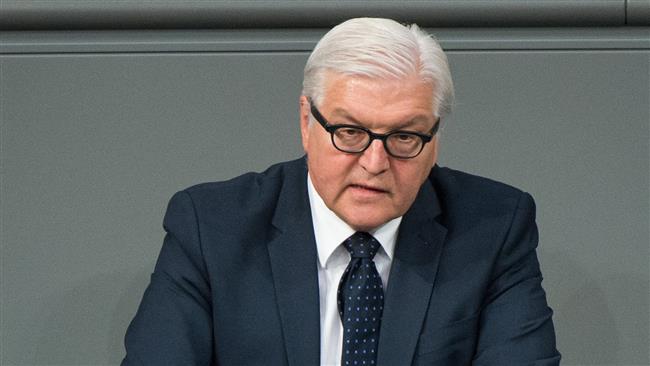
Comprehensive deal requires political resolve: German FM

Steinmeier germany fm

Steinmeier said in an exclusive interview with IRNA that the context of the deal must be watertight to avoid different interpretations.

He added the economic and financial sanctions would be lifted entirely on the primary stage of the deal to make the Iranian people enjoy benefits of the deal soon. The following is the full transcript of the interview:

What can Europe (both at member state and at EU level) do to bolster the nuclear negotiations until the JCPOA is concluded?

In Lausanne we achieved a historic framework agreement. We have thus already shown what many had doubted: that an agreement is possible which enables Iran to use nuclear energy peacefully, as well as in a way which is technologically and economically viable, which will bring the sanctions to an end and, at the same time, gives the international community durable and verifiable guarantees that Iran will not seek to acquire nuclear weapons.

The principles for a comprehensive agreement are thus in place. I hope that no‑one will call these principles into question again. Our task now is to set forth the mutual commitments in such detail that the two sides can be sure that the text is watertight and that there will be no disputes in future about its interpretation.

In your view, what are the most difficult issues still to be resolved?

For us, transparency is a key criterion. That means that the IAEA must be able to fully verify compliance with everything that is agreed, in all of the country. I know that there is a contentious debate about this in Iran.

I believe, however, that this issue can be resolved, also because Germany – just like all other states which have ratified the Additional Protocol to the Non-Proliferation Treaty – grants the IAEA unrestricted access. Thus, this is not about spying on military facilities.

Furthermore, there is a series of complex technical issues which still have to be resolved, for instance in the sphere of centrifuge development as well as the modalities for lifting the sanctions. Nevertheless, I believe here, too, that we can find solutions if the political will is there.

Let us turn to the lifting of the sanctions: why should Iran agree to a final nuclear agreement if, in the end, not all sanctions against Tehran are lifted at once? Are the latest sanctions against some Iranian banks and companies even in keeping with the spirit of the Geneva agreement and the Lausanne declaration? How can trust be rebuilt at all?

We have offered to provide relief for all economic and financial sanctions during the first phase. That will bring about improvements from which Iranians will benefit quickly, especially when it comes to the balance of payments and the exchange rate. Experts estimate that lifting sanctions will result in economic growth of between five and seven per cent and to a fall in the unemployment rate of about three per cent. That would create around one million new jobs.

Our experts have therefore been working around the clock since agreement was reached in Lausanne to create the prerequisites that will enable us to fulfil our part of the agreement punctually and in full when the time comes.

How concerned are you about the problem of xenophobia and Islamophobia in Germany? How dangerous is the Pegida movement in your view?

I believe that Pegida has long since had its day. It was a destructive phenomenon which not only damaged our standing abroad but also democratic coexistence in Germany. I am glad that in every place where Pegida appeared, they were far outnumbered by people attending spontaneous counter-demonstrations, thus making it clear that Germany remains a tolerant and outward‑looking country. We will not let ourselves be divided, neither by islamophobes nor terrorists.

In your view, in which areas should German‑ Iranian relations be especially fostered? Do you see a level of interest in Germany as high as we do on the Iranian side? Can Iran once more become Germany’s No. 1 trading partner in the Middle East? How can cultural relations between Germany and Iran develop?

It is true that Germany was Iran’s most important trading partner before the nuclear dispute. Germany imported 1.5 million tonnes of crude oil each year from Iran, while German trucks, engines and machinery were manufactured in Iran. If we can finally manage to resolve the nuclear issue, we will have the chance to build on these foundations. Iran and Germany have a lot to offer to each other – incidentally, also in the cultural sphere. I am not only referring here to the centuries-old mutual  fascination of our poets and artists. Before the dispute about Iran’s nuclear programme, for example, the German school in Tehran was the largest German school abroad. Many thousands of Iranian students and academics are studying and working at the best German universities. The German‑Iranian author and Islamic scholar Navid Kermani has just been awarded the best‑known German literature prize. That is an indication of how much potential for vibrant exchange there will be once the obstacles have been removed.

Several European foreign ministers have visited Iran during the last 18 months. Do you have any concrete plans to visit Iran?

It is well‑known in Germany that Iran is a fascinating travel destination. However, other criteria are more important to a foreign minister. I am convinced that if we reach an agreement in Vienna, that would also provide us with an opportunity to develop our relations in other spheres.

Bilaterally, there is much potential for more exchange between Germany and Iran. Moreover, when it comes to defusing the pressing conflicts in the region, it would be worthwhile to explore where we could engage in more cooperation. So there is certainly enough to talk about during a visit to Tehran – if we finally manage to resolve the dispute surrounding Iran’s nuclear programme in Vienna.

Iran believes itself to be an indispensable partner in bringing peace to the Middle East. The West still seems to take a different view. Could that change with a possible nuclear agreement and could Iran then be regarded more as a partner?

Iran has much influence in the region due to its geographical location, its rich culture, its well-educated population as well as its dynamic economy.

An Iran which lives side by side in peace and trust with its neighbours would have much to offer to the region. We believe that this must include recognition of Israel’s right to exist.

And a successful attempt must be made to defuse the ever more heated confrontation among religious communities in the region. My fear is that not only in Syria and in Iraq but also on both sides of the Persian Gulf and even in Yemen, the fatal perception is taking hold that what we are witnessing are not political conflicts which can be resolved politically but, rather, an implacable enmity between Shiites and Sunnis. When the centuries‑old peaceful coexistence between the different religious communities is called into question, that poses a threat to all states in the region, not least Iran. That is why it is a matter of urgency that we enter into a process to re-establish trust and tolerance. Iran bears considerable responsibility here. Indeed, I hope that once agreement has been reached on Iran’s nuclear programme, there will be an opportunity to think about new forms of cooperation.

Iran has shown resolve in the fight against the terrorist organisation IS. What role do you believe the Islamic Republic can play in the fight against militant jihadism?

Above all, we have to avoid the mistakes of the past, which made the advance of ISIS possible in the first place. Mosul did not fall into the hands of ISIS because the Iraqi army lacked weapons or ammunition, but because the soldiers – and a portion of the population – were not prepared to fight for an Iraqi state which they felt had abandoned them. In the long term, therefore, it will not be possible to defeat the ISIS phenomenon with military means alone. More than anything else, political progress is needed.

Everyone must help to overcome the rifts between the religious communities in Iraq and to offer the Sunni population a stake in the Iraqi state once more. That will only succeed if, for example, the Iraqi army leads the fight against ISIS in Ramadi or Mosul rather than sectarian militia which the local population fears. Support from Iran in this endeavour would be more important in the long term in the fight against ISIS than any missiles or air strikes.

It seems that Tehran has a vital role to play in reaching a political settlement in Syria. Do you see a paradigm shift here, also on the West’s side, a realisation that Iran has to be included? What role would you like to see Iran play?

If a large proportion of the Syrian population only has the choice between Assad’s barrel bombs and the ISIS butchers, any attempts to bring about a political solution seem ever more remote. The longer the conflict lasts, the more foreign extremists and sectarian militias set the tone, the more difficult it will be to maintain a basis on which all communities can live together in peace in Syria. No country has more influence on the Syrian Government than Iran. I hope that Iran will use this influence to bring the Government to the negotiating table as long as there are still forces on both sides who want peace and with whom a dialogue is possible.
A historic twist and betrayal of nation

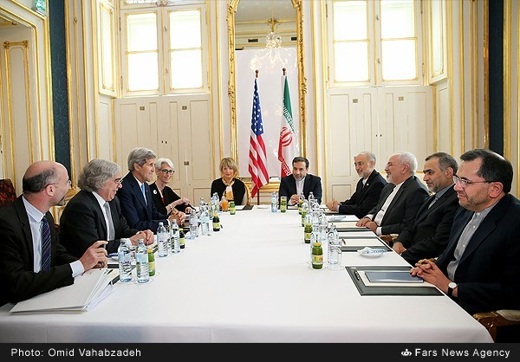
Iran Talks vienna

Distortion of ground realities and bending the truth is one of the most effective ways to mislead a society and influence public opinion. This ominous phenomenon will be still more effective when 1) it is about an issue with a historic background and 2) it aims to affect a generation which was not born to see certain events firsthand.

These are the opening sentences of an opinion piece bylined by Hossein Shamsian on Iran’s nuclear talks with P5+1 the Kayhan daily published on June 29. The following is the translation of excerpts of the piece:

[…]

Iran is going through a historic stage in its confrontation with its number-one enemy, the US, these days. On a battlefield as vast as the Islamic Revolution, a big, fierce fight is raging over the rights of the Iranian nation. With the warriors of the diplomatic front backed by the nation lining up against the enemy across the negotiating table, some are singing a different tune – instead of showing solidarity – trying to keep society in ignorance by humming the ominous tune, give false clues to the [diplomatic] warriors, and finally prevent the commander from making a decision in keeping with national expediency.

Instead of recalling US crimes and helping people rally around officials, these people are seeking to depict Great Satan, which is a horrible monster, as a kind and mild-mannered angel. The inevitable result would be nothing but disputing the resistance of people on the diplomatic front and negating any resistance to and vigilance against the US, because when you face a kind angel, there is no need to show distrust and defy what she seeks.

What they do is definitely an unforgettable betrayal of the nation and its history. This unfair behavior should not be forgotten under any circumstances. […]

Who are the people who try to distort history and paint a pretty picture of the enemy? […]

First: A group of people are trying to ignore the poor track record of the enemy. This group – that may have taken the toughest stances against the US in the past – talks about anything these days but the US animosity toward a nation which seeks nothing but its independence.

When they raise [people’s] pocketbook issues, insufficiency of credit for the country’s infrastructure or the pain the sanctions have inflicted on people, they never say who has imposed the sanctions and created the problems [for the people]. They say sanctions have put the squeeze on people, but they fail to tell people that the US has slapped these unjust sanctions. […]

They fail to say that the US is the very monster which has blocked and is blocking the sale of plane parts, medicine, medical equipment, agricultural fertilizer, pest control products and many other items to Iran. They fail to say that the US has frozen billions of dollars of Iran’s national wealth since the early months after the victory of the Islamic Revolution and refused to give it back to Iran to date. They fail to say that the US has paid big chunks of Iran’s money as reparations to the families of fallen Israeli servicemen. They fail to say these facts because their mission today is to make up the ugly and terrible face of the US for the young generations.

Second: Another group does not deny US crimes and meddling but plays down the issue and tries – through pretense and negligence – to divide it into two parts: the enemy’s past which they admit was problematic and its present-day situation [about which they say] we are facing a polite and well-mannered rival. […]

The third group identifies the US as a superpower which has the final say on everything in the world. By playing up the economic and military might of the enemy, on the one hand this group strikes fear into the hearts of those have put up resistance, and on the other, leads thinkers and policymakers to wrongfully assume that all roads lead to Rome. “If you want welfare, industrial might, civilization, arts, sports, morality and politeness, you name it, it should be sought in relations with and submission to the US,” they suggest.

They make such suggestions, but fail to answer the following questions: If the US is the utopia they are suggesting it is, why is it that they keep silent about the 99 percent movement and the million-man marches the poor hold in protest at the conduct of the one percent?  Why is it that the countries which are totally dependent and devoted [to the US] have teetered on the brink of explosion thanks to economic and social inequalities and hardships? What is the reason behind daily protest rallies and massive strikes in European countries and other allies of the US? On which front is Iran – that is deprived of US favors – lagging behind its neighbors that are blessed with the favors the US bestows on its regional stooges?

They fail to answer these questions because in that case events would not unfold according to the [pre-planned] scenario. They fail to admit that Iran is the world’s 17th country in terms of science and 20th in terms of economy and lots of other proud achievements (according to international statistics) thanks to the fact that the country has severed ties with Great Satan. This has placed Iran in a position which seems to be an unattainable dream for many US friends and allies.

Who are those people and what objectives are they pursuing? Part of this mission is accomplished by the media outlets which are fed directly and indirectly by the enemies of the Islamic Revolution. Acting against the professional mission of news media which calls for telling the truth and reflecting the realities, such media dictate their own “dreams and illusions” as “news items” in a bid to make the steps of their savior [the US] sound euphonious. […]

In addition to these media outlets, a number of politicians too are busy painting a nice picture of the enemy in the midst of the historic battle [between Iran and the US]. […] This group – whose members are from political has-beens – poses no threat other than the headache they cause by what they publish every day in “chain” newspapers [a reference to reformist-leading dailies]. They also mislead the enemy by feeding misinformation and sending the wrong signal about their weight and credibility.

What is the real intention of these “makeup people” who paint the face of the US? What do they pursue at this historic crossroads? […] They pursue three objectives. First they try to make the negotiating team feel intimidated by the US, inevitably forcing them into submission to the enemy’s acquisitiveness by inflating the power of the rival and the threat of an imaginary war.

Second, they try to depict the US as a trustworthy country which wishes good for people. This would help impose a distorted and one-sided text on the Iranian nuclear team instead of helping prepare a firm deal which will be subject to no interpretation.

Third, they point to the US as the country which would bring economic relief [for Iran] and instill a misconception into the Iranian team that they need to give in to unjust and inhumane US demands if they seek to do something for the welfare and comfort of the Iranians.

Remarks by the Supreme Leader in his recent meetings, especially the meeting on April 9 or the one with government officials, have clearly and astutely set the establishment’s nuclear red lines, suggesting that nobody is allowed to overstep them and that these wrong and deceptive signals can do nothing to influence the historic decision of the Iranian people, one way or another. What the Supreme Leader has said is a unique yardstick to identify the enemy’s supporters in trying times and tell the [nation’s] traitors and servants apart.

Talks are in a sensitive phase: Zarif

Zarif-Press

Iranian Foreign Minister Mohammad Javad Zarif said Tuesday that nuclear talks between Iran and P5+1 have now reached a sensitive phase.

The only agreement the Iranian nation accepts is one which is fair and balanced, Zarif said upon arrival in Vienna.

The agreement should preserve the nation’s rights and be based on national dignity, said he.

He added he feels there is possibility of progress with the help of political determination and hard work.

What we need today is the other side’s political determination that can smooth the path to an acceptable and sustainable conclusion, he added.

Zarif said he thinks the other side understands that a good long-lasting agreement would be out-of-reach unless the rights of the Iranian nation are recognized.

Asked about hope for a comprehensive agreement, he replied that the talks should be balanced and reasonable.

All Iranian officials have announced that they are ready for exchange of reasonable and logical talks, he said.

If the two sides reach any agreement, it should be based on what both Iran and the Western states accept, Zarif said.

If the two hold talks based on Lausanne statement, there would be a possibility for finding proper solutions, noted the Iranian foreign minister.

Asked about the existing disagreements, Zarif said the text of agreement would not be concluded unless all of its aspects are reviewed, adding we should pass this phase.

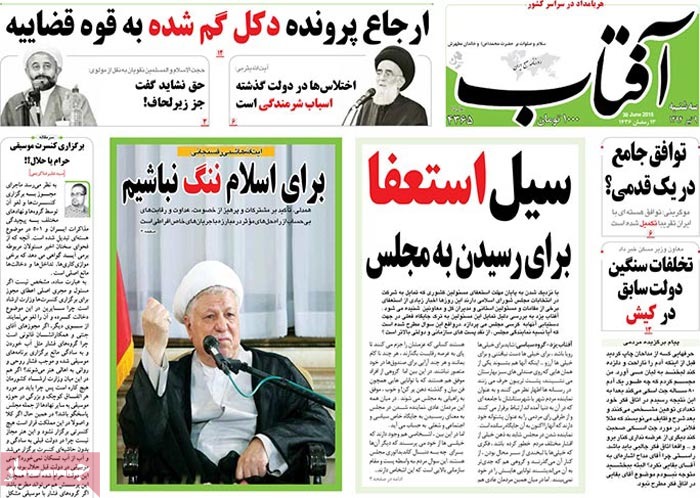
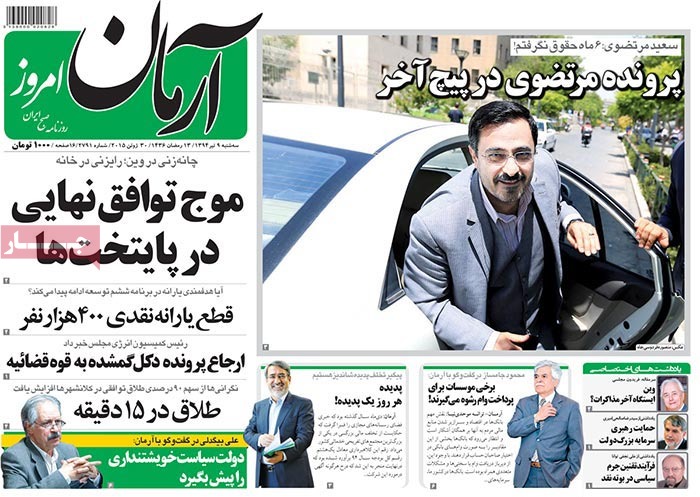
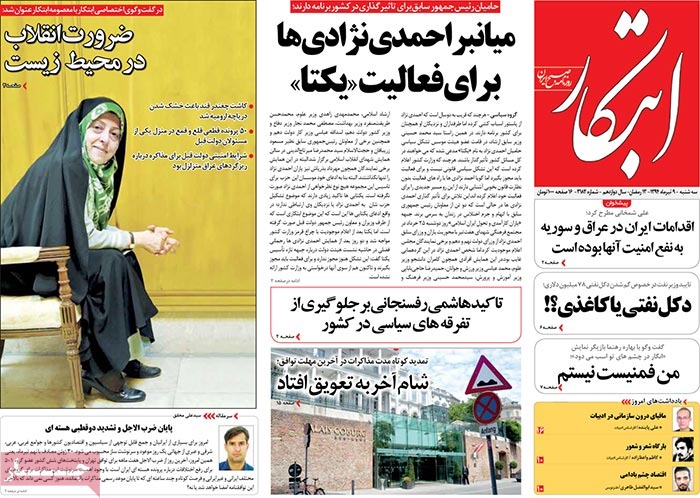
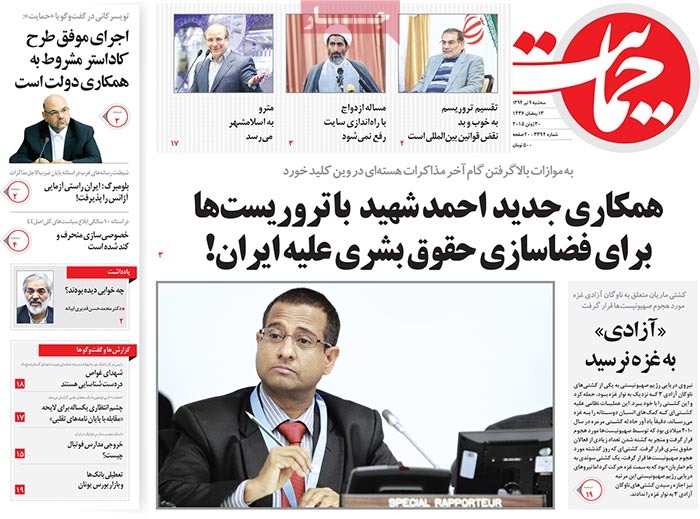
A look at Iranian newspaper front pages on June 30

Iranian Newspapers Headlines

News about the home stretch of nuclear talks between Iran and P5+1 dominated the front pages of Iranian newspapers on Tuesday.


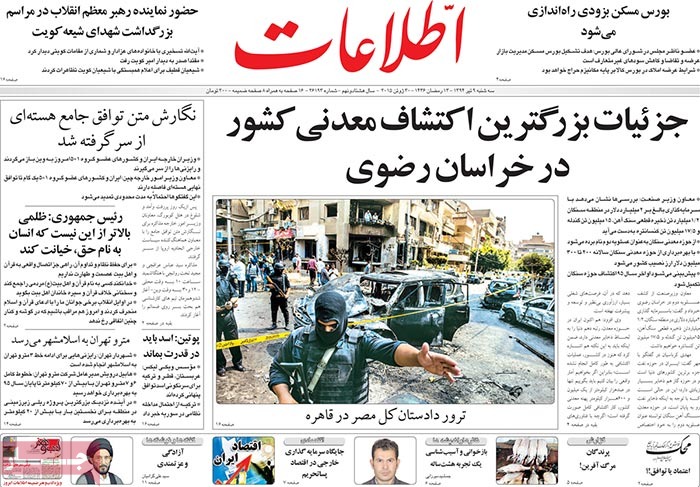
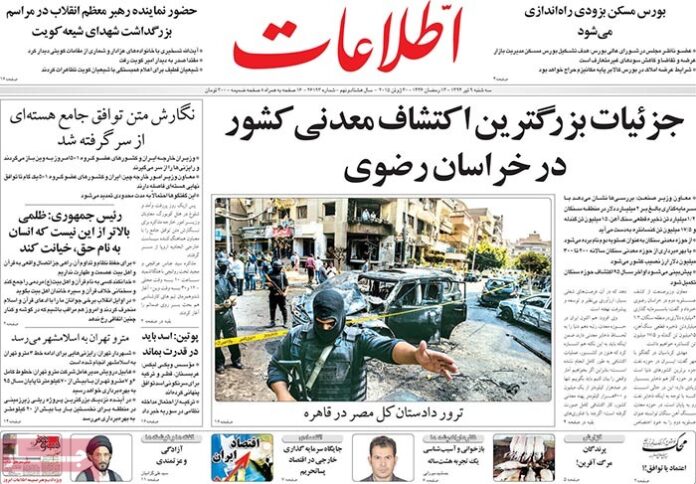
Ettela’at: The biggest mineral find in the country in Khorasan Razavi Province

The deputy industry minister says studies suggest some $2 billion in investment in Sangan will yield 1.2 billion tons of iron ore, 15 million tons of pellets and 17.5 million tons of concentrates.

When fully operational, Sangan, which is described as Iran’s second Assaluyeh [a giant gas field Iran shares with Qatar], will bring in between $200-$300 million in hard currency each year.


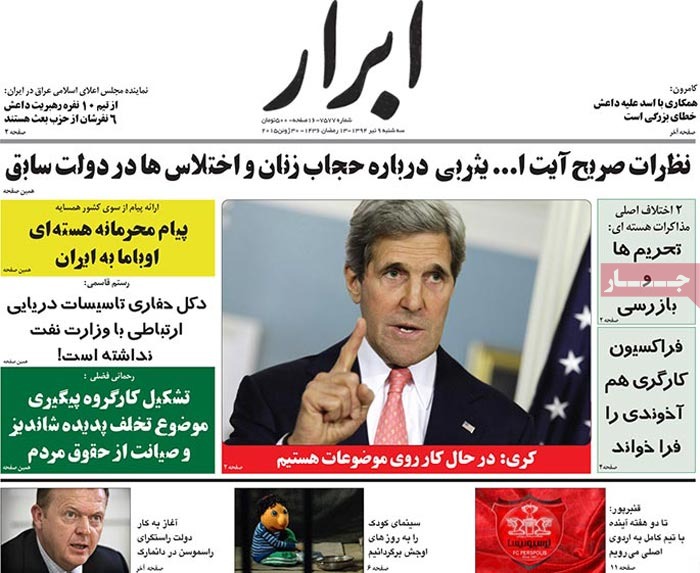
Abrar: The Iran representative of the Islamic Supreme Council of Iraq has said that six of the 10 members of the IS leadership council are Baathists.

Abrar: Obama has sent a secret nuclear message to Iran through a neighboring country.


A look at Iranian newspaper front pages on June 30


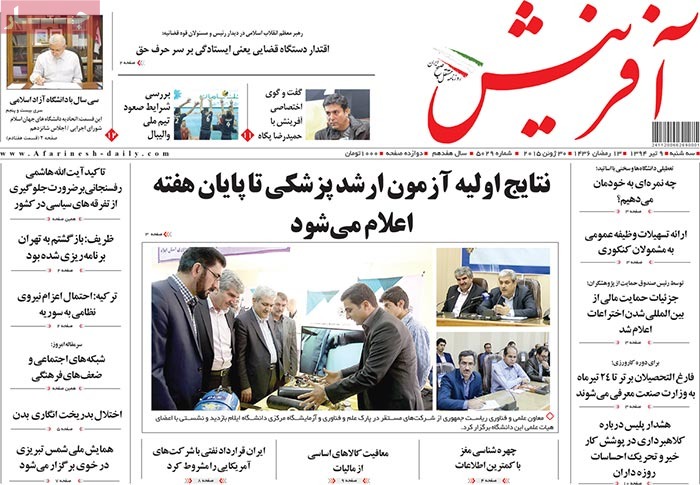
Afarinesh: Ayatollah Akbar Hashemi Rafsanjani has underlined efforts to prevent political division in the country.


A look at Iranian newspaper front pages on June 30


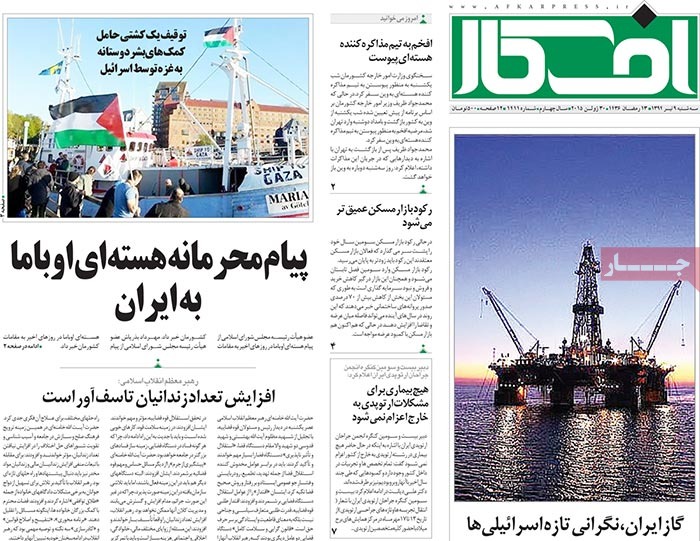
Afkar: Foreign Ministry Spokeswoman Marzieh Afkham has joined Iran’s negotiating team in Vienna.


A look at Iranian newspaper front pages on June 30


Aftab-e Yazd: “The embezzlements committed when the previous government was in office are a source of shame,” said Ayatollah Yasrebi, the head of Kashan Seminary School.

Aftab-e Yazd: A stream of resignations [by public officials] to run for parliament.

[Under Iran’s electoral rules, candidates should not hold public office when running for elected office.]


A look at Iranian newspaper front pages on June 30


Arman-e Emrooz: The chairman of parliament’s Energy Committee has said that the case involving the disappearance of an oil derrick [when Ahmadinejad was president] has been referred to the Judiciary.


A look at Iranian newspaper front pages on June 30


Ebtekar: “What Iran has done in Iraq and Syria has served the cause of security,” said the secretary of the Supreme National Security Council.


A look at Iranian newspaper front pages on June 30


Hemayat: Ahmed Shaheed, the Special Rapporteur on human rights in Iran, is working in cahoots with terrorists to make rights ballyhoo about Iran.


A look at Iranian newspaper front pages on June 30


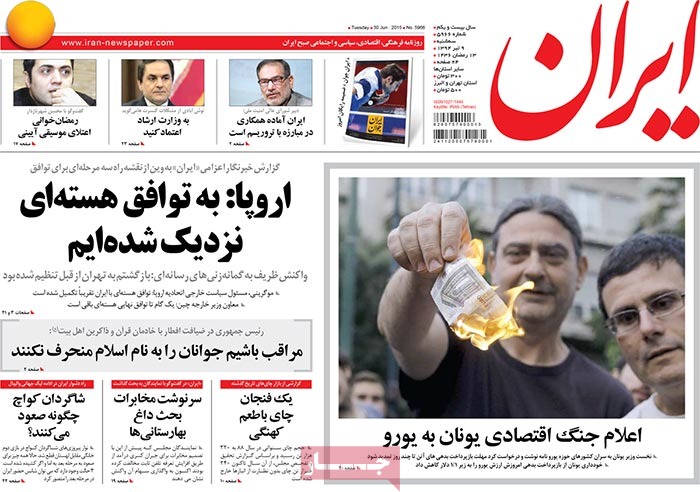
Iran: “We should be careful not to allow some to lead our youth astray in the name of Islam,” said President Rouhani.


A look at Iranian newspaper front pages on June 30


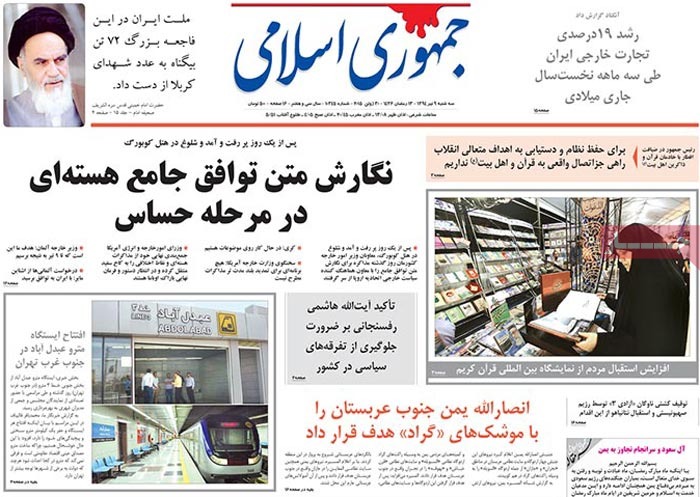
Jomhouri Islami: Iran’s foreign trade has registered a 19 percent rise in the first quarter of 2015.


A look at Iranian newspaper front pages on June 30


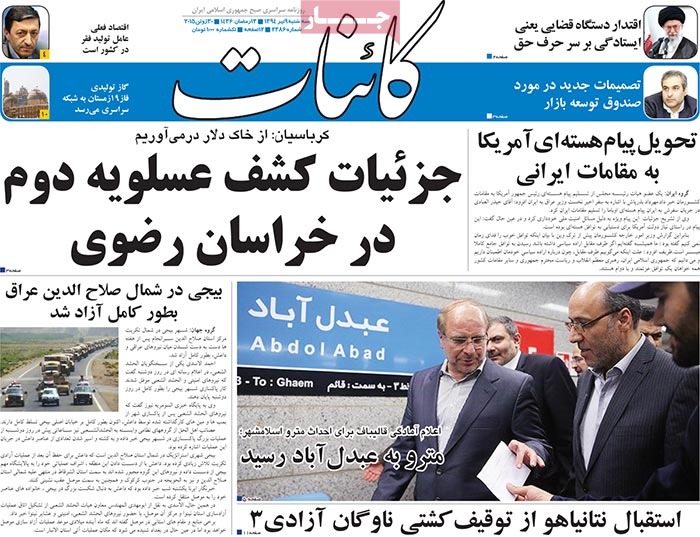
Kaenat: The Iraqi city of Baiji has been liberated; IS is on the run.


A look at Iranian newspaper front pages on June 30


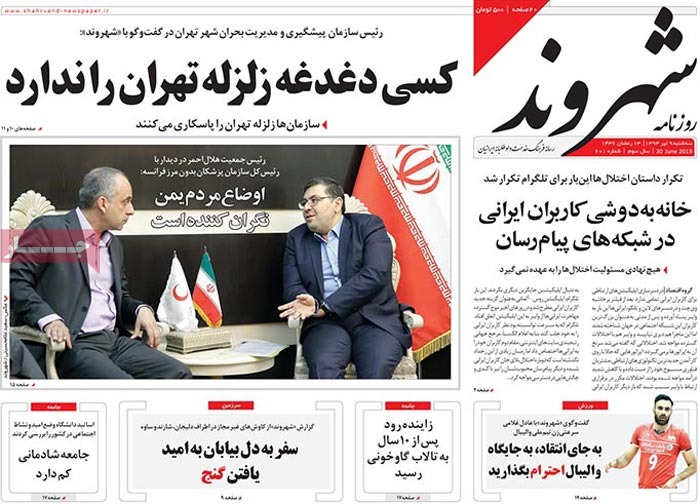
Shahrvand: In a meeting with the president of Médecins Sans Frontières (MSF), the head of Iran’s Red Crescent Society has said that the situation of the Yemeni people is alarming.


A look at Iranian newspaper front pages on June 30

Highlights of Ettela’at newspaper on June 30

ettelaat-30-june

 The biggest mineral find in the country in Khorasan Razavi Province

The deputy industry minister says studies suggest some $2 billion in investment in Sangan will yield 1.2 billion tons of iron ore, 15 million tons of pellets and 17.5 million tons of concentrates.

When fully operational, Sangan, which is described as Iran’s second Assaluyeh [a giant gas field Iran shares with Qatar], will bring in between $200-$300 million in hard currency each year.

 Egypt’s top public prosecutor has been killed in a bomb attack in Cairo.

 A housing stock exchange is to be launched soon.

The launch is designed to manage supply and demand on the housing market and put a lid on unconventional profits some rake in.

♦ The Supreme Leader’s envoy has attended a service for Kuwaiti Shiites martyred in a terrorist bombing in Kuwait City on Friday.

Ayatollah Taskhiri met with the grieved families of the martyred worshippers targeted in a mosque and a number of Kuwaiti officials.

♦ Meetings to nail a final agreement [between Iran and P5+1] have resumed.

The foreign ministers of Iran and P5+1 will return to Vienna later today to resume nuclear talks.

♦ “No injustice is worse than betrayal in the name of service,” said President Rouhani.

♦ Russian President Vladimir Putin has said that Syrian President Assad should remain in power.

Turkey has said that military intervention in Syria is a possibility.

♦ The Capital’s subway service is to be extended to Islamshahr [a town to the southwest of Tehran].

The managing director of Tehran Subway Company said that two new underground lines will be launched by March 2017.

 ISIS officially launches activities in Yemen

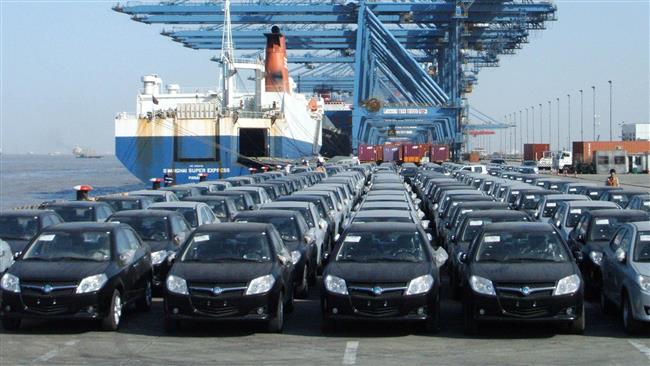
Iran car imports down 51%

Cars import

Newly published figures suggest that Iran’s car imports significantly dropped in the first quarter of the current Persian calendar year (starting on March 21).

According to official statistics, the number of foreign cars brought into Iran in the Q1 dropped by 51% year-on-year.

In total, 10,555 cars were imported in the first three months of the current year, more than 50% down from 21,500 cars brought into the country during the same period last year.

The plunge is as part of the Iranian government’s plans to slash car imports in an effort to boost the country’s domestic auto industries.

The automobile industry is seen as Iran’s biggest non-oil sector, accounting for nearly 10% of the country’s gross domestic product (GDP).

Iran Khodro and Saipa account for more than 90 percent of the total domestic production in Iran.

Latest data shows that Iran ranks 18th on the list of the world’s top auto manufacturers.

The 2014 production statistics by the International Organization of Motor Vehicle Manufacturers (OICA) indicate Iran’s auto production increased by 46.7 percent in the 12-month period.

The figures show Iranian automakers produced 1,090,846 cars and commercial vehicles last year.

Meanwhile, Iran’s media reported on Saturday that the country’s auto industry could see a major rise in production of cars in 2015.

According to a survey conducted by the Business Monitor International (BMI), the production of cars in Iran could witness a 28% increase if Tehran and the P5+1 group of countries manage to secure a final deal over the Iranian nuclear program.

The BMI has added in its report that the final Iran deal – if ever reached – will play a crucial role in the development of the country’s auto industry.

BMI also forecast that Iran’s total auto output could rise to above 2 million cars within five years.

Iran, P5+1 resume work on drafting text of final nuclear deal

Araghchi-nuclear talks

Senior representatives of Iran and the P5+1 group of countries have held talks on drafting the text of a possible final agreement over Tehran’s nuclear program.

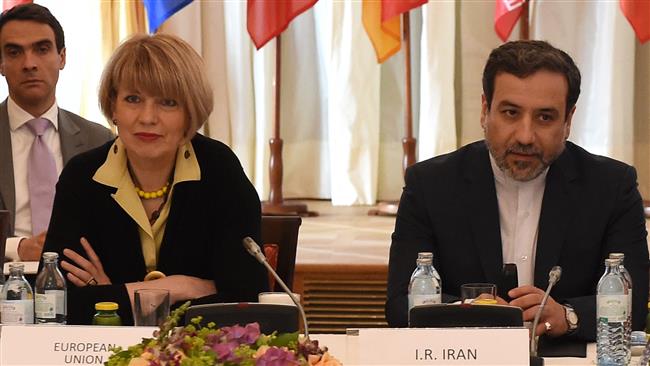
The Iranian deputy foreign ministers, Abbas Araghchi and Majid Takht-e Ravanchi, held a three-hour meeting with European Union deputy foreign policy chief Helga Schmid in the Austrian capital, Vienna, on Monday.

The members of Iran’s negotiating team also held discussions with US Under Secretary of State for Political Affairs Wendy Sherman on the draft of the final deal.

Experts from Iran, led by director general for political and international security affairs at Iran’s Foreign Ministry, Hamid Baeidinejad, and the six world powers held simultaneous talks.

Iran and the five permanent members of the UN Security Council – the United States, France, Britain, China and Russia – plus Germany are holding talks to finalize the text of a possible deal over Iran’s nuclear program by the end of June.

The two sides reached a mutual understanding on the key parameters of the potential deal in the Swiss city of Lausanne on April 2.

Foreign ministers returning to Vienna

Foreign Minister Mohammad Javad Zarif, who returned to Tehran from Vienna early Monday, is scheduled to rejoin the nuclear talks later on Tuesday.

Director of the Atomic Energy Organization of Iran Ali Akbar Salehi and Hossein Fereydoun, Iranian President Hassan Rouhani’s special aide, are also set to join the negotiating team.

French and German foreign ministers Laurent Fabius and Frank-Walter Steinmeier as well as British Foreign Secretary Philip Hammond are set to return to the Austrian capital for sensitive nuclear talks as a self-imposed June-end deadline arrives Tuesday.

[…]

Minister submits President Rouhani’s message to Algerian counterpart

Iran-Algeria

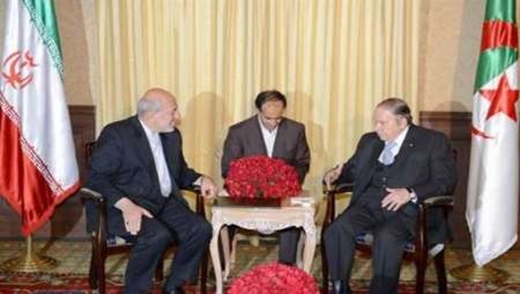
Iran’s Energy Minister Hamid Chitchian on Monday submitted President Hassan Rouhani’s message to Algerian President Abdelaziz Bouteflika, inviting him to attend a 3rd Summit of the Gas Exporting Countries Forum (GECF) which will be held in Tehran on November 23, 2015.

Bouteflika thanked the Iranian minister for the invitation and wished success for Tehran in holding the GECF meeting.

He referred to the falling oil prices and their economic impact and said Iran and Algeria should cooperate in this respect.

On regional developments, the Algerian president called for an end to violence and clashes, preventing bloodshed and establishing conditions for peace, stability and calm.

He said provoking ethnic and religious conflicts is a plot hatched by enemies to undermine countries’ security.

He added that his country opposes any foreign intervention in other countries’ affairs.

Calling Iran-Algeria political ties “good and strong”, he said his government is ready to bolster economic ties with Iran.

Chitchian in turn said Tehran is ready for continued consultation with Algeria in the field of oil price.

He called for the removal of executive problems standing in the way of the expansion of mutual economic relations and for a more prominent presence of Iranian companies in Algeria.

The GECF which was established in Tehran in 2001 has 18 members and observers.

[…]

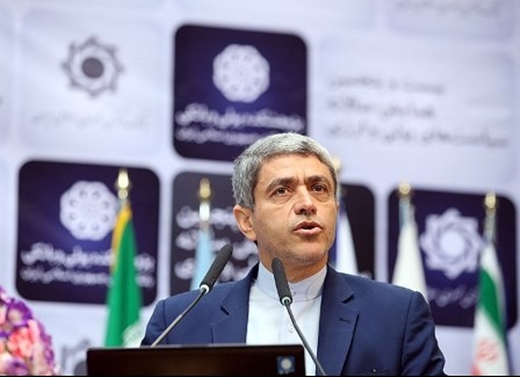
AIIB discourages poverty, promotes peace, stability: Economy chief

Tayyebnia

Iran’s Minister of Economy and Financial Affairs Ali Tayyebnia said in Beijing on Monday that establishment of the Asian Infrastructure Investment Bank (AIIB) will lower poverty and help establish peace and stability in the region.

Speaking after a ceremony to sign the articles of association (AOA) of the Asian Infrastructure Investment Bank (AIIB), which outlines the legal framework and management structure of the institution, Tayyebnia said the important role of Asian states in global economy and impact of the bank on infrastructural development of the countries to link their economy with the world, is evident.

He further said that infrastructural development of the members is the most important point for gaining access to economic integrity of the Asian countries.

He expressed hoped that future activities of the bank in financing infrastructural projects in Asia will ease the shortage of credit and help commission new activities.

Tayyebnia said he was pleased that in addition to Asian states, non-Asians, especially European states, had a share in the establishment of the bank, and said such contribution is indicative of the serious endeavor of other countries toward sustainable economic development and living standards of the public.

Meanwhile, Chinese Finance Minister, Lou Jiwei, in a speech to the AIIB meeting, expressed hope that the AIIB will be helpful in the development drive of the Asian continent.

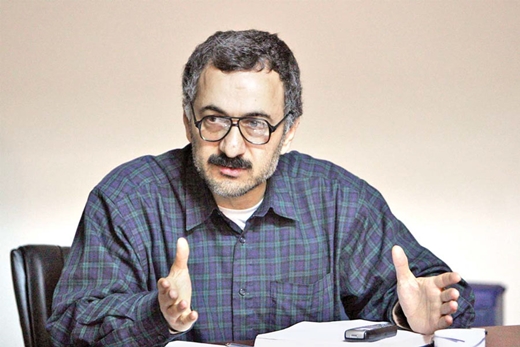
Laylaz: Iran’s economy is not sanctionable (PART ONE)

leilaz_saeed

An Iranian economist says that from 2005 onward Iran’s economy has grown more dependent on imports thanks to the organized, systematic and intentional measures [the governments have adopted].

Saeed Laylaz, who is also a journalist, a university professor and a former advisor to President Mohammad Khatami, made the comment in an interview with Khabaronline.ir and added although the removal of sanctions is necessary for the country, it will not work miracles.

The following is a brief translation of PART ONE of his remarks in the interview preceded by an introduction by Saeed Jafari Pouya, the interviewer:

Saeed Laylaz is among a handful of economists who know history and can analyze international politics. The experts in economics are usually versed in their own territory and perhaps have no interest in taking a broader look at political and international developments.

Laylaz, however, is blessed with these characteristics, something which renders him an outstanding analyst in international economics and politics. More than sanctions, he says, the sometime deliberate mismanagements of the previous government have created such a [problematic economic] situation in the country.

Iran’s construction is possible even under sanctions

Basically, the Iranian economy is not sanctionable. If you look back at the country’s experience over the past 20 years, you will realize that what I say is true. The D’Amato law [the “Iran Foreign Oil Sanctions Act” introduced by Senator Alfonse D’Amato (R-NY, 1981-1998) on September 8, 1995 to sanction foreign firms’ exports to Iran of energy technology] was never revoked. The act mainly focused on Iran’s oil, gas and petrochemistry industries, the same areas Iran posted the most growth in after the introduction of the congressional act. The reason: the establishment and government wanted to make progress in these areas despite all domestic problems.

Americans slapped most despicable embargos against Cuba

No ties in the world are more unequal and unfair than those between the US and Cuba. The embargos the US slapped against Cuba are among the most despicable ones. Cuba’s embargos which have been in place for more than 50 years have been worse than Iran’s.

They wouldn’t even sell Iraq pencils

I realized during a trip to Iraq in 1996, when the sanctions [against Iraq] were at the highest level, that the Iraqi children did not have pencils. When I inquired about the reason behind the shortage of pencils, officials told me pencils had been on the sanctions list as a dual-purpose item  with the West arguing their graphite deposit could be used for raising the resilience of the warheads and ballistic missiles.

Economic sanctions crush low-income people 

Where in Iran do you think we can find a place that bears resemblance to a country hit by sanctions? You can ask foreigners who come to Iran whether Iran looks like a country under sanctions. Sometimes the luxury items which are at many people’s disposal in Iran are not as plentiful in Europe and other developed countries. …

Of course, I do not say that sanctions have not brought pressure to bear on people. That the low-income layers of society have felt the pains of sanctions is a separate case, I want to say that the socio-political structure of Iran is not like that of a country which is reeling under tough sanctions. Such sanctions do not deliver a meaningful blow to the country.

Sanctions don’t bring nations to their knees

Since the Napoleonic era, which marks the beginning of the modern-day sanctions, no governments have been brought to their knees because of sanctions. In Cuba’s case, it was the United States that was brought to its knees. Given the situation in Iraq, the US resorted to military action and an internal agreement was the endgame when it came to [sanctions against] other countries such as South Africa.

Iran is a country which has admittedly a $40b smuggling problem to deal with on an annual basis. That comes despite the fact that around 150,000 border guards are constantly clamping down on traffickers. What if the government looks the other way? Isn’t it possible for smuggling to add up to $100b? The answer is a definitive yes.

Iran’s economy hit by mismanagement more than sanctions

Since 2005, deliberate, organized and systematic plans have been at work to make Iran’s economy more dependent on imports. For instance, the country’s import of goods and services hit $100b in 2011, the highest in Iran’s history. The reason: a new bourgeoisie was formed in Iran the members of which knew they would be in office for a short period so they decided to accumulate wealth. They knew this would be achievable only through trade and imports, not production.

I do not believe that Iran’s economy has been hit hardest because of sanctions. Compared with the effect of mismanagement and intention to accumulate wealth through imports, the impact of sanctions [on the economy] is almost none. That’s why everybody has started to complain under the burdens of sanctions, but there is no sign of the sanctions in the country, neither in foodstuffs nor in the high-tech industries such as mobile phones. Foreign journalists who come to Iran and interview me say they are surprised by the high number of iPhones in people’s hands in Iran. It is not the case in Europe, they say.

Iran’s economy began to post a drop in efficiency in 2008 because the country had registered negative productivity and a fall in capital formation three years earlier. For the first time Iran’s capital formation was in single digits when Mr. Ahmadinejad was in office. It was a double-digit figure under President Khatami, but it turned into a one-digit number in the early years of the Ahmadinejad administration and then slid all the way into the negative territory.

Why an unprecedented global consensus against Iran?

In 2005 a sort of absurdity or lack of wisdom began to emerge in foreign policy and Iran paid a dear price for the slogans which turned out to be anything but useful, the denial of the Holocaust for instance. Such issues triggered the biggest and most powerful international consensus against a single country in the course of history. …

China and Russia too realized that some inside the then government seemed to wish for [anti-Iran] resolutions and they were walking down this path. I believe such a global consensus would have not been formed had it not been because of intentional or unintentional support by some individuals inside Iran. …

Which one is more important geopolitically, Iran or Syria? How come they [the UN Security Council members] issued resolutions against Iran five times, but they failed to issue even one against Syria? Think more about this question.

Russia has occupied Ukraine, but Germany is not ready to join the ranks of countries that are against Russia, arguing that it has around $15b in trade exchanges with Russia annually. Iran’s annual trade with China stands at $30b. It is crystal clear.

What have we done that such a broad consensus has been built against Iran? The country is blamed for its human rights record, namely for incarceration of a few people; Iran does not kill people on a daily basis, nor does it launch bomb attacks against anyone; Iran does not send arms across the border into other countries and has not occupied any country.

We had a nuclear program which was moving forward within its own framework … The measures the Ahmadinejad government adopted and the unnecessary ballyhoo it made brought this on us. Unfortunately, on the nuclear front we have moved backward.