Friday, January 2, 2026
Home Blog Page 4792

Where does the dispute over JCPOA review come from?

Parliament-Iran

In the days since the conclusion of the Vienna accord, members of the Islamic Consultative Assembly have come up with three ideas as far as the role of parliament in reviewing the Iran nuclear deal goes. These three ideas have to do with differences across party lines in the chamber.

Tabnak.ir, a news website, on August 10 ran an analytical report on political bickering in the Iranian parliament over how to review the Joint Comprehensive Plan of Action (JCPOA). The following is the translation of the report in its entirety:

These three views can be reviewed according to the role – lesser or stronger – parliament is given in the review process of JCPOA:

I. Review of JCPOA in a special parliamentary committee, not on parliament floor

II. Review of JCPOA on parliament floor and a ‘yes’ or ‘no’ vote to the general outlines of JCPOA without going into details

III. Review of every single article of JCPOA on parliament floor and possibly changing [parts of] it.

The first view, which has been supported by Speaker Ali Larijani, does not want JCPOA to be reviewed in parliament at all. If there is going to be any review, it argues, it should be held in a parliamentary committee. Days after the conclusion of the deal, the top MP underlined that parliament should not get involved in the review process, saying that the nuclear issue is dealt with under the supervision of the Supreme Leader. He argued that parliament should not be concerned about it, [because] the country’s expediency will be decided on and a report will be submitted to the chamber.

Larijani
Ali Larijani

Larijani’s view drew mixed reactions, especially from the principlist critics in parliament. The speaker seems to have gradually backpedalled on his initial stance in recent days, describing parliament’s involvement as a factor which contributes to greater support for the deal and to building a consensus among politicians.

According to the Constitution, the Islamic Consultative Assembly should make comments on such international treaties, he said, adding there are some cases – Resolution 598, for instance – on which parliament has not passed any judgment. We solve the nuclear issue; perhaps it is a better idea if parliament comments, something which will help lend support [to the deal] and form a consensus [in the country], Larijani further said.

His recent remarks and his willingness to have parliament’s comments on and support for JCPOA probably suggest that JCPOA can be reviewed in a special parliamentary committee, because he does not say outright that the deal should be reviewed on parliament floor and just stresses that it is good to have parliament’s view as well. The review of JCPOA in a special committee was raised from the very beginning. Accordingly, a special committee whose members are picked on parliament floor will review the general outlines, not the details, of JCPOA after it wins the blessing of the Supreme National Security Council.

The second view calls for the review of JCPOA on parliament floor, without touching its details. The floor review entails an in-house vote in a plenary session of the chamber with MPs saying a simple ‘yes’ or ‘no’ to the general outlines of JCPOA. Under this arrangement, articles of the deal won’t be reviewed on parliament floor and deputies can merely voice their confirmation of or opposition to the general outlines of JCPOA.

Abbas Ali Mansouri
Abbas Ali Mansouri Arani

Abbas Ali Mansouri Arani, a member of parliament’s National Security and Foreign Policy Committee, says, “Deputies will provide a simple yes or no answer to one question on JCPOA: Do you approve of JCPOA?. They will only voice their agreement or opposition. Except this, nothing will be discussed in the open session of parliament, and the MPs will not allowed to get involved in [the review of] the text. Any changes to JCPOA’s text, even the slightest, require all six countries [which made up P5+1] to come together and make comments on those changes. This is not feasible”.

The third view, which is mainly pursued by members of the Islamic Revolution Stability Front, says the government should submit JCPOA in the form of a bill to parliament and then deputies should review the details and every article of JCPOA on parliament floor. It also allows MPs to make changes to the deal. If JCPOA cannot be changed, it should be either accepted or rejected in its entirety.

Mohammad Soleimani
Mohammad Soleimani

Mohammad Soleimani, an MP who is also a member of the Islamic Revolution Stability Front, explained this view in comments he made in parliament, “By getting involved in the text and making well-reasoned and responsible comments in favor or against the text, the Islamic Republic of Iran will know that what it is going to sign.

“I wonder why some, especially in the government and a member of the negotiating team, are concerned about parliament’s involvement in [reviewing] the text. What is it in the text that should not be made public? Who would stand to lose if people and MPs learned about the upsides and downsides of the deal and voted for it insightfully?

“An expert review of JCPOA should focus on the text and let go of marginal issues, speeches and slogans. The negative aspects of the text of the deal cannot be sugarcoated through double-dealing. Contradictory, ambiguous speeches and interviews will not help carry out a task that requires expertise.

“Is it possible not to be concerned after [hearing] baseless and misleading claims that Fordow, Arak and Natanz [Iran’s three nuclear facilities] are inefficient? Breakthroughs and glories cannot be downplayed by simplification, double-dealing, and offering the proverbial worthless thing to charity. The country should not be left in the grip of problems in the future. Denying parliament its legal right is not acceptable no matter who does it, the government, parliament’s Presiding Board or the chiefs of caucuses in the chamber.”

Markooh Castle, a tourist attraction in northern Iran (PHOTOS)

Markooh Castle00

Markooh Castle in the heights of the Alborz Mountains near the city of Ramsar is an old military fortress that dates back more than eight centuries.
To get inside the castle one needs to climb some 300 stairs. Unfortunately, this historical site has not been thoroughly studied by archeologists.

Markooh Castle is visited by many tourists each year and is one of the most beautiful tourist attractions of the Caspian province of Mazandaran.

Images of the castle posted online by the Iranian Students’ News Agency:

Iran top commander: ISIL will eventually disappear from the region

139207011612065651222114

The chief of staff of the Iranian armed forces has said that ISIL will be eliminated following the developments expected to unfold in the region.

Major General Hassan Firouzabadi made the comment in an interview on Sunday and added that the terrorist group and its allies will be history in the future. Tasnim News Agency on August 9 published the top general’s remarks, and the following is the translation of part of his comments on developments in four Arab nations, namely Syria, Iraq, Yemen and Bahrain:

Syria

Thank God, the key breakthroughs Damascus has achieved on different fronts have injected new life into the central government in Syria which has proved steadfast and capable of maintaining the country’s national interests and respecting its constitutional boundaries.

The Islamic State of Iraq and the Levant (ISIL) and its allies are crumbling under the pressure of developments which are expected to play out in the country down the line.

Iraq

Mischievous measures are being taken in this country. The respected people of Iraq, Sunnis and Shiites alike, should remain vigilant. The existing shortages are not genuine. A call for street protest – sparked by certain groups which are mostly non-Muslims – an explosion targeting power lines transferring Iranian electricity to Iraq and other acts of sabotage are all aimed at showing the inefficacy of the country’s central government.

Yemen

The resistance [movement] in Yemen will be the [ultimate] winner and measures by those opposing the Yemeni people will lead nowhere. At times, they make headlines by the money they spend on what they seek and by the mobilization of hired mercenaries, but such developments have no root in Yemeni soil and in the hearts of its people. These measures will fade as fast as they have happened.

Bahrain

The situation on the ground has shown that “the one-vote-for-each-citizen” demand cannot be suppressed. The Bahraini government has to reach an agreement with the country’s elite before the opportunities slip away. It should also release popular leaders from jail to steer the developments in the right direction and serve the interests of the Bahraini government and people.

Volunteer rescue operation to save fish stranded in Zayanderud (PHOTOS)

Zayanderud0

In cooperation with the provincial Department of Environment Protection in Isfahan, a group of environmentalists tried Sunday to save fish trapped in ponds of Zayanderud, the largest river in the central plateau of Iran.

Snapshots of volunteers involved in the rescue operation released online by Tasnim News Agency:

Saudileaks 32: Saudi intelligence agency offers unsolicited aide to US against Iran’s IRGC

13940431000216_PhotoI

The documents released by the Yemen Cyber Army after it hacked the Saudi Foreign Ministry in May show that Riyadh has persuaded the US to place more Iranian IRGC commanders on its sanctions list.

The Saudi Foreign Ministry was hacked by the Yemen Cyber Army in May, and a copy of its information was sent to Fars News Agency (FNA) and another one to the whistleblower website WikiLeaks.

According to one of these documents, Mostafa bin Mohammad Habib Kowsar, the director-general of the Saudi foreign ministry for Asian states affairs, in a letter to the deputy head of the ministry’s department for bilateral relations has stated that he has received a telegraph from Khalid al-Tuwaijri, the Chief of the Royal Court of Saudi Arabia under King Abdullah, informing that Riyadh has come to realize changes in the IRGC’s chain of command.

According to Kowsar’s letter, Tuwaijri has proposed in his cable that the names of new IRGC commanders be added to the list of those Iranians who had been sanctioned internationally or unilaterally by the US which would lead to their travel ban and freezing of their assets.

The cable has also warned that Saudi Arabia doesn’t want to play an overt role in this regard and the information should be presented to the US officials secretively.

Kowsar has reminded in his letter that the measure will deliver an efficient and preemptive blow to Iran and the political future of these new IRGC commanders, and will send them a direct message to caution them that they are under international scrutiny.

Kowsar also says that Tuwaijri wants the Saudi foreign minister to be informed of what the intelligence agency has proposed.

Late in May, the Yemen Cyber Army released a portion of the information and documents that it had gained in its recent cyber-attack on Saudi Arabia’s Foreign, Interior and Defense Ministries.

The Yemen Cyber Army announced that it has hacked the website, servers and archives of Saudi Arabia’s Foreign, Interior and Defense ministries and would release thousands of these top secret documents.

The group claimed that it “has gained access to the Saudi Ministry of Foreign Affairs (MOFA) network and have full control over more than 3,000 computers and servers, and thousands of users. We also have access to the emails, personal and secret information of hundreds of thousands of their staff and diplomats in different missions around the world”.

The hackers’ statement, which said the cyber army has also attacked the Saudi Interior and Defense ministries and vowed to release their details later, was carried by several globally known hackers websites.

Following the hack in May, the Yemen Cyber Army sent a copy of its information to FNA and another one to the whistleblower website WikiLeaks.

“WikiLeaks released over 60,000 documents on Friday and vowed to release the rest in coming weeks, but we plan to release the documents in separate news items since many of them contain the names of foreign nationals who have demanded visit to Saudi Arabia, for example for Hajj pilgrimage, and their names have been mentioned among the Saudi agents. Thus releasing the list of names and documents might hurt innocent individuals who have done nothing, but applied for visa at a Saudi embassy for doing Hajj pilgrimage,” FNA English Editor-in-Chief Seyyed Mostafa Khoshcheshm said.

“The number of the documents is way beyond the 500,000 that has been announced by WikiLeaks, but they need to be checked first to make sure that they do not contain misleading information and are not harmful to innocent people,” he added.

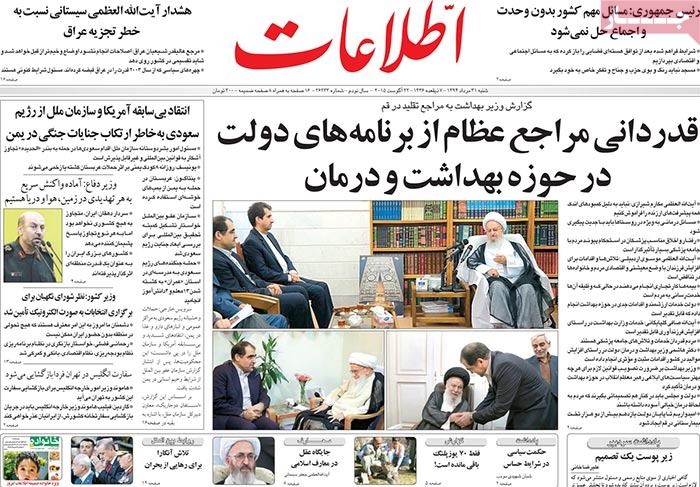
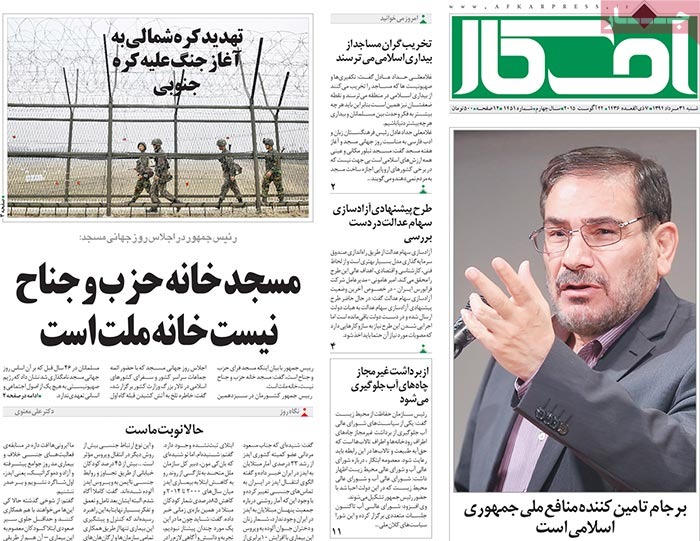
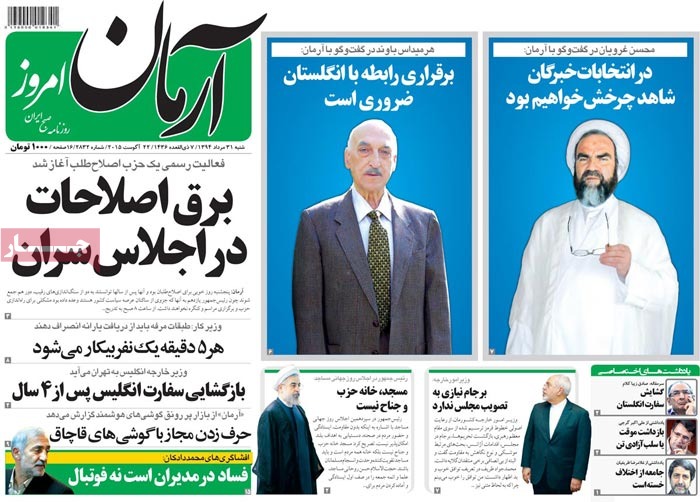
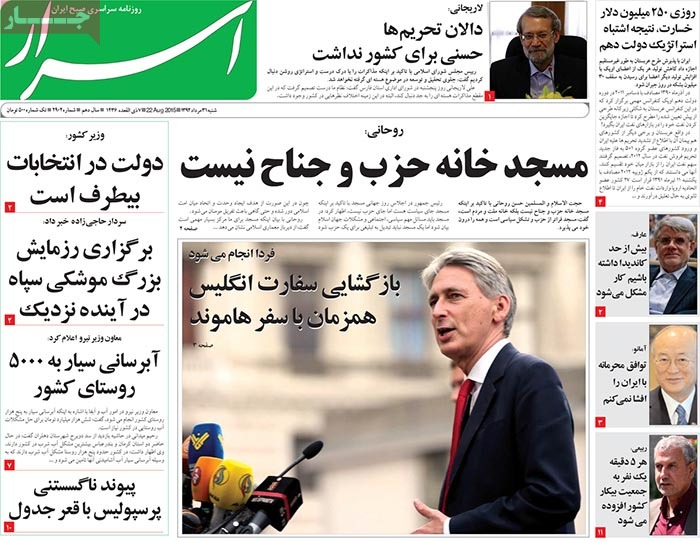
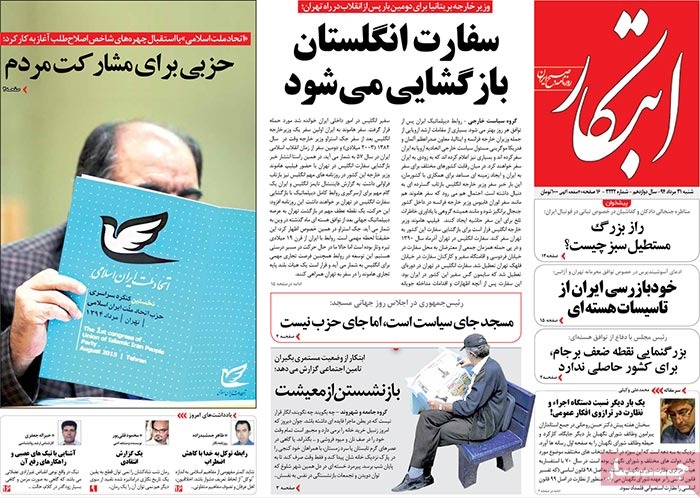
A look at Iranian newspaper front pages on August 10

Iranian Newspapers Headlines

Mehdi Hashemi, a son of the chairman of the Expediency Council, arrival at Tehran’s Evin Prison to serve a 10-year jail term dominated the front pages of Iranian newspapers on Monday. The comments of the foreign minister, his deputies and the Iranian nuclear chief in defense of the nuclear deal between Iran and P5+1 also appeared on the covers of the dailies.


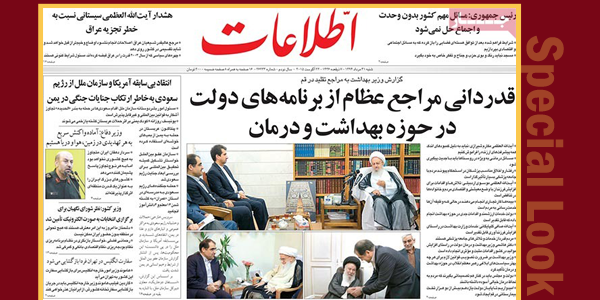
Ettela’at: “The West’s regime change policy on Iran failed,” said Foreign Minister Zarif in an Iranian diplomacy forum at Ettela’at Institute.

He further said no restrictions have been imposed on Iran’s defense capabilities [as a result of the Vienna deal].

The director of the Atomic Energy Organization said commercialization of nuclear industry is on the horizon.


Afkar: Russian warships have docked at Iran’s northern port of Anzali.


A look at Iranian newspaper front pages on August 10


Aftab-e Yazd: Japanese giants in Tehran

The daily has a report on “Tokyo’s resolve to expand economic ties with Iran”.

Aftab-e Yazd: The father saw off the son, wishing him well.

Mehdi Hashemi, a son of Ayatollah Akbar Hashemi Rafsanjani who leads the Expediency Council, has reported to Evin Prison to serve a 10-year term.


A look at Iranian newspaper front pages on August 10


Asr-e Rasaneh: “We have yet to receive any application from American firms,” said Iranian Oil Minister Bijan Namdar Zanganeh.


A look at Iranian newspaper front pages on August 10


Asrar: “The establishment should make a serious decision about health insurance,” said Health Minister Hassan Hashemi.

Asrar: “Those who were nowhere to be seen in the thick of the revolutionary struggles are now laying claim to the revolution,” said Mehdi Tabatabai, a senior religious scholar.


A look at Iranian newspaper front pages on August 10


Ebtekar: “The efforts of the government supported by the Supreme Leader prevented hardliners [from achieving their goals],” said Ayatollah Akbar Hashemi Rafsanjani, the chairman of the Expediency Council.

Ebtekar: “Claims that Iran suffered a defeat in nuclear talks are very traitorous,” said Foreign Minister Mohammad Javad Zarif.


A look at Iranian newspaper front pages on August 10


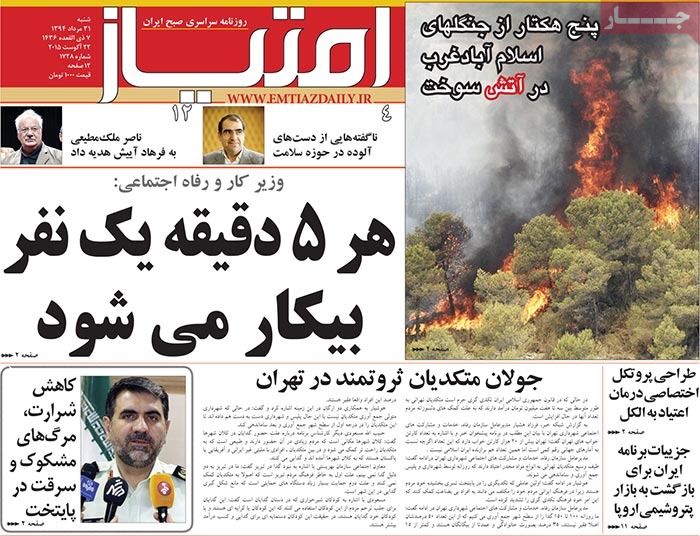
Emtiaz: The illegal drugs trade in Iran is worth around $3 billion a year.


A look at Iranian newspaper front pages on August 10


Etemad: A member of the Islamic Consultative Assembly has said the chamber’s Cultural and Judicial Committee has decided to require police to write $30-plus tickets to women who fail to observe the Islamic dress code in their cars.


A look at Iranian newspaper front pages on August 10


Farhikhtegan: Mehdi Hashemi has called on IRIB [state broadcaster] to air his defense arguments in court.


A look at Iranian newspaper front pages on August 10


Ghanoon: Parliament took its nuclear revenge on the economy, issuing a third yellow card to the economy chief.


A look at Iranian newspaper front pages on August 10


Hambastegi: “No country resents the nuclear deal between Iran and P5+1,” said the chairman of the Expediency Council.


A look at Iranian newspaper front pages on August 10


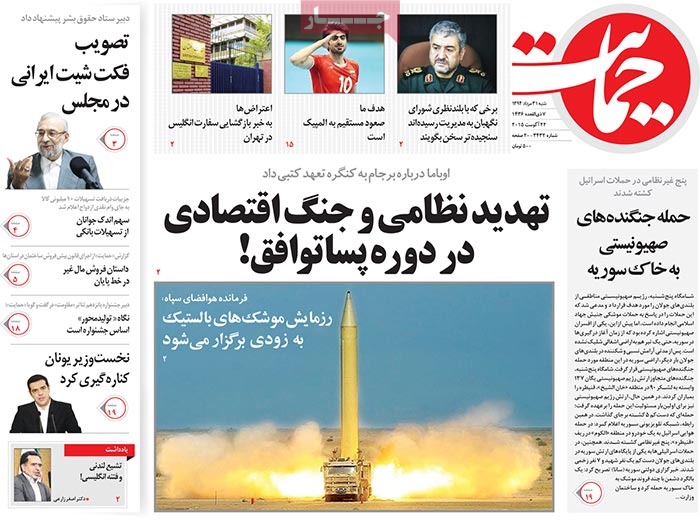
Hemayat: Mehdi Hashemi has started to serve a 10-year jail term; the judiciary stuck to implementation of justice.


A look at Iranian newspaper front pages on August 10


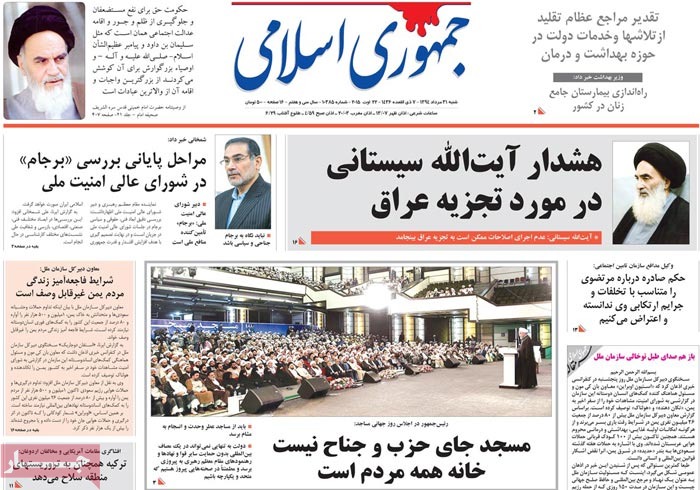
Jomhouri Islami: A new chapter has opened in economic cooperation between Iran and Japan.


A look at Iranian newspaper front pages on August 10


Kayhan: IS has issued a threat against Saudi Arabia.

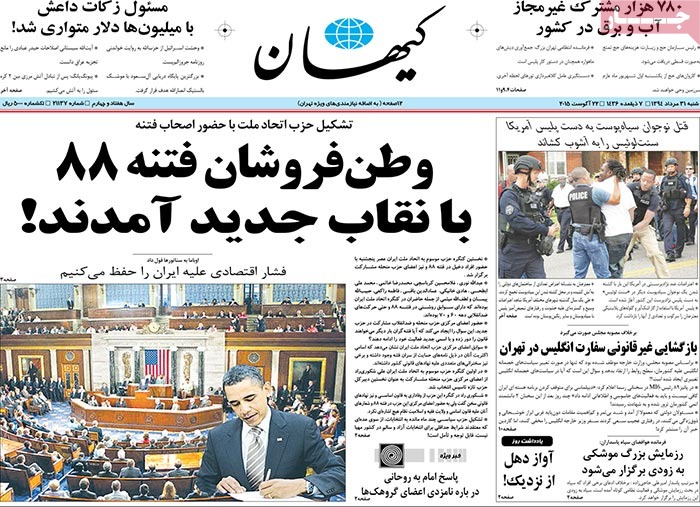
Kayhan: Reviewing the Vienna deal in the absence of critics?!


A look at Iranian newspaper front pages on August 10


Sharq: Iran’s first female ambassador to be named shortly.

Sharq: The reports issued by the Central Bank of Iran are evidence that Ahmadinejad flouted rules and regulations.


A look at Iranian newspaper front pages on August 10


Highlights of Ettela’at newspaper on August 10

Newspapers-agu10

 “The West’s regime change policy on Iran failed,” said Foreign Minister Zarif in an Iranian diplomacy forum at Ettela’at Institute.

He further said no restrictions have been imposed on Iran’s defense capabilities [as a result of the Vienna deal].

The director of the Atomic Energy Organization said commercialization of nuclear industry is on the horizon.

 A 121-story skyscraper is to be built in Tehran.

An official with the Foundation for the Oppressed has said that 11 spots in the capital are being studied for the construction of the skyscraper.

 President Obama has said that the Syrian crisis could be brought to an end in cooperation with Iran.

He has further said constructive ties with Iran can be a byproduct of the Vienna accord.

 The Iraqi prime minister has ordered unprecedented reforms in Iraq’s political structure.

The reforms eliminate the positions of vice-president and deputy prime minister.

 The Environment Protection Organization has issued a warning about land grab in mountainous areas of Damavand.

Building roads near Mount Damavand is a big mistake.

 Two rapists executed in Mashhad

A village with residents of European origin in Iran!

zargar

Residents of Zargar, a village only 100 km away from Tehran, are both Iranian and not! They have the looks of both Aryans and the Vikings! They are tall, and of course hospitable.

These villagers are Shiite Muslims who either work on farms or breed livestock. What distinguishes them from other Iranians is that their mother tongue is Romani, also known as Zargari by locals.

The origin of their language is more like a myth. These villagers themselves do not know to which part of the world they originally belong, what has brought them to Iran or how they have ended up being Shiite farmers speaking a different language in the heart of Farsi-speaking Iran.

The elderly remember an old man living in their village in the past who kept a record of his accounts in Russian. But after he passed away, Russian slipped into oblivion, and now villagers speak Romani and write in Latin.

A few years ago, some educated residents of the village posted a message in Romani on the web and appealed to those familiar with the language to visit Iran.

A few months later, three visitors from France and Britain traveled to Zargar. They were excited to find individuals sharing the same language with them in Iran.  

The three Europeans were surprised about why unlike the 18,000 Roma people based in Europe the Iranian Roma did not have any institute to represent them or why they did not take part in annual Roma gatherings in Turkey.

There are different stories as to how these villagers have ended up in Iran. One narrative says that Roma people moved to Iran centuries ago from the north. Another suggests that they were originally Iranian and were recruited as soldiers for Shah Abbas’ Qizilbash army because of their bravery.

Still another says some 200 Roma were captured during a war between Iran and the Roman Empire and were pardoned by the Persian king. Later they took up residence in an area in the vicinity of what is Qazvin today.

Although these villagers are said to originally hail from other countries, they are in love with Iran and identify themselves as Iranian only.

Date harvest (PHOTOS)

harvest0

Date cultivators across Bushehr Province are getting prepared to harvest their crops.

Snapshots of the harvest season in southern Iran posted online by Mehr News Agency:

Red lines have been upheld in Iranian nuclear program: Salehi

2903590-4449169

Director of the Atomic Energy Organization of Iran Ali Akbar Salehi said on Sunday that the red lines have been upheld in the Iranian nuclear program.

Salehi told a meeting to survey the Joint Comprehensive Plan of Action (JCPOA), signed by Iran and P5+1, that the objective of the Iranian nuclear program is to commercialize output.

Salehi expressed hope that Iran will generate 3,000 megawatts of nuclear electricity within the next 10 years.

He said the idea to generate nuclear electricity dates back to before the Islamic Revolution.

He noted that after the nuclear talks, Iran faces no limitation to continue with its peaceful nuclear program.

He said that as far as verification is concerned, the IAEA should go on with its inspection – as has been the case over the past 30 years – in Iran which is an IAEA member and a signatory to the NPT.

“As long as the world order exists and as long as we have nuclear activities, the inspection will be in place for our country and all member states,” he said.

Salehi said that there will be another form of inspection: After the Vienna deal, we should do quantitative activities, minimizing the number of centrifuges, lowering the amount of reserves to 300 kilograms. In return, they will verify that Iran honors the IAEA Safeguards Agreement. So, they will terminate all sanctions.

He added, “As far as the verification is concerned, we have accepted limitations on the purchase of equipment and they offered a list of equipment subject to limitations. […]”

After the deal we struck in Vienna, we can purchase the equipment we need through official channels; and we will lodge an official complaint in case of any industrial wrongdoing.”

On talks with P5+1, Salehi said Iran managed to gain what it wanted in the deal.

[…]