Thursday, January 1, 2026
Home Blog Page 4791

Iranian FM’s regional tour aimed at boosting ties: Official

139402011533236415144754

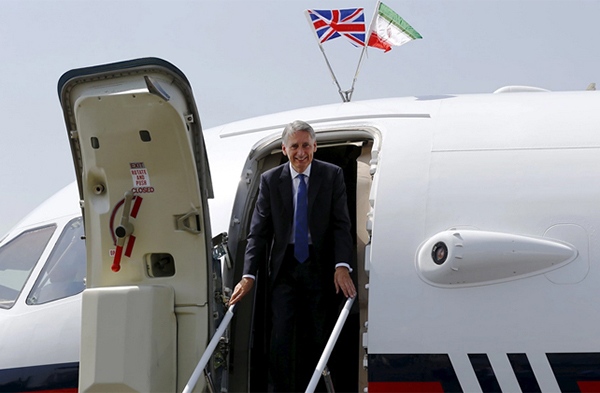
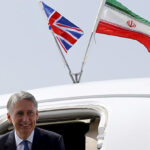
Iranian Foreign Minister Mohammad Javad Zarif’s second tour of regional countries aims to reaffirm Tehran’s resolve to reinforce its ties with neighbors, Deputy Foreign Minister for Arab and African Affairs Hossein Amir Abdollahian said on Tuesday.

Explaining Iran’s priority in strengthening ties with neighbors and the wider region is one of the purposes behind Zarif’s tour, he noted.

Amir Abdollahian added that the Iranian foreign minister will also confer with the officials of the countries he is to visit on the latest regional and international developments and will hold consultations with them on the necessity of focusing on political solutions to ongoing regional crises.

Zarif who is now in Lebanon is scheduled to visit Syria, Pakistan, India, and Russia in his tour of regional countries.

In his first regional tour in July, he visited Kuwait, Qatar, and Iraq, where he held talks with their highest-ranking officials.

Zarif’s tours come in the wake of the conclusion of nuclear talks between Tehran and P5+1 (Russia, China, the US, Britain, France and Germany).

Iran and the six powers on July 14 finalized the text of a nuclear deal that will terminate all anti-Iran sanctions after it takes effect. The United Nations Security Council also unanimously passed a resolution afterward, endorsing the comprehensive accord.

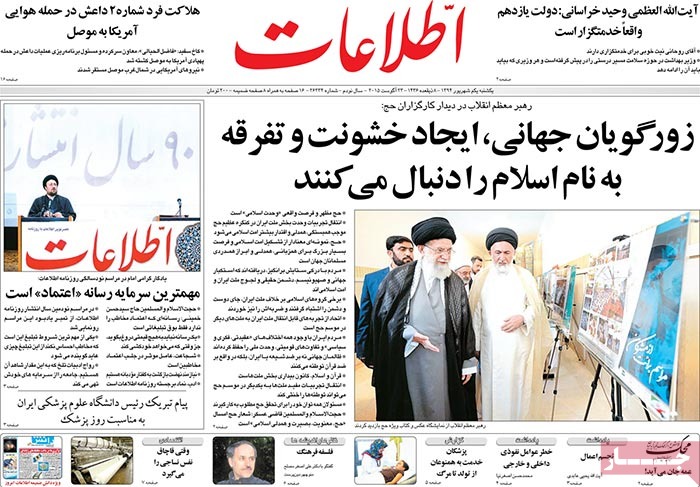
A look at Iranian newspaper front pages on August 12

Iranian Newspapers Headlines

Funeral processions held in several cities for the martyrs of the Iran-Iraq war dominated the front pages of Iranian newspapers on Wednesday. The comments of the grandson of the late Imam Khomeini on the Islamic Revolution and those of the deputy foreign minister on the Vienna accord also made front-page headlines.


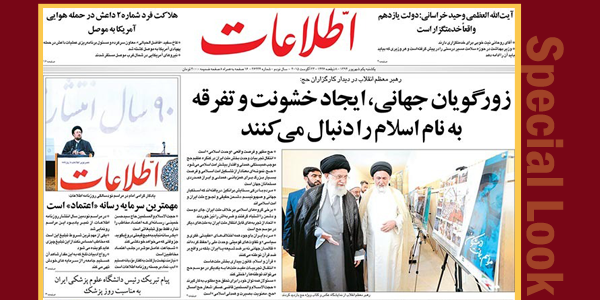
Ettela’at: “The cultural and spiritual growth of society requires economic boom and security,” the intelligence minister told a gathering of provincial culture official.

He further said that political might should be used as a means to promote cultural authority.

Highlights of Ettela’at newspaper on August 12

A look at Iranian newspaper front pages on August 12


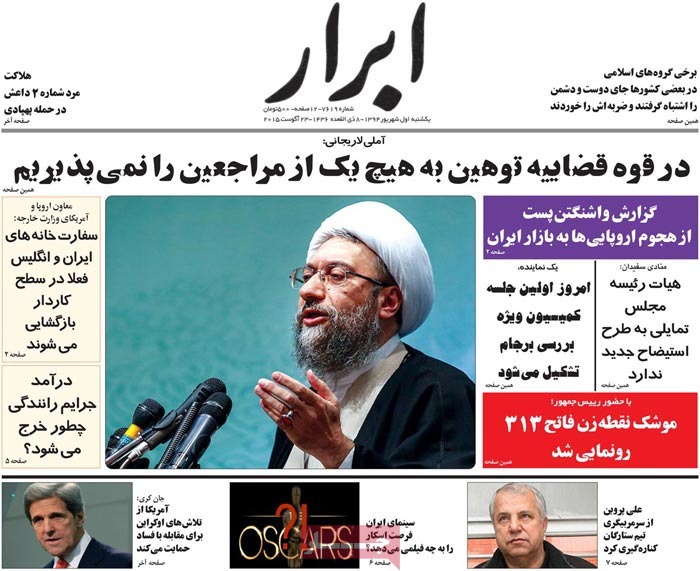
Abrar: Thirty-one MPs have called on President Rouhani not to accept the restrictions related to ballistic missiles stipulated in the UN Security Council resolution.

Abrar: Palestinian Authority President Mahmoud Abbas is to visit Iran shortly.


A look at Iranian newspaper front pages on August 12


Afarinesh: Hillary Clinton has warned of the consequences of a possible congressional rejection of the Vienna accord.


A look at Iranian newspaper front pages on August 12


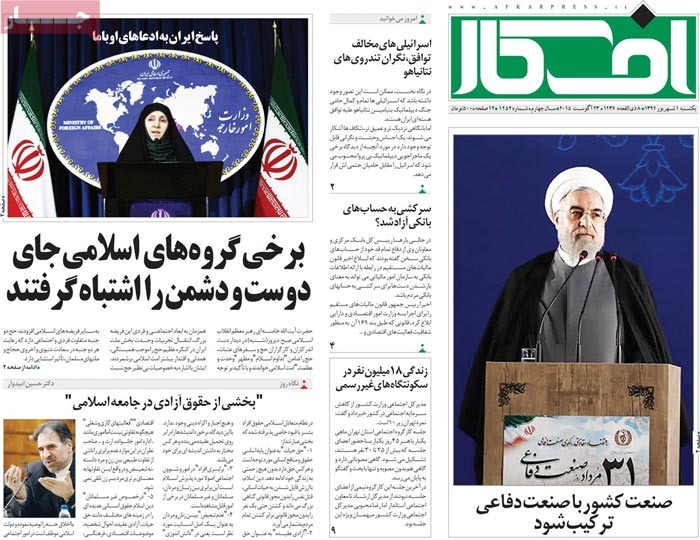
Afkar: Iran has opposed a Tehran visit by Hamas Leader Khaled Mashal.


A look at Iranian newspaper front pages on August 12


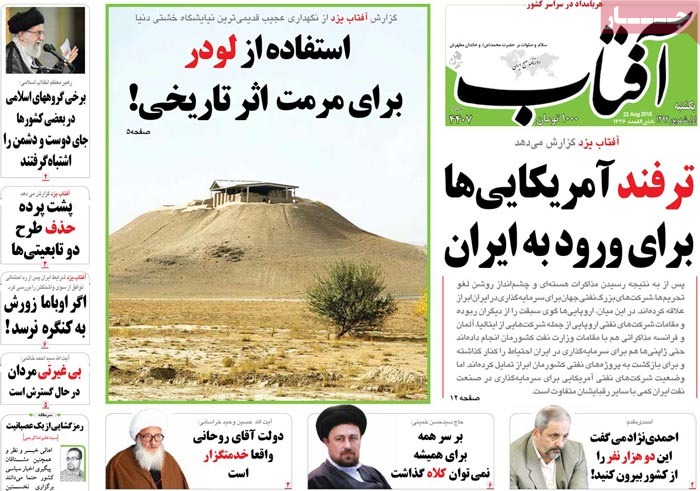
Aftab-e Yazd: The ban on Iranian oil has been lifted.

In a new directive on crude oil and petrochemical purchases from Iran, the US government has lifted the ban on imports of Iranian oil.


A look at Iranian newspaper front pages on August 12


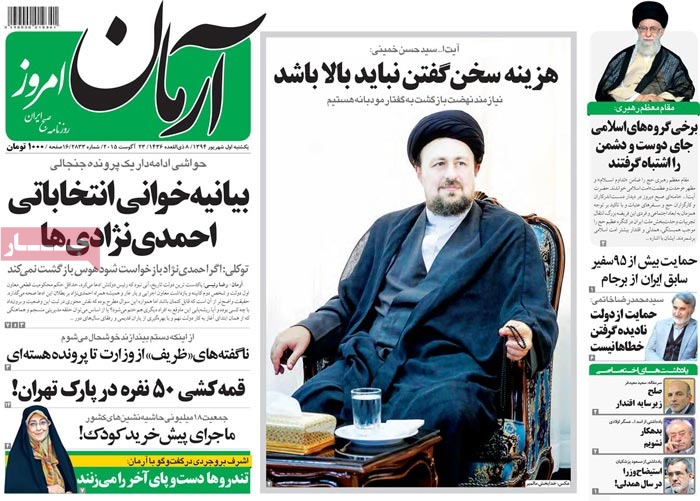
Arman-e Emrooz: “There are 800 cases involving offenses committed by senior officials of the previous administration,” said Mohammad Ashrafi Esfahani, who oversees a government office that looks into administrative offenses.


A look at Iranian newspaper front pages on August 12


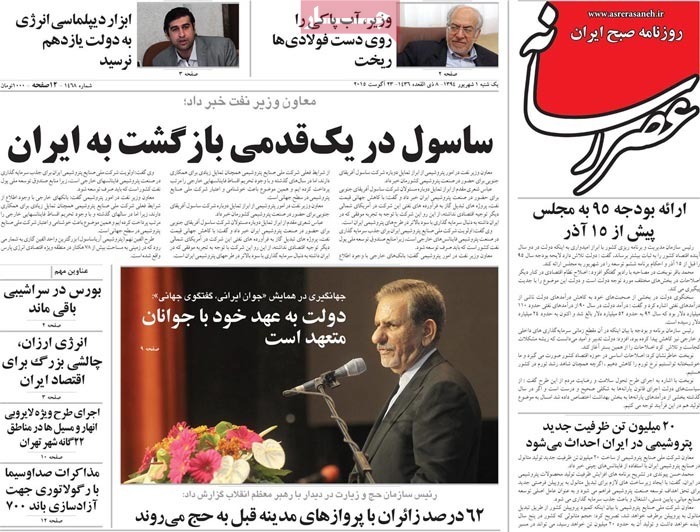
Asr-e Rasaneh: Tax evasion by those who slipped $25 billion worth of smuggled goods into the country

Asr-e Rasaneh: Iran and Spain have signed an electricity contract.


A look at Iranian newspaper front pages on August 12


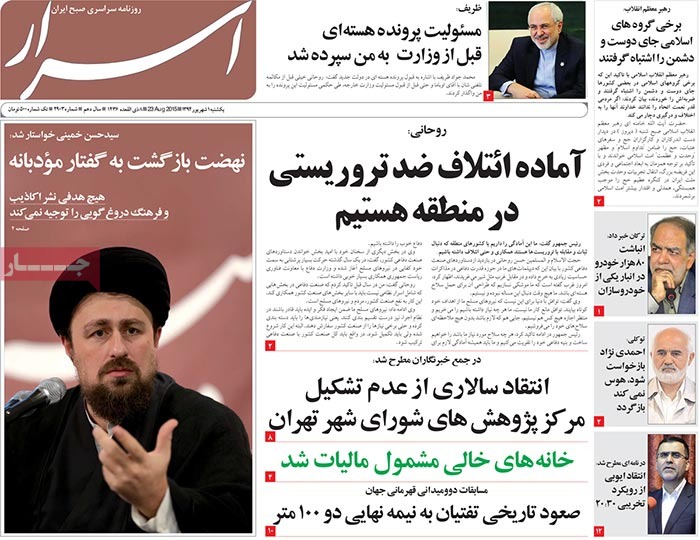
Asrar: Iranian actress Negar Javaherian has been given a seat on the jury of the Asia Pacific Film Festival.

Asrar: “Islam, [our] revolution and [the late] Imam [Khomeini] should not be hijacked,” said Seyyed Hassan Khomeini, the grandson of the founder of the Islamic Republic.

Asrar: The interior minister has said that some 4,000 individuals have expressed willingness to run for parliament in elections slated for early 2016.


A look at Iranian newspaper front pages on August 12


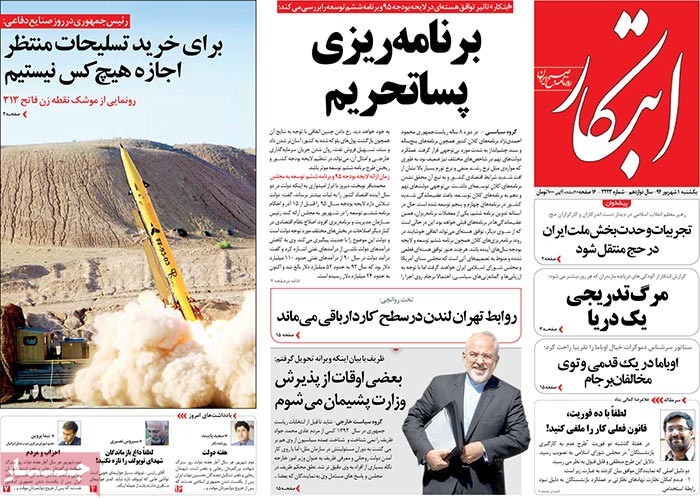
Ebtekar: Oil Minister Bijan Namdar Zanganeh has ordered oil production increased by 500,000 barrels a day.


A look at Iranian newspaper front pages on August 12


Etemad: The judiciary chief has called on officials to act leniently in cases involving the press.


A look at Iranian newspaper front pages on August 12


Farhikhtegan: “Theft is worse than failure to comply with the Islamic dress code,” said the grandson of the founding father of the Islamic Republic.


A look at Iranian newspaper front pages on August 12


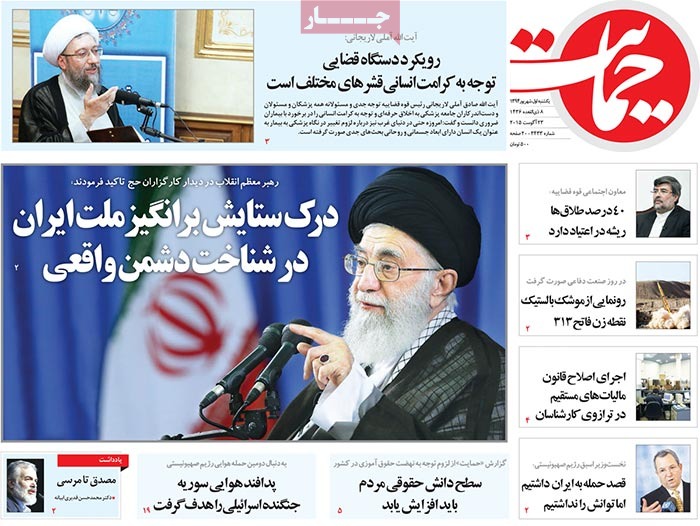
Hemayat: “Measures to discredit the Judiciary are neither legitimate nor legal,” said the Judiciary chief as he lashed out at those who have released images of Ayatollah Rafsanjani bidding farewell to his son before the latter reported to prison to serve a 10-year jail term.


A look at Iranian newspaper front pages on August 12


Hosban; The director of the Environment Protection Organization has said that park rangers will receive a 25 percent pay raise.


A look at Iranian newspaper front pages on August 12


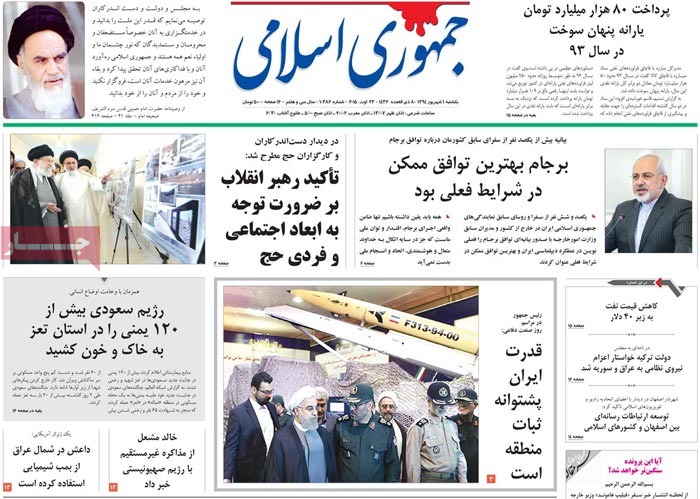
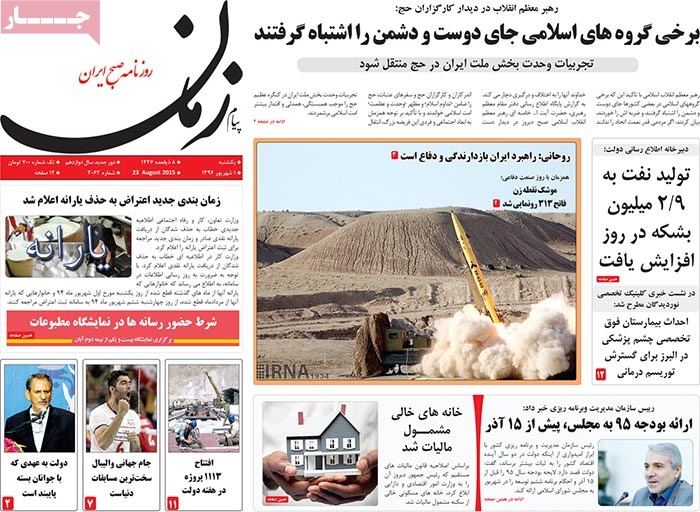
Iran: The Interior Ministry and the Guardian Council have agreed on introduction of transparent ballot boxes.

Iran: A second round of regional visits has taken Foreign Minister Zarif to Beirut, Lebanon.


A look at Iranian newspaper front pages on August 12


Kaenat: Zarif’s decision to put his Ankara visit on hold has drawn widespread reactions.


A look at Iranian newspaper front pages on August 12


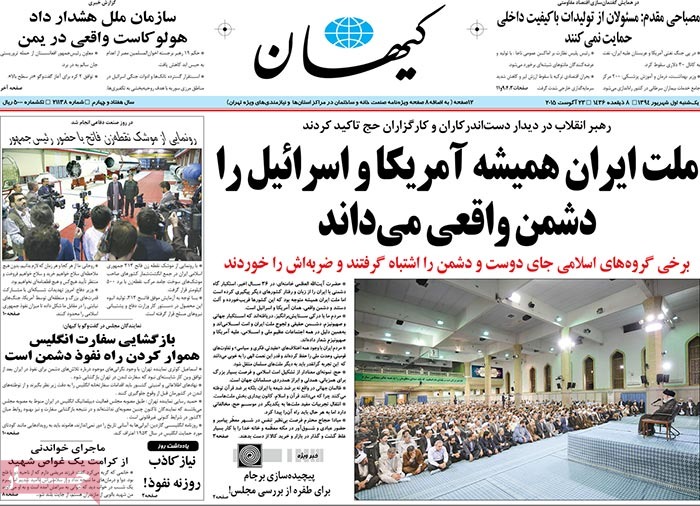
Kayhan: Some 150 MPs have sent a letter to the president calling on him to present the Joint Comprehensive Plan of Action to parliament in the form of a bill.


A look at Iranian newspaper front pages on August 12


Roozan: Minister of Economy and Financial Affairs has fallen victim to populist posturing.

The daily says the economy chief is likely to be impeached by parliament.


A look at Iranian newspaper front pages on August 12


Highlights of Ettela’at newspaper on August 12

Ettelaat

 “The cultural and spiritual growth of society requires economic boom and security,” the intelligence minister told a gathering of provincial culture official.

He further said that political might should be used as a means to promote cultural authority.

 The scent of martyrs once again filled the air across Iran as funeral processions were held for unknown martyrs of the Sacred Defense [the Iran-Iraq war in the 1980s].

The Supreme Leader expressed hope the artfulness of the martyrs brings blessing to the nation and inspiration to the revolutionary art center.

 The liquidity growth has had a downward trend ever since the 11th government took office.

Banks and credit institutes newly covered by the Central Bank have accounted for one third of the growth in liquidity, a deputy governor of the Central Bank said.

 Russia and Saudi Arabia have reached an agreement over a political solution to Syria’s crisis.

The Russian foreign minister has called for resumption of talks between the Syrian government and the opposition under the auspices of the United Nations.

 “Parliament’s turning of the Joint Comprehensive Plan of Action into legislation won’t serve the country’s interests,” said Deputy Foreign Minister Abbas Araghchi.

He further said that P5+1 won’t have their parliaments turn the Vienna accord into legislation either.

 The statuettes of five martyred reporters have been unveiled in a Tehran park.

At the ceremony, Tehran Mayor Mohammad Bagher Ghalibaf said the country’s first Reporters’ Museum will be launched in months.

 “The cultural results of the nuclear deal outweigh its economic impact,” said Seyyed Mohammad Beheshti, the director of the Cultural Heritage and Tourism Research Center.

He credited the efforts of the negotiating team for a 250 percent increase in the number of foreign tourists visiting Iran.


Pilot error, plane weight main causes of Iran-140 crash: CAO

139305191242174233384614

One year after the fatal crash of Iran-140 airplane near Tehran, Iran’s Civil Aviation Organization (CAO) on Tuesday released the results of its investigation into the cause of the deadly accident.

The pilot’s performance, malfunctioning of the engines’ control system, and breaching the Maximum Takeoff Weight (MTOW) were the main reasons behind the plane crash, the CAO announced.

The excessive fuel of the plane also exacerbated the fire that erupted after the plane crash, Mohammad Shahbazi, the official in charge of the investigations said.

A team of air accident experts from Russia came to Iran to help with the investigations in March. A Ukrainian team had also visited the country to analyze the black boxes a couple of days after the crash.

Shahbazi announced that representatives of other companies such as Motor Sich and Progress (engine designer) have also taken part in the investigation.
He further noted that the final report on the tragic crash will be prepared within the next 45 days and sent to Russia and Ukraine to be analyzed.

The plane, an Iran-140 of Ukraine’s Antonov origin, crashed on August 10, 2014, west of Tehran, shortly after take-off from Mehrabad Airport.

The aircraft had 48 passengers and crew on board, of whom 39 died.

Hours after the crash, Iranian President Rouhani ordered the grounding of the entire fleet of the country’s Iran-140 planes.

According to Rouhani’s order, the ban will remain in place until full investigation is conducted into the cause of the crash.

The Antonov An-140 commercial passenger airplane is a twin-engine turbojet aircraft, which can accommodate up to 100 passengers.

After purchasing the production license for the An-140 from Ukraine in 2000, Iran built its first Iran-140 passenger plane in 2003.

Israeli plot against Iran-P5+1 deal defeated: Iran FM

06553eb7-c501-4658-94ed-f97143569a7a

Iranian Foreign Minister Mohammad Javad Zarif says the Israeli regime’s plot against Iran’s nuclear agreement with six world powers has been defeated.

Zarif made the remarks on Tuesday upon his arrival in the Lebanese capital of Beirut on the first leg of his regional tour.

He said the nuclear agreement between Iran and P5+1– the United States, France, Britain, China, Russia and Germany – in Vienna last month created a historic opportunity for the countries in the Middle East region to repel dangerous threats such as the Israeli regime and terrorism.

Zarif expressed hope that the conclusion of Iran’s nuclear talks with the world powers would benefit the countries and nations in the region.

On July 14, Iran and P5+1 finalized the text of the nuclear agreement, dubbed the Joint Comprehensive Plan of Action (JCPOA), in Vienna.

Under JCPOA, limits will be put on Iran’s nuclear activities in exchange for, among other things, the removal of all economic and financial bans against the Islamic Republic.

Zarif also pointed to the Israeli regime, terrorism, extremism and violence as the major challenges facing the countries in the Middle East, adding: “Once more, I call on Muslim countries in the region to respond positively to Iran’s invitation to dialog and cooperation for guaranteeing the interests of regional states and nations.”

He emphasized that the Middle East countries need to hold dialog on how to deal with common challenges.

Zarif said he would exchange views with senior Lebanese officials on regional peace and security and ways to improve Tehran-Beirut cooperation.
He noted that coexistence among Lebanese groups and tribes and the country’s resistance against aggression, extremism and terrorism can set an example for other regional states to follow.

The Iranian minister arrived in Beirut at the head of a delegation on Tuesday on the first leg of the second round of his regional tours following the nuclear agreement between Iran and six world powers.

The Iranian foreign minister will fly to Syria on Wednesday before leaving for Pakistan, India and Russia in the following days.

Iran nuclear accord benefits whole region: Zarif

b11947fc-4eb0-435a-bf50-28540d30ff11

Iranian Foreign Minister Mohammad Javad Zarif says all regional countries have enjoyed the benefits of the nuclear agreement between Iran and P5+1.

“We have not used the Vienna agreement as an excuse to cause problems for others… The whole region and the friendly, Islamic and Arab countries have all enjoyed the benefits of the accord,” Zarif said in a meeting with Lebanese Prime Minister Tammam Salam upon his arrival in Beirut on Tuesday.

Zarif pointed to his recent visits to Kuwait, Qatar and Iraq immediately after the nuclear agreement, stressing that “regional dialogue” can play a constructive role at this period.

Iran’s top diplomat also voiced Tehran’s support for intra-Lebanese dialog, saying it is the only solution to the political problems in the Arab country.

Salam, for his part, hailed the nuclear accord between Iran and P5+1, adding that “The agreement has provided numerous opportunities for the establishment of peace and stability in the region.”

The Lebanese prime minister also stated that Beirut has always tried to expand its friendly ties with Tehran.

We are ready to open a new chapter in bilateral relations with Tehran after the recent nuclear accord, he stated.

Tehran and P5+1 – the US, Russia, China, France, Britain, and Germany – finalized the Joint Comprehensive Plan of Action (JCPOA) over the Iranian nuclear program in the Austrian capital city of Vienna on July 14.

During his stay in Beirut, Zarif is also scheduled to visit Lebanon’s Parliament Speaker Nabih Berri and Foreign Minister Gebran Bassil. The Iranian foreign minister will also hold talks with some Palestinian officials in the Arab country.

Zarif will leave Beirut for the Syrian capital city of Damascus on Wednesday. According to reports, he will also visit Pakistan, India and Russia in the coming days.

Islamic Republic victim of terrorism: Rouhani

fb299bfe-1a0c-4293-98a9-d54d921eed87

Iranian President Hassan Rouhani has honored the memory of the Iranian diplomats killed by Taliban militants in the Afghan city of Mazar-i-Sharif 17 years ago, saying that the Islamic Republic has been the victim of terrorism from the very beginning.

“The Mazar-i-Sharif incident serves as another piece of evidence that the Iranian nation and officials have always been the victims of terrorism,” Rouhani said in a meeting with the diplomats’ families in Tehran on Tuesday.

Apart from Mazar-i-Sharif, the Iranian embassies and diplomats have also been targeted by terrorists in other parts of the world, he said, adding, “This shows that the Islamic Republic is an anti-terror government and also proves wrong the claim by some countries that Tehran supports terrorism.”

No one imagined at that time that the terrorists might attack and kill Iran’s consulate staff in the northern Afghan city since according to international conventions, the diplomatic centers and embassies are considered safe places, the Iranian president further said.

He also pointed to the role of the intelligence services of certain countries in the Mazar-i-Sharif incident, adding that the terrorists in today’s world once again enjoy the support of Zionists and some Western countries.

Rouhani also vowed that Tehran will never give up its anti-terror bid.

So many of the Iranian elites have been martyred since the victory of the Islamic Revolution and the terrorists are still operating against the Iranian nation and we are reciprocally fighting terrorism, Rouhani stated.

On August 8, 1998, Taliban militants killed 10 Iranian diplomats and an Islamic Republic News Agency (IRNA) correspondent in Mazar-i-Sharif.

Parliament should issue JCPOA fact sheet to minimize risk of arbitrary interpretation

139308061018463853941484

The Islamic Consultative Assembly [Iran’s parliament] should issue a fact sheet on the Joint Comprehensive Plan of Action (JCPOA) Iran and P5+1 signed in Vienna on July 14 to minimize the risk of arbitrary interpretation of the deal, Mohammad Javad Larijani, who heads the Human Right Council of the judiciary, said in an interview with Tasnim News Agency.

The following is the translation of part of his comments in the interview released by the news agency on August 10:

Statements that the deal should include this or exclude that were only good when the Vienna deal had not been finalized yet. Today we have an agreement on our hands. It is not important what title that agreement carries. What is important is that it is a commitment on the part of the Iranian government and others involved in nuclear talks.

We need to avoid arguments which are useless or impractical. Statements such as the deal would have been better like this or like that should be avoided. This problem cannot be solved, because they (the negotiators) contend it was the best deal they were able to cut.

Comments that the deal should be rejected and arguments that may cause a rift in the country do not serve the country’s national interests. We need to sign off on what the Iranian government has committed itself to. Failure to accept the deal will do considerable damage to the image of the Iranian government on the international stage.

Legal entities including the Supreme National Security Council and parliament, and I emphasize parliament, should review JCPOA, but we need to throw our weight behind government and stand by it because our national interests are of paramount importance.

Some might argue that if we are to accept the deal, we should signal our approval outright. Why should we have discussions? The Supreme Leader has said that the deal should go through the legal process. Is this a formality then? Not at all. In fact, there are very important things that need to be discussed. Let’s assume we want to accept the deal. The question is what we should do to stick to our interests and at the same deny the enemy the opportunity to take advantage of the deal?

Despite arguments by some that the US Congress would kill the deal, I believe a joint meeting of Congress, attended by President Obama – either now or after the president’s veto of the initial congressional act – is very likely to give the Vienna accord the final go-ahead.

Anytime there was an agreement – both in Geneva and Lausanne – the US administration was quick to issue a fact sheet to publicize its interpretation of the deal. Coincidentally, those fact sheets turned out to be the foundation of what happened next. The Americans did this to replace the parentheses – that were to be eliminated – with phrases open to interpretation.
The fact sheets they issued are important because they are mostly supported by Western members of P5+1. This time around, the responsibility to issue a fact sheet lies with Congress. […]

We need to do the same thing in Iran to prevent the American plot from being realized. Arguments by executive officials that parliament should not get involved or by MPs that government should present the deal in the form of a bill to the Islamic Consultative Assembly for approval are waste of time. Government can presented a bill, or parliament can review the deal as part of an urgent motion.
Some might argue that what was signed in Vienna was a joint plan of action and not an agreement. The fact of the matter is that it is a deal that needs the go-ahead of parliament. If one looks too closely at the text of the deal, they may find areas which are somewhat incompatible with our Constitution.

For instance, if we decide to develop a certain area of our nuclear program, something which is in line with our national interests, we have agreed to present our plan to a committee which comprises foreign countries so that it can decide whether we need such development or not. This is against our Constitution. Any decision on what is in our national interest should be ours.
What I am saying is that the Guardian Council should also play an active role in this regard. Why is that many of us are doing nothing in this regard? What I’m saying is that we to approve the deal. But we have approval and approval. There are many things to do. We need to set aside laziness.

I have talked about these things to the parliament speaker. As a former member of the Islamic Consultative Assembly, I would like to call on all MPs not to let this historic opportunity slip. The nation expects them to act. They need to review the deal clause by clause and remove the loopholes the US may want to take advantage of. The chamber needs to put together a 30- or 40-point motion on the deal. One of these points should express support for the deal because such a measure is bound to help the executive branch in the future.

The Supreme Leader has said the case should go through channels stipulated in laws. Parliament has voted for legislation that calls for the deal to be approved by both the Islamic Consultative Assembly and the Supreme National Security Council. These two channels should be active. Parliament should take care of its business in coordination with the Supreme National Security Council. Naturally, the knowledge and experience of who have taken part in the talks should be tapped as well.

Parliament cannot delegate its authority to anyone else. Releasing a fact sheet is the responsibility of the Islamic Consultative Assembly. It would be in the best interest of the establishment to have a bill crafted in parliament to preempt the West and block its potential arbitrary interpretation of the deal.

Our vulnerability goes beyond the red lines we have set. By that I mean, even in areas where the government has respected the red lines, there might be some weak points. The first such weak point is political. The Americans argue that after 36 years of defiance, Iran has now bowed to Western nuclear demands which Tehran has dismissed as illegitimate all along.

The text we have signed off on allows the other side, the US in particular, to take advantage of the deal. For instance, the foreword of JCPOA, in its entirety, mirrors the concerns of the West as if our sole responsibility is to ease those concerns. We should have said the deal should ease our concerns too.

They have told us that we need to prove we are not after nuclear weapons. We, too, should tell them they need to prove that they do not apply double standards, that they do not trample our rights and that they do not discriminate against us. That is what makes this part of the deal unbalanced. We are the one who should always prove our compliance.

Anyone who goes through this text learns that it is open to political misinterpretation. Parliament should focus on this, because such misinterpretation would only be the starting point for the other party to want us to ease Western concerns about human rights, regional issues, Hezbollah, etc.

In other words, to the West this is the beginning of a very important game. Parliament can block this. That the Supreme Leader repeatedly said the talks should only focus on the nuclear case was meant to prevent the other side from taking political advantage of the deal.

Negotiator favors up-or-down vote for nuclear deal in parliament

araghchi

The Iranian parliament should go through the Joint Comprehensive Plan of Action clause by clause but at the end of the review process hold an up-or-down vote on the deal, Deputy Foreign Minister Abbas Araghchi said.

Araghchi, who was a senior member of the negotiating team which represented Iran in talks with P5+1, further said there would be no deal if even a single party to the talks rejected the Vienna accord.

What would happen if the text of JCPOA fails to secure the go-ahead of all seven countries involved in the talks (Iran and P5+1) is anyone’s guess, he said, adding in case of rejection the two sides should decide whether to resume the talks.

He added if the Iranian MPs rejected the deal and told the Foreign Ministry what in the text of the deal prompted them to turn it down, the reason behind their opposition would be raised with the other party. “They [P5+1] will either accept to make corrections, or they may call for the talks to resume.”

Saving Orumiyeh Lake with water from Georgia, Armenia

81714120-70085681

A member of Iranian parliament has said that transfer of water from Iran’s northern neighbors, namely Georgia and Armenia, will help save the world’s largest salt lake, the Orumiyeh Lake, which is on verge of drying up.

“Agreements on the issue have already been signed and water from Georgia and Armenia’s Kera Fountains and Swan Lake will be channeled southward using three pumping stations along the way, all three of which will be on Iranian soil,” said Ali Alilu in a press conference.

He said that transferring water from the Caspian Sea is not economically viable firstly due to the high levels of water pollution and secondly because of high costs associated with such a project.

“The 36 billion cubic meter reservoir of the Orumiyeh Lake has shrunk to two billion cubic meters today and redirecting a portion of water flowing in Aras and a number of smaller rivers will do nothing to save the lake,” he reiterated.

Alilu said that the bulk of the water transfer project needs to be implemented in Iran and the project is predicted to be finalized within two years.

He said that the water will be both bought and bartered from those two countries and the purchased water will flow to Iran at 60 to 80 cubic meters per second.

The MP emphasized that President Hassan Rouhani’s government, especially his Department of Environment (DOE) headed by Masoumeh Ebtekar, has been very successful in its bid to save the Orumiyeh Lake.

“If the drying of Orumiyeh Lake had continued unchecked, as was the case during the previous government, five provinces would have soon faced serious environmental hazards, and a grave human catastrophe,” he said.

Alilu said that making investment to save the Orumiyeh Lake can be viewed as national investment to save the environment, human lives, the cattle and agriculture in six Iranian provinces.