Sunday, December 21, 2025
Home Blog Page 4742

Iran, Kyrgyzstan plan for long-term cooperation

Rouhani-Kyrgyzstan

Kyrgyz President Almazbek Atambayev arrived in Tehran on September 4 and held talks – during his stay – with senior state officials such as President Hassan Rouhani. Later the two presidents held a joint press conference which covered a wide range of issues, including mutual ties and regional cooperation.

Kayhan daily on September 6 published a report on the Kyrgyz president’s visit, the cooperation deals the two sides signed and the remarks the two presidents made in a joint press conference. The following is the translation of part of that report:

[…]

President Rouhani said in the press conference that Iran and Kyrgyzstan have close cooperation on regional and international issues,

Recalling the new Kyrgyz government’s adoption of approaches that favor independence, Rouhani said that the closure of Manas Air Base in Kyrgyzstan which used to be manned by American troops has brought Tehran and Bishkek closer together as far as regional and international questions are concerned. He added the two countries can raise the scope of their cooperation as a result of Bishkek’s new international approach.

[…]

“We have decided to draw up a ten-year plan for mutual ties. We should take into account the two sides’ potential for promotion of ties. Such a plan, when implemented, will benefit the two nations,” President Rouhani said.

For his part, the Kyrgyz president said that his country and Iran have no differences whatsoever, adding, “As the esteemed Iranian president mentioned, we had good talks and reached agreement on many issues. This shows a bright future lies ahead for the two countries.”

President Atambayev further said, “We also discussed the implementation of a big railroad project which connects China, Kyrgyzstan, Tajikistan, Afghanistan and Iran, and decided to study a plan to operate Iran-Kyrgyzstan flights.”

“Bishkek supports Iran’s full membership in the Shanghai Cooperation Organization (SCO) and I am sure this will help SCO raise its economic capabilities and improve the infrastructure [of its members],” he added.

The Kyrgyz president also said that Bishkek and Tehran agreed to put together a ten-year-old plan for their cooperation, adding the cooperation deals the two sides inked [during my trip] is proof of the two sides’ willingness to upgrade cooperation.

Iran, Iraq sign three agreements on economic cooperation

Tayebnia-Iraqi

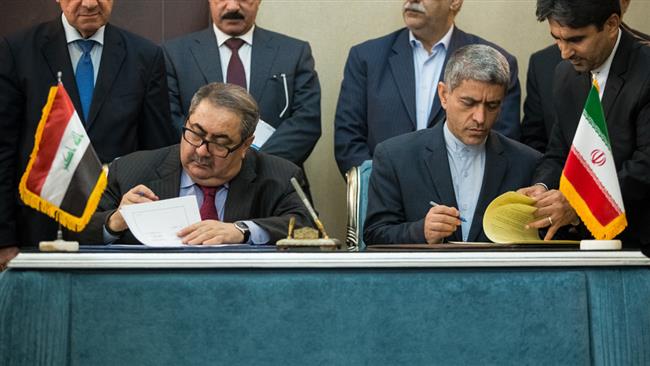
Iran and Iraq have signed three agreements for expansion of cooperation in various economic fields between the two neighboring countries.

The agreements were signed in the presence of Iran’s Minister of Economic Affairs and Finance Ali Tayyebnia and his Iraqi counterpart, Hoshyar Zebari, in Tehran on Sunday.

The agreements aim to boost cooperation between Iran and its western neighbor in such areas as customs, taxation and mutual investment.

Speaking to reporters on the sidelines of the signing ceremony, Iran’s minister of economic affairs and finance said according to the agreements, Iran and Iraq will expand customs cooperation while taking steps to do away with double taxation and encourage mutual investment in the two countries.

Tayyebnia further said that the volume of bilateral trade between Iran and Iraq currently stands at $12 billion a year, expressing hope that the new agreements will increase the figure to over $20 billion.

Zebari, for his part, congratulated the Iranian nation and government on the conclusion of the nuclear talks between the Islamic Republic and P5+1, which led to an agreement between the two sides, known as the Joint Comprehensive Plan of Action (JCPOA).

Zebari described the nuclear agreement between Iran and the sextet as rational, helpful and beneficial to both Iran and the entire region.

The Iraqi minister also said that the relations between the two countries are progressive, expressing hope that Iran-Iraq ties will further expand in the future.

Zebari arrived in Tehran Saturday at the head of an economic delegation.

He met with Foreign Minister Mohammad Javad Zarif Sunday, during which the two sides explored various aspects of bilateral relations.

Iran unveils new miniature paintings by Mahmoud Farshchian

Farshchian

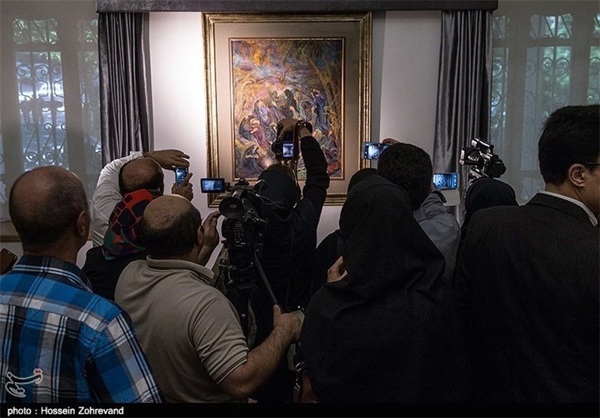
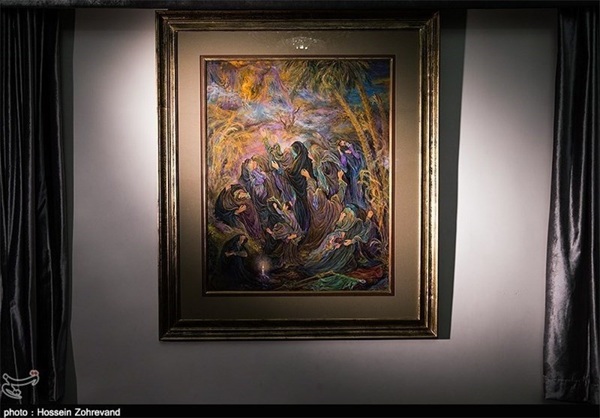
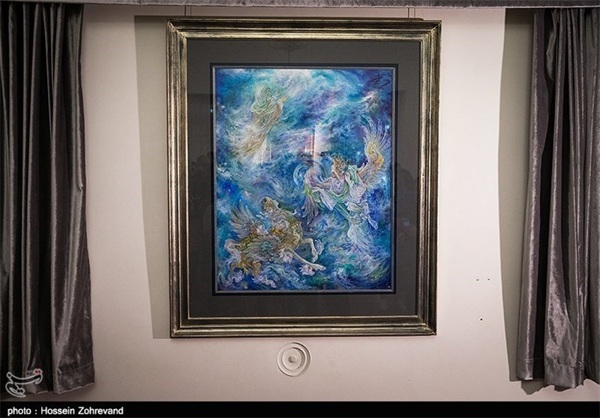
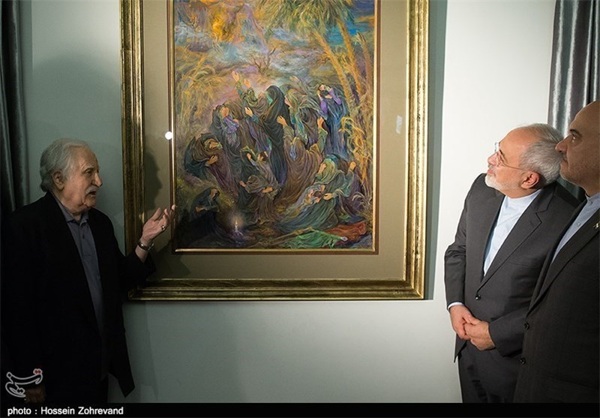
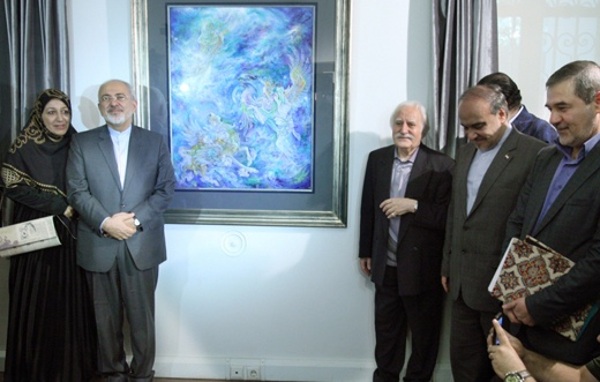
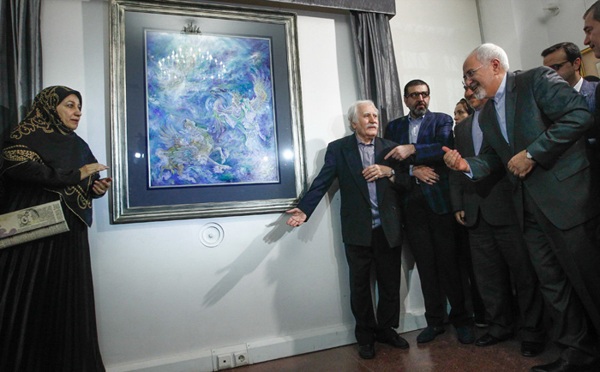
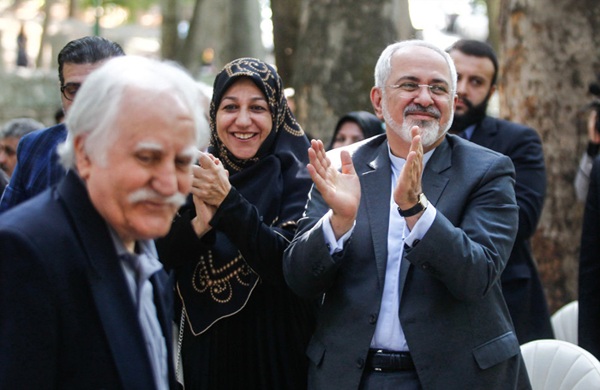
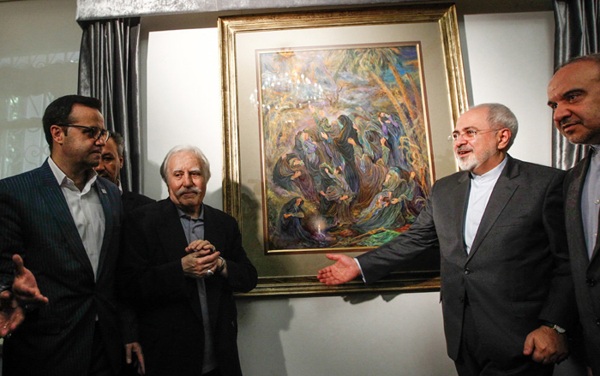
Two new miniature paintings by world-renowned Iranian artist Mahmoud Farshchian have been unveiled in Tehran.

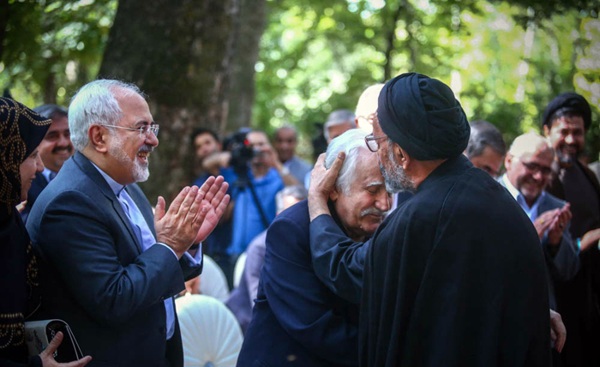
‘Sham-e Ghariban’ (The Night of the Oppressed) and ‘The Fourth Heaven’ were unveiled during a ceremony at Farshchian Museum of Sa’dabad Cultural and Historical Complex.

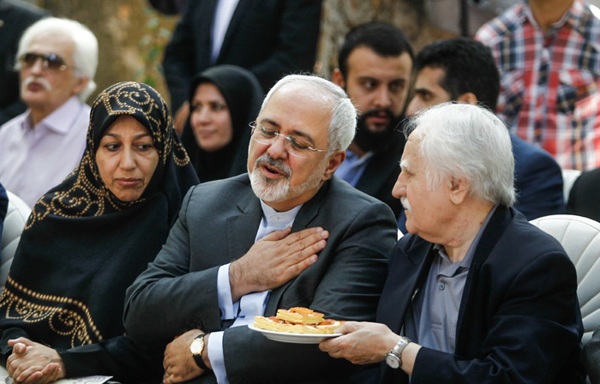
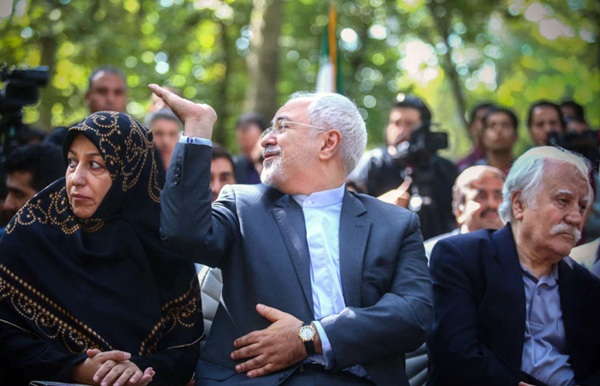
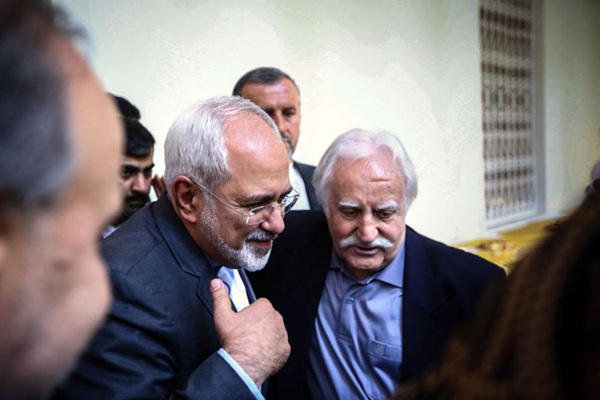
The ceremony was attended by a number of senior officials, including Foreign Minister Mohammad Javad Zarif and head of Iran’s Cultural Heritage, Handicraft and Tourism Organization Masoud Soltanifar.

“Farshchian’s works have always been the most significant gifts I’ve ever offered to ministers and ambassadors of other countries,” Zarif said during the unveiling ceremony.

He added that no other work can express the prominence, spirituality and human nature of Iranian art better than Farshchian’s creations.

Farshchian is known as Iran’s master of miniatures, whose works have been displayed in numerous galleries and museums around the world such as the British Library, Freer Gallery of Art, Bibliotheque Nationale, Metropolitan Museum and Harvard University.

The 85-year-old artist was chosen as an outstanding 21st century intellectual by Cambridge and has received an honorary doctorate in Iranian painting and Islamic arts from the High Council of Culture and Art.

He has won numerous national and international awards, including the gold statuette of Italy’s Vessillo Europa Delle Arte in 1984 and the gold medal of Belgium’s 1958 International Art Festival.

Iran’s Cultural Heritage Foundation established the Museum of Master Mahmoud Farshchian, devoted to the works of the veteran artist, at Tehran’s Sa’dabad Cultural and Historical Complex in 2001.


Prague takes a big step to get closer to Tehran

Lubomir Zaoralek

Iran Newspaper-6-sep

This year marks the 90th anniversary of the establishment of diplomatic ties between Iran and [former] Czechoslovakia and the 85th anniversary of the signing of a friendship pact between the two countries.

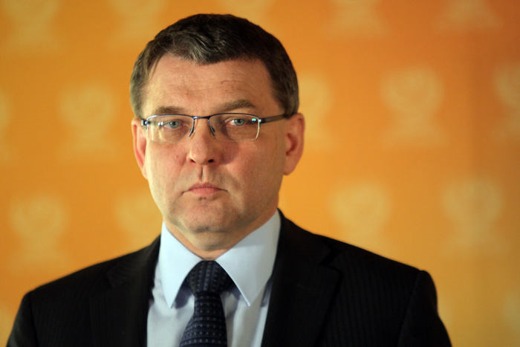
This is the opening of an opinion piece by the Czech Republic’s Foreign Minister Lubomir Zaoralek on the prospects of ties between the two nations. The following is the translation of the piece published in Farsi by Iran newspaper on September 6:

Ninety years ago the two countries [former Czechoslovakia and Iran] established diplomatic ties and 85 years have passed since the two nations signed a friendship pact. These events show that Iran is among the first non-European countries Czechoslovakia established and developed ties with. These deep-seated ties have improved the prospects of my current trip to Iran.

I am the first foreign minister [of the Czech Republic] to visit Iran in many years. I am happy that there is a firm historic reason for my trip and that is to reconstruct the age-old friendship between the two countries. Over the years I have been involved in political activities, I have always believed in working out diplomatic solutions to the world’s problems. That’s why I’m happy to see that lengthy talks between Iran and P5+1 over the former’s nuclear program have finally produced an agreement.

If such an approach is sufficiently employed, it would pave the way for resolving a number of regional issues and would patch up ties among regional nations. Given the conditions in the Middle East and North Africa, this approach is badly needed. Let me tell you about an article I recently read and found interesting. This article – The Imperative of a Comprehensive Strategy to Fight Violent Extremism – was written by my [Iranian] counterpart Mr. Zarif.

I have paid special attention to the shared willingness by the international community to defeat ISIL and all its extremist affiliates, and to remove all symbols of sectarian violence all over the world. It is highly important that we hear such a powerful message from the Islamic Republic of Iran which places emphasis on cooperation against evil forces that are acting in the name of Islam.

I am very happy to say that my country fully agrees with Iran in this regard. The Czech Republic actively supports all efforts which may help defeat ISIL and its violent state in parts of Syria and Iraq. To that end, my country is actively helping [with the fight against ISIL] in different forms such as sending ammunition to the Iraqi government and participating in non-combat projects there. We have also taken different measures to help asylum seekers from Iraq and Syria. The Czech government has always paid attention to efforts to support war-stricken people and help them get access to welfare.

As I said before, I’ve always backed the possible and workable diplomatic settlement of disputes between people and governments anywhere. This is yet another reason why I hope diplomatic ties between the two countries as well as their relations on other fronts will be revived and boosted. It is quite natural for the two countries not to see eye to eye on all issues, but they are expected to talk about all these issues and seek a sustainable, peaceful compromise.

One key way to build and improve ties among world nations and prevent confrontation and war among them goes through activation of economic cooperation. We in Europe know this very well. That’s why a relatively big economic-commercial delegation bringing together representatives from 50 Czech companies which are big industrial names in my country’s long history is accompanying me on this visit.

Their presence reminds us of the fact that the two countries have had good cooperation from the past and that there are areas for them to develop their cooperation. I would like to say that the two countries can cooperate on different fronts, especially public transport, non-military air transport, water treatment and management, medicine, healthcare, medical equipment, agriculture, machinery, mining, construction, science and technology.

For sure, the two sides will have a wide range of options for cooperation and I’m sure that at least a number of them should be developed. In addition to these, let me stress the importance of building cultural bridges between people in these two countries. I would like to express my gratitude to the Iranian government for its support for the Farsi Language and Literature Program at Charles University in Prague. I hope this can reestablish an old tradition of Iranian studies in the Czech Republic’s universities.

I am also hopeful this [Iranian studies in the Czech Republic] can help revive studies on the Czech Republic in the Islamic Republic of Iran. As I mentioned in this article, good relations between the Islamic Republic of Iran and the Czech Republic are based on good, old traditions. I am very hopeful about the bright prospects of our ties and my trip to Tehran will greatly help build a better future [for the two nations].

Iran’s Zarif calls for expansion of ties with Czech Republic

Zarif-Lubomir Zaoralek

Iran’s Foreign Minister Mohammad Javad Zarif has said that Iran and the Czech Republic enjoy good relations in various areas, calling for the two countries to further work toward expansion of their cooperation in all fields.

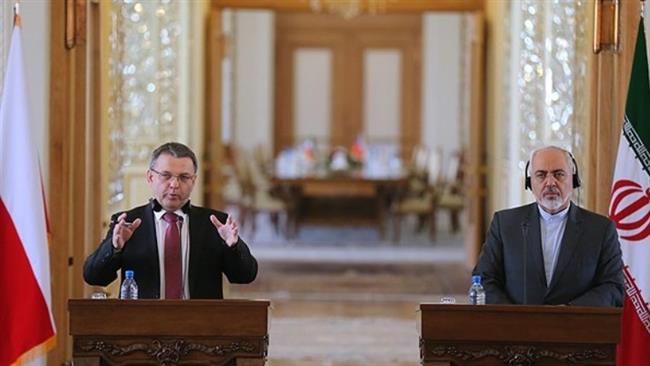
Speaking in a joint press conference with visiting Czech Minister of Foreign Affairs Lubomir Zaoralek in Tehran, Zarif said the two countries should strengthen cooperation in fighting against extremism, while trying to find solutions for the humanitarian plight of refugees, drug trafficking and organized crimes.

The Iranian foreign minister also stated that grounds have been prepared for Tehran and Prague to expand economic cooperation, particularly after the lifting of sanctions against Iran, following the nuclear agreement between the Islamic Republic and six world powers.

The Iranian foreign minister said that he had held negotiations with “influential” regional countries in recent weeks on the fight against terrorism.

He also expressed hope that such discussions would help establish stability in “our very sensitive region.”

“All countries should join the fight against terrorist groups and avoid taking measures which will finally benefit extremist groups,” the Iranian foreign minister said.

Zarif emphasized that the campaign against terrorism should not be confined to only “military confrontation,” but should also include other fields including culture and economy.

He said Iran has proved that it is a country which constantly fights against violence, extremism and terrorism.

“Unfortunately, the United States’ policy in the region has fueled violence and extremism and US allies in the region are currently supporting violence and extremism directly and indirectly,” Zarif said.

The Iranian top diplomat said that US officials and other international actors should avoid making “irrelevant” remarks and stoking more chaos in the region, adding that they should understand regional realities.

Zarif criticized inhuman treatment of refugees who are fleeing their homelands to different parts of the world to get rid of extremism and terrorism, saying that Iran has hosted millions of refugees over the past three decades coming from its neighboring countries.

He expressed Iran’s readiness, as a serious actor and a peace-seeking country in the region, to cooperate with regional states and the international community to fight violence and extremism.

The Czech foreign minister, for his part, said the Vienna nuclear agreement would reinforce security in West Asia and play a great role in bolstering Iran’s ties with the international community.

The Joint Comprehensive Plan of Action would also prepare the ground for Iran and the Czech Republic to improve relations, he added, hoping that the European Union would lift sanctions, particularly financial bans, against Iran in 2016.

The Czech foreign minister also called for further expansion of economic, political, cultural and educational cooperation with Iran.

Zaoralek said Iran plays a key role in the fight against drug trafficking, expressing his country’s willingness to cooperate with the Islamic Republic in this regard.

Afghan singer goes onstage in Tehran

Afghan Musician

The sight of a large number of Afghan nationals thronging outside the Interior Ministry’s hall made a majority of people walking or driving past Tehran’s Fatemi Square in the afternoon of September 2 think that they were there to have their residency-related problems solved.

What occurred to no one at first was that a cultural event had brought the large group of Afghan nationals there.

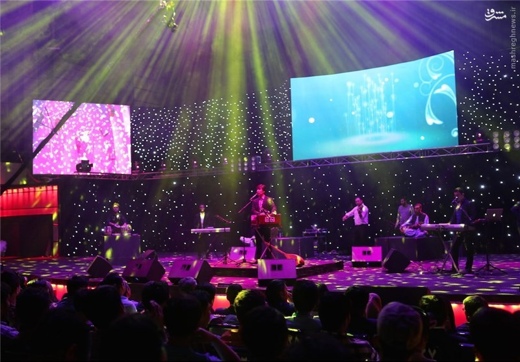
Inside the hall, Dawood Sarkhosh, an Afghan singer, sang nostalgic songs for thousands of Afghan nationals in Iran and conjured up memories of their homeland.

My Homeland, which is known to many Iranians, was the highlight of the evening and moved many Afghans in the audience to tears.

The concert was also attended by a number of Iranian art and culture lovers such as Ahmad Tavakoli, a Tehran MP who was at the event as the special guest. The nostalgic songs sang in the concert also moved the Iranian MP to tears.


A look at Iranian newspaper front pages on September 6

Iranian Newspapers Headlines

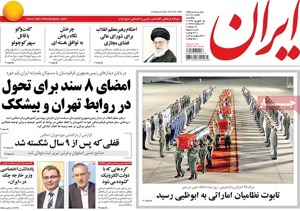
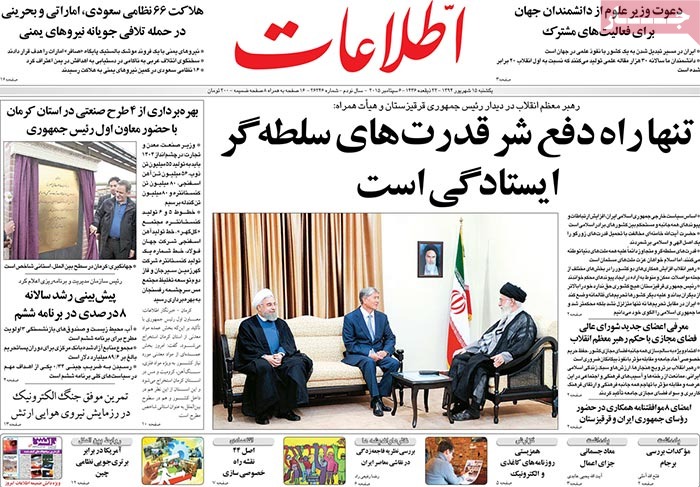
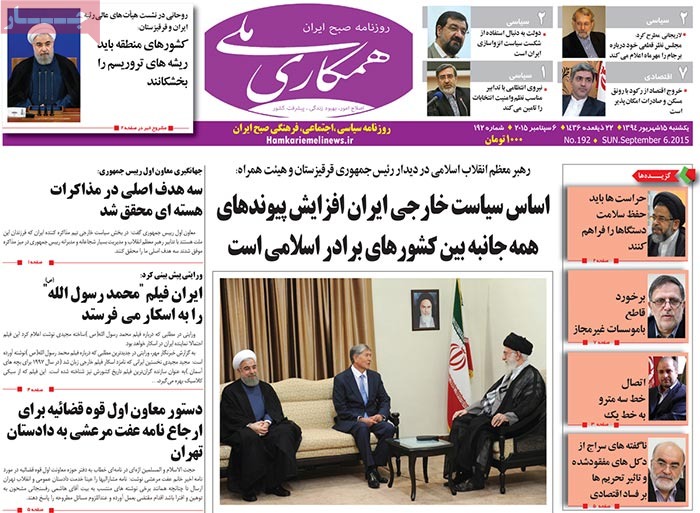
The meetings in Tehran between the visiting Kyrgyz president and senior state officials, including the Supreme Leader, and President Rouhani’s comments at a news conference with his Kyrgyz counterpart dominated the front pages of Iranian newspapers on Sunday. Appointment by Ayatollah Khamenei of new members of the Supreme Cyberspace Council and its mission laid out in a decree by the Leader also appeared on the cover of dailies.


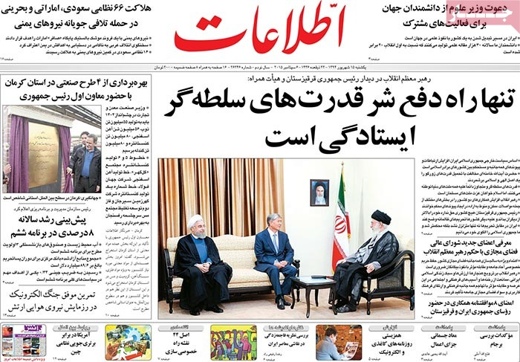
Ettela’at: “The only way to dispel the evil of hegemonic powers goes through resistance,” the Supreme Leader said at a meeting with the visiting Kyrgyz president.

Ayatollah Khamenei further said that establishment of firm ties among all Islamic countries lies at the center of Iran’s foreign policy.


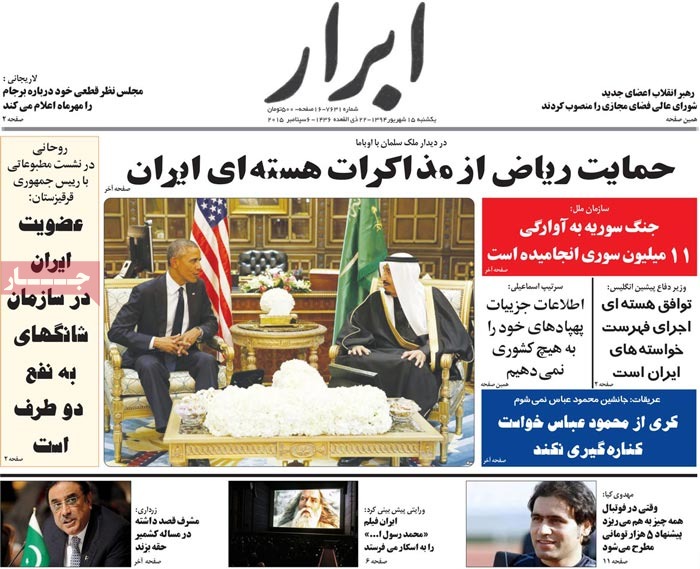
Abrar: Parliament Speaker Ali Larijani has said that the Islamic Consultative Assembly will announce its final decision on the Joint Comprehensive Plan of Action in the 30 days to October 22.

Abrar: Riyadh has thrown its weight behind the Iran nuclear talks after a meeting between King Salman and President Obama in the US.


A look at Iranian newspaper front pages on September 6


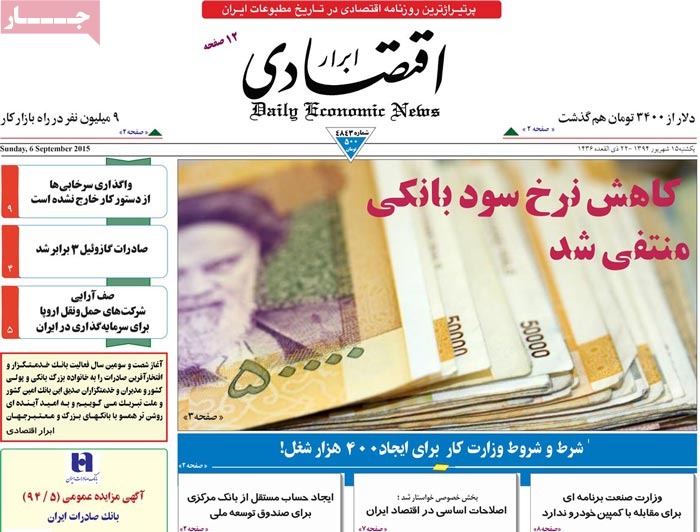
Abrar-e Eghtesadi: The plan to cut interest rates has been shelved.


A look at Iranian newspaper front pages on September 6


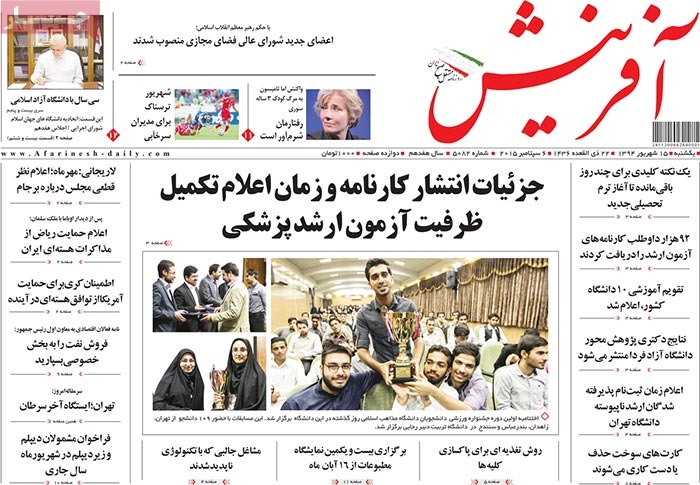
Afarinesh: A number of economists in a letter to the first vice-president have urged the Rouhani administration to allow the private sector to sell the country’s oil.


A look at Iranian newspaper front pages on September 6


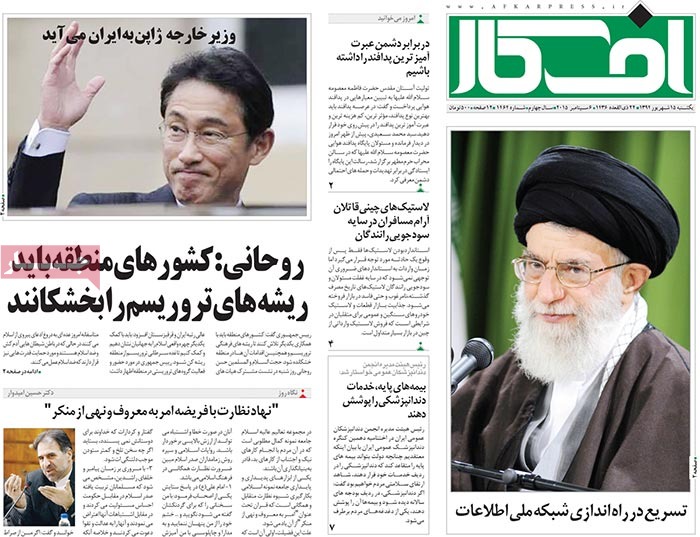
Afkar: President Rouhani has urged regional countries to join hands to uproot terrorism.


A look at Iranian newspaper front pages on September 6


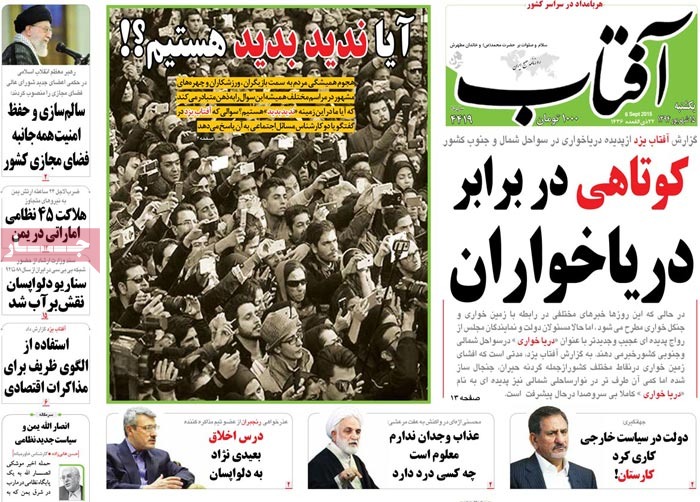
Aftab-e Yazd: “What the government has done on the foreign policy front has been quite a feat,” said the first vice-president.

Aftab-e Yazd: The ethical lesson Baidinejad taught to the Worriers [hardline opponents of President Rouhani and his policy of moderation]

Ranjbaran [the producer of a live TV talk show] apologized to the nuclear negotiator. [It came after a principlist MP conditioned his appearance at the talk show on the absence of Baidinejad].


A look at Iranian newspaper front pages on September 6


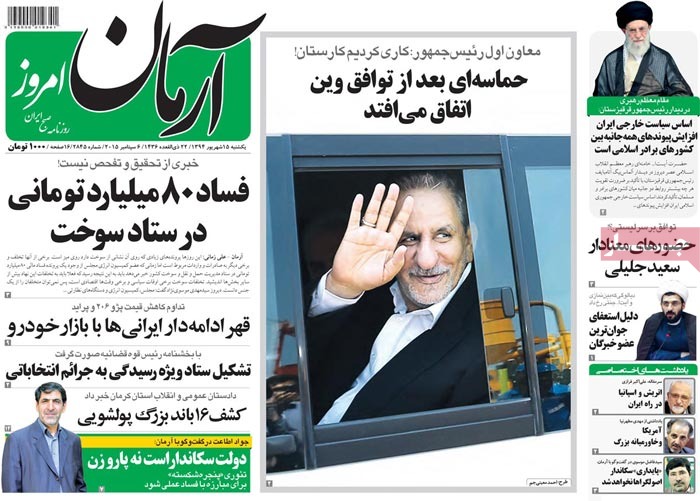
Arman-e Emrooz: $27 million corruption at the Fuel Headquarters

No fact-finding mission

Arman-e Emrooz: Iranians continue to shun the automobile market

It comes as the prices of Peugeot’s 206 and Kia’s Pride keep slipping.

Arman-e Emrooz: The judiciary chief has ordered the formation of a commission to look into possible electoral offenses.


A look at Iranian newspaper front pages on September 6


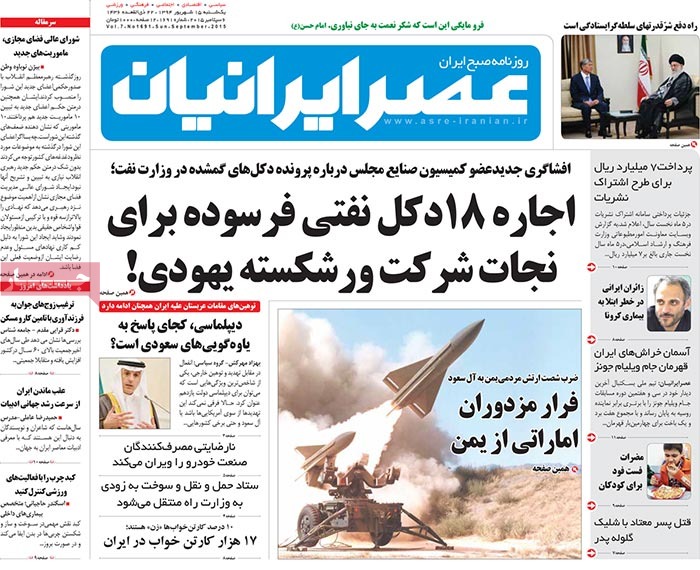
Asr-e Iranian: Eighteen worn-out oil derricks were hired to save a Jewish firm from the brink!

The revelation was made by a member of parliament’s Industry Committee about missing rigs at the Oil Ministry.


A look at Iranian newspaper front pages on September 6


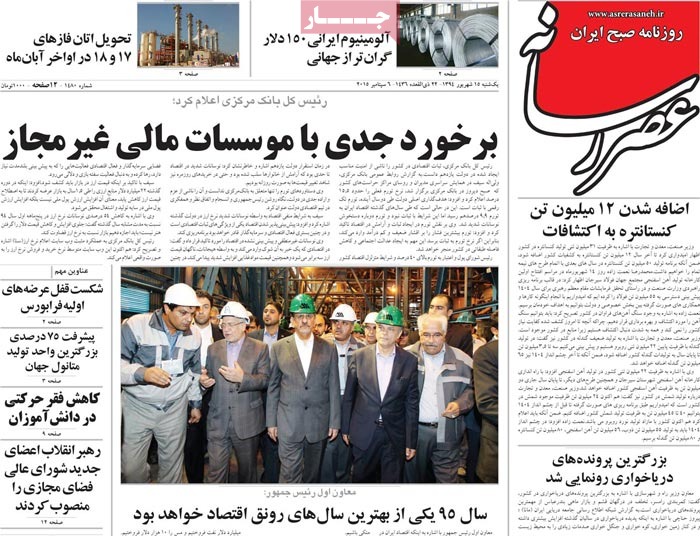
Asr-e Rasaneh: “Next year will be among Iran’s best in terms of the economic boom,” said the first vice-president.


A look at Iranian newspaper front pages on September 6


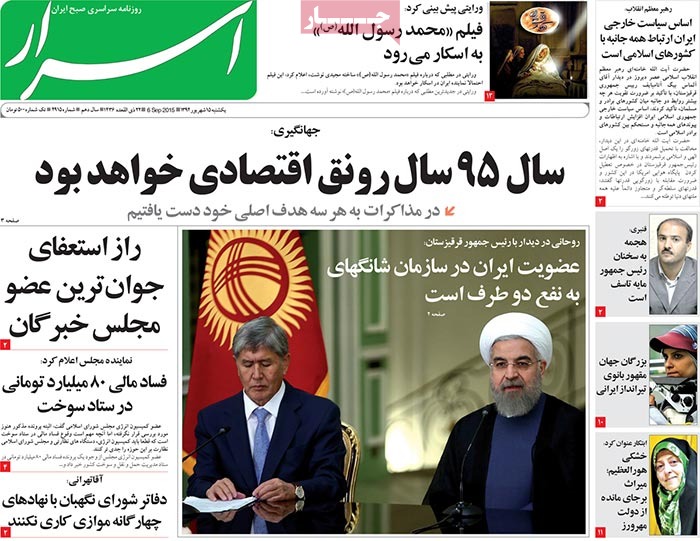
Asrar: What caused the young member of the Assembly of Experts to resign?

Asrar: “The drying of Hour-al-Azim Lagoon is a legacy of the previous government,” said Masoumeh Ebtekar, the director of the Environment Protection Organization.


A look at Iranian newspaper front pages on September 6


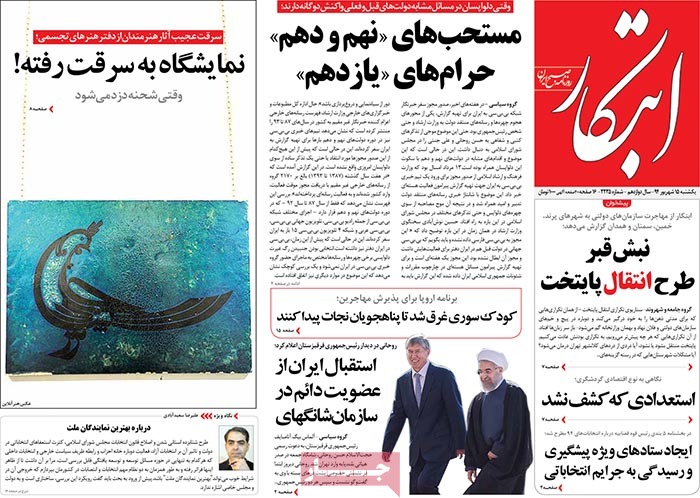
Ebtekar: The Syrian child drowned to save other refugees.

Europe has announced plans to admit immigrants.

Ebtekar: Iran has welcomed permanent membership of the Shanghai Cooperation Organization.

The announcement came at a meeting between Iranian president and his Kyrgyz counterpart in Tehran.


A look at Iranian newspaper front pages on September 6


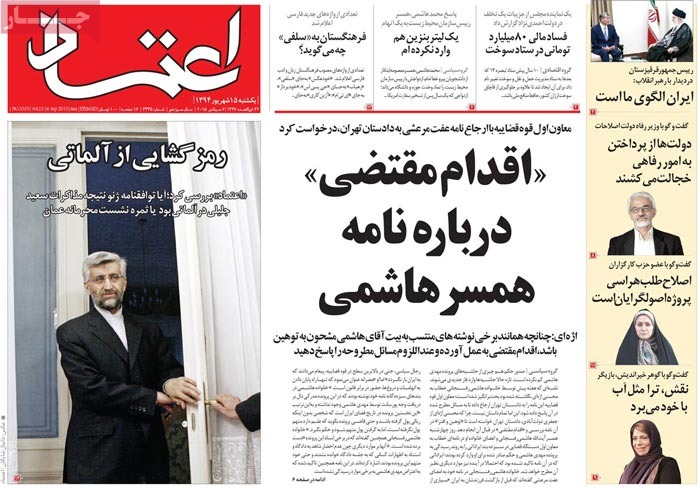
Etemad: The deputy judiciary chief has sent the letter Effat Marashi [Ayatollah Hashemi Rafsanjani’s wife] has released [on the imprisonment of his son] to Tehran Prosecutor Dowlatabadi, urging him to take action if he finds anything insulting in the letter.


A look at Iranian newspaper front pages on September 6


Hamkari Melli: “Unauthorized financial institutes will be seriously dealt with,” said the governor of the Central Bank of Iran.

Hamkari Melli: Variety has predicted that Iran will send Muhammad, Messenger of God to the Oscars.


A look at Iranian newspaper front pages on September 6


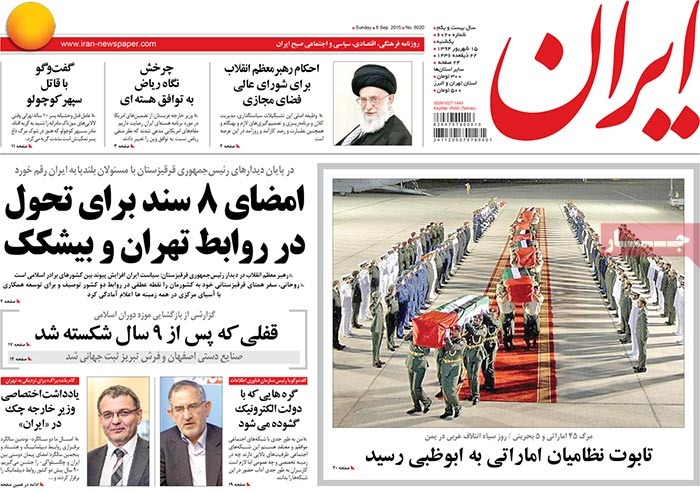
Iran: The Islamic Era Museum has reopened after nine years.


A look at Iranian newspaper front pages on September 6


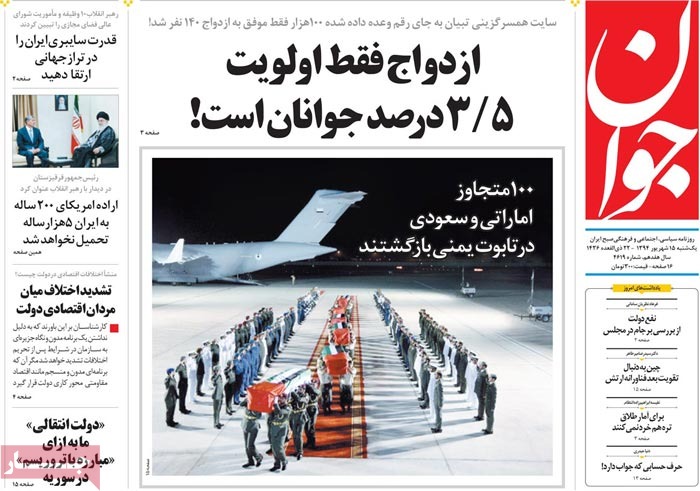
Javan: The Supreme Leader has urged members of the Supreme Cyberspace Council to promote Iran’s cyber power on an international scale.


A look at Iranian newspaper front pages on September 6


Jomhouri Islami: Emirati sheikhs are at odds over continued military operations against Yemen.

Jomhouri Islami: The number of people who have signed a petition for Netanyahu to be arrested while visiting London has gone beyond 100,000.

Jomhouri Islami: The United Nations has announced that the Syrian war has displaced 11 million people.


A look at Iranian newspaper front pages on September 6


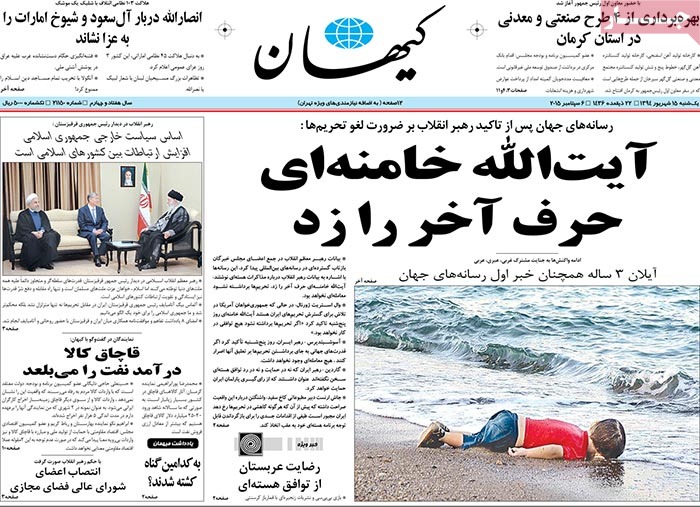
Kayhan: Ayatollah Khamenei made the final comment by underlining the need for the termination of sanctions.

That is how the world media covered the recent remarks of the Supreme Leader.


A look at Iranian newspaper front pages on September 6


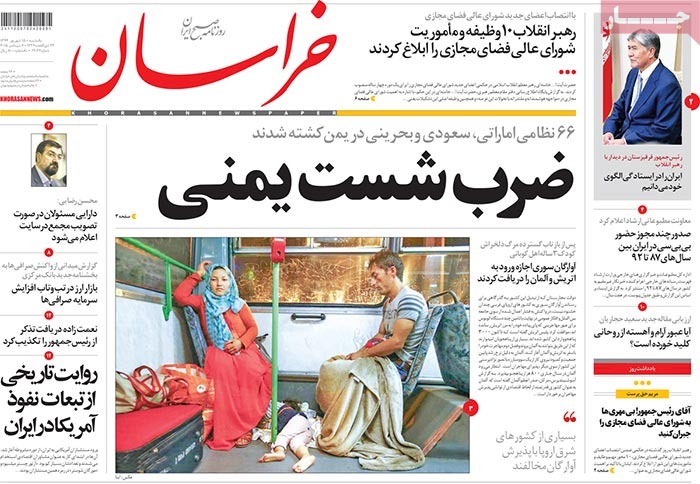
Khorasan: The industry minister has denied reports that he has received a warning from the president [over his comments on a popular campaign to boycott brand new locally-made cars].


A look at Iranian newspaper front pages on September 6


Highlights of Ettela’at newspaper on September 6

Ettelaat-september-6

 “The only way to dispel the evil of hegemonic powers goes through resistance,” the Supreme Leader said at a meeting with the visiting Kyrgyz president.

Ayatollah Khamenei further said that establishment of firm ties among all Islamic countries lies at the center of Iran’s foreign policy.

 The Iranian science minister has invited scientists from all over the world to launch joint projects with the Islamic Republic.

The science chief has further said Iranian scientists release more than 30,000 scientific papers a year, a 20-fold increase over the late 70s when the Revolution triumphed.

 The Supreme Leader has named the new members of the Supreme Cyberspace Council.

In a decree for the new members of the council, Ayatollah Khamenei has urged the council to make special efforts to clean up the country’s cyberspace, respect the privacy of members of the public, and make an effective stand against enemy inroads.

 Iran and Kyrgyzstan have signed eight cooperation agreements with the presidents of the two countries in attendance.

 A retaliatory attack by Yemeni forces has left 66 Saudi, Emirati and Bahraini soldiers dead.

A spokesman for the Saudi-led coalition has admitted that the coalition has failed to achieve its goals in Yemen.

 Four industrial projects came on stream in Kerman at a ceremony attended by the first vice-president.

 The director of the Management and Planning Organization has said that the country’s Sixth Development Plan envisions eight percent annual growth.

 The Iranian Air Force has conducted electronic warfare drills.

New observatory aims to put Iranian astronomy on the map

Iranian astronomy

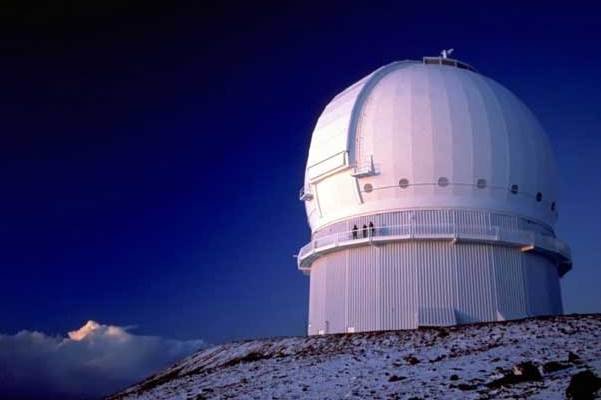
As the sun sets on an early August evening at this 3600-meter peak in central Iran, village lights shimmer in the distance and the temperature plummets. Alireza Behnam, a physicist, ducks into a cozy trailer parked at the site and heats water for tea. His immediate task on the mountain is to study the weather. His larger goal: help his country recapture some of its past astronomical glory.

A millennium ago, when Europe was in its Dark Ages, Persia and the rest of the Muslim world were dotted with observatories. Copernicus even drew on the meticulous records of planetary motion from the observatory at Maragheh in northwestern Iran for his proposal that Earth revolves around the sun. That astronomical tradition is due to resume next spring, not far from Behnam’s trailer, as construction begins on the $30 million Iranian National Observatory (INO), a 3.4-meter optical telescope.

When completed in 4 or 5 years, it could be the best general-purpose telescope for thousands of kilometers, says Piero Salinari of the Arcetri Astrophysical Observatory in Florence, Italy. “INO has very good potential for becoming an important facility for astronomy in the world, not only in Iran,” he adds. The telescope will study exoplanets and gamma ray bursts, hunt for dark matter, and probe galaxy formation. Although it is dwarfed by the largest instruments elsewhere, “an awful lot of state-of-the-art science is still being carried out with 2- to 4-meter telescopes,” says Hendrik Hildebrandt, an astronomer at the Argelander Institute for Astronomy in Bonn, Germany.

The INO testifies to the persistence of Iran’s tiny astronomy community in the face of shifting political winds. The push for an observatory began in the 1980s, when an Iranian-born philanthropist in Spain, inspired by the Isaac Newton Telescope at La Palma in the Canary Islands, offered to bankroll a similar facility in his homeland. The philanthropist “offered to bequeath his entire fortune to the University of Kerman, so long as it built an observatory,” says INO Director Reza Mansouri, an astrophysicist at the Institute for Research in Fundamental Sciences (IPM) in Tehran. But Iran was at the tail end of a long, draining war with Iraq and did not grasp the opportunity.

A decade later, the National Research Council of Iran endorsed two big science projects: the observatory and a high-energy particle accelerator. But the INO soon went off the rails. Mahmoud Ahmadinejad, a religious hard-liner, was elected president in 2005, and his science minister took a dim view of the telescope project, Mansouri says.

Counting on a change of heart—or a change of minister—astronomers continued to lay the groundwork. Mountaintop instruments showed that the steadiness of the air above Mount Gargash—its “seeing”—is outstanding. According to the percentage of “super-seeing nights,” says Arne Ardeberg, an astronomer at Lund University in Sweden, “it beats Mauna Kea,” the peak in Hawaii that’s home to some of the world’s largest and best optical telescopes. In 2009, IPM Director Mohammad-Javad Larijani, whose family wields tremendous clout in Iran, wrote to the supreme leader, Seyyed Ali Khamenei, about the observatory’s plight.

Ten days later, the government authorized 70 billion rials (about $4 million at the time) for the INO—enough to order a primary mirror from Germany and have it polished in Finland. Engineers quickly began devising solutions to the challenges of the site: large temperature swings in the dry desert air, brutal winter conditions, and earthquakes. Because Iran is one big seismic zone, the INO’s design team came up with platform supports that will be decoupled from the rock to minimize vibrations, Mansouri says. “That part of the construction is very delicate,” he says.

When reformist President Hassan Rouhani took power in August 2013, the stars at last seemed to be aligned for the INO. But last summer, as design work was wrapping up and the primary mirror was being readied for its long journey by ship and truck to Iran, the INO got some dispiriting news. Even though Iran’s parliament had approved another $1 million for the project, sanctions over Iran’s nuclear program were biting, and the government’s planning department refused to allocate the money. “It was such a discouraging moment. Our lowest point,” Mansouri says.

This year saw two “absolutely critical” developments, he says. The first was a visit to Gargash by Iran’s vice president for science and technology, Sorena Sattari. After returning to Tehran, Mansouri says, the vice president, a mechanical engineer by training, wrote an enthusiastic note to Rouhani, who then instructed the planning department to help the INO.

The second boost is from an improbable source: the United States. Last September, Alireza Shabani, an Iranian-American who is helping build a quantum computer at Google’s Quantum Artificial Intelligence Lab in Mountain View, California, read a news report about the INO’s dire straits. “I was very sad. I really wanted to find a way to make this project survive,” Shabani says. After contacting Mansouri, he pledged to enlist the Iranian-American diaspora to the cause. In July, Shabani and two colleagues launched Biruni Inc., a foundation named after an ancient Persian scholar, to raise money for the observatory.

Transferring the money won’t be easy, given U.S. sanctions. This month, Shabani says, he and a lawyer will make their case for an exemption to the Treasury Department rules. The nuclear detente with Iran should strengthen their case.

Mansouri hopes the INO will lead to other new relationships. Iran has perhaps 10 observational astronomers, he says; another 100 of Iranian origin work in the United States, and 50 or so in Europe. “If even 10% of them come back to work in Iran,” Mansouri says, “it would make a big difference.” But the view from Gargash won’t be limited to Iranians. “This is a project that all astronomers can use.”

By Science Magazine’s Richard Stone

Who is behind the plot to displace the Syrian people?

Syrian Refugees

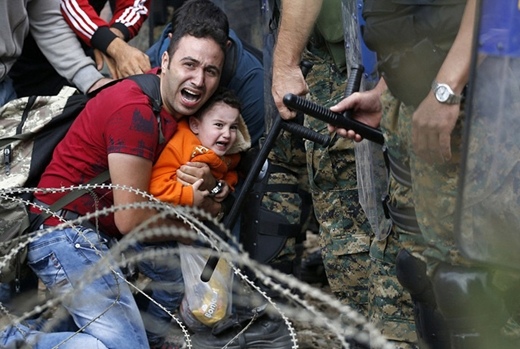
The spontaneity of the recent exodus of Middle Eastern refugees from Eastern to Western Europe which has triggered a serious debate in the European Union is pretty much in doubt.

A few years after a large number of the Syrian people were forced from of their homes in a war waged by a West-Zionist-Arab coalition to topple the Syrian government, refugees are trying to move from countries like Hungary in Eastern Europe to countries such as Germany in Western Europe, either on foot or by train.

But what is surprising is that it comes at a time when the situation in Syria is not as fluid as it used to be and both Syrian government forces and armed opposition groups have taken up positions in regions under their control and unlike the early months of the deadly conflict, internal and external displacements do not happen. So the recent mass movement of Syrian refugees seems a little fishy.

The following is the translation of an excerpt of an opinion piece by Ahmad Kazemzadeh, a Middle East expert, Tasnim News Agency filed on September 5 on the sudden surge in the number of Syrians bound for Europe:

Turkey is the prime suspect, but the role of Israel cannot be ruled out. One of the reasons why Turkey might have a hand in the refugee crisis is that Ankara has long sought a permit to set up a safe region on Syrian soil along its borders to accommodate the Syrian refugees who have turned into a serious internal challenge for the Turkish government. That would cut the Turkish government’s spending and do some damage control for its failed Syria policy.
It seems that the plot of the Syrian refugee movement has been hatched and implemented by Turkey so that Ankara can use it as leverage to bring the West on board and establish an IS-free safe region.

On top of that, parliamentary elections are in the offing in Turkey where officials of the ruling Justice and Development Party are under the impression that implementation of this plot and making the EU pick up the tab and assume partial responsibility for the Syrian refugees can give them an electoral edge at home.

As for the role of Israel and its likely connivance with Turkey, it can be argued that like Ankara, Tel-Aviv is opposed to a shift in the stance of Western and Arab countries on Syria and their probable support for Russian measures to settle the Syrian crisis.

Secondly, the fresh round of Arab displacements – in Syrian and Libya – happened exactly at a time when the Zionist regime replaced the land for peace formula envisioned in the Madrid Peace Conference in 1991, with security for security plan put forth by Prime Minister Benjamin Netanyahu and his fellow rightists. Building on this approach, Israel has prolonged the Middle East crisis and set the stage for new crises like those crippling Libya and Syria.

In fact, the EU was right when it predicted that if the Middle East and Palestinian crises were not duly addressed, they could lead to a Europe-bound exodus from the crisis-stricken regions. Now the prediction has come true. Although no serious action has been taken by Europe to defuse regional crises, its steps toward recognition of the right of the Palestinians to have a state in the territories occupied in 1967 have worried Israel. That’s why Tel-Aviv benefits from creating problems for Europe.