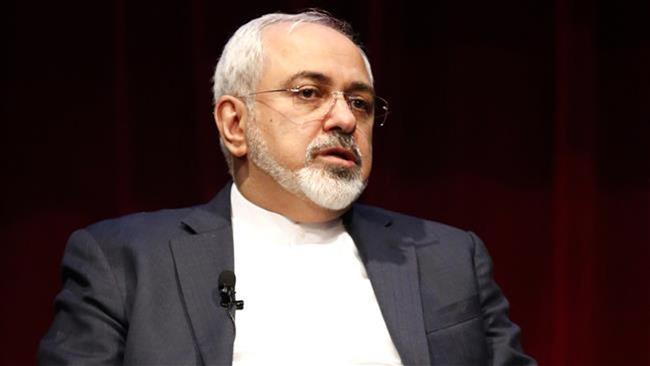
“The deal will be made or broken on whether the United States wants to lift the sanctions or keep them,” Zarif made the comments in an interview with Al-Monitor media website released on Thursday.
He also expressed Iran’s resolve to continue its cooperation with the P5+1 members – the United States, France, Britain, China and Russia – plus Germany – until the conclusion of the talks.
Referring to Leader of the Islamic Revolution Ayatollah Seyyed Ali Khamenei’s backing for the Iranian negotiating team, Zarif noted, “the Leader’s support is very important for our team.”
On June 23, Ayatollah Khamenei, in a meeting with the heads of the three branches of the Iranian government and the country’ senior officials in Tehran, commended the Iranian nuclear negotiating team for its faithfulness and bravery in the talks with the six world powers, and said the negotiators are meticulously making efforts in order to settle issues.
The Iranian negotiators have managed to bravely announce Iran’s stance on the nuclear issue, the Leader said, adding that they may possibly make some mistakes, but they are “brave and faithful.”
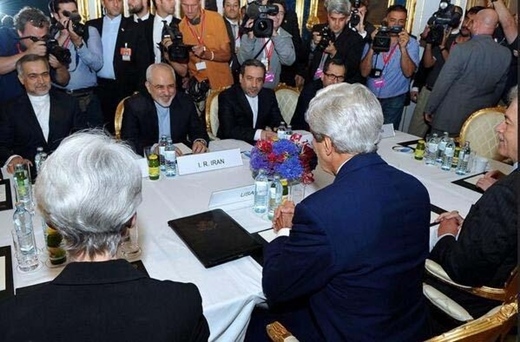
Iran and the P5+1 group of countries had set June 30 as the deadline to agree on a final nuclear deal, but talks in the Austrian capital missed the target date as some issues remain unresolved between the two sides.
The removal of sanctions against Iran and access to or inspections of the country’s military sites seem to be the major bones of contention.
Iranian officials say a final deal should conform to an understanding reached between Tehran and the P5+1 group in the Swiss city of Lausanne in April.
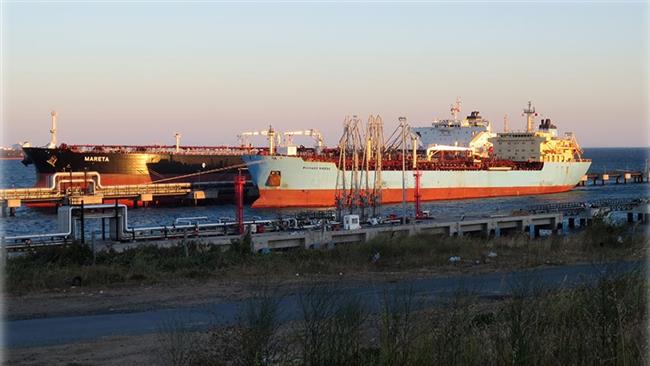
International shipping lines are stepping up port calls to Iran as the country’s massive maritime trade sector is emerging from sanctions.
US and European sanctions in 2012 on Iran’s largest ports operator have impaired commercial maritime traffic, curbing otherwise legal trade.
Foreign shipping lines ceased calling on Iran’s ports in the Persian Gulf after the US and the Europeans designated its leading ports operator, the Tidewater Middle East Maritime Company, subject to a trade ban and asset freeze.
Sanctions hampered legal trade such as transport of medical products. Iran relies on container and bulk carriers to transport much of its basic needs, including food and consumer goods. Those willing to risk the liability associated with the Iran trade faced further deterrents as they could not get insurance coverage.
Iran subsequently took the case to the Europeans courts. In January, EU’s General Court, the bloc’s second highest tribunal, annulled the sanctions citing faults with the legal grounds given by the European Union. The case involved Bank Tejarat and 40 Iranian shipping companies, all subject to an EU asset freeze.
The European Union, however, responded by leveling new charges as it has done in other cases and re-designated the bank and 32 companies.
Such behavior has raised questions in the European media and among world observers, with legal experts saying the sanctions are obviously politically-motivated aimed at pressuring Iran.
According to head of the Islamic Republic of Iran Shipping Lines (IRISL) Mohammad Hossein Dajmar, “the EU has not presented any proof or document signifying any wrongdoing by the IRISL for intensification of the sanctions”.
“This goes to indicate the sheer political nature” of the sanctions, he has said.
Iran’s legal victories, however, have their intended effects and cracks have appeared in the wall of sanctions.
According to new reports, commercial trade is scrambling back to life in southern ports, with Iran’s biggest container port having received calls from at least seven major shipping lines over the past year.
The port of Shahid Rajaee near Bandar Abbas — strategically located at the mouth of the Strait of Hormuz — accounts for 90% of Iran’s container traffic.
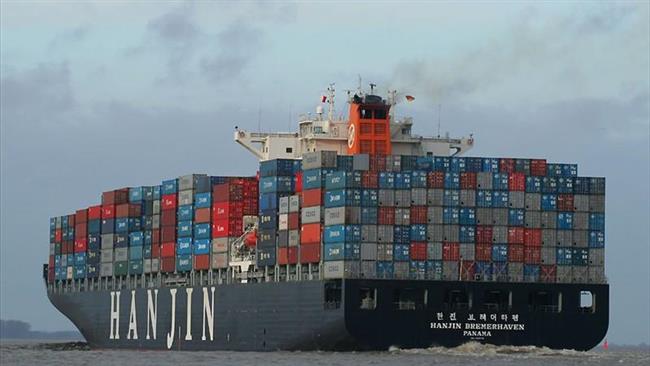
On Tuesday, it received Hanjin Bremerhaven of South Korea’s largest container carrier Hanjin Shipping Co., also one of the world’s top ten, which arrived from Singapore.
“Discharge and loading operations on the ship were carried out as soon as possible after which the vessel left Shahid Rajaee Port for Jebel Ali in the UAE,” deputy head for ports affairs in Hormuzgan Mohammad Ali Saeedipour said.
He said two more container ships belonging to Taiwan’s Yang Ming Marine Transport Corp. and Evergreen Marine Corp. will dock at the port soon.
A cargo ship belonging to the world’s third largest container company, CMA CGM of France, has already visited Shahid Rajaee as have liners from Singapore’s Pacific International Lines, Taiwan’s Wan Hail Lines and Italy’s Ignazio Messina, he said.
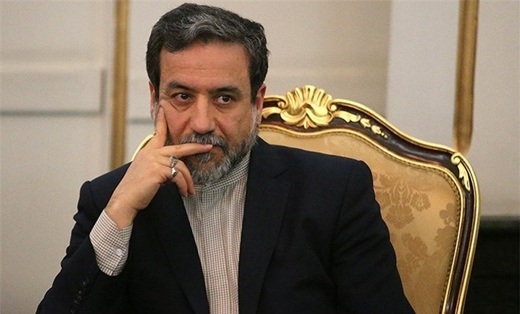
Iranian Deputy Foreign Minister Abbas Araghchi on Friday voiced Tehran’s readiness to cooperate with the International Atomic Energy Agency (IAEA) to clear up misunderstandings over allegations of possible military dimensions (PMD) in Iran’s nuclear energy program.
“We are ready to cooperate with the agency (IAEA) on PMD and to speed up such cooperation in order to reach a clear conclusion in this regard, so that the falsehood of all those claims will be proven,” Araghchi told reporters in Vienna on Friday.
He described the allegations of PMD in Iran’s nuclear activities as an “old and chronic discussion” that dates back to years ago.
“At that time, allegations were made against Iran’s nuclear program that became the basis of pressures and sanctions,” Araghchi explained.
His comments came after IAEA Director General Yukiya Amano paid a visit to Iran on Thursday.
Araghchi hailed Amano’s visit as “good and fruitful,” saying reports he has received from Tehran and those by Amano’s colleagues suggest that the trip was successful and a step forward.
“There is now a good opportunity to settle these issues (like PMD) and the questions and the claims that had been made about the past in a calmer atmosphere,” the Iranian diplomat said.
“We are also prepared to cooperate with Mr. Amano to make it clear that the existing allegations and the files against the Islamic Republic of Iran are bogus and to demonstrate the white record of Iran’s nuclear program,” he stressed.
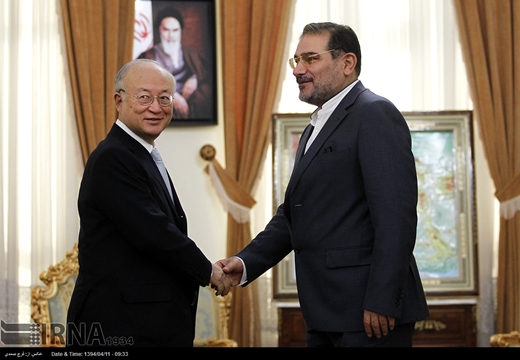
During his one-day visit to Tehran, Amano met Secretary of Iran’s Supreme National Security Council (SNSC) Ali Shamkhani and President Hassan Rouhani.
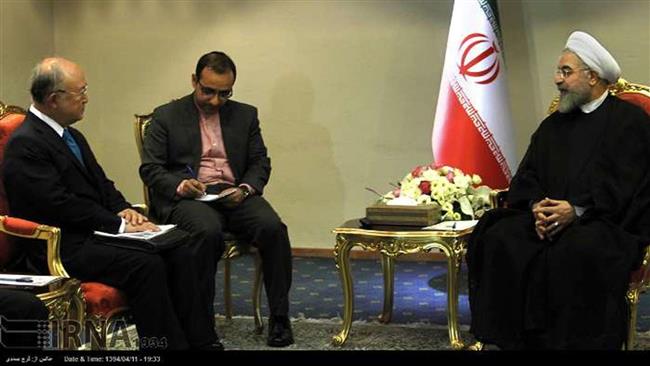
In the meeting with the president, Amano appreciated Iran’s cooperation with the IAEA, saying the previous inspections have all confirmed that Iran has always honored its commitments and there has been no deviation towards military purposes in its nuclear activities.
‘Iran is still ready to achieve a fair framework for settling the remaining issues in the specified time under the safeguards and existing regulations,’ President Rouhani said in a meeting with IAEA Director General Yukiya Amano in Tehran on Thursday.
The Iranian president noted that Iran like other member-states of the non-proliferation treaty (NPT) should achieve its full nuclear rights and there should be no discrimination in this regard.
He pointed out that the expansion of peaceful nuclear activities and also non-proliferation of nuclear weapons are two important duties of the IAEA which should be fulfilled in a balanced way and without discrimination against its member-states.
‘Iran’s transparent cooperation with the IAEA is a golden example of a large number of examples and it has been proven for the IAEA that the accusations on Iran’s diversion from nuclear activities have been baseless,’ President Rouhani added.
The Iranian president reiterated that proving the non-diversion from nuclear activities by Iran over past 12 years of close cooperation with the IAEA is the best judgment for international public opinion.
‘The IAEA should play its conspicuous role in this juncture that talks with the Group 5+1 is approaching its final stage,’ he added.
President Rouhani pointed to the settling of several problems in the past due to Iran-IAEA cooperation, and said, ‘If there will be necessary will in both sides and some non-technical issues do not interfer, some differences can be fully resolved in a short period of time.’
IAEA director general, for his part, appreciated Iran’s cooperation with the agency, and said, ‘We have always announced in the past inspections that Iran’s nuclear activities have had no diversion towards military objectives following the previous inspections and that the country has always fulfilled its commitments.’
Amano pointed to his constructive talks with Secretary of Iran’s Supreme National Security Council Ali Shamkhani, and said, ‘I believe that through mutual respect and close cooperation all issues can be resolved and I hope that IAEA’s reports will help to the process of nuclear talks after this visit.
Iran has started negotiations with a number of countries but Turkey is being cited as a serious new customer for the Iranian fuel oil.
Talks are being held with a Turkish company, which has not been named, and an agreement is expected to be signed soon if negotiations are finalized, the Mehr news agency reported.
Fuel oil is increasingly becoming unwanted in Iran as it is replaced with the South Pars gas for powering industrial units and electricity generation plants.
According to official figures, fuel oil consumption slumped 25% to 25.5 million liters in the three month since March 20 versus 35.2 million liters during the similar period a year before.
Mehr said Iran currently has 41 million liters of excess fuel oil which it is offering to passing ships in the Persian Gulf and the Strait of Hormuz.
Iran has also long-term contracts with the Persian Gulf littoral states, especially with the UAE’s bunkering hub of Fujairah for the sale of its oil fuel.
Mehr said a new marketing effort has begun to increase sales of the Iranian fuel oil which the country has always a surplus to export.
Fuel oil is a petroleum product burnt in furnaces or boilers to generate heat or in engines to power ships.
Iran exports between 200,000-600,000 metric tons of fuel oil a month depending on domestic use levels.
The exports have proven their value during years of sanctions which have targeted Iran’s crude oil exports.
The fresh bid to find new buyers and increase sales comes as Tehran is finalizing nuclear talks with the hope of reaching a final agreement which would lift sanctions.
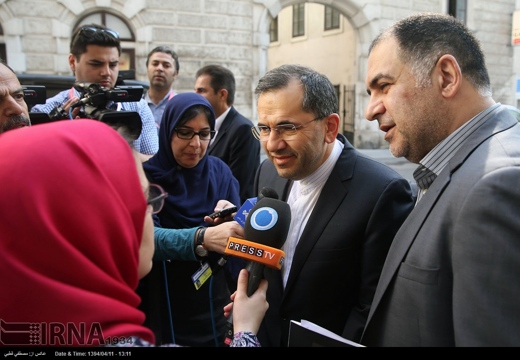
This is one of the important issues that we have been insisting upon resolving from day one as we consider these sanctions being unjust and illegitimate, Takht-e Ravanchi said while speaking to media representatives on the sidelines of the nuclear negotiations in Vienna.
‘It is our objective to remove these unjust sanctions and we expect all economic, trade and financial sanctions to be terminated from the implementation day. Iran will implement its commitments at the same time all these economic and financial sanctions will be
terminated,’ he added.
Asked about the UN Security Council sanctions, Takht-e Ravanchi said, ‘When we will reach the implementation day all the past resolutions of the UNSC will be terminated. A number of sanctions have been adopted by UN and they are not mostly economic-related sanctions. We are in discussion as to what would be the next step as far as the UNSC sanctions are concerned.’
Takht-e Ravanchi stressed we are hopeful that the job could be done over the next couple of days provided the other side is making the necessary decision to get the job done as soon as we can.
Speaking to reporters in Vienna, where the nuclear talks between Iran and the six world powers are underway, Takht-e Ravanchi said, ‘it is almost the last days of talks and we don’t exactly know on what day they would be ended. We are at a stage now that the talks are very intensive.’
‘Meetings begin early in the morning and continue until late at night. Even after the meetings with the other side, our private meetings begin at the end of the night,’ Takht-e Ravanchi said.
Deputy Foreign Minister for European and American Affairs Majid Takht-e Ravanchi told reporters here that the expert-level talks have ended but discussions will be further held at the level of deputy foreign ministers.
He declined to elaborate on the issues due to be discussed by foreign ministers. He just said that they are key issues that cannot be concluded in talks at the level of experts or deputies.
Takht-e Ravanchi said that a particular date has not been set yet for a meeting between Iran and the Group 5+1.
Noting that the foreign ministers and the European Union foreign policy chief Federica Mogherini will come to Vienna on Thursday, the diplomat said however, meetings will be held bilaterally.
He noted that the foreign ministers will leave Vienna later in the day and will later decide on their return to the talks.
Addressing a group of academics here, Ayatollah Rafsanjani said Iran has achieved the world’s most complicated technology which is the nuclear technology through major strides taken by its scientists and youth.
‘We have never been seeking nuclear weapons as Supreme Leader has issued a Fatwa banning production of atomic bombs and weapons,’ the Ayatollah said.
Iran only wants to develop nuclear technology for peaceful, health and agricultural purposes, he stressed.
Ayatollah Rafsanjani added that the world have realized in order to solve their issues they have no other way but to respectfully negotiate with the Islamic Republic of Iran.
Underlining the need for forging unity among the Iranian nation in the current situation, he said that division is a deadly poison that could cause many burdens for the Muslim Ummah.
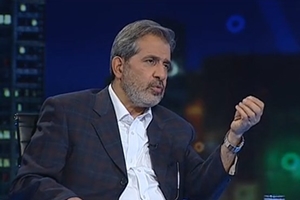
A former Iranian Foreign Ministry spokesman says that an honorable agreement is likely to be reached unless the Americans make miscalculations and upset the balance at the negotiating table in a way that makes a final deal elusive.
Hamidreza Asefi, who was also a former Iranian ambassador to Germany prior to the fall of the Berlin Wall and unification of Germany, made the comment in an interview with a TV news bulletin on the latest developments and future of nuclear talks and added that the country’s nuclear negotiating team, whose self-confidence has been boosted by the Supreme Leader’s praising remarks, should forget about the time limit in nuclear talks and stand their ground when it comes to the rightful stances of the Islamic Republic of Iran.
The following is the translation of excerpts from his remarks in the interview as reported by Khabaronline.ir on July 1:
[…]
Is it true that the other side needs an agreement more than Iran?
Yes, Messrs. Obama and Kerry as well as a US Deputy Assistant Secretary of State have made comments which show they believe Iran will not bow so they should reach an agreement with Iran. The Zionist regime is enraged, part of it is a sales presentation and the other part is that the regime is really vexed.
The Center for Security Studies (CSS), which is an international think tank in Zurich, has said that nuclear energy has been linked with national pride in Iran and that the Iranians are highly unlikely to let go of it. The country’s nuclear team should go ahead with the talks without paying attention to the war of words waged and pursued by the Americans, Zionists and Saudis.
A media blitz is in overdrive trying to sell this idea that Iran has to give up its red lines. What exactly is the West seeking to achieve from this media and psychological warfare?
They [the Western countries] are seeking to gain more concessions. They know about the clear red lines of the Islamic Republic of Iran. The way your stance is treated diplomatically when you openly announce your red lines differs from when you speak indirectly and implicitly. They have got a grasp on the question and are trying to say that they are not to blame if the talks – one in a ten thousand or one in a million – produce no results and to shift the blame onto Iran.
To date, Iran has the world public opinion on its side with all people having faith in Iran’s legitimacy and rightfulness. Nuclear talks are positive on both sides: in case an agreement is struck, Iran will reap its benefits; and if the talks produce no result, [Iran can prove that] the US and fellow P5+1 members are to blame for the inconclusiveness of the talks. If Iranian negotiators insist on their stances, the other side will be more pressed for time.
[…]
The American side says that some restrictions will be imposed on Iran for good. How does it harm Iran?
If the restrictions will be in place for a long time, they will slaughter the country’s nuclear industry. Iran’s scientists will lose their interest and motivation. If a sports team is said that they can simply do preparation exercises but are not allowed to take part in a competition, everything [they enjoy] will be lost. If the indigenized nuclear industry is to be brought to a halt, it would grow weaker [over time].
Secondly, when you accept long-term restrictions, you make yourself limited or deprived without knowing what will unfold on the international stage after five years. Iran sees no reason – logically and legally – to accept such restrictions. They want to make sure that there is no diversion in Iran’s nuclear program. They know about it, but feign sleep. They have always said that the [International Atomic Energy] Agency is not in a position to fully verify Iran’s [nuclear] measures. We are not supposed to prove this. The burden of proof is on the one who claims there are diversions in Iran’s program.
Why do we need to stand up to the other side’s acquisitive demand that decisions can be made after the UN nuclear agency’s verification?
They [the IAEA inspectors] may prolong the verification process for Iran up to ten years and then release a statement saying that they cannot verify [Iran’s activities]. There seems to be no end in sight spatially and temporally.
The agency did not pass its test on Iran in the past. Drawing on no sound reason, the agency referred Iran’s case to the UN Security Council. There was no reason for that. Iran is concerned about the inspections which may go beyond what has been envisioned in the [Additional] Protocol [of the NPT] because the IAEA did not pass its test with flying colors in the past.
Which scenario do you think will become a reality: the inconclusiveness of the talks or an agreement with some sort of restrictions?
I do not like to say something and correct myself afterward. […] But I think an honorable agreement which meets minimum expectations [of the two sides]. As for the extension of the talks, if they do not drag on for more than one month, that would not bother me. But if the Americans make miscalculations and turn the tables in a way that an agreement is not reached, it would translate into a political suicide for the other side.
I think an agreement should be arrived at unless the Americans seek to commit a political suicide. It is too hard to predict the events on the political front. We are now in Tehran and far from Vienna [the venue of the nuclear talks].
[…]
How do you think the Supreme Leader’s choice of words for the country’s negotiators – among them trustworthiness, bravery, piety and zeal – can help Iran’s nuclear team?
These characteristics are what is needed for this job. If one is engaged in a war on the diplomatic front, they have to enjoy such traits. The Supreme Leader’s words obviate the need for us to talk on that. […]
The negotiating team has boosted its self-confidence drawing on the Supreme Leader’s praising remarks. Self-confidence earns you courage and calms you down. Building on the [Leader’s] trust, the negotiators are trying to produce results. What is our destiny will lead to blessings for the country. The Supreme Leader’s remarks helped the negotiating team greatly. Those who were worried are now at ease.
You were not a worrier, were you? [A reference to the so-called Worriers who are the fervid supporters of former President Ahmadinejad and harsh critics of President Rouhani’s government and its policies]
I’m not in that particular sense of the word, but I am concerned about the gamesmanship of the Americans.
Director General of the International Atomic Energy Agency (IAEA) Yukiya Amano and Secretary of Iran’s Supreme National Security Council (SNSC) Ali Shamkhani discussed issues of mutual interests in Tehran on Thursday.
According to a statement issued by the IAEA on Thursday, Amano is currently in Tehran to accelerate the resolution of all outstanding issues related to Iran’s nuclear program.
The statement further said during his visit, Amano will meet with President Hassan Rouhani and other senior Iranian officials on Thursday.
Discussions are expected to address ongoing cooperation between the IAEA and the Islamic Republic of Iran under the Framework for Cooperation, the statement added.
It said that the visit takes place in the context of the IAEA’s continued engagement with Iran and E3/EU+3 countries as they work towards a Joint Comprehensive Plan of Action.