Thursday, December 25, 2025
Home Blog Page 4710

Economy chief orders measures to accelerate capital inflow, privatization

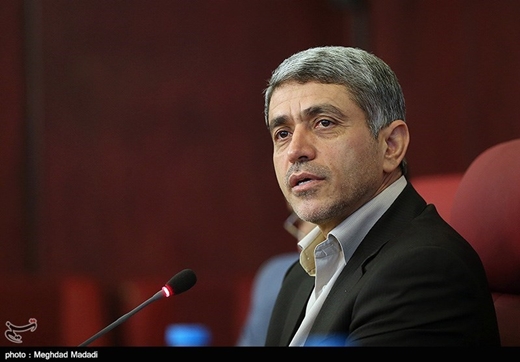
Ali Tayyebnia

Minister of Economy and Financial Affairs Ali Tayyebnia has called on the head of the Securities and Exchange Organization to form a joint workgroup to speed up the influx of foreign capital. The minister has also ordered the Iranian Privatization Organization to make an urgent decision about the so-called Justice Shares [distributed among lower and working class Iranians under Ahmadinejad].

What comes next is the translation of part of the report Alef.ir posted online on July 13 on the economy minister’s orders:


Inflow of foreign capital through stock exchange

In a letter to the head of the Securities and Exchange Organization (SEO), the economy minister ordered the organization to give priority to measures to expand the stock exchange and said that the capital market should be as instrumental as the banking system in financing the country’s projects.

The economy chief underlined the significance of measures to familiarize state managers with capital market conditions, and said formation of a joint workgroup by the SEO and the Organization for Economic Investment and Technical Assistance to attract foreign money to the capital market as well as to the mercantile and energy exchanges should be on the future agenda of the organization.

The minister added that the Securities and Exchange Organization should play a more active role in propping up the financial management industry, so that those with less experience in the capital market can be offered a wide range of investment choices by professional financial institutions.


Challenges

Attraction of foreign capital seems to be the cornerstone of the minister’s order. The strategy has been put on fast track as nuclear talks between Iran and P5+1 near an end. The Tehran Stock Exchange, however, seems to be wrestling with grave problems to attract foreign capital.

The absence of accurate and detailed information about Iranian firms and how Iran’s capital market functions, on the one hand, and laws regulating the presence of foreign investors in Iran’s economy which according to experts are far from competitive on the other have created a serious challenge for the presence of foreign investors in Iran.

An initiative aimed at setting up a special international economic center to ease the influx of foreign capital has stalled for seven years and the Ministry of Economy has practically done nothing to implement it.


Justice Shares should be given priority; Privatization Org. should be transformed

In his letter to the head of the Privatization Organization, Tayyebnia said, “Aside from following up the ratification of the Justice Shares Bill, the organization is required to set the stage for its implementation as one of the eight major key projects of the ministry.”

The economy minister stressed that the organization should fulfill all objectives envisaged in the general polices of Article 44 [which deals with privatization of state companies], and said, “The flaws of the privatization drive should be identified and then a policy package to close the gaps between what is being done and what is stipulated as objectives of Article 44 should be prepared.

With the privatization of state companies nearing completion, a plan to transform the Privatization Organization should be crafted.”
A look at Iranian newspaper front pages on July 13

Iranian Newspapers Headlines

Nuclear talks at home stretch and the guesswork on whether a deal is achieved by the July 13 deadline dominated the front pages of all Iranian newspapers on Monday. Also in the news were the mass resignation of 18 MPs from Fars Province in protest at the government’s appointment of a new governor general and reactions by some dailies which described the deputies’ move as an attempt at blackmail.

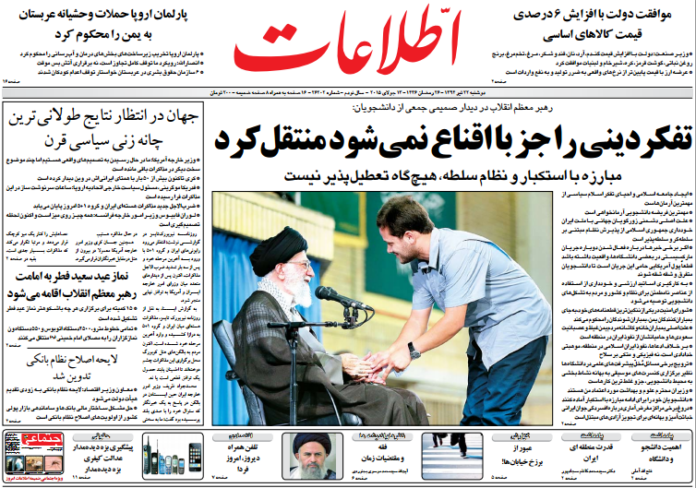
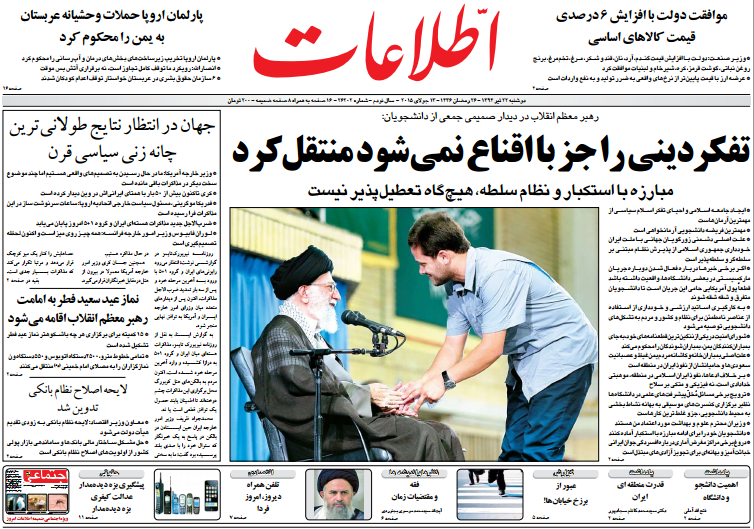
Highlights of Ettela’at newspaper on July 13

Ettela’at: “Ideology cannot be passed along unless through convincing,” said the Supreme Leader at a meeting with a large number of university students.

“The reason why global bullies show hostility toward the Iranian people is the failure of the Islamic Republic to recognize a system built on domination,” Ayatollah Khamenei further said.


Ettelaat-July13


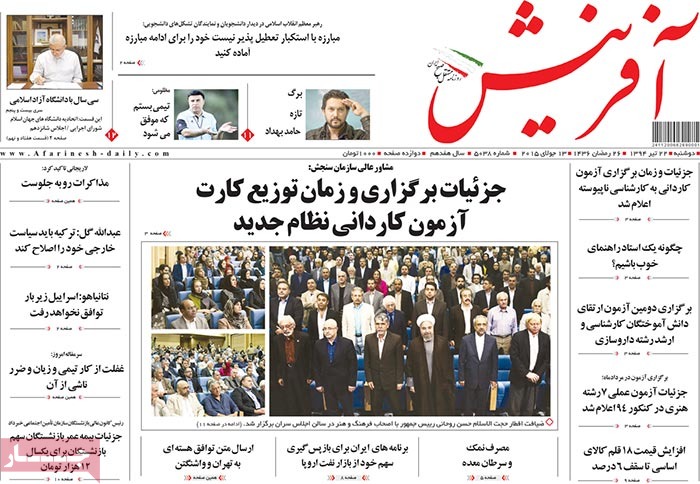
Afarinesh: “[Nuclear] talks are moving forward,” said Parliament Speaker Ali Larijani.


A look at Iranian newspaper front pages on July 13


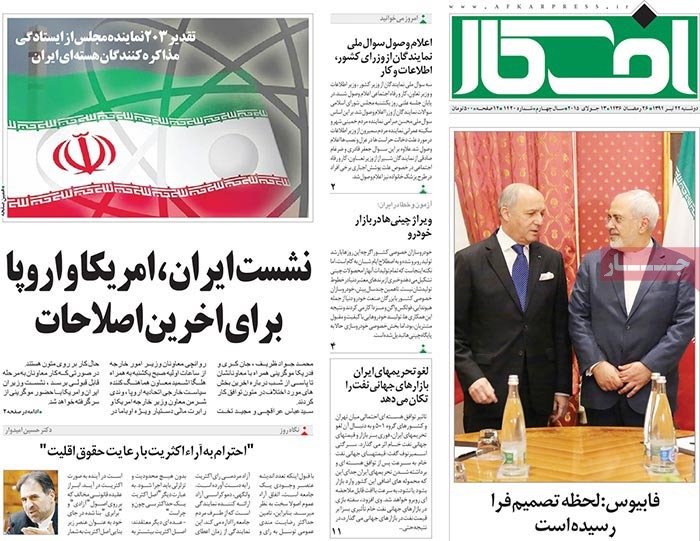
Afkar: As many as 203 Iranian MPs have appreciated the resistance of the country’s negotiators in nuclear talks.


A look at Iranian newspaper front pages on July 13


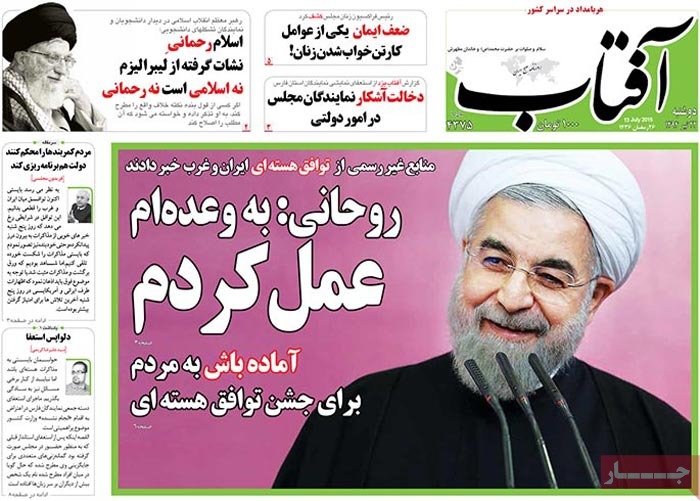
Aftab-e Yazd: “I made good on my [election] promise,” said President Rouhani [about the settlement of Iran’s nuclear case and a possible deal between Iran and P5+1].

Aftab-e Yazd: Open meddling by Iranian MPs in governmental affairs

The daily has published a special report on the “theatrical” resignation of Iranian deputies representing Fars Province.


A look at Iranian newspaper front pages on July 13


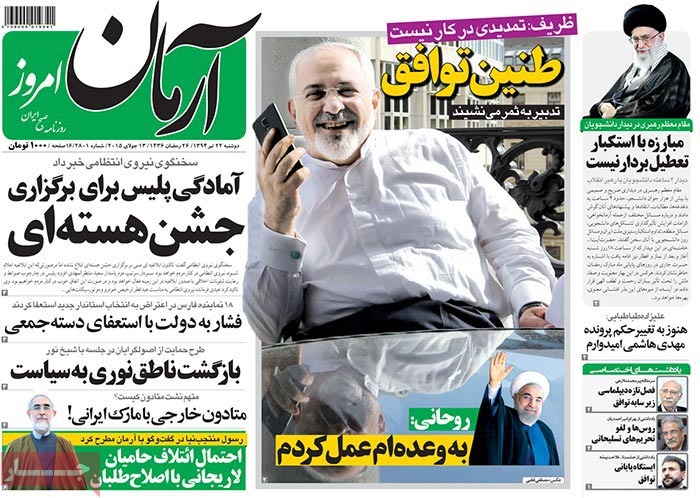
Arman-e Emrooz: The spokesman of police force has said that the law enforcement forces are ready for the celebrations people are likely to hold for a nuclear deal [Iran and P5+1 will clinch on Monday].

Arman-e Emrooz: Mass resignation to pile pressure on the government

As many as 18 MPs representing different cities in Fars Province have submitted their resignation to parliament’s Presiding Board in protest at the appointment of a new governor general for the province.


A look at Iranian newspaper front pages on July 13


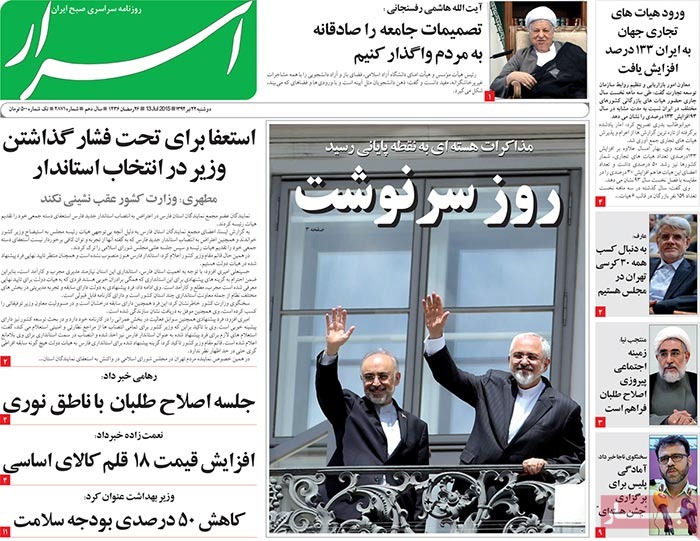
Asrar: “We are trying to win all 30 Tehran seats in parliament,” said Mohammad Reza Aref, a reformist.

Asrar: The fateful day

Nuclear talks have reached the final stop.


A look at Iranian newspaper front pages on July 13


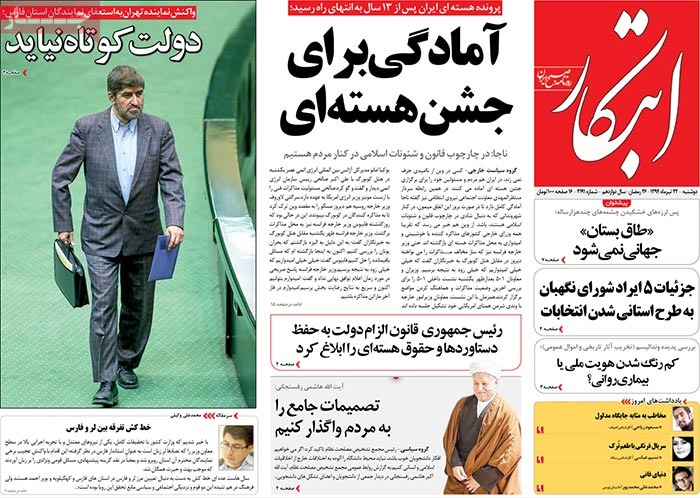
Ebtekar: Ali Motahari, a Tehran MP, has asked the government not to back out.

Motahari made the comment in reaction to mass resignation of deputies representing Fars Province in the Islamic Consultative Assembly.

Ebtekar: The president has communicated a piece of legislation which obliges the government to safeguard the country’s nuclear rights and achievements.


A look at Iranian newspaper front pages on July 13


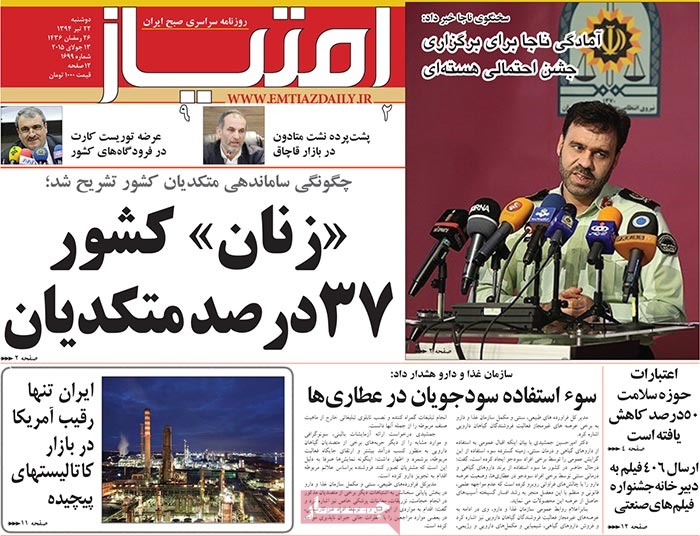
Emtiaz: Women account for 37 percent of panhandlers in the country.

An official with the State Welfare Organization of Iran has given a report on how beggars are being sheltered in the country.


A look at Iranian newspaper front pages on July 13


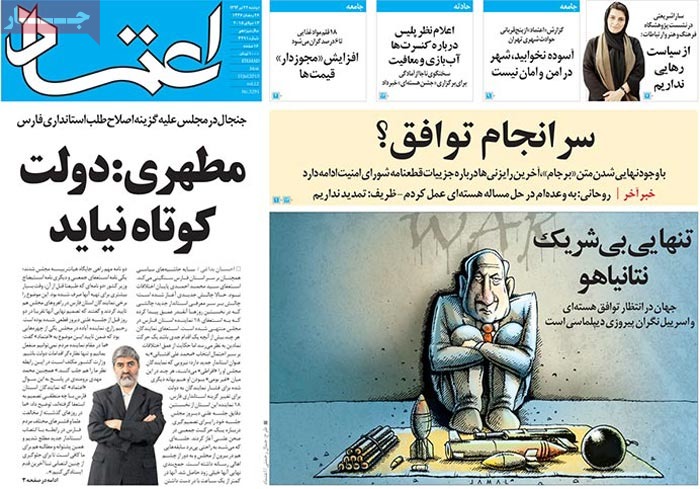
Etemad: Partner-less loneliness of Netanyahu

The world is waiting to see a nuclear deal clinched [between Iran and six world powers] and Israel is worried about the victory of diplomacy [over confrontation].

President Rouhani: I have lived up to my promise as far as the nuclear issue is concerned.

FM Zarif: Extension is no option.


A look at Iranian newspaper front pages on July 13


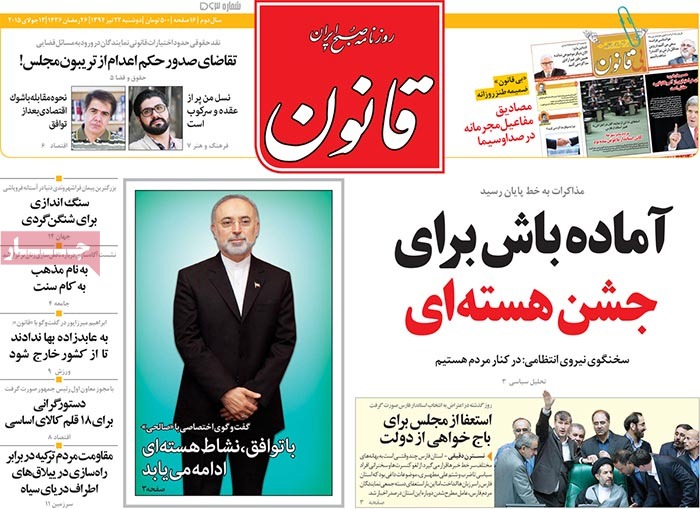
Ghanoon: Readiness for nuclear celebrations

“We stand by people,” said the police spokesman.

Ghanoon: “Adeal will help nuclear joy continue [in the country],” said Director of the Atomic Energy Organization of Iran Ali Akbar Salehi.


A look at Iranian newspaper front pages on July 13


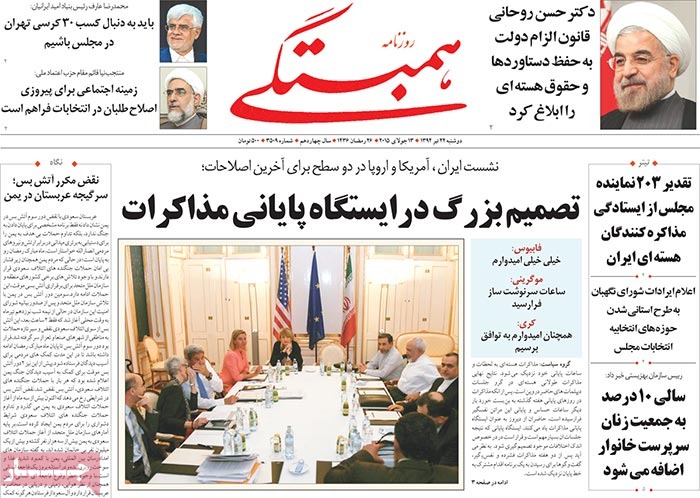
Hambastegi: “The number of female breadwinners rises by ten percent each year,” said the head of the State Welfare Organization.


A look at Iranian newspaper front pages on July 13


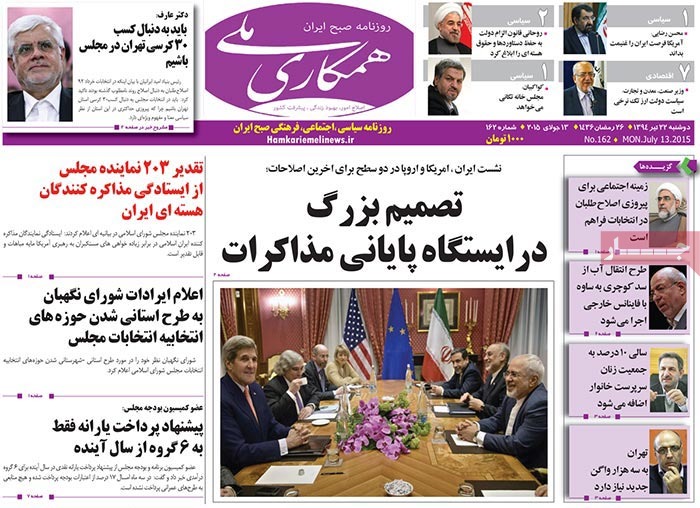
Hamkari-e Melli: A big decision at the final stop of nuclear talks

A meeting was held between [representatives from] Iran, the US and Europe to put the finishing touches [to a nuclear deal].


A look at Iranian newspaper front pages on July 13


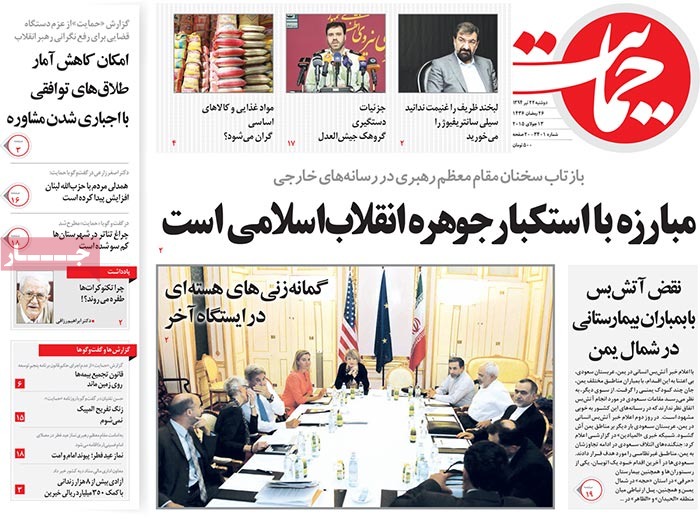
Hemayat: “The fight on colonialism is the essence of the Islamic Revolution”.

Remarks by the Supreme Leader have been covered by foreign media.

Hemayat: Nuclear guesswork at the final stop


A look at Iranian newspaper front pages on July 13


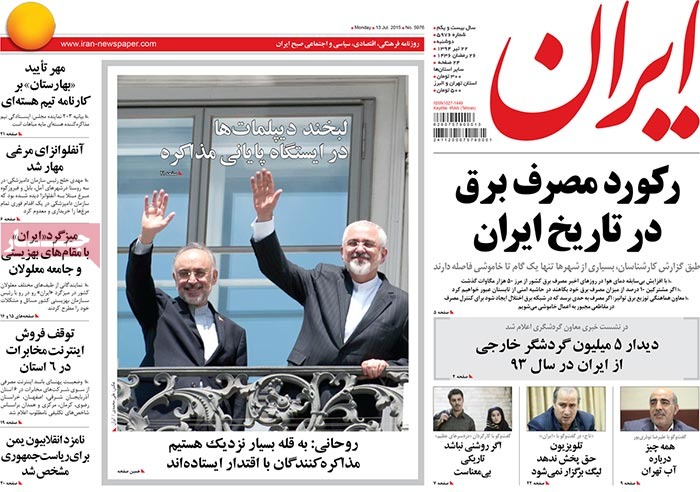
Iran: The seal of approval by Baharestan [a Tehran street where the parliament building is located] on the performance of the nuclear team

Iran: “Up to five million foreign tourists visited Iran in the March 2014-March 2015 period,” said the deputy chief of the Cultural Heritage, Handicrafts and Tourism Organization for tourism affairs.


A look at Iranian newspaper front pages on July 13


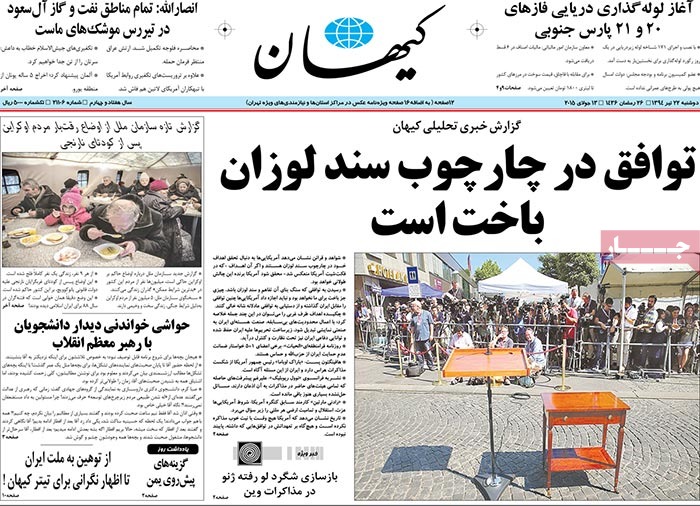
Kayhan: “Agreement within the framework of the Lausanne document spells a failure,” the daily wrote in its analytical report on what will come out of nuclear talks in Vienna.


A look at Iranian newspaper front pages on July 13


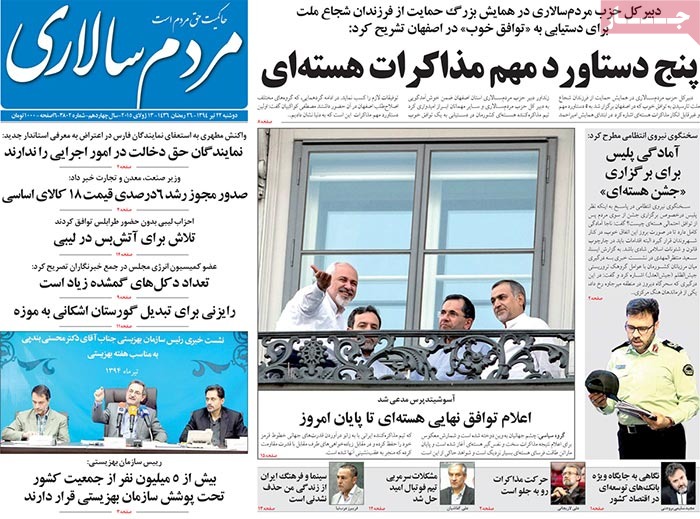
Mardomsalari: A member of parliament’s Energy Committee has said that the number of oil derricks which went missing [when Mahmoud Ahmadinejad was president] is more than what has been announced previously.


A look at Iranian newspaper front pages on July 13


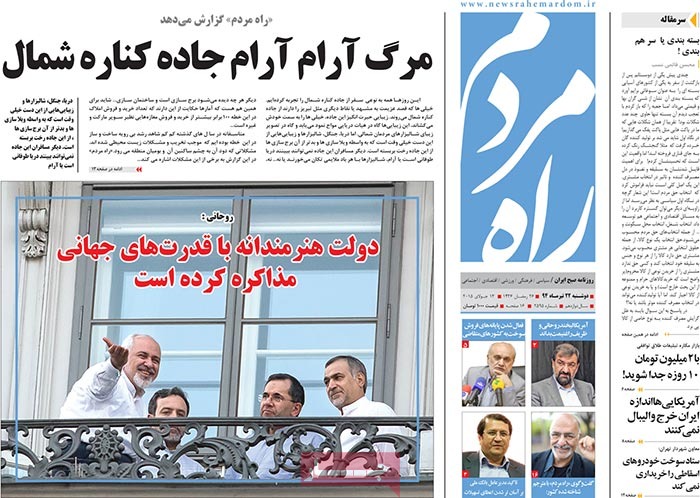
Rah-e Mardom: “The government has skillfully held talks with world powers,” said President Rouhani.


A look at Iranian newspaper front pages on July 13


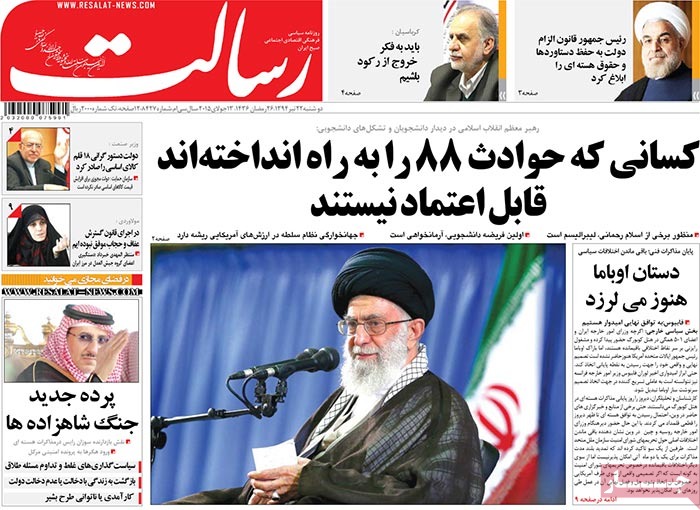
Resalat: “Those who sparked the 2009 events [a reference to two presidential candidates who disputed the election result and triggered unrest in the country] are not trustworthy,” said Ayatollah Khamenei.


A look at Iranian newspaper front pages on July 13


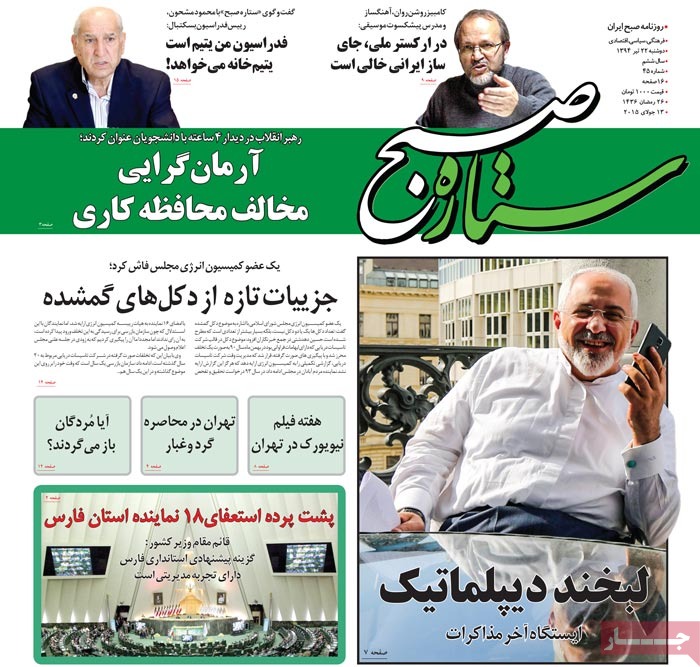
Setareh Sobh: Behind the scenes of the resignation of 18 MPs from Fars Province

The deputy interior minister has said that the government’s pick to take over as Fars governor general has managerial experience.

Setareh Sobh: A diplomatic smile

The daily has described FM Mohammad Javad Zarif’s signature smile as diplomatic in its special report on nuclear talks at the final stop.


A look at Iranian newspaper front pages on July 13


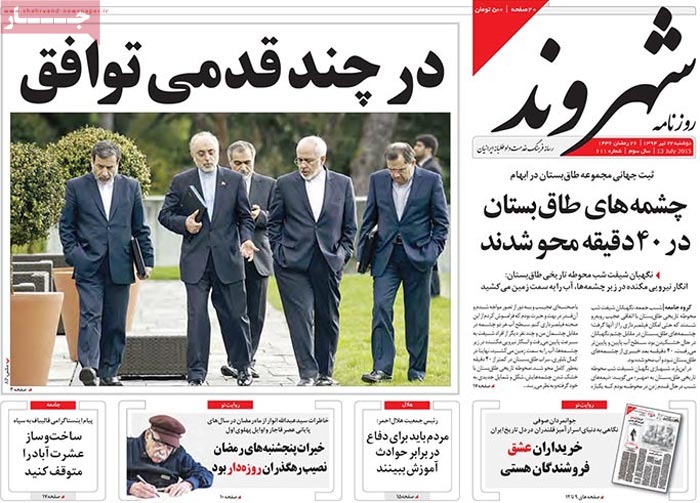
Shahrvand: A few steps away from a [nuclear] deal


A look at Iranian newspaper front pages on July 13


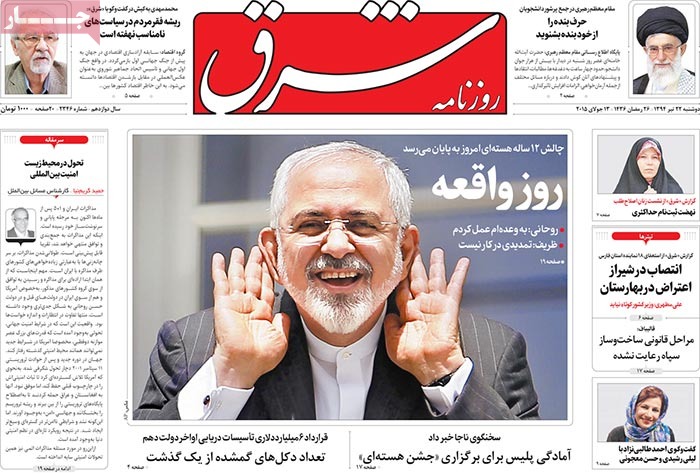
Sharq: Appointment in Shiraz; Protest in Baharestan

Sharq: The Day of Major Event

The 12-year-old nuclear challenge comes to an end on Monday.


A look at Iranian newspaper front pages on July 13


Highlights of Ettela’at newspaper on July 13

Ettelaat-July13

 “Ideology cannot be passed along unless through convincing,” said the Supreme Leader at a meeting with a large number of university students.

“The reason why global bullies show hostility toward the Iranian people is the failure of the Islamic Republic to recognize a system built on domination,” Ayatollah Khamenei further said.

 The government has given the go-ahead to a six percent rise in the prices of basic items.

 The European Parliament has condemned the violent airstrikes of Saudi Arabia against Yemen.

Meanwhile Ansarullah [the Houthis trying to repel Saudi aggression] said what they want is a complete halt to aggression, not a temporary cease-fire.

 The World is waiting with bated breath for the result of the longest political bargaining of the century.

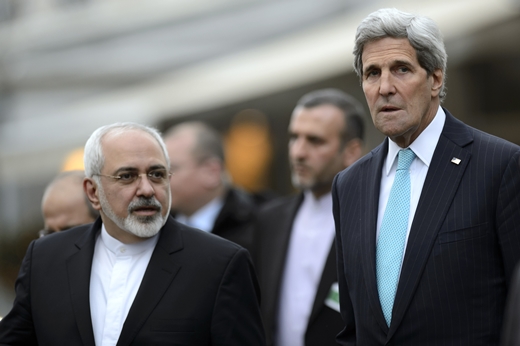
US Secretary of State John Kerry has met more than 50 times with his Iranian counterpart Mohammad Javad Zarif.

 Supreme Leader Ayatollah Ali Khamenei will lead this year’s Eid al-Fitr prayers in Tehran.

 A bill to reform the banking system has been pieced together.

Reforming the financial structure of banks and streamlining the monetary markets are among the priorities of the bill.

♦ Iran, US national libraries exchange books

Iran and the US have no other option but ink a deal

Switzerland Iran Nuclear Talks

An Iranian political analyst says that nuclear talks between Iran and P5+1 have reached a point of no return.

Sadegh Zibakalam, who is also a university professor, made the comment in an interview with fararu.com on July 12 during which he likened the nuclear talks to an irreversible chemical reaction [which can only proceed in one direction until it reaches completion]. The following is the translation of excerpts from Zibakalam’s remarks in the interview:

Nuclear talks will ultimately lead to a deal. Although the timing of such a deal is still unknown, the two sides have no other option but announce the conclusion of a nuclear deal by July 13 or September at the latest.

The talks will end in a win-win outcome by the July 13 deadline, no matter what that result. If the two sides fail to reach an agreement over a few outstanding issues and have to extend the talks for another period – which is likely to be by September – it does not mean that the talks have produced a breakthrough or ended in a breakdown.

If the result is something other than a deal, the Worriers [the fervent supporters of former President Ahmadinejad and his hardline nuclear policies and the fierce critics of the policies of President Rouhani’s administration] and hardliners inside Iran will beat the drum to claim that the talks have failed, pointing an accusing finger at the US – as usual. In other words, the business of hardliners – which had long been slack and lackluster – will thrive on the eve of Eid (al-Fitr [which marks the end of the holy month of Ramadan]).

If no deal is produced at the talks by Monday, the happiness and partying by the Worriers and hardliners in Iran will not last more than two months. In chemistry, some reactions cannot be undone once they are complete; that is to say such reactions are irreversible.

Like these chemical reactions, nuclear talks between Iran and P5+1 have reached an irreversible point. If the outcome is anything other than a deal by Monday, the talks are unlikely to return to the conditions that existed prior to June 14, 2013 [when Hassan Rouhani was elected president].

Experts, foreign ministers and their deputies [of the two sides] have held hundreds of hours of technical, political and legal talks in the past two years. In the same period, the US secretary of state has had numerous diplomatic consultations with his Iranian counterpart. If the two sides had not had strong determination to clinch an agreement, they would have not put in this amount of time and energy to settle their differences over Iran’s nuclear program.

[…]

Iran and the United States – the main parties to the talks – as well as other countries in the world and those who seek regional and international stability and peace want the talks to produce a deal. Those who wish to see nuclear talks between Iran and P5+1 return to the time before June 14, 2013 – in defiance of all rules and formulas – are the Worriers and hardliners inside Iran; the Republicans in the US; Saudi Arabia and Israel in the region; and all those countries and groups which wish to see a regime change in Iran.

[…]

Although the American hawks and [Israeli Prime Minister] Benjamin Netanyahu outside Iran and the Worriers inside Iran share one dream, which is no deal between the two sides, they have their own reasons.

The Worriers and hardliners in Iran fret that a nuclear deal may pull the rug of anti-Americanism out from under them on the one hand, and the short-term benefits may be funneled into the coffers of the Rouhani administration on the other. They are also concerned that a nuclear deal may boost the political and intellectual group(s) which have links with the president and can – as a result of the deal – tip the balance in the upcoming parliamentary elections in their own favor.

Except for those who are worried at home and abroad, the decision makers both in Iran and the US have come to the conclusion that a nuclear deal should be struck. A deal, which is sure to happen, will undoubtedly please the majority of people in the two countries.

Nuclear negotiators will come out victorious in talks: President Rouhani

Rouhani-Iran

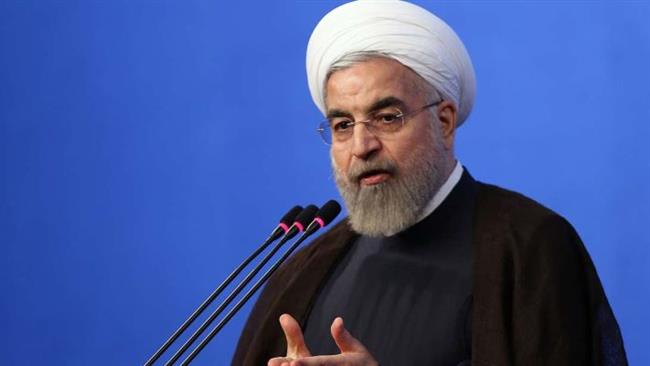
Iranian President Hassan Rouhani says Iran’s negotiating team will come out victorious in the nuclear talks with P5+1.

The Iranian president made the comments while speaking to a group of women and family rights activists in Tehran on Sunday.

“The country, people, and the negotiating team have carried out their responsibilities toward the talks,” he said.

“Currently, we are very close to the peak (of the nuclear talks) but there are still steps left to reach this peak. With the help of God, Iranian negotiators will emerge victorious from this difficult and complicated battle,” he added.


Safeguarding nuclear rights

Earlier in the day, Rouhani called for implementation of a law aimed at safeguarding Iran’s nuclear rights and achievements after the conclusion of talks.

According to Fars News Agency, Rouhani ordered the Iranian Foreign Ministry and the Atomic Energy Organization of Iran to enforce the law.

Under the law, any conclusion reached during the ongoing nuclear talks with P5+1 should include the “complete” removal of sanctions against Tehran, implemented on the day of reaching an agreement.

It also calls on Iranian Foreign Minister Mohammad Javad Zarif to report on the process of “the implementation of the agreement” to the Iranian Parliament (Majlis).

It further states that the International Atomic Energy Agency (IAEA) is allowed to only conduct “conventional inspections” at nuclear sites and will not be granted access to other sensitive or military sites.

After missing several deadlines, Iran and the five permanent members of the UN Security Council – the United States, Britain, France, Russia and China – plus Germany are still holding intensive talks in Vienna to iron out the remaining differences and nail down a landmark agreement on Tehran’s nuclear program.

“No extension, we will finish hopefully. We need some more time. We need to do some more work,” Zarif said following a meeting with his US counterpart John Kerry earlier in the day.

Why didn’t Fabius touch on differences in talks this time around?

Fabius

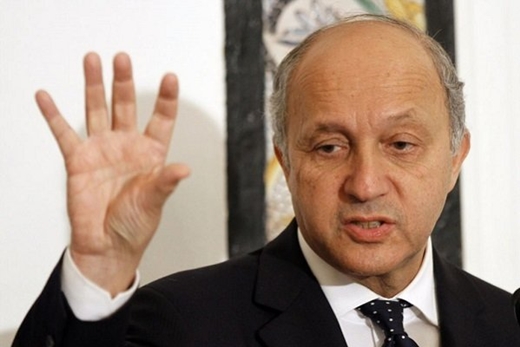
In brief comments outside the Palais Coburg Hotel in Vienna Sunday, French Foreign Minister Laurent Fabius said, “I hope that we are finally entering the final phase of this marathon negotiation.”

A number of journalists covering the nuclear talks in the Austrian capital described his tone as uncharacteristically positive, saying that raises hopes that a final deal is finally within reach.

Unlike what has been a routine over the past two years, Fabius did not talk about the differences of opinion or the tough job that lay ahead; he tried not to be a messenger of ominous news.

His comments could either be indicative of real progress in the talks or be an effort on his part to burnish his poor track record in the negotiations.

Either way, it’s still unclear whether his attempt will produce the intended result, because history suggests Fabius’ theatrics before cameras are far from reliable.

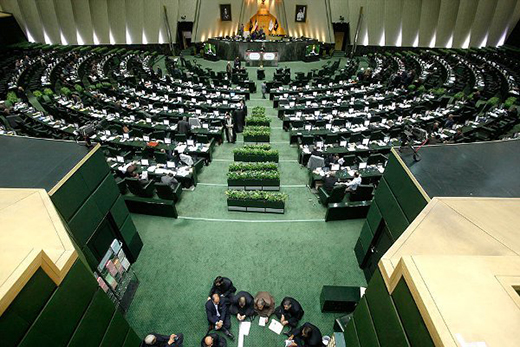
Iranian MPs thank negotiating team for standing firm on red lines

Iran Parliament

A group of MPs thanked the country’s negotiating team in the nuclear talks with the world powers for standing firm on the red lines specified by the Islamic Republic.

“During a Sunday meeting of the parliament’s National Security and Foreign Policy Committee, the lawmakers thanked the country’s negotiating team for insisting on the Islamic system’s red lines,” the rapporteur of the committee Nozar Shafiee said.

Earlier on Sunday in a similar move, another group of Iranian lawmakers in a statement thanked the country’s negotiating team for their relentless efforts in the nuclear field.

“The resistance of the Islamic Iran’s negotiating representatives against the excessive demands of the arrogant powers, headed by the US, is a source of honor and appreciable,” the statement said.

“The representatives of the great Iranian nation ask the dear negotiators to continue observing the red lines specified by the Islamic Republic and the law approved by the Islamic Consultative Assembly (Parliament) as their criteria and voice opposition to any result that violates these principles,” it added.

[…]

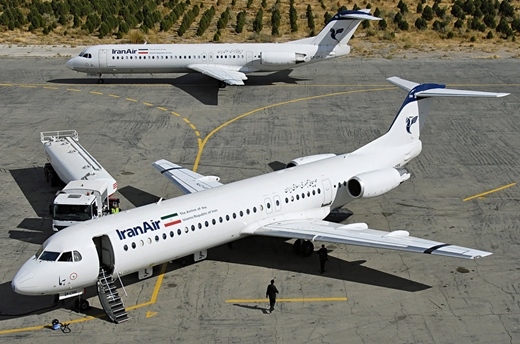
Iran says 14 new planes to join its civil fleet by yearend

plane

An official at the Civil Aviation Organization of Iran has announced that the country will add 14 new passenger planes to its civil aviation fleet before the end of the current Iranian calendar year (ends March 20, 2016).

A statement released by the Civil Aviation Organization of Iran on Saturday, quoted Hamid Habibi, deputy head of the organization for flight standards, as saying that 14 Airbus and Boeing passenger planes have been overhauled inside the country and will join the civil fleet before the end of year.

“Due to capacities created in the past year, at present, there are 168 active planes in Iranian fleet, which has had no precedent in history of the country’s civil aviation,” the official said.

Habibi added that with 168 planes conducting civil flights, about 67.63 percent of the country’s flight is now active, while the figure was only 60 percent last year, Press TV reported.

He said the total number of planes in Iranian fleet adds up to 257, including 251 passenger planes with 41,218 seats, and 6 cargo planes.

Iran’s minister of roads and urbanization announced in mid-June that the country needs 400 new passenger planes in the next 10 years to renovate its civil aviation fleet.

Abbas Akhoundi, who was in the French capital, Paris, to take part in Le Bourget Airshow 2015, added that purchasing this number of planes will cost the country at least $20 billion.

The Iranian minister said the Islamic Republic attaches special importance to development of its civil aviation fleet, noting, “In addition to the fleet, development of airports and passenger terminals also needs special attention.”

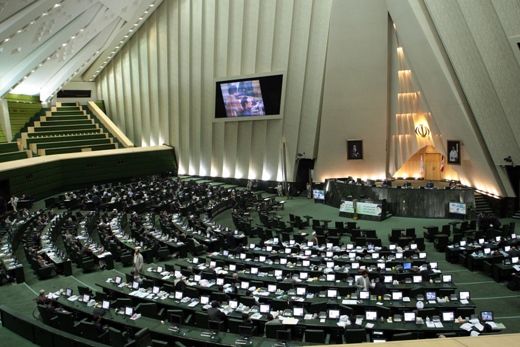
Positive signals out of Iran’s parliament at final hours of nuclear talks

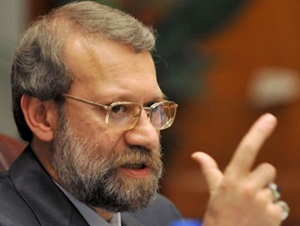
The speaker of the Islamic Consultative Assembly says that Iran’s negotiating team is moving forward, hoping nuclear talks with P5+1 can produce a good result.

Ali Larijani made the comment Sunday (July 12) on the ongoing talks in Vienna 24 hours to go before the Monday deadline. The Iranian Students’ News Agency (ISNA) filed a report on the chamber’s reaction to and predictions about what is going to happen in Vienna at the home stretch of nuclear talks.

The following is the translation of the top MP’s remarks followed by comments by two other deputies:

Speaker Larijani

Larijani09I have a positive view of the talks. Members of the country’s nuclear team are walking down a clear, well-defined and well-thought-out path.

I hope the other side too can act wisely and seize this opportunity. They should not think that the final moments are the best to put new ideas on the table and ratchet up the pressure.

Mounting pressure may backfire. Such tactics [piling pressures] are used for not-complicated talks, but when it comes to complicated and lengthy talks, everything should be thoroughly thought through in advance.

The nuclear talks are moving forward, there are some challenges though. As things stand, they can produce a deal.

Javad Heravi, MP

Javad-HeraviToday the Islamic Republic of Iran is an island of stability in the Middle East. I would like to say ‘More power to your elbow’ to Dr. Zarif, who is the chivalrous knight of Iran’s foreign policy, and to all his hardworking colleagues.

Iran bears no resemblance to nuclear countries such as North Korea and has proved to be a stable place in the region.

Western powers need to know that they have been put to a global test in nuclear talks and that what they do in the talks – including posturing and ramping up the war of words – is not logical.

Ahmad Shohani, MP

ShohaniI hope nuclear talks can lead to a definite result. If the talks possibly fail to produce a deal, the [world] public opinion will blame P5+1 for such a breakdown.

Iran hopes to clinch a deal the two sides can agree on, but if the talks end inconclusively there is no doubt that the other side will be to blame because of the new demands P5+1 have raised under pressure from the Zionist regime and Saudi Arabia. […]

Everybody is praising the way the Iranian team has stuck to its stance at this stage of the talks, even those who had previously expressed concerns or made critical comments about the country’s negotiators and their performance.

Irrespective of the final result, the talks have been to the benefit of Iran. We still hope that positive results will come out of these negotiations. […]

A look at how reliable Russians are in nuclear talks

putin2

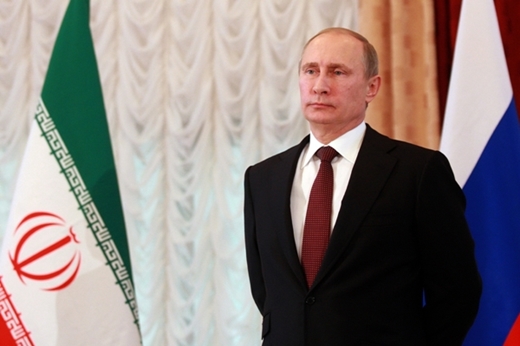
Russian President Vladimir Putin has stressed that all sanctions against Iran need to be lifted. His appeal comes as the removal of the UN Security Council arms embargo against Iran has turned into a serious bone of contention over the past few days, creating a rift between the six world powers negotiating a nuclear deal with Iran.

America and its Western allies insist on keeping the embargo in place, while Russia and China want it removed.

Underscoring Iran’s role in the fight against IS terrorists, Russian Foreign Minister Sergei Lavrov has appealed for the lifting of the arms embargo prior to other sanctions, citing the fact that ‘it would help Iran advance its efficiency in fighting terrorism’.

The New York Times [on July 6] reported American officials and their European partners in the talks – France, Germany and Britain – have opposed any lifting of the embargoes, arguing that it will only pour fuel on the conflicts in Iraq and Syria, as well as in Yemen and Lebanon, as Iran accelerates its arming of Shiite militias.

In an interview with farau.com on July 11, Bahram Amir Ahmadian, an academic and Russia expert, described the Russian plea for the removal of arms embargoes as thought-provoking and said, “The Russian stance is dubious, because the country is already under sanctions itself and will probably have difficulty selling arms.”

He added, “Russia views Iran as a good market for arms sales and for the very reason, it pays special attention to the lifting of sanctions. From Iran’s perspective, however, the removal of financial and monetary sanctions is of greater importance, because they have an impact on the country’s financial transactions on the international stage and on its foreign trade at large.

Although the arms embargo has affected Iran’s interests, under present conditions, it is not among Tehran’s priorities.”

Amir Ahmadian said, “We should not overlook the general stance of the Russians in the negotiations. As a friend, we thought that the Russians would help Iran have the financial and monetary sanctions removed, yet they adopted a different stance.”

Describing as half-baked the recent Russian stand, he said, “I don’t think the lifting of such sanctions as Russia has put it is on Iran’s list of priorities, because the conduct of Iran at the nuclear talks with P5+1 shows otherwise.”

The expert went on to say, “Despite the sanctions of recent years, Iran has pressed ahead with its economic activities and has made progress in non-oil exports. Undoubtedly, sanctions have brought us some problems. Even arms embargoes under which we cannot buy or sell weapons have proved problematic. On the whole, we have overcome these problems, and losses caused by the arms embargo are not substantial.”

Amir Ahmadian underscored, “According to Russian experts, if Moscow fares well as far as arms exports are concerned, it can sell $7-8 billion in weapons to Iran.”

As for the problems that Iran faced in the purchase of S300 missiles from Russia, he said, “The Russians have not provided us with the weapons, nor have they given back our money. Besides, Iranian officials have said that they developed a similar defense system and no longer need S300. The Russians are not reliable partners, so their stance on the removal of arms embargoes requires careful reflection.”

The expert said that the Russians should be asked why they want the arms embargo to be lifted. “It seems that they do not have an accurate insight about Iran’s military, economic and political might; they have not accepted the fact that Iran has turned into a regional power and does not need them for its arms supply.”

Recalling the fact that Russia raises foreign currency through energy, arms and lumber exports, he said, “Now that Moscow faces problems to bring in foreign currency, it seeks to sell arms to Iran. Russia is the world’s third arms producer after the US and Europe. But with the international community going down the path of détente, Russia is mired.”

The professor highlighted that the Russians do not pursue a win-win outcome in political games and added, “By and large, we cannot count on Russia.”

In answer to a question about whether the recent Russian stance in the talks will lead anywhere or Moscow will be left alone, Amir Ahmadian said, “It is obvious that the Iranian negotiating side pursues the lifting of sanctions within a package which does not give priority to arms. Therefore, the Russians do not seem to be able to secure their intended result, because the Islamic Republic is an independent and powerful nation and no country is allowed to dictate its foreign policy or tell it what is right to do.”