Tuesday, December 23, 2025
Home Blog Page 4701

Nuclear negotiators in parliament to present report (PHOTOS)

Zarif-parliament

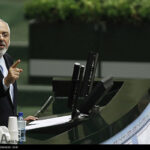
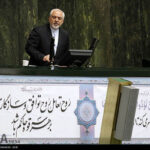
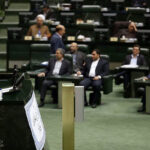
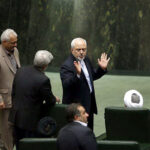
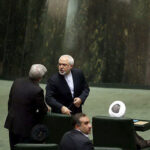
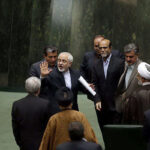
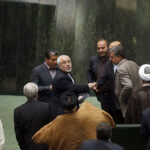
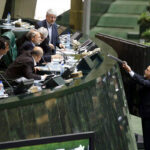
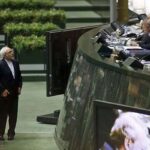
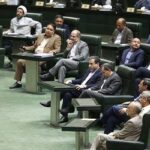
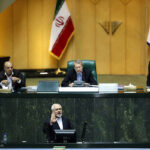
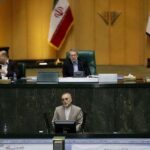
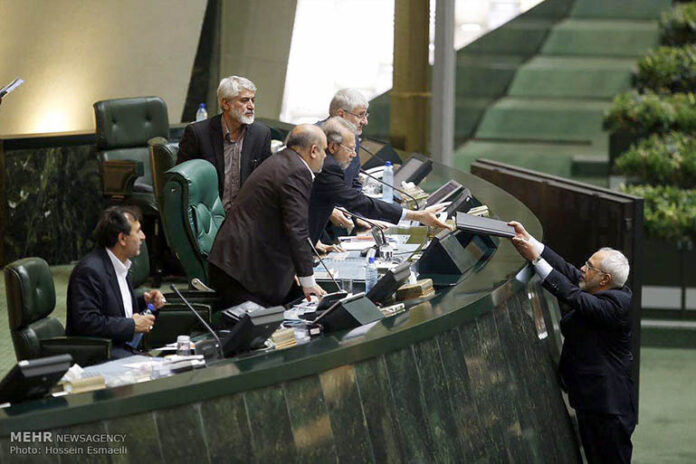
Foreign Minister Mohammad Javad Zarif, Director of the Atomic Energy Organization Ali Akbar Salehi and other negotiators went to parliament on Tuesday to present a report to MPs on talks with six world powers and the deal Iran struck with P5+1 in Vienna on July 14.

The following images of the nuclear negotiators in the Islamic Consultative Assembly have been released by the Islamic Republic News Agency (IRNA):

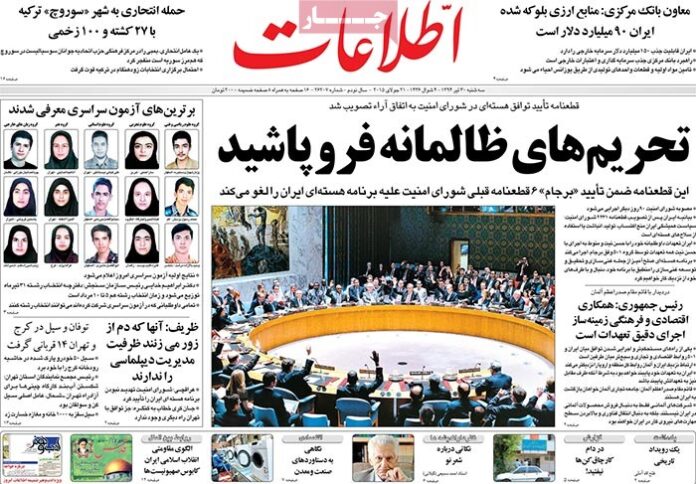
A look at Iranian newspaper front pages on July 21

Iranian Newspapers Headlines

The unanimous vote of the UN Security Council for the Vienna nuclear deal dominated the front pages of Iranian newspapers on Tuesday. Reformist dailies hailed the vote as a victory for Iran, while principlists expressed concern about the content of the new resolution. Also on the front pages was news about the deadly flooding that struck parts of Tehran and Karaj on Sunday evening.


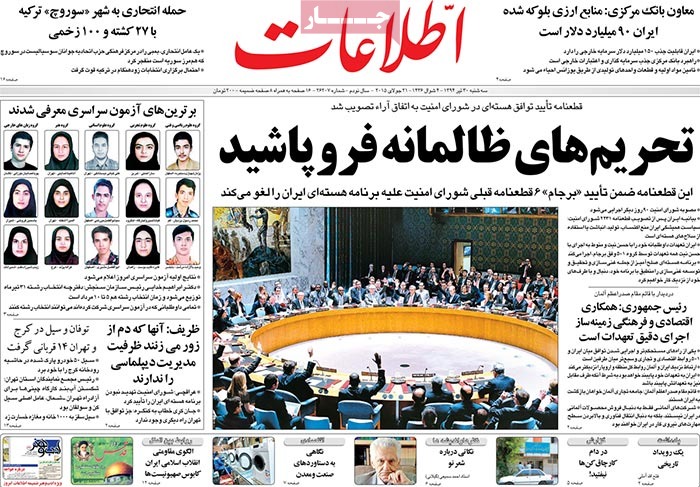
Ettela’at: The unfair sanctions regime crumbled.

The UN Security Council has unanimously backed the Iran nuclear deal.

The UN resolution puts a seal of approval on the Joint Comprehensive Plan of Action (JCPOA) and terminates the six anti-Iran resolutions the council previously issued.


A look at Iranian newspaper front pages on July 21


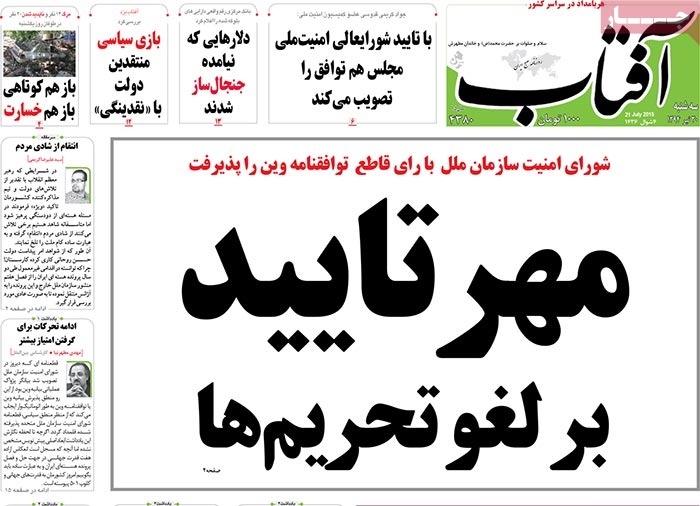
Aftab-e Yazd: “The Islamic Consultative Assembly will vote for the nuclear deal when the Supreme National Security Council approves it,” said Javad Karimi Ghoddusi, a [hardline] member of parliament’s National Security and Foreign Policy Committee.

Aftab-e Yazd: The dollars that have proved controversial already even before their return home.

[The headline refers to Iran’s foreign currency which is to be unfrozen shortly.]


A look at Iranian newspaper front pages on July 21


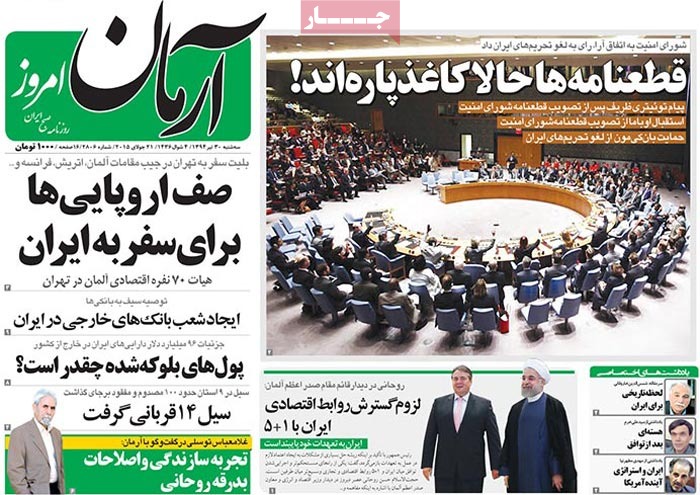
Arman-e Emrooz: The resolutions can now be viewed as torn pieces of paper! [A sarcastic comment aimed at former President Ahmadinejad who kept dismissing UN Security Council resolutions issued against Iran as trash paper.]

The UN Security Council has unanimously voted to terminate the Iran sanctions.

Arman-e Emrooz: The Europeans have lined up to visit Iran.

Austrian and French officials have already booked their tickets.


A look at Iranian newspaper front pages on July 21


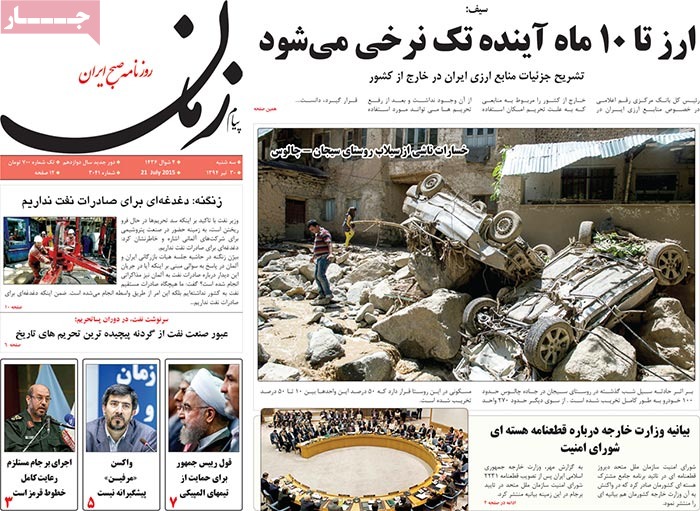
Asr-e Rasaneh: Iran will introduce a unified Forex rate system within 10 months.


A look at Iranian newspaper front pages on July 21


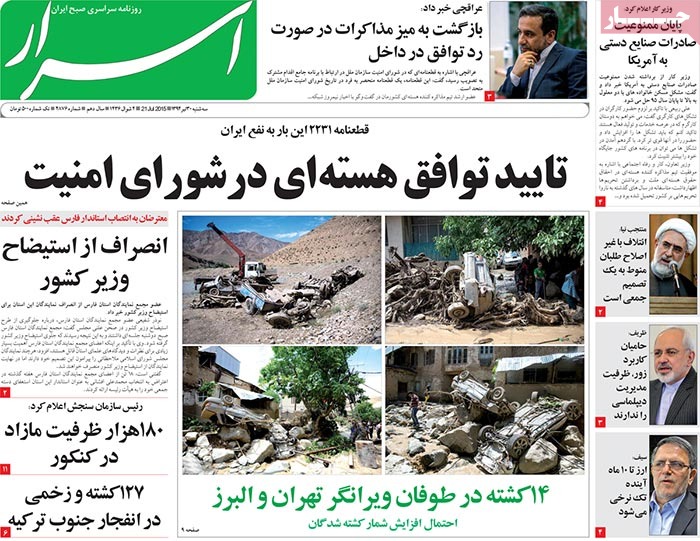
Asrar: The labor minister has announced that the ban on exports of Iranian handicrafts to the US has expired.

Asrar: “Rejection of the deal at home would see a return to the negotiating table,” said Iranian negotiator Abbas Araghchi.


A look at Iranian newspaper front pages on July 21


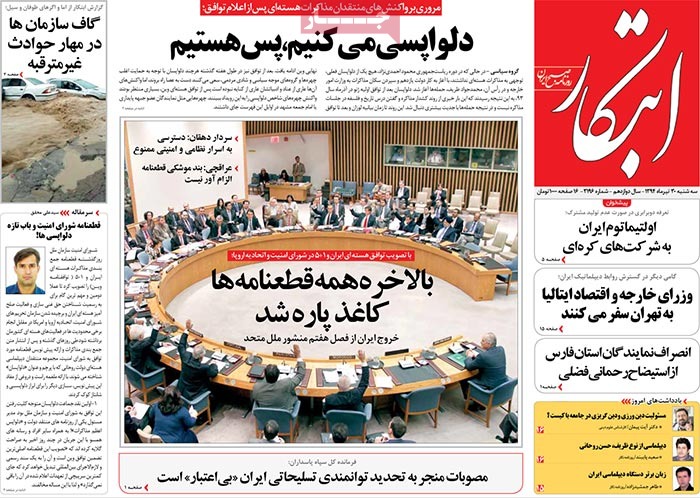
Ebtekar: Deputies representing Fars Province in the Islamic Consultative Assembly have shelved plans to impeach Interior Minister Abdolreza Rahmani Fazli.

Ebtekar: “Any decision that limits Iran’s arms capabilities is worthless,” said the commander of the Islamic Revolution Guard Corps.


A look at Iranian newspaper front pages on July 21


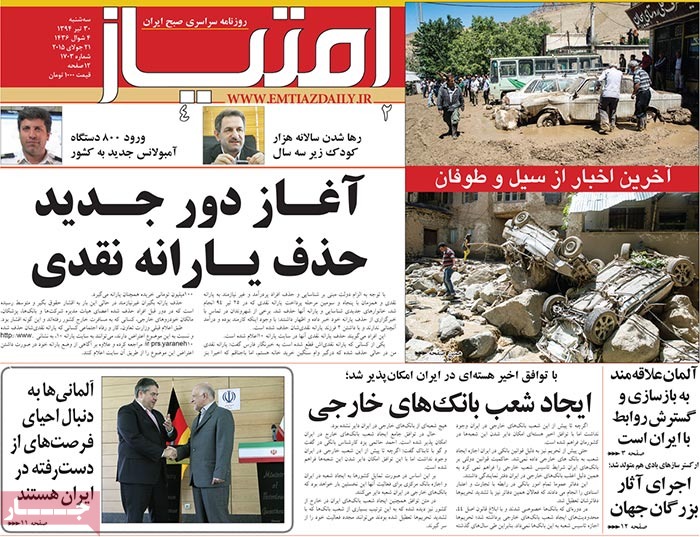
Emtiaz: Following the nuclear deal Iran and P5+1 have signed, foreign banks can set up branches in Iran.

Emtiaz: Each year around 1,000 children under three years of age are abandoned across the country.


A look at Iranian newspaper front pages on July 21


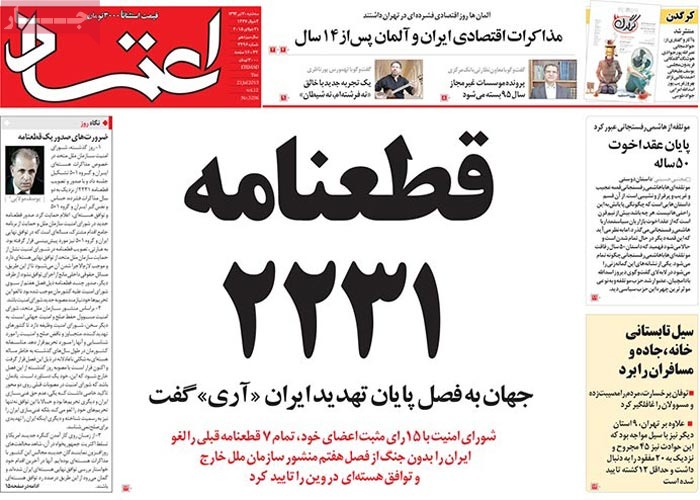
Etemad: Resolution 2231; the world closed the chapter on Iran being viewed as a threat.


A look at Iranian newspaper front pages on July 21


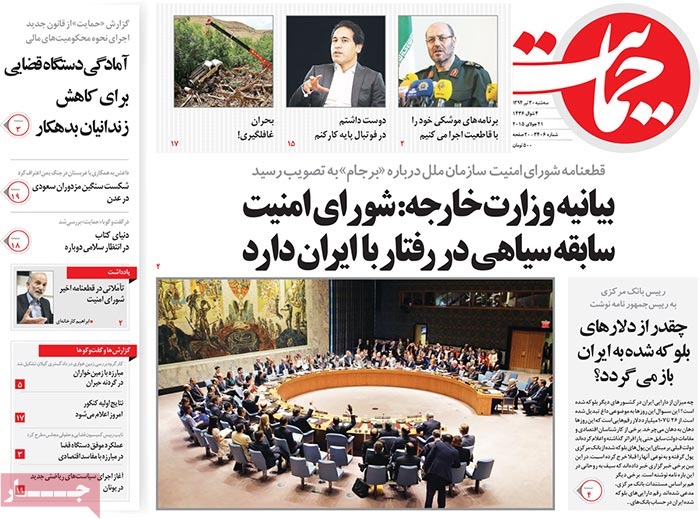
Hemayat: “The UN Security Council has a dismal record in dealing with Iran,” said the Iranian Foreign Ministry in a statement after the council voted in favor of the nuclear deal struck by Iran and P5+1.


A look at Iranian newspaper front pages on July 21


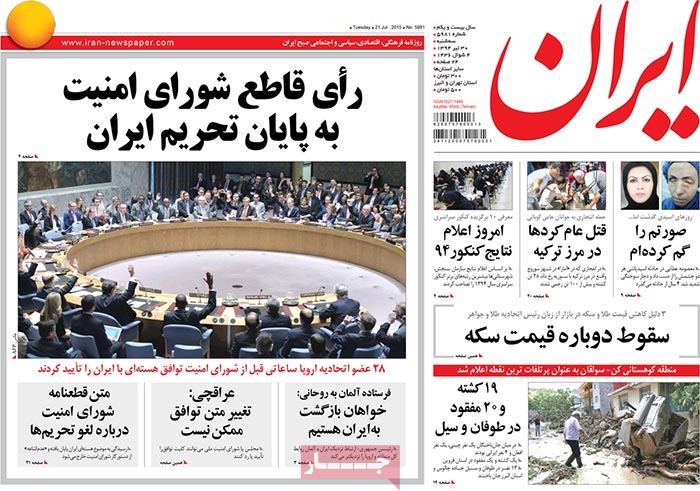
Iran: “Tweaking the text of the deal is not possible. Parliament and or the Supreme National Security Council can either approve or reject the deal in its entirety,” said Iranian negotiator Abbas Araghchi.


A look at Iranian newspaper front pages on July 21


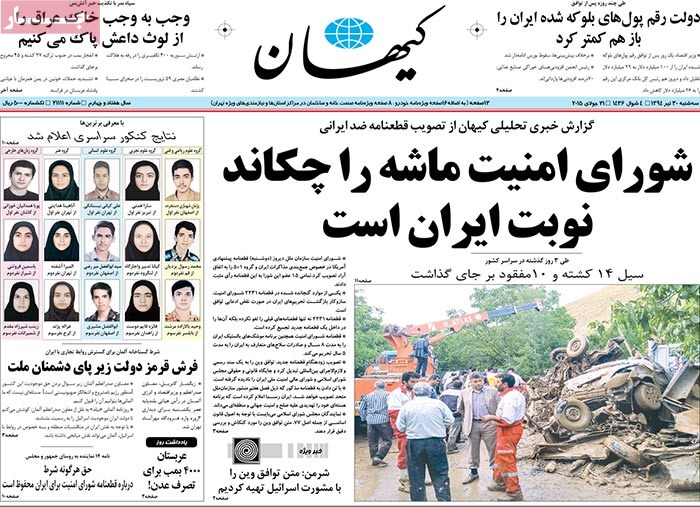
Kayhan: The daily has published an analytical report on what it calls an anti-Iranian resolution. The UN Security pulled the trigger; it is now Iran’s turn.


A look at Iranian newspaper front pages on July 21


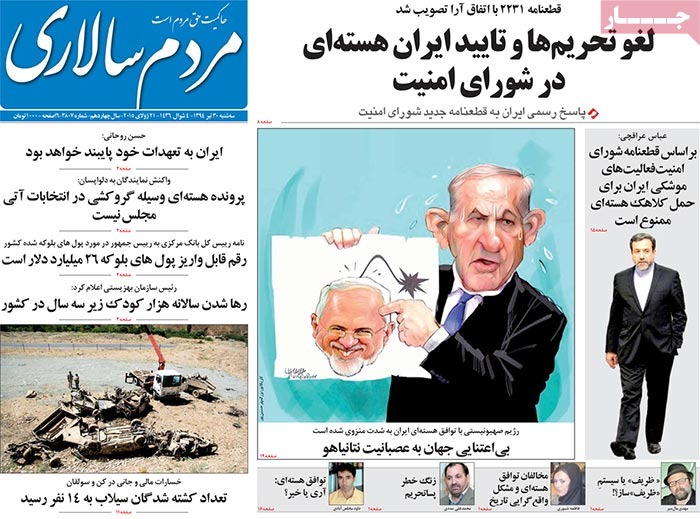
Mardomsalari: “The nuclear case should not be used as leverage for upcoming parliamentary elections,” said a number of MPs in reaction to expression of concern by Worriers [opponents of President Rouhani and the nuclear deal.]


A look at Iranian newspaper front pages on July 21


Payam-e Zaman: “Iran faces no problem when it comes to oil exports,” said the Iranian oil minister.


A look at Iranian newspaper front pages on July 21


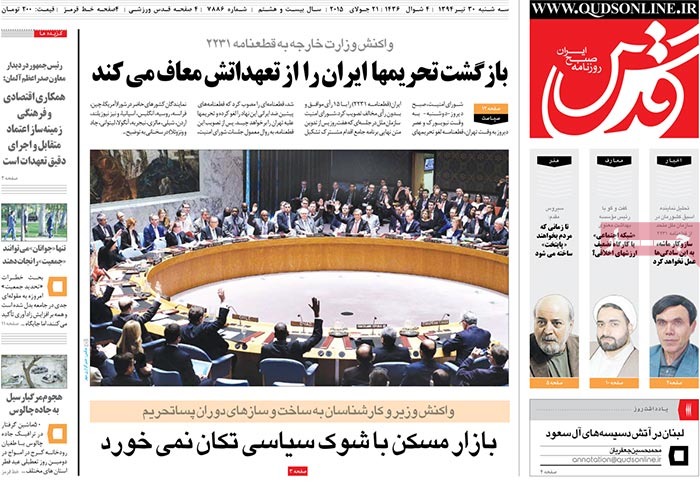
Qods: “The snap-back of sanctions will void Iran’s commitments,” said the Iranian Foreign Ministry in reaction to UN Security Council Resolution 2231.


A look at Iranian newspaper front pages on July 21


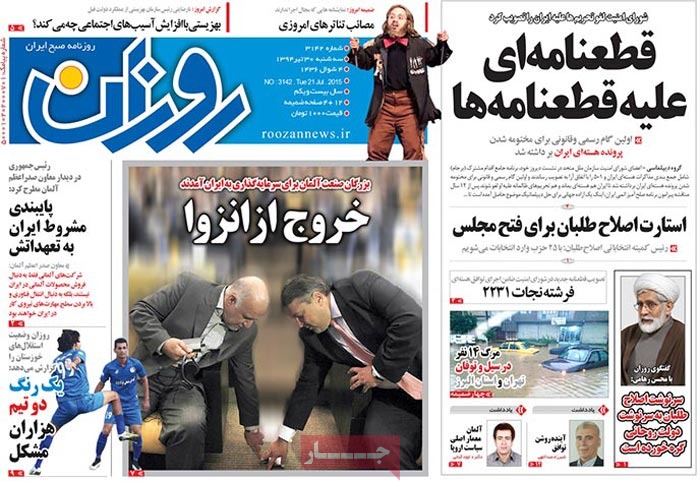
Roozan: Reformists have set a plan in motion to capture a majority of seats in parliament.


A look at Iranian newspaper front pages on July 21


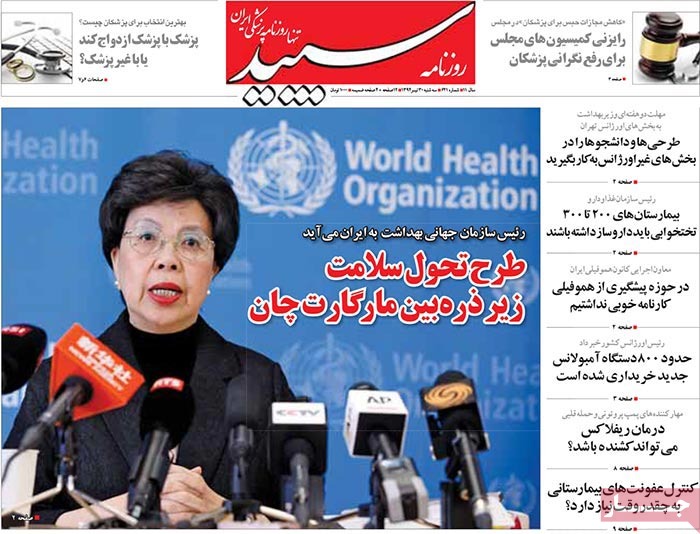
Sepid: Iran’s Health Transformation Plan under the microscope of the director-general of the World Health Organization.

Margaret Chan is to visit Iran.


A look at Iranian newspaper front pages on July 21


Highlights of Ettela’at newspaper on July 21

Ettelaat-July21

 The unfair sanctions regime crumbled.

The UN Security Council has unanimously backed the Iran nuclear deal.

The UN resolution puts a seal of approval on the Joint Comprehensive Plan of Action (JCPOA) and terminates the six anti-Iran resolutions the council previously issued.

“Economic and cultural cooperation paves the way for full compliance with commitments,” President Rouhani told the visiting German vice-chancellor.

“Iran will keep its end of the bargain if the other side fulfills its commitments,” the president further said.

 “Iran’s frozen foreign currencies overseas stand at around $90 billion,” said a deputy governor of the Central Bank of Iran.

Iran can absorb as much as $150 billion in foreign investment.

 A suicide attack on the Turkish town of Suruc left 27 dead and 100 others injured.

In another development, snap elections in Turkey became more likely.

 The top finishers of the nationwide university entrance exam have been named.

 “Those who talk about use of force do not have any diplomatic management capability,” said Foreign Minister Mohammad Javad Zarif.

His deputy Abbas Araghchi said the UN Security Council has confirmed that Iran’s nuclear program does not constitute a threat.

 Severe storm and flooding in Tehran and Karaj have left 14 people dead.

Floodwaters washed away 50 cars parked along the Karaj River.

 Iran’s Biology Olympiad team finishes fifth in world event

Iran, Germany have differences over some Mideast issues: Afkham

IRGC rejects any resolution violating Iran’s red lines

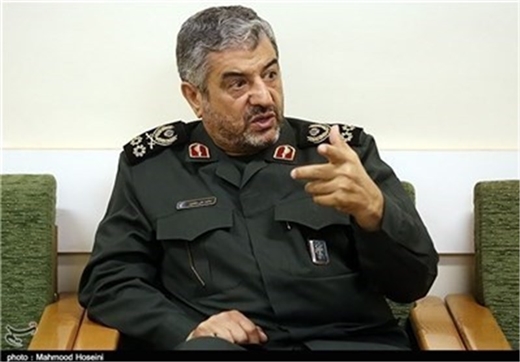
jafari

The commander of the Islamic Revolution Guard Corps (IRGC) on Monday described as void any resolution in contravention of Iran’s red lines, before the United Nations Security Council passed a resolution endorsing the document Iran and major world powers finalized on July 14 on Tehran’s nuclear program.

“Any resolution that would be in contradiction to our country’s red lines will have no validity,” Commander of the Islamic Revolution Guard Corps Major General Mohammad Ali Jafari told Tasnim on Monday.

[…]

Major General Jafari also leveled severe criticism at the draft resolution, saying, “Some of the points inserted in the draft (resolution) are clearly in contradiction to the Islamic Republic of Iran’s major red lines and violate them, particularly regarding (Iran’s) arms capabilities, and we’ll never accept it.”

The commander recommended the UNSC not to “waste its time” passing a resolution that violates Iran’s red lines.

“What matters to me as a military official more than anything else is serious persistence… when it comes to the very critical red line, namely maintaining and upgrading Iran’s defense capability,” the top officer underscored.

The IRGC commander explained that not a single Iranian official has a problem with holding negotiations and striking a “good deal” over the country’s peaceful nuclear program.

Major General Jafari also debunked a propaganda campaign the enemies have launched as part of psychological warfare to create “fake polarities” in Iranian society over the nuclear issue.

Echoing previous remarks by Supreme Leader of the Islamic Revolution Ayatollah Seyyed Ali Khamenei, the commander said the text of the nuclear conclusion has to be scrutinized in a legal process before a final view could be announced.

“It seems that some have deliberately created a fake atmosphere in order to ignore such a legal process and block the path to assessing the (nuclear) conclusion in a timely and detailed manner and placing it in a legal path in compliance with the Iranian nation’s interests.”

Iran condemns terrorist attack in Turkey

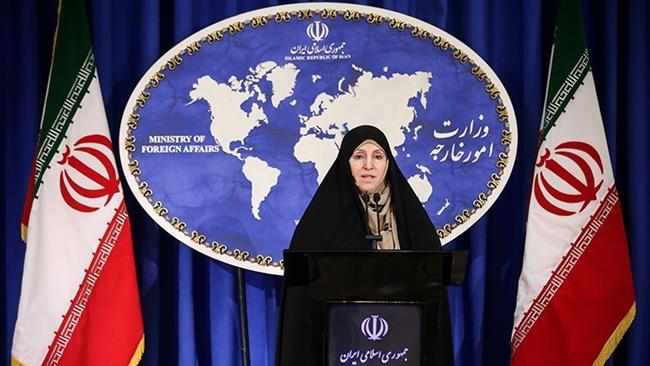
Marzieh Afkham

Iran has strongly condemned a massive terrorist bombing that rocked the Turkish town of Suruc, near the southern border with Syria.

This criminal act of terrorism once again showed that perpetrators of such crimes are not committed to any principle and will spare no effort to achieve their inhumane objectives, Iran’s Foreign Ministry Spokeswoman Marzieh Afkham said on Monday.

Iran believes that “blind terrorism” poses a serious threat to the region, she added.

At least 31 people were killed and more than 100 others wounded in the explosion that rocked the Amara Culture Center of the Suruç Municipality earlier in the day.

Turkish Prime Minister Ahmet Davutoglu told a news conference in Ankara that initial investigations suggest that the ISIL Takfiri terrorist group was behind the deadly bombing.

“Preliminary findings point to it being a suicide attack carried out by Daesh (ISIL),” Davutoglu said. “But we are not at a point to make a final judgment.”

In a telephone conversation with his Turkish counterpart Recep Tayyip Erdogan last week, Iranian President Hassan Rouhani underlined the need for the two country’s cooperation to uproot terrorism which is threatening the stability of the regional countries.

Iran approach to nuclear agreement depends on others: Speaker

larijani-germani

Parliament speaker Ali Larijani underlined that Iran’s approach to the nuclear agreement depends on the West’s behavior.

“This agreement can be key to cooperation or can be misused,” Larijani said during a meeting with German Vice Chancellor Sigmar Gabriel in Tehran on Monday.

He pointed to the historical ties between Iran and Germany, and said, “The Iranian people look at Germany in a positive manner which can be used for expansion of political, economic and cultural relations.”

The German vice chancellor, for his part, said that the German delegation’s visit to Iran shows that his country is interested in expansion of relations with Iran.

He also said that the regional crises are the result of interference by other countries, and said, “The US attack on Iraq was a mistake; the German government does not accept military intervention in any country and it believes that the military invasion will spread insecurity in the region.”

Iranian envoy blasts US ambassador to UN for anti-Iran remarks

81689044-70043713

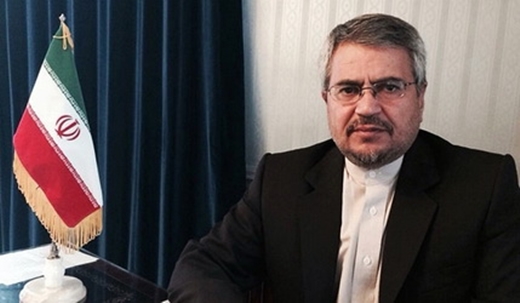
Iran’s Ambassador to the UN Gholamali Khoshroo strongly criticized the US Ambassador to UN Samantha Power for her allegations against Iran and accusing Tehran of ‘destabilizing the region and supporting terrorism’.

Addressing the United Nations Security Council on Monday, Khoshroo strongly reacted to the statements of the US ambassador to the UN.

“Before, I conclude, let me briefly thank all the ambassadors who supported JCPOA and also those countries that helped the deal happen and react to some baseless accusations leveled by some of previous speakers.

“It is ironic that the distinguished ambassador of the United States accused my government of destabilizing the region and terrorism.

“The country that invaded two countries in our region and created favorable grounds for the growth of terrorism and extremism is not well placed to raise such an accusation against my country,” Khoshroo said.

He noted that feckless and reckless acts of the United States in our region for so many years are at the root of many challenges that we are now facing in our neighborhood.

“Iran is a stable country in an unstable region. As we want our stability to persist, we do promote cooperation in the region and help our neighbors to stabilize and cooperate towards this end,” Khoshroo added.

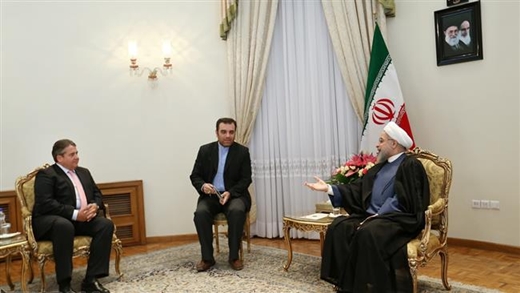
Iran-Germany ties connect Mideast, Europe: Rouhani

f8f555c5-4e59-4f28-ae59-abf5c45ba4a8

Iran’s President Hassan Rouhani says broad relations between Iran and Germany can bring countries in the Middle East and Europe closer.

Rouhani made the remarks in a Monday meeting with German Economy and Energy Minister Sigmar Gabriel, who is heading a high-ranking delegation in a three-day visit to Iran.

“We hope that the German delegation plays its positive role in the expansion of Iran’s ties with Europe as it did so during [Iran’s nuclear] negotiations” with P5+1, the Iranian president said.

Rouhani stressed the importance of taking confidence-building measures to fulfill commitments envisaged in the conclusion of the nuclear negotiations in the Austrian capital Vienna, saying enhanced trade and economic ties between Iran and the six world powers is a means to guarantee the implementation of the accord.

Iran will remain committed to its undertakings if the opposite side does so, Rouhani said, emphasizing that the proper implementation of the agreement would be beneficial to all.

He further said that Iran and Germany should improve economic, cultural and political relations.

Iran and P5+1– the United States, Britain, France, China and Russia plus Germany – succeeded in finalizing the text of an agreement, dubbed the Joint Comprehensive Plan of Action (JCPOA), in Vienna on July 14 after 18 days of intense negotiations and all-nighters that capped around 23 months of talks between Iran and the six world powers.

Under the JCPOA, limits will be put on Iran’s nuclear activities in exchange for, among other things, the removal of all economic and financial bans, against the Islamic Republic.

The United Nations Security Council on Monday unanimously endorsed a draft resolution turning the JCPOA into international law. All 15 members of the body voted for the draft UN resolution in New York, setting the stage for the lifting of the Security Council sanctions against Iran.

Germany’s keenness to return to Iran

Gabriel, who is also Germany’s vice chancellor, said German tradesmen are keen to return to Iran and cooperate with their Iranian partners.

He welcomed the Vienna nuclear agreement which Germany regards as a new starting point for Tehran-Berlin ties and for relations between Iran and European countries.

The German delegation arrived in Tehran on Sunday to hold high-level economic and trade talks with senior Iranian officials.

Meanwhile, in a Monday meeting with the German economy minister in Tehran, Iranian Foreign Minister Mohammad Javad Zarif expressed hope that Tehran and Berlin would take steps toward bolstering relations in various fields.

Referring to the latest developments in the Middle East, Zarif said terrorism and extremism are among “the most serious” threats to regional states.

“The Islamic Republic of Iran, as a stable and powerful country in the region, is ready to counter these threats,” Zarif added.

Gabriel, for his part, urged the expansion of Tehran-Berlin cooperation, particularly in the field of economy.

Iran issues statement after approval of JCPOA by UNSC (Full Text)

139305101846561383325234

The Islamic Republic of Iran issued a statement after the 15-member United Nations Security Council on Monday unanimously adopted a resolution endorsing a document Iran and major world powers recently finalized on Tehran’s nuclear energy program.

The resolution had been negotiated as part of diplomatic talks between Iran and P5+1 (Russia, China, the US, Britain, France and Germany) in Vienna.

Iran and P5+1 on July 14 concluded more than two weeks of intensive talks in Austria. The negotiations resulted in a comprehensive 159-page document on Iran’s nuclear program.

Here is the full text of the statement:

In the name of God, the Compassionate, the Merciful

The Statement of the Islamic Republic of Iran

Following the Adoption of UN Security Council Resolution 2231 Endorsing

The Joint Comprehensive Plan of Action (JCPOA)

1. The Islamic Republic of Iran considers science and technology, including peaceful nuclear technology, as the common heritage of mankind. At the same time, on the basis of solid ideological, strategic and international principles, Iran categorically rejects weapons of mass destruction and particularly nuclear weapons as obsolete and inhuman, and detrimental to international peace and security. Inspired by the sublime Islamic teachings, and based on the views and practice of the late founder of the Islamic Revolution, Imam Khomeini, and the historic Fatwa of the leader of the Islamic Revolution, Ayatollah Khamenei, who has declared all weapons of mass destruction, particularly nuclear weapons, to be Haram (strictly forbidden) in Islamic jurisprudence, the Islamic Republic of Iran declares that it has always been the policy of the Islamic Republic of Iran to prohibit the acquisition, production, stockpiling or use of nuclear weapons.

2. The Islamic Republic of Iran underlines the imperative of total elimination of nuclear weapons, as a requirement of international security and an obligation under the Treaty on the Non-Proliferation of Nuclear Weapons (NPT).The Islamic Republic of Iran is determined to engage actively in all international diplomatic and legal efforts to save humanity from the menace of nuclear weapons and their proliferation, including through the establishment of Nuclear Weapons Free Zones, particularly in the Middle East.

3. The Islamic Republic of Iran firmly insists that States parties to the NPT shall not be prevented from enjoying their inalienable rights under the Treaty to develop research, production and use of nuclear energy for peaceful purposes without discrimination and in conformity with Articles I and II of NPT.

4. The finalization of the Joint Comprehensive Plan of Action (JCPOA) on 14 July 2015 signifies a momentous step by the Islamic Republic of Iran and E3/EU+3 to resolve, through negotiations and based on mutual respect, an unnecessary crisis, which had been manufactured by baseless allegations about Iranian peaceful nuclear program, followed by unjustified politically-motivated measures against the people of Iran.

5. The JCPOA is premised on reciprocal commitments by Iran and E3/EU+3, ensuring the exclusively peaceful nature of Iran’s nuclear program, on the one hand, and the termination of all provisions of Security Council resolutions 1696 (2006), 1737 (2006), 1747 (2007), 1803 (2008), 1835 (2008), 1929 (2010) and 2224 (2015) and comprehensive lifting of all United Nations Security Council sanctions, and all nuclear-related sanctions imposed by the United States and the European Union and its member-states, on the other. The Islamic Republic of Iran is committed to implement its voluntary undertakings in good faith contingent upon same good faith implementation of all undertakings, including those involving the removal of sanctions and restrictive measures, by E3/EU+3 under the JCPOA.

6. Removal of nuclear-related sanctions and restrictive measures by European Union and the United States would mean that transactions and activities referred to under the JCPOA could be carried out with Iran and its entities anywhere in the world without fear of retributions from extraterritorial harassment, and all persons would be able to freely choose to engage in commercial and financial transactions with Iran. It is clearly spelled out in the JCPOA that both EU and the U.S. will refrain from re-introducing or re-imposing the sanctions and restrictive measures lifted under the JCPOA. It is understood that reintroduction or re-imposition, including through extension, of the sanctions and restrictive measures will constitute significant non-performance which would relieve Iran from its commitments in part or in whole. Removal of sanctions further necessitates taking appropriate domestic legal and administrative measures, including legislative and regulatory measures to effectuate the removal of sanctions. The JCPOA requires an effective end to all discriminatory compliance measures and procedures as well as public statements inconsistent with the intent of the agreement. Iran underlines the agreement by JCPOA participants that immediately after the adoption of the Security Council resolution endorsing the JCPOA, the EU, its Member States and the United States will begin consultation with Iran regarding relevant guidelines and publicly accessible statements on the details of sanctions or restrictive measures to be lifted under the JCPOA.

7. The Islamic Republic of Iran will pursue its peaceful nuclear program, including its enrichment and enrichment R&D, consistent with its own plan as agreed in the JCPOA, and will work closely with its counterparts to ensure that the agreement will endure the test of time and achieve all its objectives. This commitment is based on assurances by E3/EU+3 that they will cooperate in this peaceful program consistent with their commitments under the JCPOA. It is understood and agreed that, through steps agreed with the IAEA, all past and present issues of concern will be considered and concluded by the IAEA Board of Governors before the end of 2015. IAEA has consistently concluded heretofore that Iran’s declared activities are exclusively peaceful. Application of the Additional Protocol henceforth is intended to pave the way for a broader conclusion that no undeclared activity is evidenced in Iran either. To this end, The Islamic Republic of Iran will cooperate with IAEA, in accordance with the terms of the Additional Protocol as applied to all signatories. IAEA should, at the same time, exercise vigilance to ensure full protection of all confidential information. The Islamic Republic of Iran has always fulfilled its international non-proliferation obligations scrupulously and will meticulously declare all its relevant activities under the Additional Protocol.  In this context, since no nuclear activity is or will ever be carried out in any military facility, the Islamic Republic of Iran is confident that such facilities will not be the subject of inspection requests.

8. The Joint Commission established under the JCPOA should be enabled to address and resolve disputes in an impartial, effective, efficient and expeditious manner. Its primary role is to address complaints by Iran and ensure that effects of sanctions lifting stipulated in the JCPOA will be fully realized. The Islamic Republic of Iran may reconsider its commitments under the JCPOA,  if the effects of the termination of the UNSC sanction, or EU or US nuclear related sanctions or restrictive measures are impaired by continued application or the imposition of new sanctions with a nature and scope identical or similar to those that were in place prior to the Implementation Date, irrespective of whether such new sanctions are introduced on nuclear related or other grounds, unless the issues are remedied within a reasonably short time.

9. Reciprocal measures, envisaged in the dispute Settlement mechanism of JCPOA, to redress significant non-performance are considered as the last resort, if significant non-performance persists and is not remedied within the arrangements provided for in JCPOA. The Islamic Republic of Iran considers such measures as highly unlikely, as the objective is to ensure compliance rather than provide an excuse for arbitrary reversibility or means for pressure or manipulation. Iran is committed to fully implement its voluntary commitments in good faith. In order to ensure continued compliance by all JCPOA participants, the Islamic Republic of Iran underlines that in case the mechanism is applied against Iran or its entities and sanctions, particularly Security Council measures, are restored, the Islamic Republic of Iran will treat this as grounds to cease performing its commitments under the JCPOA, and to reconsider its cooperation with the IAEA.

10. The Islamic Republic of Iran underlines the common understanding and clearly-stated agreement of all JCPOA participants that affirms that the provisions of the Security Council Resolution 2231, endorsing the JCPOA, do not constitute provisions of the JCPOA, and can in no way impact performance of the JCPOA.

11. The Government of the Islamic Republic of Iran is determined to actively contribute to promotion of peace and stability in the region in the face of increasing threat of terrorism and violent extremism. Iran will continue its leading role in fighting this menace and stands ready to cooperate fully with its neighbors and the international community in dealing with this common global threat. Moreover, the Islamic Republic of Iran will continue to take necessary measures to strengthen its defense capabilities in order to protect its sovereignty, independence and territorial integrity against any aggression and to counter the menace of terrorism in the region. In this context, Iranian military capabilities, including ballistic missiles, are exclusively for legitimate defense. They have not been designed for WMD capability, and are thus outside the purview or competence of the Security Council resolution and its annexes.

12. The Islamic Republic of Iran expects to see meaningful realization of the fundamental shift in the Security Council’s approach envisaged in the preamble of SCR 2231. The Council has an abysmal track record in dealing with Iran, starting with its acquiescing silence in the face of a war of aggression by Saddam Hussein against Iran in 1980, its refusal from 1984 to 1988 to condemn, let alone act against, massive, systematic and wide-spread use of chemical weapons against Iranian soldiers and civilians by Saddam Hussein, and the continued material and intelligence support for Saddam Hussein’s chemical warfare by several of its members. Even after Saddam invaded Kuwait, the Security Council not only obdurately refused to rectify its malice against the people of Iran, but went even further and imposed ostensibly WMD-driven sanctions against these victims of chemical warfare and Council’s acquiescing silence. Instead of at least noting the fact that Iran had not even retaliated against Saddam Hussein’s use of chemical weapons, the Council rushed to act on politically-charged baseless allegations against Iran, and unjustifiably imposed a wide range of sanctions against the Iranian people as retribution for their resistance to coercive pressures to abandon their peaceful nuclear program.  It is important to remember that these sanctions, which should not have been imposed in the first place, are the subject of removal under the JCPOA and UNSCR 2231.

13. Therefore, the Islamic Republic of Iran continues to insist that all sanctions and restrictive measures introduced and applied against the people of Iran, including those applied under the pretext of its nuclear program, have been baseless, unjust and unlawful. Hence, nothing in the JCPOA shall be construed to imply, directly or indirectly, an admission of or acquiescence by the Islamic Republic of Iran in the legitimacy, validity or enforceability of the sanctions and restrictive measures adopted against Iran by the UNSC, the EU or its Member States, the United States or any other State, nor shall it be construed as a waiver or a limitation on the exercise of any related right the Islamic Republic of Iran is entitled to under relevant national legislations, international instruments or legal principles.

14. The Islamic Republic of Iran is confident that the good-faith implementation of the JCPOA by all its participants will help restore the confidence of Iranian people who have been unduly subjected to illegal pressure and coercion under the pretext of this manufactured crisis, and will open new possibilities for cooperation in dealing with real global challenges and actual threats to regional security. Our region has long been mired in undue tension while extremists and terrorists continue to gain and maintain grounds. It is high time to redirect attention and focus on these imminent threats and seek and pursue effective means to defeat this common menace.

Germany seeks ‘stable’ economic ties with Iran

4bff596d-c33d-427f-beac-87c09093fa99

Germany’s economy minister and Chancellor Angela Merkel’s deputy says Berlin is after setting up “lasting and stable” economic ties with Iran.
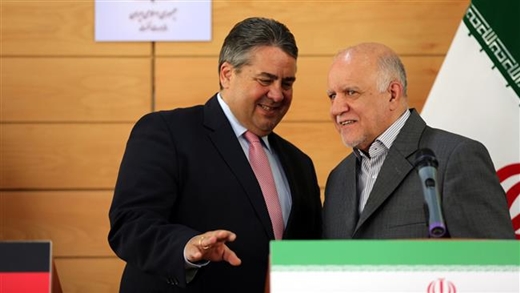
“German companies are not only prepared to sell products to Iran, but also seek to expand lasting and stable economic cooperation (with the country),” Sigmar Gabriel was quoted as saying by the Iranian media on Monday.

The German official also pointed to the long-lasting trade ties between Berlin and Tehran and said German companies are ready to transfer technology and technical know-how to Iran as part of efforts to re-engage with the country on economic matters.

He made the comments during a meeting with Iran’s Petroleum Minister Bijan Zanganeh in Tehran.

The German official also said a ministerial-level meeting of Germany-Iran economic commission would take place early next year in Tehran.

“After the removal of sanctions, German companies will start to cooperate with Iran to modernize the country’s industries,” he noted.

Accompanied by dozens of German business leaders, Gabriel is on an official visit to Iran in a bid to revive trade ties with Tehran.

German exports to Iran reached 4.4 billion euros in 2005 but plunged to 1.8 billion euros eight years later as the US and its Western allies imposed sanctions on Iran over its nuclear program.

German economy and energy minister is the first high-ranking Western official visiting Iran after the conclusion of nuclear talks between Tehran P5+1.

The talks have been aimed at securing a comprehensive deal which will see all sanctions against Iran removed in exchange for certain curbs on Tehran’s nuclear program.

Many Western companies, including German firms, have already kept a close eye on the final result of the nuclear talks between Iran and the five permanent members of UN Security Council plus Germany, amid rising hopes of returning to the country’s untapped market of 78 million people.