Tuesday, December 23, 2025
Home Blog Page 4698

Iranian, Austrian officials review technological cooperation

81692969-70050096

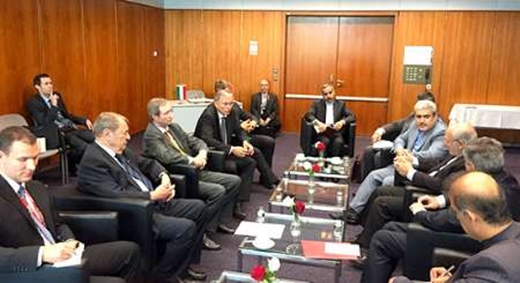
Vice-President for Science and Technology Sorena Sattari met and conferred with the Austrian President Heinz Fischer on bilateral cooperation in scientific and technological issues.

Sattari, who is now in Vienna, has already addressed the closing ceremony of the two-day Iran-EU conference dedicated to “EU-Iran – Post Sanctions Era” in the Austrian capital.

During his address, Sattari referred to Iran’s great potential and focused on developing markets in the country.

He further encouraged the participants to make investment in Iran.

He also referred to Pardis Technology Park in Iran that can be considered a place for transferring modern technologies.

During his stay in Vienna, Sattari inked two trade agreements with European companies.

Also, he met with a number of Austrian officials.

Iran, Europe finalize $2 billion of projects

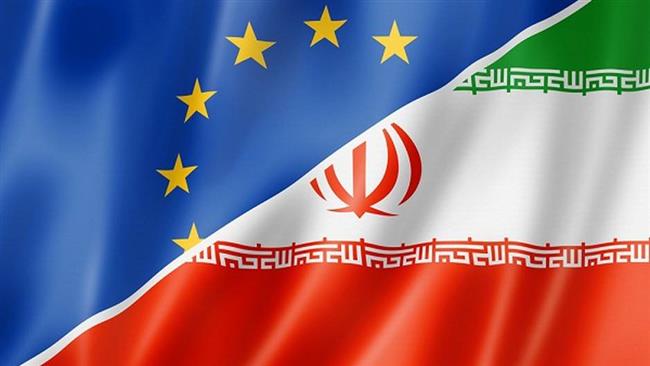
Iran-EU Flags

Minister of Industry, Trade and Mine Mohammad Reza Nematzadeh is leading the Iranian delegation at the two-day conference to discuss opportunities for cooperation with officials from Austria, France, Germany, UK and other countries.

“We are looking for a two-way trade as well as cooperation in development, design and engineering. We are no longer interested in a unidirectional importation of goods and machinery from Europe,” he told the conference.

After the finalization of nuclear talks, European leaders and representatives of major industries are in a race to size up business opportunities in the energy-rich Iran.

Deputy Economy Minister Mohammad Khazaei told the conference that the Iranian government had already granted license for more than $2 billion of projects with the Europeans.

“We are recently witnessing the return of European investors to the country. Some of these negotiations have concluded, and we have approved and granted them the foreign investment licenses and protections,” he said.

“Even in the past couple of weeks we have approved more than $2 billion of projects in Iran by European companies.”

Nematzadeh said oil and gas, metals and car industries were the industries in focus.


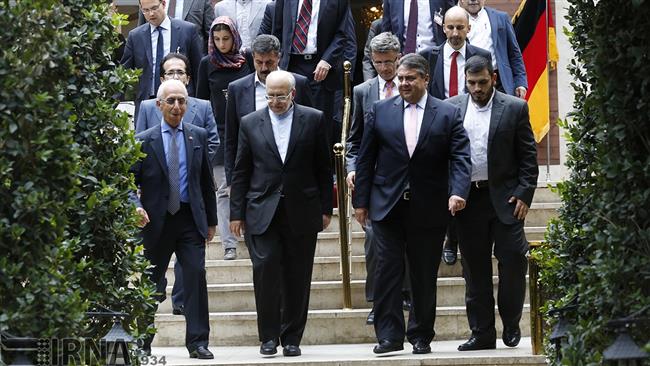
Iran's Industry Minister Mohammad Reza Nematzadeh (2nd L) and German Economy Minister Sigmar Gabriel (2nd R) are leaving a meeting after talks in Tehran.
Iran’s Industry Minister Mohammad Reza Nematzadeh (2nd L) and German Economy Minister Sigmar Gabriel (2nd R) are leaving a meeting after talks in Tehran.


According to Deputy Minister of Petroleum Hossein Zamaninia, as many as 50 oil and gas projects worth $185 billion have been marked out for presentation to prospective investors within 2-3 months along with the new contract models.

The Iran Oil Contract (IPC) addresses some of the deficiencies of the traditional buy-back deals, taking short- and long-term interests of the foreign entities to heart, he said.

Iran’s priority is to improve recovery from its ageing oilfields and develop both onshore and offshore reserves shared with its neighbors in the south and the west. For those fields, Zamaninia said, Iran was ready to sign contracts for a period of 20-25 years.

By 2025, Iran aims to produce 3 million vehicles through joint ventures with auto parts manufacturers, with 1 million units intended for exports including to Europe, Nematzadeh said.

On Sunday, German Economy and Energy Minister Sigmar Gabriel led a delegation of state officials and representatives of the country’s biggest companies on a three-day visit to Iran.

French Foreign Minister Laurent Fabius will visit Tehran on July 29 with the aim to revive relations. France’s main business lobby group, the Medef, is sending a delegation of about 80 firms to Iran at the end of September.

Meanwhile, Italian Economic Development Minister Federica Guidi will head a team of 300 traders on a two-day visit to Iran on August 4.

Switzerland’s Deputy Foreign Minister Yves Rossier arrived in Iran on Tuesday and held discussions with several Iranian officials.

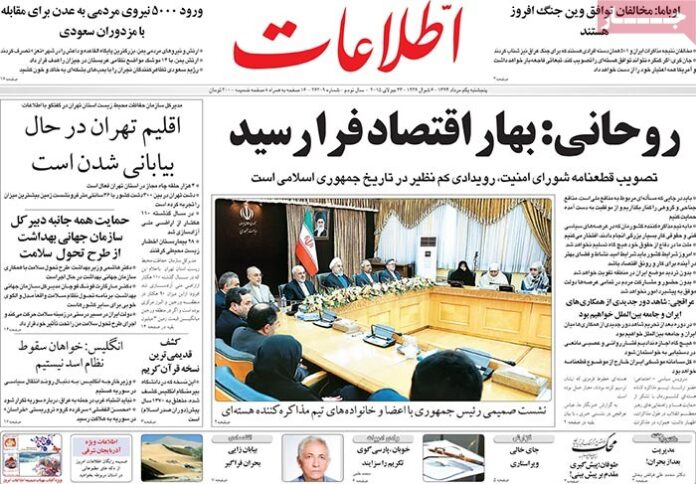
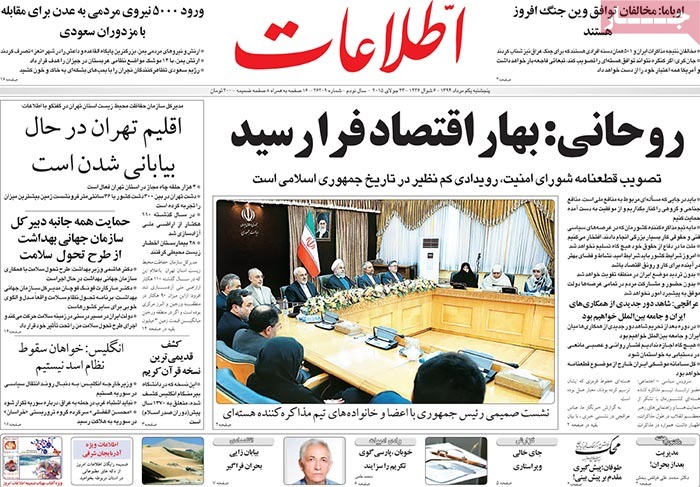
Highlights of Ettela’at newspaper on July 23

Ettelaat23

 “The spring of the Iranian economy has arrived,” President Rouhani said.

He further said that the adoption by the UN Security Council of Resolution 2231 is unprecedented in the history of the Islamic Republic.

 The president has held a meeting with members of the nuclear negotiating team and their families.

 President Obama has said, “The warmongers are trying to scuttle the Vienna accord”.

He has further said that the same people who are now against the deal Iran and P5+1 struck in Vienna last week are “the same folks who were so quick to go to war in Iraq”.

 Some 5,000 popular forces have arrived in Aden to take on Saudi mercenaries.

The Yemeni Army and popular forces have overrun Alqaeda and IS bases in the city of Taiz.

 “Tehran is getting desertified,” said the director general of Tehran Environment Protection Department.

 The director general of the World Health Organization has thrown her weight behind Iran’s Health Transformation Plan.

The Iranian health minister has said that the plan is being implemented in cooperation with the WHO.

 Britain has said that it does not want the downfall of Assad’s government in Syria.

The British foreign secretary has said that London favors political transition in Syria.

 The oldest handwritten copy of the holy Koran has been discovered.

The copy found in University of Birmingham dates back to 1,370 years ago.

Why did Professor Samii accompany German vice-chancellor?

Samii-German

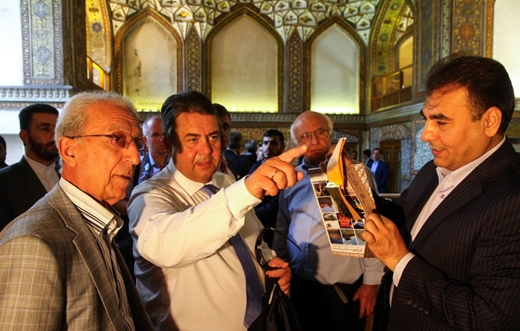
Professor Majid Samii, a distinguished Iranian neurosurgeon and medical scientist, says his trip to Iran in the company of German Vice-Chancellor Sigmar Gabriel is not for economic or political purposes, stressing that he is in Iran only to boost friendship between the two nations.

The Iranian scientist – who is the head of the world renowned International Neuroscience Institute (INI) based in Hanover – said this to reporters on Tuesday and added that it was the vice-chancellor’s idea that he accompany the German delegation to Iran. Fararu.com on July 21 released a report on his remarks. The following is the translation of what else Prof. Samii told reporters:

Professor Samii said, “The German people treat me with respect. The Iranians too show a feeling of friendship and devotion to me. It was the idea of the German vice-chancellor that I accompany him in his trip to Iran and signal this message to the Iranian nation that a new chapter of relations will open for the two countries”.

The renowned Iranian neurosurgeon went on to say, “I act as the ambassador of both Iran and Germany. Personally, I have no economic and political links with Iran. I have not made and will not make any political statement”.

He further said that the stage has been set for Iran and Germany to work together, adding that Iran has the capacity to make scientific and economic progress. He also said Iran’s cooperation with the German government will certainly produce positive results on scientific and medical fronts.

He added that the Germans and Iranians have so far been unaware of their potential, but the two countries got closer thanks to joint scientific and industrial projects they have undertaken.

“I view myself a resident of Isfahan. Our half-day trip to Isfahan revolves around sight-seeing and a meeting with the governor general before we head back to Germany,” said Prof. Samii.

“The German vice-chancellor, who is a friend of mine, asked me to accompany him on his Iran visit. The trip will also take us to Isfahan where we seek to see Iran’s historic and artistic works and their antiquity [firsthand].

“The head of the German Chambers of Commerce and Industry together with presidents of German giants such as Siemens AG [a German multinational conglomerate company] and Volkswagen Group [a German multinational automotive manufacturing company] are on the German team to Iran,” he said.

“These companies are seeking to immediately transfer their technology to Iran. They do not look at Iran as a consumer; rather, they seek to establish cooperation with Iran,” he added.

The Iranian scientist also said that the high-ranking German team has now learned about the intelligence of the Iranians and they now believe that Iran can make scientific and industrial progress like Germany.

He said that Iran’s biggest neurology center, which is being constructed in Tehran, will become operational next year (in spring). […]

A look at Iranian newspaper front pages on July 23

Iranian Newspapers Headlines

Comments by President Rouhani and senior nuclear negotiator Abbas Araghchi in support of the nuclear deal Iran struck with P5+1 on July 14 dominated the front pages of Iranian newspapers on Thursday.


Ettela’at: “The spring of the Iranian economy has arrived,” President Rouhani said.

He further said that the adoption by the UN Security Council of Resolution 2231 is unprecedented in the history of the Islamic Republic.

Highlights of Ettela’at newspaper on July 23

A look at Iranian newspaper front pages on July 23


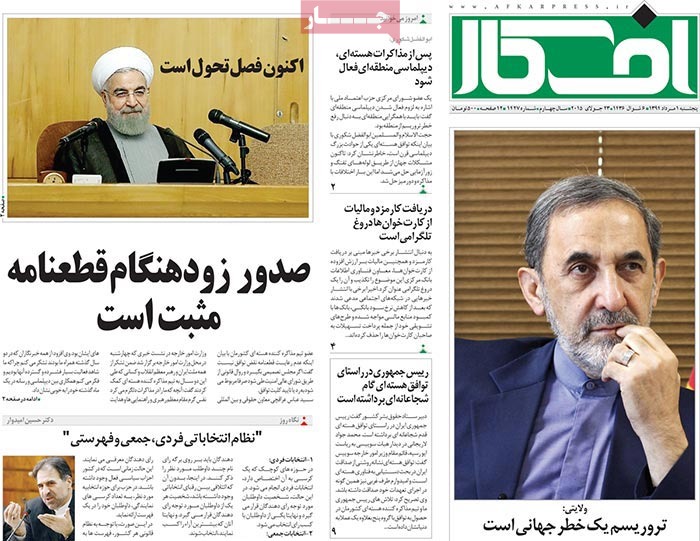
Afkar: “President Rouhani took a bold step in securing the nuclear deal,” said Mohammad Javad Larijani, the head of the Human Rights Council.


A look at Iranian newspaper front pages on July 23


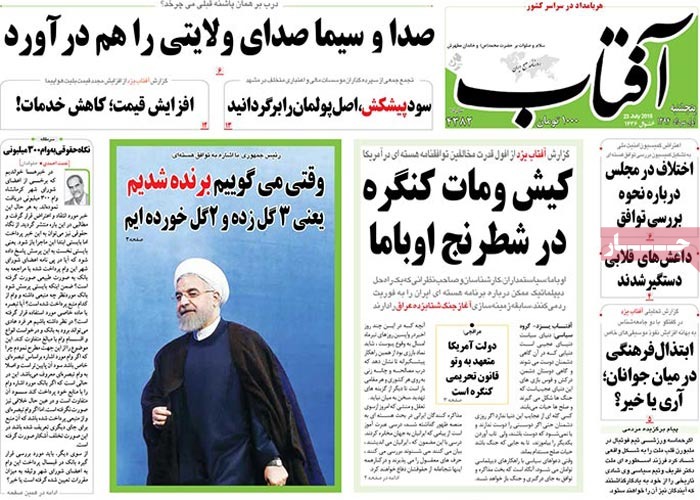
Aftab-e Yazd: Division in parliament on how the nuclear deal should be reviewed

The National Security and Foreign Policy Committee has objected to the formation of a Nuclear Review Committee in the Islamic Consultative Assembly.


A look at Iranian newspaper front pages on July 23


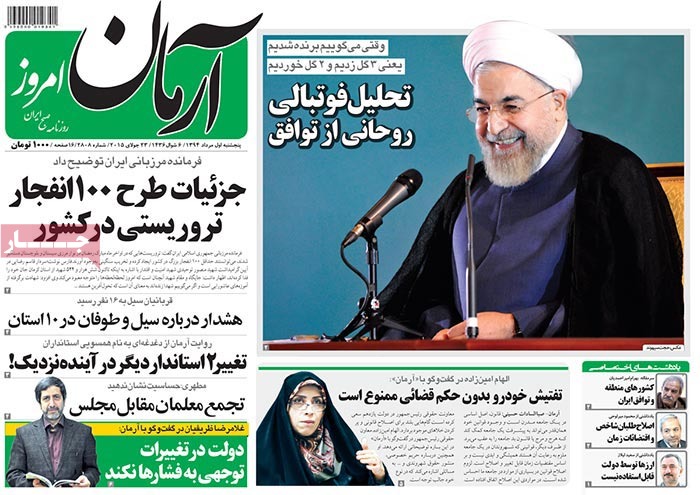
Arman-e Emrooz: The border guard chief has elaborated on a terrorist gang bust.

The terrorists who were arrested in the border area in Sistan and Baluchestan Province in the final days of the holy month of Ramadan could have set off at least 100 big explosions across the country.

Arman-e Emrooz: Two more governors general are likely to be replaced in the near future.

The daily has a report on a new government concern about provincial governors not acting in line with the policies of the Rouhani administration.

Arman-e Emrooz: “Searching the cars without a court order is against law,” said the legal deputy of President Rouhani.


A look at Iranian newspaper front pages on July 23


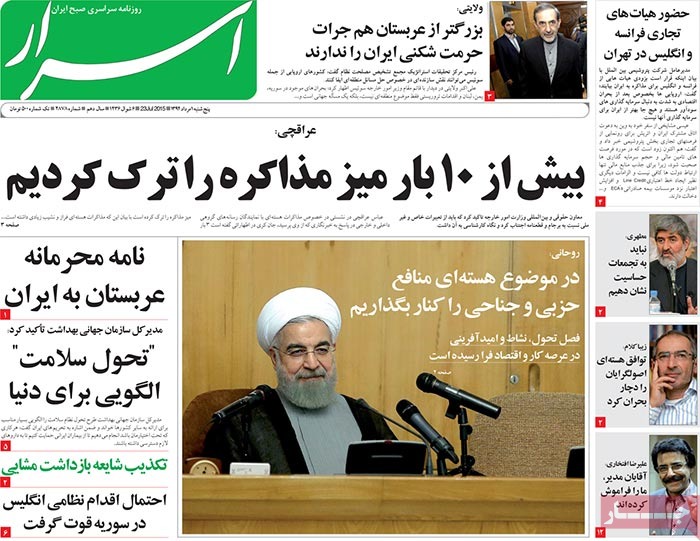
Asrar: “On the nuclear issue, let’s put aside partisan and factional interests,” said President Rouhani.

Asrar: Rumors that the former president’s chief of staff Esfandiar Rahim Mashaei is in custody have been refuted.


A look at Iranian newspaper front pages on July 23


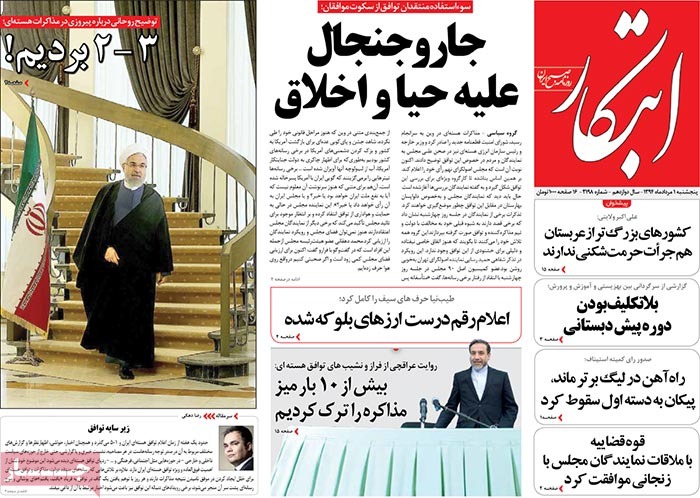
Ebtekar: “We walked away from the talks more than 10 times,” said Iranian diplomat Abbas Araghchi of the ups and downs of nuclear talks with P5+1.

Ebtekar: The Judiciary has agreed to MPs meeting with Babak Zanjani [a young billionaire who stands accused of massive fraud when Ahmadinejad was president].


A look at Iranian newspaper front pages on July 23


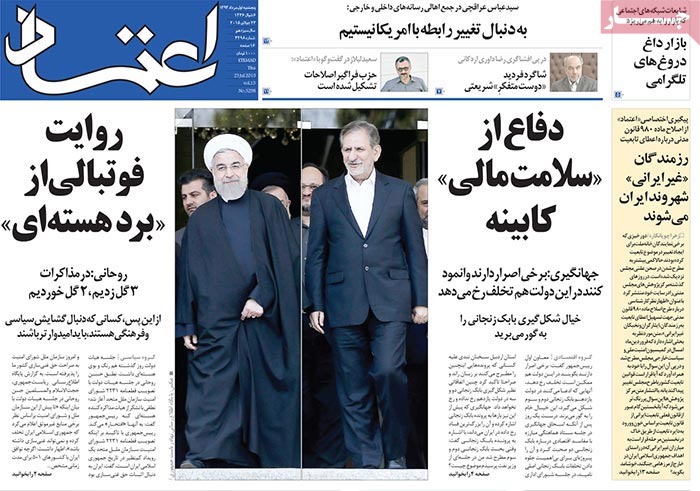
Etemad: President Rouhani’s account of the nuclear win, soccer-style: “We scored three goals and conceded only two.”

“Those who favor political and cultural openings can be more hopeful from now on,” said President Rouhani.


A look at Iranian newspaper front pages on July 23


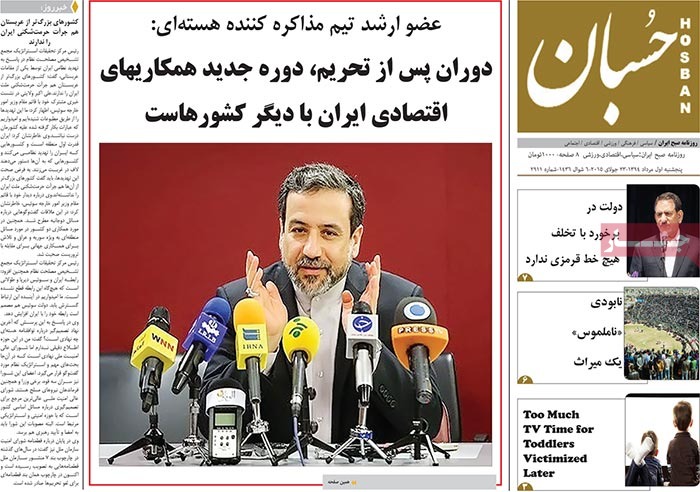
Hosban: “After sanctions, a new chapter of economic cooperation with the rest of the world will open,” said Iranian nuclear negotiator Abbas Araghchi.


A look at Iranian newspaper front pages on July 23


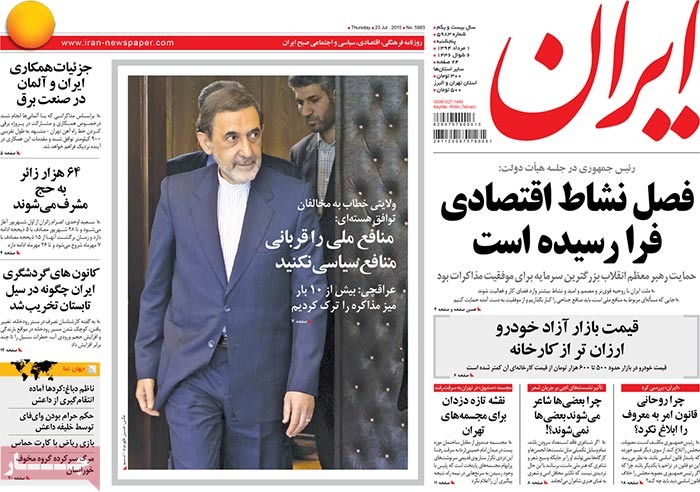
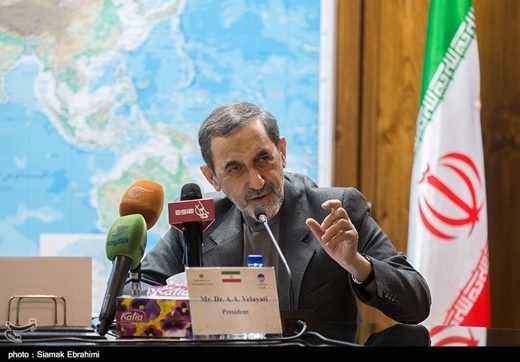
Iran: “Don’t stick to your political interests at the expense of national interests,” Ali Akbar Velayati, an advisor to the Supreme Leader, said in comments aimed at the opponents of the nuclear deal.


A look at Iranian newspaper front pages on July 23


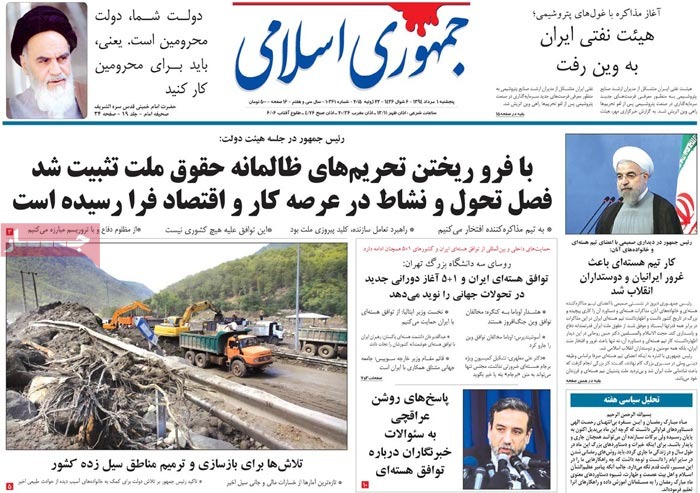
Jomhouri Islami: “The nuclear deal between Iran and P5+1 is a harbinger of a new era in international developments,” said the presidents of three main universities in the capital.

Jomhouri Islami: “The performance of the nuclear negotiating team is a source of pride for the Iranians and those who love the Islamic Revolution,” President Rouhani said.


A look at Iranian newspaper front pages on July 23 


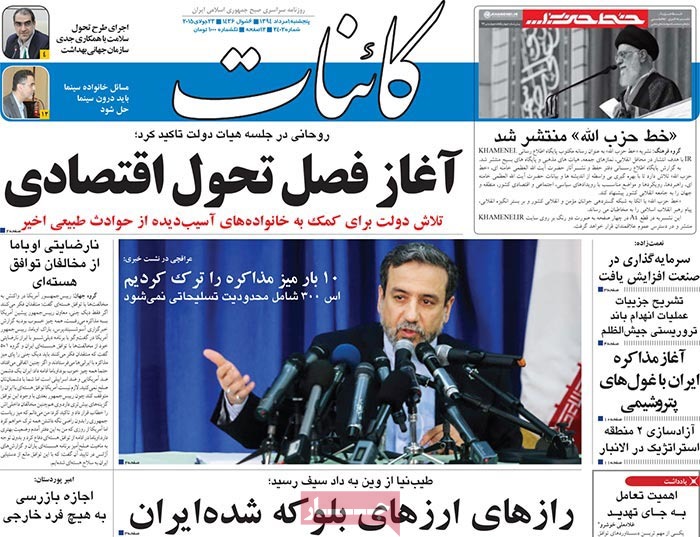
Kaenat: “The arms restrictions do not apply to S300 air defense system,” said Iranian nuclear negotiator Abbas Araghchi.


A look at Iranian newspaper front pages on July 23


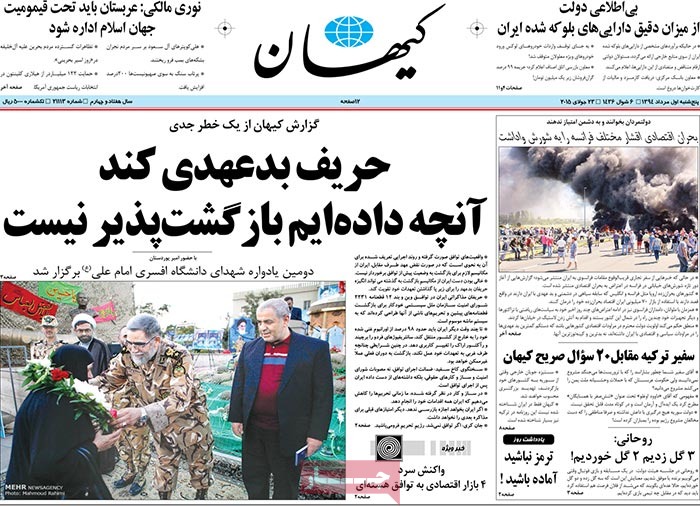
Kayhan: Government does not have an exact figure on Iran’s frozen assets.

Kayhan: “If the other party fails to honor its commitments, what we are giving away is not returnable,” the daily has said in a report on what it calls a “serious threat”.

Kayhan: Four economic markets have shown a lukewarm reaction to the nuclear deal between Iran and P5+1.


A look at Iranian newspaper front pages on July 23


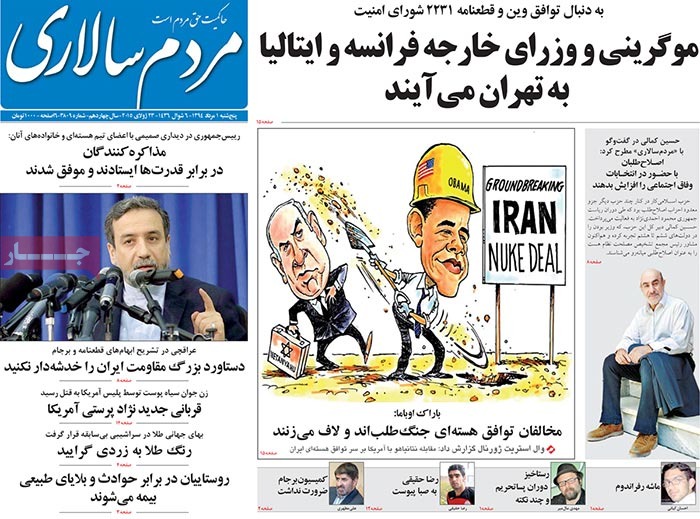
Mardomsalari: The EU foreign policy chief and the foreign ministers of France and Italy will arrive in Tehran shortly.

Mardomsalari: Villagers are to be offered insurance on natural disasters.

Mardomsalari: “Don’t tarnish the great achievement of the Iranian resistance,” said Abbas Araghchi, a nuclear negotiator, to opponents of the Iran-P5+1 nuclear deal.


A look at Iranian newspaper front pages on July 23


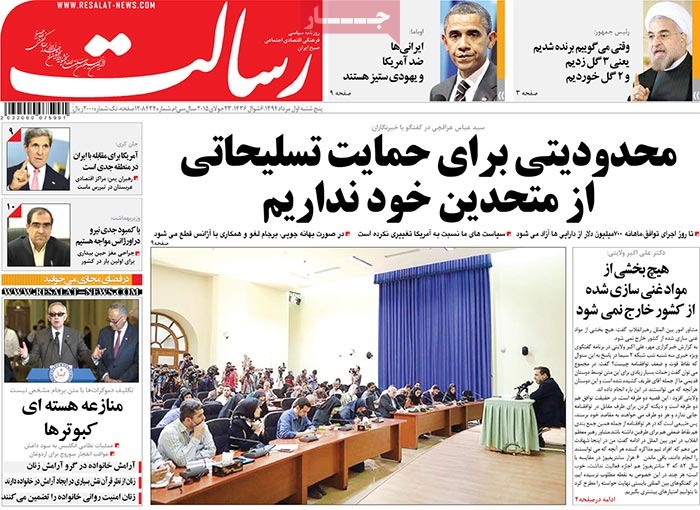
Resalat: “Iran faces no restrictions in lending arms support to its allies,” said Iranian nuclear negotiator Abbas Araghchi.


A look at Iranian newspaper front pages on July 23


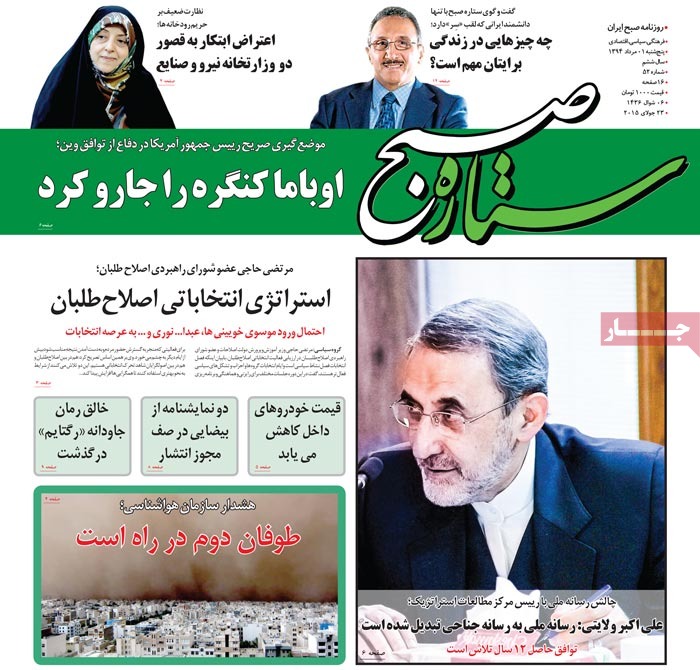
Setareh Sobh: “The national medium [a reference to state radio and TV organization] has turned into a factional medium,” said Ali Akbar Velayati, the Supreme Leader’s advisor.

Setareh Sobh: “A second storm is on its way,” the Meteorological Organization has warned.

[It came after a deadly storm which brought heavy flooding caught the residents of Tehran and Alborz provinces off guard, killing more than a dozen people.]


A look at Iranian newspaper front pages on July 23


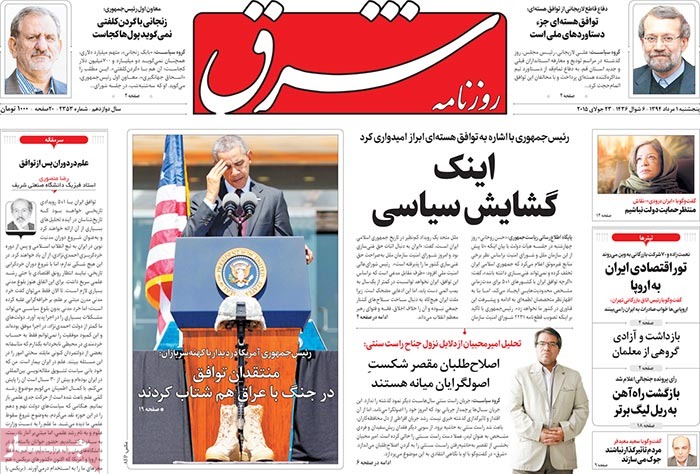
Sharq: Parliament Speaker Ali Larijani has hailed the nuclear deal as a national achievement.


A look at Iranian newspaper front pages on July 23


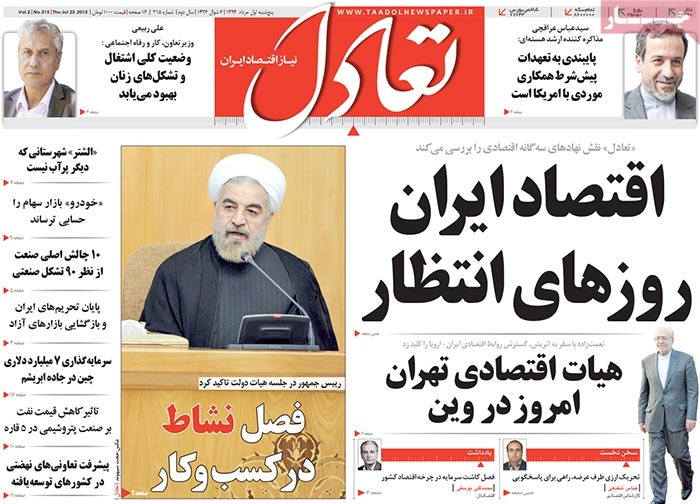
Taadol: An Iranian economic delegation led by the industry minister is in Vienna today to push for expansion of Iran-Europe economic ties.


A look at Iranian newspaper front pages on July 23


Iran’s Velayati warns against spread of terrorism

Ali Akbar Velayati

Head of the Strategic Research Center of Iran’s Expediency Council Ali Akbar Velayati expressed concern over the spread of terrorism in the world, saying that terrorist groups must be dealt with “decisively”.

The current crises in Syria, Yemen and Lebanon as well as the campaign against terrorism are not regional but global issues, Velayati said in a Wednesday meeting in Tehran with Yves Rossier, the secretary of state at the Swiss foreign ministry.

Terrorist groups in Arab countries are dangerous to all nations around the world, especially to those that sponsor these groups, he said.

The Iranian official further called on all European countries to actively contribute to the fight against terrorism in the region, saying that if today, the fight against terrorism is not pursued decisively, they will penetrate into Europe and other parts of the world.

In recent years, the threat of terrorism has intensified in the world, with groups like ISIL committing heinous crimes not only in the region but elsewhere in the world, including Europe.

In a recent terrorist attack in France, a man with links to the Takfiri ISIL terrorist group beheaded his employer and tried to blow up a gas factory near Lyon, France’s third largest city, on June 26.

On the same day, ISIL militants carried out deadly terrorist attacks in Tunisia and Kuwait, killing scores of people.

Canada losing ‘traditional partners’ over JCPOA stance

Marzieh Afkham

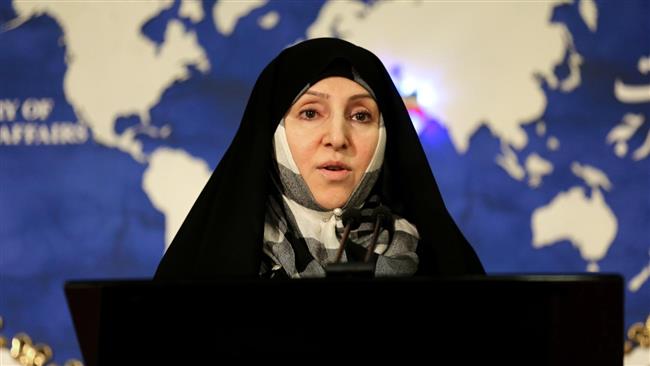
Canada’s “radical” policy towards Iran after the conclusion of nuclear talks with global powers lacks any “rational basis,” says Iranian Foreign Ministry Spokeswoman Marzieh Afkham.

On Wednesday, Afkham denounced a statement by the Canadian Foreign Ministry released after Tehran and P5+1 reached a landmark agreement, dubbed the Joint Comprehensive Plan of Action (JCPOA), in the Austrian capital Vienna on July 14.

“Continuation of a radical position against Iran by Canadian authorities, especially under the current conditions, indicates that the Canadian government’s approach towards Iran does not have any rational basis,” said the Iranian spokeswoman.

Ottawa’s “adherence” to the Israeli regime’s stance towards Iran has “led to the isolation of the country’s conservative government within the international community and even among its closest traditional partners,” she noted.

Afkham further called on the North American country to “embrace rationality and logic instead of warmongering and radicalism.”

A statement by the Canadian Foreign Affairs, Trade and Development had accused Iran of being a “significant threat to international peace and security.”

It added, however, that Canada “will examine this deal further before taking any specific Canadian action.”

Following the agreement with P5+1 – the United States, Britain, Russia, China, France, and Germany – Israeli Prime Minister Benjamin Netanyahu reiterated the regime’s anti-Iran rhetoric, calling the JCPOA a “historic mistake for the world.”

West realized anti-Iran sanctions had to go: Nahavandian

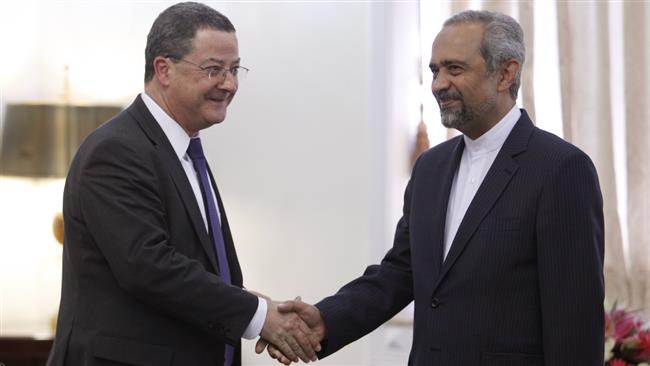
Nahavandian-Yves Rossier

Iran is prepared for “win-win” economic ties with other countries, says the chief of staff of President Hassan Rouhani.

Mohammad Nahavandian made the remarks at a meeting with Yves Rossier, the state secretary at the Swiss Federal Department of Foreign Affairs in Tehran on Wednesday.

“At present, a lot of the Western countries have come to the conclusion that the artificial (and) unnecessary crisis of Iran’s nuclear program is a big obstacle for their benefit from the Islamic Republic of Iran’s high economic capacity,” Nahavandian said.

He further noted the “cruel sanctions regime” against Tehran led to the “loss of financial transparency” in business transactions with Iran.

On July 14, Tehran and P5+1 – the US, Britain, Russia, China, France, and Germany – reached a nuclear agreement in Vienna after months of tough negotiations on Iran’s nuclear program.

As a first step in the removal of the anti-Iran sanctions, the UN Security Council unanimously endorsed a draft resolution on Monday, backing the landmark agreement, dubbed the Joint Comprehensive Plan of Action (JCPOA).

Nahavandian said the move attests to the Iranian economy’s crucial role in the international arena, stating, “All the global powers have very well realized this role.”

President Rouhani’s chief of staff also welcomed “the expansion of economic and banking relations with Switzerland,” noting that Swiss banks can play a “positive and constructive role in Iran’s bank transactions and economic activities.”

Rossier, for his part, welcomed a boost in cooperation between the two countries.

A macro look at nuclear talks, an analysis of Leader’s nuclear stance

43002_246

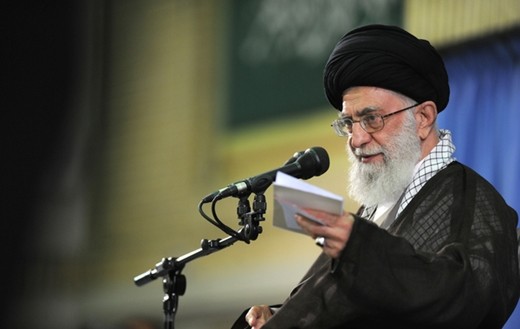
An analysis released by a website affiliated to the Supreme Leader has highlighted the need for critical analyses of the Iran nuclear deal, but has said that pointing an accusing finger at the negotiating team is in contravention of the country’s expediency and against the Leader’s approach.

Khamenei.ir, the website which releases the works of Supreme Leader Ayatollah Seyyed Ali Khamenei, on July 19 published a piece – A Macro Look at Nuclear Talks – analyzing the Leader’s interpretations of nuclear talks in recent days.

The following is the translation of the piece in its entirety:

After 23 months of nuclear talks between the Islamic Republic of Iran and P5+1 over Iran’s 13-year-old nuclear case came to an end, the Supreme Leader of the Islamic Revolution announced the country’s macro policies – including a continued anti-imperialistic approach and Iran’s regional policies – in response to a letter by the president, in his [Eid al-Fitr] sermons, and in his meetings with state officials and Iran-based ambassadors of Islamic countries to mark Eid al-Fitr.

There are a few points in the Leader’s remarks which should be contemplated:

1. Appreciating the efforts of the negotiating team: The Supreme Leader expressed gratitude for the efforts of the negotiating team after the talks came to an end, saying, “The divine rewards for them [Iranian nuclear negotiators] are reserved whether or not the text [of the nuclear deal] which has been pieced together is approved of in the course of the predicted legal channels”.

The Leader’s appreciation and thankfulness is of essence because some went beyond what is viewed as healthy criticism and contributed to division, discord and character assassination after the final text [of the nuclear deal] and its annexes were released.

It is quite natural to have a critical look at the text thanks to the untrustworthiness of the other side. But in dealing with the country’s negotiating team, some individuals have pressed on with finger-pointing and fault-finding – despite the Leader’s recommendations [otherwise] especially in a meeting with state officials – as if the final text had been prepared courtesy of their [the nuclear team’s] betrayal. This approach absolutely defies wisdom and expediency, and does not fit into the pathway the Supreme Leader has determined.

On the other hand, some others think the Leader’s expression of gratitude for the endeavors of the negotiating team translates into his approval of the result of the talks. This view is incorrect as well.

Ayatollah Khamenei said in a meeting with officials in the month of Ramadan, “I will tap into all capabilities that I have at my disposal to help the government. I approve of and support this government, like all previous governments … All governments, which came to power after the revolution, were elected by people, and I have supported these governments in all periods – when I was in charge. All governments have positive and negative points. No government can claim that everything it does is positive. Others cannot say that a government’s performance is entirely negative. No, there is a mix of positive and negative points”.

2. Emphasizing efforts to walk down the legal path: After the talks wrapped up in Vienna [and produced a deal], some expected the Supreme Leader to openly support or criticize [the nuclear deal], whereas the deal’s legal channels and mechanism have yet to be finalized.

Imam Jawad [the ninth Shiite Imam] has said that to reveal something before its finalization will lead to its destruction (Tuhaf al-‘uqul, p. 457). The focus by the Leader on the need for the deal to go through legal channels can be pondered on from two angles:

A) Because of the multiple past failure of the other side, especially the US, to keep its promises, the deal should be fully assessed, revised and modified so that the other side cannot misuse it.

B) A look at the history – past and present – of the Islamic Republic shows that Ayatollah Khamenei like the Founding Father of the Islamic Republic the late Imam Khomeini has always called for employment of legal processes and collective wisdom for making decisions on the country’s core issues.

Since 2004 when Iran’s nuclear case opened, three governments have been in charge of settling this case. Three governments, with different and sometime opposing approaches and tactics, have tried to deal with this case in their own way and within the framework of our red lines.

In different periods, the issues associated with the nuclear case have been decided on after the core principles, considerations, approaches and methods of the elected governments have been taken into account and after the case has gone through the legal procedures. The approach of the Supreme Leader in this regard shows that there is no room for being overjoyed like what some people do; nor should we consider the revolution’s principles as lost and finished like what some other do! Rather, we need to take into account these considerations in our analyses and critical views until the complex nuclear talks come to a stop and the problems are fixed.

3. Avoiding division: In a meeting with state officials and Islamic ambassadors based in Iran on the occasion of Eid al-Fitr, the Supreme Leader said, “The Iranian nation should be united and questions surrounding the nuclear case should not cause a rift in the country”.

It should be mentioned that it is the leverage of the enemies of the Islamic Revolution to turn the opportunities of the Islamic Republic of Iran into threats against the country. A case in point is what happened in Iran following the 2009 elections. A high public turnout (more than 85 percent) should have been the launching pad for the Islamic Republic to enter regional and international equations, but instead the post-election events tarnished the image of the Islamic establishment.

We need to take lessons from such incidents (seditions) and learn how to seize the available opportunities and take steps toward advancing the objectives of the Islamic Revolution. We need to be fully aware that what matters in nuclear talks is the settlement of the nuclear case, not asking people to rally around a certain person or group for electoral purposes or political and partisan bickering.

4. Having a trend-based look at the nuclear case: A trend-based macro look is one of the key points in the Supreme Leader’s remarks. The Leader said in his Eid sermons, “It is ten or twelve years that six big world powers – which are among the world’s most powerful countries as far as economic wealth, etc. is concerned – have been sitting [at the negotiating table] across from Iran in order to prevent Iran from pursuing [the development of] its nuclear industry … The result: these six powers had to tolerate the spinning of several thousand centrifuges in the country, tolerate the continuation of [the growth of] this industry in the country, [and] had to tolerate the continuation of research and development in this industry [in Iran]”.

Therefore, a merely technical and instantaneous look [at the issue] will cause us to misanalyze the case. To analyze the nuclear case – which has complex aspects and has been subject to passage of time – we need to contemplate more and have a general look at the procedures through which the country’s nuclear case is dealt with, fairly review its inputs and outputs and then pass on judgment.

The Supreme Leader has warned in his remarks that the other side should be denied anything which leads to gamesmanship, saying unity in the ranks of people holds the key to solving the problems. Isn’t it true that the recent remarks of the Supreme Leader can shed light – literally – on the way the Muslim community in Iran moves forward?

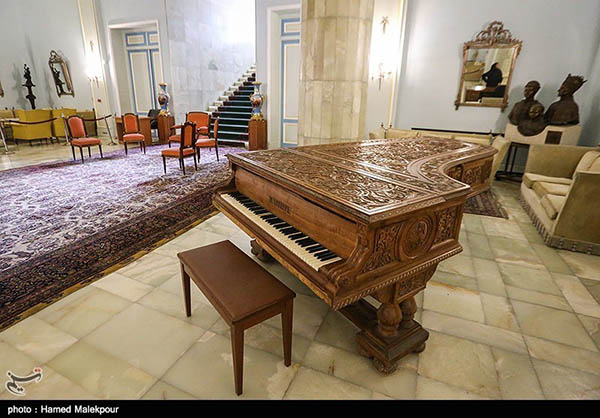
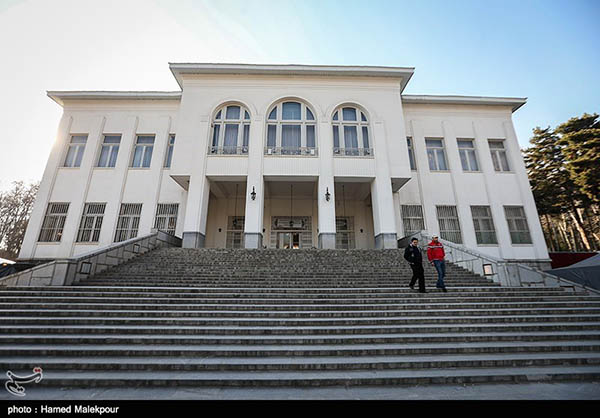
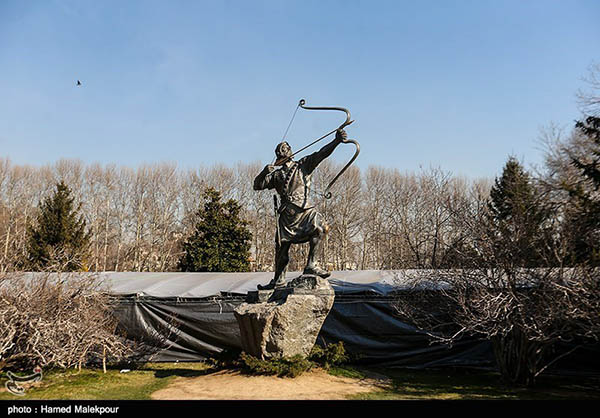
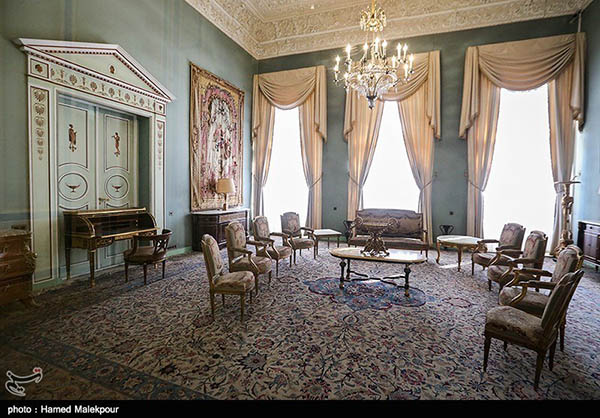
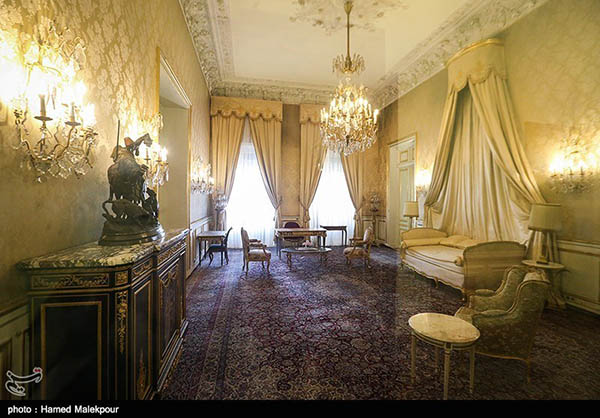
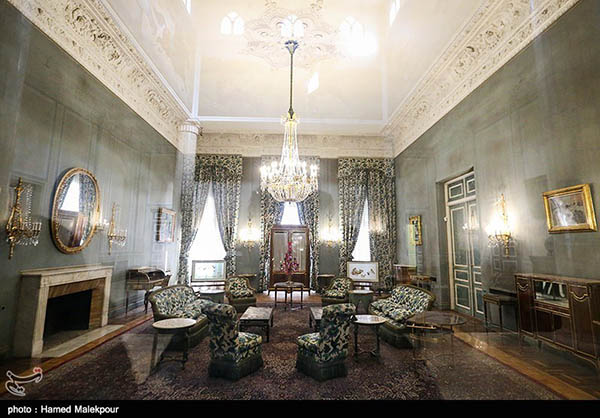
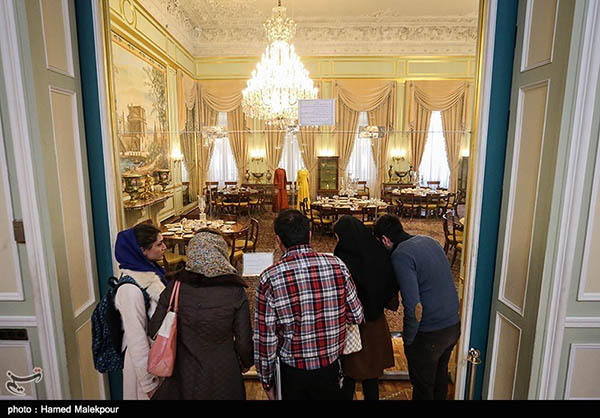
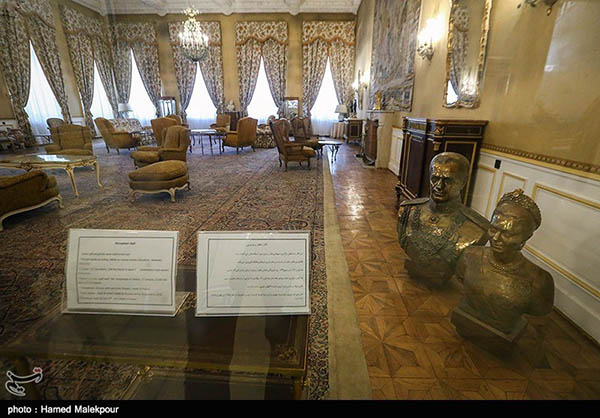
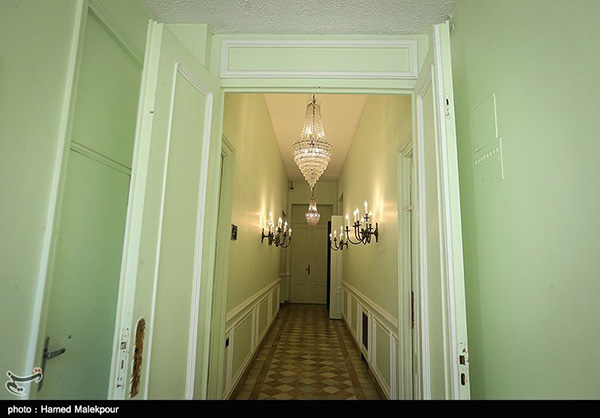
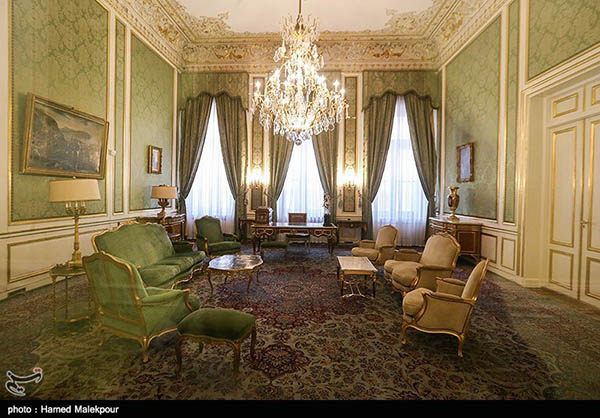
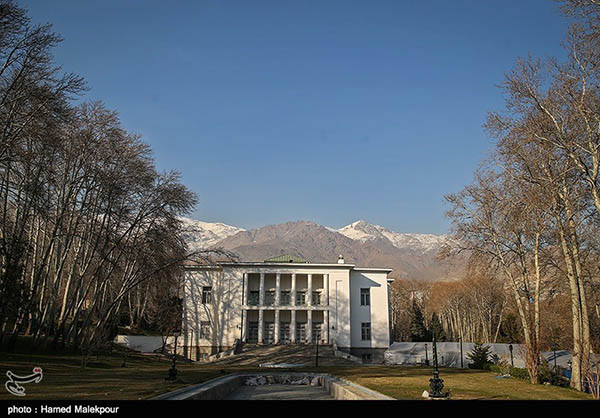
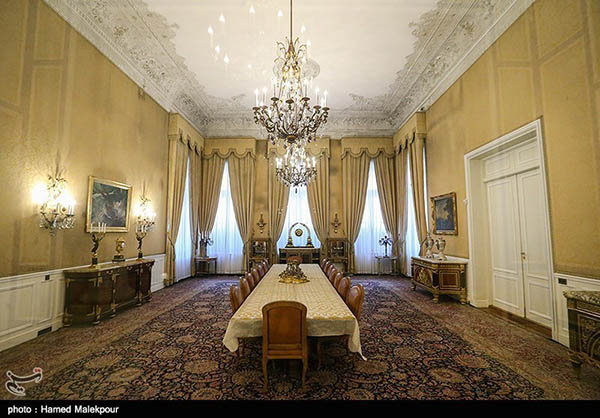
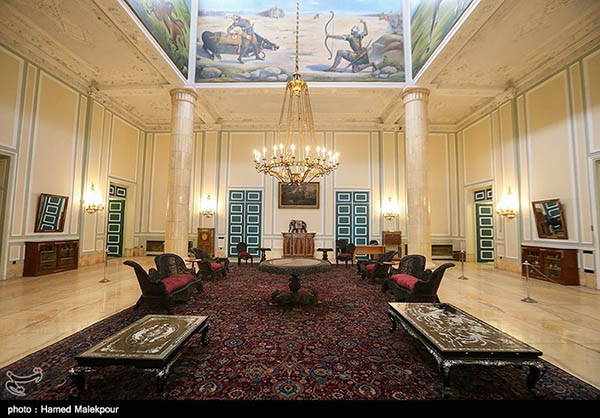
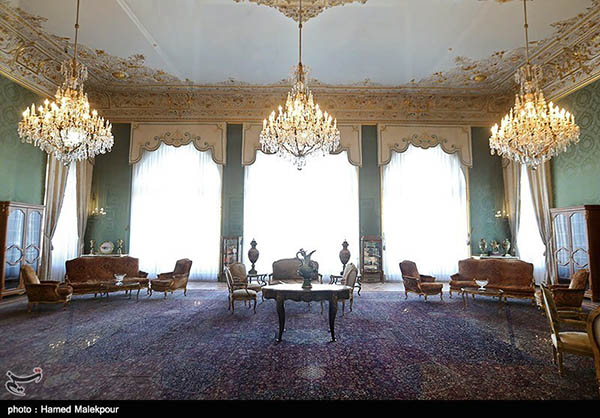
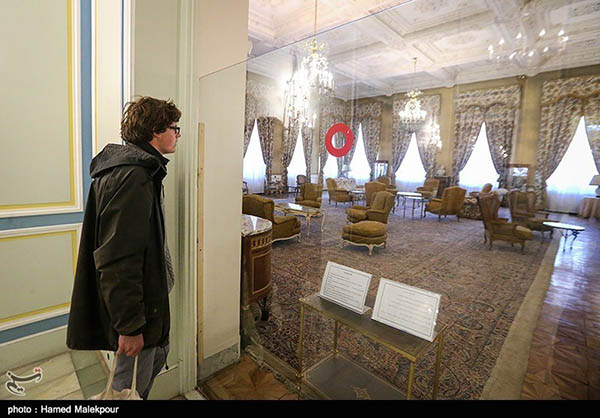
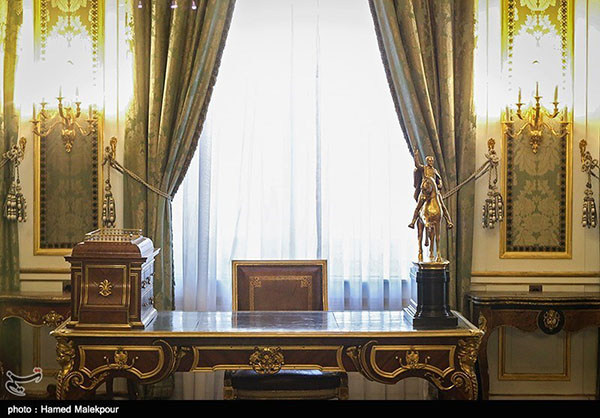
Mellat Palace Museum (PHOTOS)

Mellat Palace Museum00

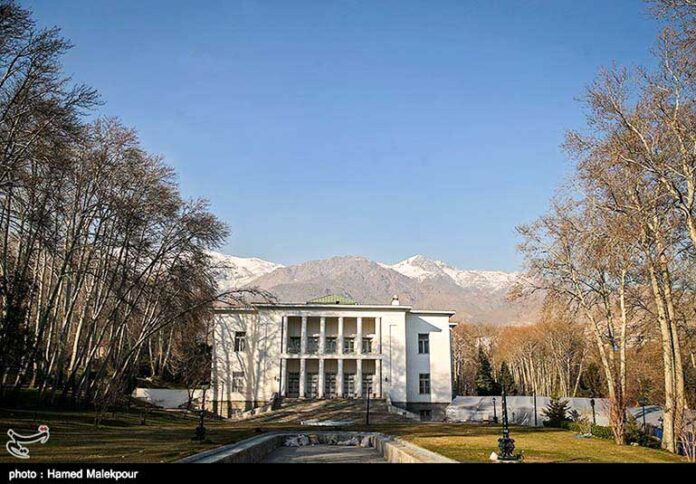
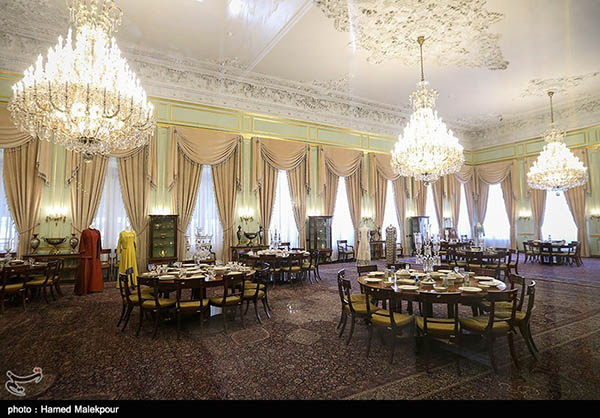
Mellat Palace Museum, also known as the White Palace, is the largest building in Sadabad, a 110-hectare collection of palaces in the north of Tehran. The complex was once a royal summer retreat for Mohammad Reza Pahlavi and his wife.

The following are photos of the White Palace posted online by Tasnim News Agency: