Tuesday, December 23, 2025
Home Blog Page 4693

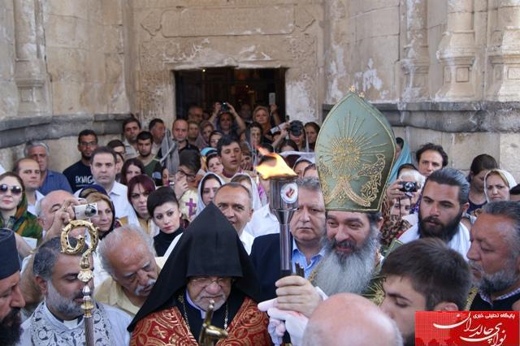
World Christian gathering in Chaldoran a sign of religious freedom in Iran

Christians-Chaldoran

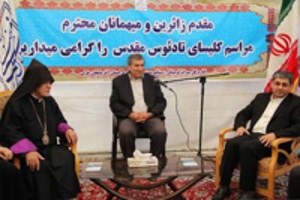
Christians-IranConvergence of Christians on the Saint Thaddeus Monastery [or Ghara Kelisa – Literally “The Black Church” – in West Azerbaijan Province] is a sign of religious freedom in Iran, Tehran’s Armenian archbishop was quoted by Alef, a news website, as telling the head of the Political Department of the Interior Ministry Sunday.

At the meeting, Archbishop Sebouh Sarkissian said, “Such freedom should be cherished.”

The following is the translation of a report the website published on the meeting on July 26:

Describing Iran as a country which preserves the heritage of different global religions, Sarkissian said, “We should safeguard this invaluable treasure called Iran, because only a few kilometers away from the borders of this country, churches are being destroyed.”

The archbishop added, “When the so-called supporters of human rights look at Iran, they put on dark glasses. But when they look at countries such as Saudi Arabia, they put on rose-colored glasses. In reality though, there is a huge difference between Iran and Saudi Arabia.”

For his part, Reza Rezazadeh, the official with the Interior Ministry, pointed to the Islamic Republic’s constitutional article which recognizes divine religions and said, “Presently, 57 religious institutions (27 Christian, 27 Zoroastrian and three Jewish) are active in the country and they are at full liberty when it comes to holding religious ceremonies.”

Each year Armenians from Iran and around the world descend on this house of worship in Chaldoran, in northwestern Iran, for ceremonies which run between three and five days. The monastery is a World Heritage site.
International interaction can help facilitate adaptation: Rafsanjani

Israel doomed to historic failure

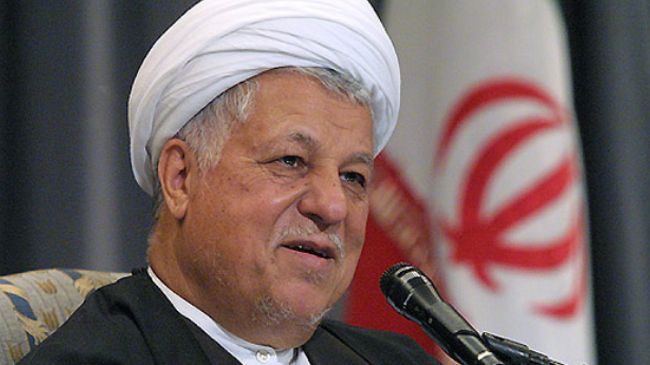
Chairman of the Expediency Council Ayatollah Akbar Hashemi Rafsanjani says he hopes interaction between the Iranian legal system and international organizations can result in the refinement of judicial regulations.

In a message to an international conference on independence of lawyers and bar associations Sunday, Ayatollah Hashemi highlighted the importance of human rights, and said, “Adaptation of the country’s judiciary and legal representation system to internationally-accepted standards will contribute to the effectiveness of the judiciary on the global stage.”

Given that cultural concepts are constantly changing, legal representation should be updated with the passage of time, the top councilor said.

The following is the translation of an excerpt of his message posted online by the Islamic Republic News Agency on July 26:

When it comes to legal representation, the emphasis is on the independence of lawyers, a key principle stipulated in the Universal Declaration of Human Rights and the International Covenant on Civil and Political Rights and Basic Principles on the Role of Lawyers [adopted by the Eighth United Nations Congress on the Prevention of Crime and the Treatment of Offenders, Havana, Cuba, in 1990].

The independence of bar associations and that of defense attorneys are an intrinsic part of this covenant.

[…]

Islamic texts urge the faithful to resort to arbiters and legal representatives when they are at odds with each other. There is no doubt that arbitration and representation are a religious issue encouraged by the Muslim Prophet. The Islamic judiciary system should organize international gatherings as such to promote the positive aspects of legal representation and facilitate adaptation.

I hope what is related to human rights is deemed as important globally and in the future there are no instances of injustice in the world. Of course, satisfaction and dissatisfaction are inevitable concepts when it comes to court cases and performance of lawyers.

The day-long gathering held on July 26 in Tehran’s Milad Tower brought together a number of ambassadors and heads of bar associations from the Netherlands, Austria, France and Turkey as well as officials from the International Bar Association.

Local dolls narrate joys, sorrows of rural women (PHOTOS)

Local dolls000

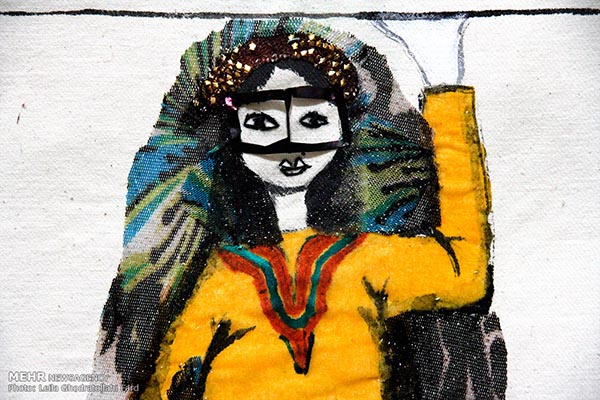
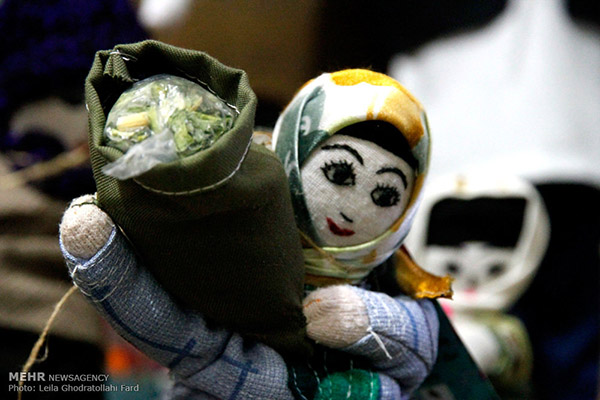
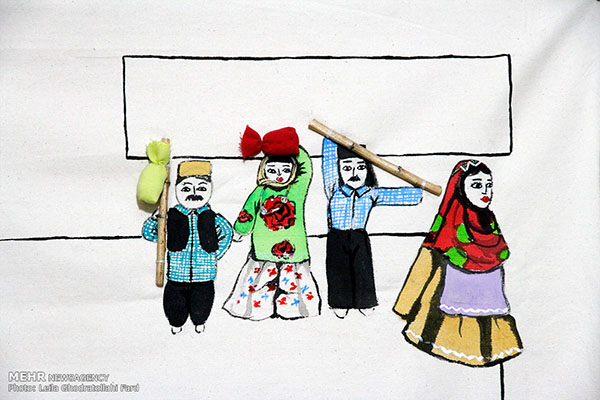
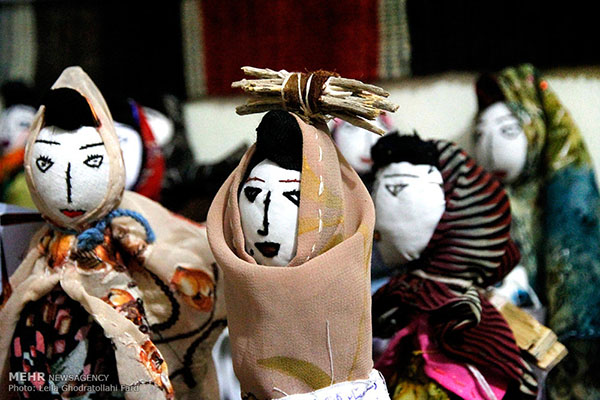
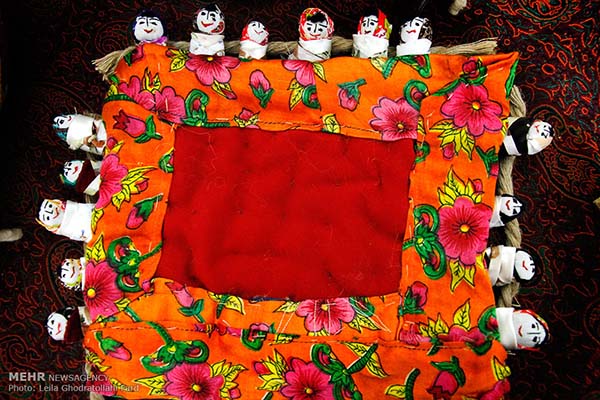
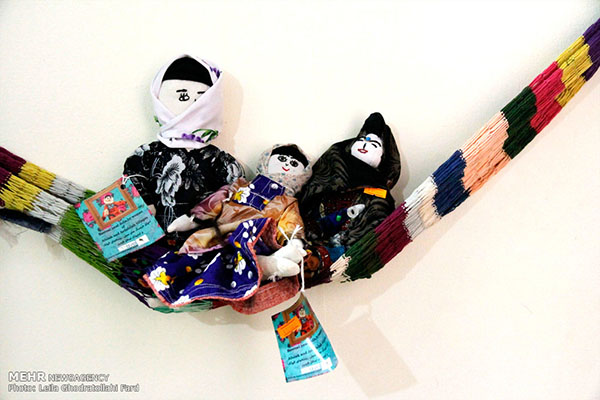
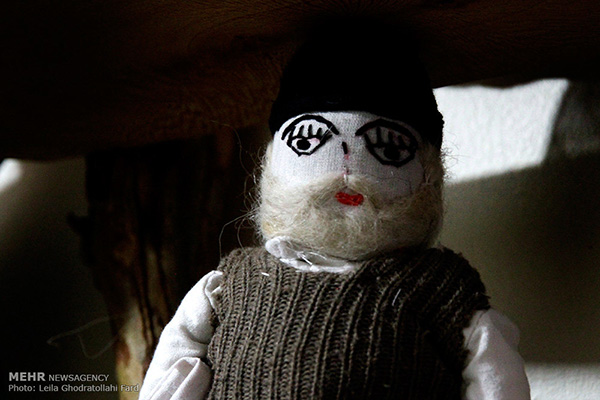
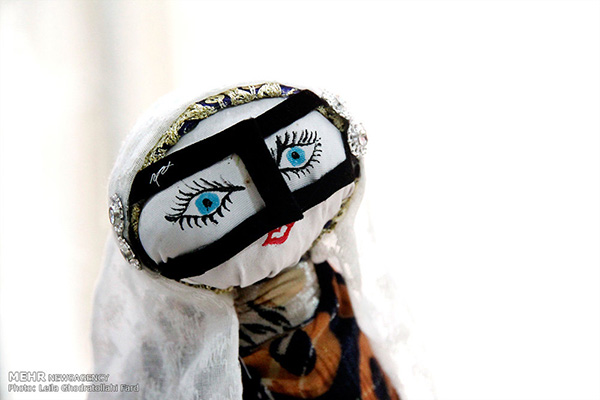
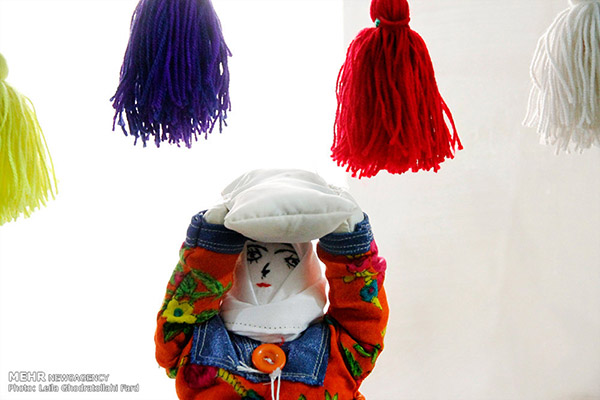
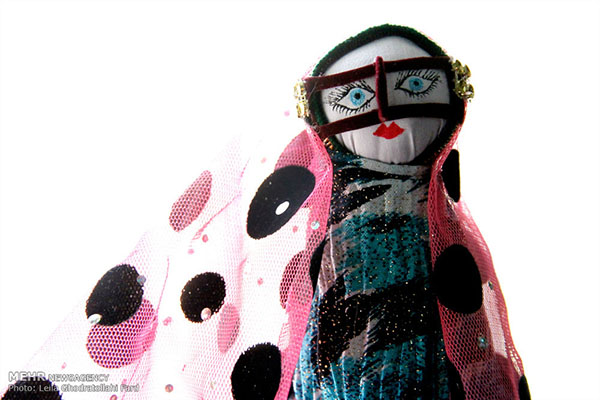
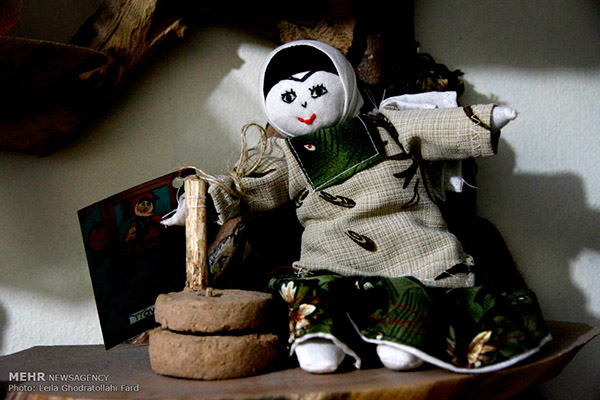
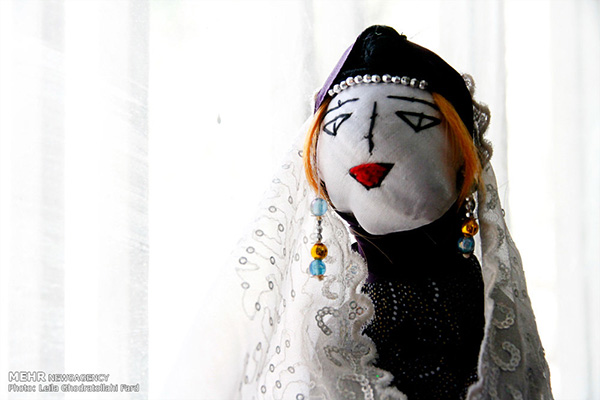
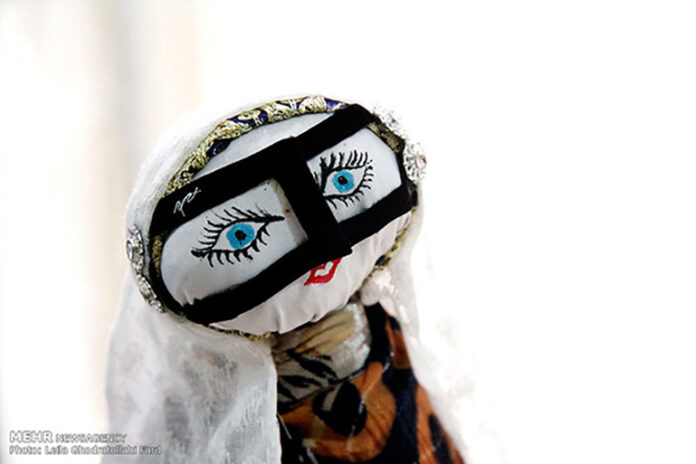
Dolls whose production in South Khorasan, Ardabil and Qazvin dates back five millennia have found their way to Tehran from the provinces.

These dolls which tell the stories of the joyful and sorrowful experience of women in rural areas put on display the forgotten local traditions and culture of rural communities.

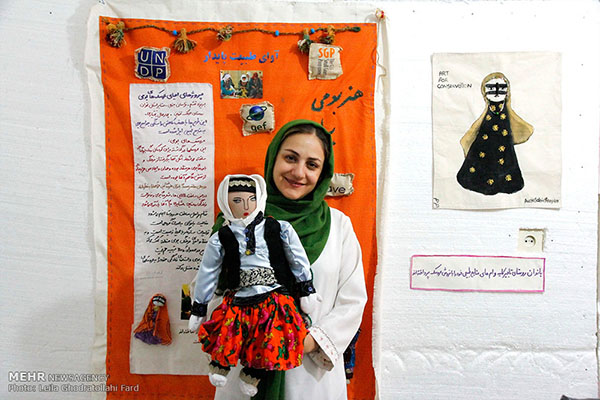
Afsaneh Ehsani, who leads a project aimed at creating sustainable employment in keeping with the preservation of pastureland, says these dolls are environment friendly and carry rich cultural values.

Images of the dolls posted online by Mehr News Agency:

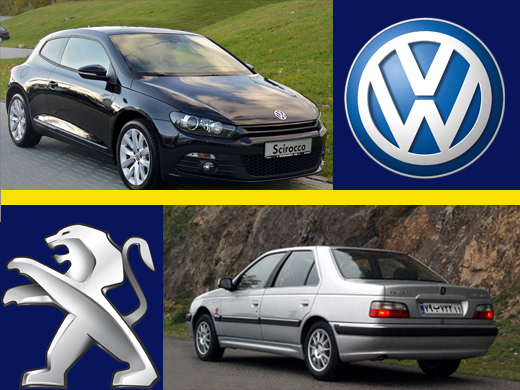
Volkswagen on course to replace Peugeot in Iranian market

car

The famous saying of “what goes around comes around” can best apply to present relations between Iran Khodro, Iran’s leading automaker, and France’s Peugeot.

Although some are set to celebrate the reunion of the two giant carmakers [after the conclusion of a deal between Iran and P5+1 which will eventually see sanctions lifted], it seems that Germany’s Volkswagen has caught Iran Khodro’s eye as a better choice of partner.

The following is the translation of an analytical report published by Donyay-e Eghtesad daily on July 25 about ups and downs of partnership between Iran Khodro and Peugeot and the reason why the Iranian automaker is more inclined to choose Volkswagen, rather than Peugeot, as its main partner:

Early in 2012, Peugeot unilaterally broke up its 24-year partnership with Iran Khodro. Without giving any reason, it upped and left the Iranian market. Later it became known that tempting offers by General Motors were behind the abrupt end of partnership.

Leaving Iran Khodro to its own devices at a time when the company was in dire straits and was grappling with a production crisis dealt a heavy blow to the Iranian company.

Iran Khodro had to fix the problem and in doing so, it even reached out to other companies, because General Motors, Peugeot’s new American partner, would not allow the French automaker to help Iran Khodro address the issues of the cars they used to manufacture together.

Pivot toward Volkswagen

According to well-placed sources, Volkswagen has apparently presented better partnership offers than Peugeot. That’s why Iran Khodro considers replacing the French automaker with its German rival.

Some experts believe that apart from technical and technological advantages of Volkswagen, other factors have contributed to Iran Khodro’s decision to shift from Peugeot to Volkswagen.

Some other experts argue that Peugeot’s failure to honor its partnership commitments and Iran’s concerns about a repeat of such behavior by the French automaker have contributed to the shift toward Volkswagen.

Critics of Peugeot believe that the company has done Iranian customers and automaking industry injustice and must be punished and that Iran Khodro should not easily re-enter into partnership with the French firm.

That said, well-placed sources say that a series of developments which unfolded over the last 18 months, between the Geneva interim agreement and the nuclear deal in Vienna, coupled with talks between Iran Khodro and foreign companies have convinced the Iranian automaker to shift its attention from France to Germany.

In other words, Iran Khodro has reached the conclusion that in the current conditions, Germany in general, and Volkswagen in particular, is a better choice for partner and can better help the Iranian auto-making industry.

That of course does not amount to an outright removal of Peugeot from Iran Khodro’s cooperation list, and the French company is not out of the picture yet.

Based on reports released by Iran Khodro, the company seeks to divide its market among four partners, with the main partner holding a 50 percent share and the rest of the shares divided among the other three.
If such reports turn out to be true, as Iran Khodro’s main partner, Volkswagen will secure a 50 percent share of the company’s market and Peugeot should try to secure a substantial share of the other half of the market of the largest automaker in the Middle East.

A look at Iranian newspaper front pages on July 27

Iranian Newspapers Headlines

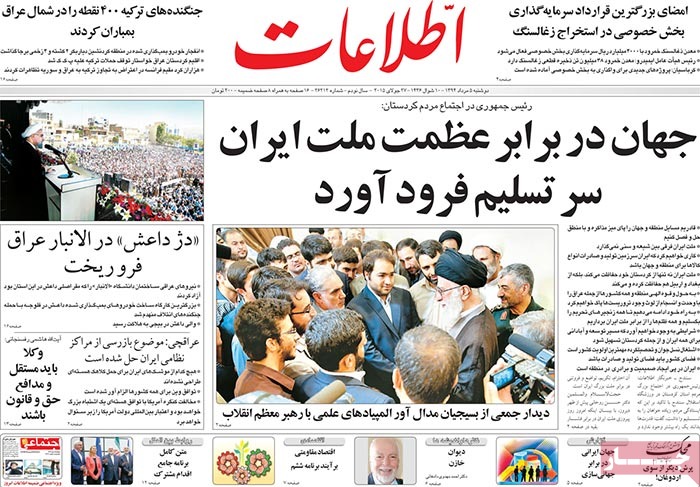
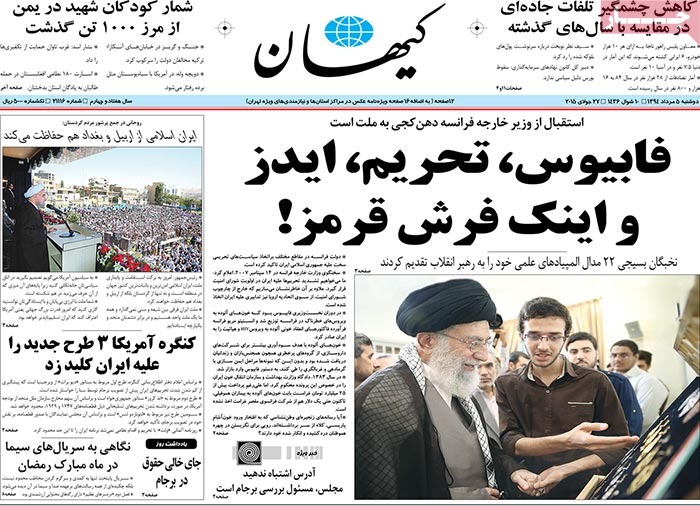
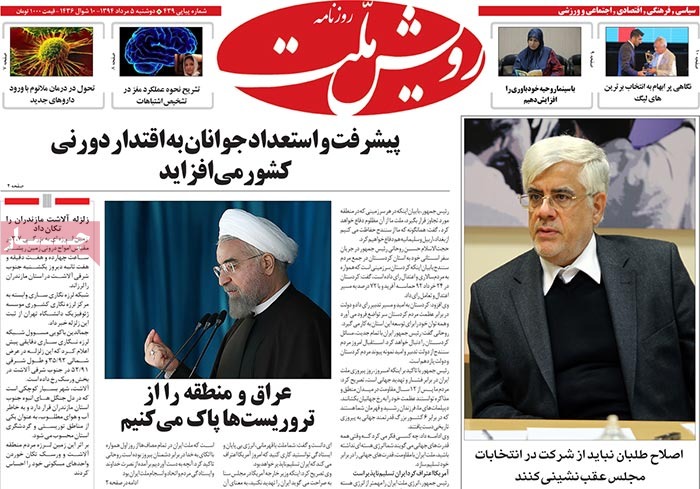
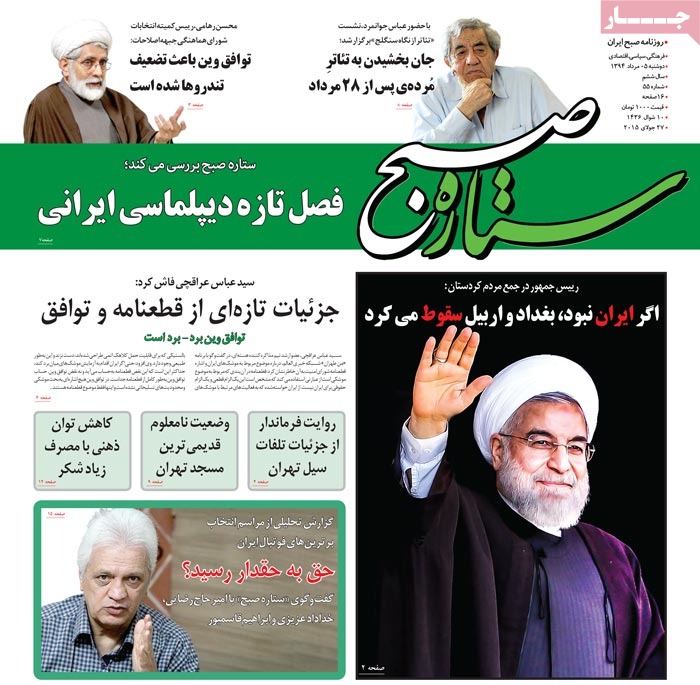
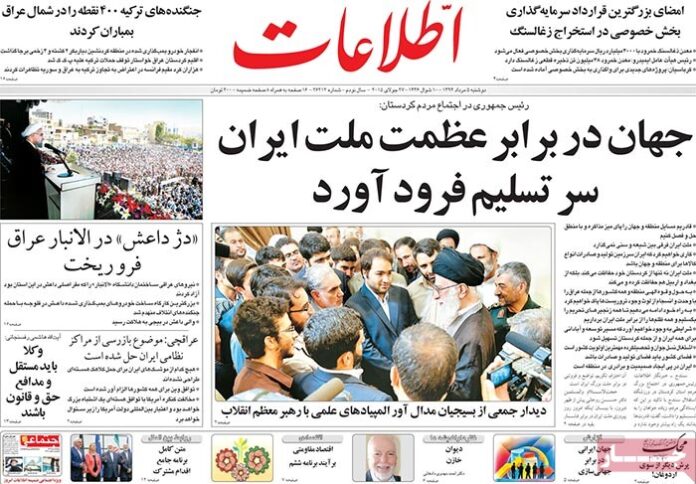
President Rouhani’s comments in Kurdistan on a wide range of issues, including the nuclear deal his administration has struck with six world powers and the priorities of his government, as well as photos of the Supreme Leader meeting with Basiji Olympian medal winners dominated the front pages of Iranian newspapers on Monday.


Ettela’at: “The world bowed its head in the face of Iranian glory,” President Rouhani told locals in Kurdistan Province.

“Creating jobs for the youth and the educated is the top priority of the country…. We are after creating an atmosphere of friendship and fraternity in the region,” the president further said.


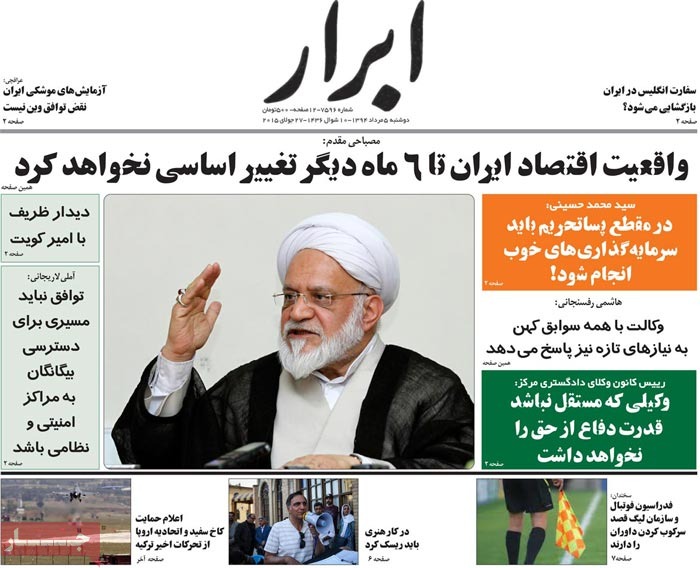
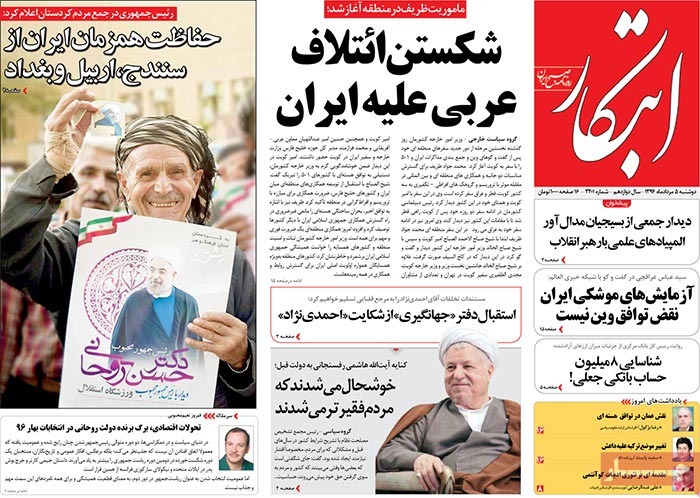
Abrar: “Iran’s missile tests are not a violation of the Vienna deal,” said Iranian nuclear negotiator Abbas Araghchi.


A look at Iranian newspaper front pages on July 27


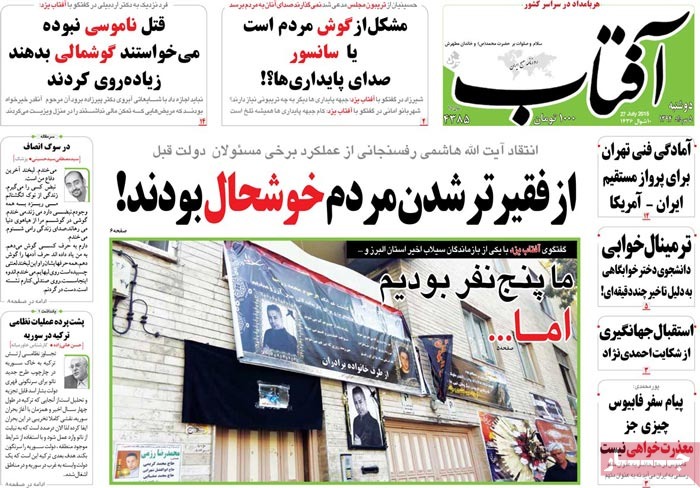
Aftab-e Yazd: Iran is technically ready to launch direct flights to and from the US.


A look at Iranian newspaper front pages on July 27


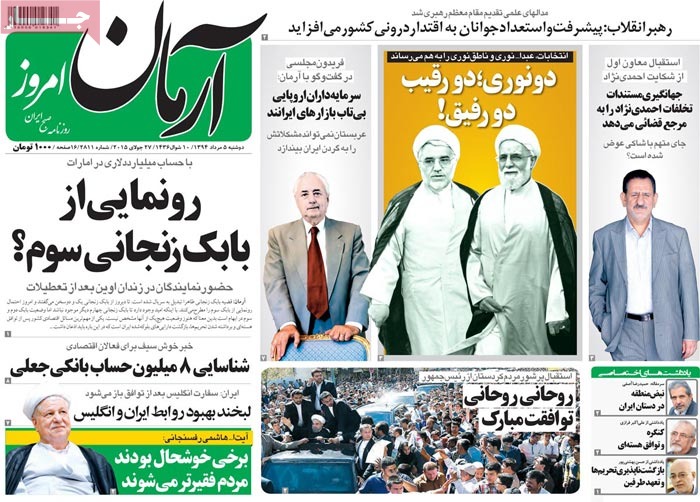
Arman-e Emrooz: “European investors can’t wait to return to Iranian markets,” Fereydun Majlesi, a political analyst, said an in exclusive interview with Arman-e Emrooz.

He further said Saudi Arabia cannot blame its problems on Iran.


A look at Iranian newspaper front pages on July 27


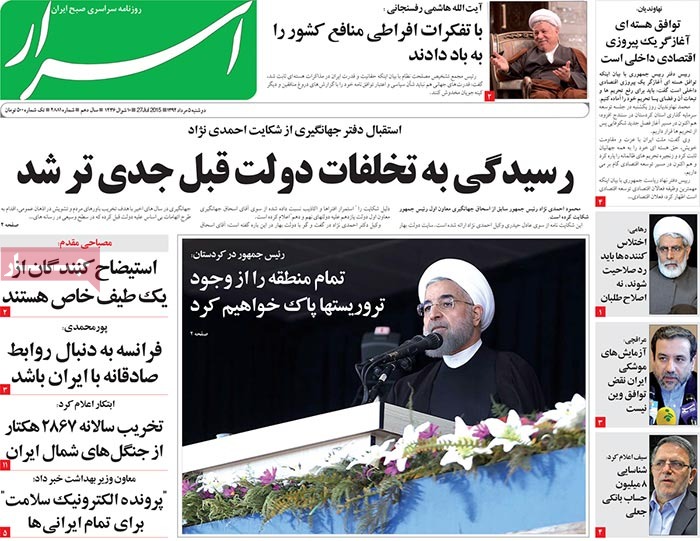
Asrar: “Some with extremist beliefs [a reference to the former president and his hardline supporters] poured our national interests down the drain,” said Chairman of the Expediency Council Akbar Hashemi Rafsanjani.

Asrar: “Those who committed embezzlement, and not reformists, should be barred [from running for parliament],” said Mohsen Rahami, a reformist leader.

Asrar: The deputy health minister has said that all Iranians will have electronic health files.


A look at Iranian newspaper front pages on July 27


Ebtekar: The governor of the Central Bank has said that some 8 million fraudulent bank accounts have been identified.


A look at Iranian newspaper front pages on July 27


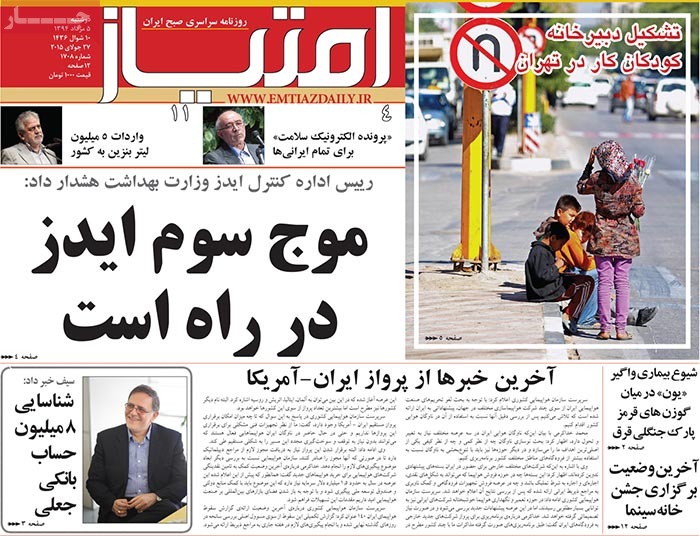
Emtiaz: A secretariat has been set up in Tehran to handle the case of street children.

Emtiaz: “A third wave of HIV/AIDS epidemics is on its way,” said the Iranian Health Ministry.


A look at Iranian newspaper front pages on July 27


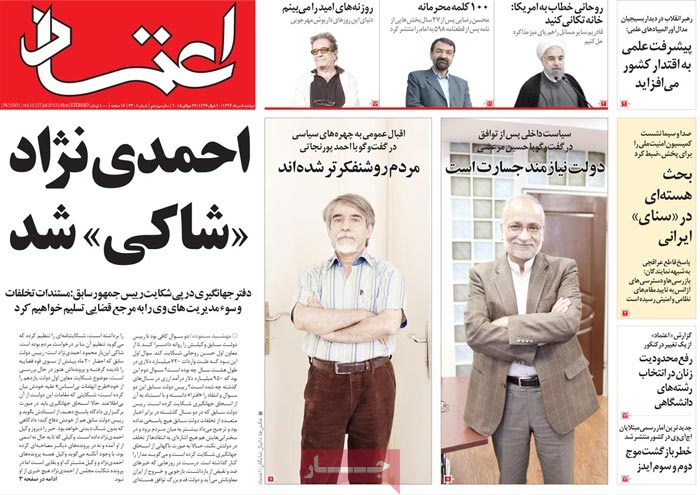
Etemad: “Scientific progress boosts the country’s authority,” said the Supreme Leader at a meeting with Basij members who have won medals in international scientific Olympiads.


A look at Iranian newspaper front pages on July 27


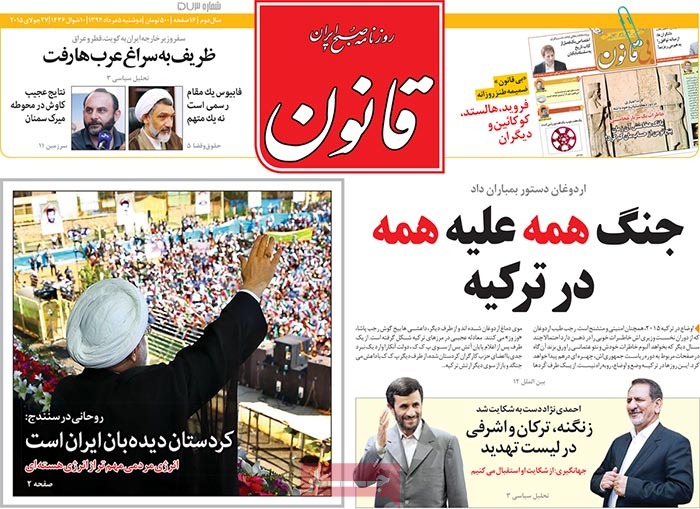
Ghanoon: “French Foreign Minister Laurent Fabius comes to Iran on a state visit, not as a suspect [in the case involving exports of tainted blood to Iran],” said Justice Minister Mostafa Pourmohammadi.

Ghanoon: Ahmadinejad has begun to file lawsuits against government officials.

Oil Minister Zanganeh, presidential advisor Akbar Torkan and Ashrafi Esfahani, who looks into administrative offenses within the government, have been threatened with lawsuit by the former president.


A look at Iranian newspaper front pages on July 27


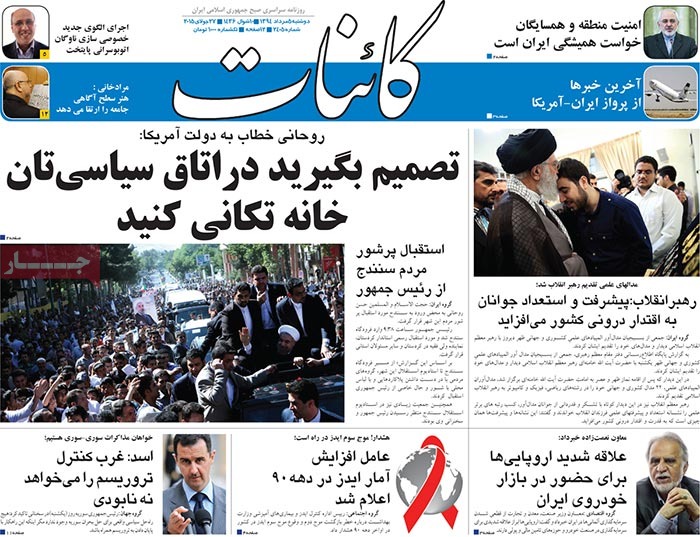
Kaenat: “Security in neighboring countries and the wider region is what Iran has always wanted,” Foreign Minister Zarif said.


A look at Iranian newspaper front pages on July 27


Kayhan: Fabius, sanctions, HIV/AIDS and now the rollout of red carpet!

The daily says government’s decision to welcome the French foreign minister amounts to thumbing its nose at the public.


A look at Iranian newspaper front pages on July 27


Rooyesh-e Mellat: President Rouhani has vowed to rid Iraq and the wider region of the scourge of terrorism.


A look at Iranian newspaper front pages on July 27


Setareh Sobh: “Had it not been for the assistance of Iran, Erbil and Baghdad would have fallen [to IS terrorists],” said President Rouhani.


A look at Iranian newspaper front pages on July 27


Highlights of Ettela’at newspaper on July 27

Ettelaat-July27

 “The world bowed its head in the face of Iranian glory,” President Rouhani told locals in Kurdistan Province.

“Creating jobs for the youth and the educated is the top priority of the country…. We are after creating an atmosphere of friendship and fraternity in the region,” the president further said.

♦ A number of Basijis who have won medals in world scientific Olympiads have met with the Supreme Leader.

 The largest contract on private investment in coal extraction has been signed.

Deputy Industries, Mines and Trade Minister Mehdi Karbasian has said that new projects are ready to be signed over to the private sector.

 Turkish fighters have bombed 400 targets in northern Iraq.

Iraq’s Kurdish Regional Government has called on Turkey to stop bombing PKK targets. In France, the Kurdish minority has staged a rally in protest against Turkish aggression against Iraq and Syria.

 The headquarters of IS terrorists in Al-Anbar has fallen to Iraqi forces.

The University of Anbar in southern Ramadi, which served as the headquarters of the terrorist grouping, has been liberated.

 “Inspection of military sites is no longer an issue,” Iranian negotiator Abbas Araghchi said.

“None of the Iranian missiles are designed to carry a nuclear payload,” the Iranian diplomat further said.

“Failure of the US Congress to support the deal would be a big mistake which would cast doubt on the credibility of the American administration,” Araghchi added.

 “Defense attorneys should be independent as they uphold laws and stand up for the rights of their clients,” Ayatollah Hashemi Rafsanjani said.

♦ Iran’s 4-monthly foreign trade reaches $27.8 b

♦ Iran’s rightfulness proven in nuclear talks: Rafsanjani

♦ Zarif thanks sources of emulation


Lebanese politician urges Arab countries to welcome nuclear deal

81695245-70054412

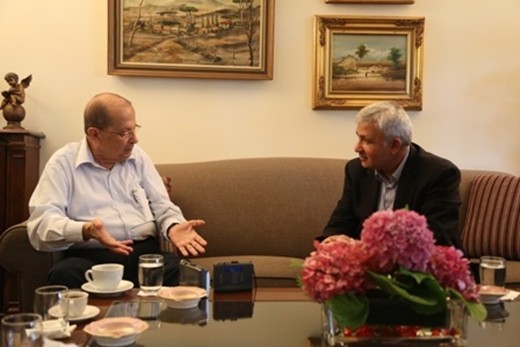
A senior Lebanese politician has expressed satisfaction with the nuclear deal between Tehran and 5+1, saying the US officials too have admitted that no countries are as zealous in fighting terrorism as Iran and Syria are.

Michel Aoun, the leader of the Free Patriotic Movement who is the nominee by the March 8 Alliance for the next presidential elections in Lebanon, told IRNA in an exclusive interview that Iran has achieved much before and after the conclusion of the nuclear agreement.

He said that the Iranian nation and experts have learnt to be self-sufficient and self-reliant during the long period of sanctions, adding that the Iranians are now preparing to adopt an open-door policy when it comes to dealing with the rest of the world.

He termed the nuclear agreement as a big success by a great Islamic country which follows the very peaceful readings of the Islamic teachings. This, the Lebanese politician added, creates calm and peace of mind for all.

Asked about the regional policies of Iran and Saudi Arabia, he said the two countries are not comparable from many aspects, adding that Iran holds different elections – including presidential, parliamentary and city councils elections. He also said heated political debates are quite common in the country, but the elections and debates are all absent in Saudi Arabia.

He then praised the peaceful cooperation the Jewish, Armenian and Assyrian representatives are leading in the Iranian parliament and voiced interest in paying another visit to Tehran.

The former commander of the Lebanese army went on to hail the skills and competence of the Iranian nuclear negotiating team and stressed the unique and unprecedented role of the Supreme Leader in advancing the talks.

He urged the Arab countries to welcome the nuclear deal between Iran and six world powers, arguing the nuclear deal serves their interests as well.

Aoun described Iran as the biggest supporter of the Palestinian cause which has never stopped backing the oppressed nation.


He urged an end to the “unacceptable” situation in Yemen and said that aggression and siege – which have caused extreme plight for the Arab nation – have to be stopped.

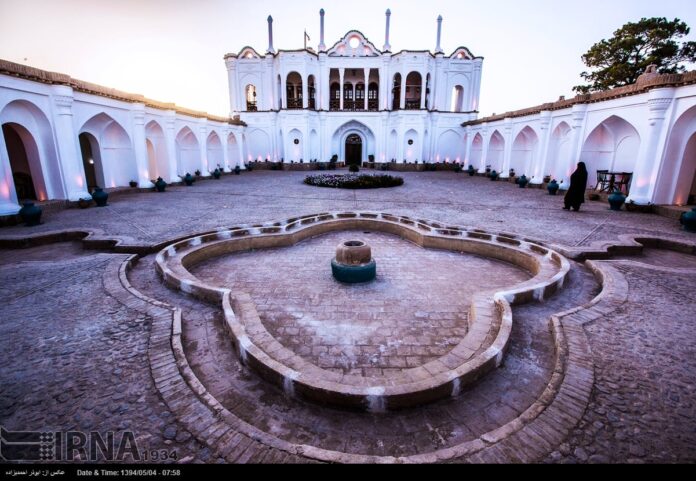
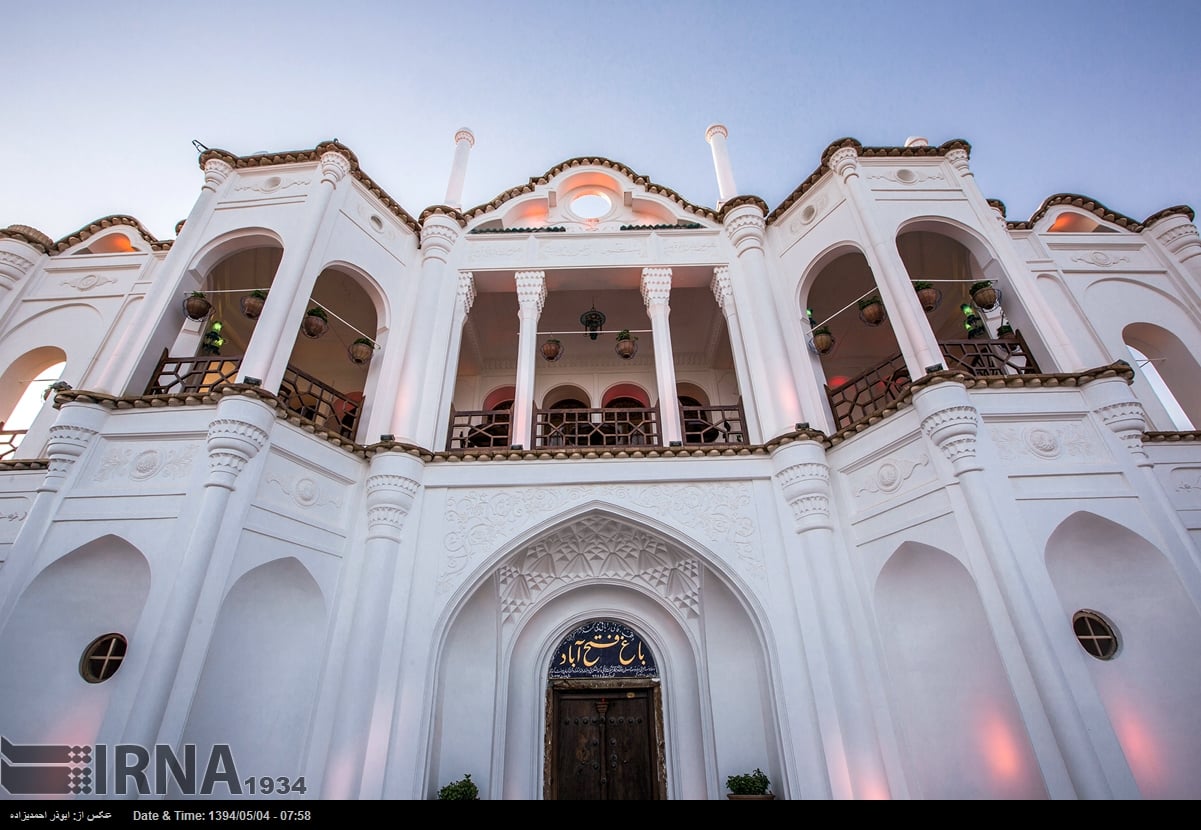
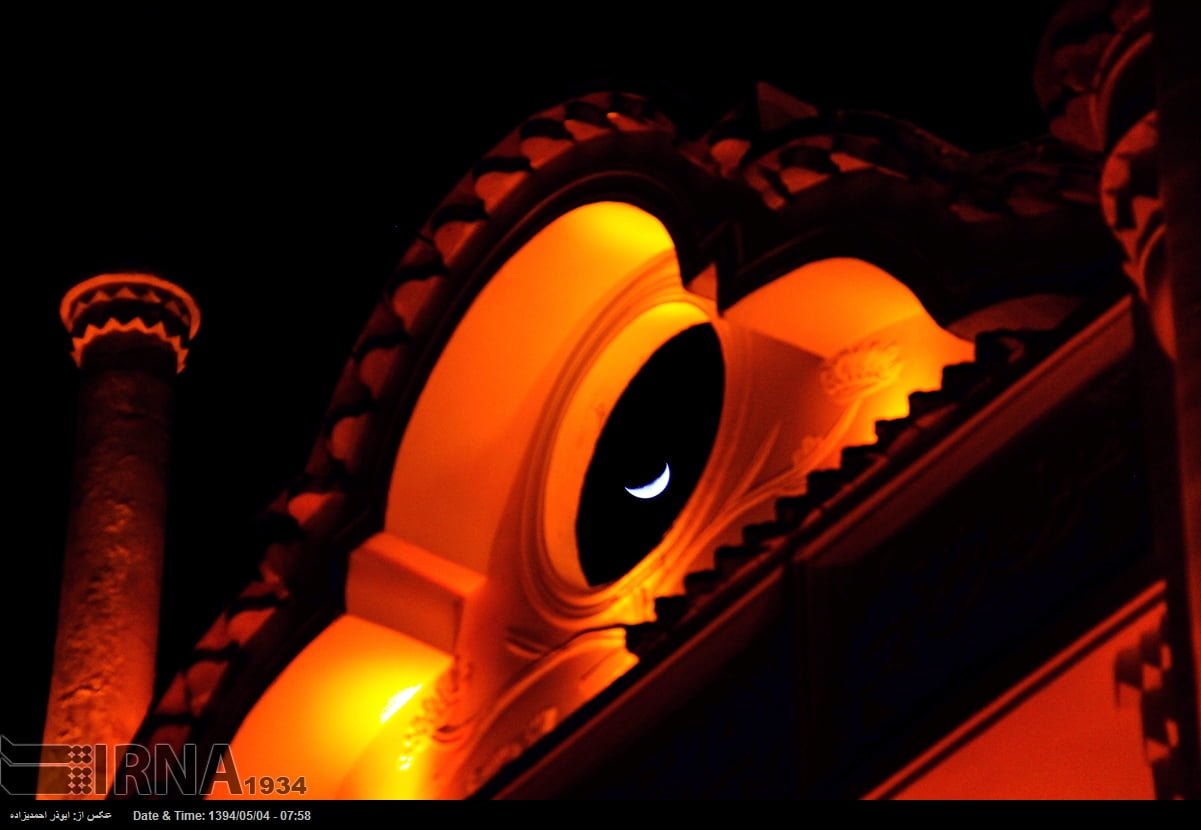
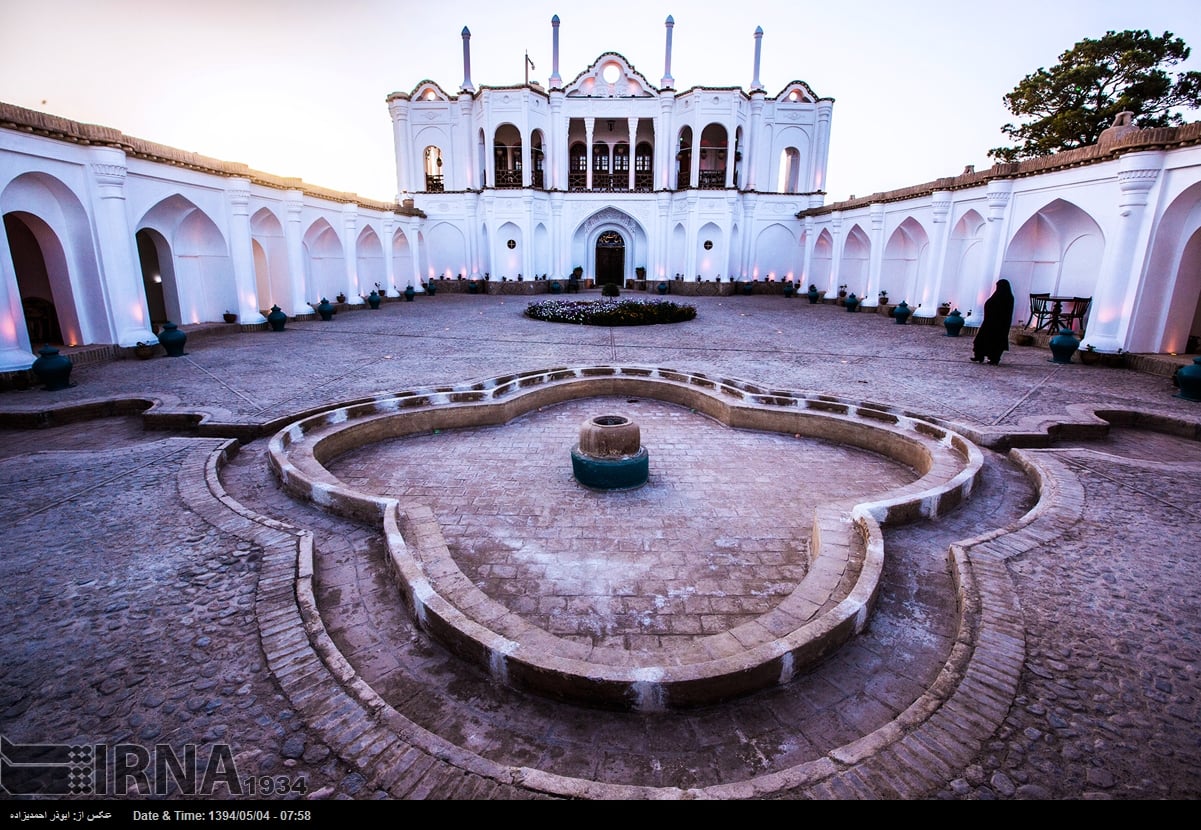
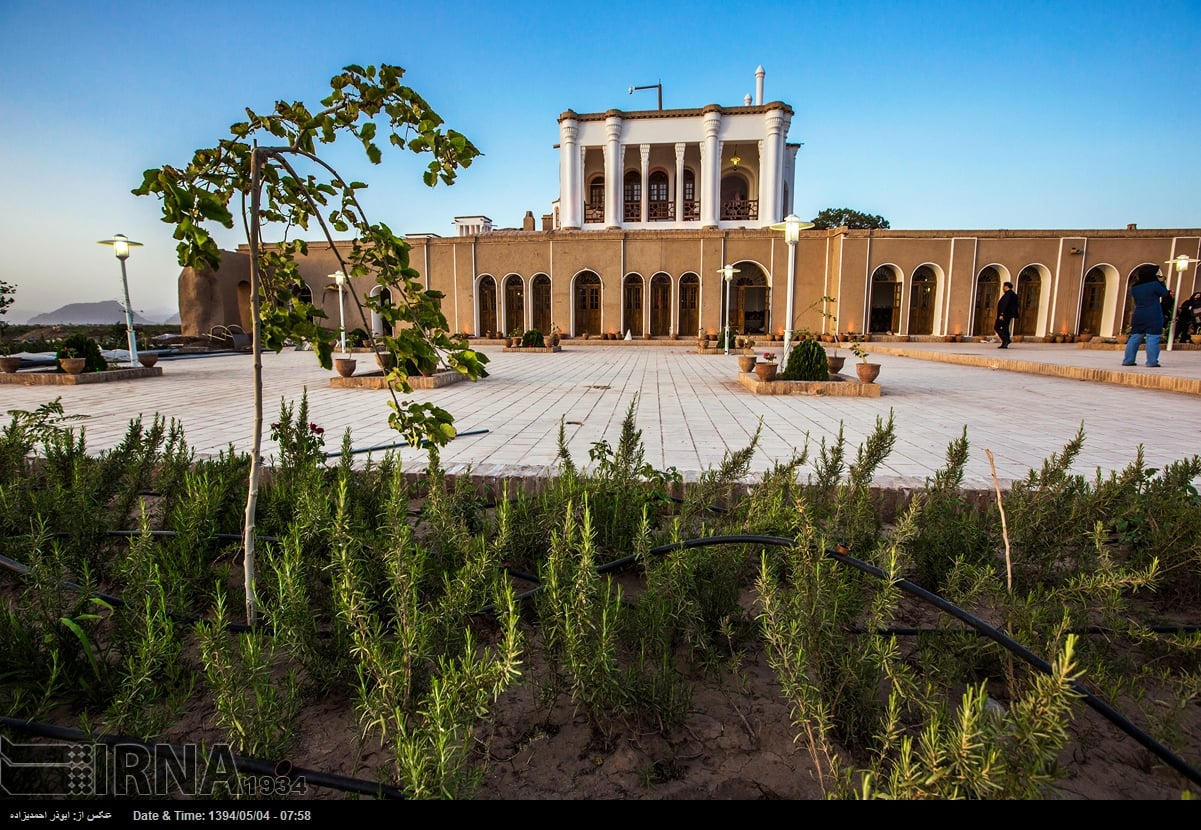
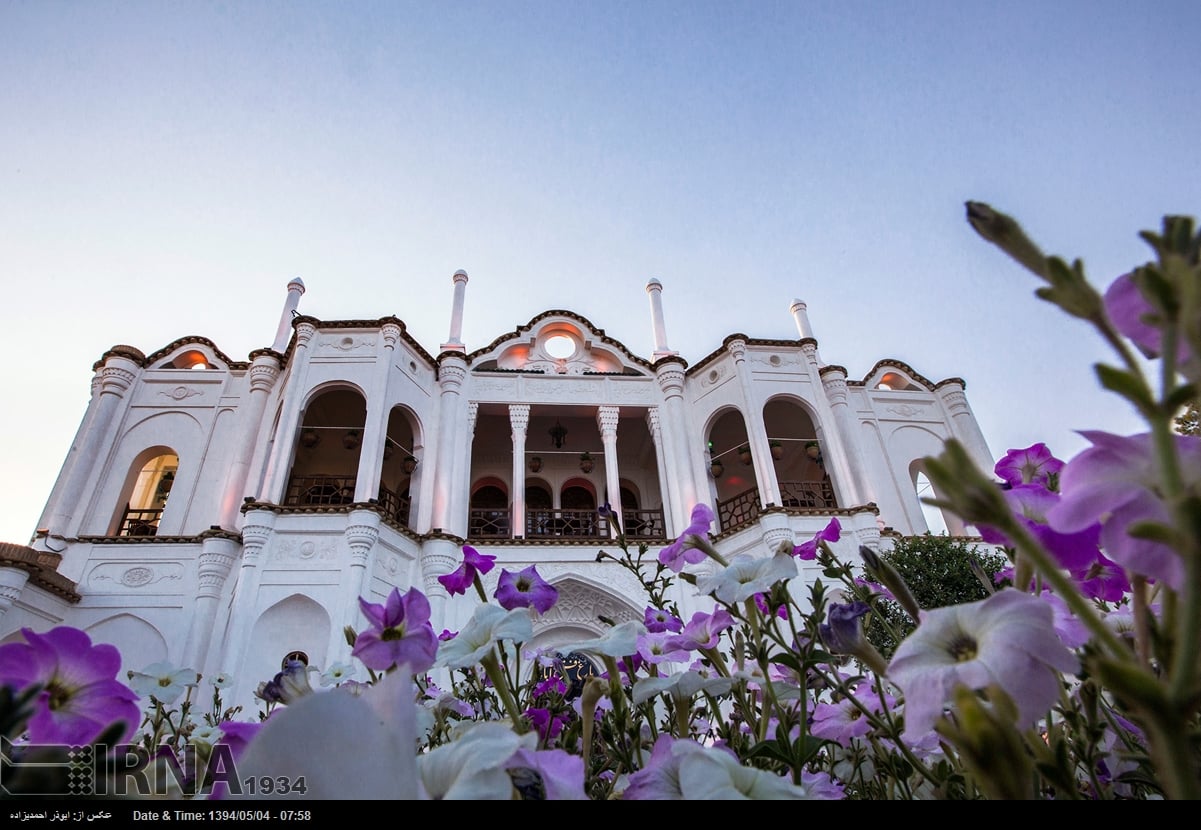
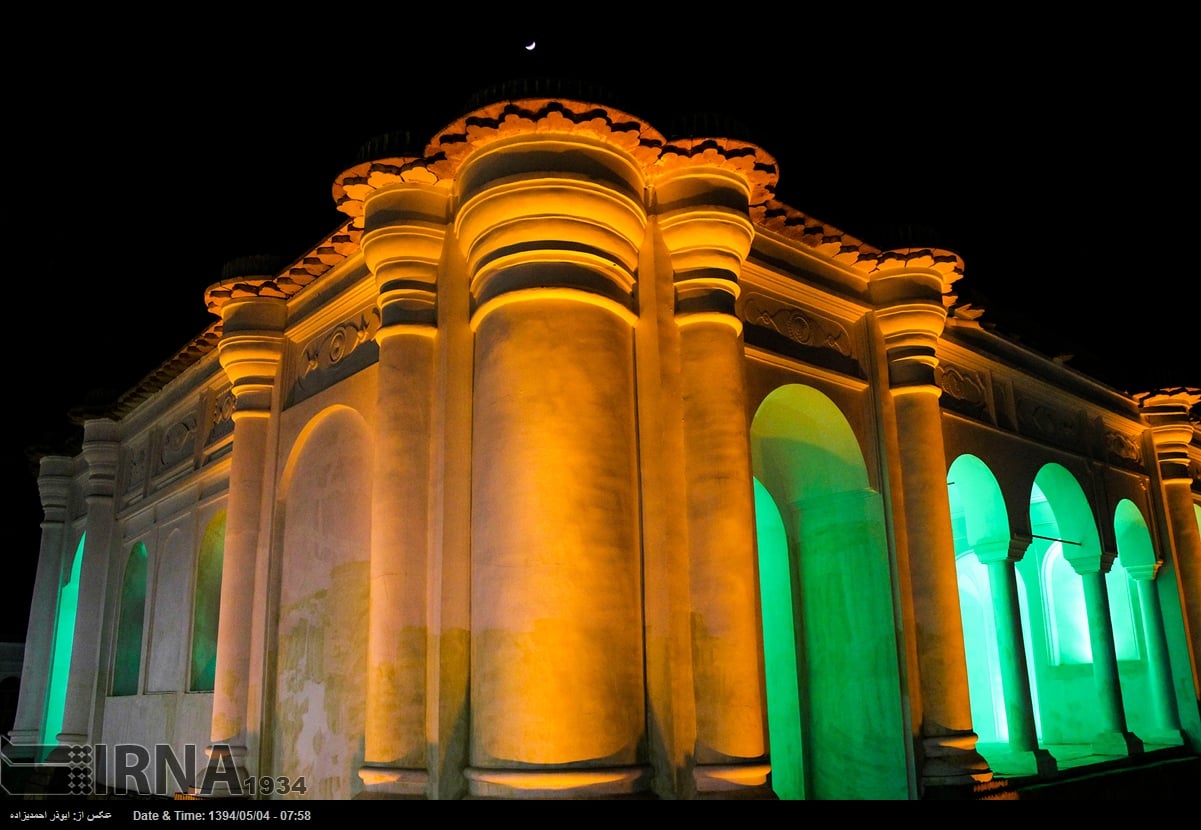
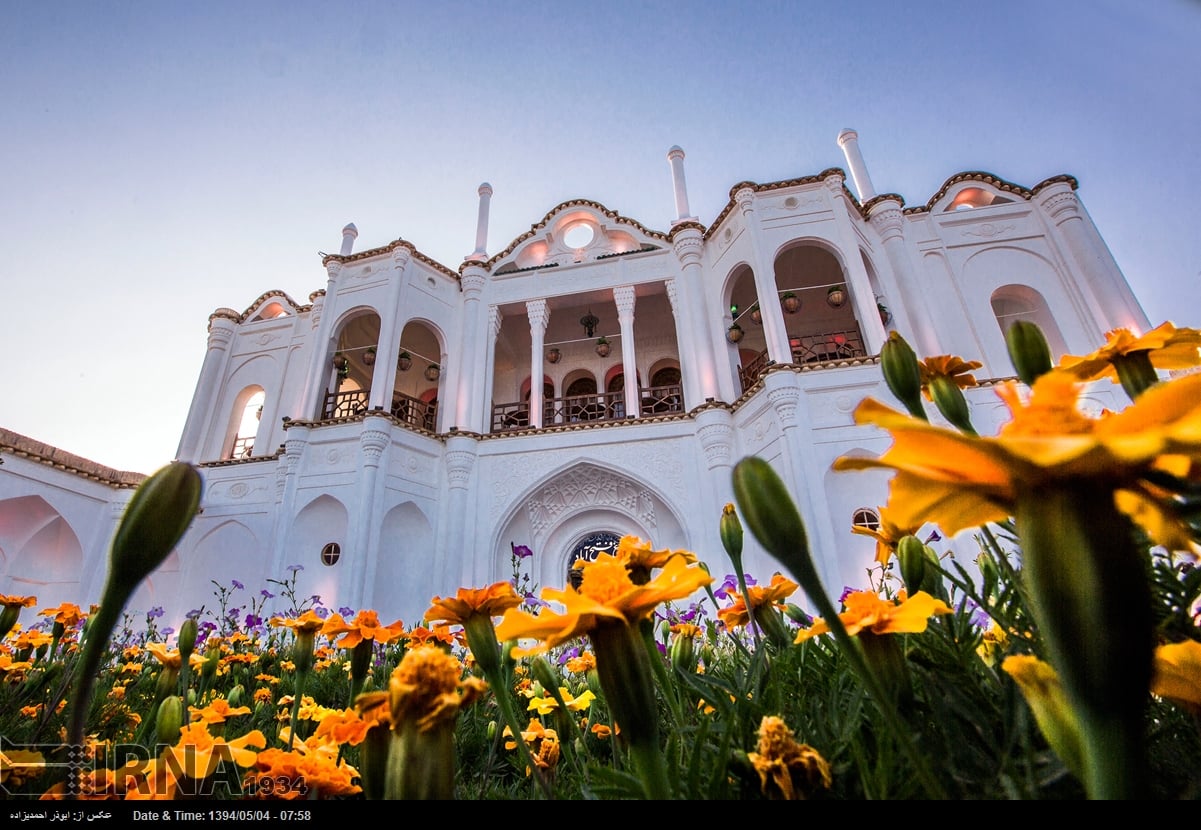
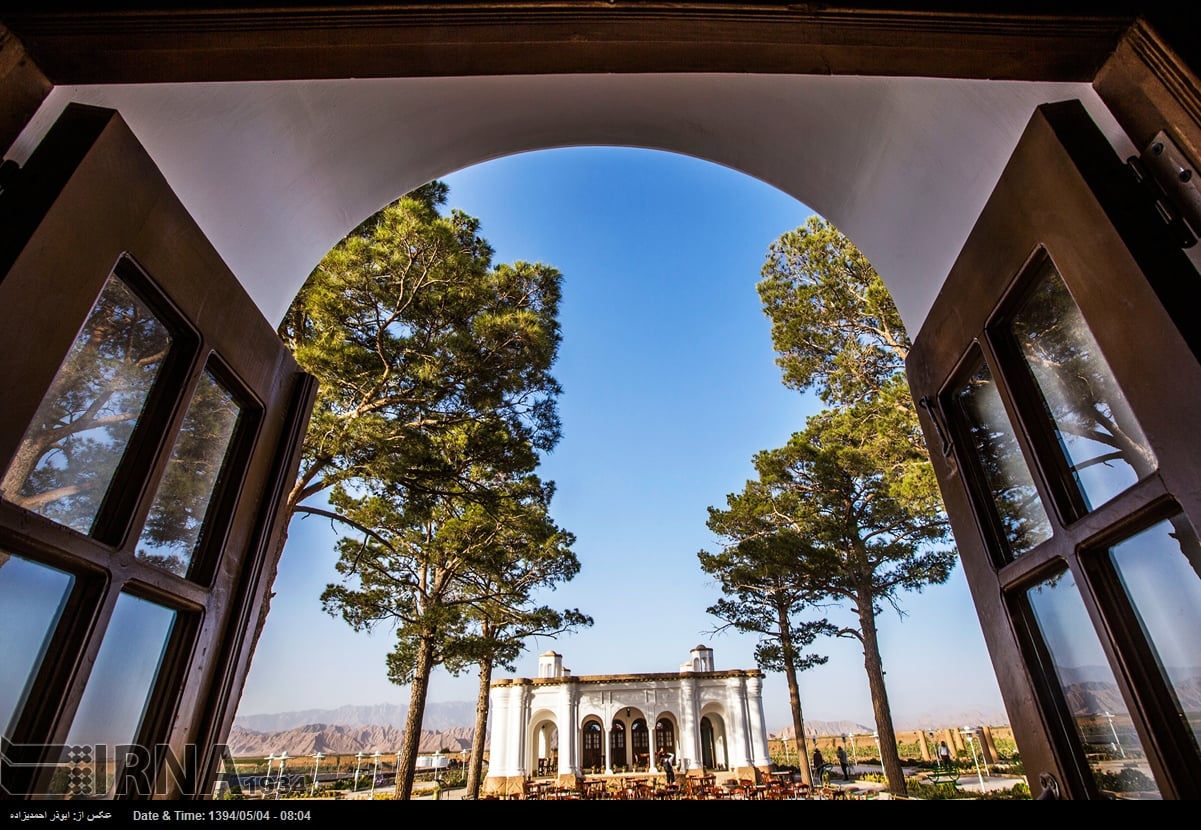
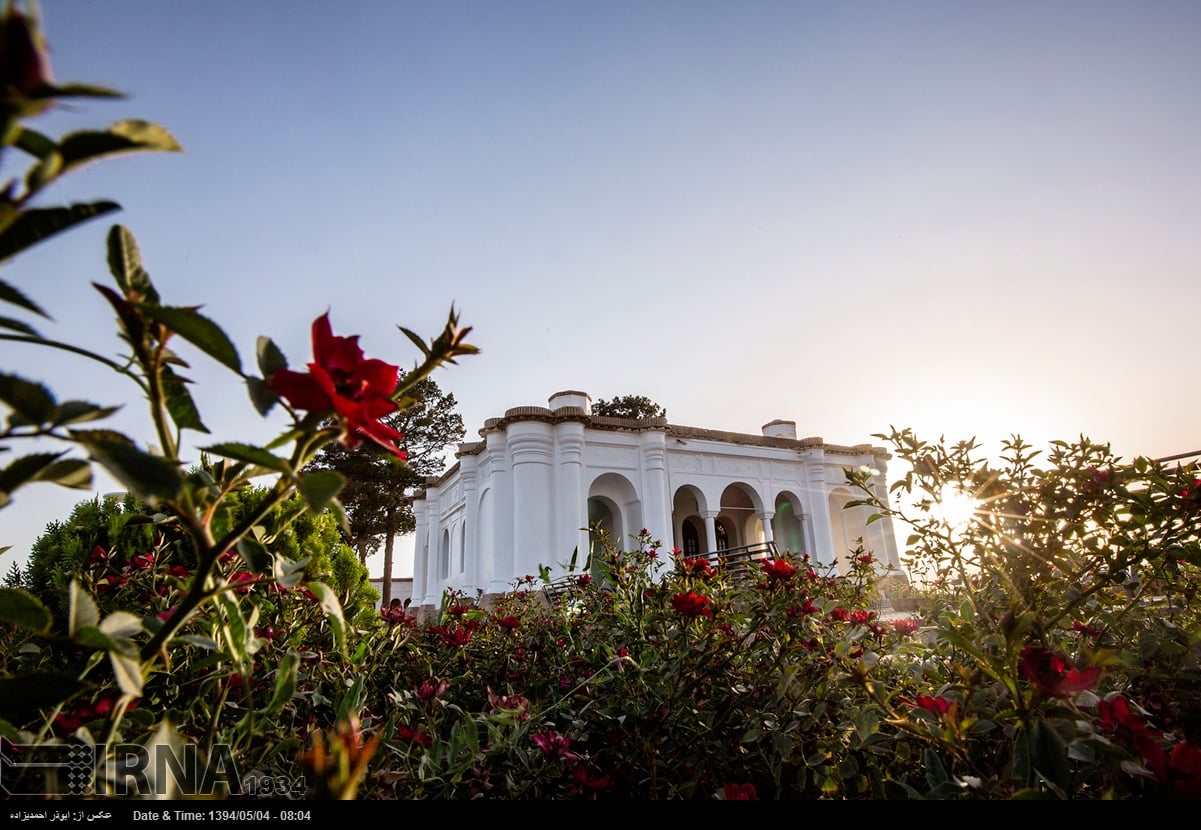
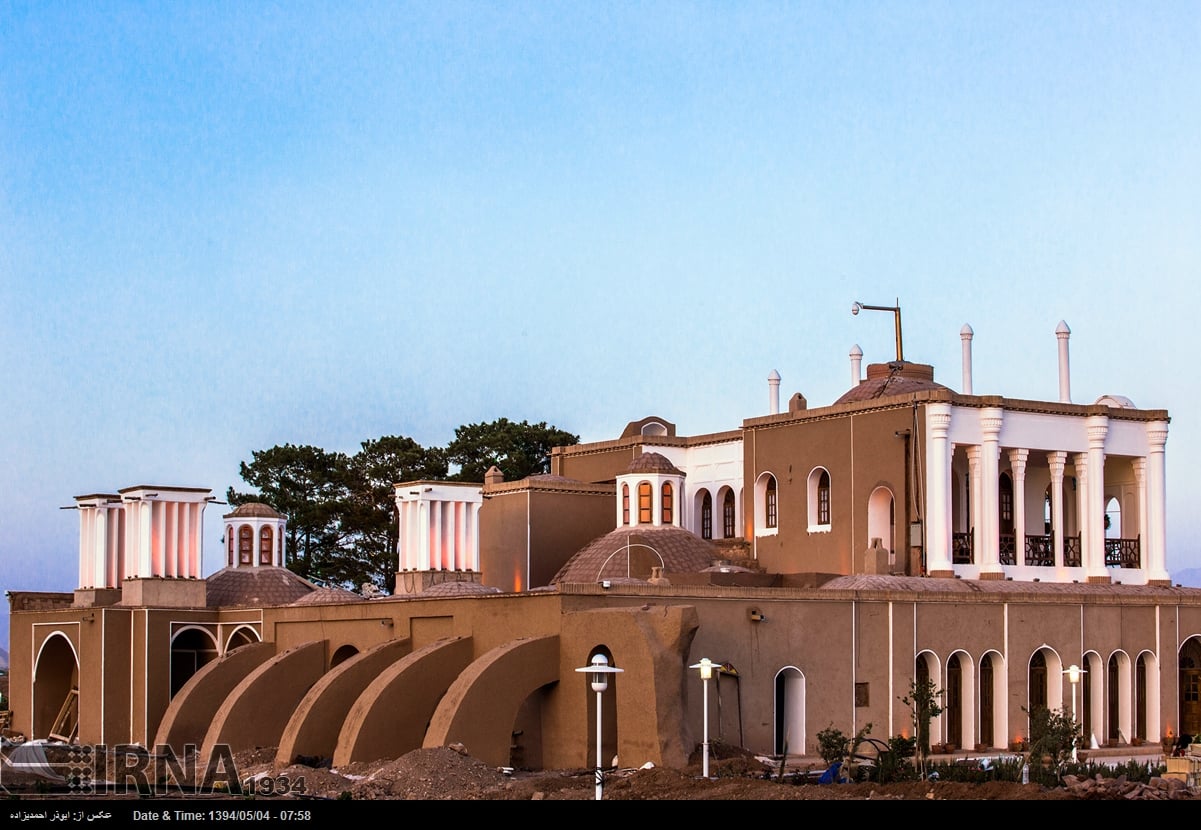
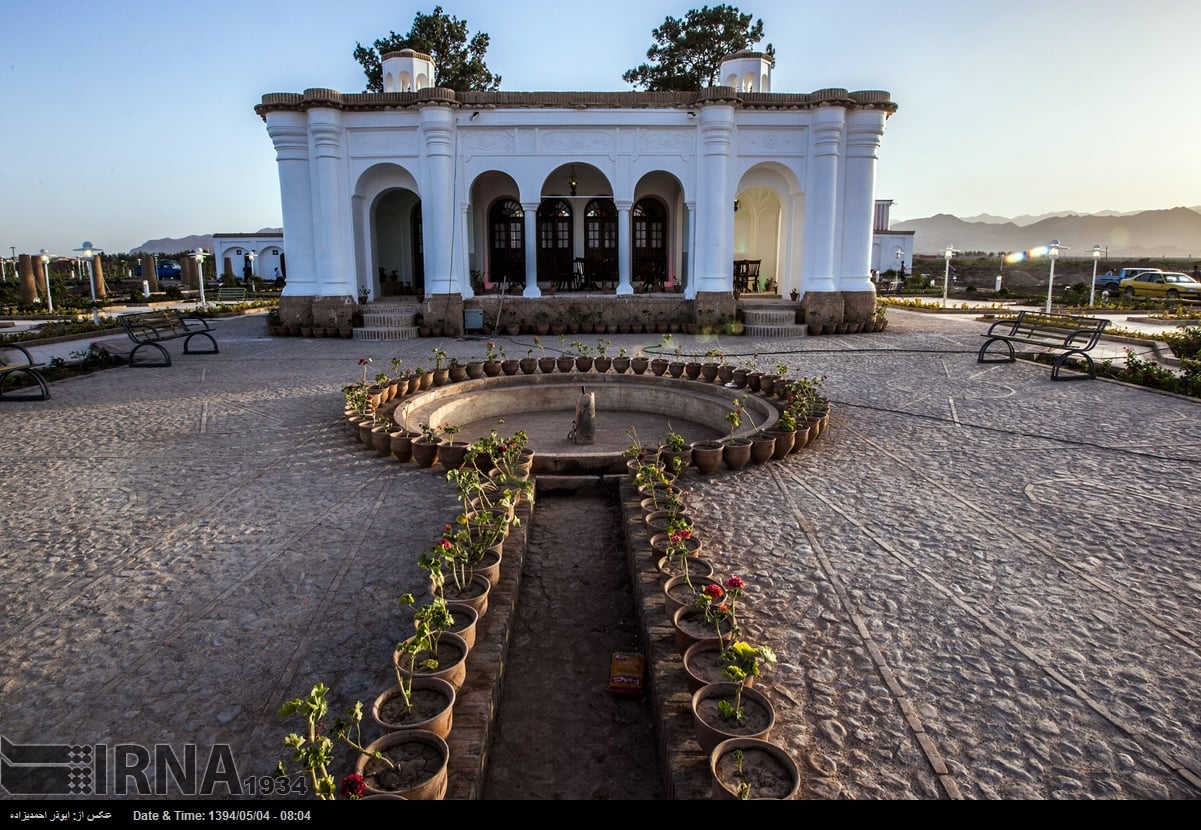
Fathabad Garden in Southern Iran (PHOTOS)

Fathabad Garden in Southern Iran

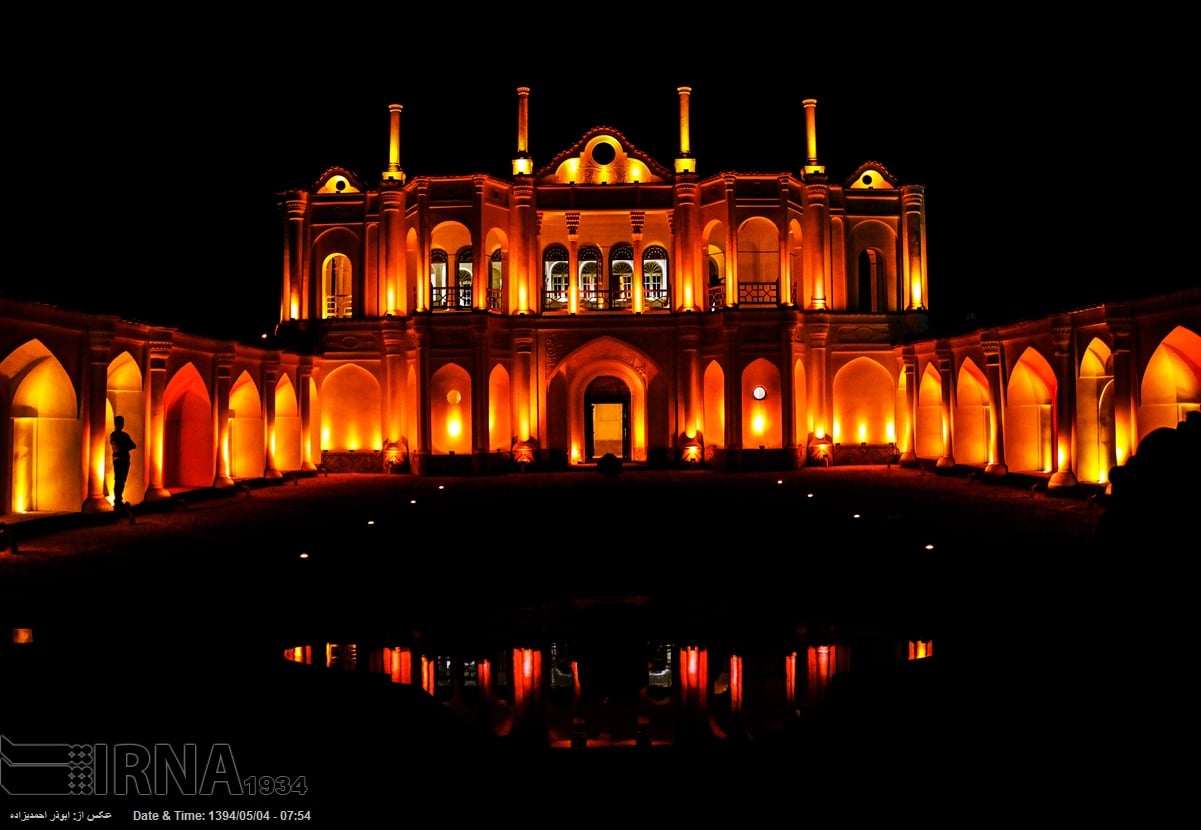
Fathabad Garden dates back to the Qajar era. Shazdeh Garden, a beautiful site in Kerman, has been modeled on Fathabad Garden.

The garden which had not been restored since 1972 was given a face-lift after the Government of Prudence and Hope took office in 2013.

Snapshots of the garden released online by the Islamic Republic News Agency:

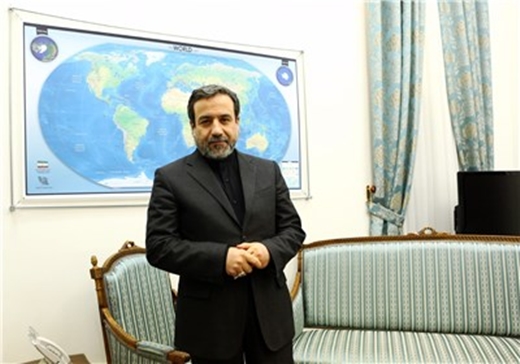
Differences with US “serious, deep-rooted”: Iran’s Araghchi

Araghchi

Differences between Iran and the US are too serious, deep-rooted and long-lasting to be settled easily, Iran’s Deputy Foreign Minister Abbas Araghchi said.

“We have fundamental differences with the US over regional issues, those related to the hegemonic system, and many other subjects,” Araghchi said in an interview with Al-Alam Arabic-language news network on Sunday.

“I personally see no immediate prospect for the establishment of (diplomatic) relations between Iran and the US,” the senior diplomat noted.

Araghchi, also a senior negotiator in nuclear talks with P5+1 said that the nuclear issue was only one of the numerous gaps between Tehran and Washington.

Though the nuclear issue will be somehow resolved, other serious issues will remain in place, he added.

Iran and P5+1 finalized the text of a lasting agreement on Tehran’s nuclear energy program in Vienna, Austria, on July 14. Later, the 15-memebr United Nations Security Council unanimously passed a resolution endorsing the text of the deal.

According to the resolution, seven previous UN resolutions on Iran will be terminated when the International Atomic Energy Agency (IAEA) submits a report to the council verifying that Iran has implemented certain nuclear-related measures.

Araghchi also said Iran has made it clear in the nuclear talks that none of the IAEA inspectors visiting Iran should be American.

“The Vienna deal (JCPOA) also stipulates that the inspectors that the agency (IAEA) will assign to conduct inspection in Iran should be from countries with which Tehran has diplomatic ties. Hence, the presence of American inspectors (in Iran) even in the future is out of the question,” he pointed out.

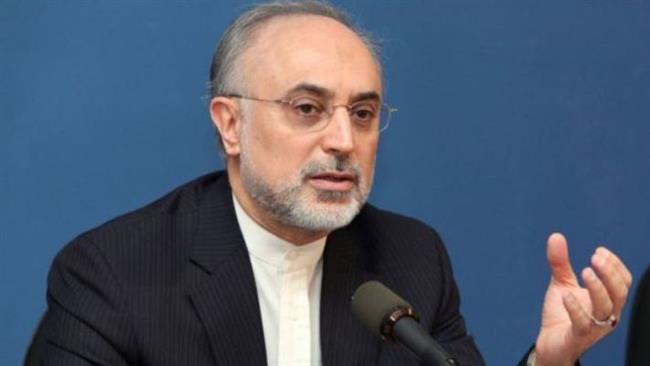
Iran’s Bushehr home to 2 new nuclear power plants: Salehi

Salehi

Iran is planning to build two nuclear power plants in the southern province of Bushehr, says Director of the Atomic Energy Organization of Iran Ali Akbar Salehi.

Salehi made the announcement during a live IRIB television broadcast on Sunday night, adding that the new plants would cost around 10 billion dollars and around 15,000 technicians would be required to work on the projects over the next three or four years .

Salehi also said the agreement between Tehran and the International Atomic Energy Agency was not a confidential matter, adding that further negotiations must be carried out with regard to IAEA experts traveling to Iran for inspections as part of a nuclear conclusion between Tehran and the global powers.

Carrying out the inspections is, however, a “matter of secrecy”, Salehi noted, adding, the agency would announce the outcome of the inspections on December 15.

In regard to the redesigning of the Arak nuclear reactor and other projects, Salehi said talks are being held with China.

“Our experts have traveled to China a few times and Chinese experts have traveled to our country a few times. In Vienna, we talked with the Americans and the Chinese and we agreed on holding a trilateral meeting between Tehran, Washington, and Beijing in China,” he was quoted as saying by IRNA.

Iran and P5+1 – the US, Britain, Russia, China, France, and Germany –  finally succeeded in finalizing the text of an agreement, dubbed the Joint Comprehensive Plan of Action (JCPOA), in Vienna on July 14 after 18 days of intense talks over the matter.

Under JCPOA, restrictions will be put on Iran’s nuclear activities in exchange for, among other things, the removal of all economic and financial bans against the Islamic Republic.