Tuesday, December 23, 2025
Home Blog Page 4694

Number of flights to European capitals to rise: Iranian official

Iran air

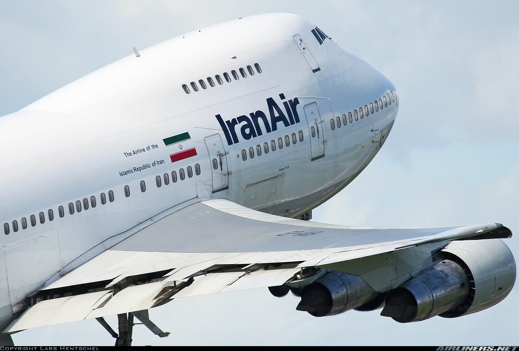
An Iranian aviation official on Saturday said the country seeks more direct flights operated by Iranian or foreign airlines from Tehran to the capital cities of a number of European countries, including Germany, France, Russia, Italy and Turkey.

Mohammad Khodakarami, deputy head of Iran’s Civil Aviation Organization (CAO), said a French delegation will come to Iran soon to discuss the number of direct flights between Tehran and Paris.

He noted three weekly flights are currently operated between the two capitals, adding that the number is planned to be raised to ten.

The official also said direct flights from Tehran to Moscow and vice versa will gradually rise to 28 from the current seven.

On Thursday, Aegean Airlines SA, the largest Greek airline, launched regular flights between Tehran and Athens.

It came days after Iran and the six major world powers on July 14 reached a conclusion over Tehran’s nuclear energy program.

Experts say the comprehensive nuclear deal and subsequent termination of anti-Iran sanctions would result in a hike in Iran’s trade with the world and boost foreign investment in the country.

Bahrain attempting regional disruption with claims: Afkham

Marzieh Afkham

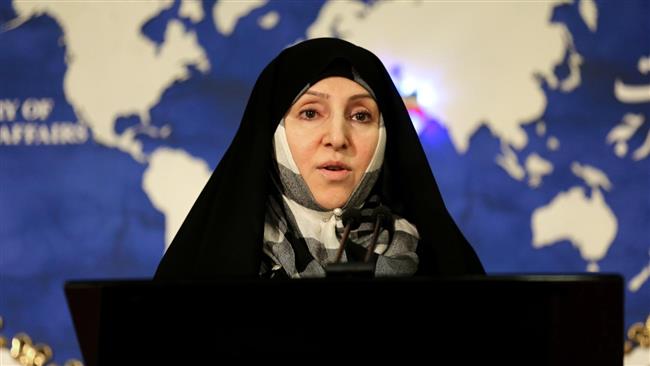
Bahrain is using repetitive “baseless accusations” to create tensions in the region, Iranian Foreign Ministry Spokeswoman Marzieh Afkham says.

Afkham made the remarks in reaction to Manama’s claims that Iran is meddling in its internal affairs, IRNA reported on Sunday.

“Such unconstructive methods will not disrupt Iran’s serious will and determination for continuity and persistence in a responsible… regional policy against threats such as extremism and terrorism,” Afkham said.

Tensions have been running high between Tehran and Manama recently.

On Saturday, Bahrain recalled its ambassador to Iran in protest against Tehran’s support for a pro-democracy movement in the Persian Gulf kingdom.

Earlier in the month, Bahrain also summoned Iran’s ambassador to Manama over similar claims.

The monarchy has repeatedly accused Iran of interfering in its internal affairs. Iran has strongly denied any such action, stating that it only supports efforts to address human rights violations in the tiny Persian Gulf state.

Manama has drawn international criticism on multiple occasions from prominent human rights organizations such as Amnesty International and Human Rights Watch for its crackdown on pro-democracy protests, including detention of activists, violent methods to disperse demonstrators, and a media blackout on rallies.

Thousands of protesters have held numerous demonstrations on the streets since anti-regime movement began in mid-February 2011.

Large numbers of people have been killed and hundreds of others injured and arrested in the crackdown on peaceful protests ever since.

Zarif reiterates Iran’s firm support for regional nations’ anti-extremism campaign

Zarif-Kuwait

Iranian Foreign Minister Mohammad Javad Zarif underlined that Tehran will firmly stand by regional countries in their fight against terrorism and extremism.

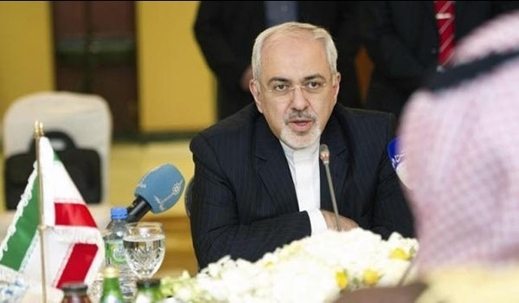
“Iran and the regional countries are facing common threats that should be confronted through mutual cooperation,” Zarif told reporters in Kuwait City on Sunday.

The Iranian foreign minister reiterated that the accusations lodged against Iran are not true, warning that such allegations are aimed at foiling cooperation among regional states.

“Iran is standing beside the regional nations against the threat of extremism,” Zarif said.

Earlier in the day, Zarif and Kuwaiti Emir Sheikh Sabah al-Ahmad al-Jaber al-Sabah in a meeting in Kuwait City discussed bilateral ties and regional developments.

During the meeting, the Iranian foreign minister and the Kuwaiti emir explored avenues for reinvigorating and bolstering mutual cooperation.

Zarif and Sheikh Sabah also discussed the latest regional developments.

[…]

Zarif arrived in Kuwait on the first leg of a trilateral regional tour earlier on Sunday that later took him to Qatar.

Zarif three-leg regional tour is meant to cement bilateral ties with regional countries.

Deputy Foreign Minister Hossein Amir Abdollahian said “deepening friendship and strengthening all-out cooperation with regional countries is the message of Iran’s foreign minister to the region”.

[…]

The nuclear agreement struck between Iran and six world powers in Vienna on July 14 is likely to be high on the agenda of Zarif’s discussions with regional officials.

Bygone are the days Russia played an Iran card

parhamnews_EqCKPe4O79hTNx

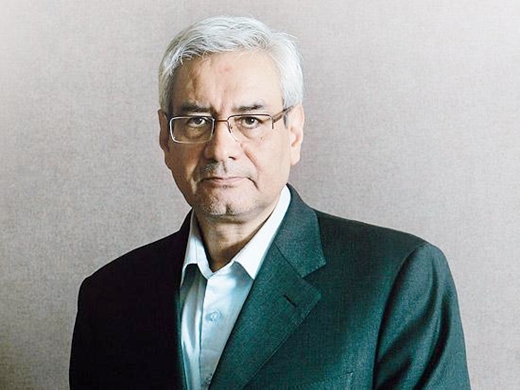
Ebrahim Asgharzadeh, a reformist political activist, has said that the country’s foreign policy machine is expected to try to reclaim Iran’s right in the legal regime of the Caspian Sea.

Asgharzadeh said this in an interview with Etemaad daily on July 25 and critically analyzed the foreign policy of former President Ahmadinejad which he argued earned Iran nothing but crippling sanctions, anti-Iran resolutions and a struggling economy. The following is the translation of part of his remarks in the interview:

The fact of the matter is that the [Former President] Ahmadinejad had been told that Iran’s nuclear case would not be referred to the UN Security Council. The negligence and remissness Iran’s diplomacy machine displayed in dealing with the nuclear case was blamed on such misinformation. After six [UN] resolutions were issued against Iran between 2006 and 2011, the Ahmadinejad administration buried its head in the sand and rejected them [the sanctions which were imposed on the country as a result of those resolutions] as “worthless paper”.

Regrettably, this attitude caused Iran to miss out on numerous opportunities. Iran had to offer more concessions to Russia so that no more pressures would be piled on the country at the UN Security Council.

One of the gravest mistakes of the diplomacy apparatus under Ahmadinejad was its too much attention to the East, something which ran counter to the core principle of the Islamic Revolution: Neither East, Nor West. By showing tendency toward the East, Ahmadinejad was trying to create a strategic alliance with Russia, China and India. Bygone are the days during which the Russians played the Iran card.

Neither of these countries welcomed such an approach [Iran pursued back then]; nor did they agree to help build a strategic alliance with Iran at the expense of their strategic ties with the West. The only result of such an approach was the inflow of unsellable, shoddy goods made by China, Russia and India to the Iranian markets.

In other words, Ahmadinejad’s East-leaning approach earned Iran nothing more than six [UN] resolutions, paralyzing sanctions and more isolation in the international community. These are the miscalculations Ahmadinejad’s diplomacy machine made during his eight years in office.

In light of the newfound self-confidence of our diplomacy machine and its thorough knowledge about international law, I hope that it can cement Iran’s diplomatic footing in other areas and reclaim the country’s rights in the fields which are equally as important as – if not more important than – the right to nuclear technology. The most important such issue is the Caspian Legal Regime.

Iran is a land for each square foot of which someone has made the ultimate sacrifice, but the Russians have – through bilateral deals with Kazakhstan and Azerbaijan – decreased Iran’s share of the Caspian Sea to less than 10 percent.

Inaction in the face of Russia, following the nuclear deal, won’t be acceptable at all. Iran has paid a dear price over the years because of the approach adopted by Ahmadinejad. Since conditions have changed and we are on equal footing with the Europeans, from now on, we can play the Russian card. Gone are the times the Russians could play the Iran card. Form this point onward, we can play the Russia card in dealing with the West.

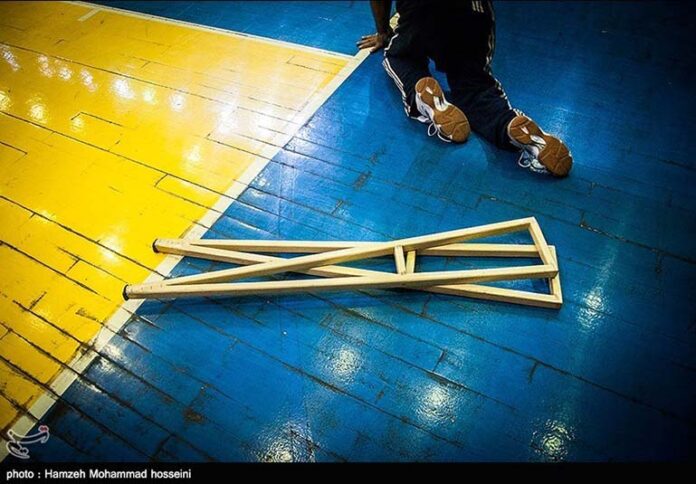
Paralyzed Iranian man wants his name recorded by Guinness (PHOTOS)

Paralyzed Iranian man00

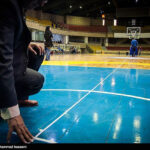
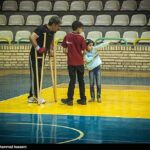
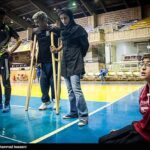
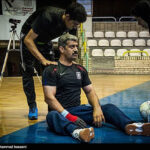
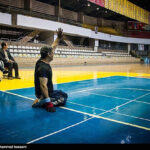
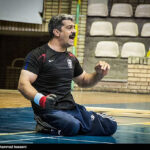
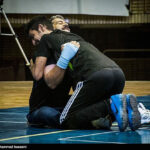
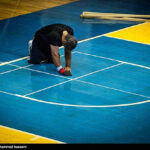
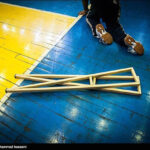
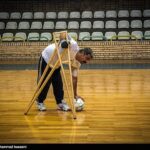
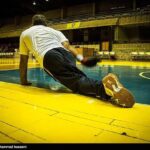
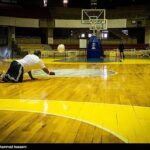
Alireza Sadeghi, an Iranian man who was paralyzed after he came down with polio, seeks to secure himself a berth in the Guinness World Records.

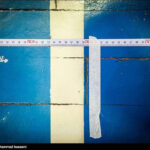
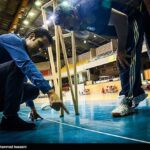
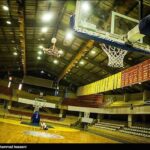
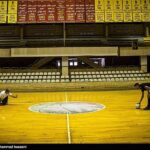
He has had his record of throwing a basketball through the net from a distance of about 26 m registered in Iran and now seeks to find a place for his record in the Guinness World Records.

Images of the paralyzed man on a basketball court posted online by Tasnim News Agency:

We in Greece are fighting to topple capitalism

kke

Greece – a country strategically located at the crossroads of Europe, Asia, and Africa which was for long toddling on the brink of default and insolvency – is preparing to begin bailout talks with its international creditors next week. The two sides are under enormous pressure to hammer out the rescue deal (worth up to 86 billion euros or $94 billion) before August 20, when Athens is scheduled to make a loan repayment of 3.2 billion euros to the European Central Bank (ECB) that it cannot currently afford.

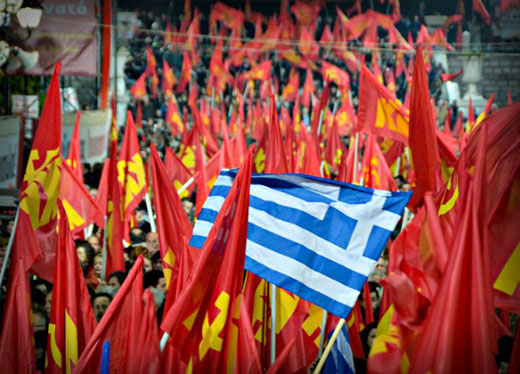
Sharq daily contacted the Central Committee of the Communist Party (KKE) in Greece through email and posed questions on where the European country is heading. The KKE’s Central Committee has said that it aims to dismantle capitalism in the country, whereas Syriza* [a party born from a coalition of Eurocommunists] is opting for the rule of capitalism.

The following is the translation of a report bylined by Nozhan Etezad Saltaneh the daily published on July 25 on the KKE’s views on the state of affairs in the struggling country:

The Central Committee of the Communist Party of Greece (KKE) has labeled left-wing Syriza as an opportunist party which defends the interests of the capitalists as it tries to keep social-democracy in place and humanize the image of capitalism in the country.

Greece’s KKE, founded more than 90 years ago, is one of the key Communist parties in Europe.  The party has a long proven track record of fights, among them, resistance against the invasion by Fascist forces – led by Hitler’s Germany and Mussolini’s Italy – of Greece [known as the Battle of Greece], fight against the dictatorship of the military junta in the 60s and 90s [known as the Greek military junta of 1967–74, or the Regime of the Colonels] and now the fight they have declared against the neoliberal capitalism and its agents.

The partyhas representatives in the Hellenic Parliament [the parliament of Greece] and the European Union. It does not favor parliamentary democracy* as the best way to make desirable changes and rejects it as a pure illusion. It has also appealed for Greece not to cooperate with the European Union which it views as reactionary [a reactionary apparatus which has at its core the interests of the monopolies] and anti-people.

Despite the fact that the EU has announced that it wants Greece to stay in the eurozone, the Communist Party in Greece maintains that Europe’s bourgeoisie supports the withdrawal [from the Eurozone] of Greece and similar economies, arguing that it [Europe’s bourgeoisie] wants to see the presence of stronger economies in the eurozone and the deletion of the weaker countries.

[…]

Syriza’s performance and its outlook

This government has offered valuable services to the system. The Syriza-led government has masked its compromise with the system by running on a leftist platform and hiding it [the compromise] behind an honorable mask. The party is pushing a false discourse. We are now at a juncture when opposition to the European Union should assume a radical form and result in rejection of efforts which lead to development of capitalism. But Syriza wants to see our country as part of an intergovernmental imperialistic coalition which has always drawn on unequal relations between countries.

On the referendum day, this government put an inappropriate question to a vote and then turned the ‘no’ vote to a ‘yes’ vote in favor of a harsher agreement. Syriza continues to exploit people’s demands and those of leftist forces to put on a popular and leftist face. The new agreement has created a situation as if the sins of the New Democracy  and PASOK social democratic political parties – which were previously in power – had been forgiven.

This government taps into populist demagoguery and is also committed to making use of macro capital. By doing so, this party has managed to win the support of the Greek bourgeoisie and imperialistic centers outside Greece, including the US.

Forming a coalition with the US, France and Italy in which the government takes pride does not serve the people’s interests. In fact, such measures will drag the working class and the general public into disputes between the imperialists.Syriza is a left-wing political party in Greece, originally founded in 2004 as a coalition of left-wing and radical left parties. It is the largest party in the Hellenic Parliament, with party chairman Alexis Tsipras serving as Prime Minister of Greece.

A parliamentary democracy is a system of government in which citizens elect representatives to a legislative parliament to make the necessary laws and decisions for the country. This parliament directly represents the people.

In a parliamentary democracy, you have a Prime Minister, who is first elected as a member of parliament, then elected Prime Minister by the other members of the parliamentary legislature. However, the Prime Minister remains a part of the legislature. The legislative branch makes the laws, and thus the Prime Minister has a hand in law-making decisions. The Prime Minister works directly with other people in the legislature to write and pass these laws.

Iran, Germany to cooperate in archeology

81695304-70054069

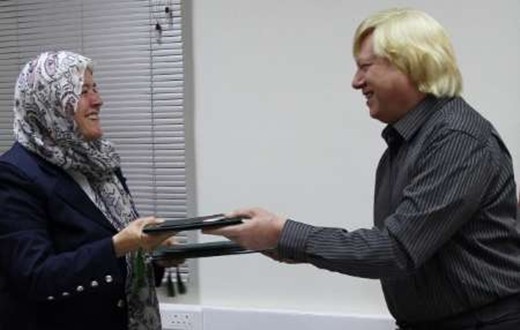
Iran and Germany will cooperate in the field of archeology in accordance with a letter of understanding the two sides signedon Sunday.

The memorandum of understanding – signed by Mohammad Beheshti, the head of Iran Cultural Heritage and Tourism Research Center and head of the German Archaeological Institute Friederike Fless – is valid for a period of five years and will be automatically renewed after that period.

According to the agreement, the two sides will cooperate and conduct research in areas such as archeology, anthropology, geophysical research, dating technology for archeological items, and other related fields.

Based on the memorandum of understanding, the German side undertakes to facilitate presence of the researchers and archeologists of the Cultural Heritage and Tourism Research Center in educational and research programs of the German universities.

The agreement stipulates cooperation by the two sides in archeological and environmental studies in areas in Iran, Germany and other countries which are determined by the supervisory group.

The German Archeological Institute undertakes not to take the cultural properties it discovers from the field archeological operations in Iran out of the country.

Where does opposition to Fabius’ Tehran visit stem from?

FRANCE-POLITICS-GOVERNMENT-CABINET

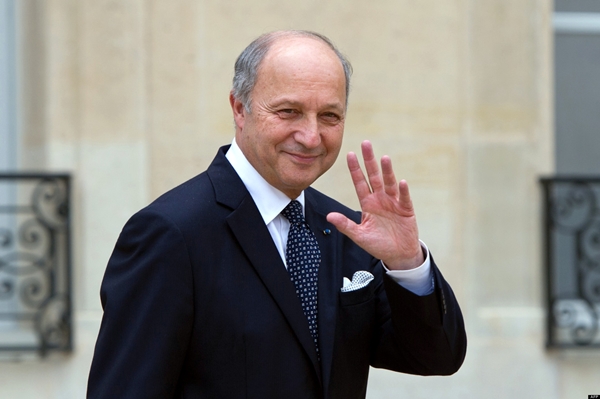
Following a fresh barrage of fierce criticism by the media affiliated to the Worriers [staunch supporters of former President Ahmadinejad and opponents of a nuclear deal] against planned Iran visits by Western officials, particularly French Foreign Minister Lauran Fabius, an expert in international affairs has described such opposition as part of the aftershocks of the Worriers’ failure to thwart nuclear talks between Iran and P5+1.

Javid Ghorban Oghli, a former diplomat, said, “Throughout the nuclear negotiations, the Worriers went to great lengths to prevent the conclusion of a deal.”

The Following is the translation of his remarks in an interview with Fararu, a news website, posted online on July 25:

These days, opponents of the Iran nuclear deal in America have changed their tactics. Those who once sought to foil nuclear negotiations are now bent on hindering the implementation of the deal through Congress.

Efforts to kill the agreement were obvious in the hearings of the Senate Foreign Relations Committee.

Some in Iran argue that France and Germany along with the US backed economic sanctions against Tehran, so we should not normalize our relations with these countries. It would be better to look at full half of the glass rather than its empty half.

That the French foreign minister, who used to take the toughest stance against Iran throughout nuclear negotiations, is now willing to visit Iran should be deemed as a great achievement for the Iranian negotiating team and government because they have succeeded in persuading France to back away from its previous stance on Iran.

The policy of self-imposed isolation should come to an end, because in today’s world such a policy is doomed to fail and no country can stand on its feet by keeping its doors closed to the world.

What matters is that the country can interact and cooperate with the world while its independence and national interests are safeguarded; if we can enforce such a policy, we will be considered a winner in today’s world.

A look at Iranian newspaper front pages on July 26

Iranian Newspapers Headlines

Comments of Ali Akbar Velayati, an advisor to the Supreme Leader for international affairs, on nuclear talks and inspections as well as on relations with Saudi Arabia and Turkey’s decision to attack IS targets in Syria dominated the front pages of Iranian newspapers on Sunday.


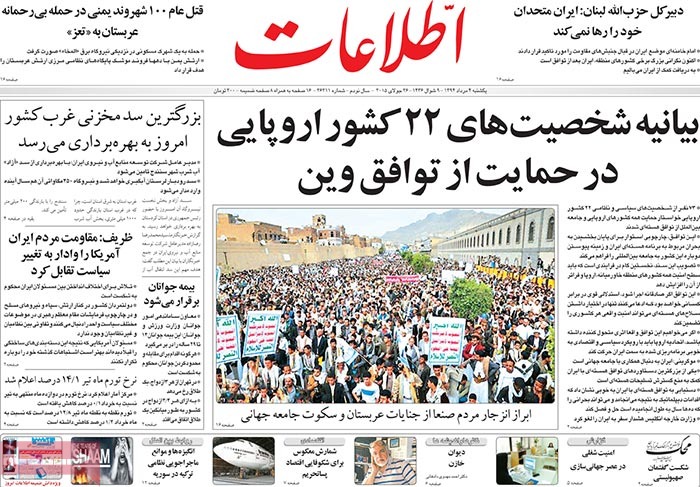
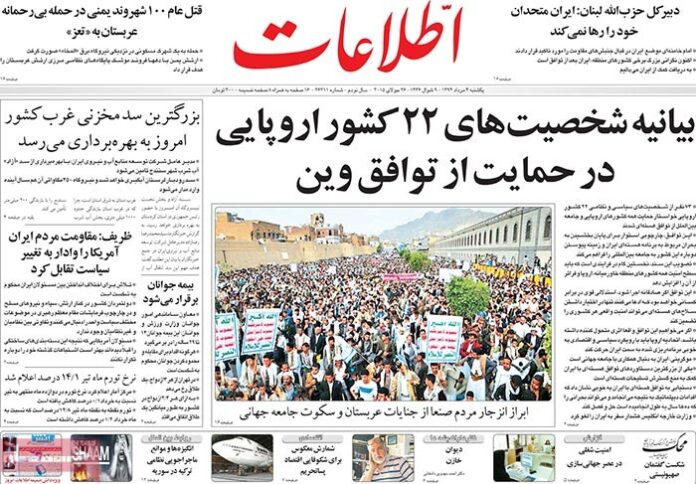
Ettela’at: Public figures in 22 European countries have issued statements in support of the Vienna deal [between Iran and P5+1].

In separate statements, the political and military officials called on all European countries and the international community to throw their weight behind the deal.


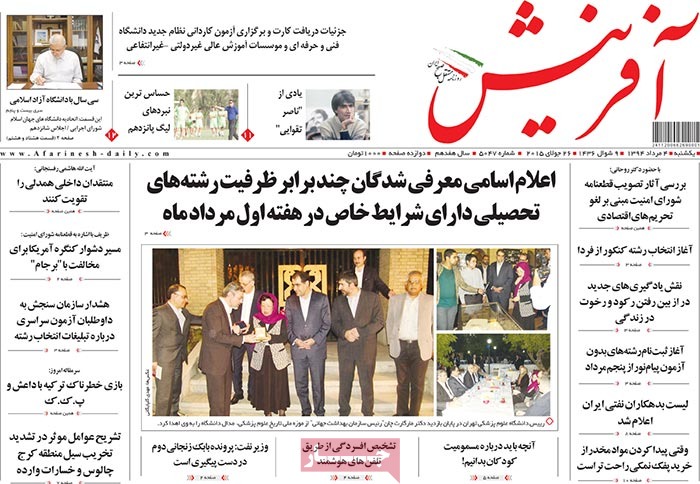
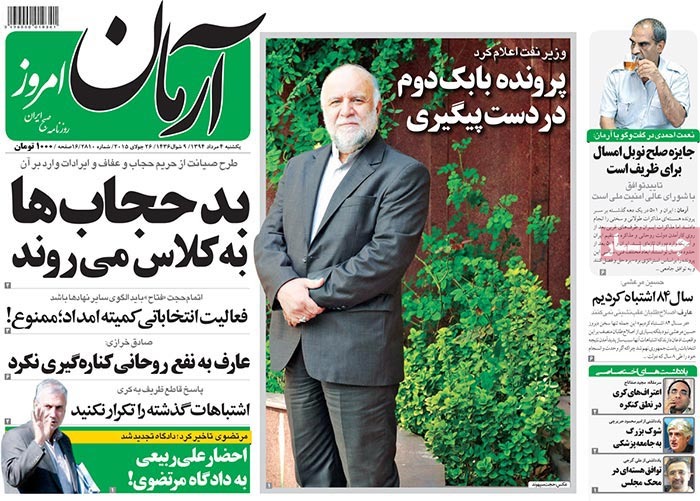
Afarinesh: “The case involving a second Babak Zanjani is under investigation,” said Oil Minister Bijan Namdar Zanganeh.

[Babak Zanjani is a young billionaire who stands accused of massive corruption and embezzlement when Ahmadinejad was president.]
 

A look at Iranian newspaper front pages on July 26


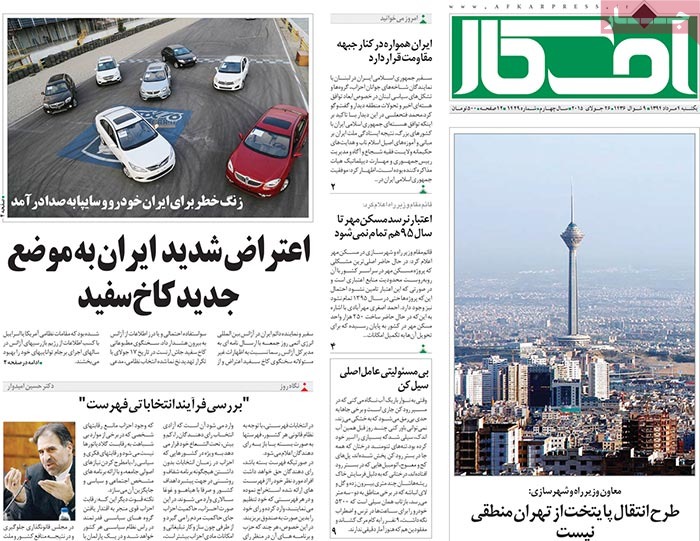
Afkar: “The plan to move the capital from Tehran defies logic,” said the deputy minister of roads and urban development.
 

A look at Iranian newspaper front pages on July 26


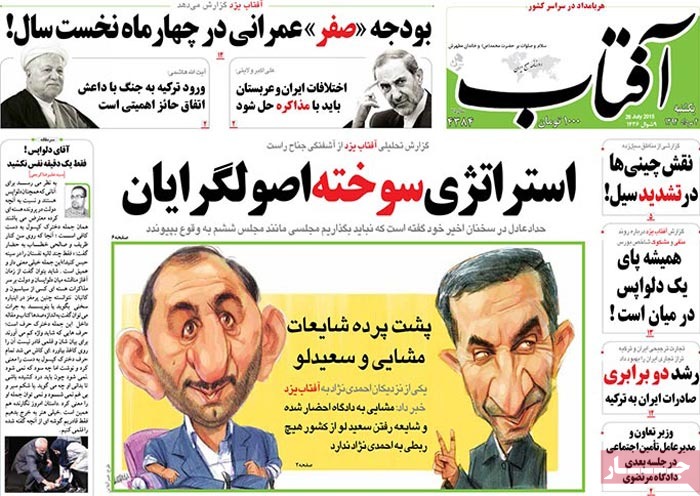
Aftab-e Yazd: “Differences between Iran and Saudi Arabia should be ironed out at the negotiating table,” said Ali Akbar Velayati, an advisor to the Supreme Leader.

Aftab-e Yazd: A source close to former President Ahmadinejad has told Aftab-e Yazd that Esfandiar Rahim-Mashaei [Ahmadinejad’s chief of staff] has been summoned to court.

The fact that Ali Saeedloo [Ahmadinejad’s deputy for executive affairs] has left the country has nothing to do with the former president, the same source said.
 

A look at Iranian newspaper front pages on July 26


Arman-e Emrooz: The director of Imam Khomeini Relief Committee has slapped a ban on any involvement in elections by the staff of the charity organization.

Arman-e Emrooz: Minister of Cooperatives, Labor and Social Welfare Ali Rabiei has been summoned by a court hearing fraud charges against the former director of the Social Security Organization Saeed Mortazavi.
 

A look at Iranian newspaper front pages on July 26


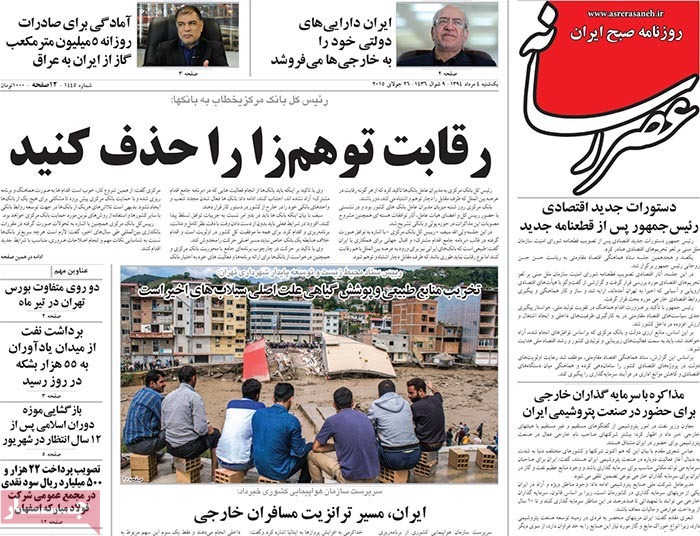
Asr-e Rasaneh: Iran stands ready to export 5 million cubic meters of natural gas to Iraq on a daily basis.
 

A look at Iranian newspaper front pages on July 26


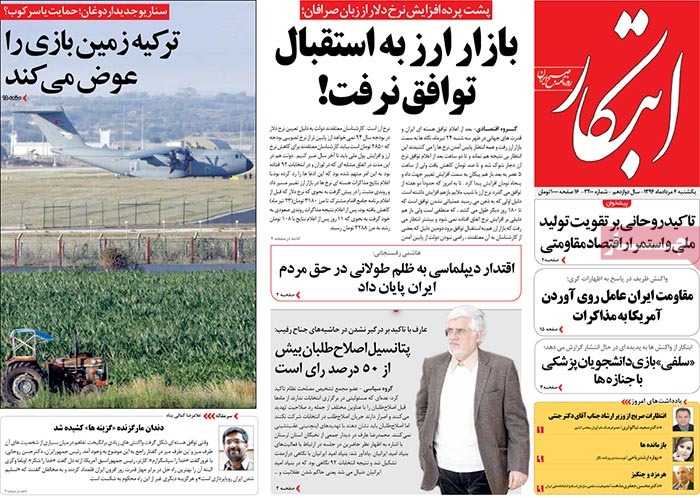
Ebtekar: President Rouhani has underlined efforts to promote national production and sustain resistance-based economy.
 

A look at Iranian newspaper front pages on July 26


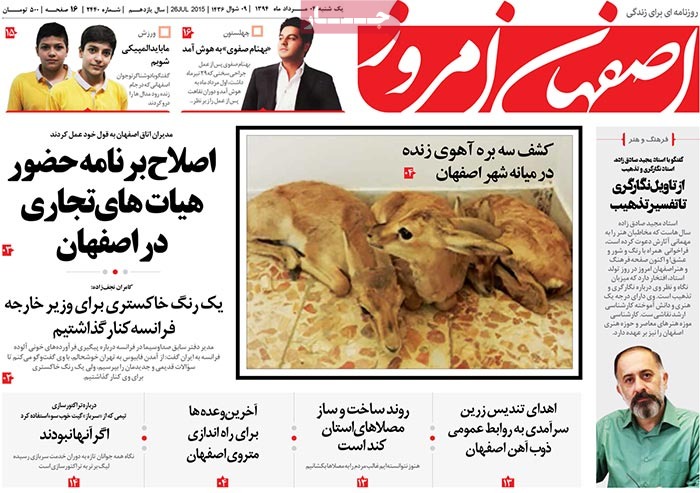
Esfahan Emrooz: Three gazelles have been seized from a poacher at the heart of Isfahan.
 

A look at Iranian newspaper front pages on July 26


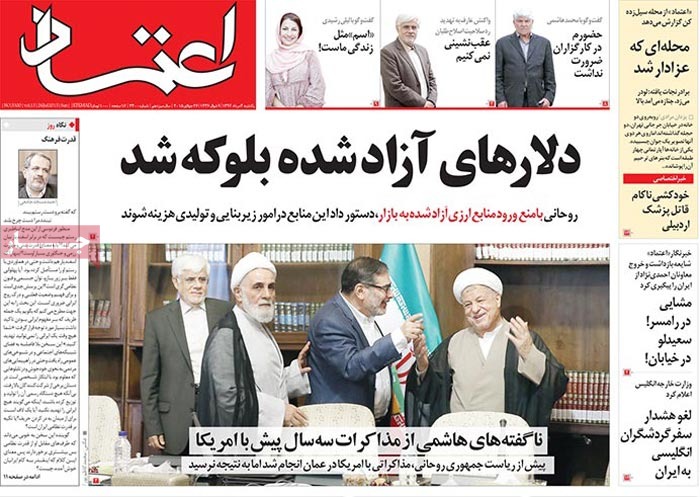
Etemad: Unfrozen dollars were frozen again

President Rouhani has banned Iran’s unfrozen foreign exchange from entering the market, saying instead they should be spent on manufacturing and infrastructure projects.
 

A look at Iranian newspaper front pages on July 26


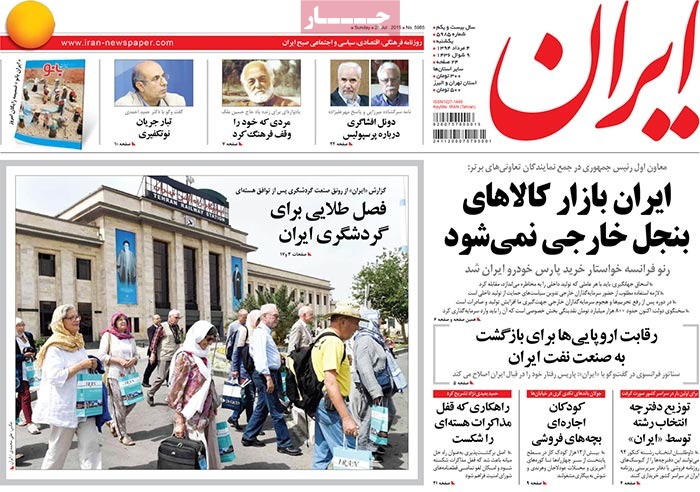
Iran: A golden age for Iran’s tourism

The daily features a report on a tourism boom in the wake of the nuclear deal.
 

A look at Iranian newspaper front pages on July 26


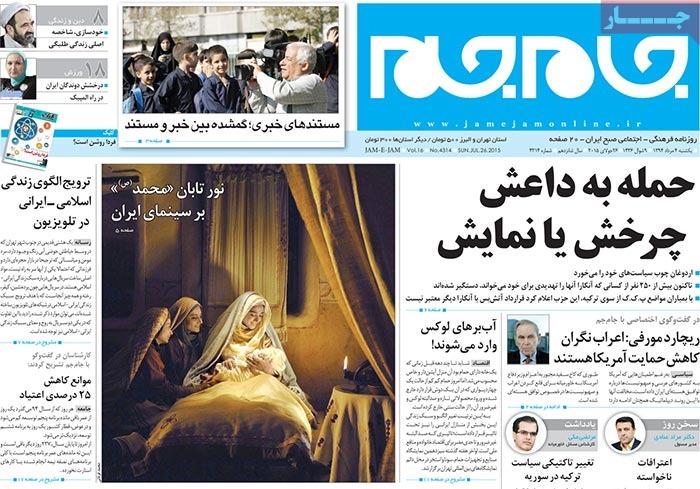
Jamejam: Is the attack on IS [by Turkey] a real turnaround or mere theatrics?

President Erdogan is paying a price for his wrong policies in the past.
 

A look at Iranian newspaper front pages on July 26


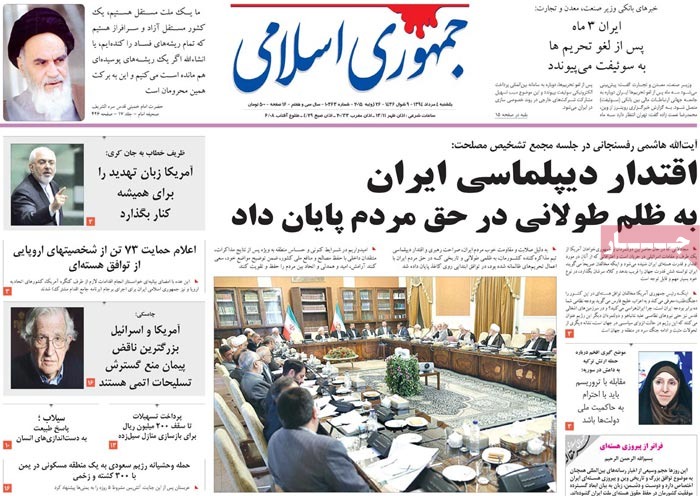
Jomhouri Islami: “Iran will join Society for Worldwide Interbank Financial Telecommunication (SWIFT) three months after sanctions have been lifted,” said the trade minister.
 

A look at Iranian newspaper front pages on July 26


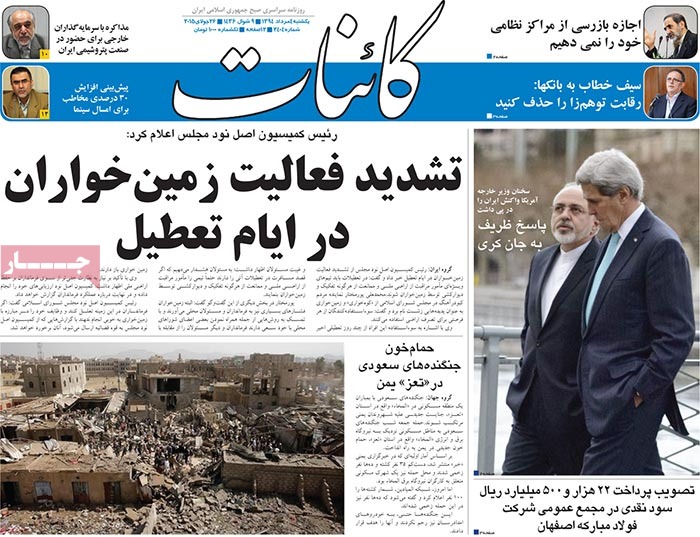
Kaenat: “We won’t allow our military sites to be inspected,” said Ali Akbar Velayati, the Supreme Leader’s advisor.
 

A look at Iranian newspaper front pages on July 26


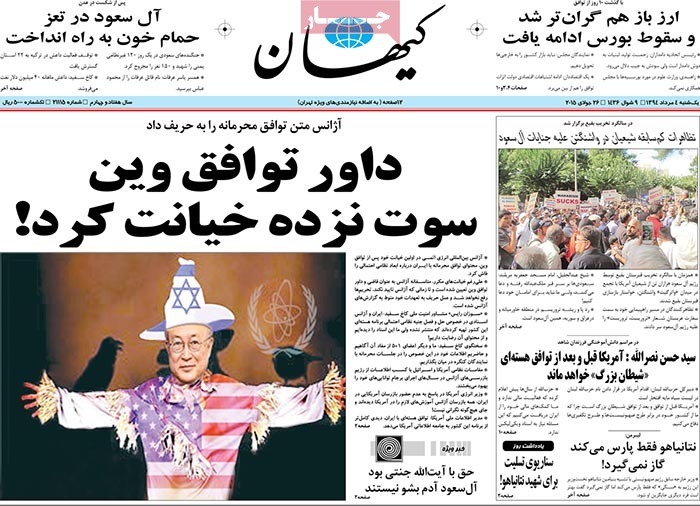
Kayhan: The referee of the Vienna deal betrayed us even before blowing the opening whistle.

The International Atomic Energy Agency has revealed the text of a confidential deal to the other side [a reference to P5+1].
 

A look at Iranian newspaper front pages on July 26


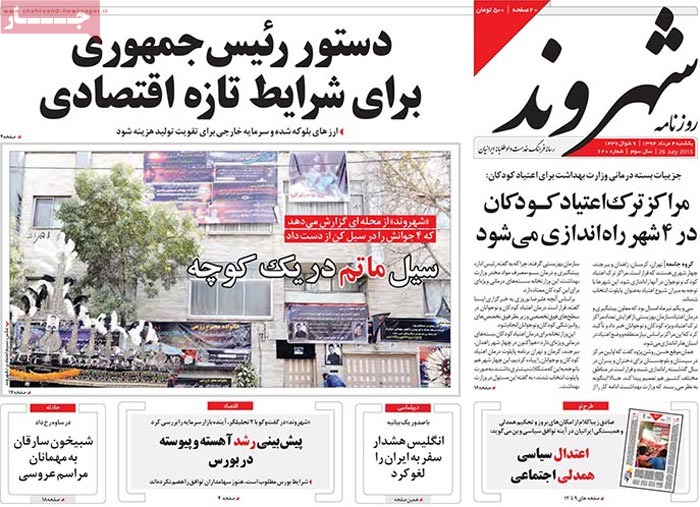
Shahrvand: Rehabilitation centers will be launched for juvenile addicts in four cities.
 

A look at Iranian newspaper front pages on July 26


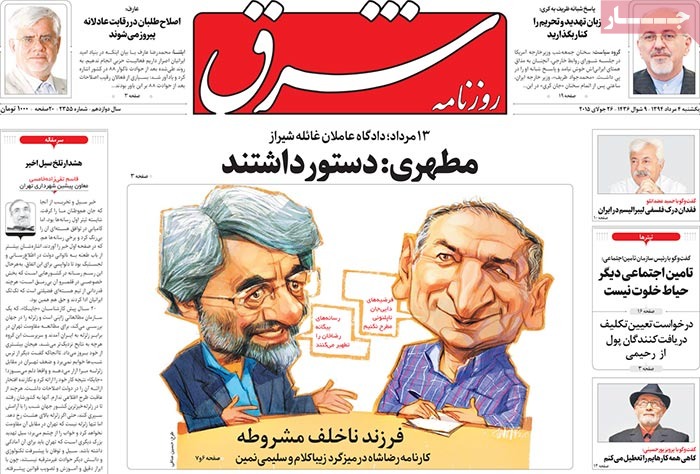
Sharq: Those who attacked Tehran MP Ali Motahari when he visited the southern city of Shiraz for a planned speech in 2014 will go on trial on August 4.

 

A look at Iranian newspaper front pages on July 26


Highlights of Ettela’at newspaper on July 26

Ettelaat-July26

 Public figures in 22 European countries have issued statements in support of the Vienna deal [between Iran and P5+1].

In separate statements, the political and military officials called on all European countries and the international community to throw their weight behind the deal.

 Residents of Sana’a have expressed indignation over Saudi crimes in Yemen and the silence of the international community.

 “Iran won’t leave its allies in the lurch,” said the secretary general of Lebanon’s Hezbollah.

Seyyed Hassan Nasrallah said some regional countries are now fretting about a post-sanctions Iran.

 Some 100 Yemeni nationals were massacred in a Saudi attack on Taiz.

Meanwhile, the Yemeni Army rained down scores of missiles on the border posts of the Saudi Army.

 The largest reservoir dam in Western Iran will be inaugurated later on Sunday.

The dam will provide drinking water to the Kurdish town of Sanandaj.

 “The resistance of the Iranians forced the US to change course,” said Foreign Minister Mohammad Javad Zarif.

The top diplomat further said efforts to sow discord among Iranian officials are doomed to fail.

 The youth will be given special insurance coverage.

An official with the Ministry of Youth and Sports has said that the new scheme covers individuals in the 14-29 age brackets.

 Inflation stood at 14.1 percent in the 30 days to July 22, down 0.1 percent over the month before.