Sunday, December 21, 2025
Home Blog Page 4670

A Tehran cobbler (PHOTOS)

Ali Vaksima00

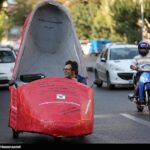
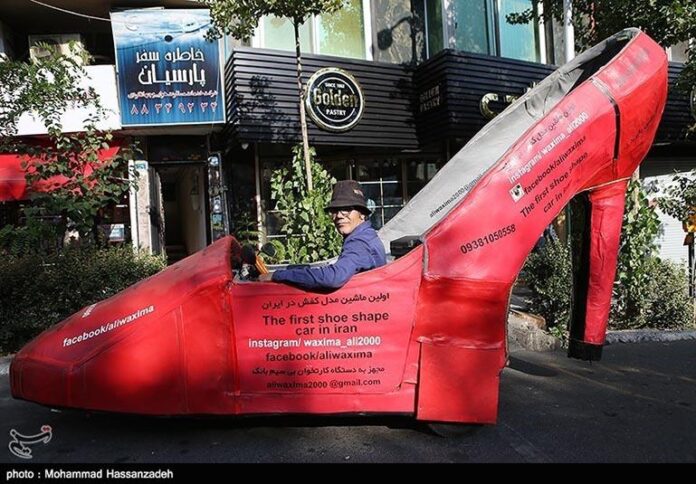
Mohammad Ali Hassankhani, known as Ali Waxima, is the first Tehran cobbler who is only one phone call away to offer services.

Over the years, his creativity to repair and polish shoes has encouraged many journalists to write pieces about him.

The 42-year-old man whose career spans more than two decades used to commute across the city by bicycle and later by a motorized tricycle to give services to his clients.

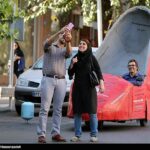
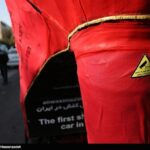
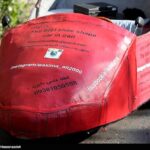
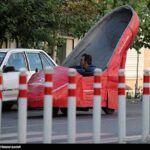
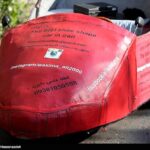
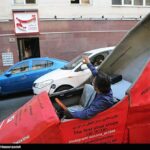
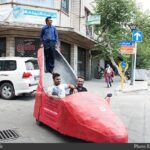
Later, he drove in Tehran in his self-designed vehicles which looked like a shoebox and a men’s shoe.

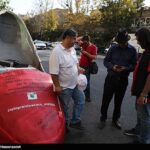
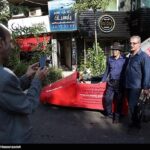
Waxima has now designed a new car which is similar to a high-heeled shoe. The vehicle has taken four months to be built. He plans to design a new vehicle resembling a child’s shoe.

Images of the Tehran cobbler released by Tasnim News Agency:

Iran’s economy grows if and when helped by the younger generation

khansari

Masoud Khansari is the fifth chairman of Tehran Chamber of Commerce, Industries, and Mines (TCCIM). He’s been active in the public sector for over two decades, but he stresses the need for the national economy to depend on the private sector. That’s why, he says, he has joined the chamber of commerce to take more effective steps toward beefing up the private sector.

He has taken the helm of a chamber which has undergone change and brought together a mix of young people with different specialties. In this chamber, old tradesmen – who had made their way from the heart of traditional bazaar into the private sector – have been replaced by young businessmen, industrialists and technocrats.

Khansari is a supporter of interaction with the world, saying the country’s interests will be better served when it is unshackled from economic sanctions after the conclusion of the Iran nuclear deal. He says that the consequences of mismanagement in the ninth and eleventh governments (led by Ahmadinejad) have been by far more harmful than those of sanctions.

The TCCIM chief also says that the rational management of economy and removal of sanctions are the two positive developments which can herald a boom in Iran’s economy. Nonetheless he is concerned about market disruption by a new stratum of the rich who came to being during Ahmadinejad’s presidency, and about provocations coming from the outside – including Saudi Arabia and the Israeli regime which are opposed to the nuclear deal. He warns that these two inside and outside factors should not be downplayed.

Etemaad daily on August 15 published an interview with Khansari on the Iranian market which, he says, remains concerned about the emergence of a class of businessmen with ties to Ahmadinejad and his inner circle. The following is the translation of part of the interview:

Trips by foreign trade delegations

The enthusiasm of foreigners for being present in Iranian market is understandable, but what matters more is how we want to cooperate with them. The Iranian market is not a small one limited to the country’s population of 78 million. We need to take into account the neighboring countries’ markets as well and work out plans for a 280-million-strong market. […] The foreigners are seeking to export goods to and invest in Iran, but we should see how we can make the optimal use [of their presence].

The foreign exchange prices should be reasonable in the first place; otherwise a grave danger would lurk out there for Iran. Unreasonable forex rates will repeat the bad thing that happened under the previous government and destroyed the country’s industries and production. Thanks to reasonable prices, Iran’s industries can show their potential and the country can pin its hopes on the new era.

Foreign investment   

The foreigners are interested in making investment in oil and petrochemical industries and car manufacturing – Iran’s market has the potential to sell 1.8 million cars each year – as well as in electricity and pharmaceuticals.

Private sector in post-sanctions era

The private sector is the driving force behind the national economy.

[…]

If the country’s privatization drive is expected to go ahead smoothly, we need to find people who seek to give priority to development.

[…]

Foreign delegations and termination of sanctions

I think they [foreign delegations] have long been after the termination of sanctions. In my meetings with European ambassadors, I learned that they were unhappy with the sanctions. They were afraid of the US, because it was their largest trading partner and the penalties they had to pay for having transactions with Iran were hefty.

Naturally, they like to have a share of the 280-million-strong market. Since oil accounts for the better part of Iran’s revenues, we do not appreciate the real value of nickel-and-dime profit. It is not the case for the Europeans to whom these markets are a matter of life and death. That’s why they are trying to normalize the situation.

The Americans  

It is a bit tougher for the Americans. The Europeans and Asians have always been [active] in Iran and have a correct interpretation of the situation on the ground. For the past 36 years, Iran has had no contacts with the US. Unlike Iran’s European and Asian partners, the Americans do not have a full understanding of the situation in Iran. I think the US faces more restrictions for investment in Iran than other countries.

It is important to know about your economic partner. For 36 long years, ties between Iran and the US have been strained. In the automotive industry, for instance, the French, Japanese and Koreans have been active in Iran [in the past 36 years] and know the ropes. They know about Iran’s technologies, managers and factories. The Europeans were involved in pharmaceuticals and petrochemicals, so they know their trading partners, but the Americans know nothing about Iran.

Iran-P5+1 deal

From an international angle, the Iran nuclear deal can be as important as the ceasefire agreement between Iran and Iraq [back in 1988]. From a domestic angle, I think a landmark event preceded the nuclear deal between Iran and P5+1 and that was the rise to power of the eleventh government – the ill-effects of the ninth and tenth governments’ mismanagements outweigh the impacts of sanctions and their ensuing events. In fact, sanctions could not have affected Iran’s economy so adversely had it not been for the mismanagements of the previous government.

An end to an international dispute    

[…] The world thought it could knock down Iran by using sanctions as a tool; to their disbelief, Iran stood on its own two feet despite suffering from mismanagement. […] If international interactions improve, a new era will definitely be ushered in for Iran which has a high oil capacity. Economically, Iran is stable. When the doors open, more change [for the better] will unfold.

What matters more today is the security situation. The region is unsafe, but, luckily, Iran is completely safe. The world has accepted this. Iran is in a good condition as far as infrastructure for production and industries is concerned. The world has learned a lesson from the fallout of undiplomatic measures. The US experience in Iraq led to [the emergence of] ISIL. The world needs to get along with Iran if it wants to restore security in the region.

Post-sanctions Iran

Iran has always been a regional heavyweight. In recent years, the Arabs and the Zionist regime have been able to play a bigger role thanks to divisions between Iran and the West. Things will change after the deal. […] Saudi Arabia and Israel have domestic problems which will be heightened by the Iran deal. Iran is a powerful country today and has to bolster its might as it tries to establish good relations with its neighbors so that they do not see Iran as a headache.

[…]

New concerns

Iran, which is entering a new era, has been left with a bitter legacy. I’m very much concerned about a new stratum which was formed during the Ahmadinejad presidency; those who emerged out of nowhere, got rich overnight and consolidated their financial foothold by building on rent-seeking and proximity to the corridors of power. They will create problems in the future, because the financial resources they have at their disposal – thanks to corruption – will make them powerful. We need to beware of this class of people so that they cannot make the situation tense.

A group of people in their twenties or thirties – with no economic background – have been given a windfall and are now leading a special [affluent] life. The lifestyle of a young man like Babak Zanjani is more lavish than the old industrialists and veteran economic players. They can be troublesome, because the money they have collected overnight can be spent on dangerous things.

[…]

What happens next?

It depends on our efforts. We are trying to increase the members or the number of people holding business cards. We need to bring on board more people in the chamber. We also need to raise the number of specialty organizations, keep pace with global changes and put forward new subjects such as management and technologies. In addition to the sanctions, we have been out of touch with managerial techniques. We should bring the new generation into the scene. We are doing our utmost to represent the majority of the private sector. […]

The chamber today is a team of individuals with different specialties. A representative from the market, one from the technical and engineering service sector as well as those from different industries are there in the chamber. These representatives are younger now. The presence of a second generation of experts in the chamber is promising. […]

Iran not to let US infiltrate into country: Ayatollah Khamenei

leader

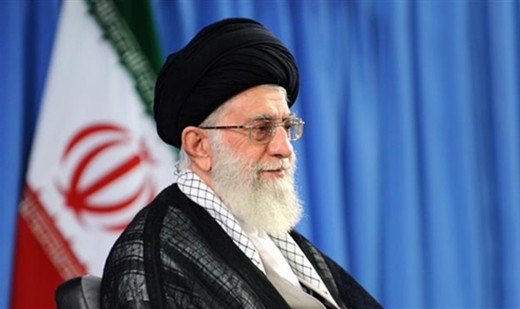
Supreme Leader of the Islamic Revolution Ayatollah Seyyed Ali Khamenei says the Islamic Republic will not allow the US to make inroads into the country.

Ayatollah Khamenei made the remarks in a meeting with participants in the 8th summit of the General Assembly of the Islamic Radio and Television Union (IRTVU) and the 6th General Assembly of the AhlulBayt World Assembly in the capital, Tehran.

The Leader said that the opposite side in nuclear negotiations with Iran was seeking to clinch an agreement with the country to find a way to infiltrate into the Islamic Republic.

Ayatollah Khamenei, however, said that Iran did not and will not allow them to achieve their goal.

“We will firmly block their way. We will not allow the US to make economic, political or cultural inroads into the country. We will counter such infiltration with all our power,” the Supreme Leader said.

Ayatollah Khamenei further underlined that, “We should first identify the enemy’s intentions and then counter their objectives through planning.”

Touching on the developments in the Middle East, Ayatollah Khamenei said the US seeks to hold sway in the region to pursue its objectives, but stressed that the Islamic Republic will counter Washington’s policies.

“They are after disintegrating Iraq and Syria,” the Leader said, but noted that Washington’s plots will fall flat thanks to God’s power.

Regarding the developments in Yemen, the Leader said that Iran is ready to render any types of assistance it can to war-hit Yemenis.

Ayatollah Khamenei described the Saudi military adventurism against Yemen as folly, stressing that aggressors are pursuing political gains in the impoverished Arab country through military action.

The Supreme Leader also reaffirmed Iran’s backing for the resistance front in the region, saying that the Islamic Republic will fully support anyone that stands up to the Israeli regime.

You’d better speak for yourself, not on behalf of Leader

shariat

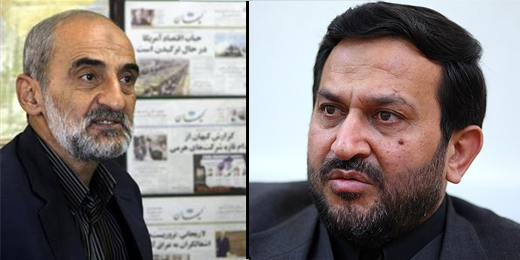
An advisor to the commander of the Islamic Revolution Guards Corps has said that Kayhan daily’s chief had better express his own views and not speak on behalf of the Supreme Leader.

Hamid Reza Moghaddam-Far, a media advisor to Major General Mohammad Ali Jafari, made the comment in an opinion piece released Sunday in reaction to a Saturday editorial by the principlist daily’s Hossein Shariatmadari and added, “I wonder why you insist on inculcating in your readership that the Supreme Leader thinks like you?”

Entekhab.ir on August 16 published a brief report on the advisor’s piece and Kayhan’s editorial. The following is the translation of that report:

IRGC media advisor’s piece

I read your piece on the nuclear issue and the Joint Comprehensive Plan of Action (JCPOA) in Kayhan daily on Saturday (August 15) and pondered on it. How come a revolutionary brother like you is insisting on instilling in his audience a feeling that the Supreme Leader’s line of thinking is like his? Or the Supreme Leader’s analysis and understanding is similar to the way [Kayhan’s managing editor] analyzes and understands things?

This comes despite the fact that the Supreme Leader took a candid stance on this issue [nuclear question] in his Eid-ul-Fitr prayer sermons and made transparent comments when addressing state officials. ….

If we are to pick and choose, which one do you think would be our pick: the Supreme Leader’s line announced by his website [leader.ir] or your piece of writing? Are we supposed to lend our ears to the straightforward remarks of the Supreme Leader that anything [the deal] should go through legal channels and should be approved or rejected in line with national interests, and avoid making hasty judgments or drawing quick conclusions?

Or shall we dig in our heels, insist on and promote our interpretation that any conclusion which is drawn outside the legal channels is viewed as running counter to the Supreme Leader’s view?

Don’t you think such posturing will create a chasm among revolutionary forces at a time when they need solidarity and unity more than ever before? Don’t you think it would be better if you expressed your own views, rather than talk on behalf of the Supreme Leader?

Hossein Shariatmadari’s editorial

Remarks by the Supreme Leader in Eid-ul-Fitr prayer sermons this year leave no doubt that he knows full well about the catastrophic consequences and shortcomings of the Iran nuclear deal. One can definitely say that the Leader is not, by any means, satisfied with the text of the deal; otherwise, given the Supreme Leader’s thorough knowledge about the Vienna agreement, his stress on and frequent repetition of “We will not let go of the revolution’s principles whether or not the deal is approved” would be unnecessary.

So those who are in charge of reviewing the text of the Vienna accord have an unshakable responsibility to reject those articles, chapters and provisions of JCPOA which do not conform to the principles of Islam, the revolution and the establishment so that they – as the Supreme Leader has put it – will not feel disgraced and humiliated before people and later before the divine court.

[…]
If we believe that the Vienna agreement and its related documents – including Resolution 2231 and the IAEA’s roadmap – come with articles and points which are catastrophic for the revolution’s principles and that the very articles and points have concerned the Supreme Leader and all those caring [for the establishment], the only way forward is the rejection of JCPOA in its entirety. Is there any other way?

A look at Iranian newspaper front pages on August 17

Iranian Newspapers Headlines

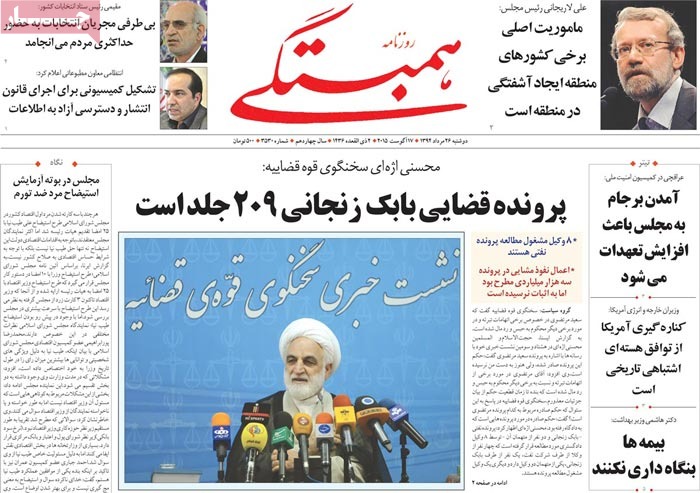
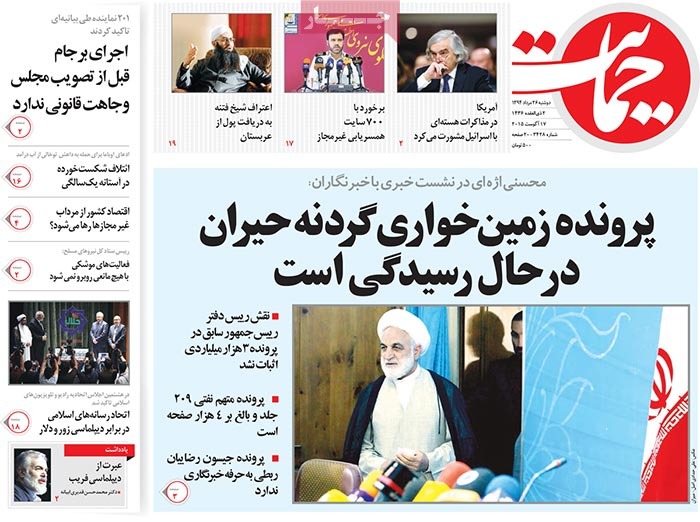
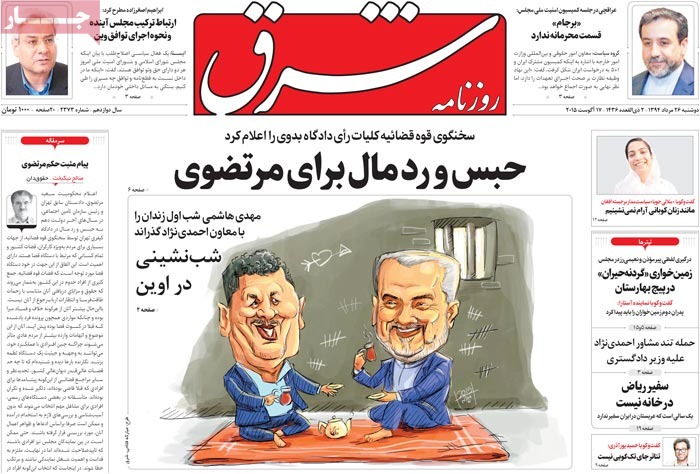
The comments of the judiciary spokesman about cases involving the former director of the Social Security Organization and Babak Zanjani and allegations against the chief of staff of the former president dominated the front pages of Iranian newspapers on Monday.


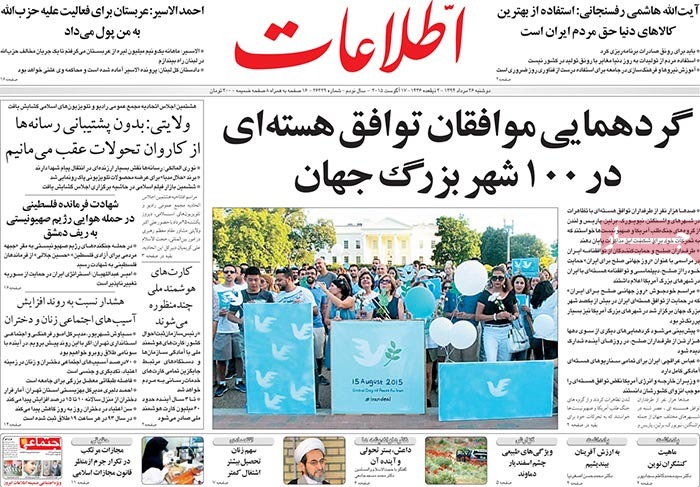
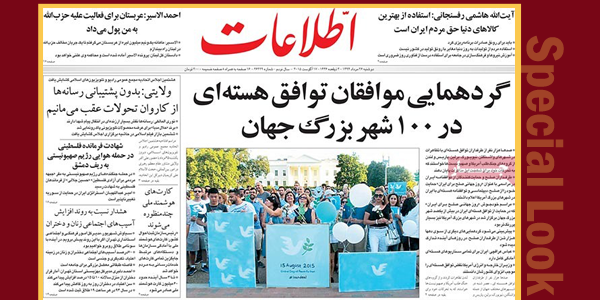
Ettela’at: Supporters of the Iran nuclear deal hold rallies in 100 cities around the world.

Thousands of ralliers in Washington DC, New York, Berlin, Paris and London called on US hawks and the Zionists to stop their efforts to sabotage the deal.


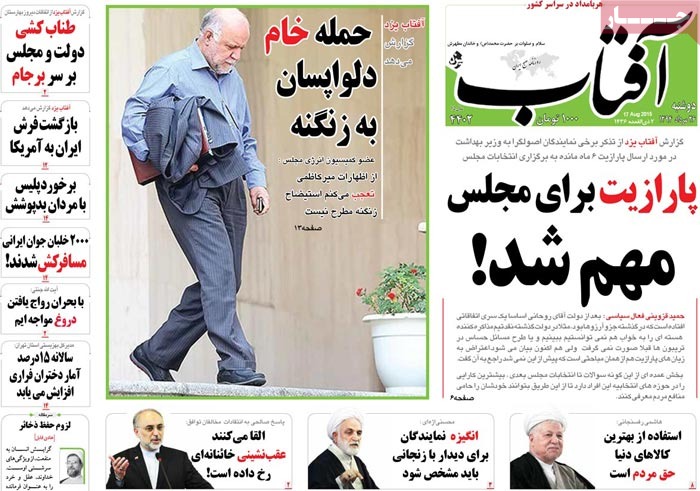
Aftab-e Yazd: The spokesman of the judiciary has said that the reason why some MPs want to meet with Babak Zanjani [a young billionaire who stands accused of massive corruption when Ahmadinejad was in office] should be made clear.

Aftab-e Yazd: The director of the Atomic Energy Organization has said that some act as if nuclear negotiators have backed off in a traitorous way in talks with P5+1.


A look at Iranian newspaper front pages on August 17


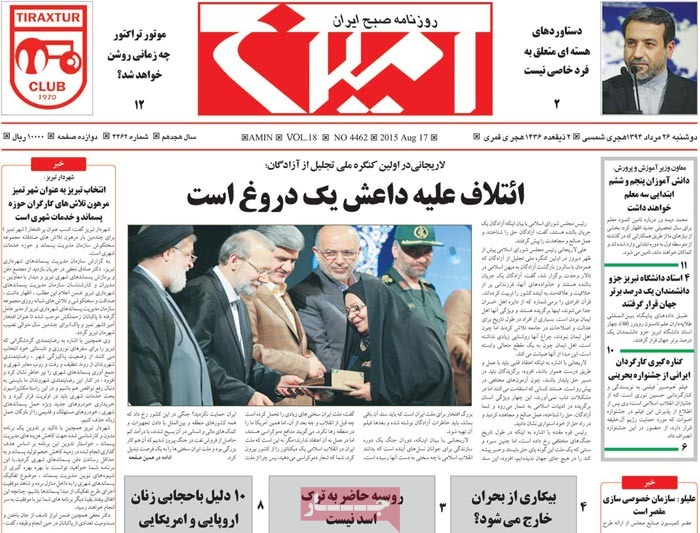
Amin: “The anti-IS coalition is a fabrication,” said the speaker of the Iranian parliament.


A look at Iranian newspaper front pages on August 17


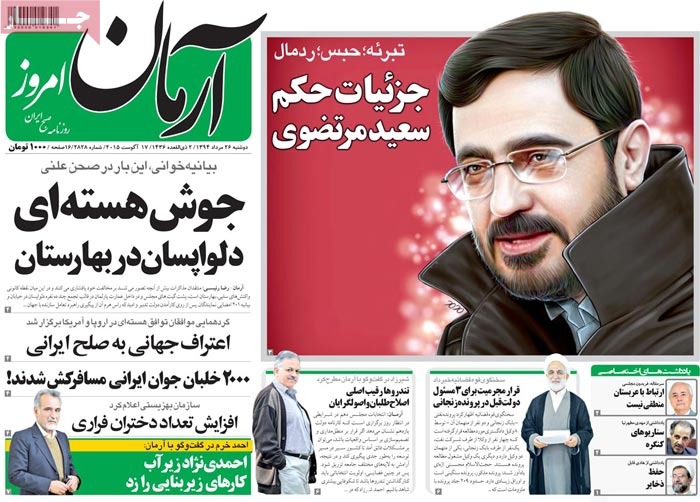
Arman-e Emrooz: The former director of the Social Security Organization has been sentenced to jail term and fine. He has been cleared on certain count(s).


A look at Iranian newspaper front pages on August 17


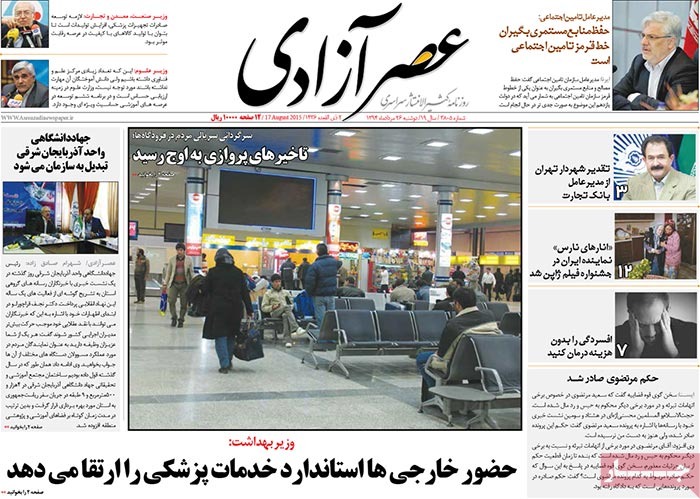
Asr-e Azadi: “Foreign presence in Iranian market improves medical service standards,” said the Iranian health minister.


A look at Iranian newspaper front pages on August 17


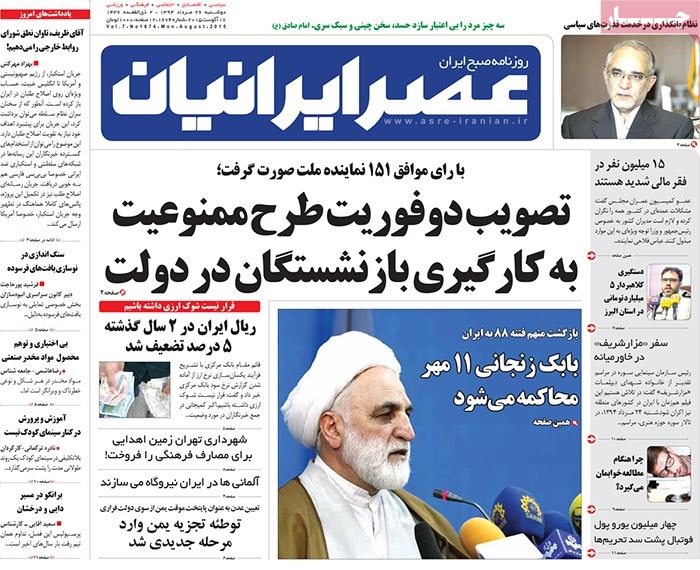
Asr-e Iranian: Germans are to build a power plant in Iran.


A look at Iranian newspaper front pages on August 17


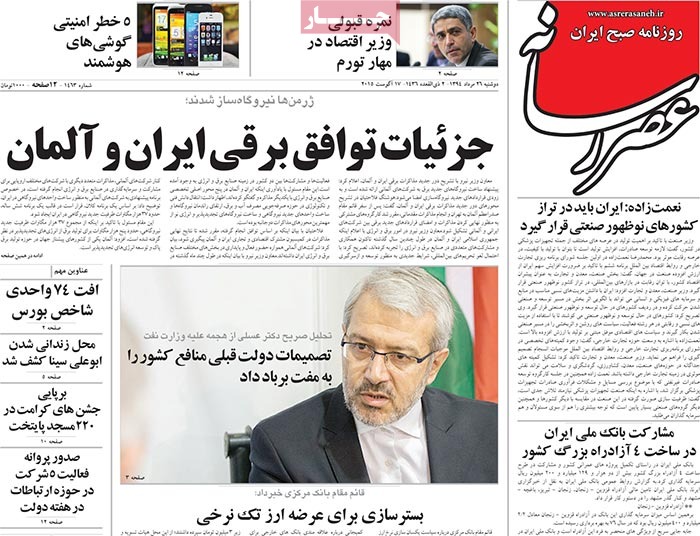
Asr-e Rasaneh: “The decisions of the previous government poured Iran’s national interests down the drain,” said Mehdi Asali, a senior Oil Ministry official.


A look at Iranian newspaper front pages on August 17


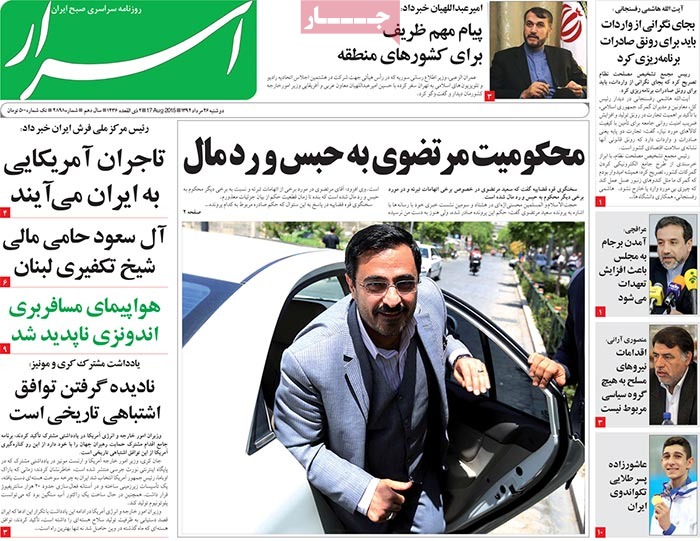
Asrar: American businessmen will visit Iran, said the director of the National Carpet Center.

Asrar:Iran’s Farzan Ashurzadeh has won a gold medal in the World Taekwondo Grand Prix.


A look at Iranian newspaper front pages on August 17


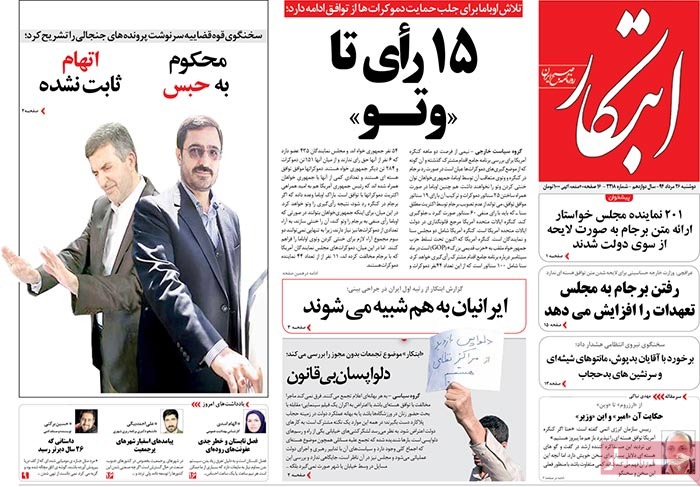
Ebtekar: “A vote for the Joint Comprehensive Plan of Action in parliament will add to our obligations,” said Deputy Foreign Minister Abbas Araghchi.


A look at Iranian newspaper front pages on August 17


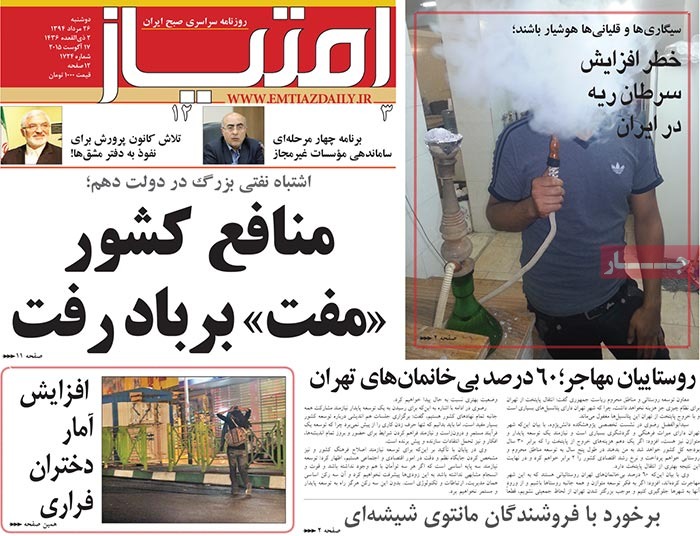
Emtiaz: Migrant villagers account for 60 percent of the homeless in Tehran.


A look at Iranian newspaper front pages on August 17


Hambastegi: “A commission is formed to implement the Free Access to Information Law,” said Hossein Entezami, a deputy minister of culture and Islamic Guidance.


A look at Iranian newspaper front pages on August 17


Hemayat: “Allegations of land grab in Heyran Village in the north are being investigated,” said the judiciary spokesman.

Gholamhossein Mohseni Ejei further said that the case involving Washington Post correspondent Jason Rezaian has nothing to do with his journalistic activity.

The spokesman went on to say that the role of [Esfandiar Rahim Mashaei] the chief of staff of the former president in the embezzlement case involving $1 billion has not been proven.


A look at Iranian newspaper front pages on August 17


Sharq: “The Joint Comprehensive Plan of Action has no confidential section,” said Iranian nuclear negotiator Abbas Araghchi.


A look at Iranian newspaper front pages on August 17


Highlights of Ettela’at newspaper on August 17

Ettelaat Highlights-post

 Supporters of the Iran nuclear deal hold rallies in 100 cities around the world.

Thousands of ralliers in Washington DC, New York, Berlin, Paris and London called on US hawks and the Zionists to stop their efforts to sabotage the deal.

 Ayatollah Hashemi Rafsanjani has said that the Iranians are entitled to using the best products made in the world.

“We need to make plans to promote exports. Making use of up-to-date foreign products does not run counter to efforts to promote local production,” said the chairman of the Expediency Council.

 Ahmed Al-Assir, a Salafist Lebanese cleric who was arrested at the airport in Beirut on Saturday, has said that he’s been in the pay of Saudi Arabia to take measures against Hezbollah.

The Lebanese prosecutor general has said the trial of the extremist sheikh will be open.

 Ali Akbar Velayati, an aide to the Supreme Leader, has said that without media support, Muslim countries fail to catch up to global developments.

The former foreign minister made the comment at the inaugural of the eighth General Assembly of Islamic Radios and TVs Union in Tehran.

 A Palestinian commander has died in an Israeli airstrike against a Syrian city.

In another development, an Iranian deputy foreign minister said Tehran’s support for Syria is immutable.

 Warning about growing social harms women and girls are exposed to

A senior cultural official with Tehran Governor’s Office has said if the current trend persists, a divorce tsunami would be around the corner.

 Multipurpose smart ID cards will be issued.

The new card will replace electronic cards citizens use to receive a variety of services.


People in several cities around globe rally in support of JCPOA

33a4d0e6-c3ba-4a8b-acd1-0140a930a534

Thousands of people have taken part in marches across the globe to express their support for a historical nuclear agreement reached between Iran and six world powers.

The rallies were held on the “Global Day of Peace for Iran” on Saturday in a number of cities including Washington DC, New York, Berlin, Paris and London.

Participants in the marches, organized partly by Iranians living abroad with no affiliation with any group or political party, called on the American and Zionist warmongers to end their efforts to derail the agreement.

In a statement, the organizers said they intend to show their support for the agreement to the rest of the world.

“These days there are proponents of war in the US spending millions of dollars to kill this agreement,” the statement said, adding, “This deal is still fragile, this seed of reconciliation has to be protected until the day it spreads seeds of peace all over the region.”

The organizers warned that the alternative to the agreement – Joint Comprehensive Plan of Action (JCPOA) – would be “another billion-dollar war in the Middle East.”

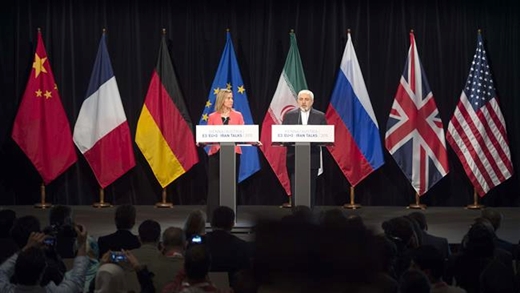
Iran and P5+1– the United States, Britain, France, China, Russia and Germany – finalized the text of JCPOA in the Austrian capital of Vienna on July 14.

Under JCPOA, limits will be put on Iran’s nuclear activities in exchange for, among other things, the removal of all economic and financial bans against the Islamic Republic.

The United Nations Security Council on July 20 unanimously endorsed a draft resolution turning JCPOA into international law. All 15 members of the council voted for the draft resolution, setting the stage for the lifting of the Security Council sanctions against Iran.

Connection between missile test stop, JCPOA ruled out

araghchi

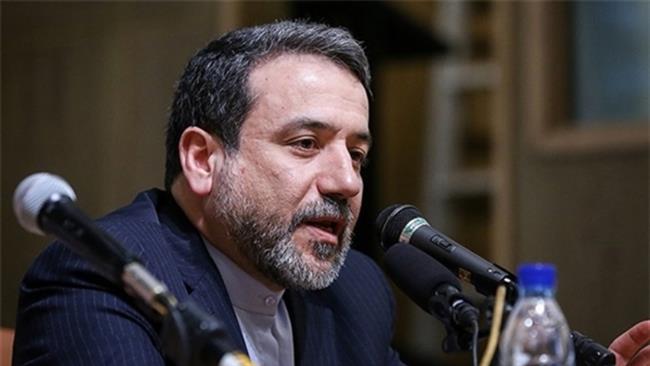
A senior member of Iran nuclear negotiating team, Abbas Araghchi, says the stop in missile tests has nothing to do with the Joint Comprehensive Plan of Action (JCPOA).

Speaking at a session of parliament’s Foreign Policy and National Security Committee Sunday on JCPOA, Araghchi said, “Our missile tests are not the concern of Resolution 2231; the tests might have been stopped for some other reasons but none of them has anything to do with JCPOA.”

He also said the Iranian Foreign Ministry has no sensitivity to present a bill on JCPOA to parliament.

[…]
Certain groups, Araghchi added, resort to articles 77 and 125 of the Constitution, asking for presentation of a bill on JCPOA to parliament and its approval, while others believe JCPOA needs not be endorsed by the chamber.

However, politically speaking, he said, “There should be a balance between commitments of Iran and of P5+1, JCPOA consideration in parliament will add to Iran’s commitments—something that is not consistent with the JCPOA spirit, that is observing the balance. However, we do not have any sensitivity about submitting a JCPOA bill.”

He said that a comparison between Resolutions 2231 and 1921 will show to what extent limitations were set for Iran militarily.

“Restrictions enshrined in Resolution 1921 are many times more than those of Resolution 2231. This means we managed to scale down the strength of sanctions, i.e. replacing ban with limitation,” he added.

The official added, “This means that the arms embargo envisioned by Resolution 2231 has nothing to do with JCPOA. Furthermore, the arms embargo that is the subject of Resolution 2231, is not binding and we can skip its implementation.”

Araghchi further said, “The removal of the arms embargo has never been part of our red lines. The Supreme Leader has declared that the first priority is the elimination of sanctions, economic and financial restrictions. Other sanctions should be lifted in intervals.”

As for the joint commission, he said, “It is a body for settlement of Iran-P5+1 disputes. The commission will, per Annex 4, have working group(s) to help iron out likely disputes among countries. The commission’s members are Iran, the EU and P5+1. The commission approvals are on the basis of consensus.”

As for SWIFT, he said it is both against Iranian banks and individuals, both legal and real entities. He said 800 legal and real entities are freed from SWIFT restrictions and only about 240 legal and real entities are still within the scope of SWIFT concern and Iran is not an exception.

In conclusion, Araghchi said, “Iran’s model had already been observed in the case of other countries. India, Japan, Brazil, and Argentine are the instances. For example, at a juncture, 25 percent of the budget of the International Atomic Energy Agency was spent on inspection of Japan. The reason was concern over Japan’s record of militarism.”

Tabriz to host int’l seminar on e-marketing, tourism on September 1

81721681-70098423

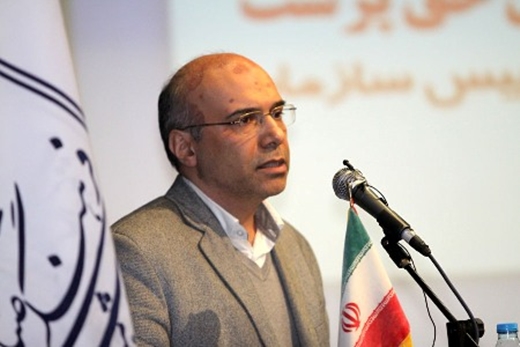
The director general of the Cultural Heritage, Handicrafts and Tourism Department in East Azerbaijan Province said Sunday that a 5th International Seminar of Internet Marketing and Tourism will be held in Tabriz on September 1.

Farzin Haghparast said in light of the wide-scope activities of the private sector in tourism and high tourism capacity of East Azerbaijan Province, holding scientific and specialized seminars will be helpful in the transfer of advanced e-marketing and tourism industry to the public and private sectors to flourish the lucrative, independent tourism industry.

The conference will be held in the cities of Tehran on August 31, in Mashhad on September 2, and Bandar Abbas on September 6.

Sponsored by the tourism department of Iran Cultural Heritage, Handicrafts and Tourism Organization, the conference will be attended by IT scholars.

Topics such as website optimization, Internet marketing and branding through social networks will be covered in the conference.

Focus will be on topics such as the impact of online tools on economic growth, expanding sales and export markets, Internet entrepreneurship and branding of local companies based on successful global models.

Experts in economics and international business are invited to speak at the conference.

The director of Travel Marketing Store in Dubai Duncan Alexander, founder and chief strategy officer of the web-based 90 Digital Company in UK Nik Garner, the managing director of the UK-based Marketing Signals Agency Gareth Hoyle are invited to the conference.

Iran warns Greek airline to remove Tel Aviv from Tehran office’s destinations list

13940525000741_PhotoI

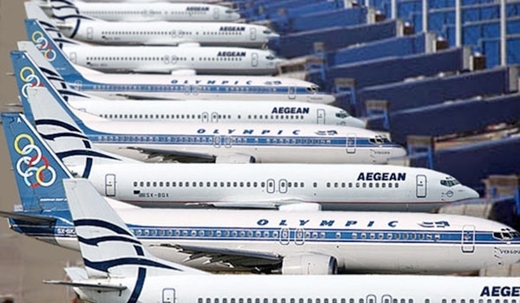
The Civil Aviation Organization of Iran (CAOI) has warned a Greek airliner operating in Iran to remove Tel Aviv from its list of online sales system.

“After a (Iranian) media outlet informed us that Greece’s Aegean Airline has included Tel Aviv in its online sales system, the CAOI in a written warning cautioned the airline to delete this fake name from its list,” CAOI Public Relations Manager Mohammad Rahimi said Sunday.

The official noted that the Civil Aviation Organization will closely follow up the case.

Iran does not recognize Israel and refers to it as Occupied Palestine. Since the 1979 Islamic Revolution, Iran has cut off all ties with Israel and replaced its embassy in Tehran with a Palestine embassy.