Saturday, December 20, 2025
Home Blog Page 4665

Iran must boost defense power: Rouhani

Rouhani

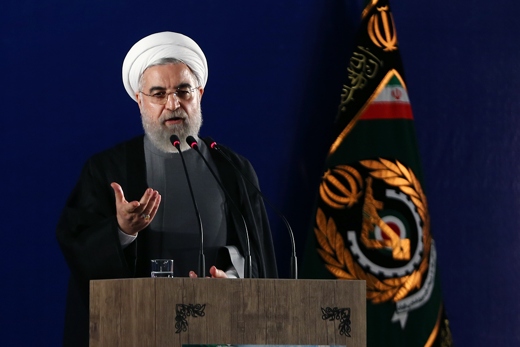
“We should strengthen our defense capability, so that the [nuclear] agreement [reached with the P5+1 group] and stability will remain sustainable in this country and our cordial ties with the region and the world will remain amicable and lasting,” Rouhani said during a ceremony in Tehran on Saturday marking National Defense Industry Day.

He added that Iran’s defense industries are there to defend the country’s territory, interests and people, saying Tehran has never sought to launch aggression against other countries.

Iran pursues a deterrent and defensive strategy and its policy is based on détente, convergence and confidence-building with other countries, he said.

He added that such a policy does not contradict Iran’s “defense power and military industry.”

Deterrent power cannot be achieved only through defense and military industries, Rouhani said, adding the country needs cultural, scientific, political and economic might as well to realize national strength.

“If a country lacks strength, independence and stability, it cannot seek real peace,” the Iranian president reiterated.


Iran’s readiness for anti-terror coalition

Rouhani further said Iran’s power would ensure regional stability and expressed the country’s readiness to form a coalition with countries in the region, which share common goals with Iran, to fight terrorism.

He reaffirmed Iran’s determination to enhance its military power and defend national territory and interests.

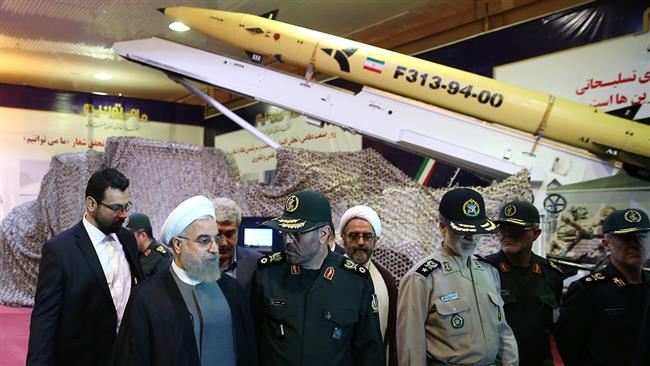
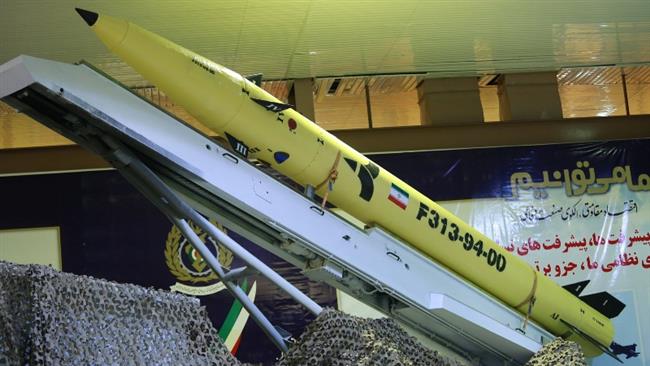
In the presence of President Rouhani, Iran unveiled on Saturday a new solid-fuel precision-guided missile, named Fateh 313, which has been designed and manufactured by experts at the Defense Ministry’s Aerospace Industries Organization.


Iran's Defense Minister Brigadier General Hossein Dehqan (3rd L) speaks to President Hassan Rouhani during a ceremony on August 22, 2015 to unveil a new solid-fuel precision-guided missile, named Fateh 313. © president.ir
Iran’s Defense Minister Brigadier General Hossein Dehqan (3rd L) speaks to President Hassan Rouhani during a ceremony on August 22, 2015 to unveil a new solid-fuel precision-guided missile, named Fateh 313. © president.ir

Fateh 313, with a range of 500 kilometers, is an advanced generation of missiles which runs on combined solid fuel using a domestically-designed sensor.


Iran unveils solid-fuel precision-guided missile

Missle

The new state-of-the-art rocket with a range of 500 kilometers was unveiled during a ceremony in Tehran on Saturday marking National Defense Industry Day in the presence of Iran’s President Hassan Rouhani and a number of senior Iranian officials.

Fateh 313 is an advanced generation of missiles which runs on combined solid fuel using a domestically-designed sensor.

The missile had been previously test-fired and successfully hit targets.

Iran’s Defense Ministry plans to begin the mass production of the rocket.

In recent years, Iran has made great achievements in its defense sector and attained self-sufficiency in producing essential military equipment and systems.

The Islamic Republic has held several military drills to enhance the defense capabilities of its armed forces and to test modern military tactics and equipment.

Iran has repeatedly said its military might poses no threat to other countries, insisting that its defense doctrine is based on deterrence.

Iranian policymakers should deliberate on key issues in weeks ahead: Mousavian

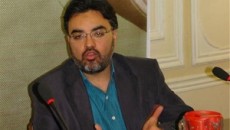
Mousavian

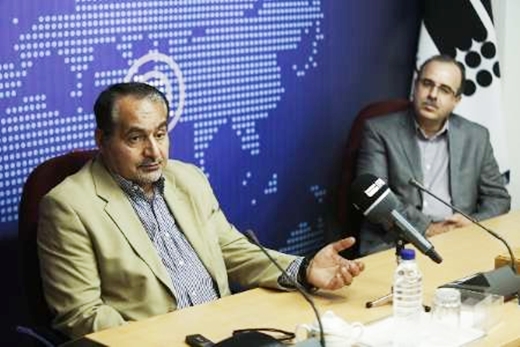
Former deputy head of the Foreign Relations Committee of the Secretariat of the Supreme National Security Council, Hossein Mousavian, says Iranian politicians should think of a number of sensitive issues regarding the Joint Comprehensive Plan of Action (JCPOA) in the weeks ahead.

Speaking in an exclusive interview with IRNA, Mousavian said the issues due to be considered are Zionists’ lobby, poor knowledge of the US Congresspersons, possibility of a plot in the shortest possible time and the likely rejection of JCPOA.

Mousavian said to this end, think tanks can prove more influential than expected.

“Perhaps that’s why the pro-JCPOA thinkers have come to Washington DC from four corners of the world to help the Obama administration,” he said.

Describing the Vienna accord “a diplomatic miracle”, Mousavian added that had it not been for God’s grace, it would not have happened.

He said that’s the only international accord, endorsed by all world powers who recognized Iran’s right to enrichment.

He added that neither the US nor any other member of the UN Security Council has in any official accord formally recognized the right to enrichment for any country.

He said a majority of world experts hardly believed world powers will both recognize Iran’s enrichment right and lift sanctions, adding, “Of course, that’s not an ideal accord for anybody in the Islamic Republic of Iran.”

He said the US Congress does not have the final say on the accord: Even if Congress rejects it, the president will have the legal authority to veto it. “So, JCPOA will be implemented and the rejection of Congress will have little effect on it.”

He said what’s going on in the US is very serious, adding, “In my opinion, it has nothing to do with the nuclear issue. The concern of the opposition elements in Congress, the American Israel Public Affairs Committee (AIPAC), and those opposing JCPOA is something else. They favor continuation and even severance of international sanctions against Iran because they pursue regime change in Iran. At any rate and in case Congress gives a negative vote to JCPOA, the US president will lose the veto power and Iran should from now on take its own choice on such a possibility into consideration and make a decision,” said Mousavian.

Under US law, members of Congress have until September 17 to fully review the final nuclear deal with Iran and pass or reject the Iran-P5+1 nuclear agreement, reached on July 14.

US President Barack Obama has threatened to veto any resolution of disapproval from Congress. In order to block a presidential veto, both the House of Representatives and Senate would have to secure a two-thirds majority vote.

On recent media rumors on Parchin, Mousavian said, “The Zionist regime has made huge investment within the very short span of time left until the review of JCPOA in the US Congress. The time is too short. They do not have more than one and half a month. For the same reason, they write articles mostly for the media; they are highly active in sessions, seminars, busy lobbying in Congress, and are busy in other fields. Each member of Congress meets at least one person opposing the agreement (JCPOA) daily.”

The professor of Princeton University said that unfortunately, contrary to expectations, members of Congress are not much competent in international and diplomatic issues. “You may not believe, but that’s true: 60 percent of the US Congress members do not have passports, have not gone overseas. Their information is at a very low level. This provides Zionists with perfect ground to be influential.”

He said, “I am confident, Obama and the US administration are fully serious up to the end to enforce the deal; however, pressure inside and the propaganda there are very high. Due to the same reason, I believe the problems of Obama inside the US are many times higher than what the Iranian party faces.”

If Israelis manage to win the votes of two-thirds of Congress members through any means, thus depriving Obama of the veto right, the UN resolutions on JCPOA will go in effect, Mousavian said. “Europe and other countries will lift sanctions; this means the world minus the US will implement the agreement. In such case, the US will be isolated.”

Close cooperation between parliament and SNSC supplements JCPOA: Official

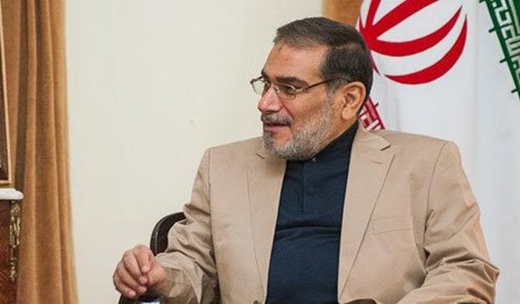
ali-shamkhani

The review of the Joint Comprehensive Plan of Action (the nuclear accord Iran and P5+1 struck in Vienna in mid-July) should not be political or factional in nature, Ali Shamkhani, the secretary of the Supreme National Security Council (SNSC) said in an exclusive interview with the Islamic Republic News Agency on Thursday.

The following is the translation of the brief interview the official news agency released on August 20:

Shamkhani said that the technical, industrial, economic, and inspection- and transparency-related aspects of the nuclear accord Iran and six world powers clinched in Vienna last month are being closely examined in different expert meetings at the Supreme National Security Council.

He went on to say that any review of JCPOA with political or factional interests in mind would undermine both the right and left and play into the hands of the enemies and rivals of the Islamic Republic.

Shamkhani said the result of the review would be announced roughly at the same time other signatories to the deal make the results of their reviews public.

He said securing consensus on the nuclear deal is imperative. “Proper mechanisms are being tapped in the review of JCPOA at the Supreme National Security Council. To that end, establishment of close interaction between the council and the Islamic Consultative Assembly is on the agenda.”

The former defense minister added such cooperation would supplement JCPOA before the results of the steadfastness of the heroic Iranian nation are officially announced.

“It was the Iranian steadfastness in the face of excessive demands by the enemy that brought the Western countries to the negotiating table. Otherwise, P5+1 would not have sat across the table from Iranian diplomats,” he said.

Shamkhani further stated that Iran’s technological progress on the nuclear front forced the enemy which initially insisted on bringing all nuclear activities of the country to a halt to recognize Iran’s nuclear capabilities.

In conclusion, he expressed hope the nuclear deal would eventually consolidate Iranian unity.

Atomic agency rejects AP report on IAEA inspections as speculation

Behrouz Kamalvandi

Iran’s atomic energy agency has dismissed a media report that Iranian experts, instead of the International Atomic Energy Agency (IAEA) staff, will inspect the country’s nuclear sites.

On Thursday, the spokesman for the Atomic Energy Organization of Iran (AEOI) rejected as speculation a recent report The Associated Press about the inspection of Iran’s nuclear sites, adding that the IAEA has so far remained committed to keeping Iran’s documents confidential.

The agency has not made any move in violation of its commitments, Behrouz Kamalvandi stated.

He also stressed that Iran’s considerations have been fully addressed within the framework of Tehran-IAEA cooperation.

Kamalvandi noted that Iran will continue its cooperation with the IAEA in a bid to resolve the disputed issues, adding that as the IAEA has announced in a statement, Tehran has “submitted information related to the agency’s questions by an August 15 deadline.”

Earlier in the day, IAEA Director General Yukiya Amano said in a statement that under the agreed roadmap, the two sides intend to make a series of “separate arrangements” that are “confidential” and cannot be made public based on legal obligations.

Amano described the roadmap signed by Iran and the UN agency in July as “robust” enough to verify outstanding issues on Tehran’s nuclear program.

“The roadmap between Iran and the IAEA is a very robust agreement, with strict timelines, which will help us to clarify past and present outstanding issues regarding Iran’s nuclear program,” Amano added.

The comments came a day after The Associated Press claimed that it has seen a document showing that the IAEA has allowed Iran to use its “own inspectors” to investigate the Parchin military site which some claim is related to the country’s nuclear program.

On July 14, Iran and the IAEA signed a roadmap for “the clarification of past and present issues” regarding Tehran’s nuclear program in Vienna. The deal came on the same day Iran and P5+1 reached an agreement that would give Iran relief from international sanctions in return for curbs on its nuclear program.

The IAEA confirmed in mid-August that Iran has complied with the timeframe set in the roadmap and has given the nuclear body the information regarding its past nuclear activities.

Hammond to reopen British Embassy in Tehran Sunday: Source

iran-uk-embassy

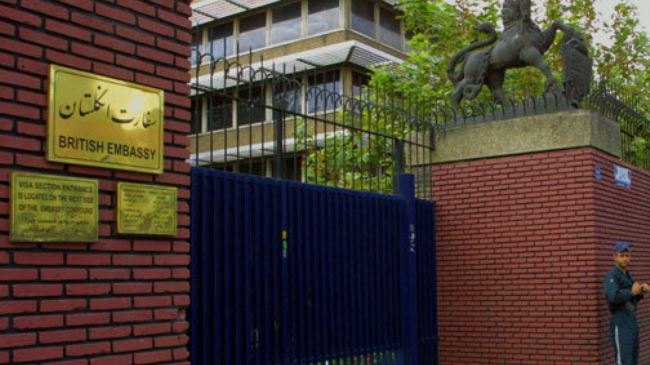
An informed source at Iran’s Foreign Ministry has confirmed reports that British Foreign Secretary Philip Hammond is due in Tehran to reopen his country’s embassy in the Iranian capital.

A number of media outlets including Britain’s Guardian newspaper earlier reported that Hammond will formally reopen the British embassy in Tehran this weekend.

“Hammond will be accompanied on his visit by a handful of British business leaders as well as the Foreign Office political director, Sir Simon Gass, who represented Britain in the marathon talks leading up to the July nuclear agreement,” the newspaper wrote.

The source in the Iranian Foreign Ministry confirmed the reports, saying the reopening will take place during a visit by Hammond to Tehran on Sunday.

Following the successful conclusion of nuclear talks between Iran and P5+1 (Russian, China, the US, Britain, France and Germany), the British foreign secretary hoped that his country’s embassy would reopen in Tehran in the current year.

He will be Britain’s first top diplomat to visit Iran in nearly 14 years.

Iran and an and the sextet on July 14 reached a conclusion in Vienna, Austria, on a lasting nuclear agreement that would terminate all sanctions imposed on Tehran over its nuclear energy program after coming into force.

Tehran-London relations became tense in 2011. On November 27 of that year, a large number of Iranian lawmakers voted to downgrade diplomatic ties with Britain, following London’s decision to impose sanctions on the Central Bank of Iran.

Later, a group of angry Iranian students stormed the British embassy in Tehran and pulled don thwe Union Jack.

Following the incident, Britain withdrew its diplomatic staff from Tehran on November 30 and asked Iran’s diplomatic delegation in London to leave within 48 hours.

Iran and Britain agreed in October 2013 to appoint non-resident chargé d’affaires as a first step toward reopening their respective embassies.

Four-year research to narrate the story of young Agnelli

Agnelli

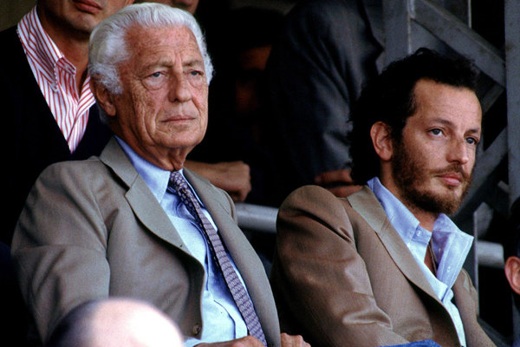
EdoardoAn Iranian writer says he has spent almost four years on doing research into the life of Edoardo Agnelli, the eldest son of Gianni Agnelli, the industrialist patriarch of Fiat, before penning a book on Edoardo and his mystery death [in November 2000].

Behzad Daneshgar further said that he has got his hands on unpublished documents on the mystery death of the young Italian man who had converted to Shiite Islam.

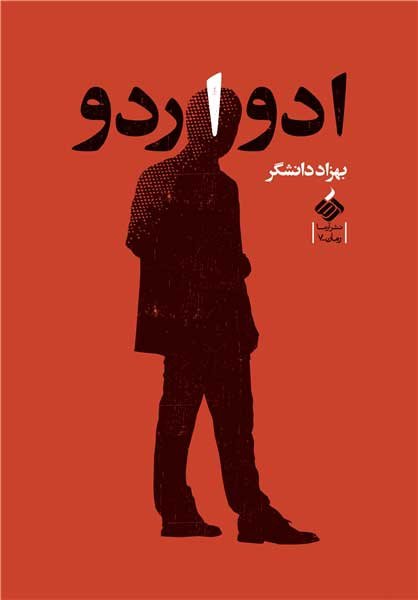
Mehr News Agency on August 19 released a report on Edoardo, a new novel written by Daneshgar. Arma Publications has recently sent the novel to bookstore shelves across Iran.

Edoardo’s father, the famous Italian businessman [and industrialist], was the owner of a number of car manufacturing factories – including Fiat, Ferrari, Maserati, Alfa Romeo, Lancia, Abarth [a racing car], and Iveco – as well as a few factories which produce industrial parts. He also owned private banks, fashion design, and clothing companies; La Stampa and Corriere della Sera newspapers; and Juventus football club. Later in his life, Edoardo converted to Shiite Islam. An heir to his father’s fortune, he died a suspicious death [in Italy at the age of 46].

A long wish

Behzad Daneshgar
Behzad Daneshgar

Daneshgar says a documentary on Edoardo Agnelli hit the screen years ago, adding he got inspiration from that documentary to write his novel. He says after watching that film, he wished he could write something about this man.

“It was about four years ago that, through some friends, I met with Mr. Ghadiri Abyaneh and those in Isfahan who were familiar with Edoardo. With their help, I contacted the team which produced the documentary on Edoardo’s life. It took me one and a half years to organize my studies on Edoardo.

“As I was doing research for my novel, I found documents – some translated and some original texts – in Italy. Having this collection of research, I started to write the novel which took me one and half years to complete,” Daneshgar added.

[…]

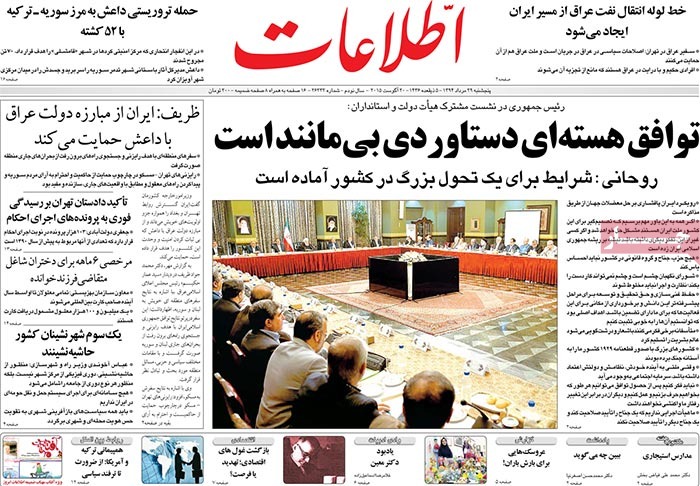
A look at Iranian newspaper front pages on August 20

Iranian Newspapers Headlines

President Rouhani’s important comments on elections and the nuclear deal his administration has cut with six world powers dominated the front pages of Iranian newspapers on Thursday. The verdict issued in the fraud and accessory to murder case of Saeed Mortazavi, a former director of the Social Security Organization, was also on the cover of most dailies.


Ettela’at: “The nuclear deal is a unique achievement,” President Rouhani told a joint meeting of his Cabinet and governors general from across the country.

He further said that the stage is set for major transformation in the country.


Abrar: “A single party or faction won’t dominate the future parliament,” President Rouhani said.

Abrar: An MP has described the performance of the minister of economy and financial affairs as “very positive”.

The impeachment of Dr. Ali Tayyebnia is likely to be shelved.

Abrar: Saeed Mortazavi, a former director of the Social Security Organization, has been sentenced to one year in jail. Six months of his prison term is suspended.

Mortazavi has been found not guilty [on charges of being an accessory to murder] in the case related to Kahrizak detention facility.
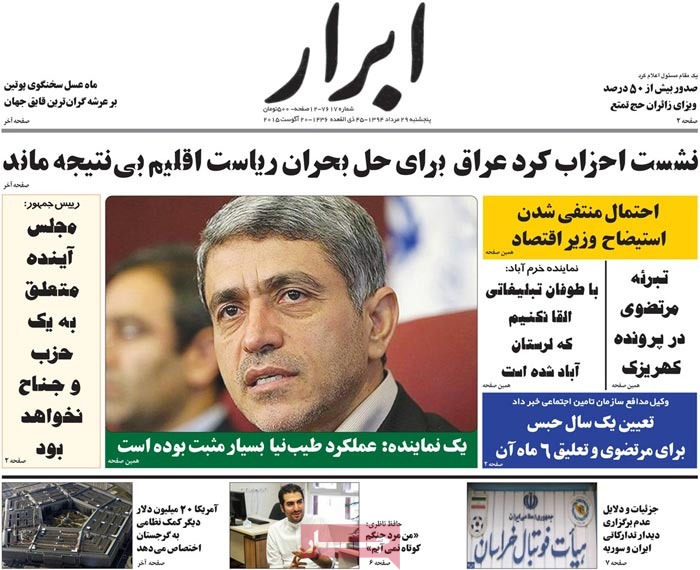
 

A look at Iranian newspaper front pages on August 20


Afarinesh: President Rouhani has said that Iran’s approach centers on dialogue to settle global problems.
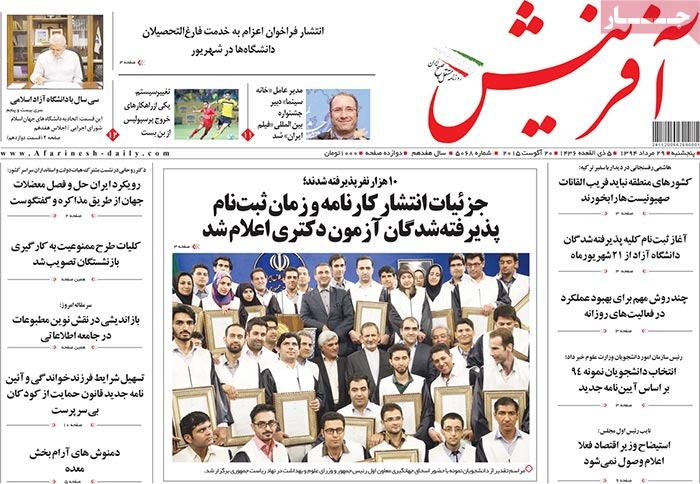
 

A look at Iranian newspaper front pages on August 20


Afkar: “Parliament will either vote on the Joint Comprehensive Plan of Action or will prepare a report on it,” said the chairman of the National Security and Foreign Policy Committee of the Islamic Consultative Assembly.
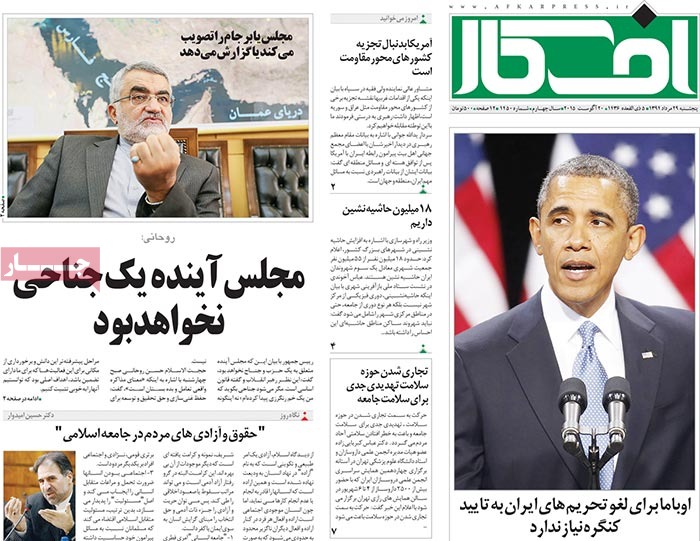
 

A look at Iranian newspaper front pages on August 20


Aftab-e Yazd: “The Guardian Council oversees the elections; it does not organize them,” President Hassan Rouhani said.
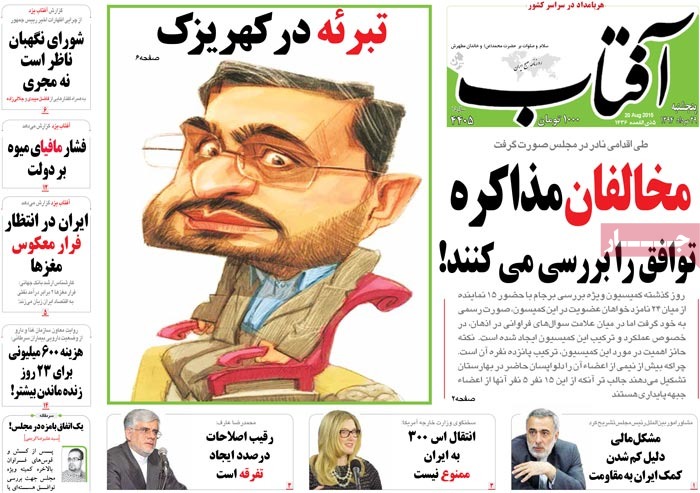
 

A look at Iranian newspaper front pages on August 20


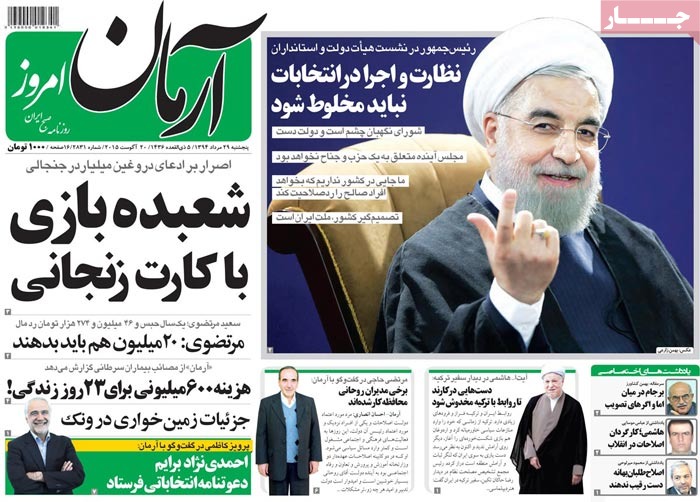
Arman-e Emrooz: President Rouhani has said that electoral oversight and implementation should not mix.

Speaking at a joint meeting of his Cabinet and provincial governors from across the country, the president said that the Iranian people make decisions for the country.

Arman-e Emrooz: “There are some efforts [behind the scenes] to disrupt ties between Iran and Turkey,” said Chairman of the Expediency Council at a meeting with the Turkish ambassador to Tehran.
 

A look at Iranian newspaper front pages on August 20


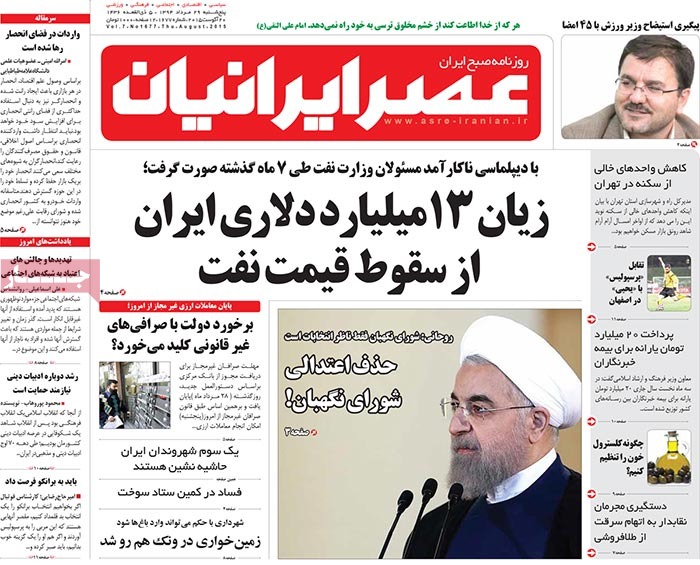
Asr-e Iranian: Thanks to the ineffective diplomacy of Oil Ministry officials in the past seven months, the drop in oil prices has cost Iran $13 billion dollars in revenues.
 

A look at Iranian newspaper front pages on August 20


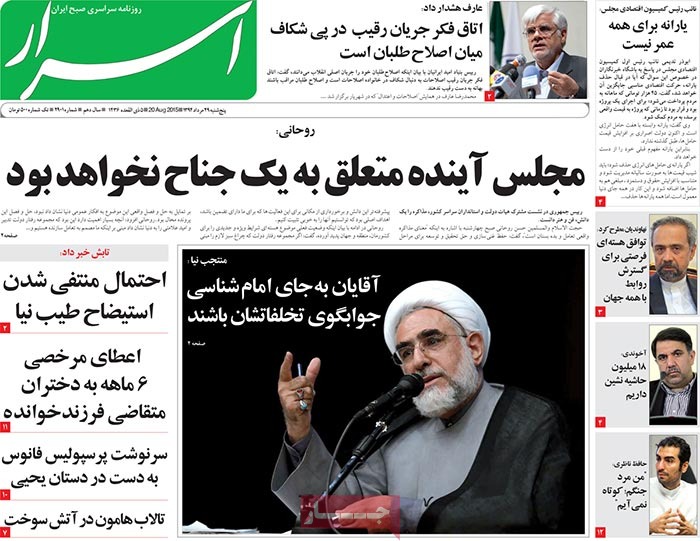
Asrar: The chief of staff of President Rouhani has said that the nuclear deal opens up an opportunity for the country to expand ties with the rest of the world.
 

A look at Iranian newspaper front pages on August 20


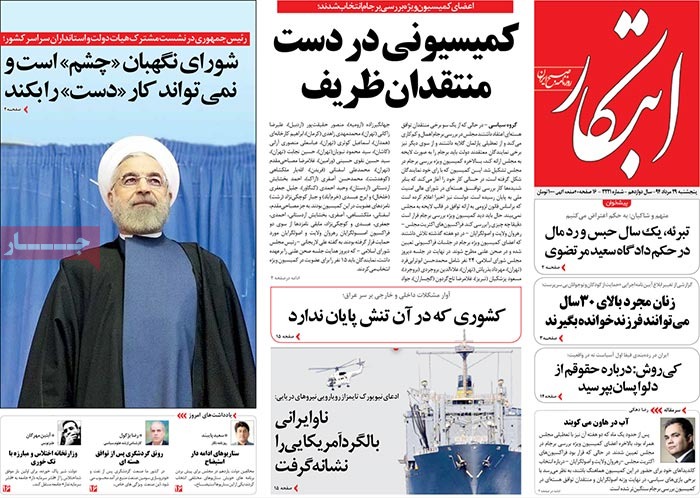
Ebtekar: A parliamentary committee dominated by MPs critical of Foreign Minister Zarif

Members of the JCPOA Review Committee have been named.

Ebtekar: Unmarried women above 30 years of age can adopt children.
 

A look at Iranian newspaper front pages on August 20


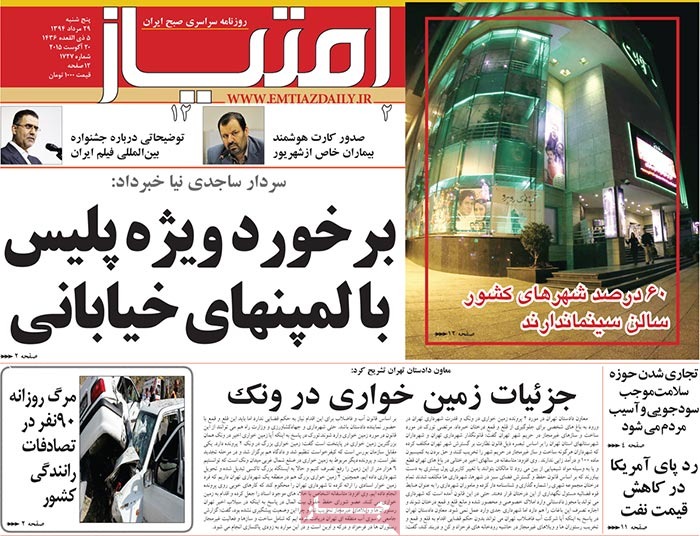
Emtiaz: Road accidents across the country claim as many as 90 lives each day.

Emtiaz: Some 60 percent of Iranian towns do not have movie theaters.
 

A look at Iranian newspaper front pages on August 20


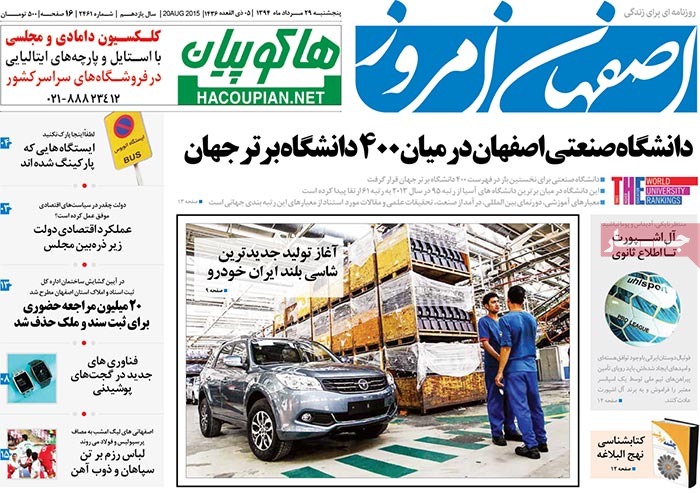
Esfahan Emrooz: Production of a new SUV at Iran Khodro [Iran’s largest automotive company] has started.
 

A look at Iranian newspaper front pages on August 20


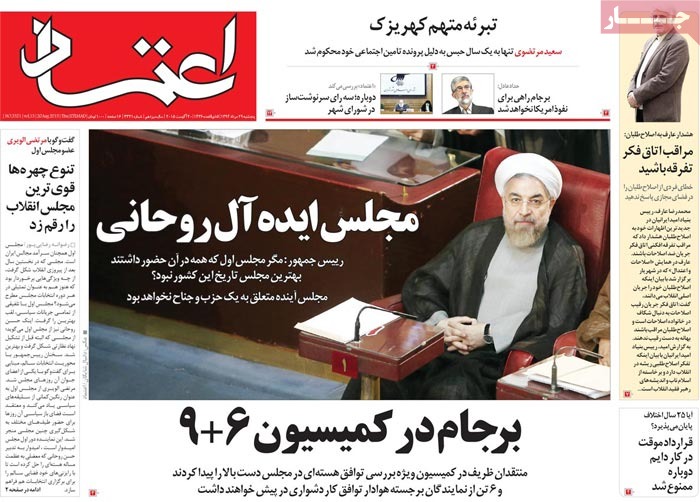
Etemad: The Joint Comprehensive Plan of Action is to be reviewed in the 9+6 committee.

Critics of Foreign Minister Zarif have the upper hand in the 15-member parliamentary review committee.

The six members of the committee who support the nuclear deal will have a difficult job on their hands.
 

A look at Iranian newspaper front pages on August 20


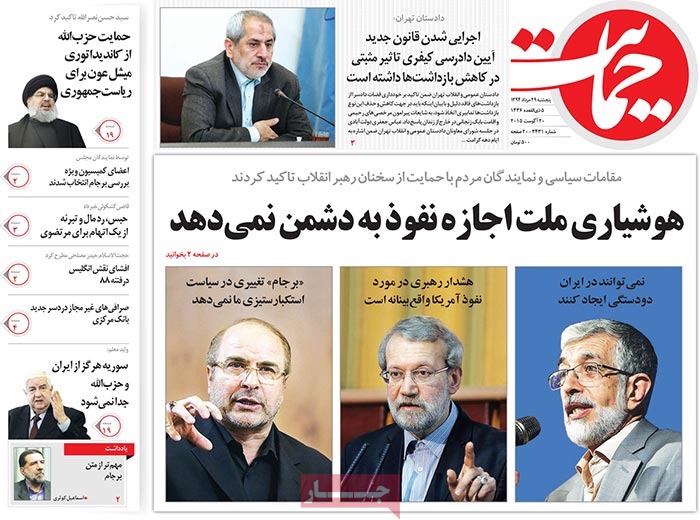
Hemayat: Political figures and representatives have supported the Supreme Leader’s comments on the need for public vigilance to frustrate enemy inroads.

“They can’t create divisions in Iran,” said Gholamali Haddad Adel.

“The Supreme Leader’s warning on American efforts to infiltrate the country is realistic,” said Parliament Speaker Ali Larijani.

“JCPOA won’t change our policy of standing up to hegemonic powers,” said Tehran Mayor Mohammad Bagher Ghalibaf.
 

A look at Iranian newspaper front pages on August 20


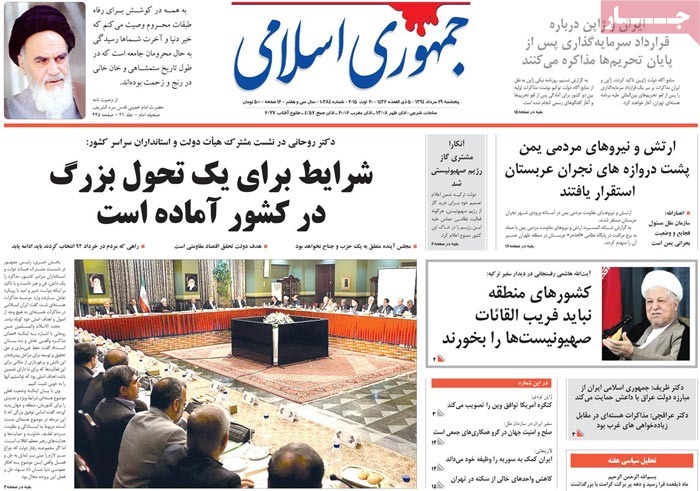
Jomhouri Islami: Iran and Japan are to hold talks on investment in Iran in the post-sanctions era.
 

A look at Iranian newspaper front pages on August 20


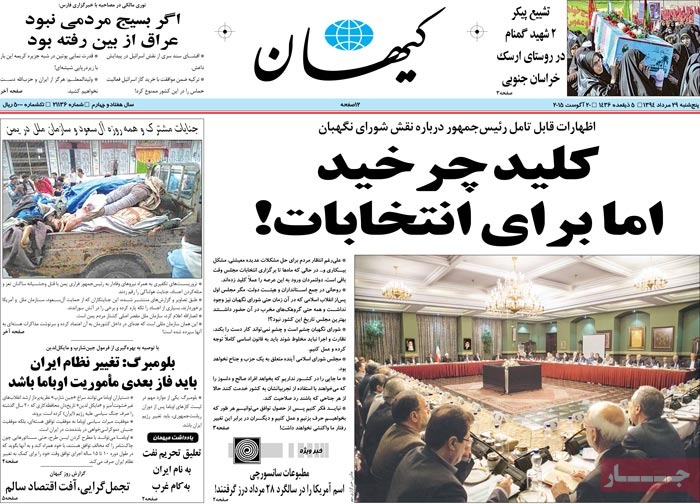
Kayhan: The key turned, but for elections! [A sarcastic reference to candidate Rouhani’s campaign theme that he holds the key to the country’s problems]

The thought-provoking comments of the president on the role of the Guardian Council
 

A look at Iranian newspaper front pages on August 20


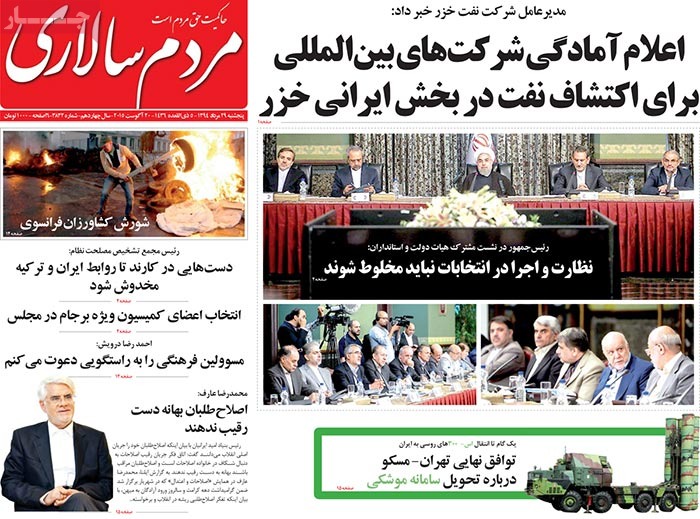
Mardomsalari: International companies have expressed readiness to explore oil in the Iranian-owned section of the Caspian Sea.
 

A look at Iranian newspaper front pages on August 20


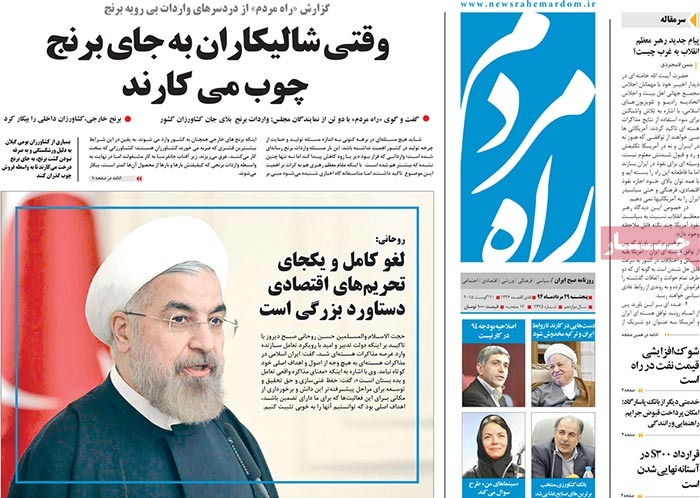
Rah-e Mardom: “Having economic sanctions terminated all at once is a great achievement,” President Rouhani said.
 

A look at Iranian newspaper front pages on August 20


Roozan: “Top clerics have not opposed the presence of women in sports stadiums,” said the deputy governor of Tehran Province.

“We are being accused on the world stage of failure to respect the most basic rights of women,” he said.
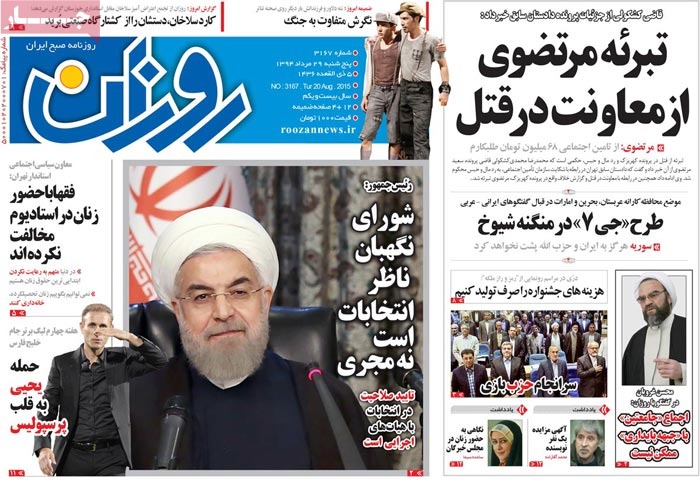

 

A look at Iranian newspaper front pages on August 20


US, allies thwarted in Mideast: IRGC commander

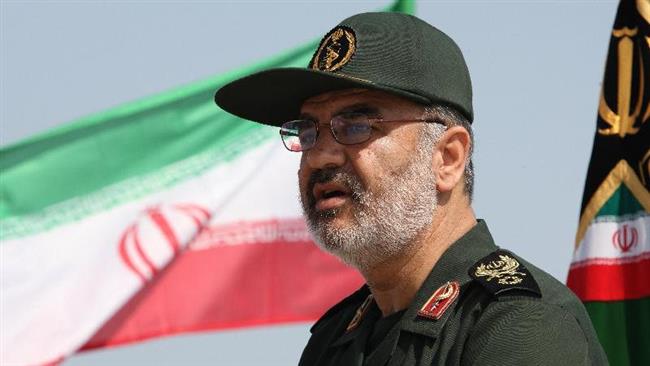
General Salami

A senior Iranian commander says the Islamic Republic has frustrated the schemes of the United States and its allies in the Middle East, adding that Tehran is turning into a major international power.

Brigadier General Hossein Salami, the second-in-command of the Islamic Revolution Guards Corps (IRGC), made the remarks at gathering in the northeastern Iranian city of Mashhad on Wednesday.

Salami slammed the 1953 US-led coup against the government of democratically-elected Prime Minister Mohammad Mosaddeq, saying Iran’s 1979 Islamic Revolution changed the “balance of power” in the world, and the country is no more dependent on foreigners like in the past.

“Today, we are thwarting all allies of the United States in the region,” stressed the Iranian general.

In August 1953, the British and American intelligence agencies initiated a coup by the Iranian military, setting off a series of events, including riots in the streets of the capital, Tehran, which resulted in the overthrow and arrest of Mosaddeq.

Six decades after the notorious coup, the US spy agency CIA for the first time published a document in August 2013 which confirmed Washington’s role in the coup d’état.

Salami further pointed to Washington’s efforts to bring the nuclear talks with Iran to fruition, saying the White House would never opt for diplomacy should it find weakness in a country.

Washington’s recourse to “the path of diplomacy” shows the failure of its “sanctions strategy,” he added.

“Iran is now turning into a major international power,” Salami said.

The US uses military measures to deal with other countries, the Iranian commander said, adding that the country, however, does not make such a move in the case of Iran as Washington is well aware of the Islamic Republic’s might.

On July 14, Iran and P5+1 reached a historic agreement, dubbed the Joint Comprehensive Plan of Action (JCPOA), which is aimed at ending years of Western standoff with Tehran over the latter’s nuclear activities.


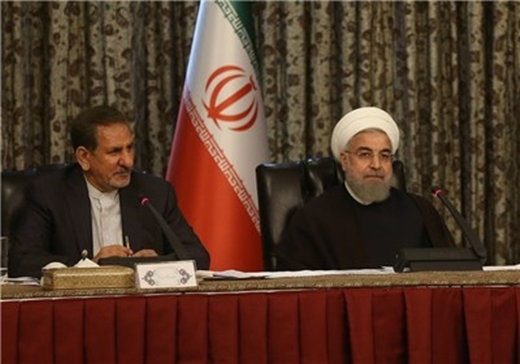
Iran achieved its goals in nuclear talks: Rouhani

Rouhani

Iranian President Hassan Rouhani on Wednesday hailed the recent conclusion of nuclear talks between Tehran and world powers, saying that the country achieved its goals in the talks.

Speaking in a cabinet meeting in Tehran, Rouhani said Iran managed to realize its major objectives in the important negotiations.

He went on to say that the termination of financial, bank, transport, and other economic sanctions was among the most important goals Iranian negotiators managed to accomplish.

It is a “great and outstanding” achievement that a country manages to make the United Nations Security Council nullify its previous resolutions against it and get its enrichment right ratified by UNSC members, he added.

Iran and 5+1 (Russia, China, the US, Britain, France and Germany) on July 14 reached a conclusion on a lasting nuclear agreement that would terminate all sanctions imposed on Tehran over its nuclear energy program after coming into force.

The 159-page deal has its own opponents and proponents both in Iran and the other countries that are parties to JCPOA, including the US.

While the United Nations Security Council has adopted a resolution to endorse the deal, the text of the document needs to be ratified by both Iran’s Parliament and the US Congress.