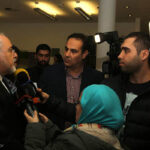
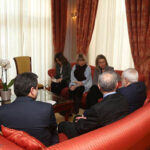
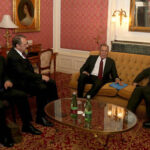
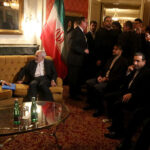
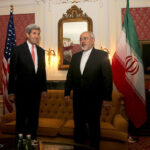
Iranian President Hassan Rouhani says the Islamic Republic supports peace and stability in Afghanistan.
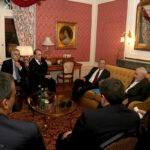
“The Islamic [Republic of] Iran favors a secure, stable and united Afghanistan,” Rouhani told the visiting Chief Executive of Afghanistan Abdullah Abdullah in Tehran on Tuesday.
Rouhani gave a positive assessment of the formation of national unity government in Afghanistan, saying it proves the “maturity” of Afghan political leaders who have paved the way for “unity and consensus among all ethnic Afghan groups.”
The Iranian president noted that security is the key requirement for Afghanistan and the entire region and expressed hope that unity in the country would result in further development of the Central Asian country.
He said that Iran’s policy is based on strengthening Tehran-Kabul ties.
“Iran welcomes the expansion of cooperation with Afghanistan particularly in the economic, cultural and environmental sectors,” said Rouhani.
He also said that the production and smuggling of narcotics poses a challenge whose tackling requires regional cooperation.
For his part, Abdullah heaped praise on the Islamic Republic for its all-embracing support for his country, saying the Iranian government and nation have always stood by the Afghan nation.
The Afghan chief executive expressed hope that the proper conditions would come about soon to facilitate the return of Afghan refugees living in Iran.
Roadmap for Iran-Afghanistan ties: Zarif
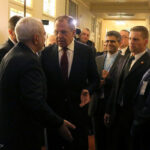
In a meeting with Abdullah earlier on Tuesday, Iranian Foreign Minister Mohammad Javad Zarif stressed the importance of drawing up a roadmap for bilateral cooperation in different fields including transit of goods, trade, security and legal issues.
He commended the Afghan government’s efforts to establish security and peace in the country within the framework of dialog among all ethnic Afghan groups.
Zarif and Abdullah also discussed the latest regional and international developments and ways to improve constructive cooperation in fighting terrorism and extremism.
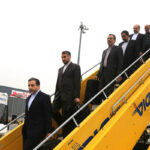
Heading a high-ranking delegation, Abdullah arrived in Tehran on Monday for an official three-day visit.
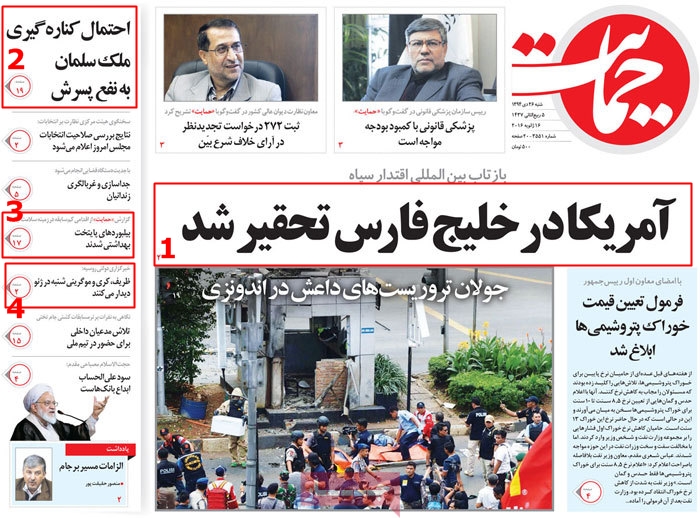
Over the past two years, the Saudi government has openly aligned itself with the Zionist regime and tried to use all manner of means to interfere with Iran’s renewed interaction with foreign countries and [the conclusion of] the Joint Comprehensive Plan of Action. Riyadh has exhaustively tapped into its potential to materialize such a goal.
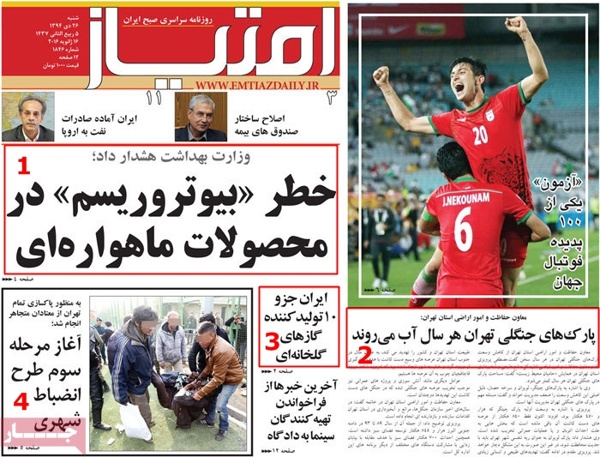
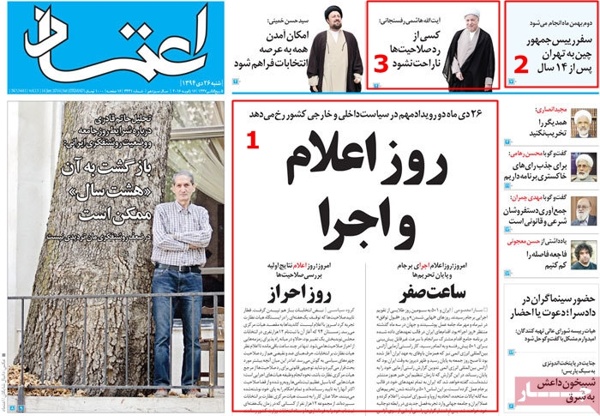
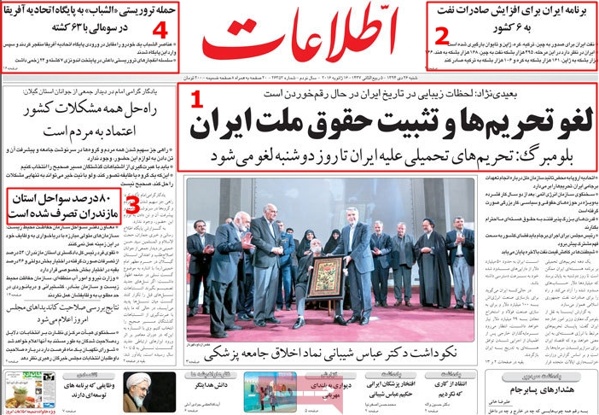
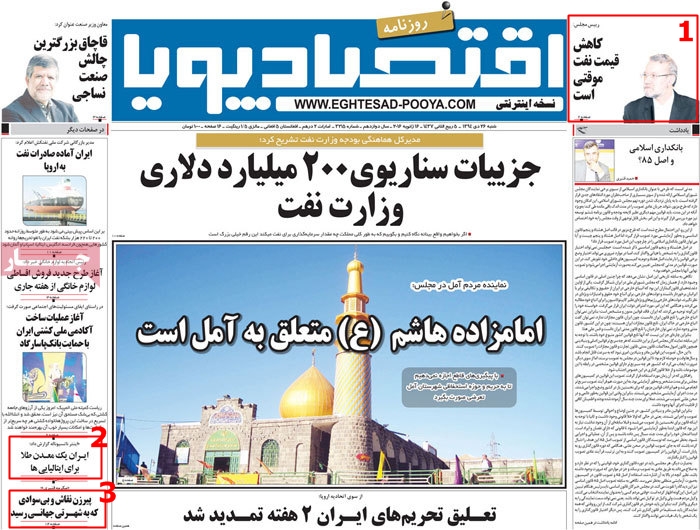
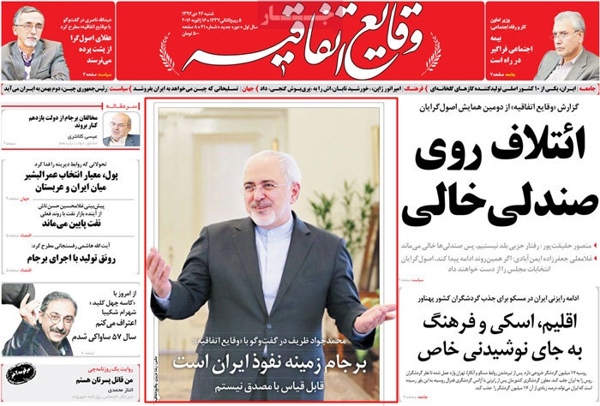
Vaghaye-e Etefaghiyeh’s front page – Jan. 5
Foreign Ministry Spokesman Hossein Jaberi Ansari wrote this at the beginning of a piece Vaghaye-e Etefaghiyeh daily published on January 5. The following is the translation in its entirety of the piece – which focused on Saudi Arabia and what developed in the wake of the Saudi execution of prominent Shiite cleric Sheikh Nimr:
After its attempts to obstruct the conclusion of JCPOA failed, the Saudi government tried to stop the Iran nuclear deal from being implemented; we have now gone through the latter stage.
It is crystal clear that in current circumstances Saudi Arabia – like Israel – is seeking to advance its interests in two core issues: confrontation with Iran and continuation of crises in Western Asia. In other words, to the Saudis growing regional tensions safeguard their interests and even their survival.
A question arises here as to whether or not the Saudis will be able to create an alliance against Iran in the region. That will not be an easy path to walk down, I should say, because those countries which characterize themselves as politically independent and pursue their own goals and plans, will never accept to follow in the footsteps of Saudi Arabia.
Despite growing pressure from Riyadh, such countries have refused to follow the lead of Saudi Arabia. The decision by two small countries – Bahrain and Djibouti which are somehow viewed as Saudi Arabia’s affiliates – to follow the lead of Riyadh will not challenge the argument above.
Those countries which value and respect their past and have a broader knowledge about the current trends in the world have set their own priorities which are different from those of Saudi Arabia. There is a dividing line between the policies of other countries and those of Saudi Arabia’s, both at regional and international levels, a distinction whose signs are clearly visible.
As for what happened [on Saturday] at the Saudi Embassy in Tehran, we see a kind of law-breaking by certain groups. Those behind the embassy attack are being duly dealt with, and some of them have been arrested and referred to judicial officials.
Iran honors its commitments on ensuring the security of foreign embassies and diplomatic missions under international conventions. This is not the first case in this regard; what matters more is that the Iranian government has fulfilled its commitments and that the law enforcement and judicial forces have put top on their agenda efforts to [seriously] deal with the perpetrators of the Saudi Embassy incident.
There are speculations that certain groups at home who are opposed to the Joint Comprehensive Plan of Action resort to such approaches in a bid to create obstacles in the way of the government’s [foreign] diplomacy.
But we should bear in mind that foreign policy issues are like national and sovereignty-related questions. These questions – either JCPOA or relations with regional and international powers – are national issues which should be excluded from partisan and factional bickering.
What the foreign policy apparatus has on its agenda for dealing with questions such as the Iran nuclear deal and regional and international relations comes from policies adopted by the country’s high decision making bodies. As the executor of national and sovereignty-related decisions, the Foreign Ministry simply carries out the decisions and deals with the details.
We believe that it is by no means acceptable and befitting to turn questions of national and foreign policy value into bones of contention and use them as a means to settle political scores. Such a behavior will only waste the country’s potential and capabilities and cause Iran to face further problems.
In the capacity of Foreign Ministry officials, we call on all people, figures, [political] groups and parties to contemplate the following idea: in dealing with foreign policy issues, national interests should not be tied to daily issues.
Three months after the first missile town of the Islamic Revolution Guards Corps (IRGC) was revealed, Iran’s Parliament Speaker Ali Larijani Tuesday toured another underground missile facility of the Revolution Guards.
Different missiles, including the Emad ballistic missile which has a range of 1,700 kilometers, can be seen in the images released of the facility.
The IRGC has announced that it has set up big underground facilities in most cities which are safe from the enemy crosshairs and will be used if necessary.
Supreme Leader of the Islamic Revolution Ayatollah Seyyed Ali Khamenei has reiterated Iran’s support for Afghanistan, saying the Islamic Republic regards peace and security in the neighboring country as its own.
In a Tuesday meeting with Afghanistan’s Chief Executive Officer Abdullah Abdullah in Tehran Ayatollah Khamenei pointed to the ongoing problems facing the Afghan nation, and said unity among various ethnic groups in the South Asian country is the most important solution to the problems.
“The Islamic Republic of Iran regards the security, tranquility and progress of Afghanistan as its own security and progress,” Ayatollah Khamenei added.
The leader further touched upon the history of close relations between Tehran and Kabul and highlighted the numerous potential of the two Muslim countries to boost mutual cooperation in various fields, including science and economy.
“Promotion of the level of cooperation is in the interest of both sides and differences of opinion, like the issue of water across the border shared by the two countries, should be resolved with cordiality and cooperation,” the leader stated.
Abdullah, for his part, described insecurity and the existence of terrorist groups in Afghanistan as the country’s main problem and said Kabul is trying to resolve the problem with trust in God and through measures to boost unity among the Afghan people as well as cooperation with “the Iranian brothers and friends”.
Iranian President Hassan Rouhani says Saudi Arabia will not be able to distract from its “great crime” of killing a religious leader by severing its ties with the Islamic Republic.
Referring to the execution Saturday by Saudi Arabia of prominent Shiite cleric Sheikh Nimr al-Nimr, President Rouhani said on Tuesday, “It is only natural that a crime against Islamic and human rights will be met with reaction from public opinion.”
“Of course, the Saudi government, in order to cover up its crime of beheading a religious leader has resorted to a strange measure and has severed its ties with the Islamic Republic, whereas, undoubtedly, such moves will never hide that great crime,” said the Iranian president, who was speaking at a meeting with Danish Foreign Minister Kristian Jensen in Tehran.
Saudi Arabia faced strong condemnation from Iran, as well as other countries, soon after the execution of Sheikh Nimr, who was a vocal critic of the Riyadh regime.
“Criticism should not be responded to with beheading,” President Rouhani said, adding, “We hope that European countries, which always react to issues of human rights, act on their human rights-related obligations in this case, too.”
Demonstrations were held in the Iranian capital and other Iranian cities to condemn the killing of Sheikh Nimr. Demonstrations were held, among other places, in front of the Saudi embassy in Tehran and its consulate in the northeastern city of Mashhad by protesters censuring Saudi Arabia.
Amid the largely peaceful protests, a group of people scaled the walls of the consulate in Mashhad while incendiary devices were hurled at the embassy in Tehran. Some 50 people were detained over the violation of the diplomatic perimeters.
On Sunday, Saudi Foreign Minister Adel al-Jubeir announced his country was cutting diplomatic relations with Iran.
Recounting Copenhagen’s reaction to Saudi Arabia’s execution, Jensen told President Rouhani that Denmark was the first country to condemn the killing of Nimr.
Darougheh House, a historical house in Mashhad was built by Russian architects in the late years of Qajar era. The house, which was built for the police chief [Darougheh in Persian] of the northeastern city, has been registered as one of Iran’s national heritage sites.
A country like Iran whose foreign policy is mostly based on calculations is unlikely to be checkmated by others.
An article on Asr-e Iran website on January 4 took a closer look at the impact of the execution by the Saudis of prominent Shiite cleric Sheikh Nimr al-Nimr on already weak relations between Iran and Saudi Arabia. The following is the translation of the final part of the piece; the headline has been chosen by IFP:
A look at the history of the foreign policy of the Islamic Republic of Iran over the past three decades shows that although at times it has been affected by problems such as sloganeering and ill-thought-out moves, it has mostly opted for logical approaches to ride out complicated regional crises. In line with such a policy, the country has not opted for costly adventurism; rather, it has chosen indirect tools over direct confrontation.
Iran’s foreign policy machine has always left the door open, although a crack, for dialogue with rivals and belligerent parties. The invasion of Kuwait by Saddam’s Iraq, US invasion of Afghanistan after 9/11 and US invasion of Iraq in March 2003 can be used to uphold such argument.
The fact that the Saudis executed Sheikh Nimr and then cut their diplomatic ties with Tehran days ahead of an expected termination of sanctions – as a result of which the Islamic Republic will be set for an economic leap and a re-launch of development measures following years of recession and economic contraction – is too much of a coincidence.
Aware that the Rouhani administration is getting rid of troublesome foreign policy issues to shift its focus to local economic problems, the Saudi government seems to want to drag Iran into new adventurism. As it was already mentioned, if the new Saudi politicians take a closer look at Iran’s foreign policy over the past three decades, they will come across a delicate point: adventurism has no place in Iran’s foreign policy.
Even after the killing of hundreds of Iranian citizens at the hands of the Saudi forces during a bloody Hajj pilgrimage three decades ago, the Islamic Republic wound not opt for direct confrontation with the Saudis. The current bone of contention is the inhumane execution of a number of Saudi citizens, including an opponent cleric. Naturally, the Islamic Republic uses conventional channels to convey its proportionate protest at the conduct of the Saudis.
If the new Saudi officials have done this to provoke Iran and send tensions between the two countries soaring, they are miscalculating, because records show that the final output of Iran’s foreign policy is based on calculations and that Tehran is unlikely to react to such measures and be checkmated.
But if the Saudis seeks to ignite a wider sectarian conflict in the Middle East in a bid to open new fronts against Iran and thus put more pressure on Tehran, one needs to wait and see to what extent Iran will be able to exert influence over its allies not to walk into the trap of sectarian tension and war.
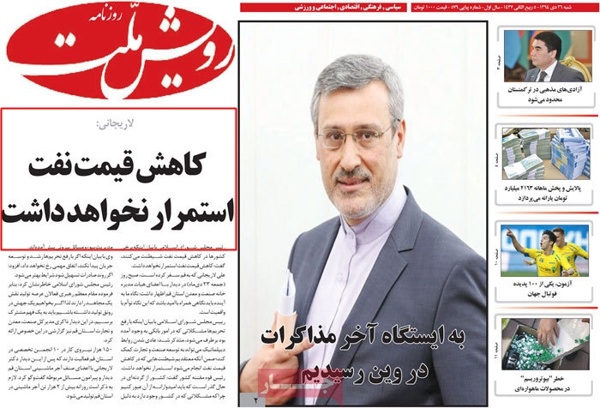
Head of Iranˈs negotiating team to the expert meeting, Hamid Baeedinejad
A ranking Iranian diplomat described Saudi Arabia’s decision to cut diplomatic ties with Iran as yet another error in a string of mistakes the Saudi officials have been making to cover up their “strategic weakness” in the region.
The international political think tanks and even the allies of Riyadh affirm that the Saudi rulers’ problem with Iran is Tehran’s increasing power, which is a result of the Islamic Republic’s prudent policies in the region, Hamid Baeedinejad, the director general for political and international affairs at Iran’s foreign ministry, said in his Instagram page.
Riyadh became increasingly frustrated when it failed to prevent a final nuclear deal between Iran and world powers that stabilized Iran’s might in the region, the diplomat added.
On Saturday, Saudi Arabia executed prominent Shiite cleric Sheikh Nimr al-Nimr, among dozens of others. The execution ignited widespread international condemnation, from both political and religious figures.
In the early hours of Sunday, furious demonstrators in the Iranian cities of Tehran and Mashhad stormed Saudi Arabia’s diplomatic buildings in protest at the Al Saud’s execution of the popular cleric.
Iranian President Hassan Rouhani criticized the incident and called for the perpetrators to be brought to justice.
Saudi Arabia, however, severed its diplomatic relations with Iran and gave the Iranian diplomats 48 hours to leave the kingdom.
First Vice President Eshagh Jahangiri renewed the Islamic Republic of Iran’s support for security and stability in Afghanistan.
“The security and stability of Afghanistan is highly important for the Islamic Republic of Iran and Afghanistan’s security is tantamount to our security,” Jahangiri said after his meeting with Afghanistan’s Chief Executive Officer Abdullah Abdullah in Tehran on Monday.
He underlined Iran’s sensitivity to the Afghan security, and said that the fight against extremism and terrorism plays an important role in this regards.
Afghanistan and Iran share many commonalities and the two countries have established cooperation in the field of regional issues, he added.
He said that the Iranian and Afghan officials have held good and positive meetings, and added that during these meetings the two sides presented positive and constructive points.
Iran is one of the most important donors to Afghanistan, which has kept its promises to help with the reconstruction of the war-ravaged country.
Iran has built several roads, power transmission lines, border stations and many other infrastructure projects to better link the two nations.
Iran has also contributed more than $ 50m annually to the Afghan anti-narcotics efforts during the past five years.
Tehran has repeatedly called for a withdrawal of the US-led foreign troops from Afghanistan, stressing that establishment of peace and security in the war-ravaged country is possible only through cooperation among regional states.
A senior Iranian official says any attempt to impose new sanctions on Tehran and restrict its defense and deterrence capabilities will undermine the nuclear agreement reached between Iran and P5+1.
In a meeting with Danish Foreign Minister Kristian Jensen in Tehran on Monday, Secretary of Iran’s Supreme National Security Council (SNSC) Ali Shamkhani reaffirmed the Islamic Republic’s goodwill to precisely and swiftly implement its obligations under the nuclear agreement, known as the Joint Comprehensive Plan of Action (JCPOA), and said the execution of the deal requires that both sides fulfill their commitments.
He added that Iran will show a “strong reaction” to any measure aimed at imposing restrictions on its defense capabilities.
In a letter to Iran’s Defense Minister Brigadier General Hossein Dehghan on December 31, President Hassan Rouhani ordered stepped-up production of missiles after reports that the US was preparing fresh sanctions on international companies and individuals in Iran.
The Wall Street Journal said later that the White House had delayed plans to impose new sanctions on Iran but added that the measures remained on the table.
The SNSC secretary further expressed hope that exchange of political and economic delegations between Iran and European countries would have positive outcomes on the expansion of all-out relations.
Shamkhani said the necessary ground has been prepared for Tehran and Copenhagen to improve cooperation in various economic and industrial sectors.
The Danish foreign minister, for his part, commended Iran’s effective measures to precisely fulfill its commitments under the JCPOA.
Jensen said his country is determined to boost relations with Iran in all fields and added that the two countries have numerous grounds for economic and technical cooperation.
On July 14, 2015, Iran and P5+1 finalized the text of the JCPOA on Tehran’s nuclear program in the Austrian capital, Vienna.
Under the agreement, Iran will accept restrictions on its nuclear program in return for the removal of sanctions imposed on Tehran by the US and the EU.