Friday, December 26, 2025
Home Blog Page 4618

A look at Iranian newspaper front pages on Jan 31

Iranian Newspapers Headlines

IFP Press Round-up, January 31, 2016

The implementation of the nuclear deal has brought about a new era for the Iranian economy and its investment potentials. These days most headlines in Iranian press looks at foreign companies sealing deals with Iranian partners to tap Iran’s major economic resources which many say is “the last remaining sizeable global economy cut off so far from international capital “.

The ongoing vetting processes in Iran for determining the final list of Parliament an Assembly of Experts hopefuls is still grabbing headlines as some of the leading hopefuls, who turned out to be disqualified by the Guardian Council, have objected the results in a last ditch effort to become eligible to run for a seat in the two leading bodies. The Assembly of Experts appoints country’s Supreme Leader and assesses his qualifications.

Here are the top headlines for Sunday, January 31, 2016.


Abrar:

1- Italy to host summit of anti-ISIS coalition

2- Netherlands joins fight against Syrian ISIS

3- 85% of Syrian refugees oppose home return

4- Arizona state representatives seek fresh Iran sanctions

5- White House reaction to Iran drone flight over US aircraft carrier
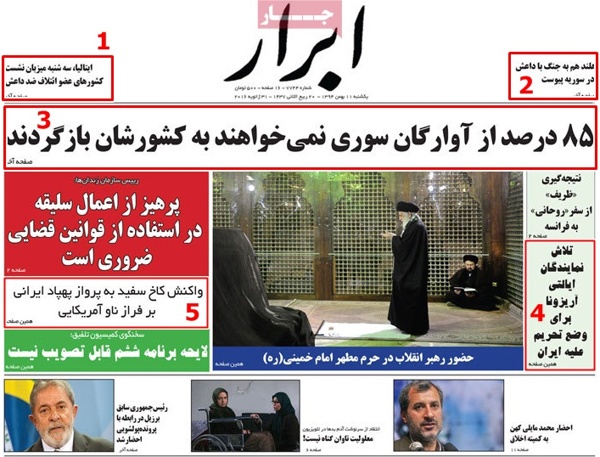
 

A look at Iranian newspaper front pages on Jan 31


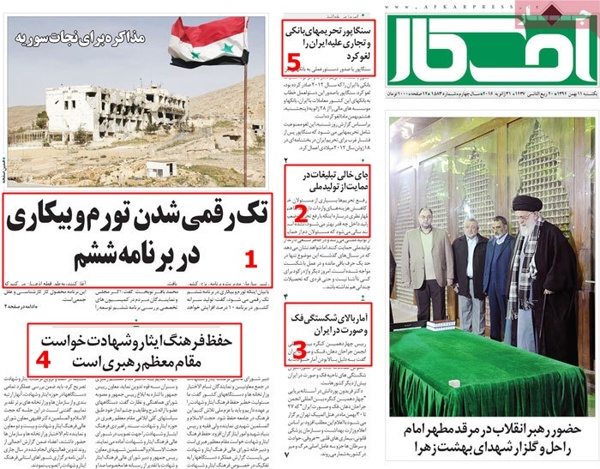
Afkar:

1- Iran eyes one digit inflation, unemployment rate in 6th plan

2- Absence of adverts to support domestic production

3- High rate of jaw, face fracture in Iran

4- Leader favors safeguarding of martyrdom, sacrifice culture

5- Singapore lifts banking, trade sanctions on Iran
 

A look at Iranian newspaper front pages on Jan 31


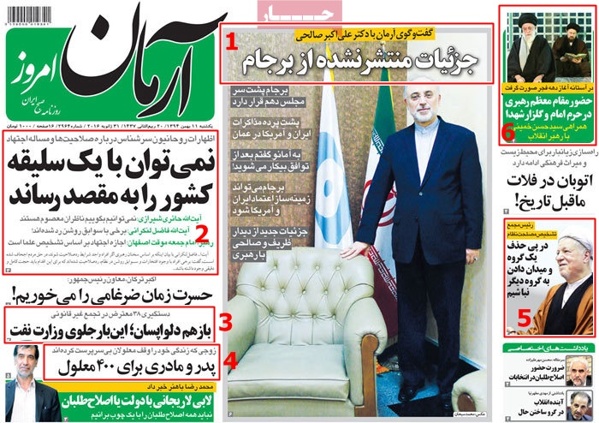
Arman-e Emrouz:

1- Unpublished JCPOA details released

An in-depth interview with head of the Atomic Energy Organization of Iran (AEOI) Ali Akbar Salehi about the terms and conditions of the Joint Comprehensive Plan Of Action (JCPOA) which were never published before.

2- Clerics: One taste cannot promote the country

A number of outstanding Islamic clerics have spoken out about qualifications of parliamentary hopefuls for the late February elections throughout time.
Ayatollah Haeri Shirazi: We cannot say that the screeners are infallible.
Ayatollah Fazel Lankarani: Many were disqualified despite vivid backgrounds.
Leader: Jurists can only allow one to become Mujtahid( jurisprudent).

3- Again, the Concerned; a group critical of some government policies, stage demonstration this time in front of Petroleum Ministry

Police arrested 38 “concerned” students who swarmed the Iran’s Ministry of Petroleum Headquarters in Tehran on Saturday to protest terms of the new oil deal model, known as Iran Petroleum Contract or IPC.
Through IPC, Iran has sweetened its oil deals for foreign investors.

4- Couple parent 400 disabled

Couple has  dedicated their life to supporting 400 disabled children.

5- ‘Let’s not seek one group’s ouster and others favor’: Rafsanjani

6- Leader visit’s Imam Khomeini’s shrine, martyr’s tombs

The Supreme Leader of Islamic Revolution Seyyed Ali Khamanei has paid a visit on Saturday to the holy shrine of Imam Khomeini and mausoleums of Sacred Defense martyrs.
 

A look at Iranian newspaper front pages on Jan 31


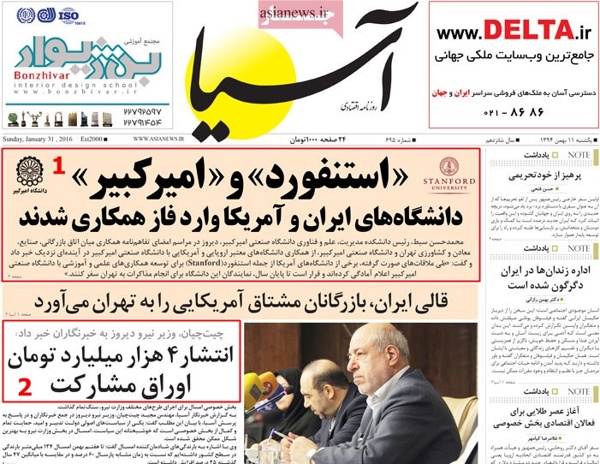
Asia:

1-Stanford, Amir Kabir unis start cooperation

2-Issuance of $4,000b bonds in Iran
 

A look at Iranian newspaper front pages on Jan 31


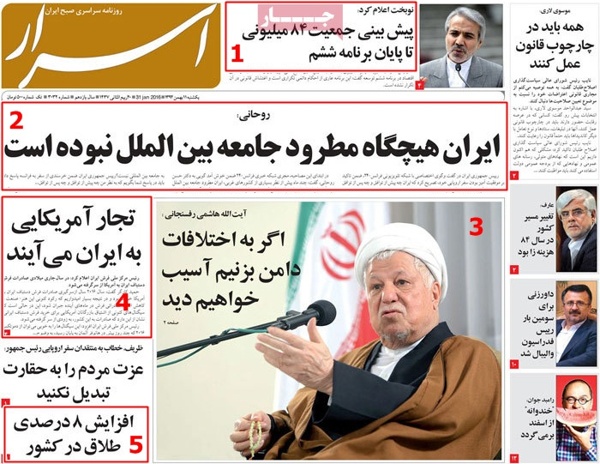
Asrar:

1- 84m population of Iran by end of 6th plan: Spokesman

2- Rouhani: Iran has never been isolated in int’l community

3- Rafsanjani: Aggravation of disputes will be harmful

4- American traders head to Iran

Head of the National Carpet Center of Iran said American traders will come to Iran for buying Iranian carpet now that the international sanctions on the country have been removed.

5- 8% growth in divorce files
 

A look at Iranian newspaper front pages on Jan 31


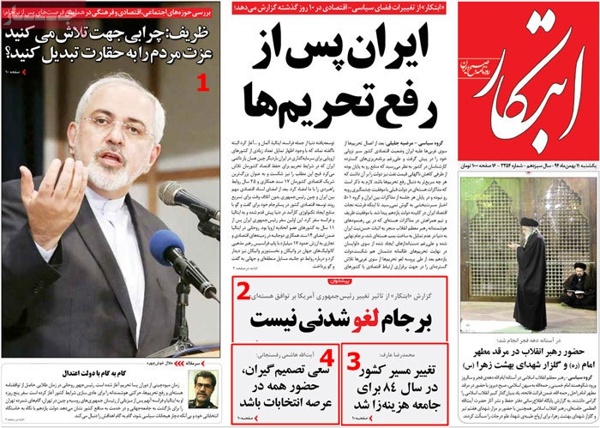
Ebtekar:

1- Zarif: Why do you vaguely try to humiliate nation’s resolve?

2- Report: JCPOA uncancellable

A report about the fate of JCPOA after US President Obama’s second term comes to an end

3- Reformist figure: Country’s 2005 detour took heavy toll on society

Mohammad Reza Aref, head of the Reformist Policymaking Council, said this.

4- Decision makers favor maximum election turnout: Rafsanjani
 

A look at Iranian newspaper front pages on Jan 31


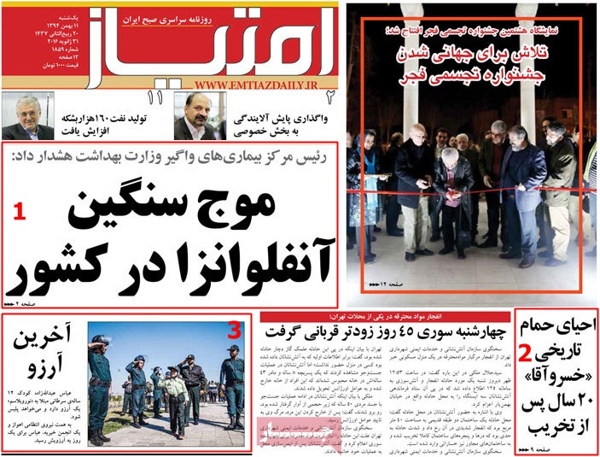
Emtiaz:

1- Heavy blow of flu in Iran

2- Historical bath recovered after 20 years of destruction

The last wish

3- A cancer kid in the southwestern city of Ahwaz wished to become a police when he grew up. The city’s policy materialized the 12-year-old’s last wish.
 

A look at Iranian newspaper front pages on Jan 31


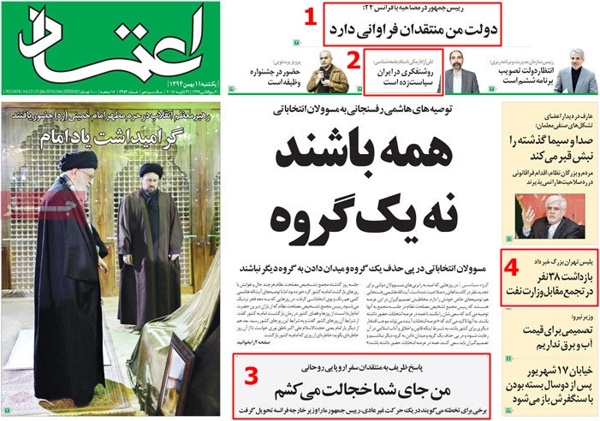
Etemad:

1- Iran President to France 24: My administration has many critics

2- Sociologist: Intellectuality in Iran is politicized

3- Zarif to critics: I am bashful instead of you

4- 38 protestors arrested in protests against Petroleum Ministry
 

A look at Iranian newspaper front pages on Jan 31


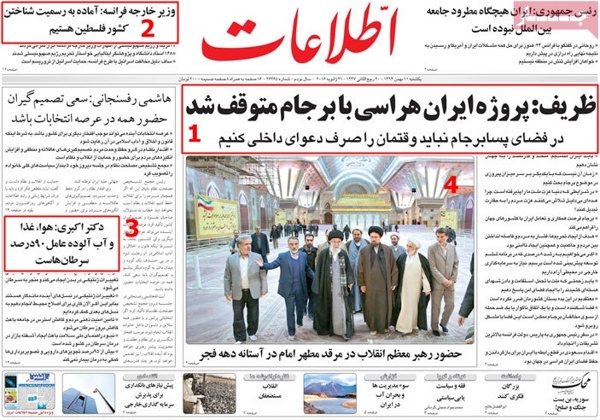
Ettela’at:

1- FM: Iranophobia scheme stopped by JCPOA

“Let’s not waste our time for domestic disputes in post-sanctions”: Zarif

2- France to recognize Palestinian state if peace efforts fail: FM

3- Tainted water, food, air cause of 90% of cancers

4- Leader visits Imam’s shrine on eve of Fajr 10 days festive period
 

A look at Iranian newspaper front pages on Jan 31


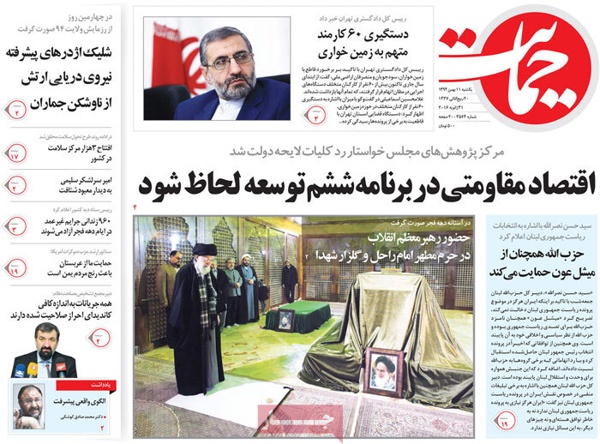
Hemayat:

1- Iran opens 3,000 healthcare centers

2- Iran to pardon 960 inmates on Revolution anniversary occasion
 

A look at Iranian newspaper front pages on Jan 31


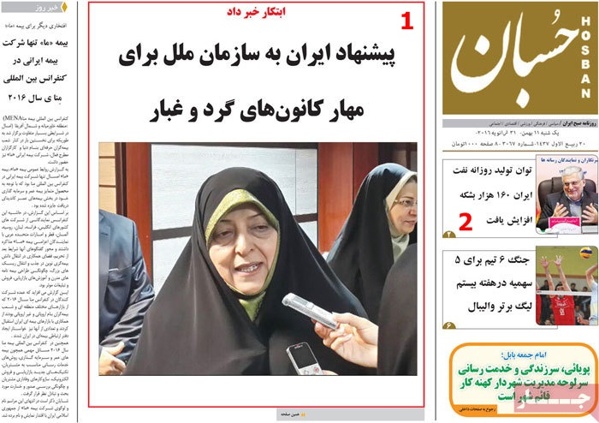
Hosban:

1- Iran proposes initiative to UN to control dust centers

2- Iran adds 160kb/d to crude production capacity
 

A look at Iranian newspaper front pages on Jan 31


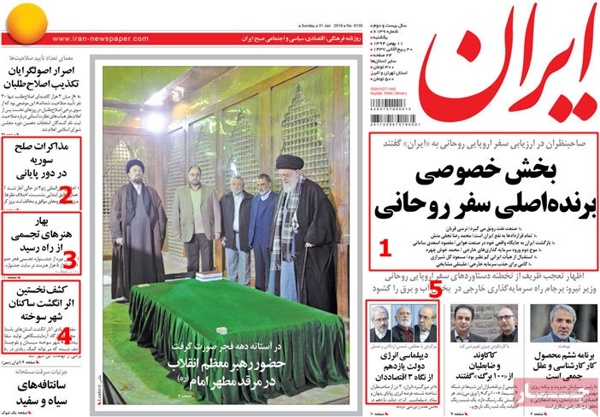
Iran:

1- Private sector chief winner of Rouhani visit [to Europe]

2- 2. New round of Syrian peace talks

3- Spring of visual arts in Iran

4- First fingerprints of burned city dwellers found in Sistan- Baluchestan Province

5- Economists examine admin’s energy diplomacy
 

A look at Iranian newspaper front pages on Jan 31


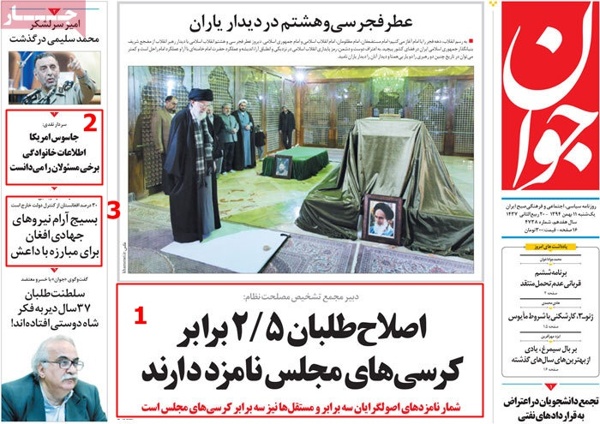
Javan:

1- Reformist candidates 2.5 times more than parliament seats: Expediency Council Secretary

2- Cmdr: US spy knew family details of some authorities

3- Afghan jihadists quietly mobilize against ISIS
 

A look at Iranian newspaper front pages on Jan 31


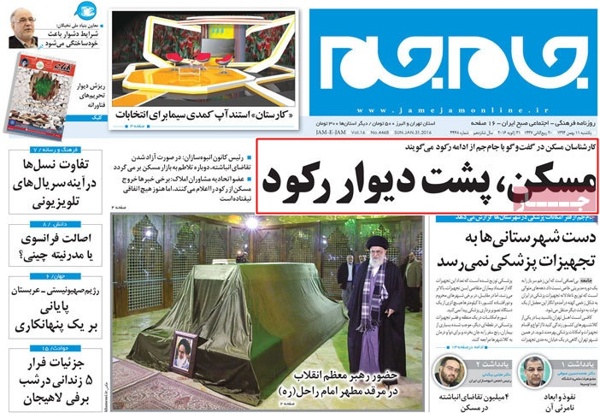
Jamejam:

Housing stock behind wall of recession
 

A look at Iranian newspaper front pages on Jan 31


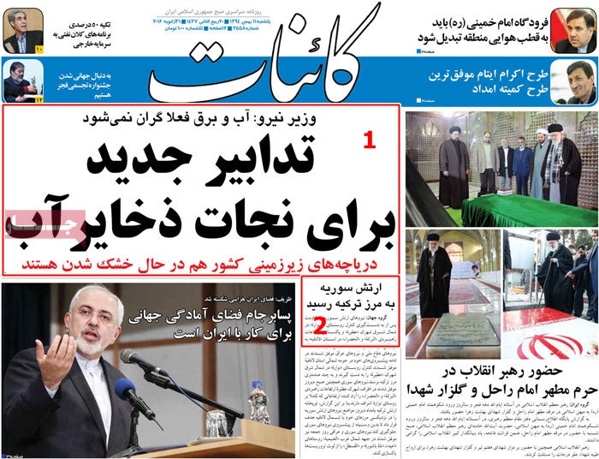
Kaenat:

1- New initiatives to save Iran water resources

2- Syrian army reaches Turkish border
 

A look at Iranian newspaper front pages on Jan 31


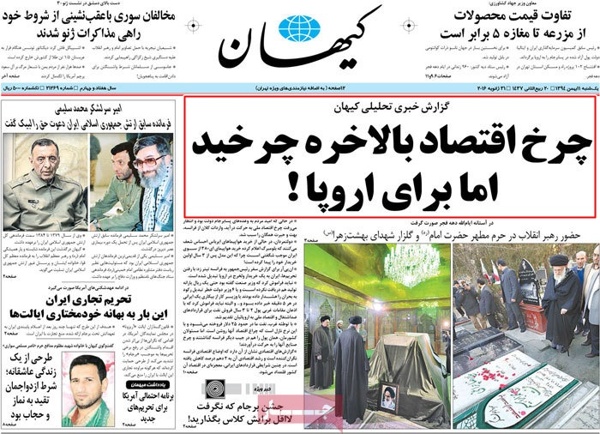
Kayhan:

Wheel of economy finally moves, but for Europe: Analytic report
 

A look at Iranian newspaper front pages on Jan 31


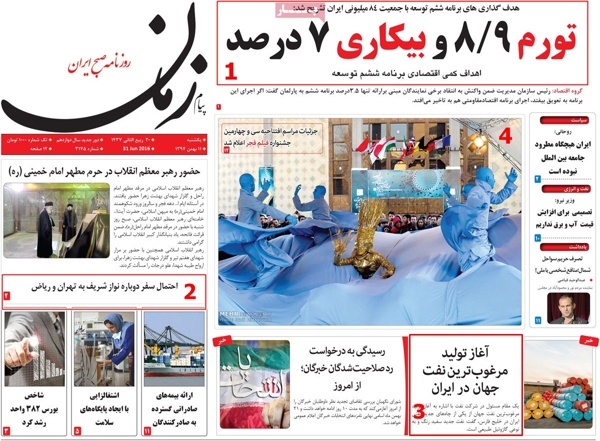
Payam Zaman:

1- 8.9% inflations; 7% unemployment eyes in 6th development plan

2- Pakistan’s Nawaz Sharif may revisit Tehran

3- Iran starts production of world’s best crude oil [from Hengam oil field the country shares with Oman]

4- 34thFajr Film festival kicks off
 

A look at Iranian newspaper front pages on Jan 31


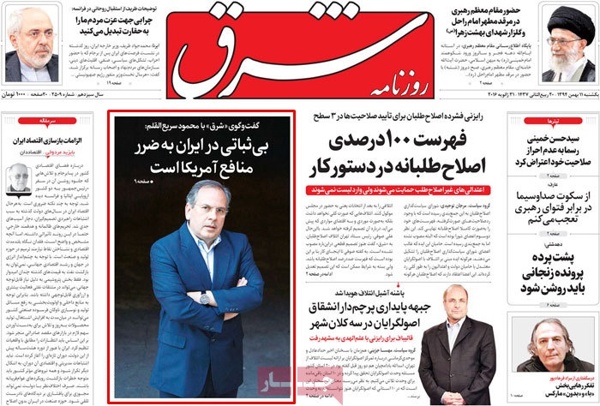
Shargh:

Interview: Iran instability harmful for US interests
 

A look at Iranian newspaper front pages on Jan 31

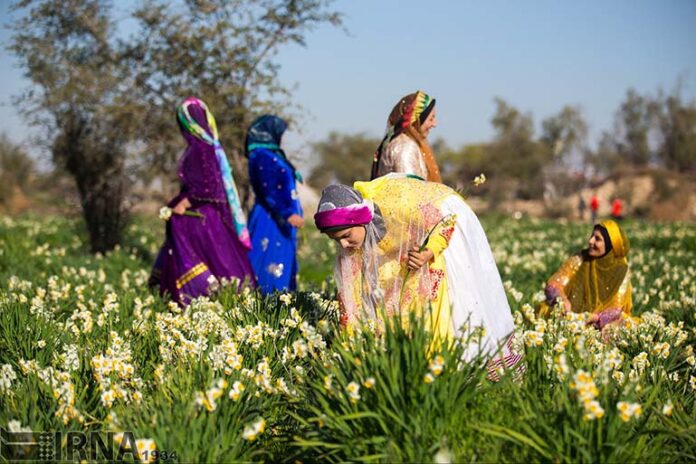
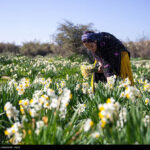
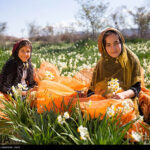
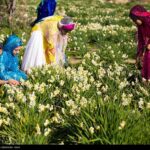
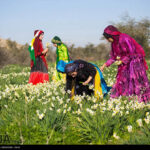
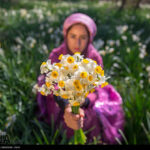
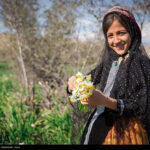
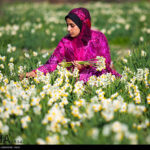
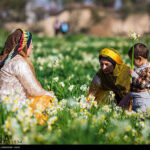
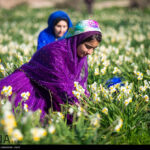
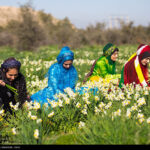
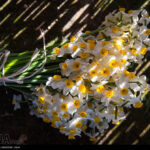
Amaryllis Flower Festival, Jarreh Village, Shiraz (PHOTOS)

A festival is held in villages Jarreh and Baladeh villages in Kazeroun, Fars Province every year.

Amaryllis farms in Kazeroun cover 70 hectares of land making up one of the World’s most splendid and largest amaryllis farms.


The following images have been released by Islamic Republic News Agency :

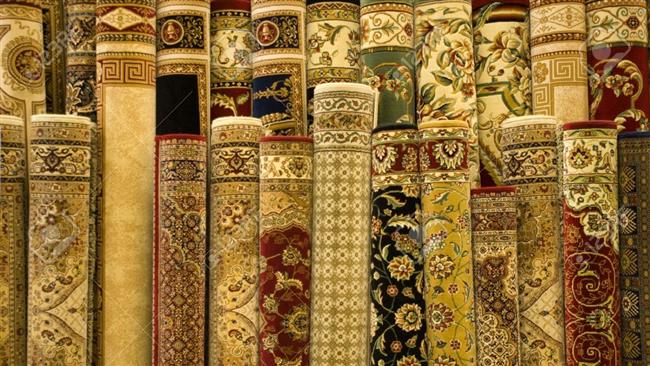
Iran rugs stacked for global markets

Exports of handcrafted Iranian rugs to the US will resume this year following a nuclear agreement which went into force earlier this month, head of Iran’s National Carpet Center Hamid Kargar said on Sunday.

Iranian caviar, pistachios, saffron and carpets and US commercial aircraft and their parts are among the items allowed for limited business with the US.

“The year 2016 will mark the resumption of handmade Iranian carpet exports to America. Hence, we are very hopeful that the existing downturn in this art-industry and the slump in exports will be compensated in the coming months,” Kargar said.

US imports from Iran have been blocked since 2010 when Washington removed a loophole which allowed imports of Iranian rugs, pistachios, caviar, and dried fruit.

Carpet weaving is a traditional craft in Iran, dating back to 500 BC. Basically an art form, it has evolved into an income earning occupation for many communities in Iran and beyond.

Carpets are one of the biggest foreign exchange earners for Iran’s $400 billion economy behind oil and gas and their derivatives, and pistachio nuts.

In 2011, the country exported more than $600 million worth of carpets and sought to raise it to $1 billion in the next year but intensified sanctions apparently hampered the plan.

In recent years, Iranian rug dealers have switched to the Asian market, catering especially to the growing crave in China and the UAE where many affluent families see exotic Persian carpets as investments.

‘No miracle’

Kargar said he was under no illusion about Iranian rugs redeeming the lost ground but “existing signals of enthusiasm by American traders are indicative of exports resuming soon.”

“In the few years which the handwoven Iranian carpet was absent from the American market, our rivals such as India and Pakistan took over and managed to pull off a significant share in the US carpet market,” he said.

In the United States, Persian carpets are offered from $200,000 to $5,000 a piece depending on the type of the fabric, design and intricacy employed in their making.

Those produced in India, Pakistan and China sell for about half the price of Persian carpets due to their lower quality, according to dealers.

The US imported $41 million worth of Persian carpets before sanctions were imposed. The country reportedly has a $200-million rug import market.

Kargar said he didn’t expect a “miracle” and a “phenomenal leap” in exports.

“However, one can fairly expect a growth in exports and a market boom after the removal of economic sanctions.”

Iran’s National Carpet Center has already held negotiations with some Persian rug dealers in the US and plans for possible visits by Iranian and American merchants, he said.

Leader confers ‘Fath’ medal on IRGC commanders

In a Sunday meeting, Ayatollah Khamenei conferred the medal on Rear Admiral Ali Fadavi, commander of the IRGC Navy, and four other high-ranking commander for arresting the trespassing US sailors.

Ayatollah Khamenei on January 24 commended as timely and praiseworthy the “brave” move by the IRGC naval forces, who arrested 10 US sailors after their patrol boats entered the country’s territorial waters on January 12.

The Leader stated that the praiseworthy measure by the IRGC forces stemmed from their faith and courage and was taken in the right time, adding that the capture of the US sailors “was in fact an act of God, who brought the Americans into our waters so they would be arrested with their hands on their heads through your timely measure.”

On January 13, the IRGC announced that ten US Marines, who had drifted into the country’s territorial waters in the Persian Gulf and had been taken into Iranian custody, were released after Americans apologized for the incident.

Earlier the same day, Fadavi said two US Navy crafts carrying 10 Marines had reached three miles into the waters surrounding the Farsi Island in the Persian Gulf.

He added that the trespassing occurred because of technical problems with the navigation systems of the American vessels.

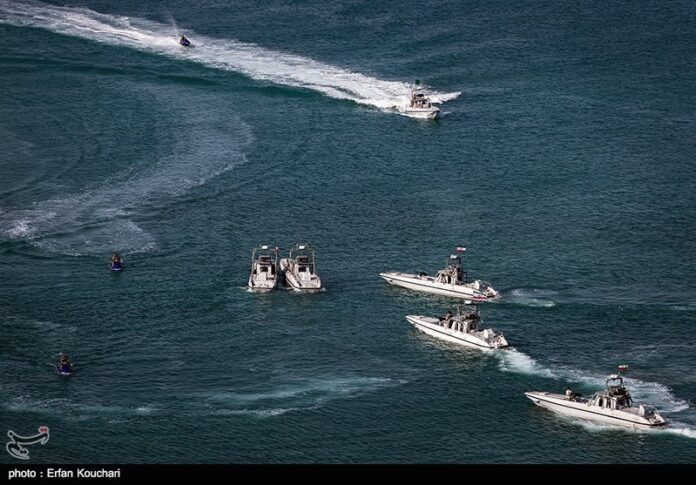
Iran’s Navy Ends Drill with Maritime Parade

Code-named “Velayat 94”, the war games whose tactical stage began on January 27, came to an end with a massive naval parade involving a range of watercraft and naval units.

The war game covered an area of around 3 million square kilometers, stretching from east of the strategic Strait of Hormuz to the northern parts of the Indian Ocean, known as the 10-degrees latitude.

Chief of Staff of the Iranian Armed Forces Major General Hassan Firouzabadi and Army Commander Major General Ataollah Salehi were among the figures that reviewed the naval forces on parade at the conclusion of the large-scale drills.

90 vessels, 13 submarines including light Ghadir-class and heavy Tareq-class ones, 17 airborne units as well as 20 Unmanned Arial Vehicles (UAVs) attended the final parade.

A range of homegrown warships, destroyers, frigates and submarines were employed in the exercises. A new tactical naval radar was also unveiled during the drill.

On Wednesday, the units engaged in the war game shooed away a US warship and a fighter jet that had approached the drill zone.

The Iranian forces also fired different types of coast-to-sea and sea-to-sea cruise missiles and advanced torpedoes in the drill.

Naval exercises are not rare in Iran’s southern waters, in the Persian Gulf and the Sea of Oman and around the strategic Strait of Hormuz.

The Navy usually unveils a series of latest military equipment in its drills.

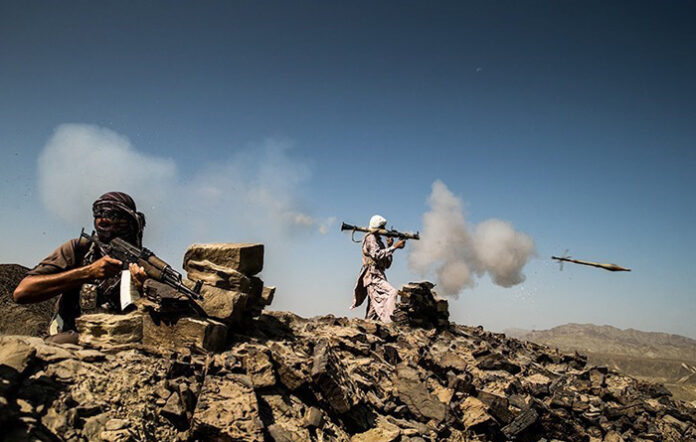
Iran border guardians wearing plain clothes

Iranian guardians of border areas wear garments worn by rebels in the areas to look like them.

The highly trained guards cover vast areas of land on foot, if necessary, to hunt drug dealers, convoys and terrorist groups.


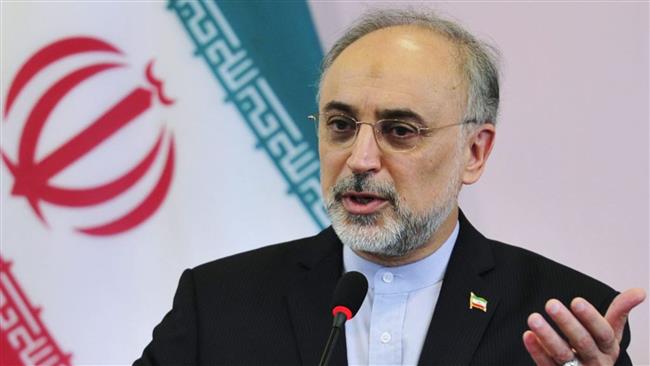
Iran to construct new power plants in Bushehr soon: Salehi

Ali Akbar Salehi-1

“In the construction of nuclear power plants, as I have already stated, we hopefully, within the next few months, will be witnessing the launching of new reactors. Activities are going on and they are expanding even in some areas,” Salehi said in an exclusive interview with Press TV on Saturday.

He added that Iran and Russia have signed agreements for the construction of “two big reactors in Bushehr.”

In November 2014, Tehran and Moscow struck a deal to build eight more nuclear power plants in Iran.

Russia has already built a power plant in Bushehr. The agreement for Bushehr Nuclear Power Plant was finalized in 1995, but the project was delayed several times due to a number of technical and financial issues.

The 1,000-megawatt plant, which is operating under the full supervision of the International Atomic Energy Agency (IAEA), reached its maximum power generation capacity in August 2012.

In September 2013, Iran officially took over from Russia the first unit of its first 1,000-megawatt nuclear power plant for two years.

Salehi said the recognition of Iran’s enrichment activities by the international community, particularly the UN Security Council, was “one very good achievement” within a nuclear agreement reached between Iran and the P5+1 group of countries, dubbed the Joint Comprehensive Plan of Action (JCPOA).

“We are one among the very few or probably the very exceptional countries that its enrichment activity has been recognized by an international body such as the UN Security Council,” the AEOI head said, adding, “One of the achievements within this framework is the fact that we were able to sell or we got this opportunity to sell our enriched uranium and get in return natural uranium or the yellowcake.”

He described JCPOA as a “good deal” that allows Iran to enter the club of countries that can enrich uranium and sell it at global market.

Iran and the five permanent members of the UN Security Council – the United States, France, Britain, China and Russia – plus Germany started to implement JCPOA on January 16.

After JCPOA went into effect, all nuclear-related sanctions imposed on Iran by the European Union, the Security Council and the US were lifted. Iran in return has put some limitations on its nuclear activities. The nuclear agreement was signed on July 14, 2015 following two and a half years of intensive talks.

Salehi also said Iran and the IAEA have entered into a new phase in cooperation and urged the body to remain impartial.

“The IAEA, being the sole verifying body, needs to keep its integrity and impartiality. Otherwise, its credibility will be questioned,” the Iranian official stated.

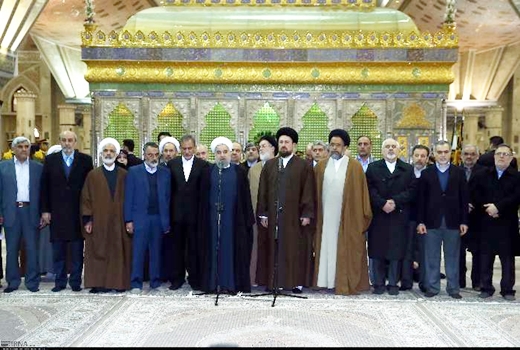
President, his cabinet pay tribute to late Imam Khomeini

During the ceremony, Imam’s grandson Hassan Khomeini received the President and the cabinet members.

President Rouhani and the cabinet members also paid tribute to the late Imam’s wife and son.

They laid wreaths at the tomb of the Father of the Islamic Revolution.

The president also paid homage to the martyrs of the 1979 Islamic Revolution.

The visit to the holy shrine took place on the occasion of the Dahe-ye Fajr (10-Day Dawn) which marks victory of the 1979 Islamic Revolution.

During the Ten-Day Dawn festivities, Iranians take part in different events and activities to remember their revolution. Every year tens of millions of Iranians also take to the streets to commemorate the final day of the festivities, on the 22nd of Bahman, or February 11th, which marks the victory of the Islamic.

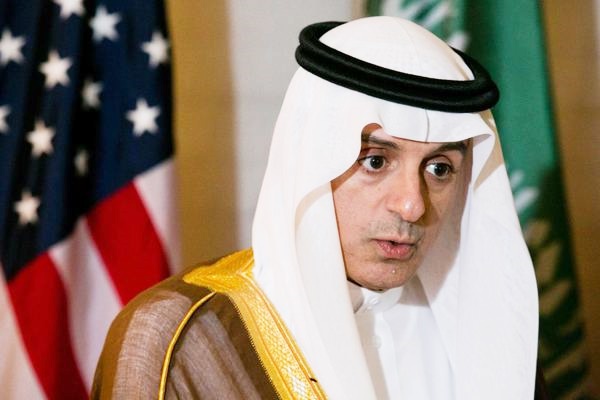
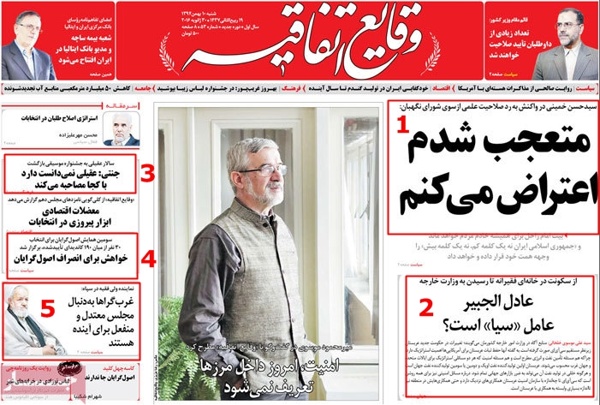
Is Adel al-Jubeir a CIA choice?

Seyyed Ali Musavi Khalkhali: There are informed sources in the Iranian Foreign Ministry who believe that the changes in Saudi Arabia’s new government have been directly carried out under the eyes of the CIA. They claim that maintaining Saudi Arabia’s stability is of strategic importance for the US due to two important facts: oil and energy provision and security. Both of these are strategic issues for the US and the West.

Saudi Arabia is OPEC’s largest, and the world’s second- or third-largest oil producer (until 2011, Saudi Arabia was second, but it has been claimed that since America’s shale oil starting officially in 2015, Saudi has been pushed into third place). Any type of interruption in its oil production can damage the oil global markets. In terms of security, everyone is fully aware of the close collaboration between the CIA and the GIP (General Intelligence Presidency) and just how much the CIA’s actions in the region depend on its cooperation with Saudi Arabia.

 This is why the CIA interfered in and managed the power transition in Saudi Arabia after the death of Malik Abdullah, when the power struggle among Saudi Arabia’s rulers was developing, and the princes were dividing the power by standing against each other. After that, Malik Salman enacted a series of changes, some of which were explicable and predictable, while some were surprising. For instance, choosing Adel al-Jubeir as the replacement of Saud al-Faisal, the veteran foreign minister of Saudi Arabia, was a surprise for many. Based on the Iranian Foreign Ministry sources’ claims, can we say that the choice of Adel al-Jubeir was a CIA decision?

Who is Adel al-Jubeir?

Adel al-Jubeir doesn’t have a strong history in the Saudi Arabian Foreign Ministry. In the beginning of the 1990s, Bandar Bin Sultan, who was Saudi’s ambassador to Washington, hired him in the embassy as an interpreter. His rose rapidly from a simple interpreter, becoming close to Bandar Bin Sultan, until he made him the embassy spokesman, then promoted him to be his link with the other representatives in the United Nations in New York.

At the same time, he became the liaison between Bandar Bin Sultan and American oil cartels, oil companies and Jewish lobbies. At the beginning of the new century, during the king’s trip to the United States, Bandar Bin Sultan introduced him to Malik Abdullah and praised his intelligence and activity. He climbed the ladder of success rapidly afterwards. First, he became Malik Abdullah’s foreign policy consultant, later being promoted to ministerial level in the same department. In 2007 he went to Washington to become Saudi Arabia’s ambassador to the United States, and in 2015, in an unexpected move, he became the Foreign Minister in Saudi Arabia.

All of this surprising progression happened while al-Jubeir was neither a prince nor someone with a strong political or diplomatic history. He is from a very simple family who were living in the village of Harmah in the suburb of Al Majma’ah city. He was born in a house with no electricity or water in a very deprived village. He was the sixth child in his family. His father initially worked for Aramco, before moving to Yemen with his family, and later going to Germany as a cultural adviser, staying there until the end of his service. Adel al-Jubeir finished his school in Germany but later went to America and finished his BA in political science and economy in a university in northern Texas. He then got his MA from Georgetown University in Washington, in international affairs. When his father retired the family was supposed to move back to Saudi Arabia, but they opposed this, so his father was forced to return to Saudi Arabia alone. His father made a new family in Saudi Arabia and it has been said that he cut off his relations with the old one.

Anti-Iranian Opinions

No one exactly knows since when and why Jubeir became anti-Iranian. It seems that his connections with Jewish lobbies in the United States had a major impact in forming his anti-Iranian opinion. The first time he openly spoke out against Iran was in November 20th 2007, at a dinner party in Washington when he had just been promoted to being ambassador. In his meeting with the United States’ new ambassador to Saudi Arabia, he talked about Iran’s nuclear program. Using highly critical language, he spoke out against Iran, bringing up the Iran’s plan for building a nuclear weapon, and said that it was now time to stand against Iran.

He believed that Iran was the cause of the problems that the United States and Saudi Arabia have faced in the region in recent years. Shortly after that, in April 2008, Wikileaks revealed some documents in which Malik Abdullah, referring to Iran, said to Ryan Crooker and General David Petraeus that Iran was like a snake whose head should be cut off without any delay. In these documents, Adel al-Jubeir talked several times about Malik Abdullah’s repeated advice to the US about the necessity of attacking Iran militarily and stopping its nuclear program.

Later, in 2011, at the beginning of Syria’s civil war, he claimed that Iran was trying to assassinate him – the same thing was also immediately claimed by Eric Holder, the former Attorney General of the US –  both aiming to plot against Iran. It was never clear what the reason was for that story, and what its result was, but many believe that the main aim was to remove Iran from the Syria issue, whose crisis was just beginning at the time. Saudi Arabia thought that they could start a fight with Iran, making such cases to stop Iran initiating any action, thus obtaining their goals in Syria.

Many believe that al-Jubeir is acting according to a predefined equation, as if he is a piece in a puzzle with a special mission.

From the clashes in Yemen, which according to An-Nahar, published in Beirut, has cost Saudi Arabia $200bn for so far, to bizarre tensions with regional countries like Iran and also extensive domestic repression, all of these seem to suggest that al-Jubeir is a pawn at odds with Saudi Arabia’s domestic interests. What will be the final outcome of this situation? As time passes, surely more aspects will be uncovered.


Vaghaye etefaghie daily
Front page of Vaghaye-e Etefaghiyeh daily on Jan 30


The Sixth Frame

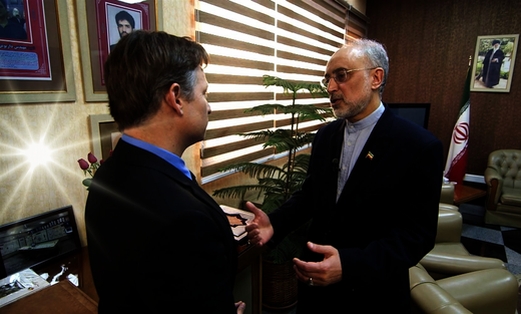
According to the Alalam news agency report, an American NBC journalist paid a visit to Dr. Ali Akbar Salehi while making a documentary about Iran’s nuclear energy and the country’s nuclear agreement with the West.

His attention was immediately drawn by the photos of assassinated nuclear scientists (nuclear martyrs) on the office wall of the AEIO director. Based on how the photos of the four scientists and a martyred driver were laid out, he asked, “What is the empty space for? Do you think there might be a sixth martyr?”
After Salehi responded in the affirmative, the American journalist asked, surprised, “Who will be the sixth martyr?” Salehi replied, to the journalist’s astonishment, “I hope that it will be me.”

Upon hearing this sentence, the smile fell from the journalist’s face. “You hope that it’ll be you?” he asked, stunned. “Yes,” Salehi continued, “Martyrdom is an honour, and all of us are awaiting and seeking it.”