Saturday, December 27, 2025
Home Blog Page 4607

Saudis Unable to Attack Syria: Iranian General

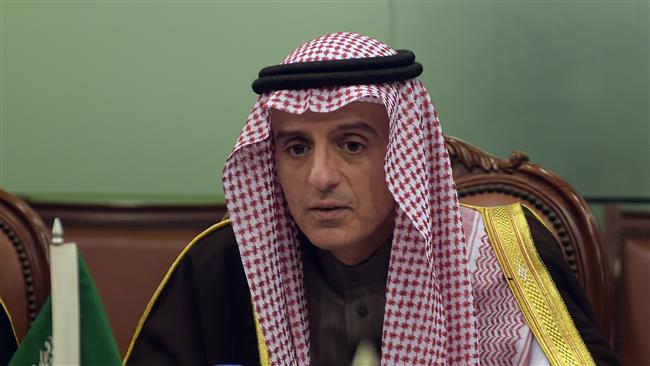
Speaking to reporters in Tehran on Tuesday, the general highlighted Saudi Arabia’s inability to take military action in Syria, saying the Al Saud has spent all its capacities over the past years in Iraq and Yemen as well as Syria, where its mercenaries have been fighting against the Damascus government.

Since the beginning of conflicts in the region, Saudi Arabia has played a role in creating, dispatching and supporting terrorists, he added.

General Jazayeri also noted that with the grace of God and thanks to strong resistance from the people of the region, the Saudi Arabian military forces and their regional allies have failed to reach their objectives, which are in line with the policies of the US and Zionism.

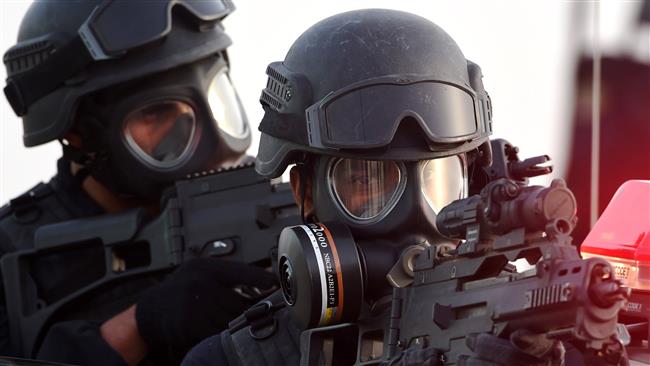
The comments came after Riyadh on Thursday voiced readiness to participate in any ground operations in Syria if the US-led coalition purportedly targeting terrorists decides to start such operations.

Saudi Arabia is a member of the so-called US-led coalition that has been conducting air raids against what are claimed to be the Daesh (ISIL) terrorists inside Syria without any authorization from the Syrian government or a UN mandate since September 2014.

Syrian President Bashar al-Assad underscored during an interview in March 2015 that the US-led military campaign does not aim to “do away” with the terror group.

Syria has been gripped by civil war since March 2011 with Takfiri terrorists from various groups, including Daesh, currently controlling parts of it.

According to the United Nations, more than 250,000 people have been killed and one million wounded during the conflict.

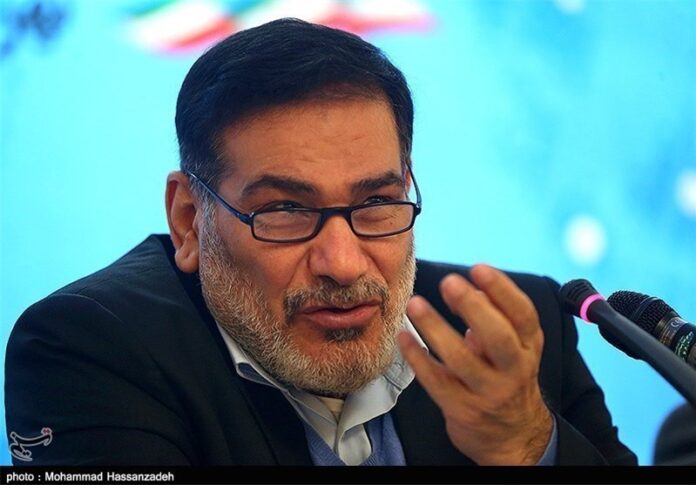
Islamic Revolution’s Ideology Diametrically Opposed to Takfirism: Iran’s Shamkhani

Addressing a conference on Takfiri terrorism in Tehran on Tuesday, Shamkhani described the 1979 Islamic Revolution as a “role model” for the Islamic Awakening movements that is “diametrically opposite” to Takfiri thinking.

The Islamic Revolution, led by the late Imam Khomeini, established a new political system in Iran based on Islamic values and democracy.

Shamkhani further emphasized that the West is using Takfiri terrorist groups, like Daesh (ISIL), as a tool to pursue its policy of spreading Islamophobia.

The objective behind Islamophobia is to undermine the holy status of Islam and its progressive rules and justify secularism in the region and the world, the Iranian official stated.

Daesh, as a Takfiri group in Iraq and Syria, is believed to be supported by the West and some regional Arab countries.

The terrorist group has been committing heinous crimes against all ethnic and religious groups, including Shias, Sunnis, Kurds, Christians, Izadi Kurds and others in Iraq, Syria and several other countries.

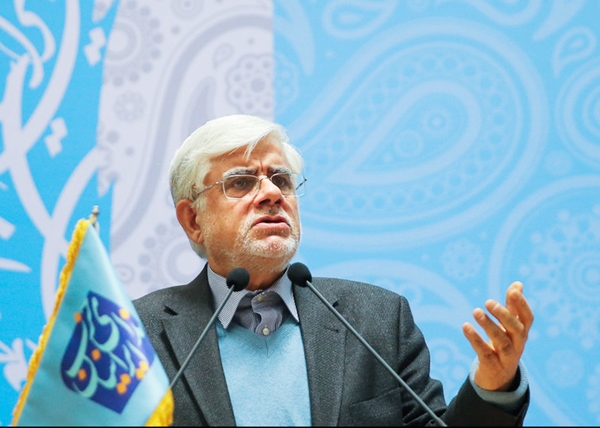
Senior Reformist Criticizes Efforts to Dishearten Iranian People

“They want to dishearten the Iranian people and the reformists,” Aref said in an address to young reformist party members, as reported by Tabnak news agency.

“You should be serious in continuing to follow this path, because participation [in the elections] is our responsibility,” the Iranian reformist told them. He added that no one had anticipated a reformist victory in the 2013 presidential elections, but “the conditions are now much better” than they were then.

He highlighted the recent disqualification of a large number of reformists from running in the elections, noting that the party could not do anything about it.

“We feel responsible for the people, the Revolution, and the Establishment,” he declared, hinting that the party will still participate in the elections, despite the mass disqualification.

He went on to say that the reformists will show that they can achieve their goals by maintaining their hope and calm, and by remaining serious.

“Calmness is a prerequisite for this path. This is the (right) path, we have no other choice. We will define ourselves within the Establishment,” he noted.

Aref defined the reformist movement as a party that is encompassed within the Establishment of the Islamic Republic, saying that reformists consider “Peace and economic prosperity” to be their slogan. He continued, encouraging reformists to maintain their hope and calmness in the upcoming elections, which will be held on February 26.

There are currently 290 seats in the Iranian parliament, known as the Majlis, which are elected by direct popular vote in nationwide elections every four years.

The Assembly of Experts is another high-ranking body, one which elects and oversees the activities of the Leader of the Islamic Revolution.

Members of the Assembly are directly elected to their office by the people for an eight-year term. It appoints a new chairman in biannual meetings.

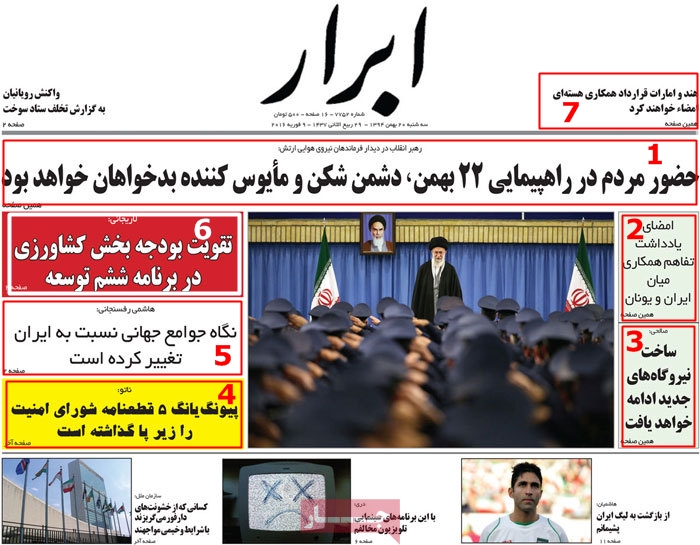
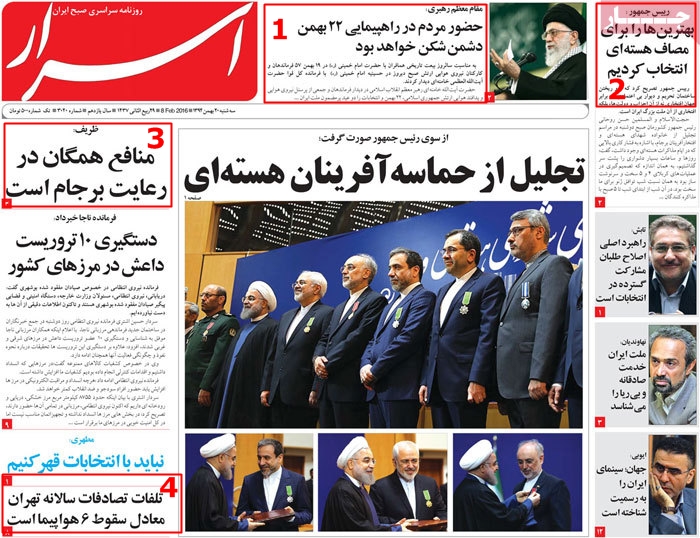
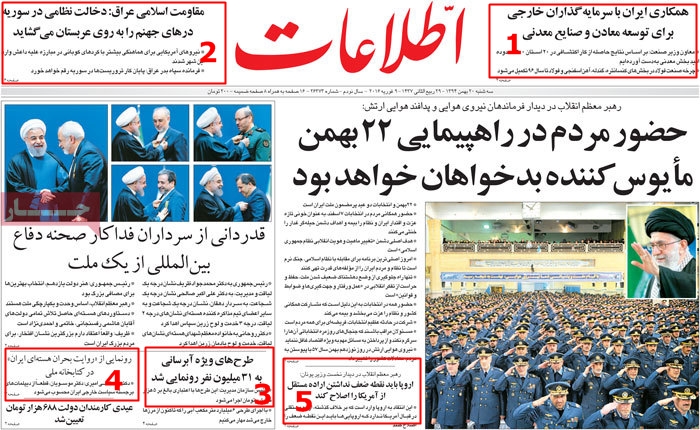
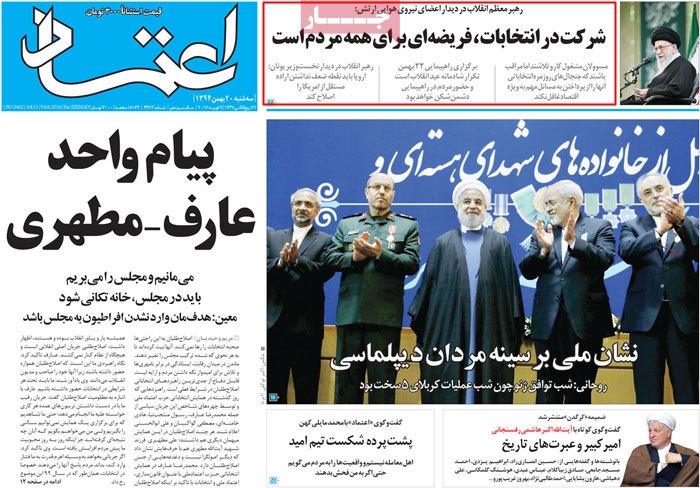
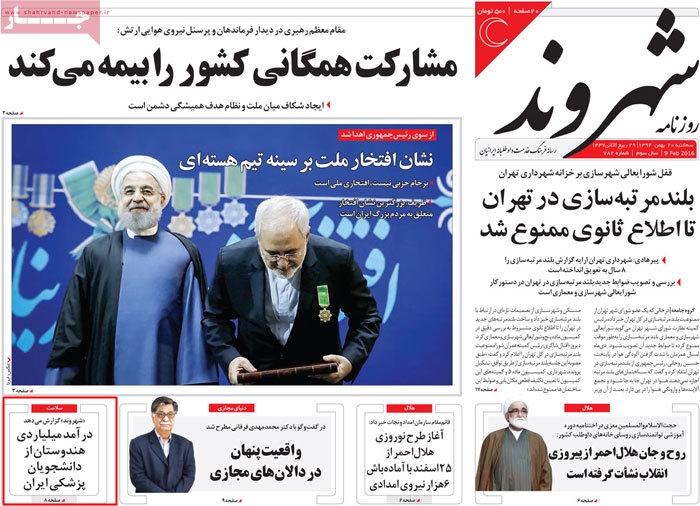
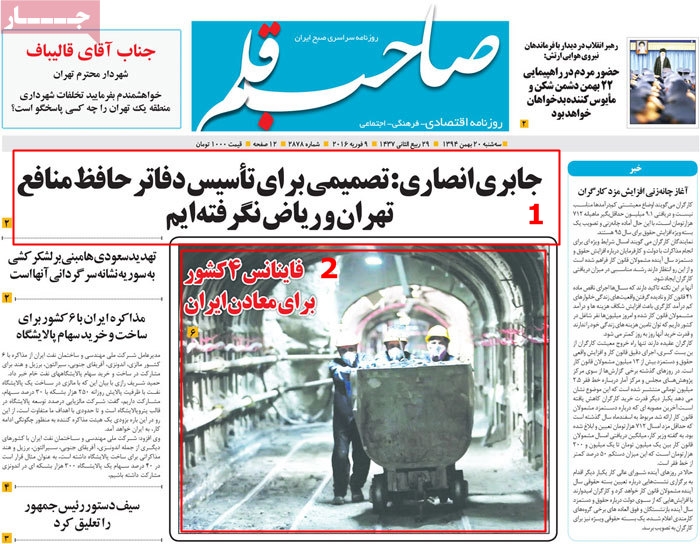
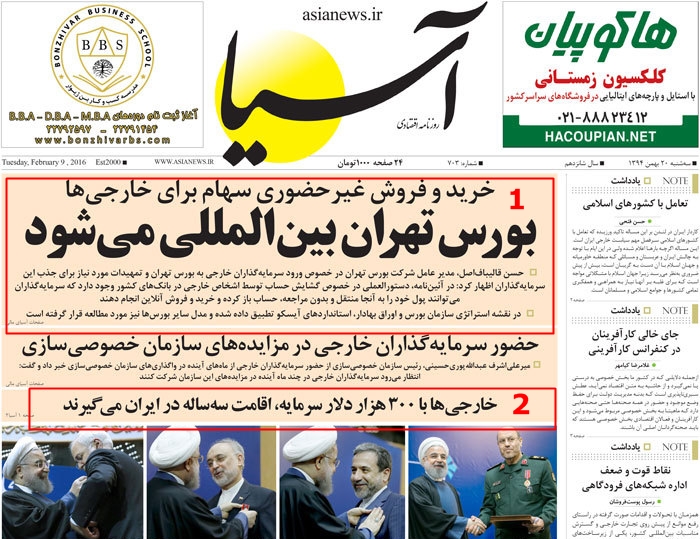
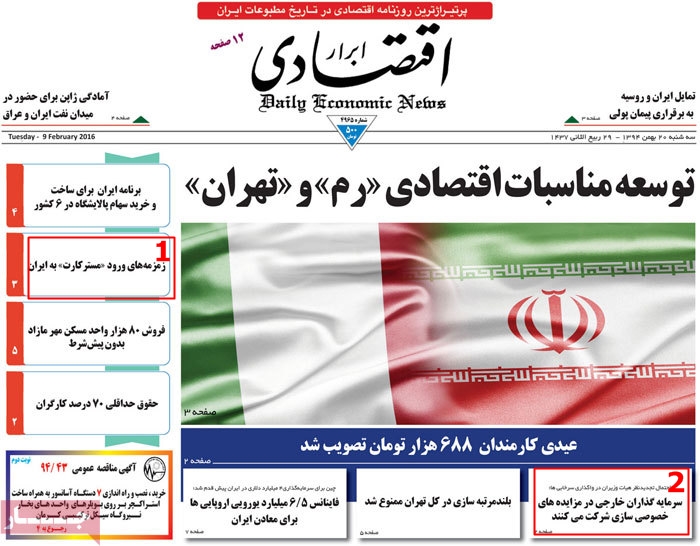
A look at Iranian newspaper front pages on Feb 9

Iran Newspaper front pages

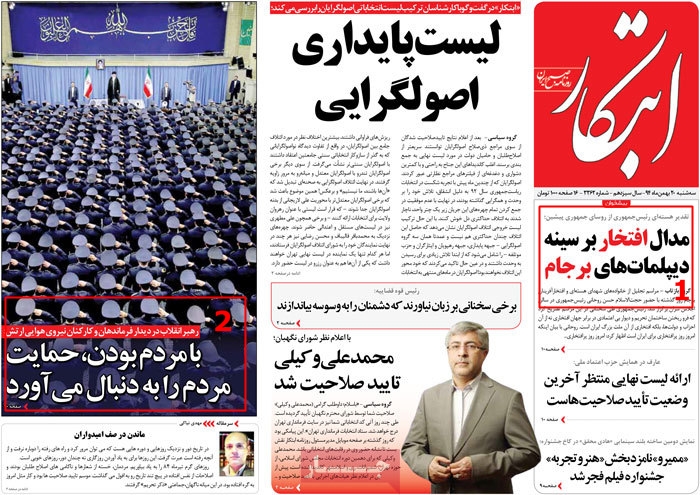
The €6.5bn European investment in Iran’s mining industry was one of the top headlines in most Iranian papers on February 9, 2016. The Leader of the Islamic Revolution, Seyyed Ali Khamenei, had a meeting with Air Force pilots on Monday, and also outlined his stance regarding current developments, including the late February elections. Once again, the leader called on every Iranian citizen to come to the polls. He also spoke about the anniversary of the victory of the Islamic Revolution, saying that the nation’s unity guarantees the mission of the revolution. All Iranian dailies focused on this on Tuesday.

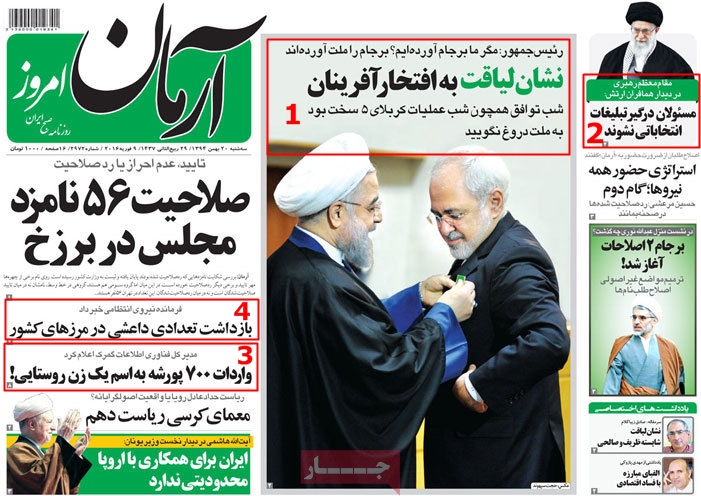
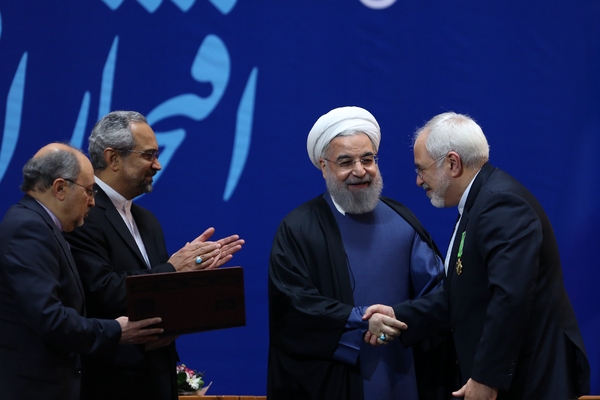
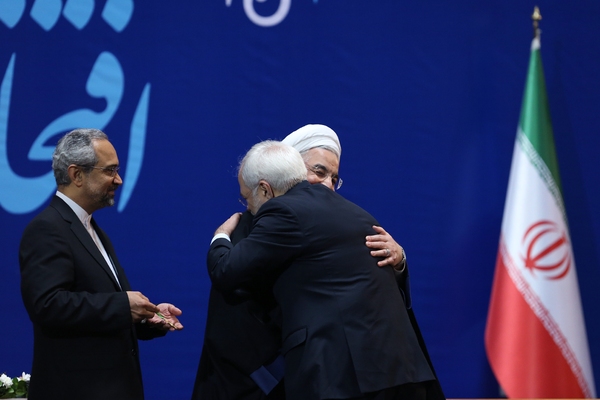
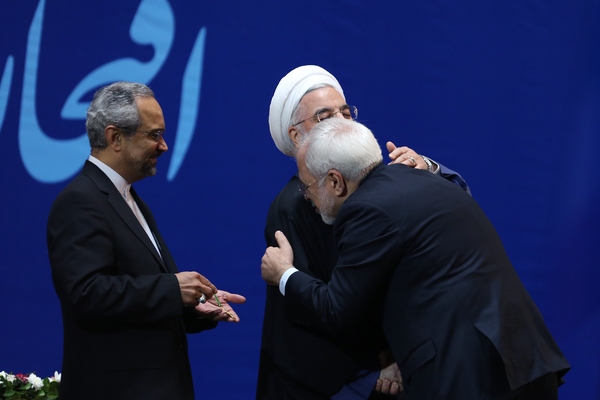
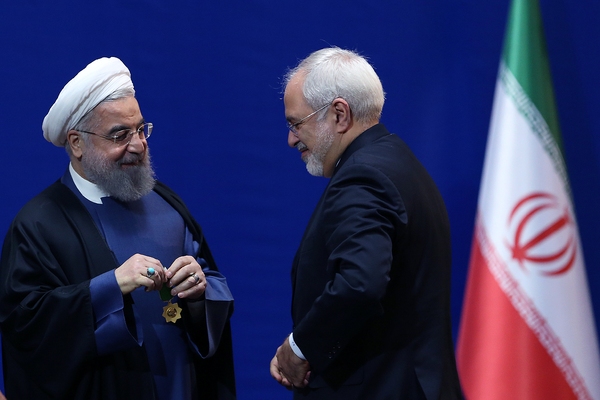
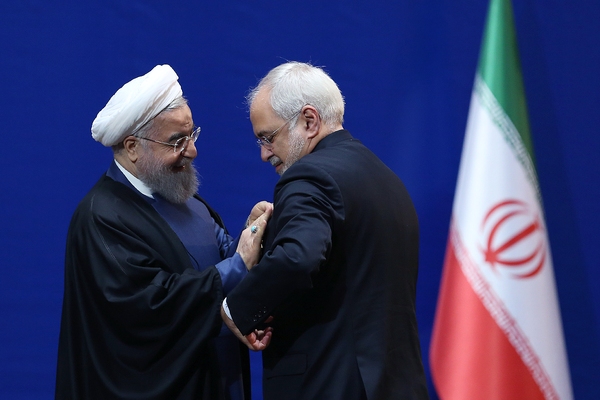
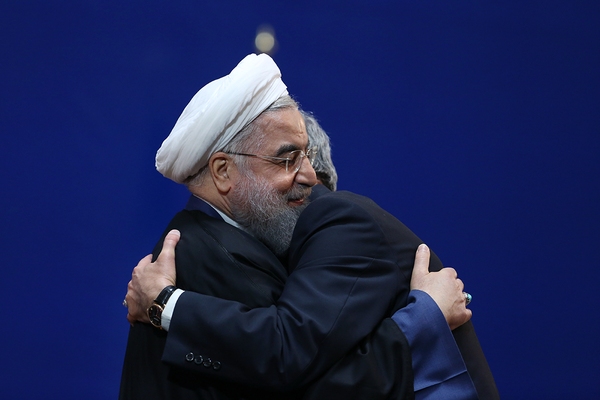
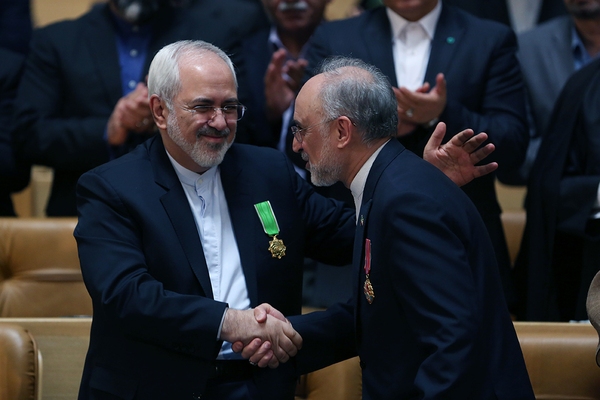
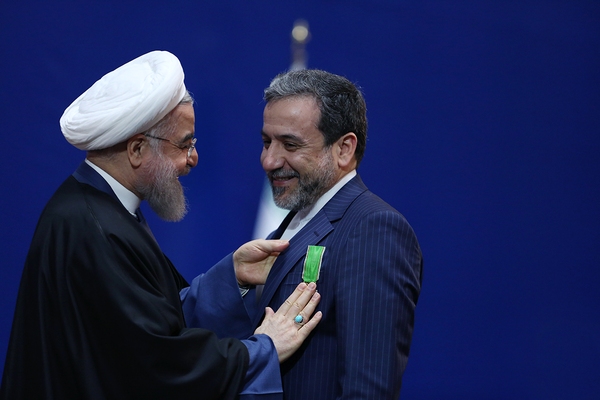
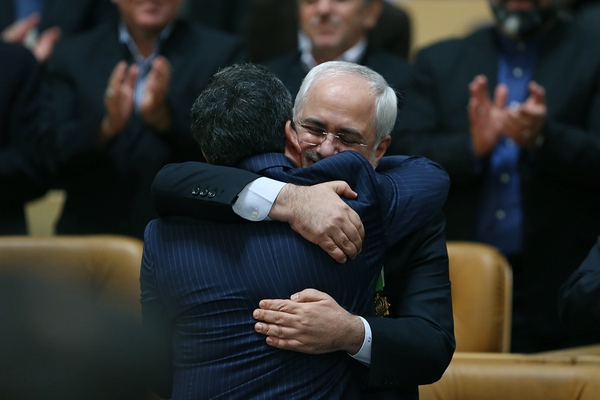
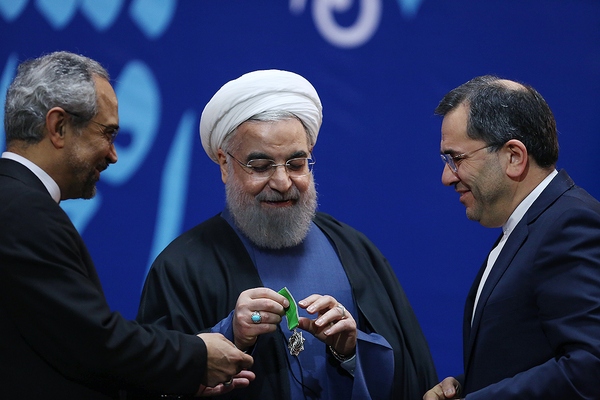
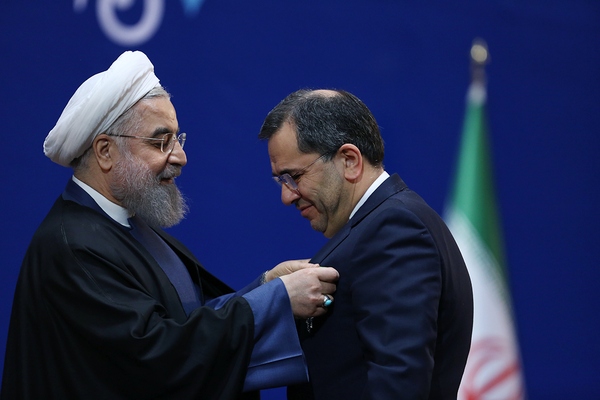
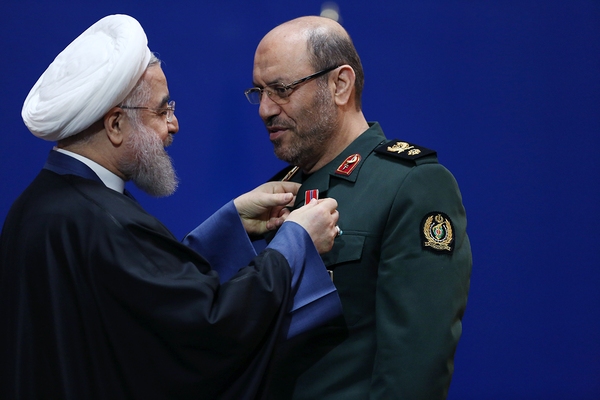
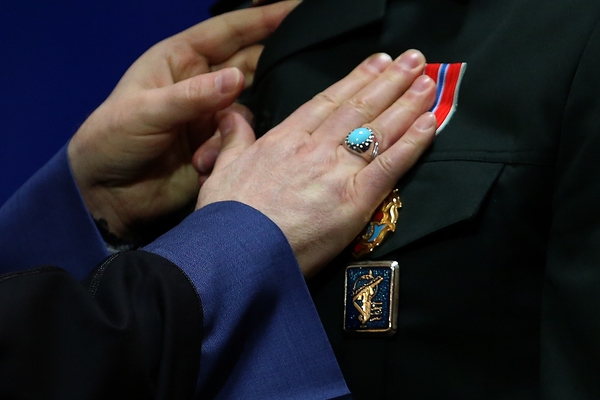
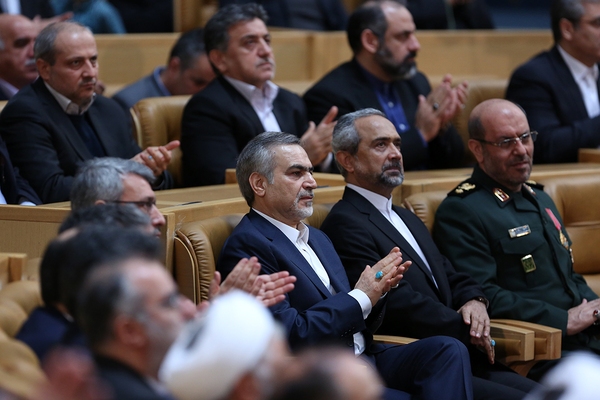
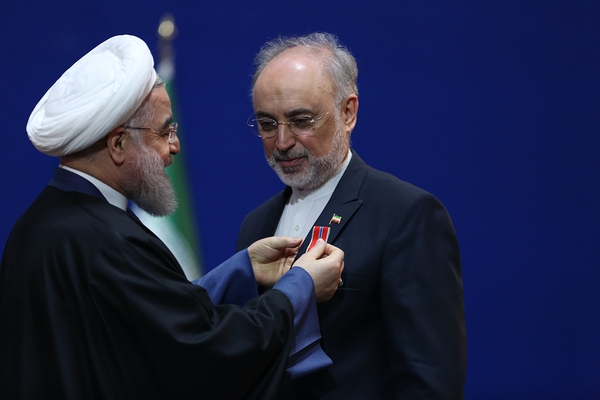
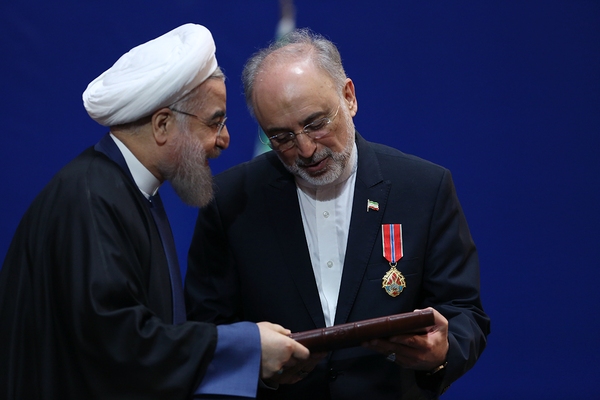
On Monday, the Iranian President Hassan Rouhani honoured the diplomats who spent more than two years of their career working on the nuclear talks which culminated in the signing of the Joint Comprehensive Plan of Action (JCPOA), which resulted in the lifting of the crippling sanctions on the country. During a ceremony, Rouhani granted the diplomats, including Minister of Foreign Affairs Mohammad Javad Zarif, a medal of honour for their endeavour and achievements regarding the nuclear issue. Some dailies, however, criticized the move, saying the negotiating team gave away much more than it gained.

Here are the top headlines.


Arman-e Emrouz:

1-President grants medals of honour to nuclear negotiators
2-Leader forbids candidates to busy themselves with election campaigns
3-Village woman imports 700 Porsche cars
4-Police claim to have captured some ISIS fighters in border areas


Arman


Ebtekar:

1-Badge of honor for JCPOA diplomats
2-Leader: Being with people ensures their support


Ebtekar


Abrar:

1-22nd Bahman rallies will leave ill-wishers abject, helpless
2-Iran, Greece ink co-operation MOU
3-AEOI Chief: Iran to build more [nuclear] power plants
4-NATO condemns N. Korea for violation of 5 UNSC resolutions
5-Hashemi Rafsanjani: Global view towards Iran has changed
6-Agricultural sector funds boosted in national budget: Parliament Speaker
7-UAE, India sign nuclear deal


Abrar


Asrar:

1-Leader: People’s 22nd Bahman rallies will break enemies
2-President: We chose the best people for the nuclear battle
3-Zarif: Honouring nuclear deal favours everyone
4-Tehran’s annual car accident victims equal to death toll of 5 plane crashes


Asrar


Ettela’at:

1-Iran welcomes foreign financiers to develop mining industry
2-Iraqi Islamic Resistance: Saudi interference in Syria will wreak hell on their military forces
3-Iran unveils new projects to deliver water to 31m people
4-Book describing Iranian nuclear crisis unveiled at National Library
5-Leader calls on EU to improve their weakness: dependence on US


Ettelaat


Etemad:

Leader: Voting at ballot boxes is an Islamic duty for all


Etemad


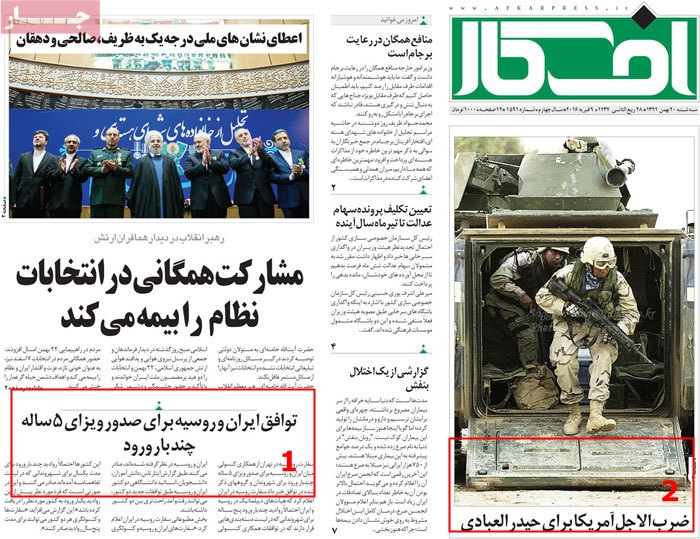
Afkar:

1-Russia, Iran to issue 5-year multiple-entry visas
2-US deadline for Heidar al-Ebadi


Afkar


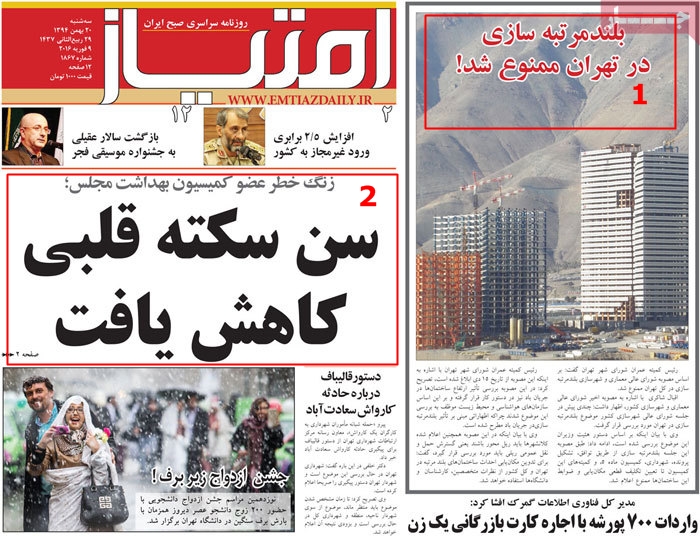
Emtiaz:

1-Building skyscrapers banned in Tehran
2-Age of heart attacks decreases in Iran


Emtiaz


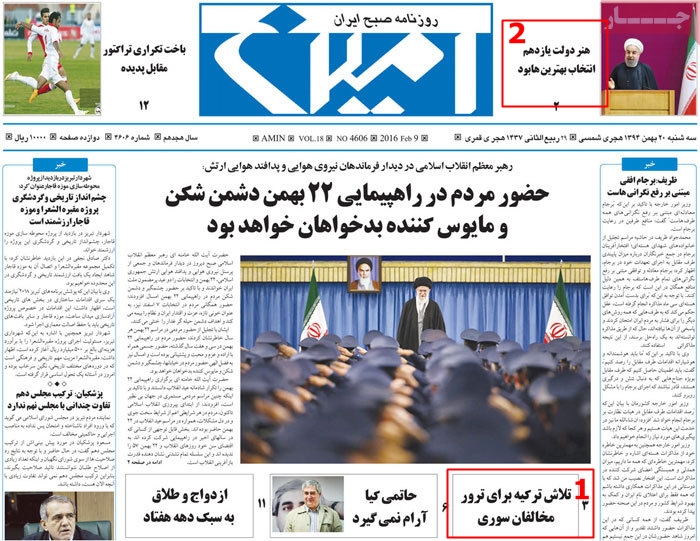
Amin:

1-Turkey seeking to murder Syrian opposition
2-President: Art of 11th administration is in appointing the best people


Amin


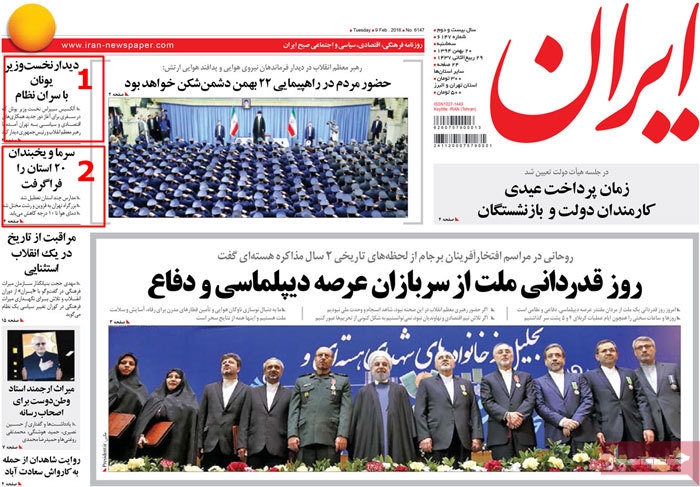
Iran:

1-Greek premier meets with Iranian authorities
2-Cold snap grips 20 Iranian provinces


Iran


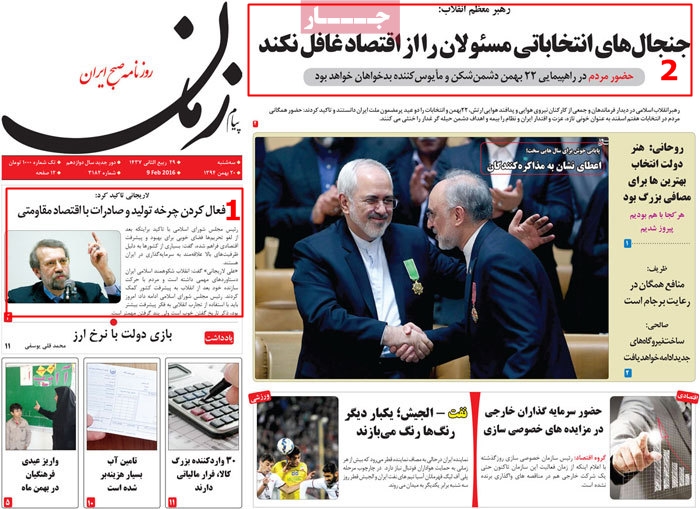
Payam Zaman:

1-Parliament Speaker: Resistive economy turns the wheels of production and exports

2-Leader: Election campaigns must not distract officials from pursuing economic concerns


Payam


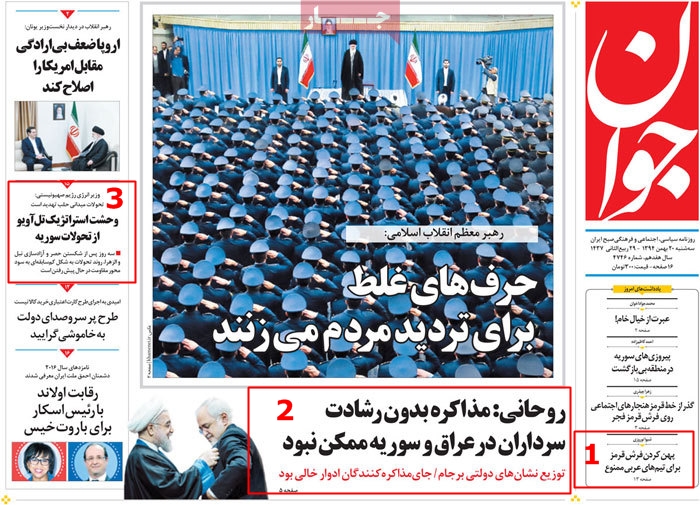
Javan:

1-No red carpet for Arabian teams in Iran
2-Rouhani: No talks were possible without the endeavours of Iranian commanders in Iraq, Syria
3-Tel Aviv’s strategic fear of Syria developments


Javan


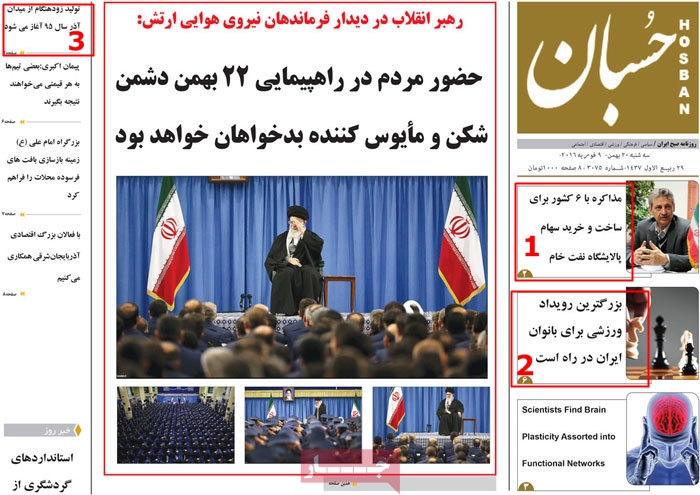
Hosban:

1-Iran considers building refineries in 6 countries
2-Women eye biggest sports event in Iran
3-Iran to start early production in Azar oilfield


Hosban


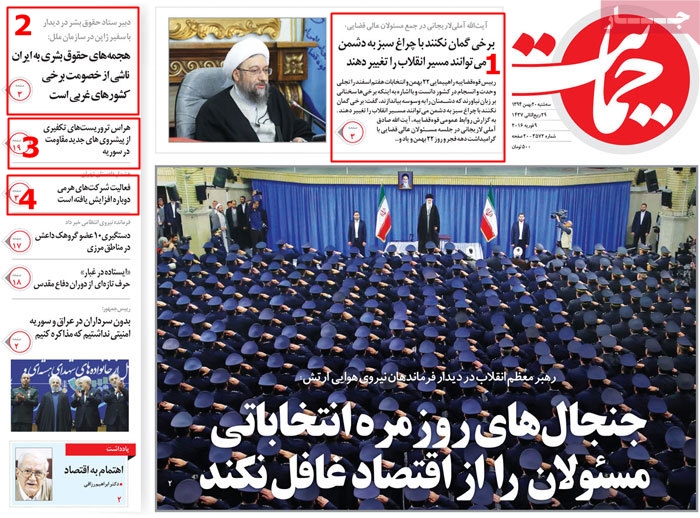
Hemayat:

1-Judiciary Chief warns those who think they can derail the revolution by showing enemies the green light
2-Human rights accusations against Iran caused by enmity of the West: Human rights chief
3-Takfiri terrorists nervous about Syrian resistance gains
4-Pyramid schemes re-emerge in Iran


Hemayat


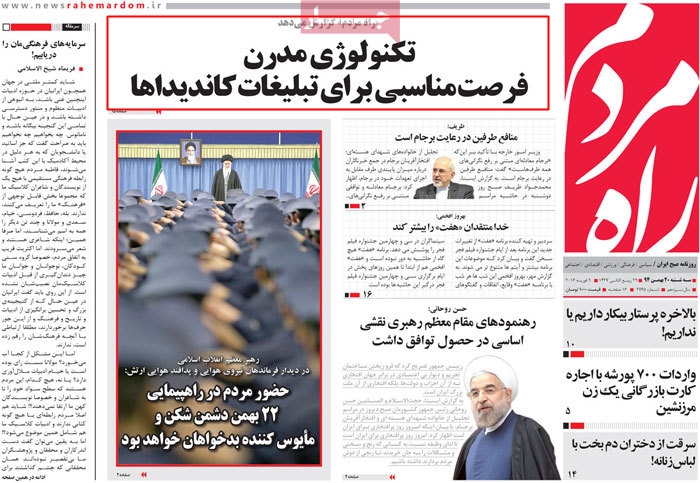
Rah-e Mardom:

Report: Modern technologies good for candidates’ election campaigns


Rah-e-mardom


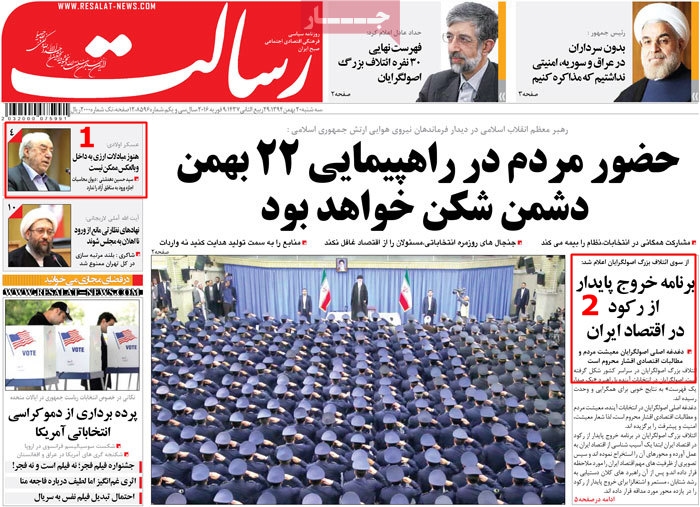
Resalat:

1-Forex trade still problematic: Business figure

2-Principal plans for driving country out of recession in a sustainable manner


Resalat


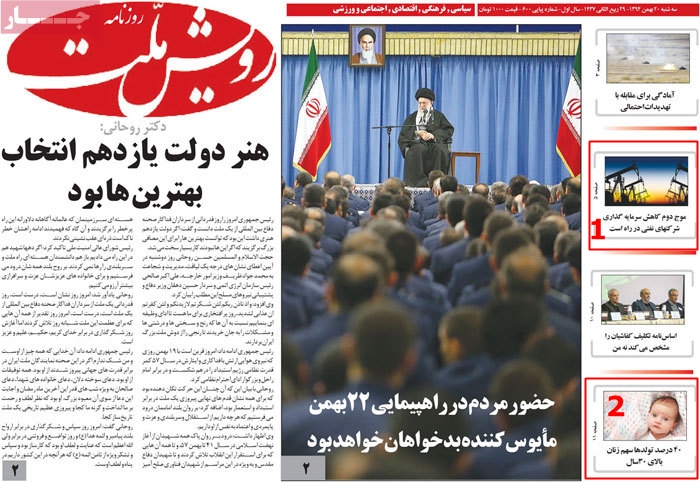
Rooyesh Mellat:

1-Second wave of foreign oil firms in Iran

2-40% of children born to mothers over 30 [in Iran]


Rooyesh-e-mellat


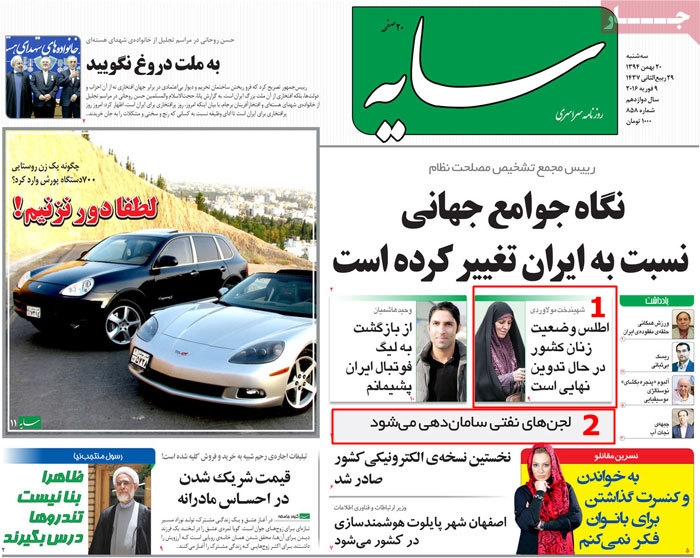
Sayeh:

1-Women’s atlas of Iran in its final stages, said Shahindokht Molaverdi, Iran’s Vice President for Women and Family Affairs

2-Iran plans to deal with oil sludge to preserve environment


Sayeh


Shahrvand:

India earns billions from Iranian medical students


Shahrvand


Sahib Ghalam:

1-No plans to launch Riyadh interests section yet: Iran

2-4 countries finance Iranian mines


Sahib Ghalam


Asia:

1-Iran stock exchange to become international

2-Iran offers 3-year visa to foreigners with over $300k capital


Asia


Abrar Eqtesadi:

1-Rumors about MasterCard coming to Iran

2-Foreign investors allowed in on privatization tenders


Abrar-Eghtesadi

Iran, Italy to ink cooperation agreements today

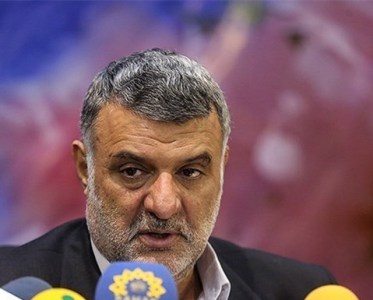
Hojjati made the remarks in a meeting with his visiting Italian counterpart Maurizio Martina.

He added the agreements will be inked in the fields of promoting agricultural machinery technology, food industry and empowering the private sector.

‘Iran and Italy enjoy good relations in agricultural areas and the activists of the two countries are fully aware of each other’s potentials,’ he said.

He also advised the private sectors of the two countries to do their best to get acquainted with the economic potentials of each other.

Moscow questions UN impartiality in Syria crisis

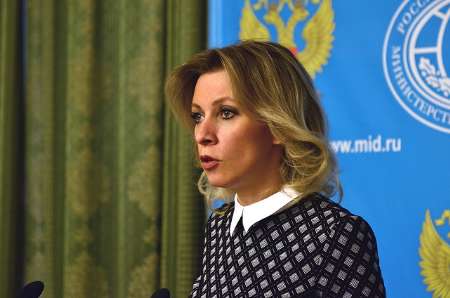
The ministry’s spokeswoman, Maria Zakharova, in a statement on Monday said that Ban’s remarks played into the hands of Western media who had been spreading rumors about the Russian air campaign against anti-government extremists in Syria and the toll it took on the civilian population, according to Sputnik.
On Friday, Ban told the Financial Times newspaper that Russian airstrikes near the Syrian city of Aleppo made it harder for UN envoy for Syria Staffan de Mistura to mediate talks between Damascus and opposition that were underway in Geneva.
They were eventually put back three weeks until February 25.
‘We have always assumed and still assume that comments from the chief executive of an international organization should be unbiased and objective, in line with his status. This was obviously not the case,’ Zakharova was quoted saying.
In late January, militants, including those from the al-Qaeda-affiliated al-Nusra Front, reinforced their positions in Aleppo close to the northern border with Turkey. A Syrian ground offensive backed by Russian airstrikes has managed to sever their supply routes and gain control of border regions, the report said.

US tourists heading to Iran after sanctions lift: NYT

According to the New York Times, tour operators speak of a surge of bookings by many Americans who, undeterred by a State Department warning about travel risks to Iran, are keen on visiting the country.

Tour operators say the demand has been so acute that they are racing to add new departures and selling them in record time.

“It’s similar to Cuba in my mind where suddenly it’s both OK to go there officially but also with travelers thinking this place is going to change,” said Barbara Banks, director of marketing and new trip development at the Berkeley, California-based Wilderness Travel, which sold out its spring trip to Iran and is planning a fall trip focused on the saffron harvest.

“They want to experience the destination before it gets watered down by lots and lots of people going,” the report quoted her as saying.

Tourism in Iran is already popular with Europeans.

Iranian officials told the Associated Press last fall that about five million foreign travelers visited Iran in 2014, and that the country aims to attract 20 million tourists, spending $30 billion, by 2025.

Among growth signs, Air France recently announced that it plans to start three flights weekly between Paris and Tehran beginning in April.

Already Iran is a one-stop destination from New York.

Iran hosts some of the world’s oldest cultural monuments, including 19 Unesco World Heritage Sites, and its varied terrain ranges from desert locales to ski resorts.

“It’s just extraordinarily beautiful, and the sites are as magnificent as any you can find in the world,” said William O. Beeman, a professor and chairman of the anthropology department at the University of Minnesota.

In response to an increase in inquiries, the Seattle-based Mir Corporation, which has been operating in Iran for 15 years, has added new train trips and small group departures in the country this year, for a total of about 10 different trips.

The report also points to some deficiencies such as shortage of enough hotels and some financial restrictions for foreign money transfers.

What Price Will the UAE Pay for its Emotional Decision to Go Along with Saudi Arabia?

Tabnak website, a news and media analysis outlet, said on Monday that, following a series of recent victories by resistance forces and the defeat of terrorist groups in the northern strategic city of Aleppo, various countries supporting these groups (including Turkey and Saudi Arabia) have reacted in different ways to these new developments in the Syrian conflict. Turkish President Erdogan reacted angrily to the war waged by Russia against terrorist groups, accusing Moscow of killing Syrian people. Saudi Arabia has been talking about sending its troops to Syria, which seems to be beyond its regional power and capability.

According to Tabnak, Saudi Arabia, which along with its allies has been fighting in Yemen for more than a year, has not achieved very much so far, and is now talking about sending a large number of its troops to Syria. It is possible that the Saudi rulers themselves are not particularly serious when they say they are ready to dispatch their forces there.

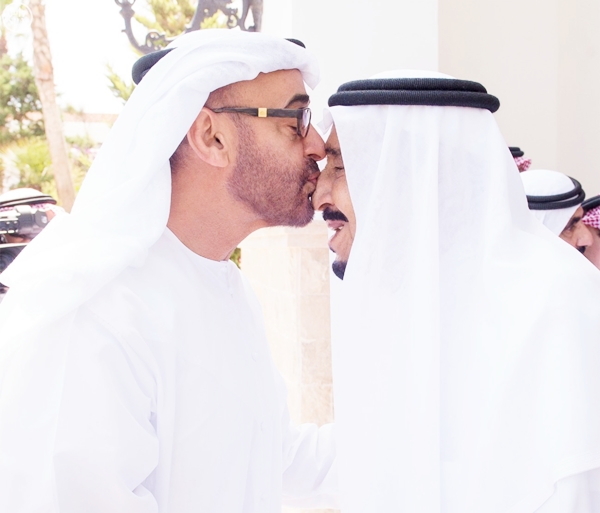
Meanwhile, the United Arab Emirates (UAE), which has always followed Saudi policies, and has taken part in the killings of Yemeni people led by Riyadh, announced its readiness to send ground troops into conflict-ridden Syria along with the Saudis.

There are several reasons behind a UAE decision to follow Saudi Arabia in sending troops to Syria. Firstly, they want to overshadow their activities in Yemen by sending troops to Syria. Secondly, by sending troops to Syria a country like the UAE can portray itself as a country of more influence in the region, especially militarily. This may be a gesture which they themselves do not believe in. Thirdly, by going along with the Saudis, they want to show Iran that the Arab countries are united in countering Iran’s regional policies, and are able to forge regional coalitions against Tehran.

Putting aside the reasons behind such position taken by the UAE, one must reflect on the consequences of the decision taken by UAE rulers. The first result of such measure is military casualties. They are engaged with a single group named Ansarullah in Yemen, and have sustained heavy loses there. In Syria, however, they will be faced with an organized government, as well as Iran and Russia, two major regional and global powers. They will also come up against Hezbollah militia forces which have often contended with Israel, possessors of one of the world’s most modern armies. Therefore, sending any troops by the UAE to Syria could result in a costly defeat.

Another possible outcome of a UAE military presence in Syria, due to its geographical proximity to Syrian conflict, will be that it could expose the country to a security crisis. Russia will undoubtedly be able to provide the Syrian army with missiles which can target both Jordan, Saudi Arabia and the UAE, which lacks a considerable defensive force.

One more fallout of sending troops to Syria by UAE will be Iran and Russia’s reactions. These two countries will definitely react to a move which, under the pretext of fighting ISIS, is in fact aimed at weakening the Syrian government. This is why the deputy commander of the Iranian Revolution Guards Corps said that Iran has given the Saudis an ultimatum, stating that there will be a strong reaction to any troops being sent to Syria.

Finally, it could be said that the UAE government is fully aware of the dangers involved in dispatching its troops to Syria. They know that, due to their limited military capabilities, they are more vulnerable to such expedition than the Saudis. With these in mind, it seems very unlikely that UAE rulers would embark on such a dangerous path. It seems more likely that they are simply going along with Saudi policies, and may consequently pay a heavy price for their decision.

Iran’s President Vows Not to Let People Feel Humiliated

Rouhani

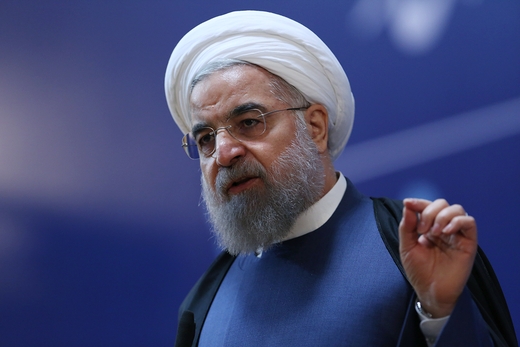
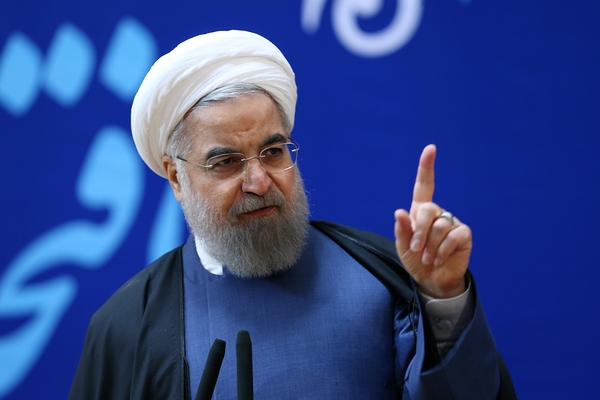
“Today is the day when a nation appreciates the strong men of politics, defense, military, and discipline who endeavored for days and nights to secure the nation’s might,” President Rouhani said.

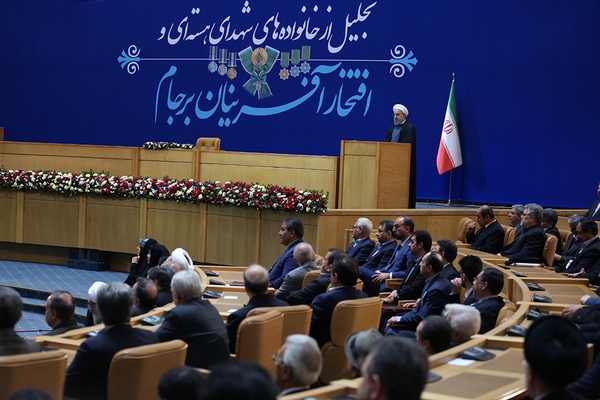
He made the remarks in an address to a Monday ceremony held in the Iranian capital to commemorate the families of the Iranian nuclear scientists that have been martyred and the officials and staff who had a role in the long process of negotiations that led to the Joint Comprehensive Plan of Action (JCPOA).

An integrated, united, and proud nation is always honored. “Wherever we stayed together, we won,” President Rouhani said.

He referred to the ceremony as being aimed at thanking the efforts of the entire nation, saying that the JCPOA neither belongs to the current administration, nor to a particular party, but it is a national honor.

The real honor in the nuclear negotiations and the JCPOA belongs to the Iranian nation, he noted, adding, “Today is the day to appreciate the great nation of Iran, who stood up in all fields, and never surrendered to or feared of superpowers.”

President Rouhani praised the families of martyred nuclear scientists, saying that Iranian peaceful nuclear energy scientists adopted the dangerous path in full awareness and courageously.

“There is no doubt that even if tens of Iranians were martyred in this path, the country’s nuclear scientists would never leave the path of people’s honor and pride,” he noted.

“When all the enemies (of Iran) joined hands to humiliate the nation in an imposed war, the Iranian nation showed an exemplary resistance and made the enemy humiliated, marking a great victory,” Rouhani said.

President Rouhani: Even if tens of Iranians were martyred in this path, the country’s nuclear scientists would never leave the path of people’s honor and pride.

He went on to say that the termination of anti-Iran nuclear-related resolutions of the United Nations Security Council (UNSC) was one of the preliminary conditions he set for Foreign Minister Mohammad Javad Zarif in the early days of negotiations, saying that the goal was achieved through the nation’s resistance although it seemed to be very difficult.

The Iranian president listed a number of factors that helped the administration conclude the nuclear talks, finalize the deal, and implement it in mid-January.

Rouhani first thanked God’s mercy, and then praised the role of the Iranian nation’s unity and solidarity, stressing that an integrated, united, and proud nation is always honored.

The world has well understood the Leader’s position and status, and knows what a position fatwa holds in an Islamic community, and is well aware that if Iran’s Leader says something, the world should trust his word and promise, President Rouhani said.

“Wherever we stayed together, we won,” he noted.

President Rouhani further described the Leader of the Islamic Revolution as the basis for the Iranian nation’s unity and integrity, saying that aside from God’s mercy and people’s resistance, the Leader’s guidelines were very effective.

“Whenever we asked for meetings and consultations, the Leader accepted and provided the Iranian negotiators with all his valuable experiences and outlined specific frameworks,” Rouhani noted.

Besides these three pillars (God, nation, and the Leader), the expertise and resistance of experienced and hardworking negotiators were keys to the finalization of the nuclear deal, he added.

President Rouhani also appreciated the Iranian nuclear chief Ali Akbar Salehi, noting that besides the path Foreign Minister Mohammad Javad Zarif and his ministry were following, a new group was needed to be formed in parallel, so the Atomic Energy Organization of Iran (AEOI) entered the negotiations with all its technical strength.

The night before the Geneva deal, from early hours in the night until 5 in the morning, we were constantly in contact, but the important point is that we never lost the way, and God did not leave us alone, President Rouhani said.

After Dr. Salehi started his work beside other members of the nuclear negotiating team, new breakthroughs were started to be made in technical and technological fields, he added.

“Later in the negotiation process, we reached a point where the defense minister and the ministry’s experts were required to enter the negotiations, and clear the false charges Zionists had raised against our nation, and settle the PMD (possible military dimension) dispute,” Rouhani said.

Accordingly, Defense Minister Brigadier General Hossein Dehqan bravely entered the field with all his colleagues, the president asserted.

He also referred to other factors including the country’s stable economy and the security and stability of the country during the course of negotiations as other keys to the nuclear deal.

If it was not for the courage of the Iranian army, Islamic Revolution Guards Corps (IRGC), Basij (voluntary forces), and other armed forces, we could not have the conditions for good negotiations, the Iranian president said.

“If during the 30-month nuclear negotiations, the administration’s economic department could not control the inflation and turn the minus 6.8 economic growth to positive 3, and restore stability to the market, we certainly could not be successful in the negotiations,” he added.

“Also if the intelligence ministry’s forces, and the Iranian Armed Forces failed to maintain the country’s security, and if our brave commanders did not resist in Iraq and refused to help the Syrian people in Damascus and Allepo, and if it was not for the courage of the Iranian army, Islamic Revolution Guards Corps (IRGC), Basij (voluntary forces), and other armed forces, we could not have the conditions for good negotiations,” Rouhani noted.

“Isn’t it an honor to prove the lies Zionists and the US raised against Iran’s nuclear program, and to terminate the cruel resolutions,” the president asked.

He further touched upon the course of nuclear negotiations, which led to the JCPOA implementation. “We passed difficult days and hours. The night before the Geneva deal was as difficult as the decisions made in Operations Karbala 4 and 5 (two of Iran’s military operation during the Iraqi imposed war).”

“From early hours in the night until 5 in the morning, we were constantly in contact, but the important point is that we never lost the way, and God did not leave us alone,” the Iranian president added.

Elsewhere in his remarks, President Rouhani underlined that the government is seeking to renovate the country’s transportation system, especially the air fleet, after the recent implementation of the nuclear deal.

After Dr. Ali Akbar Salehi, the Iranian nuclear chief, started his work beside other members of the nuclear negotiating team, new breakthroughs were started to be made in technical and technological fields, Rouhani noted.

“We will not let the Iranian people get on board of aging aircraft and feel humiliated. We are looking for renovating the air fleet and provide speedy and modern trains for the sake of Iranian nation’s welfare, comfort, and safety,” he added.

“A very great job was done to turn threat into opportunity, and all-out partnership will begin instead of sanctions,” he added.

We will not let the Iranian people get on board of aging aircraft and feel humiliated. We are looking for renovating the air fleet and provide speedy and modern trains for the sake of Iranian nation’s welfare, comfort, and safety, Rouhani asserted.

He also referred to the post-sanctions era, noting that unlike the lies certain people say – that the administration will import [excessive] foreign goods instead of domestic production – the government is looking for investment, new technologies, and partnership for taking over joint markets.

“They should not lie to the Iranian nation, because the government has been honest with people from the first day … and has kept its promises, and will do so from now on, God willing,” he added.

The defense minister and the ministry’s experts were required to enter the negotiations, and clear the false charges Zionists had raised against our nation, and settle the PMD (possible military dimension) dispute, Rouhani said.

“These are still the early results. Let the skeptics and enemies say whatever they want,” Rouhani said.

“Shouldn’t we be honored that the US president, who apparently has the world’s highest economic and military power, yields to a fatwa issued by the Leader of the Islamic Revolution, and says that he trusts the peaceful nature of Iran’s nuclear program only due to the historic fatwa of Iran’s Leader,” Rouhani asked.

“This means that the world has well understood the Leader’s position and status, and knows what a position fatwa holds in an Islamic community, and is well aware that if Iran’s Leader says something, the world should trust his word and promise,” he added.

“Isn’t it an honor to prove the lies Zionists and the US raised against Iran’s nuclear program, and to terminate the cruel resolutions,” he asked.

The government is looking for investment, new technologies, and partnership for taking over joint markets, Rouhani noted.

“I bow to the Leader’s guidance and support. On behalf of the Iranian nation, I should appreciate all the people who were involved in the field. I appreciate Grand Ayatollahs, the Judiciary Chief and Parliament Speaker, particularly my brother Dr. [Ali] Larijani, the previous administrations of [Ayatollah Akbar] Hashemi Rafsanjani, [Seyyed Mohammad] Khatami, and [Mahmoud] Ahmadinejad, the Supreme National Security Council (SNSC), the previous negotiators, the elites and academics, and also the entire nation for their prayers,” he concluded his talks.



Saudi Arabia says US has welcomed troops offer for Syria

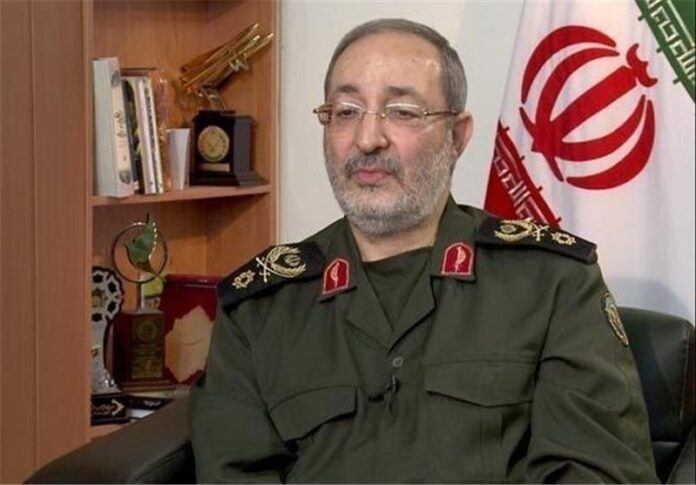
Saudi Foreign Minister Adel al-Jubeir said the offer, made last Thursday, had been met with Washington’s approval and that Saudi forces would be playing a major role in any such operation.

“The United States government was very supportive and very positive about the kingdom’s readiness to provide special forces to the operation in Syria, should the international coalition make a decision to do so,” he told reporters.
 

adel al-Jibeir
Saudi Arabian Foreign Minister Adel al-Jubeir (photo by AFP)


“So the kingdom will be part of it,” he said. “That support came from the White House, it came from the [US] State Department, it was natural for [US] Secretary [of State John] Kerry to support such a decision.”
The 65-member coalition, of which Saudi Arabia is a member, has been conducting air raids inside Syria since September 2014. The airstrikes have no authorization from the Syrian government or the UN and have reportedly fallen short of uprooting the militants.

State Department spokesman John Kirby confirmed that the United States had welcomed the Saudi offer, but he would not comment on the nature or timing of any potential ground operation.

“We are talking about a ground element,” he said. “We have discussed the potential value of a special operations capability inside that element, which would be valuable.”

Washington itself has deployed special forces to eastern Syria in what it claims is an effort to shore up local militias against Daesh.