Thursday, December 25, 2025
Home Blog Page 4570

A look at Iranian newspaper front pages on March 7

Iran Newspaper front pages

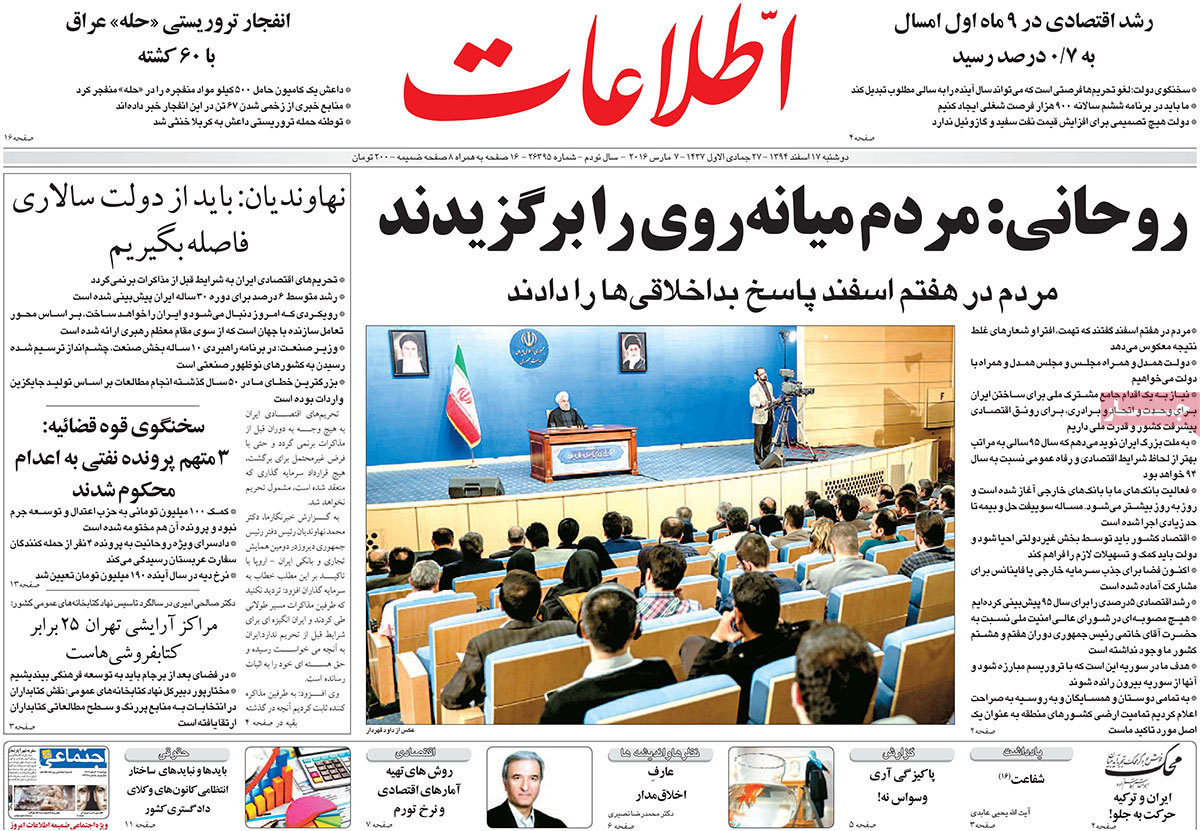
Ettela’at:

1.  Iran 9-month economic growth at 7%

2.  Terrorist blast kills 60 in Iraq’s Hillah

3.  Nation chose moderation: Rouhani

4.  Official calls for limiting “admin-archy”

5.  Oil scam culprits sentenced to death

6.  Tehran has 25 times more salons than bookshops
 

A look at Iranian newspaper front pages on March 7


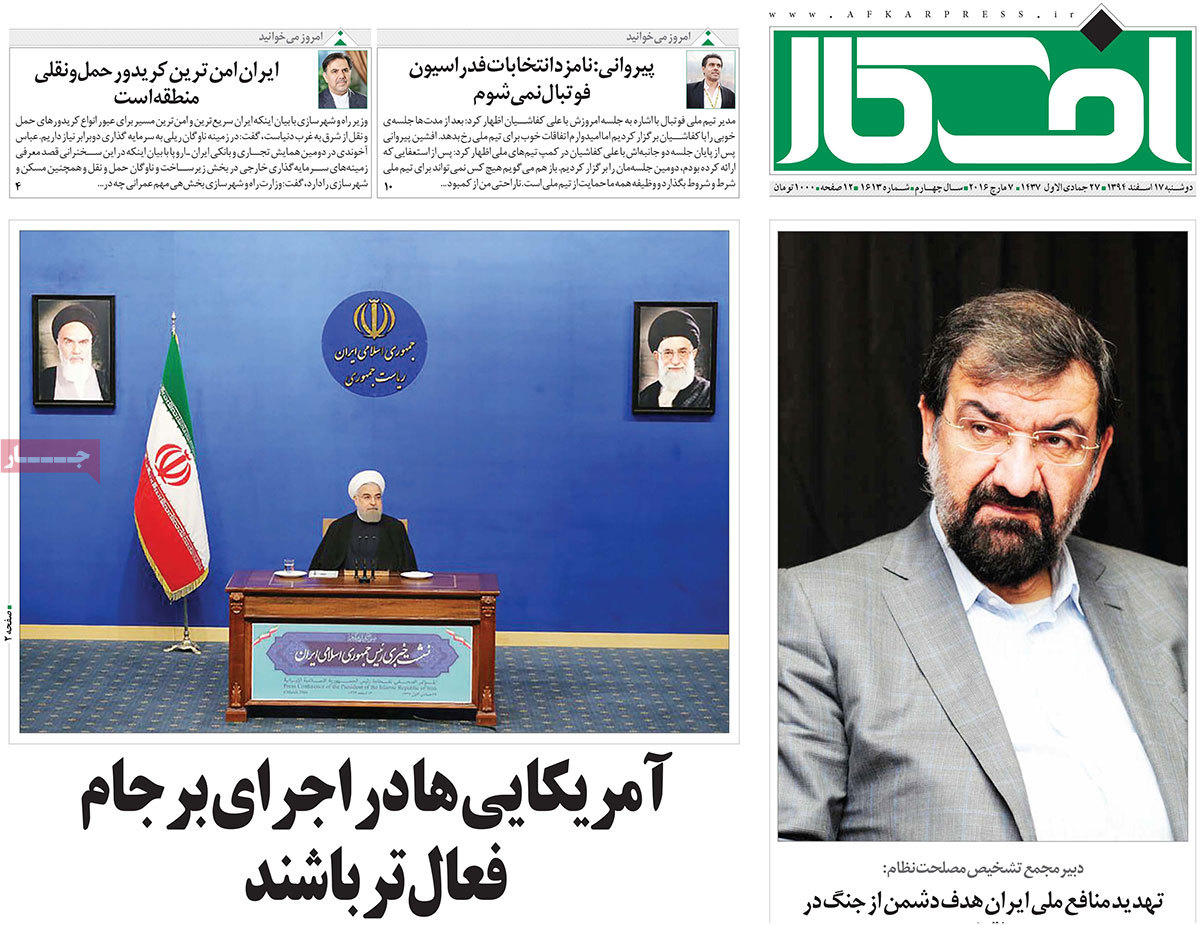
Afkar:

1.  Iran safest transit corridor in region: Minister of Roads

2.  Iran calls on US to act more on JCPOA implementation

3.  Enemies target Iranian national interests in regional conflicts
 

A look at Iranian newspaper front pages on March 7


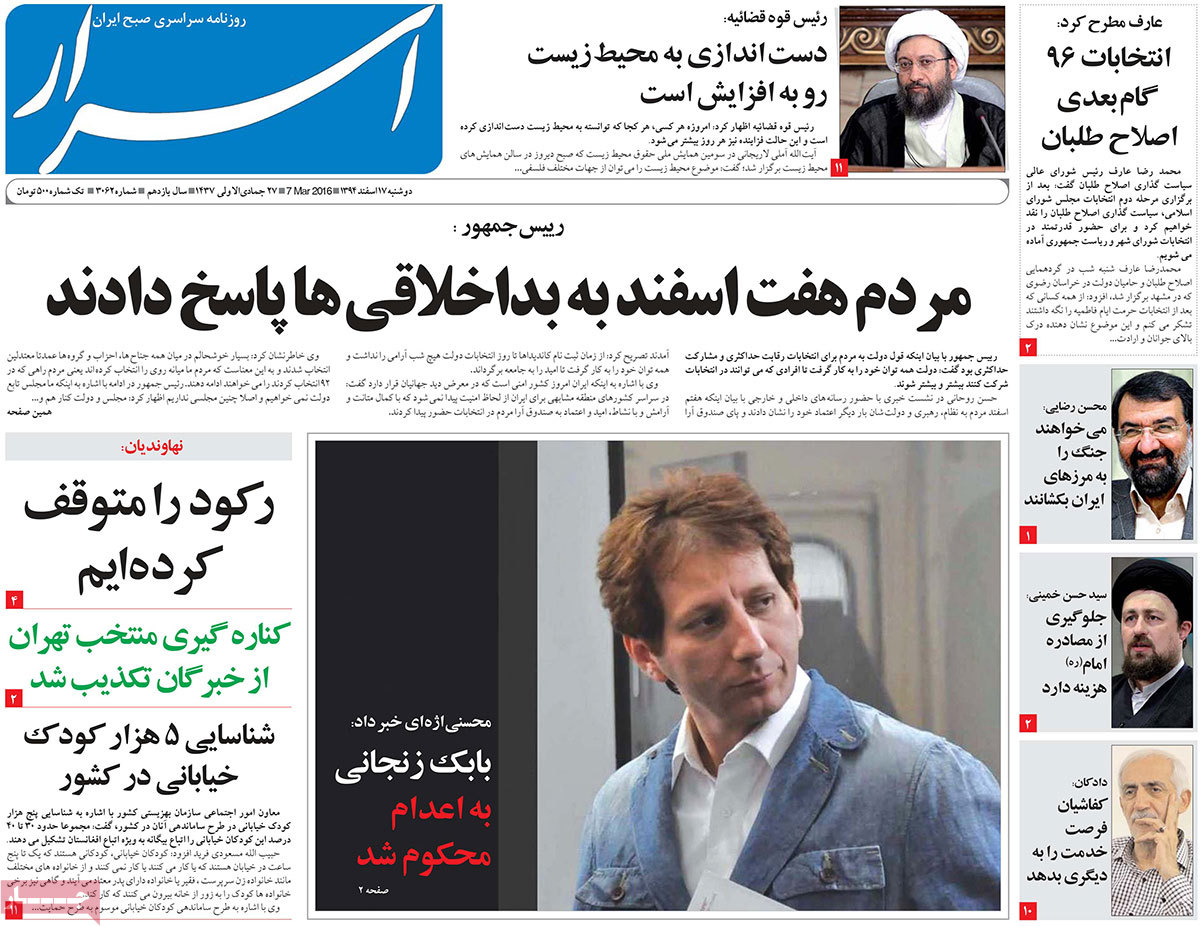
Asrar:

1.  Rouhani: Nation responded to hardships with Feb 26 election turnout

2.  Admin has curbed recession: Official

3.  5,000 street kids in Iran

4.  They [foreign enemies] are seeking to bring war to Iranian borders: Mohsen Rezaei

5.  Death sentence for corporate mogul
 

A look at Iranian newspaper front pages on March 7


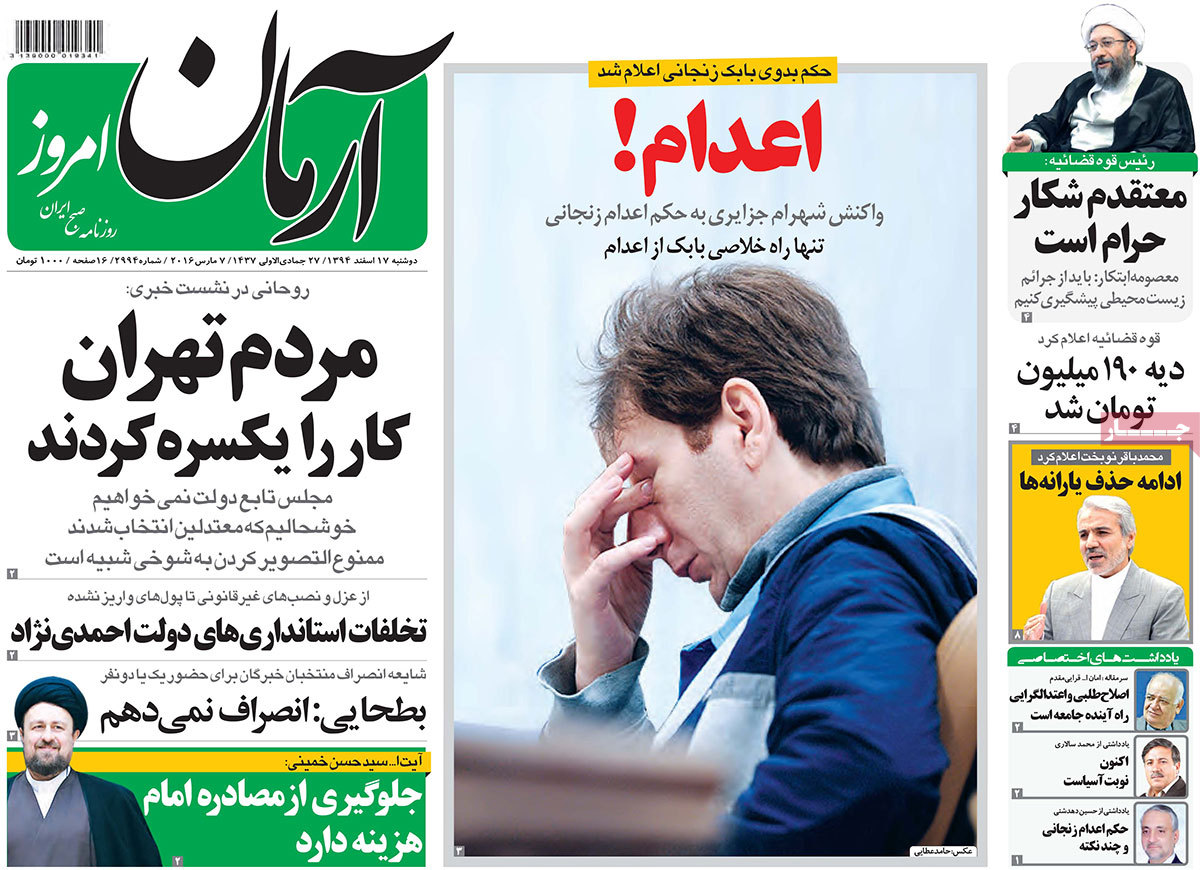
Arman-e Emrouz:

1.  Judiciary Chief rules out hunting as religiously forbidden

2.  DOE chief calls for preventing environmental crimes

3.  Execution for billionaire

4.  Admin seeking to decrease cash handouts: Spokesman

5.  Government offenses under Ahmadinejad
 

A look at Iranian newspaper front pages on March 7


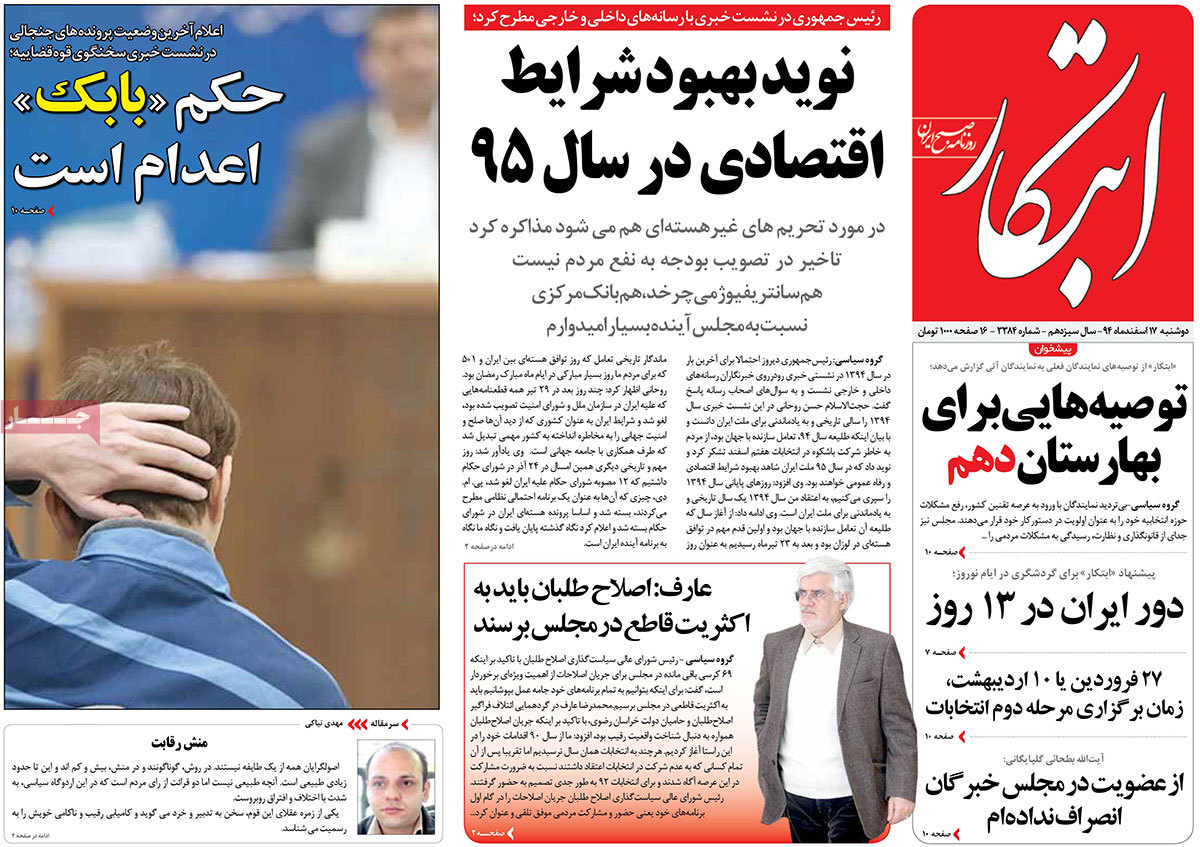
Ebtekar:

1.  Report: Suggestions for 10th Parliament

2.  Hopes high for improved conditions next year

3.  Babak sentenced to death

Iranian Judiciary Spokesman Gholam Hossein Mohseni-Ejei announced on Sunday that the billionaire Babak Zanjani and two accomplices in the oil scam case have been sentenced to death for “corruption on earth”.

4.  Around Iran in 13 days – Suggestions from Ebtekar for New Year holidays
 

A look at Iranian newspaper front pages on March 7


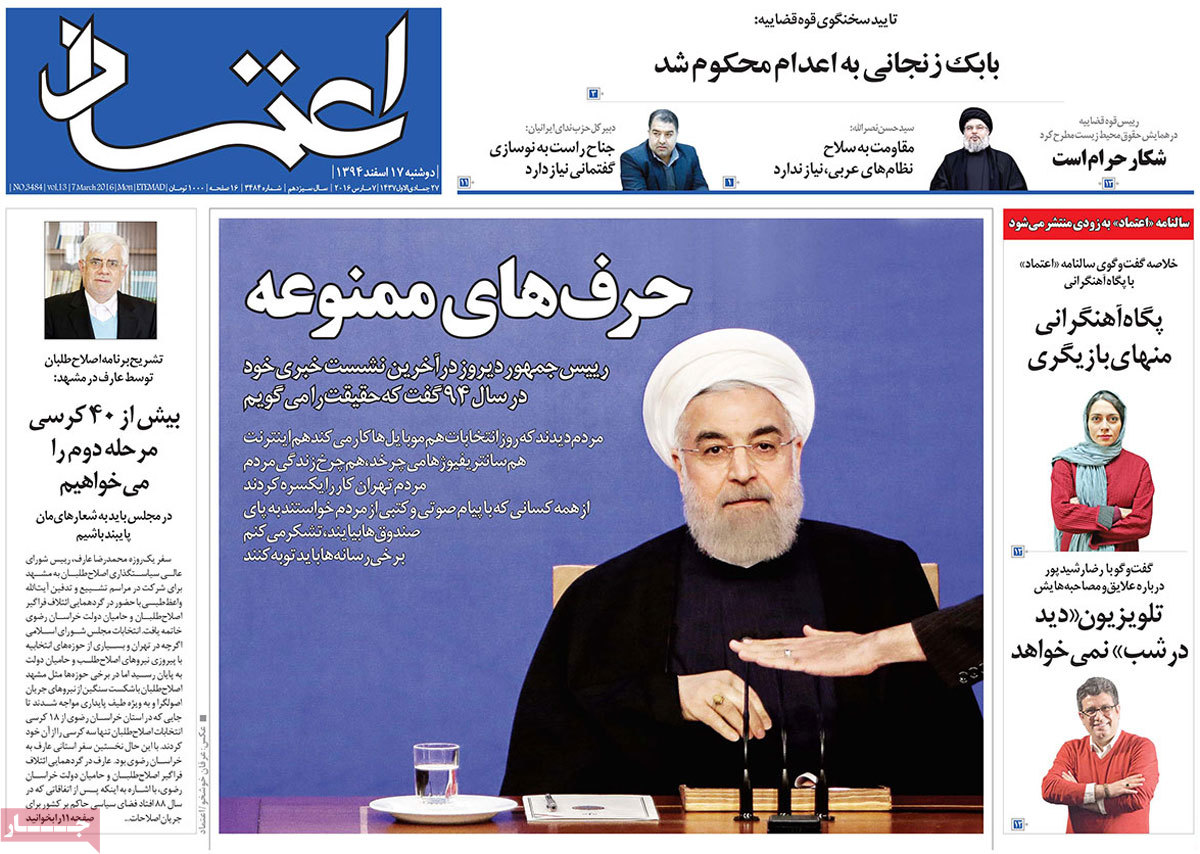
Etemad:

1.  Forbidden words

Addressing his last press conference on Sunday, Iranian President Hassan Rouhani said he was ready to say the unsayable.

2.  Hezbollah chief: Resistance doesn’t need Arab armaments

3.  Reformist Aref eyes 40 runoff seats in parliament [to gain majority in parliament]
 

A look at Iranian newspaper front pages on March 7


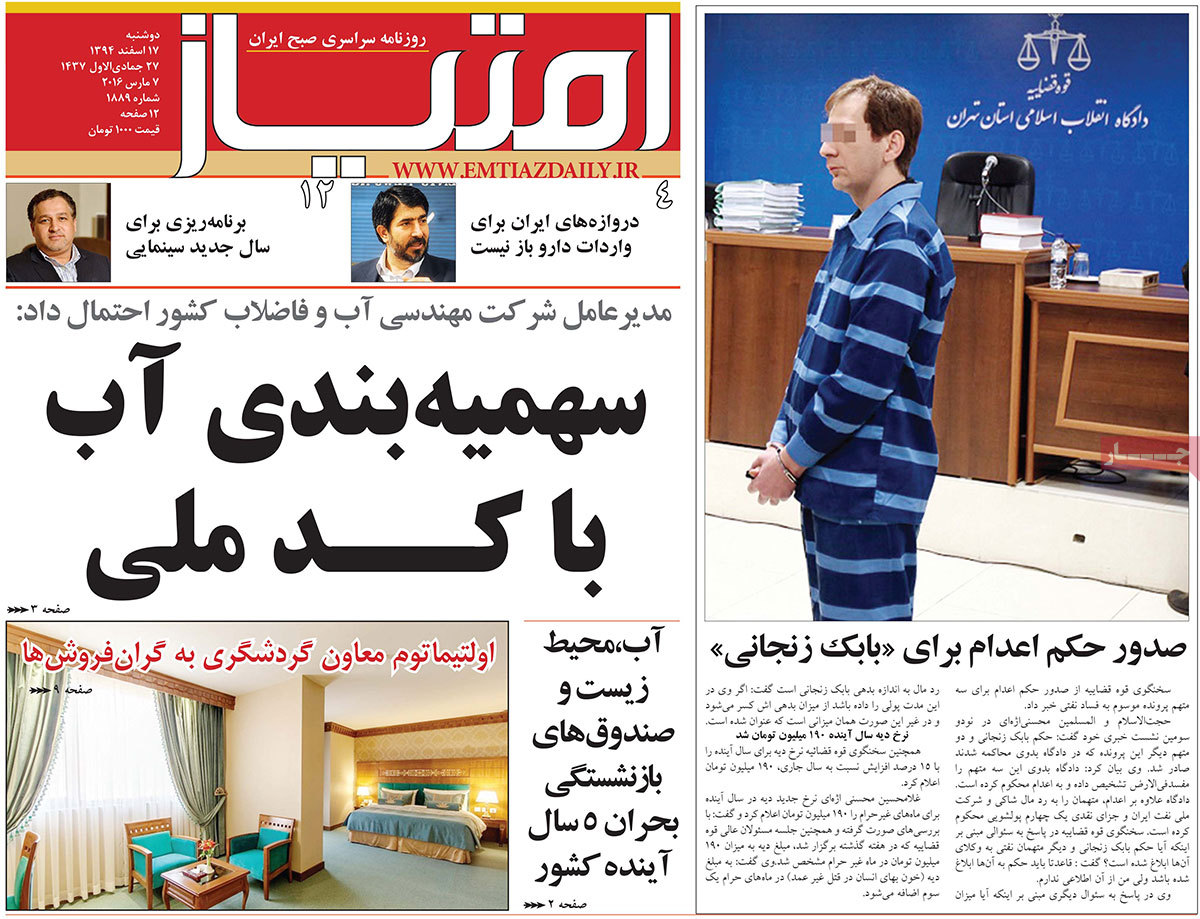
Emtiaz:

1.  Iran gateways not open to imported drugs

2.  Tourism deputy issues ultimatum to over-chargers
 

A look at Iranian newspaper front pages on March 7


Iran:

1.  Rouhani: JCPOA II, admin, nation’s resolution to develop Iran

2.  Water, environment, pension funds: future challenges for Iran

3.  Punishment no solution for preserving environment

4.  Iran eyes 6% economic growth: Rouhani aide
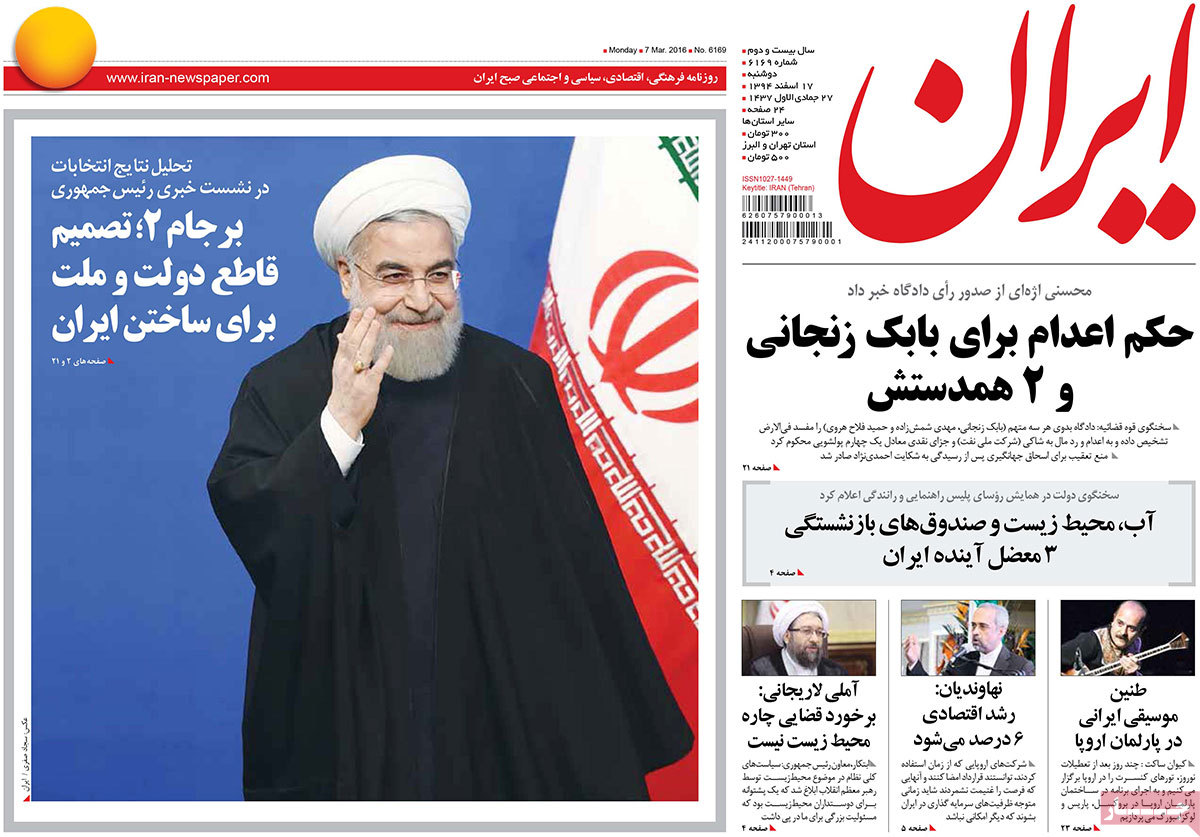
 

A look at Iranian newspaper front pages on March 7


Payam Zaman:

1.  Rouhani says hopeful of next parliament

2.  No decisions for pilgrimage yet

3.  Iran produces 0.3m cars with Iranian brands
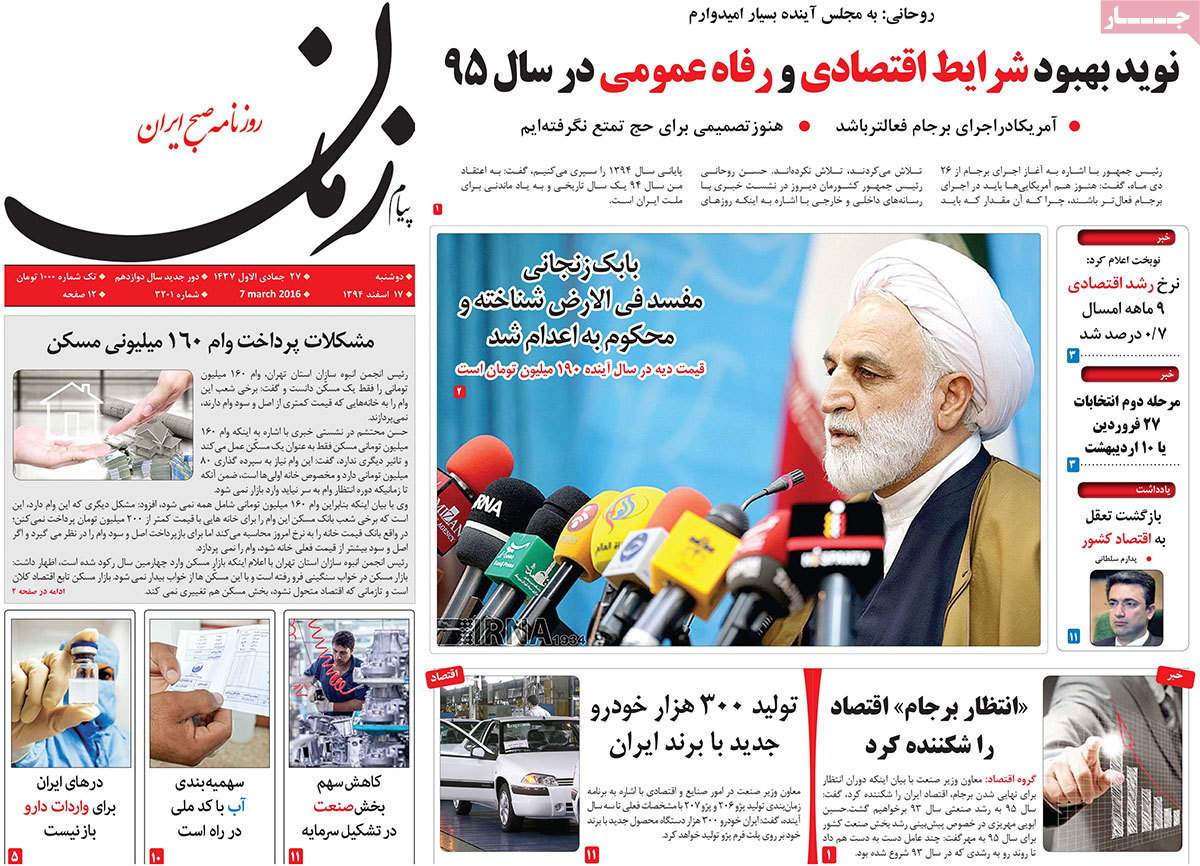
 

A look at Iranian newspaper front pages on March 7


Javan:

1.  Uprising in ISIS capital in Syria
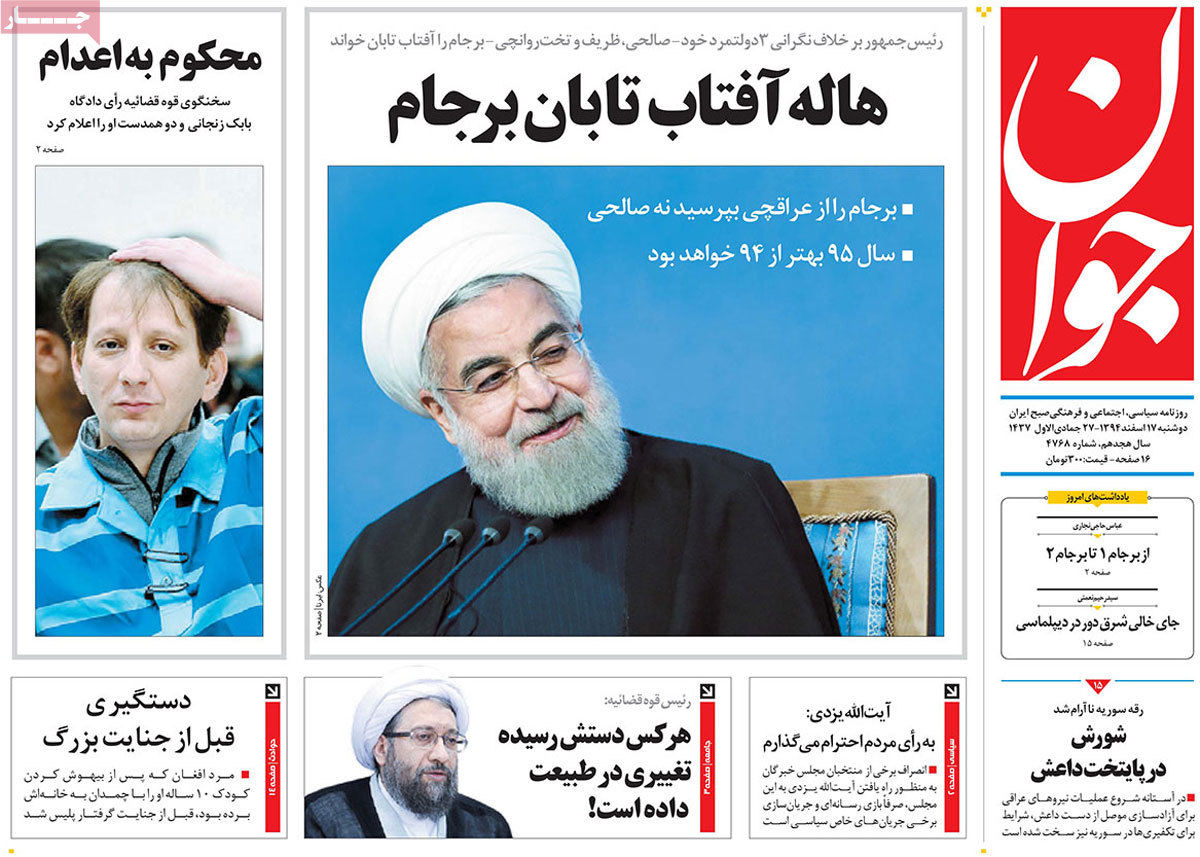
 

A look at Iranian newspaper front pages on March 7


Hosban:

1.  NIDC in talks with Asian, EU firms

2.  Health minister speaks openly to traffic police
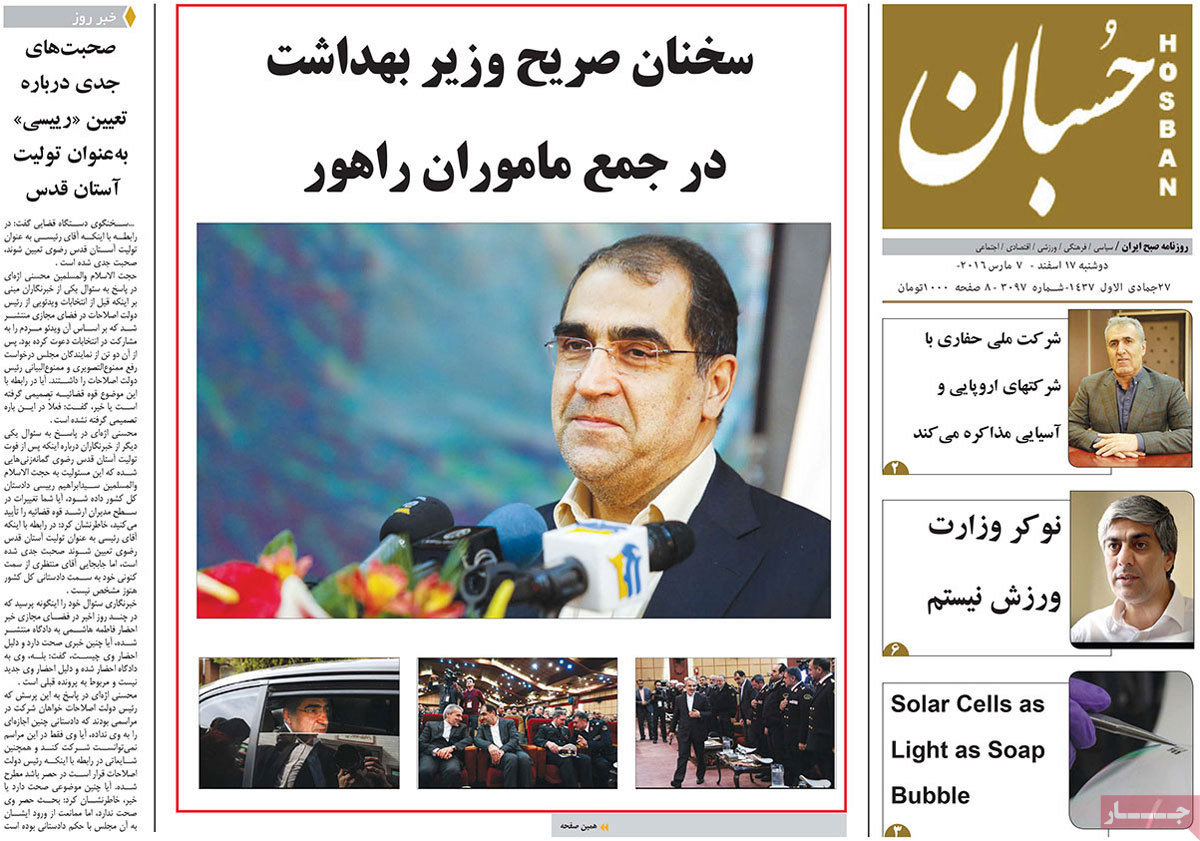
 

A look at Iranian newspaper front pages on March 7


Hemayat:

1.  Judiciary ready to convene courts on environmental crimes

2.  Nasrallah: Without resistance, Lebanon would be Israeli colony

3.  Chinese firm sanctioned for dealing with Iran

4.  Iran closes prison in [northern city of] Amol
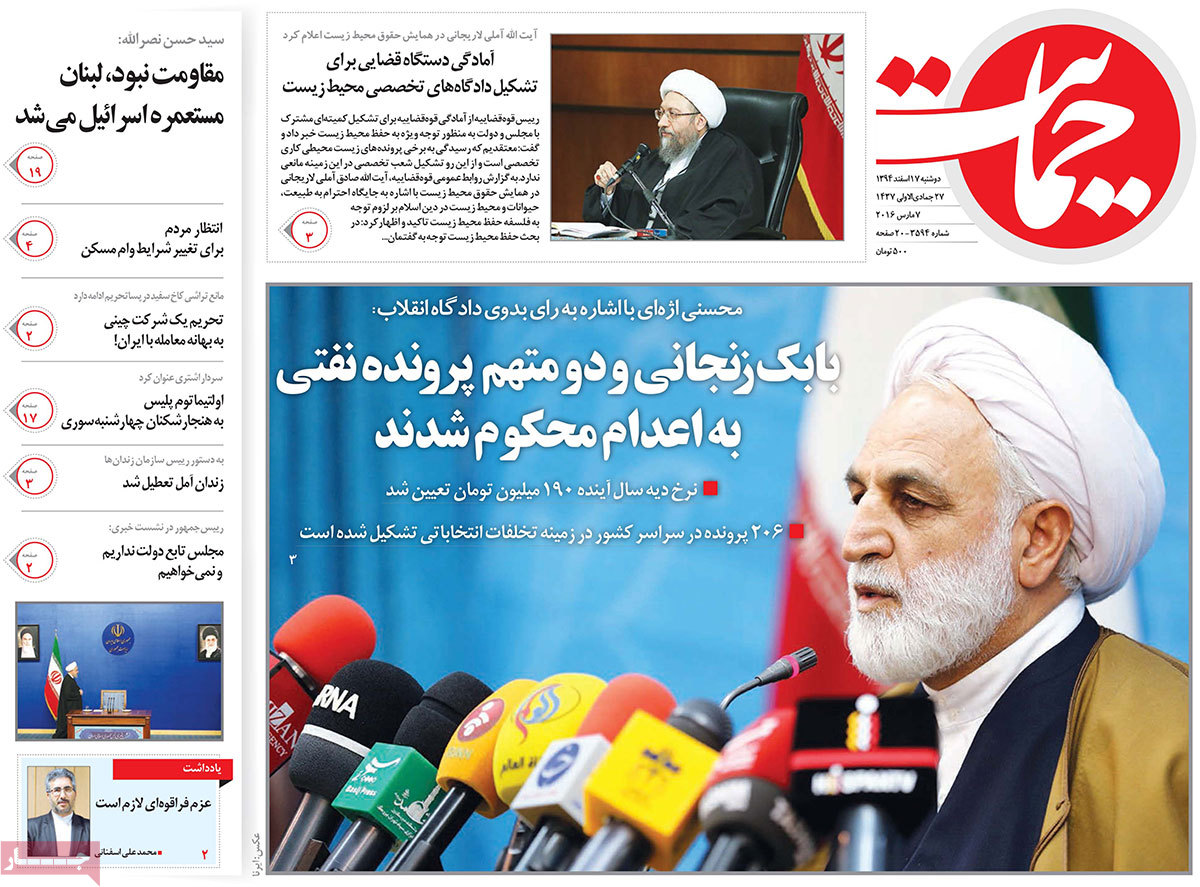
 

A look at Iranian newspaper front pages on March 7


Khorasan:

1.  1st Iran oil cargo calls at European port
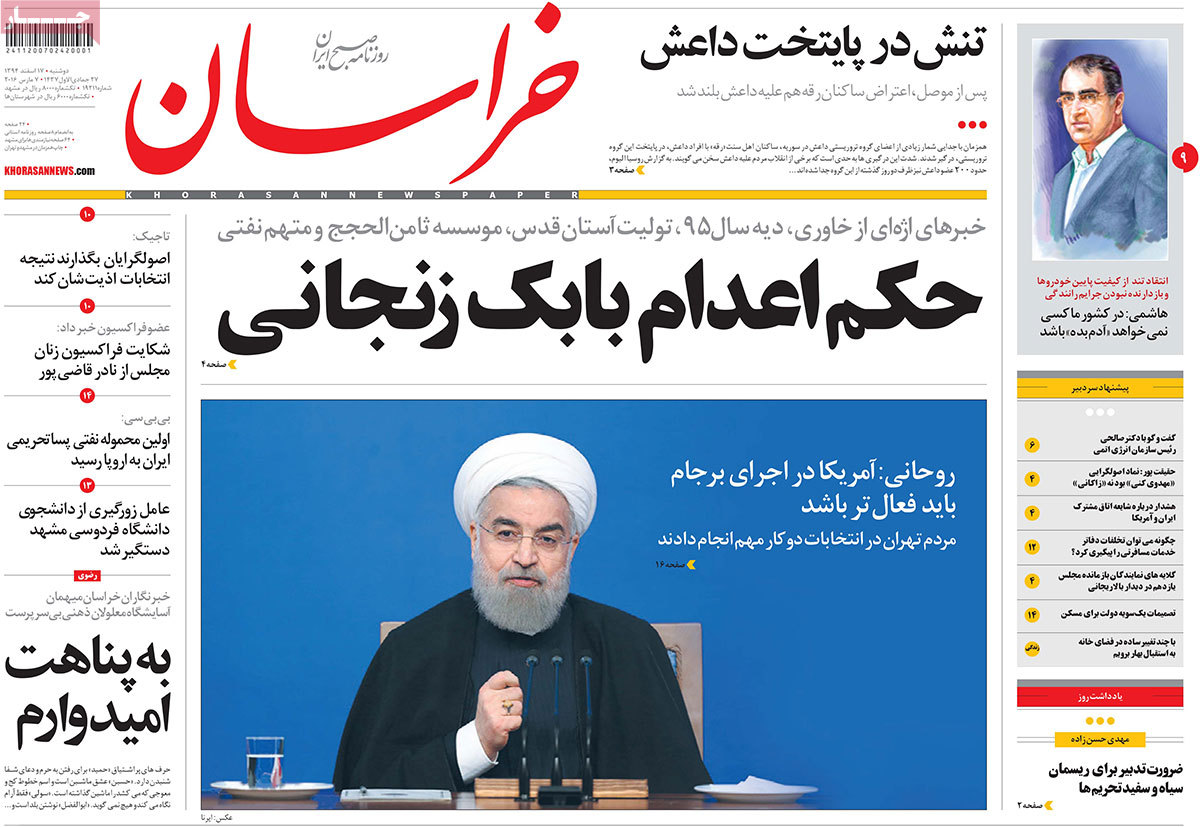
 

A look at Iranian newspaper front pages on March 7


Resalat:

1.  Rouhani: Nation displayed trust in leader, admin [in elections]

2.  Politician calls on admin to retaliate for US failure to fulfill JCPOA promises

3.  Zarif: Hezbollah defends Lebanon against Zionists
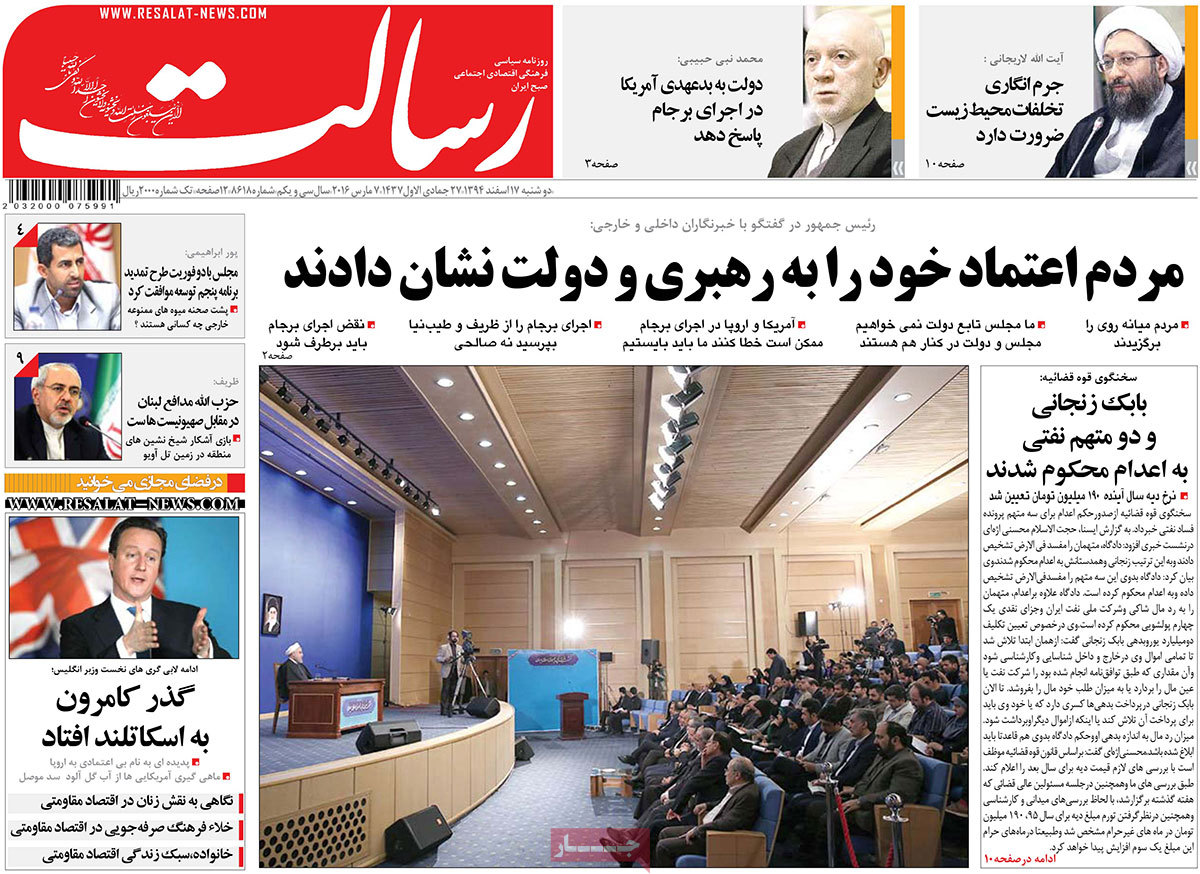
 

A look at Iranian newspaper front pages on March 7


Roozan:

1.  Ayatollah Yazdi: I endorse election outcome

The ayatollah failed to win enough votes in the Feb 26 Assembly of Experts election.
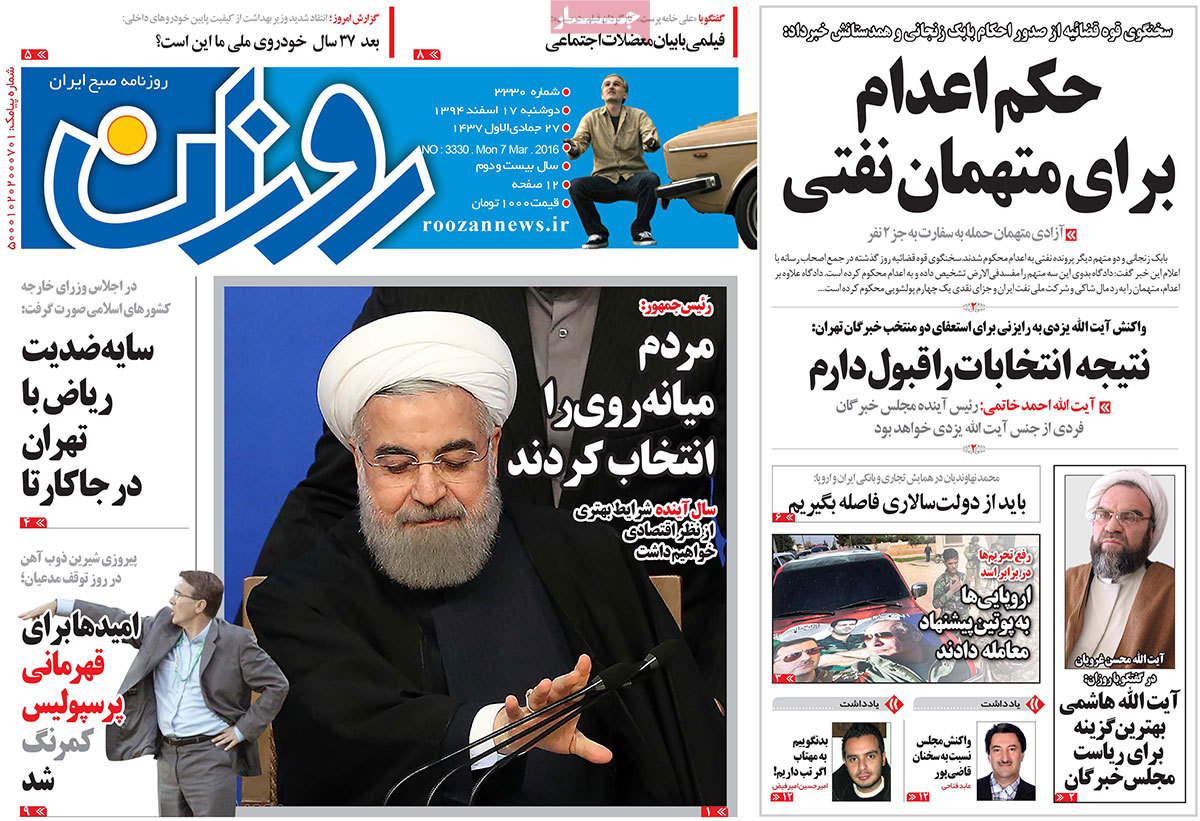
 

A look at Iranian newspaper front pages on March 7


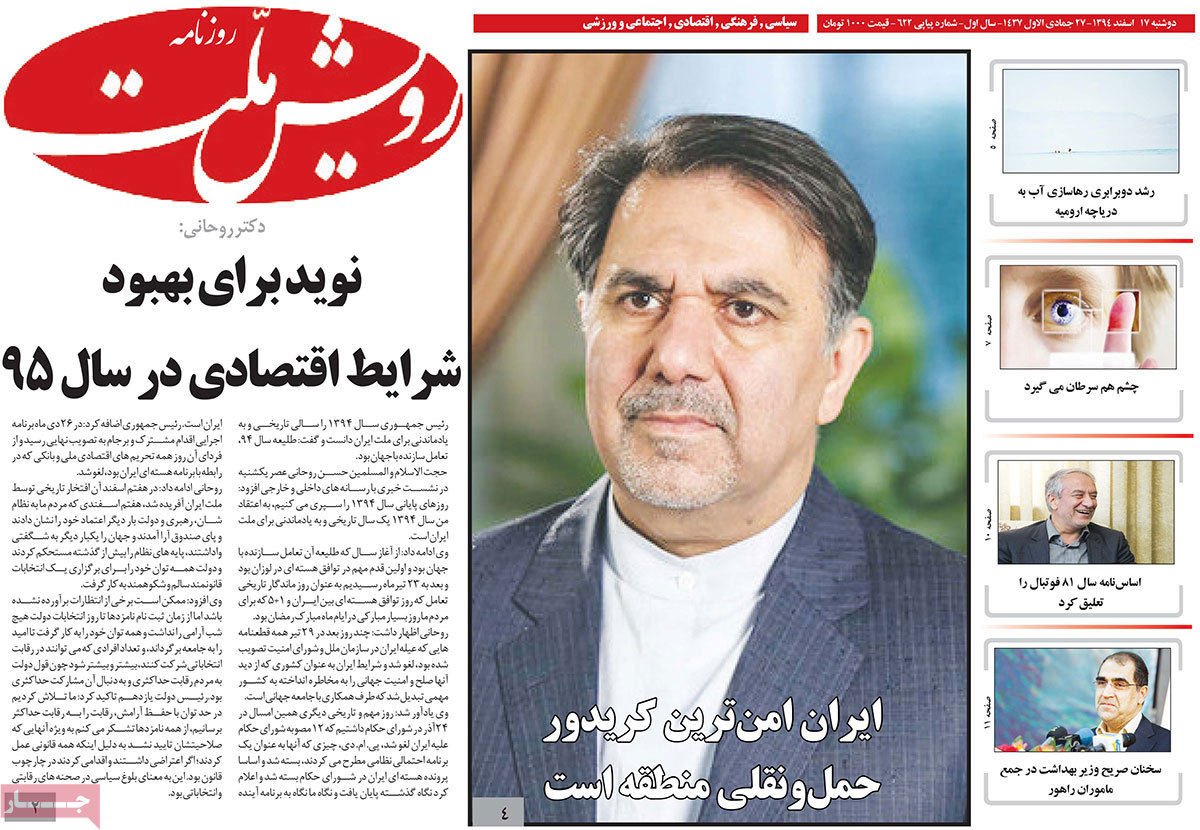
Rooyesh Mellat:

1.  Eyes can get cancer

2.  Urmia lake water intake doubles
 

A look at Iranian newspaper front pages on March 7


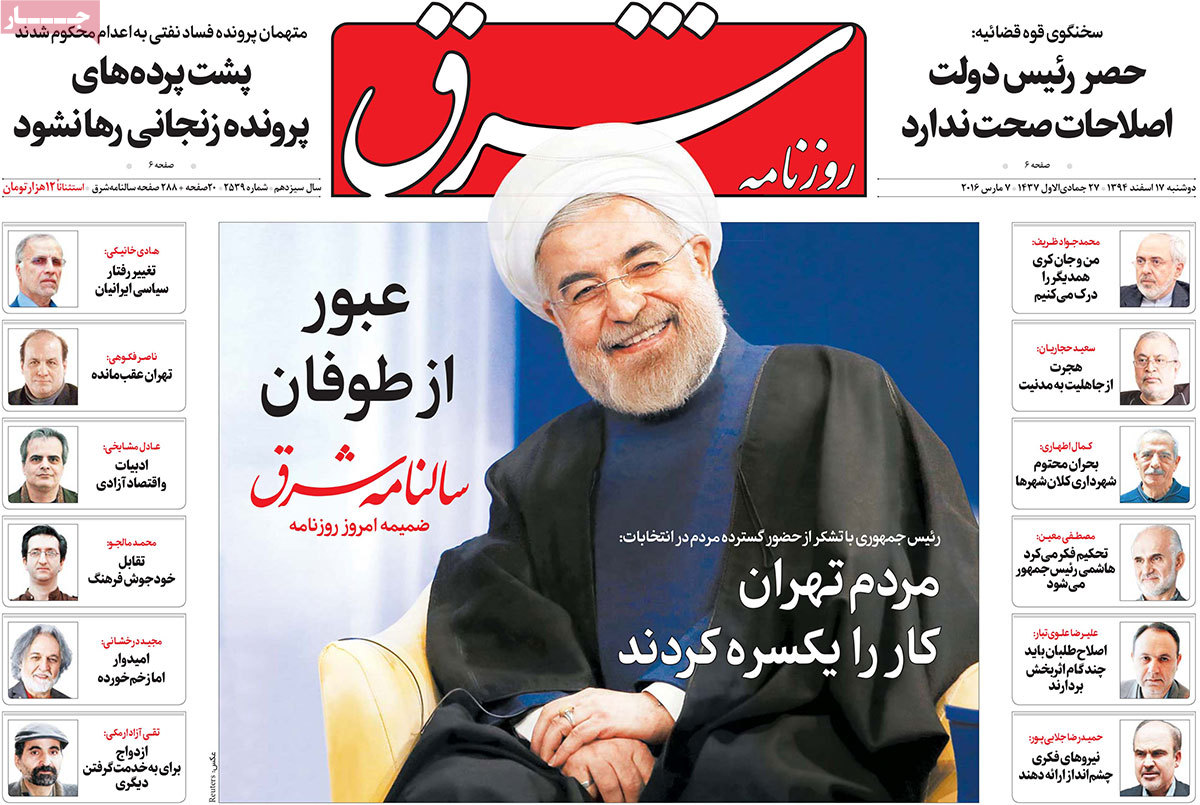
Shargh:

1.  Oil scam culprits sentenced to death; figure behind the case shall not be forgotten

2.  “John Kerry and I understand each other”: Zarif

3.  Judiciary spokesman: Reformist president’s house arrest not real
 

A look at Iranian newspaper front pages on March 7


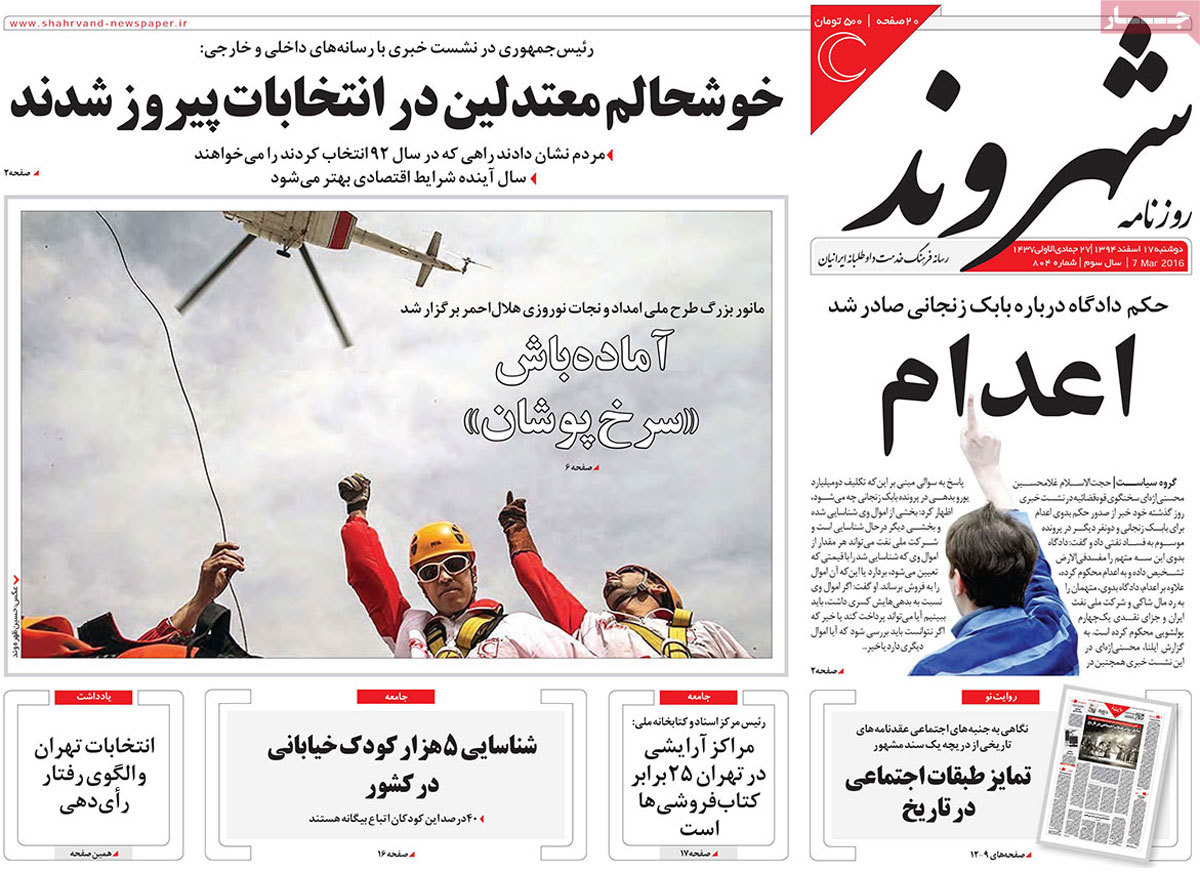
Shahrvand:

Iran Red Crescent hold major maneuver to prepare for New Year holidays

President upbeat about moderate election wins
 

A look at Iranian newspaper front pages on March 7


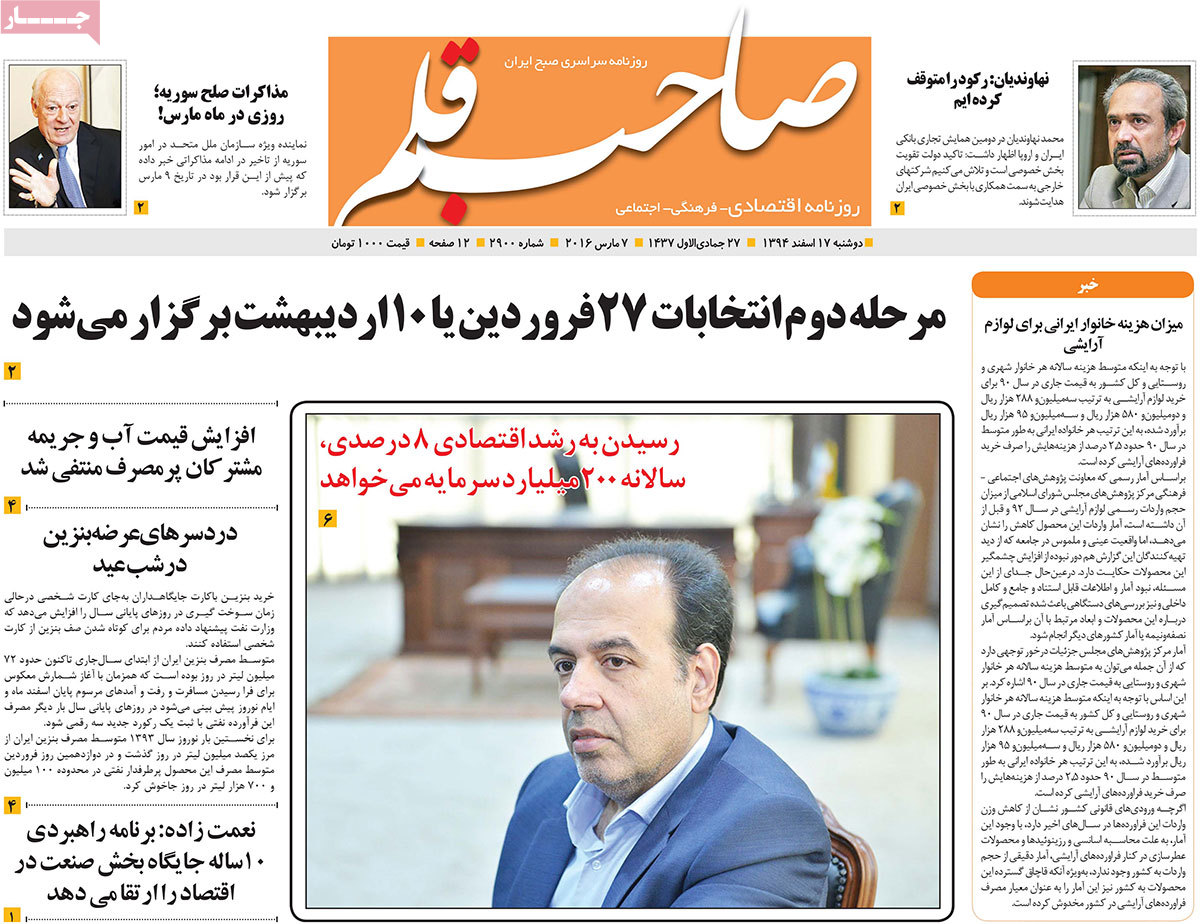
Saheb Ghalam:

1.  $200bn investments needed for 8% economic growth annually: economist

2.  No rise in water prices
 

A look at Iranian newspaper front pages on March 7


Kaenat:

1.  Forex market stable despite oil shocks: Rouhani aide

2.  Iran plans to build power plants on Persian Gulf coasts
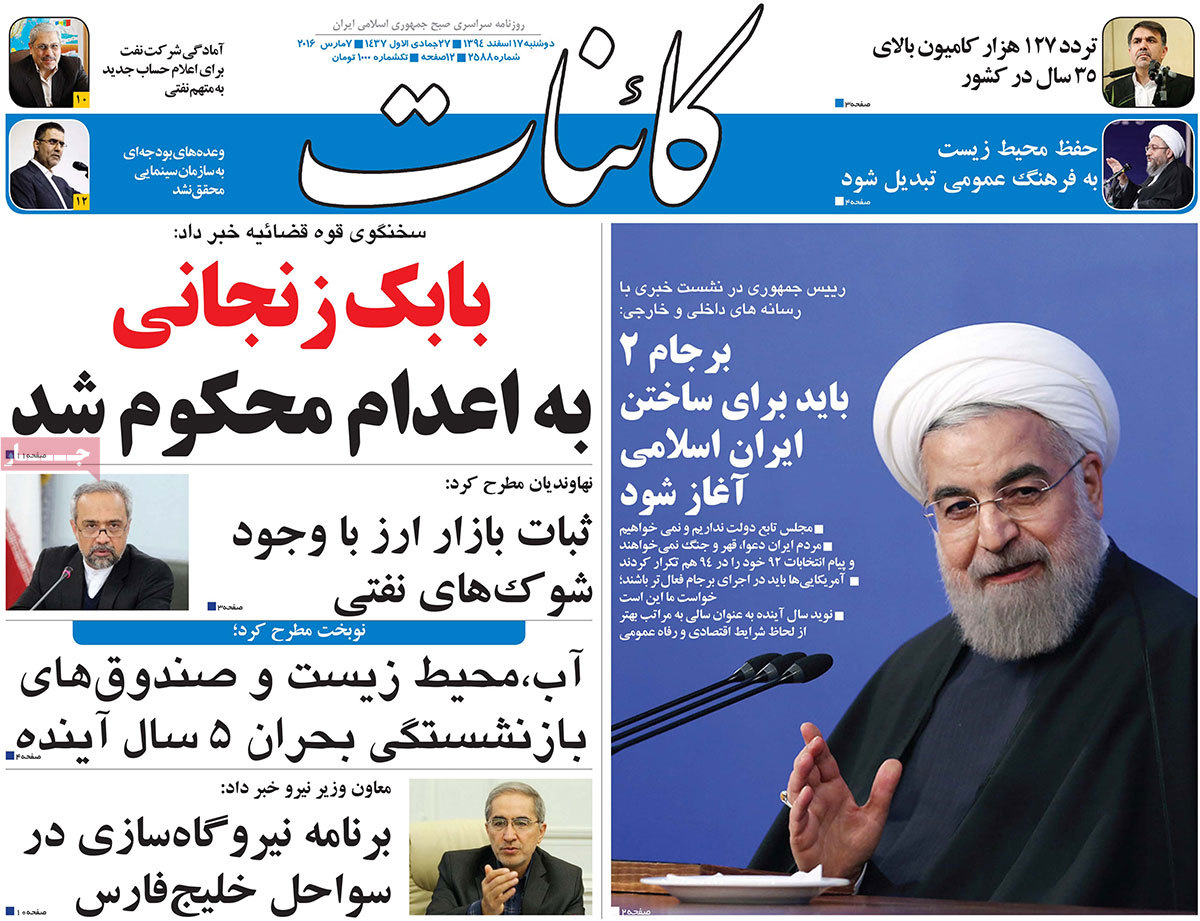
 

A look at Iranian newspaper front pages on March 7


Kayhan:

1.  IRR28,580bn ($9.46bn) of cars imported in 11 months

2.  Resistance beats ISIS, US takes credit: report
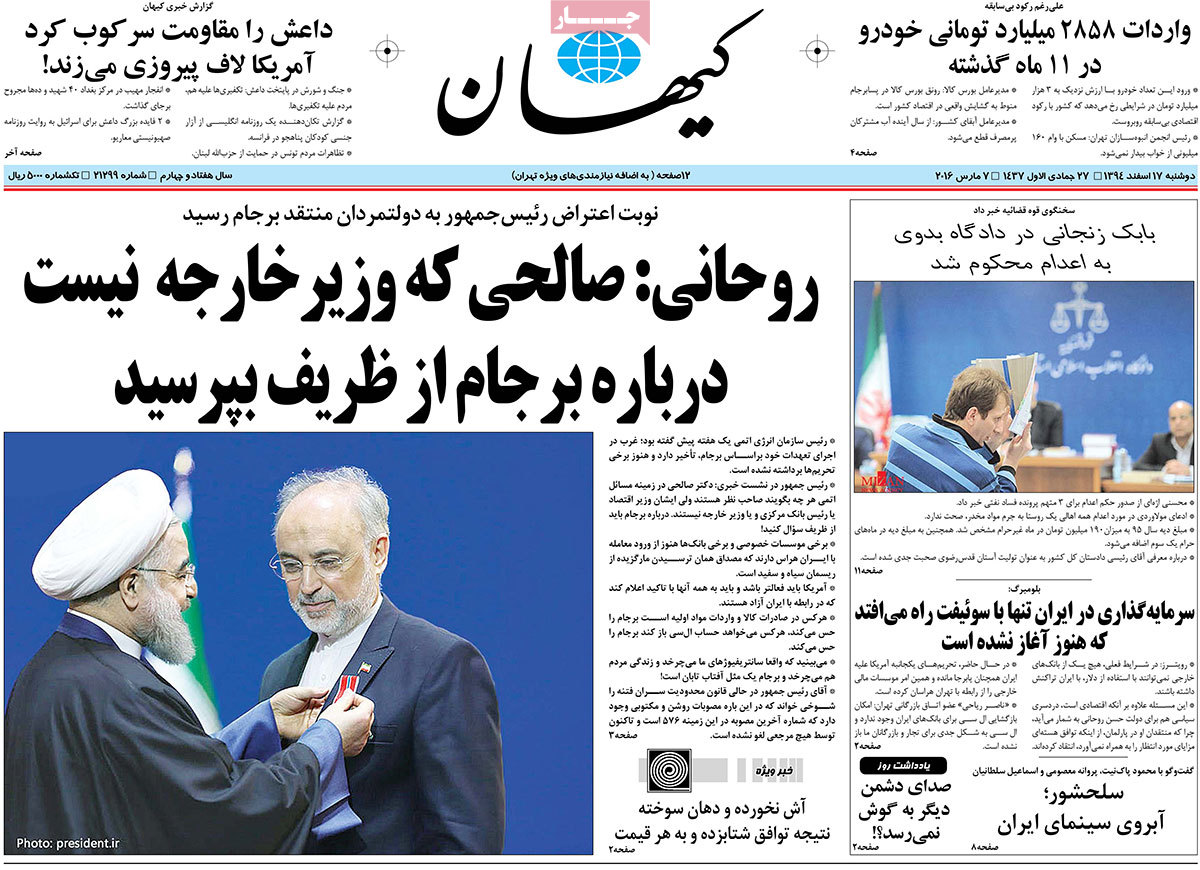
 

A look at Iranian newspaper front pages on March 7


Asia:

1.  Joint Venture; Iran ready for all kinds of co-operation: Rouhani

2.  Major Turkish holding eyes Iran presence

3.  METRO prepared to open branch in Iran
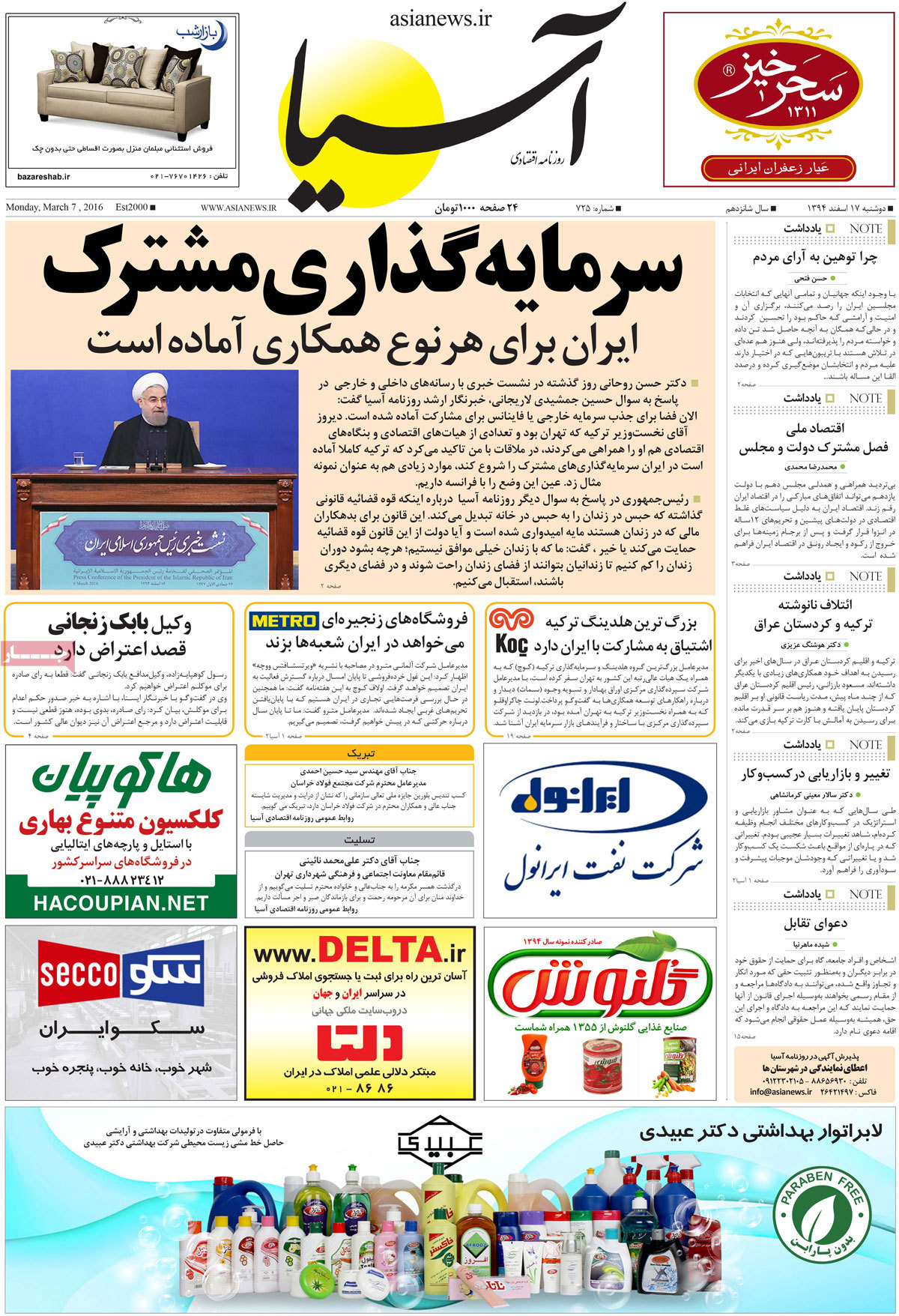
 

A look at Iranian newspaper front pages on March 7


Abrar-e Eqtesadi:

1.  Iran in talks with Russia, China, EU to supply drilling rigs

2.  Economic council seeking to sign deal with Airbus

3.  Iran to sell biggest liquid oil storage terminal

4.  Iran, Germany to revive ties
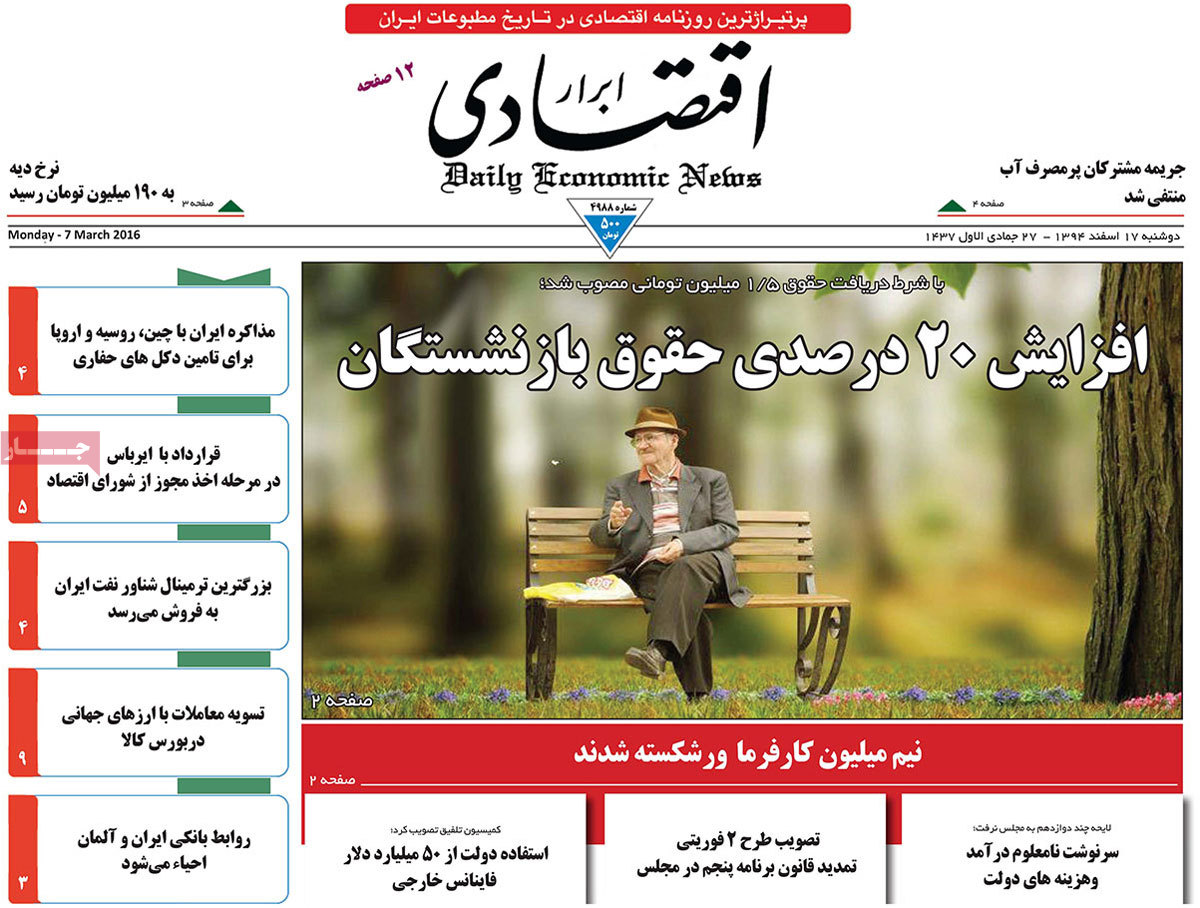
 

A look at Iranian newspaper front pages on March 7


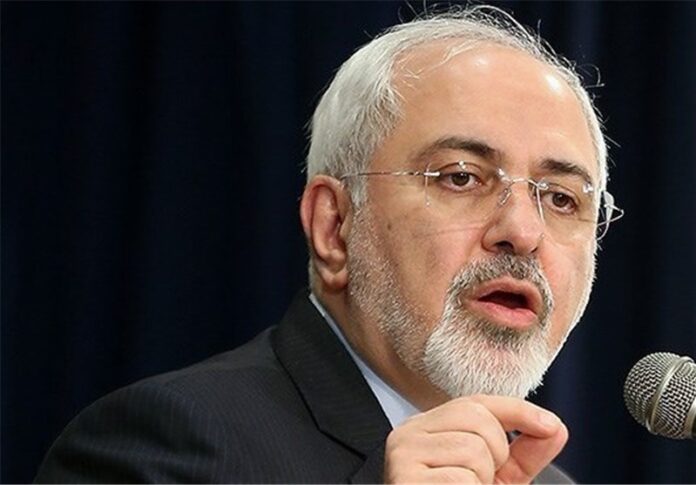
Iran Pledges to Press on with Palestine Support

“The Islamic Republic of Iran emphasizes on honoring commitments regarding Palestine,” Zarif said in a Sunday address to the extraordinary meeting of the Organization of Islamic Cooperation (OIC) on the issue of Palestine and the holy Quds, held in Jakarta, Indonesia.

“Although (Iran) knows the pressures that have been imposed on it in recent decades have been the result of our support for the cause of Palestine, it will keep up that policy,” he underlined.

The top Iranian diplomat also described the issue of Palestine as the centerpiece of the OIC, calling for serious attention to the organization’s “raison d’être” without being distracted by any other issue.

Zarif further stressed the need for Muslim unity and practical action to end the occupation of Palestine in an organized manner.

The minister then condemned the Israeli regime’s policy of Judaizing the holy city of al-Quds (Jerusalem), saying Tel Aviv is pursuing expansionism in disguise.

“Israel’s continuing brutal occupation (of Palestine) has violated the basics of international law on human rights,” he added.

Zarif finally deplored the United Nations Security Council’s inaction on the Israeli atrocities, which he said continue to threaten the international peace and security.

Zarif arrived in Jakarta on Sunday morning to participate in the OIC meeting.

Indonesia is the first destination of his tour of six countries, which will later take him to Singapore, Brunei, Thailand, Australia and New Zealand.


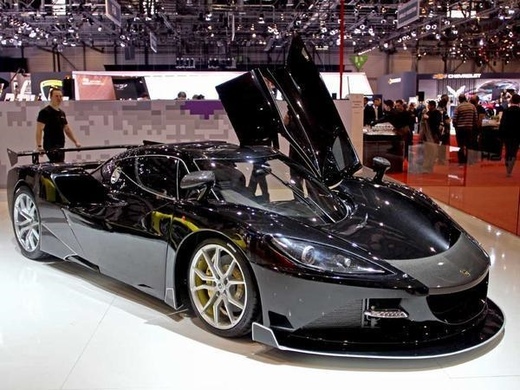
World’s Most Powerful Hybrid Car Built by British-Iranian Brand

Arash, which was founded in 1999 by Arash Farboud, presented their first new model in eight years at the Geneva Motor Show. The new generation Arash car has developed significantly, compared to the model from eight years ago.

The body of the car is made from carbon fiber, and the body panels are reinforced with carbon plastic. In addition to the fact that it is a hybrid car, the greatest advance is in terms of its power. It has an impressive acceleration time, going from 0-60 mph in just 2.8 seconds.

This supercar is the most powerful hybrid car in the world, with its impressive 2080hp. It is worth nearly €1m.


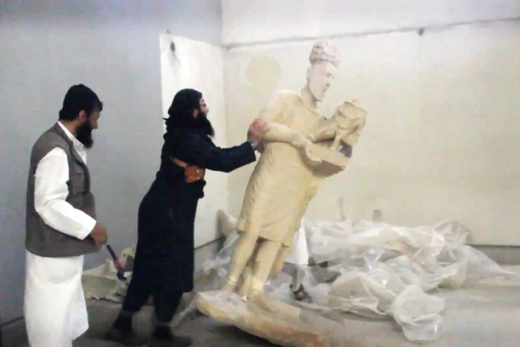
Daesh terrorists steal 99 rare archaeological pieces in Mosul

According to a report on Sunday by IraqiNews.com, Daesh terrorists have moved the stolen pieces to their stronghold in the Syrian city of Raqqa.

The museum of Mosul University locates some 405 km north of Baghdad.

The spokesman of Kurdistan Democratic Party in Nineveh Saeed Mamousini said in a press statement obtained by IraqiNews.com, “ISIS militants took these pieces to the city of Raqqa in Syria, in order to sell them later.”

Meanwhile, British national daily newspaper, Guardian, has referred to Daesh attack on the Iraqi priceless statues and artifact as a move which “threatens to upend millennia of coexistence in the Middle East.”

“The birthplace of human civilisation … is being destroyed”, said Kino Gabriel, one of the leaders of the Syrian Military Council – a Christian militia – in a telephone interview with the Guardian from Hassakeh in north-eastern Syria.

In a five-minute video, which was released by the “press office of the province of Nineveh [the region around Mosul]”, a Daesh representative speaks to the camera, condemning Assyrians and Akkadians as polytheists, justifying the destruction of the artifact and statues, it noted adding that Daesh terrorist took control of Mosul last summer in a lightning advance that led to the eviction of thousands of Christians and other minorities from their ancestral homelands in the Nineveh plains, amid reports of forced conversions.

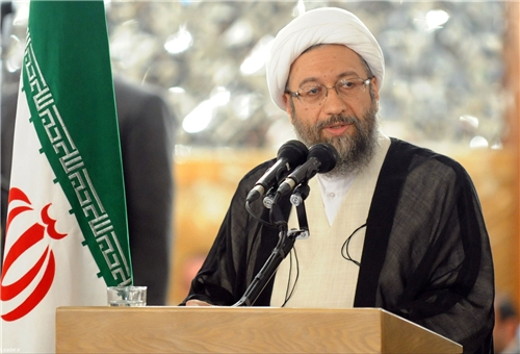
Judiciary Chief: Respect for Animals Should be Learnt from Childhood

Sadeq Amoli Larijani

According to IRNA, Judiciary Chief Ayatollah Sadeq Amoli Larijani said that respect for animals should be taught to people from their childhood.

“If we want to make the preservation of the environment into a popular culture, all government organizations must fulfil their duties. If not, it will be impossible to act judicially by appointing guards for everyone,” said the official while addressing an environmental conference in Tehran on Sunday.

He said that respecting animal rights must be taught at an early age, and that the Department of the Environment (DOE), as the custodian of preserving the environment, must make it a public issue.

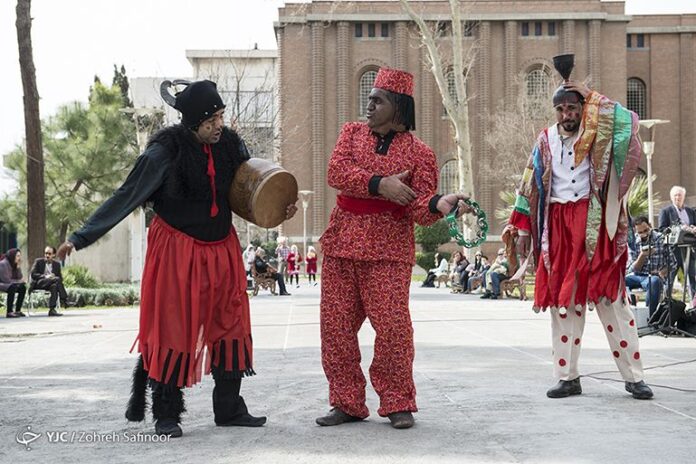
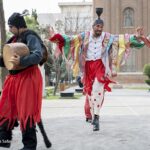
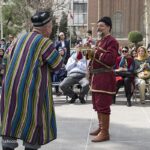
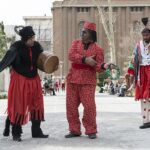
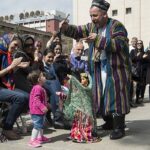
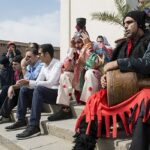
Street Performances Herald the Persian New Year

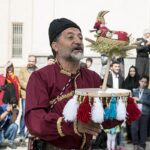
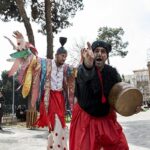
The Persian New Year, or Nowrouz, is celebrated on the Spring Equinox, and heralds a period of new life and growth. In the weeks leading up to it, a traditional character called Haji Firouz makes his appearance in the streets. Dressed in red, with a black face, and playing a drum, he spreads the news that winter is ending and spring is coming.

On the final Wednesday of the year, known as Chaharshanbe Suri, ceremonial fires are lit and fireworks are let off all over the country.

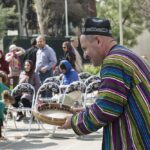
Here are some photos of Haji Firouz street performances capturing the spirit and tradition of both celebrations.

Text by IFP, photos from YJC:

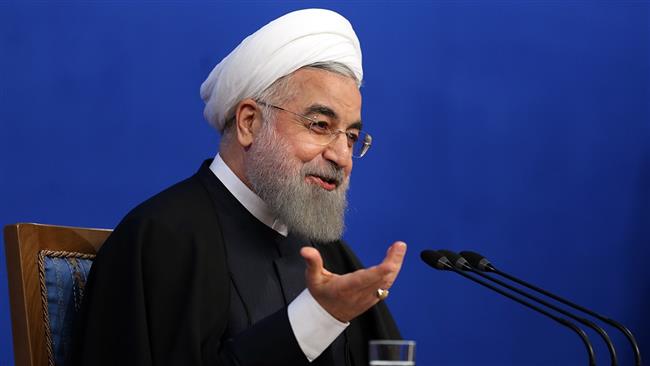
Iranians again amazed world in recent elections: President Rouhani

President Rouhani made the remark in the capital, Tehran, on Sunday, addressing Iranian and foreign reporters in a presser.

On the election day, the Iranians once again “showed their trust in their establishment, their leadership, and their administration and went to the polls and once again amazed the world,” President Rouhani said.

Iran held its 10th parliamentary and 5th Assembly of Experts elections on February 26 with an overall turnout of 62 percent nationwide. At least 33 million out of the 55 million eligible voters took part in the polls.

Rouhani hailed the participation as “historic glory.”

The government made efforts to hold “legal, free and fair” elections, and did its utmost to “return hope to the society,” he noted.

He said whatever action was taken concerning the elections, including the rejection of some of the hopefuls’ eligibility to run in the polls, “was within framework of the law and this means political maturity.”

“Among all the factions, parties, and groupings, it was mostly moderates who were chosen and this means that our people have opted for moderation,” the Iranian president said of the results of the elections.

After the introductory remarks by President Rouhani, the floor was turned to the reporters.

Sanctions removal and oil

One reporter asked how the country was availing itself of the opportunities provided following the removal in January of the nuclear-related sanctions against the country.

President Rouhani said the Islamic Republic has increased its oil output to 1.4 million barrels per day following the removal of the bans, adding, “We’ll be selling two billion barrels of oil per day next year.”

A little bit of lingering fear

Asked whether the other side to the July 2015 deal that enabled the lifting of the sanctions has been completely fulfilling its commitments, the Iranian president acknowledged that “some private institutions, some banks, [for instance] a bank that has already been fined for working with Iran, they are still a little bit afraid” of renewing business with Iran.

He, however, said this does not mean that the agreement has not led to renewed international banking and insurance cooperation with Iran.

The agreement, he said, has led to the cost of the foreign exchange flow needed for production and export to decrease by 10 percent and the cost of maritime transportation to drop by 25 percent.

On Yemen

Amid the West’s criticism of Iran’s provision of humanitarian aid for Yemen and its silence on Saudi Arabia’s unabated bombing of the impoverished nation, Rouhani said, “Iran’s altruistic assistance to Yemen is to continue and will not be disrupted… The Saudi government unfortunately continues its ruthless bombing, and great powers do not pay attention to this issue.”

Saudi Arabia launched its military aggression against Yemen in late March last year in a bid to bring fugitive former Yemeni President Abd Rabbuh Mansur Hadi, a Riyadh ally, back to power and undermine Yemen’s Houthi Ansarullah movement.

GCC’s terrorist label for Hezbollah ordered by Israel: Iran cmdr.

On Wednesday, the six-nation [Persian] Gulf Cooperation Council issued a statement labeling Hezbollah a terrorist organization. The bloc, comprising Saudi Arabia, Qatar, the United Arab Emirates, Oman, Bahrain and Kuwait, claimed that Hezbollah’s moves in the region are against international values and moral and human principles.

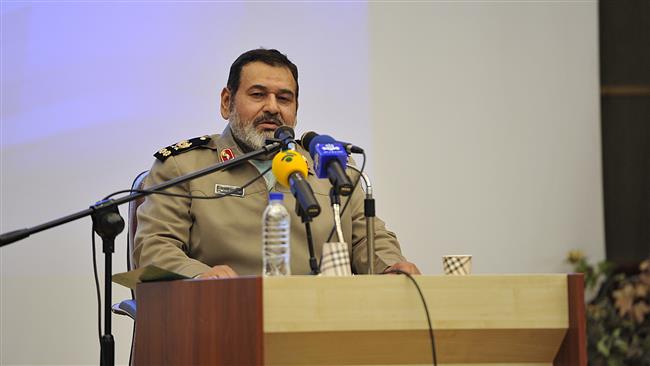
Iranian Armed Forces Chief of Staff Major General Hassan Firouzabadi said on Sunday that the Arab bloc’s blacklisting Hezbollah as a terrorist body was a strategic mistake and a very hasty and impulsive measure which runs counter to the interests of Muslim nations.

“Hezbollah is the son of the Lebanese nation,” he said, adding that the movement has done a lot for the Arab country.

The Iranian commander added that the GCC’s move was in line with Saudi Arabia’s proxy war to prepare the ground for the US and Zionists to achieve their ominous objectives in the region.

He, however, emphasized that despite efforts by Riyadh and its regional allies, the move would fail to change Hezbollah’s role in establishing power balance in the region.

The GCC decision to blacklist Hezbollah has been met with opposition and criticism.

Algeria refused to classify the movement as a terrorist organization. Palestinian resistance movement, Islamic Jihad, also praised Hezbollah as a resistance movement, which has a history in the struggle against the Zionist entity as well as in supporting the Palestinian cause. Iran, Syria and Yemen’s Houthi Ansarullah movement have also slammed the move by the GCC.

Persian Celebrations Not Derived From Any Specific Religion

Studying Persian celebrations and their placement in the calendar allows us to reveal their common characteristics. Almost all of these celebrations are linked to natural, cosmic and environmental phenomena, and that is why their timings have mostly been adapted to the natural calendar.

Another characteristic of Persian festivals and rituals is that they are always accompanied by joy and celebrations – tears and sadness have no place there. As an example, the Manichean festival of Bema is celebrated with joy and happiness even though it falls on the same date as Mani’s death.

PersiansAs reported by ISNA Cultural Centre, Mohammad Hoseein Mosavi (in his book of Celebrations of Ancient Persia) talks about respecting and honouring all of nature’s manifestations as a fourth characteristic, in addition to the three already mentioned above. There is no sign of violence or maltreatment of plants or animals in any Persian rituals – in fact, there are several which are specifically performed with the goal of looking after and honouring the environment.

A fifth characteristic is the unbreakable link between Persian celebrations and the concept of fire. Even if there is no direct relation between a celebration and fire, there will still be a small fire lit to give it more formality and venerability.

The sixth general characteristic is that they are not usually linked to the anniversary of someone’s birth or death. People’s birthdays were not of great importance for Persians, and they are rarely recorded. This can clearly be seen in ancient books like the Shahnameh. It was accepted that every person will be born and will die on certain days, but the basis for festivals was usually the accomplishment of some great achievement, rather than noting a birth or death. There are several good examples of this in the Shahnameh.

A final characteristic can be seen in the breadth of these celebrations. Persians celebrated their national festivals and rituals in a communal way, demonstrating exceptional solidarity and peaceful co-existence. They did not let ethnic, linguistic or religious differences interrupt this togetherness. Today, Persian celebrations belong to all Iranians, and they all play a role in safeguarding and honoring these traditions.

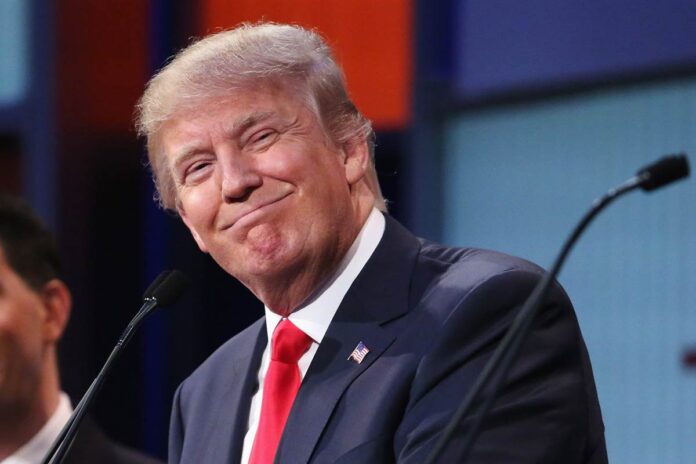
US Faces Political Earthquake if Donald Trump Becomes President

Kamran Najafzadeh, IRIB’s New York correspondent, believes that if Donald Trump makes his way to the White House, the US would be faced with a political earthquake. The current Republican frontrunner for the Presidential nomination has been strongly criticized by both Republicans and Democrats for his odd, sometimes racist viewpoints. Najafzadeh’s opinion, therefore, is that such a scenario is unlikely.

Najafzadeh made these remarks in an article published by Tabnak news website, as translated by Iran Front Page (IFP). Here is the full text:


Donald Trump is now the frontrunner for the United States’ Republican presidential nomination. He is a multi-billionaire New Yorker, who has so far defeated his Republican rivals by wide margins.

Some main elements in his campaign have included attacking African Americans, immigrants, and Muslims. In short, he says these people should go back home. He avoids criticizing even the most extreme racist groups. He has stirred up anger among minorities, from the Pope to the former Mexican president.

The Pope says that Trump is not a Christian, and Hispanics call him Hitler. Trump, however, has pleased certain sectors of American society, ones who consider themselves as being morally principled. If the situation was different, he could not have crushed his rivals in the recent Super Tuesday primaries.


Good Night Mr. Trump!

Most Democrats, Republicans, and the American elite, however, are very annoyed with him. They believe in the multicultural society of America. With so many racial and religious divisions, and such a diversity and plurality of minorities, they believe that racial and religious tensions must not be exploited for political gain.

Now, they are trying to get rid of him – but it seems a little late. Some are even trying to ignore him, following the advice of the American proverb which says, “Never pick a fight with people who buy ink by the barrel.”

Sociologists believe there are divisions within every society: the gap between the rich and poor; the working class and the bourgeoisie; the segregation of different races; the immigrant and the citizen; and between religions like Muslims and Christians.

Americans live precariously upon numerous fault-lines of multiculturalism and plurality. Someone like Trump can activate these faults, destabilize the cultural divisions, thus creating a political and social earthquake in the US.

If we suppose that Mr. Trump – who holds the most radical stances towards Muslims, minorities, and immigrants – becomes the US President, the United States would be faced with a significant seismic shift.

However, with both Europe and the US retaining memories of bloody civil wars in their history, it remains unlikely that Trump will make it all the way to the White House.