Thursday, December 25, 2025
Home Blog Page 4557

US wants to restore its hold on Iran: Ayatollah Khamenei

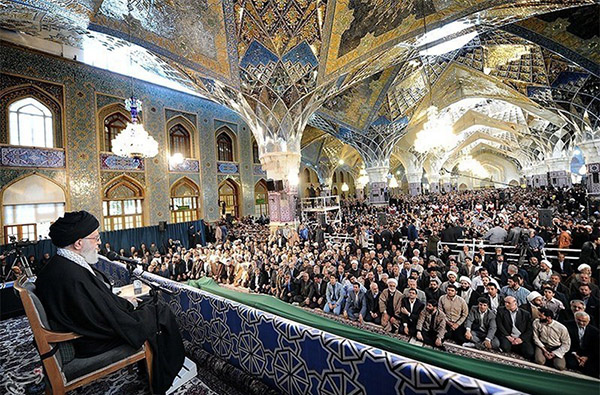
“They (the Americans) are moving in this direction in a bid to be able to reinstate their previous hegemony,” Ayatollah Khamenei told a large crowd of pilgrims in the holy city of Mashhad on the first day of Persian New Year on Sunday.

The Leader said Iran’s 1979 Islamic Revolution liberated the nation of Washington’s deep-rooted grip, adding that Iranians proved that it is possible to stand up to the US. He said the revolution handed the country back to the nation, its true owners.

Before the revolution, Ayatollah Khamenei said, that US used to plunder Iran’s riches and the ousted Pahlavi regime was the main base of the UK and the US in the region.

The Leader reiterated that the Iranian nation has no issues with the American people but the US administration is the enemy of Iran.

‘US not honoring JCPOA’

Pointing to Iran’s nuclear agreement with the P5+1 group of countries, known as the Joint Comprehensive Plan of Action (JCPOA), Ayatollah Khamenei said the other side, under various pretexts and through deception, is not fully implementing its side of the deal such as removing all obstacles to Iran’s banking transactions or unfreezing the country’s assets abroad.

“In the agreement we reached with the Americans on the nuclear issue, the Americans did not deliver on their pledges… Today, all cross Western countries and those who are under their impact, our banking restrictions are still facing problem and repatriation of our assets are facing problem,” said Ayatollah Khamenei, adding that “they fear the Americans.”

Elsewhere, Ayatollah Khamenei said there is no guarantee that President Barack Obama’s successor would “fulfill these minimum obligations.”

“The US presidential candidates are vying with each other in inveighing against Iran…These are [proof of] enmity,” said the Leader.

Ayatollah Khamenei said the Secretary of the Treasury Jack Lew is making ceaseless efforts in order to prevent Iran from benefiting from the JCPOA results.

Regarding his choice of an economic motto for the New Year, namely “Resistance Economy; Plan and Action,” the Leader said that the West seeks to imply that Iranians have only one of two choices, namely either to come to terms with the US or suffer economic hardships.

The Leader said the West seeks to instill and propagate the notion that Iranians must either bow to the demands of the US or suffer the consequences. Ayatollah Khamenei warned that submission to the wishes of the US is tantamount to backing down from one’s stances and a loss of independence.

Ayatollah Khamenei said the West would like the Iranians to back down from its demands such as on the issue of Palestine and turn into what the US would like it to be and like some regional states be reconciled with “the Zionist enemy.”

The Leader said the enemy, if not resisted, will gradually expand its demands to the point where it will question the very founding principles of the Islamic Republic and seek to change its essence and substance.

Ayatollah Khamenei called for an increase in the productivity level in Iran, particularly in the energy sector, adding this can save billions of dollars.

Leader Urges Serious Action on Resistance Economy in New Year

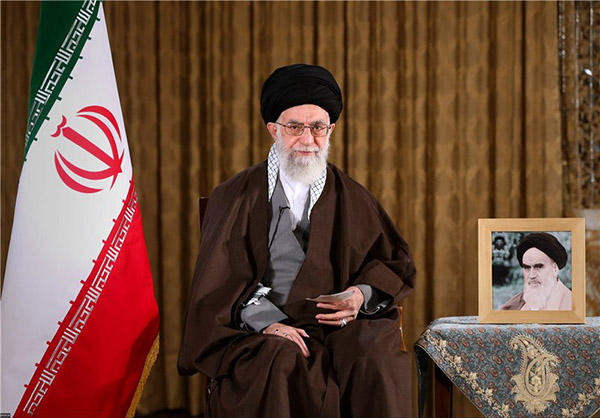
Here is the full text of the message issued on March 20, 2016 by Imam Khamenei on the occasion of Nowruz.

In the Name of Allah, the Beneficent, the Merciful

O Conqueror of hearts and sight,

O Planner of night and day,

O Transformer of power and circumstances,

Change our condition to the best of conditions.

Greetings be upon Siddiqat al-Tahirah, Fatimah al-Marziah, the Holy Prophet Muhammad’s (God’s greetings be upon him and his household) daughter. And greetings be upon Allah’s Great Representative (may our souls be sacrificed for his sake and may God hasten his reappearance).

I would like to congratulate all Iranian families and each and every Iranian – wherever they are in the world – on the occasion of Nowruz.

Dear compatriots, happy New Year!

In particular, I would like to congratulate the dear families of the martyrs, the dear disabled war veterans, their honorable families and all self-sacrificing individuals, and I commemorate the memory of our great martyrs and our magnanimous Imam (r.a.).

The year that has just begun – the (solar) year 1395 – is blessed with the auspicious name of Hazrat Zahra (s.a.) both in its beginning and in its end. Both the beginning and the end of this year are marked by the birthday anniversary of that great personality – corresponding with the lunar months. Therefore, I hope that God willing, the year 1395 will be an auspicious year for the people of Iran by the blessedness of Hazrat Zahra (s.a.) and that we will learn lessons and benefit from the spirituality, instructions and life of that great personality.

Just like all other years, the year that came to an end – the year 1394 – was a mixture of the sweet and the bitter, of peaks and troughs. This is the nature of life. The previousyear involved events ranging from the bitterness of the Mina incident to the sweetness of the 22nd of Bahman rallies and the 7th of Esfand elections. As for the JCPOA (nuclear deal between Tehran and world powers) experience, it contained hopes and concerns that continue until today.

All these were among the events of the year and all years are like this. All years and days of one’s life include opportunities and threats. Our skill lies in benefiting from opportunities and turning threats into opportunities.

The year 1395 is ahead of us. In this year as always, there are both opportunities and threats. Everyone should make efforts so that we can benefit from the opportunities of this year in the real sense of the word and so that at the end of the year, the country will witness a tangible difference compared to the beginning of the year.

There are certain hopes for the year 1395. When one looks at the prospects and the circumstances, one witnesses certain hopes. Of course, we should work hard in order to fulfill these hopes. We should work day and night and try hard in a ceaseless manner.

The main point is that the people of Iran should do something to liberate themselves from vulnerabilities in the face of the enemies’ threats and enmities. We should do something to avoid being vulnerable in the face of the enemies’ threats. We should reduce our vulnerability to zero.

I believe that the issue of the economy is the first priority. When we take a look at priorities, we see that the issue of the economy is the most urgent and essential one. If the people, the administration and different officials can – by Allah’s favor – adopt correct, timely and proper measures, then we can hope that this will influence other issues – such as social maladies and moral and cultural issues – as well.

On the issue of the economy, what is important and fundamental is the issue of domestic production, the issue of employment and eliminating unemployment, the issue of economic dynamism and the issue of combating recession. These are the issues that people are faced with. These are the things that people feel and demand. The statistics and statements of the officials themselves show that these demands and requests of the people are legitimate and sensible.

If we want to resolve the problem of recession, domestic production and unemployment and if we want to manage the issue of inflation, the cure for all these things lie in the framework of economic resistance and the economy of resistance. The economy of resistance includes all these problems. With the economy of resistance, we can fight against unemployment, we can fight against recession, we can manage inflation, we can stand up against the enemy’s threats and we can create and benefit from many opportunities for the country. The condition is that effort is made on the path of the economy of resistance.

The report that our brothers in the administration delivered to us shows that they have carried out many tasks. However, such tasks are only preliminary tasks which are related to issuing directives and edicts to different organizations. These are preliminary tasks. The task that needs to be continued is taking action, putting things into practice and showing the results to the people on the ground. This is what constitutes our responsibility. By Allah’s favor, I will discuss this issue in detail with our dear people during the (Mashhad) speech.

Thus, the name that I want to choose for this year is, “The Economy of Resistance:  Action and Implementation”. The economy of resistance, action and implementation- this is a straight and enlightened path and the road towards what we need.

Of course, we do not expect that this action and implementation will solve all the problems in the course of one year, but we are sure that if action and implementation is carried out in a systematic and correct manner, we will be able to witness the results at the end of the year.

I thank all those people who worked and continue to work hard on this path. Once more, I send my greetings to the people of Iran and I congratulate them.

And I ask God to bestow His peace and blessings on Muhammad (s.a.w.a.), on his household and on the Imam of the Age (God’s greetings be upon him and may our souls be sacrificed for his sake).

Greetings be upon you and Allah’s mercy and blessings

Iranian banks apply to operate in Turkey

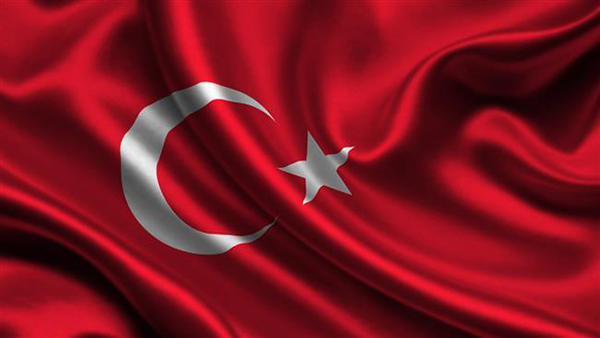
“We have taken demands from Iranian banks. Two Iranian lenders want to take banking license in Turkey,” reports have quoted Mehmet Ali Akben, the head of Turkey’s Banking Regulation and Supervision Agency (BDDK), as saying.

Akben, who did not name the Iranian banks, has further emphasized that further interest in the Turkish market is expected from the Iranian banking sector in the upcoming period of the post-sanctions era.

He said that Turkey’s banking sector operates in accordance with global standards, and this has given much prestige to the sector.

“This has also made our sector quite appealing for foreigners…For instance, Qatari lenders also want to become more active in Turkey,” added the chief of the Turkish banking watchdog.

Qatar National Bank (QNB), the region’s largest bank, has reportedly agreed to buy Turkey’s Finansbank from the National Bank of Greece (NBG) for €2.7 billion ($2.95 billion) in December 2015, as it steps up its search for larger markets overseas.

With the latest acquisition, Qatari companies have strengthened their hands in the Turkish market.

Iran’s media reported last October that the preferential trade agreement with Iran, which came into effect in early 2015, had paved the way for Iranian banks to enter the Turkish market. The English-language the Financial Tribune reported that Iran’s Saman Bank had applied to the Central Bank of the Republic of Turkey (CBRT) as well as the BDDK to receive the authorization to operate in Turkey. It also said another bank – Bank Mellat – had already obtained permission to expand its operations in Turkey and that two more banks – Bank Tejarat and Pasargad Bank – are also expected to start the proceedings for the same purpose.

Iran oil exports at highest level in years

Figures provided by Bloomberg show that the country’s exports rose to 1.55 million barrels per day (bpd) in January. The figure was the highest since March 2014 and marked a rise of 9.2 percent compared to the month before.

Other figures showed that Iran’s production had climbed to 3.37 million bpd in January, the highest level since February 2014.

The US-led sanctions that were imposed against Iran in 2011 limited the country’s oil sales to only 1 million bpd from the previous levels of above two million barrels a day.

After the election of President Hassan Rouhani and his appointment of Zangeneh as the oil minister, Iran undertook serious efforts to lift its oil production capacity in face of the sanctions that also barred foreign investments in the Iranian oil industry.

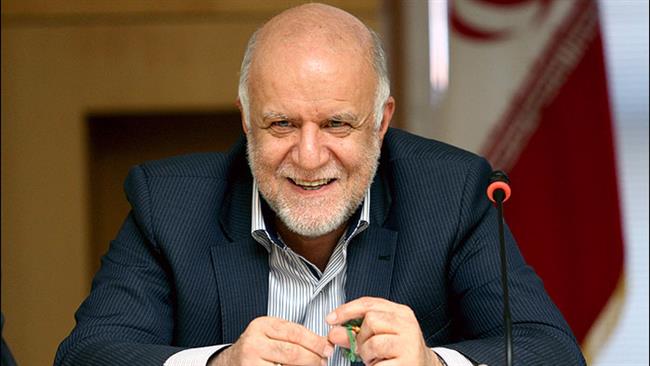
Iran’s Oil Minister Bijan Zangeneh emphasized earlier this week that Iran had already been able to regain the share of the oil market that it had lost as a result of the sanctions.

Zangeneh had previously emphasized that Iran would increase its oil production by some 500,000 bpd immediately after the removal of the sanctions and by another 500,000 bpd within the following months.

The Iranian minister – to whom the success  of Iran’s oil industry is largely attributed – had also called on global producers to make way for the incoming Iranian oil supplies, stressing that Iran has no plans to freeze its production – as demanded by market heavyweights such as Russia and Saudi Arabia.

This past Wednesday, Iran’s President Rouhani told reporters that the country’s oil exports will reach 2 million bpd within the next few months.

Iranian Manager at Microsoft, Amazon Comes Back to Rebuild Motherland

Such companies as Google, Microsoft, Amazon, and LinkedIn are among the brands that give a great reputation to any of its personnel. These companies are among the most successful corporations and influential role models, working in which can be a dream for anyone who is into the field of information technology and computer science.

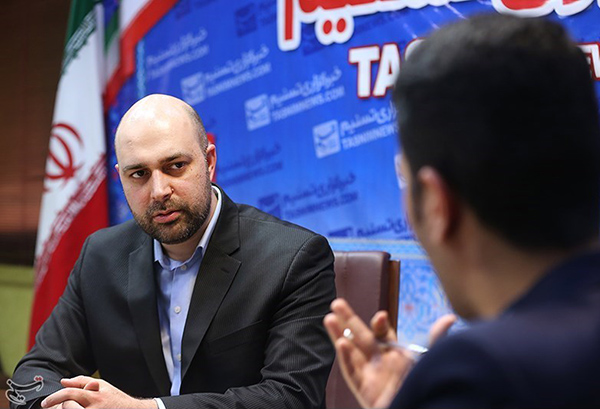
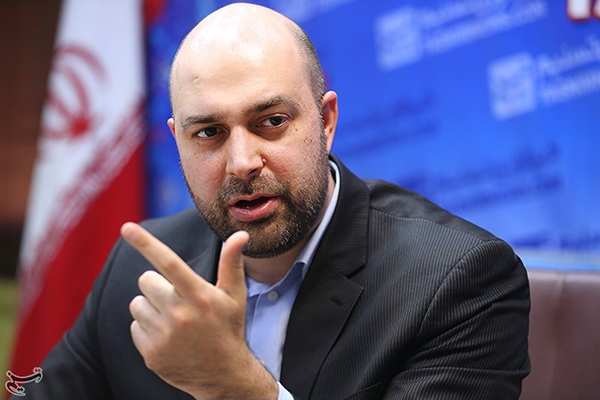
Rouhollah Rahmani is an Iranian computer scientist who has worked as a program manager in Microsoft and Amazon. An interview with Rahmani on his great experiences in these companies would be an interesting piece for all those people who wish to realize their dreams.

Currently a visiting lecturer at the University of Tehran, the 34-year-old Rahmani has returned to Iran to share his knowledge and experiences with his compatriots.

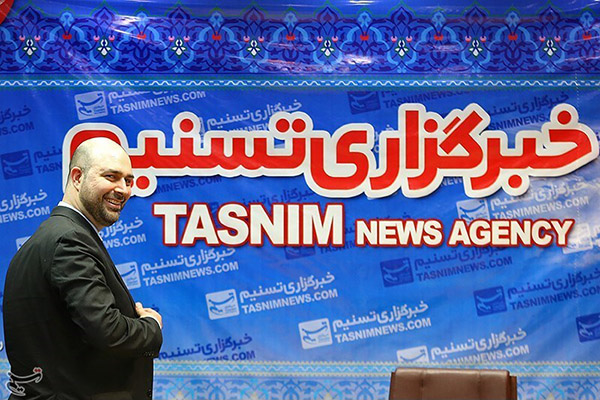
The Tasnim News Agency has recently held an interview with him, which is translated by Iran Front Page (IFP) and will be presented in separate parts.

In the first part of the interview, Rahmani talks about his life, the path he has gone through to become who he is now, and the plans he has for the future of his country, Iran.

Little Curious Inventor Finds Salvation in Serving People

Rahmani was born and raised in the United States, and spent his entire life, from kindergarten to Ph.D. and finally his career in the computer industry, in this country.

His Iranian-born parents taught him Islamic teachings, and he learned that one should “serve the people” if he wants to find the God and salvation, he noted.

“Therefore, there is no surprise that my first name and last name are Iranian, and I proudly say that I’m a Muslim,” Rahmani said.

The Iranian scientist further referred to his childhood curiosities about different sciences and technologies, saying that he wanted to be an inventor since he was four years old.

“I had just selected my (future) occupation at that time, and really didn’t know what I wanted to invent or even what the innovation was about; I just knew that I should invent,” he explained, adding that it unconsciously attracted him in the future and influenced the path of his life.
Rahmani7

Iranian Genius Takes Ph.D. Courses at the Age of 14

He said he is not one of those inventors who believe education and schooling hinders the person’s creativity. Therefore, he took his education seriously, and his genius helped him take the math courses of Ph.D. program in university when he was just 14 years old.

“I became a classmate with Ph.D. candidates, and since I was just 14 and my concerns were much less than those of Ph.D. students, I managed to rank first in the class in that age,” Rahmani said, adding that he even took basic and C++ programming courses at the age of 14.

After graduation from high school, Rahmani was admitted into Washington University in St. Louis in computer sciences. His hard work, particularly in the field of research, convinced the university to let him start his Ph.D. program when he was in the second year of his B.S.

Google Uses Rahmani’s Innovation in “Search by Image” Feature

His doctoral dissertation was focused on ‘artificial intelligence in image search engines’. The project, as Rahmani mentioned, was aimed at enabling the users to use images, rather than words, as their input to find related images and results.

According to the project, the search engine was supposed to identify the image based on the pixels, and find the information related to that item through searching its database.

Rahmani’s dissertation was exactly what later used by Google Inc. in its “Search by Image” feature in the Google Image search engine.

Microsoft Hires Iranian Scientist as Program Manager

Later on, Rahmani said, when he was looking for a job and still had not received his Ph.D., he was hired by Microsoft as a program manager in its search engine department.

“I actually was hired by Microsoft in 2007, but started my job in the company in 2008,” he went on to say.

Asked about the reason for which the beginning of his career in Microsoft was delayed for a year, he noted that he finished his Ph.D. education at that period of time, and later traveled to Iran for a six-month-long stay.

Rahmani Visits Iran, Finds His Bride, Returns to Microsoft

During his short stay in Iran, Rahmani taught in the University of Tehran for a semester. Within the same period of time, he also got married, which he believes was the best choice of his entire life.

Back to his Microsoft career in the US, he explained that one of the first tasks he was given was the development of a search engine for Microsoft, which was later titled Bing in its release to the market.

There was so such project named “Bing”, which is currently the Microsoft’s main search engine, at that time, he noted.
Rahmani8

Supervising Professor Finds Job at Google Using Rahmani’s Dissertation

Interestingly, the supervisor of Rahmani’s doctoral dissertation was later hired by Google thanks to the thesis he had work on with the Iranian scientist.

“He was invited to present my thesis on image search to Google, but they liked the research and immediately offered him a job,” he said.

“After getting hired, he left the university career and went to Google. The interesting point was that a few months before (his) leaving the university, we used to see each other many times; the difference then was that he was a senior Google researcher, and I was a program manager at Microsoft,” he noted.

“Although we turned to rivals in the industry, I call him every now and then, and we have kept in touch,” Rahmani added.

Rahmani said his supervisor’s position in Google even gave him a potential opportunity for getting hired in the giant tech company, but he never used it, and even joked about it in Microsoft.

“It’s quite normal in the US that when you achieve a minimum success in a company, all other corporations contact you and want you to work for them,” Rahmani noted.

“In the last days of my career in the US, I received invitations from Google, Facebook, and LinkedIn, and there were some other companies that invited me to interview,” he went on to say, adding that when there are lots of offers, one can make the choice, and that is good.
Rahmani4

Working in Amazon with 900 Million Types of Goods

The Iranian scientist later left Microsoft after almost 2 years and a half, and joined Amazon in late 2010, which is known in Iran as a book-seller, while it’s not just that.

“Amazon is a technology-based company like Google and Microsoft. When I was hired there, it had more than 900 million types of goods; they were looking for a way to make it the best online store in all fields using new technologies,” Rahmani said.

“Definitely, when you enter a store with 900 million types of goods, you wouldn’t feel happy, and get out immediately, because there’d be a huge amount of intellectual pressure on you,” he said.

“The challenge in Amazon was that how it can use artificial intelligence to identify the user and be a good guide for them in finding their products; for example, when you open the online store Amazon, you’d not feel you’re faced with 900 million goods,” he noted.

“There we used the most advanced technologies, and even invented certain technologies to accomplish our mission; we created and utilized several mathematical algorithms and artificial intelligence to make the customer love the Amazon store,” Rahmani explained.

In Amazon, Rahmani was tasked with using artificial intelligence to classify the goods automatically. It was right after this project that he decided to sell his house and car, bid farewell to his friends, and returned to Iran once again in 2012.

The rest of the interview will be published in another part.

FM Congratulates Iranian Expats on Nowruz

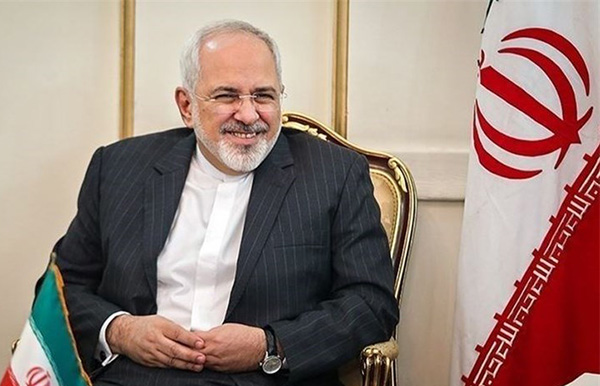
In a message on Friday, Foreign Minister Zarif congratulated the nationals living abroad on Nowruz, which marks the beginning of spring and the New Iranian Year.

He also hailed the expatriates for bringing glory to the country and their role in the cultural links between Iran and the world.

The top diplomat said Iran is on the verge of progress and prosperity with the achievement of the Joint Comprehensive Plan of Action (JCPOA), a lasting nuclear deal between Iran and the Group 5+1 (Russia, China, the US, Britain, France and Germany), and the successful holding of the parliamentary and Assembly of Experts elections with a high turnout, in the current Iranian year, which is ending on Saturday.

Iran and the Group 5+1 (also known as the E3+3) on July 14, 2015, signed the JCPOA, a 159-page nuclear agreement that terminated all sanctions imposed on Tehran over its nuclear energy program.

Iranian officials have called on the expatriates to help the country develop more rapidly in the post-sanctions era.

Zarif: Iran, Turkey should cooperate to tackle terrorism

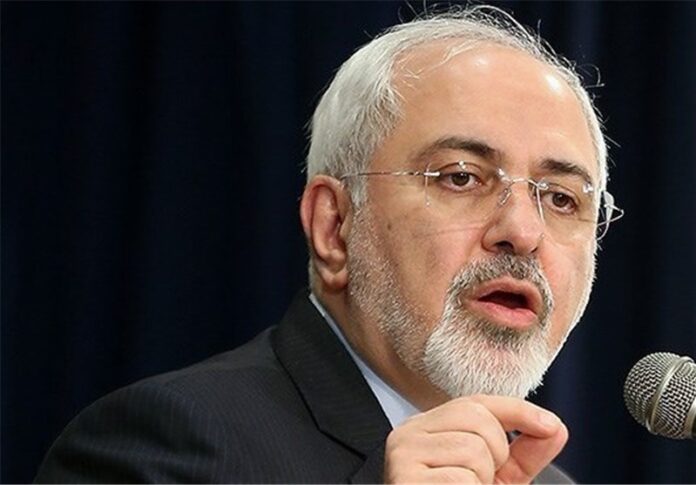
Talking to IRNA, Zarif reiterated that Iran and Turkey enjoy good neighborly relations.

‘The two countries leaders are keen on fostering economic relations during post-sanctions era,’ he added.

‘Iran and Turkey are facing common regional threats,’ Zarif said, reiterating that: ‘We also disagree on some issues but we should settle them through dialogue.’

Zarif, heading a delegation, arrived in Istanbul on Saturday morning.

While in Turkey, Zarif is to hold separate meetings with Turkish President Recep Tayyeb Erdogan, Prime Minister Ahmet Davutoglu and his counterpart Mevlut Cavusoglu.

He will also attend a working luncheon given to his honor by Cavusoglu.

Turkish prime minister recently paid a visit to Tehran at the head of a top-ranking delegation including five cabinet ministers and 160 businessmen.

First Iran cargo ship docks at Hamburg

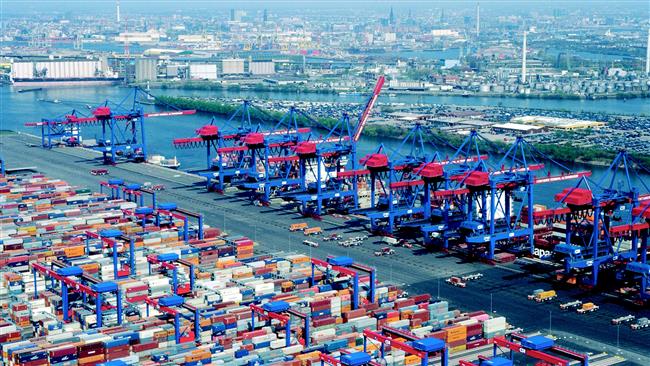
A cargo ship belonging to Iran's IRISL docked at Hamburg this week becoming the first Iranian ship to reach Europe after a hiatus of over six years.

The Azargoun, which belongs to the Islamic Republic of Iran Shipping Lines (IRISL) and can carry 2,500 standard shipping containers, arrived in Hamburg earlier this week, reported Bloomberg.

This has clearly marked the reopening of the European Container Line between Iran and Europe, which was suspended in 2010 due to sanctions imposed by the US and Europe.

Earlier, IRISL Managing Director Mohammad Saeidi had told Iran’s media that the docking of Azargoun in Hamburg meant that a regular shipping service between Iran and Europe had officially resumed after a hiatus of over six years.

Saeidi emphasized that the container ship will soon leave Hamburg after loading an Iran-bound cargo from Europe.

He added that Azargoun will visit the Antwerp port of Belgium on Monday morning before leaving for Iran.

Elsewhere in remarks, the IRISL chief said that Iran has been able to establish two new shipping companies in Europe, adding that the companies have already started cooperation schemes with their European partners.

Saeid emphasized that the same cooperation schemes are expected to facilitate the shipping services between Iran and Europe.

He also said that Iran plans to establish several new shipping lines within the next six months. They, he added, include two separate lines to North America and South America and another to East Asia.

These, Saeidi said, will provide Iran with an extended shipping reach that had been restricted as a result of the US-led sanctions that were eventually lifted in January.

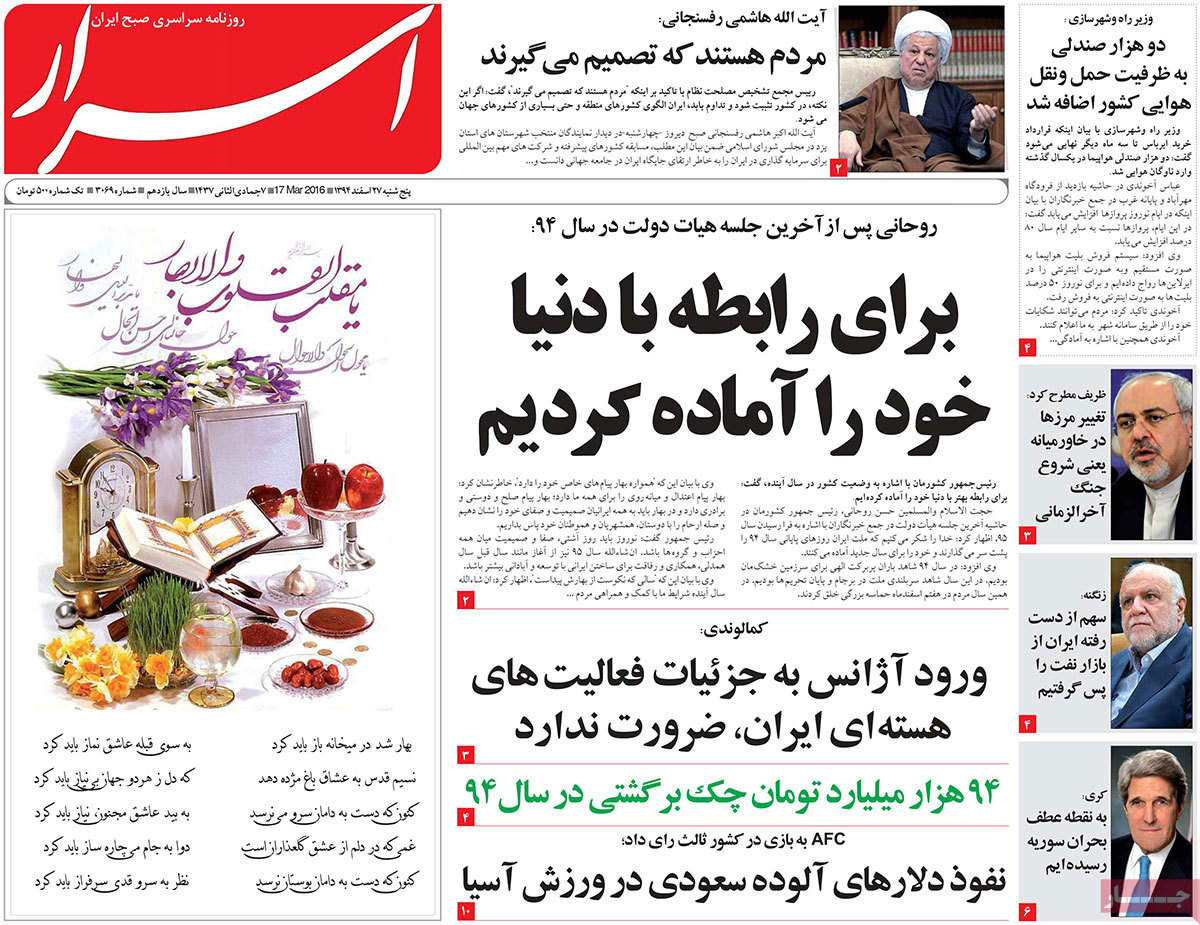
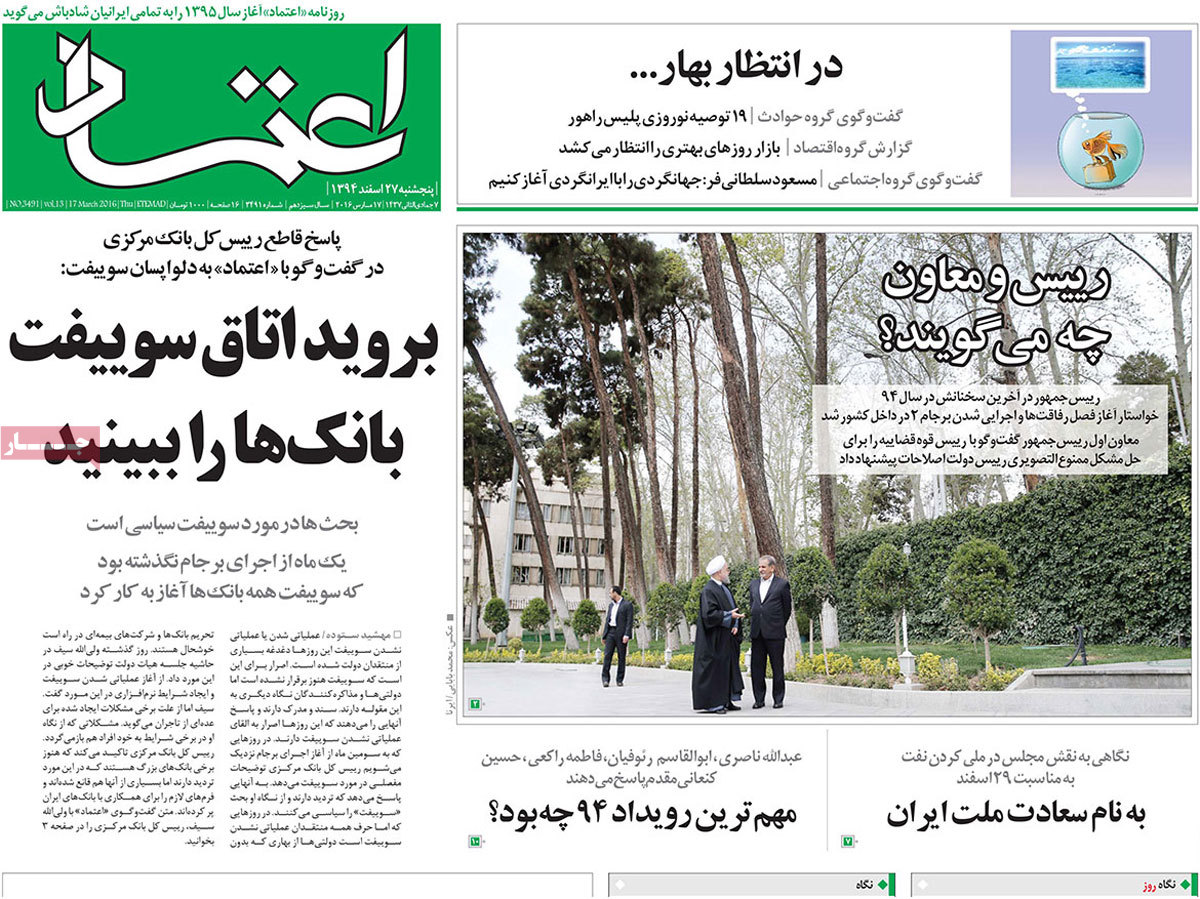
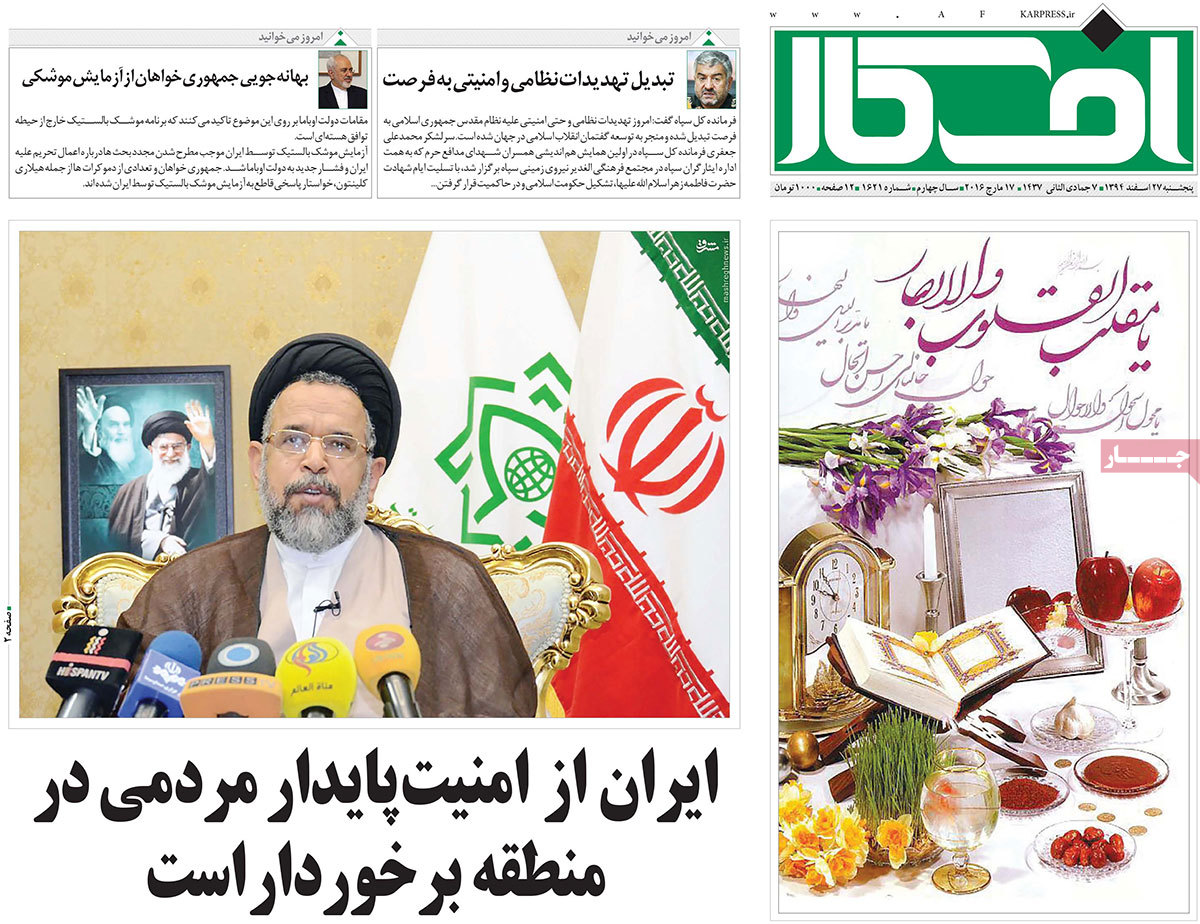
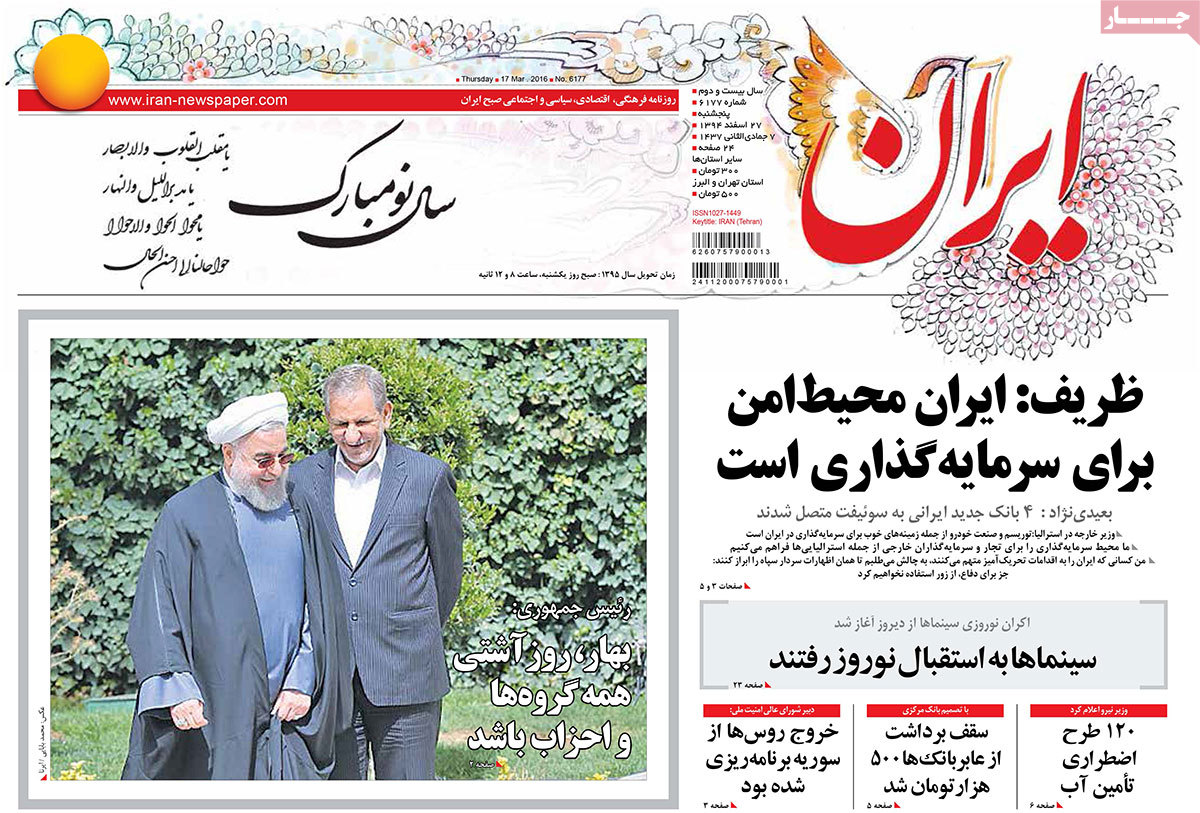
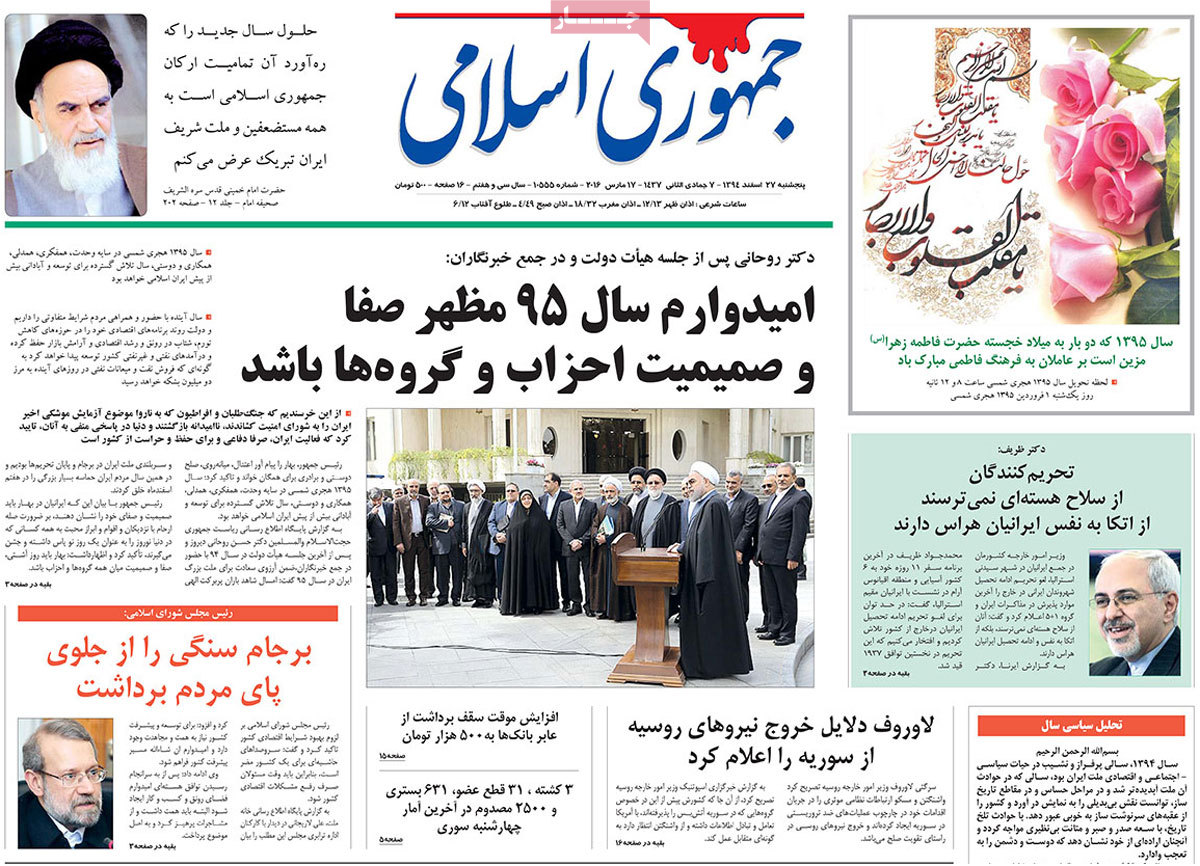
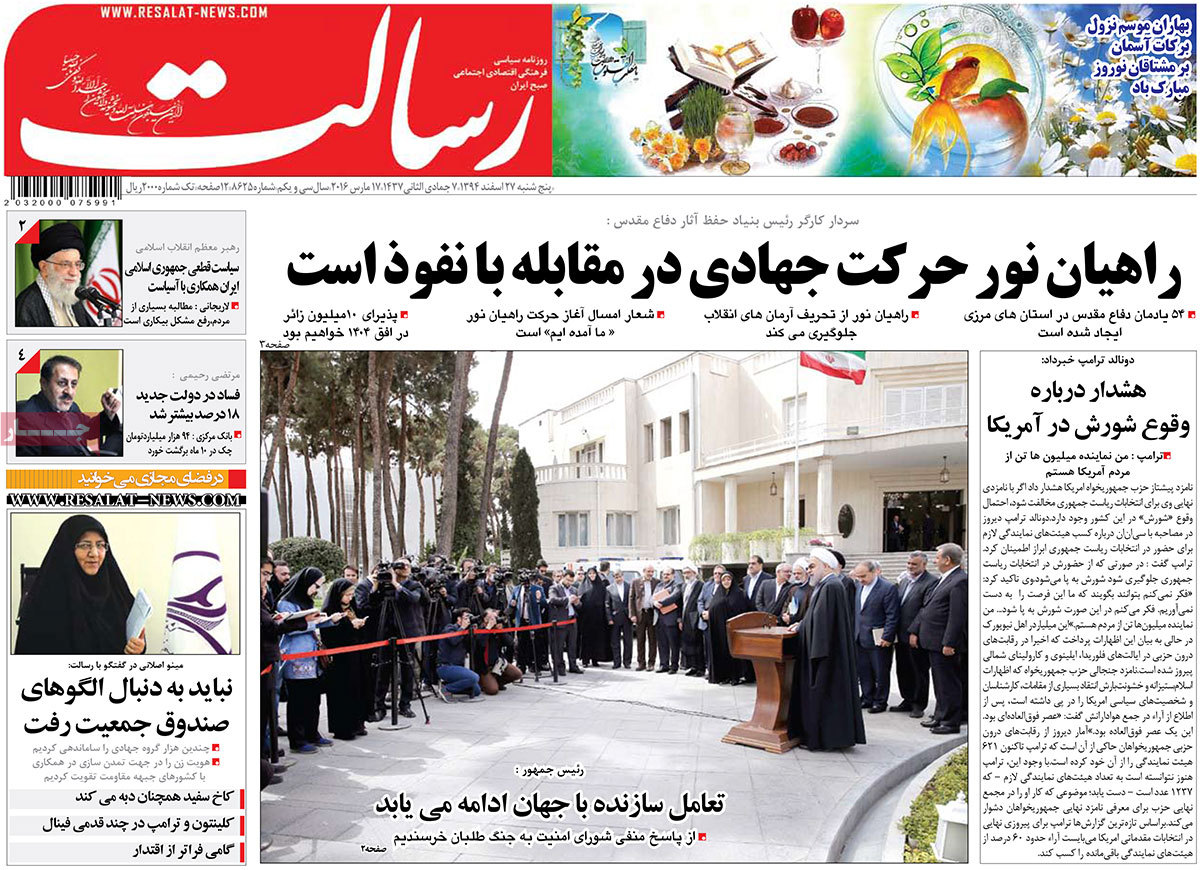
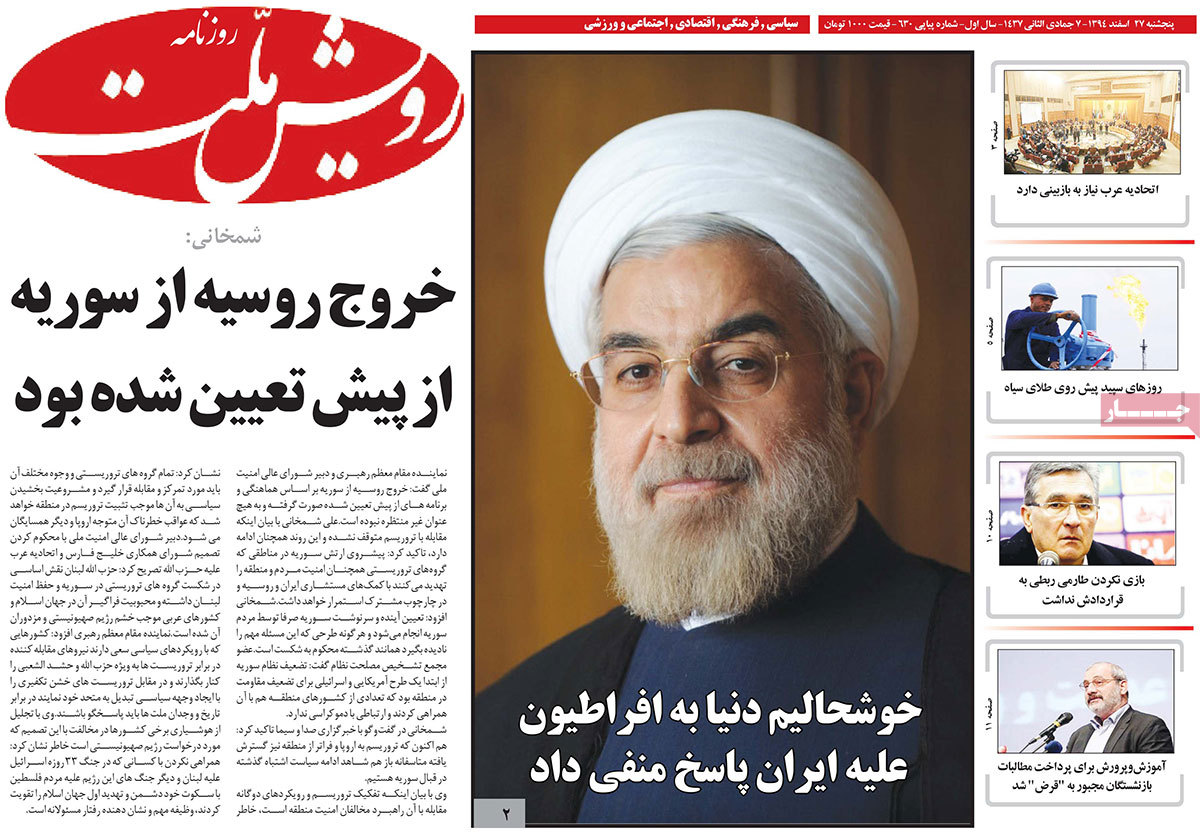
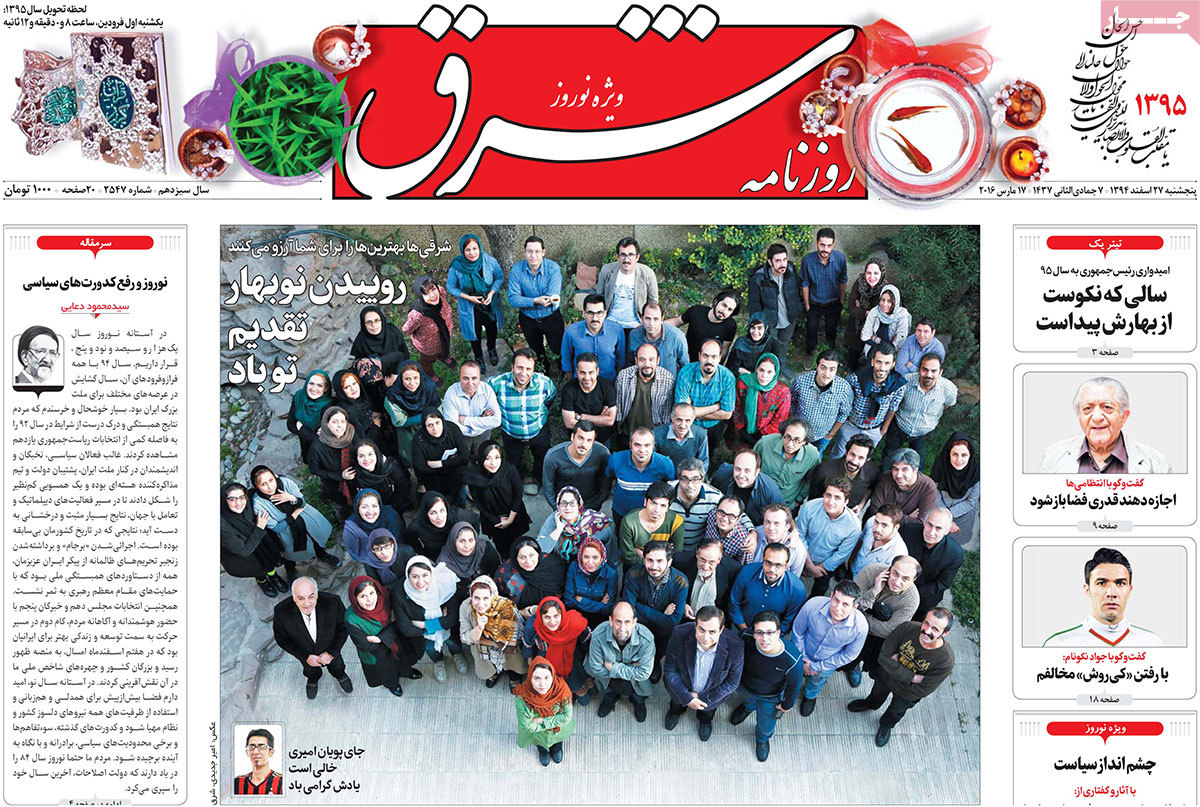
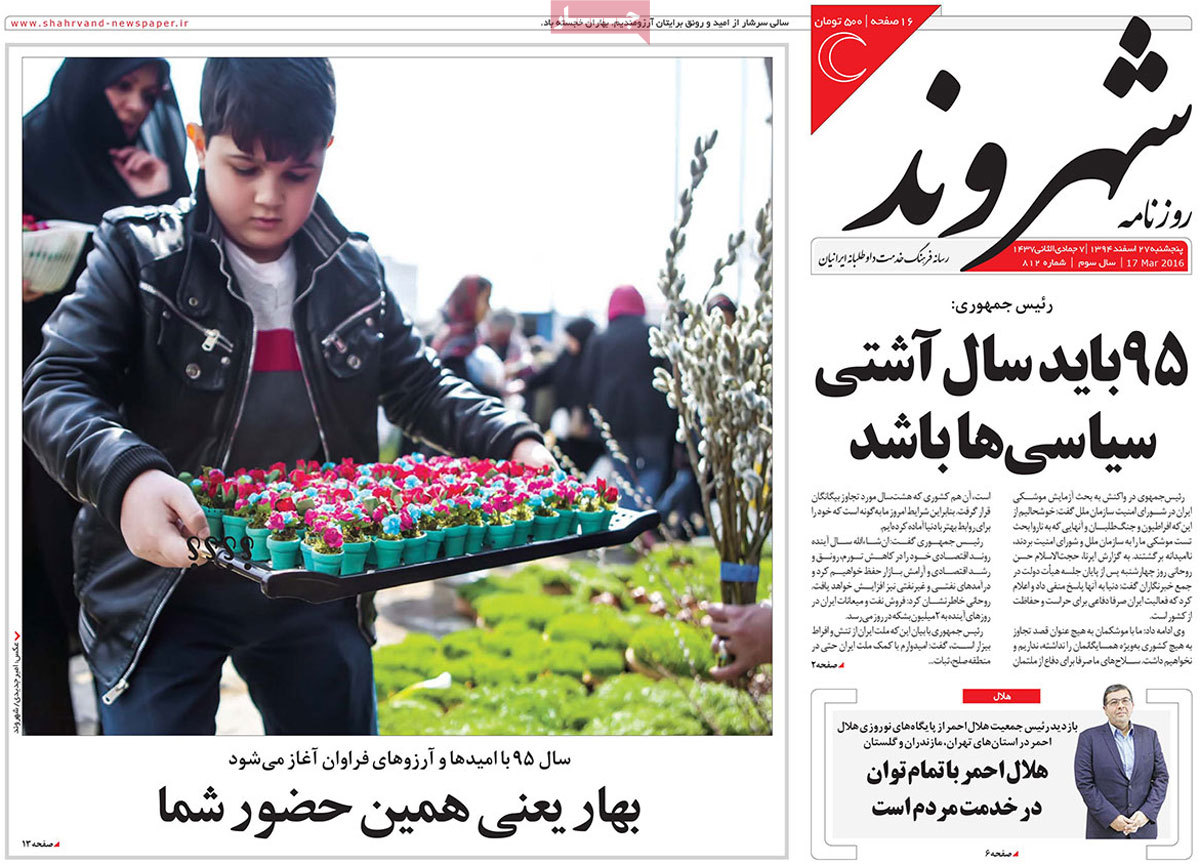
A look at Iranian newspaper front pages on March 17

Iran Newspaper front pages

Thursday, March 17, was the last day Iranian papers were publishes in Iran. 

Most of the papers chose colorful photos on their front pages to felicitate the arrival of the New Iranian Calendar Year.

The Iranian President Hassan Rouhani’s accounts regarding his administration’s policies for the coming year and the country’s economic developments in the year grabbed many headlines on Thursday.

Here are the top headlines:


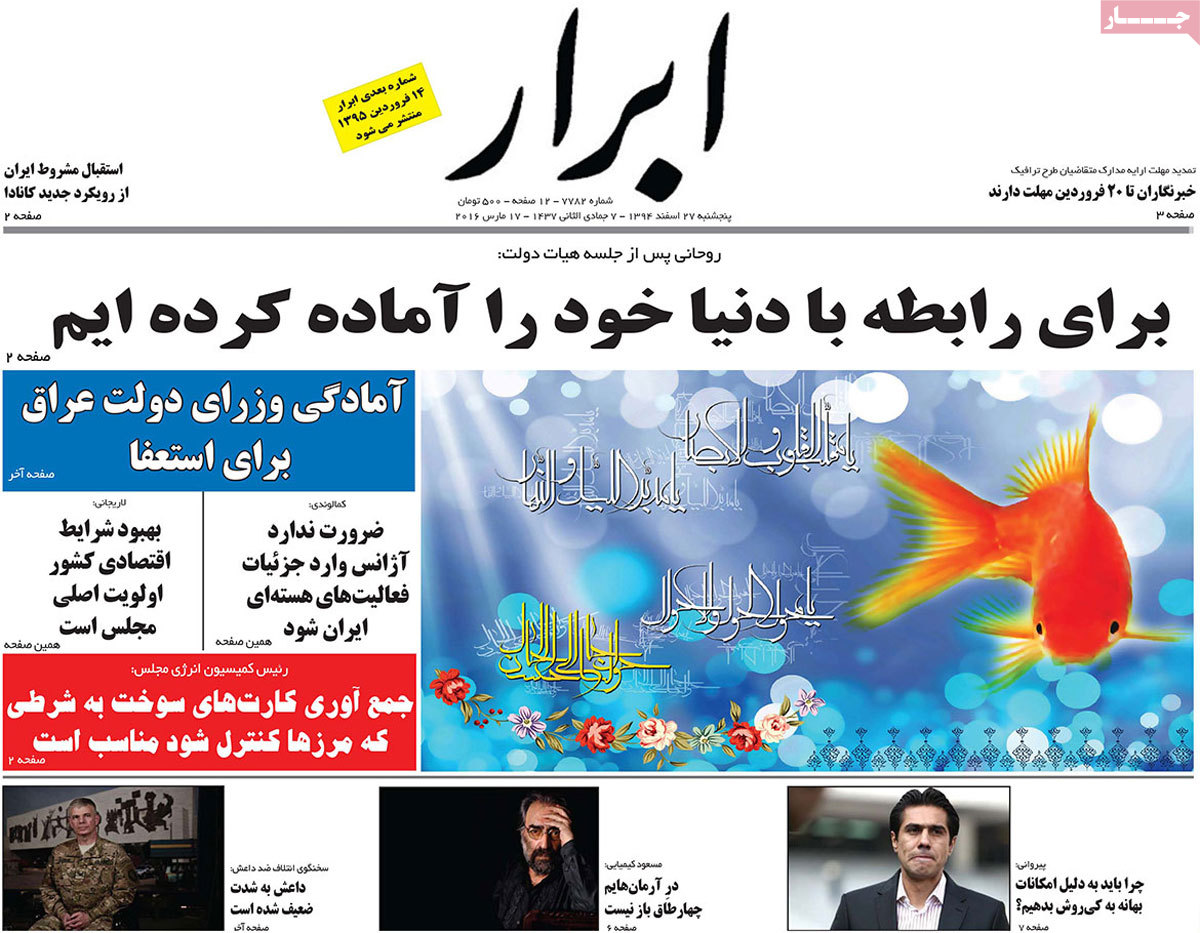
Abrar:

  1. Iran puts conditions to endorse new Canada approach
  2. President: Iran ready for int’l relations
  3. Ministers’ resignation letters sent to Iraqi government
  4. AEOI spokesman: IAEO needs not inspect details of Iran nuclear activities
  5. Speaker: Economic upturn, chief parliament concern
  6. Anti-ISIL spokesman: ISIL seriously weakened


A look at Iranian newspaper front pages on March 17


Asrar:

  1. Iran adds 2,000 seats to aerial transportation capacity: Roads minister
  2. Rafsanjani: Nation has the final say
  3. Iran regains lost oil market share: Petroleum Minister Zangeneh
  4. Zarif: ME border change will be apocalyptic
  5. Kerry: Syrian Crisis at a Turning Point
  6. AFC votes to hold Iran-Saudi Arabia games in third country; Penetration of Saudi dollars in Asian sports


A look at Iranian newspaper front pages on March 17


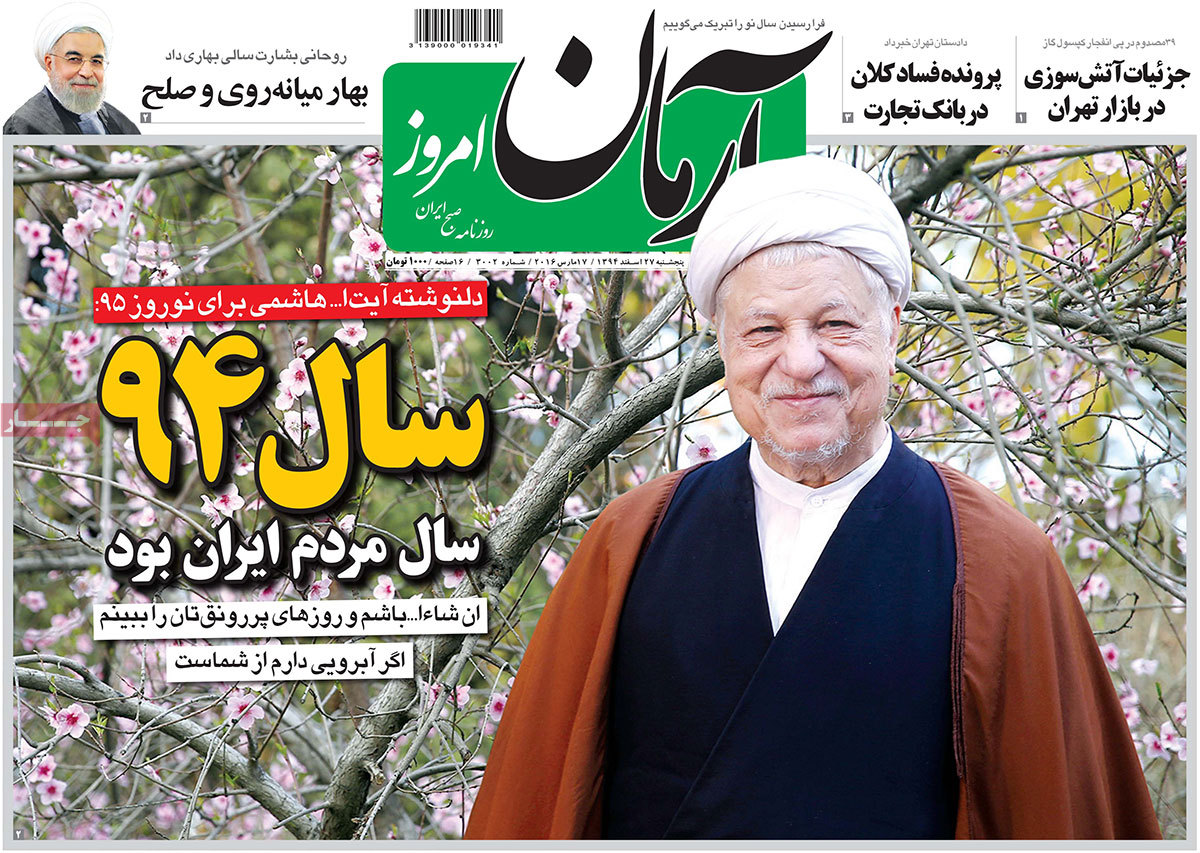
Arman-e Emrouz:

  1. Rafsanjani: “1394 was nation’s year”

1394 is the current Iranian year which comes to an end on March 19.

  1. Details about Tehran marker fire
  2. Tehran Prosecutor reveals major scam case in Bank Tejarat
  3. Rouhani felicitates New Calendar Year: Spring of moderation, peace


A look at Iranian newspaper front pages on March 17


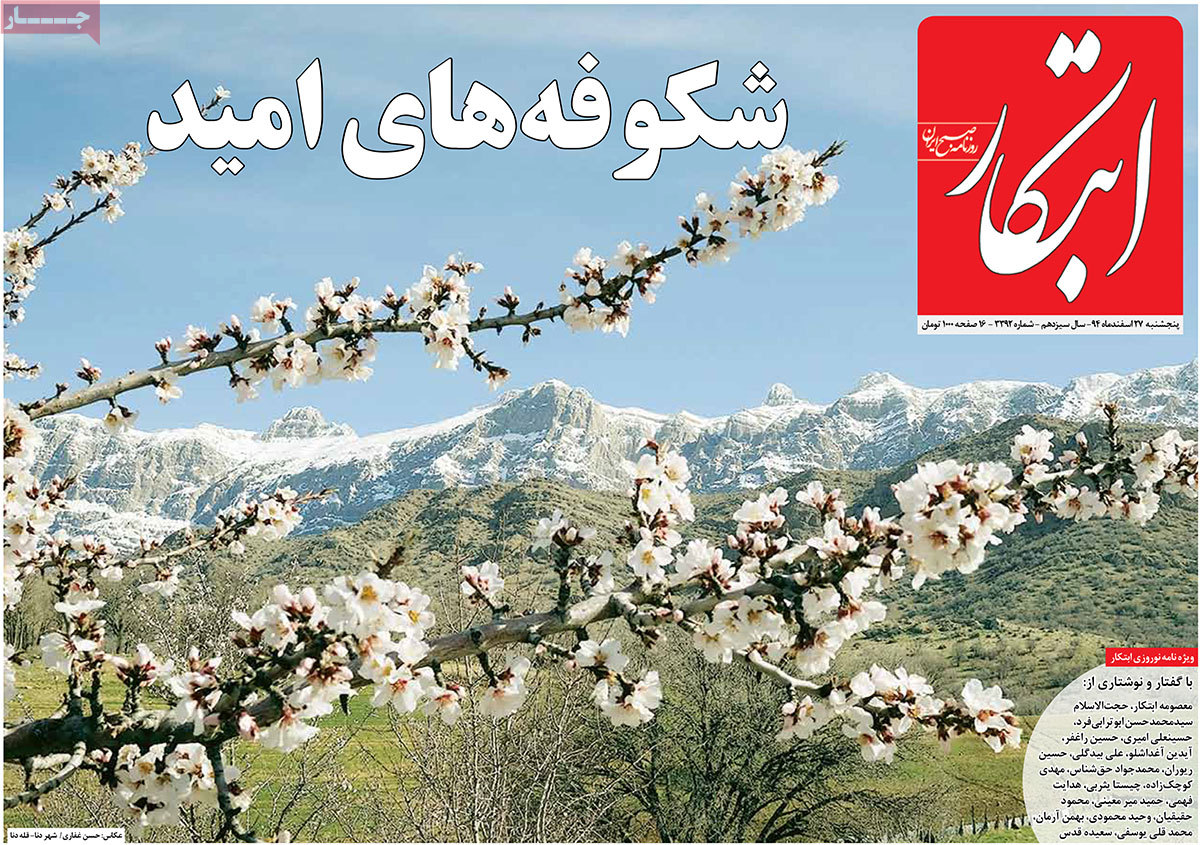
Ebtekar:

  1. Blossoms of Hope


A look at Iranian newspaper front pages on March 17


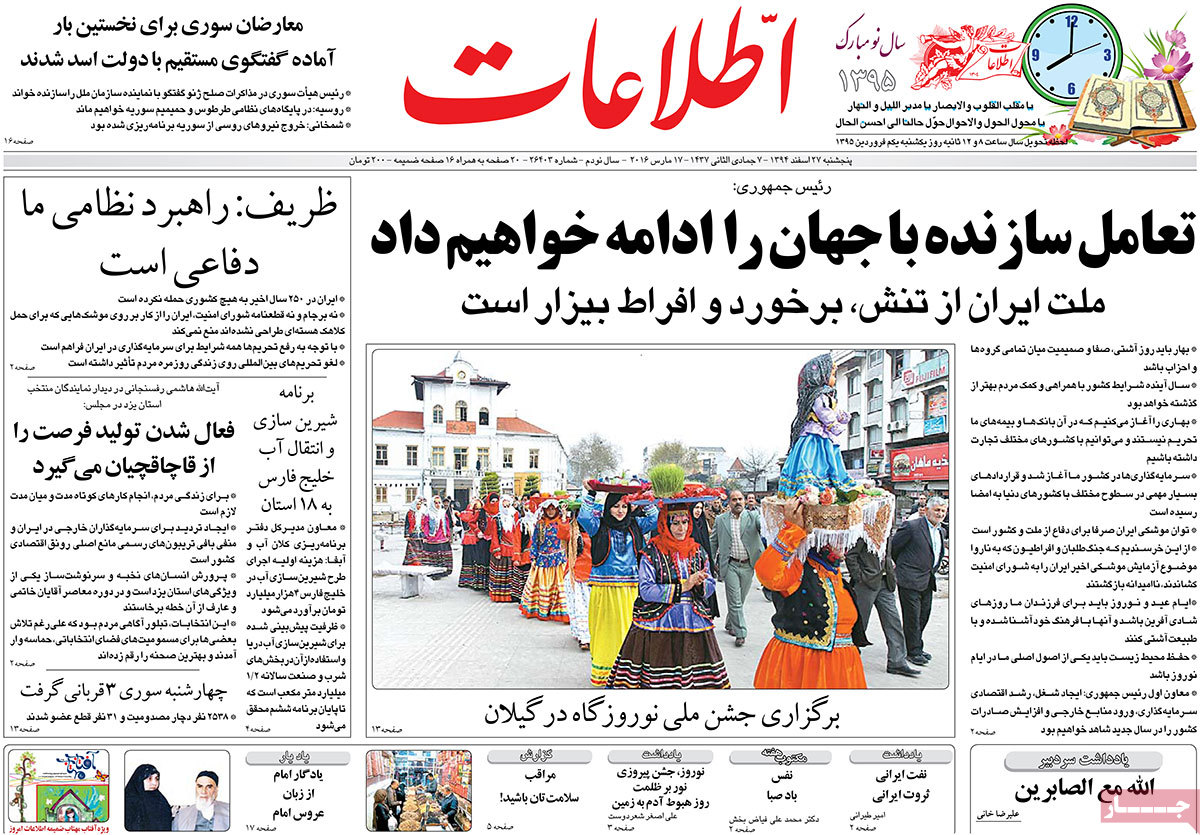
Ettela’at:

  1. Iran to maintain constructive interaction with world: Rouhani

Iranian nation hates tensions, confrontations, extremism: Iranian President Rouhani

  1. Iran military strategy defensive: Zarif
  2. Syrian opposition voice readiness to enter direct talks with Assad
  3. Rafsanjani underlined boosting domestic production for curbing smuggling
  4. Plans under way to sweeten Persian Gulf water for delivery to 18 provinces
  5. End-of-year fire festival kills 3


A look at Iranian newspaper front pages on March 17


Etemad:

  1. Anticipating spring
  2. CBI reacts firmly to SWIFT opening deniers: Go see SWIFT room in banks


A look at Iranian newspaper front pages on March 17


Afkar:

  1. Chief: IRGC has turned military, security threats to opportunities
  2. Republicans seek fresh sanctions in Iran missile test: Zarif
  3. Iran enjoying sustainable security for people in region
  4. 25m delisted from subsidy receivers
  5. Major scam case uncovered in Bank Tejarat


A look at Iranian newspaper front pages on March 17


Iran:

  1. Iran safe destination for investors: Zarif
  2. 4 new Iranian banks linked to SWIFT: Official
  3. 120 projects under way for emergency water supply
  4. Russian troops’ withdrawal from Syria was pre-planned: Iran


A look at Iranian newspaper front pages on March 17


Jomhouri Islami:

  1. Rouhani: I hope next year will be year of intimacy, friendship between parties, factions
  2. Lavrov expounds on why Moscow withdrew troops from Syria
  3. Parliament speaker: JCPOA removed big hurdle in people’s lives
  4. Zarif: Sanctioners not concerned about nuclear arms; they fear Iranians’ self-reliance


A look at Iranian newspaper front pages on March 17


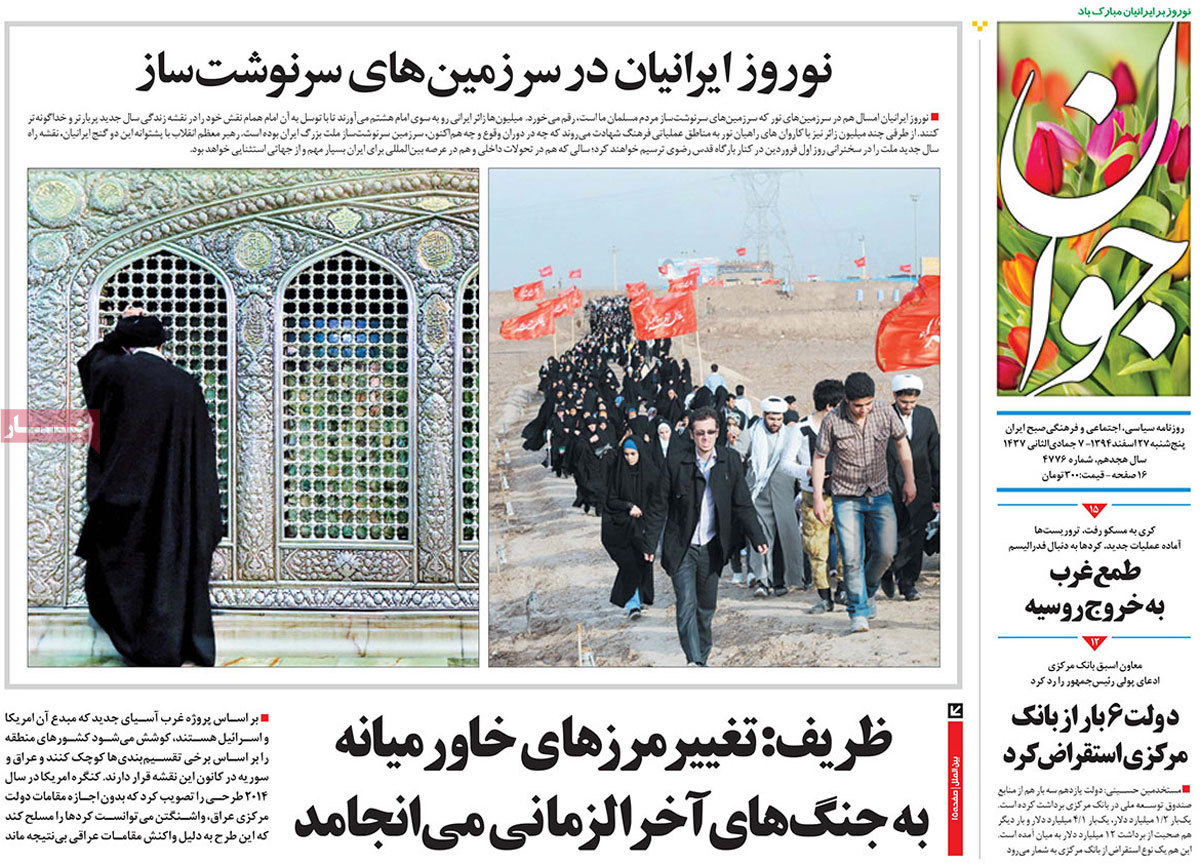
Javan:

  1. Iranian Nowruz in critical territories
  2. Western designs for Russian exodus from Syria


A look at Iranian newspaper front pages on March 17


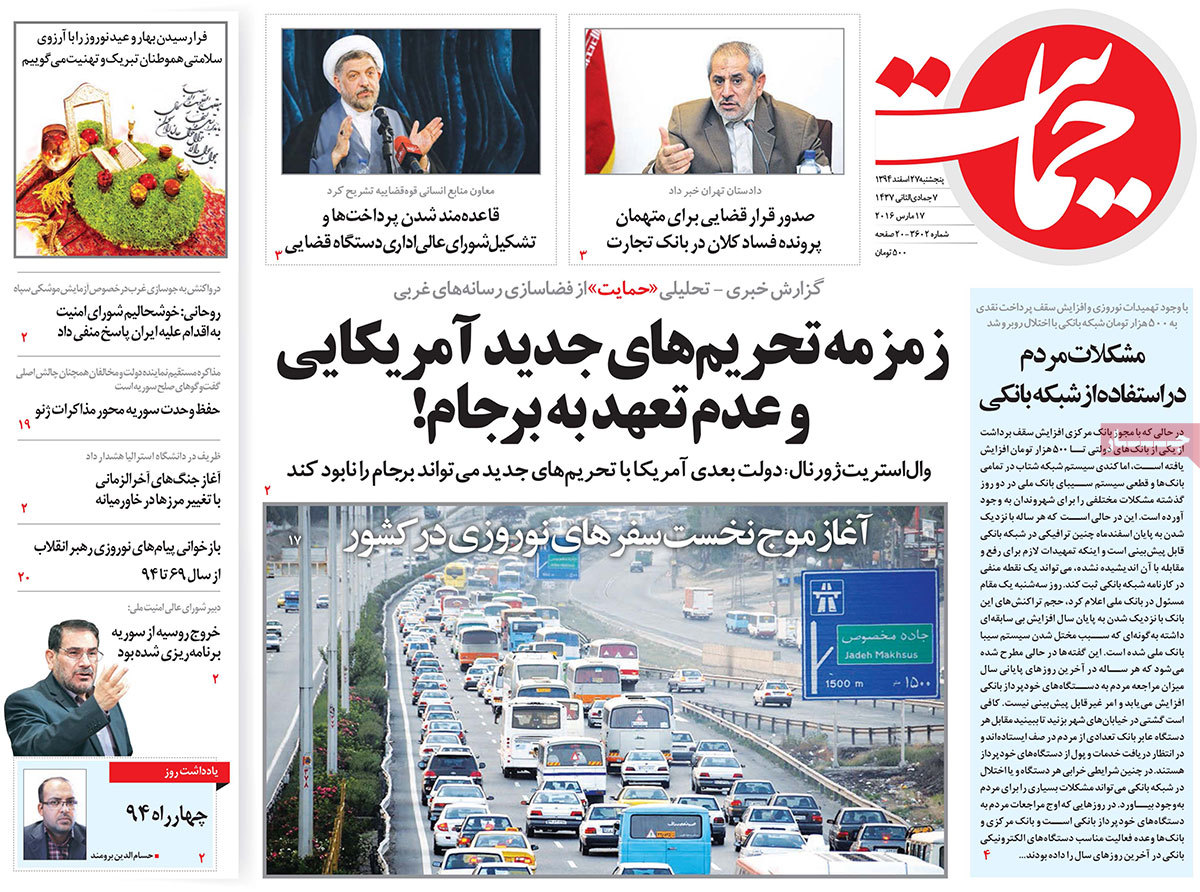
Hemayat:

  1. Murmurs about fresh anti-Iran sanctions; US keeps dishonoring JCPOA commitments: Analysis
  2. Rouhani upbeat about UNSC decision to endorse anti-Iran measure


A look at Iranian newspaper front pages on March 17


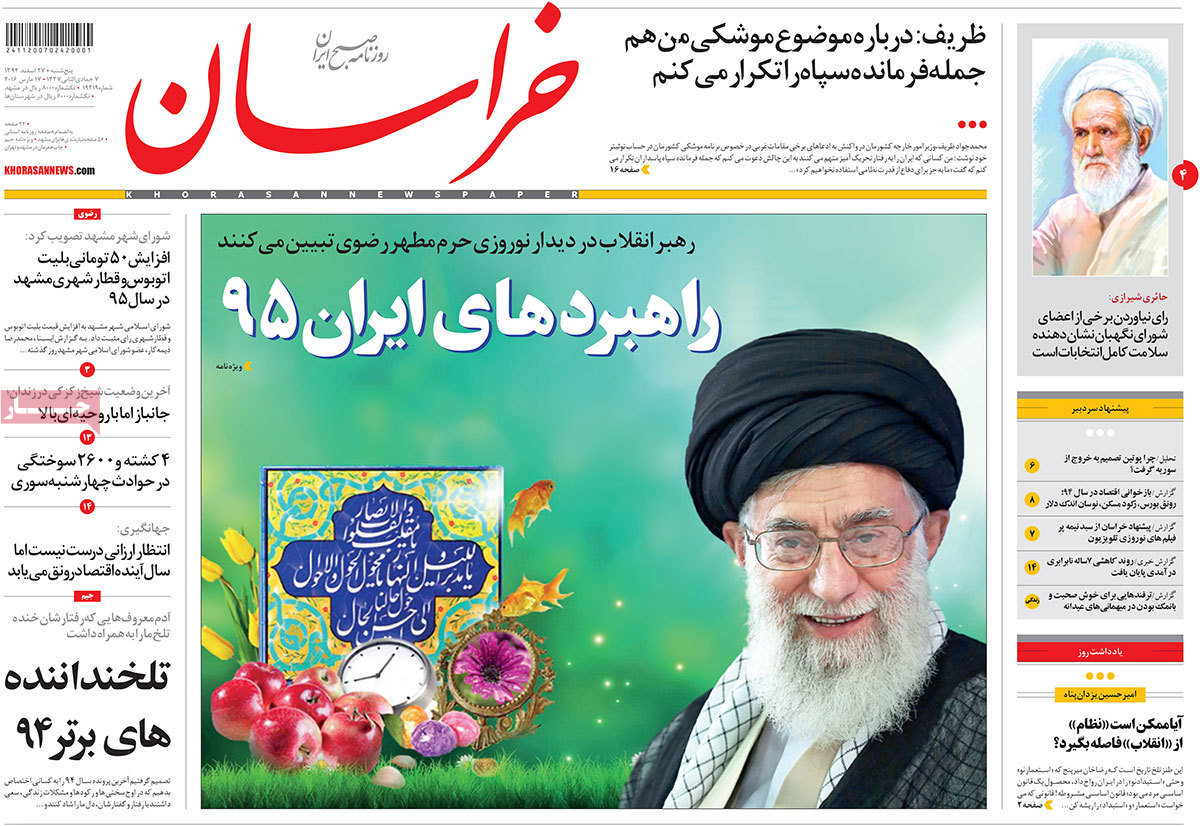
Khorasan:

  1. The paper has garnered a list of famous men and women who made every viewer smile bitterly by their deeds.

“Top bitter laughing stocks of year”

  1. Leader outlines Iran’s top strategies for new calendar year


A look at Iranian newspaper front pages on March 17


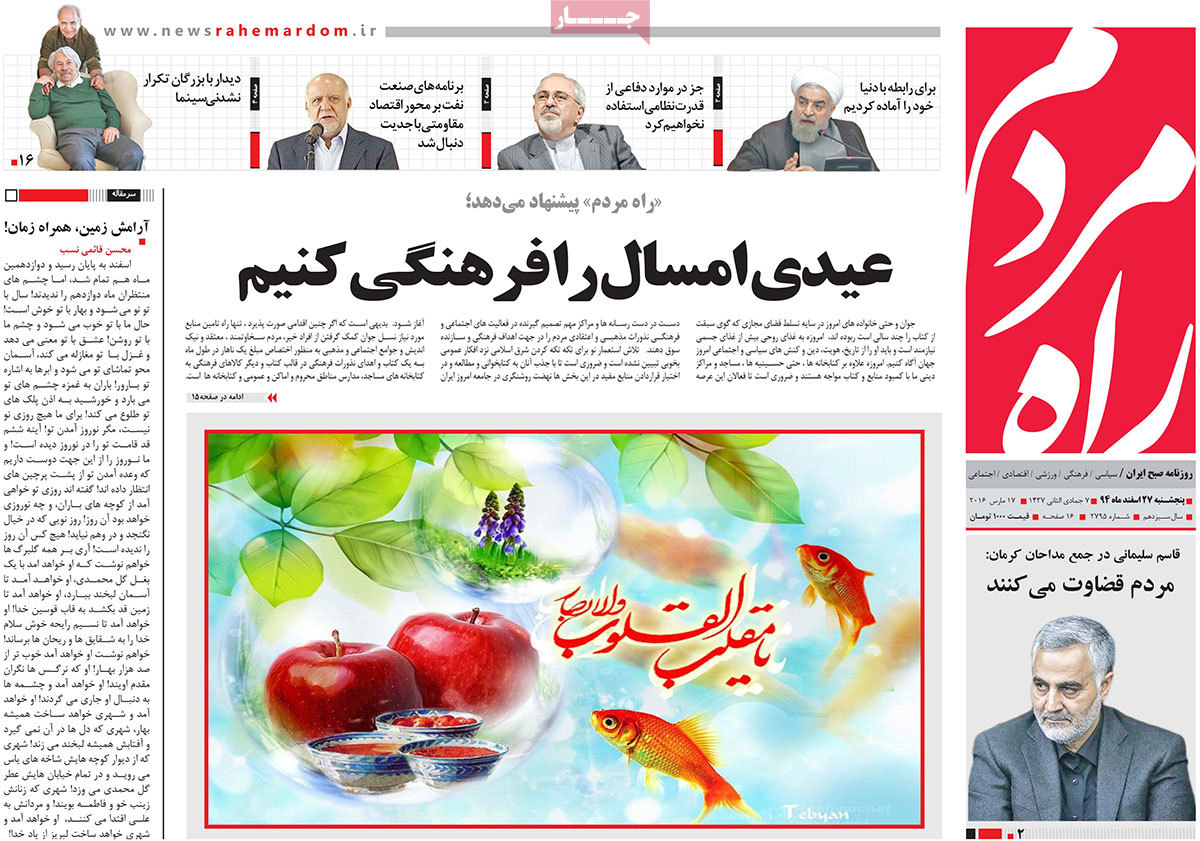
Rah-e Mardom:

  1. Iran ready for relations with world: Rouhani
  2. Zarif: Iran never uses military might except for defensive reasons
  3. Petroleum minister: Resistive economy fully observed in oil industry
  4. People will judge: Gen. Soleimani


A look at Iranian newspaper front pages on March 17


Resalat:

  1. Iran to maintain constructive interaction with world: President Rouhani
  2. Trump warns of impending upheaval in the US


A look at Iranian newspaper front pages on March 17


Rooyesh Mellat:

  1. Rouhani says upbeat about world’s denial of anti-Iran extremists


A look at Iranian newspaper front pages on March 17


Shargh:

Felicitations for New Iranian Calendar Year


A look at Iranian newspaper front pages on March 17


Shahrvand:

  1. New year must be year of political reconciliation: Rouhani


A look at Iranian newspaper front pages on March 17


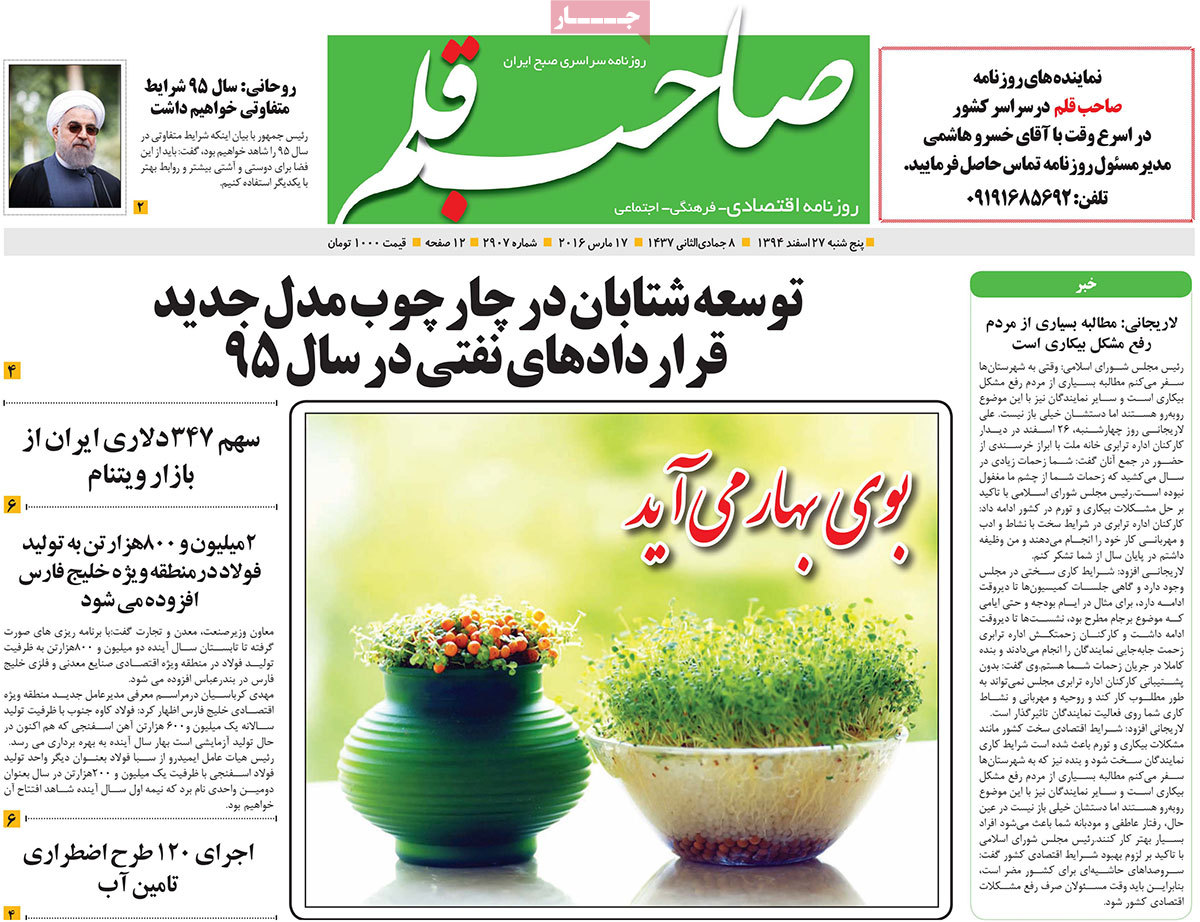
Sahib Ghalam:

  1. Momentous progress ensured by new oil contract model
  2. There comes scent of spring
  3. Persian Gulf FTZ raised steel output by 2.8mt/y


A look at Iranian newspaper front pages on March 17


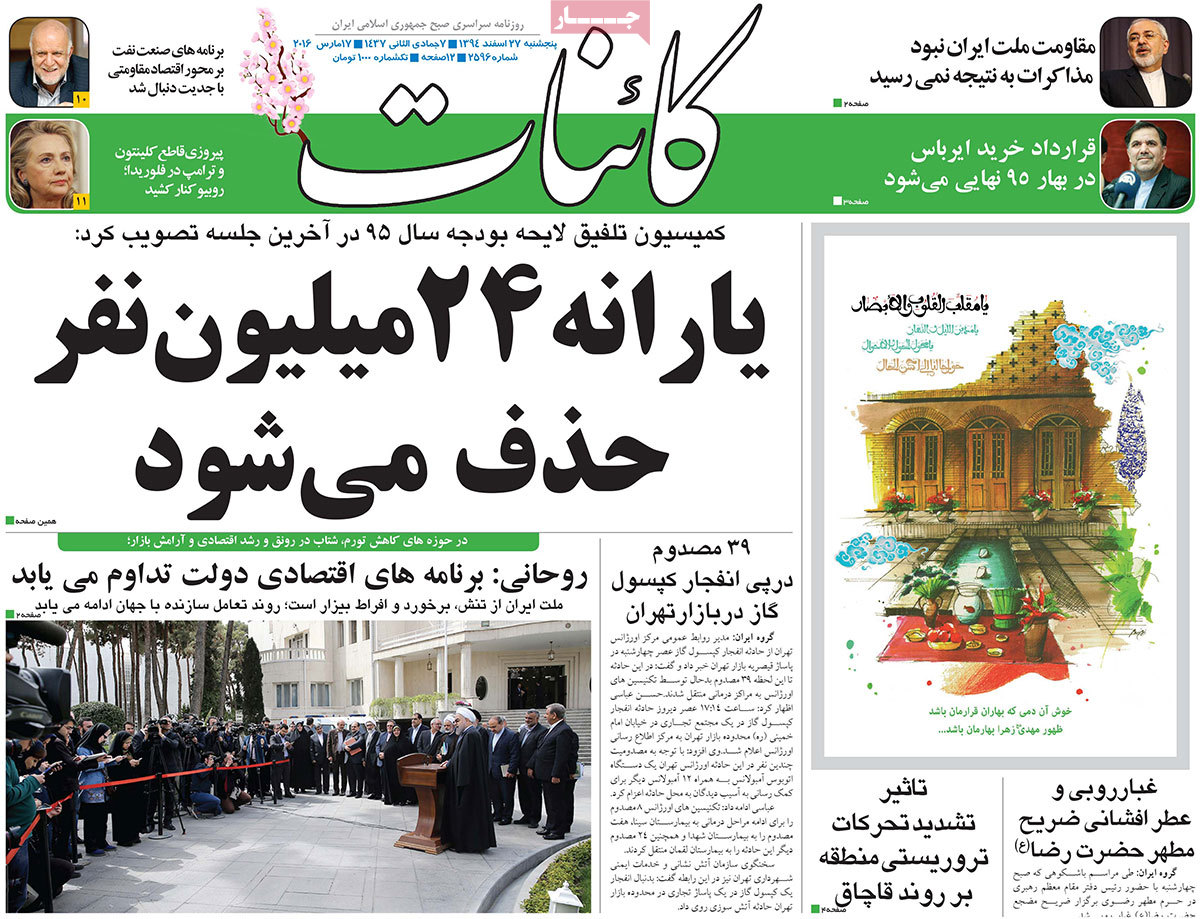
Kaenat:

  1. Iran to finalize airbus deal next year: Minister
  2. Gas blast injures 39 in Tehran market
  3. Economic upturn continues: Rouhani


A look at Iranian newspaper front pages on March 17


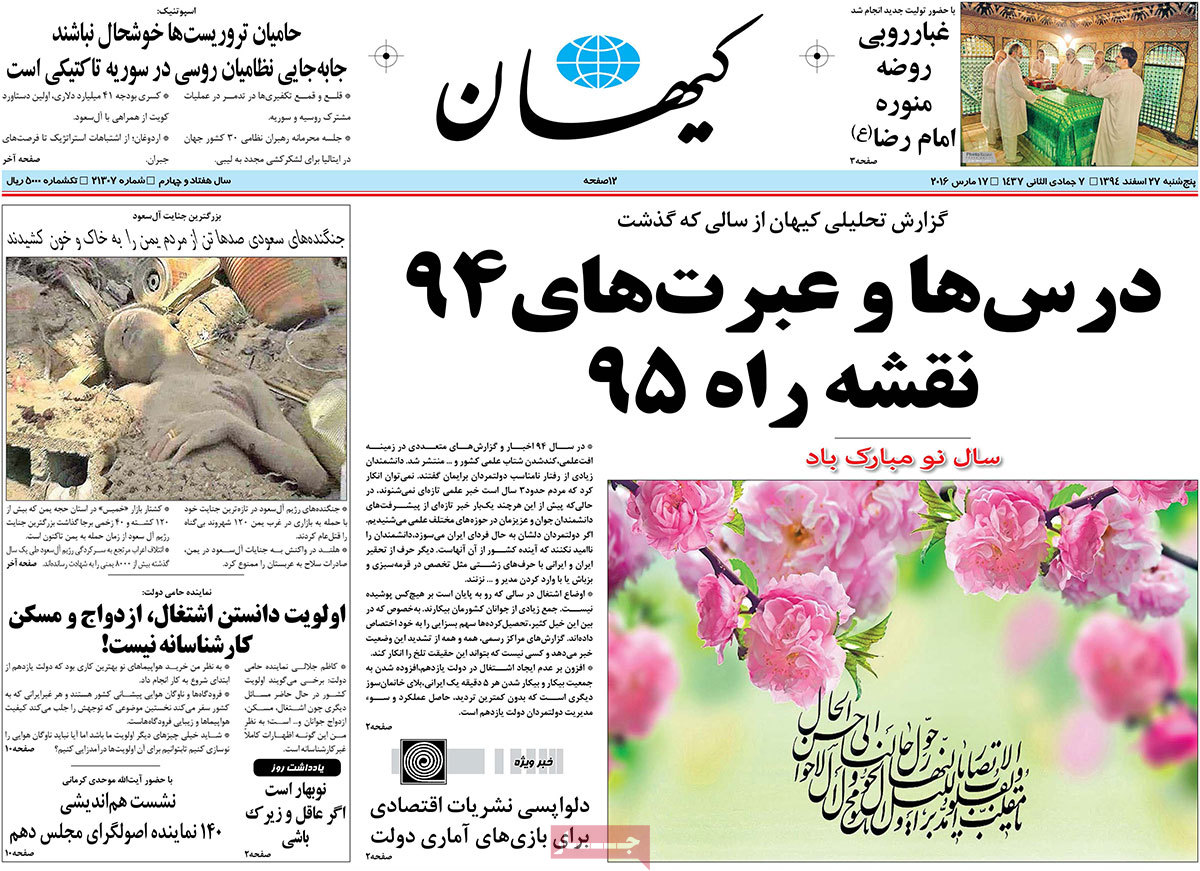
Kayhan:

  1. Lessons of year 94, roadmap for year 95: Report
  2. Saudi fighters kill hundreds in Yemen


A look at Iranian newspaper front pages on March 17


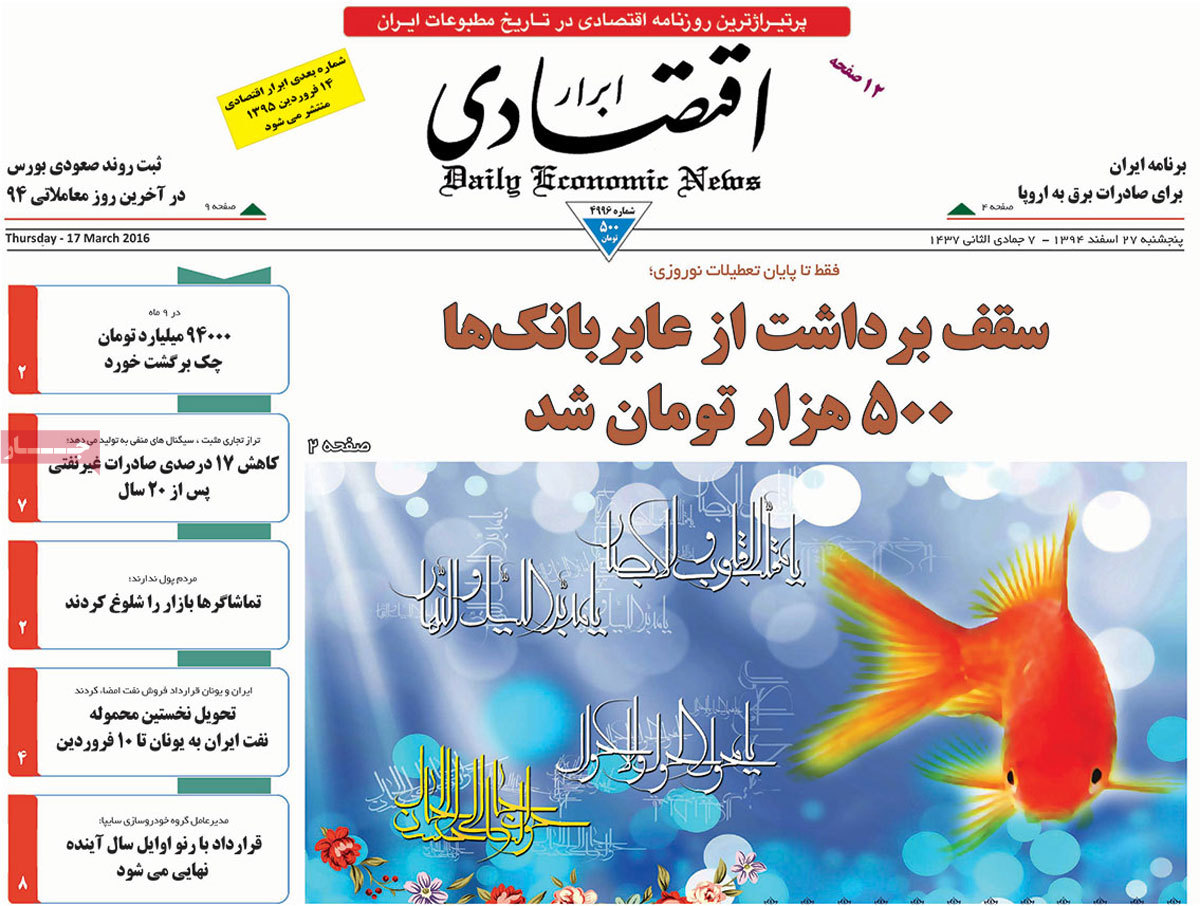
Abrar Eqtesadi:

  1. Iran plans for power export to Europe
  2. Iran non-oil exports up 17%
  3. First Iran oil shipment to call at Greek port by March 29
  4. Iran to finalize Renault deal next year


A look at Iranian newspaper front pages on March 17

Iran says regained lost oil market share

Iran’s Oil Minister Bijan Zangeneh says this has been materialized as a result of an increase in the country’s production and exports of crude oil as well as gas condensate.

Zangeneh – who made the announcement in a message to the nation on the eve of the new Persian calendar year (to begin 21 March) – emphasized that these are only part of a series of achievements that the Oil Ministry has been able to make after the removal of sanctions against Iran in mid-January.

The US-led sanctions that were imposed against Iran in 2011 limited the country’s oil sales to only one million barrels per day (bpd) from the previous levels of above two million barrels a day.

After the election of President Hassan Rouhani and his appointment of Zangeneh as the oil minister, Iran undertook serious efforts to lift its oil production capacity in face of the sanctions that also barred foreign investments in the Iranian oil industry. Accordingly, when the sanctions were lifted in mid-January, Iran increased its export ceiling to around 1.4 million bpd within a few weeks with the bulk of supplies heading to European markets.

Zangeneh had previously emphasized that Iran would increase its oil production by some 500,000 bpd immediately after the removal of the sanctions and by another 500,000 bpd within the following months.

He had also called on global producers to make way for the incoming Iranian oil supplies, stressing that Iran has no plans to freeze its production – as demanded by market heavyweights such as Russia and Saudi Arabia.

On Wednesday, Iran’s President Rouhani told reporters that the country’s oil exports will reach 2 million bpd within the next few months.