Wednesday, December 24, 2025
Home Blog Page 4523

Russia Says Legal Barriers for Iran Loan Cleared

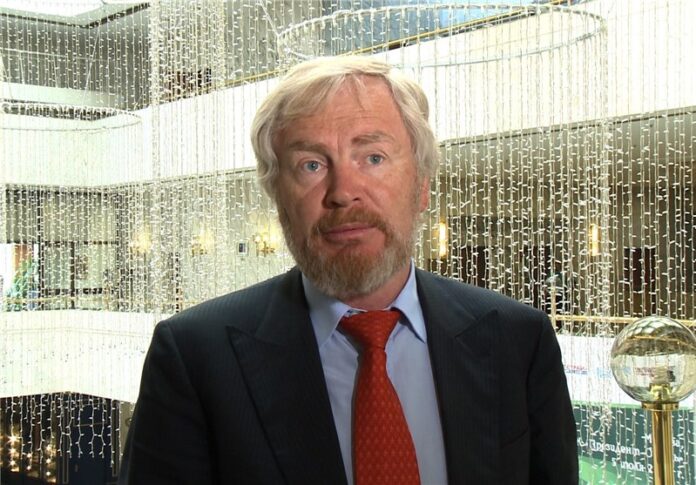
“Contradictions in the intergovernmental loan have been removed,” Russian Deputy Foreign Minister Sergei Storchak said as quoted by Sputnik on Monday.

“We’ll sign them (the documents) as soon as the decision is made by the authorities,” he added.

Preliminary agreements on granting Iran the $5-billion loan were signed during Russian President Vladimir Putin’s visit to Tehran at the end of November 2015.

Officials in Moscow had earlier said that the loan will be used for infrastructure projects, most likely electrical power generation and the development of railways.

The measure is expected to boost trade between the two countries. The target is $10 billion, from the current $1.6 billion.

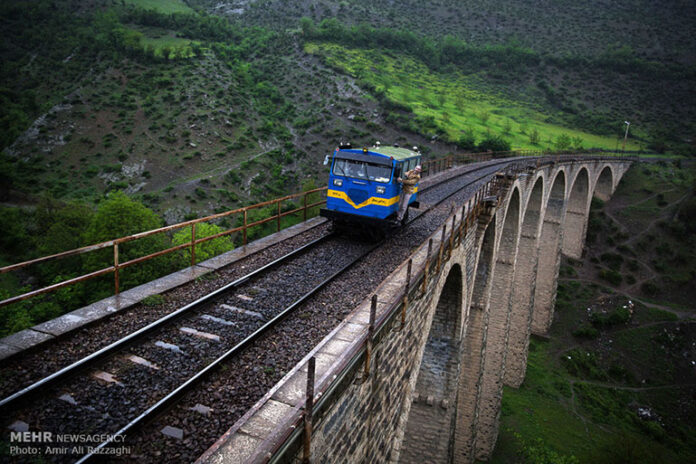
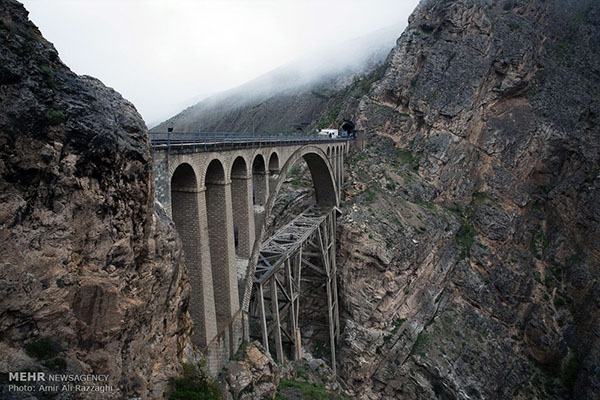
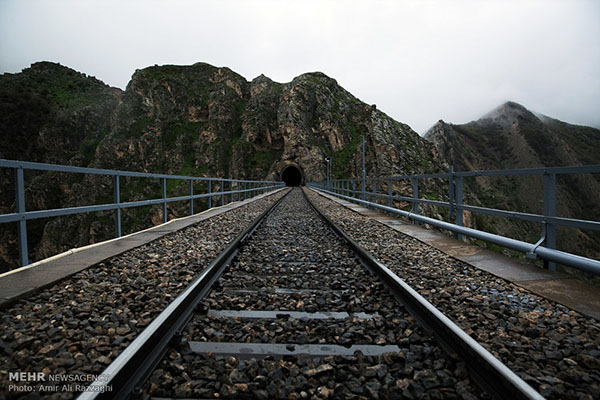
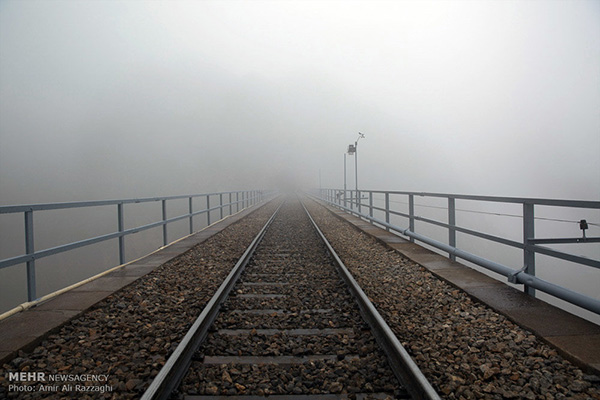
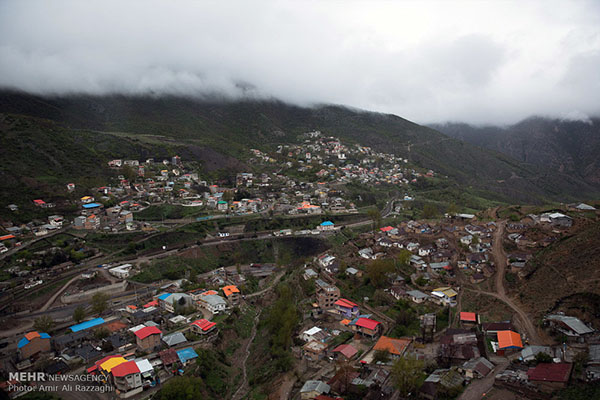
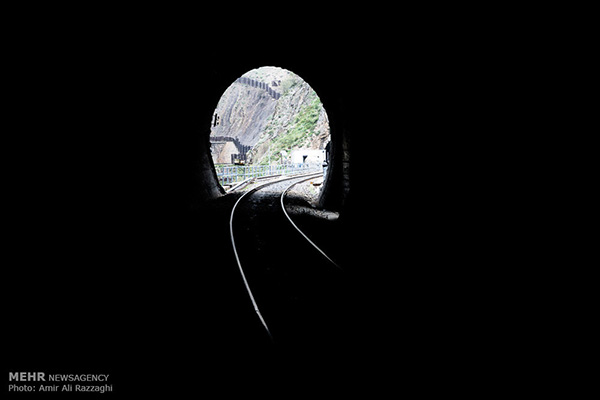
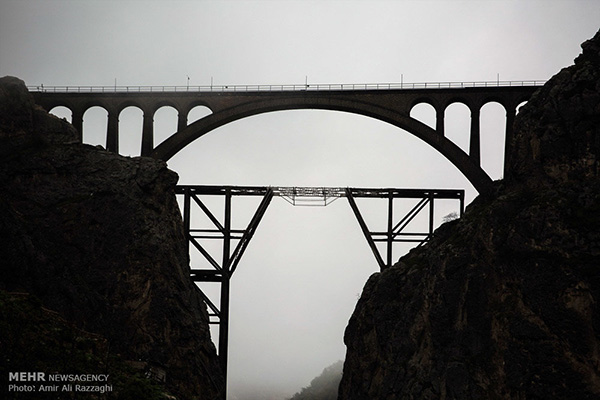
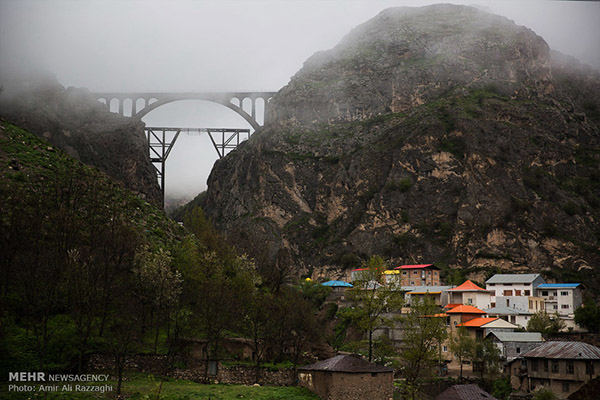
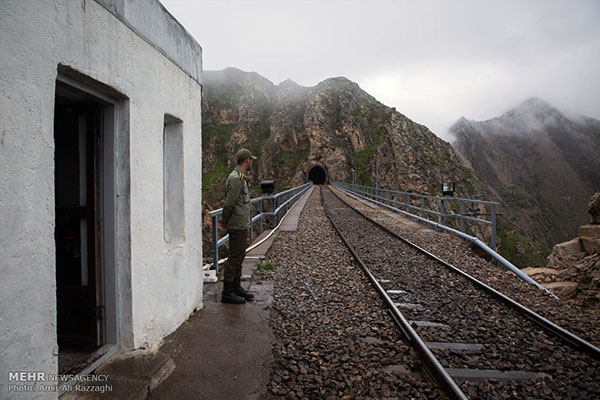
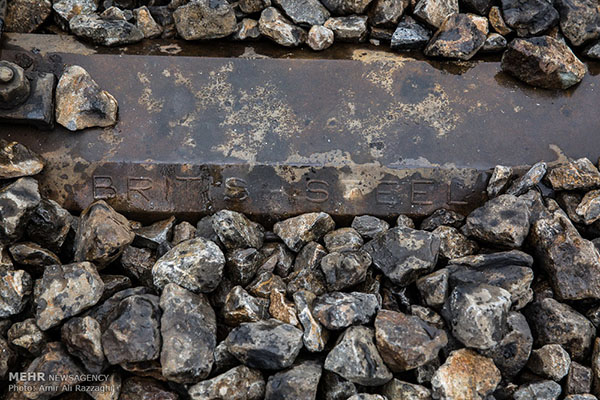
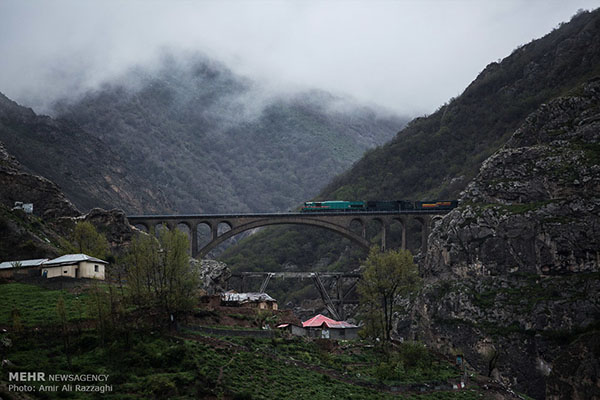
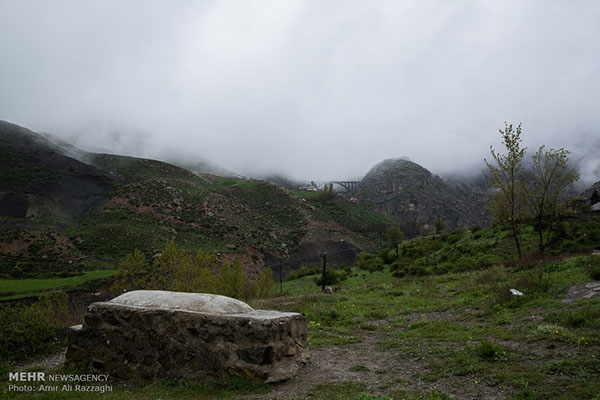
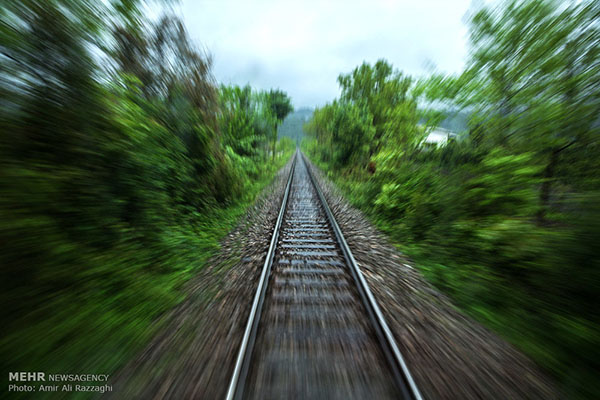
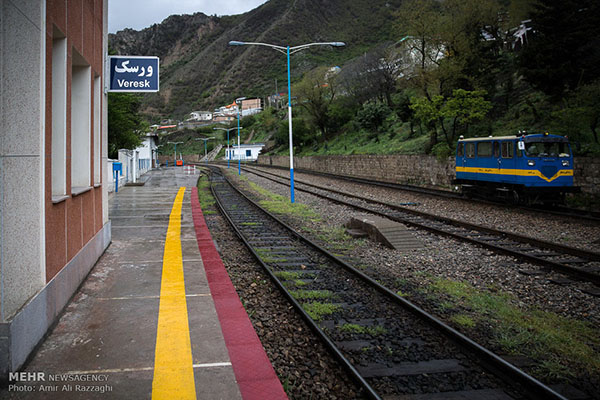
Veresk bridge in Mazandaran

Registered in Iran’s National Heritage List, the bridge is now an 80-year-old monument still serving passengers today.


Iran to dispatch work force to 5 states

Director General of Department of Policy and Employment Promotion, Ministry of Cooperatives, Labor and Social Welfare Mohammad Akbarnia noted that 80 foreign employment agencies are active inside the country while 10,000 work force are expected to be dispatched abroad in the current Iranian calendar year (began March 20); “the issue is being pursued by the private sector.”

The official asserted “some countries have voiced readiness to establish employment offices; Australia, Germany, the US, Britain and Georgia among others.”

He deemed establishment of offices for coordinating work force as the main priority of Iran’s Ministry of Cooperatives, Labor and Social Welfare saying “these agencies are in charge of supporting Iranians working abroad as well as seeking venues for job creation and deployment of work force to other countries.”

“Strengthening employment and expanding virtual employment remain as the most important responsibilities of the officials in the field,” he emphasized.

Akbarnia reiterated that Iranian human resources can be dispatched to Australia, Turkey, Germany and Denmark; “recently, negotiations have been held to send work force to Ireland.”

“Most of the countries which are after work force need skilled workers for their intended jobs,” said the official adding “given Iran’s active diplomacy in the region and other parts of the world, the country can boost interactions with other states.”

Iran to Build Petchem Hub in Austria

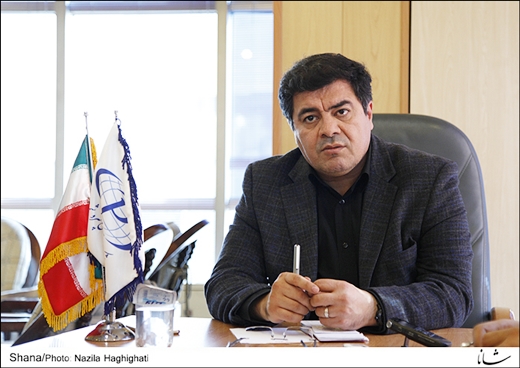
Managing Director of Petrochemical Commercial Company Mehdi Sharifi Niknafs said the company has recently inked a memorandum of understanding (MoU) with an Austrian company for establishing a petrochemical hub in the country aimed at accessing petrochemical markets in eastern European countries like Czech, Bulgari, Slovakia, etc.

Speaking on the sidelines of the 10th Iran Plast Exhibition here in Tehran, the official further said Iran needs to put on display the potentialities and capabilities it developed under the sanctions by holding such showcases.

“Iran Plast Exhibition, given the promising circumstances in the country, can be a major step for showing to the world Iran’s petrochemical achievements and capabilities,” he said.

Niknafs further called for holding more showcases like Iran Plast so that world countries will better able to learn about petrochemical activities and achievements in Iran.

He further said his company has held talks with numerous European delegations which will boost Iran’s petrochemical exports to Europe.

He also said talks are under way with Pakistanis which will hopefully lead to favorable results for interactions between Iran and Pakistan in the near future.

Larijani congratulates Assad on parliamentary Election

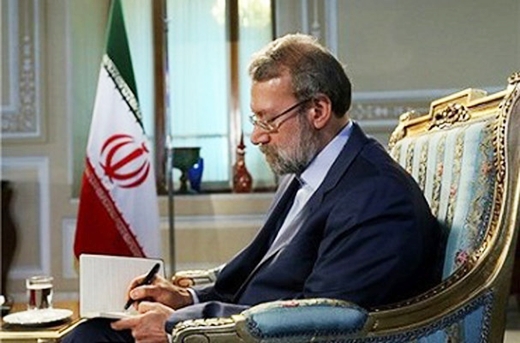
In his message, Larijani referred to the Syrian people’s massive turnout in the polls despite threats made by terrorist groups, and said the election, especially the massive participation of people, was an important regional and international event.

Larijani underlined that Iran’s strategy is establishing broad, comprehensive and close cooperation with the government and the people of Syria to achieve stability, peace and security in the region.

He expressed hope the Arab country will soon come to peace in light of the resistance and sustainability of the government and people of Syria against terrorist groups.

The Syrian electoral commission announced late Saturday that the National Unity coalition, comprising the ruling party and its allies, had won 200 of the 250 seats at the People’s Assembly (Majlis al-Sha’ab) in the recent parliamentary elections held on April 13.

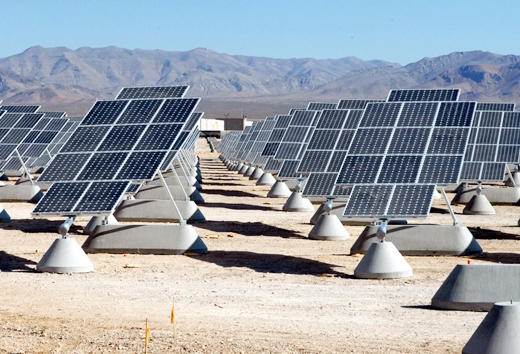
Italian company to build 50 MW solar power plant on Iran’s Qeshm island

The deal was signed between Fabio Maresca, the chairman of the Italian company, and Hamidreza Mo’meni, the head of Qeshm Free Zone Organization, on the sidelines of Italian Prime Minister Matteo Renzi’s visit to Iran.

Underlining the new round of bilateral economic relations between Iran and Italy, Mo’meni noted that the government seeks to improve the southern island via expanding macro-economic activities there and reinforcing its infrastructure including construction of the intended solar power plant.

Maresca, for his part, vowed that his company will complete this project in eight months.

Heading a 250-strong political and economic delegation, Renzi arrived in Tehran in last Tuesday, making him the first Italian official in such capacity to visit Iran since 2001.

Parts of the delegation were Italian ministers of infrastructure and transport; economic development; and agriculture, food and forestry policies. Businessmen and personalities from Italy’s public and private sectors were also accompanying Renzi in the visit.

Representatives from Italy’s private sector signed several memoranda of understanding with their Iranian counterparts, boosting ties in various sectors including textile, oil, energy, steel, telecommunications, aviation, medicine, and etc.

Mogherini: EU in Talks with US to Remove Iran’s Banking Problems

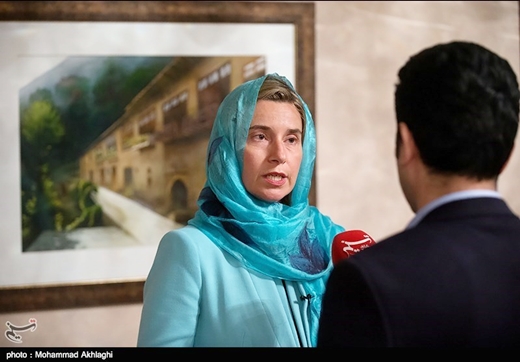
What follows is the full text of Mogherini’s interview with Tasnim’s Abbas Aslani:

Tasnim: The first question is related to the EU office in Tehran. We’ve been hearing some news related to this. Iran’s foreign minister Mr. Zarif said you discussed the issue today and some procedural issues seem to be taking place. How much time do you think is needed for opening this office in Tehran, as I heard that in the joint statement you said that a liaison team will be sent to Tehran? By the time that the office is opened, how will those diplomats work and be based in Tehran? What are the technical or legal problems related to this issue?

Mogherini: As Minister Zarif mentioned today in the press conference, there are some procedural issues to be fought internally in Iran, that we respect very much and we want everything to be smoothened properly. These are procedurals steps that need to be taken and I think that, I’m sure, the foreign minister and his ministry are taking care of that. In the meantime, as you said, we have decided to send a first team that will be operating with the support and the help of the current presidency of the European Union. It’s a rotating presidency – at the moment it’s the Netherlands holding it. I cannot foresee the timing, but I can tell you what the hopefully future EU delegation will do, which would be mainly to support and sustain all the work. Today, for instance, we have decided to start on re-launching dialogue and cooperation on many different sectors.

As we plan to develop dialogues on energy or economy or business presence here or technology or transport, and since these many different sectors require a lot of technical missions and a constant exchange with Iranian authorities and services, obviously having a presence here would be helpful to develop this cooperation in a structured way, and also would provide support for all the businesses, companies and the European financial sector that is willing to engage in Iran, providing a framework for European engagement in the country from a technical point of view. So, I think this would be an extremely useful step to build the concrete results that we want to see coming out of our cooperation.

Tasnim: And you said the timing for the opening of the office may not be certain, but the timing of the sending that liaison team is certain now?

Mogherini: Yes, it’s going to be in the coming weeks.

Tasnim: And how they will work when the office is not open?

Mogherini: They will work together with the Dutch embassy.

Tasnim: One issue which you may have been asked a lot, both on the trip and before, relates to banking transactions that have been facing problems, with Iranian officials even accusing US of breaching the JCPOA. Do you think this problem is a problem that can stop the deal, or can cause real problems? And what is your role in this regard?

Mogherini: I hold the role of coordinating the special committee that is looking at the implementation of the deal, and this is a role that we will maintain for the years to come. So, this is part of my role in the monitoring the implementation, but most of all, this is an important, very important, issue for Europeans.

As we develop our trade and investment cooperation with Iran we also need, as Europeans, to have our banks be present here to accompany these developments. So, it’s not only on the Iranian side that this is perceived as a very important issue, this is also on the European side. We are working very hard with all the European banks, with the financial sector in Europe to, first of all, explain that the situation has changed, as on the 16th of January all the economic and financial sanctions that were related to the nuclear program have been lifted, so the banks and the financial sector in Europe are facing a completely different situation. We have provided them with full information about the change of the situation. The big banks maybe need a little bit of time to adjust to the new situation and adapt to the new situation. The small banks, we are seeing them coming to Iran already in these weeks, many of them accompanying this renewed commitment and engagement on the European side on doing business together with Iran, because we know very well that this is key. We’re also talking about that with our American friends. They know how much this issue is very important for us as Europeans, and again, we cannot force anyone to do anything, but we can encourage, we can reassure, we can explain that the legal provisions are now completely different from before, and that there is no reason for European banks not to come to Iran.

Tasnim: How much do you think your trip to Tehran can give the assurance or the confidence to the European banks or the entities in the EU to work with Iran? Is it one purpose of the trip?

Mogherini: The purpose of the trip is on one side to start this cooperation for real. I remember very well, last time I was here in Tehran we were saying together with Minister Zarif that this is a turning point; when we have the implementation day, this will not only be a nuclear-related issue, but this will open the way for cooperation, practical cooperation in many different fields.

We have been working over these months, together with the Iranian authorities, on preparing these different sectors, which we are engaging with today. This is bringing new life to our relations. So the first purpose of the trip is to start, very practically, very concretely, this cooperation in different sectors. As well as that, deciding to have a dedicated economic dialogue or energy dialogue, deciding to work on a technical level on transport or on migration, helping each other in facing the different challenges we’re facing today, and also taking the opportunities that the deal opens up both for Iran and for Europe – this is also the main purpose of the trip. So, we know very well that, as Europeans, we have a special role, somehow. We are the ones that used to be Iran’s first partner in economic fields, in trade, investment, and we want to be get back to that. You can see that, because many European delegations are coming here, and we want to provide a common European framework for the single member states of the European Union and the companies of the European Union to feel comfortable to come and engage within a common European framework. So, these are the two purposes: to start practical cooperation, which is what we have done toda, and also, to reassure and invite the Europeans to come and work here.

Tasnim: On this cooperation, do you think that the EU is waiting to see the results of the US presidential elections?

Mogherini: You see me here today. Right?

Tasnim: Yes. So this is not a valid evaluation. The EU played an important role in the Iran nuclear talks in achieving the deal, but regarding Syria, it seems that we haven’t seen a very full role played by the EU. Do you think, in future, there will be a change in this regard, playing a more active role?

Mogherini: We are playing a very active role on Syria, on two different issues in particular: the humanitarian support we are giving to people inside Syria and in the region, and also on the political track. This is something I have discussed at length with my interlocutors here, in Tehran today, because we see a role both on the humanitarian and on the political track for Iran, as well. Also, we have less of a role, on the military track, because the European Union as such is not involved in the military treaties in Syria.

We believe that it is good at this stage to have coordination with the United States and Russia in leading and co-chairing the support group – the International Support Group – for Syria. This doesn’t mean that the European Union has less of a role. We are working very much, especially with the United Nations and our interlocutors in the region, starting with Iran, on how to assist this process. I believe that Iran can play a very important role in supporting the intra-Syrian talks that are starting now in Geneva.

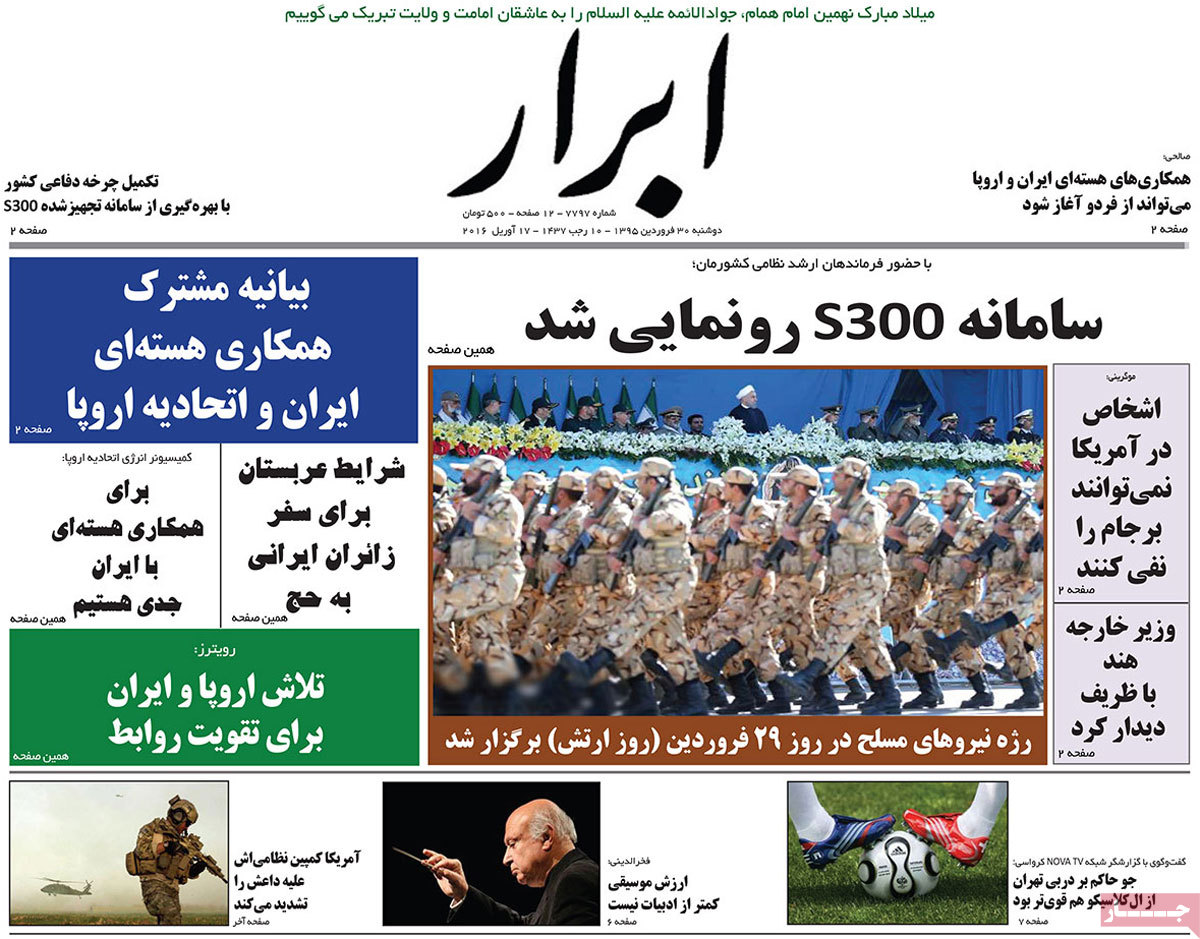
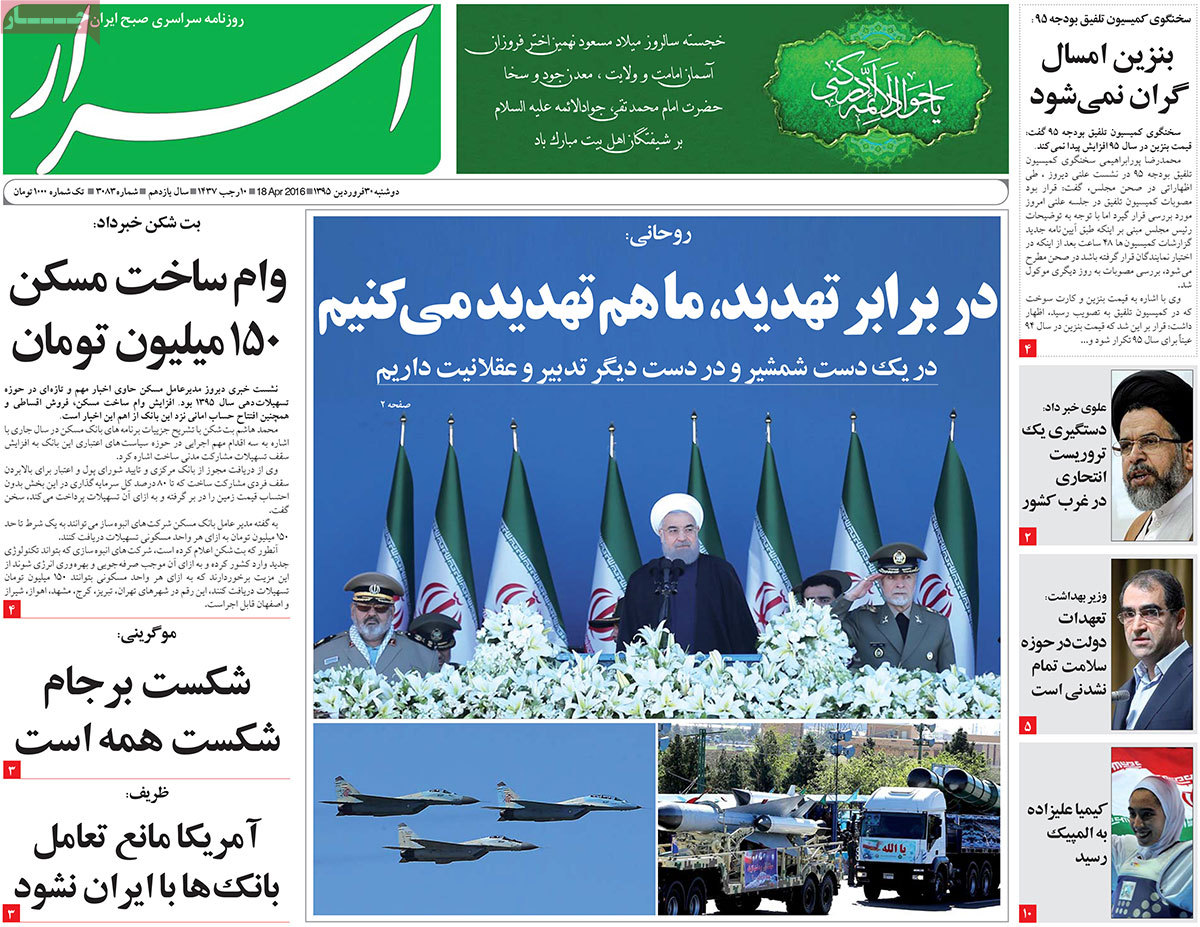
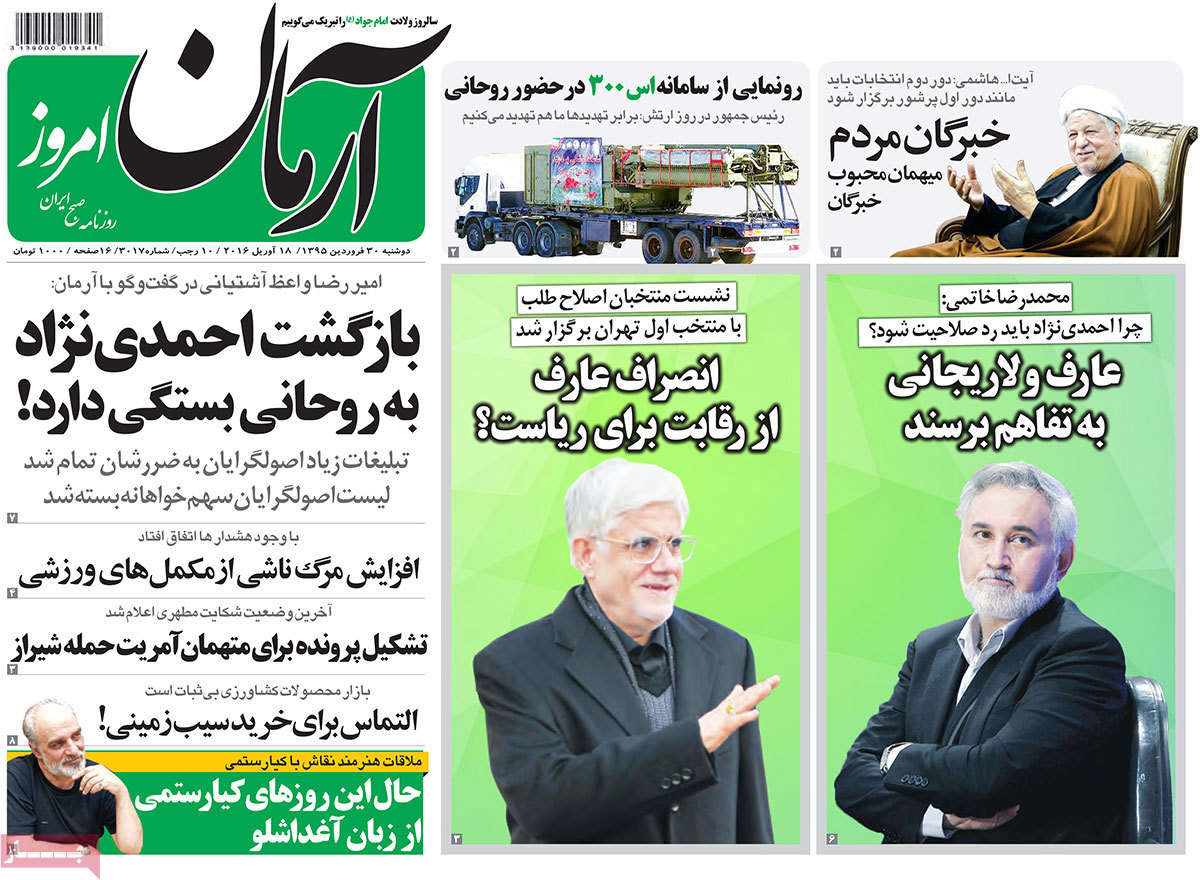
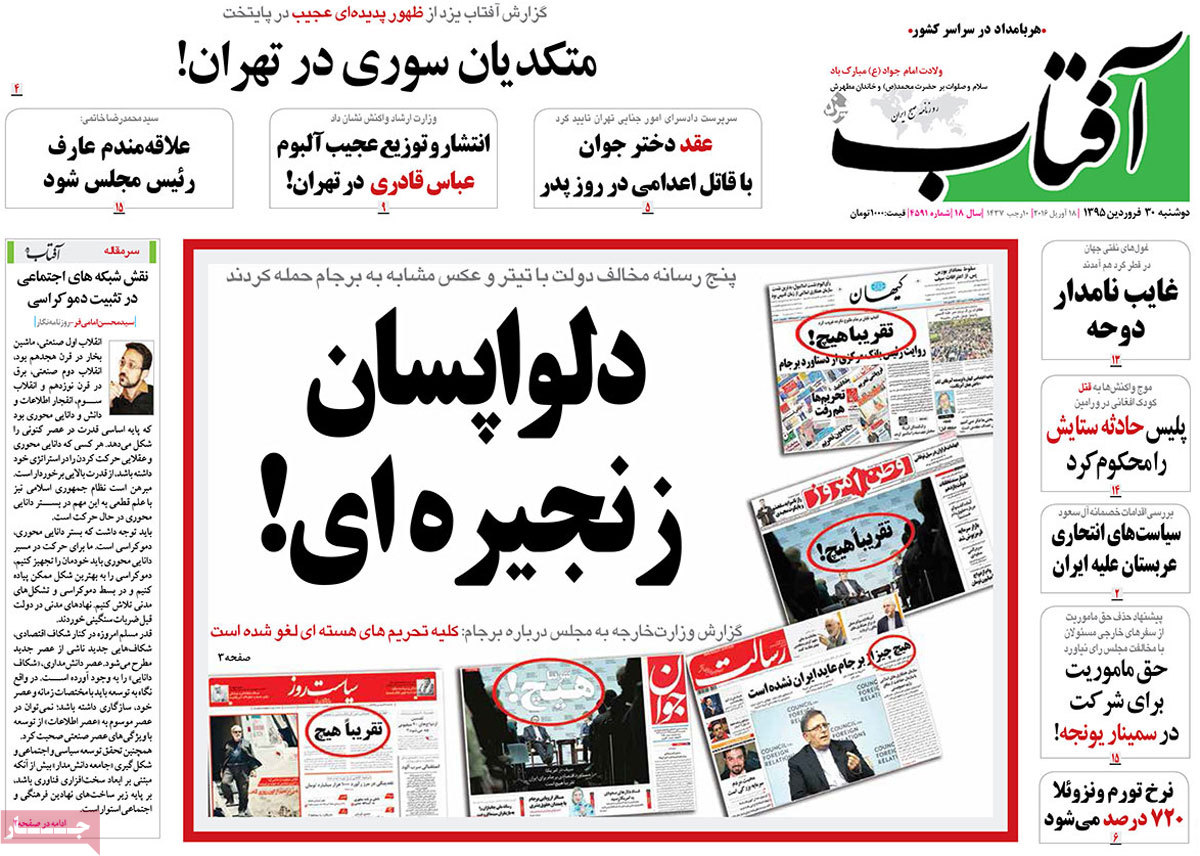
A look at Iranian newspaper front pages on April 18

Iran Newspaper front pages

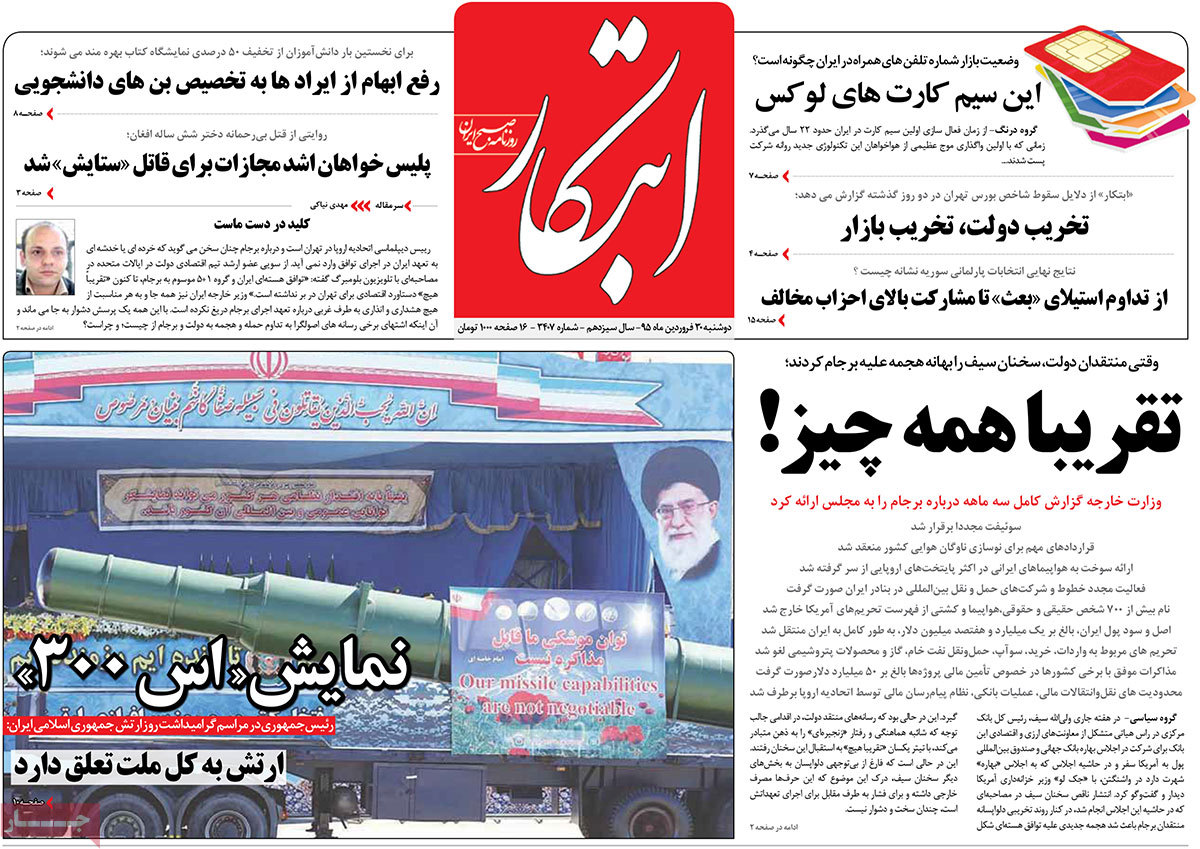
Abrar:

1- Salehi:Iran-Europe nuclear cooperation can start with Fordo

2- Mogherini: Individuals in US can not dismiss JCPOA

3- EU Energy Commissioner: We are serious about nuclear cooperation with Iran


A look at Iranian newspaper front pages on April 18


Asrar:

1-Mogherini: Failure of JCPOA, a failure for all

2-Zarif: US should not prevent banks from cooperating with Iran


A look at Iranian newspaper front pages on April 18


Arman-e Emrooz:

1- S-300 missile system unveiled with President Rouhani in attendance

President in Armed Forces Day: We respond to threats with threats

2- Despite warnings: Increasing health problems from sport supplements


A look at Iranian newspaper front pages on April 18


Aftab-e Yazd:

1- Five opposition media attack government with photographs and headlines

2- Foreign Ministry informs Parliament about lifting of all sanctions


A look at Iranian newspaper front pages on April 18


Ebtekar:

1-Critics used Central Bank Chief’s words against JCPOA to no avail

Foreign Ministry presented a full 3-month report about the JCPOA to Parliament

2-Brutal killing of 6-year-old Afghan girl: Police urge maximum penalty for murderer of Setayesh


A look at Iranian newspaper front pages on April 18


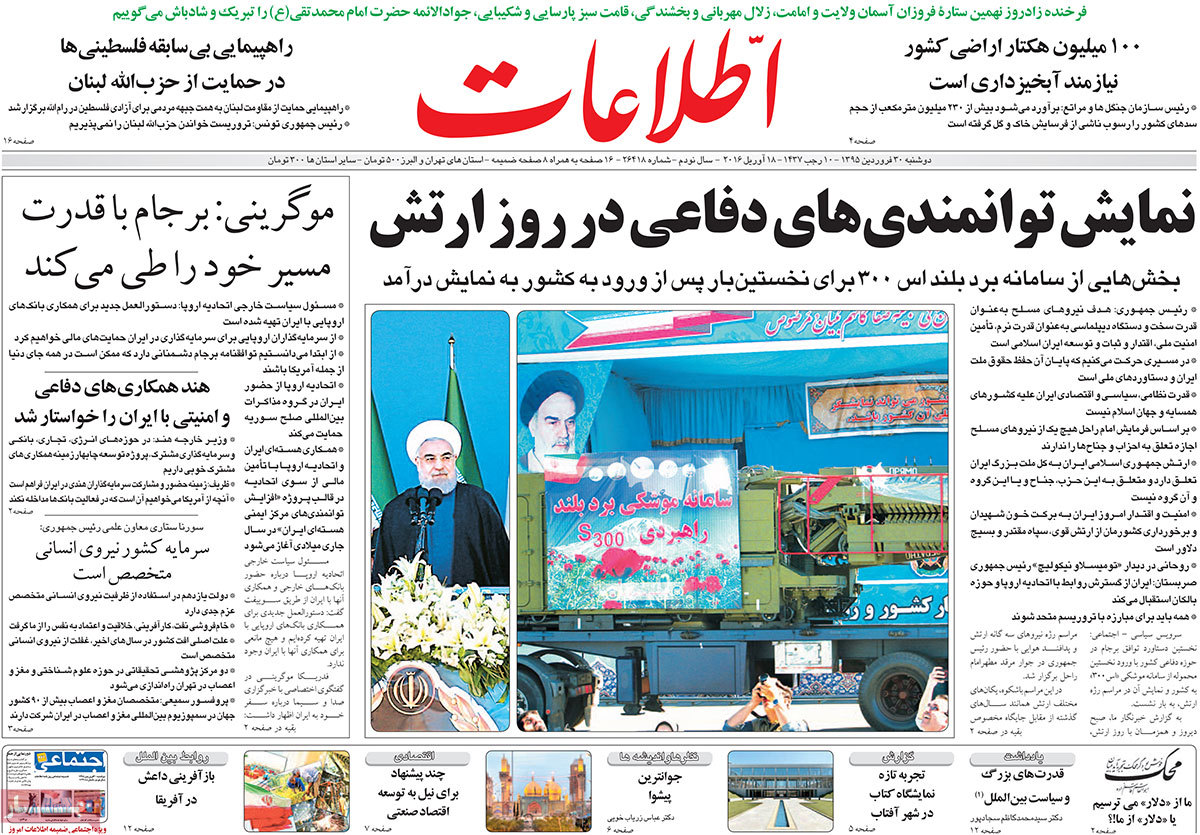
Ettela’at:

1-Iran showcases its defence capabilities on Army Day

2-India interested in defence and security cooperation with Iran

3-Mogherini: JCPOA progressing strongly


A look at Iranian newspaper front pages on April 18


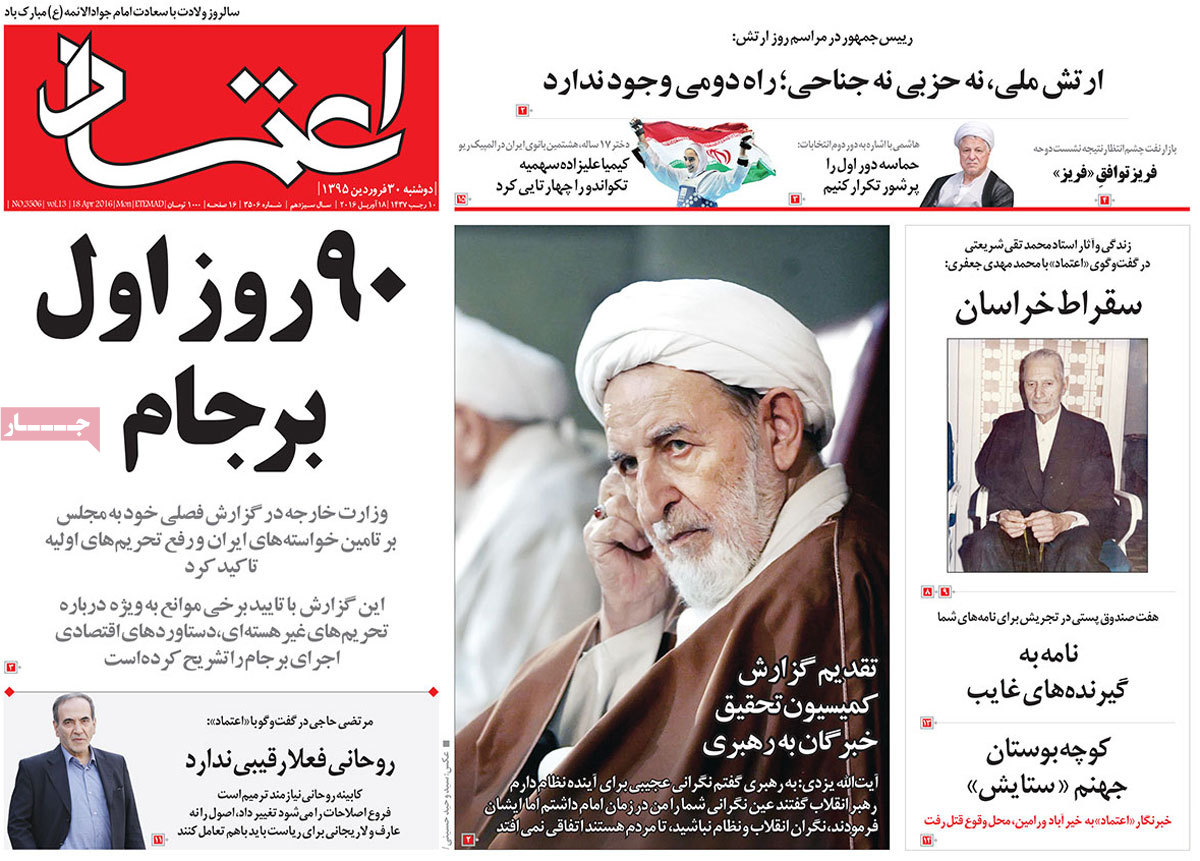
Etemad:

1-Assembly of Experts Report presented to Supreme Leader

Ayatollah Yazdi: I told the Leader I am very anxious about the future of the establishment. The Leader said, I had the same concern when Imam Khomeini was alive, but he told me not to worry about the Revolution and the Establishment, because as long as people are on the scene nothing will happen
2- A 17-year-old Iranian girl, Iranian lady in Rio Olympics

Kimya Alizadeh increased Iranian competitors to four in taekwondo


A look at Iranian newspaper front pages on April 18


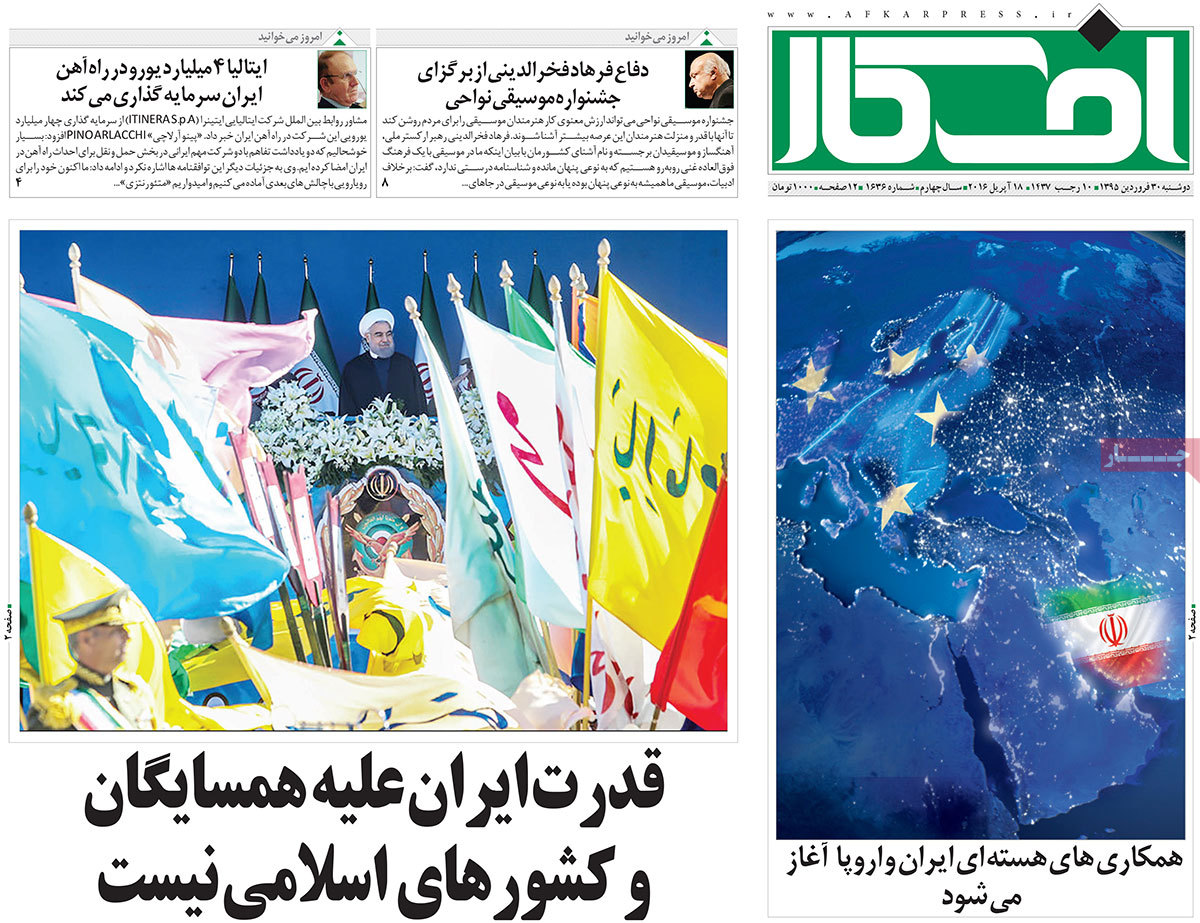
Afkar:

1- Iranian power is not aimed at neighbours and Muslim countries

2- Italy to invest 4bn Euro in Iranian railway


A look at Iranian newspaper front pages on April 18


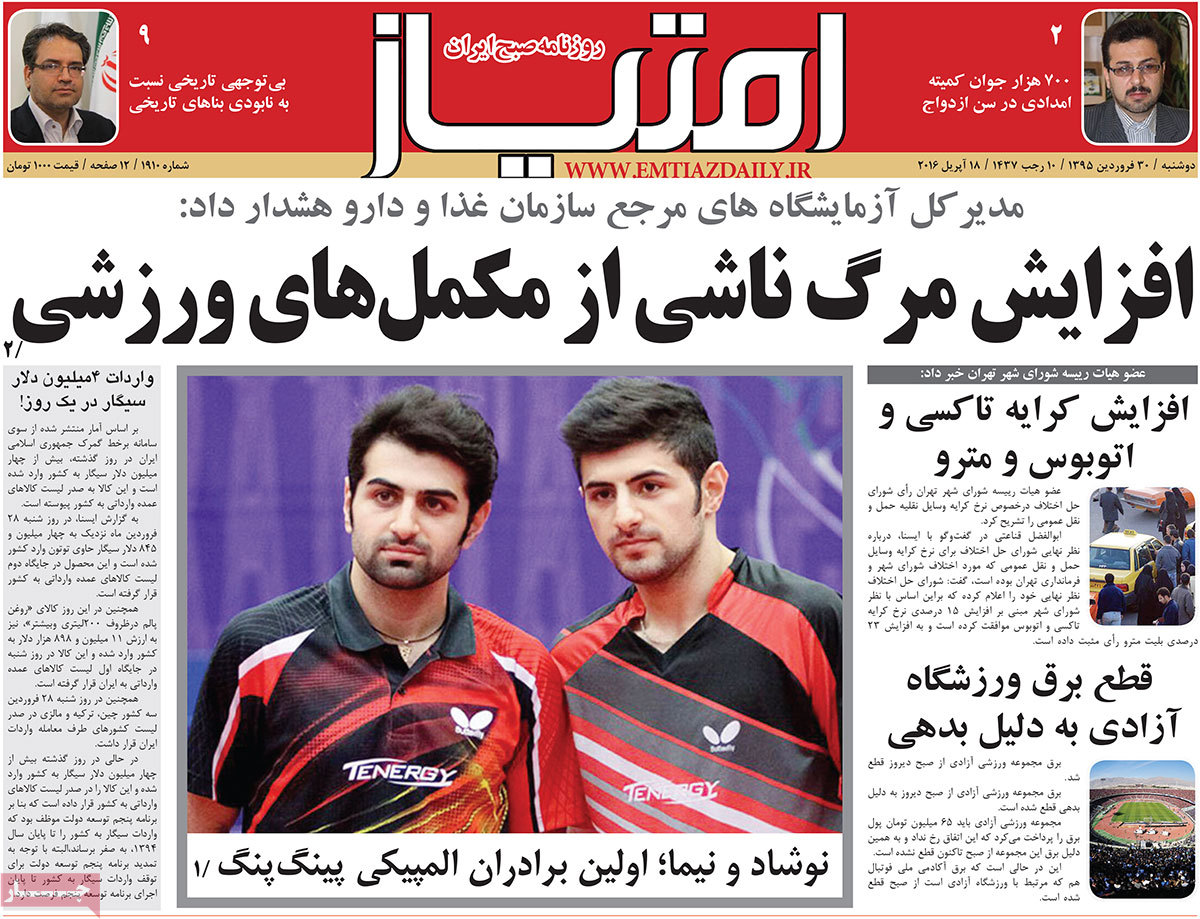
Emtiaz:

1-Noshad and Nima: First Iranian brothers to represent Iranian table tennis in Olympics

2- $4m each day on cigarette imports


A look at Iranian newspaper front pages on April 18


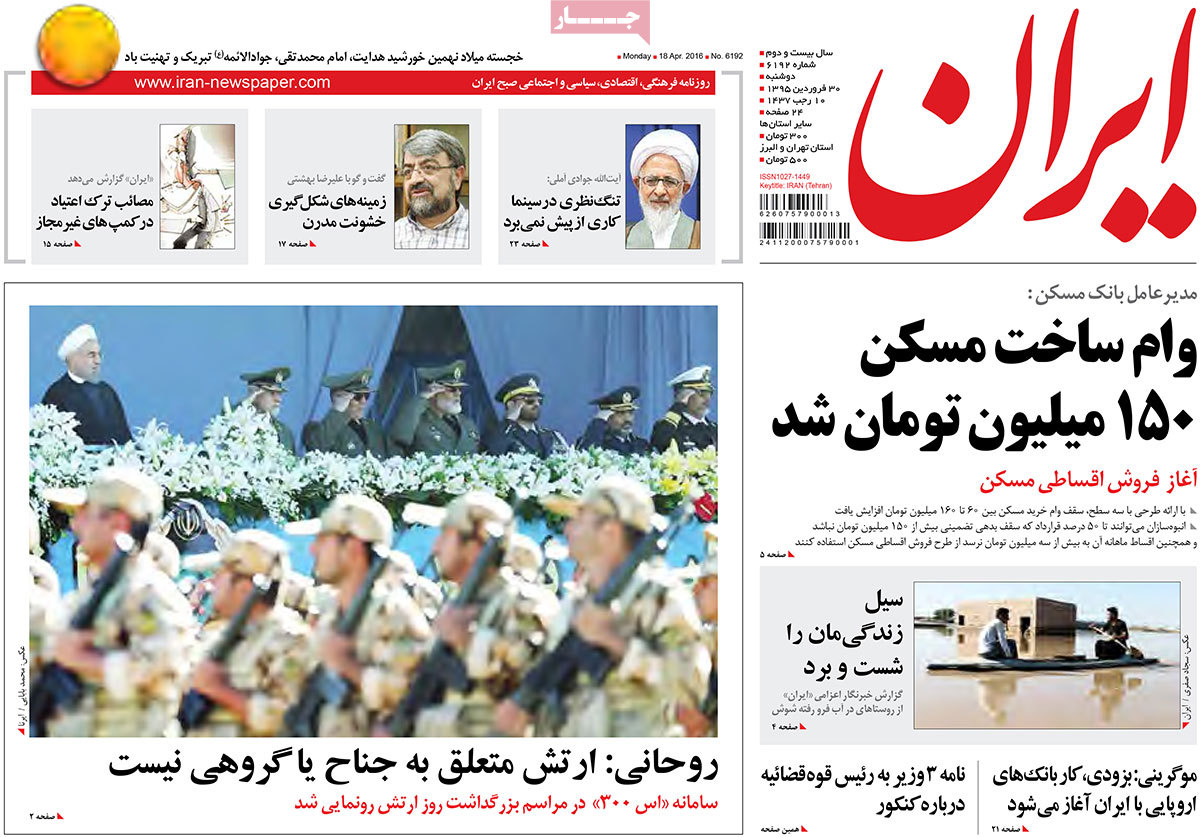
Iran:

1-Rouhani: Armed Forces don’t belong to any particular group or faction

2- Mogherini: European banks will start their transactions with Iran soon


A look at Iranian newspaper front pages on April 18


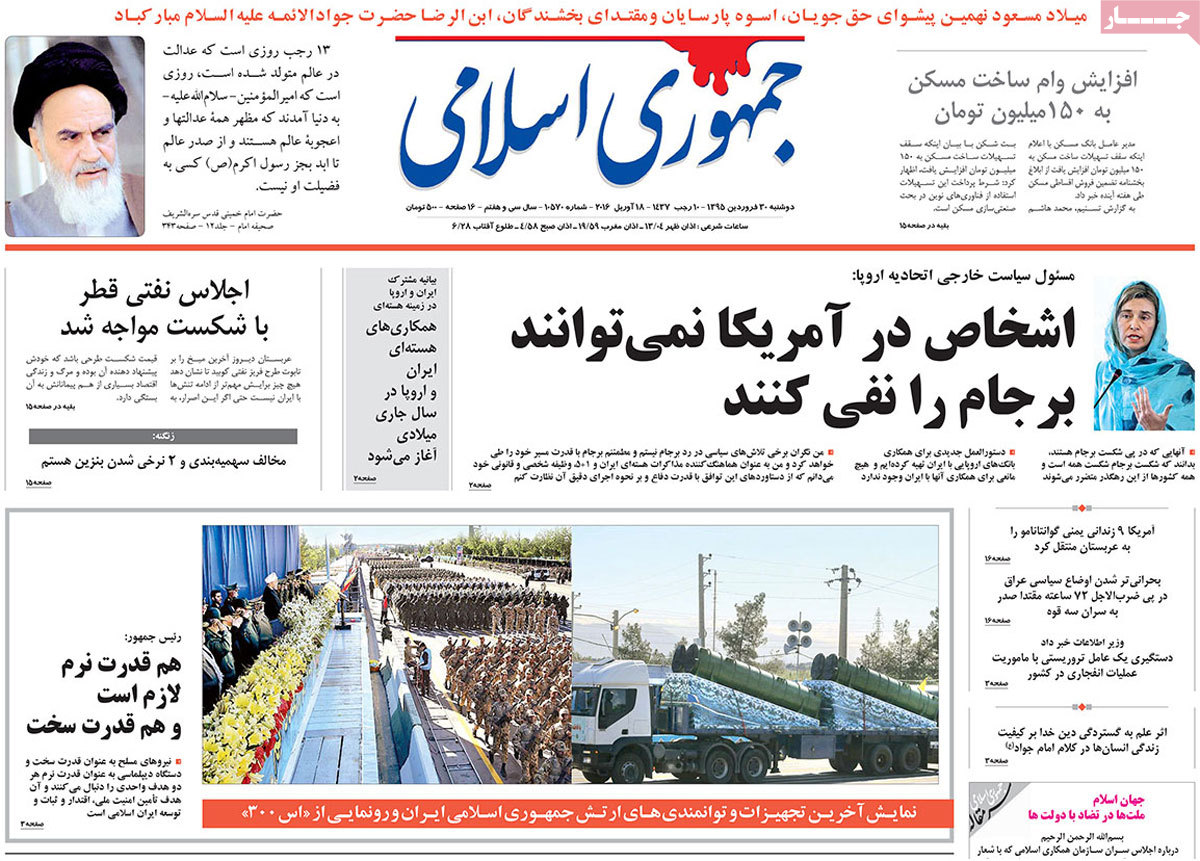
Jomhouri Islami:

1- Doha oil meeting failed

2- Rouhani: Both soft and hard power is needed

3- Intelligence Minister: Terrorist planning attack in Iran arrested


A look at Iranian newspaper front pages on April 18


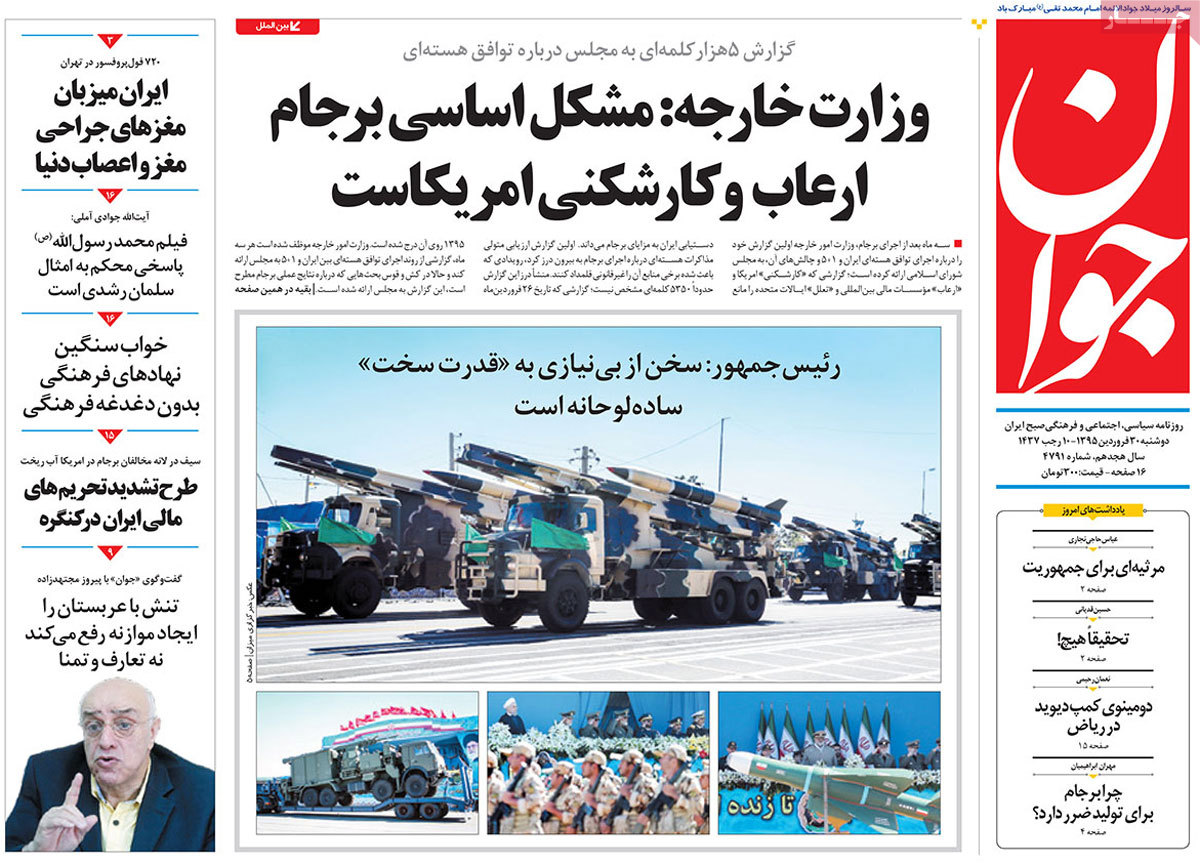
Javan:

1- 5,000-word JCPOA report submitted to Parliament on Nuclear Agreement

Ministry of Foreign Affairs: The main problem with JCPOA is intimidation by US

2- Rouhani: Talking about irrelevance of hard power is naivety

3-Interview with Pirouz Mojtahedzadeh: Saudi tension will be removed by balance of power, not pleading and niceties


A look at Iranian newspaper front pages on April 18


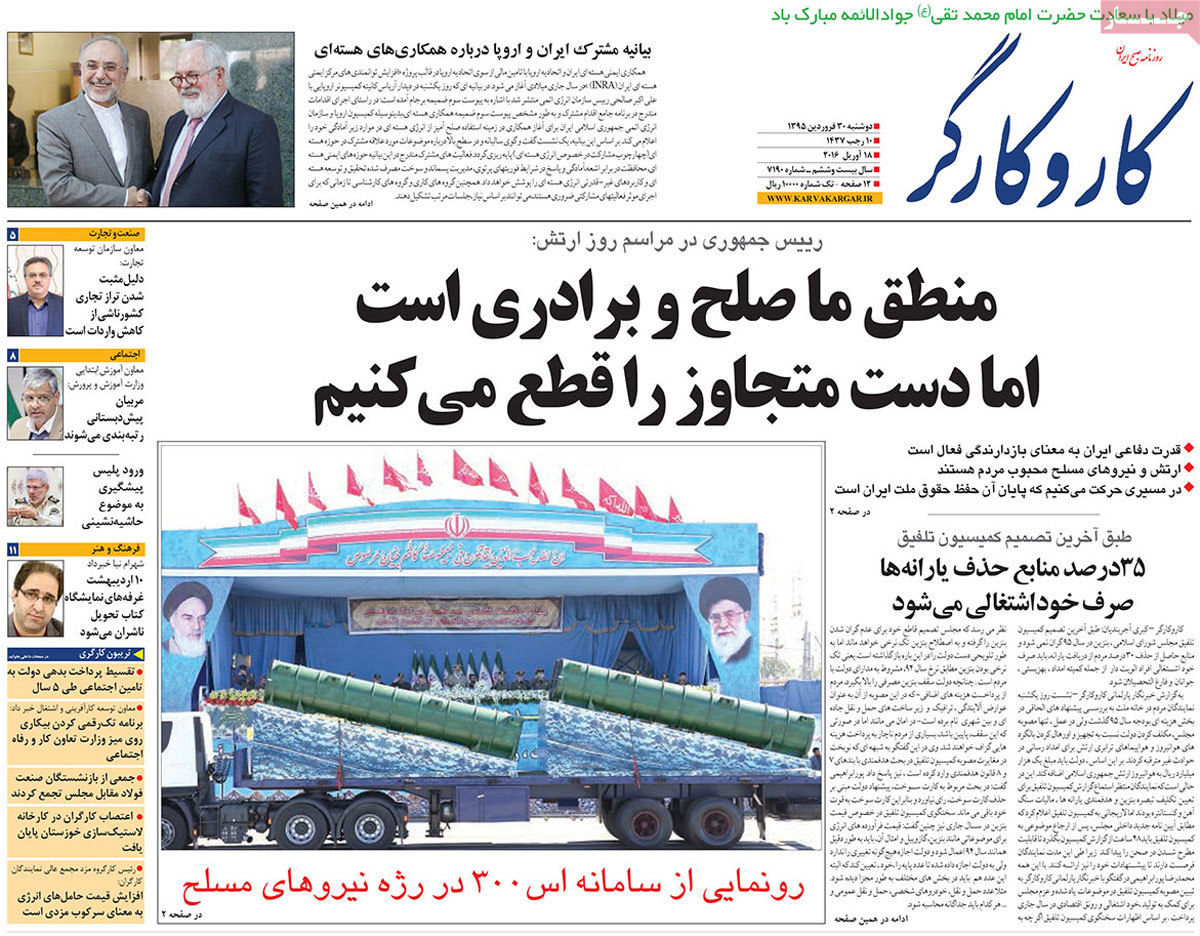
Kar va  Kargar:

1- President on Army Day: Our logic is peace and brotherhood but we will cut off hands of invaders


A look at Iranian newspaper front pages on April 18


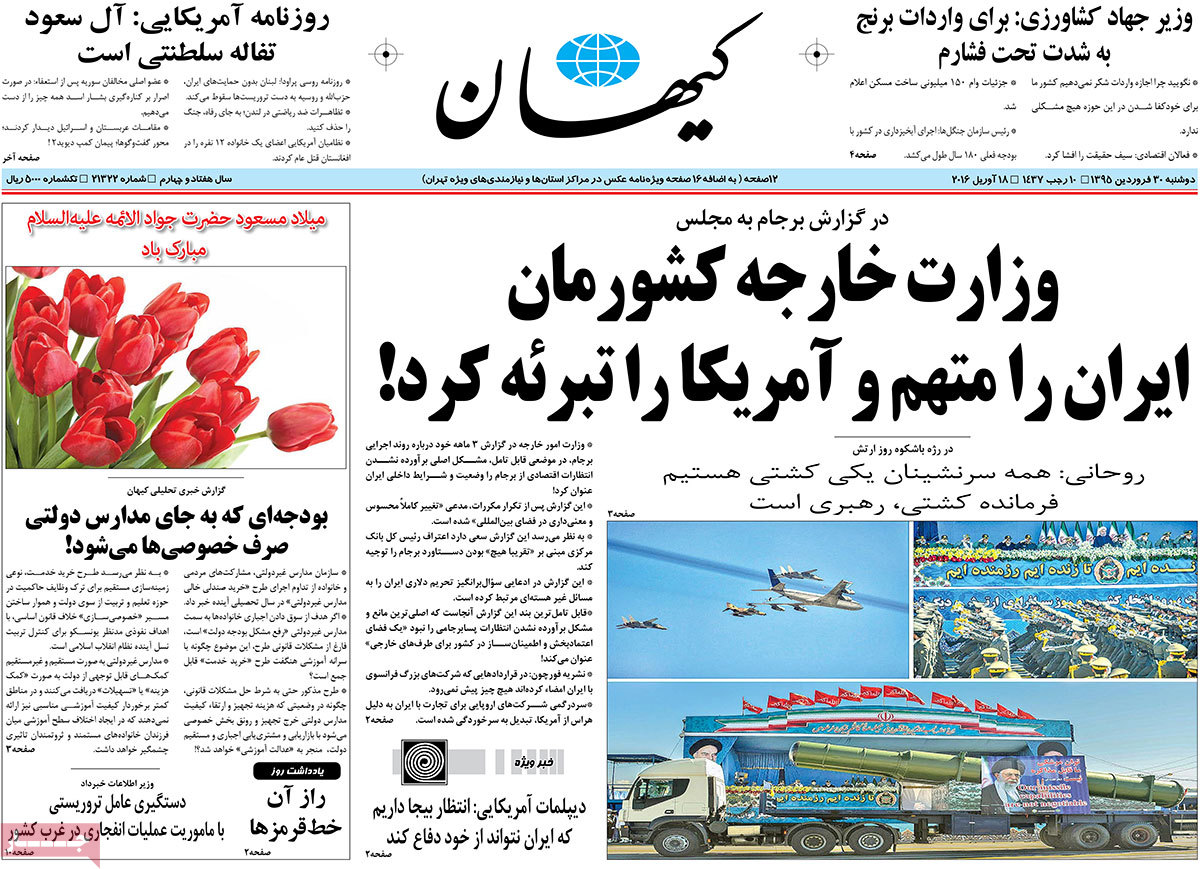
Kayhan:

1- In a report to Parliament on JCPOA: Iranian Foreign Ministry accuses Iran and acquits the United States

2- American diplomat: Illogical to expect Iran not to defend itself


A look at Iranian newspaper front pages on April 18


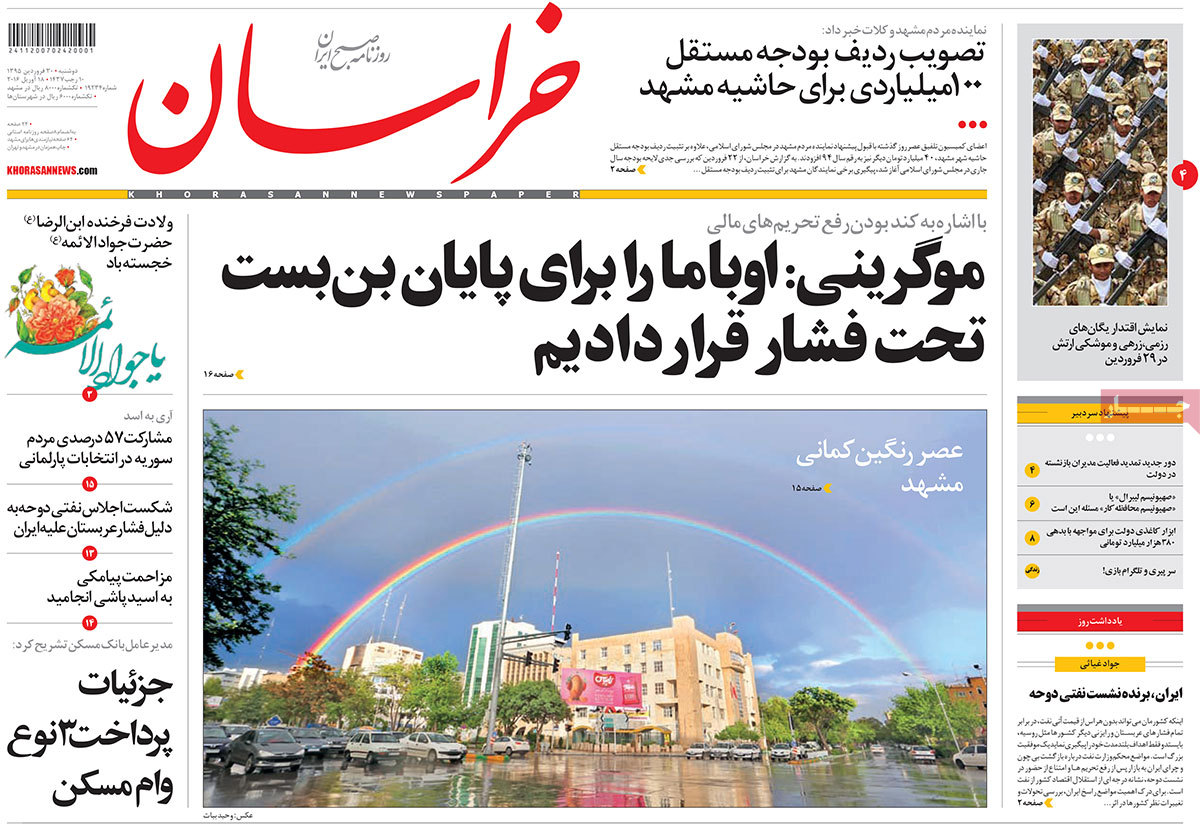
Khorasan:

1- Referring to slow pace of sanctions relief

Mogherini: For breaking the deadlock we put pressure on Obama

2- Yes to Assad: 57% voted in Syrian parliamentary election


A look at Iranian newspaper front pages on April 18


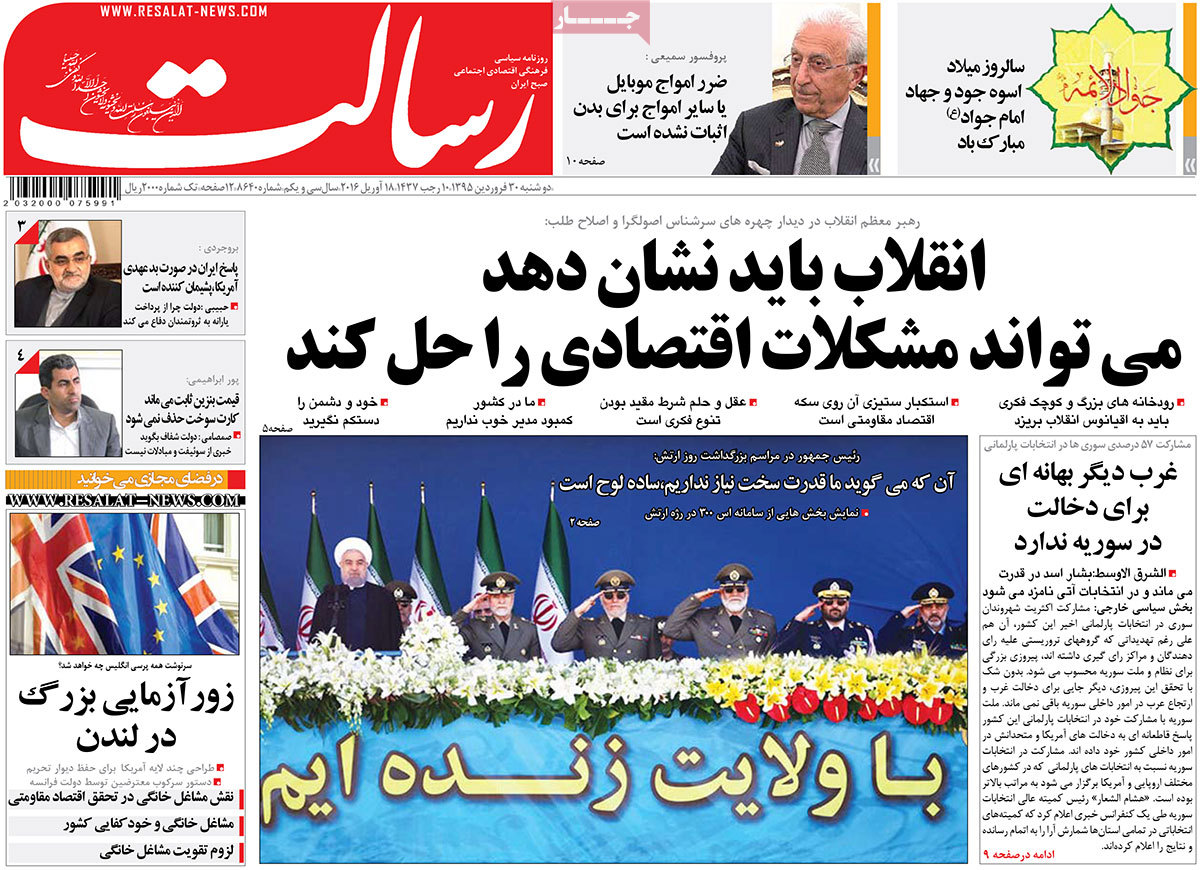
Resalat:

1- Supreme Leader meets leading fundamentalists and reformists:

Revolution should prove that it is capable of tackling economic problems

2- 57% of voters take part in Syrian Parliamentary Election! West has no excuse for interfering in Syria

3- Professor Samiee: No proof yet of cellphone waves being harmful for humans


A look at Iranian newspaper front pages on April 18


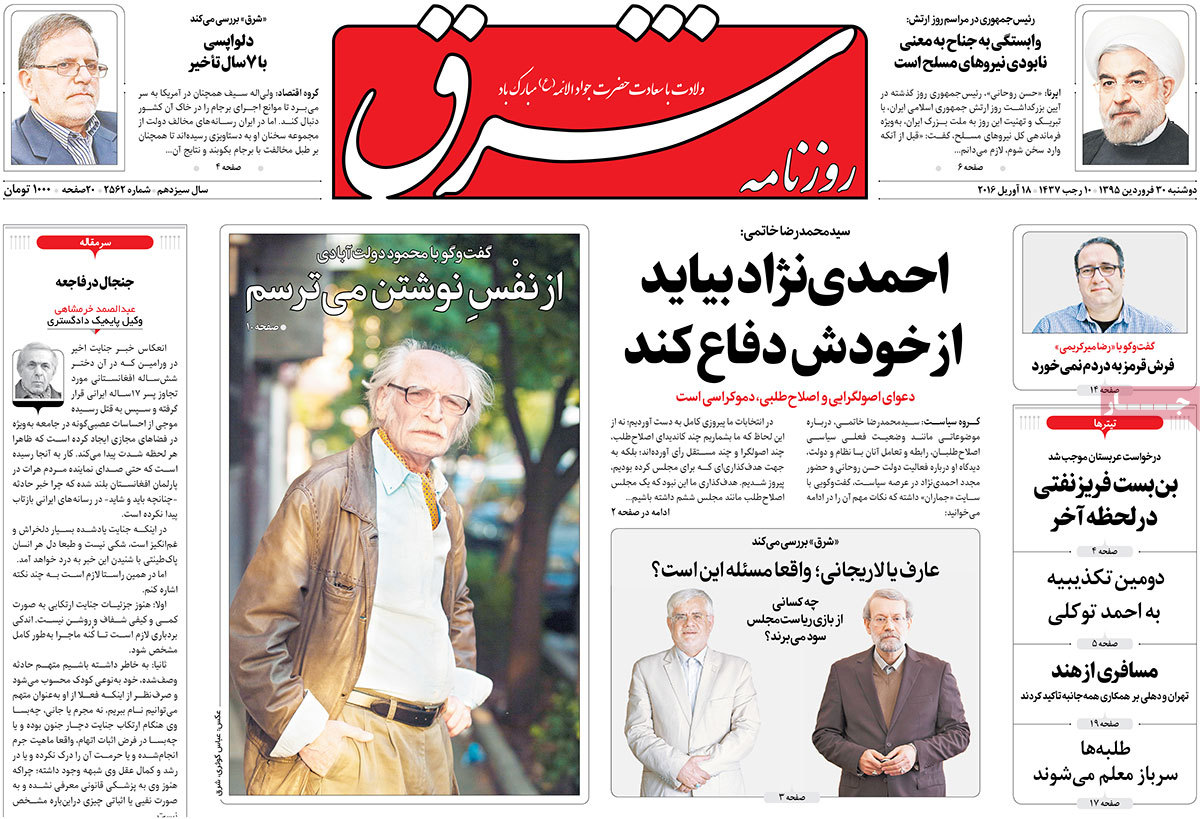
 Shargh:

1- Seyyed Mohammad Reza Khatami: Ahmadinejad should come forth and defend himself


A look at Iranian newspaper front pages on April 18


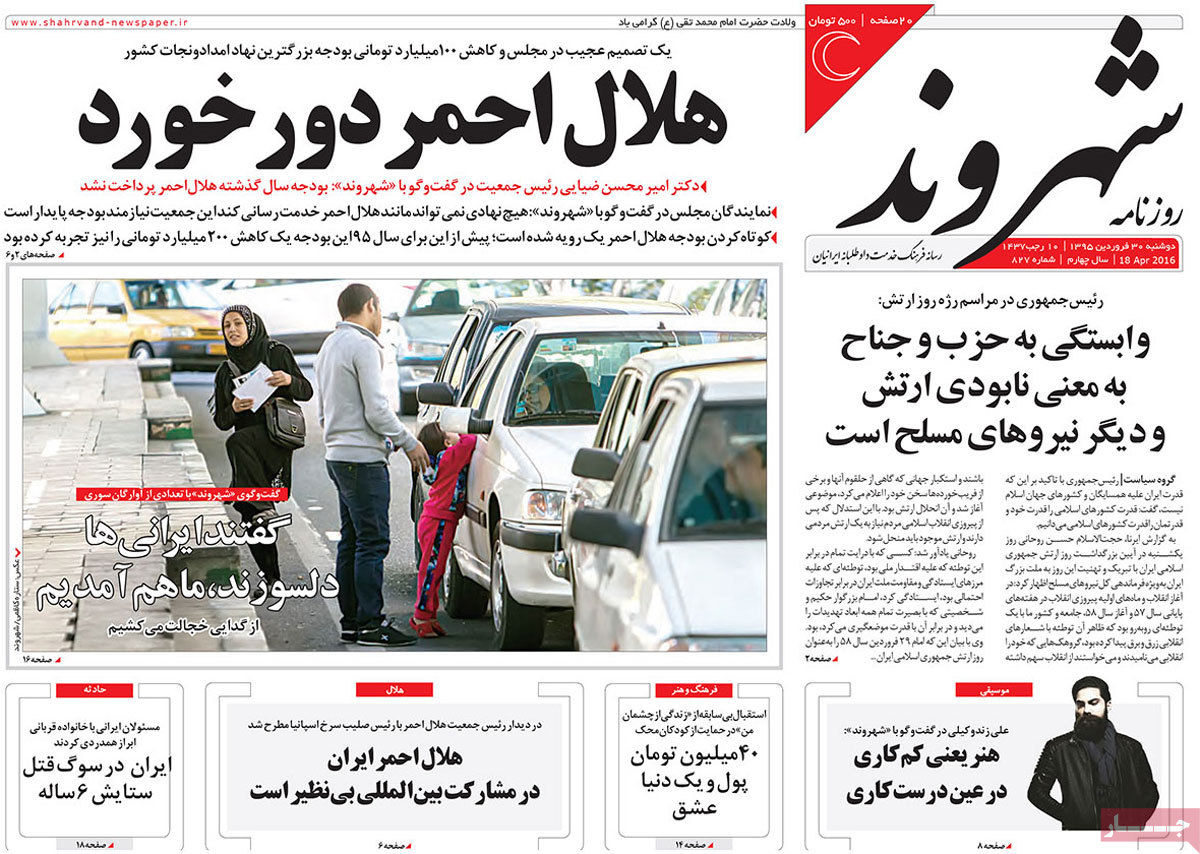
Shahrvand:

1- Exclusive interview with Syrian refugees: We are told that Iranians are kind and we hope this is true

2- In meeting between Iranian Red Crescent Society and Spanish Red Cross chiefs: Iranian Red crescent is unrivaled in international participation


A look at Iranian newspaper front pages on April 18


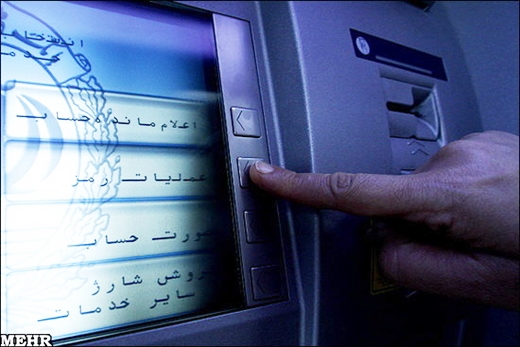
Paymentwall ‘not connected’ to Iranian banking system

Paymentwall, a San Francisco online payments company, announced on April 12 that it has integrated its payment services into the Shetab (Interbank Information Transfer Network System), which is a ‘unified, electronic clearance system for the entire Iranian banking operations that allows it to facilitate transactions from credit cards, ATMs and point-of-sale (POS) terminals.’

“Iran has promising potential to become a fertile ground for online businesses worldwide,” said David Ricart, payment project manager of Paymentwall. “Shetab has paved the way for them and streamlined the process of online transactions.”

Meanwhile, officials at the Central Bank of Iran told Mehr News that Iran’s Shetab has definitely not been connected to Paymentwall.

Davoud Mohammad Beigi, Manager of payment systems of the Central Bank, told MNA that the Central Bank has not held any negotiations with Paymentwall over this issue. Managers of other companies active in electronic banking also said the connection of Shetab to Paymentwall cannot happen without coordination with the Central Bank, and this needs to be pursued at a macro level by officials at the Central Bank of Iran.

Mohsen Ghaderi, Director General of Electronic Payment Card Networks (SHAPARAK), also dismissed any negotiations with the American company, saying PSP companies will hold a meeting to discuss the issue in details.

Following the confusion over this announcement , Paymentwall later clarified its situation in Iran to bankingtech, saying “we integrated Shetab as a new payment partner, allowing users to pay, but we are not connected to the Iranian banking system.”

“We will allow users from Iran to pay with Shetab, but we still can’t work with Iranian businesses as of now,” it added.

According to Hamid Baeidinejad, the Director General for Political and International Security Affairs of Iran’s Foreign Ministry, 26 Iranian banks have so far been reconnected to SWIFT (Society for Worldwide Interbank Financial Telecommunication) after the removal of the economic sanctions against Iran in mid-January.

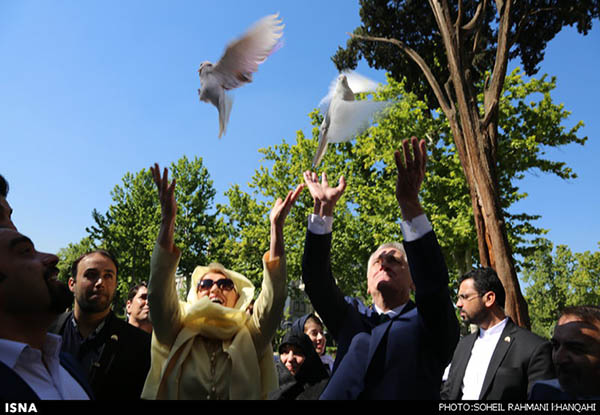
Serbian President Flies Pigeons of Peace at Tehran’s Golestan Palace

The International Day for Monuments and Sites (World Heritage Day) is marked annually on April 18 around the world with different activities, including visits to monuments and heritage sites.

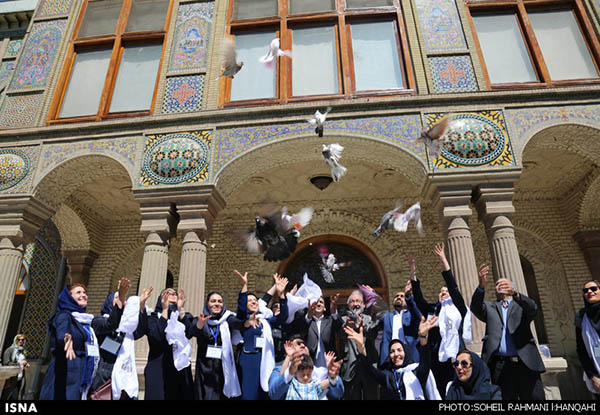
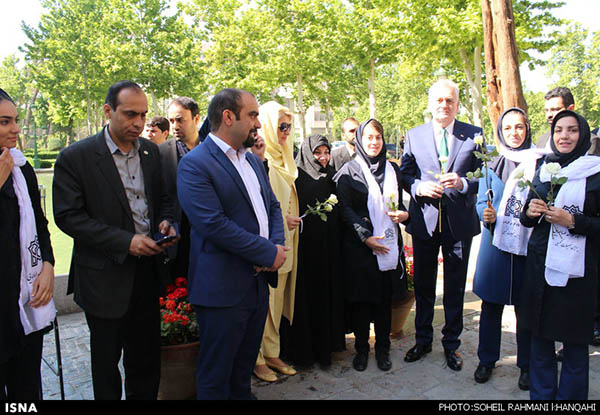
According to a report by the Iranian Students’ News Agency (ISNA), this year, a group of Iranian social activists and tourism students gathered at Golestan Palace [literally the Roseland Palace] in Tehran to convey a message of peace.

Nikolić, who is in Tehran on an unofficial trip, accompanied the group of activists and students, mostly from Tehran’s Allameh Tabatabei University, and released 19 white pigeons as a symbol of the 19 Iranian properties inscribed on the United Nations Educational, Scientific and Cultural Organization (UNESCO) World Heritage List.

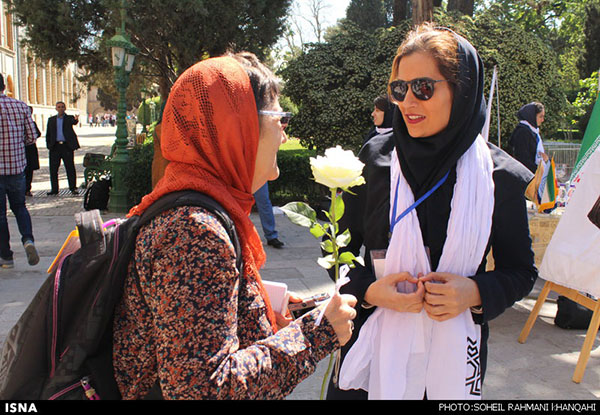
The day was commemorated in Tehran under the motto of “Each Tourist, an Ambassador of Peace.” In the ceremony held on the international day, white roses and a brochure of Iran’s tourist attractions were given to foreign tourists visiting Golestan Palace.


Some facts about Golestan Palace:

According to UNESCO, the lavish Golestan Palace is a masterpiece of the Qajar era, embodying the successful integration of earlier Persian crafts and architecture with Western influences.

The walled palace, one of the oldest groups of buildings in Tehran, became the seat of government of the Qajar family, which came into power in 1779 and made Tehran the capital of the country.

Built around a garden featuring pools as well as planted areas, the Palace’s most characteristic features and rich ornaments date from the 19th century.

It became a centre of Qajari arts and architecture, of which it is an outstanding example, and has remained a source of inspiration for Iranian artists and architects to this day.

It represents a new style incorporating traditional Persian arts and crafts and elements of 18th century architecture and technology.