Wednesday, December 24, 2025
Home Blog Page 4462

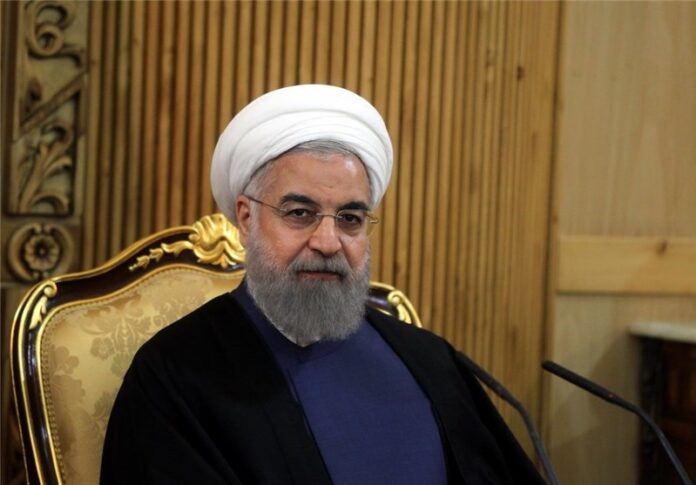
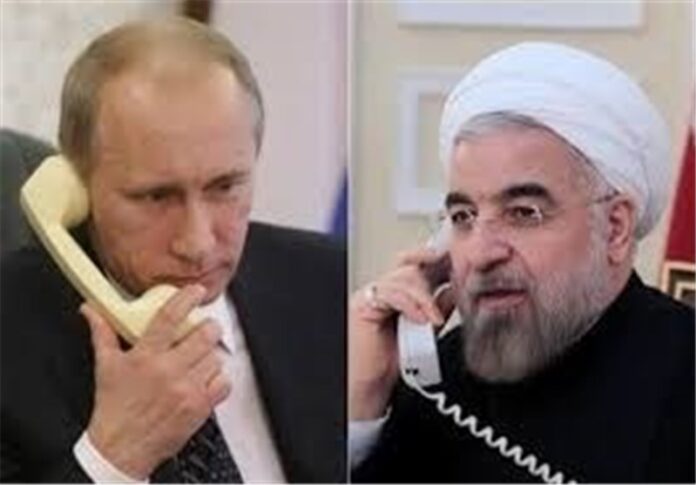
Iran’s Rouhani, Russia’s Putin Discuss Latest Developments in Syria

“A detailed discussion was held on the Syrian issue, first and foremost in regard to the successful actions of the Syrian army, which was able to push Daesh extremists out of the historic city of Palmyra with the help of Russian Air Forces. It was noted that this was a truly significant event,” Kremlin said in a statement on Monday, Sputnik reported.

The two leaders also exchanged views on a number of bilateral issues and agreed to intensify bilateral contacts at various levels, according to the statement.

Early on Sunday, Syrian state television quoted a military source as saying the army had taken “complete control over the city of Palmyra”.

Palmyra, known as the “bride of the desert”, used to attract tens of thousands of tourists a year before the Syrian conflict started in 2011.

In May 2015, Daesh (also known as ISIL or ISIS) took the city and later demolished some of its best-known monuments.

Capturing the city is a major victory for Syrian President Bashar al-Assad’s government.

With Russian support, it has made steady gains in recent months against Daesh and other groups it is fighting.

Earlier this month, Putin ordered the withdrawal of some fighter jets from Syria, but said that strikes against Daesh and another group, the Nusra Front, would continue.

Those groups have been excluded from a Russian and US-brokered ceasefire that began on February 27 and has largely held.

Syria has been gripped by civil war since March 2011 with Takfiri terrorists, including Daesh, currently controlling parts of it, mostly in the east.

The Syrian conflict has killed at least 260,000 people, according to the UN, and more than half of Syria’s pre-war population of 22.4 million has been internally displaced or fled abroad.
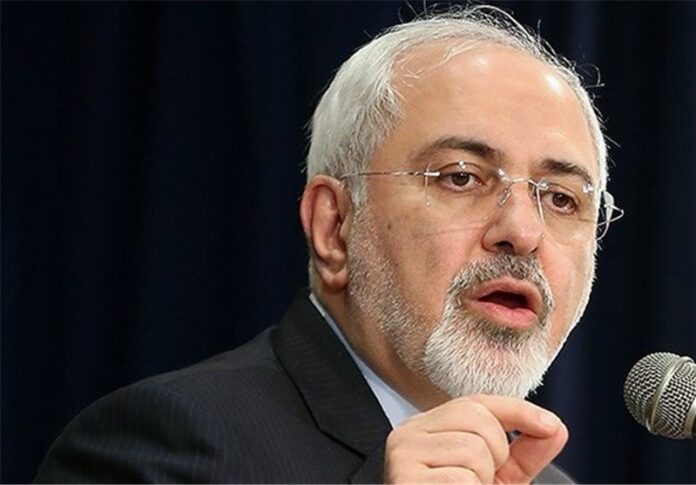
Iran responds to US actions by boosting missile power: Zarif

“We will respond to recent US measures against Iran’s missile program by further boosting our missile power,” Zarif said on Saturday.

He added that Tehran has no limitations on developing its missile program “because this program has nothing to do with nuclear weapons.”

In line with Iranian President Hassan Rouhani’s order, Iran will continue to enhance its missile capabilities, Zarif stressed.

In an order to Iran’s Defense Minister Brigadier General Hossein Dehqan on December 31, 2015, Rouhani urged acceleration in the production of “various types of missiles” needed to improve the country’s defense capabilities..

On Thursday, the US Treasury Department blacklisted two Iranian companies claiming that the firms backed Iran’s ballistic missile program. Washington also claimed that the companies are working for an industrial group, which the US alleges is in charge of Iran’s ballistic missile program.

The blacklisting came after the Islamic Revolution Guards Corps (IRGC) successfully test-fired two more ballistic missiles on March 9 as part of military drills to assess the IRGC’s capabilities. The missiles dubbed Qadr-H and Qadr-F were fired during large-scale drills, code-named Eqtedar-e-Velayat.

On March 8, Iran fired another ballistic missile called Qiam from silo-based launchers in different locations across the country.

Zarif, who was accompanying Iran’s President Hassan Rouhani in his two-day visit to Pakistan, also said comments by the US presidential candidates regarding the Islamic Republic’s missile program should not be taken seriously.

He added that personal views of the person in charge will not change the fact that Washington is legally bound to respect the nuclear agreement, dubbed the Joint Comprehensive Plan of Action (JCPOA), reached between Iran and the six world powers in July 2015.

The US administration should comply with its obligations in practice, Zarif said, stressing that some US presidential candidates, under the influence of the Zionist lobby, are making such comments against Iran which should not be heeded.

Last week, US presidential candidates took the stage at the 2016 American Israel Public Affairs Committee (AIPAC) policy conference to voice unconditional support for the Israeli regime in an apparent attempt to attract more campaign funding from the influential Zionist lobby in the run-up to the 2016 presidential election.

To get the green light, the hopefuls voiced support for Israel by attacking Iran and Palestine more than ever before.

Republican hopeful Donald Trump said he would end the JCPOA, calling the agreement “catastrophic.”

“My number one priority is to dismantle the disastrous deal with Iran,” he said, adding, “I have been in business a long time. I know deal making. And let me tell you, this deal is catastrophic. For America, for Israel and for the whole of the Middle East.”

Ted Cruz also did his best not to fall behind in the race to win Israel’s support, saying, “On the first day in office, I will rip this catastrophic Iranian nuclear deal to shreds.”

On Iran’s recent missile tests, the Texas senator said, “If I am president, and Iran launches a missile test, we will shoot that missile down.”

Republicans claim that Tehran’s missile program poses a threat to global security, while Iran categorically denies the claim, arguing that it is solely defensive.

Iranian President Urges Unity among Muslim Nations against Terrorism

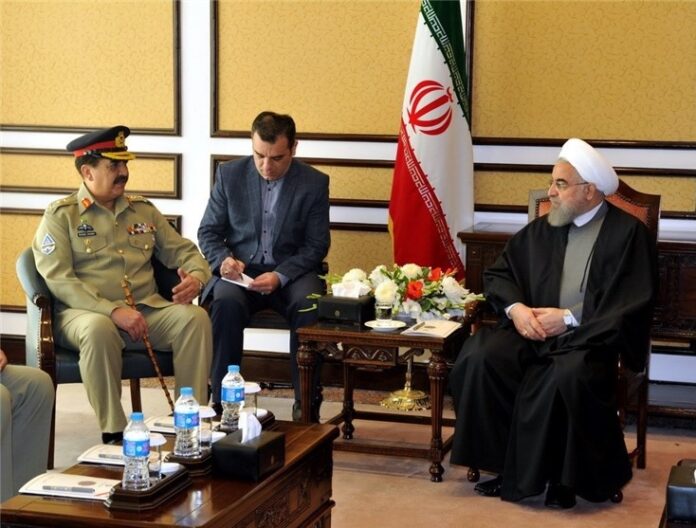
“The resolution of regional issues is possible only through constructive political dialogue and the time has come for Muslim countries to unite against terrorists and act in unison,” President Rouhani said in a Saturday meeting with Pakistani Chief of Army Staff General Raheel Sharif in Islamabad.

“Iran and Pakistan, as two significant and influential countries in the region, can make joint efforts to fulfill this important (duty),” he added.

The president further touched upon “close and age-old” defense cooperation between Tehran and Islamabad as well as deep-rooted cultural ties between the two nations, saying that Iran and Pakistan are “strategic depths” for each other and the fact has been proved in tough times.

General Sharif, for his part, emphasized that his country’s army supports efforts to boost Tehran-Islamabad cooperation and considers the ties in line with the interest of the two nations.

Heading a high-ranking delegation, including 60 Iranian businessmen, Rouhani arrived in Islamabad on Friday at the invitation of his Pakistani counterpart Mamnoon Hussain and Nawaz Sharif.

President Rouhani’s two-day trip to Pakistan, which is paid in response to Sharif’s last year trip to Iran, is aimed at discussing ways to further strengthen trade and economic relations and holding consultation with senior Pakistani officials on the latest developments in the region.

Iran, Pakistan Cooperation against Terrorism to Serve Region, World: Rouhani

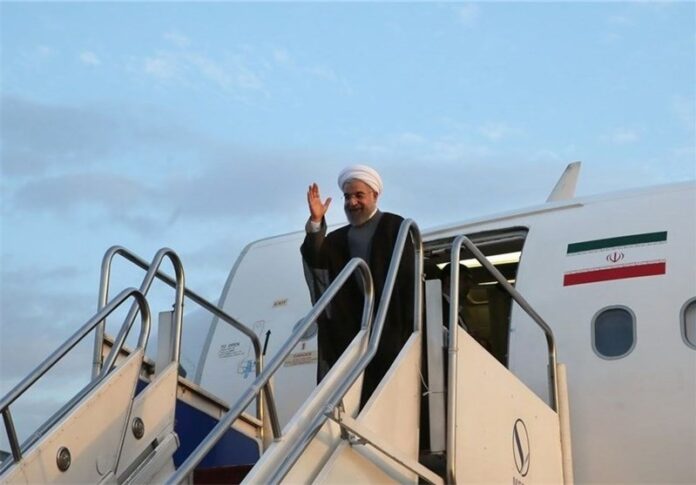
Speaking to reporters before leaving Tehran’s Mehrabad Airport for Islamabad, the president underlined the need for regional and international collaborations between Iran and Pakistan, saying that the two sides can cooperate in ensuring security in the region and fighting terrorism “which certainly would be in the interest of the two countries, the region and the world as terrorism is a global problem.”

He further described Pakistan as a country with great people and one with which Iran has many religious, cultural and historical commonalities.

Iran has maintained good ties with Pakistan since its independence and “today, the two countries’ relations are strategic,” Rouhani said.

He added that Tehran is keen to expand ties with Islamabad in different political, economic and cultural areas.

The president also highlighted the necessity of ensuring security in joint border areas and said the security pact already signed by the two countries should be implemented as soon as possible.

Heading a high-ranking delegation, Rouhani will arrive in Islamabad later on Friday at the invitation of his Pakistani counterpart Mamnoon Hussain and Prime Minister Nawaz Sharif.

President Rouhani’s two-day visit to Pakistan will take place in response to Sharif’s last year trip to Iran.

Promoting bilateral ties and particularly boosting economic cooperation in the new atmosphere created by the nuclear deal between Tehran and six world powers (JCPOA), will be high on agenda during the visit.


Spokesman Questions Legitimacy of Appointing UN Human Rights Rapporteur for Iran

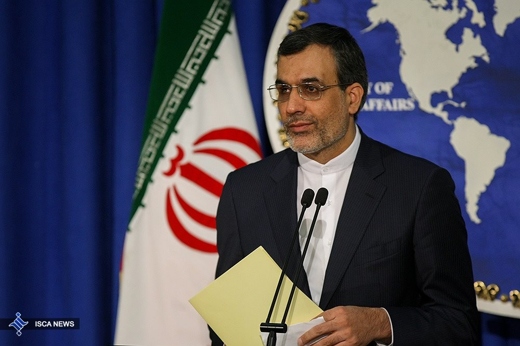
In a statement late on Thursday, Jaberi Ansari described the decision at the UN Human Rights Council (UNHRC) to extend the mandate of Ahmed Shaheed as politically-motivated and biased.

The composition of countries supporting the decision like Saudi Arabia, the United Arab Emirates (UAE) and Qatar, whose people are witnessing systematic violations of human rights by their governments, indicates the fact that the move was politically motivated, the spokesman said.

He emphasized that it also proved the West’s instrumental use of the international mechanism for protecting human rights (UNHRC).

The Islamic Republic is committed to its obligations regarding the promotion of human rights in compliance with its constitution and religious values, Jaberi Ansari said, adding that accordingly, Tehran has always cooperated with the UN human rights mechanisms, including the Universal Periodic Review (UPR).

The UPR is a unique mechanism of the Human Rights Council (HRC) aimed at improving the human rights situation on the ground of each of the 193 United Nations (UN) Member States.

Under this mechanism, the human rights situation of all UN Member States is reviewed every 4.5 years.

Various reports by Ahmed Shaheed have attacked the Islamic Republic. The reports have come under criticism by many independent observers who have questioned them for being based on accounts provided by expatriates and terrorist groups such as Mojahedin-e Khalq Organization (MKO).

Iran: Missile tests are legitimate measures to boost defense might

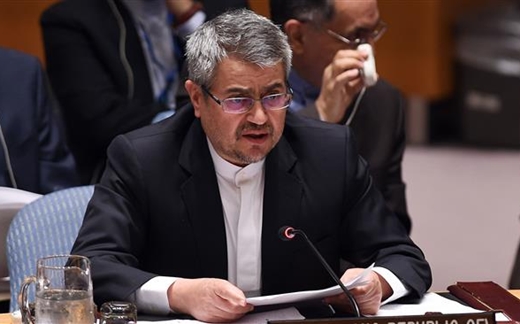
Khoshroo made the statements in a letter to UN Secretary General Ban Ki-moon after recent missile-test launches by the Iranian military forces rejecting a campaign of disinformation as well as efforts to misinterpret Security Council resolution 2231 that followed.

He stressed that Iran’s missile test launches were aimed to exercise the right to self-defense in the case of any armed attack.

‘Iran, as a country living in the most unstable and volatile region of the world, is fully entitled to build a credible conventional capability to deter and defend against any aggression,’ the letter said.

‘For decades, Islamic Republic of Iran has been under threat of use of force by the United States and the Israeli regime in flagrant violation of Article 2 (4) of the UN Charter.’

Last year, the Israeli regime even took military threat against Iran to its extreme when Moshe Yaalon, the defense minister of this regime, threatened to use nuclear bomb against Iran, Khoshroo said.

He added: ‘the same regime remains the only one in the region in unlawful possession of nuclear weapons and the only obstacle in the way towards establishing a nuclear weapon free zone in the Middle East.’

‘We expect the Council to live up to its Charter responsibility of maintaining international peace and security and address the threats to use force against a UN member state,’ the envoy said.

Iranian President Due in Pakistan Friday

Heading a high-ranking delegation, Rouhani will arrive in Islamabad on Friday at the invitation of his Pakistani counterpart Mamnoon Hussain and Prime Minister Nawaz Sharif, the deputy head for communications and information at the Iranian president’s office, Parviz Esmaeili, told Tasnim.

President Rouhani’s two-day visit to Pakistan will take place in response to Nawaz Sharif’s last year trip to Iran, the official noted.

Esmaeili said promoting bilateral ties between the two neighbors and particularly boosting economic cooperation in the new atmosphere created after Tehran and six world powers reached a nuclear deal (JCPOA), will be high on agenda during Rouhani’s visit to Pakistan.

Iran and the Group 5+1 (Russia, China, the US, Britain, France and Germany) on July 14, 2015 reached a conclusion over the text of a comprehensive 159-page deal on Tehran’s nuclear program and started implementing it on January 16.

The comprehensive nuclear deal, known as the Joint Comprehensive Plan of Action (JCPOA), terminated all nuclear-related sanctions imposed on Iran.

Experts believe that Iran’s economic growth would rise remarkably following the enforcement of the final nuclear deal.

Iran’s President Slams Brussels Attacks

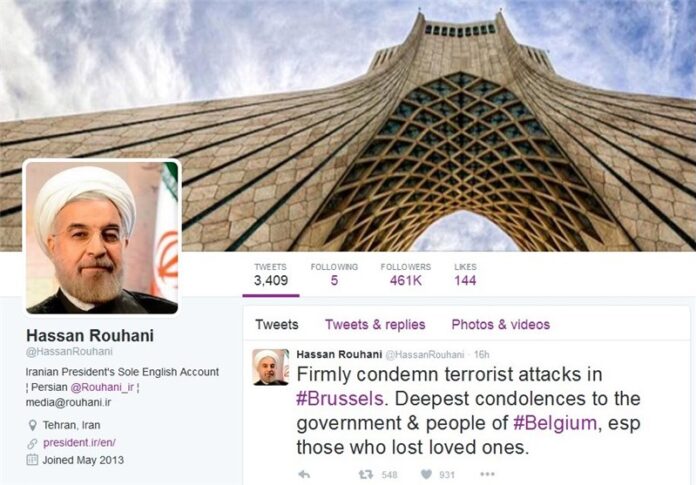
In a message in his Twitter account, President Rouhani offered his condolences to Belgium on the bloody attacks.

“Firmly condemn terrorist attacks in #Brussels. Deepest condolences to the government & people of #Belgium, esp those who lost loved ones,” he wrote.

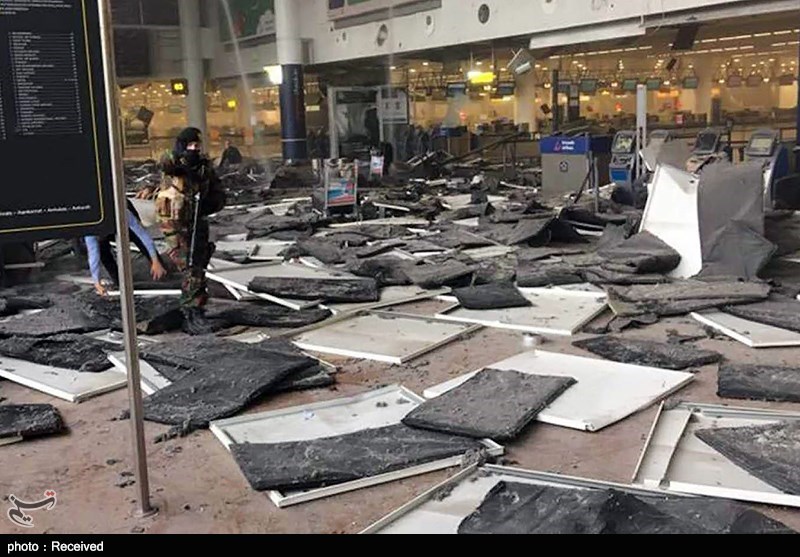
On Tuesday morning, two explosions at the Brussels airport and another at a busy metro station in the Belgian capital killed at least 35 people and wounded 230 others.


139501041004192827392954


Daesh (ISIL) claimed responsibility for the coordinated attacks, but authorities said it is too soon to say for sure whether the terror group was behind the blasts.

For the first time in the country’s history, Belgium raised the terror threat to the highest “fourth” level, the country’s prime minister said.

Borders with France and the Netherlands were also closed.

P&I provides larger liability support for Iran oil imports

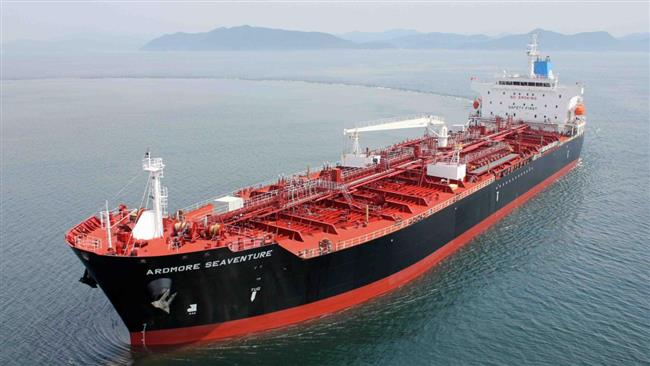
Reuters has reported that the International Group of Protection and Indemnity (P&I) Clubs, which brings together leading marine insurers owned by shipping clients and reinsured internationally, has stepped in to provide a larger insurance coverage for transporting Iranian oil.

The International Group has created a “fall-back” of $500 million additional coverage per ship for Iranian oil at no extra cost to the members, the news service said.

The initiative that was taken last week raises the default insurance coverage for tankers carrying Iranian oil to $580 million per ship from $80 million.

Although $580 million coverage is still less than 10 percent of the normal liability coverage of $7.8 billion per ship, Asian shippers such as China, India and South Korea, and some shippers in Europe, may find that enough to transport Iranian oil, Reuters has quoted an unnamed official with Japan P&I Club as saying.

Japanese shippers, however, are more risk-averse and may continue to use the government’s special sovereign shipping insurance to import Iranian oil until normal P&I coverage becomes available again, industry officials have said.

Tokyo stepped in to help its oil importers after Western sanctions imposed against Iran curbed the ability of private insurers to provide tanker cover, Reuters added.

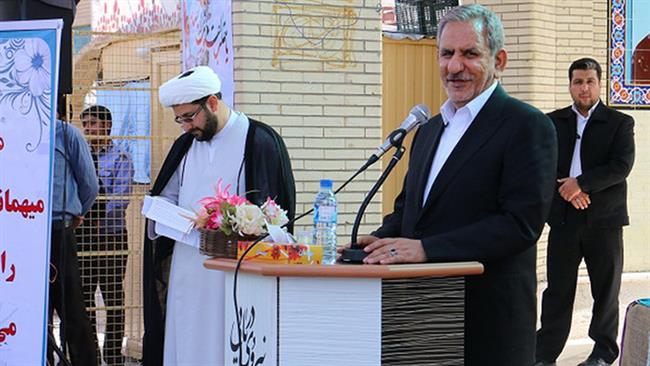
Iran’s First Vice President Es’haq Jahangiri has emphasized that the country’s oil exports saw a major rise of 900,000 barrels per day (bpd) to reach 2.2 million bpd over two months after the removal of sanctions against its oil industry.

In mid-January, a series of economic sanctions that had been imposed on Iran for multiple years were removed after a deal between the country and the P5+1 – the five permanent members of the Security Council plus Germany – was implemented.

The sanctions barred foreign investments in the Iranian oil industry and also limited a low ceiling of 1 million bpd on the country’s oil exports.

Iran’s Oil Minister Bijan Zangeneh had repeatedly emphasized that the Islamic Republic was determined to regain its share of the oil market that it had lost as a result of the sanctions.

Zangeneh had also said on the same front that plans had been devised to increase the country’s oil production by 500,000 bpd immediately after the removal of the sanctions and by a further 500,000 bpd later on.

Last week, he emphasized in his message to the nation on the occasion of the new Iranian calendar year (began 21 March) that Iran has already been able to regain its lost oil market share.

Iran announces major jump in oil exports

Iran’s First Vice President Es’haq Jahangiri said the figure marked a rise of 900,000 bpd in the country’s oil production that had been materialized within only two months after the lifting of the sanctions.

In mid-January, a series of economic sanctions that had been imposed on Iran for multiple years were removed after a deal between the country and the P5+1 – the five permanent members of the Security Council plus Germany – was implemented.

The sanctions barred foreign investments in the Iranian oil industry and also limited a low ceiling of 1 million bpd on the country’s oil exports.

“Until this past [Persian calendar month of] Bahman (21 January-February 2015), Iran was able to sell 1.3 million bpd,” Jahangiri told reporters. “But within two months after the removal of the sanctions, we have been able to export 2.2 million bpd of crude oil.”

Last Saturday, figures provided by Bloomberg showed that Iran’s oil production had climbed to 3.37 million bpd in January, the highest level since February 2014.

Before the sanctions were lifted, Iran said it had made the necessary preparations to boost its oil production capacity to pre-sanctions levels.

Iran’s Oil Minister Bijan Zangeneh had repeatedly emphasized that the Islamic Republic was determined to regain its share of the oil market that it had lost as a result of the sanctions.

Zangeneh had also said on the same front that plans had been devised to increase the country’s oil production by 500,000 bpd immediately after the removal of the sanctions and by a further 500,000 bpd later on.

Last week, he emphasized in his message to the nation on the occasion of the new Iranian calendar year (began 21 March) that Iran has already been able to regain its lost oil market share.