Friday, January 16, 2026
Home Blog Page 4408

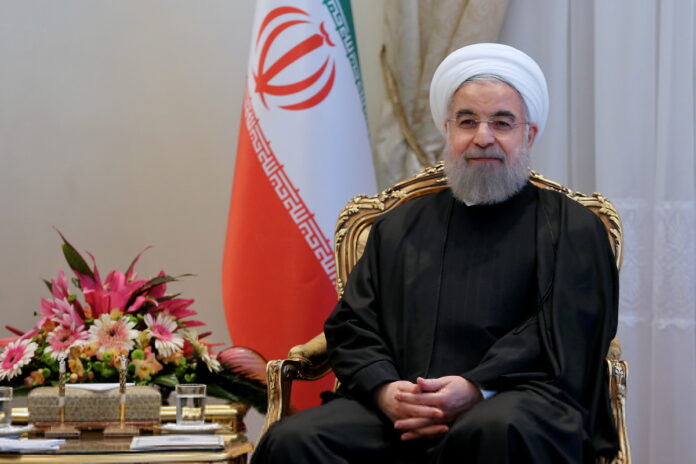
President Rouhani Congratulates French Counterpart on Bastille Day

Iran President Hassan Rouhani

President Rouhani expressed his hope that Tehran-Paris relations would further improve in all fields relying on the two sides’ capabilities, especially in the post-JCPOA era [after the nuclear deal between Tehran and world powers, which terminated nuclear-related anti-Iran sanctions].

He also wished success and prosperity for the French people and government.

The Bastille Day is marked in France as the National Day to commemorate the unity of the French people one year after the storming of the Bastille prison in 1790, as reported by IRNA.

Iran Summons Egyptian Envoy over MPs Presence in MKO Rally

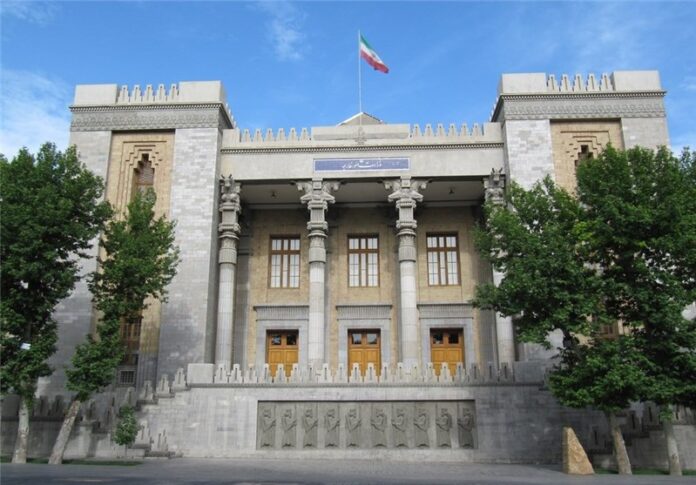
Iran’s Foreign Ministry summoned the official on Wednesday, and strongly protested Cairo’s act of interference and support for the MKO terrorist organization.

The ministry said that the participation of several Egyptian lawmakers in the rally in France was a clear sign of interference in Iran’s internal affairs and called on the Egyptian authorities to adopt a more responsible policy towards supporting stability in the region.

Stressing Egypt’s commitment to non-interference in other countries’ internal affairs, the official noted that Tehran’s protest would be conveyed to the Egyptian authorities.

On Tuesday, Iran’s Foreign Ministry summoned French Ambassador to Tehran François Sénémaud after Paris hosted the rally last week.

Paris on Saturday hosted the annual meeting that was attended by the former Saudi intelligence chief, Prince Turki al-Faisal, who gave a 30-minute address to the gathering.

On Tuesday, Iranian Foreign Minister Mohammad Javad Zarif criticized Faisal for taking part in the MKO rally and said that the former Saudi spy chief and his ilk face a fate similar to that of former Iraqi dictator Saddam Hussein.

The MKO is the most hated terrorist group among the Iranians because of its dark history of assassinations and bombings and for siding with Saddam Hussein in his eight-year war against Iran in the 1980s.

Iran, Russia, Azerbaijan Presidents to Meet in Baku Next Month: Deputy FM

13930915111906234229074

“This meeting will certainly take place. …it is expected to be held on August 8,” Rahimpour told the Tass news agency on Wednesday.

On Tuesday, Russian Foreign Minister Sergey Lavrov confirmed the meeting, saying, “We (Iran, Russia and Azerbaijan) have launched a new format of regional cooperation.”

During the summit, the three Caspian countries are going to sign new trilateral documents, while previous Tehran-Baku agreements on strategic cooperation will be also reviewed.

The upcoming summit will follow an April meeting among the Iranian, Russian and Azeri foreign ministers in Baku.

In that gathering, Iran’s Foreign Minister Mohammad Javad Zarif, Russia’s Sergey Lavrov and Azerbaijan’s Elmar Mammadyarov discussed a range of issues, including ways to settle conflicts in the Nagorno-Karabakh region.

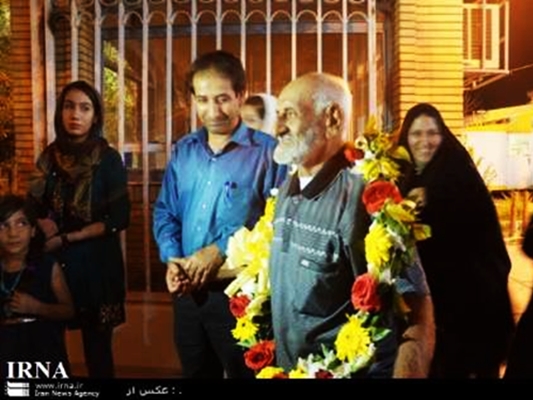
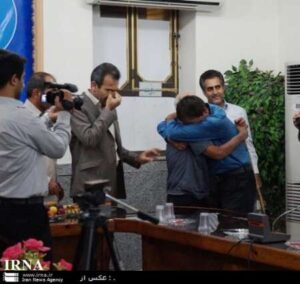
Family Reunion after 38 Years

82133829-70836619

Here is IFP’s translation of IRNA’s report on the reunion:

His name is Reza-Qoli Qias, but everyone calls him “Amou Reza” [Uncle Reza]. He used to make a living from selling things on the streets of Andimeshk; however, things completely changed in a quirk of fate.

Amou Reza did not have a national identity card, but when he became ill and had to undergo a surgery, he needed to get an ID card. Therefore, he headed to the local office of National Organization for Civil Registration to get it as soon as possible. There, the head of the office, who had heard about his sad story, decided to check the database of Iranian citizens in the hope of finding a clue from his family.

82133829-70836620Luckily, he was successful. Maybe an hour earlier, Amou Reza never thought he would see his children once again, but then he was on cloud nine. He could hug his long lost children after 38 years of separation.
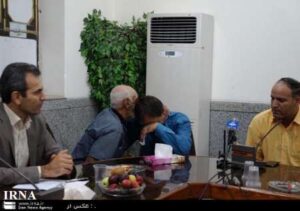
Many years ago, he had a life with four children, but things did not work out and he acquiesced to a divorce and moved on with his life.

“After the split, I lost touch with my children because they left the city together with my wife when my youngest child was only three months,” Amou Reza sighed.

“I did anything I could do to find them, but I wasn’t successful.”

His son, with tearful eyes, while kissing his father’s wrinkled hands, noted, “We had lost our hope because the local office of National Organization for Civil Registration in Andimeshk had issued our father’s death certificate.”

82133829-70836621Officials of Andimeshk held a ceremony to celebrate their reunion, after which Amou Reza returned to Isfahan with his beloved ones to start anew.
Spokesman Rejects Bahrain’s Anti-Iran Claims

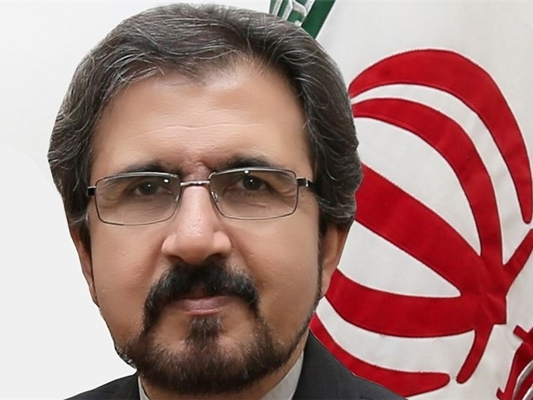
Qassemi

Bahrain has arrested two men suspected of planting a bomb that killed a Bahraini woman in late June and of having received training and support from Iran, the interior ministry said on Tuesday, July 12. A ministry statement identified a third suspect in the blast but claimed he had fled to Iran.

In reaction to the statement, Qassemi described the claims as being repetitive, false, baseless, and obsolete, according to a report by Khabar Online, as translated by IFP.

The Iranian spokesman urged the Bahraini government to stop repeating such baseless accusations and adopting such useless approaches and rather, take lessons from such moves, resolve its domestic problems and issues, and find their root causes.

“Unfortunately, the Bahraini government raises such fabricated and rejected claims in a bid to pin the blames on others for its internal conflicts and evade accountability to public opinion,” Qassemi went on to say.

According to the statement released by Bahrain’s Foreign Ministry, the bomb blast occurred on a road as the woman passed in her car in the village of East Eker, south of the capital Manama, on June 30. Shrapnel hit the car, killing her and injuring her three children.

The statement accused the three men of receiving training in weapons and explosives from Iran’s Islamic Revolution Guards Corps (IRGC). The statement claimed that one man traveled to Iran for his training.

The Bahraini version of the incident was even challenged inside the tiny Persian Gulf country. A Bahraini human rights group challenged the official version of events, citing “conflicting narratives”. Opposition activists have said on social media that witnesses reported seeing security forces fire on the woman’s car after it accidentally neared a royal convoy, Reuters reported.

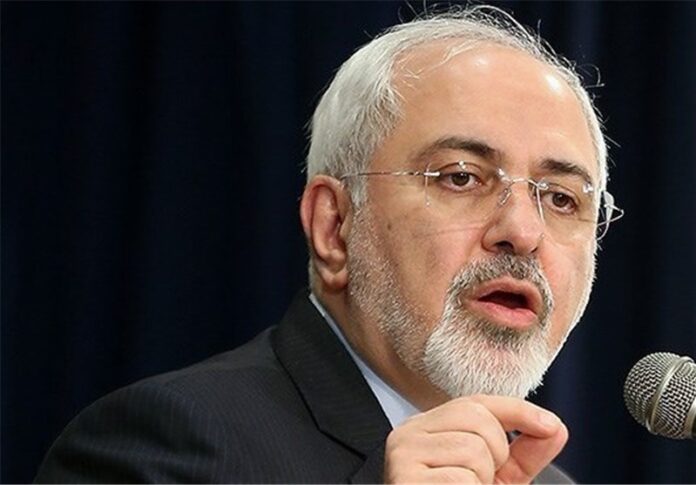
Caspian Sea’s Legal Regime Should Meet All Littoral States’ Interests: Zarif

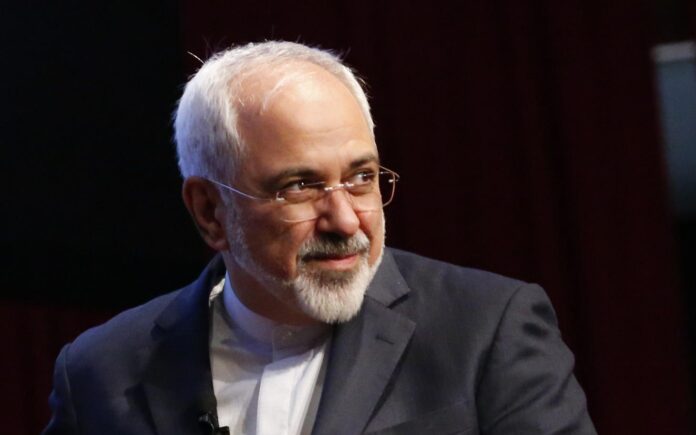
Mohammad Javad Zarif
Iranian Foreign Minister

“A lasting legal regime should guarantee that the interests of all littoral states are met given the geopolitical changes,” Zarif said, addressing a ministerial meeting of the Caspian Sea littoral states in Astana, Kazakhstan, on Wednesday, July 13.

He also expressed Tehran’s support for the establishment of a permanent regional association, whose activities and list of duties would be defined after consultation among the Caspian littoral countries.

Here’s the full text of his speech, as reported by Iranian Foreign Ministry’s website and translated by IFP:


In the Name of God

Mr. Erlan Idrissov,

Mr. Elmar Mammadyarov,

Mr. Sergei Lavrov,

Mr. Raşit Meredow,

I seize the opportunity of meeting my counterparts from Caspian Sea littoral states to offer my congratulations on the holding of the littoral states’ ministerial meeting.

I particularly appreciate the initiative and hospitality of my friend and colleague, Mr. Erlan Idrissov. In all ministerial meetings, we have fortunately witnessed forward steps. I wish the trend would continue in this meeting as well.

Dear Colleagues!

It has been 20 years since the first ministerial meeting of Caspian Sea littoral states in Ashgabat and their decision to improve the level of negotiations for the development of Caspian Sea’s legal regime.

Although 20 years of talks with numerous ups and downs indicate the complex, difficult, and intertwined nature of the multidimensional issues surrounding the Caspian Sea, the passage of time and various incidents have not at all decreased the importance of the Sea.

Here in the presence of foreign ministers, it is worth to appreciate the efforts made by the five littoral states’ negotiators and their heavy work on one of the most important and complex issues.

Fortunately, since the recent meeting of foreign ministers and presidents in Astrakhan, effective and intensive talks have been held and new agreements have been made; however, I should admit that a full understanding has yet to be reached on certain problems.

Caspian Sea’s legal regime convention is a comprehensive document that will explain the rights and obligations of littoral states and the principles for their cooperation and activities. Therefore, the negotiations need a considerable amount of deliberation. The mutual understanding witnessed in the talks has made us more optimistic towards the results of agreements.

Excellencies!

Within the past years, negotiations have been underway based on the principle of consensus to develop the legal regime of the Caspian Sea as per the principles and rules of international law. Given the unique and special situation of the Sea, a lasting legal regime should guarantee that the interests of all littoral states are met given the geopolitical changes.
To that end, the legal regime needs to take into account three main topics of concern, including peace and security, sustainable development, and fair demarcation of the sea boundaries:

1– Peace and Security: Sustainable peace and stability in the Caspian Sea is of fundamental importance to regional nations and governments. The Islamic Republic of Iran believes that the grounds for establishment of peace and security in the region can be prepared through transparency, peaceful use of the Sea, refraining from arms race, guarantees of excluding of military forces in relations among the countries, promotion of deterrent diplomacy, joint action against threats, settlement of conflicts only through peaceful means, and prohibition of the military presence of third parties in the Sea to prevent the crises and incidents, as previously agreed and declared in Astrakhan Summit’s communiqué. Such security and stability will be pave the way for economic development and the welfare of nations.

2- Sustainable Development: Observing long-term collective interests and responding to the needs of current and future generations requires that Caspian Sea littoral states take serious measures to conserve the environment and protect the biological resources of the sea. They should also control the shipment of toxic pollutants to the international markets through the Caspian Sea.

3– Fair Demarcation of the Sea Boundaries: The demarcation of the maritime borders in this Sea is one of the most important topics discussed by the littoral states. In this case, consideration should be given to the geographical position of each country and that it should involve “fairness”, an internationally-recognized principle for reaching a consensus.

Ladies and Gentlemen,

In recent years, thanks to the political will shown by the heads of states, we have been witnessing the all-out expansion of relations at all levels, which provides a basis for the opening of new horizons. To achieve these goals, the Islamic Republic of Iran supports the establishment of a permanent regional association, whose activities and list of duties would be defined after consultation among the Caspian littoral countries. Founding such an association would reflect a macro and comprehensive outlook on the Caspian issues and its different aspects.

To sum up, I hope we would achieve important outcomes in this meeting and pave the way for the fifth summit of the leaders of Caspian Sea littoral states in Kazakhstan.

Offering my congratulations on Kazakhstan’s membership in the United Nations Security Council, I once again thank Mr. Erlan Idrissov, the government and nation of the Republic of Kazakhstan for their hospitality and good organization of the meeting, and I hope we would witness the opening of the fifth Leaders’ Summit in the beautiful country of Kazakhstan in the near future.

Thank you for your attention.

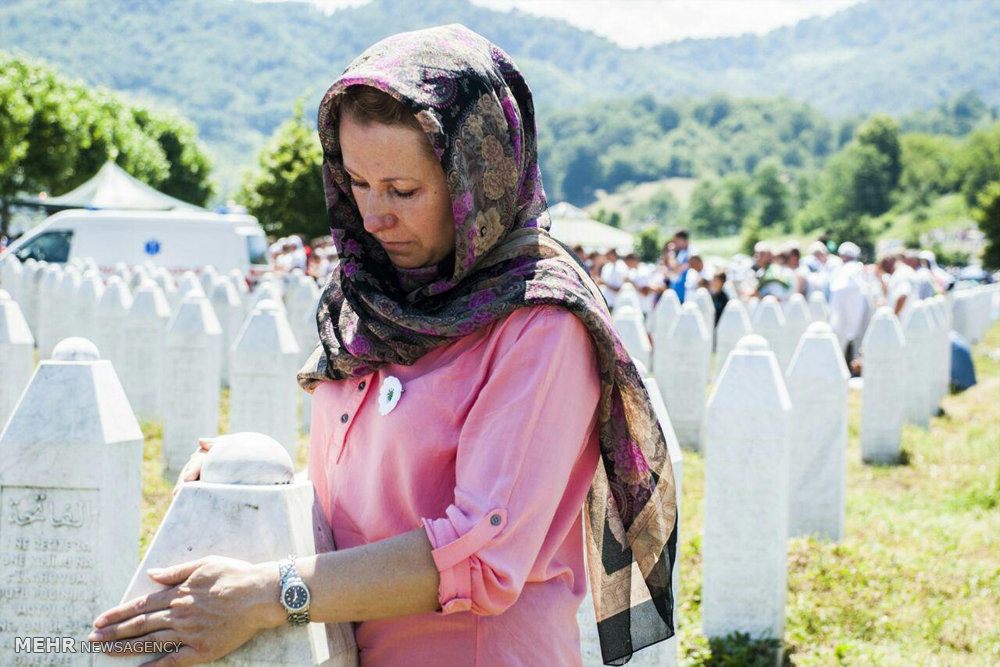
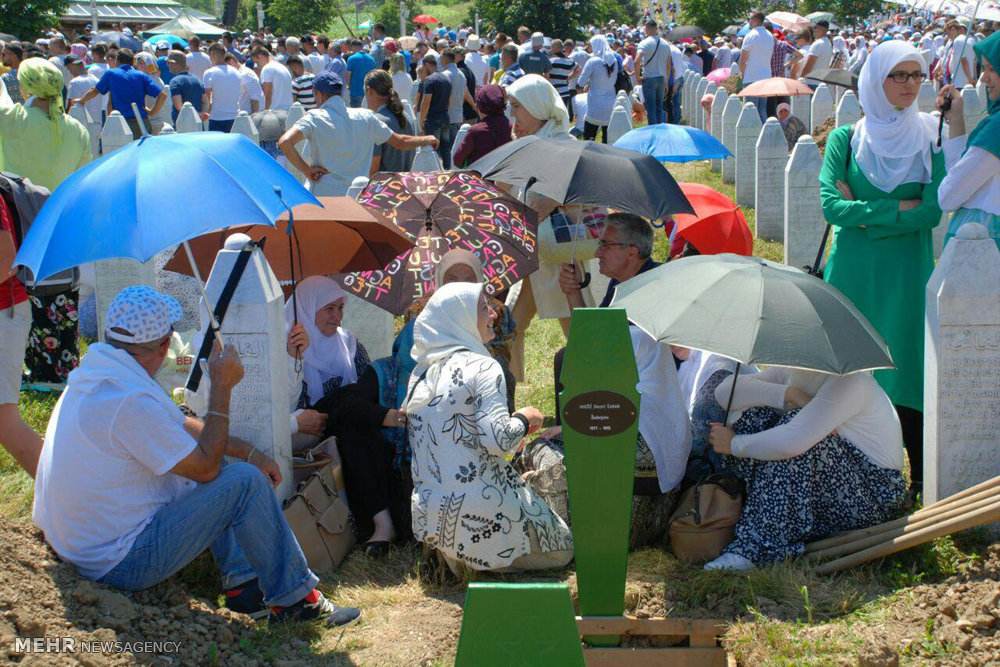
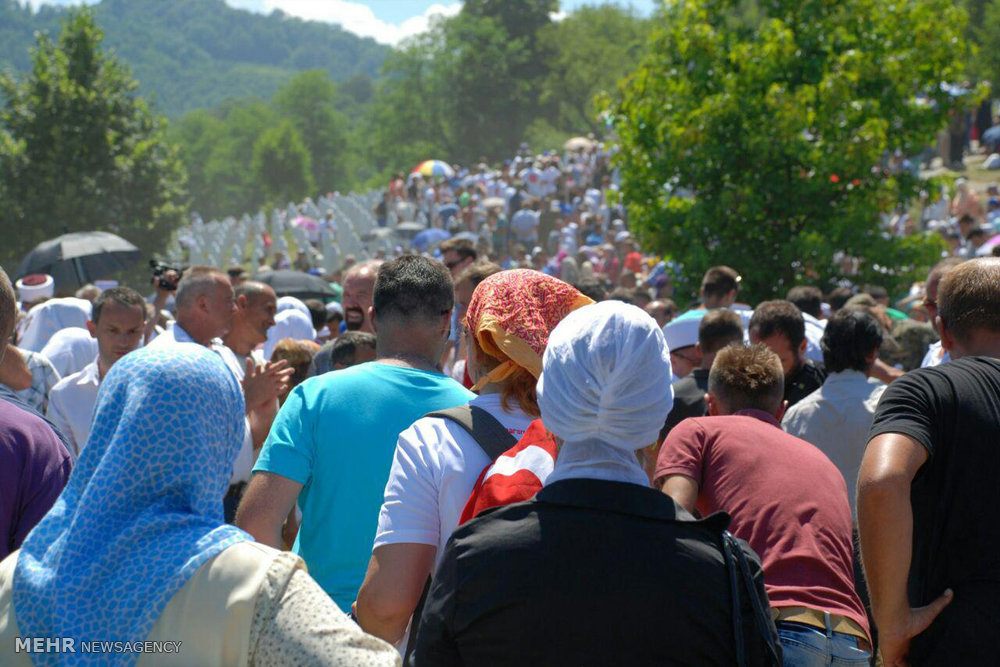
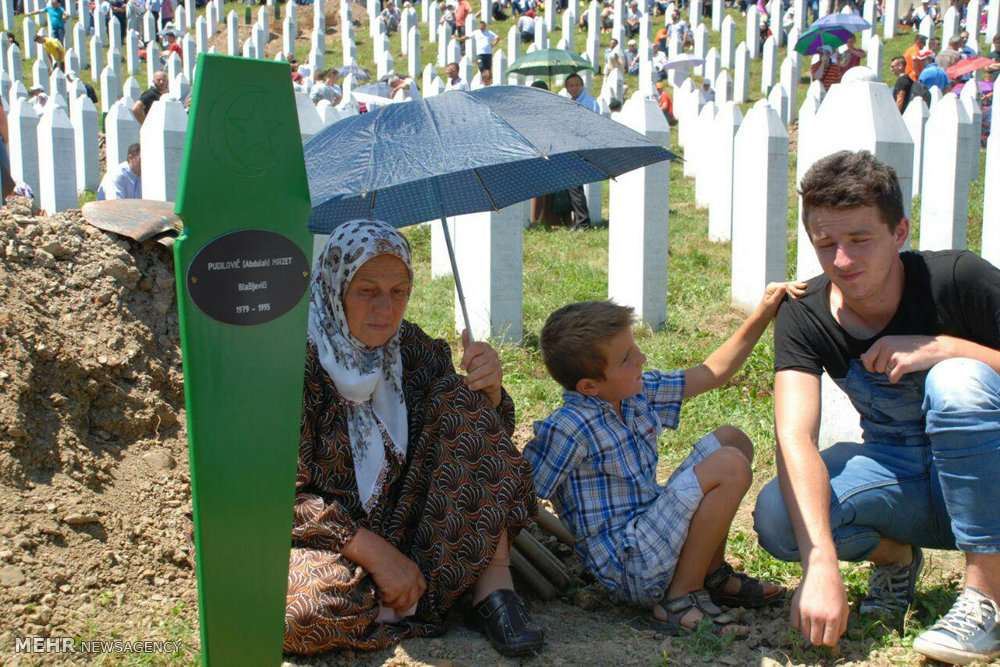
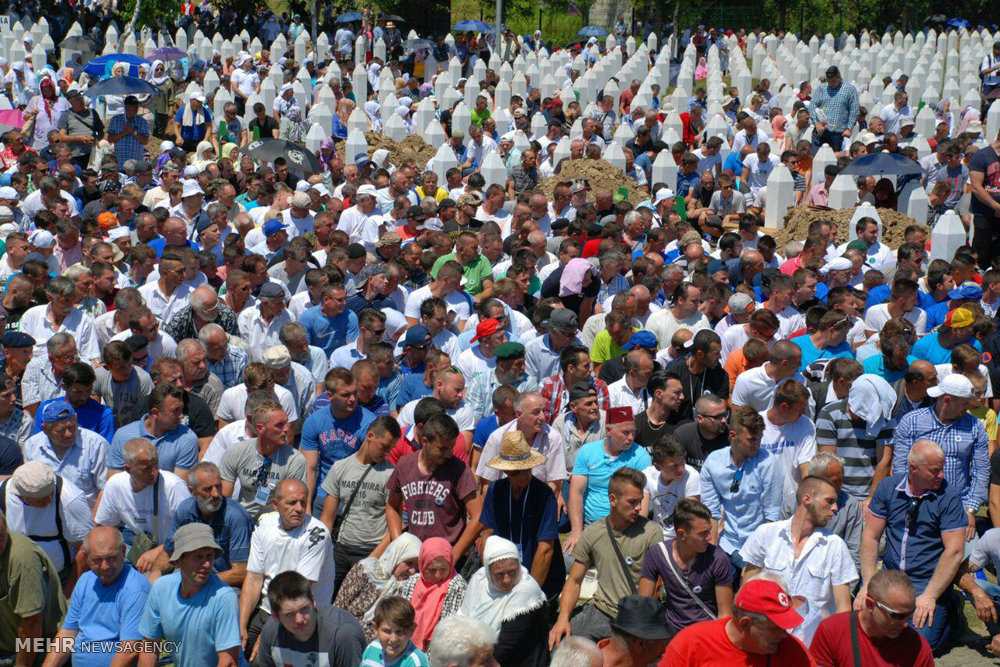
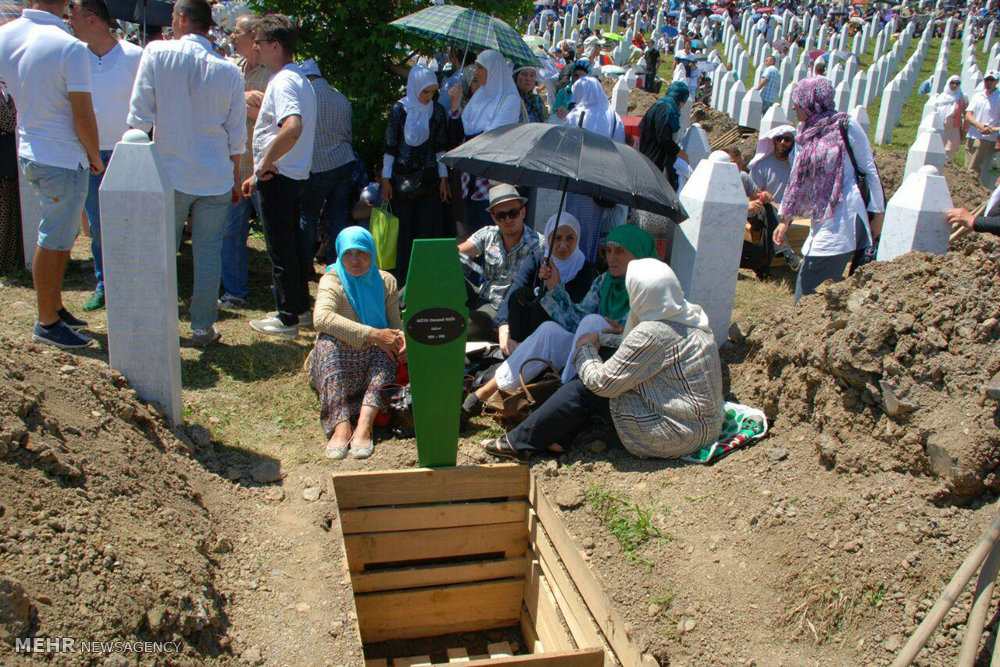
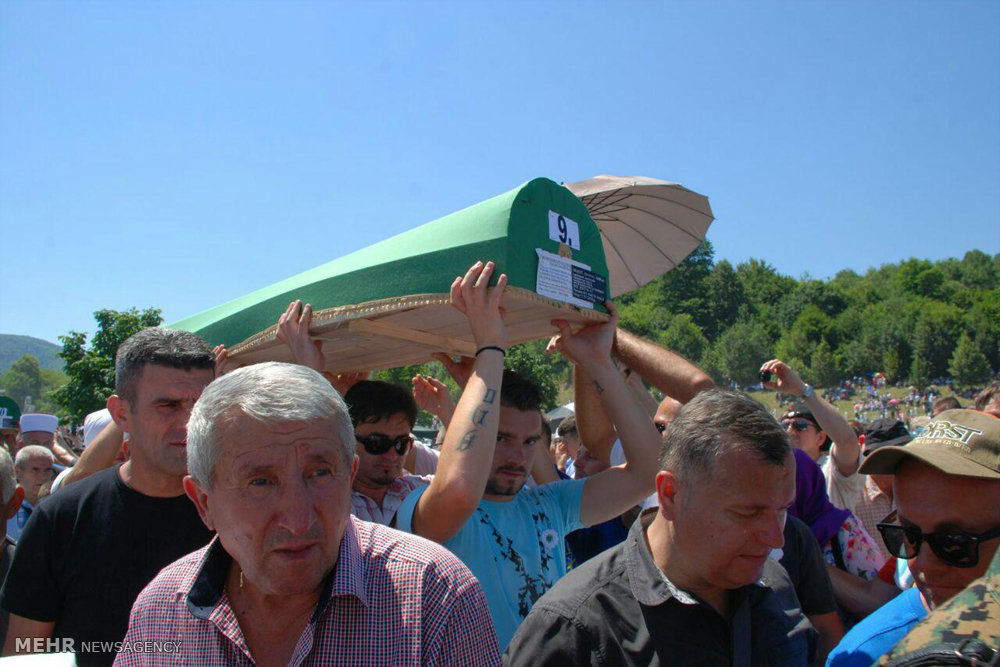
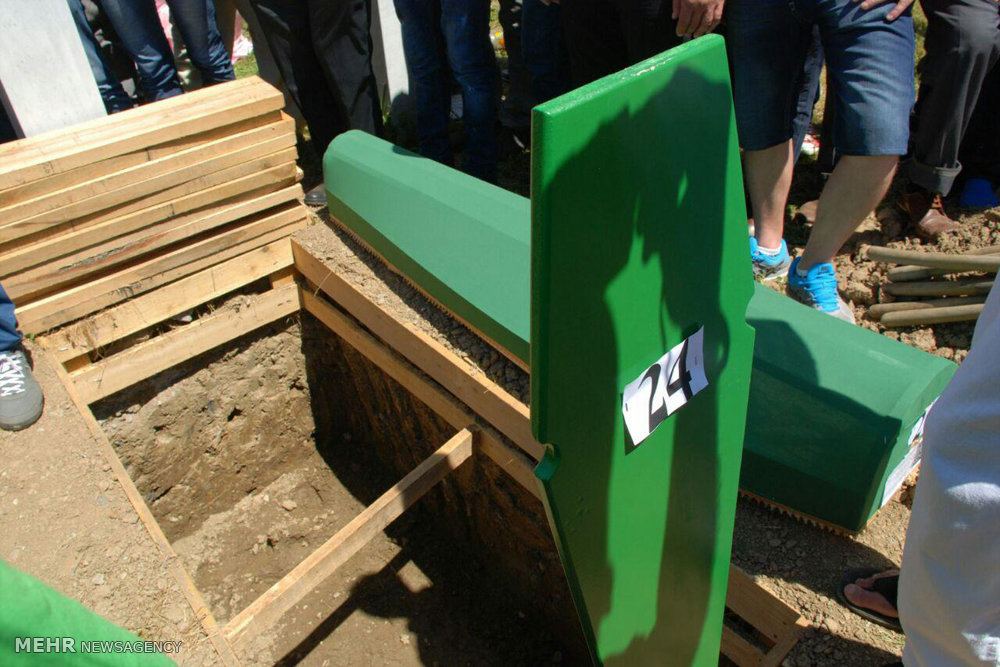
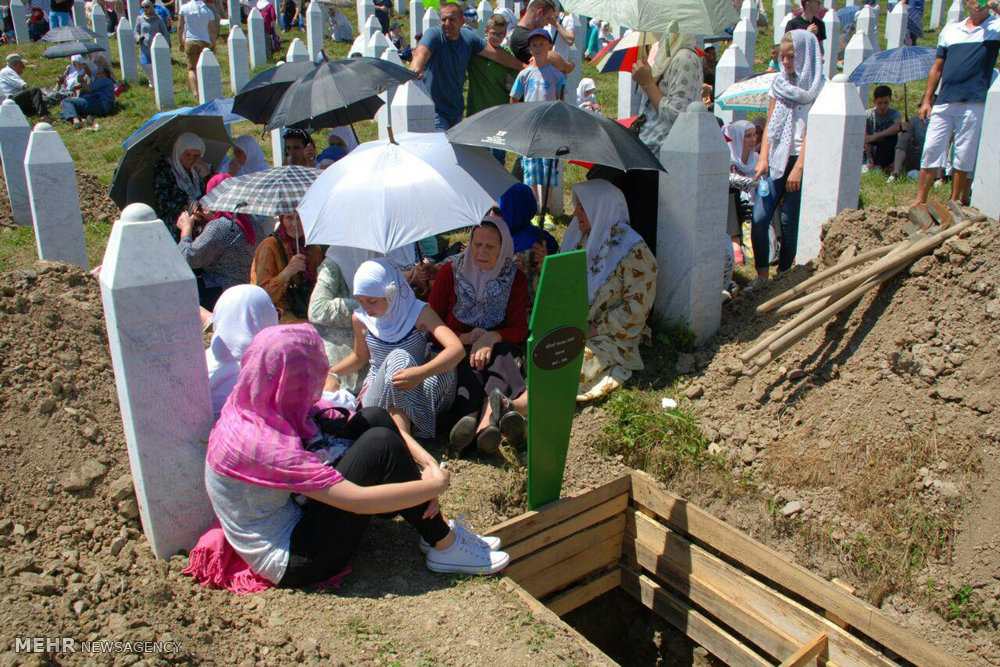
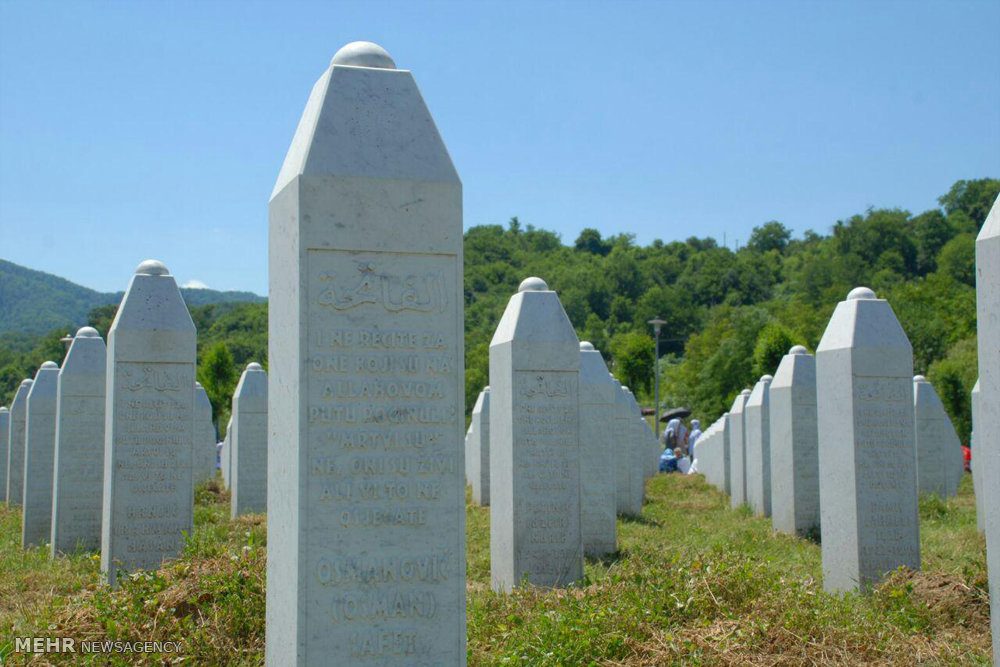
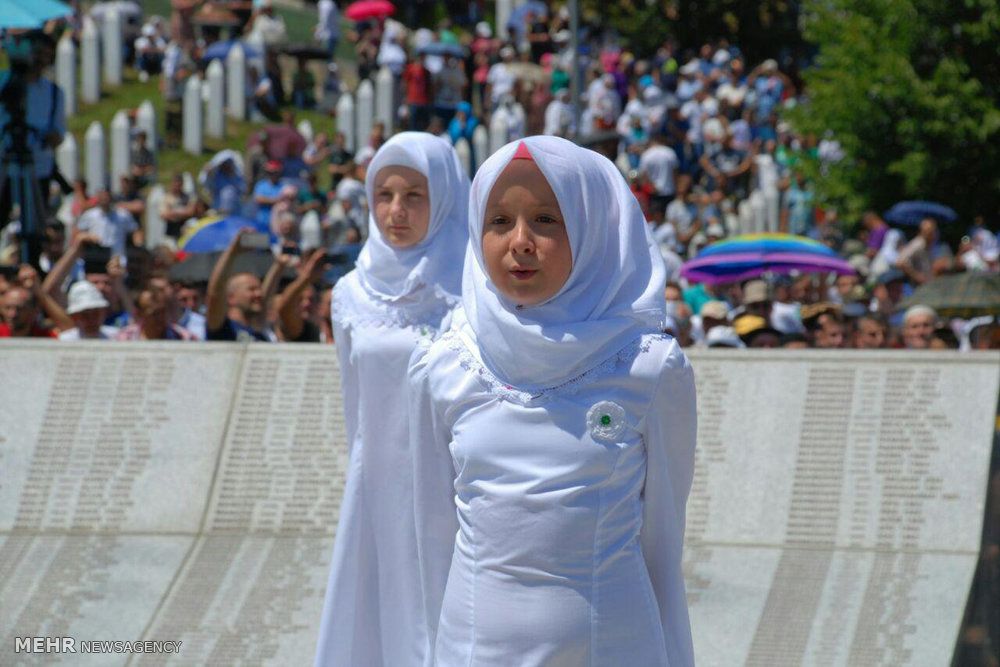
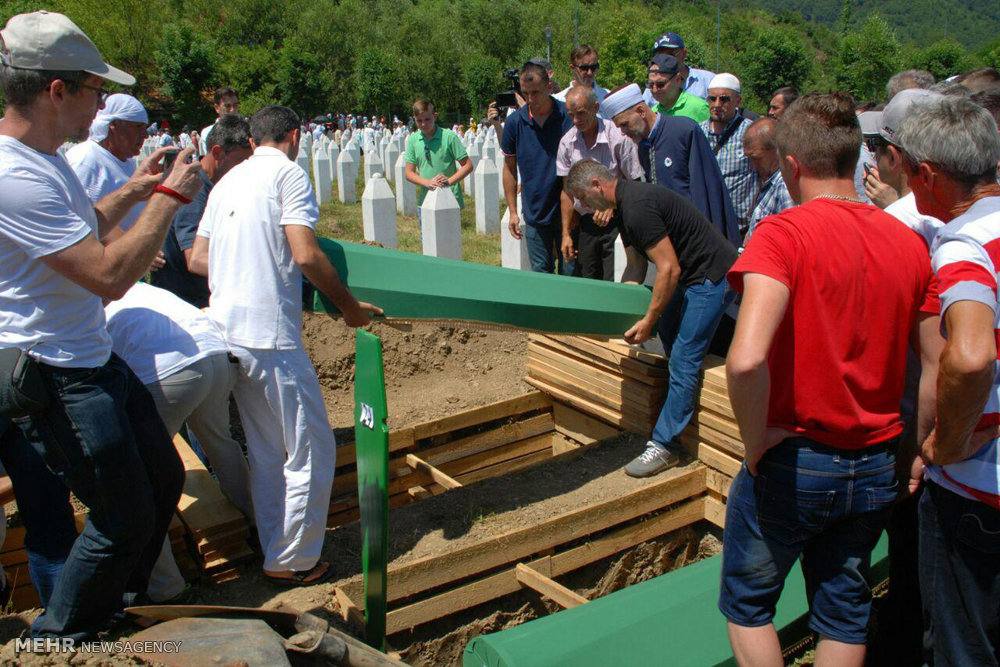
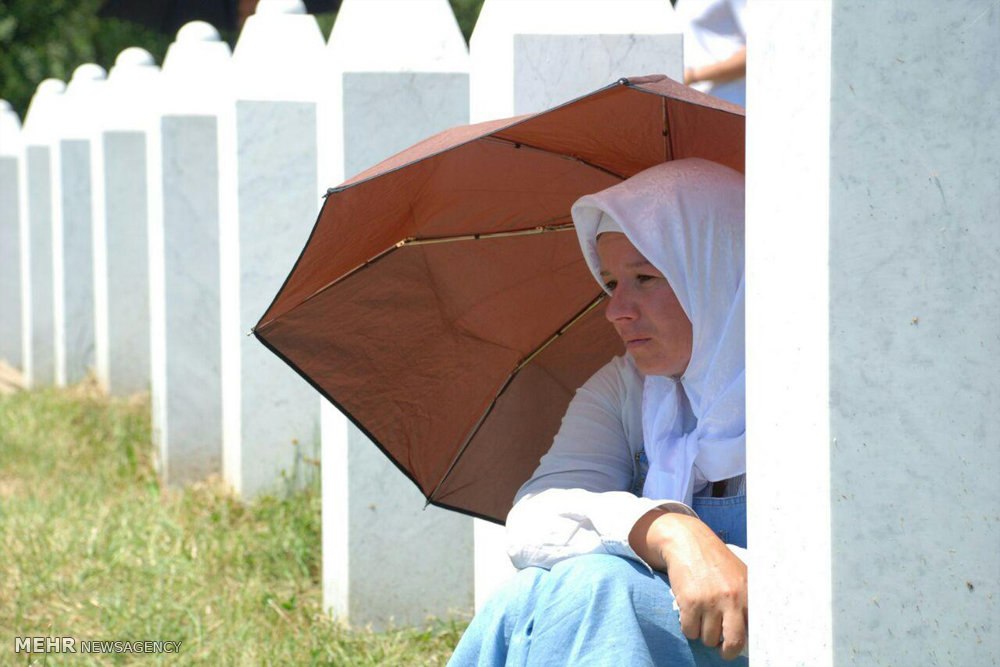
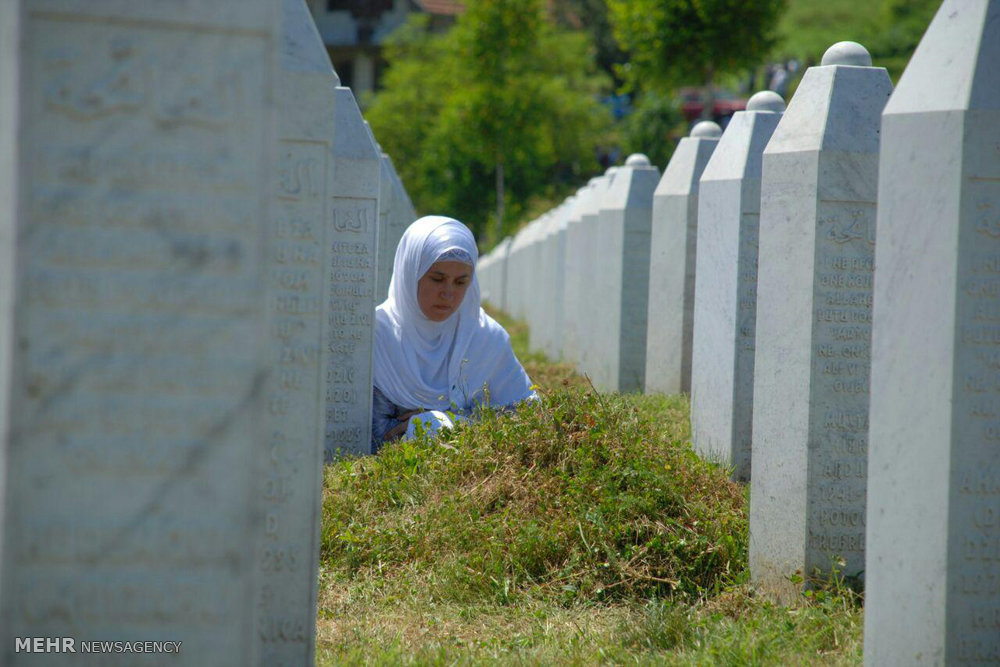
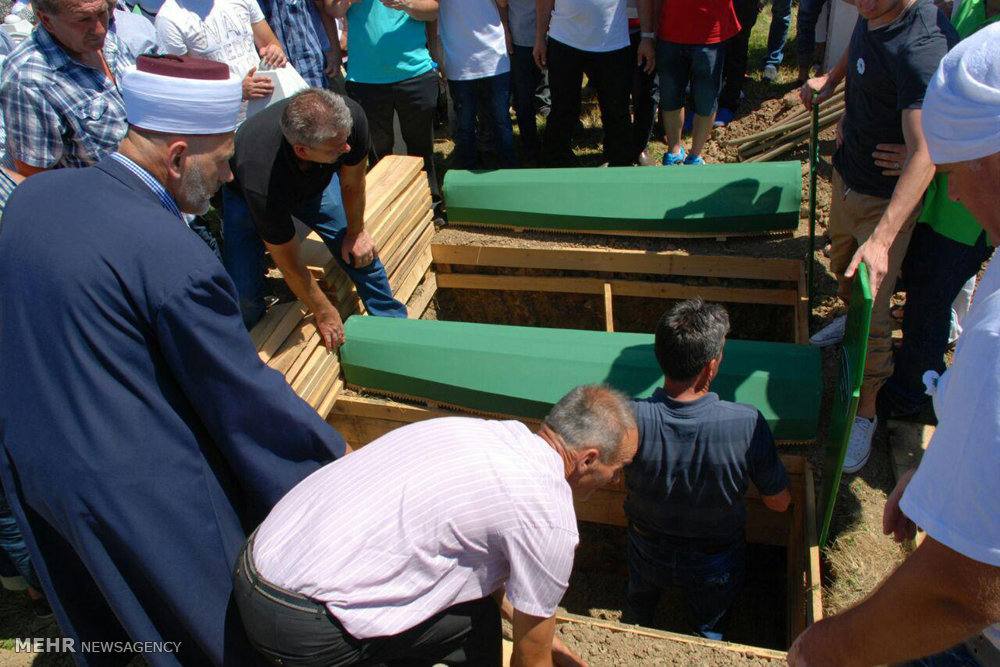
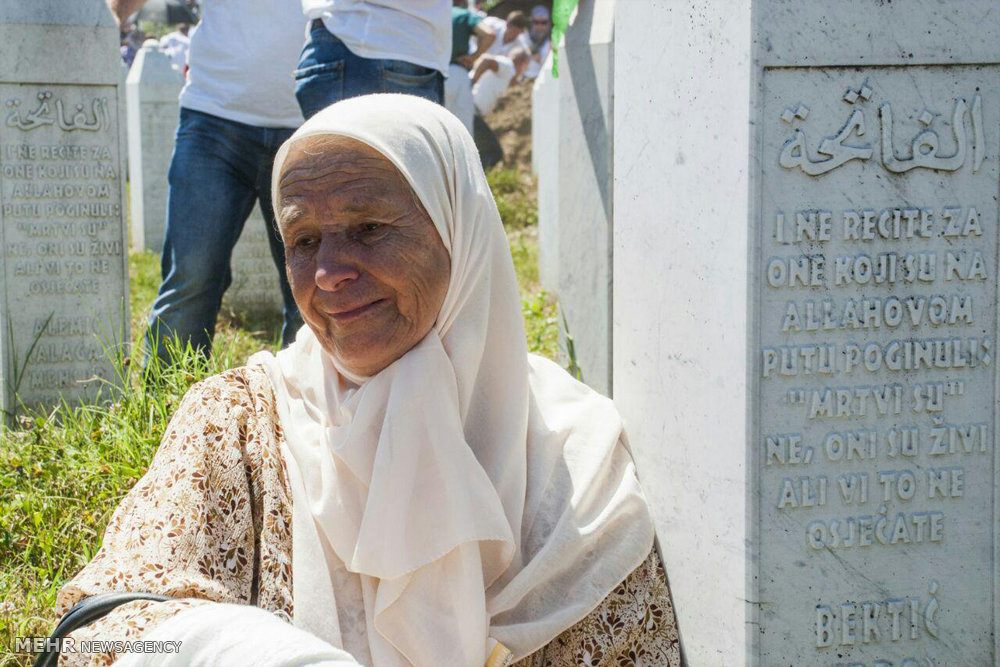
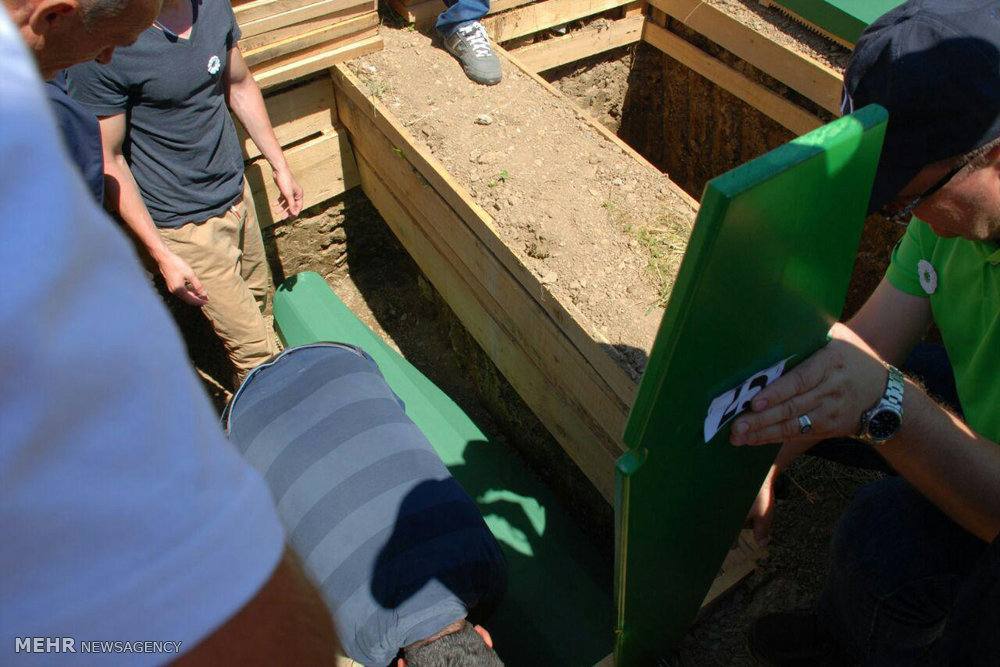
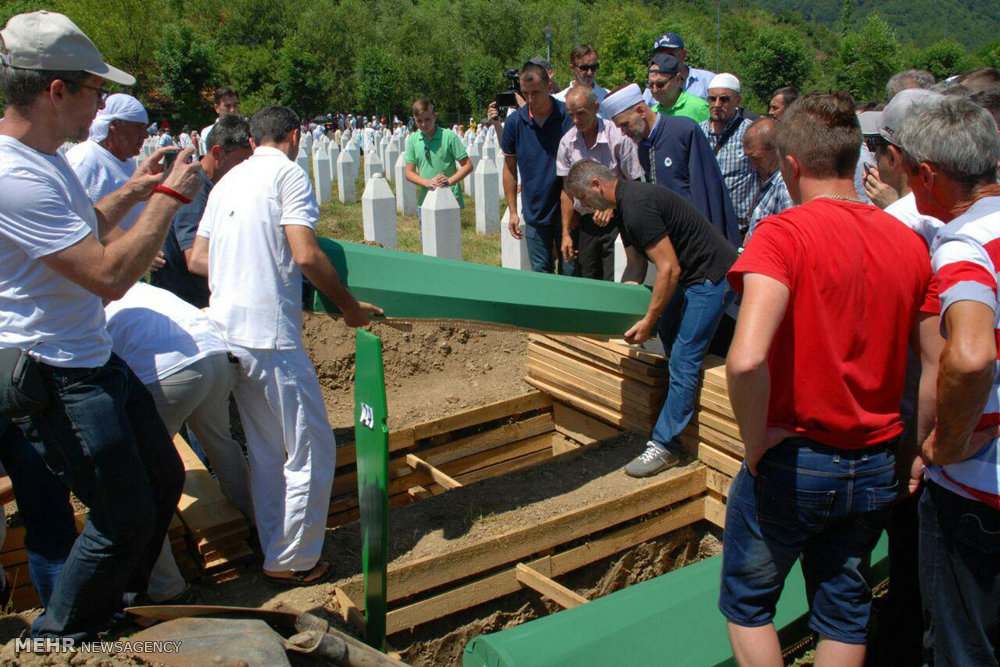
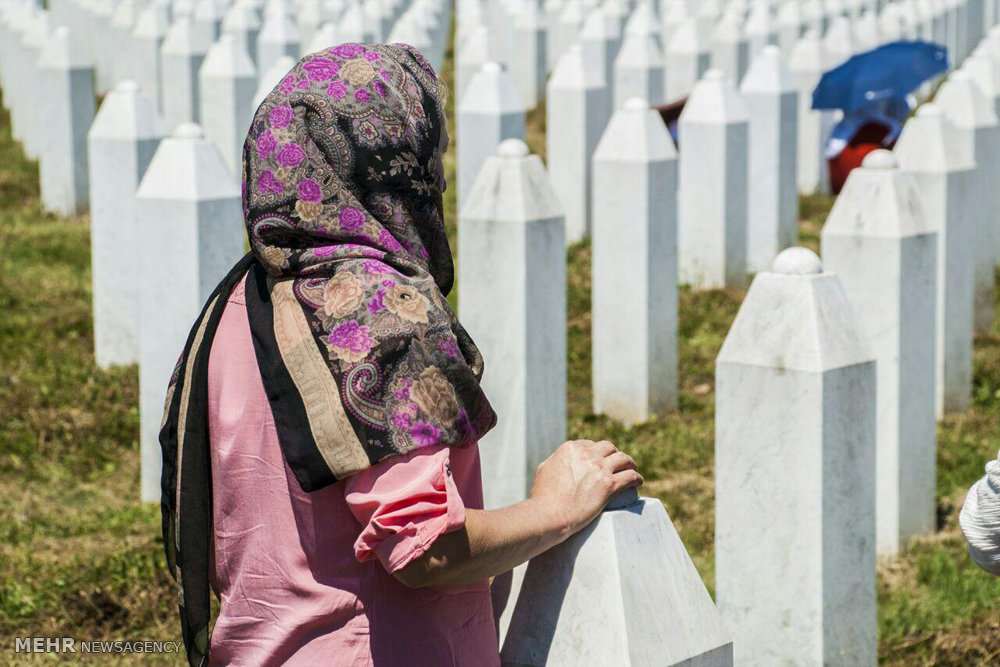
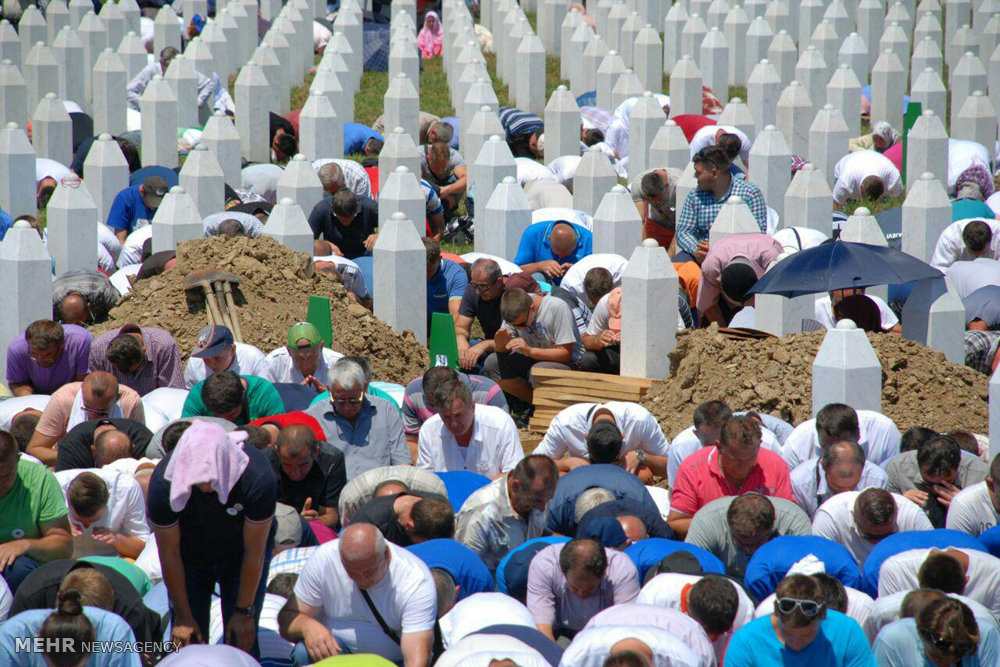
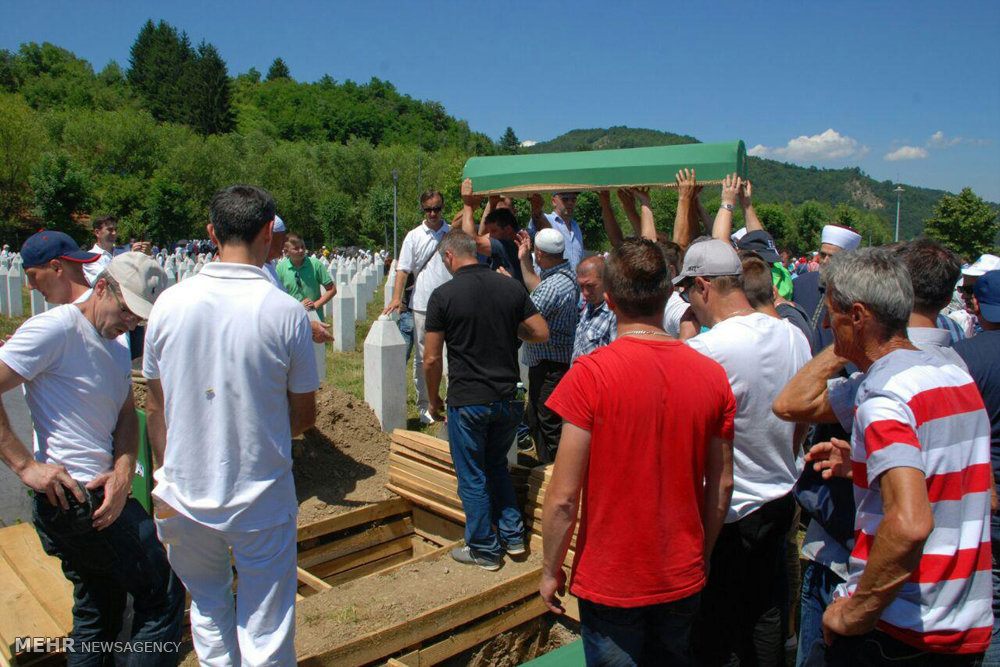
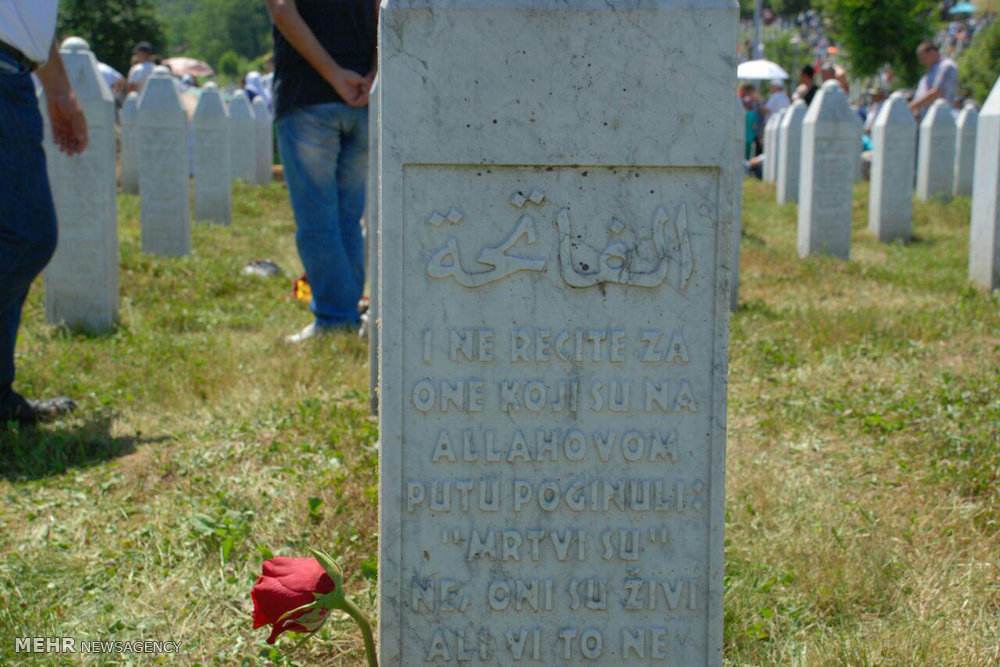
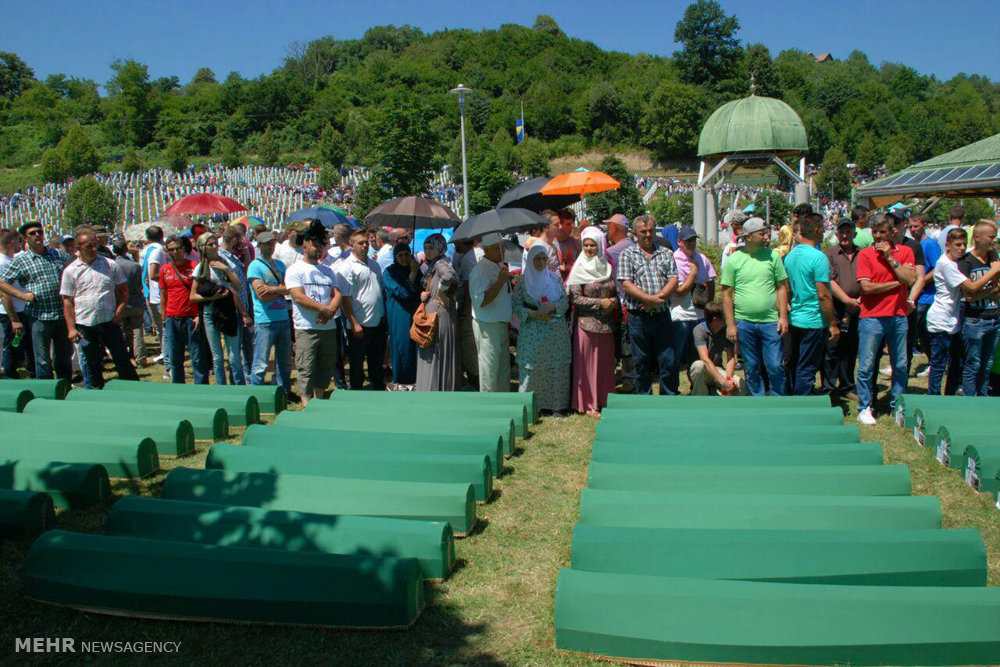
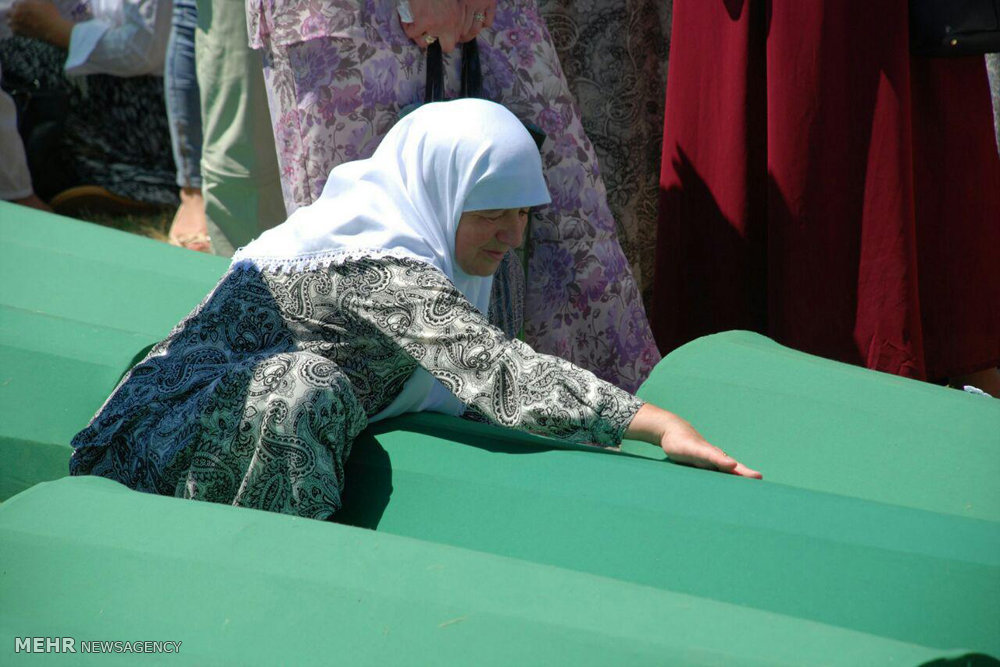
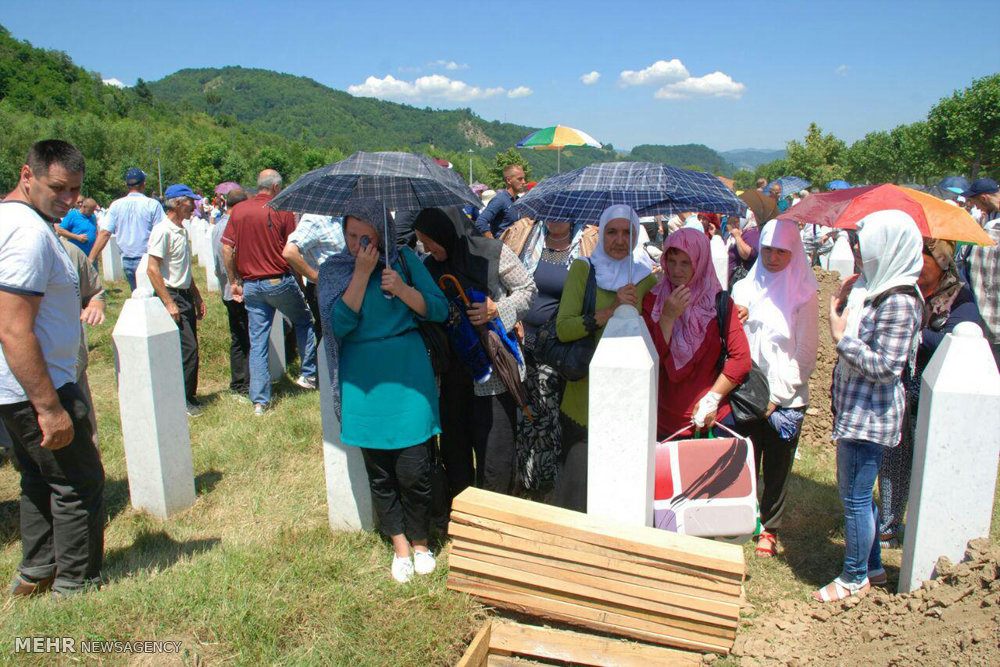
21st Anniversary of a Crime in Heart of Europe

Srebrenica massacre

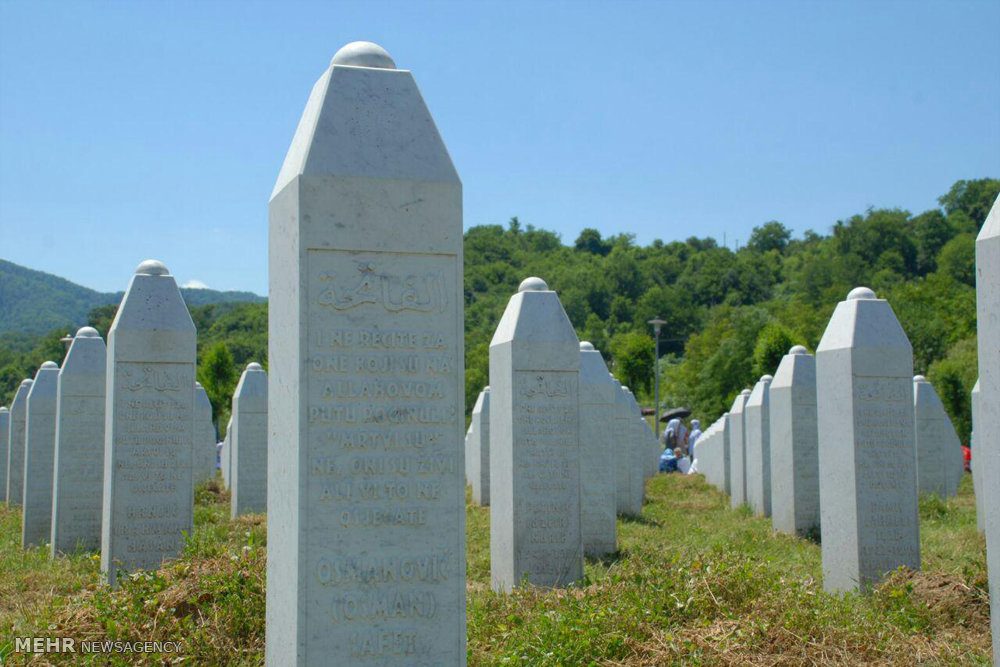
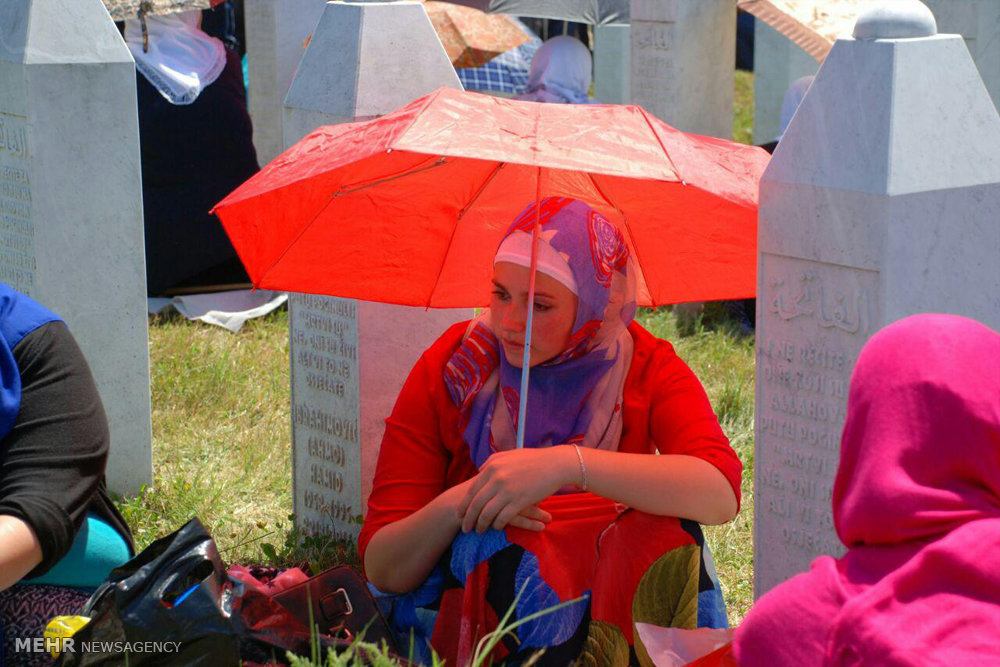
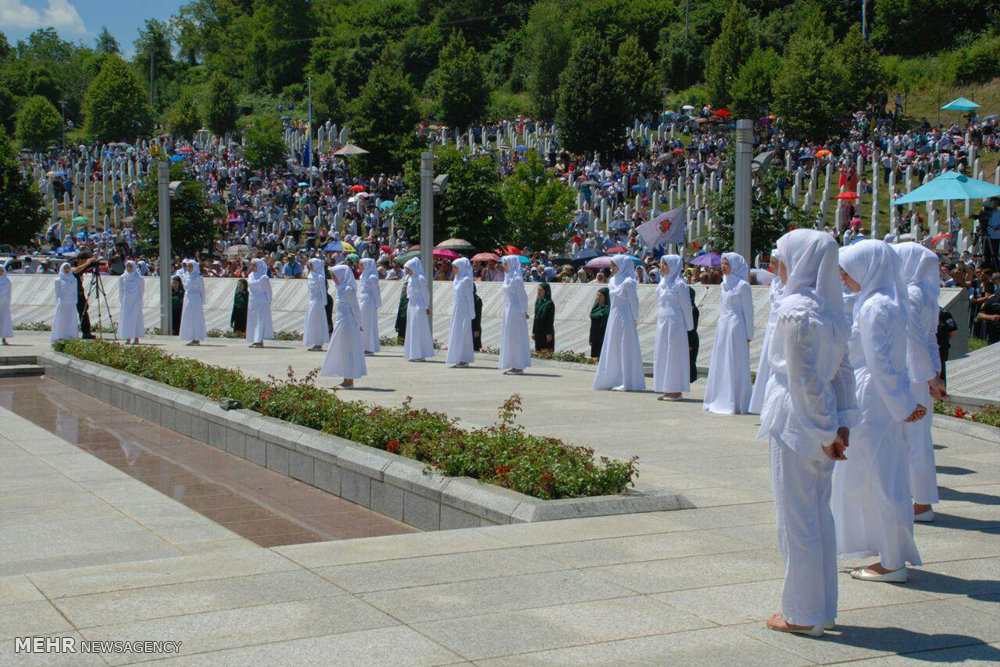
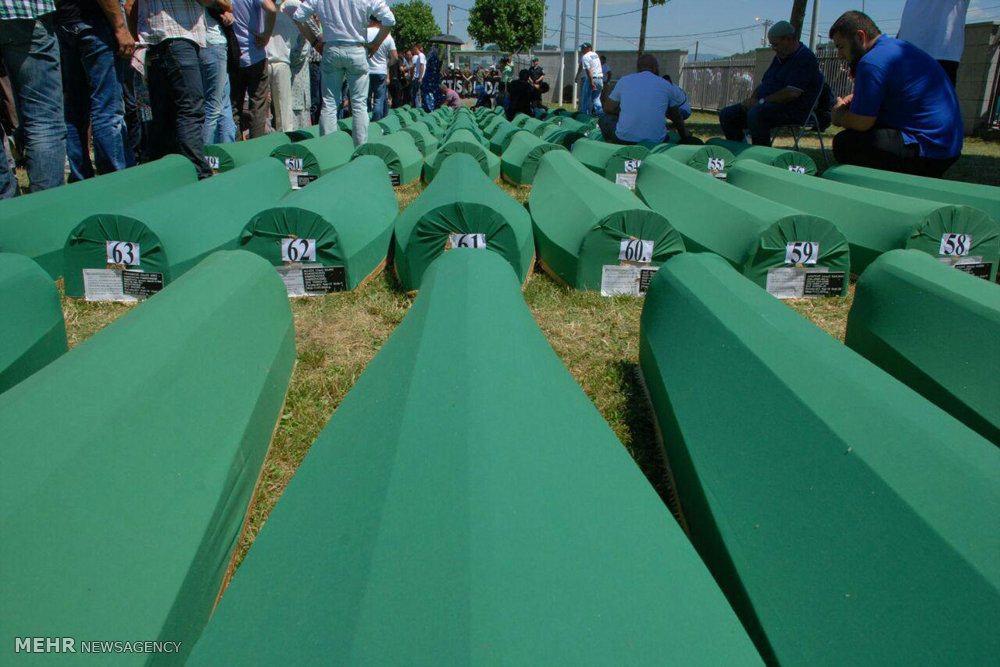
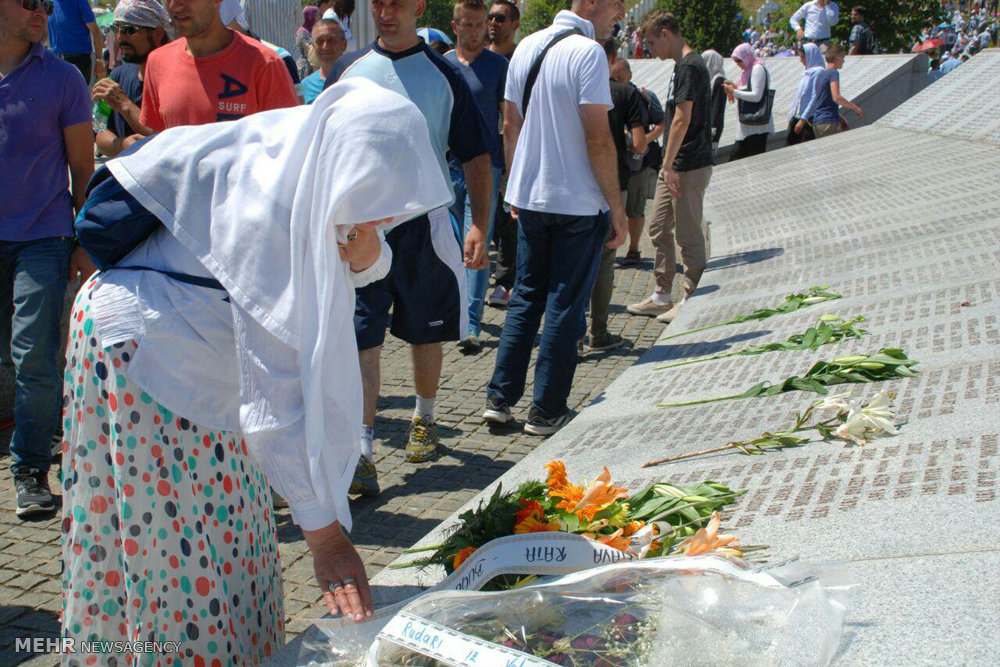
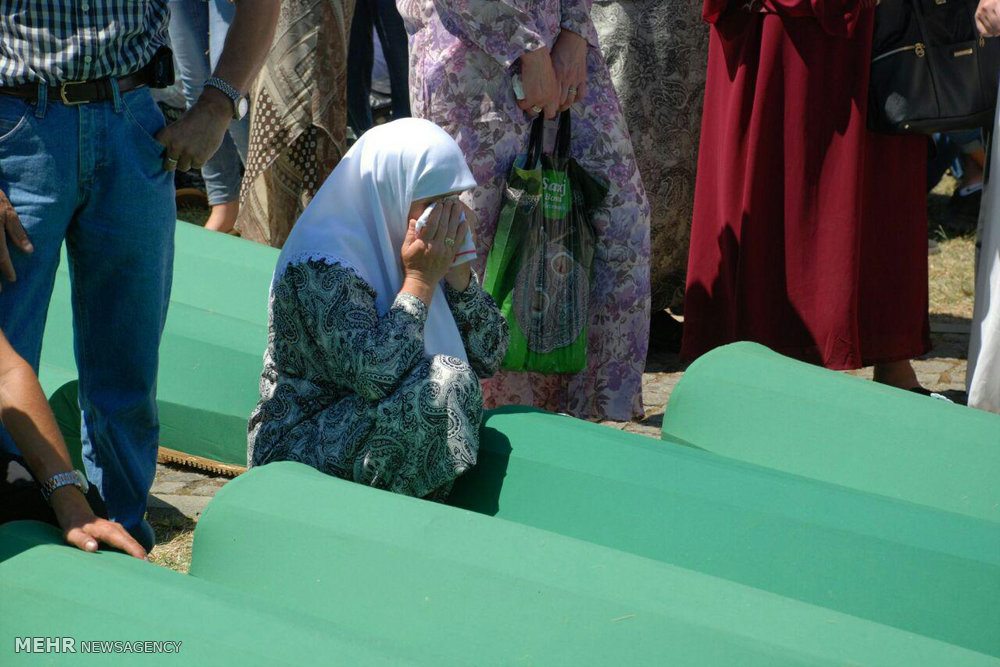
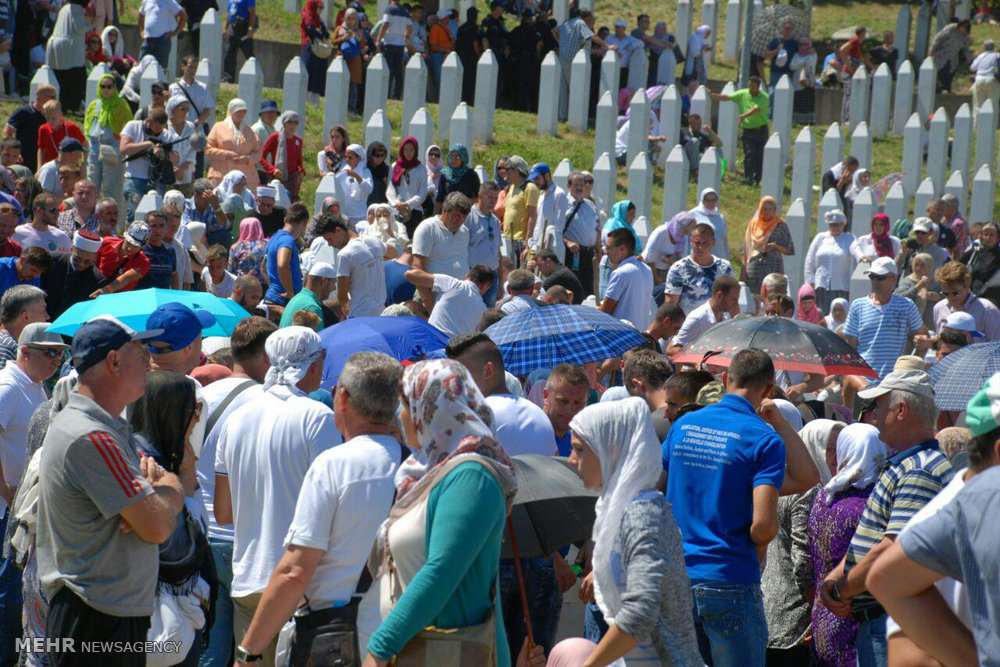
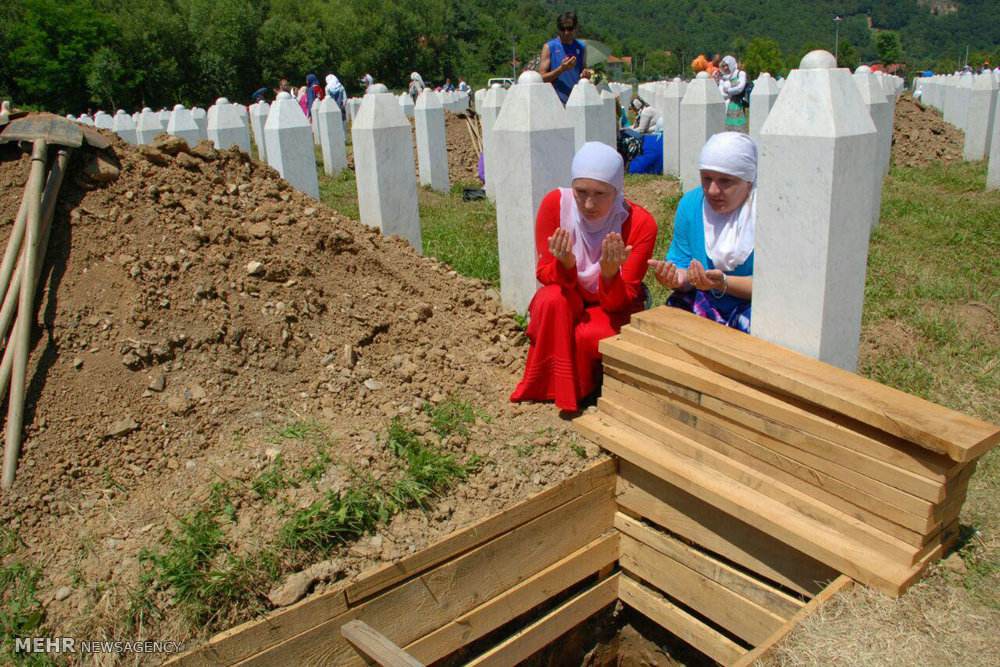
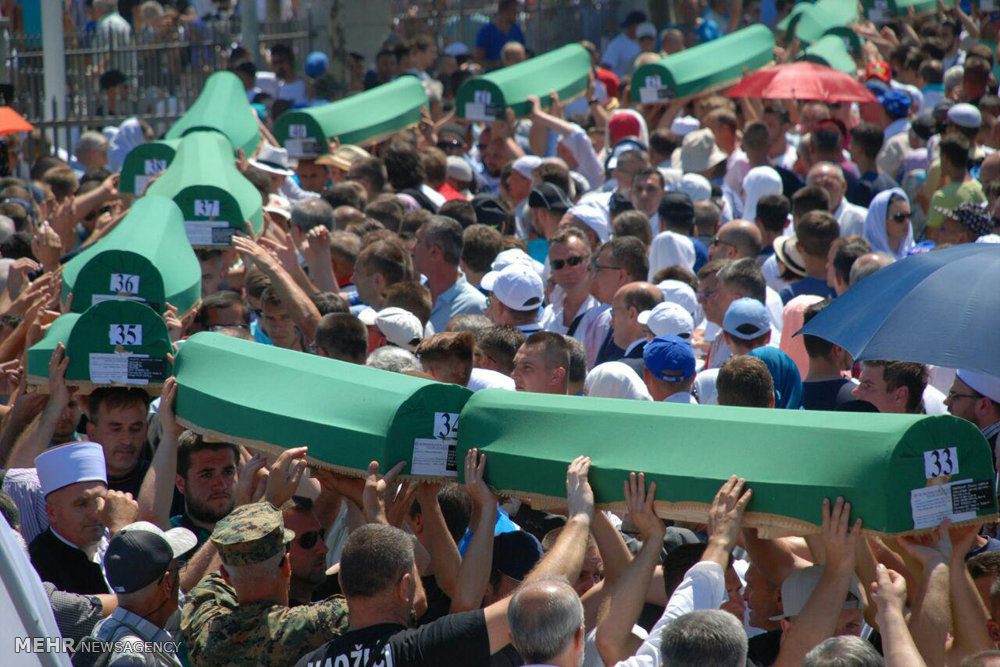
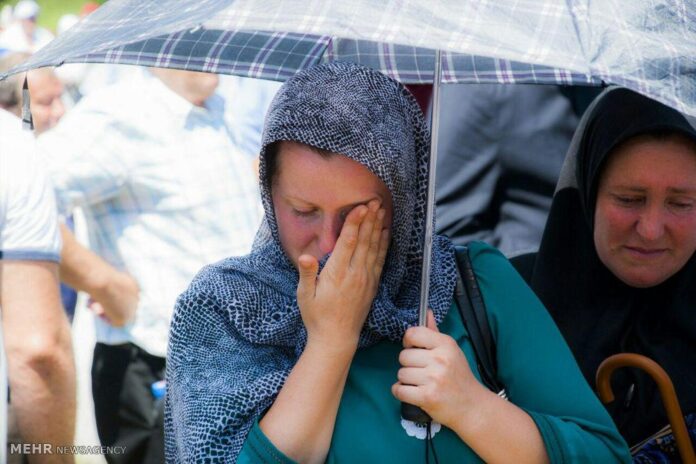
The Srebrenica massacre, also known as the Bosnian genocide, was the genocidal killing of more than 8,000 Muslim Bosnians in July 1995 during the Bosnian War.

To this day, the bones of those killed are still being discovered and identified. A ceremony was held on Monday, July 11, in the European country to mark the anniversary of the tragic genocide.

During the ceremony, which was also attended by Iran’s ambassador and cultural attaché, the remains of 127 victims were reburied in individual graves.


Iran Can Quickly Restore Nuclear Program If JCPOA Violated: Rouhani

Rouhani

The nuclear deal, known as the Joint Comprehensive Plan of Action (JCPOA), was signed between Iran and the six countries of the United States, Britain, Russia, France, China, and the Germany — collectively known as the Group 5+1 — on July 14, 2015 following some 23 months of intensive talks.

Under the deal, Iran agreed to limit its nuclear program and provide enhanced access to international atomic monitors in return for the termination of all nuclear-related sanctions imposed by the United States, the United Nations (UN) and the European Union (EU) against Iran.

“If, someday, the Group 5+1 refuses [to fulfil] its commitments, we will be completely prepared, and, in terms of nuclear capabilities, we are at such a level so as to be able to reach our desired stage in a short period of time,” President Rouhani said in the ceremony on Wednesday, July 13.

The JCPOA, the president said, “is beneficial to all countries, [and] to global peace, security, stability, and development, and its violation will be to everyone’s detriment.”

“Anyone that initiates the violation of the deal will be the loser on the international arena,” the Iranian chief executive said.

The president said everyone should make efforts “toward the [due] implementation and consolidation of the JCPOA and toward benefiting from it in general.”

146839572453332600

Suggesting that July 14, the day when the deal was signed, be called the “Day of Interaction with the World,” President Rouhani said the JCPOA proved Iran’s might.

“On this day, the Islamic Republic of Iran proved to the entire world that it has such competence and proficiency in political, technical and legal issues as well as in logic that it can negotiate with big powers to resolve a complex international issue and adequately defend the Iranian nation’s rights,” the Iranian president said.

President Rouhani went on to enumerate the benefits of the JCPOA for Iran, and thanked those involved in the negotiations that led to the deal, including negotiators.

He said one such benefit was that the threat of military invasion against Iran was removed as the nuclear pretext for such an invasion was proven hollow.

It was made clear, according to the president, that Iran has never been and will never be seeking to obtain nuclear weapons, and “what mattered to us was capabilities in enrichment as a technical and scientific issue.”

“Negotiations… made it clear that nuclear activities and [uranium] enrichment are Iran’s inalienable rights,” President Rouhani said, as reported by Press TV.

Thanks to the JCPOA, he said, sanctions on arms sales to Iran have been lifted and Iran can upgrade its defensive and military might.

The standoff over Iran’s nuclear program began back in 2003 when Western countries and some of their allies accused the Islamic Republic of seeking to build a nuclear bomb, an allegation Tehran categorically denied.

The nuclear talks were being held in an on-and-off manner for over 12 years overall. Iran’s original negotiating partners were the UK, France and Germany, a group known back in 2003 as the E3.

The talks, however, gained greater momentum under the administration of President Rouhani, who tasked the Iranian Foreign Ministry — under Foreign Minister Mohammad Javad Zarif’s watch — with handling the talks soon after assuming office in 2013.

Iran’s Missile Program Poses No Threat to Any Country: Diplomat

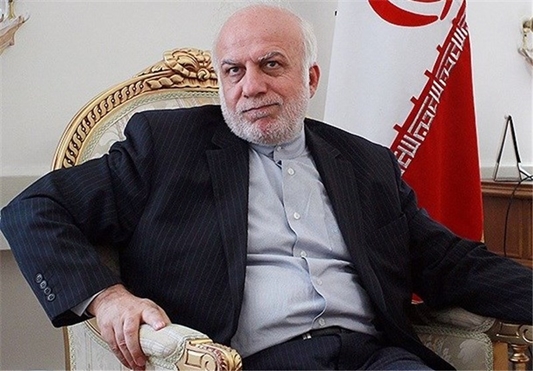
Hamid Baeidinejad, a senior official at the Iranian Foreign Ministry

Speaking to reporters a day ahead of the first anniversary of the signing of a nuclear deal between Iran and six other countries, Baeidinejad, who was a negotiator at the talks that led to the deal, said on Wednesday, July 13, that Iran’s missile program is defined in completely defensive terms.

Responding to a question about recent opposition by certain Western parties to the Iranian missile program, Baeidinejad said, “We cannot set the country’s national interests based on others’ viewpoints.”

“The foreign opponents of Iran’s missile program should not expect Iran to quit its defensive and security interests. Iran’s missile program is no threat against” regional and other countries, he said, as reported by Press TV.

The United Nations (UN)’s Secretary-General Ban Ki-moon has drafted a report on a UN Security Council resolution that endorsed the deal, known as the Joint Comprehensive Plan of Action (JCPOA), claiming that Iran’s missile activities are in violation of the “constructive spirit” of the agreement and the resolution.

BaeediNejadIn his Wednesday remarks, Baeidinejad said the draft report on Resolution 2231 is “highly imbalanced,” expressing hope that the version of the report to be officially published will be “balanced and comprehensive.”

Earlier, Iranian Foreign Minister Mohammad Javad Zarif had talked to Ban, expressing Iran’s vehement disapproval of the draft report.

Commenting on the state of the implementation of the JCPOA, Baeidinejad said the process has been “satisfactory to some extent.”

“As of now, the members of the negotiating team believe the JCPOA has not been breached” by the other sides, he said.

Iran and the five permanent members of the UN Security Council — the United States, France, Britain, China and Russia — plus Germany signed the JCPOA on July 14, 2015 following some 23 months of intensive talks.

Under the deal, Iran agreed to limit its nuclear program and provide enhanced access to international atomic monitors in return for the termination of all nuclear-related sanctions imposed by the United States, the United Nations (UN) and the European Union (EU) against the country.

The US Congress, however, has been taking various measures aimed at preserving the obstacles in the way of US and European trade with Iran. European banks have balked at the idea of resuming transaction with Iran, fearing punitive US measures.

Baeidinejad expressed his hope that “with negotiations and consultations, the likelihood exists for the resolution of the problems.”

He said the Iran-Group 5+1 Joint Commission on the JCPOA — which monitors the implementation of the deal — is to convene next week in the Australian capital, Vienna.

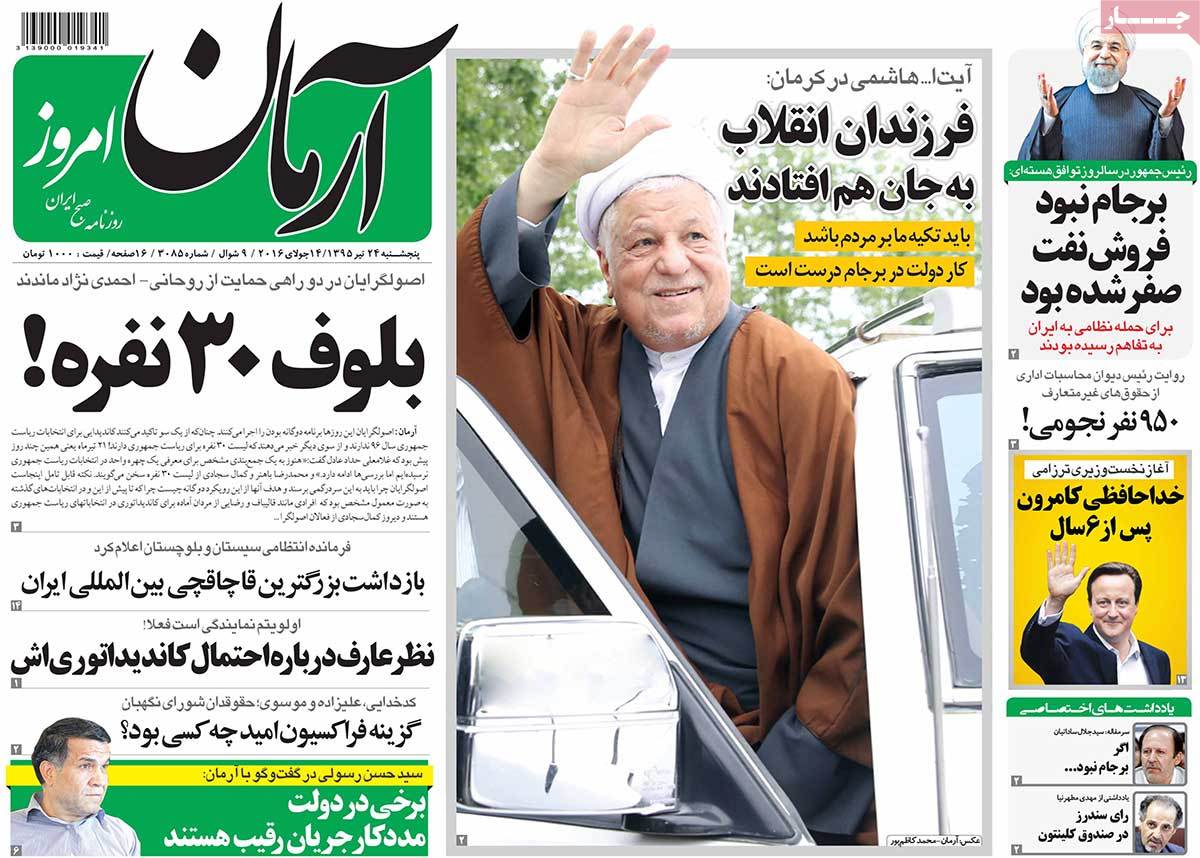
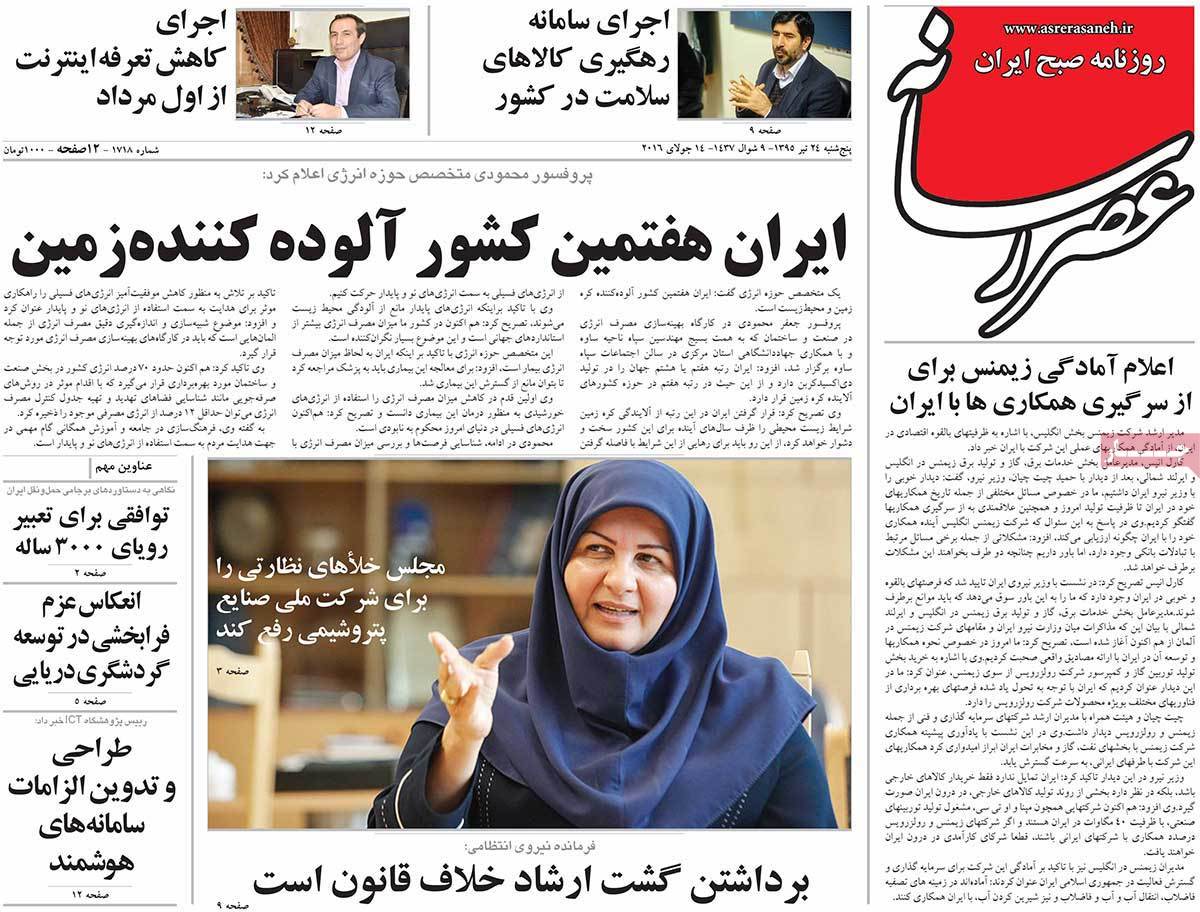
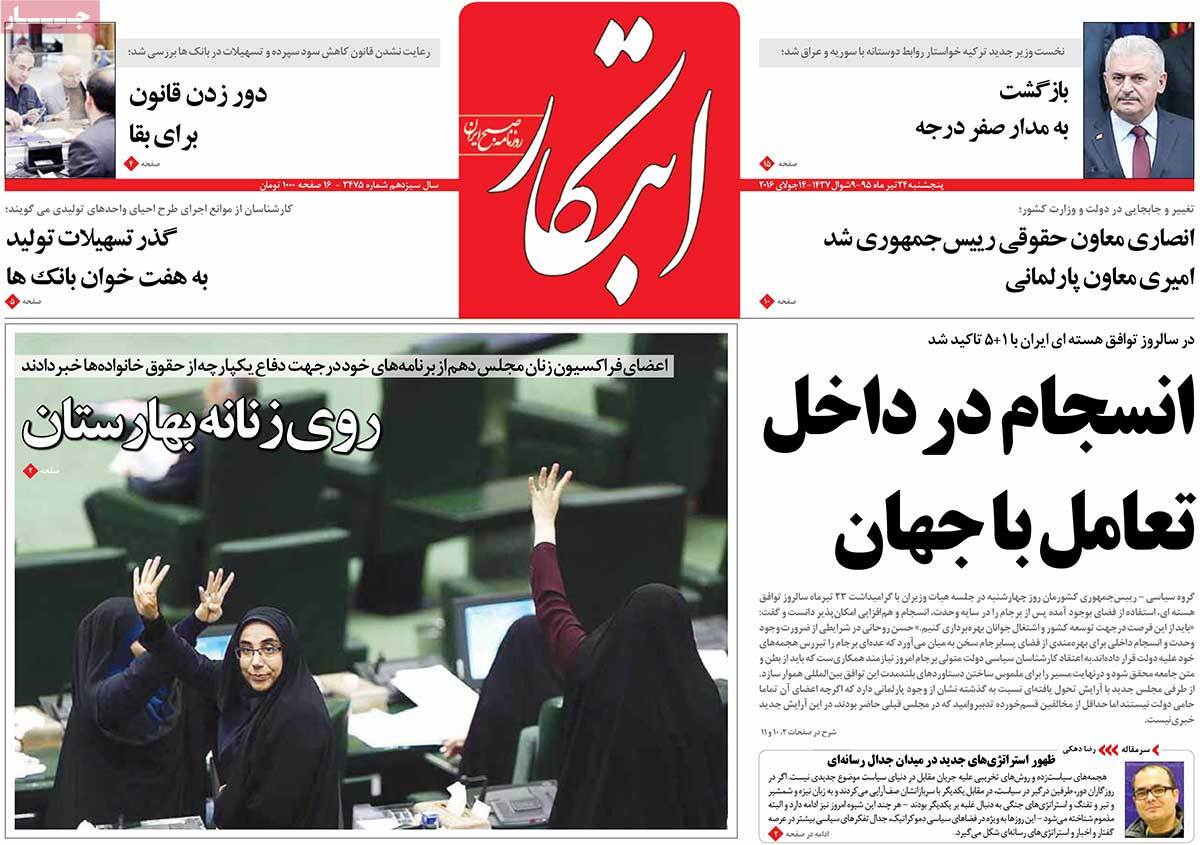
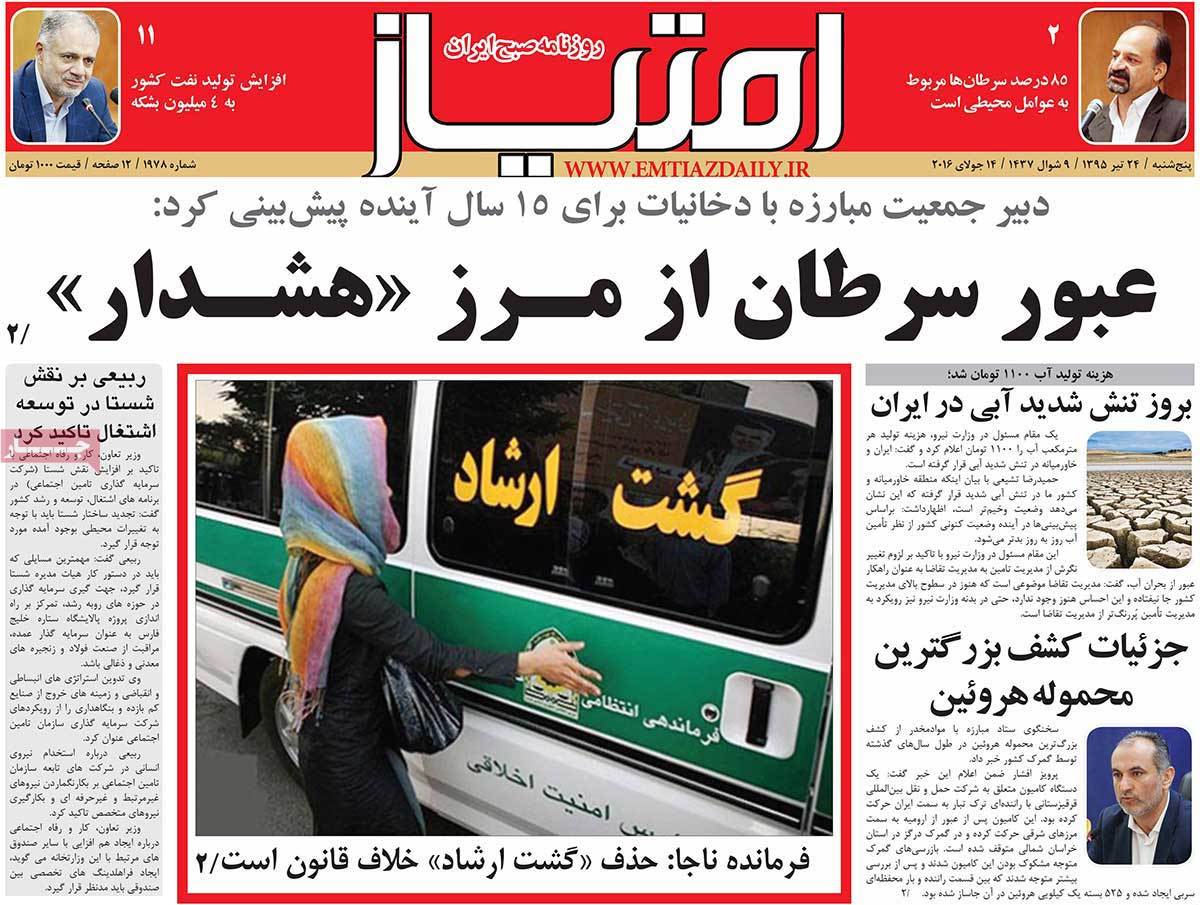
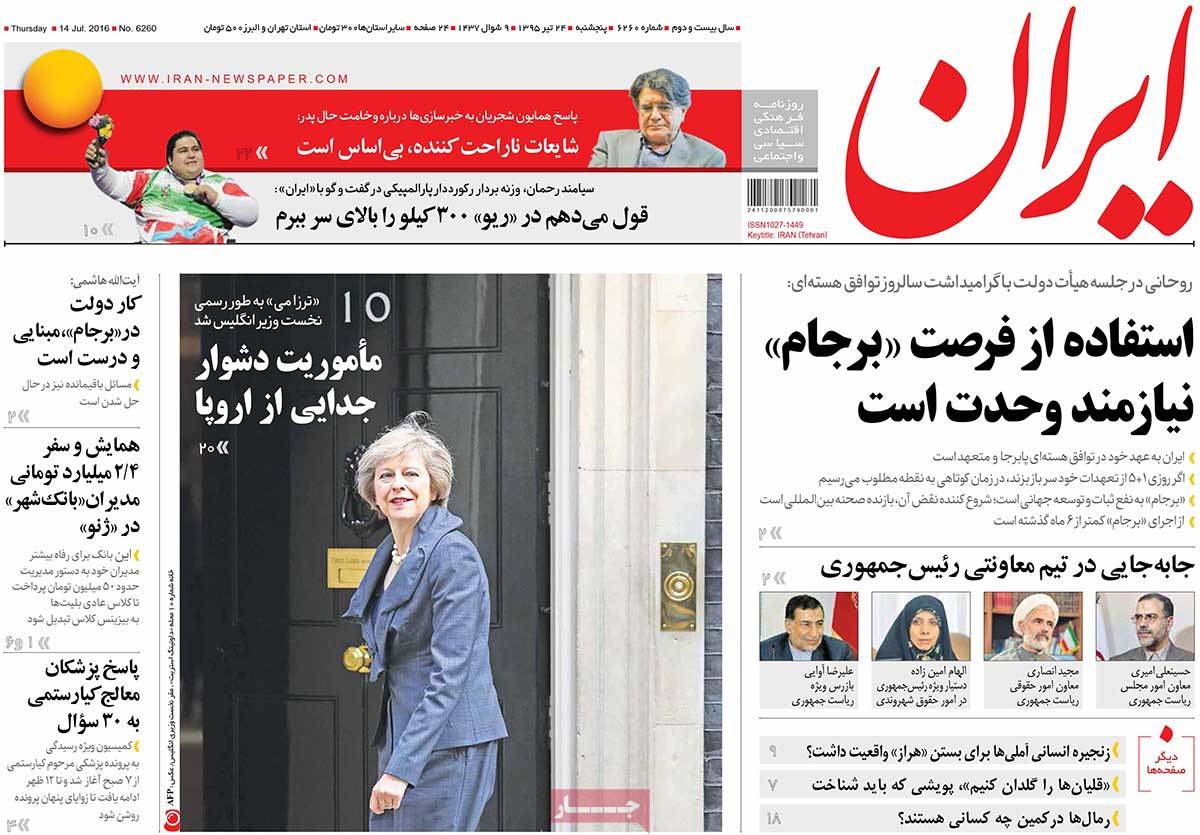
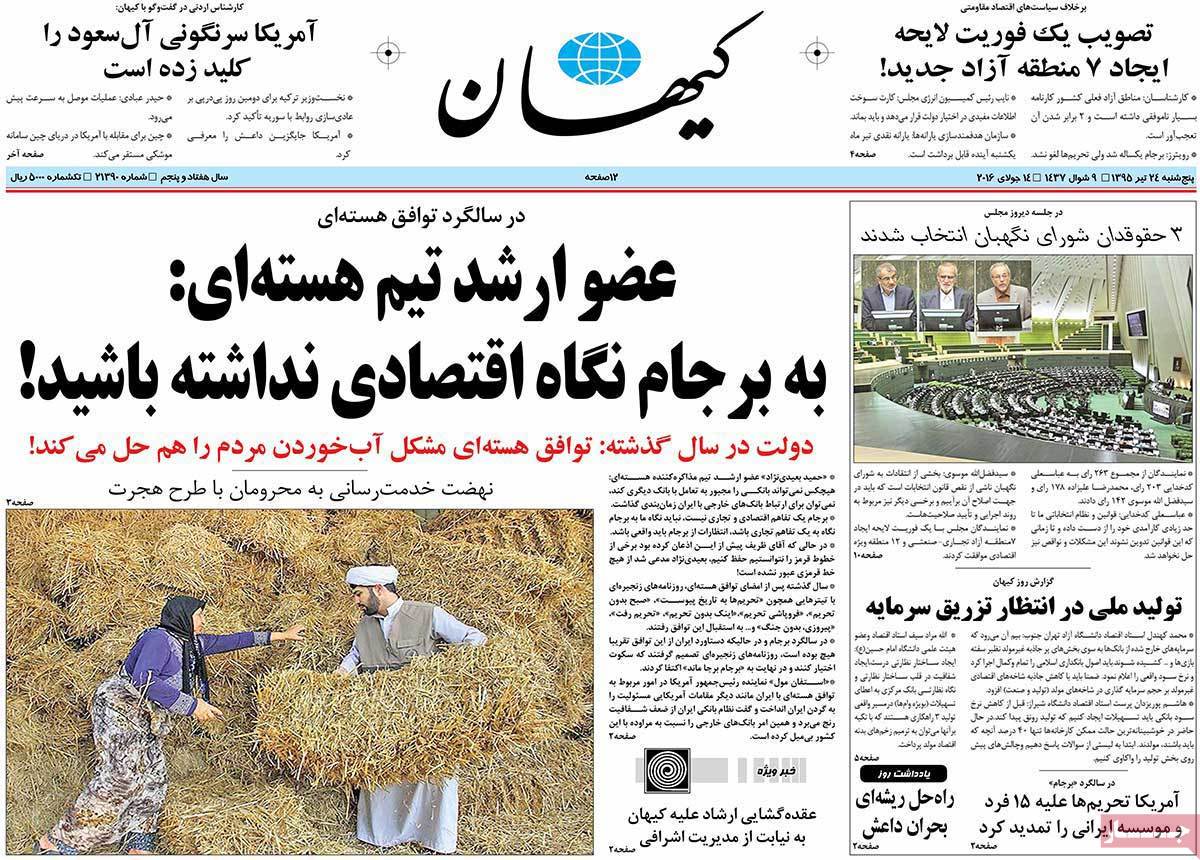
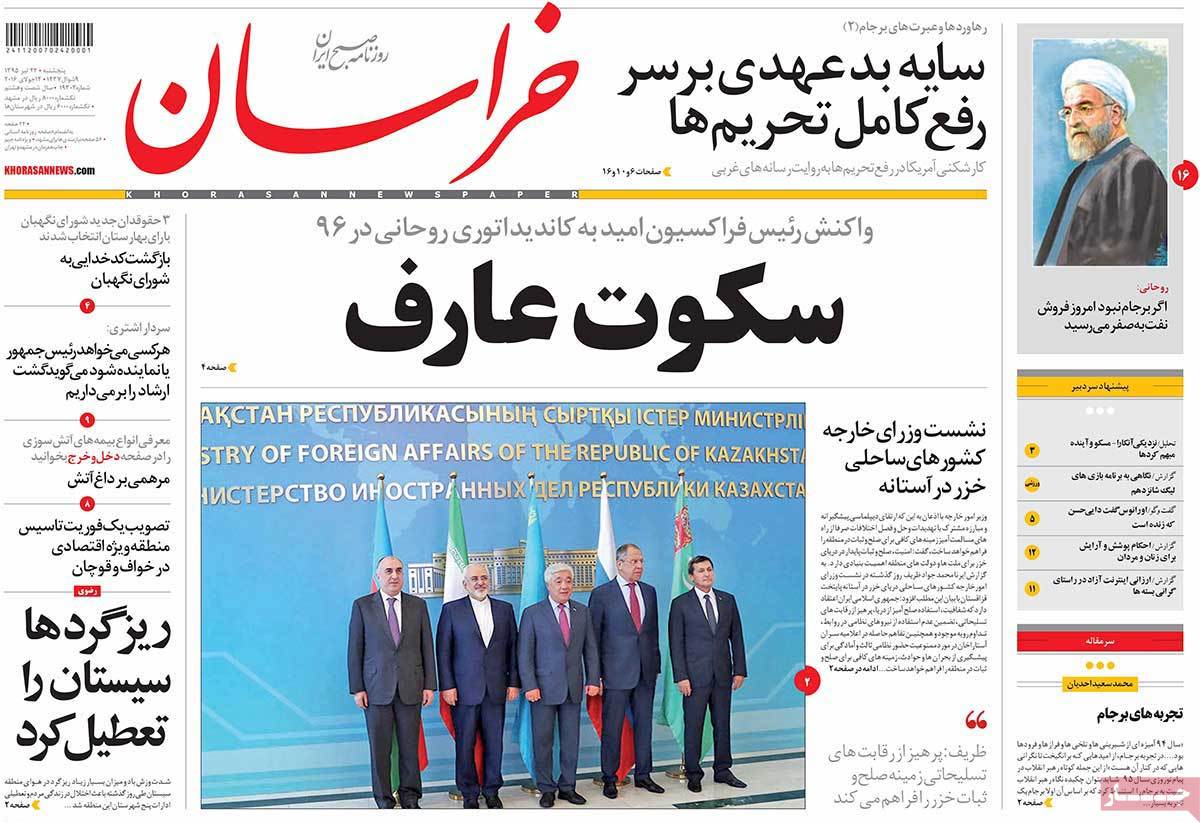
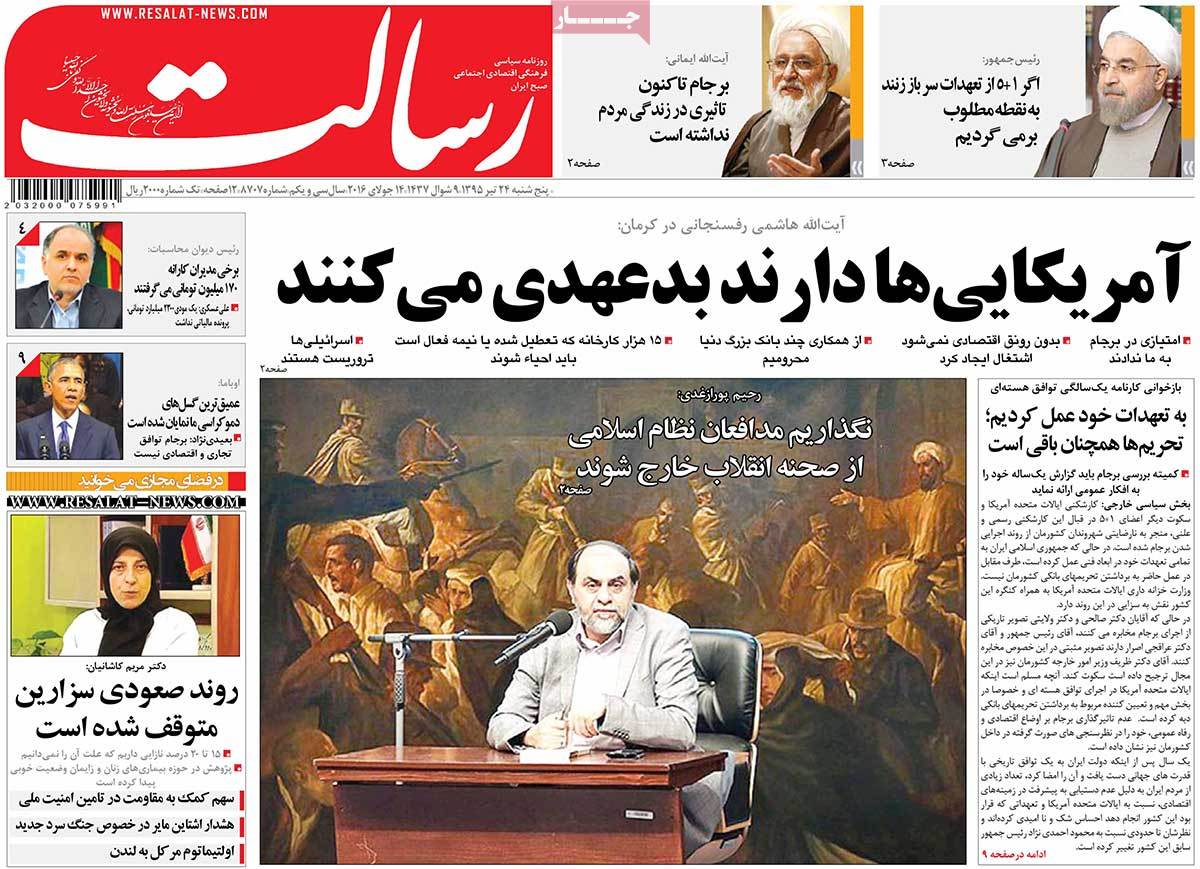
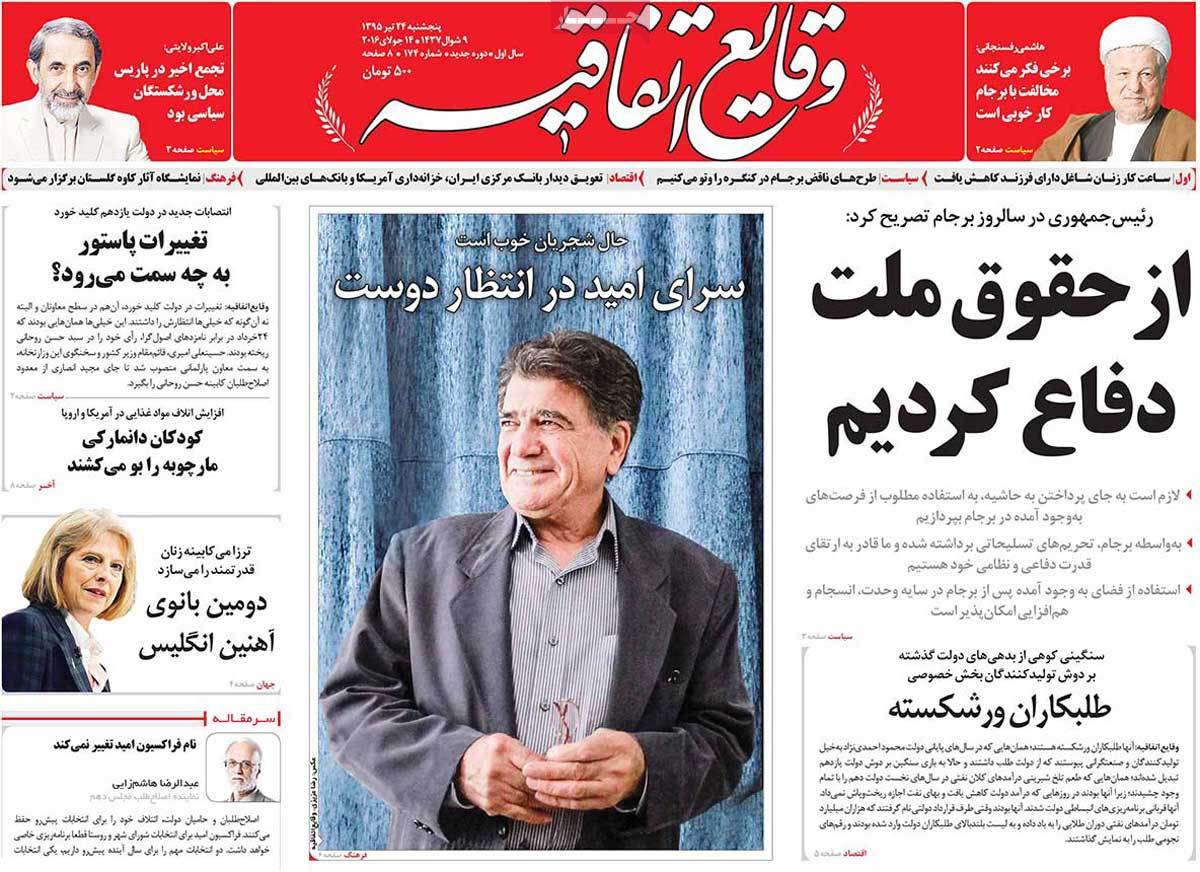
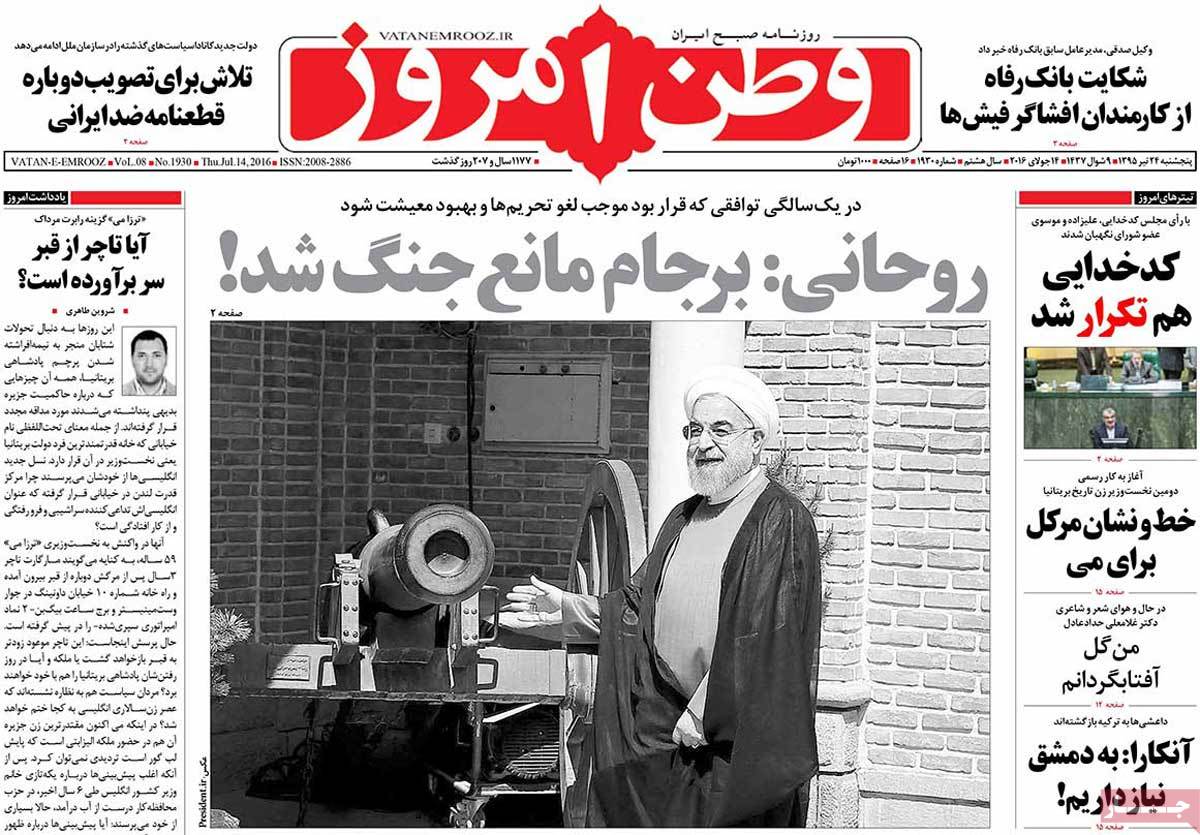
A Look at Iranian Newspaper Front Pages on July 13

Iran Newspaper front pages

Newspapers on Wednesday highlighted the recent remarks by Iranian Minister of Culture and Islamic Guidance Ali Jannati, who underlined the need for a revision in the law on prohibition of using satellite equipment.

They also covered a letter sent by 75 US figures to President Barack Obama, asking him to strengthen Washington’s ties with Tehran.

Another top story was the dismissal of 13 more executives who had received astronomical salaries. The issue has been a main part of Iranian front pages for the past weeks.

The first anniversary of the nuclear deal between Tehran and world powers was also covered in special issues in several newspapers. Many articles for and against the deal were published today.

The abovementioned issues as well as many more are highlighted in the following headlines:


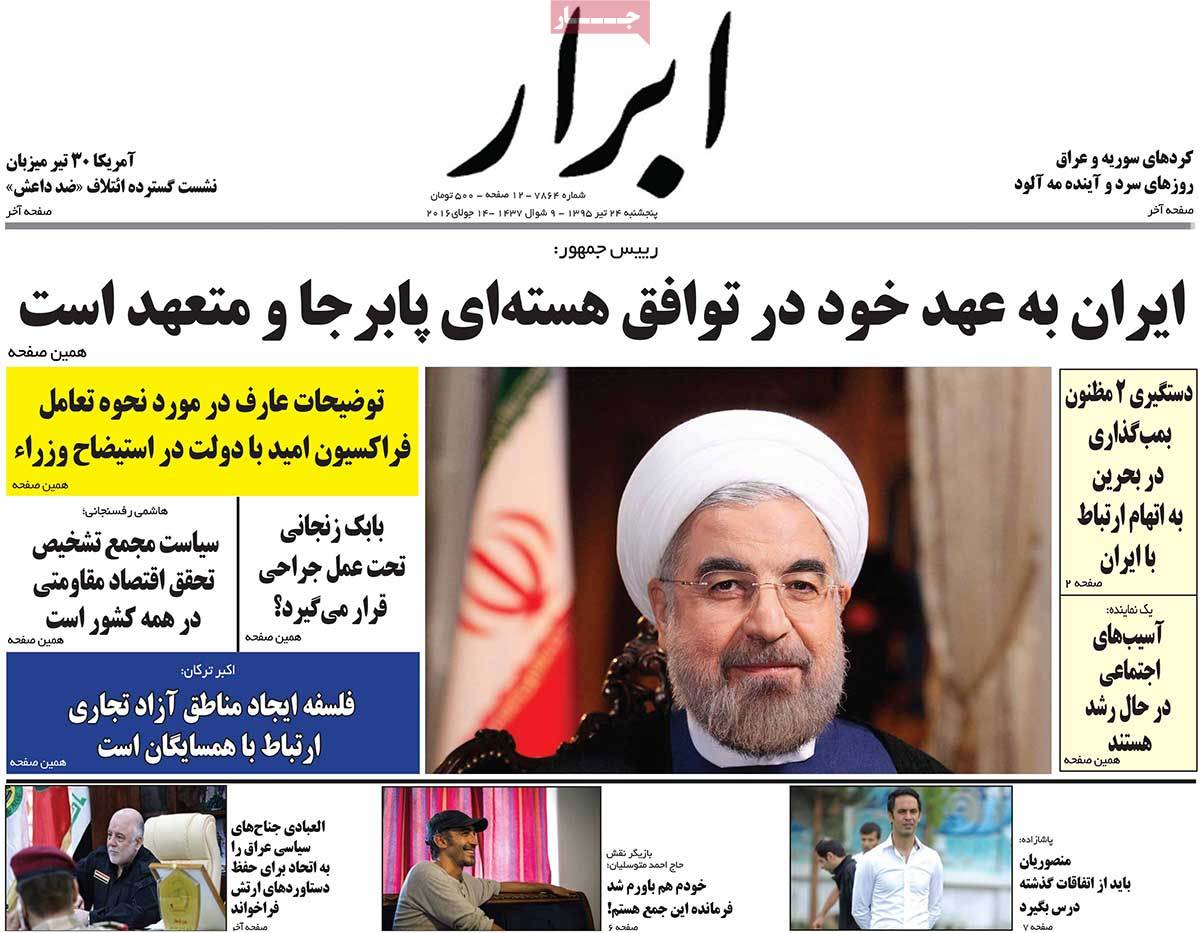
Abrar:

1- Some Australian Universities Have Resume Their Ties with Iranian Universities: Ambassador

2- US Barriers Have Decreased Iran’s Hope on JCPOA: AFP


A Look at Iranian Newspaper Front Pages on July 13


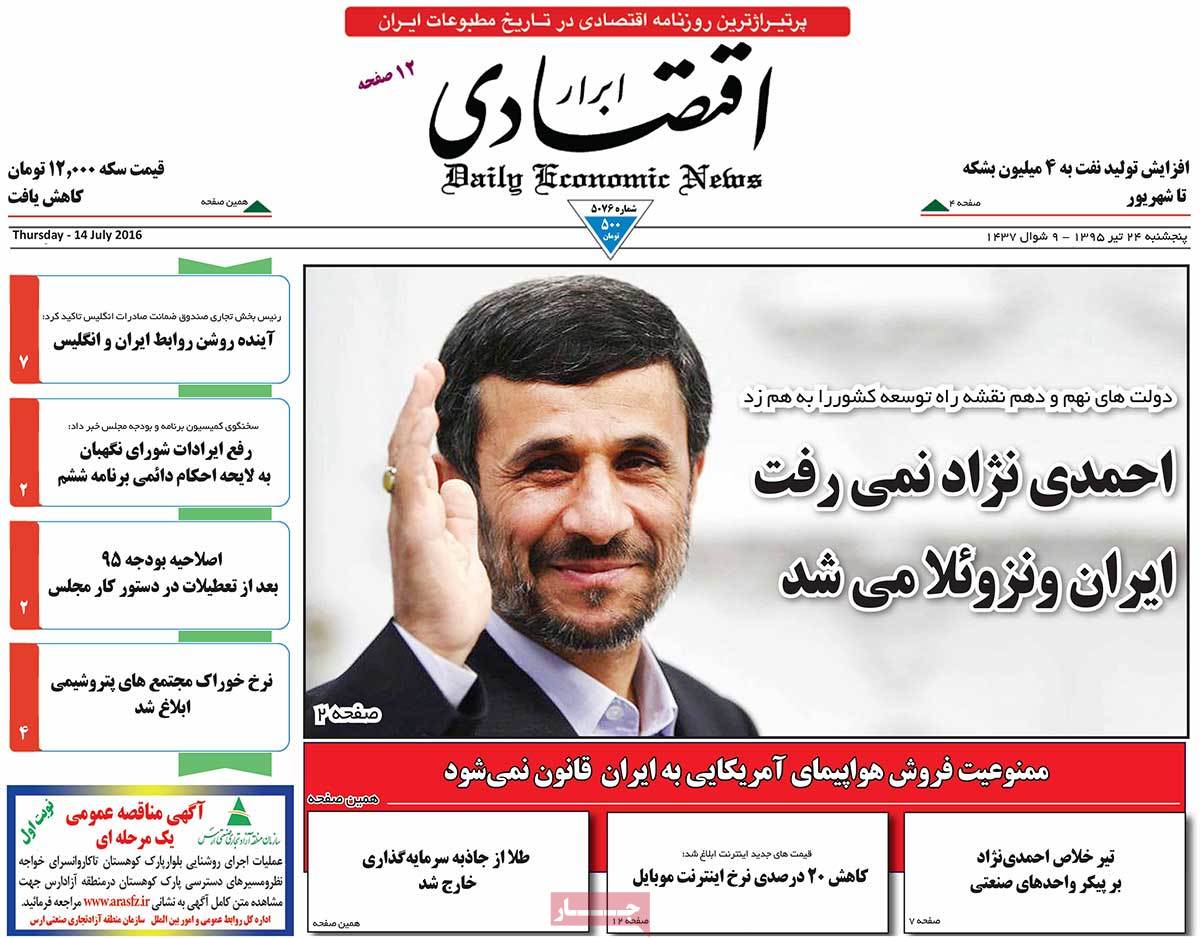
Abrar-e Eqtesadi:

1- Economic Downturn to Be Exacerbated Given Government’s Debts: CBI Governor

2- Iran’s Exports to Russia Up by 70%

3- Iran-Britain Power Talks in London

4- Mitsubishi in Talks with Iran for Plane Sale

5- Iran’s Oil Output at Highest Level in 5 Years

A Look at Iranian Newspaper Front Pages on July 13


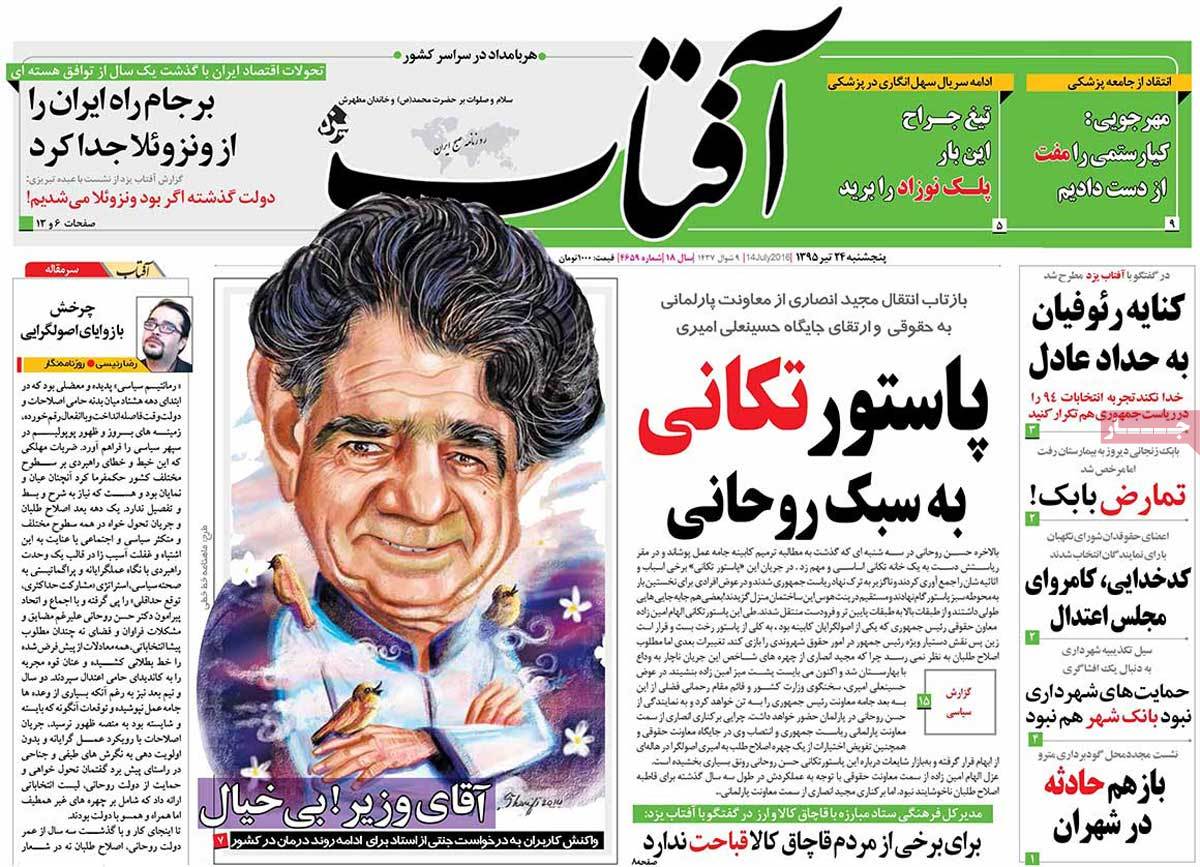
Aftab-e Yazd:

1- Reforming the Law of Satellite Equipment in Parliament

2- Judiciary Official Praises Economy Minister’s Performance on Issue of Astronomical Salaries: Rouhani’s Gov’t Is Fighting Corruption

3- Another Accident for Soldiers: This Time in Nowshahr [north of Iran]; Army Ground Force Commander: From Now on, Soldiers Will Be Transferred with Train

4- Rouhani Should Even Apologize for France’s Defeat in Euro 2016! [Editorial]

5- The Poor’s Share from Iran’s Budget Is Just 1.5%: Imam Khomeini Relief Foundation Chief

A Look at Iranian Newspaper Front Pages on July 13


Arman-e Emrooz:

1- Kiarostami’s Personal Physician Summoned over His Death

2- Executives Are Falling Victim to a Systematic Corruption: Expert

3- 6 ISIS Affiliates Arrested in Iran: Intelligence Minister Reveals Discovery of Bomb-Making Sites

4- Sale of 33 Tons of Heavy Water to US: Araqchi

5- JCPOA Saved Iran’s Economy

6- 75 US Figures Call for Improvement of Ties with Iran

A Look at Iranian Newspaper Front Pages on July 13


Asia:

1- So Far, We Have Signed 215 Deals with Foreign Banks: Minister

2- We Sold 32 Tons of Heavy Water to US, and We Received the Money: Deputy FM

Asia daily 7-13


Besharat-e Now:

1- Gov’t Goes beyond Verbal Apology: Dismissal and Resignation of 13 Top Executives

2- World’s Power in Women’s Hands: Will Democracy Smile at Women?

3- Ronaldo’s Injury and Prejudice of Iranian Social Media Users! Some Iranian Users Bring another Shame for Iran

A Look at Iranian Newspaper Front Pages on July 13


Emtiaz:

1- Bam Earthquake May Occur in Tehran: Official Warning

2- Noise Pollution in Tehran beyond Global Standards

A Look at Iranian Newspaper Front Pages on July 13


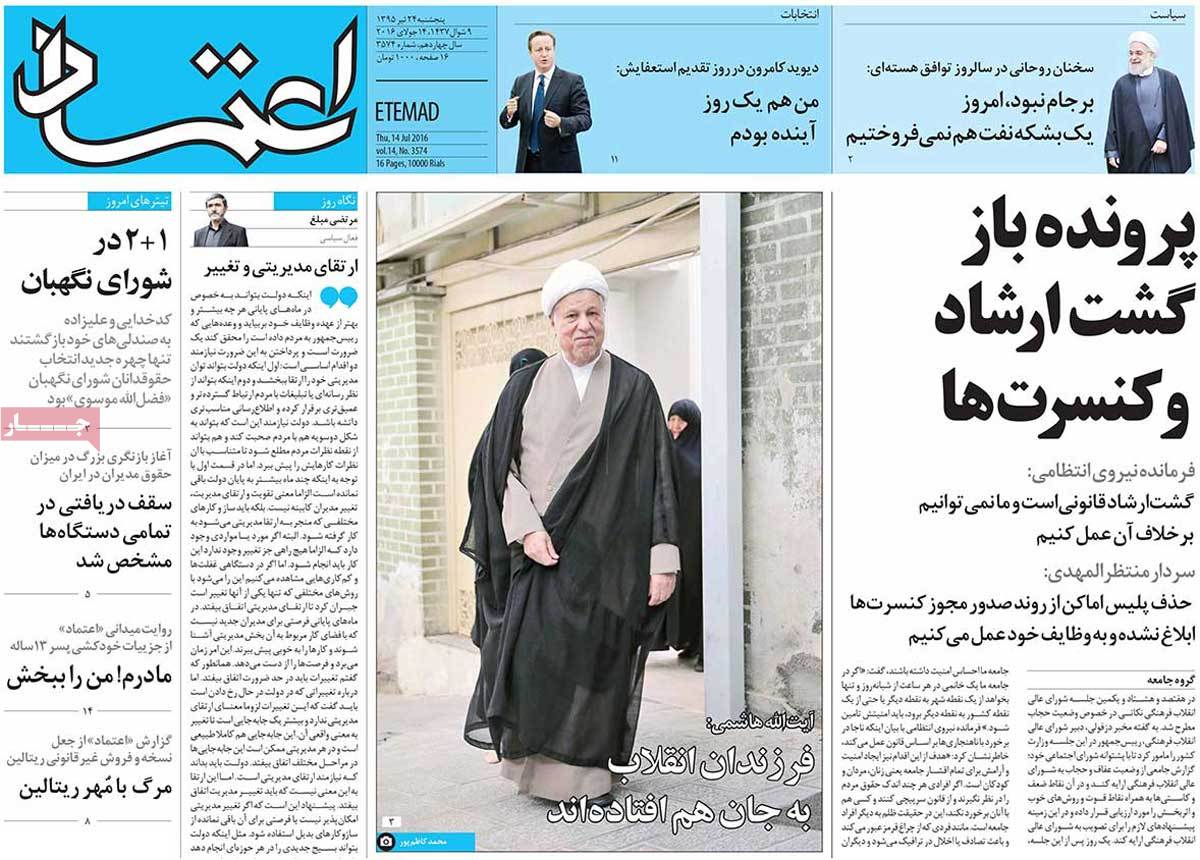
Etemad:

1- 70% of People Are Acting against Law of Ban on Satellite Equipment: Minister; Satellite Law Should Be Revised

2- Changes Begin in Rouhani’s Cabinet: Parliamentary and Legal VPs Will Be Replaced

3- Tehran’s City Council to Veto Mayor’s Financial Authority

A Look at Iranian Newspaper Front Pages on July 13


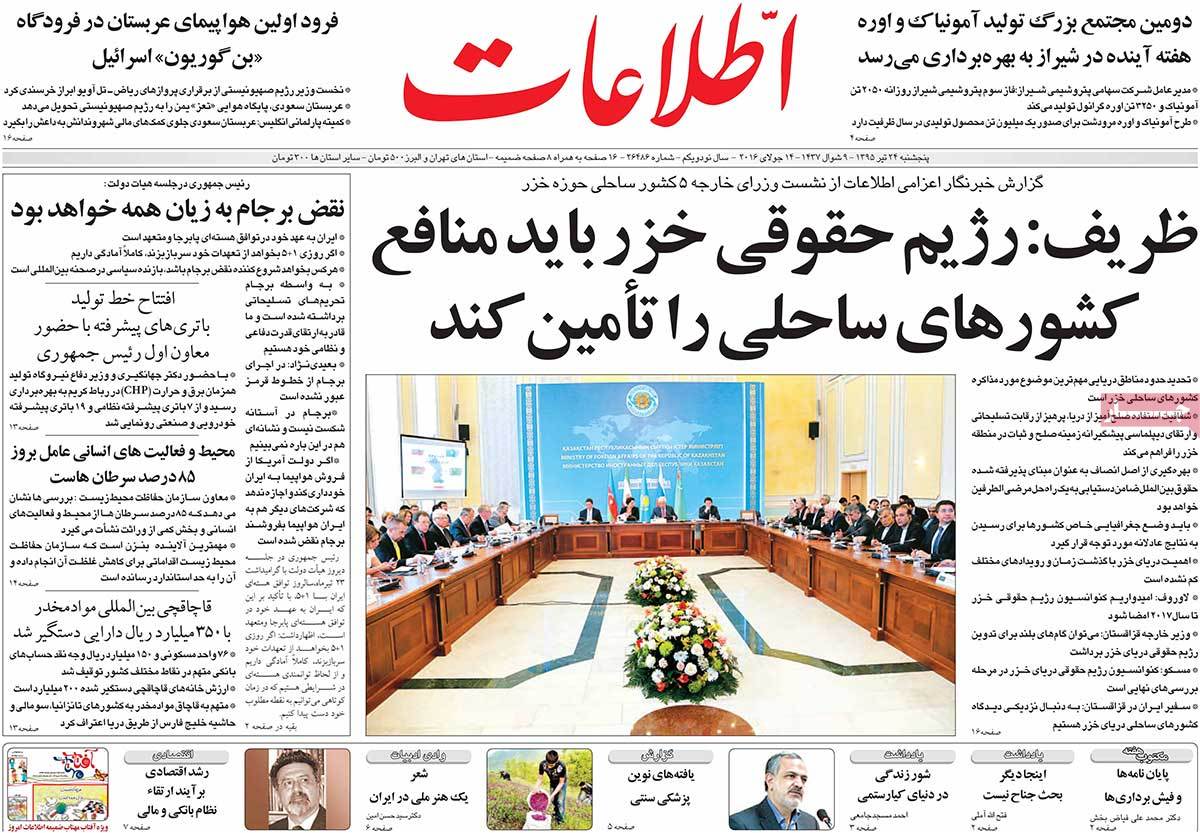
Ettela’at:

1- Doosti [Friendship] Satellite to Be Launched This Year

2- Saudi Cabinet Approves Launch of Direct Flights between Riyadh and Tel Aviv

3- Racism Exists across the US: Biden

A Look at Iranian Newspaper Front Pages on July 13


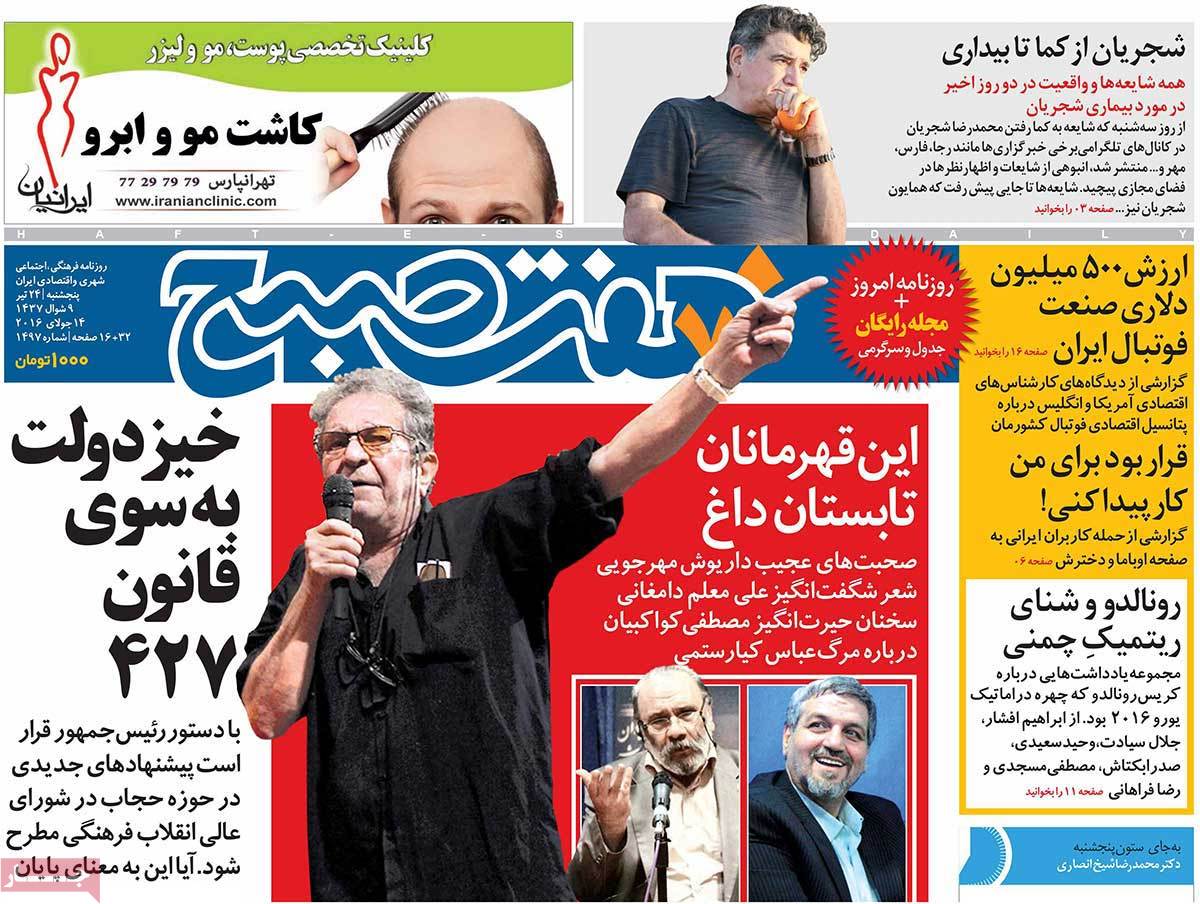
Haft-e Sobh:

1- Is [Culture Minister] Jannati Going to Remove the Ban on Use of Satellite? [Like what Ali Larijani, the then culture minister, did 24 years ago by allowing people to use VHS players]

2- Strong Online Rivals for State TV: A Report on Iranian Internet-Based Shows and Programs

A Look at Iranian Newspaper Front Pages on July 13


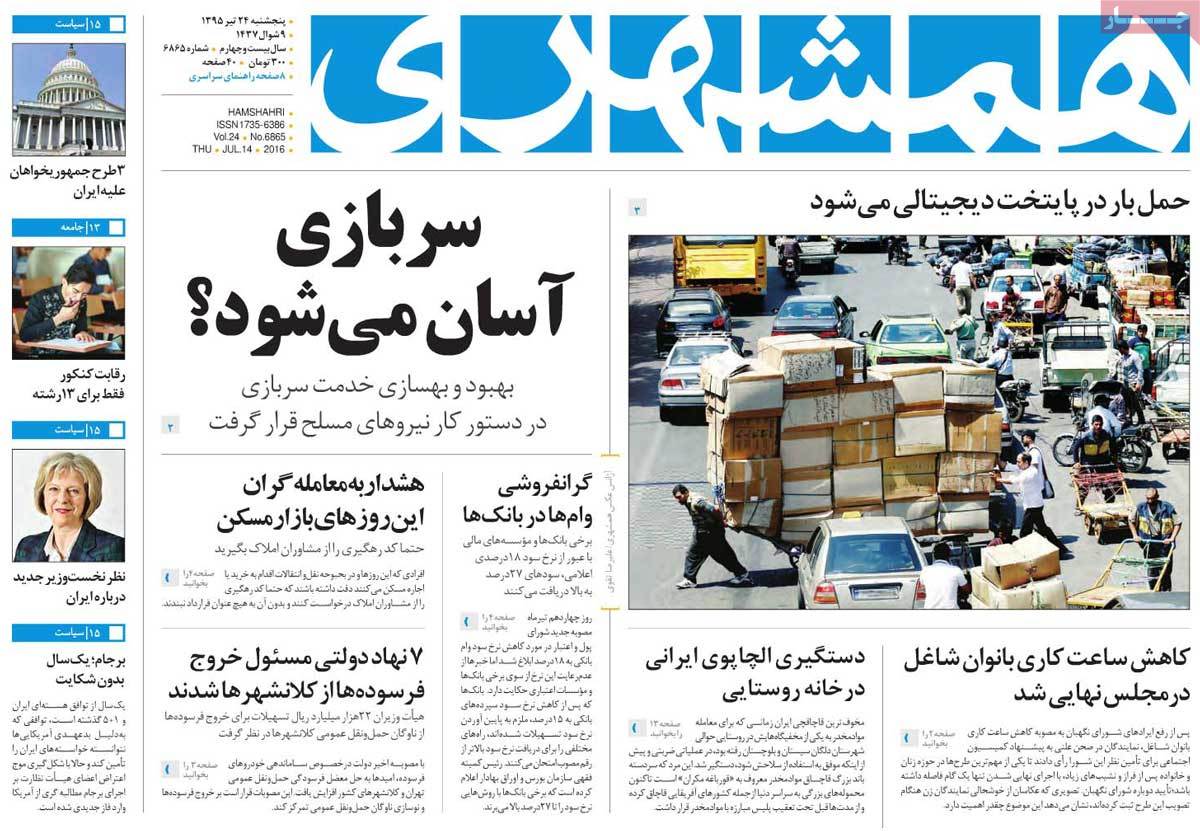
Hamshahri:

1- We Apologize: Government Spokesman in Reaction to Delay in Release of State Contracts

2- New Era in Britain after David Cameron

A Look at Iranian Newspaper Front Pages on July 13


Iran:

1- Post-JCPOA Era: First Anniversary of Nuclear Deal

2- Minister Highlights Need for Revision of Law on Prohibition of Using Satellite Equipment

3- 11 MoUs Signed with Top Oil Companies: Iranian Oil Company Chief

4- Special Schools to Be Established for Married Students

A Look at Iranian Newspaper Front Pages on July 13


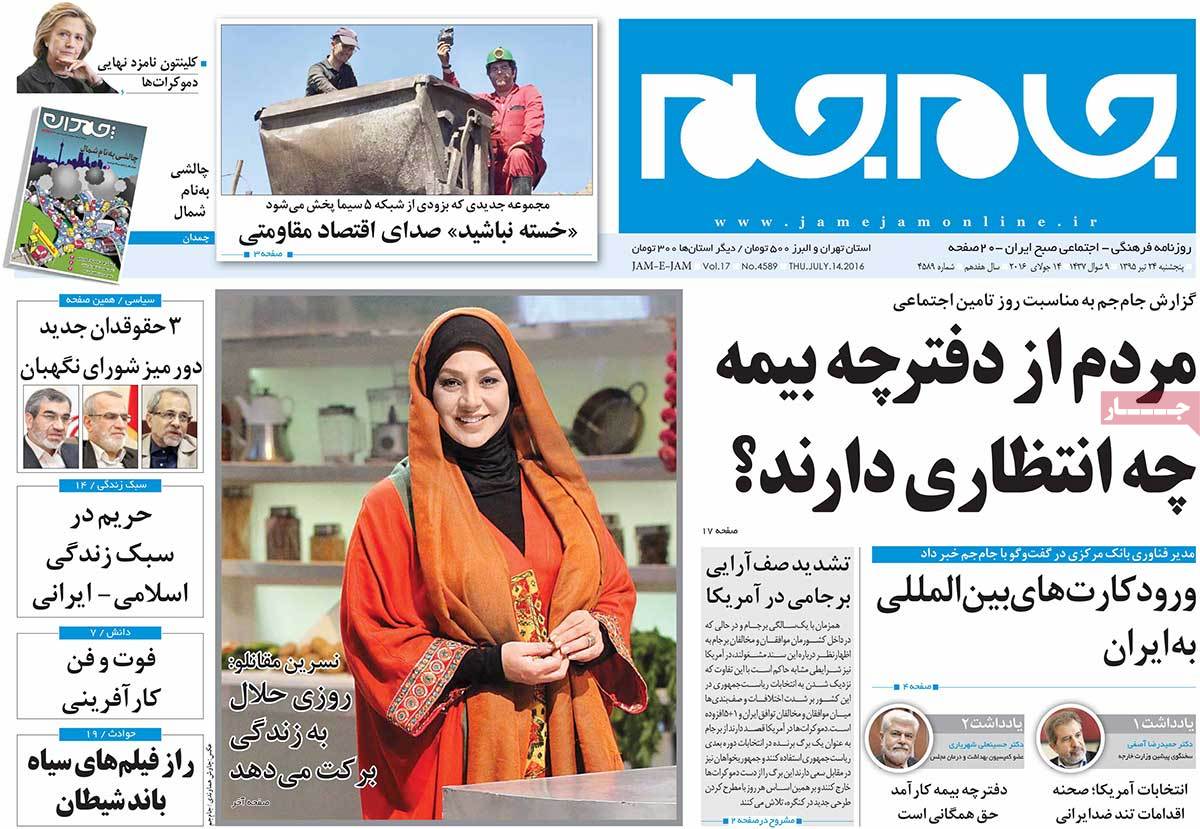
Jame Jam:

1- Fever of University Entrance Exam in 369 Cities: 1,014,000 Applicants to Compete on Thursday and Friday

2- Iraqis Say No to ISIS and the US

A Look at Iranian Newspaper Front Pages on July 13


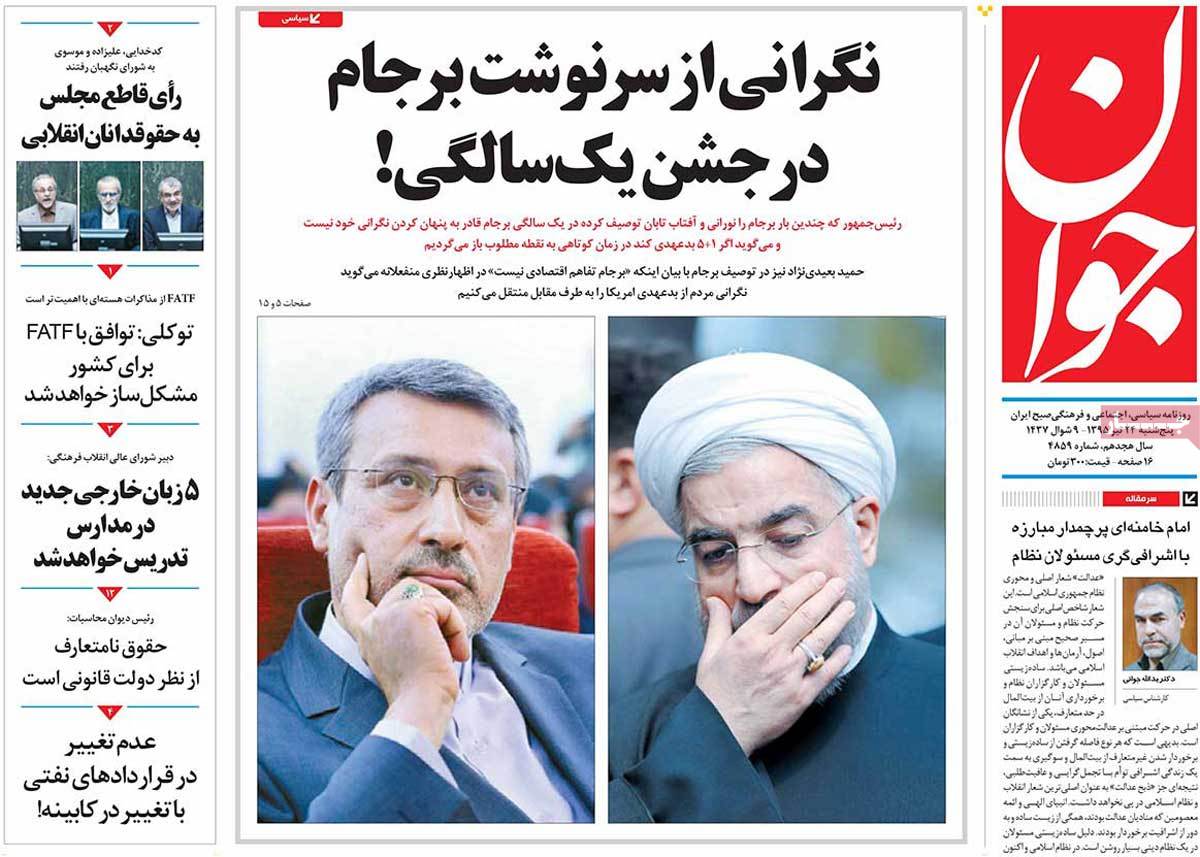
Javan:

1- Araqchi: Not All Sanctions Were Supposed to Be Removed from the First Place!

2- JCPOA Didn’t Change Our Economic Situation: 73% of Iranians

A Look at Iranian Newspaper Front Pages on July 13


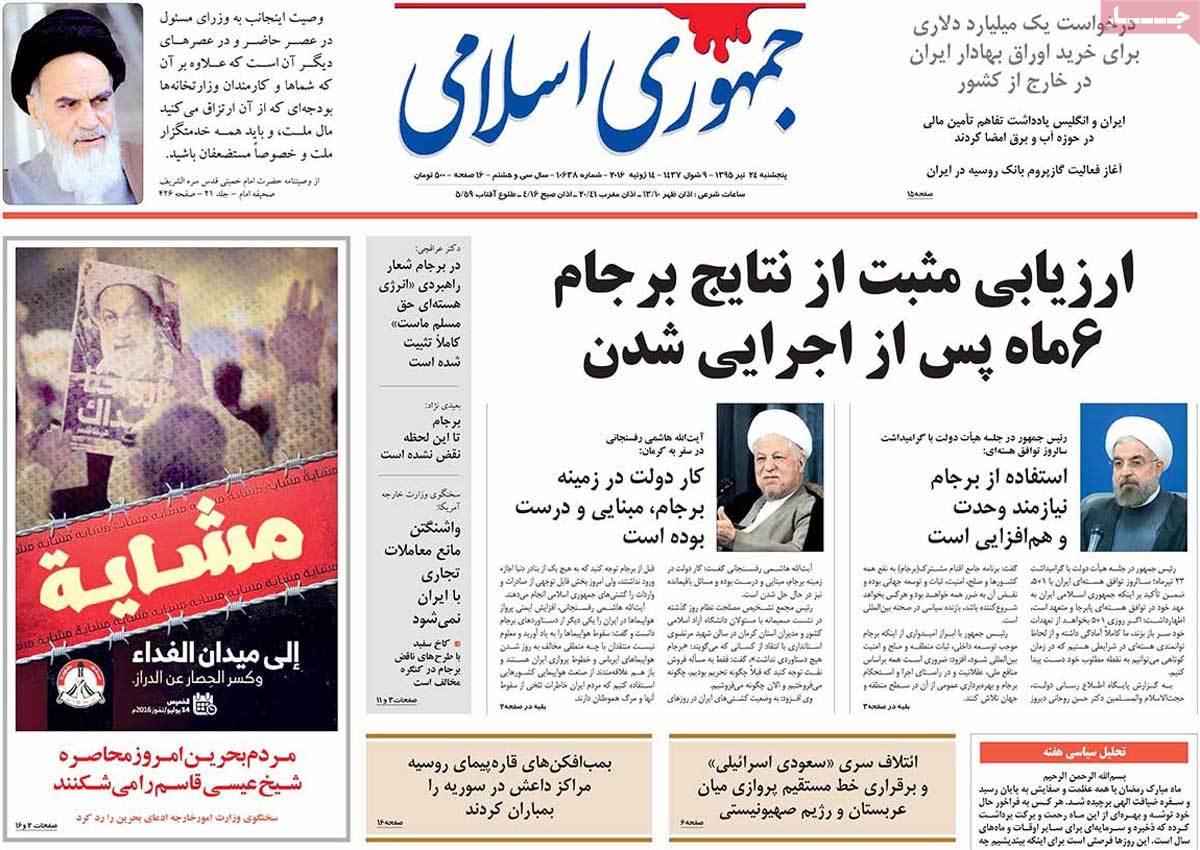
Jomhouri Eslami:

1- More than 100 Foreign Investments Made after JCPOA: Trade Minister

2- US Leadership in the World Is Coming to an End: Brzezinski

3- $5bn Investment Attracted for Development of Iran’s Trade Ports

4- Turki al-Faisal, Like Saddam, Has Tied Its Future to Terrorists: FM

5- Getting away from Iran Will Endanger US Interests: 75 Figures to Obama

A Look at Iranian Newspaper Front Pages on July 13


Kayhan:

1- The “Almost Nothing” Becomes 1 Year Old: Nuclear Technology Is Gone, Sanctions Remain in Place

2- Questionable Speed of Imposing New Oil Contracts on Iran

3- Black People in Germany, Britain, and Canada Express Solidarity with US Protesters

4- Fuss about JCPOA in Oil after the Detrimental JCPOA in Nuclear Issue

A Look at Iranian Newspaper Front Pages on July 13


Khorasan:

1- Iranian People’s Scepticism towards the US Has Increased by 6%

2- Achievements and Concerns: First Anniversary of JCPOA

3- Turkey: We’re Looking for Improvement of Ties with Syria and Iraq

A Look at Iranian Newspaper Front Pages on July 13


Resalat:

1- President: People Are Paying the Price for US Mistakes

2- US Senate and House Jointly Attack JCPOA: 3 Anti-Iran Motions to Be Put to Vote in US House

A Look at Iranian Newspaper Front Pages on July 13


Shargh:

1- Prosecutor General Dismisses Role of His Office in Sending Threatening Messages to Journalists

2- Strange Accusation against Rouhani’s Brother: Hardline MP Accuses Fereydoun of Imitating Rouhani’s Voice

3- Sanders and Clinton Join Hands to Defeat Trump

A Look at Iranian Newspaper Front Pages on July 13


Vaghaye Ettefaghieh:

1- Those Who Attacked Iranian MP in Western Iran Were Foreigners

2- Growing Increase in Number of Critics of Medical Community

3- Parliament’s Reformist Faction Is Opposed to Impeachment of Labour Minister

A Look at Iranian Newspaper Front Pages on July 13


Vatan-e Emrooz:

1- We Warned the Government against Huge Salaries, They Didn’t Pay Attention: Official

2- US Congress to Impose 3 New Sanctions against Iran

3- Astronomical Salaries Didn’t Need Such a Fuss: Minister

A Look at Iranian Newspaper Front Pages on July 13