Friday, January 16, 2026
Home Blog Page 4397

India Has Adopted a Lot from Iranian Culture: Indian Director

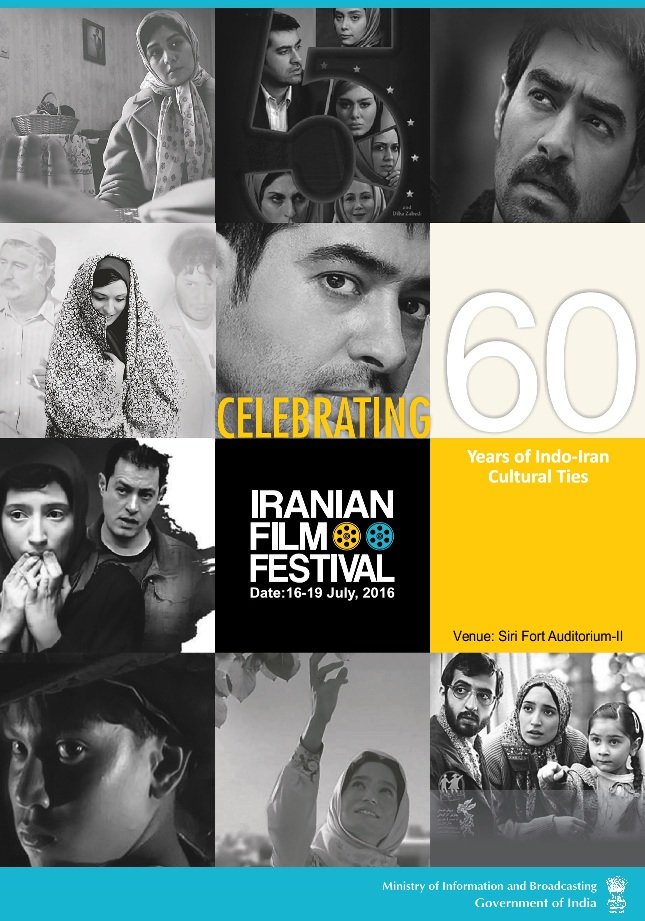
Iranian Film Festival in New Delhi

In an exclusive interview with IRNA during the recent Iranian Film Festival in New Delhi, Sanjay Mitwa said, “India and Iran enjoy strong bilateral relations since many centuries ago and India has adopted a lot from the Iranian culture, especially in the field of handicrafts.”

On his experience about Iranian films, he said, “It was my first chance to attend a festival of Iranian films. As an artist and director, it was a great moment for me to interact with Iranian artists and people. I found close similarity between the Iranian and Indian cultures.”

“So, movies presenting these connections will be successful both in Iran and India and will help the people from both countries know more about each other.” He added.

Movie and music are the strongest means for reinforcing the ties between different nations, Mitwa said, adding, “Art and culture including films and music are not limited to a particular boundary. These have their own languages which are understood by everybody in every country. Art and culture have always played important roles in strengthening the relations between different nations all over the world.”

He said he wishes to produce a joint Iranian-Indian movie.

“I will love to direct and produce a joint Iranian-Indian movie so that the people of the two great countries can understand each other better.”

The recent Iranian Film Festival in New Delhi to mark the 60th anniversary of the establishment of cultural relations between Iran and India was a golden opportunity for the interaction between the two countries’ artists, Mitwa said.

“The four-day event provided a golden platform for artists as well as the art-loving people from both Iran and India to share their rich experiences on movies and cultures.”

“To continue this trend, the Indian government shall organize an Indian film and cultural festival in Iran so that the exchange of art and culture between the two can keep flowing,” he added.

Iranian Official to Saudi Regime: You’ll Finally Come for Talks!

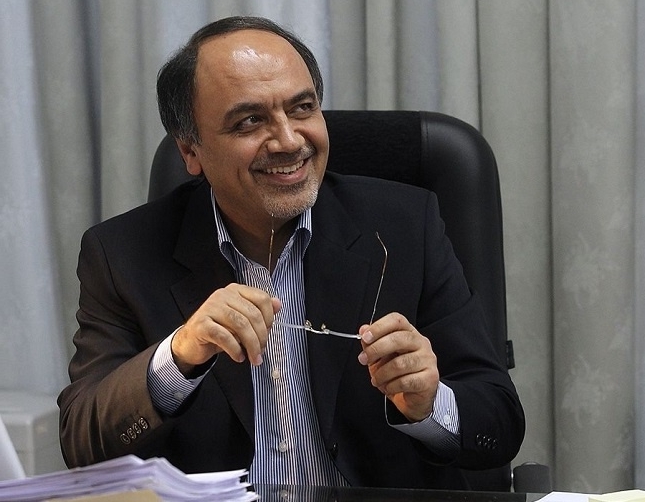
Hamid Aboutalebi, the Iranian President’s Deputy Chief of Staff for Political Affairs

“It will take time for you to come to your knees and run out of oil revenues,” Hamid Aboutalebi, the Iranian President’s Deputy Chief of Staff for Political Affairs, said in his Twitter account on Saturday, July 23.

He went on to say that the heavy cost of supporting terrorism, extremism and massacre will finally make Saudi rulers yield under financial pressure, as reported by KhabarOnline and translated by IFP.

“You were kids when the ‘Memorandum of Advice’ or ‘Muzakirat Al Nasiha’ was written in Medina, based on which you fathers exported extremism and terror and selected Imams for the world.”

“Relations between your fathers and Iran used to be friendly for three decades. When children become ministers, they first of all criticize their own fathers. This is megalomania.”

“We are much patient until the heavy cost of your regional interventions gets you to a critical situation. You will come for talks [at that time],” he stressed.

Aboutalebi made the remarks in reaction to recent anti-Iran statements by the Saudi Foreign Minister Adel al-Jubeir. During a recent speech about terrorism at the Egmont Research Centre in Brussels, Jubeir made some allegations against Iran, claiming that Tehran supports terrorism.

Zarif’s Different Visit to Africa in Post-JCPOA Era

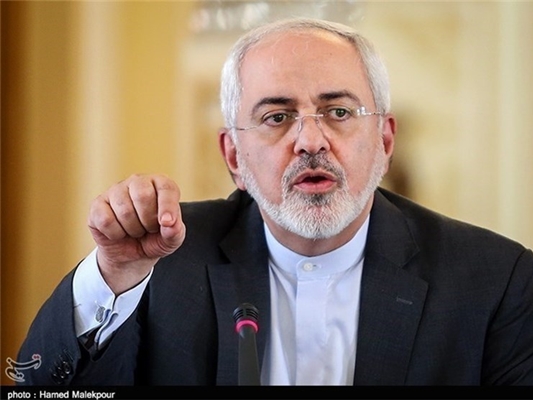
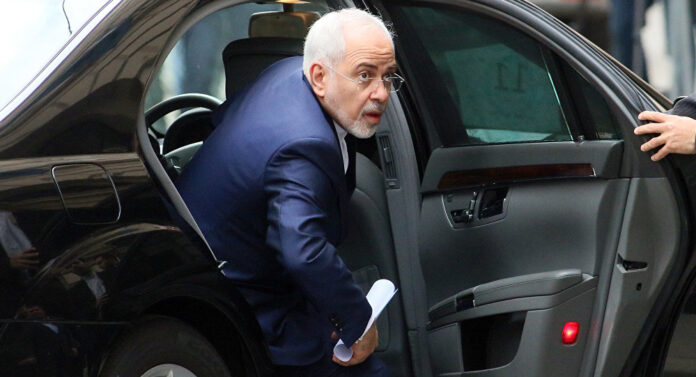
Mohammad Jazad Zarif
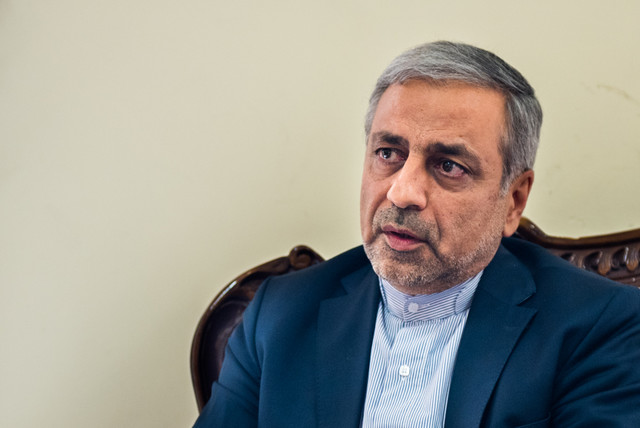
Hossein Molla-Abdollahi, the Director-General of Africa Department at the Iranian Foreign Ministry

Hossein Molla-Abdollahi, the Director-General of Africa Department at the Iranian Foreign Ministry, underlined the importance of Foreign Minister Mohammad Javad Zarif’s upcoming visit to Africa, and stressed that the positive atmosphere created after the nuclear deal makes the visit different from the previous one.

Here is IFP’s translation of excerpts from Molla-Abdollahi’s interview with ISNA:


Zarif will start his first tour of African nations after the JCPOA on July 24, and the visit will end on July 29.

“The visit is of a special importance, because it is made in a positive and different atmosphere compared with the ones made before the nuclear deal,” Molla-Abdollahi said.

“JCPOA has provided Iran with good opportunities to increase its interaction with different countries and promote mutual cooperation.”

“African countries are no exception, and we need to tap into the numerous opportunities created by the JCPOA for the country’s foreign policies quickly and accurately,” he went on to say.

“In his six-day trip, the Foreign Minister will pay official visits to Nigeria, Ghana, Guinea, and Mali in western Africa.”

During the visits, which are paid at the invitation of Zarif’s African counterparts, the Foreign Minister will hold meetings with these countries’ high-ranking officials to discuss bilateral, regional, and international ties.

“Given the importance of economic issues and increased business cooperation with these countries, a huge economic delegation including executives from public and private sectors will accompany Zarif in this tour.”

“One-day Economic Assemblies will be held in each of the countries visited by Zarif,” he noted, adding that Iranian businessmen and the foreign ministers both countries will have the chance to explore the avenues for promoting economic cooperation.

“During the visits to the four African countries, if new agreements are reached for the expansion of mutual cooperation, the two sides will sign it in the form of Memorandums of Understanding (MoUs),” he added.

Molla-Abdollahi further referred to Zarif’s first tour of Africa before the nuclear deal in winter 2014, and noted that the Iranian top diplomat had visited Kenya, Ugandan, Tanzania, Zanzibar, and Burundi in eastern Africa at that time.

“During the 2014 African tour, the Foreign Minister conferred with the high-ranking officials of these countries on the reinforcement of mutual, regional, and international cooperation.”

Molla-Abdollahi further expressed regret that the cruel anti-Iran sanctions in recent years have severely damaged Tehran’s economic relations with African countries.

He also expressed his hope that the Islamic Republic’s economic cooperation with African countries would be reinforced one again given the positive atmosphere created after the JCPOA and the removal of banking, insurance, and transport barriers caused by the sanctions.

A “considerable growth” is expected in the trade ties between Iran and African nations given the current situation, he went on to say.

Iran Taking Final Steps to Sell 40 Tons of Heavy Water to Russia: Nuclear Chief

Salehi

Speaking to the Islamic Republic of Iran Broadcasting (IRIB) on Saturday, Salehi said several rounds of talks have been held between the deputy head of the AEOI, Behrouz Kamalvandi, and his Russian counterparts in Moscow or Tehran on the heavy water deal.

“The final steps to sell Russia 40 tons of the heavy water produced by our country have been taken and its contract will be signed soon,” he noted.

The Iranian official also said that either Kamalvandi will take a trip to Moscow to reach a conclusion on the deal or the Russians will come to Tehran to follow up on the issue.

Earlier this week, Russian Foreign Ministry’s Deputy Political Director Alexey Karpov said Moscow is prepared to buy heavy water from Iran in an attempt to assist Tehran meet its commitments under the Joint Comprehensive Plan of Action (JCPOA), a nuclear deal finalized between Iran and world powers in 2015.

Tehran does not have surplus heavy water stores at present, Karpov said at the second session of a joint commission meeting after implementation of the JCPOA in the Austrian city of Vienna.

The meeting, held at Coburg Hotel, was attended by representatives of Iran and the Group 5+1 (Russia, China, the US, Britain, France and Germany).

“We are ready to assist Iran in this area through purchases of necessary amounts of this material, although this issue has not been discussed in detail so far,” the Russian diplomat added as cited by Sputnik.

Under the terms of the nuclear agreement, Iran should keep its stock of heavy water below 130 tons.

All nuclear-related sanctions imposed on Iran were terminated after Tehran and six world powers reached the nuclear agreement on July 14, 2015 and started implementing it on January 16.

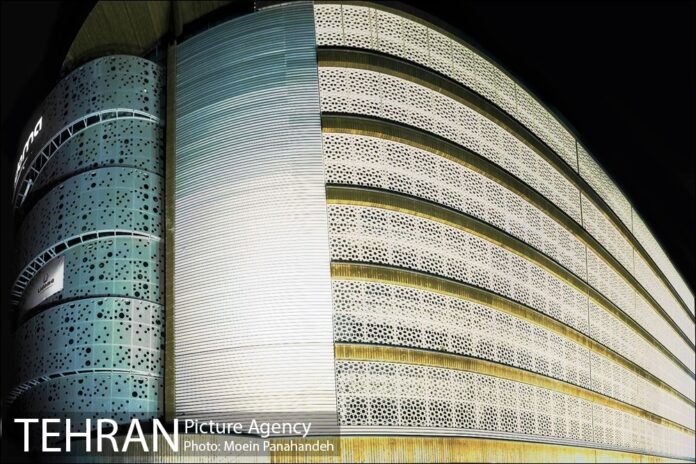
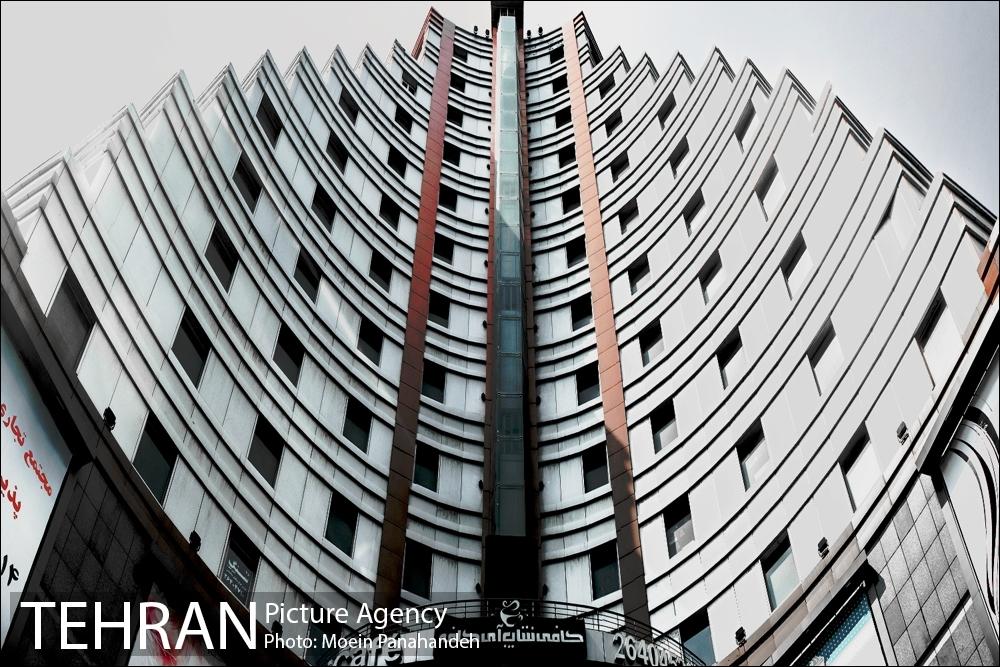
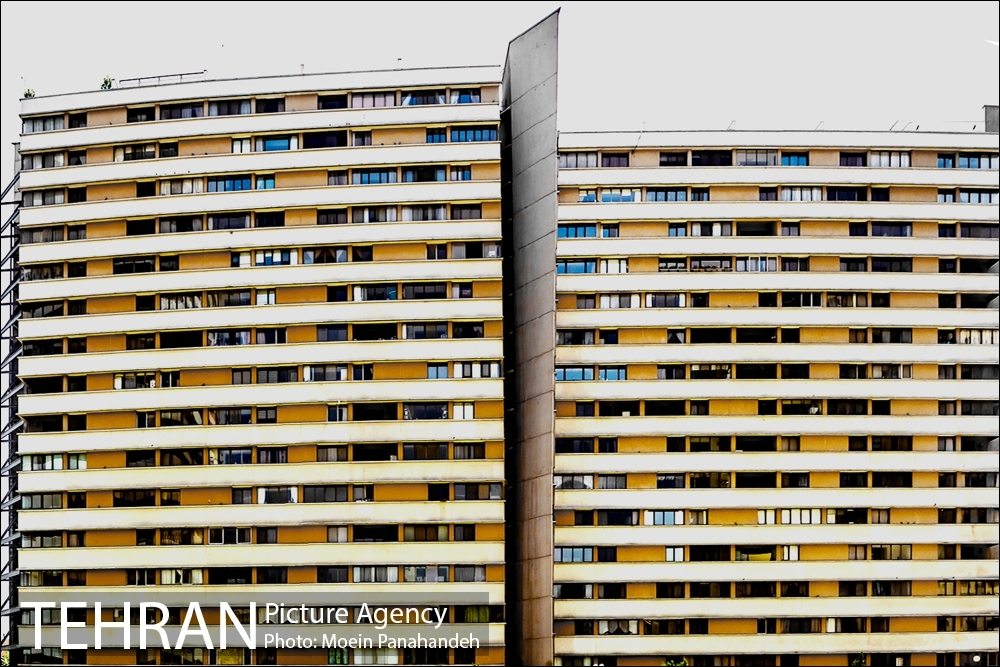
Urban Architecture of Tehran

Architecture- Tehran

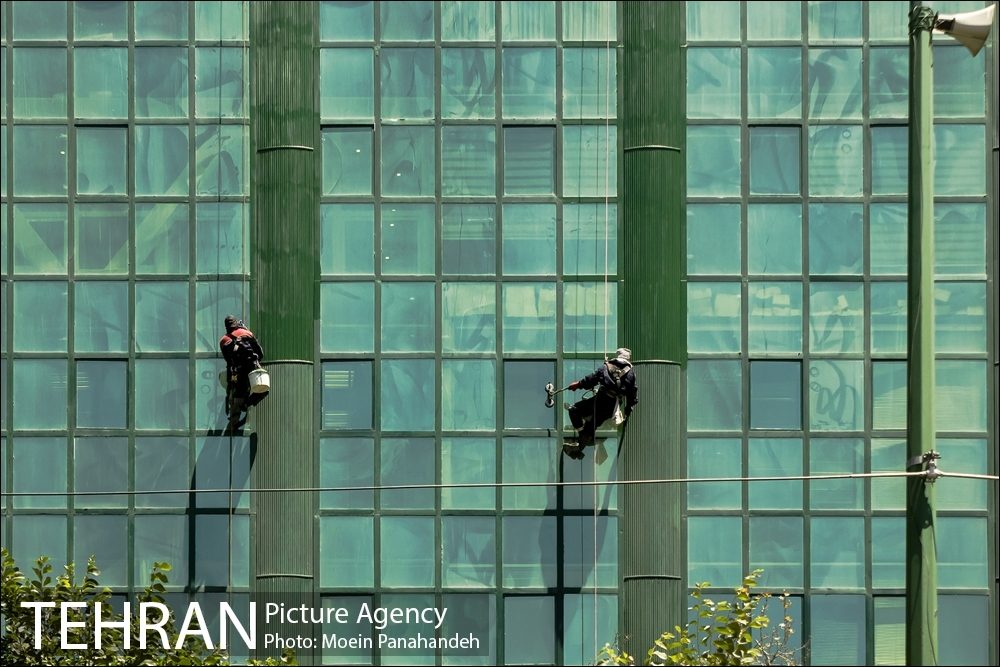
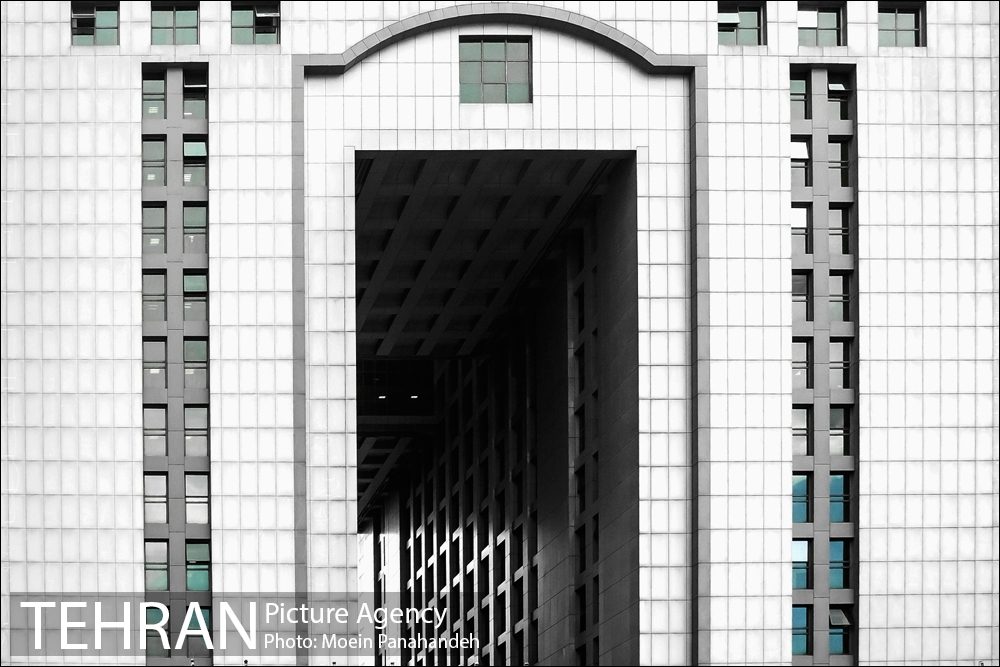
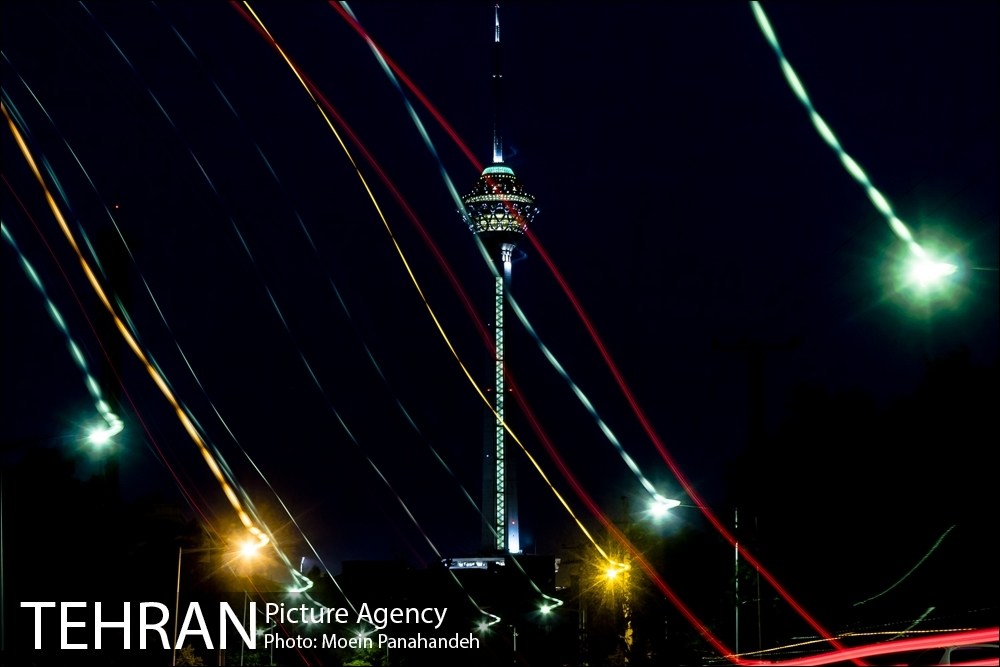
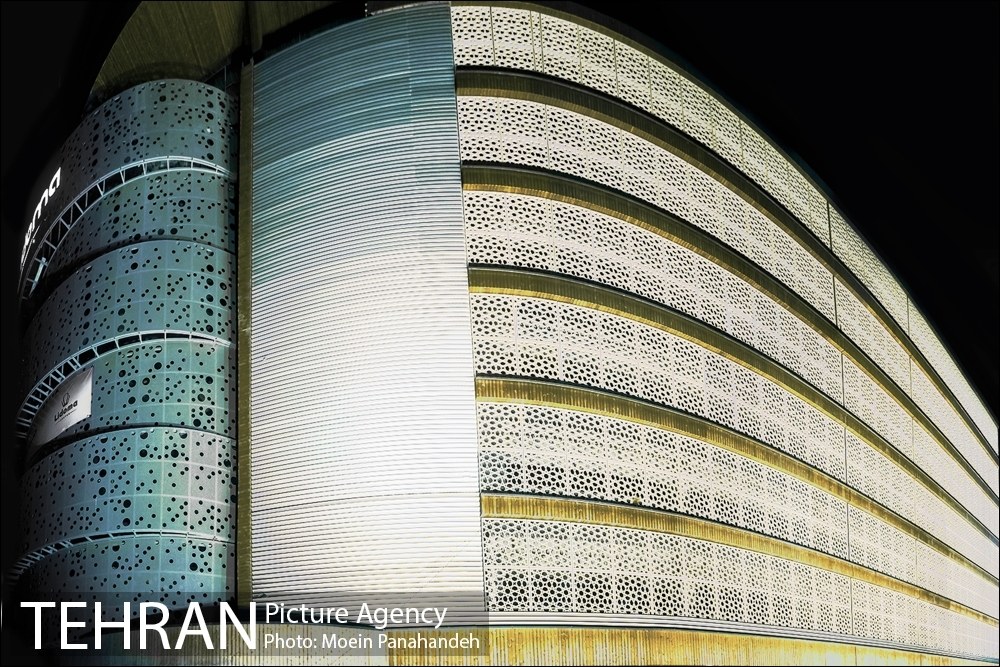
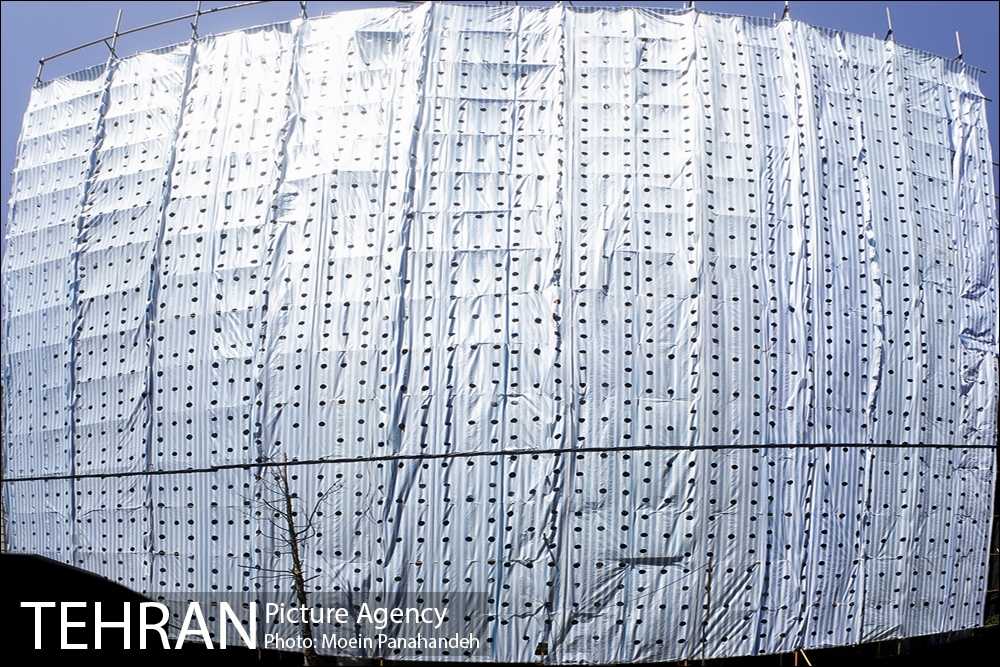
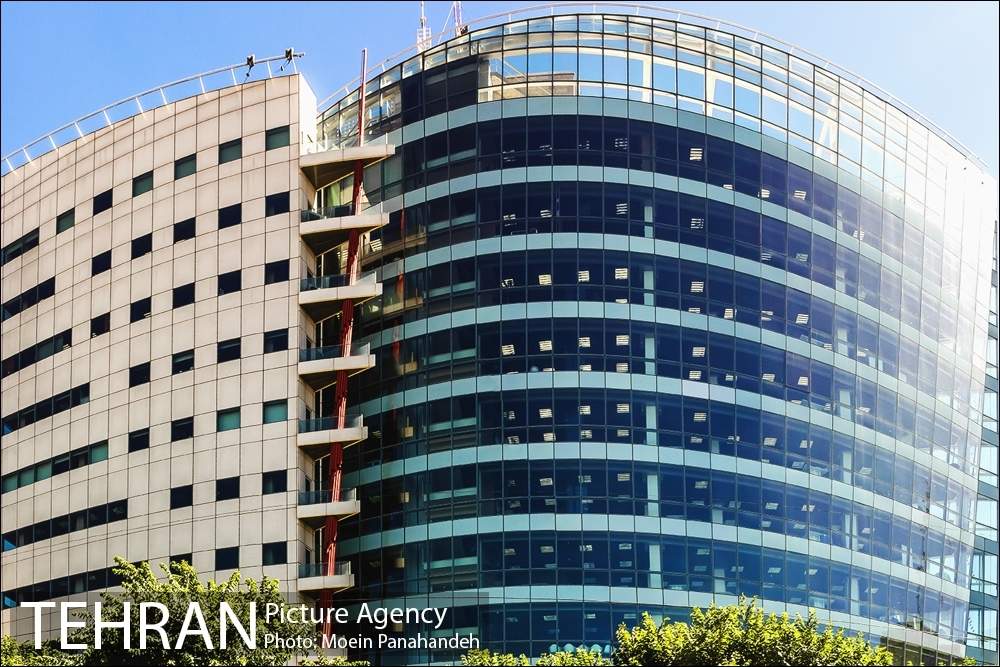
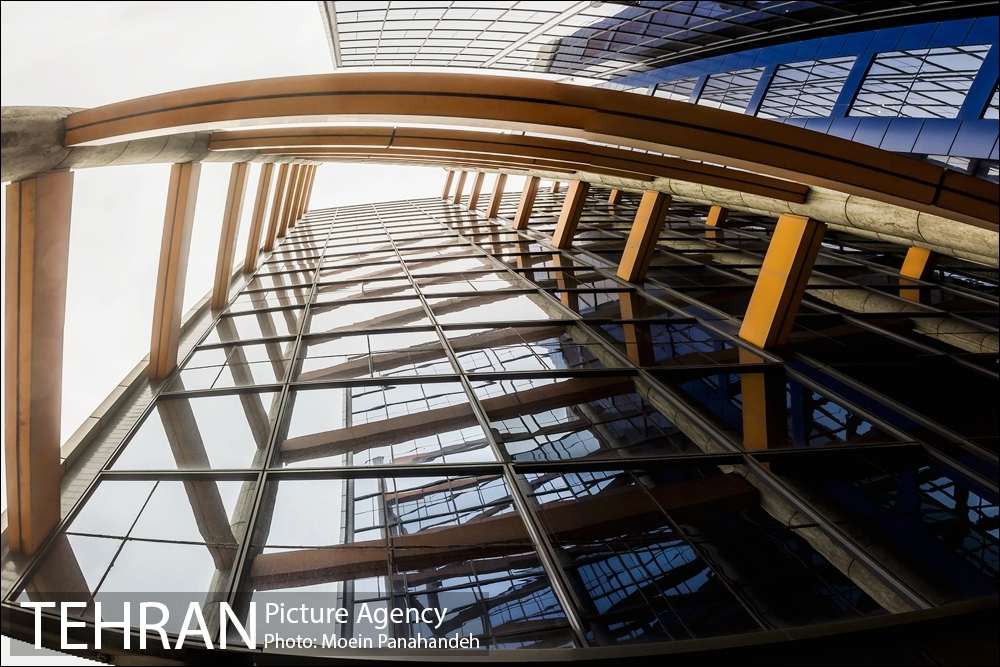
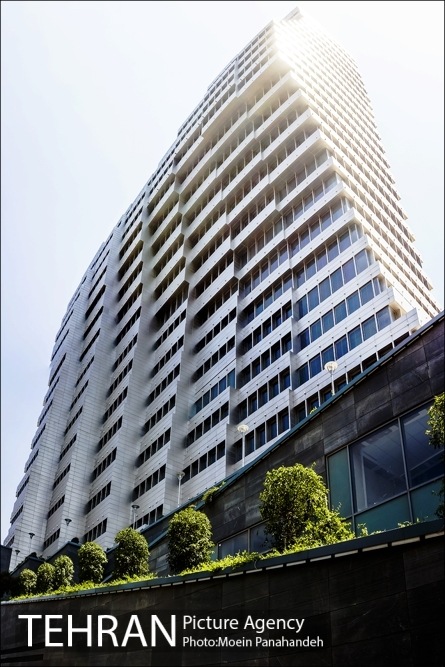
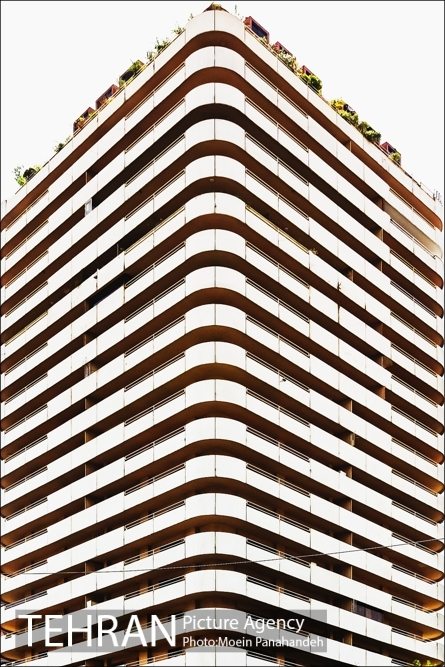
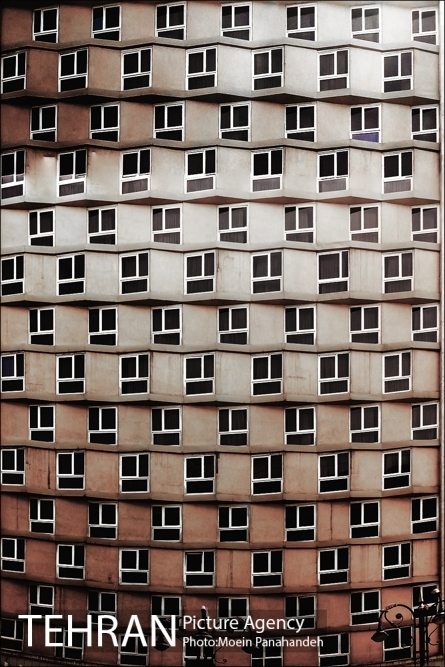
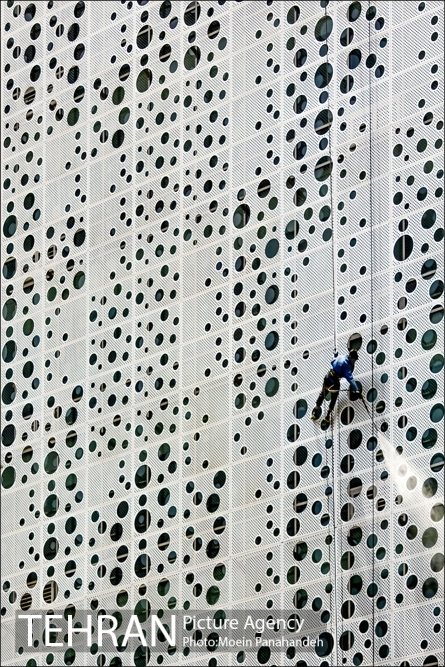
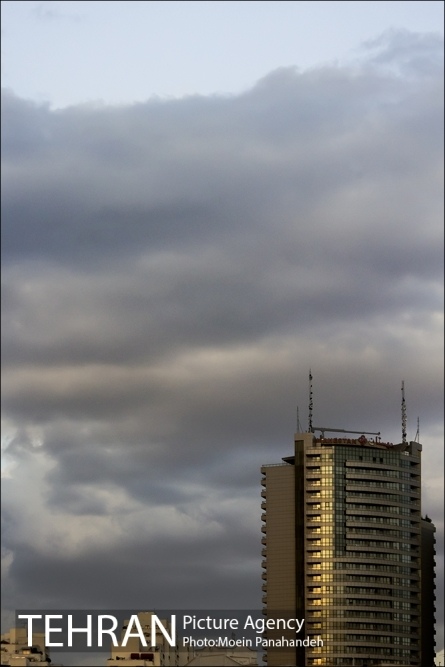
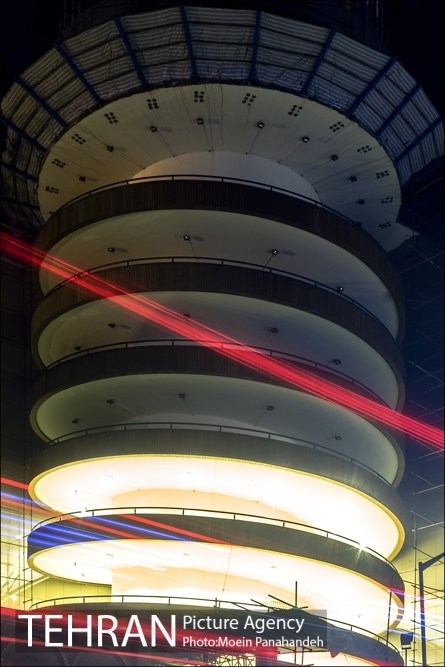
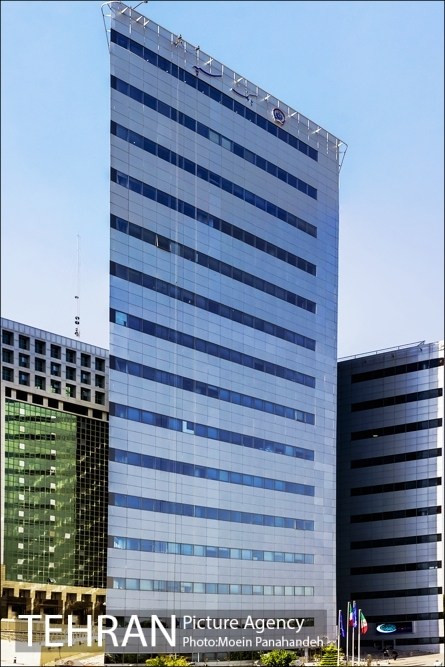
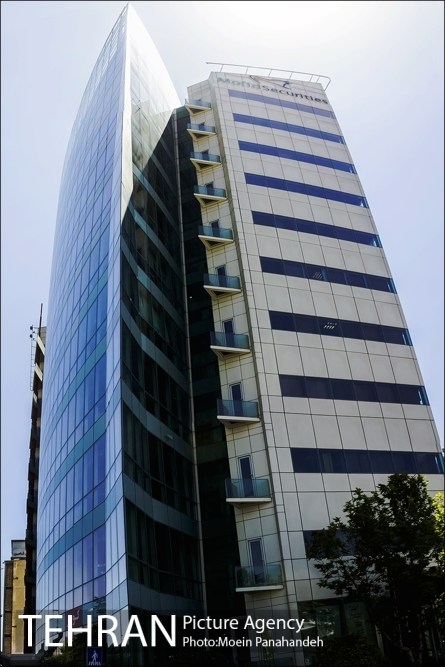
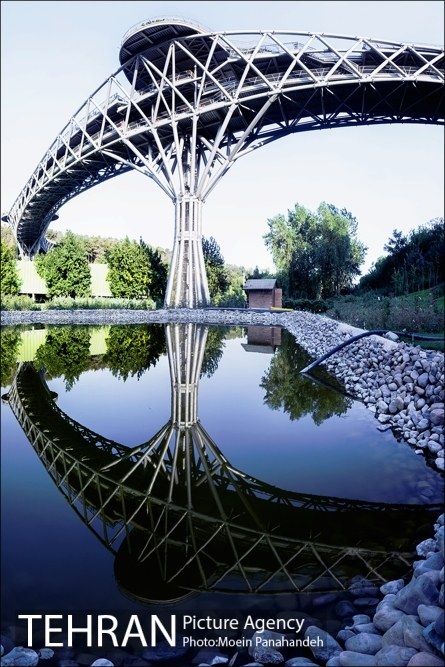
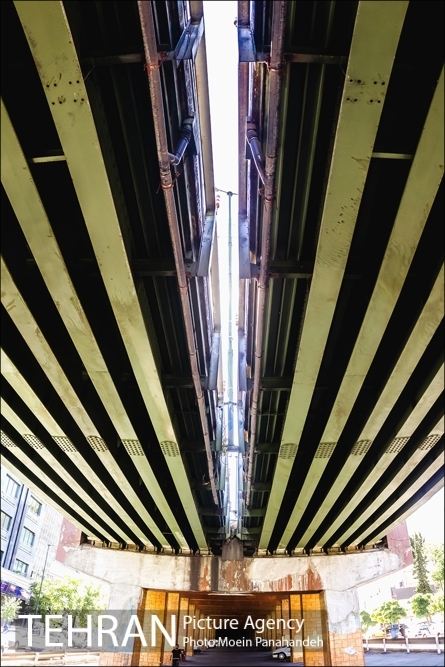
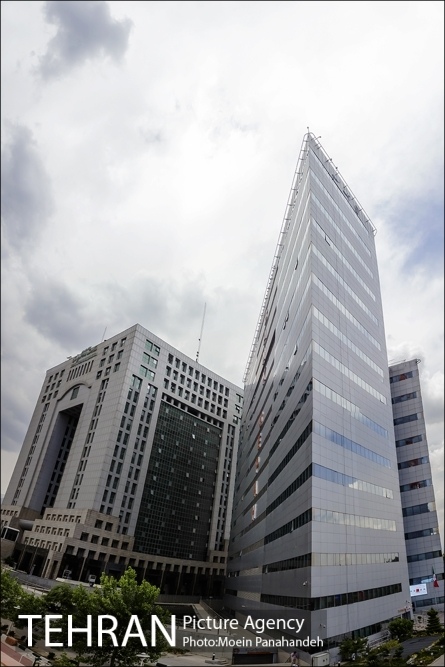
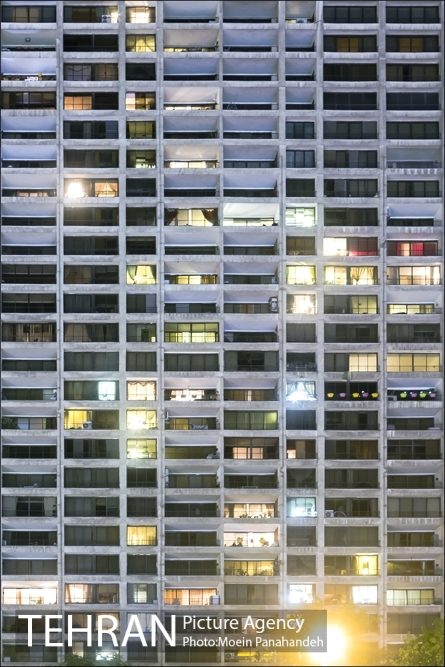
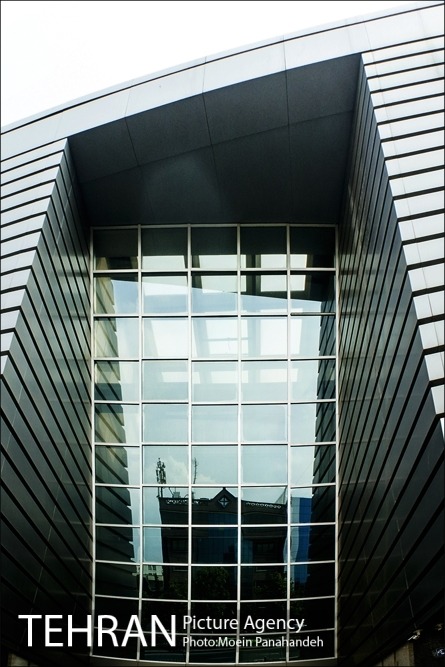
As the capital city, Tehran was introduced with symbols of modernism sooner than other Iranian cities. Modern architecture was one of these symbols.

The evolution of Tehran’s architecture from traditional to modern styles started under the reign of Nassereddin Shah of Qajar Dynasty. The changes have lingered on up to now.

Tehran Picture has published photos of modern buildings in Tehran.


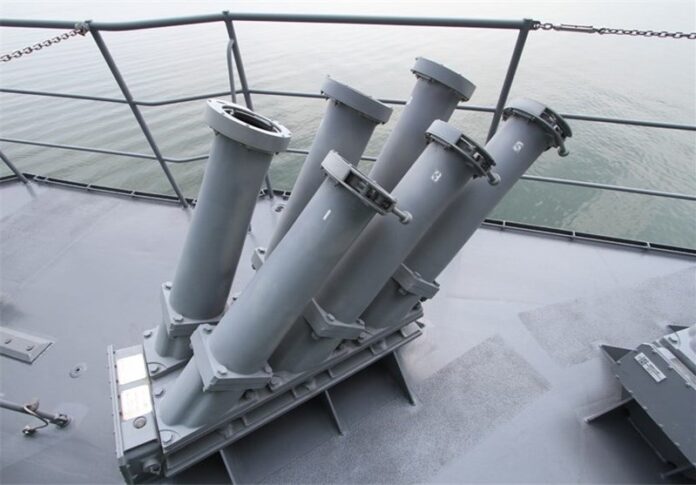
Iran Navy Vessels Equipped with Chaff Anti-Missile System

Anti-Missile System

The commander told Tasnim on Saturday that the Chaff system has been installed on all of the country’s missile-launching warships and destroyers, including Damavand.

He said the anti-missile system became operational after undergoing successful tests.

Chaff is a radar countermeasure in which the target –a ship or an aircraft- spreads a cloud of small, thin pieces of aluminum or other material, which either appears as a cluster of primary targets on radar screens or swamps the screen with multiple returns.

The steel shower is composed of radar-reflective metal that confuses the missile.

Iranian military experts and technicians have in recent years made great headways in manufacturing a broad range of indigenous equipment, making the armed forces self-sufficient in the arms sphere.

Tehran has repeatedly stated that its military might is defensive in nature and poses no threat to other countries.

A Look at Iranian Newspaper Front Pages on July 23

Iran Newspaper front pages

Many newspapers on Saturday covered the recent capture of terrorist elements in southeastern Iran, who had dug a tunnel to explode Iranian military sites.

Only three newspapers, Arman-e Emrooz, Etemad, and Shargh, managed to cover the late night shooting incident in Munich, Germany, in their second prints.

The Turkish President Recep Tayyip Erdogan’s crackdown on his opponents also remained a top story.

Newspapers also covered the ongoing conflict between the Iranian government and the Armed Forces over the role of Police in controlling concerts. In an official order, the government said the Police should only control the traffic jam and have no right to interfere in the performances; however, the Armed Forces told the Police to continue its duties.

The above issues as well as many more are covered in the following headlines:


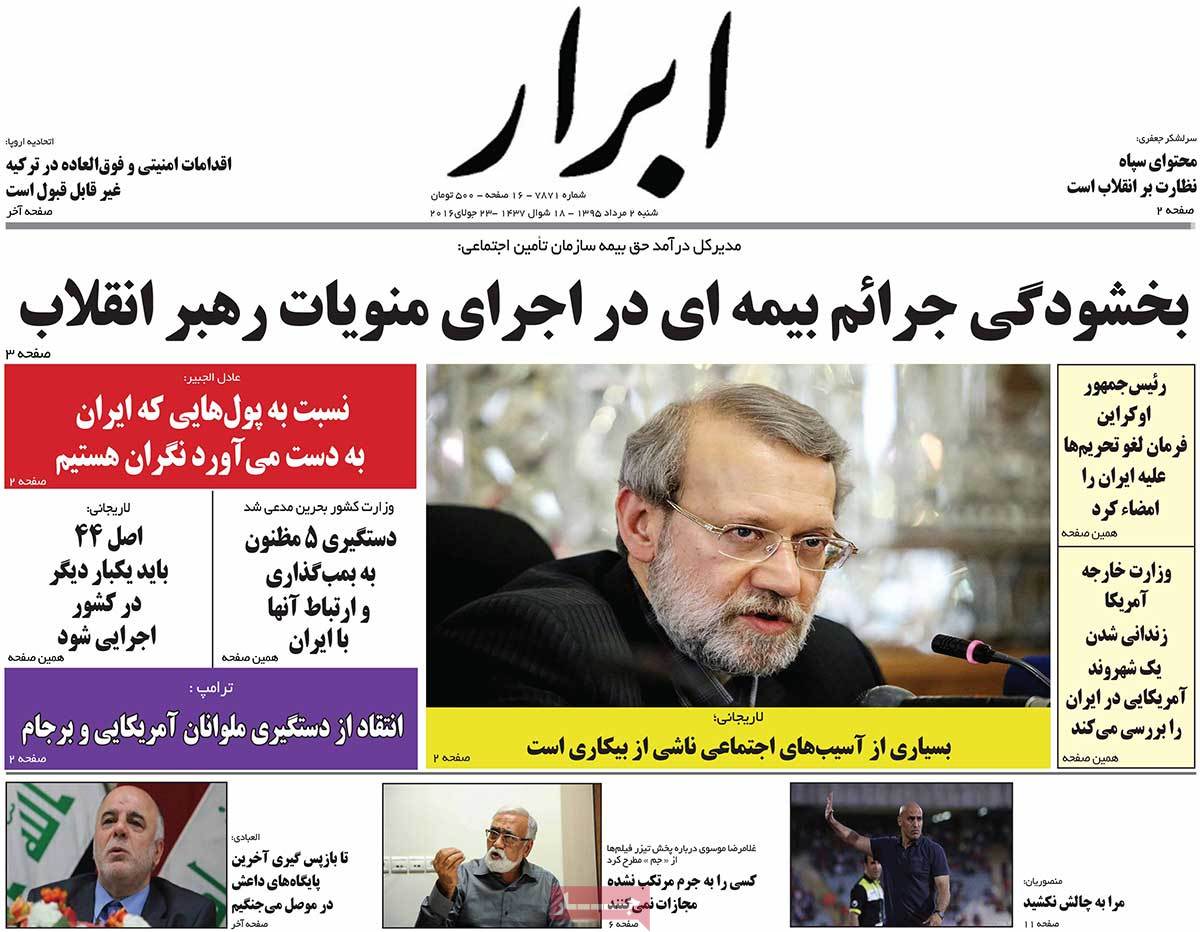
Abrar:

1- Ukrainian President Signs Order for Removal of Anti-Iran Sanctions

2- Saudi FM: We’re Worried about Money that Iran Receives

3- Trump Criticizes Arrest of US Sailors and JCPOA

4- US State Dept. Mulling Imprisonment of US Citizen in Iran
A Look at Iranian Newspaper Front Pages on July 23


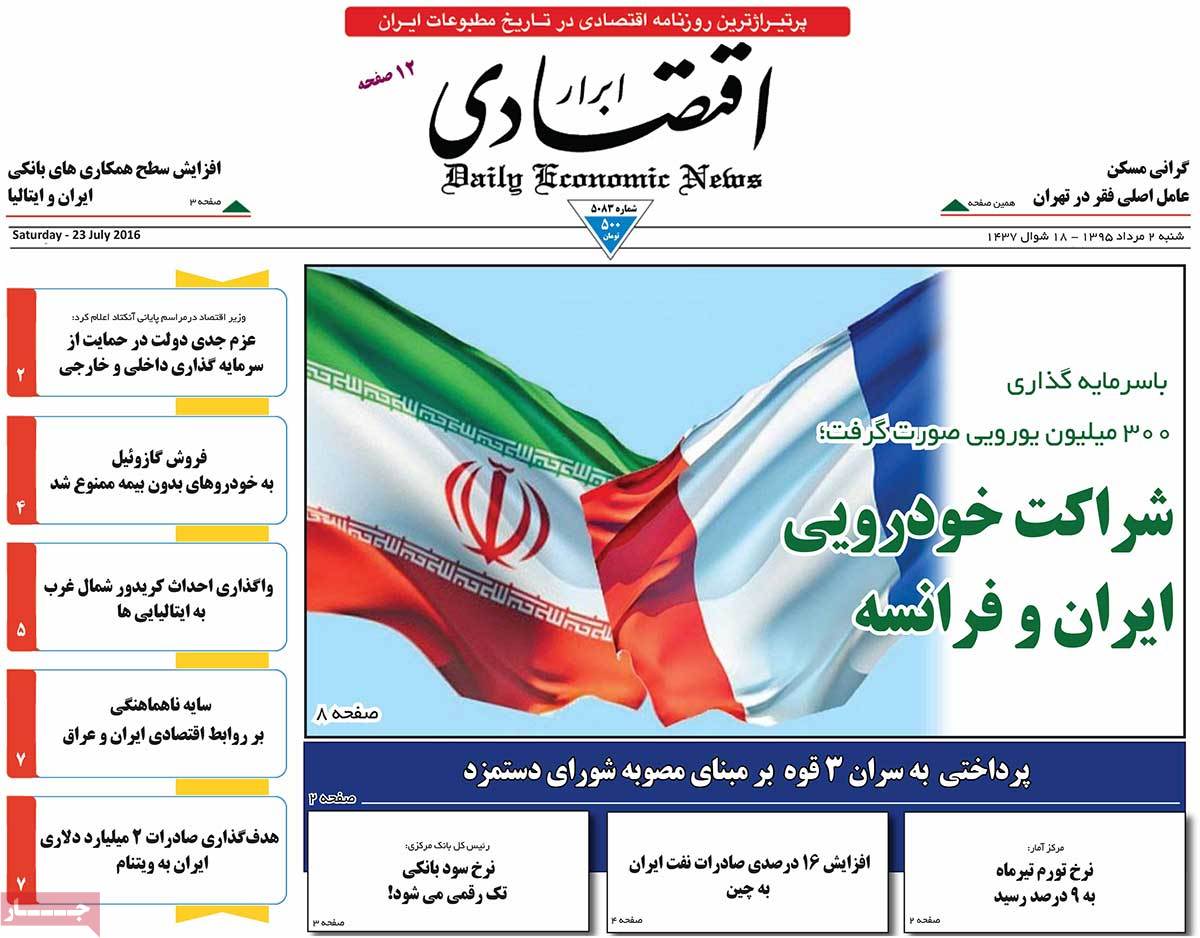
Abrar-e Eqtesadi:

1- Iran-France Car Cooperation

2- Increase in Level of Iran-Italy Banking Cooperation

3- Government’s Serious Resolve in Supporting Domestic and Foreign Investments

4- Lack of Coordination in Iran-Iraq Economic Ties

5- Iran Targets $2bn Exports to Vietnam

6- 16% Increase in Iran’s Oil Exports to China
A Look at Iranian Newspaper Front Pages on July 23


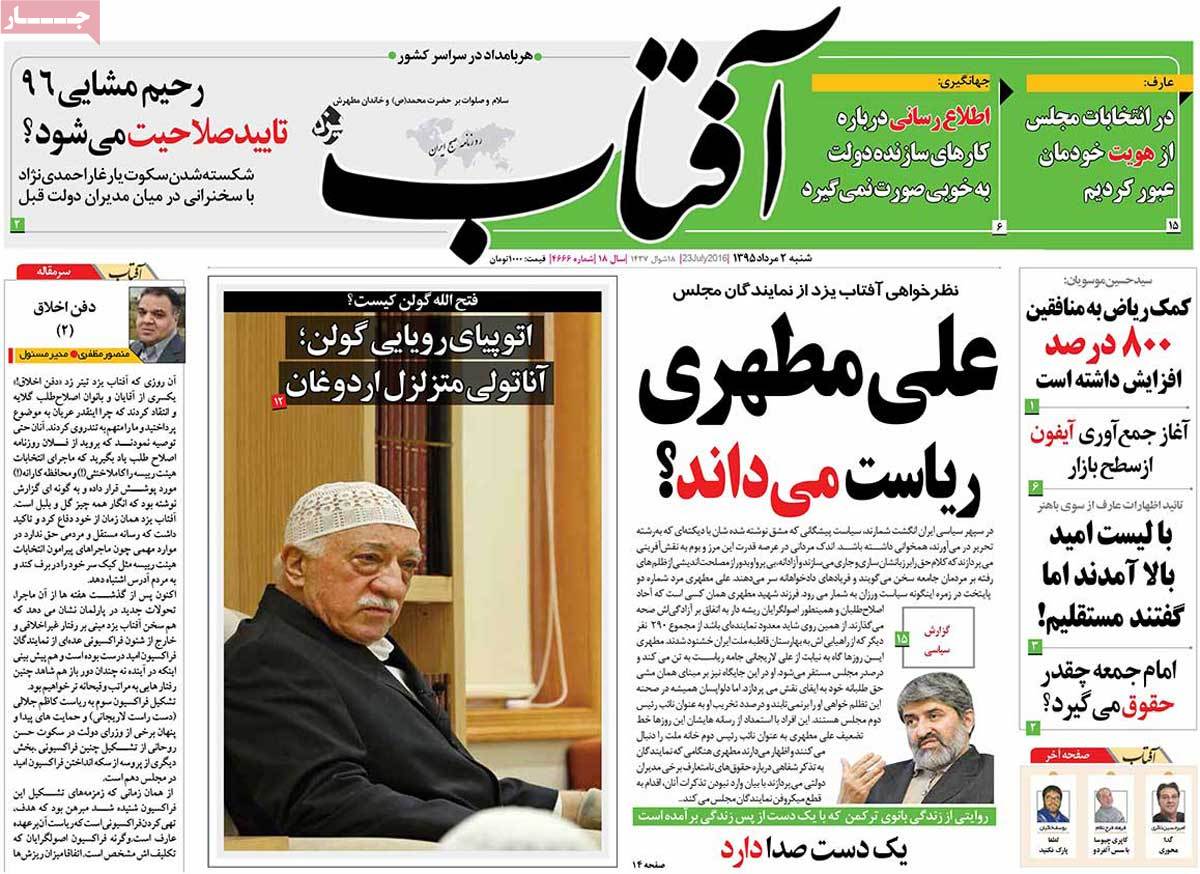
Aftab-e Yazd:

1- Gulen’s Dreamy Utopia: Erdogan’s Shaky Anatolia

2- 800% Increase in Riyadh’s Aid to MKO Terrorist Group: Mousavian
A Look at Iranian Newspaper Front Pages on July 23


Arman-e Emrooz:

1- 40 Arrested in Operation to Seize Terrorist Tunnel

2- Peugeot Signs Deal with Saipa as Well: First Co-Product Slated for 2017

3- Ahmadinejad and His Companions Start Campaigns for 2017 Presidential Elections

4- Shooting in a Shopping Centre in Munich: From 6 to 15 People Dead

5- Senior MP Motahari: We Don’t Have Parties [in Our Political System], So a Person Becomes President after Only 2 Years of Being a Mayor [Ahmadinejad]
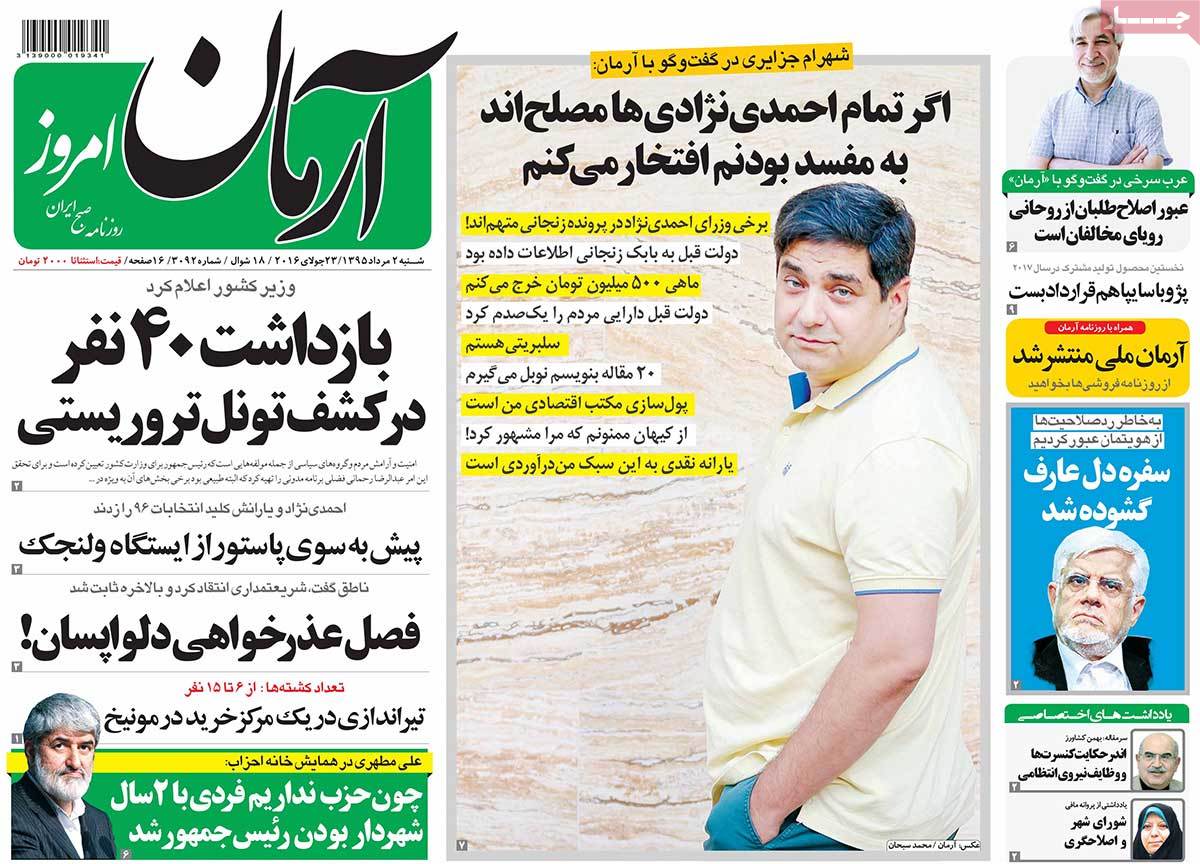
A Look at Iranian Newspaper Front Pages on July 23


Emtiaz:

1- IRGC Official Elaborates on Explosion of Truck Carrying Ammunition

2- Train Collides with Truck in Mazandaran

3- Armed Forces Spokesman Underlines Need for Confronting Unethical Behaviours in Concerts
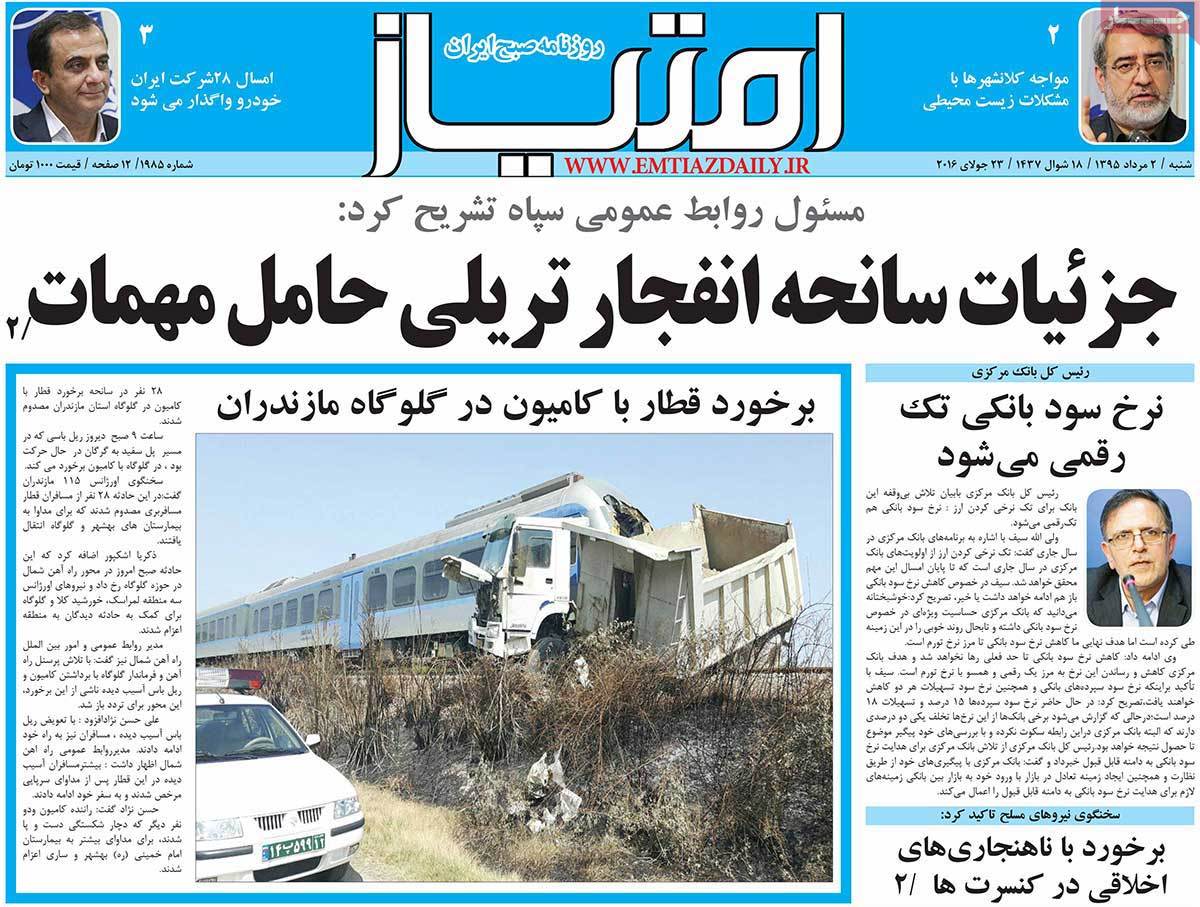
A Look at Iranian Newspaper Front Pages on July 23


Etemad:

1- Even Communists Can Establish Parties and Be Active in Iran: Vice-Speaker

2- New Station of Terror: Munich

3- Organization of Ahmadinejad Supporters
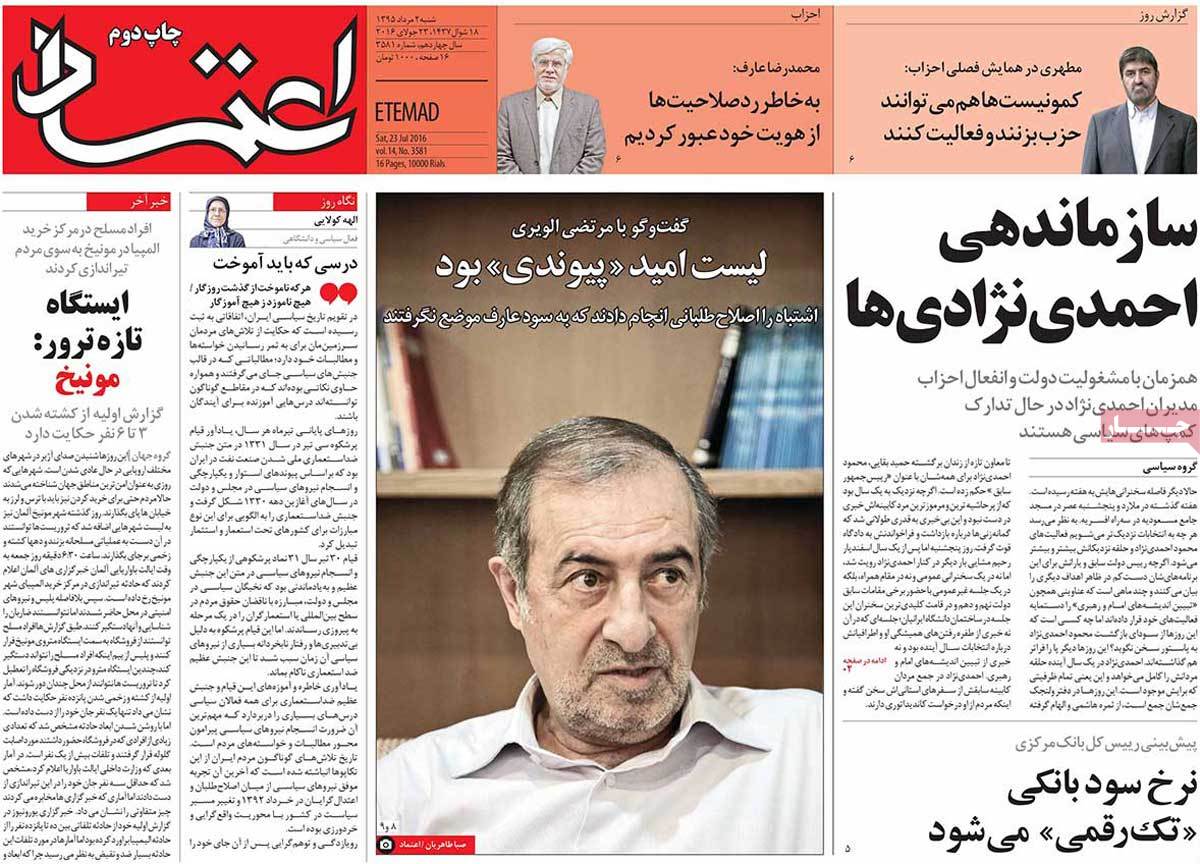
A Look at Iranian Newspaper Front Pages on July 23


Ettela’at:

1- We Won’t Let Terrorists and Bandits Make Any Move inside Iran’s Borders: Interior Minister

2- 13 Senior Government Executives Dismissed: Spokesman

3- Inflation Rate in Iran Decreased to 9%

4- Iran’s Stability Is Decisive for Regional Security: Velayati

5- Visit of High-Ranking Saudi Delegation to Israel
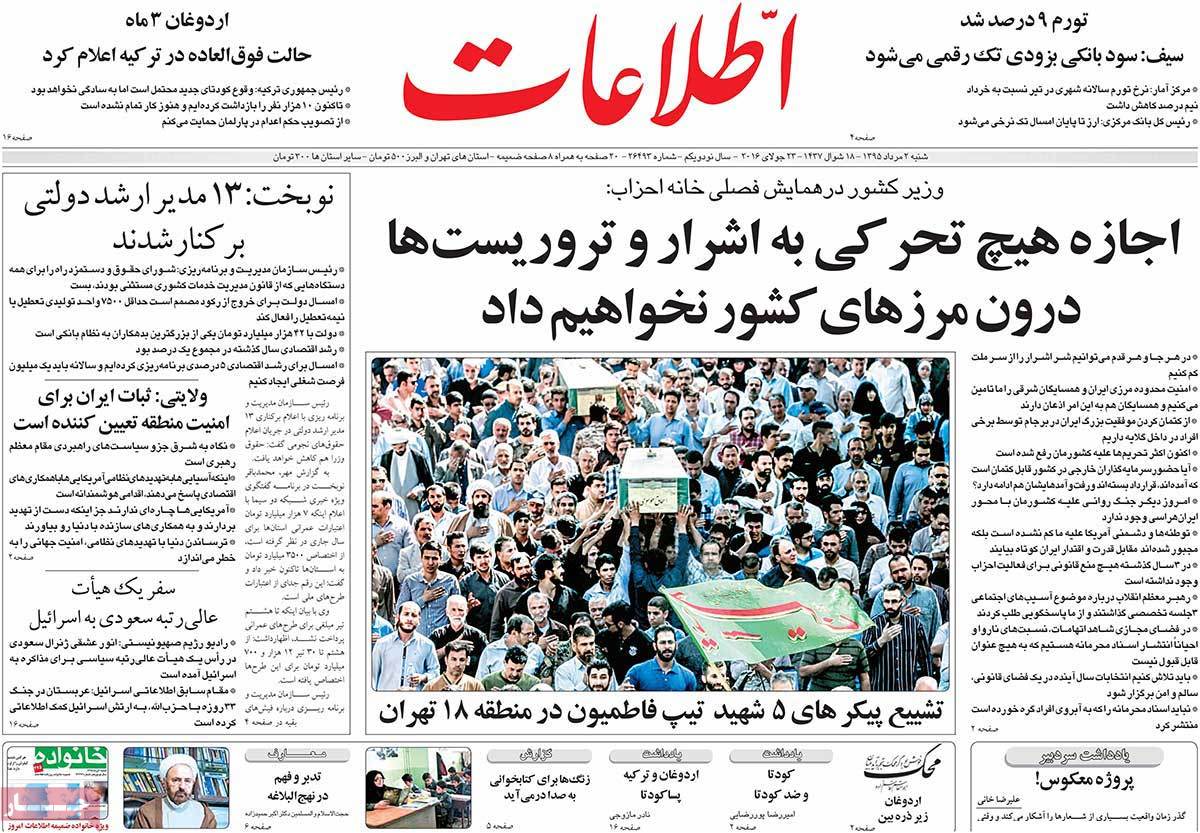
A Look at Iranian Newspaper Front Pages on July 23


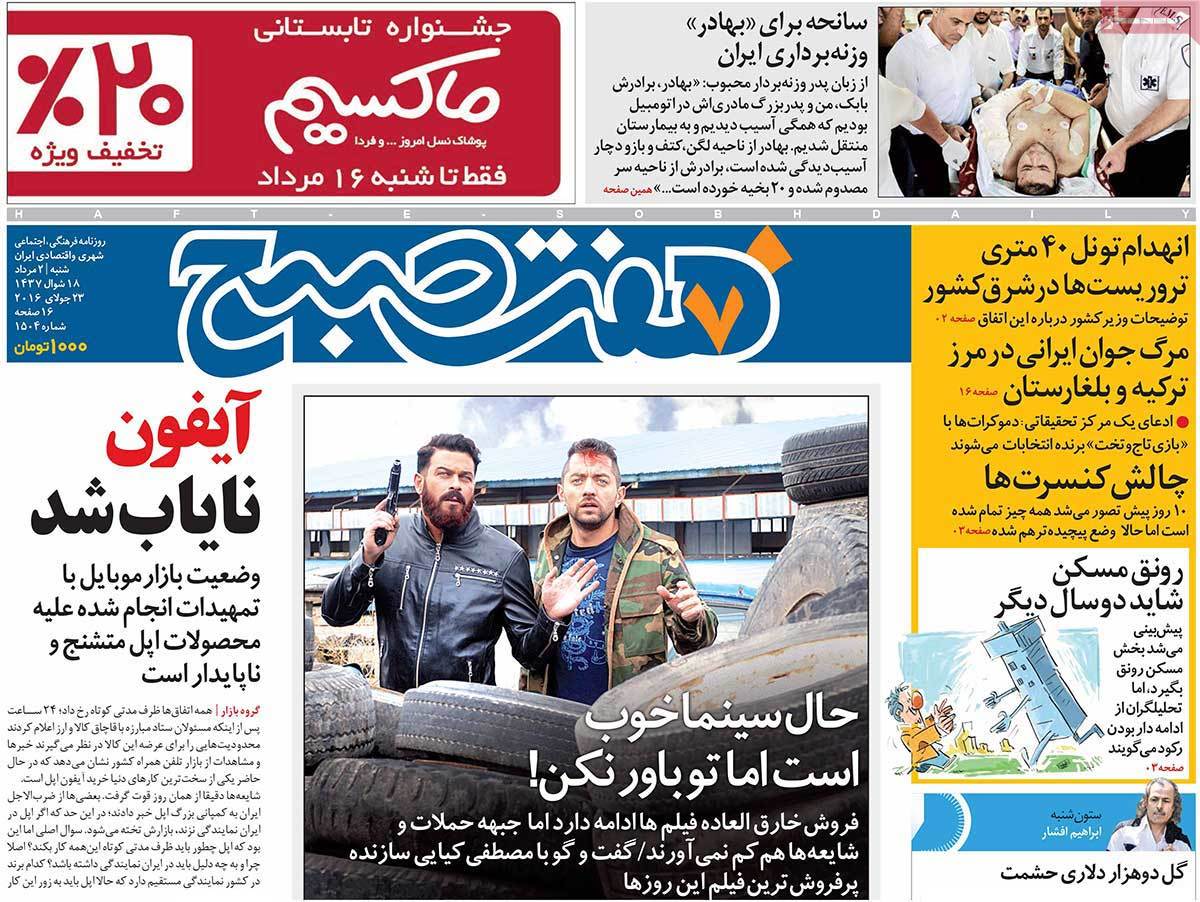
Haft-e Sobh:

1- Scarcity of iPhone in Iran’s Market

2- Iranian Weight-Lifter Bahador Moulaei Wounded in Car Accident

3- Police Discovers 40m Tunnel Dug by Terrorists in Southeastern Iran

4- Young Iranian Dies in Turkey-Bulgaria Border

5- Democrats Will Win US Elections through “Game of Thrones”
A Look at Iranian Newspaper Front Pages on July 23


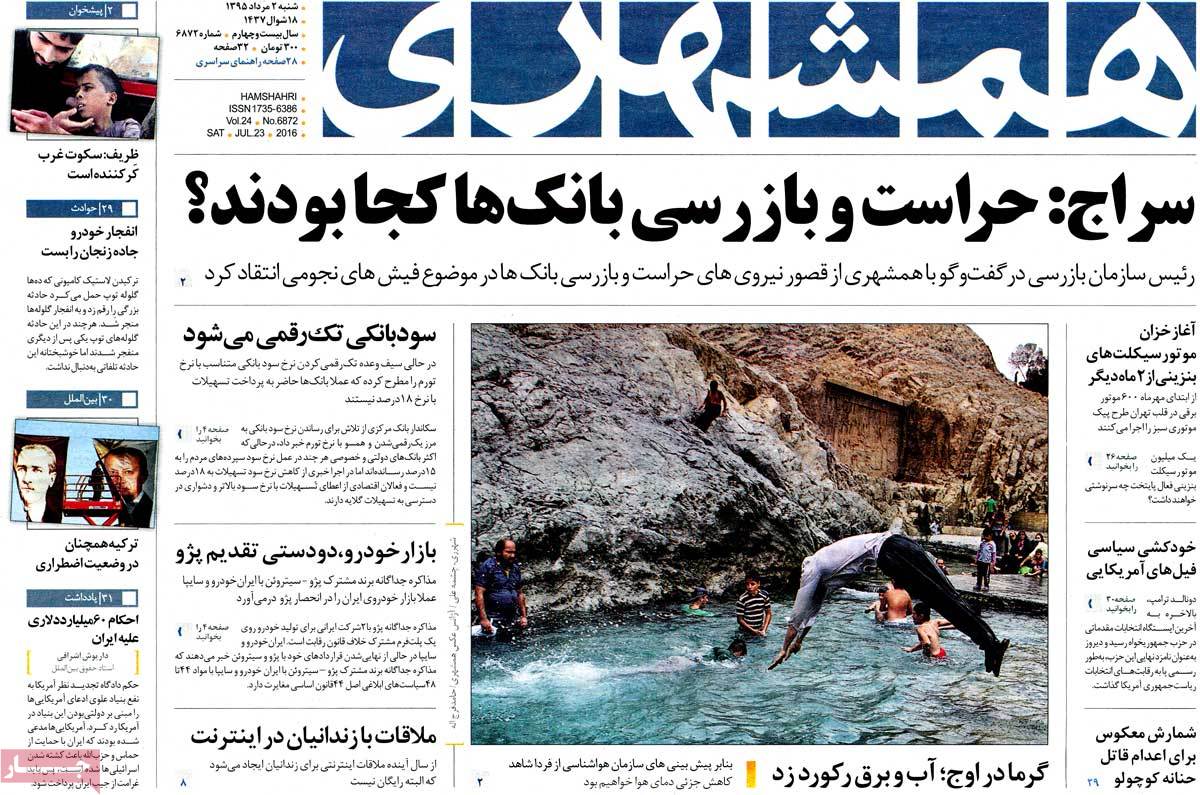
Hamshahri:

1- West’s Silence [over moderate rebels’ beheading of 12-year-old Syrian boy] Is Deafening: FM Zarif

2- Entire Iranian Car Market Offered to Peugeot

3- Political Suicide of American Elephants [GOP]

4- $60bn Court Verdicts against Iran

5- Visiting Prisoners on the Internet: Next Year, a Plan Will Be Implemented Based on Which Families of Prisoners Can Visit Them Online, Of Course Not for Free
A Look at Iranian Newspaper Front Pages on July 23


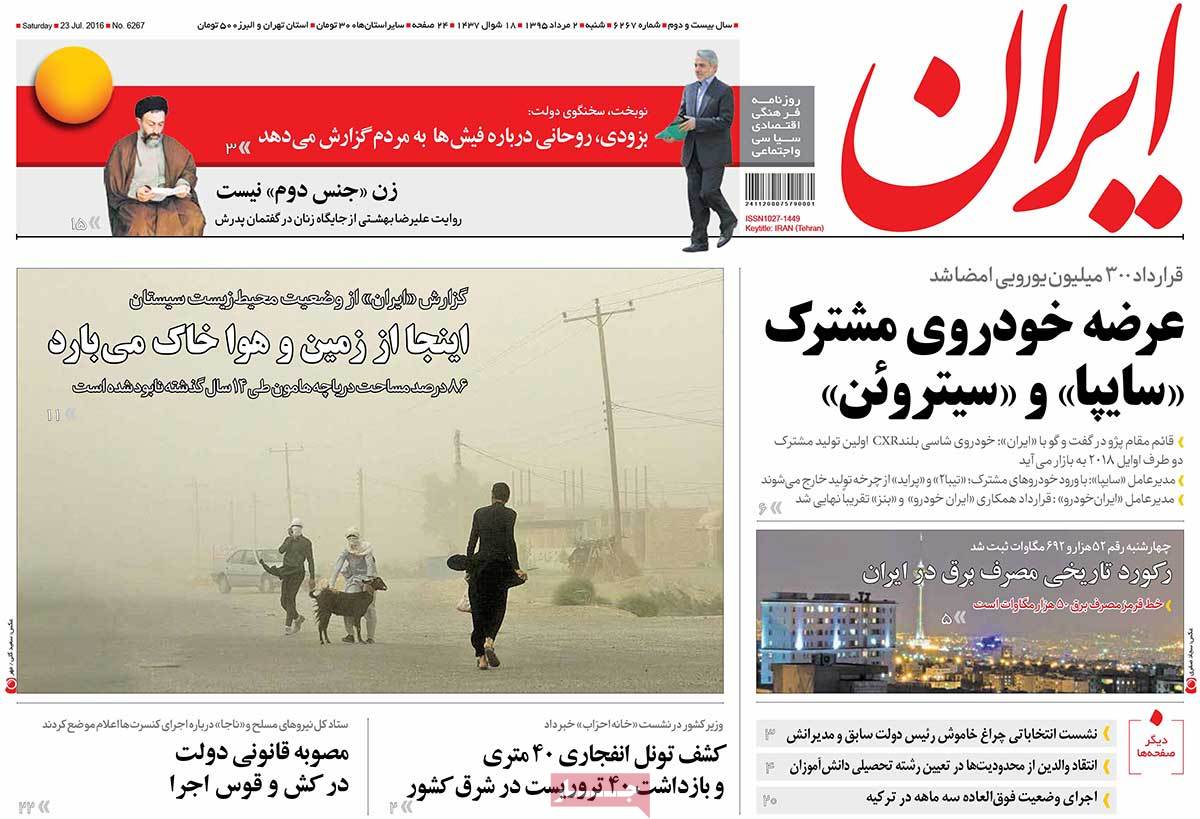
Iran:

1- Saipa and Citroen Sign €300m Deal to Manufacture Co-Produced Car

2- President Rouhani Will Soon Brief People on Astronomical Salaries: Spokesman

3- Record-Breaking Power Consumption in Iran: 52,692MW in 1 Day

4- Concert Supervision Bill Legally Approved by Government Faces Troubles in Implementation
A Look at Iranian Newspaper Front Pages on July 23


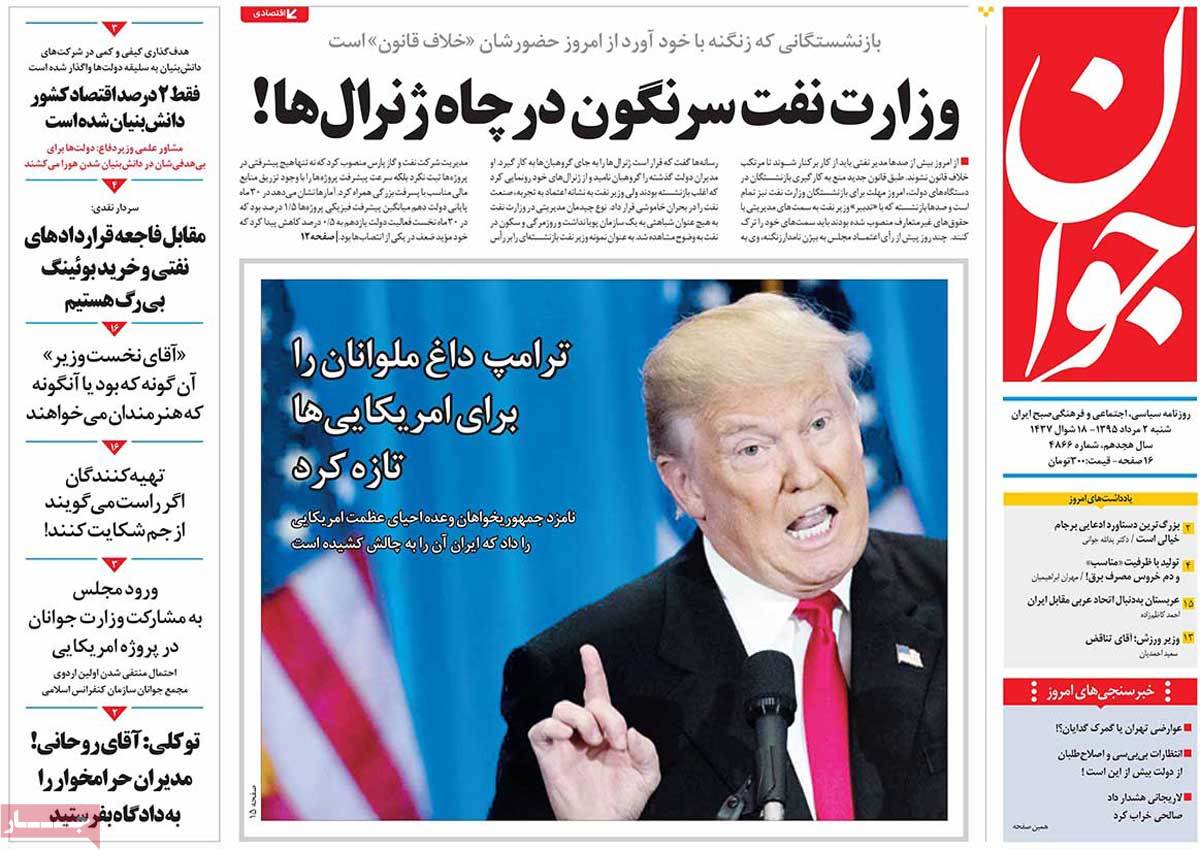
Javan:

1- Only 2% of Iran’s Economy Is Knowledge-Based

2- Basij Commander Slams Oil Contracts and Boeing Deal as “Disasters”

3- Former MP Urges Rouhani to Put Offending Executives on Trial

4- Trump Vows to Bring Back to US the Greatness Challenged by Iran
A Look at Iranian Newspaper Front Pages on July 23


Jomhouri Eslami:

1- US Court Reverses Order to Sell Iranian Assets to Compensate 9/11 Victims

2- Power Ministry Warns against Huge Increase in Water and Power Consumption in Iran

3- Global Criticism of Erdogan’s Crackdown on Opponents and Violation of Human Rights in Turkey

4- Saudi Jet Fighters Bomb Friday Prayers in Ta’iz, Yemen

5- Blood Bath in Kashmir: New Round of Popular Strikes to Begin Today
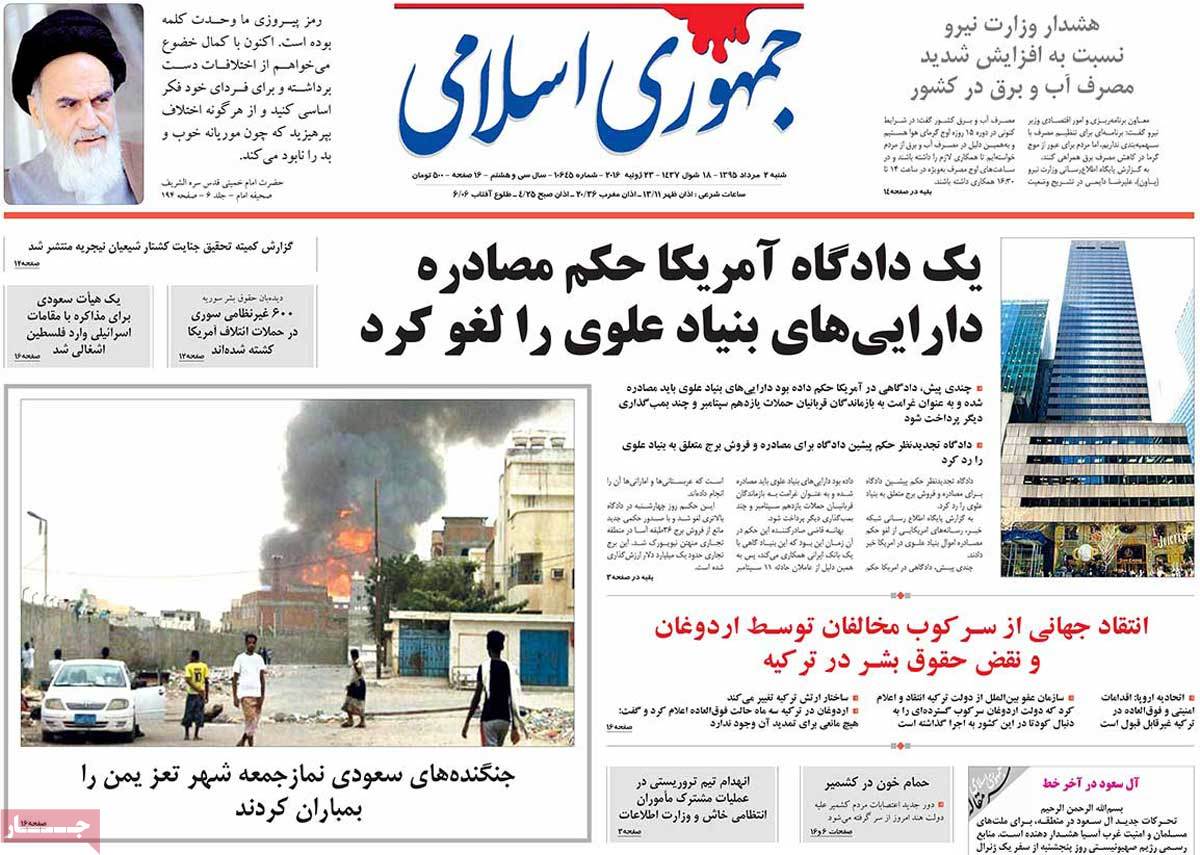
A Look at Iranian Newspaper Front Pages on July 23


Kayhan:

1- People Long for Fight against Corruption: Judiciary Should Start the Fight

2- $1bn of Iran’s Income Annually Lost in Free Trade Zones

3- Boots of Occupiers and Innocent Lives in Kashmir

4- 82 to 97 per cent of Terror Victims Are Muslims: US Dept.
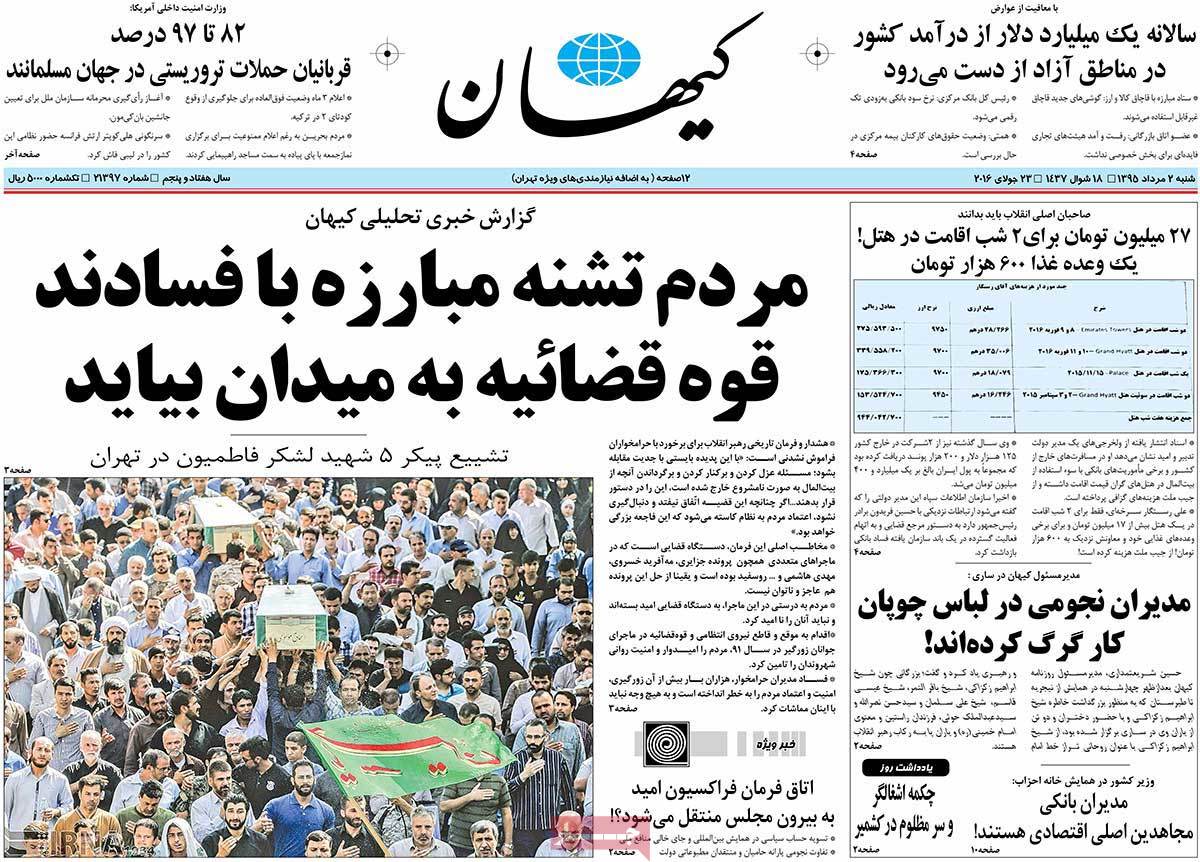
A Look at Iranian Newspaper Front Pages on July 23


Khorasan:

1- Barbarism of Moderates! US-Backed Syrian Free Army Behead 12-Year-Old Kid

2- Sultan until Further Notice: What Turkey Looks Like in State of Emergency?

3- Indirect Apple Stores Shut Down in Iran

4- The Hero Lost in History Is Found: Interview with Family of a Man Who Saved 30 Children in 1950 Mashhad Flood
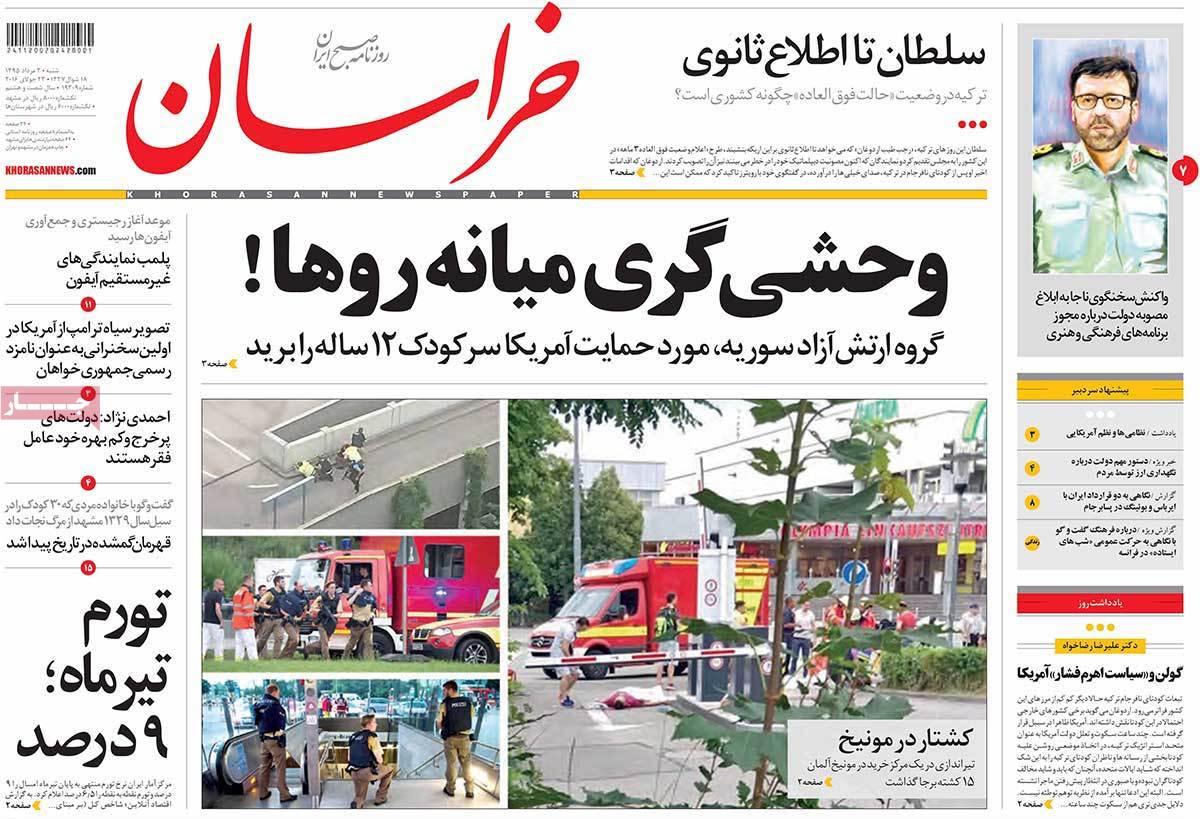
 A Look at Iranian Newspaper Front Pages on July 23


Resalat:

1- We Shouldn’t Forget about Modern Needs of Muslim World

2- Where JCPOA Is Heading to: Why President Doesn’t Respond to USA’s Excessive Demands?

3- Government Not Complying with Hijab [Islamic dress code] Law
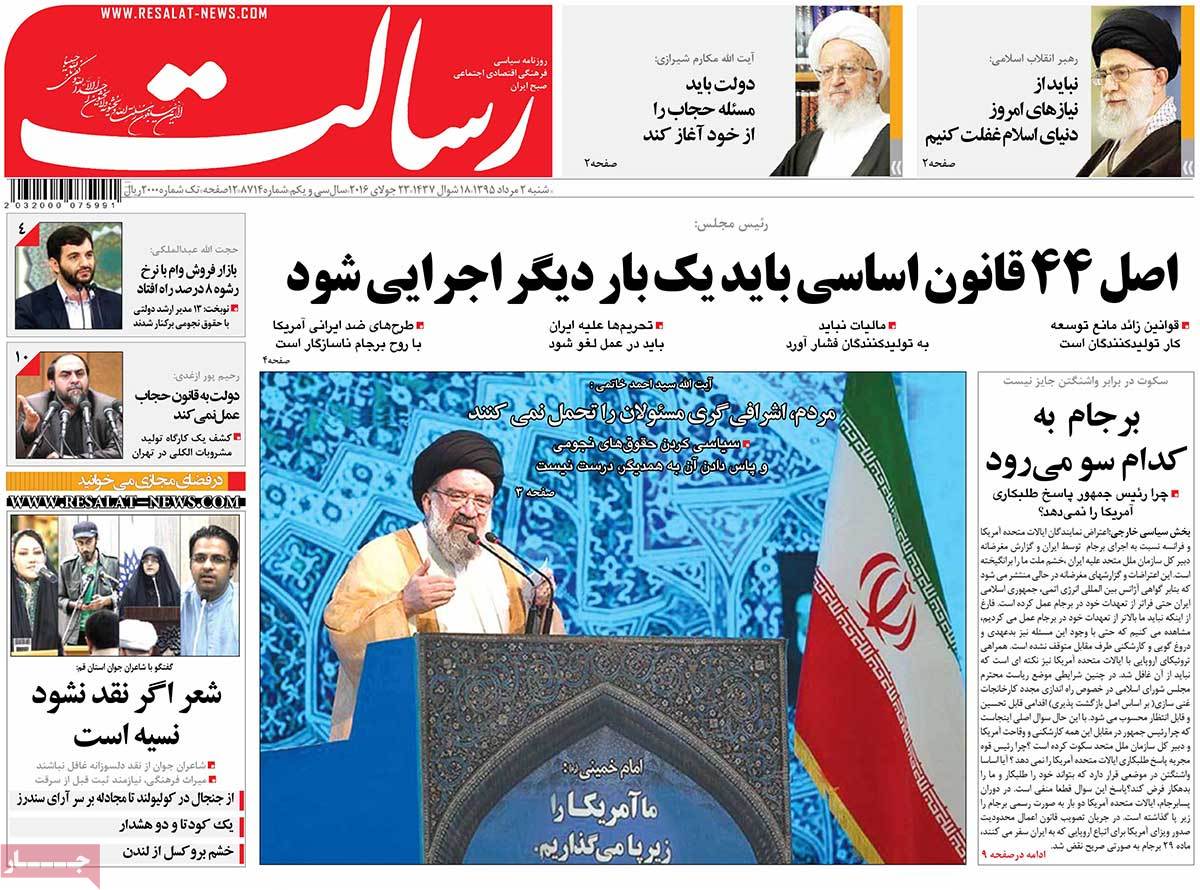
A Look at Iranian Newspaper Front Pages on July 23


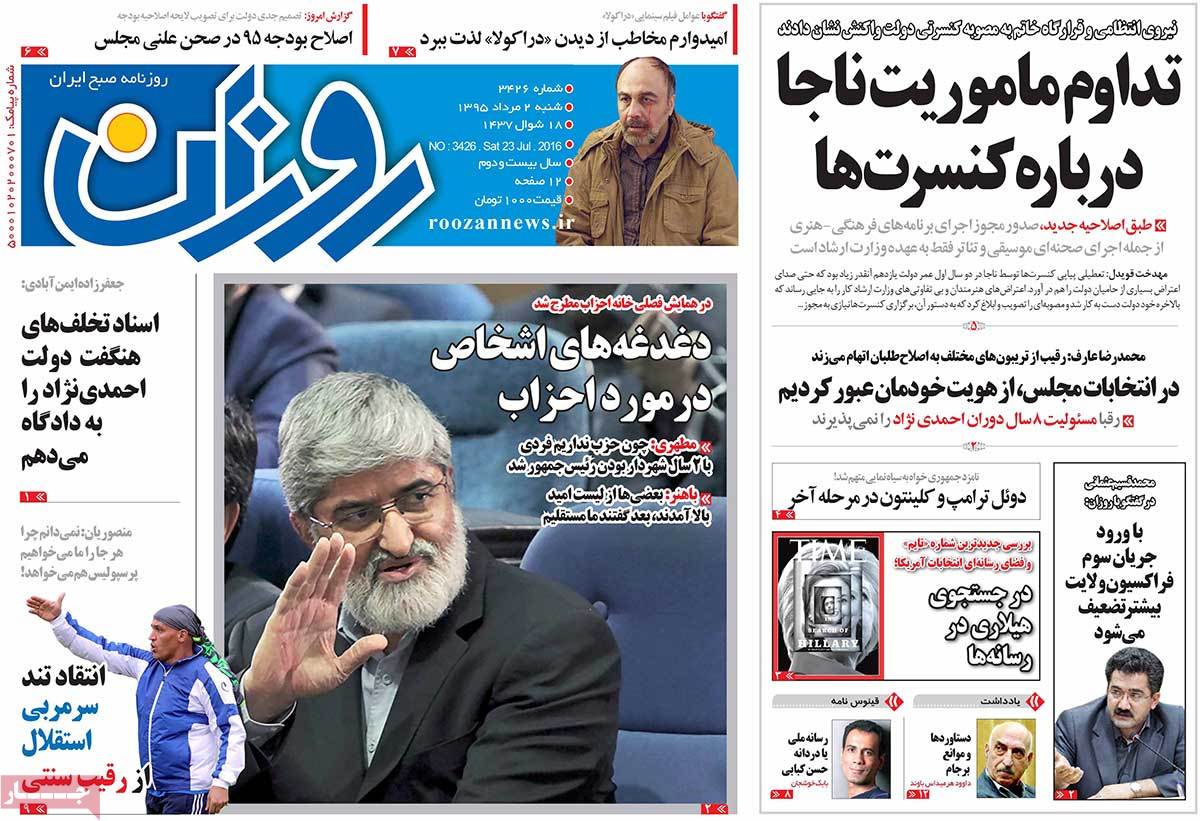
Roozan:

1- I’ll Disclose Documents on Ahmadinejad’s Huge Violations of Law to the Court: MP

2- Iran’s Law Enforcement to Continue Its Duties on Concerts
A Look at Iranian Newspaper Front Pages on July 23


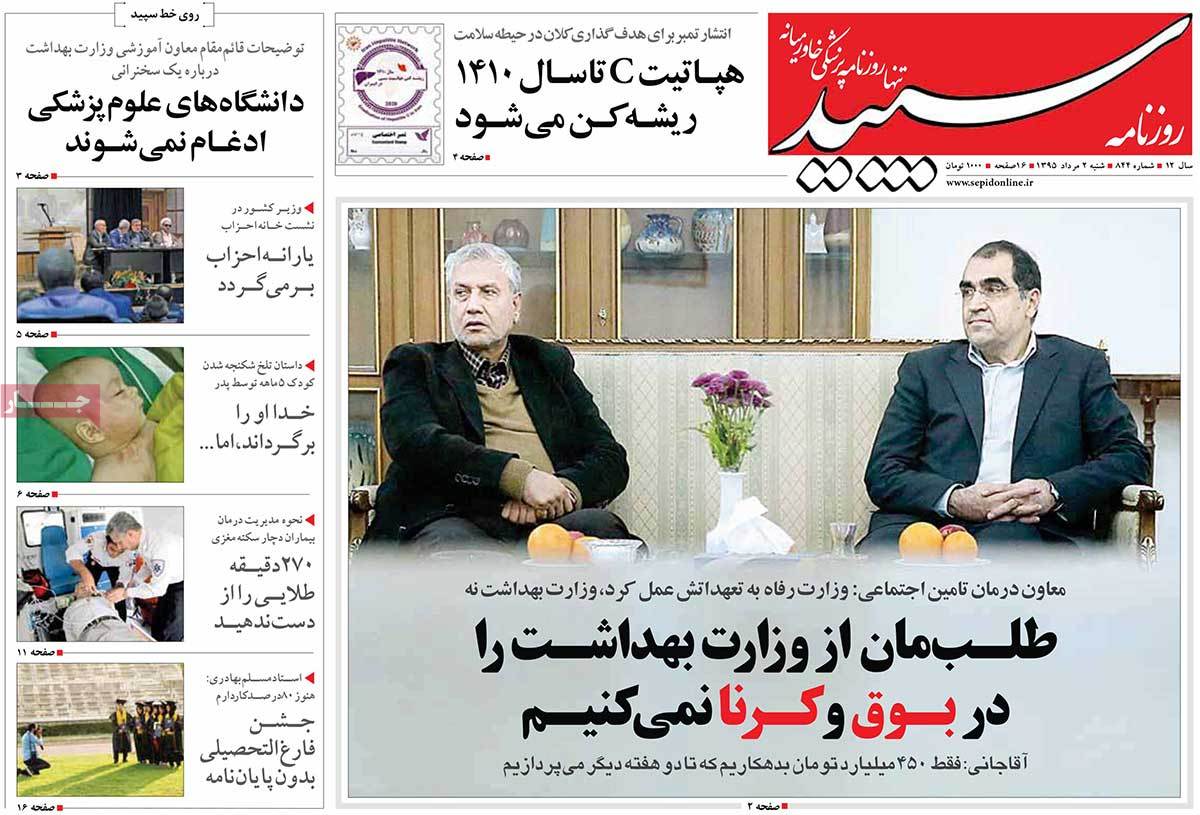
Sepid:

1- Hepatitis C to Be Eradicated by 2031

2- How to Deal with Patients Suffering a Stroke: The Golden 270 Minutes
A Look at Iranian Newspaper Front Pages on July 23


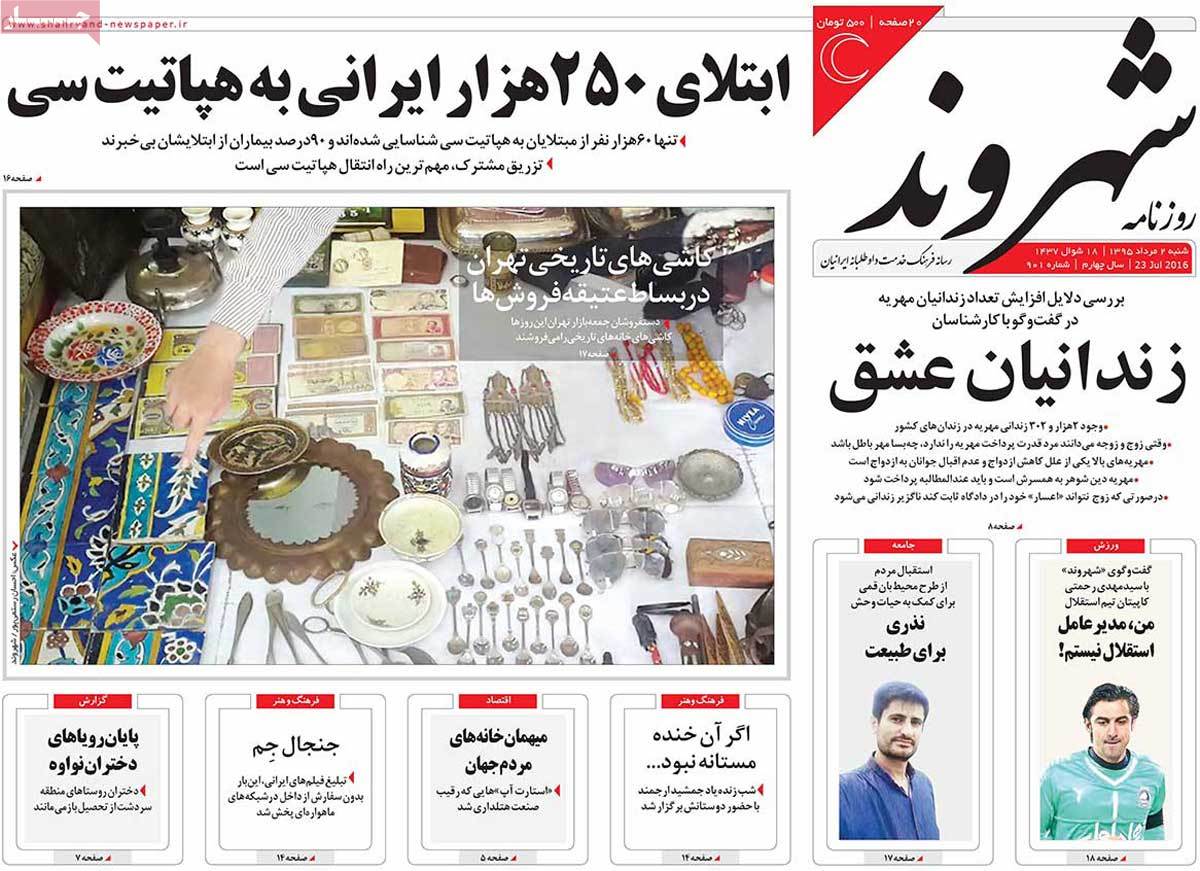
Shahrvand:

1- 250,000 Iranians Suffering from Hepatitis C: Only 60,000 Identified, Others Don’t Know They Have the Disease

2- Tehran’s Historical Tiles Sold by Antiquity Dealers

3- Donations to the Environment: People Warmly Welcome a Ranger’s Plan for Helping the Wild

4- Prisoners of Love: Reasons for Increase in Number of Men Imprisoned for Mahr
A Look at Iranian Newspaper Front Pages on July 23


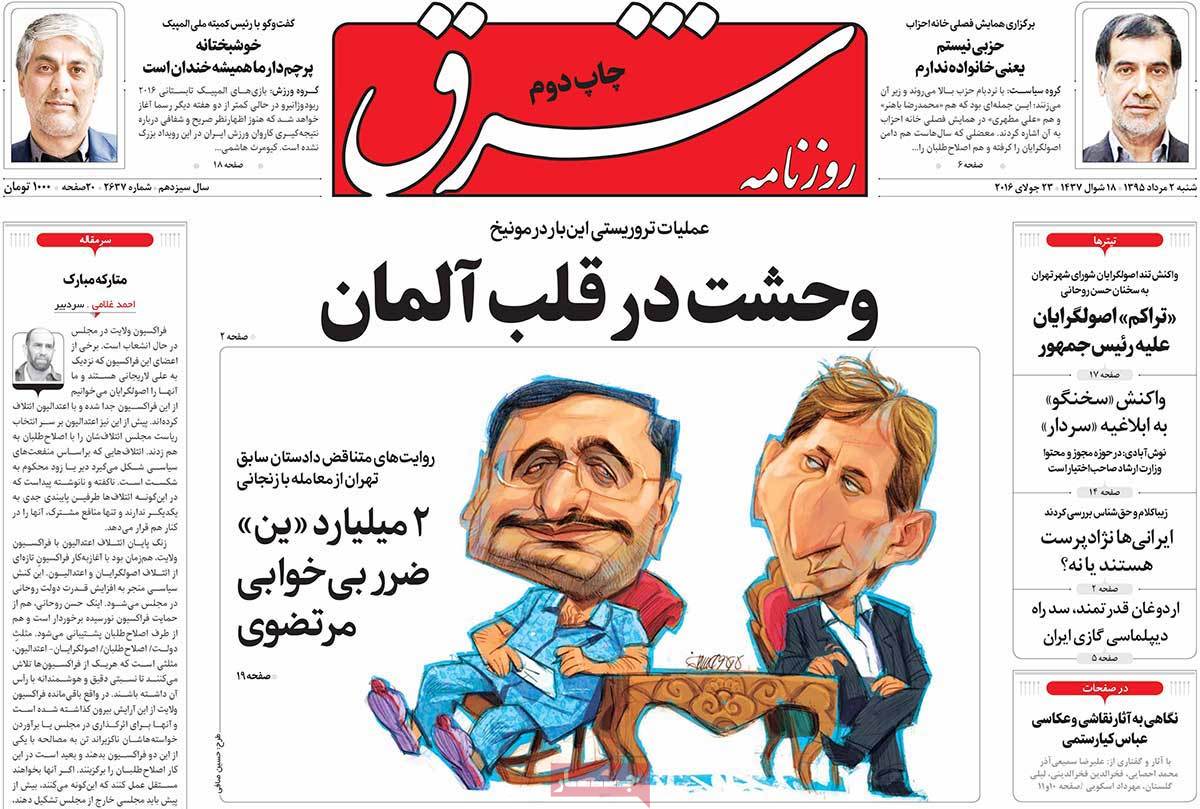
Shargh:

1- Fear in Heart of Germany: Terrorist Operation, This Time in Munich

2- 2 Analysts Discuss Whether Iranian People Are Racist

3- Powerful Erdogan a Barrier to Iran’s Gas Diplomacy

4- Congestion of Conservatives against Rouhani
A Look at Iranian Newspaper Front Pages on July 23


Sobh-e Now:

1- First Iranian President Serving Only One Term: Predictions Say Rouhani Won’t Be Re-Elected

2- Ping-Pong Game between Government and Police [on issue of concerts]
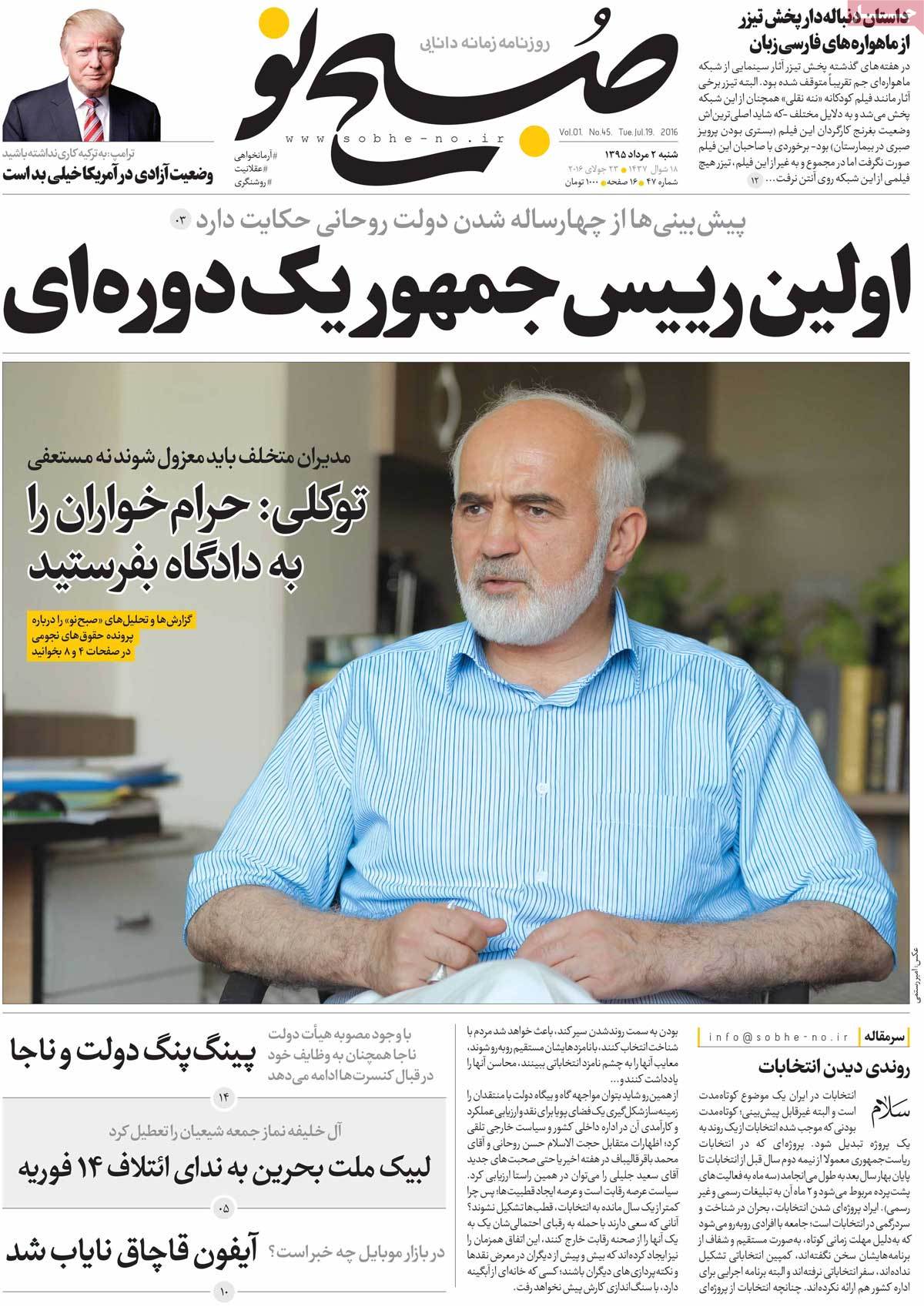
A Look at Iranian Newspaper Front Pages on July 23


Vaghaye Ettefaghieh:

1- What Inflation Rate Says: Decrease to 9% and Its Contradiction with Iran’s Economic Conditions

2- Concerns over Future of Democracy in Iran
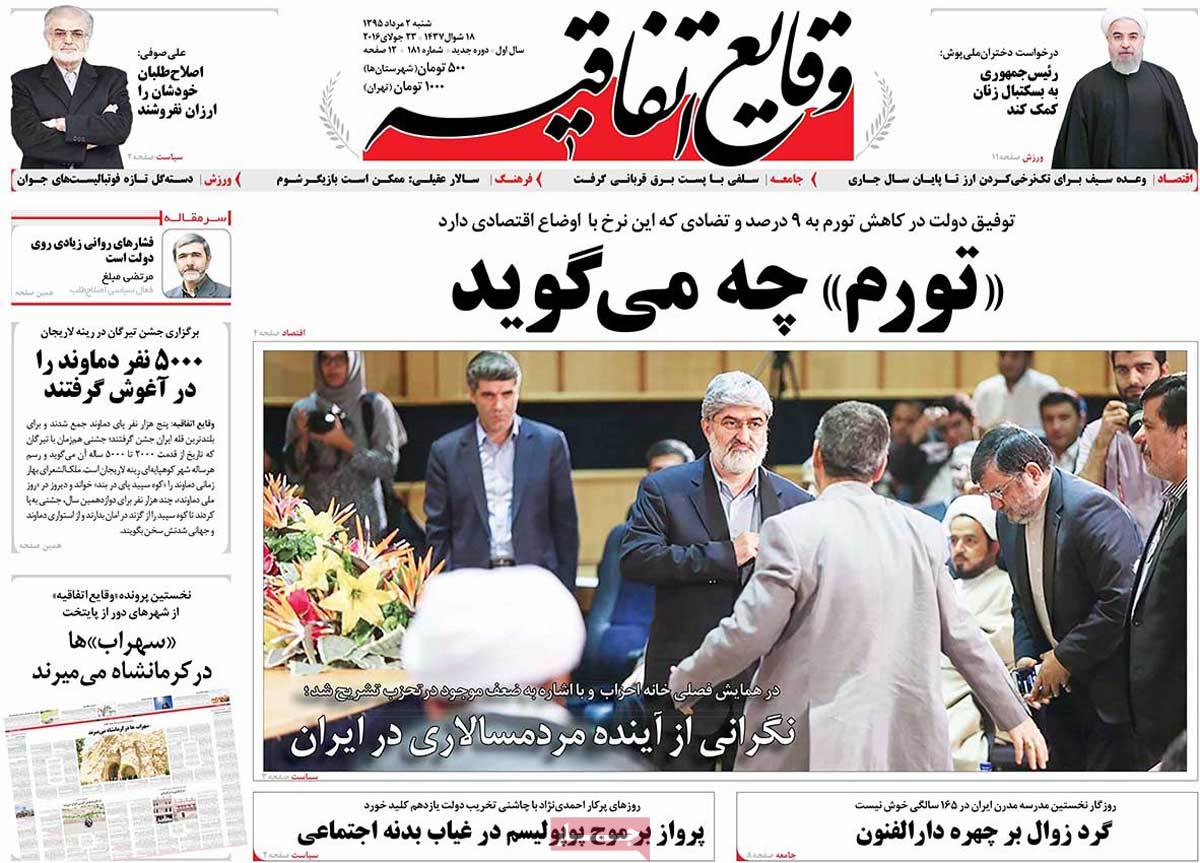
A Look at Iranian Newspaper Front Pages on July 23


Vatan-e Emrooz:

1- Latest Anti-Iran Remarks by Saudi FM Jubeir: We Can’t Tolerate Iran!

2- Western Terrorists: Attacks Will Go on!

3- Trump Attacks Clinton’s Foreign Policy: Expansionist Policies Are Enough!

4- Turkey to Bid Farewell to EU: Erdogan’s Civilian Coup
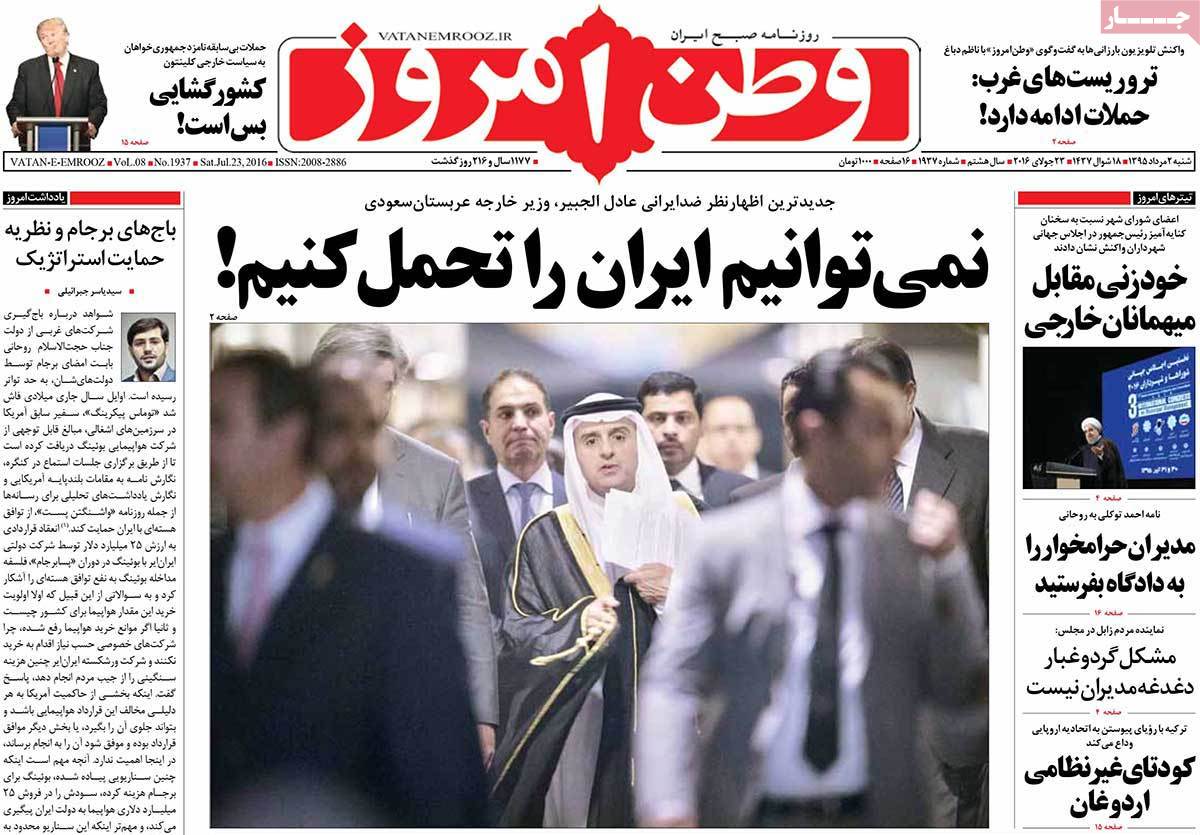
A Look at Iranian Newspaper Front Pages on July 23

Iranian Rights Group Decries Massacre of Syrian Civilians in French Airstrike

Human Rights

In a statement on Saturday, the Iranian rights group condemned the deadly military attack by the French jets on the village of al-Tukhar near the Syrian city of Manbij that killed at least 120 people.

Most of those killed were children, women and elderly. The fate of scores of other civilians is unknown.

The fatalities came shortly after a US airstrike killed at least 20 civilians in Manbij.

The statement underlined that killing of civilians, particularly women and children, is in direct contradiction to international laws and could not be justified at all.

It also urged the international community to fulfill its basic duties and take action on such unlawful attacks that jeopardize world peace and security.

Two basic principles, namely having a genuine desire to combat terrorism and drawing a distinction between terrorists and civilians, should be taken into account in countering terrorism, it added.

The council also took a swipe at the French government for providing a safe haven for notorious terrorists, like members of the Mojahedin-e Khalq Organization (MKO) that have the blood of 17,000 Iranian people on their hands.

Iran to Open Commercial Centres in Africa

Iran-Africa

“Establishing centres in Kenya and Nigeria has been finalized, and they would be inaugurated by next month,” Director-General of Branches Affairs of Iranian Trade Promotion Organization Reza Abbasqoli said.

He added that Iran would open centres in Ghana, Tanzania, Uganda, Senegal and Sudan as well.

Abbasqoli noted that the move aims to boost exports of Iran’s goods and services to target markets, especially commercial markets in Africa.

800% Increase in Saudi Arabia’s Support for MKO Terrorists

Hossein Mousavian

France has unfortunately been the epicentre for two terrorism-related events in recent weeks. The tragic truck attack in Nice, which received international attention, and a rally recently held in Paris by a notorious Iranian opposition group — the “Mujahedin Khalq,” or MKO, which for years has committed acts of terrorism against Iran. While it might not be immediately evident, there is a connection between the events — the groups behind them have been accused of atrocities and have historical ties to Saudi Arabia.

Both the MKO and the self-proclaimed ISIS, which claimed the attack in Nice, are groups with a history of terrorism, and both, in some way or another, are influenced by the kingdom.


MKO’s Terrorism in Iran

While the group no longer has the distinction of a terrorist group in the United States and is not related to or as widely destructive as ISIS, in Iran the MKO is still very much a perpetrator of terror.

Since its founding in the 1960s, the MKO’s favoured tactic has been terrorism, which for years it directed towards Americans. An MKO leader by the name of Massoud Rajavi stated in 1972 that the group’s “main goal” was to “free Iran of US imperialism.” As I documented in my 2014 book, “Iran and the United States,” the MKO’s assassination campaigns in the 1970s claimed the lives of several high-profile Americans. Among the victims were one colonel and one lieutenant colonel of the US Air Force, along with other servicemen.

The MKO’s hands are tainted not only with American blood, but also with the blood of countless Iranians, Iraqis and Kurds. Since Iran’s 1979 Revolution, the MKO has been responsible for the deaths of upwards of 17,000 Iranians, including senior officials and ministers. During the Iran-Iraq War, the MKO also sided with Saddam Hussein, earning the enmity of the vast majority of Iranians. An Iranian NGO, the Habilian Association, has gone so far as documenting all the Iranian victims of the MKO in a comprehensive database that includes photos and biographies of each of the victims.

In the ‘80s and ‘90s, the MKO was responsible for several terrorist campaigns within Iran, one of which killed some 70 Iranian officials in 1981, including both the president and prime minister at the time.

After the Iran-Iraq War, the MKO resided in Iraq and took on the role of Saddam’s henchmen. An October 1994 Wall Street Journal report quoted a Clinton administration official as saying, “Saddam looked on the Mujahedin as more loyal than some of his own army units.” After the 1991 Persian Gulf War, Massoud Rajavi lambasted the UN coalition that pushed Saddam out of Kuwait, stating, “Iranian national movements and their masses strongly denounce the Iranian regime’s alliance with US imperialism, world Zionism, and regional reactionaries to launch aggression against Iraq.”

In recent years, Iranian nuclear scientists have been assassinated — in some cases murdered while driving to work. MKO is thought by many to be involved in these attacks, perhaps with the assistance of Israel. According to a 2012 NBC News report, Israel was “training MKO members” to carry out the killings. The group has also been held responsible for an April 2000 assassination attempt on the leader of the Iranian policy making centre for the war in Iraq.


Saudi Connection

This year, the annual gathering of the MKO in Paris featured Prince Turki al-Faisal, the former director of Saudi intelligence, as a speaker. The conference typically draws the attendance of politicians of some nations, including the US, Egypt, and this year, Saudi Arabia. In his remarks, Al-Faisal praised the pseudo-Islamist-Marxist group and emphatically supported its objective of toppling the Iranian government. Al-Faisal’s comments, which come at a time when Saudi-Iranian relations are at an all-time low and have even been compared to a “Cold War” state, will have serious consequences for the Tehran-Riyadh relationship going forward.

During my trip to Iran a few weeks ago, I spoke with a senior official about the necessity of improving Iran-Saudi relations. He told me that Iran was willing to engage the Saudis but that Riyadh had devoted itself to a confrontational approach. This official informed me that Iran had detailed intelligence about Riyadh’s financial support to the MKO, which he said had increased 800 per cent in the past two years. He also noted that Saudi Arabia would cover the cost of this year’s MKO conference in Paris and that Prince Turki would be present to publicly declare Saudi Arabia’s support.

With Prince Turki’s speech to the MKO, Saudi Arabia has elected to destroy any chance of de-escalating tensions between the two nations. In pursuing this approach, Saudi leaders should be cognizant that not only are they imperilling regional and global security, but they are also following in the footsteps of Saddam Hussein. Saudi Arabia has already separated itself from its traditional regional allies with its hyper-anti-Iranian posture, so much so that only Bahrain— which is effectively under Saudi occupation — is standing fully with it. Global powers, on the other hand, are pursuing ways to enhance ties with Iran. It is truly a shame that Prince Turki al-Faisal, a man of significant ability and experience, has committed himself to this doomed cause rather than searching for peace and friendship between Iran and Saudi Arabia.

Riyadh’s now open alliance with the MKO only solidifies its position as the sponsor of yet another terrorist group that espouses perverted views of Islam. The barbaric Nice terrorist attack — later claimed by the ISIS terrorist group — and Prince Faisal’s endorsement of the MKO have a common denominator: a connection to Saudi Arabia.


Saudi Arabia and ISIS

It has long been evident to the global community that Saudi Arabia is a benefactors of Islamist militant groups, including likely the group that evolved into ISIS. Many US officials have publicly acknowledged this reality. Even former US Secretary of State Hillary Clinton stated at the Brookings Institution last year that, “Much of the extremism in the world today is the direct result of policies and funding undertaken by the Saudi government and individuals.” A recent British parliament report also stated that it is “very likely” that individuals close to the royals of the Arab monarchies of the Persian Gulf have donated money to ISIS, though it is unclear how directly those funds have been given. Historically, too, the ideology of the group has ties to Saudi Arabia’s own identity via Wahhabism.

While ISIS wreaks havoc on the world with its global acts of terror, the MKO ravages Iran. In much the same way ISIS is a twisted offspring of the Sunni world that has ravaged, among others, Sunni-populated areas, the MKO is its counterpart for Iranians in the Shia world. Iranians thus expect the world community to confront the MKO just as it confronts ISIS. At the very least, the group should not be hosted by countries like France and endorsed by Saudi Arabia. In the fight against terrorism, European and Saudi leaders should know better than to distinguish between “good” and “bad” terrorism, or tolerate any form of terrorism in the service of cheap geopolitical gains.

In light of the Nice terrorist attack, the international community should also view the threat from other groups such as the MKO as an interconnected phenomenon. The scourge of terrorism currently threatening the whole world can only be alleviated if it is addressed in a holistic way. The Nice truck slaughter — indeed the slaughtering by ISIS in general — and the MKO’s killing of thousands of Iranians are both worthy of our attention and condemnation. The territory the perpetrators of such violence use to plan and launch attacks, as well as the flow of cash, equipment and ideology they draw their support and influence from should all be considered as pieces of the same terrorism “puzzle.” The global terrorist threat simply cannot be solved until all these pieces are recognized as being a part of the same puzzle and dealt with in an effective and simultaneous manner. This means not only increasing security to prevent attacks, but also seriously confronting those who aid terrorism in any way — from the MKO to ISIS.