Monday, December 22, 2025
Home Blog Page 4292

As a Second Chance to Riyadh, Iran Will Hold Talks with Saudis in Future

Amir-Abdollahian

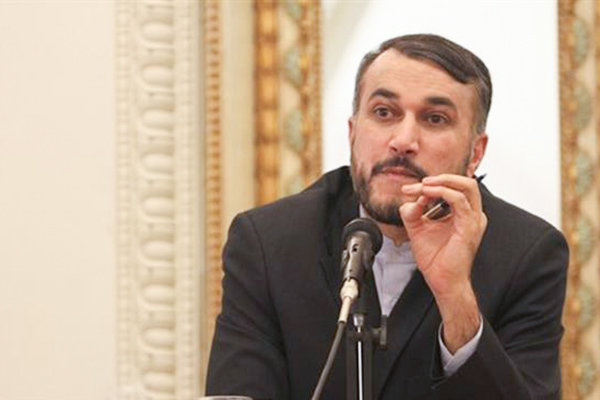
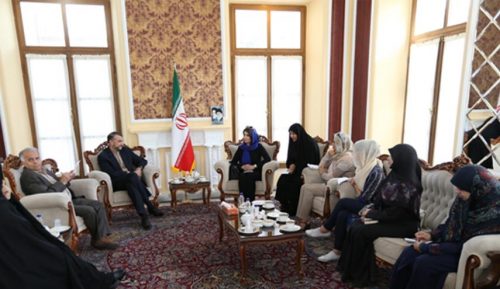
Speaking in a meeting with a Lebanese media delegation in Tehran, Hossein Amir Abdollahian, the international advisor to Iranian Parliament Speaker, referred to a meeting between Russian President Vladimir Putin and the former director general of the Saudi Intelligence Agency Bandar bin Sultan in Moscow, where the Saudi official talked about his country’s plan to use armed forces to overthrow the political system in Syria.

“During the meeting, Putin asked Bandar bin Sultan if he was aware that once Damascus falls, the armed forces would come after you in Riyadh, to which the Saudi official said, ‘yes we are, but immediately after the overthrow of Assad, we will bomb and kill all armed forces in Syria’.”

“We have many documents that prove the terrorist attack near our embassy in Beirut had been coordinated by Bandar bin Sultan, and the target of the attack was the Iranian ambassador Ghazanfar Roknabadi,” he said.

Amir Abdollahian went on to add, “What I mean by talking about these events is that we have been in talks with Saudi Arabia and will continue to do so because we are neighbours and situated in the same region.”

“Saudi Arabia has many capacities that could be utilized in service of the Islamic world and the region, but unfortunately, their approach is not constructive,” Mehr quoted him as saying.

“In turn, we have tried to show self-restraint and give them another chance because their domestic issues have impaired their ability to make right decisions.”
Amir Abdollahian Lebanon

No Country, Even Iran, Has the Right to Interfere in Lebanese Elections

Elsewhere in his remarks, he stressed that Lebanese leaders are highly competent to make decisions for their own country, and no foreign country, be it Saudi Arabia, France, the US or even Iran, has the right to interfere in their domestic affairs.

“Iran has made a lot of efforts for the completion of a political process in Lebanon,” he said.

Amir Abdollahian went on to criticize Saud Al Faisal and Adel Al-Jubeir, Saudi Arabia’s former and current foreign ministers, for their unconstructive approaches toward the political process in Lebanon, and stressed that the president of Lebanon should be selected from the country’s Christian party.

“Once prominent Christian figures in Lebanon decide on one person who is approved by other political parties, the Islamic Republic of Iran will support that decision,” he said.
Foreigners Queuing Up to Have Trade Ties with Iran: FM

Zarif

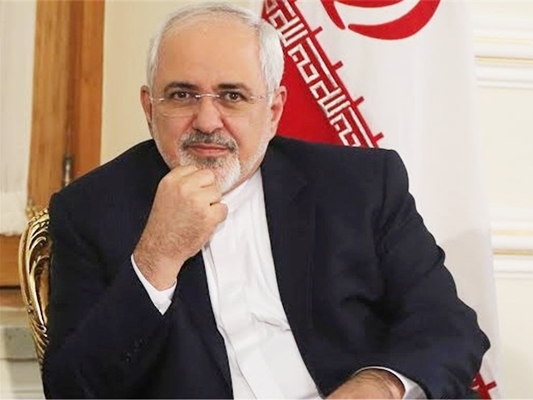
Speaking at the parliament on Sunday, Zarif said the Foreign Ministry has focused efforts to achieve the goals of the Resistance Economy plan, boost non-oil exports, and stimulate foreign investment in the country.

He also noted that his ministry has tried to improve the regional and international conditions to attract more foreign investment.

“The fact that the Foreign Ministry has removed the legal barriers to economic activists having trade interaction (with Iran)… is an initial achievement,” he noted, as reported by Tasnim.

Back in August, President Hassan Rouhani pointed to the country’s economic progress during his term, saying Iran’s economy is on the right track despite a whole host of problems that have gripped oil-exporting countries.

Highlighting the major achievements over the past three years, President Rouhani said the inflation rate turned into a single-digit number dropping to below 9 percent, the economic growth in the first quarter of the current Iranian year increased to 4.4 percent, the industrial growth rose to 8.8 percent, and the value of non-oil exports rose by $3.3 billion, outstripping the value of imports after many years.

Syrian People Break Their TV Sets in Fear of ISIS

ISIS TV

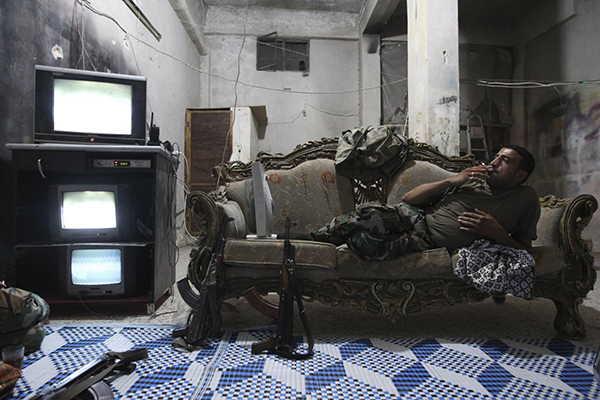
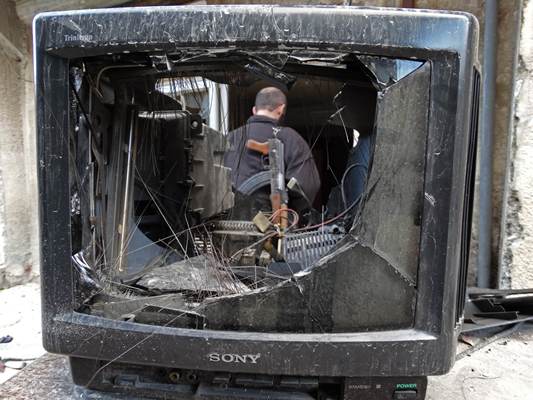
According to a report by ISNA, as translated by IFP, almost 90 percent of people in Syria’s Raqqa have broken their TV sets in the fear of ISIS terrorists.

This has made the majority of them unaware of the latest developments and news in the world.

People’s move to break their TV receivers came after rumours that the ISIS militants are going to search Syrian people’s houses and arrest whoever has one.

The ISIS terrorist group destroys TV satellites and receivers to prevent people from watching foreign channels.

TV in AleppoEarlier reports showed that militants entered homes in the Syrian town of Al Shaddadi in Hasaka Province, and destroyed television equipment, after pro-ISIS imams condemned watching television, claiming it spread information that is “incorrect, baseless and false”.
“They are entering houses by force to destroy dishes and satellite receivers,” one witness from Al Shaddadi told RFE/RL, with other witnesses and activists corroborating the account.

“There is nothing that ISIS cannot implement. All it takes is to chop off the head of one or two people under the pretext of watching television and the whole city would be disciplined,” Anwar al-Khodar, a lawyer and activist from Raqqa who fled to Turkey, told Arab Weekly.

“No one would then dare go near a television set. One would even break his own television set in order to prevent any member of his family from using it.”

A pro-ISIS imam at the Al Fawwaz Mosque in Raqqa told the congregation last year not to watch television, though no formal decree banning TV has yet been issued.

“He told people gathered for the Friday prayer that the news aired by Al-Jazeera and Al-Arabiya and other channels is incorrect, baseless, and false and that’s why there will be a decision to forbid people to watch TV,” a Raqqa resident talking under the pseudonym Mohammed al-Ali for his safety told RFE/RL, adding that the imam said that the only programmes permitted would be broadcasts of the Koran being recited.

In its campaign to control access to information, ISIS has set up special cinema booths in parts of the Syrian city Aleppo it has seized and Raqqa broadcasting propaganda videos and films of executions.

ISIS operates a radio station called Al-Bayan in Mosul, its centre of operations in Iraq, and has banned private internet access in Raqqa, with internet access now restricted to cafes monitored by militants.

Saudi Arabia Turns to Gregorian Calendar to Shore Up Finances

Saudi Money

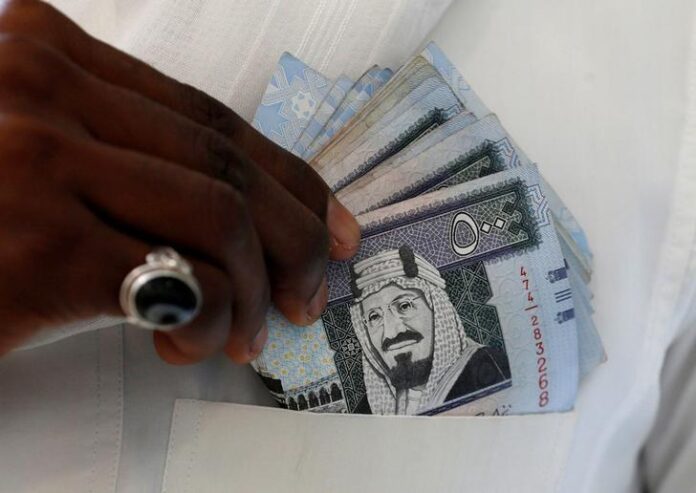
Saudi Arabia on Sunday shifted to the Gregorian or Western calendar as a basis for paying civil servants as part of an austerity package.

Saudi Arabia, the birthplace of Islam, adopted the lunar Islamic calendar when the kingdom was founded in 1932. The Islamic year is around 11 days shorter than the Gregorian year.

The shift to the Gregorian year comes in response to a decision made by the Saudi government earlier this week as part of spending-cut measures, according to reports by Saudi Arabia’s Sabaq and the Deutsche Presse-Agentur (DPA), as covered by IRNA.

The government also cancelled some bonuses offered to state employees.

Saudi authorities on Sunday started enforcing increases in the fees for entry visas.

Millions of Muslims from across the world visit Saudi Arabia annually as part of a pilgrimage to Islam’s holiest sites there.

On Monday, Saudi King Salman ordered a 20-per-cent cut in the salaries of government ministers and a 15-per-cent reduction to financial rewards and allowances for members of the kingdom’s advisory Shura Council.

Saudi Arabia, the world’s top oil exporter, has felt the pinch of a steep fall in oil prices since 2014.

Tehran’s Towers: How Iranian Capital Embraced Bold Architecture

Orsi Khaneh

Here is a report by The Gaurdian, as covered by Haft-e Sobh Newspaper:

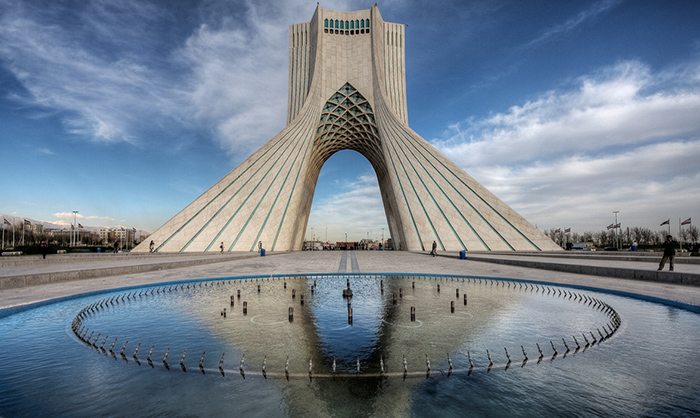
In the few decades leading up to the 1979 Islamic revolution, architects such as Houshang Seyhoun, Kamran Diba and Hossein Amanat pushed the boundaries of traditional Persian architecture by using traditional elements in modern designs; Amanat’s Azadi tower epitomises those efforts.

After the revolution, however, the Iranian capital’s architectural scene suffered a serious blow as the country was consumed first by war then by post-war reconstruction. But more recently, with young architects educating themselves in worldwide trends, and the relative stability of the country compared to its post-revolutionary upheaval, a new generation are following in the footsteps of the veterans. The city has embraced a bold, experimental architecture.

Tehran in 2016 “is in a constant mood of reconstructing and rebuilding itself,” according to Mehran Gharleghi, director at London’s Studio Integrate, who has previously worked in Tehran for the prominent architecture firm Mirmiran. “The municipalities accommodate new designs, at least compared to Europe, and there’s a big appetite for new buildings.”


Azadi Tower

“Tehran has a unique structure,” he adds. “It is more dynamic than any European capital, and at the same time it’s not a typical Middle Eastern city. Its urban scene is quite chaotic at the first glance. But, similarly to cities like Tokyo, this means Tehran is constantly able to renew its visual identity.”

Tehran’s mayors are also influential. Former president Mahmoud Ahmadinejad was one. And the incumbent, Mohammad Bagher Ghalibaf, who has run eye-catching projects such as installing Picasso and Matisse billboards on the city’s streets, has presidential ambitions himself – leading, says Ghaleghi, to “the motivation of Tehran’s mayor to commission ambitious projects and improve the urban set-up”.
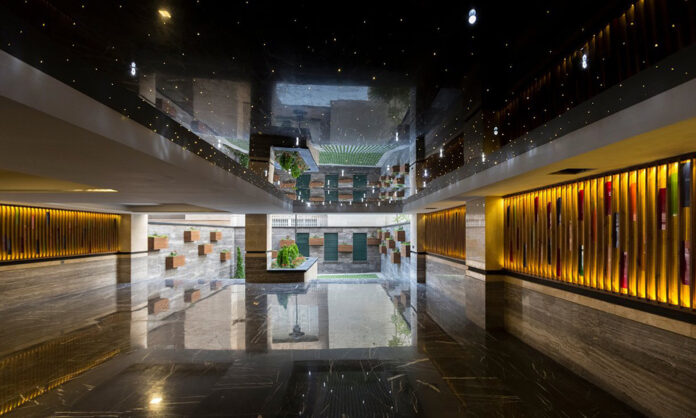
Architects in Iran also enjoy a great deal of freedom. “Their hands are not tied,” says Kamran Rezaianpour, founder of the architecture firm Idehandish, which has offices in Tehran and Shiraz. “The mayor’s office won’t make obstacles; the main issue is to persuade the owner. In Tehran, the mayor’s office is mainly concerned with two issues: parking spaces and the height of buildings.”
Nor is the new architectural freedom limited to the capital. “In fact, in other cities, such as Isfahan, Shiraz, Mashhad and Tabriz, you’ll see more creative works than in Tehran,” Rezaianpour says. “In the past, there was a huge difference between the capital Tehran and big provincial cities in that regard, now this has been narrowed.”


Sharifi-ha House


Sharifi-ha house

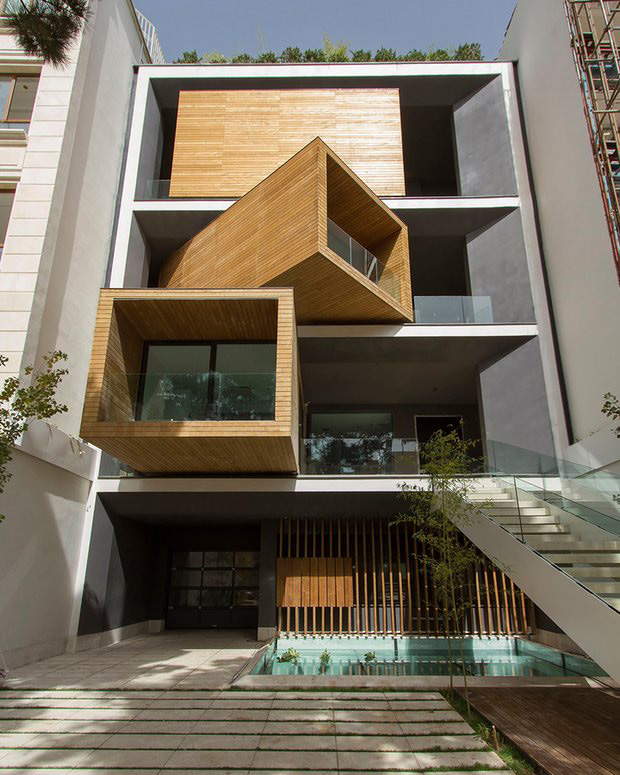
Built in 2014 in Tehran’s affluent Darrous neighbourhood, the Sharifi-ha house is a seven-floor building with three rotating blocks that turn 90 degrees. Each block is on a rotating base that allows the owner, Farshad Sharifi, to change its direction at the push of a button. The house has a swimming pool, a gym and a cinema.

“The openness/closure of the building’s volume is a reference to traditional Iranian houses, which would dynamically serve as seasonal modes of habitation by offering both a Zemestan-Neshin (a winter living room) and Taabestan-Neshin (a summer living room) to their residents,” its lead architect from Next Office, Alireza Taghaboni, has written.


 Tabiat Bridge

Tabiat Bridge


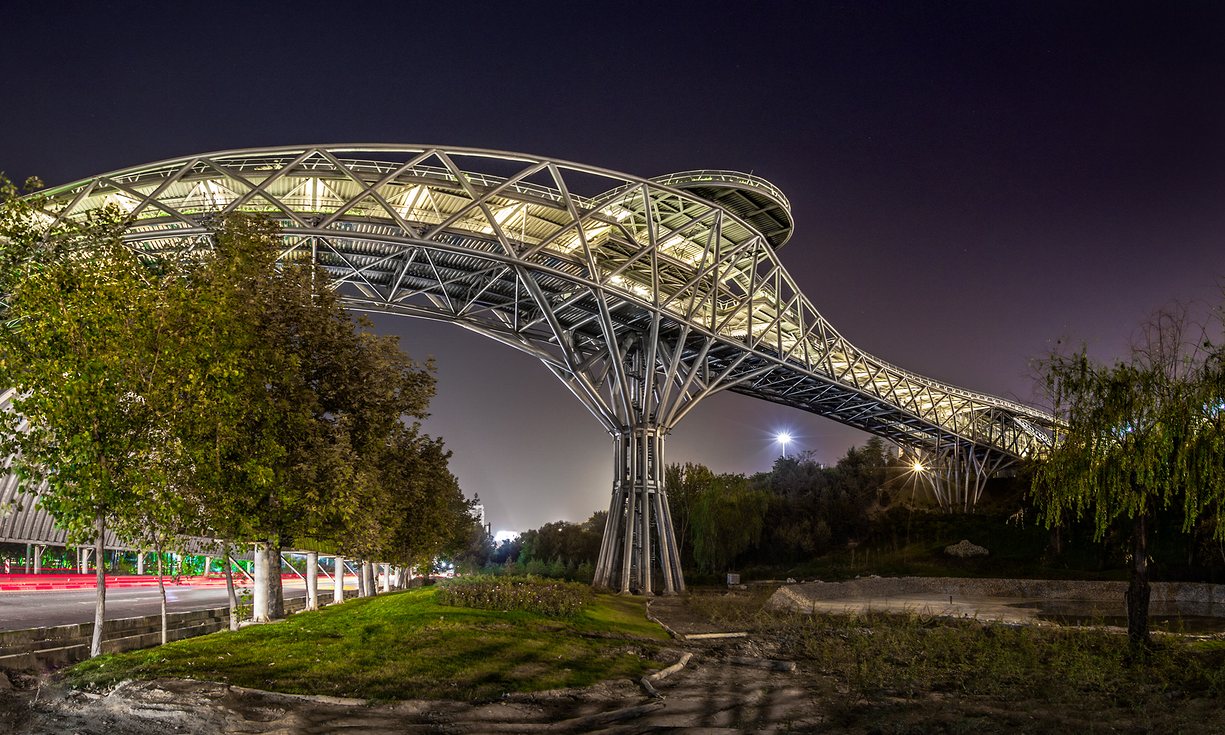
Unveiled in 2014 by Tehran’s mayor, Tabiat (nature) bridge is a spectacular hi-tech structure designed by young architects Leila Araghian and Alireza Behzadi. Araghian was 26 when she designed the bridge, which took over two years to build and has since become a popular hangout for younger people and a site for morning sports. On public holidays, thousands flock there to picnic.

The bridge received a great deal of international attention after it was named last year among the winners of the Architizer A+ awards, a global competition based in New York. The 270m structure, which connects two parks in north Tehran, is built on three large pillars. It has multiple pathways and three floors of restaurants, cafes and seating areas. “I didn’t want it to be just a bridge that people would use to get from one park to another,” Araghian told the Guardian last year. “I wanted it to be a place for people to stay and ponder, not simply pass.”


Pardis Mellat Cinema


Pardis Mellat Cinema

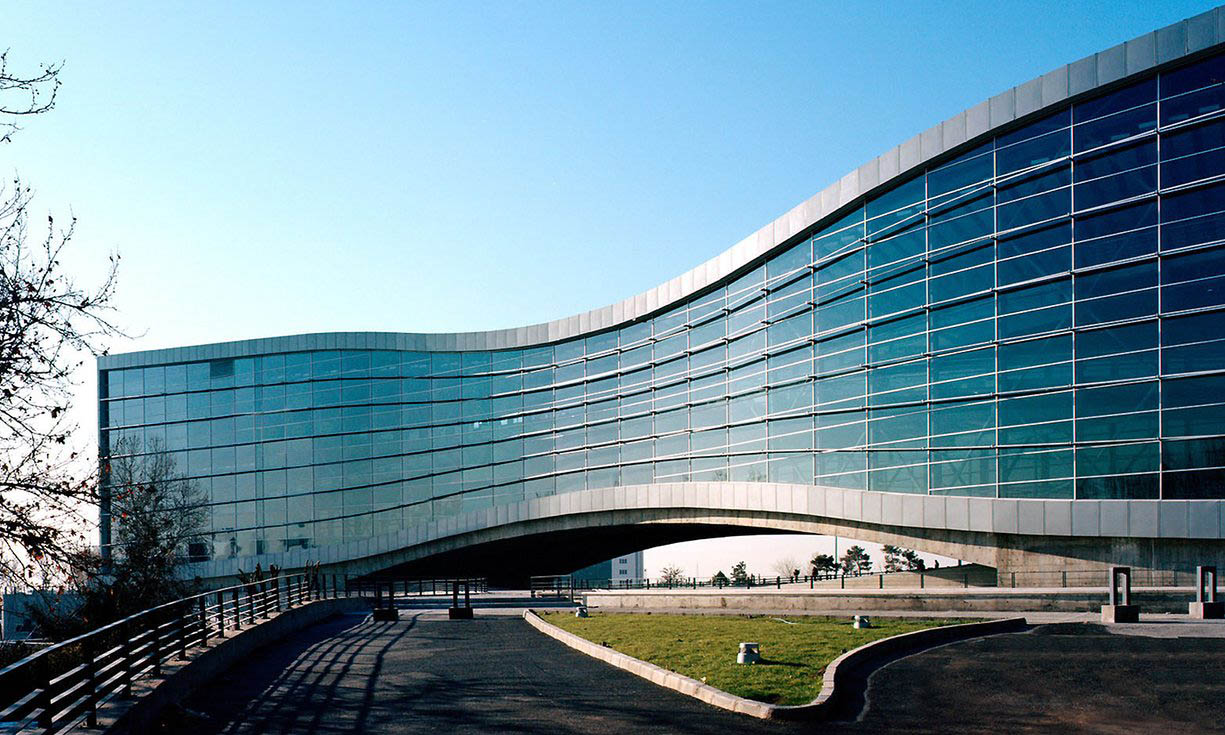
Reza Daneshmir’s Pardis Mellat cinema is responsible in many ways for kicking off the new burst of creativity in the capital, and was one of the first projects to gain international recognition after the revolution. “It was commissioned by Tehran’s mayor and completed in 2008; the state sector continued to commission similar works later such as the Tabiat Bridge,” says Gharleghi.

The cinema is in the southern corner of Tehran’s popular Mellat Park. One of its central features is a 57-metre arch with no supporting columns, and the building is designed as a place to hang out after watching films.


Nikbakht House


Nikbakht House


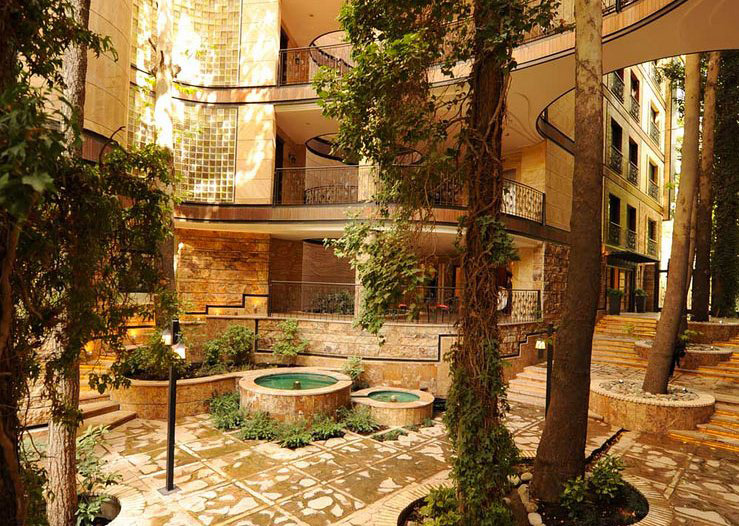
Mohammad-Reza Nikbakht’s residential building in Niavaran, north Tehran, built in 2013, was specifically designed to ensure no trees were cut down during its construction. “We’ve seen too many times in Tehran that 150-year-old or 200-year-old trees are cut for creation of new flats,” he said. “In my project, we faced a total of 128 trees with an average age of 70 years.” The initial plan required around 40 trees to be cut, but Nikbakht redesigned and persuaded the municipality to preserve all of them.

“We tried to protect them by covering them up during the construction. One tree dried up and another caught fire – the rest remained intact,” Nikbakht says. The residential complex has two blocks and each have five floors. “After this project, many people have become conscious about preserving the trees and the authorities have also increased the cost of cutting trees for the purpose of constructing new houses or offices.”


Orsi Khaneh


Nikbakht House

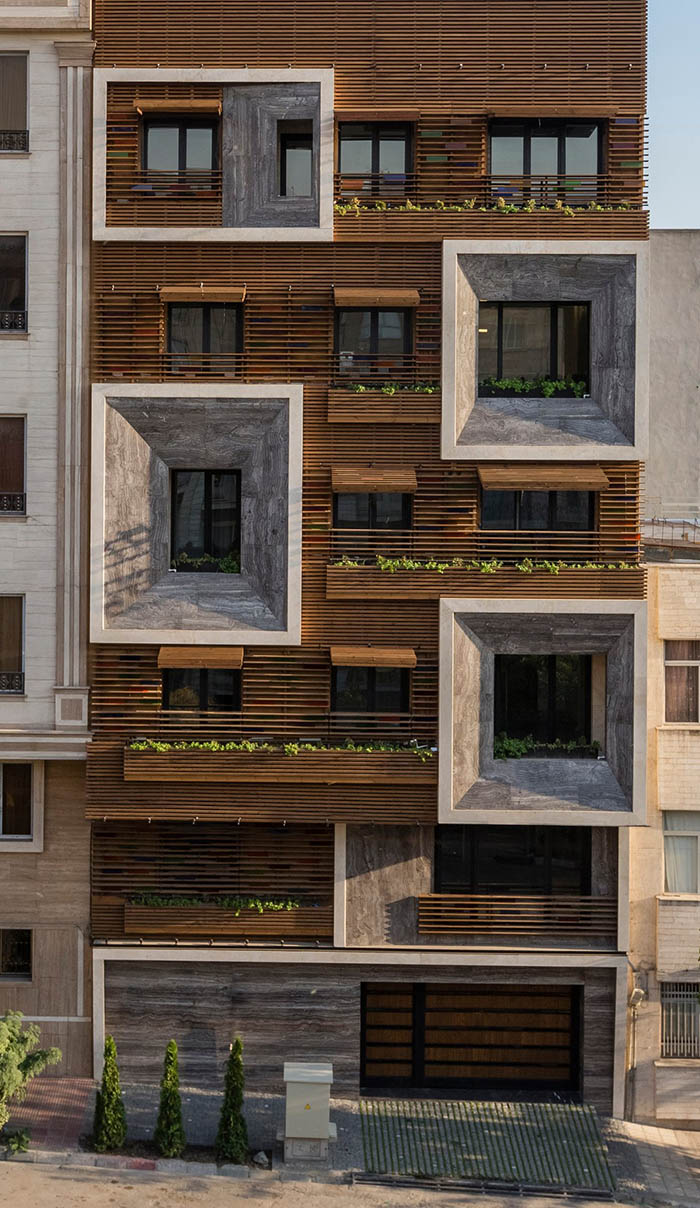
The Orsi Khaneh, designed by the Keivani brothers, is a residential block of flats completed in September 2015 in Tehran’s middle-class Gisha neighbourhood. “One of our main concerns was how to bring our architectural values to today, our aim was to make our Iranian architecture up to date,” Nima Keivani says. “In this project, we used the concept of Orsi windows seen in Iranian houses in the city of Kashan and tried to use it in today’s architecture.”

The building has seven floors, five of which are apartments, and a garden on its roof. “We also used stained glass and used the six colours that have traditionally been seen in Iranian windows,” Keivani said.

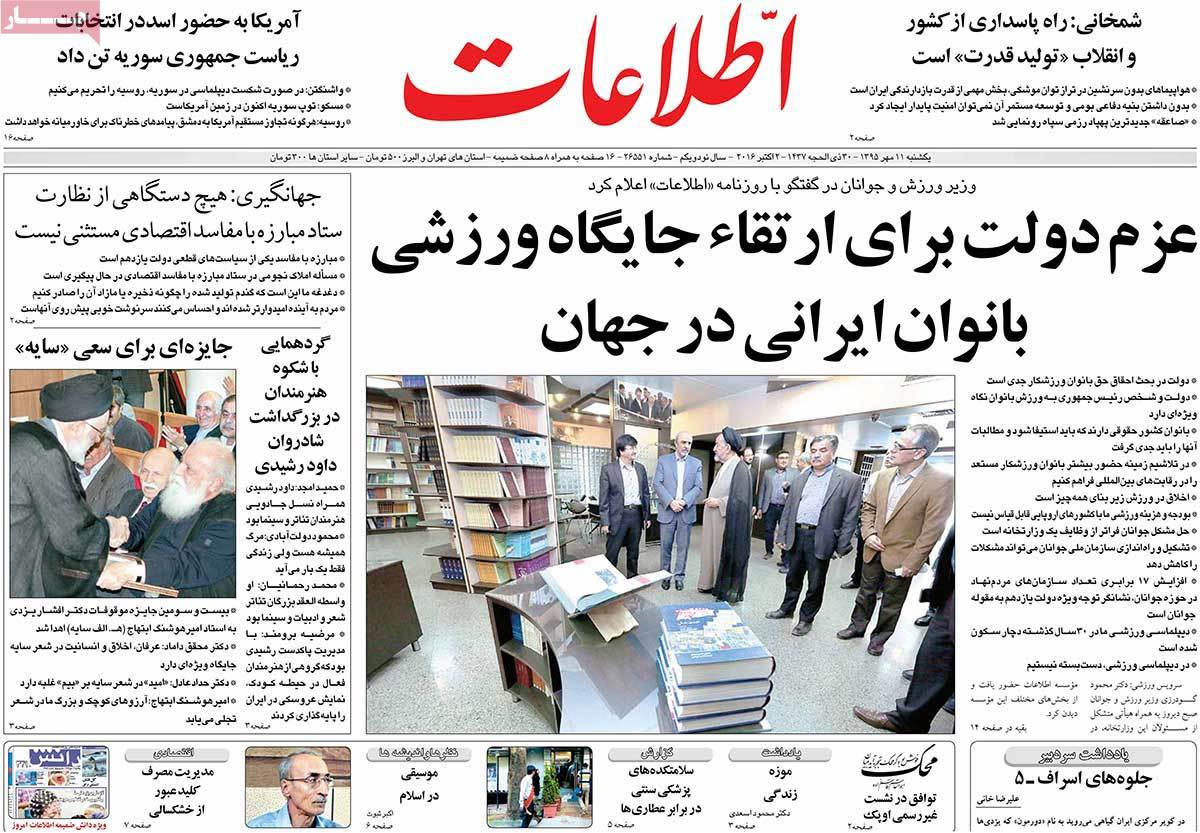
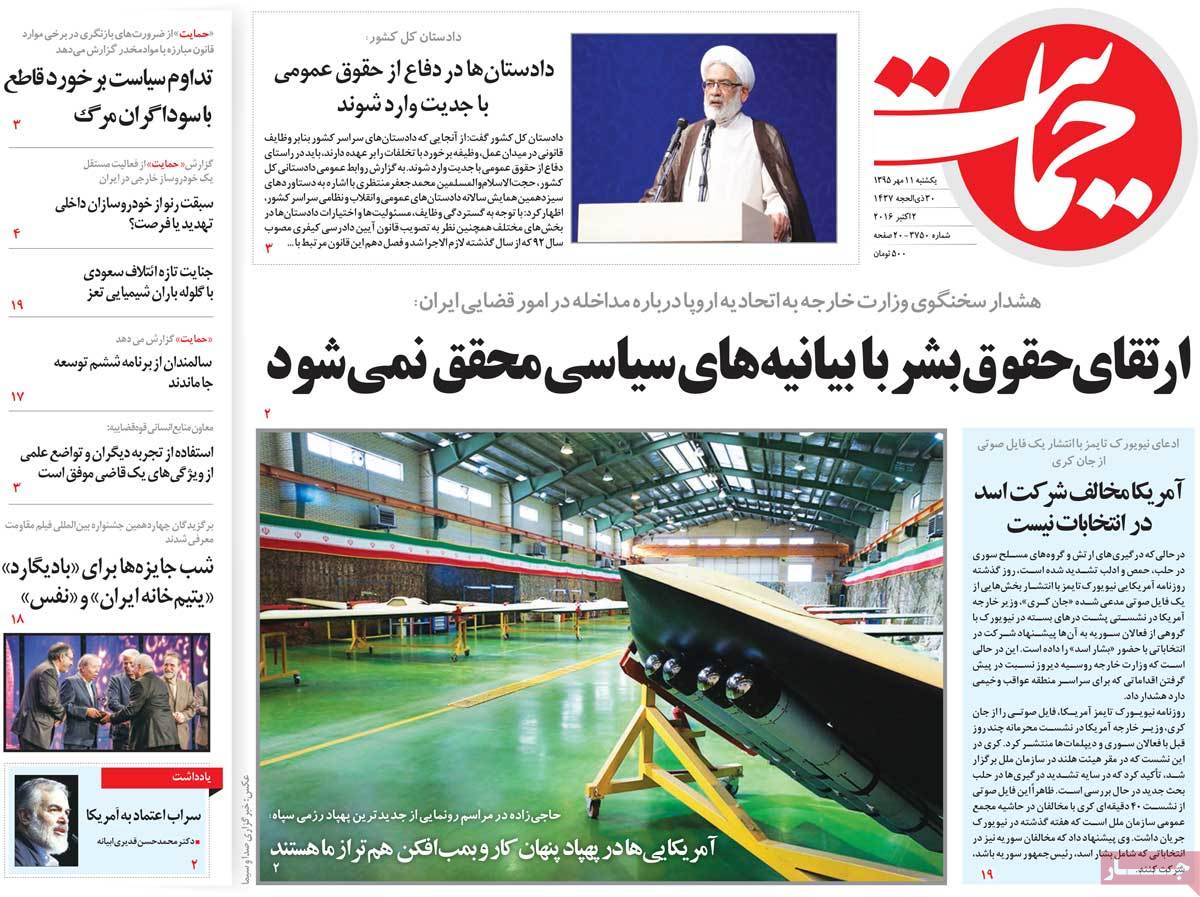
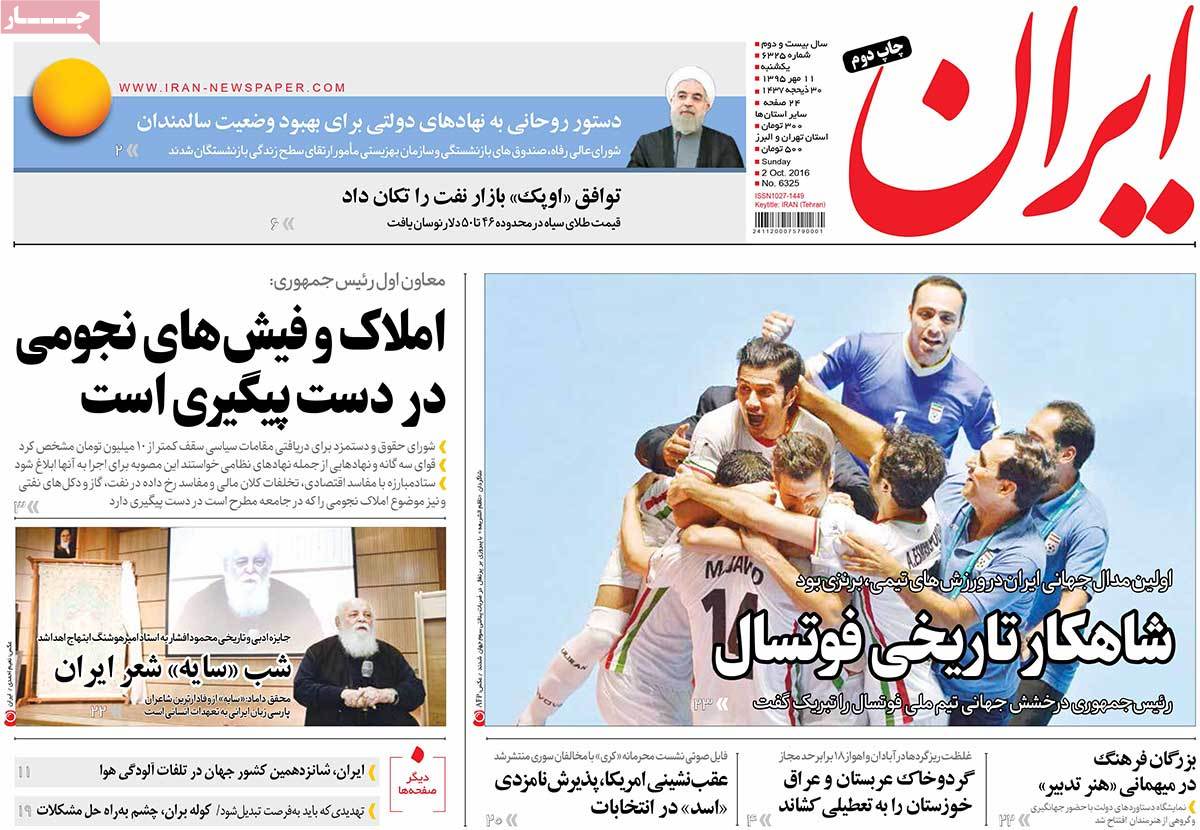
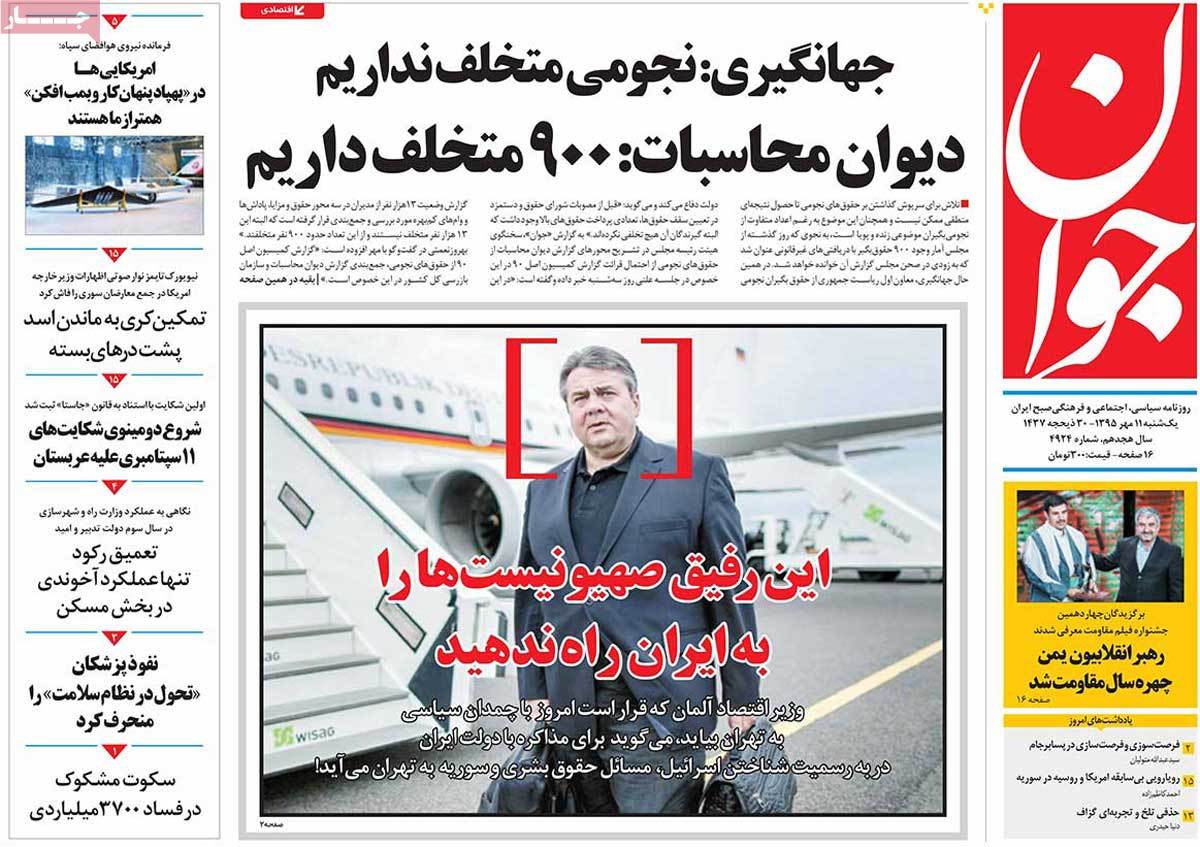
A Look at Iranian Newspaper Front Pages on October 2

Iran Newspaper front pages

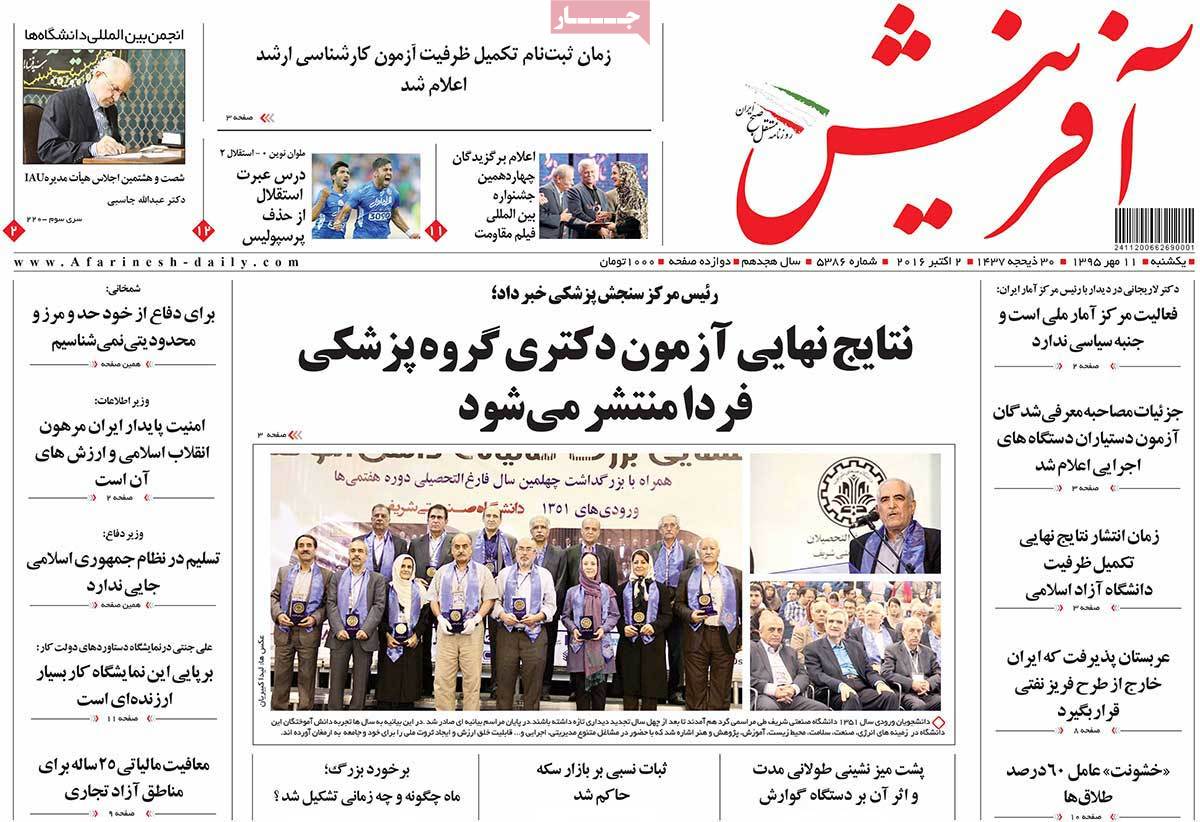
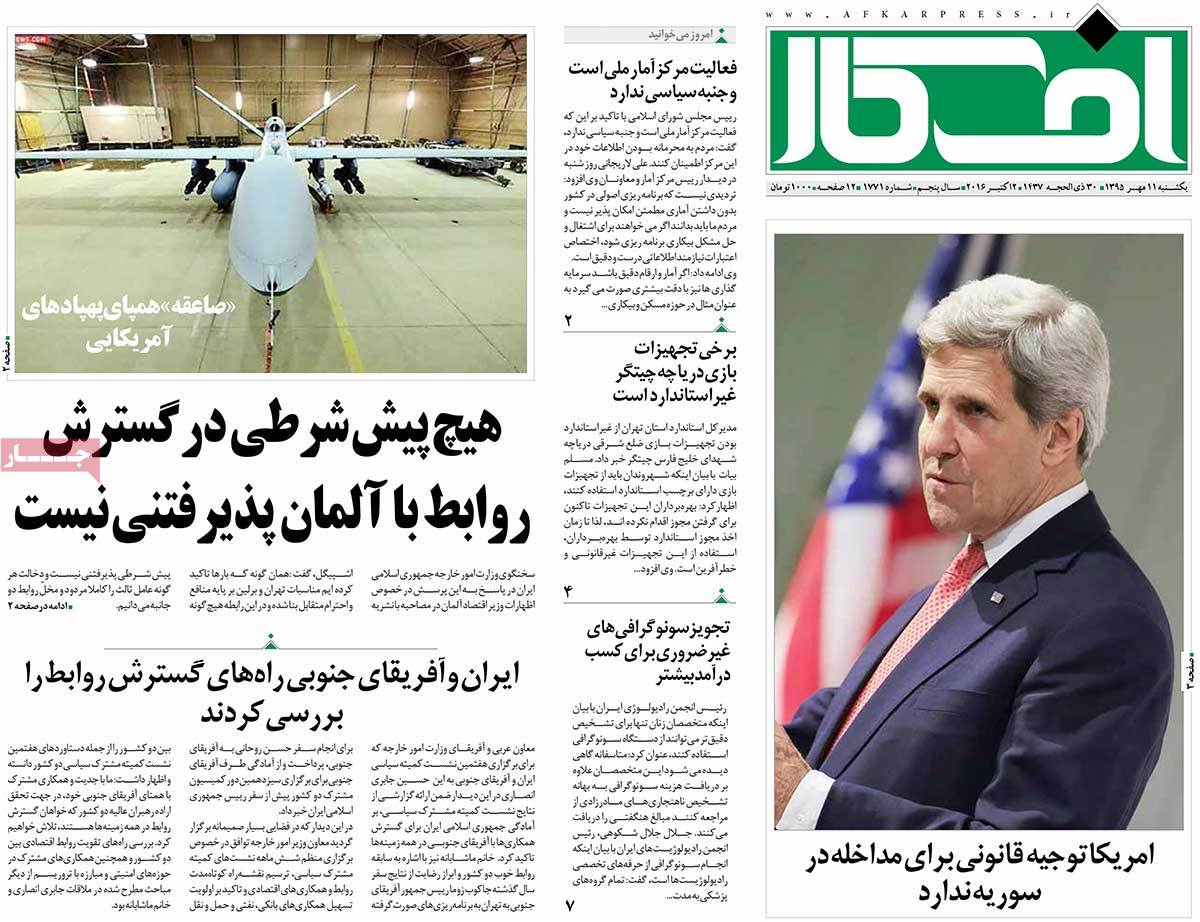
The majority of newspapers on Sunday covered the upcoming visit of German Economy Minister Siegmar Gabriel and his alleged pre-condition – Iran’s recognition of Israel – for expansion of Tehran-Berlin ties.

Another top story was the unveiling of Iran’s newly-developed drones and the American UAVs hunted by Iranian forces.

Newspapers also covered the US Secretary of State John Kerry’s remarks about Syrian President Bashar al-Assad’s presence in Syrian elections.

The above issues, as well as many more, are highlighted in the following headlines:


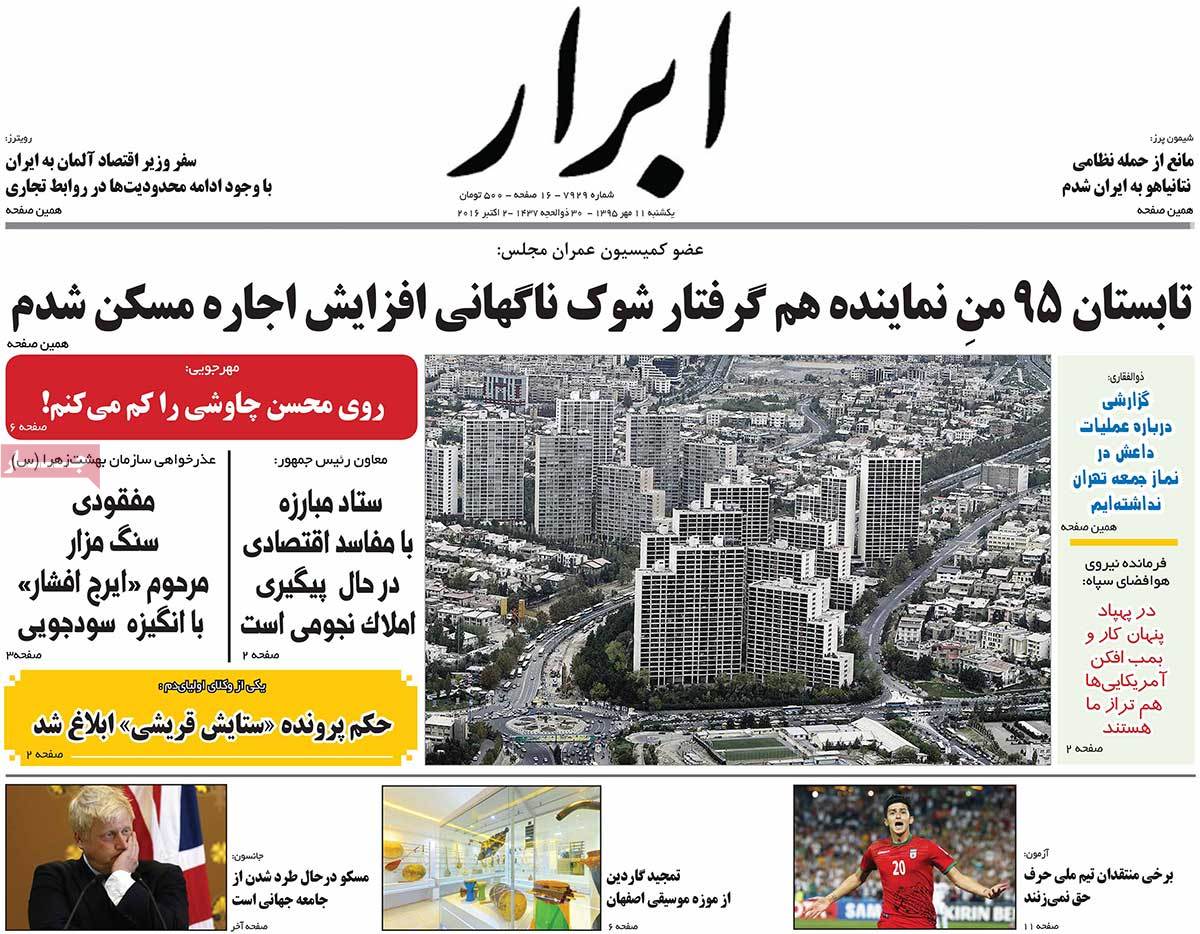
Abrar:

1- IRGC Aerospace Force Commander: US Trying to Draw Level with Iran in Making Stealth and Bomber Drones

2- Deputy Minister: No Report of ISIS’ Operation in Tehran Friday Prayers

3- Reuters: German Economy Minister Visiting Iran in Spite of Continued Restrictions in Trade Ties

A Look at Iranian Newspaper Front Pages on October 2


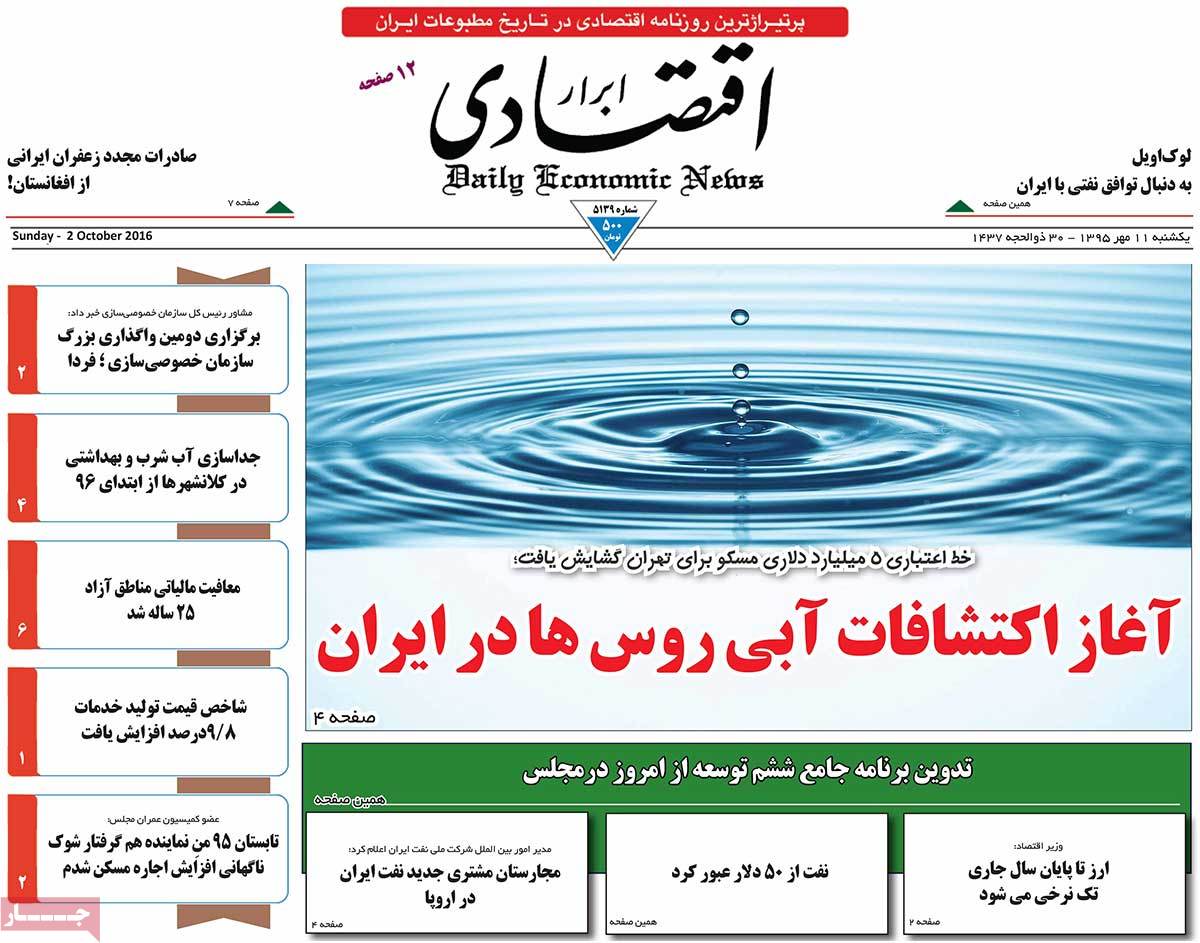
Abrar-e Eqtesadi:

1- Lukoil Looking for Oil Deal with Iran

2- Re-Export of Iran’s Saffron from Afghanistan!

3- Russians Begin Water Explorations in Iran: Moscow Opens $5bn LC for Tehran

A Look at Iranian Newspaper Front Pages on October 2


Afarinesh:

1- Shamkhani: We See No Limit in Defending Ourselves and Our Borders

2- Intelligence Minister: Iran’s Sustainable Security Achieved Thanks to Islamic Revolution and Its Values

3- Defence Minister: Submission Has No Meaning in Islamic Republic

A Look at Iranian Newspaper Front Pages on October 2


Afkar:

1- Kerry: US Has No Legal Justification for Intervention in Syria

2- Iran and South Africa Explore Avenues for Expansion of Ties

3- Iranian Spokesman: Iran Accepts No Pre-Condition for Expansion of Ties with Germany

A Look at Iranian Newspaper Front Pages on October 2


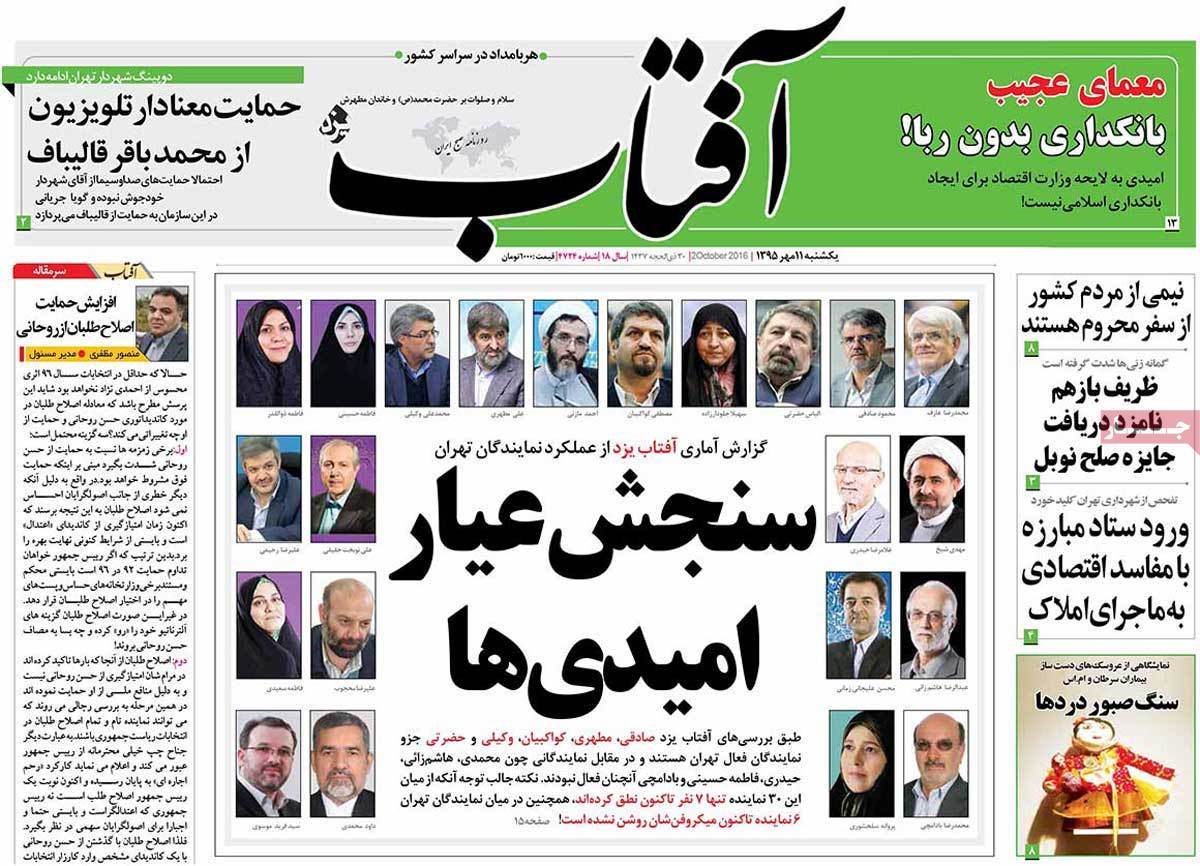
Aftab-e Yazd:

1- Renewed Speculations: Zarif Once Again Named as Noble Peace Prize Candidate

2- 50% of Iranians Deprived of Travelling

A Look at Iranian Newspaper Front Pages on October 2


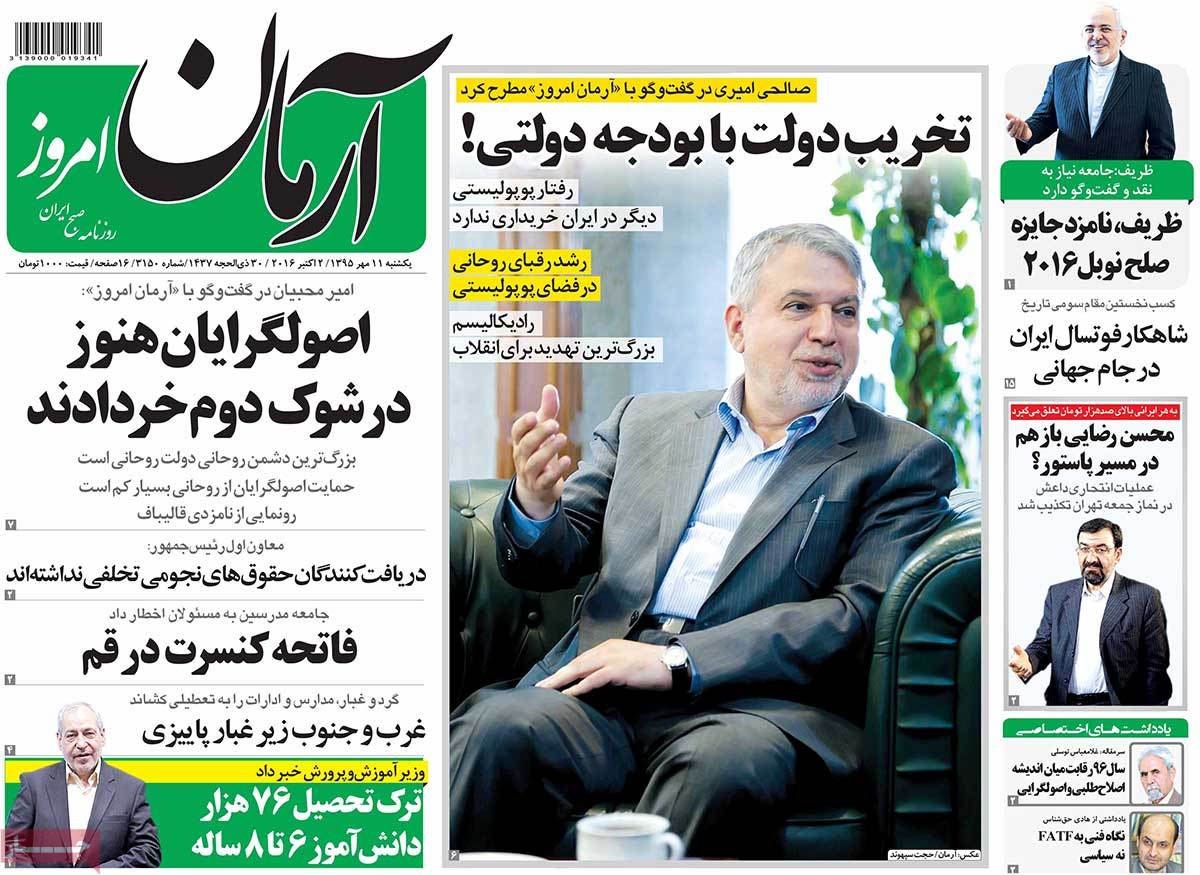
Arman-e Emrooz:

1- Iran Futsal Team Makes History: 3rd Place in World Cup, First Medal in Iran’s Futsal History

2- Western and Southern Iran Hit by Dust Pollution of Autumn: Schools and Administrations Shut Down

A Look at Iranian Newspaper Front Pages on October 2


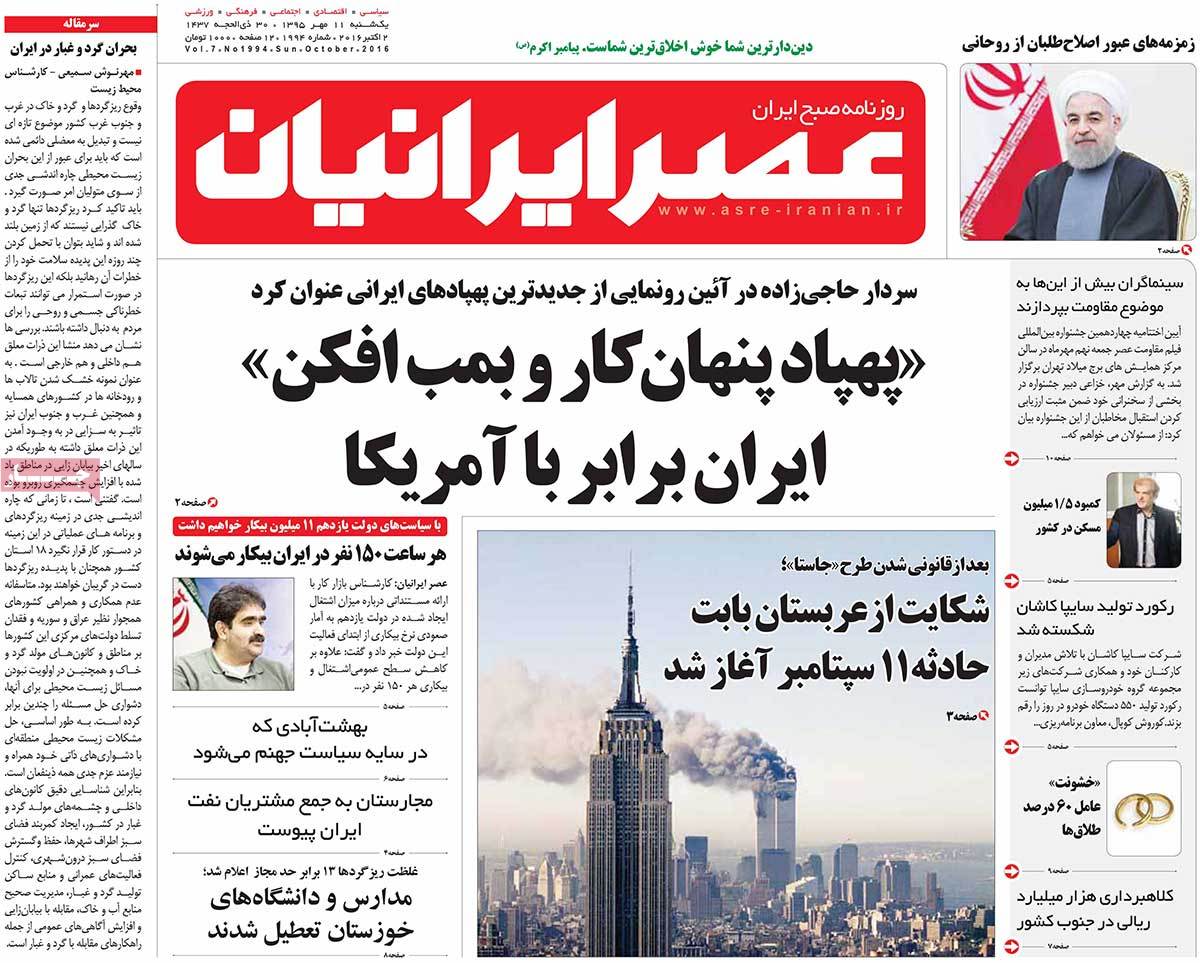
Asr-e Iranian:

1- Hungary Joins Iran’s Oil Customers

A Look at Iranian Newspaper Front Pages on October 2


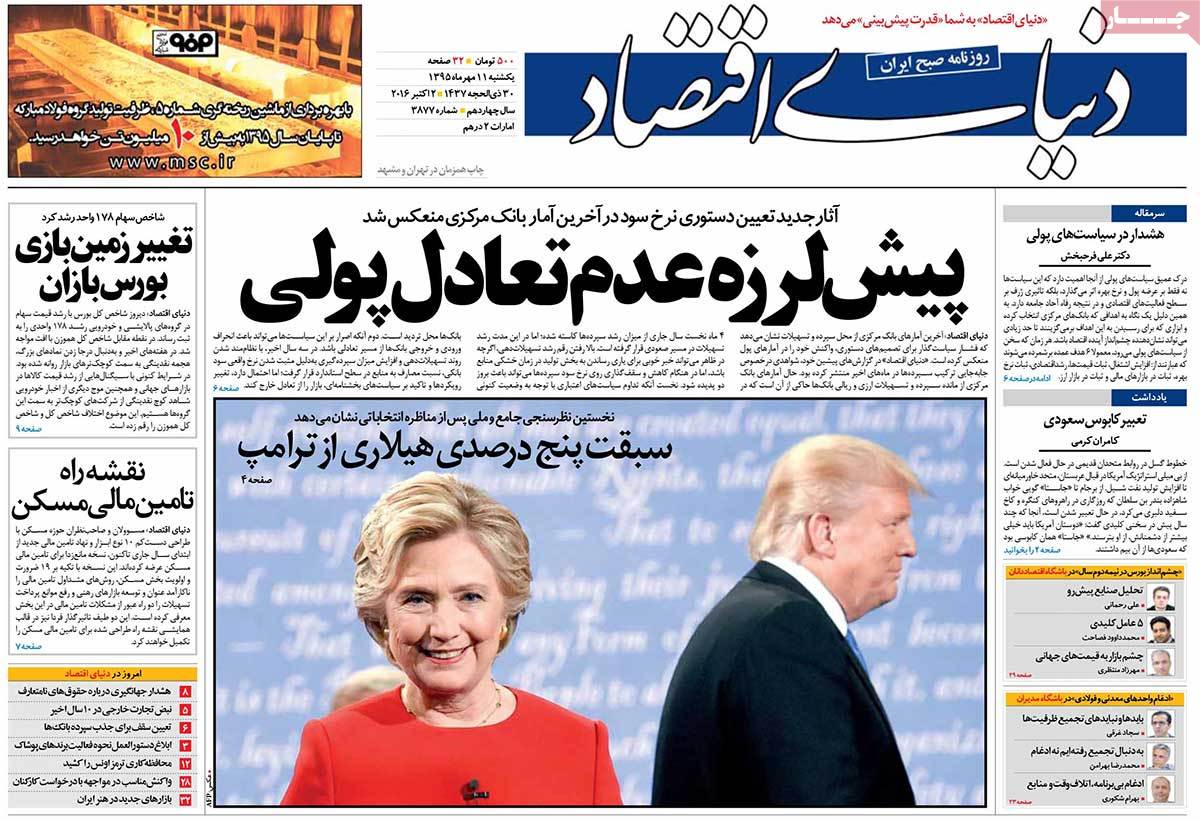
Donya-ye Eqtesad:

1- First Nationwide and Comprehensive Poll after US Presidential Debates Indicates: Hillary Is 5% ahead of Trump

A Look at Iranian Newspaper Front Pages on October 2


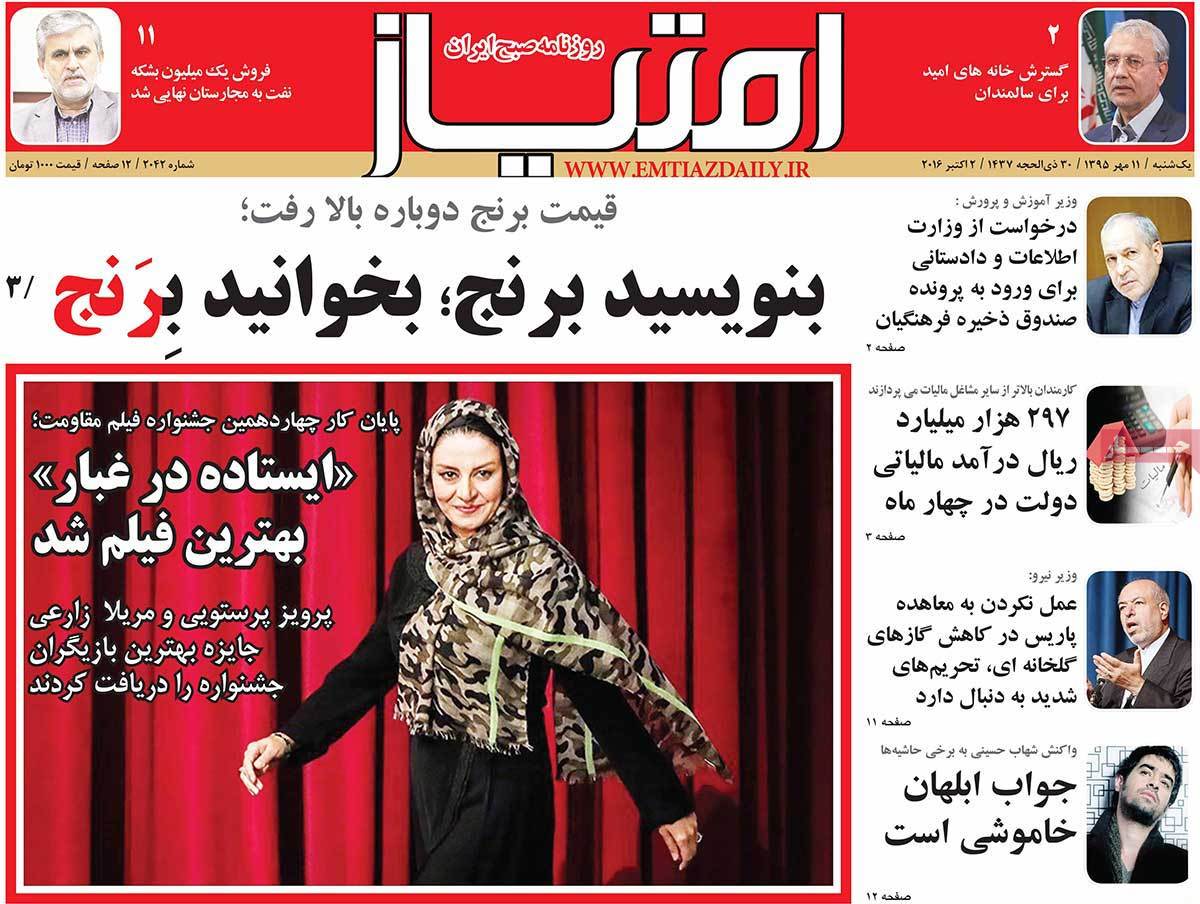
Emtiaz:

1- Power Minister: Serious Sanctions Can Be Imposed If Iran Fails to Implement Its Commitments as per Paris Deal on Greenhouse Gases

A Look at Iranian Newspaper Front Pages on October 2


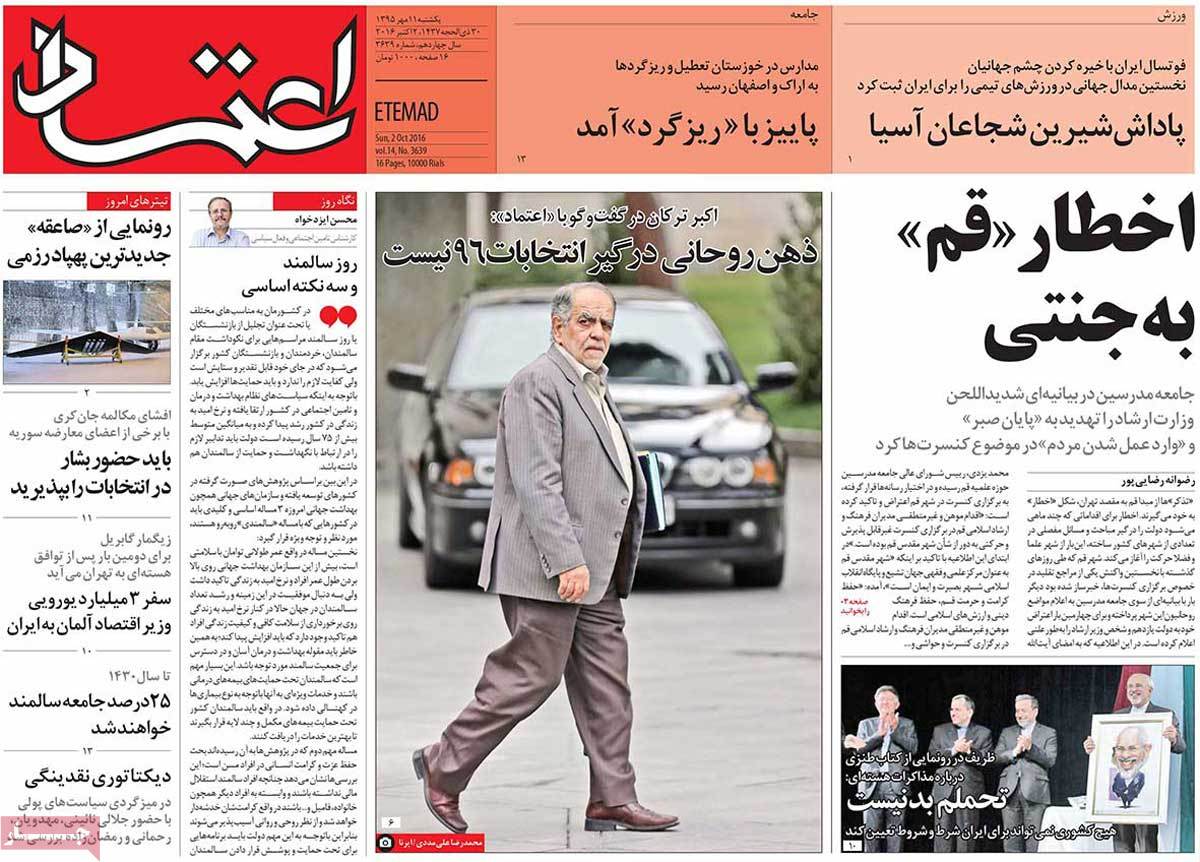
Etemad:

1- Iran Unveils Latest Fighter Drone ‘Sa’eqeh’

2- You Have to Accept Assad’s Presence in Syrian Elections: Kerry’s Conversation with Some Syrian Opposition Figures Leaked

3- German Economy Minister’s Visit to Tehran with €3bn Business Deals: Gabriel to Visit Iran for Second Time Since Nuclear Deal

A Look at Iranian Newspaper Front Pages on October 2


Ettela’at:

1- US Accedes to Assad’s Presence in Syrian Presidential Elections

2- Government Resolved to Promote Position of Iranian Women in World’s Sports

A Look at Iranian Newspaper Front Pages on October 2


Hemayat:

1- Foreign Ministry Spokesman Warns EU against Interference in Iran’s Judicial Affairs: It’s Not Possible to Promote Human Rights through Politically-Motivated Statements

A Look at Iranian Newspaper Front Pages on October 2


Iran:

1- US Backs Off and Accepts Assad’s Presence in Syrian Elections

2- Iran, 16th Country in the World in Air Pollution Fatalities

A Look at Iranian Newspaper Front Pages on October 2


Javan:

1- Don’t Let This ‘Friend of Zionists’ Enter Iran: German Economy Minister Is Going to Visit Iran for Talks with Government over Recognition of Israel

2- Beginning of the Domino of Lawsuits Filed against Saudi Arabia over 9/11

A Look at Iranian Newspaper Front Pages on October 2


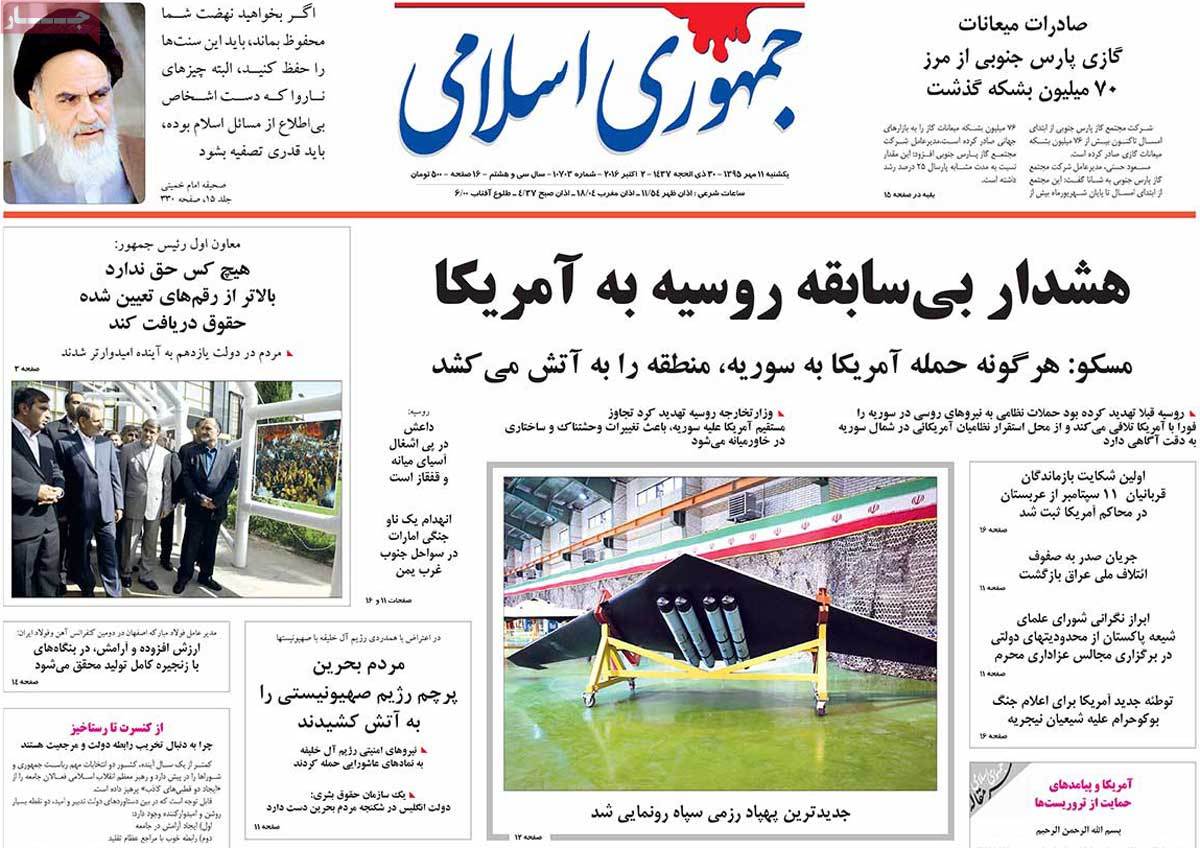
Jomhouri Eslami:

1- Russia’s Unprecedented Warning to US: Moscow Says US Attack on Syria Would Set Fire on Entire Region

2- Export of South Pars Gas Field’s Gas Condensates Exceeds 70m bpd

3- Russia: ISIS after Occupying Central Asia and Caucasia

4- First Lawsuit Filed by a 9/11 Survivor against Saudi Arabia in a US Court

A Look at Iranian Newspaper Front Pages on October 2


Kayhan:

1- Development of Auto Industry by Assembling Renault Products Dating Back to 17 Years Ago!

2- Yemen Army Destroys UAE’s Warship in Ta’iz Coasts

3- On Verge of Islamic Month of Muharram, Al Khalifa Regime Becomes More Brutal in Oppressing Bahraini People

4- First VP: Executives Who Received Astronomical Salaries Didn’t Violate the Law!

A Look at Iranian Newspaper Front Pages on October 2


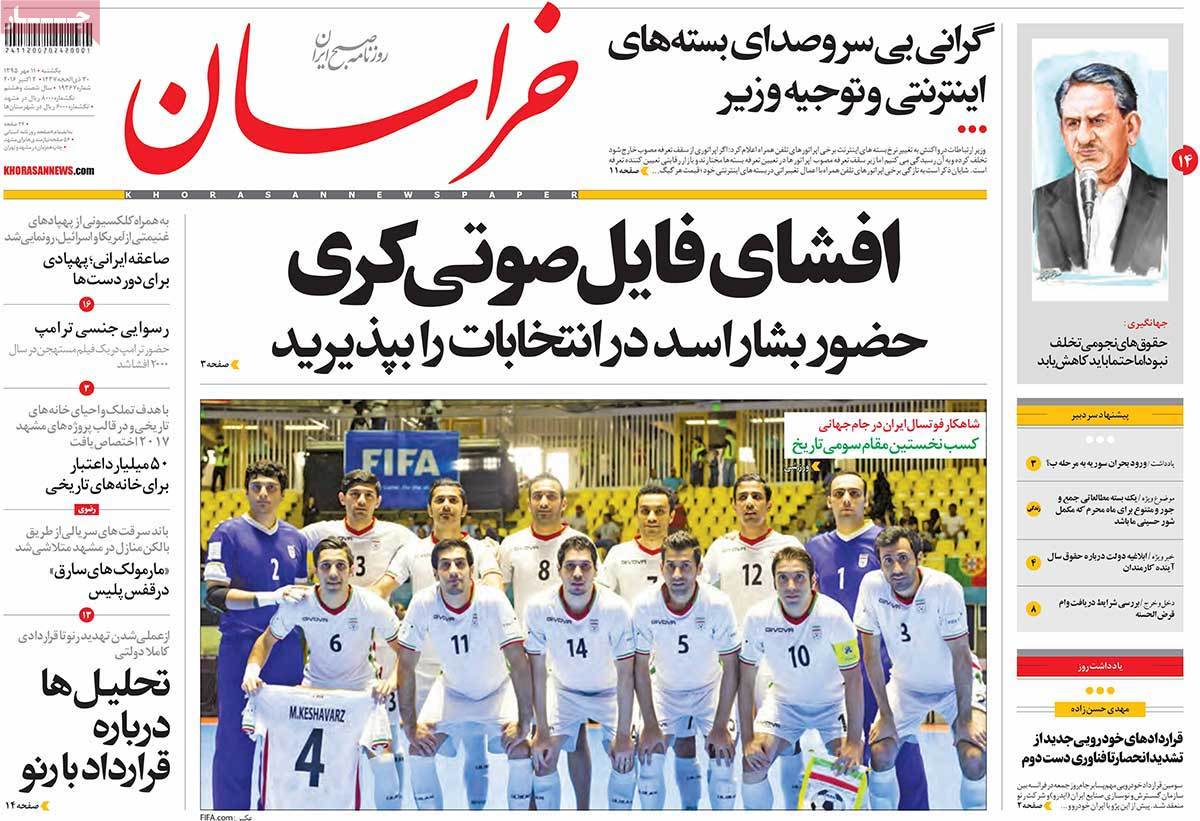
Khorasan:

1- Trump’s Sexual Scandal: Trump’s Presence in a 2,000 Pornographic Video Leaked

A Look at Iranian Newspaper Front Pages on October 2


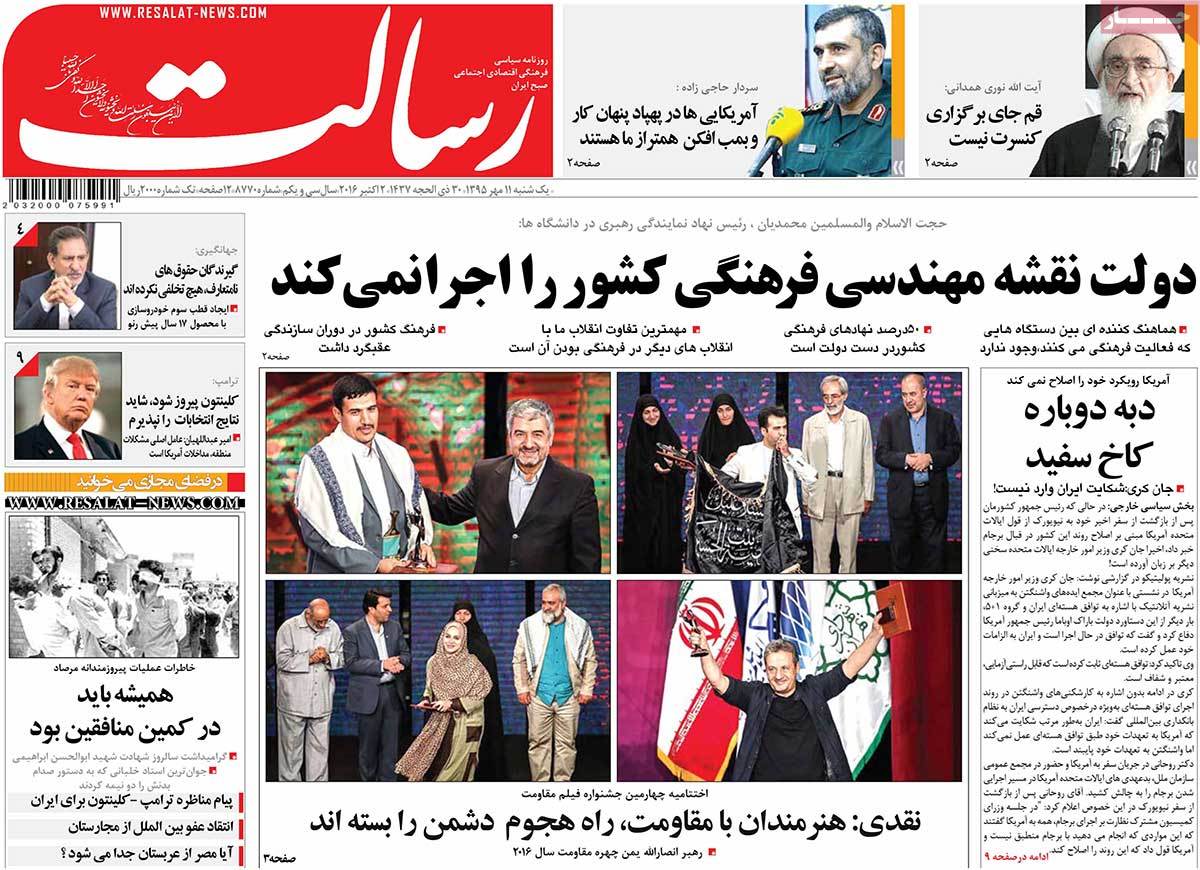
Resalat:

1- Trump: If Clinton Wins, I May Refuse to Accept Election Results

2- Amir Abdollahian: US Interference Is Main Cause of Middle East’s Problems

A Look at Iranian Newspaper Front Pages on October 2


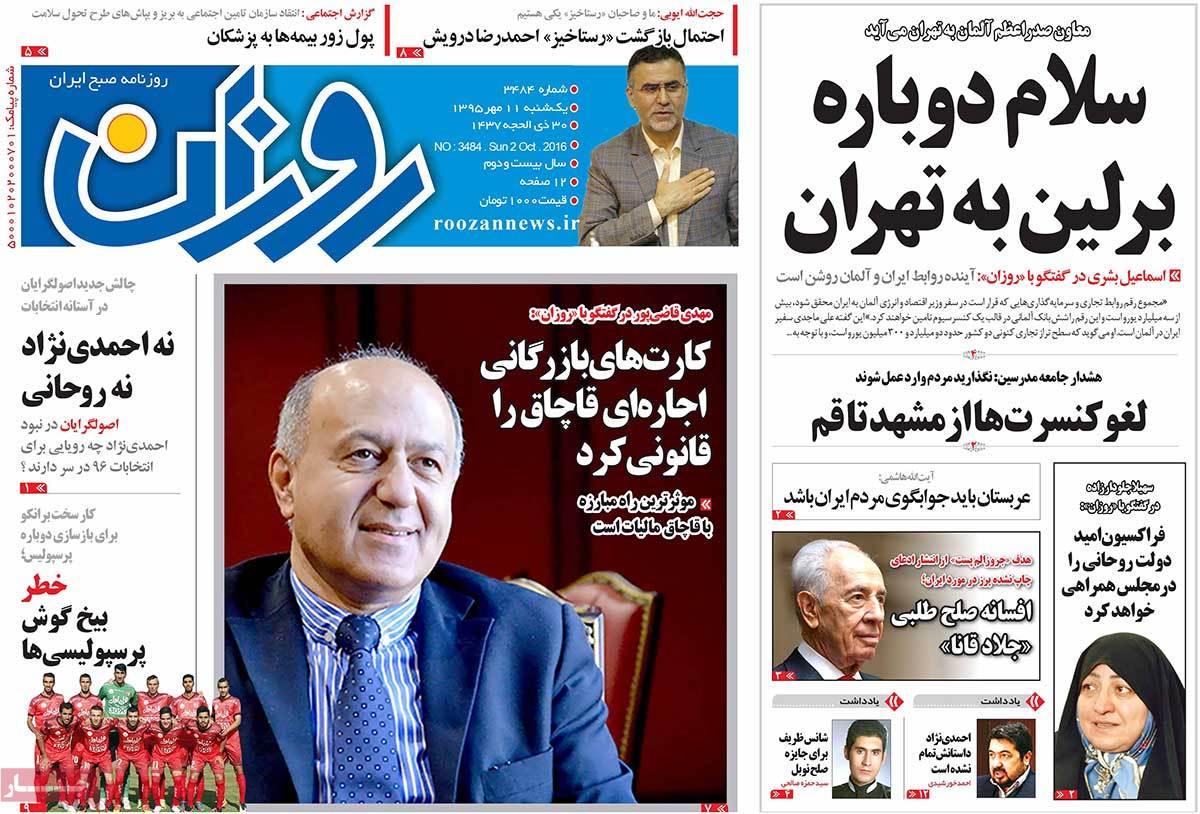
Roozan:

1- Conservatives’ New Challenge ahead of Elections: Neither Ahmadinejad, Nor Rouhani

2- Berlin Once Again Says Hello to Tehran

A Look at Iranian Newspaper Front Pages on October 2


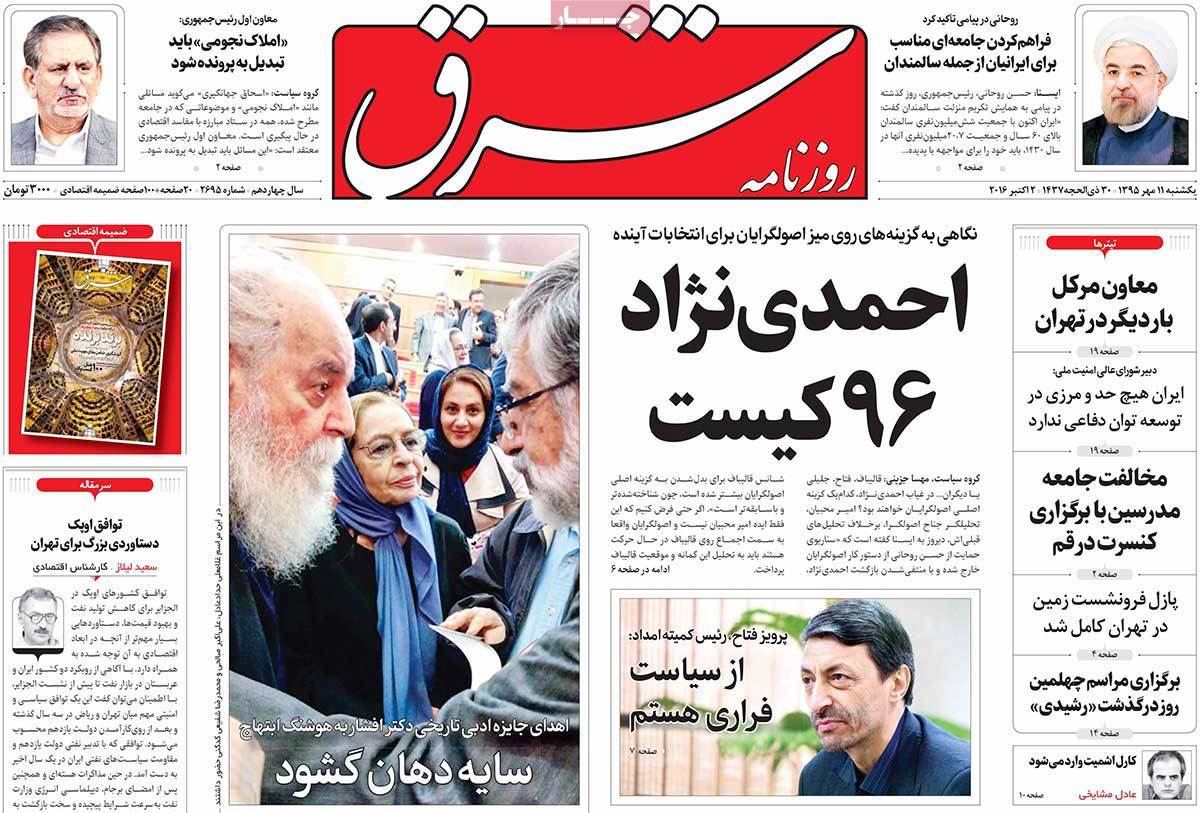
Shargh:

1- Merkel’s Deputy Once Again in Tehran

2- SNSC Secretary: Iran Knows No Limit for Developing Its Defensive Capabilities

A Look at Iranian Newspaper Front Pages on October 2


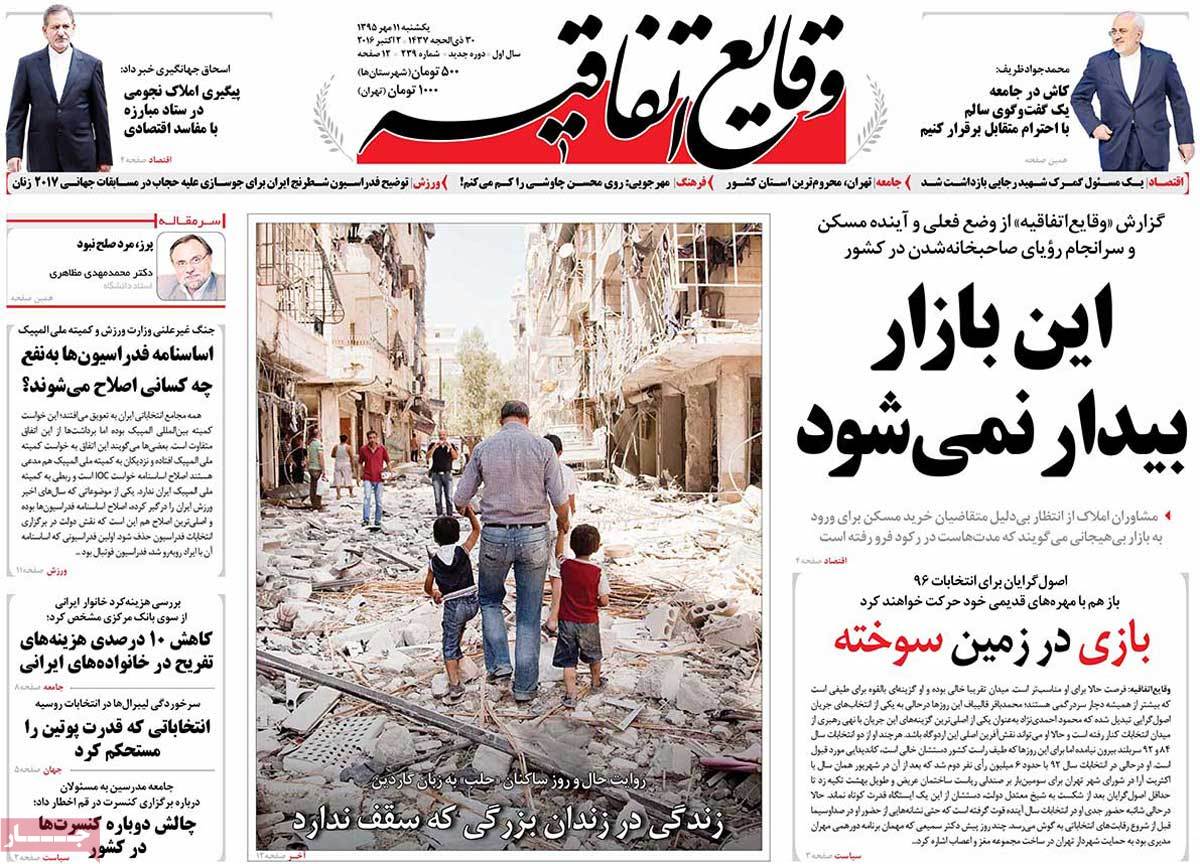
Vaghaye Ettefaghieh:

1- Life in a Big Prison without a Ceiling: Guardian’s Account of What’s Going on in Aleppo

2- Liberal Frustration in Russian Elections: The Polls that Strengthened Putin’s Power

A Look at Iranian Newspaper Front Pages on October 2


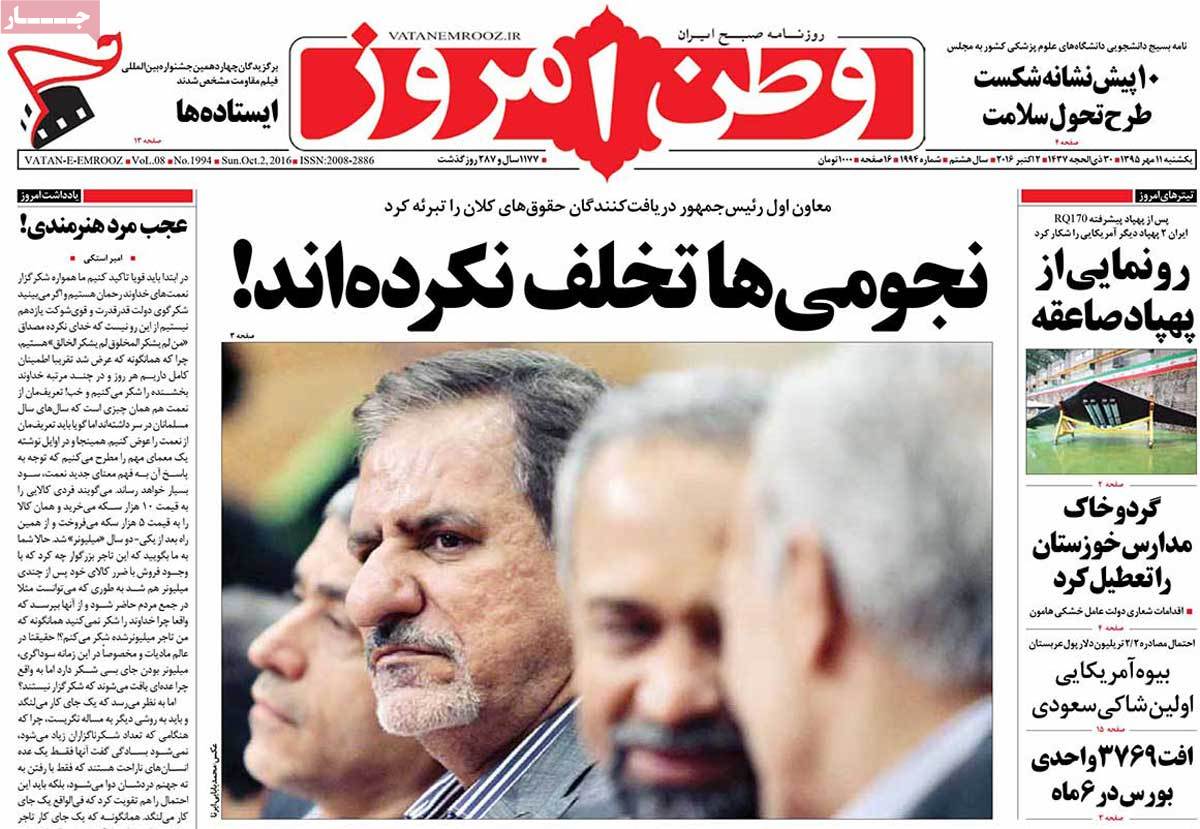
Vatan-e Emrooz:

1- Iran Has Hunted 2 Other American Drones after RQ-170

2- American Widow, the First to Sue Saudi Arabia

A Look at Iranian Newspaper Front Pages on October 2

Iran, Netherlands to Expand Trade Ties According to Roadmap

Iran-Netherlands

“Grounds are provided for closer cooperation between the Islamic Republic and the Netherlands in many fields,” Jahangiri said in a speech in the Erasmus University in Rotterdam.

The diplomat added that therefore, the two countries have devised a roadmap to promote relations within its framework.

“Thanks to the advantages of doing business with the Islamic Republic of Iran, European countries have taken massive steps to boost economic cooperation with Iran over the past two years, especially after the nuclear deal,” he noted.

Earlier last month, Jahangiri and president of the Netherlands’ central bank (De Nederlandsche Bank), Klaas Knot, held a meeting in The Hague to discuss ways to boost banking interactions between the two nations.

The talks come against the backdrop of a new wave of interest in ties with Iran after Tehran and the Group 5+1 (Russia, China, the US, Britain, France and Germany) on July 14, 2015 reached a conclusion over the text of a comprehensive 159-page deal on Tehran’s nuclear program and started implementing it on January 16.

The comprehensive nuclear deal, known as Joint Comprehensive Plan of Action (JCPOA), terminated all nuclear-related sanctions imposed on Iran.

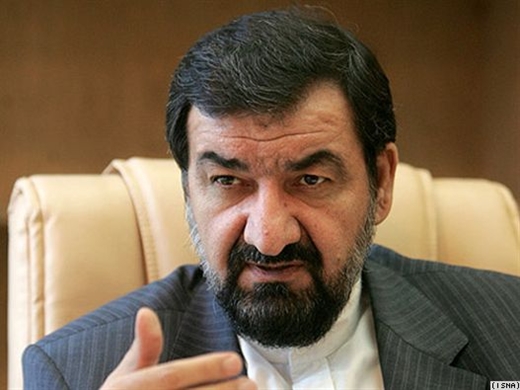
IRGC General Says Saudi Arabia Is Iran’s Enemy

Mohssen Rezai

“Today, Saudi Arabia is our enemy and Turkey is our rival,” Rezaei, a former commander of the Islamic Revolution Guards Corps (IRGC), said, addressing a congress in the Western province of Kohgilouyeh and Boyer Ahmad on Sunday.

Referring to the US support for Saudi Arabia, he said, “One day, they will see that Wahhabism will disgrace them in a way worse than the ISIS terrorist group.”

Rezaei expressed regret that the US has learned no lesson from the crimes committed by the former Iraqi dictator Saddam Hussein and the ISIS against the people, as reported by Fars and edited by IFP.

“Iran is asking them why they enter the lands of independent countries like Syria and Yemen.”

He called on regional countries to protect their independence and avoid becoming a puppet of the US and Israel, and asked, “Why shouldn’t a country like Saudi Arabia experience democracy? Why shouldn’t its people decide their own fate?”

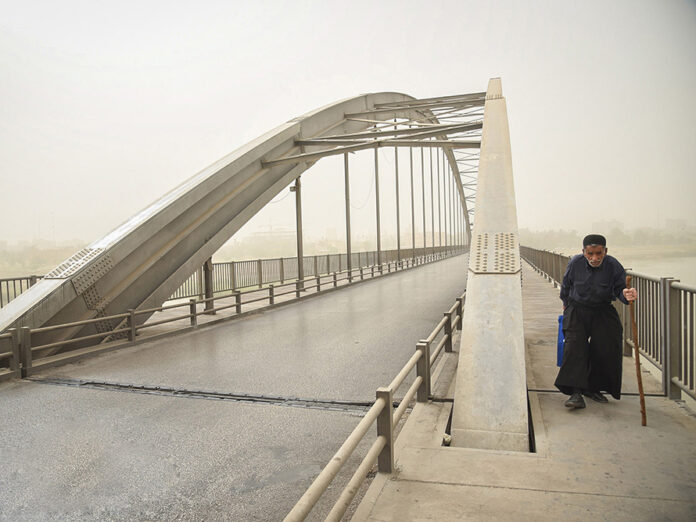
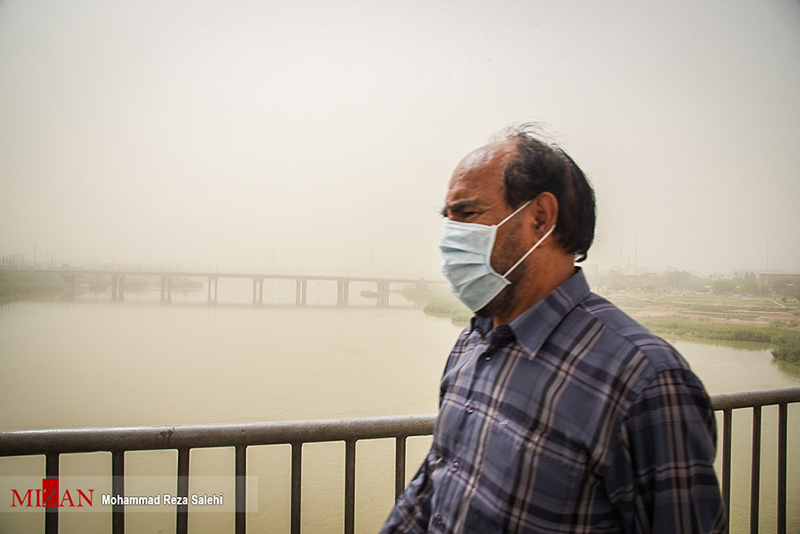
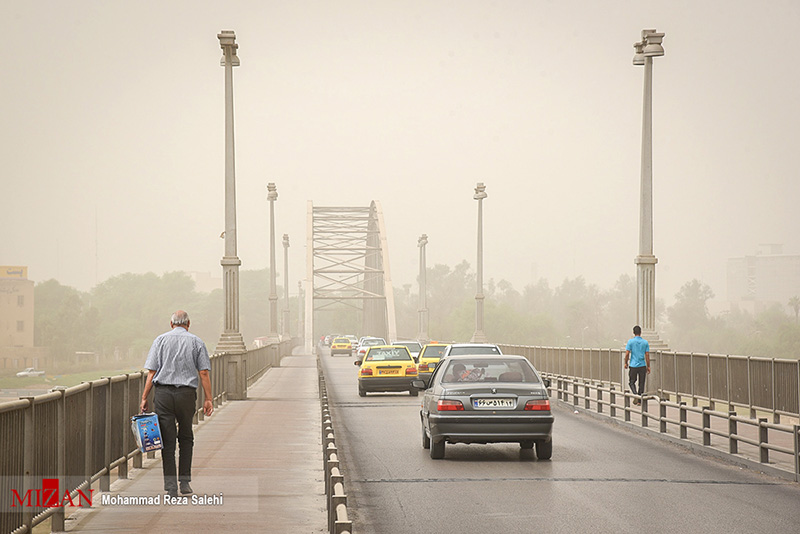
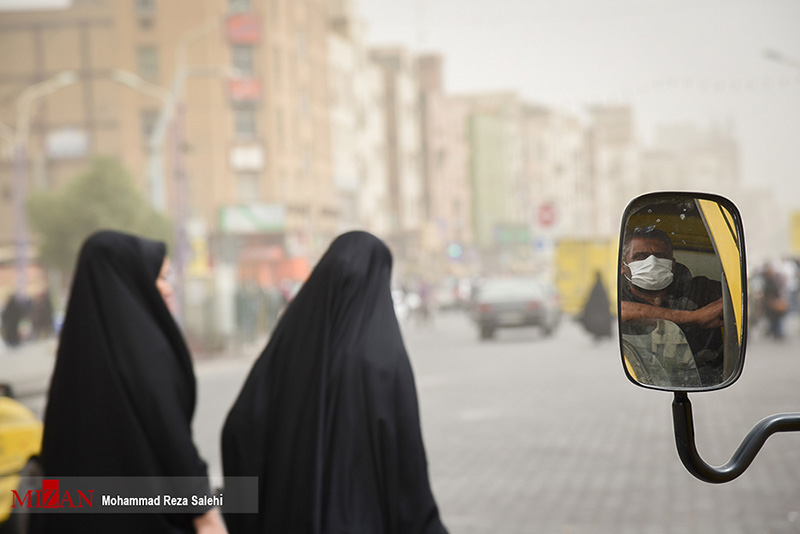
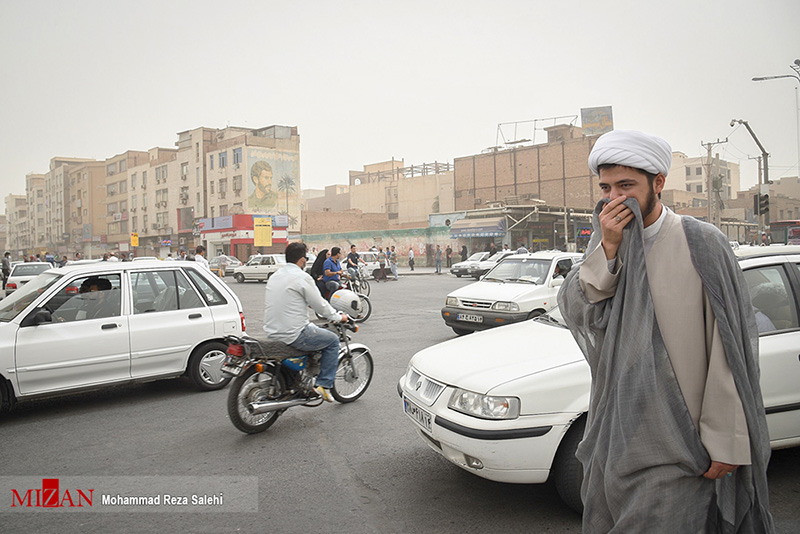
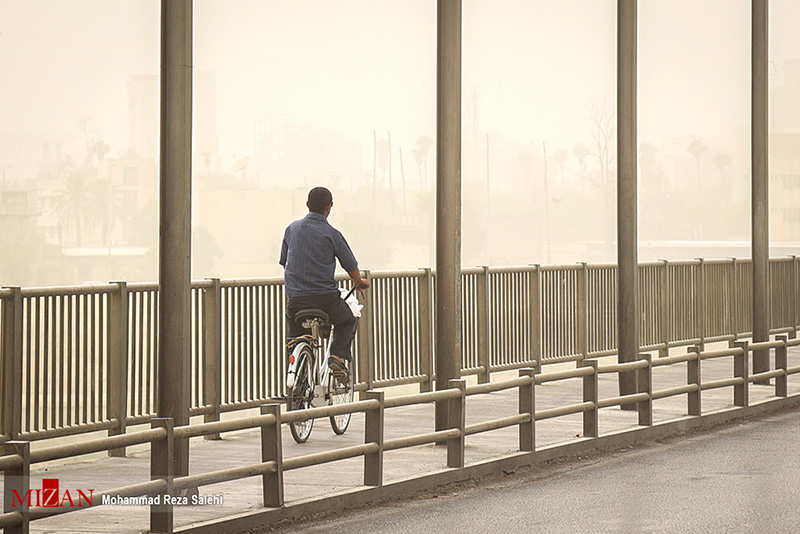
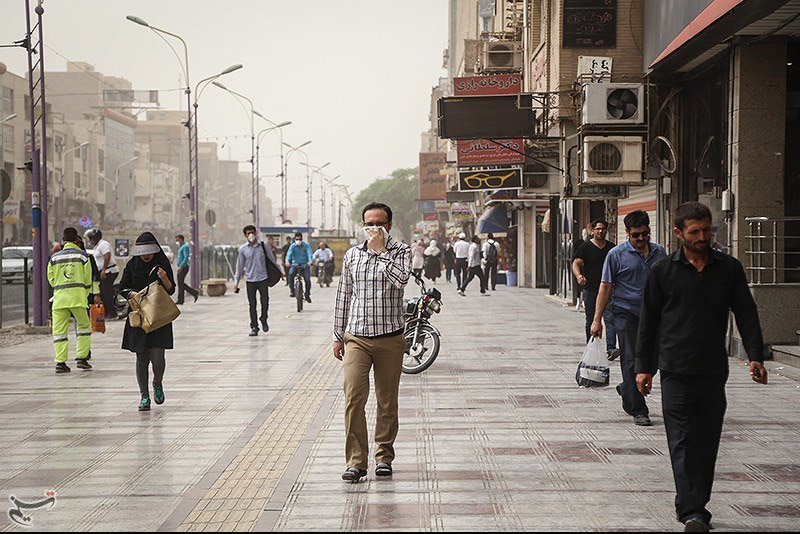
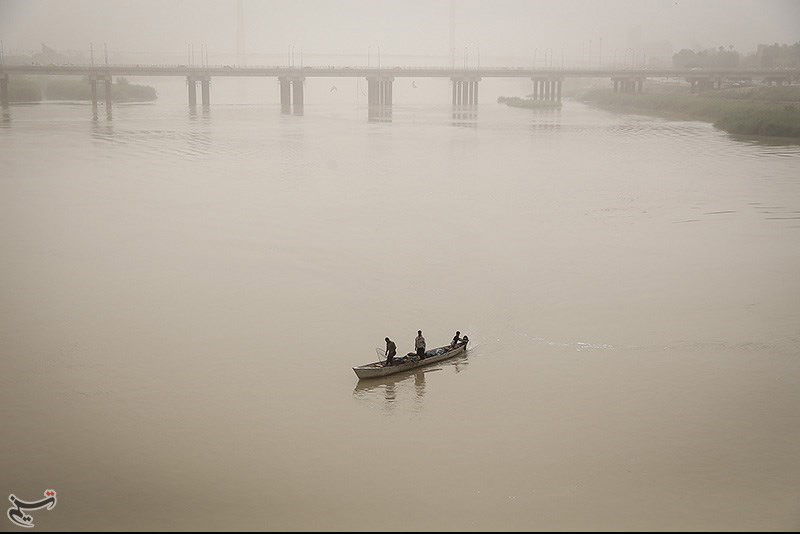
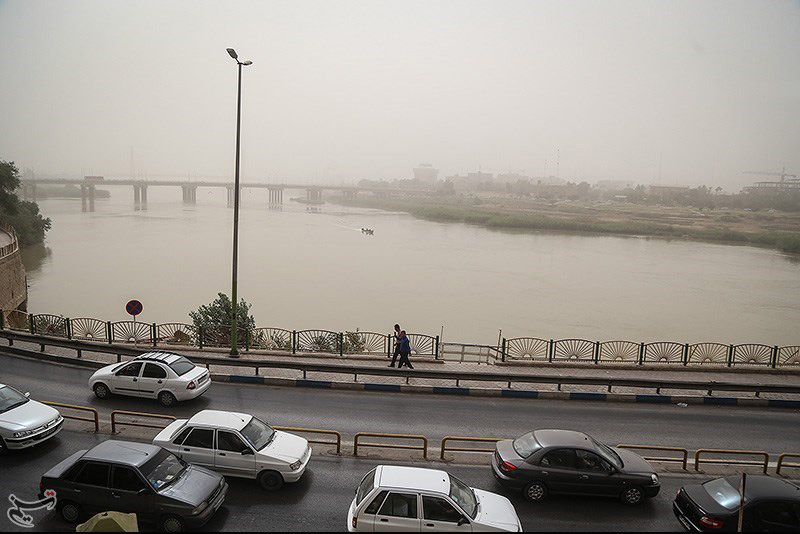
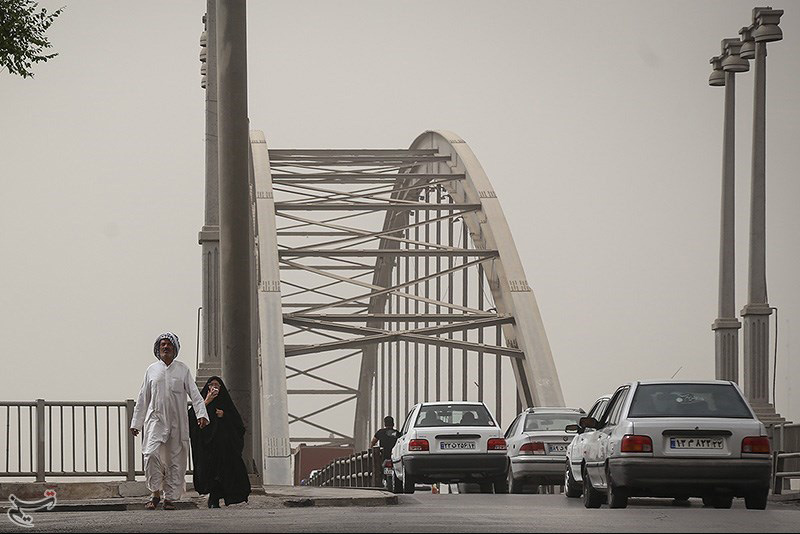
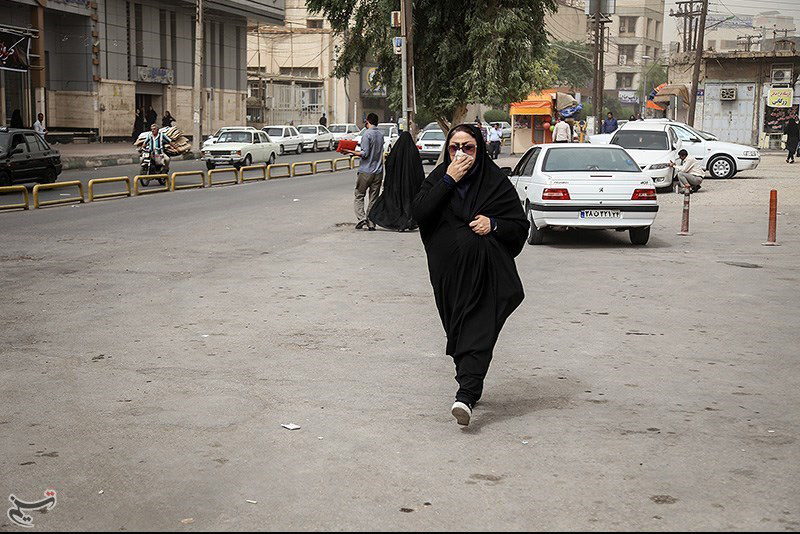
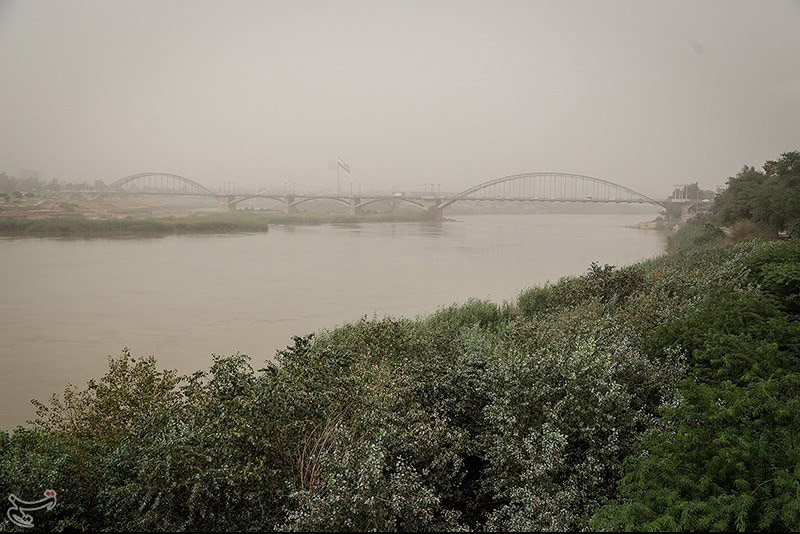
Dust Pollution in Western Iran Reaches ‘Dangerous’ Levels

pollution-Khuzestan

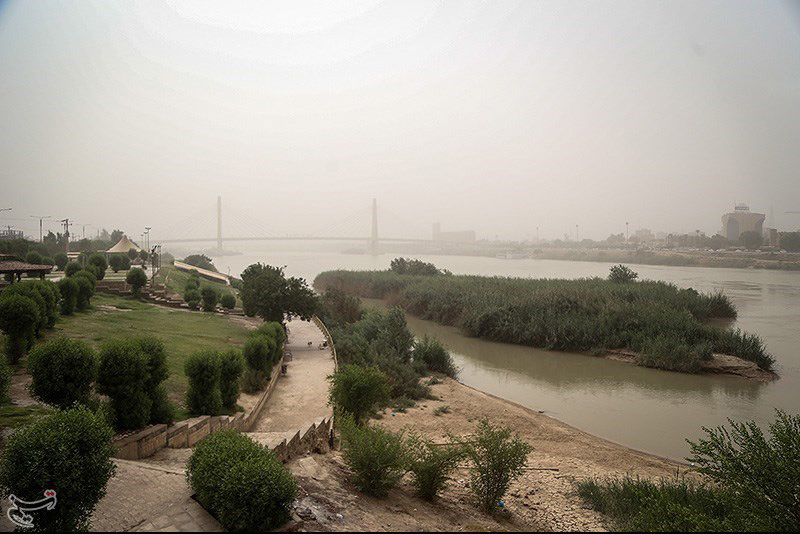
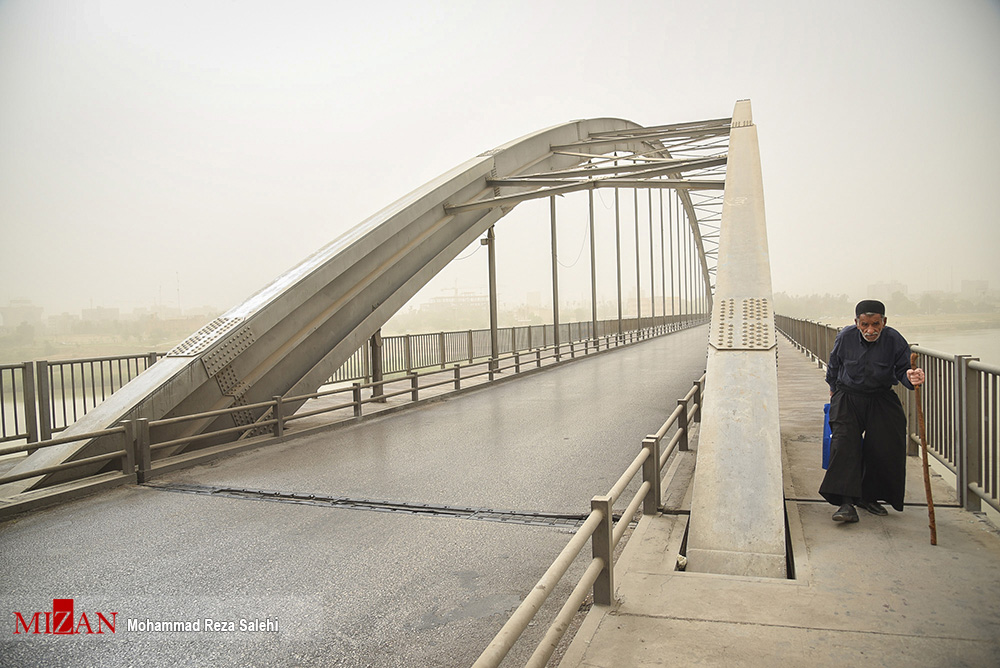
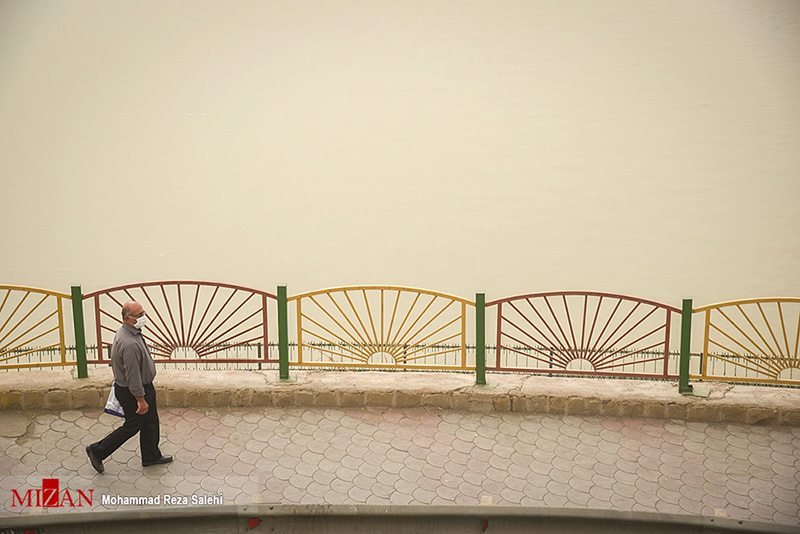
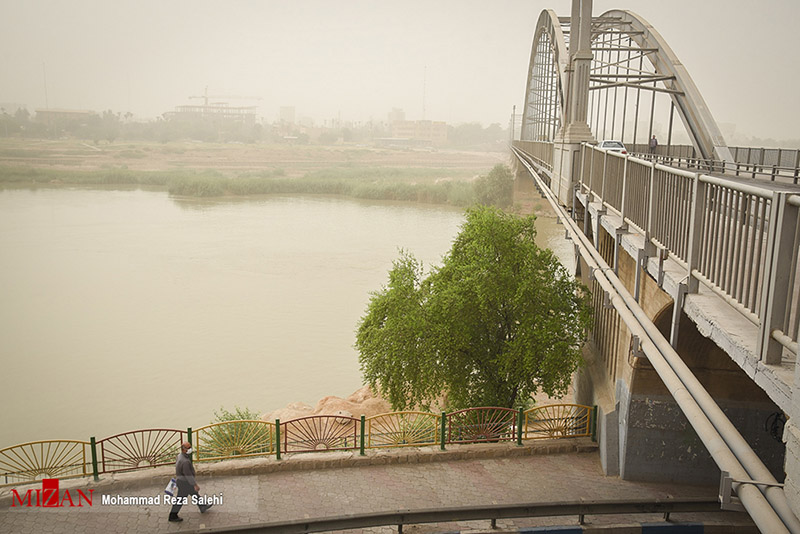
The air pollution caused by dust and particles in Iran’s western provinces, including Khuzestan, has reached “dangerous” levels.

The disruptive dust storms have pushed pollution in these border areas to alarming levels, raising health concerns.

Schools and universities have been shut down due to the alarming dust pollution.

The particles, carried by winds, can penetrate the lungs and enter the bloodstream, causing serious diseases such as lung cancer, asthma and heart problems.

Here are photos of the pollution taken by Mizan and Tasnim:


Soft War Aimed at Making Iranians Indifferent, Leader Warns

leader

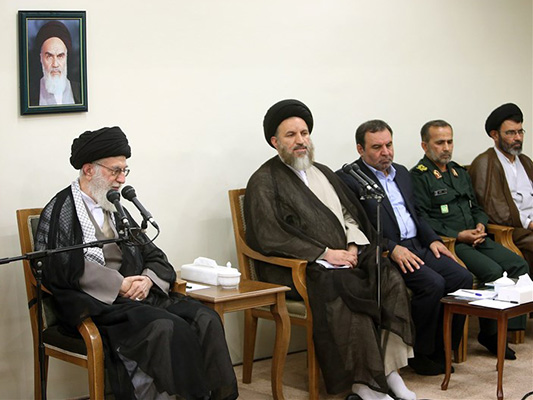
The enemy’s purpose in the soft and covert war against Iran is people’s estrangement from resistance, making people indifferent to their aspirations and dominating the country’s mental and spiritual atmosphere, Ayatollah Khamenei said in a meeting with members of committees tasked with holding congresses to commemorate the country’s martyrs, on September 26.

The leader also warned of tactics that the enemies use to disappoint and sideline the Iranian nation, pointing to their various tools, costly propaganda as well as economic, political and security pressures.

Ayatollah Khamenei, however, highlighted the enemies’ failed attempts at damaging Iran, noting, “With its resistance and fortitude, the Iranian nation has thwarted many of the world powers’ plots.”

The Leader’s comments in that meeting were made public on Sunday morning.

Imam Khamenei has on various occasions cautioned against enemies’ cultural and political plots against Iran, including ploys aimed at impairing the religious beliefs and absorbing the talented young generation.