Sunday, December 28, 2025
Home Blog Page 4194

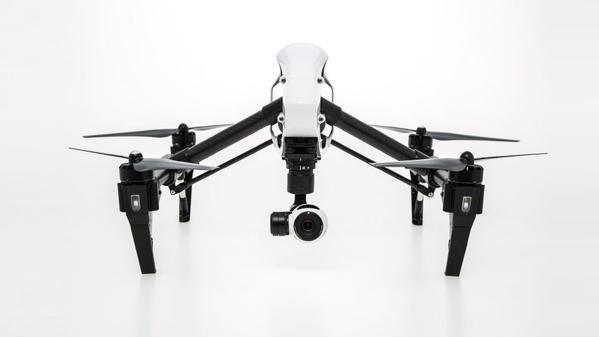
Quadcopter Shot Down in Tehran over Security Concerns

Drone

According to a report by IFP, residents in central Tehran heard loud gunfire and an explosion, they said on social media.

It was later announced that Iran’s Khatam al-Anbia Air Defence Base’s anti-craft forces have shot down an unmanned aircraft in central Tehran.

Deputy Governor-General of Tehran Mohsen Hamedani told ISNA that the drone belonged to the Islamic Republic of Iran Broadcasting (IRIB), and it was taking aerial pictures of the place where Friday Prayers are usually held in Tehran.

However, he added, it has ignored the no-fly zone and trespassed on the area where the house of Iran’s Leader Ayatollah Seyyed Ali Khamenei and the Presidential Palace are located.

Those using the quadcopter for filming did not know the area was prohibited airspace, he noted.

Khatam al-Anbia Air Defence Base also released a statement on Friday, confirming that the unmanned aerial vehicle, which had entered Tehran’s airspace without coordination and permission, was shot down by the anti-craft forces, Tasnim reported.

After looking into the issue, the downed drone appeared to have been a quadcopter operated by a film crew shooting aerial footage for a documentary, it added.

Meanwhile, an official with the IRIB organization dismissed the allegations that the quadcopter belonged to the state TV.

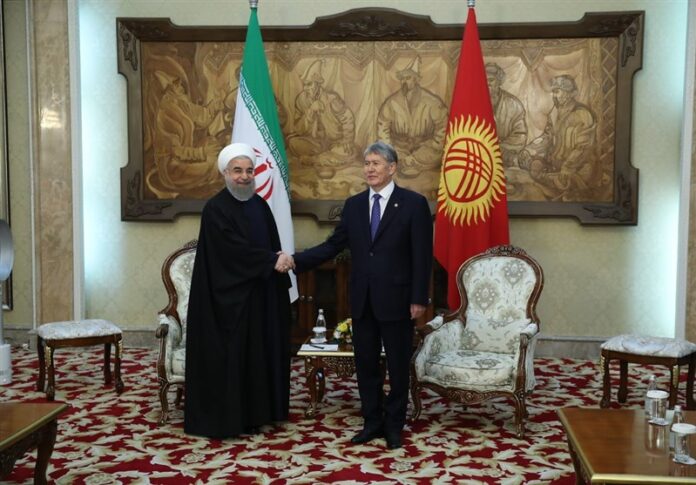
Iran, Kyrgyzstan Urge Closer Ties in All Fields

Iran- Kyrgyzstan

According to the joint communique released on Friday at the end of Iranian President Hassan Rouhani’s official visit to Kyrgyzstan, Rouhani and his Kyrgyz counterpart, Almazbek Atambayev, held talks on ways to strengthen Tehran-Bishkek ties in all spheres.

The two sides also hailed the outcome of efforts to promote cooperation in diverse fields during 24 years of their diplomatic ties as “positive” and stressed the need for boosting the relations more than ever, it said.

The two presidents also described Rouhani’s trip to Kyrgyzstan as a manifestation of the two countries’ joint efforts of to deepen relations in various fields, the joint communique said.

High-ranking officials from Iran and Kyrgyzstan inked five documents to boost cooperation between the two countries in various areas.

The documents include a Memorandum of Understanding (MoU) on cooperation between Iran’s Ministry of Communications and Information Technology and the Central Asian country’s State Committee of Information Technologies and Communications.

The other documents signed by the two countries focus on enhancement of bilateral collaborations in the fields of health and medicine, culture and arts, social affairs, and combating narcotics trafficking.

Heading a high-ranking political and economic delegation, President Rouhani visited Kyrgyzstan on the final leg of a tour of the Caucasus and Central Asia that earlier took him to Armenia and Kazakhstan.

Turkey to Pull Out Forces from Iraq: Envoy

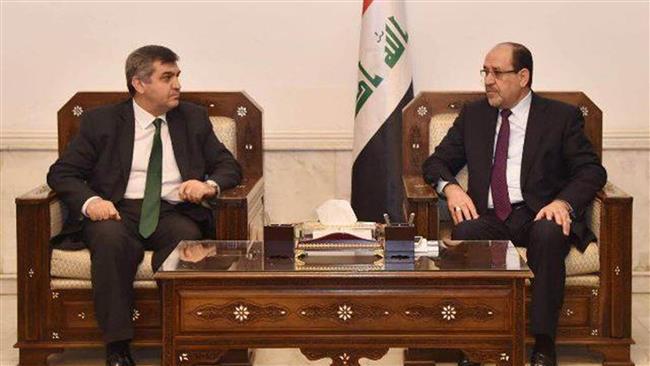
Baghdad Faruk Kaymakci-Nouri al-Maliki

Faruk Kaymakci made the remarks in a meeting with Iraqi Vice President Nouri al-Maliki in Baghdad on Thursday, Iraq’s al-Sumaria news network reported.

Ankara respects the Iraqi sovereignty and will soon pull out its troops from Iraq, Kaymakci said, highlighting Turkey’s readiness to help Iraq battle terrorism.

Last December, Turkey deployed some 150 soldiers, equipped with heavy weapons and backed by about two dozen tanks, to the Bashiqa military camp on the outskirts of Mosul, where a major operation in underway by Iraqi forces to liberate the city from Daesh terrorists.

Ankara claimed the deployment was part of a mission to train and equip Iraqi Kurdish forces in the fight against Daesh.

However, Baghdad has repeatedly asked Ankara to withdraw its forces from the region, describing Turkey’s military presence in Iraq as an infringement of its sovereignty.

Maliki, for his part, called for coordination between the two countries regarding mutual issues.

He also underlined the importance of reinforcing bilateral ties and expressed hope that the relations will advance in line with the interests of the two nations.

The two officials further discussed security and political situation and problems facing Iraq and the region.

Earlier this month, Turkish Prime Minister Binali Yildirim vowed Turkish troops’ withdrawal from Iraq as soon as Mosul is recaptured from Daesh.

The Turkish premier made the pledge in a phone conversation with his Iraqi counterpart, Haider al-Abadi, according to a statement released by Abadi’s office.

Late last month, the Arab League denounced Turkey’s interference in the affairs of Iraq and Syria, stressing that the Turkish government’s support for terrorists has now backfired.

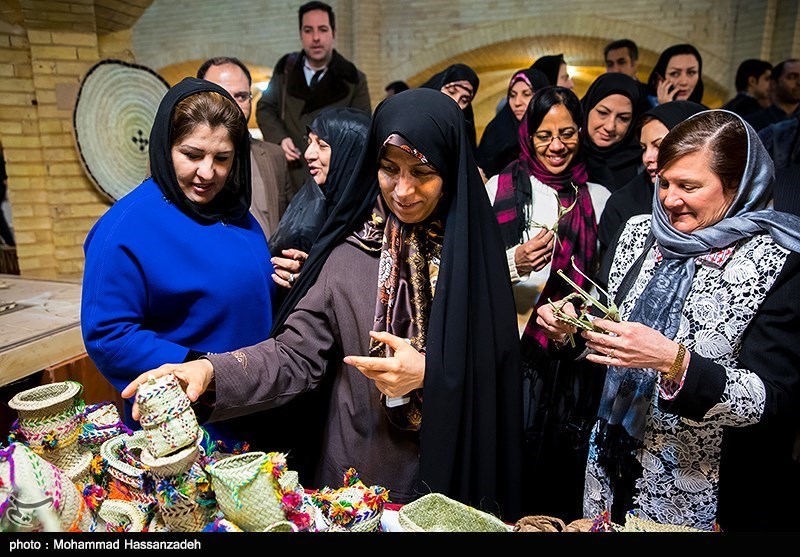
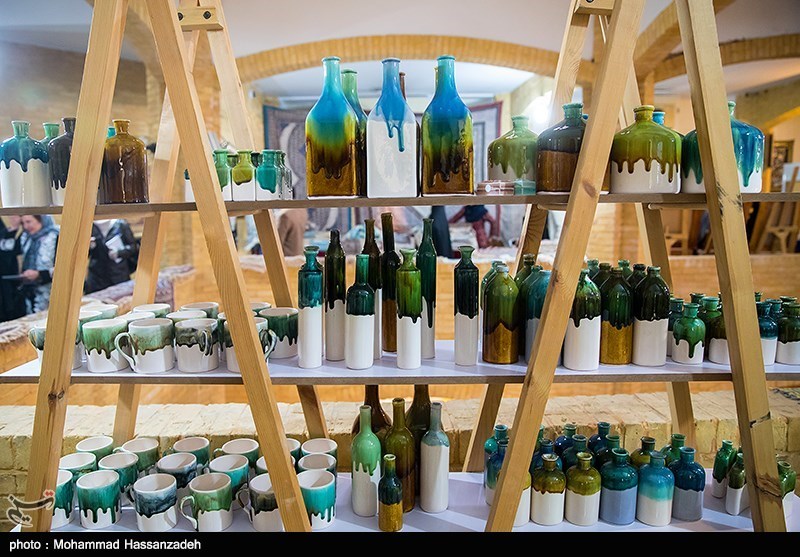
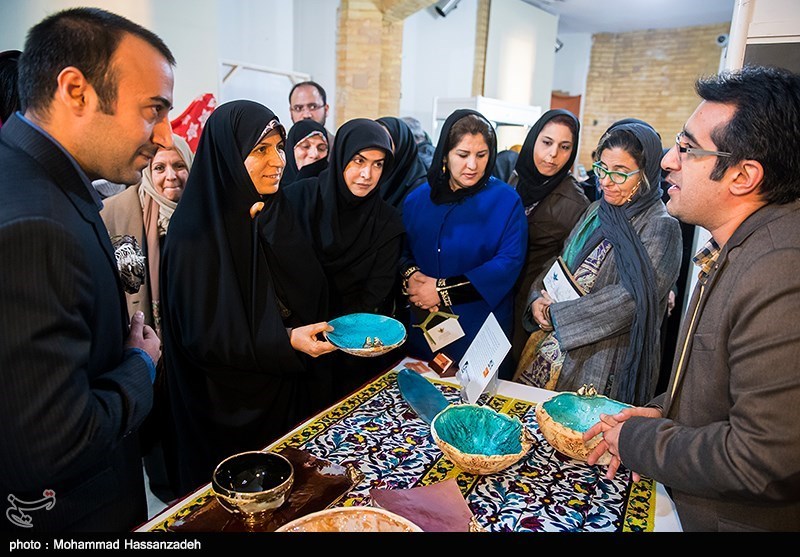
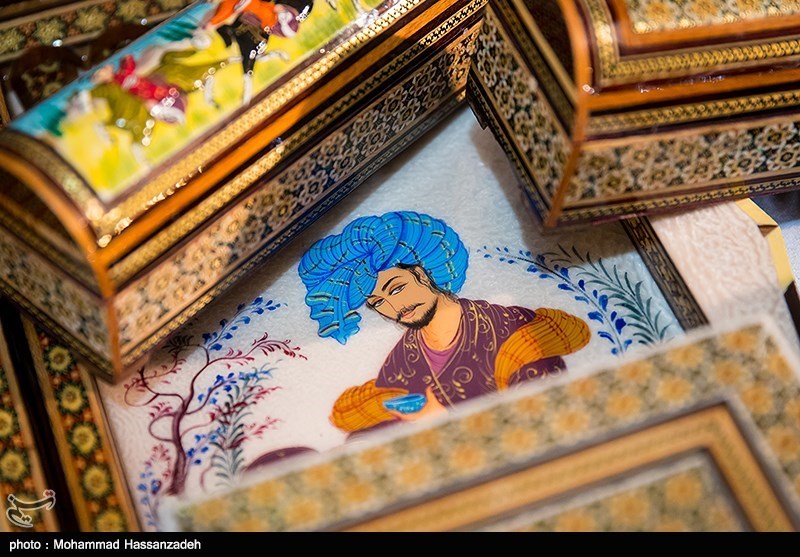
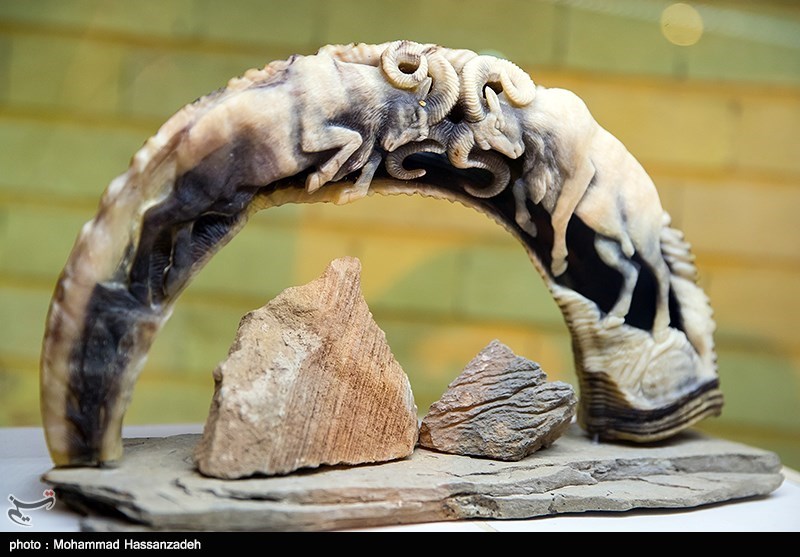
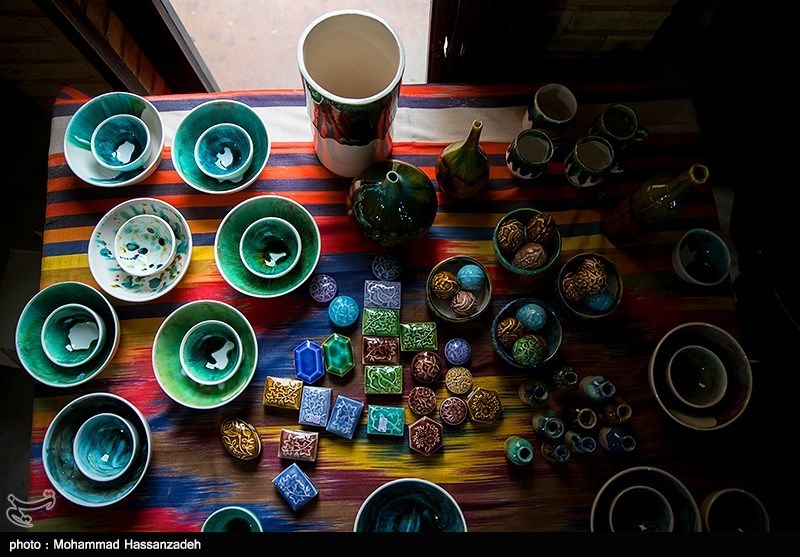
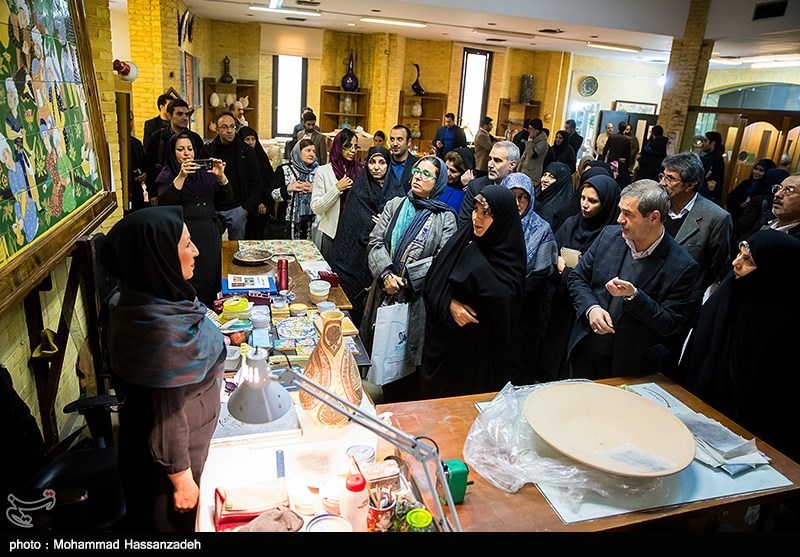
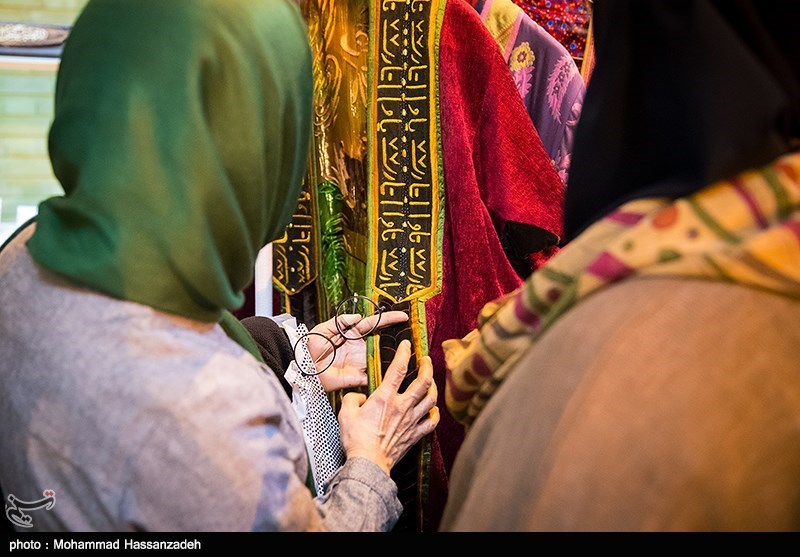
Tehran Hosts Exhibition of Handicraft for Wives of Foreign Ambassadors

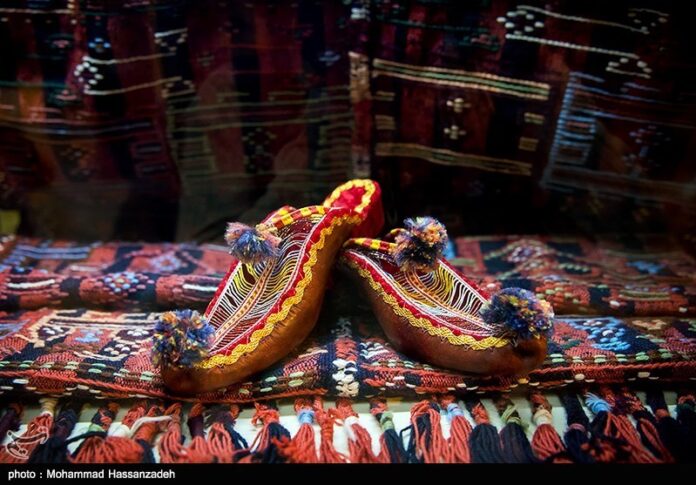
Exhibition of Handicraft

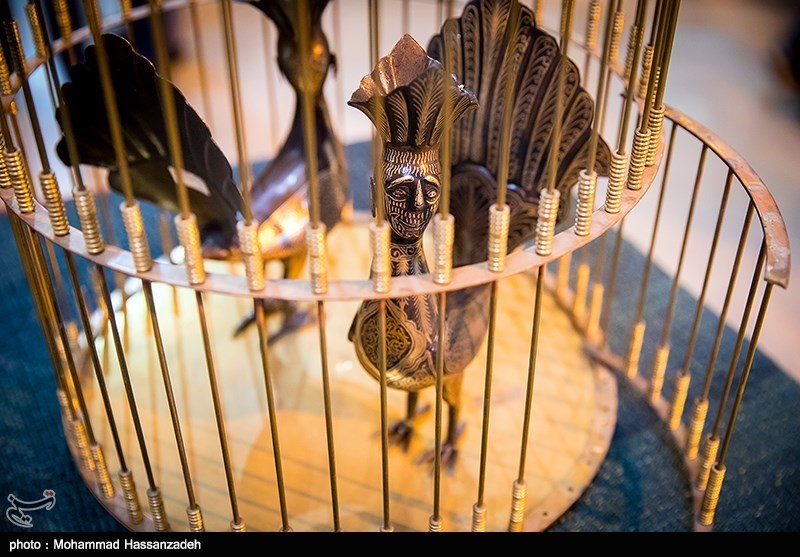
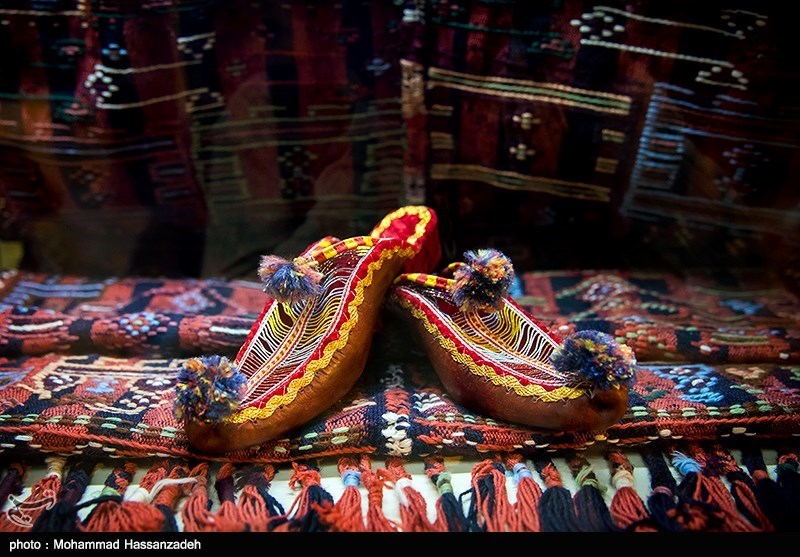
Iranian Vice President and ICHTO Chief Zahra Ahmadipour, the deputy head of ICHTO Bahman Namvar Motlaq, and wives of foreign ambassadors in Iran attended the opening ceremony of an exhibition of Iranian handicraft for foreign ambassadors’ wives on December 20 in ICHTO office in Tehran, Iran.

Here are Tasnim’s photos of the opening ceremony:


Iran’s President Rejects Military Solution to Karabakh Dispute

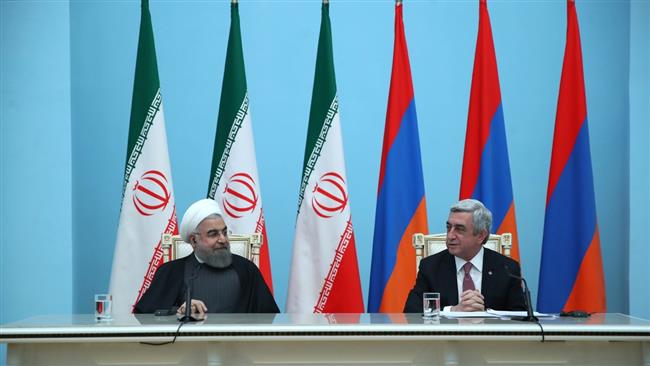
Iran-Armenia

Describing Armenia and Azerbaijan as Iran’s “friendly neighboring countries,” Rouhani expressed optimism that “a lasting peace” would be established in the Karabakh region “through negotiations and political means.”

“Such lasting peace would serve the interests of all regional countries,” Rouhani said during a joint press conference with his Armenian counterpart Serzh Sargsyan in Armenia’s capital, Yerevan, on Wednesday.

Peace cannot be established through military means, the Iranian president said, adding, “We can witness security and stability in the region through dialog within the framework of international law.”

The Nagorno-Karabakh conflict began in 1988 and escalated into armed clashes after the collapse of the Soviet Union in the early 1990s. Sporadic tensions and border skirmishes have continued in the region despite a ceasefire signed in 1994.

Nagorno-Karabakh is internationally recognized as part of Azerbaijan; however, it is governed by the self-proclaimed Nagorno-Karabakh Republic.

In April, a new wave of unrest erupted in the region and surrounding areas in Azerbaijan, which killed at least 110 people.

A shaky Moscow-brokered ceasefire took effect on April 5 and stopped the huge fighting, but the two sides still continue to accuse one another of violating the truce.

Elsewhere in his remarks, the Iranian president touched on the issue of terrorism and called for a collective campaign against the menace until it is fully eradicated.

Rouhani said Iran and Armenia saw eye to eye on the necessity of rendering assistance to Iraq and Syria, which are both grappling with terrorism, as well as the need for delivering humanitarian aid to conflict-hit nations, especially people from the Syrian city of Aleppo.

Iran’s President Rejects Military Solution to Karabakh Dispute

Rouhani also pointed to the development of Tehran-Yerevan ties in the sector of energy and said the two sides had reached an agreement to enhance cooperation on a deal for Iran to swap gas between Turkmenistan and Armenia, as well as to exchange electricity and complete the third electricity transmission line between the two sides.

He said the railroad links between Iran and Armenia connecting the Persian Gulf to the Black Sea would facilitate the expansion of trade and economic ties between the two countries and also with other countries.

The Iranian president said the two countries had also agreed to facilitate the activities of businessmen and investors, including in Aras Free Zone, located in the northwest of Iran at the border point with Armenia and Azerbaijan.

The Armenian president, for his part, said the two countries were determined to implement their agreements on gas and electricity cooperation.

Sargsyan said the railroads connecting the Persian Gulf with the Black Sea would facilitate the transition of goods and the export of Iranian commodities to European markets.

Before their joint press conference, the Iranian and Armenian presidents held a meeting to discuss bilateral ties, regional developments and issues of mutual interest.

Iran’s President Rejects Military Solution to Karabakh Dispute

Following the meeting, Iran and Armenia issued a joint statement stressing two sides’ determination to boost bilateral ties.

The two presidents highlighted the cooperation agreements signed between the two countries on energy, transportation, telecommunications and industry aimed at boosting trade ties and developing the infrastructure in the two countries, said part of the statement.

The statement said the two presidents also reaffirmed their countries’ opposition to the development and use of weapons of mass destruction.

Rouhani also invited his Armenian counterpart for an official visit to Iran.

Heading a high-ranking politico-economic delegation, the Iranian chief executive arrived in Yerevan on Wednesday on the first leg of a Central Asia tour which will also take him to Kazakhstan and Kyrgyzstan.

Rouhani’s visits to the three countries come at the invitation of the respective countries’ heads of state.

Syrian PM Due in Iran with Economic Agenda

Imad Khamis

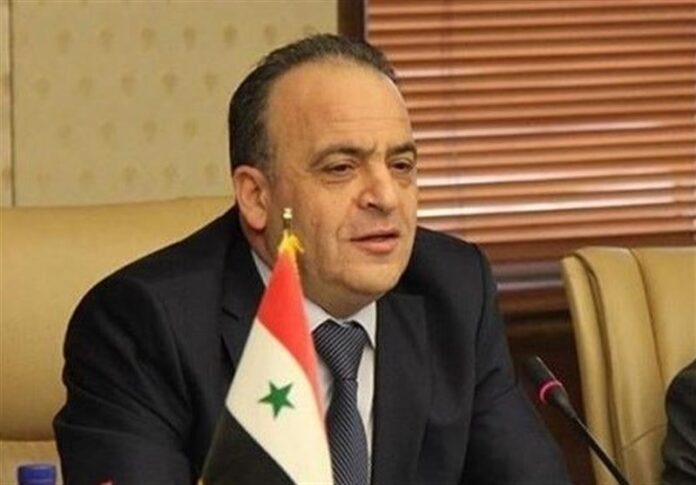
In a meeting with Iranian Deputy Foreign Minister for Arab and African Affairs Hossein Jaberi Ansari in Damascus on Wednesday, Khamis said he will pay a visit to Tehran at the invitation of Iranian First Vice-President Eshaq Jahangiri to pursue and reach agreements on mutual economic cooperation.

Strengthening Iran-Syria economic cooperation is a necessity that the two countries should seriously pursue, Khamis added.

For his part, the Iranian diplomat highlighted four decades of “strategic relations” with Syria, saying a joint political committee between the two countries is also contributing to closer economic interaction and implementation of the previous agreements.

During his stay in Damascus, the Iranian diplomat is scheduled to meet with Syrian President Bashar al-Assad and Foreign Minister Walid Muallem.

He will later fly to Lebanon for an official visit. Syria and Lebanon are two major partners of Iran in the region.

A Look at Iranian Newspaper Front Pages on December 22

Almost all newspapers covered the claims raised by conservative lawmaker Javad Karimi Qoddousi, who disclosed the remarks made by Foreign Minister Mohammad Javad Zarif in a closed session with lawmakers. Karimi Qoddousi claimed that Zarif has regretted trusting US Secretary of State John Kerry’s promise, and that he was wrong. However, Foreign Ministry Spokesman Bahram Qassemi dismissed the allegations, saying that Karimi Qoddousi was not even present in that session and his remarks were in direct contradiction to Zarif’s comments.

Another top story was the attack of Al Khalifa regime on Bahraini cleric Sheikh Isa Qassim’s house, and the protest rallies held by Sheikh Qassim’s supporters.

The unusual traffic jam in the Iranian capital of Tehran, and President Hassan Rouhani’s ongoing tour of Eurasia were among other top stories today.

The above issues, as well as many more, are highlighted in the following headlines:


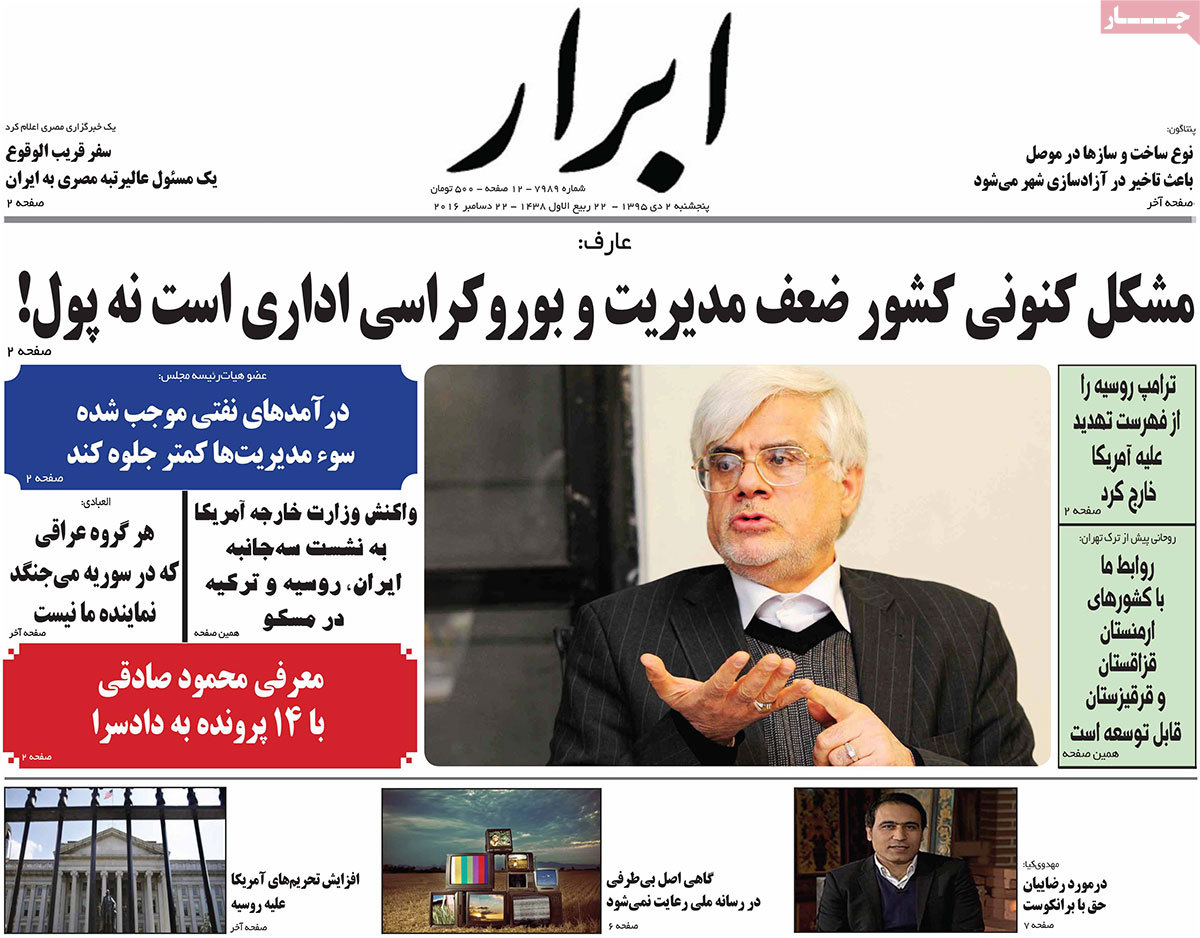
Abrar:

1- Aref: Iran’s Current Problem Is Weak Management and Bureaucracy, Not Money

2- Trump Removes Russia from List of Anti-US Threats

3- Oil Incomes Have Caused Mismanagement Not to Be Noticed Enough: MP

4- Iraqi PM: Any Iraqi Group Fighting in Syria Is Not Our Representative
A Look at Iranian Newspaper Front Pages on December 22


Abrar Eqtesadi:

1- Dollar Rate in Iran Crosses 4,000 Tomans

2- 61% Jump in Britain’s Imports from Iran

3- Iran-Indonesia Oil Ties to Be Revived as of 2017

4- New Round of Negotiations with Pakistan for Free Trade Deal

5- US Congressman: Trump Trying to Hinder Iran’s Purchase of Boeing and Airbus Planes

6- Inflation Rate in Past Iranian Month Decreased to 7.2%
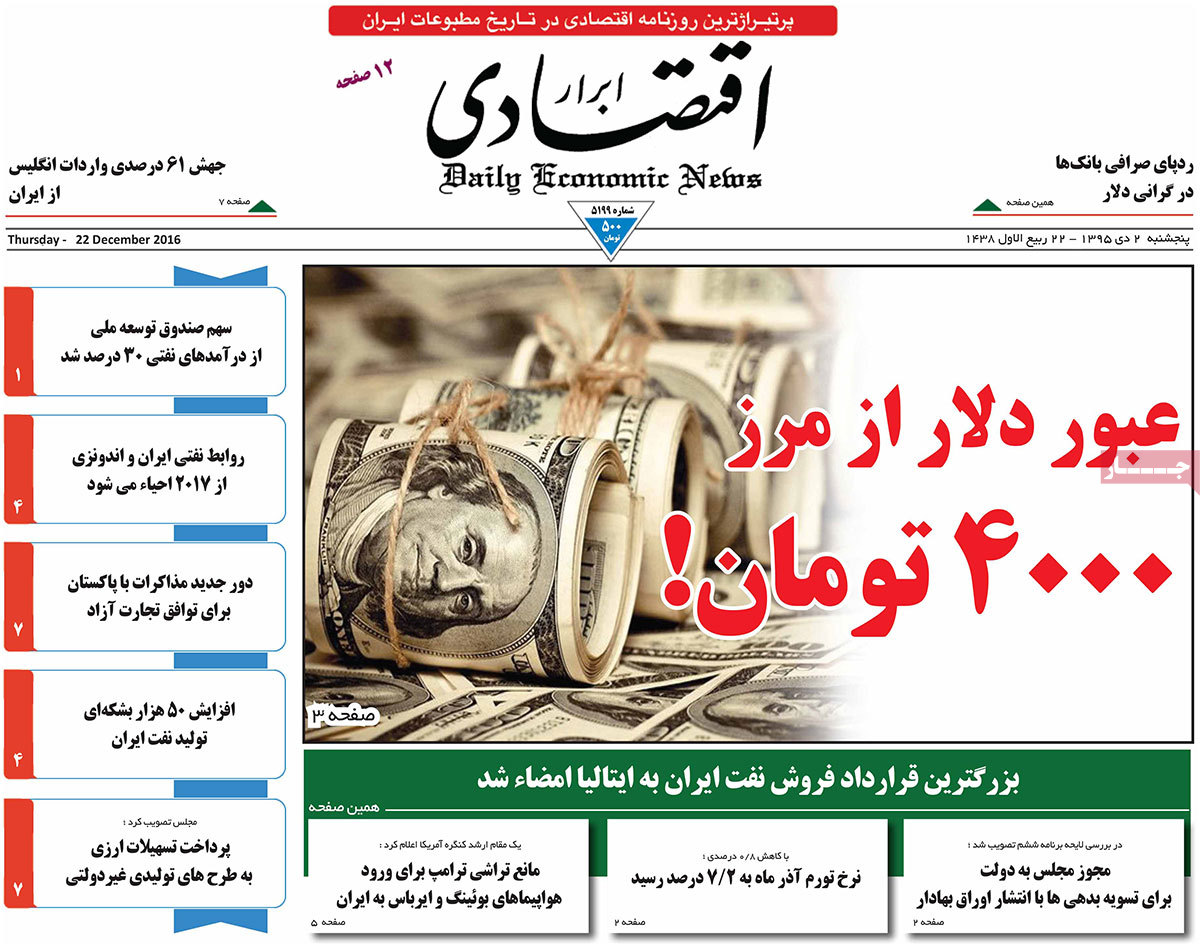
A Look at Iranian Newspaper Front Pages on December 22


Aftab-e Yazd:

1- A Slap on Face of Truth: Hard-Line MP Discloses [in a distorted way] the Secret Content of Closed Parliamentary Session for Second Time

[Conservative lawmaker Javad Karimi Qoddousi claimed Foreign Minister Mohammad Javad Zarif has said in a closed session with Parliament’s National Security and Foreign Policy Commission that he regrets trusting US Secretary of State John Kerry’s promise, and that he was wrong. However, Foreign Ministry Spokesman Bahram Qassemi dismissed the allegations, saying that Karimi Qoddousi’s remarks were in direct contradiction to Zarif’s comments.]
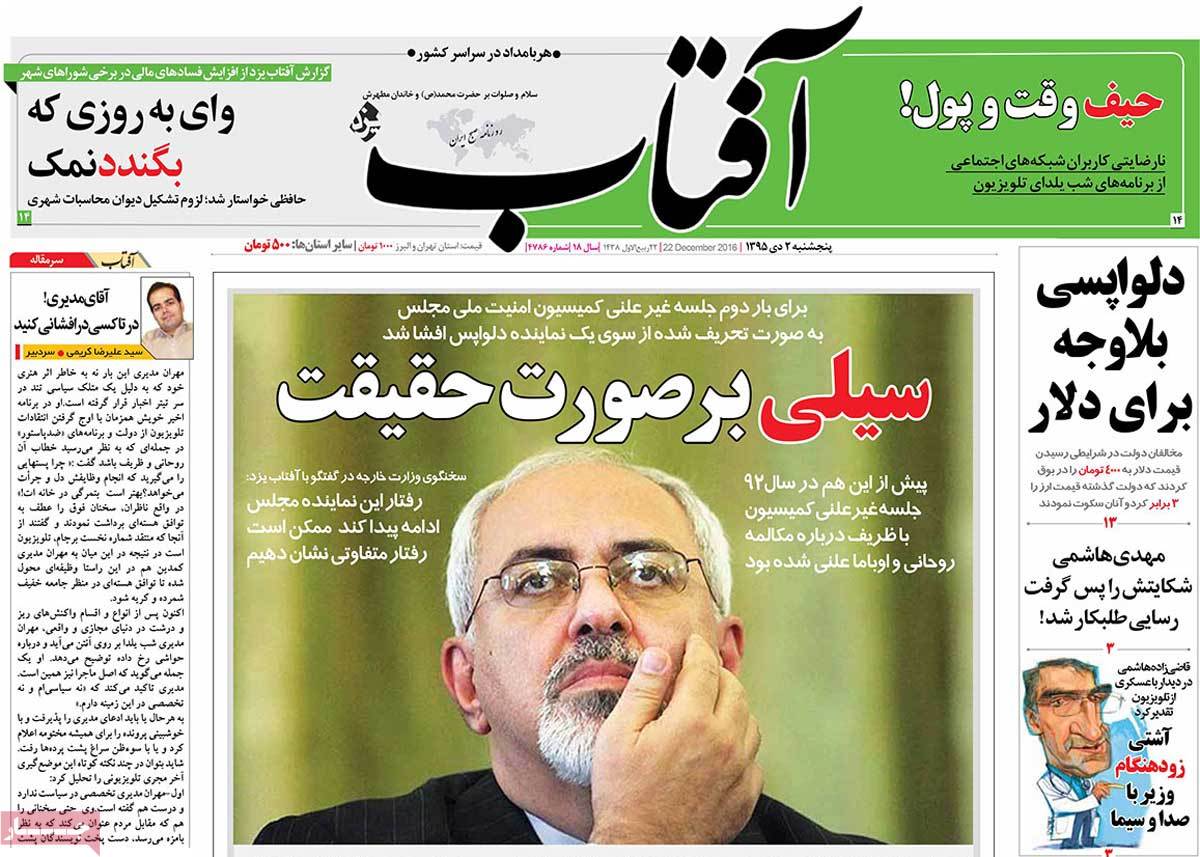
A Look at Iranian Newspaper Front Pages on December 22


Arman-e Emrooz:

1- Ayatollah Rafsanjani: JCPOA Opened the Way for Saving the Country

2- Absent MP Discloses What He Has Not Seen Himself; Foreign Ministry’s Response: Karimi Qoddousi Was Not Present in the Session and His Remarks Are False
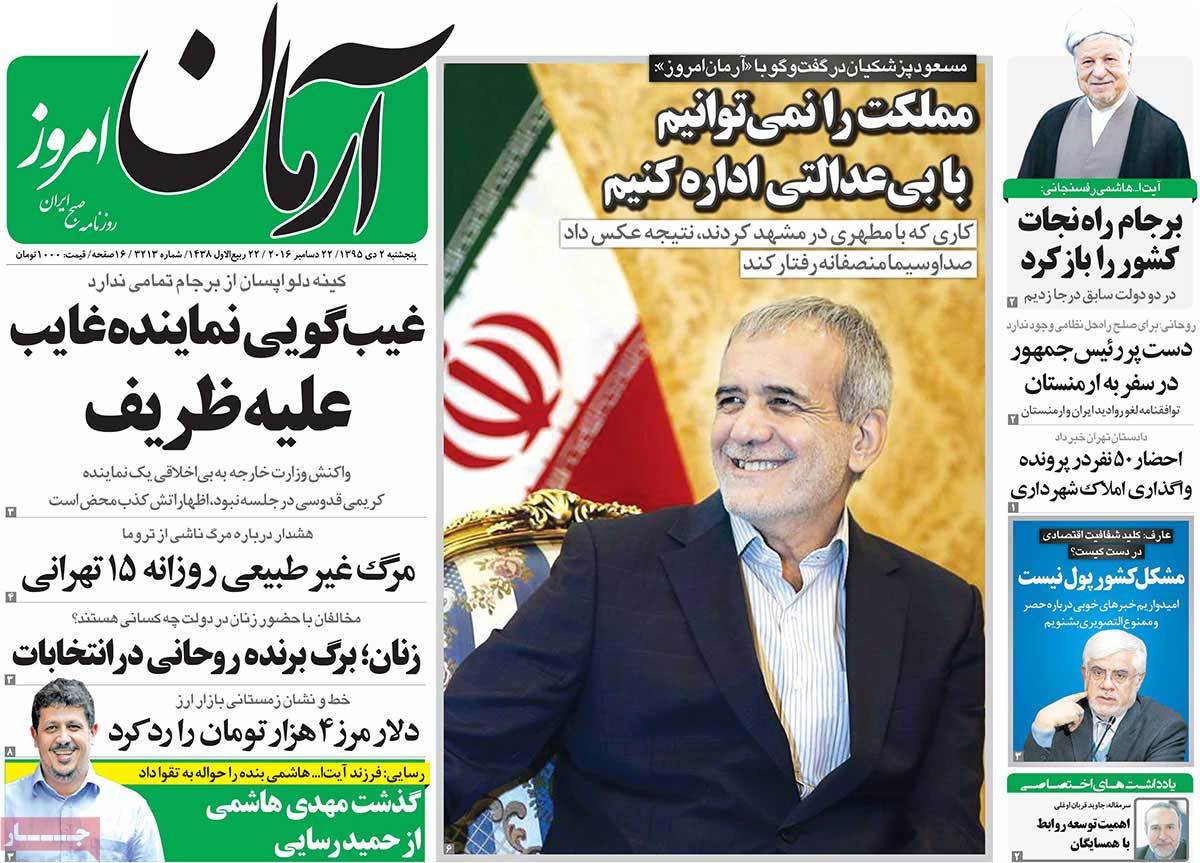
A Look at Iranian Newspaper Front Pages on December 22


Ebtekar:

1- Giants Destroying Iran’s Nature: What Consequences Do Activities of Factories Have for Environment?

2- On Occasion of Assassination of Russian Envoy to Ankara: Alexander Griboyedov, Russian Envoy Killed in Iran; Was He a Victim of Prejudice or Was the Russian Tsar Mad at Him?

3- Finding Equivalents for Social Media Jargon: Concerns of Iran’s Culture Centre

4- Iran’s Economy Demanding Share from New Markets

5- Economic Opportunities Provided by Interaction with Asian Countries
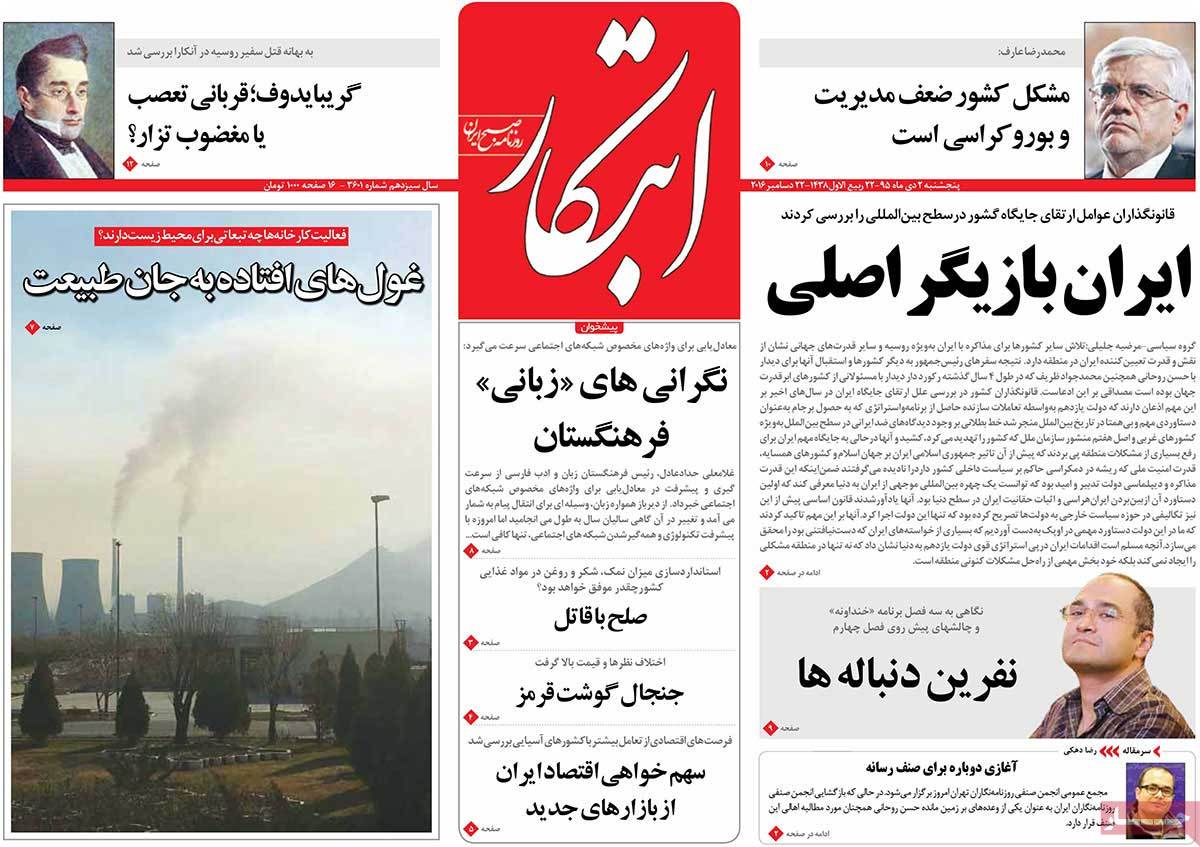
A Look at Iranian Newspaper Front Pages on December 22


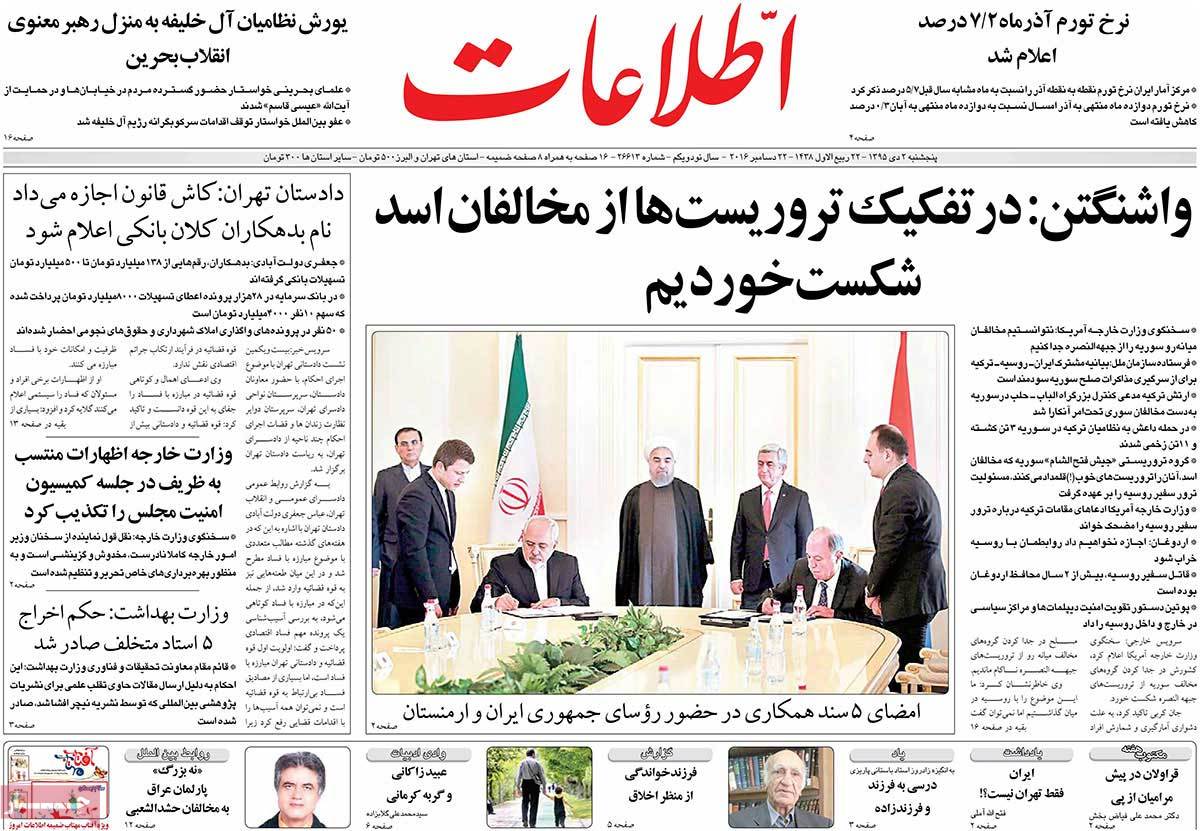
Ettela’at:

1- Washington: We Failed in Distinguishing Terrorists from Dissidents of Assad

2- 5 MoUs Signed by Iranian and Armenian Presidents

3- If It Was Legal, We Would Declare Names of Those Who Are Heavily Indebted to Banks: Prosecutor General

4- Foreign Ministry Rejects Remarks Attributed to Zarif

5- Al Khalifa Regime’s Forces Attack House of Bahraini Revolution’s Spiritual Leader

6- Bahraini Clerics Call for People’s Massive Presence in Streets in Support of Sheikh Isa Qassim

7- Amnesty Int’l Urges Al Khalifa Regime to Stop Its Oppressive Actions
A Look at Iranian Newspaper Front Pages on December 22


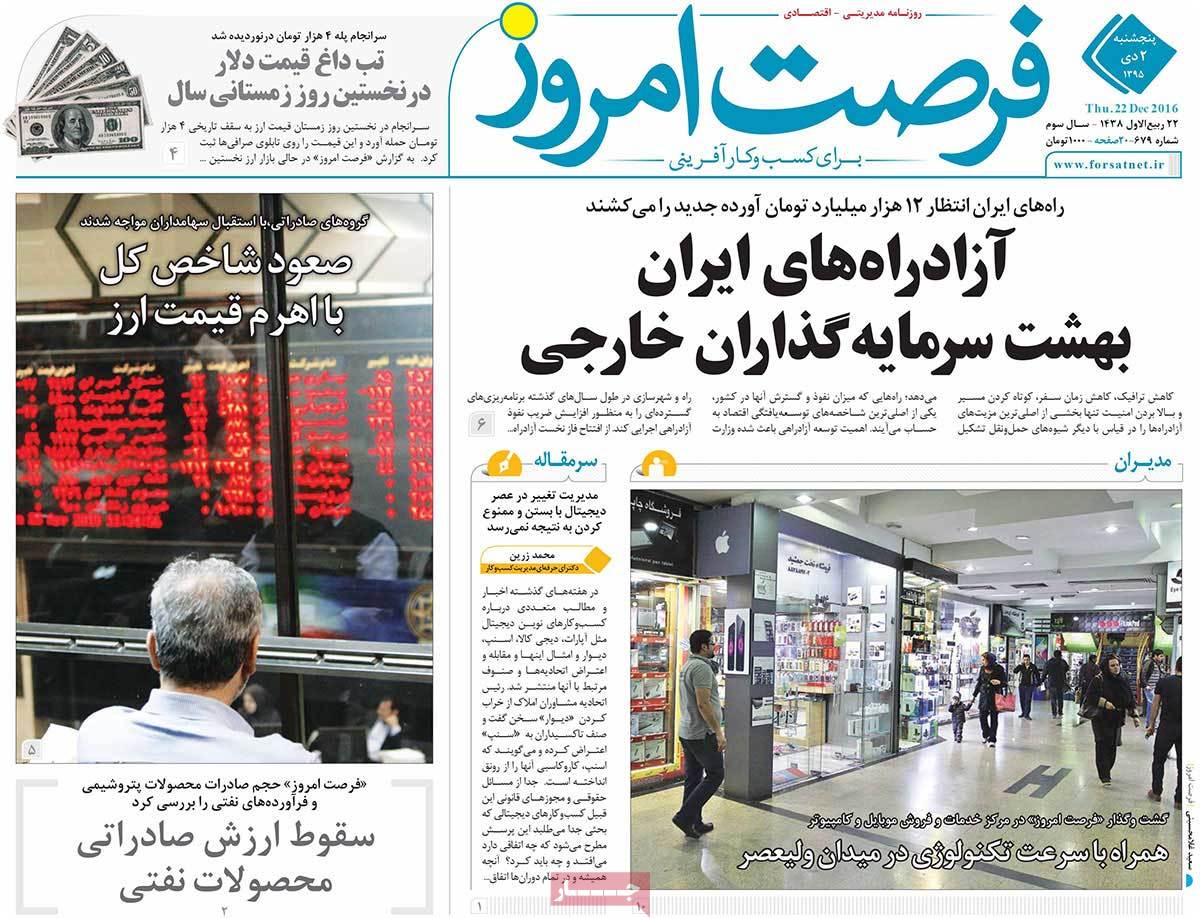
Forsat-e Emrooz:

1- Iranian Highways, Paradise of Foreign Investors

2- Iranian Roads Can Attract $3 Billion New Investment
A Look at Iranian Newspaper Front Pages on December 22


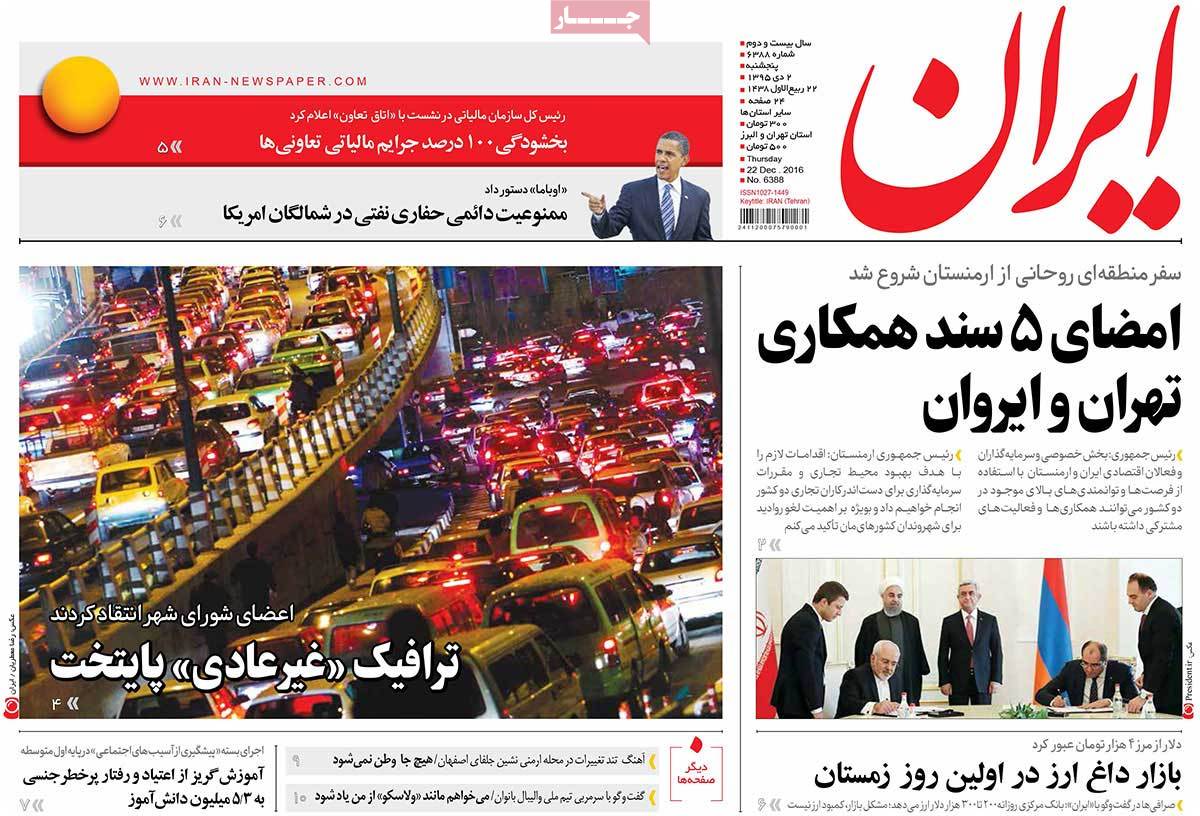
Iran:

1- Rouhani’s Regional Tour Starts from Armenia

2- Tehran and Yerevan Sign 5 Documents of Cooperation

3- City Council Members Criticize Unusual Traffic Jam in Iranian Capital

4- Hot Market of Foreign Exchange in First Day of Winter

5- Based on Obama’s Order, Oil Excavation in Northern America Will Be Prohibited Forever
A Look at Iranian Newspaper Front Pages on December 22


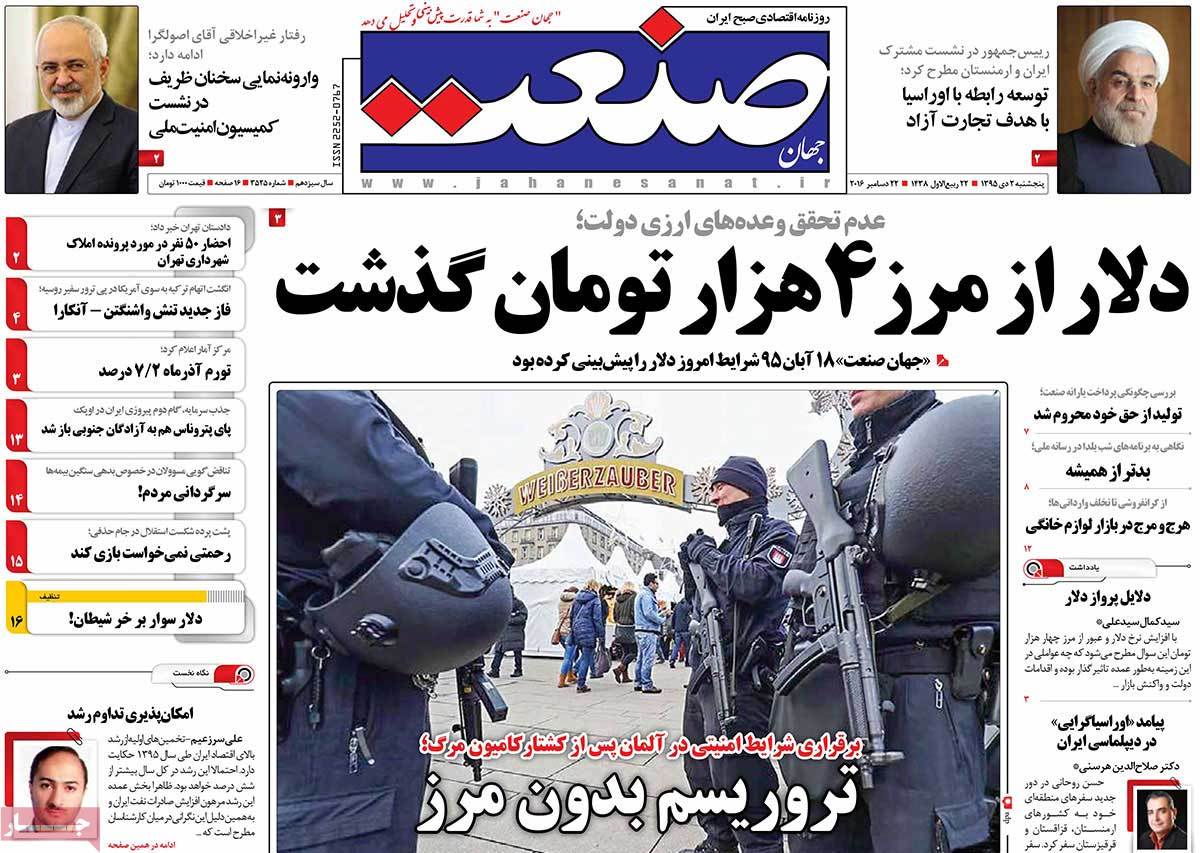
Jahan-e Sanat:

1- Terrorism without Borders: Security Conditions in Germany after Intentional Truck Attack

2- Rouhani: Development of Relations with Eurasia Aimed at Free Trade
A Look at Iranian Newspaper Front Pages on December 22


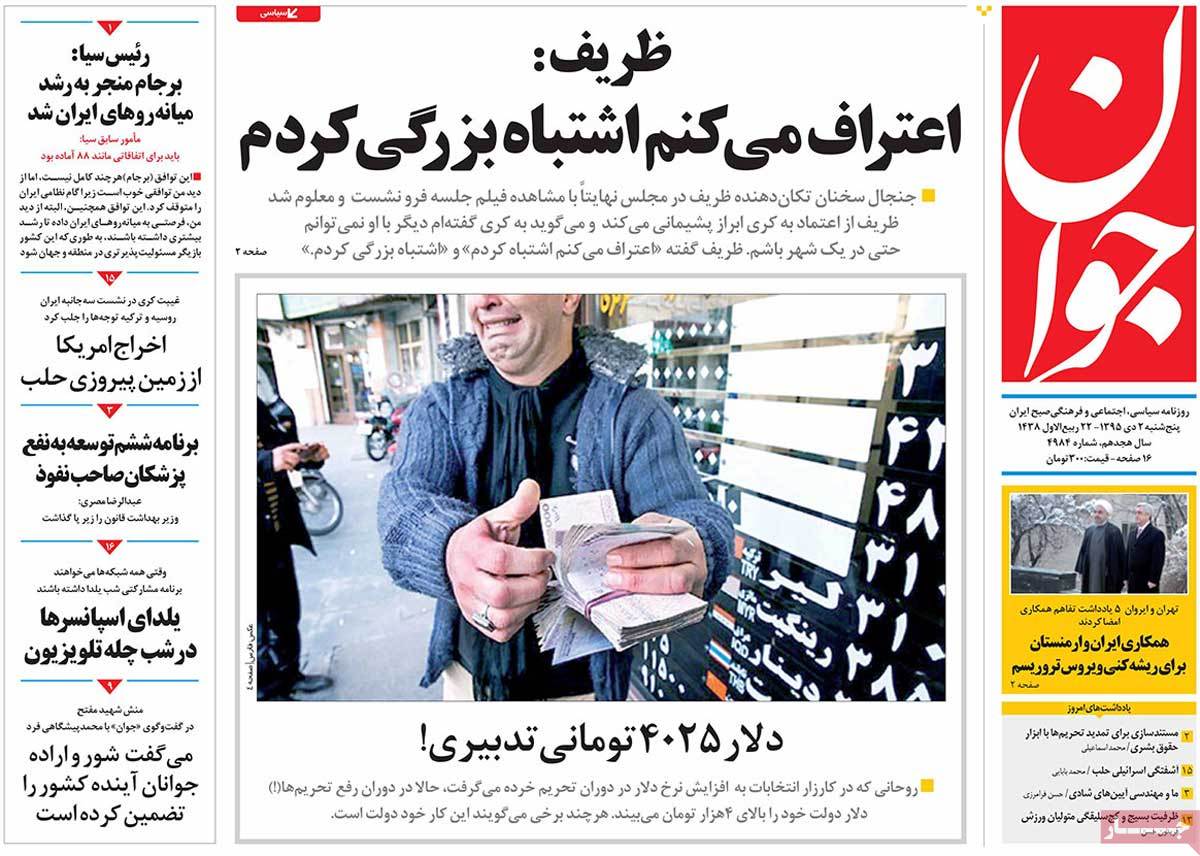
Javan:

1- Zarif: I Admit I Made a Big Mistake: Controversy over Zarif’s Shocking Remarks in Parliament Finally Ends with a Video Confirming His Comments. It Was Finally Shown Zarif Has Regretted Trusting Kerry; Zarif: I Made a Very Big Mistake

2- Rouhani Who Used to Criticize High Rate of Foreign Exchange in Time of Sanctions, Now Sees Highest Rates of Dollar in the Time of Sanctions Removal (!). However, Some Believe that It Is an Intentional Move by His Government to Raise the Rates

3- US Fired from Ground of Aleppo Victory

4- Kerry’s Absence from Iran-Russia-Turkey Trilateral Meeting Attracts Attentions
A Look at Iranian Newspaper Front Pages on December 22


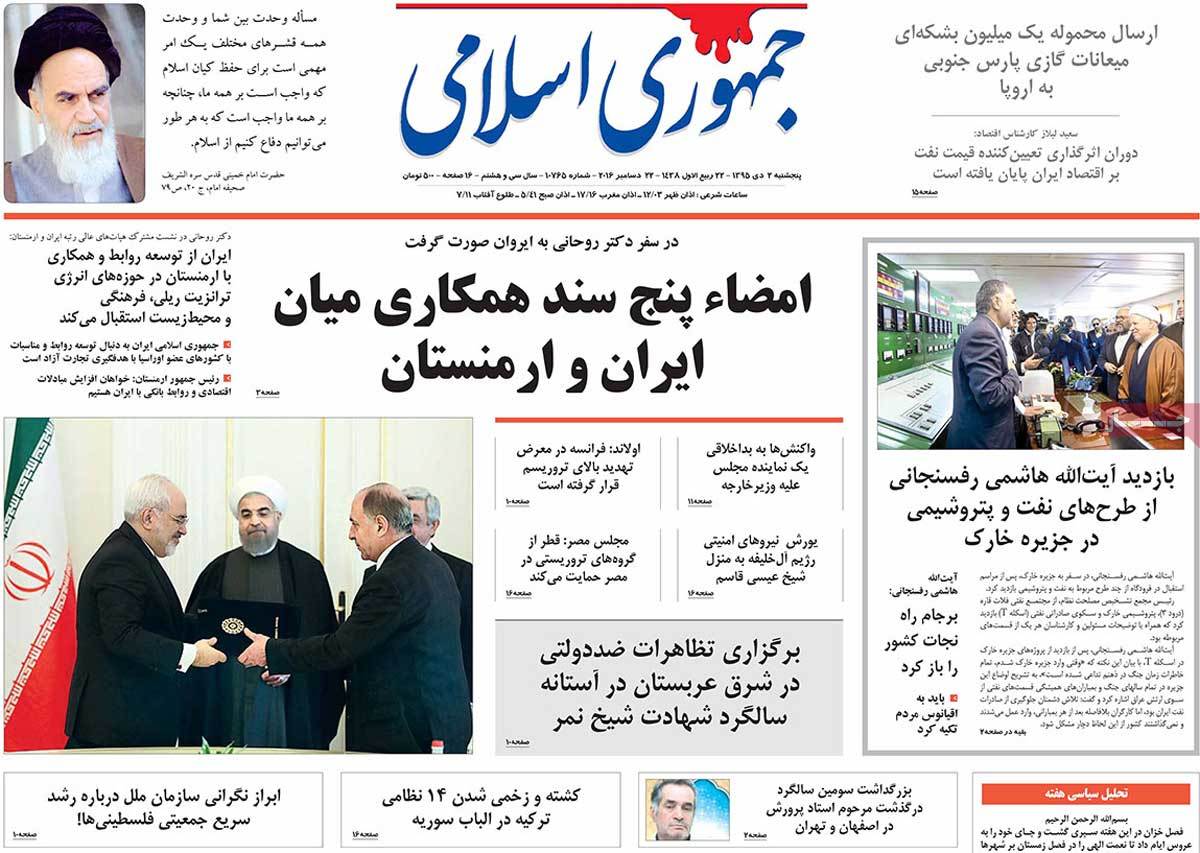
Jomhouri Eslami:

1- Iran Sends 1 Million Barrels of Gas Condensates to Europe

2- Hollande: France Exposed to High Level of Terrorism Threat

3- Reactions to a Lawmaker’s Unethical Behaviour against Foreign Ministry

4- Anti-Government Demonstrations Held in Eastern Saudi Arabia on Verge of Death Anniversary of Sheikh Nimr

5- UN Worried about Rapid Growth of Palestinian Population
A Look at Iranian Newspaper Front Pages on December 22


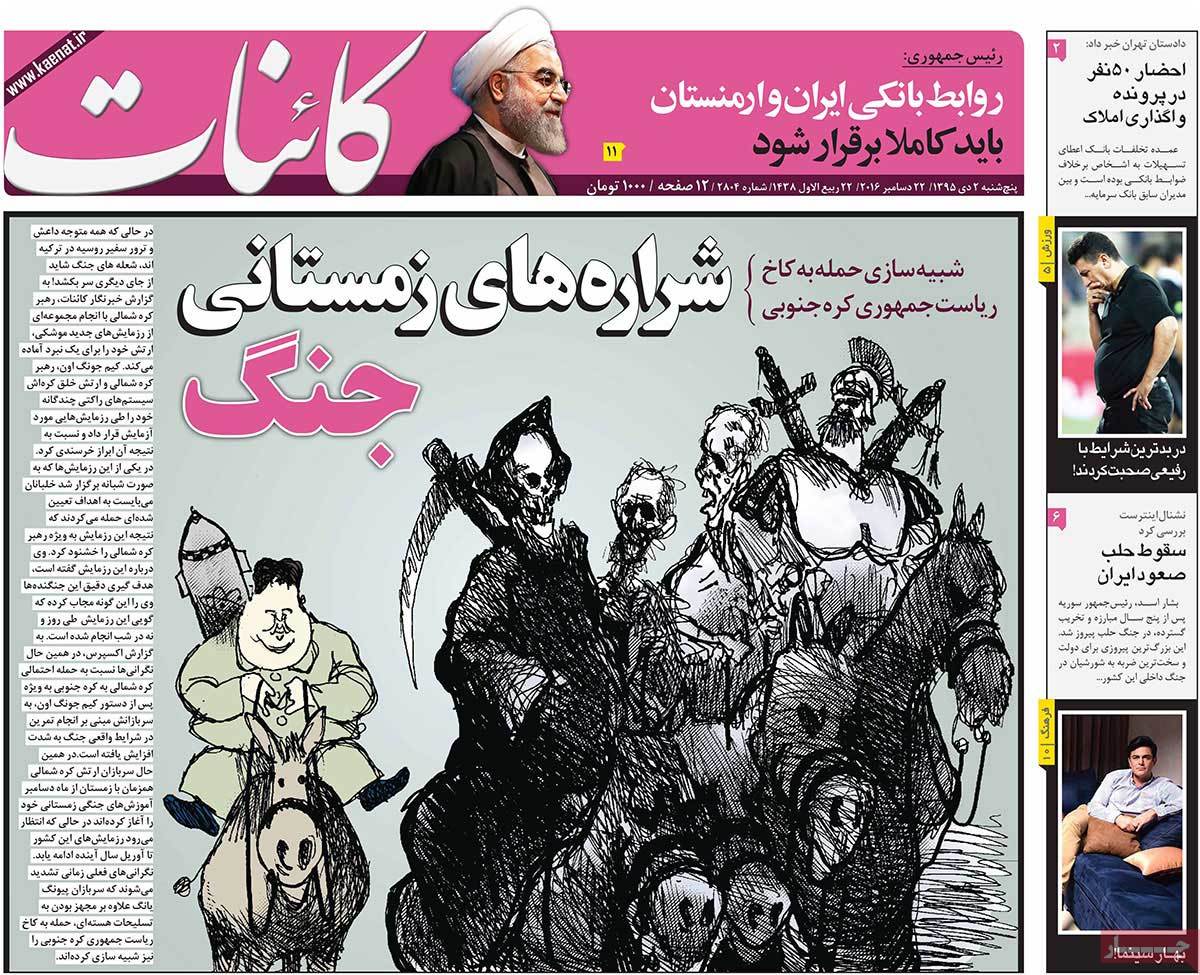
Ka’enat:

1- Winter Drums of War: Simulation of Attack on South Korean Presidential Palace: While Everyone’s Attention Is Focused on ISIS and Assasination of Russian Ambassador to Turkey, Flames of War May Be Ignited Somewhere Else; North Korean Leader Preparing His Army for an All-Out War by Testing New Missiles
A Look at Iranian Newspaper Front Pages on December 22


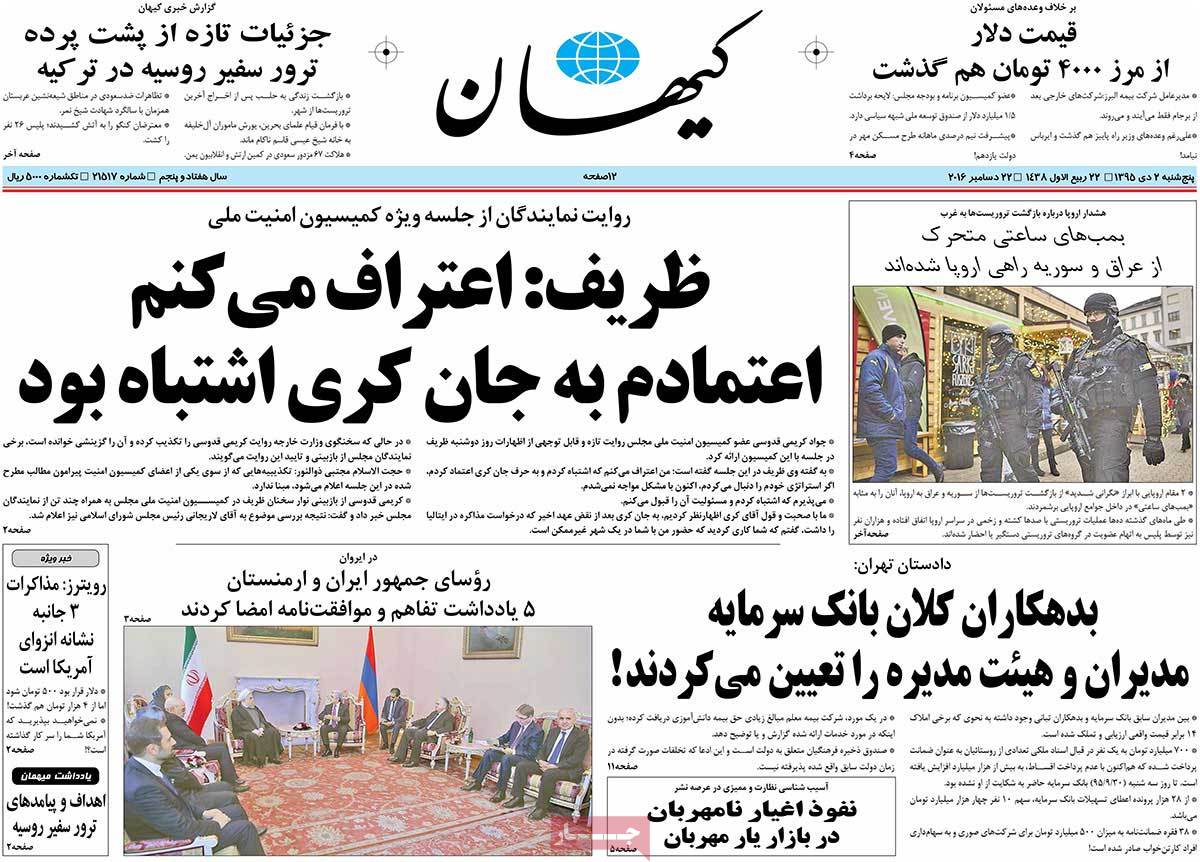
Kayhan:

1- Zarif: I Admit It Was Wrong to Trust John Kerry

2- Mobile Time Bombs Depart Iraq and Syria for Europe
A Look at Iranian Newspaper Front Pages on December 22


Khorasan:

1- Korean Brand Receives $750 Million Fine: Iran’s Customs Organization Discovers a Major Importer’s Trick
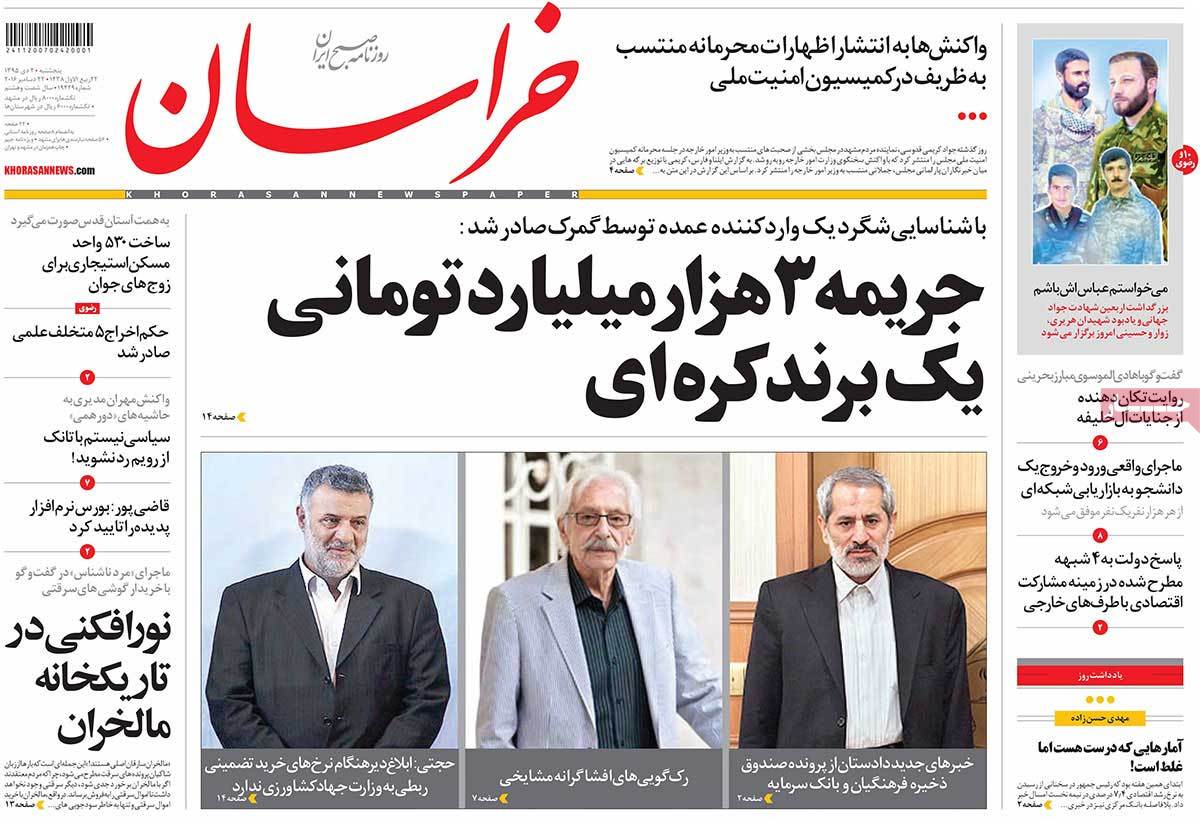
A Look at Iranian Newspaper Front Pages on December 22


Resalat:

1- Fight against Corruption Has No Way but Transparency: MP’s Letter to Parliament

2- Senior Cleric Ayatollah Alavi Gorgani: We Can’t Expect People Not to Complain

3- IRGC Has Carried Out 34,000 Projects to End Deprivation
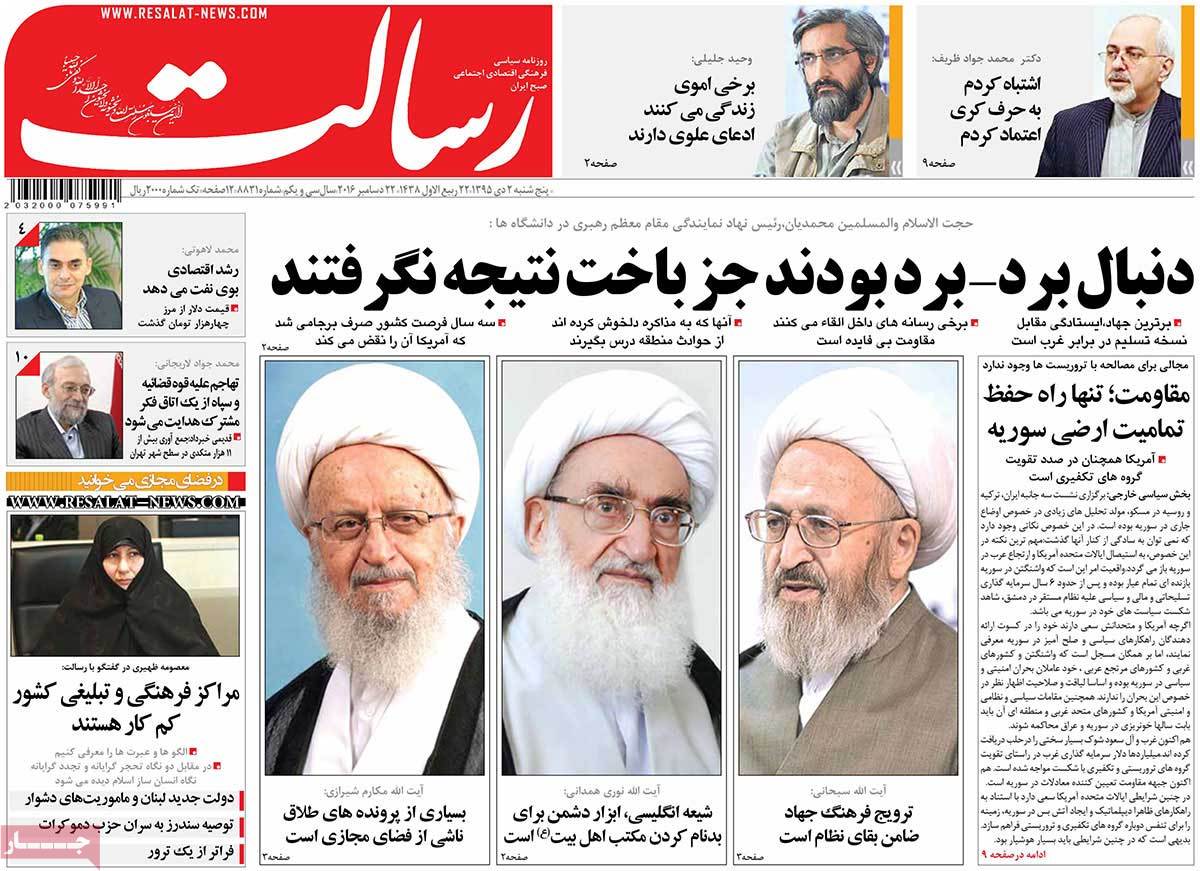
A Look at Iranian Newspaper Front Pages on December 22


Siasat-e Rooz:

1- Tehran Prosecutor General: 22 Executives Who Received Astronomical Salaries Summoned

2- Mistake in Trust: Is It Possible to Compensate?
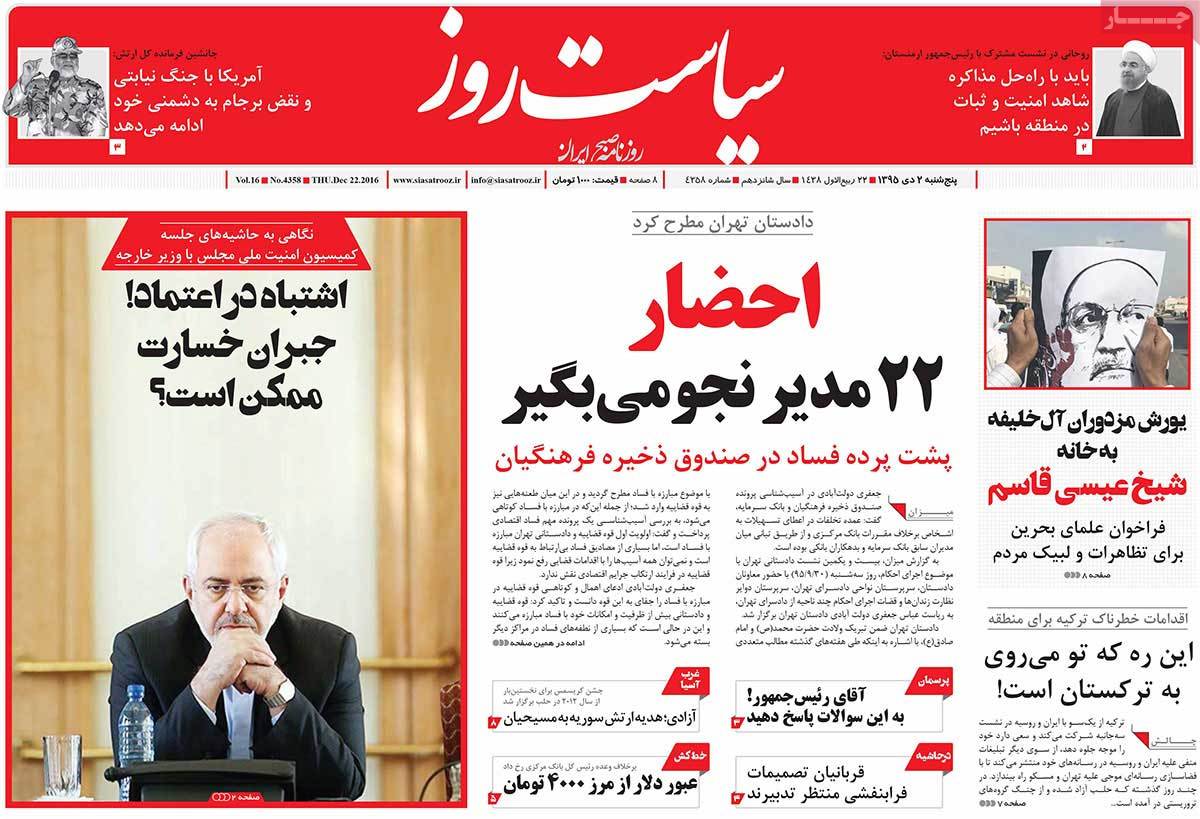
A Look at Iranian Newspaper Front Pages on December 22


Shahrvand:

1- Four Diseases Kill Half of Iranians: Diabetes, Cardiovascular Diseases, Respiratory Diseases, and Cancer Cause 52% of Deaths

2- Secrets behind Tehran’s Traffic Jam
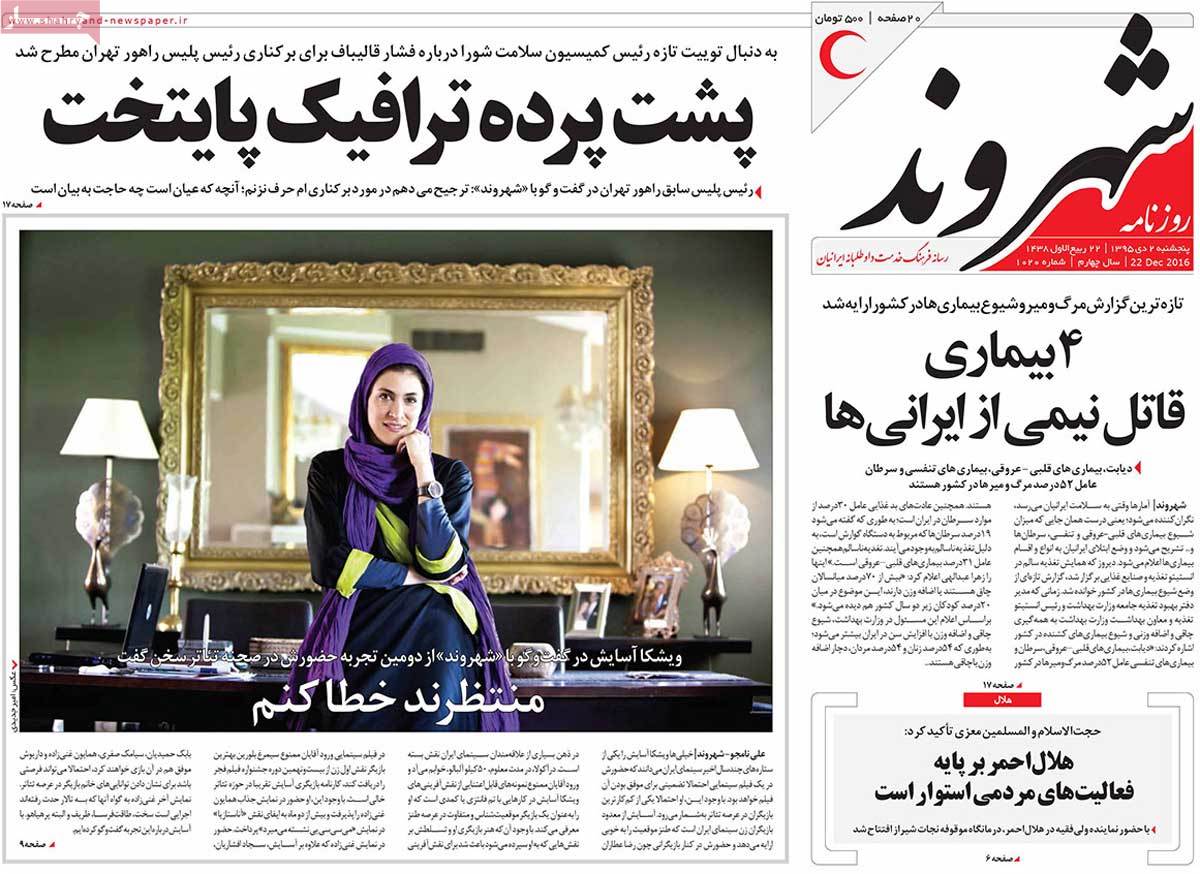
A Look at Iranian Newspaper Front Pages on December 22


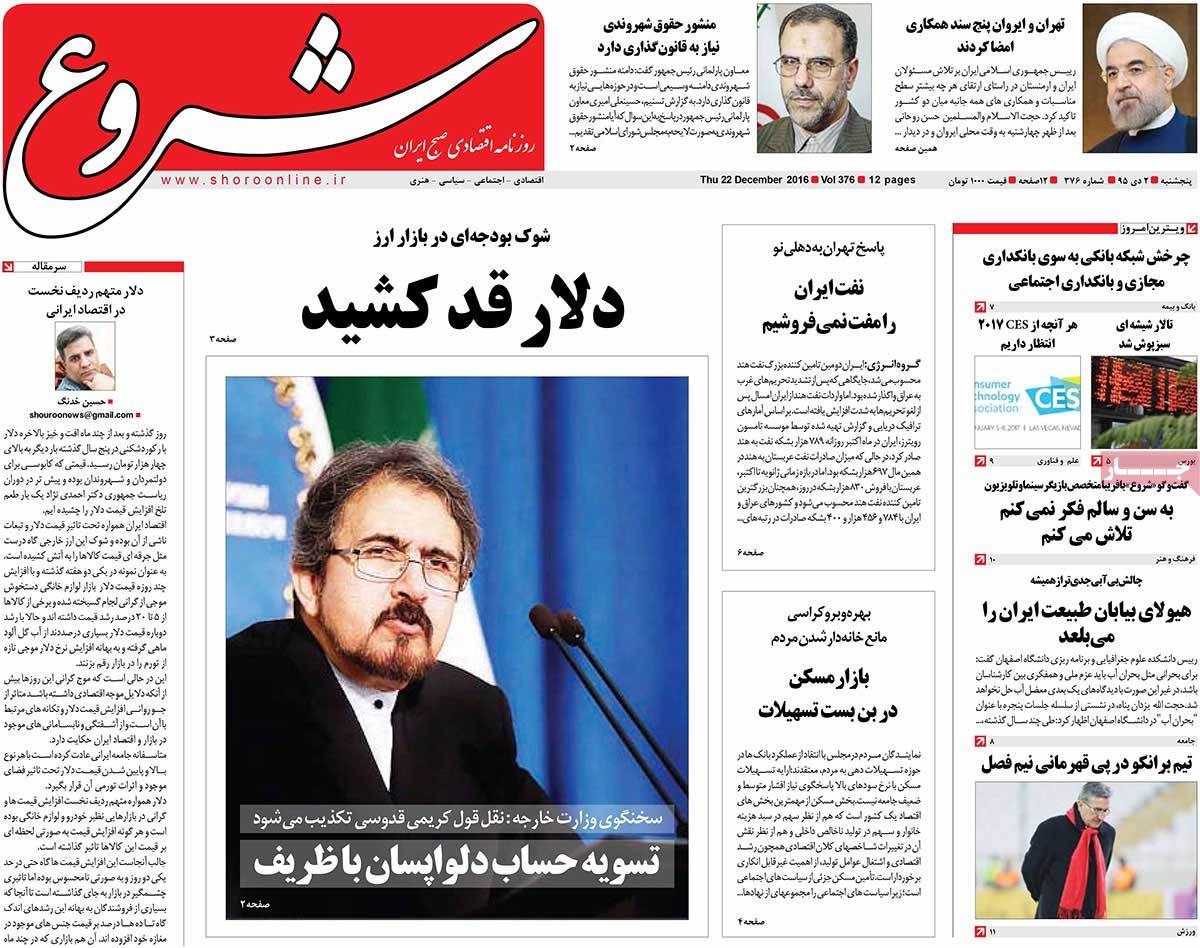
Shorou:

1- Foreign Ministry Denies Remarks by Karimi Qoddousi about Zarif’s Remarks: Hardliners Take Revenge from Zarif

2- Tehran’s Response to New Delhi: We Won’t Sell Iran’s Oil Free of Charge
A Look at Iranian Newspaper Front Pages on December 22


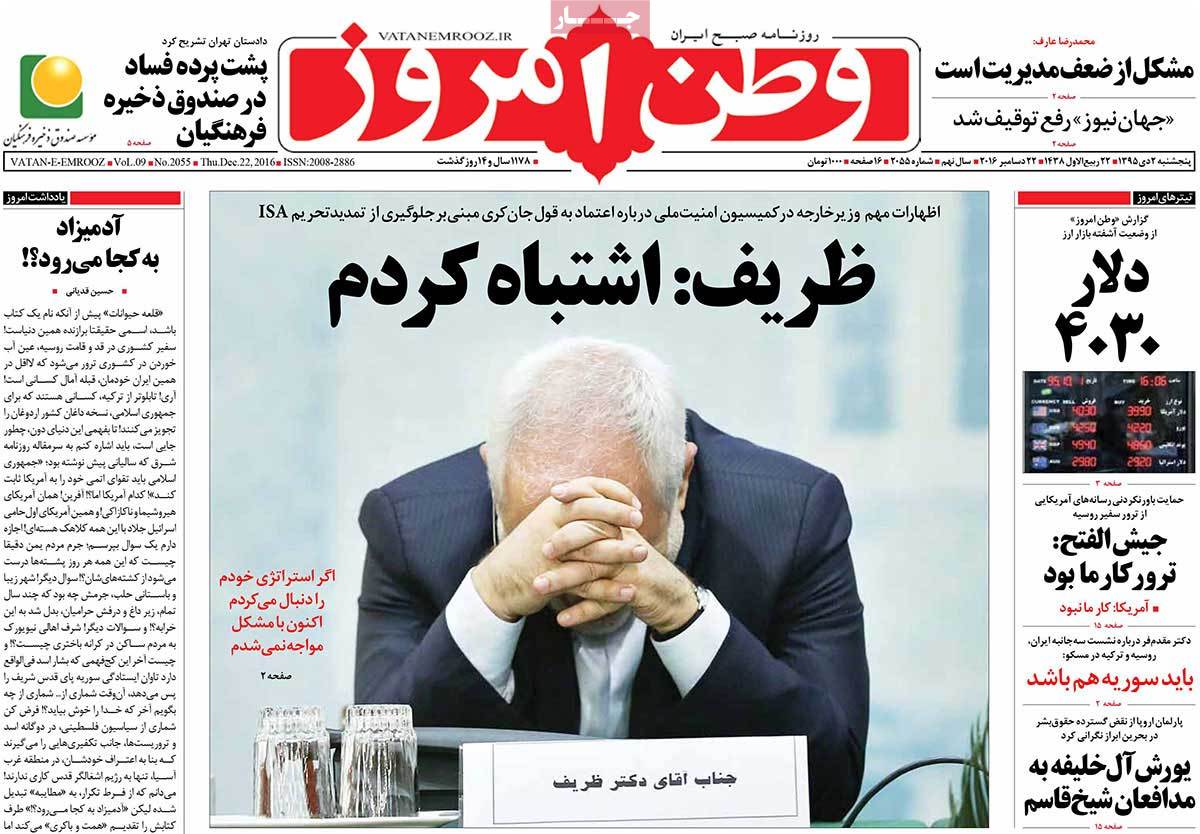
Vatan-e Emrooz:

1- I Was Wrong: Important Remarks by FM Zarif in Parliament’s National Security and Foreign Policy Commission Meeting about His Trust in John Kerry’s Promise to Prevent ISA Extension

2- Al Khalifa Attacks Defenders of Sheikh Qassim in Bahrain
A Look at Iranian Newspaper Front Pages on December 22

‘Political Agenda’ behind Syria War Crimes Panel: Iran

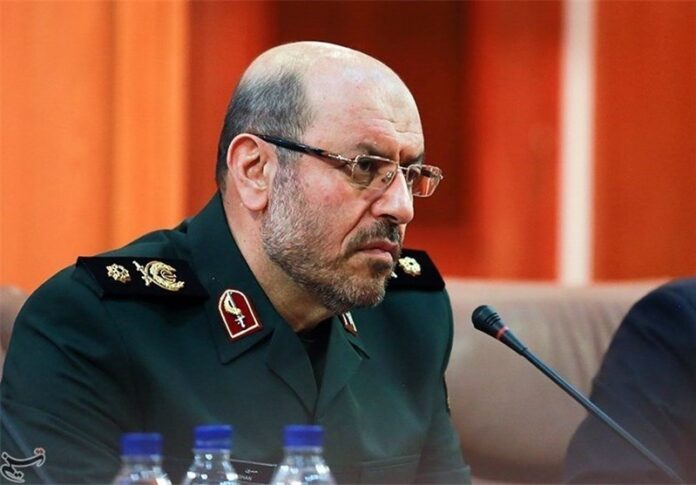
Iranian Defense Minister Brigadier General Hossein Dehqan

“We find the draft resolution to be an unconstructive move, on both legal and political grounds,” Iran’s Deputy Ambassador to the UN Gholam-Hossein Dehqani said in New York on Wednesday.

The resolution, “in its entirety, is in violation of the (UN) Charter and the fundamental principle of state sovereignty,” he added.

Dehqani said law enforcement and prosecution of criminals fall strictly within the domestic jurisdiction of states, thus the establishment of an investigative mechanism without the consent of the Damascus government amounts to utter disregard to Syria’s sovereignty.

“As such, this initiative is also in violation of the provisions of the Charter of the United Nations, including Article 2.7 by intervening in matters which are essentially within the domestic jurisdiction of a UN member state,” he said.

Dehqani said the resolution “undoubtedly seeks to advance a political agenda under the disguise of quest for justice.”

“It is quite noticeable that right after the retake of eastern Aleppo by the Syrian Army from the terrorists, suddenly different initiatives with a clear political agenda have been pushed at different levels,” he said.

Dehqani said Iran has frequently reiterated that there is no military solution to the ongoing crisis in Syria, and Syrians should decide their political future by themselves.

The Islamic Republic has also stressed the need for a genuine Syrian-led peace process in order to bring about peace and national reconciliation, he added.

Dehqani pointed to a Tuesday meeting between Iranian Foreign Minister Mohammad Javad Zarif and his Russian and Turkish counterparts Sergei Lavrov and Mevlut Cavusoglu in Moscow, describing it as an example of how to put political process back on track.

“This draft resolution before us today is not in the right direction, as it can undermine the efforts to foster a political solution to the crisis,” he said.

“By establishing an illegal investigation mechanism and introducing conditionality, this draft will serve no purpose other than creating impediments in the way towards achieving a political solution for the crisis,” Dehqani added.

The draft resolution, he said, fails to address the root causes of terrorism in Syria, and will only serve the impunity of those who have formed, financed, armed and ideologically nurtured terrorist groups and foreign terrorist fighters there

On Wednesday, the General Assembly adopted a Lichtenstein-drafted resolution to set up a panel to prepare Syria war crimes cases.

The measure was co-sponsored by countries like the United States, France, Britain, Qatar, Saudi Arabia as well as Turkey, which are known to be the major sponsors of Takfiri terrorists fighting to unseat the Syrian government.

Iran, Kazakhstan Sign 5 Deals during Presidential Visit

Iran-Kazakhstan

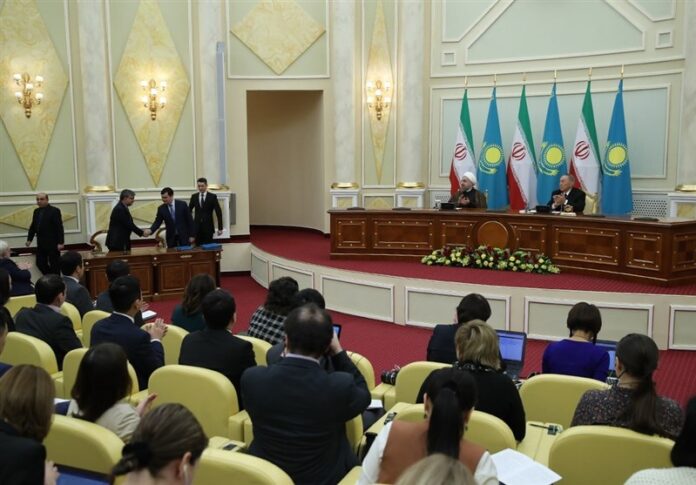
In a high-profile meeting in Astana, attended by the presidents of the two countries, officials from Iran and Kazakhstan signed five documents, including two agreements on livestock quarantine and cooperation in the Caspian Sea shipping industry.

The two sides also inked a memoranda of understanding on facilitation of reciprocal tourists travels and an MoU on labor and social welfare.

Moreover, the Central Bank of Iran and the National Bank of Kazakhstan signed another memorandum of understanding.

Heading a high-ranking delegation, President Hassan Rouhani arrived in Astana on Thursday morning and was received by his Kazakh counterpart Nursultan Nazarbayev in a formal welcome ceremony.

The Iranian president began a tour of regional countries by visiting Armenia on Wednesday. He is scheduled to visit Kyrgyzstan afterwards.

Foreign Tourists in Iranian Traditional Medicine Centres

Healthcare Food

For a long time, Iran has been a health tourism destination for foreign people who wanted to do cosmetic surgeries, or to be treated for refractive errors, infertility, etc.

Now, Iran intends to present its traditional medicine by founding special supervised health centres where people can undergo traditional treatments and buy the herbal medicines they need.

“Foreign health tourists sign up where the Iranian patients do. They are generally less aware of such a science; some of them have heard of Iranian methods of bloodletting, apitherapy and leech therapy, though,” said Mohammad Panahi, the Director General of Health Tourism Department at Iran’s Cultural Heritage, Handicrafts and Tourism Organization (ICHTO).

According to a Farsi report by ro-meds.com, he went on to say that “there should be standard places for the supply of medicinal plants, pharmaceutical products and distillates to satisfy the needs of clients. We all should try to win the confidence of patients in order to widen the circle of health tourists who resort to traditional medicine.”

Panahi noted that while some tourists know nothing about Iranian traditional medicine, some others have tried it before and worry about the consequences, so they look for a totally certified centre. Some tourists go to health centres just to collect information on the subject. The cost is the same for domestic and foreign patients.


The least harmful method

“Not only are the chemical drugs less known among people, their combinations with each other, and their use in amounts more or less than what is prescribed can also be harmful. The process of traditional treatment takes more time, but the herbal medicines used in this method are the least harmful,” Panahi noted

“Medicinal Plants are used in traditional medicine in the form of herbal medicines, manufactured by new technologies, or old medicine prescriptions. In any case, they are prescribed by a traditional physician,” he added.

“As people believe that there is no harm in consuming fruits and vegetables, they have confidence in traditional medicine,” added the manager of first Iranian traditional medicine centre.

“75% of the patients who go to general practitioners need no drugs, or can be cured by self-prescribed medicines if trained in self-treatment,” said Mahmoud Khodadoust, the former Iranian Deputy Minister of Health and Medical Education in Traditional Medicine Department, during the opening of Alborz Province traditional medicine centre, which is the most prominent in attracting health tourists.

He added that Iranians tend to believe in traditional medicine, referring to the existence of 10,000 traditional physicians and 15,000 apothecaries.