Saturday, April 11, 2026
Home Blog Page 3987

Riyadh Accepts Tehran’s Conditions for Hajj Pilgrims’ Security: Minister

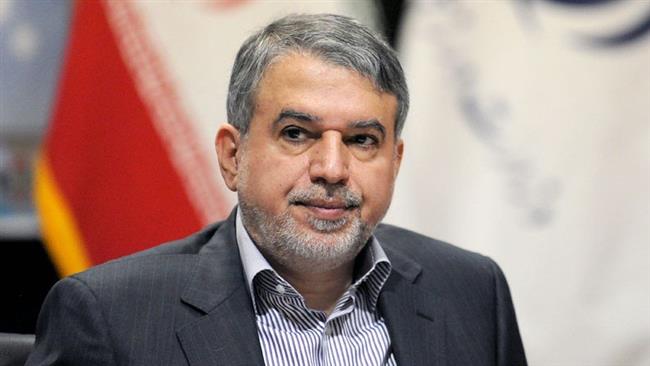
Reza Salehi Amiri

Speaking to reporters on the sidelines of the cabinet meeting on Thursday, Reza Salehi Amiri underlined Tehran’s resolve to maintain the “dignity” of Iranian Hajj pilgrims, the Iran newspaper reported.

“For this aim, we have taken all the possible paths. The Saudi Arabian side accepted the conditions required by Iran for [ensuring] the security of Hajj pilgrims and given [assurances] in writing,” he added.

The culture minister said that Iran has currently dispatched medical teams and different logistics to the holy cities of Mecca and Medina, noting that the first group of Iranian pilgrims will be sent to Saudi Arabia on July 31.

“We normally monitor the situation and if there is any likelihood for an incident, we will follow it up at the senior levels of the [Iranian] establishment (top officials),” Salehi Amiri pointed out.

In January, Iran’s Ministry of Culture responded to an official invitation by Saudi Arabia to attend meetings to discuss the resumption of the Hajj pilgrimage for Iranians and conveyed Iran’s ideas and concerns to the Saudi side.

In September 2015, a deadly human crush occurred during Hajj rituals in Mina, near Mecca.

Days into the incident, Saudi Arabia published a death toll of 770 but refused to update it despite gradually surging fatality figures from individual countries whose nationals had been among the victims of the crush.

Unofficial sources put the death toll at almost 7,000 people. Iran said about 465 of its nationals lost their lives in the incident.

Riyadh Accepts Tehran's Conditions for Hajj Pilgrims' Security: Minister

Earlier that same month, a massive construction crane had collapsed into Mecca’s Grand Mosque, killing more than 100 pilgrims, including 11 Iranians, and injuring over 200 others, including 32 nationals from Iran.

Serious questions were raised about the competence of Saudi authorities to manage the Hajj rituals in the wake of the incidents, and, facing Saudi intransigence to cooperate and refusal to guarantee the safety of Iranian pilgrims, officials in the Islamic Republic subsequently decided to halt pilgrimages over security concerns.

Saudi Arabia also unilaterally severed its diplomatic ties with Iran in January this year after protests in front of its diplomatic premises in Tehran and Mashhad against the execution by Riyadh of eminent Saudi Shia cleric Sheikh Nimr al-Nimr.

Iran-Total Gas Deal Sparks Controversy in Tehran

The opponents and proponents of the deal signed on July 3 have missed no opportunity to state their opinions about it. But the main question is whether or not they are all qualified enough to express their ideas.

Iran and a consortium headed by Total signed a five-billion-dollar gas deal to develop the South Pars offshore gas field’s phase 11. The consortium consists of Total from France (with a share of over 50%), CNPS from China (30%), and Petropars Group from Iran (lower than 20%).

In his remarks during the signing ceremony, Iran’s Oil Minister Bijan Zanganeh said this is a very good day for Iran’s oil industry. He also expressed the hope that the industry develops into a new phase with the signing of the deal.

Mohammad Baqer Nobakht, the spokesman for the Iranian government, also said with signing the agreement, Iran has demolished the wall of sanctions.

The deal has sparked mixed reactions among a larger number of Iranian political and economic players. Government officials have warmly welcomed the deal, while the issue of signing new oil contracts with foreign companies particularly the French giant of Total has been controversial provoking serious disputes inside Iran over the past months.

In one case, Leader of the Islamic Revolution, Ayatollah Seyyed Ali Khamenei, ordered the officials in charge that no new oil and gas contracts for international companies must be awarded without necessary reforms.

In a letter to Iran’s First Vice-President, Es’haq Jahangiri, two weeks before signing of Iran-Total gas deal, former lawmaker Ahmad Tavakoli criticized the government for violating its own approvals about the necessity of observing security measures in dealing with foreign companies.

As the founder of the corruption watchdog, non-governmental organization Justice and Transparency Watch, Tavakoli also said as stipulated in the Leader’s guidelines on oil contracts with foreign companies, the government is obliged to observe all security considerations.

“The 8th stipulation of the guideline says that the companies’ access to the secret information about Iranian oil fields should be discussed in the National Security Council,” Tavakoli added.

Now most of the critics say their main question is whether the government has addressed the issues raised by Tavakoli. But there are other opponents of the oil deal who have taken one step further. Ali Reza Zakani, a former Iranian MP says he is against the deal for reasons beyond what Tavakoli raised in his letter.

“We are against the deal because the French company left Iran alone during western sanctions and is notorious for its corrupt deals,” he added.

The proponents of the deal, however, view it as a victory for the Islamic Republic. In response to the critics, Zanganeh said the gas deal was signed despite opposition from inside and outside the country because the opponents begrudge Iran’s dignity and achievements particularly its restored relations with the world.

He also stressed the deal has been signed according to the Constitution of the Islamic Republic of Iran. “Based on the government approvals, a seven-member board is now assigned with making sure the deal does not violate any government approvals. The board is comprised of four former ministers and three other senior officials,” he said.

Speaking on the sidelines of the signing ceremony, Zanganeh also said Iran has invested five billion dollars, but Total is expected to invest nearly six billion dollars.

“Some critics say we have given away between 50 to 70 percent of the whole shares of the deal to the foreign side. But this is wrong. The whole income of Total and its consortium from the gas fields would stand at less than 15 percent in the next 20 years.”

This comes as Hedayatollah Khademi, a member of the presiding board of Iranian parliament, says the lawmakers are set to conduct a review of the deal with Total and expressed hope that there will be an appropriate mechanism to oversee the deal.

“We also hope the French side remains committed to its pledges under the deal and won’t leave it unfinished,” he said.

He went on saying that over the next couple of days, the parliament’s presiding board will enter into correspondence with the Oil Ministry to get the details of the deal.

“Having got the details, the relative commission will begin a probe into the agreement,” he said.

The statements of the lawmaker reveal an important point: Neither the opponents, nor the proponents are not aware of the deal’s details. It seems the Oil Ministry has decided to keep the details secret.

So, it goes without saying that all the opinions expressed for or against the deal are based on some partial media speculations.


Follow Reza Khaasteh in Twitter via @Khaaasteh

Tehran to Host Iran-Italy Joint Orchestra Performance

The performance entitled “The Roads of Friendship” will be staged on July 6 at Tehran’s Vahdat Hall.

The ensemble is composed of Italian as well as Iranian musicians conducted by Maestro Riccardo Muti from Italy and Maestro Shardad Rohani from Iran.

Muti from Italy and Maestro Shardad RohaniThe Italian maestro is going to conduct the Tehran symphony orchestra, which according to Rohani is an honour for the Iranian music community.
Rohani told the Mehr News Agency that the historic presence of such a great master in Iran is a turning point in Tehran symphony orchestra’s activities.

A second performance with the same ensemble will be later held on July 8 in the Italian city of Ravenna.

Rohani referred to the Iranian musicians’ performance in Ravenna, and said it is a source of honour for members of Tehran symphony orchestra to send a message of peace and friendship to the world through their performance in an Italian city in a time when the entire Middle East is grappling with war.

He said the world has negative perceptions of Iran, and the Iranian musicians’ performance in Ravenna can improve the Islamic Republic’s image as a cultural state.

The joint performance in Iran is going to be held as the country has a busy musical week ahead.

Many singers from pop to traditional singers with different musical styles are going to hold concerts in different parts of the country from north to south and east to west.

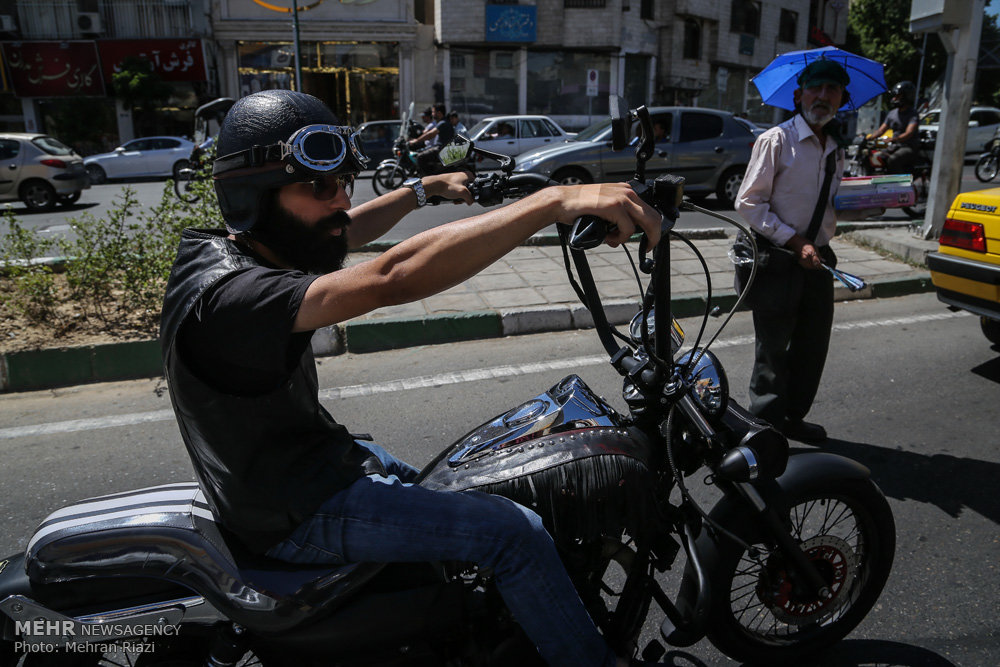
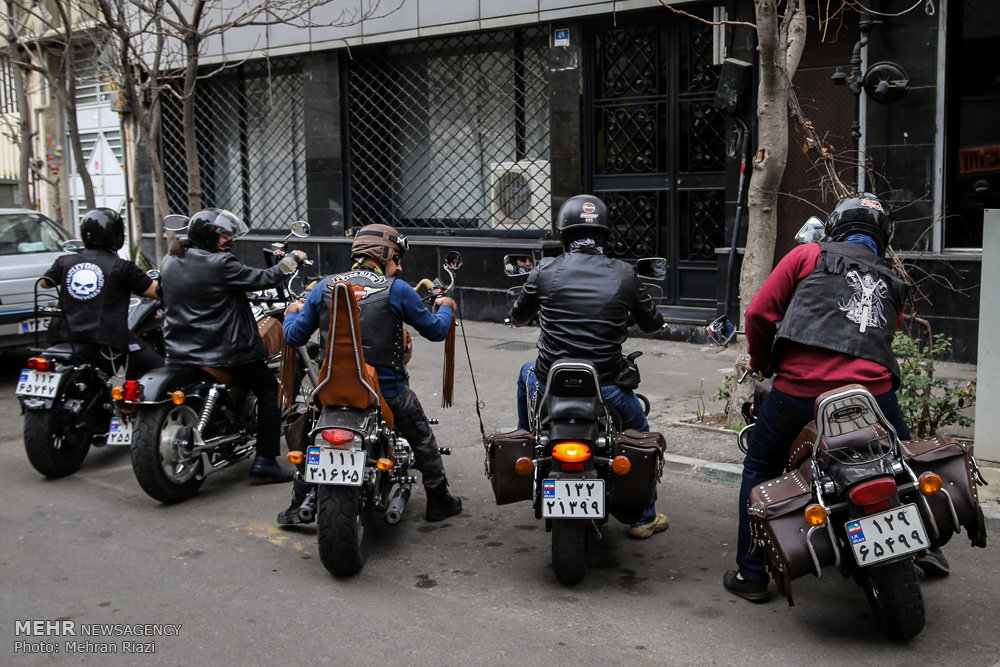
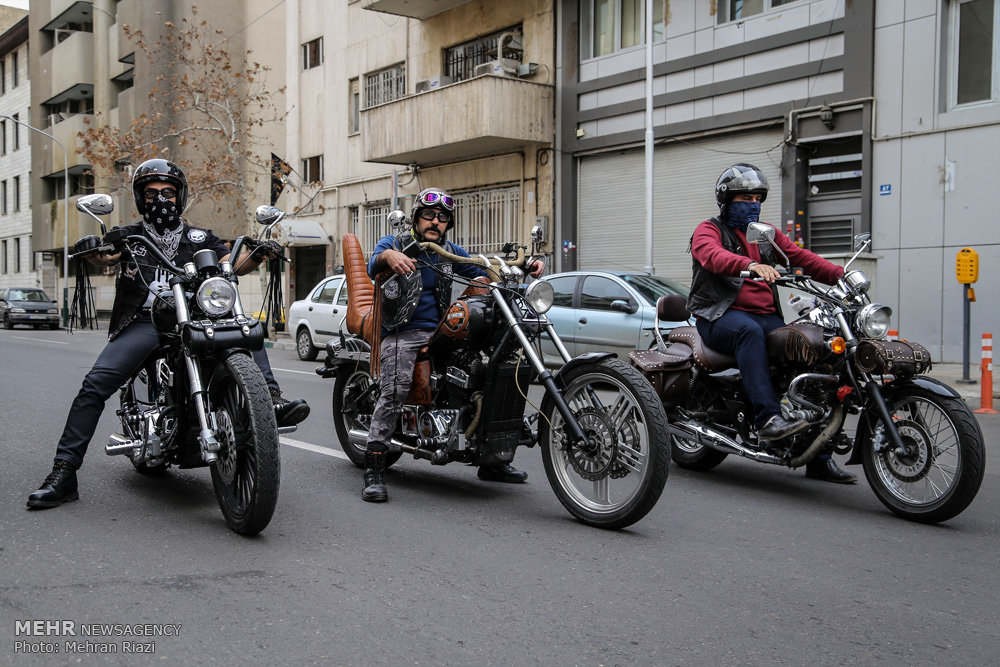
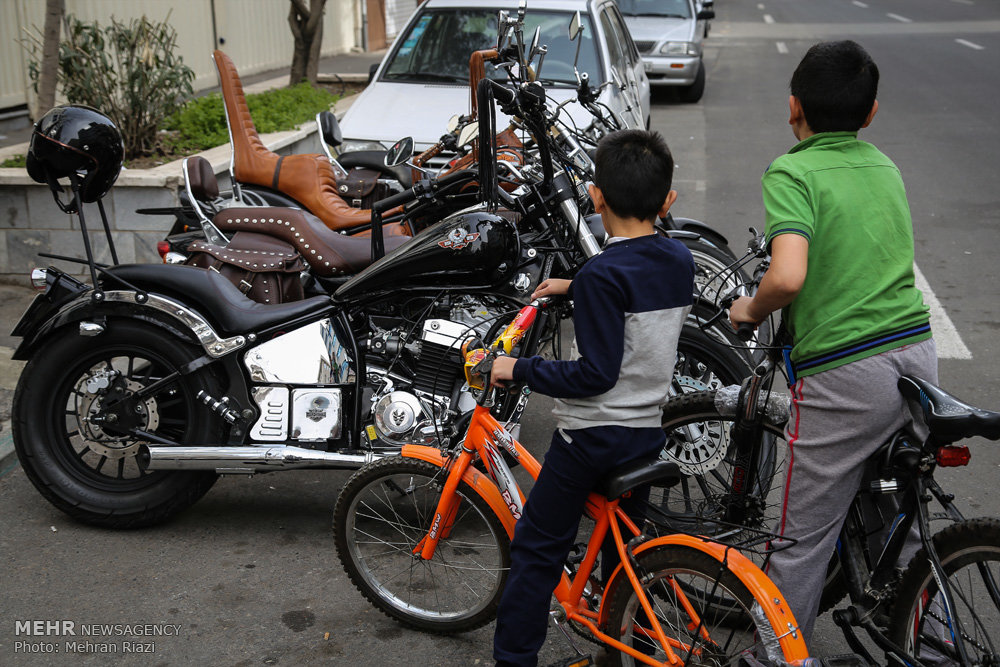
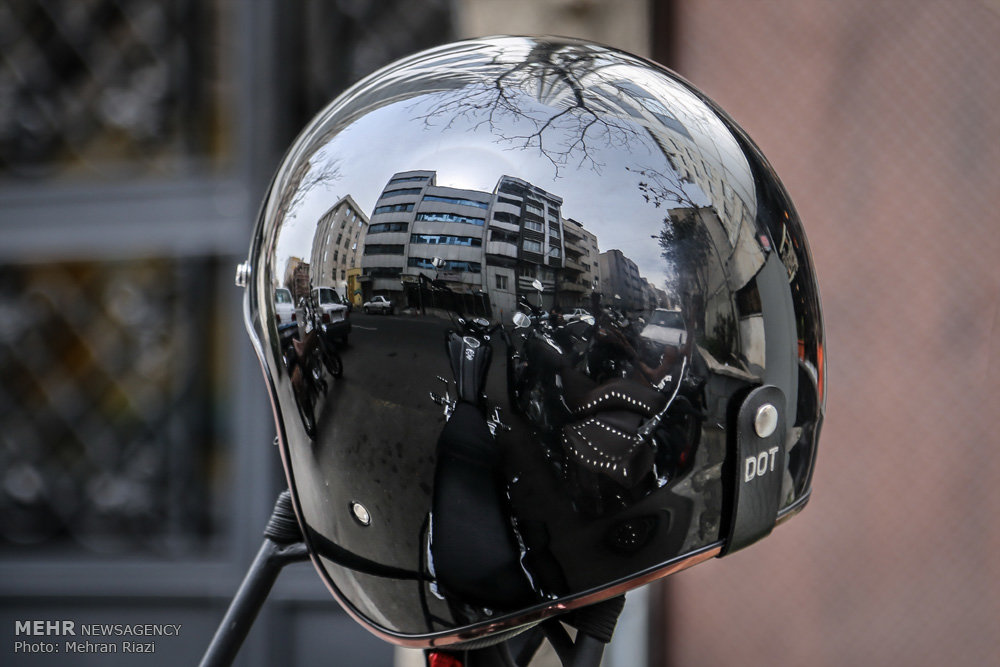
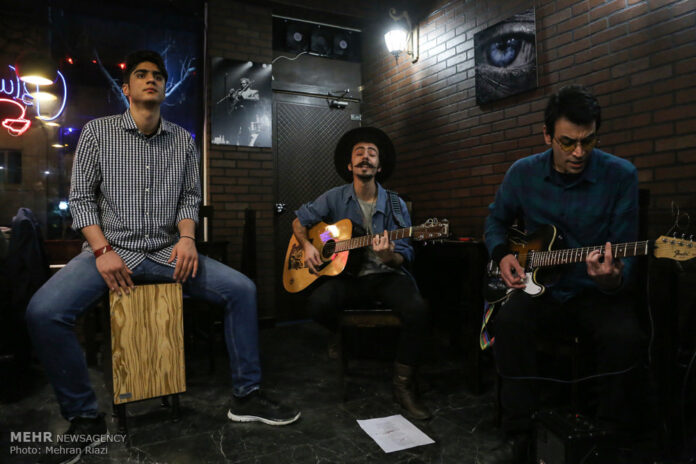
Blues Coffee Shop, Hangout for Iranian Cruiser Motorcyclists

Cafe-Tehran (26)

Blues is an African-American music that traverses a wide range of emotions and musical styles. “Feeling blue” is expressed in songs whose verses lament injustice or express longing for a better life and lost loves, jobs, and money.

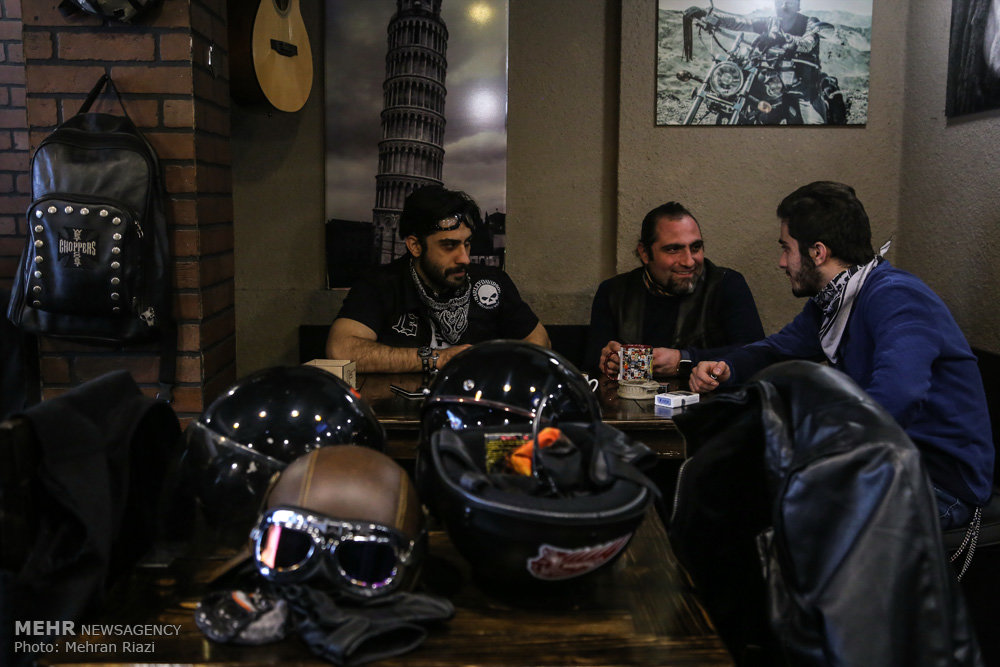
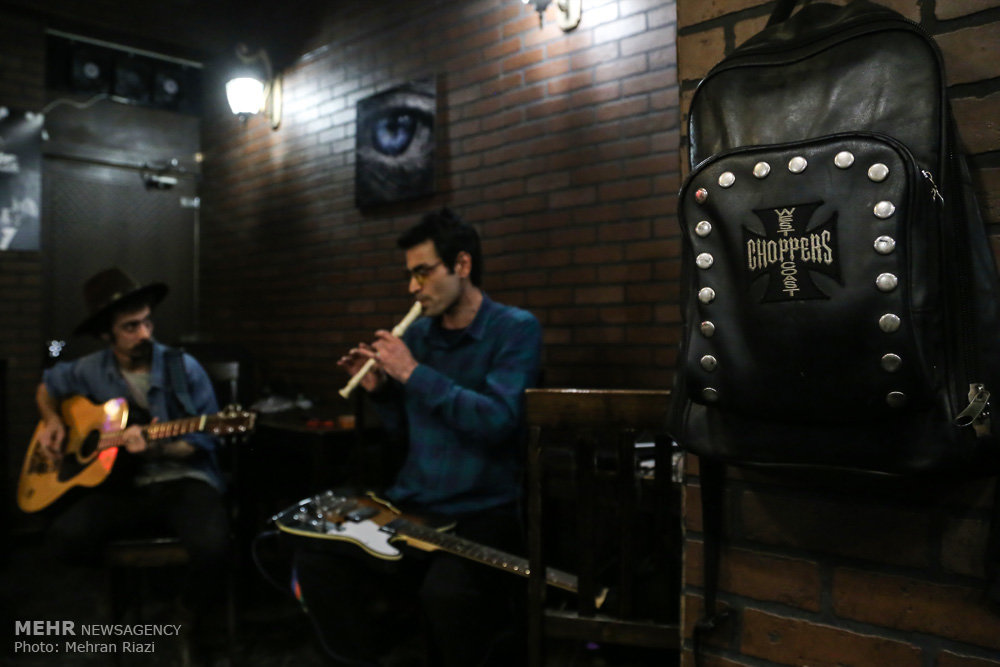
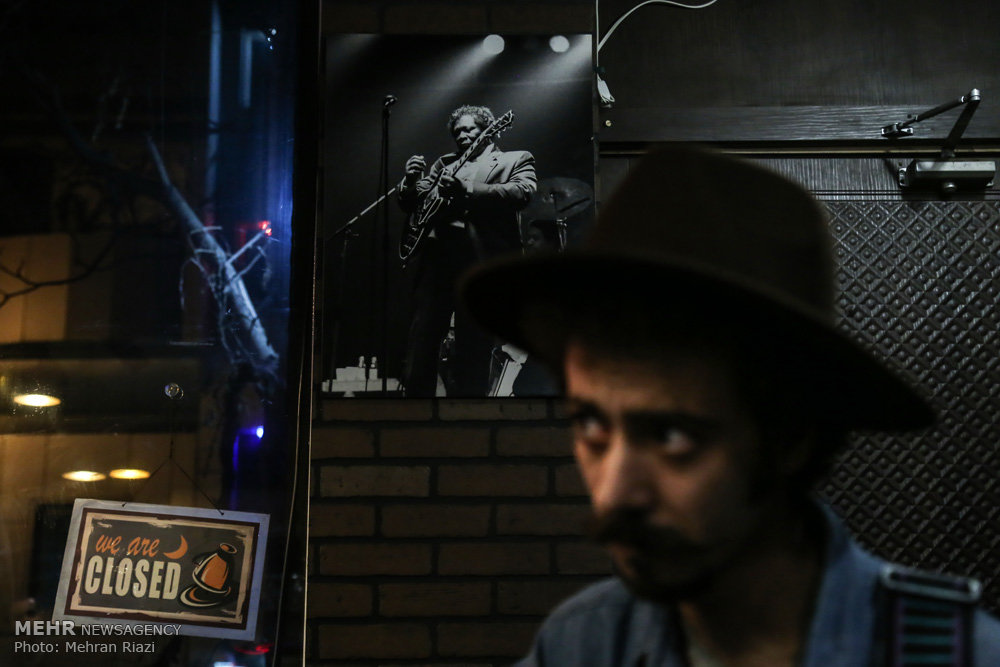
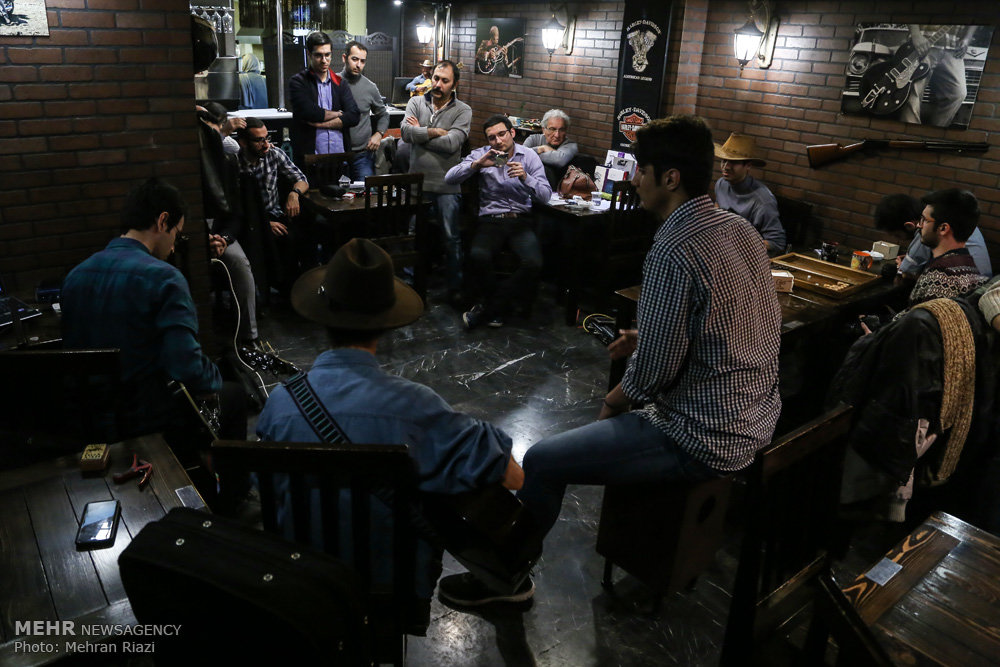
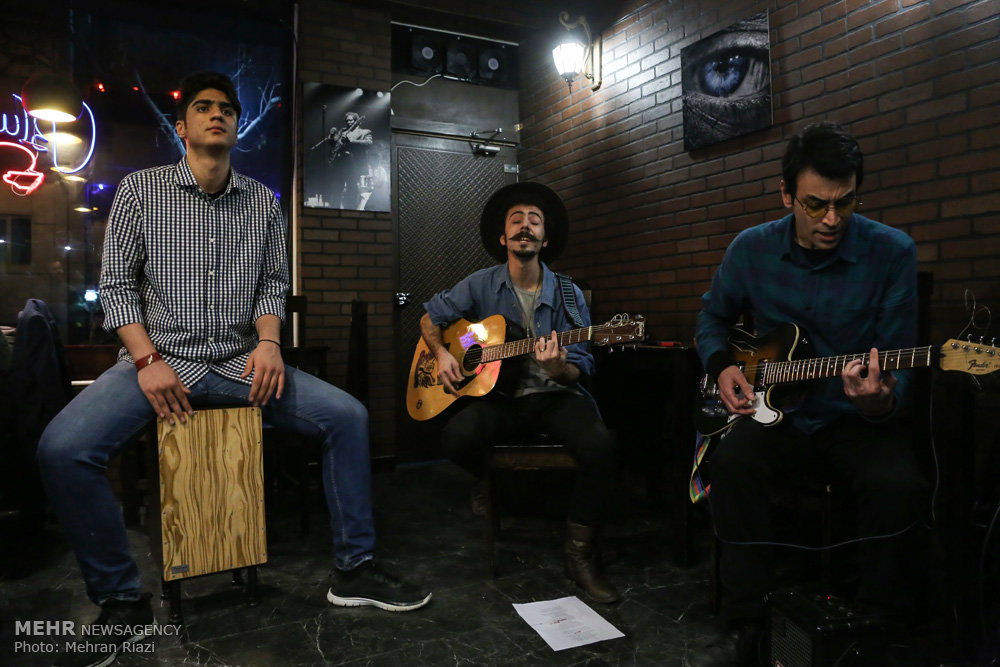
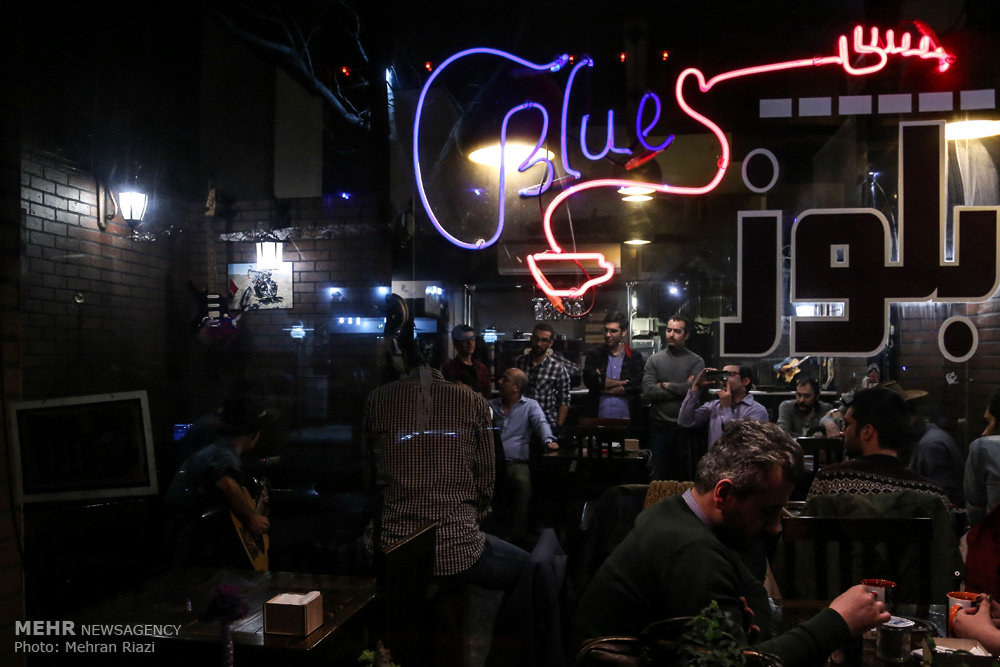
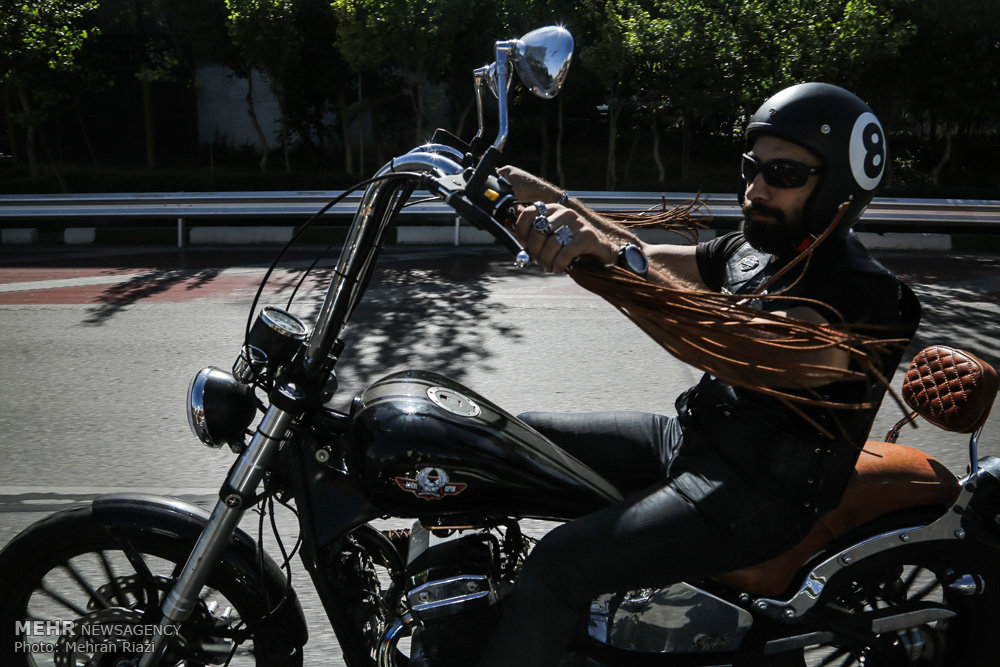
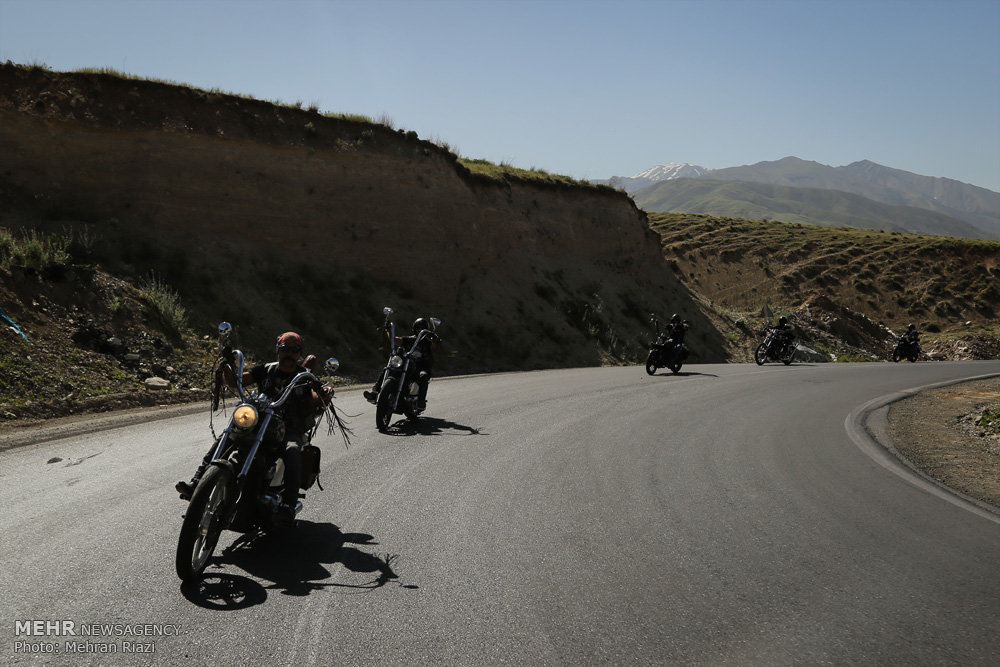
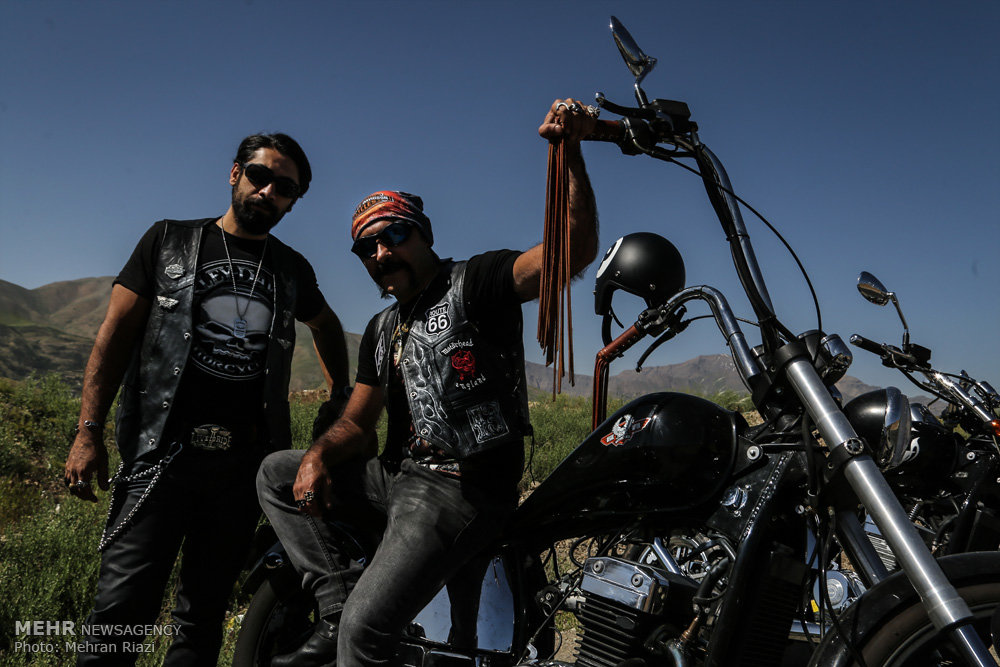
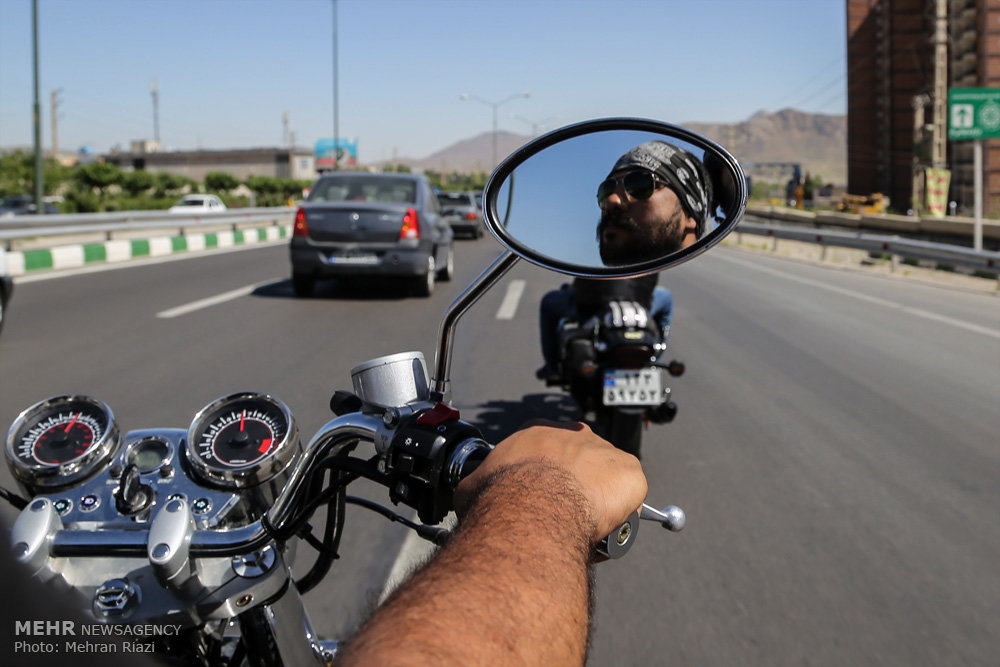
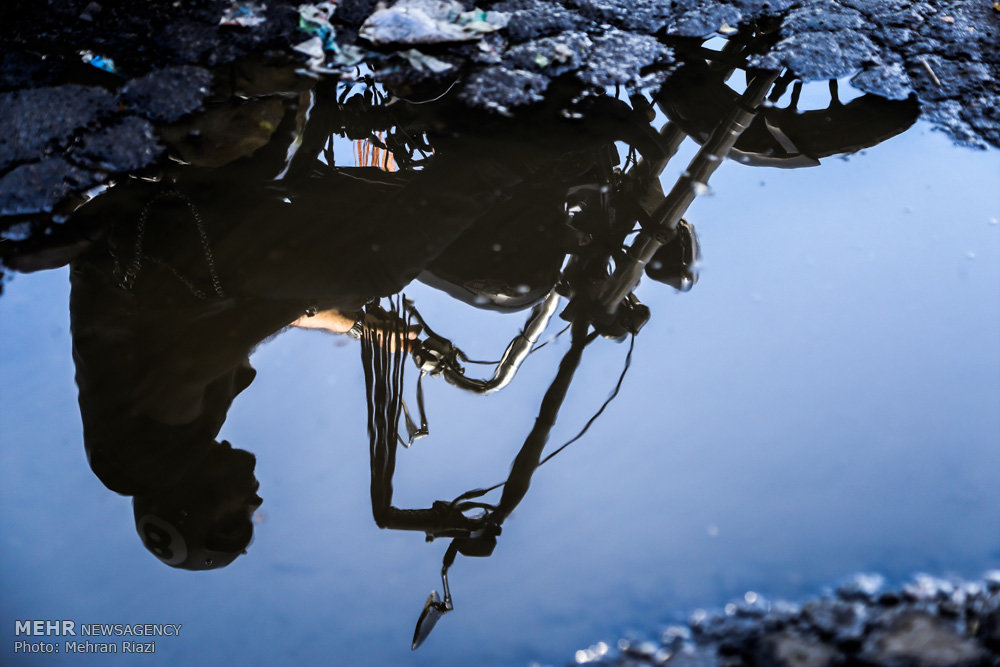
Robert Hakoupian, 42, is the owner of the ‘Blues Coffee Shop’ in Tehran. He has established it to provide amateur musical players filled with a longing for motorcycling with a hangout to come together and hold live concerts. He is now planning to organize the cruiser motorcyclists into a cohesive group and involve them in charity events.

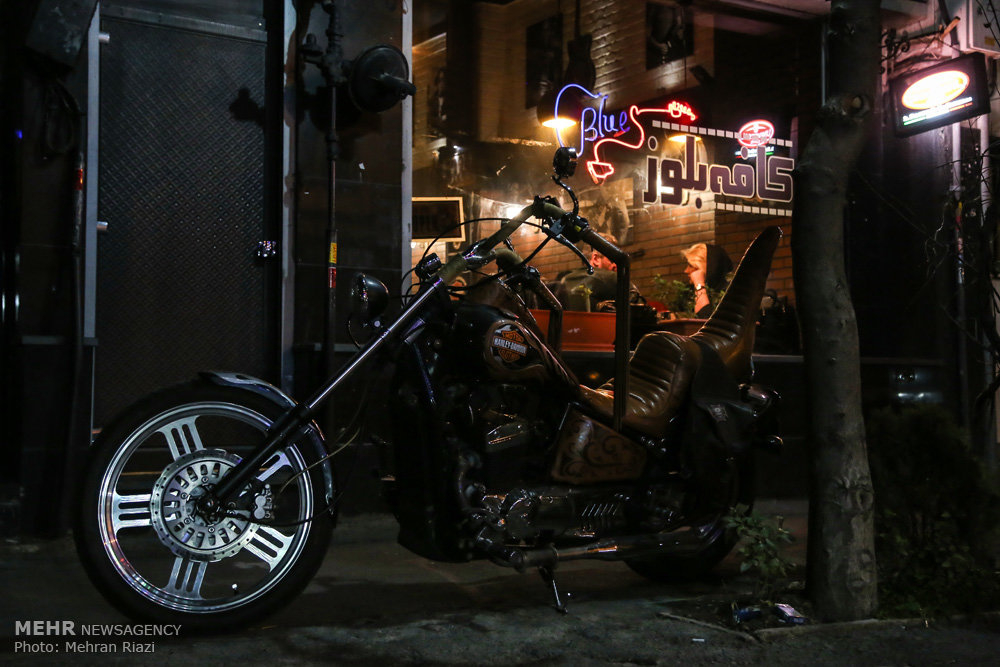
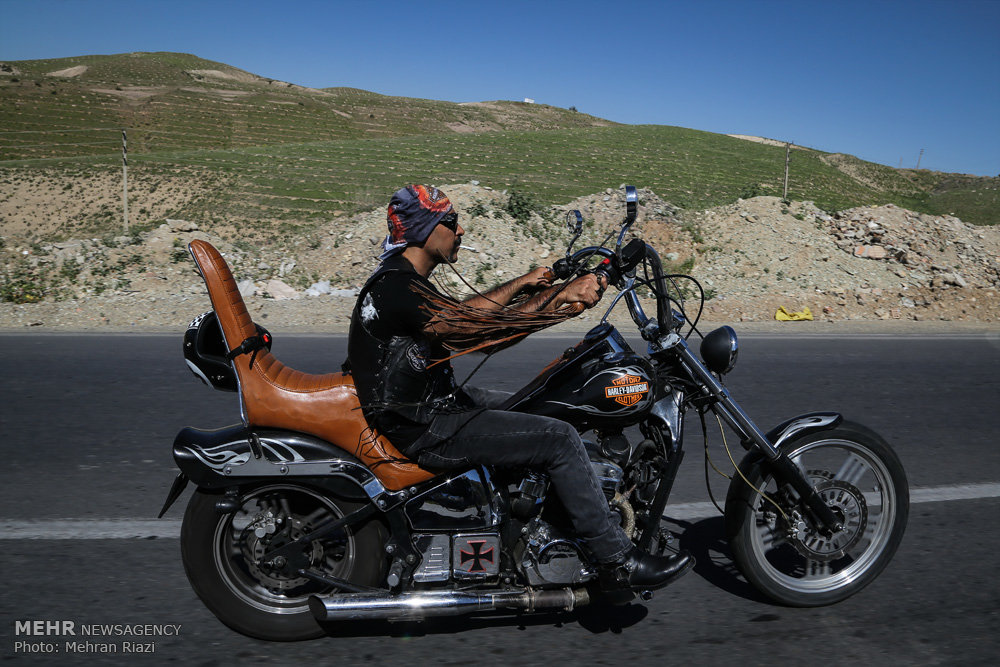
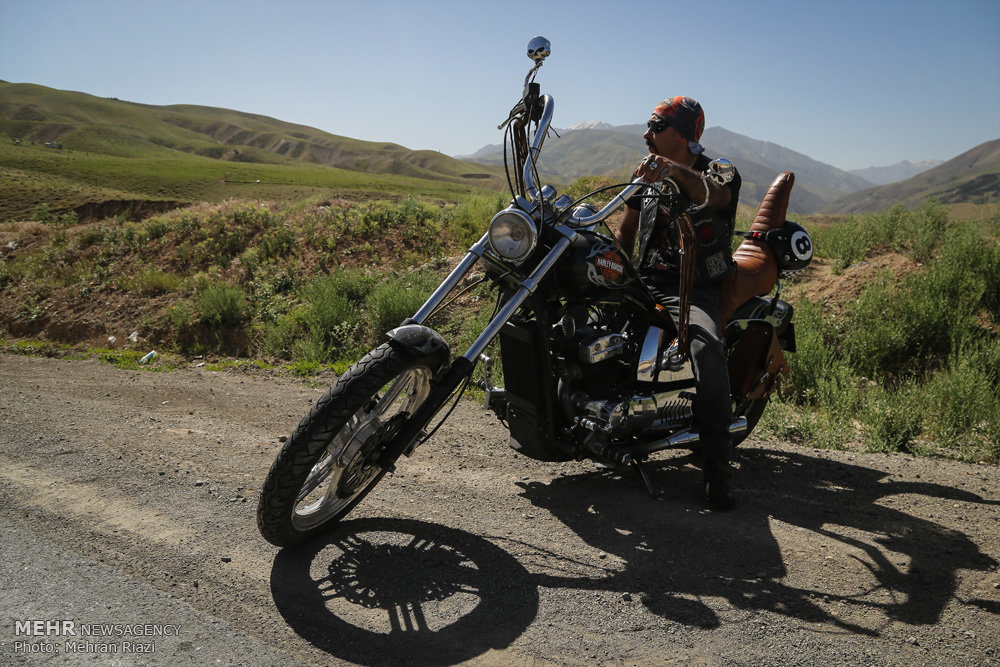
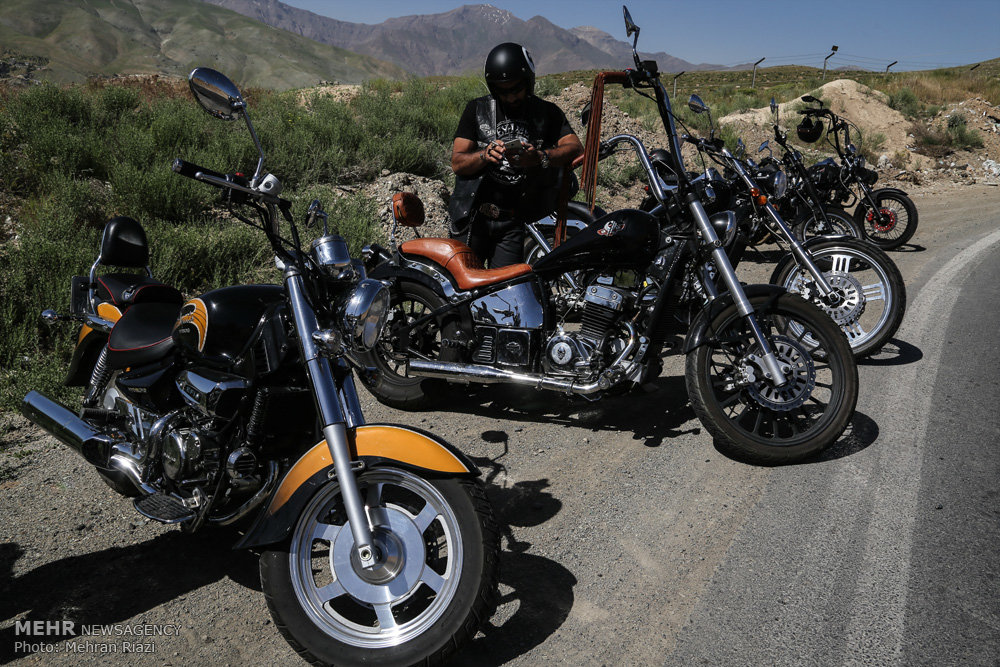
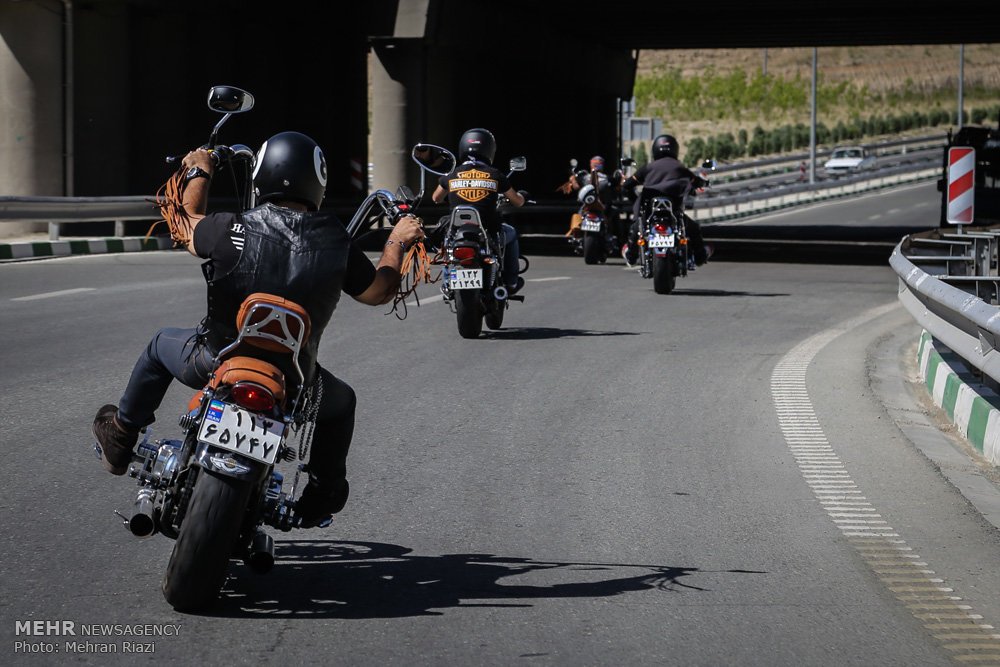
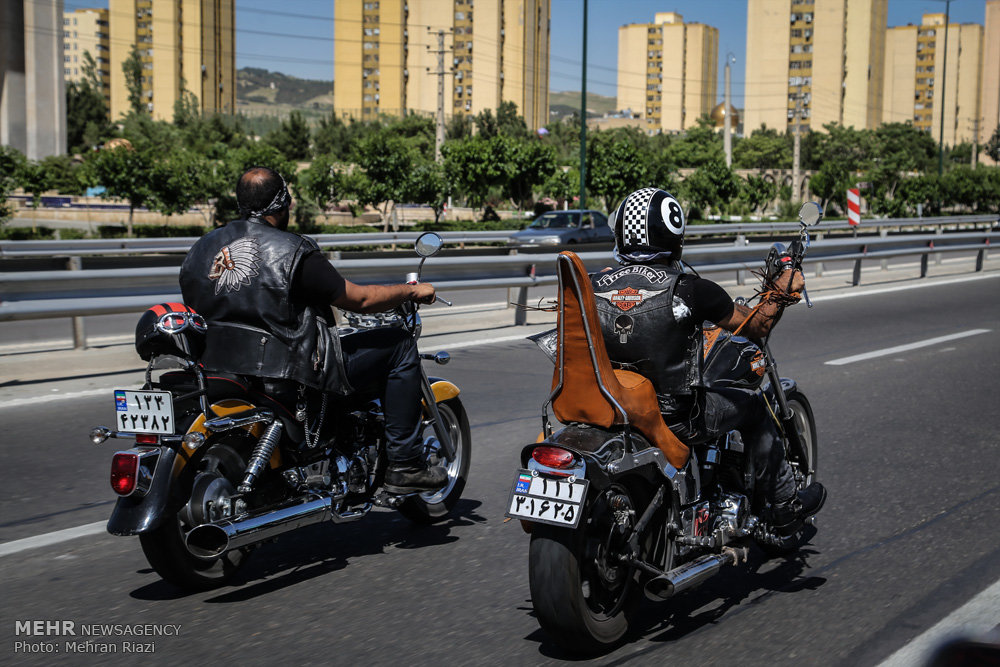
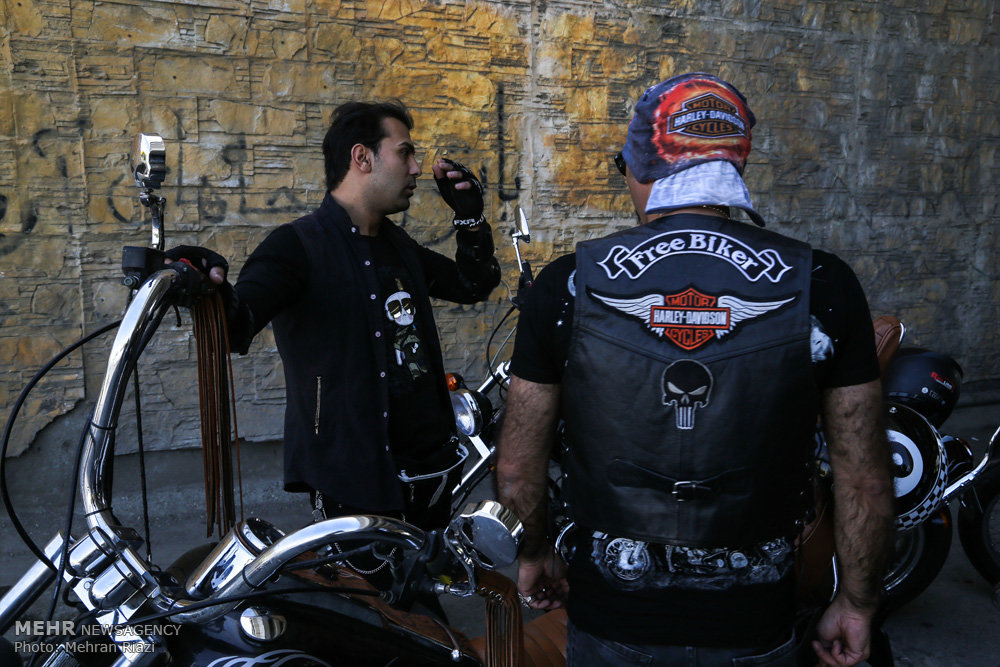
Robert, himself, has been crazy for motorcycles since his childhood. Later during his teenage years, he developed an interest in the Harley-Davidson motorcycles and bought his first bike in 2005. Cruiser motorcycles are not fast. They are mainly designed for group rides in the country roads.

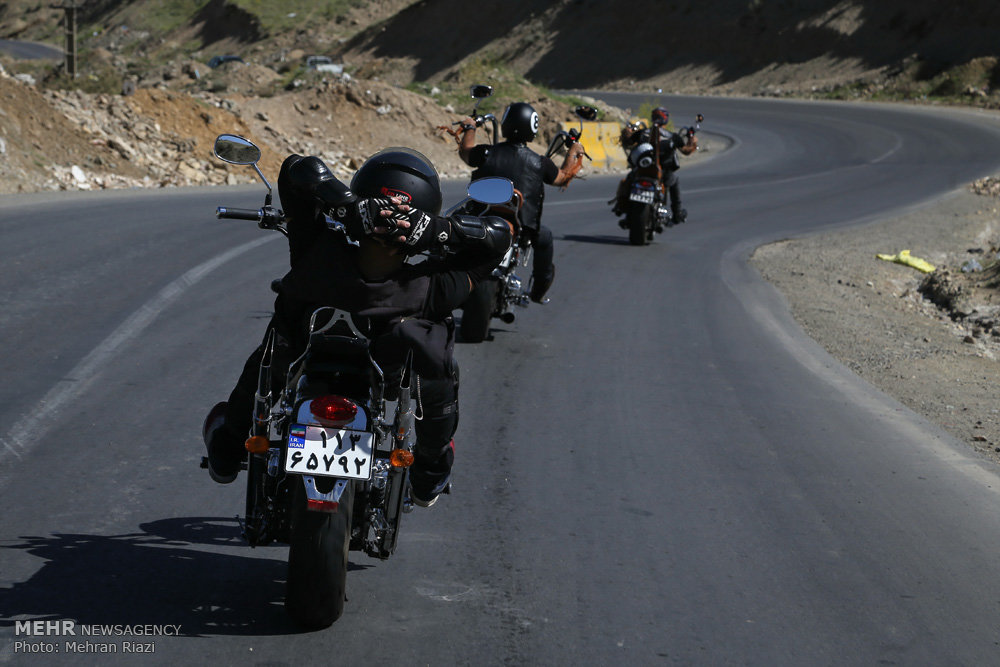
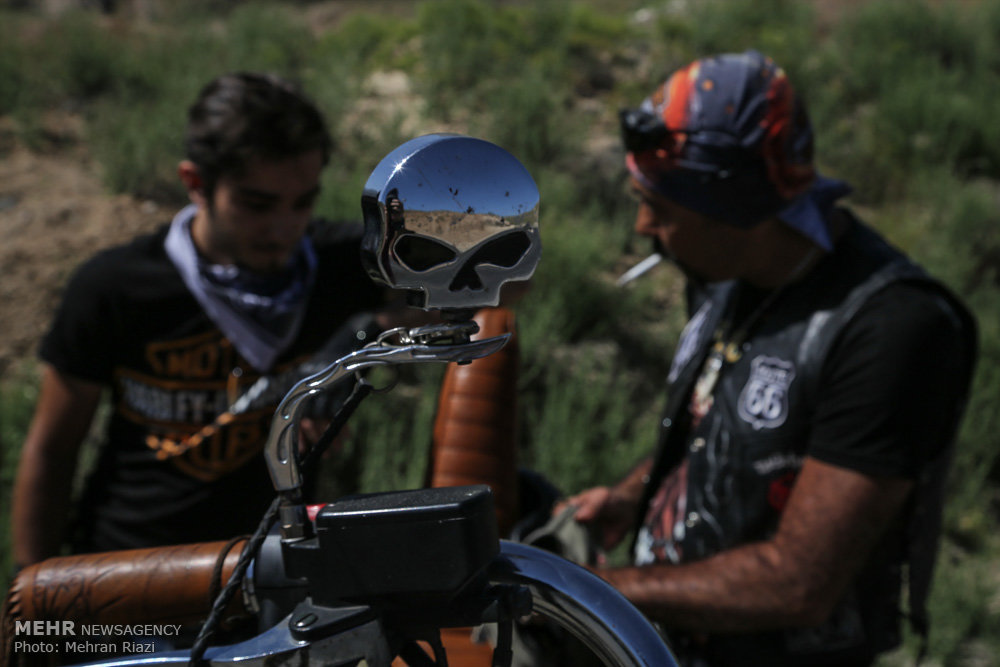
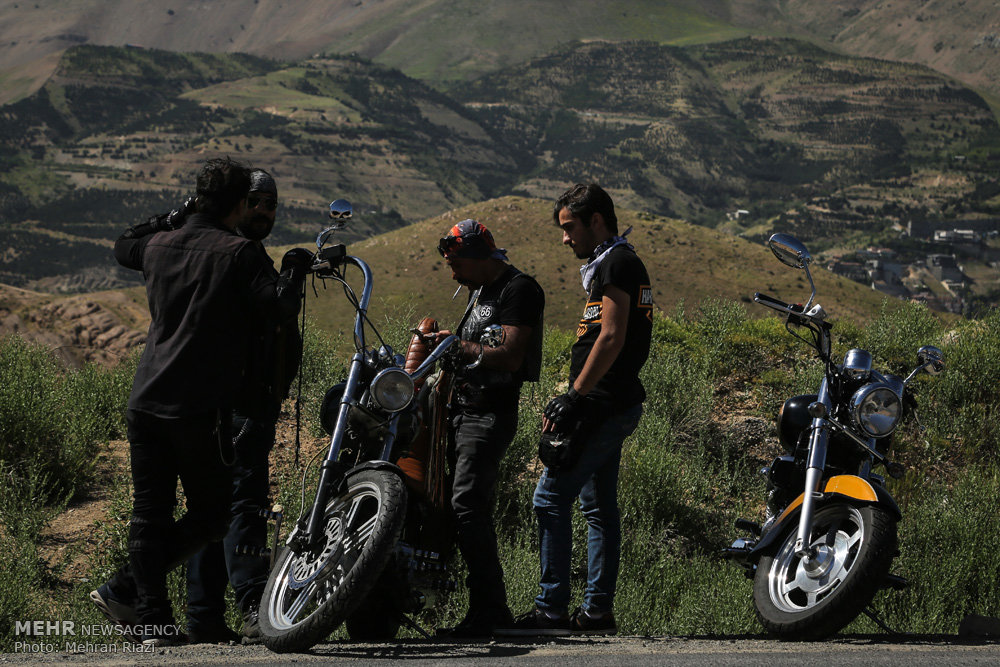
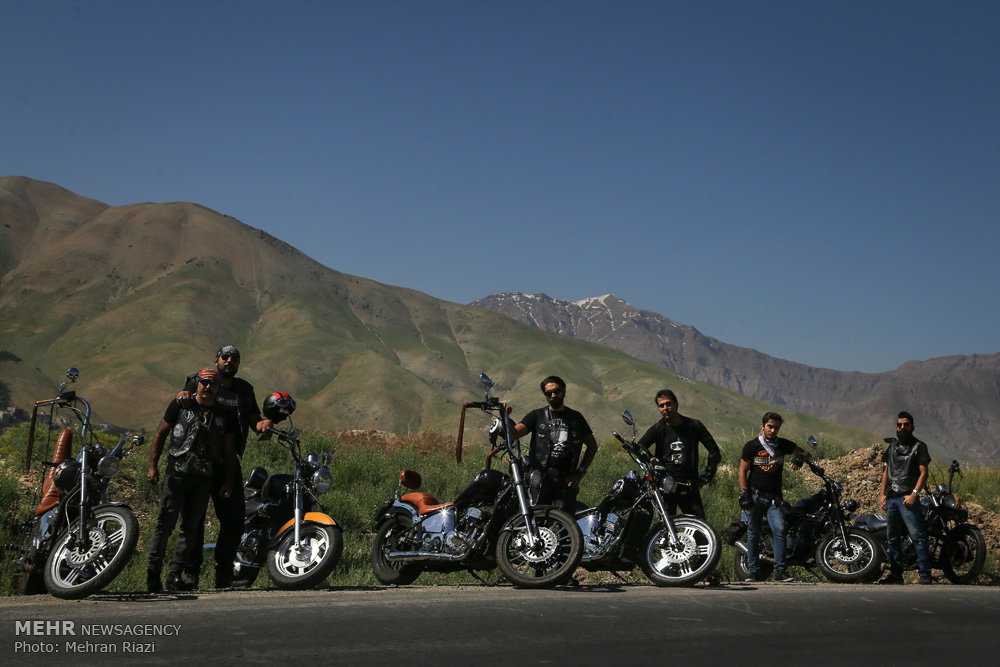
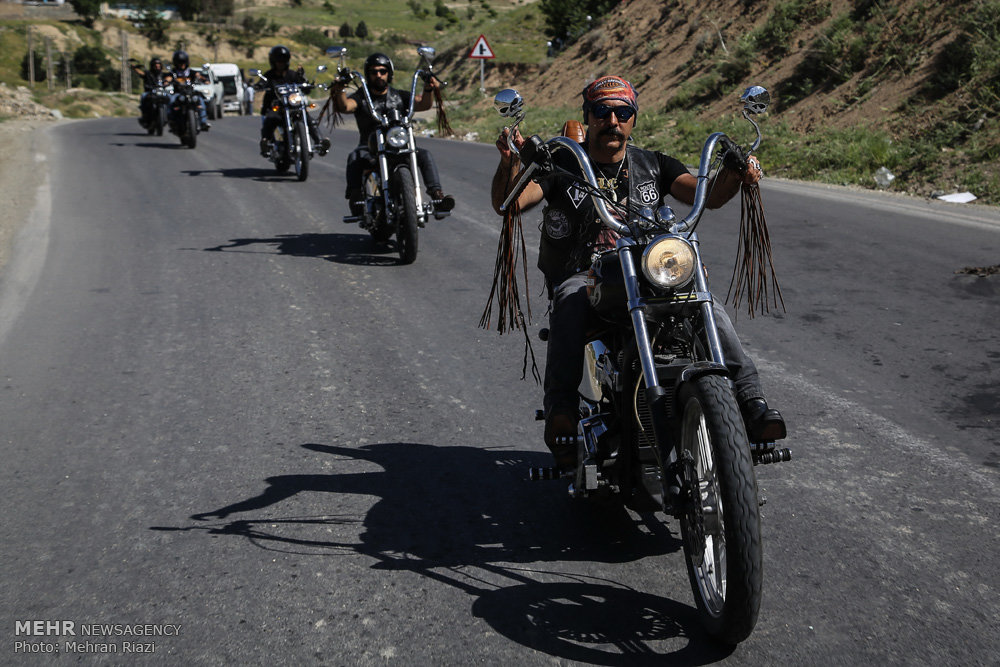
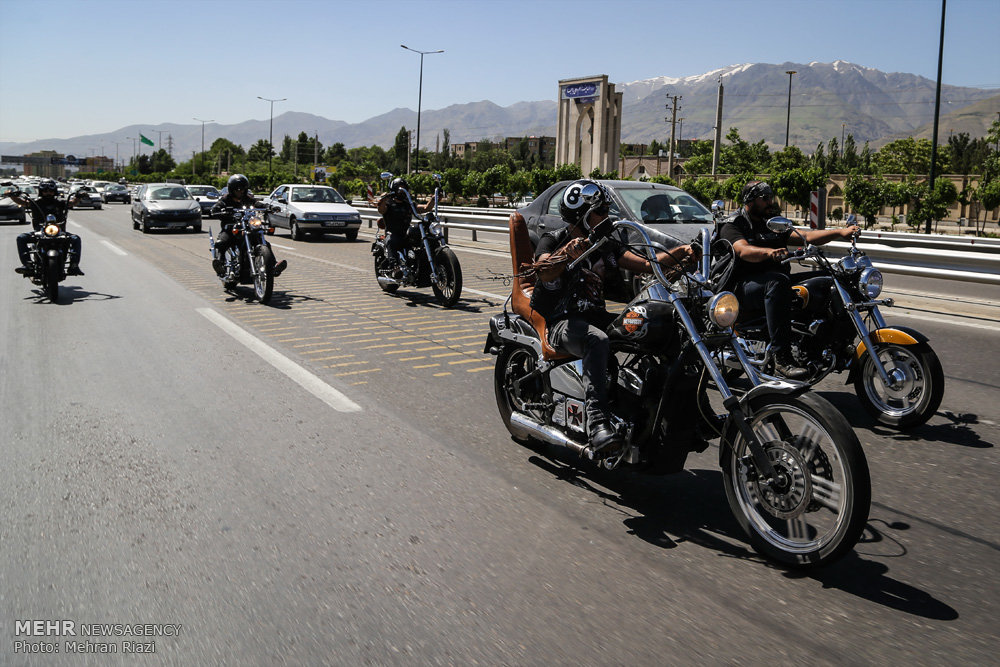
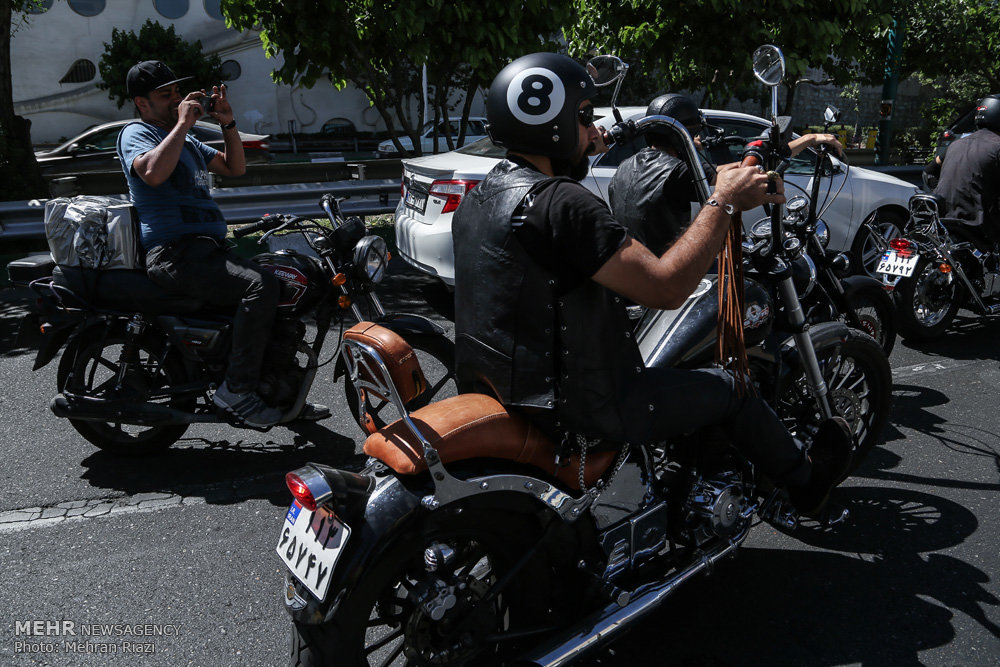
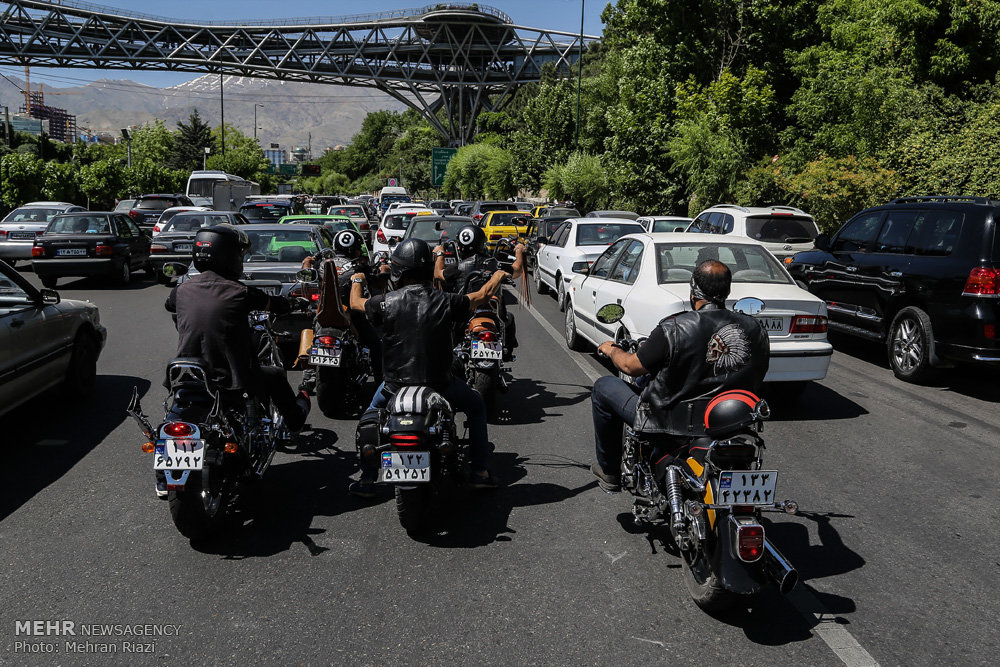
Iranian cruiser motorcyclists are conformists fully observing the country’s rules. They are not affiliated with any illegal groups or organizations. They ride on the country roads in large numbers and view motorcycle riding as a lifestyle.

Robert and his friends do not care about their destinations. They are just crazy for the roads.

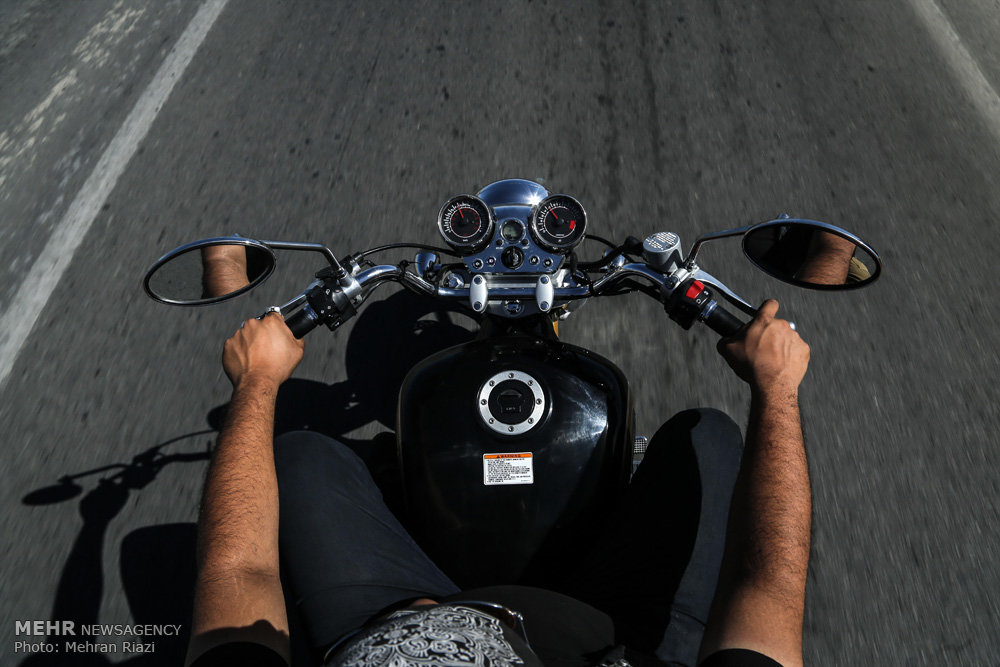
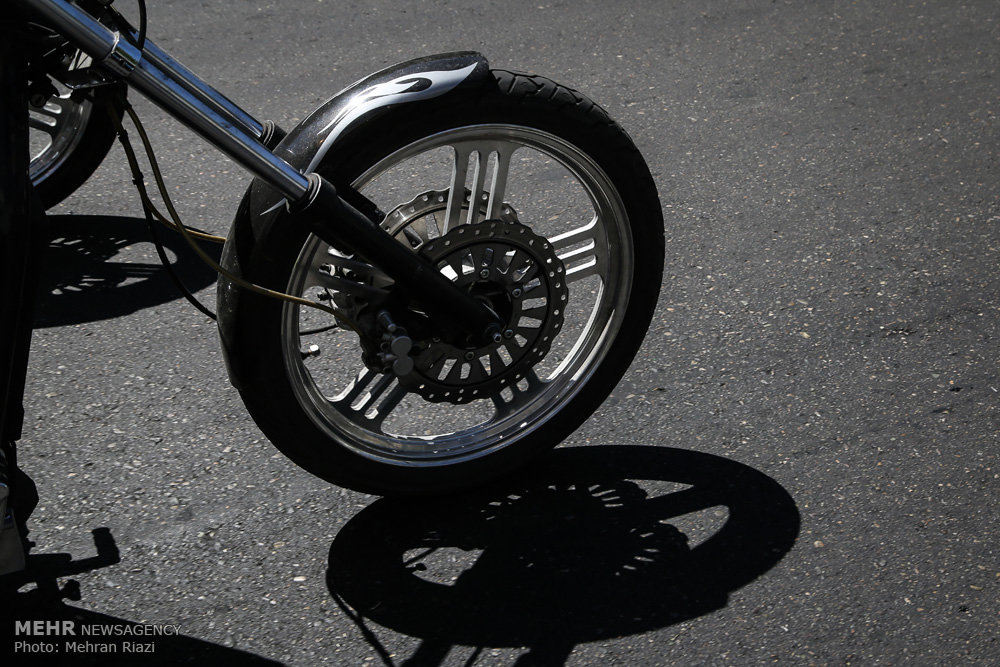
Here are Mehr’s photos of the motorcyclists and their café in Tehran:

Iran Calls for Int’l Cooperation against Drug Trafficking

Iranian Parliament Speaker Ali Larijani has criticized the absence of any consolidated international will to fight drug trafficking saying that all expenses should not be paid just by Iran and the other countries must take it seriously.

Ali Larijani, who was speaking at a conference in Tehran to discuss drug abuse and illicit trafficking, said drug trafficking is the dirtiest kind of organized crimes.

“Drug trafficking destroys the bodies and lives of people, hurts the families and creates social disparities, so it is a very annoying phenomenon for societies,” he added.

Larijani called the increase in production of different types of drugs “alarming”, saying that the hub of narcotics production is bordering Iran.

“In 2001, Americans went to Afghanistan to fight drugs and terrorism. Now 16 to 17 years have passed, but statistics show no decline in drug production, and instead it has increased,” he went on to say.

He also referred to the sacrifices made by the Islamic Republic of Iran in fight against drugs saying, “We [Iran] work as a shield in war on drugs, but why no one helps Iran and why the borders are not controlled?”

“Iran is partly controlling the path of drug trafficking, so the rest of the world needs to think of themselves, because Iran does not have to pay all the costs,” Chief of Iranian Parliament stressed.

Referring to the fact that terrorism today is funded by drug trafficking, Larijani said during diplomatic talks much stress is put on the issue of combating drug trafficking, but we do not see the results. There should be more diplomatic efforts to eliminate the sources of drug trafficking.

In another part of his statements, the Iranian official pointed out that now in Afghanistan various laboratories have emerged and modern equipment has been found.

“From where have they been brought to Afghanistan? The sources are clear. While all Western intelligence services say everything is under control, how is that they cannot root out narcotics trafficking, and eliminate these labs,” he asked.

Larijani concluded that in Iran there is a serious determination among the authorities in the field of counter-narcotics, and everyone emphasizes that it is important to combat this social harm.

 Abdolreza Rahmani Fazli

Iran Has World’s Highest Rate of Drug Seizure

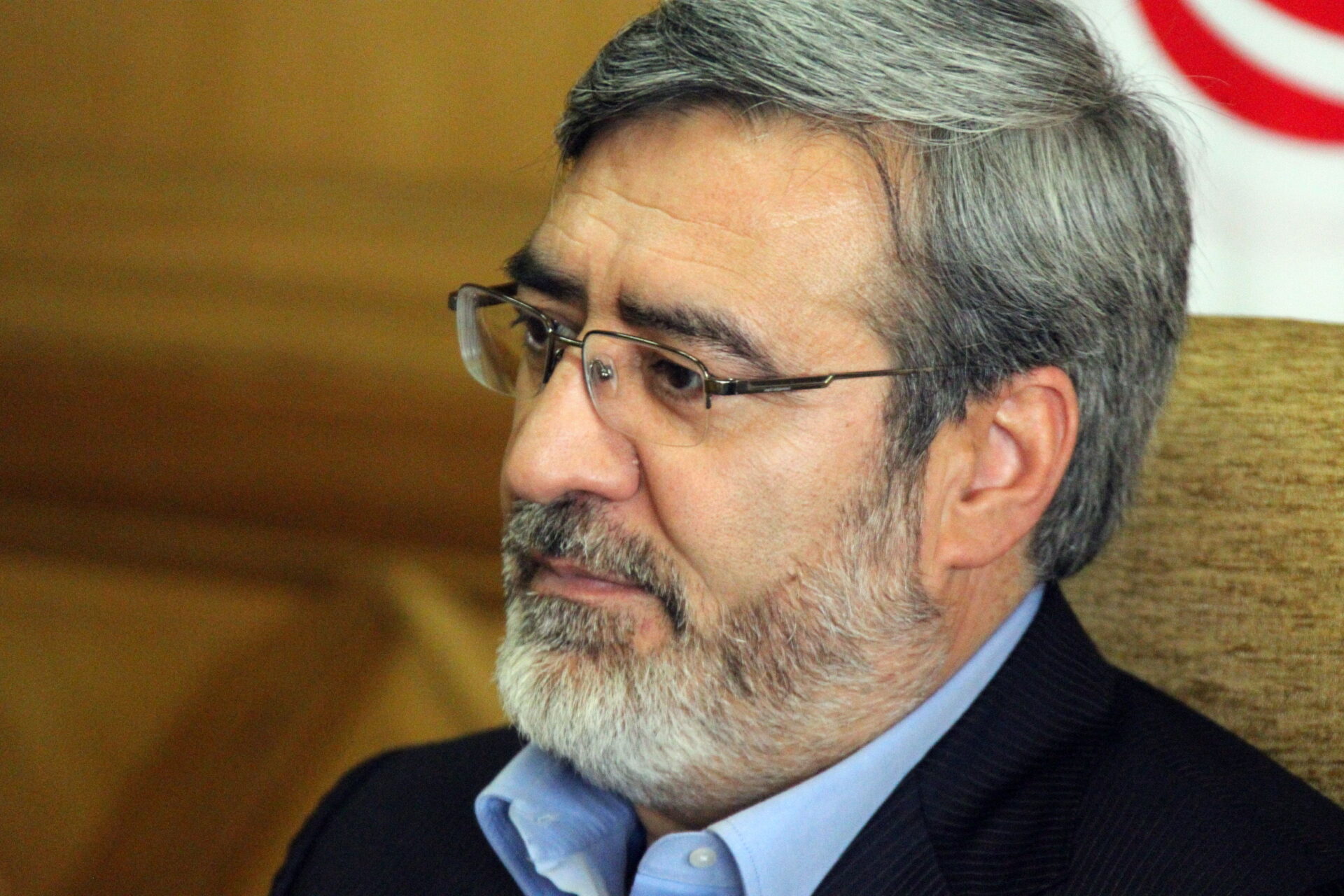
Elsewhere in the ceremony, Iran’s Interior Minister Abdolreza Rahmani Fazli also took the podium saying that the highest rate of drug discovery in the world could be seen in Iran.

He pointed out that the Islamic Republic of Iran is considered a successful country in primary prevention of drug abuse, and rehabilitation of addicts in the international community.

Rahmani Fazli also highlighted Iran’s efforts to fight against illicit drugs, saying that all of the country’s law enforcement, judicial and intelligence organizations have had “an acceptable performance” in this area.

“In order to reduce the access to drugs and psychotropic substances, 8,880 operations were launched in which we had armed clashes with smugglers,” Rahmani Fazli underlined.

The Interior Minister added that in the clashes, over 2,500 tons of illicit drugs, including narcotic drugs and psychotropic substances, have been captured from the traffickers.

Elsewhere in his remarks, Rahmani Fazli stressed that organized crimes have endangered the peace and security of human beings around the world and have led to violation of human rights. It has also undermined the efforts to realize economic, social, cultural, political and civil development around the world.

Referring to this year’s slogan of the United Nations Office on Drugs and Crime (UNODC), “First Listen!”, he emphasized that listening to children and youths is the first step in helping them to have a healthy and safe life.

“This slogan directly refers to the need for expansion and institutionalization of the primary prevention in social communities especially in the families,” Rahmani Fazli added.

Iran shares hundreds of kilometers of borders with Afghanistan and Pakistan, and lies on the main trafficking route for poppy, the source of opium and heroin, from Afghanistan to the West.

Despite high economic and human costs, the Islamic Republic has been actively fighting drug trafficking over the past three decades.

Iran has spent millions of dollars to seal the borders and prevent the transit of narcotics destined for European, Arab and Central Asian countries. The war on drug trade originating from Afghanistan has claimed the lives of thousands of Iranian police officers.

A Look at Iranian Newspaper Front Pages on July 6

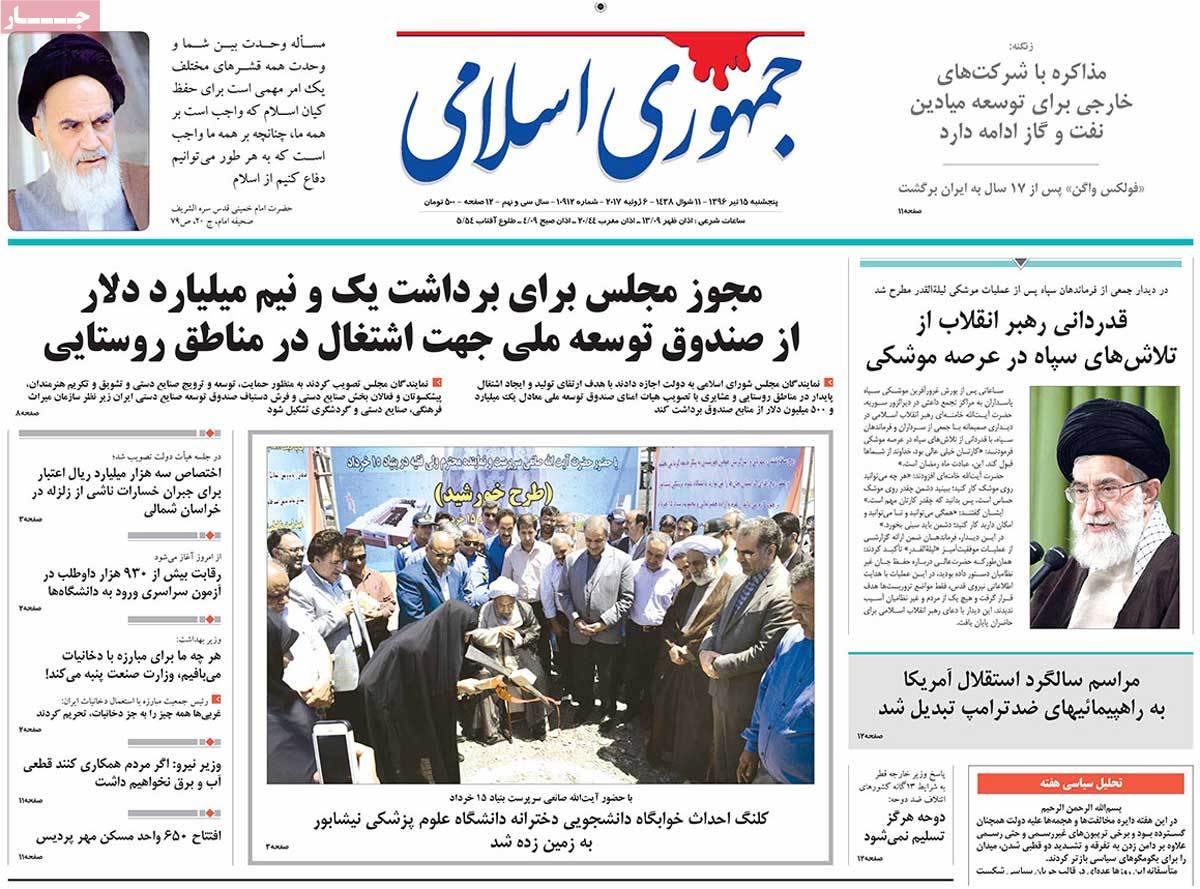
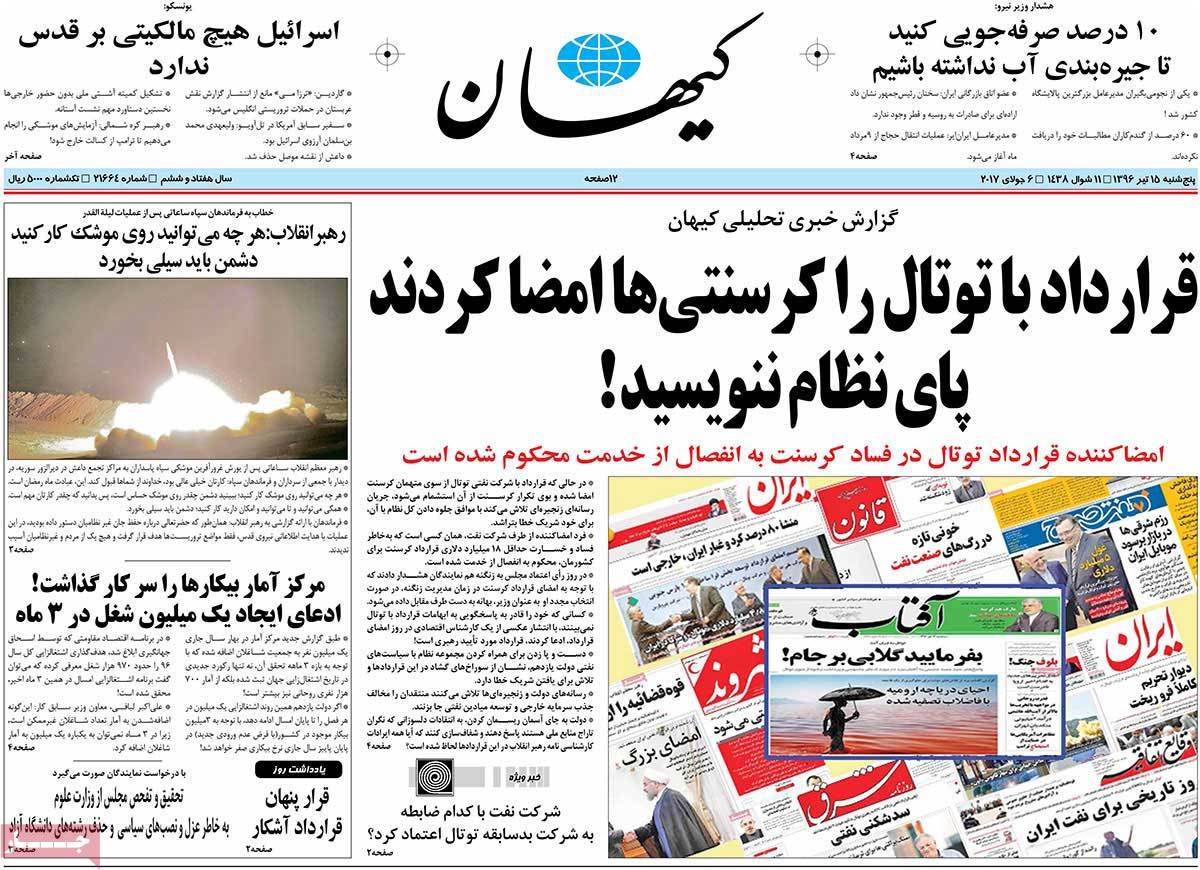
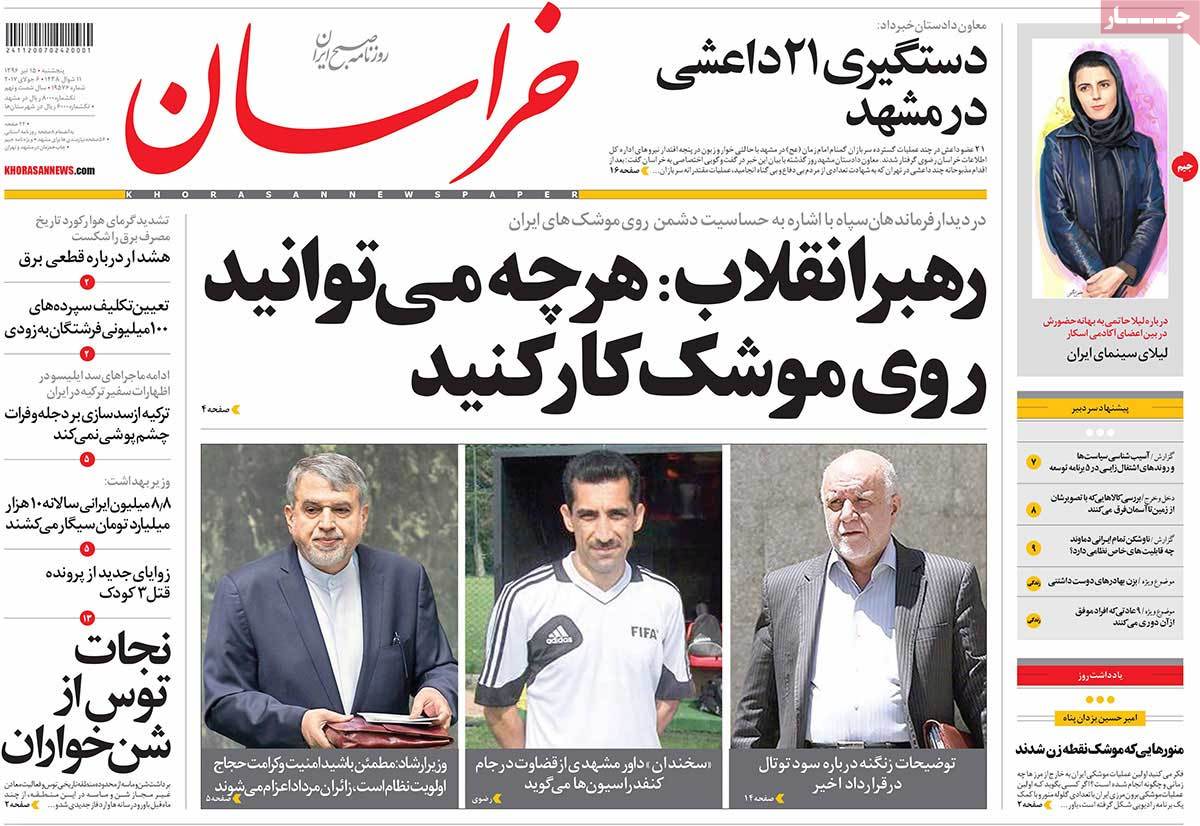
Most Iranian newspapers on Thursday covered the remarks made by Ayatollah Seyyed Ali Khamenei, the Leader of Iran’s Islamic Revolution, in a meeting with a group of IRGC commanders. The Leader praised the IRGC’s missile attack on ISIS positions in Syria, and said Tehran’s missile defence power should be enhanced.

Iran’s huge gas deal with France’s Total for the development of a South Pars Gas Field phase and the reactions to the deal also remained a top story today.

The crisis in relations between Qatar and Saudi Arabia, and the negative response by Doha to the preconditions set by Riyadh and its allies also received great coverage.

The above issues, as well as many more, are highlighted in the following headlines and top stories:


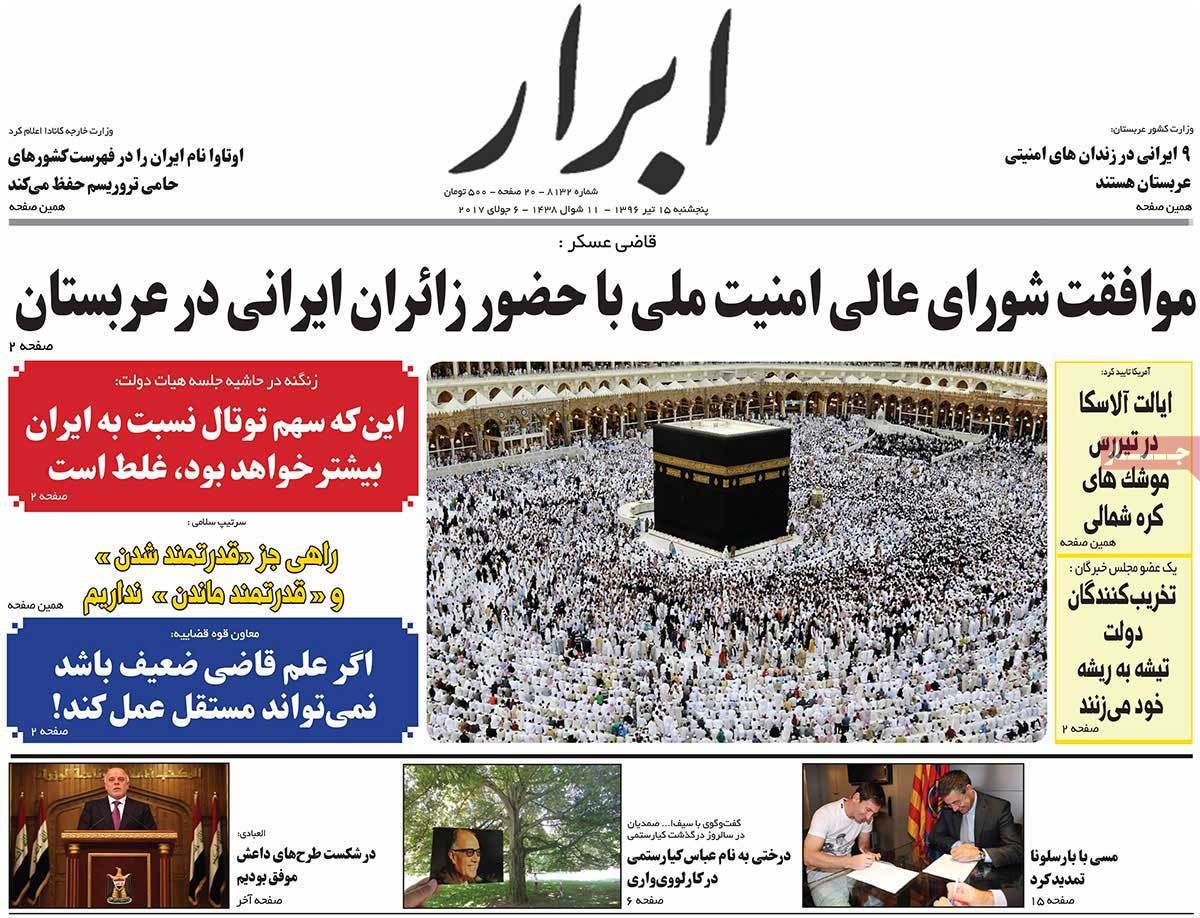
Abrar:

1- Iran’s SNSC Okays Dispatch of Pilgrims to Hajj

2- Saudi Interior Ministry: 9 Iranians Kept in Saudi Prisons

3- Oil Minister: It’s Wrong that Total’s Share Is More than Iran’s

A Look at Iranian Newspaper Front Pages on July 6 - abrar


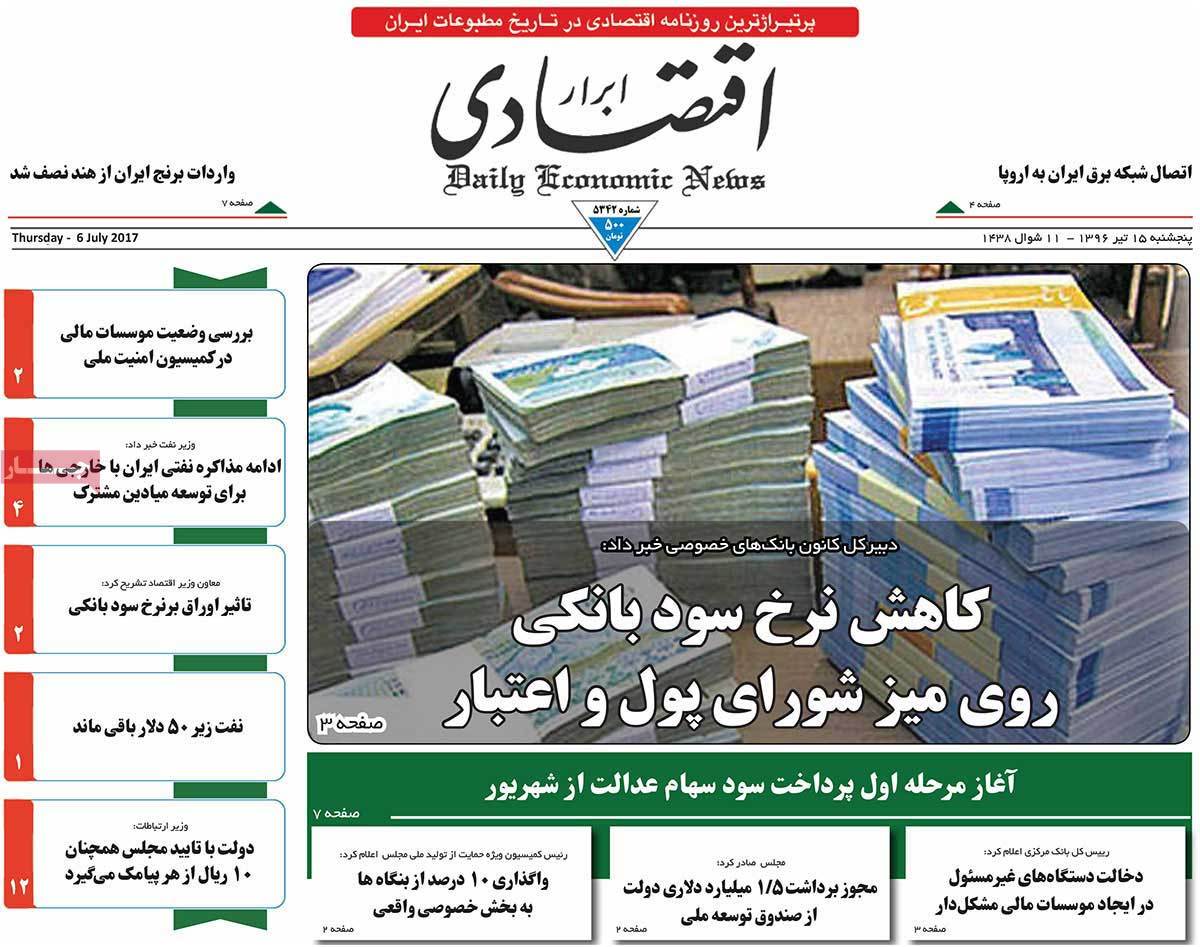
Abrar-e Eqtesadi:

1- Iran’s Power Network to Be Connected to Europe

2- Iran’s Rice Imports from India Halved

3- Minister: Iran to Resume Talks with Foreigners for Development of Joint Fields

A Look at Iranian Newspaper Front Pages on July 6 - abrar egtesadi


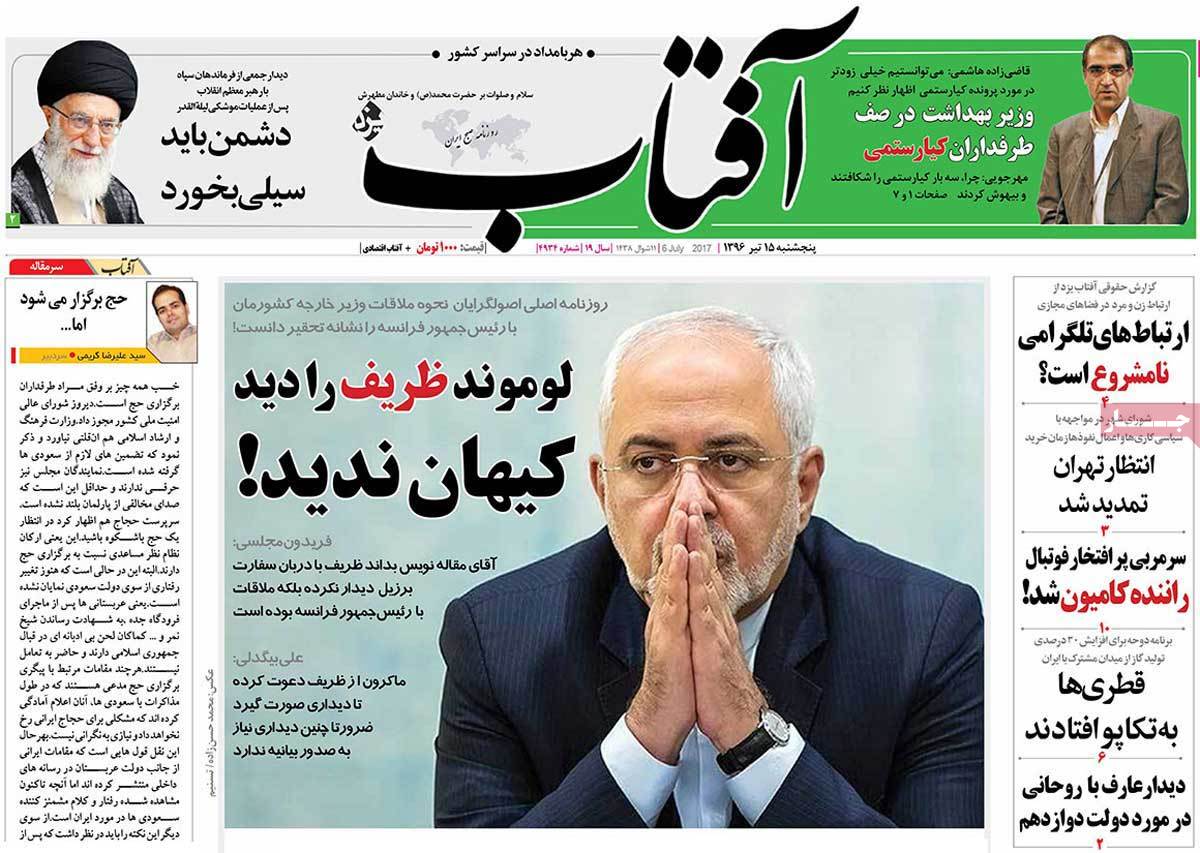
Aftab-e Yazd:

1- Le Monde Noticed Zarif, Kayhan Didn’t!

2- Health Minister among Kiarostami Fans

A Look at Iranian Newspaper Front Pages on July 6 - aftab


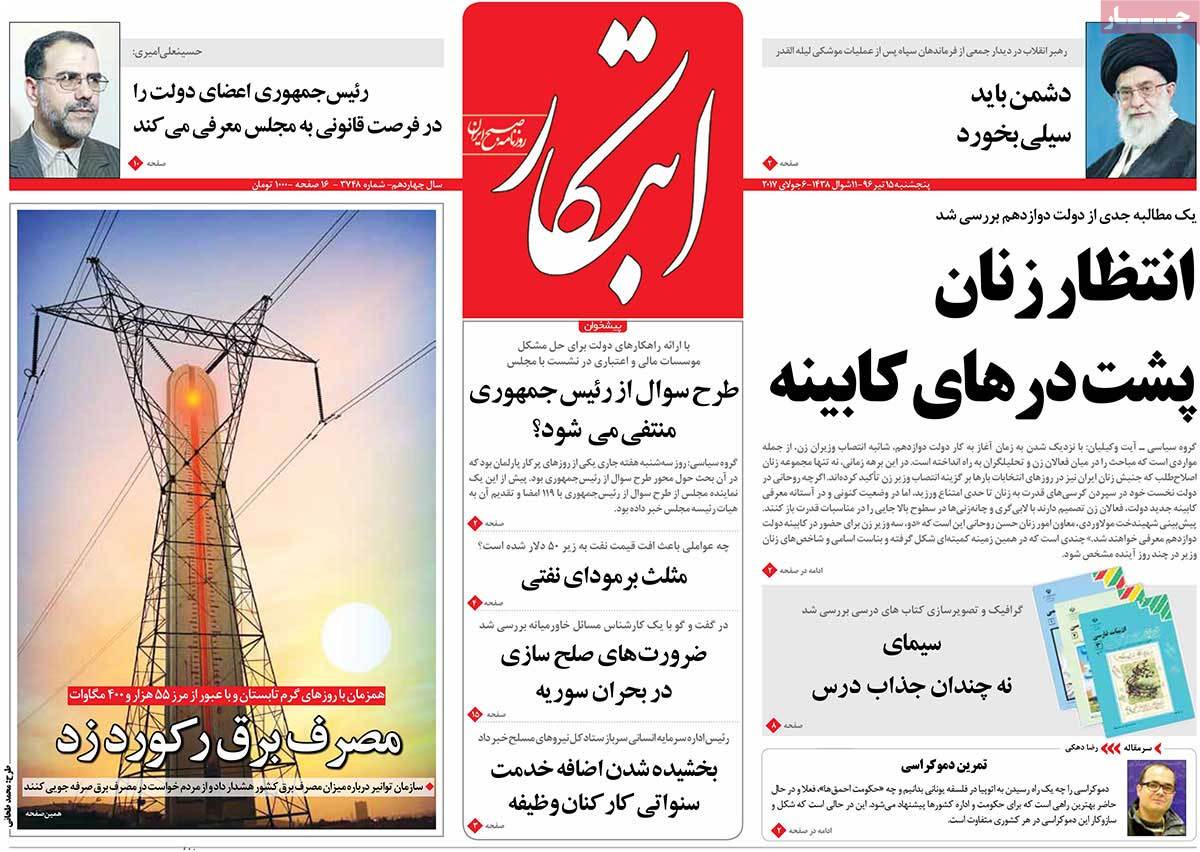
Ebtekar:

1- Rouhani Urged to Appoint Women Ministers in Next Cabinet

2- Analyst Discusses Necessities of Peace-Making in Syria Crisis

A Look at Iranian Newspaper Front Pages on July 6 - ebtekar


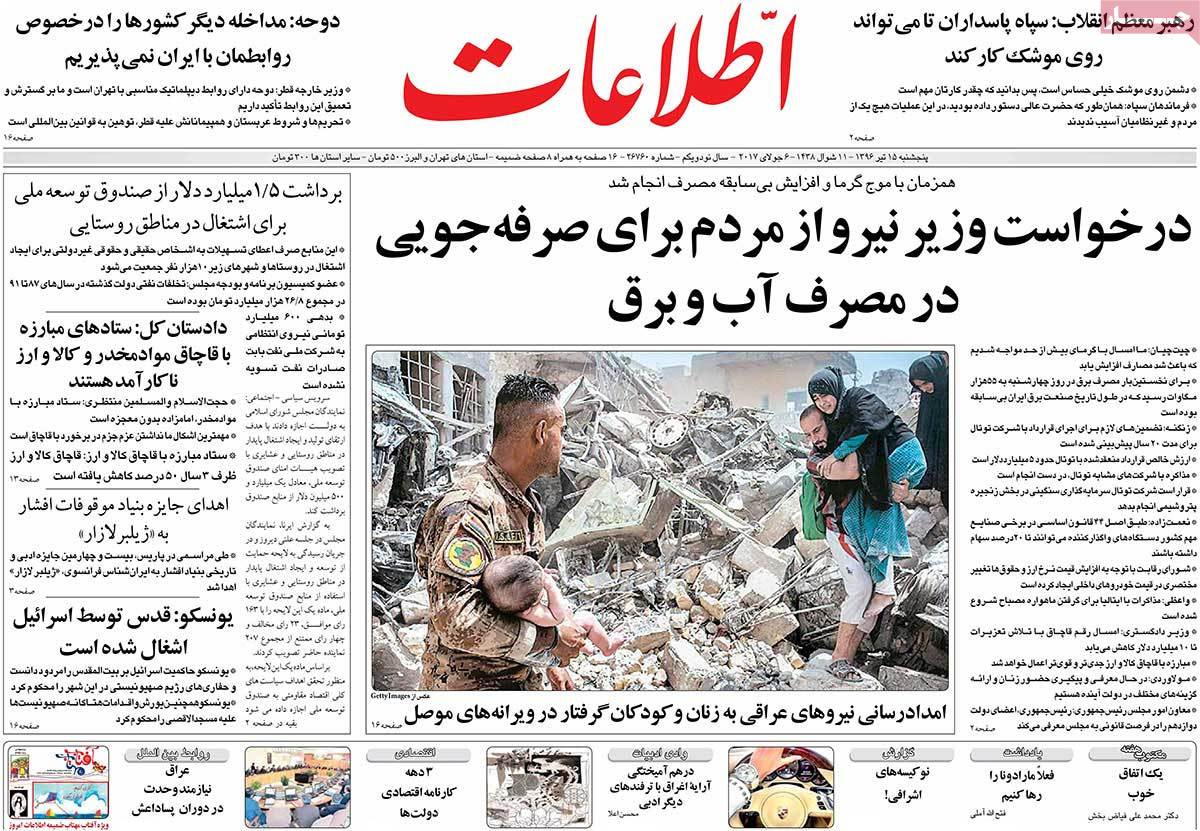
Ettela’at:

1- Iran Leader Urges IRGC to Work on Missiles as Much as It Can

2- Doha: We Won’t Accept Other States’ Meddling in Our Ties with Iran

3- Iraqi Forces Helping Women, Children Stranded in Ruins of Mosul

4- UNESCO: Quds Occupied by Israel

  • UNESCO Rejects Israel’s Rule over Jerusalem

 A Look at Iranian Newspaper Front Pages on July 6 - etelaat


Iran:

1- UN’s Priority Is to Fight Dust Pollution in Ahvaz: Official

2- Official Responds to Criticisms of Iran’s Deal with Total

  • Iran to Earn $84bn, Total’s Share to Be $12bn: Minister

3- Total Deal Symbol of JCPOA Strength: Ex-Diplomat

A Look at Iranian Newspaper Front Pages on July 6 - iran


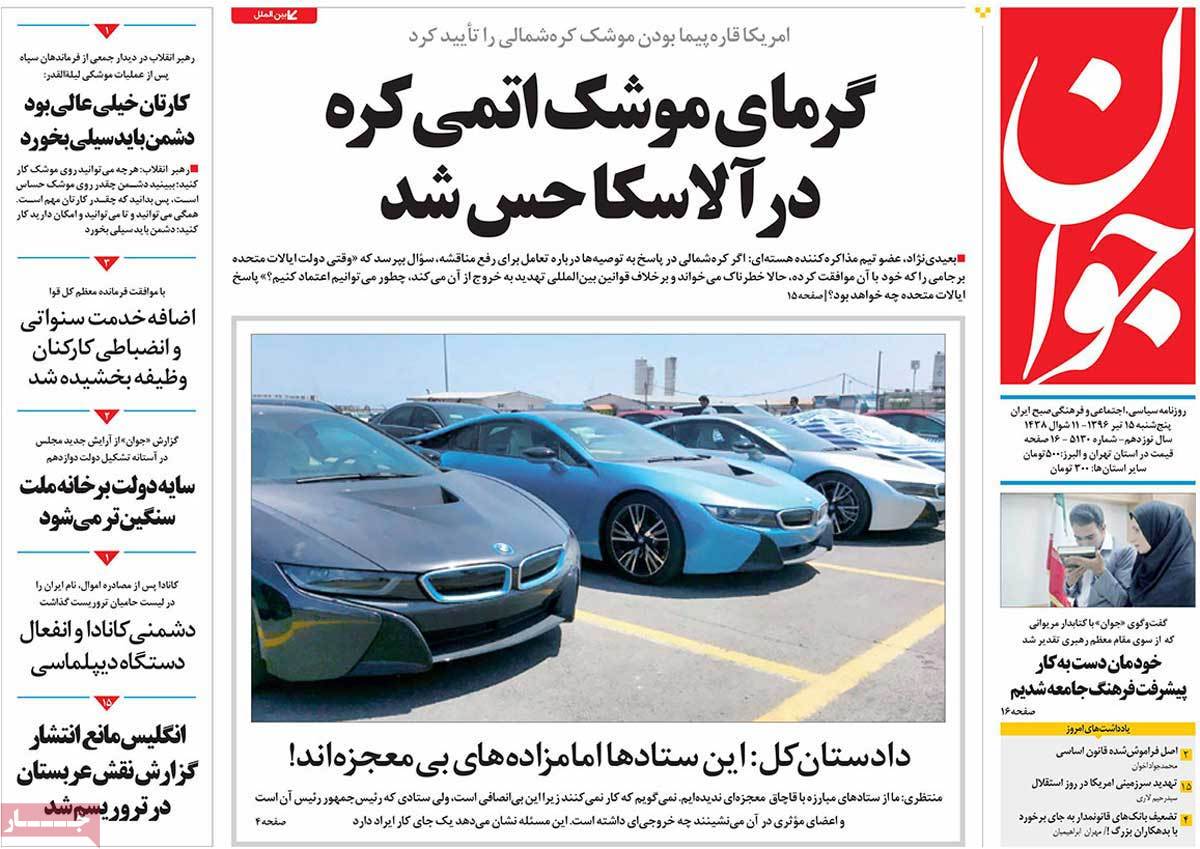
Javan:

1- Iran Leader to IRGC Commanders: You Did Great Job, Enemy Should Be Slapped

2- US Confirms North Korea’s Missile Was Continental

  • Heat of Pyongyang’s Atomic Missile Felt in Alaska

3- Britain Prevents Release of Report on Saudi Arabia’s Role in Terrorism

A Look at Iranian Newspaper Front Pages on July 6 - javan


Jomhouri Eslami:

1- Volkswagen Returns to Iran after 17 Years

2- US Independence Day Ceremony Turned into Anti-Trump Rallies

A Look at Iranian Newspaper Front Pages on July 6 - jomhori


Kayhan:

1- Deal with Total Signed by Those Who Signed Crescent Deal

  • Don’t Blame Establishment for Total Deal!

2- Signatories of Total Deal Had Been Dismissed after Crescent

A Look at Iranian Newspaper Front Pages on July 6 - kayhan


Khorasan:

1- 21 ISIS Elements Arrested in Mashhad

2- Iranians Annually Spend IRR 10 Trillion [$266m] on Smoking

A Look at Iranian Newspaper Front Pages on July 6 - khorasan


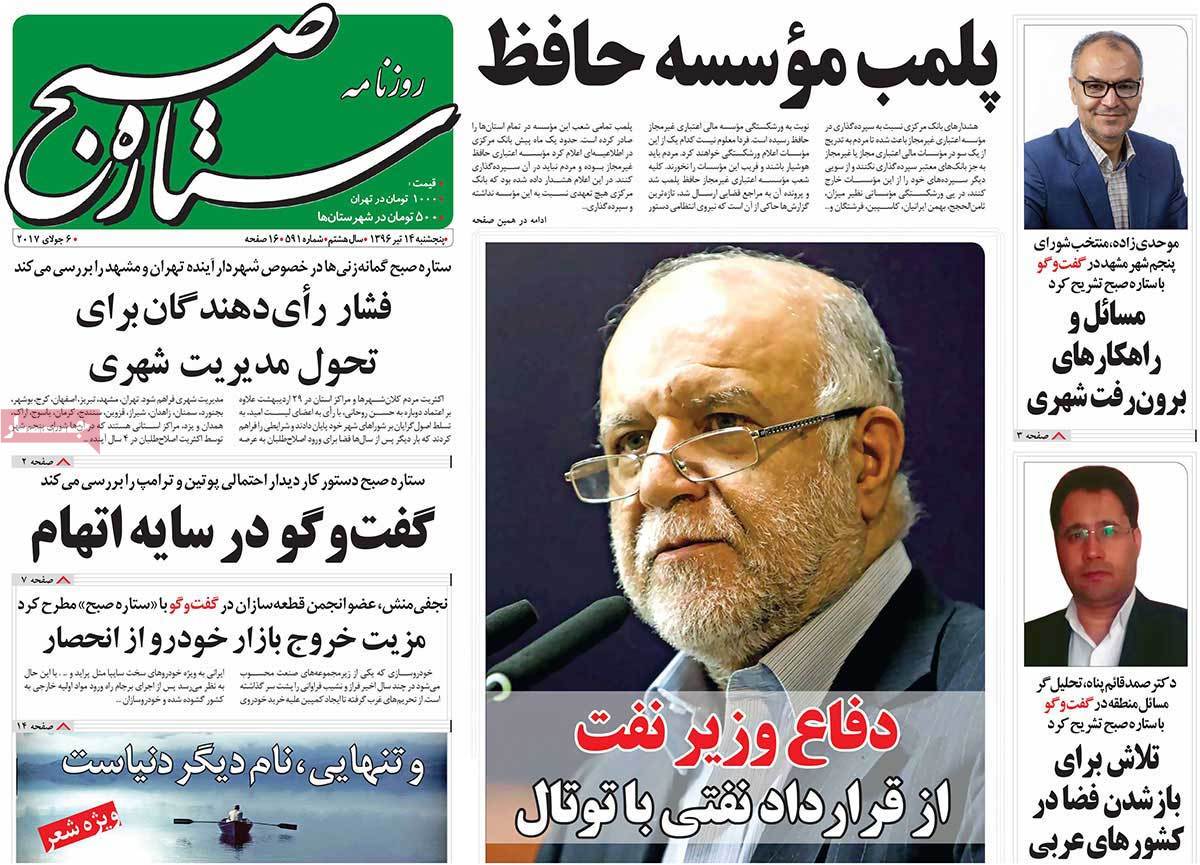
Setareh Sobh:

1- Putin-Trump Talks to Be Held under Shadow of Accusations

A Look at Iranian Newspaper Front Pages on July 6 - setare sobh


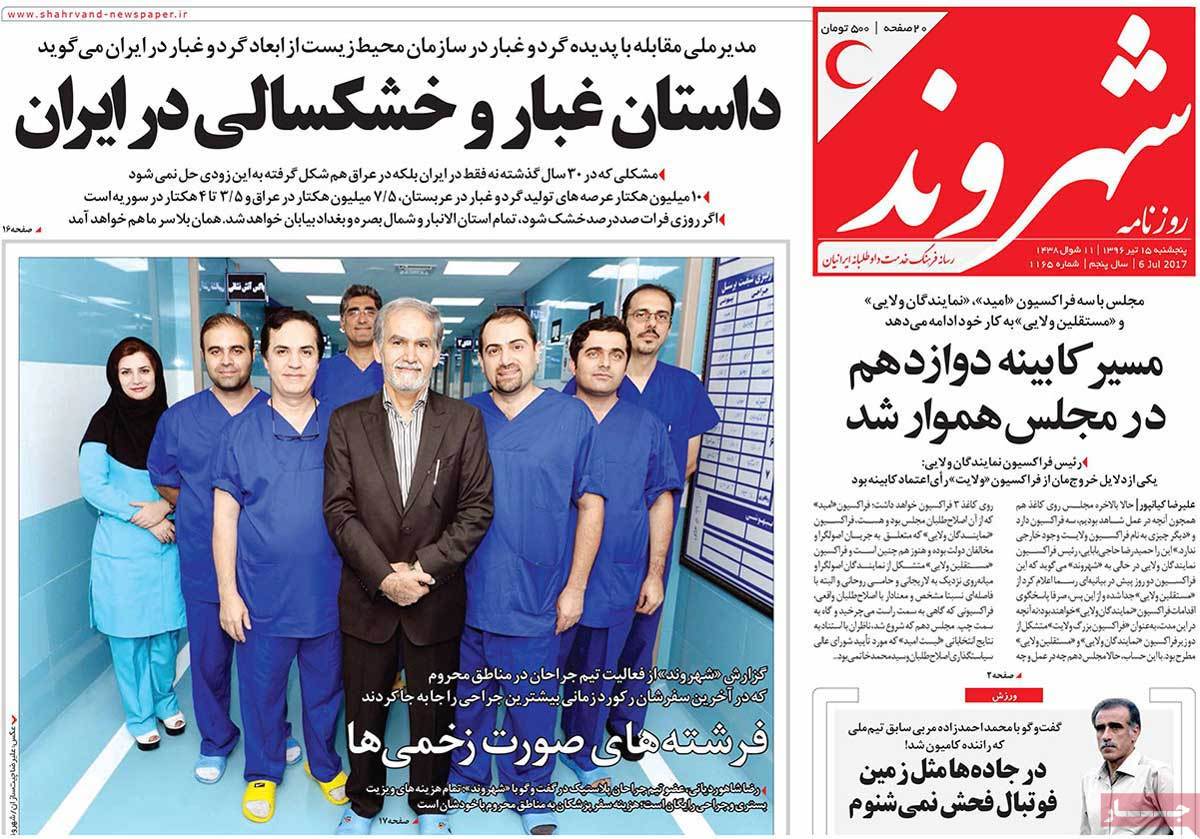
Shahrvand:

1- Story of Dust and Drought in Iran

2- Scarface Angels: Group of Plastic Surgeons Visit Deprived Areas for Free Surgery

A Look at Iranian Newspaper Front Pages on July 6 - shahrvand


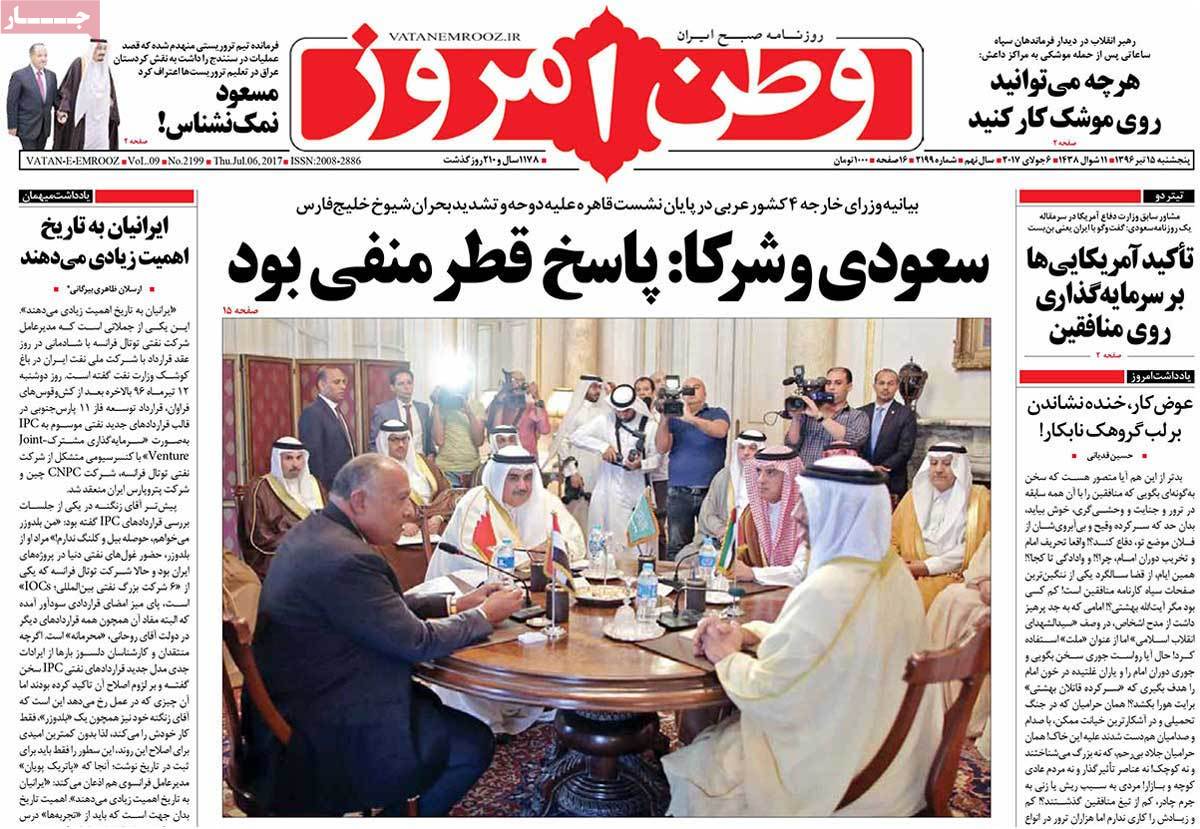
Vatan-e Emrooz:

1- FMs of 4 Arab Countries Release Statement against Doha: Crisis Deepens

2- Saudi Arabia and Partners: Qatar’s Response Was Negative

3- Americans’ Emphasize Making Investment on MKO Terror Group: Ex-NSA

A Look at Iranian Newspaper Front Pages on July 6 - vatane emrooz

Iran Leader Urges IRGC to Boost Missile Power

“Keep working on the missile program as far as you can. Look how sensitive the enemy is about [the country’s] missiles, so you should know that your work is highly important,” the Leader said in a meeting with a number of Islamic Revolution Guards Corps (IRGC) commanders last month, hours after the IRGC hit Daesh positions in Syria’s eastern Dayr al-Zawr province.   

In remarks published on Wednesday, Ayatollah Khamenei praised the IRGC for its strike against Daesh in Syria.

“The enemy must be slapped in the face,” the Leader added.

During the meeting, the commanders briefed the Leader on the strike, saying the IRGC had only hit the positions of the terrorists and that no civilians were targeted in the operation.

The IRGC strike came in response to the June 7 terrorist attacks in Tehran, which killed 18 people. The Daesh Takfiri terrorist group claimed the attacks.

The projectiles were the first launched from Iran at targets outside the country.

The IRGC has said the missiles killed more than 170 Takfiri terrorists, including a number of commanders and senior elements, and inflicted heavy damage on their equipment and systems.

‘US Had Plans to Pulverize Iran Passenger Plane in Air’

‘US Had Plans to Pulverize Iran Passenger Plane in Air’

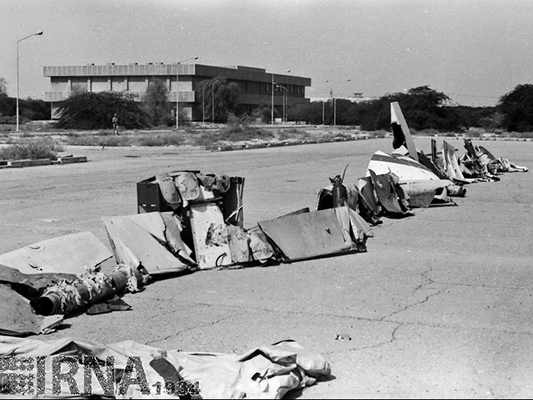
Iranian second flotilla admiral, Nasser Sarnevesht, who was the commander of the operations to recover the pieces of the bodies of the victims of the shoot-down of Iran Air Flight 655 by the USS Vincennes on July 3, 1988, believes that the attack had been aimed at annihilating the jet as well as all its passengers and crew members on board in the air.

The civilian aircraft, an Airbus A300-B2, was flying in the Iranian airspace over the Strait of Hormuz from the port city of Bandar Abbas to Dubai, carrying 274 passengers and 16 crew members, when the USS Vincennes fired two SM-2MR surface-to-air missiles at it, killing all the 290 on board.

In a Farsi interview with the Khabar Online News Agency, Sarnevesht has narrated the sad story of the 50-day operations he and his team carried out in the Persian Gulf to collect the unidentifiable bodies of the victims. Here are the highlights of this interview:
“The horrible incident took place at 10:17 am on July 3, 1988 [the year when the war between Iran and Iraq came to an end]. We were immediately dispatched on a mission [to the site of the incident] to perform the rescue operations. On that day, we were supposed to be sent on another mission to Shaibah Air Base [in the southern Iraqi province of Basra]; however, the mission coincided with [the declaration of] the ceasefire [between Iran and Iraq].”

“We did not require foreign assistance to collect the corpses and the debris of the plane. In addition to the two cruisers that had anchored, we had two hovercrafts, three helicopters and 80 scuba divers to carry out the operations. Recovering the bodies took 50 days. Since the bodies were dismembered, we collected their pieces. During the mission we were constantly exposed to the danger of being attacked by sharks and eagle rays. Due to the dangers involved, we had to perform the rescue operations at night,” he noted.
“Out of a total of 290, we managed to only recover the corpses of 178 victims. The US had intended to pulverize the Iranian aircraft in the air and, therefore, it had fired a surface-to-air standard missile with a range of 300 miles. Such a missile is capable of destroying a spacecraft let alone a passenger jet.”

“Iran can follow up the case, but it would be futile as they will not come back to life. We even recovered the black box from the wreckage of the aircraft and handed it over to related authorities. We transferred every single valuable item left from the crash by a helicopter [to the shore]. After examining the black box it was announced that no warning had been given by the US warship to the Iranian passenger plane. Even the flight’s pilot had not been given a chance or time to divert the plane.”

Following the missile attack, US officials claimed the warship had mistaken Iran Air Flight 655 for a warplane.

Iran, Russia, Turkey Hold Trilateral Meeting in Astana

Iran, Russia, Turkey Hold Trilateral Meeting in Astana

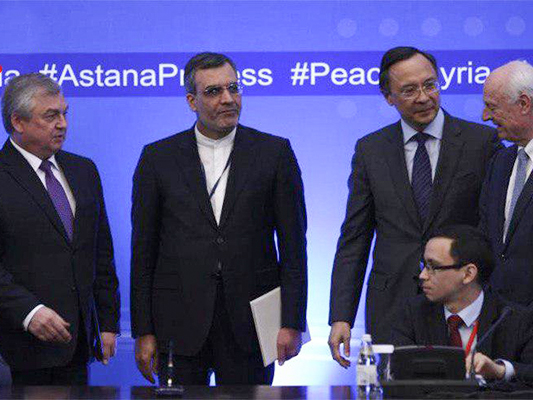
Iran’s Deputy Foreign Minister for Arab and African Affairs Hossein Jaberi Ansari, who heads the Iranian delegation to Astana talks, took part in the tripartite meeting with his Russian and Turkish counterparts on Wednesday.

The representatives of the three guarantor states conferred on the results of political consultations and the expert-level agreements made within the past two days in Astana.

They also exchanged views on the next expert meeting due to be held in Iran in three weeks. Iran will be hosting the Syria peace talks for the second time.

Earlier on Wednesday, Jaberi Ansari held his second meeting with Syrian envoy to the United Nations Bashar Jaafari.

During the meeting, the two sides discussed the latest developments in the war-torn Arab country, the details of de-escalation zones, and the way observers should be deployed.

The Iranian official also held a fresh round of talks with Russian President Vladimir Putin’s point man on Syria, Alexander Lavrentiev. The two sides conferred on the expert meetings to specify the limits of de-escalation zones in Syria.

Jaberi Ansari also met the French government’s special representative on Syria affairs as well as the Kazakh foreign minister, Kairat Abdrakhmanov, on the sidelines of the Astana talks.

A Look at Iranian Newspaper Front Pages on July 5

Iranian newspapers today widely covered the remarks made by Major General Mohammad Ali Jafari, the commander of the Islamic Revolution Guards Corps (IRGC), and IRGC Quds Force Commander Major General Qassemi Soleimani about the significance of the military organization’s efforts to ensure Iran’s security.

The reactions to a huge gas deal signed between Iran and France’s Total also received great coverage today. Conservative papers strongly denounced it as being against the country’s interests, while reformists and pro-government media hailed it as a historic deal that breaks the wall of sanctions.

Many papers also marked the first anniversary of the demise of prominent Iranian filmmaker and photographer Abbas Kiarostami.

The above issues, as well as many more, are highlighted in the following headlines and top stories:


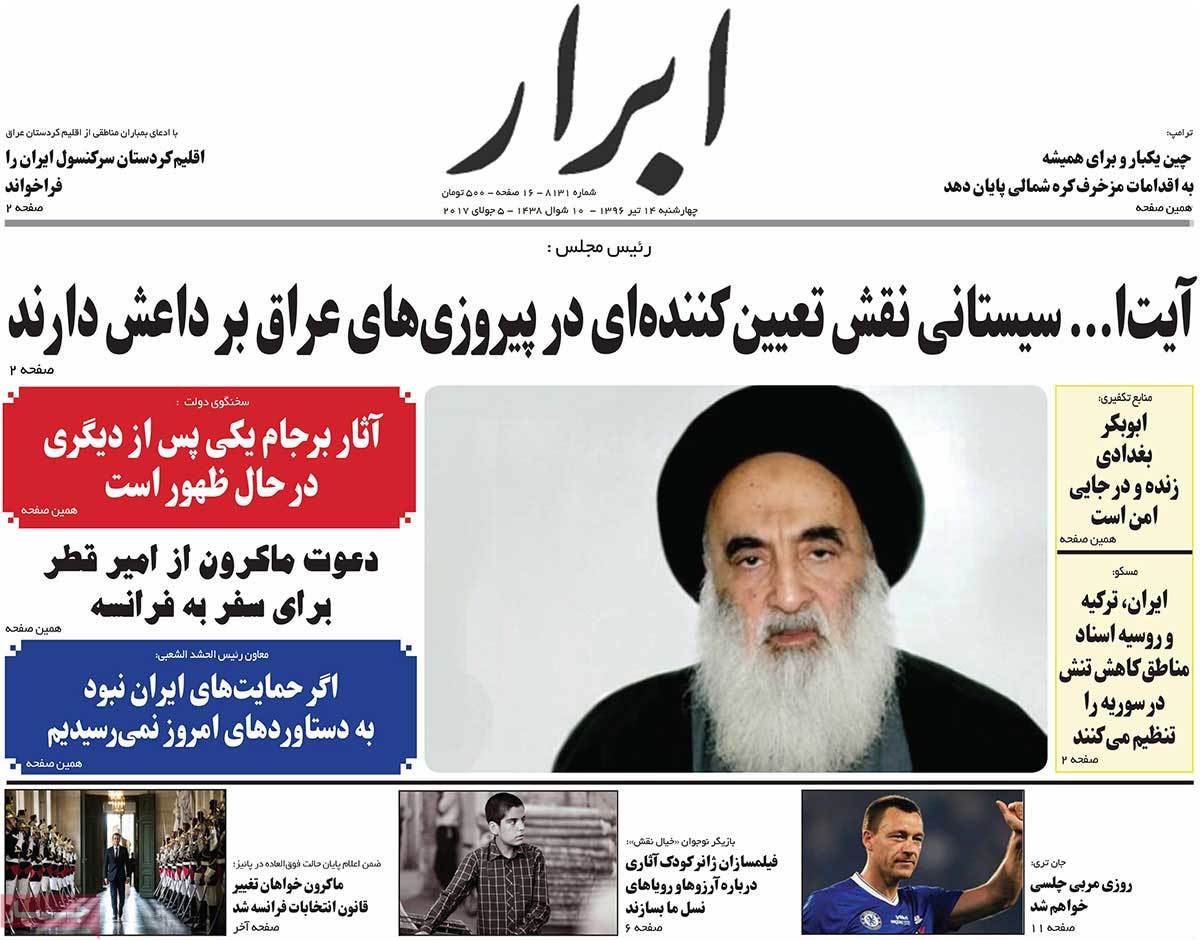
Abrar:

1- Iran Parliament Speaker Hails Ayatollah Sistani’s Role in Iraq Victories

2- Iran Gov’t Spokesman: JCPOA’s Fruits Emerging One after another

3- Without Iran’s Support Iraq Couldn’t Achieve Today’s Results: Iraqi General


A Look at Iranian Newspaper Front Pages on July 5 - abrar


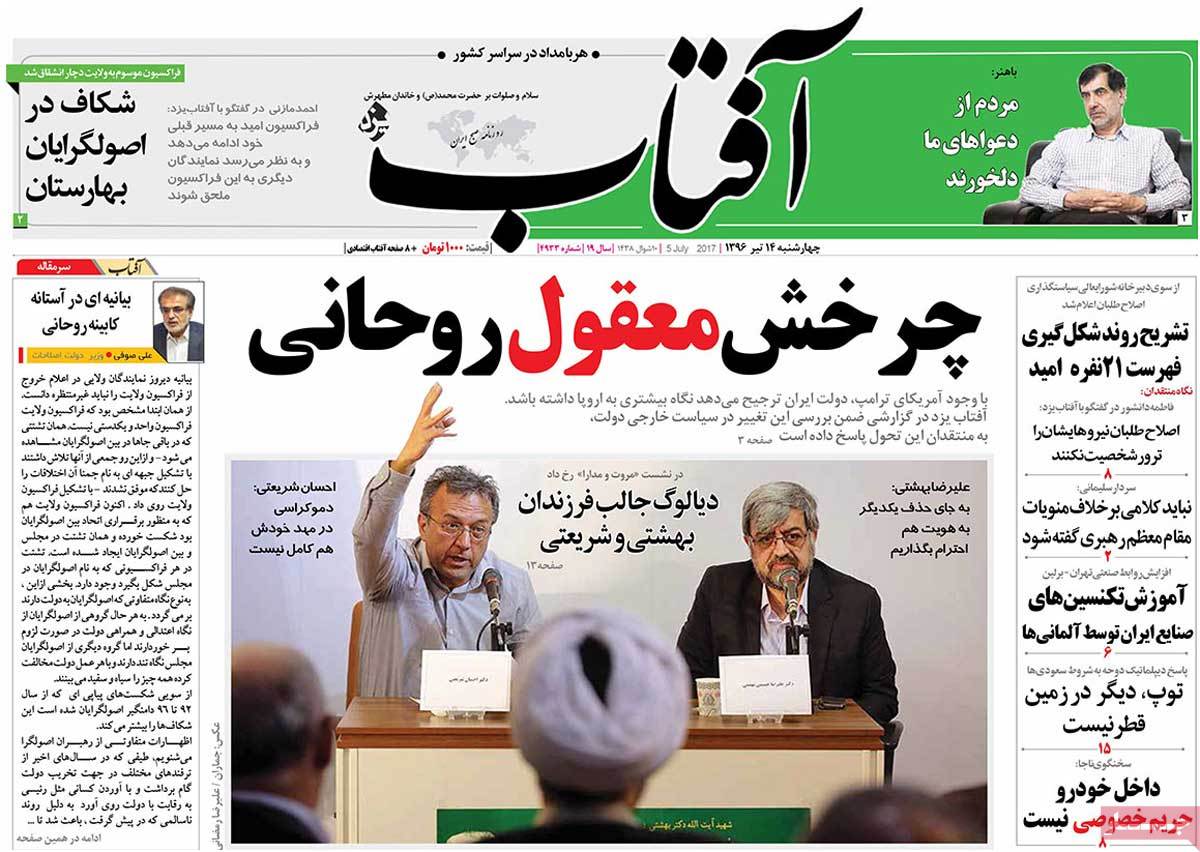
Aftab-e Yazd:

1- Rouhani’s Rational Turn

  • Iran Prefers Cooperation with Europe as Long as Trump Holds Office in US

2- Nothing against Iran Leader’s Words Should Be Uttered: General Soleimani

3- Iran Police: Inside People’s Cars Not Their Private Space


A Look at Iranian Newspaper Front Pages on July 5 - aftab


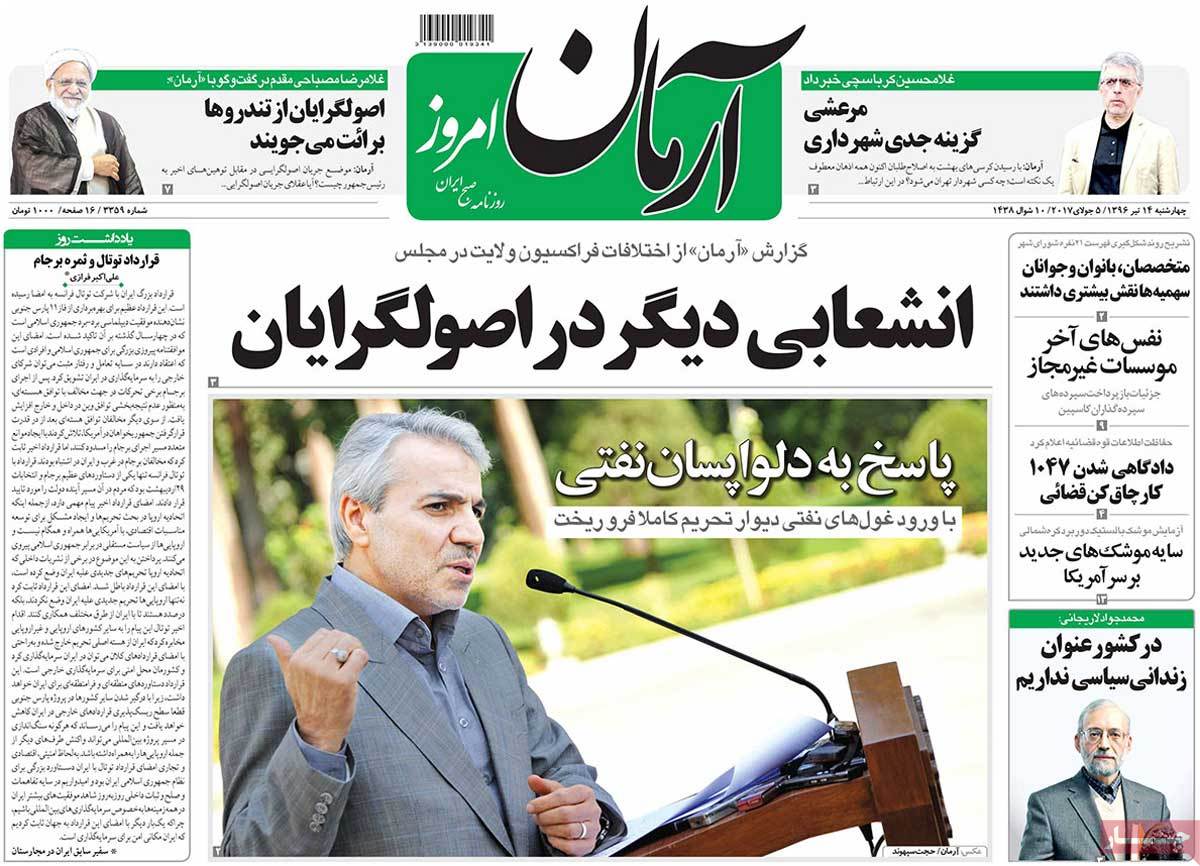
Arman-e Emrooz:

1- Gov’t Spokesman: Wall of Sanctions Collapses after Oil Giants’ Arrival in Iran

2- Top Human Rights Official: Iran Has No Political Prisoner

3- Conservatives Renouncing Radicals: Senior Right-Winger


A Look at Iranian Newspaper Front Pages on July 5 - arman


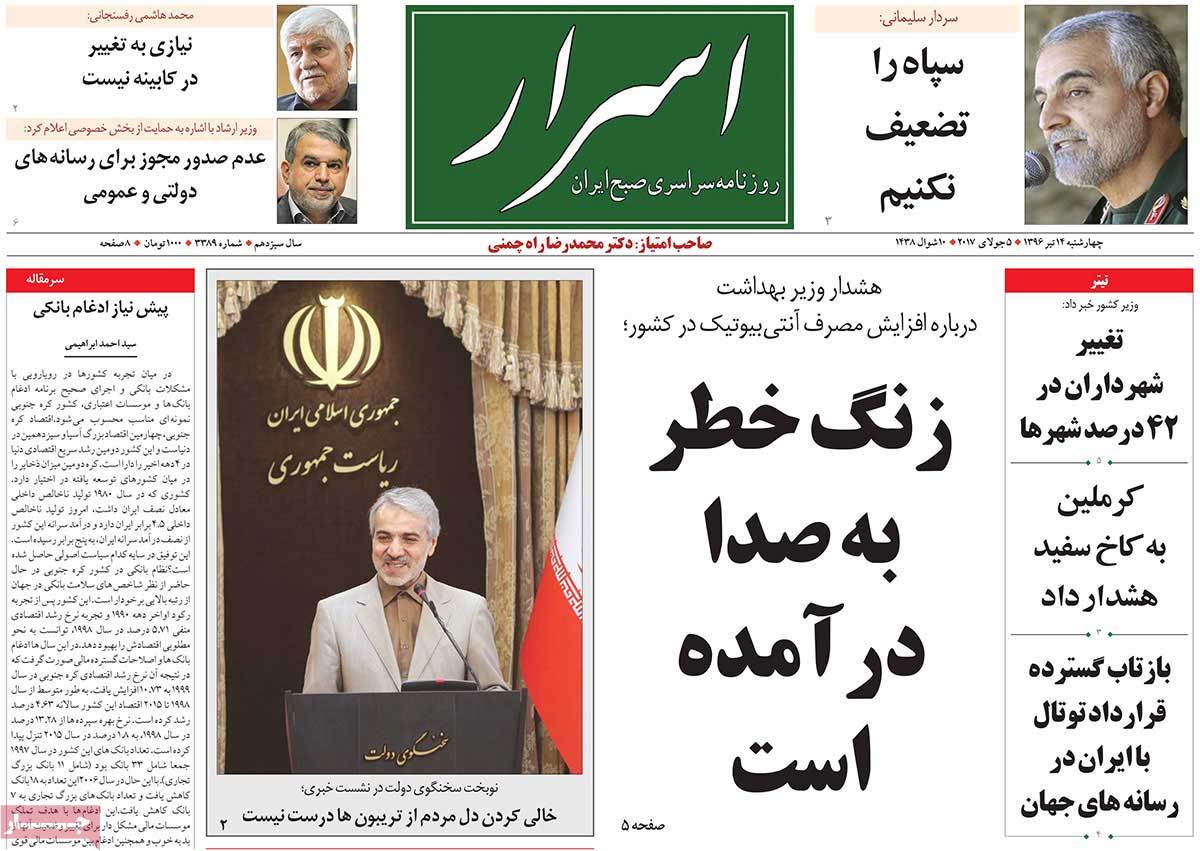
Asrar:

1- General Soleimani: Do Not Weaken IRGC

2- Interior Minister: Mayors in 42% of Cities to Be Changed


A Look at Iranian Newspaper Front Pages on July 5 - asrar


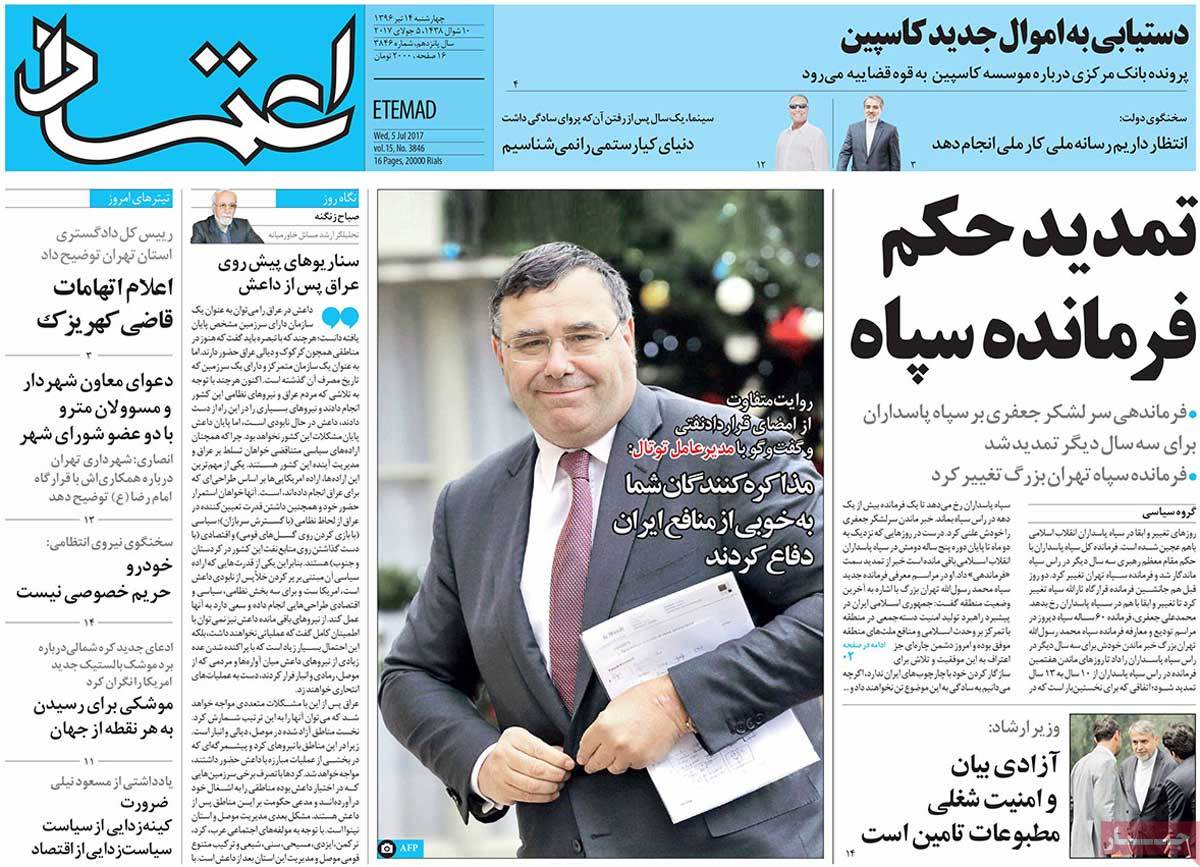
Etemad:

1- Different Account of Total’s Deal with Iran

  • Total CEO: Your Negotiators Well Defend Your Interests

2- IRGC Commander to Remain in Office for 3 More Years


A Look at Iranian Newspaper Front Pages on July 5 - etemad


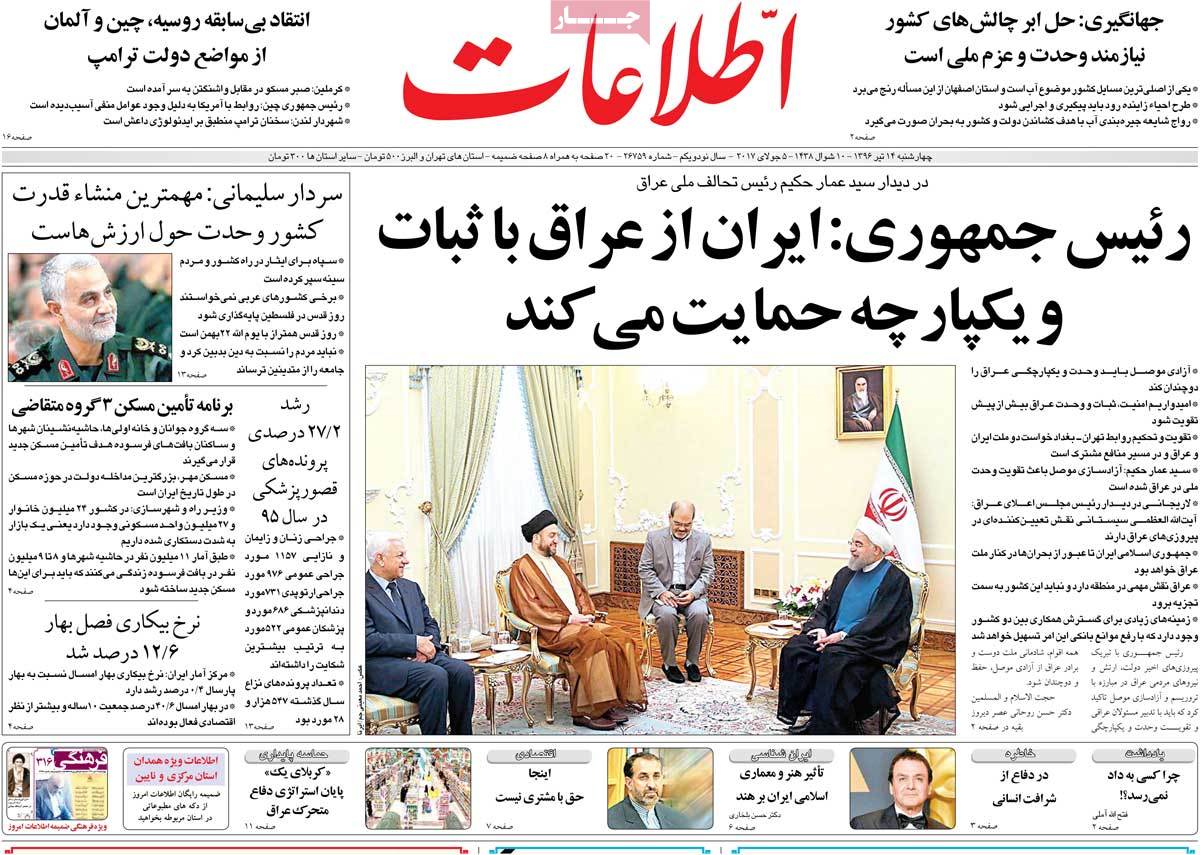
Ettela’at:

1- President: Iran Supports Stable, Integrated Iraq

2- General Soleimani: Unity on Values Main Source of Iran’s Power

3- Resolving Super-Challenges in Iran Needs Unity, National Resolve: First VP

 A Look at Iranian Newspaper Front Pages on July 5 - etelaat


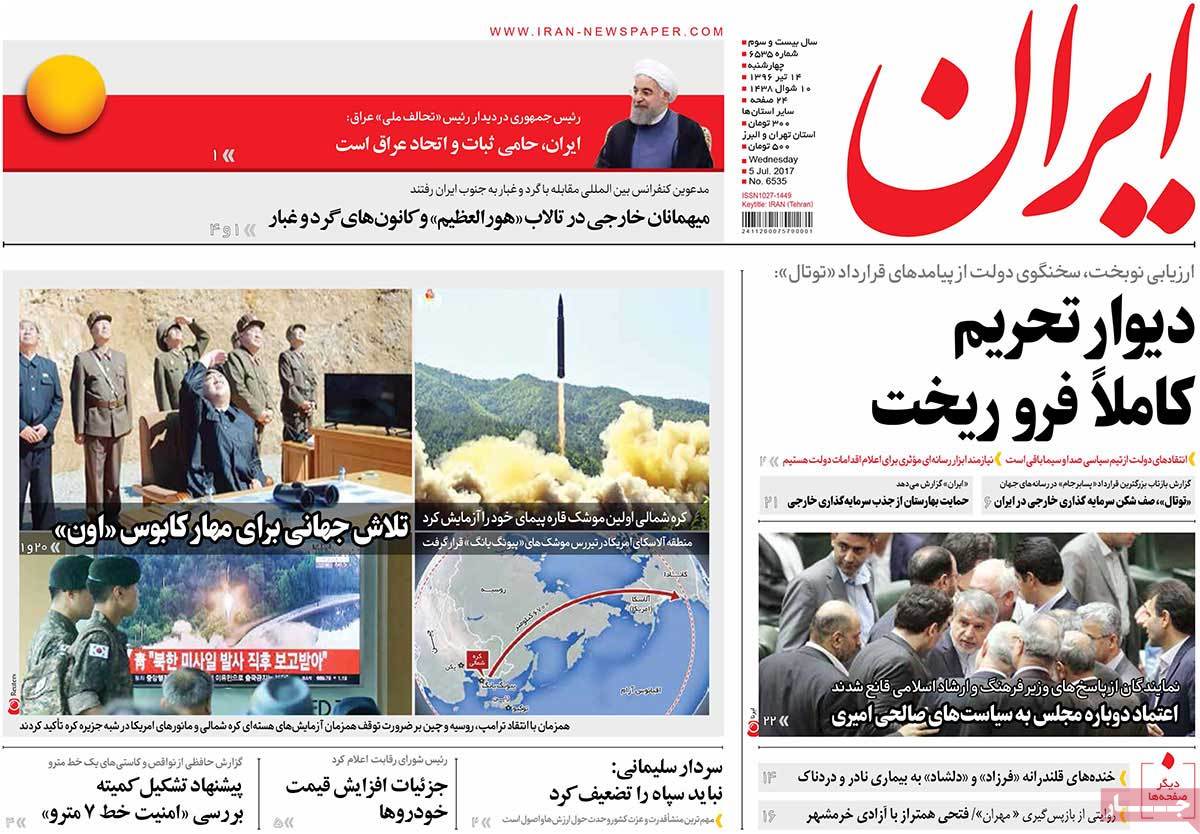
Iran:

1- Global Efforts to Harness North Korean Leader

  • After Trump’s Criticism, Russia, China Urge Pyongyang to Stop Nuclear Tests

 A Look at Iranian Newspaper Front Pages on July 5 - iran


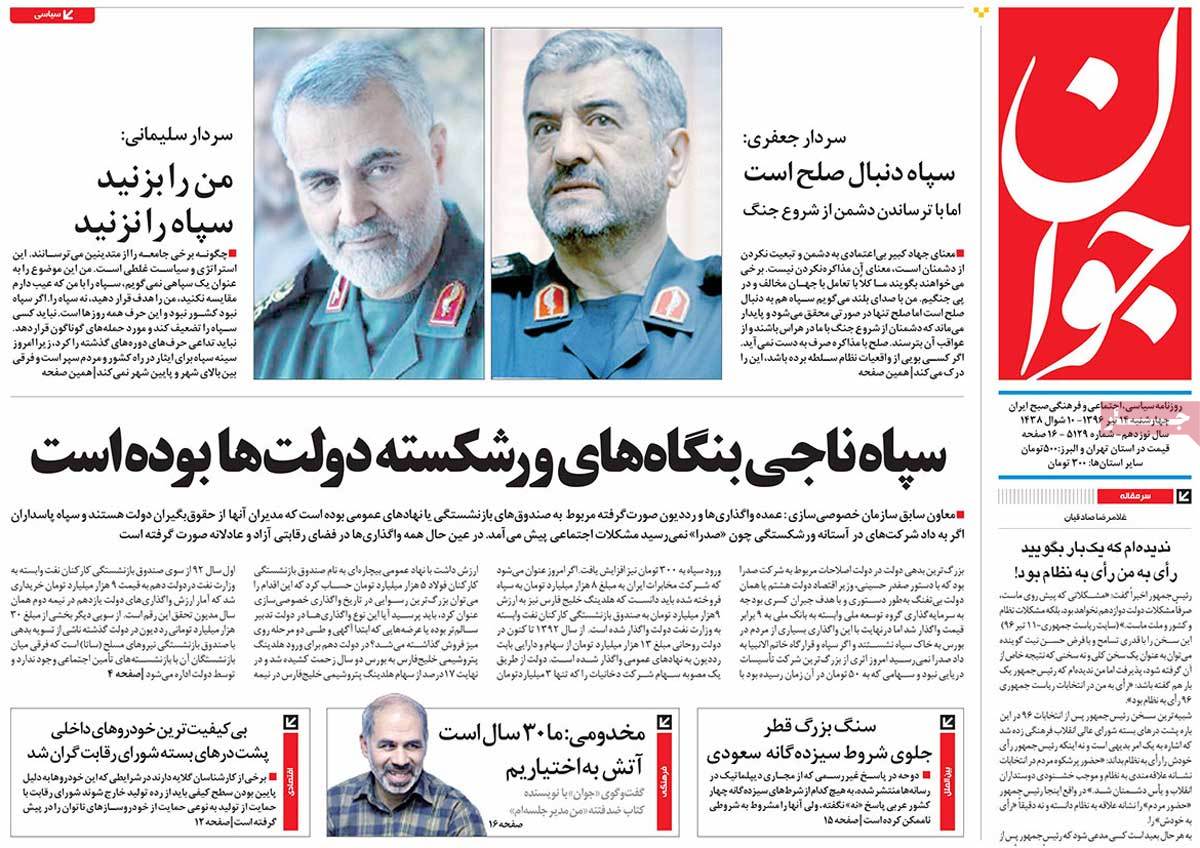
Javan:

1- Commander: IRGC Looking for Peace by Making Enemies Afraid of Waging War

2- General Soleimani: Attack Me, but Don’t Attack IRGC

3- IRGC Has Saved Governments’ Bankrupt Businesses

A Look at Iranian Newspaper Front Pages on July 5 - javan


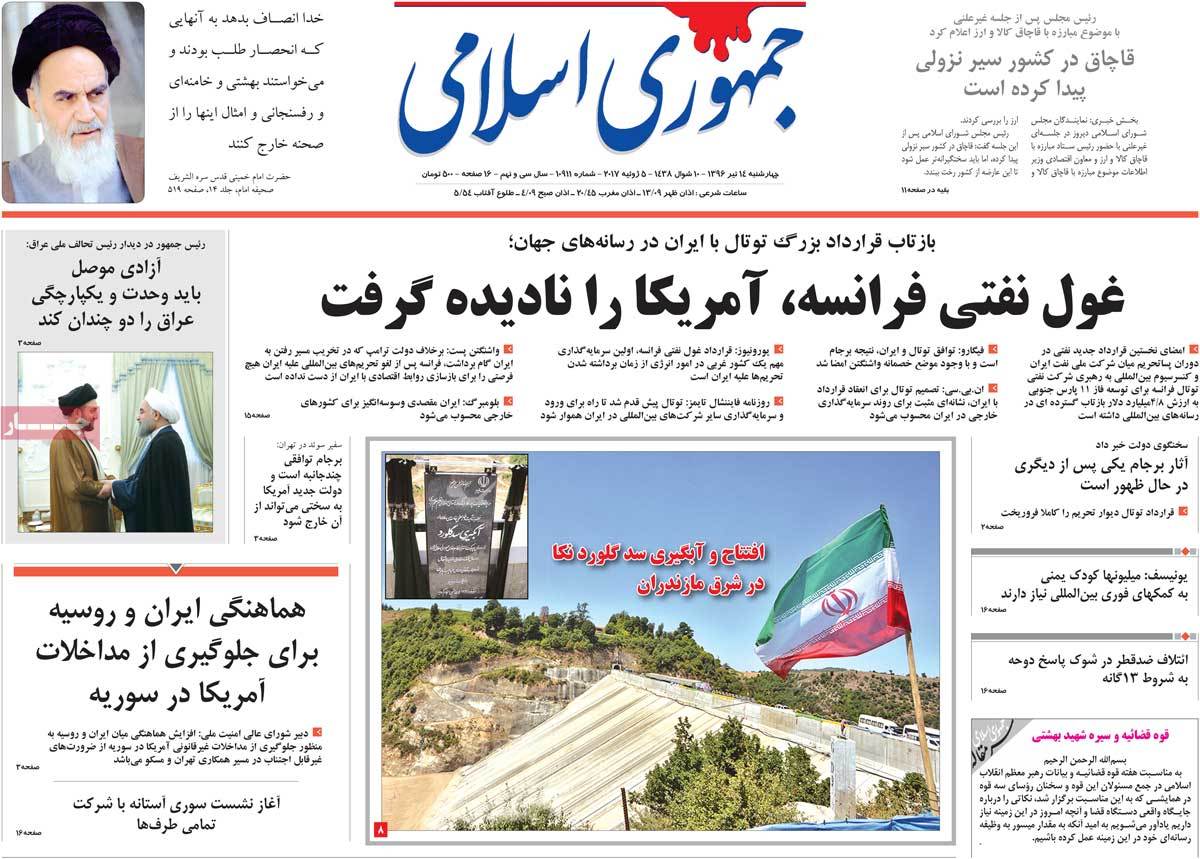
Jomhouri Eslami:

1- Iran’s Big Deal with Total Widely Covered by World Media

  • French Oil Giant Ignores US

2- UNICEF: Millions of Yemeni Children in Urgent Need of Int’l Help

3- Iran, Russia Should Cooperate against US Interference in Syria

A Look at Iranian Newspaper Front Pages on July 5 - jomhori


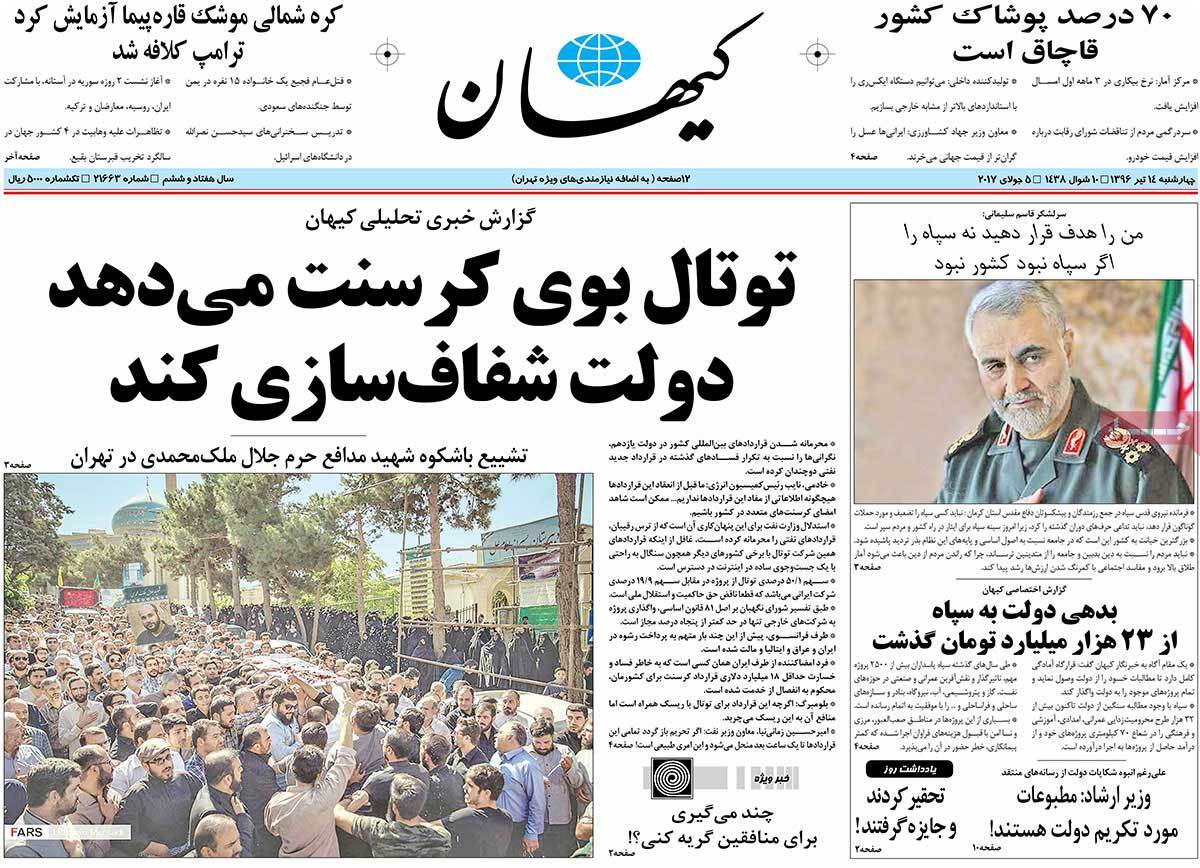
Kayhan:

1- Total Smells Like Crescent; Government Should Be Transparent

2- 70% of Apparel in Iranian Markets Have Been Smuggled into Iran

3- Government’s Debts to IRGC Exceed IRR 230 Trillion [over $6bn]

A Look at Iranian Newspaper Front Pages on July 5 - kayhan


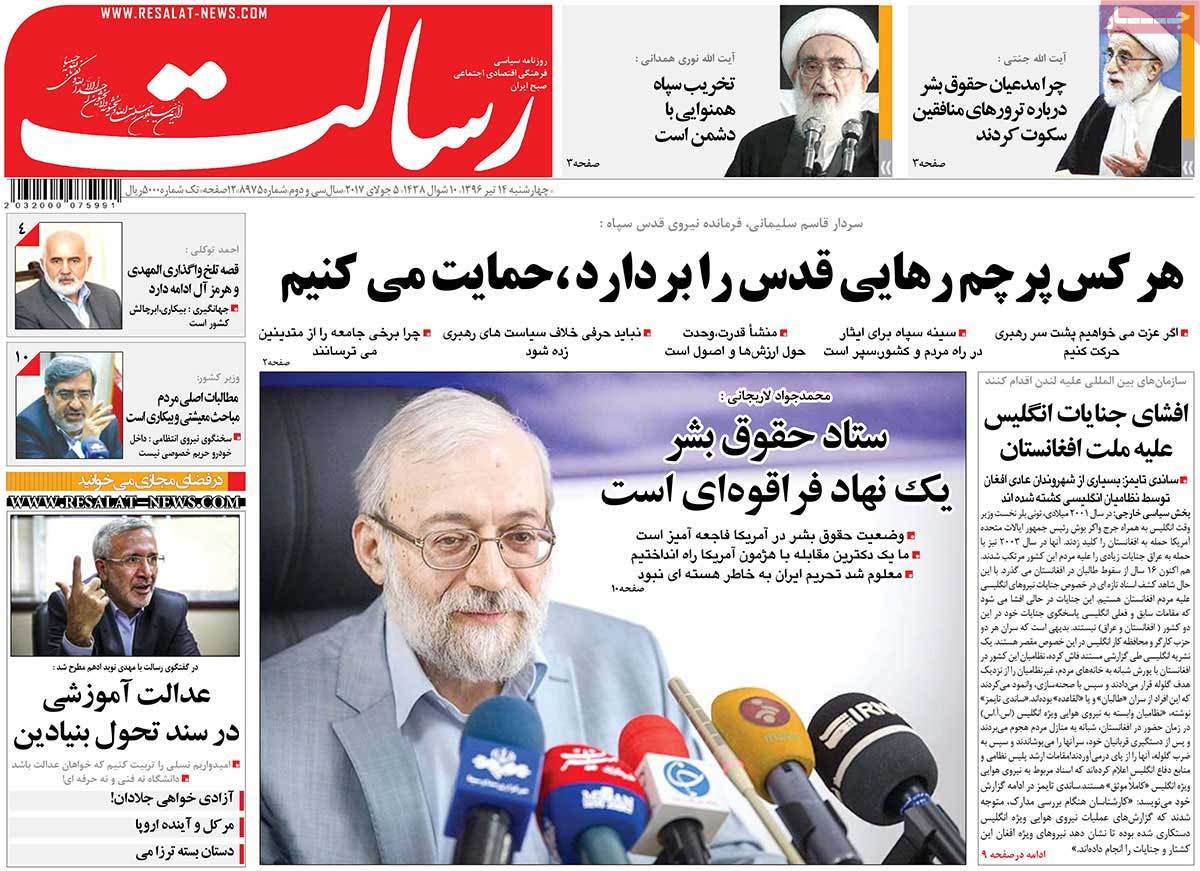
Resalat:

1- General Soleimani: We’ll Support Whoever Raises Banner of Quds Liberation

2- Ayatollah Jannati: Why Advocates of Human Rights Are Silent towards MKO Crimes?

A Look at Iranian Newspaper Front Pages on July 5 - resalat


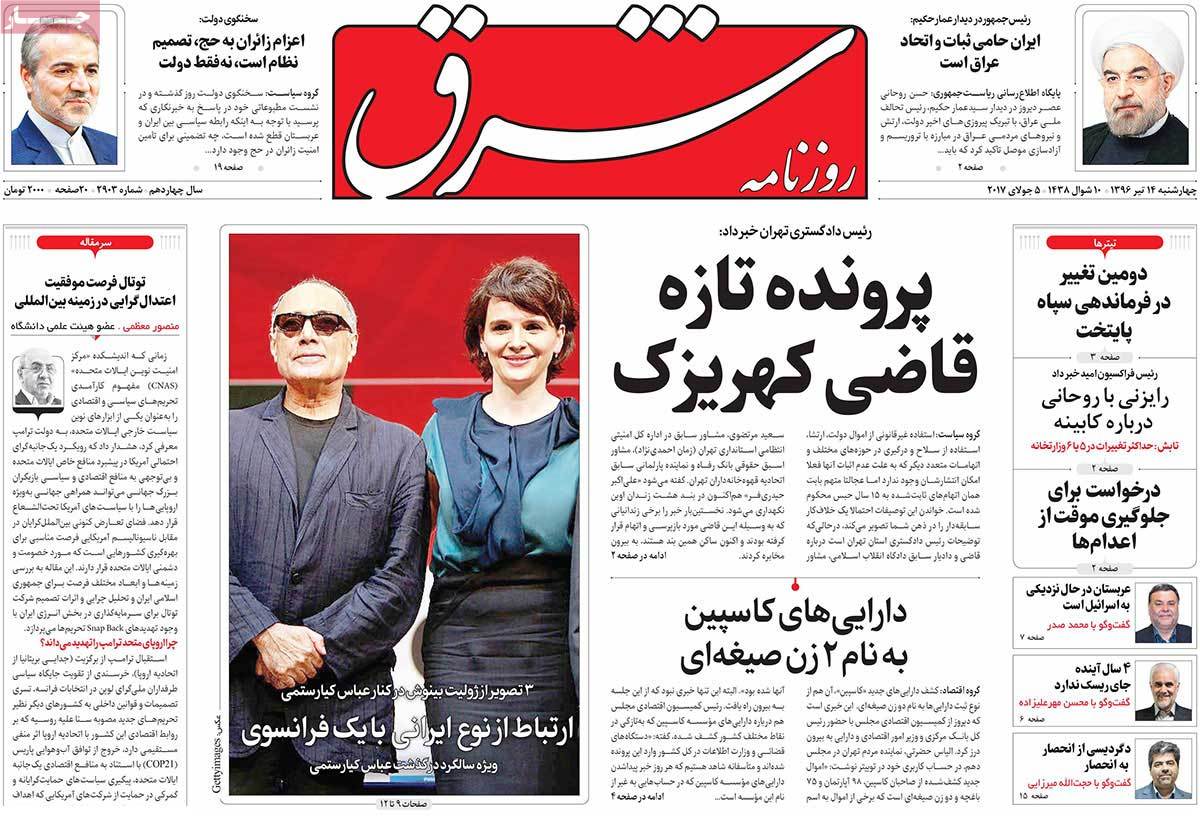
Shargh:

1- Iranian Connection with a French Woman

  • Three Pictures of Binoche beside Kiarostami

2- Entire Establishment, Not Just Gov’t, Has Decided to Send Pilgrims to Hajj

A Look at Iranian Newspaper Front Pages on July 5 - shargh