Saturday, April 11, 2026
Home Blog Page 3984

124 Iranian Planes Crippled, Waiting for Spare Parts

124 Iranian Planes Crippled, Waiting for Spare Parts

According to a Farsi report by Nasim Online, nearly 40 percent of the country’s planes are languishing in the hangers across the country. The full text of the report is as follows:

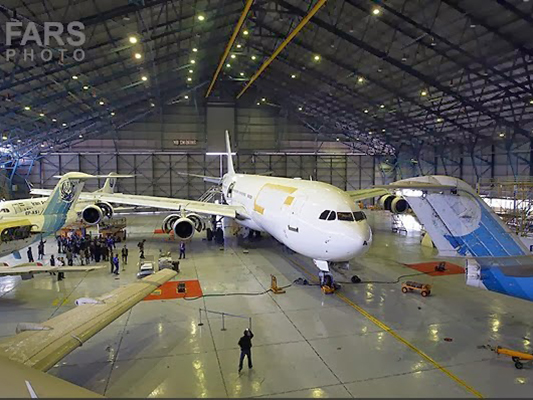
124 planes in Iran are crippled allegedly either due to outdated maintenance checks or shortage of engines and spare parts. The crippled planes are on the verge of being stored as out of service planes, but they can be restored after an overhaul.

In a directive last year, Iran’s Civil Aviation Organization urged the national airliners to exclude old planes from their fleets. The directive paved the way for decommissioning of at least 27 outdated planes from Mehrabad [Tehran], Hasheminejad [Mashhad], and Zahedan airports. The decommissioned planes included Boeing 747, Boeing 727, Fokker 100, Airbus 300, BAE and Falcon 20. The planes belonged to Iran Air (10), Mahan (11), Aseman (5) and Pouya Air (1) airlines.

Iran’s aerial transportation system has been among the most outdated aerial systems in the Middle East over the past four decades. Before the implementation of JCPOA in 2016, there were 124 crippled planes in Iran. On the other hand, the average useful life of 166 operating planes stood at 23 years old.

In the early days of JCPOA implementation, Iran Air (Homa) signed a contract with the French manufacturer Airbus to obtain the mid- and long-range planes through a lease purchase. The value of an earlier contract with Airbus to obtain 228 planes stood at $25bn, but the Iranian side decided to leave out A380 planes from the contract reducing its value to $10bn. The purchased planes are set to be delivered to Iran Air within a 10-year period beginning in 2017. Later, Iran Air signed a $16bn deal with Boeing for 80 planes. The planes are expected to be delivered in ten years. Add to the list, 45 Airbus planes to be delivered to Iran Air Tour, 28 planes to Zagros Air as well as 30 Boeing 737 planes to Aseman.

International standards require the Islamic Republic of Iran to exclude outdated planes from its air fleet. Outdated aerial fleet have already hampered the operation of Iranian airliners making them notorious for their long delays. Back in May, Mehrabad airport had 6,162 flights out of which 3,139 flights were carried out with delay.

According to Iran’s Civil Aviation Organization, Iran Air Tour with 74 percent, Atrak Air with 65 percent and Ata Air with 61 percent had the longest list of delayed flights from Mehrabad airport during May.

At present the number of operating planes produced in 2000 stands at 20 which is a poor standard for Iran’s aviation system. The figure included the planes purchased just recently. Iran’s aerial system needs at least 556 planes by 2025.

One of the main points raised during Geneva talks which led to the clinching of the nuclear deal between Iran and the world powers was repairing 120 crippled planes in Iran. One and a half years after the implementation of the nuclear deal, not only no plane has been repaired, but four other operating planes have been crippled.

So, it seems the JCPOA has not resolved the problems of Iran’s aerial transportation system especially because today providing the spare parts have become much harder compared with previous years.

Relevant officials in the industry maintain that over the past two years, Iran has come under more pressure in civil aerial field.

Most of the manufacturers have already stopped offering services to Iran under various pretexts. Despite the Iranians’ earlier expectations, the JCPOA has not yet relieved sanctions on Iran in civil aerial industry. Another issue which has put Iran’s aerial system in trouble is the limitations on banking systems which have not been removed yet.
Iran to Appoint Woman as Head of Flag Carrier Airline

IranAir

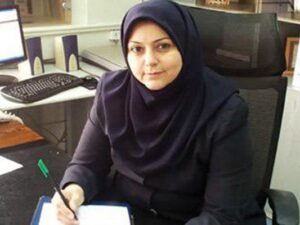
Iran to Appoint Woman as Head of Flag Carrier AirlineFarzaneh Sharafbafi, a current board member at The Airline of the Islamic Republic of Iran (Iran Air), will replace the current CEO Farhad Parvaresh if approved by members of President Hassan Rouhani’s cabinet.
Sharafbafi, the Director-General of Iran Air’s Research Department, will be the first-ever woman to head the national flag carrier, according to a Farsi report by Fars News.

She is also the first Iranian woman with a PhD in aerospace. She has already implemented several aviation projects and has taught various aerospace courses.

After leaving the airline, the former CEO Parvaresh is going to represent the Islamic Republic at the International Civil Aviation Organization (ICAO) in Montreal, Canada.

Mona Lisa’s Smile Revived on Arab Girl’s Face

Mona Lisa’s Smile Revived on Arab Girl’s Face

Some 514 years have passed since Leonardo da Vinci created the Mona Lisa, his most famous painting, and now the world is witness to the creation of another Mona Lisa while the painter has been dead for 498 years.

The modern-day Mona Lisa is not an oil painting showing the portrait of a mysterious woman produced by the paintbrush of a distinguished painter using delicate shading.

This time, fear and consternation has led to the creation of real life Mona Lisa, according to a Farsi report by ISNA.

She should be in her mother’s arms now with her braids ornamented with colourful ribbons. The sound of her laughter should be reverberating in his father’s ear. She should be playing childish games, be happy and act like a normal girl of her age. Nevertheless, only God knows how frightened she had been when her mother had been running away from the ISIS terrorists while panting heavily.

In 1503, da Vinci created the Mona Lisa on canvas with a number of paintbrushes and oil paints. He worked on his work of art for four years to be able to paint a mysterious face full of ambiguity.

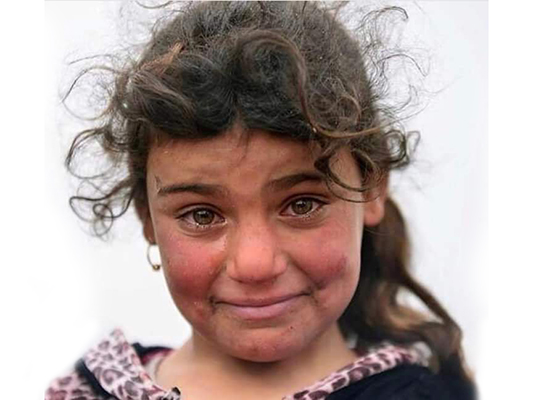
The ambiguous expression on the face of da Vinci’s Mona Lisa is an outcome of four years of incessant hard work by a painter who left his artwork unfinished in the end. Now, in the early years of the present century, the modern-day Mona Lisa’s picture displays a young girl’s face full of fear and sorrow with a faint smile on it. The girl’s bitter smile is the consequence of an intense fear and speaks of her profound sorrow caused by utter horror.

The Mona Lisa of 21st century is confused and sad. She is scared. Her eyes are filled with tears. She is not old enough to be dubbed Mona Lisa. Nevertheless, no other name suits the innocent face of a young girl that displays these emotions all at once.

The face of the 21st century’s Mona Lisa has caused the heart of millions to ache even though those who should feel the ache fail to do so. It is as if they fail to see the little girl’s bright eyes, let alone to feel sympathy for her.

She is doing her best to smile in this photo which has been taken of her right after she managed to escape the ISIS terrorists.

Humanities on Verge of Extinction in Iran

Humanities on Verge of Extinction in Iran

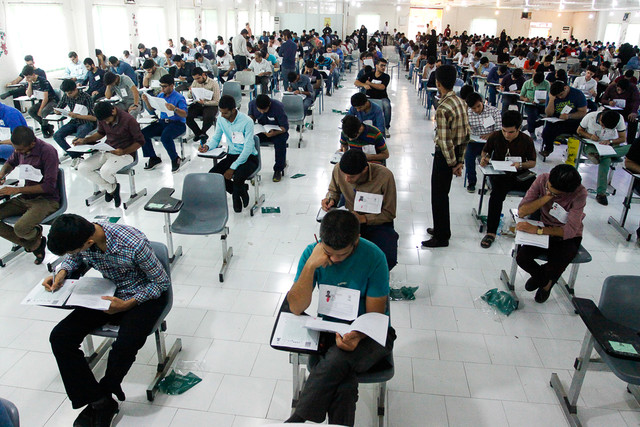
Figures show that out of 930,000 volunteers who had registered to take Iran’s university entrance examination on Friday, July 7, only 184,000 were interested in the humanities.

The fact is deeply worrying as it has the potential to spark off a crisis in the courses pertaining to these academic disciplines in the near future.

Farhikhtegan newspaper, an Iranian paper belonging to the Islamic Azad University, has discussed the risks of failing to pay due attention to humanities and the reasons for the Iranian students’ reluctance to study such academic disciplines at university, in an extensive report titled “Humanities on the Verge of Extinction” published on July 8.

The report says although the Iranian parents’ interest in their children becoming physicians is a salient and undeniable fact, the reduced number of the volunteers for taking humanity courses has heightened concerns more than ever.

The issue is critical enough to lead to a crisis in the field of thought in the country in the near future. The question is why nowadays, Iranian elites are more inclined towards studying courses in engineering and medicine.

Coming up with an answer to this question requires hours of discussion and study by experts. However, the roots can be found by looking deeper into Iran’s education system and the Iranian families’ general culture.

Haddadi, an Iranian researcher in this field, maintains that “an incorrect attitude towards providing [Iranian students with] educational guidance has infiltrated into our educational system, and this has led to the inefficiency of efforts to identify top [Iranian] talents and guide them in the right direction. Our instructors in humanity courses are usually not experts or interested in this field of study and the contents of the educational books are not attractive enough to the students.”

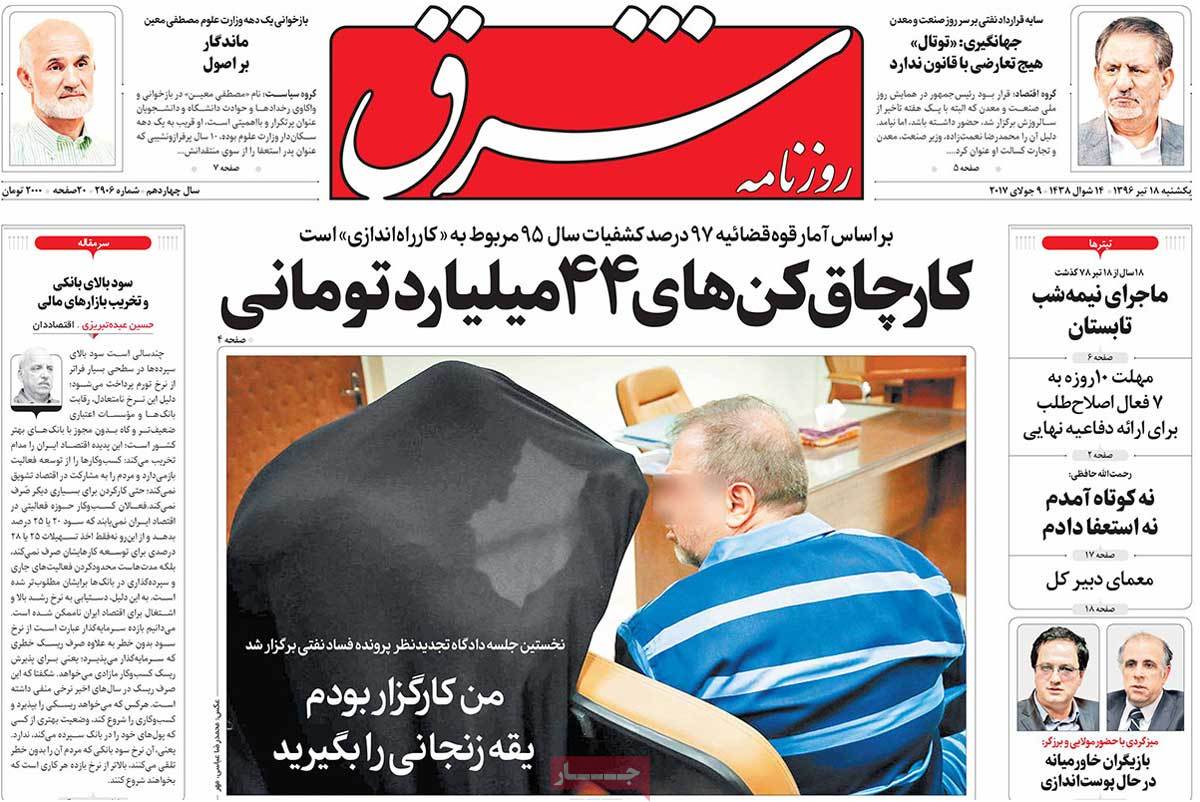
A Look at Iranian Newspaper Front Pages on July 9

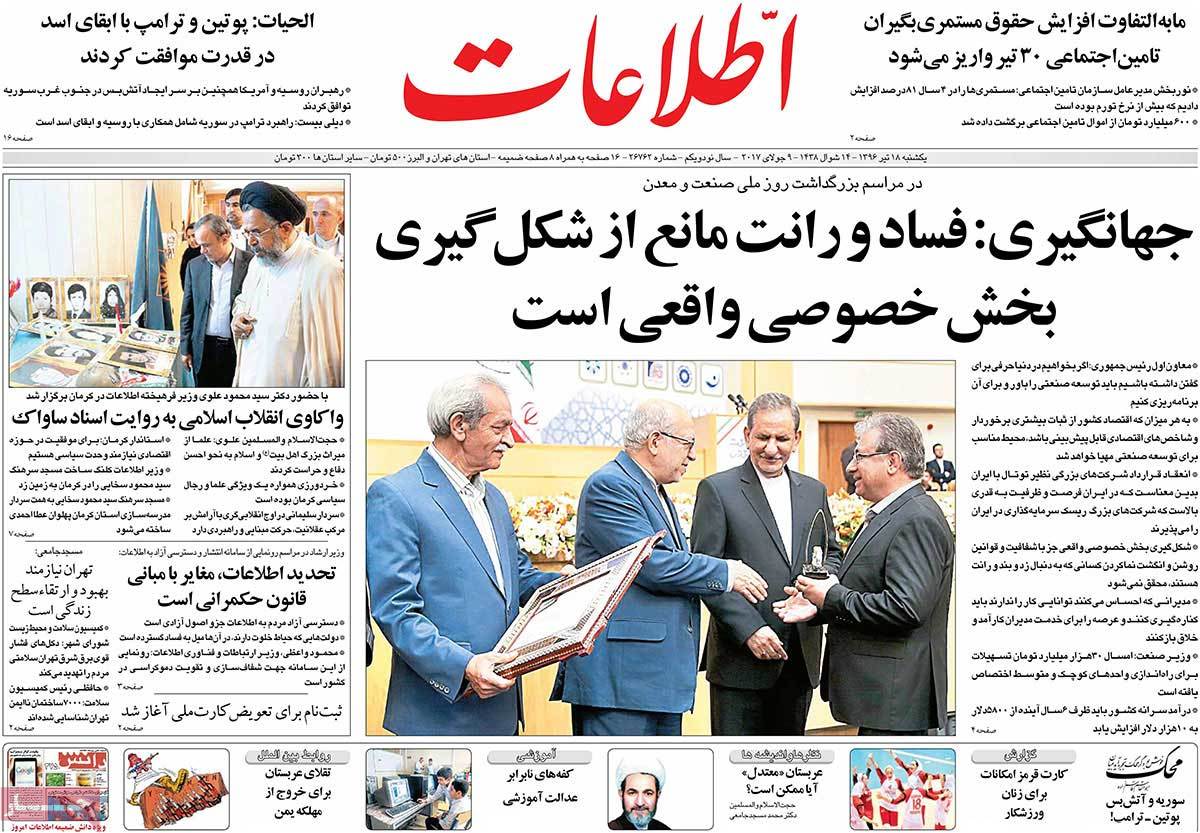
Newspapers today covered the remarks made by First Vice-President Es’haq Jahangiri about the need for trusting and reinforcing the country’s private sector.

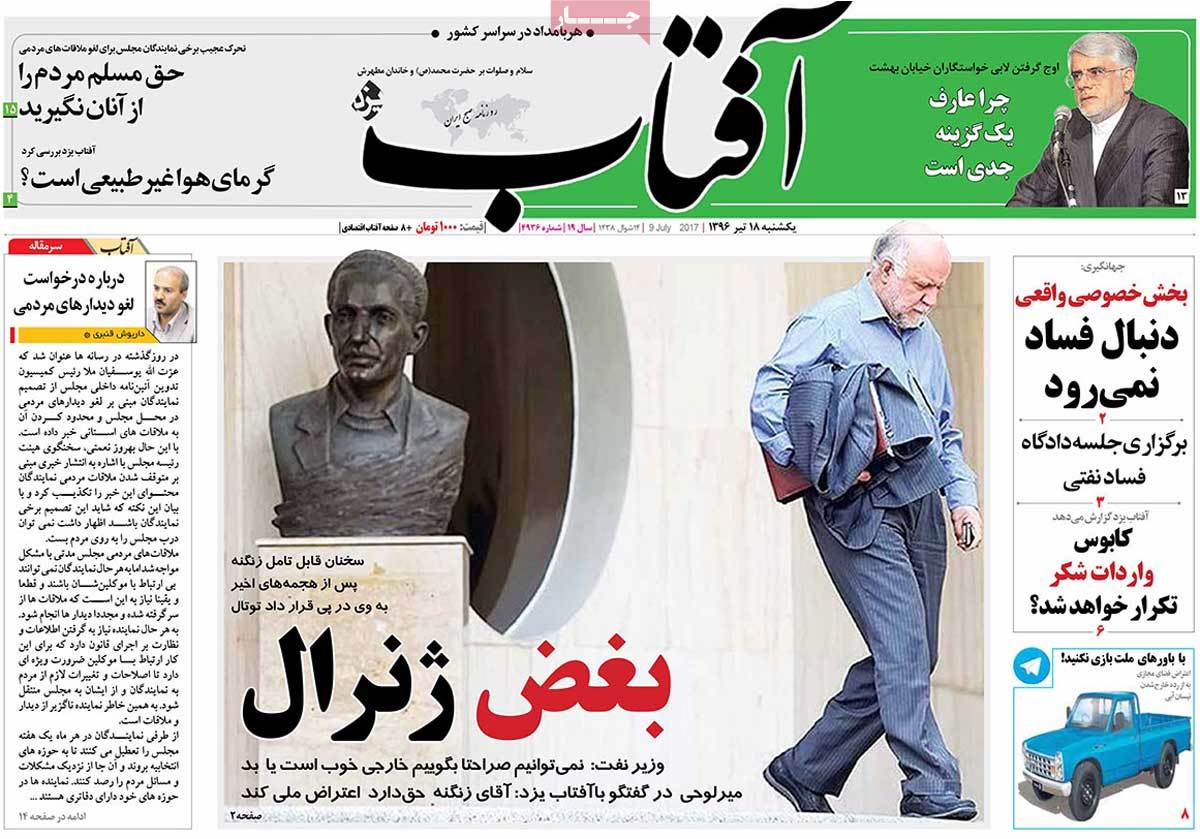
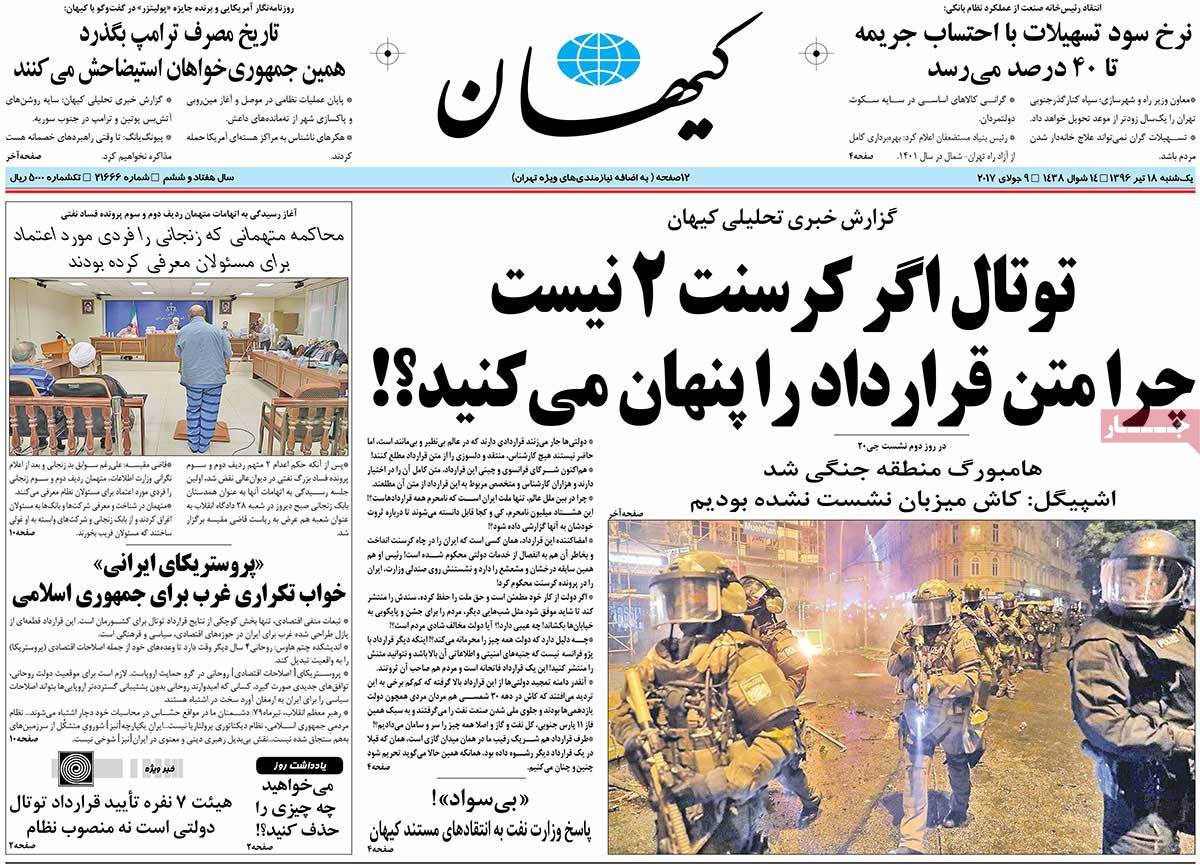
The huge gas deal with Total also remained a top story after a week. Conservative newspapers criticized the secrecy of the deal, and pro-government papers covered Oil Minister Bijan Namdar Zanganeh’s response to criticisms.

Another top story was the portal unveiled by Rouhani’s administration to provide people with free access to the information of state institutions. The move is part of the government’s efforts to promote Freedom of Information (FOI) and increase transparency.

The above issues, as well as many more, are highlighted in the following headlines and top stories:


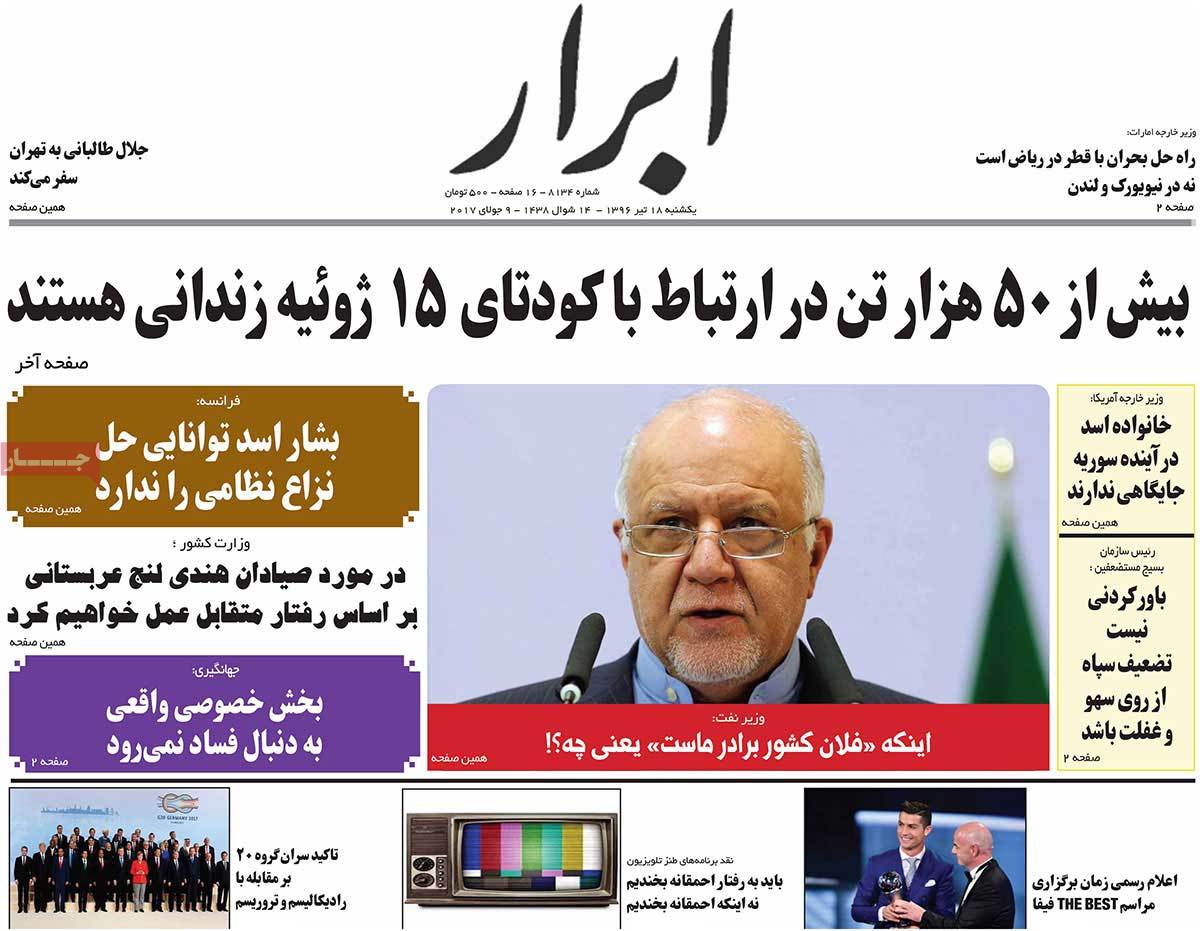
Abrar:

1- Oil Minister: What Does It Mean ‘That Country Is Our Brother’?

2- Iran to Take Reciprocal Measures against Indian Sailors of Trespassing Saudi Boat

A Look at Iranian Newspaper Front Pages on July 9 - abrar


Aftab-e Yazd:

1- The General’s Thought-Provoking Remarks after Attacks on Total Deal [The General refers to Oil Minister Zanganeh]


A Look at Iranian Newspaper Front Pages on July 9 - aftab


Arman-e Emrooz:

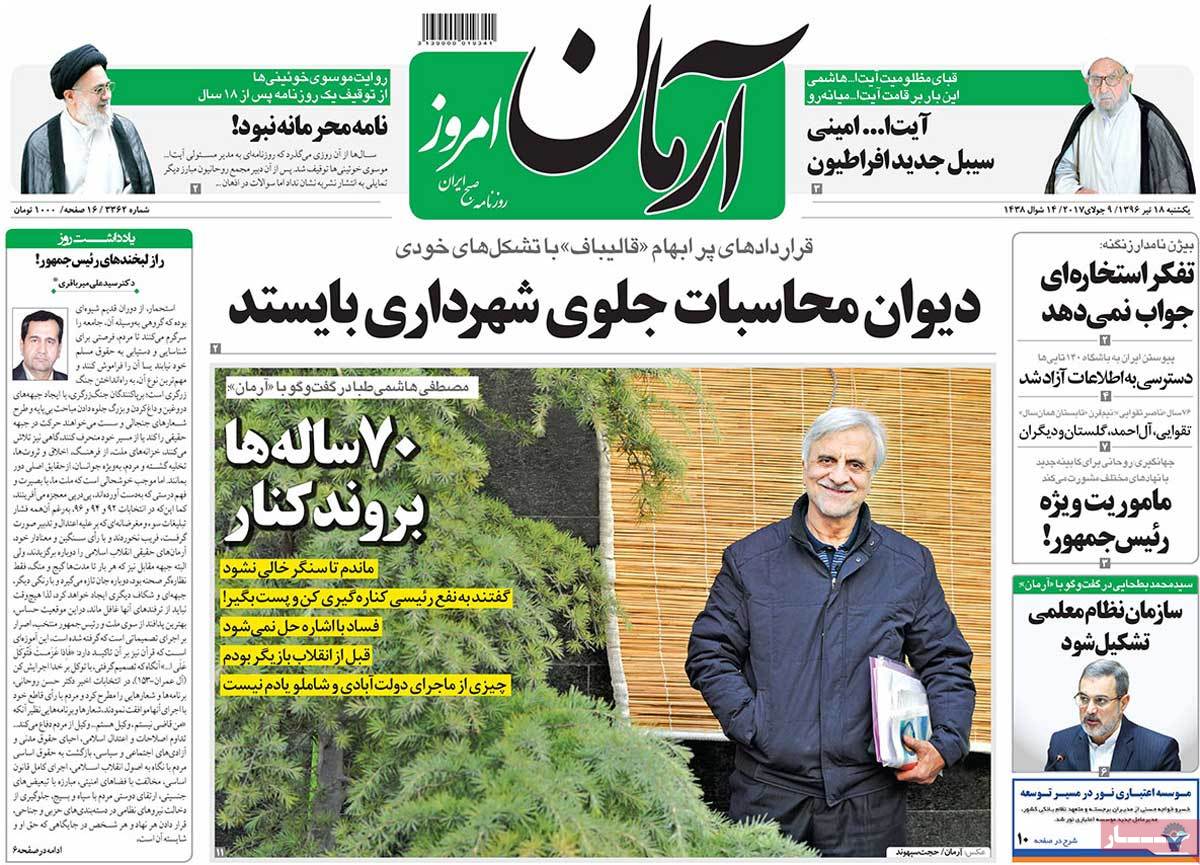
1- 70-Year-Old Officials Should Leave Office: Hashemitaba


A Look at Iranian Newspaper Front Pages on July 9 - arman


Asrar:

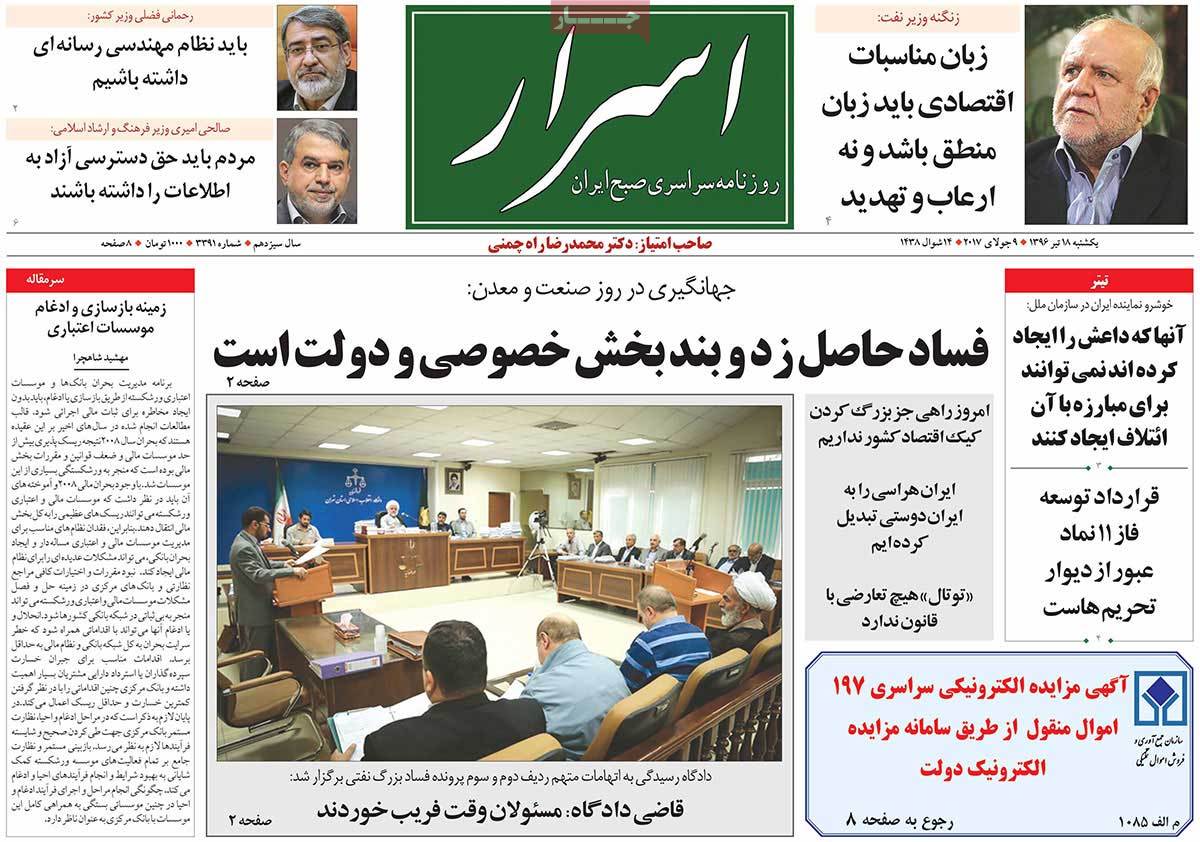
1- Oil Minister: Logic, Not Intimidation and Threat, Is Language of Economic Ties

2- Culture Minister: People Should Have Right to Freely Access Information

3- First VP: Corruption Result of Gov’t-Private Sector Collusion

4- Iran Envoy to UN: Those Who Created ISIS Cannot Form Coalition for Fighting It

A Look at Iranian Newspaper Front Pages on July 9 - asrar


Ettela’at:

1- Corruption Preventing Formation of Real Private Sector

2- Al-Hayat: Putin, Trump Agree on Assad’s Remaining in Power

A Look at Iranian Newspaper Front Pages on July 9 - etelaat


Haft-e Sobh:

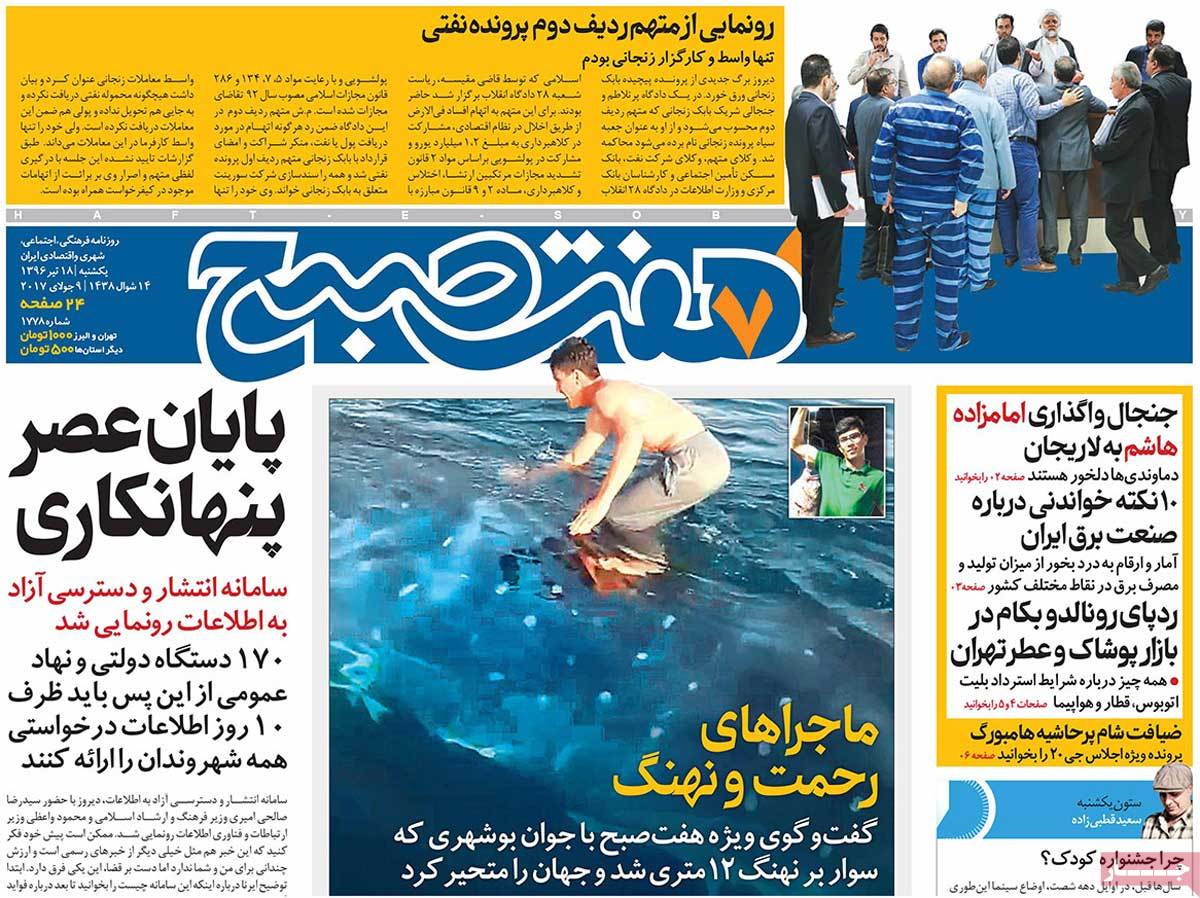
1- Interview with Young Man Who Rides 12-Metre Whale Shark in Persian Gulf

2- Era of Keeping Secrets Over: Portal Unveiled for People’s Free Access to Information

  • All State Institutions Obliged to Respond to People’s Requests within 10 DaysA Look at Iranian Newspaper Front Pages on July 9 - haftesobh

Iran:

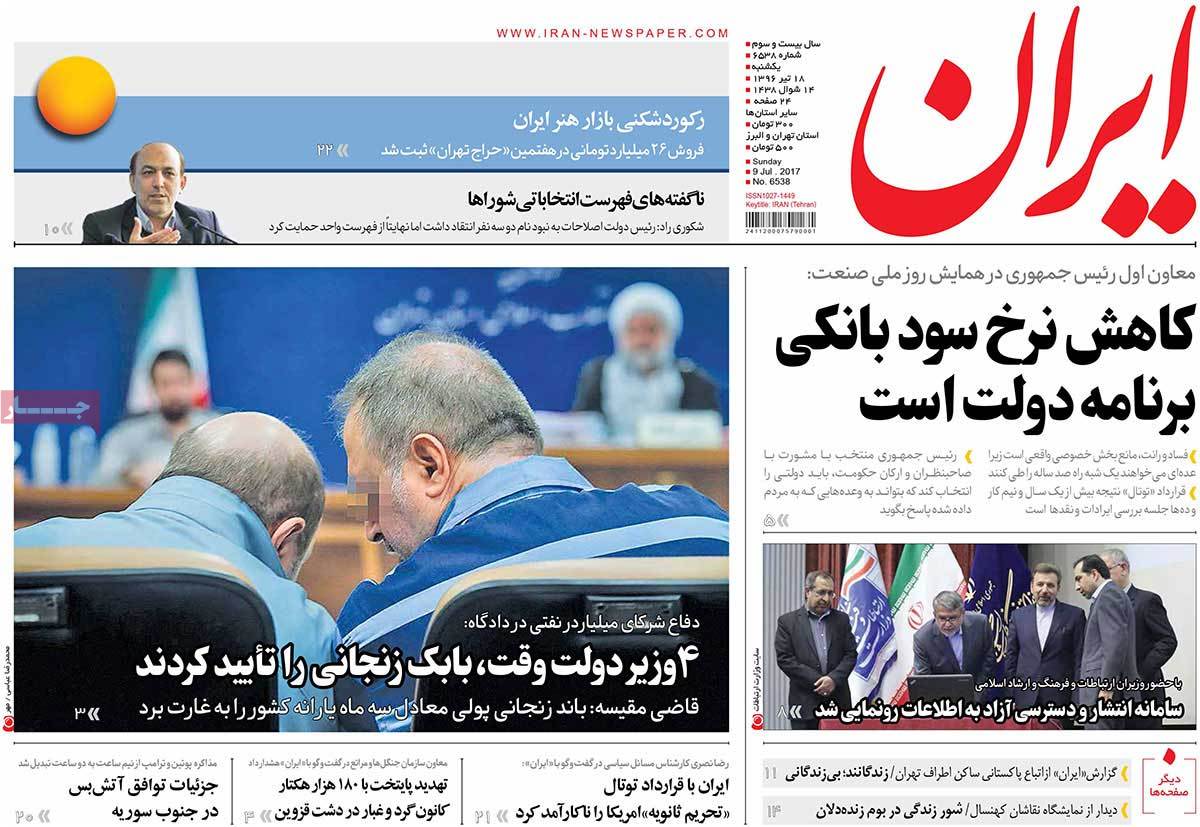
1- Partners of Babak Zanjani Defend Him: 4 Ahmadinejad Ministers Approve of Him

2- Judge Moghiseh: Zanjani’s Team Plundered Iran’s Money

3- Reza Nasri: Iran-Total Deal Makes US Secondary Sanctions Ineffective

4- Iran’s Art Market Breaks Records: 7 Million Dollars of Artworks Sold in Tehran Auction

A Look at Iranian Newspaper Front Pages on July 9 - iran


Javan:

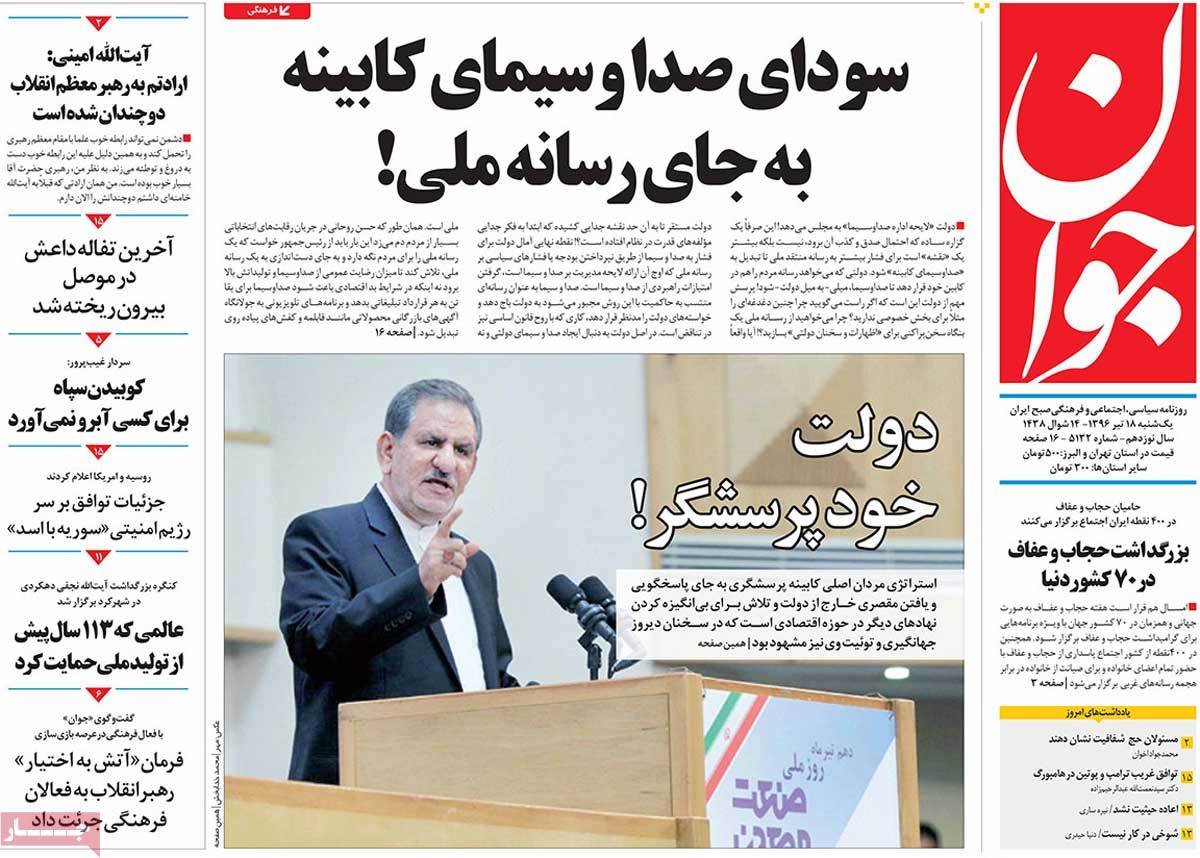
1- Rouhani’s Gov’t Trying to Pin Blames on Others Instead of Being Accountable

2- Hijab to Be Commemorated in 70 Countries

A Look at Iranian Newspaper Front Pages on July 9 - javan


Jomhouri Eslami:

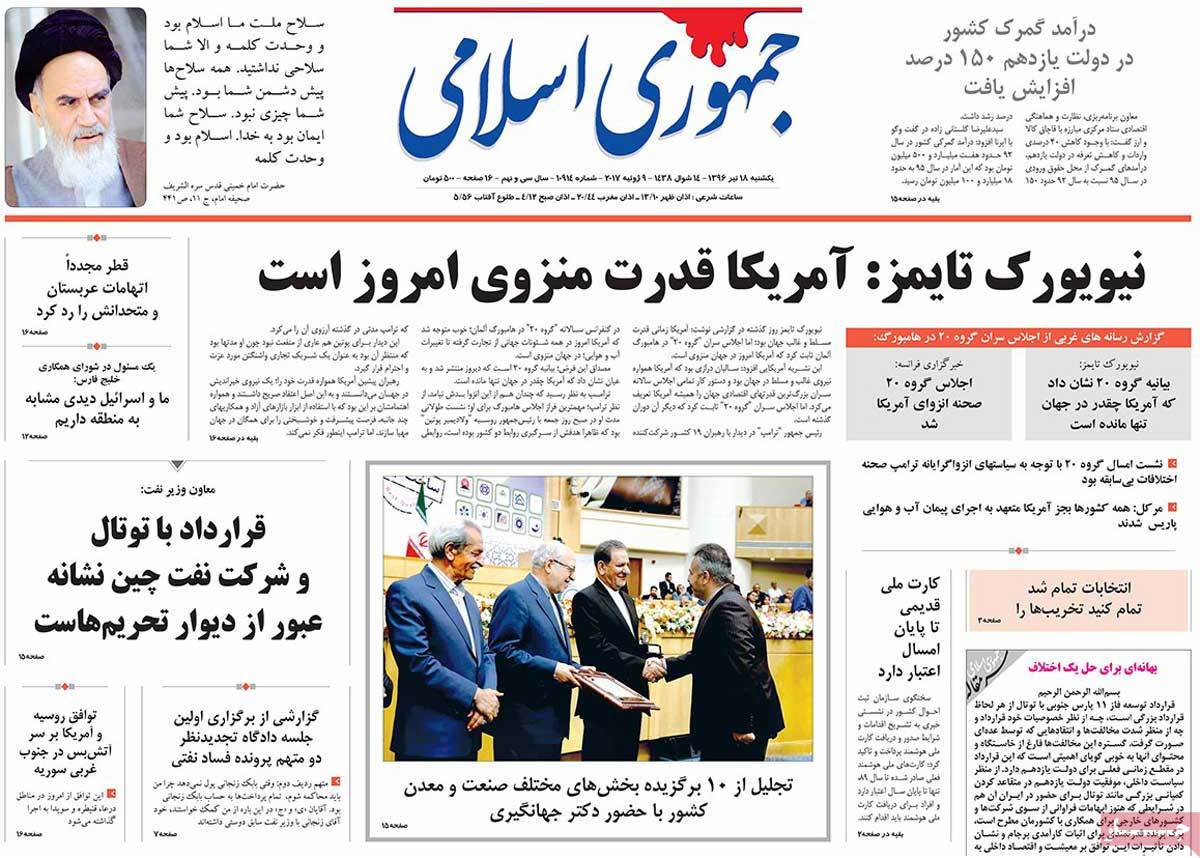
1- New York Times: US Isolated Power of Today’s World

2- Deputy Oil Minister: Deal with Total, China Shows Wall of Sanctions Broken

A Look at Iranian Newspaper Front Pages on July 9 - jomhori


Kayhan:

1- If Total Deal Isn’t another Crescent, Why Does Gov’t Hide Its Text?

2- GOP to Impeach Trump Once His Expiry Date Reached: US Pulitzer-Winning Journalist

A Look at Iranian Newspaper Front Pages on July 9 - kayhan


Resalat:

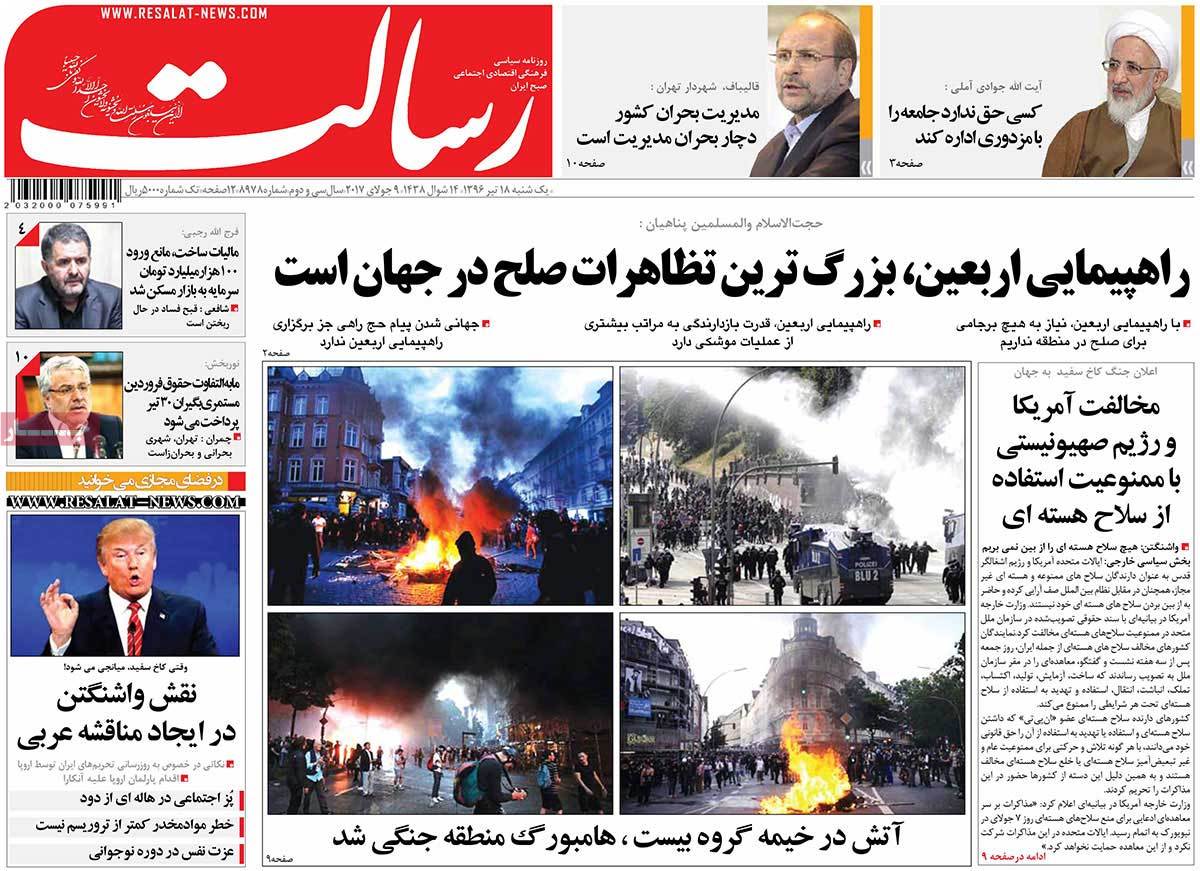
1- Fire on G20 Camp: Hamburg Turns into War Zone

2- Tehran Mayor: Serious Management Crisis in Iran’s Crisis Management

A Look at Iranian Newspaper Front Pages on July 9 - rasalat


Rooyesh-e Mellat:

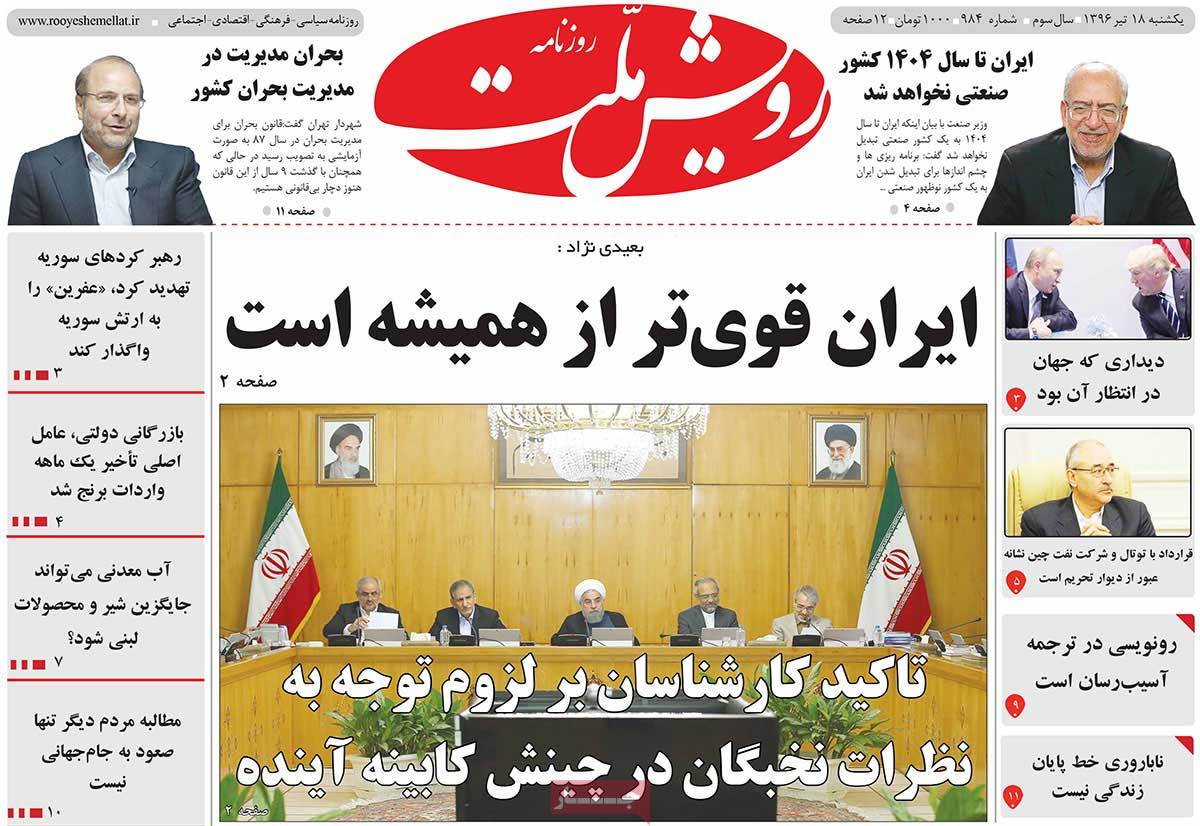
1- Trade Minister: Iran Not to Become Industrial State by 2025

A Look at Iranian Newspaper Front Pages on July 9 - royeshmellat


Shahrvand:

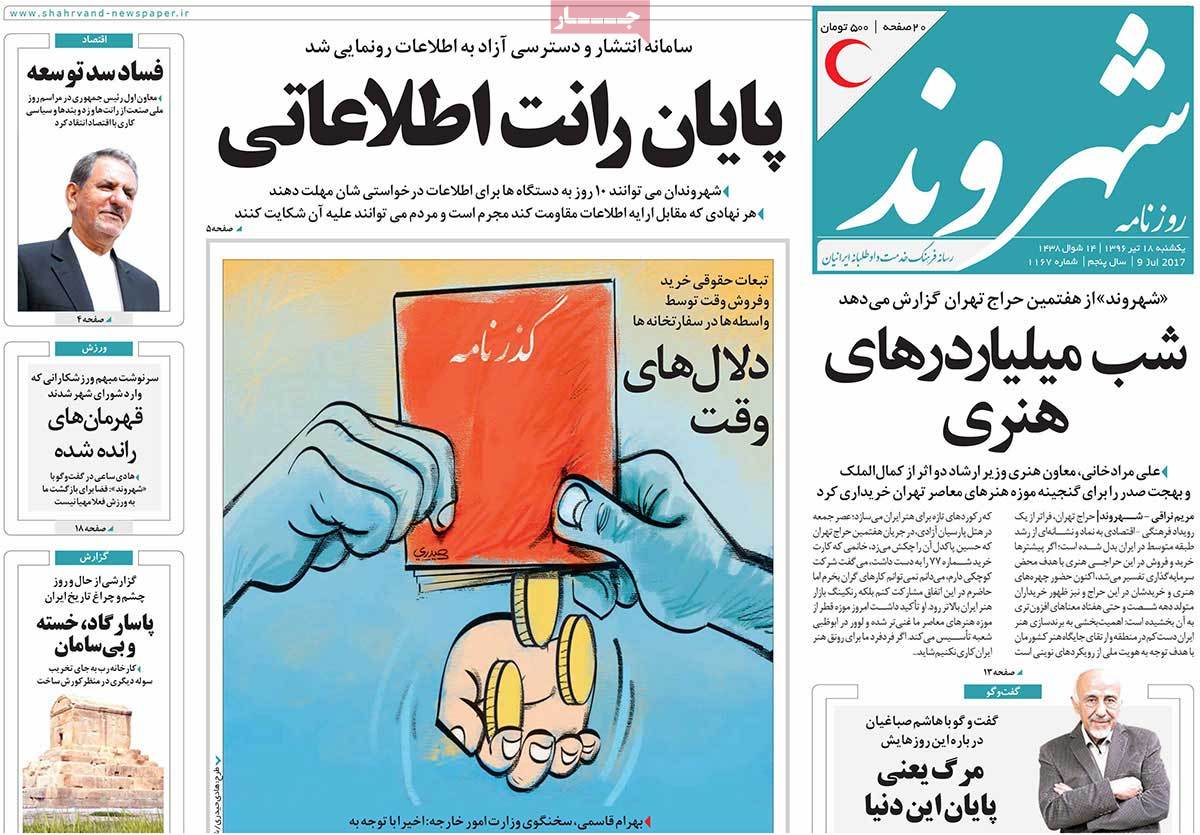
1- Middlemen Making Money by Selling, Buying Visa Appointments

A Look at Iranian Newspaper Front Pages on July 9 - shahrvand


Shargh:

1- Shadow of Oil Deals on National Day of Industry and Mine

2- First VP: Total Deal Not against Iran’s Law

A Look at Iranian Newspaper Front Pages on July 9 - shargh

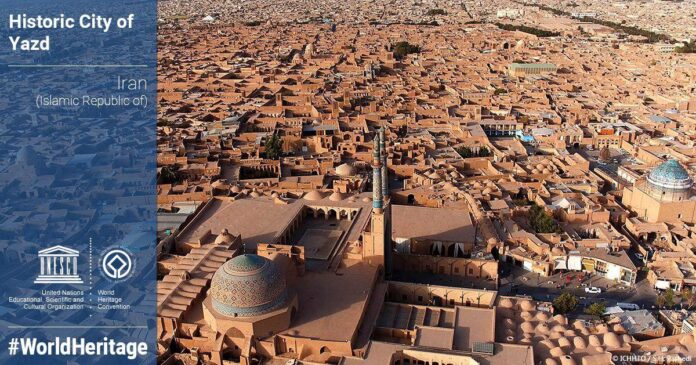
Historical City of Yazd Inscribed as World Heritage Site

yazd

The site was inscribed as a world heritage during the 41st session of UNSCO’s World Heritage Committee in Krakow, Poland, on Sunday, July 9.

The historical structure of Yazd is a collection of public-religious architecture in a very large scope comprising of different Islamic architectural elements of different periods in a harmonious combination with climatic conditions.

Iran had submitted its request for the addition of Yazd to the world heritage list back in 2007.

Europe Source of Dangerous Weed Smuggled into Iran

Head of the Iranian Customs’ Drug Enforcement Department Nematollah Moomvandi has warned against the organized smuggling of a particular type of marijuana into Iran from certain European countries, including Britain.

Marijuana, also known as cannabis and weed, is a narcotic drug made from the leaves of the hemp plant.

Moomvandi said the drug smuggled into the Islamic Republic is, in fact, the seeds from which hemp grows.

He said the seeds have been discovered in such items as toys, tablets, hairbrushes, slippers, decorative items and belts sent in by post.

“The seeds of this dangerous plant have been delivered to the country in postal packages and, of course, discovered by customs agents since June last year. In 2016, 204 cases of hemp seeds stashed in incoming postal packages were registered on the list of the items discovered by the customs, which is a considerable figure.”

He said the drug kept being smuggled into the country in postal packages on a larger scale in the second quarter of 2017, but was intercepted as well.

“Iran has lodged its protest with the European Union via the foreign ministry because these countries don’t control their borders to counter drug trafficking.”

He said hemp seeds seem to be smuggled in an organized manner.

“The [Iranian] Customs has supplied the necessary information to the [country’s] Drug Control HQ, Intelligence Ministry and Police,” he noted.

As for why narco-traffickers have turned to smuggling this particular type of drug, he said the key reasons are that it is a lucrative trade, and the drug can easily be transferred in the form of seeds.

“It is said that every single seed of the plant has a [street] value of around Rls. 10 million [over $250],” he said.

“Another problem with this new drug is that it can easily be planted at home, which makes it difficult for authorities to control its production and distribution.”

Experts have done genetic research work on the plant, whose narcotic content was 6%, and managed to produce a new plant with a 25-percent narcotic content. The new plant can easily be grown in a flower pot.

‘Iran Adopting Realistic Approach toward Social Networks’

Iran’s Minister of Culture and Islamic Guidance Reza Salehi Amiri says the government has adopted a realistic approach vis-à-vis cyberspace.

“The Establishment’s approach toward social networks and virtual space is not a passive and confrontational approach, but a realistic one based on management and production of useful content,” said the minister, according to a Farsi report by Entekhab news website.

He said a confrontational approach is a nonstarter and should be avoided as it will bring about “deviation” and a Western-style way of thinking.

“A passive approach, which prescribes submission in dealing with cyberspace, is not effective, either, and we should not pursue this approach,”

He further noted that the exchange of information is unlimited in today’s world, and added in Iran, for example, there are 47 million internet users.

“Currently, there are 800,000 websites as well as 1.5 million channels operating in the cyberspace in the country,” he said.

He noted that all aspects of people’s lives such as culture, politics, the family and other constituents of society have been influenced by cyberspace and social networks, and added the society has a growing tendency to use social networks.

“At the moment, social networks account for the bulk of people’s cultural consumption, which means people and citizens receive their messages from social networks more than before.”

The National Cyberspace Council is monitoring the full extent of social networks’ influence on the society, the culture minister noted.

During the recent presidential election in Iran, for example, between 2.5 and 3 billion messages were exchanged between Iranians each day, he said.

Family members used to spend two hours a day interacting with each other in the past while the figure dropped to around 20 minutes last year, which means social networks have assumed a special position in families.

“The current information revolution puts two paths before us: Either to drown in this sea of information, or to adopt a clear strategy to manage it, and definitely it would be effective and useful to adopt a clear strategy to manage it,” he underlined.

He said family members used to spend around two hours a day talking and interacting with each other in the past while the figure dropped to around 20 minutes last year, which means social networks have assumed a special position in families.

He then pointed out that computer games are all the rage now among children.

“Last year, for example, around 450 billion Tomans (nearly $120 million) worth of computer games were sold in the country, or in 2016, the Clash of Clans game sold $2 billion across the world.”

He said inappropriate cultural consumption will lead to “cultural malnutrition,” which, in turn, will lead to social maladies and cultural challenges.

The minister underlined that social networks influence and change people’s consumption patterns and behaviours as well as type of clothing and makeup.

“These changes will create a new language in the society, and people will have more craving for diversity and pleasures.”

He then said the high rate of use of social networks by children and young adults shows the importance of producing useful content and transferring it to them via virtual space.

Social networks influence people’s consumption patterns and behaviours as well as type of clothing and makeup. These changes will create a new language in the society, and people will have more craving for diversity and pleasures.

The more virtual space is expanded, he said, the more new borders are created, and “we should properly delineate new borders by producing useful content.”

The minister further underlined that the society is moving toward using mobile phones more and more, so much so that a global survey shows all libraries across the world will provide books to their clients on mobile phones by 2020.

Salehi Amiri then said the business of start-ups is booming in Iran, and added many of their directors range in age from 20 to 25, which shows the youths have secured a considerable share of activities in virtual space.

He said the middleman is cut out in most of these projects, which has resulted in over millions of commodities being delivered to households on a daily basis.

The minister added mosques should turn into bases where content is produced for cyberspace.

“Transferring ethical and educational messages to families requires the cooperation of theology schools and universities, and that’s why the theology school [in the city of Qom] should be active in cyberspace more than ever before.”

He further said direct talk and face-to-face conversation cannot be a suitable method to transfer concepts and messages, so different means such as music, plays, painting and films should be used.

He stated that people seriously need to watch films these days, and added subsidizing film-making in the country could increase viewership of locally-produced movies.

Salahi Amiri underlined his ministry has a duty to counter promiscuity and reactionarism. However, he added, blocking cultural and artistic activities will only increase social vice and problems.

He concluded by saying that effective cultural activities require long-term work, and added, “Regarding the hijab issue, for instance, activities should be goal-oriented, logical and in the right path with a long-term look.”

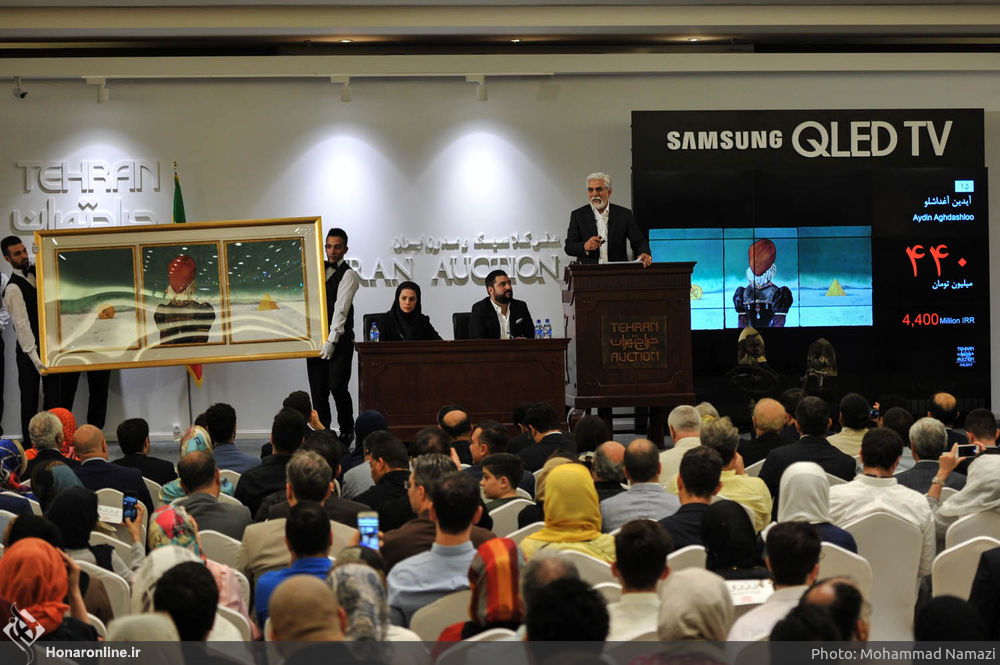
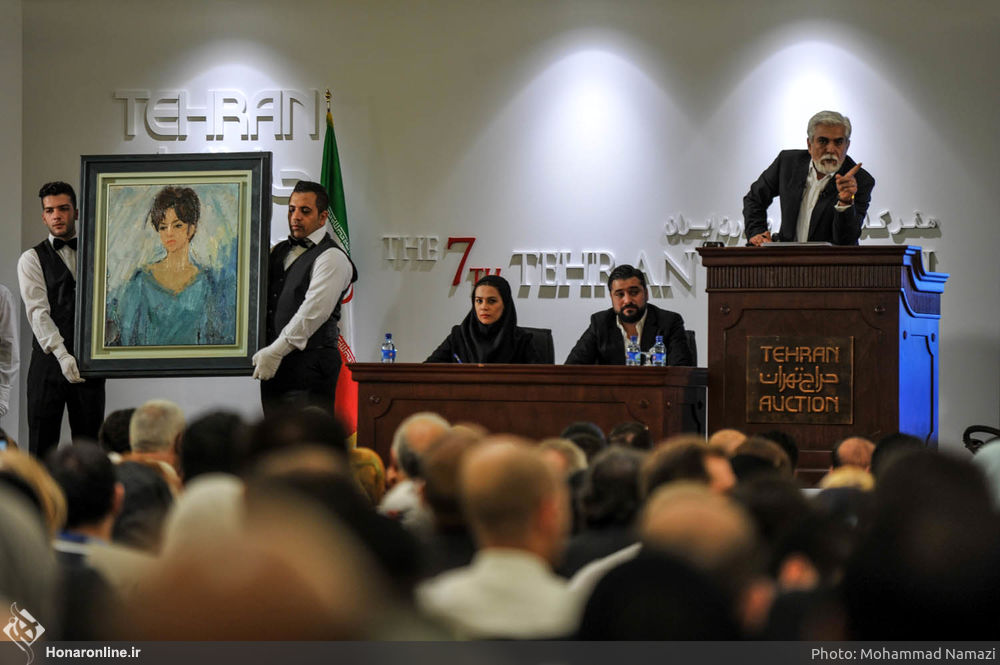
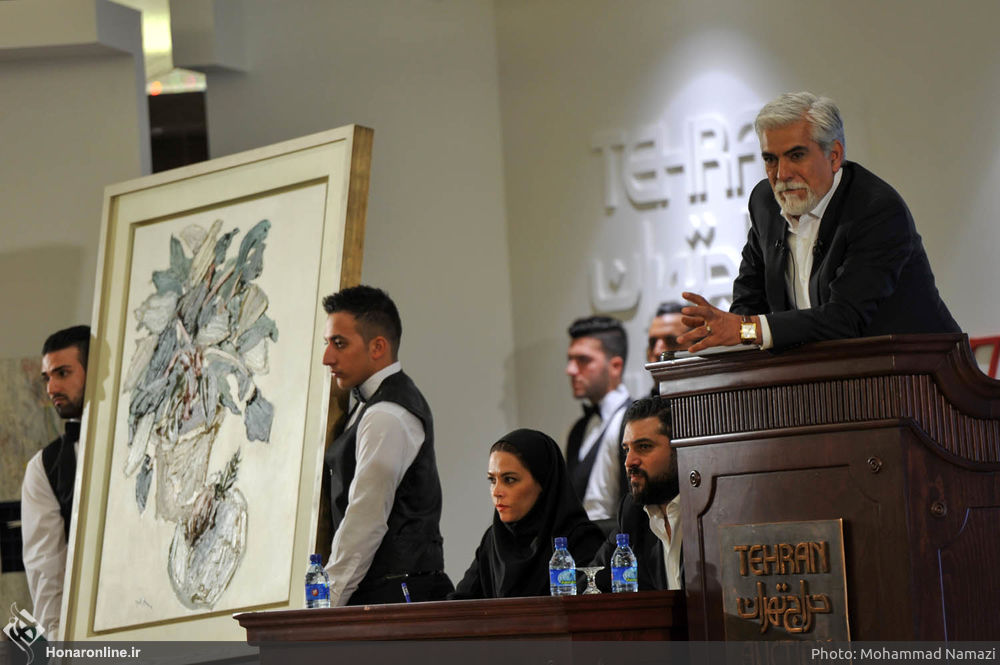
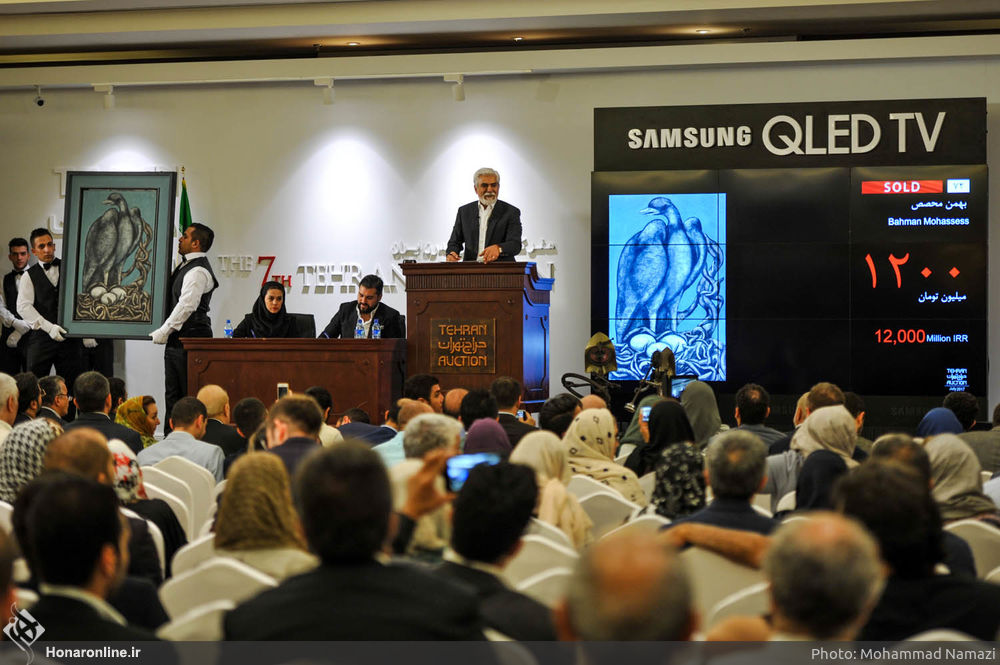
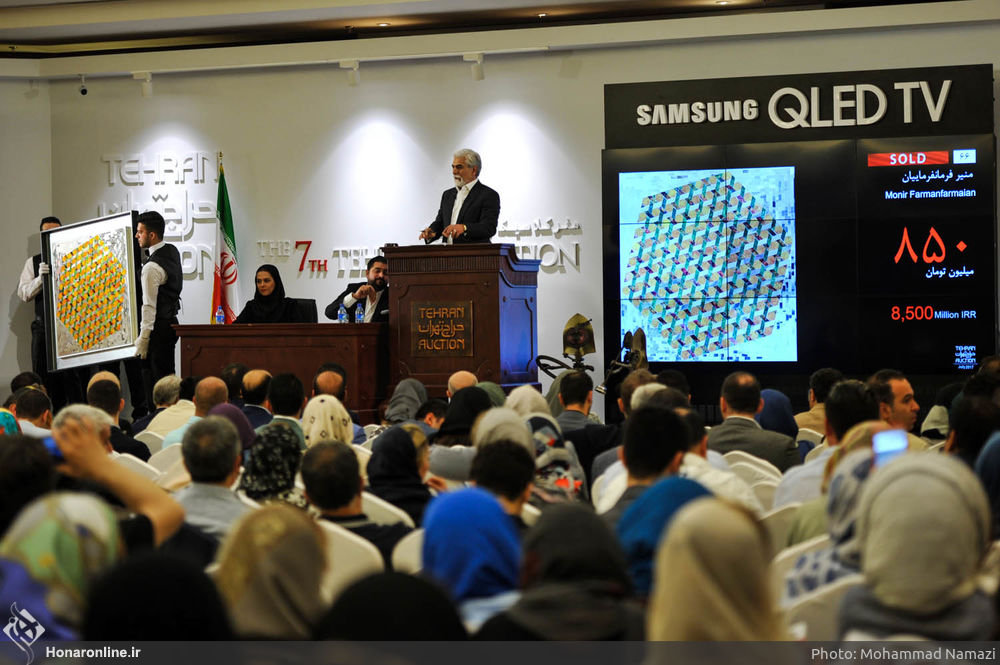
Over 70 Artworks Sold at 7th Tehran Auction for $7m

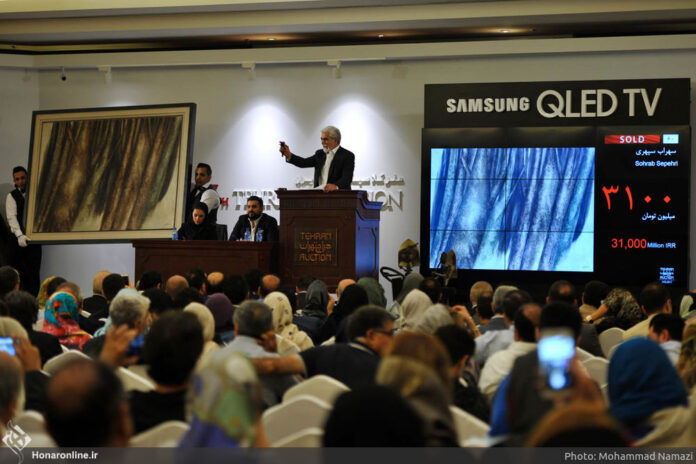
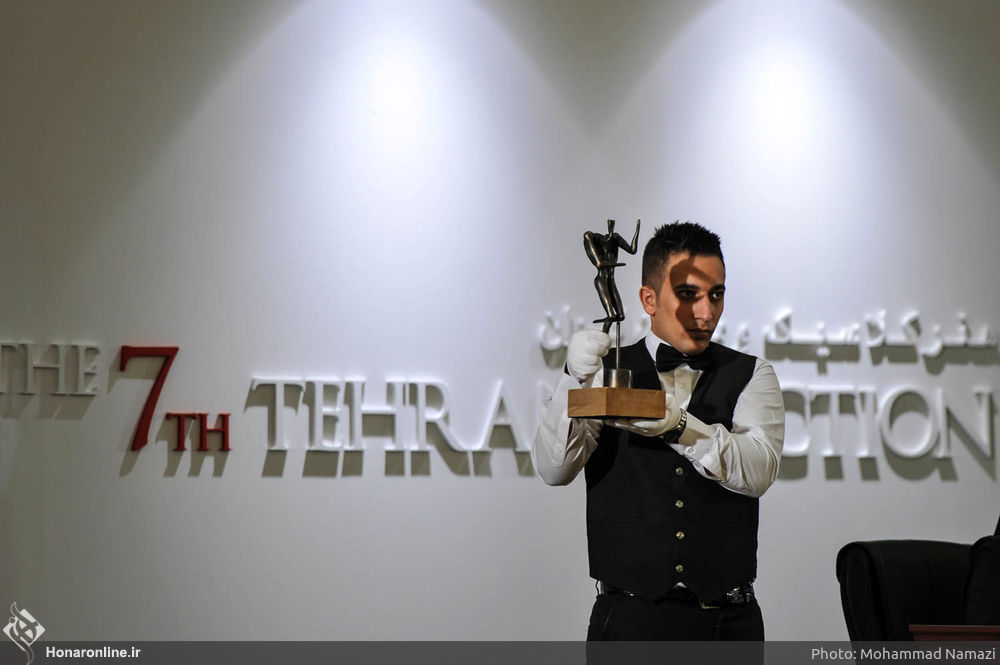
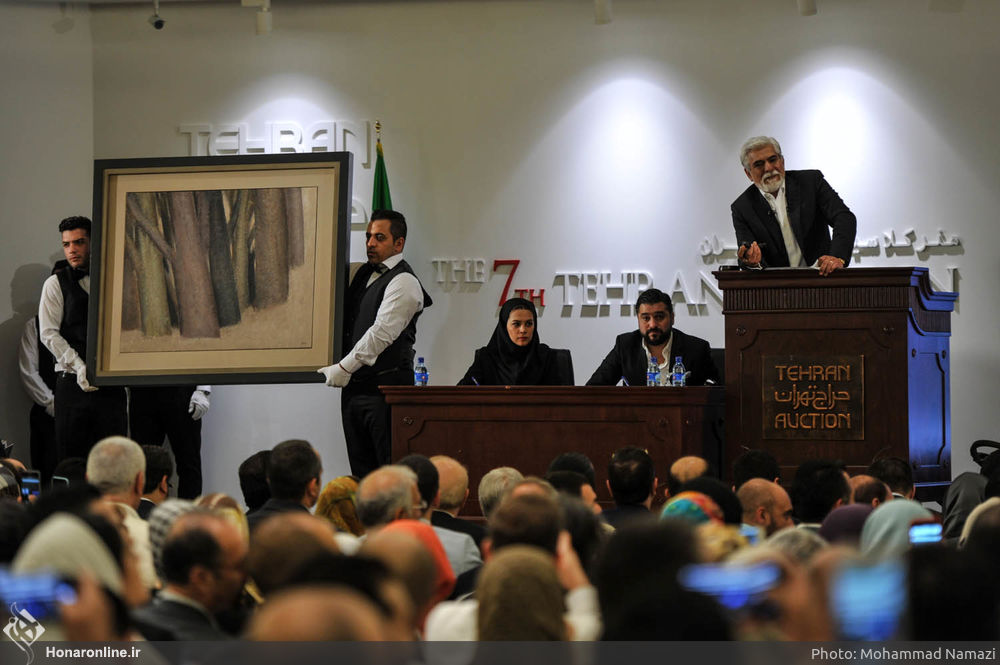
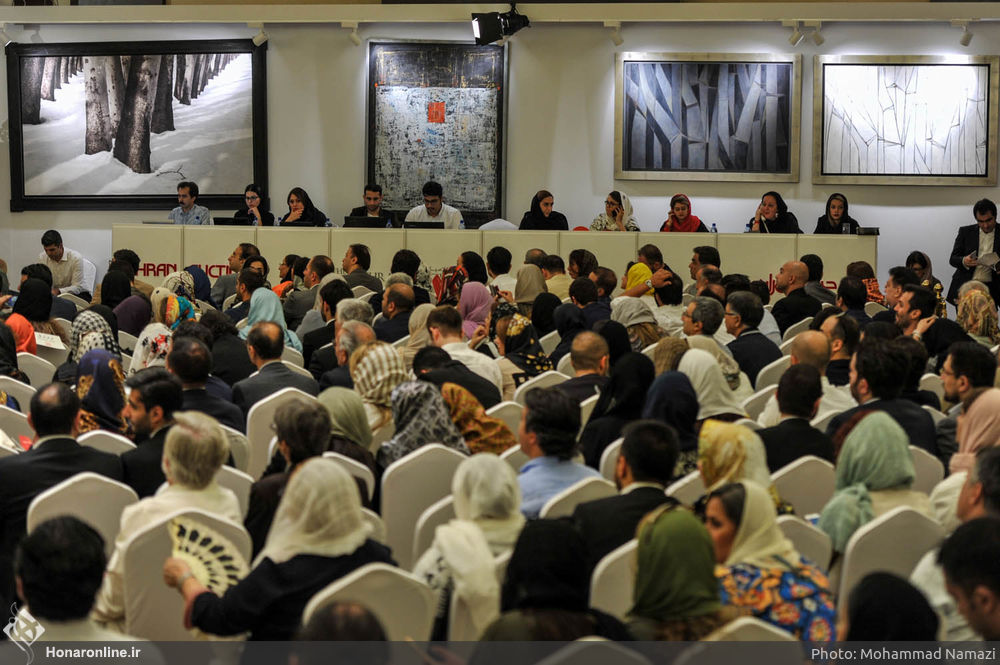
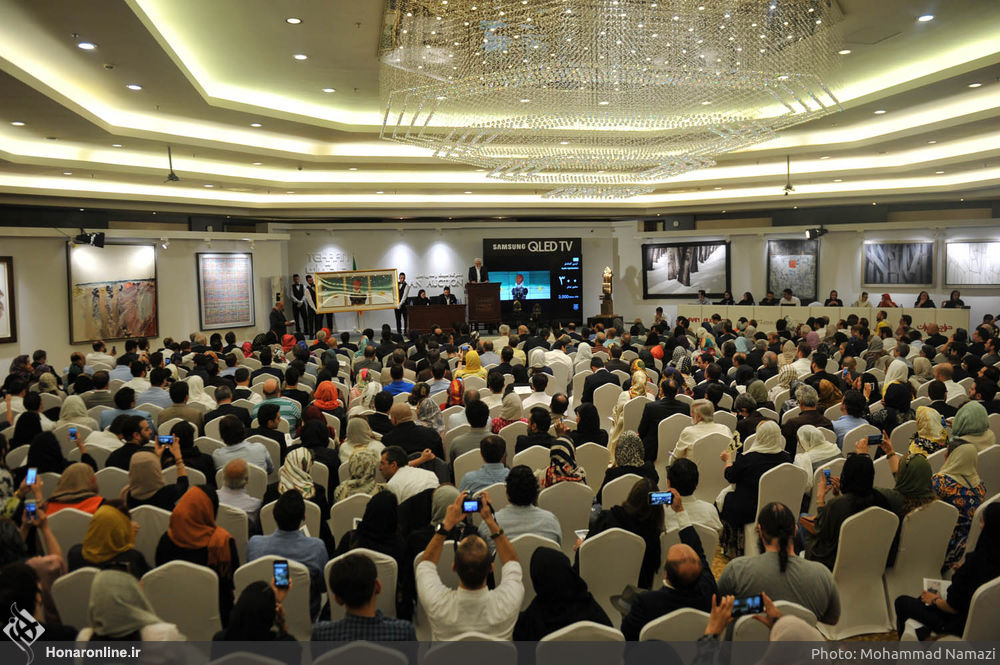
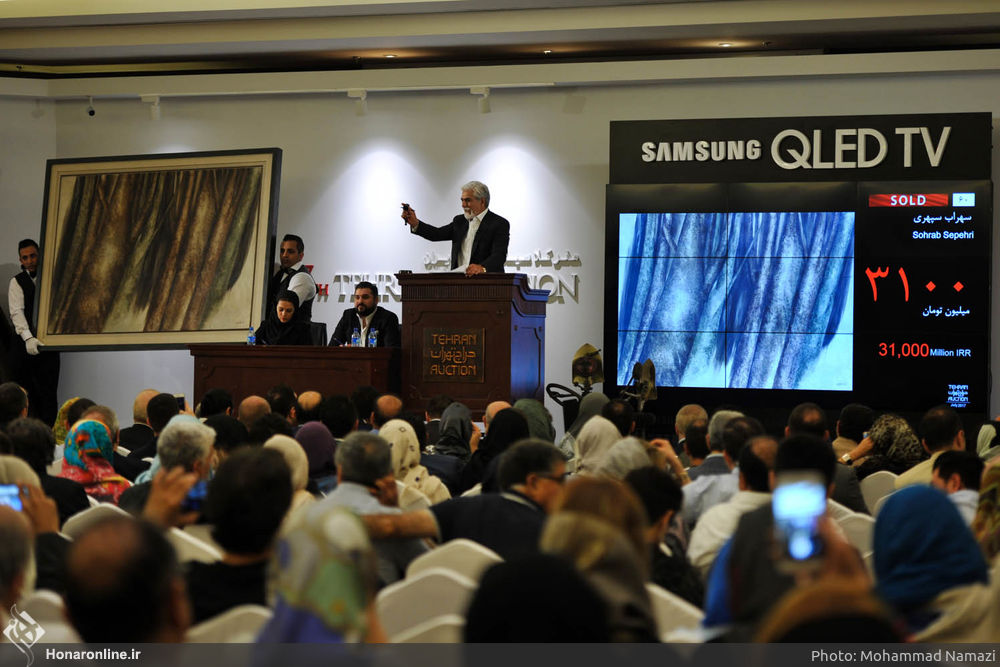
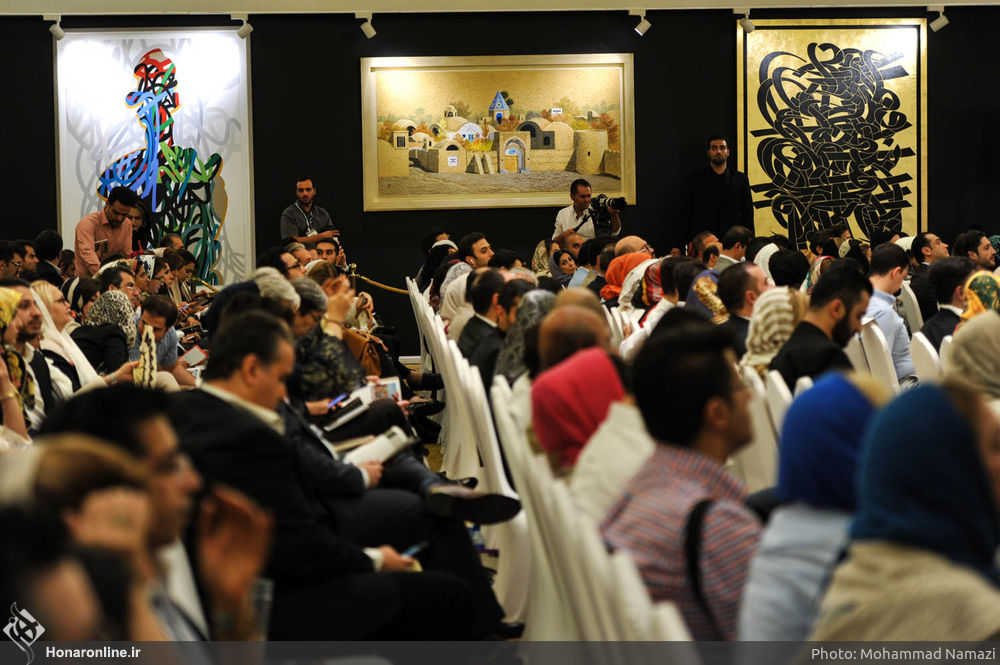
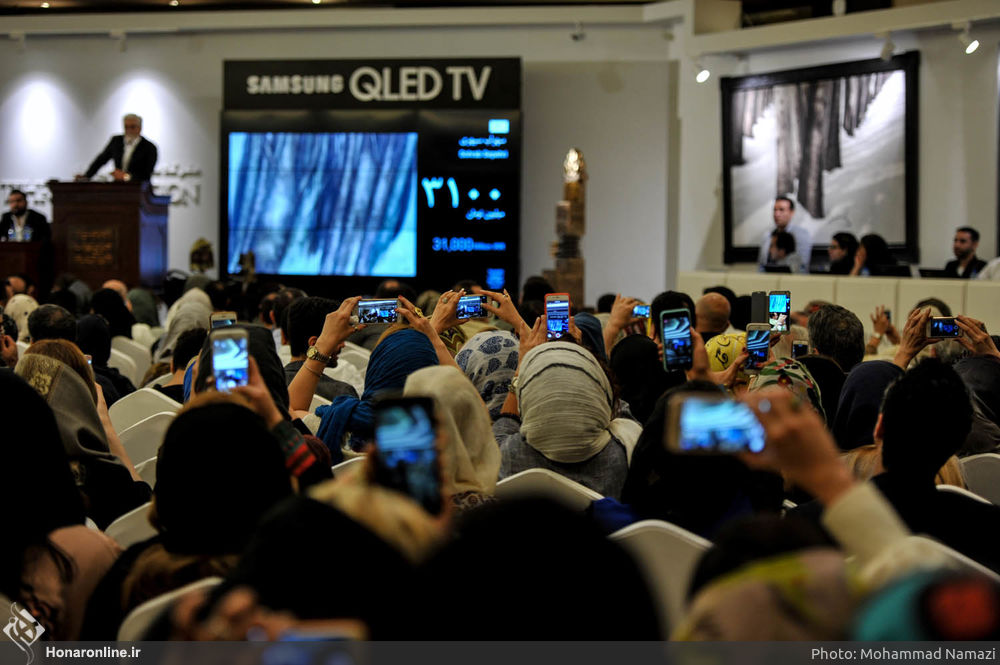
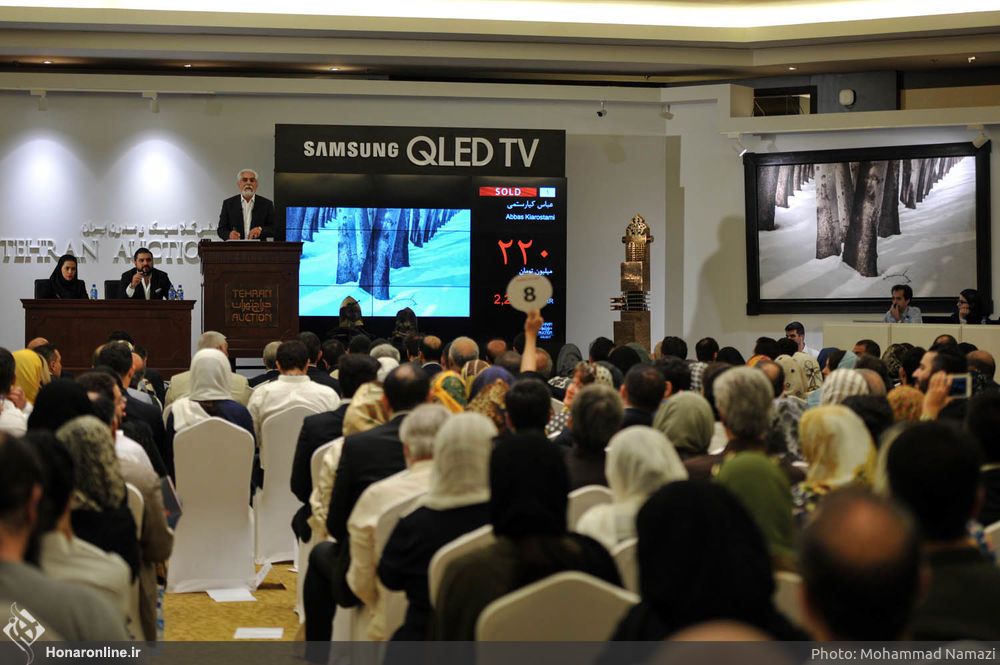
Except one piece, all the 72 pieces, including 13 classic and 59 modern works by Iranian celebrated artists were sold at the event, Honaronline reported.

Although the number of presented works this year reduced compared with the previous two editions, (80 pieces in 2016 and 126 in 2015), the final results showed an increase of $150,000 and $250,000 in comparison with the total sum in 2016 and 2015 respectively.

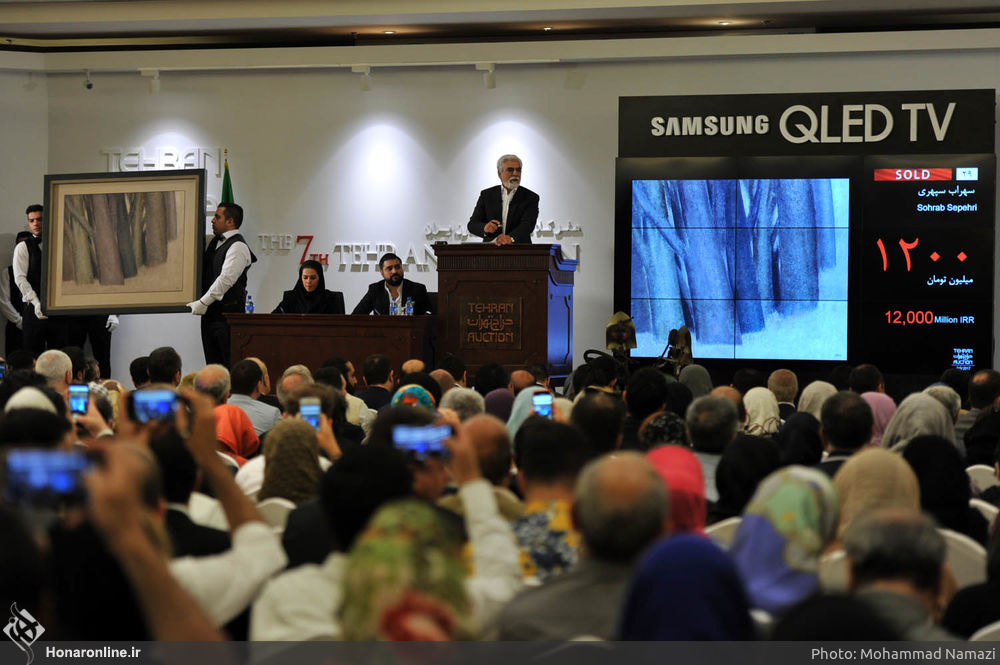
Similar to the past two editions, the top bid was an untitled painting from the ‘Tree Trunk’ series by the legendary poet and painter Sohrab Sepehri (1928-1980). Estimated at $660,000-930,000, it went under the hammer for $825,000, and was named the most expensive painting throughout the Iran’s art history.

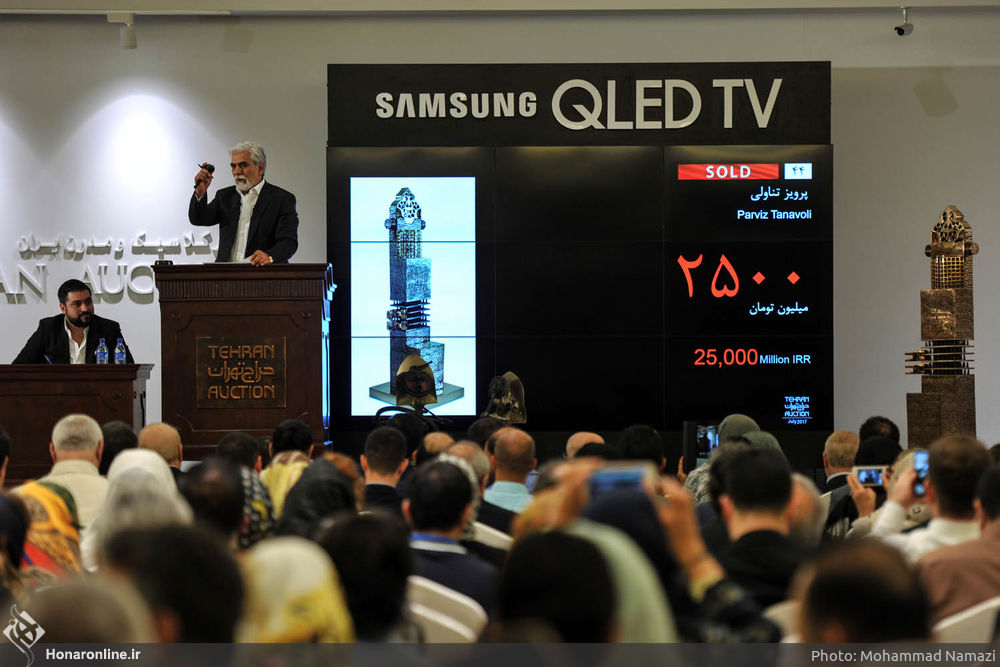
Over 70 Artworks Sold at 7th Tehran Auction for $7mA bronze sculpture titled ‘Poet and Cage’ by the sculptor, painter Parviz Tanavoli, 80, (with the base price of $530,000-$800,000), received the second highest bid and was sold for $665,000.
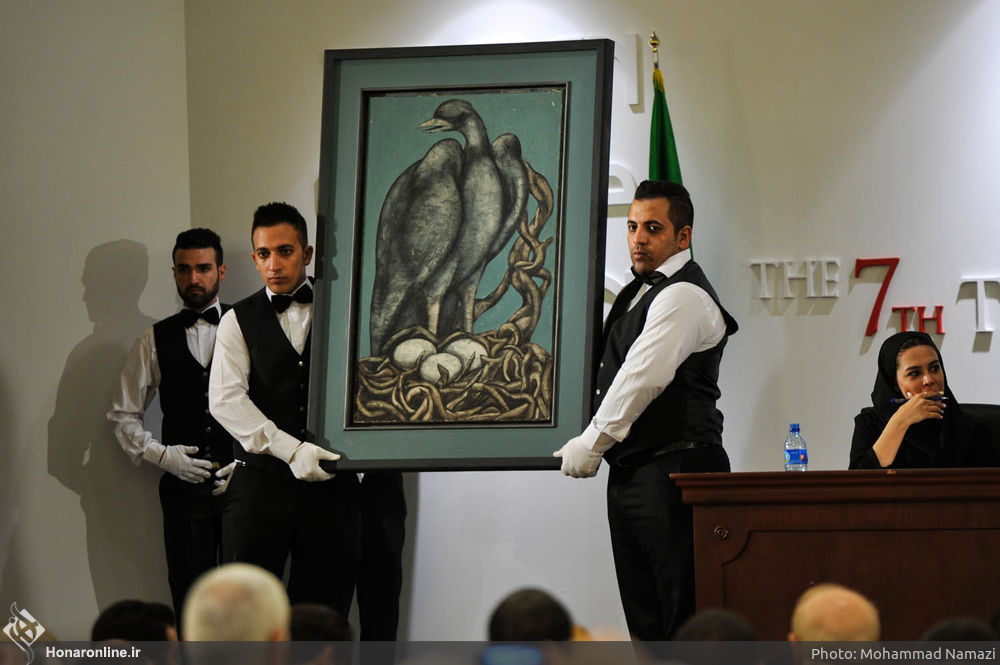
Two works were jointly placed on the third place, both with a final bid of $320,000. They were a painting by painter, sculptor Bahman Mohasses (1931-2010) titled ‘Blind Eagle’ and another oil on canvas work from Sepehri’s ‘tree trunks’ series.

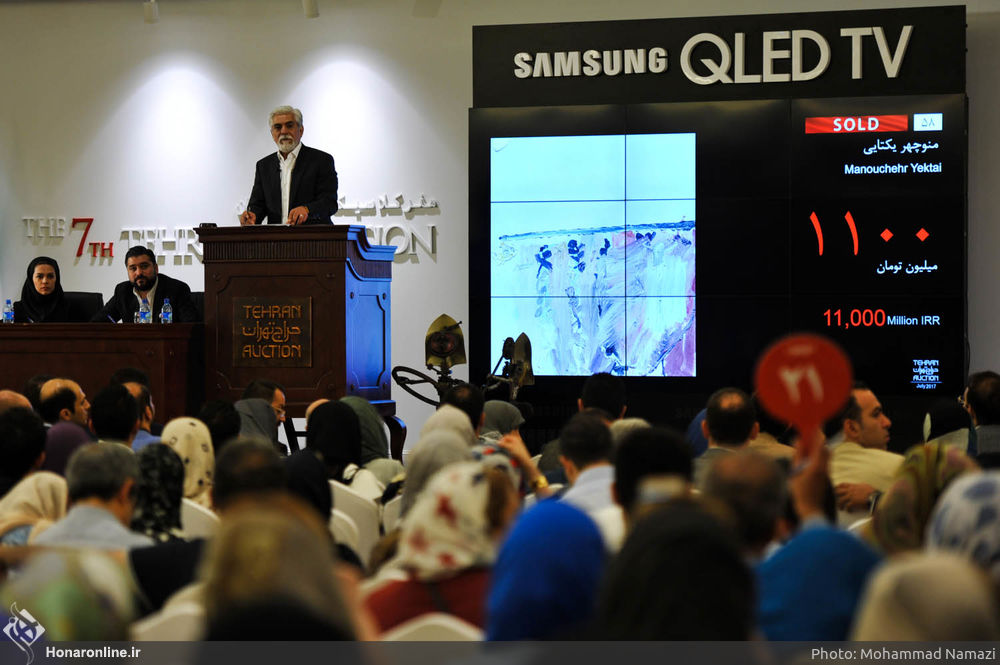
The 6th spot was also shared by two paintings. A 135-year-old painting by the most renowned Persian painter of the late 19th century Mohammad Ghaffari, better known as Kamal-ol-Molk (1859-1940) and a work by abstract expressionist Manouchehr Yektai, 94, both went under the hammer for $305,000.

The rest of the works were sold at prices lower than $265,000 (10 billion rials).

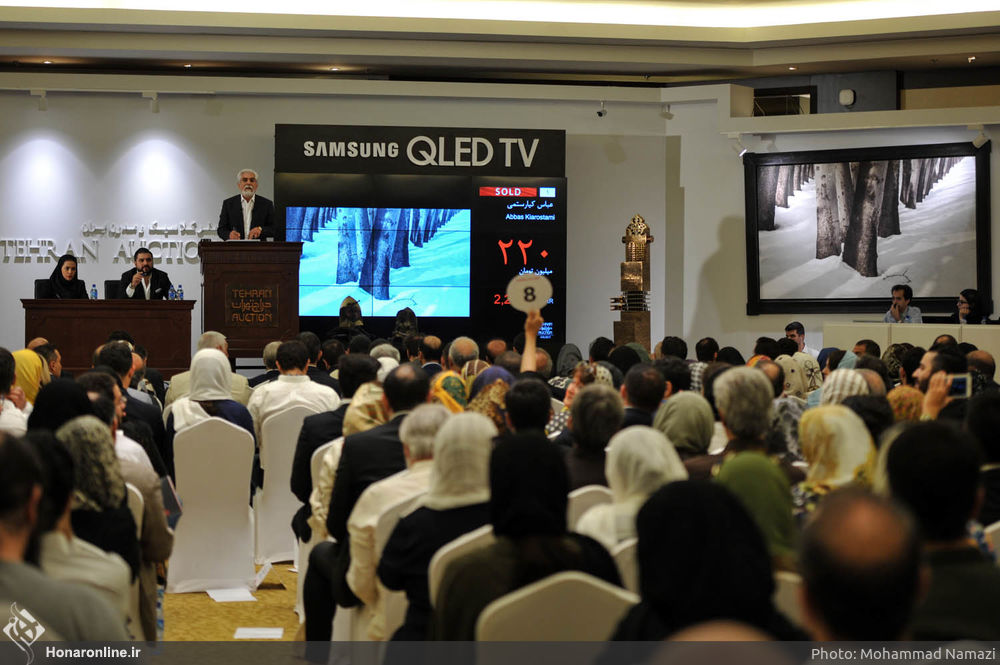
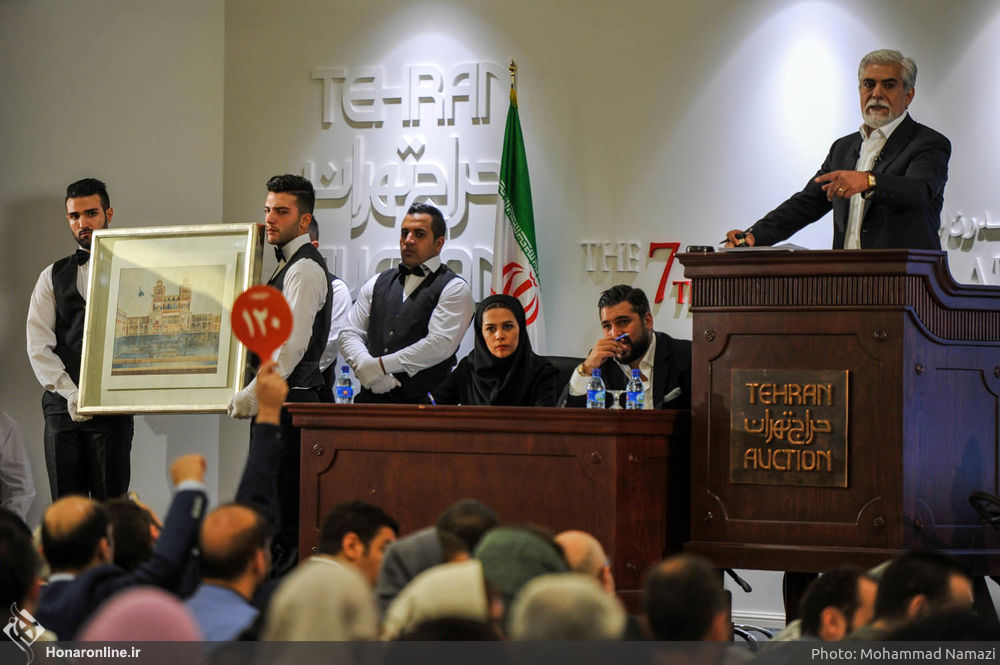
Like last year, actor, screenwriter, director and TV presenter Hossein Pakdel was the auctioneer. A the beginning of the event, he pointed to the first anniversary of the renowned Iranian auteur and photographer Abbas Kiarostami, who passed away last July, and said, “ Kiarostami is always present in Iran’s art, so we start the seventh Tehran Auction with a piece from his photography  collection.

Over 70 Artworks Sold at 7th Tehran Auction for $7mTherefore, Kiarostami’s photo from his ‘Snow White’ series was the first work put on auction. Originally offered for $40,000-55,000, it was eventually sold for $60,000.
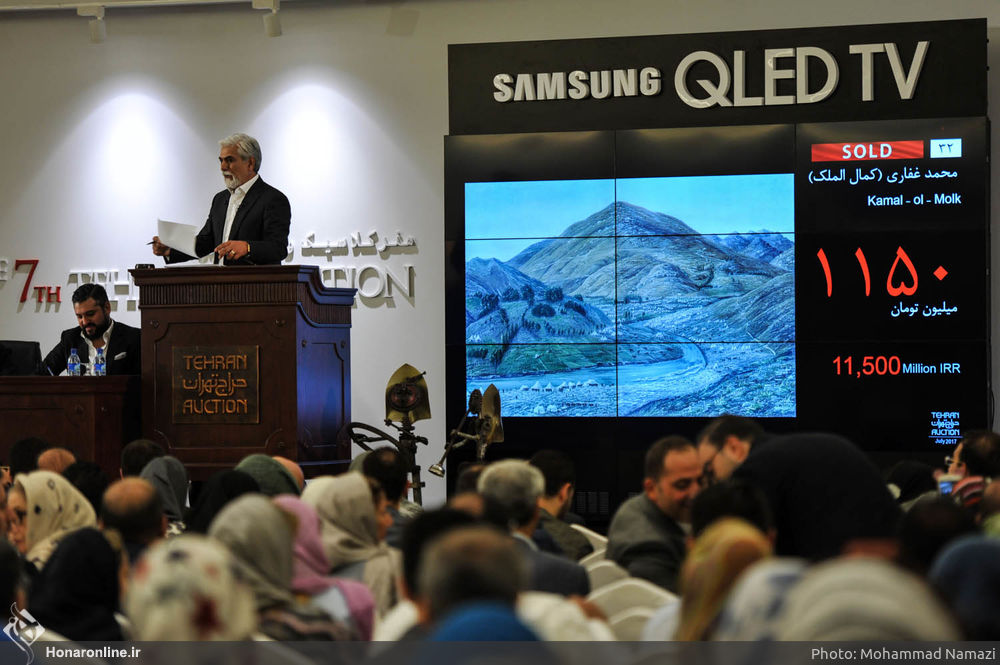
Two works at the event were purchased by the art deputy of the Ministry of Culture and Islamic Guidance. They were Kamal-ol-Molk’s painting and a black-and-white painting by modern art painter Behjat Sadr (1924-2009) which was sold for $70,000.

Attending the auction Ali Moradkhani, the deputy minister, said that the pieces were purchased to be added to the treasured collection of Tehran Museum of Contemporary Art.

The Tehran museum has more than 4,000 items that include 19th and 20th century world-class Iranian, European and American paintings, prints, drawings and sculptures, from almost all artistic periods and movements.

At this year’s edition of the auction, 20 works went under the hammer at a price higher than the maximum value of the basic estimation and the rest received bids within the estimated prices.

Tehran Auction is a national endeavor to address the increasing interest in modern and contemporary Iranian art and facilitate the acquisition of the best quality works in reliable ways.

The first of its kind in Iran, Tehran Auction was launched in 2012 as a private, independent initiative to introduce the best of Iranian art ranging from established and emerging Iranian artists to Iranian art collectors and global buyers.

It also aims to support the domestic art market as a key basis for the international market. Tehran Auction works widely with Iranian art galleries and collectors to ensure a vast and strong selection of paintings, sculptures and photographs.

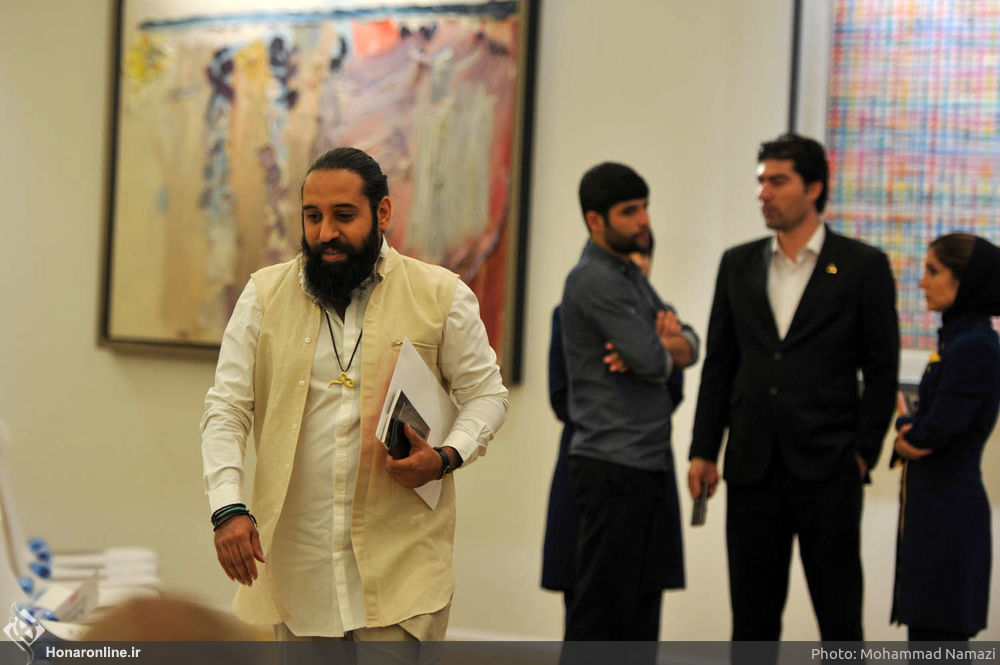
Here are Honar Online’s photos of the auction:

Iran Launches Portal to Promote Freedom of Information (FOI)

Free Access to Info

The portal for dissemination of, and free access to information was inaugurated on July 8 after eight months of research and comparative work on the back of efforts by the Iranian Information Technology Organization (ITO).

The ceremony was attended by Minister of Communications and Information Technology Mahmoud Vaezi as well as Minister of Culture and Islamic Guidance Reza Salehi Amiri, according to a Farsi report by ISNA.

The system became operational after the law on Freedom of Information (FOI) was put into practice. The law on dissemination of, and free access to information was announced in 2009, and its executive directives were drawn up five years later in 2014.

After eight months of research, the portal became operational on a trial basis last month, and was officially unveiled on July 8, 2017.

Organizations and institutions are obliged to provide the information that people need in maximum 10 days via the system.

Iran Launches Portal to Promote Freedom of Information (FOI)
Minister of Communications and Information Technology Mahmoud Vaezi, Minister of Culture and Islamic Guidance Reza Salehi Amiri, and the secretary of the Commission for Publishing and Providing Free Access to Information, Hossein Entezami, in a ceremony on July 8 to launch a portal that gives Iranians free access to information.

“Following the launch of a portal for dissemination of, and free access to information, it’s been 45 days now that people have been able to receive the information they need,” said ICT Minister Vaezi in the unveiling ceremony.

“Different institutions and organizations also must feed their information into this system,” he added.

He said the trial period has helped the ministry detect the system’s weak points and shortcomings.

“Free access to information is a national issue. If a government wants to remain democratic, it should be accountable and have a tool which can establish a bridge between officials and people. This system is one of those instruments.”

The minister said access to information will contribute to transparency and elimination of corruption, saying these features are part of democracy.

“Free access to information is a two-way process, which means not only should institutions provide people with their information, but also people should use that information properly,” said Vaezi.

He then touched upon the limitations which exist in the way of free access to information.

“The first restriction is national interests and security as well as the peace. The second limitation is people’s privacy as well as companies’ trade documents. The third limitation is the information which is effective in decision-making,” he said.

Vaezi went on to say that free access to information is nothing new.

140 countries have laws on free access to information, and another 90 countries are seeking to draw up laws in that regard, he noted.

In the meantime, the secretary of the Commission for Publishing and Providing Free Access to Information, Hossein Entezami, said 34 out of 400 institutions to which the law applies have been connected to the system.

He said the majority of institutions and organizations already linked to the system are executive ones, but a number of judicial and legislative bodies have also joined in.