Monday, December 29, 2025
Home Blog Page 3912

A Look at Iranian Newspaper Front Pages on August 27

The top story in all newspapers today was the remarks made by the Leader of Iran’s Islamic Revolution, Ayatollah Seyyed Ali Khamenei, in a meeting with President Hassan Rouhani and his cabinet members.

The Leader gave the government several pieces of advice, urging them to tolerate their critics and resolve the Iranian people’s economic problems as soon as possible.

The comments made in two ceremonies were also highlighted today: First, the ones in a ceremony to appreciate efforts made by former Tehran mayor Mohammad-Baqer Qalibaf, and second, those made in a ceremony to inaugurate new Culture Minister Seyyed Abbas Salehi.

The above issues, as well as many more, are highlighted in the following headlines and top stories:


Abrar:

1- Rouhani: We’ve Promised to Eradicate Absolute Poverty in 4 Years

2- Zarif: No Decision Made Yet on Rouhani’s Trip to New York

3- Iran Top Officer: Leader Not Convinced by Level of Promotion in Armed Forces’ Power
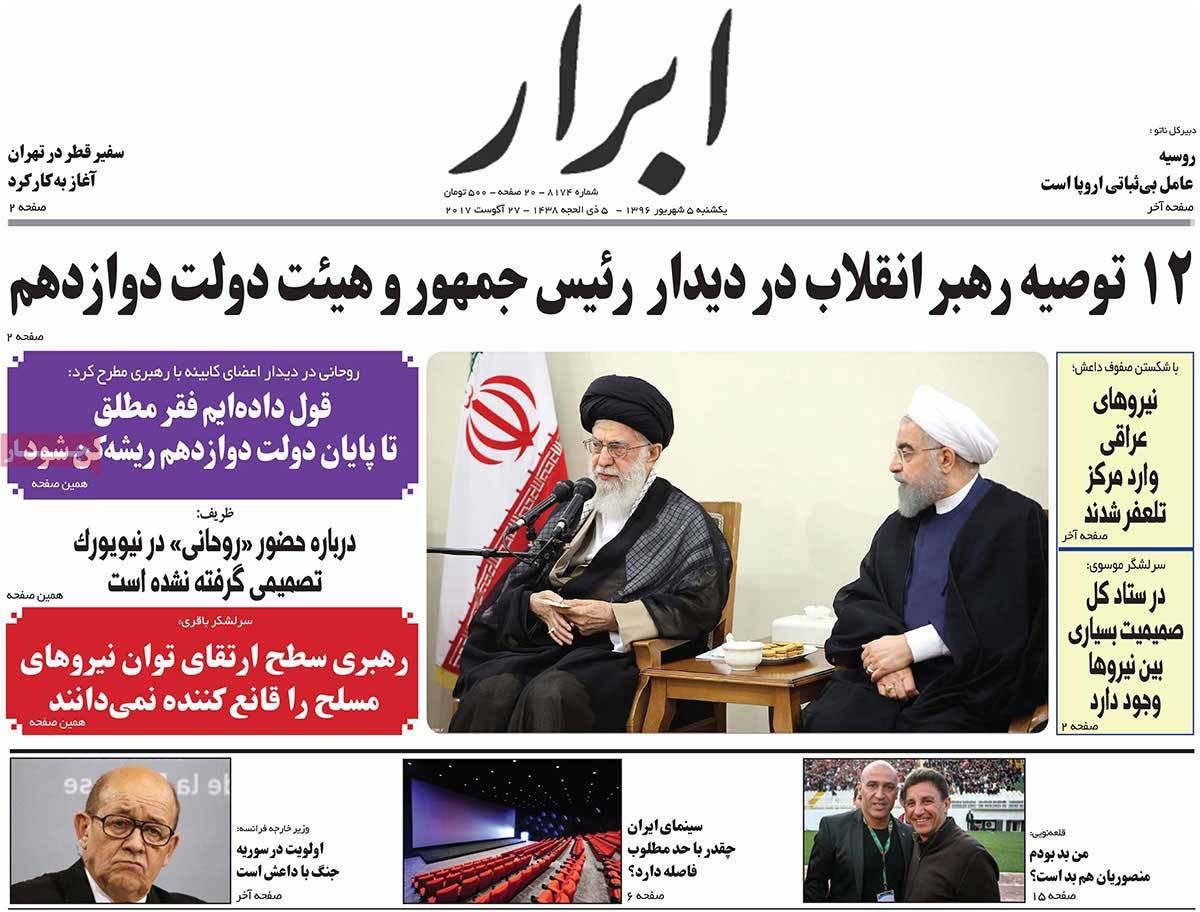
A Look at Iranian Newspaper Front Pages on August 27 - abrar


Aftab-e Yazd:

1- Iran Leader Calls for Government’s Nonstop Efforts to Resolve People’s Economic Woes

2- Cabinet Overshadowed by Three Generals

  • Ministers of Foreign Affairs, Health, Oil Most Competent Ones in Rouhani’s Cabinet
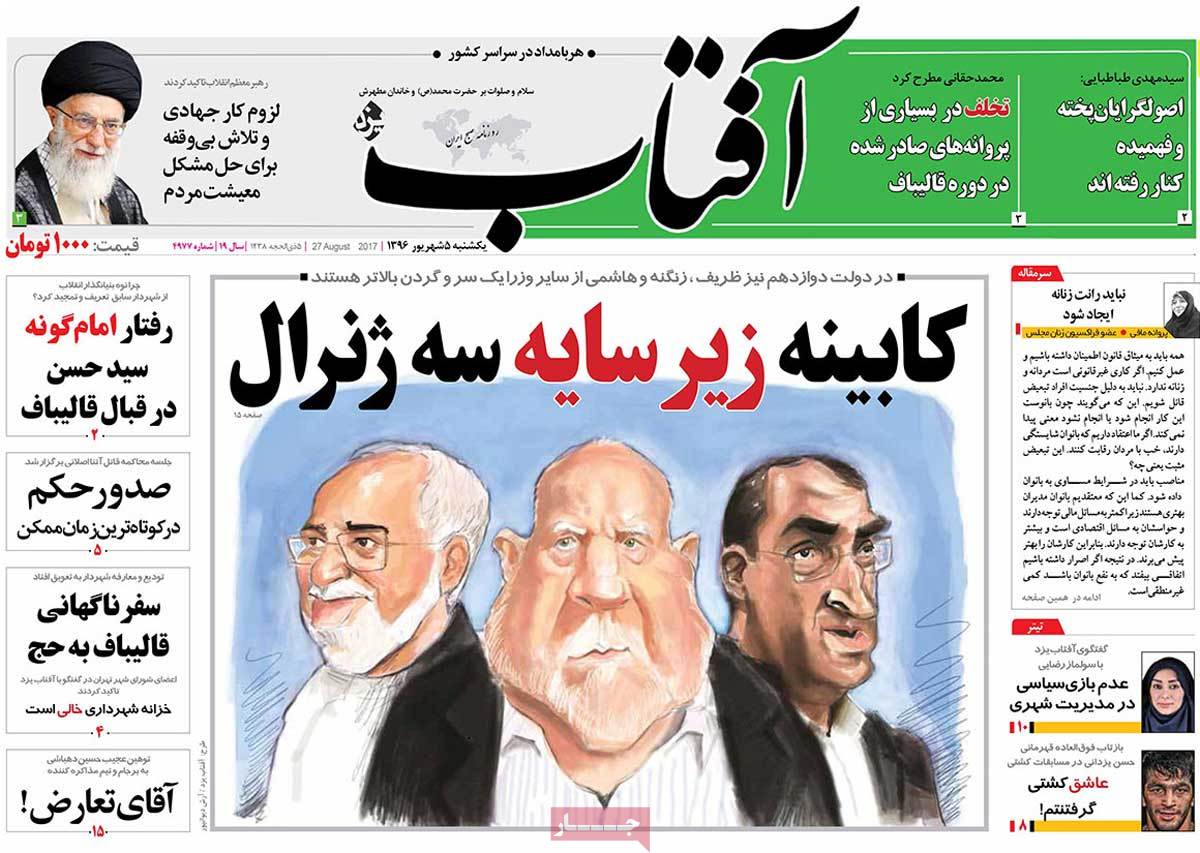
A Look at Iranian Newspaper Front Pages on August 27 - aftab


Arman-e Emrooz:

1- Iran Leader’s 12 Key Advice for Government; Listen to Your Critics

2- Ex-MP Underlines Need for Free Media to Fight Corruption

  • Western Countries Reward Whistle-Blowers
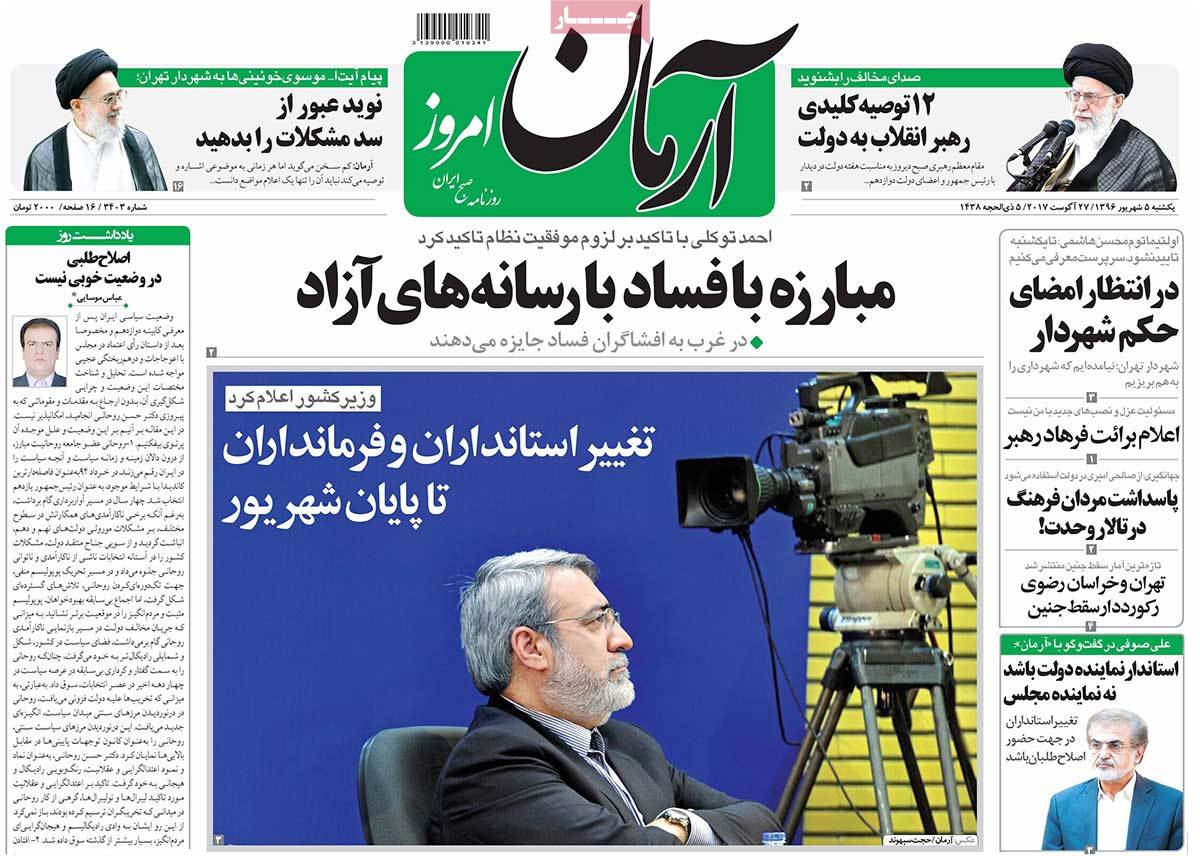
A Look at Iranian Newspaper Front Pages on August 27 - arman


Etemad:

1- New Culture Minister: I’ll Try to Keep Atmosphere of Iran’s Culture Breathable, Clean
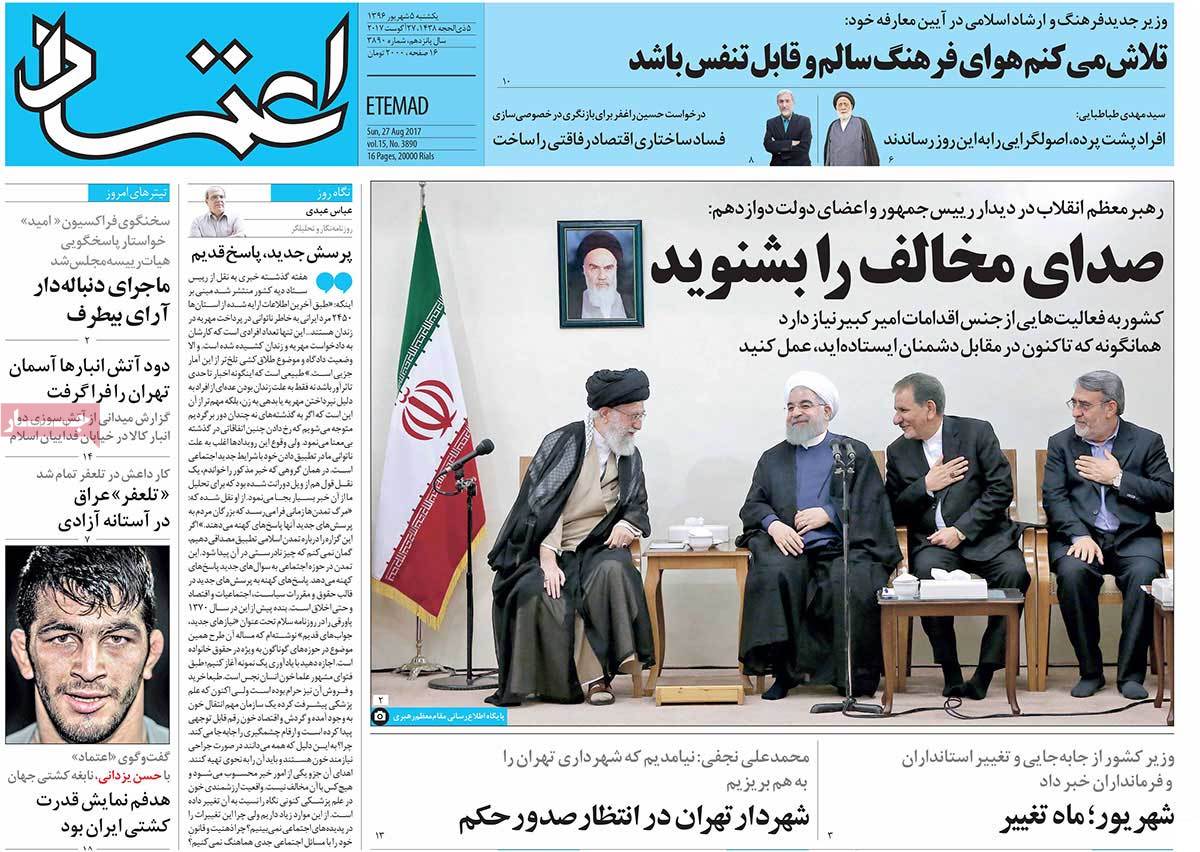
A Look at Iranian Newspaper Front Pages on August 27 - etemad


Ettela’at:

1- Leader Calls for Decrease in Iranian Economy’s Reliance on Oil

2- Iraq’s Tal Afar Liberated from ISIS Occupation
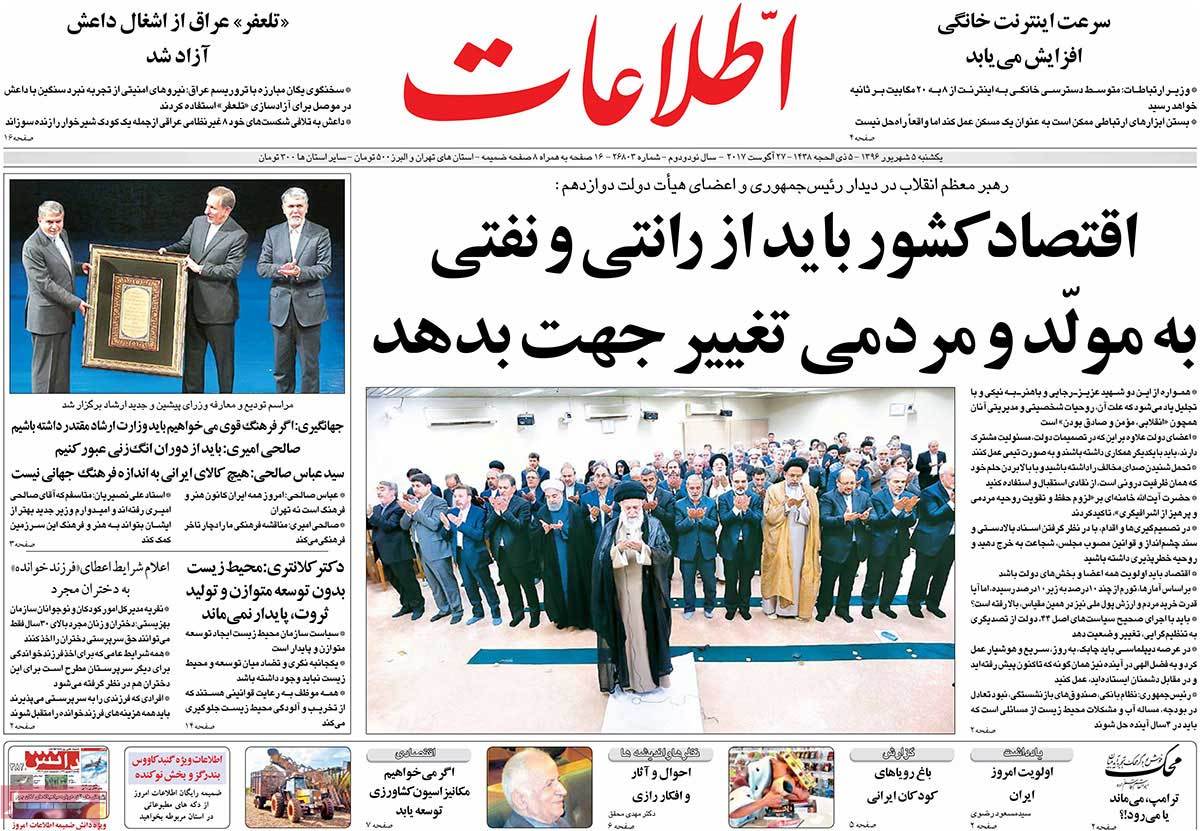
A Look at Iranian Newspaper Front Pages on August 27 - etelaat


Iran:

1- Iran Leader Underlines Necessity of Nonstop Work for People’s Livelihood

2- Trade Minister: Government Won’t Be Backyard for Quasi-Public Corporations
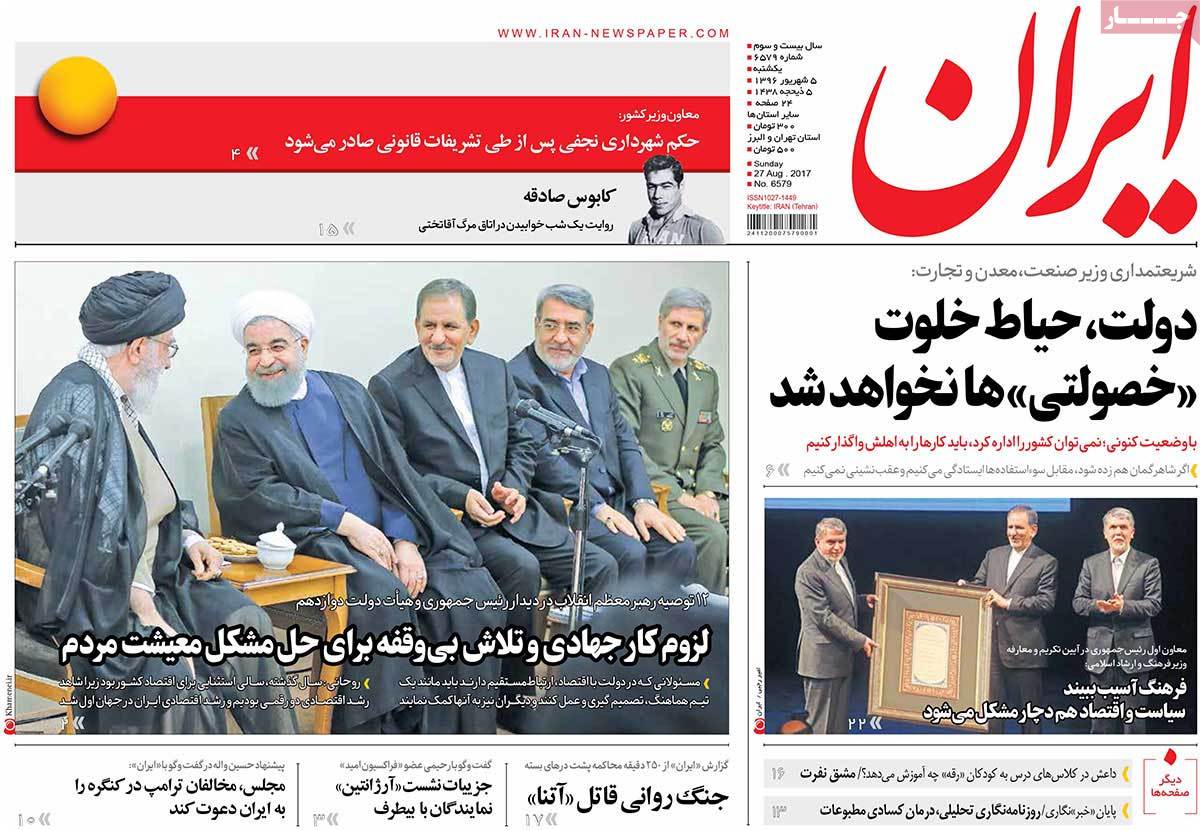
A Look at Iranian Newspaper Front Pages on August 27 - iran


Javan:

1- Leader: Iran’s Economy Should Become Productive, Popular

2- Western Countries in Riyadh Summit Urge Syrian Dissidents to Accept Assad
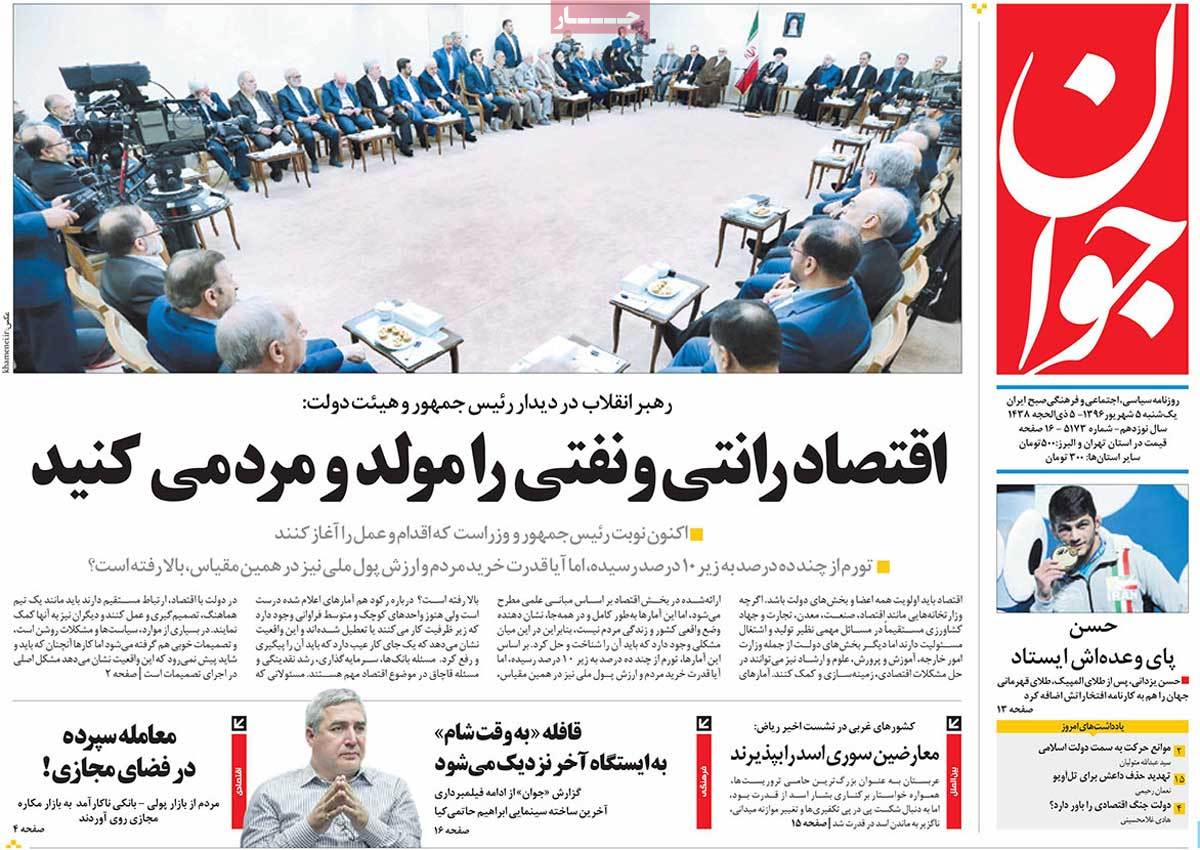
A Look at Iranian Newspaper Front Pages on August 27 - javan


Jomhouri Eslami:

1- Iran Nuclear Chief: First Phase of New Nuclear Project in Fordow Inaugurated

2- Afghanistan’s Shiites Warn Gov’t: If You Don’t Protect Us, We’ll Do It Ourselves

3- 704 Broker Relations with 249 World Banks after Iran Nuclear Deal
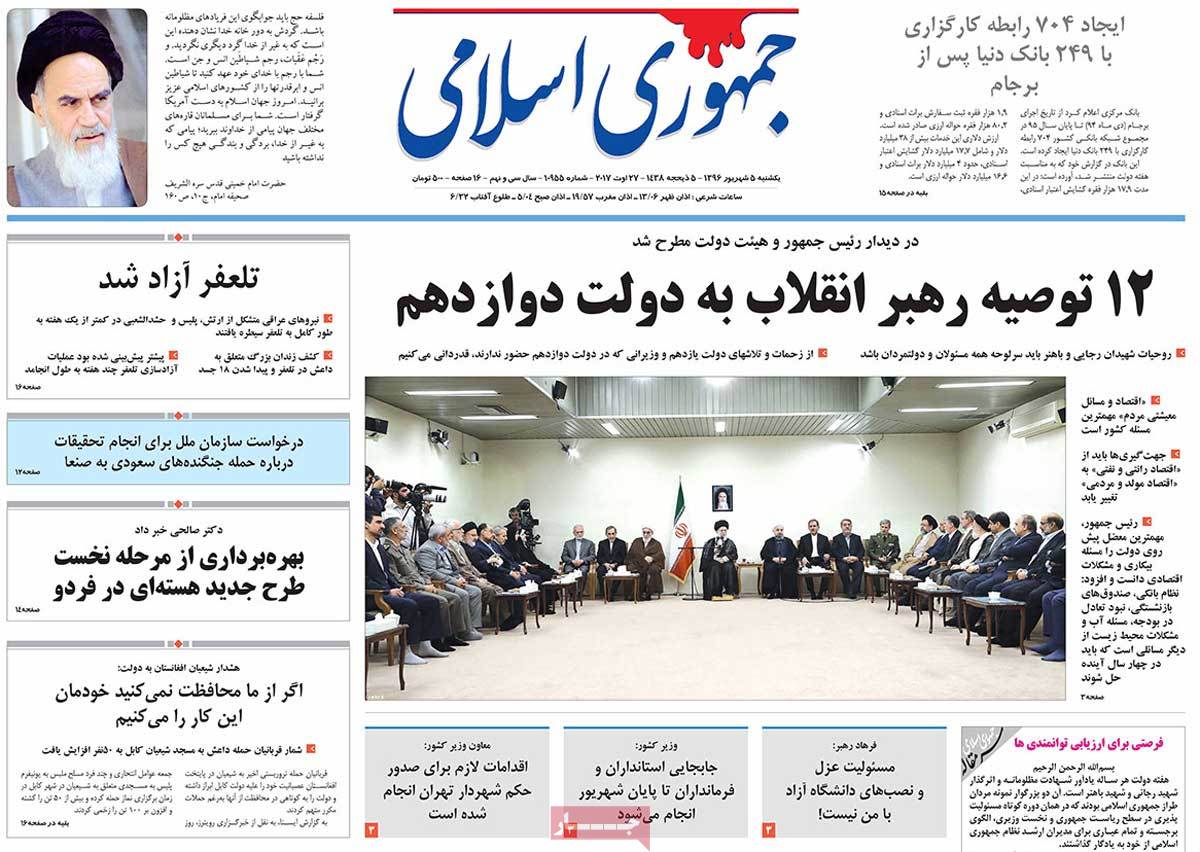
A Look at Iranian Newspaper Front Pages on August 27 - jomhori


Kayhan:

1- Iran Leader Urges Government to Refrain from Aristocracy

  • Economic Statistics Don’t Fully Reflect People’s Real Lives
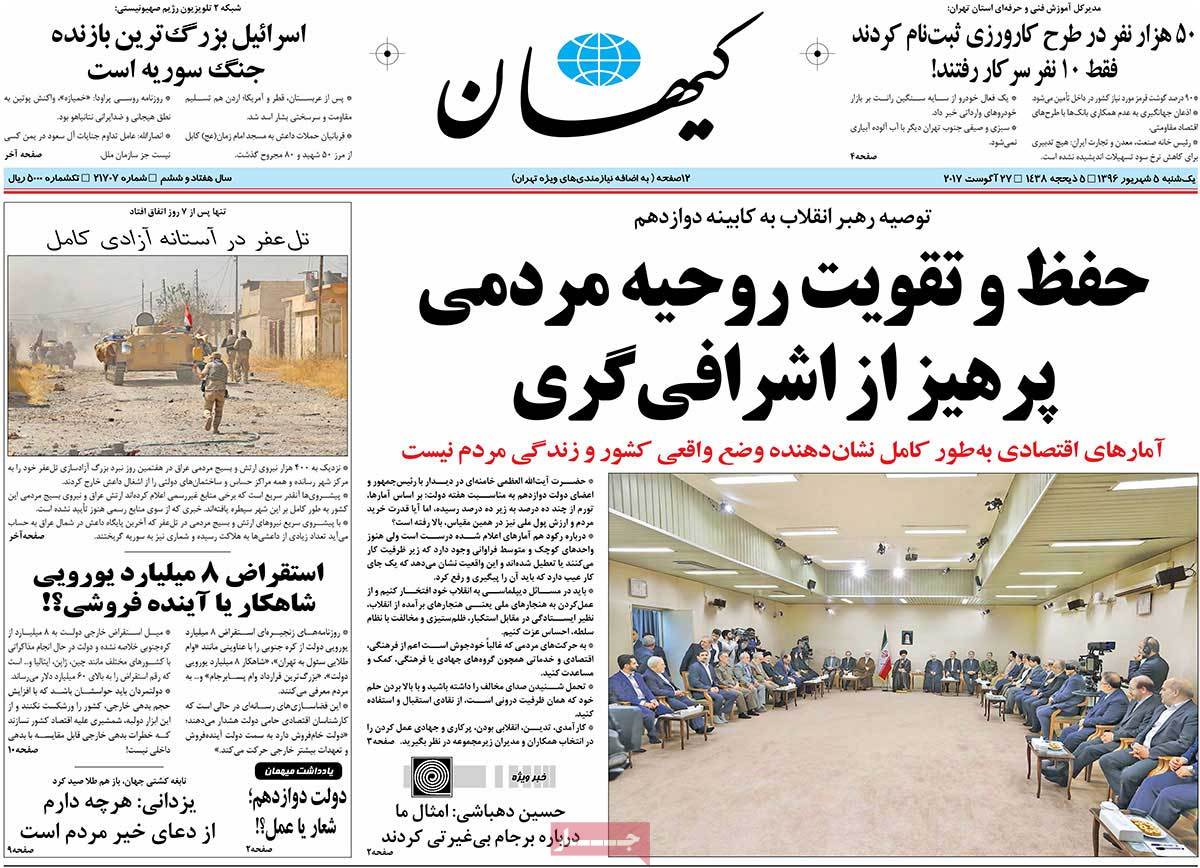
A Look at Iranian Newspaper Front Pages on August 27 - kayhan


Resalat:

1- It’s Time for Rouhani, His Ministers to Start Action: Leader

2- Imam Khomeini’s Grandson: Qalibaf Felt Society’s Pains

3- Rouhani: Resolving Issue of Unemployment First Priority of Gov’t
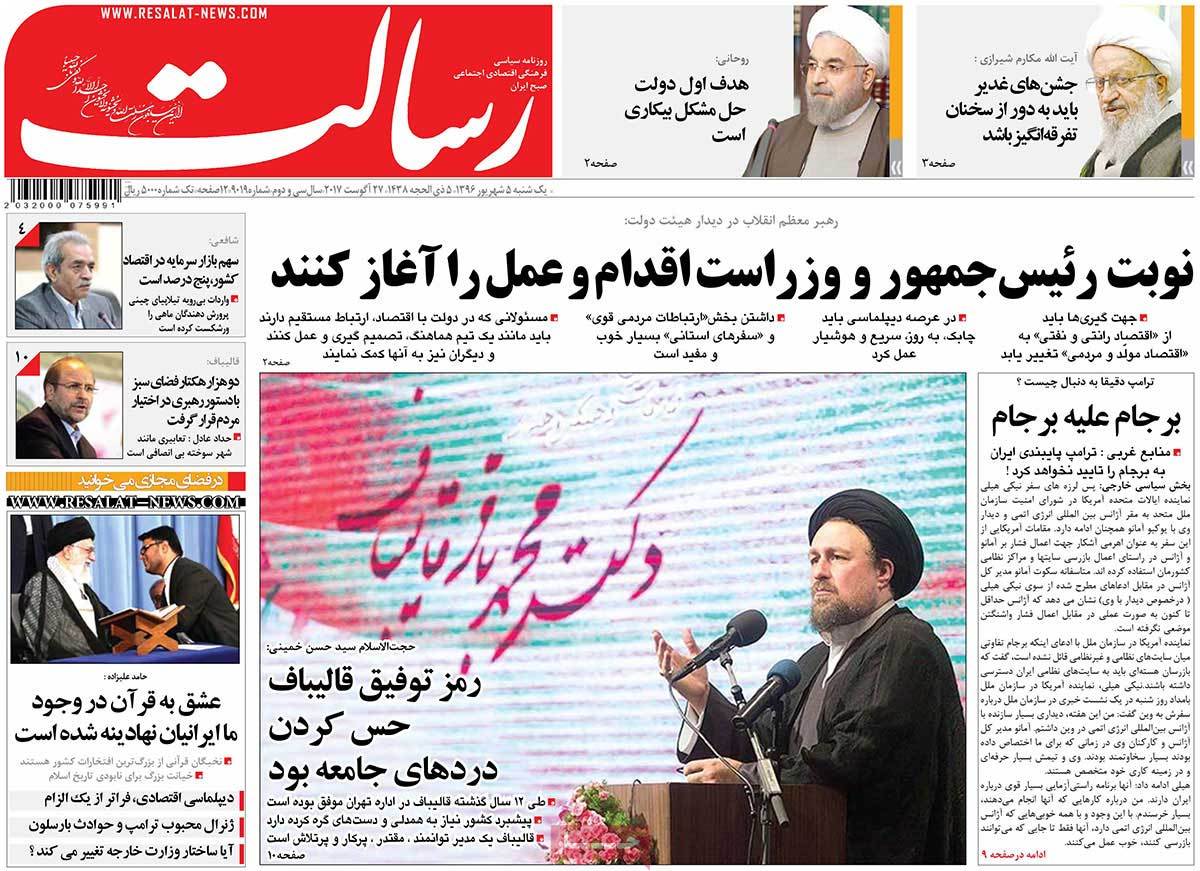
A Look at Iranian Newspaper Front Pages on August 27 - resalat


Rooyesh-e Mellat:

1- Withdrawal from JCPOA to Isolate US: Ex-Secretary

2- Qassemi: Iran to Reciprocate US Moves

3- Average Age of Oil Deal Negotiators Decreased to 30
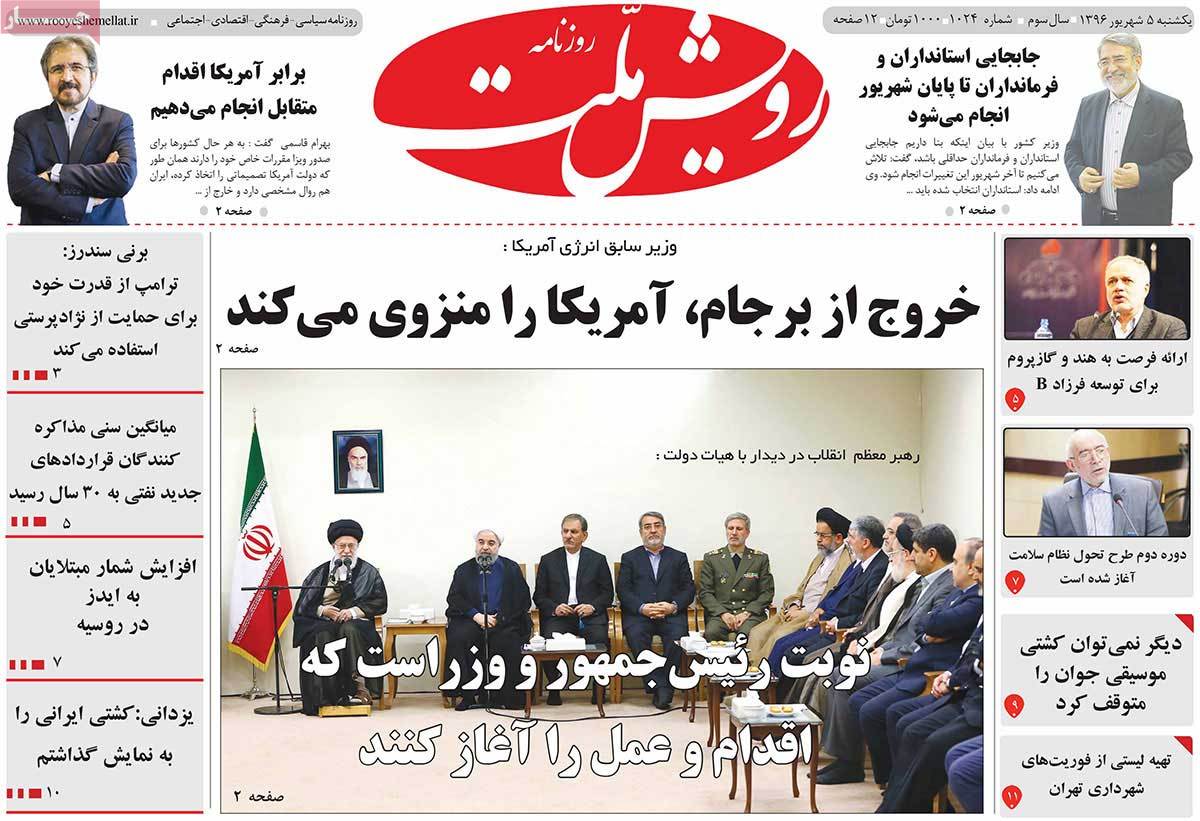
A Look at Iranian Newspaper Front Pages on August 27 - royesh mellat


Shargh:

1- Iran Leader to Gov’t: Tolerate Your Critics

2- First VP: No Change to Be Made to Iran’s Cultural Policies
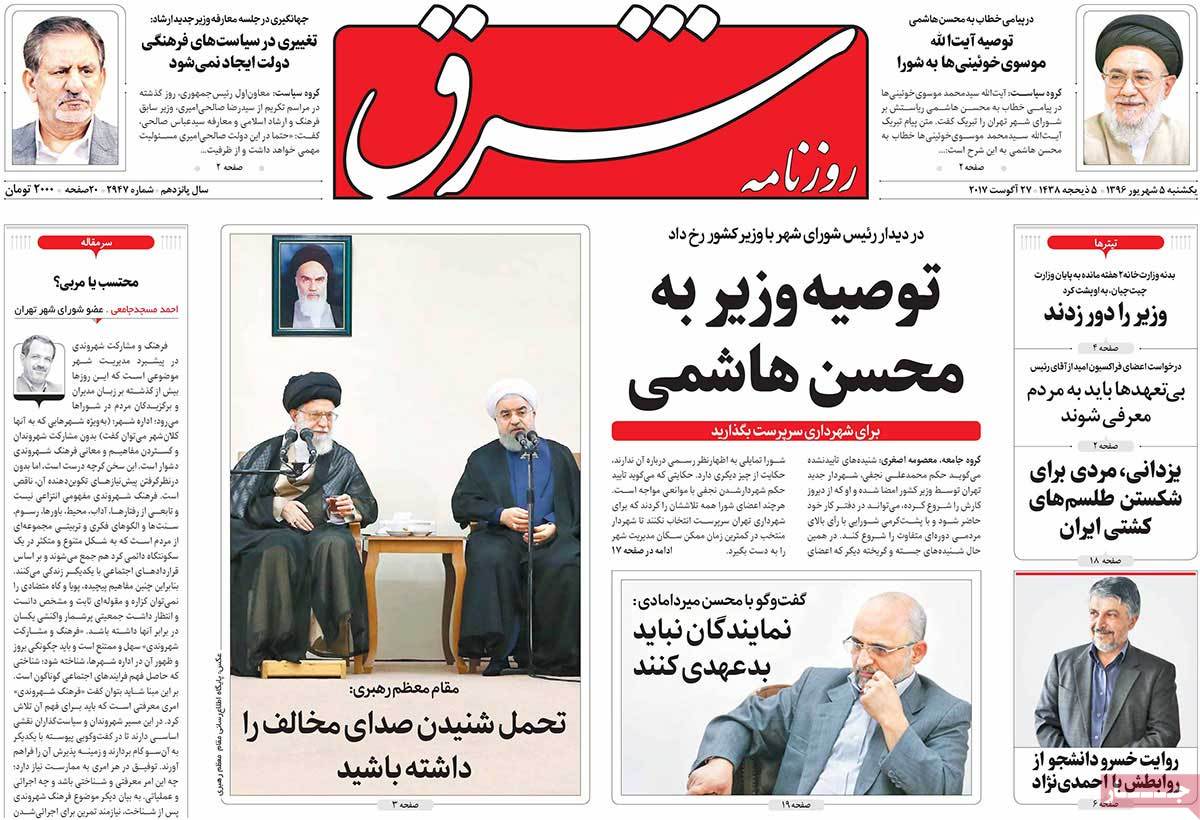
A Look at Iranian Newspaper Front Pages on August 27 - shargh

Iranian Shiite Muslims Set Out on World’s Longest Arba’een Pilgrimage Walk

The farewell ceremony of the world’s longest mass pilgrimage walk of Arba’een, the 40th day after the martyrdom anniversary of Imam Hussein – the third Shiite Imam – was held in the northeastern Iranian city of Mashhad.

According to a Farsi report by the Azad News Agency (ANA), the ceremony was attended by a number of the province’s people and officials.

Arba’een marks the end of a 40-day mourning period following the day of Ashura, Muharram 10, 61 AH (October 10, 680 AD), on which Imam Hussein as well as his 72 companions sacrificed their lives for the sake of Islam in the Battle of Karbala, which took place in the Iraqi city on the same day.

En route to Karbala, the caravan will pass through five Iranian provinces and some 13 cities including Torbat-e Heydarieh, Bajestan (both located in Khorasan Razavi Province), Ferdows and Tabas (both in South Khorasan Province), Khur and Biabanak County, Nain, Shahreza, Varzaneh, Dehaqan (all located in Isfahan Province), Borujen and Lordegan (both in Chaharmahal and Bakhtiari) as well as Izeh and Ahvaz (both in Khuzestan province). It will enter the Iraqi territory from Shalamcheh border checkpoint in western Iran and will arrive at Imam Hussein’s Holy Shrine on Arba’een.

Every year, millions of Shiite Muslims take part in Arba’een pilgrimage walk, one of the biggest marches worldwide. This year, Arba’een will fall on November 9.

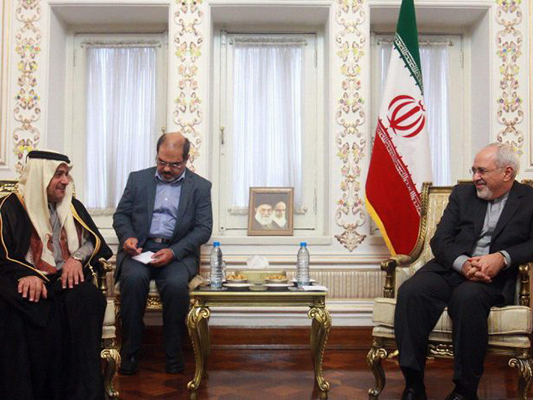
‘Qatar Admits Its Mistake by Restoring Ambassador to Iran’

Qatar Admits Its Mistake by Restoring Ambassador to Iran
Ali Bin Hamad al-Sulaiti, Qatar’s ambassador to Tehran, returned to Iran on Friday after a 20-month hiatus.

Political analyst Sa’dollah Zare’i has, in an article published in the Persian-language Jame Jam daily, weighed in on Qatar’s recent decision to expand the level of its ties with Iran. The following is the full text of the analytical piece written by Zare’i, who is an expert on West Asia issues as well as a university lecturer.

Doha’s decision to return its ambassador to Tehran is, in fact, an admission of the mistake it made last year under pressure from Saudi Arabia. During that time, Qatar itself suffered due to Riyadh’s logic, or rather lack of logic. Of course, the blow dealt to Qatar was much more serious than that suffered by Iran because Saudi Arabia’s call for Arab states to sever relations with Iran was futile and only a few Arab countries accepted to do so. This came as unlike Saudi Arabia, the United Arab Emirates and Bahrain, Qatar did not close its embassy in Tehran last year and only settled for downgrading the level of its political relations with Iran form ambassador to charge d’affaires. With this move, Doha showed its discontent with the statement of the [Persian] Gulf Cooperation Council (GCC). Maybe what happened to this tiny nation a year later [the tension in Qatar’s ties with Saudi Arabia] was the result of its non-compliance with the GCC’s statement.

The question here is what impact the return of Doha’s ambassador to Iran will have on boosting relations with the country.

The reality is that Iran-Qatar relations, so far, have been to the benefit of Qatar because these relations have been largely limited to the political domain, which Doha has used as a bargaining chip in dealing with some governments. So, Qatar’s returning its ambassador to Tehran is in line with Doha’s interests and, at the moment, is not that much to the benefit of Iran. If we look at the very low level of Tehran-Doha ties, we will find out that Iran is among the countries which have the lowest levels of trade with Qatar. This comes as Iran, geographically speaking, is one of the closest countries to Qatar, and naturally, Qatar can have access to Iran’s agriculture market at a much lower cost. Like other Arab countries to the south of the Persian Gulf, Qatar prefers to purchase lower-quality agricultural produce from other countries and ignore high-quality Iranian products.

The return of Qatar’s ambassador to Tehran can provide the answer to another key question: Will severance or downgrading the level of ties with Iran last? The return of the Qatari ambassador suggests the answer to that question is “no.” The important point here is that Iran is a great country which is influential in most cases and issues from India to Morocco; hence, the severance or lowering the level of political relations with Iran will show its negative consequences in the short run and the country which has done so will regret it.

There is another important point in Iran’s foreign relations. In our political ties with foreign governments, we do not pay that much attention to whether or not our relations are beneficial to us. In other words, our relations with a country remain limited to the “political layer” and this is a strategic mistake. For instance, our diplomatic relations with Doha, which are as old as the short lifetime of Qatar, have had almost no economic benefits for Iran. This is while Qatar’s imports cross the $22 billion mark annually. Naturally, Tehran-Doha economic relations should account for at least $5 billion of that figure. So, in my estimation, if our relations with Qatar do not expand from political to economic and cultural areas as well, the continuation of the Qatari embassy’s work in Tehran and that of Iran’s embassy in Doha will only serve the interests of Qatar.

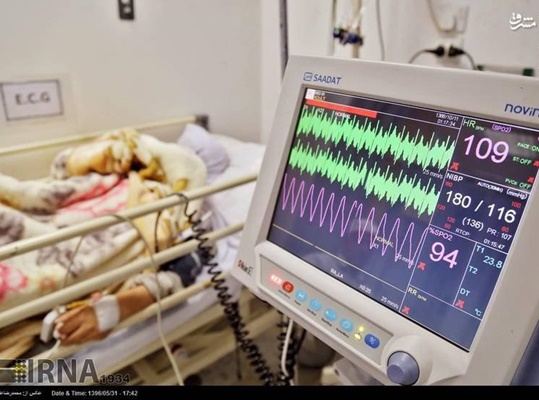
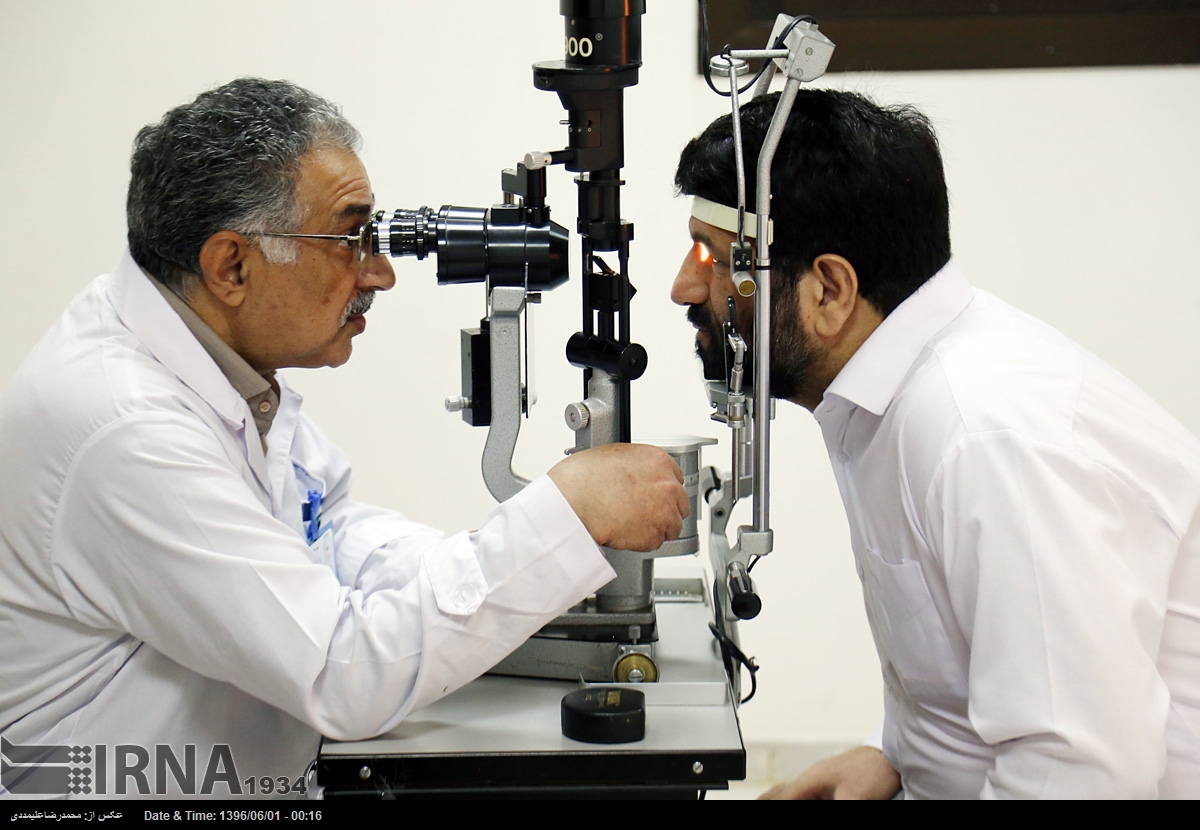
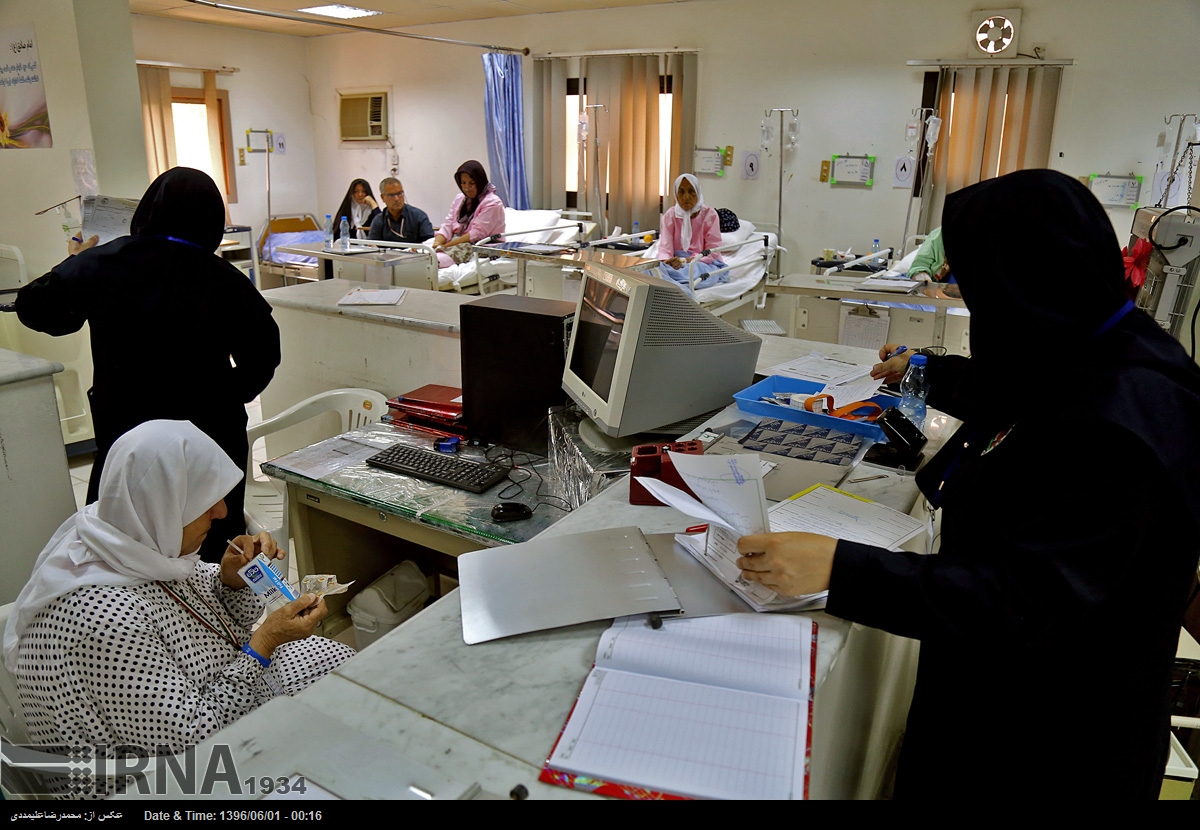
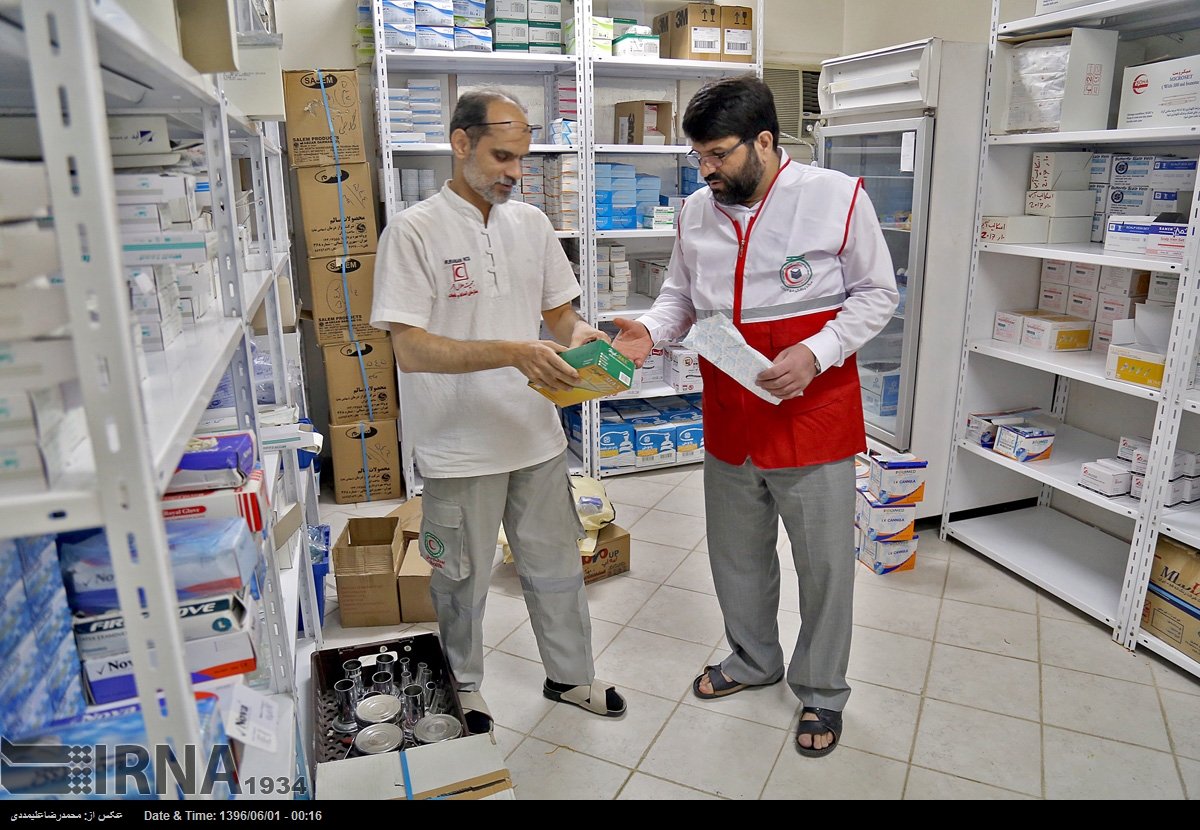
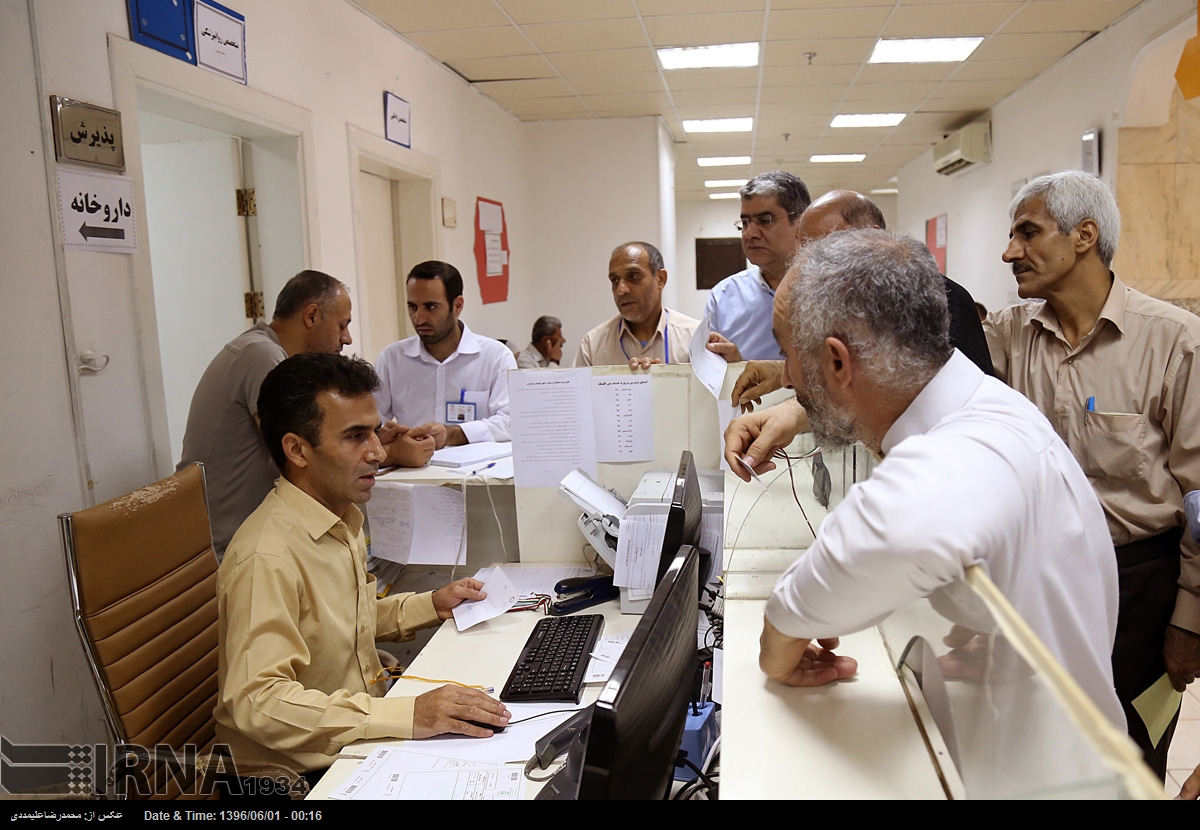
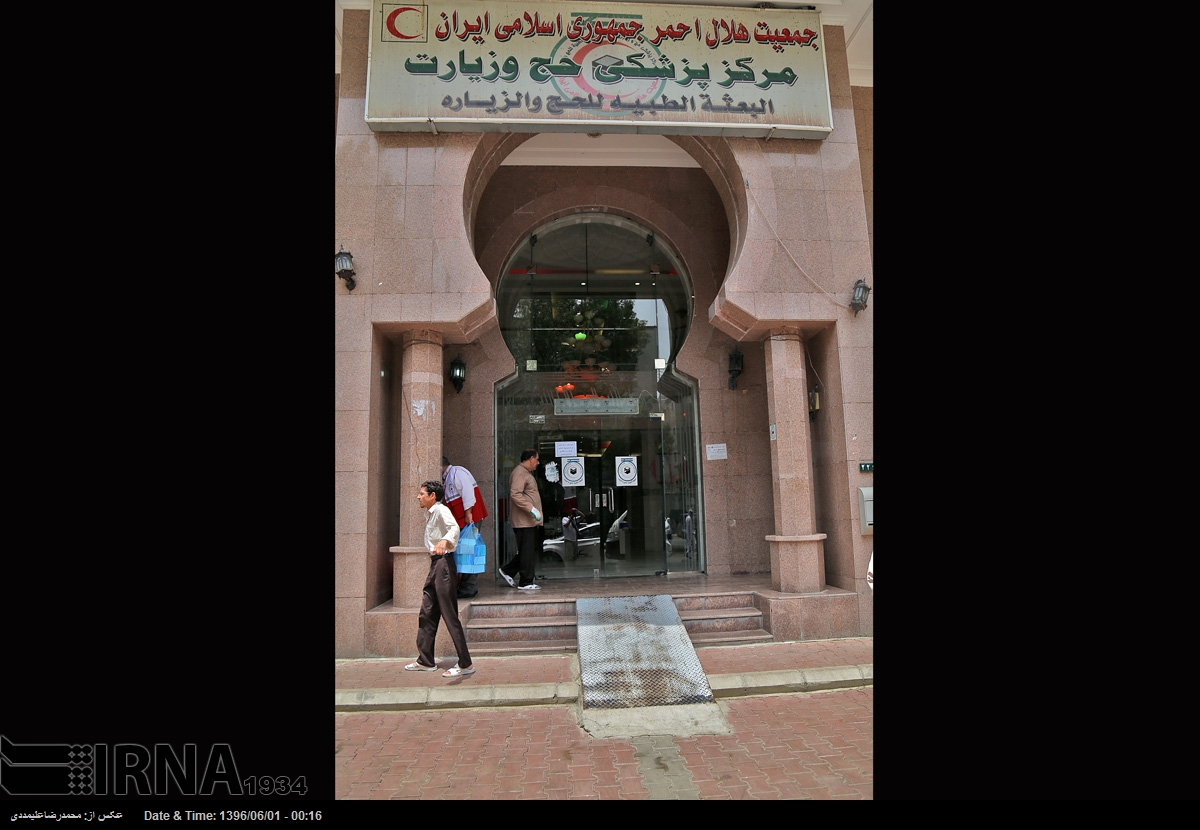
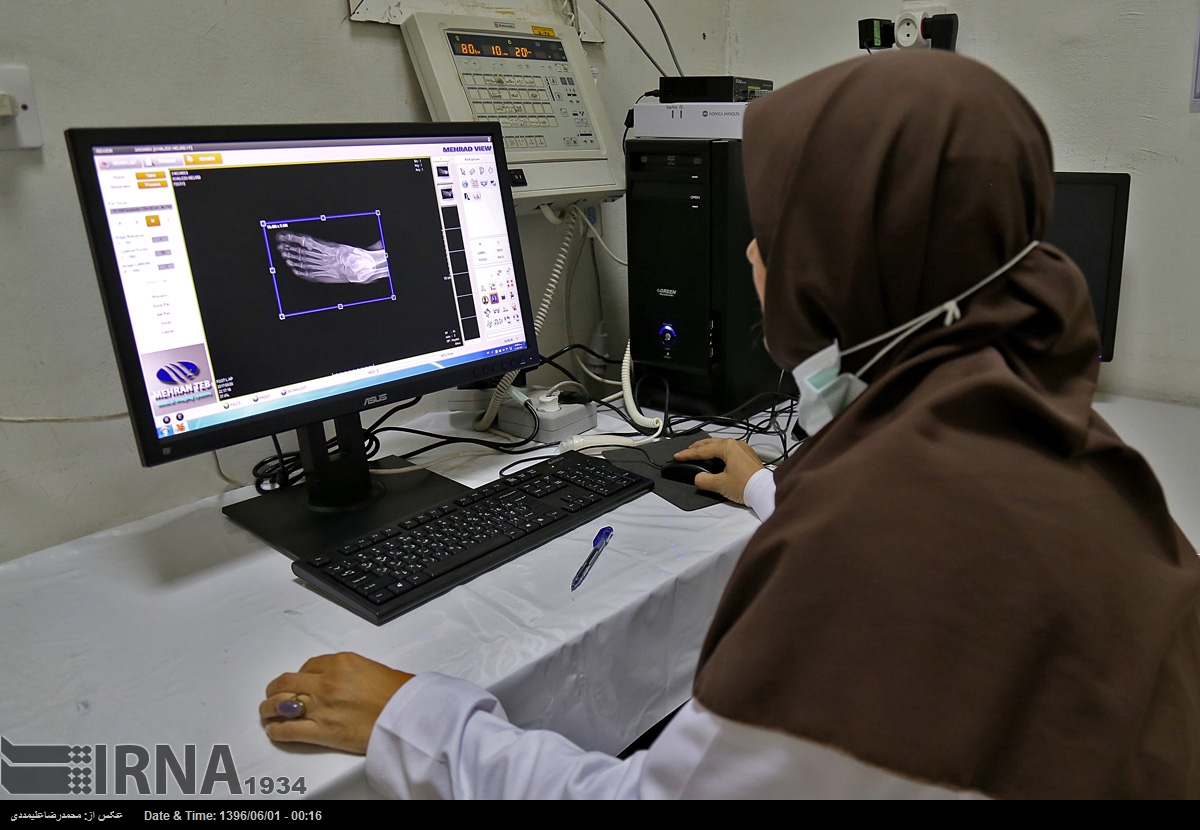
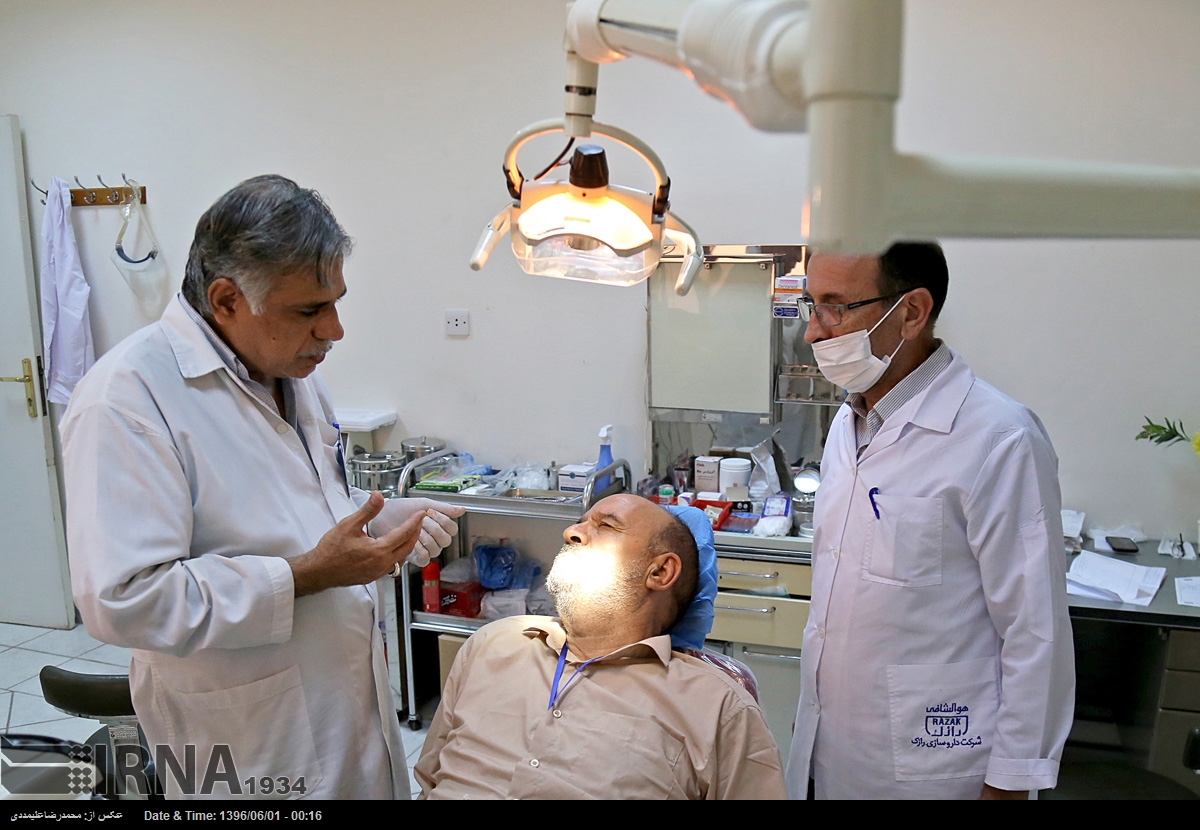
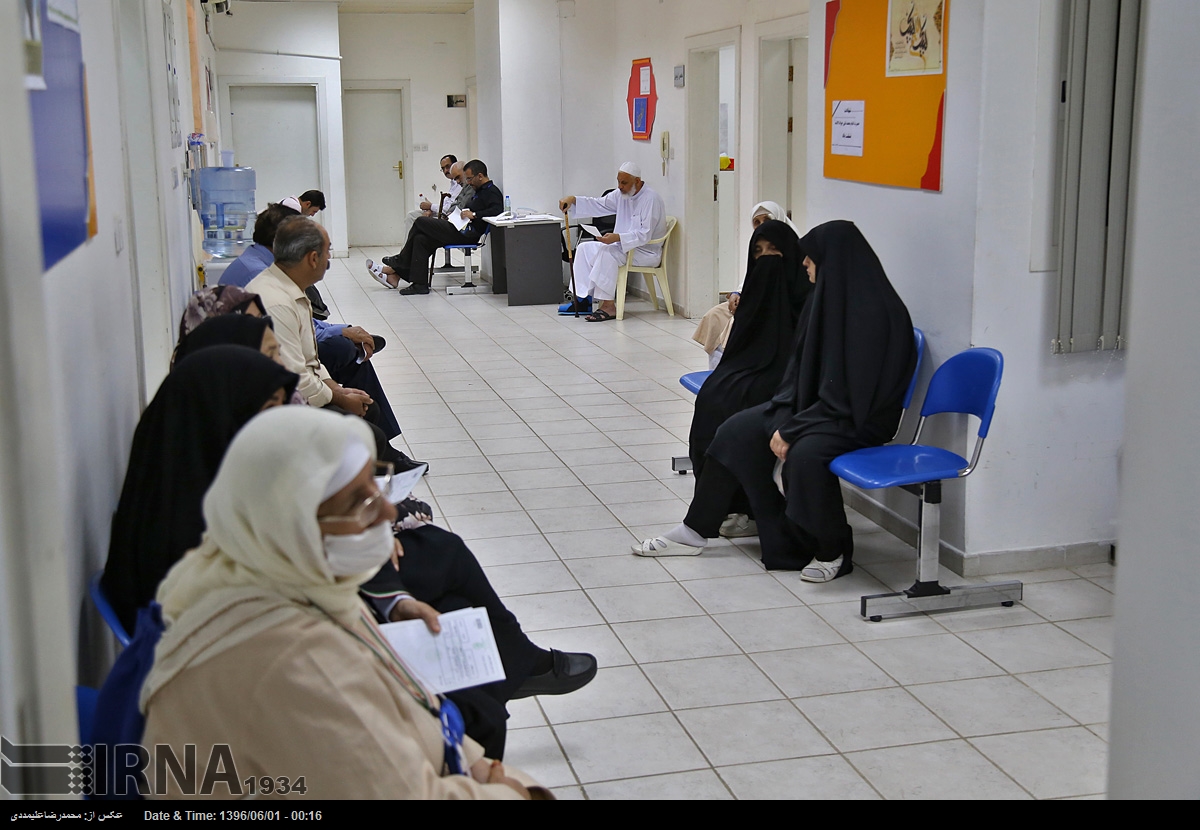
Iranian Hospital in Mecca Giving Services to Pilgrims

Numerous Iranian pilgrims visit the Iranian hospital in Mecca every day, receiving services from over 570 doctors and specialists, nurses, pharmacy technicians, hospital staff as well as laboratory, radiology, and dentistry personnel.

Here are IRNA’s photos of the hospital and its staff:


Mamarz Lake; Haunted Body of Water in Northern Iran

If you are interested in off-road driving, you can experience it by setting off a journey to Mamarz Lake through a byway.

Throughout most days of the year, the virgin ecosystem of the lake is covered with fog and non-stop far sounds of wild animals. Add to the scene, the presence of dried out trees in the lake making it more and more closer to what is called the Ghosts Lake.

With a length of 700 metres and width of 300 metres, the lake is very attractive. Due to its unique scene and rare beauty, it has been registered as a natural heritage.

One of the main features of Mamarz Lake which attracts the visitors’ attentions is the remains of some old trees in the middle of the lake. They are known as dead trees. As a part of the lake’s nature, the scene contributes to the horrible nature of the lake.

The lake is located in the middle of an eye-catching forest near Nowshahr, which the visitors can enjoy along with the lake’s nature.

Here are photos of the lake retrieved from the Karnaval.ir website:

Iran Should Pick More Female Ambassadors: MP

Jalil Rahimi Jahan-Abadi, the head of the International Affairs Committee of the Iranian Parliament’s Judicial and Legal Commission, has weighed in on the reports that two women could possibly be picked as Iran’s ambassadors overseas.

“Running an embassy is an intellectual work, not a manual job, and it’s been centuries that physical power has no determining role in humans’ affairs,” he said, according to a Farsi report by ICANA.

“The power of thinking is something which runs today’s world, and, intellectually speaking, women are no less than men and can easily handle complex affairs in today’s world.”

The Iranian lawmaker stressed that women hold key positions in many countries.

“In many countries, presidents, prime ministers and parliament speakers are women. Women in many countries have made their presence felt on the international stage and have discharged their professional responsibilities well,” said the lawmaker.

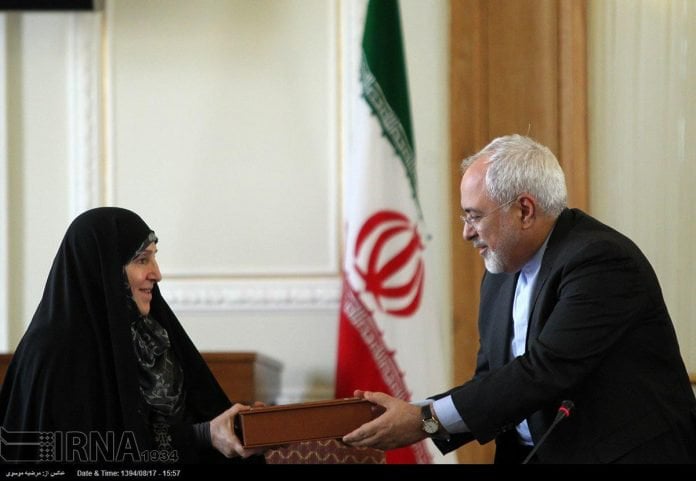
He touched upon the presence of Marzieh Afkham at Iran’s embassy in Malaysia and added, “Given the success of Ms. Afkham in Iran’s embassy in Malaysia, the Iranian foreign minister must consider choosing more women ambassadors.”

Ambassadors Should Also Be Chosen from Sunni Community

The MP expressed hope that two more woman ambassadors will be designated by the Foreign Ministry.

“Of course, if one of the women is a Sunni, we will have killed two birds with one stone: we have chosen both a woman and a person from religious minorities, which will help promote national interests,” he added

“The presence of women in domains of activities such as embassies can be very effective because embassy activities are analytical work. … Women are not incapable of handling complex issues, and I believe more women can be designated as ambassadors, and I can tell you confidently that women can be successful.”

Iran Parliament Vows Strong Support for Handwoven Carpet Industry

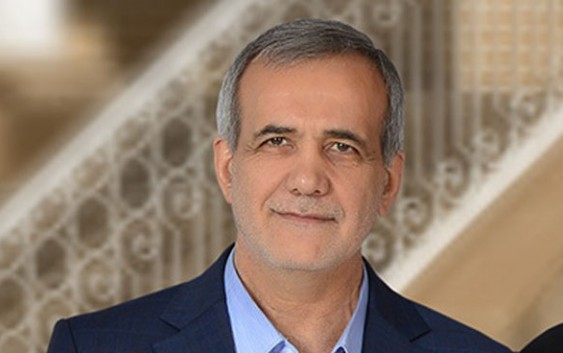
The first vice-speaker of the Iranian Parliament, Massoud Pezeshkian, has stressed that the Parliament intends to make considerable effort to shore up those involved in domestic handwoven carpet industry.

According to a Farsi report by ICANA, he further called for the identification of new export markets to increase overseas sales of Iranian handwoven carpets.

en-pezeshkianPezeshkian made the remarks in a meeting with the head of Iran National Carpet Centre (INCC), Hamid Kargar, on the sidelines of the opening ceremony of the 26th Iran Handmade Carpet Exhibition – the biggest of its kind worldwide – in Tehran on August 23.

Given that the demand for handwoven carpets in global markets is limited, efforts are required to create or identify new markets to boost exports of Iranian carpets, he added.

Pezeshkian put the current total global demand for handwoven carpets at $1.3 billion, expressing satisfaction with the fact that Iran has always been the world’s top producer of handmade carpets, followed by India, Pakistan, Afghanistan, Turkey, Nepal, and China.

“In the first decade of the 21st century, Iran’s annual handwoven carpet exports stood at $500m. Unfortunately, following the intensification of the sanctions by the US, the figure decreased to $300 million due to fluctuations in domestic forex market, increased price of raw materials, internal problems of a number of Arab states and the European countries’ economic recession.”

The MP said however, Iran’s handmade carpet exports have witnessed growth again after the going into effect of the Joint Comprehensive Plan of Action (JCPOA) – signed between Iran and the P5+1, and the removal of the western sanctions targeting the country’s carpet industry.

He put Iran’s handwoven carpet exports at $350 million in the 12-month period ending March 2017.

The 26th Iran Handmade Carpet Exhibition will be open to visitors until August 29.

MP Backs Granting Nationality to Children with Foreign Fathers

In a Farsi interview with ICANA, the vice-chairman of the Iranian Parliament’s Judiciary Commission, Yahya Kamalipour, threw his weight behind granting Iranian nationality to the children born to an Iranian mother and a non-Iranian father.

“Although the Parliament earlier put aside a bill set forth by the government on the nationality of the children born to an Iranian mother and a non-Iranian father, we are seeking to put together a comprehensive plan,” he said.

He went on saying that the lawmakers have done their utmost to provide the mentioned children with a single nationality.

“This means that it is up to the children themselves to obtain a dual nationality if they like,” he added.

He emphasized that the Iranian Parliament will not put any effort into granting dual nationality to the children and said the bill set forth by the government is too general.

“So, we the lawmakers have decided to develop a detailed plan drawing on the government’s bill to tackle the current problems in this field,” he said.

The lawmaker added unfortunately some people have married non-Iranian immigrants without going through the legal and civil regulations.

“This has left their children without any clear identity,” he said, adding that’s why the lawmakers are now working on a plan to remove these people’s identity problems.

“The number of children with the same identity problem is high in some regions and provinces. Such people are deprived of all legal rights of Iranian citizens like education, job and insurance coverage. This comes as they are secretly taking advantage of our resources and facilities. So, they fall prey to administrative corruption nets,” he said.

Kamalipour stressed that to manage and control the country’s population as well as to stop growing insecurity, “the government needs to address the problem of these people.”

“We resolving the current problems, we can also prevent from damages to our national resources,” he concluded.

Iran, Azerbaijan Need to Sign Free Trade Agreement

Deputy Manager for Economic Evaluation of Tehran Chamber of Commerce, Maryam Khazaee, says by signing a free trade agreement with Azerbaijan, Iran can have an appropriate share in Azerbaijan’s market.

According to a Farsi Report by the Azad News Agency (ANA), she made the statements during a meeting on the capacities for Iran’s exports to Azerbaijan. The meeting was attended by representatives from private sectors as well as the Trade Promotion Organization, Export Development Bank and Iran-Azerbaijan Chamber of Commerce.

During the meeting, Khazaee read out a brief report on the economic indexes of Azerbaijan. “The latest table of the World Bank ranks Azerbaijan among countries with an average upward income. Meanwhile, Azerbaijan is categorized as a state with a relatively high annual income. The average foreign investment in Azerbaijan has been $4.3m per year from 2012 to 2015; however, the number rose to $4.5m in 2016,” she noted.

Khazaee went on saying that Azerbaijan plans to turn into a developed country by 2020 with a high level of income. She said Iran has not yet managed to play a key role in the Azeri market. “One of the main measures which can contribute to Iran’s growing role in the region is signing a free trade agreement with the neighbouring state,” she added.


Insurance Coverage and Exporters’ Financial Provision

Ashkan Abbasi Tehrani, the head of the State Risk and International Cooperation Group at the Export Guarantee Fund of Iran briefed the participants on the official approach of the Fund towards the exporters. He said the fund issues insurances for all exporters. “Simply, we insure the buyers’ risk,” he noted.

Touching on other services to be offered by the fund, he said the fund is committed to financially support the exporters. “The Fund issues insurances at the request of the exporters. It can also guarantee their credits in the banks. So, the exporters along with the foreign banks, companies and governments can rely on the Fund’s letter of guarantee to press ahead with their project,” Abbasi added.

He said the Fund offers various other services and added the details of the services are available on the portal of the Fund.

He referred to the services offered by the Fund to facilitate exports to Azerbaijan, adding that the Republic is one of the main CIS states which has the largest insurance coverage. “We have allocated $21m to short-term and $120m to long-term insurance coverage in the Azerbaijan Republic.”

He also noted that the insurance covers software, plastic goods, industrial machines, food and clothes.

Azerbaijan Republic is categorized by the Export Guarantee Fund of Iran as one of the five high-risk countries in terms of export of goods. The short-term and long-term coverage of the export to the country stands respectively at $90m and $180m.

‘Israel Using Russia as Buffer between Iran, Occupied Territories’

‘Israel Using Russia as Buffer between Iran, Occupied Territories’

Iranian lawmaker Mohammad Javad Abtahi says the Israeli regime has misgivings over the restoration of tranquility and security to Syria.

“Given that border areas in Lebanon and Syria have been purged [of terrorists], the Zionist regime [of Israel] is concerned over the establishment of calm and security in Syria,” he said, according to a Farsi report by ICANA.

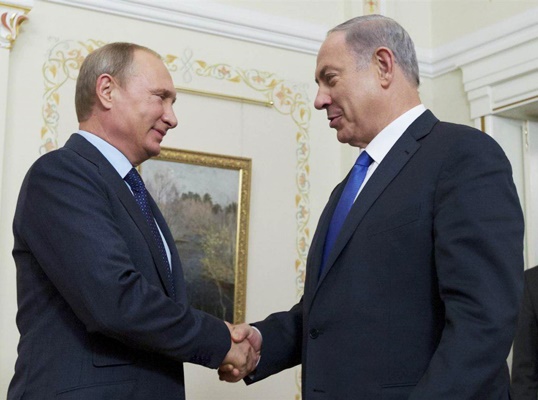
He said Israeli Prime Minister Benjamin Netanyahu tries to take advantage of Russian President Vladimir Putin to turn Russia into a buffer between Iran and the borders of occupied Palestine.

“Netanyahu’s trip to Moscow should be interpreted as a move to make up for the Israeli regime’s back-to-back defeats,” said the MP.

He said the striking feature of Israeli officials is that they get anxious too quickly.

“They (Israeli authorities) are really scared of the growing power of the [Lebanese resistance movement] Hezbollah,” he said.

“The Israeli regime’s strategic need is to win Russia’s heart to ensure the security of the Golan Heights.”

“Given the Zionist lobby’s influence in the US, Netanyahu tries to create a ray of hope for the Kremlin in Washington in order to get anti-Russia sanctions eased,” said the legislator.

“Russia is not unlikely to mediate again, but such an approach will further consolidate the position of Takfiri terrorists and facilitate the recruitment of new operatives,” he said.

“Russia shouldn’t forget that the Israeli regime has supported terrorists, and, at last, will trigger fresh security concerns in Chechnya,” he noted.

“Russia’s breaches of promises on several occasions have led Iran to take this issue into consideration when adopting approaches. Resistance forces are prepared for every eventuality.”