Saturday, April 18, 2026
Home Blog Page 3909

Kurdistan Referendum Regionally Harmful: Iranian Envoy

Kurdistan Referendum Regionally Harmful: Iranian Envoy

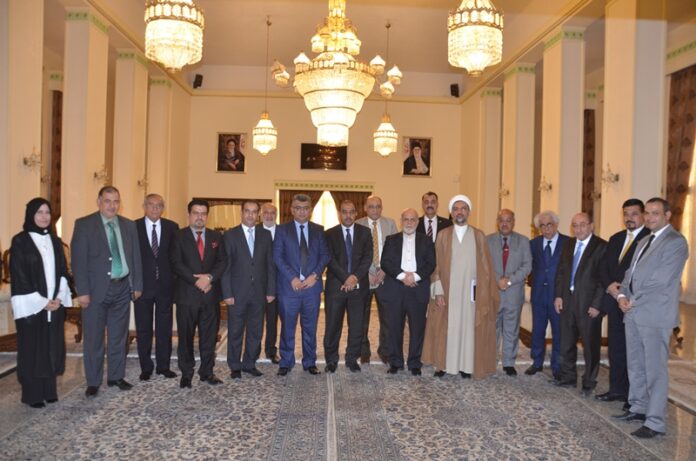
In an address to a group of Iraqi leading media and elites in Baghdad, Iran’s ambassador to Iraq, Iraj Masjedi, stressed that the Islamic Republic has explicitly made it clear to the “Kurdish brothers” in Iraq that Tehran is totally against the idea of holding an independence referendum.

According to a Farsi report by IRNA, Masjedi said part of Tehran’s opposition is due to harmful effects of such a referendum on the lives of Iraqi Kurds.

“Our opposition is based on analysis of the realities on the ground because we believe that at present, Iraq’s Kurdistan has a stable and calm condition,” he said, adding the idea of an independence referendum will embroil Kurdistan region into the political, security and economic crises that Iraq’ central government is now grappling with.

He referred to Iran-Iraq joint fight against terrorism and said the Islamic Republic of Iran has paid a heavy price in the fight to protect its neighbour.

Touching on the diplomatic ties between the Islamic Republic of Iran and the Arab states of the region, he said Iran has always sought to establish good-faith relations with its Arab neighbours. “But this is the Arab states who avoid any close relation with the Islamic Republic under pressure from foreign powers,” he noted.

The ambassador of the Islamic Republic of Iran to Iraq also referred to the water crisis in the region and said the main bulk of the water flowing into Iraq come from Turkey and Syria.

“Only 8 percent of the water flowing into Iraq comes from Iran. On the other hand, 50 percent of the water ends up in Kurdistan region and the remaining 50 percent end up in regions under the control of the central government of Iraq,” he said, adding the origins of the water in Iran have dried up in recent years.

He rejected as baseless any report saying Iran has deprived Iraqi people of the water.

Masjedi also praised the high-level of cooperation between Iran and Iraq and said the cooperation can be expanded due to the available capacities.

He also referred to millions of Iranian pilgrims who annually flock to Iraq to pay tribute to Shiite Imams buried in Iraq and said there is no similar case across the world.

He further noted that Iran and Iraq have established close economic and cultural relations with each other.

“To this end, Iran has exported a huge amount of gas to Iraq’s power plants and increased its annual trade volume with Iraq to $8m,” he added.

According to Masjedi, Iran and Iraq have various cultural commonalities including massive cultural and scientific cooperation.

During the meeting held on Monday, Iraqi elites and media representatives raised about 40 major issues in their questions about Iran and Iraq governments.

The two-hour meeting was organized by Iran’s cultural attaché in Iraq. It was the latest of a series of meetings aimed at exploring ways to expand relations between the two countries.
IRGC Detains ISIS-Linked Terrorists near Iranian Capital

IRGC Detains ISIS-Linked Terrorists near Iranian Capital

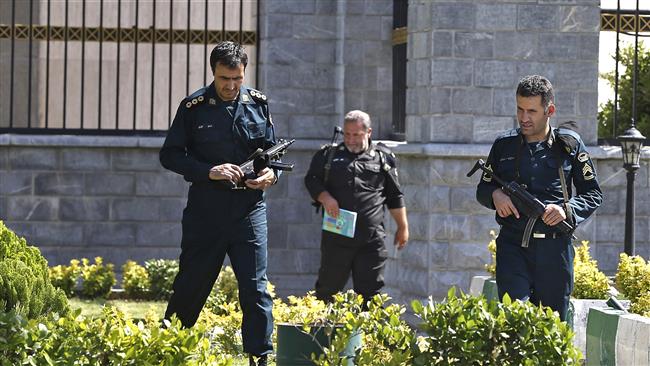
The ISIS element was apprehended in the Andisheh town in Shahriar County, Tehran Province, Colonel Amin Yaamini, the commander of the local IRGC division, told a news conference, Mehr News Agency reported on Wednesday.

The arrestee, he said, belonged to the ISIS-affiliated Ajnad al-Sham (Soldiers of the Levant) group, which is mainly active in the western Syrian provinces of Idlib and Hama.

“So far, very important information has been collected from the ISIS element’s phone, and he remains under investigation,” he said.

‘300 ISIS plots for Tehran’

The commander said the terrorist group has been intending to conduct 300 terror operations in Tehran during the holy lunar month of Muharram — when Shia Muslims gather in throngs to mourn the martyrdom of the Third Shia Imam, Imam Hussein and his companions.

He, however, did not specify whether the IRGC had discovered the plans by examining the detainee’s cell phone or had found out about them otherwise.

On June 7, gunmen mounted almost simultaneous assaults on Iran’s Parliament and the Mausoleum of the late Founder of the Islamic Republic Imam Khomeini. ISIS claimed responsibility for the strikes. The twin attacks killed 17 people and injured over 15 more,

In response, the IRGC fired six ballistic missiles into ISIS bases in the eastern Syrian province of Dayr al-Zawr later in June, leaving at least 65 terrorists dead.

IRGC Detains ISIS-Linked Terrorists near Iranian Capital

In August, General Qassem Soleimani said Iranian forces would not rest until they have taken out every last terrorist from the face of the Muslim world after ISIS reportedly beheaded an Iranian military adviser in Syria.

The general, who commands the IRGC’s Quds Force, made the remarks after Mohsen Hojaji, who was a member of the Iranian advisory support team in Syria, was reportedly taken hostage by the Takfiri group near the Iraqi border and beheaded two days later.

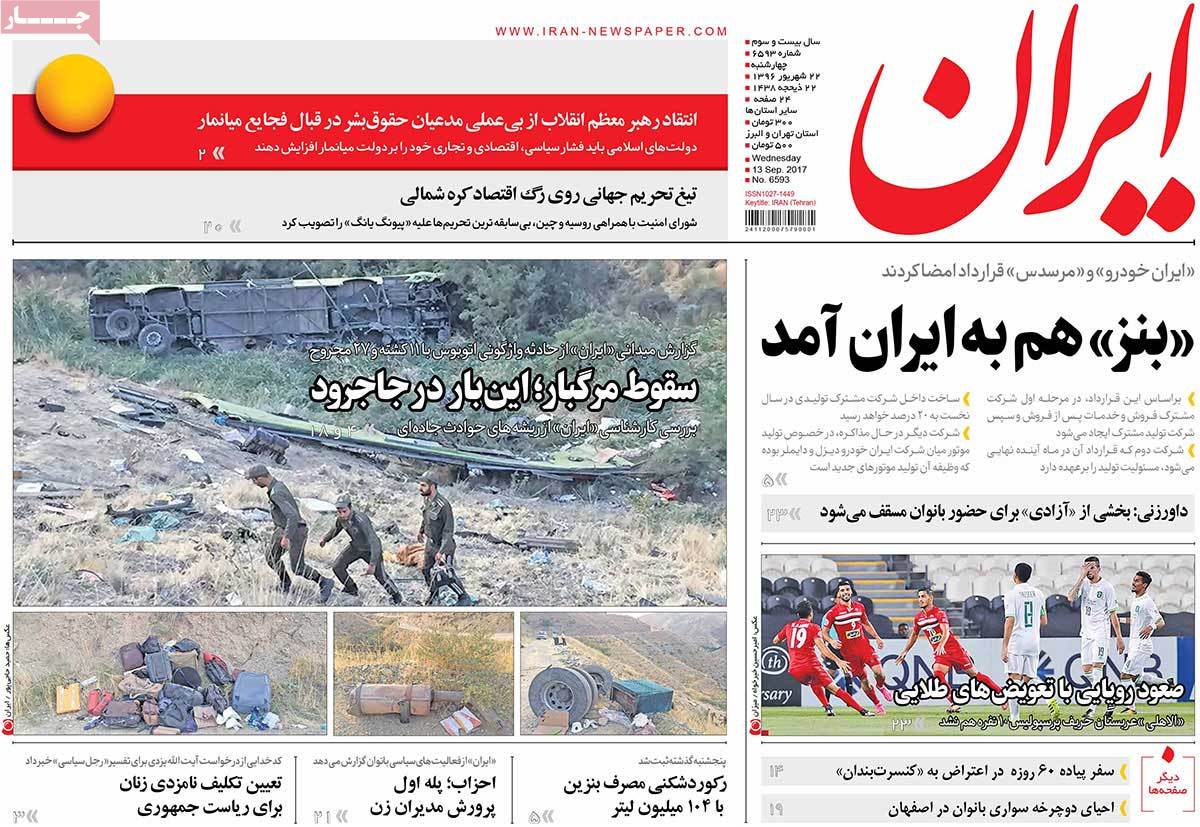
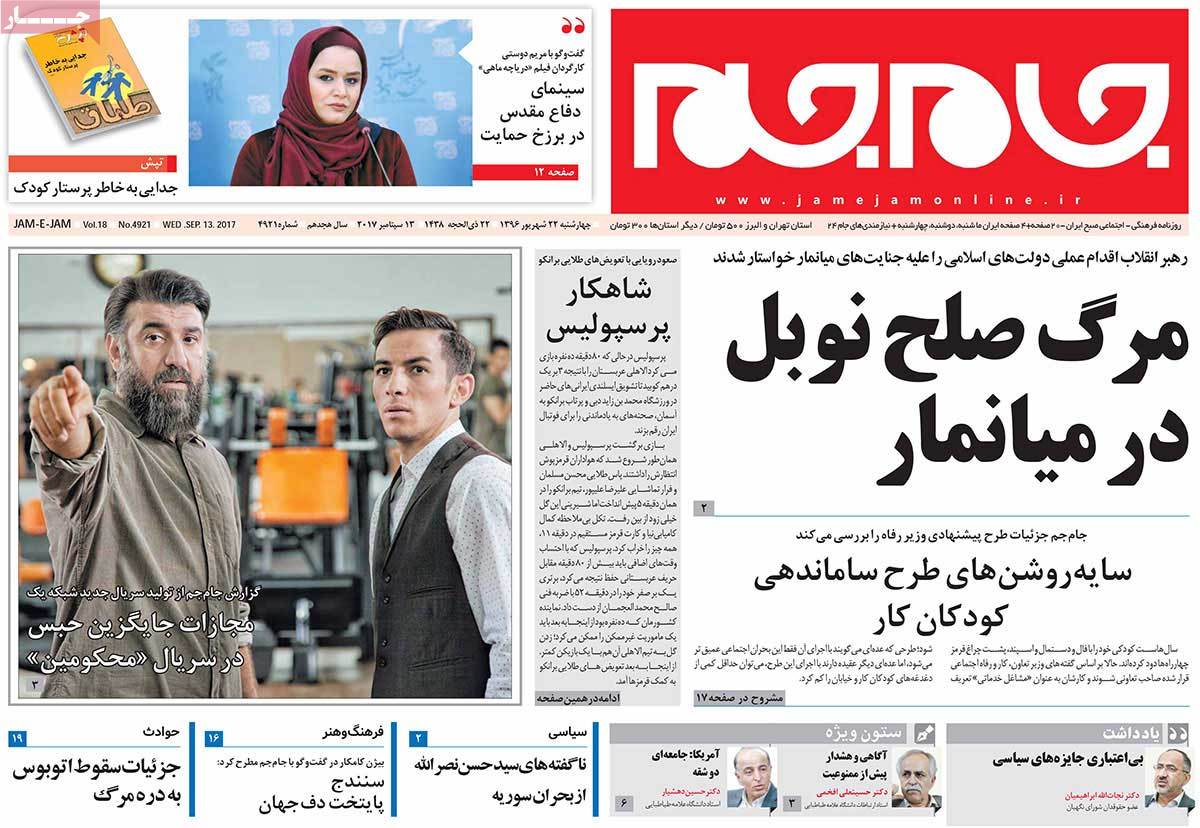
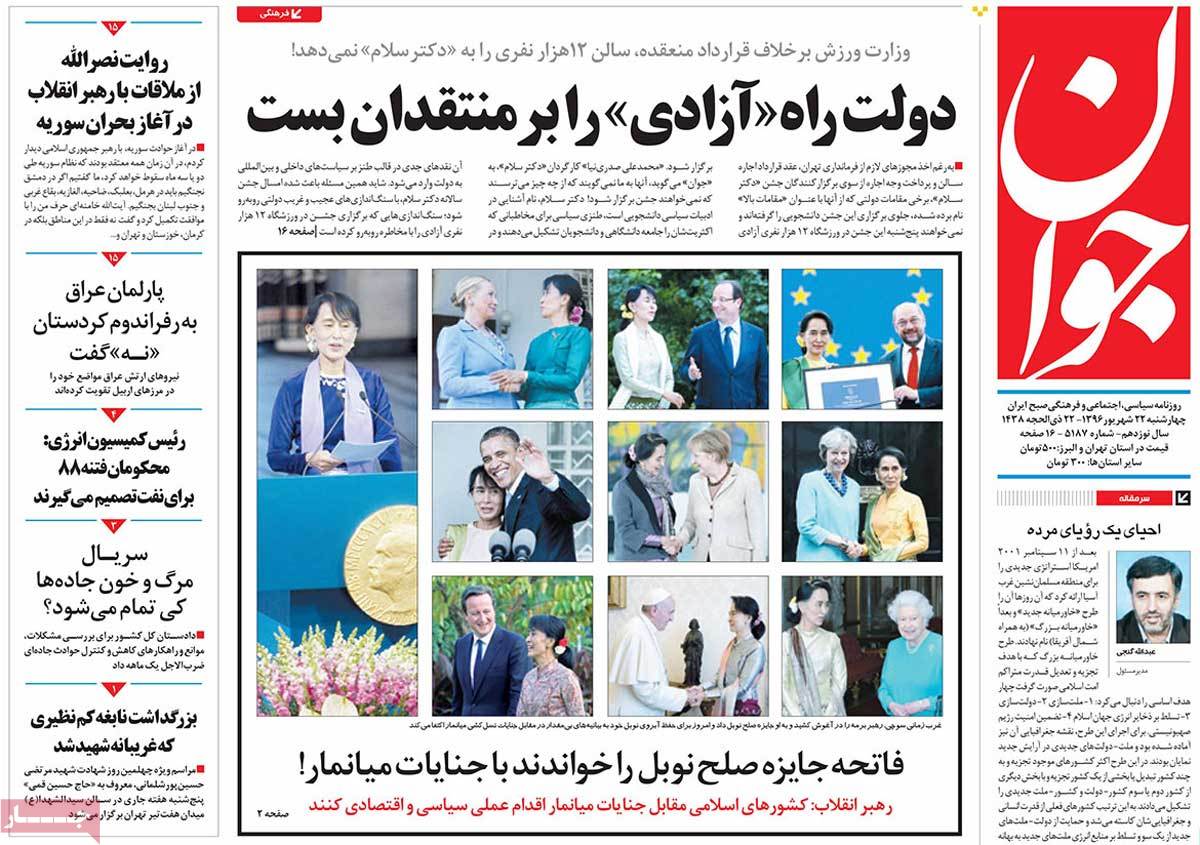
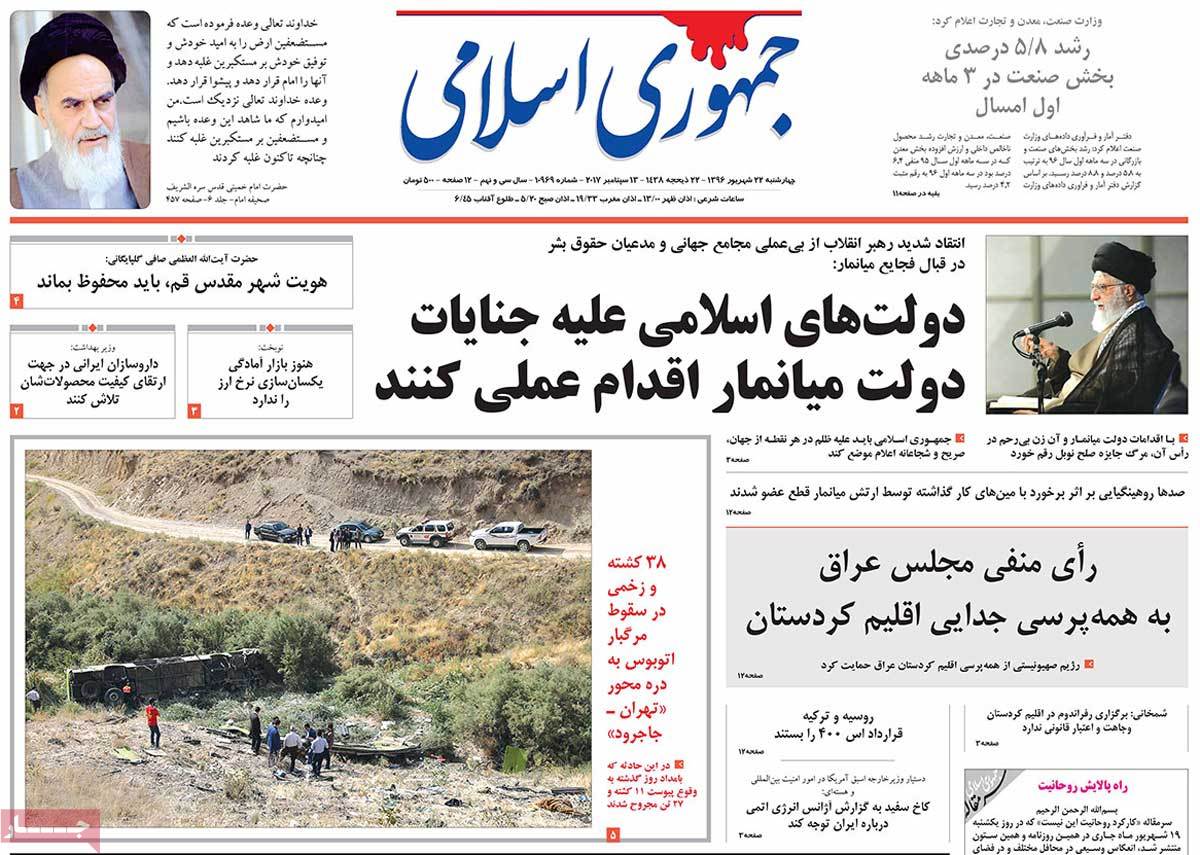
A Look at Iranian Newspaper Front Pages on September 13

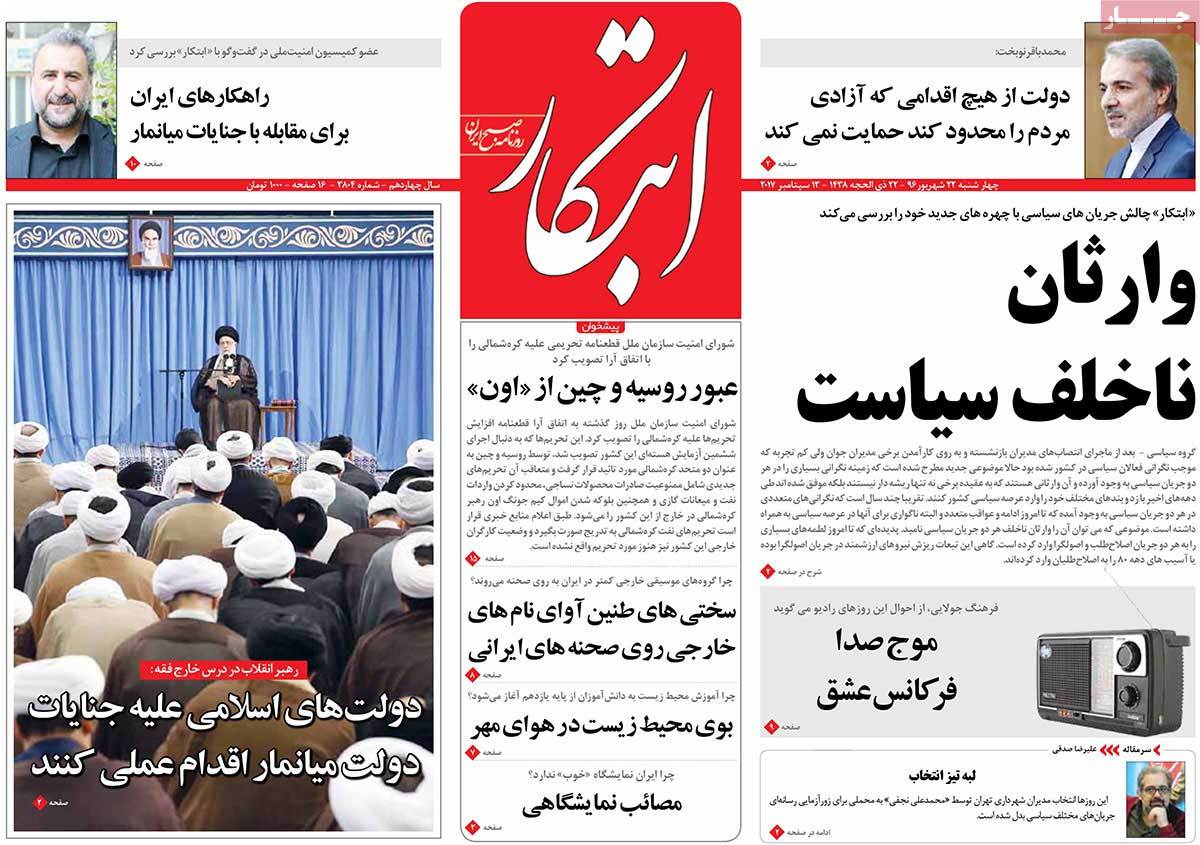
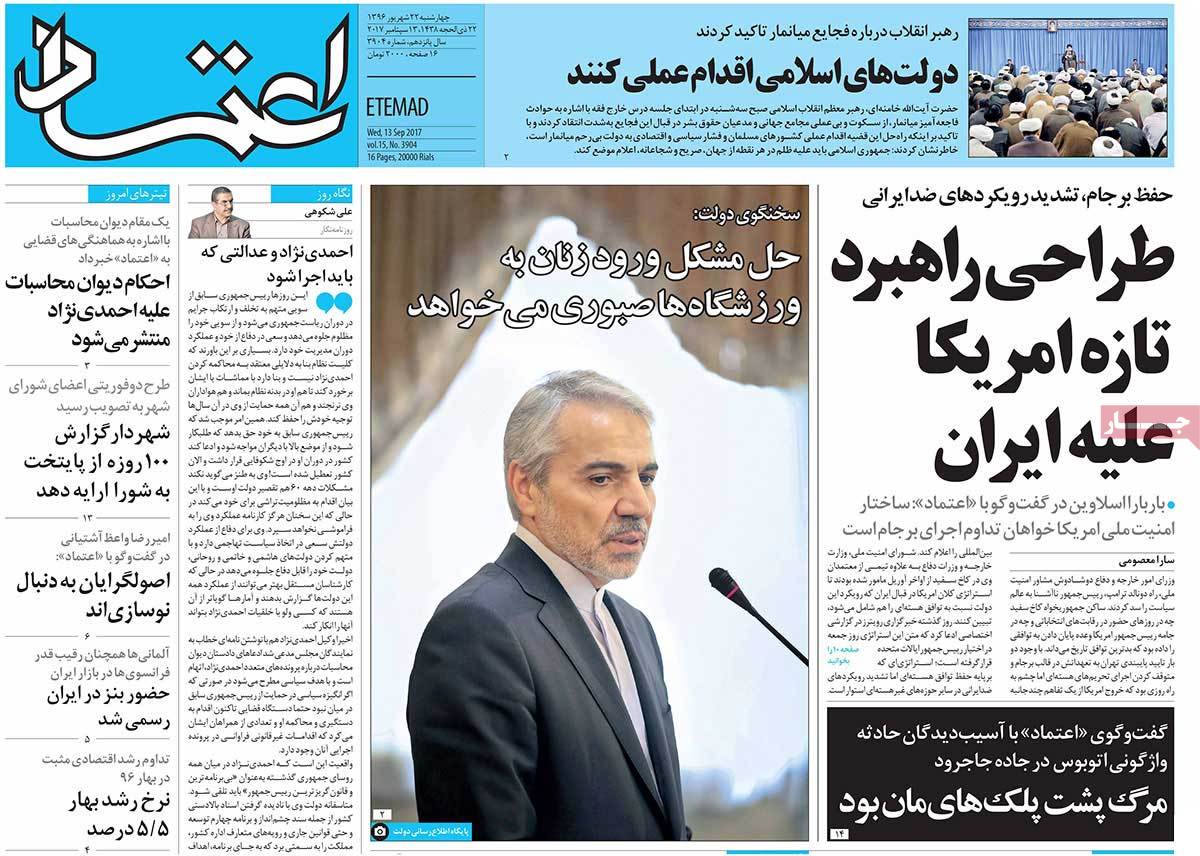
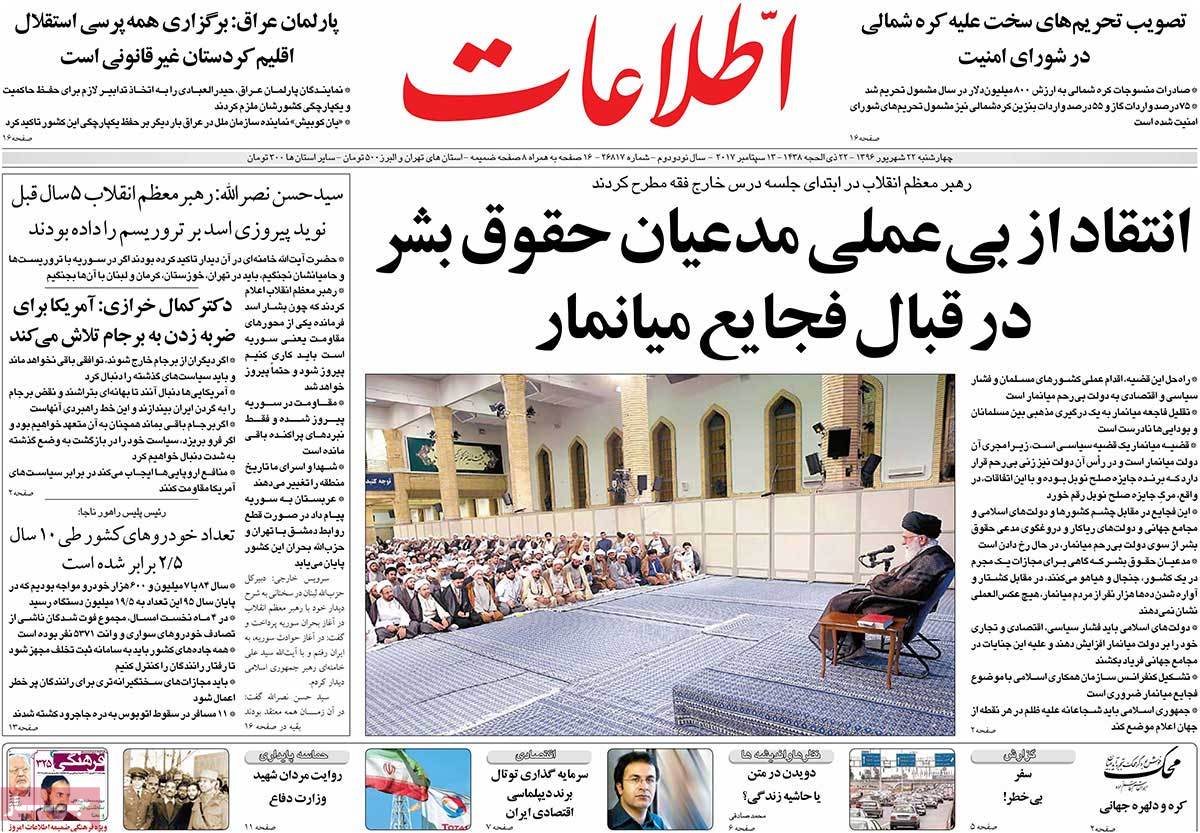
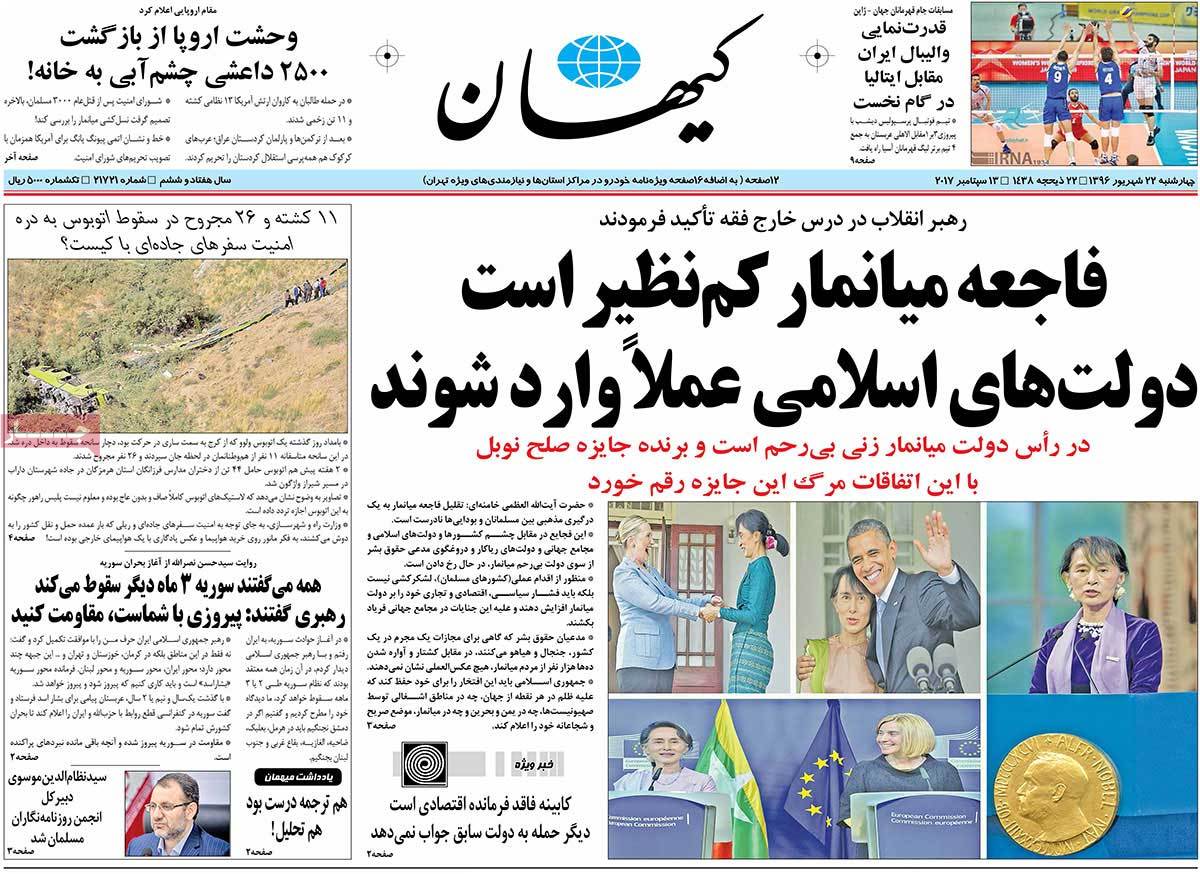
All newspapers today covered the remarks made by the Leader of Iran’s Islamic Revolution Ayatollah Seyyed Ali Khamenei about the plight of Muslim people in Myanmar and his call on Islamic countries to put Myanmar under pressure.

Several papers also released reports on US President Donald Trump’s new strategy towards Iran and the nuclear deal, which involves exerting greater pressure while maintaining the JCPOA.

Another top story was the issue of Iraqi Kurdistan region’s independence referendum, which remained controversial in Iranian papers.

The above issues, as well as many more, are highlighted in the following headlines and top stories:


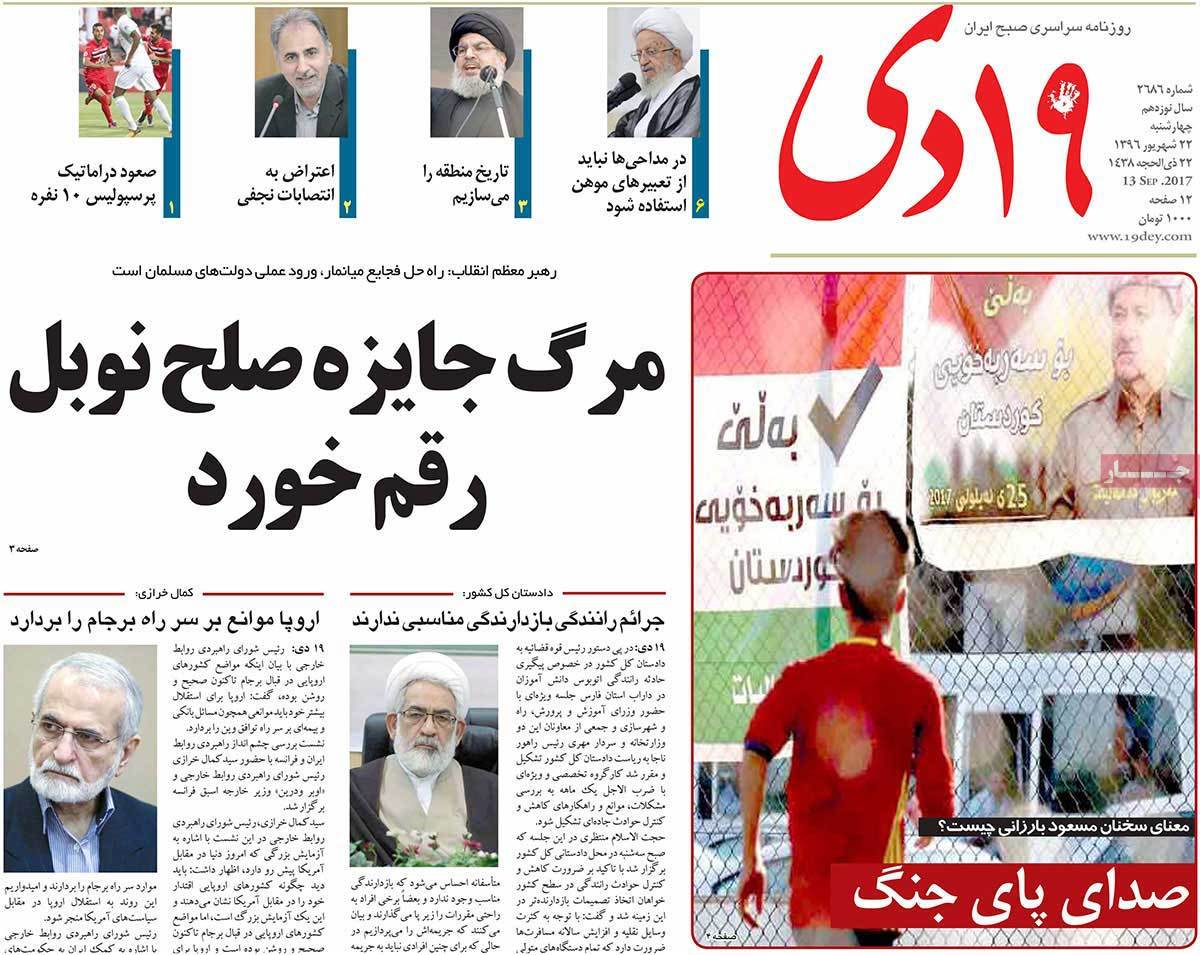
19 Dey:

1- Europe Should Remove Barriers to Nuclear Deal: Iran’s Ex-FM

2- Death of Peace Nobel Prize Arrives

A Look at Iranian Newspaper Front Pages on September 13


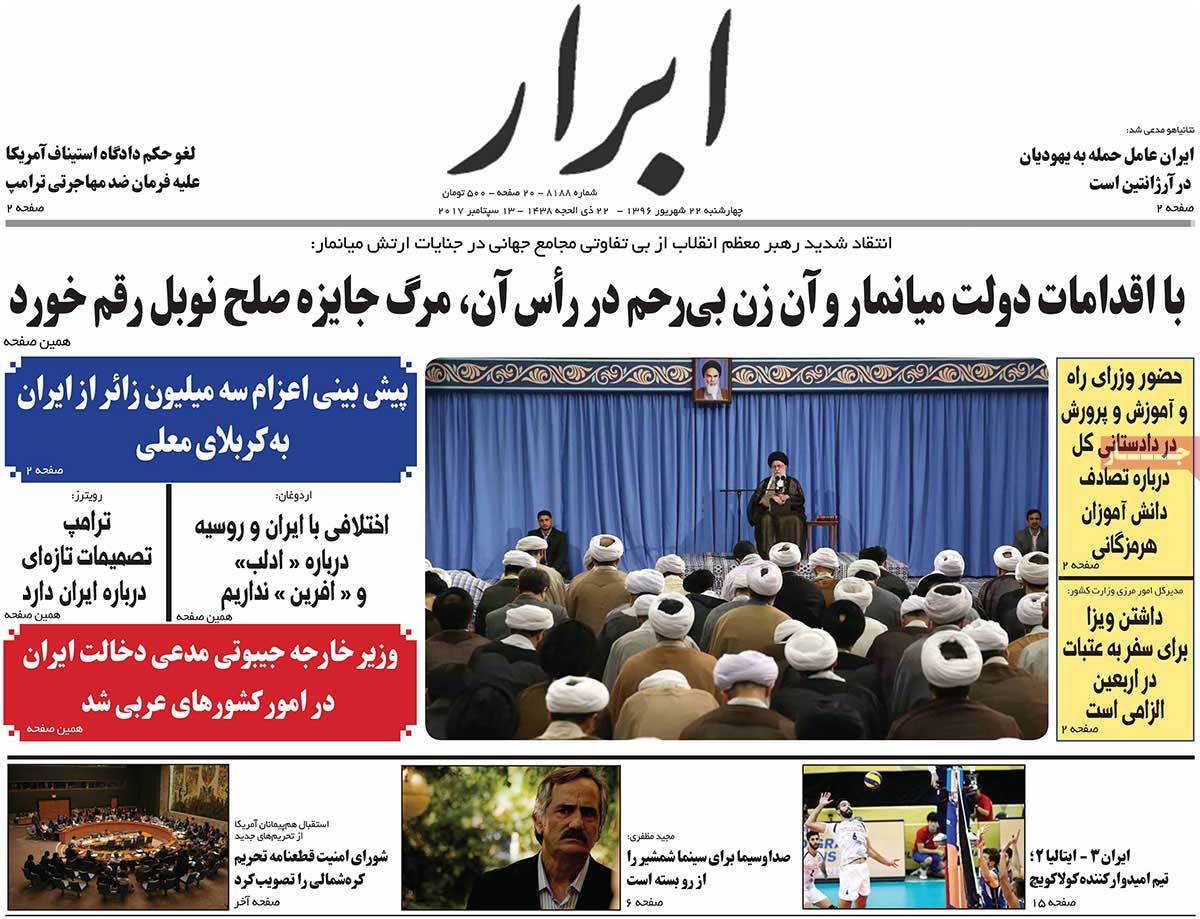
Abrar:

1- 3 Million Iranian Pilgrims Expected to Visit Iraq’s Karbala

2- Erdogan: We Have No Difference with Iran, Russia on Idlib

A Look at Iranian Newspaper Front Pages on September 13


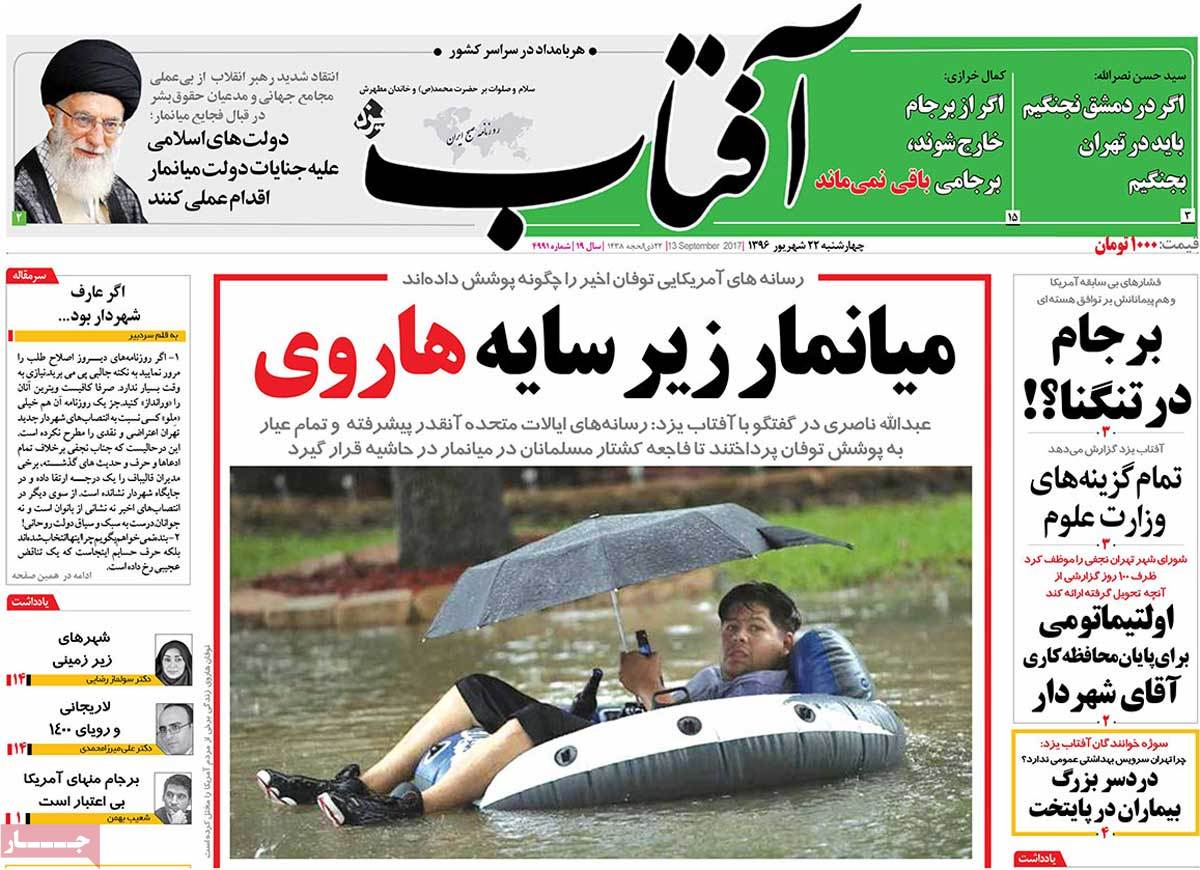
Aftab-e Yazd:

1- Myanmar under Shadow of Harvey

  • How American Media Covered Recent Hurricanes

2- JCPOA in Deadlock? Unprecedented Pressure of US, Allies on Nuclear Deal

A Look at Iranian Newspaper Front Pages on September 13


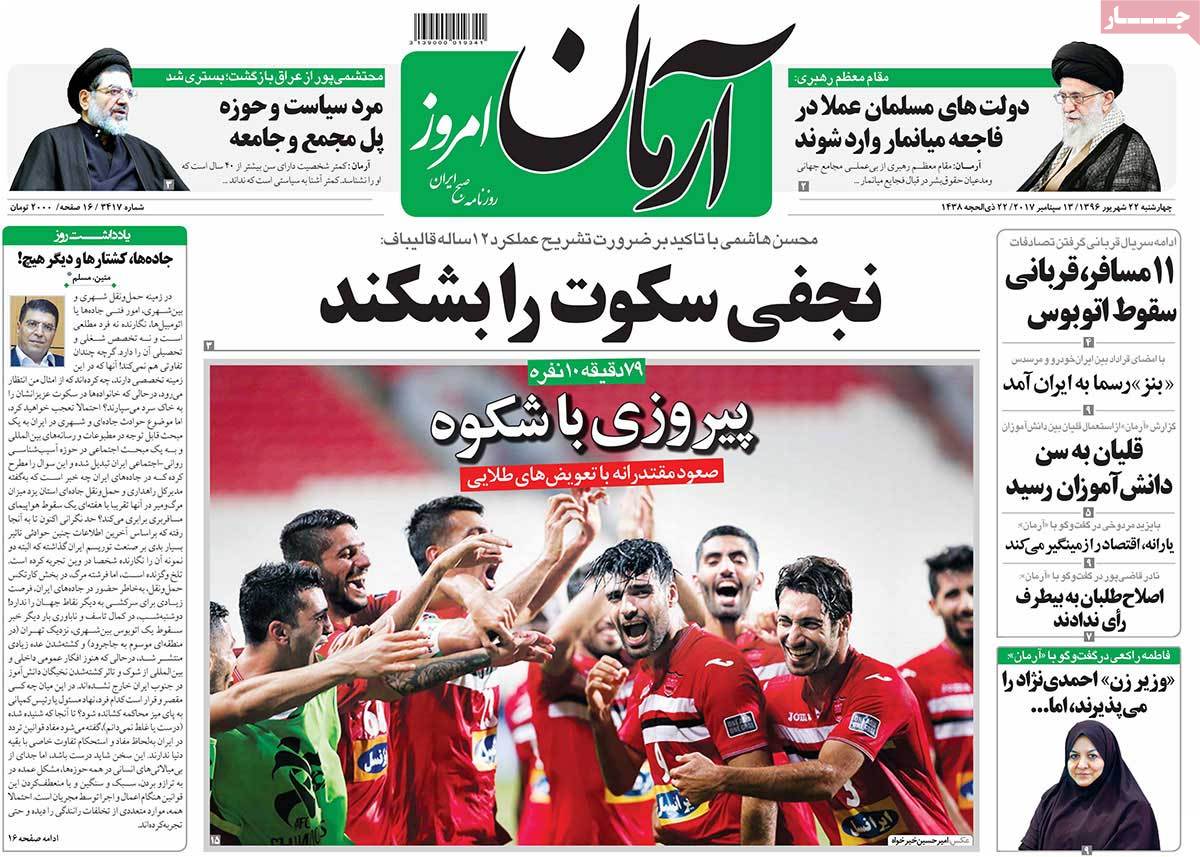
Arman-e Emrooz:

1- Iran Leader Urges Muslim States to Practically Interfere in Myanmar Disaster

2- 79 Minutes with 10 Players: Glorious Victory

A Look at Iranian Newspaper Front Pages on September 13


Ebtekar:

1- Spokesman: Gov’t Doesn’t Support Any Move that Limits People’s Freedom

2- Russia, China Stop Supporting North Korean Leader

  • UNSC Unanimously Ratifies Resolution against Pyongyang

A Look at Iranian Newspaper Front Pages on September 13


Etemad:

1- Maintaining Nuclear Deal, Strengthening Anti-Iran Approaches: New US Strategy

2- Gov’t Spokesman: Resolving Issue of Women’s Presence in Stadiums Needs Patience

A Look at Iranian Newspaper Front Pages on September 13


Ettela’at:

1- Iraqi Parliament: Iraqi Kurdistan Independence Referendum Illegal

2- Hezbollah Chief: Iran Leader Had Predicted Assad’s Victory over Terror 5 Years Ago

A Look at Iranian Newspaper Front Pages on September 13


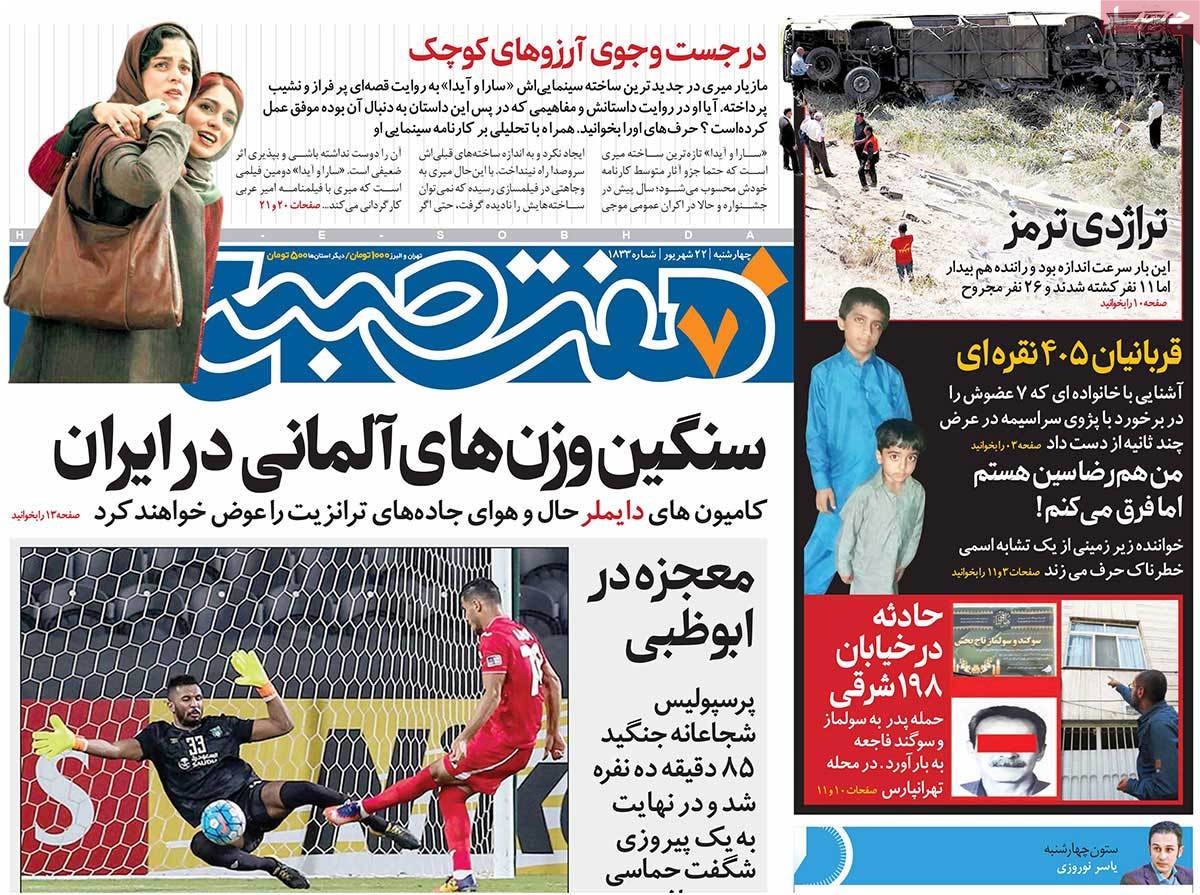
Haft-e Sobh:

1- German Trucks to Change Atmosphere of Iran’s Roads

2- Miracle in Abu Dhabi: Persepolis Fights Bravely

A Look at Iranian Newspaper Front Pages on September 13


Iran:

1- Benz Arrives in Iran: Iran Khodro, Mercedes Sign Deal

2- Blade of Global Sanctions on North Korea’s Economic Veins

A Look at Iranian Newspaper Front Pages on September 13


Jame Jam:

1- Iran Leader: Death of Nobel Peace Prize in Myanmar

2- Masterpiece of Persepolis: Dreamy Victory with Branko Ivankovic’s Golden Substitutions

A Look at Iranian Newspaper Front Pages on September 13


Javan:

1- Gov’t Closes Doors of Azadi (Freedom) [Stadium] to Critics

  • Sports Ministry Not Allowing Critics to Hold Gathering in Azadi Stadium

2- Hezbollah Chief’s Account of His Meeting with Iran Leader at Beginning of Syria Crisis

A Look at Iranian Newspaper Front Pages on September 13


Jomhouri Eslami:

1- 5.8% Growth in Iran’s Industry Sector in Q1

2- Russia, Turkey Sign S-400 Deal

A Look at Iranian Newspaper Front Pages on September 13


Kayhan:

1- Iran Leader: Myanmar Disaster Unprecedented

2- Europe Afraid of Return of 2,500 Blue-Eyed ISIS Elements to Home!

A Look at Iranian Newspaper Front Pages on September 13


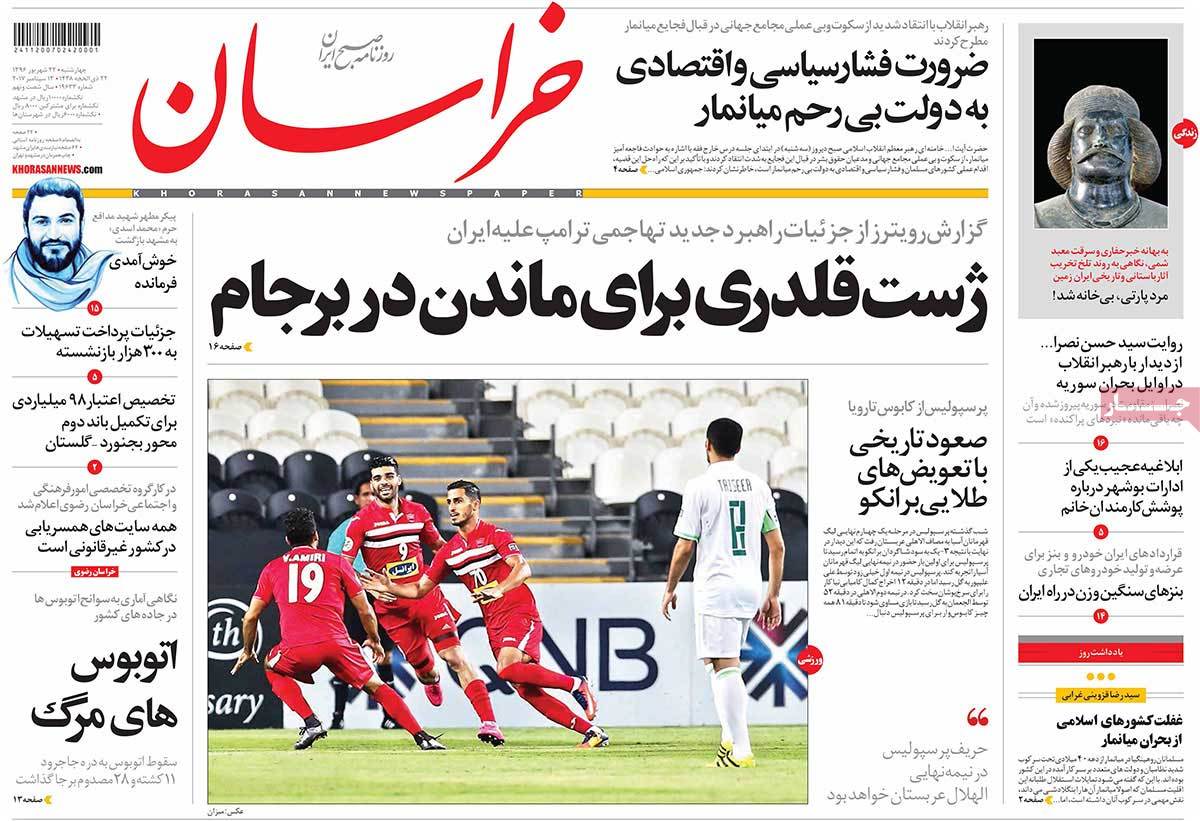
Khorasan:

1- Gesture of Bullies to Maintain JCPOA: Trump’s New Aggressive Strategy against Iran

2- Need for Political, Economic Pressure on Cruel Gov’t of Myanmar

A Look at Iranian Newspaper Front Pages on September 13


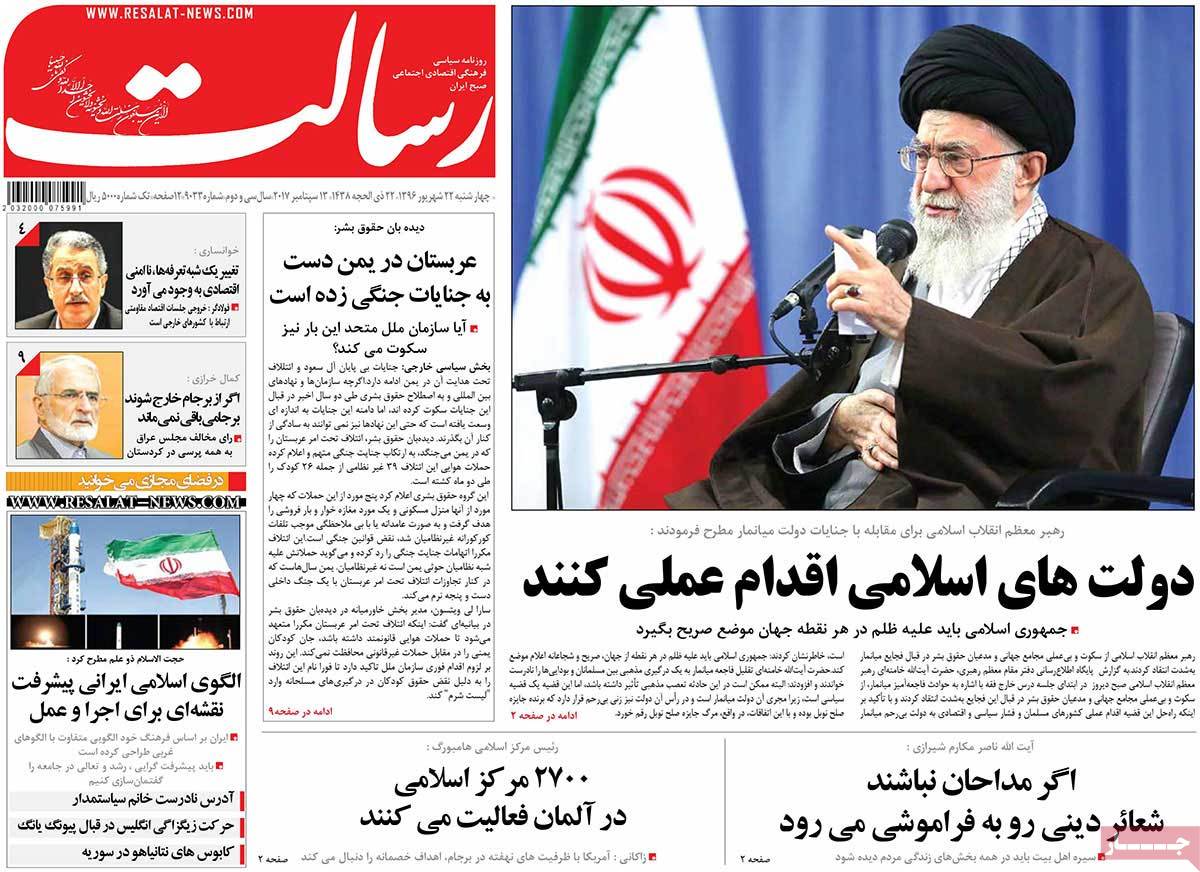
Resalat:

1- HRW: Saudi Arabia Commits War Crime in Yemen

2- 2,700 Islamic Centres Active in Germany: Head of Hamburg Islamic Centre

A Look at Iranian Newspaper Front Pages on September 13


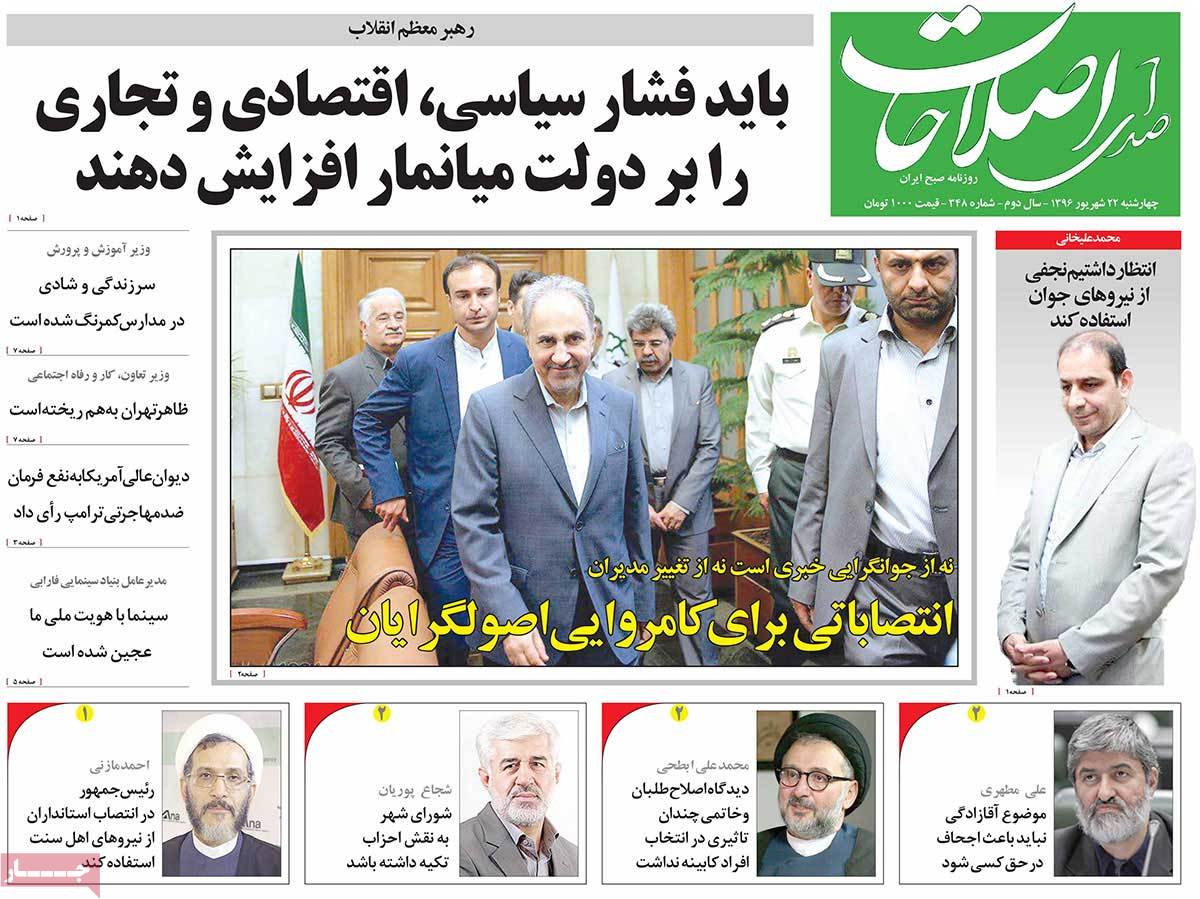
Seda-ye Eslahat:

1- Iran Leader: Political, Economic, Trade Pressure on Myanmar Should Be Increased

2- Appointments to Satisfy Conservatives: No Change in Managers

A Look at Iranian Newspaper Front Pages on September 13


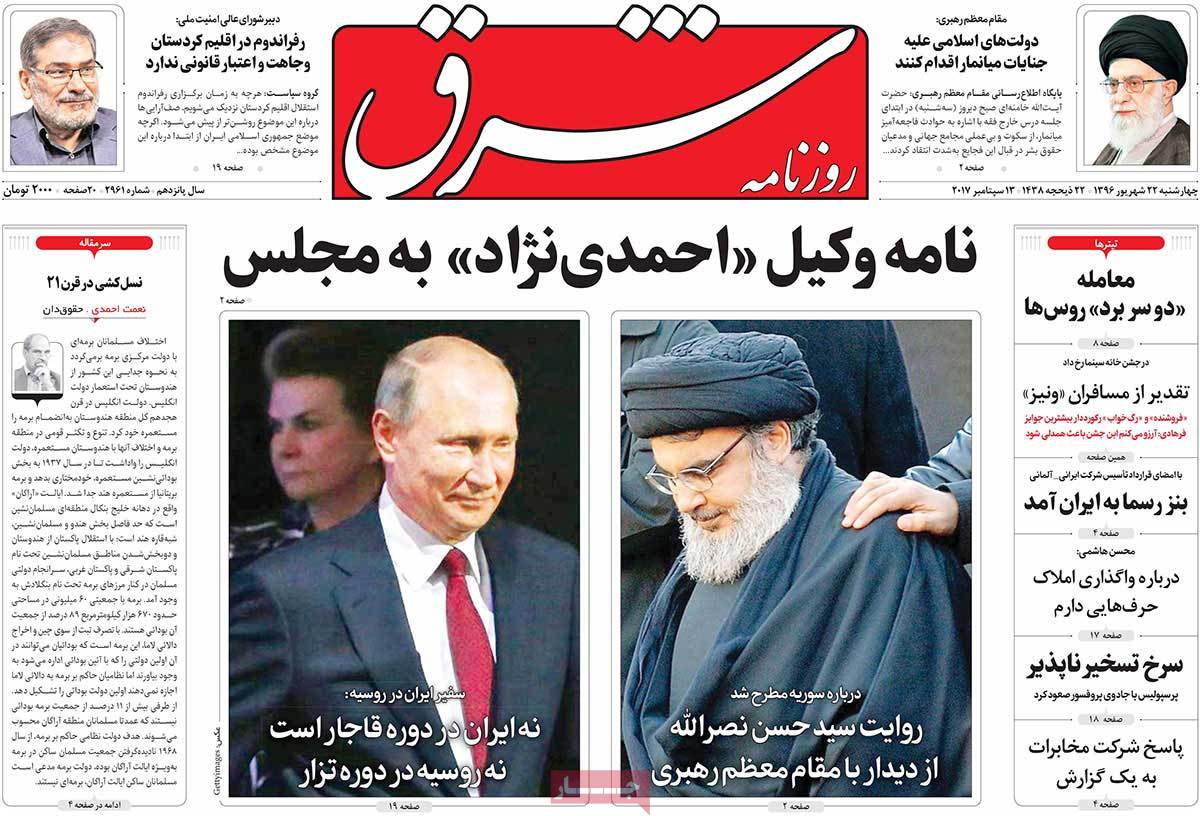
Shargh:

1- Iran’s Envoy to Syria: Iran Not in Qajar Era, Neither Is Russia in Time of Tsar

2- Iran’s Shamkhani: Referendum in Iraqi Kurdistan Not Legally Valid

A Look at Iranian Newspaper Front Pages on September 13


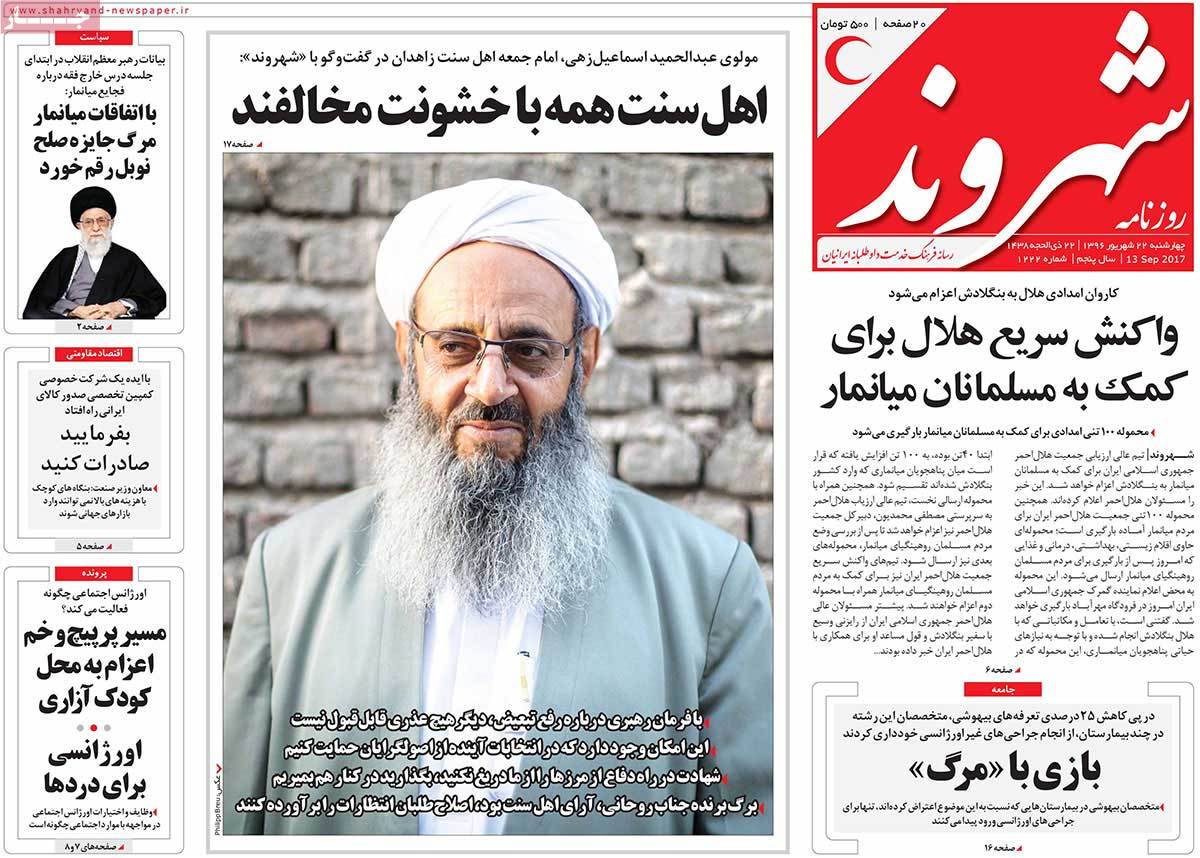
Shahrvand:

1- Iran’s Top Sunni Cleric: Sunnis Are All against Violence

2- Iranian Red Crescent’s Rapid Reaction to Help Myanmar Muslims

A Look at Iranian Newspaper Front Pages on September 13


Iran to Send Tonnes of Humanitarian Aid to Myanmar Muslims

Iran to Send Tonnes of Humanitarian Aid to Myanmar Muslims

The Iranian diplomatic delegation, to be led by Deputy Foreign Minister for Asia and Pacific Affairs Ebrahim Rahimpour, will be accompanied by a team from Iran’s Red Crescent Society (IRCS), Fars News Agency quoted Foreign Ministry Spokesman Bahram Qassemi as saying.

The consignment of Iran’s humanitarian aid for the Myanmarese refugees will be delivered to Bangladesh, he added.

According to the spokesman, the Iranian delegation will also pay a visit to a Rohingya refugee camp in Bangladesh’ city of Cox’s Bazar.

Iran is ready to build a refugee camp and a field hospital in Bangladesh for the Myanmarese Muslims with the permission of the Dhaka government, he added.

The spokesperson also noted that Iran’s ambassador to Thailand, who is also an accredited ambassador to Myanmar, is going to meet the Myanmarese Foreign Ministry officials to express Tehran’s stances and voice its concern about the plight of Rohingya Muslims.

As regards Iran’s diplomatic efforts to end the persecution of Muslims in Myanmar, Qassemi said Foreign Minister Mohammad Javad Zarif will discuss the issue on the sidelines of the annual session of the United Nations General Assembly in New York next week.

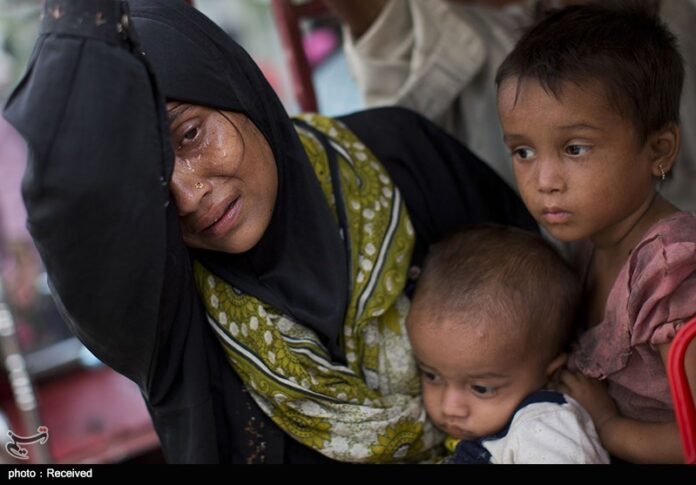
The Rohingya Muslims in Myanmar have long faced severe discrimination and were the targets of violence in 2012 that killed hundreds and drove about 140,000 people from their homes to camps for the internally displaced.

On September 12, the UN refugee agency said the number of Rohingya Muslim refugees that have fled recent violence in Myanmar has spiked to about 370,000.

Earlier, the UN top human rights official accused Myanmar of carrying out “a textbook example of ethnic cleansing” against Rohingya Muslims.

Zeid Ra’ad al-Hussein, the UN high commissioner for human rights, said the military’s “brutal” security campaign was in clear violation of international law, and cited what he called refugees’ consistent accounts of widespread extrajudicial killings, rape and other atrocities.
Iran Inks Deal with Syria to Repair Its Power Grid

Iran Inks Deal with Syria to Repair Its Power Grid

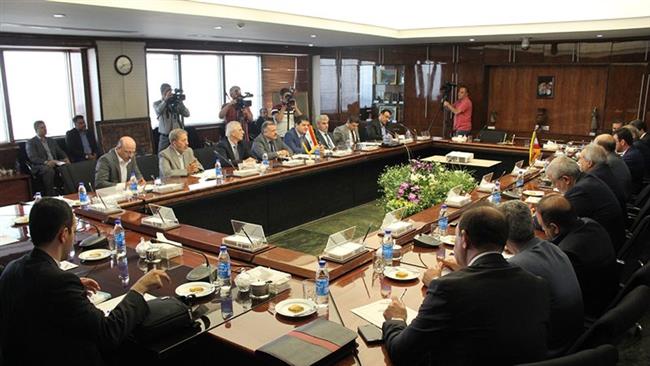
Syrian Electricity Minister Mohammad Zuhair Kharboutli traveled to Tehran as his country is looking to friendly states to help rebuild the country after more than six years of war with foreign-backed terrorists.

Syria’s civilian infrastructure has been battered under the ferocious conflict but Kharboutli said Tuesday the government is working relentlessly to restore the power system and that Iranian companies will have a role in rebuilding Syria.

The reconstruction of the country comes amid the Syrian army making steady advances in recent months and taking back cities and towns from terrorists.

“We are glad that good news is coming out about the situation in Syria theses days, and the terrorists are facing defeat and complete elimination,” Sattar Mahmoudi, Iran’s caretaker energy minister, said during the signing ceremony.

Iran Inks Deal with Syria to Repair Its Power Grid

The contracts include building a power plant in the coastal province of Latakia with a capacity of 540 megawatts and restoring the main control center for Syria’s electricity grid in the capital Damascus.

Iranian companies will also rehabilitate a 90-megawatt power station in Dayr al-Zawr province, where the Syrian army has made swift advances against Daesh terrorists in recent days, and another in the Homs province.

Two contracts were signed, including for Iran to supply power to Aleppo city, which the Syrian military and its allies fully regained last year in a major blow to terrorists.

The memorandum further involves the establishment of five gas turbines, each with a capacity of 125 megawatts in in Baniyas, SANA news agency reported.

Iran Inks Deal with Syria to Repair Its Power Grid

Tehran has already assured Syria to expand its cooperation to construct water and sewerage facilities in the Arab country.

Mahmoudi said the capacities of Iranian companies in production, distribution and transmission of power and power plant equipment are unique in the region and many Iranian products are able to compete with the world’s leading brands.

“The message of Iran’s Ministry of Energy is to restore light to the houses of the Syrian people, while the terrorists and their supporters have had no message other than darkness and terror for the Syrian people in the past few years,” he said.

In May 2013, Iran agreed to provide Syria with a $3.6 billion credit line for imports of goods and commodities and implementing civilian projects.

Iranian firms are already involved in a series of electricity generation projects worth $660 million in Syria, according to Energy Ministry officials.

A plan has been mooted for exports of Iranian electricity to Syria which would hook up Iran’s national grid with those of Iraq and Lebanon, creating the biggest power network in the Islamic world.

Iran Inks Deal with Syria to Repair Its Power Grid

Damascus was a major ally of Tehran during eight years of the former Iraqi dictator Saddam Hussein’s war on the Islamic Republic in the 1980s and Iran now feels obliged to return the favor.

“During these years, the Iranian nation and the government have stood with the Syrian people in the worst conditions, and we certainly will not leave the Syrians alone in the difficult conditions of reconstruction,” Mahmoudi said.

In January, the two countries signed several agreements during a visit by Syrian Prime Minister Imad Khamis to Tehran, under which the Islamic Republic would build a mobile service operator in the Arab country.

Iran Inks Deal with Syria to Repair Its Power Grid

Under the deals, Syria would grant a license to Iran to operate the Arab country’s third mobile service provider and allow the Islamic Republic to set up a petrol terminal on 5,000 hectares of land.

Syria would also give Iran 5,000 hectares of farmland and commission the operation of phosphate mines in Sharqiya and a port in the Arab country to Iranian companies, IRNA reported then.

Khamis traveled to Tehran with a large business delegation, with Iran’s Vice President Es’haq Jahangiri saying the visit marked “a new page for economic activities between the two countries.”

Iran, Afghanistan to Launch Joint Project to Restore Hamun Lake

Iran, Afghanistan to Launch Joint Project to Restore Hamun Lake

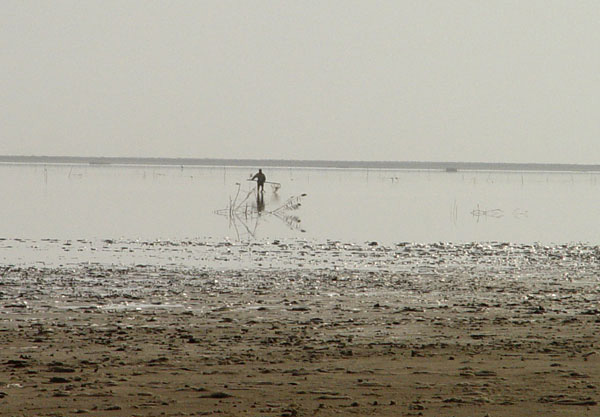
Head of the Wetlands Office of the Iranian Department of Environment, Arezoo Ashrafizadeh, said Iran and Afghanistan are working together on a joint strategic plan to restore Hamun Lake in Iran’s southeast.
In a Farsi Interview with ISNA, Ashrafizadeh said following the latest meetings between high-ranking Iranian and Afghan officials on Hamun Lake and based on the guidelines given by Iran’s Leader on the necessity to restore the lake, the two sides have decided to prepare a joint strategic plan on this issue.

“To this end, Iran and Afghanistan have established some joint committees to prepare the grounds for the two sides’ cooperation in this field. So far, several committees (Water, Science, Training, Economy, Agriculture and Security) have been set up by the two sides,” she said.

Ashrafzadeh also said the Iranian Department of Environment has representatives in each committee. “So far, the committees have held several meetings inside Iran attended by representatives from Afghanistan,” she added.

The official went on saying restoration of Hamun Lake is not possible without close cooperation between Iran and Afghanistan.

“Fortunately, Afghanistan has announced its agreement to work with Iran to restore the lake,” she said, adding during the committees’ meetings, representatives of Afghanistan have announced their readiness to work with the Iranian counterparts to work in this field.

“We hope the two sides go ahead with the joint project smoothly and the project ends up in the interest of the region,” she concluded.

Hamun Lake is fed by numerous seasonal water tributaries; the main tributary is the perennial Helmand River, which originates in Afghanistan’s Hindu Kush mountains.

Iran Appoints 1st Female Manager of Gas Field Development Project

Iran Appoints 1st Female Manager of Gas Field Development Project

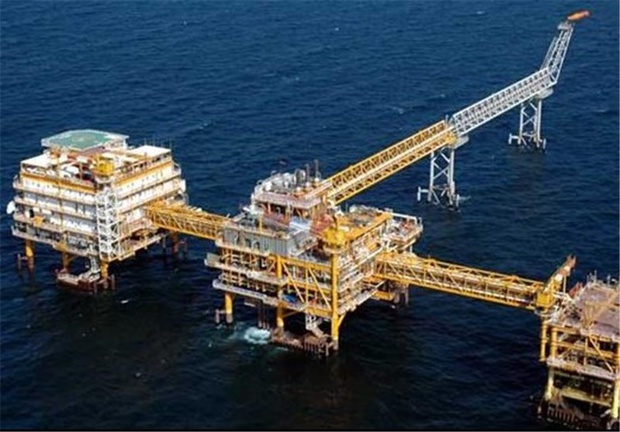
In a decree, the Chairman and Managing Director of Pars Oil and Gas Company, Mohammad Meshkinfam, appointed Shabnam Shahbazi as the manager of Farzad gas field development project.

Given various reasons including hard conditions of gas and oil fields, men are usually appointed as the manager of development projects but with the new decree, Shahbazi has become the first female manager of Farzad joint gas field.

The field which includes two main and strategic gas fields, (Farzad A and B) is one of the joint fields between Iran and its southern neighbours.

Red Region Project: Carpets Show Chaos in Mideast

Red Region Project: Carpets Show Chaos in Mideast2

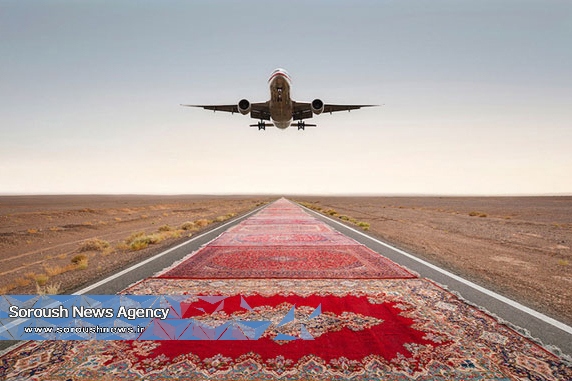
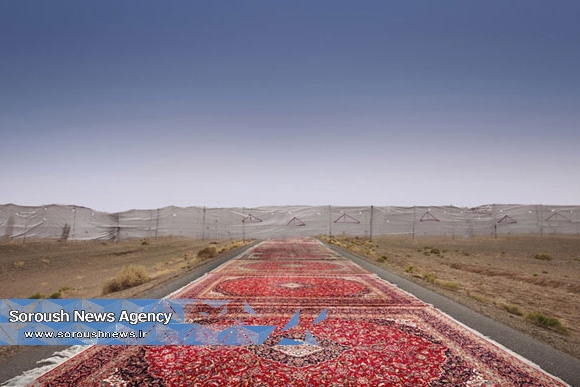
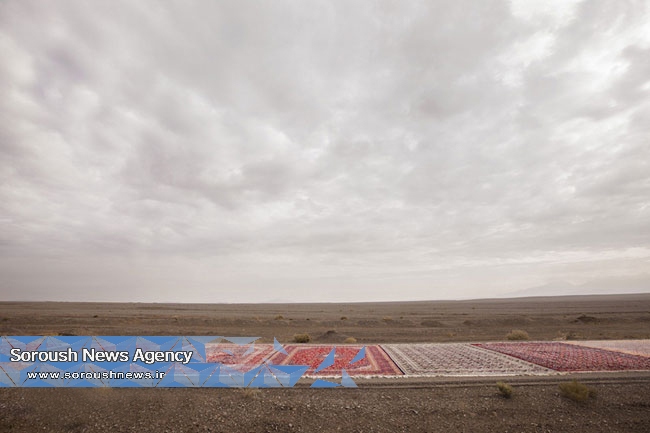
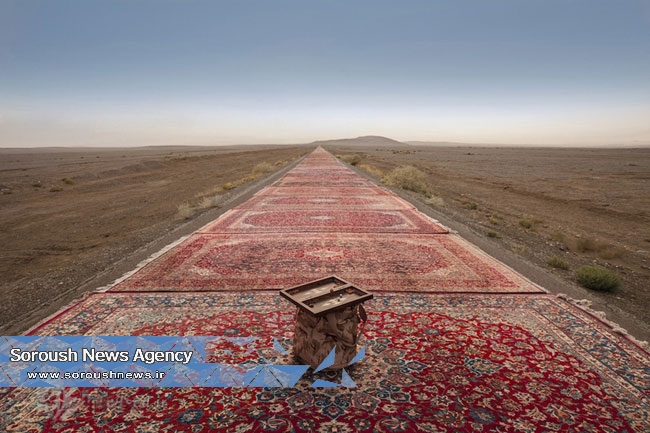
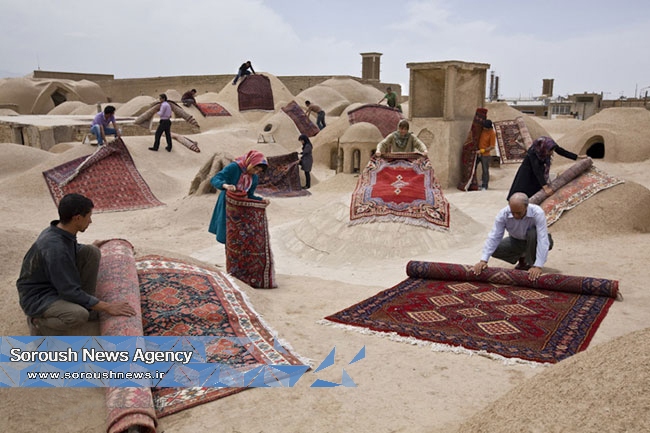
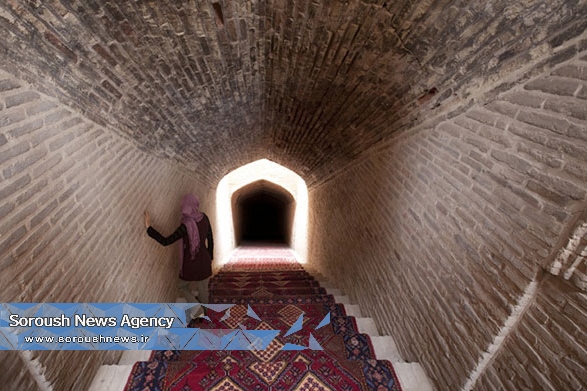
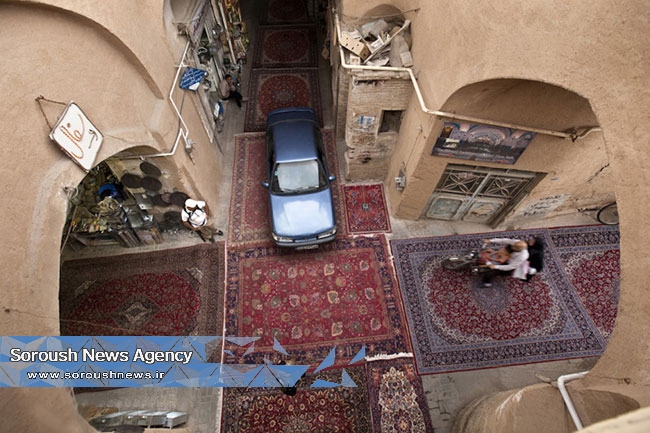
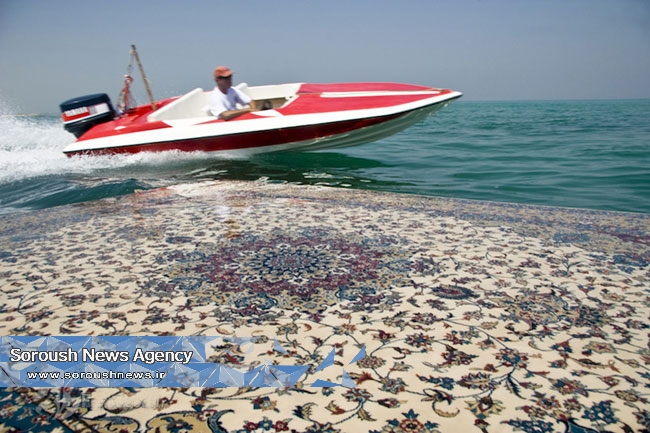
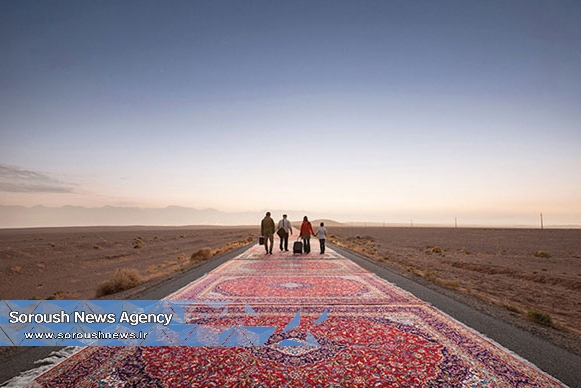
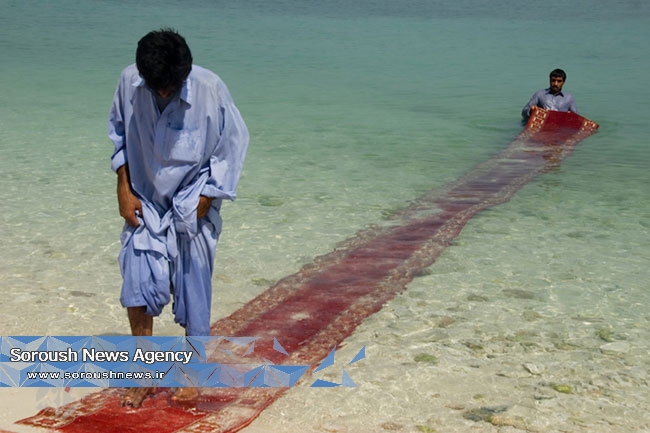
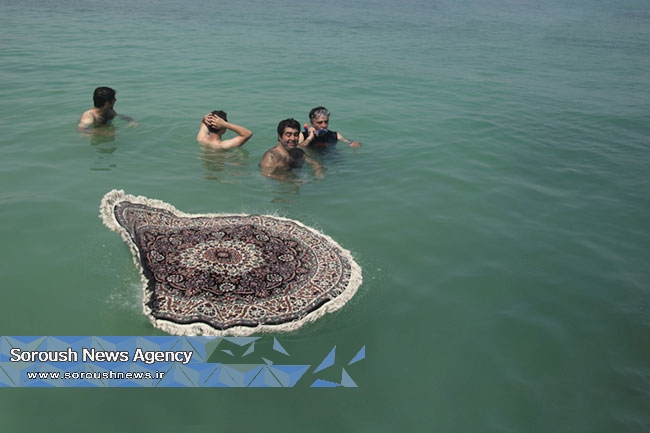
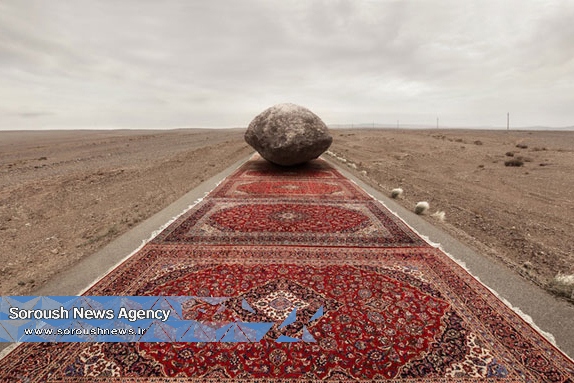
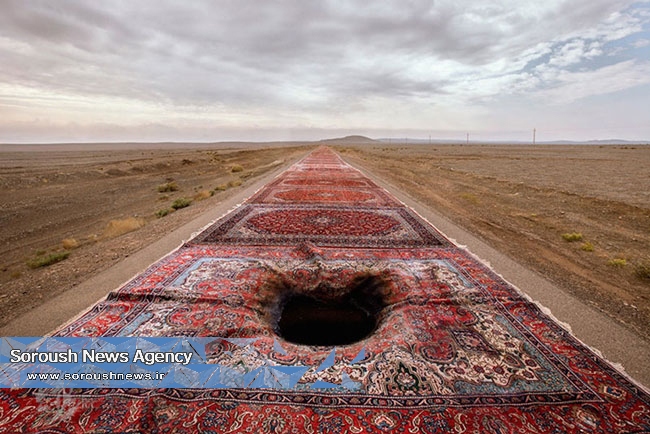
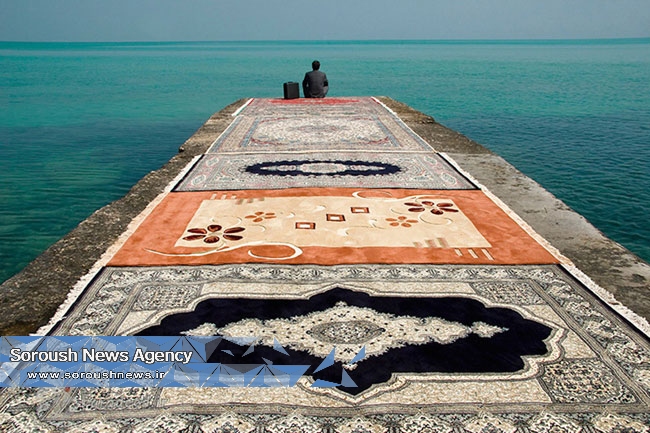
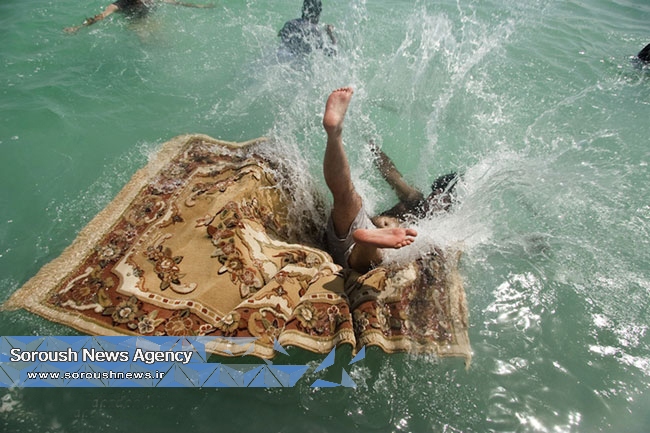
Jalal Sepeher, a well-known and self-trained photographer who has been working on a project on Iranian carpets, has made a creative change in his project by taking photos of Iranian carpets in an empty and dry desert.

In his new project, the photographer has taken various photos of Iranian carpets in a dry desert under a cloudy sky, according to a Farsi report by the Soroush News Agency.

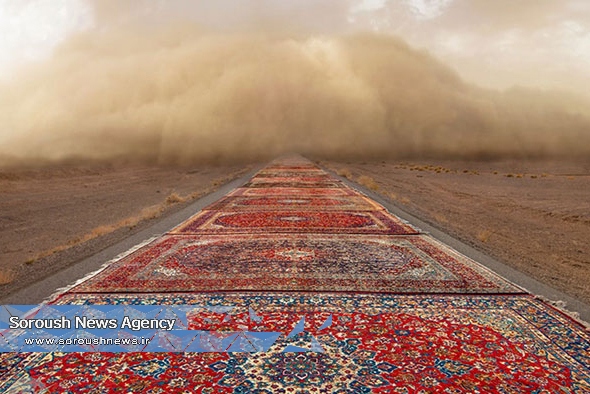
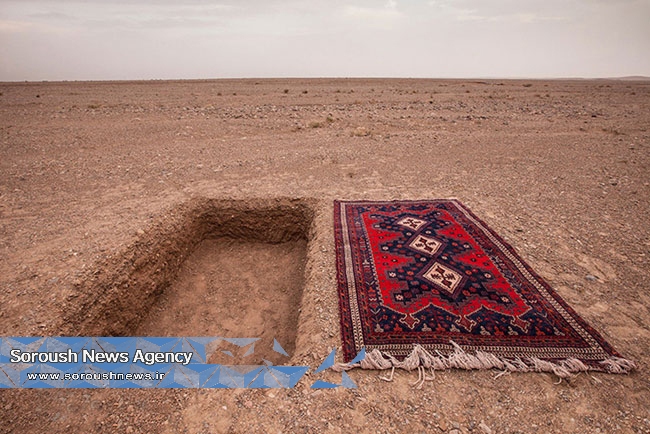
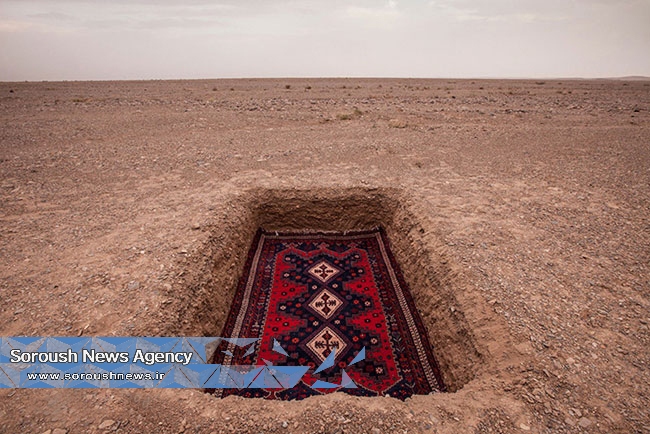
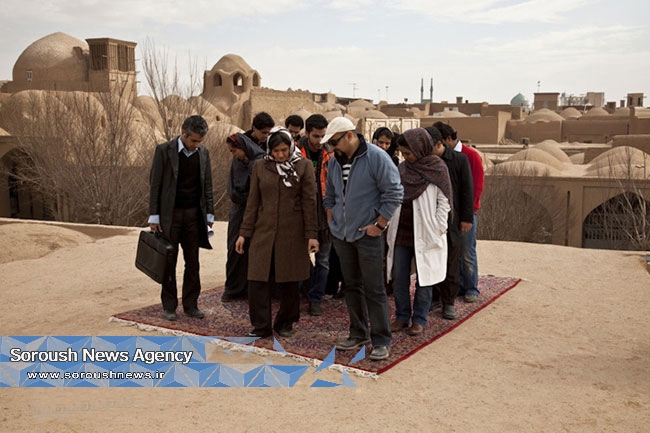
Art experts view the project as a reflection of the chaos underway in the Middle East. In this project, the Iranian market is depicted against the backdrop of endless deserts and roads leading to nowhere under a cloudy sky.

In one photo, an Iranian carpet has been spread on a road with a deep pit in the middle. In another photo, a huge stone has fallen on the carpet.

In a photo, a sand storm is seen at the backdrop threatening the security of the Red Region. In a photo, a family is seen standing on the carpet looking at the horizon, maybe thinking about migration.

The elements used in the collections including an airplane over the sky imply concepts like migration, instability, threats and insecurity which are spreading across today’s Middle East.

Sepehr had earlier launched similar projects with different backdrops including historical monuments, traditional architectures as well as natural elements of Iran’s southern regions.

‘New US Sanctions Aimed at Undermining Iran’s Power’

‘New US Sanctions Aimed at Undermining Iran’s Power’

A specialized meeting of the Saba Cultural-Media Centre has been held to review the new US sanctions on Iran. The meeting was specifically aimed at discussing ways of tackling the new sanctions imposed against the Islamic Revolution Guards Corps (IRGC).

Here are highlights of the discussion, as report by Basirat news website:

Washington’s new bans against the Islamic Republic of Iran have a well-connected chain aimed at undermining the constituents of power in Iran.

University professor Abu-Mohammad Asgarkhani said at the meeting one of features of the sanctions is that the US is legalizing the permanence of the bans.

“[Washington] suggests these are not only preliminary sanctions, but are bans on the part of other countries as well. In other words, all Europeans are obliged to cooperate in implementing the law. It means the sanctions are not unilateral. It means the JCPOA has no role here, and the law mobilizes all these countries against us. So, the sanctions are a regime,” said Asgarkhani.

“We asked what objectives and rules the sanctions regime has. They themselves said principles are in line with objectives. … The objective is completely clear.”
“Several concepts can be taken into consideration when it comes to sanctions,” he added.

  1. They have numerous and network-like regimes.
  2. They follow a single objective.
  3. They have common concepts.
  4. They are continuous.
  5. They oblige others to implement them.
  6. They are extended from the nuclear domain to other areas, including conventional weapons. This is our initial understanding of the sanctions.

Sanctions: A Long-Term Strategy

Also present at the meeting was researcher Hamed Mousavi, who expressed his viewpoints on the issue.

“They had drawn up a plan under which they were set to target Iranian troops in Syria, that is, start physical combat. But because they were not capable of doing it, another group said they needed a long-term plan for Iran and shouldn’t act emotionally. Overall, one can consider the sanctions as a long-term strategy which would ratchet up the pressure gradually,” said Mousavi.

New Sanctions and JCPOA

Siamak Baqeri also said at the meeting that the so-called HR 3364 law is a unique law. At the same time, it is rules-based and, in fact, is intertwined with a series of other laws. The law does not suggest that it is an accumulation of previous laws. Despite all laws which exist, this law focuses on a certain objective. There are points which have made this law much more secretive than previous ones.

So, in the first place, it will not be right to regard the law as a result of efforts by opponents of the JCPOA in the US. If we look at the trend of the passage of the law, we will see that all American think tanks contributed to it. These show that the end product was not the outcome of attempts by opponents of the JCPOA; rather, it was the result of consensus within the United States.

One of the important features of the law is that it is complementary. The law is a complement to the JCPOA’s unsaid points. This law is a complementary one which focuses on Iran’s defense power. Even if a human rights issue is enshrined in it, it can target our defense power as well. The law says a regional strategy should be devised regarding Iran’s asymmetrical threats. It also says bans should be slapped on ballistic missiles, Iran’s conventional weapons and the IRGC. Therefore, it focuses on undermining the constituents of Iran’s power.


University of Tehran Opens Dorm for Foreign Students

University of Tehran Opens Dorm for Foreign Students

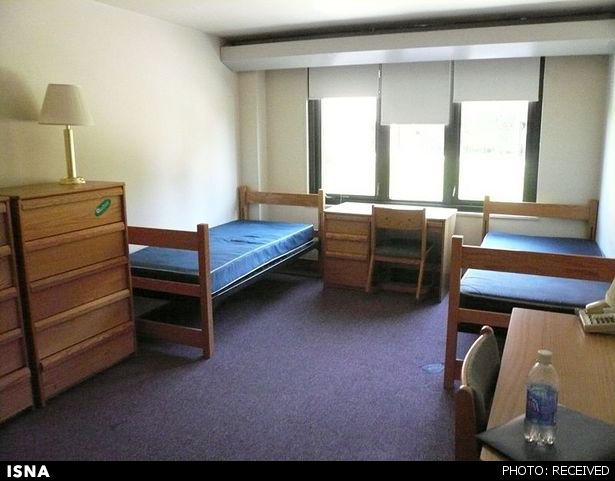
Tehran University’s Deputy for Students’ Affairs, Hassan Behnejad, said in a Farsi interview with the Young Journalists Club (YJC) that this year for the first time the Osku dormitory has been launched for the foreign students.

“This dormitory consists of 15 apartment units. We are trying to accommodate students studying at the central campus and students from foreign countries in these dormitories in the new academic year,” said Behnejad.

He also noted that several other dormitory complexes are being built at the university campus, which hopefully will be operational next year.

“Since the closure of dormitories in early summer we wanted to renovate all the dorms at the university campus for the new academic year.”

“At the moment, we have completely evacuated some dormitories at the university, and equipped them with heating and cooling systems. Two of our dorms which were located elsewhere in the city have been reconstructed and provided with new equipment,” he added.

“Due to a shortage of dormitories at this university in the new academic year, we had to to lease several dorms for students. Given the high costs we should pay, we do hope that this problem will be resolved soon.”