Tuesday, December 30, 2025
Home Blog Page 3871

A Look at Iranian Newspaper Front Pages on October 2

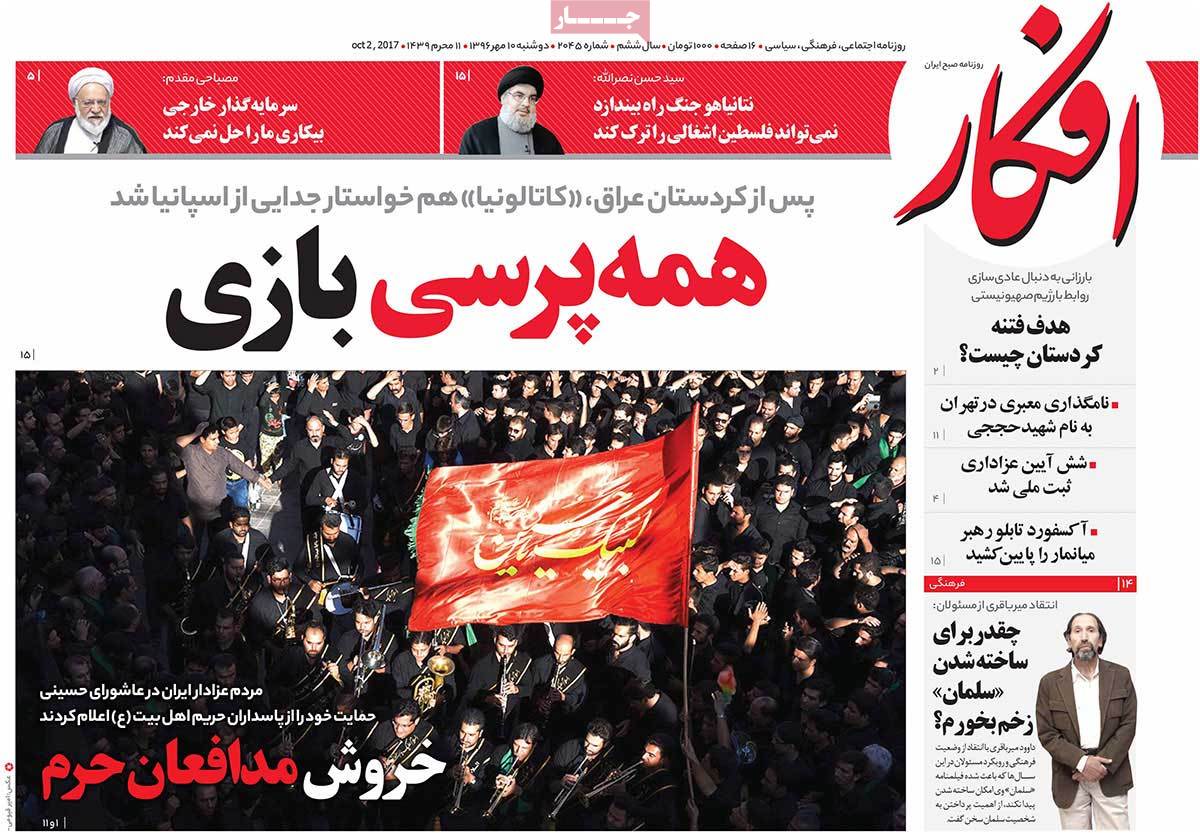
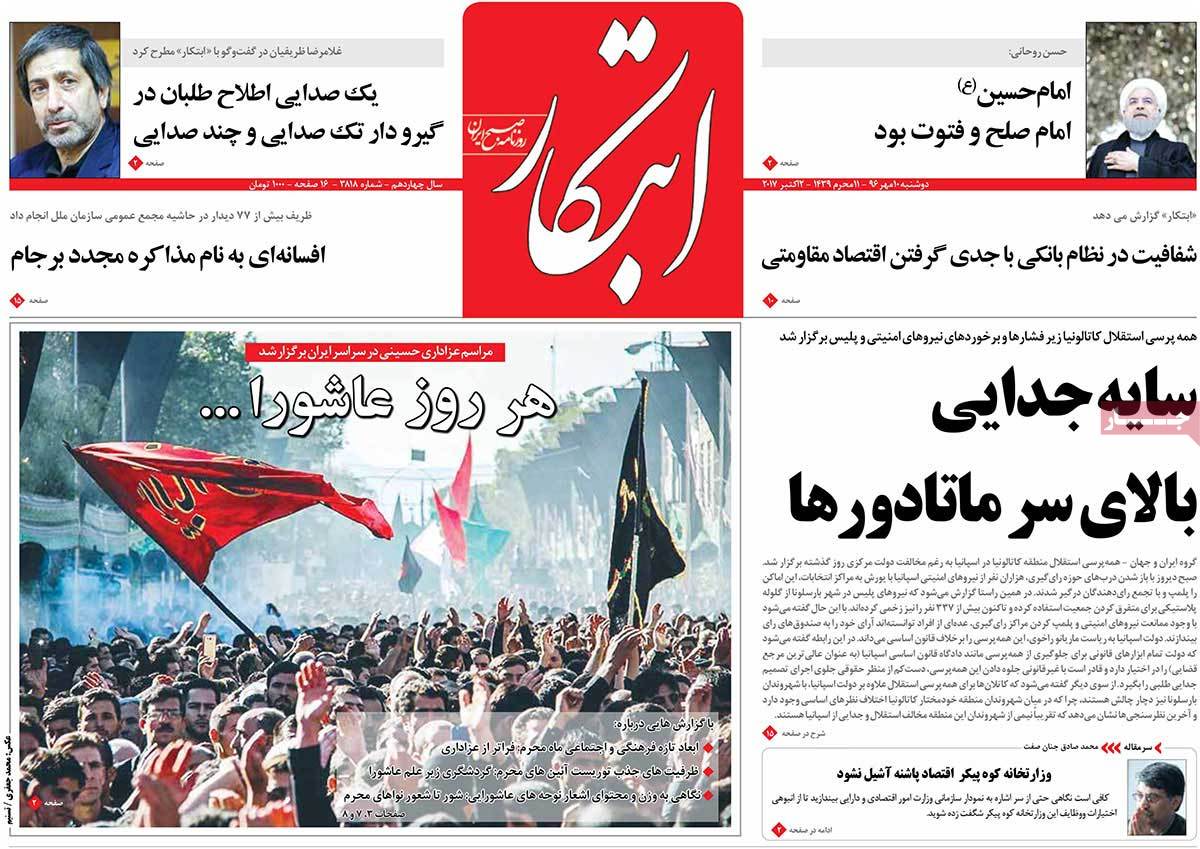
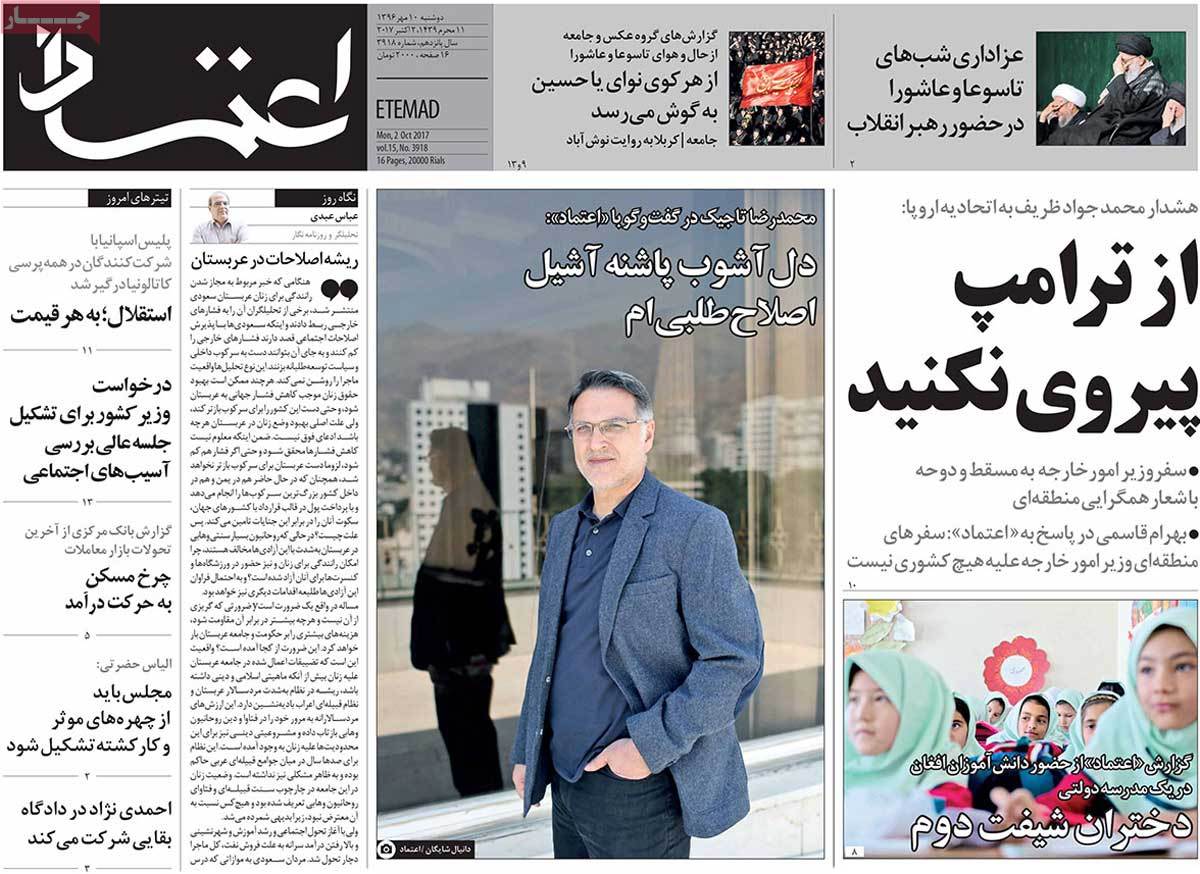
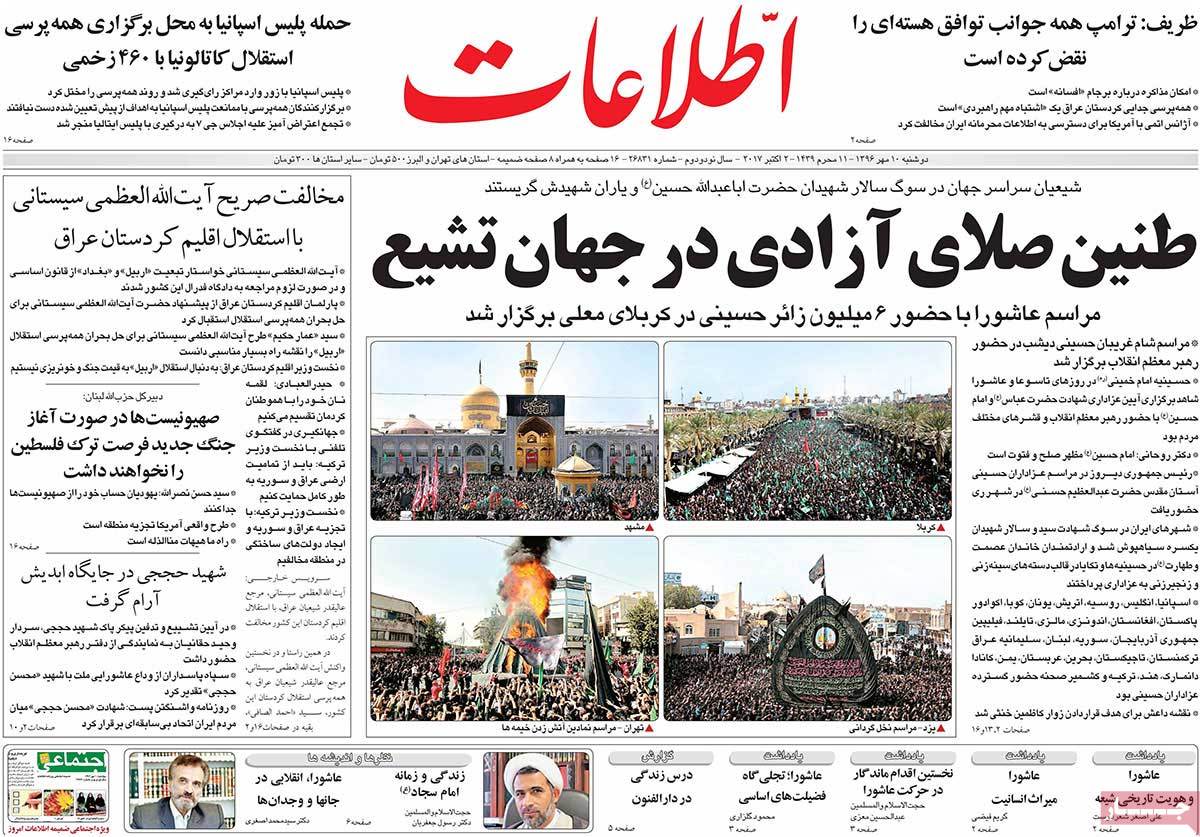
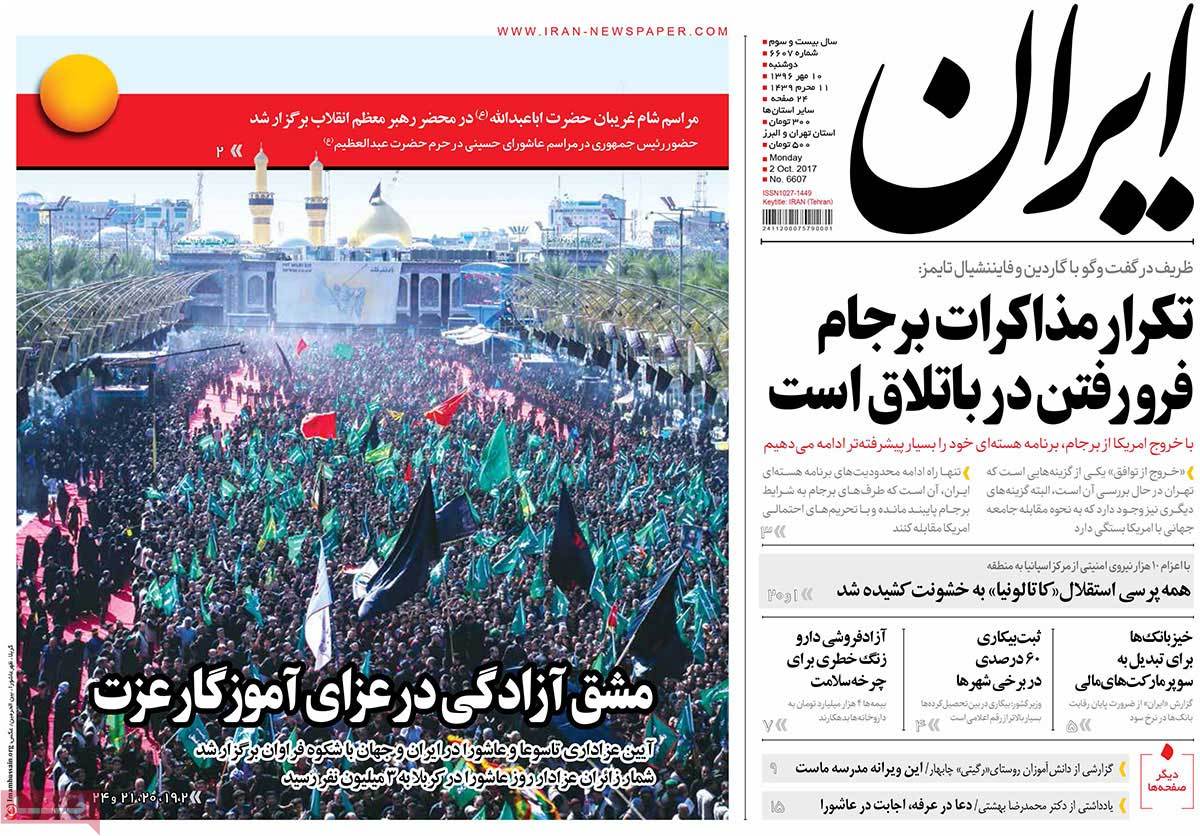
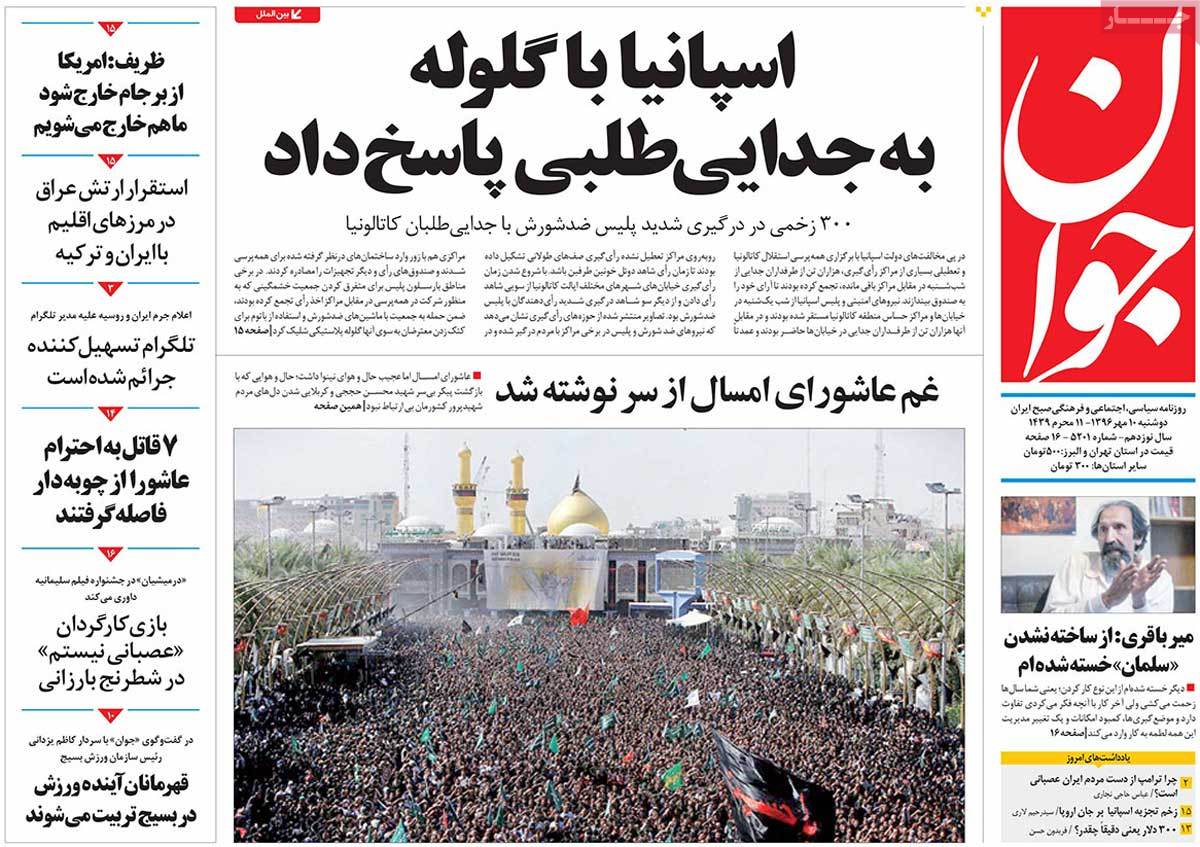
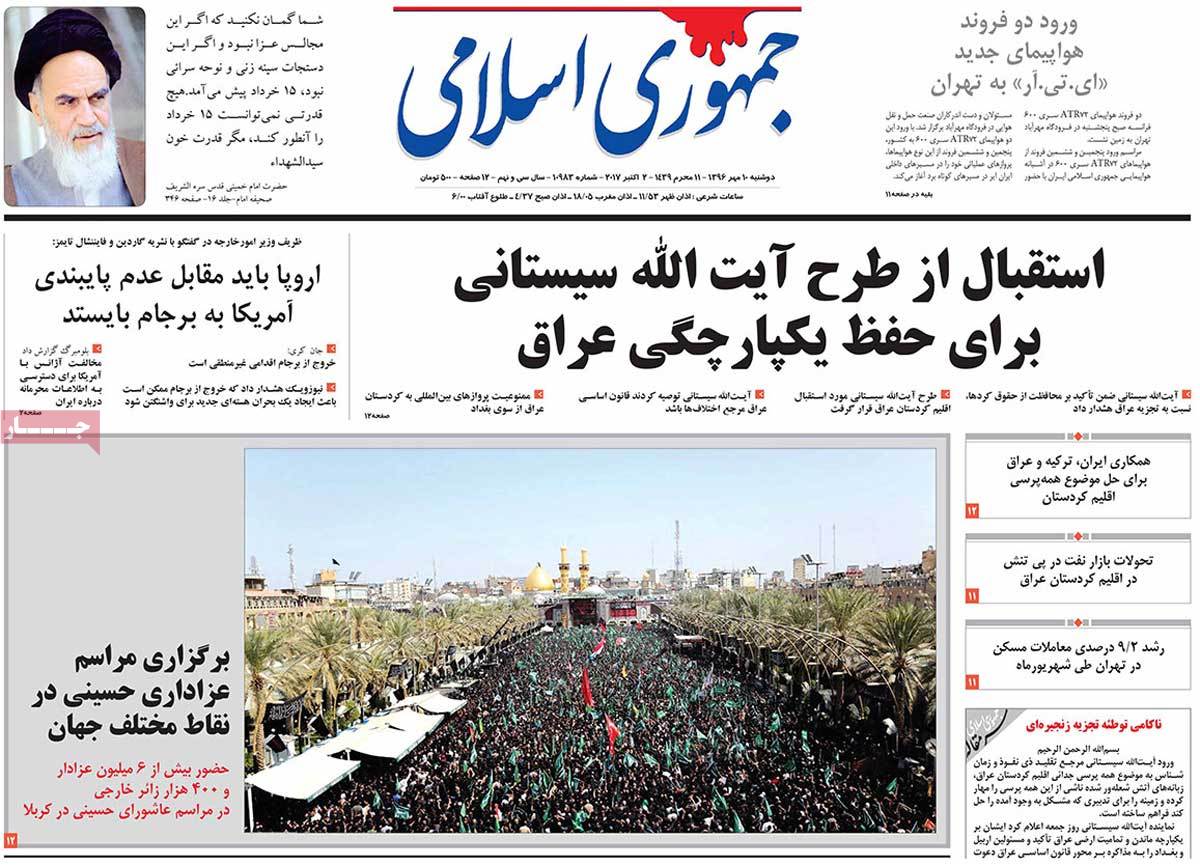
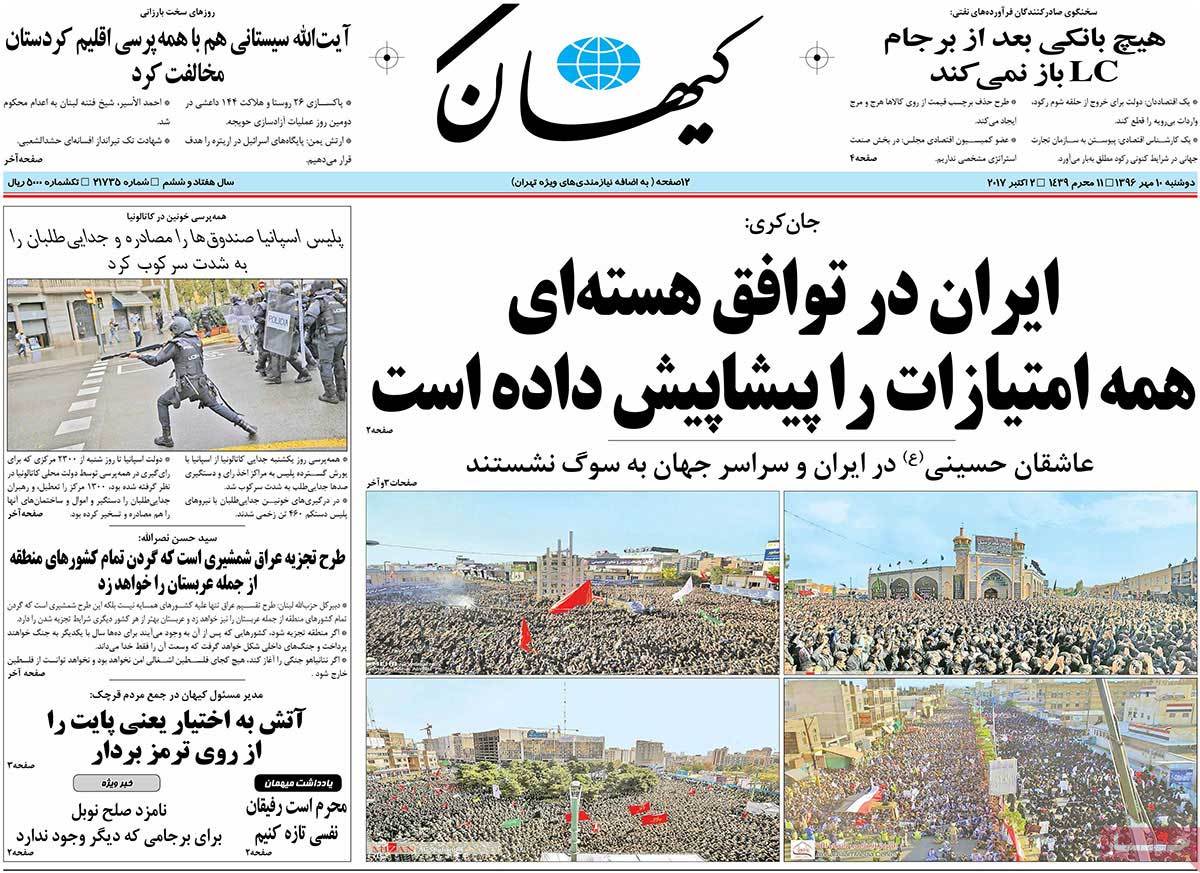
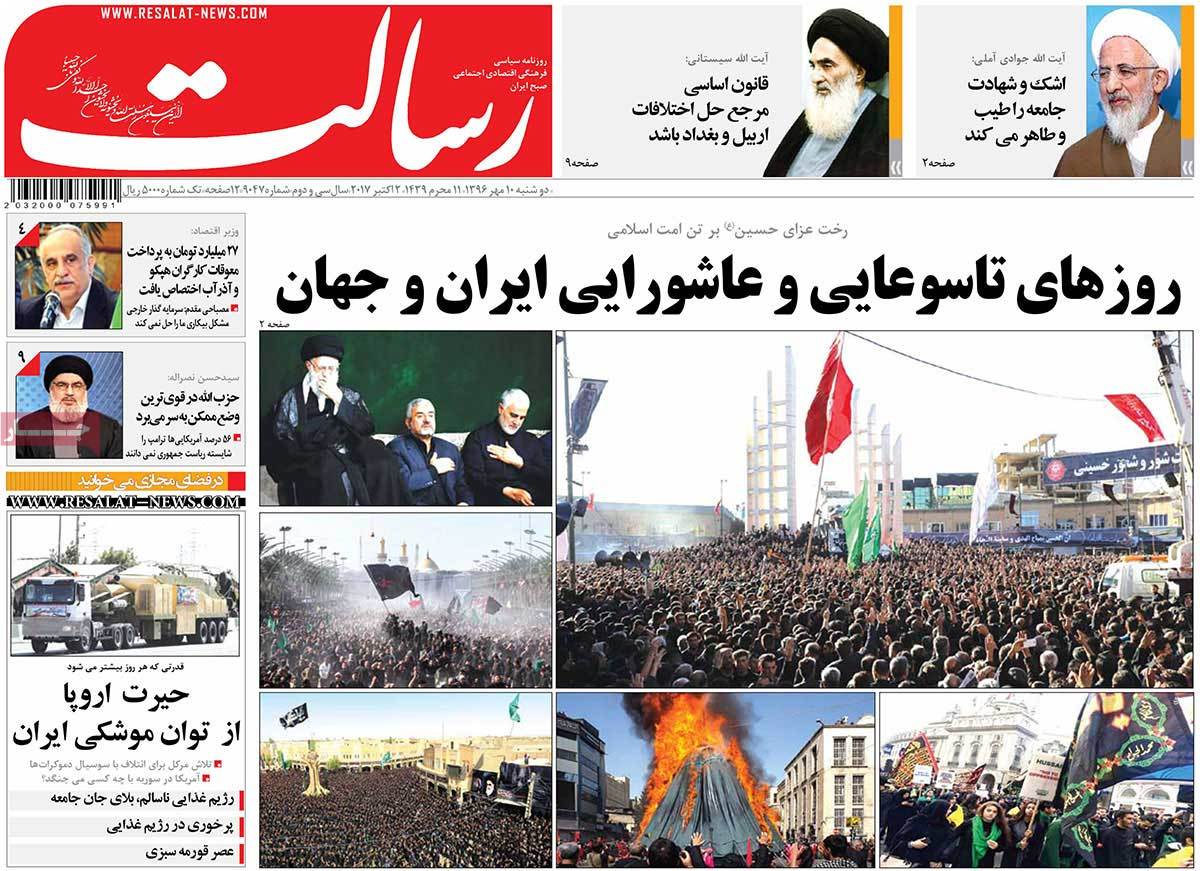
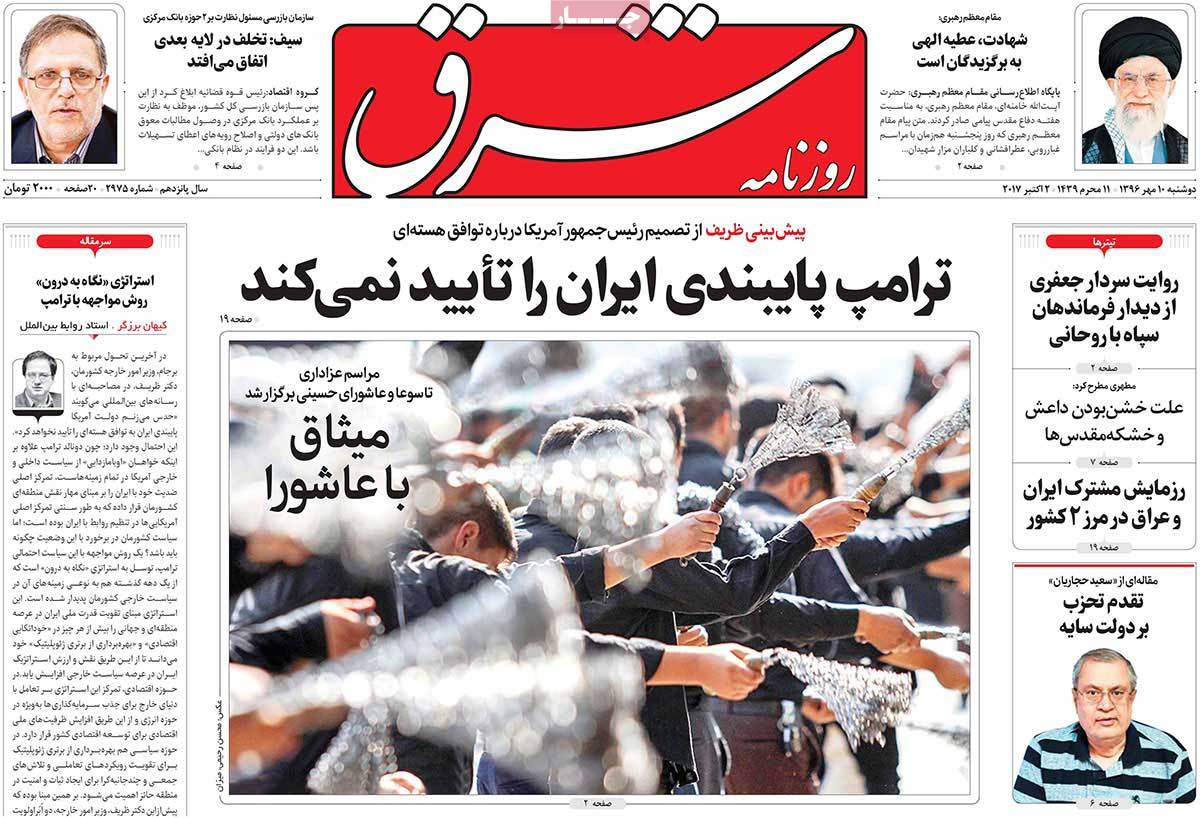
After two days of holiday (the martyrdom anniversary of Imam Hussein, the third Shiite Imam and the grandson of Prophet Muhammad), all newspapers on Monday published photos of huge mourning ceremonies held across Iran and other Muslims states on their front pages.

Having been closed for three days (the two holidays plus Friday), newspapers started covering the most important international events of the past few days on their front pages.

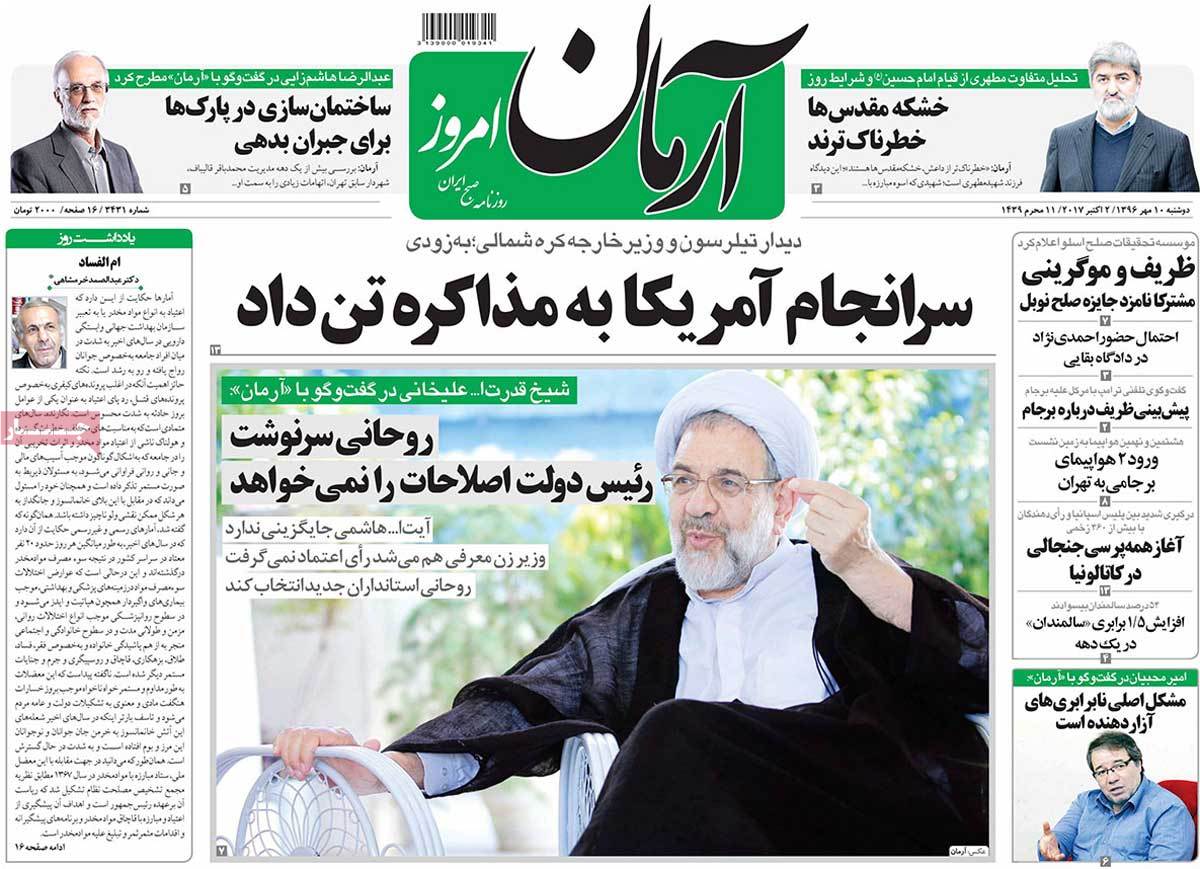
A top story was Iranian Foreign Minister Mohammad Javad Zarif’s remarks about the nuclear deal between Tehran and world powers, and his prediction that Trump would refuse to confirm the Islamic Republic’s compliance with its JCPOA commitments.

Zarif, who was busy meeting with officials from other countries on the sidelines of the UN General Assembly and delivering speeches and giving interviews in New York, once again asked Europeans to defy US in case of the nuclear deal. He also described the renegotiation of JCPOA an impossible myth.

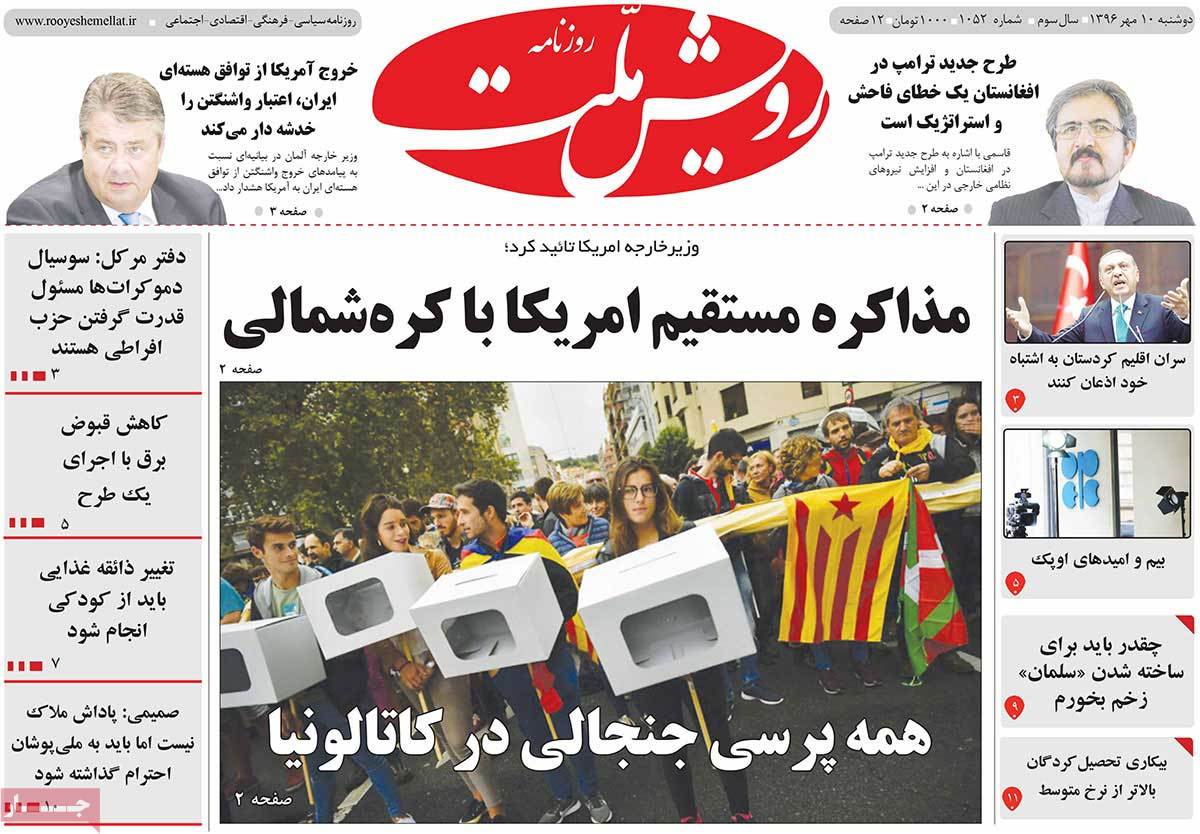
A few days after the Iraqi Kurdistan’s independence referendum, now newspapers are covering the plebiscite on Catalonia’s secession from Spain and the brutal reaction of Spanish police forces, which wounded hundreds of protesters.

Newspapers particularly compared the peaceful reaction of Iraqi government to Kurdistan’s illegitimate votes with Spain’s brutal and oppressive reaction to Catalonia referendum.

The above issues, as well as many more, are highlighted in the following headlines and top stories:


Afkar:

1- Game of Referendums: After Iraqi Kurdistan, Now Catalonia Seeks Independence from Spain

A Look at Iranian Newspaper Front Pages on October 2


Arman-e Emrooz:

1- US Finally Accepts to Negotiate with North Korea

  • Tillerson to Meet North Korean FM Soon

2- Zarif, Mogherini Nominated for Nobel Peace Prize

3- Two Newly-Purchased Planes Arrive in Iran: 8th and 9th Planes after JCPOA

A Look at Iranian Newspaper Front Pages on October 2


Ebtekar:

1- Rouhani: Imam Hussein Was Imam of Peace, Kindness

2- Shadow of Secession over Matadors’ Head

  • Catalonia Independence Referendum Held amid Pressures, Clash with Police

2- Every Day Is Ashura: People across Iran Mourn Imam Hussein’s Martyrdom

A Look at Iranian Newspaper Front Pages on October 2


Etemad:

1- Tasu’a, Ashura Mourning Ceremonies Held with Iran Leader in Attendance

2- Zarif Warns EU against Following Trump

A Look at Iranian Newspaper Front Pages on October 2


Ettela’at:

1- Zarif: Trump Has Violated All Aspects of Iran Nuclear Deal

2- Spain Police Attacks Catalonia Independence Referendum Stations: 460 Wounded

3- Ayatollah Sistani Explicitly Voices Opposition to Iraqi Kurdistan’s Independence

4- Hezbollah Chief: Zionists Won’t Have Chance to Leave Palestine If Wages New War

A Look at Iranian Newspaper Front Pages on October 2


Iran:

1- Zarif: Repetition of JCPOA Talks Is Sinking in Swamp

A Look at Iranian Newspaper Front Pages on October 2


Javan:

1- Spain Responds to Secession with Bullets

2- Iraqi Army Deployed in Kurdistan’s Borders with Iran, Turkey

3- 7 Murderers Temporarily Escape Death in Respect for Ashura

A Look at Iranian Newspaper Front Pages on October 2


Jomhouri Eslami:

1- Iran, Turkey, Iraq Join Hands to Resolve Issue of Iraqi Kurdistan’s Independence

2- Mourning Ceremonies Held for Imam Hussein in Various Parts of World

  • +6 Million Mourners, 400,000 Foreign Pilgrims Attend Ashura Ceremony in Karbala

3- Developments of Oil Market Following Tension in Iraqi Kurdistan

A Look at Iranian Newspaper Front Pages on October 2


Kayhan:

1- Kerry: In JCPOA, Iran Has Given All Concessions in Advance

2- Oil Spokesman: No Bank to Return to LC after Nuclear Deal

3- Hezbollah Chief: Plot to Disintegrate Iraq to Hurt All Regional States, Including Saudi Arabia

A Look at Iranian Newspaper Front Pages on October 2


Resalat:

1- Ayatollah Sistani: Constitution Should Be Referred to Resolve Erbil-Baghdad Conflict

2- Europe Amazed by Iran’s Missile Power: The Power that Grows on Daily Basis

A Look at Iranian Newspaper Front Pages on October 2


Rooyesh-e Mellat:

1- Qassemi: Trump’s New Plan in Afghanistan Blatant, Strategic Mistake

2- German FM: US Withdrawal from Nuclear Deal to Damage Washington’s Reputation

A Look at Iranian Newspaper Front Pages on October 2


Shargh:

1- Zarif Predicts US President Won’t Confirm Iran’s Compliance with JCPOA Commitments

2- Iran-Iraq Joint Military Drill in Border Areas

3- ‘Looking Inside’ Strategy, Best Way to Confront Trump [Editorial]

A Look at Iranian Newspaper Front Pages on October 2


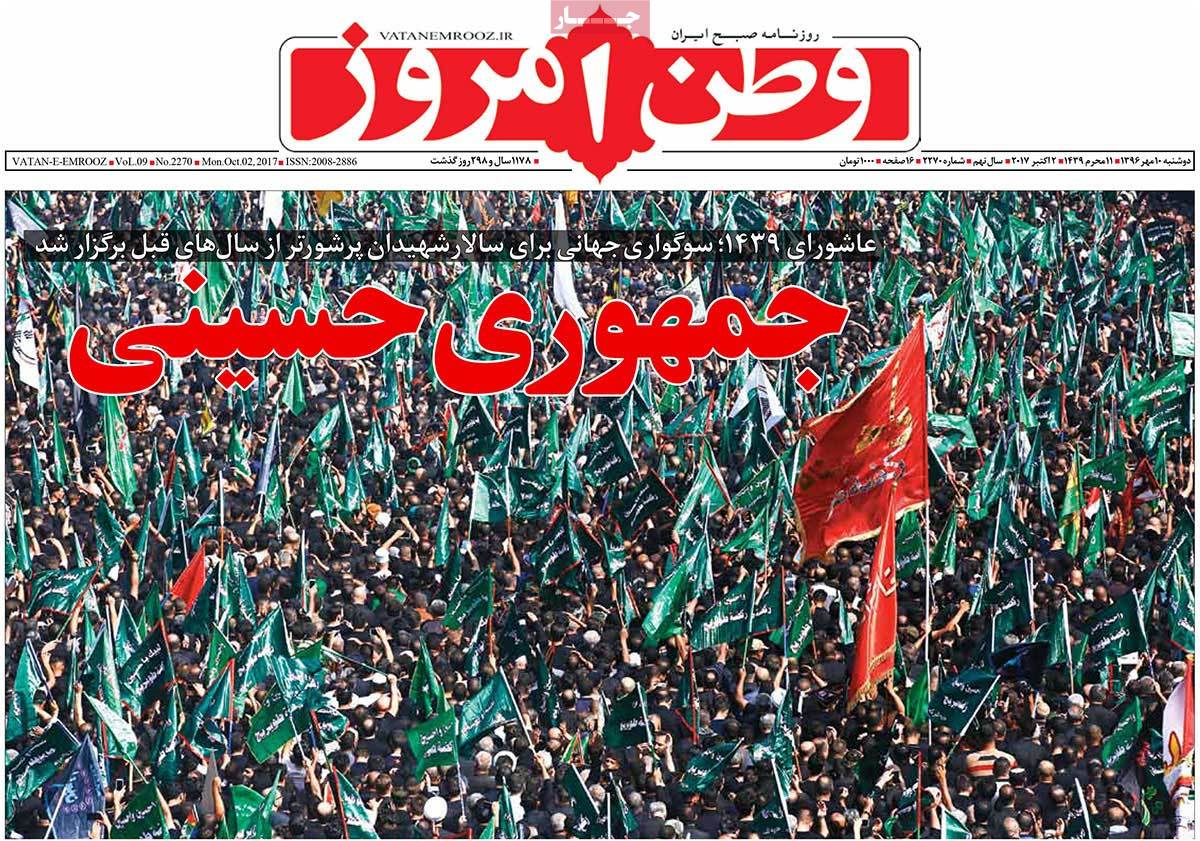
Vatan-e Emrooz:

1- Republic of Imam Hussein

  • Ashura 1439, Global Mourning for Imam Hussein More Glorious than Ever

A Look at Iranian Newspaper Front Pages on October 2


Secretary of Iraqi Kurdistan Parliament Resigns

Fakhradin Qadir

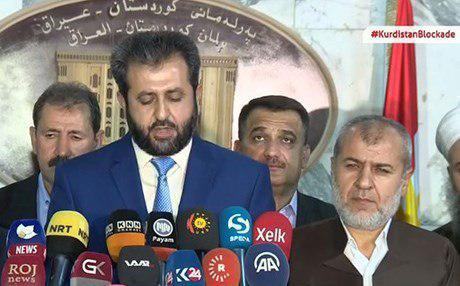
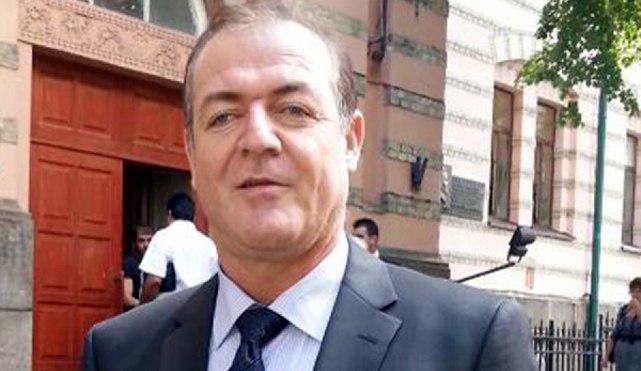
Just five day after the independence referendum of Iraqi Kurdistan, the Kurdish Parliament’s secretary, Fakhradin Qadir from the Change Movement, announced his resignation in protest at what he called the Kurdistan government’s manipulation and instrumental use of parliament.

Qadir tendered his resignation as Secretary and membership of Kurdistan’s Parliament in a press conference on Sunday outside the parliament building, a Farsi report by the Kurd Press said.

“During my membership in the parliament, we adopted significant laws and decisions which, unfortunately, have never been implemented by the government. Meanwhile, the ruling party has limited the authority of the parliament. Political parties are after an acquiescent parliament and that’s why they are seeking to limit the scope of parliament’s activities,” he said.

Qadir went on saying Kurdistan region needed a written Constitution but “the parliament members failed in a vain attempt to develop a constitution because of government’s sabotage campaign.”

The Kurdish politician added the parliament tried to establish a fund for oil revenues to make oil dealings more transparent but “this goal was never achieved and we saw tens of illegal contracts signed without coming under the lawmakers’ supervision.”

Qadir also referred to the recent independence referendum of Iraqi Kurdistan region and said, “The parliament members did their best to hold the referendum within the law but the vote which is of national significance for us was held without the lawmakers’ supervision.”

He then touched on the main issue of the leadership of Kurdistan and its subsequent political crises and said the last parliament abandoned the issue unresolved “but when we began working to find an appropriate mechanism to resolve the issue, we faced complete crackdown and the parliament was sealed.”

The tensions between the government and parliament in Iraqi Kurdistan’s region began to gain momentum back in 2015 when the Change Movement, the second largest party in the Kurdistan Regional Government (KRG), said its parliament speaker and several parliamentarians had been prevented from entering the Kurdish capital, Erbil.

The checkpoint was manned by security forces affiliated with the Kurdistan Democratic Party (KDP).

The KDP is the largest bloc within the KRG and is led by Masoud Barzani, who has held onto the region’s presidency, even though his rivals, including the Change, claim his term ended on August 19 in 2015.

Relations between Change and KDP deteriorated after Change and Speaker Sadiq played a major role in failed attempts to amend the presidential law to limit the powers of Barzani and set clear term limits for him.

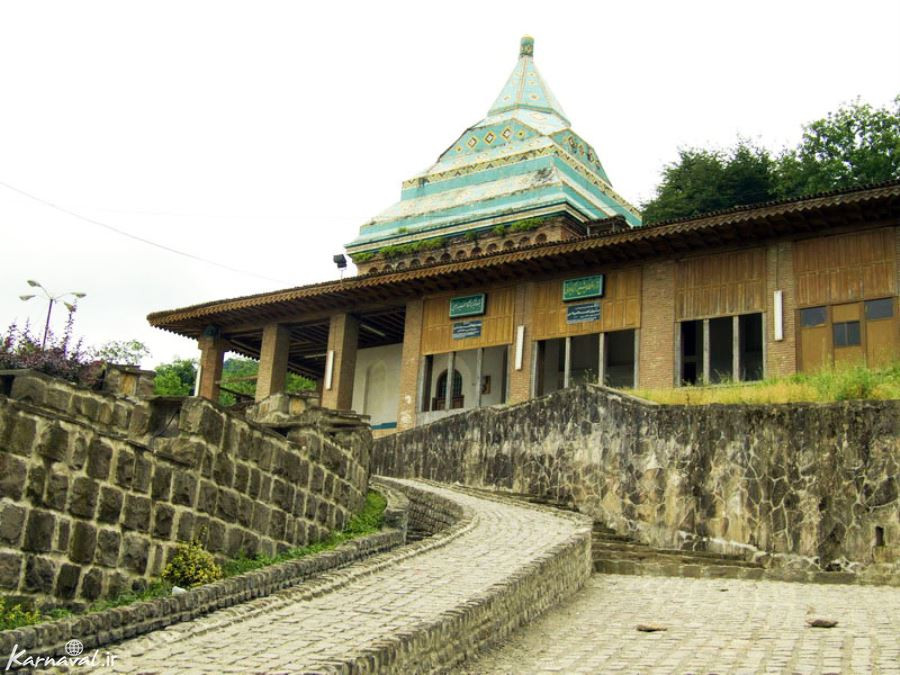
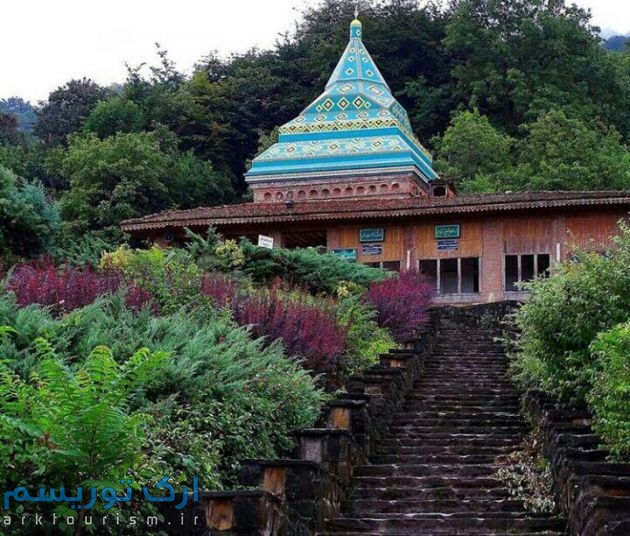
Tomb of Sheikh Zahed Gilani; Historic Monument among Tea Fields

Tomb of Sheikh Zahed Gilani; Historic Monument among Tea Fields

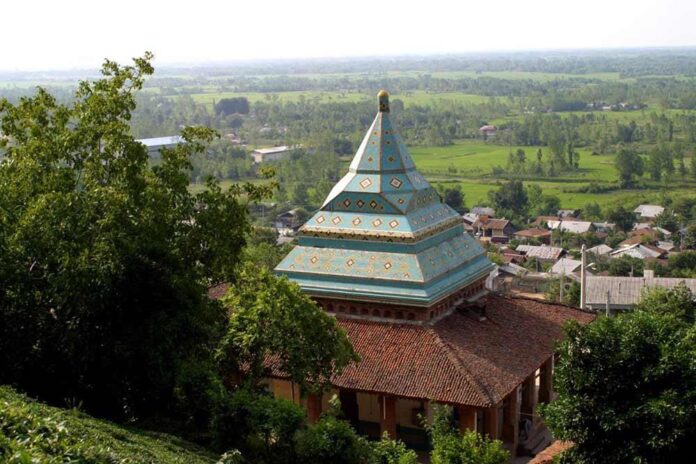
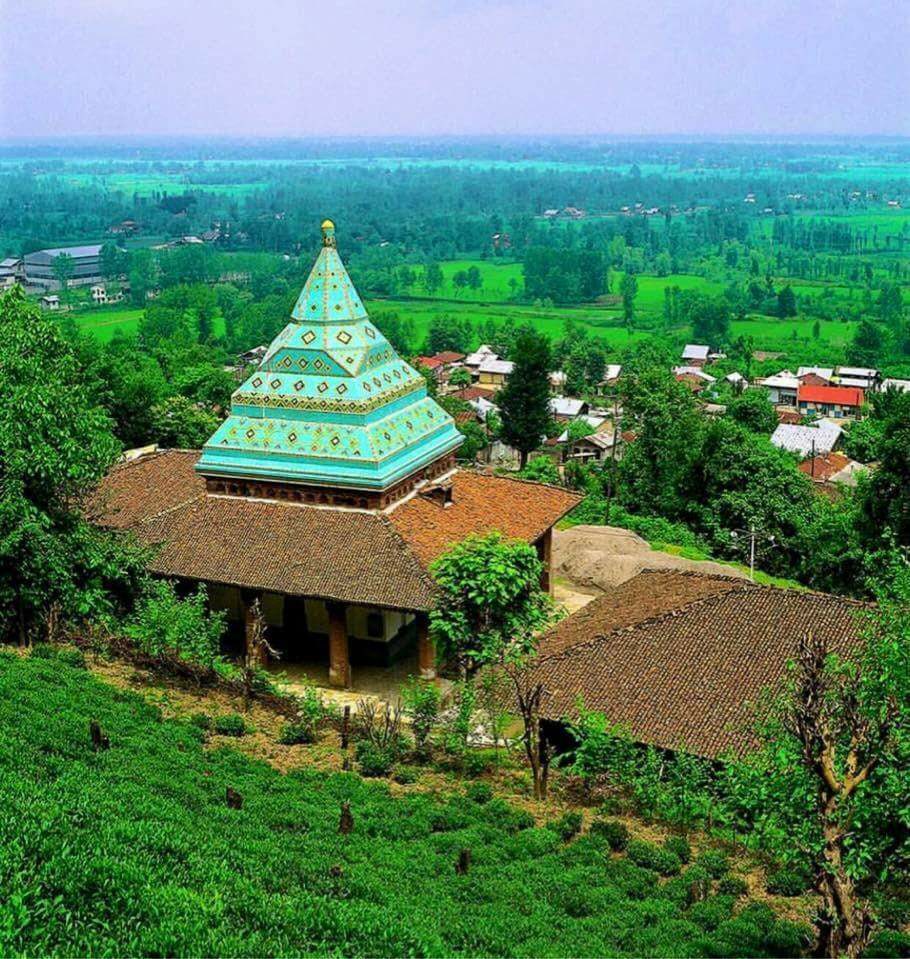
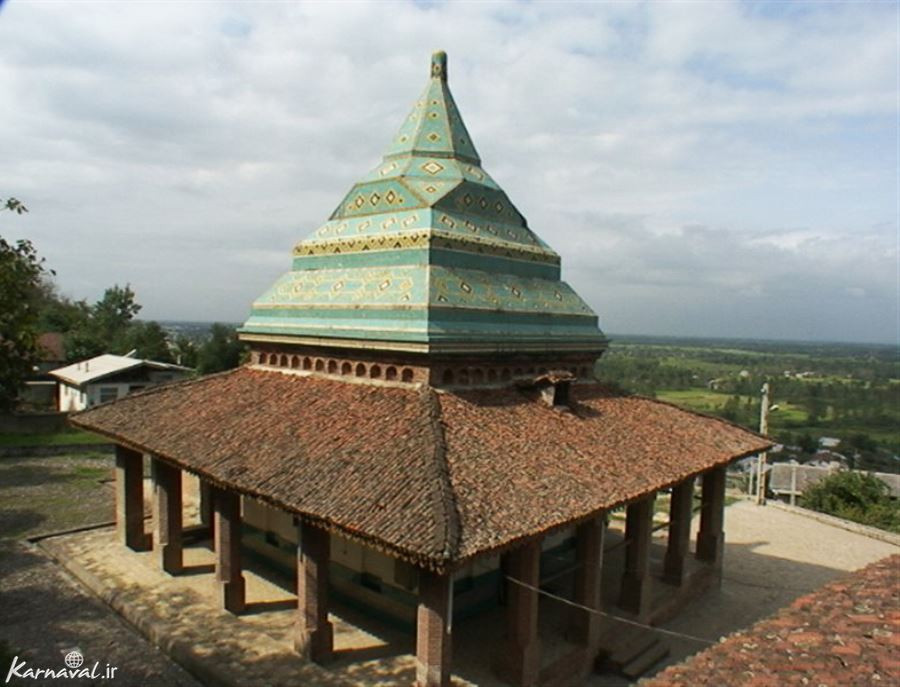
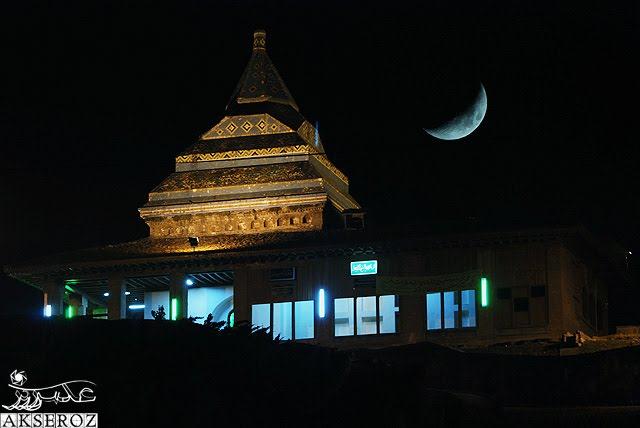
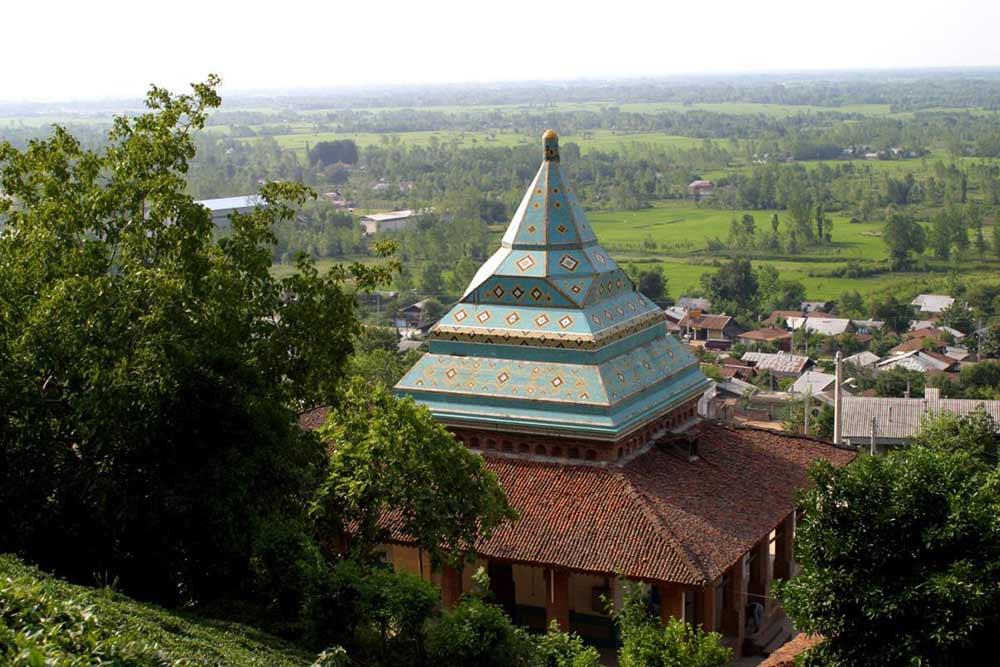
The tomb of Sheikh Zahed Gilani with a turquoise octagonal dome is located in Lahijan and belongs to the Safavid era (late 9th century AH).

According to a Farsi report by Karnaval.ir, the walls of the historic monument’s porch are 115 cm high; which were later ornamented with seven-colour tiles of the Qajar era. In different parts of the porch there are niche windows with curved vaults.

The pyramid and octagonal dome- the most beautiful feature of the building- has a steep slope that allows rapid rain waters to pass. Its surface is covered with yellow-blue, and white-black tiles, with traditional, flower-like designs, which double its beauty. The rest is covered with ceramic.

Sheikh Zahed died in 700 AH and was buried in the western part of Gilan province. Some say in 892 AH, Sultan Haydar Safavi had a dream and then with his architects and carpenters who had travelled by ship from the city of Shirvan to Gilan, built the tomb and transferred the Sheikh’s body to Gilan.

Tadj’ad-Dīn Ebraheem Kurdi Sanjani known as Sheikh Zahed Gilani was one of the great Sufis of Iran; who descended from the city of Sanjan in eastern Khorasan province. His family was one of the most famous ones in Gilan who was engaged in agriculture.

Here are photos of the historic monument retrieved from various news agencies:

Iran Condemns Terrorist Attacks in France, Canada

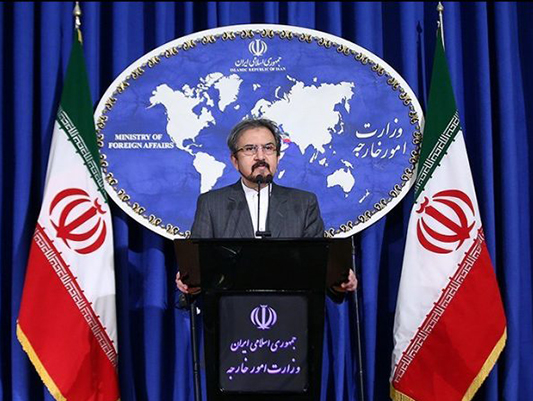
Bahram Qassemi

In a statement on Sunday, Qassemi condemned the attacks and expressed sympathy with the victims’ families.

“While some countries are unfortunately busy doing business with terrorism and giving false addresses, once again a group of innocent and defenceless people fell victim to violence, assassination, and cruelty” Qassemi noted.

“It is necessary that the human community and all countries in the world, in an all-inclusive movement, dry up the intellectual roots, financial support and human resources of terrorism as one of the most serious human tragedies in the present century, and effectively deal with this most-hated phenomenon,” he went on to say.

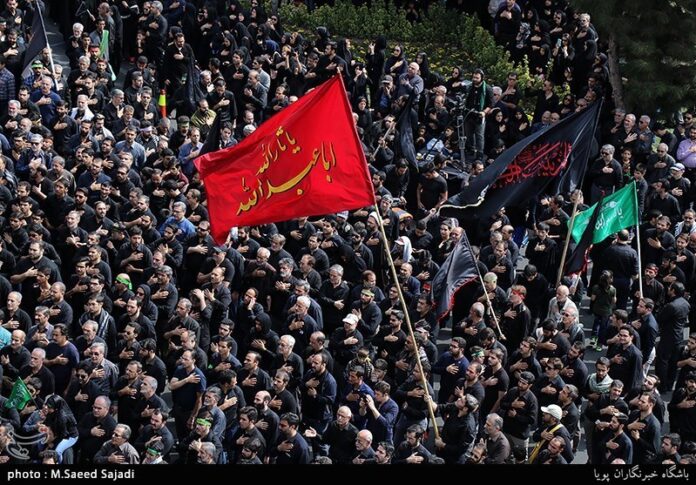
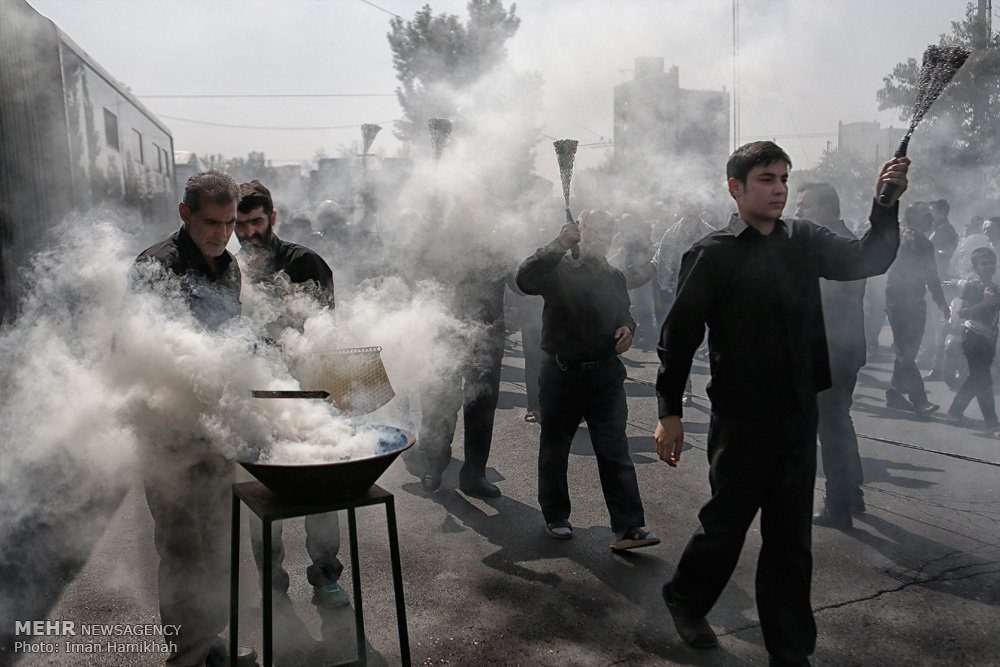
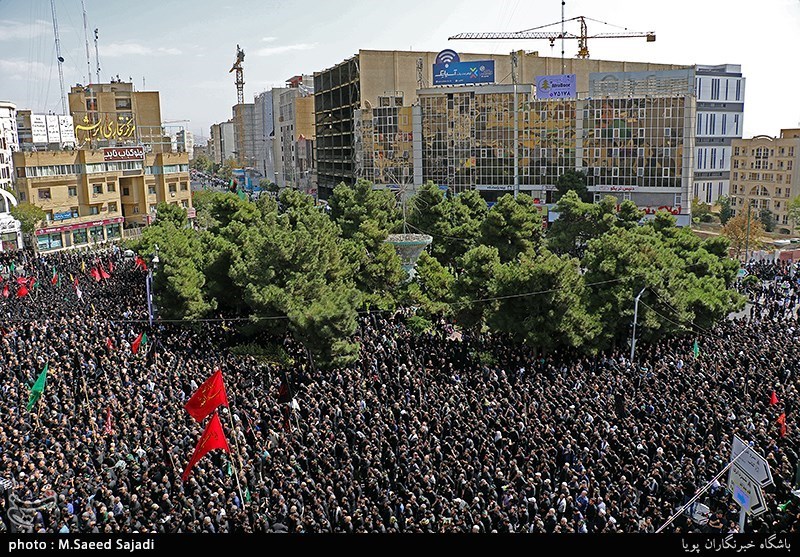
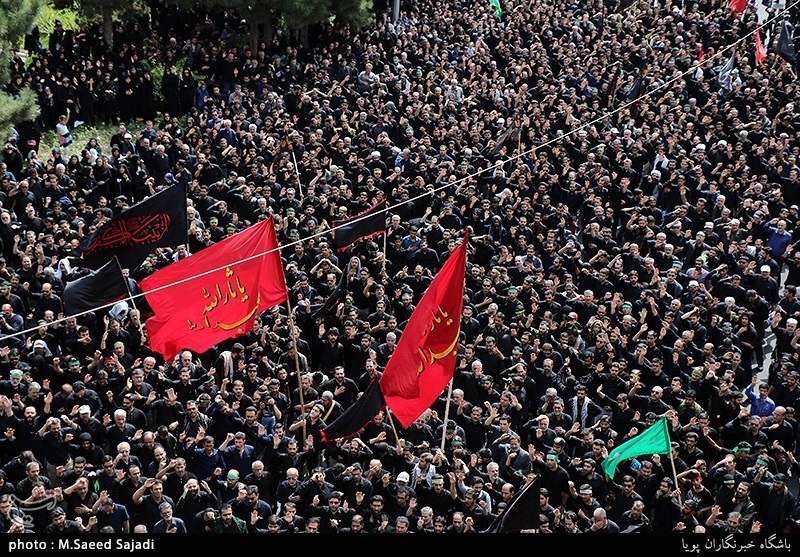
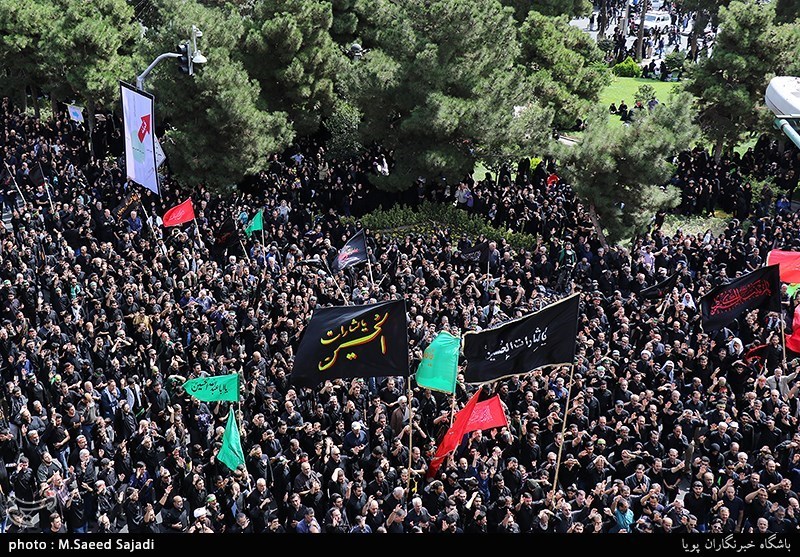
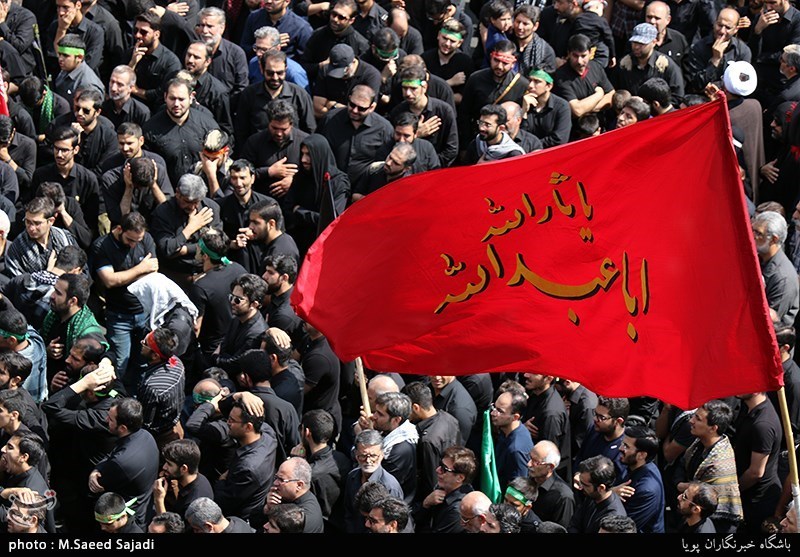
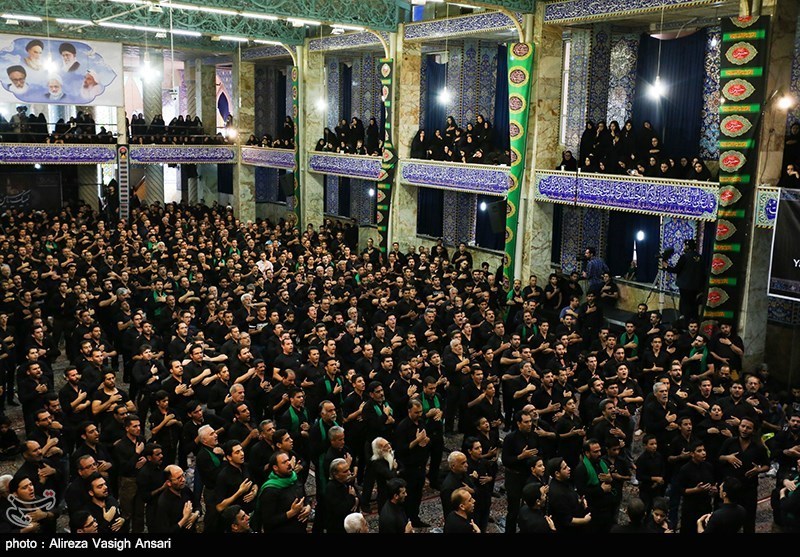
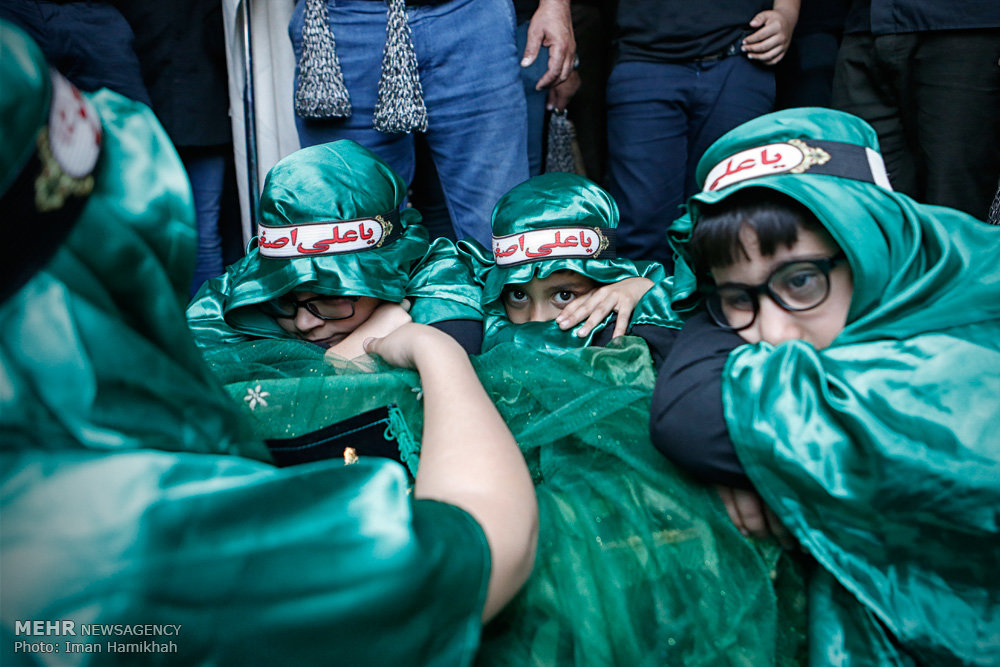
Millions of Shiites Mourn Imam Hussein’s Martyrdom across Iran

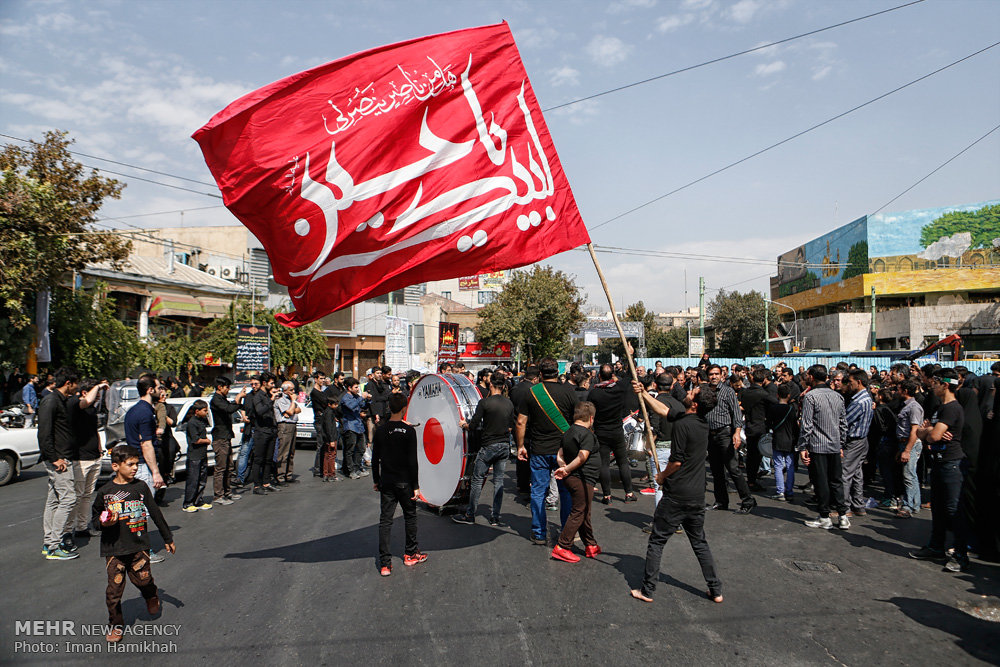
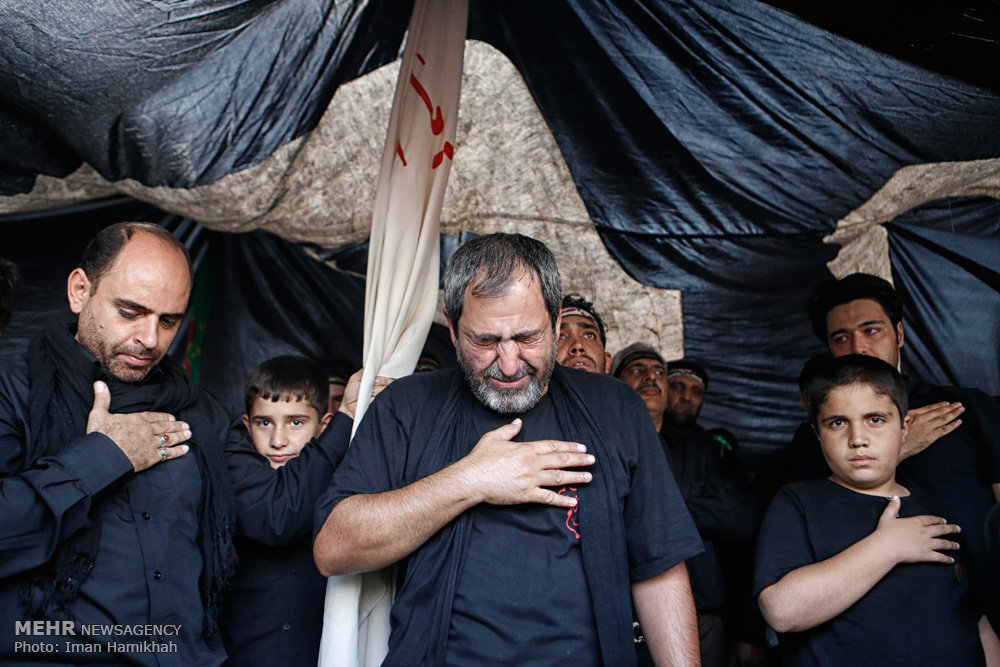
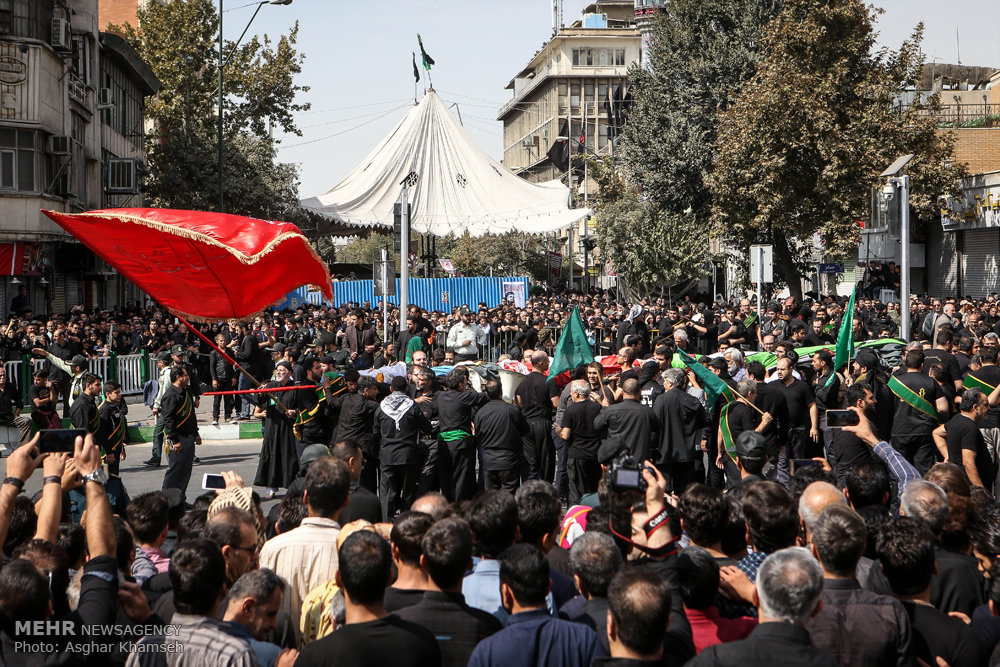
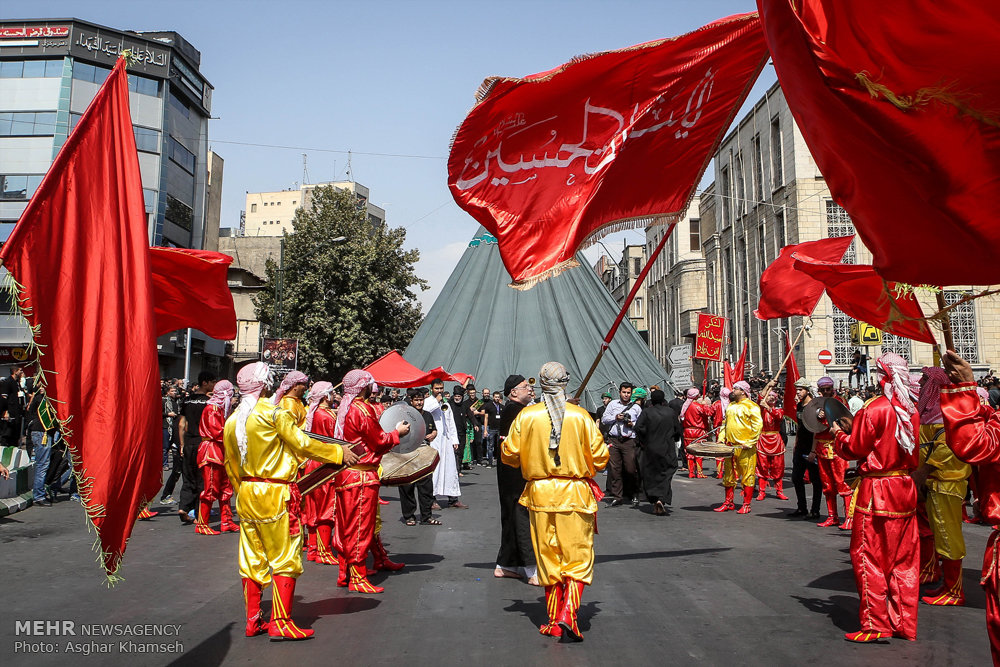
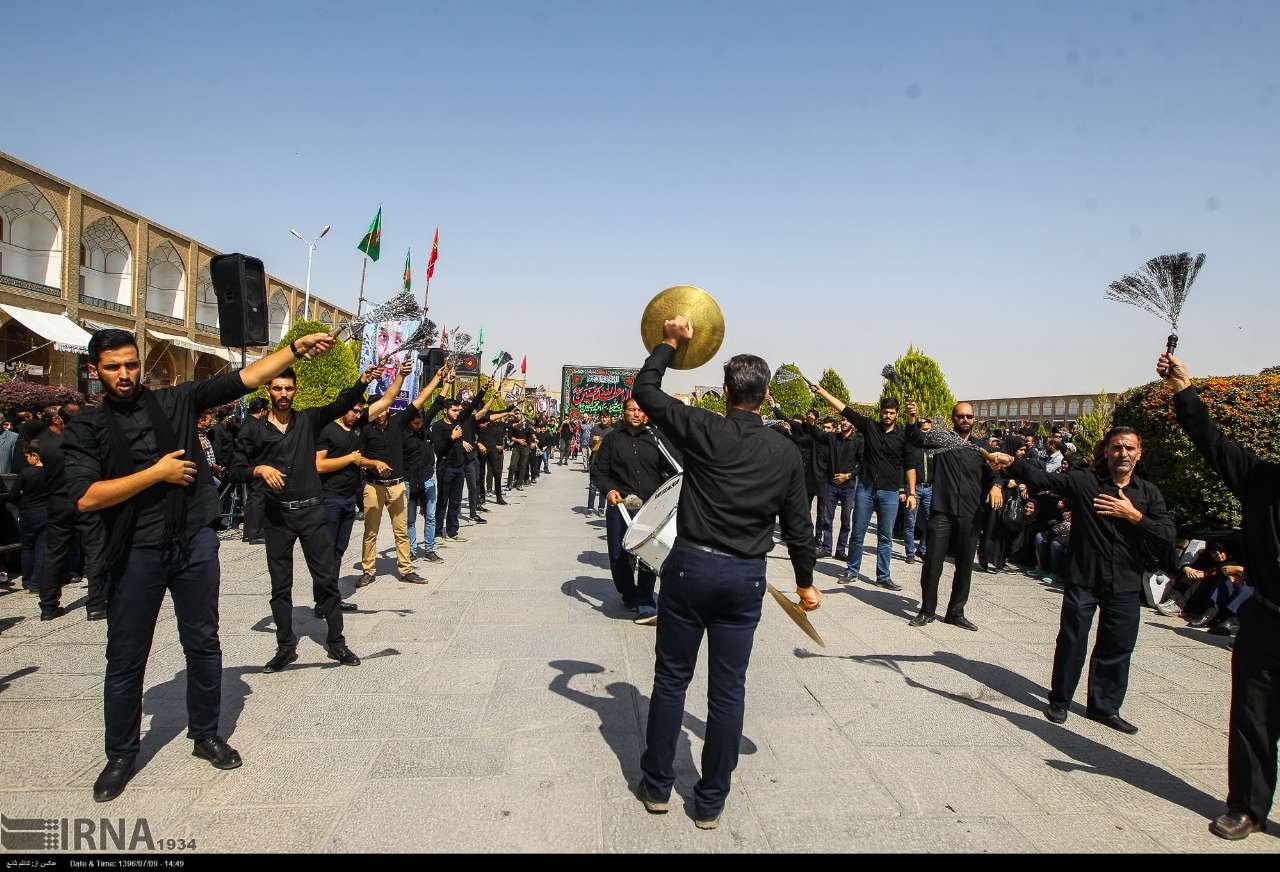
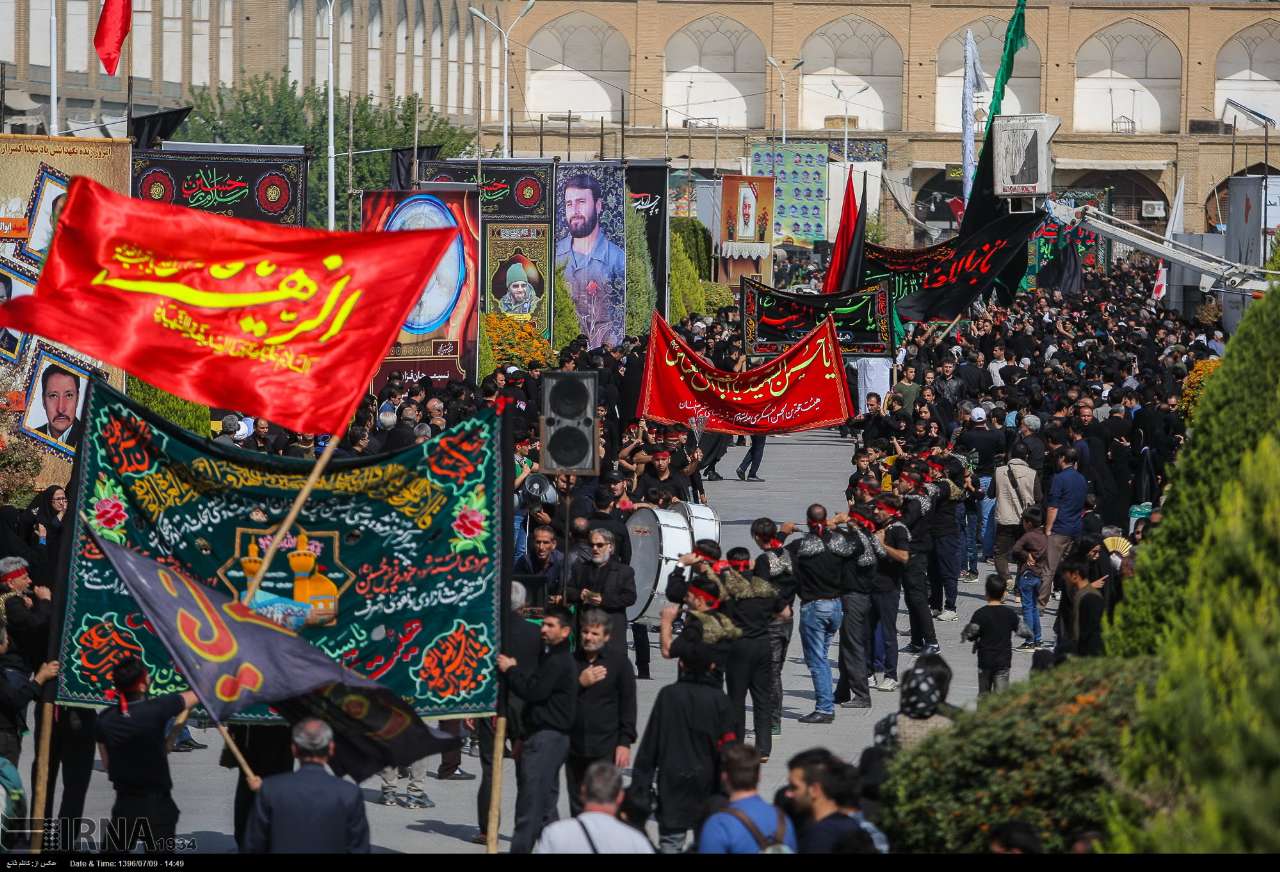
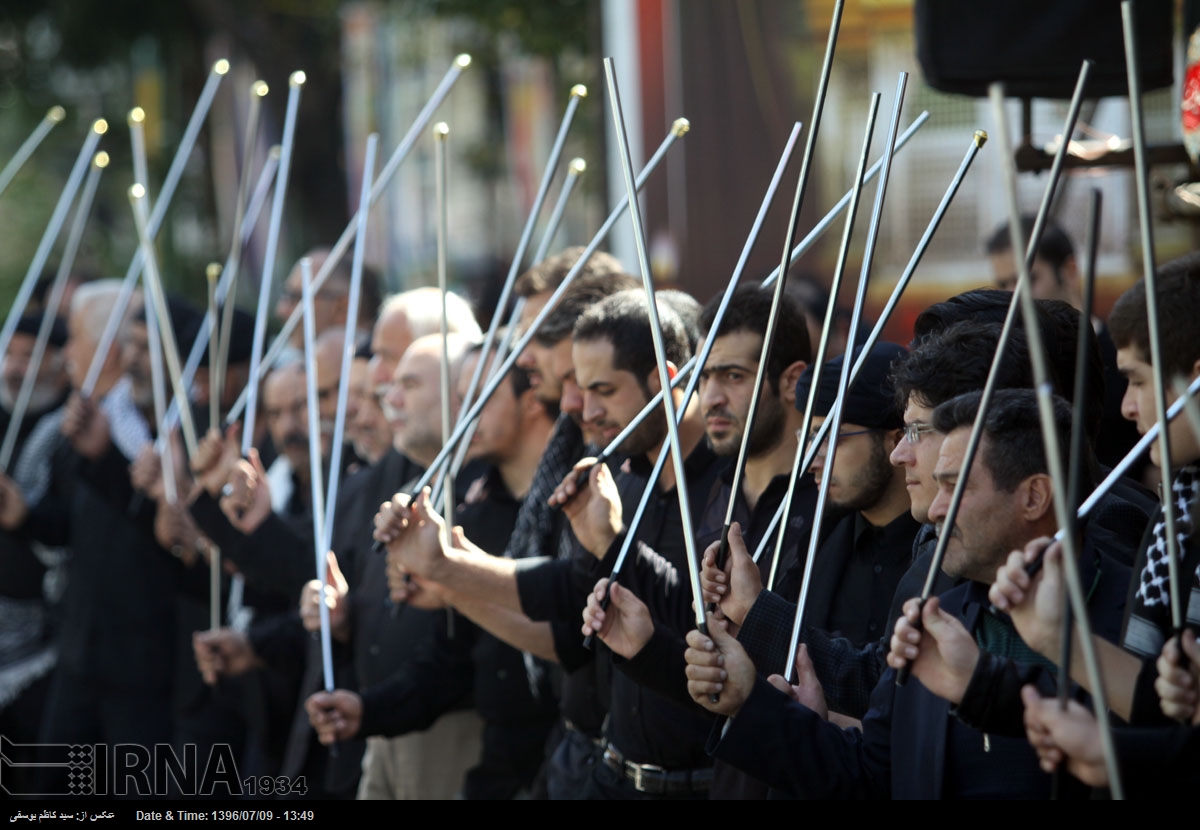
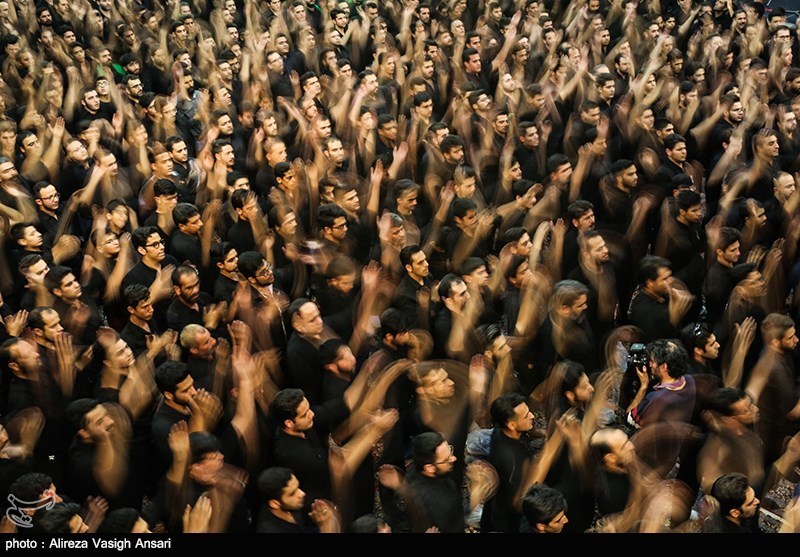
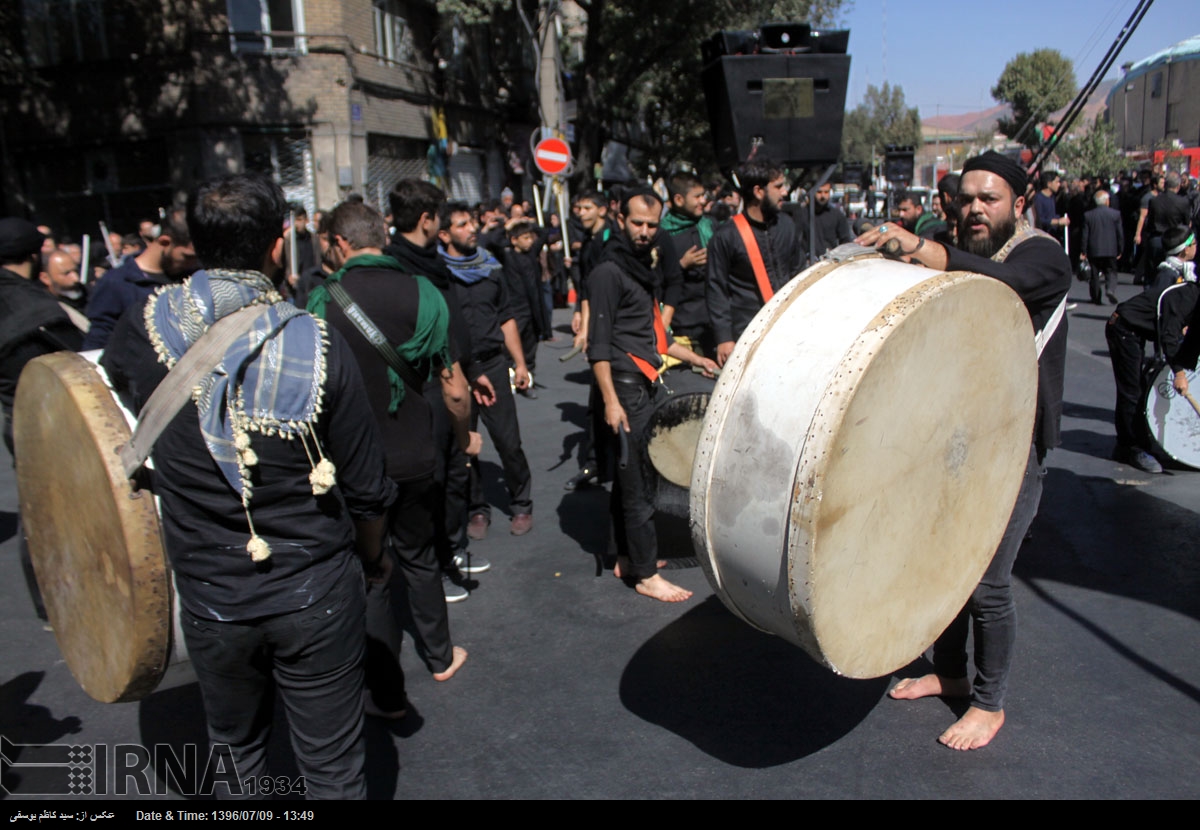
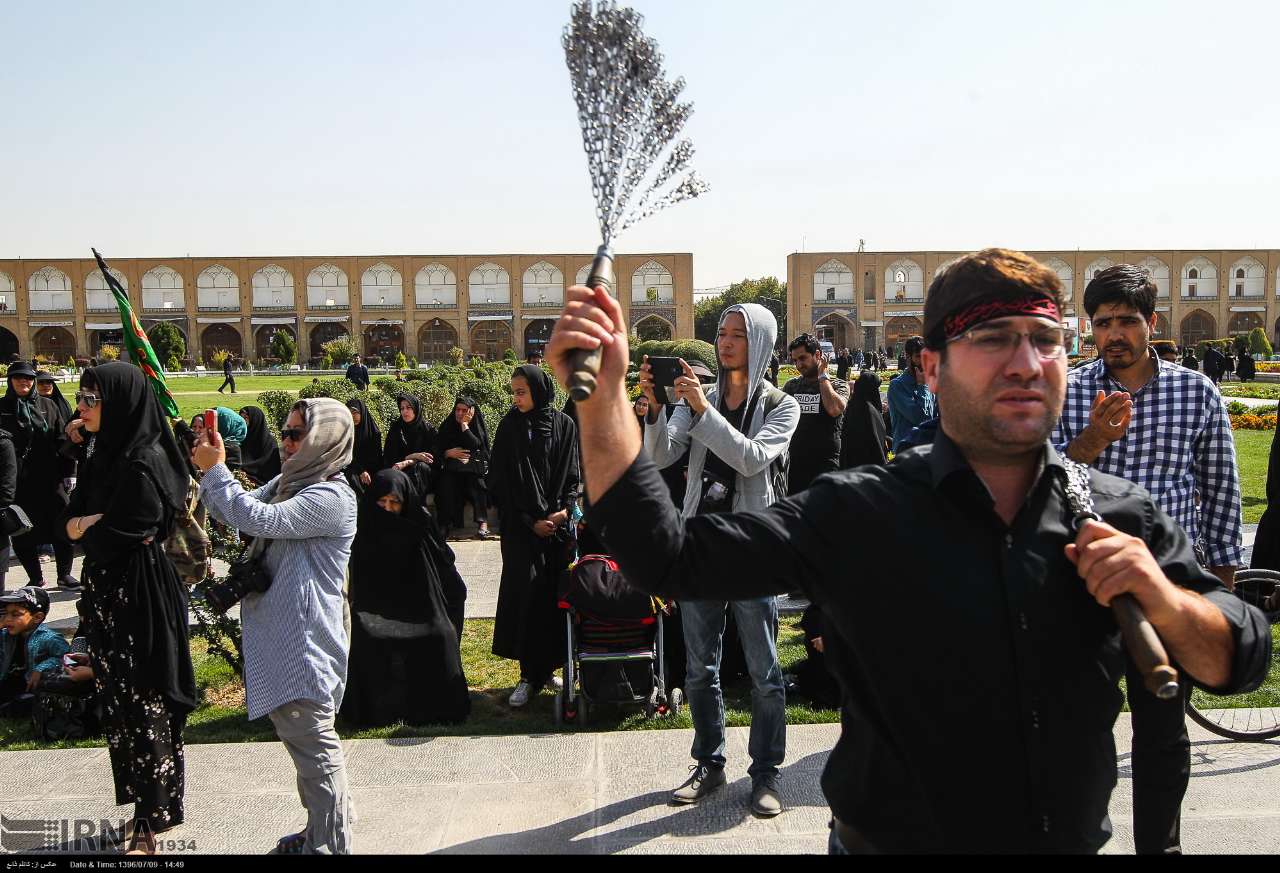
Ashura, the 10th day of the lunar month of Muharram, marks the martyrdom anniversary of Imam Hussein (AS), the grandson of Prophet Muhammad (PBUH), and his 72 faithful companions in the Battle of Karbala in 680 AD.

Every year on Ashura, millions of Shiites around the world, dressed in black, take to the streets and mosques to mourn the sad occasion.

In Iran, devotees in cities, towns and villages across the country listened to elegies recounting the indescribably tragic events in the Battle of Karbala.

Here are photos of the mourning ceremonies held across the country:

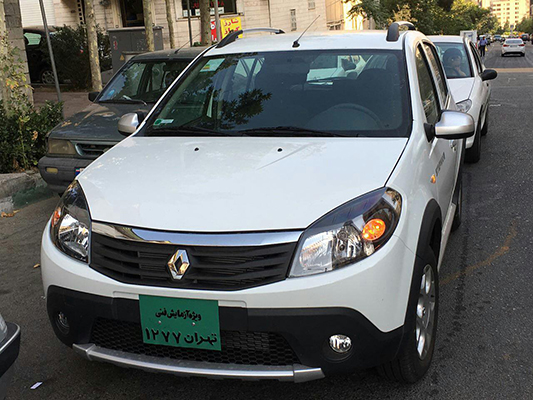
Renault Exports to Iran Rises by 83%

According to a Farsi report by the Young Journalists Club (YJC), the French carmaker has announced that according to its monthly sales figures, the sales to Iran increased by 82.6% in the first eight months of 2017.

“The Renault Group has sold 99,617 vehicles to Iran,” the report says.

Renault’s share of the Iranian market grew from 3.5 percent to 10 percent in these 8 months in comparison to the same period last year.

The company’s sales in August amounted to 14,591 units, down 13 percent from July 2017.

Renault’s sales were 16,733 units in July, but in total, Renault’s sales grew 27% compared to August 2016.

In August 2017, Renault’s share of the Iranian market was 9.7 percent, which shows a 0.2 percent increase in comparison to the same period last year.

Renault’s sold 2.43 million vehicles between January and August, which is 10.7 percent more than the same period in 2016.

Renault’s group has said the role of the Iranian market has been so important that the company’s sales doubled in one year. Tondar and Sandro were the cars sold more than the others in the Iranian market.

Iran Ready to Work with Europe in Anti-Narcotics Operations

Brigadier General Mohammad Masoud Zahedian highlighted the need for technical, operational, and intelligence cooperation between Iran and its European counterparts in fight against drug trafficking, according to a Farsi report by ISNA.

Zahedian who was leading a high-ranking delegation in a visit to Turkey’s capital, Ankara, at the invitation of his Turkish counterpart, held talks with his counterparts from Turkey and many other Europe and Balkan region.

During the talks, the Iranian official said Iran’s fight against narcotics is based on national will as well as religious beliefs and added at least 3,700 Iranian police forces have been killed and over 12,000 others wounded in operations against drug smugglers.

He highlighted the key role that Iran is playing in the fight against narcotics in the region and voiced his country’s readiness to promote relations with countries from Europe and Balkan region in eradication of narcotics across the world.

“The Islamic Republic of Iran is ready to host the upcoming forum of heads of anti-narcotics police from Europe and Balkan region,” he noted.

Elsewhere in the meeting, Colonel Barani, the representative of Iran’s drug enforcement in Ankara, read out a report on the technical measures that the Iranian anti-Narcotics police have adopted and said to launch a serious operation against drug traffickers, there should be comprehensive cooperation between different regional and international countries.

‘PUK Loses Iran’s Friendship after Kurdistan Referendum’

Iraqi Kurdish lawmaker Xuan Davoudi has in an article termed the Patriotic Union of Kurdistan (PUK) as the main loser of the referendum held on the secession of the Iraqi Kurdistan region, reports the Persian-language Entekhab website.

The legislator underlines the result of the plebiscite was that the PUK lost Kirkuk as well as its friendship with Iran.

He writes regions such as Kirkuk and some disputed areas were traditionally under the control of the PUK, which is considered a friend of Iran as well.

Following the referendum, which Iran was opposed to, the PUK not only lost areas under its control, especially Kirkuk, but also lost its friendship with Tehran, which has always stood by the PUK in times of crises, according to the legislator.

Although major bridges were built in Kirkuk, the referendum destroyed the bridge of trust that former Iraqi president and current PUK leader Jalal Talabani had built between different ethnic and religious groups, the Iraqi MP further writes.

He says the plebiscite also changed other ethnic and religious groups’ positive viewpoint toward Kurds.

Irrespective of all these failures, Davoudi notes, Kurds found an opportunity after the fight against ISIS to bring the disputed regions under the control of Kurds only, but Kurdish leaders missed that chance as well.

The plebiscite on the secession of the Kurdistan region from Iraq was held in three Kurdish provinces and the disputed regions despite widespread international, regional and local opposition.

The holding of the referendum triggered a crisis in Erbil-Baghdad relations and made the central Iraqi government adopt tight measures to reclaim Iraq’s sovereignty, including a ban on international flights to Kurdistan’s airports.

Iran Hosts First Int’l Live Brain Surgery Seminar

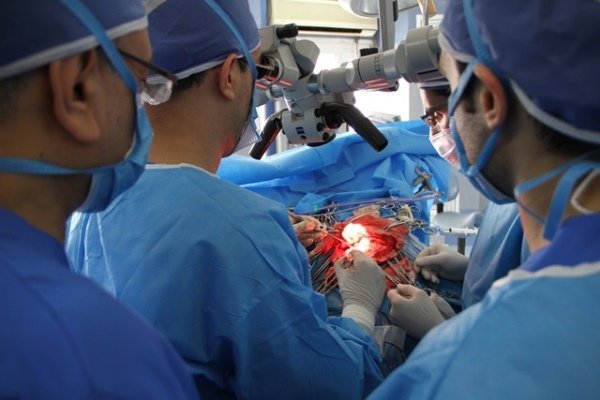
During the seminar held earlier this week, Iranian surgeons performed four live cerebrovascular surgeries displaying the Iranian doctors’ efficiency and capabilities in this field, according to a Farsi report by ISNA.

“The two-day seminar was attended by a large number of well-known doctors from Iran and other countries and the attendees exchanged scientific views during the event,” said Head of Brain Surgery and Neurosurgery of Shiraz University of Medical Sciences, Abdol-Karim Rahmanian.

Rahmanian, who performed a surgery on the first day of the seminar, further noted that during the seminar four patients with cerebrovascular problems underwent surgery.

“We exchanged views with our foreign counterparts on best ways to perform such surgeries,” he added.

He also said Shiraz plays a leading role in the southern hemisphere of the country in offering services to the patients suffering from cerebrovascular problems.

Rahmanian called on the related government organizations to provide Shiraz’s Namazi Hospital with the required equipment for cerebrovascular surgeries and said any shortage in this field could be dangerous for patients of the region.

He said 120 patients with cerebrovascular problems are treated in Shiraz annually, adding that Namazi hospital is working at an international level and the doctors in the hospital are capable enough.

“The surgeries performed in Namazi hospital are comparable with those performed in international hospitals in the developed countries,” he added.

60 specialists from different countries took part in the seminar. It was also attended by representatives of international suppliers of medical equipment.

No One to Negotiate with US Anymore after JCPOA Withdrawal: FM

In a September 27 interview with Charlie Rose at the Asia Society in New York, Iran’s Foreign Minister Mohammad Javad Zarif warned the US against cancellation of the Iran nuclear deal.

“I think the United States is making a strategic mistake by sending a message to the world that it is not reliable as a negotiating partner. In any deal, in order to reach a deal you give concessions and you take concessions from the other side. And no deal will be sustainable if you take the concessions and pocket them and then you ask for more after you conclude the deal. Nobody else would come and negotiate with the United States. The United States will become known as an unreliable partner even for others. Now I believe the Europeans are saying if the United States were to break the deal, nobody else would trust the West. I think the United States has to prove that it is a reliable partner.”

In response to a question about Iran’s reaction to Trump’s withdrawal from the nuclear deal, Zarif said “we will make an appropriate decision based on the circumstances.”

The Iranian minister also ruled out a new agreement, as some US officials have called for.

“We need to be realistic in our expectations. We dealt with all these issues. It took us many years. It took us 10 years of posturing on all sides and two years of serious negotiations to reach this deal. I don’t expect that a new round will produce any better results. In fact, a new round will get us in a quagmire that nobody will be able to get out of.”

Charlie Rose also asked Zarif about his meeting with Tillerson during a recent meeting of JCPOA Joint Commission on the sidelines of the UN General Assembly, and Zarif said it was a civilized meeting. He went on to say that after the meeting, Secretary Tillerson said “we didn’t throw shoes at one another”, that was something certainly achieved.

About Trump’s statements at UN General Assembly, the Iranian FM said, “First of all, the United States is not in compliance with the letter of the deal. [The] statement by President Trump before the General Assembly … was a violation of paragraphs 26, 28 and 29 of the letter of the deal.”

Donald Trump believes Iran is a dictatorship, even though Washington’s allies in the region “haven’t seen a ballot box in their countries,” Iran’s foreign minister said, adding that Tehran derives its legitimacy and mandate from the people.

“Maybe President Trump likes to think of Iran as a dictatorship, but it is interesting that all of his allies [in the region] haven’t even seen a ballot box in their countries… Be it as it may,” Zarif said, answering a question about political processes in Iran and where the country was headed.

“What is important is that we derive our legitimacy and our power from our people, unlike our friends in the region,” Zarif told Charlie Rose. “We do not derive our legitimacy from the beautiful military equipment we get from the United States.” He also stressed that Iran does not buy its security from foreigners.

“Our society is not that different, we have the same processes,” Zarif explained. “I don’t have a crystal ball. I know the players, you know the players in the US. But if I ask you who will win the next presidential elections in the US, can you tell me?”

Turning to this week’s Kurdish independence referendum in Iraq, Zarif said that Iran was opposed to the vote. Zarif called the Kurds “our eternal friends,” noting that Iran came to their assistance when they were fighting ISIS extremists in Erbil, the capital of the Kurdish region.
“We believe that this referendum is dangerous for stability in the region and doesn’t serve the interest of our Iraqi Kurdish friends.”

Elsewhere in his statements, Zarif once again criticized Trump’s anti-Iran remarks at the UN General Assembly, saying that America has been unable to understand the realities of the region.

Referring to repression of people by the allies of the United States in the region, he said today they are celebrating granting of driving licenses to women in one of these countries. He also stressed that the United States ignores the realities of the region.

The Iranian FM also said that he is proud of the Iranian community in the United States adding that they are forerunners in the business and scientific fields and yet have been banned from entering the United States.

However, he added that the citizens of the country that blew up the World Trade Centre can travel to the United States with no problem.

Furthermore, Zarif reiterated that he will not accept the US President’s insults to Iran and the Iranians.

The Foreign Minister of Iran also responded to a question on the missile program of the country and emphasized that Iran’s missile program is a defensive one, and in order to understand it one must look at the Iranian history.

The Iranian top diplomat stressed that the facts must not be overlooked. Saudi Arabia spent $67 billion on arms last year. The United Arab Emirates spent $40 billion. But Iran spent only $6 billion in order to defend 80 million Iranian people.

Zarif referred to the 8-year imposed war on the Islamic Republic and said at that time everyone was supporting Saddam Hussein and no one was talking about Saddam Hussein’s use of chemical weapons.

Regarding Tehran’s ties with Saudi Arabia, Zarif stressed that Tehran was hoping to work together with Riyadh to bolster security in the Middle East.

“We do not have the illusion that we can exclude Saudi Arabia from this region. We believe that Saudi Arabia is an extremely important player in the region whose role needs to be respected,” Zarif said.

“But we expect Saudi Arabia to also recognize that we are an important part of this region and they can never exclude Iran. As we will never try to exclude Saudi Arabia so Saudi Arabia has to abandon this illusion.”

Turning to Syria, the Iranian foreign minister added that Washington has apparently completely shifted its priority from battling the ISIS terrorist group to making sure Damascus does not regain control over its borders with Iraq.

“Today it seems to me that priorities have changed and for the government of the US it is more important to prevent the Syrian government from taking over the border with Iraq than it is to defeat ISIS,” he said.

Zarif also suggested his country could intervene elsewhere in the Arab world to fight extremists. Zarif said Iran has fought against extremists and terrorists in Afghanistan in the 1990s, in Iraq since 2003 and in Erbil.

In Syria, he said, “the government and resistance forces have been able to achieve military victory over the terrorists to a really important extent.”

“If we need to go to the assistance of any other government in the region in order for them to fight extremists and terrorists, we are ready,” Zarif said. “This is an open declaration that Iran is always on the side of those who fight extremism and terrorism.”

Iran’s Foreign Minister pointed out that four years ago he told the UN Secretary General that Iran is ready to cooperate to end the crisis in Syria. He said he presented a four-point plan for solving the Syrian crisis that was not addressed, but the passage of time proved that it was the right plan.

Zarif underscored that the solution to the Syrian crisis is the ceasefire, the formation of a national government and a reform of the constitution, which is proposed by Iran, but the other parties have neglected it.

Zarif also responded to a question about Iran’s stance on the Qatari-Saudi rift saying that the Islamic Republic is not involved in this issue, and this is the result of Saudi Arabia and the UAE’s mistakes to try to bring Qatar to its knees. He added that the stability of the countries of the region is in the interest of Iran.

Regarding the chemical attacks in Syria, Zarif mentioned that Iran is present in Syria to fight ISIS and not to take sides. He condemned the use of chemical weapons in Syria and urged that an independent international inquiry team should look into the case.