Friday, December 26, 2025
Home Blog Page 3826

Tehran to Host First Visual Arts Exhibition of Afghan Artists

Tehran to Host First Visual Arts Exhibition of Afghan Artists

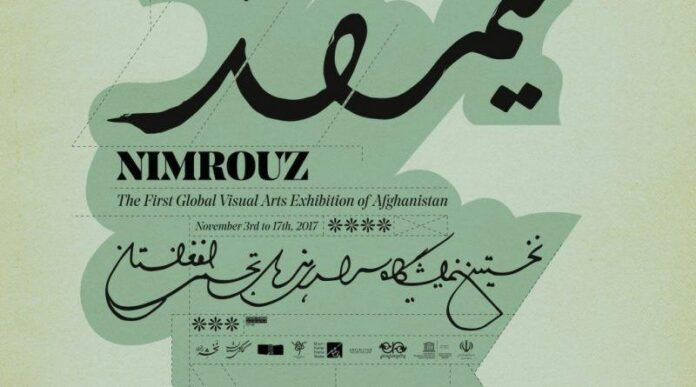
The First Global Visual Arts Exhibition of Afghanistan, also called “Nimrouz”, organized by Niavaran Cultural Centre in cooperation with Afghanistan’s embassy in Tehran, will showcase Afghanistan’s visual arts as of November 3.

According to a Farsi report by Mehr News Agency, Afghan artists will put on display about 130 paintings, photos, videos, installations, and calligraphy artworks during the exhibition.

53 Afghan artists from France, Azerbaijan Republic, Germany, the US, Australia, Afghanistan, Iran, Pakistan, Sweden, Norway and the Netherlands will take part in the exhibition.

The exhibition is aimed at making Iranian and Afghan artists more familiar with the historical and cultural commonalities between Iran and Afghanistan, promoting Afghanistan’s visual arts which are not under the world’s limelight, and displaying the capabilities of new Afghan generations.

The Iranian sculptor, Maryam Kouhestan has been chosen as the executive manager of the First Visual Art Exhibition of Afghan Artists in Iran.

During the opening ceremony of the exhibition, the organizers will unveil books written by three generations of Afghan writers. The collection includes insightful details of contemporary arts of Afghanistan.

Nimrouz Exhibition will be open to visitors until November 17. The visitors can visit the exhibition every day from 10 in the morning to 20 at night.

Unity of IRGC, Iranian Army Defeats Enemies: Chief Commander

Major General Jafari onSaturday said the Army, under the command of a wise and revolutionary leadership, is stronger than ever on the path to a great development to make the Islamic Revolution and the Establishment of Iran more powerful.

Jafari also announced the IRGC’s readiness for close and shoulder-to-shouldercooperation with the army in all fields.

The IRGC commander made the remarks in a message to Commander-in-Chief of the Islamic Republic of Iran Army, Major General Seyyed Abdolrahim Mousavi.

Fire at Tehran Refinery Kills Several People

The incident occurred when a group of engineers and technicians who were providing overhaul operations were caught in a blaze at the top of a distillation tower.

The blaze occurred due to unknown reasons. However, Iran’s IRNA news agency quoted Hedayatollah Jamalipour, the governor of Rey, as saying that a leak could have been involved.

Also, Mehr news agency quoted Jamalipour as saying that the victims were trapped at the top of the tower by what he described as a “huge” blaze.

“It was not possible to save the individuals that were doing repair operations at a high altitude from the ground,” IRNA quoted the official as saying.

Meanwhile, Fars news agency quoted Hamid-Reza Jafari, the head of Tehran Refinery Public Relation Department, as saying that the victims of the accident were still being identified, suggesting that their bodies had been charred beyond recognition.

At least two were reported to have been wounded with serious injuries.

Mehr news agency quoted an eyewitness as saying that one had jumped down to escape the advancing blaze but had been seriously wounded.

The fire was later brought under control and an investigation was opened to determine its cause.

The Tehran Refinery was built in 1968 and has a processing capacity of above 200,000 barrels per day of crude oil piped from Khouzestan province – the heartland of Iran’s oil industry.

It saw a massive blaze in January as a result of what media said was a lighting strike at an oil tank.  The incident had no casualties.

Iranian Conservative Denounces Disqualification of Zoroastrian Councillor

Former chief of the Islamic Republic of Iran Broadcasting (IRIB), Ezatollah Zarghami ,published an image of Niknam on his Instagram page and wrote, “The respectable Guardian Council, based on its his legal and Sharia duties, has cancelled the membership of Sepanta Niknam in the Yazd City Council. Let’s respect it and let them carry out their responsibilities properly, far from political expediencies.”

However, he added, “I am surprised why the numerous organizations responsible for discerning the country’s expediencyare dragging their feet on making way for such a clear expediency [rejecting the Guardian Council’s decision]?”

“The necessity of respecting public opinion, especially those of the committed people of Yazd (including Muslims and Zoroastrians), who voted in favour of Mr Sepanta Niknam on the basis of earlier legal announcements, is the best reason to confirm his membership in the Yazd City Council.”

Iranian Conservative Denounces Disqualification of Zoroastrian Councillor“I do believe that maintaining the dignity and status of the Islamic Republic of Iran at the domestic and international arena is the most important expediency of the Establishment,” Zarghami added.

The former president of IRIB also noted that, “Let’s not push the society towards false bipolarisms and not become the mouthpiece for the global propaganda apparatuses by feeding them with such subjects.”

“In the meantime, what crowning achievements the Muslims have accomplished in the city council that a Zoroastrian cannot?!” Zarghami sarcastically asked.

The Zoroastrian councillor’s membership was suspended by a branch of Iran’s Administrative Court of Justice after the Guardian Council said a non-Muslim cannot make decision for a Muslim majority.

The verdict notes that based on the opinion of the Guardian Council, members of religious minorities are prohibited from becoming members of city councils.

Earlier, Ali Larijani, Iran’s parliament speaker and a number of lawmakers had called the suspension illegal, stating that Iran’s parliament would request to establish a panel to resolve the matter.

Several reformist figures, along with other conservatives like Ahmad Tavakkoli and Mostafa Aqa-Mirsalim, have also voiced their protest against the disqualification.

Is Donald Trump Really Crazy?

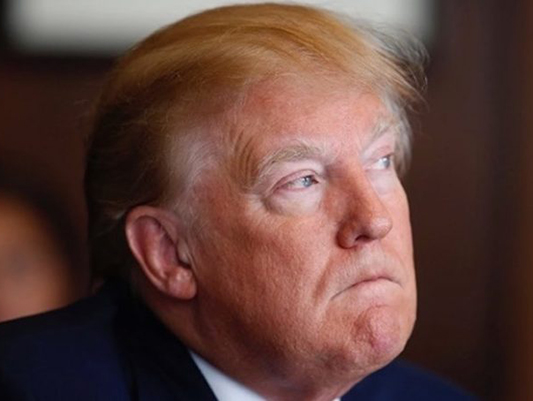
Legal expert Mohsen Baharvand has, in an article published by he Persian-language Etemad daily, weighed in on the characteristics of US President Donald Trump and his attempts to besiege countries with an iron wall. The full text of the article follows.

Trump is not crazy. He crazily seeks to save the United States. Without a cold war, the US will be hit by a terrible downfall and will lose its global leadership. Washington’s actions should not be seen only within the context of regional equations and the Iran nuclear deal. It seems that in addition to regional motives to create security and support the Israeli regime and gain access to Saudi Arabia’s dollar reserves, global strategic motives lie behind these actions. Such an international way of thought does not emanate from Trump’s way of thinking. Rather, it must have logically come from the thoughts of strategists whose planning goes way beyond that of Trump. Behind Trump’s not-so-acceptable and not-so-logical actions lies a doctrine which can be regarded as the revival of the cold war in order to save the US. Trump’s doctrine is in fact a return to the past and a mixture of the old doctrines of the US president. This doctrine of Trump is an amalgamation of Monroe, Nixon and Kennedy’s doctrines. Trump chants the slogan of “America first” like Monroe, pretends to be a lunatic like Nixon and powerfully seeks a new cold war like Kennedy.

If we look at the map of the world, we see that Trump is seeking to erect a new iron wall around Russia and China. The only difference is that Trump seeks to tighten the wall around them. Iran is the only place where he has lost all hope. The wall used to stand on Iran’s northern borders and the coast of the Caspian Sea, but now it has been transferred to southern Iran and the southern coasts of the Persian Gulf. The US seeks to lay siege to China from the South China Sea, India and Afghanistan. Afterwards, the US wants to extend that wall by putting pressure on Pakistan and going all the way to Saudi Arabia to other areas in the Middle East to occupied Palestine to Egypt. The White House also tries to regain from Russia what was once the sphere of the Soviet influence and had weakened the iron wall. India, Iraq and Egypt are among those countries. By the same token, efforts to gain domination over Syria can be explained as well. The situation was the same in Eastern and Northern Europe until Russia showed reaction in Ukraine. In this global campaign, the US has suffered the most losses in Iran, and this infuriates Washington more than anything else. Barack Obama, Trump’s predecessor, pursued the same objective via a different approach. However, Obama did not believe in an aggressive method and tried to advance Washington’s goals through softer approaches. He did not believe in using hard approaches. He even sought to talk Iran into getting into his circle of siege.

This was the same thing that Leader of the Islamic Revolution Ayatollah Seyyed Ali Khamenei described as “an iron hand in a velvet glove.” As already mentioned, all those measures were aimed at maintaining the United States’ superiority. The Americans have probably been convinced that Obama’s method was not enough. So, Washington is openly seeking a cold war in order to survive. Trump needs to build walls and he needs a serious rival. Maybe one thing was mostly ignored in Barack Obama’s method, but the current US team is completely feeling its danger, and that is “China’s growing trade influence.” From the current US team’s standpoint, China and, to some extent Russia, would have overcome the United States had Obama’s approach continued. What Trump is doing is, in fact, making efforts to save the US and secure its share of the global market. Imagine what will happen if China’s trade continues to grow on world markets at the current pace in the next 10 to 20 years. In that case, the United States will have a tiny share, even in its own domestic market. On the other hand, China and Russia, which are aware of these developments, are intentionally trying to refrain from entering Washington’s game and maintain the previous trend. They, especially China, prefer to be friends with and overcome the US through trade superiority. China, in particular, knows that if it gets engaged in direct confrontation with the US, it will lose a major part of the market for Chinese-made goods due to Washington’s political leverage, not economic advantage.

Like China, Russia, too, still prefers to avoid a direct standoff with the US. Following the collapse of the former Soviet Union, Russia needed a long period of rest and calm to focus its attention on trade and development rather than arms production. During the tenure of President Dmitry Medvedev, Russia made every effort to achieve this end with the West’s cooperation. However, Russia was a target close at hand; so, the issue was hijacked and Moscow’s optimistic scenario failed and only emboldened the US. Washington knows well that if the Kremlin finds some breathing room, and if China continues the current trend, the US will, economically speaking, turn into a second-rate country sooner or later. Famous American intellectuals have the same idea, too.

Therefore, one can logically come to the conclusion that Trump’s America does not have much opportunity, and will move forward until it can drag Russia and China into the new cold war. If we accept these assumptions as true, then we should also accept that firstly, the US will extremely increase pressure on countries around China and Russia, namely Iran, in order to provoke them. And secondly, Washington’s measures will not be limited to the Iran nuclear deal and the Middle East region. Also we can conclude that China and Russia will resist and will try not to get involved in this game. As a result, they will not show serious reaction to the pressure around them any time soon. Another conclusion which can be drawn would be that Russia and China still optimistically think that Washington’s moves will be limited to the countries around them. Nevertheless, given what was said above, if they do not resist, the US will continue to ratchet up the pressure in order to reduce their share of the global trade and politics via confrontation and bullying, or to expose them to sanctions or unfair economic rivalry to make them enter direct competition. China and Russia’s indifference or lack of reaction to US actions vis-à-vis the countries around them is regarded as a strategic mistake.


But Iran:

I believe Iran should take three points into consideration in its planning. First, it should take the danger and power of the US seriously. We should get to know the real power of the enemy and make plans accordingly to counter it. Second, the US confrontation with Iran is not only bilateral and regional. Third, Iran should not shoulder the task of confronting the US all alone. This is a global issue and all countries exposed to the dangers of US actions should deal with the issue more seriously and play a part. In my estimation, this confrontation is not only a bilateral or regional one involving Iran and the US, but Iran, intentionally or unintentionally, is regarded as part of a global strategy and a key player in a major game. If Iran sees confrontation with the US as a bilateral or regional issue, and pays the price for it alone, and seeks to create a balance of power in the region on its own, it will be an arduous and costly task. Iran also needs to create a balance of power in the region in order to promote its independent regional objectives. Beyond the Persian Gulf, petrodollars and Washington’s military prowess stand ready, and on this side of the Persian Gulf Iran is standing alone only with reliance on the power and faith of its youth and domestically developed technology. This is something to be proud of. But it is no reason for other countries which are the targets of US actions not to play a role in creating a balance of power in the Middle East and Persian Gulf because they may have to pay a higher price  in the long run. They should increase their cooperation with Iran and counterbalance the United States’ weight in the regional balance of power.

Iran Preparing Infrastructure for Bitcoin Adoption

bitcoin

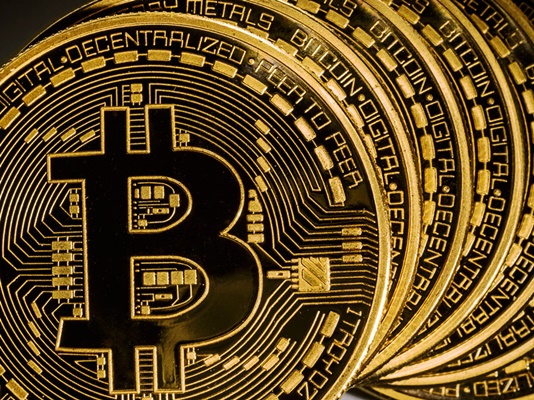
“The ministry of communications and information technology has already conducted a number of research studies as part of efforts to prepare the infrastructure to use Bitcoin inside the country,” Davaee said in a Farsi interview with Shargh newspaper published on Wednesday.

He went on saying the crypto currency has two aspects: Economic and infrastructural. “We as the main centre in Iran dealing with the country’s technology developments have taken very seriously the issue of preparing the infrastructure for the new currency.”

The Iranian official went on saying such digital infrastructure are part of the soft power of each country and said entrance of the currency into Iran will end up in the general interests of the country.

“Arrangement are being made with the related organizations to put together the infrastructure as early as possible.”

Observers maintain that the entry of the digital asset into the Iranian market is part and parcel of the technology-hit world we are living in and will end up in Iran’s the benefit.

Bitcoin is defined as the first decentralized digital currency, as the system works without a central repository or single administrator. The system is peer-to-peer, and transactions take place between users directly, without an intermediary. These transactions are verified by network nodes and recorded in a publicly distributed ledger called a block-chain.

According to research conducted by Cambridge University this year, there are 2.9 to 5.8 million unique users using a crypto currency wallet, most of them using bitcoin.

Iran, Azerbaijan to Jointly Produce Buses

Azeri Economy Minister Shahin Mustafayev says it is possible to produce buses at a joint auto making factory run by Iran and Azerbaijan.

“We have begun initial talks on that matter,” he said in a meeting with his Iranian counterpart Massoud Karbasian as quoted by Fars News Agency.

The infrastructure of the factory was put in place in 2016, and it is scheduled to become operational in December 2017.

“The building and communication line are ready at the moment, and we plan to fit the factory with the necessary equipment in November,” said the Azeri minister.

“We would like to inaugurate the factory in December. Probably, things will not go as scheduled, and the inauguration may be postponed until next year,” Mustafayev said.

The joint Iran-Azerbaijan auto manufacturing factory will have the capacity of producing 10,000 vehicles per year. Twenty percent of the production will be exported to countries which are members of the Commonwealth of Independent States as well as Central Asian countries.

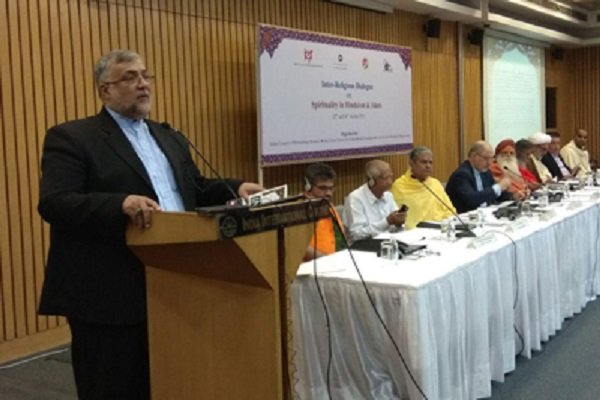
India Hosts Religious Dialogue between Islam, Hinduism

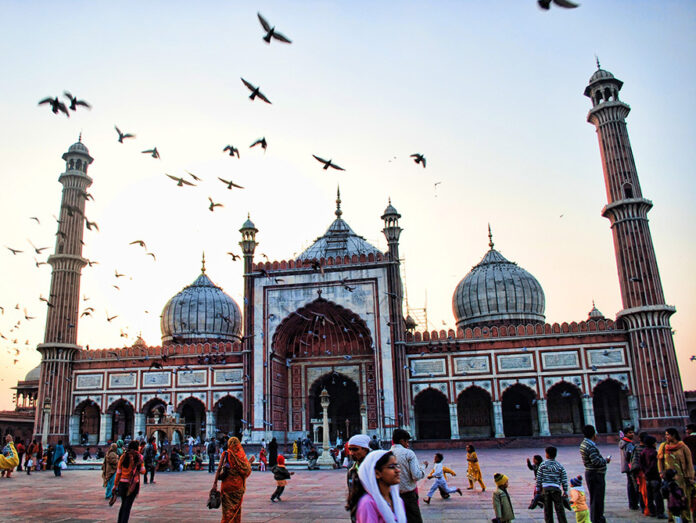
During the event, which was held on Wednesday with the theme of “Spirituality in Islam and Hinduism”, head of Islamic Culture and Communication Organization of Iran, Abuzar Ebrahimi Torkaman, said that spirituality is necessary for every human being, and every human needs it.

India Hosts Religious Dialogue between Islam, HinduismEbrahimi Torkaman told to the audience that human beings have been struggling to meet their material needs during the past 100 years, and have made great achievements, wrote ISNA in a Farsi report.

“Especially in the last 50 years, and with the advent of modern technologies, they have been able to significantly increase the speed of many things; however, not only they have not made much progress in achieving spiritual needs, but in some cases have had many retreats.”

This Iranian official went on to say that spirituality cannot be taught; it must be tasted by human beings, and this is the job of those who have experienced it.

At the end of his speech, Ebrahimi thanked the organizers of the First Round of Dialogue between Islam and Hinduism expressing hope that “such dialogues would provide us with a deeper and mutual understanding of each other in the future.”

He also announced that his organization is ready to host the second round of such dialogues in Tehran in 2019.

From Iran, Deputy Head of the Iranian Leader’s Office on International Affairs Hujjat al-Islam Mohsen Qomi, Director of the Iranian Society of Cultural Works and Luminaries Hassan Bolkhari, Iran’s Ambassador to India Gholam-Reza Ansari, and Iran’s Cultural Attaché to India Ali Dehgahi attended the conference. Director of the International Centre of India, and a group of cultural and religious figures next to thinkers from India and Iran also took part in the cultural event.

A Look at Iranian Newspaper Front Pages on October 28

Iraqi Prime Minister Haider al-Abadi’s visit to Tehran and his meeting with the Leader of Iran’s Islamic Revolution Ayatollah Seyyed Ali Khamenei was the Thursday top story of Thursday in Iran, which was widely covered in Saturday’s newspapers.

Catalonia’s unilateral declaration of independence and the release of confidential documents regarding the assassination of John F. Kennedy were among international issues covered by Iranian newspapers today.

Conservative papers particularly highlighted the fresh anti-Iran sanctions imposed on Iran on the pretext of Tehran’s missile defence program. Kayhan also said in its front page that Iran should counter the US measures by stopping implementation of JCPOA.

The above issues, as well as many more, are highlighted in the following headlines and top stories:


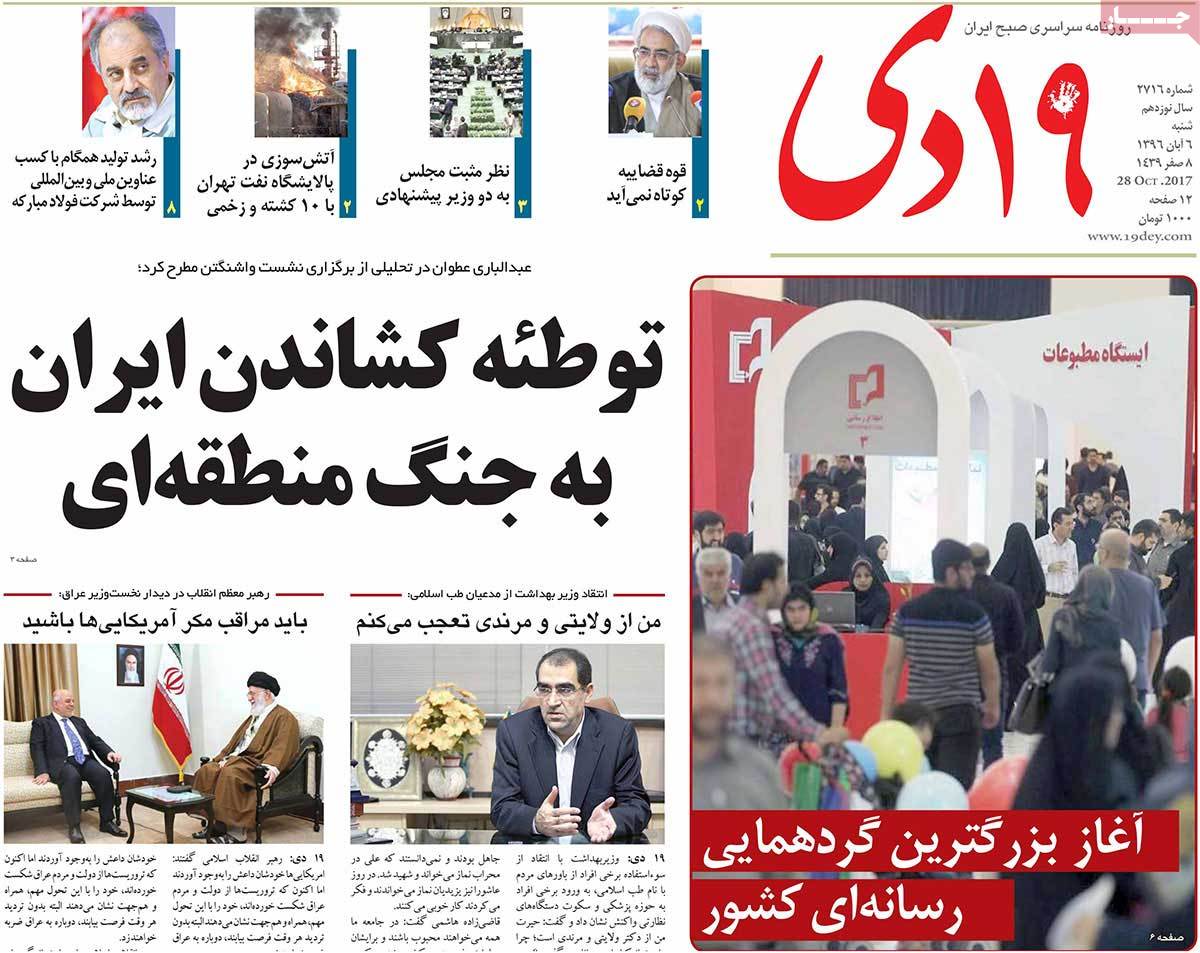
19 Dey:

1- Atwan: Plot Hatched to Drag Iran into Regional War

2- Iran Leader to Iraqis: You Should Beware of US Deceitfulness

3- Iran’s Biggest Gathering of Media Professionals Begins
A Look at Iranian Newspaper Front Pages on October 28


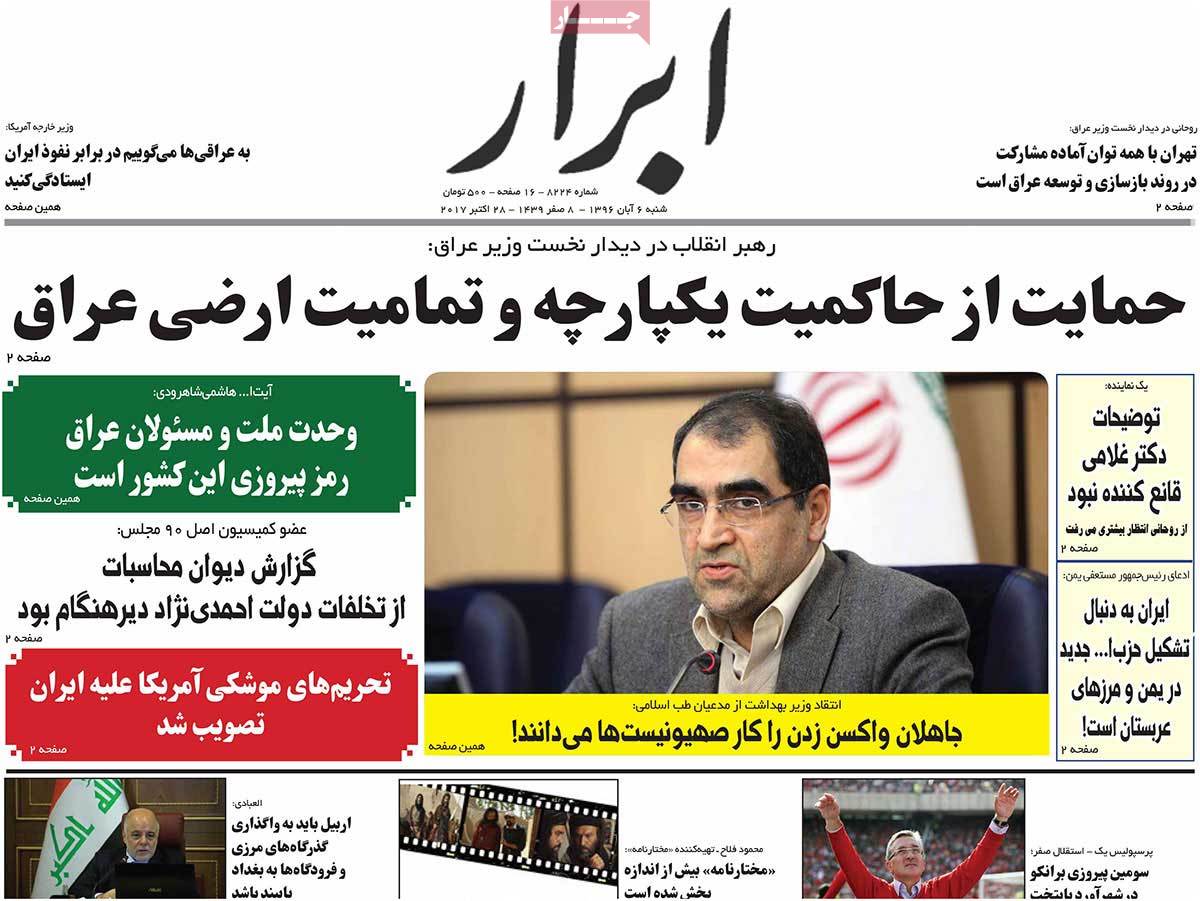
Abrar:

1- Leader Underlines Iran’s Support for Iraq’s Territorial Integrity, Integrated Sovereignty

2- US Imposes Missile Sanctions against Iran

3- Rouhani: Iran Fully Prepared to Take Part in Iraq’s Reconstruction
A Look at Iranian Newspaper Front Pages on October 28


Abrar-e Eqtesadi:

1- 20 Hectares of Lands in Russia’s Astrakhan Special Zone Allocated to Iranian Firms

2- Negotiation with Russians for Development of 10 Oilfields

3- Iran Ready to Export 3,000 Megawatts of Power to Pakistan
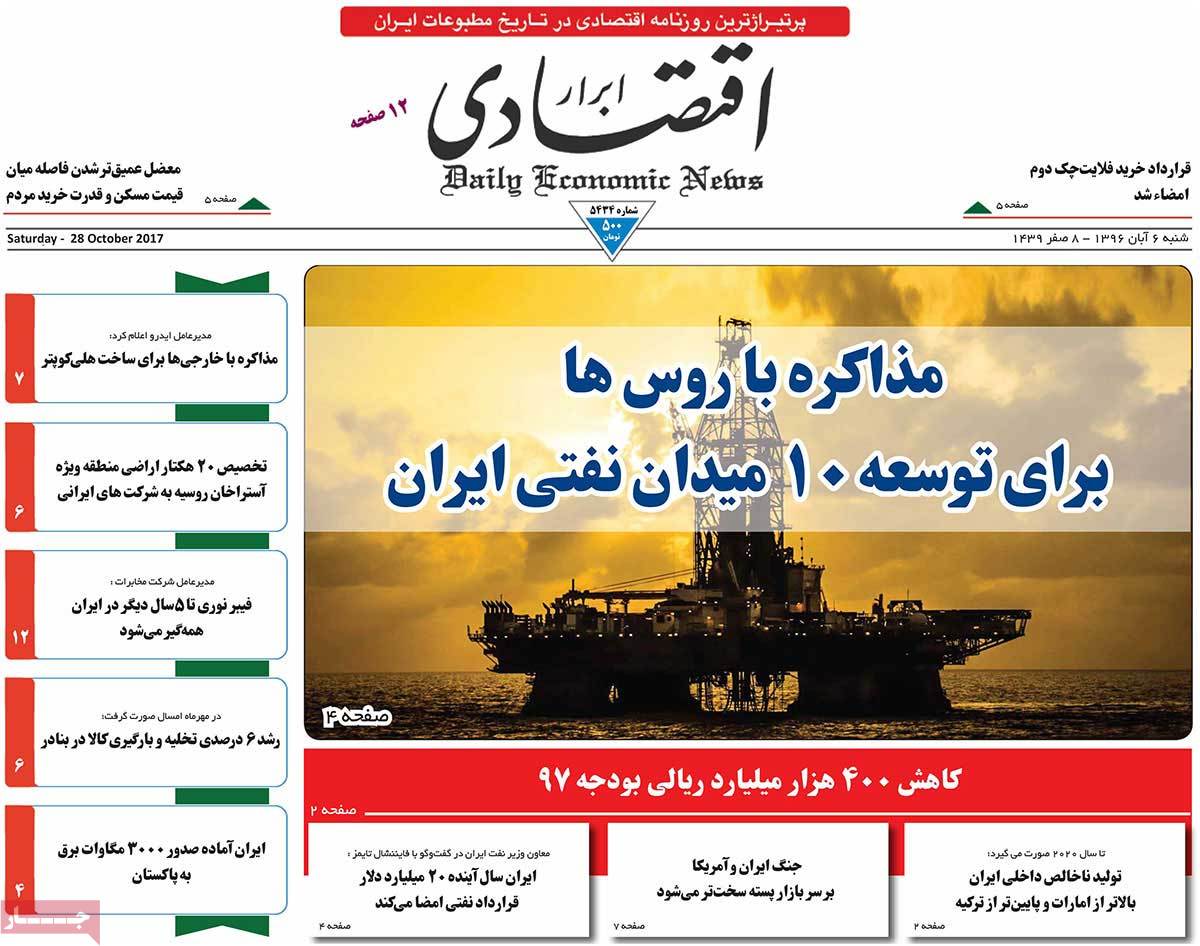
A Look at Iranian Newspaper Front Pages on October 28


Aftab-e Yazd:

1- Iran Parliament Expected to Give Vote of Confidence to Both Ministers Proposed

  • Science, Energy Ministers Not to Face Serious Challenge in Parliament

2- Iran Leader: Secret behind Iraq’s Victories Was Unity, Support for Brave Young Believers
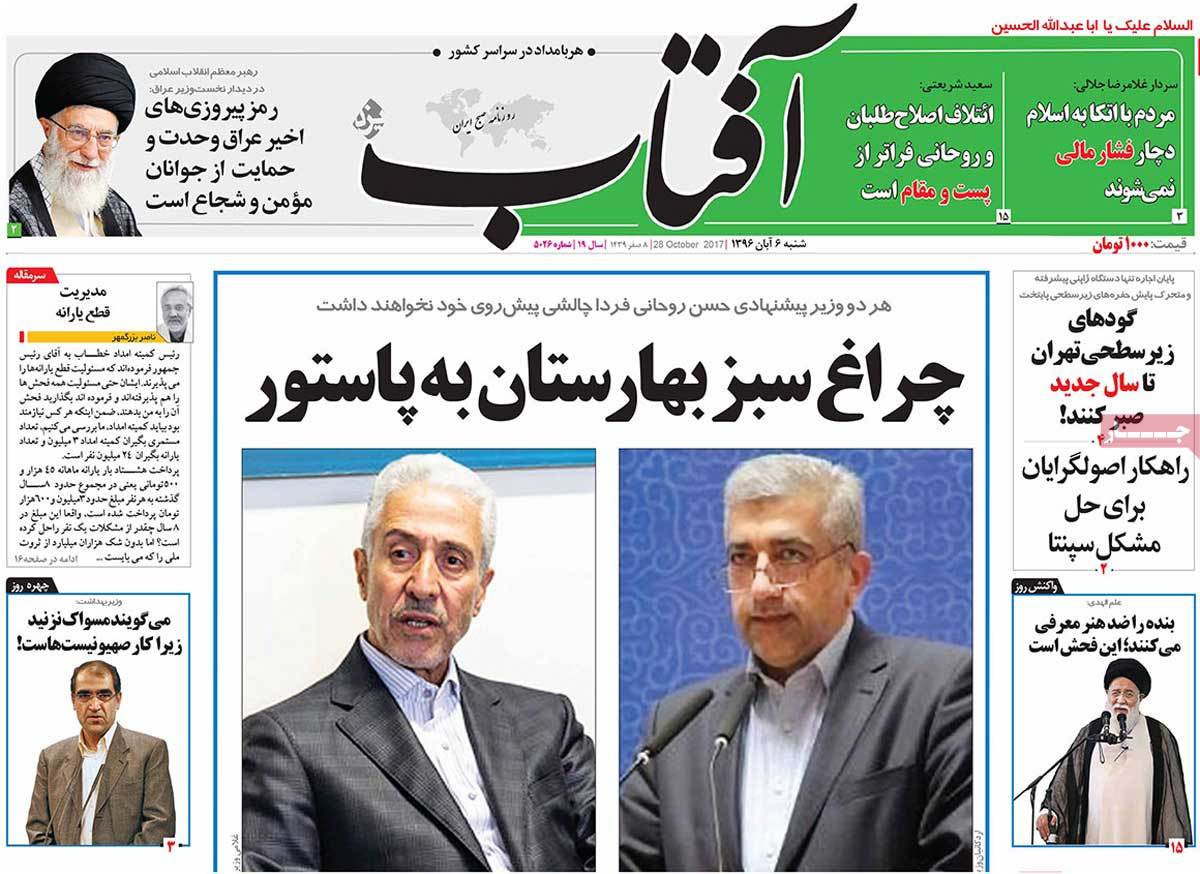
 

A Look at Iranian Newspaper Front Pages on October 28


Emtiaz:

1- Urban Development Minister: Document of Cooperation Signed with Russia on Housing

2- Tehran’s Air Polluted in 80% of Past Week
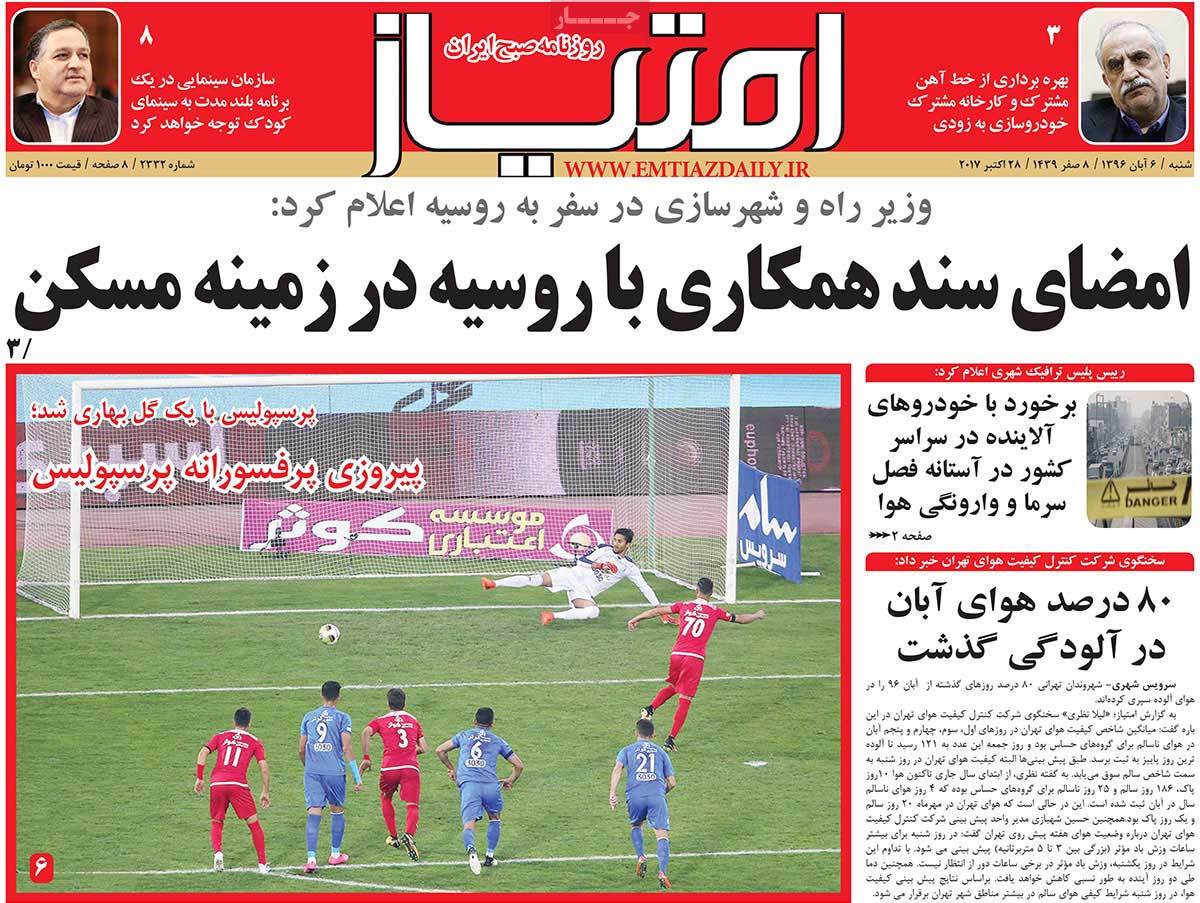
A Look at Iranian Newspaper Front Pages on October 28


Ettela’at:

1- Iran Leader Underlines Tehran’s Support for Expansion of Ties with Baghdad

2- 1.2 Million Visas Issued for Arba’een Pilgrimage

3- Putin to Visit Tehran on Wednesday
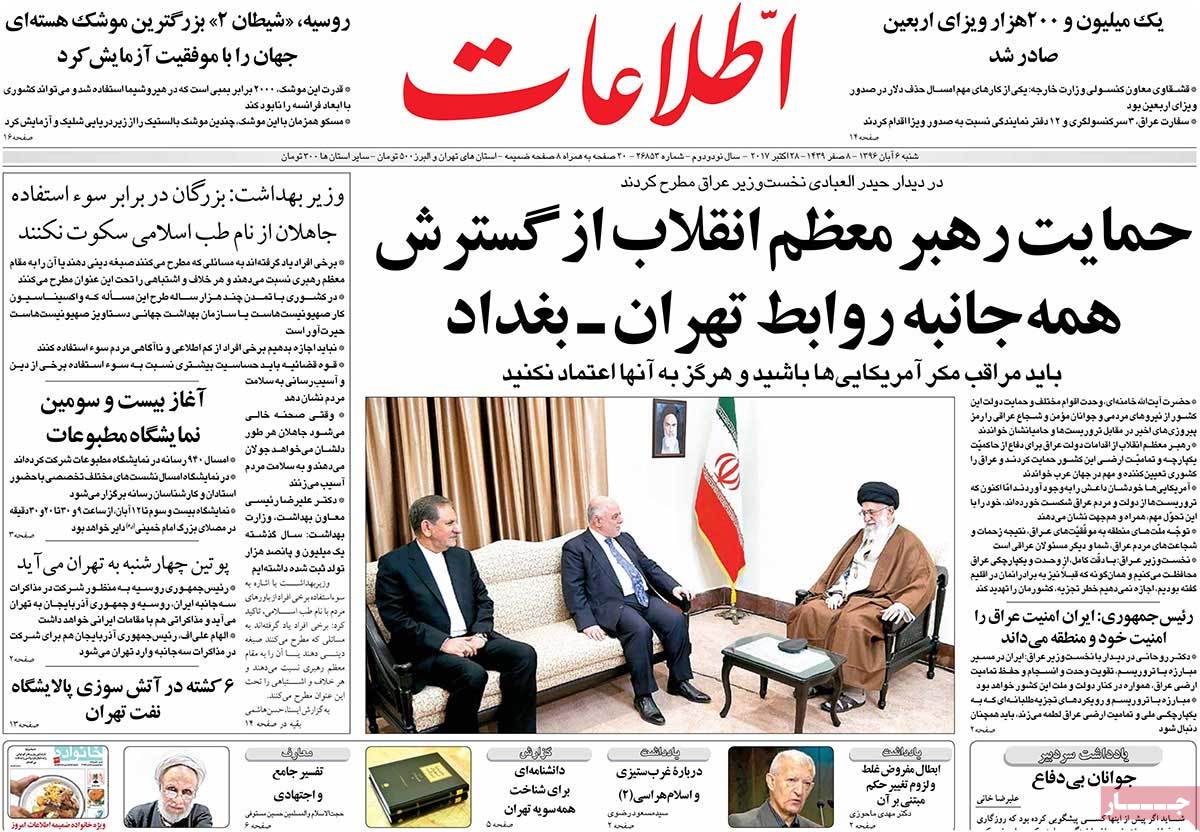
A Look at Iranian Newspaper Front Pages on October 28


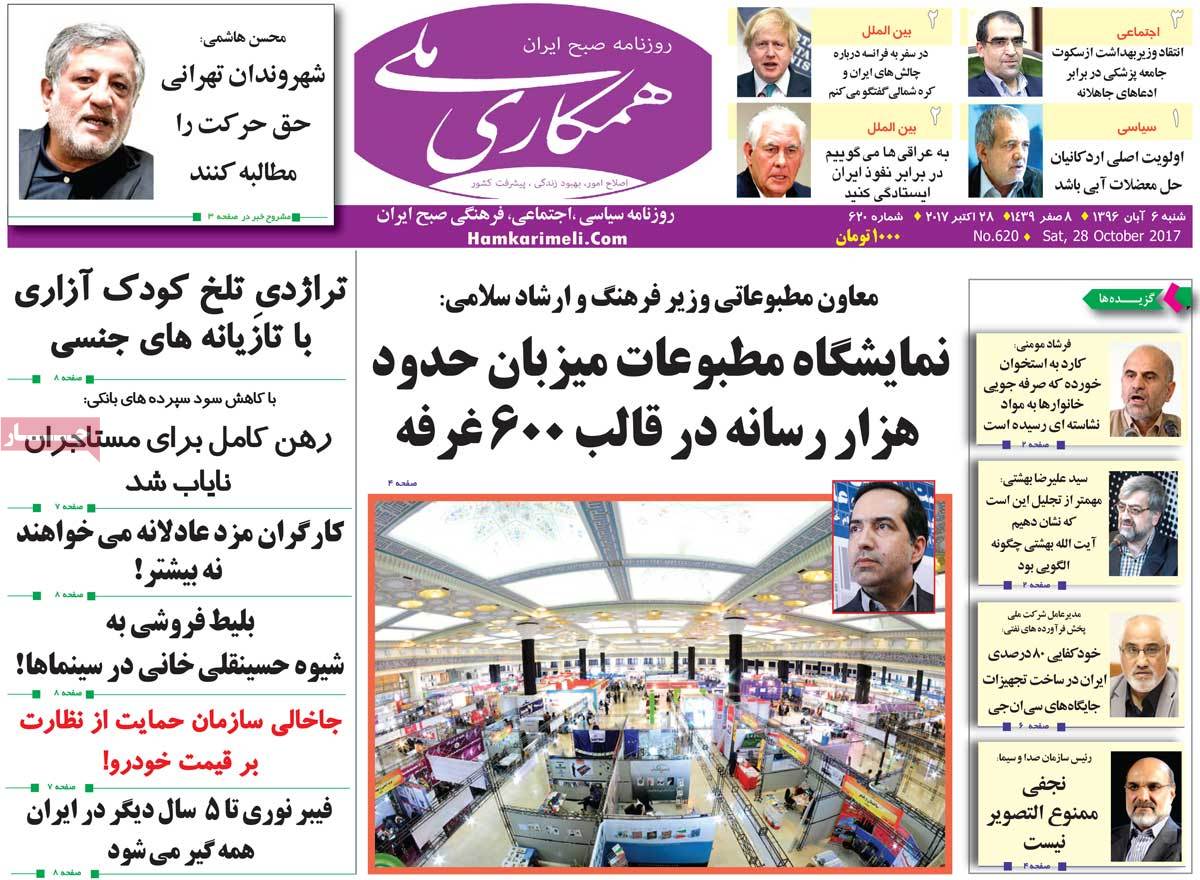
Hamkari-e Melli:

1- Press Exhibition Hosting 1,000 Media Outlets in 600 Booths: Official
A Look at Iranian Newspaper Front Pages on October 28


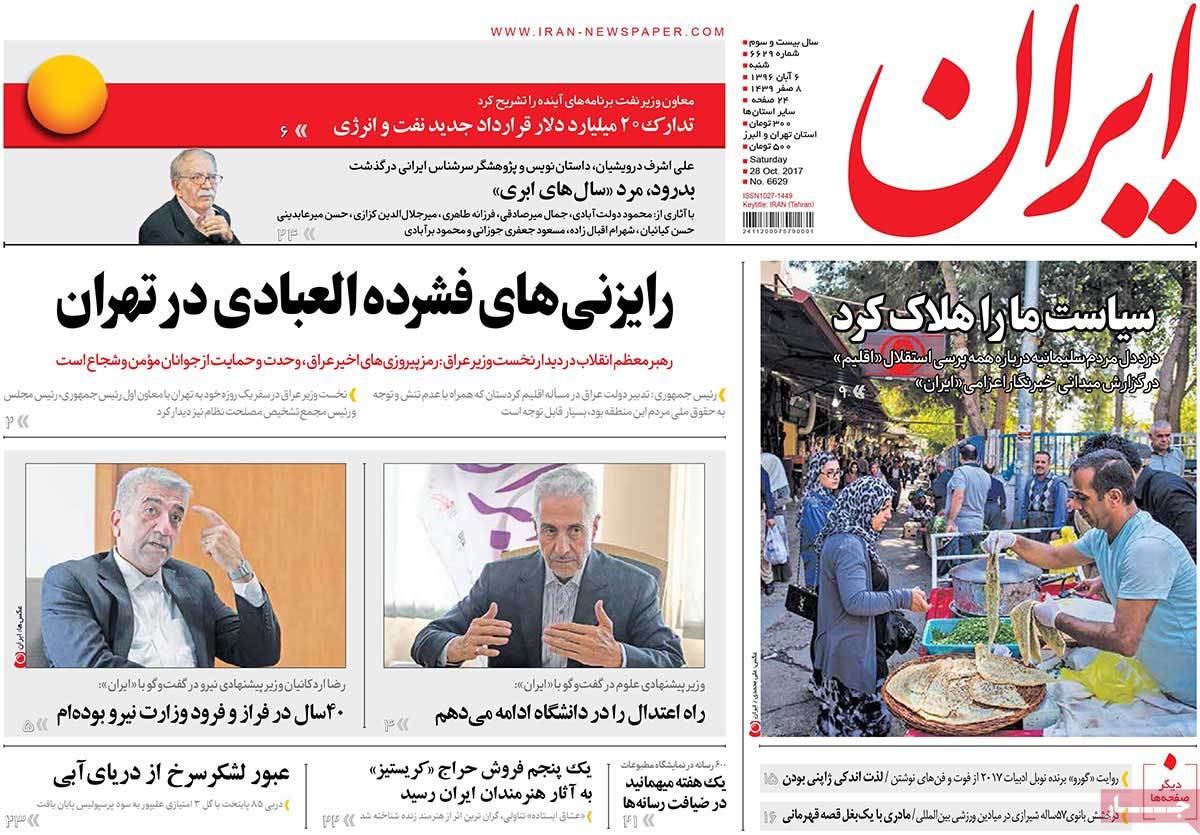
Iran:

1- Politics Destroyed Us: People of Sulaymaniyah Talk about KRG Independence

2- Proposed Energy Minister: I’ve Been in Energy Ministry for 40 Years

3- Proposed Science Minister: We’ll Continue Path of Moderation in Universities

4- One-Fifth of Christie’s London Auction Sales Dedicated to Iranian Artists

  • Tanavoli’s Artwork Most Expensive Work by Living Artist
 

A Look at Iranian Newspaper Front Pages on October 28


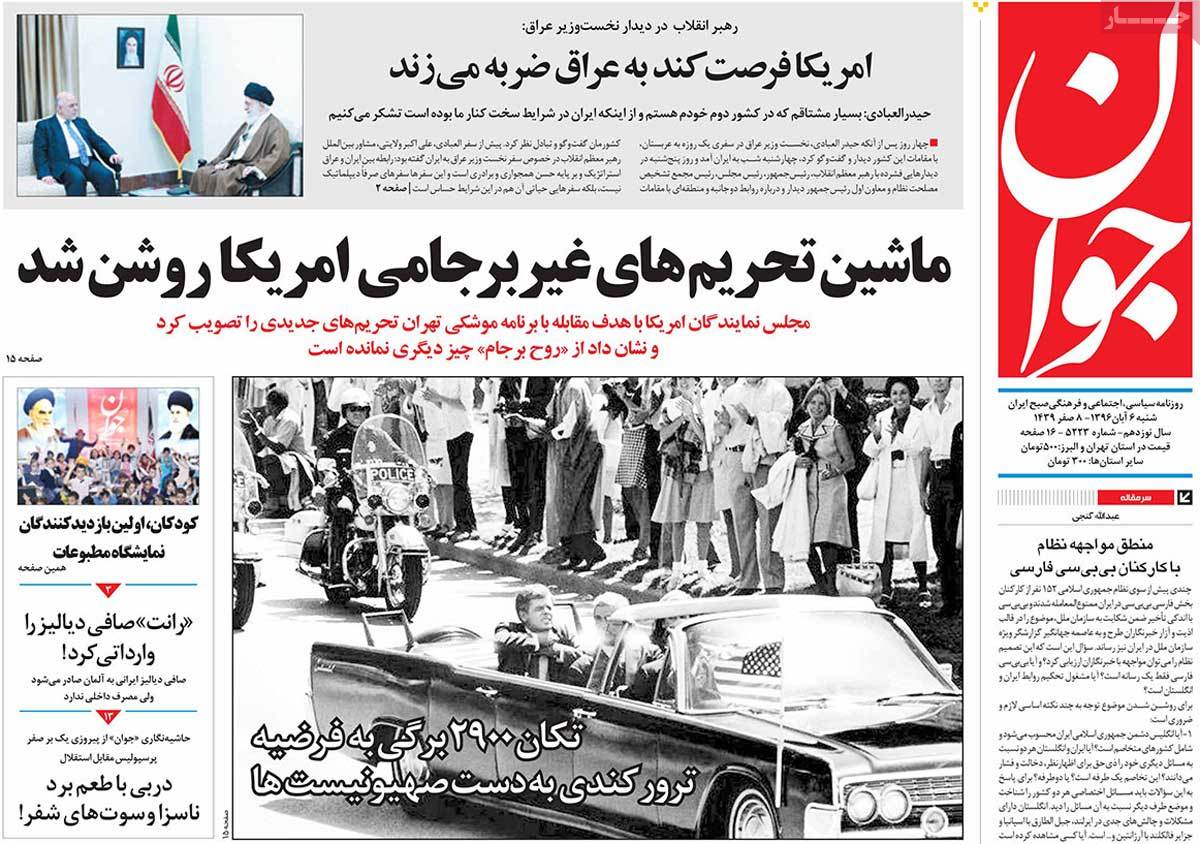
Javan:

1- Iran Leader: US to Deal a Blow to Iraq If It Finds Opportunity

2- US Starts Engine of Its Non-Nuclear Sanctions against Iran

  • US House of Representatives Imposes Sanctions on Iran’s Missile Program
  • Nothing Left of Spirit of Iran Nuclear Deal
 

A Look at Iranian Newspaper Front Pages on October 28


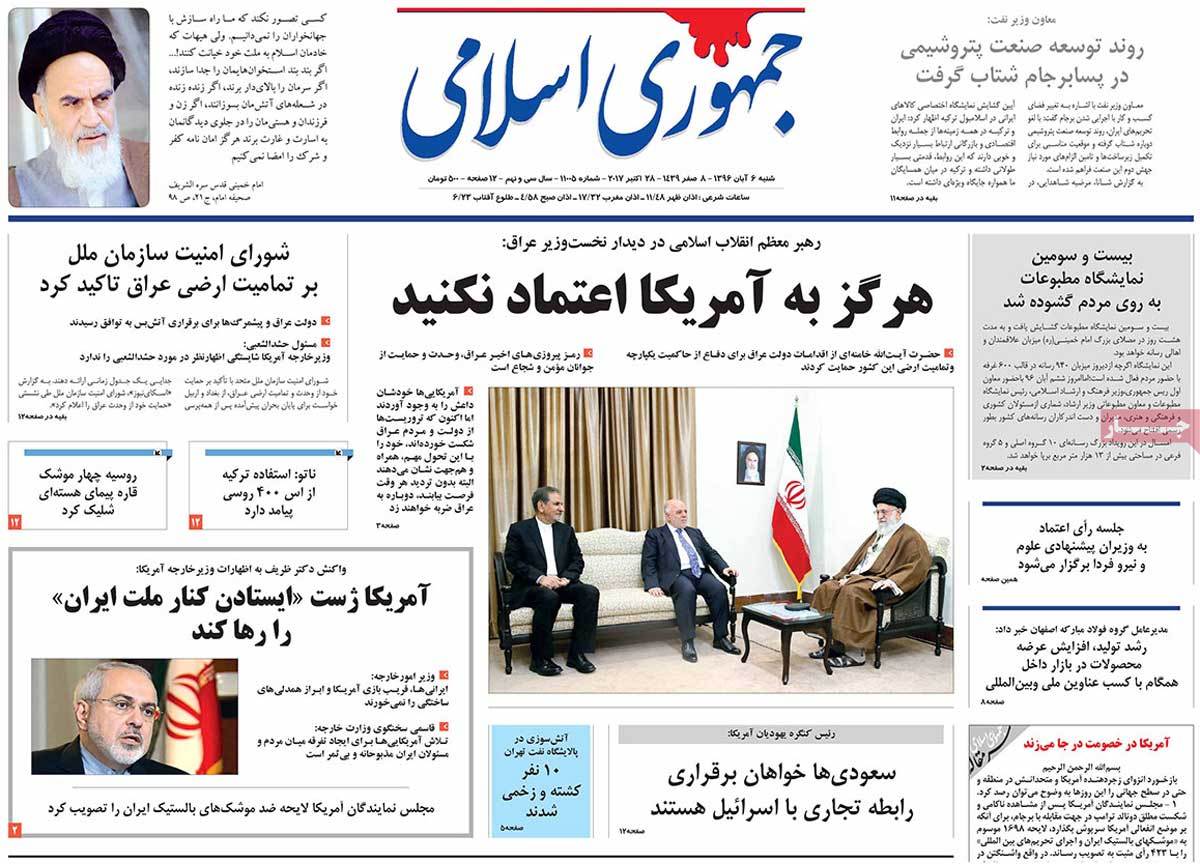
Jomhouri Eslami:

1- Iran FM Advises US to Leave Mantra of ‘Standing with Iranian People’

2- UNSC Once again Underlines Iraq’s Territorial Integrity

3- 23rd Press Exhibition Open to Visitors

4- Deputy Oil Minister: Development of Petchem Industry Accelerated after Nuclear Deal
A Look at Iranian Newspaper Front Pages on October 28


Kayhan:

1- Missile Sanctions Imposed ahead of Implementation of Mother of Sanctions

2- Qatari Ex-PM’s Horrible Confessions: We Devised Plan of Syria War with US, Saudi Arabia, Turkey

3- Memorial Plaque Installed on House of Rouhani’s Father

  • Those Were The Days When Iran Unveiled 20% Uranium Enrichment
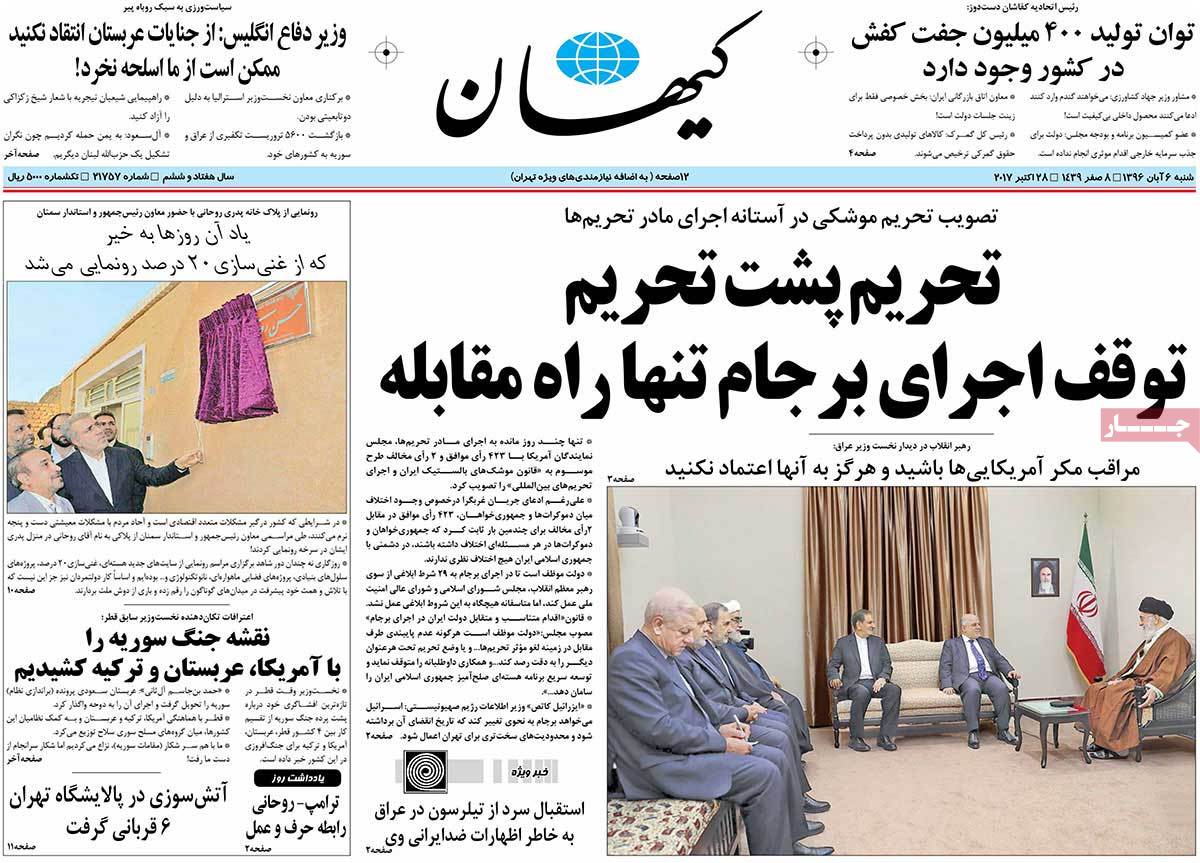
A Look at Iranian Newspaper Front Pages on October 28


Khorasan:

1- Deputy Foreign Minister: Forces Deployed to Oversee Syria Ceasefire
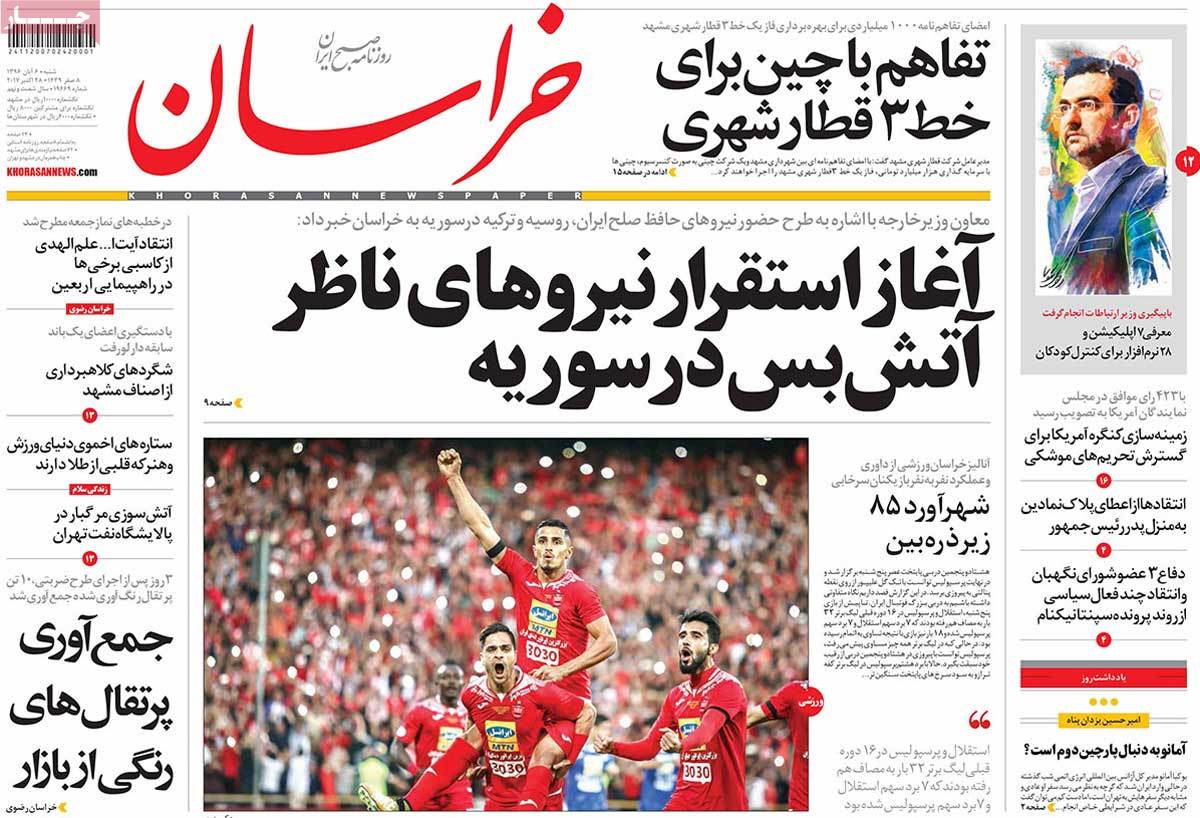
 

A Look at Iranian Newspaper Front Pages on October 28


Resalat:

1- Iran Leader to Iraqi PM: Don’t Trust Americans

2- Ayatollah Nouri Hamadani Urges Officials to Implement Policies instead of Talking

3- US Approves Bill against Iran’s Ballistic Missiles

  • Netanyahu: We Thank US for Imposing Recent Sanctions against Iran
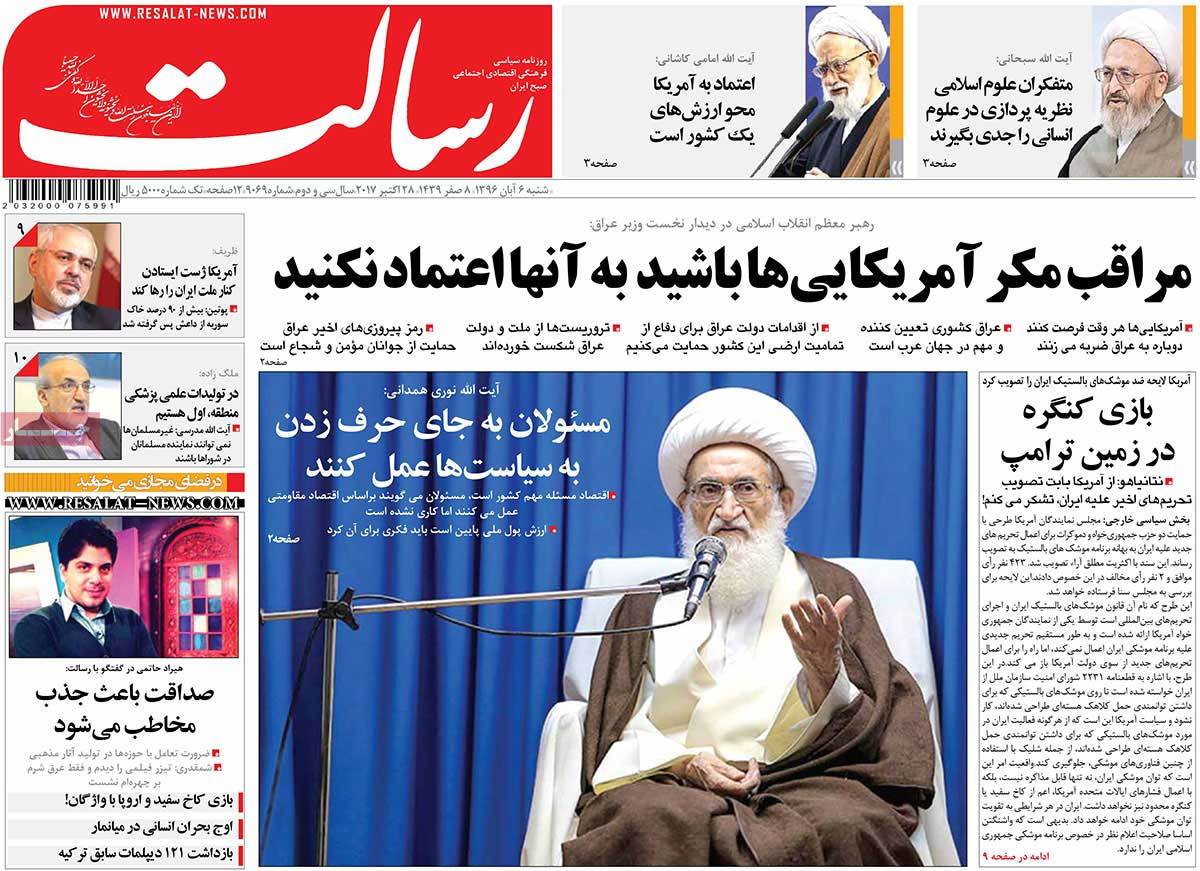
 

A Look at Iranian Newspaper Front Pages on October 28


Saheb Qalam:

1- Press Exhibition to Be Inaugurated Today by First VP Jahangiri

2- Amir-Abdollahian: Disintegration of Iraq, Syria Second Plan of Terrorists
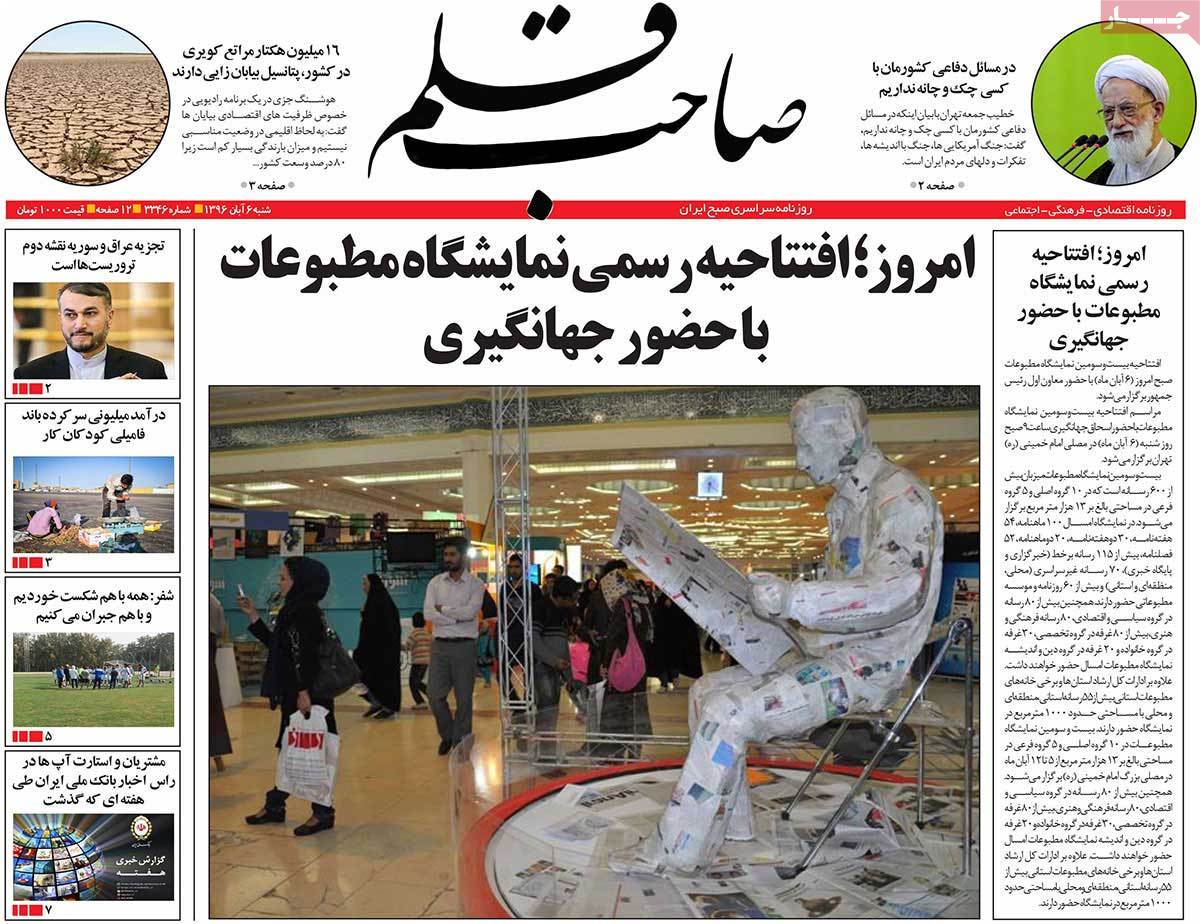
 

A Look at Iranian Newspaper Front Pages on October 28


Shargh:

1- Rouhani in Meeting with Iraqi PM: Iraq’s Security Same as that of Iran
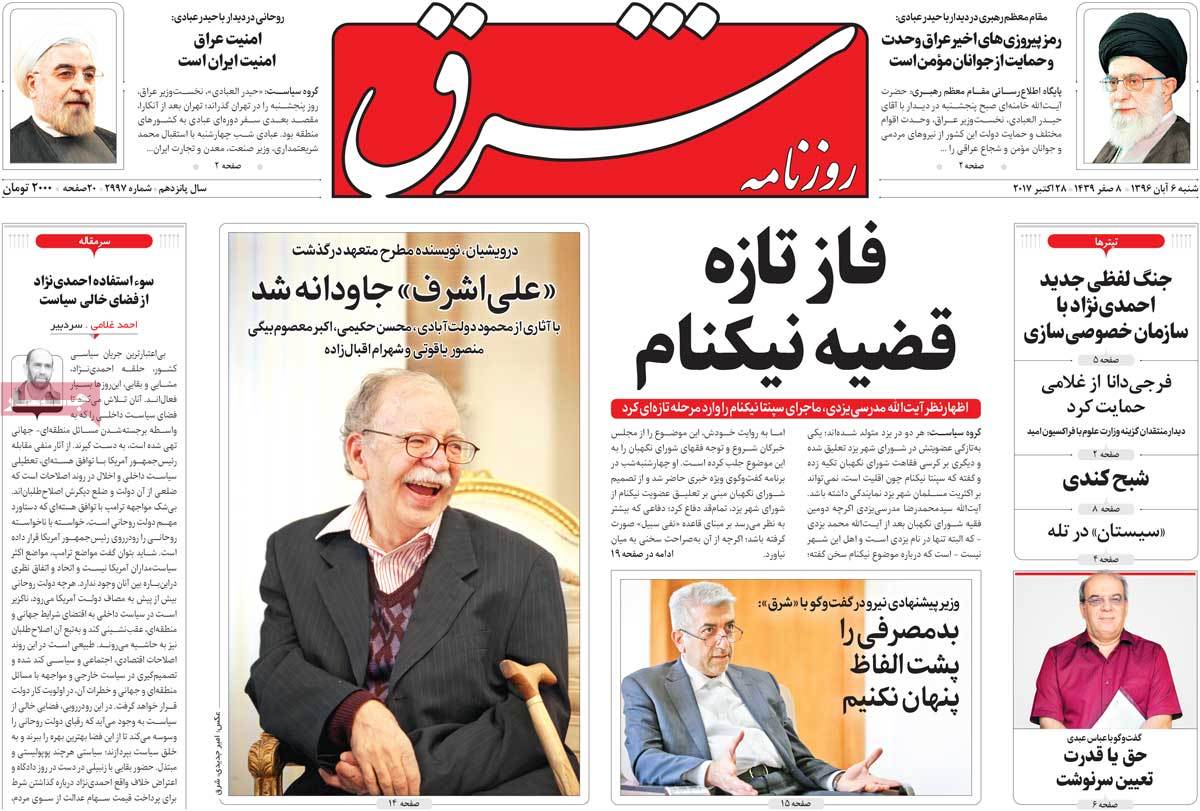
A Look at Iranian Newspaper Front Pages on October 28


Several Works by Iranian Artists Sold at Christie’s London

Held October 25, the Modern and Contemporary Art sale, which was held in London for the first time (the previous 22 rounds were in Dubai), generated $6.8 million from 44 pieces sold from among the 57 on display. Ten Iranian pieces sold during the event accounted for one fifth of the total sale.

According to the auction website, the sculpture ‘Standing Lovers’ by Parviz Tanavoli at $262,200 and Monir Farmanfarmaian’s mirror and glasswork ‘Heartbeat’ worth $147,488, got the highest bids in the Iranian lots.

Tanavoli, 80, is an internationally recognized contemporary artist with  profound knowledge of Iranian history and culture. He is best known globally for his calligraphic work ‘Heech’, the Persian word for ‘zilch’ based on which he has made tens of sculptures.

Farmanfarmaian works combine the traditional technique of glass mosaic and painting with a contemporary aesthetic.

Islamic World Art

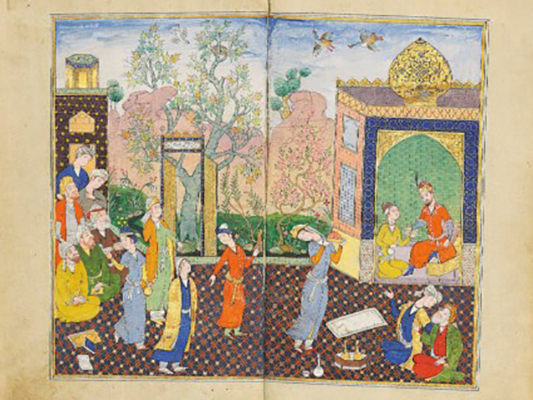
In the ‘Art of the Islamic and Indian Worlds’ sale, held October 26, several Iranian pieces, including books, carpets and paintings accounted for a significant share of the  total sale of $6 million from 325 lots.

Avicenna’s book ‘Al-Qanun Fi Al-Tibb’ was one of the items that went to the highest bidder at $26,500, Mehr News Agency reported.

Avicenna (908-1037) was born near Bukhara in Central Asia. He was a Persian polymath who is respected as one of the top thinkers and writers of Iran. Of the 450 works he is known to have written, around 240 have survived, including 150 on philosophy and 40 on medicine.

His most famous works are ‘The Book of Healing’ – a philosophical and scientific encyclopedia, and ‘The Canon of Medicine’ – a medical encyclopedia which became a standard medical text at many medieval universities and remained in use as late as 1650.

Besides philosophy and medicine, Avicenna’s works include writings on astronomy, alchemy, geography and geology, psychology, Islamic theology, logic, mathematics, physics, music and poetry.

Another Iranian lot at the sale was a manuscript of Shahname (book of kings) by Ferdowsi. It was also sold for $4,306.

Hakim Abul-Qasim Ferdowsi Tusi (940–1020 CE) or Ferdowsi, is held in high esteem as one of the most influential Persian poets of all time, and an influential figure in Persian literature. His Shahnameh narrates the mythical and historical past of Iran from the beginning of the creation of the world to the Islamic conquest of Persia in 7th century AH. Christie’s, the world’s leading art business, holds around 350 auctions annually in over 80 categories, including areas of fine and decorative arts, jewelry, photographs and collectibles.

It has a presence in 46 countries with 12 salerooms across the world, including in London, New York, Paris, Geneva, Milan, Amsterdam, Dubai, Zurich, Hong Kong, Shanghai and Mumbai.