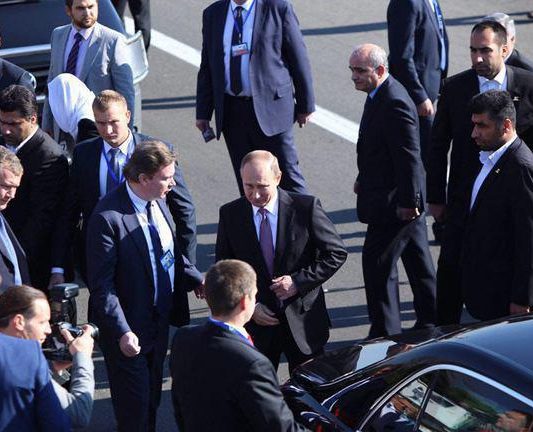
The Russian president will first hold a meeting with his Iranian counterpart Hassan Rouhani in Saadabad Palace, and then meet with the Leader of Iran’s Islamic Revolution Ayatollah Seyyed Ali Khamenei. Upon arrival at Mehrabad Airport, Putin was welcomed by Iranian Economy Minister Masoud Karbasian.
He will finally take part in a trilateral meeting with Rouhani and Azeri President Ilham Aliyev, who has earlier arrived in the Iranian capital.
The three presidents will hold the second trilateral meeting between leaders of Iran, Azerbaijan Republic, and Russia. The first meeting was held in Baku.
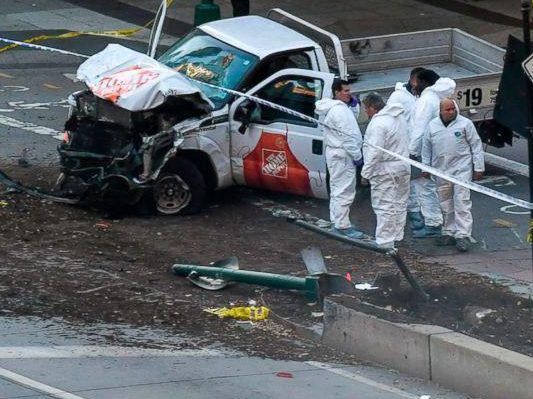
In his Wednesday statement, Qassemi expressed regret at the incident and sympathized with the families of the victims.
“Using the tactic of invading and killing innocent and defenceless citizens on the streets and public places reflects the cruelty and brutality of terrorist groups such as ISIS who have proved they do not believe in any human principles and ethics,” said Qassemi.
He also added that when such events occur in another country, the people of Iran, as one of the victims of terrorism, remember their own bitter memories of similar events.
“We believe that the ominous, inhumane, and cruel phenomenon of terrorism has its roots in the policies and approaches the US and its allies earlier adopted in the Middle East. They created, nurtured, and supported these groups to make instrumental use of them.”
He further noted that they (the US and its allies) used these groups as a means to achieve their goals and also destabilize the regional countries.
Qassemi underlined that the only way to eradicate terrorism is that all countries deal seriously, honestly and in full transparency with this phenomenon.
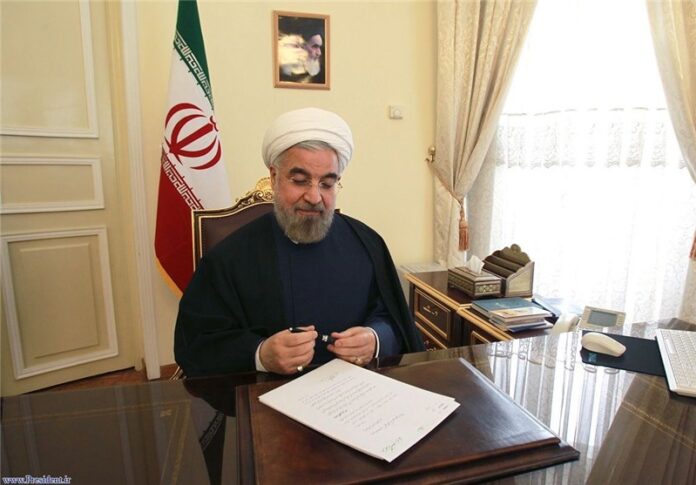
In his Wednesday message, Rouhani felicitated the African nation and government on its National Day which marks anniversary of the 1954 revolution against the French rule.
The Iranian president expressed the hope that Tehran and Algiers would tap into all their capacities to promote ties in all areas.
Rouhani also wished prosperity and dignity for the Algerian president, government and people.
November 1, in Algeria commemorates the first successfully coordinated attacks on 1954, by the National Liberation Front, against French military installations, public utilities, and communications facilities.
The fights continued until March 18, 1962, when an agreement was reached between the French and the National Liberation Front at Evian, France.
“The United States has always tried to minimize the benefits of the Iran nuclear deal for the Islamic Republic,” Araqchi said in an address to Iranian lawmakers on Wednesday, while presenting a report on the trend of the implementation of the nuclear deal.
He said Washington’s non-compliance with its commitments under the JCPOA has been aimed at keeping Iran from reaping the benefits of the agreement as much as possible.
Araqchi stressed that the US is obliged to make good on its commitments under the JCPOA, but reneges on its obligations.
“Breaches of promises by the new US administration have considerably increased in recent months,” he noted.
He said both the previous and incumbent US administrations have nursed ill intentions regarding the JCPOA.
The deputy foreign minister further said Iran stands ready to counter any possible US scenario regarding the JCPOA, saying Tehran has envisioned the necessary measures and actions to deal with any US move on the agreement.
He said Washington has adopted numerous measures which run counter to the letter and spirit of the JCPOA, including restrictions on the issuance of visas in the previous US administration, passing restrictive banking regulations, insistence on and ratcheting up non-nuclear sanctions, hostile and provocative remarks by the new US president, and efforts to pressure the International Atomic Energy Agency over Iran’s nuclear program.
Washington’s sanctions can easily keep Iranian companies from taking part in events related to “communications and information technology.” Reports that interested individuals have been barred from taking part in the exhibition, especially when the venue of the event is not in the United States, but in Spain – an EU member state which claims to be a supporter of the Iran nuclear deal – shows Iranian people, contrary to US President Donald Trump’s rhetoric, are the main target of Washington’s sanctions and have been deprived of being present in all arenas.
Therefore, the Iranian nation, as a cultured people with a rich civilization, has every right to regard as a bluffer the person who makes all this rhetoric. How can Iranian citizens believe the verbal compliments by the ruler of the White House on their culture and civilization? How can they believe his honesty? How can they believe Trump’s words when unfair laws supported by him deprive them of attending an event related to science and technology and of travelling to a third country?
There is uncertainty over the GSMA imposing sanctions on Iran. That could deprive Iranians from attending the biggest mobile phone event, according to a Farsi report by Shargh newspaper.
The GSM Association is a trade body that represents the interests of mobile network operators worldwide. One of the services it offers is to determine the International Mobile Equipment Identity (IMEI). It is a unique number for each mobile phone and is comprised of several parts each of which shows information such as the country which has manufactured the phone as well as the model of the device. The IMEI has numerous uses, namely enabling devices to be identified in mobile networks. Now, there are reports that after the imposition of sanctions by the GSMA, the trade body has banned Iranian visitors from going to the international mobile phone congress in Barcelona.
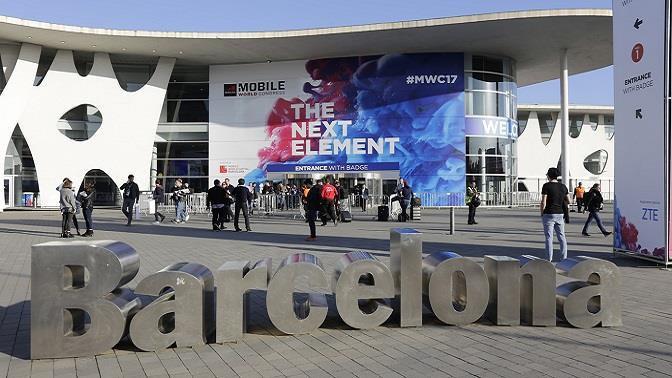
In other words, Iranians will not be able to attend the 2018 Mobile World Congress (MWC). After users enter the information related to the country, they see a message which indicates Iranian users are banned from visiting the 2018 MWC exhibition. The message reads that because the GSMA is an American company, it should act in accordance with the trade sanctions imposed by the US government. The sanctions keep the GSMA from issuing visas to visitors from Cuba, Iran and Syria.
The MWC held in Barcelona is an exhibition which brings together companies producing mobile gadgets and displays the latest communications technologies. The GSMA is the main organizer of the international event. Every year, telecoms operators and mobile phone producers introduce their latest achievements at the exhibition.
Given the GSMA’s sanctions, it seems that this year, neither Iranian firms nor visitors and IT authorities will be able to attend the event.
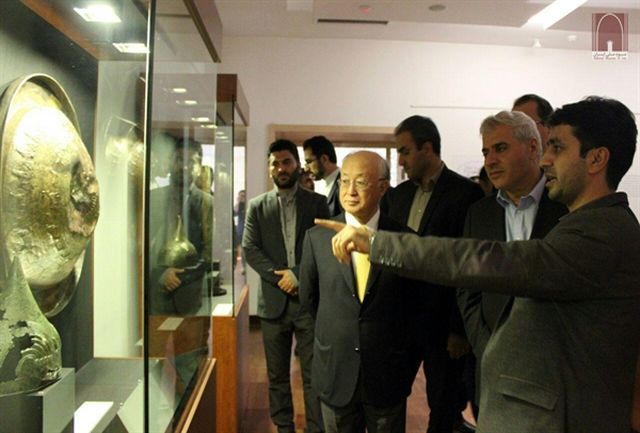
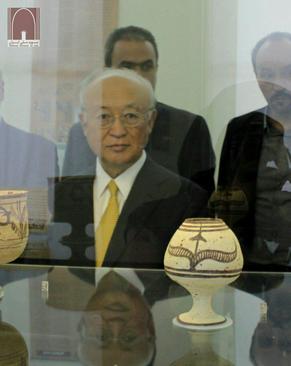
The IAEA Director General, who visited Iran as part of a diplomatic mission to hold talks with Iranian officials on the nuclear agreement, paid a visit to the National Museum of Iran while Behrouz Kamalvandi, the spokesman of the Atomic Energy Organization of Iran (AEOI), and a number of other officials accompanied him.
During his tour which took about three hours, he visited various parts of the museum including the ones dedicated to prehistoric, ancient, and Islamic-era Iran and a joint exhibit called “Iran and Armenia; Memory of a Land”, Mehr News Agency wrote in a Farsi report.
He also visited various objects including the works of Susa, Tepe Sialk, Achaemenid Hall, the Statue of Penelope, the Statue of Parthian Noble Man, and the Hall of Sassanid relics.
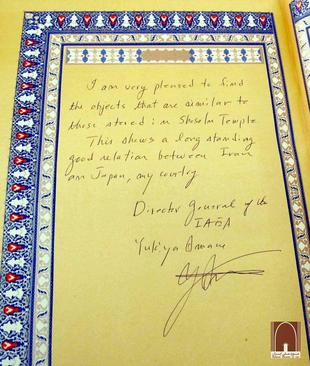
Amano wrote in the memorial book of the museum that “I am very pleased to find the objects that are similar to those in Shosoin Temple. This shows a long-standing good relation between Iran and Japan, my country.”
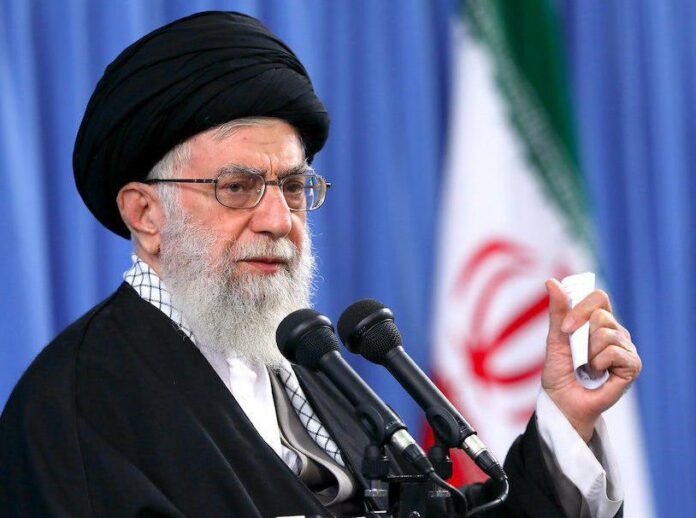
Ayatollah Khamenei on Wednesday described the battle against the Zionist regime of Israel as a “sacred” one and a collective responsibility of the entire Muslim world.
The “heavy responsibility” to support Palestine lies with the entire Islamic world, the Leader said in a message to the 2nd international conference of resistance scholars, held in Beirut.
“Without a doubt, scholarly elites, clerics and politicians, as well as the officials of Muslim countries carry the heavier part of this responsibility; this is a sacred and well-ending Resistance. The Divine promise guarantees definite victory of the resistance,” the Leader said, as reported by Tasnim.
Describing the battle against Israel as a “holy” fight with a fortunate outcome, Ayatollah Khamenei said Almighty God has pledged a definite victory in this battle.
The Leader also urged that efforts should be made to diversify the continued fight against Tel Aviv.
“Your congress today represents part of this vast, public movement. May God help you succeed on this path. I recommend that all individuals, who feel the importance of this great responsibility, continue different methods of fighting against the usurper Zionist Regime.”
According to head of the Union of Resistance Scholars, Sheikh Maher Hamoud, more than 200 scholars from over 80 countries have taken part in the two-day event in Beirut.
“True Promise: Palestine between Balfour Declaration and Divine Promise” is the theme of the conference.
The first international conference of resistance scholars was held in Lebanon in May 2016.
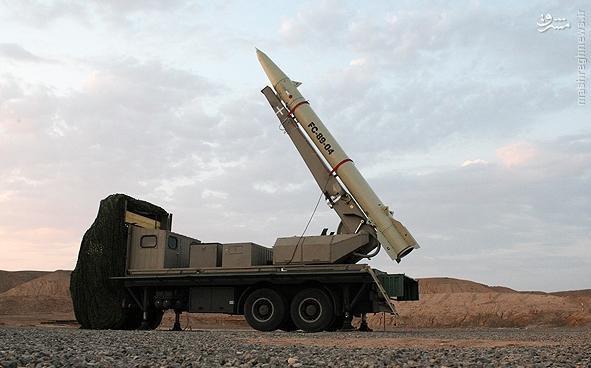
Chairman of the General Staff of the Iranian Armed Forces Major General Mohammad Baqeri says Iran’s missile capability is merely geared to deterrence.
“The Islamic Republic of Iran’s missile power is completely defensive and [Iran] has no intention of launching aggression against any country, but when it comes to defending the country and national interests, if an aggressor makes a strategic mistake and intends to encroach upon our interests, the Islamic Republic of Iran will have no reservations about using its missile power,” he said.
According to a Farsi report by ILNA, he then touched upon Iran’s missile capabilities from a quantitative, tactical and technical point of view.
“The Commander-in-Chief of the Armed Forces [Ayatollah Seyyed Ali Khamenei] has authorized us to produce missiles with a range of up to 2,000 kilometers, and our scientists have managed to produce these missiles with [high] quality and in quantities needed by the country.”
He said Iran’s missiles have been deployed in “safe areas and underground missile towns.”
He said Iran pays much attention to the “precision” and “pin-point accuracy” in designing and producing its missiles.
“In the world, missiles are usually produced to carry nuclear warheads, and this does not need accuracy as they (attacks) cover large areas. But the Islamic Republic of Iran regards the possession, production and use of nuclear warheads as religiously forbidden; so, our scientists have designed precision-guided missiles with more accuracy,” said the top general.
He said the deterrence power of Iran’s missiles is based on the latest technologies.
“No matter how much our enemies, namely the criminal United States and human-and-child-killing Zionists, increase their missile defense capabilities, they won’t be able to overcome our missile power,” the general underlined.
He also stressed that Washington’s sanctions will not affect the Islamic Republic’s missile program.
“The laws and regulations of the US Congress and circles regarding the imposition of sanctions will have no bearing on the Iranian nation’s will and missile power,” said the top general.
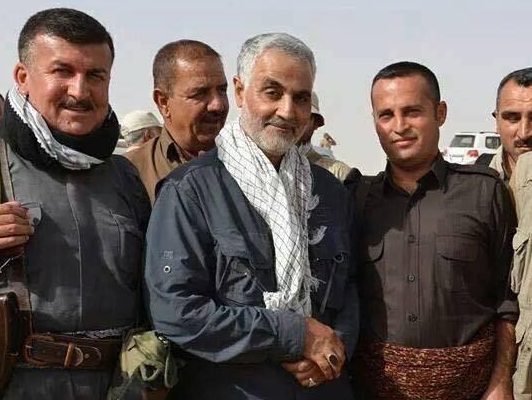
Nazim Dabagh, the representative of the Iraqi Kurdistan Regional Government (KRG) in Tehran, recently disclosed that General Soleimani headed meetings with local delegations in Iraqi Kurdistan region ahead of the Kurdish referendum.
“General Soleimani also had several private meetings with Masoud Barzani, the president, and Nechirvan Barzani, the prime minister of the Iraqi Kurdistan region and the leaders of other parties, including Change (Goran) party,” Dabagh said on Sunday.
He added that the Iranian side had warned the Kurds not to hold an independence referendum because all powers will stand united against the Iraqi Kurdistan region, Fars reported.
According to Dabagh, the Iranian side also told the KRG officials and Kurdish groups that Tehran wants the Iraqi Kurds’ achievements to be maintained within the framework of the Iraqi constitution.
He lauded General Soleimani and other Iranian officials’ efforts to help the Kurds, and said, “We always need relations and friendship of Iran.”
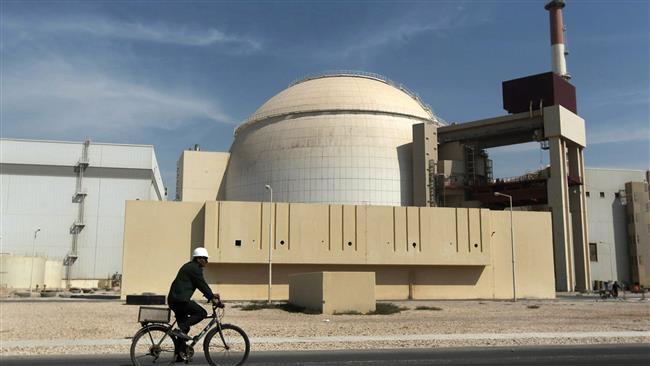
In an agreement between the senior officials of the Atomic Energy Organization of Iran (AEOI) and Rosatom, phases two and three of Iran’s Bushehr nuclear power plant will begin supplying electricity to Iran’s power grid in 10 years.
According to the general director of the Rosatom, Iran and Russia will jointly build the two plants on the northern coast of the Persian Gulf.
“Twenty percent of the entire phase two and eighty percent of its building construction will be done by the Iranian side. We have signed an agreement to build eight power plant blocks and these blocks could be built in other parts of Iran,” said Rosatom Director General Alexey Likhachev at a Tuesday press conference with the AEOI chief Ali Akbar Salehi in Bushehr.
Salehi also expressed hope that the second phase of the project will finish in seven years and the third two years later.
The AEOI chief also elaborated on the benefits of the project for Iran, saying, “The first phase of Bushehr nuclear power plant is now operational and as a result, some 11 million barrels of crude oil is saved annually. The production of electricity by a 1,000-megawatt plant will also help diminish up to seven million tons of gas emissions every year.”
Salehi underlined Iran and Russia’s resolve to maintain and strengthen their nuclear cooperation, adding, “The Bushehr nuclear power plant is a symbol of strategic cooperation between Iran and Russia.”
He pointed to Iran’s plan to produce 20,000 megawatts of nuclear-generated electricity and said, “Since the cost of constructing a 1000-megawatt nuclear power plant is $5,000 billion, we need to invest $100,000 billion to build nuclear power plants with a capacity to generate 20,000 megawatts of electricity.”
The ceremony to inaugurate the project came a few days after International Atomic Energy Agency (IAEA) Secretary General Yukiya Amano visited Iran, and once again confirmed Tehran’s compliance with the agency’s charter and the 2015 nuclear deal with six world powers.
Iran says that the project will be conducted within the framework of the Safeguards Agreement with the IAEA and the Non-Proliferation Treaty (NPT).
Salehi said the implementation of Iran’s nuclear deal, known as the Joint Comprehensive Plan of Action (JCPOA), has played a positive role in making the project come to life.
Each of the two new phases will produce 1,057 megawatts of electricity. Combined with phase one, Iran will produce some 3,300 megawatts of nuclear-generated electricity in a decade.