Saturday, December 27, 2025
Home Blog Page 3803

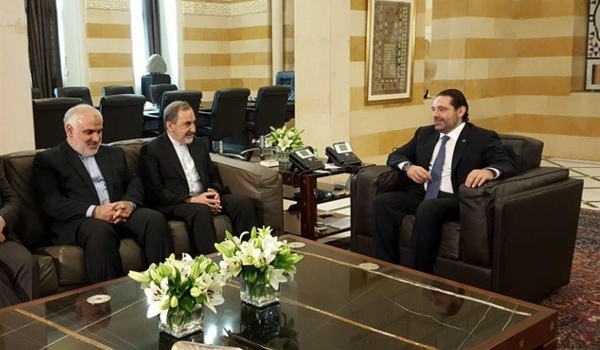
Iran’s Velayati Dismisses Hariri’s Remarks about Their Meeting in Beirut

Velayati-Saad Hariri

Speaking to reporters in Tehran on Tuesday, Velayati pointed to his meeting with Hariri in Beirut one day before his shock resignation and said despite Hariri’s claims, the talks were not “tough, violent or involving threats”.

“Mr. Hariri said that during the meeting he had with me, he called on (Iran) not to interfere in the internal affairs of Lebanon,” Velayati said, adding that Hariri did not make such remarks at all.

It became clear that his remarks have been made under the influence of Saudis, who are not willing to see Lebanon in peace, having friendly relations with Iran, the top official said.

Velayati also said that in the meeting, Hariri tried to play the role of a mediator between Tehran and Riyadh.

He expressed the hope that Hariri would return to his post soon.

Hariri, announced his resignation in a televised statement from Riyadh on November 4, citing many reasons, including the security situation in Lebanon.

He also said he sensed a plot being hatched against his life. Hariri blamed interference in Lebanon by Iran and Hezbollah Resistance Movement for his decision to quit, an allegation the two have repeatedly denied.

Reports say the Saudi regime had ordered Hariri to resign in an effort to destabilize Lebanon.

Saad Hariri is the son of former Lebanese prime minister Rafiq Hariri, who was assassinated in 2005. Hariri has also been the leader of the Future Movement party since 2005.

He became prime minister in 2016 after serving another term between November 2009 and June 2011.

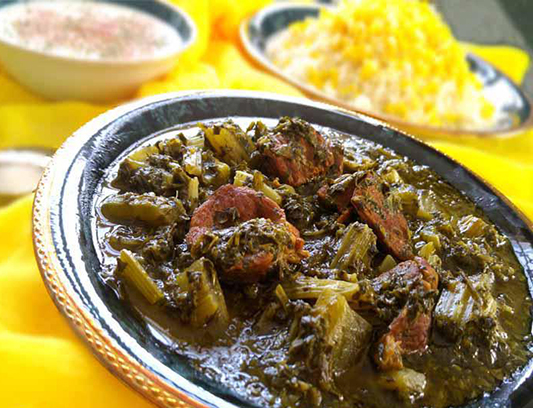
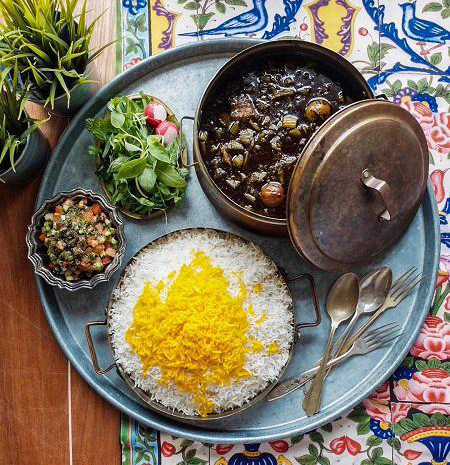
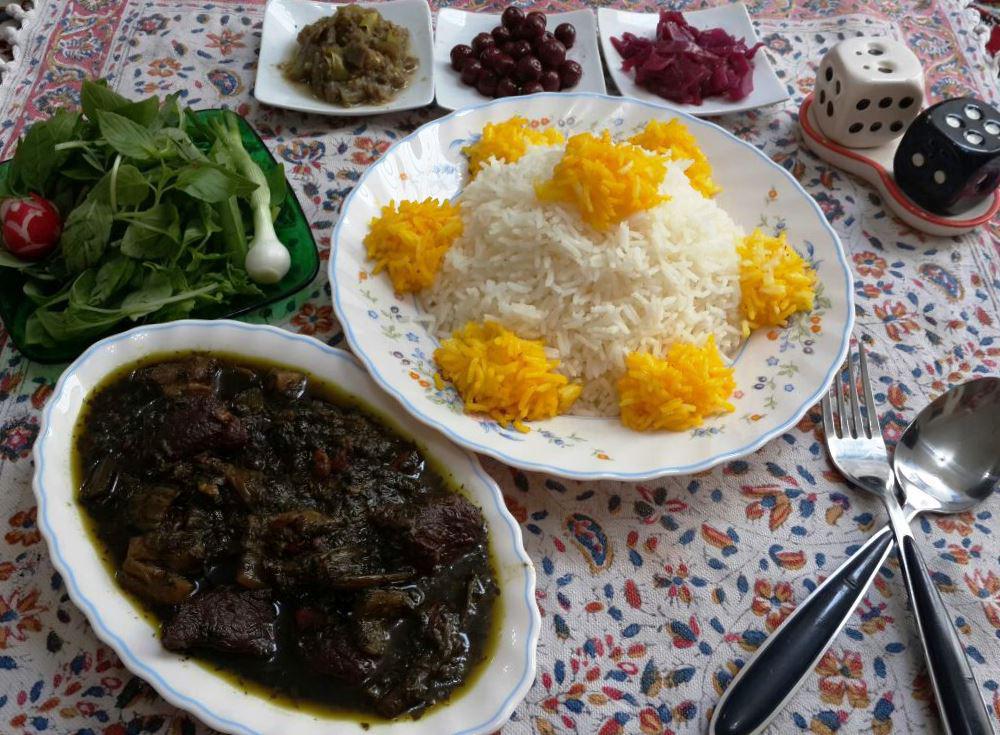
Iranian Food Recipes: Celery Stew with Rice

Celery Stew with Rice

The stew is served with rice and takes a relatively long time to be prepared.

Here is how it is made:

Ingredients:

250 grams of chopped meat

250 grams of celery

200 grams of chopped mint and parsley (parsley 150 g, mint 50 g)

1 medium-sized onion

20 grams of butter

Verjuice as much as needed

Salt, pepper, and turmeric as much as needed

Recipe:

Celery Stew with RiceChop the onion and sauté until translucent and then add turmeric. Add the chopped meat and sauté on low heat until they turn brown a little. If the heat is too high the meat will not be tender. Now add 2 to 3 cups of boiling water to the mixture to cook.

Fry the vegetables, but be careful not to fry too much because it gets bitter. Now sauté the celery a little. It should be kept in mind that it must be done with low temperature so that the celery would not become stiff.

After 1 to 1.5 hours when the meat is rather cooked, you must add vegetables and celery to it, and give both meat and celery enough time to cook well.

After one hour, meat and celery are probably cooked. Of course, at this stage, taste the celery, if it is not tender, you must wait more.

When the celery is cooked, add salt, pepper, verjuice, and if you like, a few dried plums.

Now the stew is ready to serve. Bon appétit

Notes:

  • Use thin, young celery stalks to cook well and soften.
  • The vegetables must be fried well, but it’s better to taste it every now and then not to become bitter.
  • The more sautéed onion you add, the tastier your stew will be.
  • If you use lamb, you can add vegetables and celery immediately after pouring water since the lamb become tender soon. But if you use veal, be sure to cook it one hour and then add the rest of the ingredients.
  • The more time you give to the stew to cook on a medium heat, the more delicious food you get at the end.
  • Add the verjuice slowly and taste it so that your stew does not get too sour.
  • Celery Stew with Rice

A Look at Iranian Newspaper Front Pages on November 14

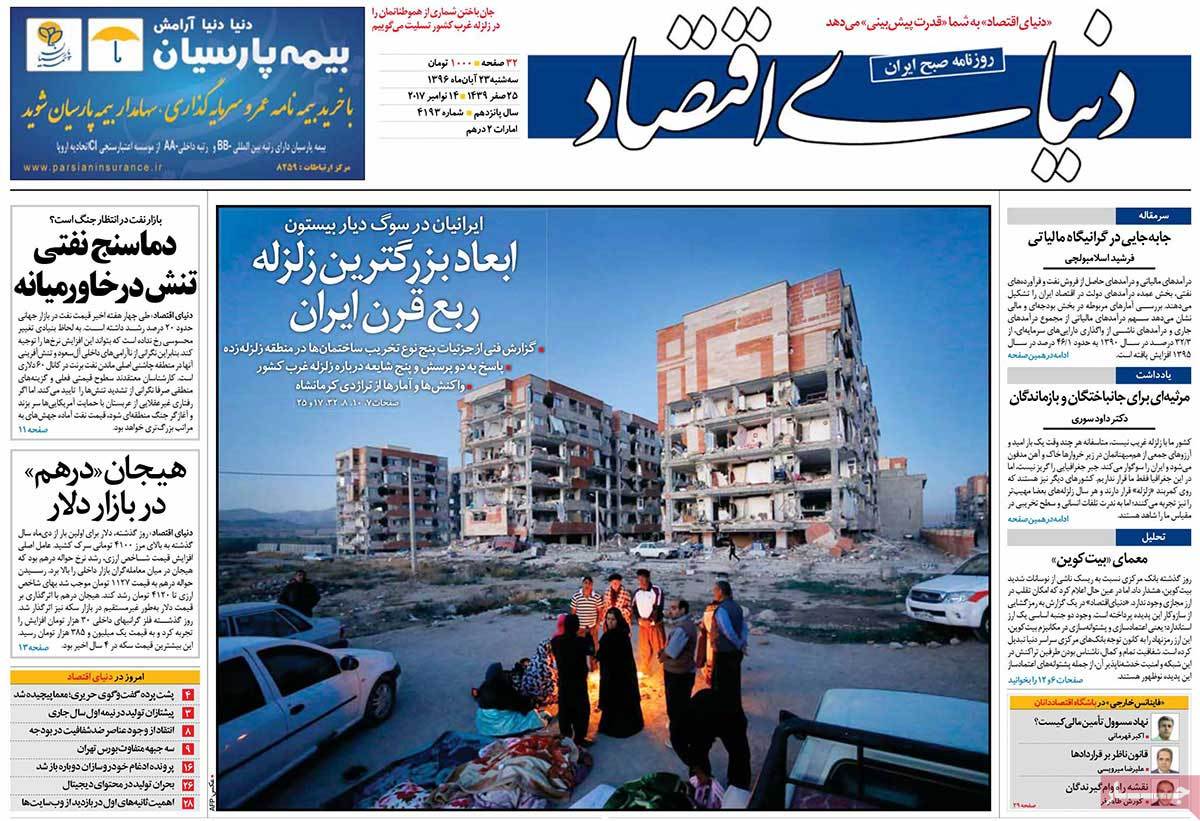
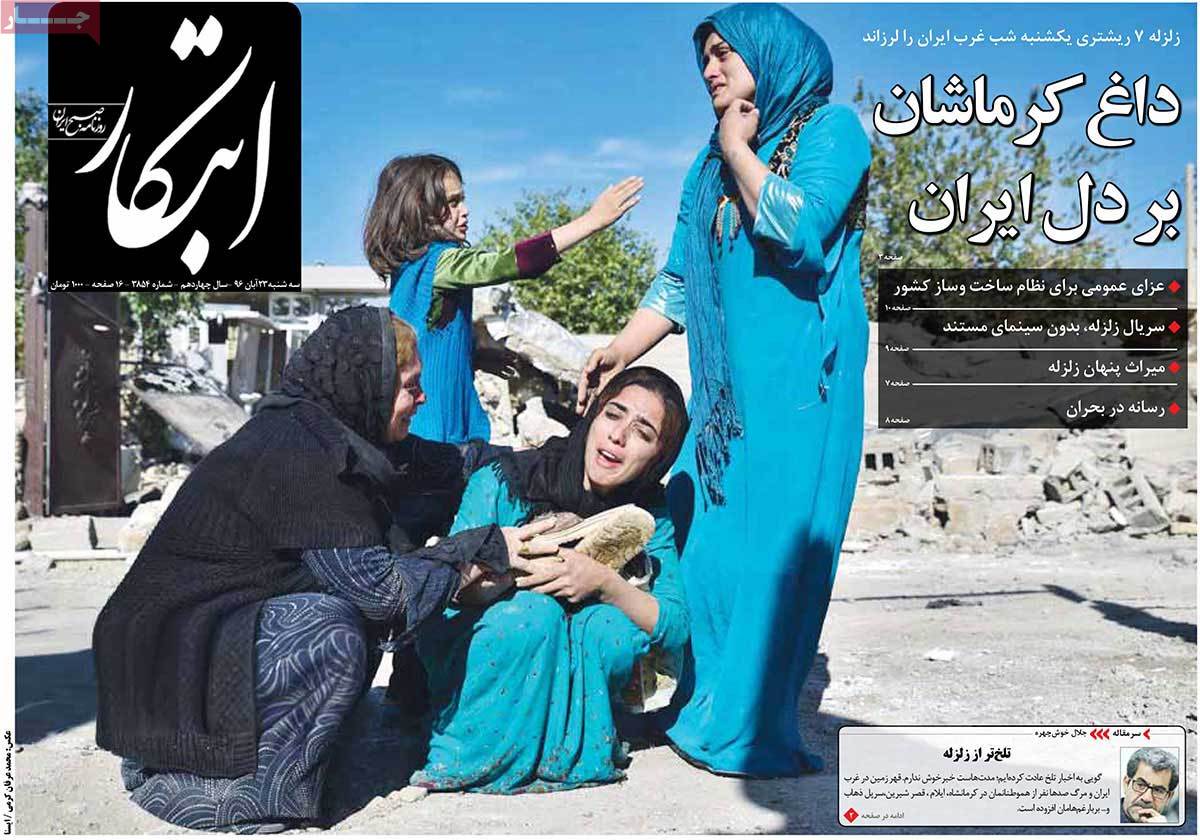
The deadly earthquake in the Western Iranian province of Kermanshah was the top story in all Iranian newspapers today. The earthquake has so far killed over 433 and wounded nearly 8,000 people.

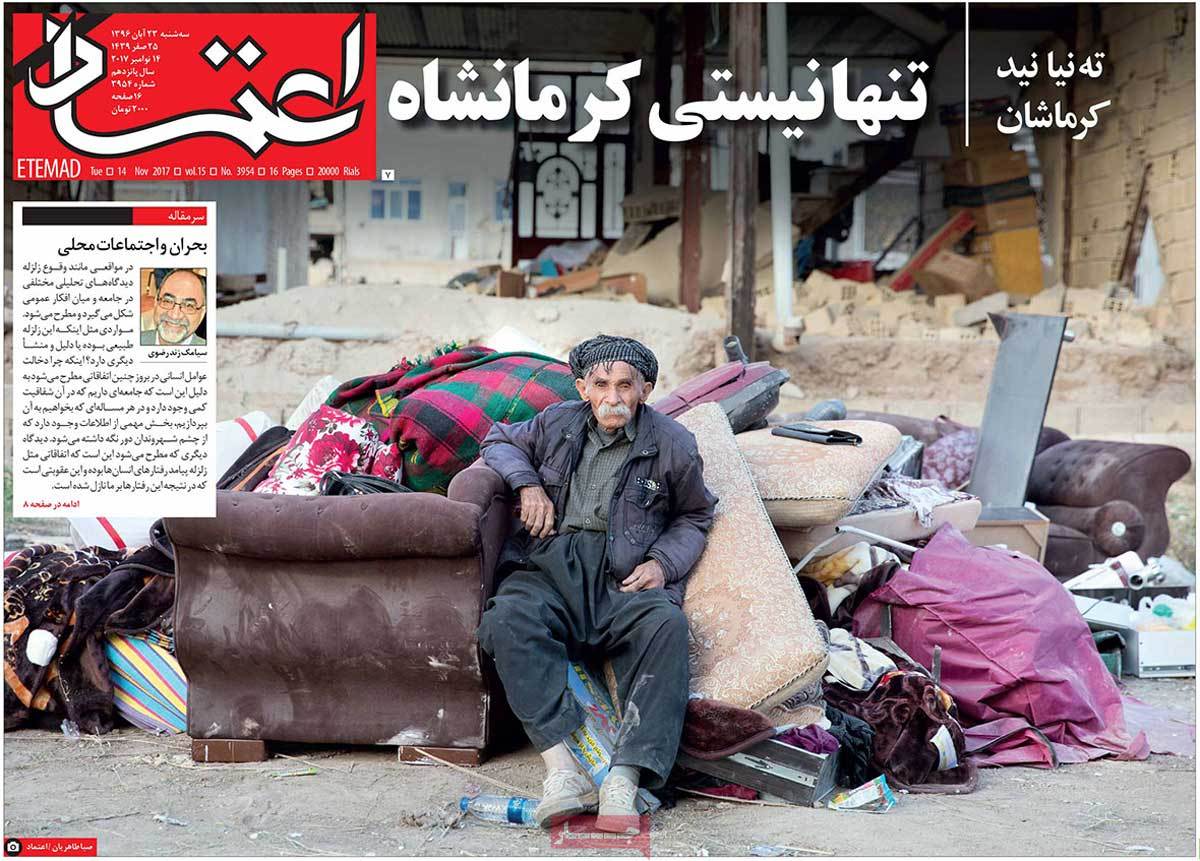
At least seven papers today used Kurdish words in their headlines to offer condolences to the Kurds of Iran’s Kermanshah, who suffered the biggest damage in the earthquake.

Almost all papers covered a message by the Leader of Iran’s Islamic Revolution Ayatollah Seyyed Ali Khamenei to condole with the nation over the earthquake and to order the officials to accelerate their rescue and relief efforts.

They also highlighted the Leader’s remarks about the splendour of Arba’een pilgrimage and his thanks to the Iraqi nation and government for organizing the mass pilgrimage and hosting the pilgrims.

The above issues, as well as many more, are highlighted in the following headlines and top stories:

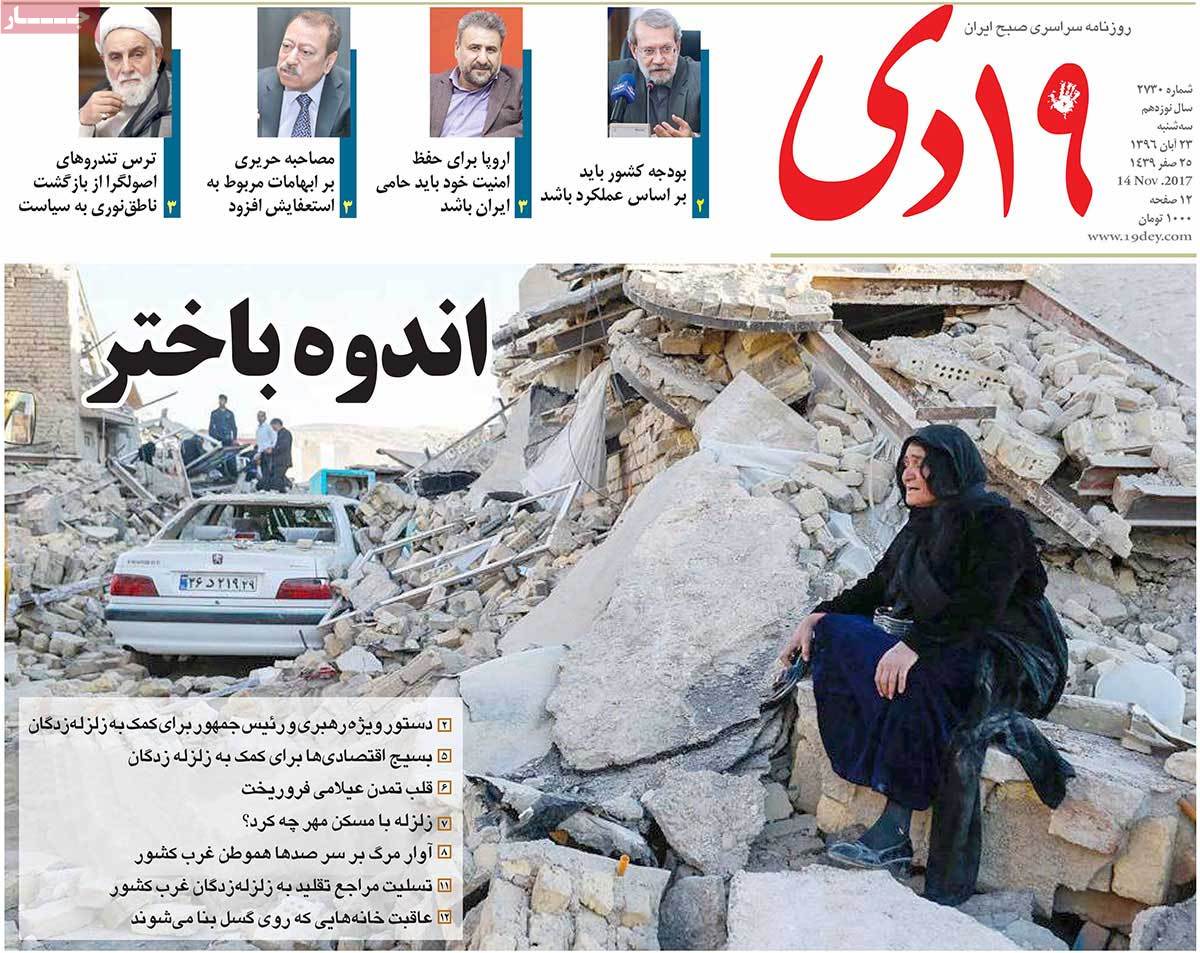
19 Dey:

1- Sorrow of West

2- Rubble of Death on Iranian People in Western Areas
A Look at Iranian Newspaper Front Pages on November 14


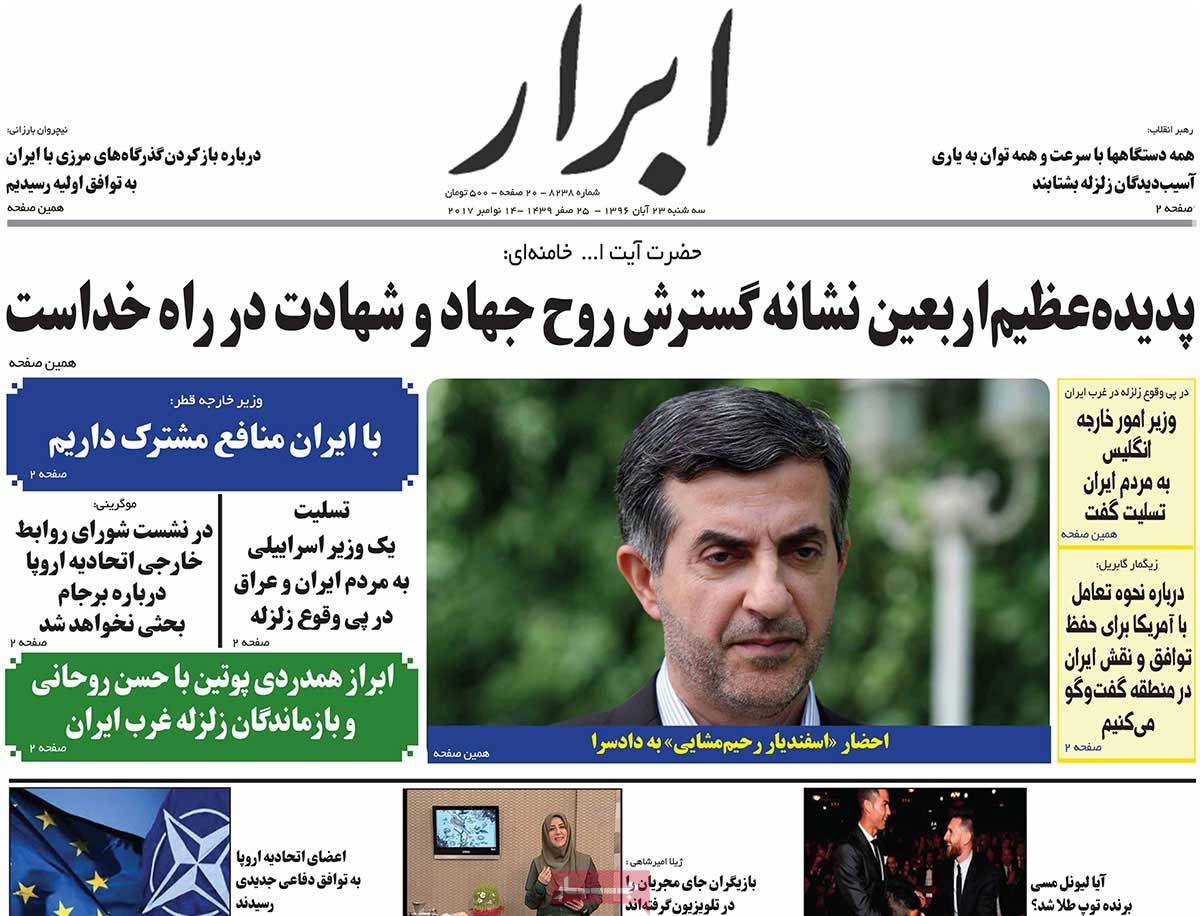
Abrar:

1- Iran Leader: Arba’een Great Phenomenon that Shows Spirit of Martyrdom

2- Ayatollah Khamenei Urges All Bodies to Immediately Help Quake-Hit People

3- British Foreign Secretary Condoles with Iranian People over Earthquake

4- Israeli Minister Extends Condolences to Iran, Iraq after Earthquake
A Look at Iranian Newspaper Front Pages on November 14


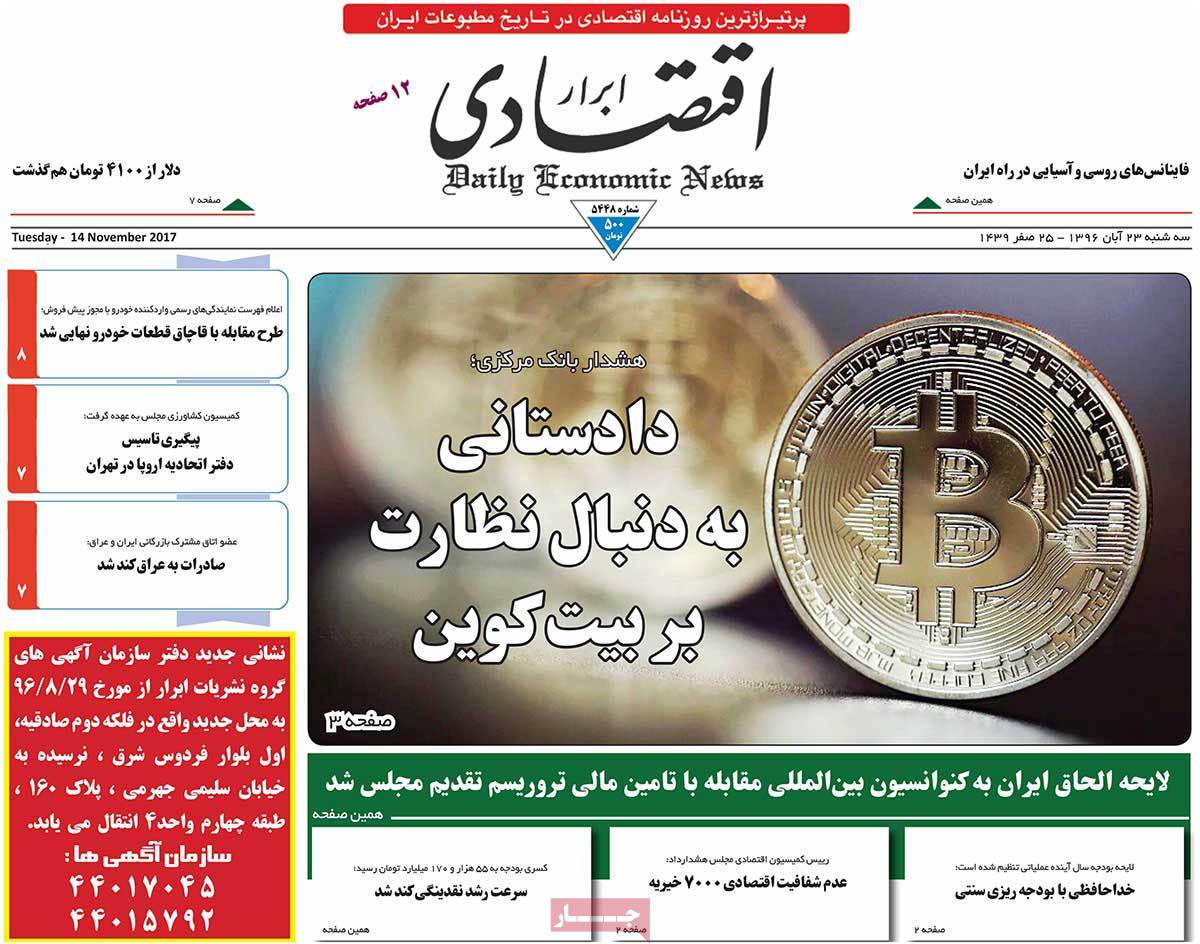
Abrar-e Eqtesadi:

1- Central Bank: Prosecutor to Supervise Bitcoin
A Look at Iranian Newspaper Front Pages on November 14


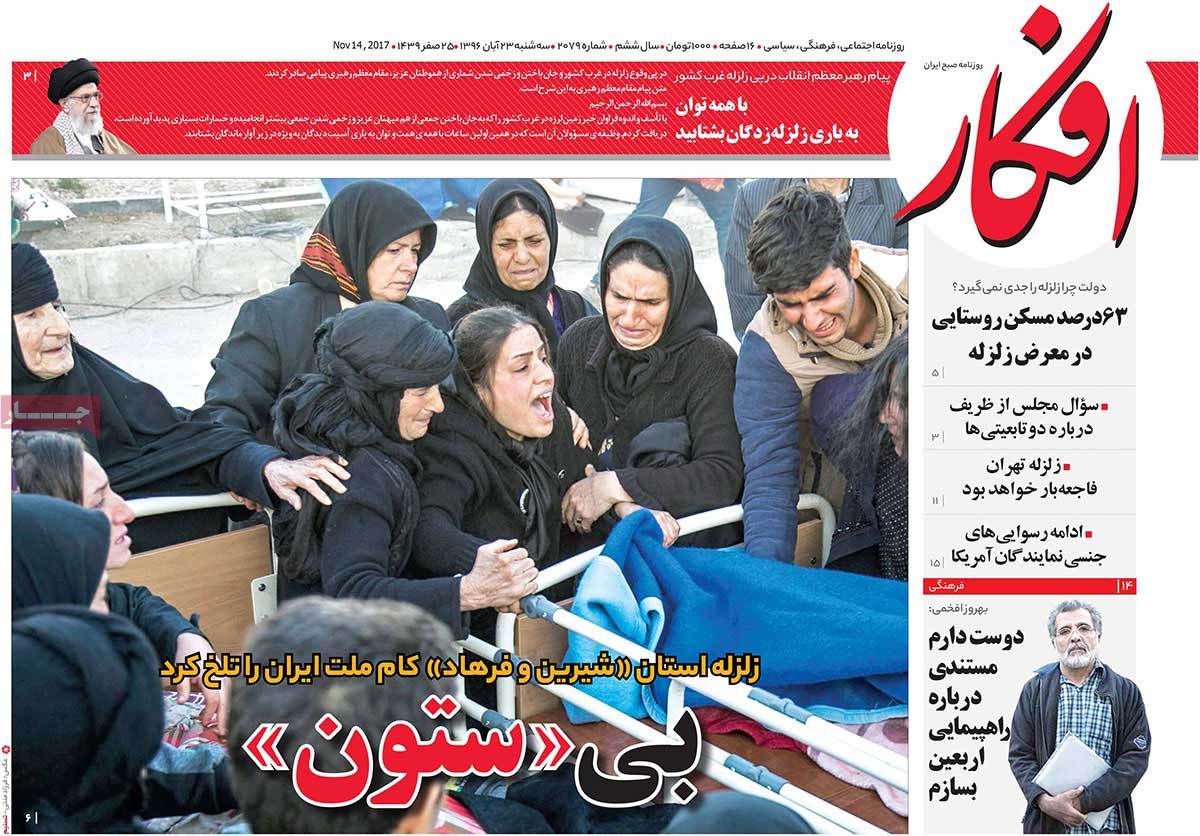
Afkar:

1- Iranian People in Grief over Deadly Earthquake

2- 63% of Village Houses Prone to Earthquake
A Look at Iranian Newspaper Front Pages on November 14


Aftab-e Yazd:

1- Iran Cries: Over 1,000 Killed, Wounded in Kermanshah Earthquake

A Look at Iranian Newspaper Front Pages on November 14


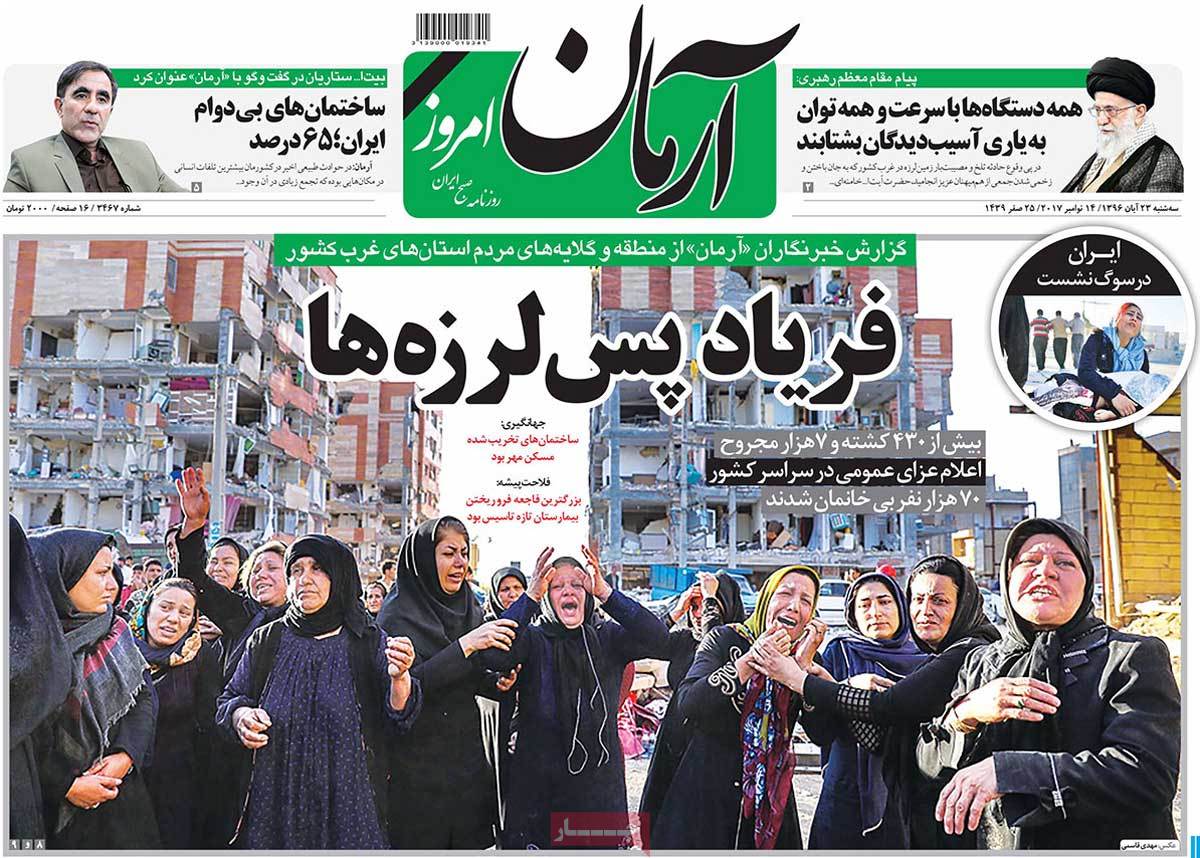
Arman-e Emrooz:

1- Scream of Aftershocks: People Complaining in Western Provinces

2- 70,000 People Displaced
A Look at Iranian Newspaper Front Pages on November 14


Donya-ye Eqtesad:

1- How Big Was Kermanshah Earthquake
A Look at Iranian Newspaper Front Pages on November 14


Ebtekar:

1- Iran Grieving for Kermanshah
A Look at Iranian Newspaper Front Pages on November 14


Etemad:

1- You’re Not Alone Kermanshah
A Look at Iranian Newspaper Front Pages on November 14


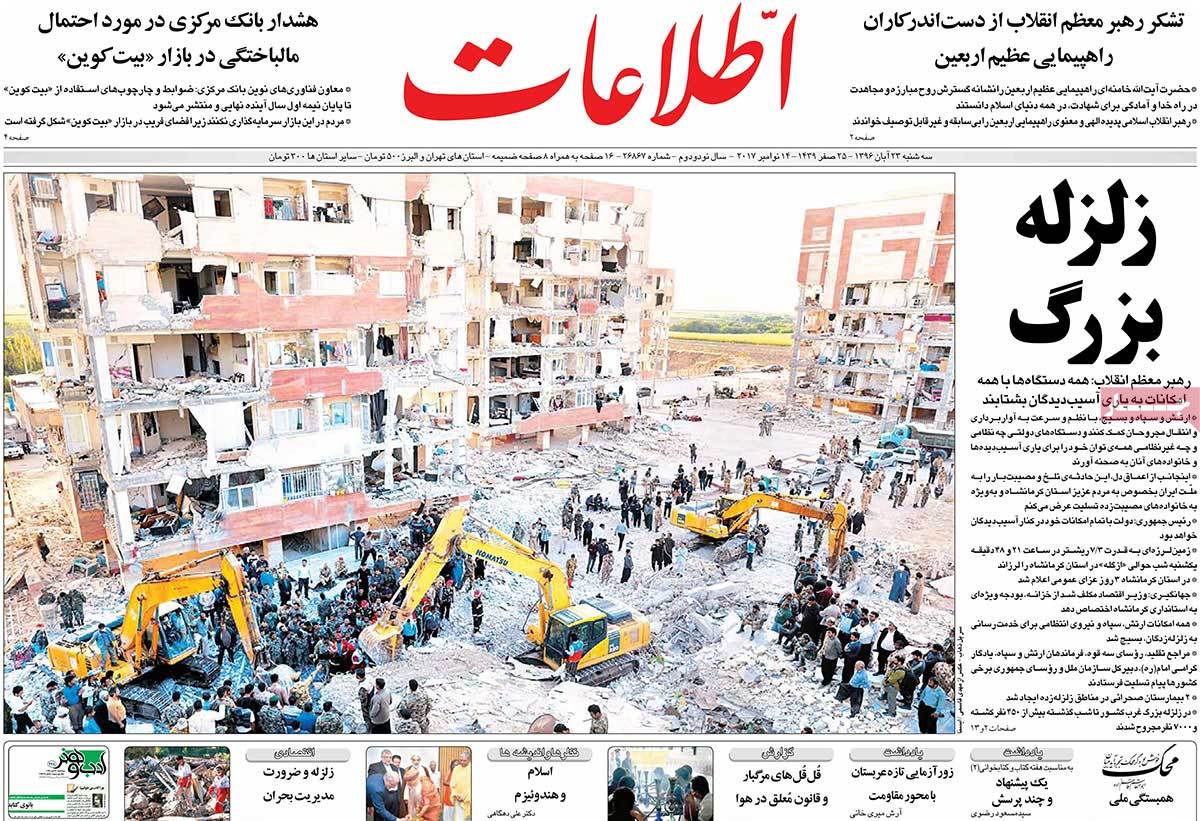
Ettela’at:

1- Huge Earthquake

A Look at Iranian Newspaper Front Pages on November 14


Farhikhtegan:

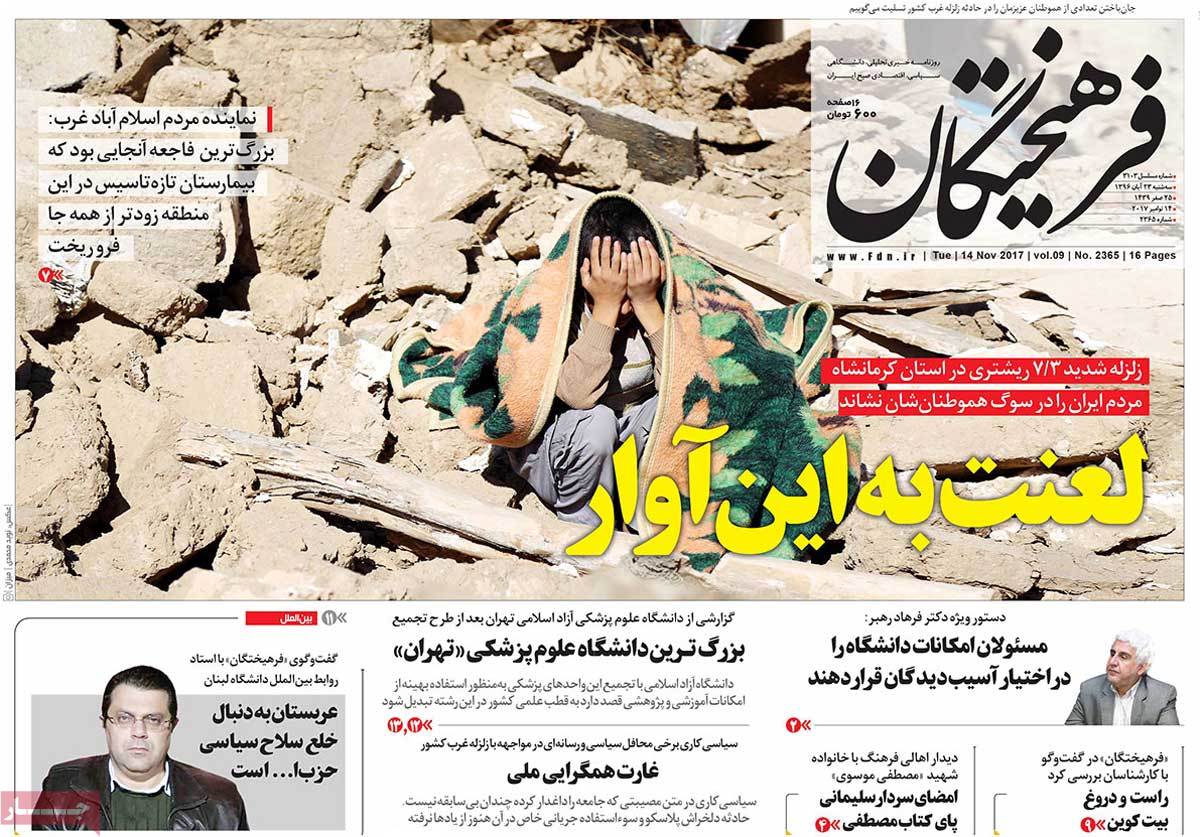
1- Damn This Rubble

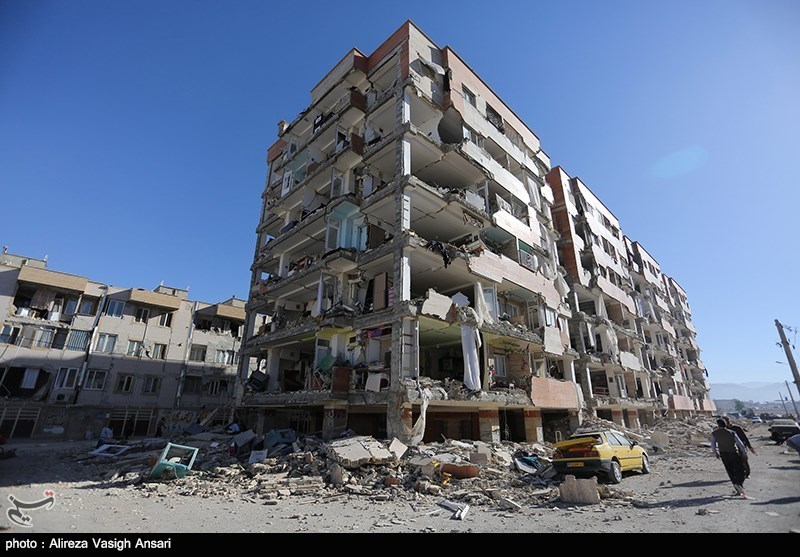
2- MP: Biggest Disaster Happened When Newly-Built Hospital Collapsed before Other Buildings
A Look at Iranian Newspaper Front Pages on November 14


Iran:

1- Iran Saddened by Kermanshah Earthquake

2- Iran Government Declares Tuesday as Day of National Mourning
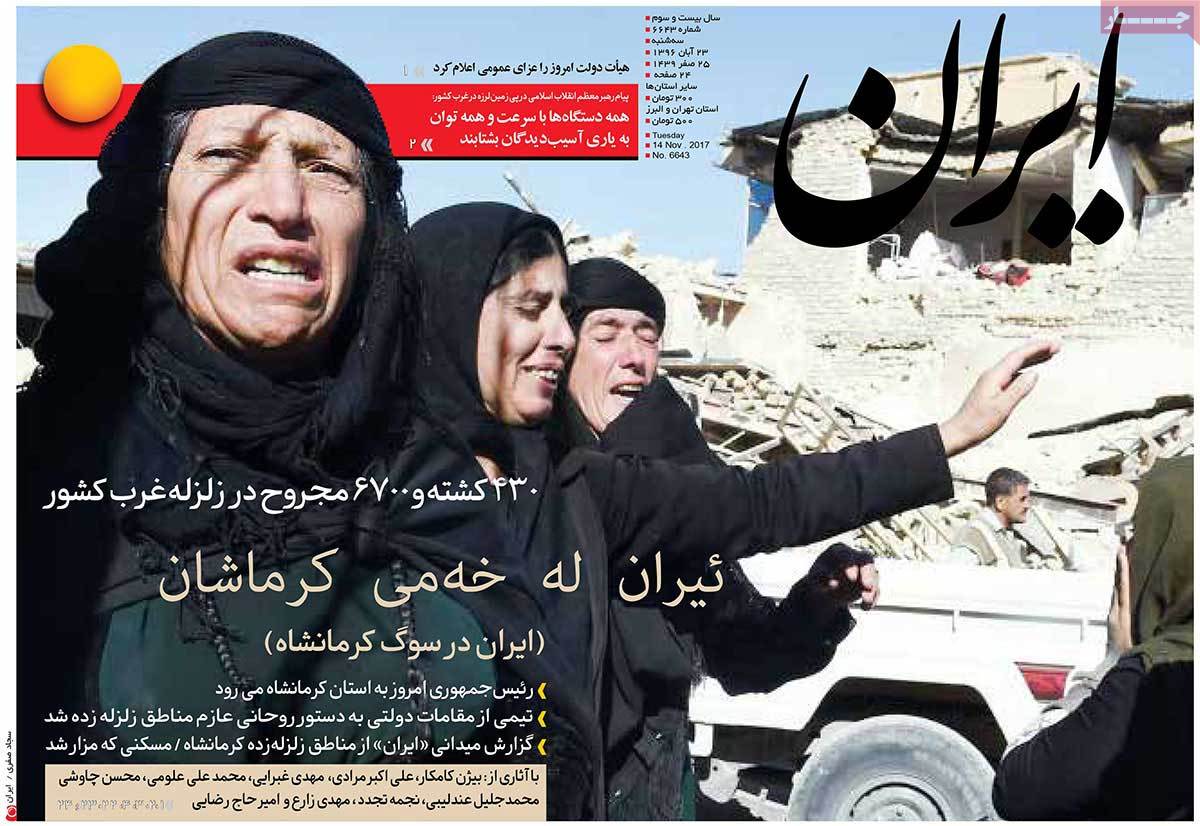
A Look at Iranian Newspaper Front Pages on November 14


Jame’eh Farda:

1- Cry of Iranian Mothers

2- Second Disaster: Warning about Crisis after Earthquake
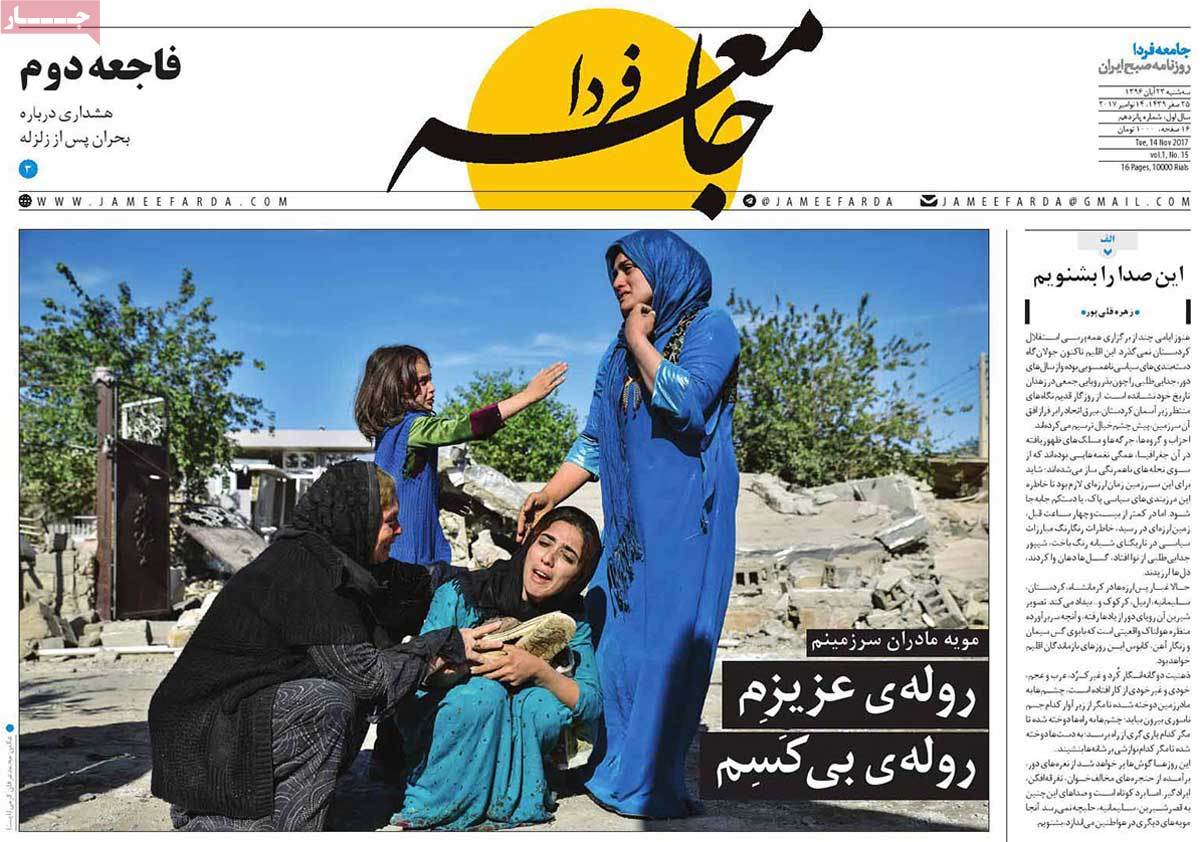
A Look at Iranian Newspaper Front Pages on November 14


Javan:

1- Pain of the Land of Champions

2- Iran Leader Orders Military Forces, Officials to Expedite Rescue, Relief Efforts

3- Government Submits Bill Similar to FATF to Parliament
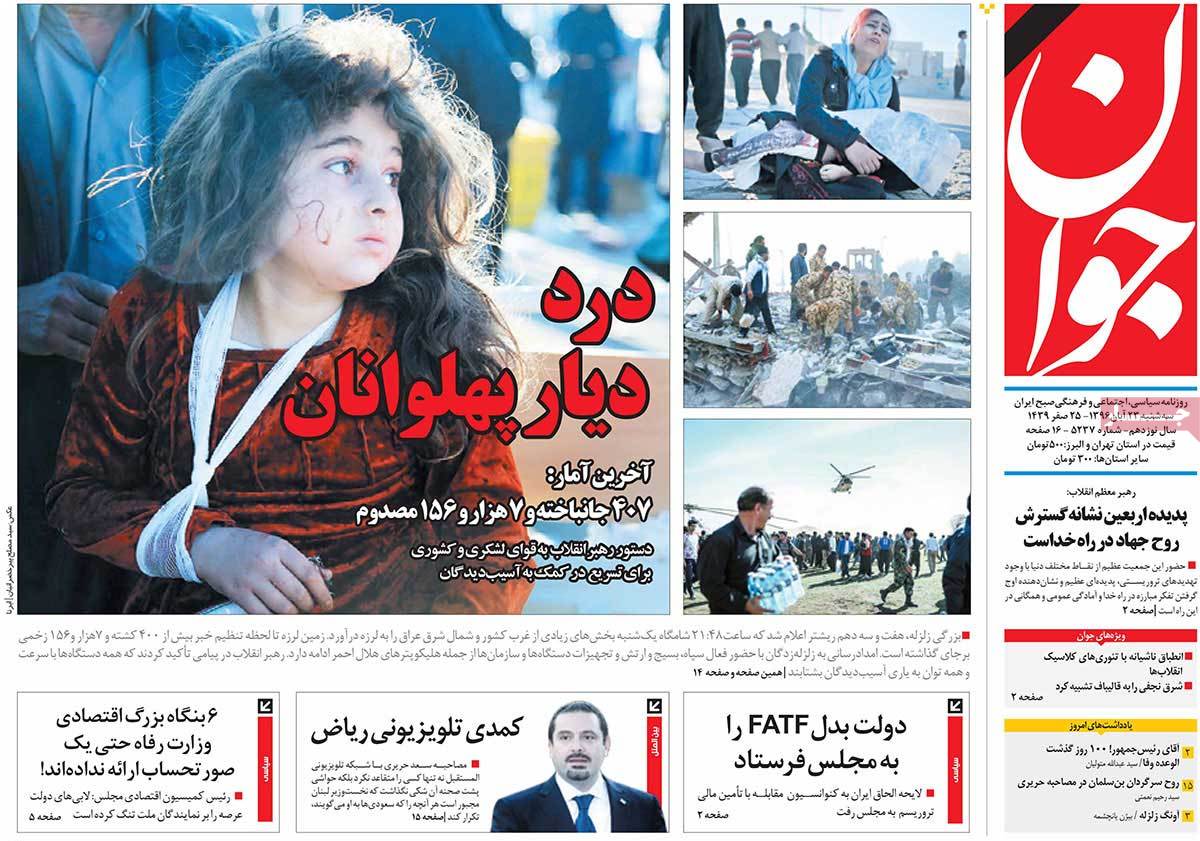
A Look at Iranian Newspaper Front Pages on November 14


Jomhouri Eslami:

1- President: Gov’t to Stand by Quake-Hit People with All Facilities
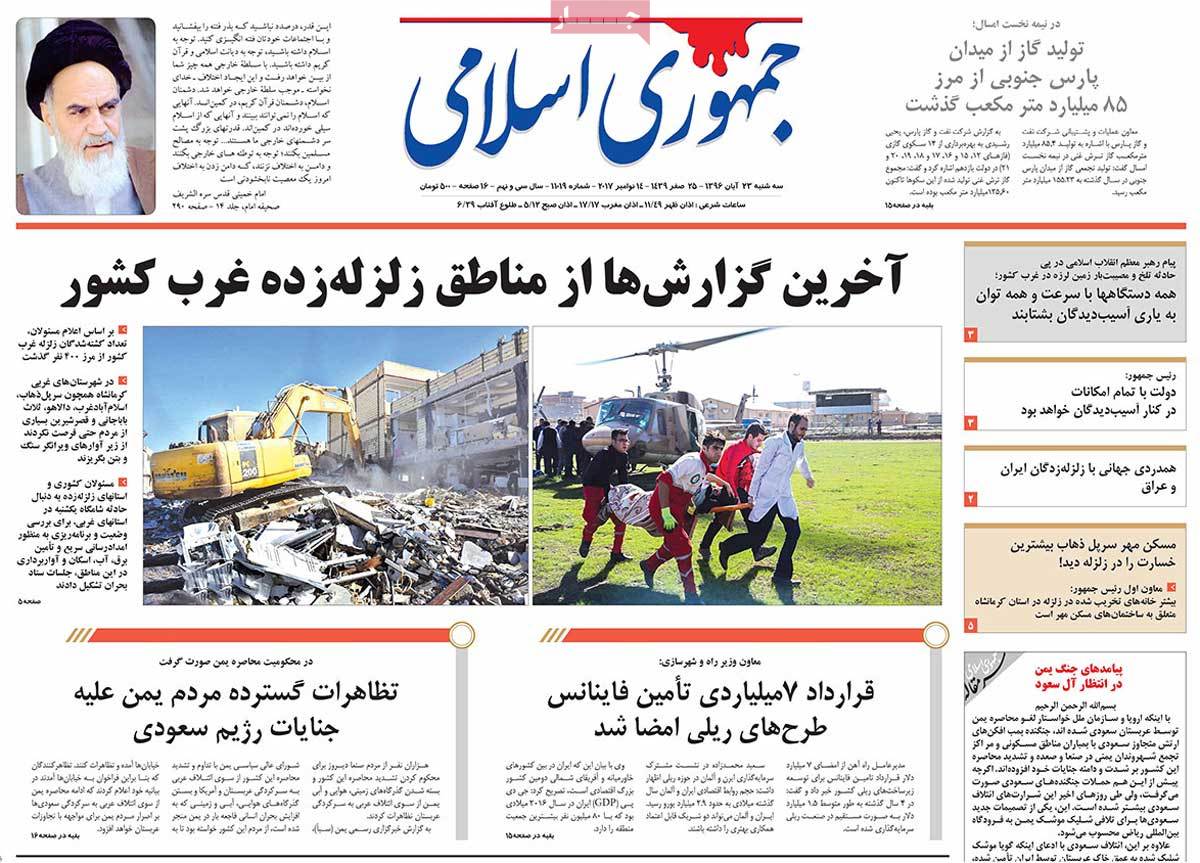
A Look at Iranian Newspaper Front Pages on November 14


Kayhan:

1- Latest News of Huge Quake in Western Iran

2- A Report on Saudi Internal Crisis: New Wave of Purge to Come

  • Saudi Arabia May Be Disintegrated

3- EU’s Office in Tehran Tasked with Creating Security, Economic Crises
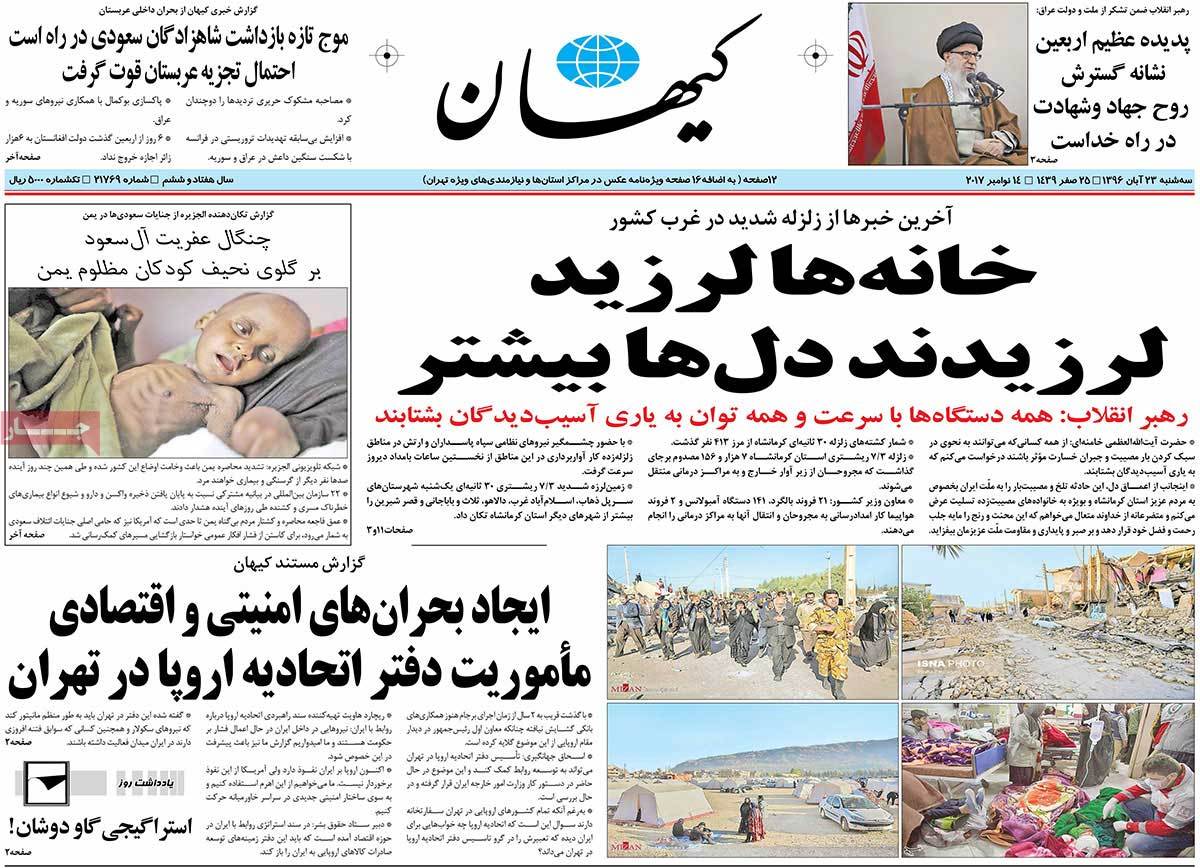
A Look at Iranian Newspaper Front Pages on November 14


Khorasan:

1- I Cried with You

2- Controversies over Hariri’s Distressed Interview

3- People Queue Up in Donation Stations to Give Blood for Quake-Hit People
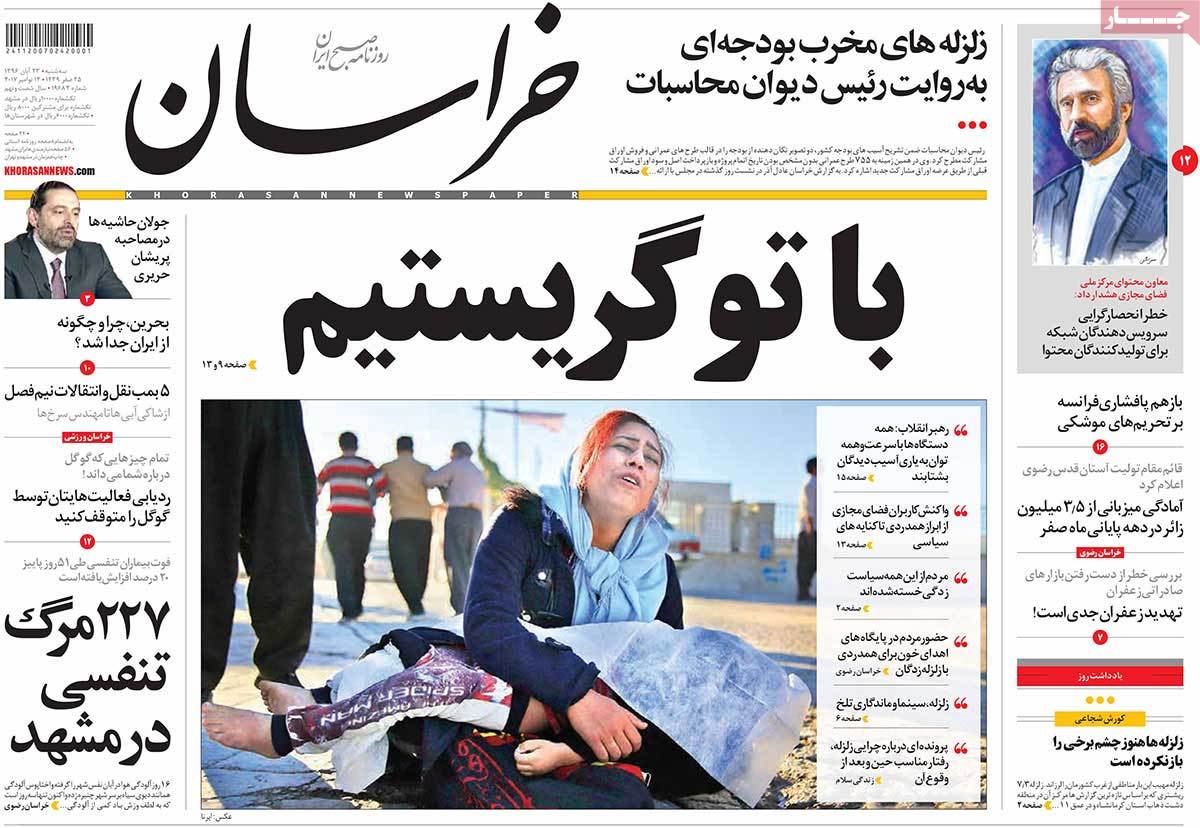
A Look at Iranian Newspaper Front Pages on November 14


Seda-ye Eslahat:

1- Iran Loses Its Dear Ones: Crisis in Crisis Management
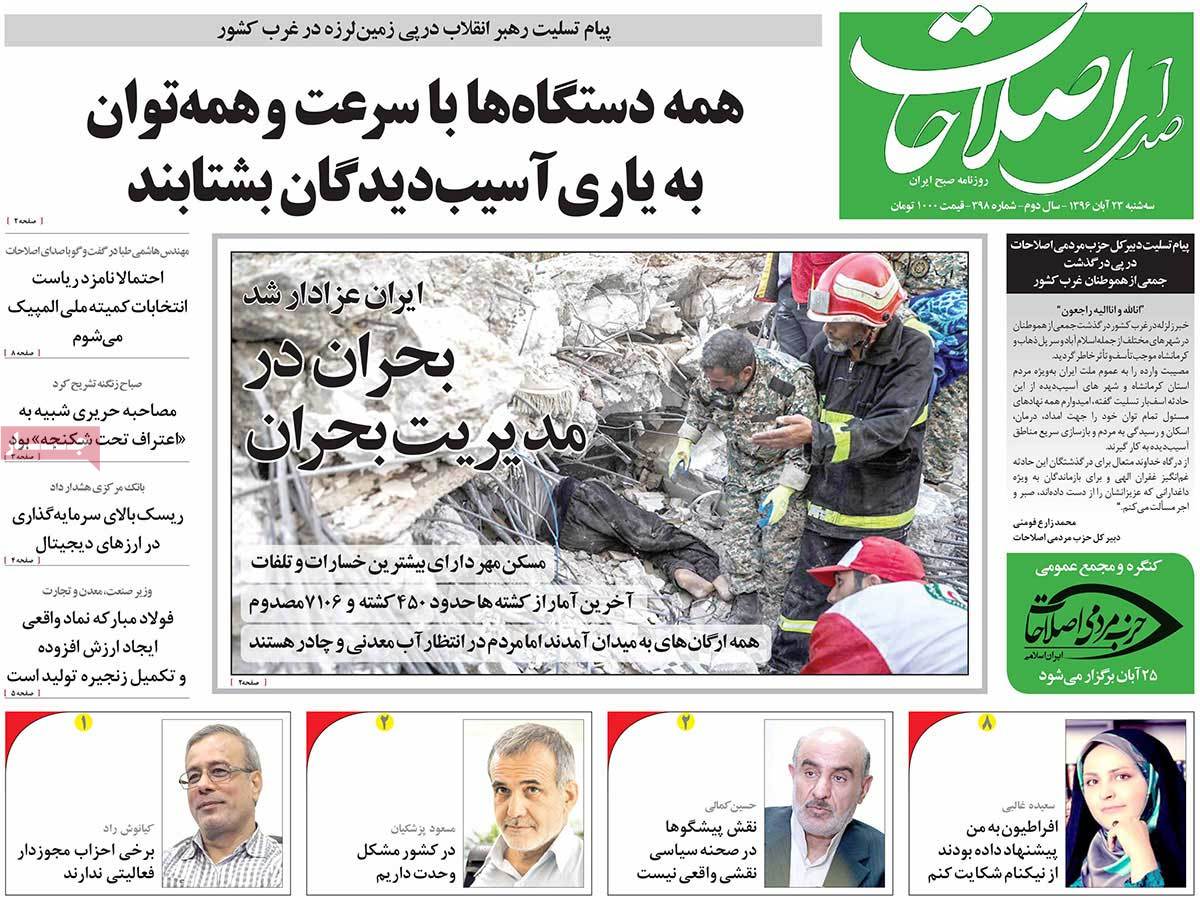
A Look at Iranian Newspaper Front Pages on November 14


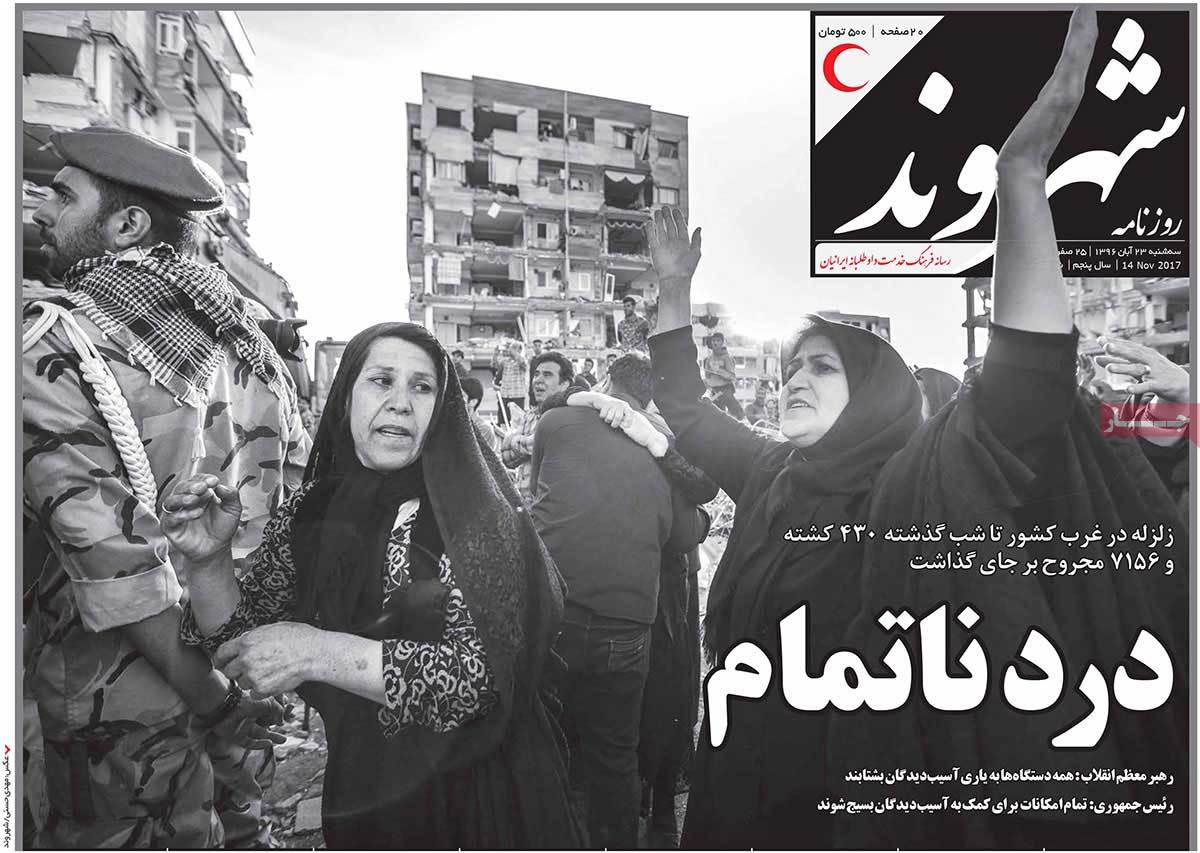
Shahrvand:

1- Unfinished Pain

A Look at Iranian Newspaper Front Pages on November 14


Shargh:

1- Palace of Grief: Second Complex of Mehr Housing Project Couldn’t Resist Earthquake

2- Foreign Ministry Spokesman: We Don’t Export Any Weapon to Yemen
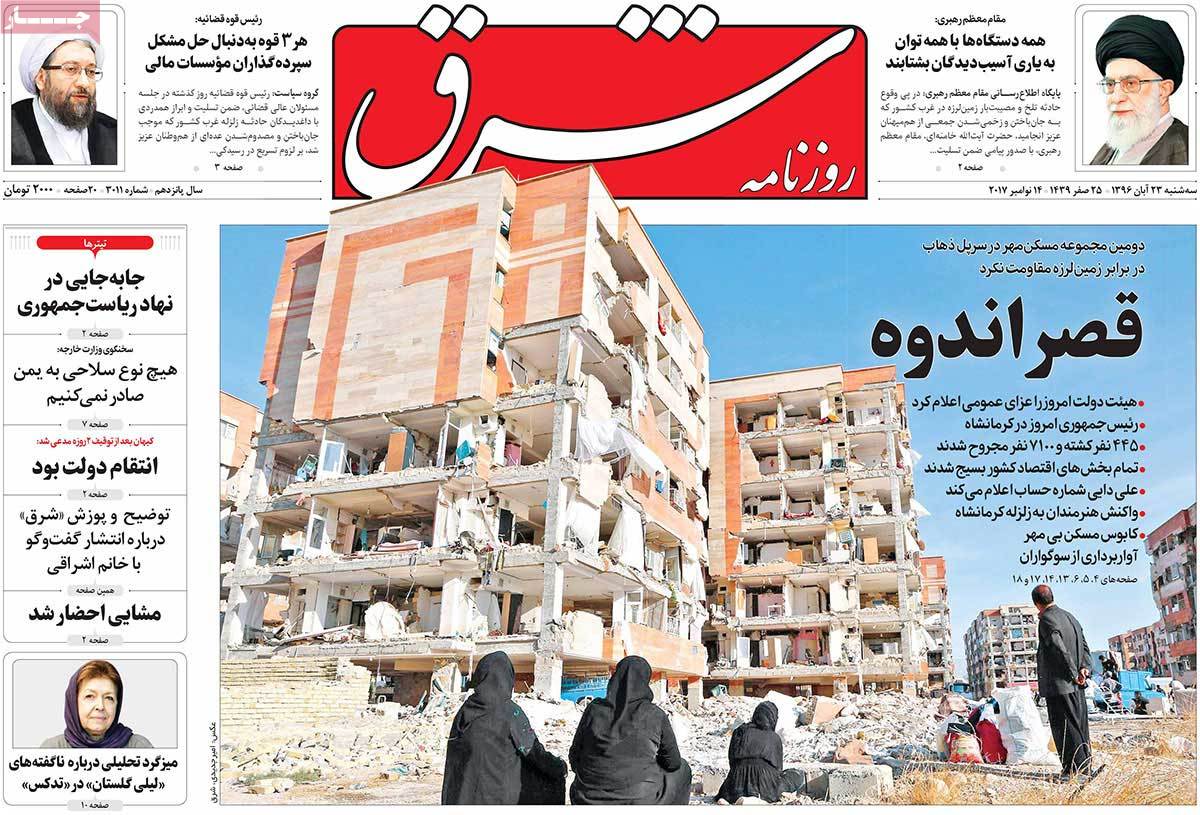
A Look at Iranian Newspaper Front Pages on November 14


Siasat-e Rooz:

1- Iran Mobilized to Help People of Kermanshah

2- US Tired of Israel: Analyst
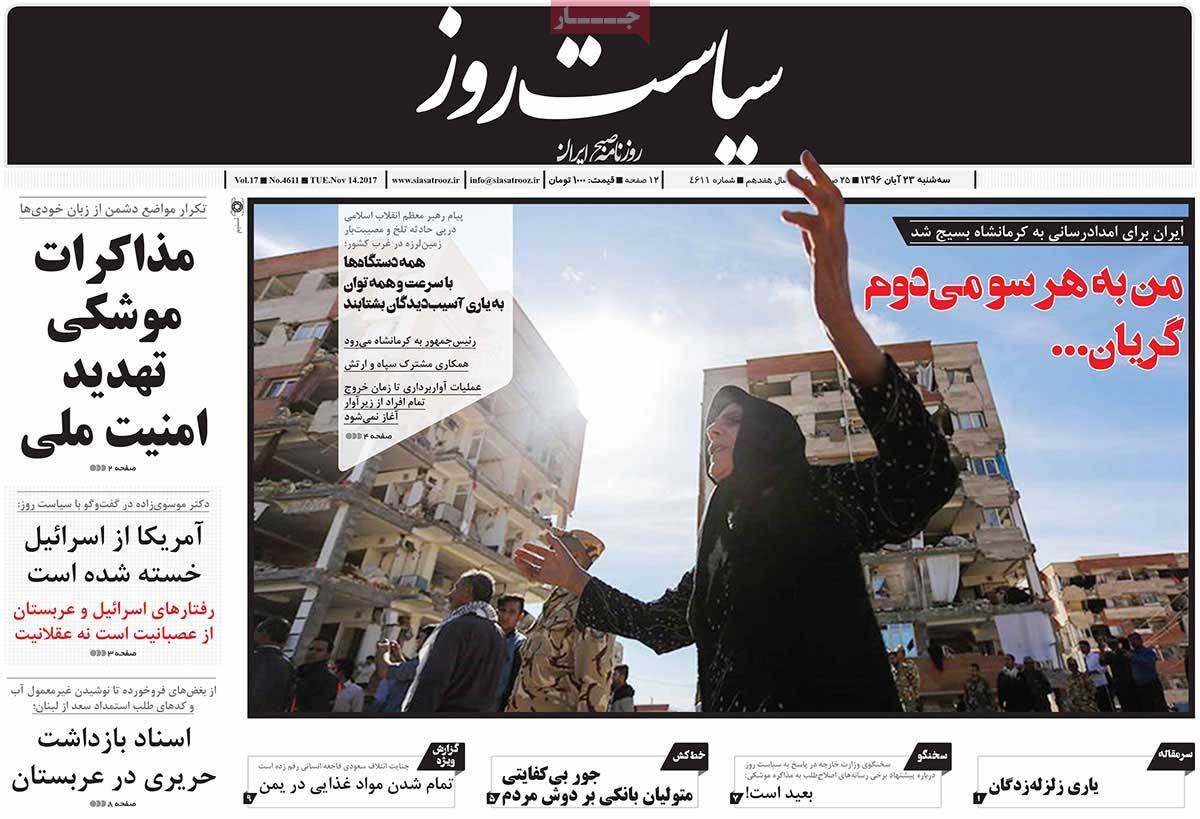
A Look at Iranian Newspaper Front Pages on November 14


Iran FM Pens Letter to UN Chief over Yemen Crisis

Iran FM Pens Letter to UN Chief over Yemen Crisis

“It is the duty of the international community to get more responsibly and effectively engaged in ending the senseless war and establishing a ceasefire, ensuring delivery of humanitarian assistance and eventually restoring permanent peace in this country through dialogue and national reconciliation without preconditions,” Zarif said in a letter to Secretary General of the United Nations António Guterres on Monday.

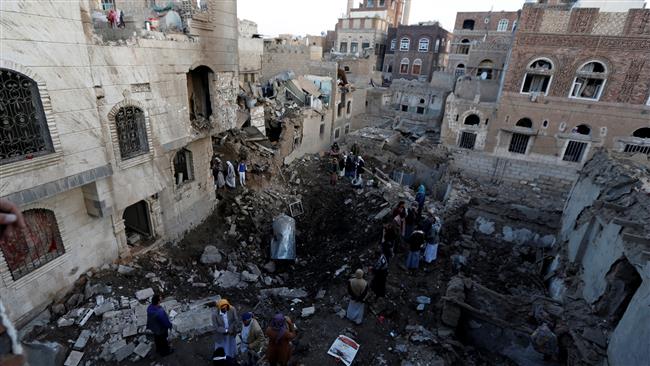
He added that “over 30 months of aggression against an already impoverished Yemen has claimed thousands of lives of civilians, in particular women and children, and brought about the destruction of Yemen’s civilian infrastructure including hospitals, schools, roads, food factories and power plants, thus depriving civilians of their most basic necessities.”

Iran FM Pens Letter to UN Chief over Yemen Crisis

The top Iranian diplomat emphasized that blocking of humanitarian access to an already famine-stricken Yemen and the decision to “close all Yemeni air, sea and land ports,” have further deteriorated the humanitarian nightmare in Yemen.

“The Islamic Republic of Iran has emphasized from the beginning of this crisis that the only way to restore peace and stability is to allow all Yemeni parties to establish, without any foreign interference, their own inclusive national unity government,” Zarif said.

In another part of his letter, Zarif said, “I believe that it is long overdue to consider and implement the four-point plan that I proposed — in my letter of 17 April 2015 addressed to your predecessor contained in document S/2015/263 — right after the Saudi-led coalition initiated war on Yemen. Today, the same plan, which includes the following, remains to be applicable and indeed imperative in order to end this nightmare:

1. Ceasefire and immediate end to all military operations;

2. Unimpeded urgent humanitarian and medical assistance to the people of Yemen;

3. Resumption of Yemeni-led and Yemeni-owned national dialogue, with the participation of the representatives of all political parties and social groups;

4. Establishment of an inclusive national unity government.”

Since March 2015, the Saudi regime has been heavily bombarding Yemen as part of a brutal campaign against its impoverished southern neighbor in an attempt to reinstall Yemen’s former president, Abd Rabbuh Mansur Hadi, a staunch ally of Riyadh, and crush the Houthi movement, which is in control of large parts of Yemen, including the capital Sana’a. The Saudi campaign, however, has failed to achieve its goals.

Since the onset of the brutal war, Ansarullah, the national army and popular groups have joined forces to defend the country against the Saudi aggression. Over the past two years, the Houthis have also been running the state affairs.

Iranian Army, IRGC Working Together to Rescue Quake-Hit People

Iranian Army, IRGC Working Together to Rescue Quake-Hit People

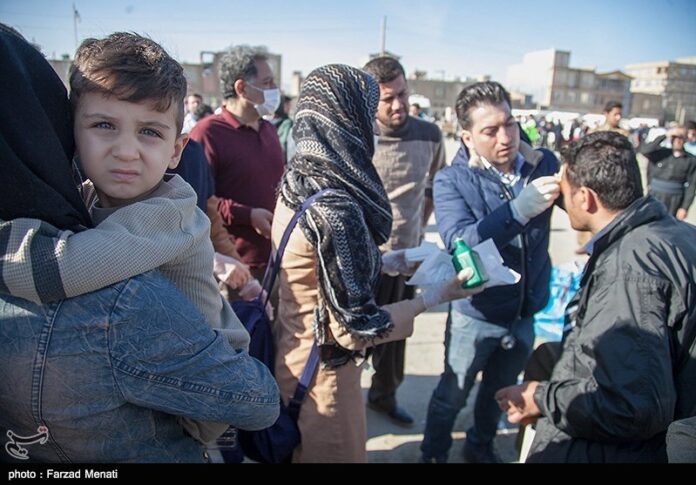
In a televised interview on Monday, Major General Mohammad Ali Jafari said the IRGC has mobilized efforts to rescue people in rural areas while the Army units have focused their relief operation on Sarpol-e-Zahab, a city in the western province of Kermanshah hit hardest by the Sunday night quake.

So far, 395 Iranian people have been pronounced dead and more than 6,000 others injured in the quake measuring 7.3 on the Richter scale, whose epicenter was near Halabjah, southeast of Iraq’s Sulaymaniyah.

The IRGC chief has predicted that rescue operations in the quake-hit areas would finish by the end of Monday.

Iranian Army, IRGC Working Together to Rescue Quake-Hit People

Iranian Army, IRGC Working Together to Rescue Quake-Hit People

Iranian Army, IRGC Working Together to Rescue Quake-Hit People

A deputy governor of Kermanshah said helicopters of the Army Ground Force Airborne Unit have been transferring those injured in the disaster, saying three planes operated by the IRGC also carry the wounded to capital Tehran.

More than 130 aftershocks, some even measuring greater than 5 on the Richter scale, have rumbled through western Iran since last night.

In a message on Monday morning, Leader of the Islamic Revolution Ayatollah Seyed Ali Khamenei ordered all Iranian officials to rush to help the large number of people affected by the earthquake, and particularly rescue those trapped under rubble in the very first hours after the disaster.

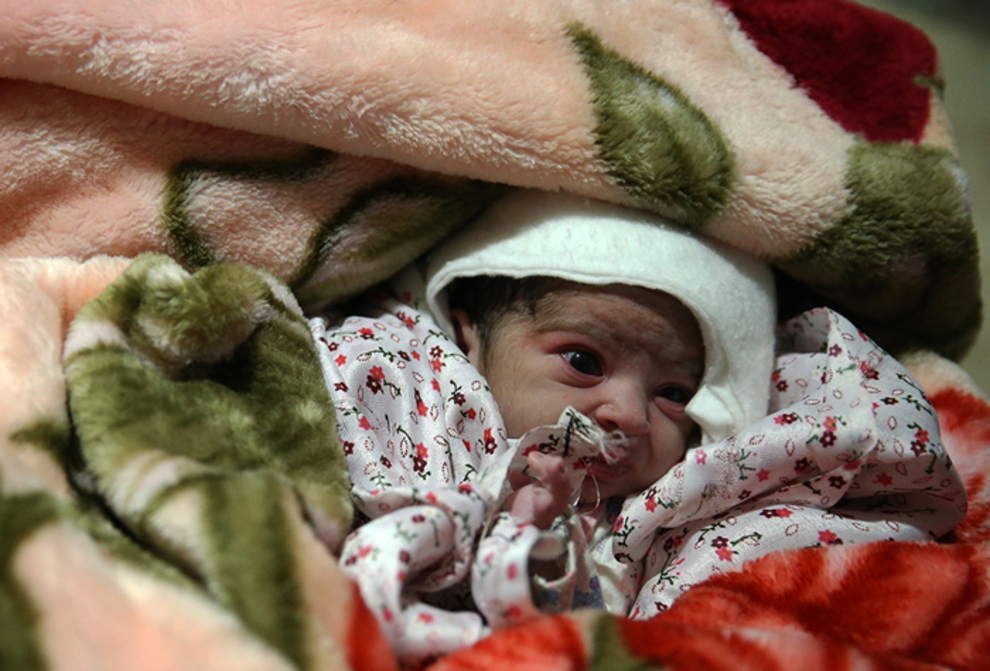
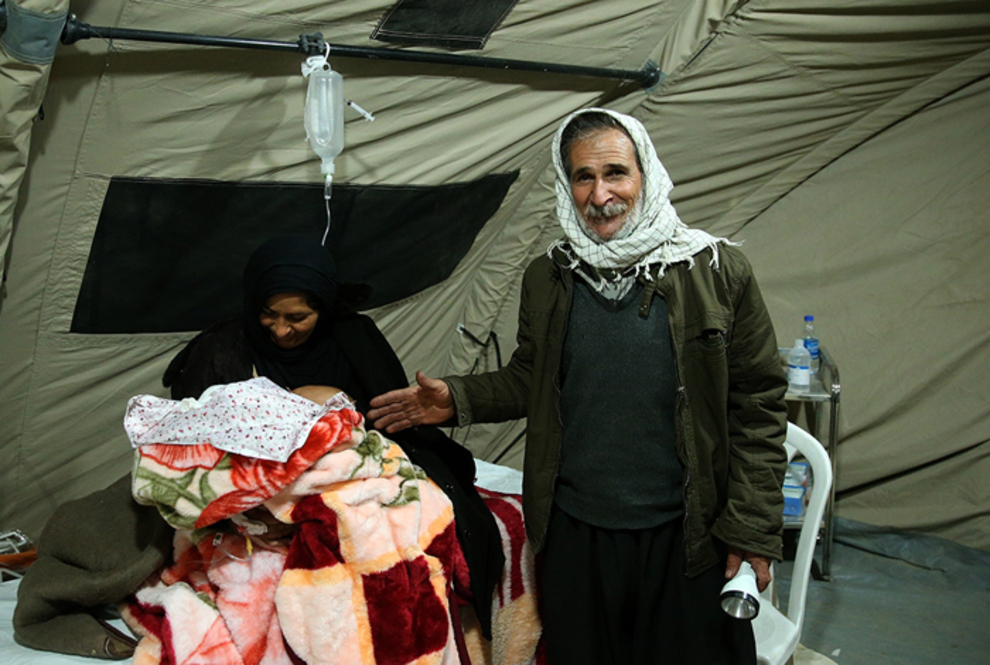
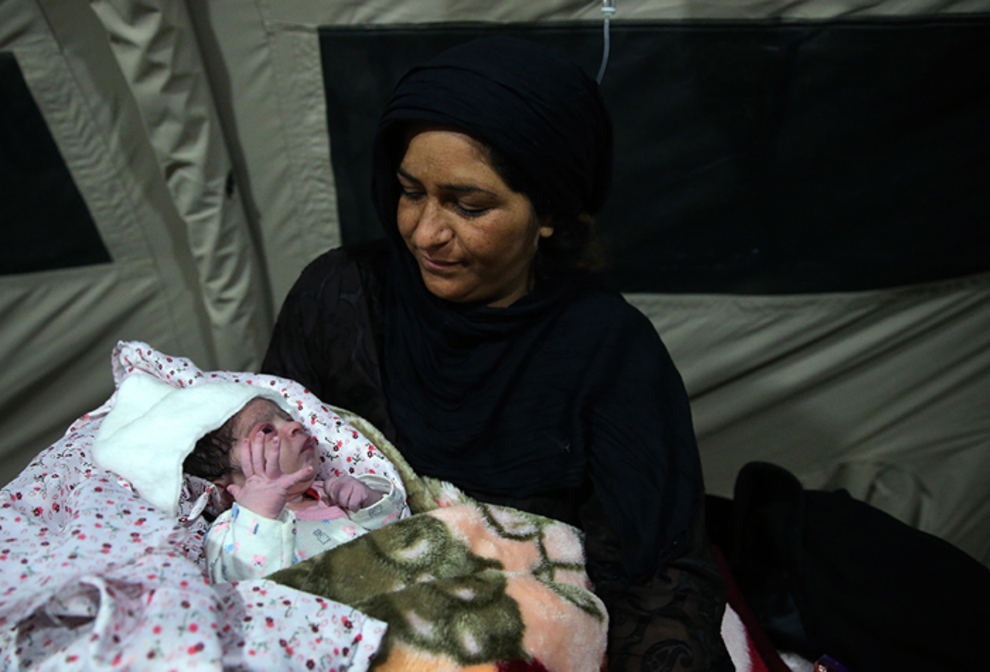
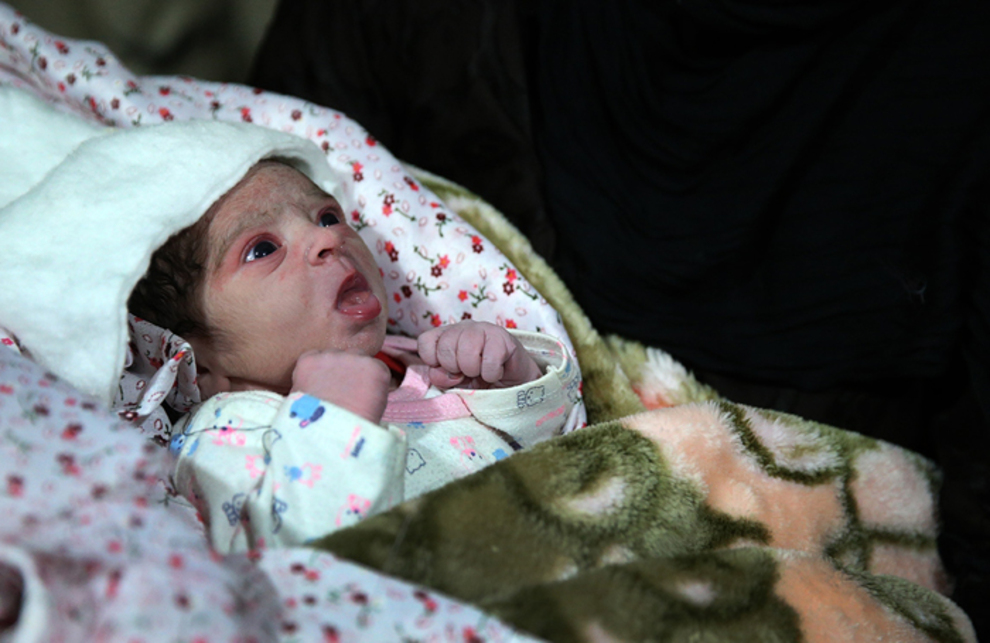
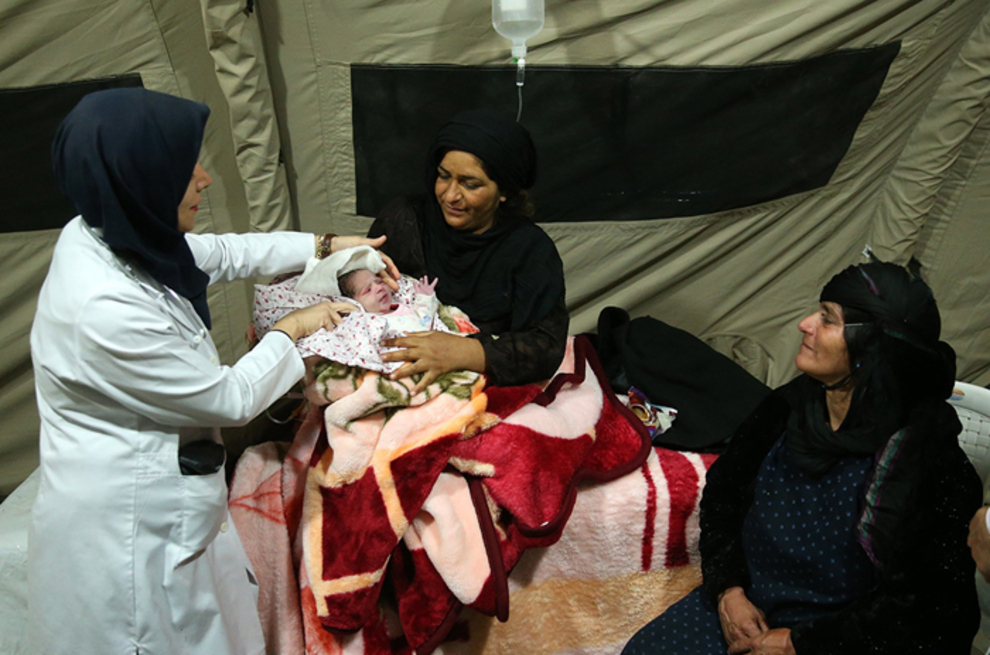
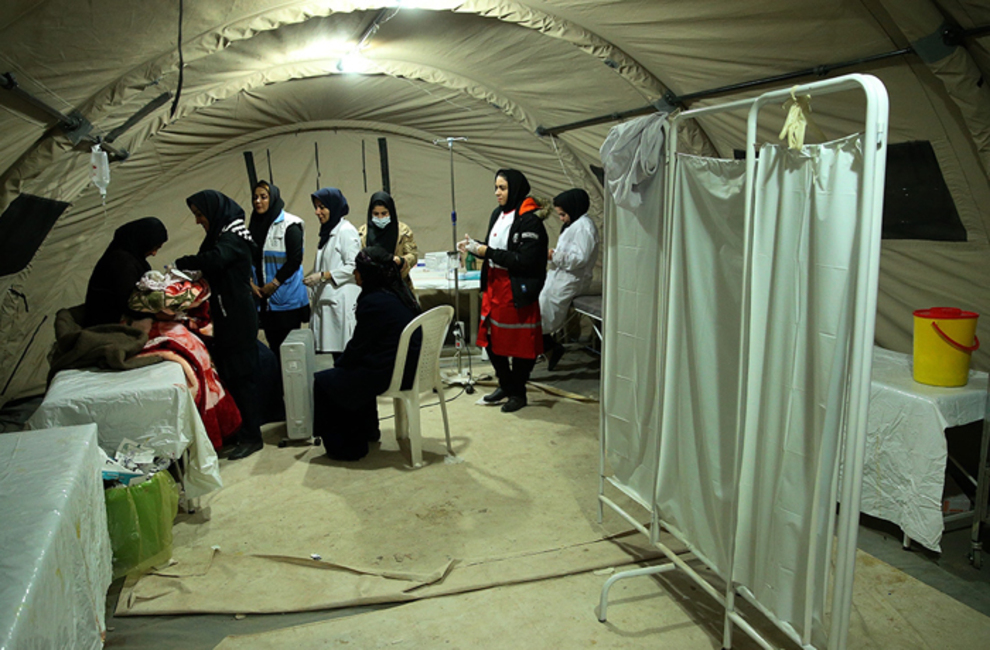
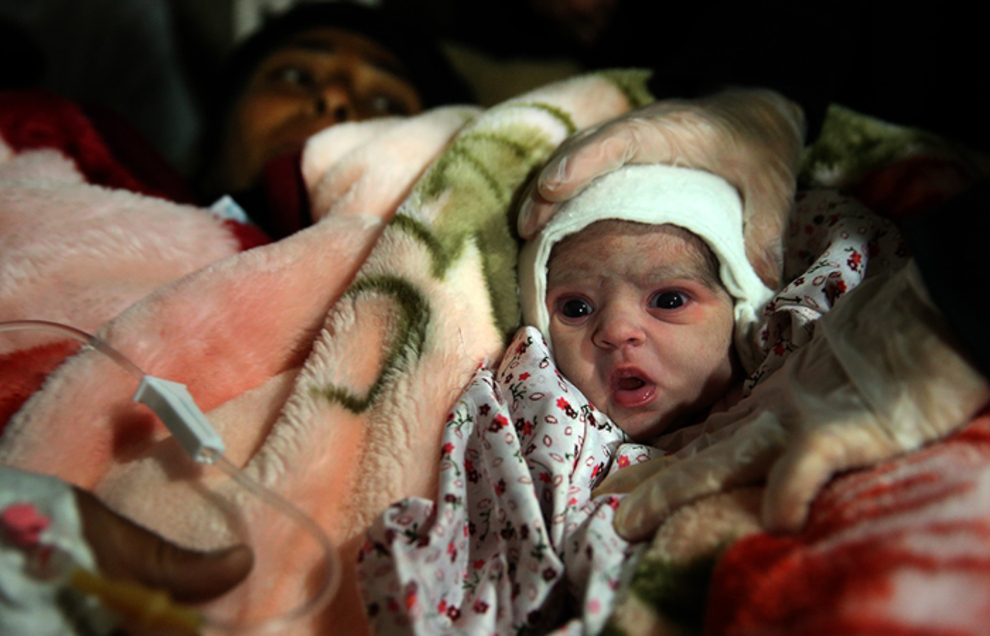
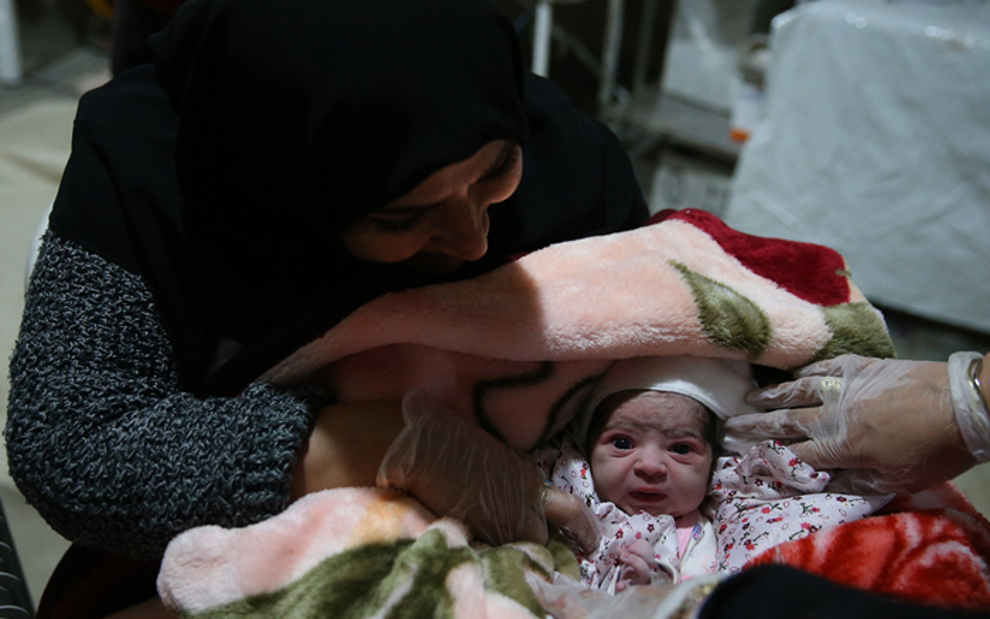
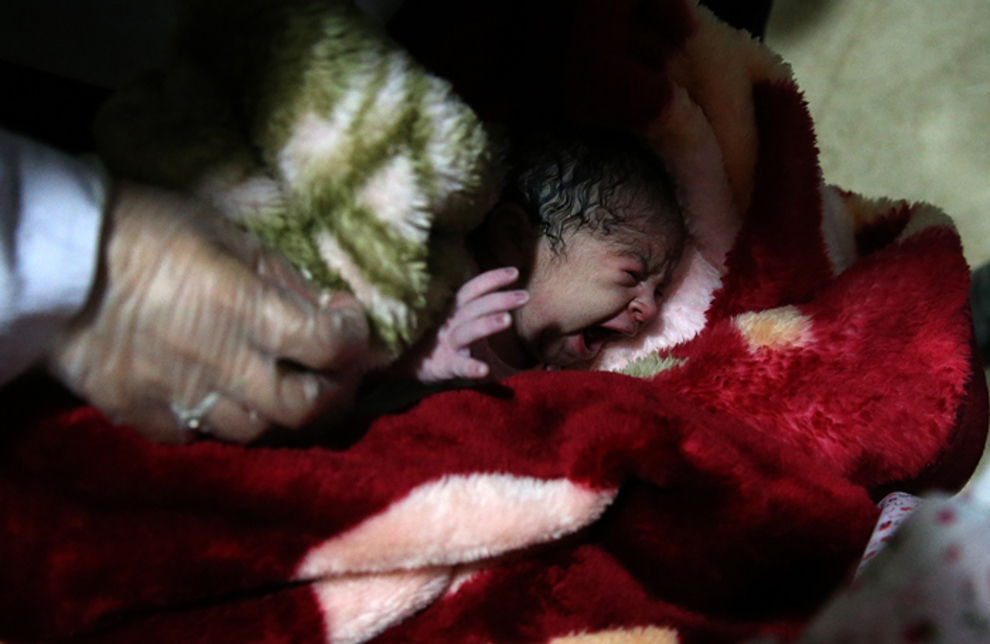
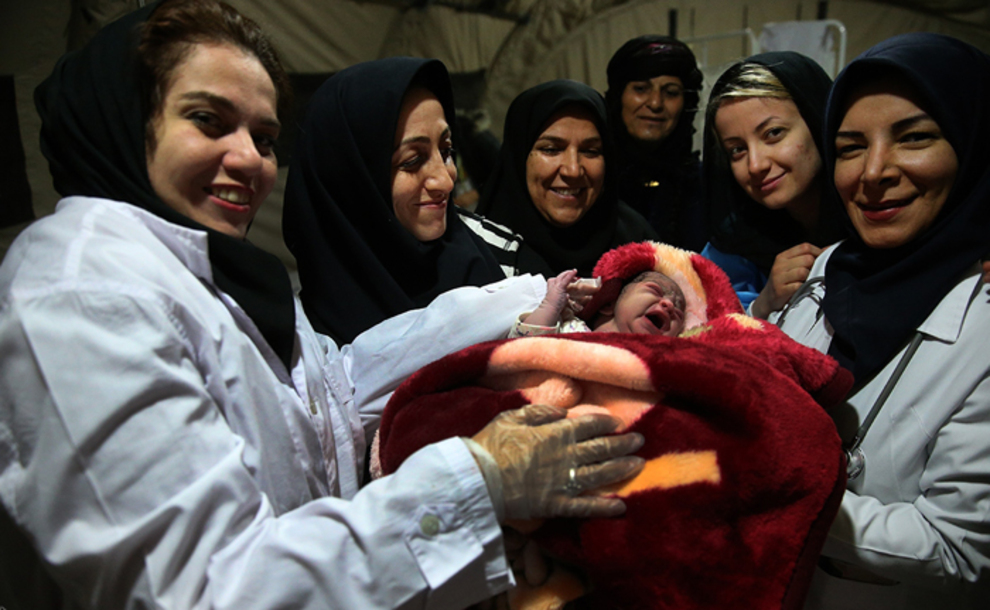
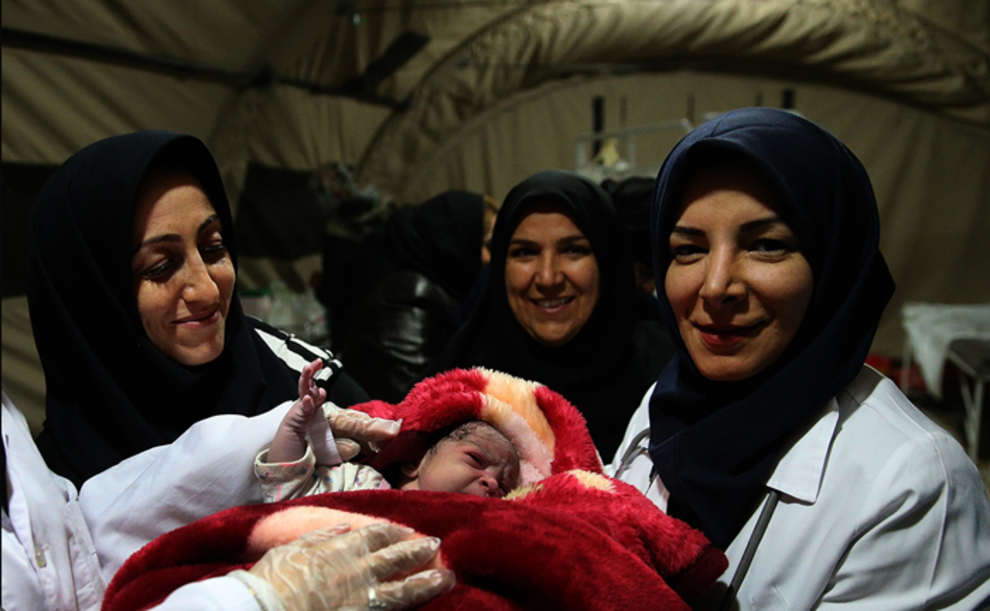
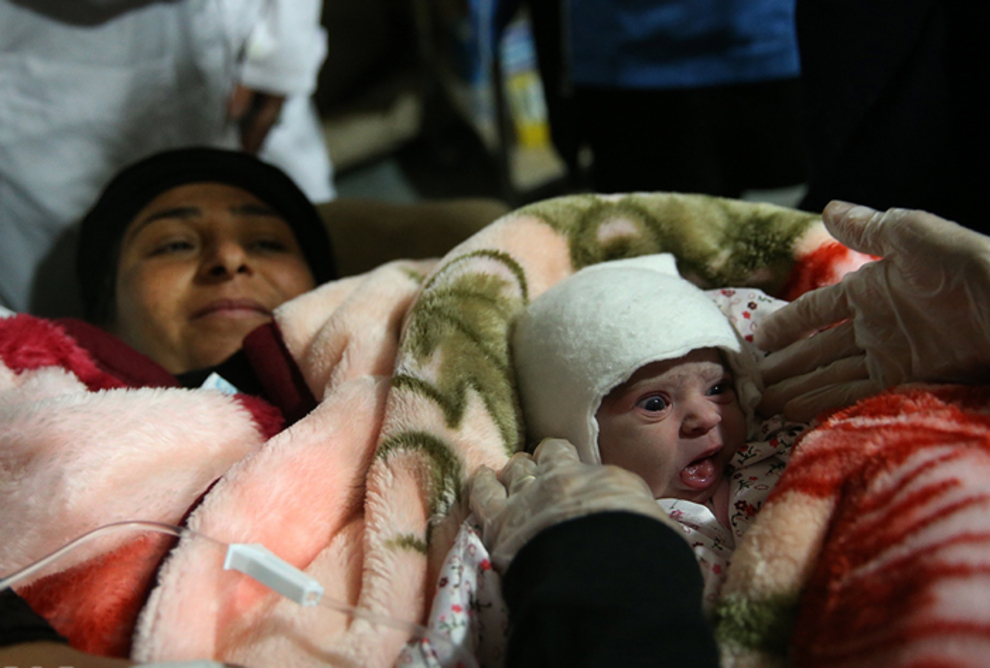
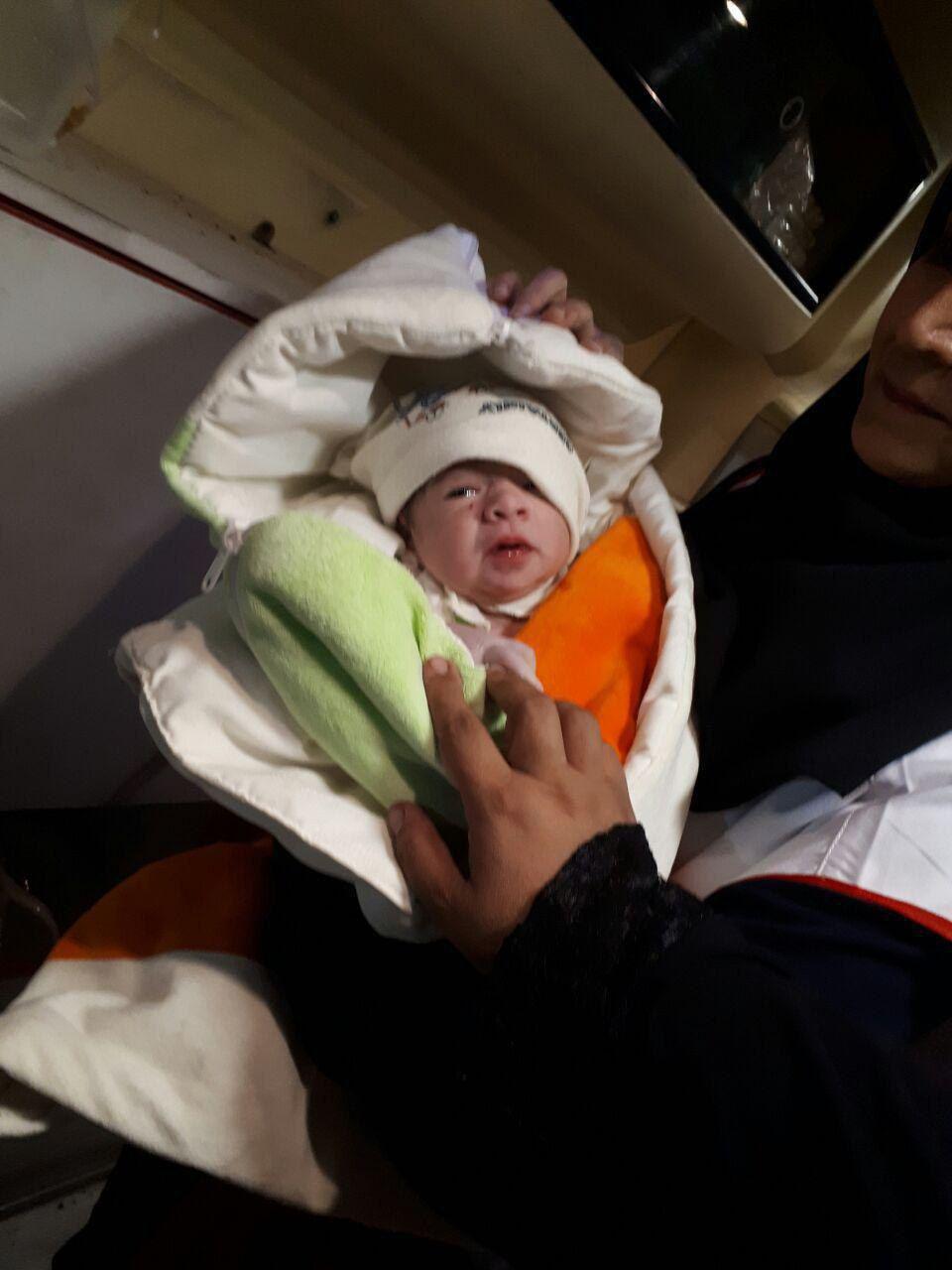
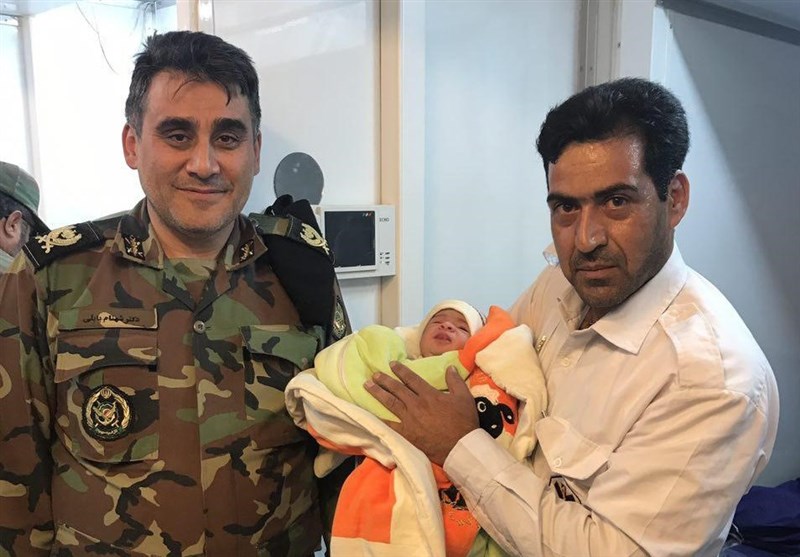
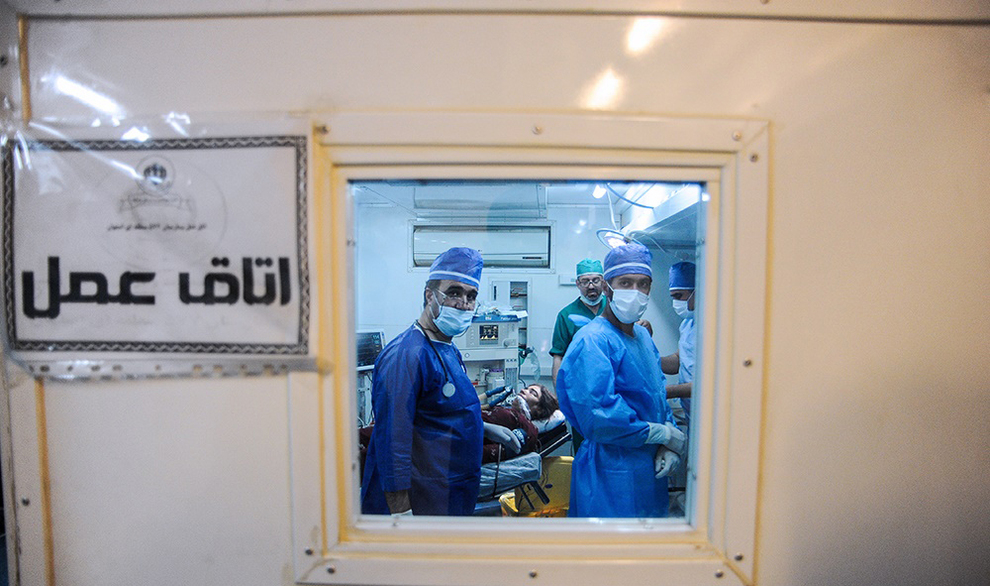
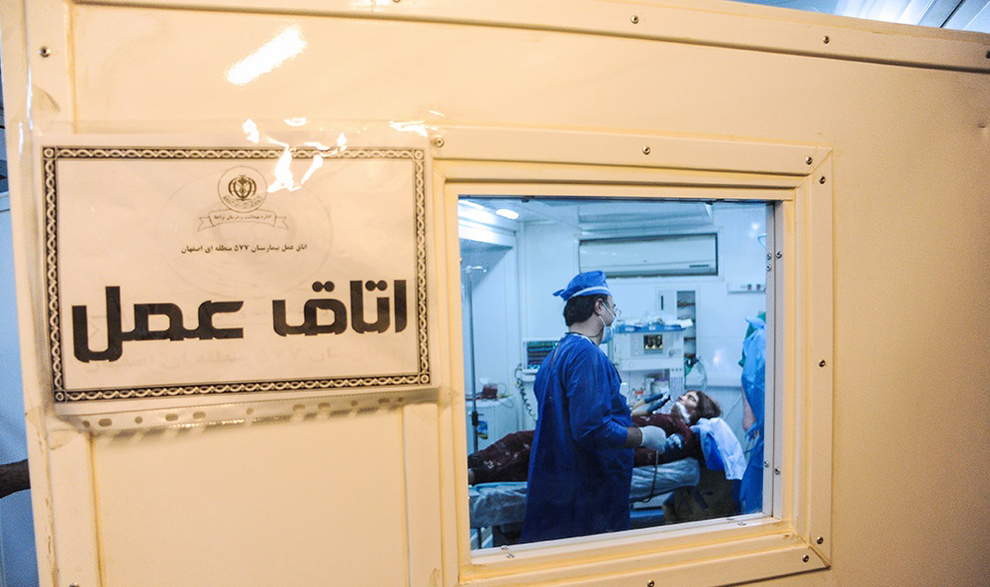
Two Babies Born in Makeshift Hospital amid Iran Earthquake

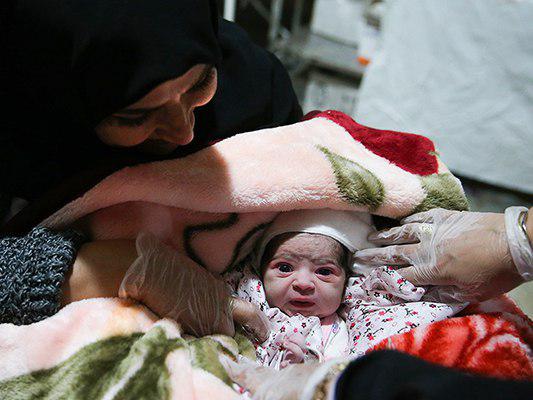
Two Babies Born in Makeshift Hospital amid Iran Earthquake

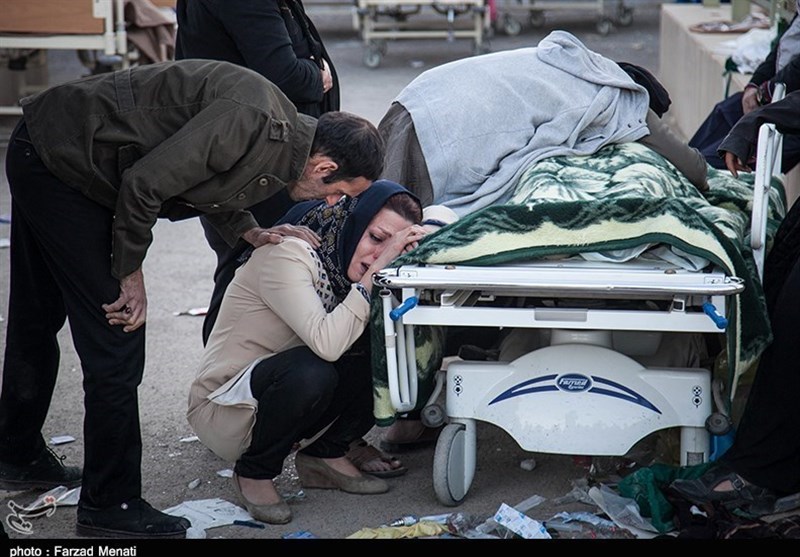
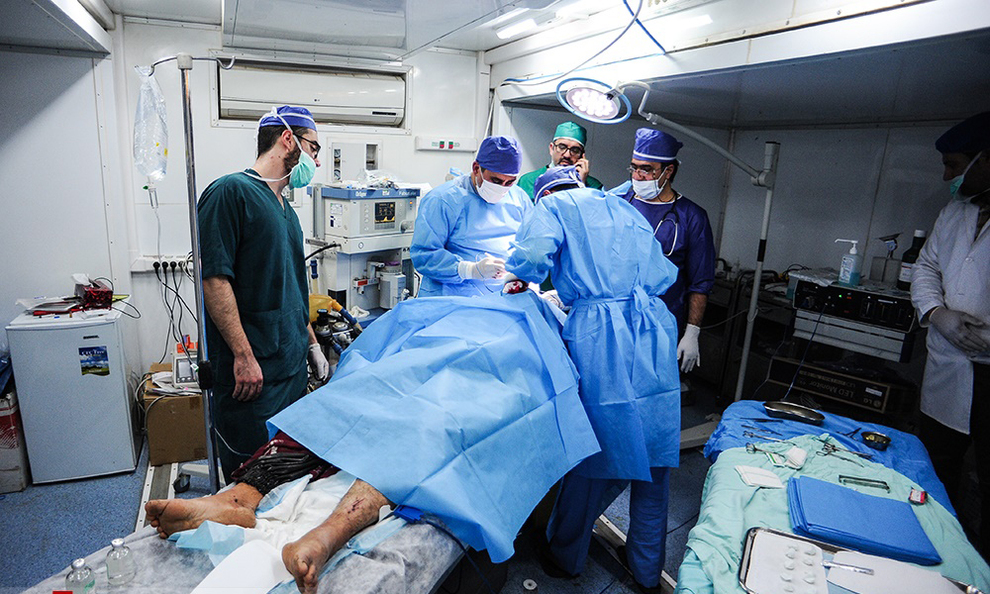
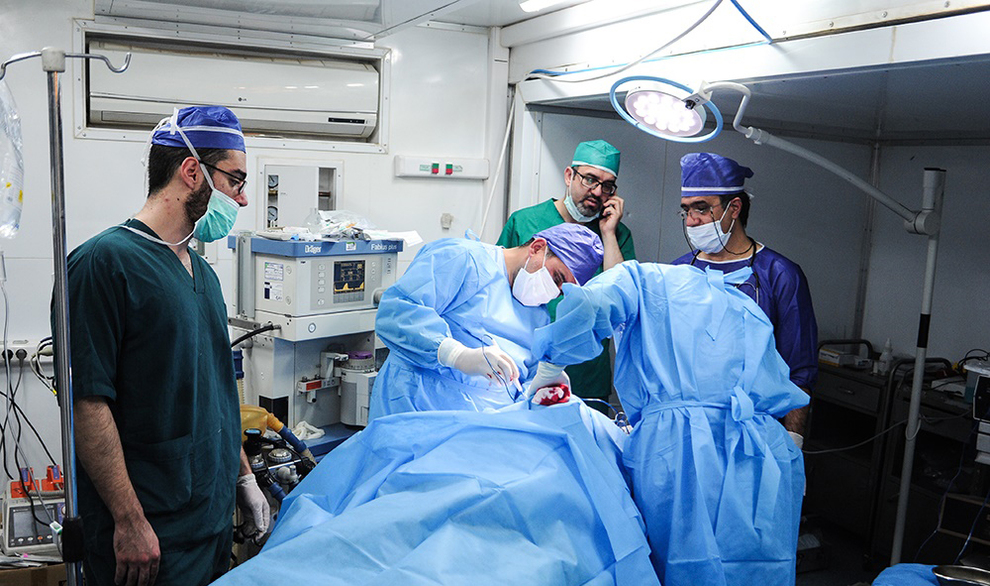
The Sunday earthquake has so far left at least 430 dead and over 7,000 people wounded, many of whom are being treated in makeshift hospitals set up by the Iranian Army and the Islamic Revolution Guards Corps (IRGC) in Kermanshah province.

One baby on Monday and another one on Tuesday morning were born in the Army’s makeshift hospitals with the help of the Army Ground Force’s doctors in Sarpol-e Zahab city.

Meanwhile, the first brain surgery was also performed in a makeshift hospital in Sarpol-e Zahab by Doctor Shahnam Baboli, a brain specialist who is also an Army Brigadier General.

Mizan News Agency reported that the condition of the patient who underwent the surgery was so bad that transferring him to Kermanshah hospitals could lead to his death.


Iran Plans to Join Int’l Counter-Terrorism Convention

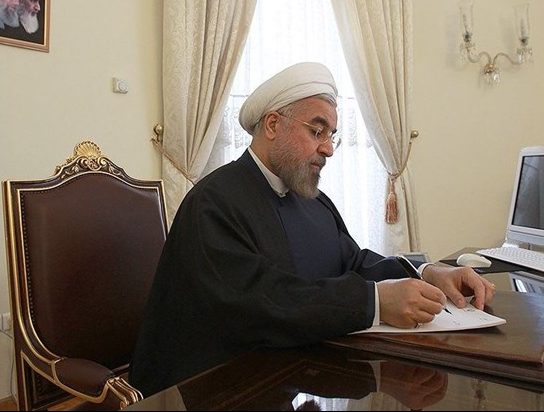
Rouhani-Hassan

The idea to draft the bill was initiated by Iran’s foreign ministry and approved by the cabinet on October 29, a Farsi report by the Iranian government’s official website said.

In the bill submitted to the Parliament, the government says that the ICSFT is a document developed by the United Nations with the aim of preventing any form of financial support to terrorist groups.

“The Islamic Republic of Iran has always been the main target of terrorist groups since the Islamic Revolution in 1979,” the government said in the bill’s text, stressing that the country has condemned terrorist attacks wherever and in whatever form they happen.

The bill has been presented to the Parliament given the growing threat of terrorism, according to the text released by the government.

The bill also said fight against terrorism requires close cooperation among all states.

The Terrorist Financing Convention formally known as the International Convention for the Suppression of the Financing of Terrorism is a 1999 United Nations treaty designed to criminalize acts of financing acts of terrorism.

The convention also seeks to promote police and judicial co-operation to prevent, investigate and punish the financing of such acts. As of July 2015, the treaty has been ratified by 187 states; in terms of universality, it is therefore one of the most successful anti-terrorism treaties in history.

IAEA Report Contradicts US Claims on Iran Nuclear Deal

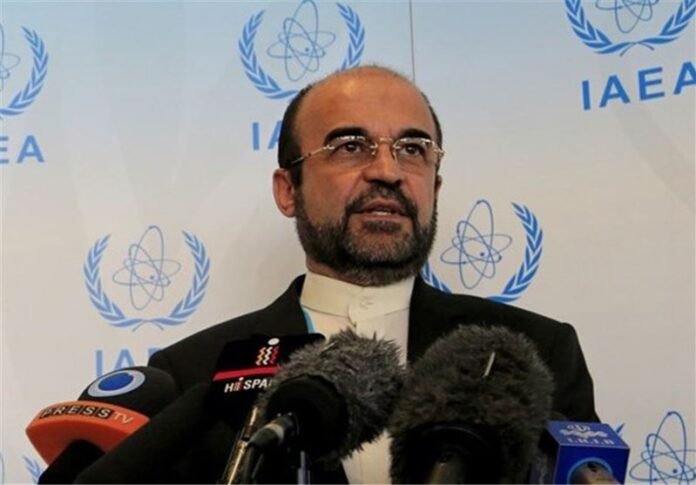
Reza Najafi

“The agency’s new report,  in contradiction to the US’ claims, once again proves that Iran’s nuclear activities are in direct compliance with the JCPOA,” said Reza Najafi on Tuesday.

Iran and the five permanent members of the United Nations Security Council – the United States, France, Britain, Russia and China – plus Germany signed the he Joint Comprehensive Plan of Action (JCPOA) on July 14, 2015 and started implementing it on January 16, 2016. Under the JCPOA, Iran put limits on its nuclear program in exchange for the removal of nuclear-related sanctions imposed against Tehran.

Earlier in the day, the IAEA once again verified that Iran remains in compliance with its commitments under the landmark nuclear agreement.

IAEA Report Contradicts US Claims on Iran Nuclear Deal

Najafi also stressed that Iran and other members of the IAEA expect the agency to continue with its impartial assessment of the agreement.

Despite eight reports by the IAEA confirm Tehran’s compliance, on October 13, US President Donald Trump delivered an anti-Iran speech in which he said he would not continue to certify Iran’s compliance with the terms of the JCPOA, reached under his predecessor, Barack Obama, and warned that he might ultimately terminate the agreement.

The US Congress now has less than 60 days to decide whether to reimpose economic sanctions on Tehran that were lifted under the nuclear accord.

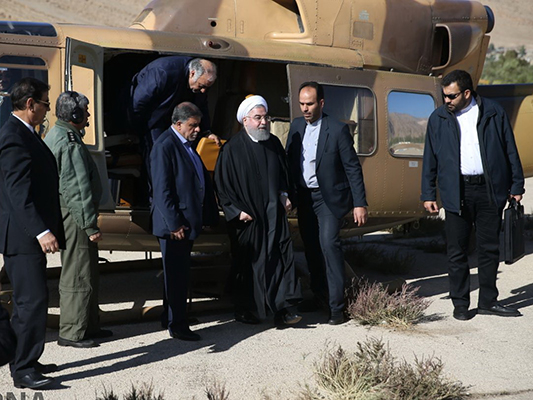
Iran President Visits Quake-Hit Areas, Promises Help in Reconstruction

rouhani-kermanshah

Upon arrival in Kermanshah, Rouhani offered his condolences on behalf of the Iranian nation to the quake-stricken people of Kermanshah.

He said the government will give reconstruction grants and loans to the quake-hit people to help them rebuild their houses as soon as possible.

He also vowed that the Iranian people and his administration will stand by the people affected by the deadly earthquake.

Rouhani also wished that his next visit to the province would be aimed at opening construction projects.

The Leader of Iran’s Islamic Revolution Ayatollah Seyyed Ali Khamenei has also sent a delegation to the province. The delegation includes the Leader’s representative in the Iranian Red Crescent Society and his representative in Kermanshah who arrived in the province on Tuesday to personally monitor the relief and rescue operations and the degree of damages caused to the region.

They will finally submit a report to the Leader on the quake-hit areas and the people’s problems there.

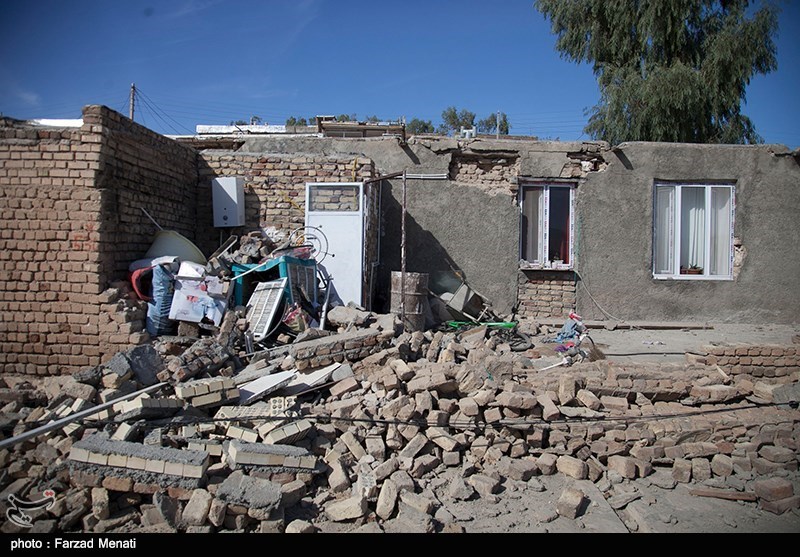
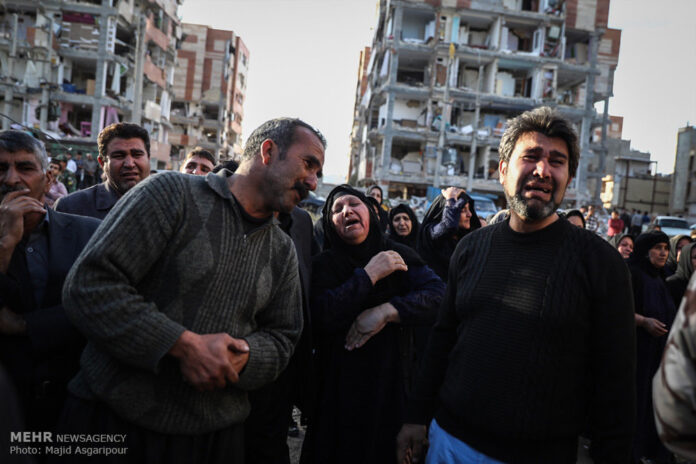
Rescue operations are underway in the western regions. According to the latest figures, at least 430 people have lost their lives and at least 7,370 others sustained injuries in the tremor. Some 12,000 homes have also been completely destroyed in the incident.

US Condoles with Iran over Deadly Earthquake

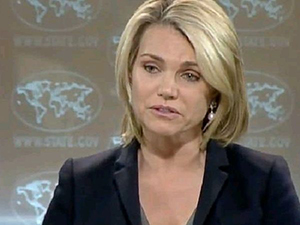
US Condoles with Iran over Deadly EarthquakeIn a statement on Monday, US State Department Spokeswoman Heather Nauert said, “The United States expresses its sincere condolences to all of those affected by the earthquake in Iran and Iraq.”
“We keep the families of those who were killed, and injured, in our thoughts as well as the communities that have suffered damage to homes and property,” she added.


US Condoles with Iran over Deadly EarthquakeIn another statement, Pope Francis, the Pope of the Catholic Church, also expressed sympathy with the Iranian and Iraqi nations over the earthquake casualties.


US Condoles with Iran over Deadly Earthquake

US Condoles with Iran over Deadly Earthquake


Chinese President Xi Jinping, Spanish Prime Minister Mariano Rajoy, and German President Frank-Walter Steinmeier also expressed their regret over the deadly incident.
Georgian President Giorgi Margvelashvili, President of Turkmenistan Gurbanguly Berdimuhamedow, and President of Kyrgyzstan Almazbek Atambayev extended their condolences in separate messages to Iranian President Hassan Rouhani.

Egypt and Jordan also condoled with Iran over the earthquake and offered sympathy to the bereaved families of the victims.

Earlier on Monday, Russian President Vladimir Putin, Canadian Prime Minister Justin Trudeau, Syrian President Bashar al-Assad, Turkish President Recep Tayyip Erdogan, and Afghan President Ashraf Ghani and Chief Executive Abdullah Abdullah condoled with Iran over the tragedy.

Tajikistan’s President Emomali Rahmon, Kuwaiti Emir Sabah Al-Ahmad Al-Jaber Al-Sabah, Azeri President Ilham Aliyev, Irish President Michael Higgins, Italian Prime Minister Paolo Gentiloni, British Foreign Secretary Boris Johnson, UN Secretary-General Antonio Guterres and EU Foreign Policy Chief Federica Mogherini were among other high-ranking officials who offered sympathy to the Iranian nation.

In a message on Tuesday, Iran’s Foreign Minister Mohammad Javad Zarif appreciated the messages of sympathy.
“Heartbreaking images from the earthquake damage and loss of life in Kermanshah (and in Iraq). We are grateful for global expressions of sympathy and offers of assistance. For now, we can manage with our own resources. Many thanks for all offers and we will keep you posted,” he tweeted.