Tuesday, December 23, 2025
Home Blog Page 3719

Yemen’s Ansarullah Hits Riyadh Airport Using Ballistic Missile

The missile unit of the Yemen army and Popular Committees pounded the King Khalid international airport in the Saudi capital, Riyadh by Burkan (Volcano) H-2 missile, a Scud-type missile with a range of more than 800km, Lebanon-based Arabic-language al-Mayadeen news network reported.

There are no initial report of injuries or casualties.

The Yemeni troops had targeted the King Khalid international airport in Riyadh with a Burkan H-2 missile on November 2017.

Yemen’s defenseless people have been under massive attacks by the coalition for almost three years but Riyadh has reached none of its objectives in Yemen so far.

Since March 2015, Saudi Arabia and some of its Arab allies have been carrying out deadly airstrikes against the Houthi Ansarullah movement in an attempt to restore power to fugitive former president Abdrabbuh Mansour Hadi, an ally of Riyadh.

Over 14,000 Yemenis, including thousands of women and children, have lost their lives in the deadly military campaign.

Tehran, Lahijan Host Snow Sculpture Festivals

Tehran

The artworks included the snow sculptures of animals and human faces, among others. The festival in the Iranian capital was organized by the municipality on Monday January 29 in Pardisan Park in Western Tehran.

Also a festival of such sculptures was held in the northern Iranian city of Lahijan, attended by people from all walks of life.

Here you can find photos of the festivals retrieved from ILNA and Mehr:

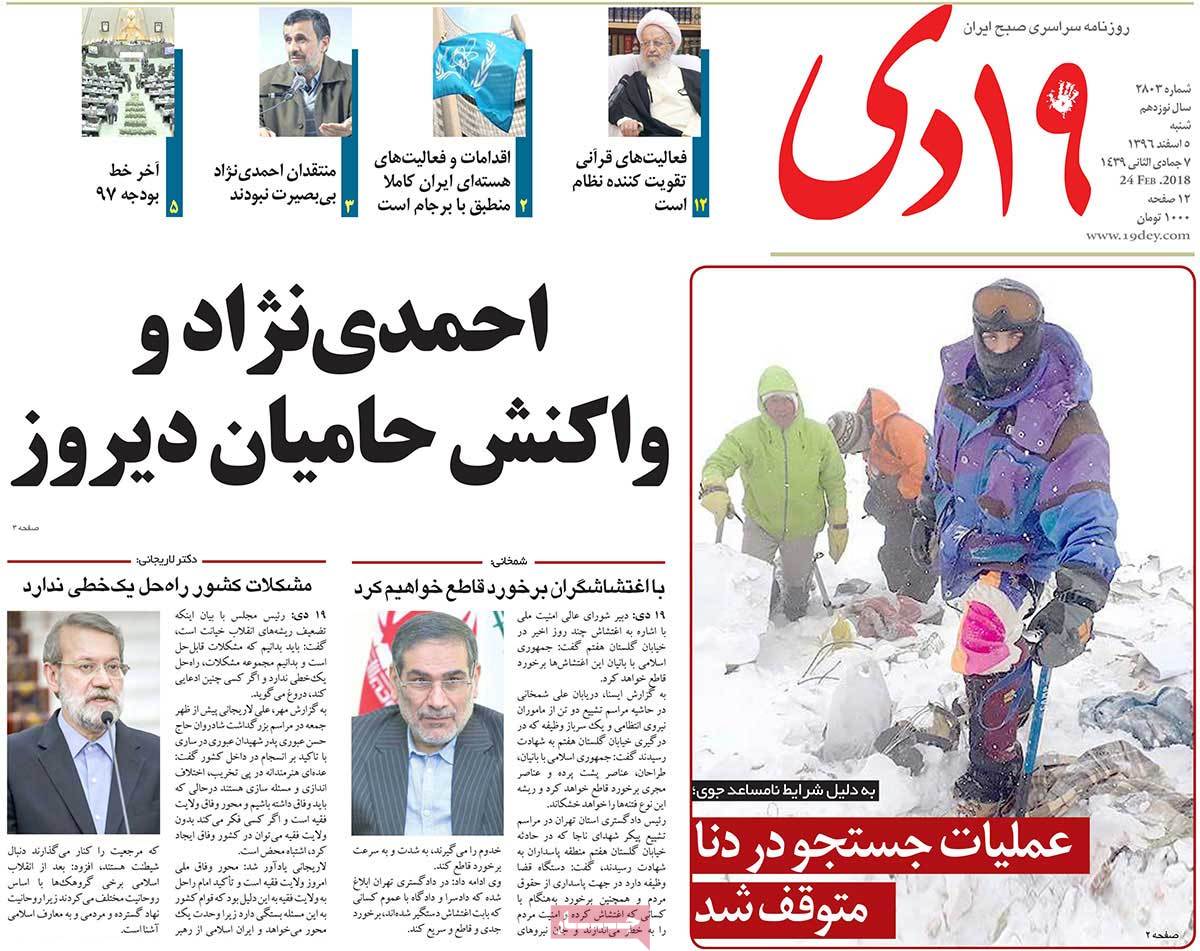
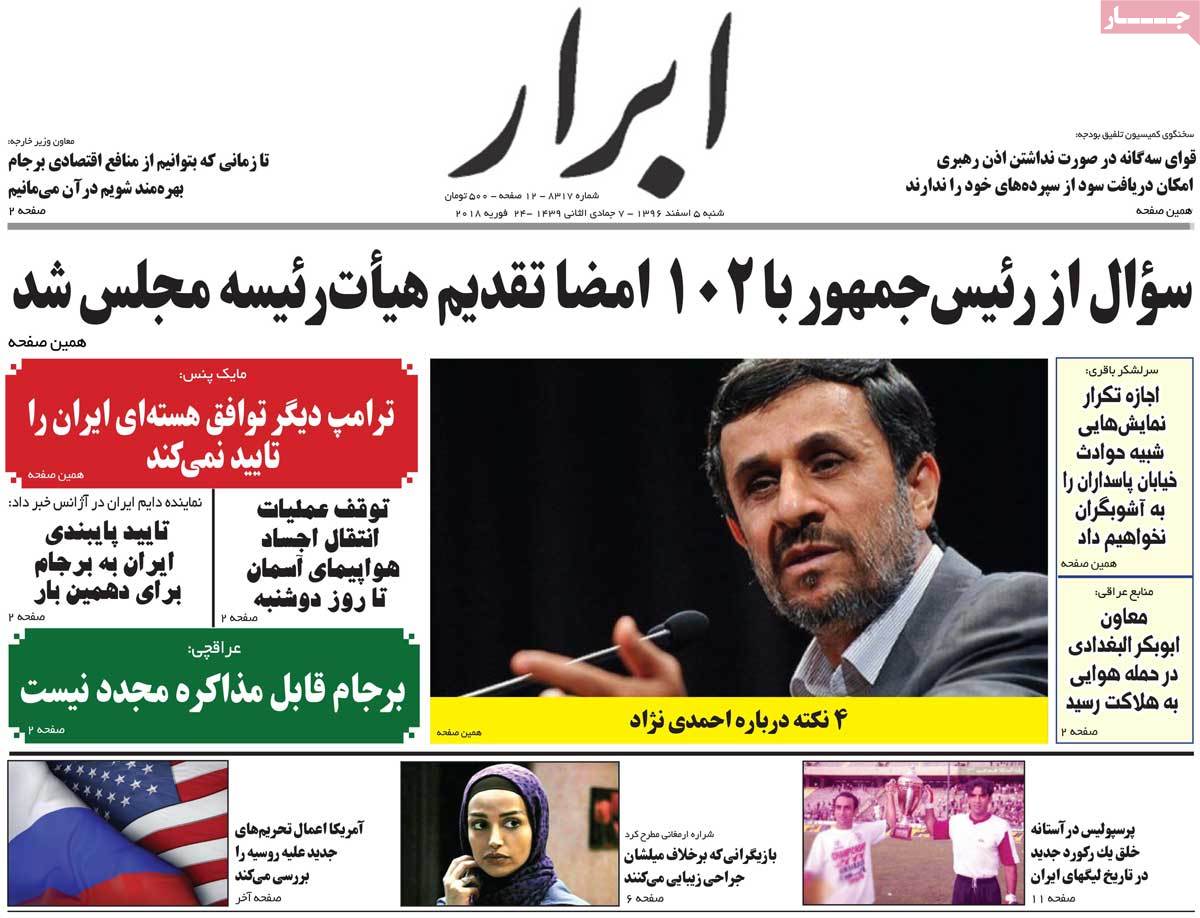
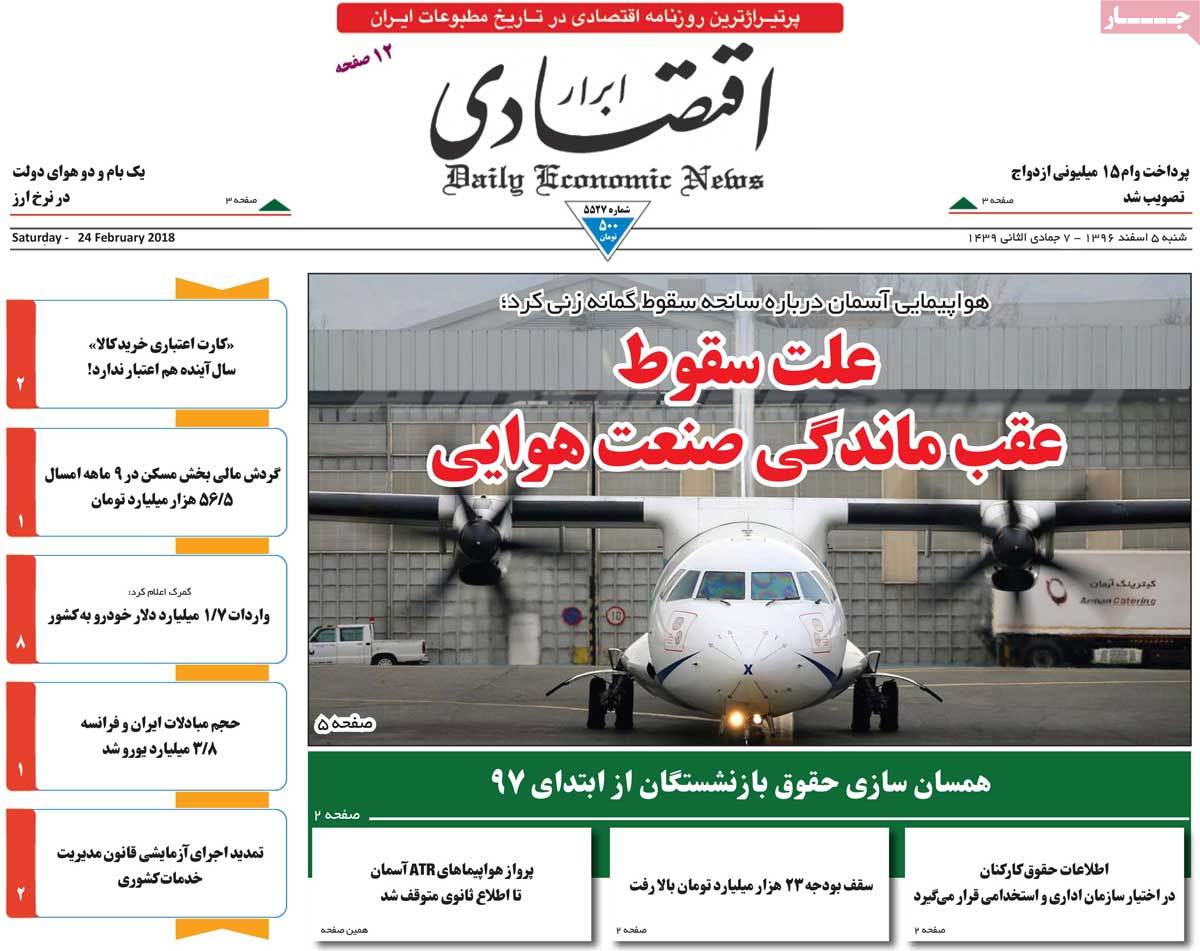
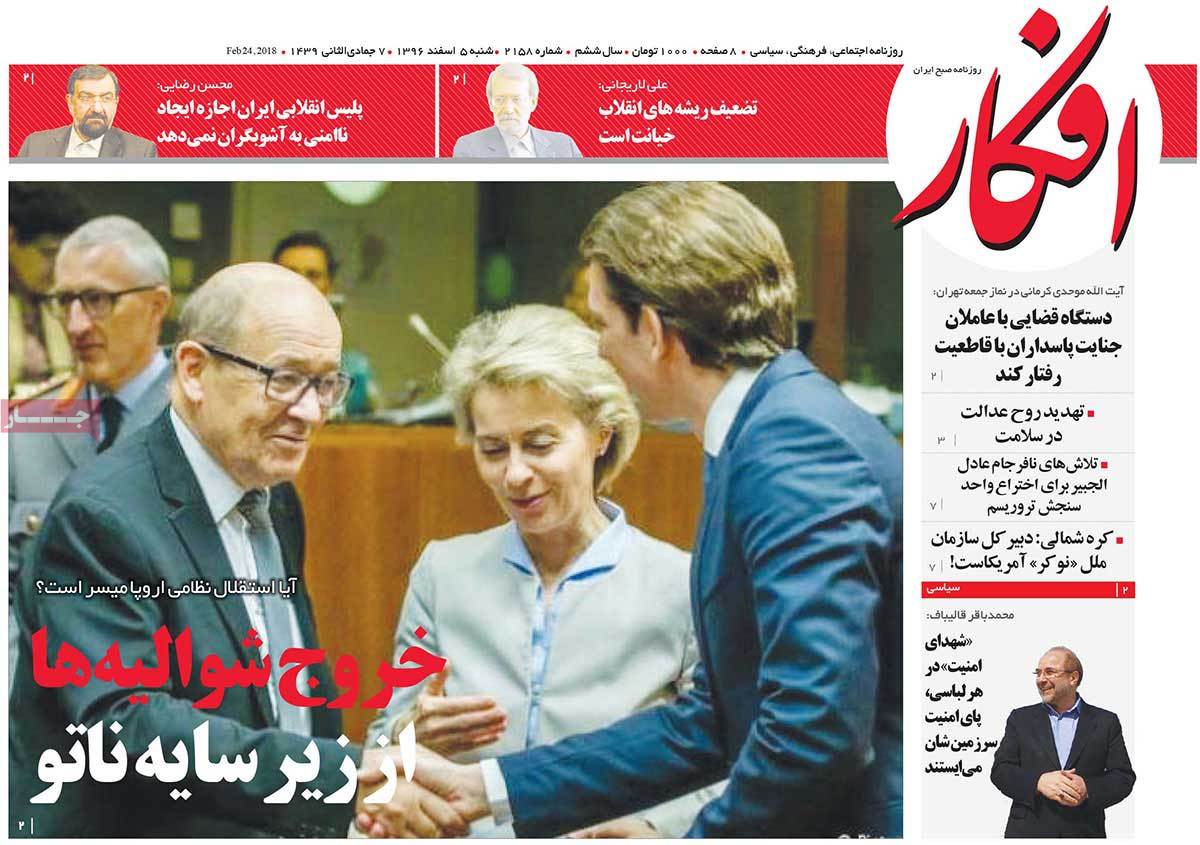
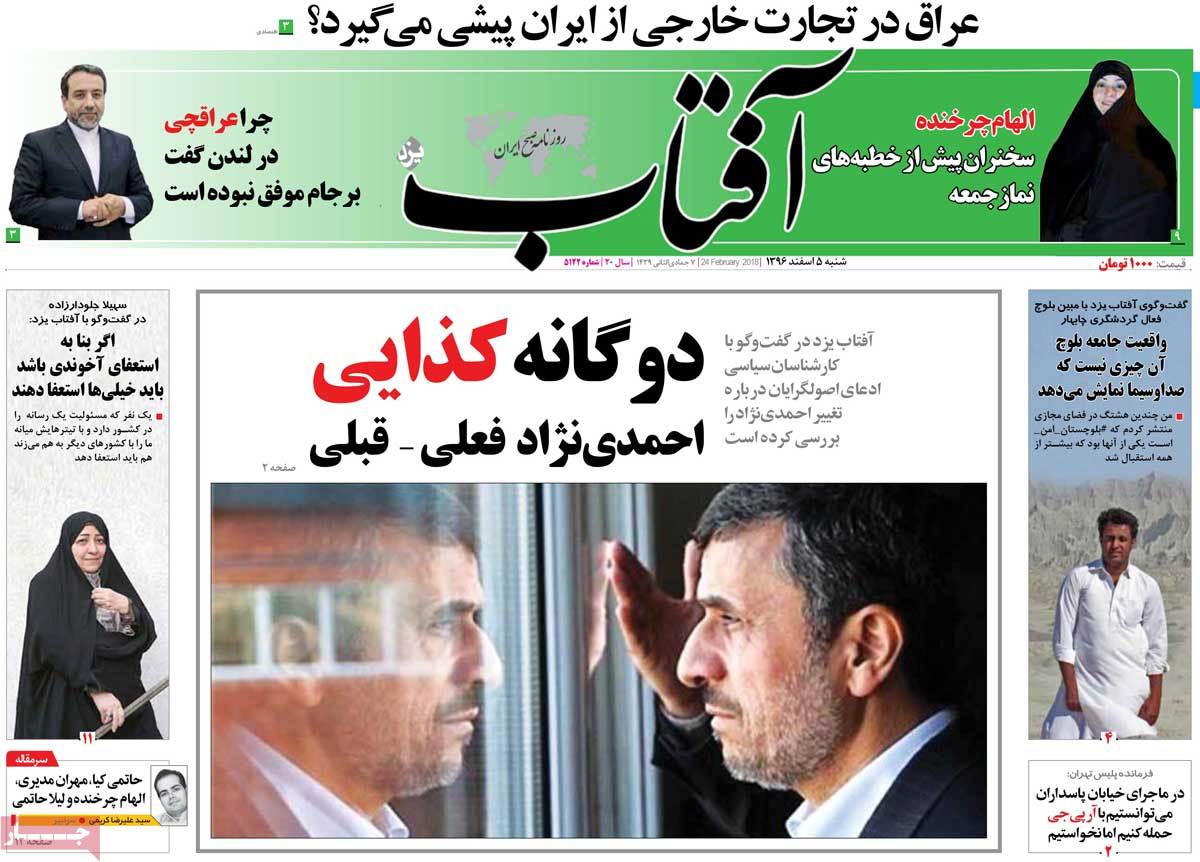
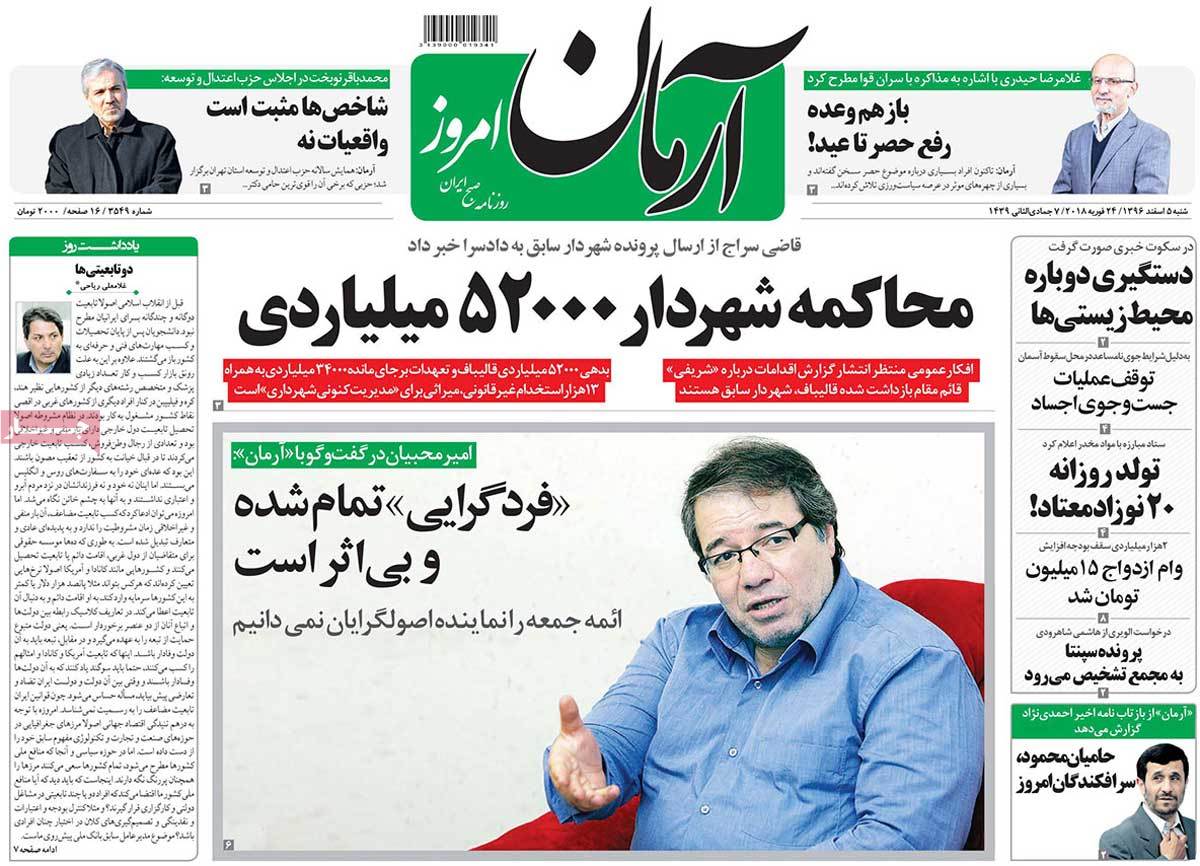
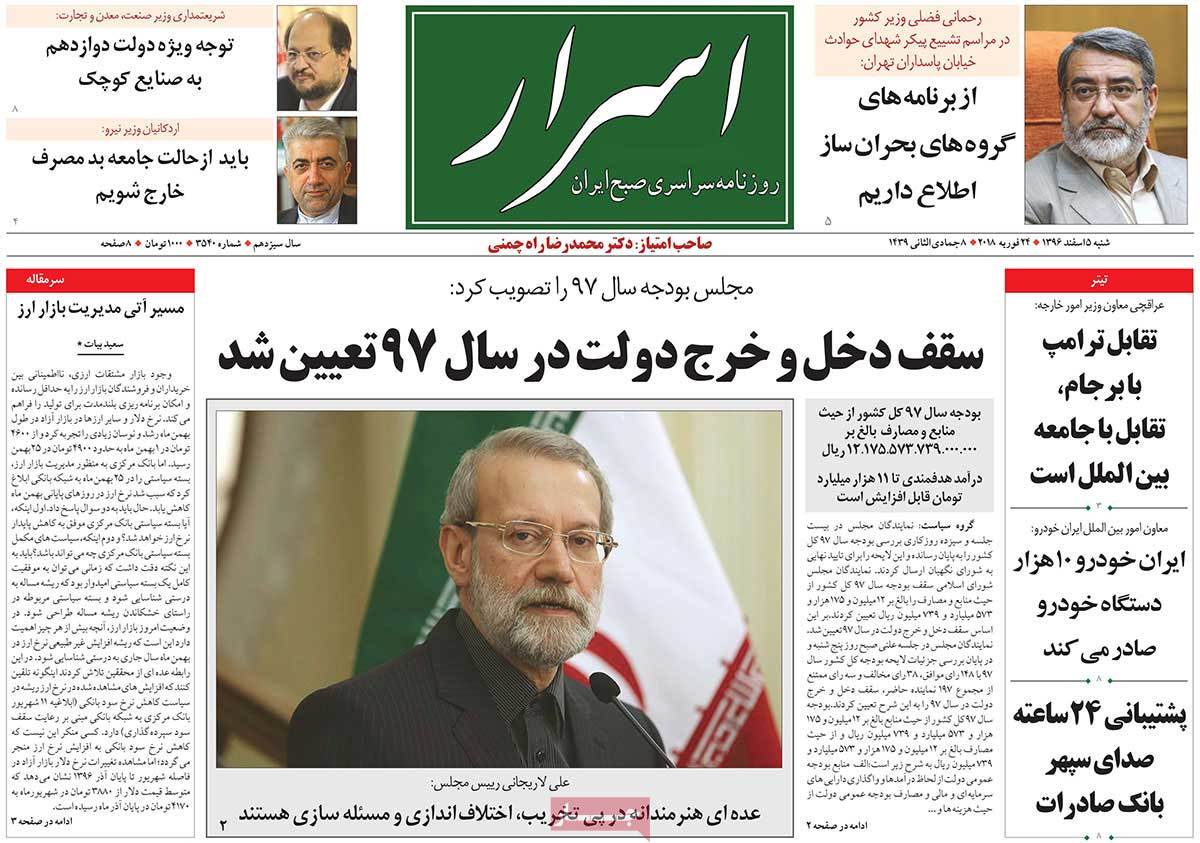
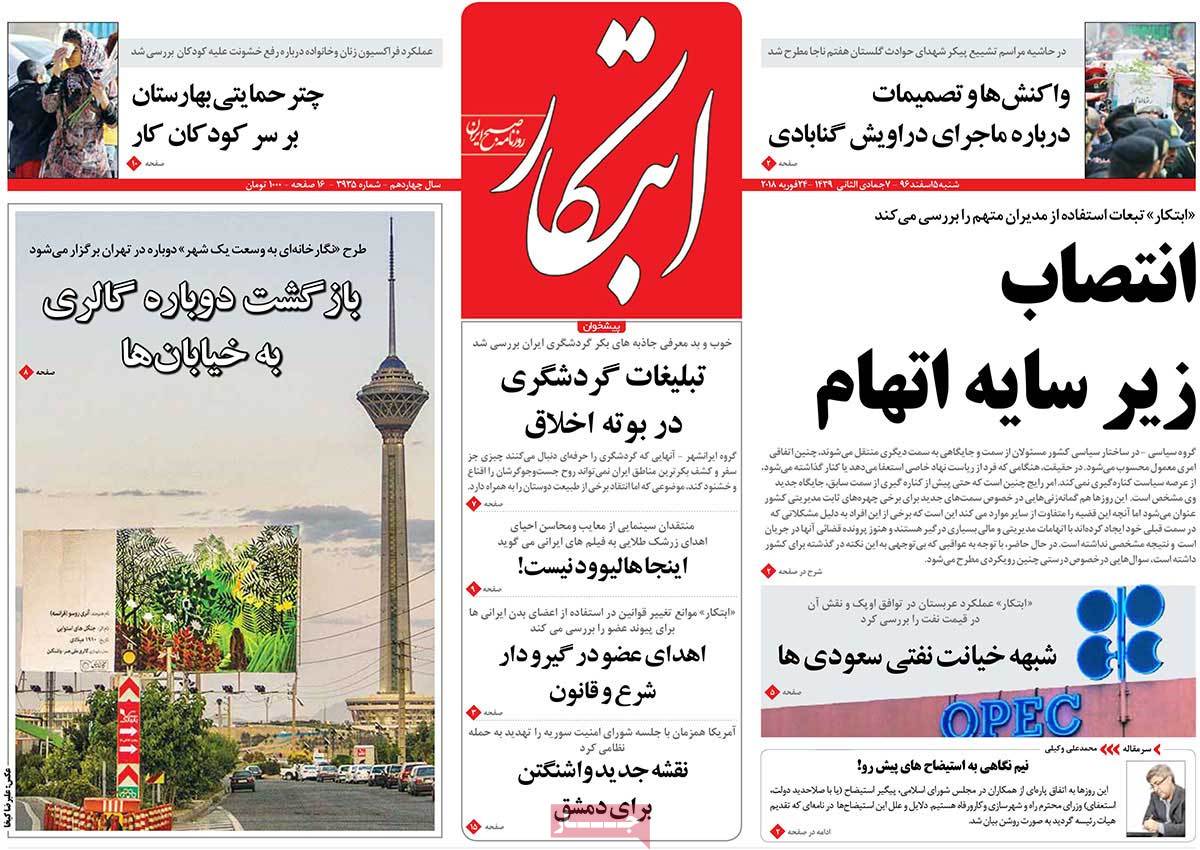
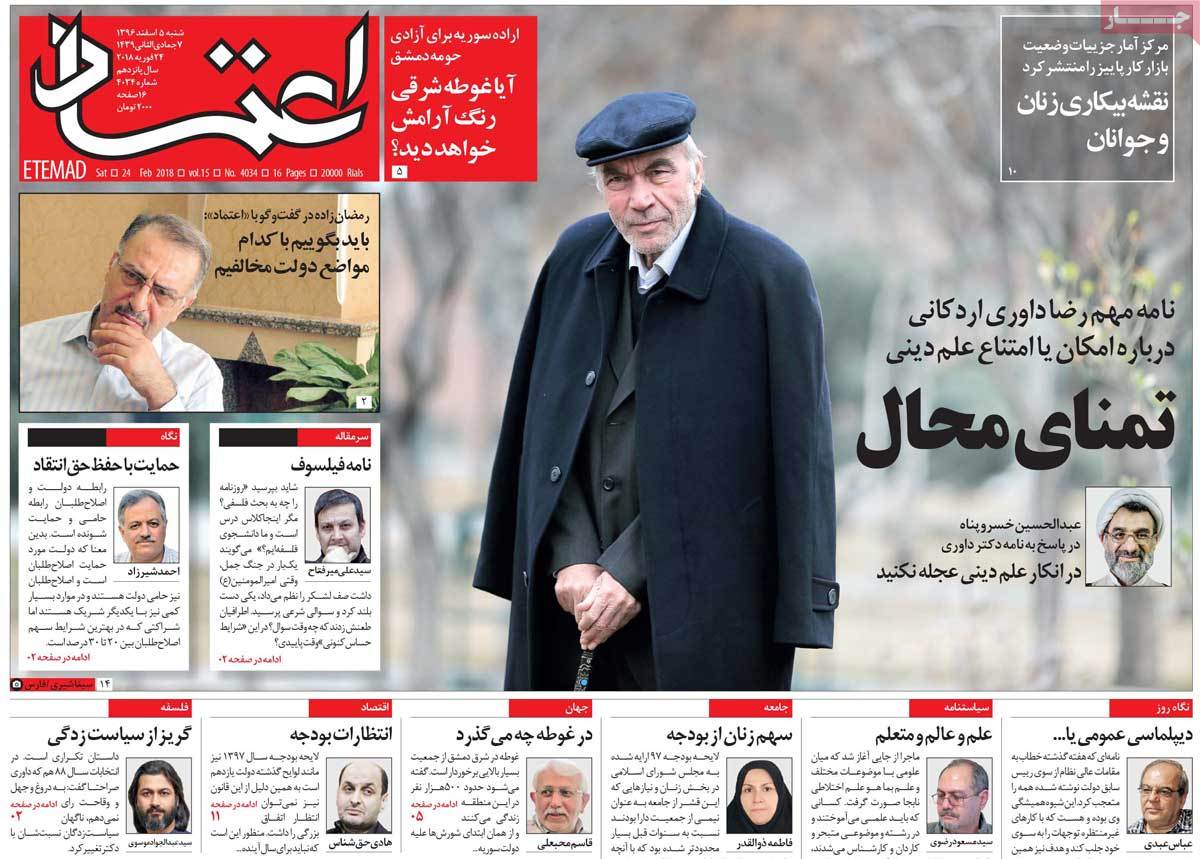
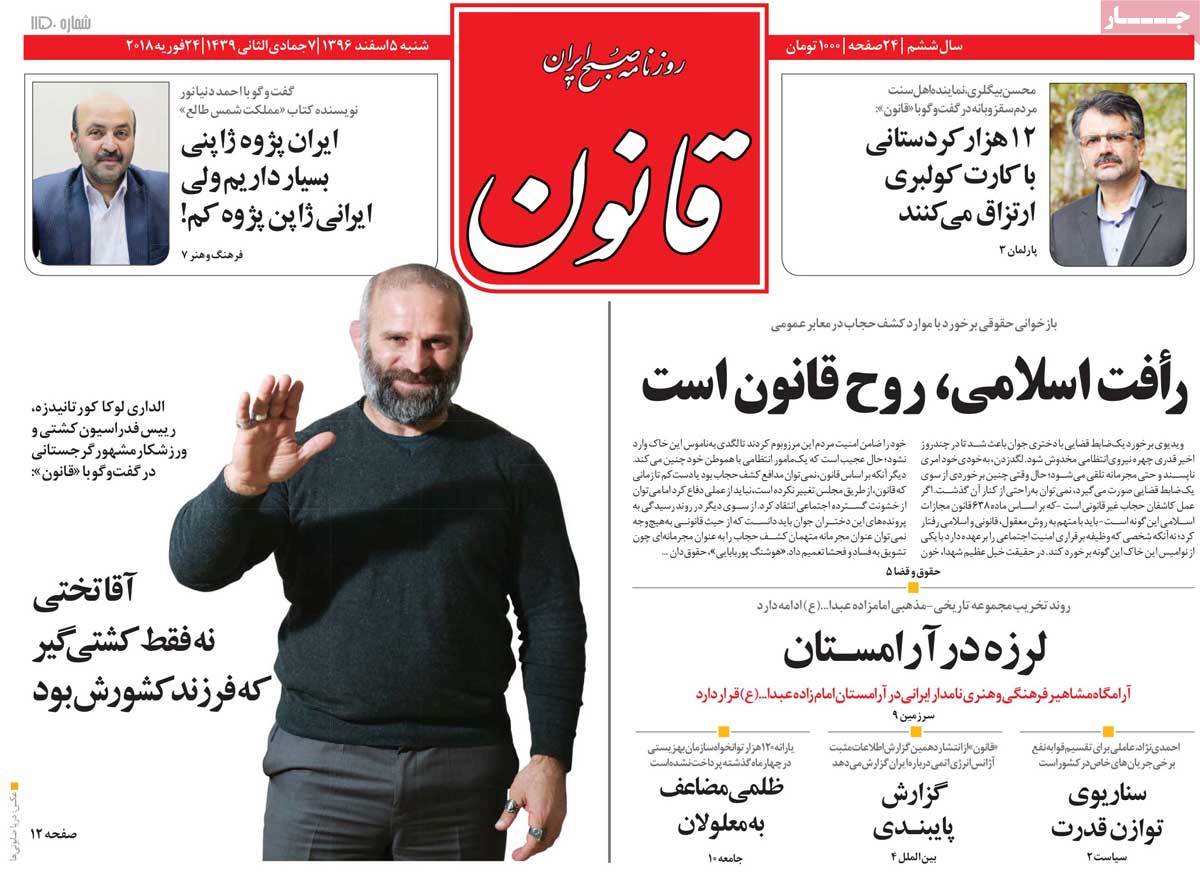
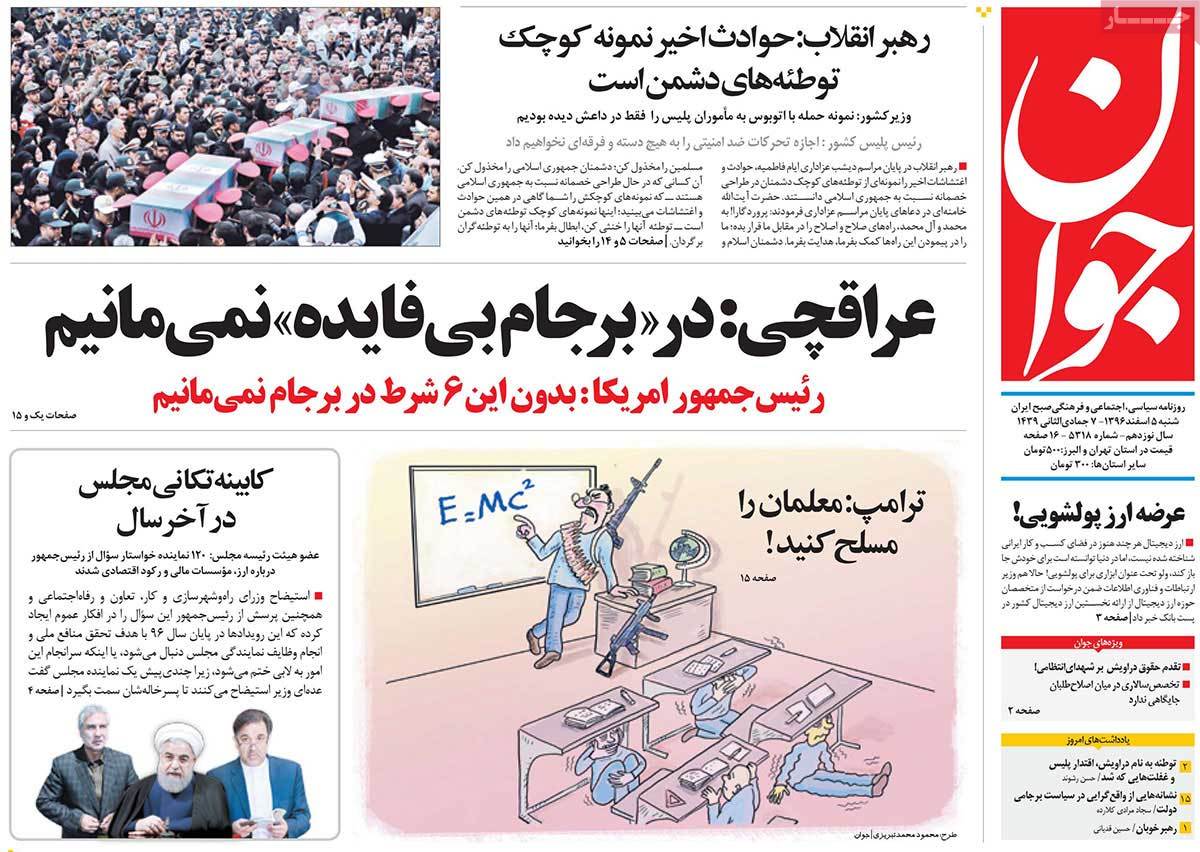
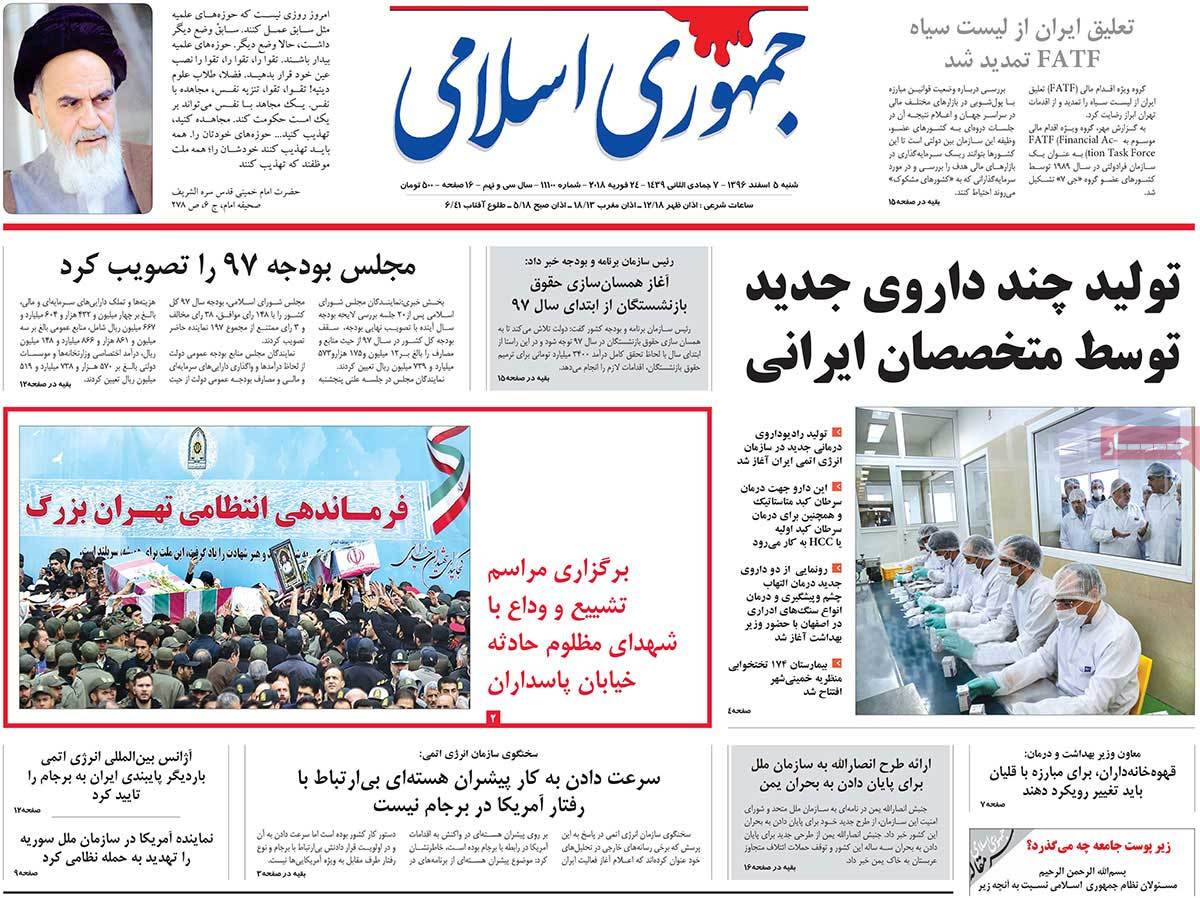
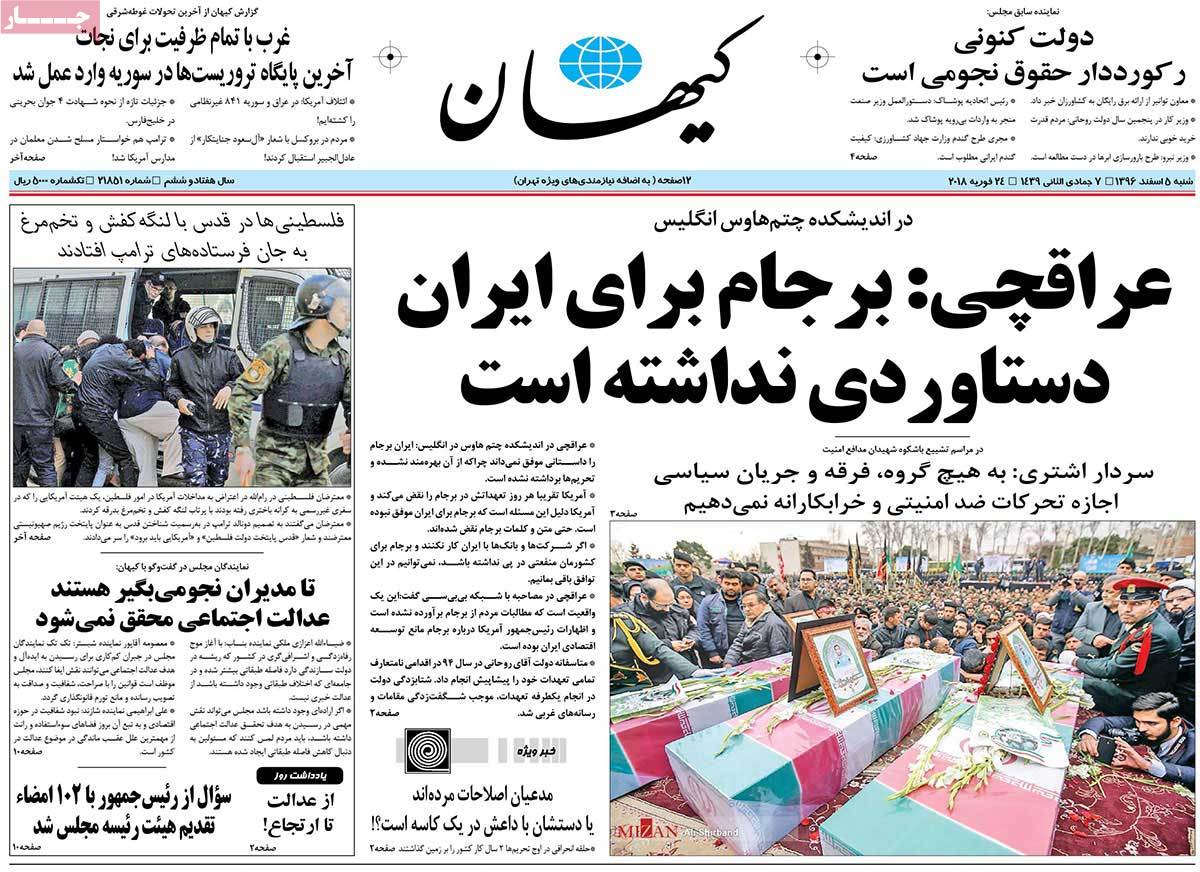
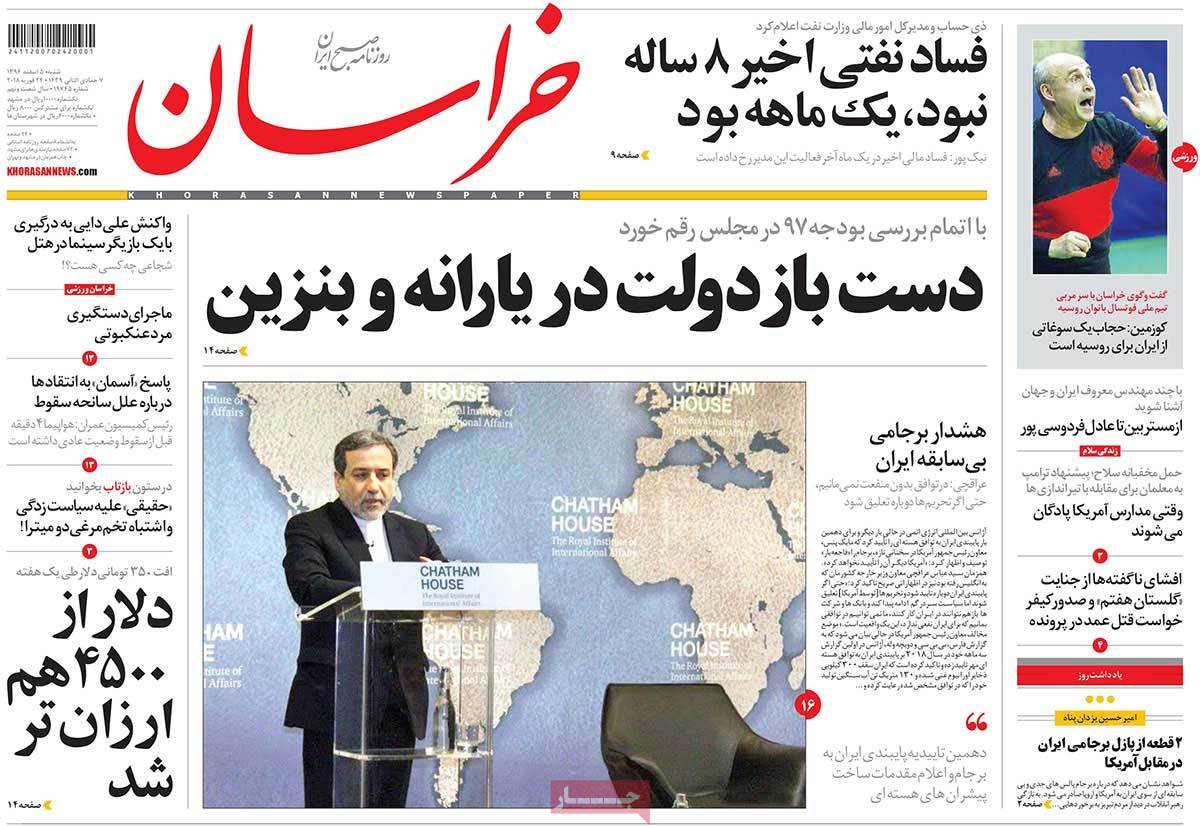
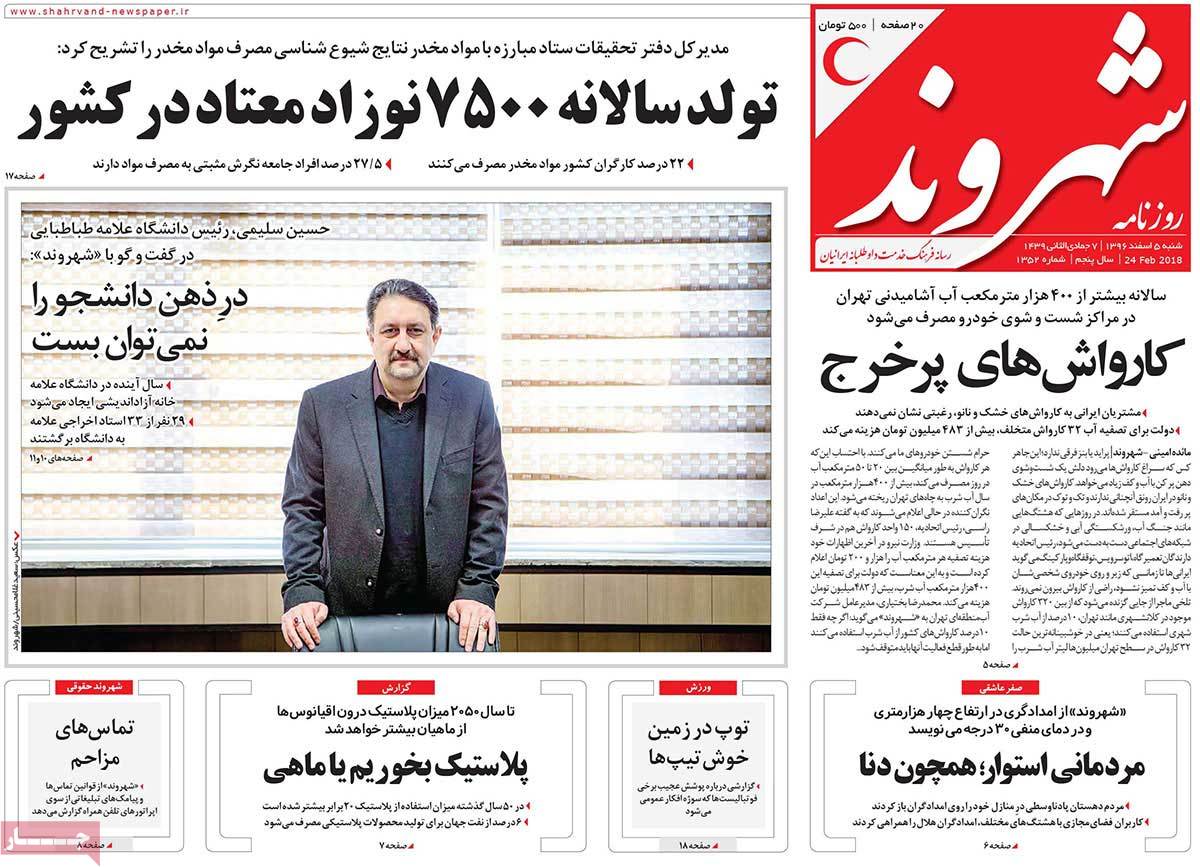
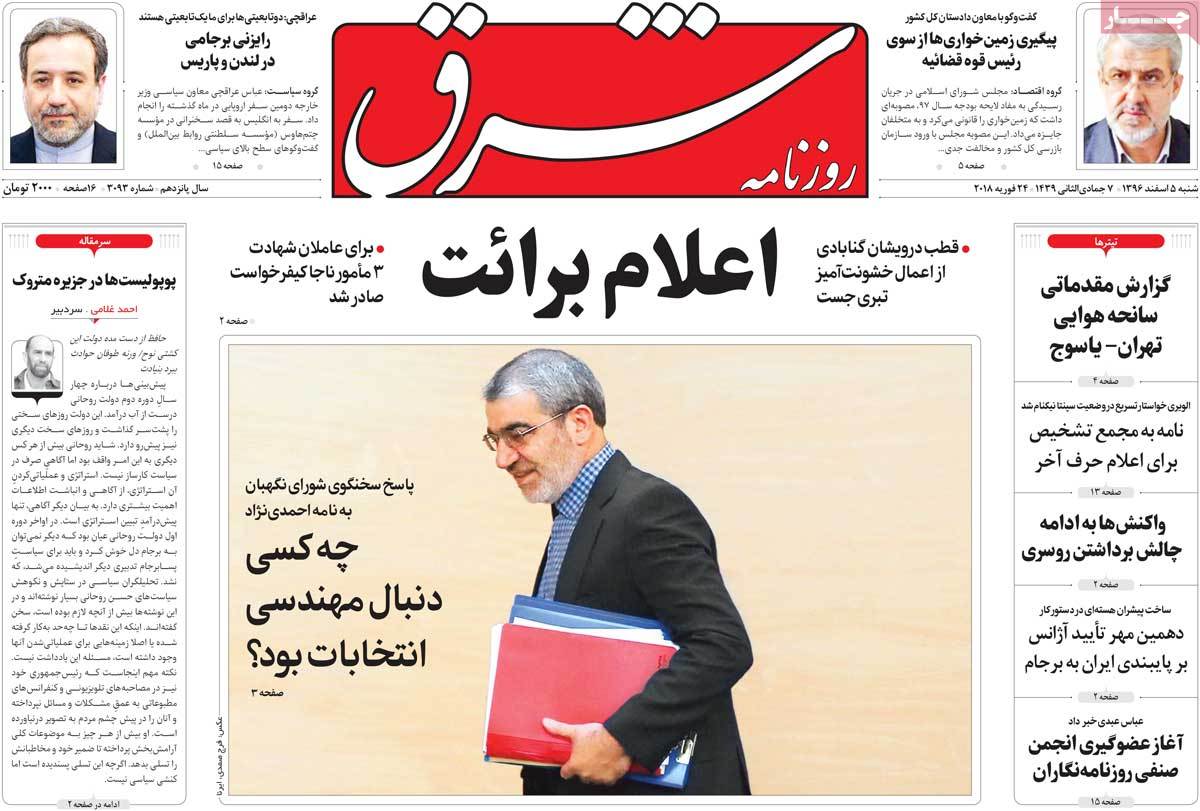
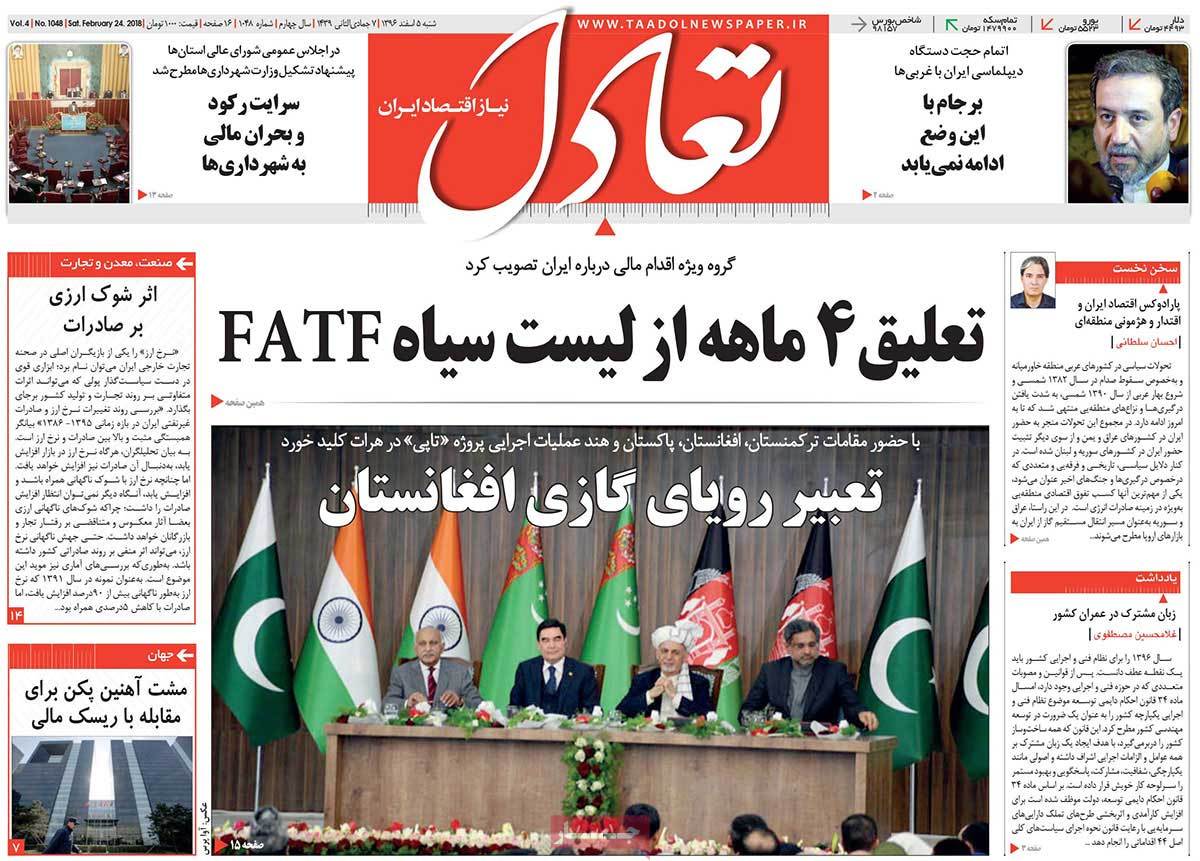
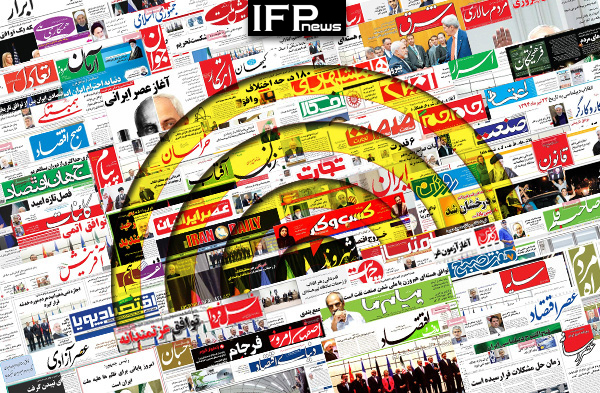
A Look at Iranian Newspaper Front Pages on January 30

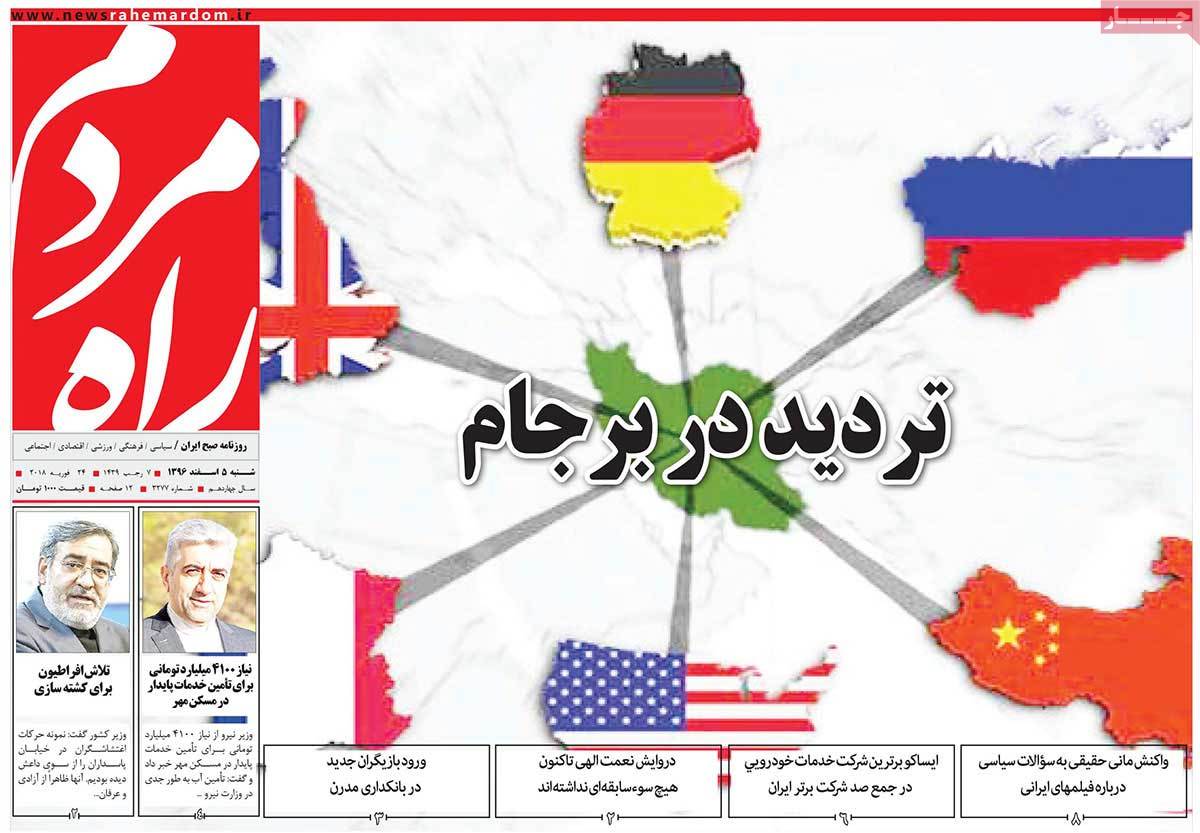
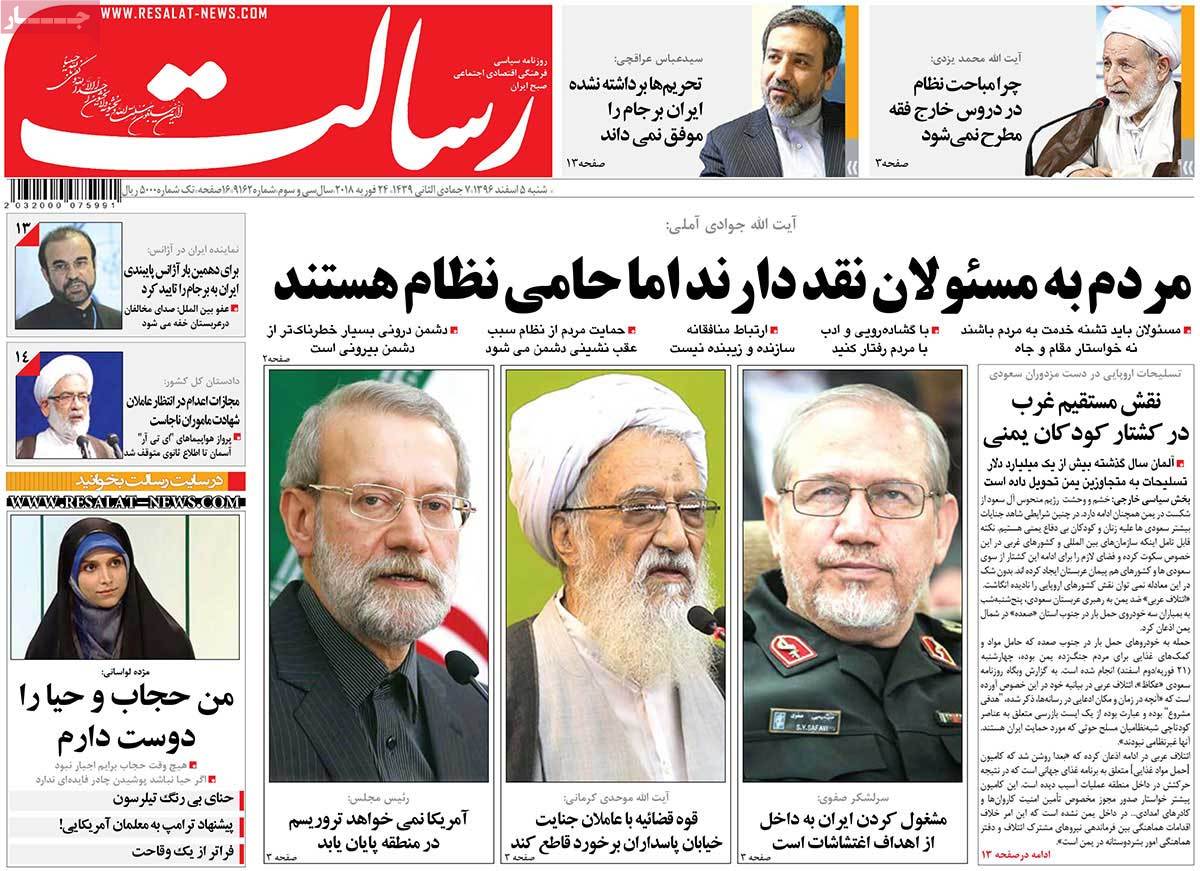
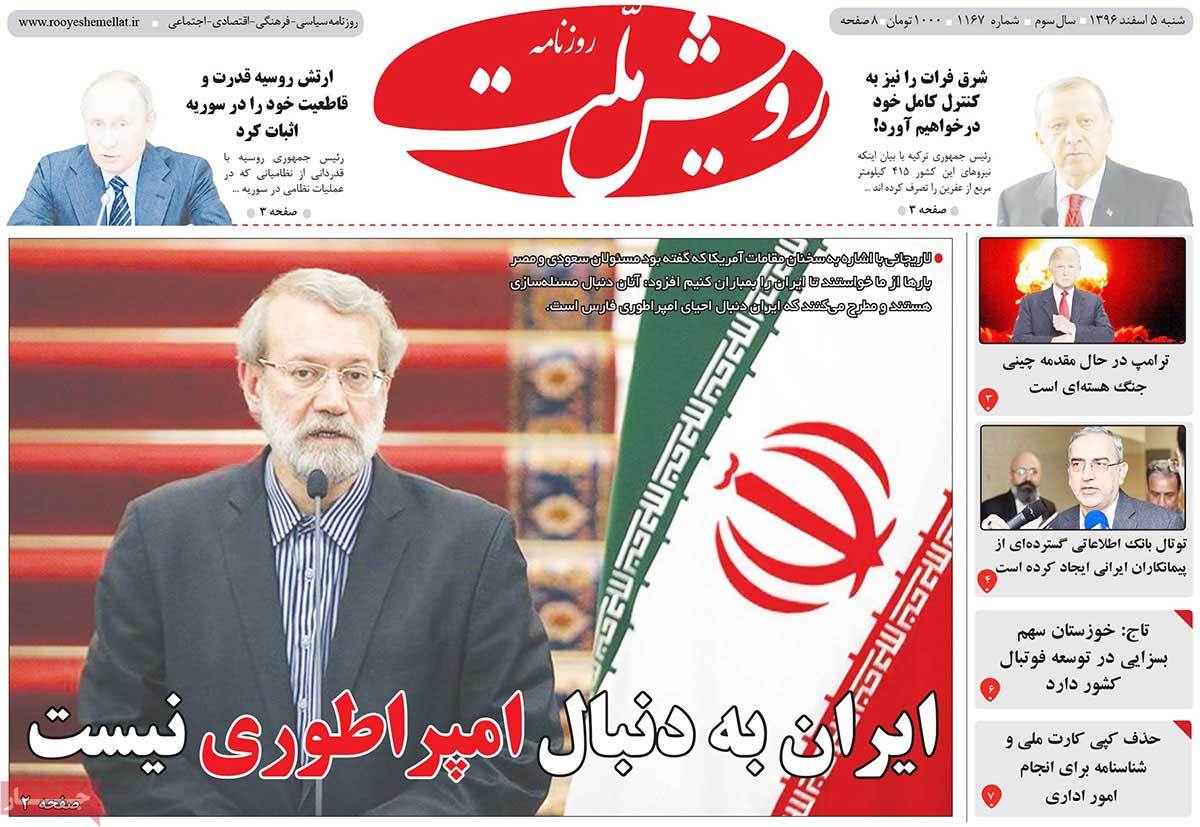
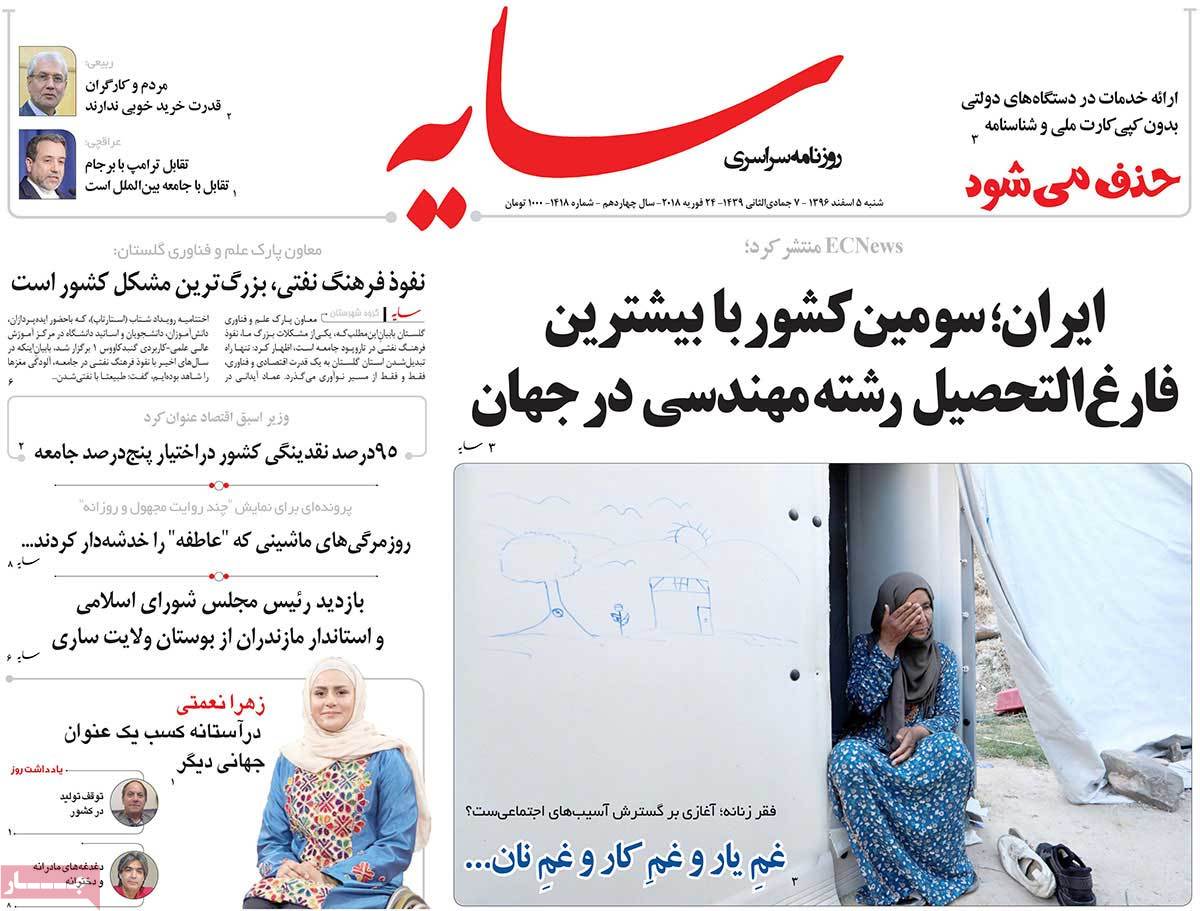
A Look at Iranian Newspaper Front Pages on November 18

The heavy snowfall in Tehran and the problems created for people remained a top story today.

Several papers also discussed the Parliament’s vote against the budget proposed by the Rouhani administration for the next fiscal year.

The Russian presidential election and Vladimir Putin’s certain victory as well as the Syria peace talks expected to be held in Russia’s Sochi were among other stories covered today.

The above issues, as well as many more, are highlighted in the following headlines and top stories:


Abrar:

1- South Korea DM: N. Korea to Be Wiped Off World Map If Uses Nukes

A Look at Iranian Newspaper Front Pages on January 30


Aftab-e Yazd:

1- Putin’s Challenge with People

2- January 30th, Day of Clean Earth

3- Putin Will Win Russia Elections, But … [Editorial]

A Look at Iranian Newspaper Front Pages on January 30


Arman-e Emrooz:

1- Those Who Disclose Corruption Are Not Protected

2- Analyst: Between Iran and US, Iraq Won’t Choose Tehran

3- Iran Won’t Sue China over Sanchi Accident

A Look at Iranian Newspaper Front Pages on January 30


Ebtekar:

1- Snowy Economy: A Report on Business in Snowy Days

A Look at Iranian Newspaper Front Pages on January 30


Etemad:

1- Iran National Security Council to Probe into Accession to Palermo Convention

2- Bloody Days of Kabul

A Look at Iranian Newspaper Front Pages on January 30


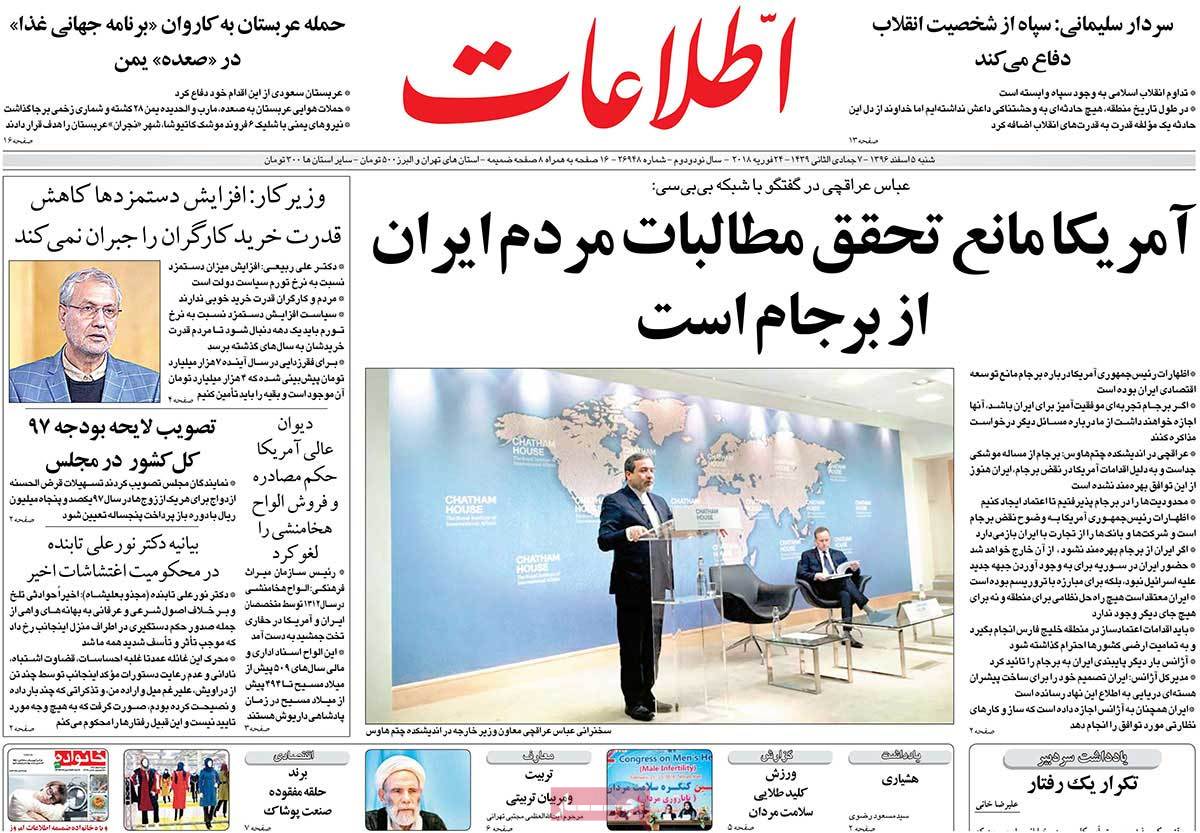
Ettela’at:

1- Iran’s Railway Network to Be Completed

2- Turkey Violates Syria’s Sovereignty by Appointing Governors for 3 Towns of Aleppo

3- Trump’s Economic Clash with Europe

A Look at Iranian Newspaper Front Pages on January 30


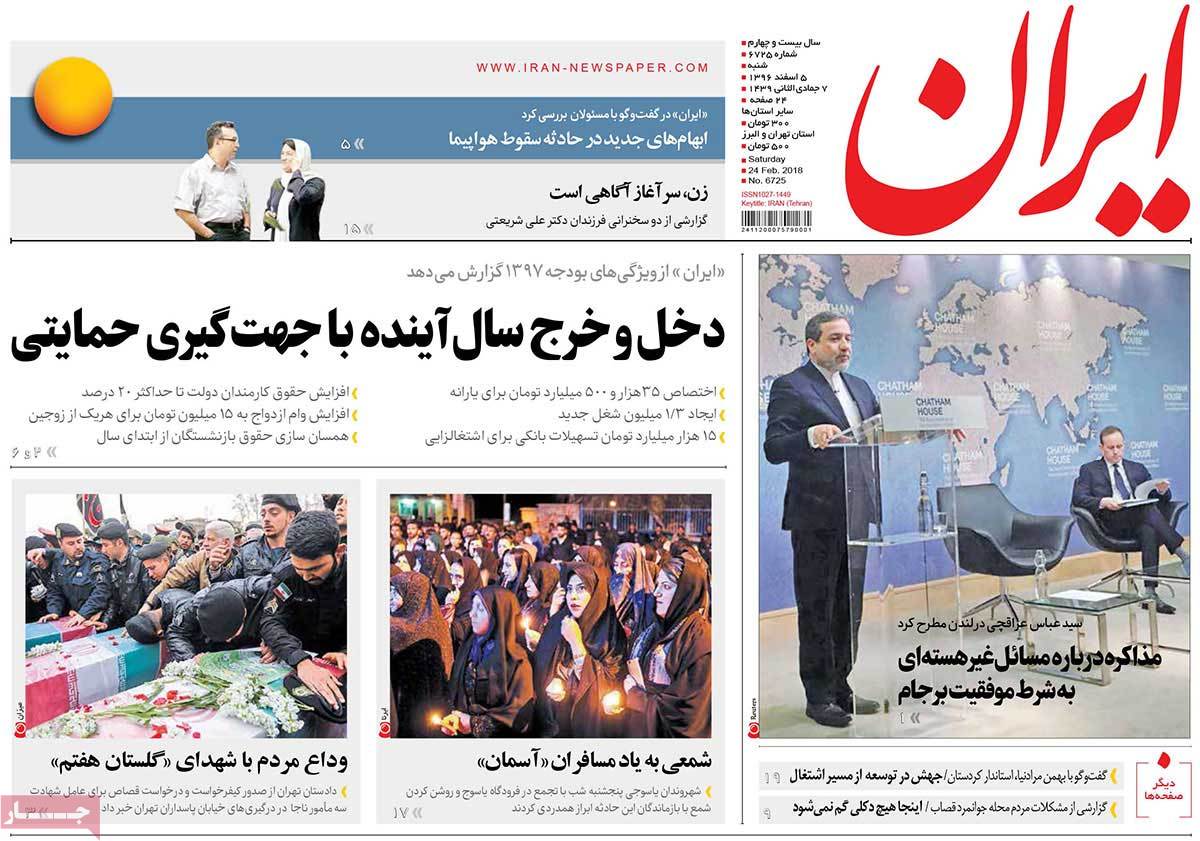
Iran:

1- Opposition Figure Mousavi, His Wife Can Now See Children Whenever They Want

2- Aftershocks of Snowfall: A Report on Transportation Problems

A Look at Iranian Newspaper Front Pages on January 30


Javan:

1- IRGC Navy General: Americans Have Changed Their Behaviour in Persian Gulf

2- Judiciary Chief: Even One Single Corrupt Judge Is Too Much for Judiciary

3- Iran Leader Urges Judiciary to Publicly Prosecute Offending Judges, Introduce Honest Ones

A Look at Iranian Newspaper Front Pages on January 30


Jomhouri Eslami:

1- African Union Supports Iran Nuclear Deal

2- China to Reopen Iranians’ Blocked Bank Accounts

3- US Lawmakers to Prevent Stonewalling in JCPOA, US Isolation: NIAC Member

4- Iran First VP: Finalisation of $12 Billion Worth of Finance Deals Achievement of JCPOA

A Look at Iranian Newspaper Front Pages on January 30


Kayhan:

1- Assad: We’ll Destroy Tel Aviv Airport with Missiles If Israel Hits Syria

2- US, Europe Form Working Group to Revise Iran Nuclear Deal

  • Europe Breaks Its Promise that JCPOA Is Non-Negotiable!

A Look at Iranian Newspaper Front Pages on January 30


Khorasan:

1- Ifs and Buts of Palermo Convention: Right Concerts or Misinterpretation

A Look at Iranian Newspaper Front Pages on January 30


Resalat:

1- Health Ministry: Iranian People’s Life Expectancy Increased by 25 Years in Past 4 Decades

A Look at Iranian Newspaper Front Pages on January 30


Shahrvand:

1- Happy, Unhappy Aspects of Snow

A Look at Iranian Newspaper Front Pages on January 30


Shargh:

1- Certain MPs Lobby Others to Reject Government’s Proposed Budget 10 Minutes before Voting

A Look at Iranian Newspaper Front Pages on January 30


Sobh-e Now:

1- Health Ministry: Iranian People’s Life Expectancy Increased from 54 to 78

2- No Deadlock in Islamic Traditional Medicine: Cleric

A Look at Iranian Newspaper Front Pages on January 30

Syria National Dialogue Congress Kicked Off in Sochi (+Video)

Russian Foreign Minister Sergei Lavrov on Tuesday inaugurated the national Syria talks which finally began in the Russian coastal town of Sochi after months of debating and bargaining.

Political delegations from Iran, Russia and Turkey, as the three countries which initiated the negotiations, as well as a UN delegation led by Staffan de Mistura are attending the talks.

More than 1,600 representatives from different Syrian groups, including armed opposition groups, Kurds, Arabs and other ethnic groups, are in Sochi as well.

One of the key items on the agenda of the talks is to establish a commission tasked with drawing up Syria’s future constitution, a Farsi report by IRIB said.

The talks were officially scheduled to kick off at 10 am local time with an official ceremony. However, the talks started with several hours of delay. Differences of opinion between de Mistura and Russian officials are said to have delayed the negotiations.

The inaugural was scheduled to be followed by the first plenary session of the event, which would run until noon.

The second plenary session was scheduled to open at 14:30 and would run for three hours. High on the agenda of the second meeting would be discussions on how to draw up Syria’s new Constitution while preserving the country’s territorial integrity.

The negotiations are expected to draw to a close with the release of an official statement reflecting the decisions made during the talks.

During a trilateral summit attended by leaders from Iran, Russia and Turkey back in November, 2017, it was agreed to hold the current Syria talks in Sochi.

US Relocating ISIS to Afghanistan to Justify Its Regional Presence: Iran Leader

Expressing regret over the recent events in Afghanistan, which according to Ayatollah Khamenei, were perpetrated by those who claim to be Muslims, the Leader stressed they are not following Islam at all.

Addressing a group of seminary students in Tehran on Tuesday, Ayatollah Khamenei also noted that those who created ISIS to turn it into a weapon for oppressing and committing crimes against the people in Syria and Iraq, after suffering defeats, are relocating ISIS to Afghanistan.

“The recent massacres are, in fact, the first stage of this plot,” he added.

“To the US-backed terrorists there is no difference between Shiites and Sunnis; they target civilians whether Sunnis or Shiites,” Ayatollah Khamenei said.

Elsewhere in his remarks, the Leader noted that it is Washington’s first priority to keep the regional countries busy with their own matters.

He further mentioned that the US does not want to see the region in peace. It wants to keep the governments and peoples of the region busy with their own stuff so as not to think of standing against the Zionists.

“The second goal is to create instability in order to justify their presence in the region and achieve their political and economic goals. The Americans are themselves the main source of insecurity in Afghanistan, and the massacres in the region since about 20 years ago, were carried out by the US agents directly or indirectly.”

“May God curse the [global] arrogance, its agents, and the criminal Zionist regime and the US that massacre Muslims in such a way,” highlighted the Leader.

FBI Deputy Chief, Frequent Target of Trump’s Attacks, Steps Down (+Video)

McCabe, who served a brief stint as acting director of the bureau after Trump fired ex-FBI chief James Comey, will remain on the payroll until March, when he is eligible to retire with full benefits, NBC said. He had been expected to leave.

Trump and some Republicans in Congress have accused McCabe of political bias, citing his role at the FBI during investigations related to Hillary Clinton and Trump. They question his role in the Clinton email probe and the investigation into Russian efforts to influence the 2016 election and whether the Trump campaign coordinated with the Kremlin.

Trump did not answer when asked by reporters Monday afternoon if he knew about McCabe’s move. The White House was not involved in McCabe’s decision, press secretary Sarah Huckabee Sanders told reporters Monday afternoon.

“The president was not part of this decision-making process,” she said.

The president had thrown jabs at McCabe in a manner unusual for a president and a top FBI official. Trump repeatedly accused McCabe of improper ties to Clinton because former Virginia Gov. Terry McAuliffe — a Clinton ally — backed McCabe’s wife’s run for a state office in 2015. The Wall Street Journal reported in October 2016 that McAuliffe gave nearly $500,000 to Jill McCabe’s campaign for state Senate.

More details about Trump’s relationship with McCabe surfaced last week, when The Washington Post reported that the president asked him in May who he supported in the presidential election.

In December, the president also tweeted that McCabe was “racing the clock to retire with full benefits.”

Also following Trump’s decision to dismiss Comey back in May 2017, McCabe had come to the defence of his former boss, backing up Comey’s claims that President Trump demanded his loyalty.

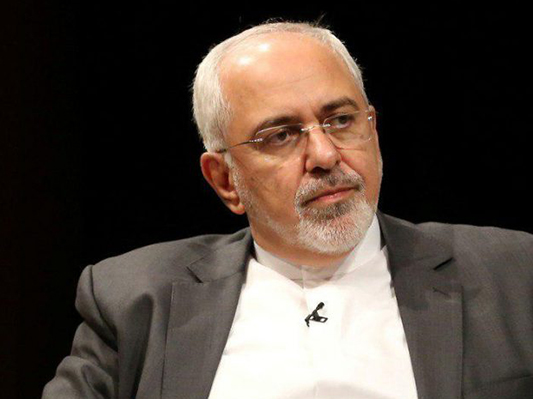
FM Zarif Slams Haley’s New Claims on Iran Role in Yemen

In a tweet on Monday, Zarif wrote, “In the fake news department, Trump & Co. attempt to create an Iranphobic narrative at the UN Security Council — through wining and dining and fake “evidence” provided by a warring neighbor—that would pass muster with only the same desperate neighbor & its accomplices in war crimes.”

FM Zarif Slams Haley’s New Claims on Iran Role in YemenIn another tweet later on Tuesday morning, Zarif said, “A while ago US showed a Saudi supplied Iranian missile intact. They must’ve been told a missile destroyed by a Patriot does not land fully assembled. So now US shows UNSC missile fragments w/ Iranian Standard Institute logo, as on our foodstuffs. Try fabricating “evidence” again.”

The Iranian top diplomat’s comments came after US Ambassador to the United Nations Nikki Haley claimed in a tweet that “We brought the Security Council to DC to see first-hand evidence from the Department of Defense of Iran’s illegal weapons program. These violations cannot continue.”

On Monday, US President Donald Trump dined with members of the UN Security Council, who are discussing “evidence” that allegedly shows Iran is arming rebels in Yemen.

Trump said before the lunch meeting Monday at the White House “We’re helping the world.”

The guests included Haley and a couple of foreign ambassadors. Among the attendees were ambassadors from China, France, Russia and the United Kingdom.

The attendees were shown missile remnants that the US claims are proof that Iran has been arming rebels in Yemen; a claim that Tehran has emphatically denied for many times.

FM Zarif Slams Haley’s New Claims on Iran Role in Yemen

Iran to Complain to ICJ over Turkmenistan’s Overpriced Natural Gas Supplies

Iranian Oil Minister Bijan Namdar Zanganeh, in an interview with the Persian-language Islamic Republic News Agency (IRNA), said the country is planning to make a complaint against Turkmenistan Gas Company over the quality of the natural gas it is delivering to Iran.

“We are also going to file another complaint with the International Court of Justice (ICJ) to [make the company] review the price of the [natural] gas it is exporting [to Iran] because we believe their prices are too high and must be reduced,” he added.

He noted that Tehran and Ashgabat have earlier made complaints against each other over issues pertaining to natural gas.

“They claim Iran is $1.5 billion in arrears to them over [natural] gas exports, but we believe this figure is not right,” said he oil minister.

He said the complaint that Iran has made to them over the exorbitant prices [of natural gas] should be referred to the ICJ as well.

Iran’s Deputy Oil Minister Hamidreza Araqi had earlier touched upon Tehran’s condition for resuming natural gas imports from Turkmenistan.

“If Turkmenistan brings down [natural] gas prices, we will buy gas from the country. If Ashgabat refuses to agree to our demands, we will file a complaint with the ICC over the country’s cutting off gas [supplies],” Araqi had already underscored.

Differences between Iran and Turkmenistan over natural gas heightened at the beginning of 2017 when Turkmenistan stopped its natural gas exports to Iran. Now, one year on since then, the disagreement still lingers on. Given that talks have failed to produce tangible results, the case is likely to be sent to the ICJ in the near future.

The Iran-Turkmenistan gas dispute broke out in late 2016. Finally, Turkmenistan completely cut off its exports of natural gas to Iran at the beginning of 2017 under the pretext that Tehran owed Turkmenistan for gas supplies.

Iran, itself a major gas exporting country, has been temporarily importing natural gas from Turkmenistan to supply its northern and northeastern provinces with their required fuel. The gas imports are expected be halted once a huge gas pipeline project connecting the northern provinces to the national gas pipeline network is finished.

“Iran-Europe Talks Fruitful If Focused on Regional Issues, Not Missiles”

US President Donald Trump has given Europe four months to reform the nuclear agreement between Iran and six world powers known as the Joint Comprehensive Plan of Action (JCPOA) or to strike a peripheral deal with Iran over the country’s missile activities. Europe is on the horns of a dilemma at a time when all voices inside Iran are saying in unison that the Islamic Republic will not renegotiate the JCPOA, nor will it hold any talks on the country’s missile program. Kayhan Barzegar, an expert on international relations, has told the Persian-language Etemad newspaper that Iran will be a loser if it enters negotiations on its missile program. However, the analyst has underlined in his interview that Iran has the upper hand in regional equations, which means Iran has the potential to turn regional talks with Europe – NOT with the Americans – into a win-win game. Highlights of Barzegar’s interview with Etemad daily conducted by Sara Masoumi follow:

Trump is the one who mostly insists on holding talks, somebody who has stepped into the White House with a new discourse and strategy, and sees the JCPOA as detrimental to Washington’s interests value-wise. As far as values are concerned, Trump is against former US President Barack Obama’s discourse in America’s domestic and foreign policy and somehow seeks to destroy all of them, particularly the JCPOA. In Trump’s point of view, the JCPOA was not an appropriate discourse in getting closer to Iran. And in terms of interests, Trump is of the conviction that the JCPOA has added to Iran’s regional power, which is detrimental to the interests of the US and its allies in the region. Now, he has US interests in mind by agreeing to a proposal on regional and missile talks and to a so-called JCPOA reform plan. Trump believes the Iran nuclear deal was basically meant to bring peace and stability to the region. Now, with the JCPOA having brought Iran out of the international blockade and having depicted a powerful picture of Iran in the eyes of Tehran’s regional friends such as Hezbollah and other political groups in Iraq and Syria, Iran’s power has grown in the region, which, in turn, has made the situation more difficult for the US and its regional allies.


Setting new and tough conditions such as holding talks on Iran’s missile program or imposing new sanctions will practically push the Iran nuclear deal off its original track and makes the agreement pointless.


Accordingly, Trump has linked the issue of regional and missile talks to the JCPOA, and has given European countries and the US Congress a four-month deadline to somehow reform the JCPOA or he will withdraw from the agreement. Trump seeks to show that Iran must not use the JCPOA as a proxy or a lever to further advance its interests in the region. He has added the issue of regional and missile talks to the JCPOA to create a new framework for Iran affairs in the United States’ domestic policy, especially in the Congress, and Washington’s policies in the region. In the eyes of Trump, relations between the US and its regional allies such as Saudi Arabia and the Israeli regime had been weakened due to Obama’s compromising policies, and need to regain their previous status.

With that in mind, one can say that Trump is now seeking to scuttle, or at least undermine the JCPOA as much as possible. Setting new and tough conditions such as holding talks on Iran’s missile program or imposing new sanctions will practically push the JCPOA off its original track and makes the agreement pointless.

On the other hand, Europeans are committed to preserving the JCPOA. The deal is a successful multilateral agreement that boosts Europe’s global influence. Europe may have some domestic problems, but it enjoys a creditable position on the global political arena. From this perspective, geopolitical urgency in the most important principle for Europe when it comes to preserving the JCPOA. Europe is not only worried about the spillover of terrorism and an influx of refugees as a result of conflicts in north Africa and the Middle East region, but is also concerned about the possible outbreak of another conflict in the region as a result of the JCPOA’s being disputed. Trump, too, is cashing in on this concern of Europe and, under the pretext of safeguarding the JCPOA, pushing the Europeans to expand the sphere of nuclear talks to include negotiations on regional issues and Iran’s missile program. It seems that Trump is trying to narrow the gap with Europe and once again form a united front within the framework of a Western alliance against Iran. In fact, Europe sees the JCPOA as a tool to ensure regional stability and global security.

Europe seeks to form a more positive framework for talks with Iran. In the Europeans’ point of view, Iran is the most important and most stable country in the east of the Mediterranean region. They believe negotiations should be held with Iran with a critical, and at the same time constructive look, in a bid to ensure regional stability. Unlike the American perspective, Europe believes Iran’s role cannot be ignored or undermined; rather, as Europe believes, Iran should be brought to the negotiating table to help tackle the regional scourges, especially terrorism.


Europe regards Iran as the most important and most stable country in the east of the Mediterranean region. They believe Iran’s role cannot be ignored or undermined, and it should be brought to the negotiating table to help tackle the regional scourges, especially terrorism.


Of course, Europe’s talk of holding negotiations on Iran’s missile program, and the country’s outright refusal to sit at the negotiating table on that matter make the issue more complicated. Negotiations on Iran’s missile program, which is a national security issue and related to the country’s deterrence capability, would amount to a game where Iran would be the loser and the other side the winner. Europe’s talk of any such negotiations can kill the chances of holding talks with Iran on any issue. On the other hand, negotiations with Europe on regional issues can be fruitful and build confidence. The point is that Iran’s positive role in fighting regional scourges such the ISIS terrorist group is not noticed as much as it should be, due to plots by regional rivals that try to paint a negative picture of Iran. Tehran entering into direct talks on regional issues will give the Islamic Republic the chance to shed more light on its positive role in the region.

In the first glance, European countries, especially France, are bringing up the issue of regional talks in order to rein in Iran’s influence and power in the Middle East. Of course, a distinction has to be drawn between France’s position and that of other European states. French officials are over-influenced by the picture that Saudi Arabia, the Israeli regime and US-affiliated currents have painted of Iran. European countries, France included, should have a more pragmatic look at Iran’s role in the region, so that they will be able to reach tangible results on the path to achieving regional peace and security.

Some people inside Iran believe the Western side wants to sit at the negotiating table with the Islamic Republic in order to contain the country’s leverage in the Middle East; hence, even before such talks begin, they believe Iran will be the loser if such negotiations begin. As a result, the negotiations are not expected to ever begin and bear fruit. However, the methodology used to channel Iran’s diplomacy should not be based on the question “What benefit will European countries, e.g. France, will have for us?” In other words, we should not expect them to hold talks in line with our interests. Rather, Iran should make them understand that their cooperation with Iran in the political and security domains will help serve their interests and ensure their security.

Iran played a key role in defeating the ISIS terror group and is a key player in helping the broad-based government in Iraq go on and promoting peace talks in Syria. Iran plays a role in political equations in Yemen and Afghanistan as well.

The reason why French Foreign Minister Jean Yves Le Drian keeps repeating his call for missile talks even though he knows Tehran is opposed to such negotiations is that Trump has wanted him to do so. In fact, France has the role of Trump’s proxy.

Anyway, by raising the issue of holding talks with Iran, European countries, including France, hope they will be able to create a new atmosphere and secure guarantees that they believe would keep Trump from scuttling the JCPOA or would stop the emergence of another crisis. However, their relative success depends on separating regional talks from negotiations on the missile issue. Military, defence and missile issues are so sensitive for Iran and its people that there is no room for talks on them.


Europe’s success in bringing Iran to the negotiating table depends on separating regional talks from negotiations on the missile issue since military, defence, and missile issues are very sensitive for Iran and its people.


As for the JCPOA, the problem is that Trump is against the deal, which was an achievement of his predecessor Barack Obama. Trump does not have problems with Iran and the JCPOA only; rather, the whole world has issues with Trump’s unorthodox policies. If somebody other than Trump had become US president, the situation could have been different.

Europe’s allies in the Middle East can definitely influence Iran-Europe relations. The Saudis, for instance, can have an impact on the negotiations with their money, lobbies and media outlets. However, the influence they would have on Europe will definitely be not so strong as their impact on Washington. The Europeans look at Saudi issues with a more critical look. The issue of the Al-Qaeda terrorism being linked the Saudi Arabia, the ISIS’ connection with Wahhabism and Riyadh’s large-scale bombardment of defenceless Yemeni people are condemned in the court of public opinion in Europe.

Another point is that Iran should not rush to pull out of the JCPOA even if the US or Europe withdraws from it. Iran’s withdrawal from the agreement will have no benefit for the country. One way or another, the JCPOA at least legitimized Tehran’s nuclear program as far as Iran’s cooperation with the International Atomic Energy Agency (IAEA) is concerned, and showed the program has no military dimensions. Nevertheless, the US can have many negative impacts on the implementation of the JCPOA. In fact, the United States’ only contribution to the agreement was that the country hindered trade between Iran and Europe.

Even if the US and Europe pull out of the JCPOA, Iran will not have to say it wants to withdraw from the deal. Like the era before the JCPOA was signed, Iran can continue to have relations with China, Russia, India, Turkey, Iraq, South Korea, Japan and other countries. Europe and the US are not the whole world. We are in the post-globalization age. In other words, having relations with Europe does not necessarily guarantee development and the accumulation of wealth.

All in all, Europe has a strong desire to preserve the JCPOA, and would do anything to do so. Europe would do that in order to preserve its own interests. So, the Europe-US coalition cannot be expected to take the same form it used to. The logic behind that coalition was to threaten Iran’s nuclear program to, as they put it, ensure international security. Now, that logic is rejected altogether.

Delegations in Sochi for Syrian National Dialogue Congress (+Video)

Among the delegates who have arrived in Sochi are reportedly representatives of the internal opposition from Damascus. A total of 169 people have arrived to Sochi from the Syrian capital.

Another 175 people, including representatives of the Arab Socialist Ba’ath Party and the National Progressive Front have also arrived to Sochi.

The Syrian National Dialogue Congress is set take place between January 29 and 30. Around 1,600 delegates representing a wide range of Syria’s political forces have been invited to participate in the Congress.

The initiative to hold the congress was announced at a December meeting of the Syrian ceasefire guarantor nations, including Russia, Iran and Turkey.

Russia, Iran and Turkey hoped the talks in Sochi could compensate for lack of progress in UN-brokered talks to end Syria’s seven-year war. The three countries have coordinated the establishment of de-escalation zones in Syria; a separate initiative which many say has helped drastically reduce fighting in the Arab country.

Sochi’s prospects of success hit a fresh snag Saturday when the Syrian High Negotiation Commission (HNC), an umbrella opposition group supported by Saudi Arabia, announced that its representatives will be absent from the negotiations. However, the HNC seems to have changed its mind and will reportedly send its delegation to Sochi.