Friday, December 26, 2025
Home Blog Page 3580

A Look at Iranian Newspaper Front Pages on June 2

A Look at Iranian Newspaper Front Pages on November 19

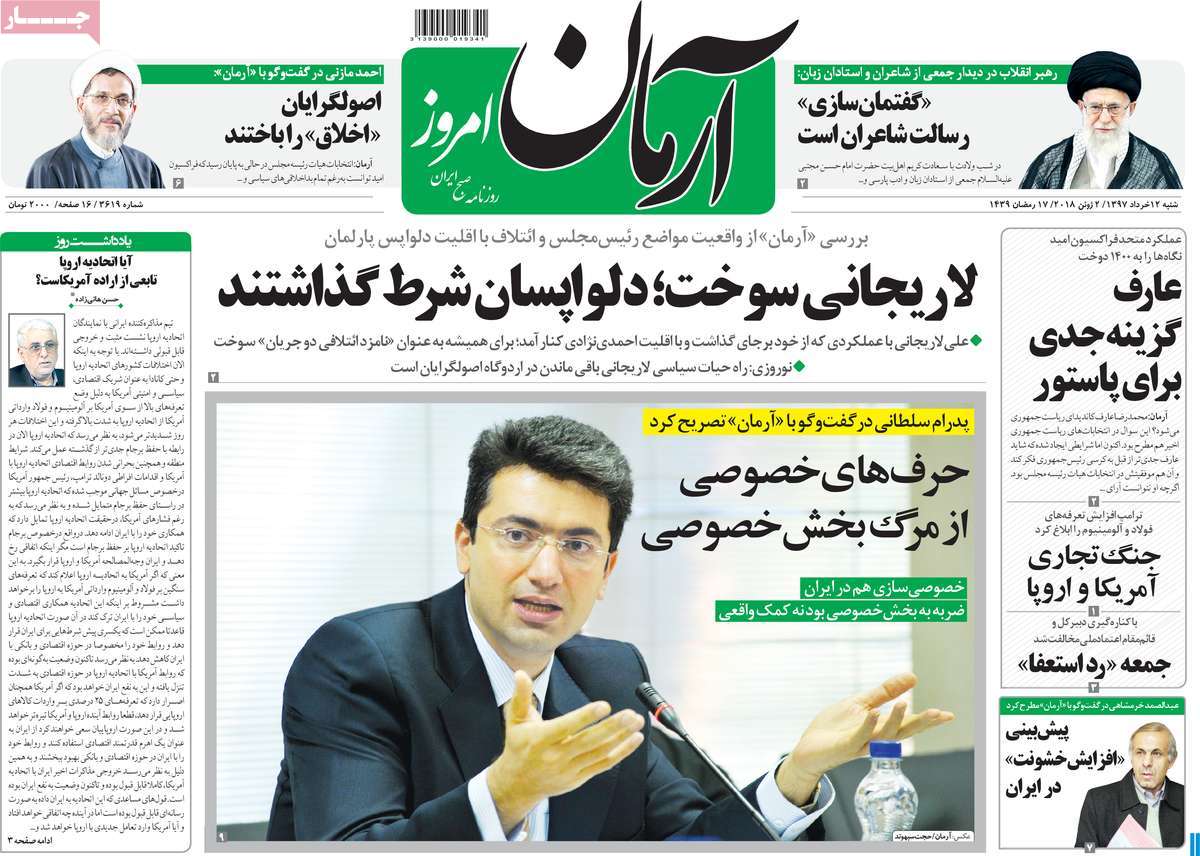
Several papers today discussed the re-election of Ali Larijani as the Speaker of Iran’s Parliament for the 11th consecutive time, and the fewer votes he secured compared with previous times. Some analysts believe the votes showed Larijani won’t have a great chance in the 2021 presidential elections.

Also a top story today was US President Donald Trump’s decision to impose heavy tariffs on the import of steel from Europe and the EU’s reaction to the move, which is widely described as the beginning of a trade war.

Europe’s ongoing efforts to save the Iran nuclear deal and resist against the US sanctions also received great coverage.

The above issues, as well as many more, are highlighted in the following headlines and top stories:


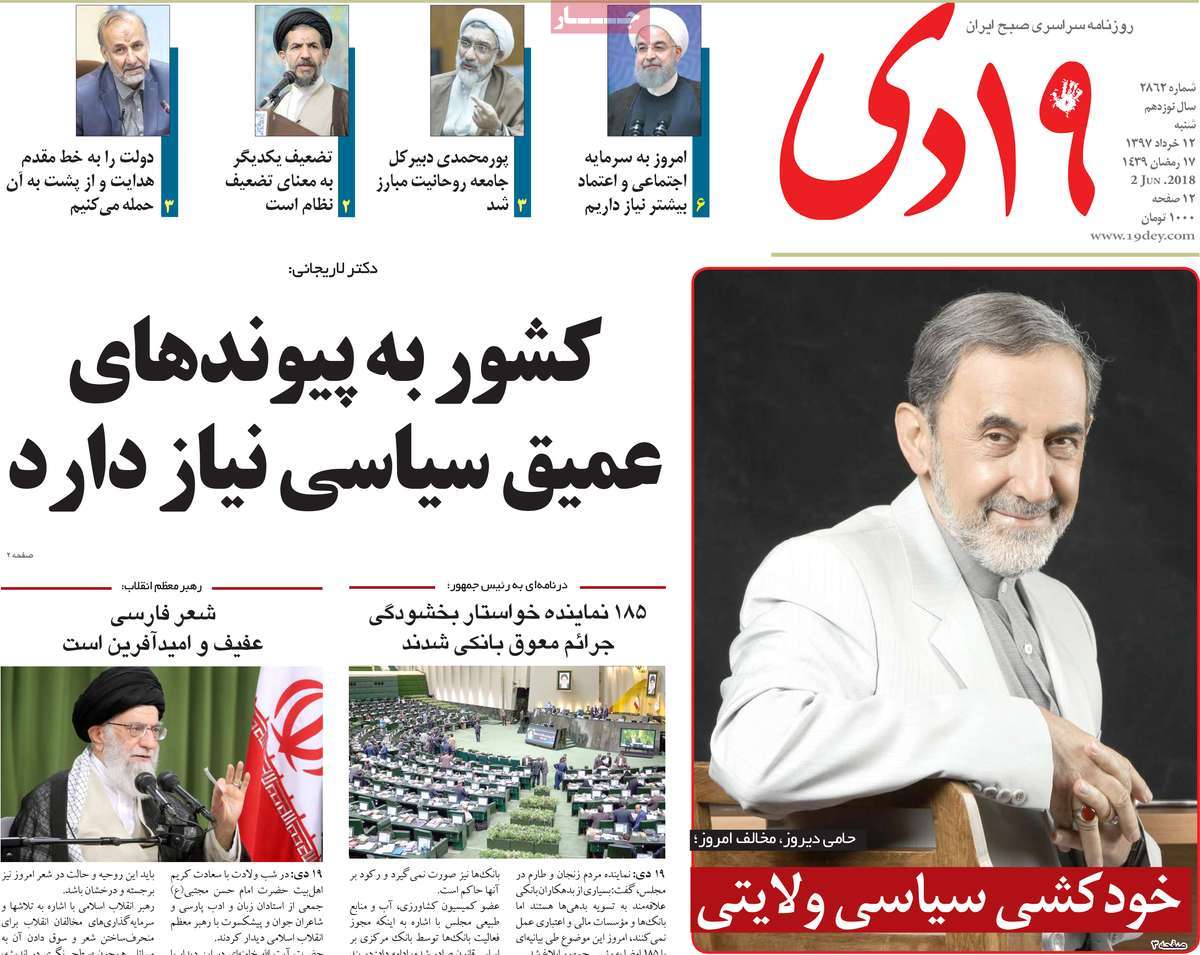
19 Dey:

1- Larijani: Iran Needs Deep Political Bonds
A Look at Iranian Newspaper Front Pages on June 2


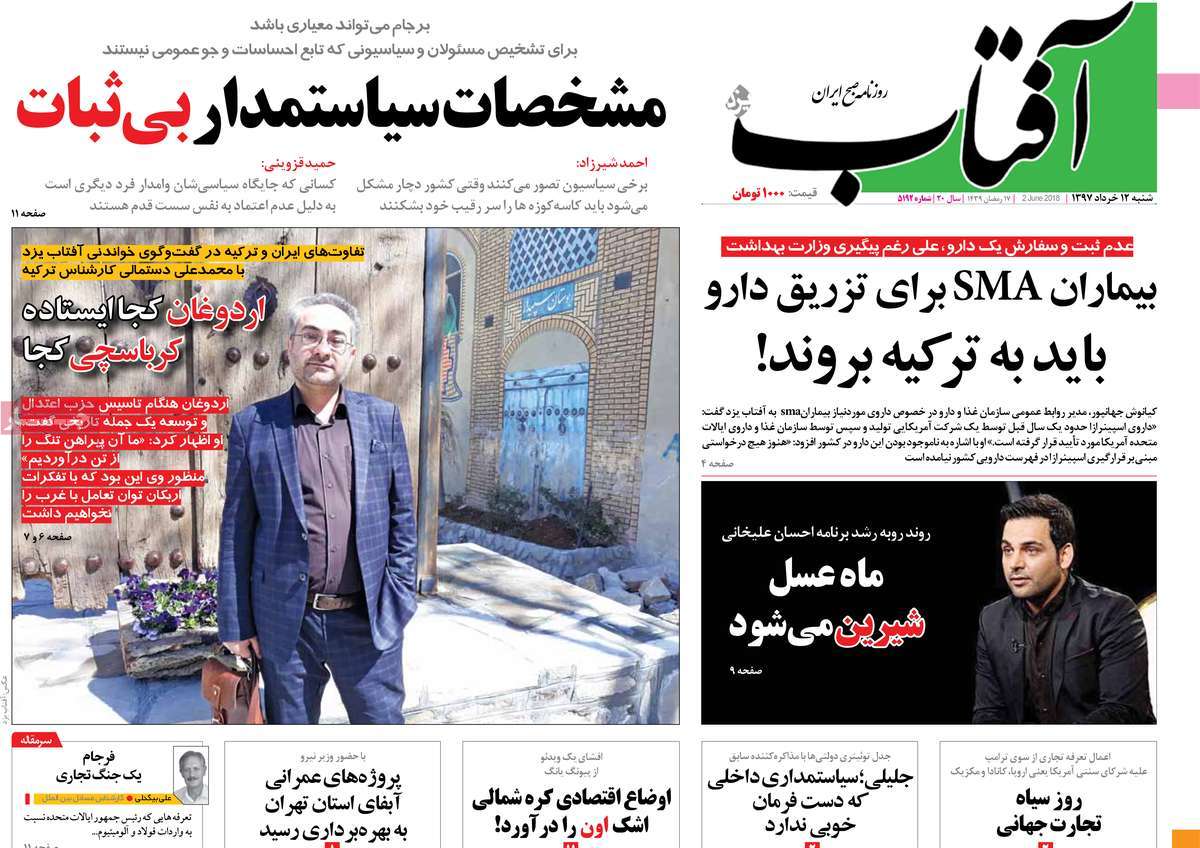
Aftab-e Yazd:

1- The Instable Politician

  • JCPOA Can Serve as Yardstick against Which to Identify Officials Not Influenced by Emotions
A Look at Iranian Newspaper Front Pages on June 2


Arman-e Emrooz:

1- Larijani No Longer an Option Endorsed by Both Factions for Presidency
A Look at Iranian Newspaper Front Pages on June 2


Donya-ye Eqtesad:

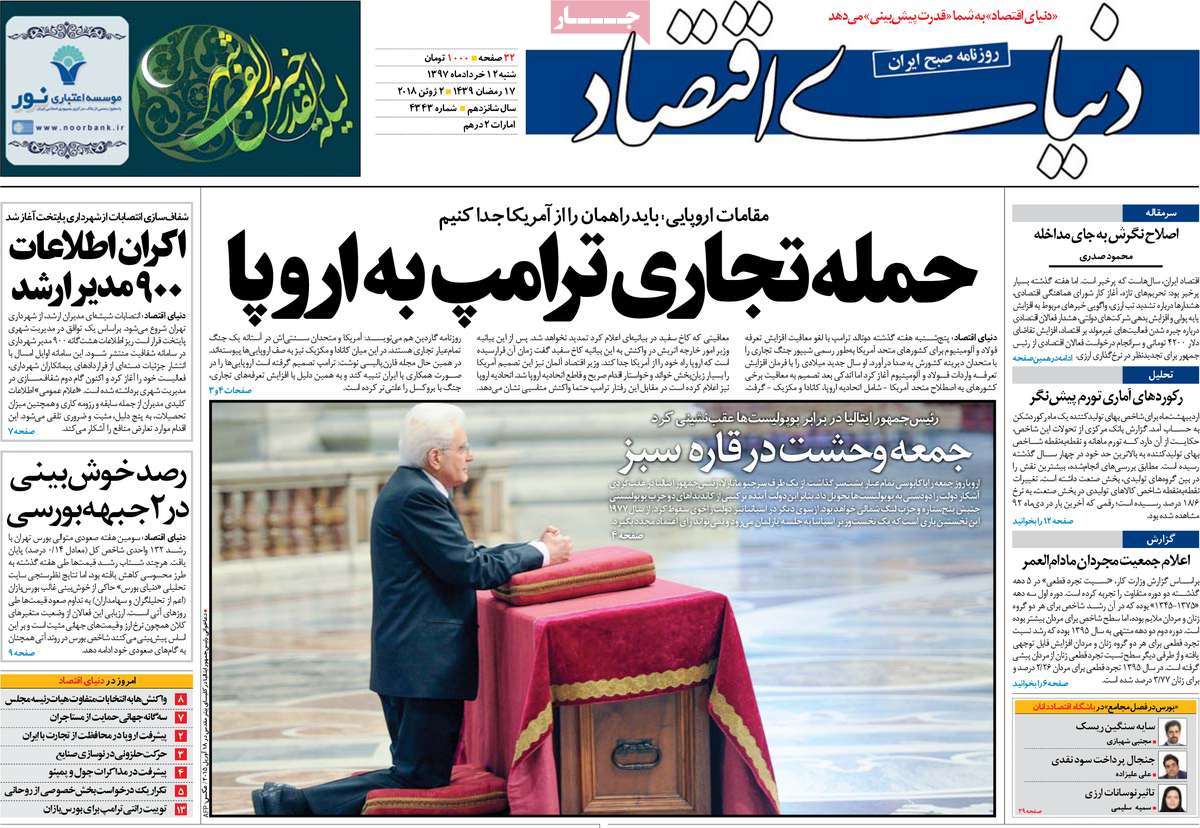
1- Friday of Terror in Europe

  • Italian President Backs Off against Populists
A Look at Iranian Newspaper Front Pages on June 2


Ebtekar:

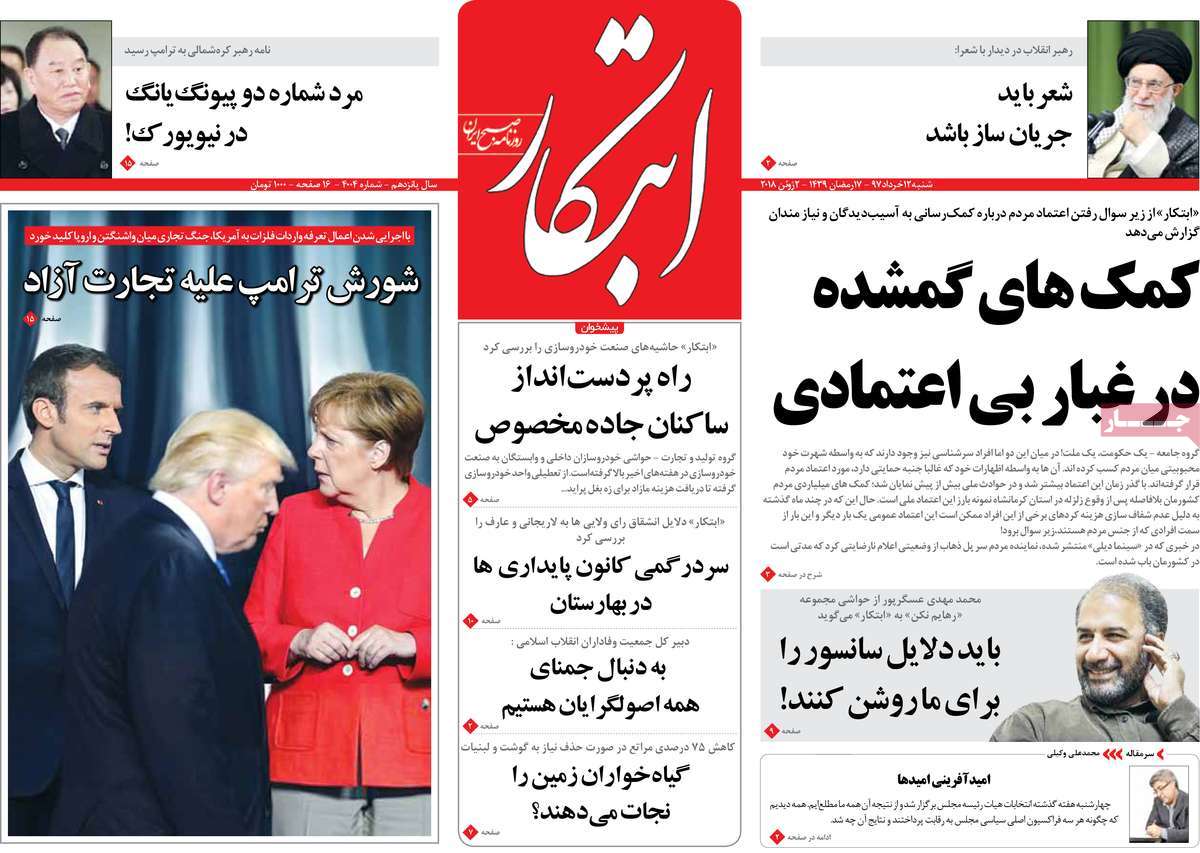
1- Trump’s Rebellion against Free Trade

2- Pyongyang’s Second Man in New York! N. Korean Leader’s Letter Delivered to Trump
A Look at Iranian Newspaper Front Pages on June 2


Etemad:

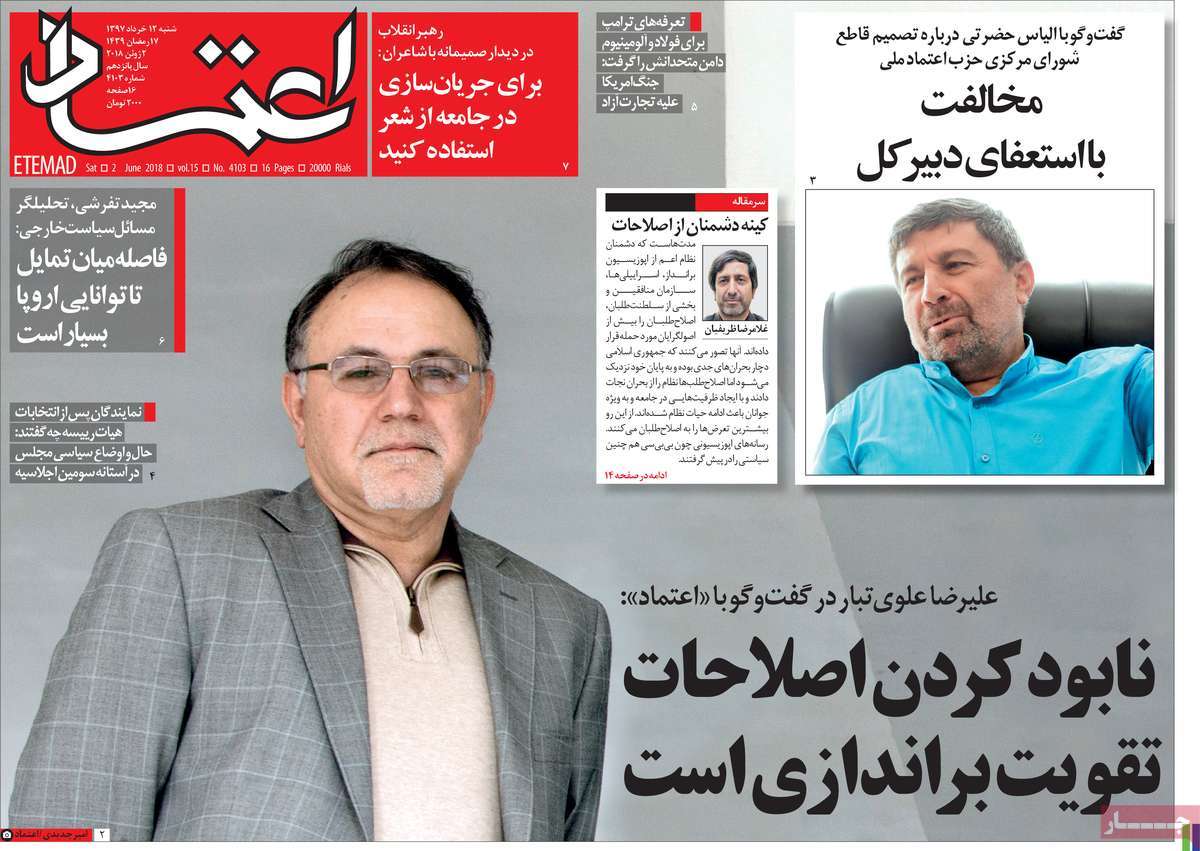
1- Analyst: Europe Not Capable Enough to Meet Our Demands
A Look at Iranian Newspaper Front Pages on June 2


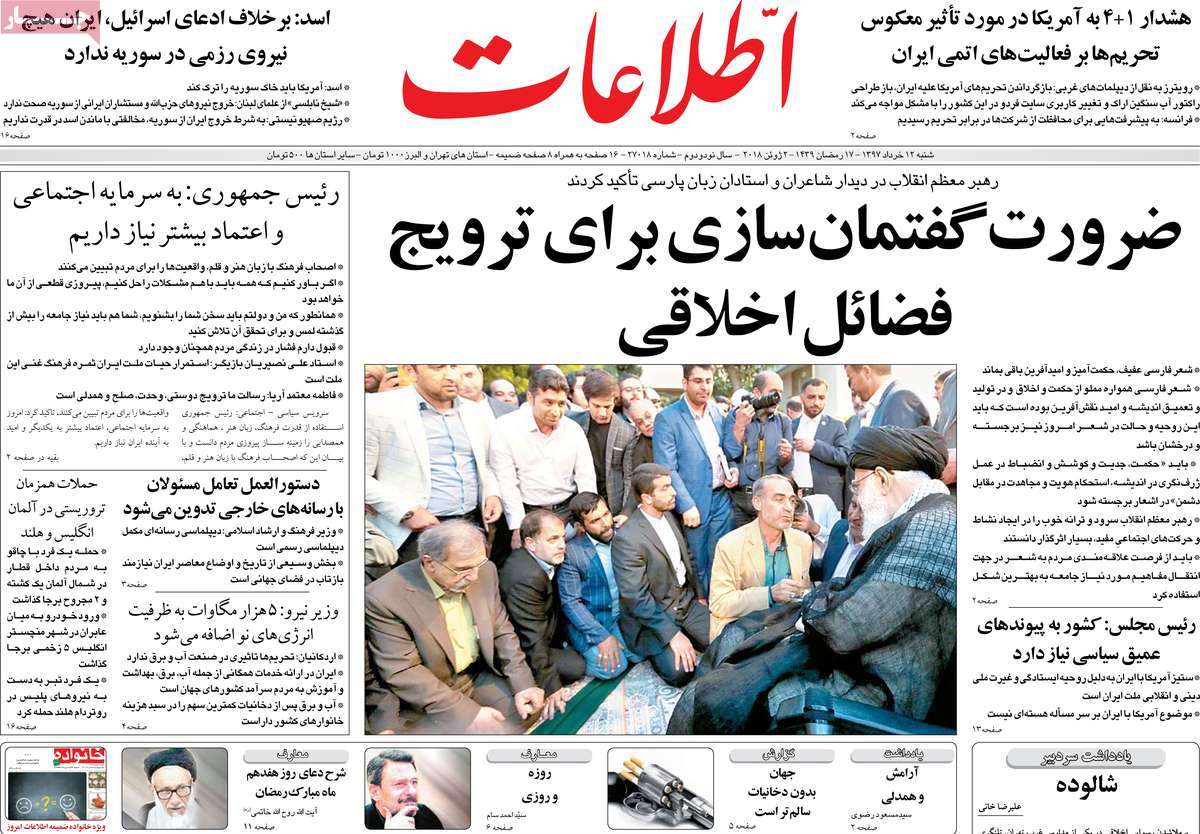
Ettela’at:

1- P4+1 Warns US about Opposite Effect of Sanctions on Iran’s Nuclear Activities

2- Assad: Iran Has No Military Forces in Syria unlike Israel’s Claim
A Look at Iranian Newspaper Front Pages on June 2


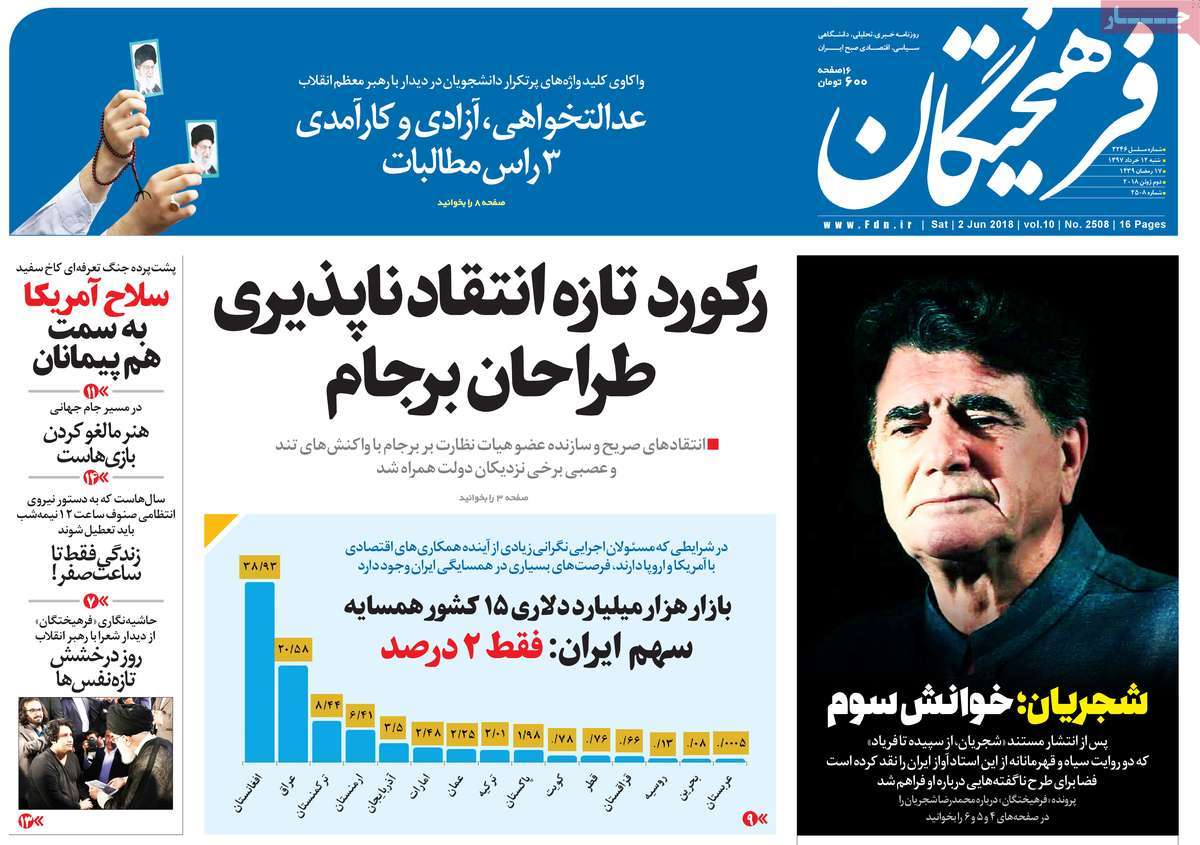
Farhikhtegan:

1- Iran Holds Only 2% of Neighbour’s $1,000-Billion Market

  • Officials Concerned about Future of Business Ties with US, Europe, While Missing Abundant Opportunities in Neighbouring Countries
A Look at Iranian Newspaper Front Pages on June 2


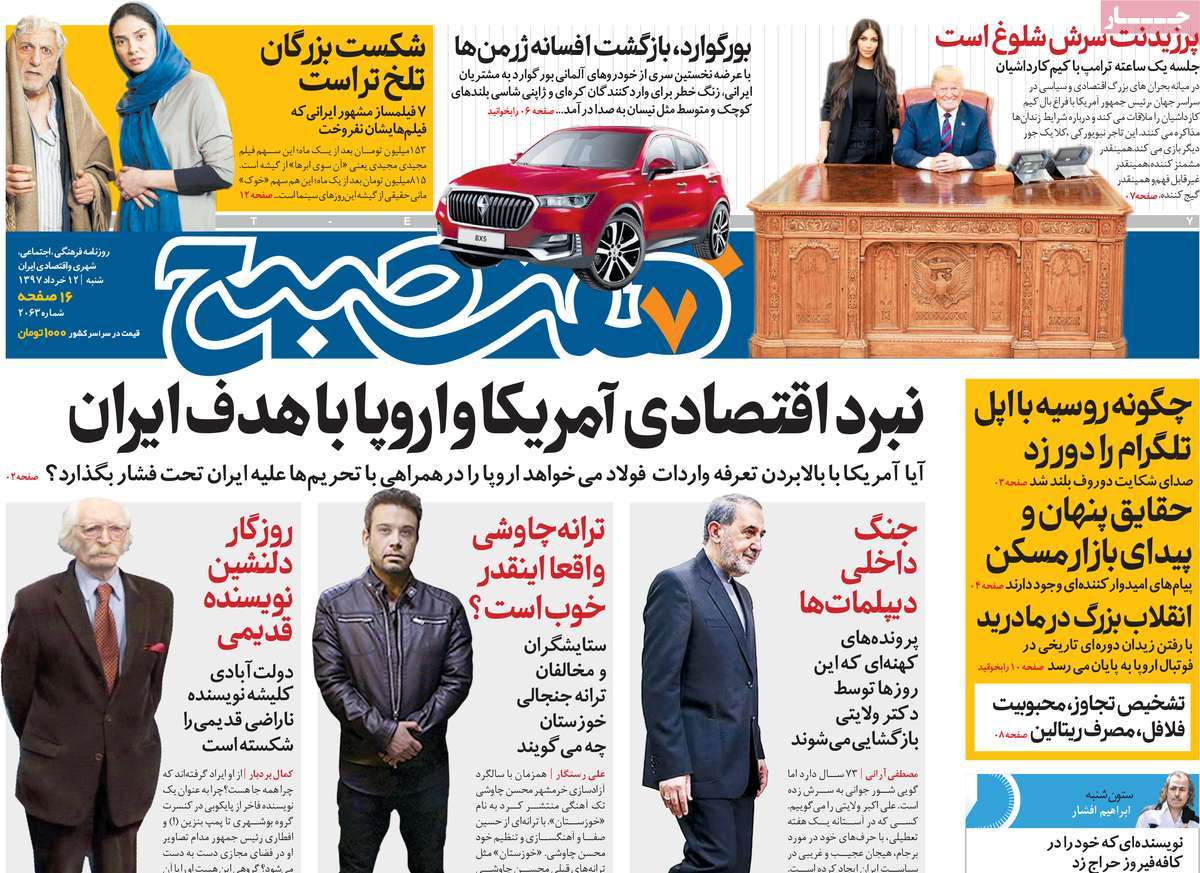
Haft-e Sobh:

1- Iran Target of US-Europe Economic Conflict
A Look at Iranian Newspaper Front Pages on June 2


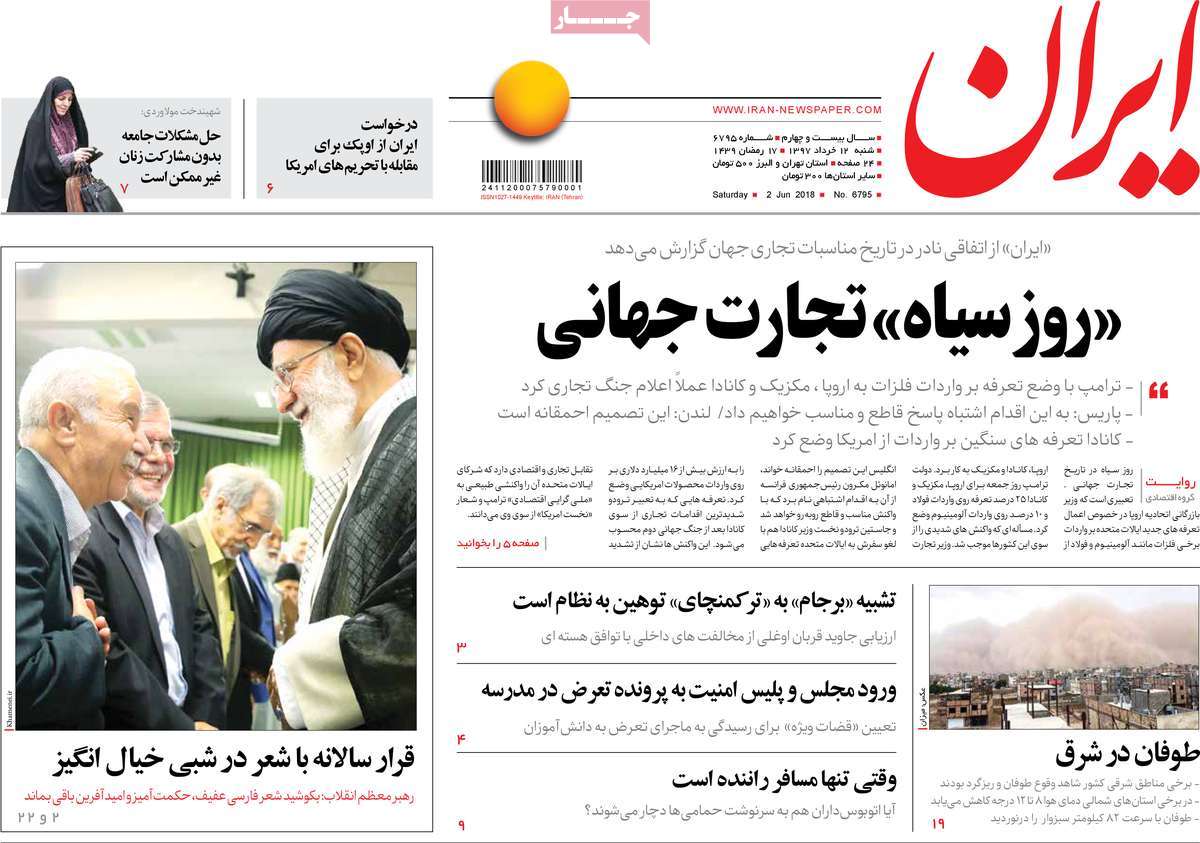
Iran:

1- Black Day of World Trade: Unprecedented Development in History of Global Trade Ties
A Look at Iranian Newspaper Front Pages on June 2


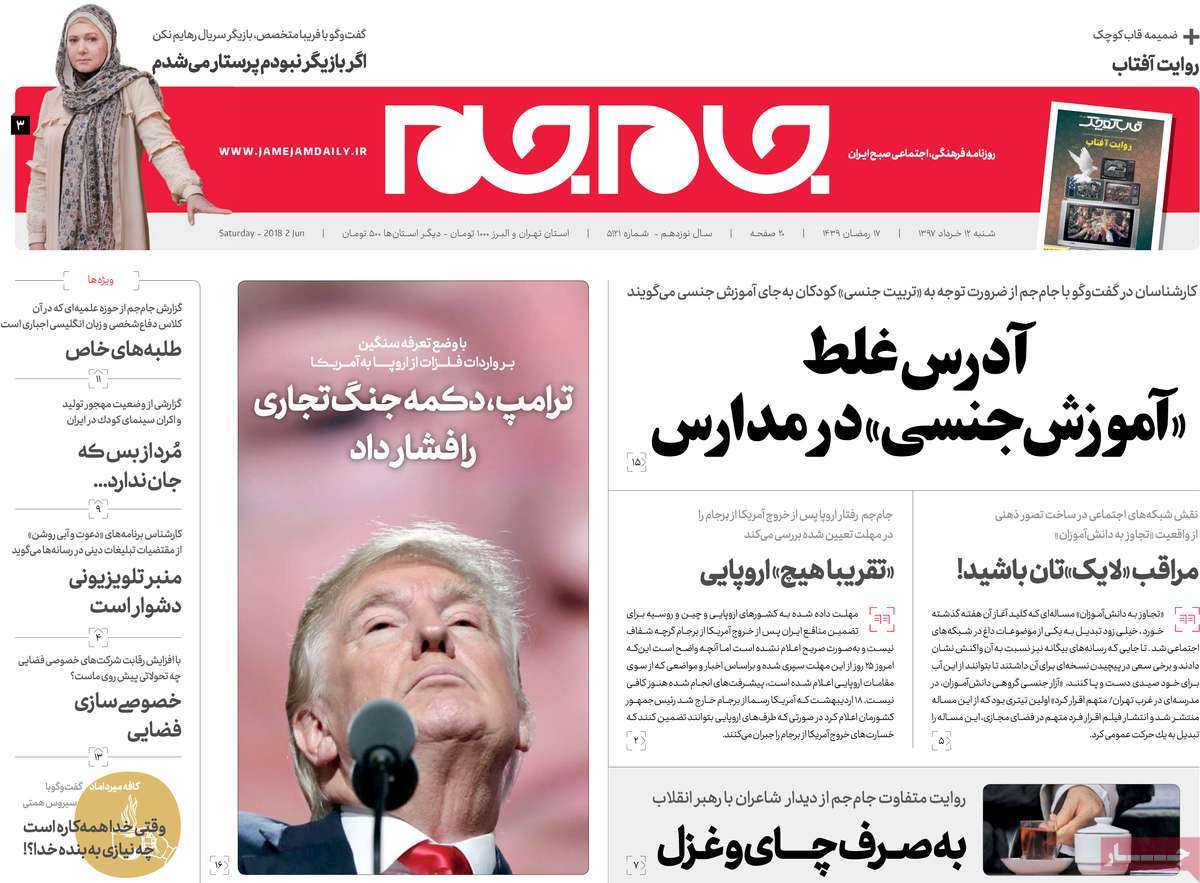
Jame Jam:

1- Trump Pushes Button of Trade War by Imposing Heavy Tariffs on Steel Imports from EU
A Look at Iranian Newspaper Front Pages on June 2


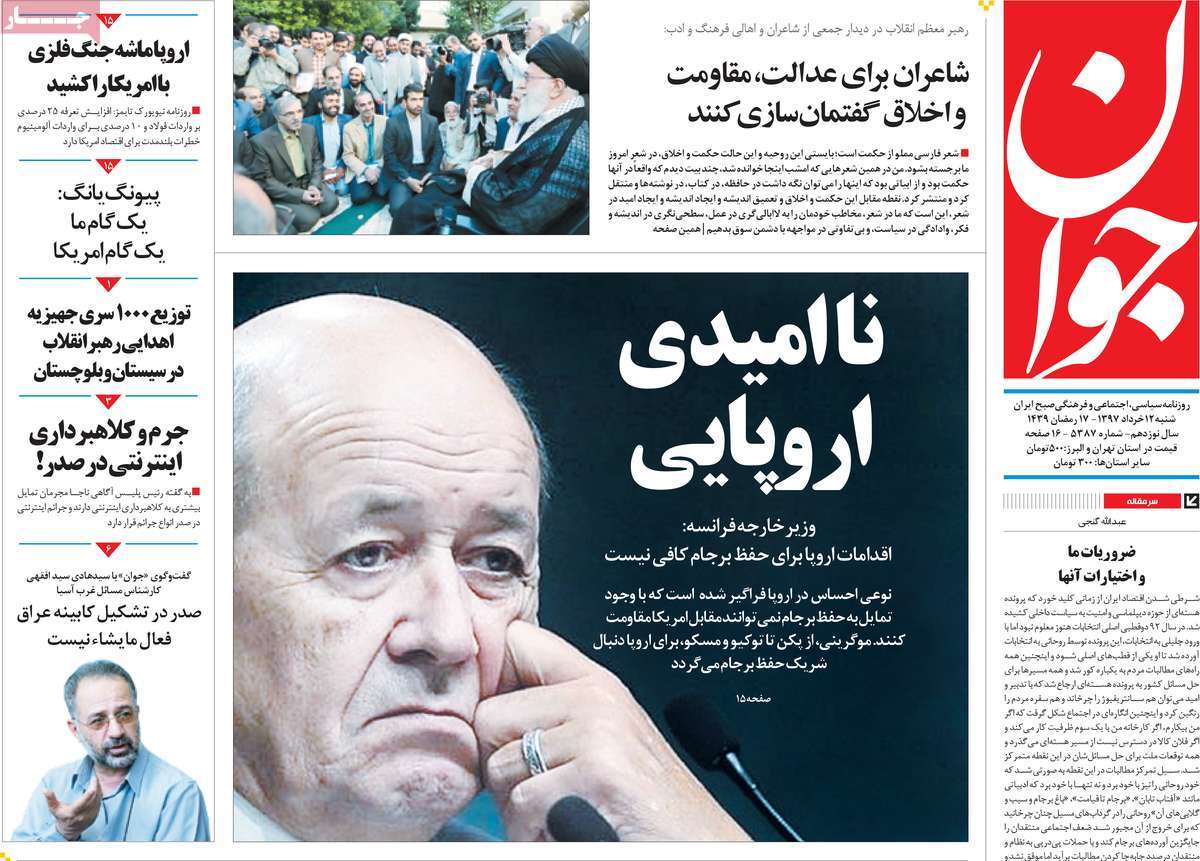
Javan:

1- European Frustration

  • French FM: Europe’s Efforts Not Enough to Save JCPOA
  • Europeans Feeling They Cannot Resist US despite Inclination to Save JCPOA
  • Mogherini Looking for Partners to Save JCPOA from Beijing to Tokyo, Moscow

2- Europe Pulls Trigger of Steel War against US
A Look at Iranian Newspaper Front Pages on June 2


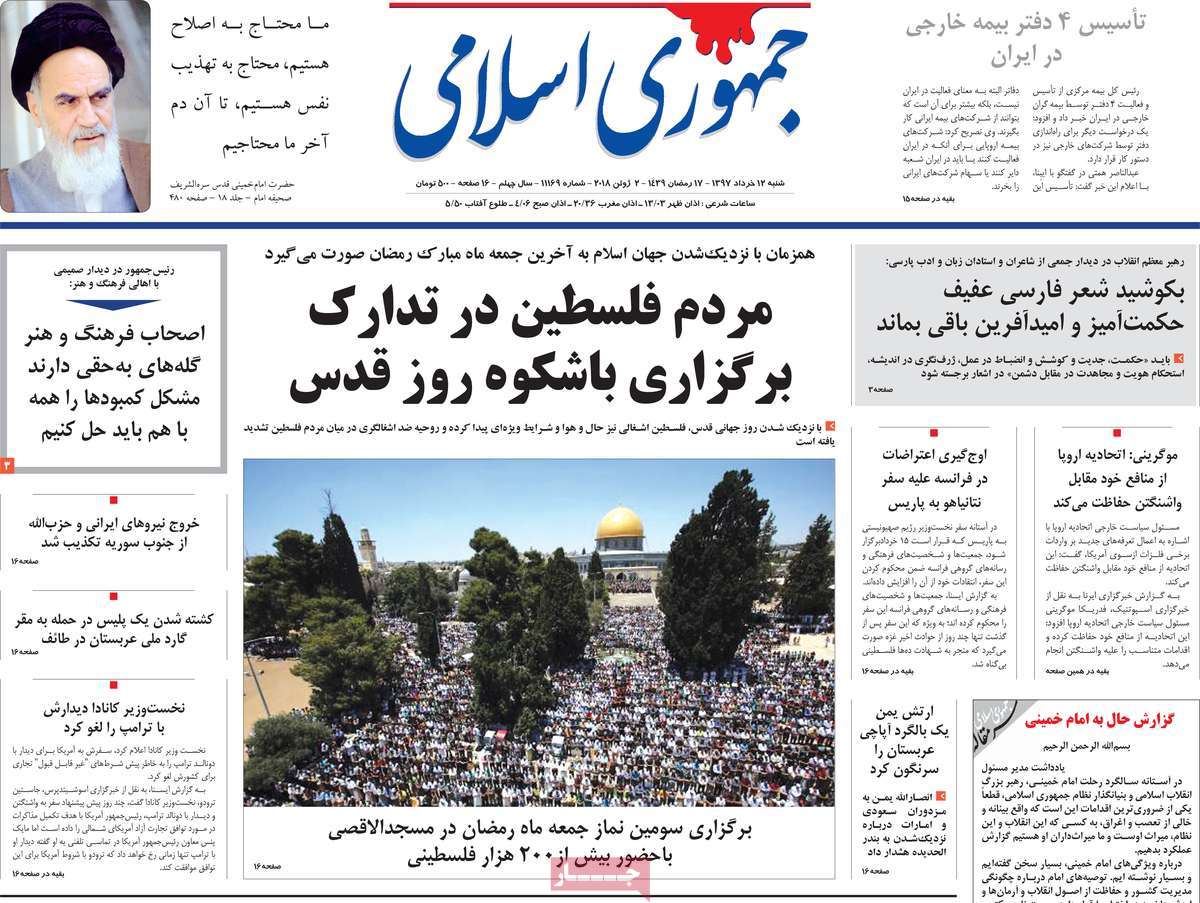
Jomhouri Eslami:

1- Palestinian People Preparing for Glorious Day of Quds
A Look at Iranian Newspaper Front Pages on June 2


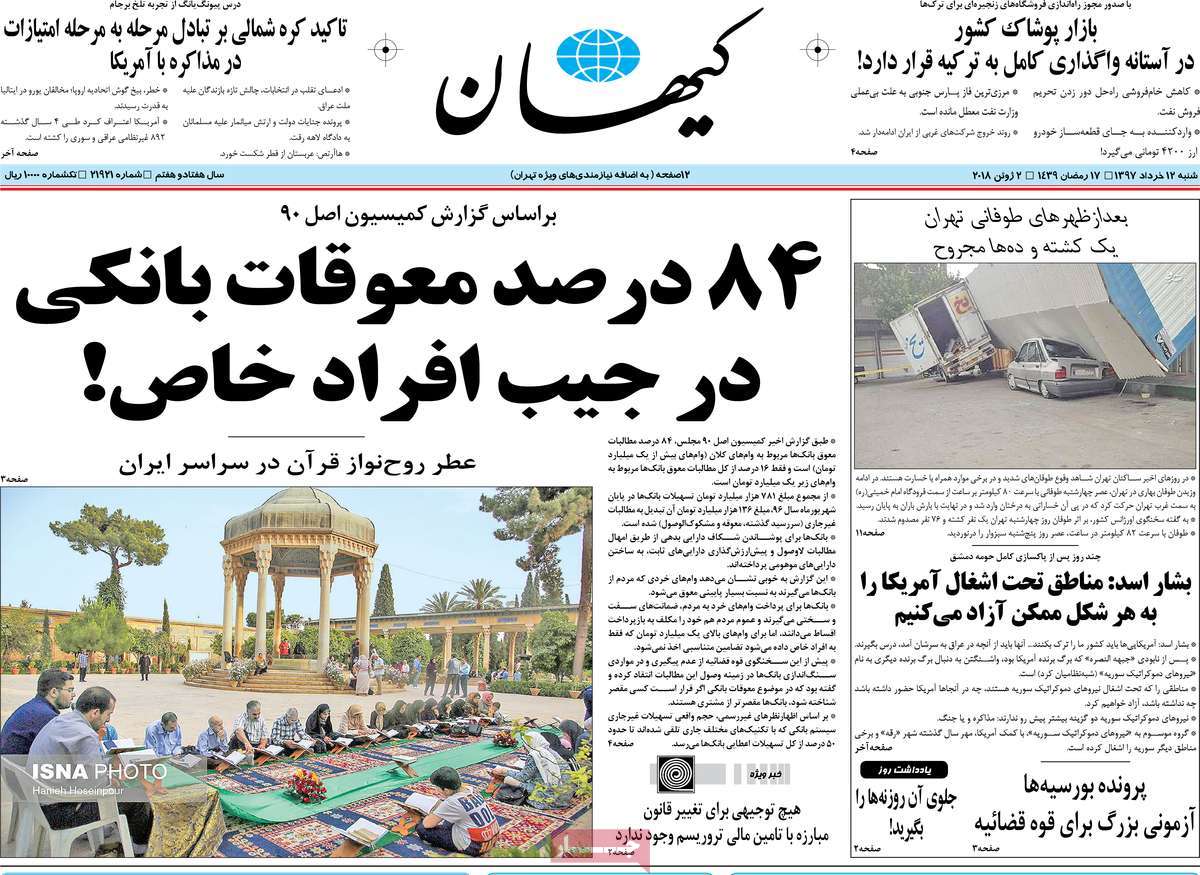
Kayhan:

1- Iran’s Apparel Market to Be Fully Seized by Turkey!

2- North Korea Stresses Step-by-Step Exchange of Concessions in Talks with US

3- Assad: We’ll Liberate Areas Occupied by US by any Means Possible
A Look at Iranian Newspaper Front Pages on June 2


Resalat:

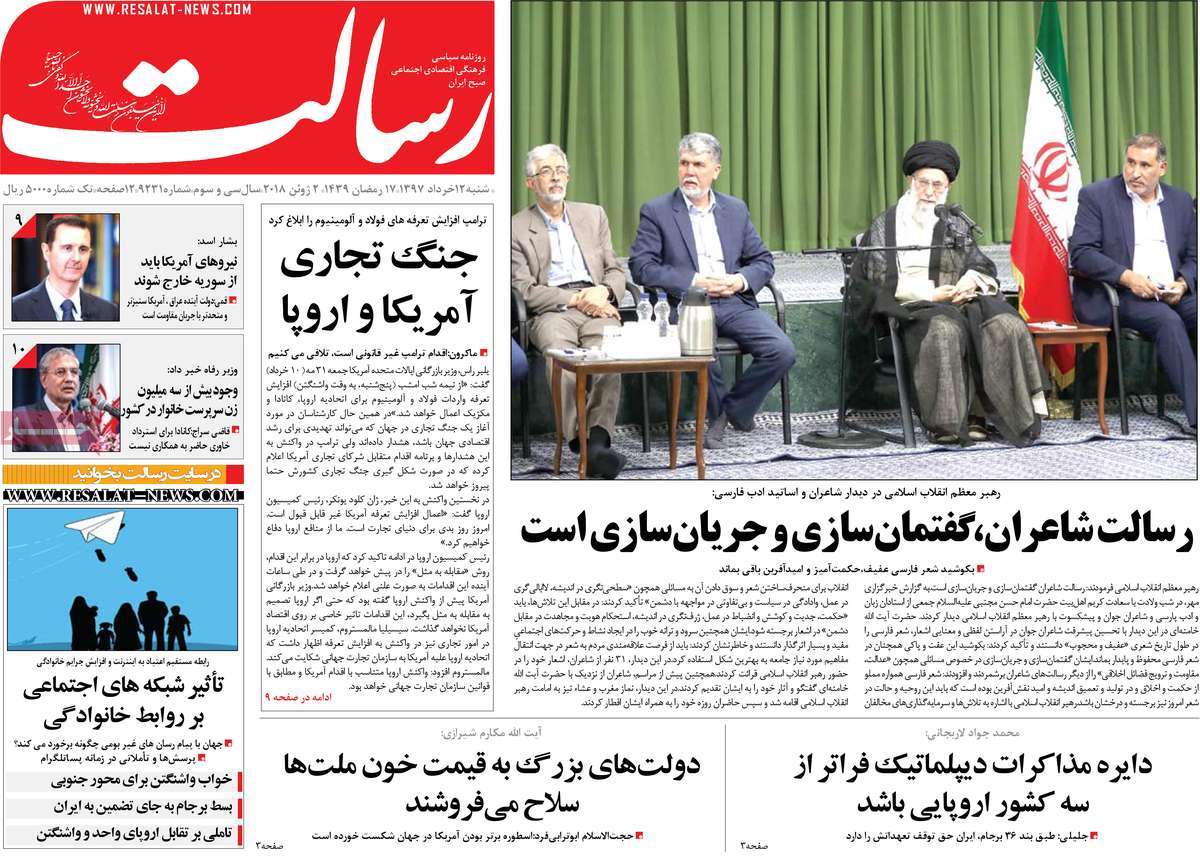
1- Ayatollah Makarem Shirazi: Big Governments Selling Weapons at Expense of People’s Blood
A Look at Iranian Newspaper Front Pages on June 2


Rooyesh-e Mellat:

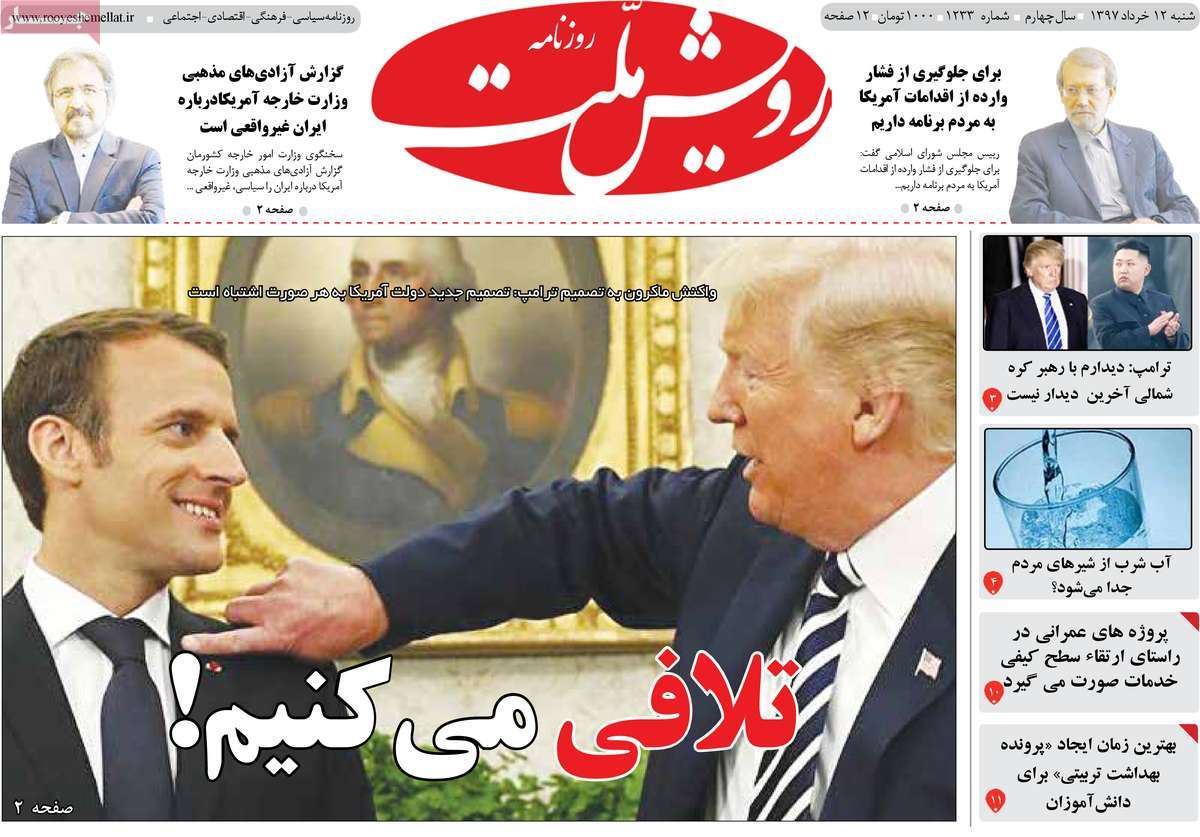
1- We’ll Retaliate!

  • Macron Calls Trump’s New US Decision a Mistake

2- Larijani: We Have Plans to Prevent US Measures from Putting People under Pressure
A Look at Iranian Newspaper Front Pages on June 2


Saheb Qalam:

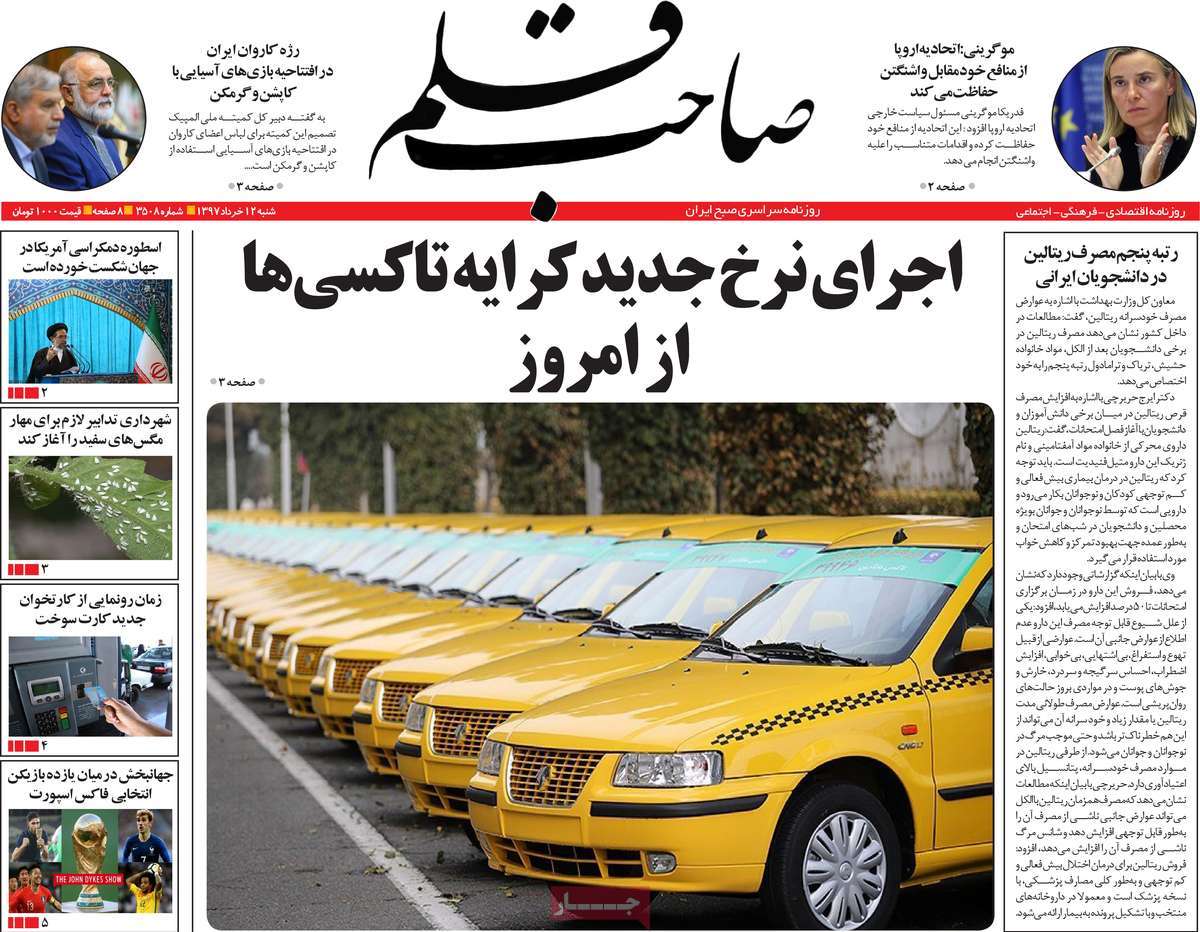
1- Mogherini: EU Protects Its Interests against Washington
A Look at Iranian Newspaper Front Pages on June 2


Setareh Sobh:

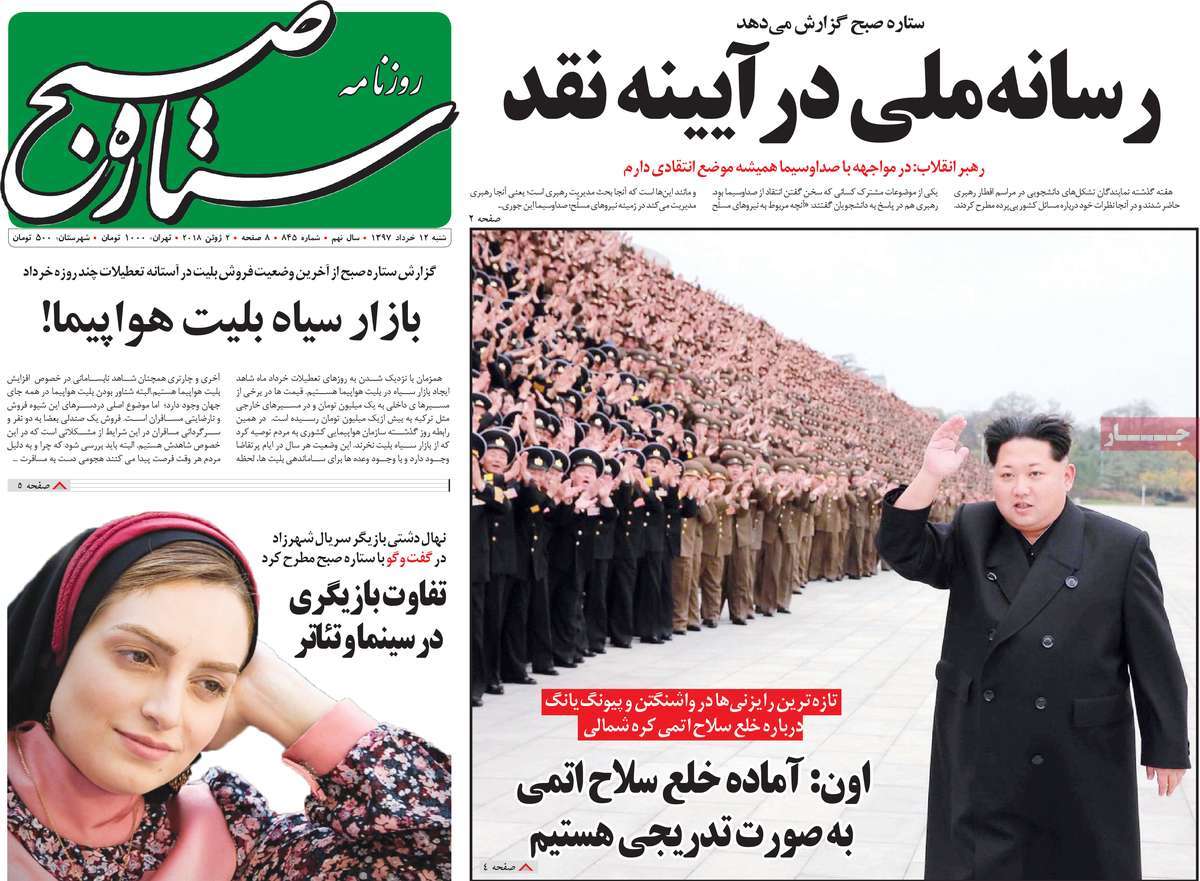
1- Kim Jong-un: We’re Ready for Gradual Nuclear Disarmament
A Look at Iranian Newspaper Front Pages on June 2


Shargh:

1- Conflict over Nuclear Car

  • Jalili: JCPOA Was Like Buying a Car for $1bn While Its Real Value Is $1m
  • Rouhani’s Aide: You Committed So Many Offences with This Car that Its Fines Exceeded Its Value

2- Trump against Buddies

3- Iran’s Top Security Official: Syria’s Security Equal to Our Own Security
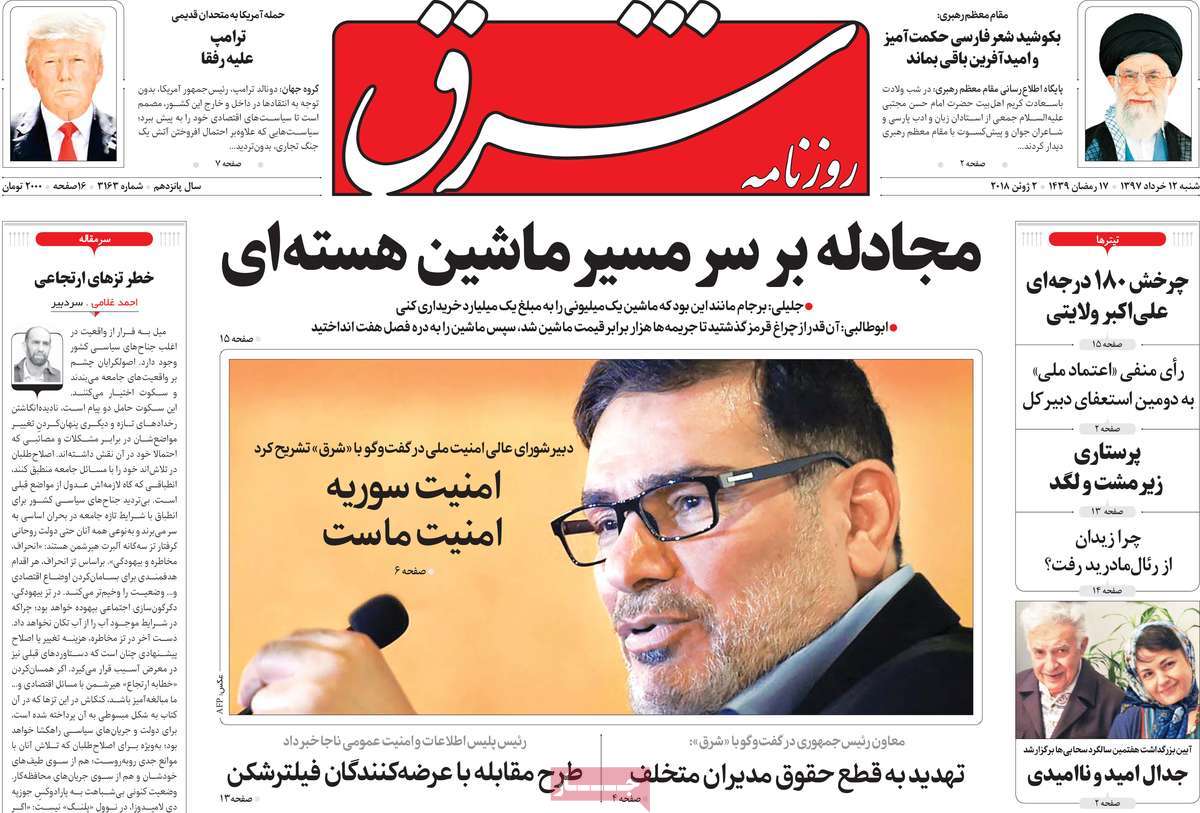
A Look at Iranian Newspaper Front Pages on June 2


Tejarat:

1- Iran Leader: Songs, Lyrics Effective in Creative Social Happiness
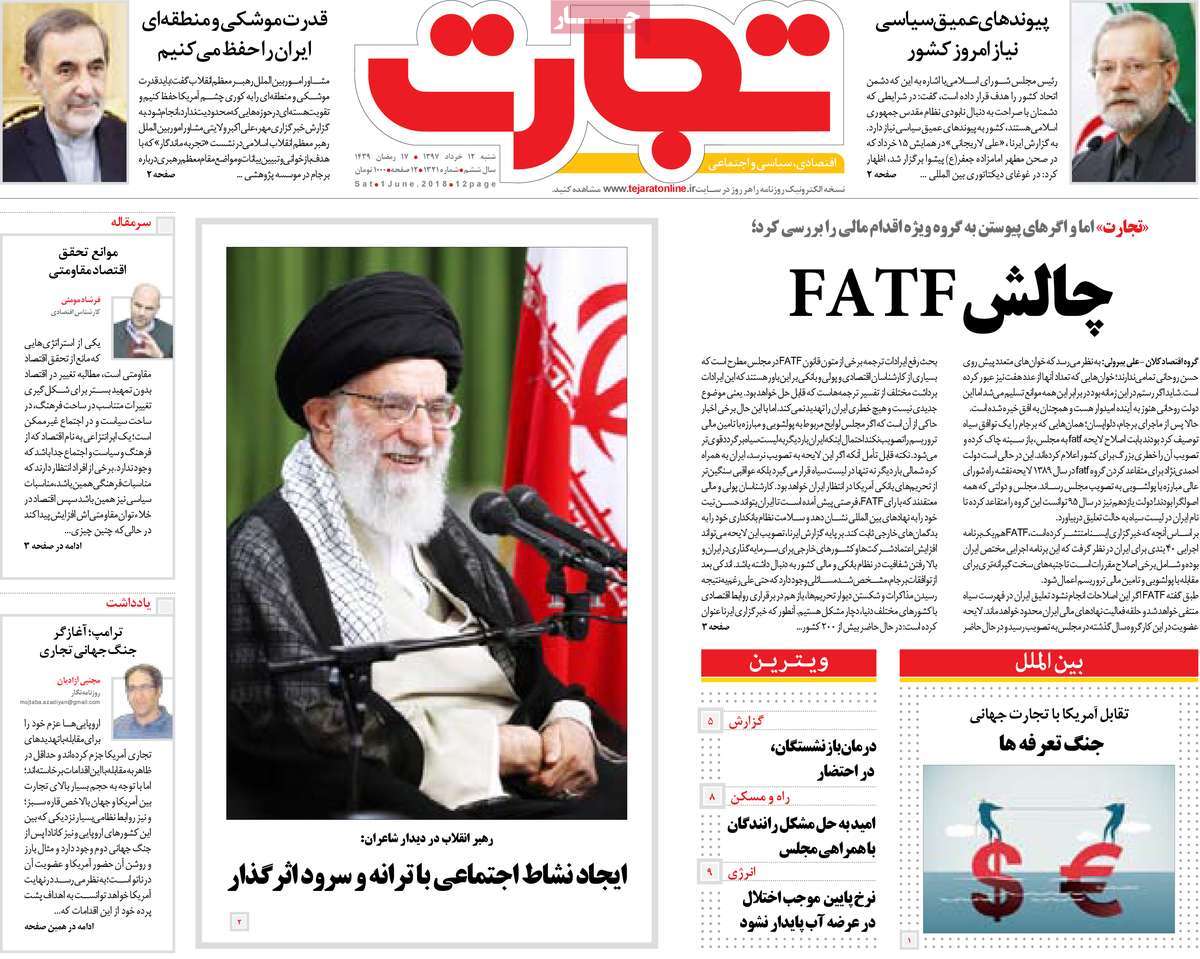
A Look at Iranian Newspaper Front Pages on June 2

Message of Zoroastrianism Must Be Heard Worldwide: Iran President

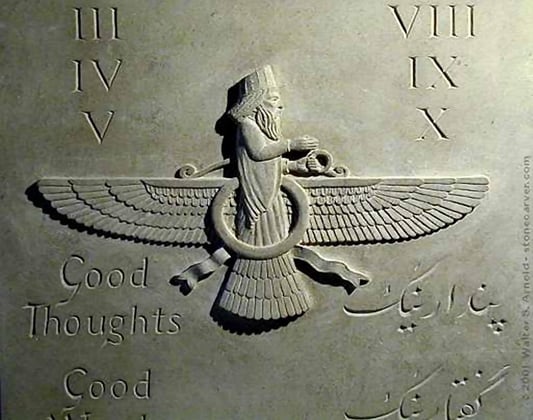
Faravahar, symbol of Zoroastrianism

In a Saturday message to the event, which was started in Perth in western Australia on Friday and will last until Monday, Rouhani said the congress is a source of pride for Iran, the birthplace of the Zoroaster and the first home of Zoroastrians.

The president said Zoroastrianism is a divine religion highly similar to Islam and other monotheistic religions, whose message needs to be heard.

Message of Zoroastrianism Must Be Heard Worldwide: Iran President“The world today needs moral teachings of prophets, including Zoroaster. The world ought to pay attention to [basic Zoroastrian] tenets of Good Thoughts, Good Words, Good Deeds,” he said.
“These tenets point out that our deeds are affected by our thoughts and we need to correct our thoughts before correcting our deeds and words,” he said.
The president said Zoroastrian teachings have greatly affected Iran’s culture, inspiring prominent intellectuals from Iranian polymath Avicenna to renewed poets Hafez and Rumi.

“The Zoroastrian teachings have been incorporated into Iranian culture … and have become parts of characteristics of Iranians from all ethnicities and races,” he said.
“We must be grateful for these common roots that connects us together and shape our deeds and behaviour”, he said.

“I hope such gatherings could [help] convey the message of this great religion to the whole world,” the President concluded.

Rouhani finally wished happiness and prosperity for all Zoroastrians in the world, particularly the Parsi community of India.

Iranian Researchers Develop Stress Management Software

The software was designed by researchers at Tarbiat Modares University, a report by ISNA said on Saturday.

“This device is a receiver of brain signals, and measures brain signals using an electrode and sends the data to the software via Bluetooth,” said Farzaneh Yousefi, the CEO of the knowledge-based company which has developed the software.

Another top executive at the company also says the new method has advantages over conventional methods.

“The software we developed works with single-channel headsets, which means it can be used anywhere easily. For example, sportspersons can register their signals at the gym or even at home and see the analyses of their brain signals in the software; however, they had to refer to a clinic in old methods,” says the senior executive.

For a brief review of Iran’s achievements in various fields of science and technology, check the book “Science and Technology in Iran: A Brief Review

According to the CEO, the software can be used on Android systems for now.

According to Yousefi, the software can be used to monitor sleepiness in train drivers and to upgrade the performance of the brain in professional athletes.

The software was developed by one of the knowledge-based companies at the IT Research Centre of Tarbiat Modares University.

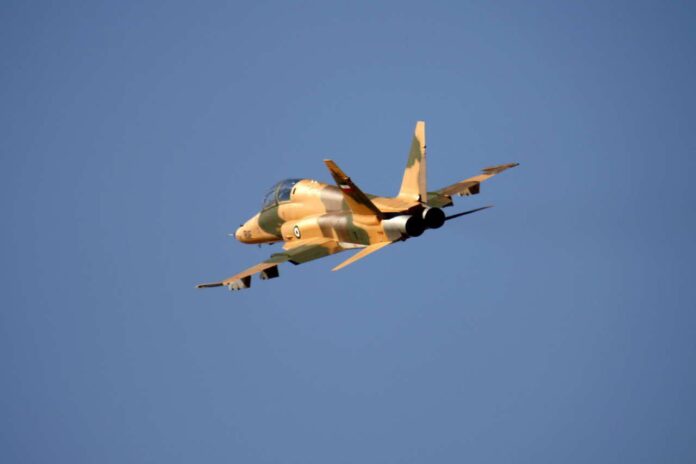
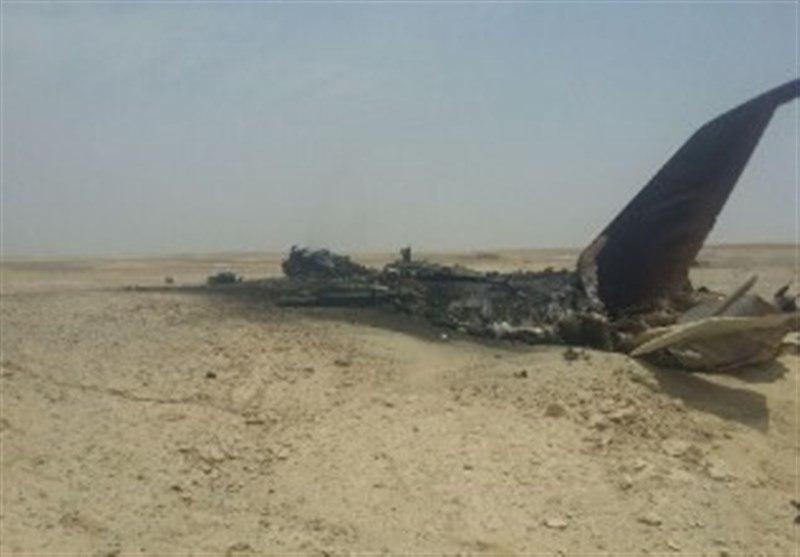
Iranian Army’s F7 Fighter Jet Crashes in Isfahan Province

The plane has crashed near the city of Hassanabad in Jarqavieh Olya district, Isfahan province.

The two pilots on board had ejected before the crash, and were found alive near the crash scene.

According to local governor Hossein Behzadfar, the trainer jet’s pilots have been transferred to a hospital in Isfahan.

Iranian Army’s F7 Fighter Jet Crashes in Isfahan Province

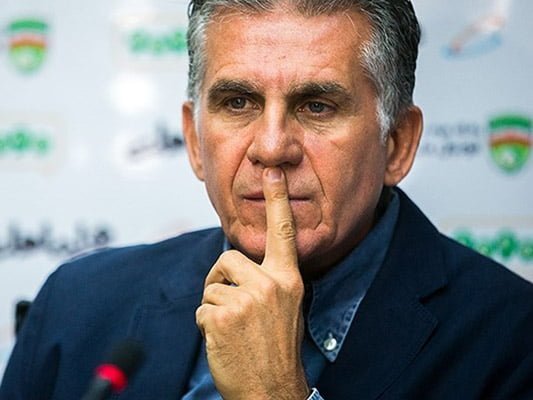
Queiroz Blasts “Cruel Sanctions” Hampering Iran Preparation for FIFA World Cup

Carlos Queiroz

Queiroz made the statement Saturday while speaking to reporters before a training session of Iran’s national football team, rejecting criticism that the Iranian football federation is neglecting to properly prepare Team Melli for the world tournament.

“Some people say why don’t we hold a friendly match with Italy. This is embarrassing. They know all issues very well,” he said.

“They know we don’t have necessary resources [and] no team plays against us. They know we face cruel sanctions,” Queiroz said, according to a report by Fars News Agency.

Queiroz was referring to unilateral sanctions US has placed on Iran for years. Washington has also vowed to impose the “highest level” of economic bans on Tehran unless it agrees to 12 demands.

Team Melli has so far held few friendly matches comparing to other participants in the world cup, worrying football fans who believe such matches play a big role in testing players’ capabilities.

As part of preparations for the 2018 World Cup, Iran was to hold friendly matches with Greece and Kosovo last week. But both matches were canceled.

In its last match before the tournament, Iran is to face Lithuania on Friday.

The 2018 FIFA World Cup will take place from June 14 to July 15.

A total of 64 matches will be played in 12 venues located in 11 cities.

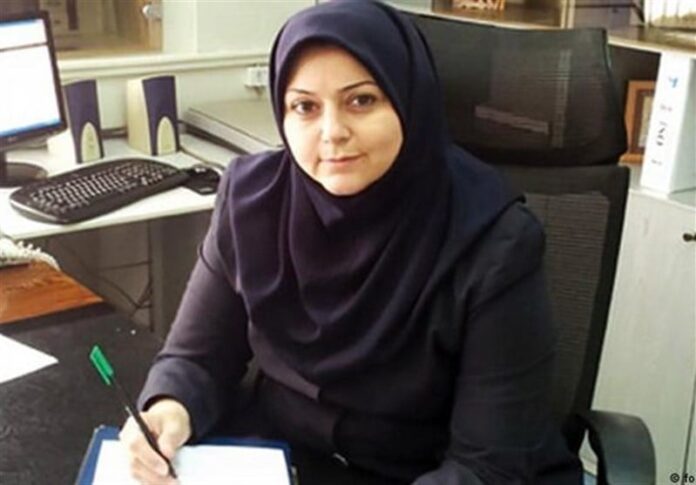
Tough Days ahead of Iran’s Civil Aviation: Iran Air CEO

In comments at a meeting of judicial officials, held to discuss the reasons for frequent flight delays, Iran Air CEO Farzaneh Sharafbafi said the average age of the country’s fleet of passenger planes is 24 years, noting that one should not expect too much from an industry that has not been well supported in the past.

The conditions of civil aviation industry in Iraq, Afghanistan and other neighbors are better than in Iran, she added, saying Iran is suffering from sanctions and has to face problems for supplying simple aircraft components.

Soon, the Iranian foreign flights will be denied fuel, and the country will have to deliver cash in suitcases to supply fuel, Sharafbafi added.

She also said it is not fair to blame only the pilots for the flight delays, deploring a decision by a judge to handcuff a pilot for delay.

Iran, trying to renovate its aging fleet of passenger planes, is gradually receiving the aircraft purchased from Airbus and ATR, following the implementation of the JCPOA, a nuclear agreement from which the US government withdrew in May 2018.

During a January 2016 visit to Paris by Iranian President Hassan Rouhani, Tehran signed a major contract with Airbus worth about $27 billion to buy 118 planes.

Later in June 2016, Iran sealed another deal worth around $25 billion with the US aerospace heavyweight, Boeing, for the purchase of 100 passenger planes.

Since the coming into force of the JCPOA, Iran has received more than 10 new planes, including three Airbus passenger planes and several ATR turboprops.

But the US withdrawal from the JCPOA and its president’s move to impose new sanctions on Tehran has discouraged major companies from working with Iran.

“Israel Directly Involved in Killing Iranian Military Advisors in Syria”

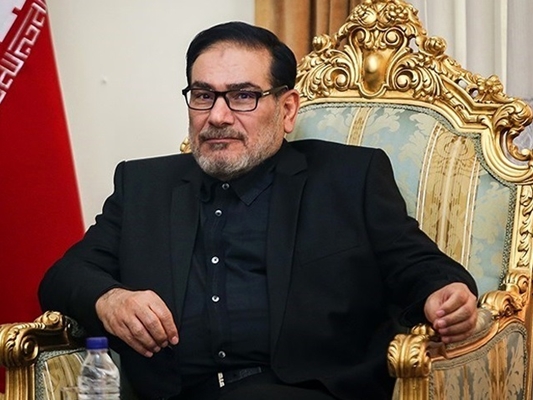
Signs of US Decline Clearer Than Ever: Iran Official

Shamkhani, the secretary of Iran’s Supreme National Security Council, made the comment in an interview with Al Alam News Network.

“The Israeli regime took direct actions to assassinate [Iranian] nuclear scientists, produce the Stuxnet [computer] virus, and kill our [military] advisors in Syria,” said Shamkhani.

He said Israel is a “sworn enemy” of the Islamic Republic of Iran and has overtly threatened to take military action against the country over the past 40 years.

The senior official underlined the Israeli regime has also supported dissident and terrorist groups as well as the former Iraqi strongman Saddam Hussein’s regime.

“Israel’s hostile approach towards Iran has always been there,” said Shamkhani.

The official then touched upon Tel Aviv’s ratcheting up its anti-Iran rhetoric, so much so that its verbal threat against Tehran has turned into a marked threat.

“I believe the change in the tone of [the language used by] the Israeli regime’s officials is due to their frustration resulting from back-to-back defeats and failures on different fronts,” he said.
He underlined that terrorism contributed heavily to Israel’s security.

“The emergence of Takfiri terrorism in the region, bloodshed on the frontiers of the Muslim world, together with the destruction of important parts of the economic and military infrastructure of Islamic countries resulted in … golden years for Israel’s security,” Shamkhani noted.

“Now, with Takfiri terrorists being defeated in Syria and Iraq, for which Israel partly blames Iran, this golden period has come to an end, and Palestine has turned into the Muslim world’s most pressing issue once again,” he noted.

He said Iran will do whatever it takes to ensure its security.

“We will vigilantly take whatever actions and measures necessary to ensure Iran’s interests and security against any aggressor,” he said.
Elsewhere in his remarks, the top official touched upon Syria’s missile attack which came in response to Tel Aviv’s strikes.

“Over the past 25 years, the Zionist regime had not received any proper response to its acts of aggression such as its strikes against Syrian and Iraqi nuclear facilities, its attack on the Turkish ship MV Mavi Marmara, and shooting down an Egyptian plane,” said Shamkhani.

“Today, the Syrian army and government have such high self-confidence and power that they can shoot down the aircraft of the Israeli regime, hit its missiles in the sky and, thanks to intelligence operations, target and destroy key military sites of this regime in retaliatory operations immediately after Israeli aggression,” he noted.

“The Arab world and Islamic world take pride in this,” he said.
He said the Syrian missile attack also had the message that the “hit-and-run” era is over, and the Israeli regime should be answerable for its behaviour.

“This power and capability is the achievement of the axis of resistance and has created a new level of balance of power in the region,” he said.
Shamkhani then referred to Russia’s plan for Syrian army troops to be stationed on the border with Jordan.

“We strongly back Russia’s efforts to drive out terrorists from the Syria-Jordan border and to get the Syrian army to gain control of the border area,” he said.
“We regard this move as a positive step toward the Syrian government’s further control over the territories occupied by terrorist groups,” he said.
Elsewhere in his remarks, Shamkhani touched upon the victories of Syrian troops in their operations.

He said the back-to-back gains made by the Syrian army and popular forces on different fronts led to the full liberation of territories in the south of the country as well as the Rif Dimashq Governorate.

“With this new equation, an important part of the Syrian army units stationed in the south of the country can be redeployed to purge the remnants of terrorist elements from the north of the country and to counter the Israeli regime’s attacks,” he said.

“Therefore, the recent gains on the ground in Syria will have a strategic impact on security equations in the future,” the top official noted.

He further reiterated that Iranian military advisors have a limited presence in Syria at the request of the Syrian government to help in the fight against terrorism.

“Our advisory assistance will continue as long as the Syrian government asks us to do so,” he said.
He stressed that Iran regards the security of Syria as its own, and hence, the maintenance of stability in that country is an accomplishment for Iran as well.

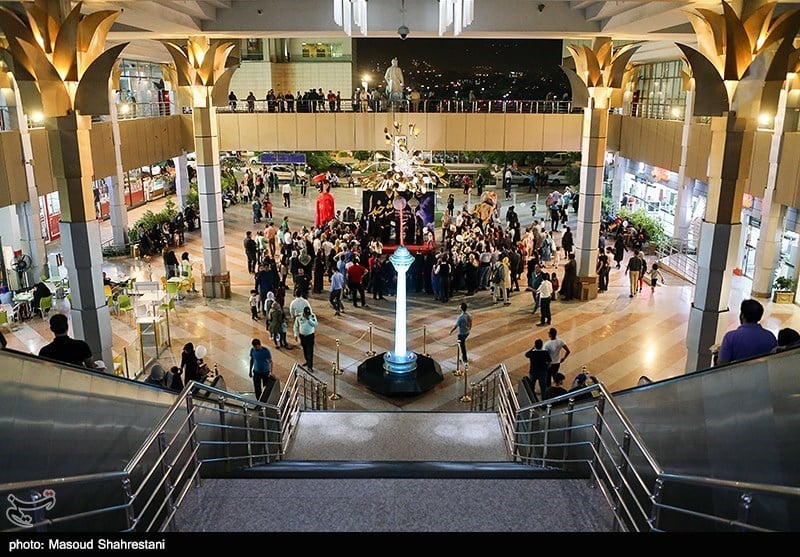
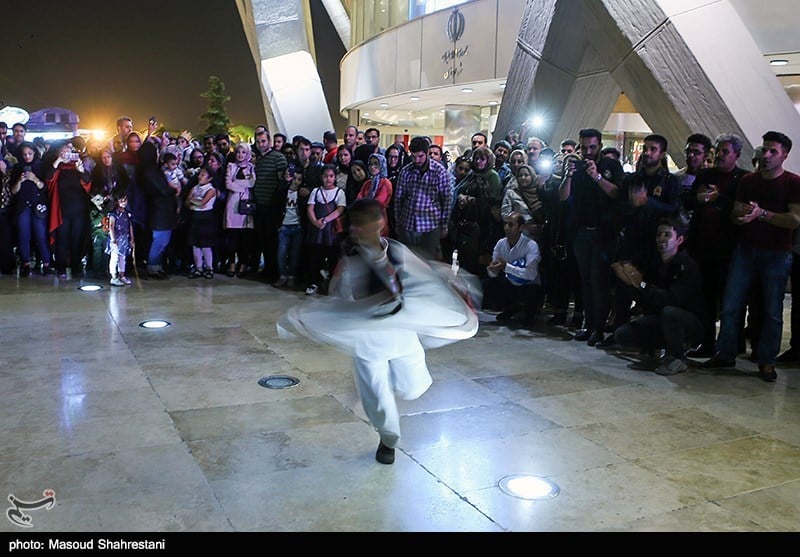
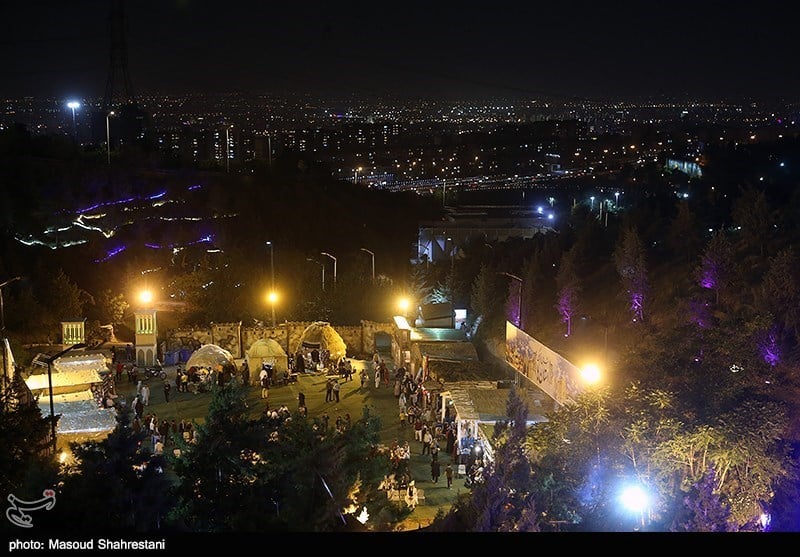
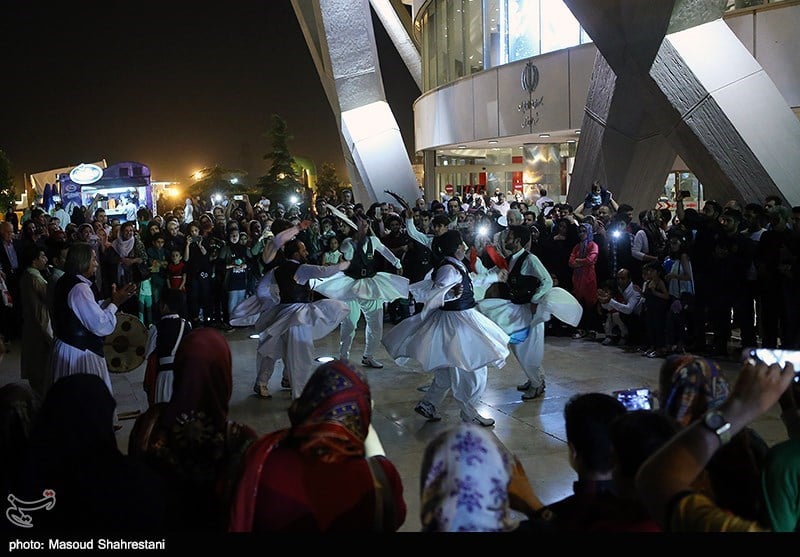
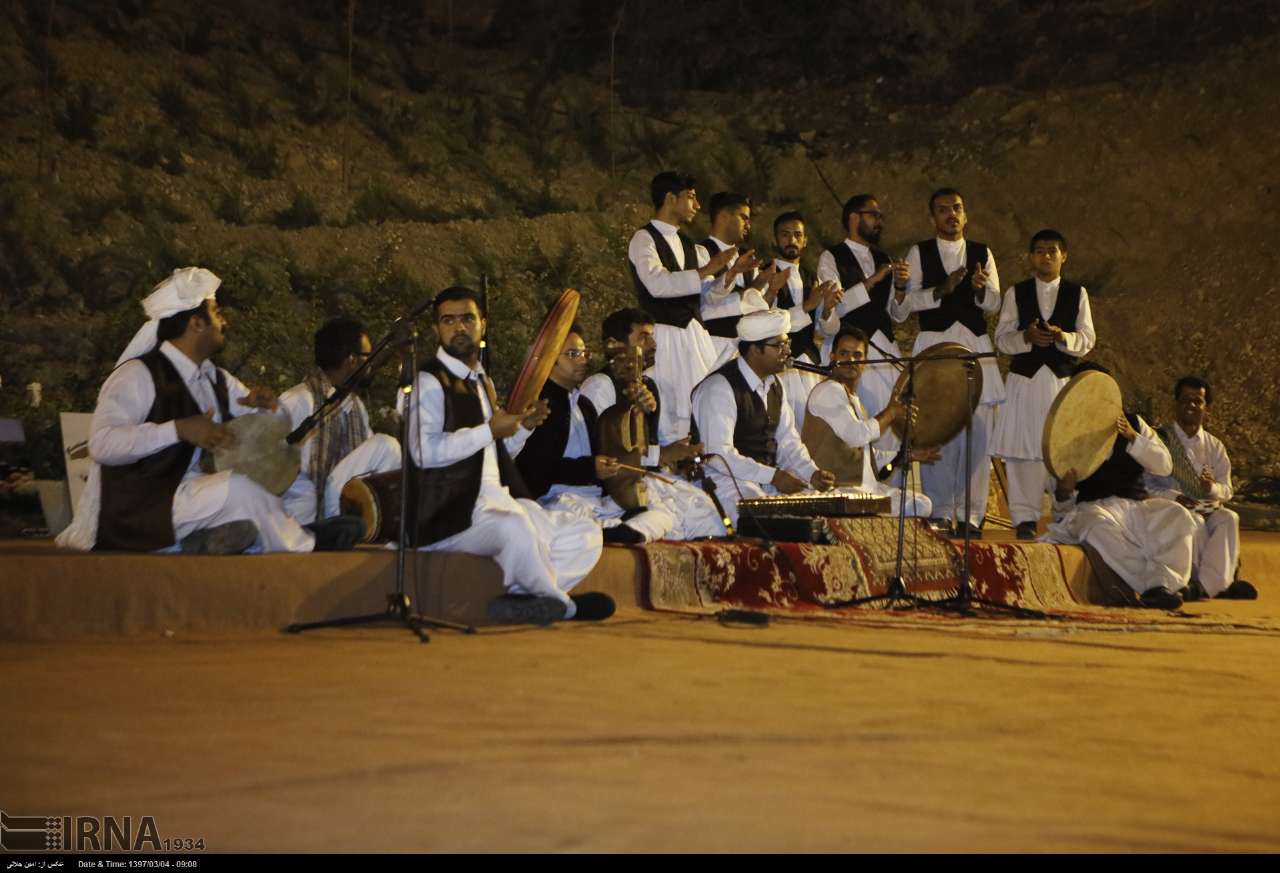
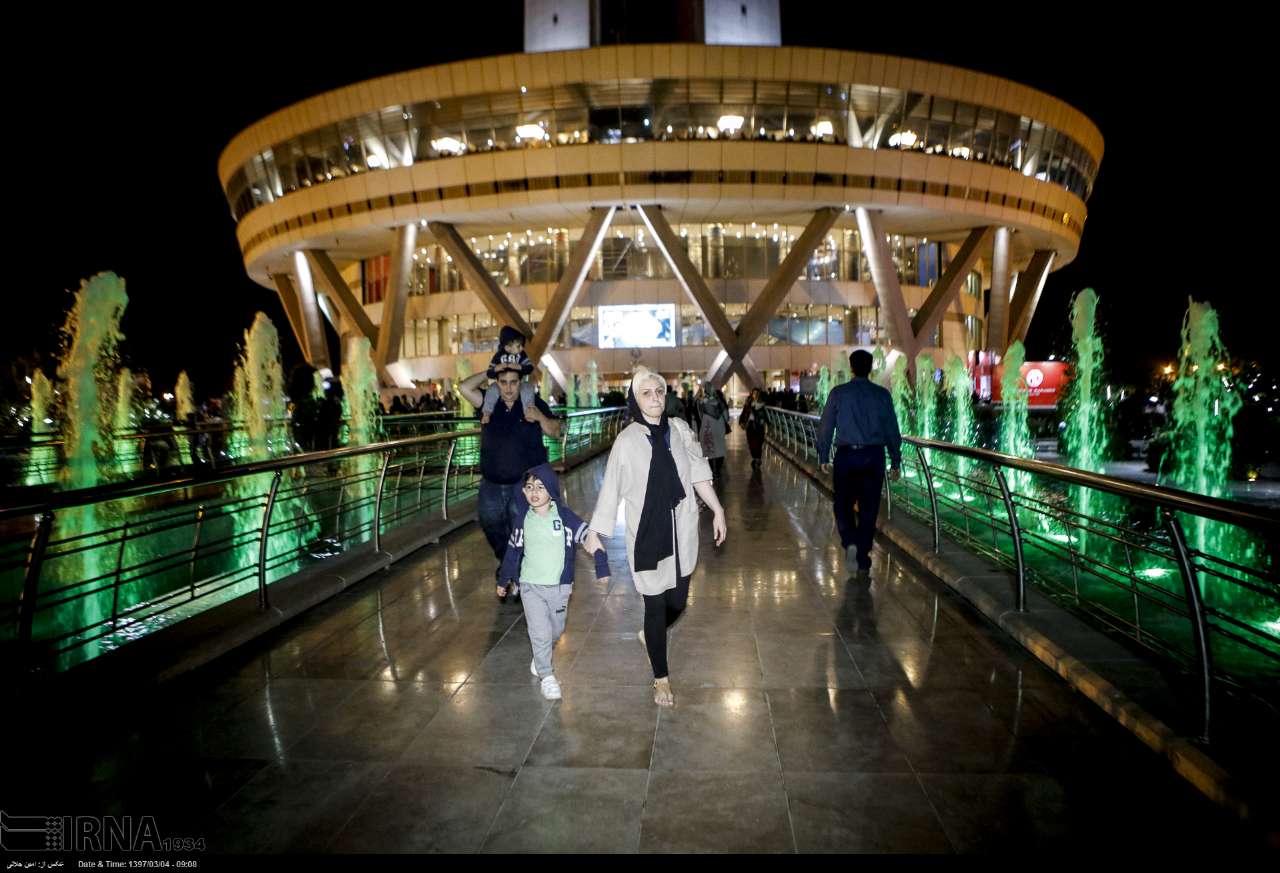
Tehran’s Milad Tower Hosting Ramadan Festival

The festival began on May 17 with various programs from Iftar to Suhoor in the iconic tower, and would continue until the end of Ramadan.

Ali Darvishpour, the tower’s managing director, says Ramadan programs began with sighting of the crescent moon from the highest point of Tehran with the presence of astronomers and professional observers at a height of 292 metres, and continue with diverse programs in the cultural and social spheres until the end of the holy month.

Darvishpour also added that the Holy Quran will be written by famous calligraphers during the festival while some others would recite Quran verses in especial circles.

“Religious gatherings next to serving simple Iftar foods are among other programs being performed in the Milad Tower.”

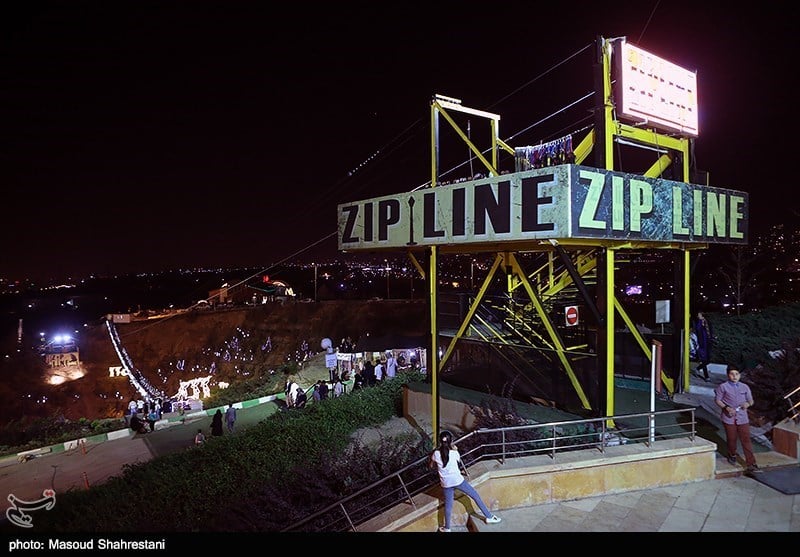
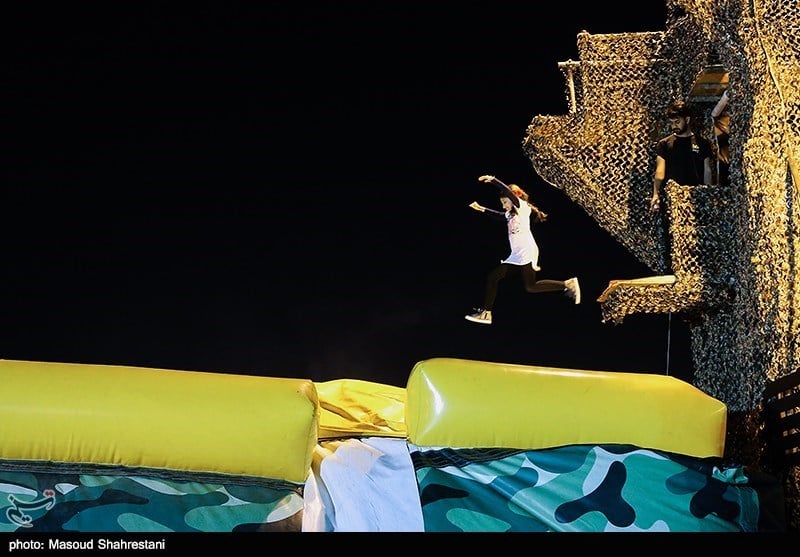
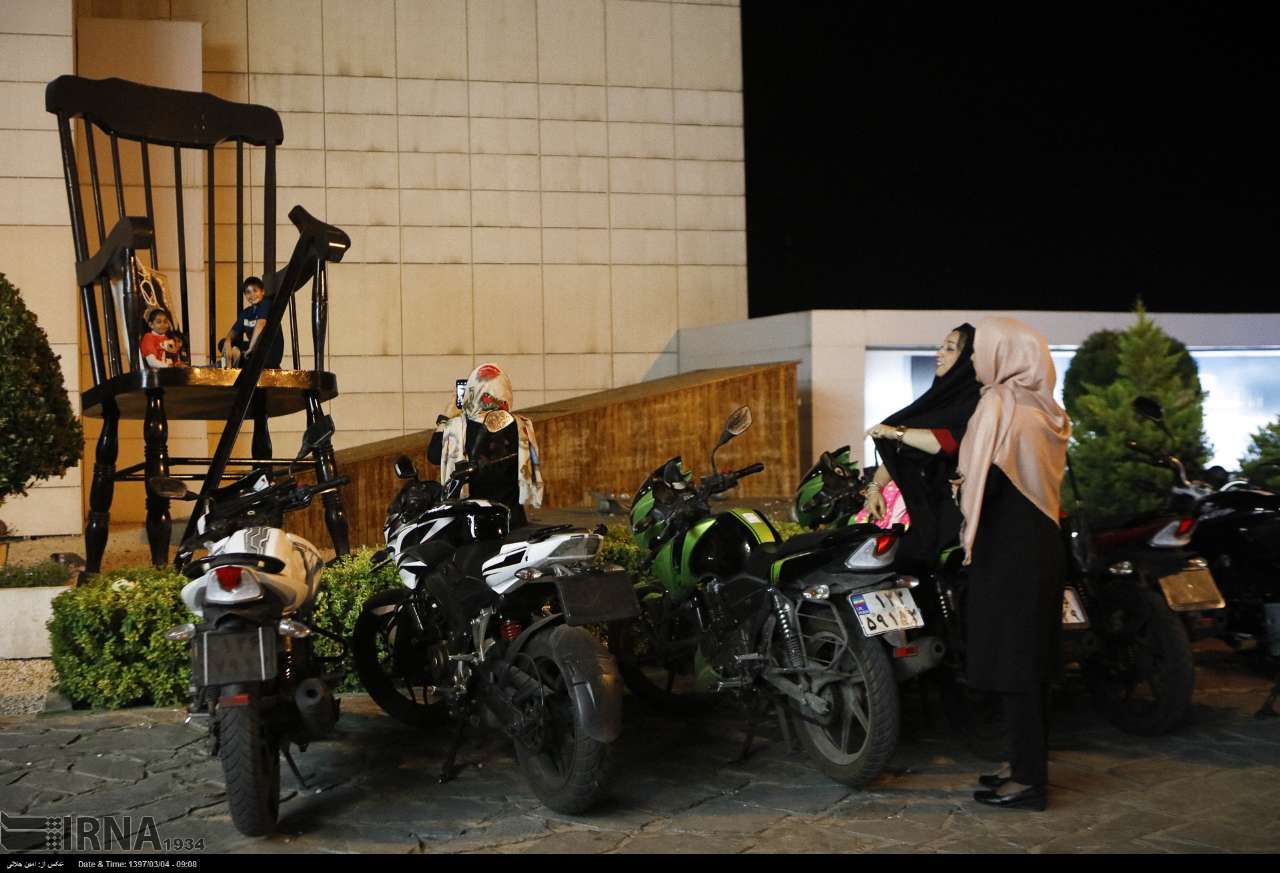
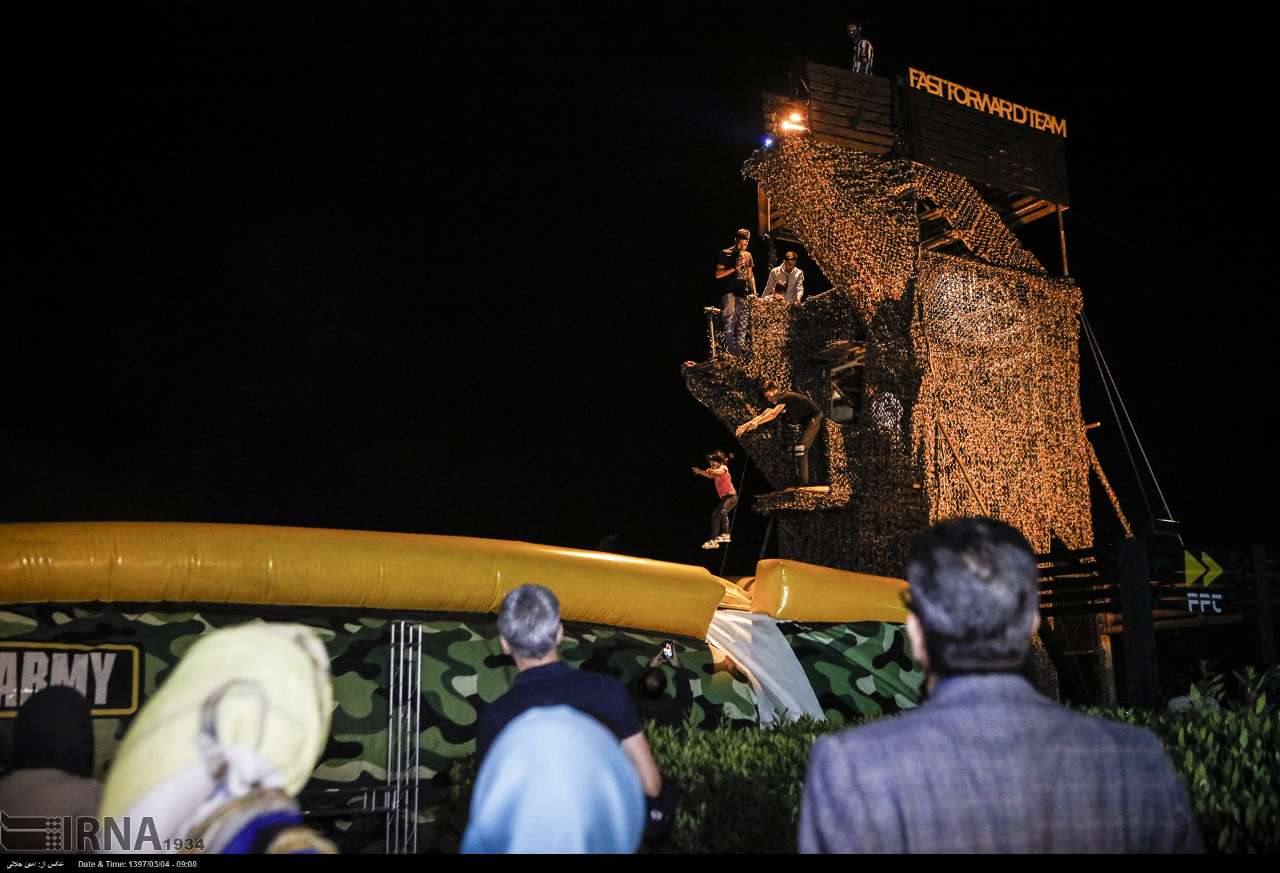
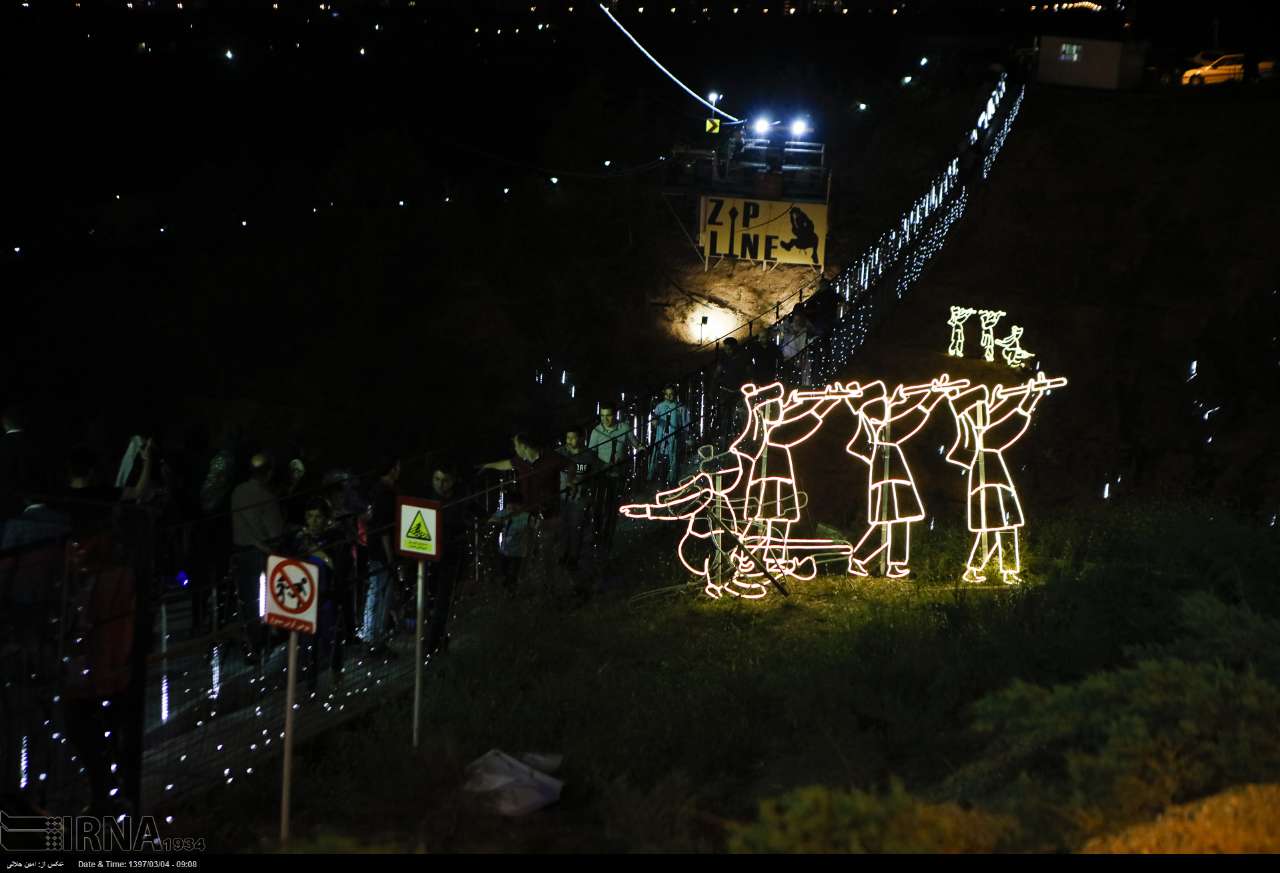
He went on to say that on the western side of the Tower, in the vicinity of the Zipper Line and Suspension Bridge, there are happy and vibrant games such as bungee jumping and trampoline.

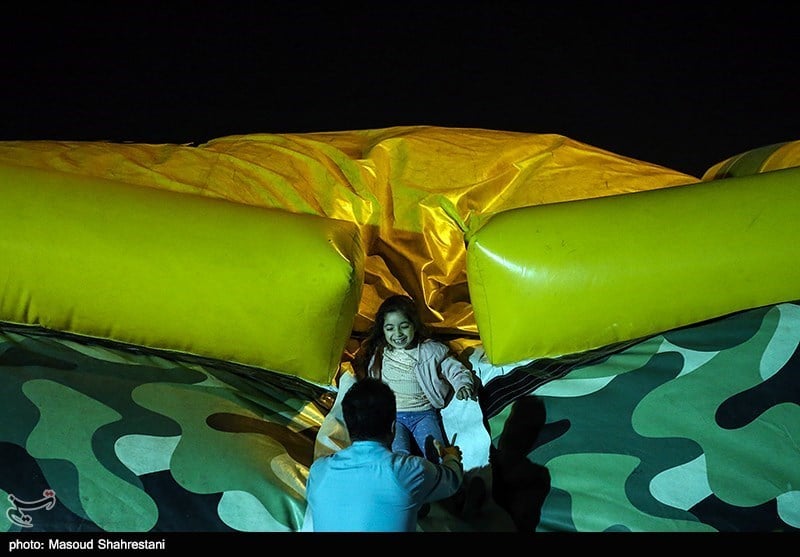
A special area has also been designated for kids and young adults to play, enjoy and have fun on the eastern side of Milad tower.

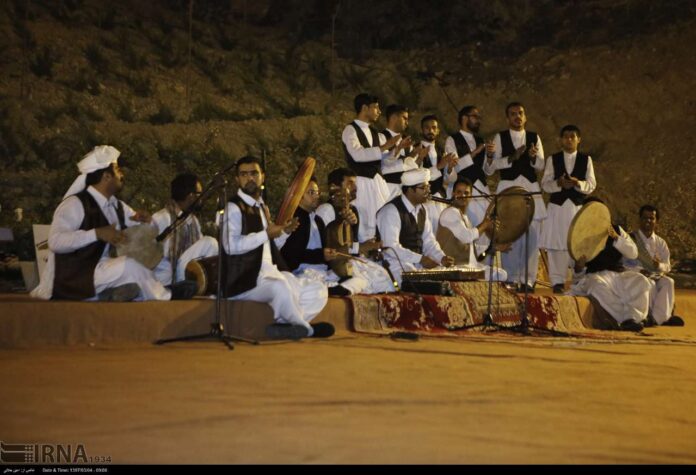
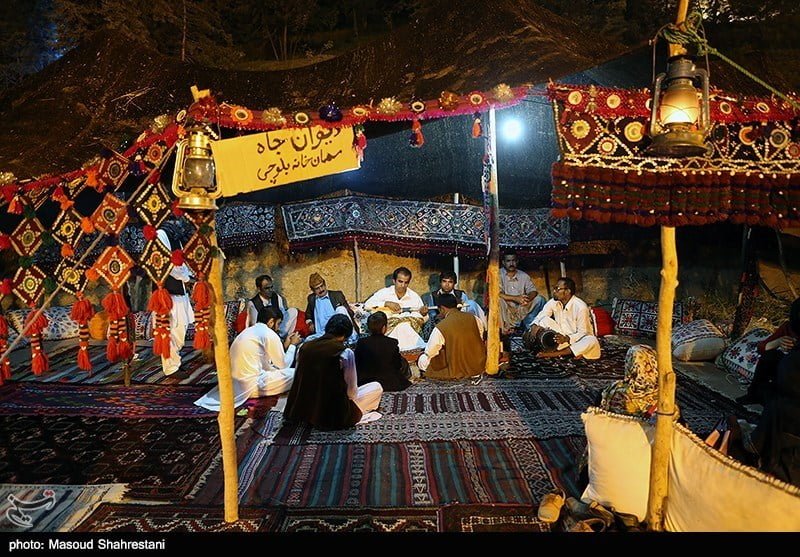
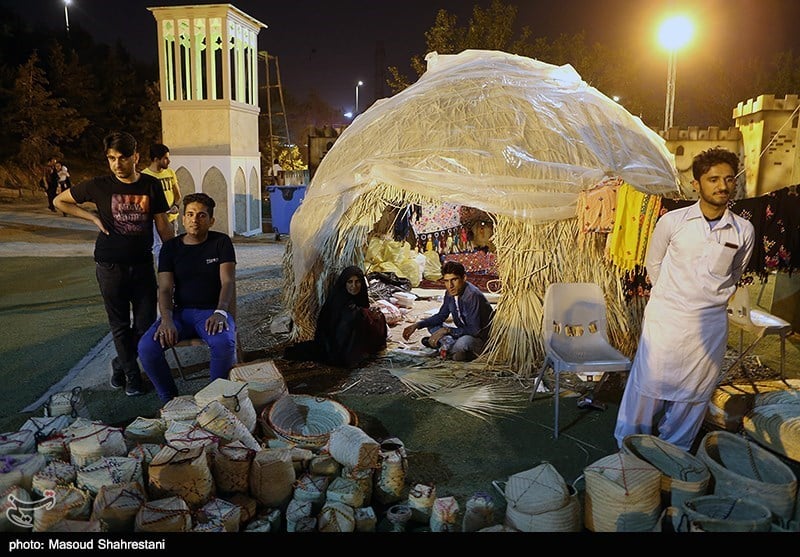
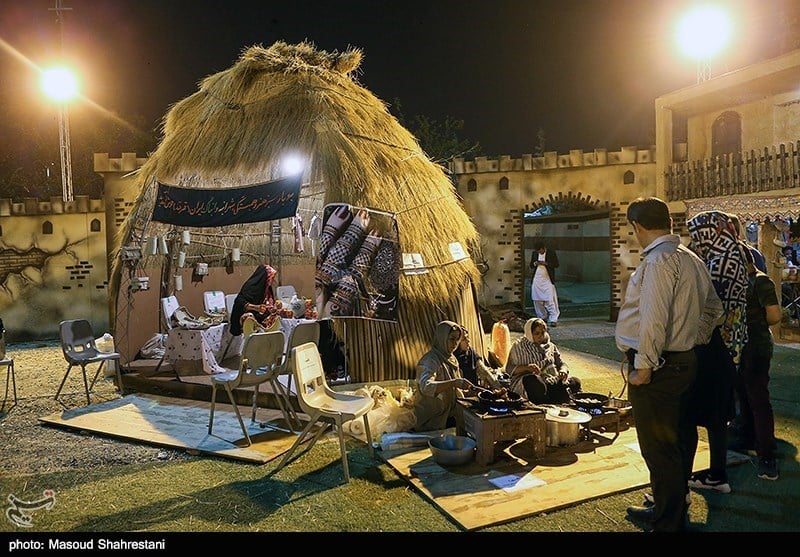
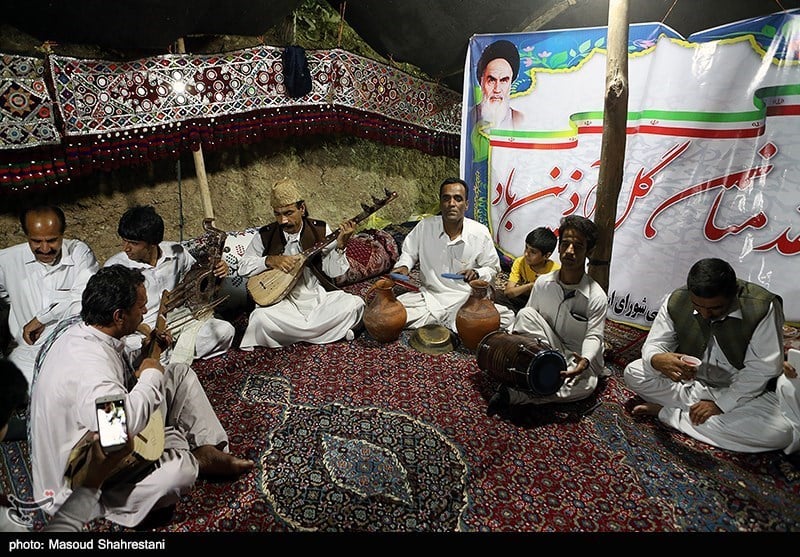
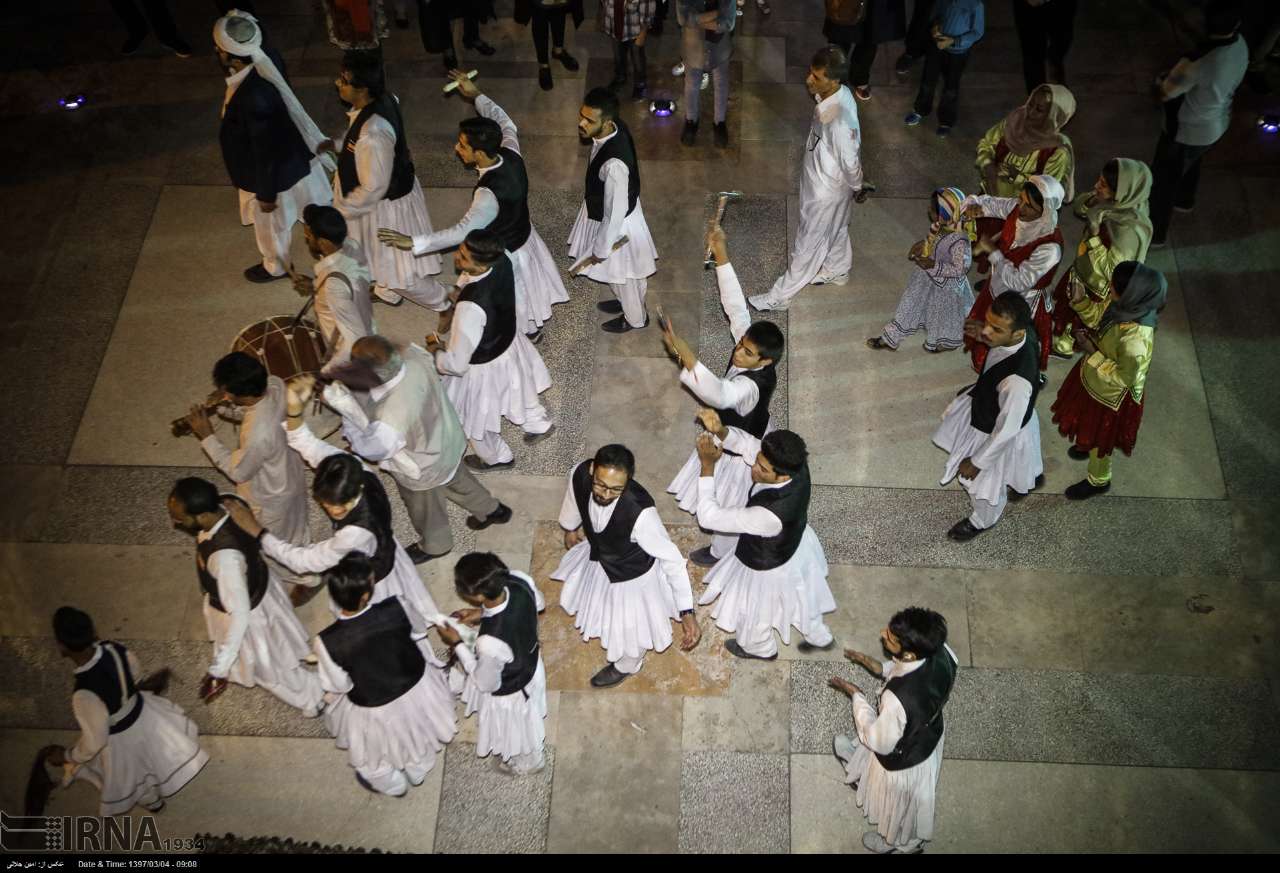
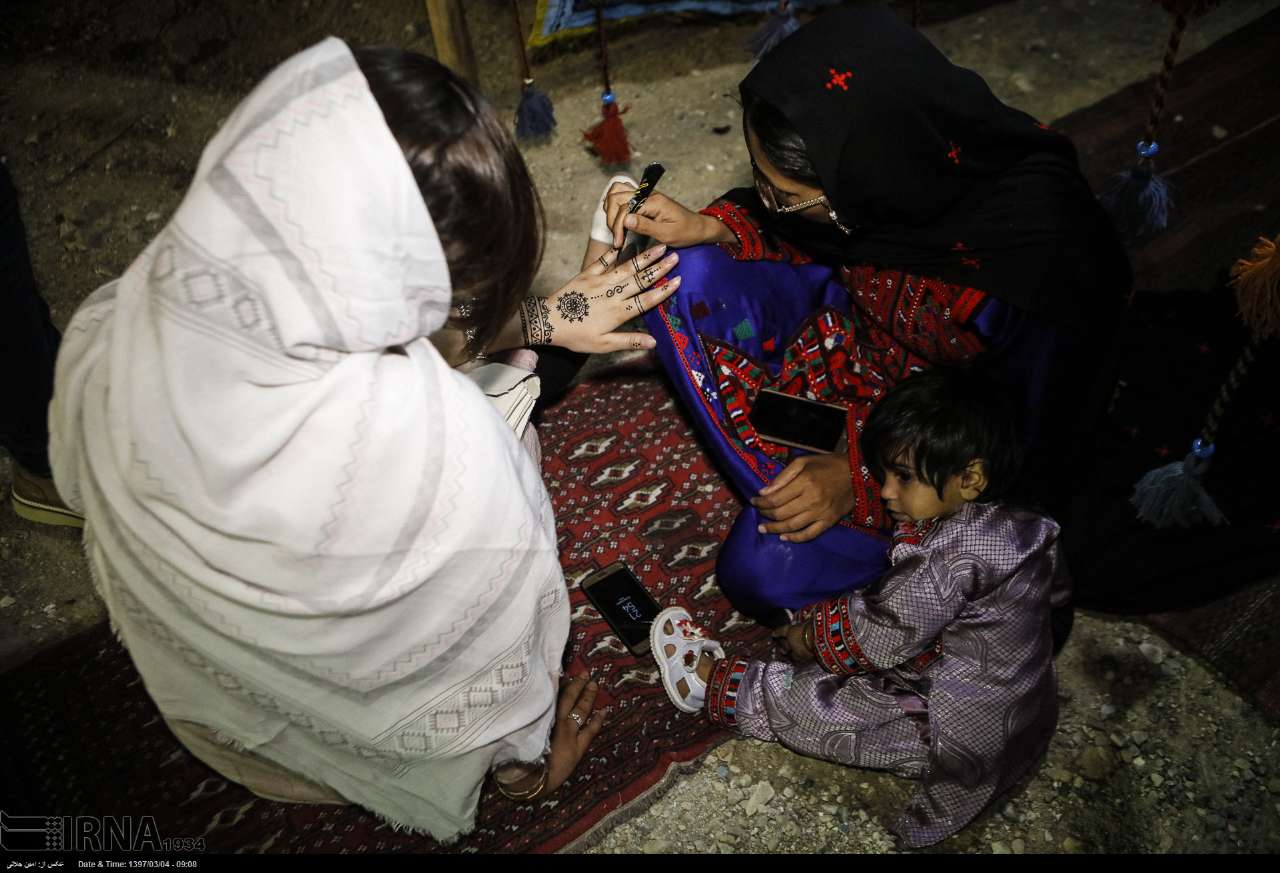
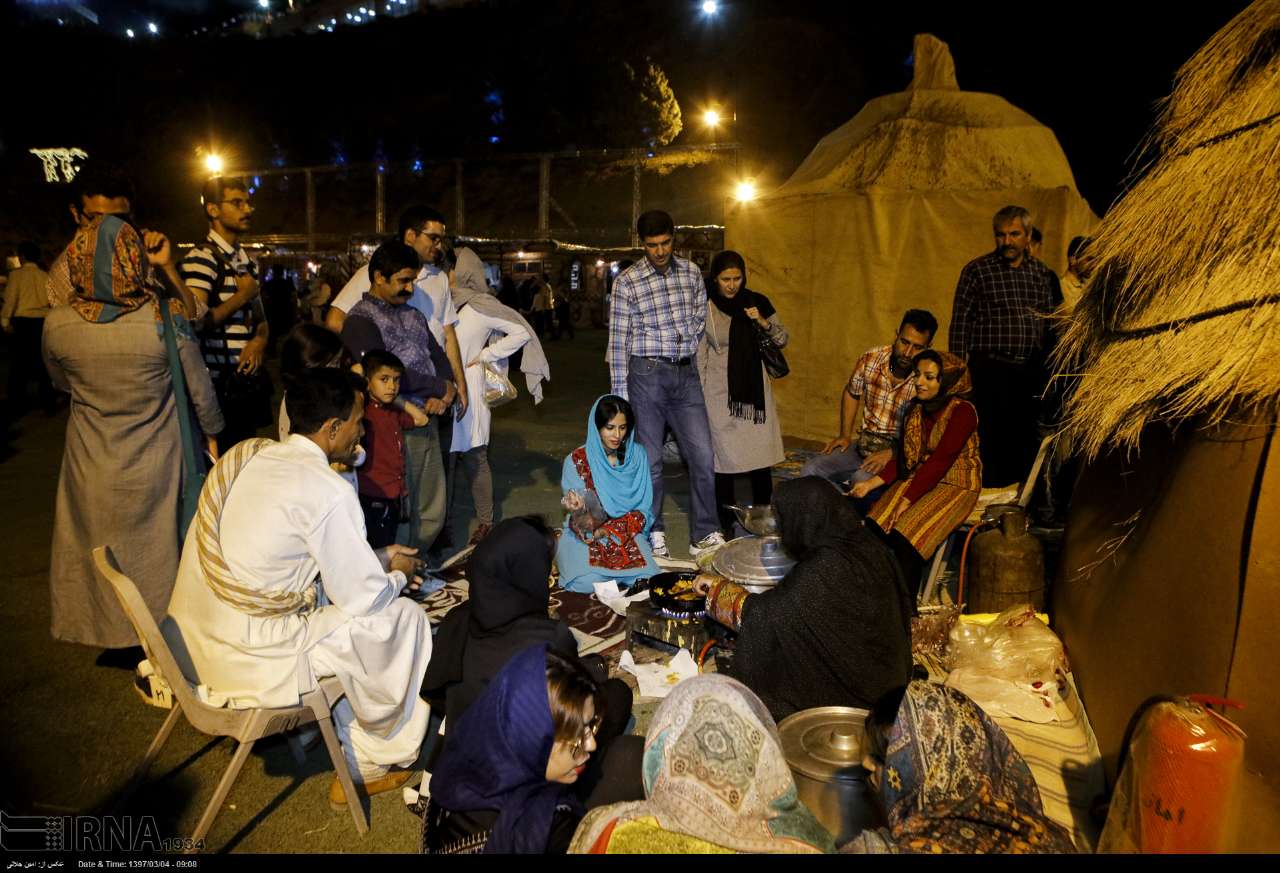
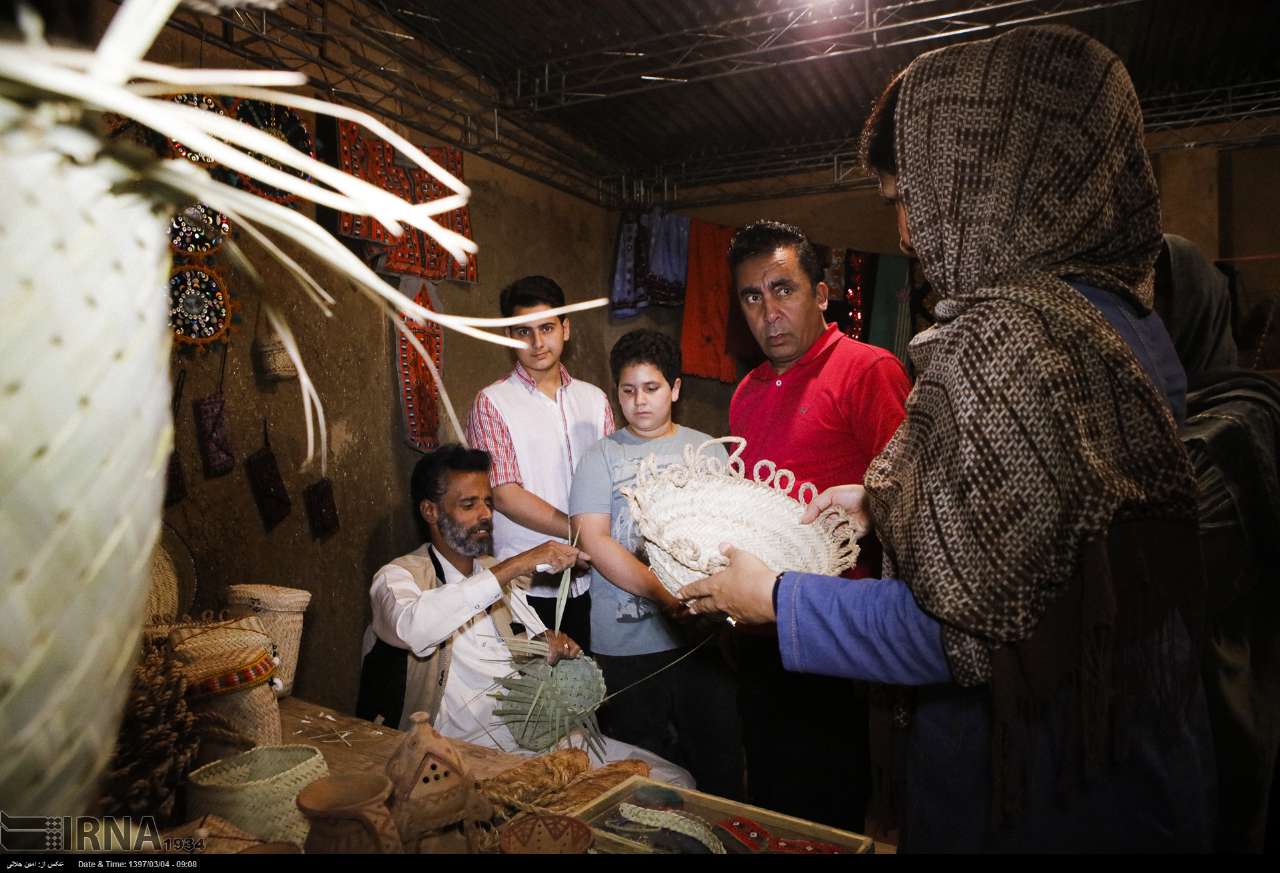
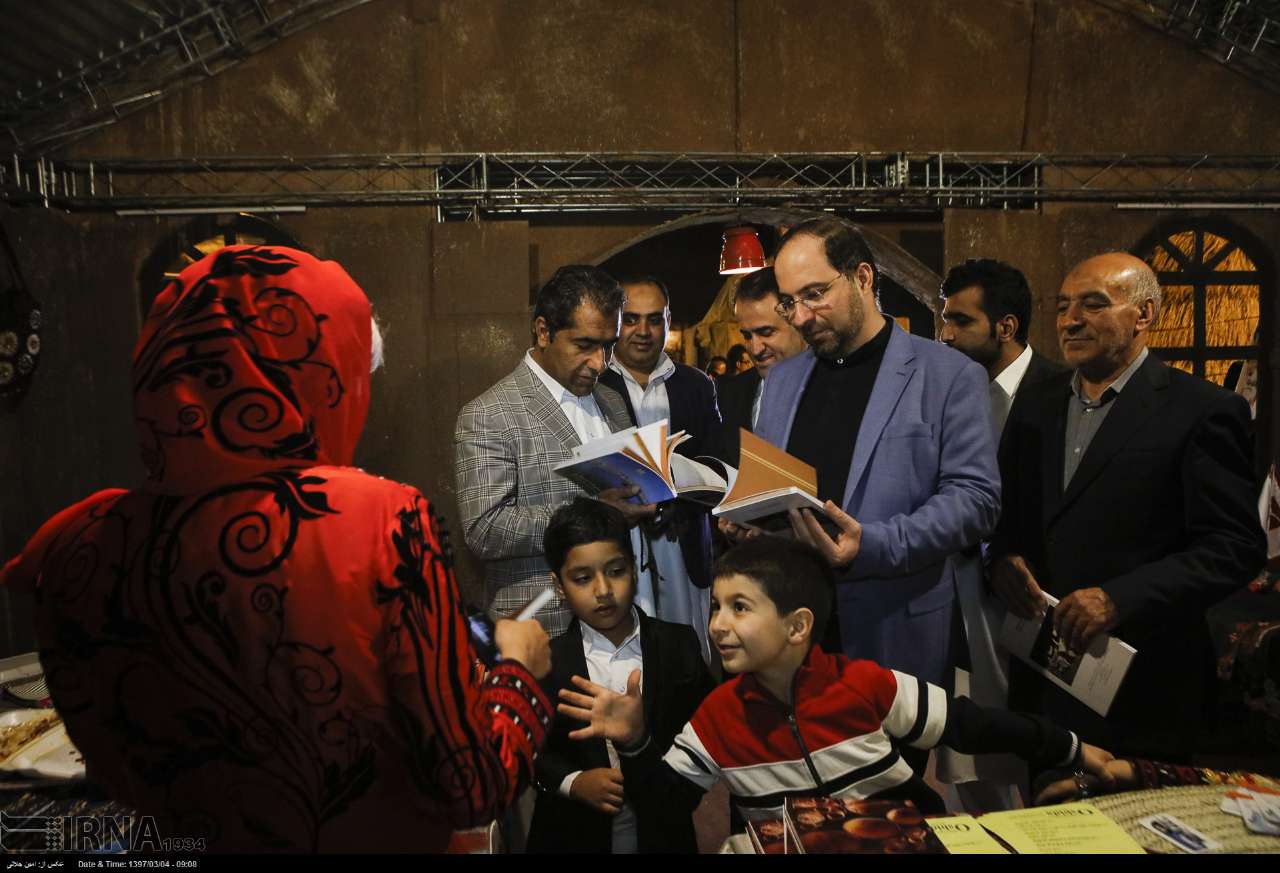
In another part of the festival, Iranian tribes have been offered an opportunity to present their arts, crafts, and lifestyles in so-called Tribal Homes.

The homes are open to visitors in the outskirts of the Milad Tower to give a chance to the lovers of the Iranian culture, technology and lifestyle to see such traditions in person.

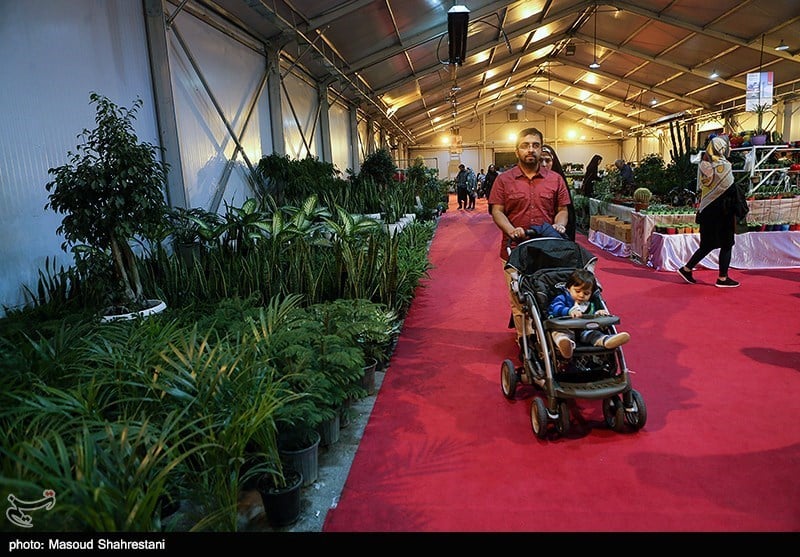
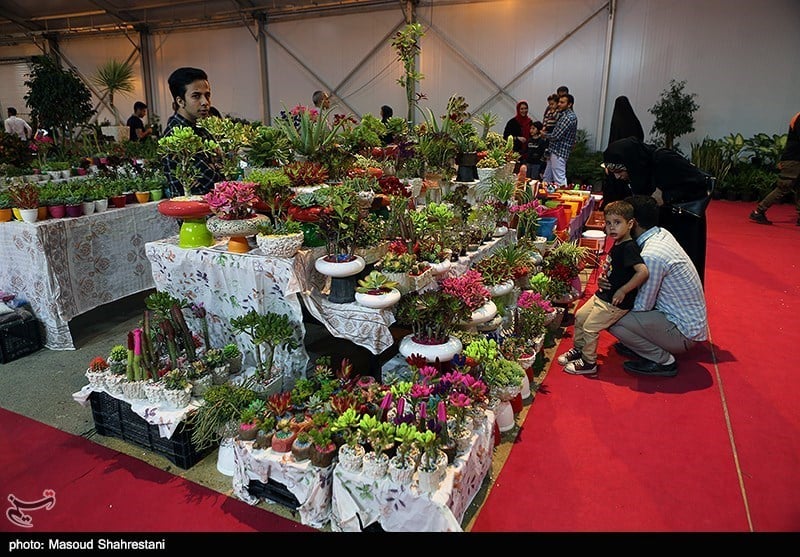
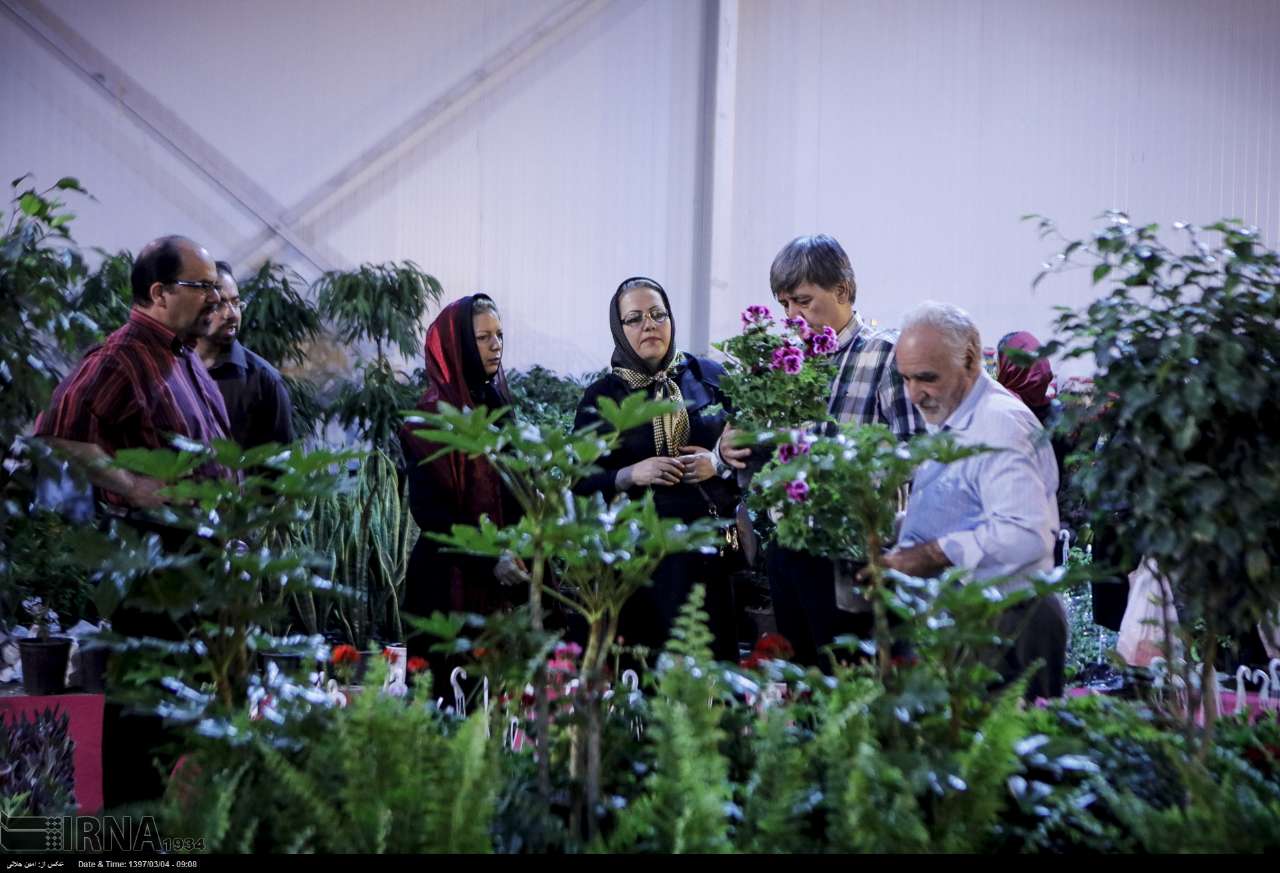
During this festival, a flower and plant exhibition is also held to promote a different look at apartment life and the maintenance of apartment flowers. The exhibition presents herbs, as well as traditional medicines.

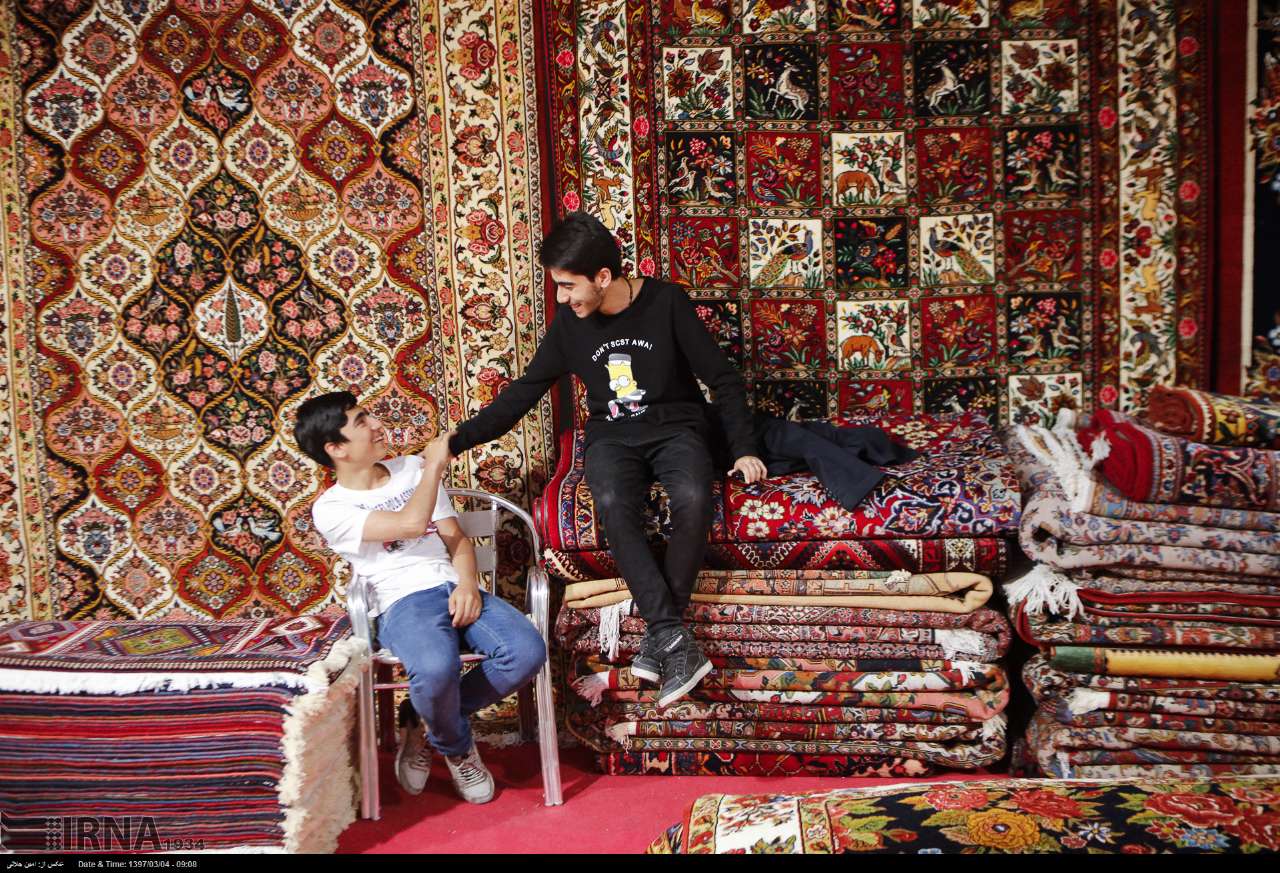
Meanwhile, in the gardens of the Milad Tower, with the aim of protecting domestic production, a number of Iranian items and products are introduced.
These goods are generally healthy and the purpose of their introduction is to make people aware of the culture of enjoying healthy foods, and to strive to change lifestyles towards the use of healthy and harmless foods.

What follows are Tasnim and IRNA’s photos of the festival:

Signing LC Deal to Help Expand Iran-Italy Relations: Rouhani

In a Saturday letter to his Italian counterpart Sergio Mattarella, Rouhani offered congratulations to the Italian nation and government on the country’s National Day and Republic Day.

“Maintaining constructive interaction and deepening relations with Italy, as a friend and important country in the European Union, based on mutual respect and interests, has been a priority of the Islamic Republic of Iran in recent years,” the Iranian president noted.

“Fortunately, under this policy, relations between the two countries in various fields have been growing and I am confident that by signing the agreement of line of credit, the path to operationalisation of documents signed between the two countries will be facilitated and accelerated,” he added.

He finally wished health and success for his counterpart and prosperity and felicity for the people of the Italian Republic.

Festa della Repubblica (Republic Day) is the Italian National Day and Republic Day, which is celebrated on 2 June each year. The day commemorates the institutional referendum held by universal suffrage in 1946, in which the Italian people were called to the polls to decide on the form of government, following the Second World War and the fall of Fascism.

With 12,717,923 votes for a republic and 10,719,284 for the monarchy, the male descendants of the House of Savoy were sent into exile.

“Support for Palestine Root Cause of West’s Problems with Iran”

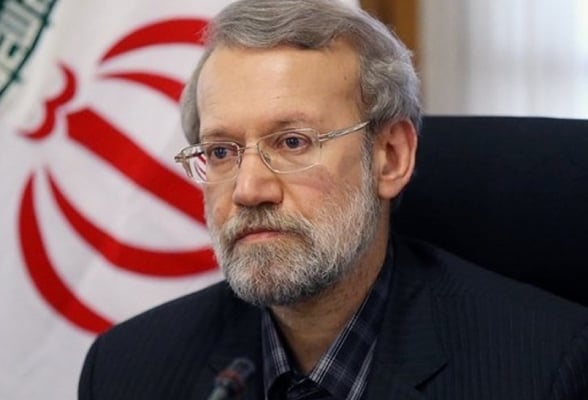
Ali Larijani

The US withdrawal from the 2015 nuclear deal, which placed confidence-building curbs on Tehran’s nuclear program, once again proved that the US claim Iran is secretly developing nukes is only a pretext to place pressure on Iran, Larijani said on Saturday.

The top lawmaker said the main problem of the US with Iran is our tireless support for the Palestinian cause, he was quoted as saying in a report by ICANA.

“[During a round of nuclear talks] I asked the other side what is your problem with us when you know we are not after nuclear weapons? He replied the real problem lies in Iran’s support for Palestine, which does not allow the US to carry out its plans in the region,” said Larijani, a top nuclear negotiator in early 2000s.

Iran has been steadfast in its opposition to Israel since the 1979 Revolution, demanding an end to the decades-long occupation of the Palestinian lands.

Shortly after the Revolution, the Islamic Republic’s founder Ayatollah Rohullah Khomeini singled out the two main enemies of Iran: the US as the “great Satan” and Israel as the “little Satan”.

He further noted that the long-standing US animosity towards Tehran also has its origins in the 1979 Islamic Revolution that toppled the rule of the US-backed Shah Mohammad Reza Pahlavi

“The adventurous policy of the US is rooted in the revolutionary move of 15 Khordad that led to Iran’s independence,” Ali Larijani said.

The uprising is known to be the starting point of a revolution that replaced the Shah monarchy with the Islamic Republic.

Larijani made the remarks in an address to a gathering of people on the eve of the anniversary of the 1963 anti-Shah demonstrations, known as 15 Khordad Uprising.


US Opposed to Anti-Terror Efforts

Larijani further referred to the recent remarks made by US Secretary of State Mike Pompeo, and said the main focus of US demands is Iran’s regional presence, because Iran’s anti-terror efforts in Iraq and Syria have disrupted their plans.

The top lawmaker said the US created ISIS to destabilise the region and prepare the ground for carrying out its plots to topple its enemies, but the collapse of the so-called caliphate set up by ISIS rendered those plans unsuccessful.

“They didn’t want us to engage in anti-terror efforts in the region, so that they can foment insecurity in the region and … block Iran’s path to development,” he said.

The lawmaker was speaking at a time of heightened tensions between Iran and the US.

The US administration, which has hardened Washington’s line on Iran, has threatened to impose the “strongest sanctions in history” against Iran that would ultimately destroy the country’s economy unless it capitulate to a series of 12 “basic requirements”.

Among other conditions, the list asks Tehran to halt missile development, stop what the US claims are Iran’s interventions in the affairs of Iraq, Syria and Yemen and cease support for groups which the US considers terrorist but Iran sees as legitimate resistance forces.


Economic War in the Making

Larijani said the us threats of imposing unprecedented sanctions on Iran shows the US hopes an economic war could make Iranian people dissatisfied with their conditions and weaken Iran’s resolve.

The lawmaker said Iran should work to boost domestic production and make the economy invulnerable to US pressure.

“We face a hard path [to stand against US pressures], but the gains will be outstanding,” Larijani said.