Thursday, December 25, 2025
Home Blog Page 3528

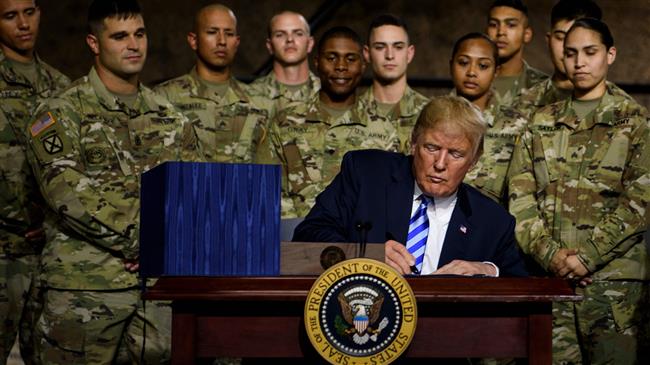
Trump Pushing US Army to Invade Iran: Top General

Iran Will Definitely Change Approach to UAE: Top General

“Today, our system is at risk of harshest sanctions and threats, and the enemies’ behaviour is unpredictable,” Chief of Staff of Iran’s Armed Forces Major General Mohammad Baqeri said on Sunday.

“Although the incumbent US administration does not make military threats, there is credible information that in the past year and a half, it has been trying to push the US military to invade [Iran].”

The top general said although the US is currently focused on carrying out its economic threats against Iran, Tehran would do well to get ready to come to grips with other types of threats as well.

“The focus of enemies’ threats is on economic sanctions, but various threats could emerge and armed forces should be ready to defend the nation and the system,” Tasnim quoted him as saying.

The Trump administration pulled the US out of the 2015 nuclear deal early May and has vowed to impose harsh sanctions that it claims could eventually destroy the Iranian economy.

The US has provided a list of 12 demands that says Tehran needs to accept if it seeks relief from Washington’s threats.

Don’t Play with Lion’s Tail, Iran’s President Tells Trump

Donald Trump’s threat that the US will cut off Iran’s oil exports shows that he is a political neophyte, Rouhani said, stressing that if the US president knew anything about politics, he would not have made such a threat.

He also noted that Iran has various options on the table to deal with US threats including the closure of the strategic Strait of Hormuz.

“Mr Trump! We are men of honour and have guaranteed the security of the region’s waterways [Hormuz Strait] throughout the history. Don’t play with fire, it will make you regretful,” he told a gathering of Iranian ambassadors in Tehran on Sunday.

The Trump administration has announced it intends to cut down to zero Iran’s oil revenues by early November, when a majority of anti-Iran US sanctions that were suspended under the 2015 nuclear pact will snap back.

Rouhani has vowed Iran will stop oil imports from the Persian Gulf by blocking the Strait of Hormuz if the US halts Iran’s oil exports.


War with Iran Mother of All Wars

The president said Iran’s enemies have hatched various plots against the country since the Islamic Revolution of 1979, from attempts to topple the system to disintegrate the country.
Rouhani said the latest plot was weakening Iran through international sanctions, which was foiled by the 2015 nuclear deal.

The president said the US has now decided to try exhausting the Iranian nation.
“Today, our internal unity is greater than before. Threats will boost our cohesion,” he said.
Rouhani said enemies will “loot” Iran if it caves into pressure by a “lying bully” like Trump.
“Today, talking with the US means nothing but surrender and ruining all achievements of the Iranian nation,” he said.

Rouhani said the incumbent US administration is standing against the world and acting against the US’ national interests.

“Americans must understand well that peace with Iran is the mother of all peace and war with Iran is the mother of all wars,” he said.

War of Words Escalates between Iranian, US Presidents


Iran to Improve Ties with Saudi Arabia, Bahrain, UAE

Referring to allegations by the US that Tehran is destabilizing the region, the president said Iran is a peace-loving nation that sees helping neighbours against killers as its sacred duty.
“We uprooted ISIS and saved the people of the region. We are proud of that,” Fars News Agency quoted him as saying.

“Our influence in the region is historic and civilizational. Our commitment to the [security of the] region results from our Islamic and Iranian identity,” he said.

Rouhani said moves by the US administration and the Israeli regime in recent months have exposed the true nature of the Zionist regime and proved Iran’s relentless opposition to the Zionist regime was a good policy.

“Today, it is more clear that the Zionist regime is bent on aggression and occupation … What we were telling our neighbours and Arab countries regarding the nature of Israel has proved correct,” he said.

The US and Israel have taken steps seen as preparations for implementing a so-called peace plan dubbed “the deal of the century”, which has been formulated by the Trump administration.

In May, the US moved its embassy from Tel Aviv to Jerusalem al-Quds, effectively killing hopes to reach a so-called two-state solution for the Palestine conflict.

“So far, [they] were telling Israel is a model of democracy in the region. Today, it is proven that this is the centre of apartheid,” Rouhani said.

In spite of recent developments, the president said Tehran seeks closer relations with Saudi Arabia and its allies.

“We want best relations with our neighbours. Under the new circumstances, we seek to mend Iran’s relations with Saudi Arabia, the UAE and Bahrain,” he said.

Iran Reaffirms Religious Minorities Free to Be Elected to Local Councils

Iran’s Expediency Council, which is charged with resolving disputes between the Iranian Parliament and the Guardian Council, ruled on Saturday that members of the religious minorities can be elected to local councils.

Two-thirds of those participating a Saturday meeting of the Expediency Council voted for the law, which will allow Sepanta Niknam, a Zoroastrian member-elect of Yazd’s city council, to start his work as a councillor after being suspended by the Guardian Council.

“Today, the Expediency Council ruled that the 1996 law on religious minorities is applicable and they can run for local elections,” Gholam-Reza Mesbahi-Moqaddam a member of the Expediency Council told Mehr News Agency.

Iran Reaffirms Religious Minorities Free to Be Elected to Local CouncilsSepanta Niknam was the only non-Muslim politician elected to the council of Yazd in central Iran back in May 2017 but he was suspended later in the year following a complaint by one of his fellow councillors and a decision by the Guardian Council.

It had followed a ruling by the head of Iran’s Guardian Council, which oversees elections, barring religious minorities from running for municipal votes.

Since the Guardian Council can only oversee national elections, the ruling was rejected by parliament, but that did not prevent Niknam’s suspension.

Majid Ansari, another member of the Expediency Council said the members ruled on Saturday in favour of Niknam.

“Today, the Expediency Council ruled that religious minorities can participate in council elections in their towns,” he said.  According to Ansari, Niknam is now free to retake his post in the Yazd city council.

Iran officially recognises Iranian Zoroastrians, Jews and Christians as religious minorities.

The national parliament has several religious minority members, including three Christians, a Zoroastrian and a Jew among its 290 deputies.

Zoroastrianism was the dominant religion in Persia, prior to the arrival of Islam, but only counts around 25,000 adherents today, according to government figures.

Iran Reaffirms Religious Minorities Free to Be Elected to Local Councils

Iran Marks Inscription of Bam Citadel as World Heritage

A group of people and authorities gathered on Thursday in front of the historical structure in Kerman province to mark the inscription, which took place on July 8, 2004.

At the cultural event, a group of artists exhibited scenes from the lives of the people of Bam in various historical periods as well as the arrest of Lotf Ali Khan, the last Shah of Iran during the Zand dynasty.

In this festival, the lifestyle of people in the marketplace of the ruled-over part of the building and the rulers’ part in the most internal wall, the command centre, and barracks were recreated and presented to the public.

What follows are Fars News Agency’s photos of this event:

A Look at Iranian Newspaper Front Pages on July 21

A Look at Iranian Newspaper Front Pages on November 19

Several papers today covered the remarks made by Iranian Foreign Minister Mohammad Javad Zarif in a recent interview with euronews, in which he said the package offered by the EU to save the Iran nuclear deal was not satisfactory.

The Guardian Council’s decision to reject the bills ratified by the Parliament on Iran’s implementation of Financial Action Task Force (FATF) standards also remained a top story today.

Also a top story was the Israeli Parliament’s ratification of a controversial and racist bill that recognizes a “Jewish Nation-State” and discriminates against Palestinians and Arabs living in the occupied territories.

The above issues, as well as many more, are highlighted in the following headlines and top stories:


19 Dey:

1- Europe’s Last Chance to Save Iran Nuclear Deal

2- Zarif: EU’s Package to Save JCPOA Not Satisfactory

A Look at Iranian Newspaper Front Pages on July 21


Abrar:

1- North Korea Has Highest Index of Modern Slavery

A Look at Iranian Newspaper Front Pages on July 21


Aftab-e Yazd:

1- A Woman’s Controversial Presence at Iranian Foreign Ministry

2- Aref: Reformists’ Parliamentary Faction Supports Four FATF Bills

3- US Trying to Convince Turkey to Cooperate on Iran Bans

A Look at Iranian Newspaper Front Pages on July 21


Donya-ye Eqtesad:

1- Diplomacy of Partners after US Withdrawal

  • Ambassadors, Economic Attaches of Four Countries Discuss Iran’s Remaining in JCPOA

A Look at Iranian Newspaper Front Pages on July 21


Ebtekar:

1- Israel Continues Trend of Creating Tensions

  • “Jewish Nation-States” Bill Sparks Controversy

2- Turkey’s Extraordinary Situation Finally Cancelled Two Years after Coup

3- Iran Leader to Government: Your Performance Should Be as Well as Team Melli’s!

A Look at Iranian Newspaper Front Pages on July 21


Etemad:

1- Iran’s Top Sunni Cleric: We Won’t Betray Our Own Territory [Iran]

2- One Iran, One Voice [Editorial]

A Look at Iranian Newspaper Front Pages on July 21


Ettela’at:

1- Zionist Regime’s “Jewish Nation-State” Law Globally Condemned

2- Rouhani’s Chief of Staff: Velayati’s Visit to Moscow Based on Government’s Decision

3- Nasrallah Personally Claims Responsibility for Mediation in Syrian Refugees’ Case

A Look at Iranian Newspaper Front Pages on July 21


Hemayat:

1- Zionists’ Apartheid in Occupied Territories

  • Knesset Ratifies Law of Forming “Jewish Nation-State”

A Look at Iranian Newspaper Front Pages on July 21


Iran:

1- Iranians Warmly Welcome French Artists’ “Time Labyrinth” in Tehran’s Azadi Tower

A Look at Iranian Newspaper Front Pages on July 21


Javan:

1- End of 39 Months of Shiites’ Pains in al-Foua and Kafraya

2- Beijing: We’ll Stand against US Sanctions

A Look at Iranian Newspaper Front Pages on July 21


Jomhouri Eslami:

1- Zarif to Euronews: Doing Oil-for-Good Trade with Russia Not on Agenda of Iran

A Look at Iranian Newspaper Front Pages on July 21


Kayhan:

1- Shiites of al-Foua and Kefraya See Result of 3 Years of Resistance

2- People Must Feel Government Is Doing Its Best: Iran Leader

A Look at Iranian Newspaper Front Pages on July 21


Khorasan:

1- Yemeni Drones Give Shock to Riyadh Refinery

A Look at Iranian Newspaper Front Pages on July 21


Rooyesh-e Mellat:

1- Zarif Calls on Europe to Stop Being under US’ Influence

A Look at Iranian Newspaper Front Pages on July 21


Sazandegi:

1- Solidarity to Rebuild Iran: Rouhani Holds Meeting with Mayors of 7 Megacities

A Look at Iranian Newspaper Front Pages on July 21


Setareh Sobh:

1- FATF Bills in Coma

  • Supreme National Security Council or Expediency Council: Which One to Make Final Decision?

A Look at Iranian Newspaper Front Pages on July 21


Shargh:

1- Trump Invites Putin to Visit Washington

2- Russian President’s Special Envoy Briefs Iran on Results of Helsinki Summit

A Look at Iranian Newspaper Front Pages on July 21

10 Iranian Border Guards Killed in Clashes with PJAK Terrorists

Iranian Soldier Killed in Shootout with Terrorists in Southeast Border

“In the last night’s attack by culprits and anti-revolutionary terrorists affiliated to the global arrogance (the US) on the border post of the IRGC Ground Force’s Hamzeh Seyed al-Shohada Base in the village of Dari in Marivan District in Kurdistan Province and subsequently, the explosion of an ammunition depot, 10 fighters of Islam were martyred,” the IRGC Public Relations Department said in the statement.

In the clash with the terrorists, a number of terrorists were killed and a number of others suffered injured and escaped the scene, the statement added.

The IRGC further emphasized that “a deadly and crushing revenge” awaits the terrorist and anti-revolutionary groups and their supporters for committing this crime.

The IRGC is tasked with protecting the country’s northwestern and southeastern borders.

Negotiating with US Not to Solve Iran’s Problems: Leader

It is a clear mistake to think that negotiating or having ties with the US would settle the Islamic Republic’s problems, the Leader said in a Saturday meeting with Iranian foreign minister and a group of Iranian ambassadors and diplomats in Tehran.

“The US has basic and fundamental problem with the Islamic Establishment of Iran. Moreover, there are many countries in Africa, Asia, and Latin America which have ties with the US but are still gripped with many problems,” Ayatollah Khamenei added.

The Leader pointed to the deep animosity of the US towards the Islamic Republic, and said, “Americans seek to restore the position they had in Iran before the 1979 Revolution, and would not be satisfied with anything less than that.”

The Leader said Washington’s opposition to Iran’s nuclear power, high enrichment capabilities, and its regional presence has its roots in the US’ deep hostility towards the components of the Islamic Republic’s strength.

Ayatollah Khamenei referred to the country’s regional presence as one of the components of Iran’s power and security, and said this is why the enemies are opposed to such presence.

Iranian officials have repeatedly announced that the US cannot be trusted, he noted, adding that he himself has long been repeating the fact that the Americans’ words and even signatures cannot be trusted. “So holding talks with the US is futile.”

The Leader further highlighted the significance of taking advantage of the country’s untapped or less-tapped opportunities.

“Negotiations with Europeans shouldn’t be stopped, but we shouldn’t stall the country while waiting for Europeans’ package [to save the Iran nuclear deal]; rather many required measures must be taken inside the country,” he added.


Rouhani’s Remarks on Oil Exports Very Significant

Iranian President Hassan Rouhani during his recent trips to Europe threatened that if Iran’s oil is not allowed to be exported through the Persian Gulf due to the US sanctions, then the oil of no other country in the region can be exported.

The Leader on Saturday described Rouhani’s comments as very important, saying that they showed the policy and approach of the Islamic Establishment of Iran.

“The foreign ministry is duty-bound to seriously pursue such stances held by the president,” he added.

“The main and real goal of diplomacy is to protect national interests. Having interaction or clash [with other countries] are just ways to secure the national interests,” Ayatollah Khamenei said, stressing that Iran’s national interests are derived from the major policies and values of the Islamic Republic, which must be protected by the foreign ministry.


Ideology Not Separate from Diplomacy

“Some wrongly talk of the need for making a distinction between diplomacy and ideology; however, there is no problem with ideological diplomacy, and it is not right and logical to imply there is a clash between ideology and national interests,” the Leader noted.

“Ideology seeks to secure and maintain the country’s national interests, and is considered as a nation’s identity,” he went on to say.

The Leader referred to the ideology-based behaviours and policies of Western governments, saying, “Americans frequently use the expression ‘American Values’ in their remarks. This is their ideology derived from the US Declaration of Independence.”

“Even in European countries, ideological thoughts dominate their political behaviours and activities,” he noted.

Ayatollah Khamenei also noted that the country’s policy of establishing wise, smart, targeted, and logical ties with the world is inspired by the Islamic view of the Establishment and totally based on ideological diplomacy.


Human Rights Accusations Part of Iranophobia Project

The Leader also referred to the enemy’s psychological war against the Islamic Republic, and said the accusations of breaching democracy, lack of freedom, and violation of human rights in Iran are all part of the psychological war and Iranophobia project pursued by the adversaries.

Ayatollah Khamenei also blasted the crimes committed by Europeans and Westerners in the time of colonialism, the limitations of democracy in the West, the partisan dictatorship in the US and some European countries, and the West’s current crimes including their role in the Saudis’ slaughter of Yemenis.

“Westerners are symbols of violating human rights, but blatantly raise accusations against Iran, in a way that one is sometimes surprised to see how shameless they are,” he added.

Tehran, IAEA Signed No Secret Deal on University Inspection: Envoy

Iran Calls for IAEA’s Impartial Verification of Saudi Nuclear Activities

Kazem Gharib-Abadi, Iran’s representative at the International Atomic Energy Agency, said there is no “secret agreement” that allows the IAEA to inspect Iranian universities.

“There are no secret agreements for inspection of universities and other places and everything has been in accordance with the country’s obligations,” he said.

On Monday, Fars News Agency reported that the IAEA’s inspectors had made a secret visit to Iran University of Science and Technology in Tehran, quoting an IUST faculty member as saying that another inspection had been made at Sharif University of Technology.

The report was confirmed this week by Science Minister Mansour Gholami, who said the inspection was authorized by the Supreme National Security Council.

Gholami said the IAEA inspectors had just visited the universities’ laboratories.


Basis for Cooperation

Gharib-Abadi said countries that have adopted the IAEA’s Additional Protocol are obliged to declare their nuclear research activities to the IAEA and allow it to verify their peaceful nature.

Tehran, IAEA Signed No Secret Deal on University Inspection: EnvoyThe IAEA also monitors research activities of countries and papers their academics publications in scientific journals, and it may seek special access to inspect their nature, the envoy said, appearing to suggest that’s why the IAEA inspectors have visited Iranian universities.

“The basis for cooperation between Iran and IAEA is Iran’s obligations and the UN watchdog has no access beyond these obligations,” he said, Fars reported.

The Additional Protocol is a set of requirements for information and access to assist the IAEA in its task of confirming that states are using nuclear material for solely peaceful purposes.

The Additional Protocol is a voluntary agreement and each agreement is independently constructed between a state and the IAEA.

Gharib-Abadi said the IAEA has not conducted any interviews with Iranian nuclear scientists, in accordance with an order by the Leader of Islamic Revolution Ayatollah Seyyed Ali Khamenei barring such interviews.

The Atomic Energy Organization of Iran has refused to comment on the inspections.

Even Underground Tunnels Used to Get Married in Iran!

Qanat gonabad

For a very long time Iranians provided the water they needed through subterranean channels called qanat.

Qanats are old man-made structures that provide all or part of the required water in parts of Iran which face water shortage; hence, they are highly valuable and have a special status.

Qanats are also culturally significant as they were associated with symbolic ceremonies and customs in Iran in the past. Now, the revival of those rituals can keep them from slipping into oblivion, and at the same time can serve as an effective way to attract local and foreign tourists in order to further promote the country’s tourism industry.

The qanat technology was developed in ancient Iran by the Persian people sometime in the early 1st millennium BC, and spread from there slowly westward and eastward.

In old times, people in some parts of Iran believed it was possible to solve the problem of inadequate water production by finding a wide for qanats based on an old tradition!

Ali-Asghar Semsar-Yazdi, a senior advisor at the Iranian International Centre for Qanats and Historical Structures, has weighed in on the ancient “Qanat Wedding” rituals and customs.

“The rituals, which were practiced in some parts of the country in the not-too-distant past, have now been forgotten,” he told the Iranian Students News Agency (ISNA).

“In ancient communities, some people believed that if a qanat stopped producing adequate water due to drought or any other reason, the problem would be solved by holding a wedding ceremony for that qanat,” he said.

“In order to hold wedding rituals for a qanat, a widow native to that village would be [symbolically] wed to the qanat in a ceremony similar to the wedding celebrations held nowadays, and the woman was regarded as the qanat’s spouse till the end of her life,” he said.

Even Underground Tunnels Used to Get Married in Iran!Semsar-Yazdi also referred to a ritual in which the woman would take a dip in the qanat’s water after the wedding ceremony.

“The qanat needed to cover the expenses of its wife. So, the owners of the qanat would meet her expenditure by paying her an allowance on behalf of the qanat; in other words, this expense was added to other expenses of the qanat such as dredging, digging and renovation [expenses],” he said.

He noted the last “qanat’s wife” died around 40 years ago and there is no qanat’s wife left. He also said the city of Yazd is stranger to qanat wedding ceremonies.

“As far as it has been observed, no qanat wedding rituals were held in Yazd, and no Yazdi woman was wed to a qanat as its wife; however, cities such as Isfahan and Shahrood hosted such ceremonies,” he said.

In 2016, UNESCO inscribed the Persian Qanat as a World Heritage Site, listing the following eleven qanats: Qasebeh Qanat, Qanat of Baladeh, Qanat of Zarch, Hasan Abad-e Moshir Qanat, Ebrāhim Ābād Qanat in Markazi Province, Qanat of Vazvān in Esfahan Province, Mozd Ābād Qanat in Esfahan Province, Qanat of the Moon in Esfahan Province, Qanat of Gowhar-riz in Kerman Province, Jupār – Ghāsem Ābād Qanat in Kerman Province, and Akbar Ābād Qanat in Kerman Province.

Pilot’s Error Main Cause of Iranian ATR Plane Crash: Official

In a recent meeting with the managers of Iranian airlines in Tehran, the Civil Aviation Organization official, Hassan Rezaeefar, put the blame for the fatal crash on poor handling of the situation in the cockpit.

He said the pilot had brought down the plane below the minimum allowable altitude, managed the situation inappropriately, failed to run through the flight checklists, used the autopilot system in a wrong time when the plane was approaching the airport, and ignored a request from the co-pilot.

The official also blamed the co-pilot for an error in the checklist request process.

The ATR plane, operated by Aseman Airline, was flying from capital Tehran to the city of Yasouj on February 18 when it crashed into near the top of Mount Pazanpir with a height of 4,300 meters.

In March, the Civil Aviation Organization of Iran released a preliminary report that mentioned the medical history of the pilot.

The report said the renewed license of the 62-year-old pilot of the plane had imposed limitations on his flight conditions, considering the pilot’s open-heart surgery and his age.

It said the airline had failed to take into account the medical limitations.

Prior to November 2006, the age limit for pilots was 60, but it was increased to 65 years under the International Civil Aviation Organization (ICAO) rules.

Following the fatal crash, all ATR planes at the disposal of Iran’s Aseman Airlines were temporarily banned from flying.