Thursday, December 25, 2025
Home Blog Page 3529

“Israel’s Claim of Stealing Iran’s Nuclear Data Laughably Absurd”

Alireza Miryousefi, a spokesman for Iran’s diplomatic mission to the United Nations, was responding to recent reports by The New York Times and other news outlets about the details of Mossad’s purported operation near the Iranian capital in the rather Hollywood-style scenario.
The scenario was initially unveiled by Israeli Prime Minister Benjamin Netanyahu, who is widely known to have a penchant for theatrics. Netanyahu went live on television in late April for yet another dubious show against Iran and put on display what he claimed to be records from a secret warehouse in Tehran.

Netanyahu claimed Israeli agents had managed to break into the warehouse in an overnight raid and bring back “half a ton of the material” consisting of 55,000 pages and another 55,000 files on 183 CDs.

The Israel premier’s vaudeville — which came only days before the US announced its withdrawal from the 2015 multilateral nuclear deal with Iran — was meant to persuade the world that Iran has been lying about its nuclear program, without providing even a single piece of evidence.

The New York Times published an article on July 15, in which it elaborated on the purported Mossad operation, which it claimed lasted for over six hours.

Reacting to the report, Miryousefi once again rejected Israel’s claims in a statement and said, “It’s almost as if they are trying to see what outlandish claims they can get a Western audience to believe.”

“Iran has always been clear that creating indiscriminate weapons of mass destruction is against what we stand for as a country, and the notion that Iran would abandon any kind of sensitive information in some random warehouse in Tehran is laughably absurd,” he added.

Netanyahu’s April 30 show was so cheaply theatrical that it was quickly held up to ridicule inside Iran and abroad, with observers raising serious questions about the purported Mossad raid.

Back then, Iranian Foreign Minister Mohammad Javad Zarif called the Israeli premier “the boy who can’t stop crying wolf is at it again,” recalling a similar anti-Iran rant by Netanyahu at the UN General Assembly in 2012– during which he used a cartoon bomb in an attempt to portray the Islamic Republic as a threat.

Deputy Foreign Minister Abbas Araqchi also said that Netanyahu was playing a baseless childish and naive game against Iran.

The Israeli leader was back then involved in an intense lobbying campaign aimed at dissuading Washington and the other parties to the Iran deal from supporting the landmark agreement, officially dubbed the Joint Comprehensive Plan of Action (JCPOA).

Except in the US, Netanyahu’s claims, however, fell on deaf ears.

Reacting to the show hours later, the EU’s foreign policy chief, Federica Mogherini, said on May 1 that Netanyahu’s presentation failed to question Tehran’s compliance with the 2015 nuclear deal and that any such claims should solely be assessed by the International Atomic Energy Agency (IAEA).

The IAEA — which uses strict mechanisms to monitor the technical aspect of the JCPOA’s implementation — has repeatedly confirmed Iran’s full commitment to its side of the bargain.

The latest New York Times piece comes as Iran and its other parties in the deal — Russia, China, France, Britain plus Germany — are engaged in a diplomatic process aimed at working out ways to keep the JCPOA in place despite Washington’s pullout in May.

“Russia to Do Its Best to Prevent Escalation of Iran-Israel Conflict”

“Sometimes conflicts do arise, and we are naturally concerned about the possibility of a military confrontation between Iranian and Israeli forces in Syria,” Dzhagaryan told the Russian newspaper Kommersant on Wednesday.

“We do our best to prevent this. To prevent the escalation of conflict,” Dzhagaryan added.

His comments come as Ali Akbar Velayati, the special envoy of Iran’s Leader, and Israeli Prime Minister Benjamin Netanyahu both visited Moscow on the same day last week, and held separate meetings with Russian President Vladimir Putin, fuelling speculations that Moscow is trying to mediate between the two sides.

After Netanyahu’s meeting with Putin, diplomatic sources said that “Russia is acting to push Iranian forces from near the Syrian border” with Israel.

However, Dzhagaryan portrays a different reality: “Iran is not a country that you can put pressure on. This is a big state, pursuing an independent foreign policy. It is only possible to work with the Iranians through persuasion, whereas pressure is counterproductive.”

When asked to comment on Tehran’s role in resolving the Syrian conflict, Dzhagaryan recalled that Iran’s military presence in Syria is legitimate. “Just like the Russian military, the Iranians are there at the invitation of the legitimate Syrian government and are participating in the operation to eradicate terrorists.”

In response to the question of Russia’s continued consumption of Iranian oil after November despite threats from Washington, the ambassador said, “We do not recognize unilateral American sanctions, from our point of view, they are illegal.”

“Our trade and economic relations are developing quite dynamically. We have a number of large-scale projects, including the second and third stages of the Bushehr Nuclear Power Plant, the construction of four power units of the Sirik Thermal Power Plant and electrification of a railway stretch between Garmsar and Ince Burun. Despite threats from the US, today I see no obstacles for implementing these projects,” he said, adding that work on them continues in normal mode.

According to the Russian envoy, the Iranian authorities are doing their utmost to prevent the country’s isolation and any further negative trends in the national economy. “We are ready to provide assistance to Iran in that matter.”

“For us, Iran is a friendly country. We cooperate in various spheres, and in some of them, for example, in terms of ending the war in Syria and launching a full-fledged political settlement process, Iran is one of our key partners,” the diplomat concluded.

Saudi Plot to Blockade Iran Doomed to Fail: Arab Analyst

“How on earth Saudi Arabia wants to impose a blockade on a vast country like Iran while it is incapable of simply intercepting the missiles fired by Yemen’s Houthis,” Qatari analyst and professor of political sciences Ali Al-Hail said in a recent interview with Sputnik.

“Tehran tested Riyadh’s courage nearly a week ago by sending a number of its speed boats into Saudi Arabia’s territorial waters near the capital of the Arab country’s Eastern Province, but the only reaction Saudis showed was to file a lawsuit with the United Nations,” he was quoted as saying in a report by IRNA.

He then described the Islamic Republic of Iran as a country with great powers for coping with Saudi Arabia’s threats and said enjoying the ownership of the three islands of Abu Musa, Lesser Tunb and Greater Tunb, Iran is in full control of the strategic Strait of Hormuz, a waterway through which large oil tankers of the world regularly pass.

The Qatari analyst underlined that Iranians have invested about $500 billion in Dubai, the UAE, as well as other Persian Gulf states since long time ago. “The Islamic Republic has the backing of other regional states like Qatar, Kuwait and Oman. Meanwhile, it also has covert relations with Abu Dhabi officials.”

According to Al-Hail, Qatar will rush to support Iran as soon as Saudi Arabia or any other state decides to impose a blockade on the Islamic Republic as it did on Qatar.

The history of Iranian-Saudi ties since the victory of Iran’s 1979 Revolution hasn’t been smooth. The Riyadh policy has essentially been one of eying maximal regional influence by vying for hegemony.

This policy has been continually steered by a manufactured fear of an ever-increasing Iranian cultural supremacy and political superiority. During talks over the Iranian nuclear program, Riyadh spared no effort to derail it and proved more of a regional liability for the US, rather than a regional ally.

Putin’s Envoy Briefs Iran on Helsinki Meeting with Trump

In a meeting held in Tehran, Alexander Lavrentiev held talks with Saeed Iravani, the deputy secretary of the Iranian Supreme National Security Council for foreign policy and international security.

During the talks, the Russian representative presented a comprehensive report on the negotiations held in a recent summit between Trump and Putin.

The Russian official said Moscow has committed itself to supporting international agreements and urges countries to refrain from unilateralism and using economic and trade tools to impose their political will on other nations.

Lavrentiev touched upon the Kremlin’s transparent and firm position on the Iran nuclear deal, and said Russia regards the imposition of unilateral sanctions against Iran as a violation of this international agreement. He said the Russian president reminded Trump in their meeting that Washington’s sanctions are unconstructive and detrimental.

He expressed hope that continued talks by China, Russia and other European countries with the United States will make the White House change its stance with regards to unilateral policies. He also hoped that already agreed deals within the framework of the JCPOA will serve as the basis for further action.

He also stressed the need for Iran and Moscow to press ahead with their political and security cooperation in Syria.

He said the Russian government’s determination to continue joint work to combat terror has not been undermined, and the two countries will continue to move on the same path until stability and security are fully restored to Syria.

Iravani, in turn, expressed his gratitude to the Russian president for immediately sending a special envoy to Tehran, and described the move as a clear sign of both countries’ compliance with the rules of mutual cooperation and strategic collaboration.

“The Russian president’s fundamental and firm stances on the United States’ unilateralism and breach of promises show Russia’s commitment to international regulations and the logic of talks and understanding in order to tackle political and security challenges,” said the Iranian official.

Iravani appreciated Russia’s abidance by and support for the JCPOA as well as its non-stop efforts to [help] fulfil the commitments undertaken by other signatories to this international agreement.

“As stipulated in numerous reports of the International Atomic Energy Agency, the Islamic Republic of Iran has lived up to all of its obligations under the JCPOA and believes the continuation of this trend is contingent upon the securing of Iran’s legal rights and the fulfilment of the obligations undertaken by the other countries which are parties to the deal,” he said.

Elsewhere in his remarks, he touched upon the recent developments in Syria. He recalled the gains made by the Syrian army and popular forces in the south with the support of countries which are members of the anti-terror coalition.

“The recent achievements are a key step toward promoting the political process within the framework of the negotiations in Astana and Sochi,” he said.

He noted Iran believes it is very important to keep pursuing a political solution to the Syria crisis while boosting the trend of intra-Syrian talks, and supports efforts made in that regard.

Iravani noted the level of Tehran-Moscow cooperation shows the negative moves by the Israeli regime as well as its hit-and-run actions have no bearing on Iran-Russia cooperation, and that the two countries will continue to reinforce Syrian armed forces in the war on terror within the framework of the current coalition.

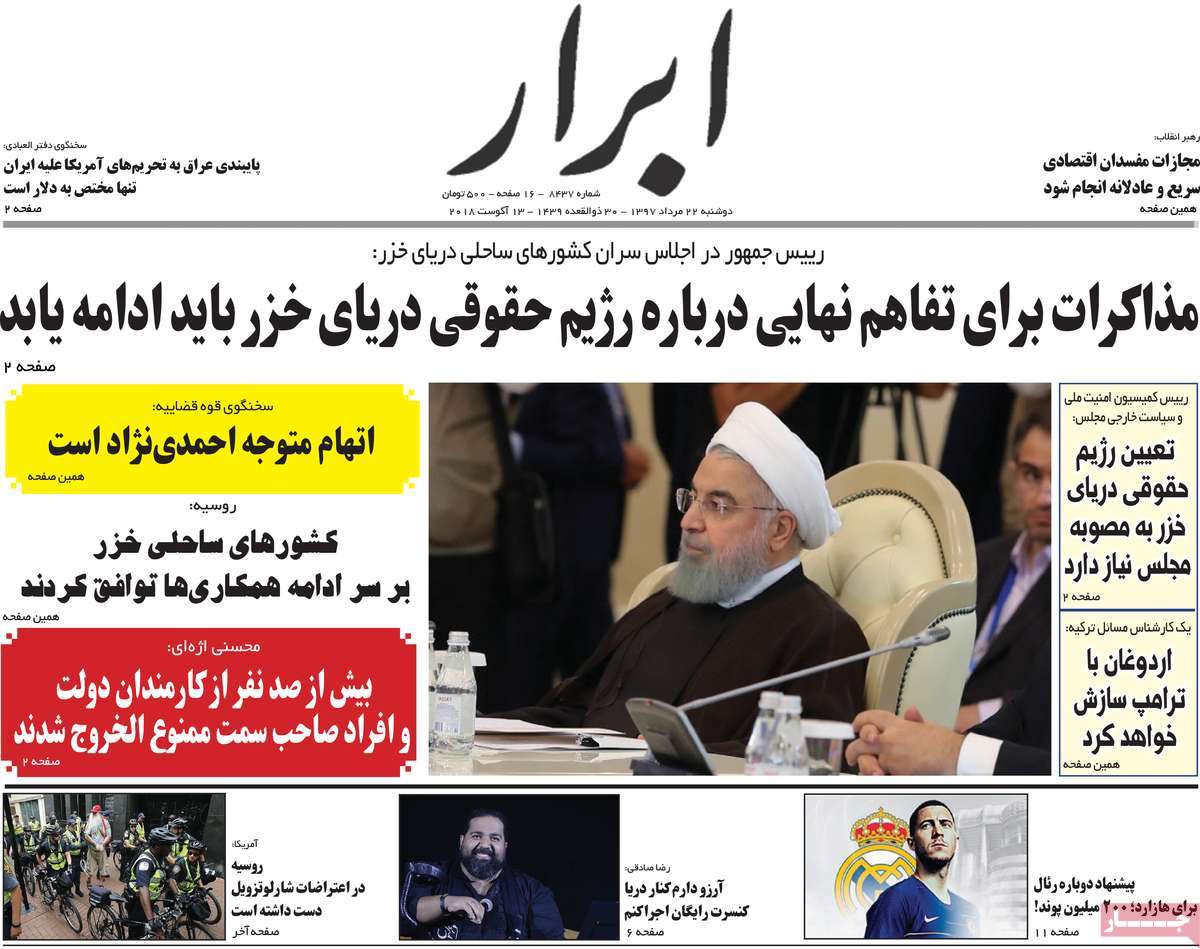
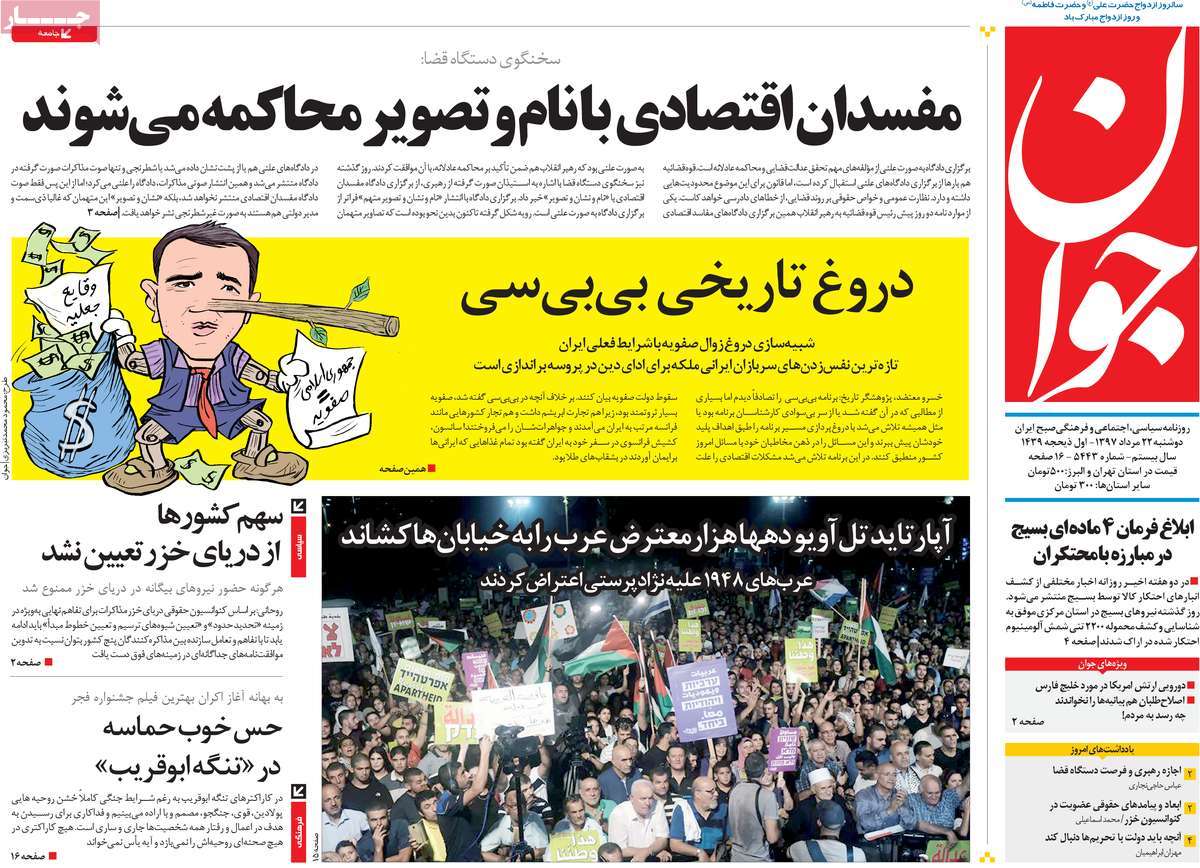
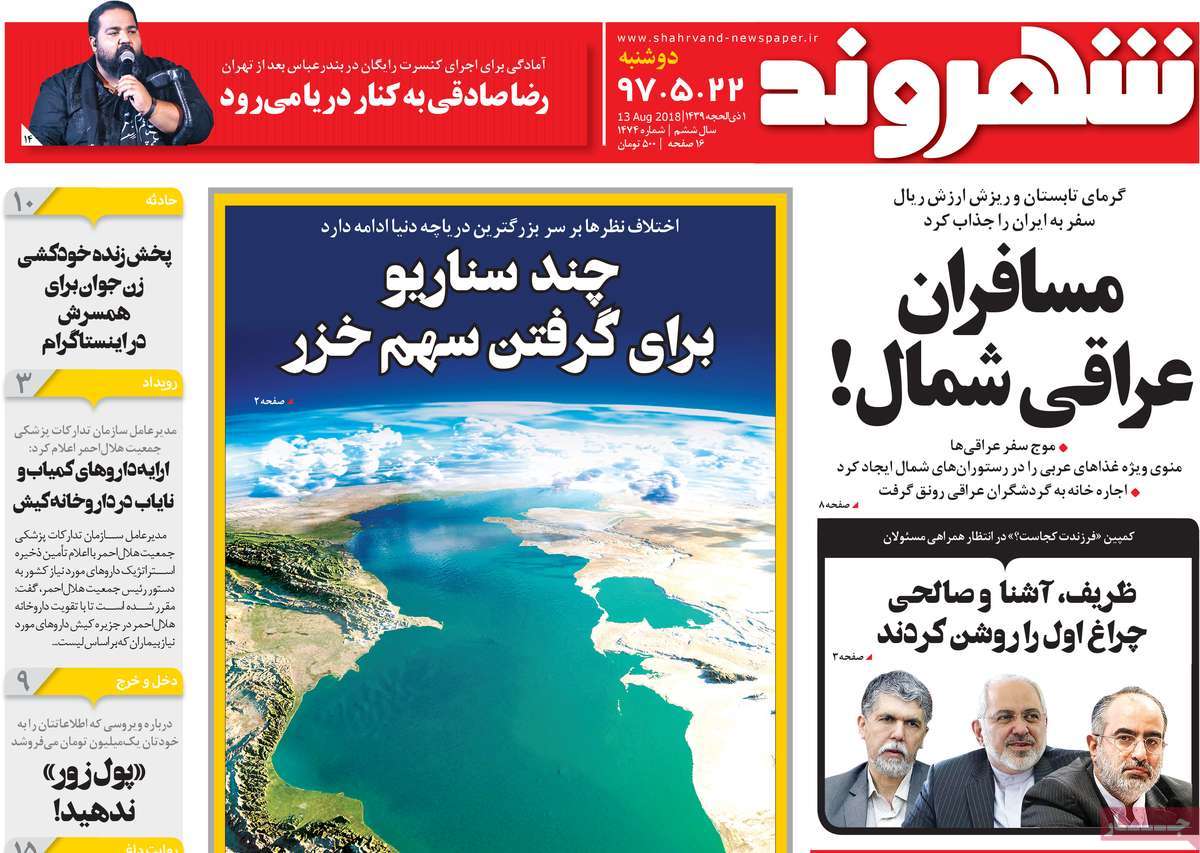
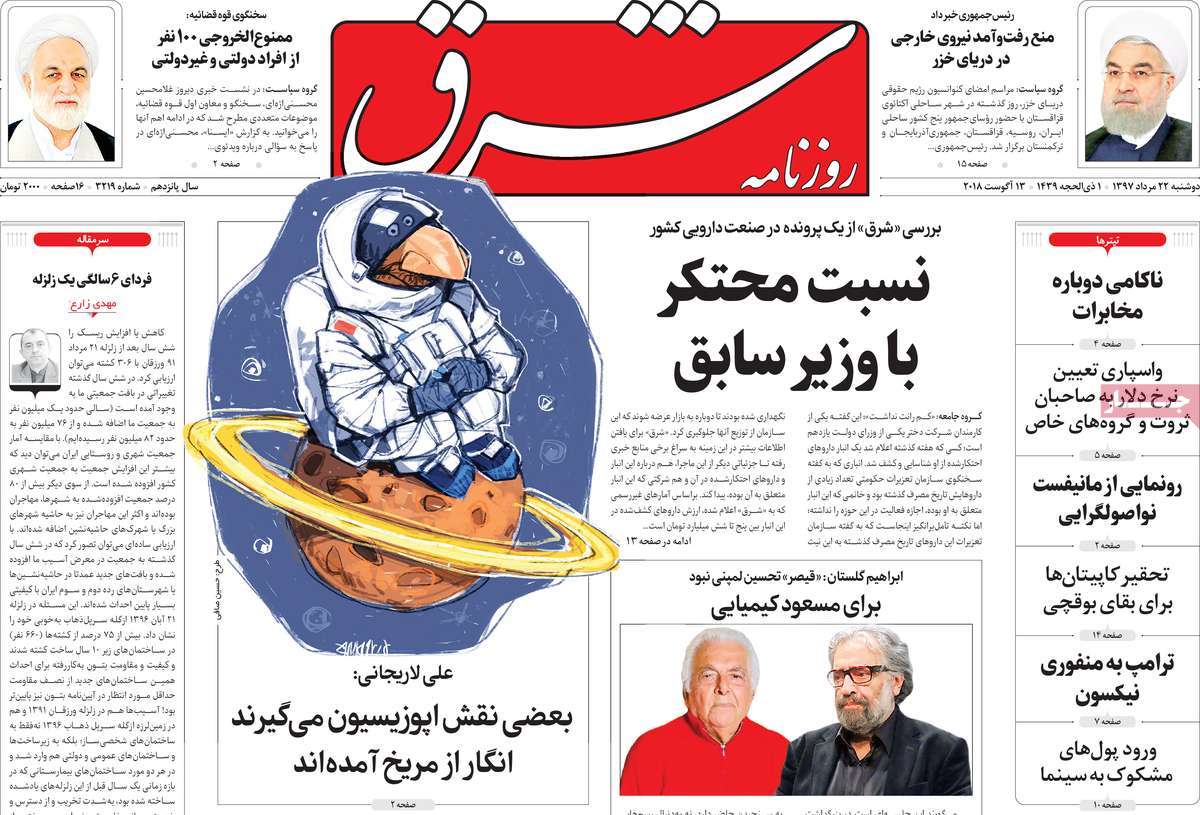
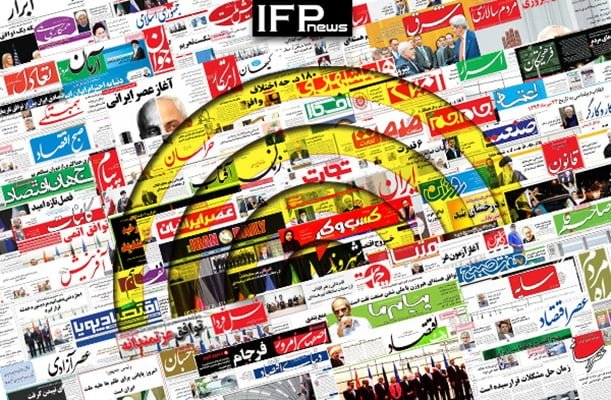
A Look at Iranian Newspaper Front Pages on July 19

A Look at Iranian Newspaper Front Pages on November 19

The top story today was the remarks by President Hassan Rouhani’s chief of staff Mahmoud Vaezi, who said US President Donald Trump had called his Iranian counterpart for eight times during the latter’s visit to New York in 2017, but the Iranian delegation ignored the calls.

The prospect of Tehran’s cooperation with the European Union and their efforts to save the Iran nuclear deal also remained a top story. Reformist and pro-government media covered the remarks by an official with Tehran’s chamber of commerce on the EU’s $80 billion credit for working with Iran, but Kayhan rejected the remarks as a lie, saying that the European Investment Bank (EIB) has clearly announced it will not work with Iran due to its risks.

President Rouhani’s decision to reshuffle his cabinet in coming days also received great coverage.

The above issues, as well as many more, are highlighted in the following headlines and top stories:


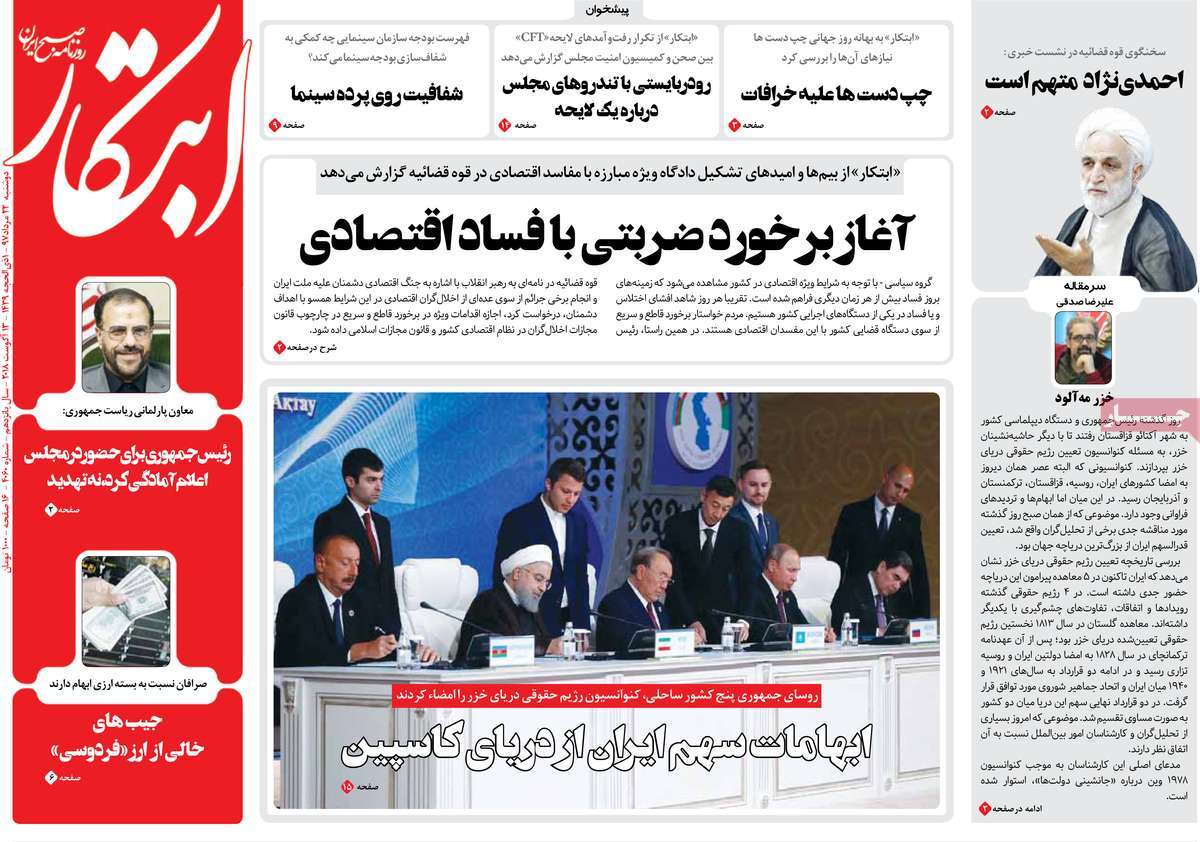
Abrar:

1- Armed Forces Totally Prepared to Give Crushing Response to Any Ill-Wishing Aggressor: DM

2- ICJ: Iran Has Filed Lawsuit against US over Re-Imposition of Sanctions

3- India Might Be Exempted from US’ Iran Sanctions: Indian Paper

4- Europe Shouldn’t Just Pay Lip Service: Zarif

A Look at Iranian Newspaper Front Pages on July 19


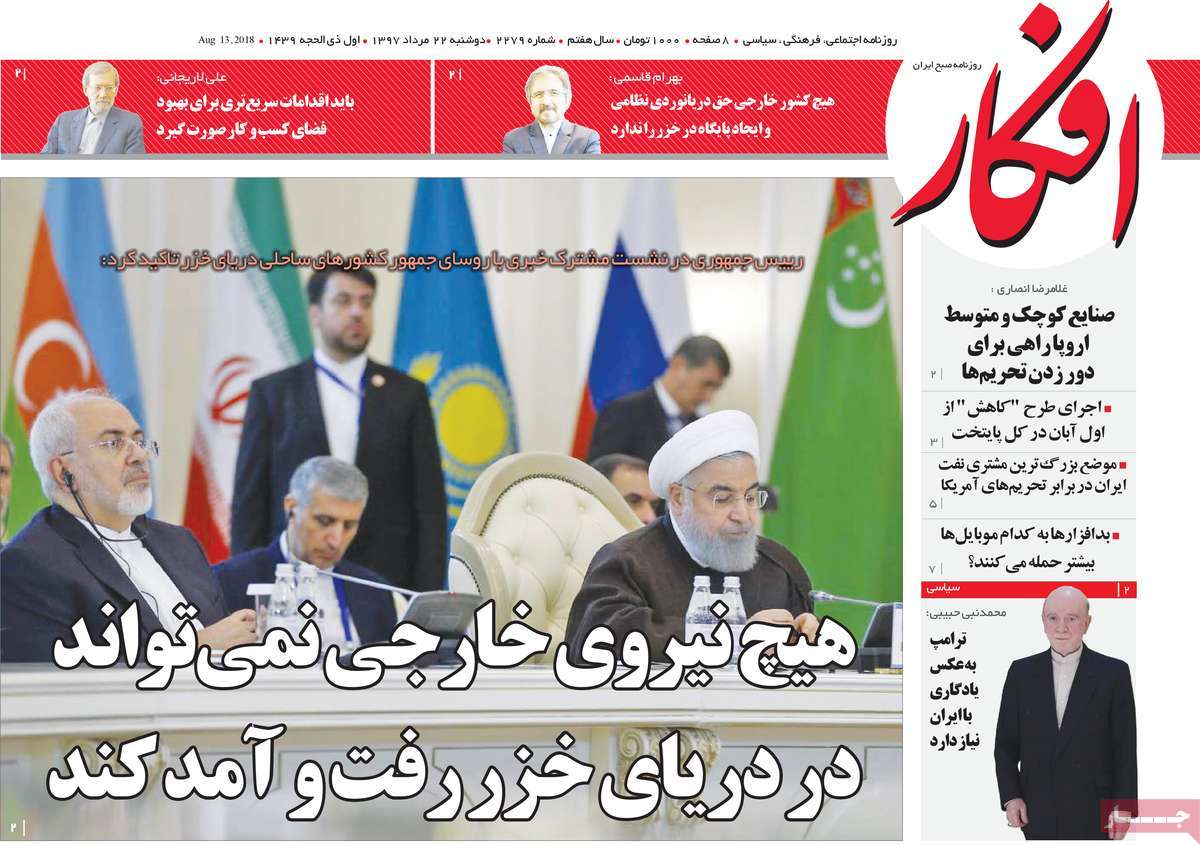
Afkar:

1- Putin Blackmailing Trump: What Secret Does Putin Know?

2- E-Government Best Way to Eradicate Corruption

3- Historic Prosecution of Those Disrupting Gold Coin, Forex Markets

A Look at Iranian Newspaper Front Pages on July 19


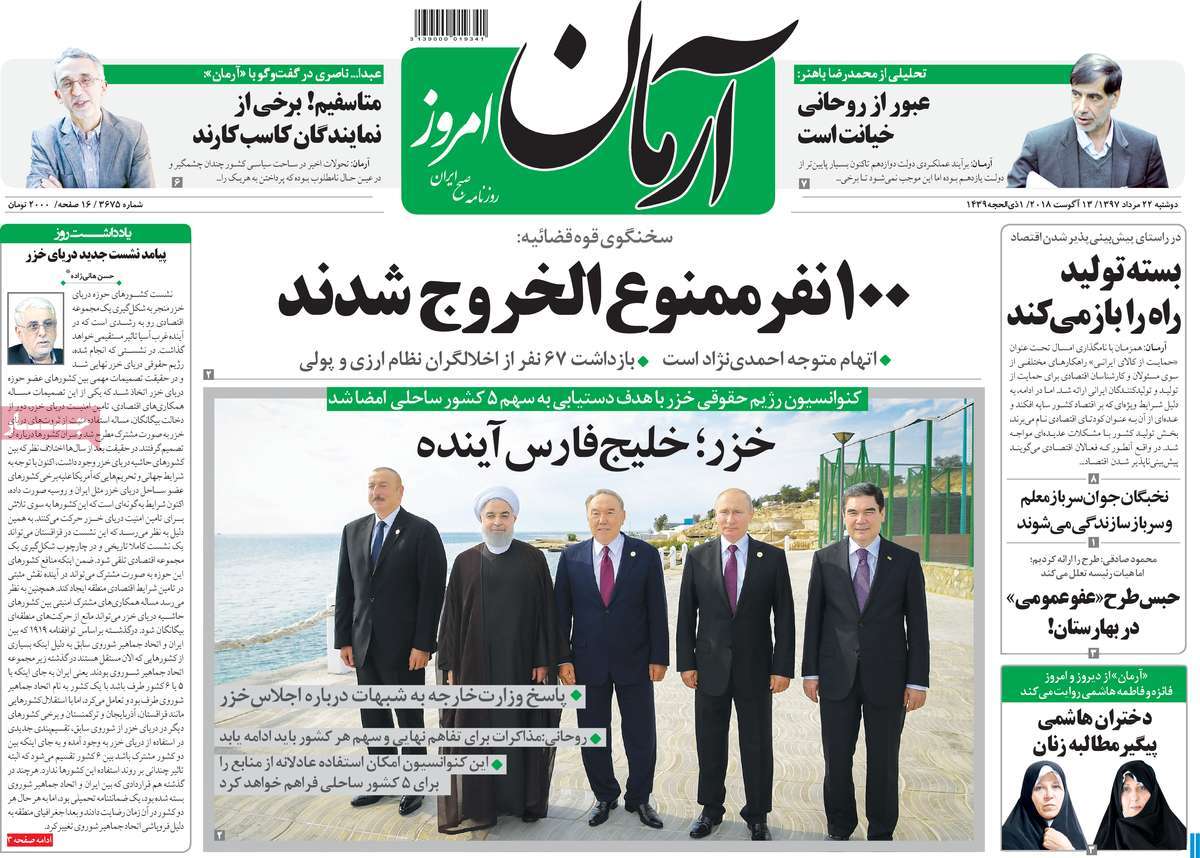
Arman-e Emrooz:

1- Talks with US: From Words to Reality

  • Trump Makes Eight Phone Calls to Meet with Rouhani in New York

2- Trump and Issue of Contacting Iran [Editorial]

3- Prosecutor-General Gives Ultimatum to Chief Banker

  • Central Bank Must Disclose Names of Those Receiving Official-Rate Currencies in 48 Hours

4- Trump Looking for Iran-US Bilateral Talks without Europe [Editorial]

A Look at Iranian Newspaper Front Pages on July 19


Ebtekar:

1- Two Steps by Europe, One Step by Iran

  • Iran, Europe’s Efforts to Save JCPOA

A Look at Iranian Newspaper Front Pages on July 19


Emtiaz:

1- $80 Billion Credit for Iranian Firms

2- Huge Interest in Summer Vacations

A Look at Iranian Newspaper Front Pages on July 19


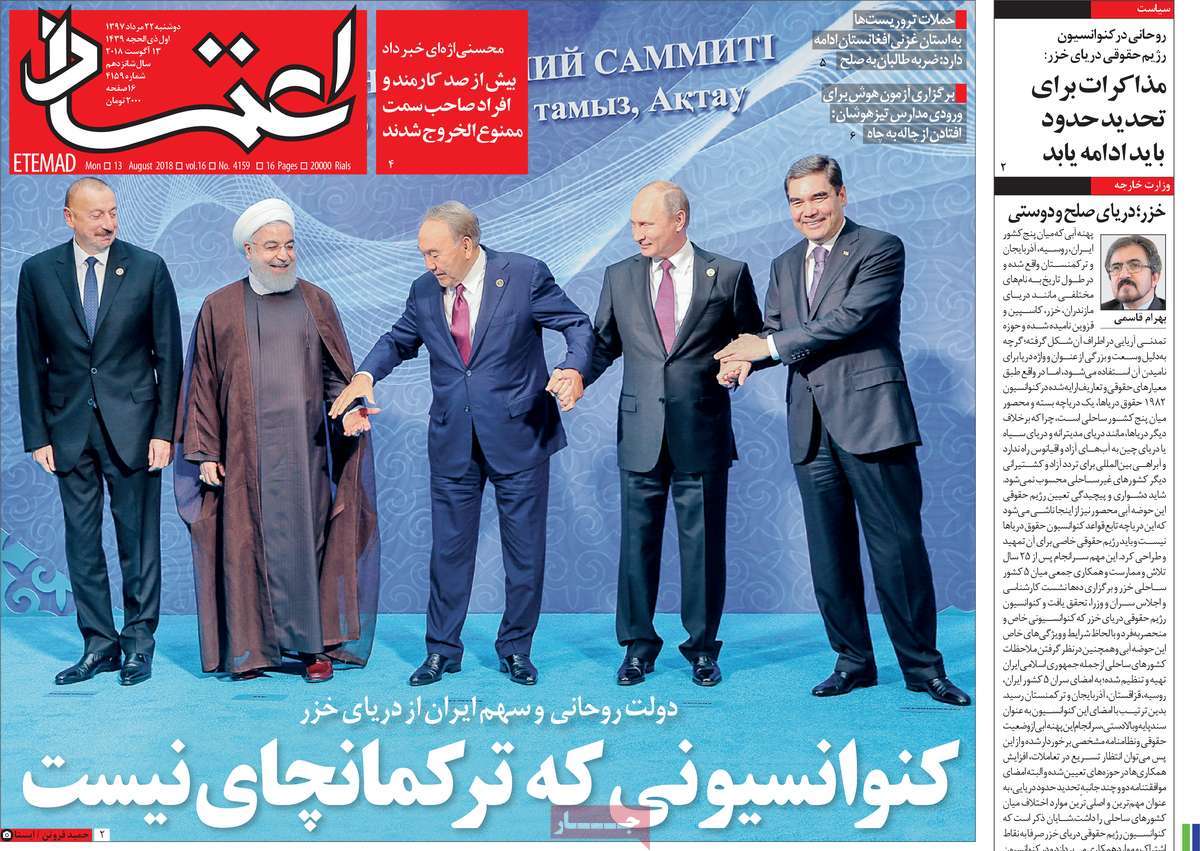
Etemad:

1- Judicial Action Not Working on Hijab Issue: Prosecutor General

A Look at Iranian Newspaper Front Pages on July 19


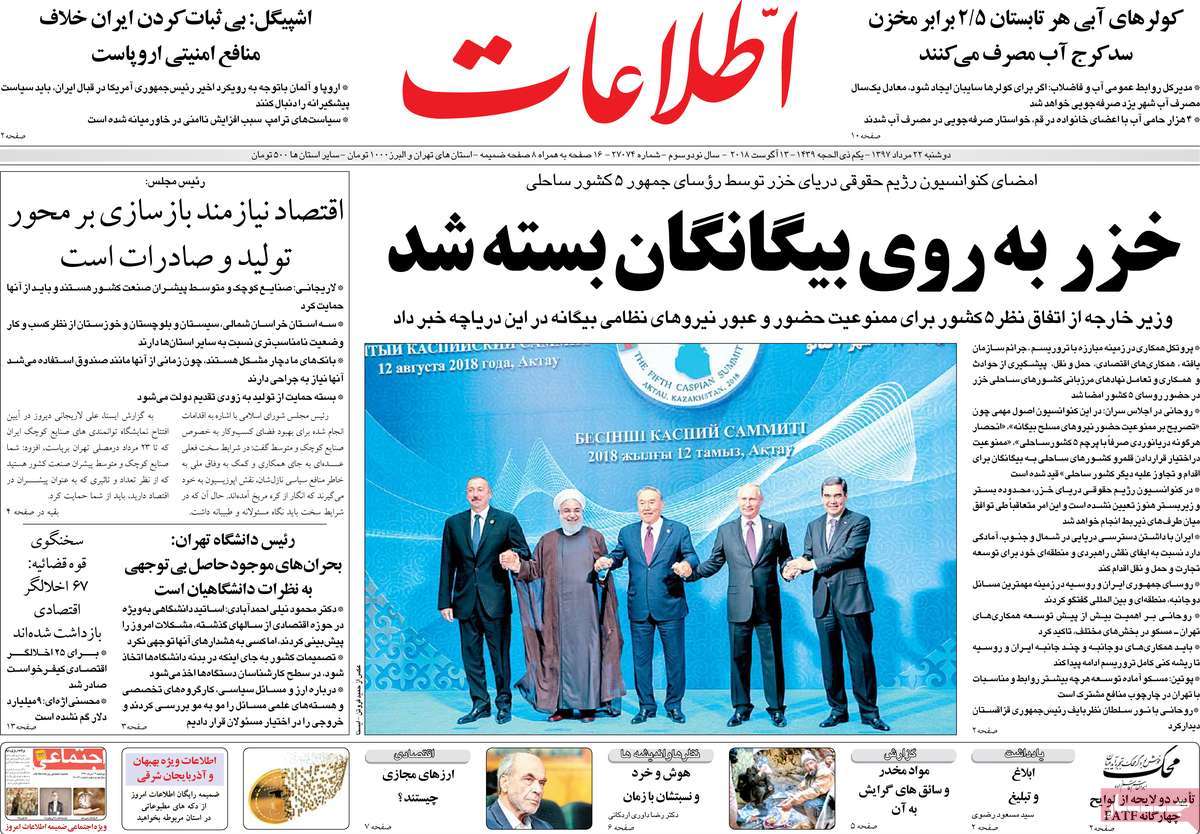
Ettela’at:

1- Iran Ready to Achieve 190,000 SWU Enrichment: AEOI Chief

2- Cabinet to Be Reshuffled

A Look at Iranian Newspaper Front Pages on July 19


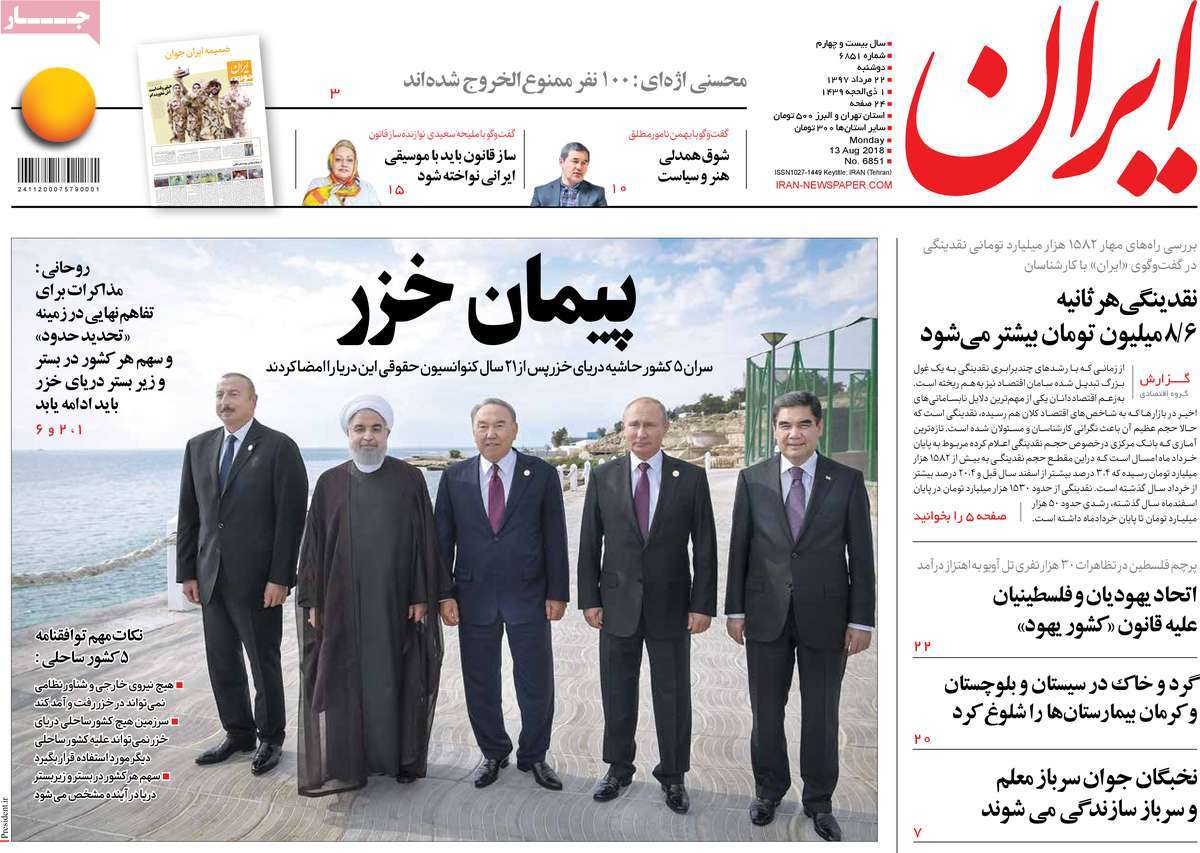
Iran:

1- Time for Cabinet Reshuffle

  • Rouhani Considering New Options for Ministerial Posts

2- Online School for Programming in Mother Tongue

3- Iran and US: Who Would Call First?

  • Trump Called Rouhani Eight Times during His Visit to New York

A Look at Iranian Newspaper Front Pages on July 19


Javan:

1- Gov’t to Reinforce Its Members in Economic War: Cabinet Reshuffle in Coming Days

2- Faghani: World Admired Iran

3- Lack of Media Literacy, Achilles’ Heel of Celebrities in Cyberspace

4- Trump Accepts Russia Has Interfered in US Elections

  • Russia Had Intervention, but It Wasn’t Effective

A Look at Iranian Newspaper Front Pages on July 19


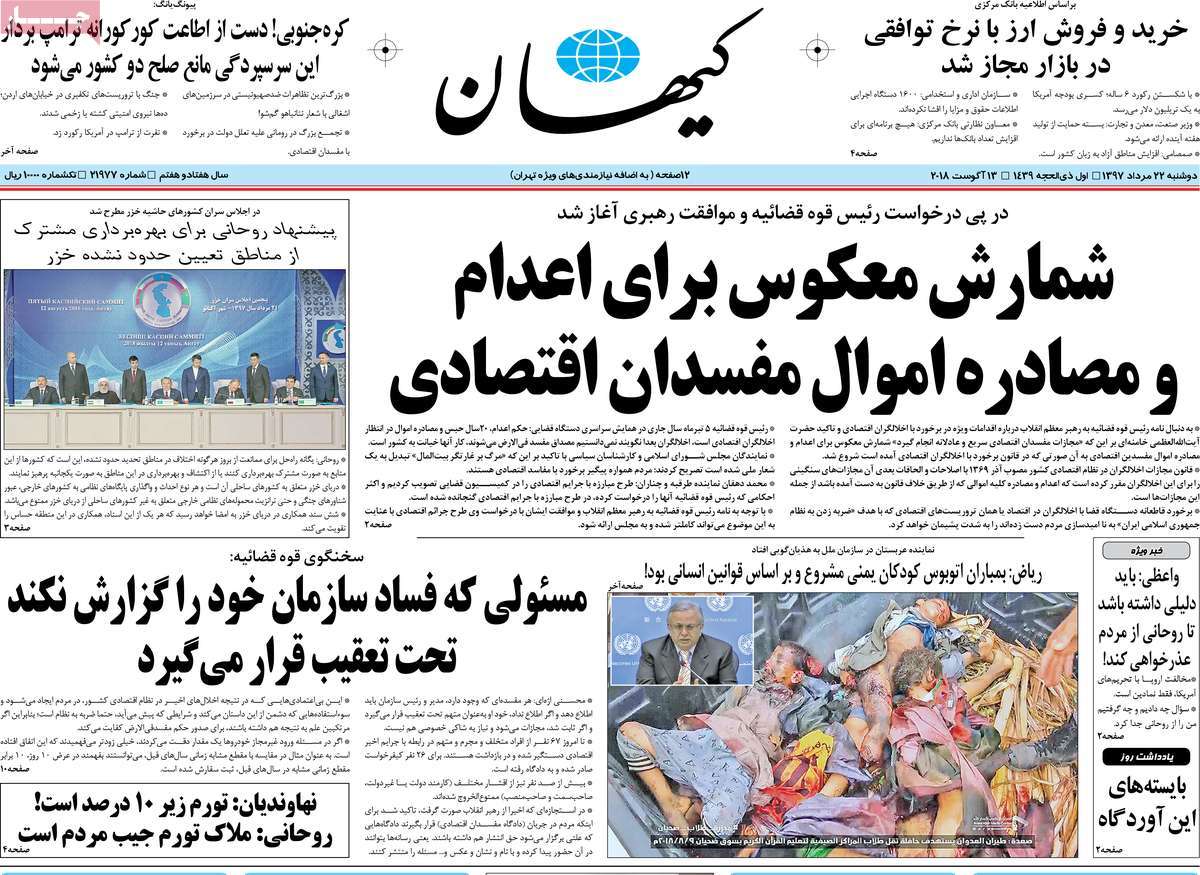
Kayhan:

1- They Lie that Europeans Want to Allocate $80 Billion to Iranian Firms

  • European Investment Bank: EU Banks Cannot Work with Iran

2- Bodies of 75 Martyrs Repatriated from Iraq to Iran after 3 Decades

A Look at Iranian Newspaper Front Pages on July 19


Resalat:

1- Citizens’ Rights Violated in Cyberspace

2- Every Single Iranian Has Right to Access Public Information

3- People Are Not Told about Realities of FATF

A Look at Iranian Newspaper Front Pages on July 19


Shargh:

1- Eight Unanswered Calls by Trump for Talking with Rouhani

2- China’s Eye on Middle East: Chinese President Visits UAE after 29 Years

3- Velayati: We Have Trust in Moscow

A Look at Iranian Newspaper Front Pages on July 19

Gilan Province, Historical Hub of Silk Farming in Iran

Gilan Province in northern Iran produces almost half of the country’s raw cocoon thanks to its climate, which is conducive to mulberry tree plantation.

Last year, the province produced over 430 tonnes of raw silk cocoons.

Other provinces in which sericulture is practiced include Mazandaran and Golestan (in northern Iran), Khorasan Razavi, North and South Khorasan (all in eastern Iran), East Azarbaijan (in the northwest) and Isfahan (in central Iran).

The country is the world’s eighth biggest country in silk farming after China, India, Uzbekistan, Thailand, Brazil, Vietnam and North Korea.

The industry generates numerous direct and indirect jobs, especially for the rural population.

Silk and its byproducts such as silkworm powder are used as raw material in pharmaceutical, cosmetics and toiletry industries.

The following photos retrieved from IRIB News Agency show people of Gilan Province active in the sericulture industry:

Iran, Armenia Hold Joint Consular Meeting

Iran Congratulates Armenia on National Day

The meeting was held at the Iranian Foreign Ministry on Wednesday and was chaired by Iranian and Armenian directors general for consular affairs.

At the meeting, the two sides reviewed the topics discussed at the 11th joint consular meeting of the two countries and expressed satisfaction with the proper implementation of the decisions adopted and the progress made. They further exchanged views on issues such as mutual cooperation in easing popular exchanges between the two countries and upgrading cooperation in the fields of commerce and tourism.

They also discussed students and prisoners’ affairs as well as fighting drugs, human smuggling and organized crime, among other issues.

Iran Ready to Expand Business Ties with D-8 States: FM

During the Wednesday meeting, Iran’s top diplomat described the D-8 Organization as an important body with great untapped potentialities for expanding cooperation among the member states.

He also expressed Iran’s willingness and preparedness to enhance cooperation with the private sectors of the D-8 member states and exchange experiences with the organization in scientific and technological areas.

Transfer of Technology, cooperation in various research and development areas, financing economic projects, barter system, cooperation in medicine production and exports were among other issues discussed in the meeting.

The D-8 Organization for Economic Cooperation, also known as Developing-8, is an organization for development cooperation among Bangladesh, Egypt, Nigeria, Indonesia, Iran, Malaysia, Pakistan, and Turkey.

The goals of D-8 Organization for Economic Cooperation are to improve the member states’ position in the global economy, diversify and create new opportunities in trade relations, enhance participation in decision-making at international level, and improve standards of living.

D-8 is a forum with no adverse impact on bilateral and multilateral commitments of the member states, emanating from their membership to other international or regional organizations.

Iran Ready to Expand Business Ties with D-8 States: FM

FM Zarif Warns against Plots to Sever Iran-Europe Ties

Iran Blasts Europe’s ‘Disastrous’ Subservience to US

Zarif made the comments in separate meetings with the outgoing ambassadors of France, Belgium and the Netherlands in Tehran.

During the Wednesday meetings, the Iranian top diplomat referred to the long-time and historical relations between the Islamic Republic of Iran and Europe and warned about the enemies’ plots to sever relations between the two sides through false pretexts.

He also underlined the dire need for Europe to avoid sheltering desperate terrorist groups on its soil.

Iran and the five remaining parties to the 2015 nuclear deal have been involved in talks over the past months to discuss ways of maintaining the international accord after the US’ withdrawal.FM Zarif Warns against Plots to Sever Iran-Europe Ties

Since US President Donald Trump pulled Washington out of the historic nuclear deal, European countries have been scrambling to ensure that Iran gets enough economic benefits to persuade it to stay in the deal.

Trump also said he would reinstate US nuclear sanctions on Iran and impose “the highest level” of economic bans on the Islamic Republic.

Under the JCPOA, Iran undertook to put limits on its nuclear program in exchange for the removal of nuclear-related sanctions imposed against Tehran. The remaining parties have vowed to stay in the accord.

Iran Foreign Ministry Presents 10th Quarterly Report on JCPOA to Parliament

ICJ Ruling Proves US Sanctions against Iran Cruel: Statement

In a Wednesday statement, Qassemi said the report was presented to the Parliament’s National Security and Foreign Policy Commission on Tuesday.

“In its 10th report to the Parliament, the Foreign Ministry pointed out that during the first three months of this Persian year, all the developments of the Iran nuclear deal were influenced by the US administration’s illegal and unilateral move to withdraw from the JCPOA in May,” he said.

The spokesman went on to say that the Foreign Ministry’s report also referred to the intensification of the US’ aggressive moves and approaches towards Iran under the current president as well as the US’ repeated violations of its commitments under the JCPOA.

“The report then elaborated on the US administration’s moves over the past three months as well as the other measures it adopted following an exclusive speech by the US president dedicated to his country’s new policies towards Iran on May 8,” he noted.

According to Qassemi, the tenth report to the Parliament also  covered the measures adopted by the Foreign Ministry to pursue the rightful demands of the Islamic Republic by taking advantage of the existing capacities including the negotiations that the Iranian foreign minister held with his counterparts of the remaining sides of the JCPOA, two meetings at the level of ministers and deputy ministers held by the Joint Commission of the JCPOA, several expert meetings held with other sides of the JCPOA aimed at exploring ways on how they can compensate for the loss inflicted on Iran by the US’ withdrawal as well as their pledges and measures to guarantee that Iran can enjoy its benefits under the nuclear deal.

In its report, he said, the Foreign Ministry also referred to the 11th report by the International Atomic Energy Agency on Iran’s full compliance with its nuclear pledges and its continued nuclear activities within the country’s strategic and long-term nuclear program.

“The report underlines that over the past three months, all nuclear activities of Iran –particularly in Research & Development area – have continued based on the schedule of the Atomic Energy Organization of Iran.”