Thursday, December 25, 2025
Home Blog Page 3527

“Enemies Spending Huge Money to Create Insecurity in Iran”

Mohammad-Ali Jafari

Speaking at a Sunday ceremony in Mashhad, General Jafari stressed that the enemies, especially in recent months, spent a lot of money, but we see that they could not do anything, and today our country is secure.

“The enemies of the Islamic Revolution have conspired against Iran ever since the victory of the Revolution and used everything they could to create insecurity and disagreement in society,” he was quoted as saying in a report by Fars News Agency.

Jafari further mentioned that during the imposed war (by Iraq) the enemies thought they could prevent the spread of the 1979 Revolution, while the war, despite its losses, was the greatest opportunity for the export of the Islamic Revolution.

“Of course, our enemies do not realize that such actions, even the soft threats, do not affect us. They are doing everything they can to exert pressure on the Iranian nation, but experience has proved that the Iranian nation is turning the threats into opportunities,” noted the Iranian commander.

He also underlined that the economic threats will be countered if we focus on domestic capabilities, facilities, and resources as the Leader of the Islamic Revolution mentioned.

“The young generation of Iran is revolutionary, believer, conscious, and enlightened; therefore, it is necessary to use the capacity of these huge young forces for the future of the country and the Islamic Revolution through planning, organising and concentrating on scientific work,” concluded Jafari.

IRGC Warns Foreign Intelligence Services against Destabilising Iran Borders

General Ramezan Sharif

Brigadier General Ramezan Sharif said it is better for these countries to stop their support for criminal terrorist groups who try to disrupt the security of Iran’s borders.

“The IRGC’s ground forces in recent years, especially after the emergence of ISIS and Takfiri terrorism on the periphery of the country, have been successful in countering the destabilising scenarios of the enemies of the Islamic Republic.”

“The IRGC, along with other security and defence forces, has had a successful presence in providing security and peace for the dear people of the border provinces in the west, northwest, and southeast of the country,” he added.

He further noted that the enormous attendance of the faithful and grateful people of Marivan and Kurdistan province in the funeral ceremony of the martyrs showed that the efforts and investment of the enemies to create a gap between people and the institutions of the Islamic Republic have failed.

Sharif also warned that if the enemies do not stop supporting terrorists they will face the strong response of the country’s security and defence forces, especially the IRGC, and will have to face the music.

The Saturday night attack in the village of Dari in Marivan led to clashes which entailed in an explosion at an arms depot, where 11 IRGC and Basij members lost their lives.

In the past years, security forces and border guards of the Islamic Republic of Iran have engaged in clashes with terrorists, many of whom try to cross the country’s borders with Pakistan and Iraq to carry out attacks inside Iran.

Iran, Austria Commemorate First European Ascent of Mount Damavand

Iran, Austria Commemorate First European Ascent of Mount Damavand

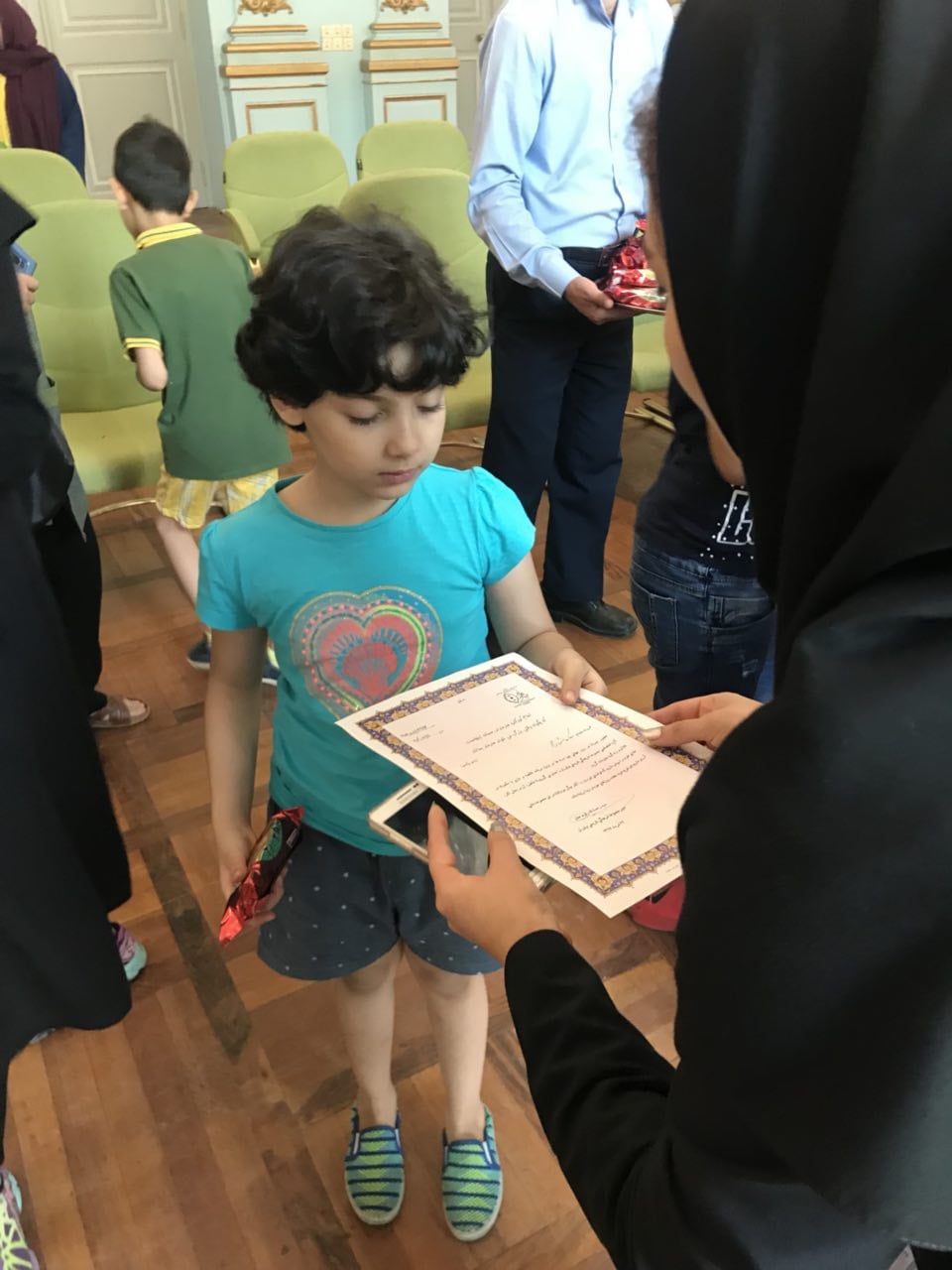
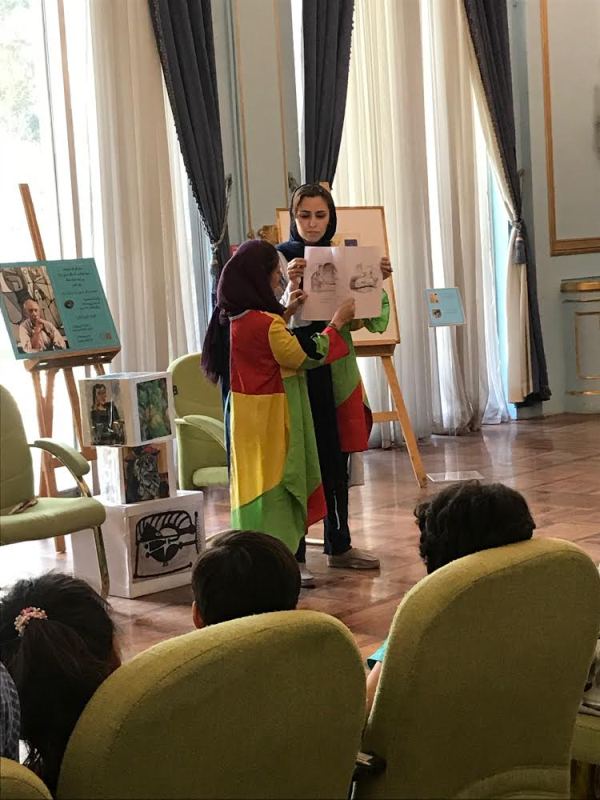
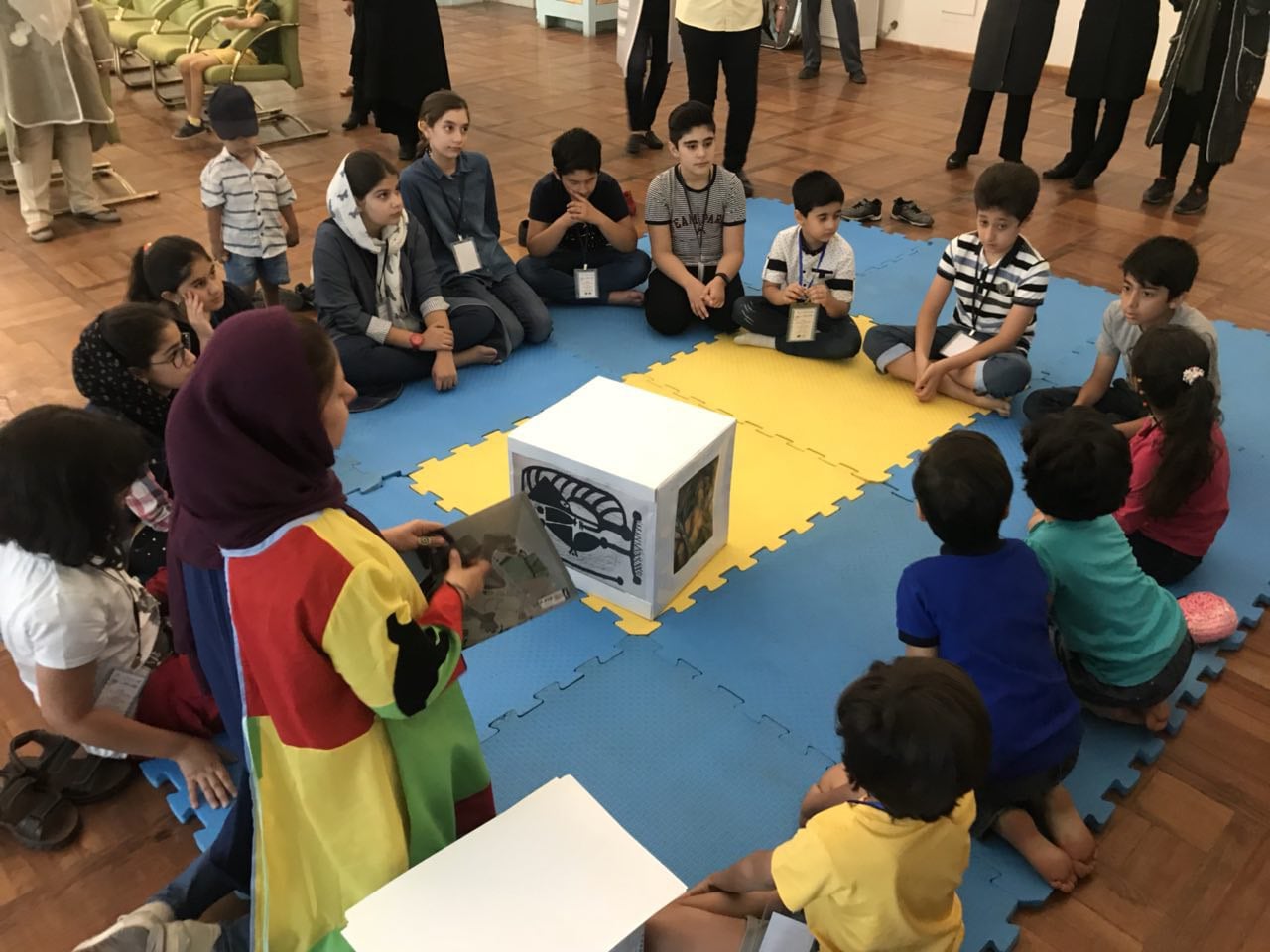
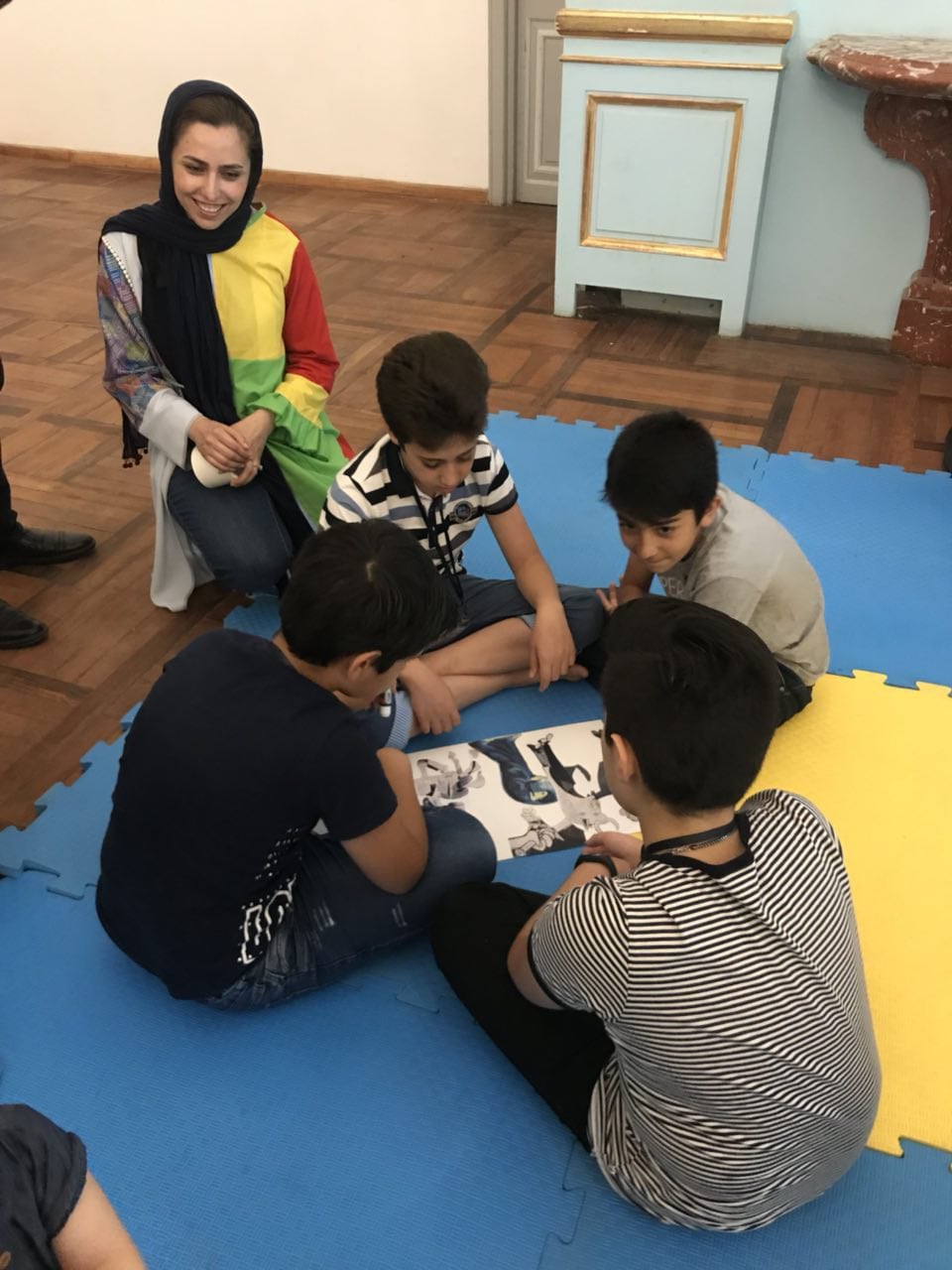
The event was held on July 20 at the Niavaran Historical and Cultural Complex, north of Tehran. The ceremony was attended by ambassadors of Austria and Mexico to Tehran and Ali Asghar Moonesan, the Head of Iran’s Cultural Heritage, Handicrafts and Tourism Organisation (ICHTO).

Iran, Austria Commemorate First European Ascent of Mount DamavandAccording to Miras-e Arya, Moonesan told the symposium, “I am very pleased to attend this summit on the occasion of the anniversary of the first ascent of a European to the peak of Mount Damavand; a ceremony to commemorate an Austrian climber, scientist and researcher who has managed to climb Damavand.”

“Fortunately, the relationship between Iran and Austria is already at a very good level, and there exist friendly ties between the two countries. When Iranian people hear the name of Austria, the first thing that comes to their minds is the Austrian culture, especially Austrian music,” said Moonesan.

He further mentioned that art and culture are factors that contribute to proximity of nations. “The artist conveys the most beautiful human concepts including kindness, compassion, friendship, and peace in the form of art to his fellows.”

Iran, Austria Commemorate First European Ascent of Mount DamavandAustrian ambassador to Iran, Stefan Schulz, also hailed the holding of such a symposium in Iran, expressing his satisfaction with the ceremony and appreciated the efforts by the ICHTO for hosting the event.

“The presence of the Iranian and Austrian climbers in the ceremony reflects the unity and interconnectedness of the two countries of Iran and Austria, and a sign of their sympathy for preserving achievements in a cultural atmosphere based on the interaction between Iran and Austria.”

The Ambassador of Austria to Iran went on to say, “The Damavand Symposium 2018 is one of the biggest cultural events of the two countries, whose cultural relations date back to 500 years ago.”

“I am very pleased to announce that with the assistance of the Federation of Mountaineering of Iran and Austria, a mountaineering training centre has been launched to focus on mountain rescue, while cooperating on medicinal plants based on an agreement between four Austrian universities and a university in Iran is encouraged. In addition, a joint study course on sustainable tourism will begin with the cooperation of an Austrian institution,” noted the Austrian official.

The Austrian Ambassador to Iran also pointed out that on August 9, a number of Iranian and Austrian climbers are going to climb to the summit of Mount Damavand in a joint program.

Through such sporting and cultural events they want to show that Iran and Austria will adhere to all their commitments in various fields, he added.

“The cooperation between Tehran and Vienna at the Damavand Symposium in 2018 will convey the message of strengthening cultural cooperation between Iran and Austria,” underlined Schulz.

After the end of the symposium, Moonesan together with the Austrian ambassador visited the photo exhibition of Iranian and Austrian climbers who ascended to Mount Damavand.

Iran, Austria Commemorate First European Ascent of Mount Damavand

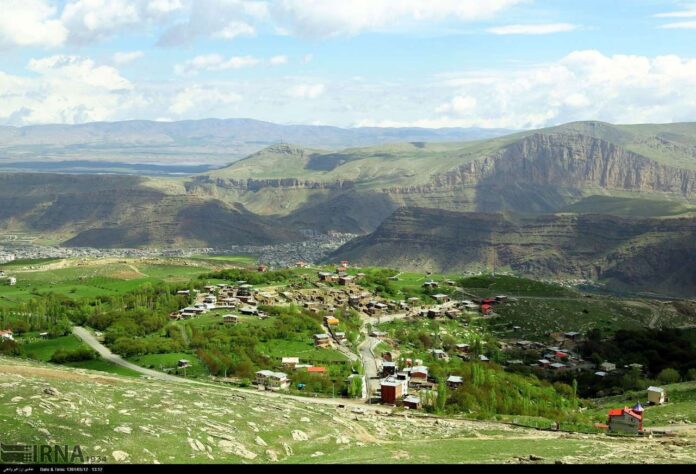
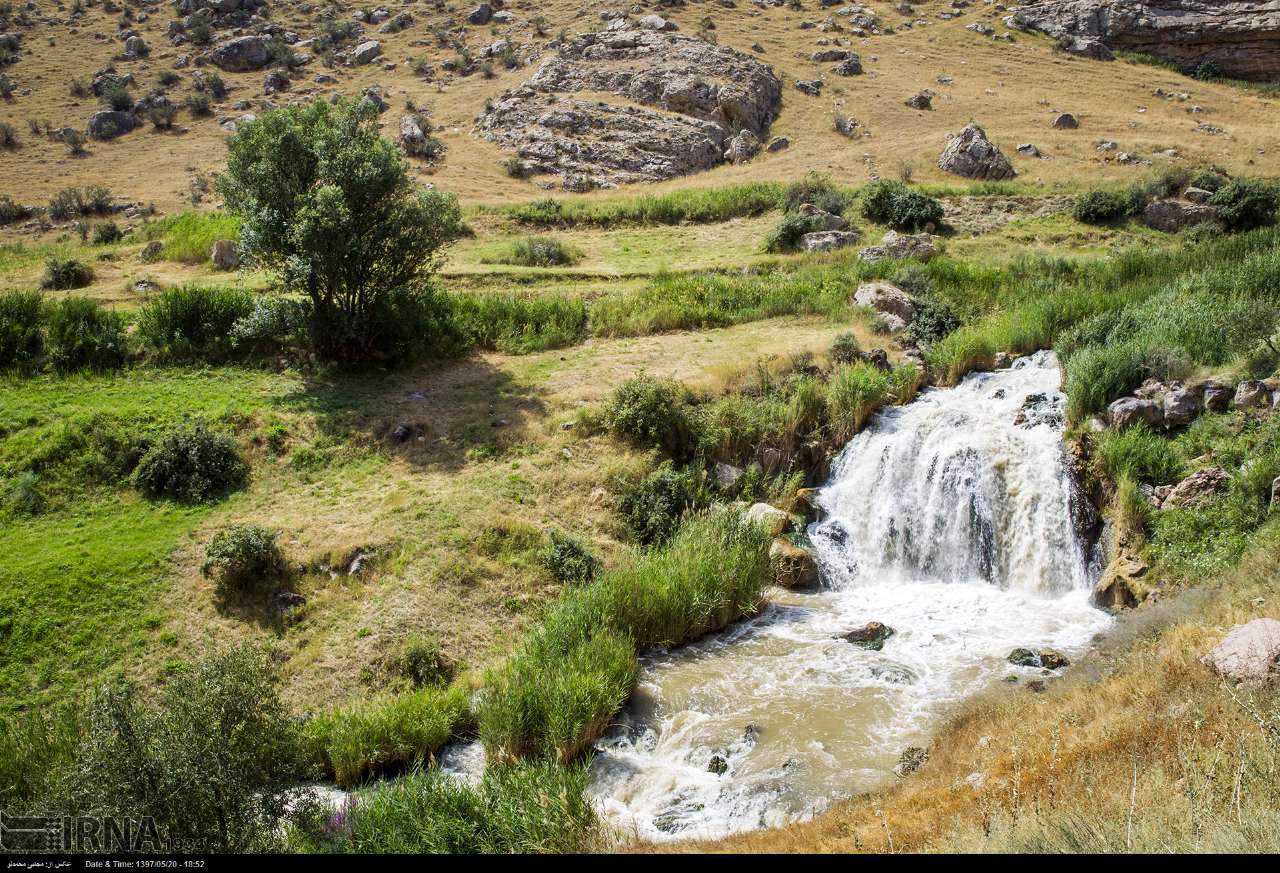
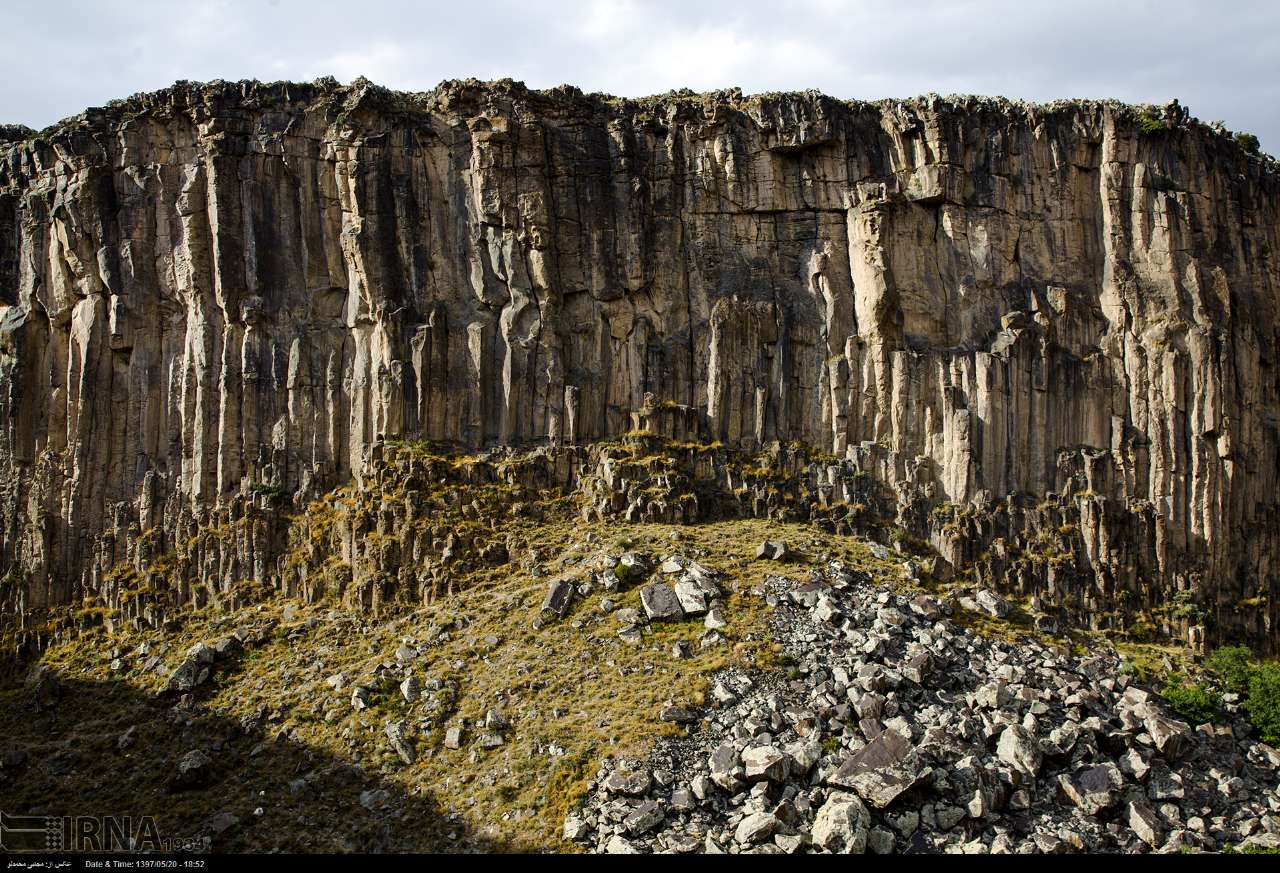
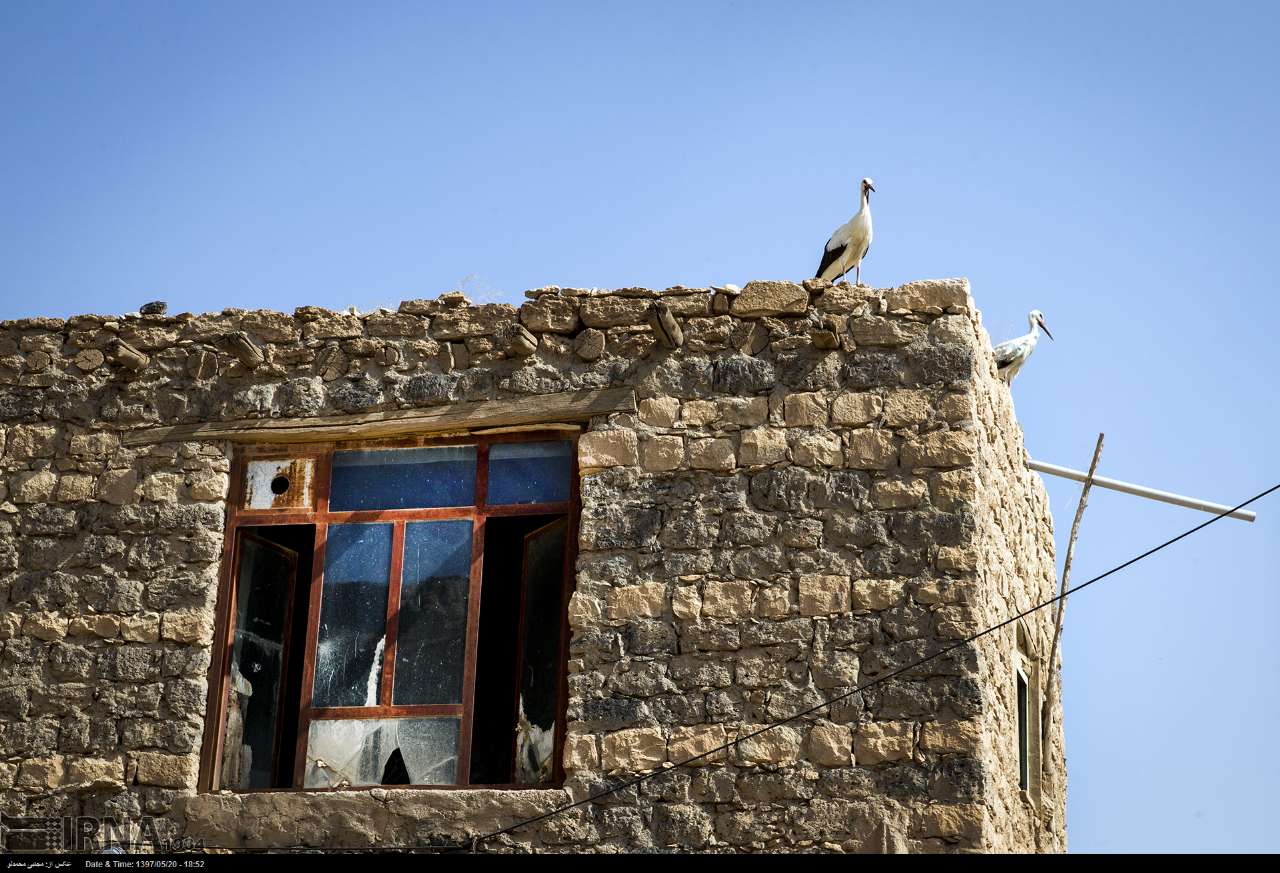
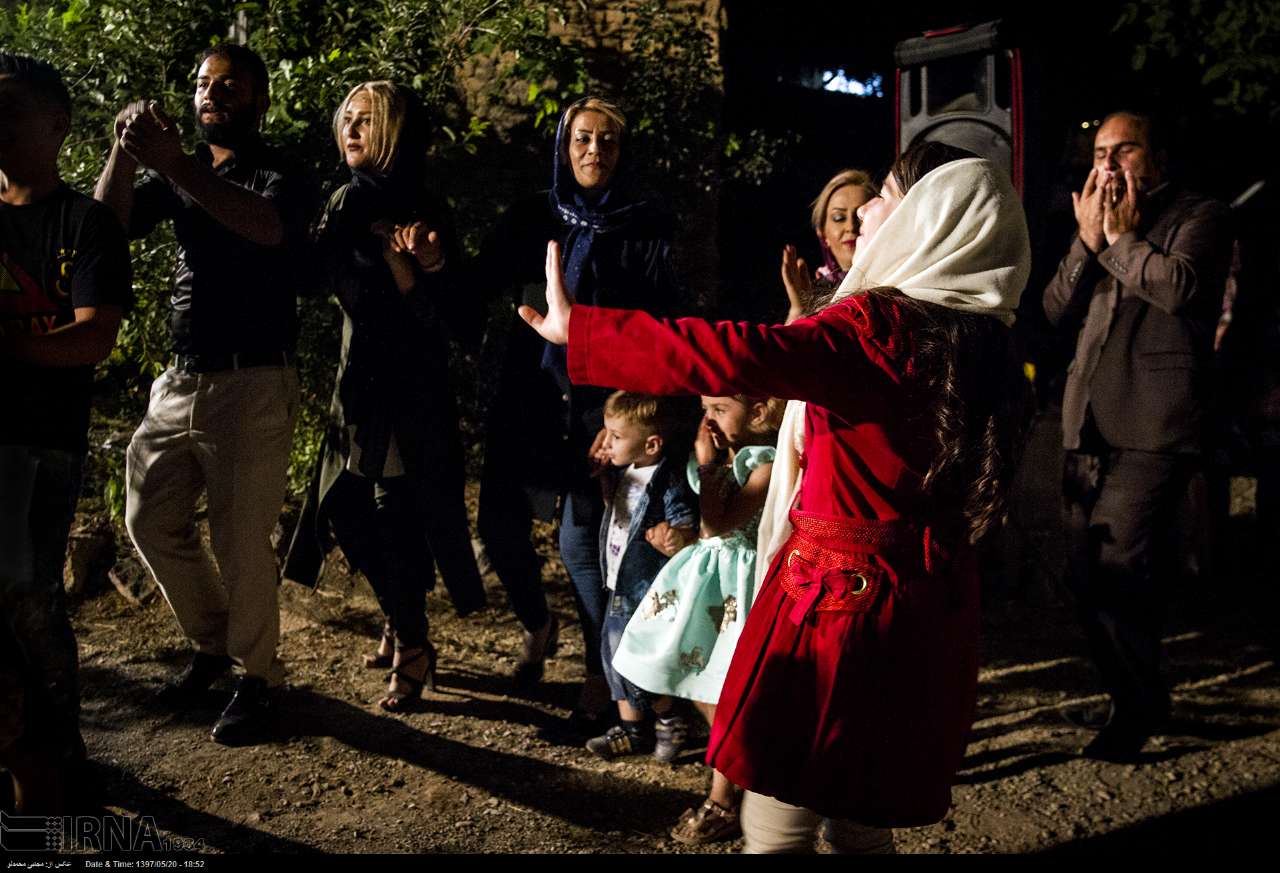
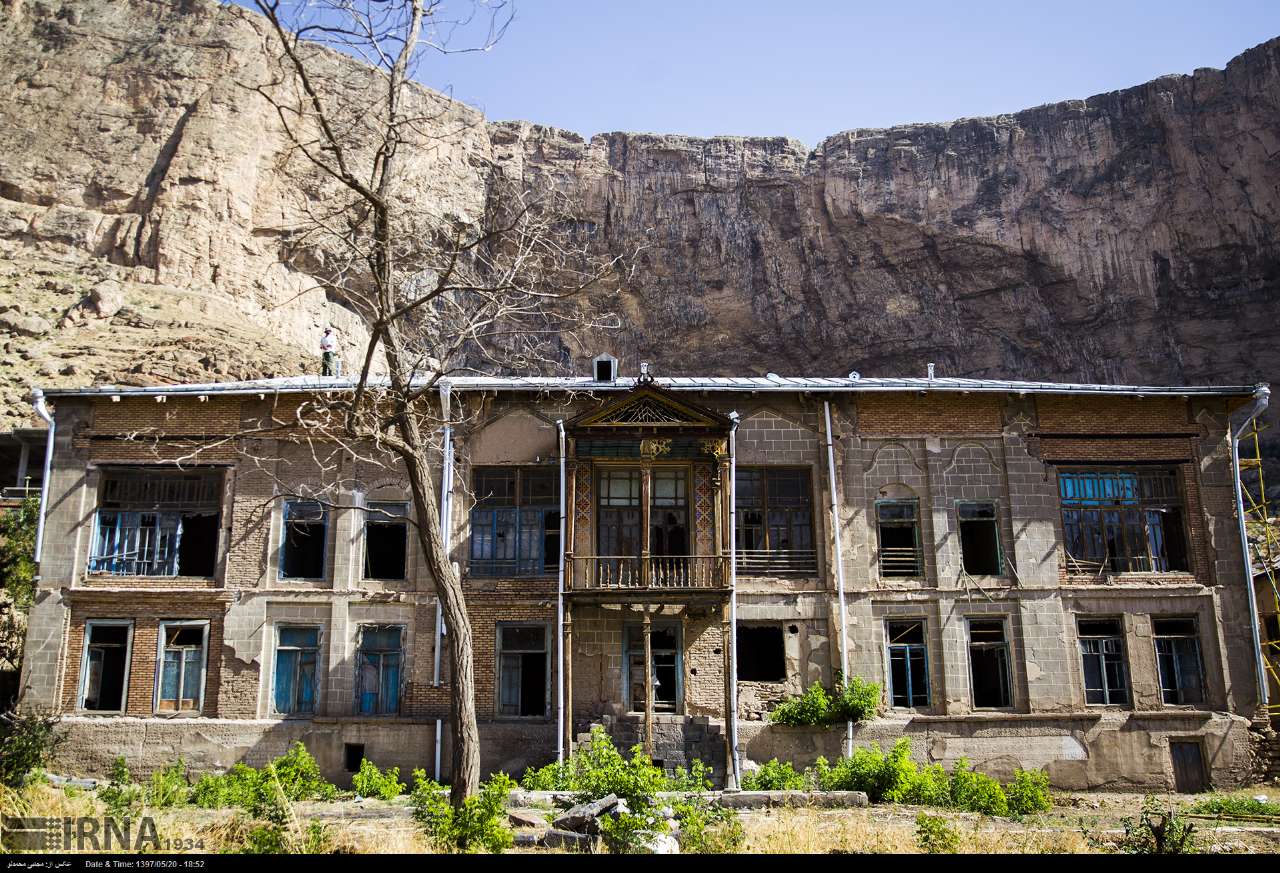
Iran’s Beauties in Photos: Hanam Village in Lorestan

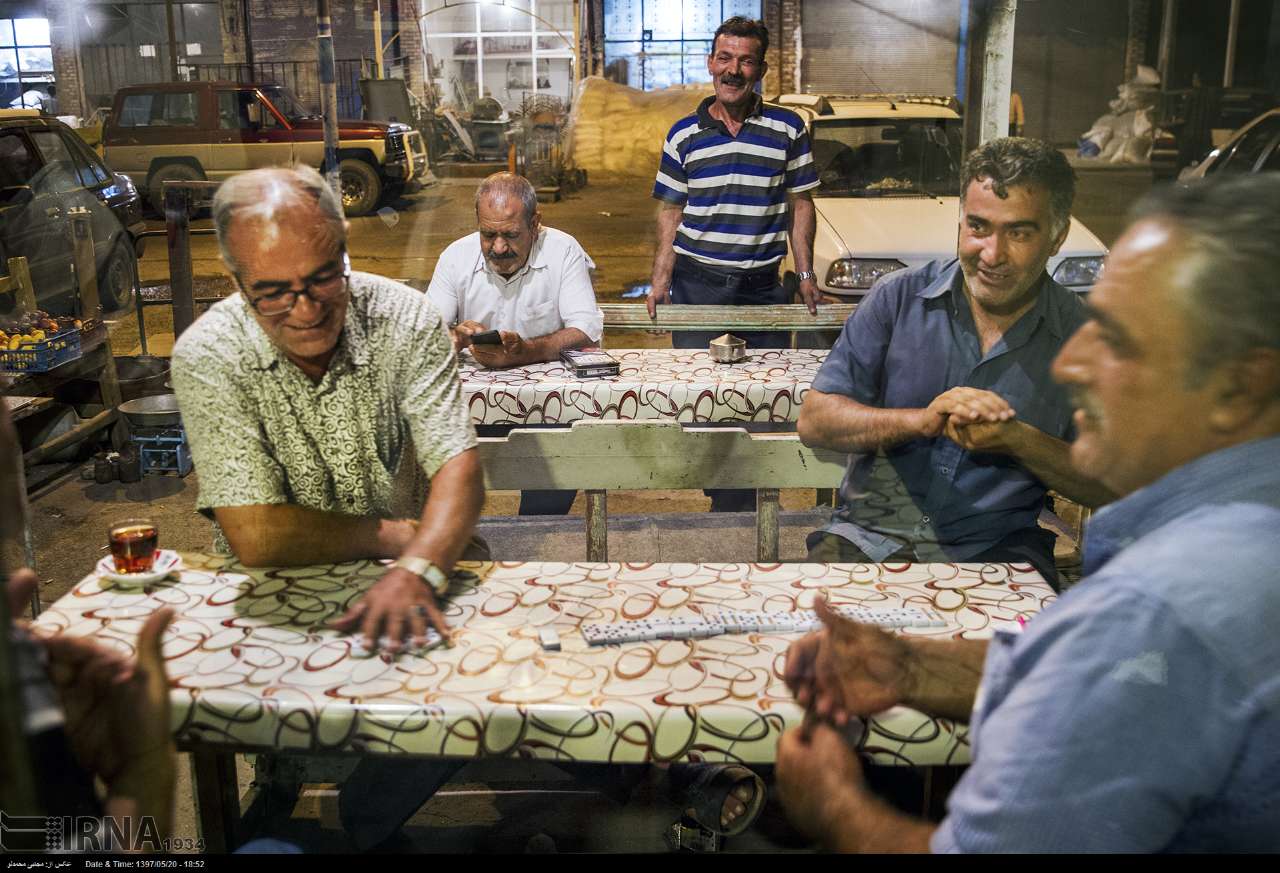
The village is home to hardworking and hospitable people who are mostly engaged in gardening and agriculture.

Hanam has a rushing river and several springs that supply drinking and agriculture water for the people of the region and its downstream villages.

The village is located next to the Garrin Mountains and the Velash Peak, which has a height of 3,623 metres. Garrin is limited to Borujerd from the east, to Aleshtar from the west, and to Nahavand from the north.

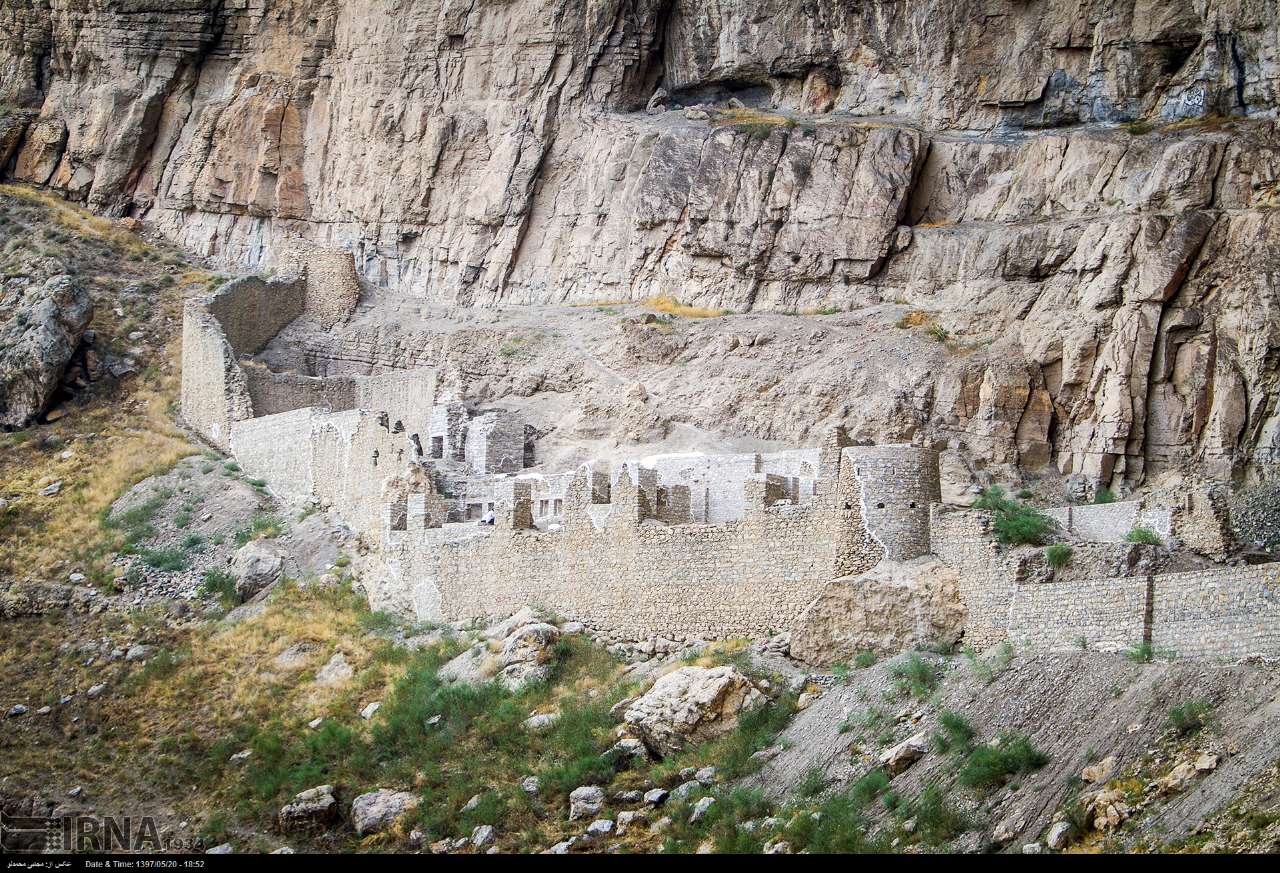
What follows are the photos of the scenic village retrieved from Tasnim News Agency:

Iranian Refinery Signs Contract with German Firm

Gholam-Reza Baqeri, the CEO of Tabriz Oil Refinery Company, told reporters on the sidelines of the signing ceremony on Saturday that the unit will ease environmental concerns regarding the activities of the refinery.

“This plan will be implemented based on a 24-month contract worth $12 million as part of environmental goals of the company,” he said, as reported by IRNA.

Baqeri said under the plan, the refinery’s waste gases will be recycled to produce up to 110 tonnes of sulphur per day.

The measure is seen as an important step to reduce air pollution in Tabriz, an Iranian metropolis and capital of East Azarbaijan Province.

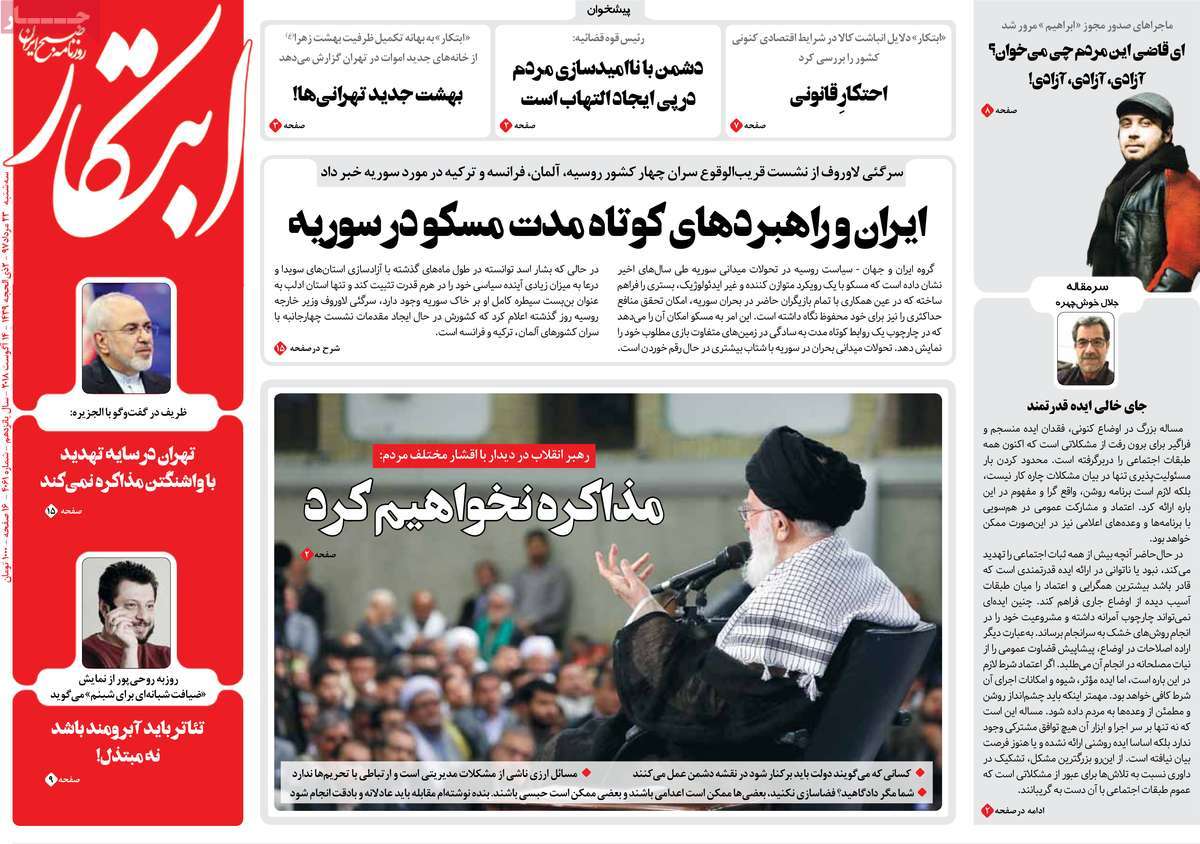
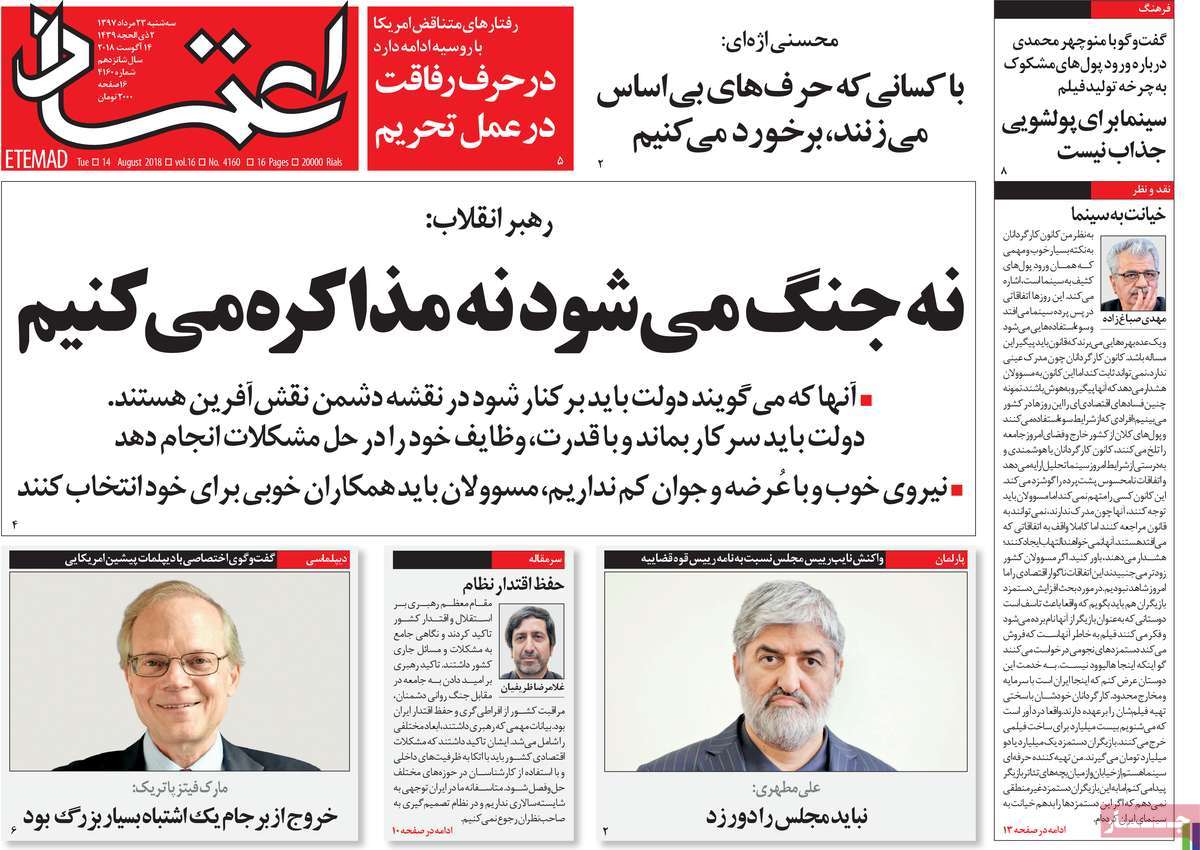
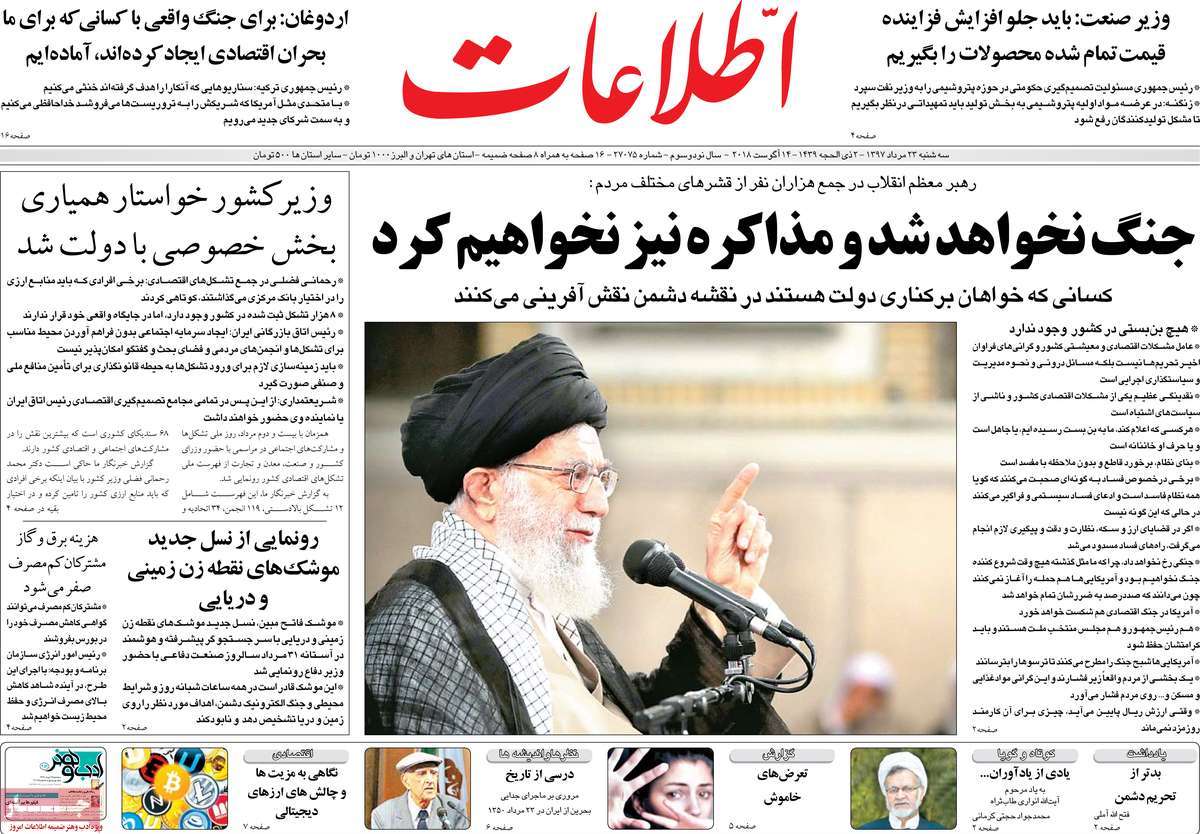
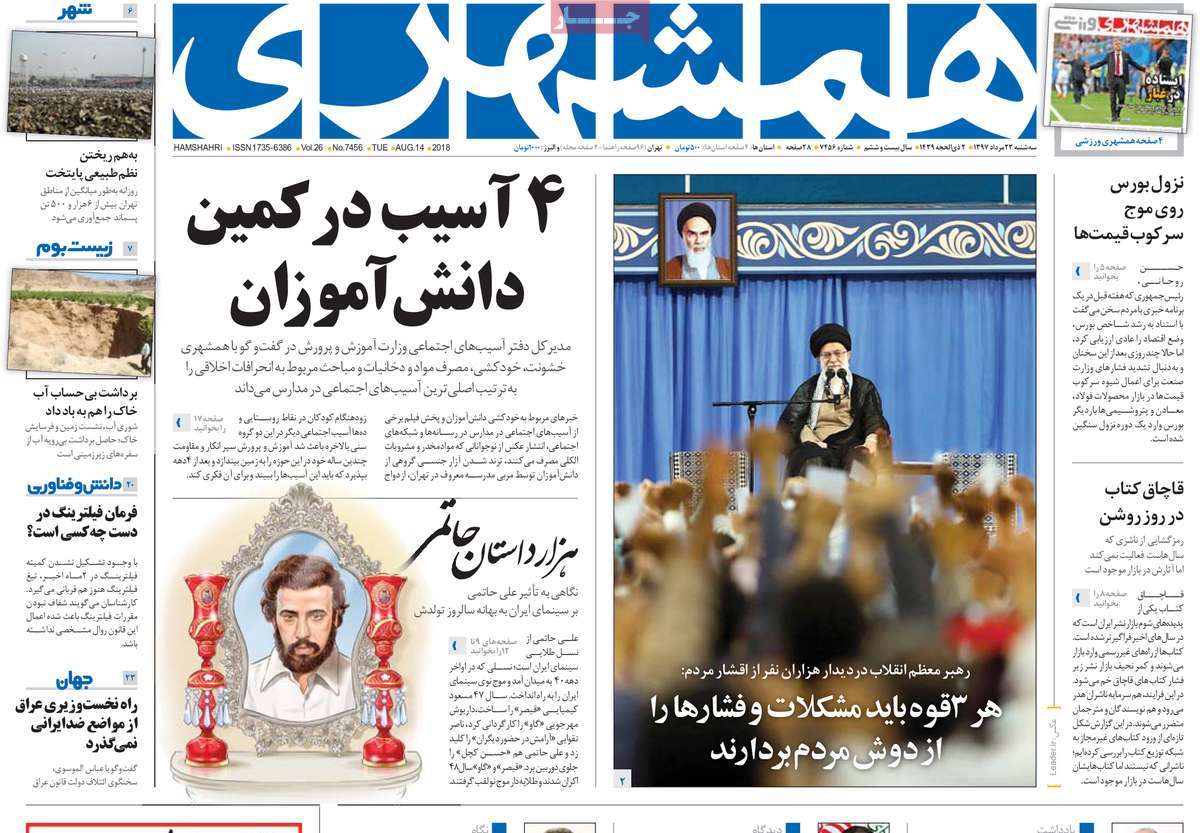
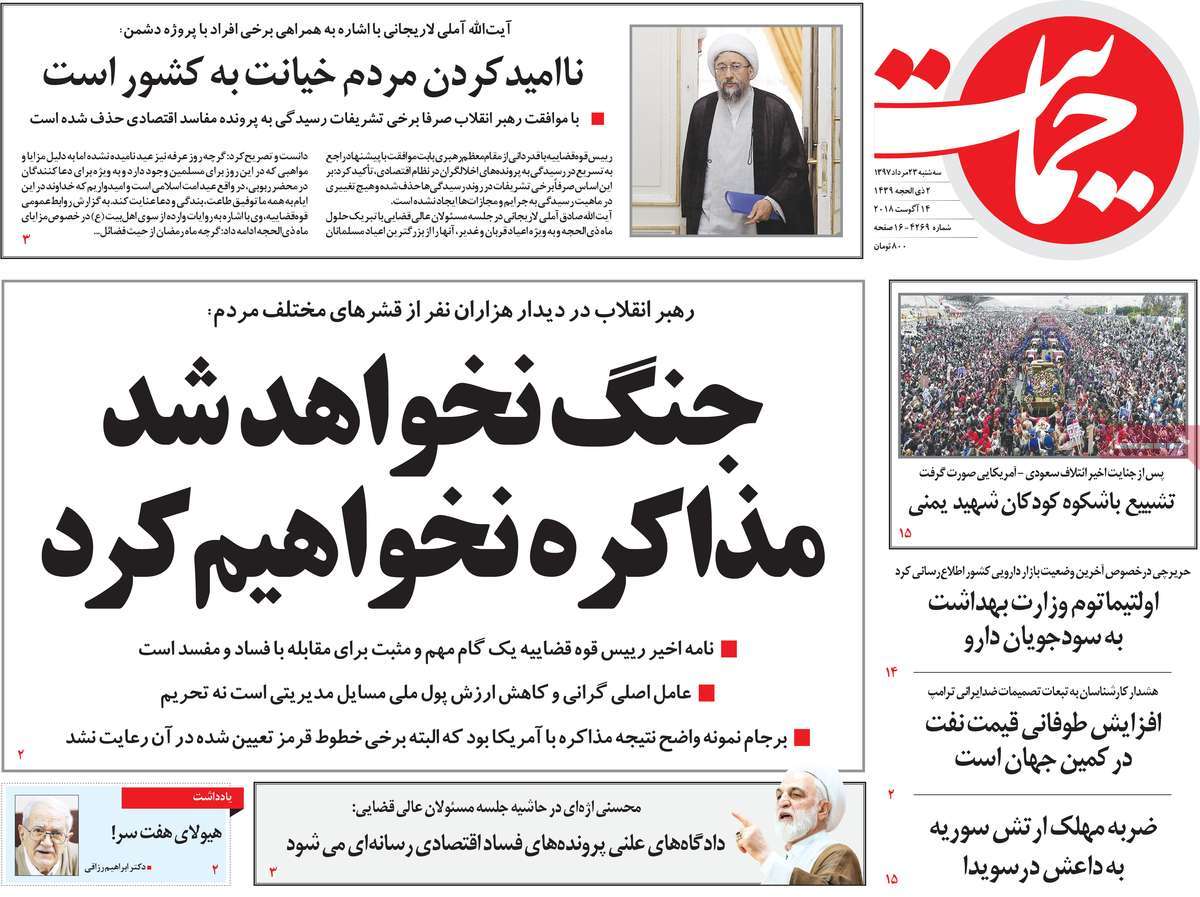
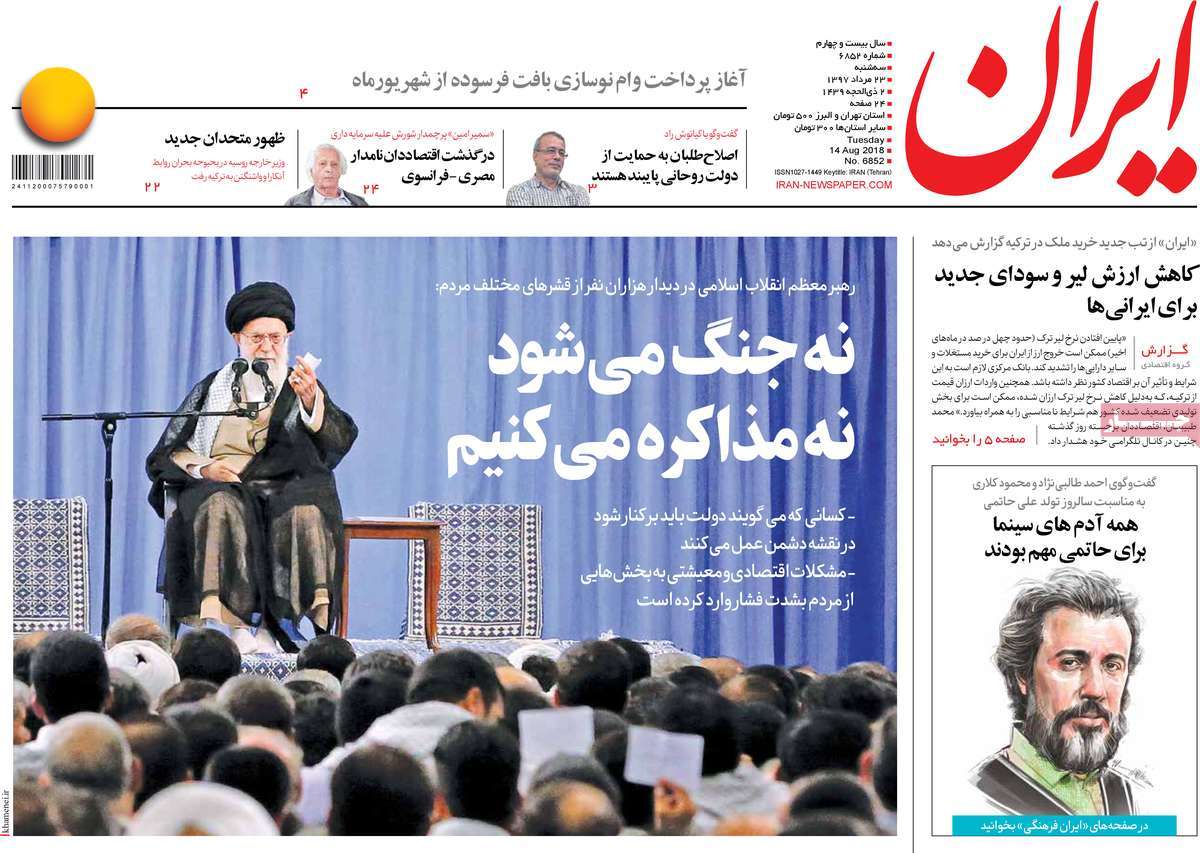
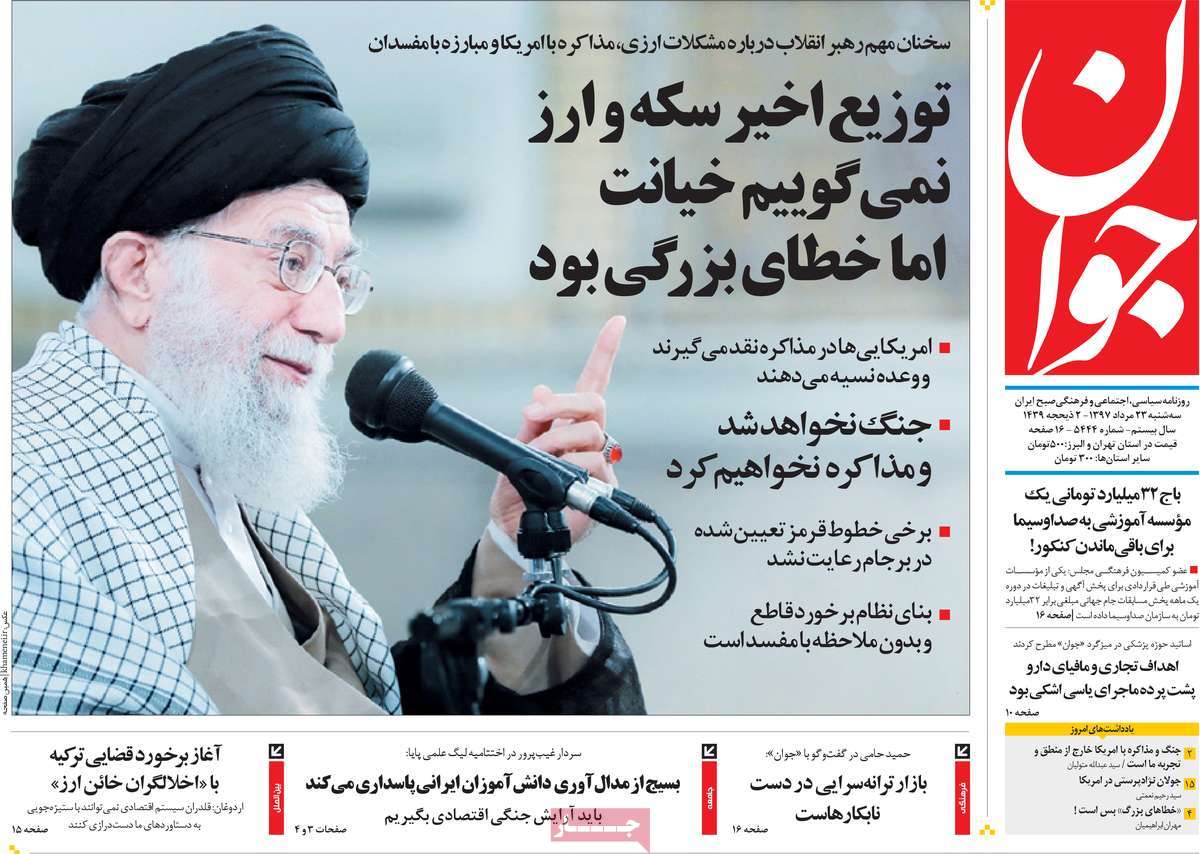
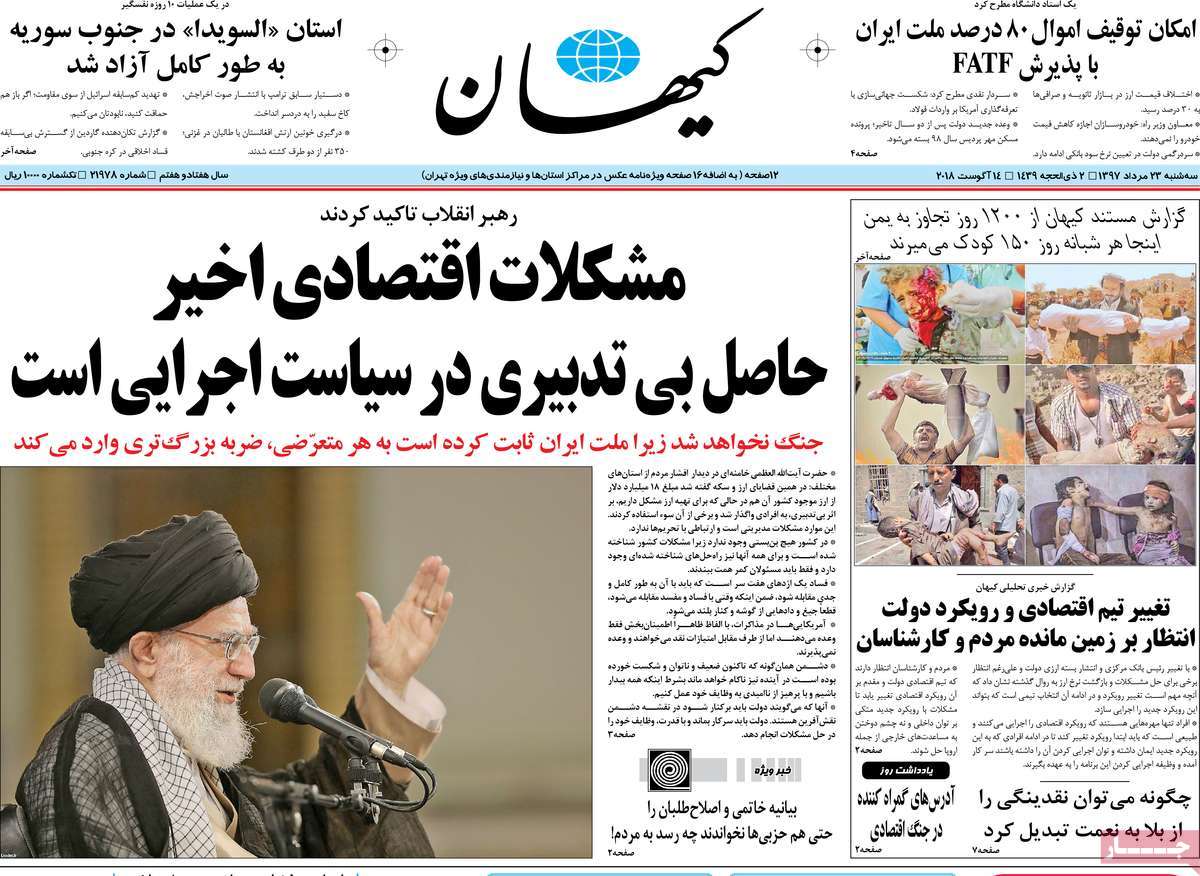
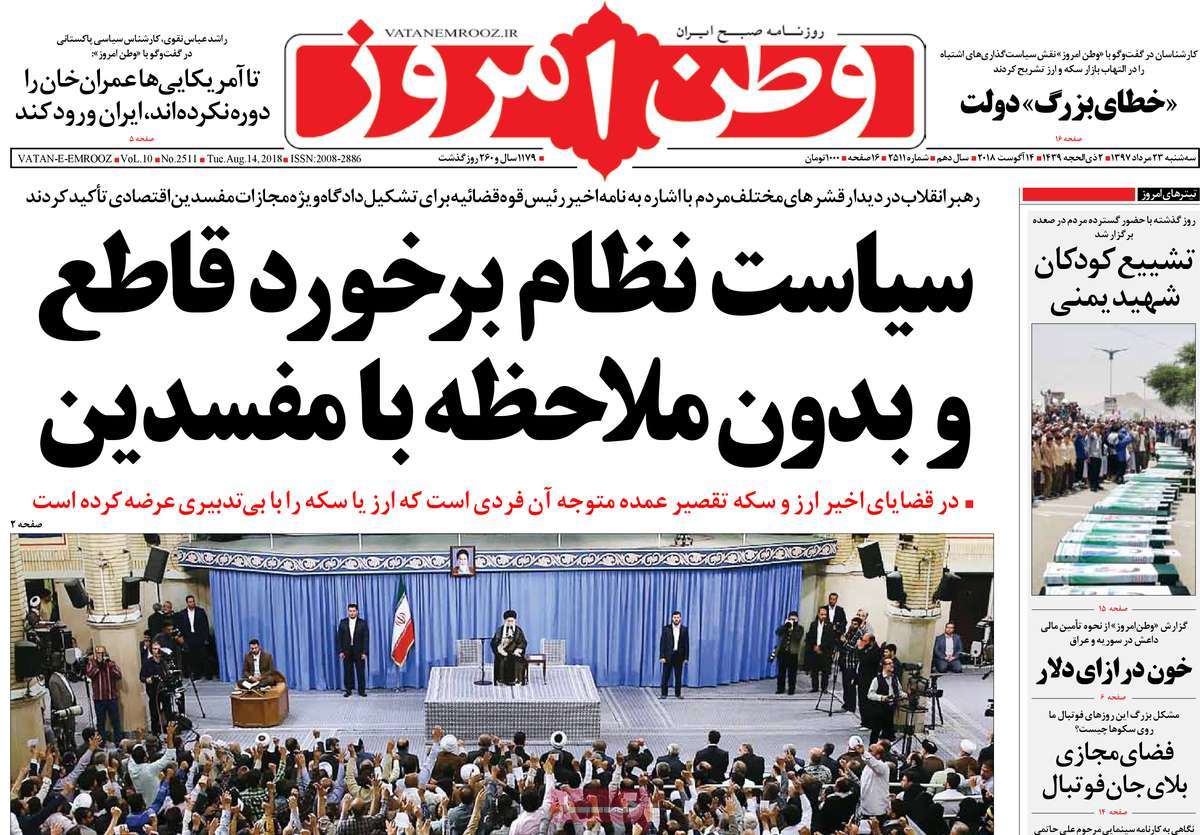
A Look at Iranian Newspaper Front Pages on July 22

A Look at Iranian Newspaper Front Pages on November 19

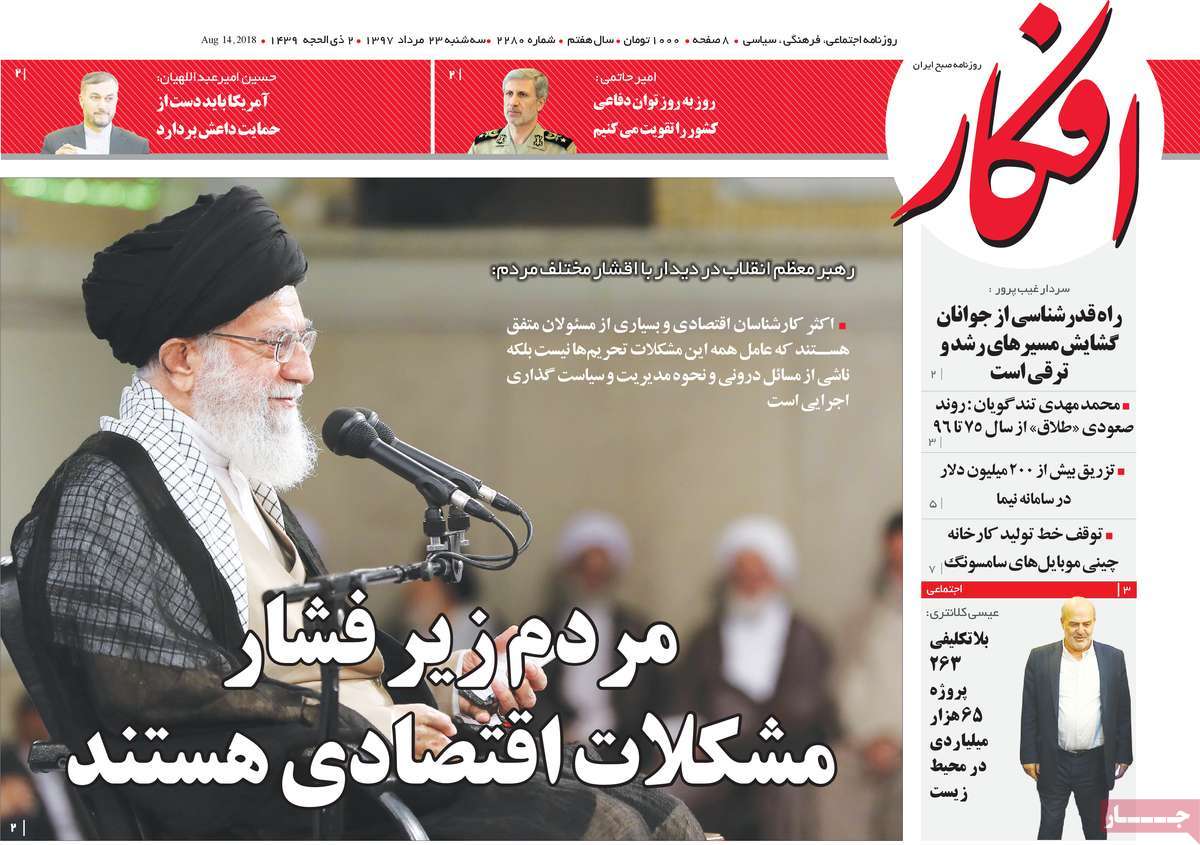
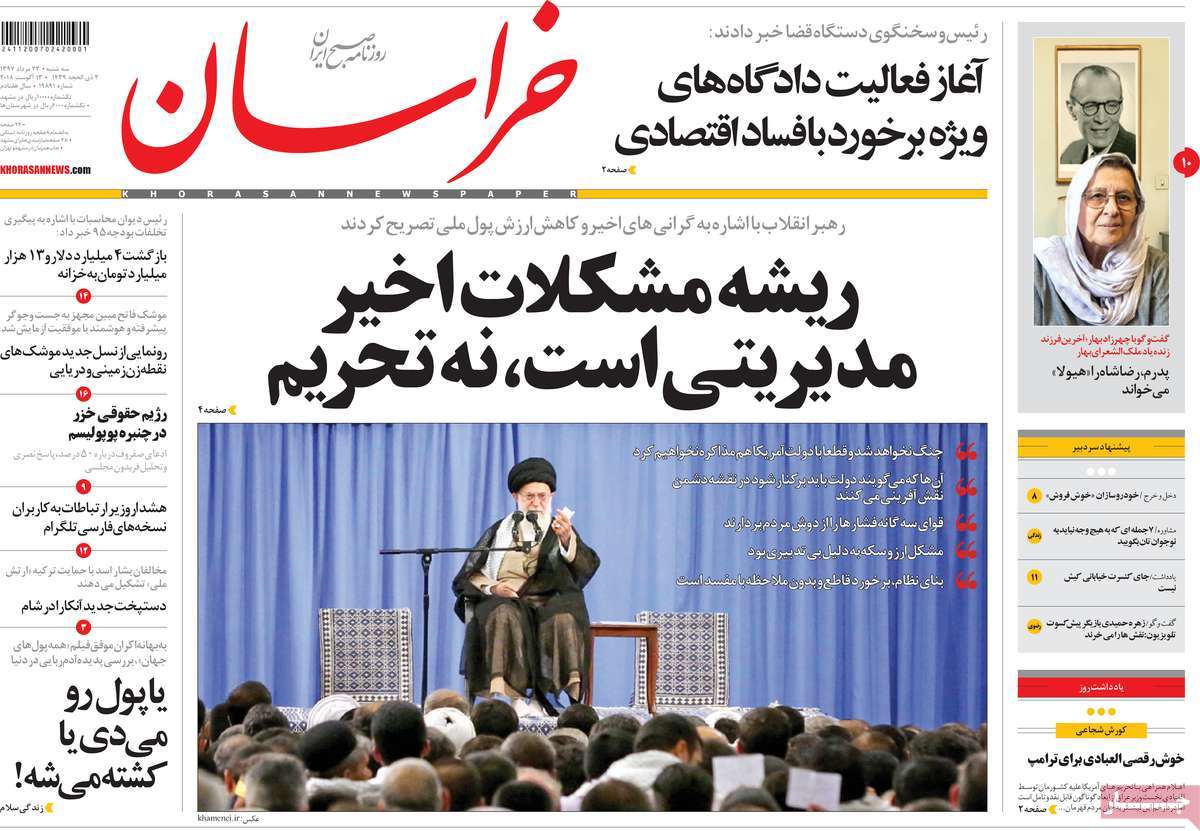
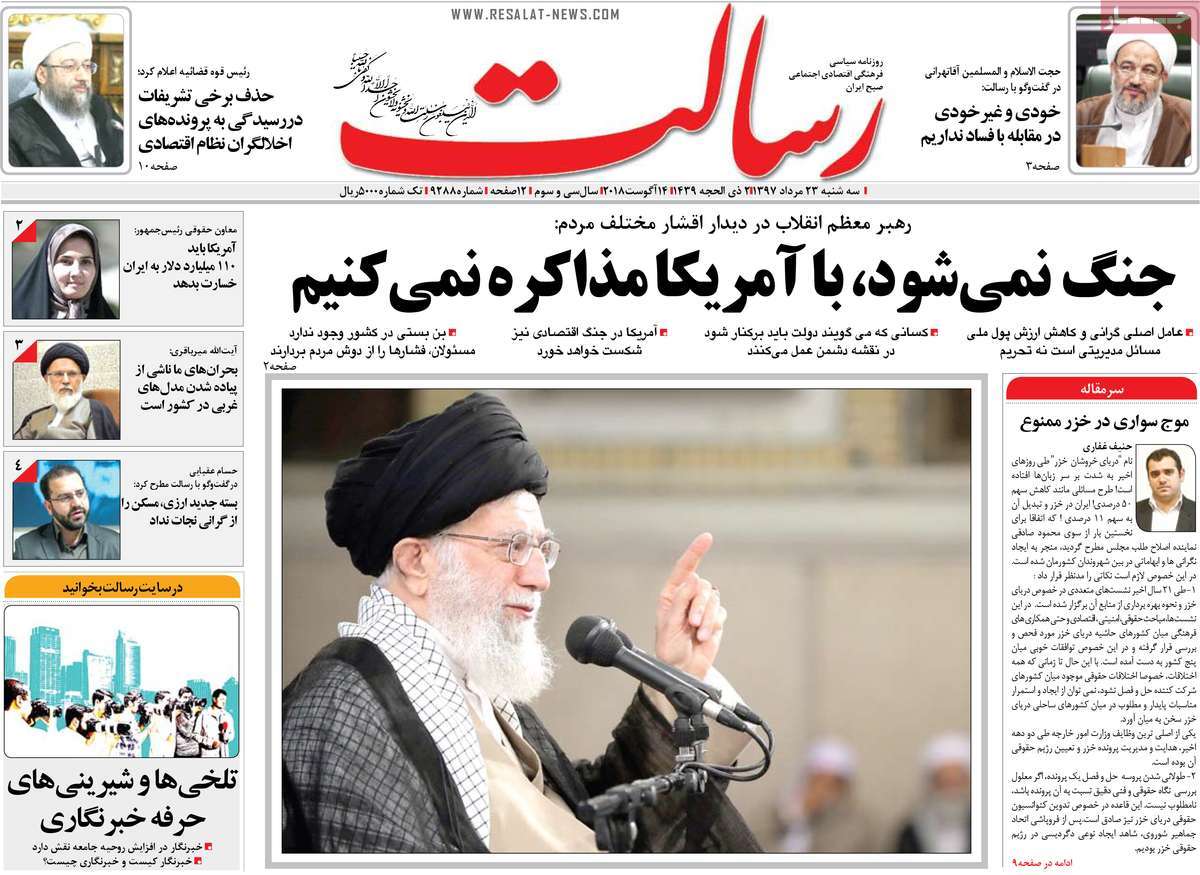
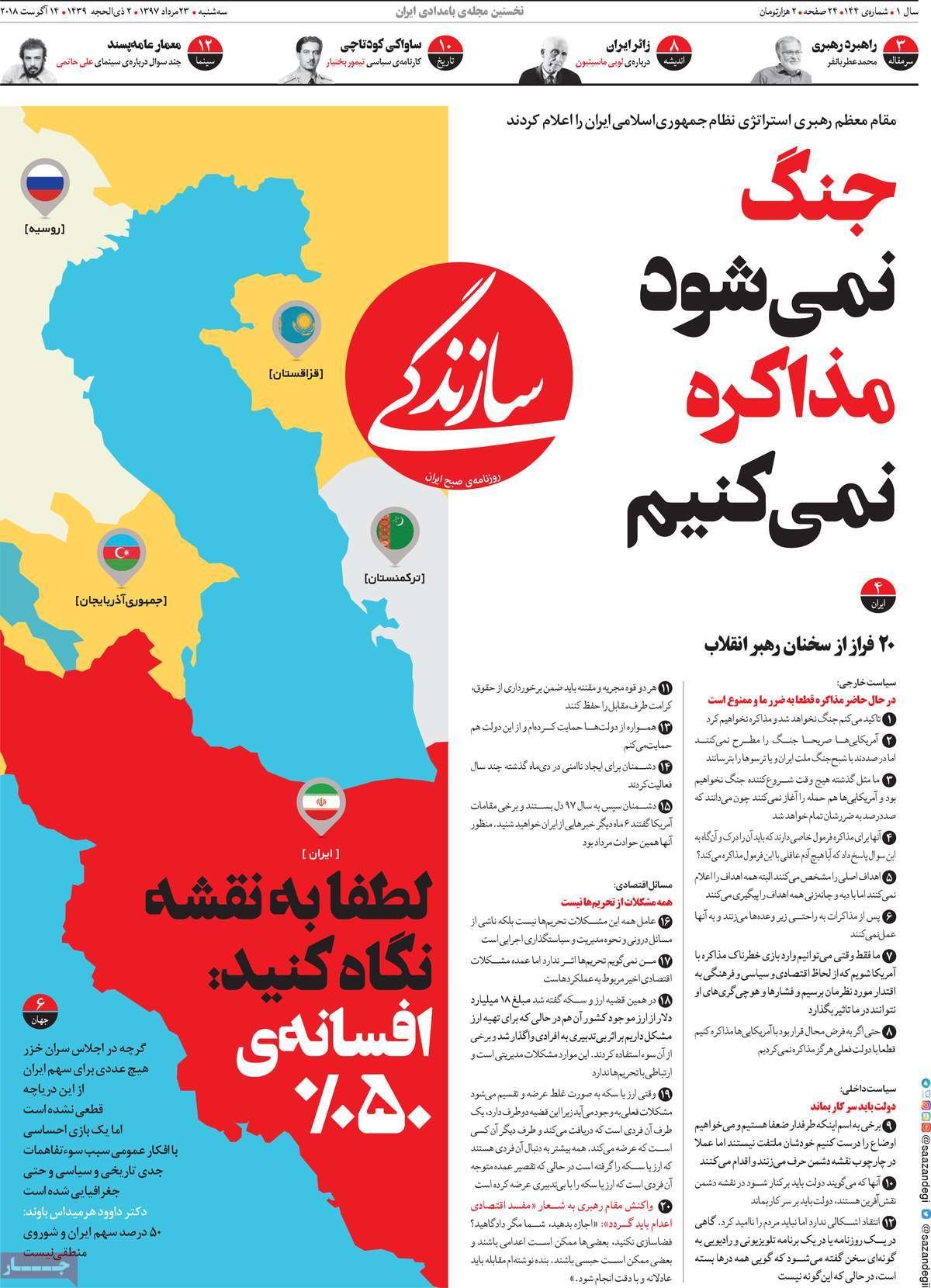
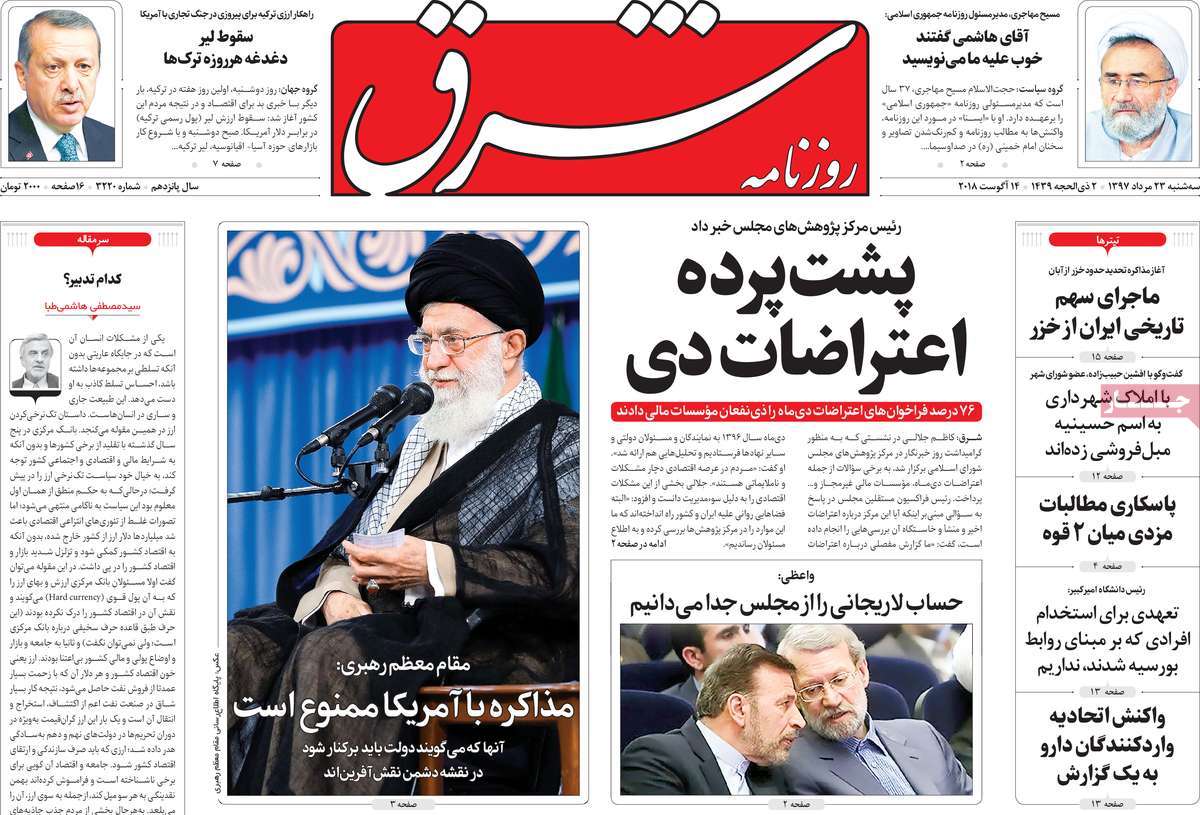
The top story in all papers today was the Saturday remarks by the Leader of Iran’s Islamic Revolution Ayatollah Seyyed Ali Khamenei in a meeting with the Iranian foreign minister and the country’s ambassadors.

Also a top story was a vote by the Expediency Council which reaffirmed the religious minorities’ right to run for local elections and be elected to city and village councils. The vote allowed Sepanta Niknam, a Zoroastrian politician, to get back to his work in the City Council of Yazd after being suspended by the Guardian Council.

Several papers also covered a terrorist attack by PJAK militants on an Iranian border post in Marivan, western Iran, during which 11 IRGC forces were killed and several others wounded.

The above issues, as well as many more, are highlighted in the following headlines and top stories:


19 Dey:

1- Iran Leader: There’s No Point in Holding Talks with US

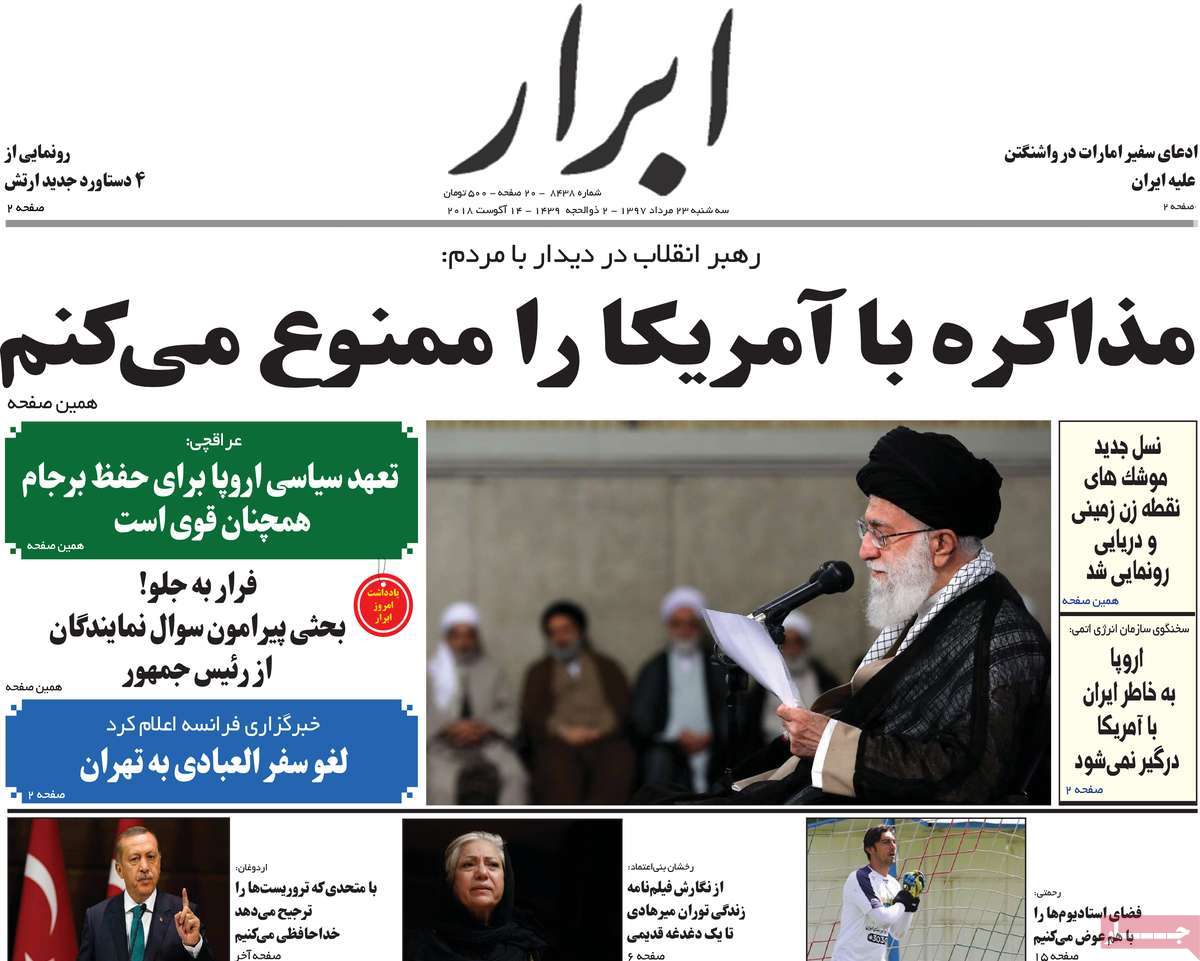
A Look at Iranian Newspaper Front Pages on July 22


Abrar:

1- FM: Zionists’ Iranophobia Project Failed

A Look at Iranian Newspaper Front Pages on July 22


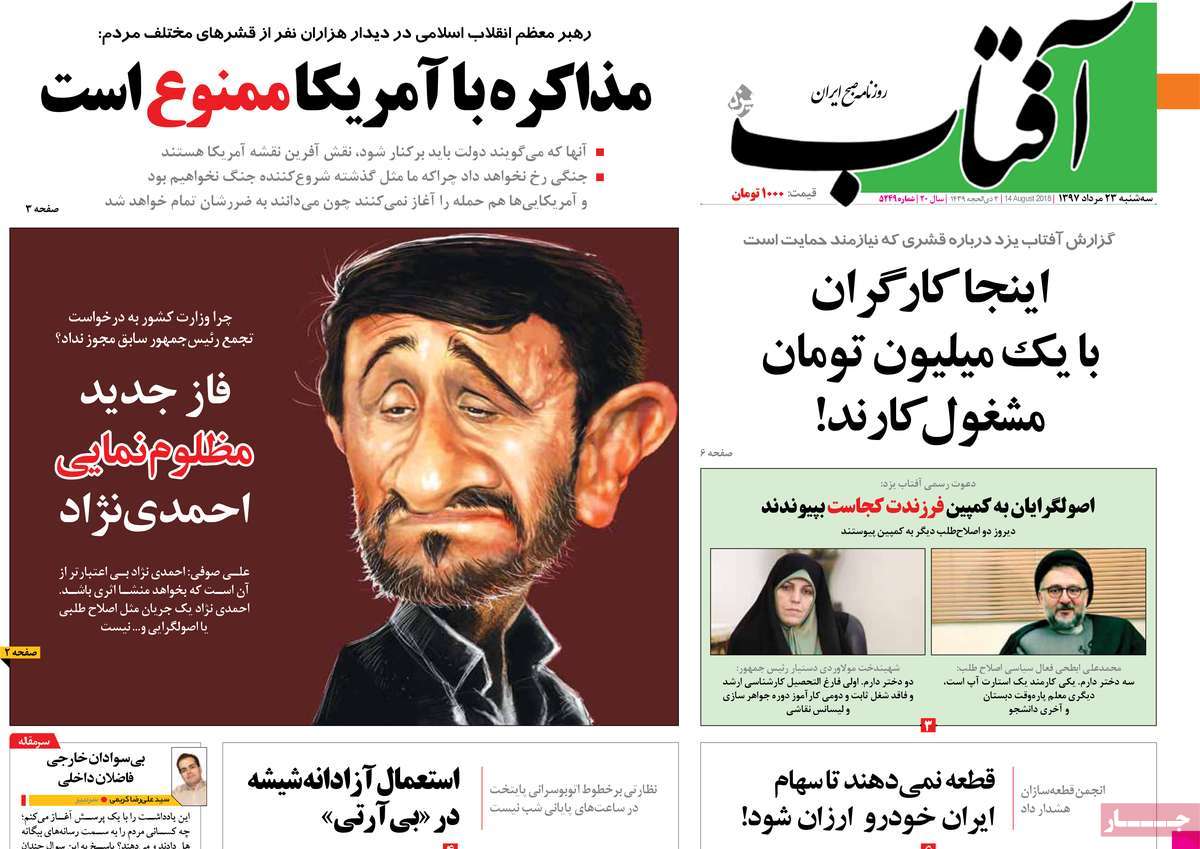
Aftab-e Yazd:

1- We Were All Together Yesterday: Zoroastrian Councillor

  • Expediency Council’s Vote Sends Sepanta Niknam Back to Yazd’s City Council

2- Iran Leader: Talks with Europeans Shouldn’t Be Halted

A Look at Iranian Newspaper Front Pages on July 22


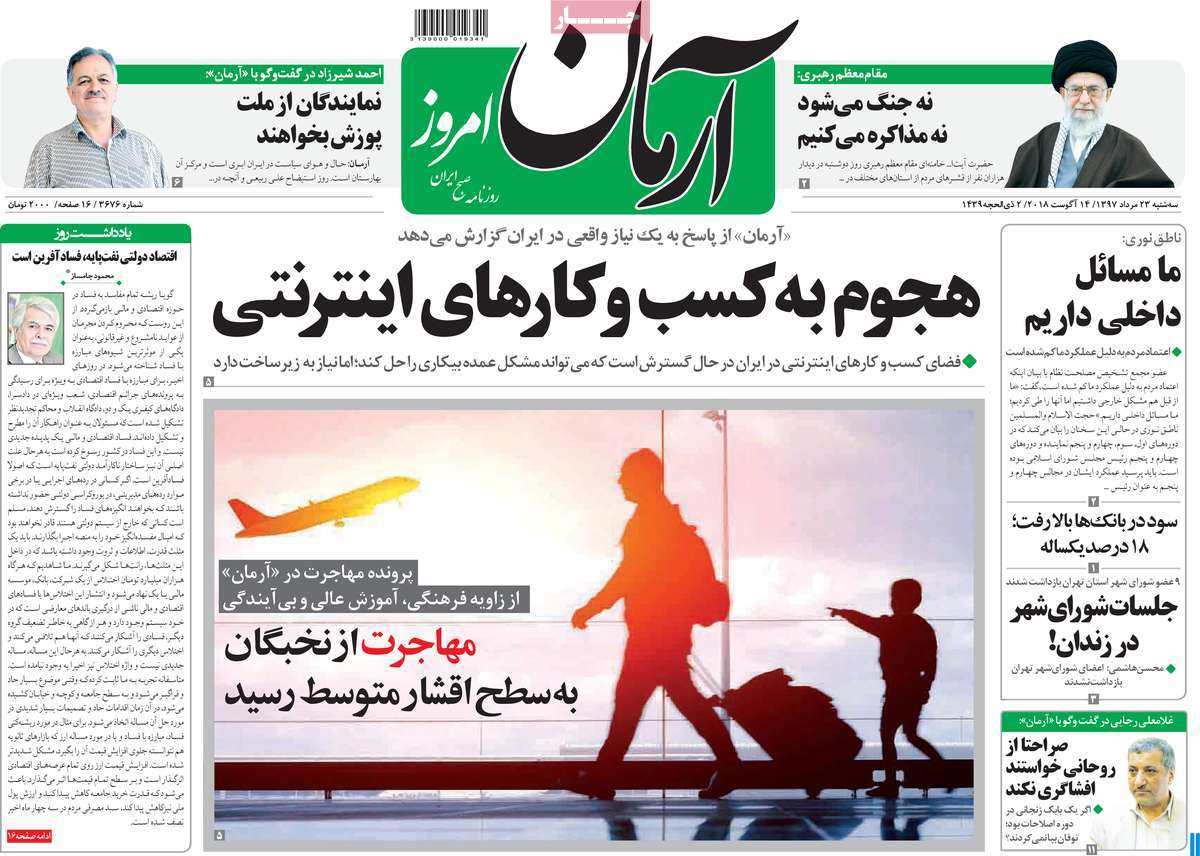
Arman-e Emrooz:

1- Sepanta Niknam Finally Returns to Yazd’s City Council

2- Attack on Border Post in Iran’s Marivan Leaves 11 Killed

3- Imam Khomeini’s Grandson: We’ll Undoubtedly Overcome Challenges

A Look at Iranian Newspaper Front Pages on July 22


Donya-ye Eqtesad:

1- Trump Backs Off from His Stances on US Dollar

A Look at Iranian Newspaper Front Pages on July 22


Ebtekar:

1- China Biggest Player of New Cold War: A Review of Xi’s Visit to Africa

2- Another Scandal for Trump

A Look at Iranian Newspaper Front Pages on July 22


Etemad:

1- Paying Our Debts to Zoroastrian Iranians [Editorial]

2- Reformists’ Main Challenge Is Those Who Seek Regime Change in Iran

A Look at Iranian Newspaper Front Pages on July 22


Ettela’at:

1- Israel’s Artillery Attack on Resistance Forces’ Positions in Gaza Leaves 5 Dead

A Look at Iranian Newspaper Front Pages on July 22


Jame Jam:

1- Iran Leader: Don’t Wait for EU’s Package

A Look at Iranian Newspaper Front Pages on July 22


Javan:

1- Those Going Abroad for Pleasure Won’t Receive Official-Rate Currency Anymore

A Look at Iranian Newspaper Front Pages on July 22


Jomhouri Eslami:

1- Global Opposition to Zionist Regime’s Plot to Create “Jewish Nation-State”

A Look at Iranian Newspaper Front Pages on July 22


Kayhan:

1- Iran Leader: Rouhani’s Oil Threat Based on Policy of Islamic Republic

2- Insane Aerial, Ground Attacks on Gaza Leaves Hundreds of Palestinians Dead, Wounded

A Look at Iranian Newspaper Front Pages on July 22


Quds:

1- Iran Leader: Even US’ Signature Cannot Be Trusted

A Look at Iranian Newspaper Front Pages on July 22


Sazandegi:

1- Iran Leader: Diplomacy Has No Contradiction with Ideology

A Look at Iranian Newspaper Front Pages on July 22


Setareh Sobh:

1- Iran Leader: Main Goal of Diplomacy Is to Protect National Interests

A Look at Iranian Newspaper Front Pages on July 22


Shargh:

1- Turkish Foreign Ministry: We’ll Oversee US Sanctions against Iran

2- NIAC: Pompeo Must Apologize

A Look at Iranian Newspaper Front Pages on July 22


Iran’s Printing Museum; A Must-See Site for Tourists

The museum is located on the 30th Tir Street downtown Tehran. The neighborhood is one of the most prosperous passageways in Tehran, where many people come to do their job and spend their time during the day and night.

The Script and Print Museum is a subset of Library, Museum, and Document Centre of the Parliament, and is located in a building of the National Library. Its corners have different memorials from the Qajar period and their printing machines.

Amin Ali Jahani, the director of the museum, says the Parliament’s print house is the oldest major printing house in the country. There exists a brilliant record of publishing books and various publications, as well as the machines of that era. Visiting this museum can help visitors get familiar with the evolution of the print industry in Iran.

“The museum is divided into 14 sections in seven parts: the history of books in Iran, the beginning of printing in Iran, printing machines, printing houses, printing of photographs, binding, and book publishing and printing in the digital age and contemporary era; and in each of these parts one can find the oldest machineries,” added Jahani.

The first exhibition space of the museum is the section allocated to the history of writing in Iran, which dates back to the beginning of the time of writing in Iran, i.e. from 3,000 BCE till the beginning of traditional Iranian book publishing.

In this section, clay tablets and stamps of Proto-Elamite, Elamite writing system, Elamite cuneiform scripts, Persian cuneiform scripts, Middle Persian scripts including Pahlavi and Sassanid Pahlavi inscriptions, as well as Avestan scripts could be seen.

Iran’s Printing Museum; A Must-See Site for TouristsThe second section of the museum focuses on historical schools of traditional book writing in Iran during the Islamic era with works such as the scripts of the early Islamic centuries (Quranic scripts written in Kufic), the Seljuk era scientific books, the Iranian painting and calligraphy schools with works of Tabriz’s Ilkhani school, Herat’s Timurid school, Tabriz’s Safavid school, Isfahan’s Safavid school and Qajar school.

The third section is about the beginning of printing in Iran. This section deals with how the printing industry enters Iran and lithographic printing practices start in the country.

One of the most attractive parts of the museum is the fourth and fifth sections of the museum which focus on the printing machinery, and have occupied the largest space of the museum.

The sixth section of the museum located in the basement of this complex is the live show of an old print shop, in which printers are set up to show the space of a print house and its working environment to the visitors.

The museum’s seventh to ninth sections are devoted to photo printing techniques in the printing industry, including the introduction of photography glasses, photography devices such as the German-made old cameras and the 1973 Toyota camera manufactured by Japan, among others.

In the next sections, one can see bookbinding techniques from the past to contemporary times. In the last section of the exhibition, the contemporary era examples of print works and the digital age computer techniques in publishing, as well as the publication of texts on the Internet and cyberspace are briefly presented so that the evolution of the printing industry can be introduced.

Iran Not to Wait Too Long for Europeans: FM Zarif

zarif

Addressing a ceremony to pay homage to the late founder of the Islamic Republic, Imam Khomeini, in Tehran on Saturday evening, Zarif pointed to recent talks between Iran and the European parties to the JCPOA and said, “Alongside the statements and pledges they give, the Europeans must act to save this agreement.”

“We have not seen sufficient practical measures by the Western powers and the remaining parties (to the JCPOA),” he said.

Iran will continue the talks with the Europeans, but will not wait too long for them, the top diplomat said, referring to Europe’s move to propose a package of economic measures to offset US pullout from the JCPOA.

Earlier this week, Zarif said that the practical measures of the five remaining parties to the JCPOA have begun, adding that in his recent visit to Vienna, the foreign ministers of the countries informed him of the detailed measures.

Zarif further emphasized that Iranian diplomats will continue the talks on saving the JCPOA.

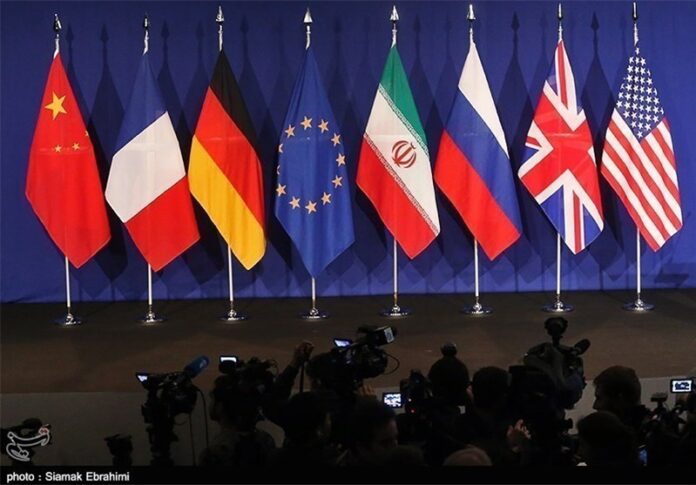
On May 8, the US president pulled his country out of the JCPOA, which was achieved in 2015 after years of negotiations among Iran and the Group 5+1 (Russia, China, the US, Britain, France and Germany).

Following the US exit, Iran and the remaining parties launched talks to save the accord.

Meanwhile, Leader of the Islamic Revolution Ayatollah Seyed Ali Khamenei has underlined that any decision to keep the JCPOA running without the US should be conditional on “practical guarantees” from the Europeans.

Iranian Researchers Develop Herbal Medicine for Epilepsy

Project manager Reza Mazloum Farsibaf said the newly-developed medicine can be used for the “final and definitive treatment” of the disease while other drugs currently used to cure epilepsy are coupled with some challenges.

He told ISNA that some of the medicines prescribed should be used by patients for a long time while they have side effects, including extreme somnolence, permanent tensions, and severe physical damage.

“So, the drugs developed to treat this disease in the world have not led to the complete treatment of the disease, so far,” he said.

For a brief review of Iran’s achievements in various fields of science and technology, check the book “Science and Technology in Iran: A Brief Review

He said research shows that taking the newly-developed herbal drug for 6 to 12 months and stopping the use of chemical medicines result in the final treatment of the disease.

According to the senior researcher, surveys have also shown that patients which needed surgery were cured after taking the medicine.

He said the drug has gone through the stage of tests on animals, adding its clinical tests are being carried out at a hospital under the supervision of the Shahid Beheshti University of Medical Sciences.

Iran Different Experience for Every Foreign Tourist: Indian Daily

Tarun Vijay, a former Indian lawmaker who recently had a trip to the Iranian city of Shiraz, has written an article in Telegraph India that “our relations with the Persian people go beyond strategic needs. It’s a matter of the heart.”

“For me, the journey to Persia was also a matter of de-learning some things and weaving something new – a serenade of serenity is what I would call it,” he was quoted as saying in a report by IRNA.

This Indian researcher has also commented that Iran is not like any other country for India. “Since the days of King Darius to the Mughals, and from the families of Jamshetji Tata and Godrej to Field Marshal Sam Manekshaw and Ghorban Mohammadpour, we have had so much of Persia amidst us. So much that it has silently merged into our being, giving a distinct flavour to our languages, culture, strengths, mores and habits. But the presence in Iran is a very different experience for any traveller who wants to travel to the country.”

Iran Different Experience for Every Foreign Tourist: Indian Daily“The three days I spent in Iran just a few weeks ago changed a lot of my perceptions about that country, its people and culture. Iran, as routinely reported to us by Western governments and media agencies, is everything that stands against human values and democratic practices. Is that stereotype true? Should I not say something about what I saw and experienced for myself?” writes Vijay

He further mentions that Iran must be seen and understood by Indians through the eyes of Indians. “Iran is a people, something that defines itself in unmatched subtlety and finesse; it’s a poet’s dream, it’s dance, it’s drama, it’s fun. It is a land of unparalleled brilliance and beauty.”

“We in India might still be debating about our Aryan roots, but Iran is sure and proud to be an Aryan land. That name itself – Iran – is directly derived from the word Aryan.”

“They are different from every other Muslim land – so distinctly refreshing and civilised that it cannot but strike a visitor. We could see a softer, liberal, open side of Iranian society, a side not often showcased. Restaurants were as noisy and chaotic rolling with all types of kebabs. A large number of cars on the roads were driven by women, who not just waved at our visiting caravan but also shouted with their necks out – Hello! Welcome to Iran!”

takht jamshidVijay also says that visiting the ruins of Persepolis, the ancient city of the Persians also known as Takht-e-Jamshid, was an amazing experience as we all know how immensely they have pioneered and contributed to the India growth story.

“Contemporary Islamic Iran has kept its ancient pre-Islamic heritage preserved with such touching care and pride that we can learn a few things from them. Another revealing moment for me was paying obeisance at a Hindu temple and a gurdwara – both on the same campus – at Bandar Abbas; these structures are meticulously preserved and maintained by the Iranian government’s culture department.”
This Indian journalist further points out that, what was incredible throughout the trip, was the spontaneous show of warmth and friendship by the Iranian people.

Referring to his long journey to the Iranian cities, he wrote all of this came to transpire along the 7,200-kilometre International North–South Transport Corridor (INSTC), which has been receiving the attentions of Prime Minister Narendra Modi and the Russian President, Vladimir Putin, for obvious reasons.

Iran Different Experience for Every Foreign Tourist: Indian Daily
Iran Officially Opens Strategic Port of Chabahar

India’s help in developing Iran’s Chabahar port is a milestone in the overall development of INSTC. It received a boost during Modi’s Tehran visit and, in more than one way, it underlines the critical importance of India-Iran co-operation.

Yes, the American sanctions wrecked the Iranian economy. But everyone should trust that for Delhi, the road to Tehran doesn’t pass through Washington DC. Our relations with the Iranian people go beyond strategic needs. It’s a matter of the heart. For me, the journey to Iran was also a matter of de-learning some things and weaving something new – a serenade of serenity is what I would call it, he concludes.