Wednesday, December 31, 2025
Home Blog Page 3506

Iran to Teach “Regrettable Lessons” to Aggressors, IRGC Warns

In a statement on the occasion of the National Day of Defence Industry, the IRGC said Iran’s revolutionary forces have managed in the past decades to turn the Pahlavi regime’s totally dependent military apparatus into a mighty military pole in the region.

“Today, Iran has reached a level of defensive deterrence that warmongering sworn enemies are wary of [having] adventures and carrying out their threat of invading the Islamic homeland,” it said in the statement published on Wednesday.

The IRGC said Iran’s defence power has become a great concern for adversaries, particularly the US-Israel-Saudi trio, prompting them to search for solutions to stop the development of Iran’s military might.

The statement said boosting the country’s deterrent power is an “inevitable duty” of Iran’s armed forces, vowing they will turn the threat of sanctions into opportunities and will teach “hard and regrettable” lessons to those who dare to endanger the country’s security.

On Tuesday, Iran unveiled its first home-grown fighter jet named “Kowsar”, a fourth-generation warplane for aerial support missions.

Varzaneh Desert; Amazing Site for Camping, Stargazing

The desert is located along the Gavkhouni Wetland covering an area of about 17,000 square metres.

Many tourists annually come to the region for camping and gazing at stars.

What follows are photos of the desert retrieved from Mizan News Agency:


US Still Top Importer of Persian Rugs despite Sanctions

Iran exports $126 million worth of carpets (27.9%) to the US, $57.5 million to Germany (13.6%), $30 million to Lebanon (7.1%); $23.4 million to the United Kingdom (5.5%), and $23.1 million to Japan (5.5%).

Head of Iran’s National Carpet Centre Fereshteh Dastpak said that despite the US sanctions, Iran’s export of hand-woven carpets to the United States still ranks first.

According to customs data, in the first four months of the last year, 292.5 tonnes of carpets were exported to the United States worth $21 million, but this year it reached 792 tonnes worth $38 million.”

She underlined that “this year we exported 19,883 tonnes of handmade carpets in the first quarter of the year, worth about $100 million.”

The Head of Iran’s National Carpet Centre further mentioned that Iran is the world’s first handmade carpet exporter, and India is ranked second.

Dastpak said that importing any carpets to Iran from other countries is considered smuggling.

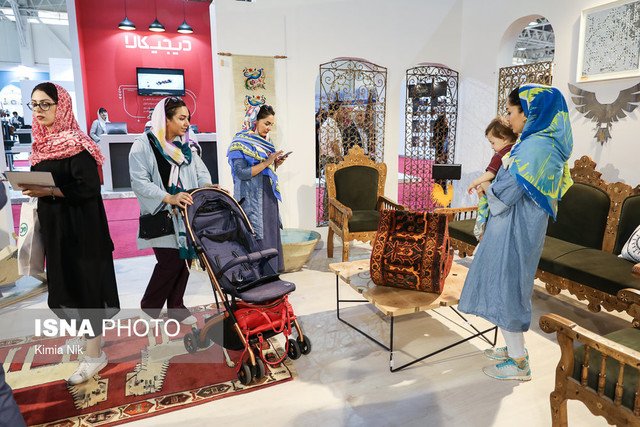
Pakdast also said the 26th Iranian Handmade Carpet Exhibition will be held 25 to 31 Aug 2018 in Tehran with 780 exhibitors participating in the event in an area of 40,000 square metres.

“In the opening ceremony of the exhibition, a carpet of peace and friendship with 70 different symbols in it will be unveiled.”

The Head of Iran’s National Carpet Centre said, “This carpet, which symbolizes the Iranians’ peace and friendship, will be handed over to the president or foreign minister, and will eventually be offered to the UN headquarters in Geneva.”

She concluded that 70 exhibitors and businessmen from 26 countries will attend the exhibition.

No 50-50 Share Stipulated in Iran-Russia Treaties on Caspian Sea

The Caspian Legal Regime Convention signed by the five littoral states of the Caspian Sea, namely Iran, Russia, the Azerbaijan Republic, Turkmenistan and Kazakhstan on August 12, 2018 received extensive reactions from political and legal experts. Some jurists referred to the provisions of two agreements signed in 1921 and 1940, believing Iran should have a 50% share of the sea. By virtue of the terms of the two agreements, they say, all privileges must be equally divided between Iran and the former Soviet Union. Accordingly, the Ministry of Foreign Affairs has, based on legal and statutory arguments, responded to the questions and ambiguities which have arisen in that regard in order to illuminate the public. The full response is as follows.

  1. Under the 1921 and 1940 agreements, the two countries enjoy equal rights, and the Caspian Sea has always been shared between Iran and Russia throughout history. What is your idea about this?

As it has been announced time and again, neither of the above-said agreements explicitly speaks of an equal share, or division of the sea equally or shared utilization of the sea. Basically, neither of the contracts mentions a point about the division of the sea between Iran and the Soviet Union.

  1. It is stipulated in Clause 3 of Chapter 3 of the 1921 agreement between Iran and Russia that both sides will enjoy equal rights to the Atrek river and other rivers and waters on the border. Apart from Atrek and other rivers, what other body of water is there? So, border waters mean the Caspian Sea! How is it that the above-mentioned clause speaks of the Atrek river with low water levels, but does not mention a major and important sea such as the Caspian Sea?

In addition to Atrek and other rivers, there are other border waters such as reservoirs, dams, ponds, springs, creeks, etc., all of which have been clearly referred to. However, there is no explicit and direct reference to the Caspian Sea. Moreover, the relevant commission has, so far, met ten times and finalized decisions on all rivers, creeks, reservoirs and other issues. However, no point has been mentioned regarding the Caspian Sea. This shows the term “coastal waters” mentioned in the convention does not include the Caspian Sea.

  1. What does ‘border waters’ mean?

In all border agreements between the two countries, whenever the term “border waters” is mentioned, it refers to rivers, creeks, reservoirs (dams), ponds, springs, etc.

  1. Based on Chapter 11 of the 1921 agreement, both signatories to the deal have agreed to enjoy an equal right to free shipping under their flags in the Caspian Sea. Doesn’t that mean equal rights?

In the above-said phrase, only “free shipping” and “the principle of the flag” are clearly mentioned, and no special points have been mentioned regarding the division (whether equally or unequally) of the Caspian Sea.

  1. At the moment, Iran enjoys the right, even an equal right, to free shipping in most waters across the world. Does that mean Iran’s right to equal ownership and sovereignty in those areas? If so, what’s Iran’s status in the Caspian Sea?

First of all, we should know that in the agreement on the above-mentioned regions, only three chapters and one clause is related to the Caspian Sea. Second, the rights are not equal in some chapters, and it is not right to claim that Iran has equal rights because some chapters are completely unilateral and to Russia’s benefit.

  1. Given that the 1940 agreement says all rights are equal, why has the issue been followed up differently so far?

It should be noted that that the Iranian foreign minister and deputy commerce minister signed the agreement as Iran’s representatives, and the Soviet Union’s ambassador and commercial attaché in Tehran signed the agreement on behalf of the Soviet Union. Moreover, the above-mentioned treaty is about sea navigation and commerce, not borders. Therefore, it is not appropriate to say that all rights are divided equally, and the agreement does not provide for border issues.

  1. It is stipulated in Clause 1 of Article 12 of the 1940 treaty that the ships plying across the Caspian Sea under the flag of either of the two countries shall be treated as state vessels in the ports of the two sides whether upon entrance into, during stay at, or when leaving the ports. Doesn’t that mean equal rights?

These provisions provide for equality of rights only as far as port regulations are concerned, not border and sovereignty issues. In addition, these provisions were ostensibly in Iran’s interest, but it was not, because Iran had no ships in the Caspian Sea, and it was only Russian vessels that were carrying goods. It was they that enjoyed exemptions, not Iran. This comes as Iran’s first ship (in the true sense of the word) entered the Caspian Sea in 1989. Furthermore, under Clause 3 of Article 12, both Iran and the Soviet Union had been mutually granted the cabotage to transfer commodities and passengers, but in practice, it was only Russia that could do it.

  1. Under Clause 4 of Article 12 of the above-mentioned treaty, both signatories monopolize fishing for their own vessels within a radius of 10 miles from their seashores, and reserve the right to offer special discounts and privileges for the imports of fish caught by the vessels plying across the sea under their flag. What evidence is available in that regard?

Under Clause 4 of Article 12, a 10-mile limit had been allocated for both countries merely for fishing. According to that clause, the Soviet Union’s exclusive fisheries area was almost seven times as large as Iran’s. The base for determining that area was the length of the coastline of each country. The Soviet Union’s coastline was between 6 and 7 times that of Iran’s.

  1. Based on Article 13 of the 1940 treaty, both sides have agreed that no vessel can ply throughout the Caspian Sea except the ones belonging to either Iran or the Soviet Union, or the ships which belong to state transportation and commercial enterprises operating under the flag of one of the two countries. So, this can lead to the conclusion that equal rights are given to both countries.

Article 13 is very good, but does not denote the division of the sea on a 50-50 basis. That article only suggests that any vessel with a third flag is not allowed to ply across the Caspian Sea. Article 14 also mutually accepts shipping certificates issued by either side, but does not refer to division and demarcation, whatsoever. Even Article 15 merely refers to shipping measures in the Caspian Sea and commodities and does not explicitly or implicitly refer to division or demarcation.
  1. Under Article 16, this is a three-year agreement and can be revoked at a six-month notice. Is this article legally binding?

Any of the Caspian Sea littoral states, even Iran and Russia, can terminate the contract at a six-month notice.

  1. Another point which refers to Iran’s 50-percent share is a letter annexed to the 1940 agreement. The letter reads that Iran and the Soviet Union regard the Caspian Sea as their own, and that the sea is of special importance to them; so, the two governments will adopt the necessary measures to keep nationals of third countries serving on the ships of Iran and the Soviet and at Caspian Sea ports from using the services and their stay at ships and ports for purposes other than the ones within the tasks and responsibilities assigned to them. Does this case concern the equality of rights?

The word “common” is not mentioned in the above-mentioned letter unlike what is publicly said about it in most books, articles and speeches. The letter is significant only in that it mentions that the Caspian Sea belongs to its two littoral states, and underlines that nationals of third countries must not take advantage of their situation, and does not provide for joint ownership of the sea, especially one based on a 50-50 share. Moreover, the above-said clause is very useful and positive for Iran at the moment, but it was in the Soviet Union’s interest during the ruler of former Iranian dictator, the Shah, when the Americans were present in Iran.

  1. Based on the letter written by the Soviet Union’s national commissioner in 1927 concerning the handing over of the Anzali port, the former Soviet Union’s government asked Iran to take into account both countries’ common interests at the Caspian Sea, and not use non-Iranian nationals for a period of 25 years except for janitors and workers.

The issue that the sea exclusively belongs to its two littoral states simply indicates that no third party should enter the sea. Of course, this provision was to Iran’s detriment at the time. Moreover, the 25-year period mentioned in the treaty has expired now.

  1. Anyway, the overall spirit of the agreements indicate the two sides enjoy equal rights.

This is not true. What was said clearly shows that not only the overall spirit of the above-named treaties is not based on enjoying equal rights and shares, but in several cases they were unilateral and in the Soviet Union’s interest. We can also say that not only have the two countries not always enjoyed equal rights, but also in some cases the situation unfolded in such a way that rights were determined based on the length of each country’s coastline.

  1. The former Soviet Union collapsed, but Iran stands like before. Should the collapse of the Soviet Union have any effect on Iran’s share?

The 1921 agreement was concluded between Iran and the Soviet Union. Back then, Communists still faced opposition from white Russians and the Soviet Union had not been officially established, yet. The former Soviet Union was officially established in 1922. Azerbaijan and Turkmenistan joined the Soviet Union after two years. The contract is also called the Russo-Persian Treaty of Friendship (1921). Now, Russia can claim a 50-percent share of the sea, as well, but it won’t, and has not, and settled for a much smaller share of the seabed, i.e. less than 19 percent, and later accepted to have a very much smaller share of oil and natural gas resources. On the other hand, even if a 50-percent share is allocated to Iran, the two littoral states should have no share of the sea at all and a fence should be built on shorelines to keep them from utilizing the sea.

  1. Can basically something be done in order for the Caspian Sea not to be divided at all in order to face no problem in this regard?

In all legal systems, every owner can terminate his or her partnership unless they have already committed themselves to not doing so. This is not the case in the Caspian Sea. At the moment, four other countries are claiming shares, and Iran cannot say it does not accept their demand.

  1. Half of the Caspian Sea is printed in the maps that appeared in school books during the rule of the former Shah of Iran and after the 1979 Islamic Revolution. Doesn’t that mean that Iran has a 50-percent share of the sea?
First, what was printed in the maps during the Shah’s rule and even after the revolution showed around one fifth or one sixth of the Caspian Sea, not 50 percent. So, that claim is not true. Second, even if it is true, the publishing of a map unilaterally is no evidence to prove a country’s claims. As you might know, the Soviet Union regarded the Hosseinqoli-Astara line as the base for Iran’s share in all maps. Third, the maps drawn in Iran always include parts of neighbouring countries. Does that mean those parts belong to Iran? At the end, it should be noted that the maps drawn in Iran depict the whole of the Persian Gulf and the Sea of Oman. Does that mean the whole of the Persian Gulf belongs to Iran?
Austria Interested in Learning How to Build Iranian Mud Building: Envoy

Speaking about the transfer of knowledge from Vienna to Iran and vice versa, the ambassador said that “mud buildings are very popular in Austria. These well-known structures, such as wind-catchers, are attractive to our citizens in Austria. In fact, the lifestyle today has led people to live in more relaxed buildings.”
“Before the opening of this exhibition, we had a trip to Yazd, and we were accompanied by the adviser of the Urban Design and Architecture Department of Yazd. As a result, the city’s officials announced their readiness to participate in the event. On this basis, it is also decided to hold joint workshops in Austria and Iran to exchange art and knowledge, especially in the field of building mud structures.”

The Austrian ambassador further mentioned that the buildings of Yazd are registered on the UNESCO list adding that negotiations have been held to transfer knowledge of constructing these structures, but the exact timing is not clear yet.

In this regard, he said, a representative from the University of Vienna is to hold consultations with a representative from the University of Yazd to discuss how the job will be carried out.

“At the moment, some people in Vienna and Austria are interested in healthy homes that are built with healthy materials such as wood, straw and even mud, so such measures can be used as a business,” added the Austrian official.

He made the comments during a ceremony to mark the 60th anniversary of the establishment of the Austrian Cultural Centre in Tehran and the 100th death anniversary of the prominent Austrian architect Otto Wagner. This ceremony was recently held at the Niavaran Cultural Centre in Tehran.

Otto Wagner (1841-1918) is one of the prominent European architects of the 19th century and early 20th century. His designs today are among the most important examples of architecture in the period of architectural transformation from historicism to modernism.

On the occasion of the 100th anniversary of the death of Otto Wagner, part of the great exhibition held by the Vienna Museum to commemorate him is put on show in Tehran.

Schulz said on the sidelines of the opening of the exhibition “Otto Wagner; the Endless City”, that art is an important factor in introducing Iran to the world.

“Iran and Austria have a long history of relations that is very significant and different from Iran’s ties with many other European countries,” said Schulz.

“The history of relations between Iran and Austria dates back to many years ago. The first official communications of these two countries were recorded 700 years ago, and the first partnership between Iran and the Austrian government goes back to 500 years ago at the time of Shah Ismail Safavid.”

The Austrian ambassador said, “Otto Wagner; the Endless City”, is a step towards showing significance of the relations between Tehran and Vienna.

“This exhibition is the first step in explaining the importance of our relationships. As you know, Wagner is an artist beyond an architect who has a comprehensive look at life and urban life,” noted Schulz.

He spoke about the influence of Wagner in Iran, saying that two of Wagner’s students came to Tehran many years ago and played a significant role in the design and architecture of modern state-owned buildings in the country. “As you know, part of the ideas of these people were crystallised in the urban and social development.”

“Otto Wagner; the Endless City” will run through August 28 at Niavaran Cultural Centre.

Jury Amazed by Iranian Kid’s Performance at National Music Festival

Parsa, a very talented instrumentalist from the city of Karaj, was the youngest participant who took the stage at the 12th National Youth Music Festival, which is underway in Tehran.

Parsa’s mastery in playing tonbak, an Iranian percussion instrument, attracted the attention of all jury members. They took photos with him and one of the masters hugged him after listening to his performance.

The 12th National Youth Music Festival will be underway until September 8 in two sections at Niavaran Cultural Centre and Rudaki Hall.

What follows is a video of Parsa’s joint performance with renowned Iranian singer and instrumentalist Ali Zand-e Vakil:

Colourful Persian Broths Showcased in National Festival

45 types of broths and soups were cooked every day during the festival, said Yahya Rahmati, the Director General of the Cultural Heritage, Handicraft and Tourism Department of Zanjan.

On the sidelines of the festival, he noted, a large handicrafts exhibition was opened, during which the artworks of 31 provinces were presented.

Rahmati went on to say that the broth festival is now the largest food festival in the Middle East.

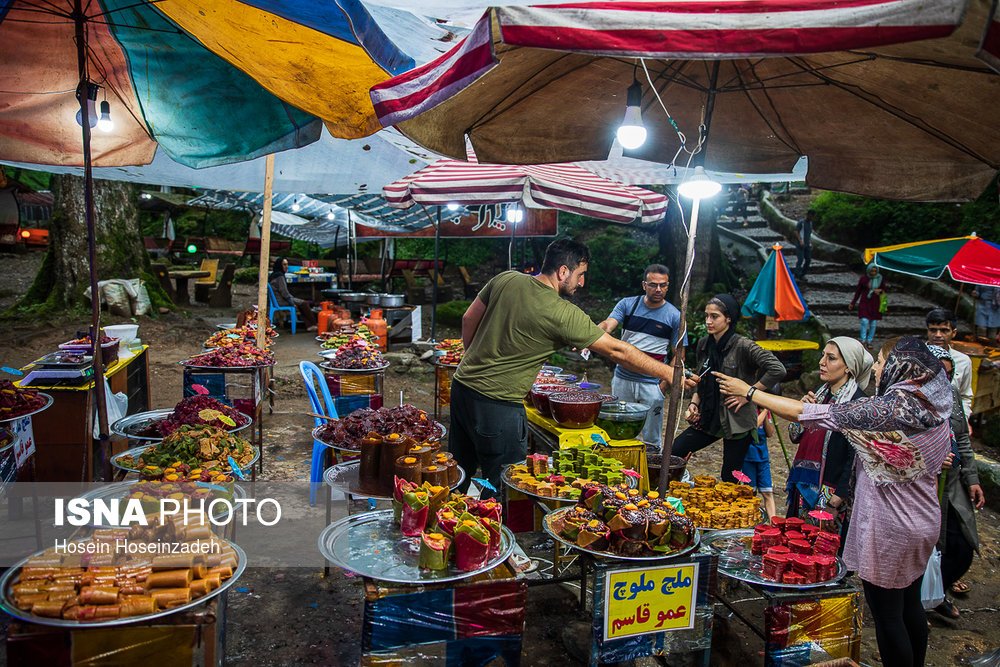
What follows are photos of the festival retrieved from various sources:

Ancient Pottery Kiln Found in Southern Tehran

The kiln has been found in Bahram hill in Moqim Abad of Shahr-e Rey, an ancient city south of the Iranian capital.

Bahram Mousavinia, the head of the archaeological team, said they have also found remnants of a luxury residence in the area, which is believed to be built during the Sassanid era (224-651 CE).

Mousavinia expressed hope searching the perimeter of the hill would help demonstrate the role and importance of Shahr-e Rey in pre-Islamic era and afterwards, IRNA reported.

“Excavating the place is expected to give us important information about the pottery industry in early Islamic times in Shahr-e Rey,” he said.

According to Iran’s Cultural Heritage and Tourism Organization, Shahr-e Rey is estimated to be built more than 8,000 years ago and it houses several monuments dating back to the fourth and fifth millenniums BCE.

In the early Islamic era, it was once a seat for the caliphs of Umayyad dynasty.

Iran FM Congratulates World Muslims on Eid al-Adha

“In trying times – and as some may try to divide us – the Muslim world comes together to celebrate Eid-al-Adha,” Zarif said in a Tuesday post in his Twitter account.

He also wished his “fellow Muslims everywhere a very Happy Eid.”

Eid al-Adha or the Feast of the Sacrifice is the second of two Islamic holidays celebrated worldwide each year (the other being Eid al-Fitr), and considered the holier of the two.

It honours the willingness of Prophet Abraham to sacrifice his son as an act of obedience to God’s command. Before Abraham could sacrifice his son, God provided a ram to sacrifice instead.

In commemoration of this, an animal is sacrificed and divided into three parts: one third of the share is given to the poor and needy; another third is given to relatives, friends and neighbours; and the remaining third is retained by the family.

In the Islamic lunar calendar, Eid al-Adha falls on the 10th day of Dhu al-Hijjah. In the international (Gregorian) calendar, the dates vary from year to year drifting approximately 11 days earlier each year.

“Iran Spending Much Less than Other States on Defence Capabilities”

“Today, we can provide what we need to defend our country, of course, without getting into an arms race,” Brigadier General Hatami said during a ceremony held in Tehran ahead of the National Day of Defense Industry, which will be marked on August 22.

“We are moving towards the use of modern technologies and defense diplomacy,” he said, adding, “We tried to strengthen our defense sector within the framework of our needs and priorities.”

“Of course, we are doing this at the lowest cost,” the defense minister said, adding that Iran’s expenditure on defense sector is even less than that of smaller countries.

During the Tuesday ceremony, the country’s first state-of-the-art fighter jet designed and manufactured by domestic military experts was unveiled.

The homegrown aircraft dubbed “Kowsar” has been manufactured following extensive research and efforts by the Iranian Defense Ministry’s experts.

It enjoys capabilities such as a highly integrated architecture and a fire control system using the fourth generation of the digital data networks.

The aircraft is capable of carrying various weapons and is used for short aerial support missions.

Iranian military experts and technicians have in recent years made great headways in manufacturing a broad range of indigenous equipment, making the armed forces self-sufficient in the arms sphere.

Iranian officials have repeatedly underscored that the country will not hesitate to strengthen its military capabilities, including its missile power, which are entirely meant for defense, and that Iran’s defense capabilities will be never subject to negotiations.