Tuesday, December 23, 2025
Home Blog Page 3487

Iran’s DM Hatami Visits Syria’s Aleppo

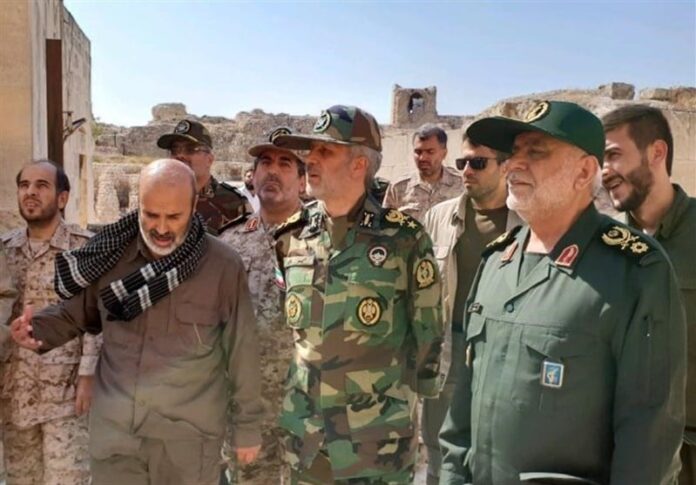
Accompanied by a group of ranking Syrian military commanders, the Iranian defense minister visited Aleppo, Syria’s second largest city which was recaptured from terrorist groups by the Syrian army in December 2016.

Brigadier General Hatami also held talks with the Syrian troops and the voluntary forces fighting against terrorists, and was briefed on the plans to cleanse the city of remnants of the terrorist groups and establish full security in the war-damaged city.

The Iranian minister arrived in Syria on Sunday for a series of high-profile meetings on ways to promote Tehran-Damascus military cooperation and coordinate the fight against terrorism.

Since the outbreak of war and foreign militancy in Syria in 2011, Iran has stood by the Syrian government and supported its people against terrorist groups, including Daesh (ISIL).

In recent months, the Syrian army has managed to liberate many of the areas occupied by terrorists and has begun the reconstruction process.

Saudi Expulsion of Canadian Ambassador “Object Lesson” to Others

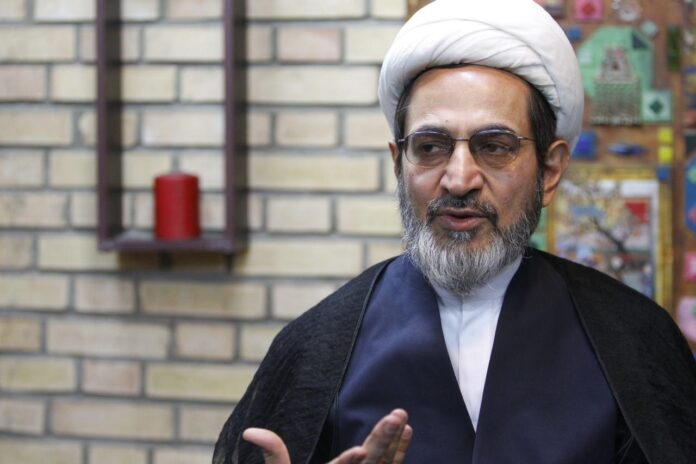
Mohammad Masjed-Jamei

Saudi Arabia has, in recent months, apprehended and incarcerated a large number of university professors, poets, clergymen and businessmen on charges of acting against national security. The kingdom has also expelled the Canadian ambassador to Riyadh for what Saudi Arabia calls interference in its internal affairs. Saudi Arabia has also recalled its ambassador to Ottawa for consultations. Moreover, Saudi Arabia announced it would suspend all its commercial relations and transactions with Canada as well as Canada’s investments in the Kingdom. Meanwhile, the Saudi national airline announced it would stop its flights to and from Canada and that all sold plane tickets would be canceled. Saudi Arabia also announced it would stop all training, scholarship and student exchange programs with Canada. Riyadh further said it would stop all medical training programs for Saudi nationals in Canada and try to transfer its patients from Canadian hospitals.

In an interview with Khabar Online news website, former Iranian ambassador to the Vatican and Morocco Mohammed Masjed-Jamei has weighed in on Saudi-Canadian relations and a range of other issues related to the Arab kingdom.


Sudden Severance of Ties Common among Arab Leaders

Touching upon Saudi Arabia’s sudden severance of ties with Canada, he said such abrupt moves by Arabs are not unexpected.

“We even saw this tendency recently in faraway Morocco region; I mean Morocco’s cutting off its relations with Iran,” said the former ambassador.

“The Moroccans could have downgraded their ties; they could even stop their relations completely; but this kind of severing relations is pointless in today’s world, even if their claim was supposedly true,” he said.

He further said late Libyan leader Muammar Gaddafi had behaviour which suggested the same approach.

“Basically, such behaviour exists in Arab countries,” said the former diplomat.

He said Arab leaders show extensive feelings of friendship towards one another at a point in time as if they are going to maintain a long and warm relationship for years, but shortly after, their behaviour takes a 180-degree turn.

“At last, they have a specific behavioral logic. Of course, it wouldn’t be right to review issues from an ethnic point of view, but the reality, without any exaggeration, is that such a thing exists,” he says.

He believes Arabs show such behaviour a lot.

“For instance, Iraq had a very cordial relationship with Kuwait before attacking the country. In the ‘Arab Spring’ story, this very dynasty of the Qatari Emir had very amicable ties with [Syrian President] Bashar al-Assad. Until before the invasion of Kuwait, during the rule of King Hussein in Jordan, Saudi Arabia and Jordan had a very close and cordial relationship, but all of a sudden everything changed and Jordan began to strongly support Saddam Hussein,” he noted.

Masjed-Jamei further touched upon the latest blockade on Qatar as another case in point.

“Or take this recent blockade on Qatar, for example. Shortly before the incident happened, Qatar afforded the greatest welcome of its history to the Saudi king, i.e. Salman. But after a short time, that relationship was severed in the worst manner possible,” he underlined.

He then referred to former Egyptian President Mohamed Morsi as another example.

“When Morsi came to power, in his first foreign trip, he went to Saudi Arabia to visit King Abdullah. There, Morsi said they wanted to form a large Sunni coalition. Then suddenly, relations between the Muslim Brotherhood and Saudi Arabia turned so sour that Saudi Arabia put Muslim Brotherhood members on the list of terrorists,” he noted.

“Or during the reconstruction of the United Arab Emirates (UAE), for instance,” he said.

“The services that Muslim Brotherhood rendered to this country was excellent; but after the Arab Spring started, the UAE suddenly turned against Muslim Brotherhood, in the UAE itself as well as in all Arab countries and even Turkey,” the former diplomat noted.

“Or take the [Persian] Gulf Cooperation Council, for instance. In fact, this council was the most stable and logical united Arab group. But we saw how three members of the council, namely Saudi Arabia, Bahrain and the UAE lined up against another member, i.e, Qatar, and treated it in the worst way possible,” he noted.

He said the above-mentioned incidents should “serve as a lesson for us.”


Ties with Arabs Unstable, Fragile

The former diplomat underlined Iran should know that the Arabs’ relations with the country, no matter how warm and cordial they may be, are unstable and fragile, and an about-face in their approach may take place any moment.

He said what has somehow lessened the fragility of relations between Tehran and the Arabs is Tehran’s flexibility and forgiveness.

Another point, he said, concerns Saudi Arabia.

“The reality is that the new Saudi regime, i.e., the authorities running the country after Salman, especially after Mohammed assumed power and was declared as heir to the throne, have e series of thinking problems,” he said.

“They have problems in terms of establishing a posivite relationship that can benefit them both domestically and internationally,” added the former diplomat.

“The pointis that when a person’s evaluation of himself/herself, or a country’s evaluation of itself, or a regime [‘s evaluation] of itself is not in accordance with the reality of that person or country or regime, disorders will emerge, and the more the evaluation’s discordance with reality, the more severe the disorder,” he said.

Another point, he said, concerns Saudi Arabia.

“The reality is that the new Saudi regime, i.e., the authorities running the country after Salman, especially after Mohammed assumed power and was declared as heir to the throne, have a series of thinking problems,” he said.

“They have problems in terms of establishing a positive relationship that can benefit them both domestically and internationally,” added the former diplomat.

“The point is that when a person’s evaluation of himself/herself, or a country’s evaluation of itself, or a regime [’s evaluation] of itself is not in accordance with the reality of that person or country or regime, disorders will emerge, and the more the evaluation’s discordance with reality, the more severe the disorder,” he said.

He then mentioned some examples to further clarify the issue.

“For instance, the image that Muammar Gaddafi had of himself, and of what the West thought of him, and of his influence among the Western states, was completely wrong,” Masjed-Jamei noted.

“Gaddafi really thought if Libya comes under a military attack, the Italian government, which had signed a defence agreement with Tripoli, will definitely stand by Libya and defend the Arab state,”

He added.


Gaddafi Wrongly Thought Italy Would Help Libya

“Gaddafi thought now that he has concluded the agreement with Italy, Rome will stay by him and will defend Libya against threats,” said the former diplomat.

“Gaddafi was especially proud about one thing: his personal and friendly relationship with Berlusconi, who was not only Prime Minister at the time, but an influential person in Italy’s industrial and economic society due to his wealth; in other words, his status was not due to his premiership only, but due to different reasons, especially his economic and financial situation,” he said.

The former diplomat underlined that all the points mentioned show that Gaddafi thought the Europeans really liked him and support him as a major stabilizing force in North Aftica and Sahara.

“Of course, Gaddafi did have a stabilizing role in those areas, but wrongly believed the Europeans really supported him, and have a real alliance with him and would stand by him in critical times” he said.

There are other cases as well, he noted.

Then the former Iranian diplomat turned to the isuse of Saudi Arabia.

“Now it should become clear what Saudi Arabia thinks of itself. The reality is that traditionally, until the end of King Abdullah’s rule, Saudi Arabia’s behaviour in its foreign policy was such that it resulted in the country’s stability … but the new ruling elite in Saudi Arabia has ideas similar to that of Gaddafi and believes Western countries really like Saudi rulers and are united with them,” he said.

The former diplomat further referred to a visit to the US last year by Mohammed bin Salman.

“If anyone is familiar with diplomatic norms, he or she will easily find out that during Mohammed bin Salman’s trip to the United States around a year ago, the kind of welcome that Trump extended to him and the kind of meeting they had were very insulting. Bin Salman was like a student standing in front of his despotic teacher,” the former diplomat said.

He then referred to what Trump did during that meeting, i.e., showing to reporters a list of Washington’s arms sales to Riyadh plus the value of every single arms contracts that the US and Saudi Arabia had signed.

“In other words, Trump was telling his people that ‘Look! I’m milking the Saudis!’,” the former diplomat said.

“You know, a great part of Trump’s popularity with his supporters is due to the fact that he is creating jobs and bringing in more financial resources (income) into the US,” said the former diplomat.


Saudis Repeating Gaddafi’s Mistake by Relying on US

He then turned to the Israeli regime and its alliance with the United States.

“Israel, as a country and a regime, is inherently popular with the Westerners and the Americans from whatever group, party or sector. There are numerous reasons for this. For example, Trump’s smile to Netanyahu is really sincere and even brotherly. In fact, in his meeting with Netanyahu, Trump not only considers him as an ally, but as his most important ally; however, Trump’s smile to likes of bin Salman is totally different. His smile and respect is because he wants to milk bin Salman,” said the diplomat.

“Let’s get back to the main issue. Because they don’t have a proper evaluation of their status, they make mistakes and come up with illusions. As to why they don’t have a proper assessment, there are many reasons. Regarding Saudi Arabia, the main reason is the country’s oil riches and petrodollars. They believe because they have money, they are popular, and as a result, they can attain whatever they want, can order others, and can even bully others. They have such a mentality. This is a mishmash of a kind of primitive behaviour which has taken on an aggressive mode; it’s a sort of aggressive primitiveness,” said the former diplomat.

“Formerly, Saudi kings usually tried to remain silent and give ransom and be generous and spend money and sort of ignore things in order to get round problems. They tried not to blow problems out of proportion; rather, they tried to downplay problems and keep them from being known publicly. In other words, they tried to deal with the problem at the outset,” he noted.

The former diplomat then turned to the recent row between Saudi Arabia and Canada.

“We can say that the issue which has emerged with Canada is, in fact, the new Saudi rulers’ first issue with a Western country; in other words, Canada is the first Western country that the new rulers have issues with. It has started with Canada for now, but if they pursue the current approach, they will have numerous problems with other countries, as well,” he stated.

Masjed-Jamei said Saudi rulers do not seem to have the power to understand issues, and those who can understand, do not have the power, or verbal ability to express their ideas.

He then elaborated on why Saudi rulers are not able to understand issues.

“Because if they say a word, they will be accused of treason and betraying the monarchial system and of being weak. As a result of the accusations, they may be stripped of everything. I know that there were some people within the ruling elite and even at the level of ministers, who had different opinions and, hence, were dismissed,” said he former diplomat.

He then touched upon the reasons behind Ms Badavi’s arrest.

“It will be good to mention the root causes of this story. Very briefly speaking, until early 90s, because of the abundant money that Saudi Arabia had and due the fact that the previous generation was inherently conservative, the Saudi society was homogeneous.  …. The society was more or less homogeneous and was satisfied with what it had,” he said.

“Tro review it more precisely, the issue is related to Saudi Arabia being modernized. Very briefly, the modernization of Saudi Arabia took place while observing Islamic norms within a tribal and Saudi context. In other words, it was coupled with the welfare that was the result of the wealth injected into the society. So, the core of the society had no problem with modernization and was more or less comfortable with it. In other words, people from almost all walks of life, including women, men, rural, urban, educated, uneducated, etc., were practically living in acceptable conditions,” said the former diplomat.

“But after the 90s, a series of developments began to unfold. In the 90s, a wave of rather widespread discontent which was the fallout from the invasion of Kuwait began for the first time. They were objecting to why Saudi Arabia had allowed Western troops to come to the region and stay there. Anyway, from the on, religious unrest started,” he said.

“It was from early 2000 on that the society’s homogeneity was disrupted. Since early that year, and especially after 2001, the Westerners, especially the Americans, began to adopt measures to open up the Saudi society. Their argument was that the fact that the Saudi society can bring up people who would be able to pull off the 9/11 incident is because of their closed social, political and especially educational and academic system as well as a lack of free elections. They argued that the society shouldbe opened up to reform issues,” he said.

On the other hand, the promotion of communications as well as internet channels and cyberspace together with satellite channels led to the opening up of the Saudi society from within. … The rate of population growth in Saudi Arabia is very high. Now, maybe more than half of Saudi people are under 30. This shows the Saudi society is very young. This very young society is growing up in an atmosphere influenced by cyberspace and satellite channels and new ideas and conditions. This generation is completely different from the previous one and pursues its own different ideas and ideals,” the former diplomat.

He said the new Saudi ruling elite has outrageous interpretations and ideas regarding domestic policies and giving civil rights to people and modernizing the society while confronting the objections and efforts of people in order to gain more rights.

“In other words, the new ruling elite has simply settled for giving a series of very superficial concessions, which, ironically enough, disrupt tranquility and stability in society, and does not tolerate more than that,” he noted.

He said a wife in Saudi Arabia can be served with heavy penalties, from cash fines to a maximum one year in prison, if she checks her husband’s cell phone without permission.

“To tell the truth, this is a deadly poison for a society like that of Saudi Arabia, a society that does not have basic preparations for such a thing and [a society] where the man is not a ‘pillar,’ but a ‘master;’ that will result in numerous family and social challenges,” said the former diplomat.

Elsewhere in his remarks, Masjed-Jamei touched upon the expulsion of the Canadian ambassador from Saudi Arabia, and said it does not have anything to do with the Saudi crimes in Yemen.

“Fairly speaking, this story is not related to Saudi Arabia’s regional problems and the issue of Yemen and Hudaydah and so on. The point is that Saudi Arabia, due to some reasons, wants to stave off criticism over human rights issues by major and influential Western countries, be it the US, Britain or France. This issue is probably a major part of the reasons behind this sever reaction,” he noted.

He said Riyadh’s move was aimed at teaching Ottawa a lesson.

“It seems that Canada paid the price for others; in other words, Saudi Arabia’s extreme move came as an object lesson to others,” he said.

The former diplomat said Canada was more vulnerable than others in that saga.

“They have already done that to Germany. In recent months, Germany criticized Saudi Arabia on numerous occasions, especially over Yemen. The Saudis, of course, reacted to the criticisms. Germany is a big country and is the driving force behind the EU, economically and industrially,” he said.

He noted that the severance of Riyadh- Ottawa ties will not harm Canada.

“Canada is very rich, very vast and full of potential and facilities; after all, it is one of G7 countries. … So, Canada cannot be harmed by such an issue. Of course, a couple of Canadian companies may be hurt, but that would be nothing. Canada’s exports to Saudi Arabia mostly included military hardware, namely tanks,” he said.

He then touched upon short-term and long-term consequences of Saudi Arabia’s move.

“It is a little hard to predict because we should wait and see to what extent media and journalistic circles and NGOs of Western countries will exert pressure to counter Saudi Arabia. At the moment, such pressure exists, but is not predictable that much. It is not clear to what extent these pressures will lead to a change of policy or approach by these countries toward Saudi Arabia,” he said.

“But their approach will definitely change. Even now it has somehow changed. The Western countries’ point of view toward Saudi Arabia is not the same as before the Canada crisis. The crisis between Saudi Arabia and Canada is a clear and unjustifiable example,” he said.

“This behaviour by Saudi Arabia will improve Iran’s image because Iran has never show such reactions to such criticisms from others,” he said.

The former diplomat then mentioned some recommendations regarding Iranian-Saudi relations.

He said the current ruling elite is the best alternative for Iran to have relations with at the moment because whatever regime takes power in Saudi Arabia under the current circumstances, it will be worse that the present one.

A Look at Iranian Newspaper Front Pages on August 28

A Look at Iranian Newspaper Front Pages on November 19

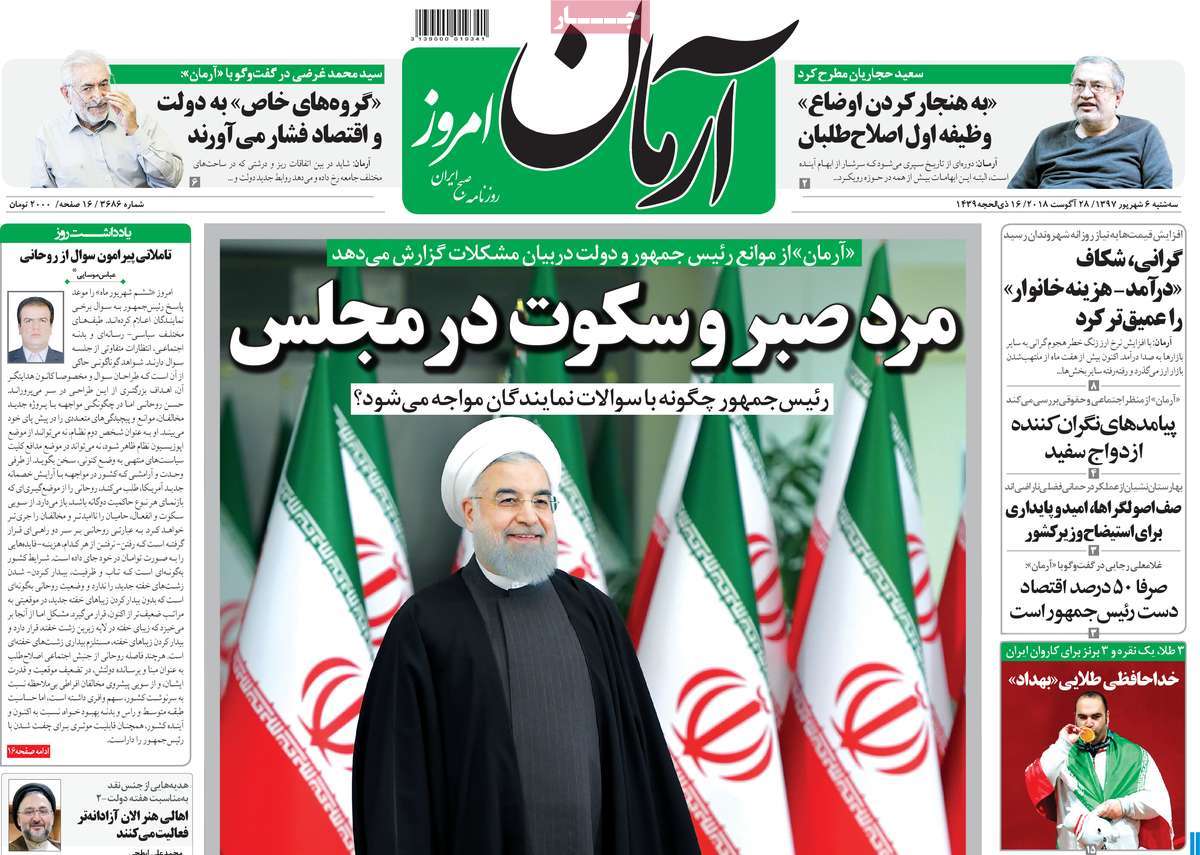
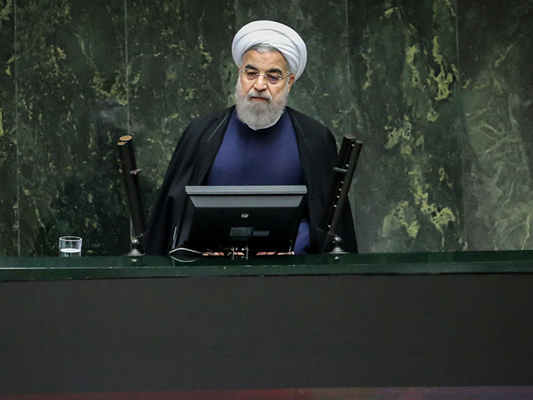
Several papers today covered President Hassan Rouhani’s Tuesday speech at the Parliament, during which he was supposed to answer five question raised by the lawmakers on the country’s economic situation.

Also a top story was the upcoming summit of Iranian, Turkish, and Russian leaders in the Iranian city of Tabriz, which is to be held on September 7.

The International Court of Justice (ICJ)’s hearing of Iran’s lawsuit against the US over the latter’s illegal sanctions against Tehran also received great coverage.

The above issues, as well as many more, are highlighted in the following headlines and top stories:


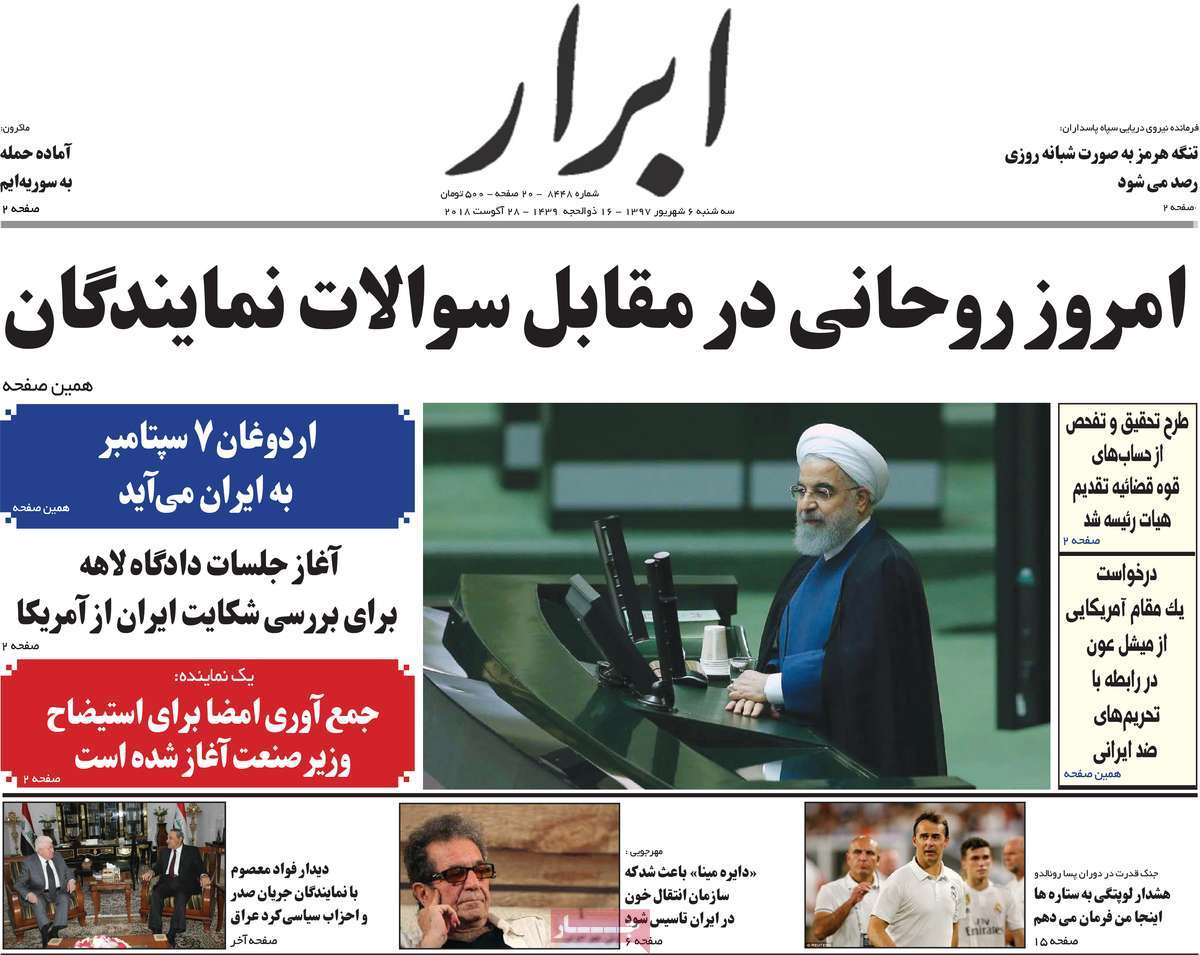
Abrar:

1- Erdogan to Visit Iran on September 7

2- IRGC Navy Chief: Hormuz Strait Monitored All the Time

3- Macron: We’re Ready to Attack Syria

A Look at Iranian Newspaper Front Pages on August 28


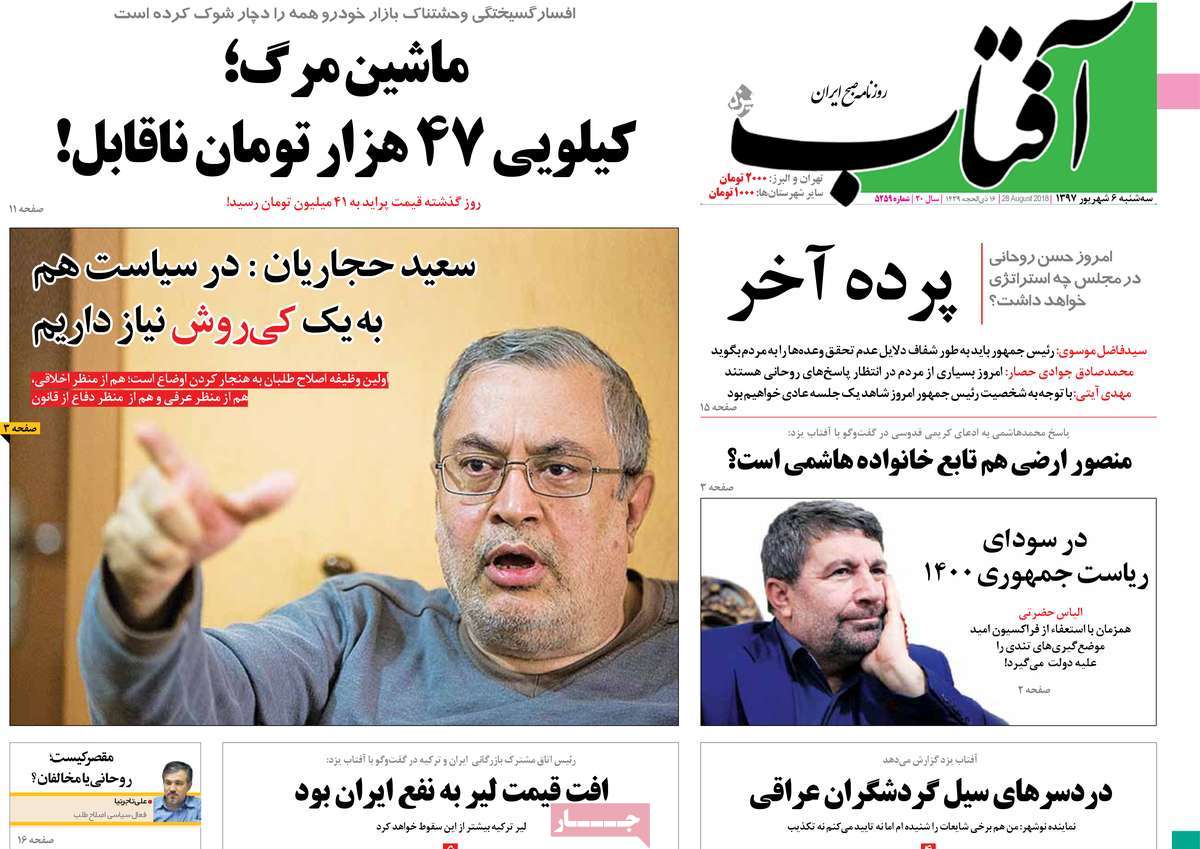
Aftab-e Yazd:

1- Everybody Shocked by Car Market Getting Out of Control

2- Last Act: What Will Be Rouhani’s Strategy in Parliament Today?

3- Official: Devaluation of Turkish Lira Serves Iran’s Interests

A Look at Iranian Newspaper Front Pages on August 28


Arman-e Emrooz:

1- Conservatives, Reformists, Hardliners All Seek to Impeach Interior Minister

A Look at Iranian Newspaper Front Pages on August 28


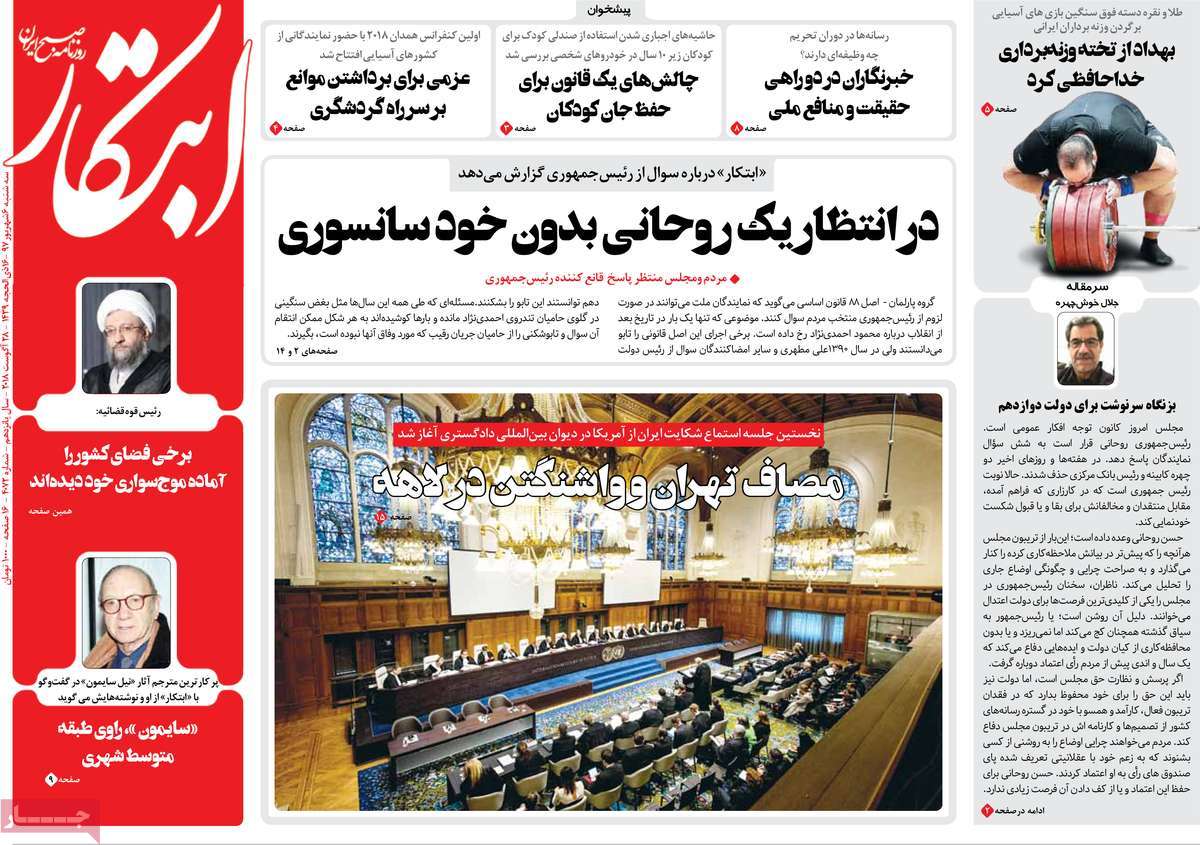
Ebtekar:

1- Tehran vs Washington in The Hague

  • ICJ Hears Iran’s Lawsuit against US

A Look at Iranian Newspaper Front Pages on August 28


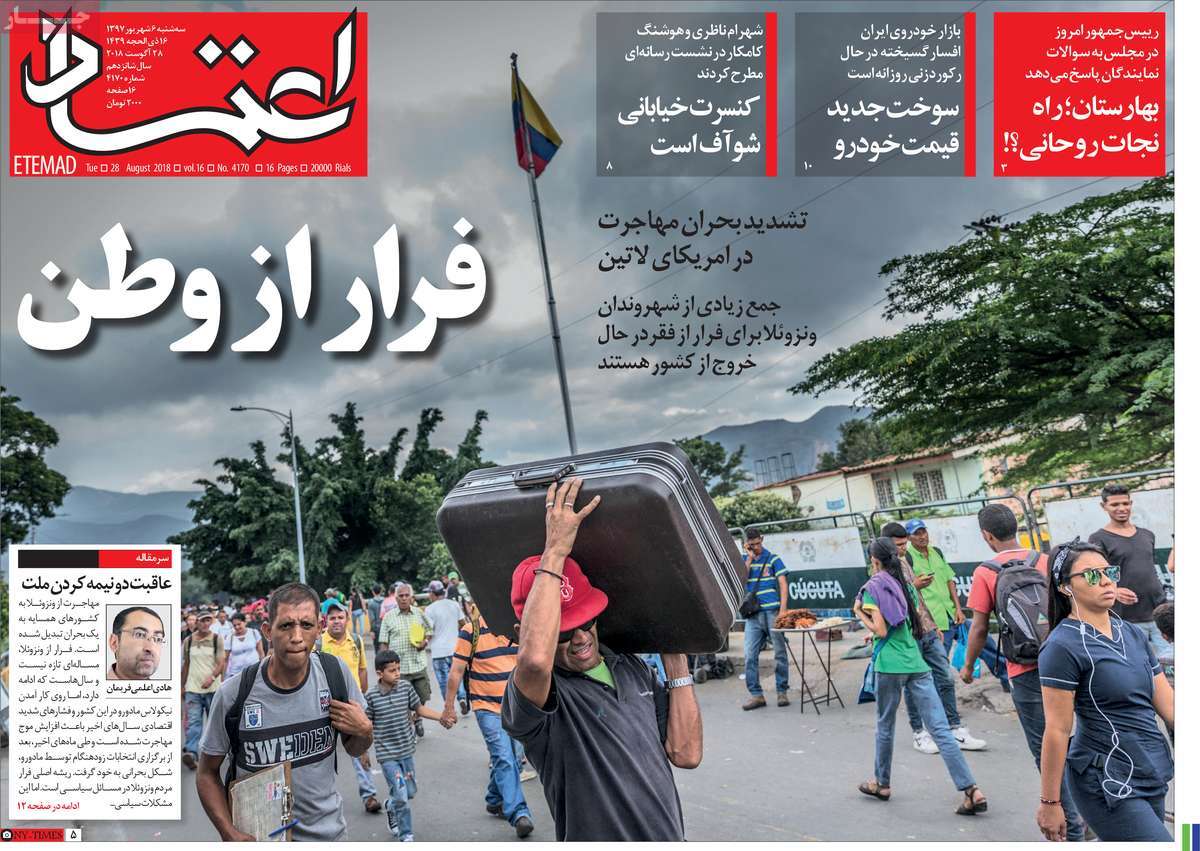
Etemad:

1- Escaping Homeland: Escalation of Refugee Crisis in Latin America

2- Parliament, the Way to Save Rouhani?

A Look at Iranian Newspaper Front Pages on August 28


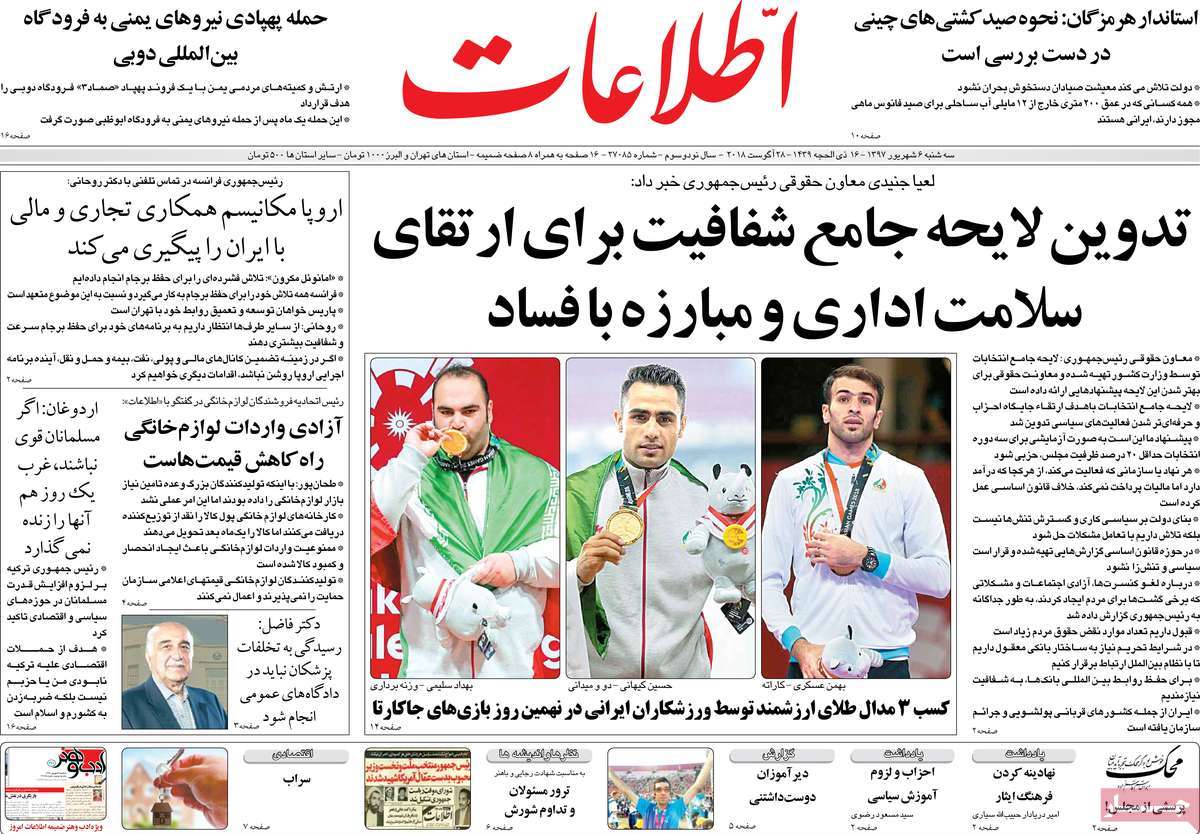
Ettela’at:

1- Rouhani’s VP for Legal Affairs: Iran Working on Transparency Bill to Fight Corruption

2- French President: Europe to Implement Mechanism for Trade Ties with Iran

3- Erdogan: West Won’t Leave Muslims Alive for One Day If They’re Not Strong

4- Iran Probing into Chinese Fishermen’s Operation in Iranian Waters

A Look at Iranian Newspaper Front Pages on August 28


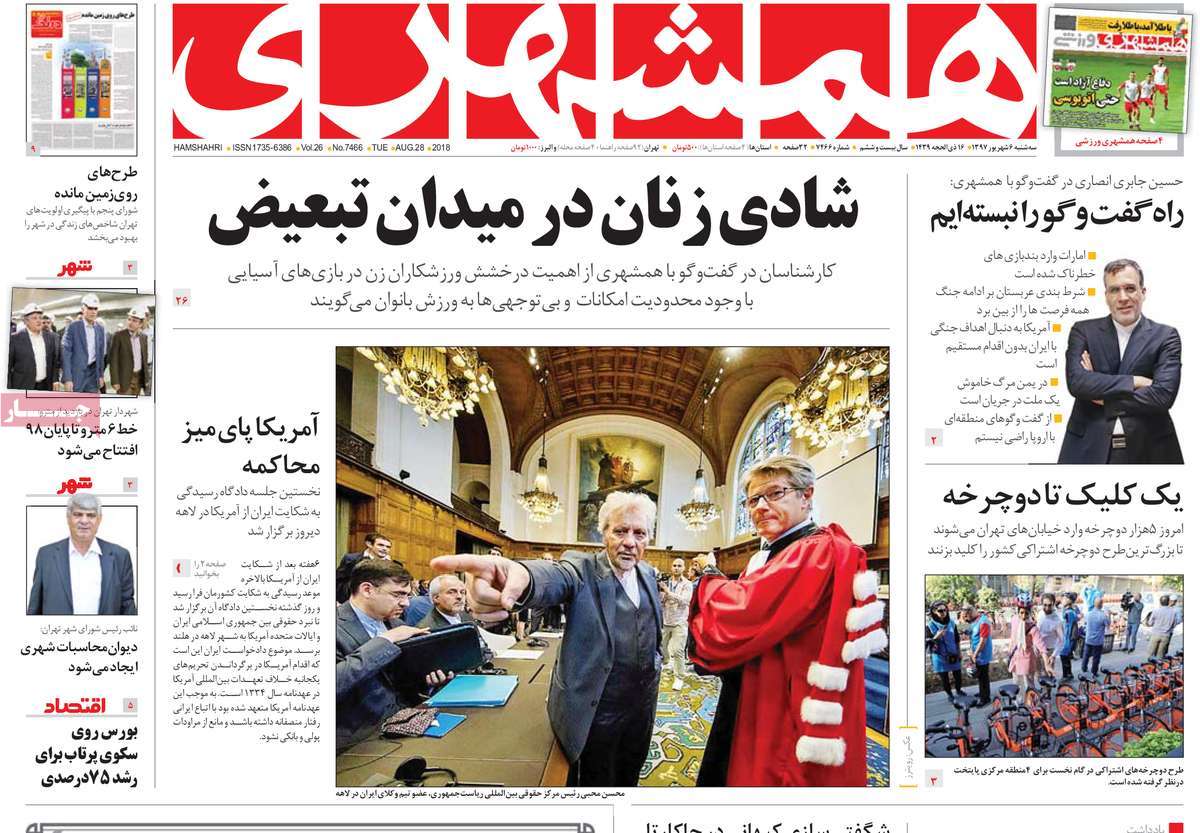
Hamshahri:

1- Iranian Women Achieving Victories despite Discriminations

  • Why Iranian Women’s Brilliant Performance in Asian Games Matters

2- US to Appear in ICJ over Iran Lawsuit

A Look at Iranian Newspaper Front Pages on August 28


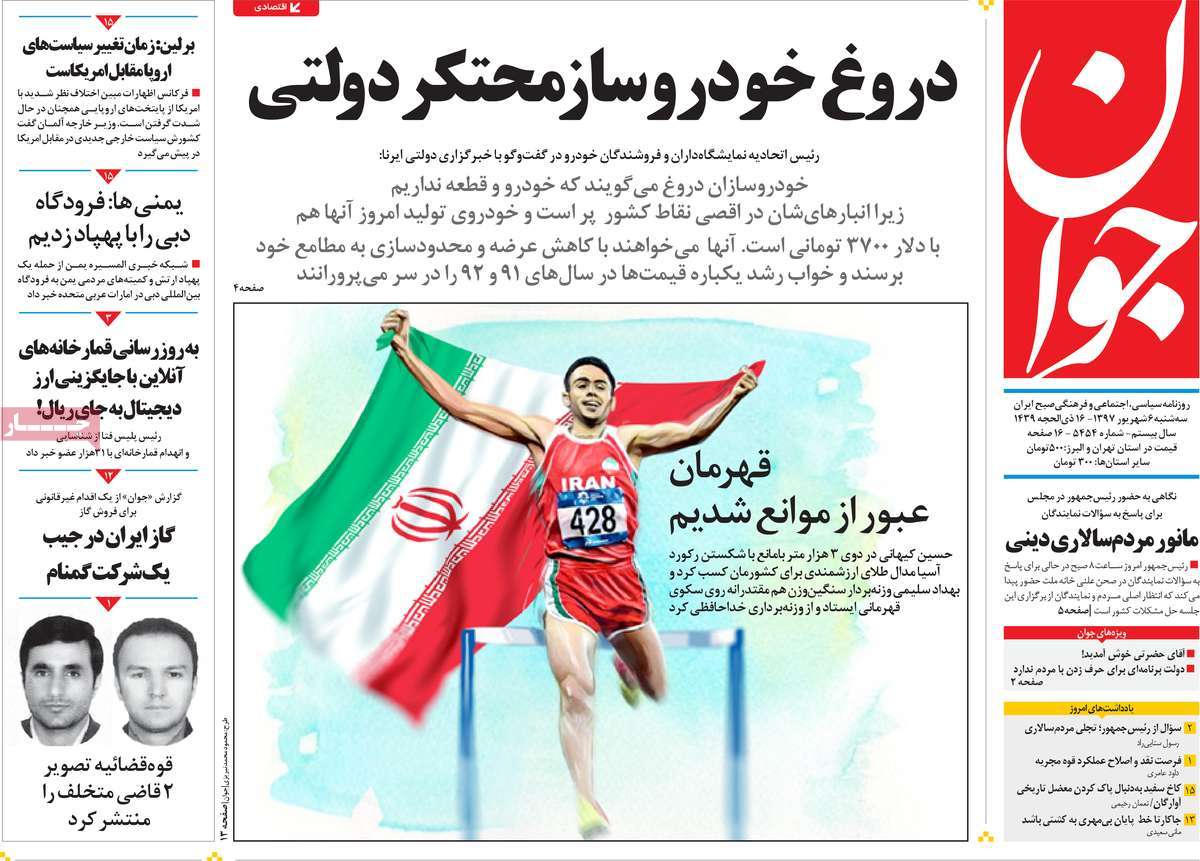
Javan:

1- We’re Champion of Overcoming Obstacles

  • Iranian Runner Keyhani Wins Asian Gold Medal

2- Yemenis: We’ve Attacked Dubai Airport with Drone

3- Berlin: It’s Time for Europe to Change Its Policies towards US

A Look at Iranian Newspaper Front Pages on August 28


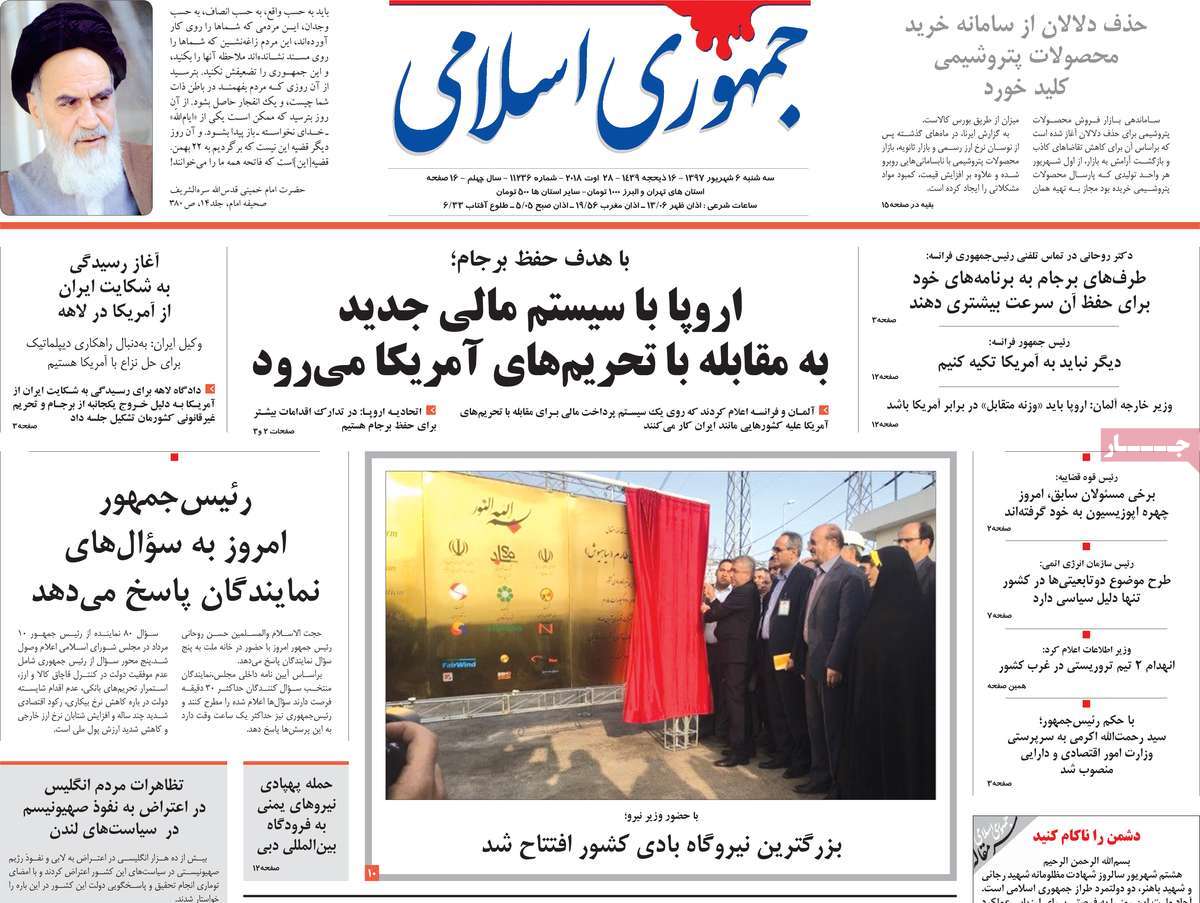
Jomhouri Eslami:

1- Europe to Counter US Sanctions with New Financial System in Order to Save JCPOA

2- ICJ Starts Working on Iran’s Lawsuit against US

3- Iranian Energy Minister Inaugurates Iran’s Biggest Wind Power Plant

A Look at Iranian Newspaper Front Pages on August 28


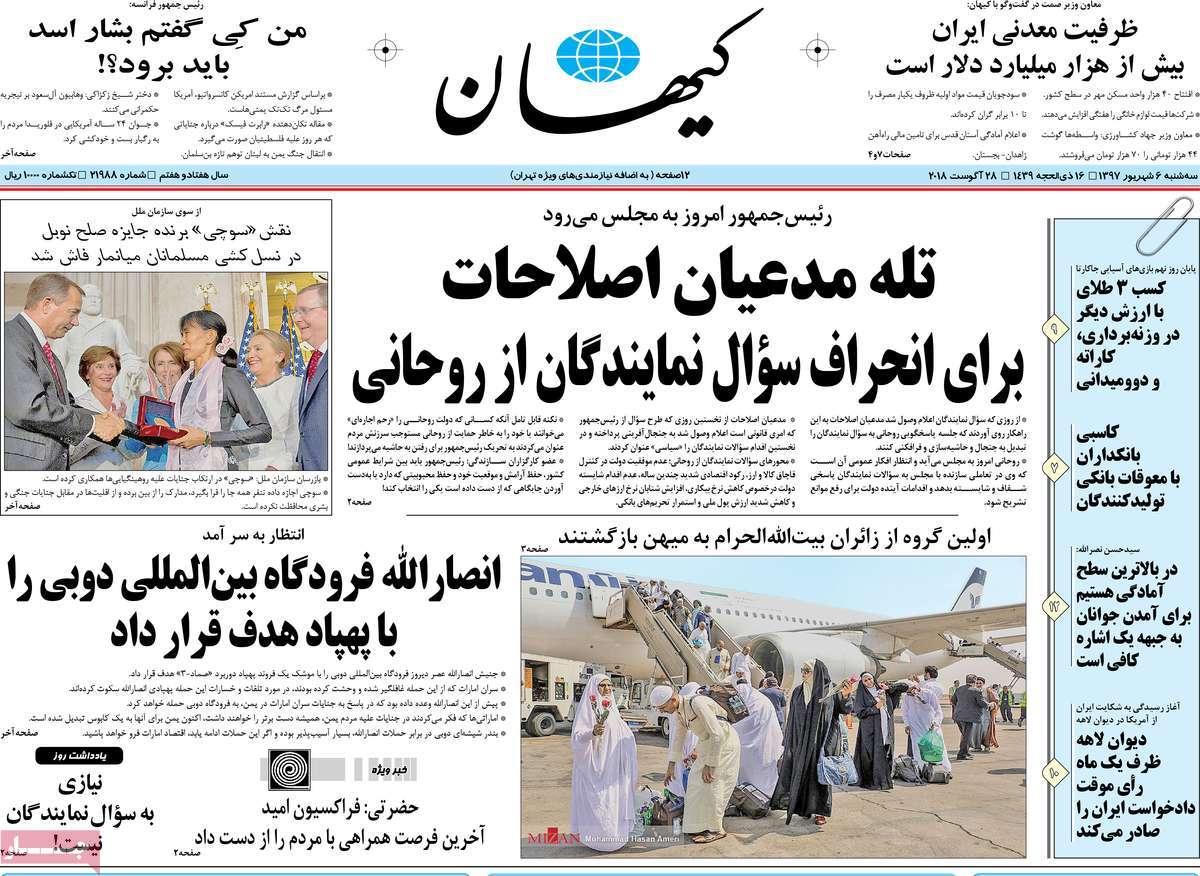
Kayhan:

1- Deputy Minister: Iran’s Mining Capacity over $1,000 Billion

2- Macron: When Did I Say Assad Must Go?

A Look at Iranian Newspaper Front Pages on August 28


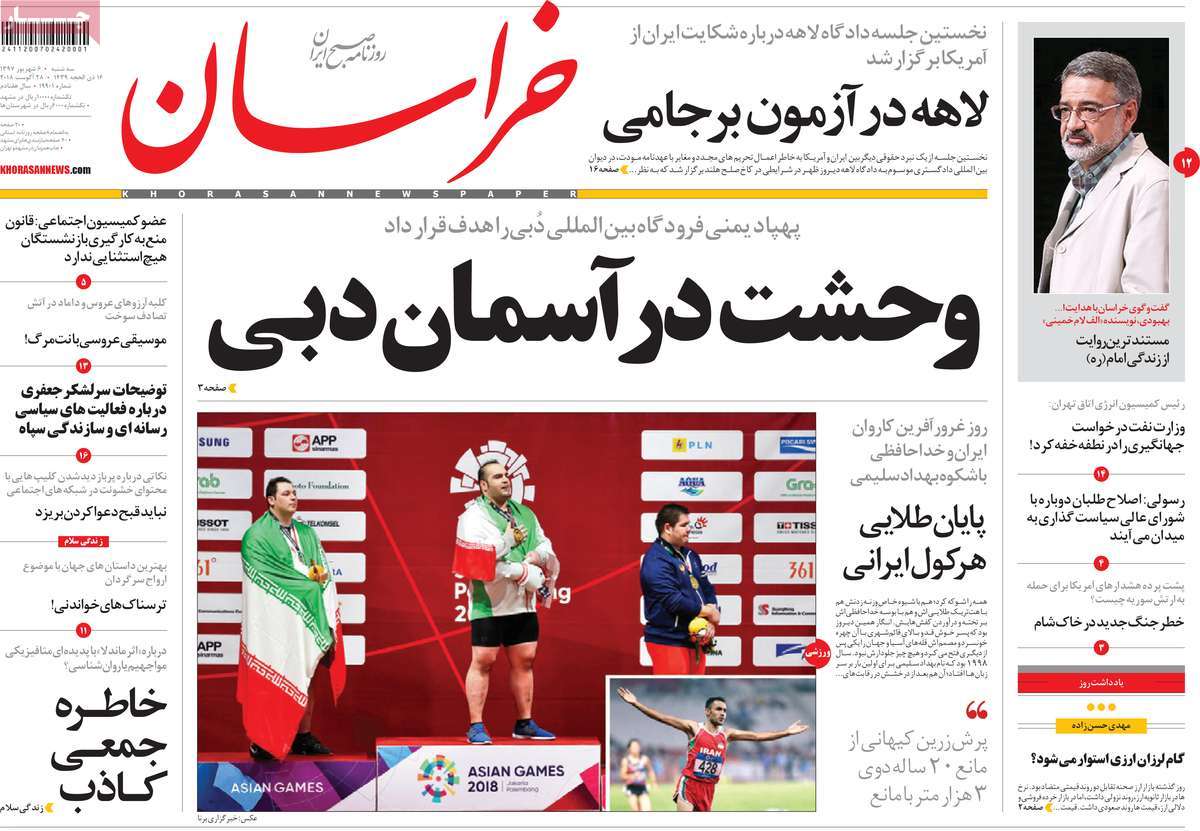
Khorasan:

1- Terror in Dubai’s Sky: Yemeni Drone Attack Hits Dubai Int’l Airport

2- The Hague and Its JCPOA-Related Test

A Look at Iranian Newspaper Front Pages on August 28


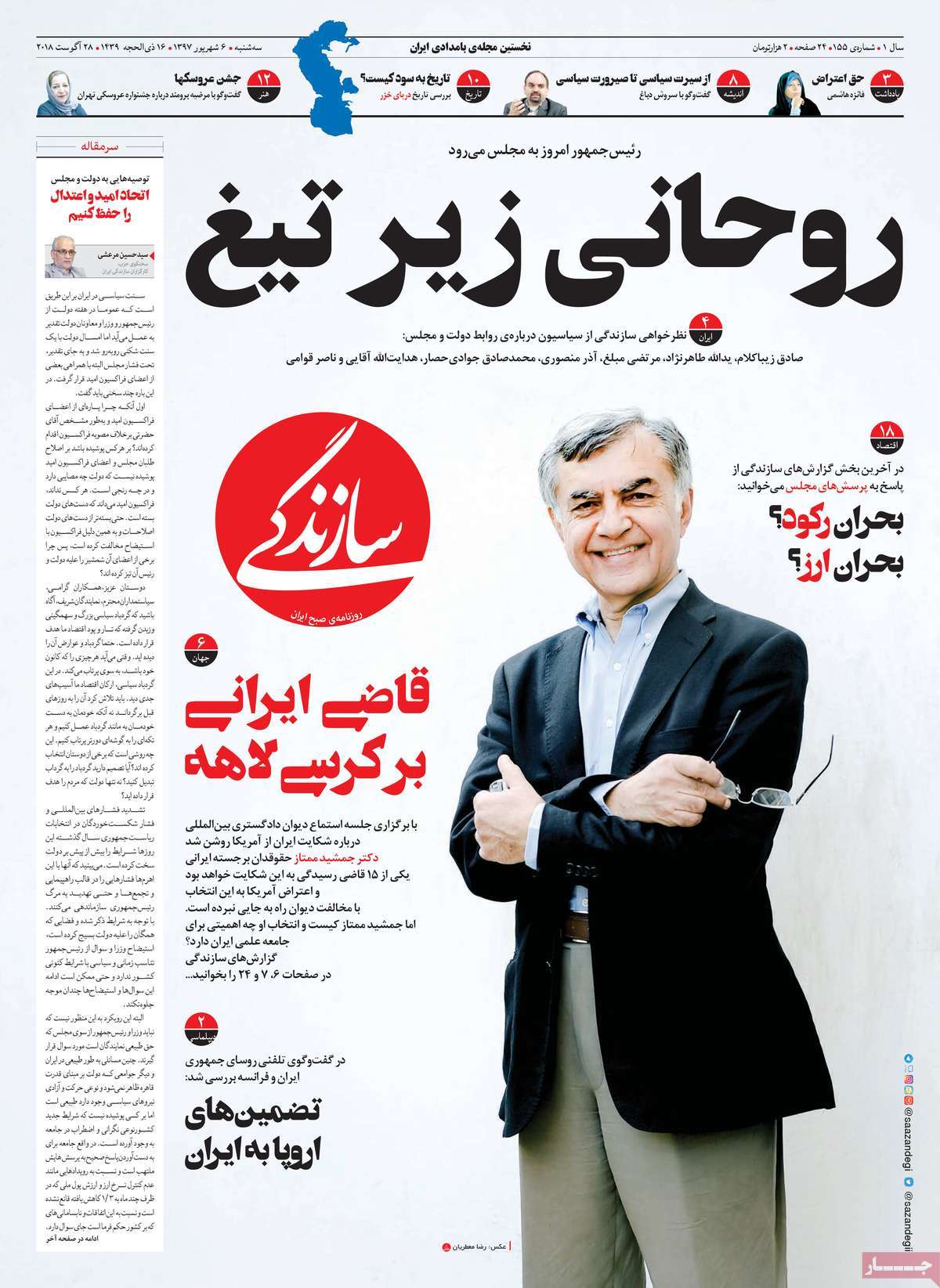
Sazandegi:

1- Iranian Judge among Judges of The Hague

2- Rouhani under Fire: President to Appear in Parliament Today

A Look at Iranian Newspaper Front Pages on August 28


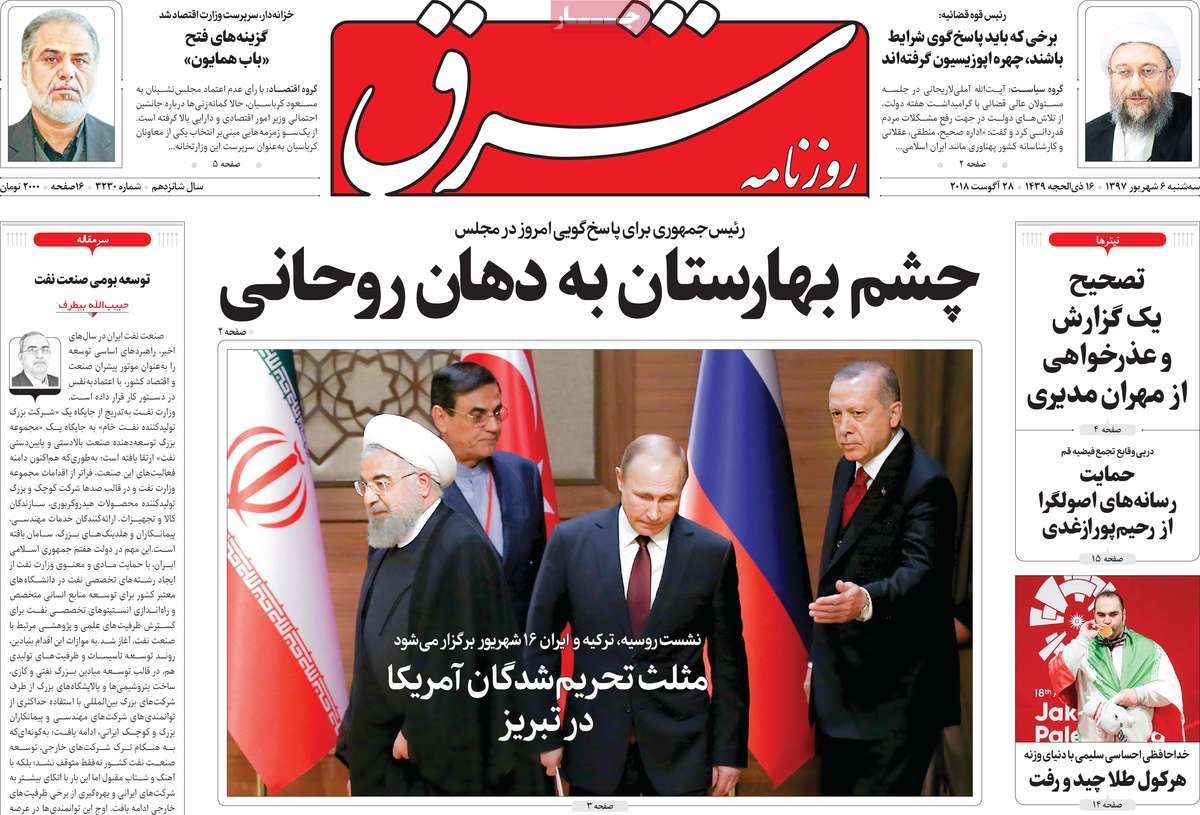
Shargh:

1- Tabriz to Host Triangle of Countries under US Sanctions

  • Iran, Russia, Turkey to Hold Summit on September 7

2- Iranian Hercules Wins Gold Medal and Quits Weightlifting

  • Behdad Salimi’s Emotional Farewell to Weightlifting

A Look at Iranian Newspaper Front Pages on August 28

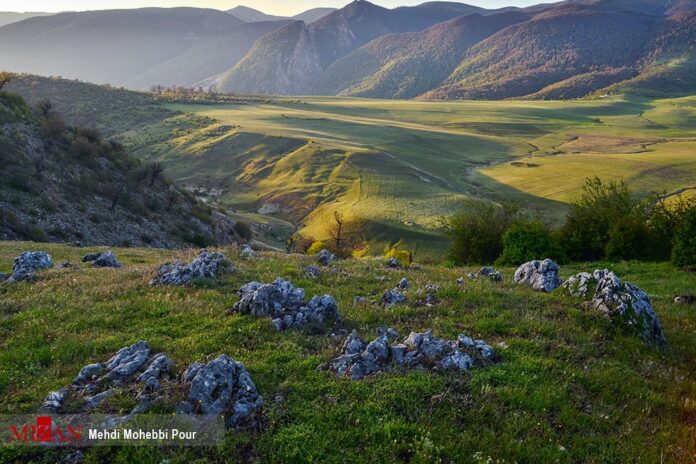
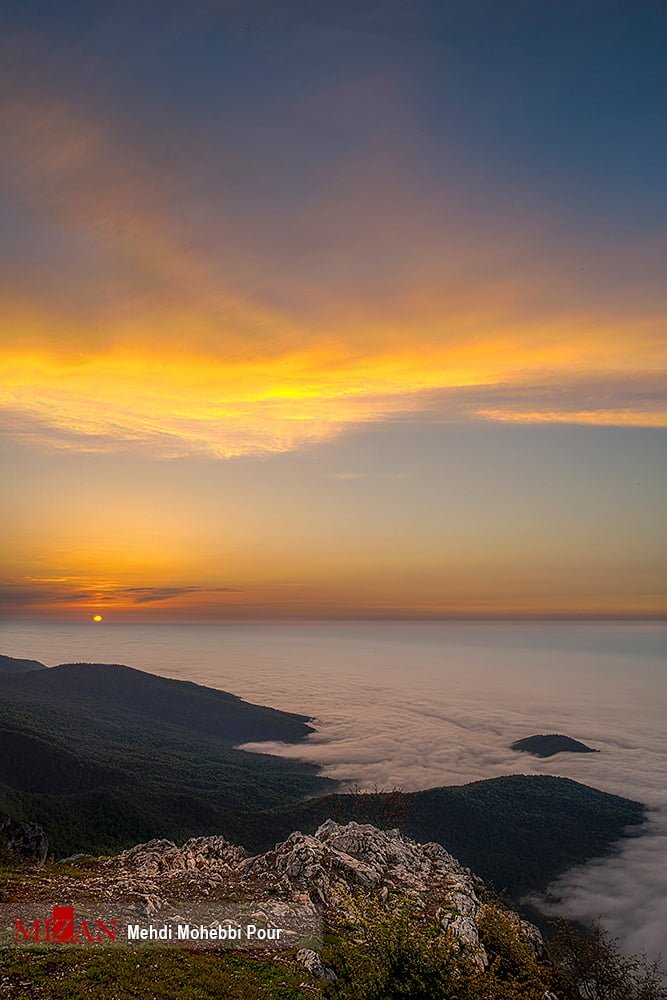
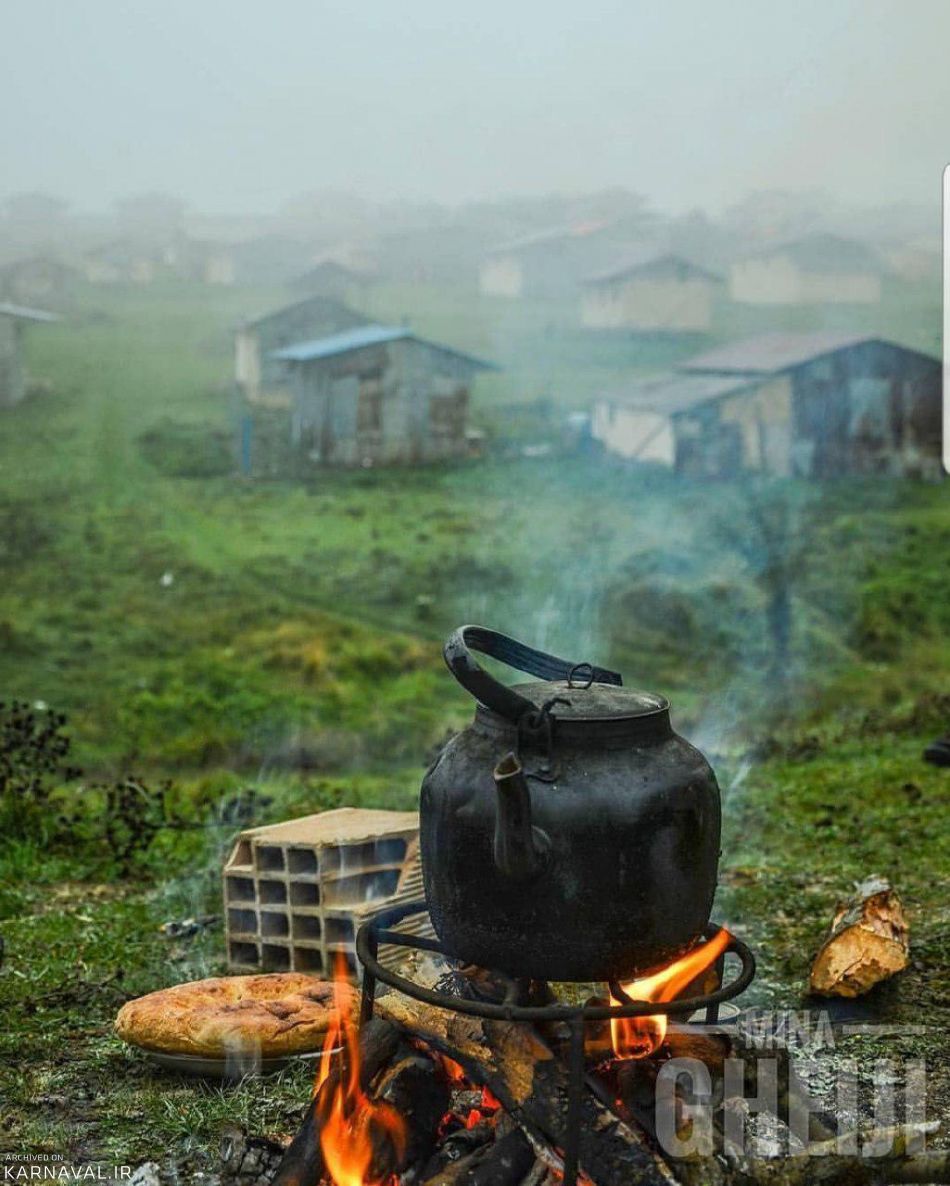
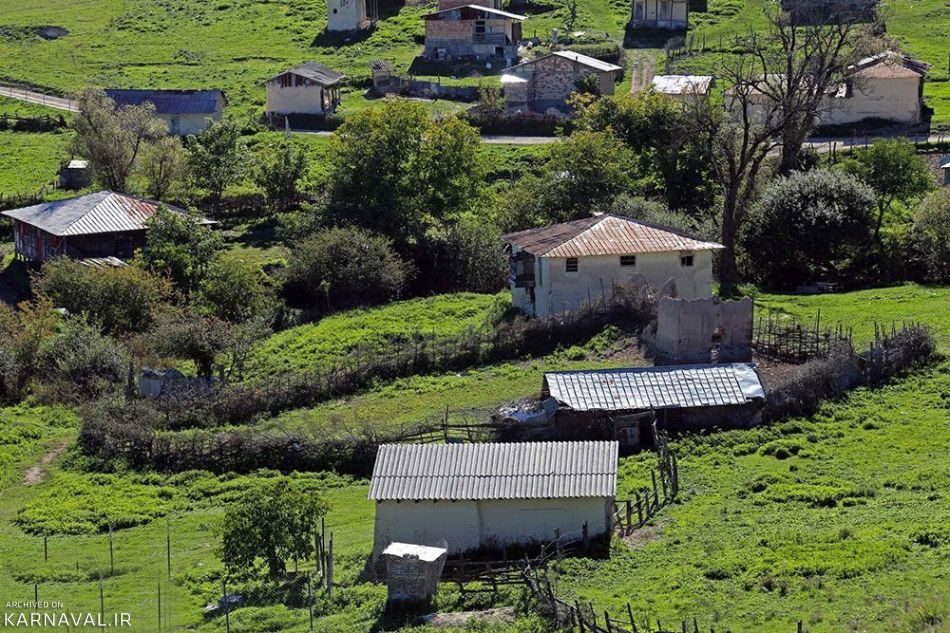
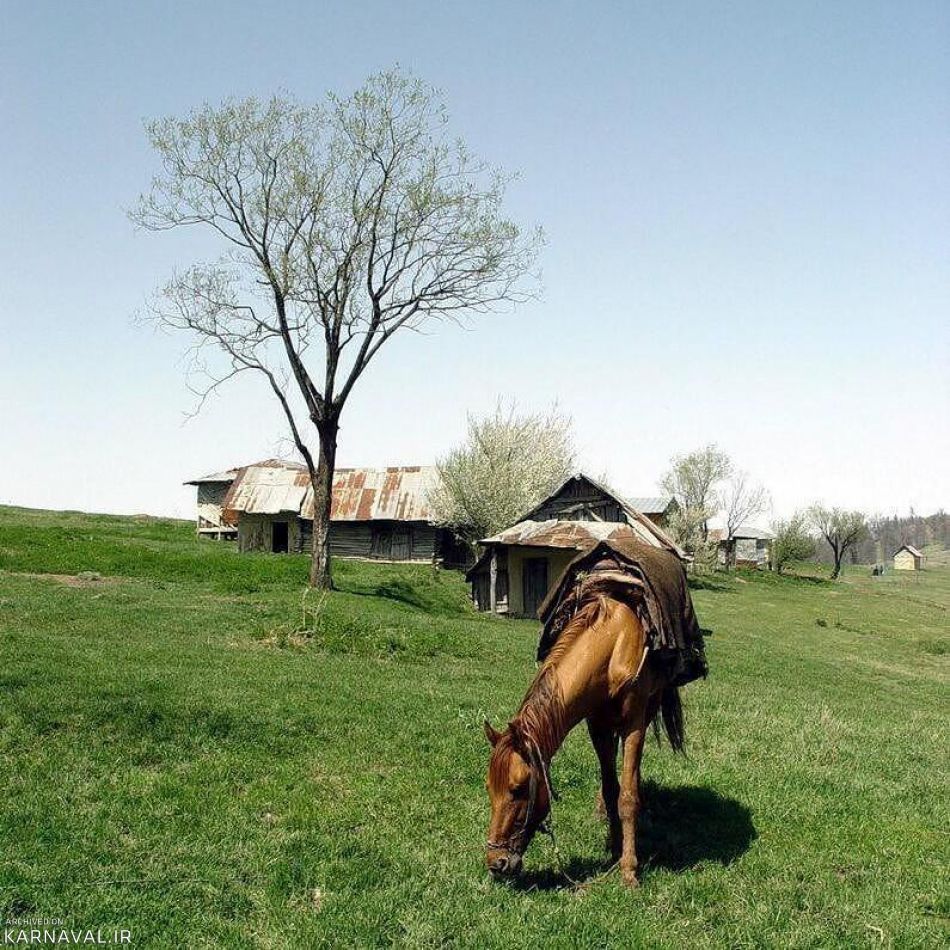
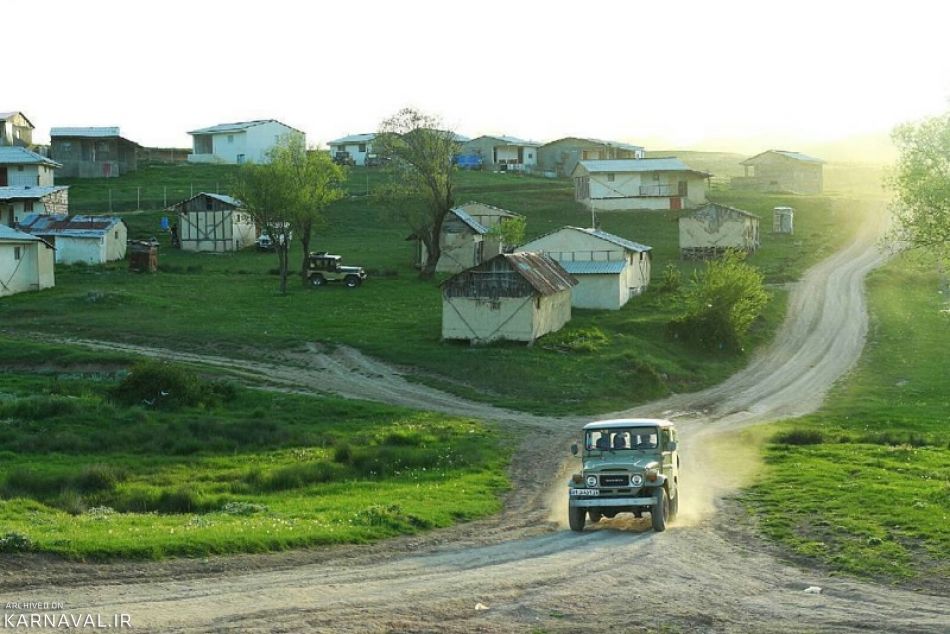
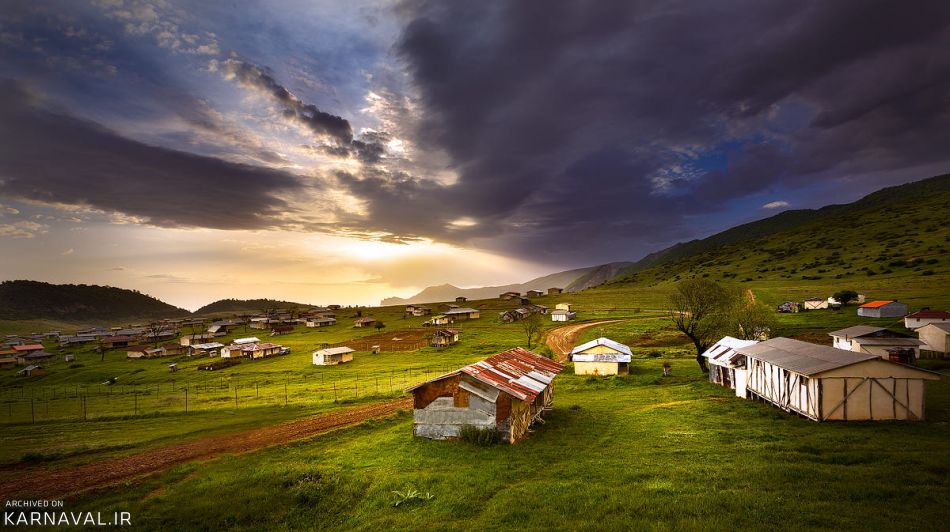
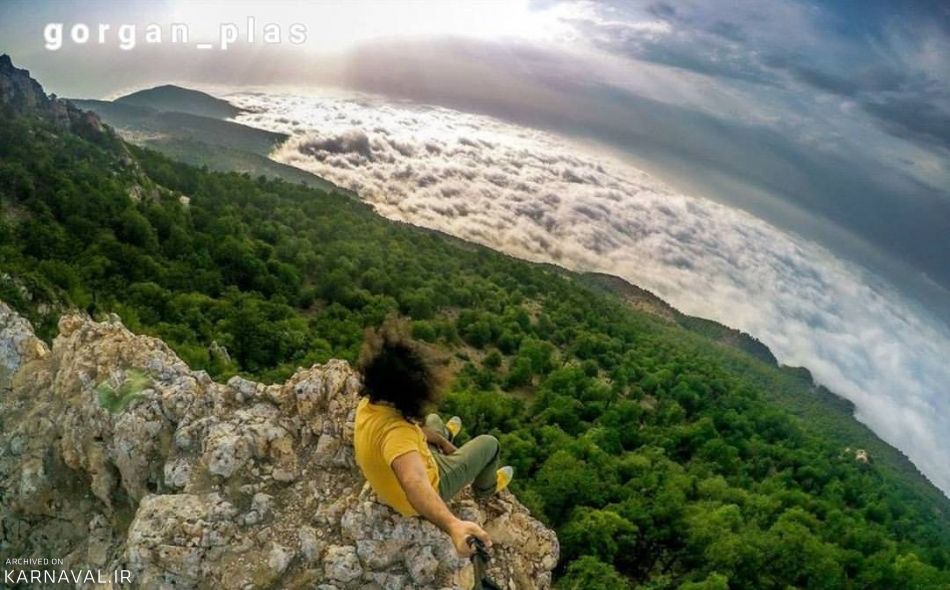
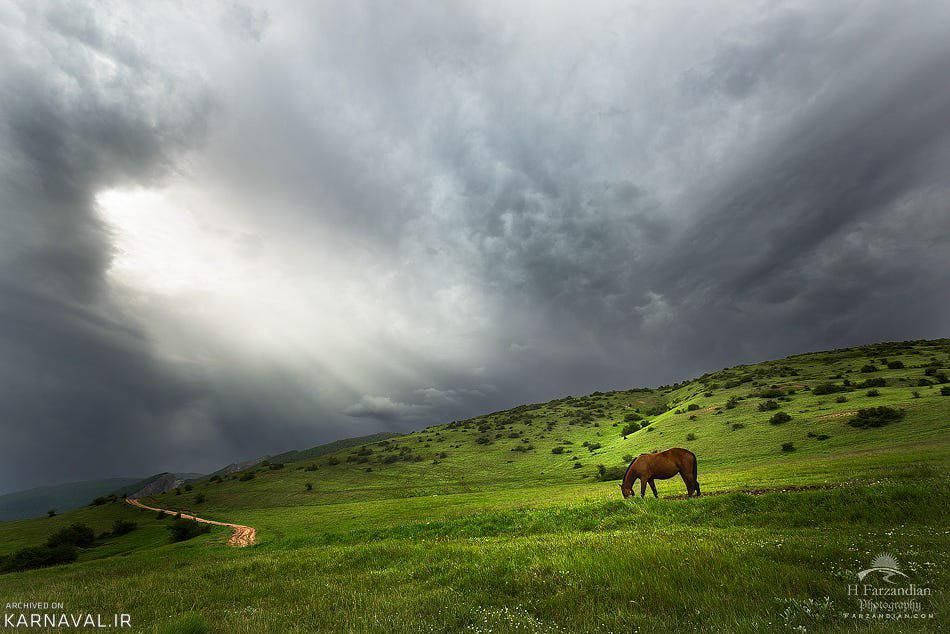
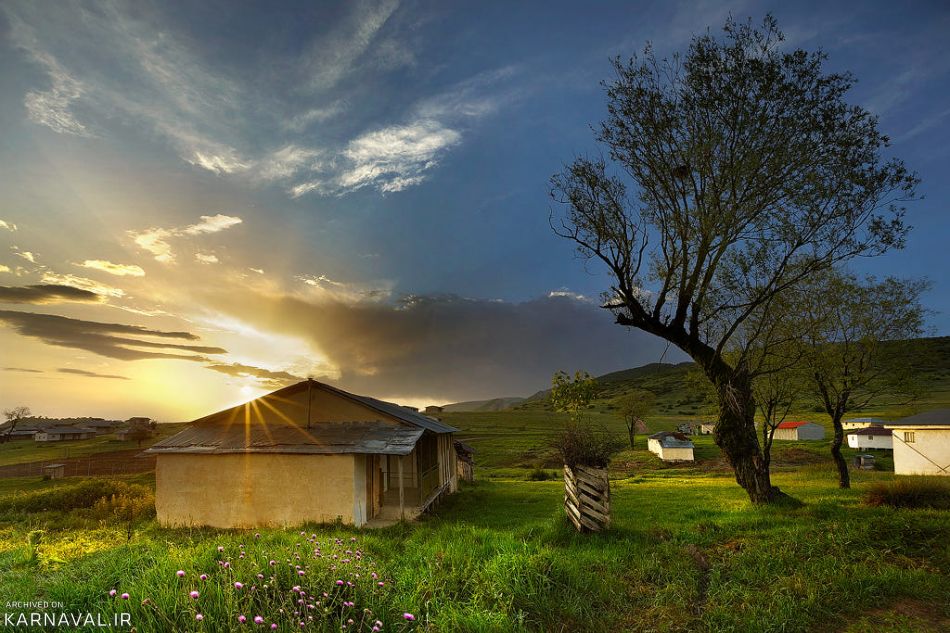
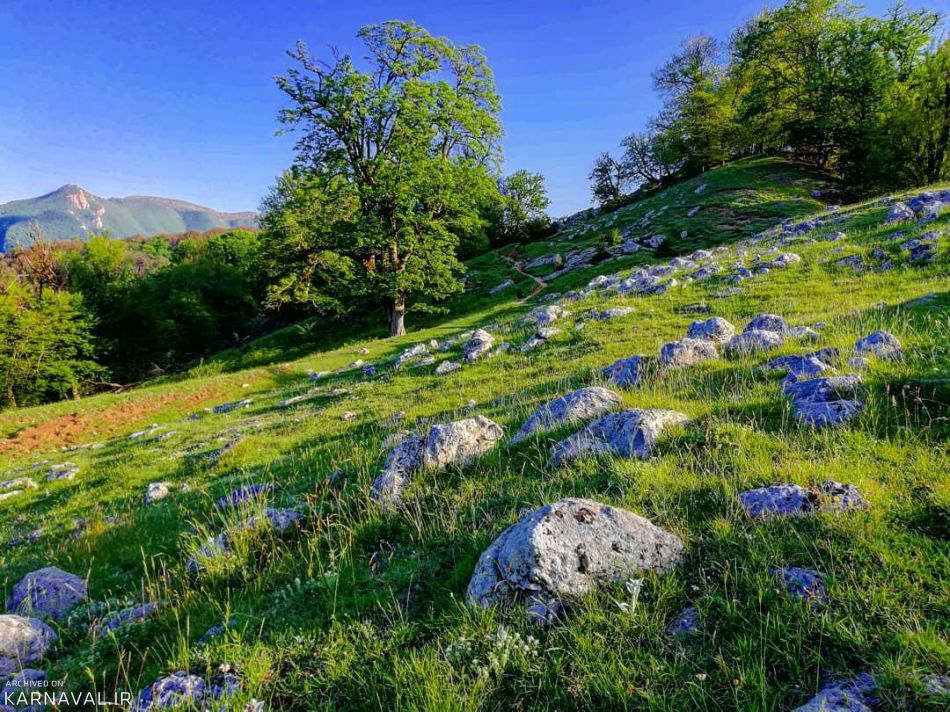
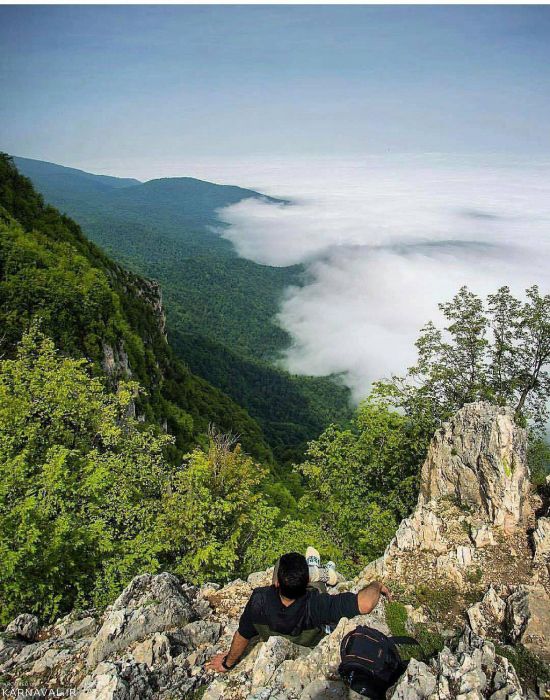
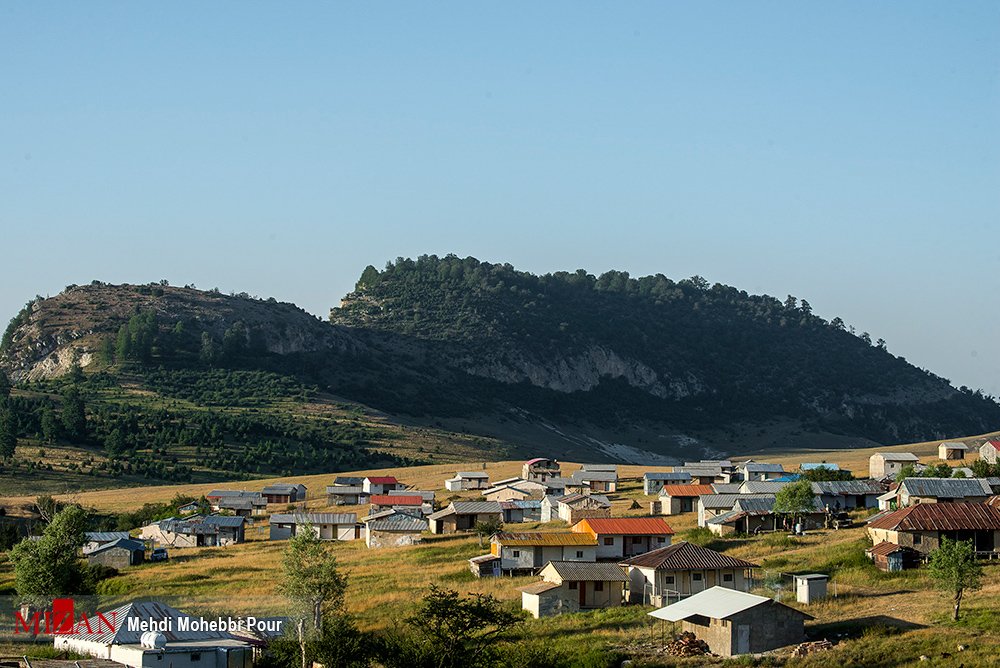
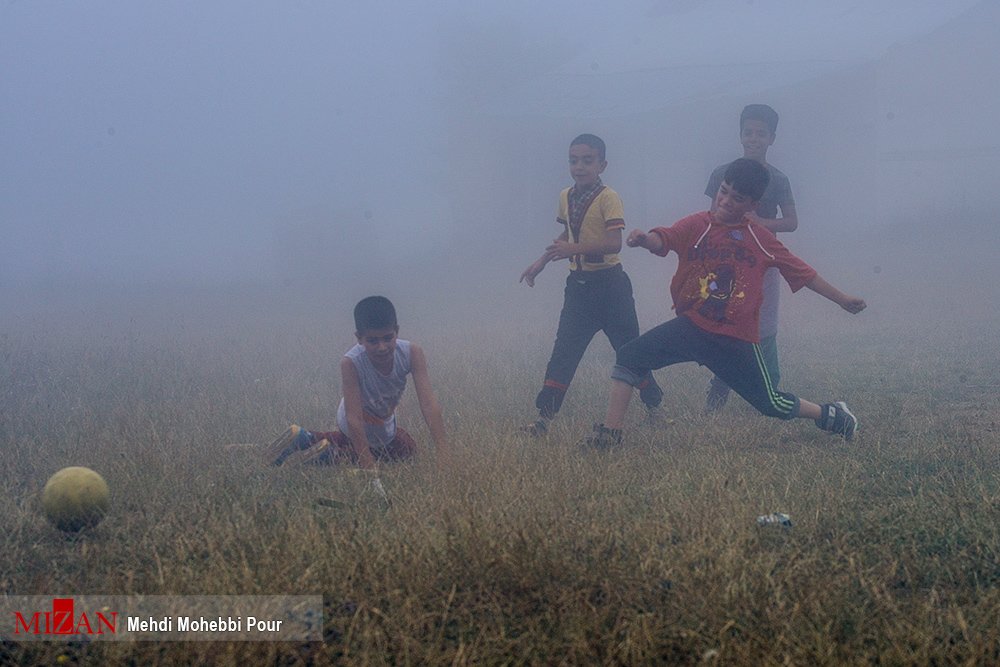
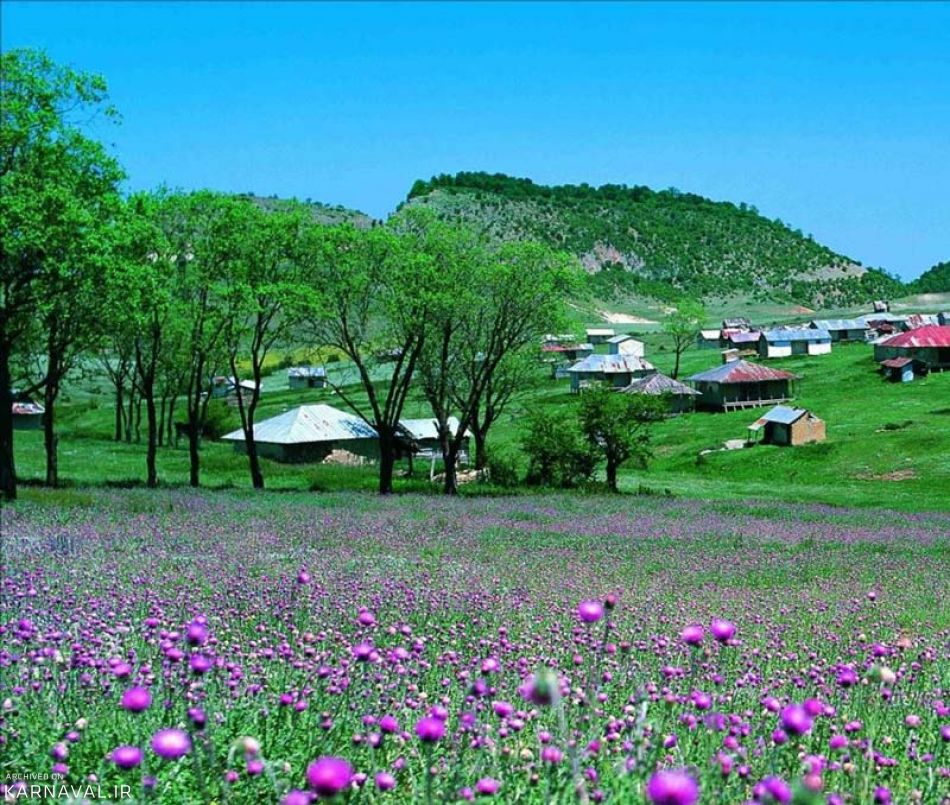
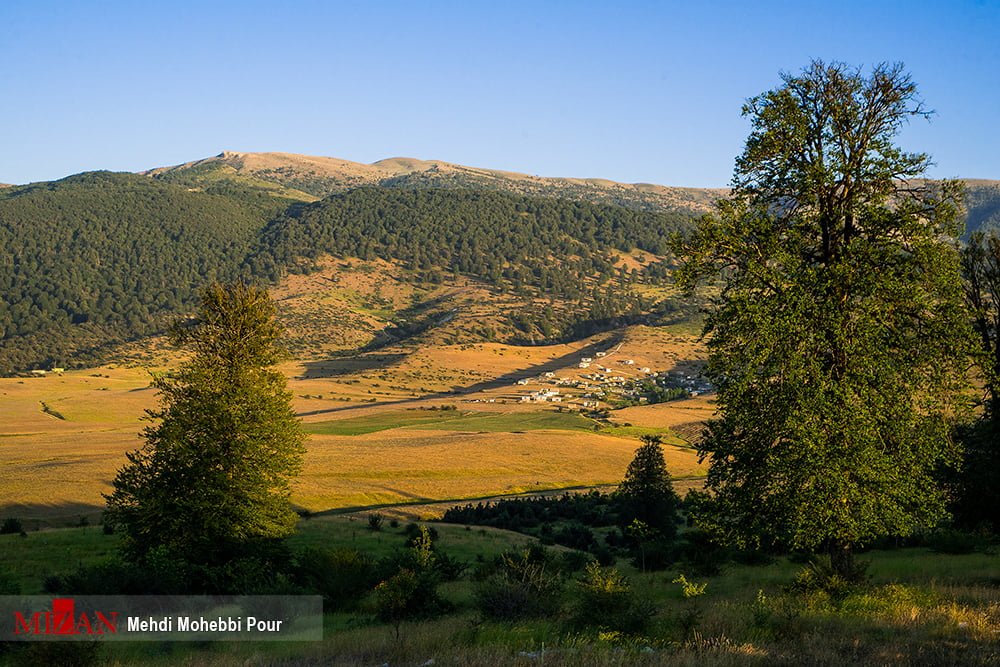
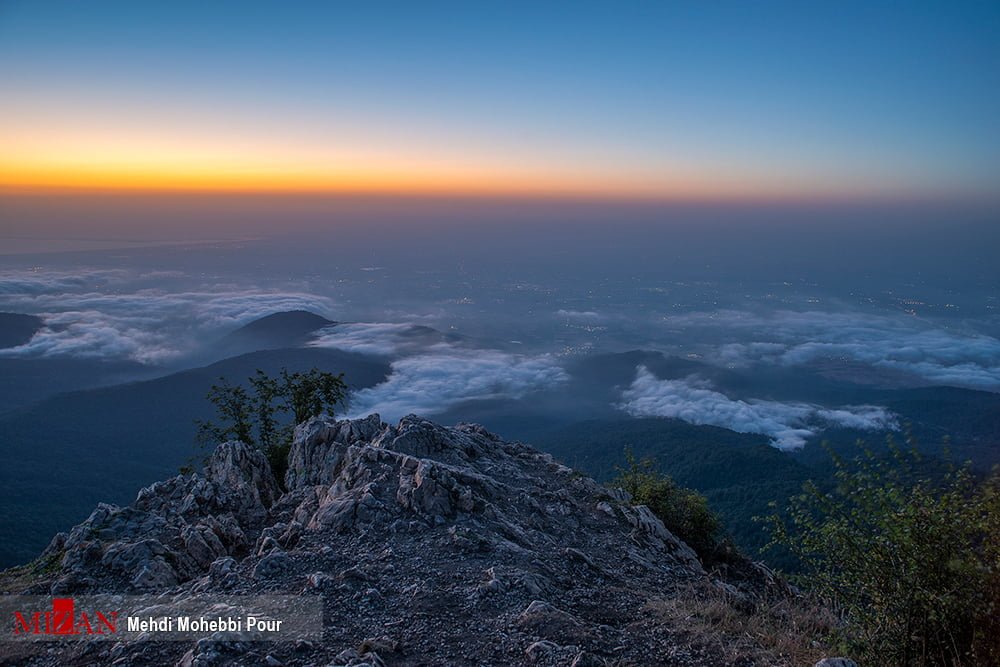
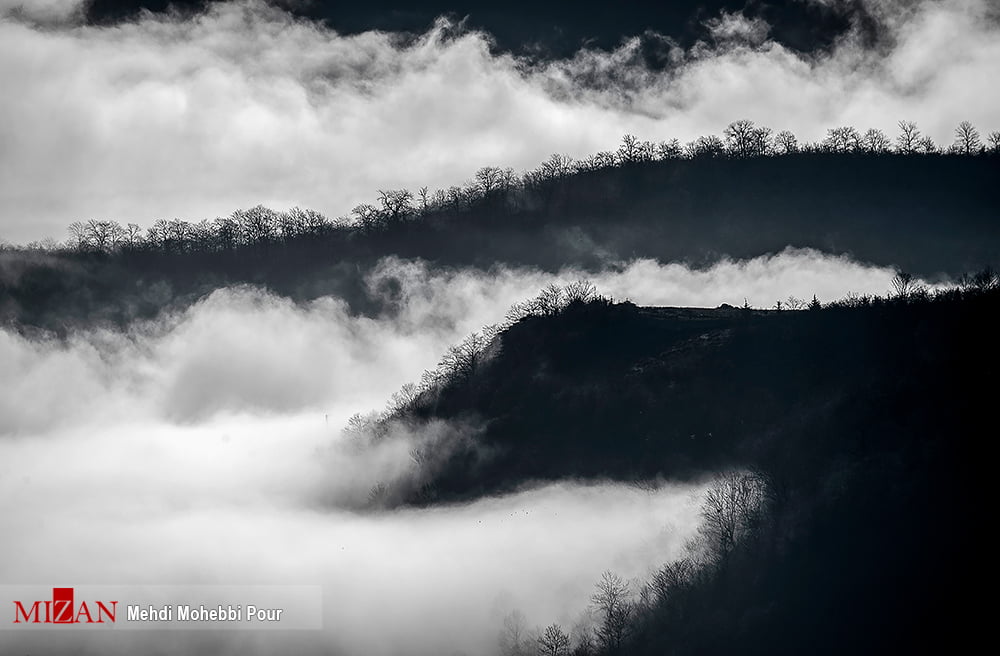
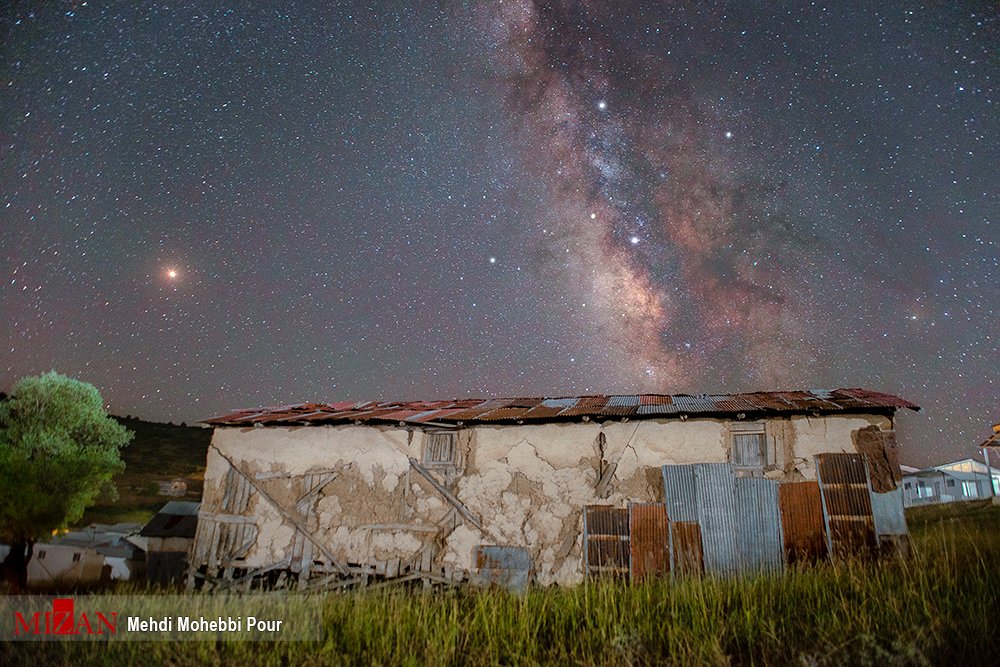
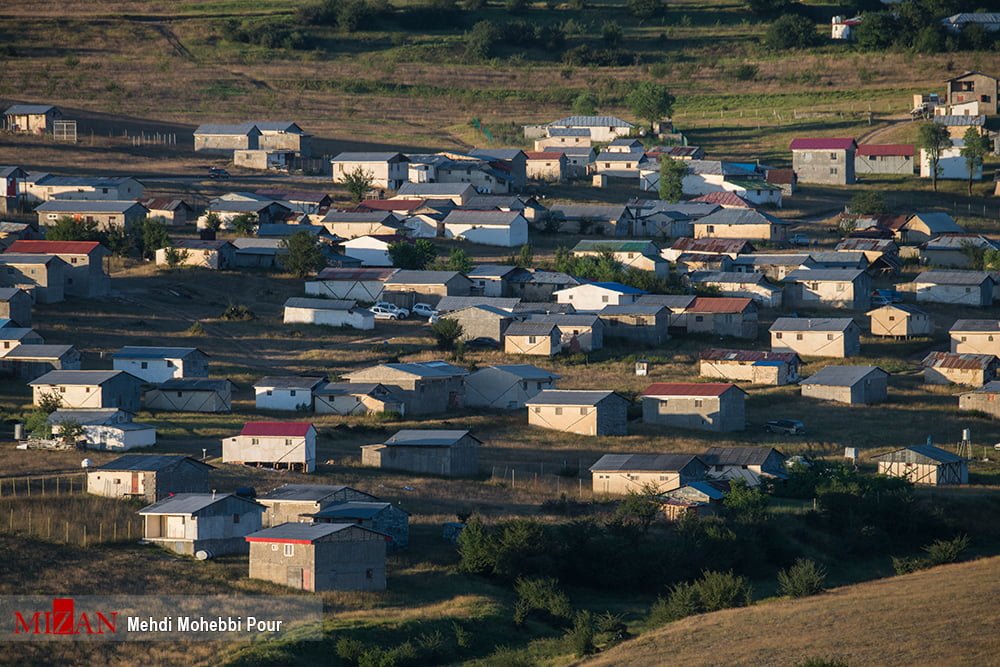
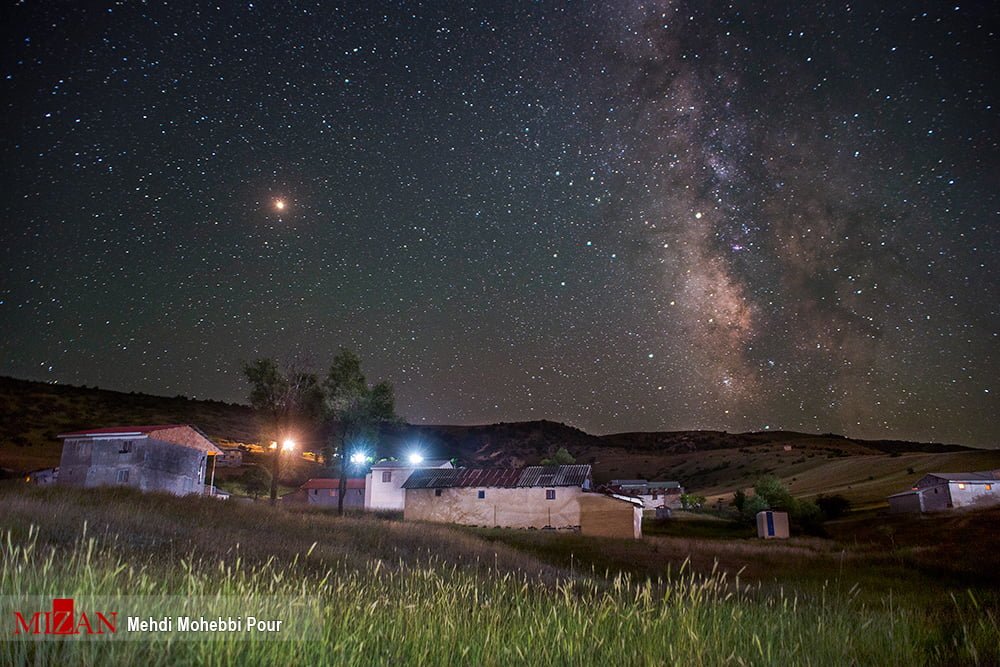
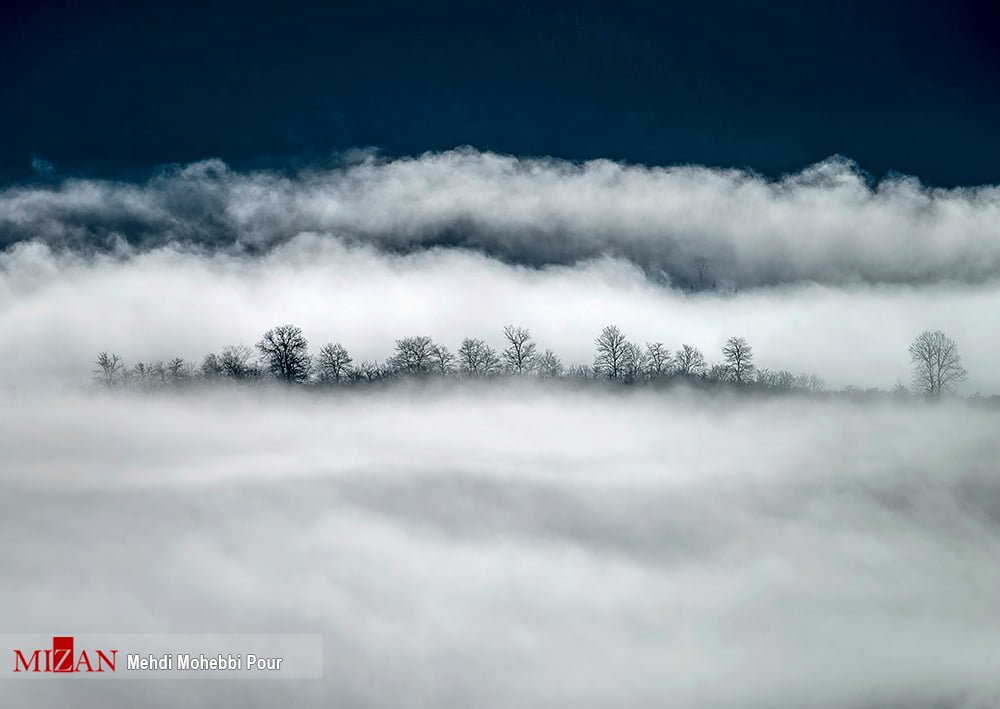
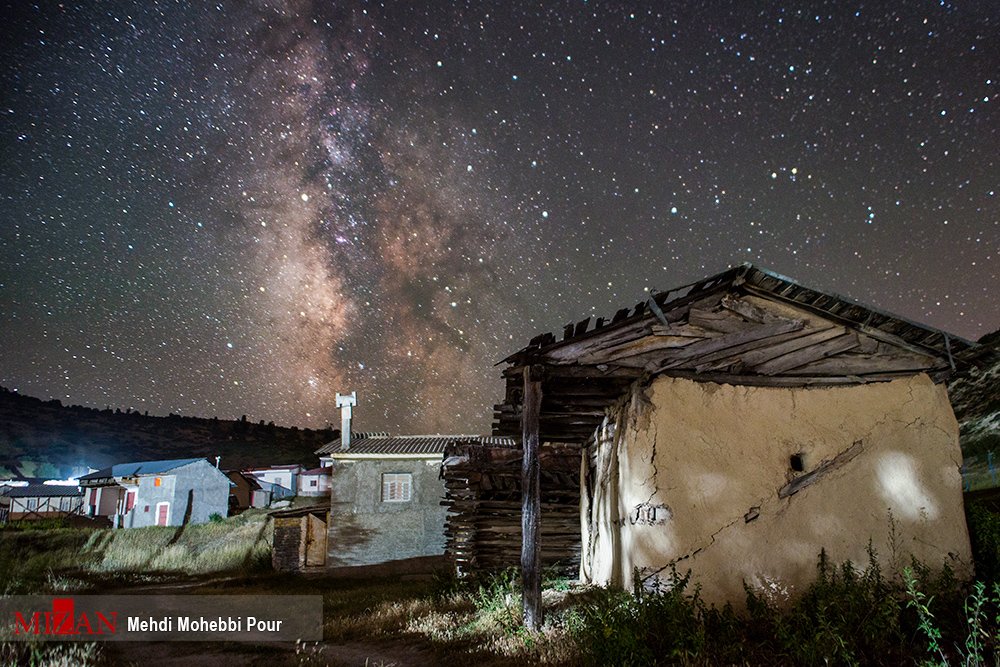
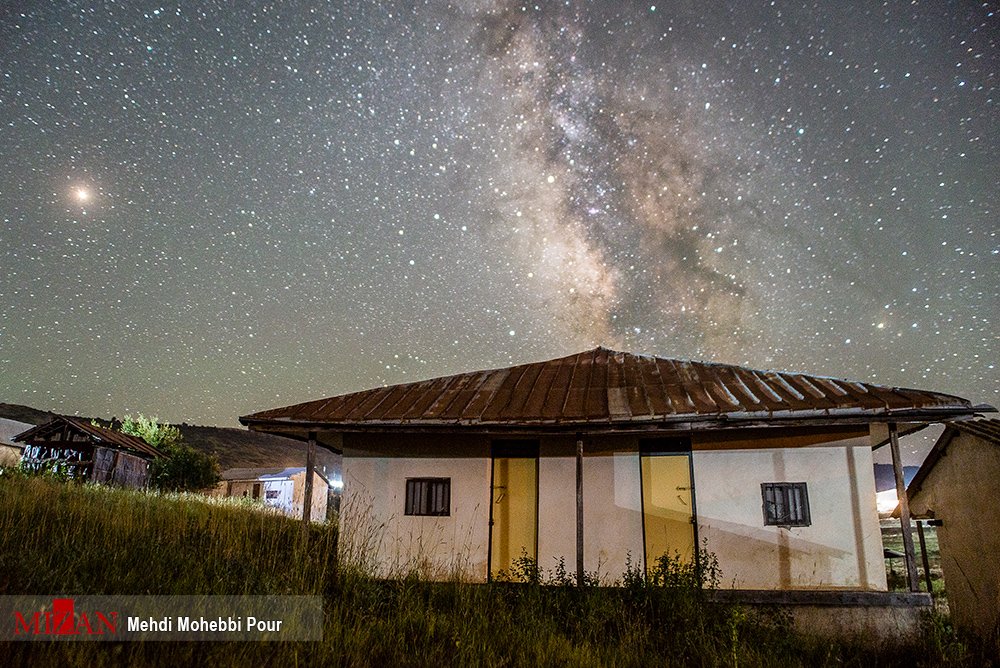
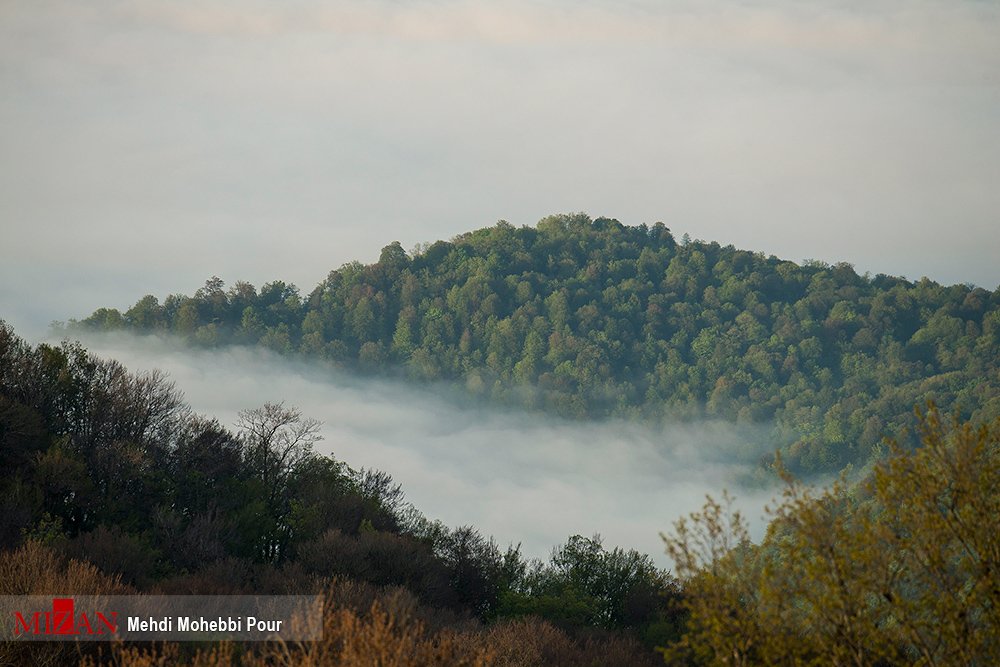
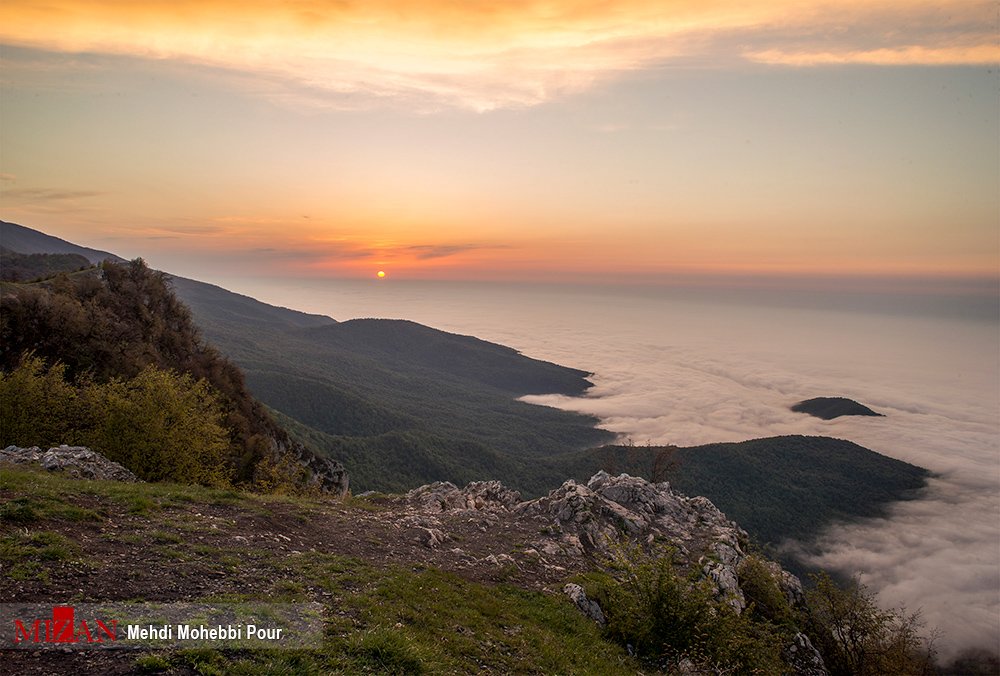
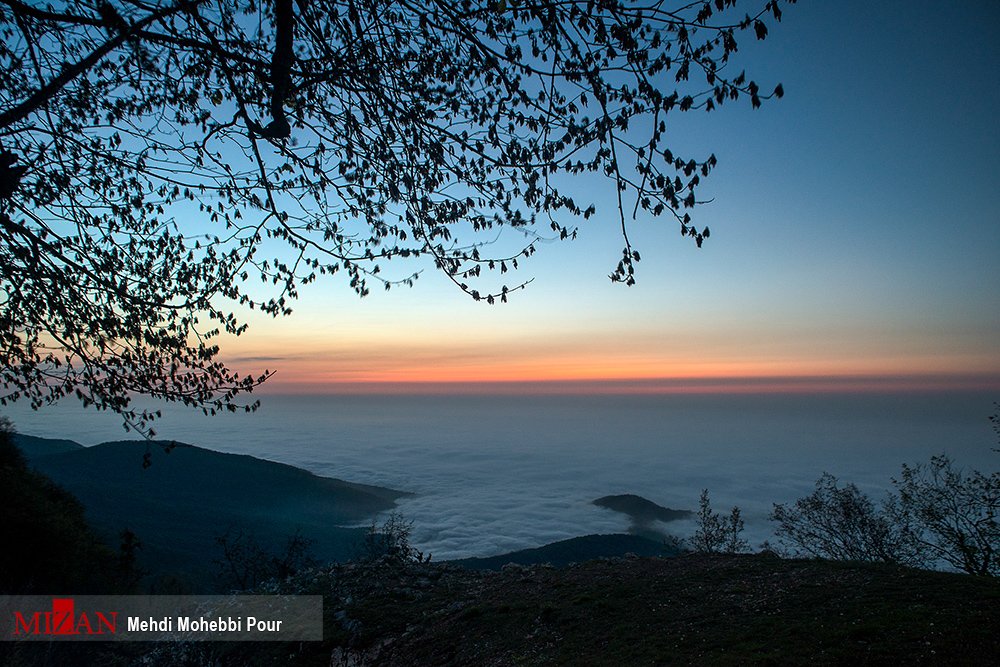
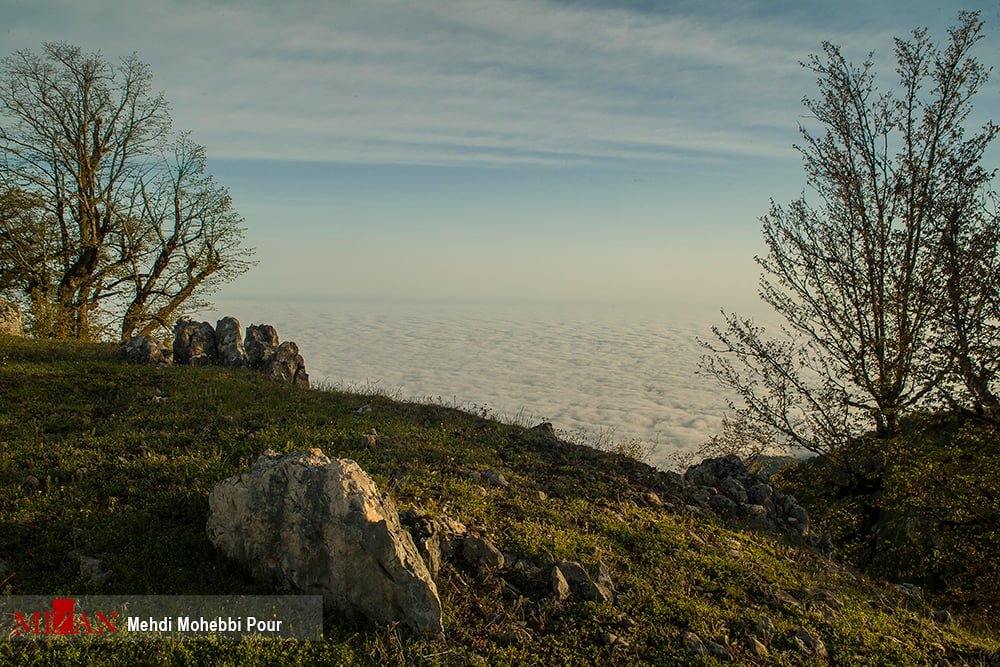
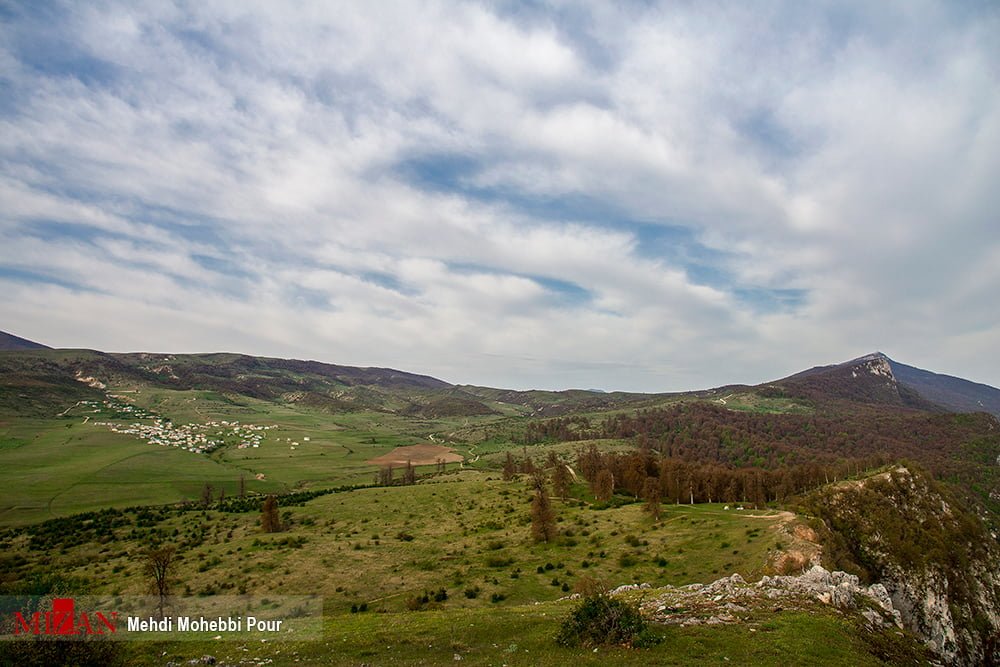
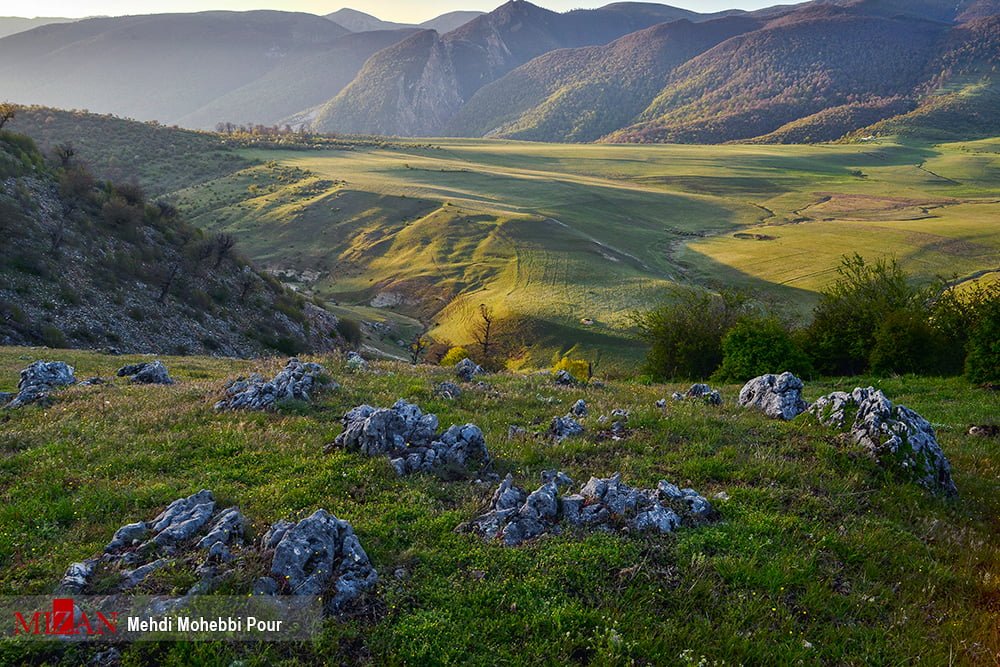
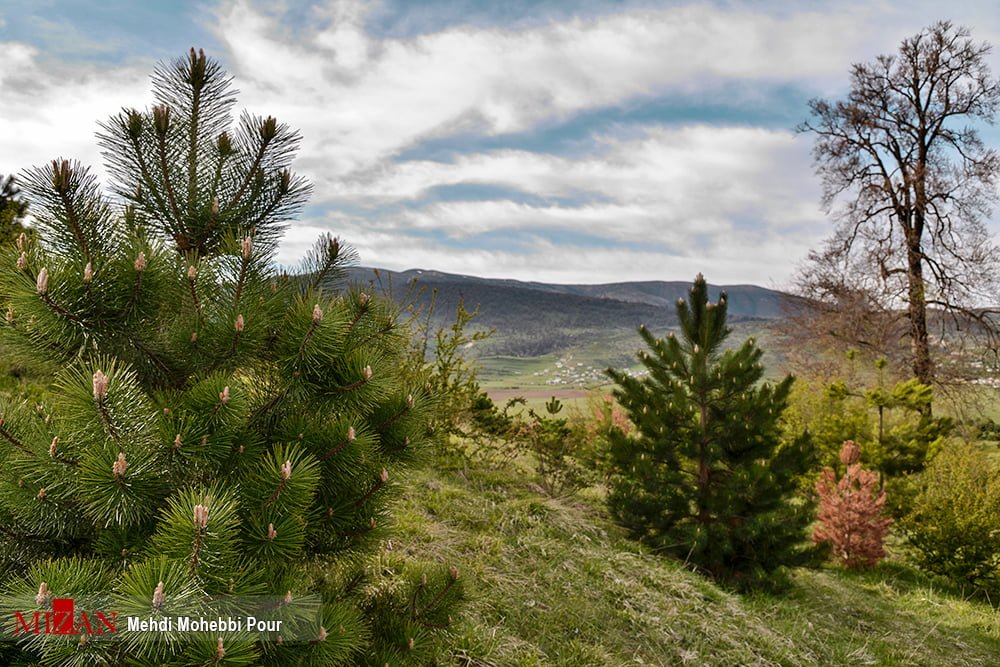
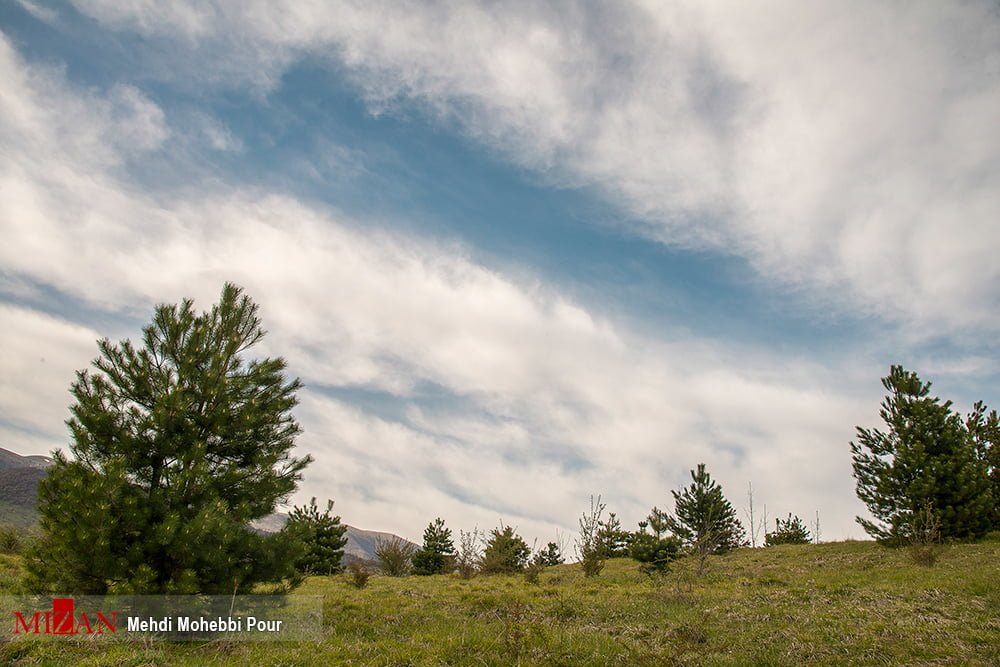
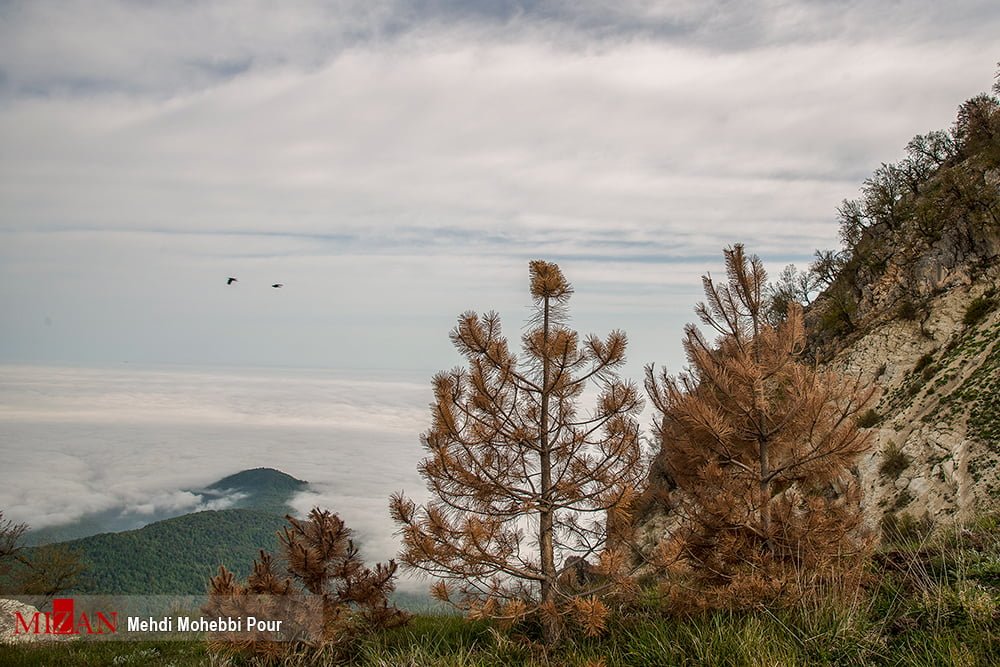
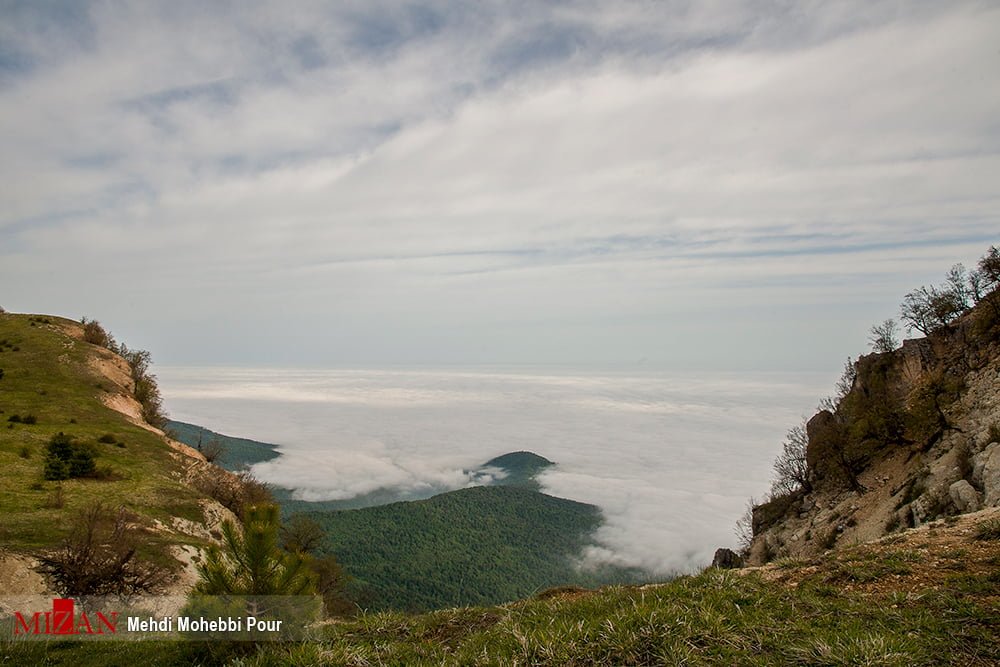
Jahan Nama Village; A Tranquil Summer Resort North of Iran

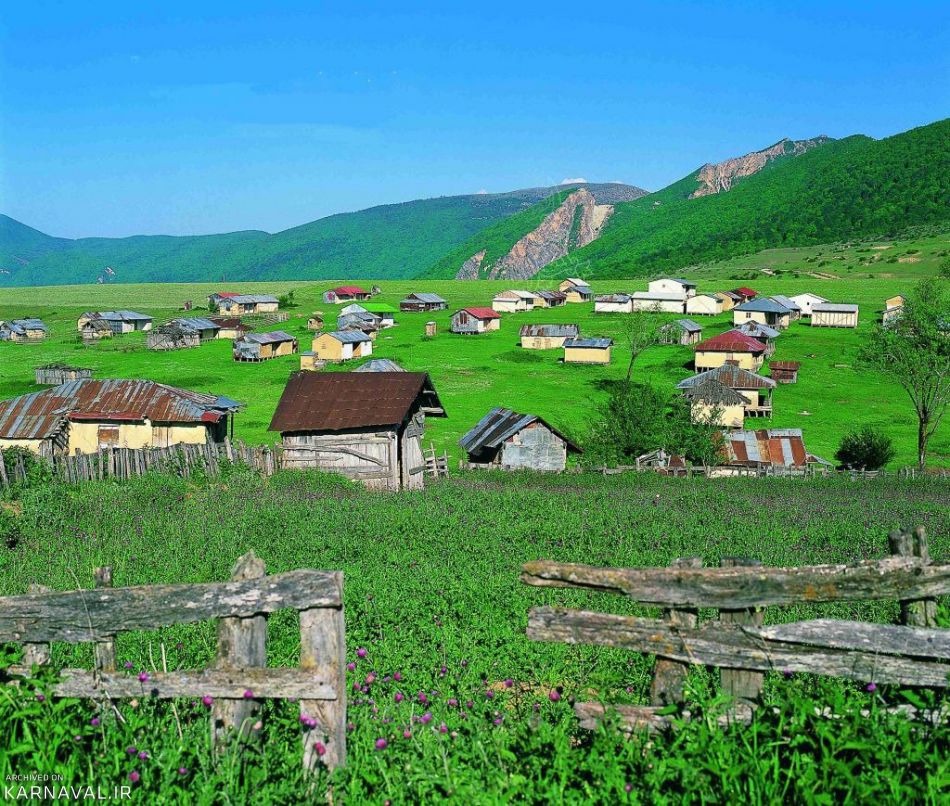
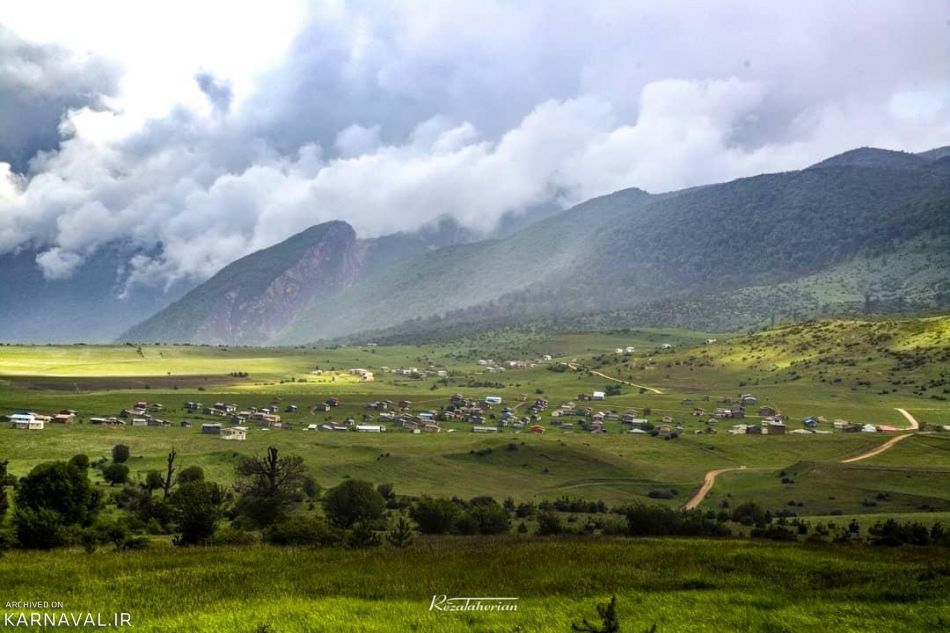
Jahan Nama is a perfect and spectacular summer resort that reminds every visitor of the magnificence and atmosphere of the Alps and Swiss villages.

It is surrounded by a vast plain among the forests and also several-million-year-old Alborz Mountains. The village has a native and traditional architecture; there is no such thing as urban life including plumbing, mobile antennas, electricity, and telephone.

The protected place is 31,747 hectares in area and is located at an altitude of 600 to 3,086 metres above the sea level.

The region has the most untouched and virgin forests in northern Iran, and is said to be the only region in the country where tigers can easily live.
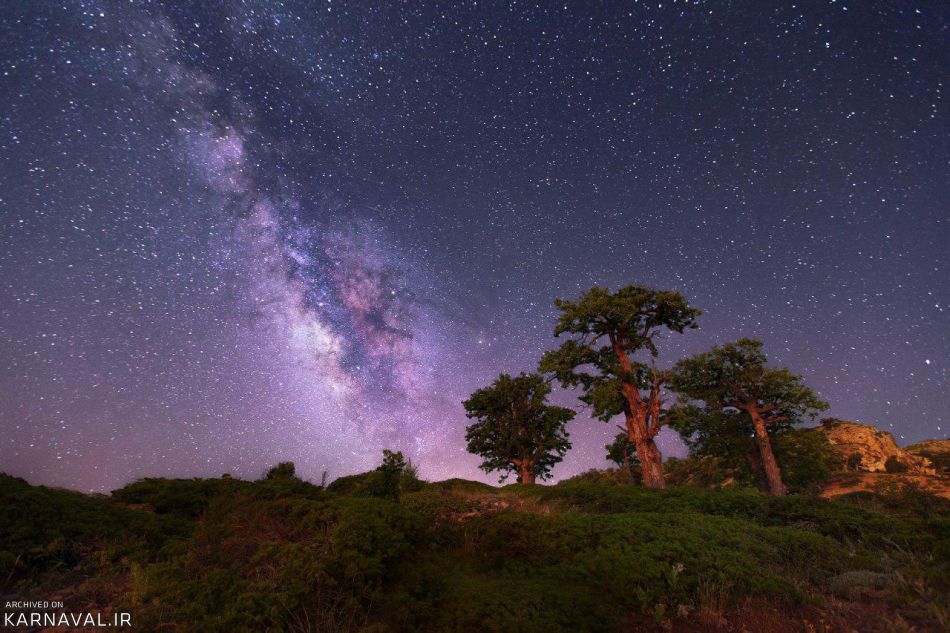
Jahan Nama is the largest protected area of the province after the Golestan National Park and has been under the supervision of the Environment Department since 1973. The forests of Jahan Nama are among the oldest ones in the world.
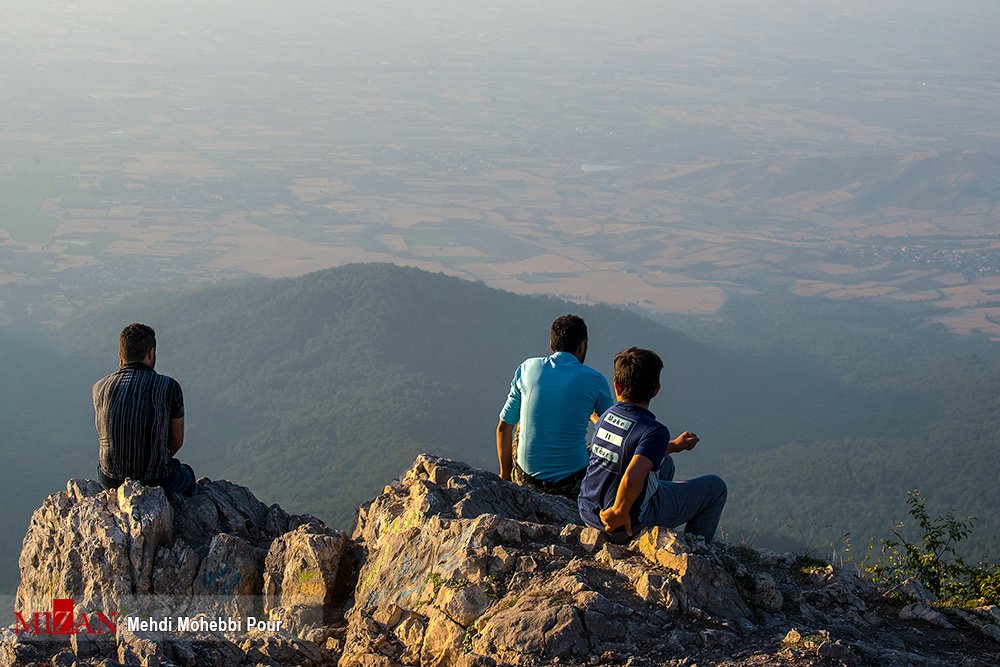
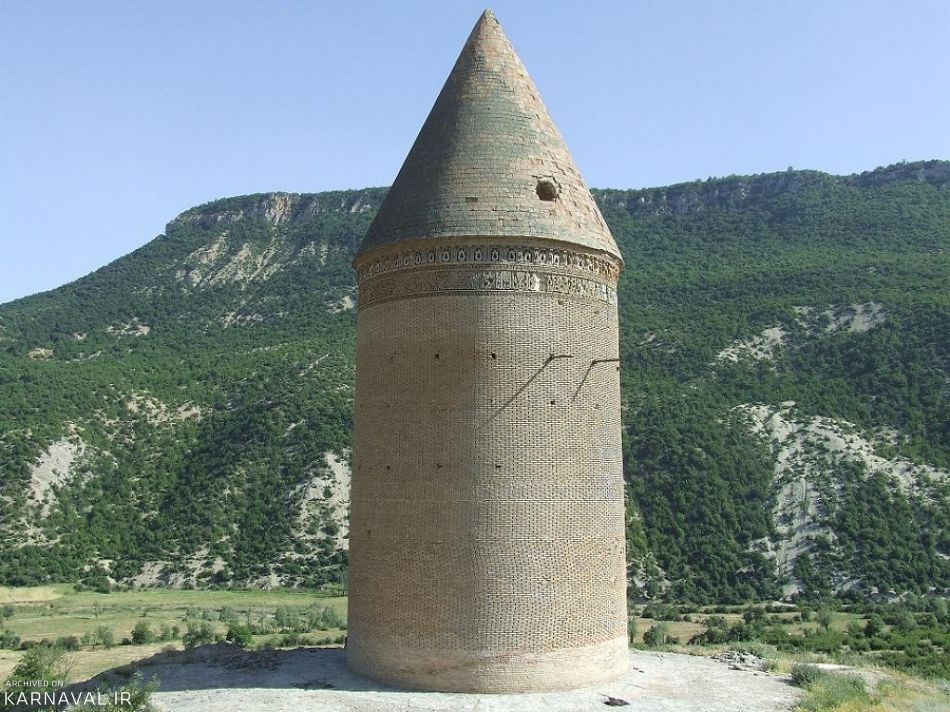
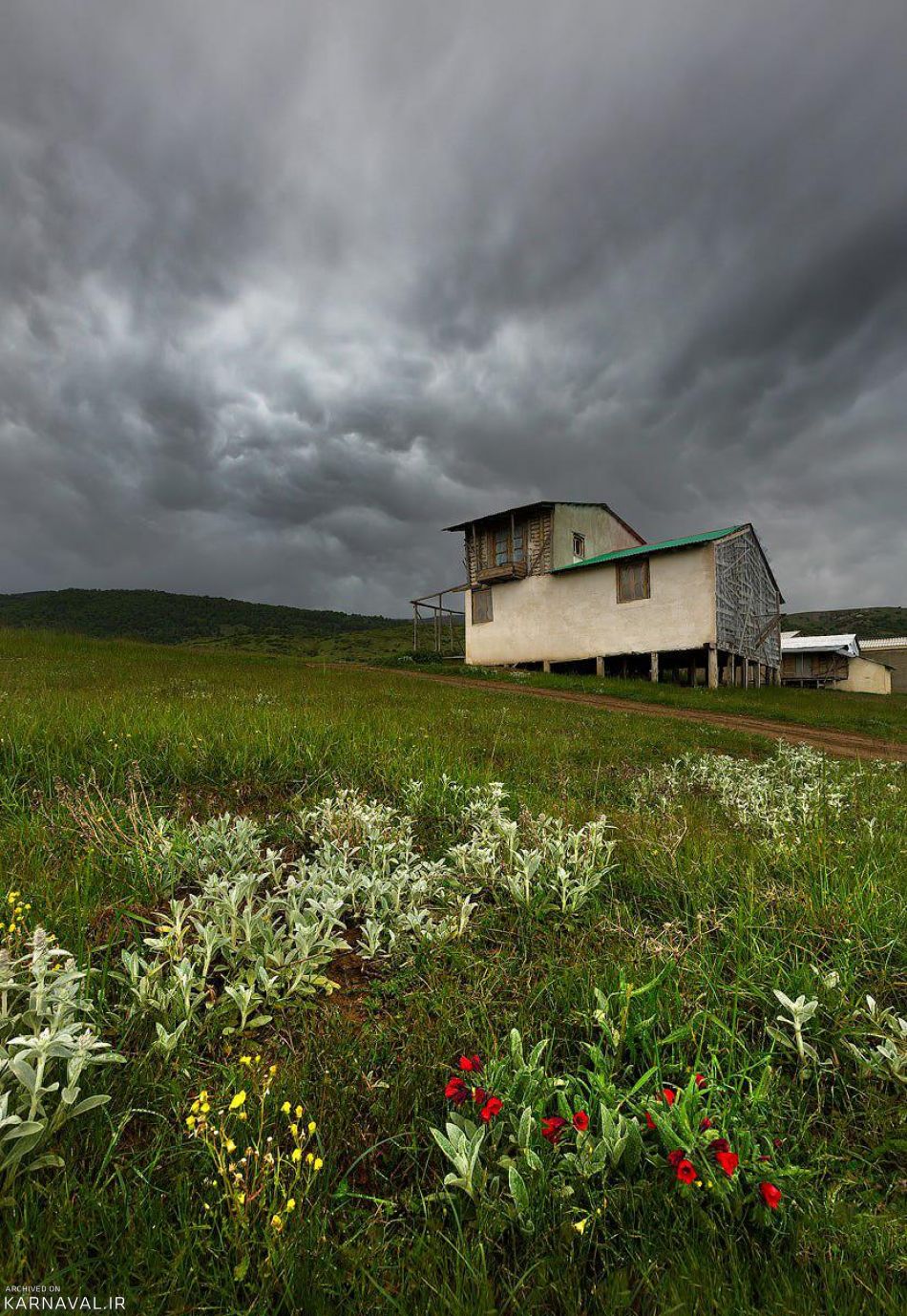
Following you can find photos of the region retrieved from Mizan Online:

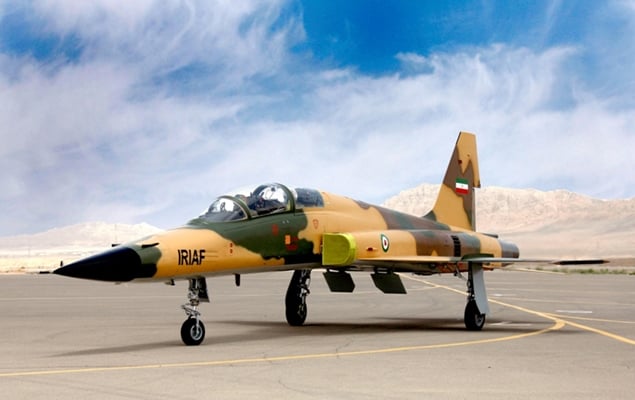
“Iran’s Production of Homegrown Fighter Jet Unprecedented in Muslim World”

Lieutenant Commander of the Iranian Army, Brigadier General Mohammad Hossein Dadras, was reffering to the homegrown Kowsar fighter jet which was unveiled last week.

“Unlike most regional states which purchase their weaponries, the Islamic Republic has achieved self-sufficiency in defence area,” he was quoted as saying in a report by Tasnim News Agency.

Addressing a military gathering in Tehran on Tuesday, the general said if ensured that one day Iran would become self-sufficient in defence area, the enemies would decidedly provide it with the required defence equipment.

He went on to say that regional states suffer from lack of defence independence and any defence decision taken by them which may stand in contradiction with the outside powers’ interests are blocked immediately.

The commander also referred to the presence of Iranian naval squadron in the high seas and its fight against pirates and said the Islamic Republic of Iran can play a key role in creating stability for world trade in the seas.

“Regional states can themselves provide the region’s security without the presence of foreign powers,” he noted.

The Iranian commander also referred to the human rights violations in the US including its latest policy to separate refugee children from their parents in America’s southern borders and said if the polices were pursued by other states, Washington would deal seriously with them immediately under the pretext of protecting human rights.

“The US suffers from double standards when it comes to human rights as it is now remaining silent towards the crimes committed by its allies – Saudi Arabia and Israel – in the regional states including Yemen, Iraq, Syria and Afghanistan,” he noted.

General Dadras said the Islamic Republic of Iran is capable of defending itself against enemies’ threats.

He added the enemies only understand the language of power and Iran speaks with them with the same language due to its growing defence power.

Security Forces Disband Two Terrorist Cells in Western Iran

Alavi said on Monday that the terror cells were affiliated with the hostile countries.

The minister added that one of the terror teams had 12 members, all of whom have been arrested.

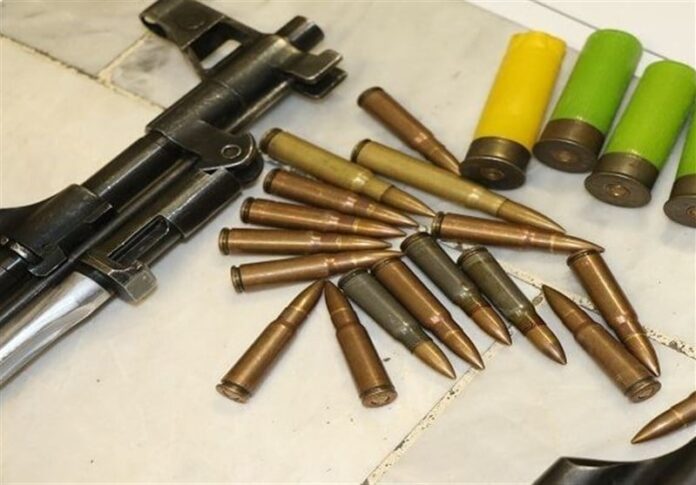
In a separate operation, the intelligence forces detected an armed team of terrorists who had entered the country to carry out acts of terrorism and sabotage, Alavi stated.

He said that two members of the latter team were killed in an armed clash, two others were captured, and a number of AK-47 machine guns and grenades as well as some telecommunication equipment and cash were confiscated in the operation.

According to the minister, some of the perpetrators behind the August 14 assassination of commander of traffic police in the western city of Ravansar are among those arrested in the operation.

Number of Iraqi Tourists Visiting Iran Sharply Rising

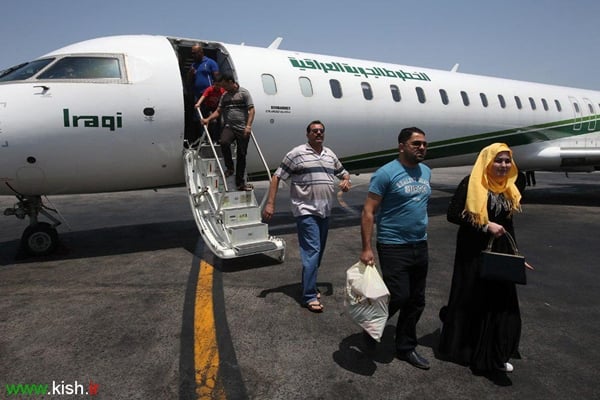
Iran’s consul general in Sulaymaniyah says the number of visas issued to Iraqi Kurds rose four-fold in the one month to August 22, 2018, i.e., 2,800 visas per day.

There are also reports that at least 10,000 Iraqi visitors are entering the Islamic Republic every day.

The Shahrvand newspaper has further reviewed the matter in an interview with the authority running a guesthouse and handling Iraqi travellers’ affairs.

Mr Boraqchi who is in charge of the guesthouse says they are hosting a lot of Iraqi, Egyptian and Chinese visitors, but most of them are Arabs and Iraqis.

“Maybe 10% of our customers are Iranians coming from other cities,” he says.

“In summer, Iraqis come to Iran. They get a more pleasant weather condition here,” says Boraqchi.

Figures, too, bear testimony to that. A drop in the value of the rial against the greenback is one of the reasons behind an increase in the number of visits to Iran by Iraqis, including Kurds.

Having fun and vacationing are not the only aim of Iraqi tourists visiting Iran. Some of them come to Iran for medical treatment.

“Iraqi visitors stay here for a couple of days. They go to the north [of Iran] for a few days, and when they return they go to Qom and Mashhad. They return to their countries sometimes from Tehran and sometimes from Mashhad. There are direct flights between Mashhad and Baghdad,” says the official.

“All types of people come here, from doctors to engineers to workers, from educated to illiterate. We have guests from all walks of life,” he says.

According to Boraqchi, the Iraqis who come to Iran to see doctors usually seek a hair implant operation or nose job.

“They pay doctors good money. They bring a lot of dollars with them, as well,” he says.

Om-e-Hussein and her two children Sarah and Hussein are standing next to each other. Her husband goes upstairs sooner than them. They have just returned from the Nature Bridge (a large landmark pedestrian bridge connecting two parks in Tehran) and their eyes are shining with joy.

“Tehran is very beautiful,” they say.

They have been staying in Tehran for a week now. They stayed in Ramsar for a few days after visiting Qazvin. They are to go to Mashhad by train tomorrow.

“Iranians are very kind to us. When they come [to Iraq] to visit Karbala and Najaf, we also treat them very well. We open the doors of our houses to them, cook food in the streets for them, and do not charge them at all,” they say. By “cooking food,” they mean the votive food that people distribute among others during Muharram and Arba’een, the fortieth day after Imam Hussein’s martyrdom.

Sarah, the young girl of the family, is a teacher. She is looking for a restaurant where she can have Qormeh-Sabzi stew.

“We have been told that Qormeh-Sabzi is very delicious, but we couldn’t find it wherever we went,” she says.

Hussein, who is an engineer, is looking for a water park.

He says Tehran has the most beautiful water park, though he does not know its name.

Iraqi tourists do not come to Iran for hair implant or rhinoplasty or visiting northern cities only; rather, there are groups of them who come to Tehran for receiving modern treatment.”

According to Boraqchi, those who come to Iran for cancer treatment usually do not book hotel rooms because their expenses will swell. They generally rent furnished houses because they should stay in Iran for at least one year.

The Omar family has the same condition: a family of four whose 12-year-old son has blood cancer and whose daughter suffers from hearing loss. They have already visited Lebanon for treatment, but the dose of drugs during chemotherapy was so high that the child developed a heart condition, and finally they came to Iran. They have rented a house near the Shariati hospital.

“Here, we had a few chemotherapy sessions. We wanted to undergo a marrow transplant surgery, but couldn’t find a match,” they say.

They are very pleased with doctors’ behaviour in Iran and even say that doctors at the hospital sympathize with them a lot while it was not like that in Lebanon.

Iraqi tourists normally begin coming to Iran from July and August and the trend continues until before schools open in autumn.

Iran Will Resort to “Third Option” If EU Fails to Keep JCPOA

“We can remain in the deal or walk out, but there is also a third path. In case Europe fails to meet its commitments, we will announce a new method that is the third path,” he said.

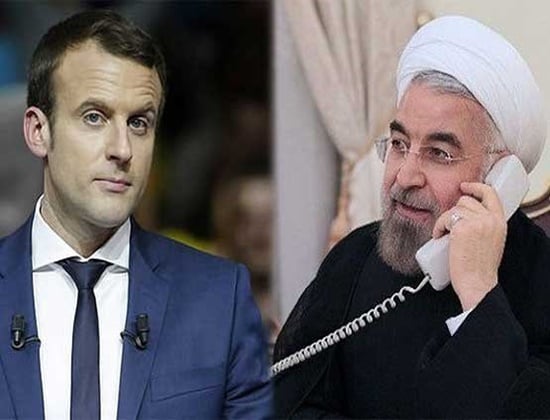
Rouhani said he has told his French counterpart Emmanuel Macron in a Monday phone conversation that Tehran will resort to that third option in case the EU fails to do its commitments.

The Iranian president did not give any detail about the option, and told the lawmakers he would do so in case it plans to tread on the path.

Back in early May, the US walked out of the deal and since then is working to re-impose anti-Iran US sanctions suspended under the deal.

Washington is also pushing the world to cut trade with Iran and stop purchasing oil from the country. The EU has offered Iran a support package to compensate for the US pull-out.

Iran has announced the package is acceptable at the macro level, but talks are underway between the two sides on details of the package.


Currency Fluctuations Have No Economic Root

The president, who had been summoned to the parliament to respond to the lawmakers’ questions about the conditions of the Iranian economy, defended his government’s economic record, saying it worked hard to improve people’s livelihood.

Rouhani, who championed the nuclear pact during his first tenure in office, said the nuclear deal produced tangible benefits for the Iranian nation, allowing the government to boost economic growth.

However, he said that in the past eight months, changes in the country’s conditions worsened the economic situation.

Rouhani suggested the recent dramatic decline in the value of rial has its roots in a change in people’s perceptions, and not economic reasons.

“I believe the problem was about the people’s perception regarding the future of Iran. People’s perception was suddenly changed,” he added.

The plunge in the value of rial has soared the prices of imported consumer goods and depressed some markets in the past few months.

Earlier this month, the value of rial against the US dollar passed 100,000 in the free market, prompting the government, judiciary and the parliament to take immediate measures to stop the plunge in the value of rial.

Some believe people’s fear of the return of sanctions has pushed them to sell their reserves of national currency, leading rial to slide to record lows.


Iranian Economy Not in ‘Crisis’

Rouhani said the country’s economy is not facing a crisis, urging officials to refrain from conveying such a message to the people.

“Do not say that we are facing a crisis. We are sometimes on the edge of damage, but not in a crisis,” he said.

The president said all branches of power will join hands to overcome challenges, under the guidance of the Leader of Islamic Revolution Ayatollah Seyyed Ali Khamenei.

“We should tell the Iranian people that we won’t allow the US plots to succeed. The nation must be assured that we won’t allow a bunch of anti-Iran people in the White House to plot against us,” he said.


Rouhani Faces Impeachment Risk

Although Rouhani put up strong defence of his government’s record, lawmakers were largely unconvinced by his arguments.

An electronic voting after Rouhani’s speech showed lawmakers were not convinced by his answers to four of their five questions, namely increased smuggling, high rate of unemployment, the flagging economy and the drop in rial’s value.

The lawmakers were only relatively convinced by Rouhani’s remarks on the anti-Iran banking sanctions.

Eighty members of the Iranian parliament, who were unhappy about the government’s economic performance, tabled a motion in an open session on August 1 to question Rouhani about his administration’s economic policies and its response to the country’s economic hardships.

Rouhani’s failure in appealing to the parliament puts him in risk of impeachment, taking into account that Rouhani’s political opponents are threatening to remove the president.

Lawmakers have already impeached his labor minister Ali Rabiei and economy minister Masoud Karbasian this month.

On Monday, there were reports some lawmakers are pushing for impeachment of Minister of Roads and Urban Development Abbas Akhoundi.

Iran Developing National Blockchain Platform

Aboutaleb Najafi, who is the CEO of Informatics Services Corporation, an executive arm of the Central Bank of Iran, said the blockchain technology has applications in many industries, and by 2027, over 10 percent of GDP will be transferred using this technology.

“With the help of banks, the private sector and all other stakeholders, we want to create a blockchain platform for banking [applications],” Fars News Agency quoted him as saying.

Speaking in a conference on the blockchain technology, he said the national blockchain will decrease the cost of small financial transactions for the Iranian people and will allow for the creation of a money transfer network involving Iran and its allies.


Domestic Cryptocurrency in the Making

Najafi said the establishment of the domestic blockchain network will enable Iran to put into effect its own cryptocurrency.

“The national cryptocurrency will be backed by the Iranian rial and issued by the Central Bank of Iran. It has no limitation and its infrastructure network is private blockchain,” he said.

The cryptocurrency’s underlying blockchain technology eliminates the need for a third party and allows for instant, irrevocable and secure transactions.

The Central Bank of Iran in March banned Iranian banks from dealing in foreign cryptocurrencies, including bitcoin, over money laundering concerns, joining the growing list of nations which ban foreign cryptocurrencies, including India and Pakistan.

Dozens of countries such as China, Russia, and Singapore have already developed their own digital currencies, as they address needs of consumer anonymity and transaction efficiency.

“EU Must Be Faster, More Transparent in Saving Iran Deal”

During a phone conversation with his French counterpart Emmanuel Macron on Monday, President Rouhani said Iran has already remained faithful to all its commitments under the deal, and expects other sides to speed up their plans with more transparency to save the deal.

“Iran is seeking to save the nuclear deal but if it comes to this conclusion that there would be no resolute guarantee by the European sides in financial, monetary, oil, insurance and transportation areas, we will turn to our alternative measures,” he added.

According to President Rouhani, the other sides of the JCPOA bear a heavy responsibility to save the nuclear accord following the US pullout.

In turn, Macron expressed his country’s willingness to strengthen its mutual ties with the Islamic Republic and added France will do whatever in its capacity to save the JCPOA and to this end, it would remain faithful to all its commitments.

Elaborating on the measures adopted by the European sides of the Iran nuclear deal to save the accord, Macron said the Europeans have put hard efforts into protecting the JCPOA by following certain trade and financial mechanisms.

During the phone call, the two presidents also exchanged views on a number of regional and international issues including the Syria crisis.

The upcoming meeting between the European foreign ministers as well as the EU Foreign Policy chief with Iranian foreign minister on regional issues was also discussed during the phone call.

President Rouhani and his French counterpart also underlined the need for keeping their close contacts to pursue the two countries’ joint goals.