Saturday, December 27, 2025
Home Blog Page 3386

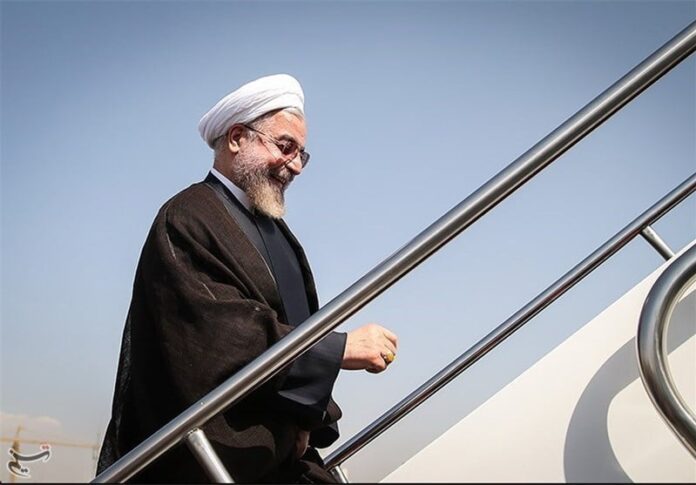
Iranian President Due in Turkey for Official Visit

The Iranian president will visit Ankara at the official invitation of his Turkish counterpart Recep Tayyip Erdogan to attend the fifth round of Iran-Turkey high council of strategic cooperation, deputy head for communications and information at the Iranian president’s office announced.

Heading a high-ranking political and economic delegation, Rouhani will leave Tehran for Ankara on Wednesday evening for a 2-day visit, Parviz Esmaeili added.

During the trip, the two countries will sign major political, economic and cultural agreements, he noted.

Esmaeili said the high council of strategic cooperation, to be co-chaired by the presidents of Iran and Turkey, is an initiative that was developed during Rouhani’s first official trip to Turkey.

Iran and Turkey have ramped up efforts in recent years to boost bilateral trade, setting a $30-billion annual trade target and signing several agreements to enhance cooperation in various areas.

Turkey is one of Iran’s major trading partners in the region.

Extremists Set Fire to Saudi Woman’s Vehicle

The woman’s car was set ablaze when parked before her home in the port city of Jeddah, Saudi Arabia’s police said.

Norhan Besam, the owner of the car, called the police to report the fire.

Earlier, the extremists had set ablaze another woman’s car in the holy city of Mecca.

Ten days after the incident, Mecca governorate issued a statement saying that at least two people have been arrested in connection with the fire.

Back in June, Saudi Arabia issued driving licences to women for the first time in decades, just weeks before a ban on female drivers was lifted.

However, women’s rights activists complained of a new crackdown – with several being arrested. The arrests, observers said, were made because Saudi Crown Prince Mohammed bin Salman wanted to take all the credit for giving the permission, but women’s rights activists did not believe so.

Iran, Russia, Turkey to Announce Formation of Syria Constitutional Committee

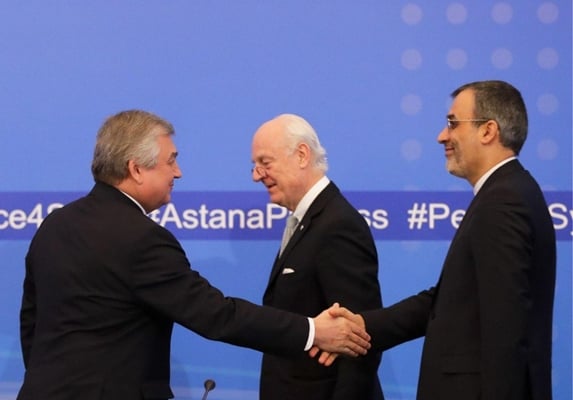
Hossein Jaberi Ansari, Russian presidential envoy for Syria Alexander Lavrentiev, and deputy undersecretary for foreign affairs of Turkey Sedat Onal

The agreement was reached in a trilateral meeting of the representatives in the Swiss city of Geneva on Monday.

The meeting of the guarantor states of Astana Talks on Syria was attended by Iranian foreign minister’s special assistant for political affairs Hossein Jaberi Ansari, Russian presidential envoy for Syria Alexander Lavrentiev, and deputy undersecretary for foreign affairs of Turkey Sedat Onal.

The top negotiators of the three countries finalised the draft document of the final statement of the meeting of the Foreign Ministers of Russia, Turkey and Iran which would be held in Geneva on Tuesday, December 18.

It will be stipulated in the statement that the committee has been established through the joint intensive efforts of the three guarantor states and their close contact with the Syrian parties and the representative of the United Nations Secretary-General.

The statement will also officially announce the composition and names of the representatives of the government, opposition and civil society in the Syrian constitution committee will be officially announced.

Following their trilateral meeting, the senior negotiators from the three guarantor states of the Astana talks also met with UN’s Special Envoy for Syria Staffan de Mistura at the UN headquarters in the Swiss city.

They listed the names of the representatives of Syria’s civil society in the committee and made the required arrangements for the trilateral and quadrilateral meeting of the three foreign ministers and de Mistura.

Before travelling to Geneva through Beirut, Iran’s Jaberi Ansari had an urgent and two-hour visit to Damascus Sunday night, where he met with Syrian President Bashar al-Assad and discussed the latest developments regarding the Syrian constitution committee.

Iran, Turkey, and Russia, the three guarantor states of the Astana Process, agreed to form a constitutional committee during the Syrian National Dialogue Congress on January 30, 2018 in the Russian city of Sochi.

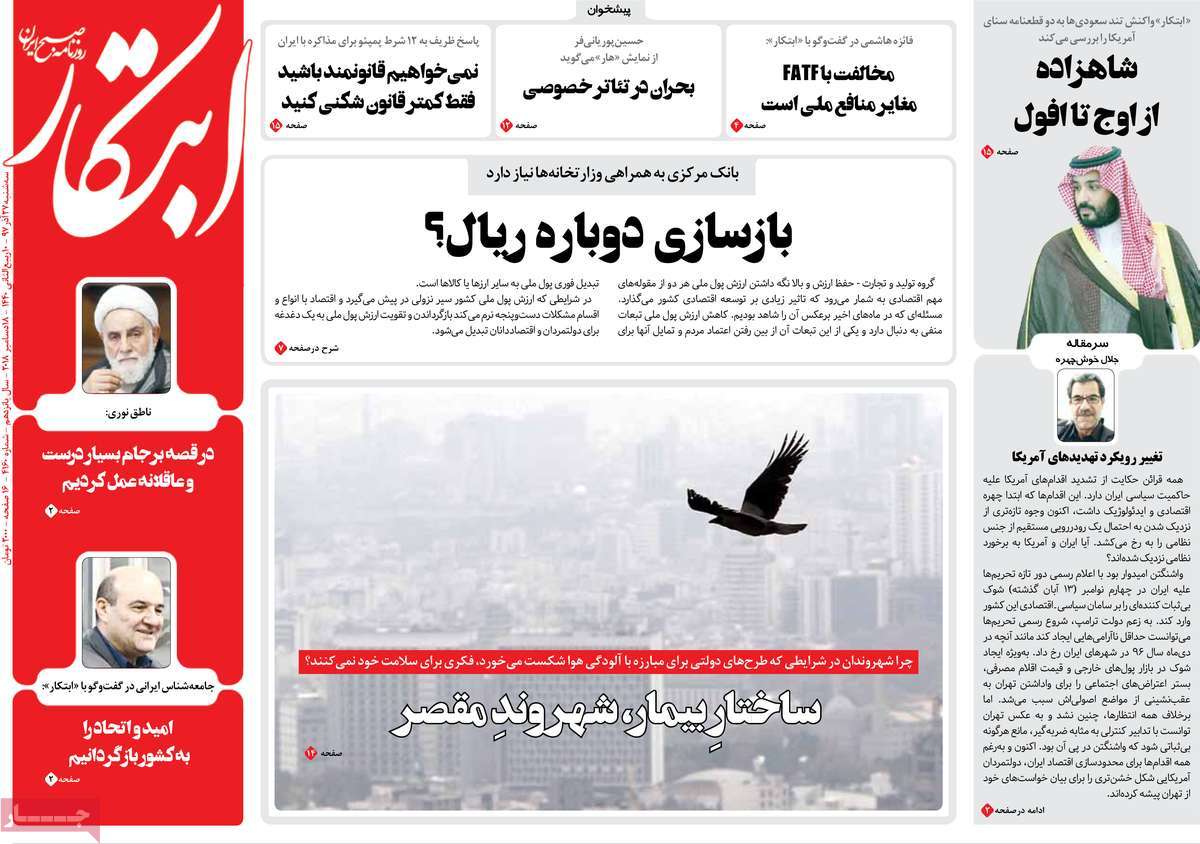
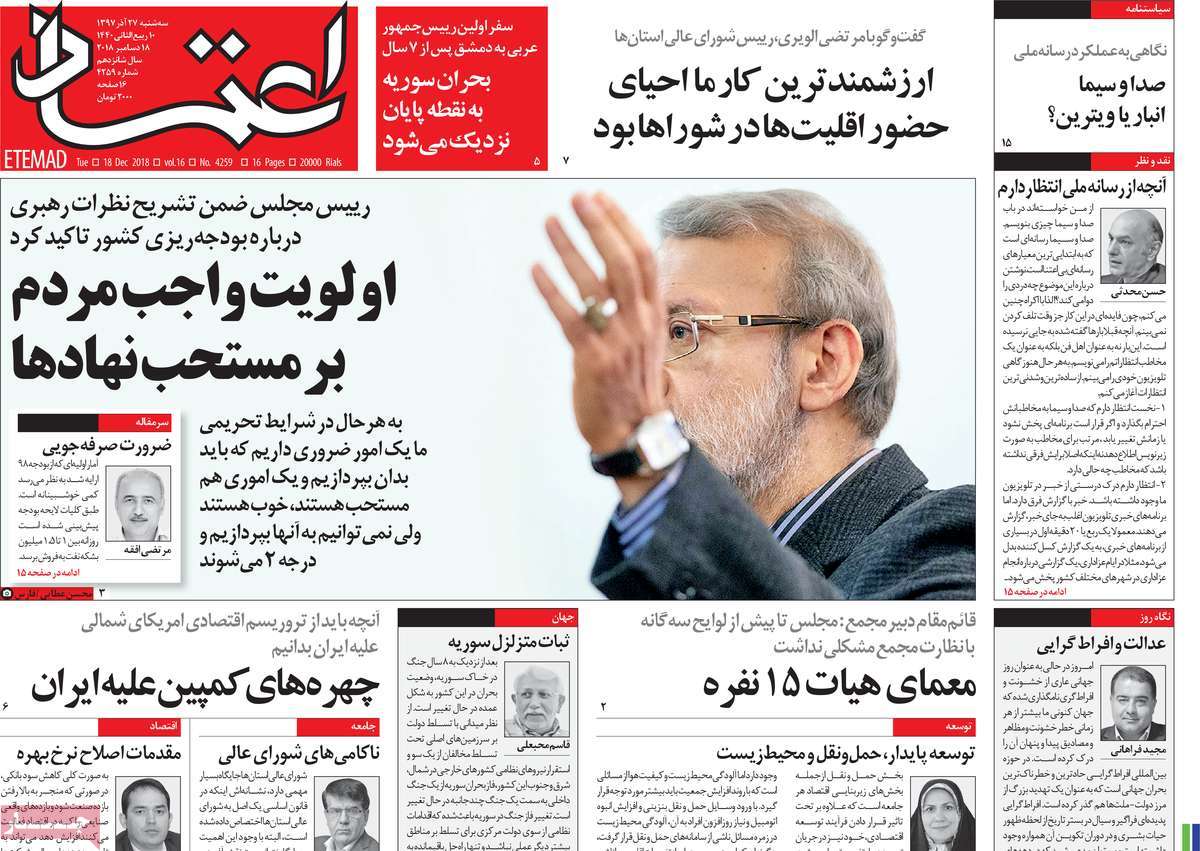
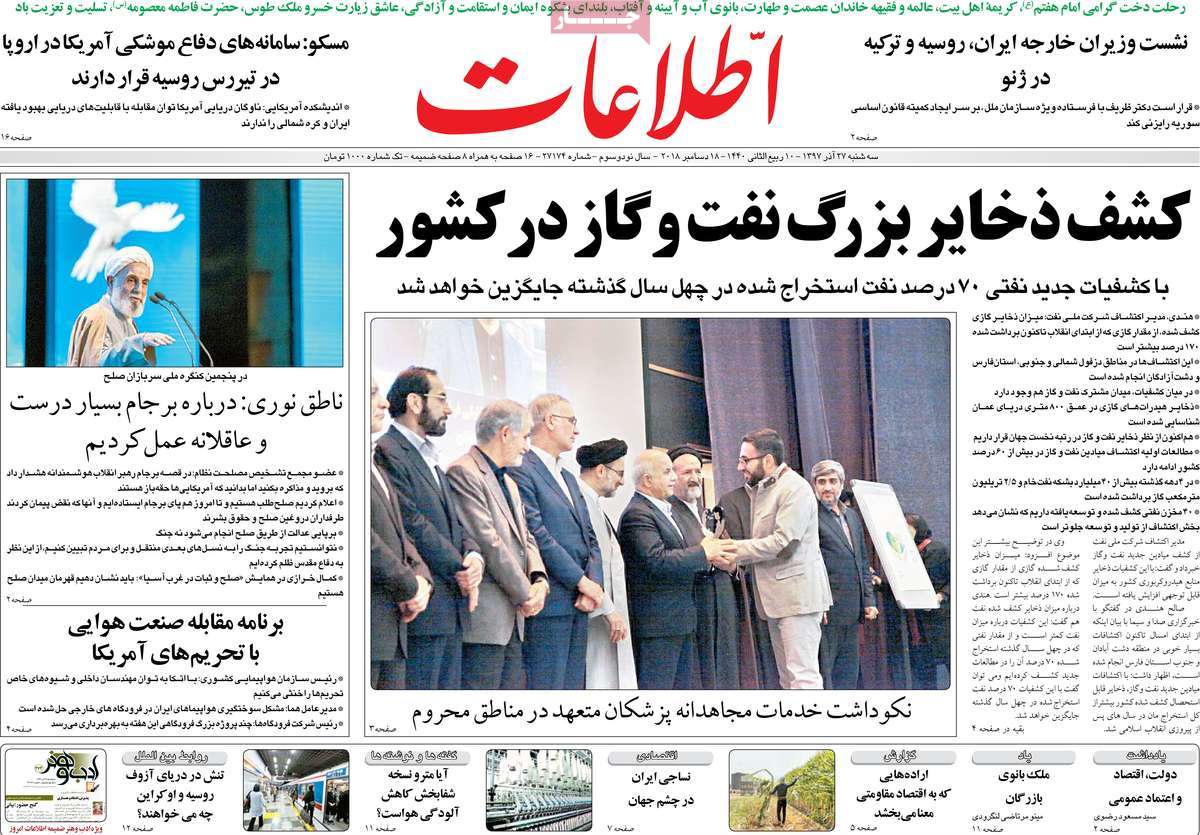
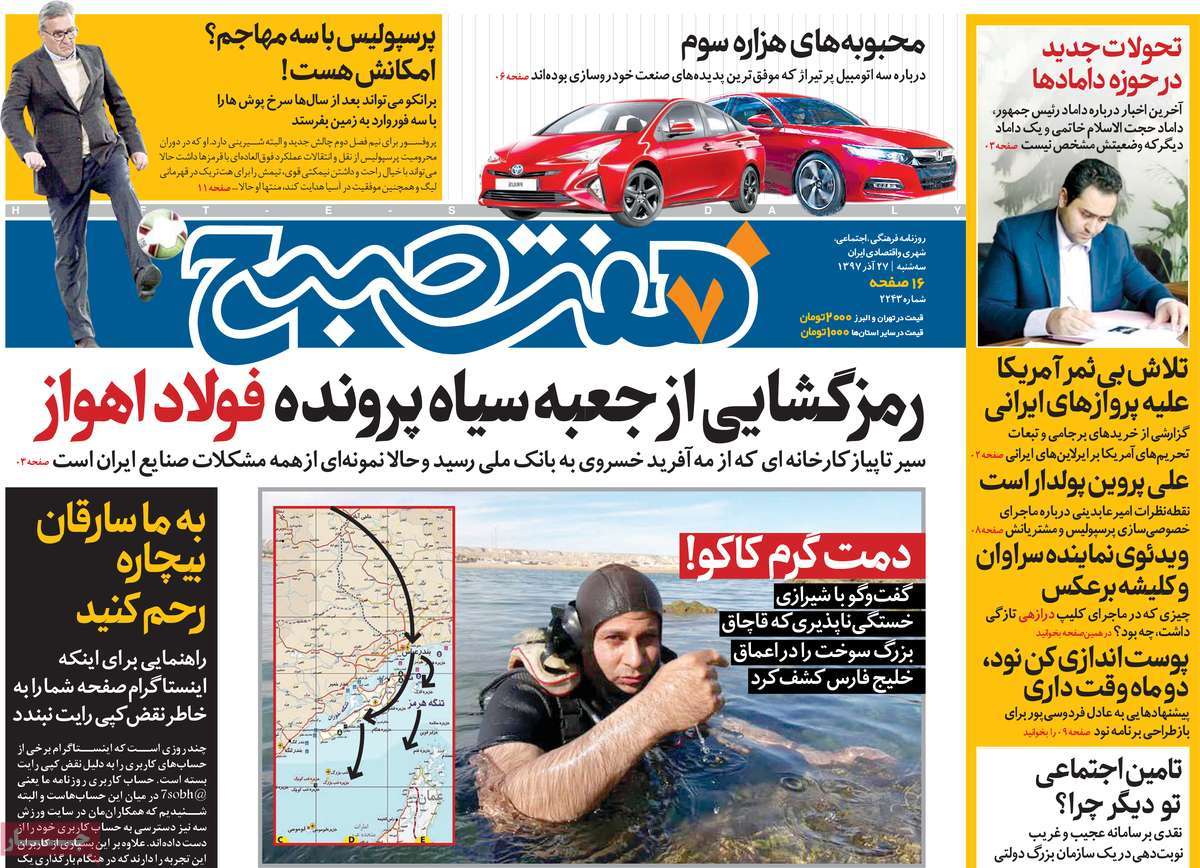
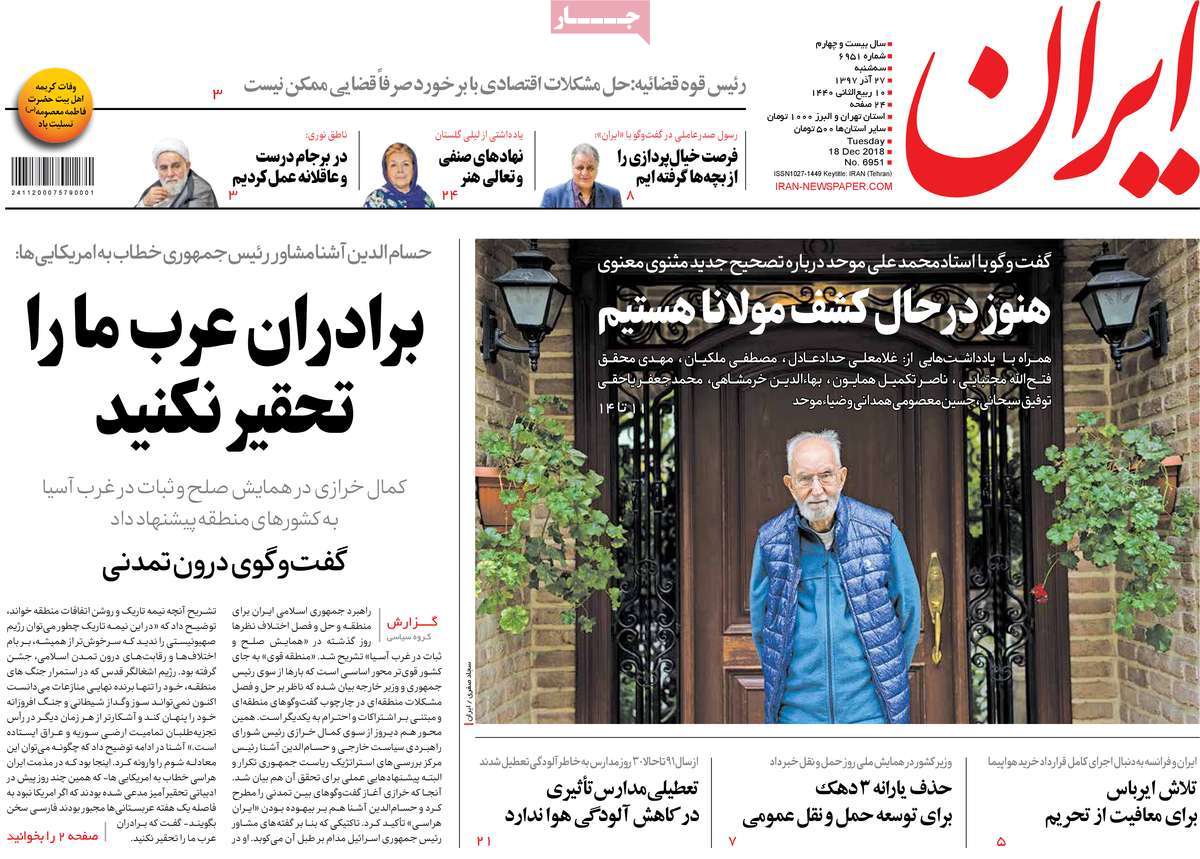
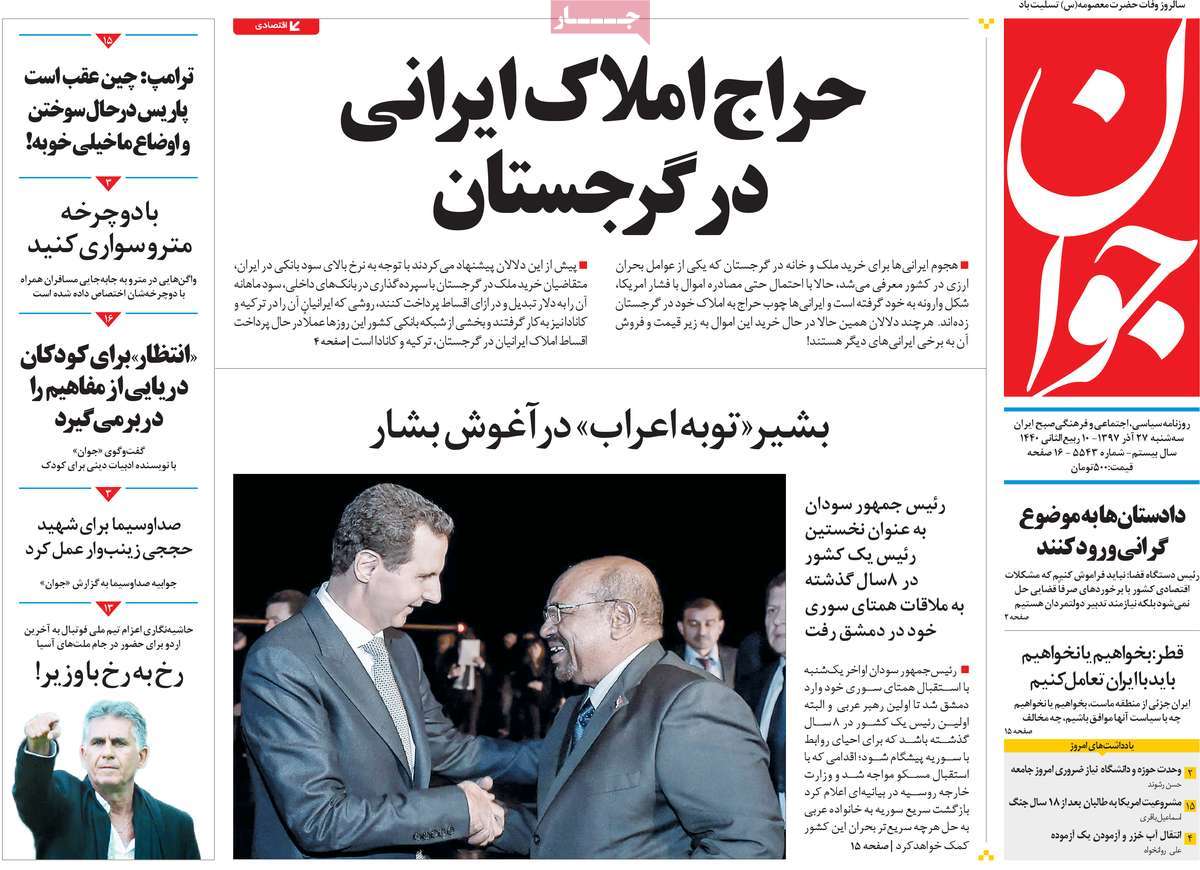
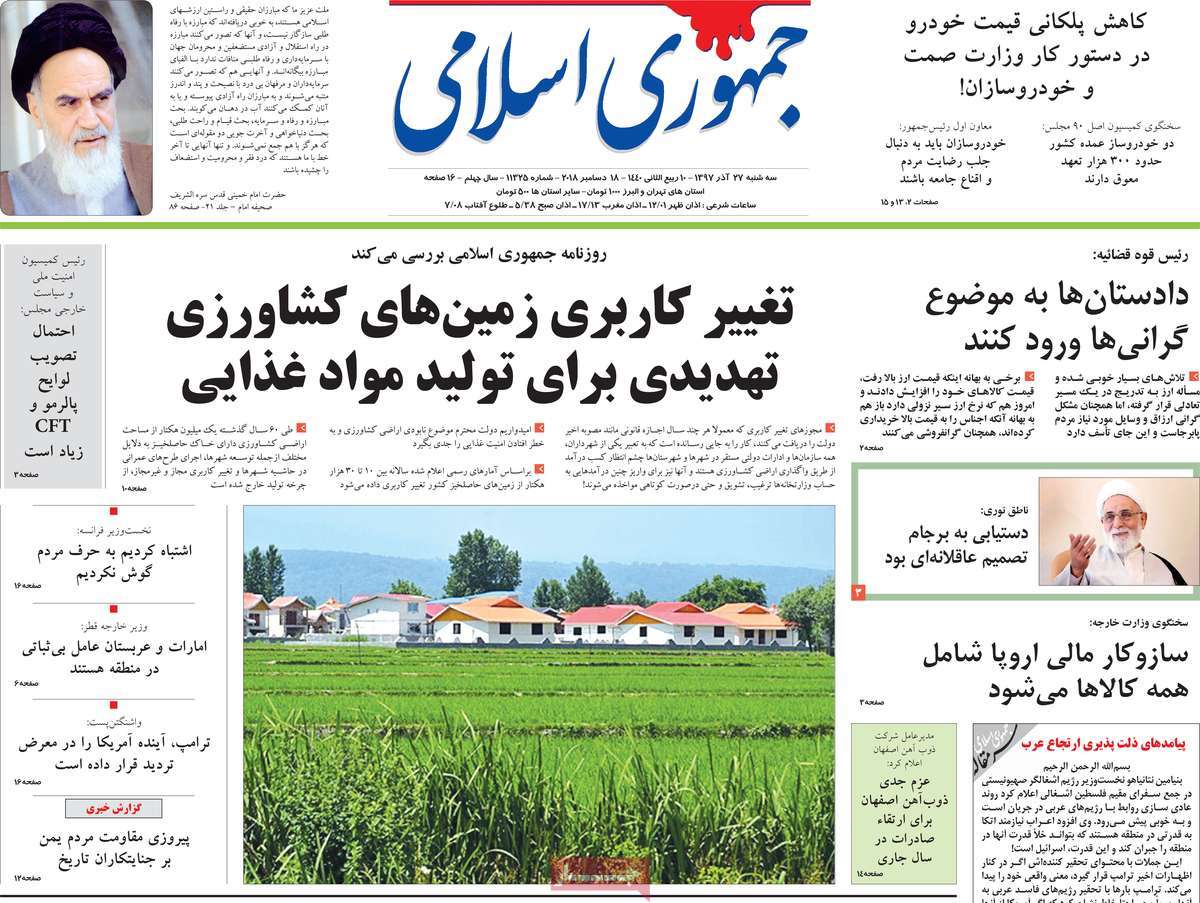
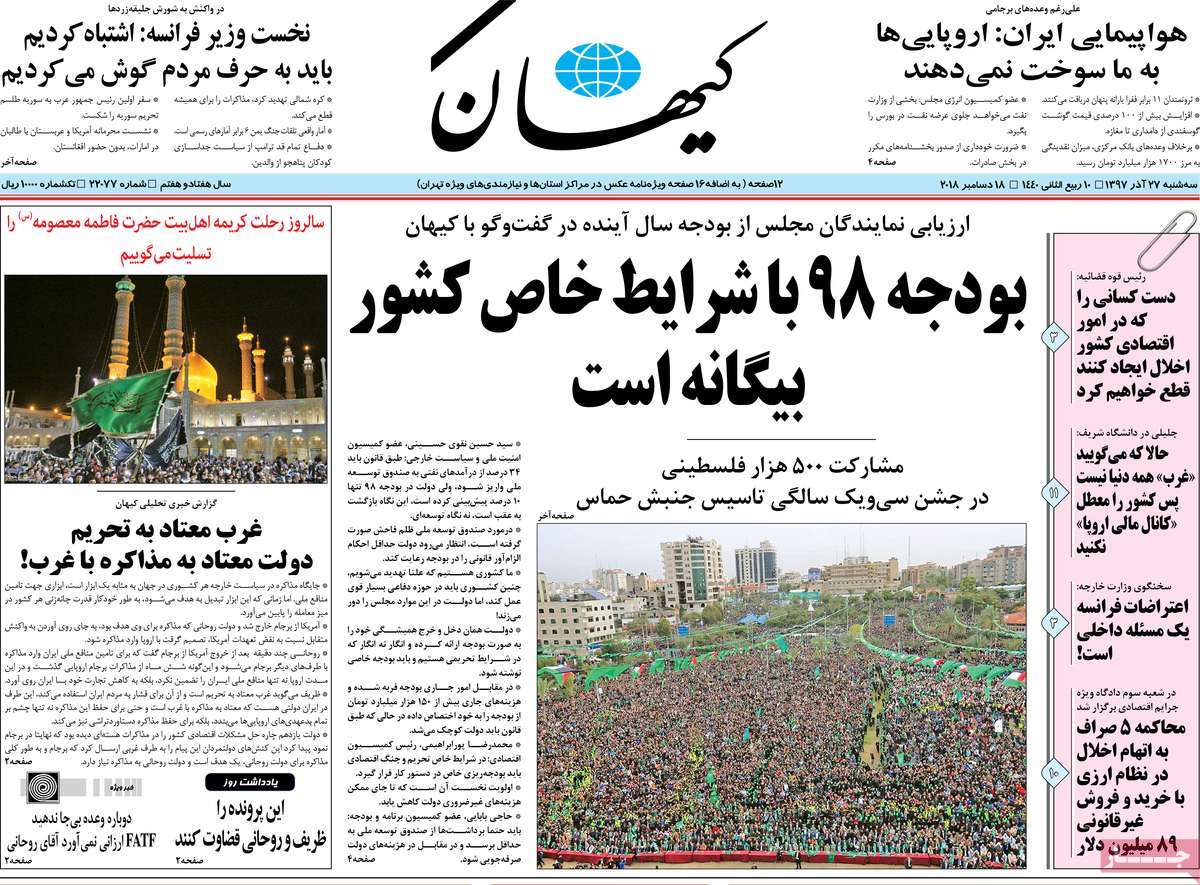
A Look at Iranian Newspaper Front Pages on December 18

A Look at Iranian Newspaper Front Pages on November 19

A top story today was the beginning of a fresh round of Syria talks in the Swiss city of Geneva, attended by the foreign ministers of Iran, Turkey, and Russia.

Several papers today covered the visit of Sudanese President Omar al-Bashir to the Syrian capital, which was the first of its kind by an Arab leader in eight years.

Also a top story was the US sanctions against Iranian airplanes and aviation industry, which are causing problems for the country’s flights.

The above issues, as well as many more, are highlighted in the following headlines and top stories:


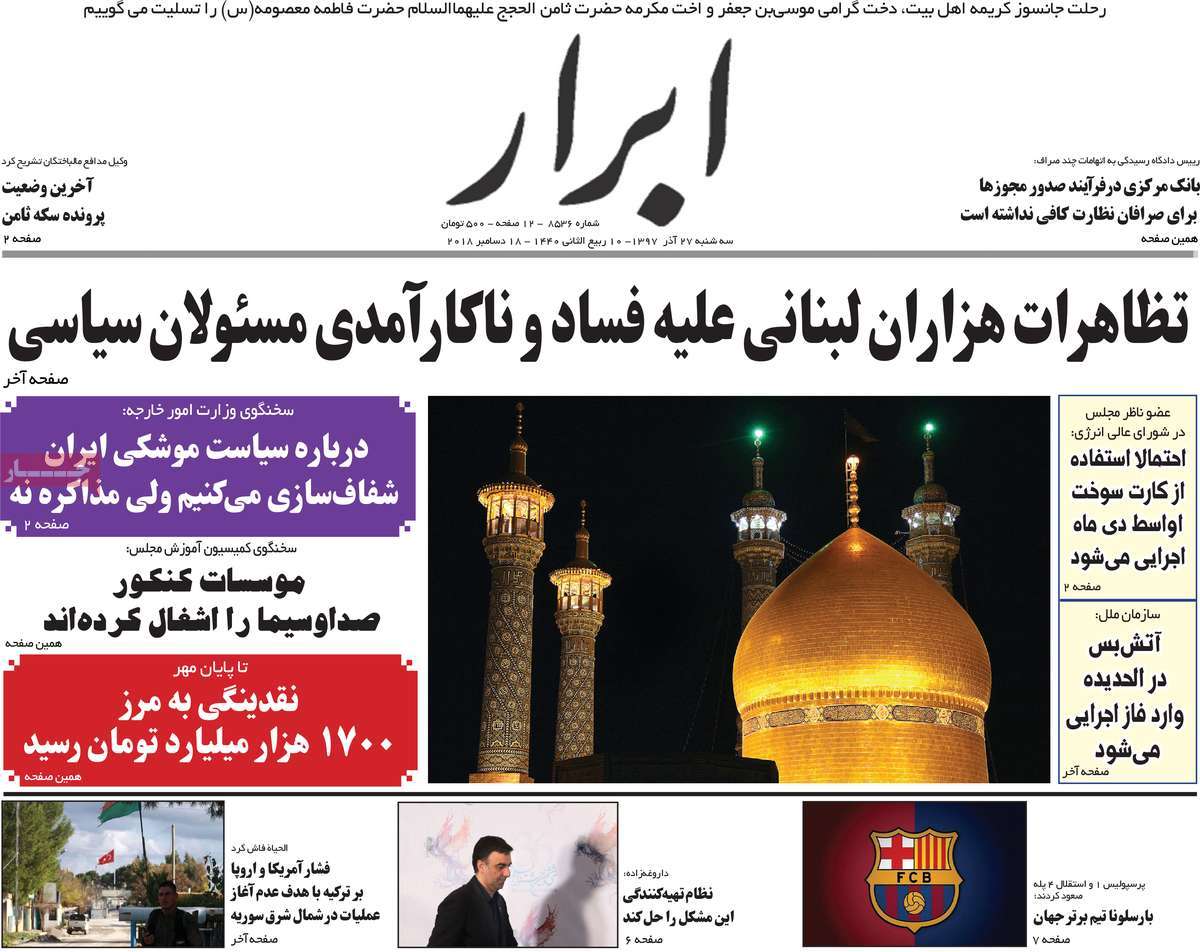
Abrar:

1- Thousands in Lebanon Protest Corruption, Inefficiency of Officials

2- We Provide Clarification for Iran’s Missile Program, but Won’t Negotiate It: Foreign Ministry

3- Al-Hayat: Pressures of US, Europe on Turkey Aimed at Preventing Operation in NE Syria

4- UN: Ceasefire in Hudaydah to Get into Operational Phase

A Look at Iranian Newspaper Front Pages on December 18


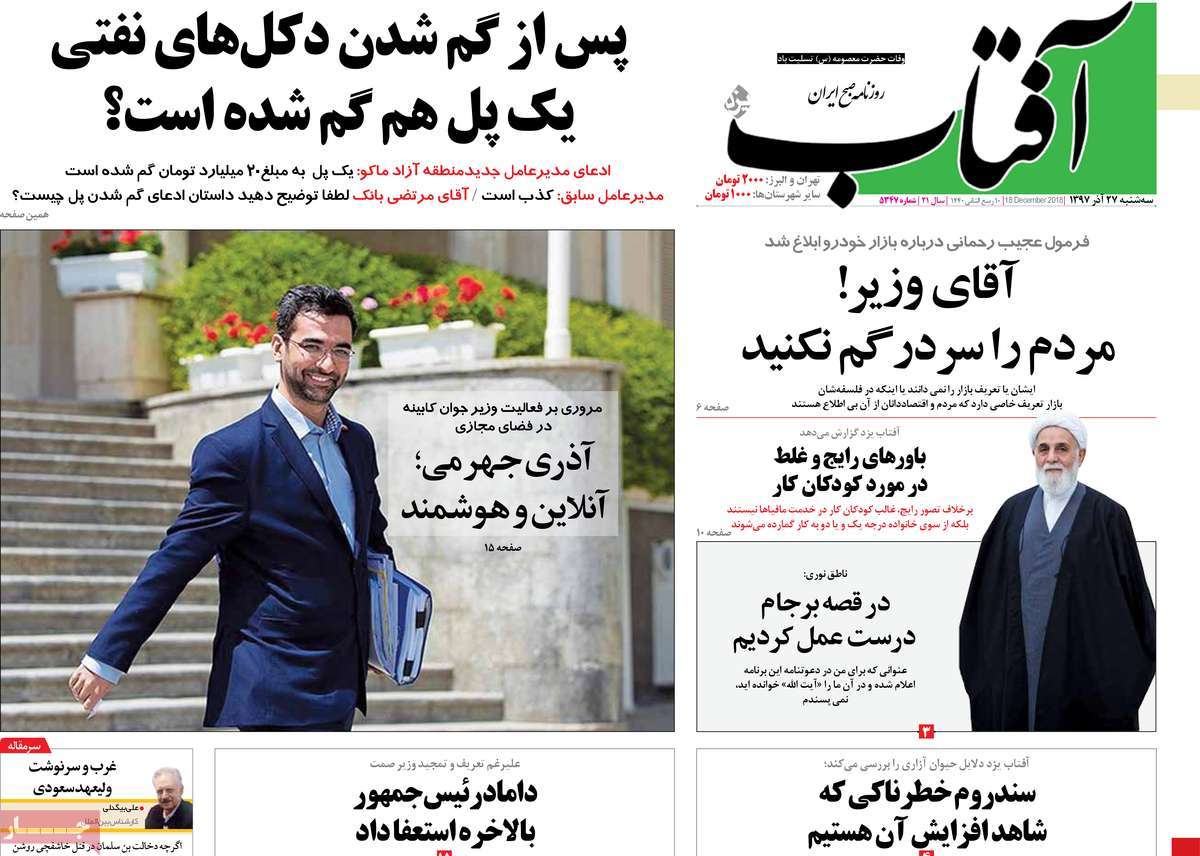
Aftab-e Yazd:

1- Rouhani’s Son-in-Law Finally Resigns

2- West and Fate of Saudi Crown Prince [Editorial]

A Look at Iranian Newspaper Front Pages on December 18


Arman-e Emrooz:

1- Will Europe Join Fuel Sanctions? Continued Stonewalling, Pressure by US

A Look at Iranian Newspaper Front Pages on December 18


Ebtekar:

1- We Had Very Wise, Proper Performance on JCPOA: Cleric

2- Rafsanjani’s Daughter: Opposition to FATF against National Interests

3- Saudis’ Harsh Reaction to Two US Senate Resolutions

A Look at Iranian Newspaper Front Pages on December 18


Etemad:

1- First Arab President Visits Damascus after 7 Years: Syria Crisis Close to End Point

2- Figures of Anti-Iran Campaign

  • What We Should Know about N. America’s Economic Terror against Iran

A Look at Iranian Newspaper Front Pages on December 18


Ettela’at:

1- Huge Oil, Gas Reserves Discovered in Iran

  • New Oil Discoveries to Replace 70% of Oil Extracted in Past 40 Years

2- Moscow: US’ Missile Defence Systems in Europe within Range of Russia

3- Iran, Russia, Turkey FMs to Meet in Geneva

A Look at Iranian Newspaper Front Pages on December 18


Haft-e Sobh:

1- US’ Futile Attempt against Iranian Flights

  • A Report on Repercussions of US Sanctions against Iranian Airlines

A Look at Iranian Newspaper Front Pages on December 18


Iran:

1- Don’t Humiliate Our Arab Brothers: Rouhani’s Aide to Americans

2- Airbus’ Effort to Be Exempted from Sanctions

  • Iran, France Seeking Full Implementation of Plane Purchases

A Look at Iranian Newspaper Front Pages on December 18


Javan:

1- Trump: China Lagging behind, Paris Burning, We’re Very Good!

2- Qatar: We Should Interact with Iran Whether We Want It or Not

3- Sudanese President Visits Damascus as First Arab Leader in 8 Years

A Look at Iranian Newspaper Front Pages on December 18


Jomhouri Eslami:

1- Europe’s Financial Mechanism Includes All Types of Goods

2- French PM: We Made a Mistake We Didn’t Listen to People

3- Qatar FM: UAE, Saudi Arabia Sources of Instability in Mideast

4- Washington Post: Trump Has Questioned Future of US

A Look at Iranian Newspaper Front Pages on December 18


Kayhan:

1- Iran Air: Europeans Not Giving Us Fuel

2- France Protests a Domestic Issue: Iran Foreign Ministry

3- 500,000 Palestinians Attend 31st Anniversary of Hamas Establishment

A Look at Iranian Newspaper Front Pages on December 18


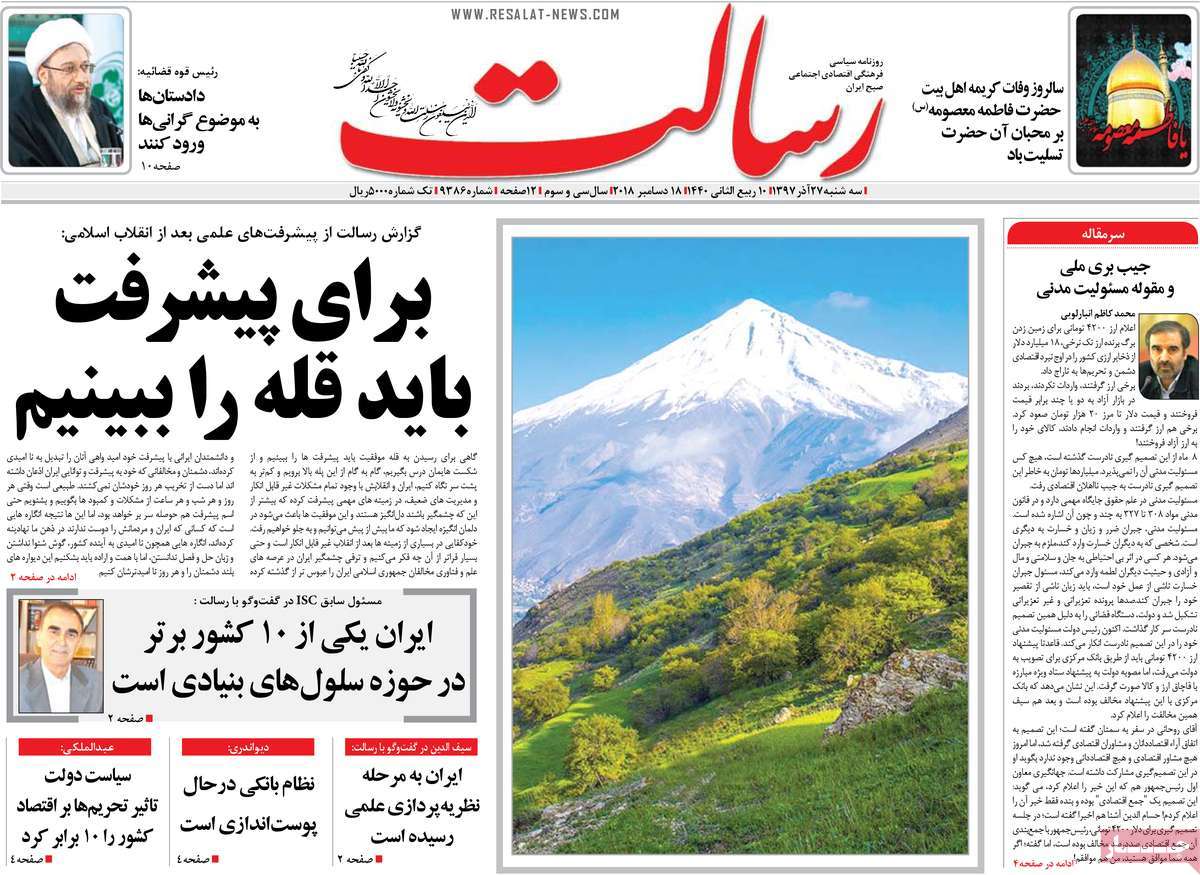
Resalat:

1- Former ISC Official: Iran among Top 10 Countries in Stem Cells

  • Iran Has Reached Level of Scientific Theorization

A Look at Iranian Newspaper Front Pages on December 18


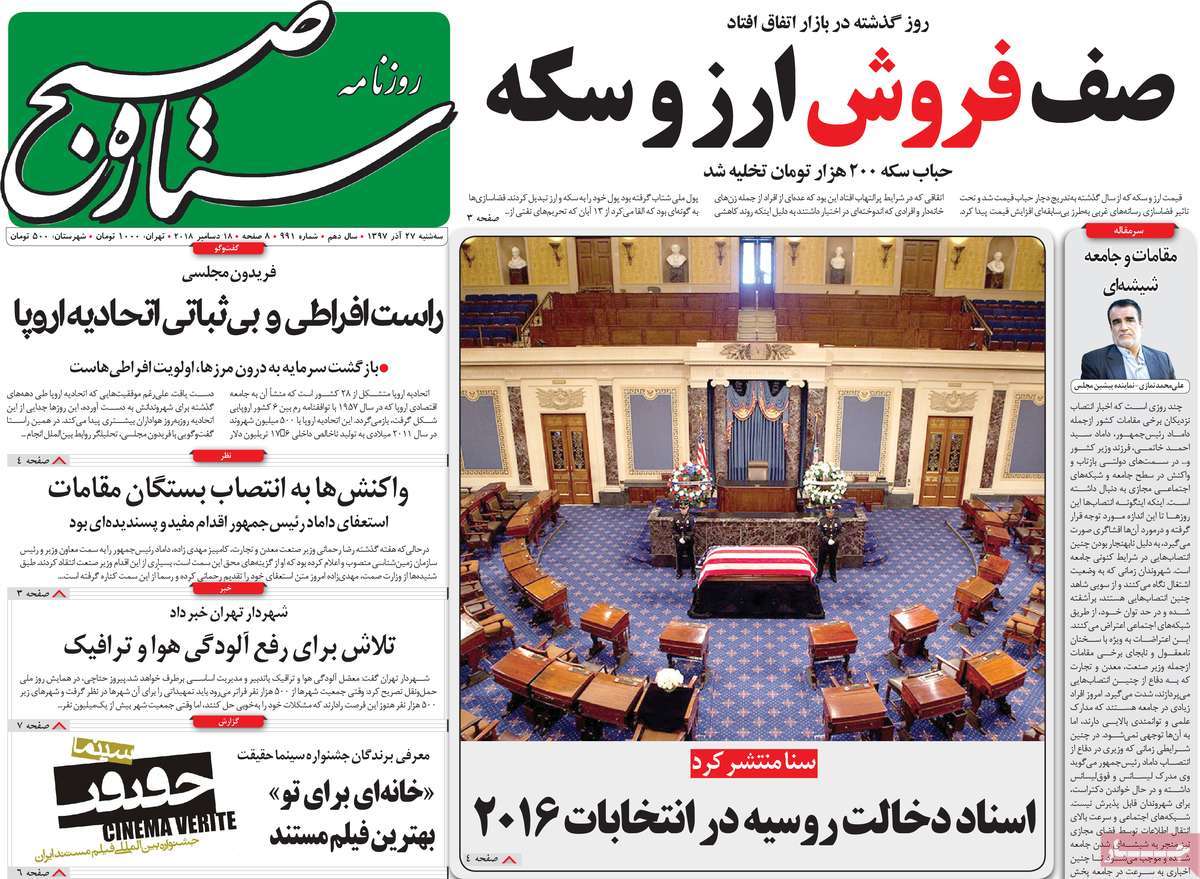
Setareh Sobh:

1- Senate Releases Documents on Russia’s Interference in 2016 Elections

A Look at Iranian Newspaper Front Pages on December 18


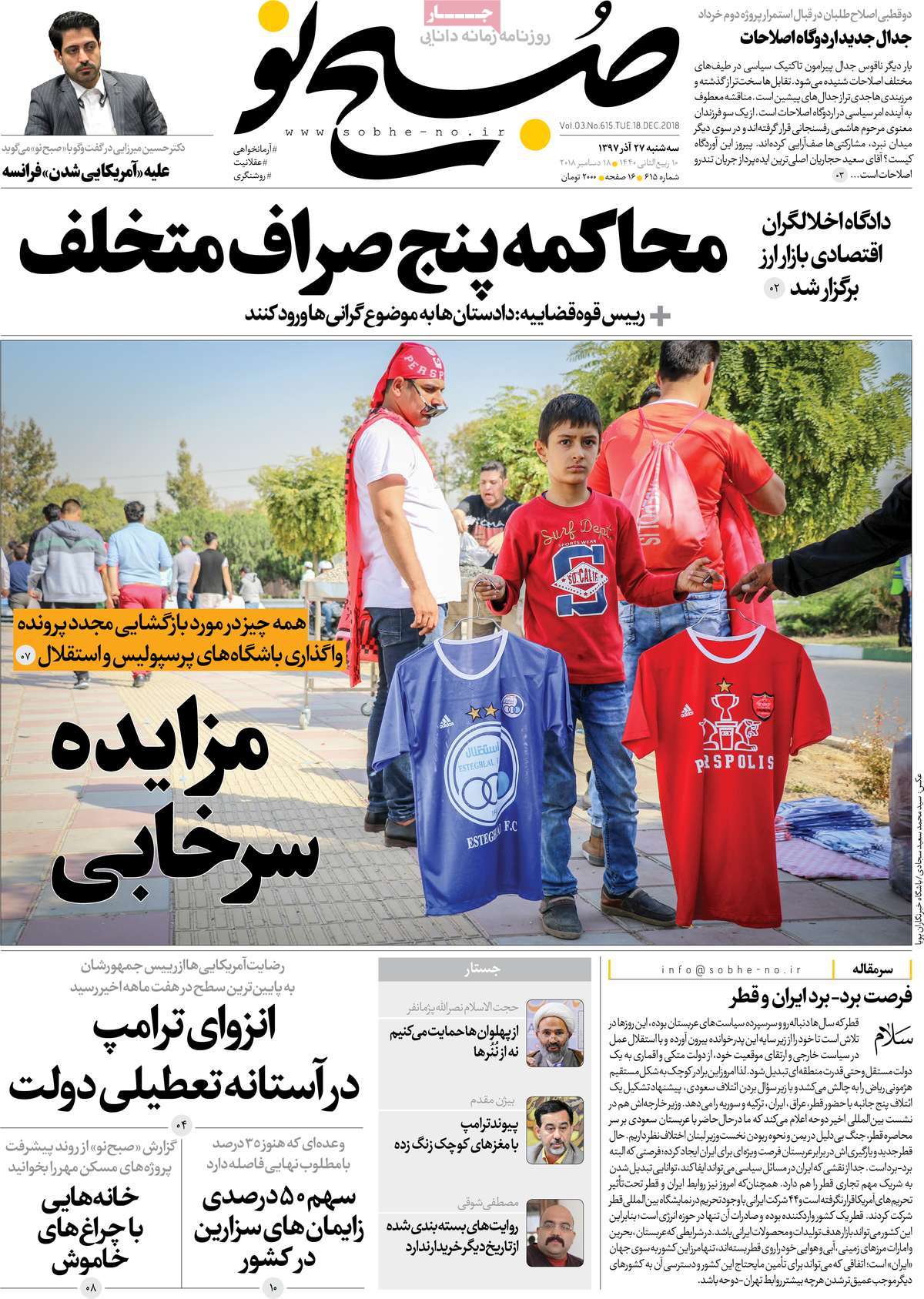
Sobh-e Now:

1- Against Americanization of France: Analyst

2- Trump’s Isolation on Verge of Government’s Shutdown

  • Americans’ Satisfaction with Trump in Lowest Level in 7 Months

A Look at Iranian Newspaper Front Pages on December 18

Iran Urges UN to Remain Unaffected by Pressures over Yemen

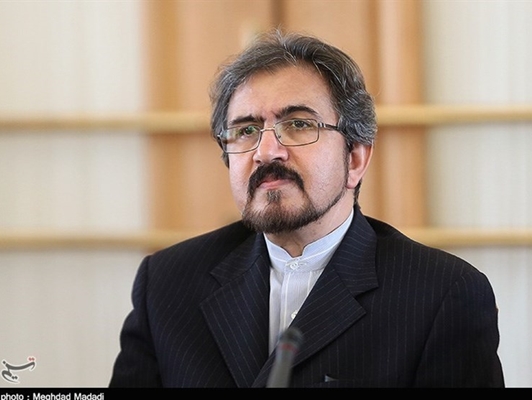
Qassemi

Qassemi made the remarks in an interview with the Al-Alam News Network, where he elaborated on the recent Yemen peace talks held in Sweden.

During the interview, he also praised the Ansarullah movement for making its presence felt as a party to Yemen peace talks in Stockholm.

The full text of the interview follows.


Al-Alam: What score do you give to Ansarullah in Yemen peace negotiations?

Qassemi: We should give a good score to Yemeni people and the Resistance [front] and their resistance against the aggression launched against them. The Ansarullah movement will definitely get a high score. The guidance by this movement and its resistance brought about results which led to the Stockholm meeting. This group managed to present itself as the main party to Stockholm talks, which is a great victory for the movement itself as well as for the people of Yemen.

Al-Alam: Iran and Ansarullah have always emphasized that a political solution is needed to resolve the Yemen crisis, but the Saudi-led coalition insisted that a military solution is needed. Why do you think they insisted on a military solution, and how come they finally accepted a political solution?

Qassemi: I believe the Saudi-led coalition forces had a kind of unwarranted illusion and believed they would be able to achieve their goals through attacking Yemen. They had a big strategic mistake in mind; so, they launched their operation and had no proper understanding of the realities behind the occupation of Yemen as well as the aggression against the country and Yemen’s history. Their behaviour showed they were not well aware of the contemporary and past history, and they easily launched their aggression. From the outset, those who had a better understanding of the region and knew about the outcome of occupation and aggression believed the war on Yemen would get nowhere. They were of the conviction that the Yemeni nation would wholeheartedly defend its interests and dignity and history even under the toughest circumstances and would tolerate all hardships but would not succumb to humiliation. Therefore, it was clear to us that a military solution would be a nonstarter in Yemen, and no matter how much time would elapse, Saudi Arabia and the United Arab Emirates as well as other forces providing arms support and contributing to the creation of large arsenals would face defeat at the end of the day. And today, we have come to a point where the parties to the conflict should sit at the negotiating table and think about the future through political solutions.

Al-Alam: During the talks, Saudi Arabia and the United Arab Emirates were trying to attack the port city of Hudaydah. How do you evaluate such behaviour during the time the negotiations were underway?

Qassemi: For quite some time, Saudi Arabia had been frustrated in the face of the Yemeni nation’s will and resistance and showed its grudge and anger by bombarding civilian centres such as schools and hospitals. Events did not unfold as Riyadh expected, and resistance continued, and popular resistance forces as well as Yemeni people and the Ansarullah movement pressed ahead their resistance against the aggressors that were equipped by different types of modern weapons and enjoyed the support of some countries in the region and beyond. So, on the one hand, the Saudi-led coalition was moving towards a maniacal military move, and on the other, it seemed that the extent of this human disaster touched the international community and triggered a new movement against this aggression. Therefore, Riyadh was facing more and more problems, hardships and dangers with regards to Yemen day by day. As a result, Saudi Arabia and its backers needed to tackle that scourge one way or another. This came as the resistance front had not only not weakened, but also was gaining more strength and moving towards a higher status with regards to military resistance, winning support worldwide, and sending the message of Yemeni people’s innocence.

Al-Alam: Recently, the United States gave Saudi Arabia a month to hold he talks. Why do you think Washington openly intervened in this issue, and how did it influence the outcome of the talks?

Qassemi: The situation of Yemen and the humanitarian disaster which happened there and aggravated situation in the country day by day plus the voice of the innocent people in a world where communications have a high status, especially with the high rate at which information is exchanged, finally drew the attention of the international community to a serious crisis, which could probably be regarded as a crisis and disaster of the current century. Such circumstances brought about a situation not only for Saudi Arabia, but also for its supporters, where they felt it was not the right time to sustain the situation. Hence, even ostensibly, they needed to put on a new mask and paint a fresh image of themselves to pretend that even they themselves did not approve of the situation. If the situation continued, it could undermine the credibility of US rulers and lead to more scandals for the White House.

Al-Alam: Yemen peace talks with the Ansarullah movement held in Sweden, in fact, amounted to the recognition of the negotiations by the international community. This came as Saudi Arabia and the United Arab Emirates had been reluctant to hold talks with Ansarullah until then. How do you see that?

Qassemi: It was prudent of Ansarullah to be able to impose its position on the aggressors through its own resistance as well as that of Yemeni people. Securing such a status is indicative of the power of Yemeni people’s resistance against aggression. Nations which are willing to resist aggression and occupation are able to achieve victory and upgrade their status, at last. Ansarullah and Yemeni people are a clear example of this. We can see in the contemporary history of other countries that the movements which insist on their stances and put up with hardships will, at last, be able to edge closer to securing their rights despite all the injustice and discrimination which might exist on the international stage. By putting up a stiff resistance against Saudi Arabia and the United Arab Emirates and occupying forces, Ansarullah managed to present itself as an equal party to the peace talks held in the Swedish capital, Stockholm, and to attend the negotiations as the representative of Yemeni people.

Al-Alam: In the Sweden talks, parties to the negotiations strongly insisted on the issue of Hudaydah and postponed the issue of Sana’a, the Yemeni capital, to the future. What’s your analysis of this development?

Qassemi: Hudaydah and its port enjoy a strategic situation, and that’s why the occupiers tried a lot and allocated so much funds in recent months to fully occupy this city and its port, but to no avail. It was due to the importance of this region that it was necessary during the first round of negotiations to announce a clear solution and approach, so that the issue might be followed up in the following consultative meeting slated to be held in Kuwait in January. On the other hand, maybe, at this juncture, the issue of Yemen was not an issue for which one single solution could be offered. So, the focus on the issue of Hudaydah during the Stockholm talks could be seen as a step-by-step policy.

Al-Alam: During the 4-year war on Yemen, it has been said that the conflict is a proxy war between Iran and Saudi Arabia. Is this true?

Qassemi: This is a big lie put forward by anti-Iran elements as well as the Saudi-led coalition and the United States. Iran has had no military role and presence in Yemen as the Arab country was under total blockade and there was no connection between Iran and Yemeni groups. In fact, Yemeni troops are using weapons that had been bought with Saudi money in the past for the former puppet government of Yemen.

The claim that the Yemen conflict was a proxy war is a big lie told by the Saudis.

We only lent mental support to Yemen because of the oppression it suffered. Iran has given no arms and military support to Yemeni forces. Talk of a proxy war was a sheer and blatant lie told by the Saudi-led coalition.

Al-Alam: How do you evaluate the future of talks between the Ansarullah movement and the ousted government?

Qassemi: The solution that we have always believed in has been an end to the aggression on Yemeni people and allowing Yemenis to achieve their objectives through dialogue. Today, these talks have got underway in Sweden, and we hope this trend will result in an end to the aggression while safeguarding Yemenis’ rights. Yemeni people can achieve their goals in intra-Yemeni talks and take steps towards the reconstruction of this country, as much of Yemen’s infrastructure has been destroyed by aggressors.

Al-Alam: Saudi-Emirati media have launched a negative propaganda campaign against Ansarullah and Hudaydah, and say the Ansarullah movement is looting and destroying this port. And they could announce in the future that Ansarullah has violated the ceasefire! What is the purpose of this propaganda?

Qassemi: It is natural that a country which easily commits crimes and slaughters Yemeni people could level such accusations against Ansarullah, and the Riyadh government is likely to make such nonsense comments. If the negotiations in Sweden receive more support from the United Nations and are attended by international observers in Yemen, such blame games could be prevented to some extent, and given the media and international communications, the aggressors will suffer another defeat if they want to make another mistake.

Al-Alam: How do you see the future of Yemen?

The beginning of the negotiations in Sweden was a major event, and the presence of Ansarullah as a party to the talks is very significant, too. We hope the UN will be able to play its key role in establishing peace while remaining unaffected by different pressures.

Poverty and human disasters in Yemen are the fallout of the Saudi aggression. A global movement is needed to rebuild Yemen and move towards improving Yemeni people’s living standards. It is a duty of the international community as well as regional and Muslim countries to step in that direction to make up for the existing silence in the face of these atrocities.

Iran Must Accelerate FATF Accession amid Israel Inclusion

FATF’s Blacklisting of Iran; Threat or Opportunity?

ISNA wrote in a recent article that Israel’s inclusion in the FATF is worrying, as the membership may give it another podium to publicly challenge Iran, along with the US, Argentina and Persian Gulf Arab governments who already oppose Iran’s accession.

“Israel’s formal membership makes the task harder for Iran, as foreign opposition [to Iran joining FATF] will increase while domestic opposition [persists],” he said.

Israel, which since February 2016 was an observer in the organization, was accepted as a member of the global body dedicated to combating money laundering and terrorism financing last week.

Israel’s Justice Ministry said last Monday Israel’s inclusion could help it influence policy against regional foes.

“Israel will be able to take part in setting international rules in the realm of terror financing and money laundering, rules that it is subject to in any event,” the ministry said.


Need for Quick Steps

Despite Israel’s opposition, Iran should keep up making efforts to prevent the blocking of financial and monetary lifelines, as it is essential to Iran’s continued resistance against unilateral US sanctions imposed in November, ISNA wrote.

“At a time when unilateral US sanctions have limited Iran’s breathing room and targeted essential lifelines … and Europe and China and Russia have limited power in countering the sanctions … it is quite necessary to keep small transaction channels open,” the report wrote.

The agency wrote that FATF is an organization run by consensus and other countries will not heed to illogical pressure of the US and its allies if Iran takes necessary steps.

Iran’s accession to the FATF Iran’s accession to the G7-created FATF has faced obstacles in recent months, mainly over concerns among some officials that the move could endanger Iran’s national security interests.

Out of four parliamentary bills required for Iran’s accession to the global anti-money laundering body, only the first one has so far gone into effect and the fate of the other three is in limbo.

An amendment to Iran’s Combating the Financing of Terrorism (CFT) law, a bill on Iran’s accession to the United Nations Convention against Transnational Organized Crime, and another bill amending the country’s anti-money laundering law, have been found to be problematic by the Guardian Council, the legislation watchdog.

Proponents of the FATF accession say the measure would smooth the path for Iran’s increased financial transactions with the world and allow Iranian financial sector to function more easily in the international economy.

The FATF announced last month once again it extends the deadline for Iran to complete reforms to meet conditions for getting out of the body’s black list.

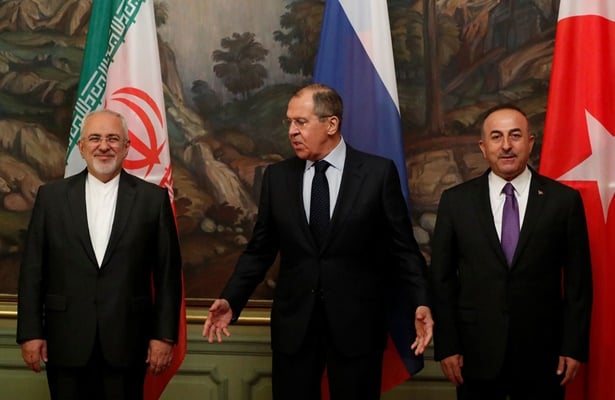
Iran FM Due in Geneva for Syria Talks

According to Foreign Ministry Spokesman Bahram Qassemi, Zarif will make the trip to attend a trilateral meeting with his Russian and Turkish counterparts as well as the UN special envoy for Syria.

During the talks, the top diplomats are going to hold consultations on Syria’s Constitutional Committee, Qassemi added.

The talks are expected to put an end to more than seven years of conflicts which erupted in Syria back in 2011, when a small group of opposition forces took up arms against Damascus.

Soon, however, a mix of international terrorists and paid mercenaries mingled with and then largely sidestepped the armed Syrian opposition groups, effectively turning the Arab country into a battlefield for foreign governments opposed to Syrian President Bashar al-Assad.

But the Syrian military, with advisory military help from Iran and Russia — and a Russian aerial bombardment campaign — has retaken control of much of the country, and the conflict is generally believed to be winding down.

IOSCO Promotes Iran’s Membership Status

Iran’s Securities and Exchange Organization officially joined IOSCO in 2016 as an associate but managed to promote itself to a junior member this year thanks to its adherence to all obligations set by the IOSCO and sense of responsibility to respond to all specialized questions raised by the international body.

“The promotion will provide us with a chance to attract more foreign investment and expand our cooperation with all related watchdogs involved in the global capital markets,” SEO’s Head Mohammad Fetanat was quoted as saying in a report by the Iranian government’s official website dolat.ir.

Information technology exchanges with other players of the world’s capital markets, promotion of Iran’s capital market knowhow, sharing of experiences with other watchdogs are among other main achievements of the membership promotion for the Islamic Republic, he added.

Experts say the membership status promotion of the SEO in the international body reveals the growth and developments made in Iran’s capital market, and that it is now operating within the international standards of the IOSCO.

From now on, Tehran Stock Exchanges, Iran’s Fara Bourse, Iran Mercantile and Energy Exchange and Central Securities Depository of Iran along with other active centres in the capital market can join the IOSCO and enjoy its membership advantages.

The promotion of the SEO also brings international credit for the Islamic Republic and reveals that exchanges in Iran enjoy appropriate infrastructure and are carried out within the international standards. The SEO will use the new capacities for further development of exchanges across the country.

The new membership status means that the Islamic Republic can join all committees of the international body, even its board of directors and enjoy the right to have a vote in making most decisions after taking some training courses.

Established in 1983, IOSCO serves as the most important international council involved in the global markets. It is made up of the world’s regulatory agencies setting international standards and coordination among stock exchanges across the world.

Its main goals are establishing cooperation among member states to promote standards in order to create strong, neutral, efficient markets, exchanging experiences to promote local markets, making concerted efforts to create high standards in stock exchanges and preparing the ground for mutual cooperation through removing the current obstacles.

It is made up of three main committees: executive, technical and growth. It also has a regional committee.

The body works intensively with the G20 and the Financial Stability Board on the global regulatory reform agenda Securities regulators in emerging markets account for 75% of its ordinary membership.

Iran to Replace European, American Pharmaceuticals with Indians

Referring to India’s pharmaceutical capabilities, Hashemi said New Delhi is one of the major powers in the field of medicine, raw materials and vaccines.

“A major part of the European and US markets is dominated by the Indian pharmaceutical companies, and the Islamic Republic has also used their products in its industries,” Hashemi said at the end of a three-day visit to India.

“Unfortunately, our approach towards the European and US companies is a traditional one that should change. This change of view will surely benefit the country in the future,” he underlined.

Indian officials are really interested in promoting all-inclusive ties with Iran, he said, as reported by the government’s official website Dolat.ir.

“To counter the sanctions imposed on Iran and the nation, it is a great opportunity to make use of cost-effective and economical talents. We must use this chance to improve our domestic products. Iran and all the region, of course, are a very good market for India.”

He further maintained that during this visit he held a lot of meetings and discussions with the Indian authorities, the ministers of commerce, health and traditional medicine, as well as the banks and pharmaceutical companies of India.

“India, like the Eastern Bloc countries, has a great chance to develop all-out ties with Iran. These countries can contribute to the development of the Islamic Republic, the advancement of technology and the independence of Iran in various fields,” added the Iranian minister.

Global Summit on Maternal and Child Healthcare was held in India with the presence of a large number of health ministers.

Qazizadeh Hashemi along with representatives from the private sector in the field of medicine and pharmaceutical products held meetings with 50 Indian companies during the 3-day visit.

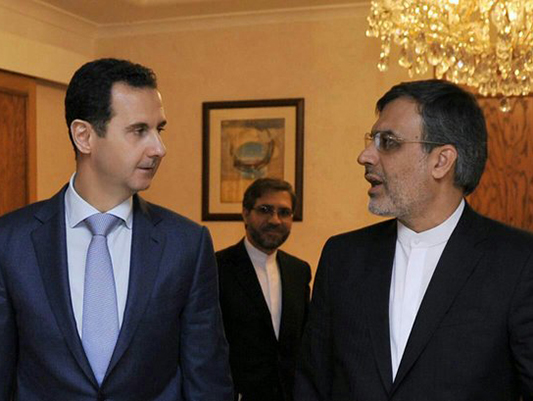
Iranian Diplomat, Syria’s Assad Discuss Constitutional Committee

During the Sunday night meeting, the two sides conferred on the latest developments regarding the formation of Syria’s Constitutional Committee.

President Assad appreciated the efforts made by Iran to form the Committee despite the obstacles put by states which support terrorism.

He also stressed the importance of efforts made by the friends and allies of Syria, particularly Iran and Russia, to stop the interference of some Western states in the political process and consolidating the establishment of  a political process led by the Syrians themselves away from any form of external intervention.

Jaberi Ansari, for his part, briefed President al-Assad on the arrangements made to hold a meeting for the guarantor states of Syria peace, which is expected to be held in the coming two days in Geneva, particularity after agreeing on the final shape of the Committee.

He affirmed Iran’s commitment to continued consultations and coordination with Damascus which showed a great amount of flexibility on reaching the agreement.