Saturday, December 27, 2025
Home Blog Page 3387

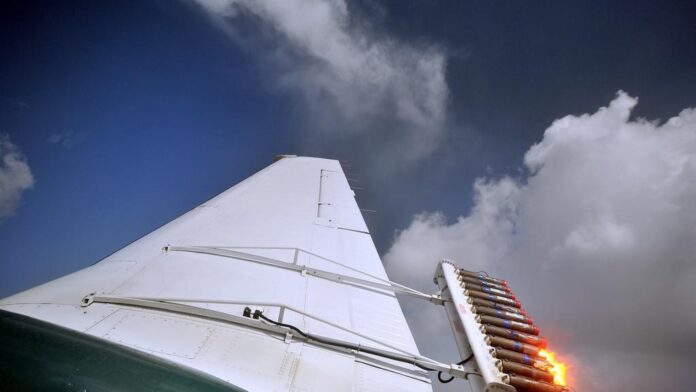
Iran Produces Cloud Seeding Rockets

Iran Produces Bullets for Cloud Seeding

Speaking to reporters on Sunday, the energy minister said the rockets to seed clouds used to be imported from abroad, but now the Islamic Republic is able to produce them inside the country.

As Iran is located in a low-rainfall region, cloud seeding is a method used to increase precipitation and solve the drought problems.

For a brief review of Iran’s achievements in various fields of science and technology, check the book “Science and Technology in Iran: A Brief Review

Back in February, Ardakanian said the ministry has launched cooperation with the Islamic Revolution Guards Corps (IRGC) in cloud seeding operations.

In January, the IRGC Aerospace Force commander expressed preparedness to help the Energy Ministry to carry out such operations, saying his forces were at the Iranian nation’s service and would mobilise all equipment to help the administration.

Cloud seeding is a type of weather modification that aims to change the amount or type of precipitation that falls from clouds by dispersing substances into the air that serve as cloud condensation or ice nuclei, which alter the microphysical processes within the cloud.

US Sanctions Not to Change Iran’s Policies: FM Zarif

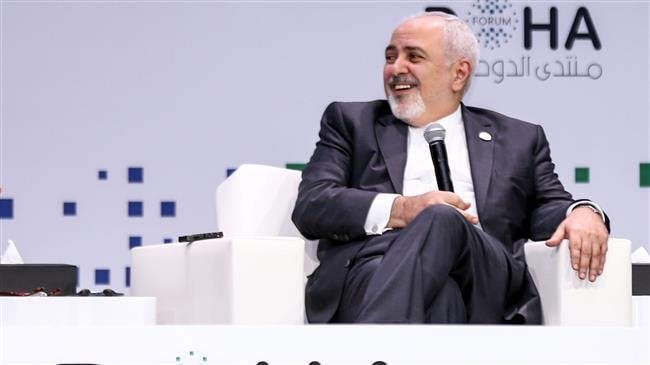
“It’s obviously the case that we are facing economic pressure because of the US sanctions. [The] US is a major global power and it can actually create painful conditions for other countries. But would that lead to a change of policy? I can assure you that it won’t,” Zarif said in an address to the Doha Forum 2018 in Qatar on Saturday.

“If there is an art, we have perfected in Iran and can teach to others for a price, it is the art of evading sanctions,” he added.

Although the US has put so much pressure on Iran over the past 40 years, the Islamic Republic has managed to survive, he said.

“We’ve survived against the United States, against the will of the United States for the last 40 years, and I believe we will survive for the next 40 years,” the top Iranian diplomat pointed out.

US President Donald Trump withdrew his country in May from the multilateral Iran nuclear agreement, officially known as the Joint Comprehensive Plan of Action (JCPOA), and decided to re-impose unilateral sanctions against Tehran.

Under the deal, reached between Iran and six major powers – the US, Britain, France, Germany, Russia and China, Tehran agreed to put limits on its nuclear program in exchange for the removal of nuclear-related sanctions.

In November, the Trump administration announced the re-imposition of the “toughest” sanctions ever against Iran’s banking and energy sectors with the aim of cutting off the country’s oil sales and crucial exports.

A first round of American sanctions took effect in August, targeting Iran’s access to the US dollar, metals trading, coal, industrial software, and auto sector.

The US administration hoped to get the other parties to the deal with Iran to likewise scrap the deal, but instead, they stressed that not only would they stick to the agreement, but they would also work to sustain it in the face of increased US pressure. Europeans believe that the nuclear deal is an important element of international security.

Zarif further said there was room for talks with the US but that Washington must “respect the outcome of the talks” they already had, in reference to the nuclear negotiations leading to the conclusion of the JCPOA.

“I can tell you as somebody who did all the talking for that document (the JCPOA) that neither Iran nor the United States can get a better document. So there is room for talk. But you need first to respect the outcome of the talks you already had,” he added.

The Iranian foreign minister said, “There is no reason to engage in talks while the results of long and very difficult talks are still up in the air and the United States is actively trying to undermine those results.”

Saudi Arabia wants increasing tension in Middle East

Elsewhere in his speech, Zarif said Saudi Arabia intended to increase tension in the Middle East, referring to the ongoing crisis in Yemen and the gruesome murder of Saudi dissident journalist Jamal Khashoggi, which is widely believed to have been ordered by Saudi Crown Prince Mohammed bin Salman.

“Unfortunately, Saudi Arabia does not want to reduce tension. Actually, Saudi Arabia believes that it is in its interest to increase tension,” the Iranian foreign minister added.

He held the US and its ally Saudi Arabia accountable for the “humanitarian nightmare” in war-ravaged Yemen.

He emphasized that if the US and its Western allies, who have supported Saudi Arabia under all conditions, wanted to have more stability in the Middle East, they “need to show that bad behavior would get a bad response.”

Khashoggi, a one-time royal insider who had been critical of the crown prince recently, was killed after entering the Saudi consulate in Istanbul in early October.

Following weeks of denial of any involvement in Khashoggi’s disappearance, the Saudi regime eventually acknowledged the “premeditated” murder, but has sought to distance the heir to the Saudi throne from the assassination.

A Saudi prosecutor said Khashoggi’s body had been dismembered, removed from the diplomatic mission and handed to an unidentified “local cooperator.”

The CIA is said to have concluded that the crown prince was behind the killing, but Trump is yet to endorse the assessment.

Zarif also dismissed claims that Iran had armed fighters from the Houthi Ansarullah movement, noting there were “facts” that other countries had shipped arms.

“We have never provided weapons to Houthis. They have enough weapons, they don’t need weapons from Iran,” he said.

“I don’t need to show any evidence about the jets that were flying in Yemen bombing the Yemenis. Those are American-made jets and those are Saudi fighters, I assume, which are piloting those jets,” Zarif stated.

“If there are allegations about Iranian weapons, there are facts about US weapons, facts about Saudis bombing the hell out of the Yemenis,” he added.

Leading a coalition of its allies, Saudi Arabia invaded Yemen in March 2015 in an attempt to reinstall Yemen’s ex-president, Abd Rabbuh Mansur Hadi, who had resigned amid popular discontent and fled to Riyadh.

The imposed war initially consisted of an aerial campaign, but was later coupled with a naval blockade and the deployment of ground mercenaries to Yemen. Furthermore, armed militia forces loyal to Hadi, in line with invaders, launch frequent attacks against Yemeni people in regions held by Houthis.

Since the onset of aggression, the Yemeni army, backed by fighters from the Houthi Ansarullah movement, has been defending the impoverished nation against the invaders. The coalition is also resolute to crush the movement as another goal in its war on Yemen, which is teetering on the edge of famine.

The Saudi-led war has also taken a heavy toll on the country’s infrastructure, destroying hospitals, schools, and factories. The UN has said that a record 22.2 million Yemenis are in dire need of food, including 8.4 million threatened by severe hunger. According to the world body, Yemen is suffering from the most severe famine in more than 100 years.

A number of Western countries, the US and Britain in particular, are also accused of being complicit in the ongoing aggression as they supply the Riyadh regime with advanced weapons and military equipment as well as logistical and intelligence assistance.

Earlier this month, the United Nations said the humanitarian crisis in Yemen, already the worst in the world, would deteriorate in 2019.

“The country with the biggest problem in 2019 is going to be Yemen,” said Mark Lowcock, the head of the UN Office for the Coordination of Humanitarian Affairs (OCHA), in a press conference in the Swiss city of Geneva.

Number of Foreign Tourists Visiting Iran on Rise

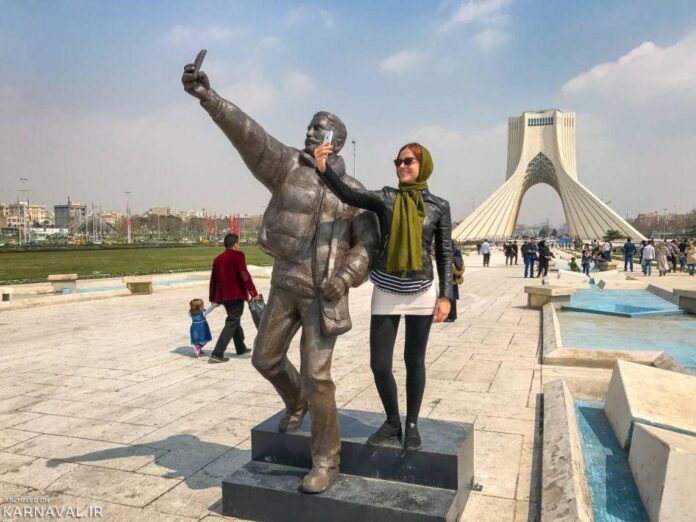
Seyyed Hemayat Mirzadeh, head of the Iranian Parliament’s Tourism Commission, said appropriate measures have been adopted, particularly in Fars and Isfahan provinces, to attract more foreign tourists.

“Our cultural and historical heritage across the country serves as our long-lasting [alternatives to] oil resources. They are capable of attracting many people from across the world,” he said.

“Our handicrafts are also unique and there are many people who are interested in them. We should tap into the capacities and promote the heritage through appropriate advertising mechanisms,” he added.

Mirzadeh also noted that there are many Iranian relics and historical objects held in foreign museums and research centres which should be retrieved.

“Fortunately, Iran’s Cultural Heritage, Handicrafts and Tourism Organization (ICHTO) has taken some practical steps to retrieve them. Such efforts are admirable and should continue,” he said, as reported by the government’s official website dolat.ir.

According to official figures the number of foreign tourists visiting Iran increased by 38 percent during the first four months of the current Iranian calendar year (started in mid-March).

About 1.44 million foreign tourists visited Iran during spring which shows a 30 percent increase compared with the same period last year. The figure seems surprising considering the US administration’s sanctions and Iranophobia project against the country.

During the first three months of this Iranian calendar year, Iraqis accounted for 75 percent, Azeris 30 percent, Afghans 28 percent, and Turks 24 percent of the total number of foreign tourists visiting Iran.

Medical treatment and business are among the two top priorities of the foreigners visiting Iran.

A Look at Iranian Newspaper Front Pages on December 16

A Look at Iranian Newspaper Front Pages on November 19

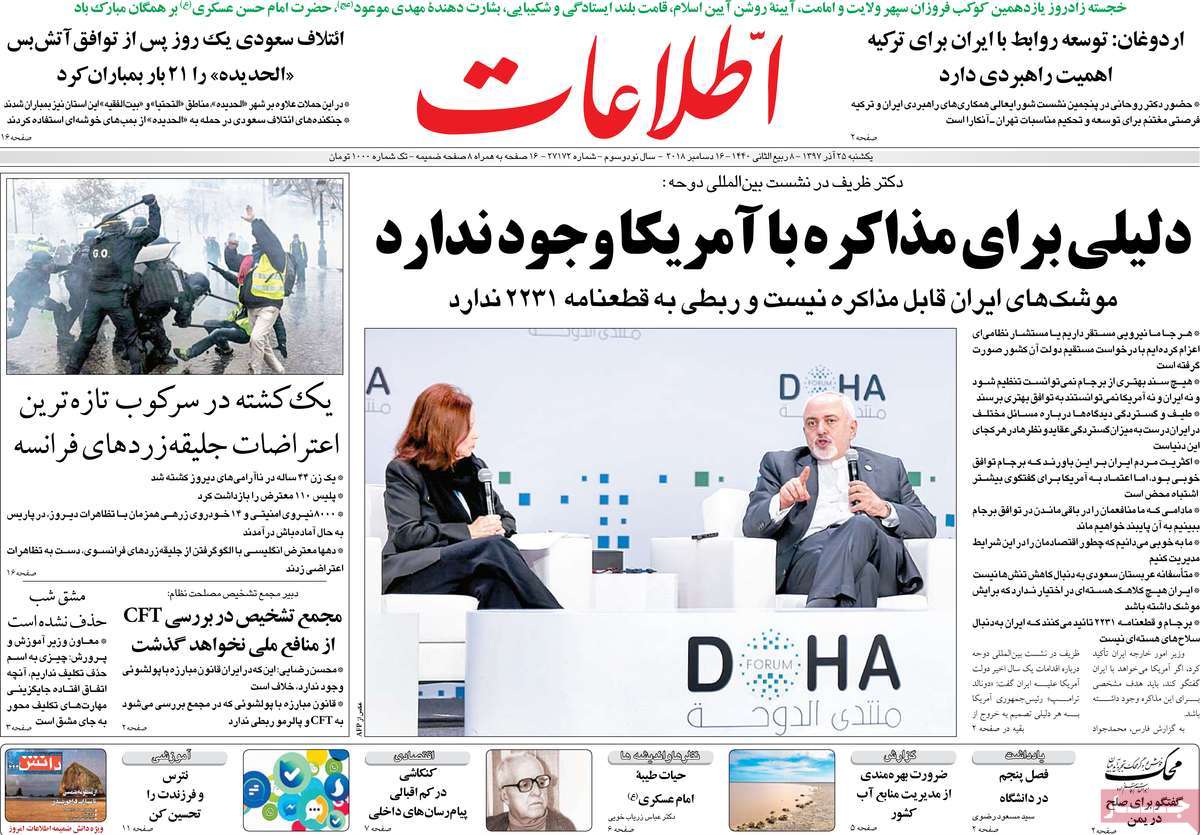
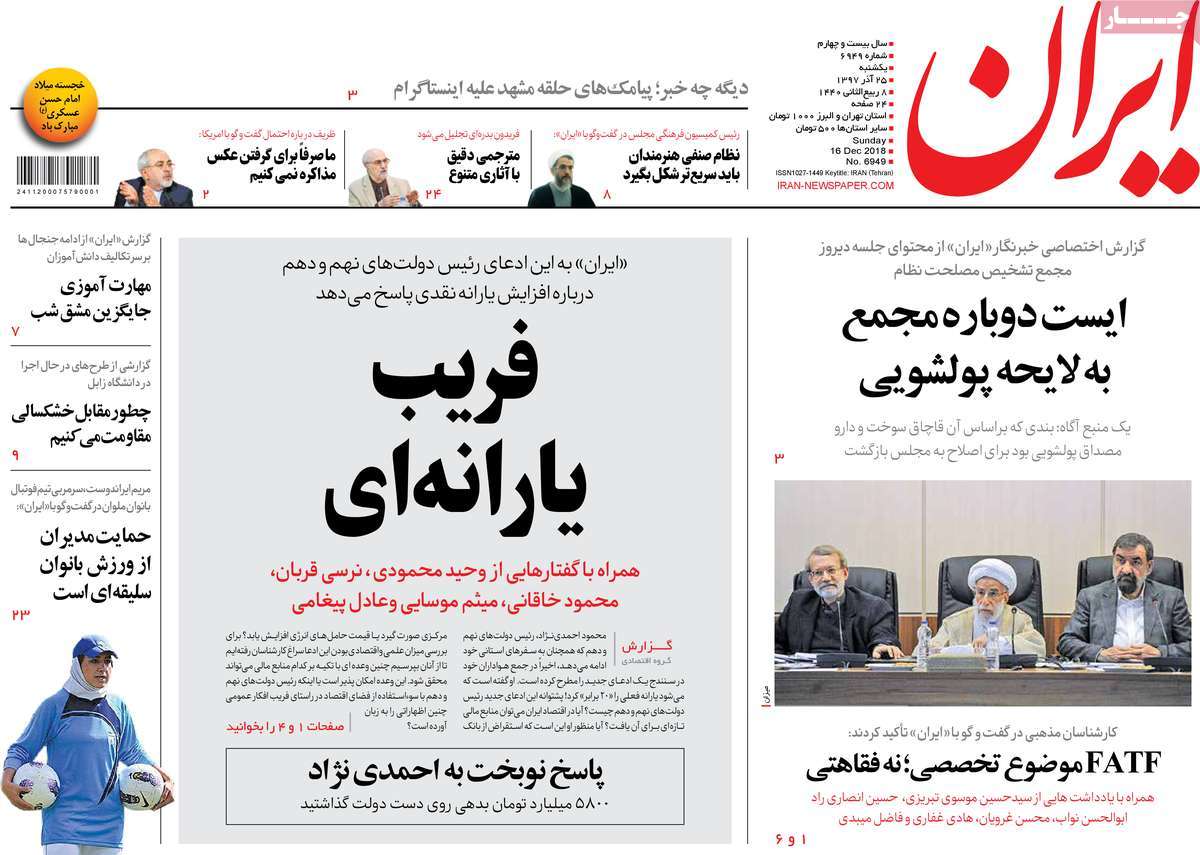
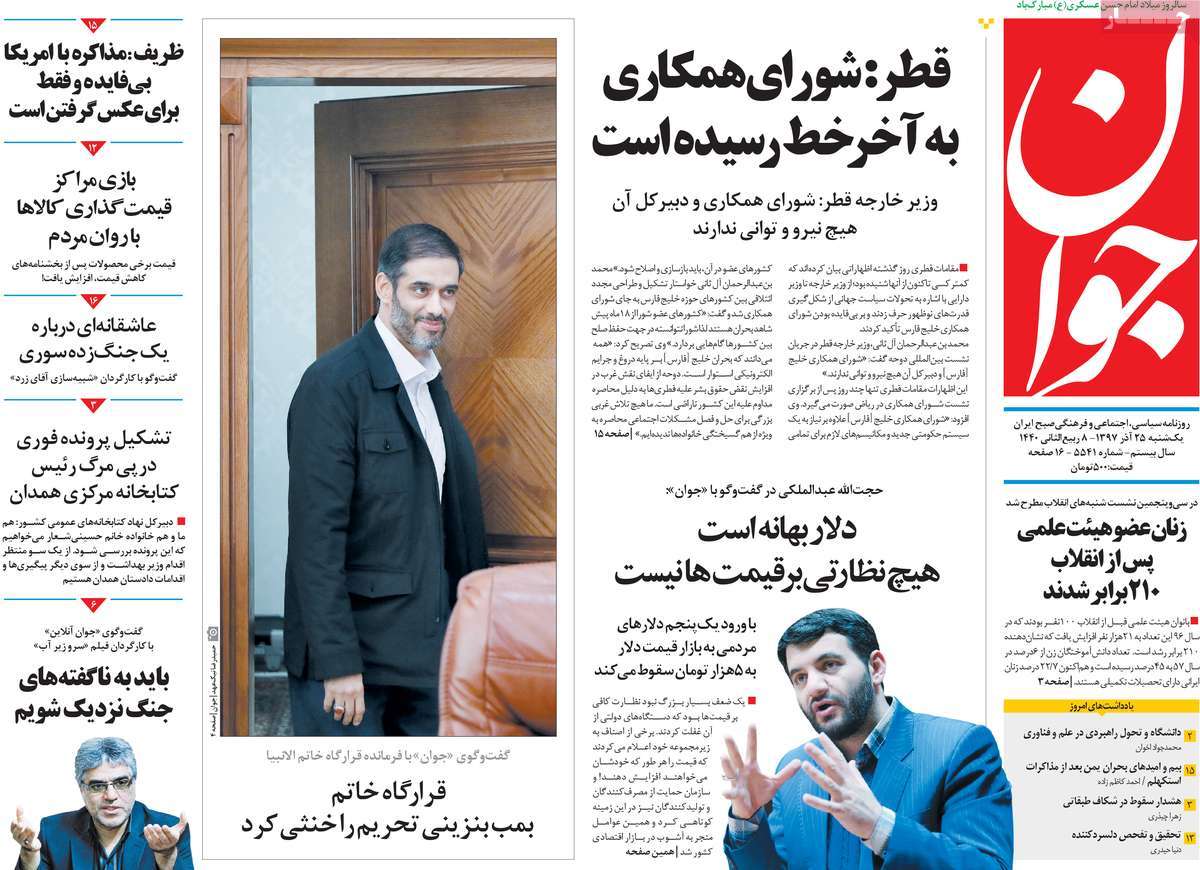
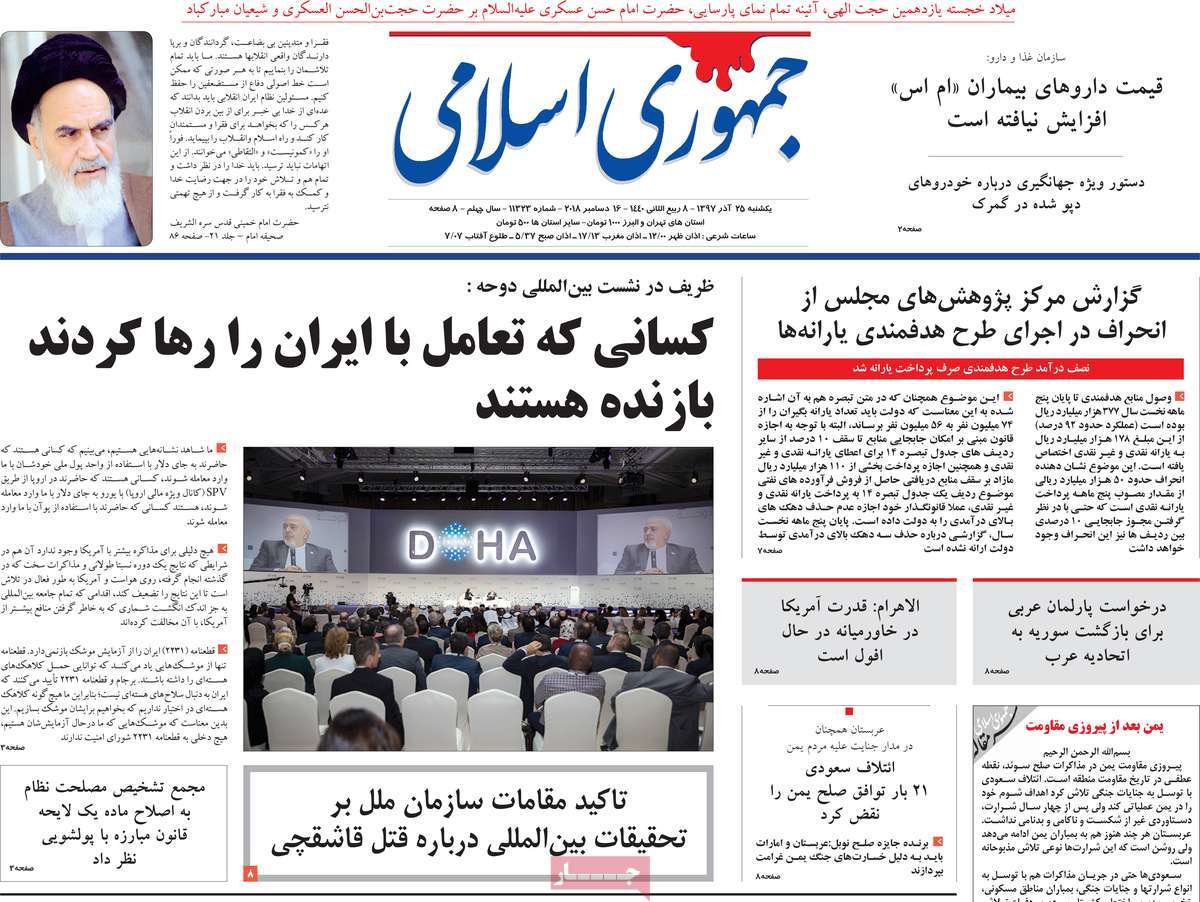
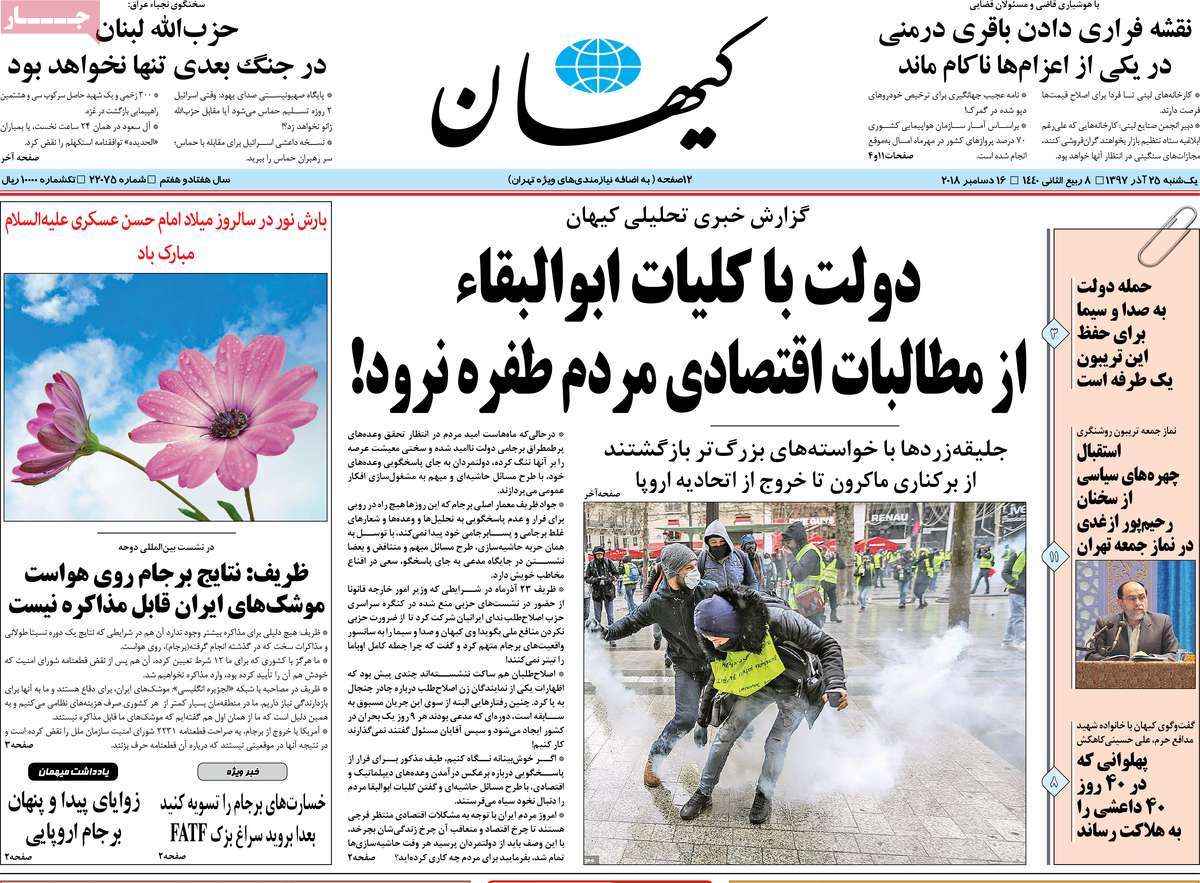
A top story today was comments made by Iranian Foreign Minister Mohammad Javad Zarif during his address to the Doha Forum 2018 in the Qatari capital.

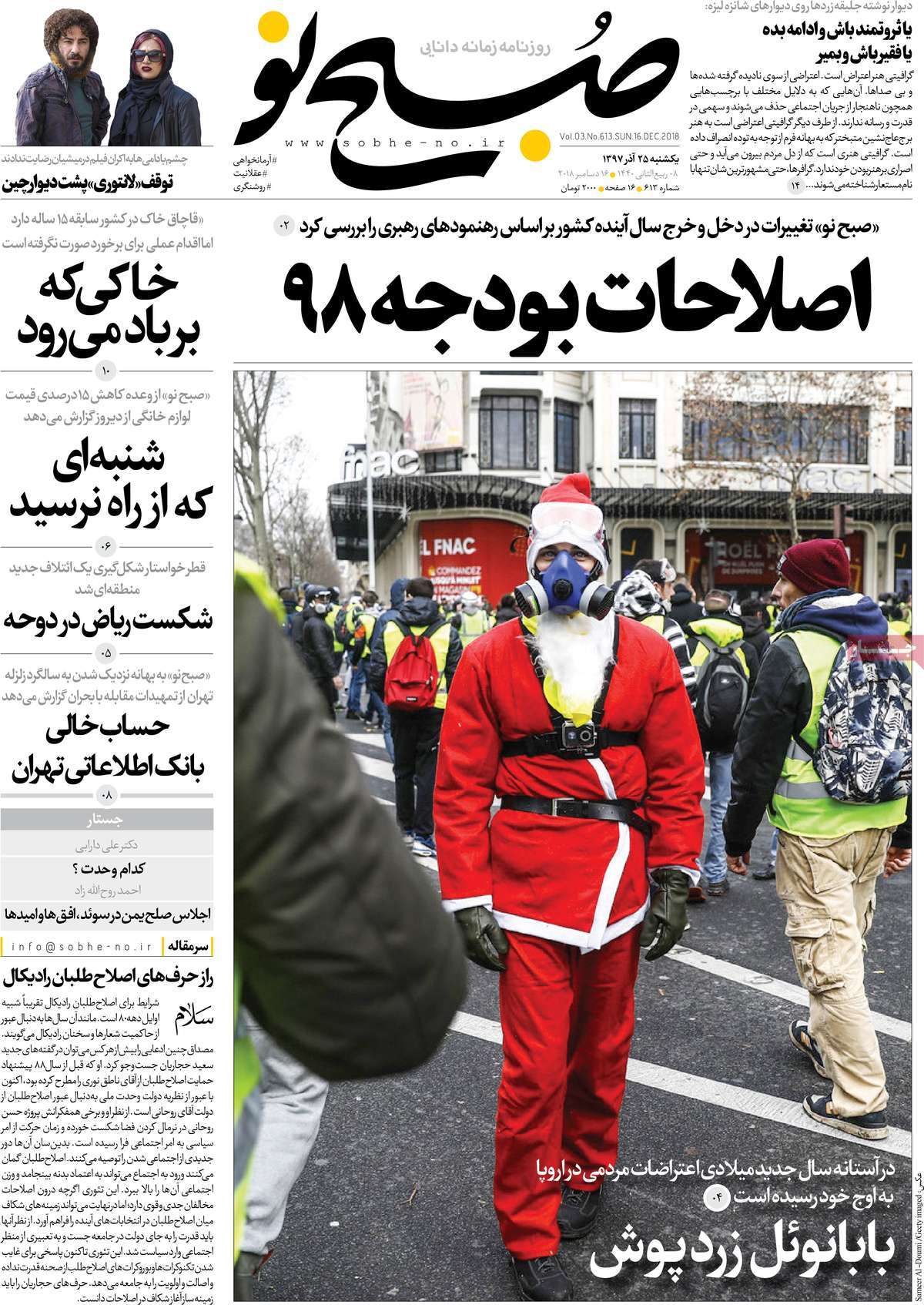
Several papers also covered the return of Yellow Vest protesters to the streets of France on the fifth consecutive weekend.

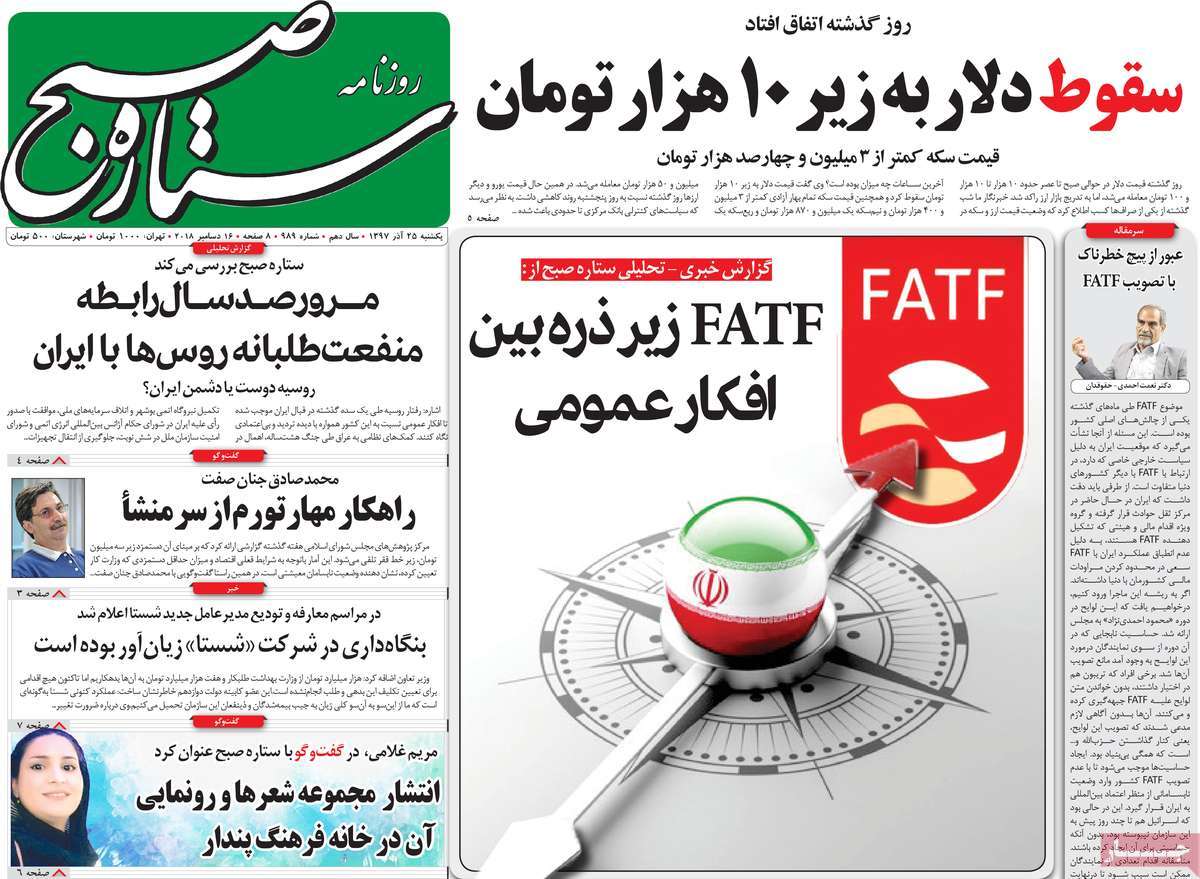
The controversy over Iran’s adoption of the standards set by the Financial Action Task Force (FATF), the global anti-money laundering body, also remained a top story.

The above issues, as well as many more, are highlighted in the following headlines and top stories:


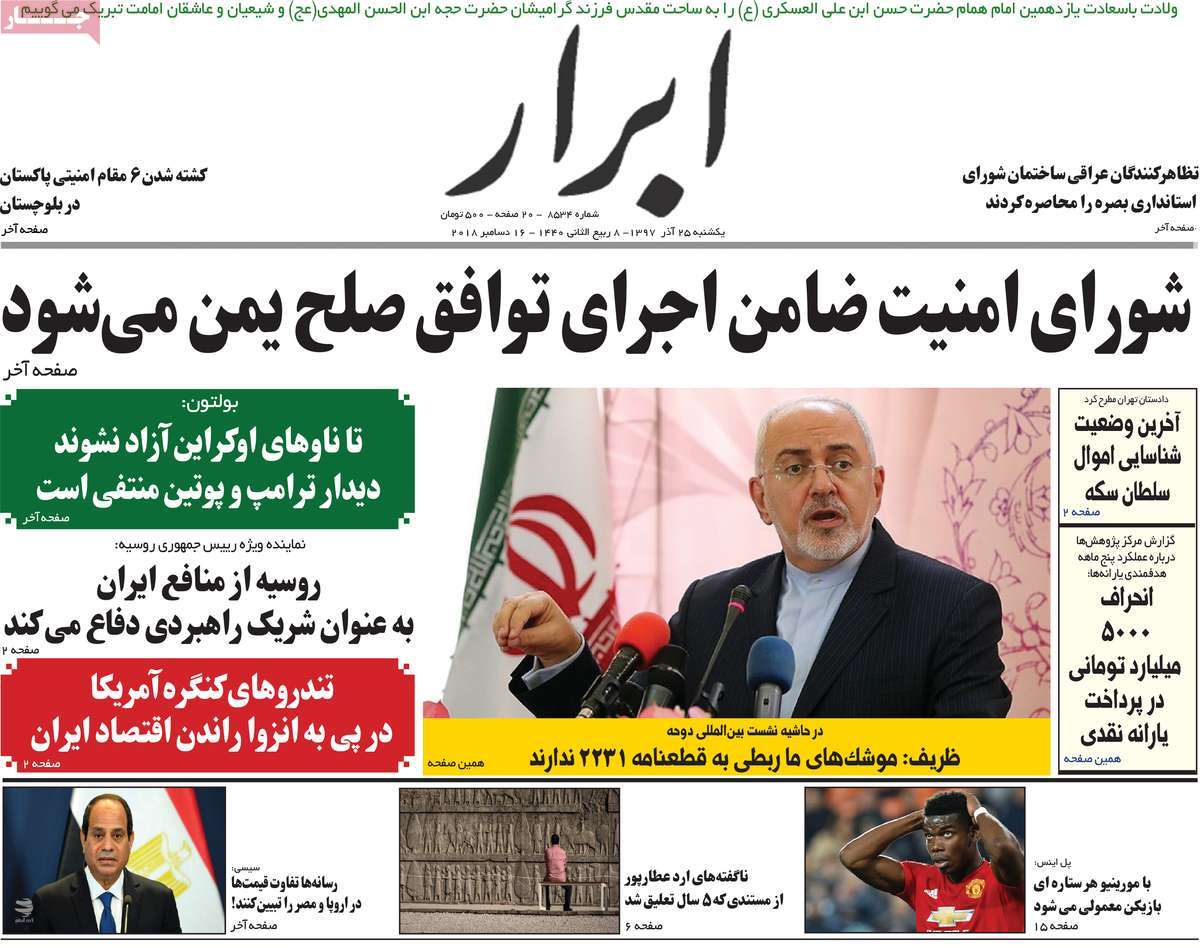
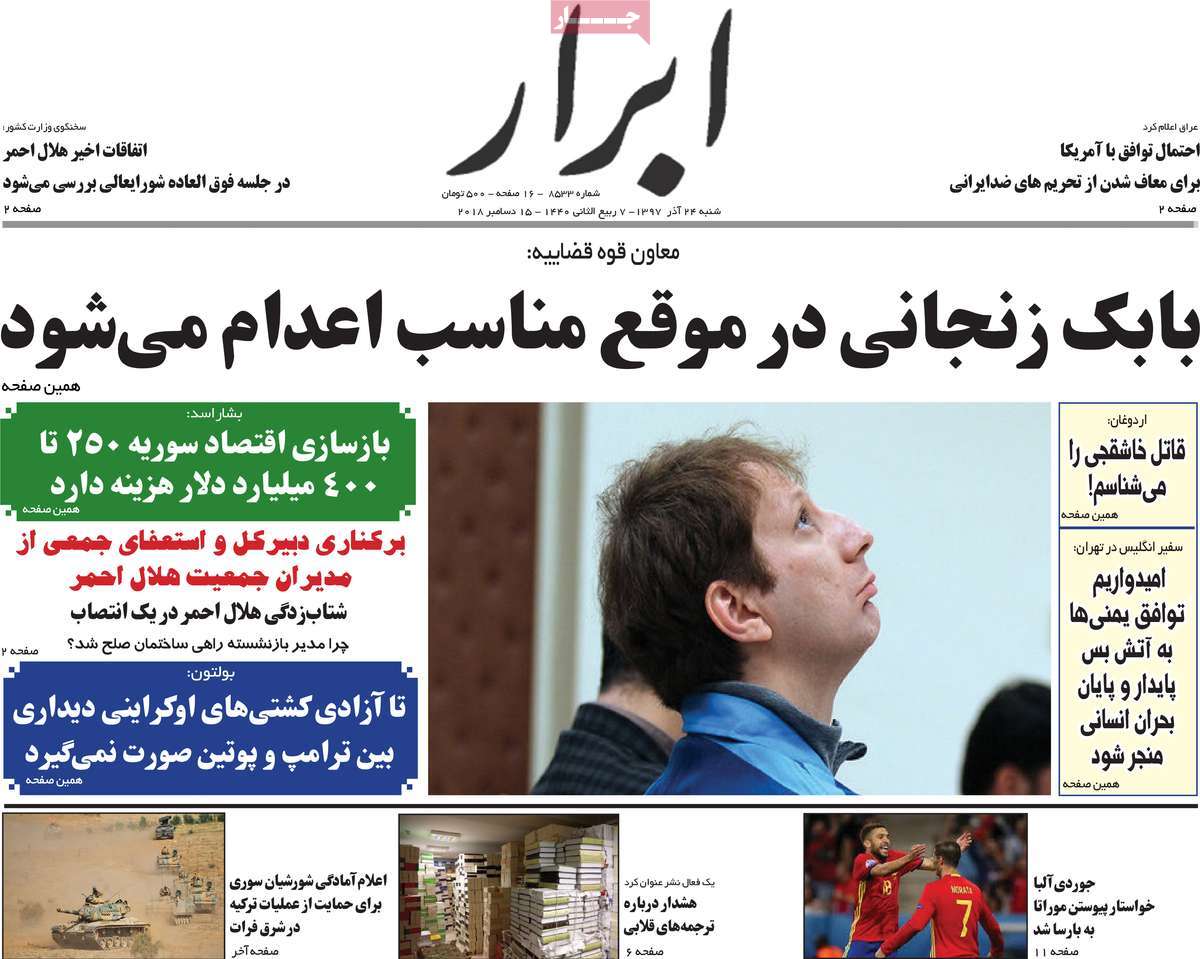
Abrar:

1- UN Security Council to Become Guarantor of Yemen Peace Deal

2- Six Pakistani Security Forces Killed in Balochistan

3- Iraqi Protesters Surround Basra Governor’s Office

4- Bolton: Trump-Putin Meeting Cancelled until Ukraine Warships Freed

5- Russian Envoy: Russia Supports Iran’s Interests as Its Strategic Partner

6- Radicals in US Congress Trying to Isolate Iranian Economy

A Look at Iranian Newspaper Front Pages on December 16


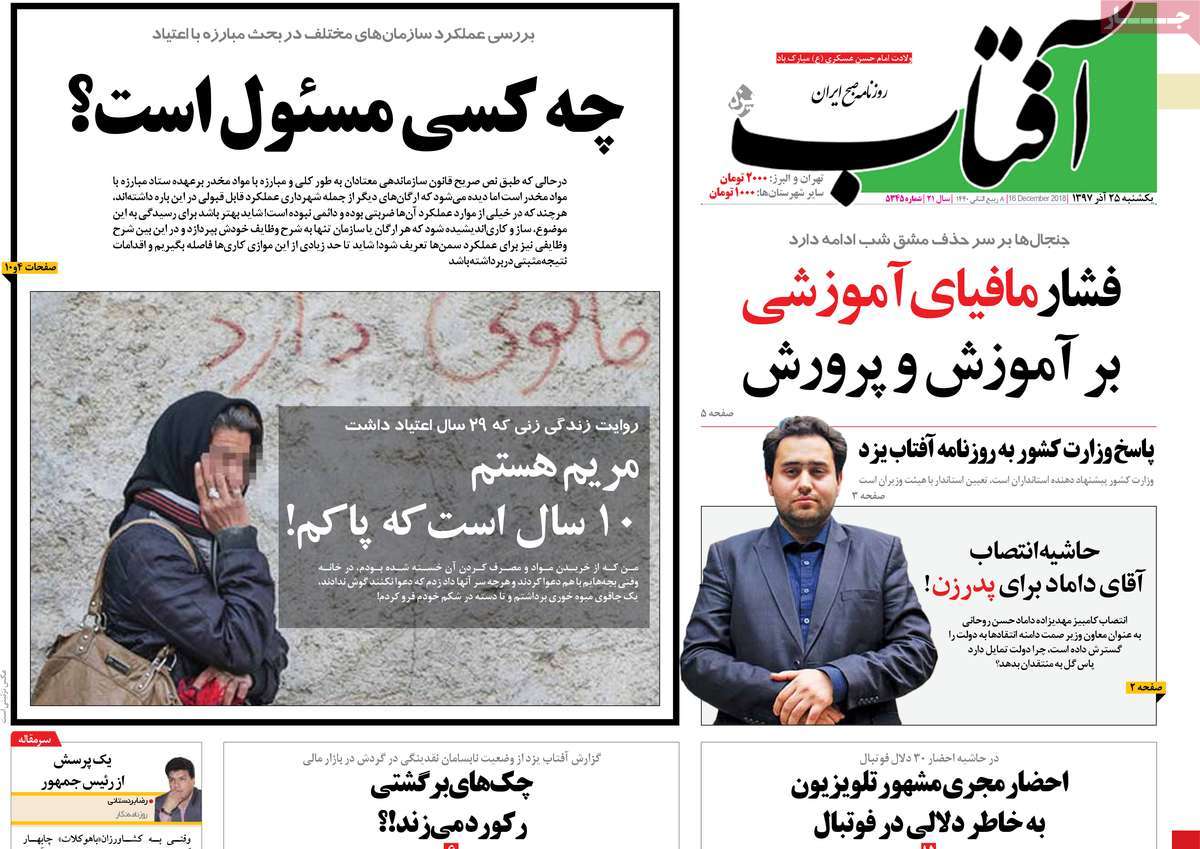
Aftab-e Yazd:

1- Education Mafia Putting Education Ministry on Pressure

  • Controversy over Students’ Homework

A Look at Iranian Newspaper Front Pages on December 16


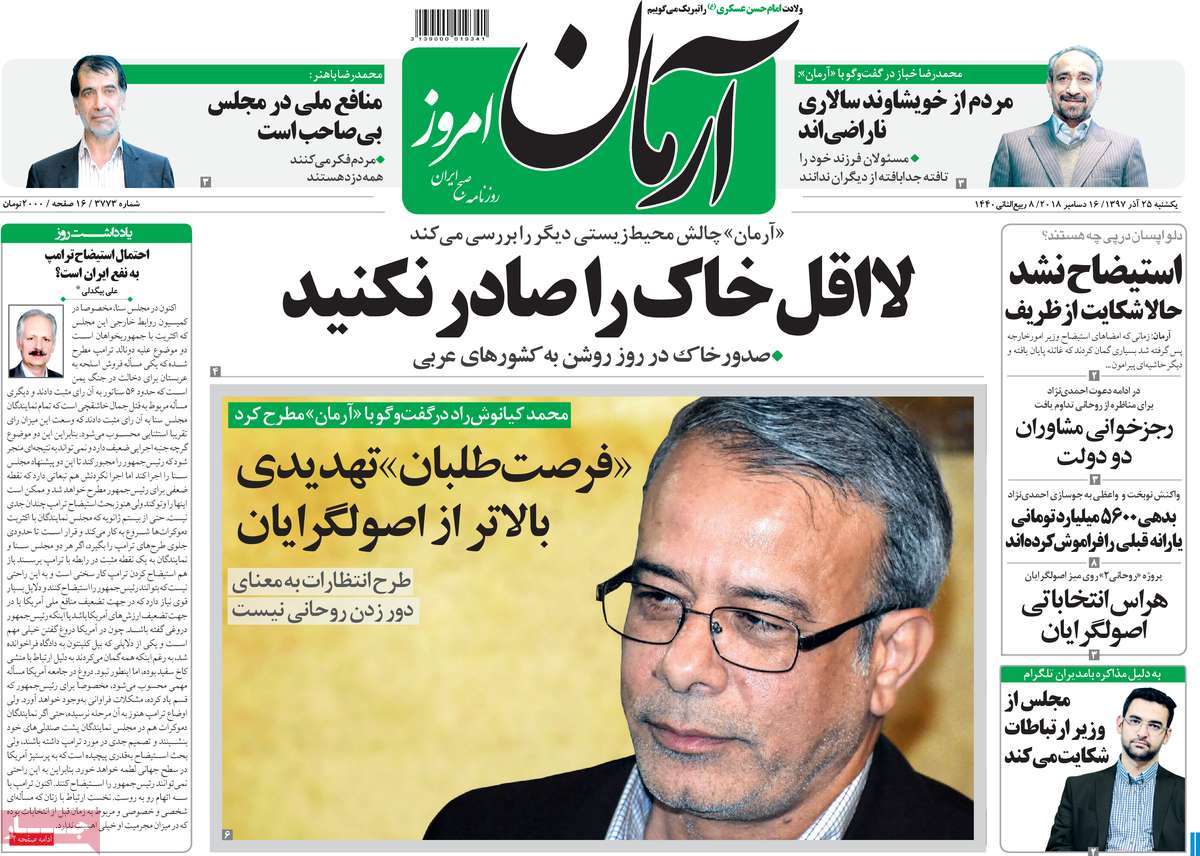
Arman-e Emrooz:

1- Will Trump’s Impeachment Serve Iran’s Interests? [Editorial]

2- Parliament to Sue ICT Minister over Holding Talks with Telegram Managers

A Look at Iranian Newspaper Front Pages on December 16


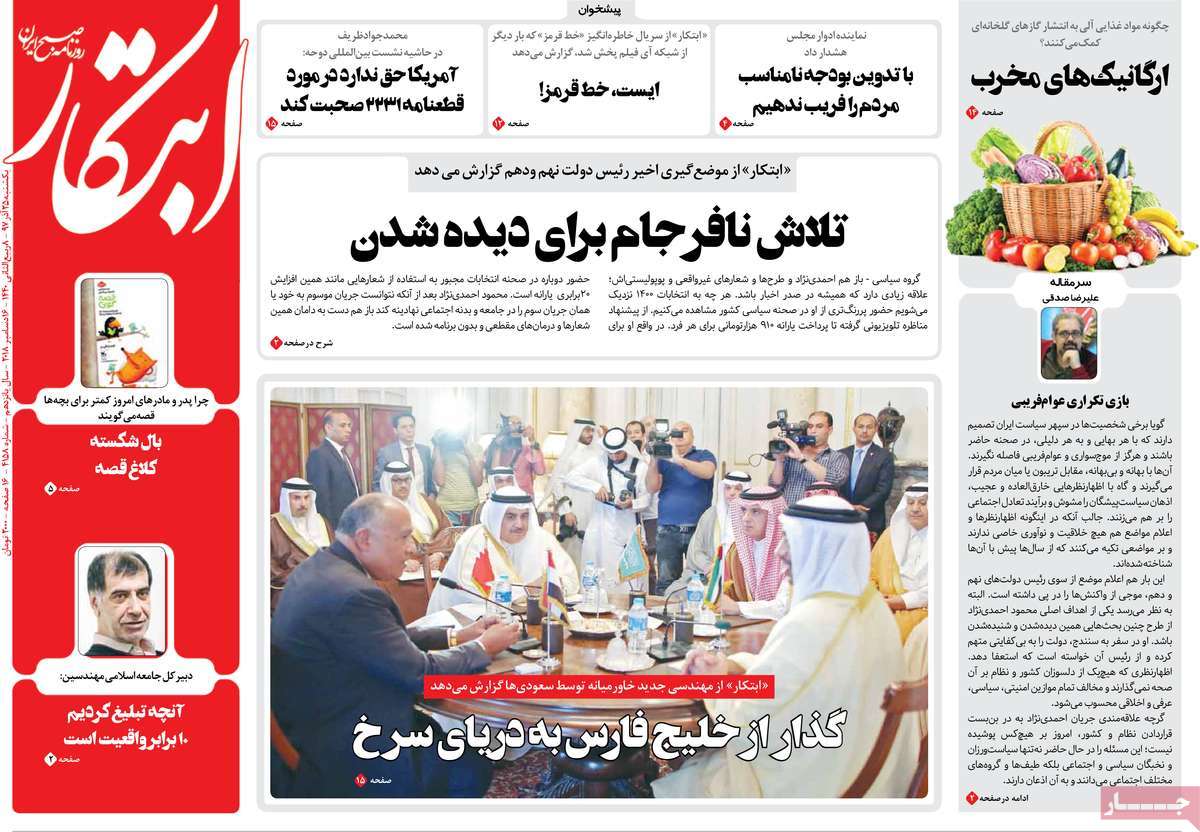
Ebtekar:

1- Saudis’ New Plan for Middle East: From Persian Gulf to Red Sea

2- US Not in Position to Talk about UN Security Council Resolution 2231: Zarif

A Look at Iranian Newspaper Front Pages on December 16


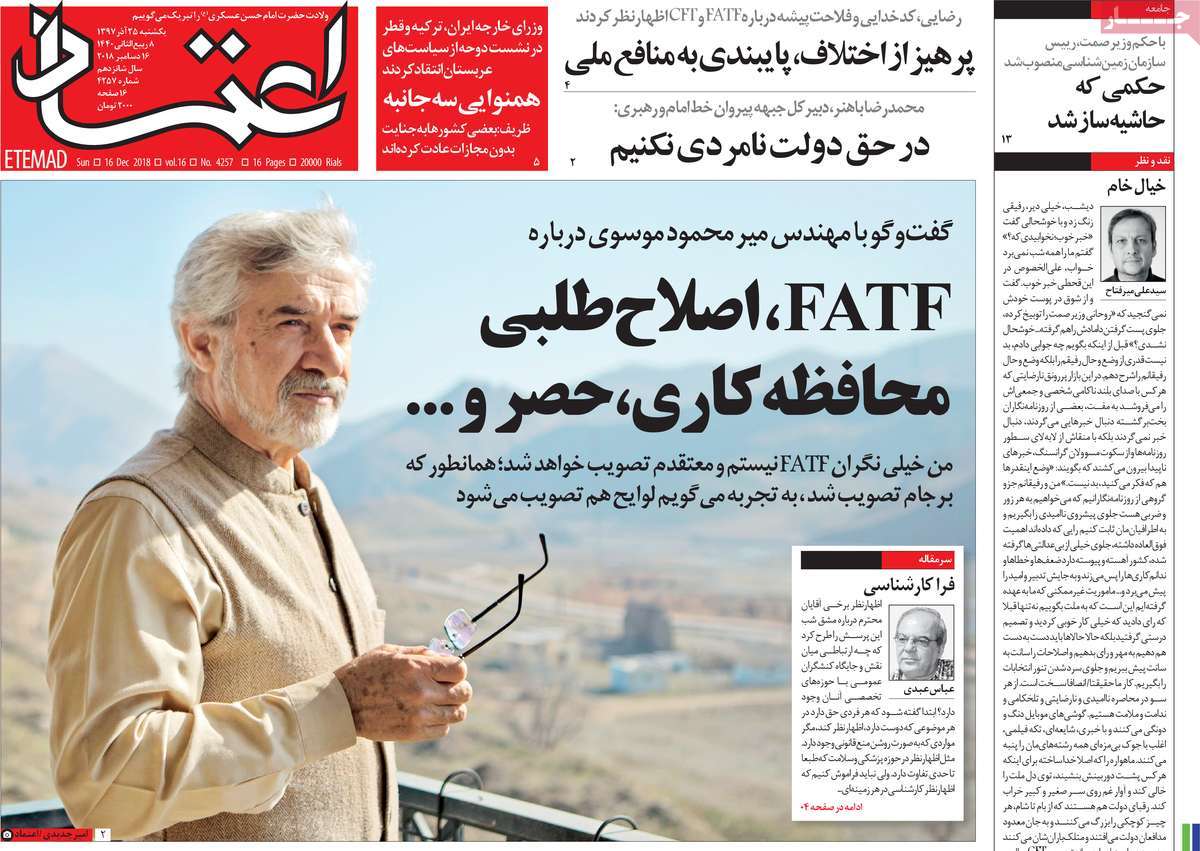
Etemad:

1- Trilateral Consensus: Iran, Turkey, Qatar Unanimously Criticize Saudi Policies

  • Zarif: Some Countries Accustomed to Committing Crime without Being Punished

2- Avoiding Disagreement, Remaining Committed to National Interests

  • Officials from Expediency Council, Guardian Council, Parliament Talk about FATF

A Look at Iranian Newspaper Front Pages on December 16


Ettela’at:

1- No Reason for Talking Talks with US: Zarif in Doha

  • Iran’s Missiles Non-Negotiable, Have Nothing to Do with UNSC Resolution 2231

2- Erdogan: Development of Ties with Iran Strategically Important for Turkey

3- Saudi Coalition Launches 21 Airstrikes against Hudaydah One Day after Truce

4- One Killed in Latest French Crackdown on Yellow Vest Protests

A Look at Iranian Newspaper Front Pages on December 16


Iran:

1- Zarif: We Won’t Hold Talks Only for Photo Opportunities

2- FATF, Specialized Issue Not Related to Clerics: Religious Experts

A Look at Iranian Newspaper Front Pages on December 16


Javan:

1- Qatar FM: GCC Has No Teeth, Power

2- Zarif: Negotiating with US Futile, Only for Photo Opportunity

A Look at Iranian Newspaper Front Pages on December 16


Jomhouri Eslami:

1- Those Who Stop Interaction with Iran Are Losers: Zarif

2- Arab Parliament Calls for Return of Syria to Arab League

3- Al-Ahram: US Power in Mideast Declining

4- UN Officials Call for Int’l Investigation into Khashoggi’s Murder

A Look at Iranian Newspaper Front Pages on December 16


Kayhan:

1- Iraq’s Nujba Movement: Lebanese Hezbollah Not to Be Left Alone in Next War

2- Zarif: Iran’s Missiles Not Negotiable

A Look at Iranian Newspaper Front Pages on December 16


Setareh Sobh:

1- US Dollar Rate Down to Less than IRR 100,000

2- Iran to Pass Dangerous Turn by Ratifying FATF [Editorial]

A Look at Iranian Newspaper Front Pages on December 16


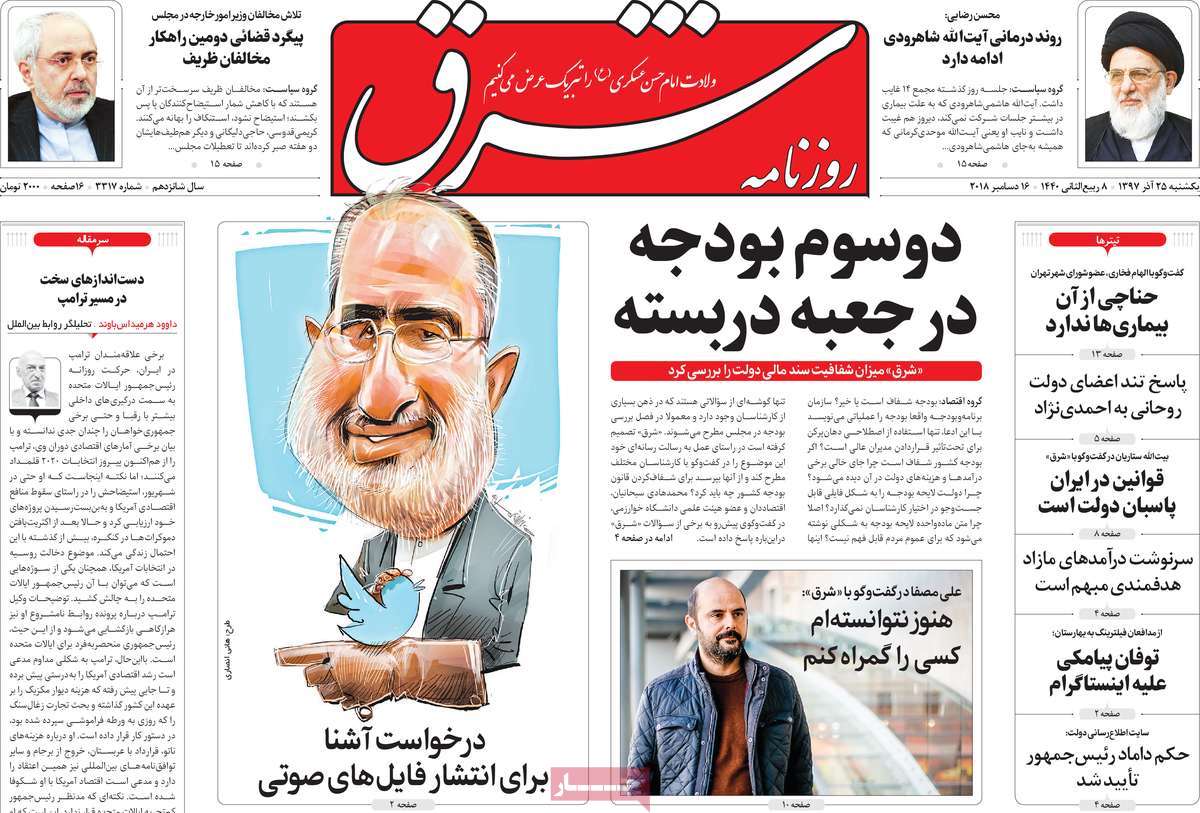
Shargh:

1- Laws in Iran Protect Government: Analyst

2- Opponents of Zarif Trying to Take Him to Court

3- Difficult Path ahead of Trump [Editorial]

A Look at Iranian Newspaper Front Pages on December 16


Sobh-e Now:

1- Santa Clause in Yellow Vest: Popular Protests in Europe Reach Their Peak ahead of Christmas

  • Be Wealthy and Survive or Be Poor and Die: Yellow Vest Protesters

A Look at Iranian Newspaper Front Pages on December 16

Iran Condemns Deadly Terror Attack in Pakistan

A file photo of Pakistan's Balochistan security personnel. / Photo by INP

In a Saturday statement, Bahram Qassemi expressed condolences to Pakistan’s government and people as well as the families of the victims and those wounded in the terrorist incident.

He also said the Islamic Republic of Iran is fully prepared to take part in any joint campaign against the scourge of terrorism in the region in any form or shape.

Six Pakistani soldiers were killed when a paramilitary convoy came under attack by gunmen in southwestern Balochistan province.

The shooting took place in the mountainous district of Kech on Friday, when soldiers from the paramilitary Frontier Corps (FC) were on a routine patrol, officials said.

The separatist Pakistani group the Balochistan Liberation Army (BLA) claimed responsibility for the attack.

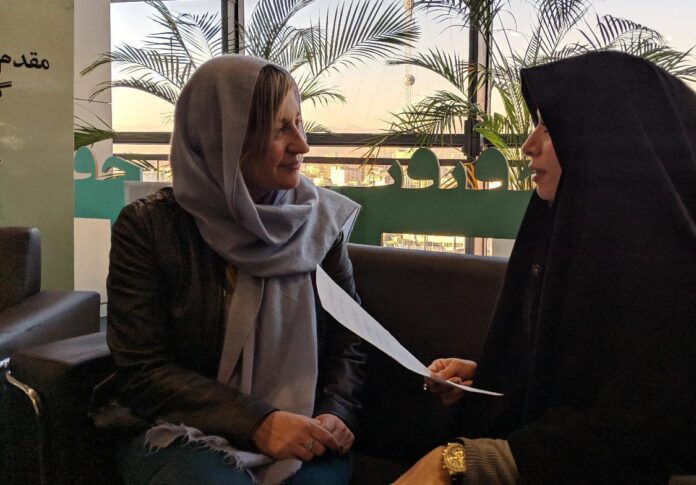
‘Cinema Great Chance to Give True Image of Women in Iran’

The cultural activist, who is in Tehran to attend the Cinema Verity international documentary film festival, made the comment in an interview with IRNA.

She recounted her experience of visiting Tehran, and said Iran is a fabulous country with a culture that is the cradle of all world cultures.

She said Iran is a peace-loving country which would like to open up to the whole world.

She said Iran’s cinema is very vast and rich, and has many productions to offer to international film markets. She said the cinema industry is a proper opportunity for Iran to present the realities of this country to the world and rectify the untrue image of Iran painted by certain foreign media outlets.

She said one of the good subjects for foreign film-makers can be Iranian women’s active role in society, including their role on cultural and educational fronts as well as their way of thinking, how they manage their lives and how interested they are in their country.

She was asked whether or not her observations in Iran regarding women and their role in society were consistent with the accounts given by certain Western media. In response, the cultural activist said that some Western media outlet claim women’s role and rights are mostly ignored in Iran. However, she says, “I found out during this short trip to Iran that women are very active, strong, effective and dynamic and play key roles in society.”
To mention a few examples of Iranian women’s role in society, she says, one can refer to the women taking part in this Tehran festival as well as the women working at different managerial levels and even women taxi drivers. She says Iranian women are educated.

“Some of them go abroad for education and return to their country after they finish their studies. This is very interesting to me and it can bring a better future for Iran. In my opinion, media give their audience the kind of information which they want and which serves their interests,” she said.

She was asked how she would describe to friends and family her experience of visiting Iran when she returns home. In response, she said her trip to Iran was unfortunately very short and that she would definitely travel to Iran whenever she gets the chance to.

“I also recommend my friends not miss the chance to visit Iran. I will tell them that Iran and Tehran are very safe, lively and dynamic,” she said.

Addressing some leaders of major world powers who do not know Iran’s history and civilization well and who sometimes talk about Iran with the language of threat and sanctions, she said, “Try to understand others and those who think differently and [try] to respect others’ beliefs and thoughts.”

She concluded by saying that she believes Iran is an extraordinary and cultural country which is the birthplace of all other cultures in the world.

Archaeological Museum of Tehran Opens to Public

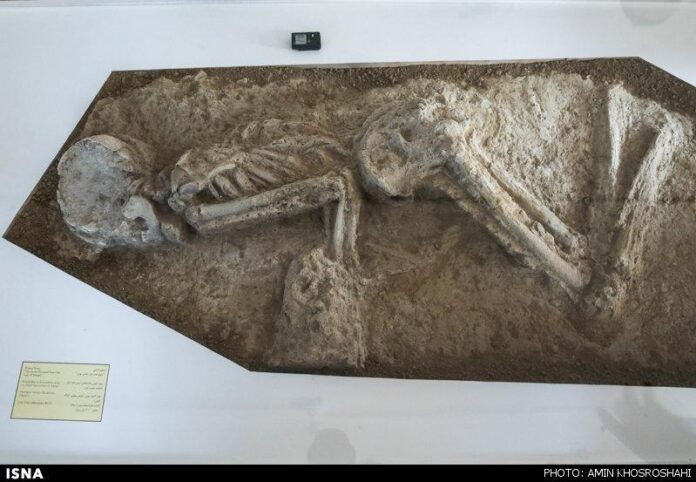
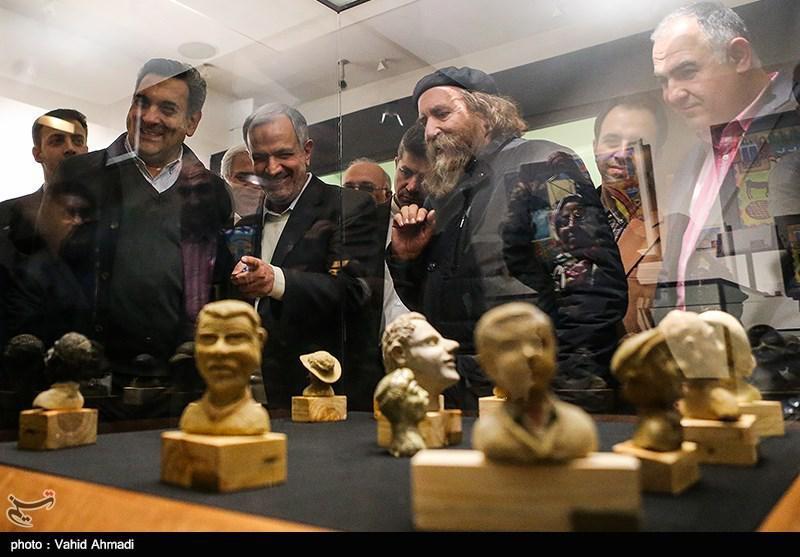
Speaking on the sidelines of the opening ceremony, Tehran’s mayor Pirouz Hanachi said that more than 200 objects belonging to the city of Tehran are exhibited in this museum.

The objects discovered in Tehran are not ordinary ones and should be put on show for the public in order to inform them about the city and its features, he added.

Archaeological Museum of Tehran Opens to Public

“Tehran is an ancient and historical city whose artifacts date back to the reign of Shah Tahmasp in 16th century,” he added.

“Items found in Tehran show that the city dates back to more than 8,000 years ago proving that the Iranian capital is a historical city,” said Hanachi.

Iranian Rial Regains Lost Value as Forex Market Returns to Stability

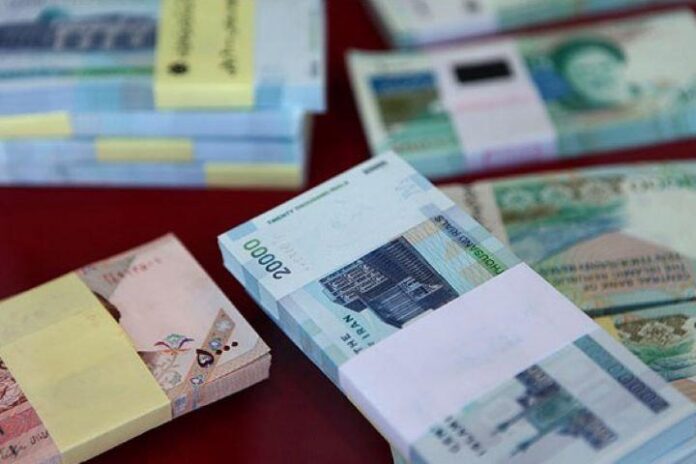
The Iranian currency has been strengthened sharply in recent days, with US dollar being traded around 101,500 rials in governmental exchange offices in Tehran on Saturday, media reports said.

The rial’s recovery is considered remarkable, compared with record lows around 190,000 against the US dollar in late September.

Iran’s national currency had dropped past 100,000 for the first time in late July as Iranians braced for the return of the first batch of economic US sanctions, and rial’s fall continued in the coming months.

Some believed a wave of panic buying of dollar triggered over fears of the repeat of the historic decline of the national currency amid the tightening of anti-Iran sanctions in 2011 led rial to slide to record lows.

Some others thought the dramatic decline results from adversarial plots to sabotage the Iranian economy.

Anyway, the dramatic decline in the value of rial sharply increased the prices of imported consumer goods and depressed some markets in recent months.

However, the trend was reversed early November, when the second batch of US sanctions came back but left no tangible impact on Iranian economy.

This is while the US, which pulled out of the 2015 nuclear deal in May, had vowed to exert “maximum pressure” on Iran’s economy to force negotiations on tougher limits on its nuclear and missile activities.


Central Bank’s Role

The rial’s rise is good news for a government which is struggling to prevent US sanctions on Iran’s oil, banking and other industries from pushing the economy into recession.

The hike comes in the wake of the introduction of new currency policies by the Central Bank of Iran.

Early August, Abdolnasser Hemmati, the newly-appointed governor of the Central Bank of Iran (CBI), unveiled a package of measures to rein in the recent turbulence in foreign currency market in Iran.

According to the new policy, hard currency was made available at a subsidized rate of 42,000 against the US dollar for purchases of basic and essential goods and medicine.

Moreover, a secondary currency market was launched to give importers of non-essential goods access to hard currency brought home by the nation’s exporters at floating rates.

According to the package, the ordinary people in need of foreign currency for travelling abroad or other usages could purchase foreign currencies from exchange offices at a price close to the secondary market rates.

That reversed a decision in April to ban trading currency outside the official rate of 42,000 rials to the dollar.

Other Factors at Play

Some observers have attributed the recovery to limitations on banking transactions and purchases of dollars as well as a ban on send-outs by unlicensed exchange shops.

Analysts believe positive news regarding Iran’s oil sale, particularly the exemption of main buyers of Iran’s oil, has also accelerated the downfall of US dollar.

This is while following the US withdrawal from the nuclear deal, White House officials were vowing they will reduce “Iran’s oil exports to zero.”

President Hassan Rouhani said in a statement on Tuesday export of Iranian oil has improved since early November.

Separately, the European Union’s foreign policy chief said on Monday a promised financial mechanism to facilitate non-dollar trade with Iran could be in place by the yearend.

The European Union has agreed to create the so-called Special Purpose Vehicle as parts of efforts to compensate for the US withdrawal and convince Iran the economic benefits from the nuclear deal will be preserved.

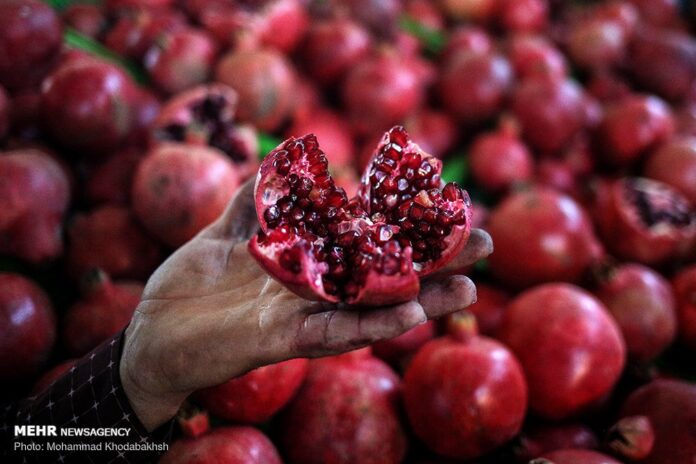
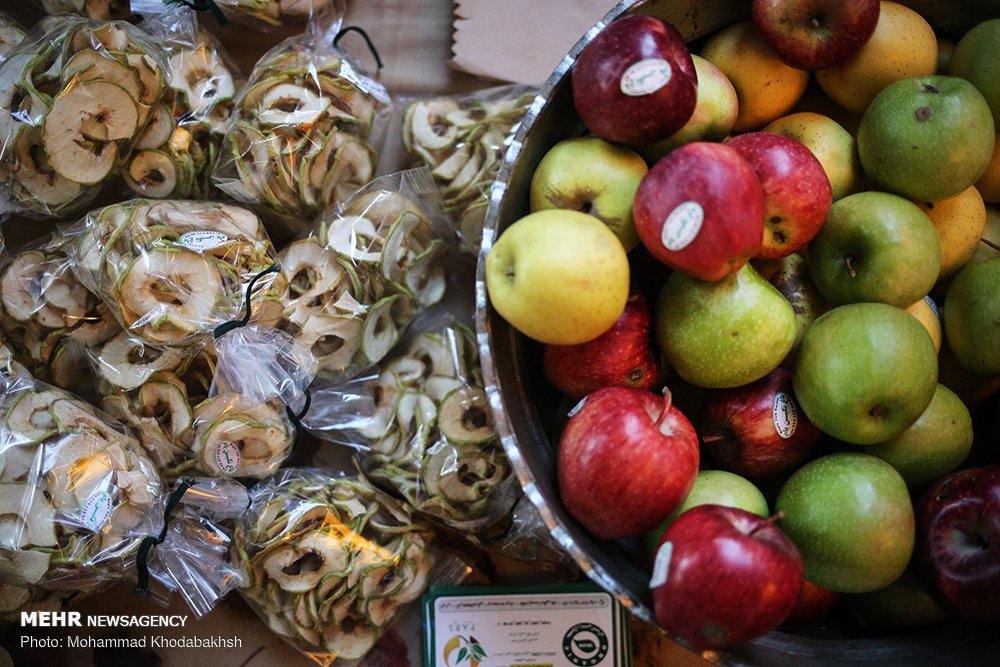
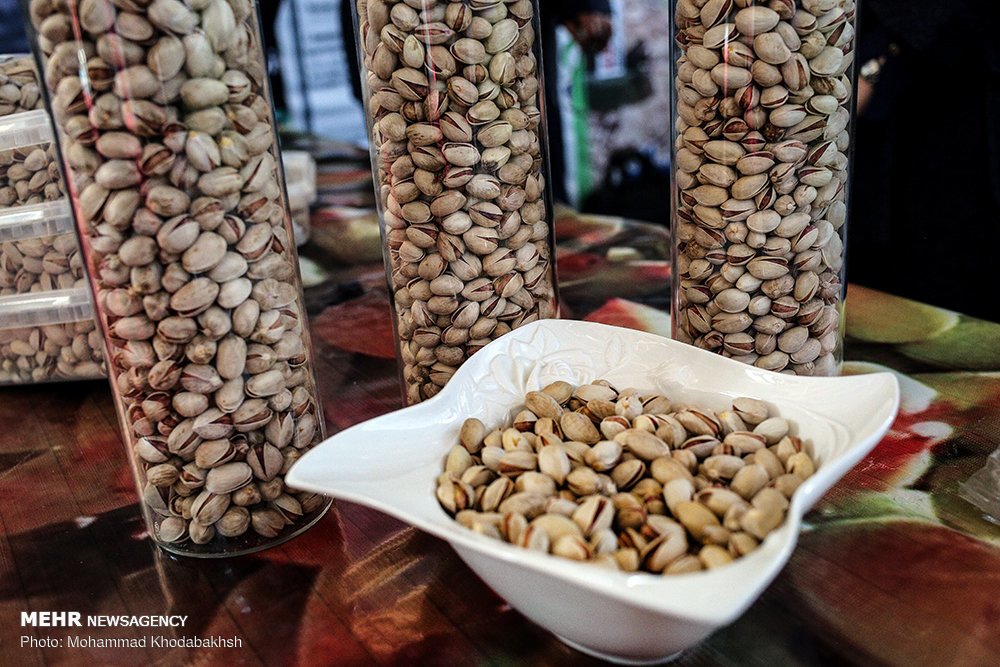
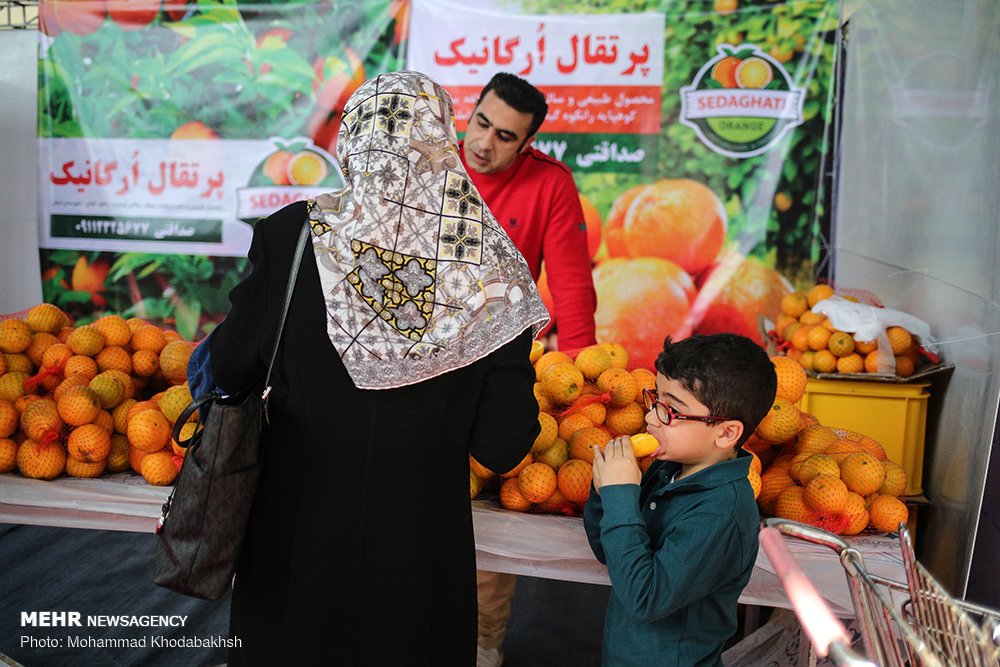
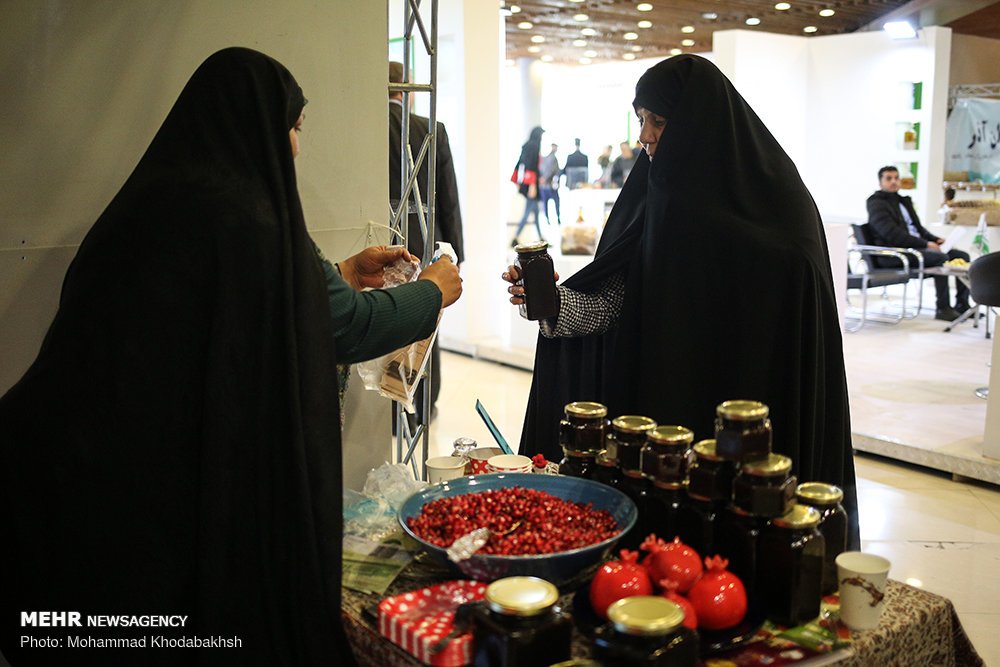
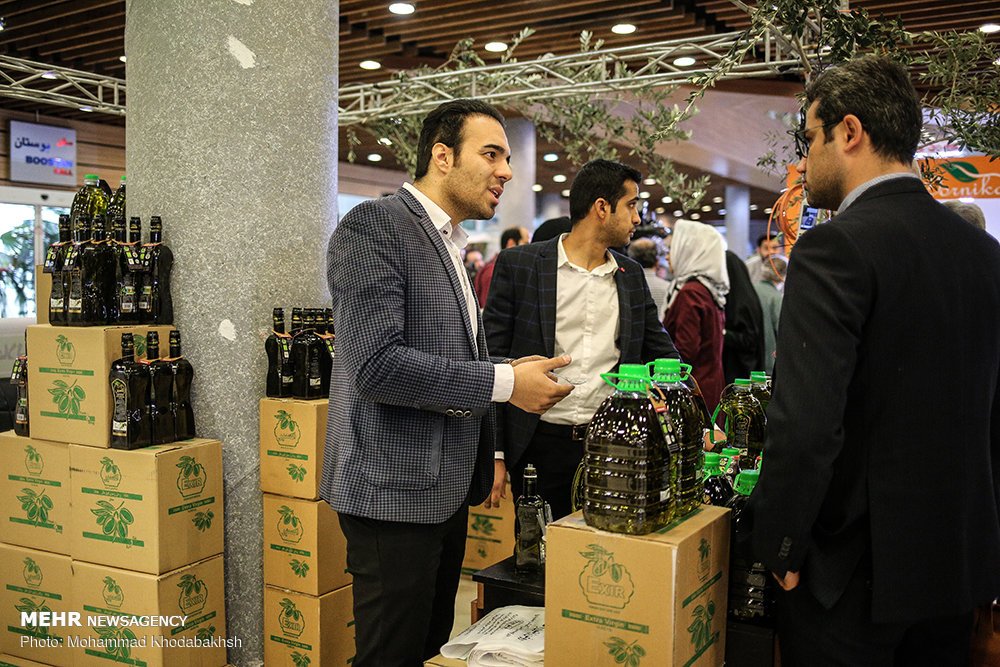
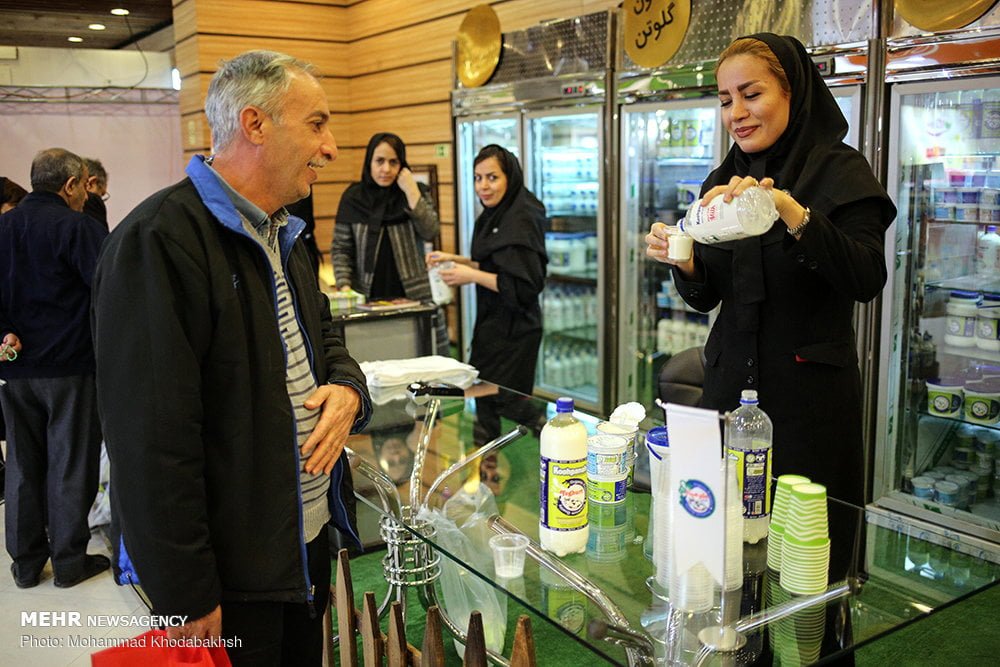
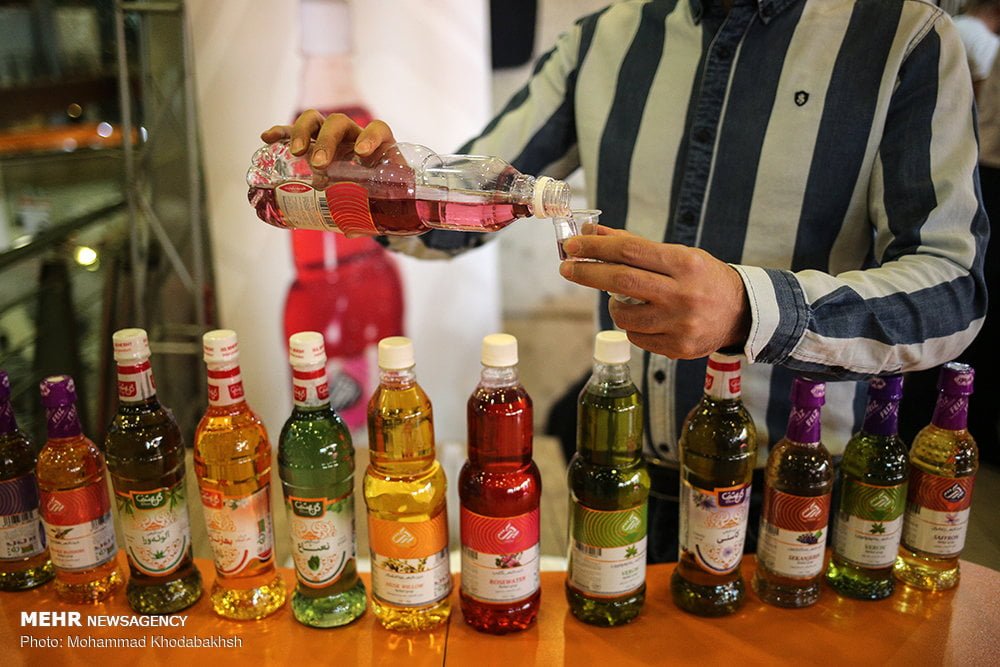
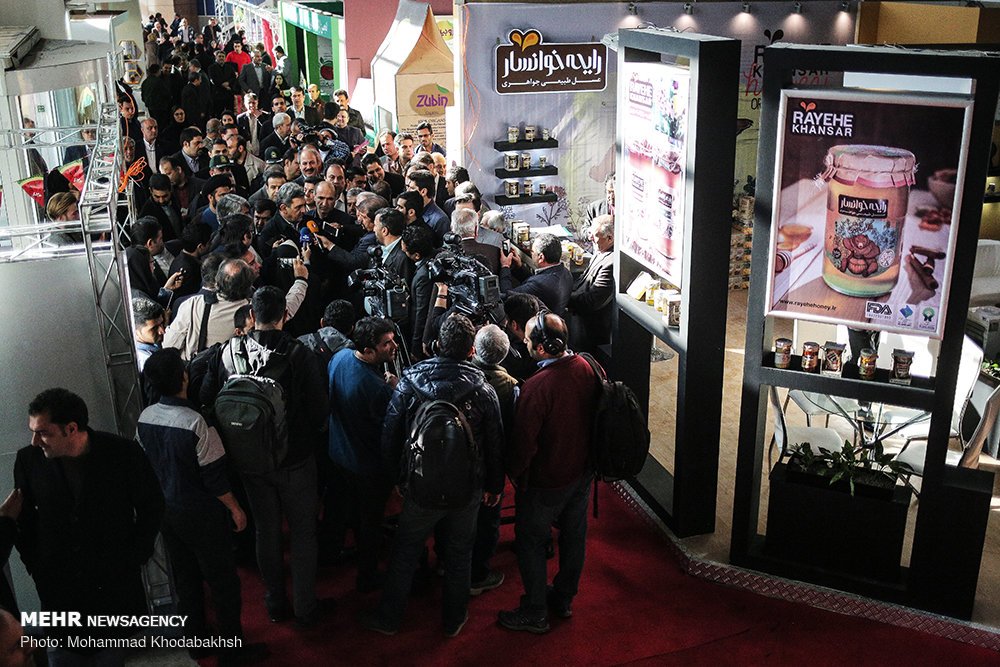
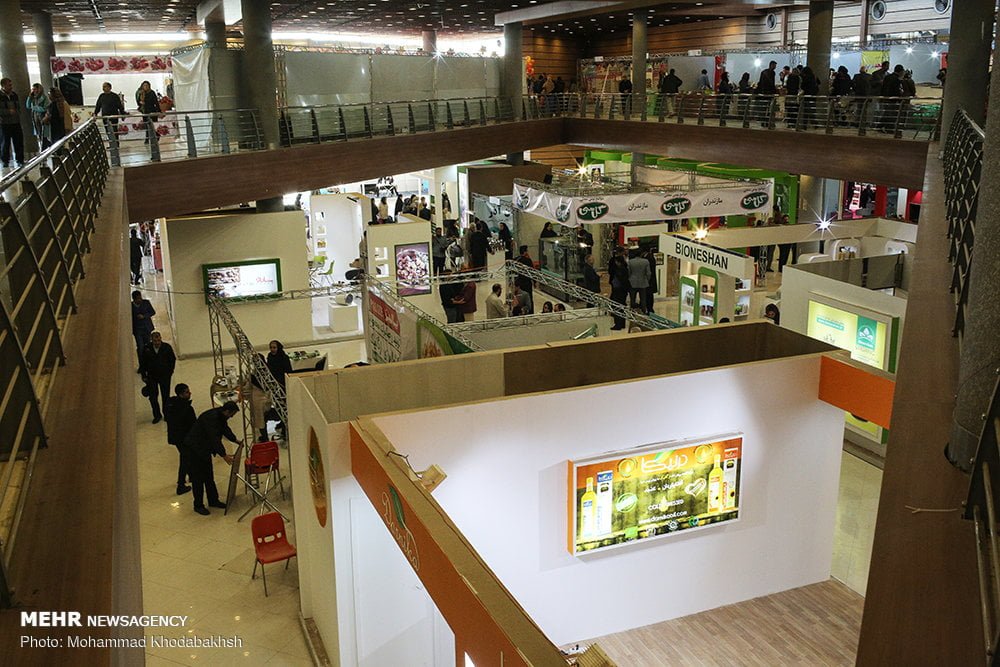
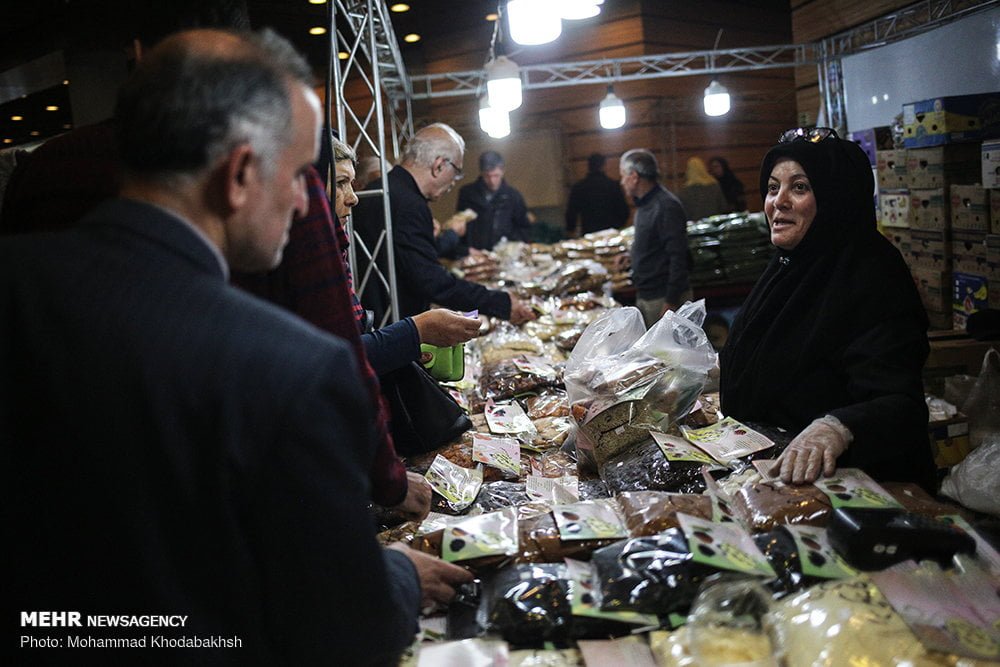
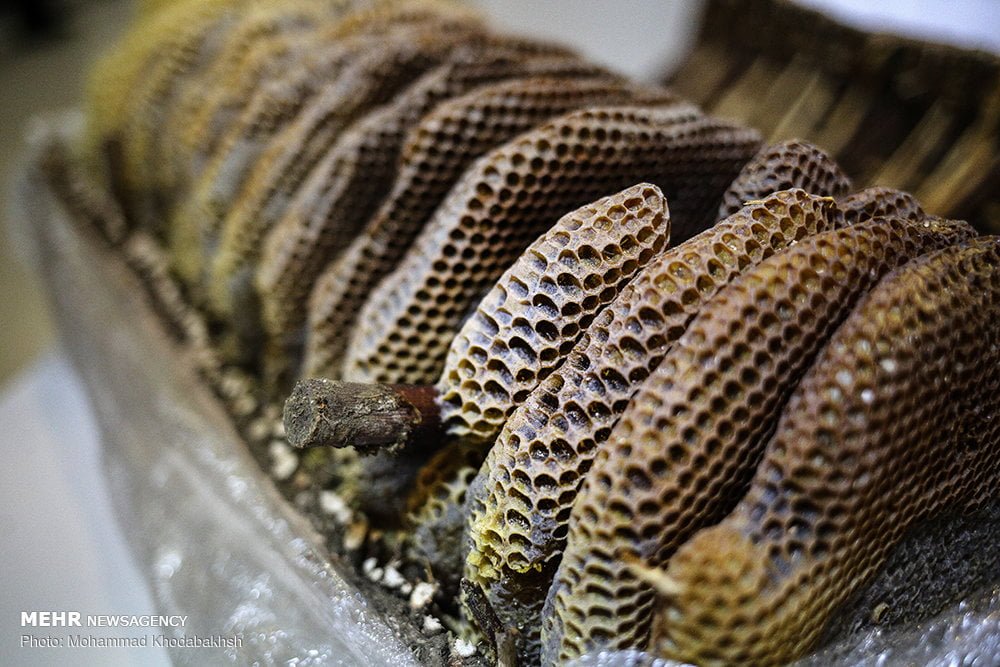
Tehran Hosting Organic Food Fair ahead of Yalda Night

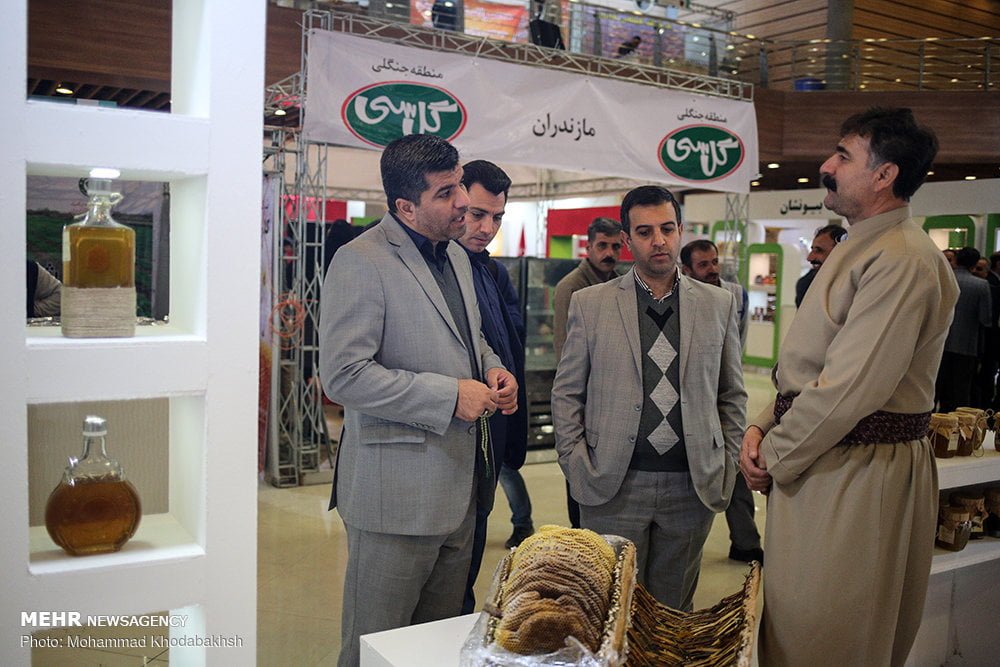
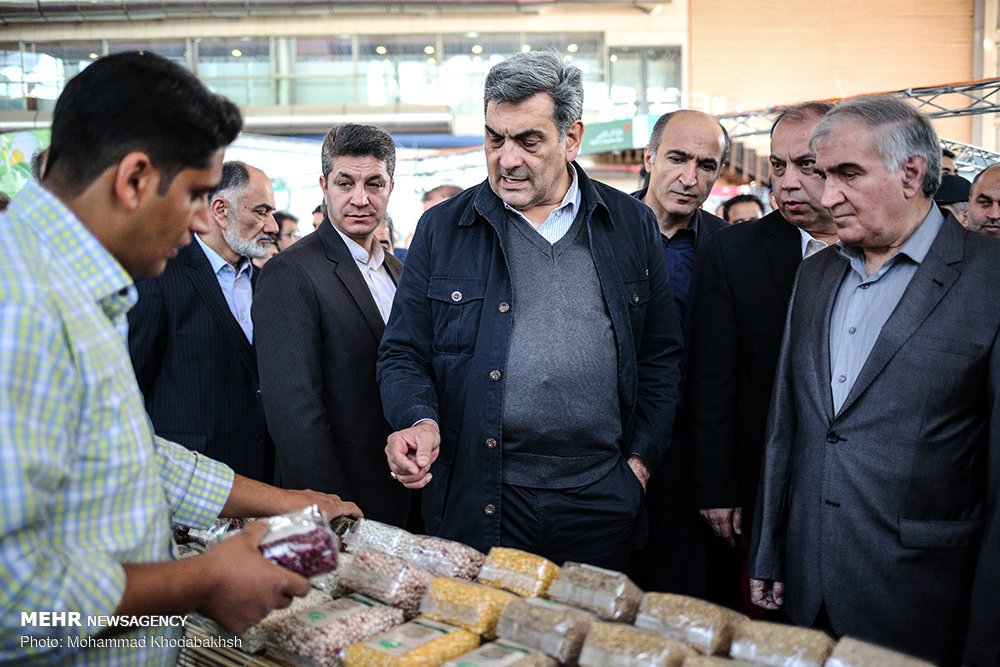
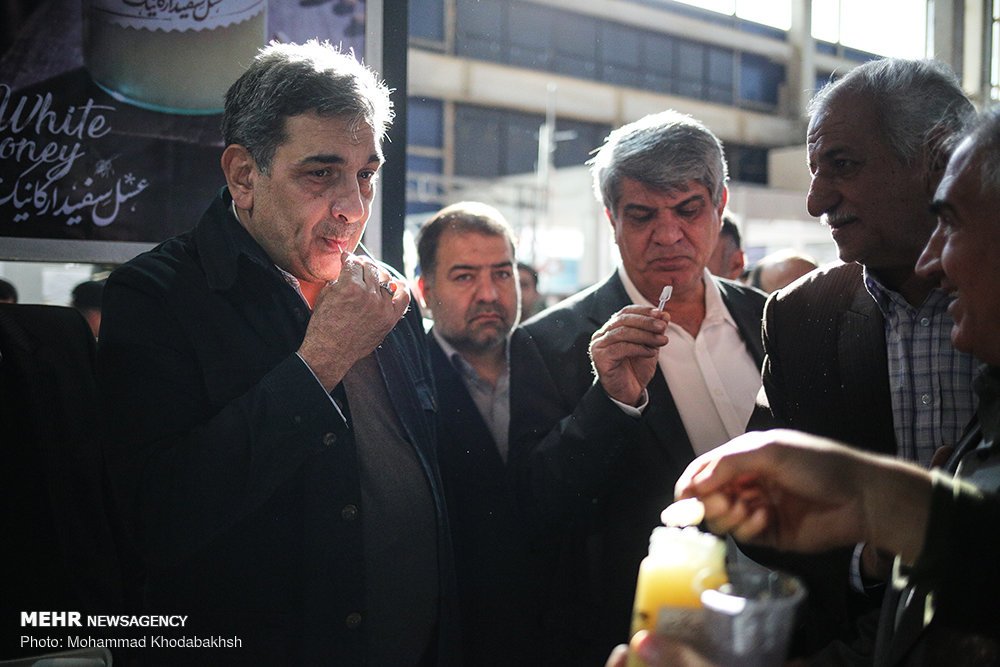
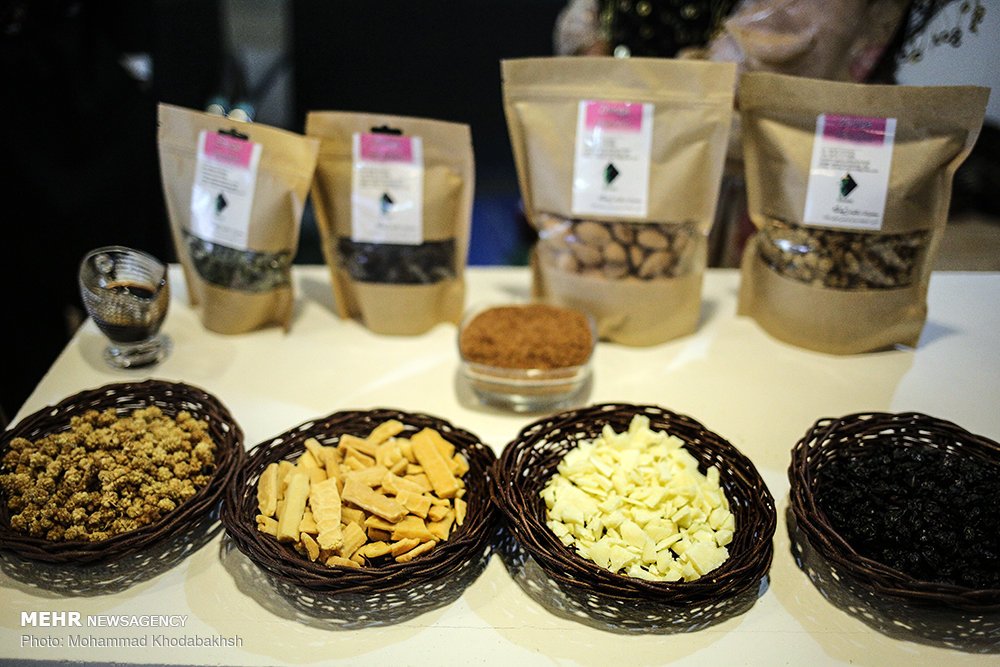
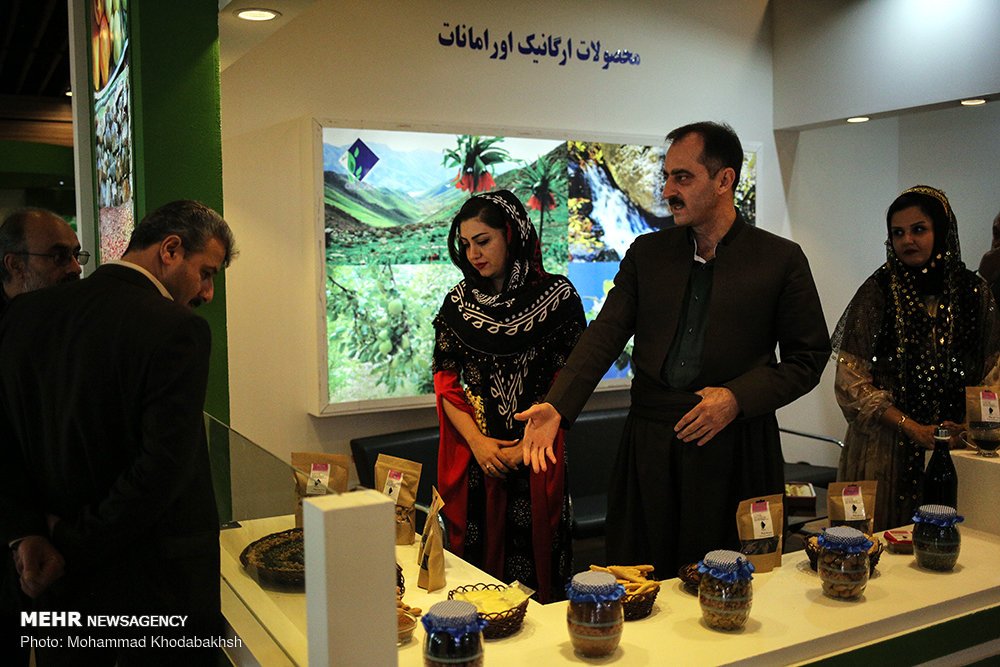
Every year, a few days before Yalda, Iranians hit the market to buy nuts, fruits and other edible products.  This year, on the occasion of the Persian festival, an exhibition of organic products is being held in Tehran.

Yalda Night or Shab-e Chelleh is the Iranian festival of winter solstice celebrated on the longest and darkest night of the year. It is the night between the last day of the ninth month (Azar) and the first day of the tenth month (Dey) of the Iranian calendar.

Yalda is one of the ancient festivities celebrated by Iranians, Afghans, Tajiks and Uzbeks. During the night, friends and family gather together to eat, drink and read poetry until well after midnight.

On this night, it is customary to sit at a tablecloth which is decorated with nuts, pomegranate, and watermelon. The poems of renowned Persian poet Hafez, which can be found in the bookcases of most Iranian families, are read or recited at this ceremony. Poets also recite their own poems for others.

Yalda night was officially added to Iran’s List of National Heritage in a special ceremony in 2008.

The exhibition of organic food products with 110 stands and three halls will run for one week until December 21.

What follows are photos of the exhibition retrieved from Mehr News Agency:


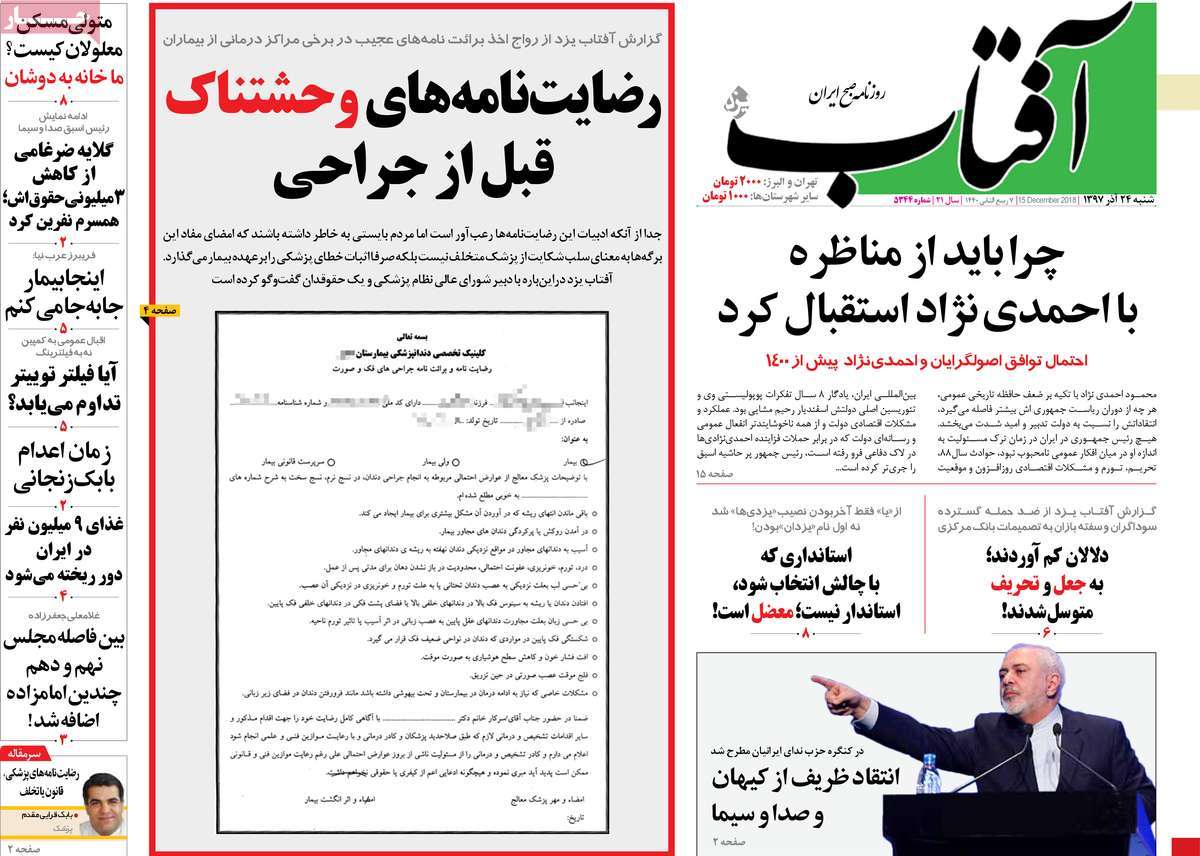
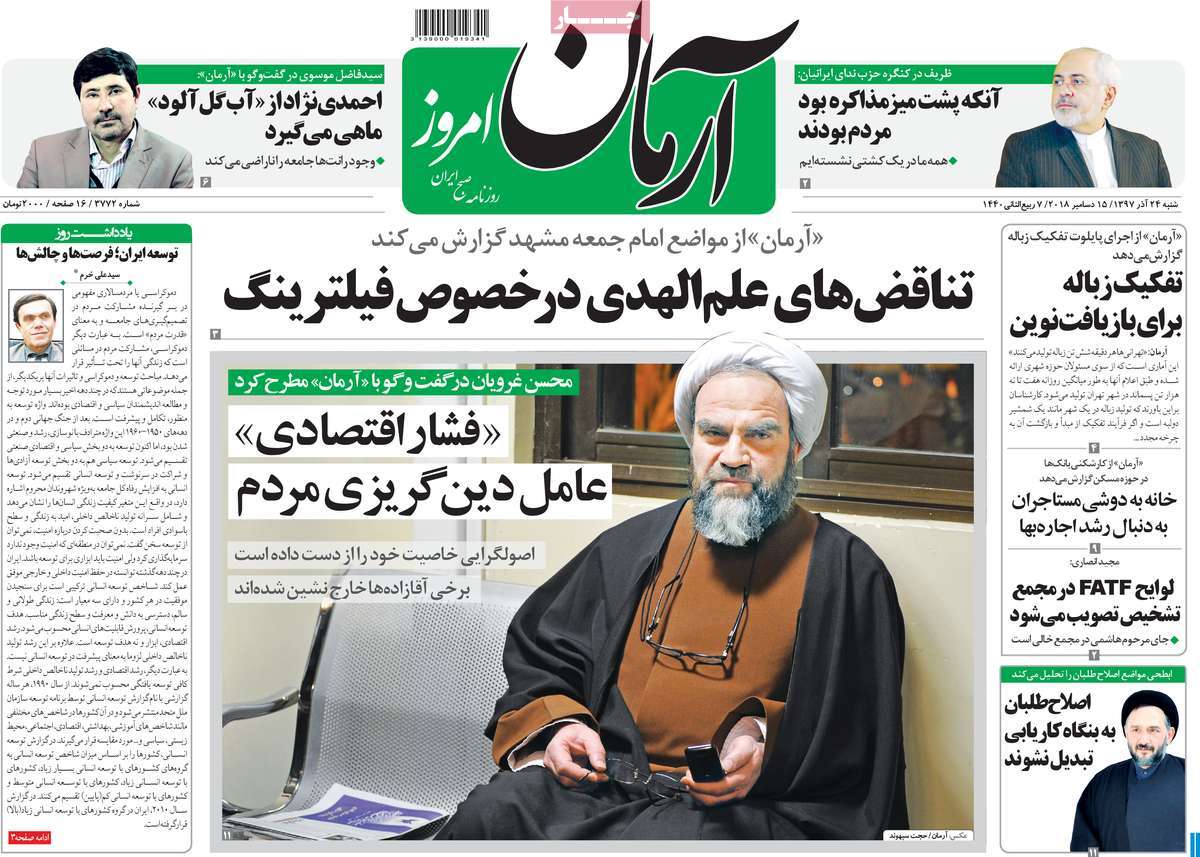
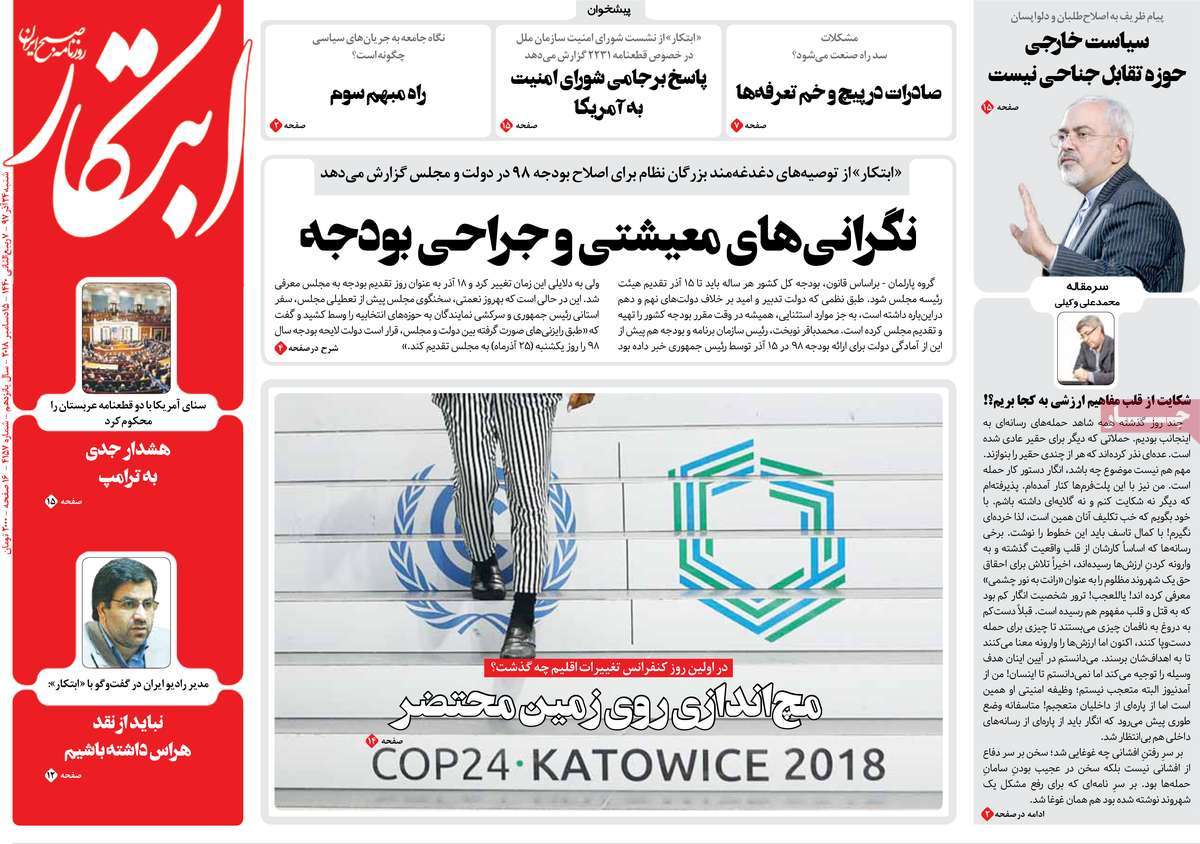
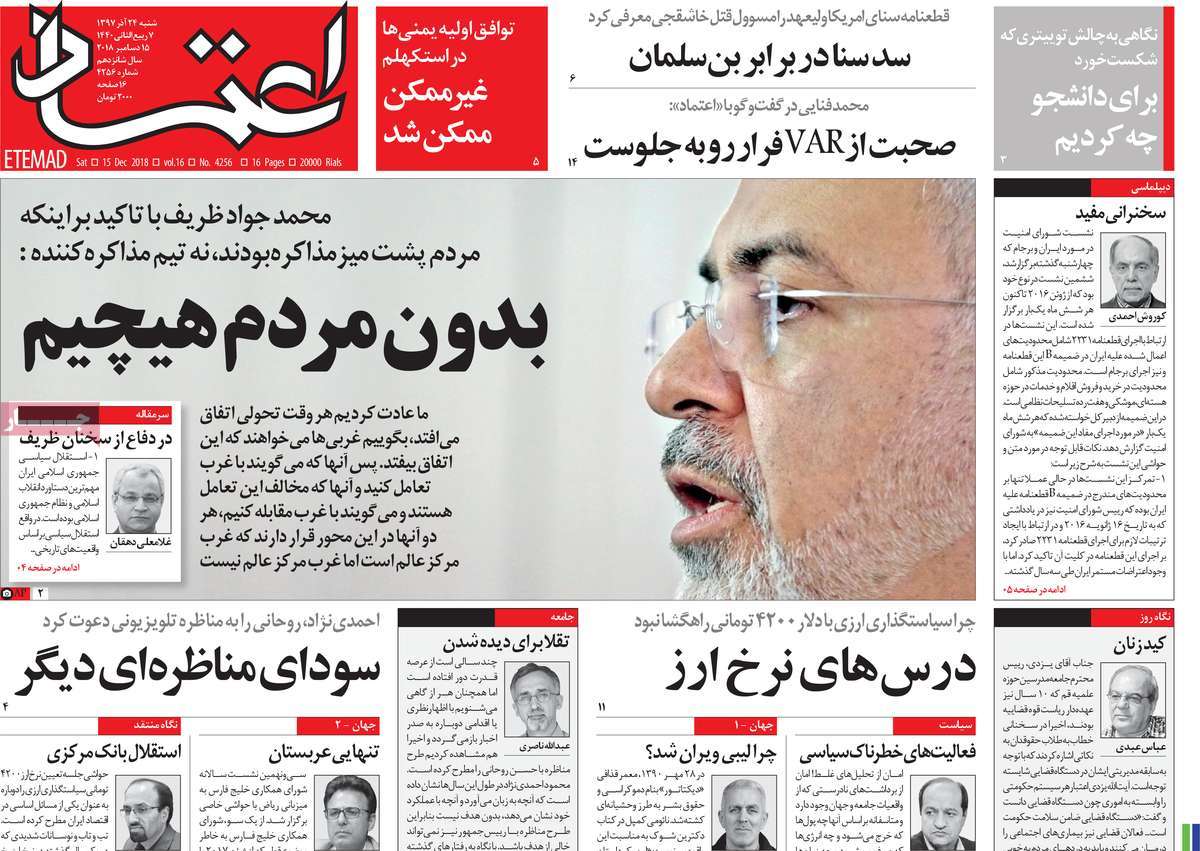
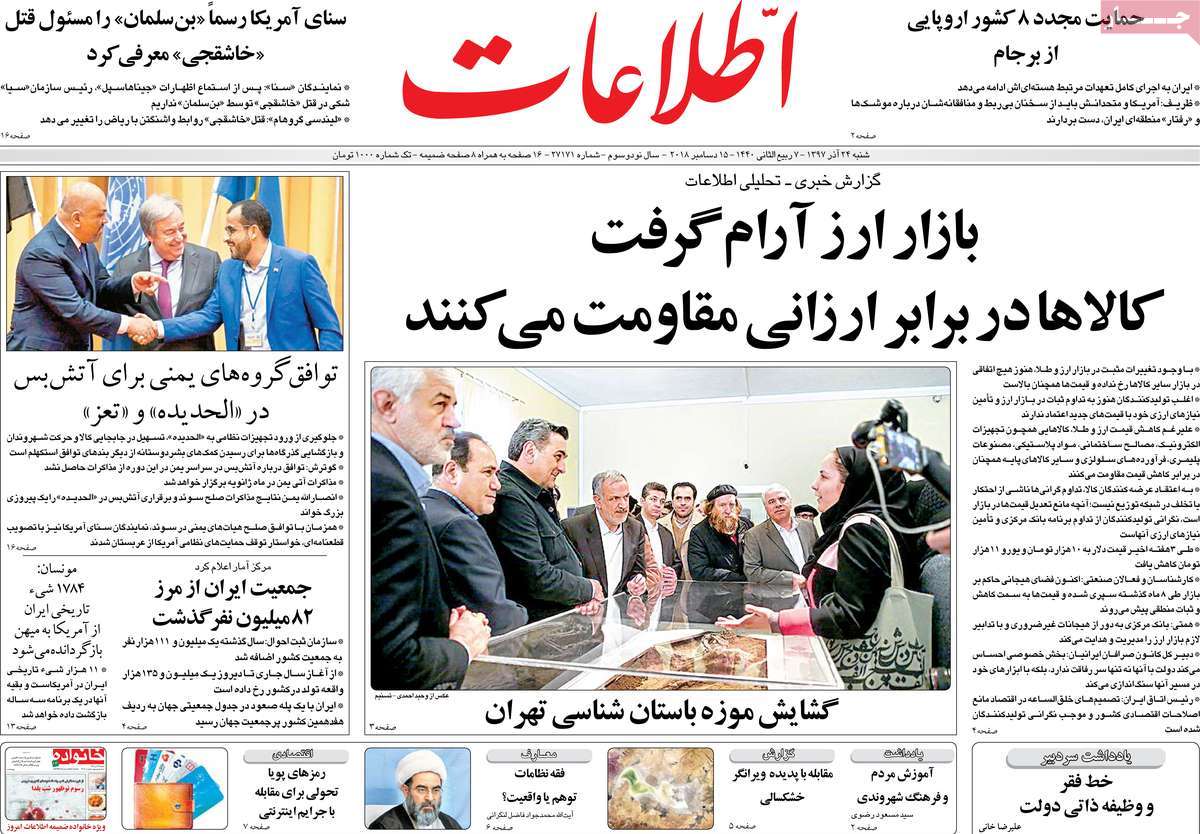
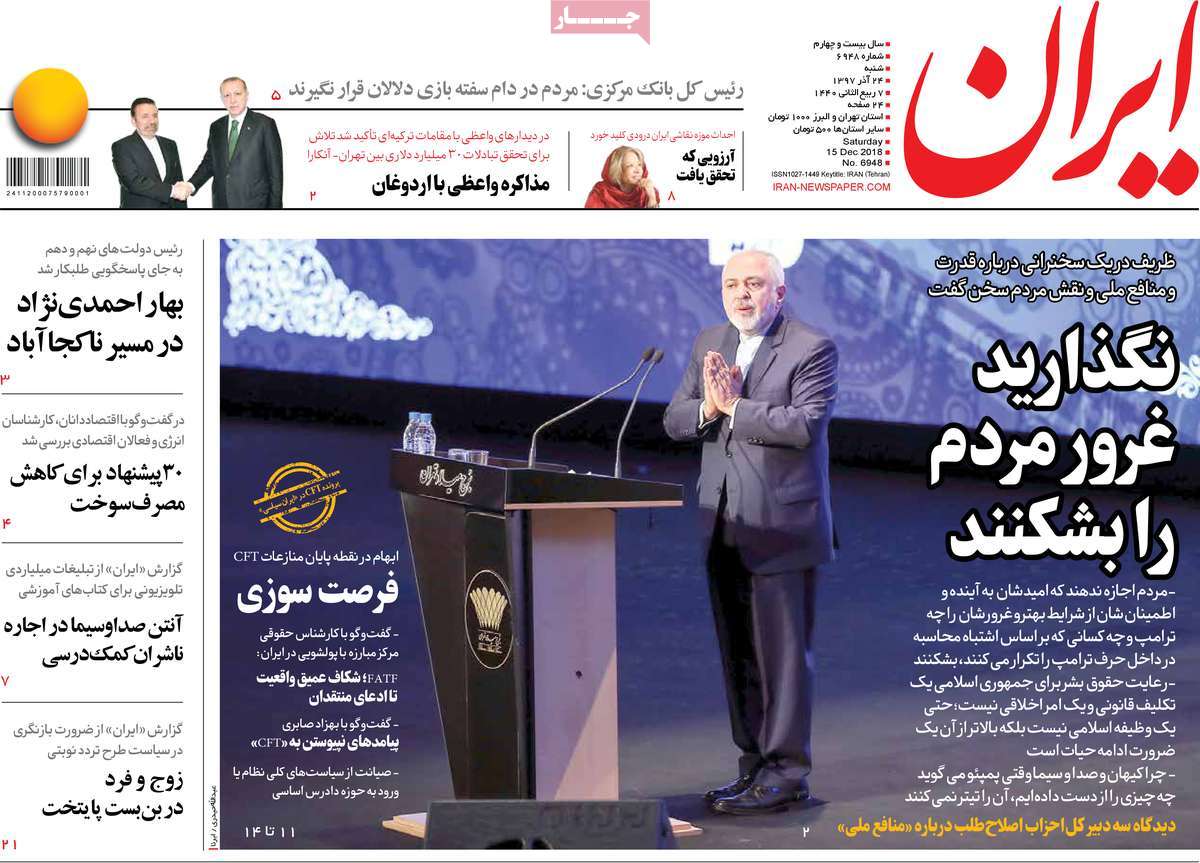
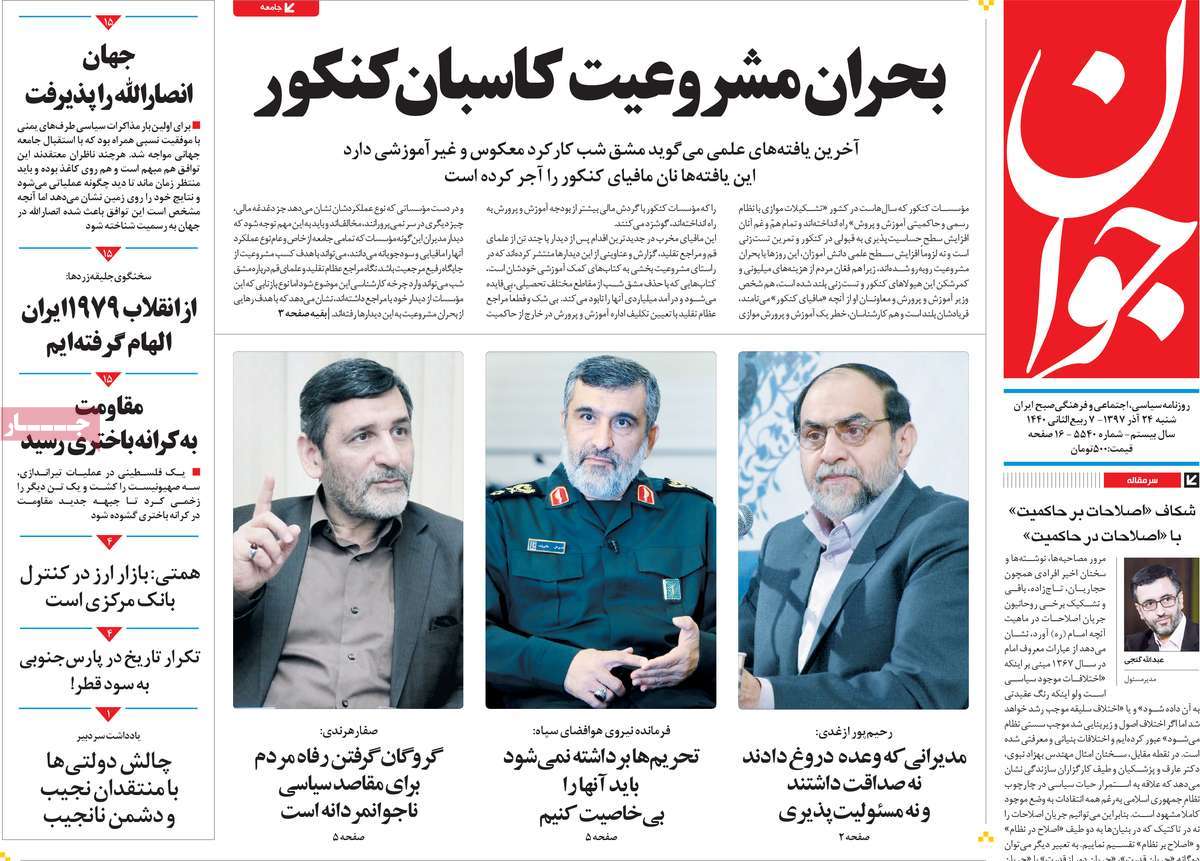
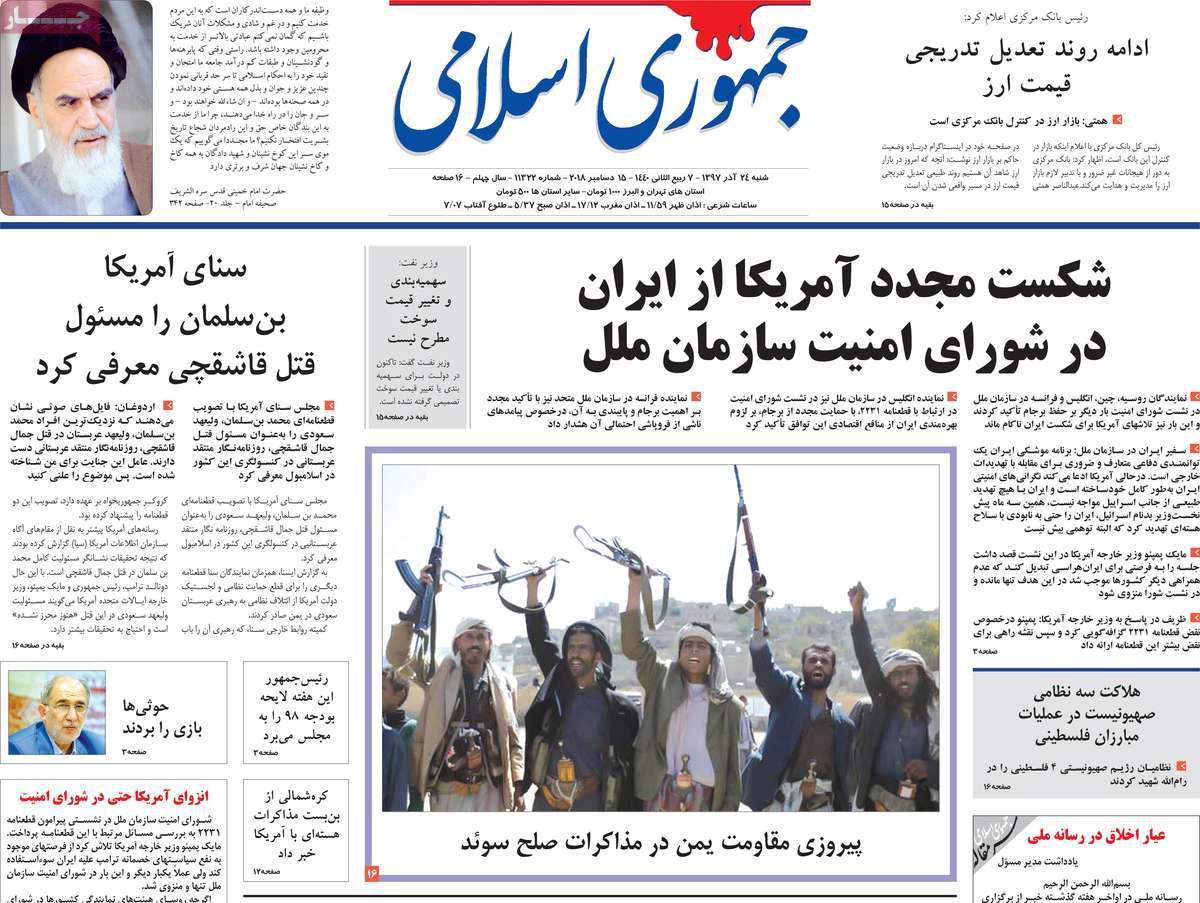
A Look at Iranian Newspaper Front Pages on December 15

A Look at Iranian Newspaper Front Pages on November 19

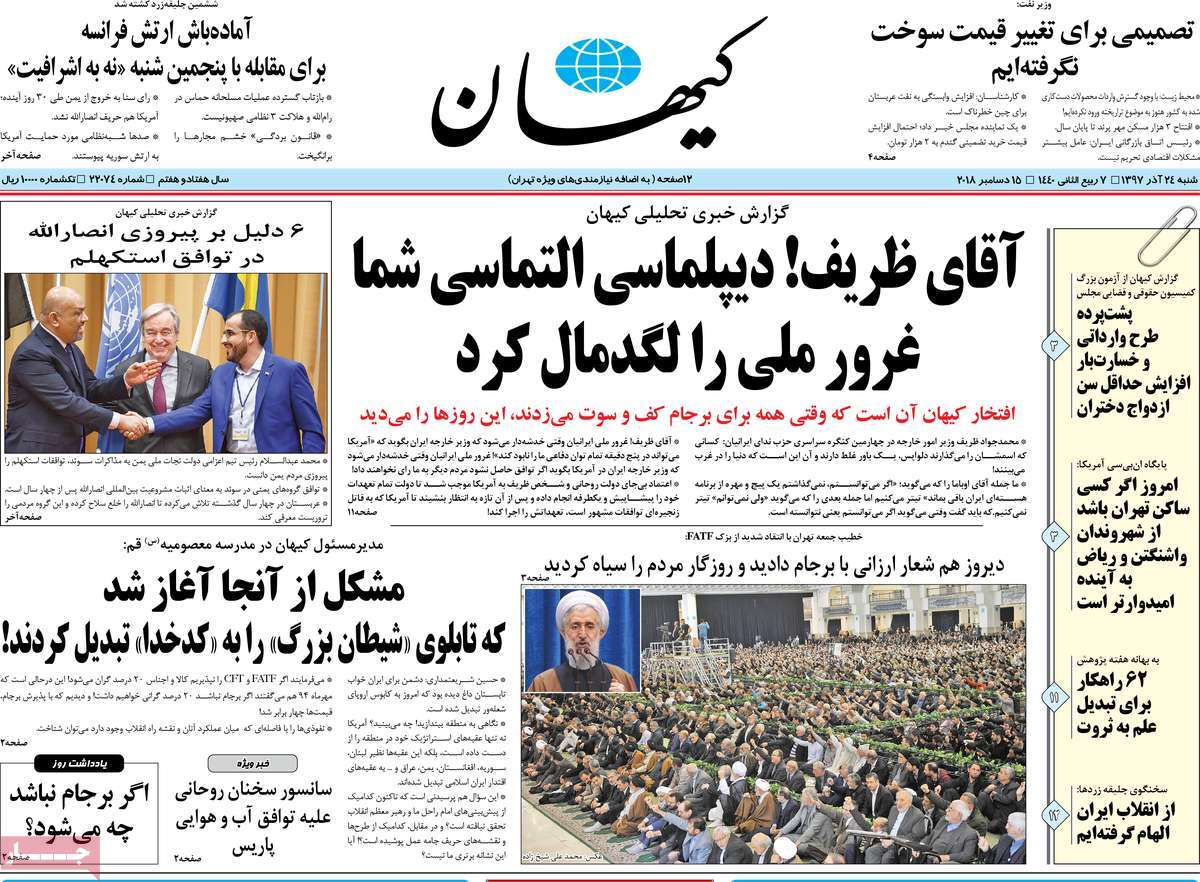
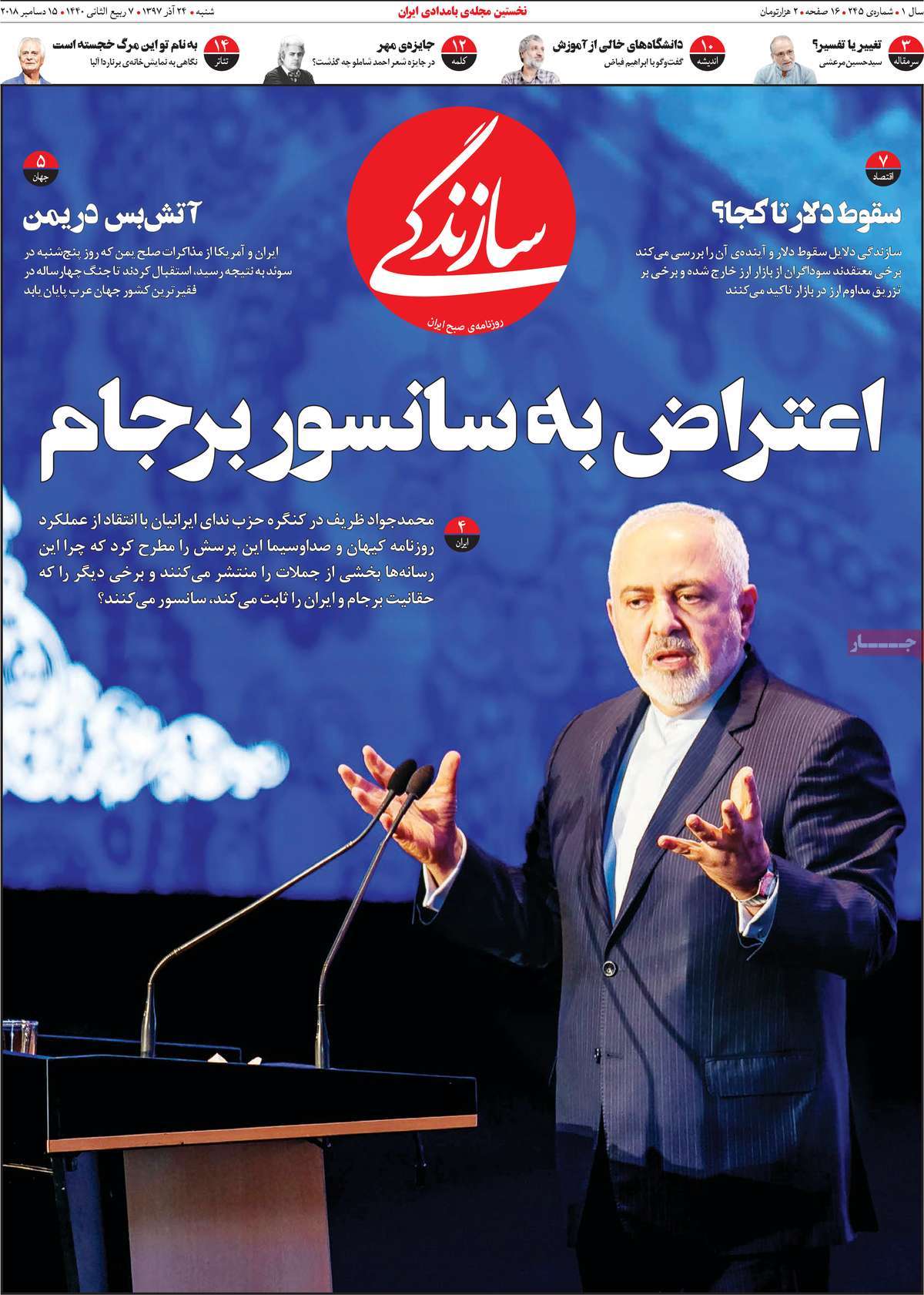
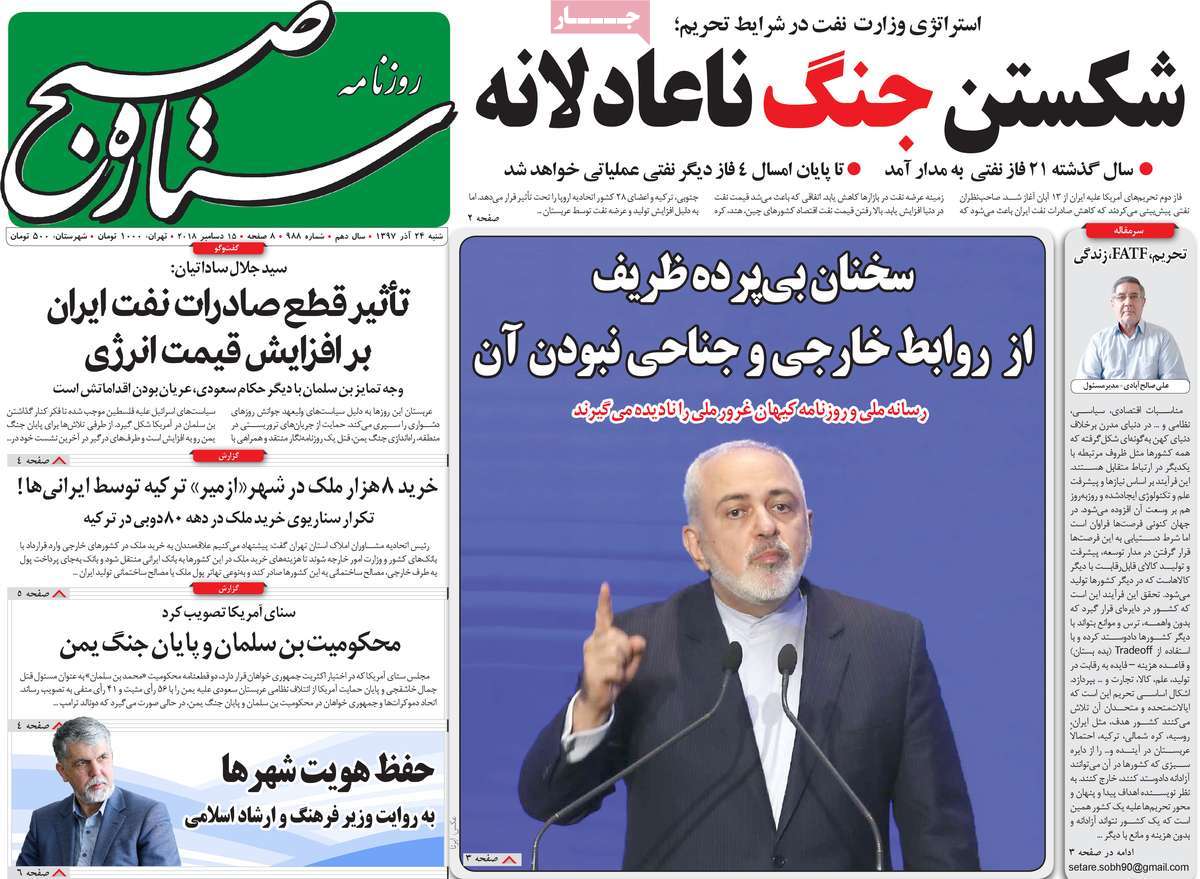
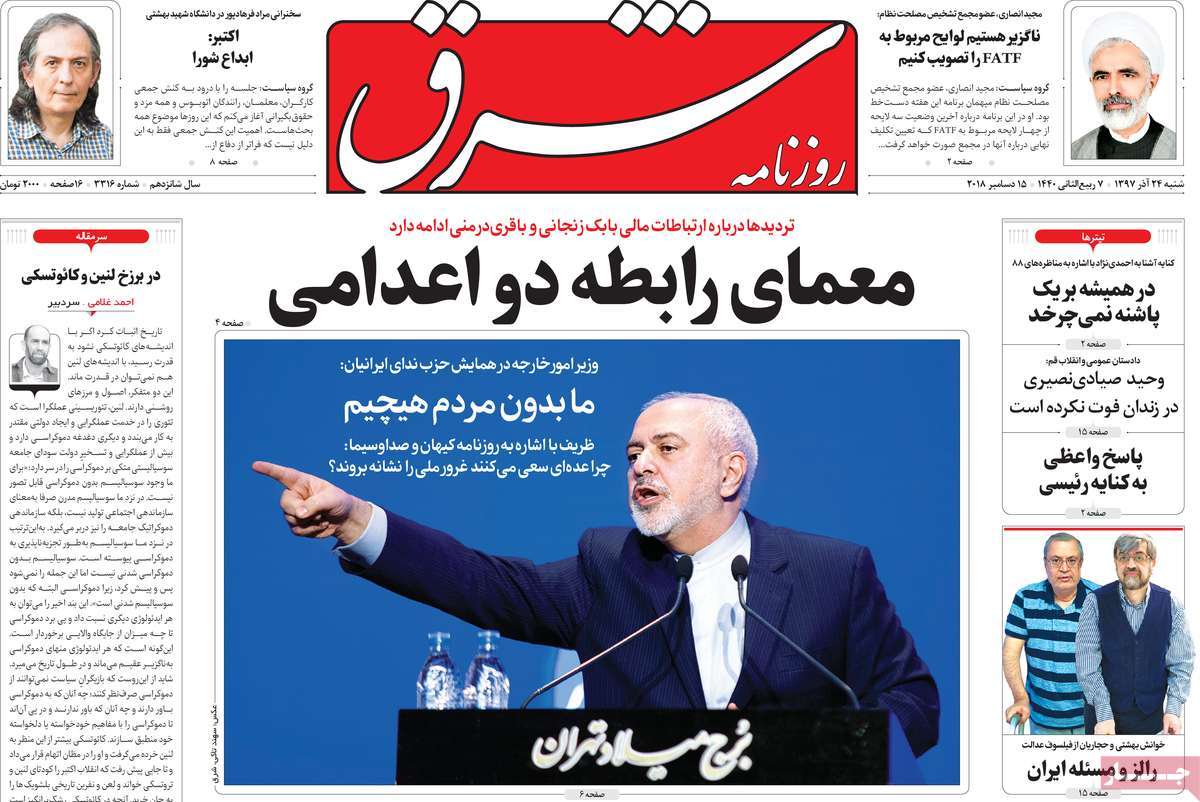
The top story in all papers today was a ceasefire agreement reached between Yemeni warring sides after several days of talks in Sweden.

Several papers also covered the remarks made by Iranian Foreign Minister Mohammad Javad Zarif, in which he criticized the state TV and certain conservative papers for censoring the good aspects of the Iran nuclear deal.

The US Senate’s unanimous vote to stop Washington’s support for the Saudi war in Yemen and to blame Saudi Crown Prince Mohammed bin Salman for the assassination of dissident journalist Jamal Khashoggi also received great coverage.

The above issues, as well as many more, are highlighted in the following headlines and top stories:


Abrar:

1- Iraq: We May Reach Agreement with US to Be Exempted from Iran Bans

2- Judiciary Chief: Zanjani to Be Executed in Due Time

A Look at Iranian Newspaper Front Pages on December 15


Aftab-e Yazd:

1- Forex Brokers Trying to Distort, Tell Lies to Prevent Decrease of Rates

  • Central Bank’s Measures Working

A Look at Iranian Newspaper Front Pages on December 15


Arman-e Emrooz:

1- Reformist Cleric: Economic Pressure Makes People Frustrated with Religion

A Look at Iranian Newspaper Front Pages on December 15


Ebtekar:

1- Zarif’s Message to Reformists, Hardliners: Foreign Policy No Place for Political Fights

2- US Senate Condemns Saudi Arabia with Two Resolutions: Serious Warning to Trump

A Look at Iranian Newspaper Front Pages on December 15


Etemad:

1- Zarif: We’re Nothing without People’s Backing

2- US Senate’s Resolution Blames Saudi Crown Prince for Khashoggi’s Murder

A Look at Iranian Newspaper Front Pages on December 15


Ettela’at:

1- Forex Market Calms Down: Prices of Consumer Goods Still High

2- Eight European Countries Once Again Express Support for JCPOA

3- Yemeni Groups Agree to Ceasefire in Hudaydah, Taiz

4- Iran’s Population Exceeds 82 Million

A Look at Iranian Newspaper Front Pages on December 15


Iran:

1- Zarif: Don’t Destroy People’s Sense of Honour

A Look at Iranian Newspaper Front Pages on December 15


Javan:

1- IRGC Aerospace Commander: Sanctions Won’t Be Lifted, We Should Neutralize Them

2- Chief Banker: Central Bank Has Control over Forex Market

3- Yellow Vest Protester: We’re Inspired by Iran’s 1979 Revolution

A Look at Iranian Newspaper Front Pages on December 15


Jomhouri Eslami:

1- US Once Again Defeated by Iran at UN Security Council

2- Forex Rates Continue to Decline

3- Yemeni Resistance Winner of Sweden Peace Talks

A Look at Iranian Newspaper Front Pages on December 15


Kayhan:

1- Mr Zarif! Your Diplomacy Has Destroyed People’s Sense of National Honour

  • Kayhan Proud It Predicted Current Days When Everyone Clapped for JCPOA

2- French Army on Standby for Countering Fifth Saturday of ‘No to Aristocracy’ Protests

A Look at Iranian Newspaper Front Pages on December 15


Sazandegi:

1- How Much Dollar Rates Are Going to Decrease?

2- Zarif Strongly Criticizes Kayhan, State TV for Censoring JCPOA Achievements

A Look at Iranian Newspaper Front Pages on December 15


Setareh Sobh:

1- Zarif Talks of Need for Keeping Foreign Policy Away from Political Fights

2- Oil Ministry’s Strategy under Sanctions: Fighting Unfair War

3- Bin Salman Condemned by US Senate

A Look at Iranian Newspaper Front Pages on December 15


Shargh:

1- We Have to Ratify FATF Bills: Reformist Member of Expediency Council

A Look at Iranian Newspaper Front Pages on December 15


Vatan-e Emrooz:

1- Letter of Repentance: Zarif Admits West Not Centre of World

2- Ceasefire in Hudaydah

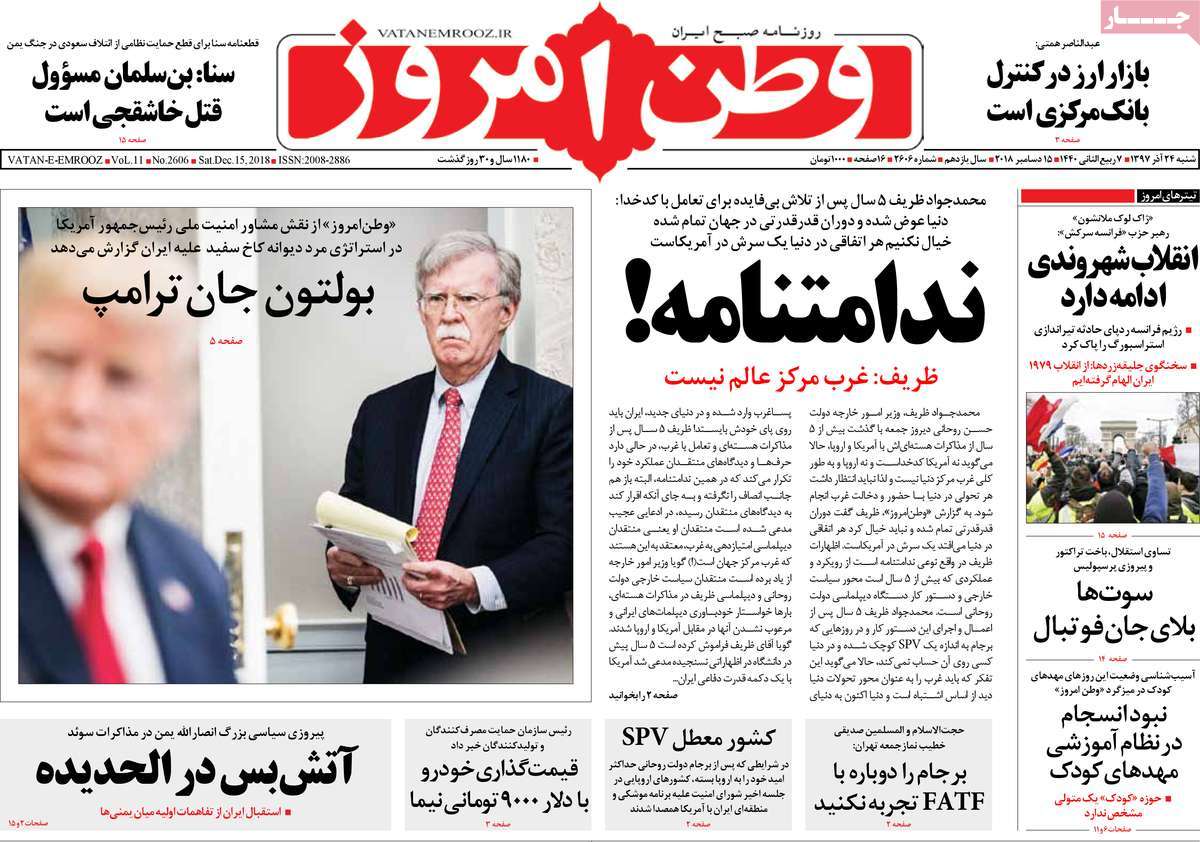
A Look at Iranian Newspaper Front Pages on December 15