Monday, December 22, 2025
Home Blog Page 3345

Iran Leader Warns of Plots to Undermine Iraq’s Independence

The Leader said on Saturday that promotion of unity among all Iraqi groups is the only way to ward off ploys of the enemies.

Speaking in a meeting with Iraqi President Barham Salih, Ayatollah Khamenei warned that some regional and western countries try to undermine Iraq’s independence by meddling in the Arab country’s internal affairs.

He added that these countries also seek to disturb regional peace.

Referring to the vast capacity of the two countries to expand cooperation, the Leader added that “a strong, independent and advanced Iraq is very valuable to Iran, and we will be next to our Iraqi brothers.”

Elsewhere in his remarks, Ayatollah Khamenei called on Iranian officials to promote all-out cooperation with Iraq.

The Iraqi president, for his part, hailed Iran’s anti-terror efforts in his country. Salih said the Iraqis will never forget the Islamic Republic’s help in the fight against Takfiri terrorists.

“We seek to expand cooperation in all fields and promote it to a level that preserves the dignity of social and cultural relations and the common interests of the two nations,” noted Salih.

The Iraqi official also underlined that “we are going to turn Iraq into a strong country in the region, and we hope that we can benefit from the Islamic Republic’s capacities to rebuild Iraq.”

Celebrities Help Quake-Hit People of Kermanshah Cope with Tragedy

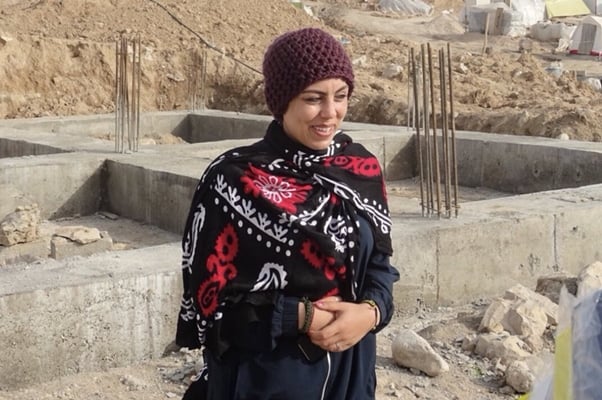
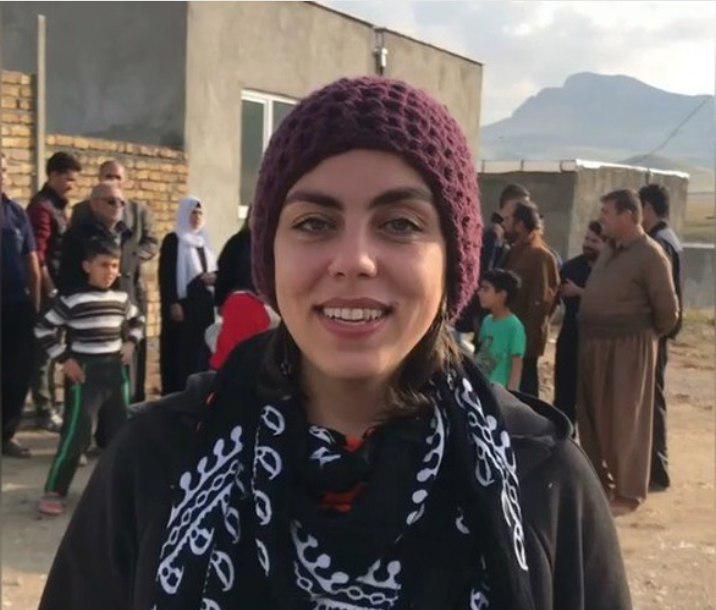
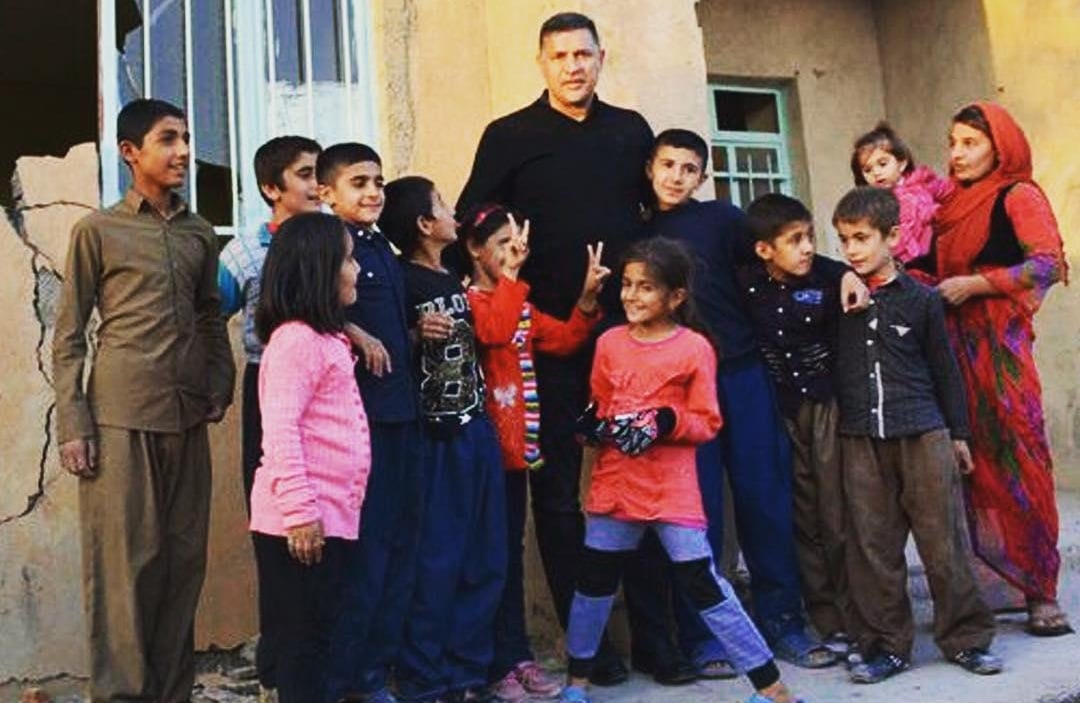
Following the quake in Nov. 2017, many celebrities even began to gather public donations. Among them, three with more fans and followers managed to raiss a huge amount of cash money: Legendary football player Ali Daei, political activist Sadegh Zinakalam, and social worker Narges Kalbasi.

But a question lingering in mind is what has happened to the cash money collected by these celebrities over the past year?

The reconstruction of the affected areas began a few weeks after the quake. Parts of the projects are carried out by the government which has granted loans to the residents whose houses have been partially or completely destroyed in the quake.

A video of reconstruction projects in Kermanshah carried out with the support of Iranian football legend Ali Daei, who was among the celebrities who rushed to help the people after the 2017 earthquake

But how about the celebrities who collected cash money from people to help the quake-hit residents of the western province?

The celebrities didn’t withdraw the money deposited into their accounts several months after the quake, a move which sparked harsh criticisms. The lengthy delay by the celebrities triggered Farhad Tajarrodi, the representative of Sarpol-e Zahab, to call on the relative supervisory organizations to follow up the issue and urge the celebrities to provide convincing explanations.

At the end of the day, the three leading celebrities were summoned by the Judiciary  and their bank accounts were blocked. In response, the celebrities said, instead of providing food and tents for the affected people which is among the government’s duties, they prefer to invest the deposited money into some fundamental projects like reconstructing the destroyed houses. They also offered court-friendly documents and continued their efforts in the province.

Celebrities Help Quake-Hit People of Kermanshah Cope with TragedyNarges Kalbasi is the social worker who has been living in the region over the past year and as witnessed by the locals, she personally receives and manages the public donations.

A resident of a village which Ms Kalbasi is involved in its reconstruction says before the quake, he was a builder and “after the quake, Ms Kablabsi assigned me to build houses for the affected families.”

Kablasi pays him salary even for the houses he builds for his own family and father. “She receives only 350 million rials from each family and provides them with a house worth 900m. She also makes up for the families’ financial shortage through the public donations.”

According to him, the quality of the one or two-bedroom houses is good. “The pillars are made of concrete and the projects are completed before being delivered to the families.”

She has also helped the construction projects carried out by their owners or Housing Foundation. “Ms Kalbasi is extremely generous,” says a local.

Sadegh Zibakalam is the political activist who days after the quake announced that he is going to reconstruct Sarab Zahab Ghaderi village in Sarpol-e Zahab in a new place and called the new village “Omid”. About five months later, the governor of Kermanshah said Zibakalam had set forth plan to invest the donations in the reconstruction of the water and sewage as well as solar power systems in the region.

The former Iranian football player and the all-time top goal scorer in the world Ali Daei began his operation in Male Rolan village about nine months after the quake.

Celebrities Help Quake-Hit People of Kermanshah Cope with Tragedy“Despite the bureaucratic obstacles in the way of reconstructing the village, we finally managed to get the legal permission for the reconstruction projects after nine months and began our operations immediately,” he said some weeks after the inauguration of his reconstruction project in the village.

Daei assured the villagers that the project was underway according to schedule.

According to Houshang Bazvand the governor of Kermanshah province, only the three mentioned celebrities are active in the region investing the donations in the reconstruction projects. He said they have already constructed 350 out of the 104,000 units destroyed in the quake.”

Iranian social worker and activist Narges Kalbasi has moved to Kermanshah since the 2017 earthquake, raising fund and helping people cope with the disaster.

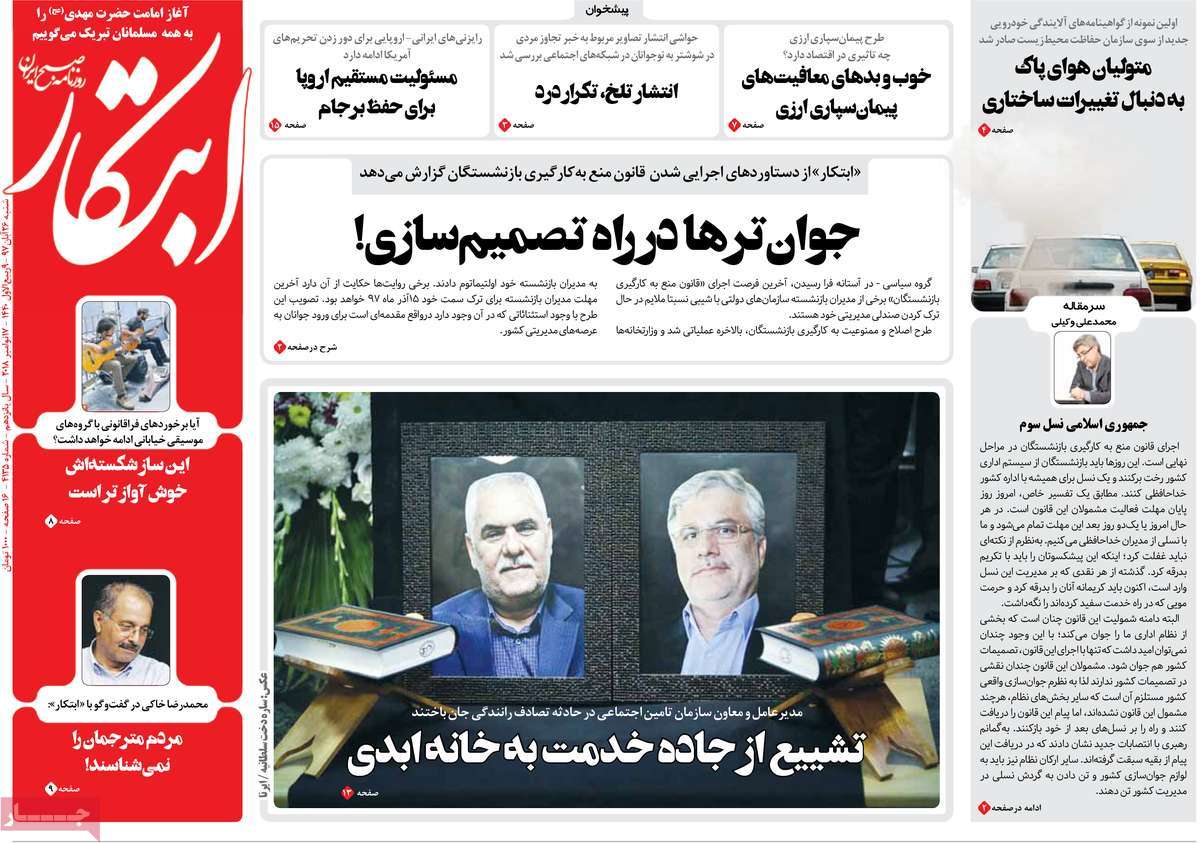
A Look at Iranian Newspaper Front Pages on November 17

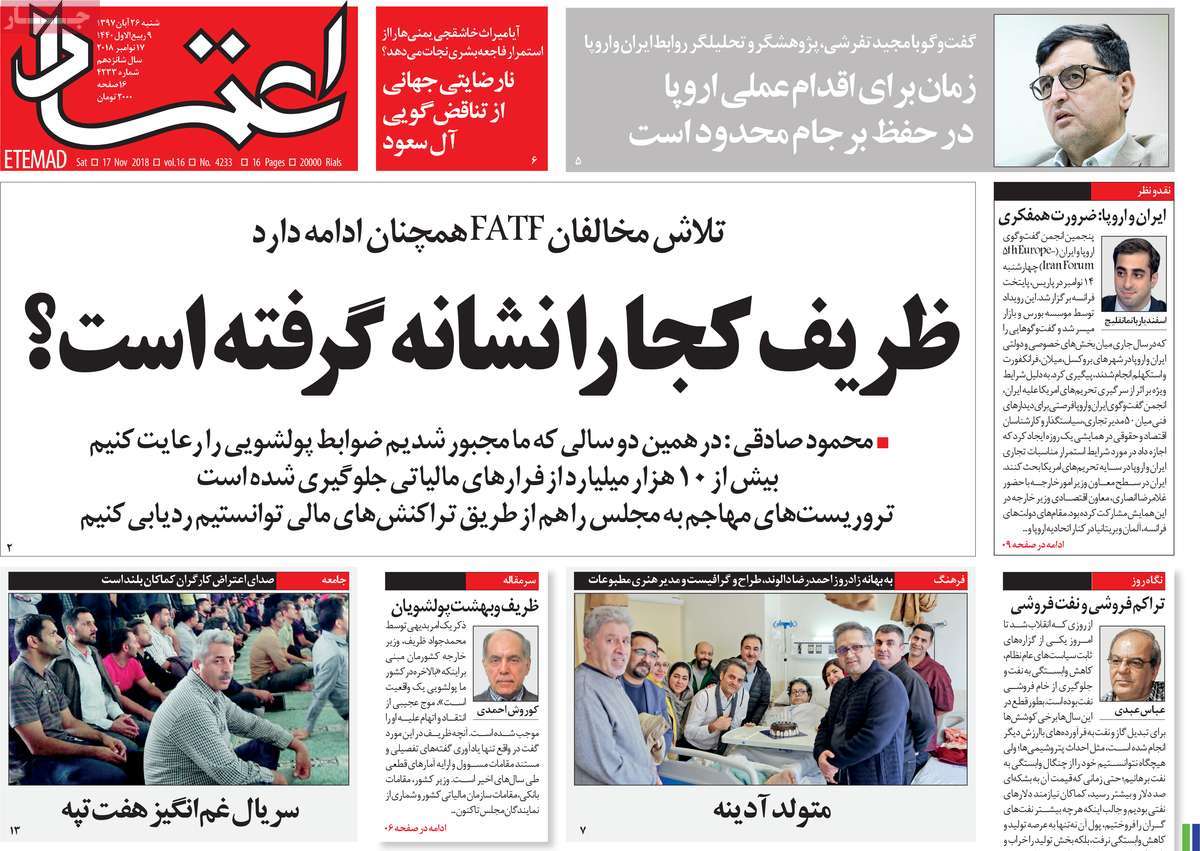
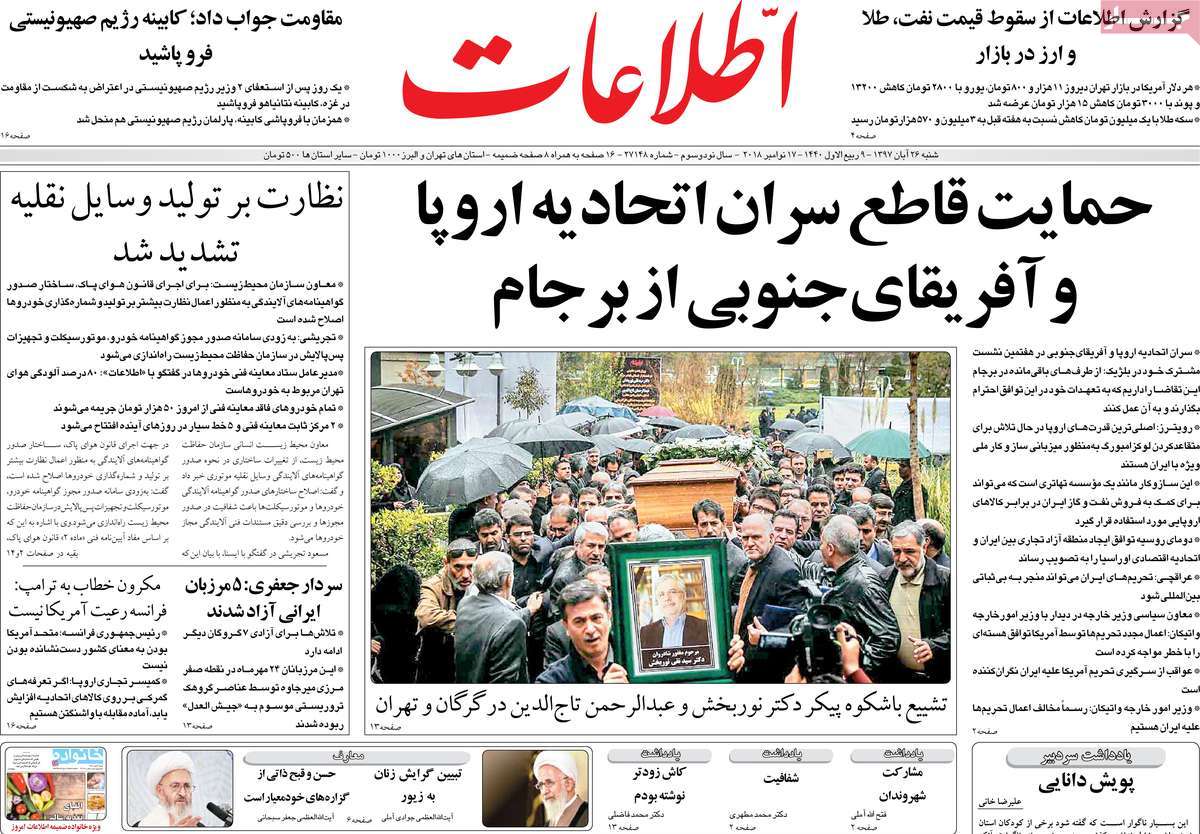
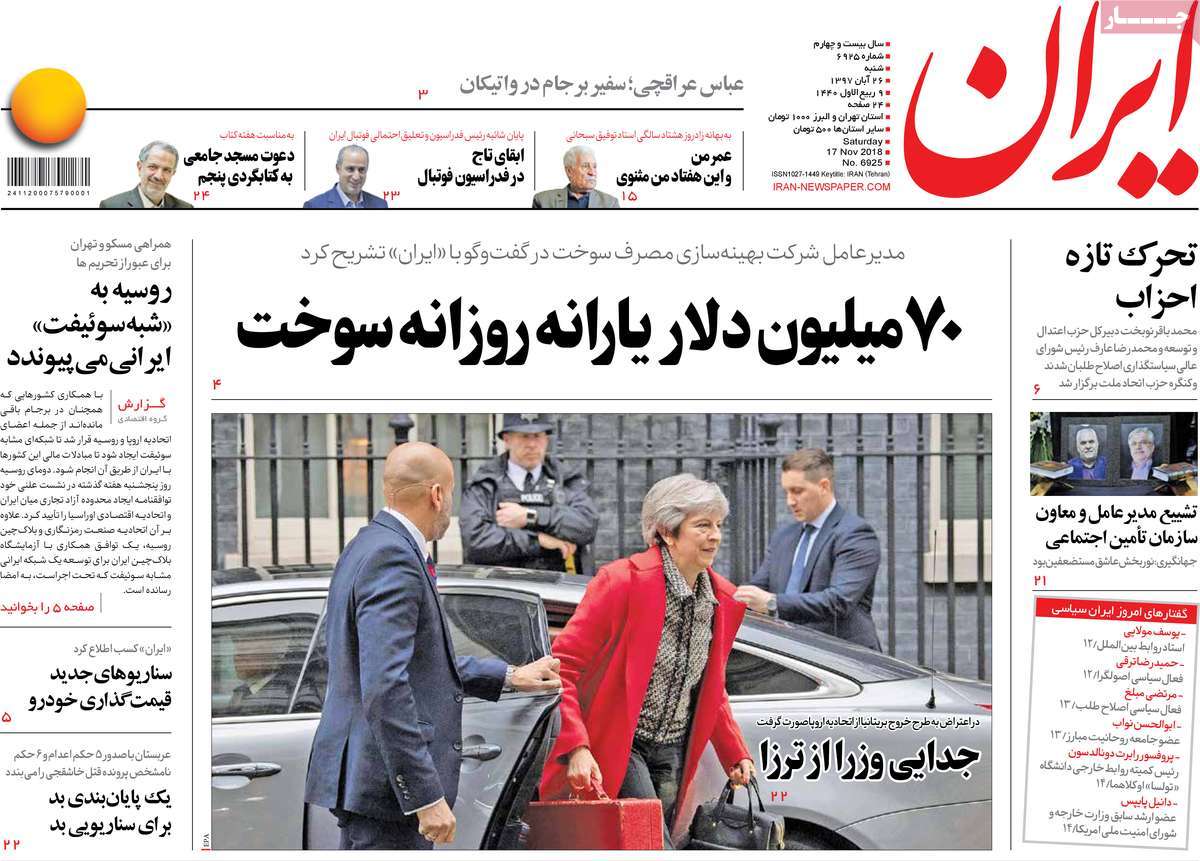
A Look at Iranian Newspaper Front Pages on November 19

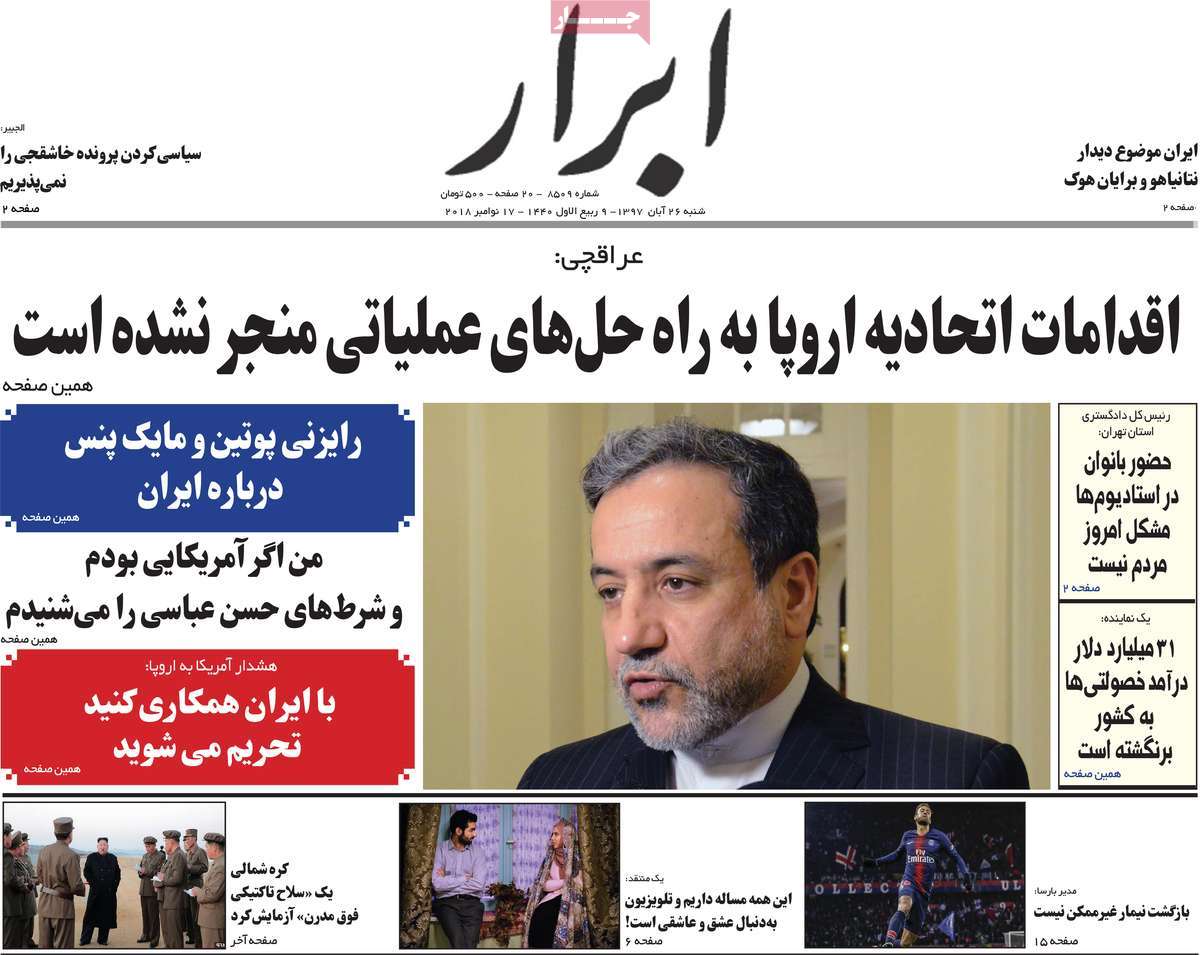
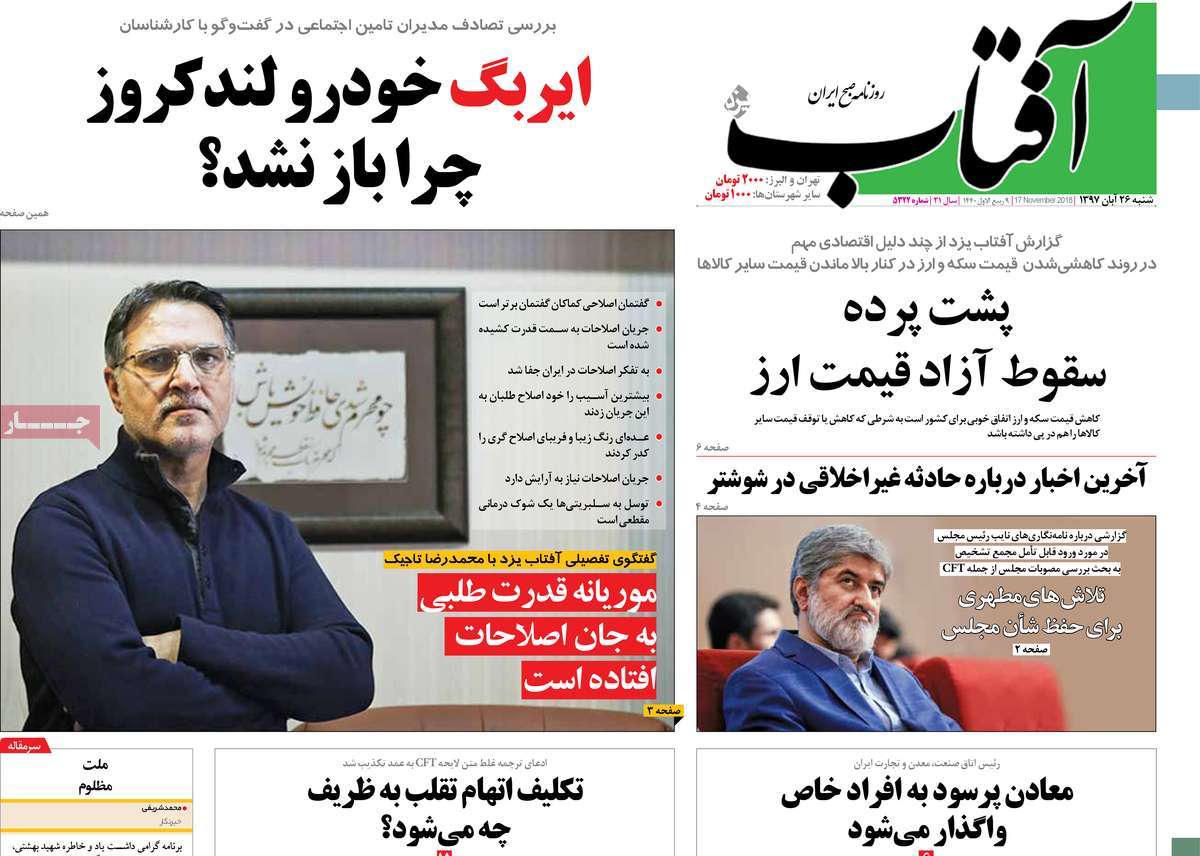
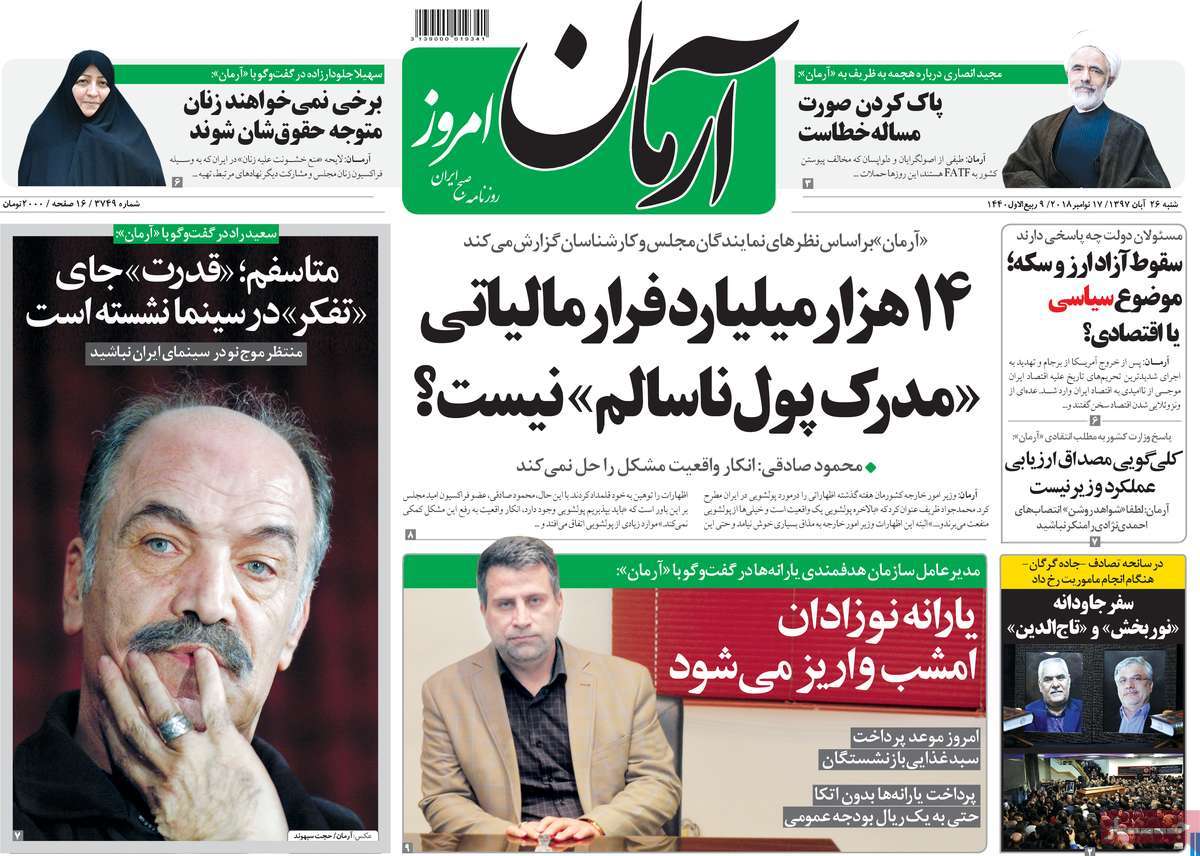
Newspapers today widely covered the ongoing talks between Iran and the European Union over the bloc’s efforts to save the Iran nuclear deal, particularly by implementing a special payment mechanism known as Special Purpose Vehicle (SPV).

Also a top story was the controversy over Iran’s adoption of the standards set by global anti-money laundering body FATF, particularly the remarks recently made by Foreign Minister Mohammad Javad Zarif against the opponents of Iran’s accession.

The recent decline in US dollar and gold coin prices in the Iranian markets also received great coverage.

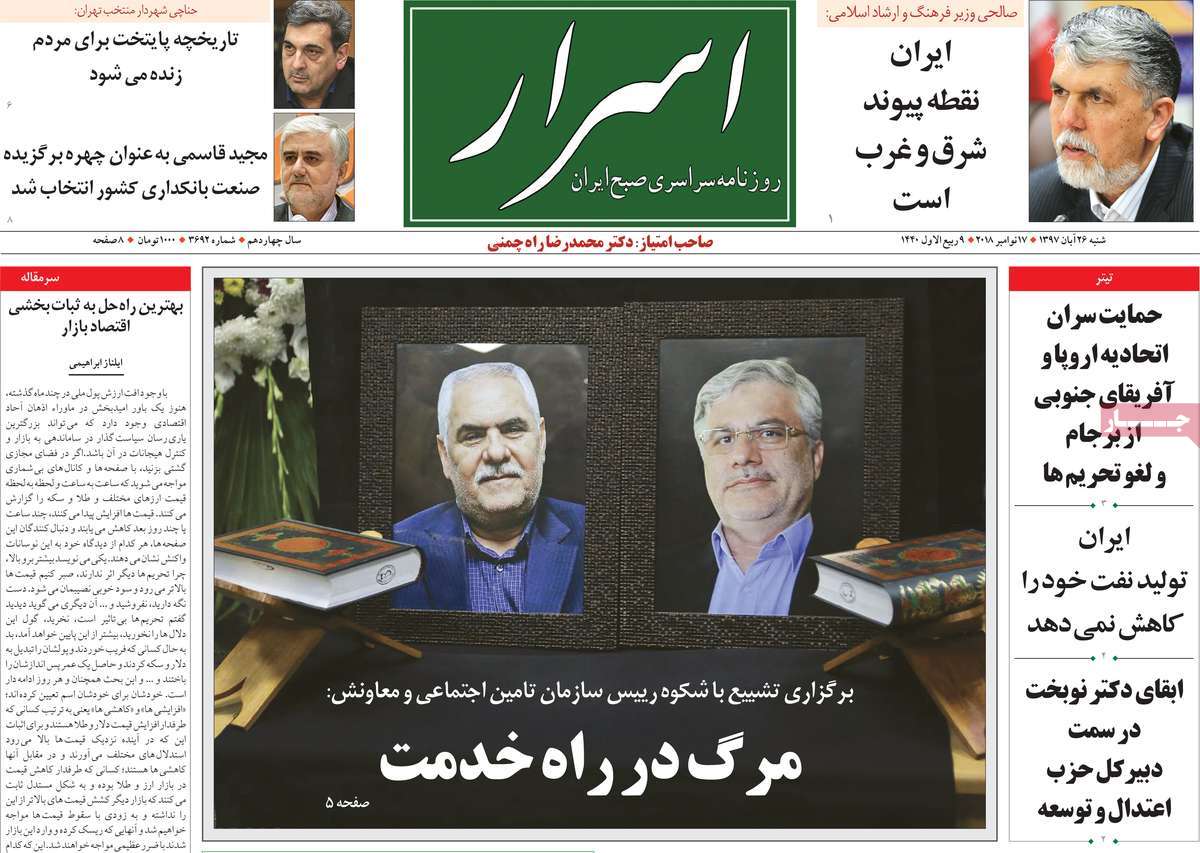
The above issues, as well as many more, are highlighted in the following headlines and top stories:


Abrar:

1- Araqchi: EU’s Measures Have Not Led to Operational Solutions

2- Putin, Pence Hold Talks on Iran

3- US Warns Europe: You’ll Be Sanctioned If You Work with Iran

A Look at Iranian Newspaper Front Pages on November 17


Aftab-e Yazd:

1- Mistranslation of CFT Bill Sparks Controversy in Iran

2- Secrets behind Huge Decrease in US Dollar Rates in Iran

A Look at Iranian Newspaper Front Pages on November 17


Arman-e Emrooz:

1- Decrease in Forex, Gold Coin Rates: Political or Economic?

2- Some Don’t Want Women to Know Their Rights: MP

A Look at Iranian Newspaper Front Pages on November 17


Asrar:

1- Culture Minister: Iran Links West to East

A Look at Iranian Newspaper Front Pages on November 17


Ebtekar:

1- Europe’s Direct Responsibility to Save JCPOA

  • Iranian-European Consultations to Bypass US Bans

A Look at Iranian Newspaper Front Pages on November 17


Etemad:

1- What’s Zarif Targeting? Opponents of FATF Still Working against It

2- Will Khashoggi Legacy Save Yemenis from Continued Crime against Humanity?

A Look at Iranian Newspaper Front Pages on November 17


Ettela’at:

1- EU, South Africa Leaders Strongly Support Iran Nuclear Deal

2- Resistance Worked: Zionist Regime Collapsed

3- A Report on Decline in Oil, Gold, Forex Rates

4- IRGC Chief-Commander: 5 Abducted Iranian Border Guards Released

A Look at Iranian Newspaper Front Pages on November 17


Iran:

1- Ministers Leaving Theresa May to Protest Brexit

2- Russia to Join Iranian Quasi-SWIFT

A Look at Iranian Newspaper Front Pages on November 17


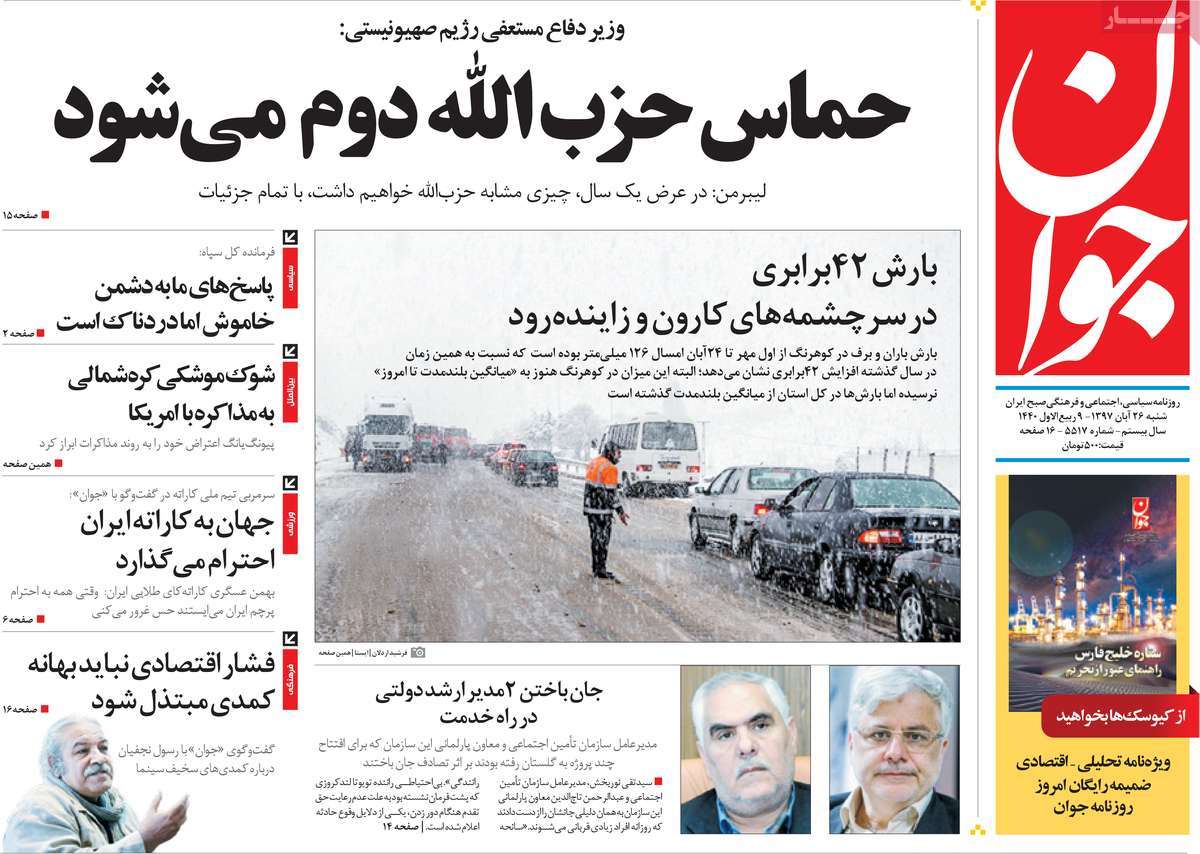
Javan:

1- Resigned Israeli DM: Hamas to Turn into Second Hezbollah

2- IRGC Chief-Commander: Our Response to Enemy Will Be Covert, but Painful

3- Two Senior Government Officials Die While Serving Nation

  • Social Security Chief, His Deputy Killed in Car Crash

4- Rainfall in Sources of Karoun, Zayandeh Roud Rivers Up by 42 Times

A Look at Iranian Newspaper Front Pages on November 17


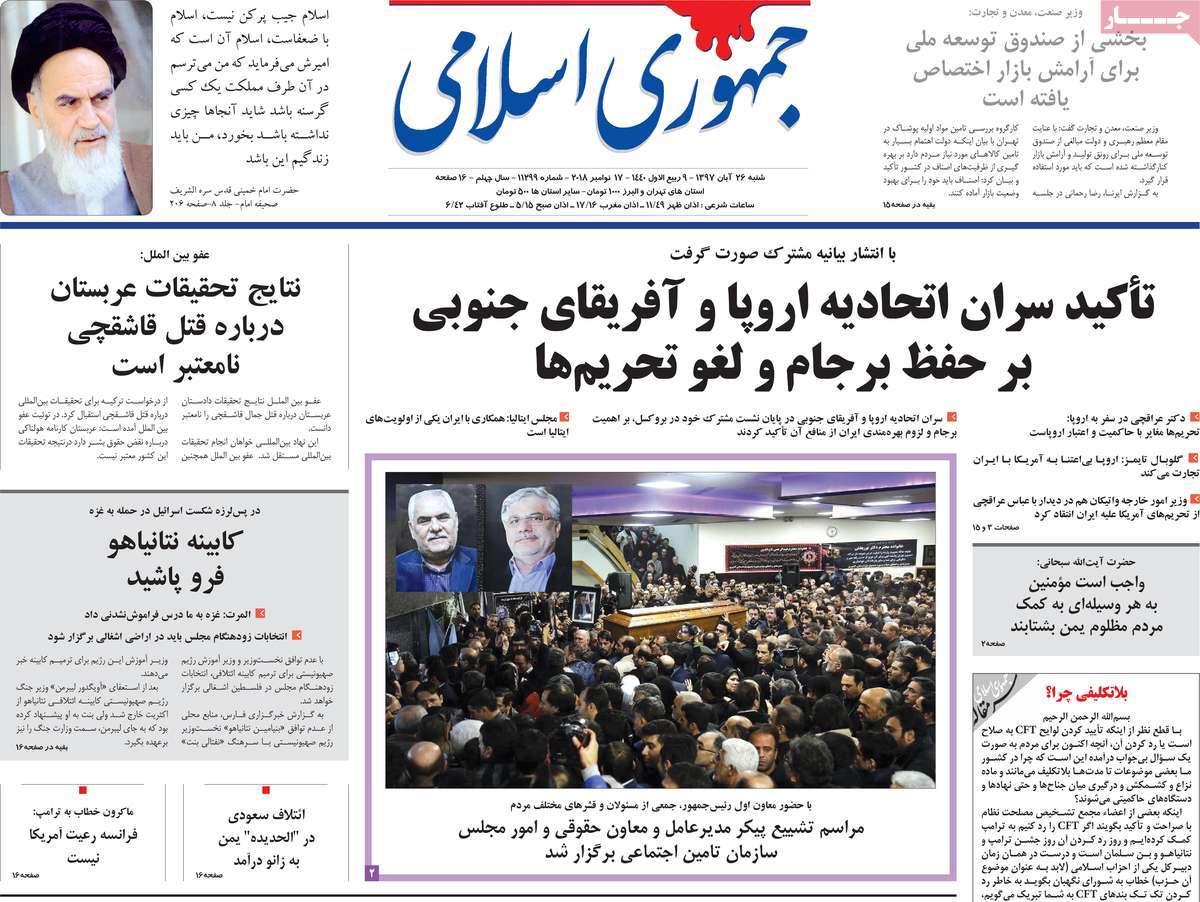
Jomhouri Eslami:

1- Amnesty Int’l: Saudi Probe into Khashoggi Case Invalid

2- Netanyahu’s Cabinet Collapses

3- Macron to Trump: France Not Vassal State of US

A Look at Iranian Newspaper Front Pages on November 17


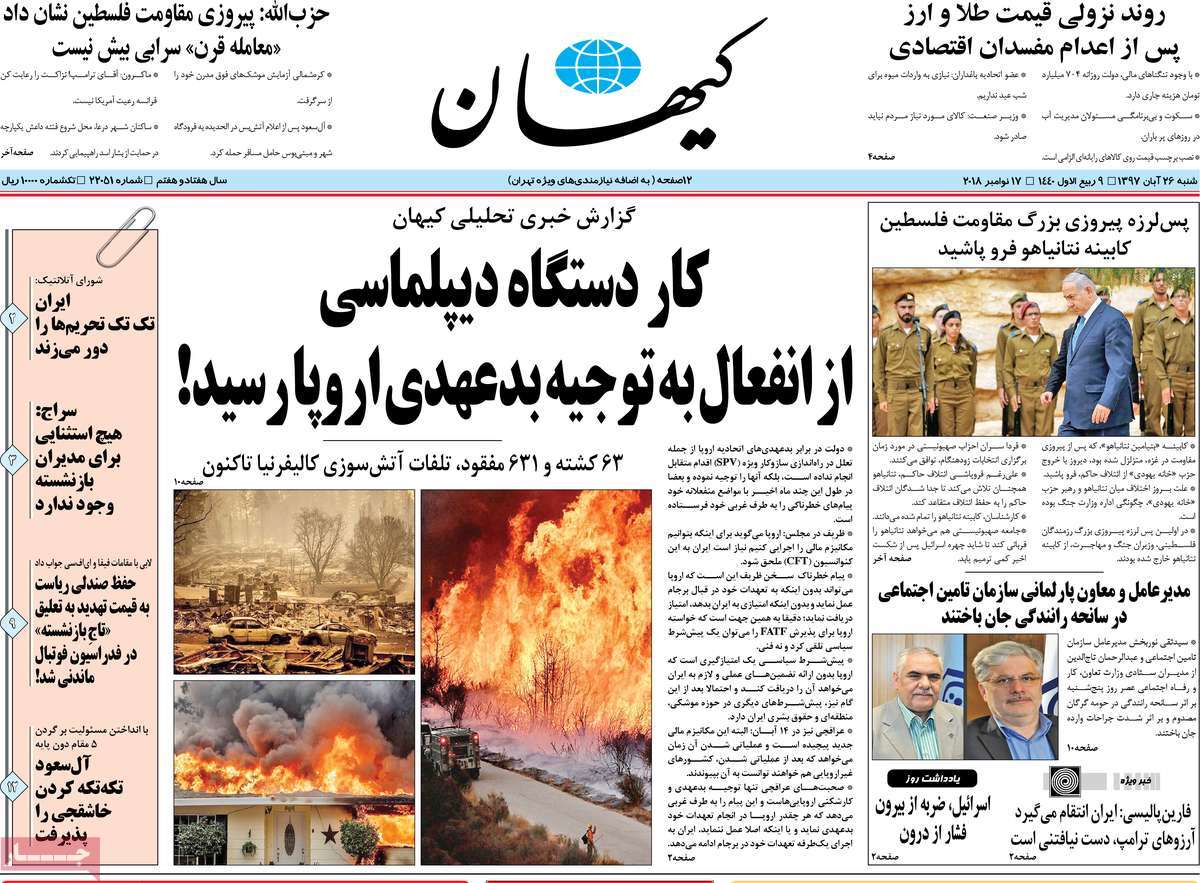
Kayhan:

1- Iranian Foreign Ministry Justifying Europe’s Violation of Its Commitments!

2- Aftershocks of Palestinian Resistance’s Great Victory: Bibi’s Cabinet Collapses

3- Hezbollah: Palestine’s Victory Showed ‘Deal of Century’ Nothing More than Mirage

4- Decrease in Gold Price after Execution of Those Involved in Economic Corruption

A Look at Iranian Newspaper Front Pages on November 17


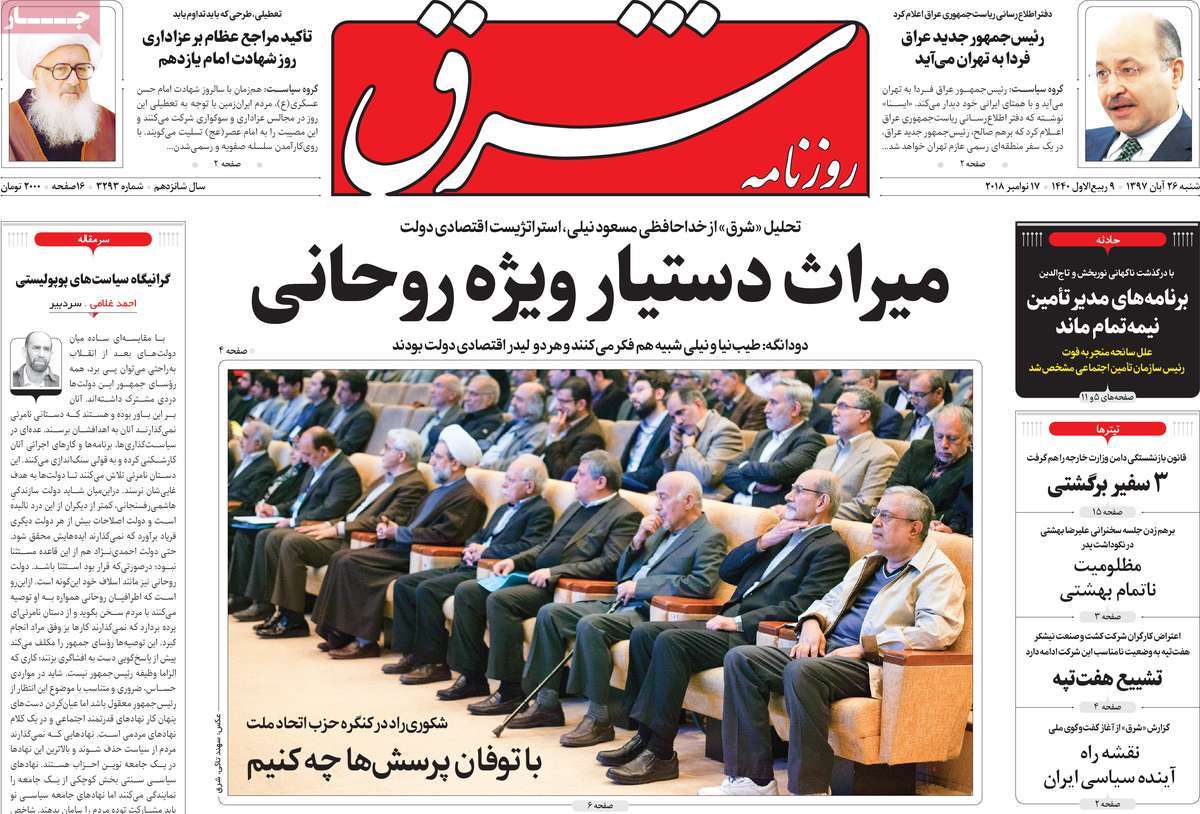
Shargh:

1- New Iraqi President Due in Tehran

2- Legacy of Rouhani’s Special Aide Massoud Nili

  • The Economic Strategist of Rouhani Administration Leaves Office

A Look at Iranian Newspaper Front Pages on November 17


Sobh-e Now:

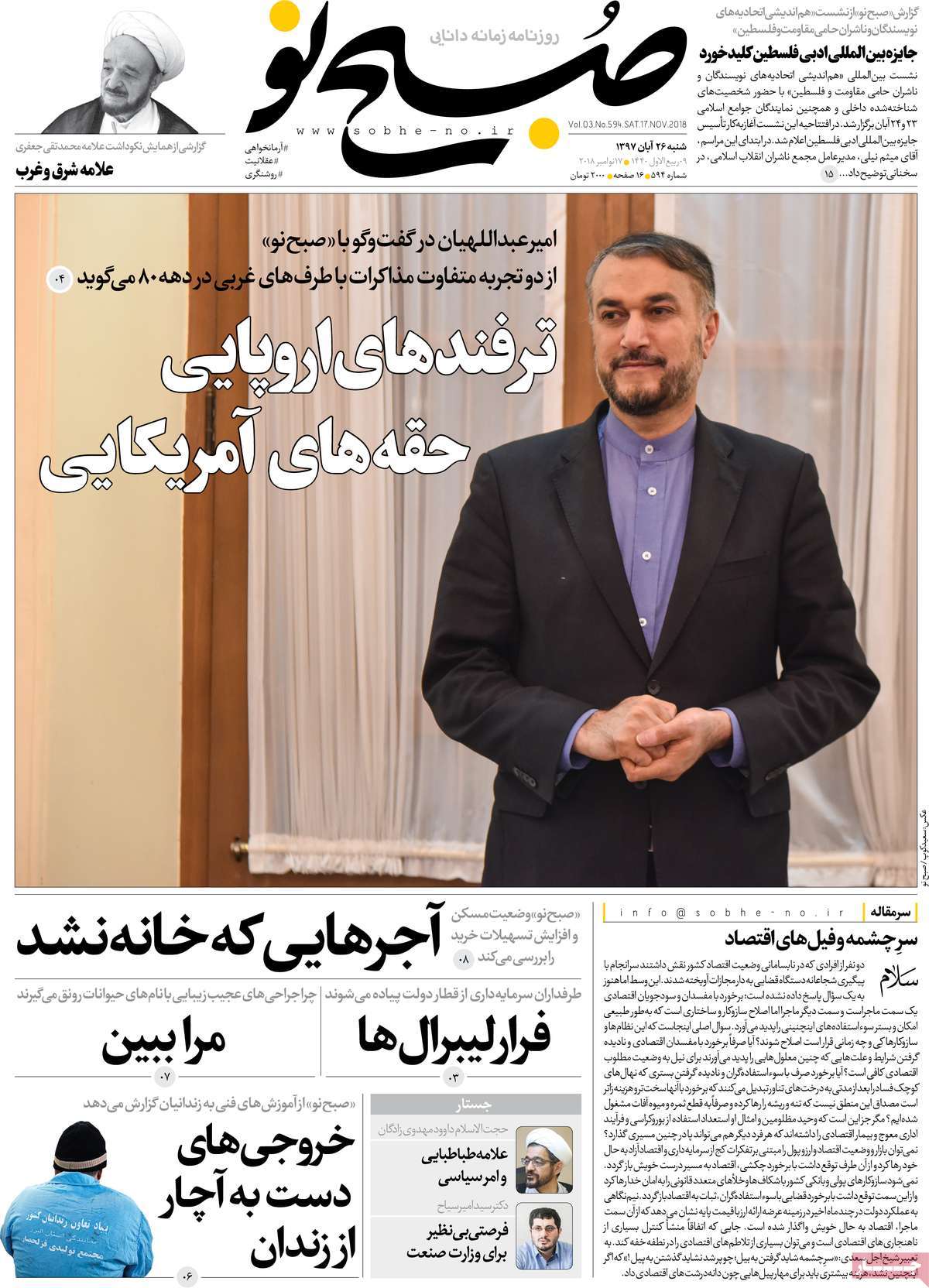
1- European Tricks, American Deceits

  • Amir-Abdollahian Talks of His Negotiations with Western Sides in 2000s

A Look at Iranian Newspaper Front Pages on November 17


Vatan-e Emrooz:

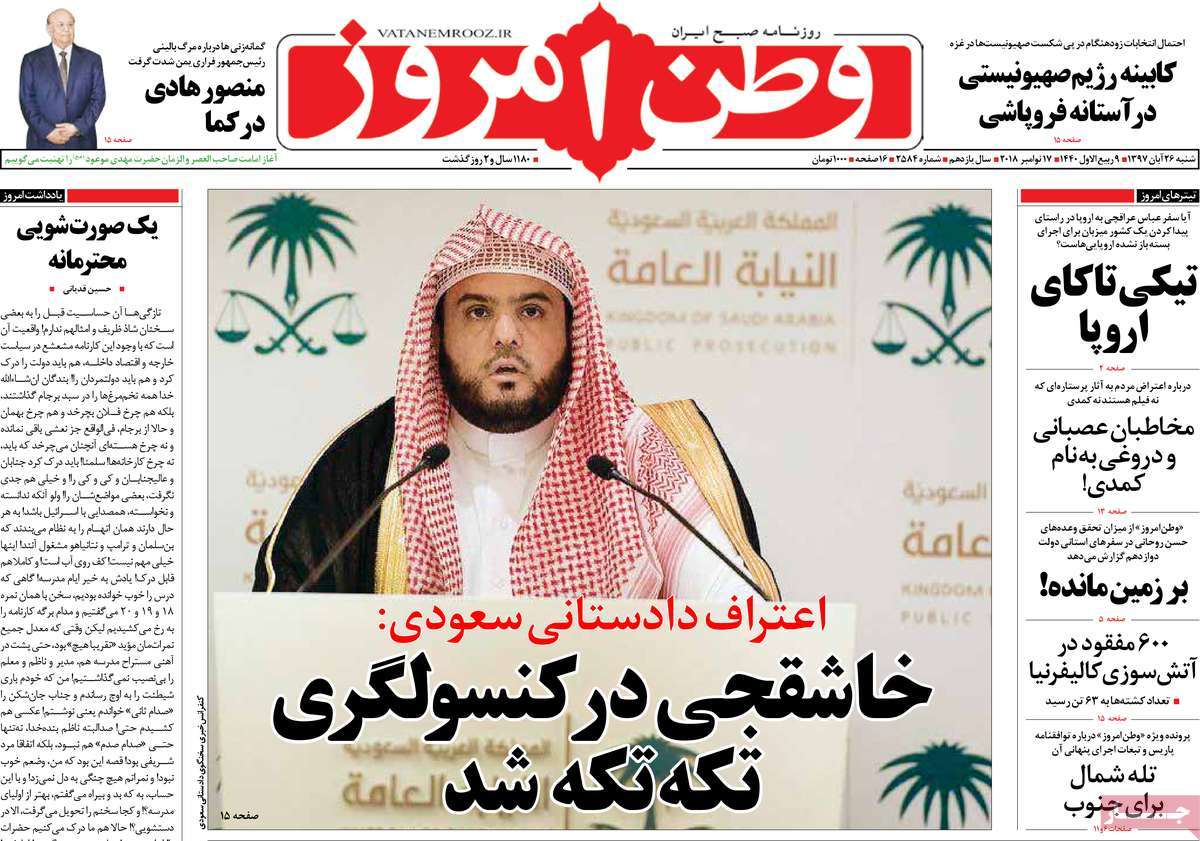
1- Saudi Prosecutor Admits Khashoggi Dismembered at Saudi Consulate

2- 600 Missing Following California Wildfires

A Look at Iranian Newspaper Front Pages on November 17

Best Home Remedies for Skin Burn Treatment

Whether or not such prescriptions are efficient has not yet been confirmed by specialists because they are solely experimental. They might be useful for minor burns, but for more serious skin burns, patients must see a doctor and undergo advanced methods of burn treatment.

In the text below, we will have a short review of such prescriptions which have come to be known as home remedies for treating burns.

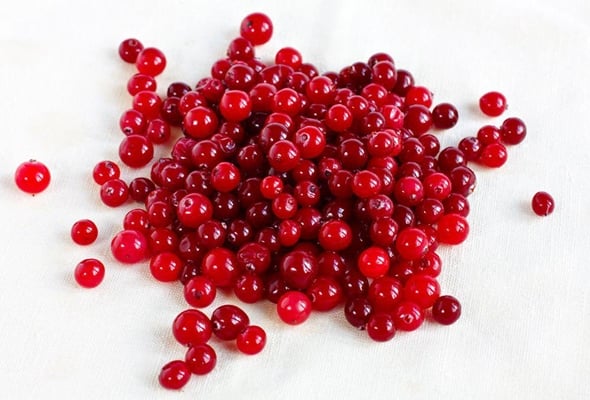
Cornelian Cherry Seeds

The quality seeds help you considerably remove the burned areas of your skin. Soak them in water for at least one night. Then squeeze the soaked seeds and turn them into a soft paste. Now, put it smoothly on the burns and let it be there for a while. Then wash the burns after the paste is completely dried.

Potato Skin

It’s said that potato skin is highly helpful for healing wounds due to its moisture and anti-bacterial features. Peel a number of potatoes and leave their skins on your burns for a while.

Leaves of Plantain

The leaves enjoy anti-bacterial and anti-inflammation features. Therefore, they can be used as a strong moisturizer for treating wounds. Putting the juice of the leaves on the burns can rapidly alleviate their irritation and lead to a rapid healing.

For a brief review of Iran’s achievements in various fields of science and technology, check the book “Science and Technology in Iran: A Brief Review

Marigold

Marigold is highly efficient in treating burns because it rapidly restores the burned areas of the skin. The plant’s efficiency increases significantly if it is used regularly for a long period of time. Meanwhile, marigold’s oil can stimulate the biological process of adding to skin textures of the body. The oil is highly recommended for grade 2 burns.

Tea Oil

The oil extracted from tea should be diluted with some water and then be rubbed on the burned area. It’s also recommended that people suffering from grade 3 burns massage regularly the oil into the burned area because the massage will improve blood flow and provide the area with further nutrients and oxygen to restore dead cells and textures.

Fatty Milk and Yogurt

Put the burned area of the skin into fatty milk for 15 minutes. This will immediately alleviate the irritation of the burns. Fatty yogurt can also keep the burns cold and moistures.

Best Home Remedies for Skin Burn Treatment

Vitamin Pill

As an amazing home remedy to accelerate the healing process, you can use Vitamin C and E pills. To do so, you can eat meals including the mentioned vitamins one week after the burning. Meanwhile, you can pour the liquid of Vitamin E capsule on your burns and treat it immediately.

Onion Juice

The Quercetin and Sulfur of onion juice help you to get rid of burns in a short time. The juice also removes any inflation of the skin. To this end, first squeeze onion and extract its juice and roll down some drops of the juice on the burns and massage it with your hand.

Banana Skin

Banana skin includes Lutein which is widely known as a strong antioxidant. Lutein is helpful in reducing skin inflation caused by the burns. It also highly alleviates the irritation of the burned areas of the skin.

Soy Sauce

The edible stuff is highly helpful for treating grade 1 and 2 burns.

Tehran, Baghdad to Increase Bilateral Trade Value to $20bn

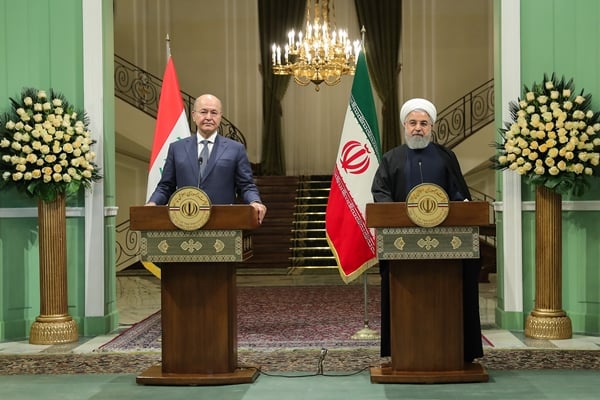
President Rouhani on Saturday stressed the significance of political and economic ties between the two neighbours, saying they had agreed on closer cooperation in energy, oil and environment sectors.

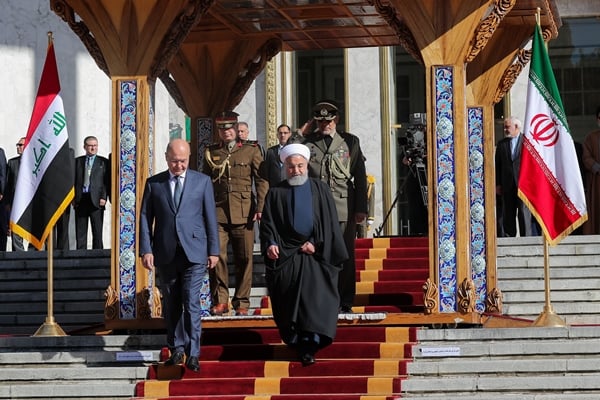
Rouhani made the comments during a joint press conference with his Iraqi counterpart Barham Salih held in Tehran.

He said railway development aimed at making the march of Arba’een easier for Iranian pilgrims was one of the issues raised in his discussions with President Salih.

The Iranian president also referred to the dust pollution in south-western Iran, which originates from the Iraqi territory, and said Salih promised to personally pursue the issue. He expressed hope that the two sides can get rid of the dust problem through joint efforts.

He went on to say that Iran-Iraq ties are of great historical, cultural, and regional importance underlining that the history of mutual cooperation goes back to more than 30 years ago.

Iranian and Iraqi presidents also emphasised the importance of regional security and stability.

The Iranian president highlighted the importance of establishing peace and security in Yemen and Syria, saying that regional stability will benefit all Mideast countries.

Salih, for his part, said the people of Iraq understand the importance of bilateral ties with Iran and will not forget Tehran’s help in their fight against terrorism.

Salih arrived in Tehran on Saturday as his first official visit to the country since assuming office last month.

Several high-ranking officials have accompanied Salih on this trip. Salih is set to meet other top Iranian officials to discuss regional and bilateral issues.

UN Rewards Iranian Woman for Creativity in Rural Life

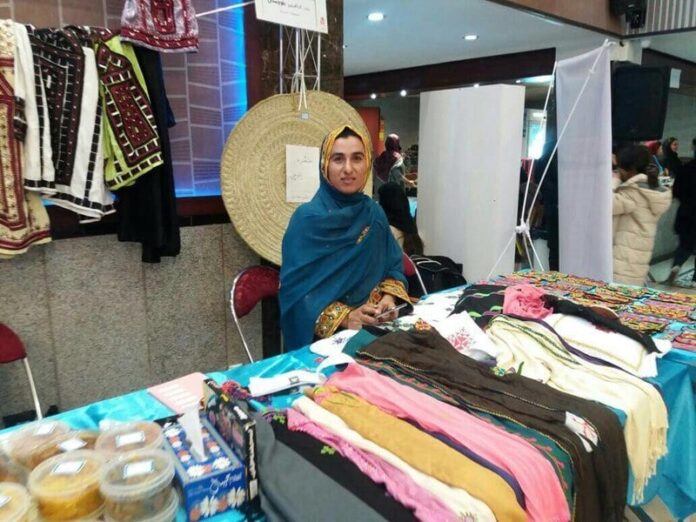
Ziba Azizi, who was born in Azizabad County of Qasr-e Qand district in Sistan and Baluchestan province, was introduced a few days ago as one of the UN role models and the most inspiring rural woman in Iran.

Some other women from Nepal, Honduras, Colombia, India, Switzerland, Guatemala and Mexico were among the laureates of 2018 Women’s World Summit Foundation’s awards for Creativity in Rural Life.

Azizi has been addressing and raising awareness on issues like child marriage in her community, where it is still widespread.
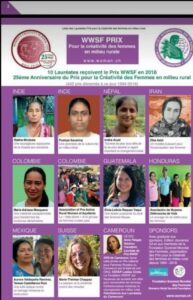
UN Rewards Iranian Woman for Creativity in Rural LifeAccording to the WWSF, she’s been engaged in distribution of stationery in dozens of schools, the fundraising and supervision of the construction of restrooms in deprived rural areas (which is especially important for women), preventing 30 cases of child marriage (each case demands many hours of negotiating with the families involved), and finally teaching needlework, one of the traditional weaving handicrafts made by Baloch women, to destitute women.

Ziba has even been able to market the products, combining them with modern art and selling them under the brand name “Noora”, thereby creating job opportunities for many women who head their families and are in critical need.

Maybe most important of all, Ziba started an International Association of Psychosocial Rehabilitation Services in one of the most impoverished rural areas of Sistan and Baluchestan, which has provided education for children who receive no education. The centre is called House of Knowledge, where a new culture is being born, one giving equal rights to girls as well as boys to be educated.

Here is a brief summary of Ziba’s life that has been published by Iran newspaper:
Ziba’s parents got an ID card for their nonexistent girl in 1983 to receive more ration coupons. A few years later, Ziba was born on the last night of holy month of Ramadan. She was five years old when her family moved to the village of Deh Jan, which in Balochi language means “The Premier Woman”. They moved there to have less troubles in life, along with her father’s family in the absence of the father.

Ziba’s father at that time had gone to Dubai to cover their living expenses.

Now, more than 25 years have passed since then, and Ziba remembers those days as follows:
“My earliest memories date back to the time when my mother was sewing and also was taking goats to pastures while I was taking care of my one-year-old sister. It was very sad that my mother had to work so hard. I told myself, you should compensate these days when you grow up! The more I grew up, the more my mom was getting on me as my dad was not there. It was so bad that I was begging her to let me go to school. For the first time, several teachers came to teach children in our village and in the surrounding regions. Meanwhile, there were no schools in our village, and there was no place for them to stay overnight.”

After the arrival of these teachers, despite her mom’s disagreement, Ziba and her aunt were the first girls attending the school with the permission of her grandfather.

Ziba says she was a good student, but her teacher used to reproach her for her burnt sleeves. “I wore a Baloch shirt instead of a uniform, and since I was baking bread every day, the sleeves of all my clothes were burnt, and this was unacceptable to our teacher. However, a few months later, when I received my books and got the top scores, our teacher became my best friend and companion.”

After finishing the elementary school, she went to another village to continue her studies with the support of her grandfather.

She used to get up early in the morning to walk several miles. At the same time, Ziba decided to change the lives of the girls in the village and her siblings so that the hardships she experienced would not be repeated for them.

Ziba finished high school to become the teacher of illiterate people. Then, she started helping girls and women who could not go to school. Beside teaching, she continued her studies in social sciences.
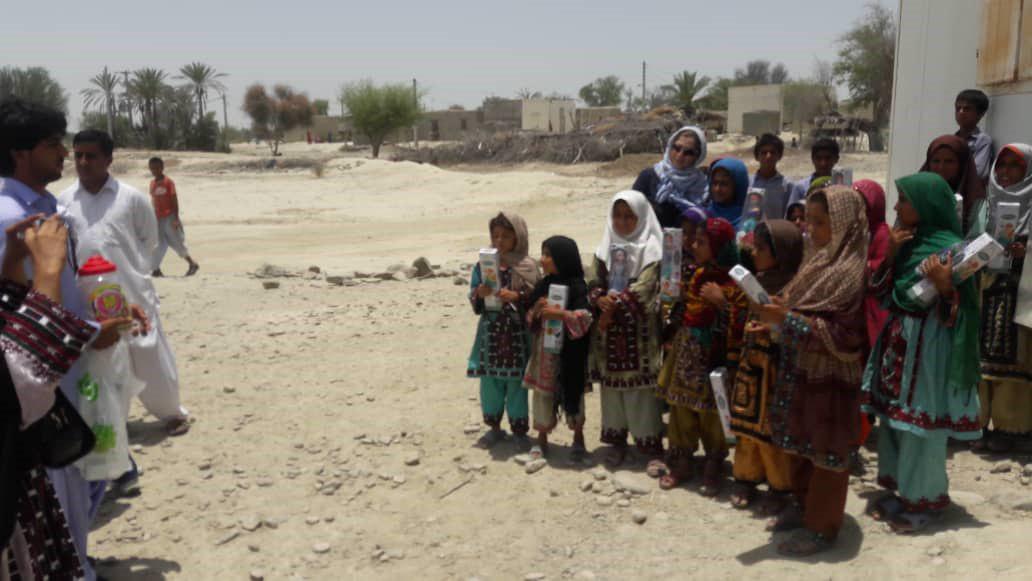
UN Rewards Iranian Woman for Creativity in Rural LifeThe university gave her the chance to make her childhood dreams come true.

At the same time, her father, who was busy with domesticising camels in Dubai, had his ribs broken and returned from Dubai.

Now, in addition to helping her mother, she had to work in farm as well.

“No one was calling me Yaghoub’s daughter anymore. They were calling me Yaghoub’s son. In addition to giving financial assistance to my family, I received a loan and expanded my father’s house so that my sisters and brothers could have their own rooms,” adds Ziba.

Gradually, charitable groups came to the village and Ziba did her best to convince them she is determined to help improve the lives of the villagers. Finally, they sent her to Qasr-e Qand as a trainer.

“When I first arrived in Tehran and I visited this metropolis with all the facilities, on the way back to Qasr-e Qand, I told myself that the things I had done so far were not enough and I must increase my activities.”
Ziba continued her activities. Her successes and her growing influence in the region led the United Nations to choose her as one of the world’s leading rural role models.

However, she says “of course, I have additional responsibilities now, but all my joy is because of the cheers in Azizabad and Qasr-e Qand. I am happy that the motivation of youths in our region has increased.”

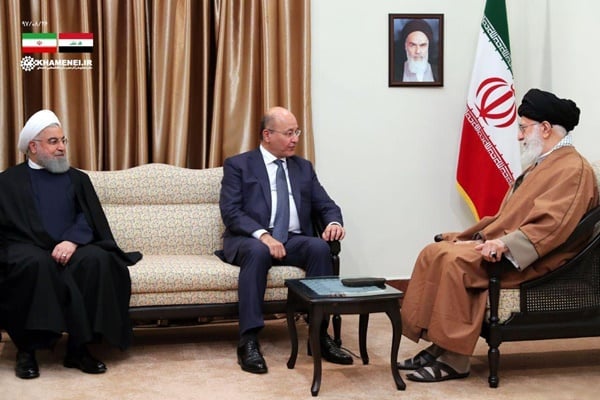
Iraqi President in Tehran to Hold Talks with Iranian Officials

Iranian President Hassan Rouhani officially welcomed his Iraqi counterpart in Tehran’s Saadabad Palace.

Salih is accompanied by several high-ranking officials. He is going to meet with Rouhani and other top officials to discuss regional and bilateral issues.

The two sides are also expected to sign memorandums of understanding in different fields.

Salih is in the middle of a regional tour. Before his trip to the Islamic Republic, he visited Jordan, Kuwait, and the United Arab Emirates. He is slated to visit Saudi Arabia as well.

Iran and Iraq are close regional allies and have extensive trade ties. Iraq is Iran’s second-largest market after China, and buys everything from food and machinery to electricity and natural gas.

On 2 October 2018, Salih was elected as 8th President of Iraq. He received 219 votes and defeated Fuad Hussein who secured 22 votes.

He is the former prime minister of the Kurdistan Regional Government of Iraqi Kurdistan and a former deputy prime minister of the Iraqi federal government.

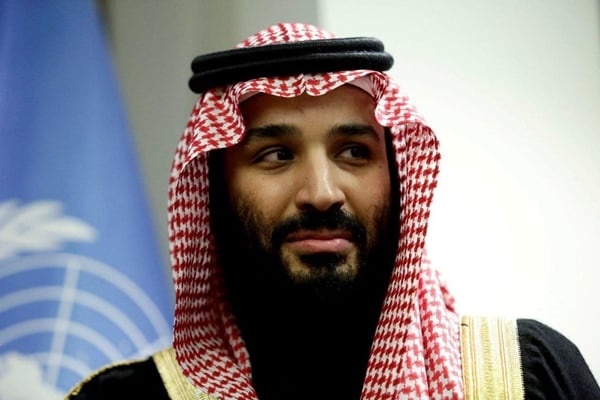
‘CIA Concludes Bin Salman Ordered Killing of Khashoggi’

A report by The Washington Post quoted people familiar with the case as saying that the CIA’s assessment, in which officials have said they have high confidence, is the most definitive to date linking Mohammed to the operation and complicates the Trump administration’s efforts to preserve its relationship with a close ally.

A team of 15 Saudi agents flew to Istanbul on government aircraft in October and killed Khashoggi inside the Saudi consulate, where he had come to pick up documents that he needed for his planned marriage to a Turkish woman.

In reaching its conclusions, the CIA examined multiple sources of intelligence, including a phone call that the prince’s brother Khalid bin Salman, the Saudi ambassador to the United States, had with Khashoggi, according to the people familiar with the matter who spoke on the condition of anonymity to discuss the intelligence.

Khalid told Khashoggi, a contributing columnist to The Washington Post, that he should go to the Saudi consulate in Istanbul to retrieve the documents and gave him assurances that it would be safe to do so.

It is not clear if Khalid knew that Khashoggi would be killed, but he made the call at his brother’s direction, according to the people familiar with the call, which was intercepted by US intelligence.

The CIA’s conclusion about Mohammed’s role was also based on the agency’s assessment of the prince as the country’s de facto ruler who oversees even minor affairs in the kingdom. “The accepted position is that there is no way this happened without him being aware or involved,” said a US official familiar with the CIA’s conclusions.

Over the past several weeks, the Saudis have offered multiple, contradictory explanations for what happened at the consulate. This week, the Saudi public prosecutor blamed the operation on a rogue band of operatives who were sent to Istanbul to return Khashoggi to Saudi Arabia, in an operation that veered off course when the journalist “was forcibly restrained and injected with a large amount of a drug resulting in an overdose that led to his death,” according to a report by the prosecutor.

The prosecutor announced charges against 11 alleged participants and said he would seek the death penalty against five of them.

The assassination of Khashoggi, a prominent critic of Mohammed’s policies, has sparked a foreign policy crisis for the White House and raised questions about the administration’s reliance on Saudi Arabia as a key ally in the Middle East.

Among the intelligence assembled by the CIA is an audio recording from a listening device that the Turks placed inside the Saudi consulate, according to the people familiar with the matter. The Turks gave the CIA a copy of that audio, and the agency’s director, Gina Haspel, has listened to it.

Iran Rejects UN Rights Resolution as ‘Politically-Motivated’

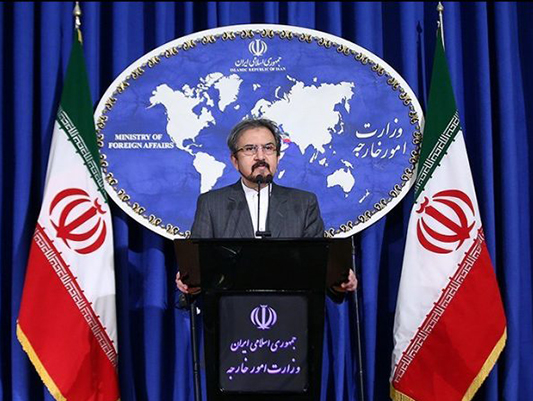
Bahram Qassemi

The resolution was adopted during the 73rd session of the Third Committee of the General Assembly with the support of governments which are themselves among the biggest violators of human rights in their own countries and in other states, Qassemi said in a Friday statement, condemning these countries for backing the resolution.

“The resolution has been drafted and adopted without considering the facts on the ground in Iran, and based on a selective, biased, and discriminatory approach and with political intentions,” he said, saying that Tehran rejects the resolution.

“Iran strongly condemns the instrumental use of human rights, human rights resolutions, and international mechanisms by certain Western countries, the occupying and infanticidal Zionist regime [of Israel], and some reactionary regional regimes,” Qassemi said, adding that these countries use human rights as a tool to achieve their extremism and inauspicious goals.

Tehran also condemns these countries’ anarchist policies and their support for separatist terrorists, he went on to say.

Iran believes such a trend would undermine the international community’s trust in international mechanisms and their efficacy, he added.

Qassemi said in contrast with such measures, the country lends credit to the UN Human Rights Council’s Universal Periodic Review (UPR), which would assess all countries without discrimination.

“Iran’s constructive and active participation in the UPR process reflects the Islamic Republic’s seriousness in enhancing human rights and acting on its international commitments in the area through constructive cooperation and dialogue-based mechanisms,” he added.

The resolution was approved Thursday in a 85-30, with 68 abstentions. This means the resolution will most probably be approved by the 193-member world body when it comes up for voting next month.

Speaking ahead of voting on the Canadian draft resolution, Iran’s deputy ambassador to the UN Es’haq Al-e Habib said the countries sponsoring the measure have done everything in their power to “suppress or derail” Iranian people’s “century-long struggle… for the causes of human rights and democracy.”

“Orchestrating a military coup in 1953 against a democratically-elected government, unconditionally supporting a despotic ruler for the following two and half decades, supporting a war of aggression against Iranians during the 1980s, providing chemical weapons and reconnaissance to [former Iraqi dictator] Saddam to target Iranians, shutting down an Iranian passenger flight murdering all of its 290 passengers, colluding with renowned terrorist cults, and waging a full-fledged economic war against Iranians in defiance of Security Council resolution 2231 and the mandatory ruling of the International Court of Justice are only a few examples to recall,” he said.

Iran Bans Advertisement of Harmful Products

Last weekend, Iranian Minister of Health and Medical Education Seyyed Hassan Qazizadeh Hashemi sent letters to Minister of Culture and Islamic Guidance Seyyed Abbas Salehi and the chief of state broadcaster IRIB Abdolali Ali-Asgari to inform them of the ban on advertising the harmful products in all media.

An official with Iran’s Food and Drug Organisation announced that the list of harmful products has been reviewed and prioritised following a series of meetings with the health authorities, as well as the representatives of National Standard Organization.

According to the Food and Drug Organisation, these products have been classified into three groups:

Sausages, ham, all types of sandwiches and pizza, ready-to-eat frozen pizzas, Olivier salad, samosas, falafel, processed cheese, all kinds of carbonated or non-carbonated beverages, energy drinks, flavoured malt drinks, carbonated fruit drinks, cooking oils, frying oils, margarine or vegetable butter, potato chips, fried corns and beans (snacks), cocoa products, fatty desserts, and makeup products for skin and hair (lipstick, mascara, foundations, pancakes, eyeliners, lip-liners, hair dye, and sun tan lotions) are all in the Group 1 due to the existence of heavy metals and the frequency of consumption.

All types of cream cheeses, syrups and non-alcoholic drinks, high-fat sauces (mayonnaise and salad dressings) with a fat content of over 30%, sweets made from flour, toffees, candies, various anti-cellulite products and topical slimming products are in the second group of the banned products.

Group three includes semi-prepared kebab, hamburgers, edible icy products, instant drinks powder, Minerin crème, tattoo and skin design products, hair straighteners, and hair regenerators.