Tuesday, December 30, 2025
Home Blog Page 3339

A Look at Iranian Newspaper Front Pages on February 13

A Look at Iranian Newspaper Front Pages on November 19

The top story in all papers today was the latest war of words between Iranian and American officials, particularly the tweet by US President Donald Trump and the response he received from Iranian Foreign Minister Mohammad Javad Zarif.

Also a top story was the upcoming Warsaw Summit, which is to be held by the US in the Polish capital and is expected to be an anti-Iran meeting of Western, Israeli, and Arab foreign countries, even though Poland has vowed it will have nothing to do with Iran.

The Thursday meeting between Iranian President Hassan Rouhani, his Russian counterpart Vladimir Putin, and the Turkish president, Recep Tayyip Erdogan, in the Black Sea resort city of Sochi also received great coverage. The issue of Syria and efforts by the three guarantor states to bring back peace to the country will be the focus of the trilateral meeting.

The above issues, as well as many more, are highlighted in the following headlines and top stories:


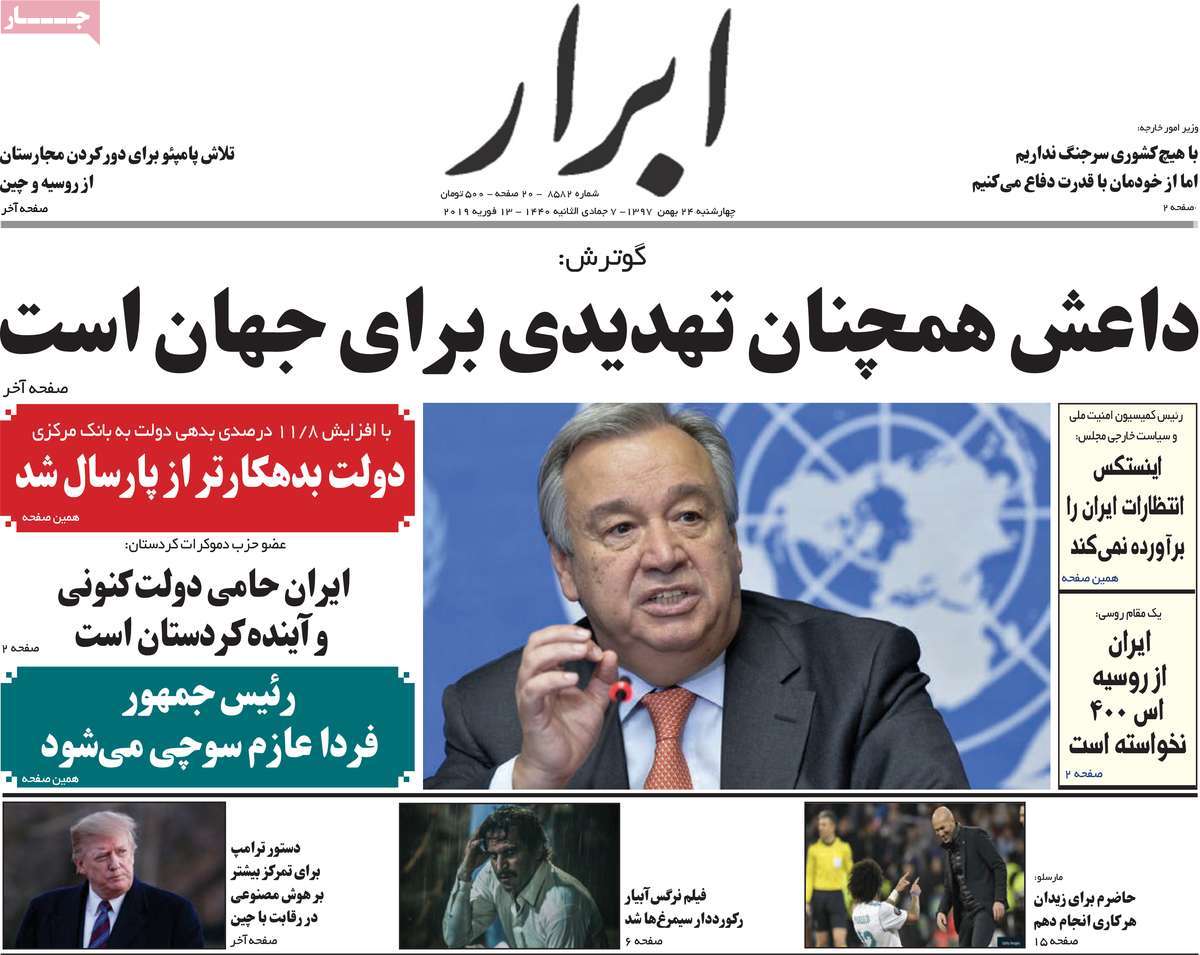
Afkar:

1- FM: We’re Not after War with Any Country, but Strongly Defend Ourselves

2- Pompeo’s Efforts to Keep Hungary Away from Russia, China

3- Guterres: ISIS Still Threat to World

4- Russian Official: Iran Has Never Asked Russia for S-400

5- Trump Calls for More Focus on Artificial Intelligence in Competition with China

6- INSTEX Not Fulfilling Iran’s Expectations: Lawmaker

A Look at Iranian Newspaper Front Pages on February 13


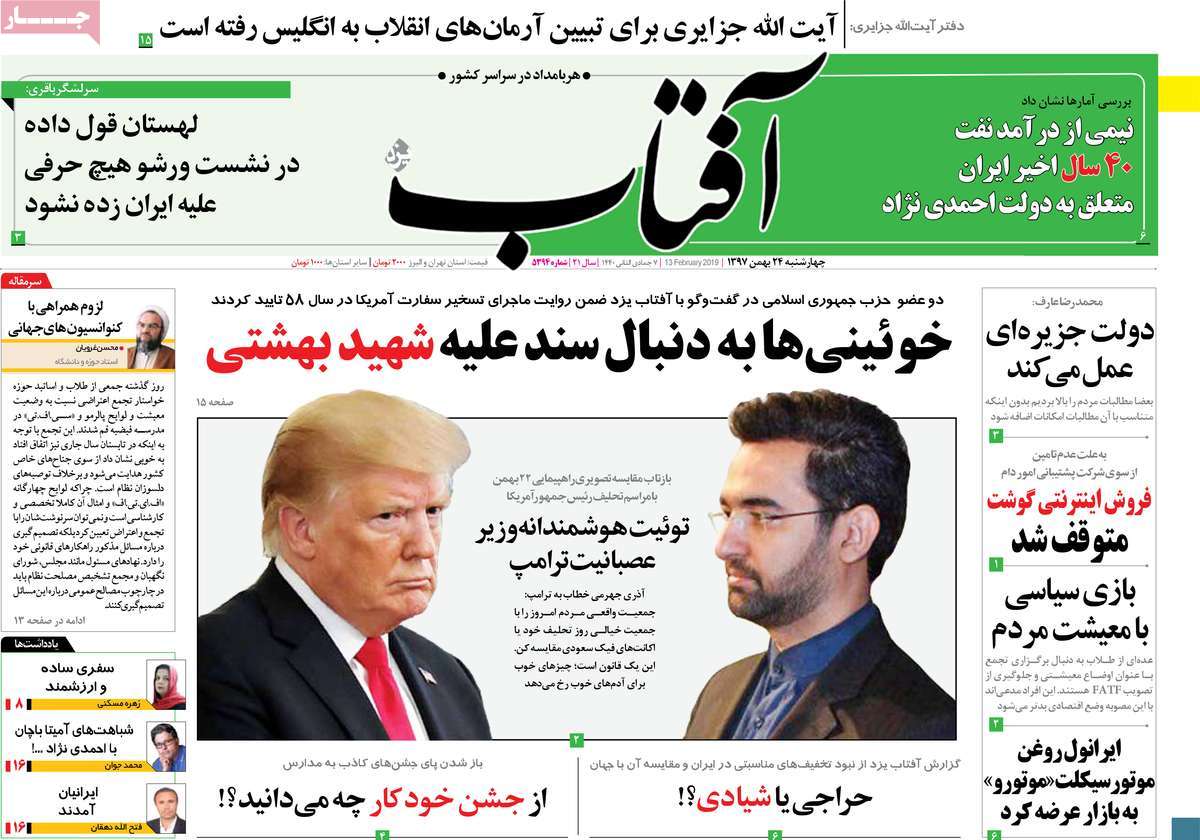
Aftab-e Yazd:

1- Ayatollah Jazayeri in UK to Elaborate on Causes of Iran’s Revolution

2- Poland Vowed No Anti-Iran Comments Be Made in Warsaw Summit

3- Half of Iran’s Oil Revenues in Past 40 Years Earned during Ahmadinejad’s Era

4- Iranian Minister’s Smart Tweet amid Trump’s Outrage

  • ICT Minister: Compare REAL Crowd Attending Iran Rallies with Your Fake Inauguration Day Crowd

A Look at Iranian Newspaper Front Pages on February 13


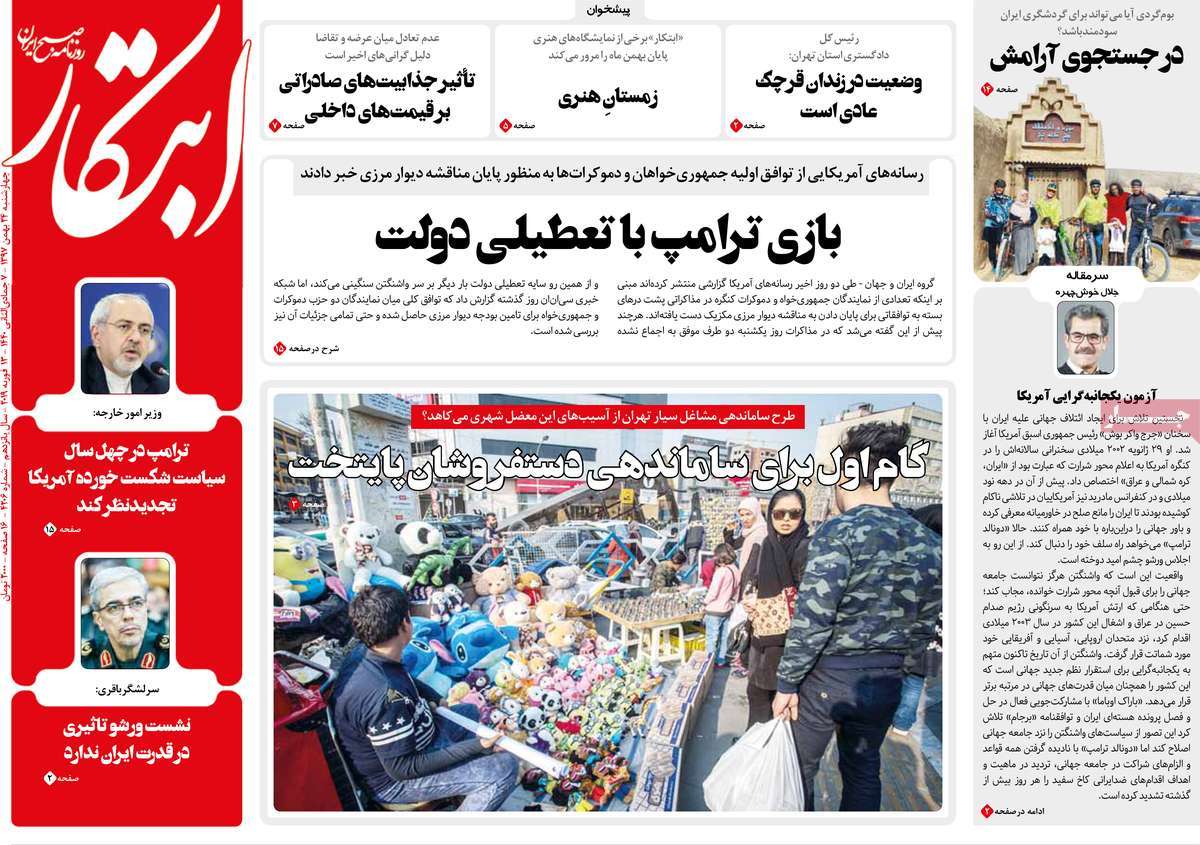
Ebtekar:

1- Iran FM: Trump Must Rethink 40 Years of Failed US Policy

2- Top General: Warsaw Summit Not to Impact Iran’s Power

3- Trump Playing with Government Shutdown

  • GOP, Dems Reach Initial Deal to End Border Wall Dispute

A Look at Iranian Newspaper Front Pages on February 13


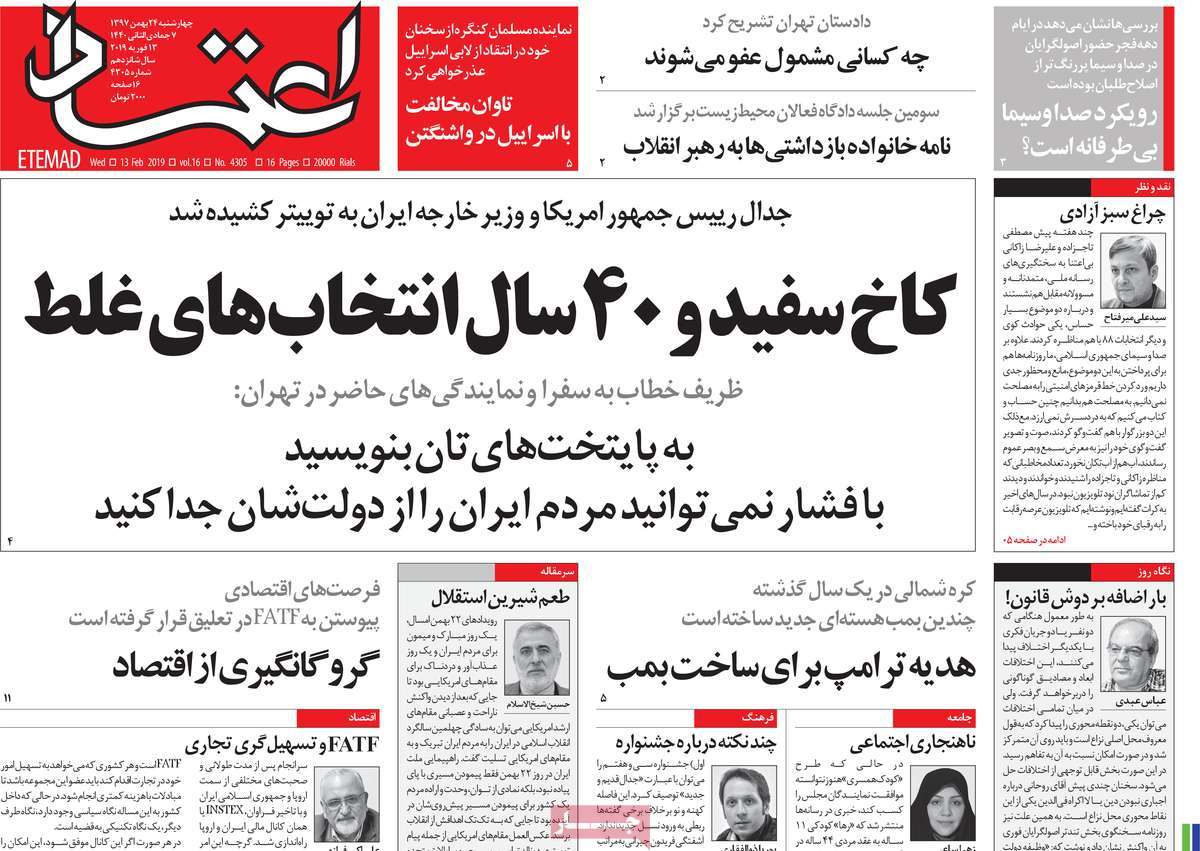
Etemad:

1- Price of Opposing Israel in Washington

  • Muslim Congresswoman Apologizes for Remarks against Israeli Lobby Group

2- White House and 40 Years of Wrong Choices

  • US President, Iran FM Continue War of Words in Twitter

3- Trump’s Gift for Making Bomb: N. Korea Has Developed Several New Nukes in Past Year

A Look at Iranian Newspaper Front Pages on February 13


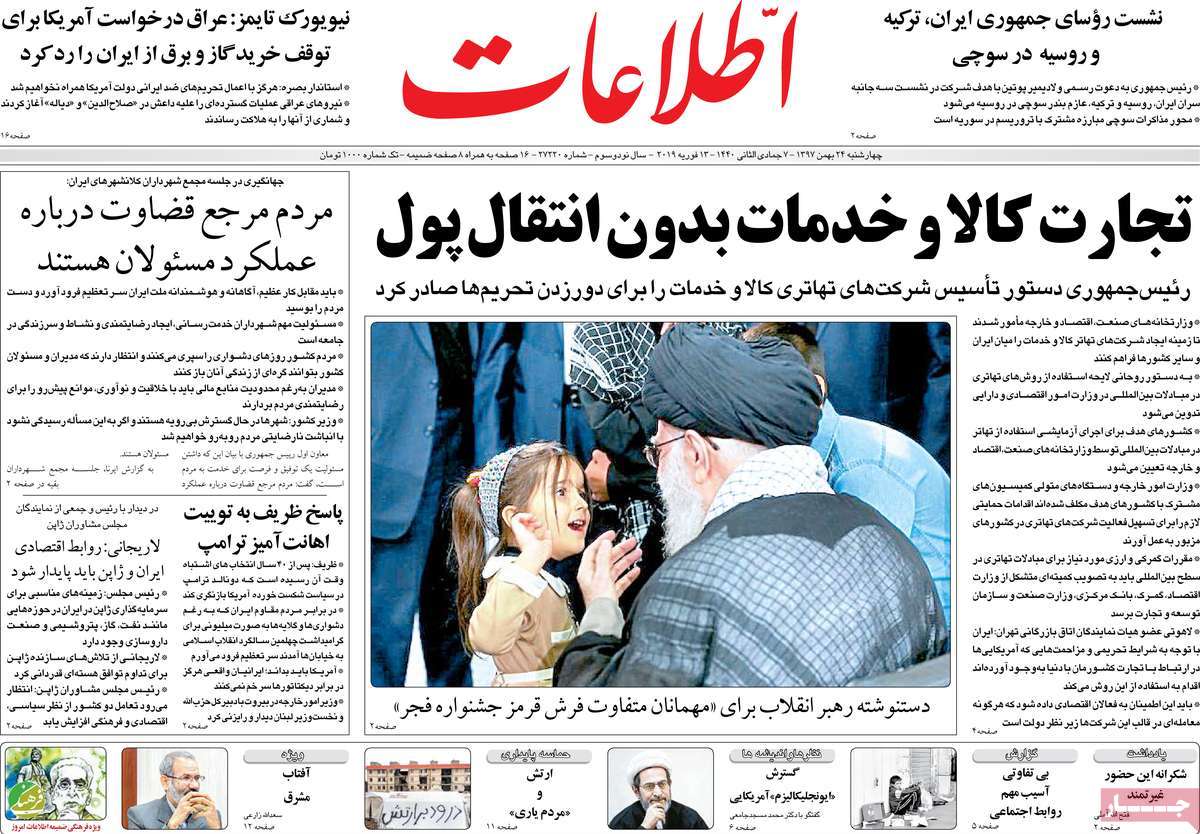
Ettela’at:

1- Iran, Russia, Turkey Presidents to Meet in Sochi

2- New York Times: Iraq Rejects US’ Request to Stop Gas, Electricity Imports from Iran

3- Zarif’s Response to Trump’s Insulting Tweet

4- Rouhani Urges Formation of Barter Companies to Bypass US Sanctions

A Look at Iranian Newspaper Front Pages on February 13


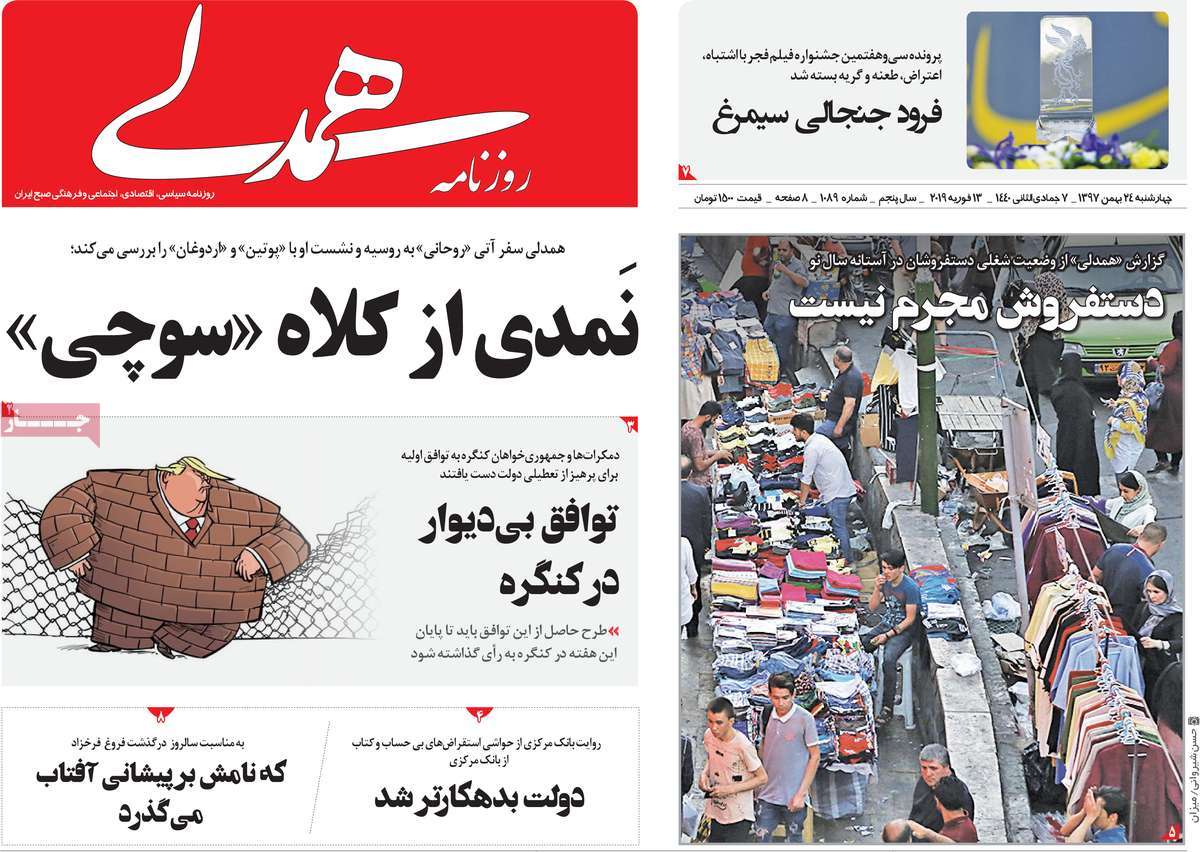
Hamdeli:

1- A Report on Rouhani’s Upcoming Trip to Russia, His Meeting with Putin, Erdogan

2- No-Wall Deal in Congress

  • Democrats, Republicans Reach Initial Deal to Avoid Gov’t Shutdown

A Look at Iranian Newspaper Front Pages on February 13


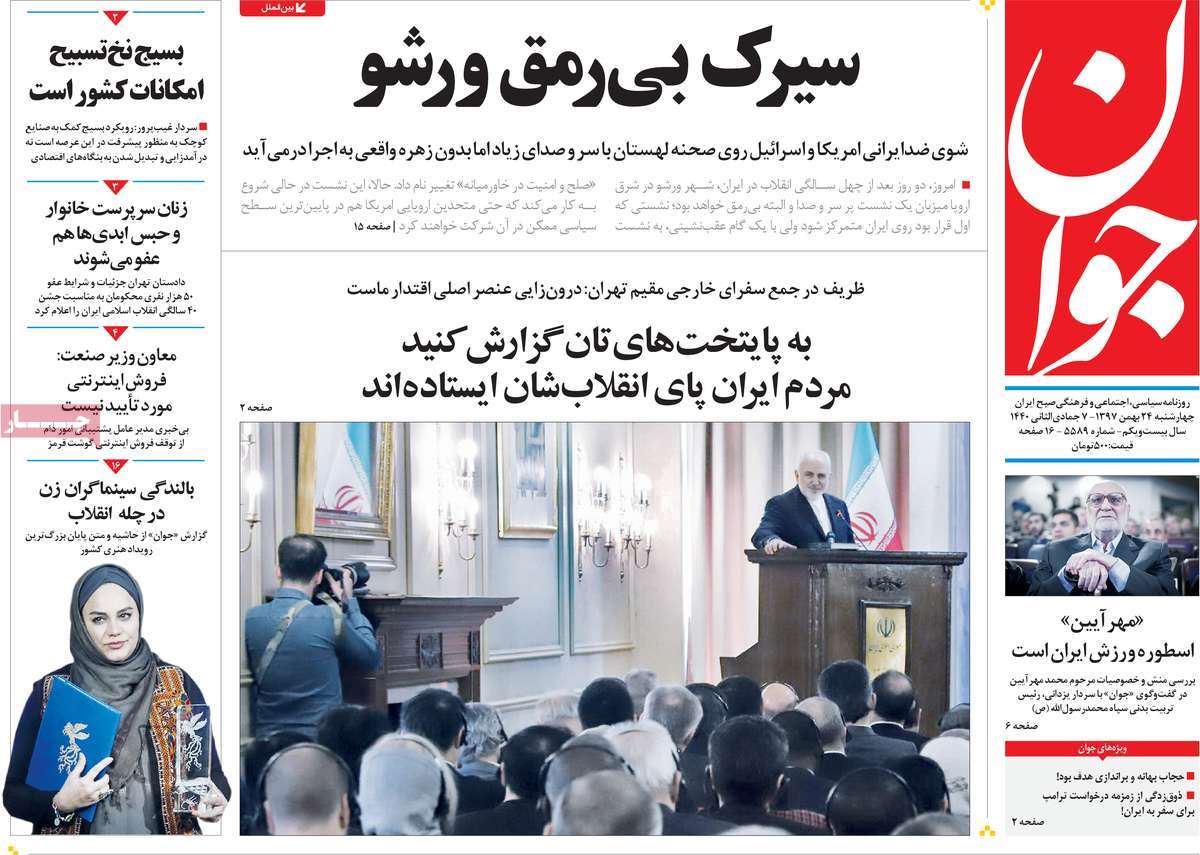
Javan:

1- Dull Circus of Warsaw

  • US, Israel’s Anti-Iran Show in Poland to Be Held in Noisy, but Impotent Way

2- Report to Your Capitals Iranians Have Stood behind Their Revolution: Zarif

A Look at Iranian Newspaper Front Pages on February 13


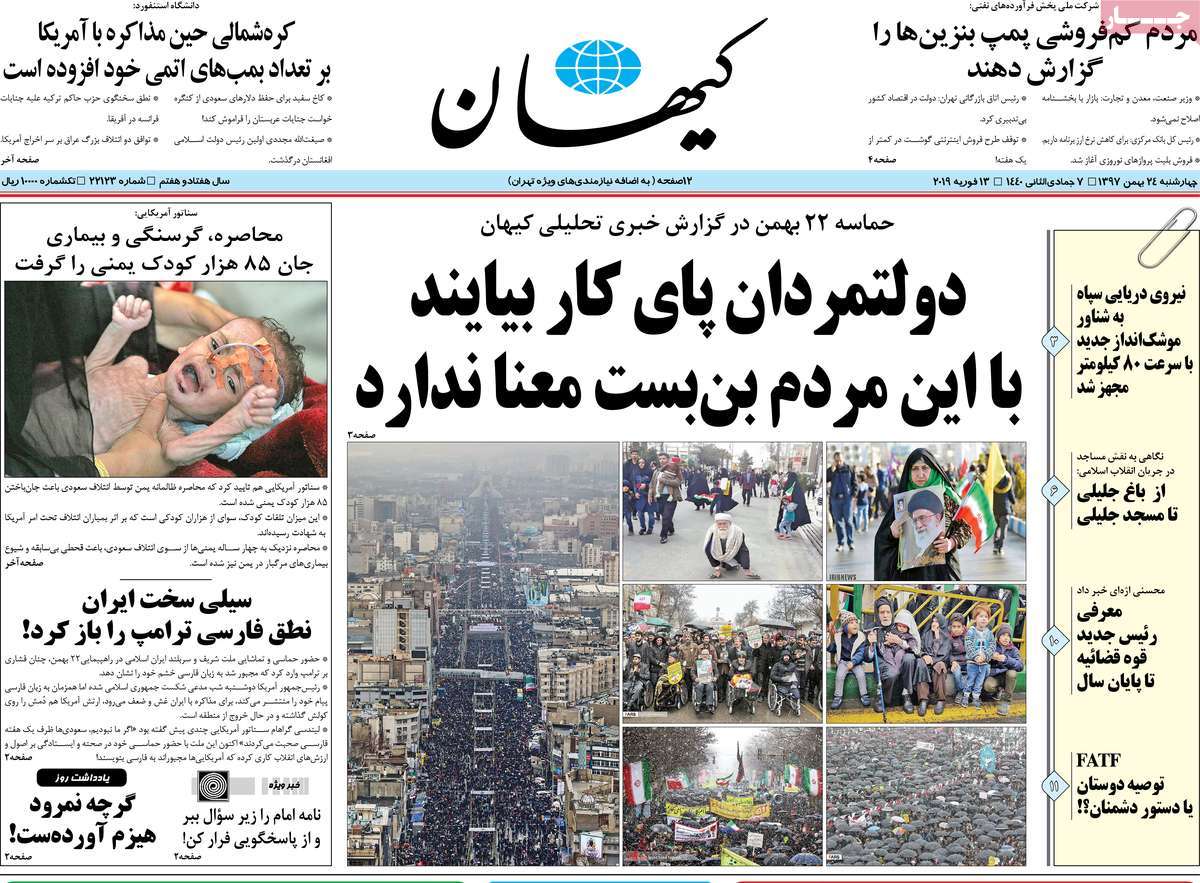
Kayhan:

1- North Korea Has Increased Its Nuclear Bombs While Holding Talks with US

2- 85,000 Yemeni Kids Killed by Hunger, Disease

3- IRGC Navy Equipped with New Catamaran Capable of Firing Cruise Missile

4- Trump Starts Talking after Being Slapped by Iran in Face

A Look at Iranian Newspaper Front Pages on February 13


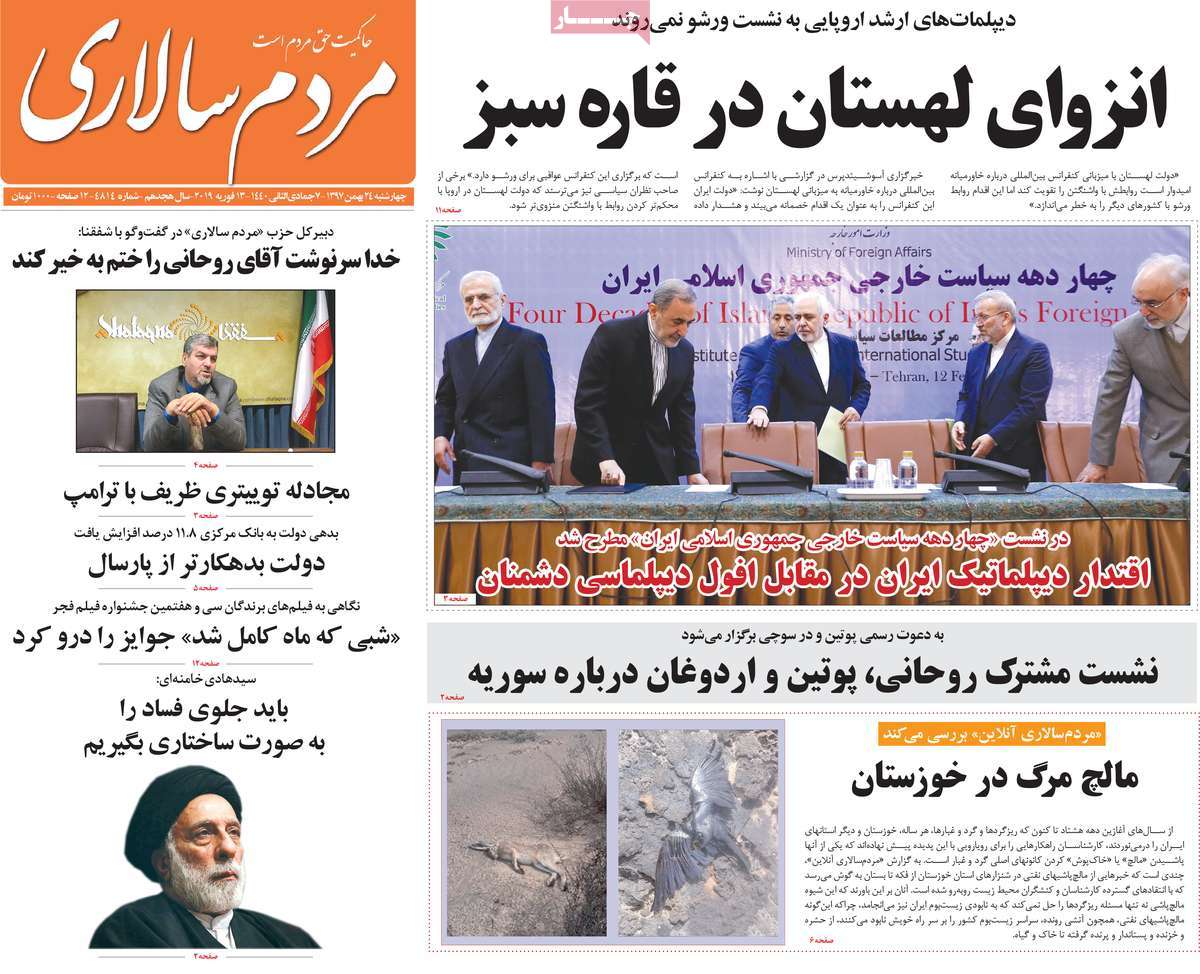
Mardom Salari:

1- Poland’s Isolation in Europe: Top European Diplomats to Boycott Warsaw Summit

2- Rouhani, Putin, Erdogan to Hold Trilateral Meeting on Syria

A Look at Iranian Newspaper Front Pages on February 13


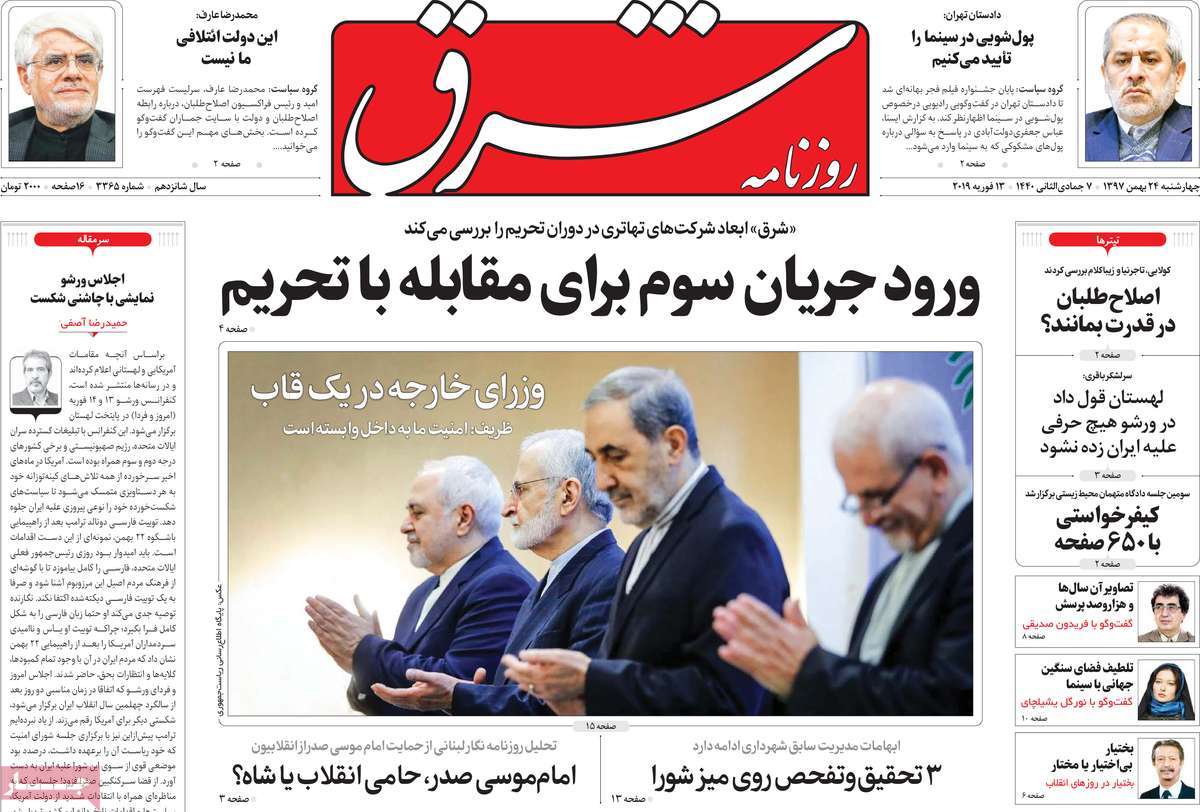
Shargh:

1- Third Move to Counter Sanctions: Barter Companies

2- Warsaw Summit: A Show Doomed to Failure [Editorial]

3- Poland Vowed There’ll Be No Anti-Iran Comment in Warsaw Meeting

A Look at Iranian Newspaper Front Pages on February 13


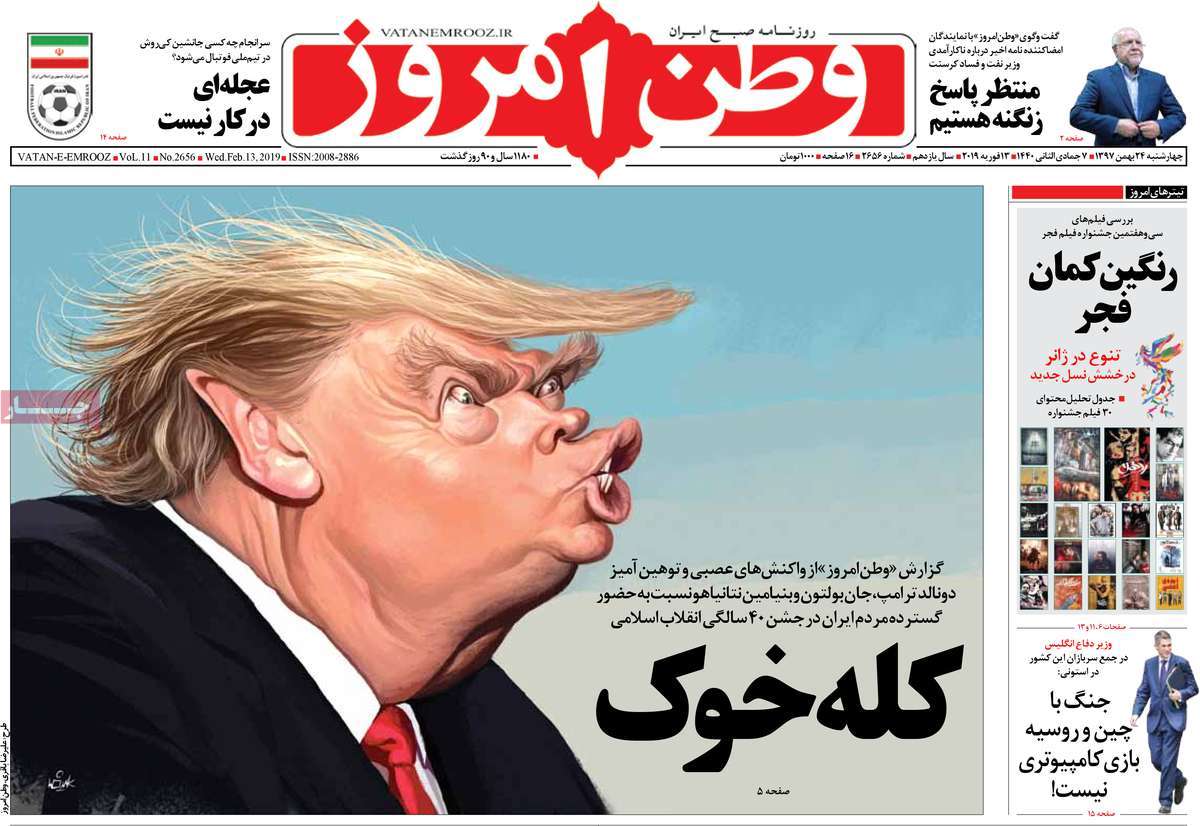
Vatan-e Emrooz:

1- War against China, Russia Not a Computer Game: UK Defence Secretary

A Look at Iranian Newspaper Front Pages on February 13

Iran Leader Releases ‘Strategic’ Statement on 40th Revolution Anniv.

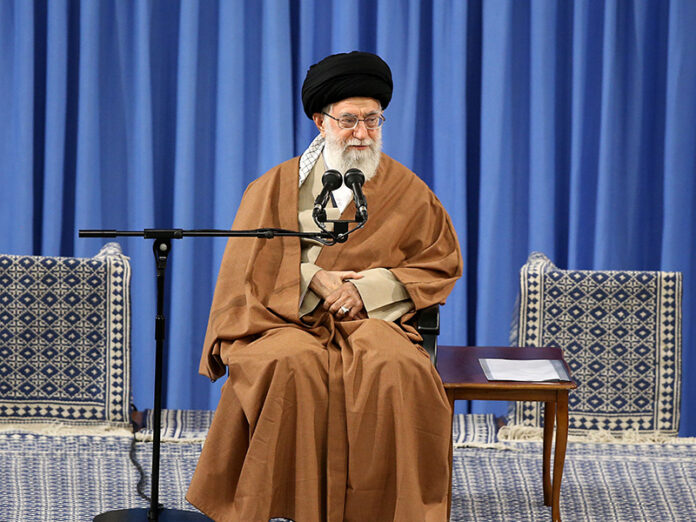
Ayatollah Seyyed Ali Khamenei

The statement, issued as a new chapter is opened in the Islamic Republic’s life, explains the path walked in the past forty years and the steps needed for further advances, the Leader’s official website said.

In the statement, the Leader has stressed the unique role Iranian youth could play to help the country take its “second stride” towards ideals, explaining requirements for Iran’s progress in seven sections.

The Leader has further admitted the Revolution’s failure to realize justice in the Islamic society by saying that “we’re far far away from where we should be”, and stressed that the Revolution is prepared to correct its mistakes.

Ayatollah Khamenei has also urged all Iranian officials to be “afraid” of deepening gap among social classes in the Iranian society.

The full text of the statement, entitled the “Second Phase of the Revolution”, is as follows:

In the Name of God, the Most Beneficent, the Most Merciful

All praise is due to Allah, the Lord of the Worlds, and peace and greetings be upon our Master and Prophet, Ab-al-Qassem Al-Mustafa Muhammad, upon his pure and immaculate household, upon his chosen companions and upon those who follow them in charity until the Day of Judgment

Among all the nations suffering from oppression, few make an effort to launch a revolution; and among those nations that have risen and launched a revolution, few have been witnessed to have pursued it to the end, or moved beyond merely changing the government and safeguarded their revolutionary values. However, the auspicious Revolution of the Iranian nation—which is the greatest and most popular revolution of the contemporary era—is the sole revolution that has persisted forty years of pride, saved from betrayal to its values, and it has preserved its dignity and original slogans against all the temptations which seemed irresistible; hence, entering the second phase of self-development, society-processing and civilization-building. Heartfelt salutations to this nation, the generation who initiated and continued [the movement] and the generation that currently steps into the magnificent and global phenomenon of the second forty years!

The day when the world was divided into the material West and East, and no one presumed a major religious movement would emerge, the Islamic revolution of Iran stepped into the scene gloriously and mightily; it broke the frameworks; it flaunted to the world the outdatedness of the clichés; it put the religion and the material world together, and declared the coming of a new era. It was much expected that the leaders of deviation and oppression would react—but in vain. Whatever the right and left modernity did— from pretending to ignore this emerging and unprecedented voice to extensive efforts for suffocating it— just brought them closer to their indispensable demise. Today, after forty annual celebrations of the victory of the Revolution and forty Fajr ten-days, one of the two centers of animosity has already perished, and the second one is struggling with predicaments that signal its death in the near future. Whereas, the Islamic Revolution is advancing while preserving and adhering to its mottos.

It is possible to assume an expiry date for anything, yet, the global mottos of this religious revolution are exceptional; they will never expire because they match human nature in all eras. Freedom, ethics, spirituality, justice, independence, dignity, rationality, brotherhood, are not limited to a single generation or society so that they would rise in a period and decline in the next. It is impossible to imagine a people who despise these values. The reported cases of reluctance to these values were due to the officials who had shrunken from these religious values; and not due to their adherence to them and endeavors for achieving them.

The Islamic revolution—like a living and unwavering phenomenon—is always flexible and ready to correct its mistakes, but it is not revisionary or passive. It is positively sensitive to criticisms; it regards them as a divine blessing as well as a warning to those who do not act upon their words; yet it, by no means, takes distance from its values, which are blended with the religious faith of the people, thanks be to God. Since the establishment of the system, the Islamic revolution has never suffered from, and will never suffer from stagnation and recession, and it does not see any conflict and contradiction between revolutionary dynamism and political and social order; rather, it eternally defends the theory of the revolutionary system.

The Islamic Republic is not reactionary and it does not lack perception and understanding in face of new phenomena and situations; however, it strongly adheres to its principles and it is highly sensitive to its frontiers in relation to its rivals and enemies. It never imprecisely regards its principle lines and considers it important as why and how it would persist. Undoubtedly, the gap between the musts and the realities has always tormented the idealist consciences; however, this gap is fillable, and in the past forty years it has been filled in many cases, and certainly in the future, with the presence of a young, faithful, wise and motivated generation, it will be filled more vigorously.

The Islamic Revolution of the Iranian nation has been mighty, but merciful; forgiving and even oppressed. It has not committed any of extremist and deviated acts that have marked many other uprisings and movements with stigma. In no conflicts—not even against the United States or Saddam Hussein—did it ever shoot the first bullet and, in all cases, it defended itself after the enemy’s attack; of course, it blow the defensive strike vigorously. Since its inception, this Revolution has never been merciless nor has it ever shed blood; it has neither been passive nor hesitant. Standing assertively and courageously against bullies and thugs, it has defended the oppressed. This revolutionary bravery and gallantry, this honesty, assertiveness, and sovereignty; this global and regional realm of action in support of the oppressed of the world represent a source of pride for Iran and the Iranians, and may it persist eternally!

Now, at the beginning of a new chapter in the life of the Islamic Republic, I would like to address my dear young people: the generation who steps up to start another part of the Great Jihad [selfless endeavor] for building a great Islamic Iran. The first section of my address concerns the past.

Dear ones! You cannot learn but from your own experience or listening to the experiences of others. Many of what we have seen and experimented, your generation has not experienced and seen yet. We have seen and you will see. The decades ahead are your decades, and it is you who should protect your revolution while you are qualified and full of motivation, and move it closer to its great ideal: that is, the emergence of a new Islamic civilization and the preparation for the rising of the great sun of wilayat (may our souls be sacrificed for him) [Imam Mahdi (a.s.)]. To take steady steps in the future, we need to develop a good knowledge of the past and learn from the experiences. If this strategy is neglected, lies will replace the truth, and the future will be menaced by unknown threats. The adversaries of the revolution are strongly motivated in their efforts to spread distortions and lies about the past and even the present, exploiting money and all the necessary tools for it. The bandits of thought, creed and awareness are ample; the truth cannot be heard from the enemy and its troops.

The Islamic Revolution and the establishment that rose from it started from scratch. Firstly, everything was against us: the corrupt regime of Taghut [Pahlavi tyranny]—which, in addition to its dependence and corruption, tyranny and being coup-based—was the first royal regime in Iran that was brought to power by the foreigners rather than by the force of sword; the government of the United States and some other Western governments; or the extremely chaotic situation inside Iran; and the shameful backwardness in science and technology, politics, spirituality, and any other virtue.

Secondly, there was no precedent experience before us and the path ahead of us had not been treaded. Obviously, Marxist uprisings and the like could not represent a role model for a revolution that emerged from the heart of Islamic faith and knowledge. Islamic revolutionaries began without an example and experience, and the combination of a republic and Islam and the means for the formation and progress of it were not achieved except through the divine guidance as well as the luminous heart and the great thought of Imam Khomeini. And this marked the first brilliance of the Revolution.

Then, the revolution of the Iranian nation transformed the bipolar world of that day into a three polar world, and then, with the fall and disappearance of the Soviet Union and its allies and the emergence of new poles of power, the new dichotomy of “Islam and the Arrogant Front” became a prominent phenomenon of the contemporary world and the focal point that is attracting the world’s attention. On the one hand, the aspirated look of the oppressed nations, freedom-seeking movements and some independence-seeking states of the world fixated on it; and on the other hand, it was screened by resentful and malicious eyes of the world’s bullying regimes and blackmailer thugs. Such, the world adopted a different orientation, and the seismic power of the Revolution shook the untroubled pharaohs. Hostilities began with all intensity; if it was not due to the magnificent power of the faith and the motivation of this nation and the heavenly and endorsed leadership of our imminent Imam, it was impossible to resist the hostility, conspiracy, and vice [directed at us].

In spite of all these onerous problems, the Islamic Republic took greater and stronger steps day after day. The past 40 years exhibited great jihads, brilliant achievements and amazing advances for the Islamic Iran. The magnitude of the progress made by the Iranian nation in the last forty years is well-recognized when compared to similar spans following other major revolutions such as the French Revolution, the October Revolution of the Soviet Union and the Indian Revolution. The jihadi management strategies inspired by Islamic faith and the belief in the principle of “we can do it”—that Imam Khomeini (r.a.) had taught us all—assisted Iran in its achievement of dignity and progress on various arenas.

The revolution put an end to a long historical decadence, and the country, which was severely humiliated and utterly retrograded during the Pahlavi and Qajar dynasties, started to progress rapidly. In its first step, the revolution turned the disgraceful regime of the tyrannical monarchy into a popular and democratic state, and employed the element of national determination—which is the essence of comprehensive and genuine progress—to the heart of the country’s governance; then, it turned the youth into the main forerunners of the developments and the key players in the management of the country. It conveyed the “we can do it” spirit and belief to everyone; thanks to the enemies’ sanctions, it taught everyone to rely on domestic capacities, and this unfolded a source of great blessings:

Firstly, it guaranteed the stability and security of the country; the territorial integrity and the protection of the borders—which were targeted by the enemy’s serious threats—and gave rise to the miracle of victory in the eight-year war, leading to the defeat of the Ba’athist regime, and its American, European and Eastern supporters.

The story is being updated …

6m Foreign Tourists Visit Iran in 9 Months: VP

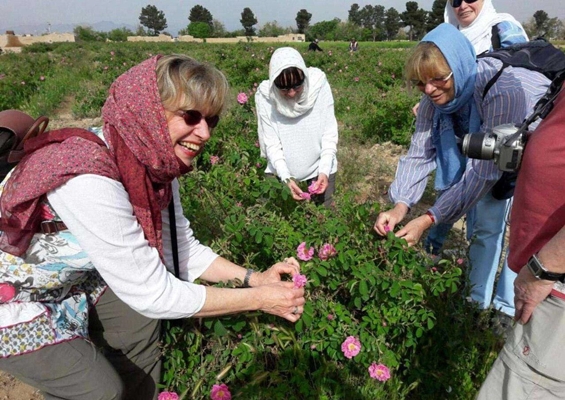
A group of foreign tourists picking rose flowers which will be turned into rosewater in the city of Kashan, in central Iranian province of Isfahan

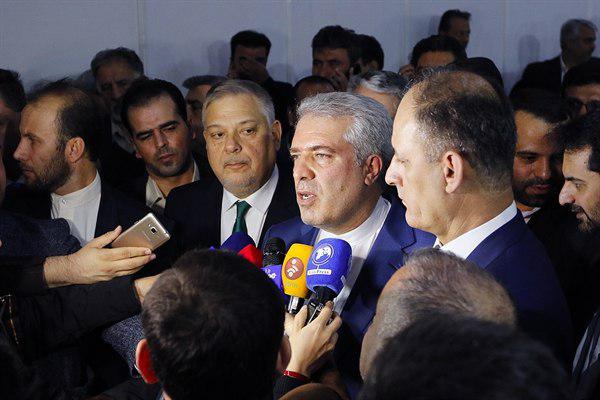
Speaking to reporters on the sidelines of the 12th Tehran International Tourism Exhibition on Tuesday, Mounesan predicted that by the end of the current Persian year (March 20), nearly seven million foreign tourists will visit Iran.

“Iran enjoys various tourist attractions along with its unique historical sites as well as warm hospitality of its people. Meanwhile, through holding various international tourism exhibitions, the Islamic Republic has managed to attract a growing number of tourists,” he was quoted as saying in a report by the Cultural Heritage and Tourism News (CHTN) website.

He went on to say that fortunately, the number of foreign tourists visiting Iran has increased significantly compared with the same period last year.

Tourism, in addition to economic functions, has other social and cultural functions which can lead to further cultural exchanges among the cultures, Mounesan said.

He also predicted a promising future for Iran’s tourism industry.

The Iranian vice-president said today a growing number of investors are expressing their interest in investing in Iran’s tourism industry.

6m Foreign Tourists Visit Iran in 9 Months: VP“So far, two thousand projects worth millions of dollars have been launched in Iran by private firms active in the tourism industry,” he said.

Mounesan cited the huge investments as a sign of a promising future for the industry in Iran.

During his visit to the Tehran International Tourism Exhibition, Mounesan was accompanied by Iraq’s Culture and Tourism minister.

The two officials made a tour of various sections of the exhibition and held talks with the delegates from private companies active in tourism industry.

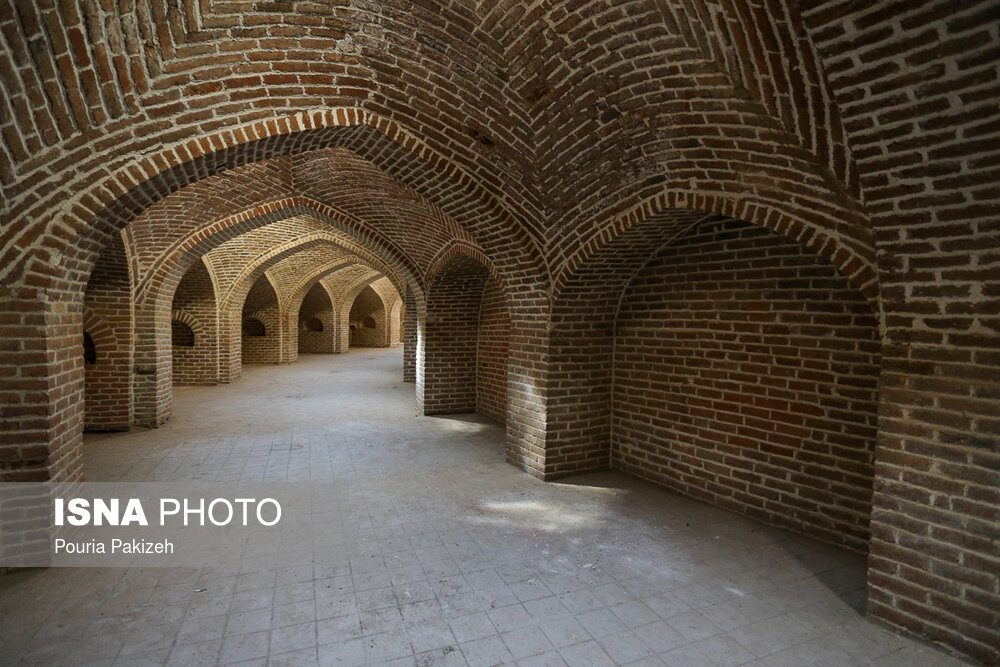
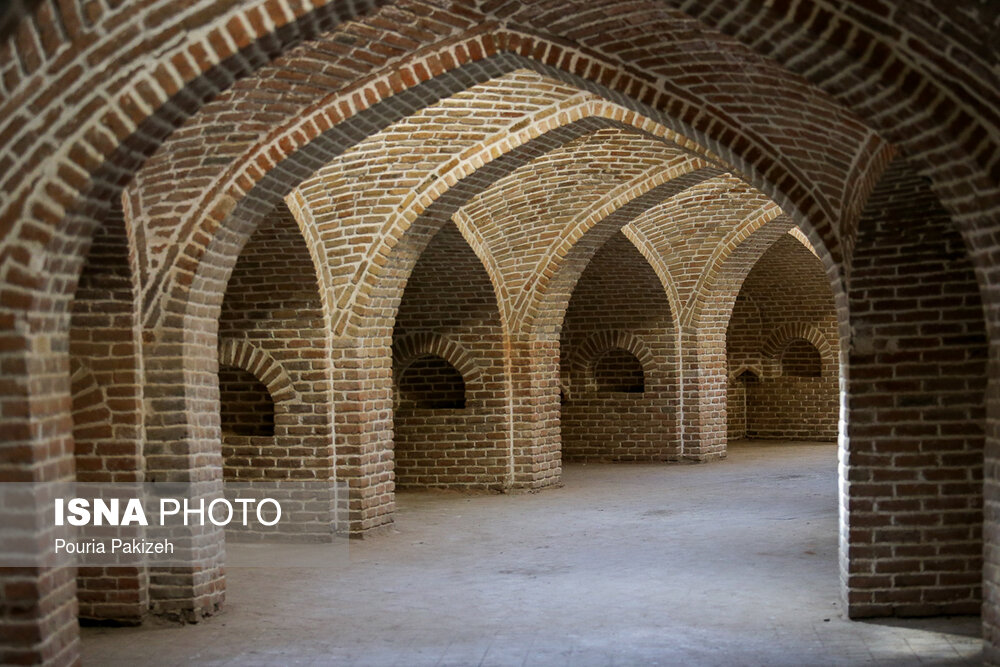
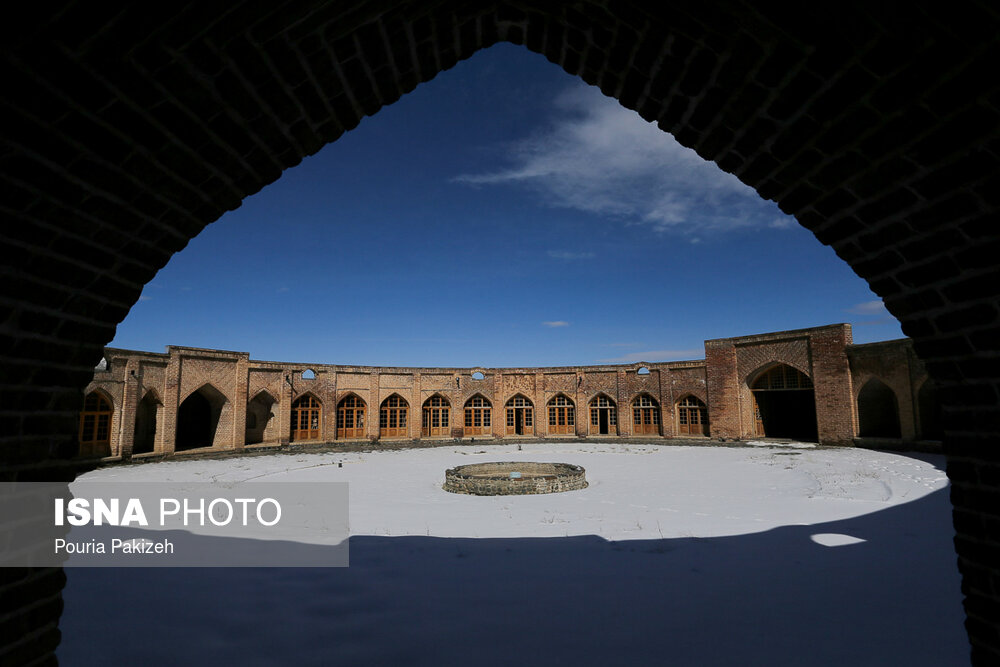
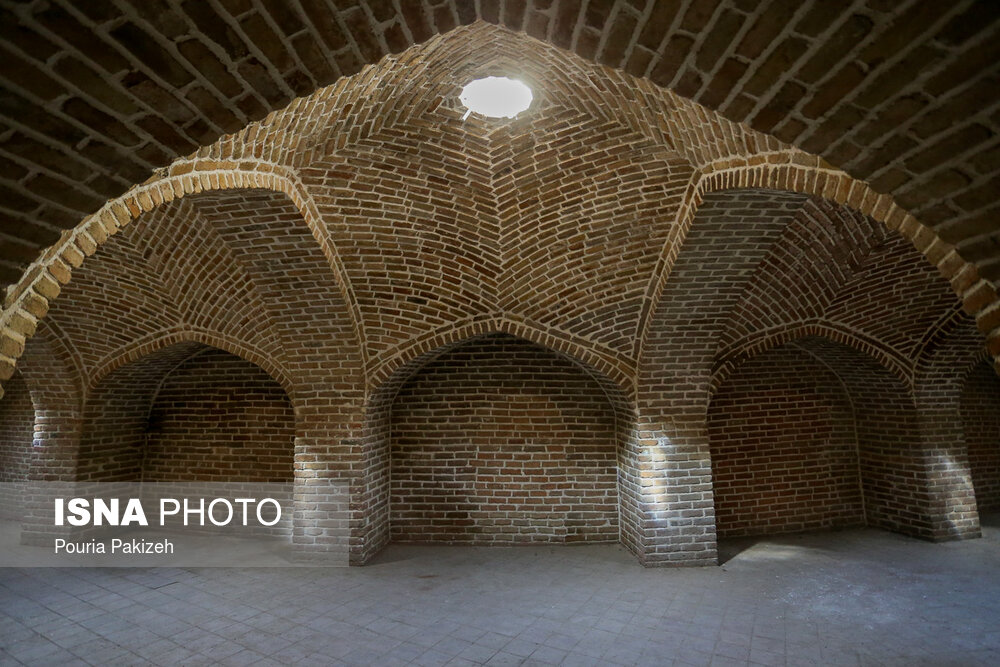
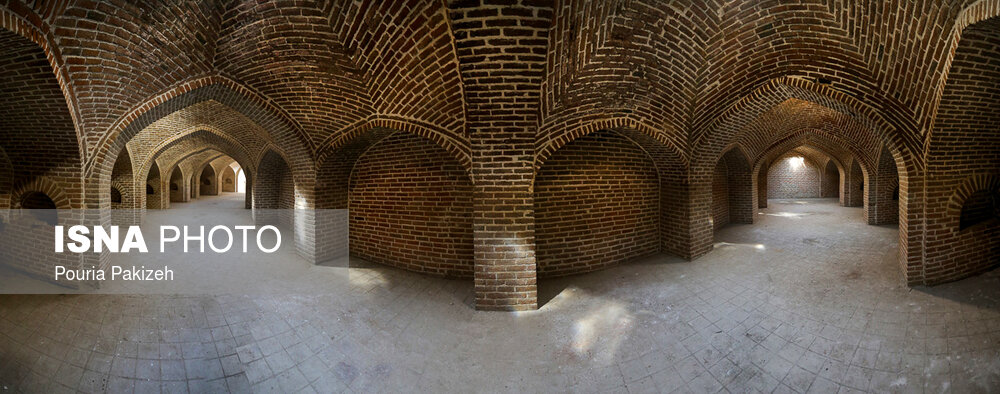
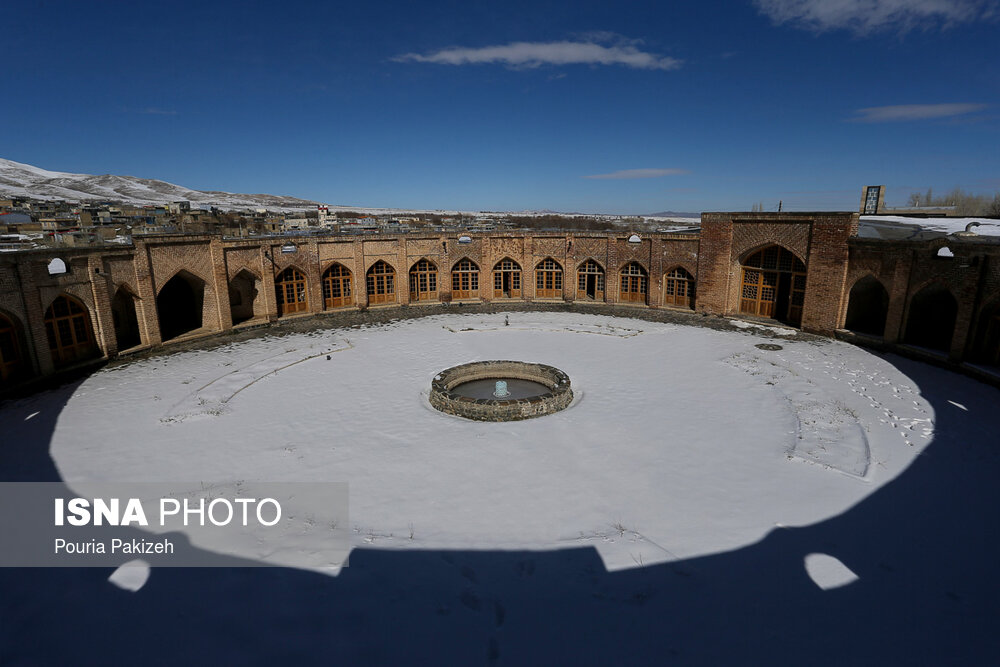
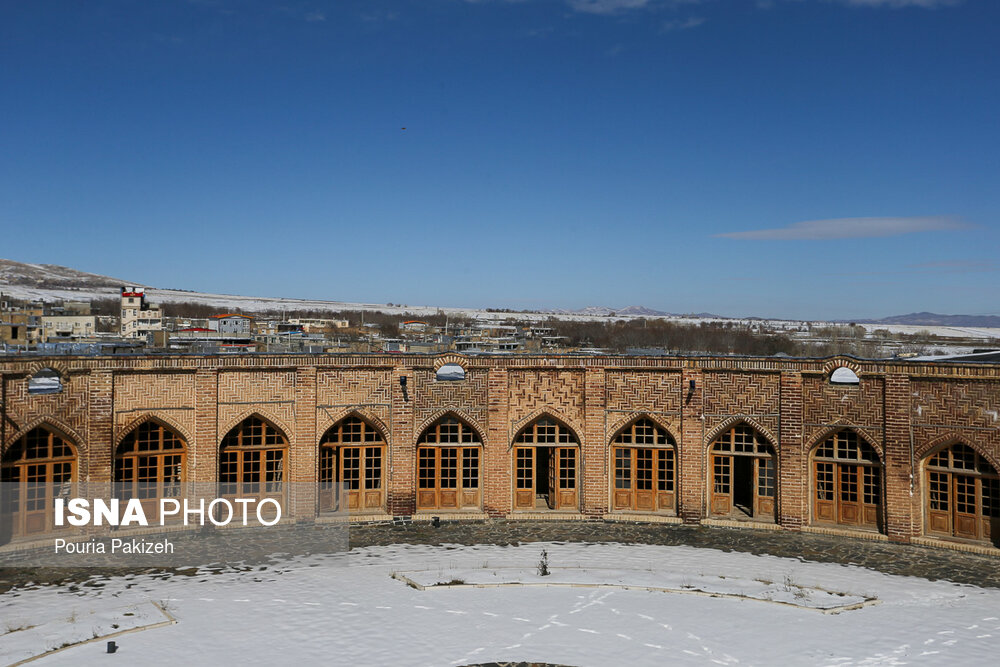
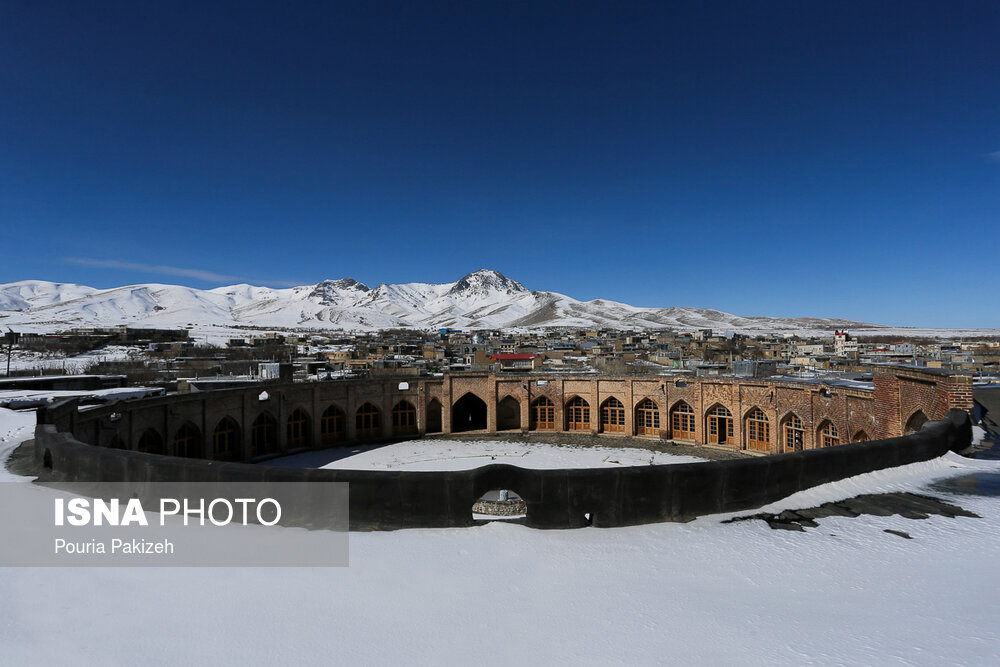
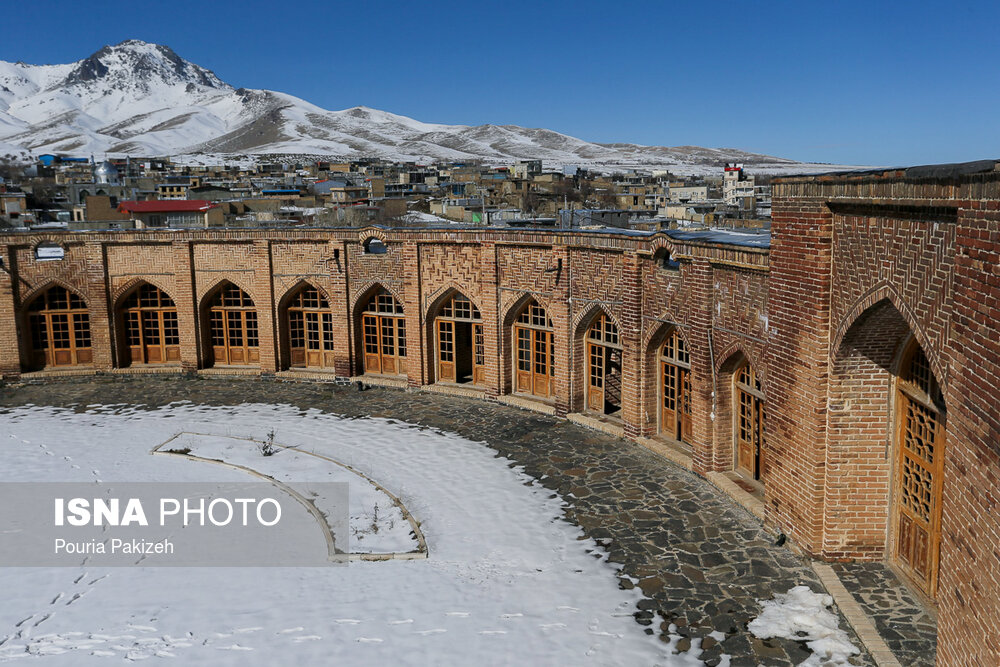
Tajabad Caravanserai; Unique Structure in Iran’s Hamadan

Tajabad Caravanserai; Unique Structure in Iran’s Hamadan

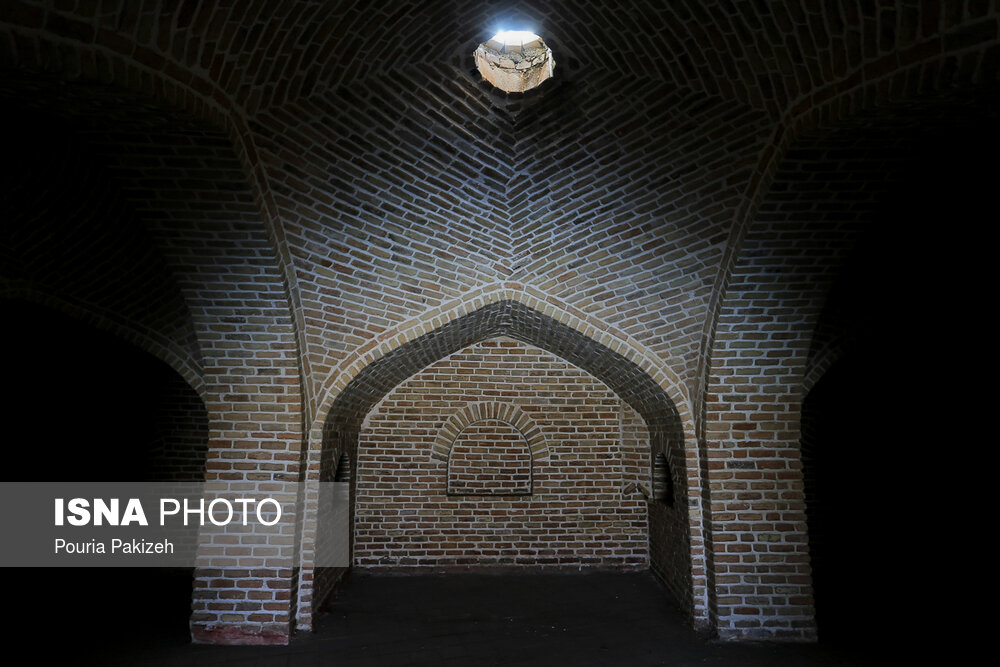
Caravanserais have played a significant role throughout the history of Iran. The tradition of building the structure was customary in Iran before and after Islam. Many beautiful caravanserais have been made in Iran, especially after the advent of Islam.

Tajabad Caravanserai is one of the most beautiful ones built after Islam during the Safavid era. It was registered in 1997 in the list of Iran’s national heritage. The people in Tajabad village speak Kurdish. This structure is located in the central part of the village, near Hamadan-Kermanshah road and on the way of pilgrims to the Iraqi holy city of Karbala.

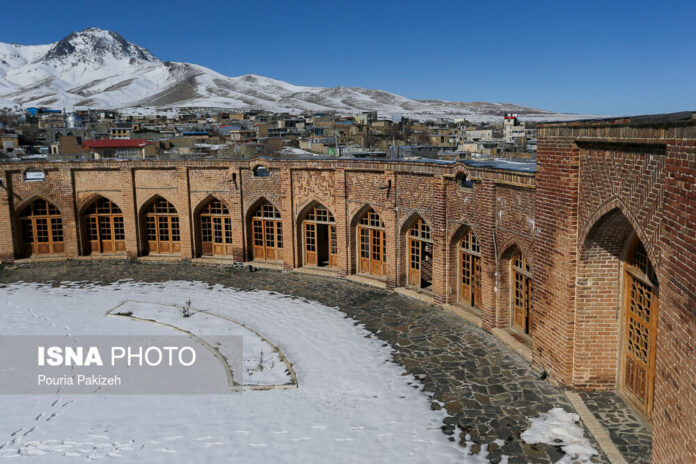
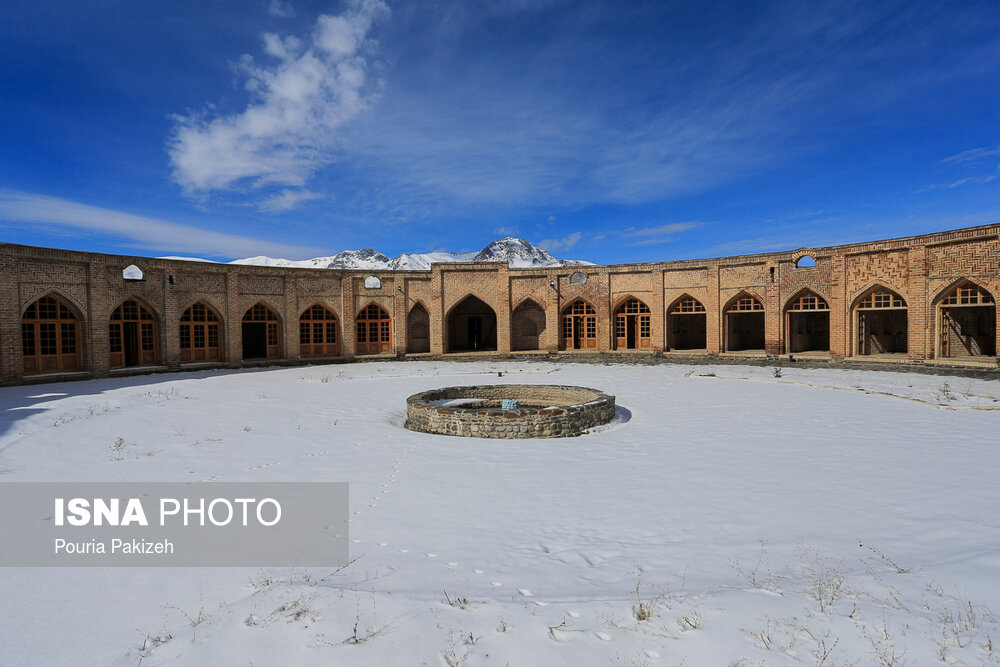
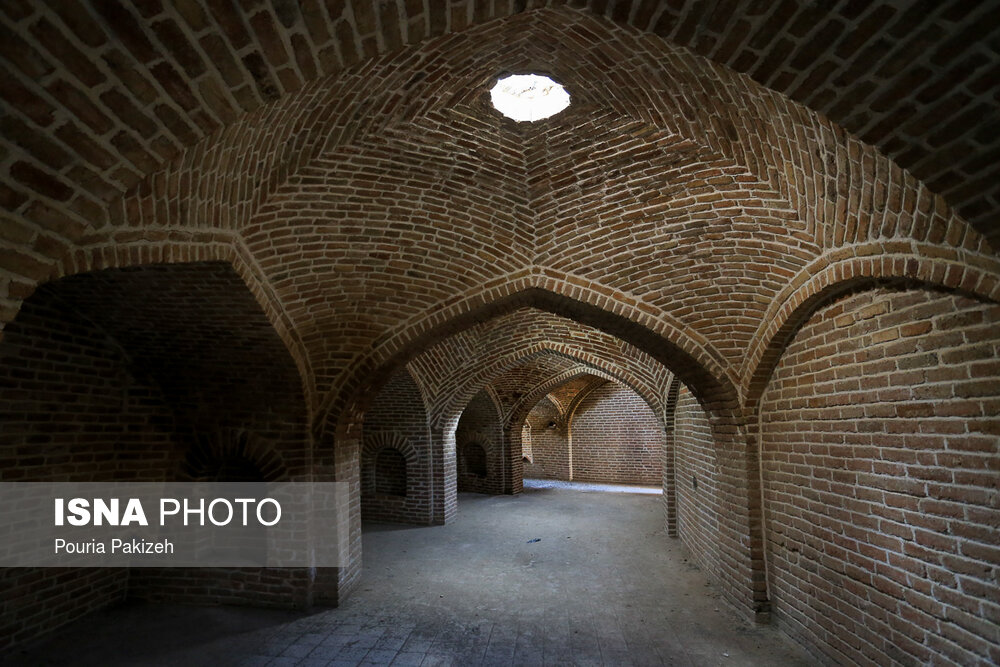
It is actually a circular Rabat – a type of caravanserai used by people to house their livestock – unlike most of the Iranian ones that have a rectangular plan. This plan is very rare among Iranian caravanserais; making the structure one of the most important caravanserais in the western region.

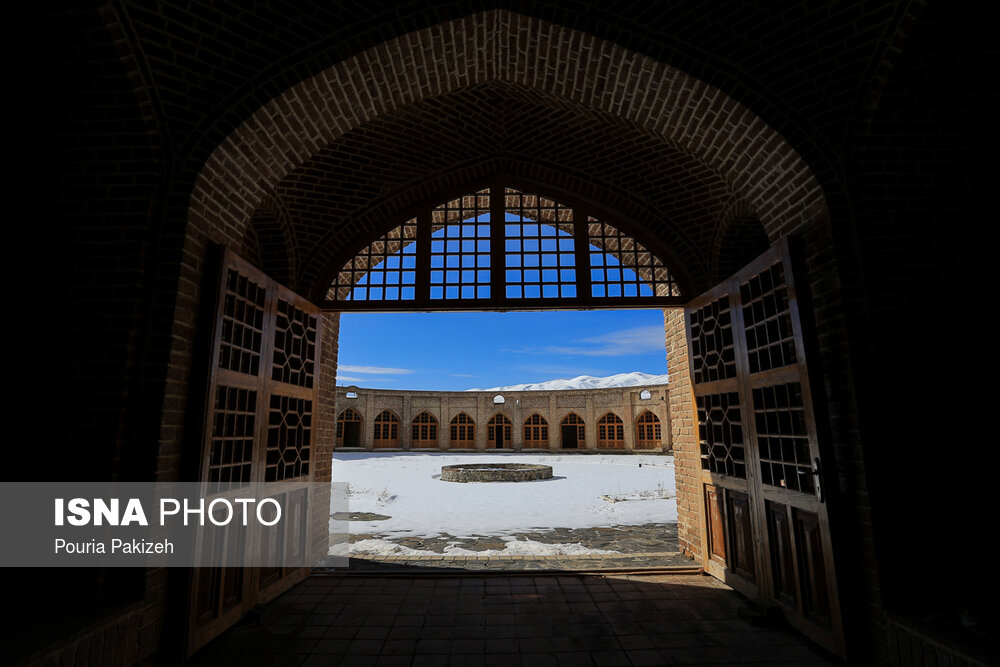
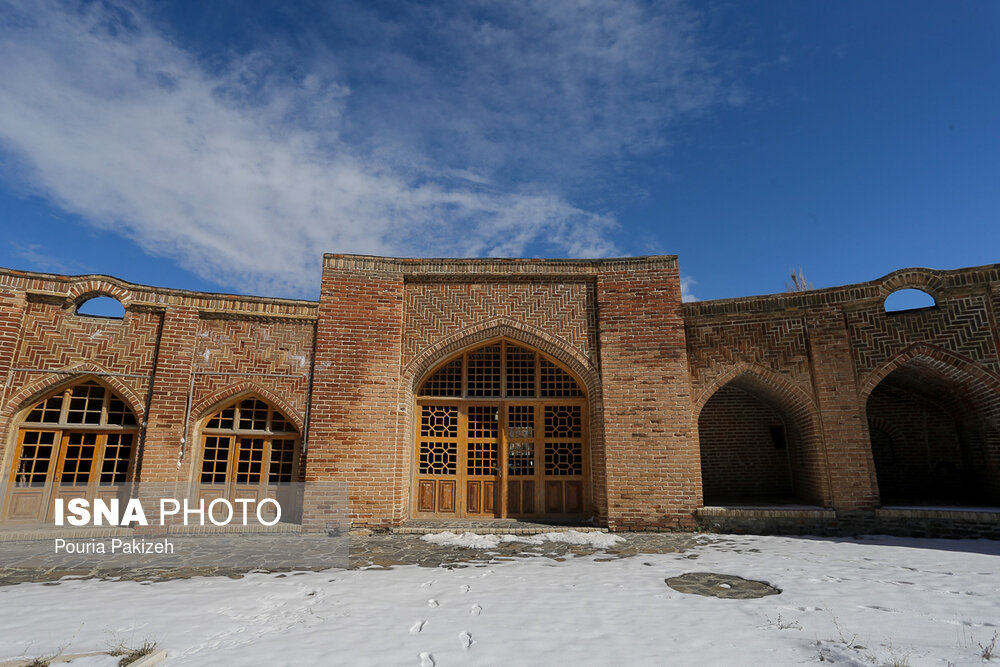
The eastern entrance has two decorative and modern facades, with two wooden doors. This is the entrance to the stables and lower chambers.

There are 26 chambers in front of it. The courtyard is covered with stones and two wells are seen inside the building.

The main materials used in the construction of Tajabad Caravanserai are red brick and sandstone.

What follows are photos of the attractive structure retrieved from ISNA:

Iran Gains Knowhow to Produce 10 New Biotech Drugs

He said the drugs will be mass produced and enter the market within the next two and three years.

“Today, there is no potential rival for Iran in the biotech area,” Qanei was quoted as saying in a report by Mehr news agency.

On the developments in the biotech area in Iran, Qanei said before the Islamic Revolution in 1979, no biotech drug was produced domestically but in 2006, Iranian scientists managed to produce the first domestic biotech drug.

“We have produced 22 biotech drugs, and that came despite the international sanctions which deprive us of the main technological equipment. Despite the obstacles created for us, we have managed to turn into a biotech hub in the region with no serious rival in this area,” he said.

For a brief review of Iran’s achievements in various fields of science and technology, check the book “Science and Technology in Iran: A Brief Review

According to the Iranian official, based on Iran’s 20-Year Vision Plan, the Islamic Republic will turn into the first country in the region in biotech area within the next six years.

“For the time being, the knowhow of 10 to 20 new biotech drugs have been achieved which will be mass produced in the next two and three years. By producing such drugs, we can be the first or second country in Asia in biotech area,” he said.

Qanei said the Biotechnology Development Department of Iran’s Vice-Presidency for Science and Technology is charged with following up developments in the biotech area and added “we have made great progress over the past four decades in this area.”

Iran, Turkey Clinch Deal to Boost Tourism Ties

As the 12th International Tourism Exhibition opened in Tehran Tuesday, delegations from Iraq, Turkey, Oman and Afghanistan entered Iran.

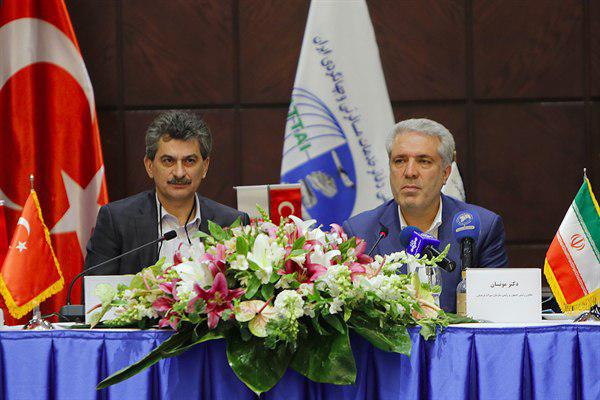
The first meeting was held between the Association of Turkish Travel Agencies (TURSAB) and the Iranian Union of Travel Agencies and Airlines, reported ISNA. The head of the Iranian Cultural Heritage, Handicrafts and Tourism Organization as well as the Turkish ambassador to Iran were also present at the meeting where the private sectors of both countries inked a memorandum of understanding on mutual cooperation.

The head of TURSAB, one of Turkey’s most influential and significant tourism syndicates, said his delegation is comprised of TURSAB staff members as well as representatives from five coastal and historical provinces plus officials from the Turkish Culture and Tourism Ministry.

He said his trip comes to enhance relations and settle problems facing the two countries.

He touched upon the imbalanced tourism ties between Iran and Turkey, and noted his country seeks to strike a balance between the trips made to Iran and Turkey by the people of both countries.


Iran Needs Better Infrastructure

Derya Örs, a prominent Turkish Iranologist who was introduced as the Turkish ambassador to Iran five months ago, opened his speech with the famous verse “In the name of the Lord of both wisdom and mind, To nothing sublimer can thought be applied” by late renowned Iranian poet Ferdowsi. He also extended his congratulations on the 40th anniversary of the triumph of the 1979 Islamic Revolution of Iran.

He said Turkey and Iran are not separable, are two heavyweights in the Middle East, and they will be the top regional powers if they join hands.

He said it is right that Turkey hosts a large number of Iranian visitors, and fewer Turkish citizens visit Iran. However, he added, if infrastructural problems in Iran are solved, the number of Turkish tourists visiting Iran could rise. He said Iran should build more hotels in the cities of Isfahan, Shiraz and Tehran. The official underlined the current infrastructure is not efficient enough to handle 10,000 tourists visiting those cities at the same time.


Situation Not Ideal, But There’s No Problem

Ali-Asghar Mounesan, the Iranian vice president and head of Iran’s Cultural Heritage, Handicrafts and Tourism Organization (ICHTO), began his speech with some sense of humour.

“I’m not as skillful as Mr ambassador to be able to translate what I’m saying at the same time, so I hope the interpreter will translate my words fully,” he noted.

He also offered congratulations on the 40th anniversary of the victory of the Islamic Revolution.

“I don’t know if you saw the rallies on the 22nd of Bahman,” said Mounesan, addressing those working in Turkey’s tourism sector.

“Millions took to the streets in support of their country and establishment at a time when the Americans are once again exerting the harshest economic pressure on Iranians,” he said.

“It has been 40 years that we have been under pressure for the sake of our independence-seeking revolution; still, our country has made much progress, and as Mr Ambassador mentioned, Iran along with Turkey is one of the biggest powers in the region, has a role in regional issues and is influential. These are the achievements of a period of time when we were under the toughest sanctions,” he said.

Mounesan also touched upon the condition of Iran’s tourism infrastructure which the Turkish ambassador had criticized.

“At the moment, there are more than 1,400 hotels and accommodations in the country. Around 2,000 projects with a price tag of over $12 billion are under construction. Of that number, 500 are hotels and accommodations. We are rapidly completing the infrastructure. Some 1,400 eco-tourism sites have been set up in villages, and their number will increase to 2,000. Some historical monuments have also been turned into hotels. So, there are no serious problems when it comes to infrastructure, though we have not reached the ideal point, either,” said Mounesan.

He said the biggest problem is that Iran’s tourism sector has not been introduced and promoted, but sanctions cannot be imposed on the tourism sector.

“40 years ago, we had 450 thousand tourists. The figure has risen to 6 million now, and we hope it will cross the 7 million mark by year’s end. We have reached this figure despite all the problems that the Americans caused by launching propaganda campaigns against Iran,” he said.

Iran Urges Bolton to Put Aside ‘Delusions’, Study Iranian Culture

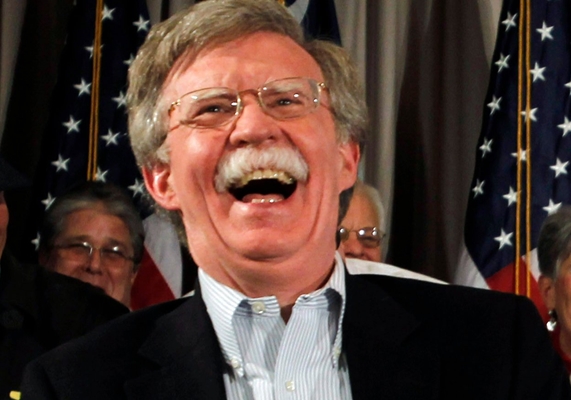
“John Bolton suffers from a totally chronic type of delusion regarding Iran and Iranians,” Bahram Qassemi told IRNA on Tuesday in reaction to Bolton’s Monday comments about the Islamic Republic.

“Despite all the self-made illusions and imaginations and the suggestions of certain allied terrorist groups, he is now seeing that the glorious rallies marking the 40th anniversary of the historic revolution of the great Iranian nation have faded away his naïve and weird dreams,” he noted.

“In a passive, hostile and highly angry reaction, and instead of understanding and learning about the culture of the great people of Iran and the deep roots of the Islamic Revolution, Bolton has once again used a bitter language which is out of touch with realities,” Qassemi said.

Instead of reconsidering his wrong insight and interpretation, Bolton has maintained his long-standing grudge, and raised naïve promises and imaginary notions in a bid to justify his earlier wrong analyses and unfulfilled prophecies, he said.

“Perhaps today is a good opportunity for the American official to take a look at what happened on the anniversary of the revolution with people’s massive turnout and [compare them with] what other malefactors had taught him, and [put aside] old and long-standing grudges against Iran and Iranians and think a bit instead of making such wrong statements,” he said.

Bolton, who in 2017 had vowed he would celebrate in Tehran before 2019, made comments against the Iranian government in a tweet on Monday.

Bolton said it was up to the Iranian government to change its behaviour and the US supports “the will of the Iranian people.”

His tweet came after millions of Iranians took to streets on Monday to celebrate the 40th anniversary of the victory of a revolution that toppled the US-backed rule of Mohammad Reza Pahlavi and created the Islamic Republic.

Social Media Marketing Trends to Look Out for in 2019

https://www.singlegrain.com/digital-marketing/11-digital-marketing-trends-you-can-no-longer-ignore-in-2018/

It is important to note that your competitors are also on their toes. Ignoring the trends will only give them an edge.

2019 is no different. Things will keep changing, and you need to be on the lookout. There always will be more about social media marketing than there was yesterday. The following are social media trends that you need to pay attention to this year.

  1. Paid Ads

While organic traffic is an asset to your digital marketing strategy, you need to do more. Nothing should stop you from extending your reach. You can use paid ads to significantly increase your traffic by adding on the organic traffic that you already have. The catch is that you will be able to achieve steady traffic within a short time without putting in too much effort.

  1. Influencer marketing

You should not be working alone anymore. Social media marketing is about connecting with people. The more the connections, the better for your brand. Social media influencers have a loyal following. How about you use them to source for traffic.

You can choose to either pay an influencer to post your content, products and links on their social media platforms, or you can make your relationship symbiotic. If you decide to collaborate, you can also create useful content that could also benefit their audience as you benefit from traffic in return.

Working with influencers is a very effective way of extending your reach. Users are also more likely to embrace your product if they see that someone influential is associating with it.

Social Media Marketing Trends to Look Out for in 2019
https://www.relevance.com/is-live-streaming-the-future-of-social-media/
  1. Livestreaming

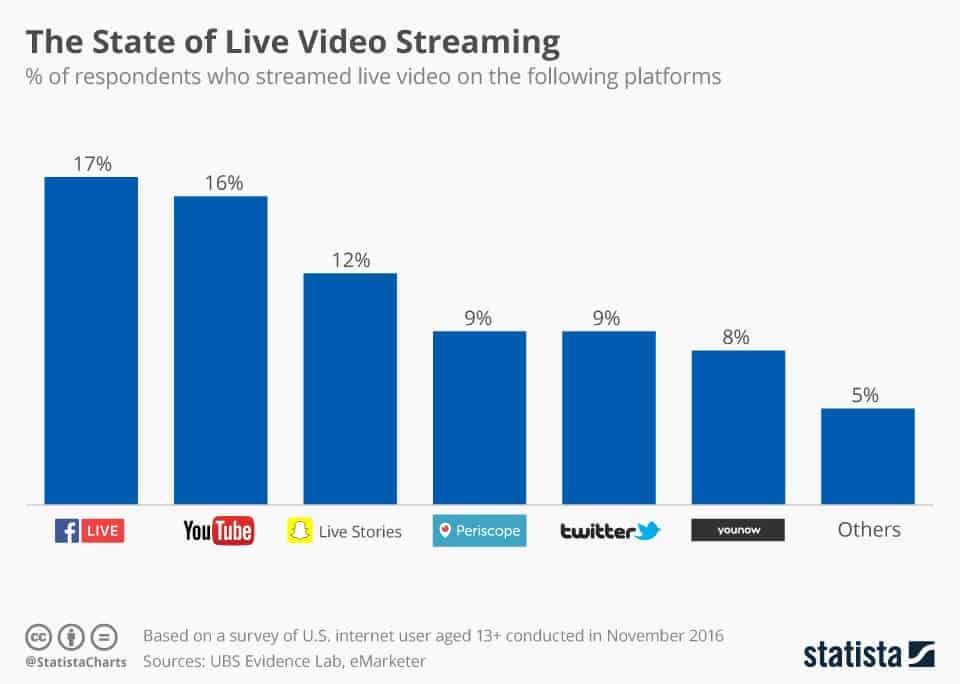
Livestreaming is a social media marketing trend that you should incorporate in your marketing strategies. Remember that you are looking for ways in which you can best engage your audience. Look no further! Livestreaming is the perfect way to go about it. The beauty of it is that you do not have to invest too much in video production for it to happen. More so, you can do it any time. Social media platforms have made it possible by adding this feature.

Instead of creating ‘How to’ content in text for, you can do product demos through livestreaming. By so doing, you will have created an engaging, humanising and fun way of conversing with your audience.

  1. Private groups and accounts

Private groups and accounts on social media platforms are becoming powerful tools in social media marketing. The platforms have algorithms that prioritise friends and content on the platforms. How is this useful to social media marketing? Well, it is quite simple. Its contribution to targeted marketing is incredible.

Iran’s Oil Revenues Increase by 49% despite US Bans

Iran’s Oil Revenues Increase by 49% despite US Bans

The main reason for the increase in oil revenues despite the US sanctions is the rise in oil prices on world markets. Although in recent weeks the demand for crude has been affected by factors such as US-China trade tensions and worries about global economic growth decline, IRNA reports.

Of course, to curb the surplus of oil, the 14 OPEC member states decided to reduce their oil production by 800,000 barrels per day at the 175th meeting of the organisation in Vienna late November.

In addition, the US embargo on the Venezuelan oil helped in increasing prices in the global markets.

The figures show that in the past nine months the value of Iran’s crude oil sales increased by 48.9%, but in the field of export of oil products and gas condensates we witness 59.2% decrease.

Meanwhile, in the world markets, each barrel of Iran’s heavy oil is sold for around $54 and each barrel of light oil of the country is sold for about $59 depending on the time and place of delivery.

The price of OPEC’s oil basket is now $61.58 according to rates of the Oil Price website.

US’ Warsaw Conference Not to Weaken Iran: Top General

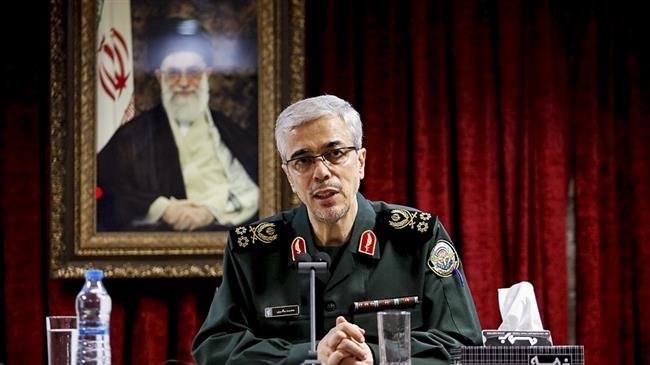
Chairman of the Chiefs of Staff of the Iranian Armed Forces Major General Mohammad Baqeri played down the confab, which is to open in the Polish capital on Wednesday, as “insignificant” and “worthless.”

Baqeri said Poland had pledged that the so-called Middle East security meeting would not include any anti-Iran discussions.

“Whether or not anything is said against Iran during the Warsaw meeting, it will fail to affect the Islamic Republic’s policy and power,” said the Iranian general.

“We will wait and see if the Polish officials will stick to their word,” he said.

The international gathering will take place on February 13 and 14 as part of US attempts to heap pressure on Iran globally.

US Secretary of State Mike Pompeo said the meeting would “focus on Middle East stability and peace, freedom and security here in this region, and that includes an important element of making sure that Iran is not a destabilizing influence.”

Later in the month, however, and as officials from various countries indicated their refusal to participate, US Deputy Ambassador to the UN Jonathan Cohen claimed at the UN Security Council that the meeting was “not a venue to demonize or attack Iran,” in an apparent about-face.

Since withdrawing from the Iran nuclear deal last year, the US administration has steadily ratcheted up pressure on Tehran and vowed to increase it until Iran halts what US officials describe as its “malign activities” throughout the Middle East and elsewhere.

As part of its policy of maximum pressure, Washington in early November re-imposed what it called the harshest-ever sanctions against the Islamic Republic.

The meeting has, however, received a cold welcome from Washington’s European allies, which are engaged in a diplomatic process with Tehran aimed at saving the 2015 nuclear deal.

EU foreign policy chief Federica Mogherini has already announced that she will refuse to attend the event. Likewise, ministers from several European Union countries will likely skip the summit, The Wall Street Journal reported last month.

Tehran has denounced the confab as “a circus” and summoned Poland’s envoy to protest Warsaw’s hosting of the event.

Iran’s Foreign Minister Mohammad Javad Zarif said on Sunday that the Warsaw meeting had fallen flat on its face before even getting off the ground.

“The Warsaw meeting was rendered doomed to failure before start,” he said.