Tuesday, December 30, 2025
Home Blog Page 3337

‘Seoul Keen to Keep Good Ties with Tehran despite Sanctions’

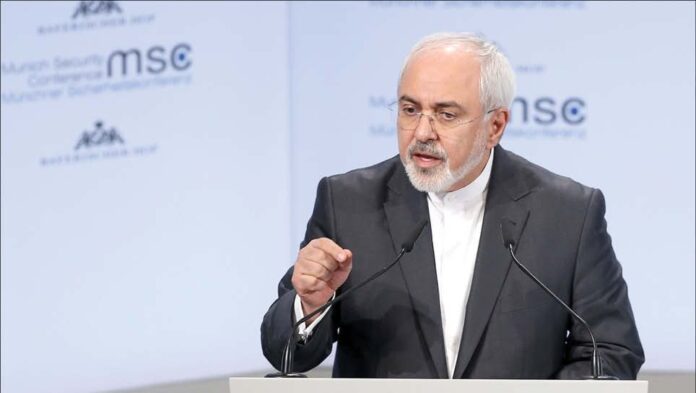
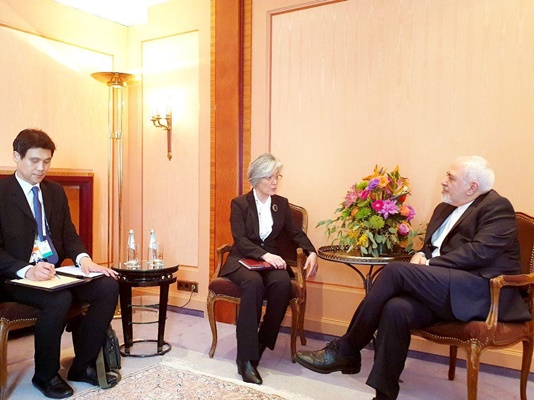
She made the remarks in a Friday meeting with Iranian Foreign Minister Mohammad Javad Zarif in the German city of Munich.

During the meeting, which was held on the sidelines of the 55th Munich Security Conference, the Korean minister offered sympathy over the recent terrorist attack in south-eastern Iran.

She also expressed Seoul’s interest in continuing decades of good relations between the two countries despite pressures and sanctions.

The two sides also conferred on economic and trade relations between Iran and South Korea, the most important regional and international issues including the situation in the Korean Peninsula, the Iran nuclear deal, and other topics of mutual interest.

Back in December, Iran finalized a deal with South Korea to trade oil for goods as part of a larger strategy to bypass US sanctions re-imposed on the country following Washington’s unilateral withdrawal from the 2105 Iranian nuclear deal.

Head of Iran-South Korea chamber of commerce said the deal was made for returning oil export revenues from South Korea.

“By the new mechanism, Iran’s oil export revenue will be bartered with imported goods,” Hossein Tanhayi said.

Seoul has fully complied with the US sanctions in the past few months, and totally stopped its oil imports from Iran in September for the first time in six years. The country made the decision before US sanctions against Iran take effect in November 4.

South Korean buyers, which are among major Asian buyers of Iran’s crude oil, suspended Iranian oil loading from July due to the uncertainty of getting a waiver from the US government.

South Korea relies on Iran for 13 percent of its imported oil, making Tehran its third crude supplier following Saudi Arabia and Kuwait. In 2017, the South purchased 147 million barrels of Iranian oil.

Iran Elected to UN Peacebuilding Commission

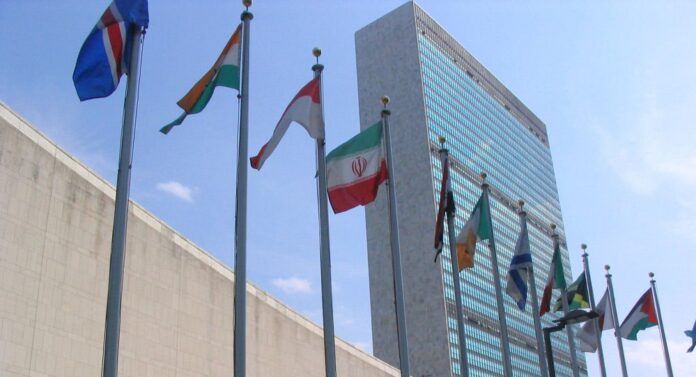
In their Thursday meeting at the UN headquarters in New York, 35 out of 46 member states of the ECOSOC voted in favour of Iran’s membership in the commission.

“Iran’s membership in the council came amid US delegation’s fierce opposition,” a report by IRNA said.

According to the report, the US delegation called for a secret ballot as part of a larger plan to stop Iran’s membership in the council but the ECOSOC’s members resolutely voted for Iran’s membership.

The UN’s Peacebuilding Commission is an Intergovernmental advisory body of both the United Nations General Assembly and the United Nations Security Council that supports peace efforts in conflict-affected countries, and is a key addition to the capacity of the international community in the broad peace agenda.

Members are elected to the UN Peacebuilding Commission for a two-year term. The commission has 31 members selected by the United Nations Security Council (seven countries including five permanent members of the UNSC), ECOSOC (seven members), the UN General Assembly (seven members), five members paying the highest amount of the UN budget and members of the UN with the highest number of military and police forces in the world body’s peacekeeping missions (five members).

ECOSOC is one of the six principal organs of the United Nations, responsible for coordinating the economic and social works of 15 UN specialized agencies, their functional commissions and five regional commissions

Netanyahu Deletes Tweet to Retract ‘War with Iran’ Gaffe

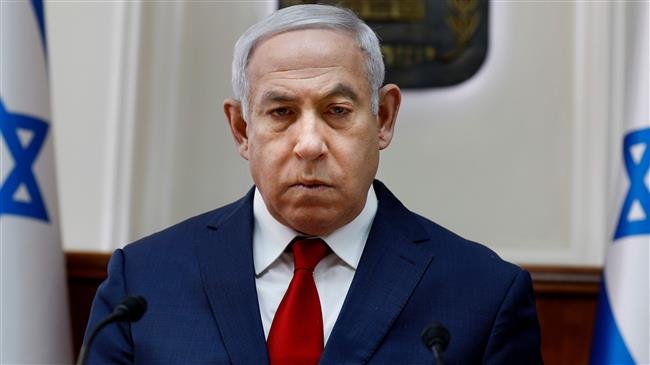
Israeli Prime Minister Benjamin Netanyahu (Photo by AFP)

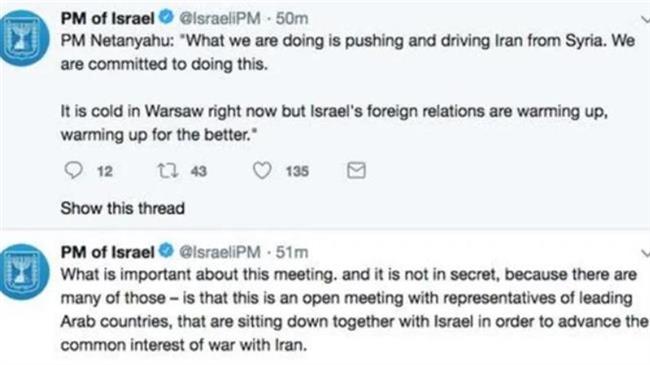
Speaking in a short video recorded on the sidelines of the anti-Iran meeting in Warsaw on Wednesday, hawkish Netanyahu said the event “is an open meeting with representatives of leading Arab countries, that are sitting down together with Israel in order to advance the common interest of war with Iran.”

Netanyahu’s office posted the Hebrew-language video on Facebook and Twitter, in which he could be heard using the Hebrew word “milchama,” which literally translates to “war.”

It also tweeted Netanyahu’s remarks on its English-language Twitter account.

The Israeli premier’s open call for war with Iran led to an uproar on social media and even startled the White House, which had earlier claimed the Warsaw forum was not meant to “demonize or attack Iran.”

The backlash prompted Netanyahu’s office to quietly delete the tweet and replace it with another one that changed the phrase “war with Iran” to “combating Iran,” without issuing a retraction or a correction of any kind.

Israeli media later attempted to portray Netanyahu’s gaffe as a mere translation blunder.

Netanyahu Deletes Tweet to Retract 'War with Iran' GaffeThe US government quickly reached out to Israeli officials to ask for an explanation, according to NBC News.

American delegates traveling with Vice President Mike Pence — who is attending the summit in Warsaw, said that senior Israeli officials told the US that it was a matter of “bad translation,” the report added.

Senator Angus King, (I-Maine), a member of the Senate Intelligence Committee, rejected the idea that Netanyahu had simply been mistranslated, and said “he knew what he meant.”

An Associated Press correspondent based in Israel said that he had himself heard Netanyahu using the word ”milchama.”

Last month, US Secretary of State Mike Pompeo announced that the Warsaw forum would purportedly focus on the “important element of making sure that Iran is not a destabilizing influence.”

Later, however, and as officials from various countries indicated their refusal to participate, US Deputy Ambassador to the United Nations Jonathan Cohen said the meeting was “not a venue to demonize or attack Iran,” in an apparent about-face.

Tehran condemned the confab as a “circus” and summoned Poland’s envoy to protest the European country’s hosting of the event.

Warsaw Final Statement Testifies to Its Defeat, Failure: Iran

Despite Washington’s tremendous efforts to hold an all-inclusive summit and create a new alliance against the Islamic Republic of Iran, the small number and low level of those attending the conference turned the final statement of the summit into a useless document which was developed only by the two organizers of the summit and lacked any credibility, Qassemi said in a Friday statement.

Even those few and low-ranking participants refused to endorse any anti-Iran decision at the conference, which was a nonstarter from the beginning, he added.

From the early stages of its development, the failure of the idea of holding the summit was completely imaginable and predictable to all leading and wise visionaries, analysts and politicians of the world, Qassemi said.

“How can a conference titled Peace and Security in the Middle East gain success while main regional players like Iran, Turkey, Lebanon, Syria, Iraq and Palestine are absent and significant countries such as China, Russia and many other leading European and non-European states are either absent or represented at a very low level,” he asked.

The spokesman said the nervous and tense remarks and behaviours of the US secretary of state and vice-president who, during their speeches and interviews openly criticized Europe or insistently asked them, from a position of weakness, to pull out of the Iran nuclear deal, are the best testimony to and a sign of their failure and incapability to achieve their desired goals in the summit.

The US, on the one hand, sponsors a conference on Peace and Security in the Middle East, and on the other hand, through its hypocritical policies and by unilaterally withdrawing from the Iran nuclear deal in violation of all international laws, increases tension, conflict, support for terror, disagreement and hostility among regional nations, and promotes insecurity, instability, poverty, war and extremism, he noted.

He underlined that despite all hostile and belligerent policies by the US and the occupying regime of Israel, fight and resistance to create a secure and stable region free from the presence of foreign and aggressive powers will keep going on.

Qassemi said the US should immediately put an end to such a fruitless grudge by understanding the realities of this sensitive region of the world.

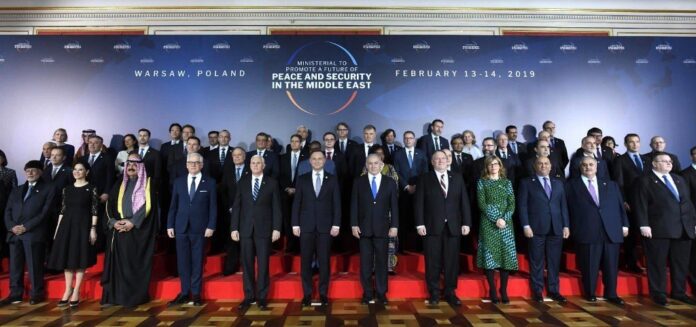
Speaking Thursday during the summit, US Vice President Mike Pence urged Washington’s European allies to withdraw from the Iran nuclear deal and accused them of trying to break the US sanctions against Tehran.

He said the financial mechanism known as INSTEX set up by the EU to facilitate trade with Iran was an effort to weaken US sanctions targeting the Islamic Republic.

The EU has repeatedly expressed support for the nuclear deal since US President Donald Trump declared the US would pull out in May last year.

Attended by delegations from 60 governments, the two-day summit which began in the Polish capital on Wednesday failed to produce any decisions against Iran.

Feeling the backlash days ahead of the conference, the US backed down from its initial announcement that the summit would be focused solely on Iran. To this end, US Secretary of State Mike Pompeo and other American officials sought to broaden the scope to include other Middle East topics, including the conflicts in Syria and Yemen.

Iranian Foreign Minister Mohammad Javad Zarif described the two-day conference on Iran and the Middle East as “dead on arrival.”

Iran’s top diplomat said not even Washington believed the event provided the 60 participating countries with a serious opportunity to exchange their views on those topics.

World Condemns Terror Attack on IRGC Forces

The UN Security Council on Thursday condemned “in the strongest possible terms” the “heinous and cowardly terrorist attack” in Iran’s southeastern Sistan and Baluchestan Province.

In a statement, all the 15 members of the council, including the US, offered their sympathy and condolences to the families of the victims and to the Iranian government and wished a speedy and full recovery to the injured.

The council members reaffirmed that terrorism in all its forms and manifestations constitutes one of the most serious threats to international peace and security.

They underlined the need to hold perpetrators, organizers, financiers and sponsors of terrorism acts accountable and bring them to justice, and urged all states to cooperate with the Iranian government and all other relevant authorities in this regard.

“Any acts of terrorism are criminal and unjustifiable, regardless of their motivation, wherever, whenever and by whomsoever committed,” they said, reaffirming the need for all states to combat threats to international peace and security caused by terrorist acts.

In a separate message, Spokesperson for the European Union’s External Action Service Maja Kocijancic said “there can be no justification for such an outrageous act of terror.”

“The European Union expresses its condolences to the families of the victims and to the people of Iran; we wish a speedy recovery to those injured.”

Turkish President Recep Tayyip Erdogan, at the beginning of his speech in a trilateral meeting with his Iranian and Russian counterparts in Sochi, strongly condemned the terrorist attack, and offered sympathy to Iran.

The Turkish foreign ministry had earlier released a statement in this regard. “We strongly condemn this heinous terrorist attack. We wish Allah’s mercy upon those who lost their lives and speedy recovery to the wounded. We convey our condolences to the people and Government of Iran.”

Chinese Foreign Ministry spokesperson Hua Chunying said Thursday that it condemns the suicide terrorist attack. “We express our condolences to the victims and sympathy to the bereaved families and the injured.”

Indian Ministry of External Affairs strongly condemned the dastardly terrorist attack, saying, “Terrorism, in all its forms and manifestations, is condemnable and perpetrators of such crimes should be brought to justice expeditiously and without distinction.”

The ministry also offered India’s condolences to the families of the victims, the people, and government of Iran, wishing speedy recovery to those injured.

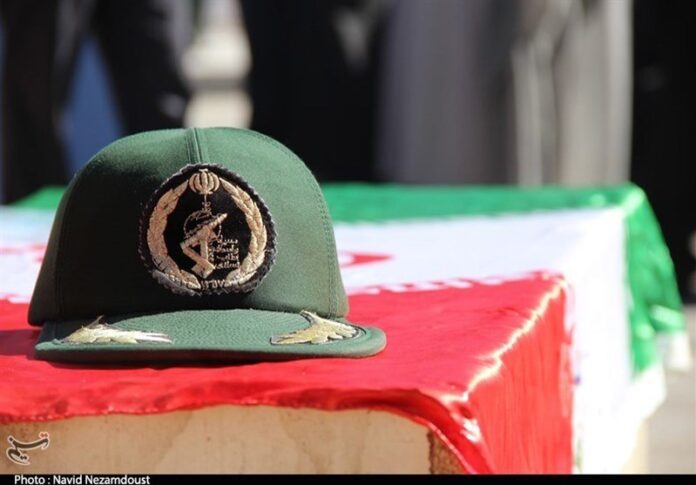
A suicide attack by Pakistan-based Takfiri elements on a bus carrying Iranian border guards in Zahedan-Khash road killed and wounded dozens of IRGC forces.

The attack, claimed by the so-called Jaish ul-Adl terrorist group, killed 27 and injured 13 others.

The IRGC’s Quds Headquarters said in a statement that an explosive-laden car rammed into the bus, which was taking the personnel back to their homes.

Following the deadly attack, the governor-general of Sistan and Baluchestan declared three days of mourning, and that of Isfahan – where the soldiers belonged – announced two days.

Iran FM in Germany to Attend Munich Security Conference

Over 100 officials, political, security, and international figures including presidents, foreign and defence ministers, and officials from certain international organizations are attending this year’s conference.

In addition to delivering a speech, the Iranian foreign minister is to hold talks with a number of officials and figures on the sidelines of the conference.

The Munich Security Conference (MSC) describes itself as the world’s leading forum for debating international security policy.

According to its official website, its objective is to build trust and to contribute to the peaceful resolution of conflicts by sustaining a continuous, curated and informal dialogue within the international security community.

It provides a venue for official and non-official diplomatic initiatives and ideas to address the world’s most pressing security concerns.

The MSC also offers protected space for informal meetings between officials and thus – as its original motto has it – build peace through dialogue.

Iran Strongly Condemns India Terror Attack

Offering condolences to the Indian government and nation, Qassemi sympathized with the families of the victims of the tragic incident.

“As a country that has been a victim of terrorism and has taken major and effective steps to root out terrorist groups in the West Asia region and has paid heavy costs and is resolved to keep up this path with strong determination, we believe using such bloody and inhumane methods by any group and with any motive and under any name is unacceptable,” he said.

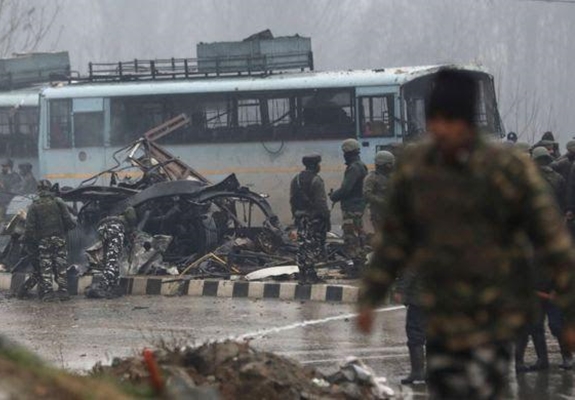
At least 40 Indian paramilitary police have been killed in a bomb attack by militants on their convoy in Indian-administered Kashmir.

Police told the BBC that a car filled with explosives had rammed a bus carrying the troops to Srinagar.

Pakistan-based group Jaish-e-Mohammad said it was behind the attack.

It is the deadliest militant attack on Indian forces in Kashmir since the insurgency against Indian rule began in 1989.

Iran, Russia, Turkey Wrap Up Sochi Summit on Syria

What follows is the full text of the statement:

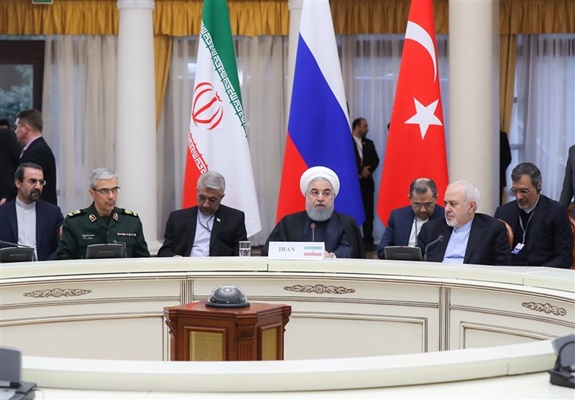
President of the Islamic Republic of Iran H.E. Hassan Rouhani, President of the Russian Federation H.E. Vladimir Putin and President of the Republic of Turkey H.E. Recep Tayyip Erdoğan gathered in Sochi on 14 February 2019 for a Tripartite Summit.

The Presidents:

  1. Discussed the current situation on the ground in Syria, took stock of the developments following their last meeting in Tehran on 7 September 2018 and underscored their determination to strengthen the trilateral coordination in light of their agreements.
  2. Emphasized their strong and continued commitment to the sovereignty, independence, unity and territorial integrity of the Syrian Arab Republic as well as to the purposes and principles of the UN Charter.
  3. Highlighted that these principles should be universally respected and that no actions, no matter by whom they were undertaken, should undermine them.
  4. Rejected all attempts to create new realities on the ground under the pretext of combating terrorism and expressed their determination to stand against separatist agendas aimed at undermining the sovereignty and territorial integrity of Syria as well as the national security of neighboring countries.
  5. Took note in this regard that the US decision on the withdrawal of its forces from Syria, if implemented, would be a step that would help strengthen stability and security in the country in compliance with the above-mentioned principles.
  6. Examined in details the situation in the Idlib de-escalation area, denounced and expressed serious concern with the attempts of the terrorist organization “Hayat Tahrir al-Sham” to increase its control over the area, and agreed to effectively counter these attempts as well as to take concrete steps to reduce violations in the Idlib de-escalation area through full implementation of the agreements on Idlib, including the Memorandum on Stabilization of the Situation in the Idlib De-escalation Area of 17 September 2018. They also reaffirmed the determination to continue cooperation in order to ultimately eliminate DAESH/ISIL, Al-Nusra Front and all other individuals, groups, undertakings and entities associated with Al-Qaeda or DAESH/ISIL, and other terrorist groups, as designated by the UN Security Council.
  7. Discussed the situation in the north-east of Syria and agreed to coordinate their activities to ensure security, safety and stability in this area including through existing agreements, while respecting sovereignty and territorial integrity of the country.
  8. Reaffirmed their conviction that there could be no military solution to the Syrian conflict and that it could only be resolved through the Syrian-led and Syrian-owned, UN-facilitated political process in line with the UN Security Council Resolution 2254.
  9. Reaffirmed their determination to facilitate the launch of the Constitutional Committee as soon as possible, including by agreeing on its composition and elaborating recommendations for its rules of procedure based on the work undertaken by the three guarantors. They emphasized in this regard the importance of continuing interaction and coordination with the Syrian parties and the United Nations Secretary-General’s Special Envoy for Syria Geir O. Pedersen.
  10. Welcomed the successful development of the second mutual release of detainees within the framework of efforts of the respective Working Group. The releases that took place on 24 November 2018 and 12 February 2019 constituted important contribution of the Astana format to building confidence between the Syrian parties and creating necessary conditions for advancing the political process.
  11. Emphasized the need to continue all efforts to help all Syrians restore normal and peaceful life as well as alleviate their sufferings. In this regard, they called upon the international community, particularly the United Nations and its humanitarian agencies, to increase their assistance to Syria by providing additional humanitarian aid, restoring humanitarian infrastructure assets, including water and power supply facilities, schools and hospitals.
  12. Highlighted the importance of creating conditions for the safe and voluntary return of refugees and internally displaced persons (IDPs) to their original places of residence in Syria. They assessed positively the interaction with all interested parties, including the Office of the United Nations High Commissioner for Refugees (UNHCR), and reaffirmed their readiness to continue this coordination.
  13. Agreed to assign their representatives with the task of holding the next International Meeting on Syria in Astana in April 2019.
  14. In addition to the Syrian issue, discussed recent developments in the world as well as their collaboration in different fields and decided to boost joint economic and commercial cooperation.
  15. Condemned the recent terrorist attack in Iran (Sistan-Balouchestan Province). President of the Russian Federation H.E. Vladimir Putin and President of the Republic of Turkey H.E. Recep Tayyip Erdoğan expressed their condolences to the families of the victims of this attack and sympathy with the people and the government of the Islamic Republic of Iran.
  16. Decided to hold the next Tripartite Summit in the Republic of Turkey upon the invitation of President of the Republic of Turkey H.E. Recep Tayyip Erdoğan.
  17. The Presidents of the Islamic Republic of Iran and the Republic of Turkey expressed their sincere gratitude to President of the Russian Federation H.E. Vladimir Putin for hosting the Tripartite Summit in Sochi.

Int’l Community Must Join Hands to Reconstruct Syria: Rouhani

“The International community must help the Syrian people in returning the displaced and refugees to their country and starting the reconstruction of Syria,” he said.

Rouhani made the statement in an address to a trilateral meeting in the Russian city of Sochi on Thursday, dedicated to discussing latest developments in the country.

The one-day meeting also aims to review the outcome of the Astana conference on the Syria peace process, as the seven-year conflict in the country is moving toward an end.

Rouhani, Recep Tayyip Erdogan and Vladimir Putin will also discuss the fight against terrorism and cooperation for reconstruction of Syria.


Need for Inclusive Anti-Terror Fight

Rouhani said the anti-terror fight in the country must continue until the remaining terrorists are eradicated.

“The fight against all terrorist groups in Syria must continue until they are eradicated,” he said.

Rouhani said governments across the globe must refrain from supporting terrorists in the country.

“Terrorists must not feel safe in this country or any other place across the globe, and their supporters must not think they can use the terrorism card in internal, regional and international equations,” he said.


US Must Quit Syria

The Iranian president said the US must end its Syria presence as soon as possible, as the country is still supporting terrorists in Iraq and Syria and uses them to its own benefit.

The Iranian president said there are credible reports that the US is assisting the US is moving Daesh terrorists to Syria and Afghanistan.

“The presence of US forces in Syria must end as soon as possible,” he said.


World Should Prevent Israel’s Anti-Syria Attacks

The Iranian president said the world must move to stop Israeli attacks against Syria.

“The international community must deal with the Zionist regime’s arbitrary attacks against Syria,” he said.

Israel has committed numerous air strikes against the Syrian forces in recent years, many of them remain unpublicized.

Before the start of the summit, the Iranian president held separate meetings with Erdogan and Putin to discuss bilateral relations and international developments.

Iran Gov’t Urges Quick Approval of FATF as Deadline Approaches

Foreign Ministry Condemns FATF’s Blacklisting of Iran

Laya Joneydi, the vice president for legal affairs, made the statement on Wednesday, while speaking to reporters after a Cabinet meeting.

Out of four parliamentary bills required for Iran’s accession to the Financial Action Task Force (FATF), only two of them have so far gone into effect and the fate of the other two are still in limbo.

A bill amending Iran’s Combating the Financing of Terrorism (CFT) law and a bill on Iran’s accession to the United Nations Convention against Transnational Organized Crime are still problematic in the eyes of the Guardian Council, the legislative watchdog.

The FATF announced late last year it extends the deadline for Iran to complete reforms to meet conditions for getting out of the body’s black list until the February meeting.

The upcoming Financial Action Task Force meeting is to be held in Paris on February 17-22.

No Iranian representative will attend the upcoming FATF meeting.

Foreign Ministry Explains Why Iran Not Invited to FATF Meeting


Deadline Likely to Be Extended

Joneydi said it is likely that the global anti-money laundering body extends Iran’s deadline to meet the body’s conditions, but the Expediency Council ought not to take the risk.

Ayatollah Mohsen Shabestari, a member of Iran’s Expediency Council, announced on Wednesday the bill on Iran’s accession to Palermo Convention is to be discussed in the council Saturday, expressing hope it will be approved.

In the last meeting of the council, several commissions had expressed a negative view on the approval of the bills.

Iran’s accession to the G7-created FATF has faced problems over concerns among some officials that the move could endanger Iran’s national security and economic interests.

This is while proponents of the FATF accession say the measure would smooth the path for Iran’s increased financial transactions with the world and allow Iranian financial sector to function more easily in the international economy.