Sunday, May 3, 2026
Home Blog Page 2702

Russia Has Upper Hand in Armenian-Azeri Crisis: Analyst

Russia Has Upper Hand in Armenian-Azeri Crisis

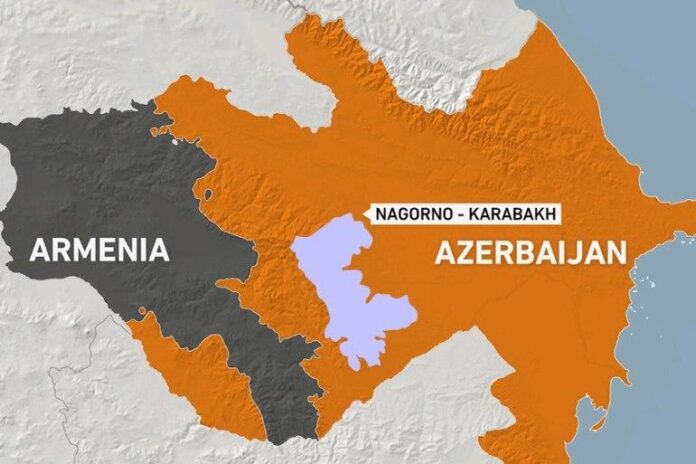
Afshar Soleimani, who is also an expert on Central Asia and the Caucasus, has weighed in on the recent developments pertaining to the Karabakh conflict.

Speaking in an interview with Iranian news agency Khabar Online, he has argued that Moscow is opposed to Iran’s intervention in the conflict.

The full text of the interview follows:


To begin with, please tell us why mediation efforts to settle the Karabakh crisis have been futile so far? Can Iran bring the two countries (Armenia and the Azerbaijan Republic) closer to peace?

Over the past years, Ira made attempts to mediate between Armenia and the Azerbaijan Republic, but to no avail. In 1992, when Mohammad Yagub Mammadov was the president of the Azerbaijan Republic and Levon Ter-Petrosyan was the Armenian president, then Iranian President late Akbar Hashemi Refsanjani invited both heads of state to Iran, and a statement was released after the negotiations held in the Iranian capital. Under the statement, it was agreed that talks be held to determine the status of a ceasefire and that Iran plays its role in the process. However, no result was produced, and the main reason for that was an important player in the Karabakh conflict called Russia. It is the Russians that are throwing their weight around in the region and regard South Caucasus as their backyard and, like in the Soviet era, wouldn’t like to lose regions that are under their influence. Security-wise, this is a very important issue for Moscow.

So, you believe Russia is opposed to Iran getting involved to help resolve the crisis?

When the Tehran statement was issued and as the Azeri and Armenian presidents were on their way back to their countries, Shusha (a city in the disputed region of Nagorno-Karabakh in the South Caucasus) was captured and fell into the hands of Armenia, I mean the heights overlooking the khanates in Karabakh. Following the development, the Azerbaijan Republic’s media reflected the event as if Iran had been the main accomplice for that. Nevertheless, Iran had no role in the capture of Shusha, whatsoever; rather, it was Russia that, with the help of Armenia, decided to make the move in order to question Iran’s mediation efforts. In 1994, when a ceasefire agreement was signed in Bishkek for the first time, and it was decided that the Minsk Group settle the conflict, Iran never took on a mediation role from then on; after all, no country asked Iran to mediate, either. Furthermore, we should bear in mind that generally speaking, the crisis is too serious now to be settled by mediation. In addition, the Russians are not interested in Iran acting as an intermediary and wouldn’t like Tehran to play a role in South Caucasus. Russia is inclined to follow all relevant issues trilaterally without any other country being involved.

Given that this crisis has, security-wise, been extremely significant to Iran, what policy should Tehran adopt on it?

Security-wise, the Karabakh crisis is very important to Iran. In recent days, we saw that even a rocket was fired at an Iranian border village in the country’s northwestern East Azerbaijan province during military clashes between the Azerbaijan Republic and Armenia. Mediation efforts have been fruitless so far, and a strong foreign policy and strategy is required to tackle the crisis. Iran should not adopt a hardware approach in order to support Muslim countries in the region because this method won’t work, and the other sides will follow suit if Iran does so. Iran can, at least, align itself with the Azerbaijan Republic. Of course, it is said that the Azerbaijan Republic has had relations with the Israeli regime; there is also word that Turkey intends to dispatch terrorist forces to war zones. Back in 1993 when Tehran and Baku signed on a mutual friendship agreement, one of the provisions of the deal highlighted that the Islamic Republic of Iran respects the Azerbaijan Republic’s territorial integrity and, based on the same provision, the Karabakh crisis needed to be resolved. With the conflict flaring up, it is also necessary, at this juncture, that Iran be politically more active than in the past. It will not simply suffice to ask the warring sides to exercise restraint and support a ceasefire as such an approach will put Iran in a passive position. Moreover, we are witnessing a fresh wave of propaganda campaigns and blame games whereby Iran is accused of sending arms to Armenia.

As you mentioned, with the escalation of the conflict between the two sides, we are seeing a new wave of accusations being levelled against Iran, and the Iranian Foreign Ministry has repeatedly denied those charges. In your opinion, what is the objective of these blame games and how can Iran manage this smear campaign?

These days, the Azerbaijan Republic’s media keep accusing Iran of supporting Armenia. Diplomatic trips to the Azerbaijan Republic and announcing support for this country can put an end to rumours and foil plots against our country. With the collapse of the former Soviet Union and the breakaway of the Azerbaijan Republic, this country, with an area of 86,600 kilometres, has been recognized as an independent country by the UN with Karabakh and Nakhchivan being integral parts of it. However, events have unfolded ins such a way that Armenia has made territorial claims. The UN Security Council has also issued four resolutions in that regard, so far and asked Armenia to end the current situation and withdraw its troops from those regions. However, these resolutions are not binding, and major powers, for their part, will implement the resolution only when everything is in their interest. Iran’s political support for the Azerbaijan Republic, as a Muslim country, is of utmost importance. Tehran-Baku relations are not satisfactory enough at this point as Iran has not announced its position on the return of occupied territories to the Azerbaijan Republic.

What do you think the conflict will result in, and what will happen at the end? Will the conflict end soon or should we expect more fighting as tensions escalate?

Sooner or later, these clashes will stop once again, and the importance of diplomacy and dialogue will come to light once again. Although diplomacy should have been used before the outbreak of the war, the final solution to the conflict is diplomacy. If the Azerbaijan Republic can retake parts of its occupied territories in the coming days, it will be able to regain its lost rights. Otherwise, no headway will likely be made with settling the crisis because the Minsk Group has not been able to take a positive step towards resolving the crisis, either. Moreover, the historical reasoning put forward by Armenia is not admissible because history is littered with different developments and the only authority to refer to, is the United Nations. Even during the era of the former Soviet Union, the self-rule Karabakh Republic, like Nakhchivan, was part of the Azerbaijan Republic. With the territorial integrity at that time, it was possible to solve the problem then. However, most of those territories later came to be settled by Armenians and Stalin created a crisis accordingly, which was the reason why tensions were not eased in the future. Generally speaking, one can predict that Russia will put an end to the conflict in the coming days or weeks. Also, the US will not interfere in Russia’s affairs as it didn’t with regards to Ukraine and other cases. So, we can say that Russia has the upper hand in this issue.
Iran, 25 Other Countries Urge Removal of US Sanctions amid Pandemic

Iran, 25 Other Countries Urge Removal of US Sanctions amid Pandemic
The United Nations headquarters building is pictured though a window with the UN logo in the foreground. / Photo by Reuters

Speaking on behalf of the 26 countries at a meeting of the UN General Assembly’s human rights committee, China’s UN Ambassador Zhang Jun said “unilateral coercive measures” violate the UN Charter, multilateralism, and impede human rights by hindering “the well-being of the population in the affected countries” and undermining the right to health.

The joint statement said “global solidarity and international cooperation are the most powerful weapons in fighting and overcoming COVID-19.”

“We seize this opportunity to call for the complete and immediate lifting of unilateral coercive measures, in order to ensure the full, effective and efficient response of all members of the international community to COVID-19.”

Among the countries that backed the statement were half a dozen that face sanctions by the United States, European Union or other Western nations including Cuba, North Korea, Iran, Russia, Syria and Venezuela.

The statement notes that both UN Secretary-General Antonio Guterres and UN human rights chief Michelle Bachelet have called for the waiving of sanctions that undermine a country’s capacity to respond to the pandemic.

The 26 countries also took aim at “chronic and deep-rooted racial discrimination, police brutality and social inequality.”

They cited the shooting by police of two Black Americans, George Floyd who died at the hands of a white police officer in Minneapolis in May, and Jacob Blake, shot by a white police officer in August and left paralyzed from the waist down.

“The COVID-19 mortality rate of minorities, in particular people of African descent, is disproportionately high in some countries,” their statement said.

Iran’s IRGC Using RQ-170 Drones to Seed Clouds

Iran’s IRGC Using RQ-170 Drones to Seed Clouds

The move comes to tackle drought in parts of the country.

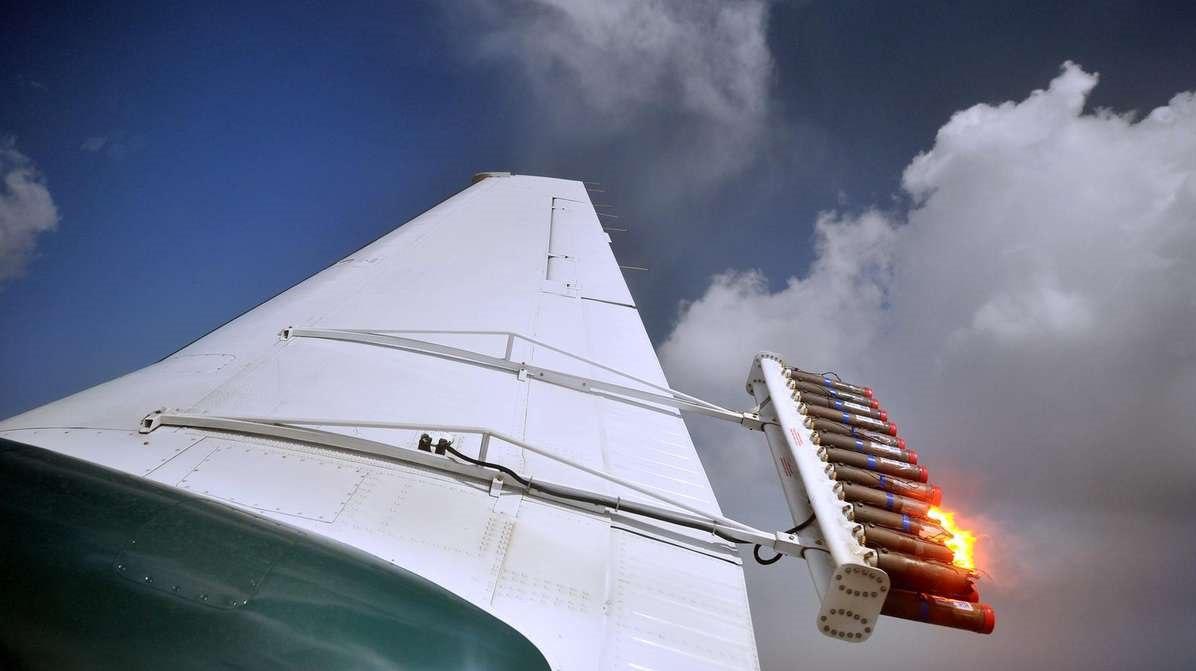
Over the past couple of years, the IRGC’s Aerospace Division has been using a new method to seed clouds by using drones.

The seeding materials used in the operation have also been produced by IRGC experts.

The advantage of drones over manned aircraft is that drones have higher maneuverability, cost less to operate and are more flexible during operations.

The IRGC’s drone units have conducted several cloud seeding operations in several parts of the country over the past years.

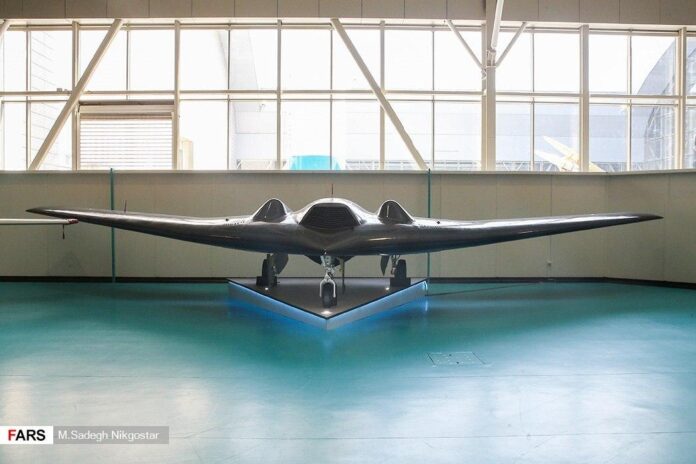
In 2015, Iran downed a US RQ-170 Sentinel stealth aircraft with minimal damage. The drone was flying over the Iranian city of Kashmar, near the Afghan border, when it was brought down, and was later reverse-engineered. Iran’s IRGC Using RQ-170 Drones to Seed Clouds 2
Known to be able to hack into enemy drones, Iran currently possesses the biggest collection of captured or downed American and Israeli drones, including the US’ MQ1, MQ9, Shadow, ScanEagle, and RQ-170 as well as the Israeli regime’s Hermes.

Seeding clouds is a new technology which is only several decades old. Over this rather short period, the technology has come under spotlight in many countries.

Different methods are used to seed clouds, namely using aircraft, hot-air balloons and land-based generators.

Using planes to seed clouds has its own advantages and drawbacks. When airplanes are used, it is possible to determine the exact place where seeding materials are to be sprayed, hence improving the precision of the seeding operation. However, the disadvantage is the limited duration of flight among clouds which create thunder and lightning, posing a threat to those on the plane.

Iran to Prosecute 45 Americans over Their Role in Medical Sanctions

Iran to Prosecute 45 Americans over Their Role in Medical Sanctions

During a Monday visit to a hospital in Tehran for the patients suffering from rare diseases, head of the Iranian Judiciary’s High Council for Human Rights, Ali Baqeri Kani, said the council has compiled a list of 45 American natural and legal persons who have had a role in the cruel US sanctions against the people of Iran.

The list, made in cooperation with the Iranian Intelligence Ministry, has been submitted to the Prosecutor General of Tehran for judicial action, he added.

The 45 American people in the list are going to be prosecuted in accordance with the Article 5 of the Iranian Act on countering the US violation of human rights and terrorist activities and the Article 8 of the law on retaliatory action against the US designation of the IRGC as a terrorist organization, he noted.

Baqeri Kani finally lashed out at the US government for turning the policy of maximum pressure on Iran into the policy of maximum hostility towards the Iranian nation, and deplored the European states’ obedience to Washington’s criminal actions in imposing medical and pharmaceutical sanctions on people of Iran.

In a recent interview with RT, Iranian Foreign Minister Mohammad Javad Zarif slammed the US for impeding the Islamic Republic’s ability to fight the coronavirus, explaining that US sanctions have prevented the purchase of critical medical supplies.

Washington’s efforts to stop Tehran from exporting oil have limited the government’s ability to respond to the global health crisis and provide relief to the Iranian people, Zarif said.

Iran Warns Baku, Yerevan over Border Insecurity Caused by Karabakh Conflict

Iran Warns Baku, Yerevan over Border Insecurity Caused by Karabakh Conflict

Asked by reporters about the situation along Iran’s northwestern border after a recent flare-up of fighting between the Republic of Azerbaijan and Armenia, Interior Minister Abdolreza Rahmani Fazli said on Monday, “We have advised and warned the neighbouring states that we would by no means tolerate insecurity, interference, or any other measure damaging the security of our people in those regions.”

The minister also expressed hope that Azerbaijan and Armenia would observe the international law that entails respect for the national sovereignty and rights of all states.

Rahmani Fazli then hoped that the country’s border areas would not experience any insecurity with the warring sides proceeding with caution and Iran monitoring the border zones strongly and thoroughly.

The interior minister said a number of mortar shells fired during the Nagorno-Karabakh fighting have fallen in Iran, saying Tehran will give the warring sides a stronger warning if such incidents recur.

On Saturday, Iranian Foreign Ministry Spokesperson Saeed Khatibzadeh called on Armenia and Azerbaijan to be careful not to violate Iran’s border amid the outbreak of the new round of fighting.

His comments came after officials in Iran’s northwestern province of East Azarbaijan reported that mortar shells fired by the warring sides in the latest round of fighting between Armenia and Azerbaijan have hit border rural areas in the province.

According to reports, one of the mortars has fallen in a village in Khoda-Afrin county, injuring a 6-year-old child.

Iranian President Inaugurates Thousands of National Projects

Iranian President Inaugurates Thousands of National Projects

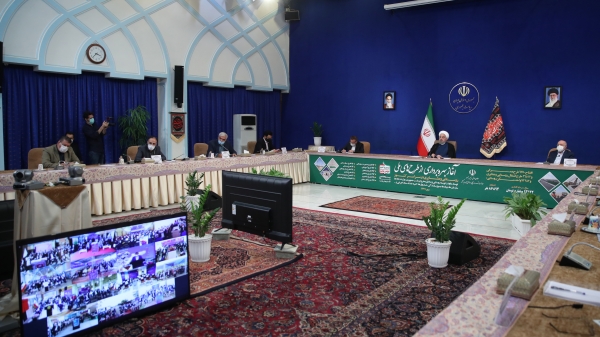
In an online event on Monday, President Rouhani ordered the opening of thousands of new projects in the 27th week of inauguration of national projects across the country.

In the videoconference, the president inaugurated 6,750 construction projects, 26,512 plans for rural and nomadic employment, and 282 housing projects in villages in various provinces.

The new projects, unveiled on the eve of the national Day of Village and Nomads, have been funded with an investment of 13,122 billion tomans and have provided employment for 86,894 people.

The new projects have been carried out by the Ministry of Agriculture, Ministry of Labor, Ministry of Roads and Urban Development, Education Ministry, Oil Ministry (gas supply projects), Energy Ministry (power transfer projects), Ministry of Information and Communications Technology, Interior Ministry, Health Ministry, Ministry of Culture, the Islamic Revolution Housing Foundation, Imam Khomeini Relief Foundation, the Construction Basij Organization, Executive Headquarters of Imam’s Directive, and Omid Entrepreneurship Fund.

Iran’s Daily COVID-19 Infections, Deaths Hit All-Time High: Ministry

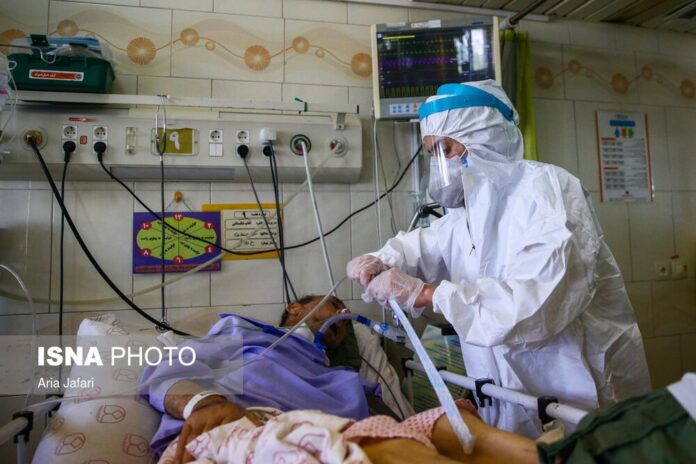
The figure announced by Sima-Sadat Lari in her Monday press conference increases the total number of COVID-19 infections in Iran to 475,674.

She also said the virus has killed 235 patients since Sunday noon, increasing the overall death toll to 27,192. The number of new deaths equals the all-time high record of July 29.

So far, she added, 392,293 patients have recovered from the disease or been discharged from the hospital.

Lari said 4,167 patients are also in critical conditions caused by more severe infection.

The spokeswoman noted that 4,115,445 COVID-19 tests have been taken across the country so far.
She said the high-risk “red” zones include Tehran, Qom, Mazandaran, East Azarbaijan, Isfahan, Yazd, Ardabil, Khorasan Razavi, Khuzestan, Hamadan, West Azarbaijan, Bushehr, Chaharmahal and Bakhtiari, Kohgiluyeh and Boyer-Ahmad, Alborz, Lorestan, Markazi, Ilam, South Khorasan, Kermanshah, North Khorasan, Semnan, Gilan, Zanjan, Qazvin, and Kerman provinces.

The “orange” zones also include Golestan, Hormozgan, Kurdistan, and Fars provinces, she added.

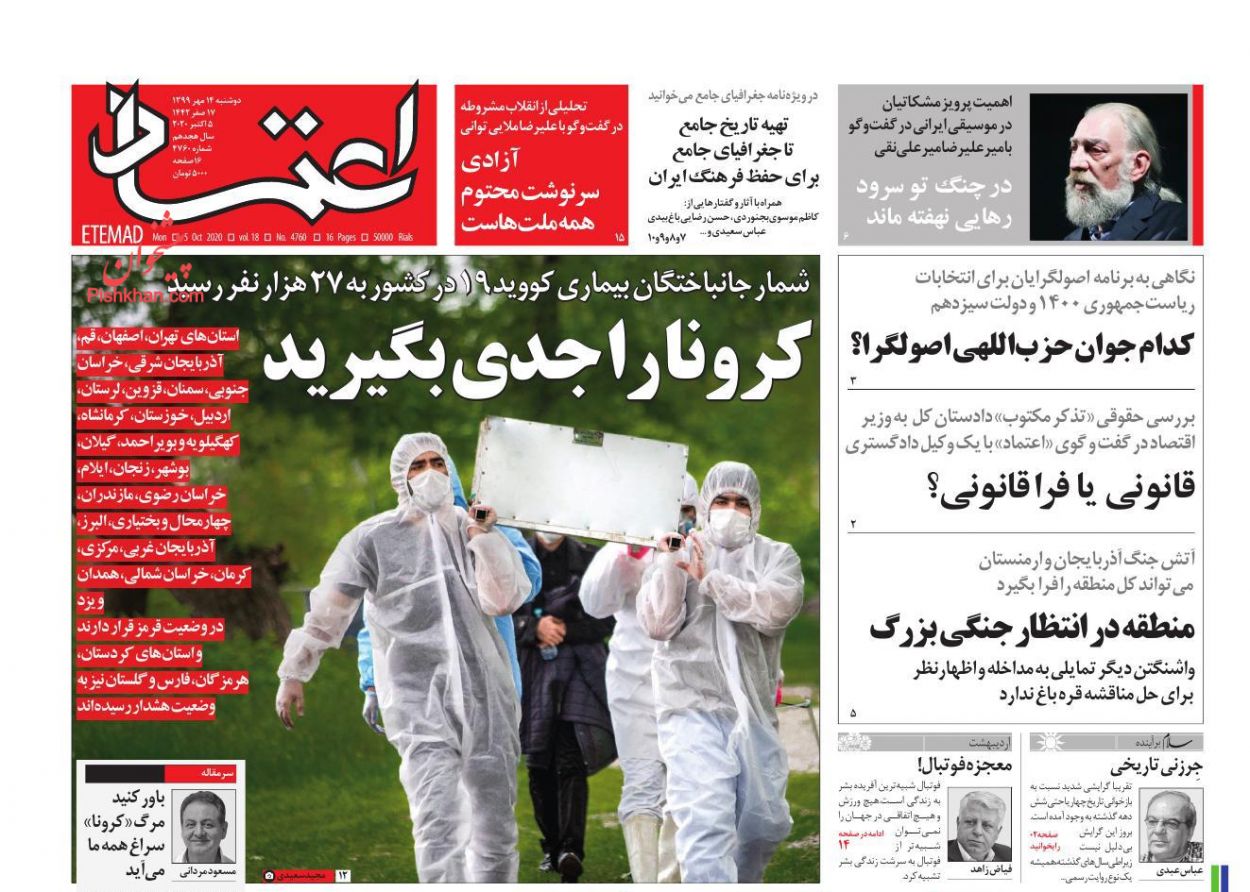
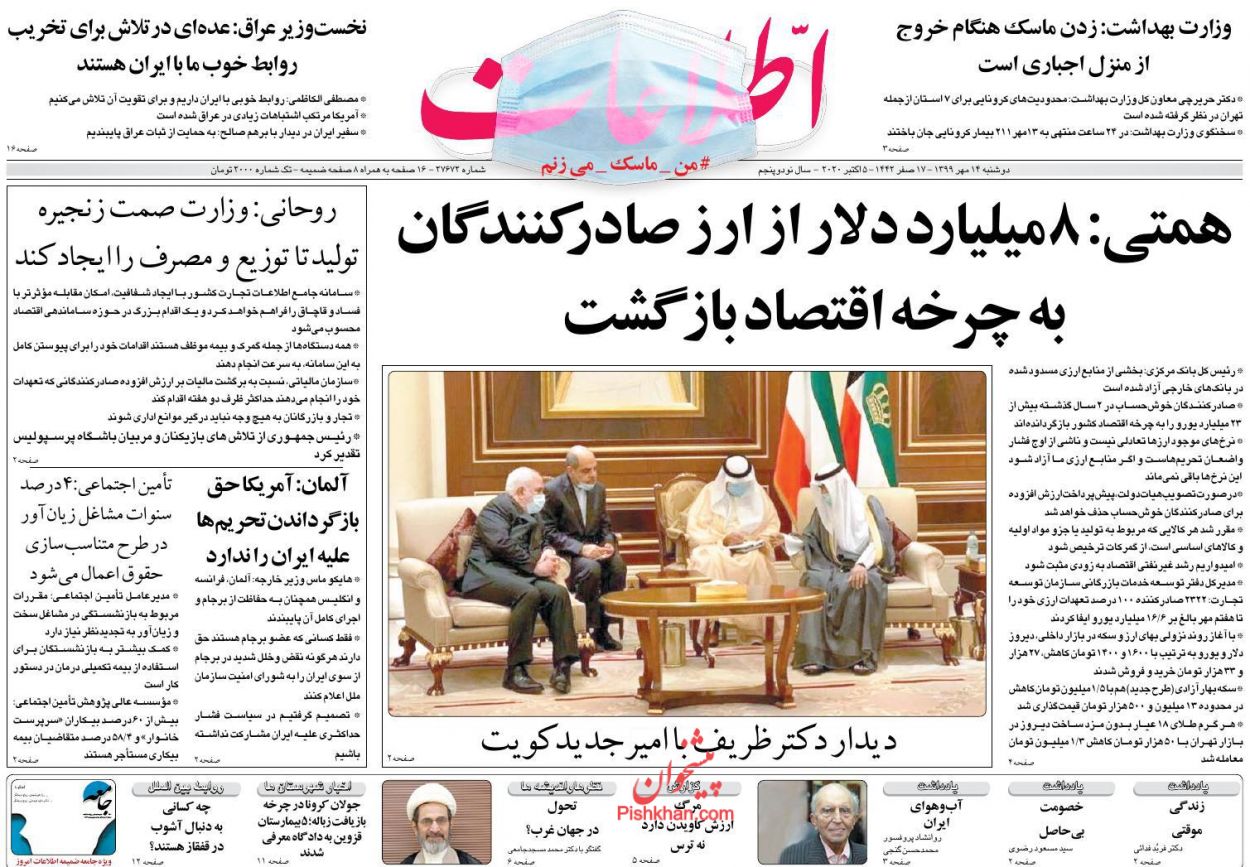
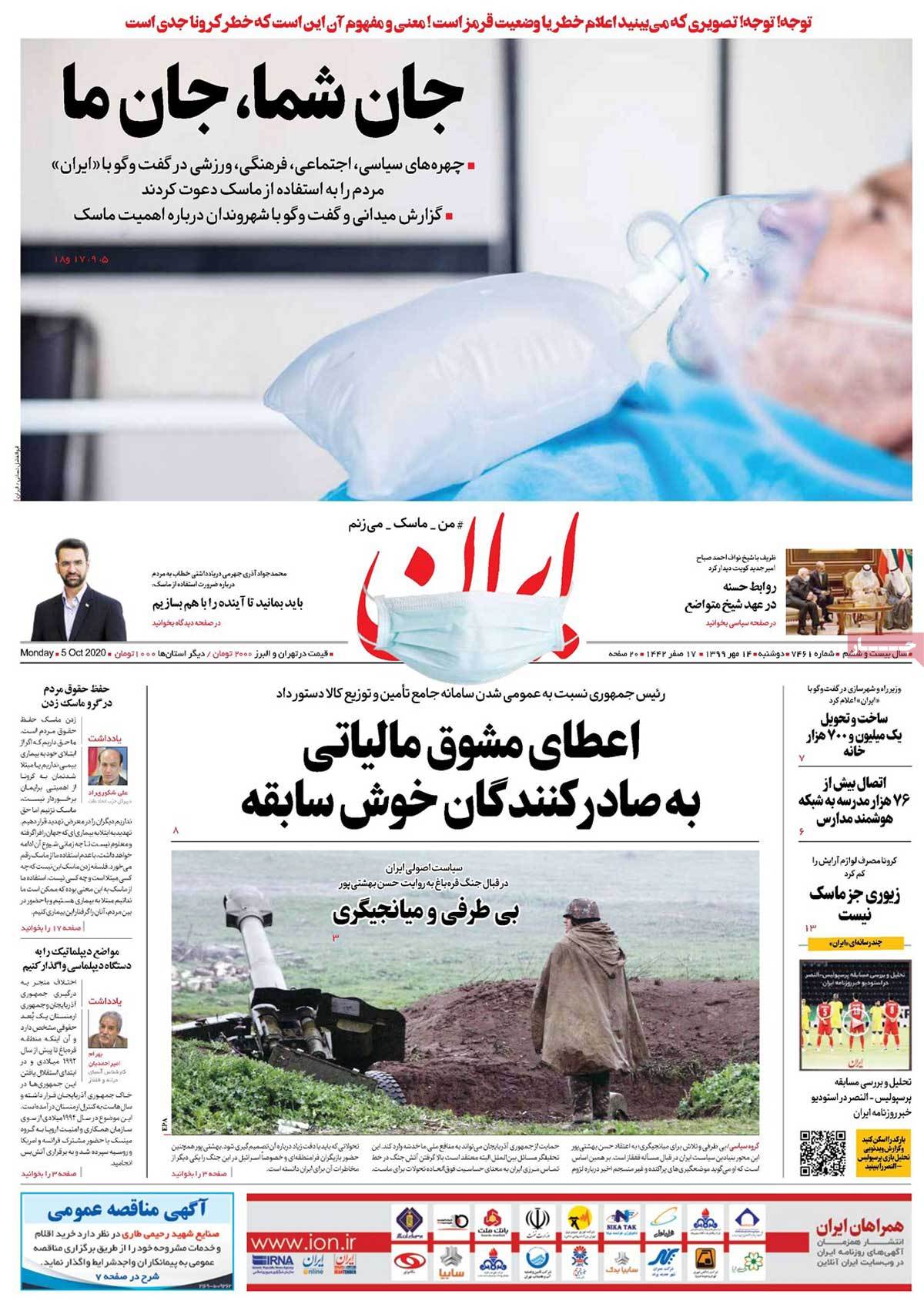
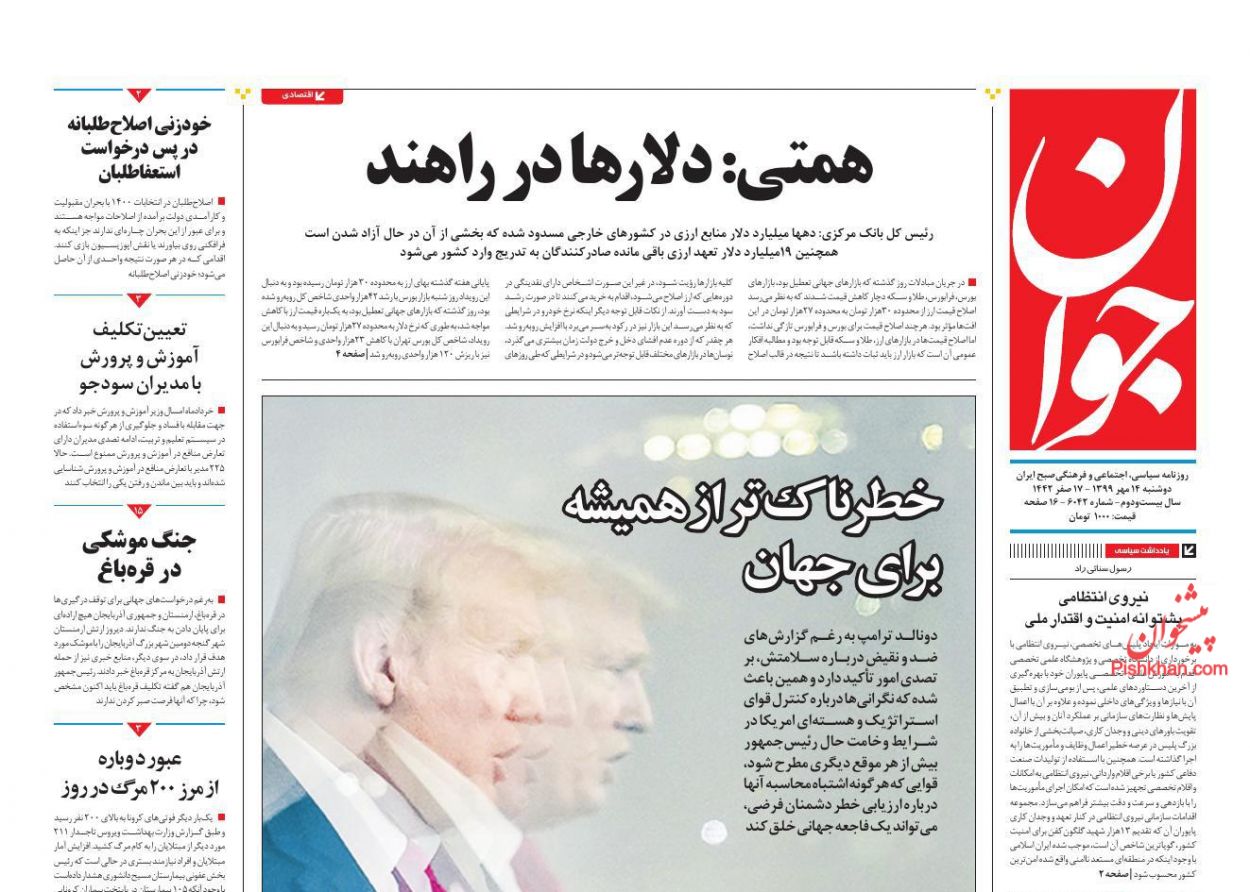
A Look at Iranian Newspaper Front Pages on October 5

A Look at Iranian Newspaper Front Pages on November 18

Iranian Newspapers

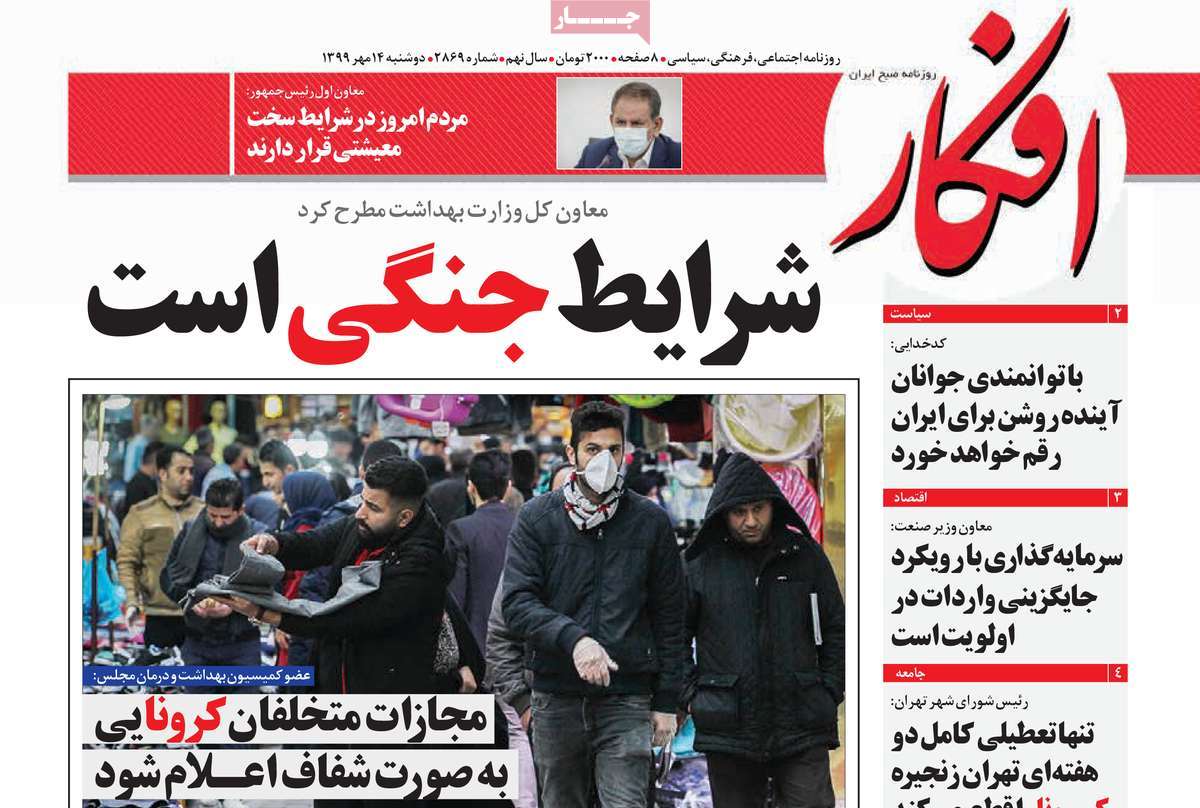
Afkar Newspaper:

1- Deputy Health Minister: Iran in War Conditions

A Look at Iranian Newspaper Front Pages on October 5


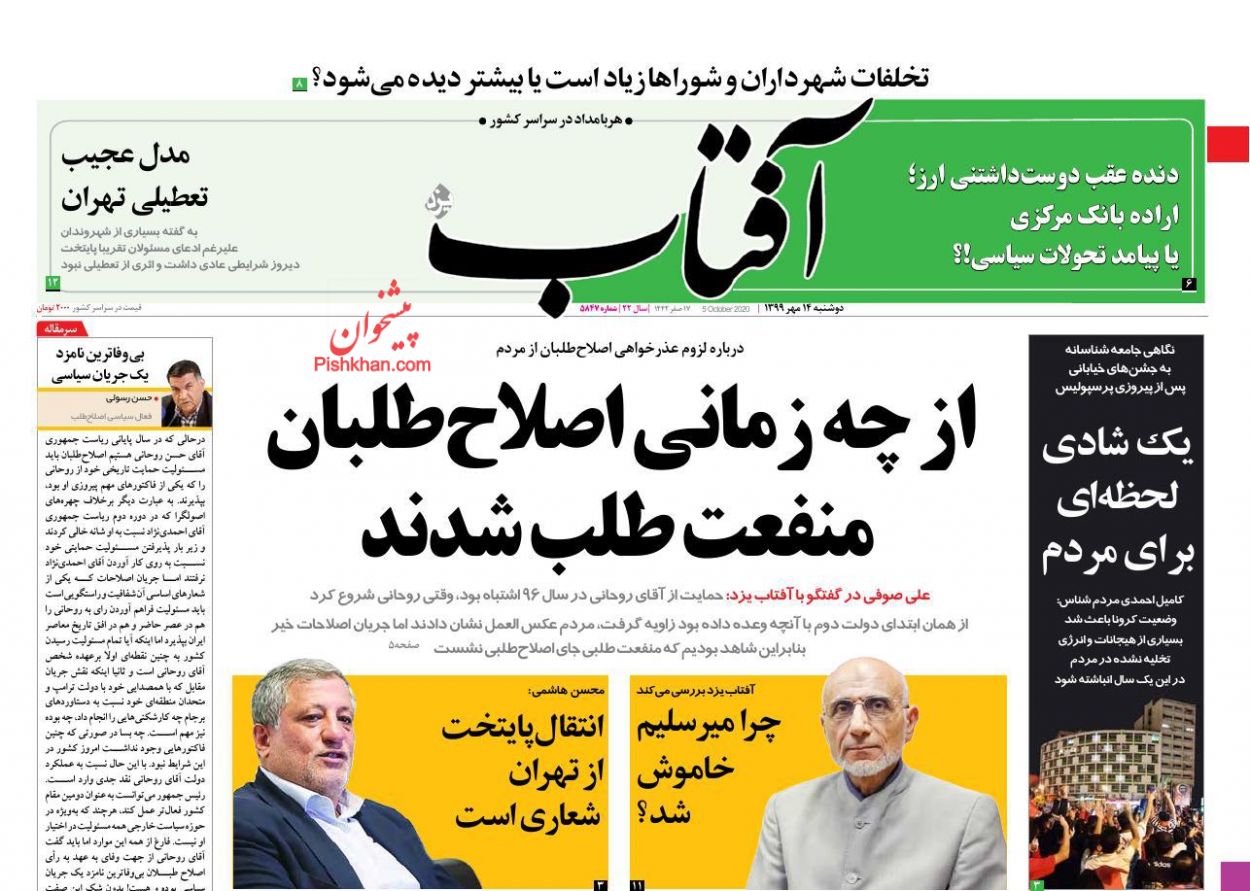
Aftab-e Yazd Newspaper:

1- Changing Iran’s Capital City Not Feasible: City Council Chairman

2- Strange Model of Shutting Down Tehran

3- Iran’s Currency Recovers Some of Its Value: Central Bank’s Resolve or Result of Political Developments?

A Look at Iranian Newspaper Front Pages on October 5


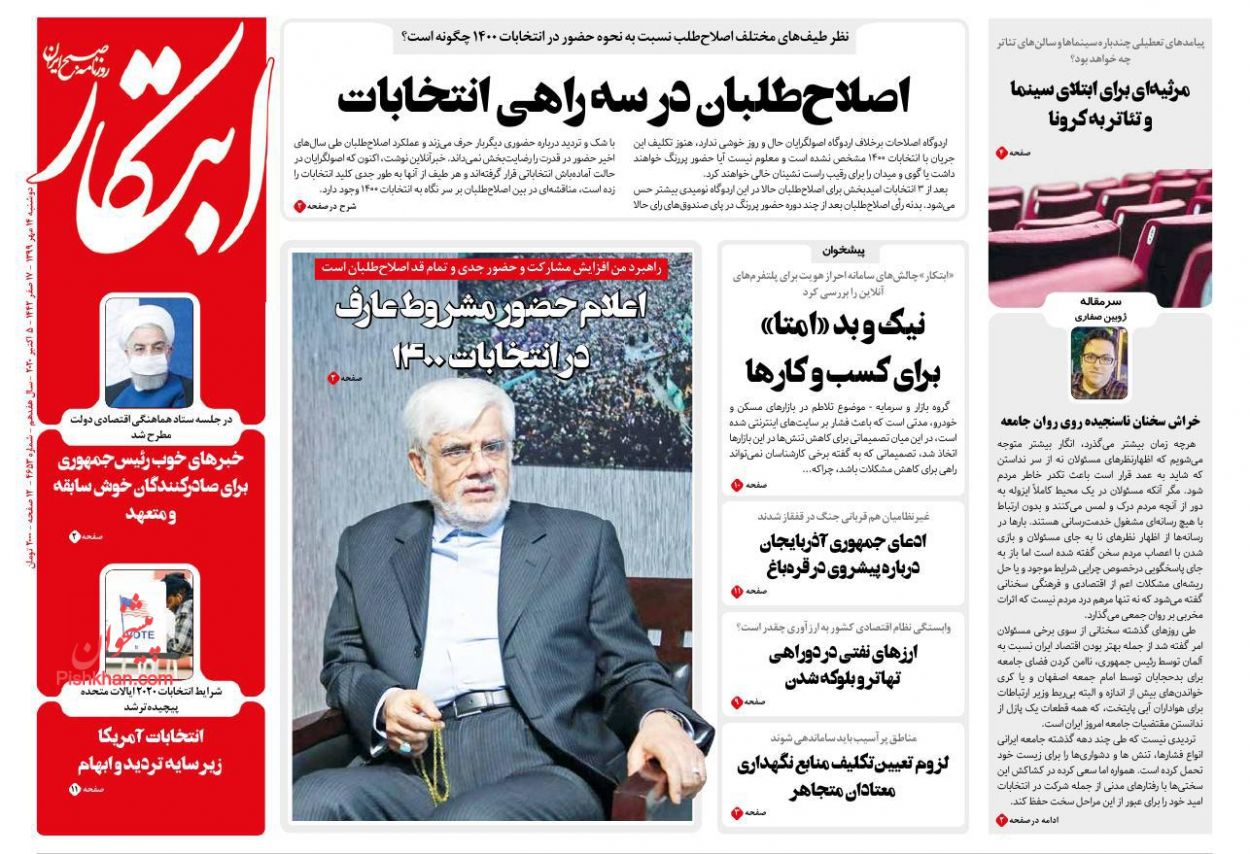
Ebtekar Newspaper:

1- US Elections Under Shadow of Doubt, Ambiguity

* Situation Getting More Complicated in US

2- Azeri President Claims His Country Has Made Gains in Karabakh

3- Civilians Falling Victim in Caucasus War

A Look at Iranian Newspaper Front Pages on October 5


Etemad Newspaper:

1- Take Coronavirus Seriously

2- Region on Verge of Full-Scale War

A Look at Iranian Newspaper Front Pages on October 5


Ettela’at Newspaper:

1- Zarif, New Emir of Kuwait Hold Talks

2- Berlin: US Has No Right to Return Iran Sanctions

3- Iraq PM: Some Trying to Disrupt Our Good Ties with Iran

A Look at Iranian Newspaper Front Pages on October 5


Iran Newspaper:

1- Celebrities, Cultural, Social, Sports Figures Beg People to Wear Mask

A Look at Iranian Newspaper Front Pages on October 5


Javan Newspaper:

1- Central Bank Governor: US Dollars Coming

2- More Dangerous Than Ever for the World

* Trump Still Insist on Governing US Despite Health Problems

* Concerns Grow over His Ability to Control US Strategic, Nuclear Power

3- Missile War in Karabakh

A Look at Iranian Newspaper Front Pages on October 5


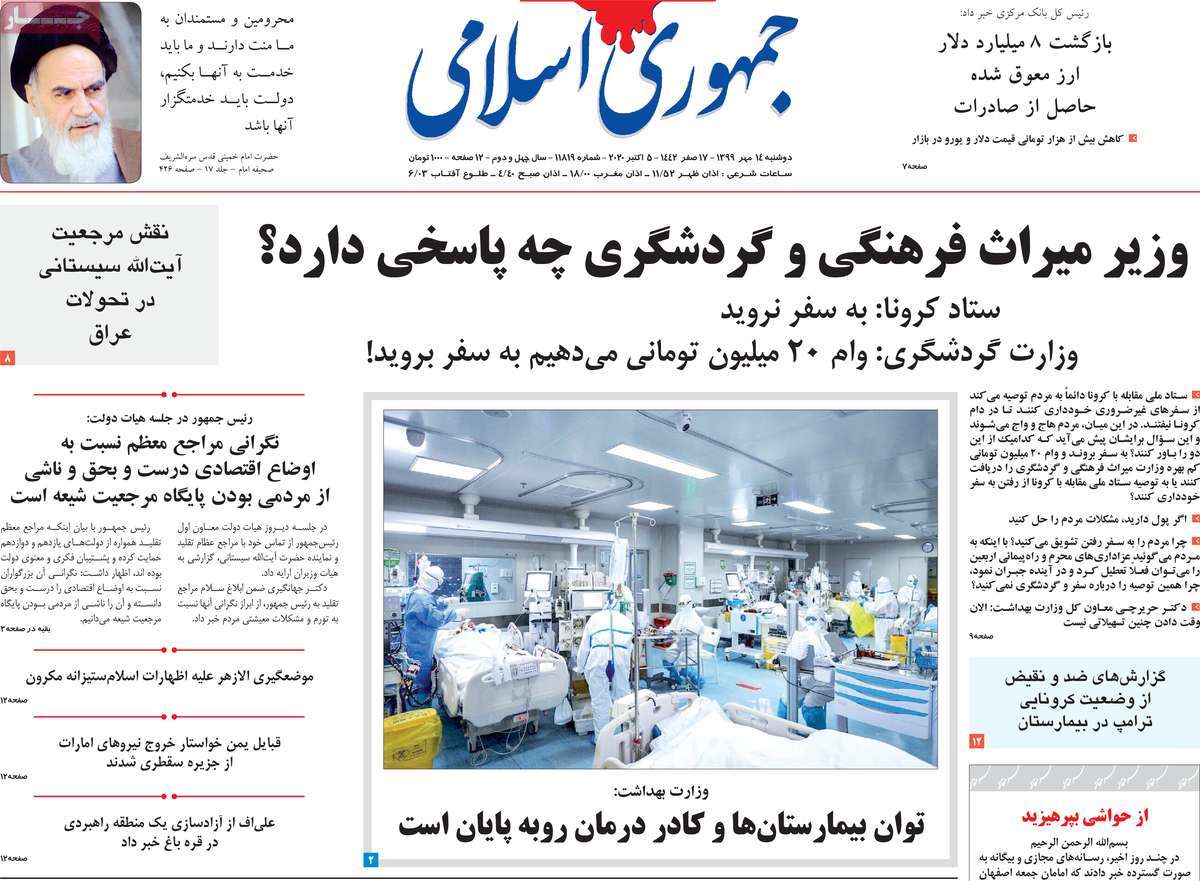
Jomhouri Eslami Newspaper:

1- Health Minister: Hospitals, Medical Staff Running Out of Power

A Look at Iranian Newspaper Front Pages on October 5


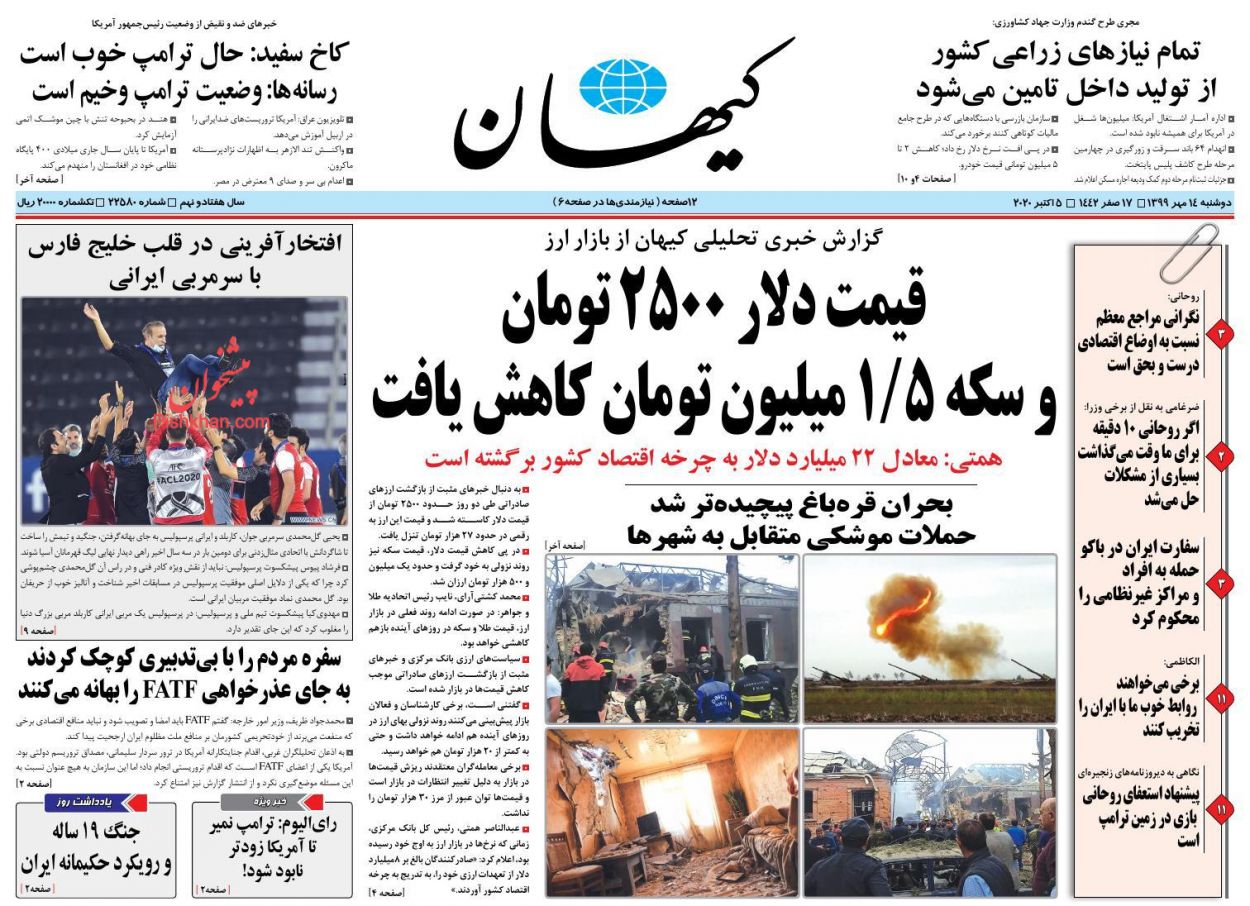
Kayhan Newspaper:

1- Karabakh Conflict Gets More Complicated: Mutual Missile Attacks on Cities

2- Iranian Team, with Iranian Head Coach, Successful in Heart of Persian Gulf

3- White House: Trump’s Fine; Media: Trump in Dire Conditions

4- Iran Embassy in Baku Condemns Attacks on Civilian Targets

A Look at Iranian Newspaper Front Pages on October 5


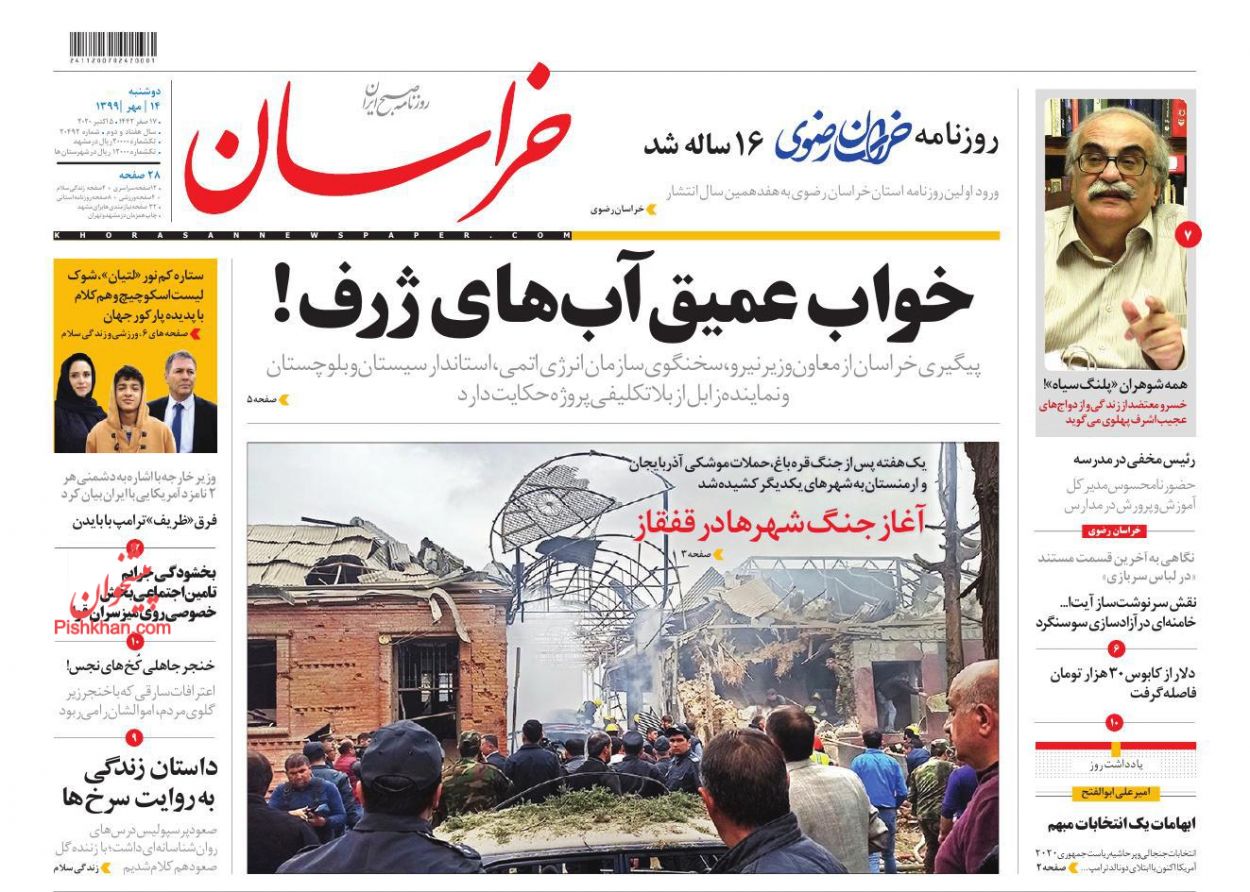
Khorasan Newspaper:

1- War of Cities Begin in Caucasus

A Look at Iranian Newspaper Front Pages on October 5


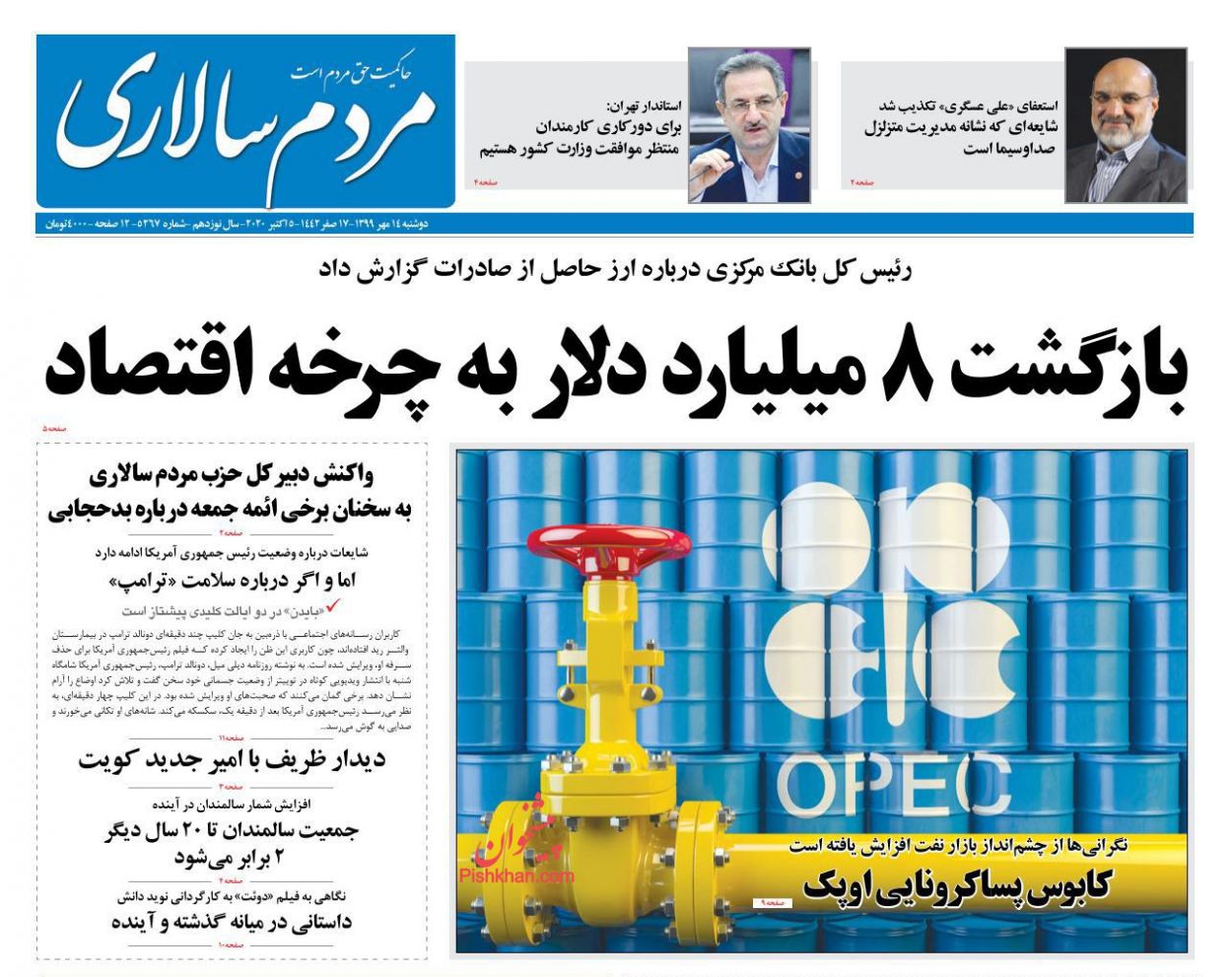
Mardom Salari Newspaper:

1- Return of $8 Billion to Iran’s Economy

2- Ifs and Buts of Trump’s Health

A Look at Iranian Newspaper Front Pages on October 5


Shargh Newspaper:

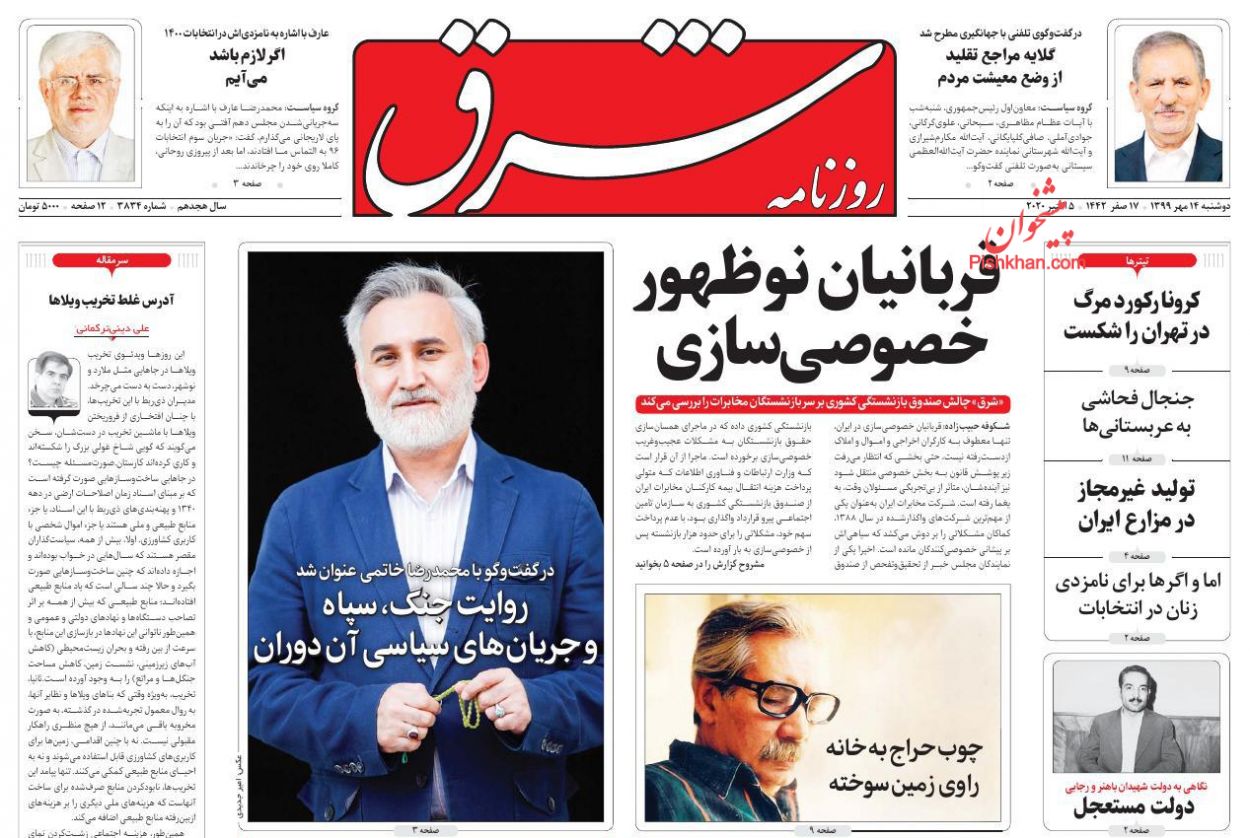
1- Coronavirus Breaks Fatalities Record in Tehran

A Look at Iranian Newspaper Front Pages on October 5

Iran Says Saudi, Israel Have No Right to Comment on Nuclear Commitment

Iran Says Saudi, Israel Have No Right to Comment on Nuclear Commitment

Addressing a press conference on Monday, the Foreign Ministry spokesman dismissed the Saudi concerns about an alleged Iranian violation of the 2015 nuclear deal.

Saudi Arabia and the Zionist regime are probably the last ones to have any right to make comments on the subjects relating to nuclear commitment, Khatibzadeh added.

Pointing to Saudi Arabia and Israel’s serious opposition to the settlement of disputes over Iran’s nuclear program, the spokesman said, “They have not hidden and would not hide such opposition. Such comments are much more ridiculous than being worth response.”

“On Saudi Arabia, I should say that Saudi Arabia is bound by the NPT to honor its commitments. We are carefully examining the relevant developments and news, and warn Riyadh to be careful to honor its international commitments and allow the international and legal paths to be carefully pursued about Saudi Arabia’s activities that are sometimes hidden and covert,” he stated.

“We have also told the international community and institutions, as they are in the right path to hold Saudi Arabia accountable for its obligations,” the spokesperson concluded.

In August, Iran’s permanent representative to international organizations in Vienna called on the IAEA to clarify Saudi Arabia’s “covert” nuclear activities.

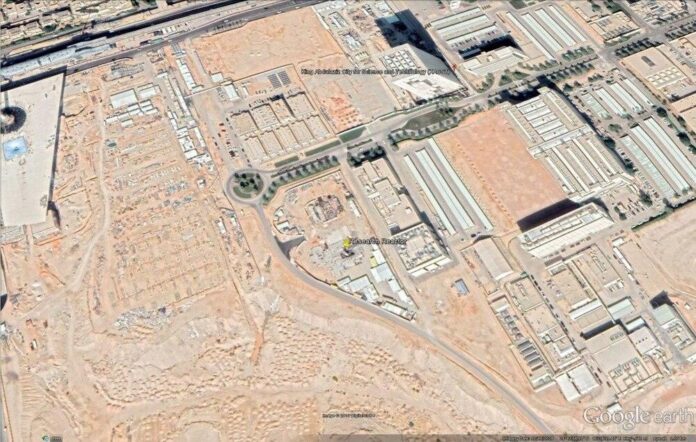
The comments came after American intelligence agencies said they had spotted an undeclared nuclear site near Saudi Arabia’s capital city of Riyadh, scrutinizing attempts by the kingdom to process uranium and move toward the development of atomic bombs.

Qeisarieh Complex: Fabulous Gateway to Isfahan

Qeisarieh Complex

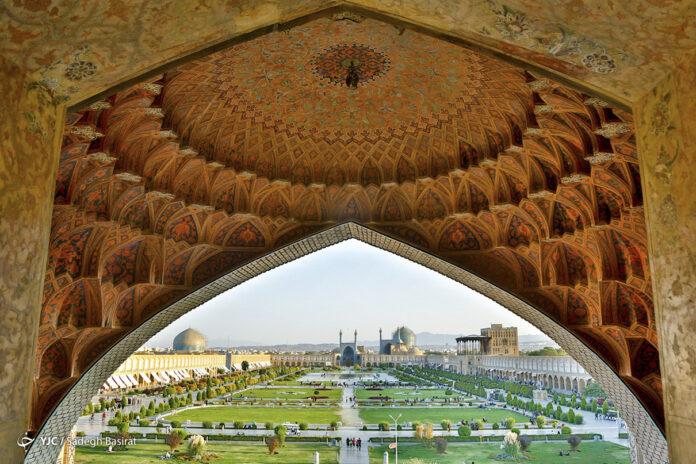
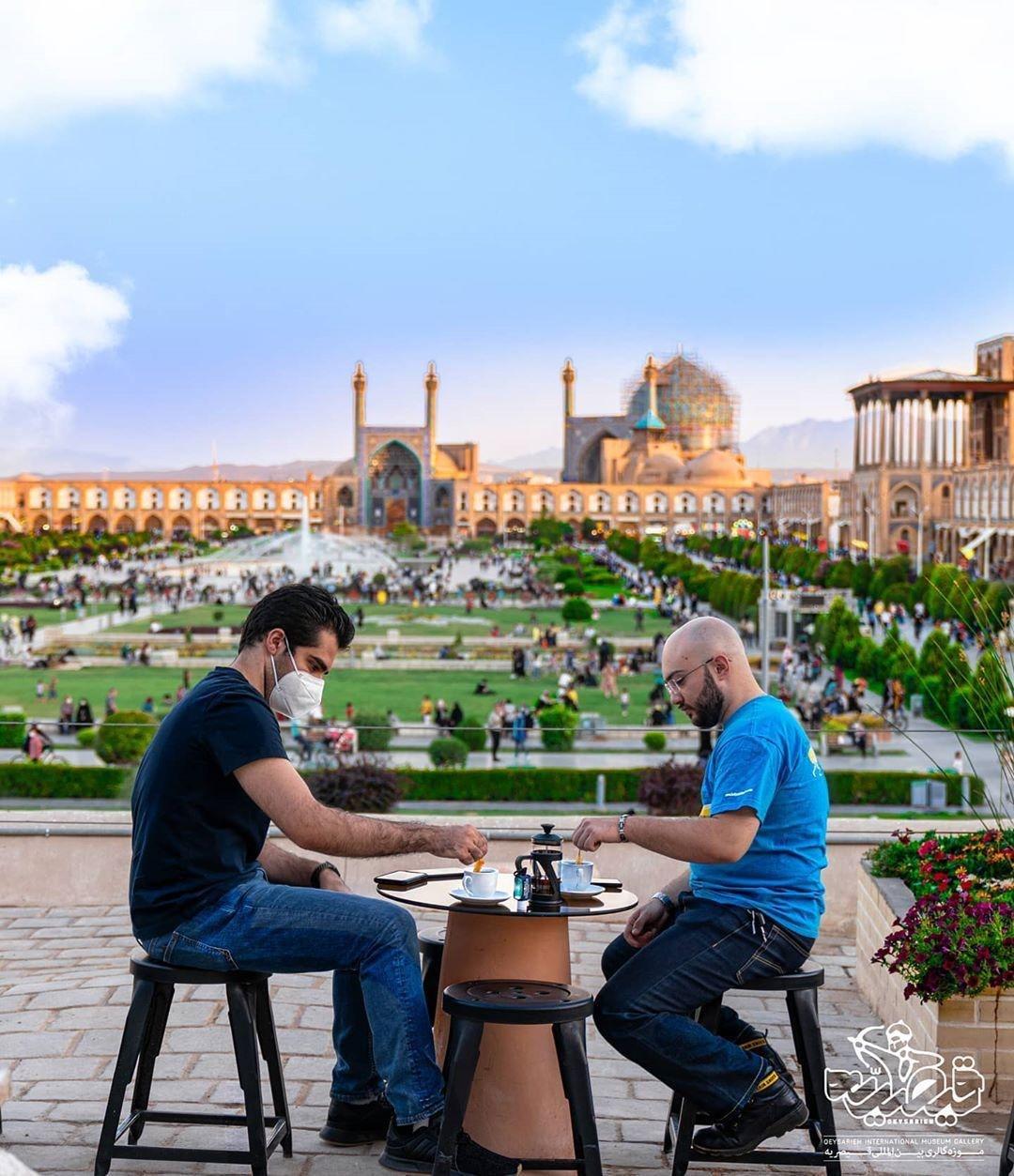
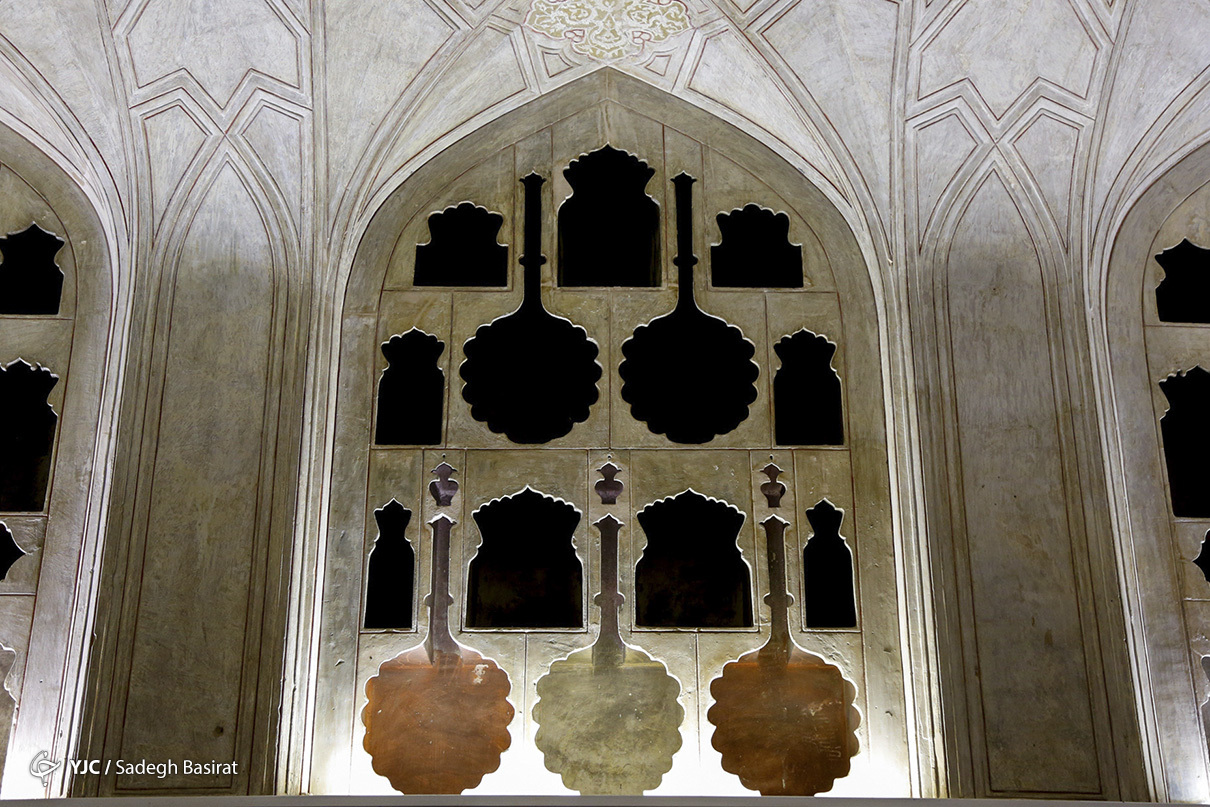
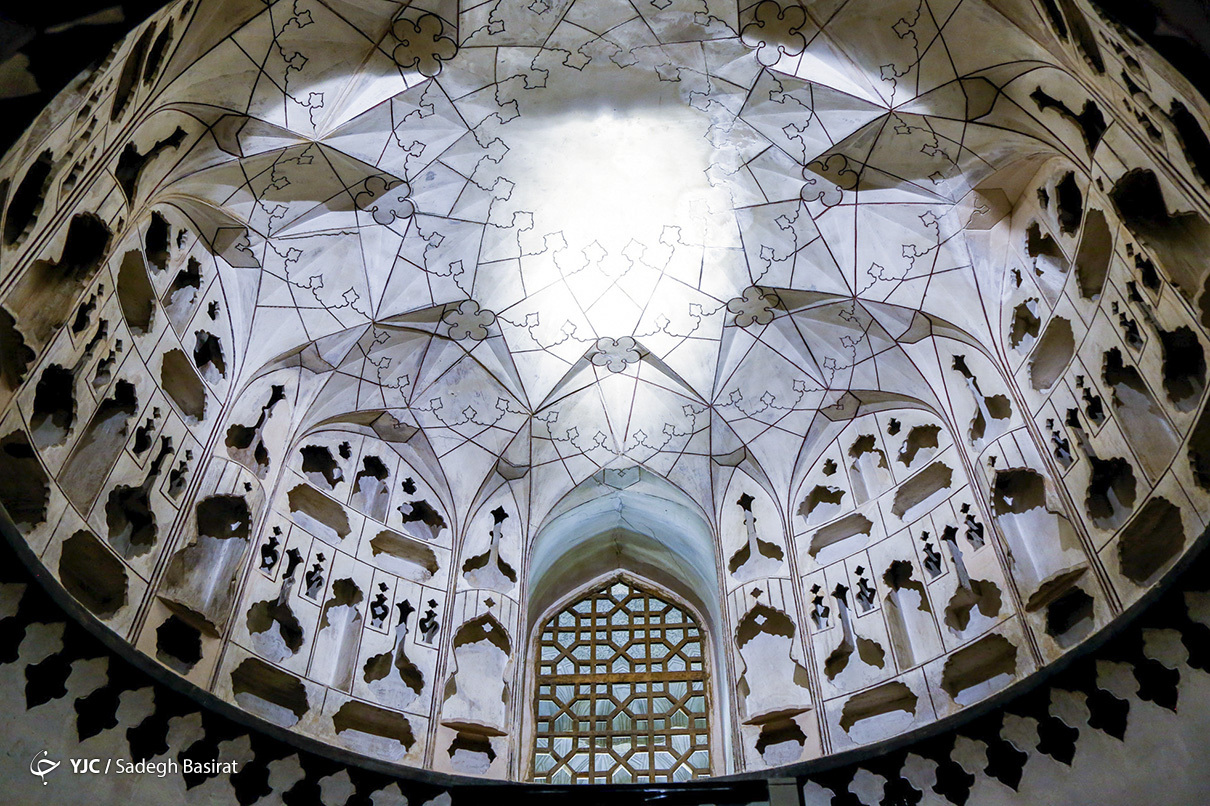
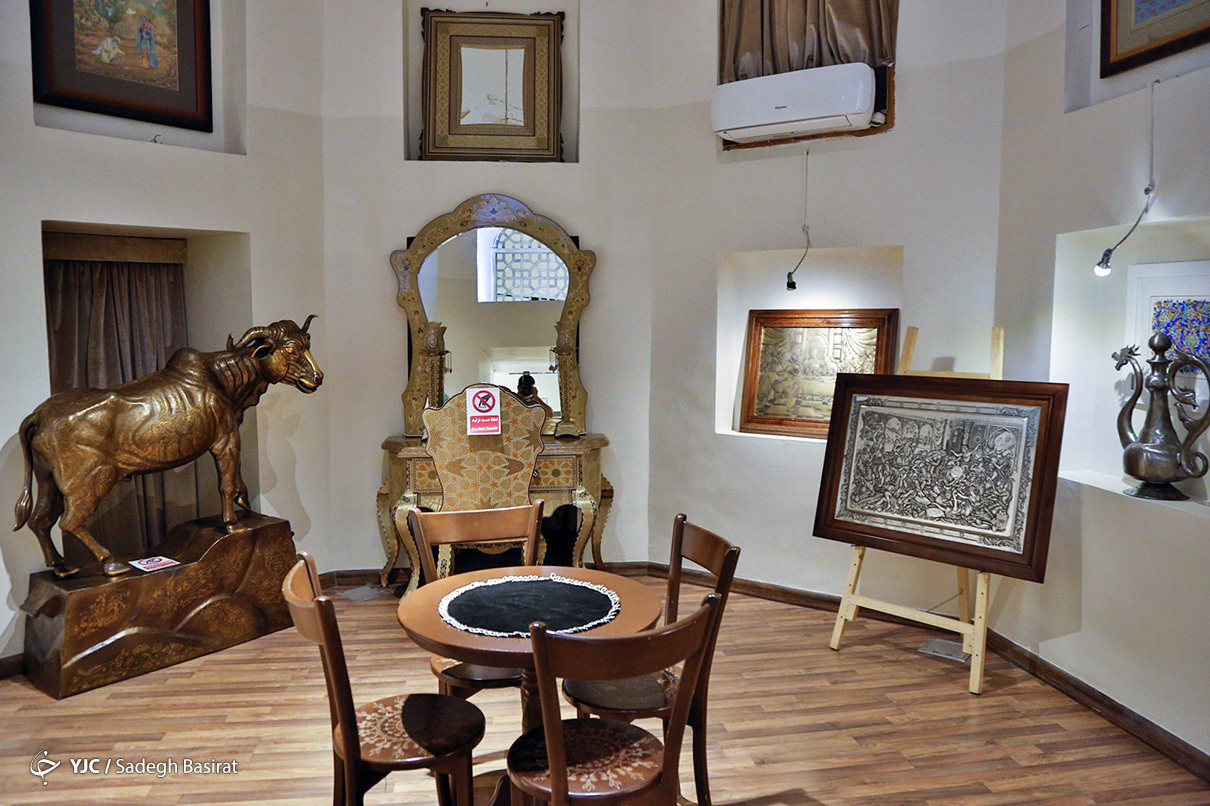
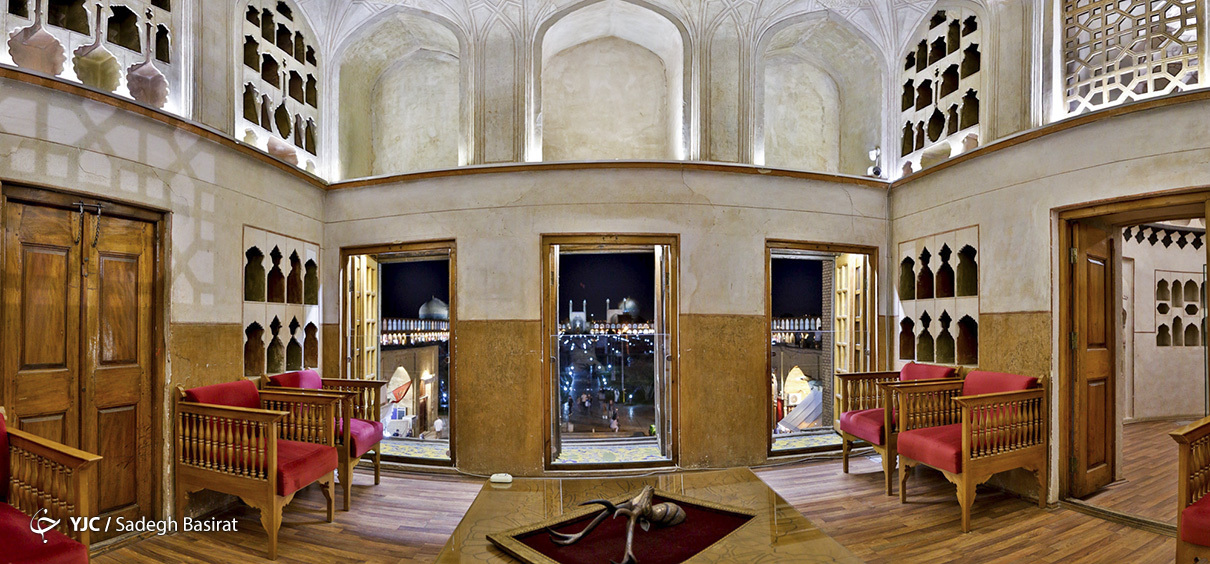
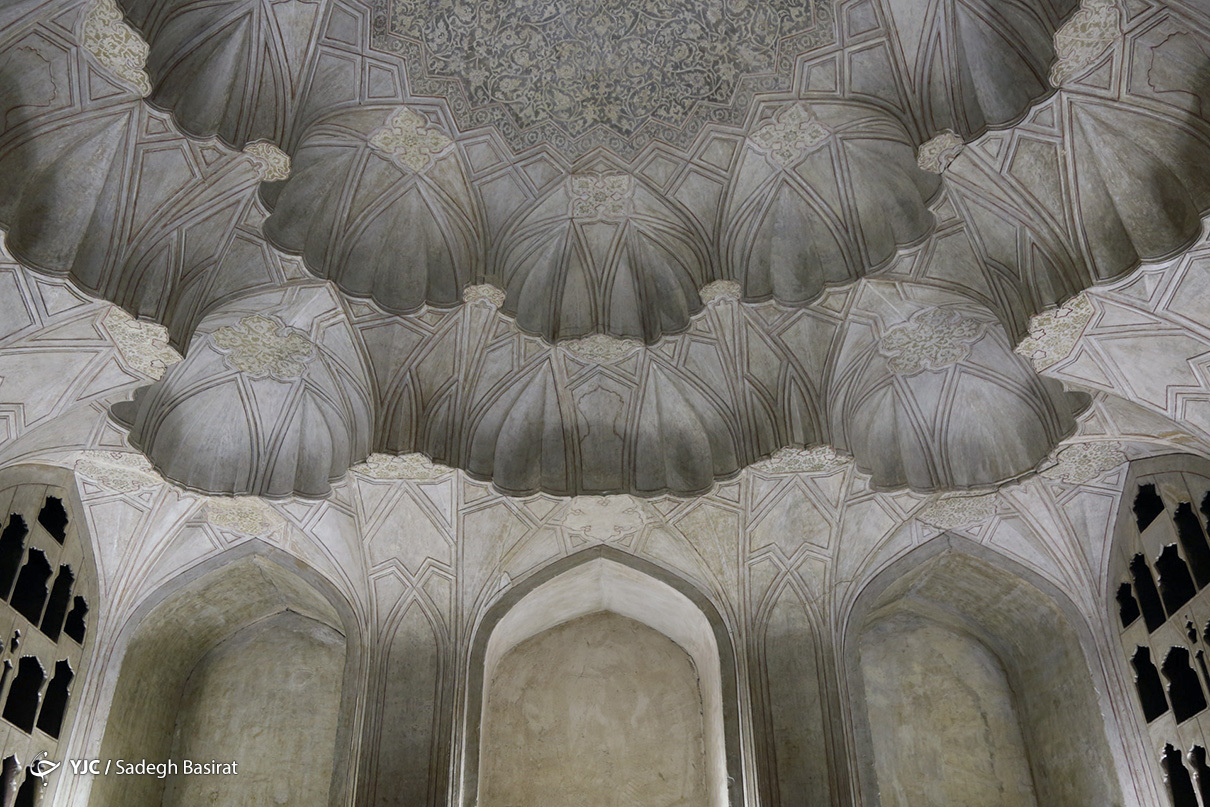
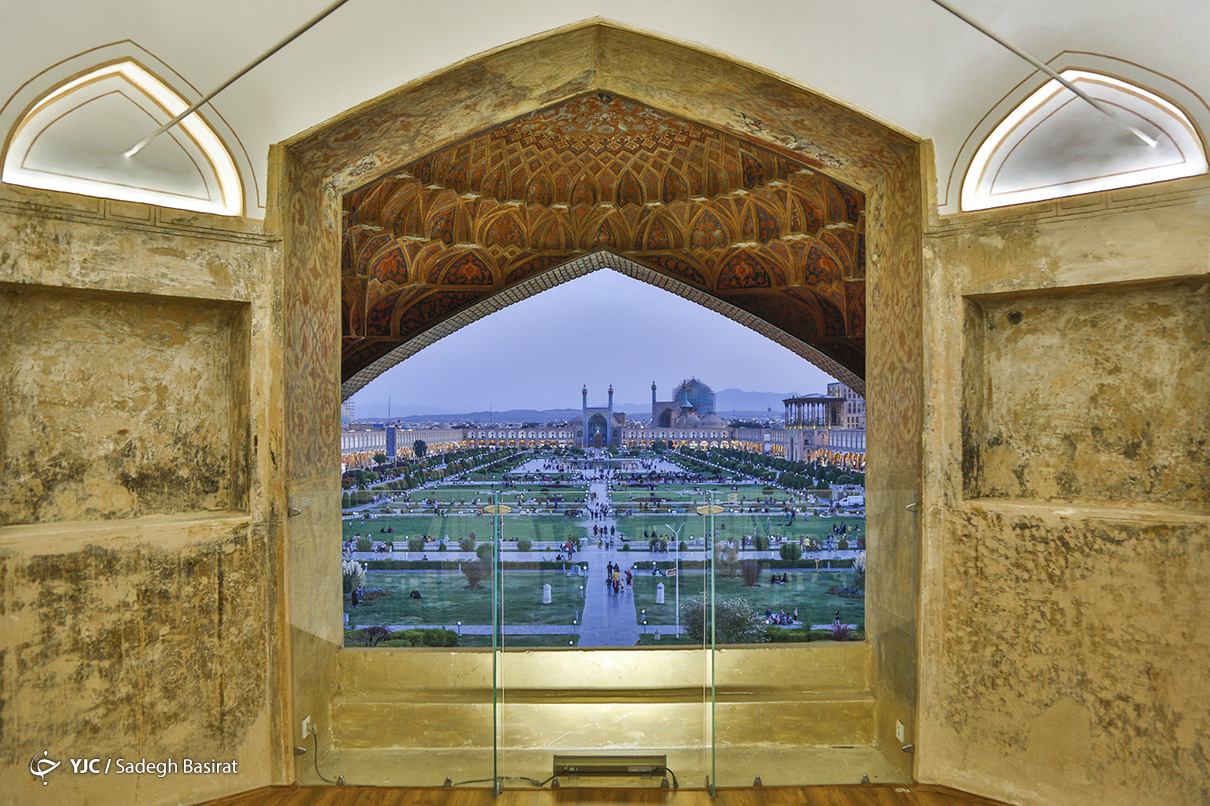
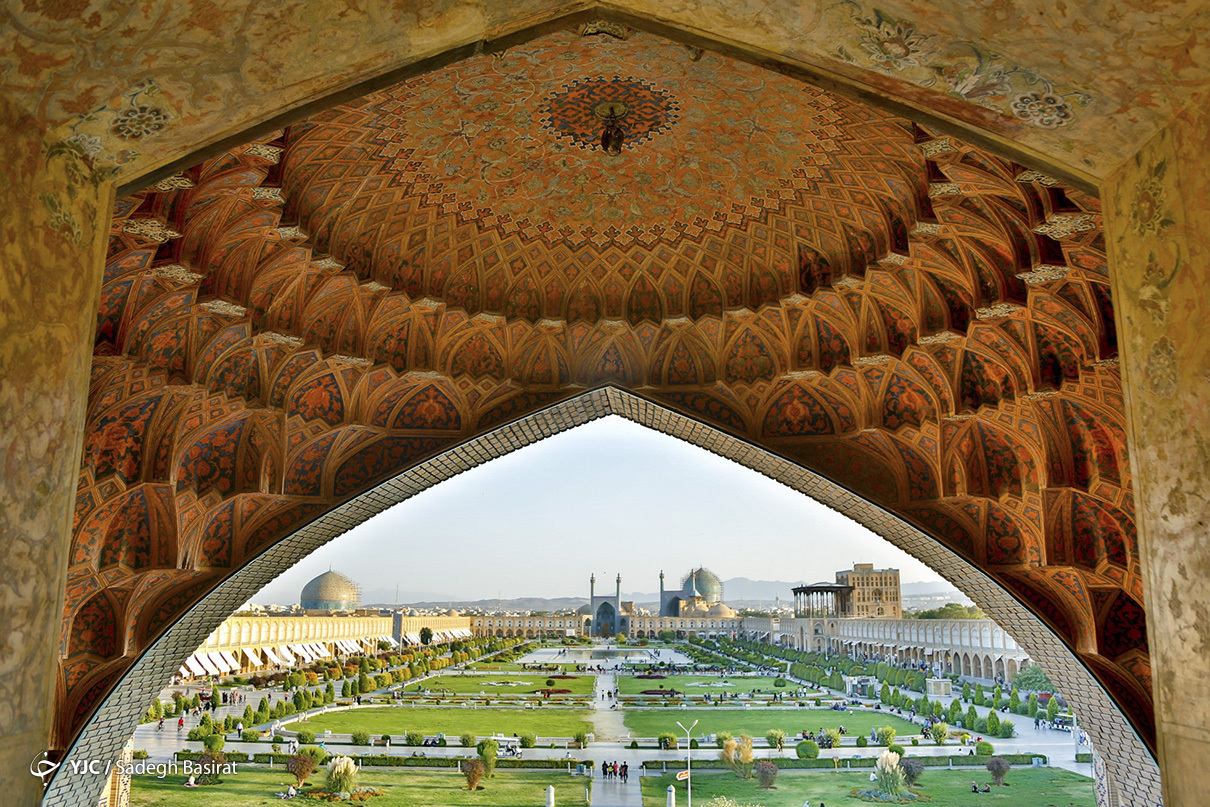
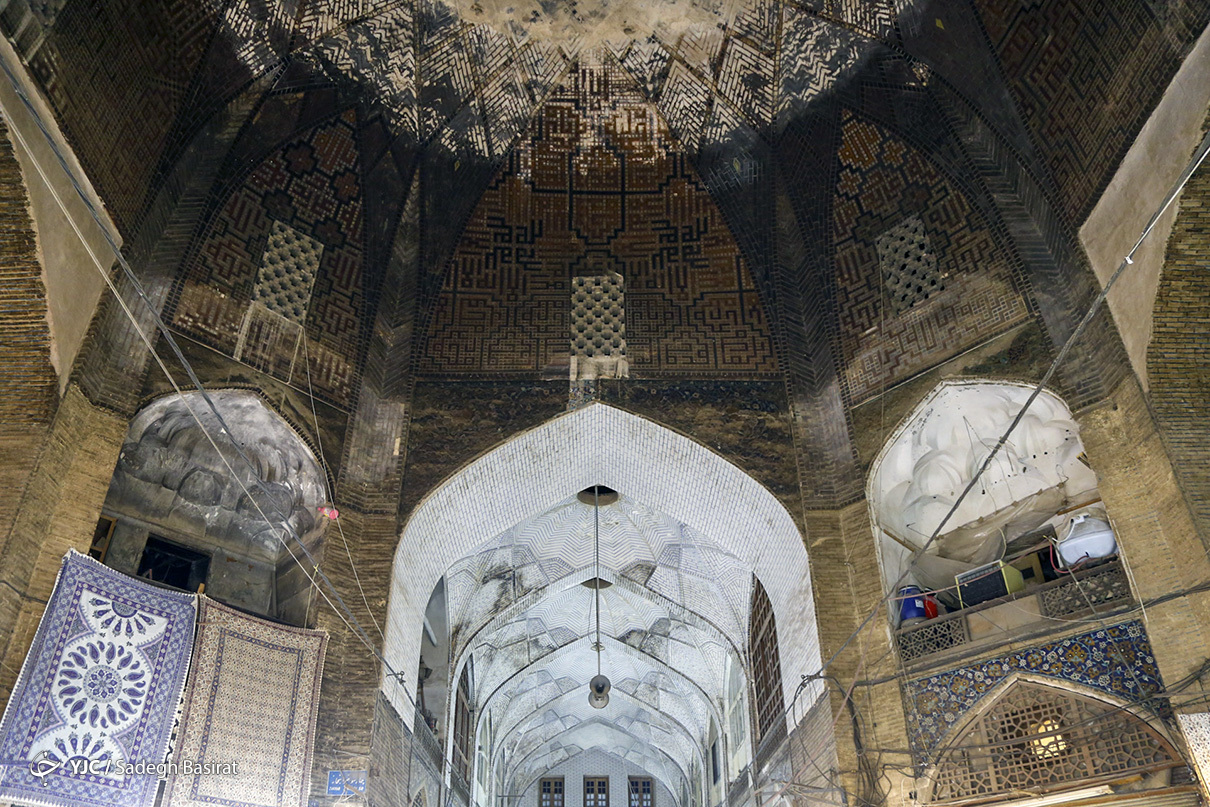
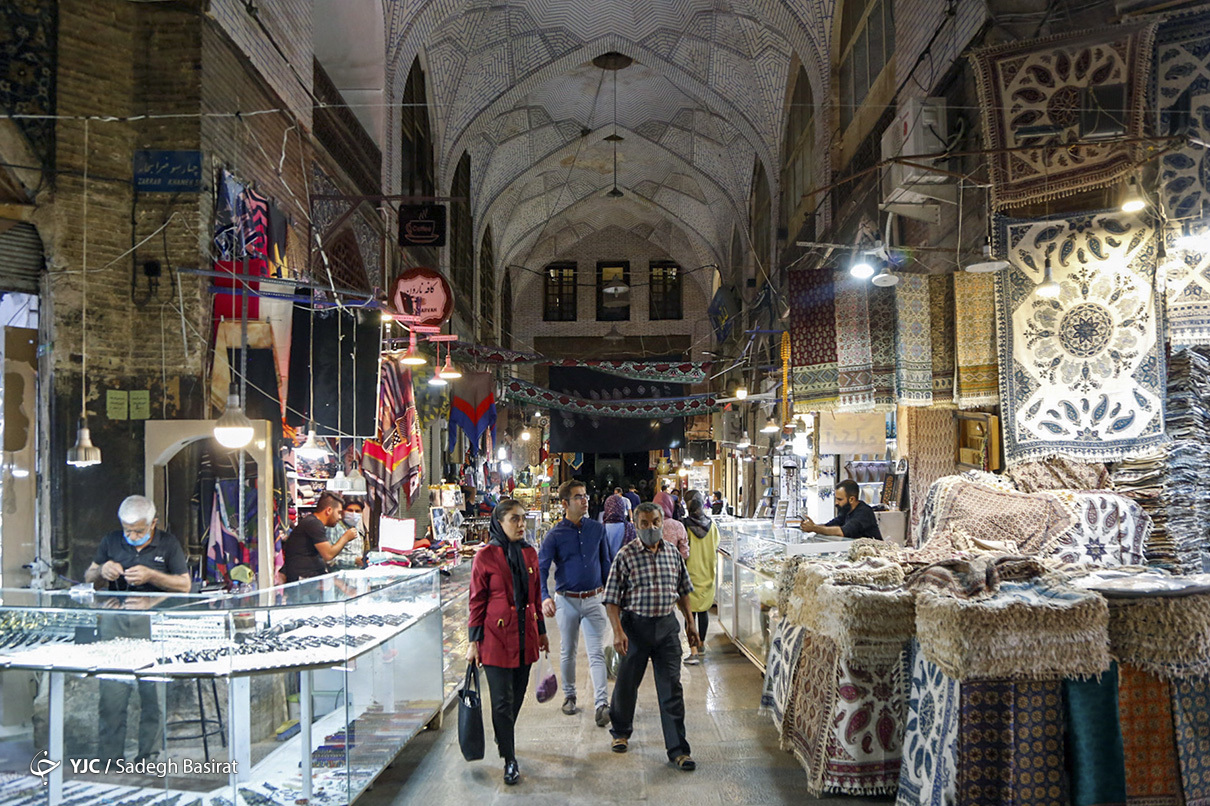
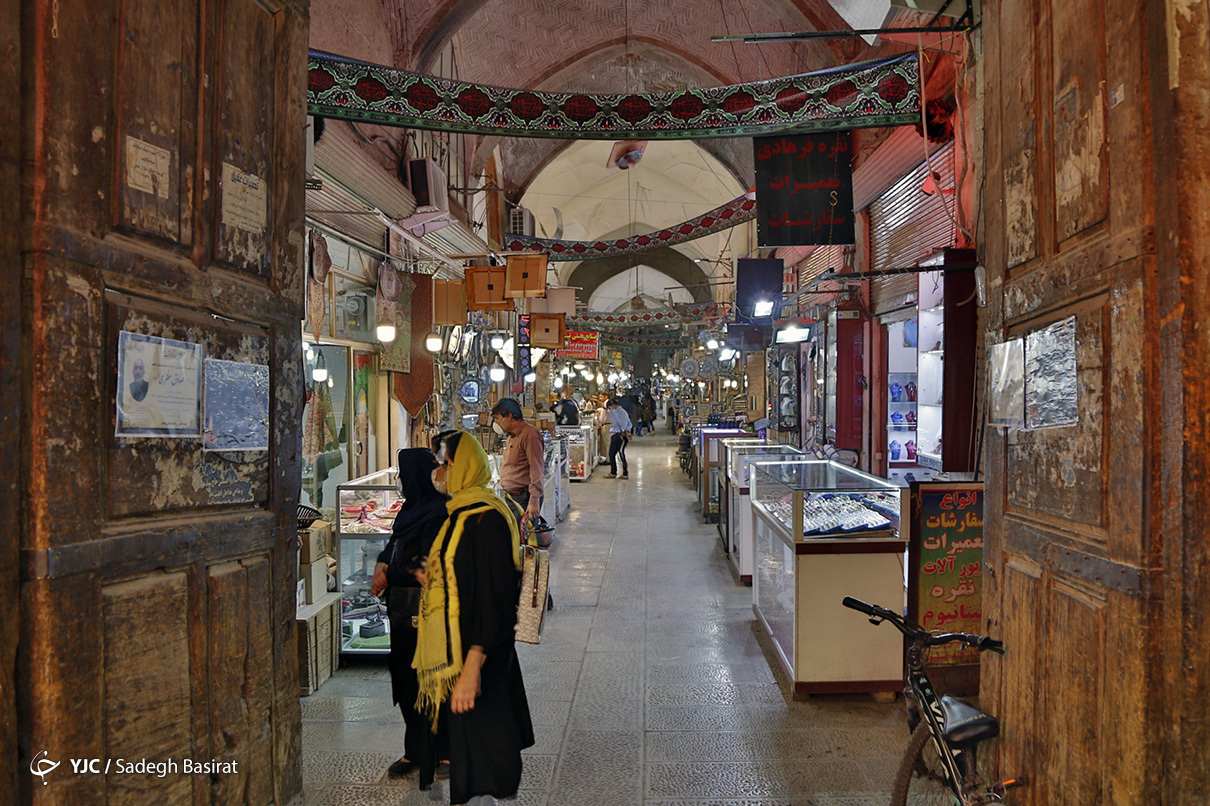
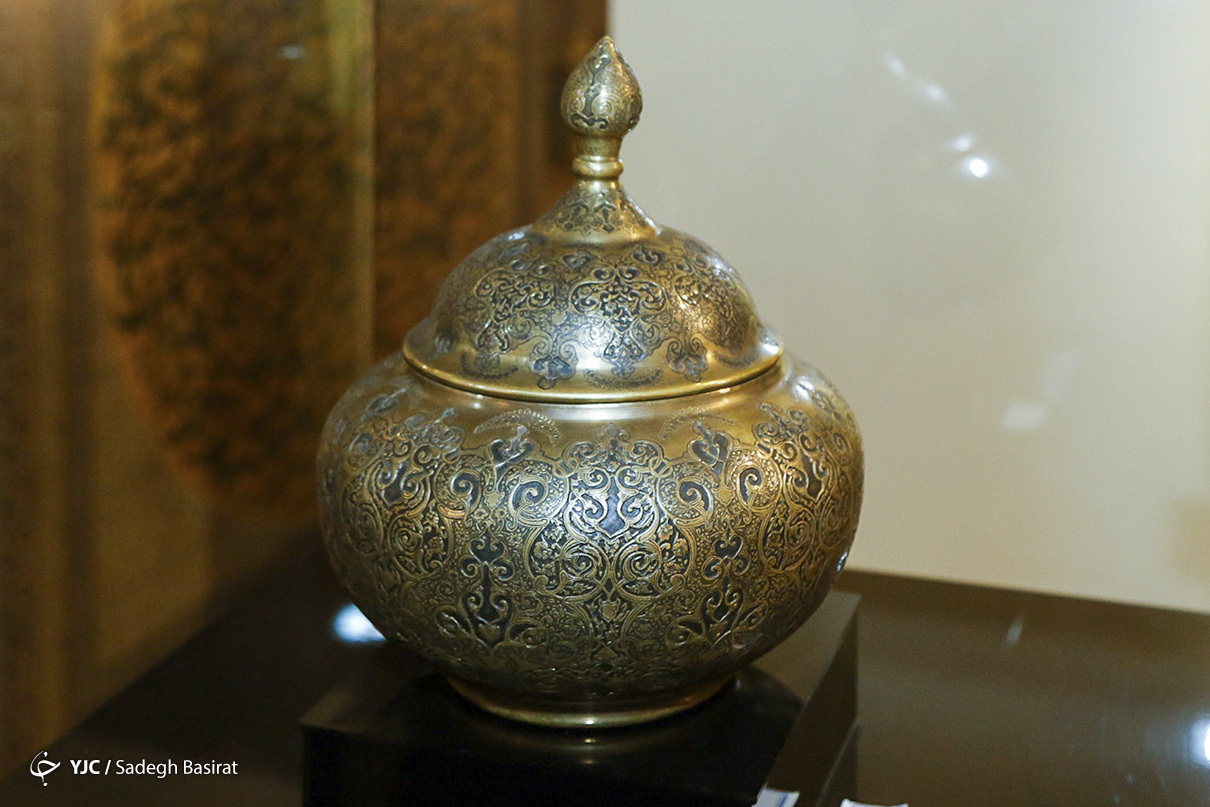
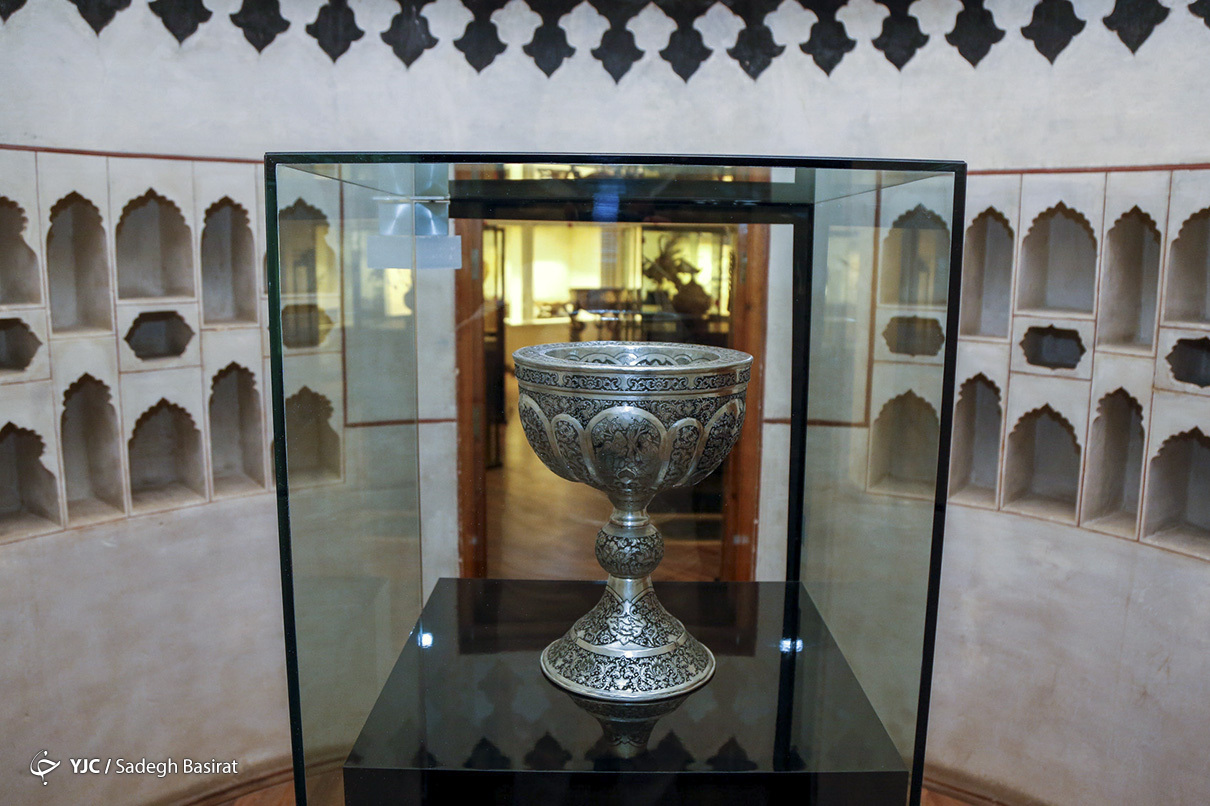
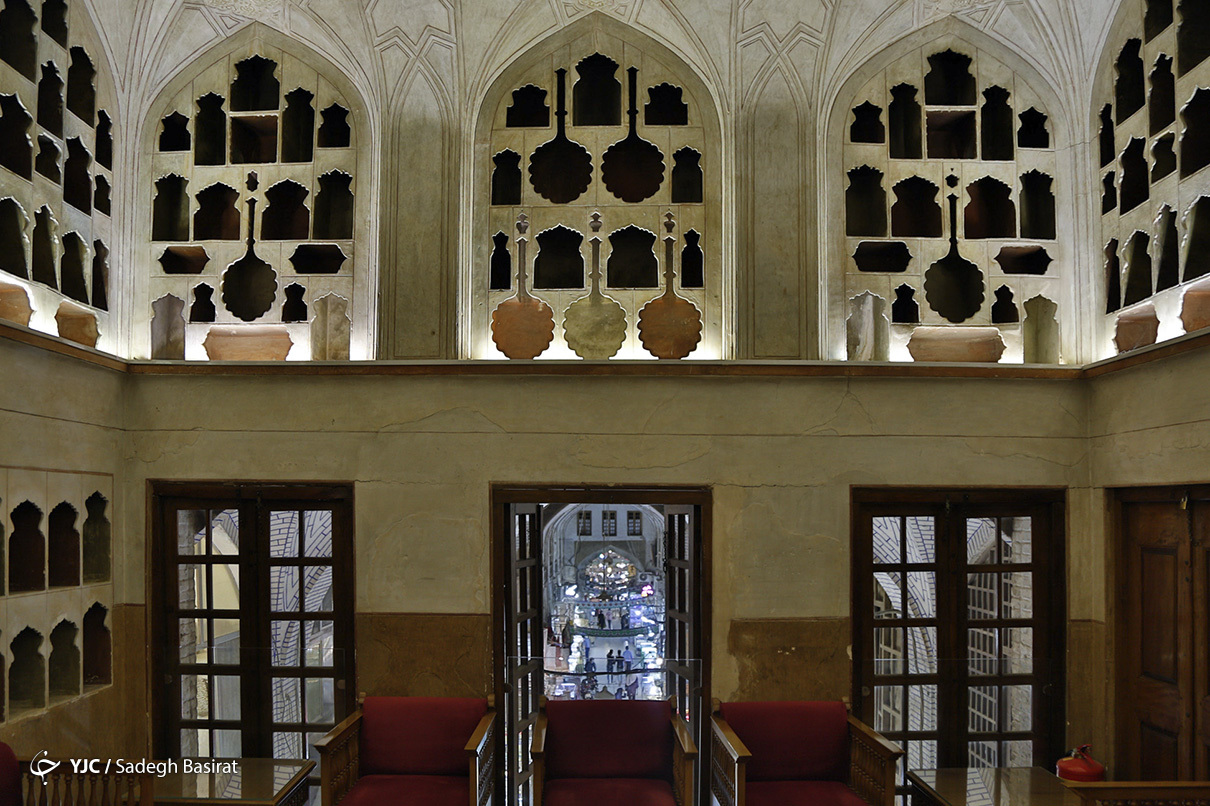
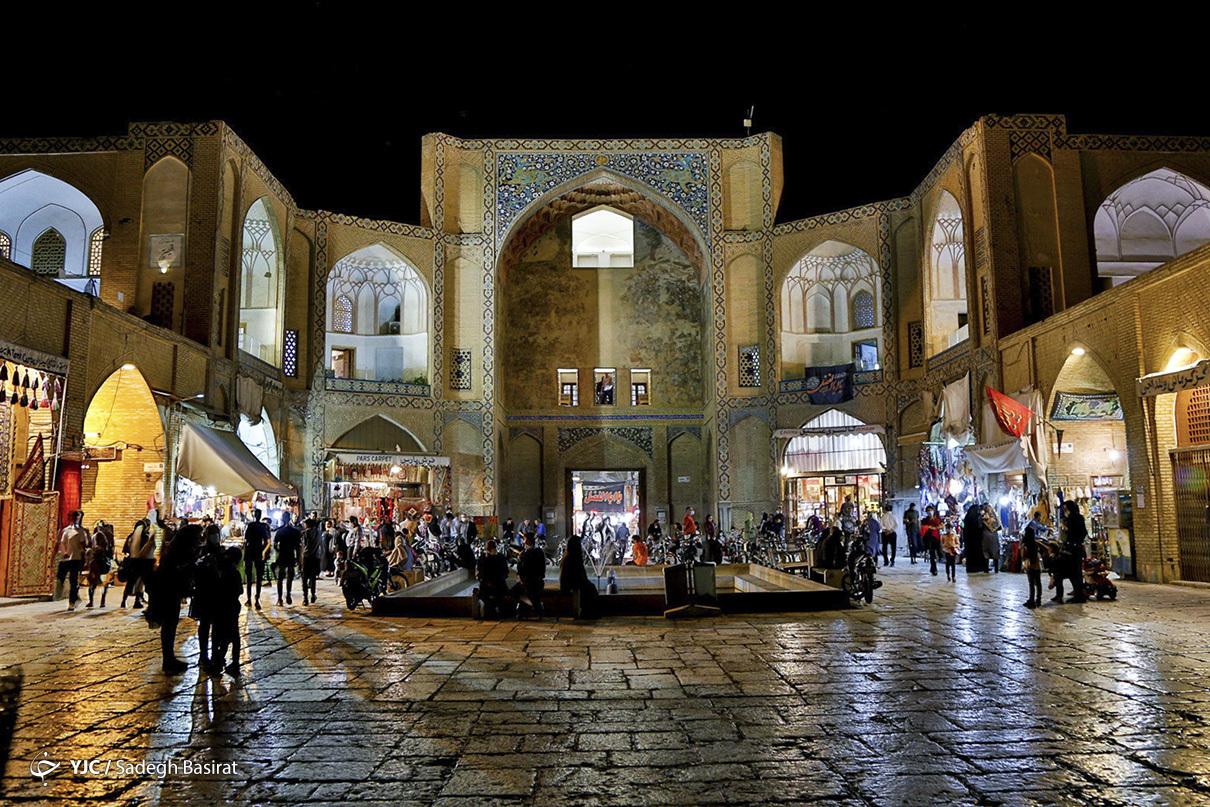
The Qeisarieh complex of Isfahan includes an exquisite gateway in the Shahi Bazaar, the Naqqareh-Khaneh edifice, the Royal Mint, the Royal Caravanserai, and a bazaar where a museum gallery and a café have opened recently.

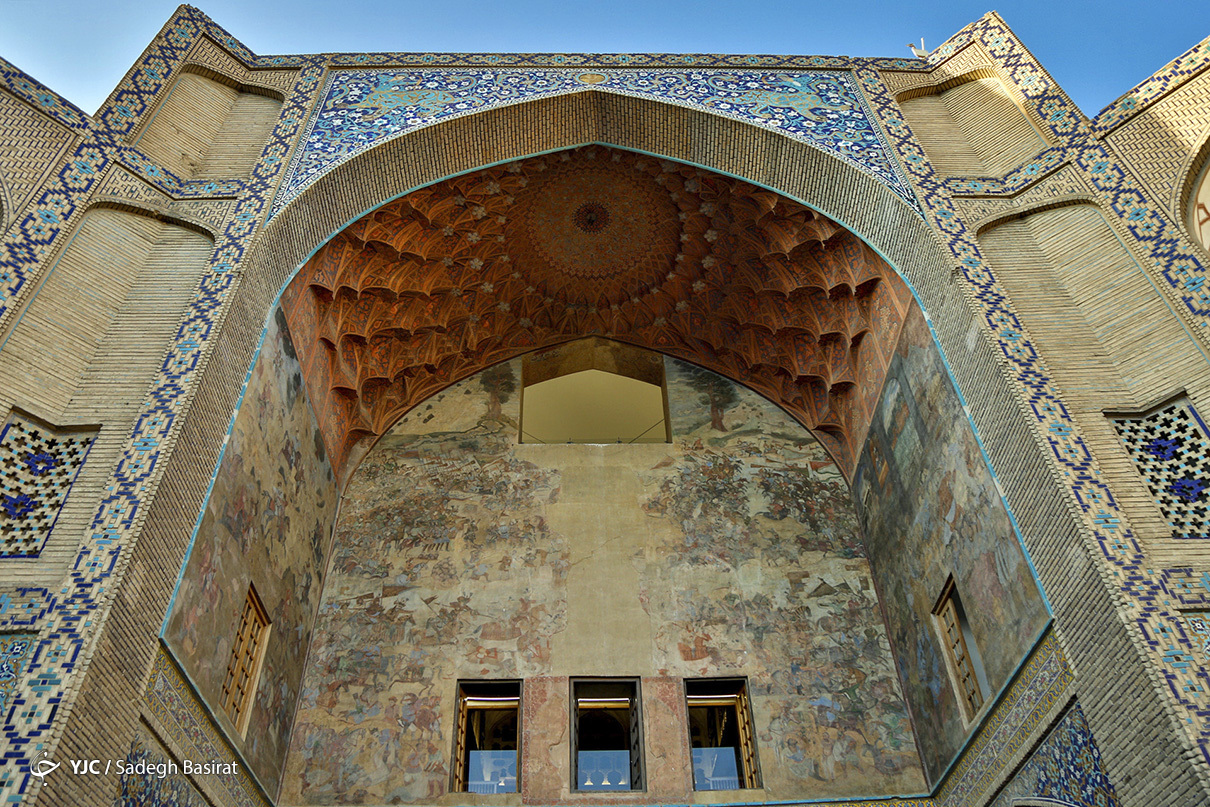
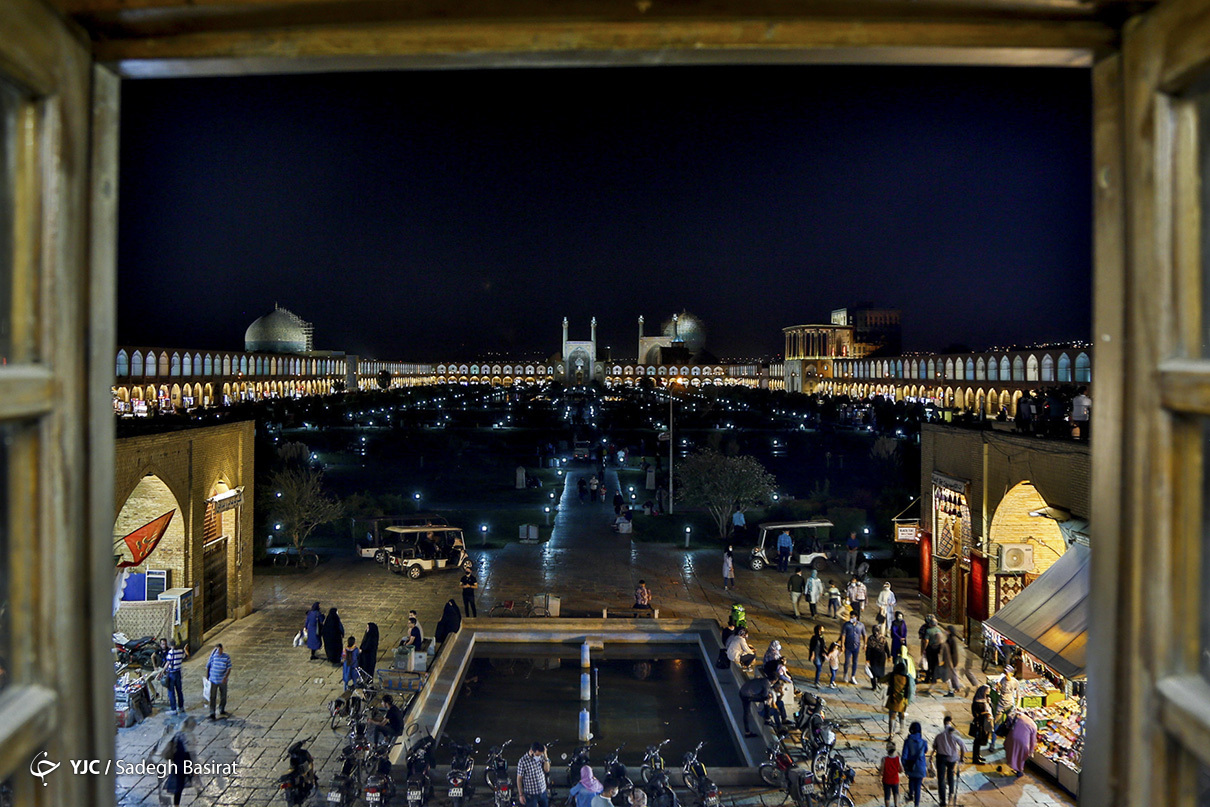
The historical site of Qeisarieh Gate is situated in the north of Naqsh-e Jahan Square, across from the Imam Mosque (known as Shah Mosque before 1979 revolution). The portal was built during the reign of King Abbas I of the Safavid dynasty by an architect named Master Ali Akbar Isfahani. The naming of the gate is etymologically connected to a historical construction in Kayseri, located in Anatolia, which is now Turkey.

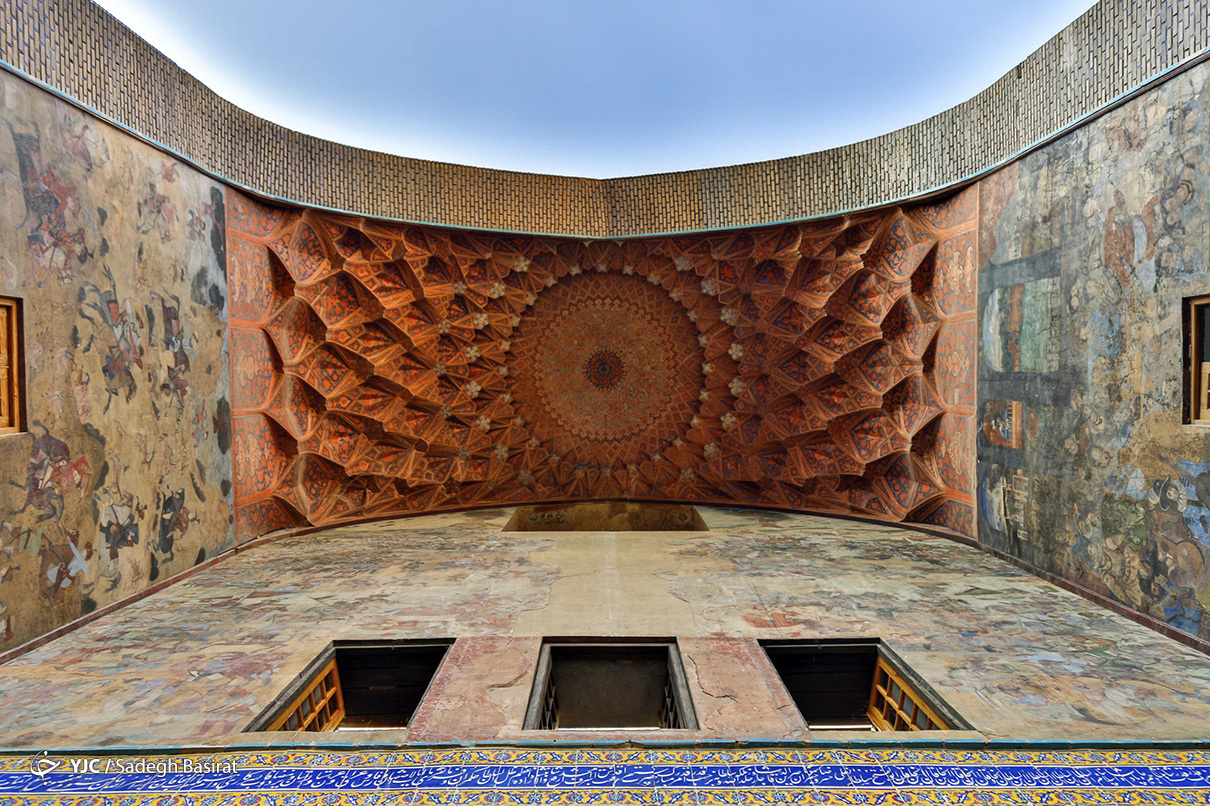
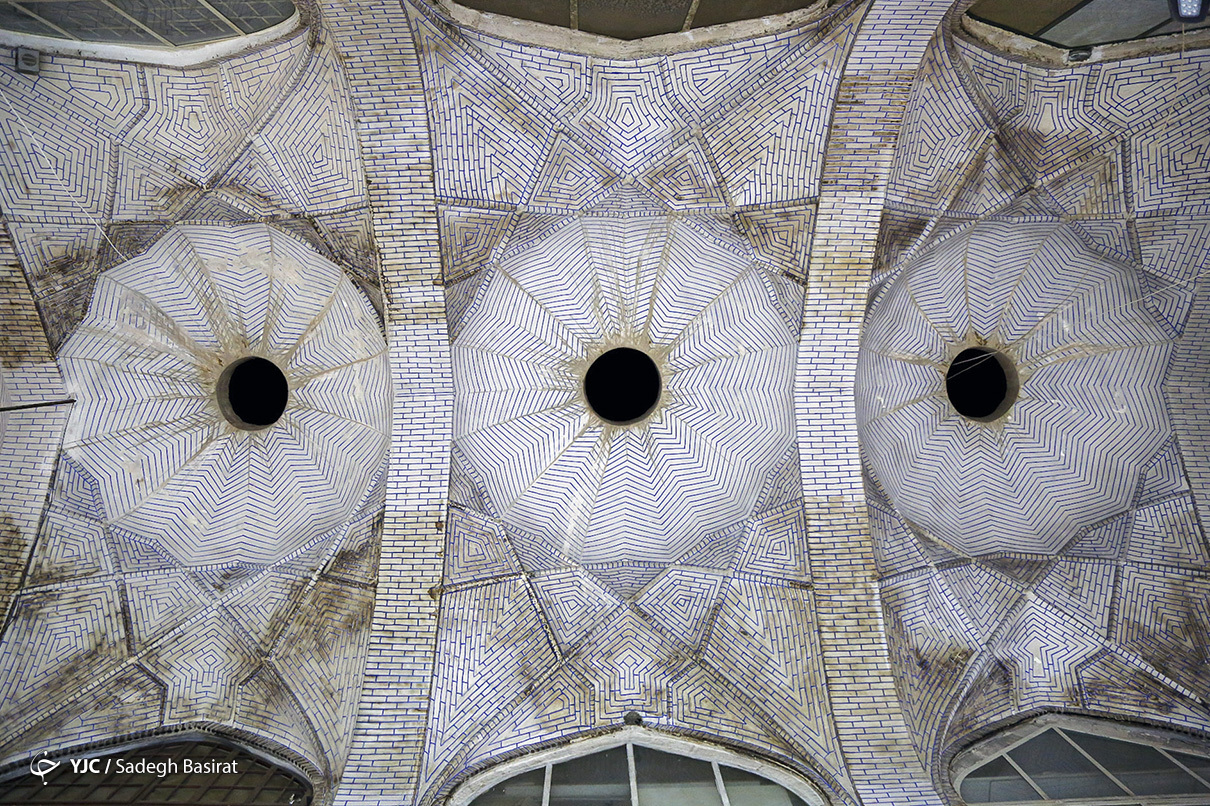
The Qeisarieh Gate is decorated with brickwork and paintings. The portal was known as the most important and biggest gateway to the Safavid-built part of Isfahan. The gate was a link connecting the new district of Isfahan to the old town built during the Seljuq dynasty through the Grand Qeisarieh Bazaar.

The Qeisarieh complex now includes the gateway, the Naqqareh-Khaneh edifice, the Royal Mint and the Royal Caravanserai that attract tourists from around the world.

Café Qeisarieh
Café Qeisarieh

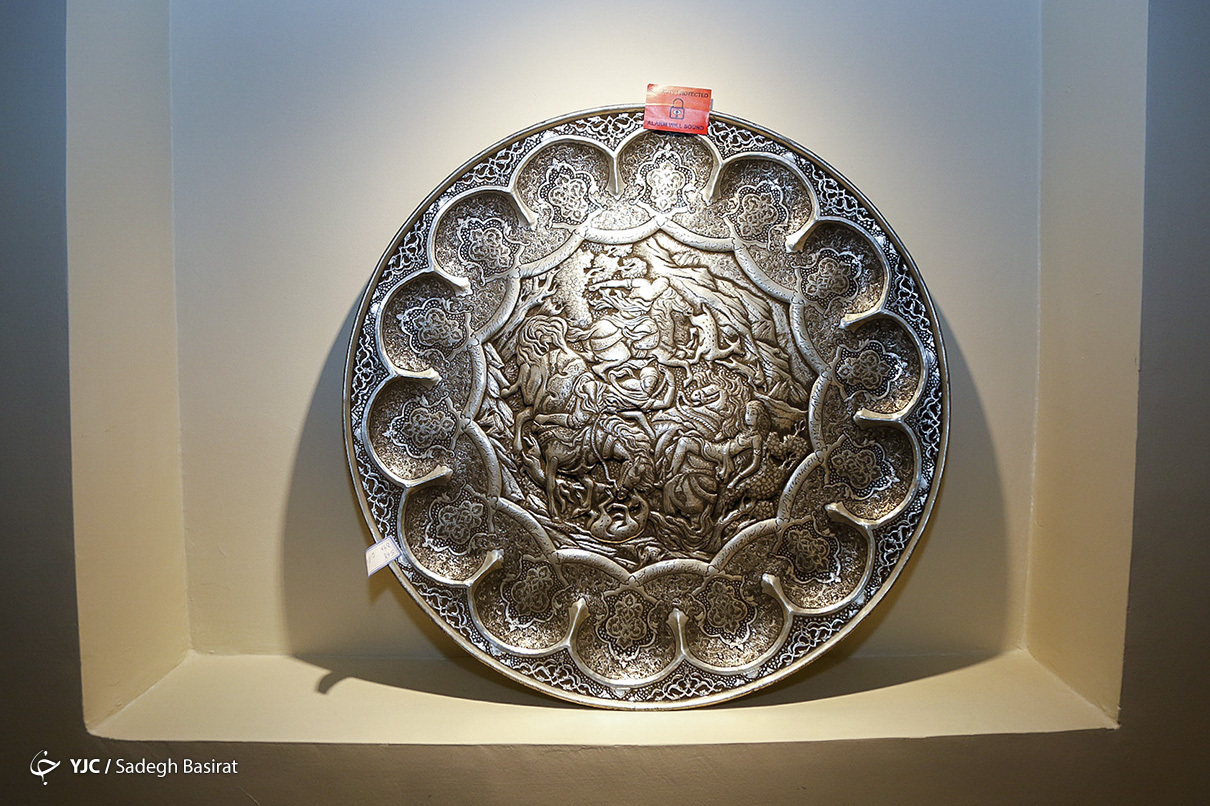
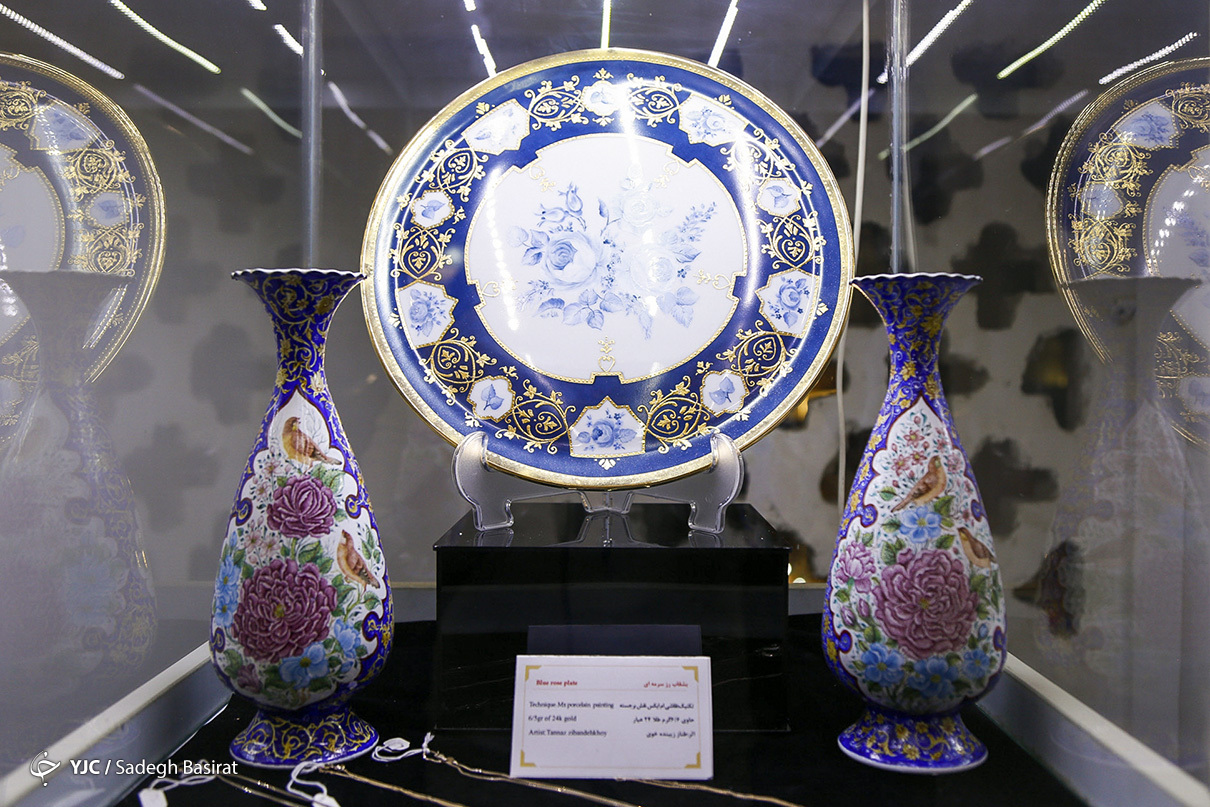
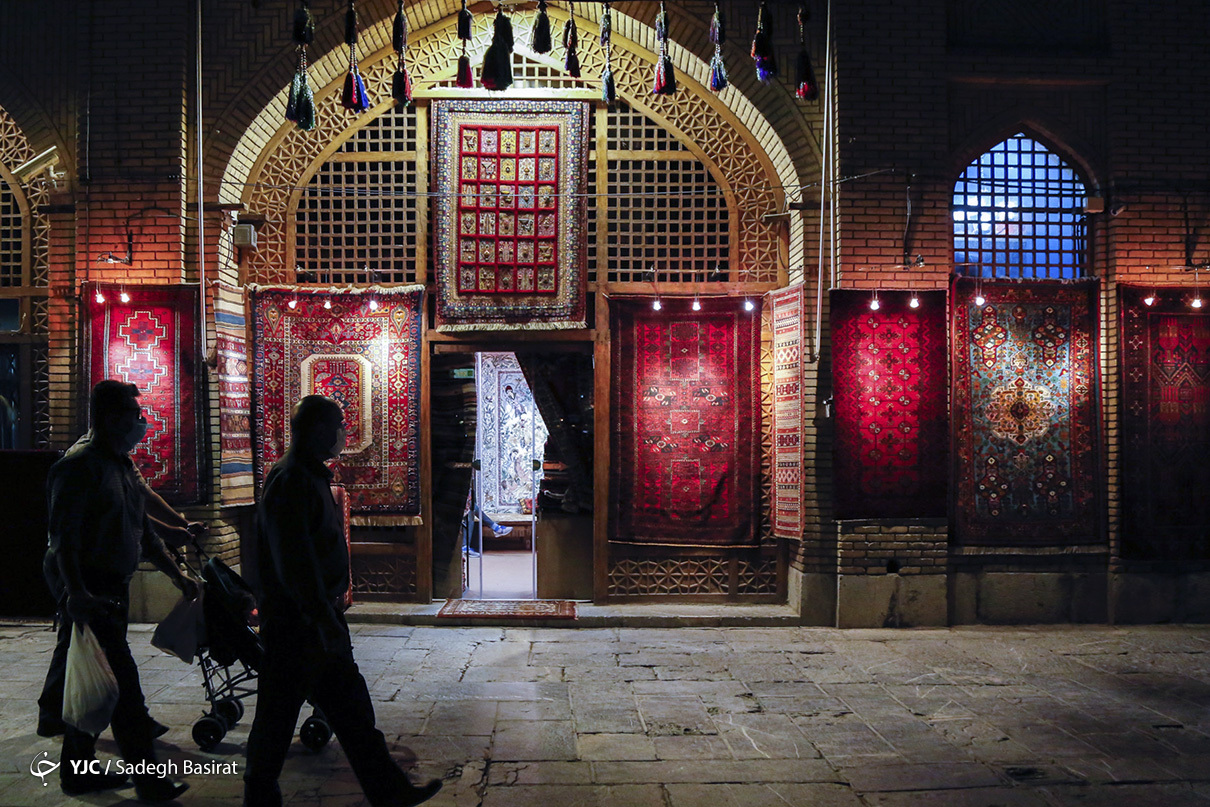
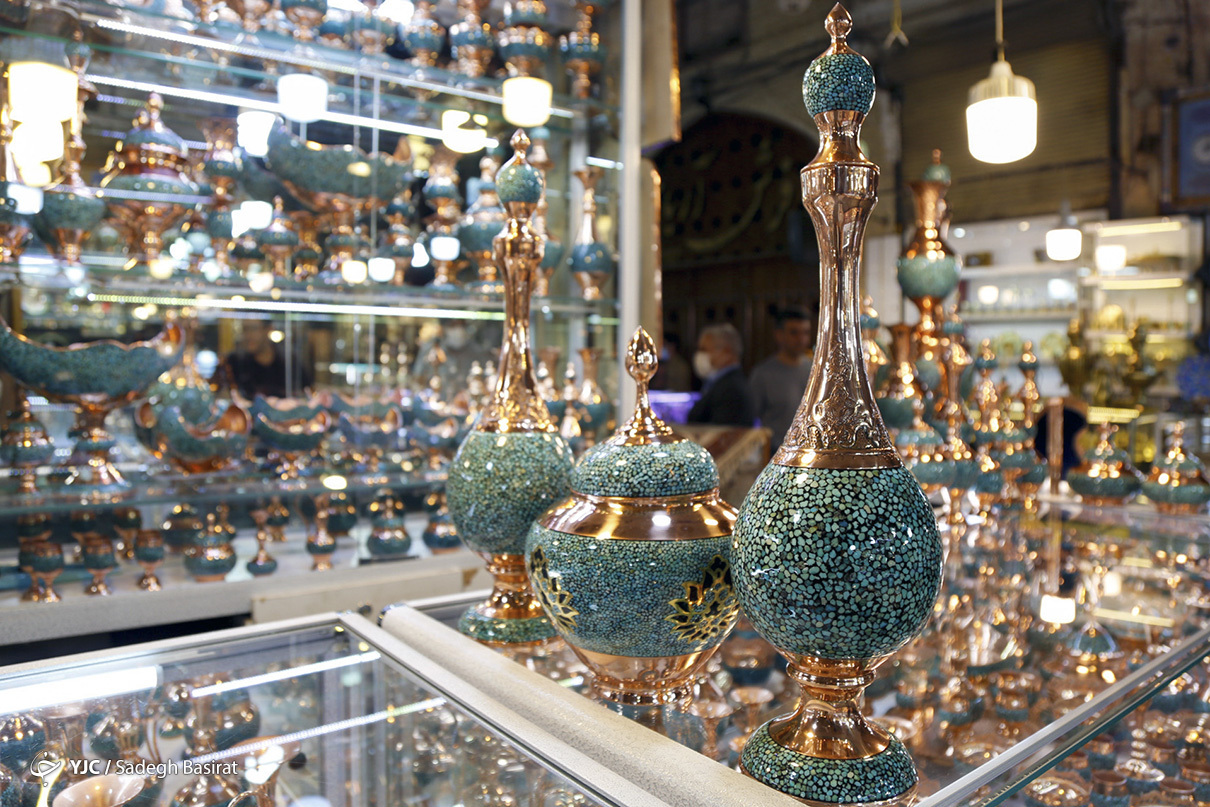
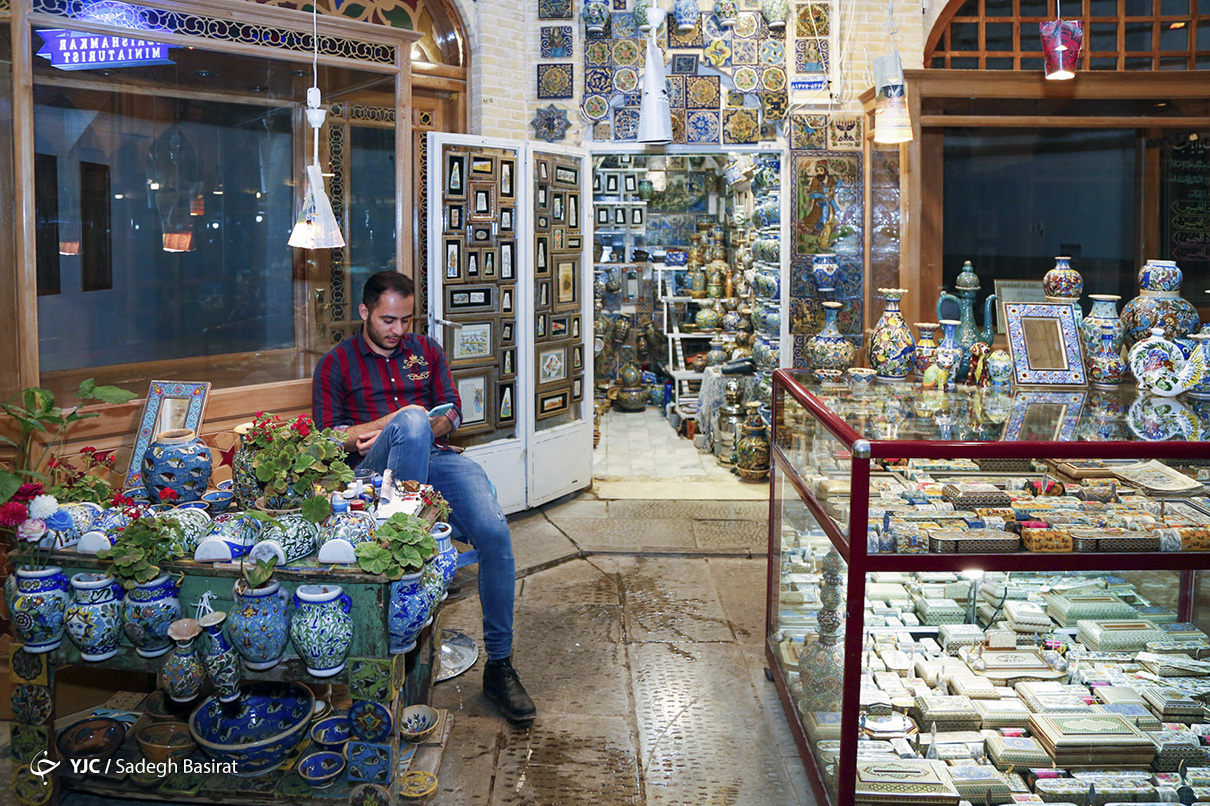
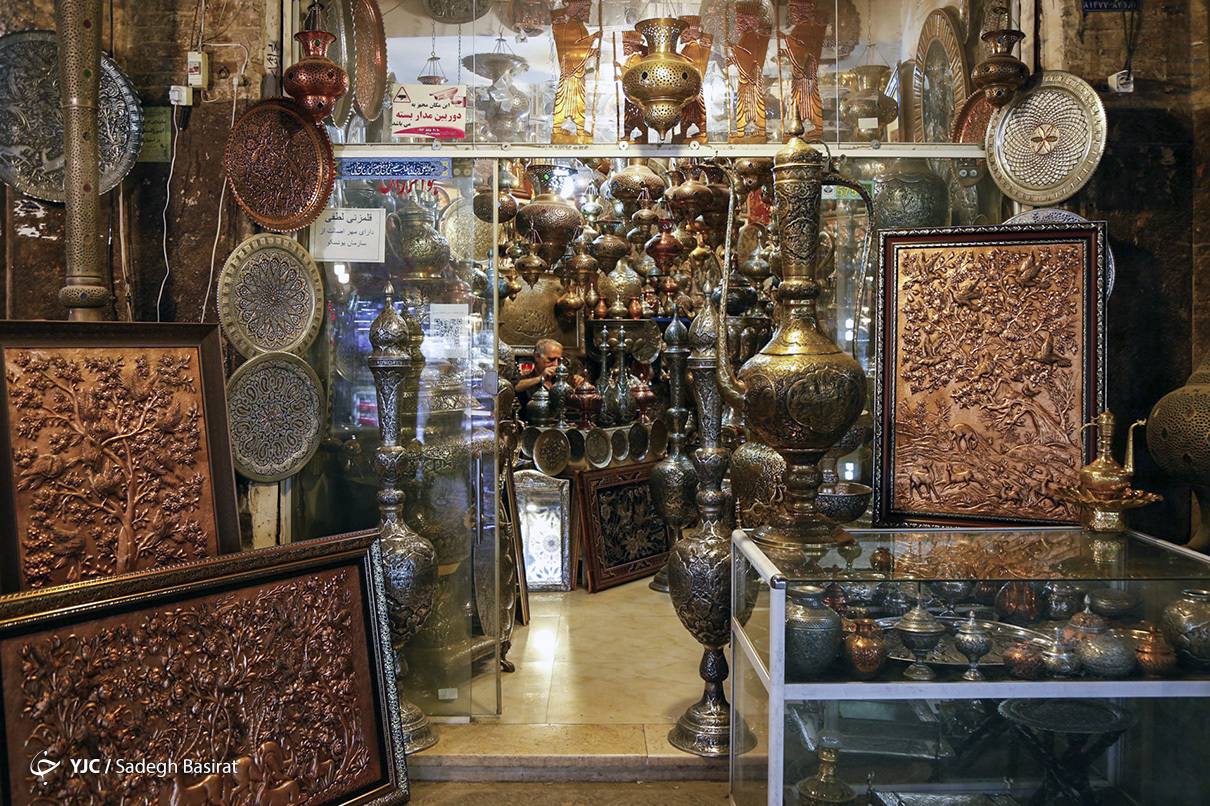
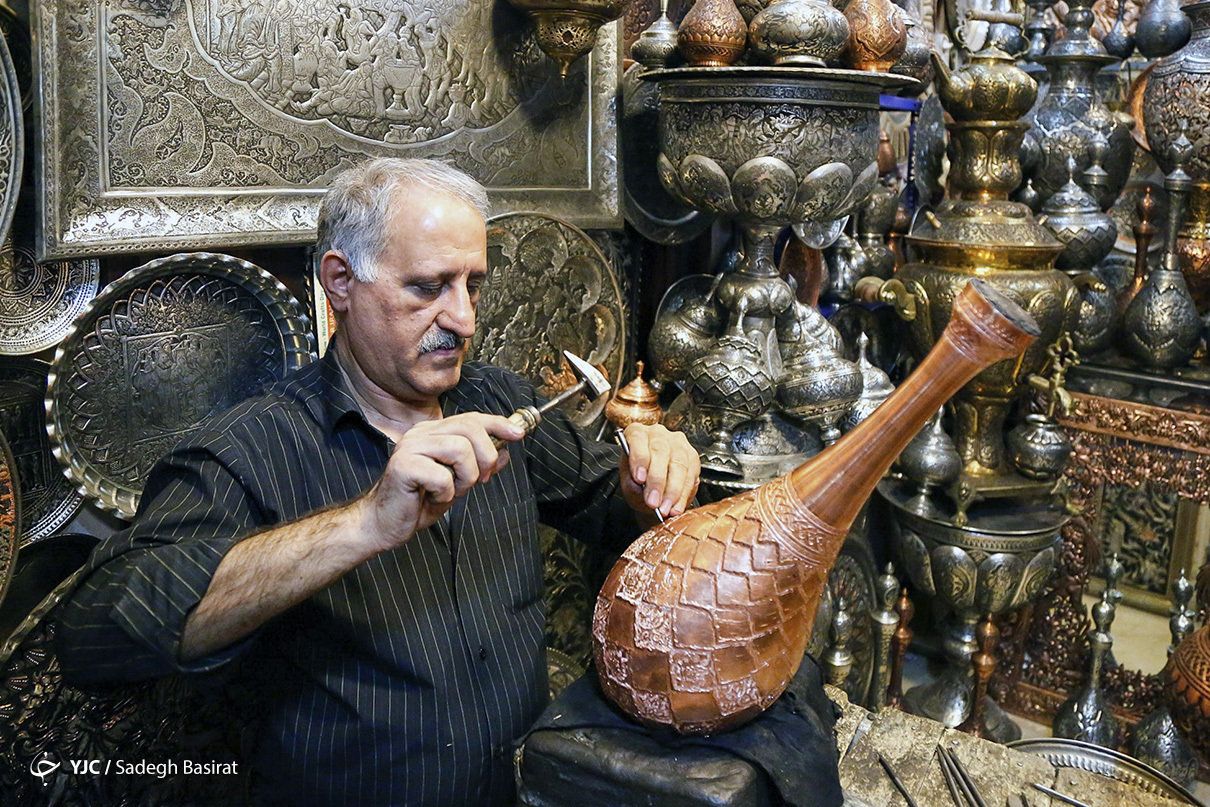
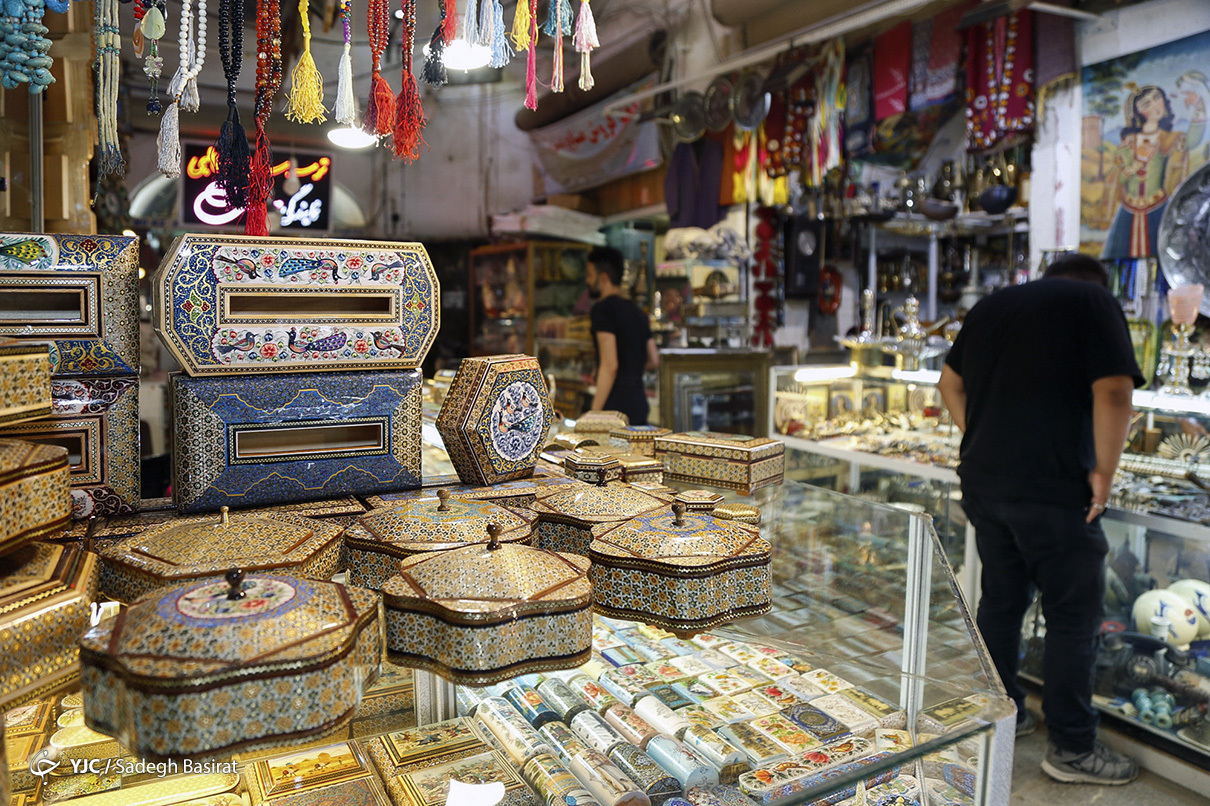
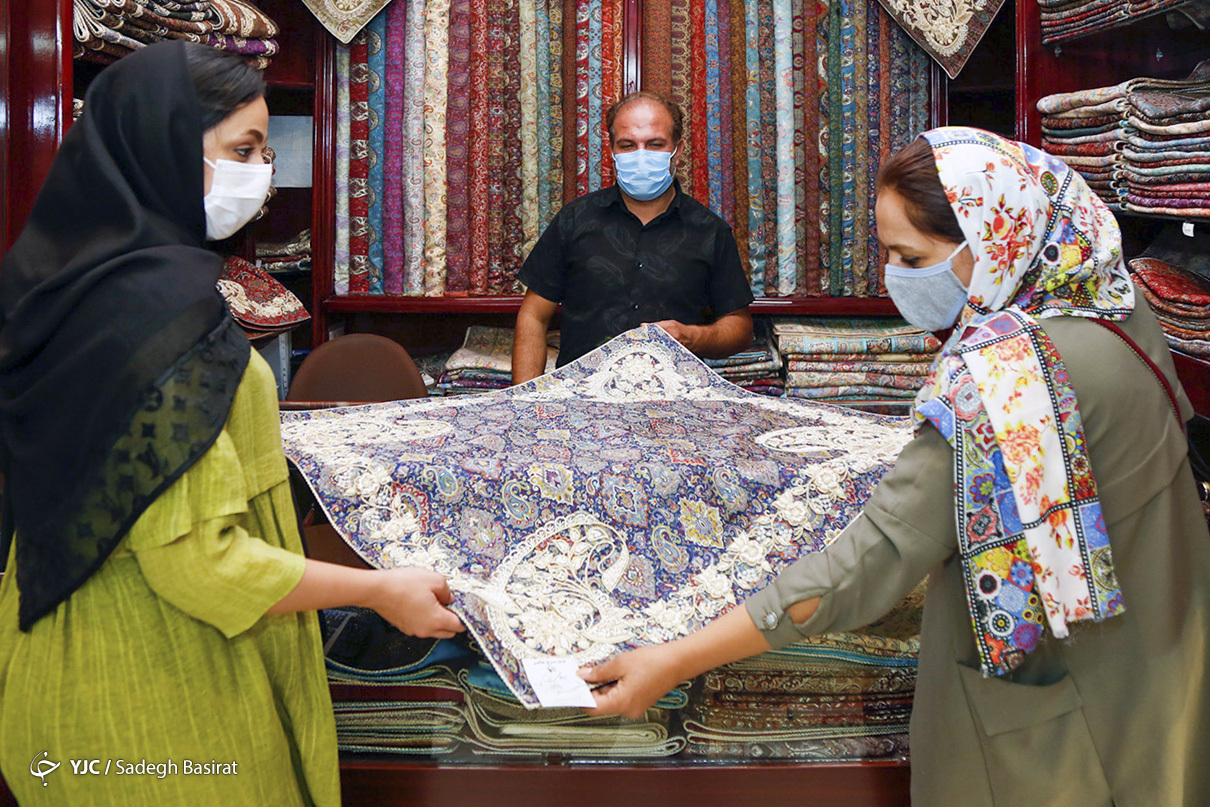
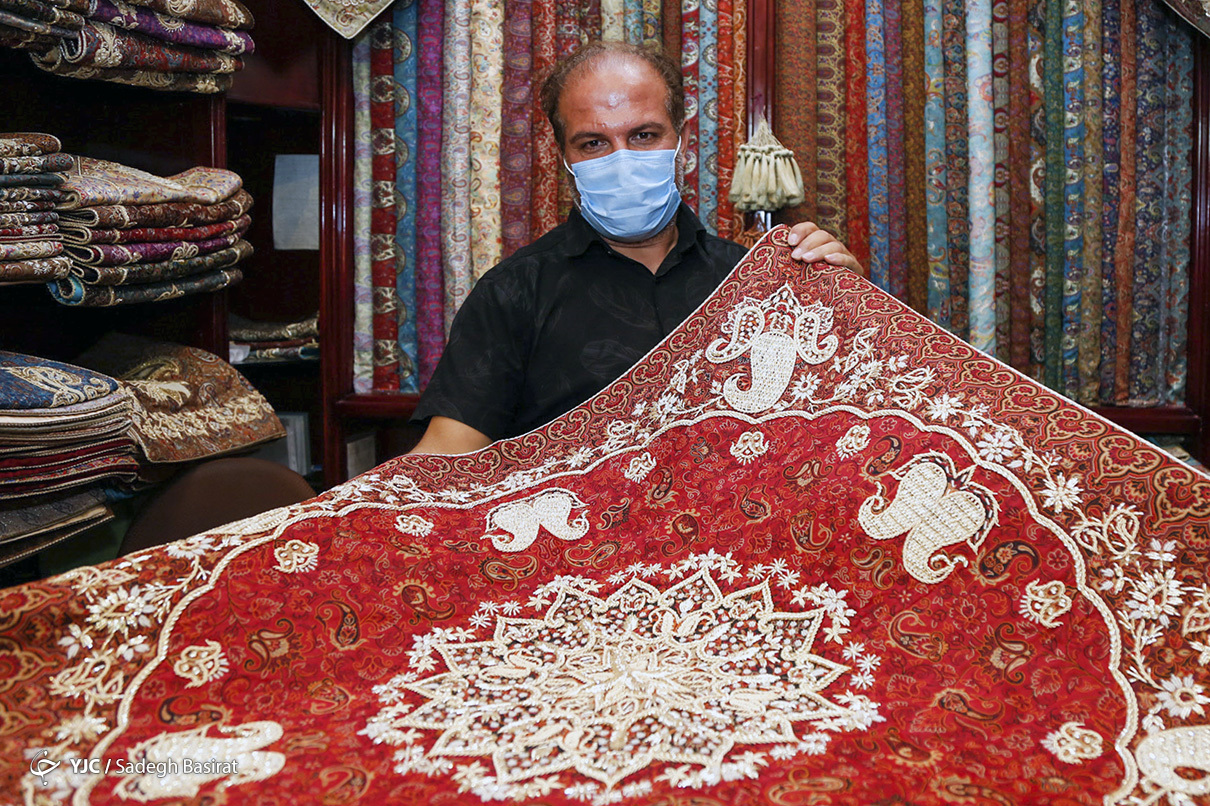
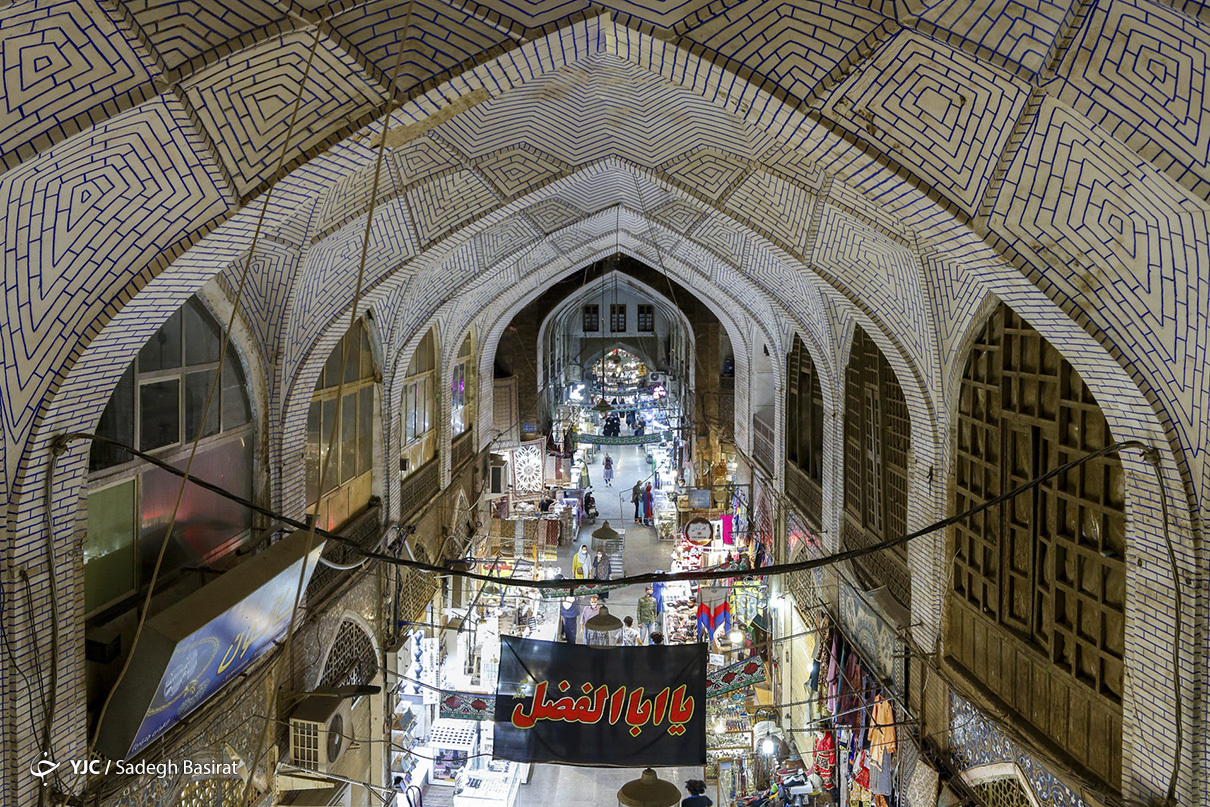
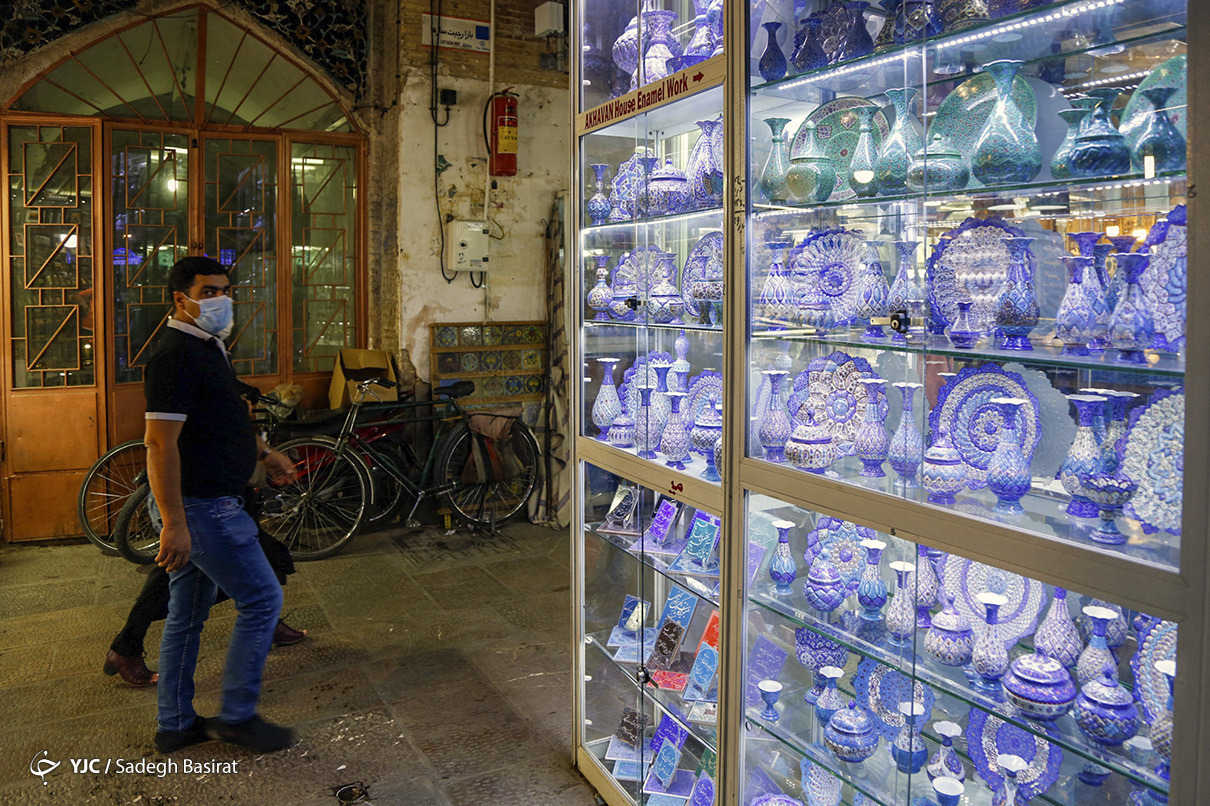
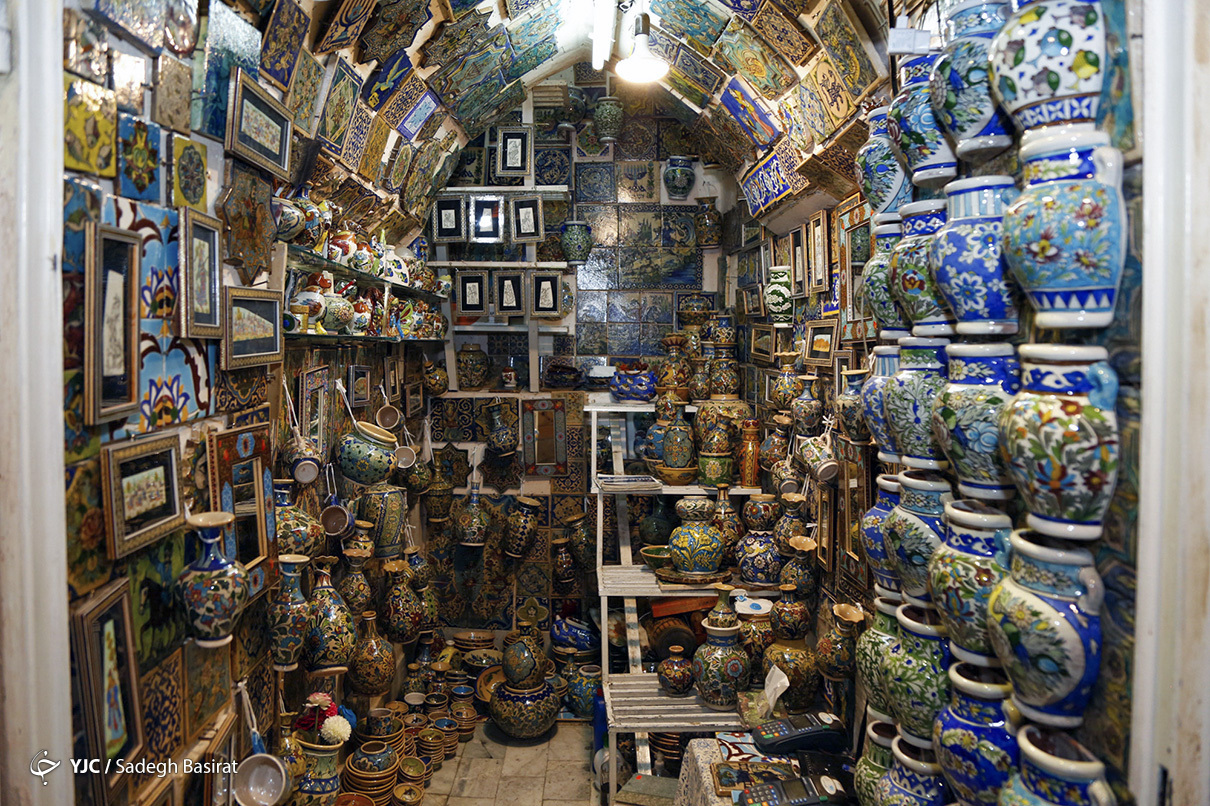
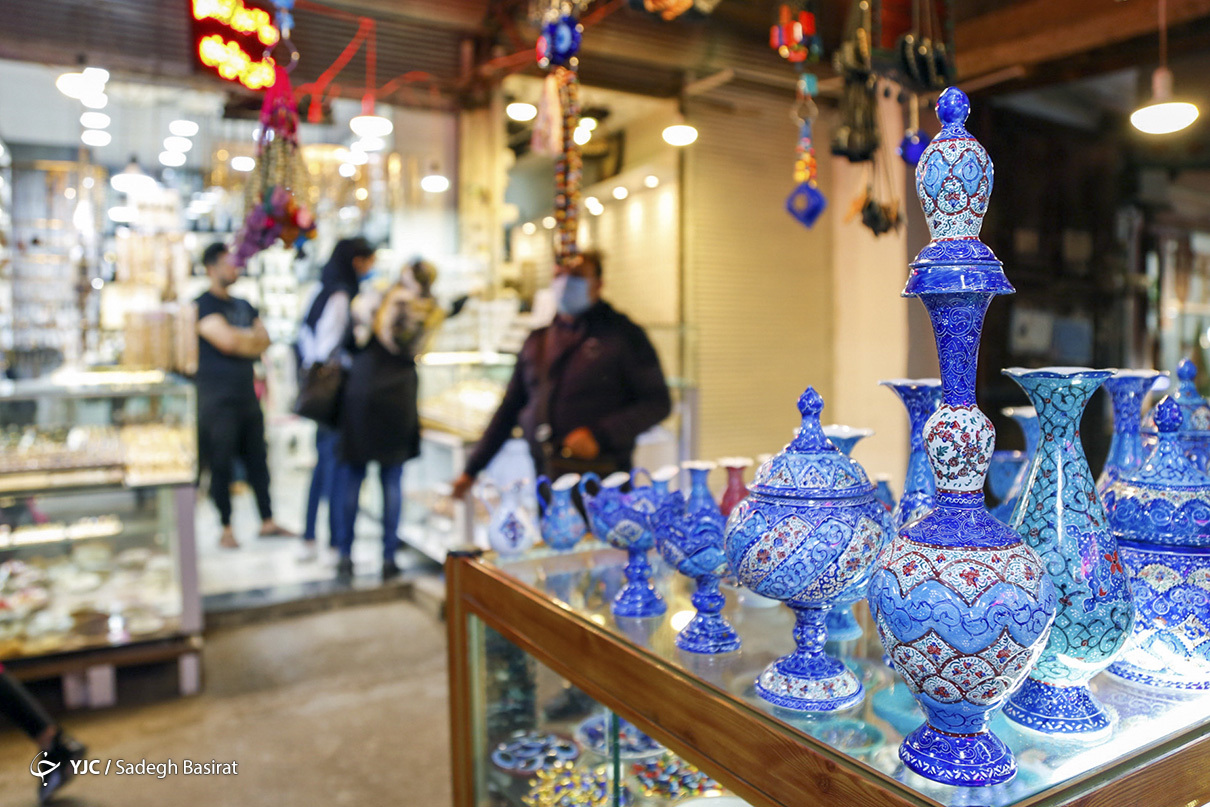
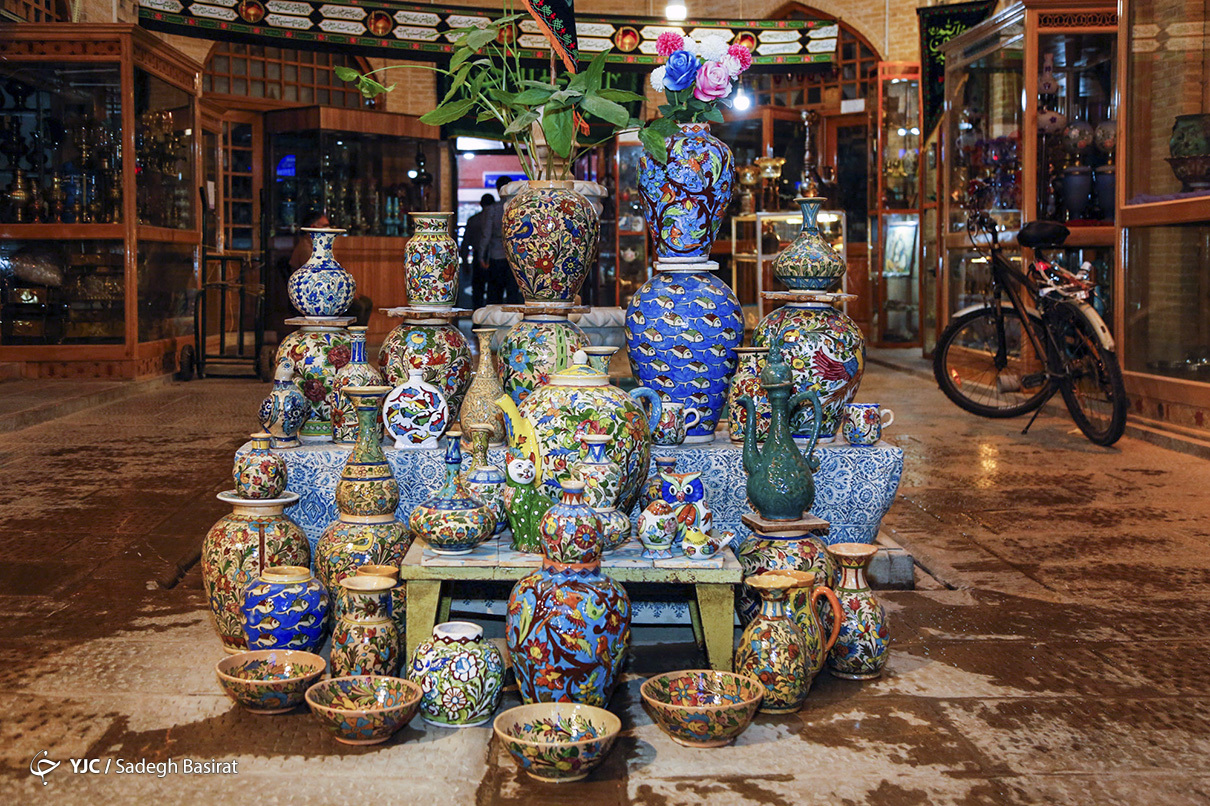
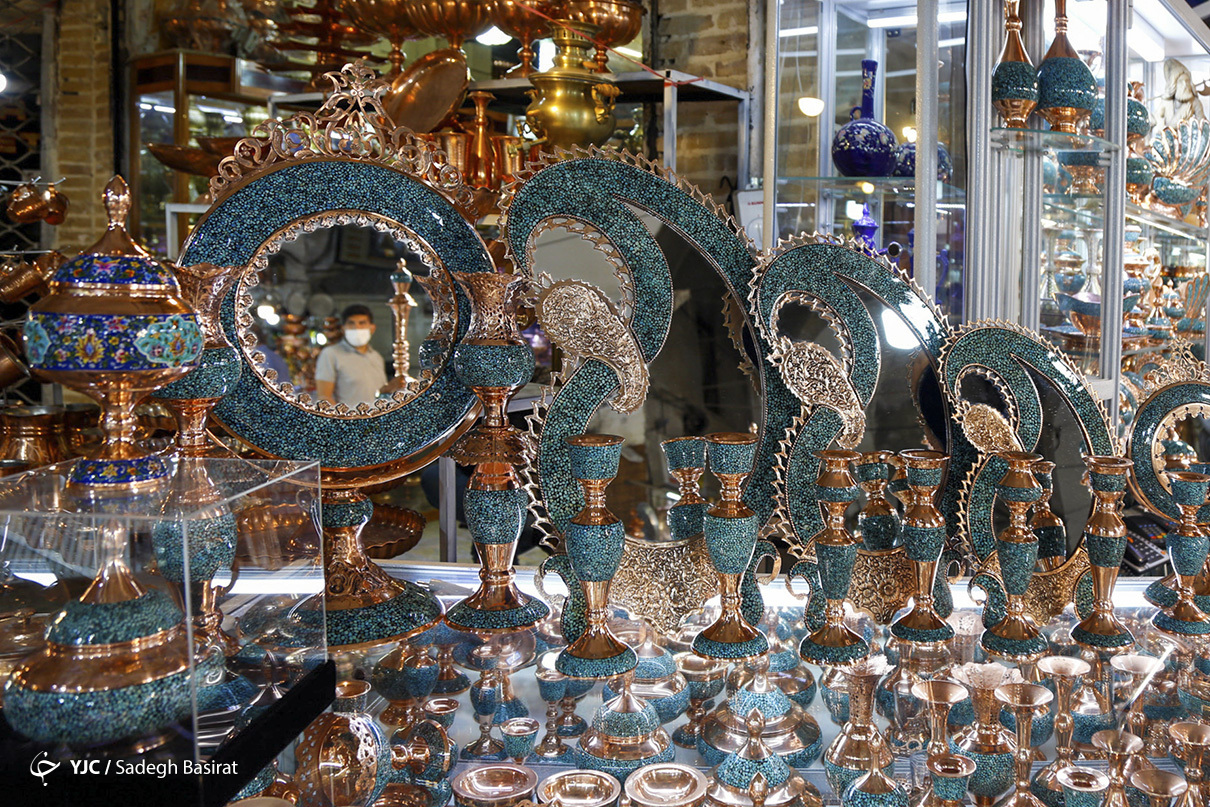
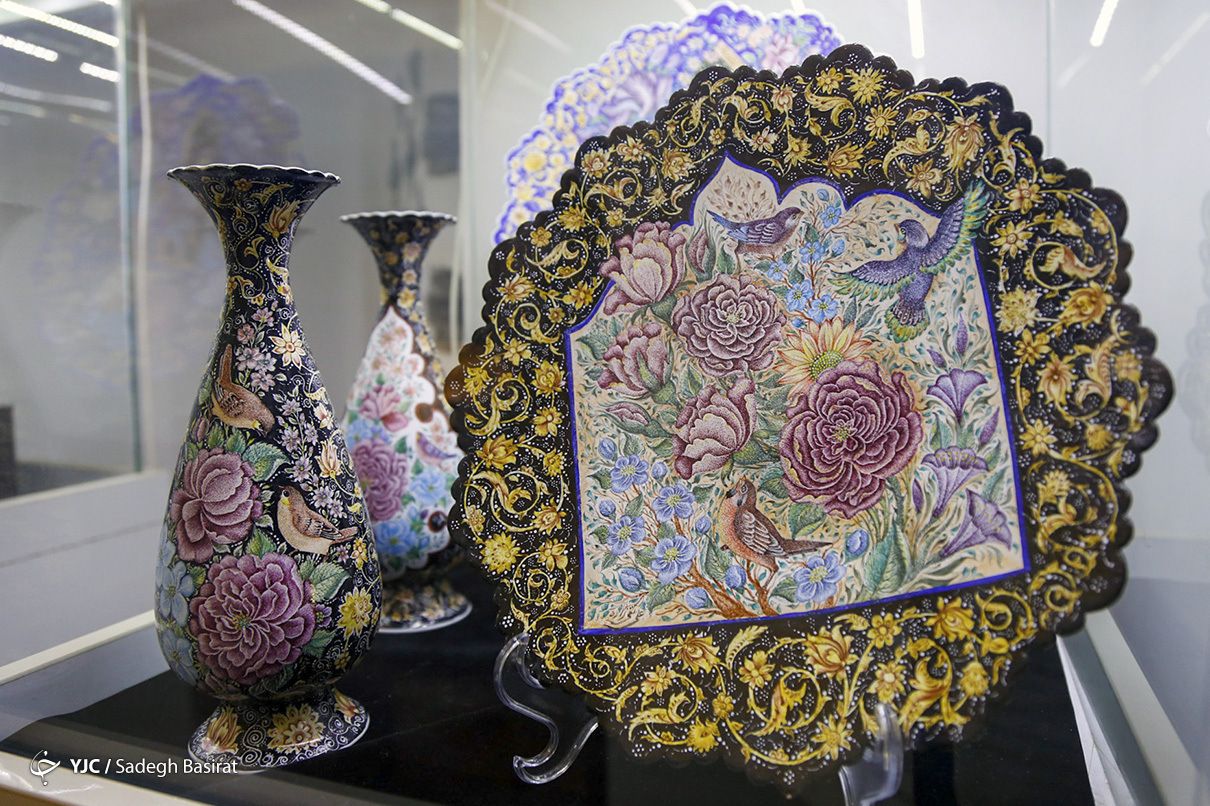
The Qeisarieh Bazaar is currently known as a major center for the handicrafts made in Isfahan. The bazaar was one of the largest and busiest markets during the Safavid era. The covered bazaar of Isfahan stretches for kilometers and involves various sections selling various commodities.

The Grand Bazaar of Isfahan, which includes the Qeisarieh Bazaar, had several gates, including the Qeisarieh Gate in the northern wing of Naqsh-e Jahan Square.

The Qeisarieh Gate has been registered on the List of National Cultural Heritage in January 1932.

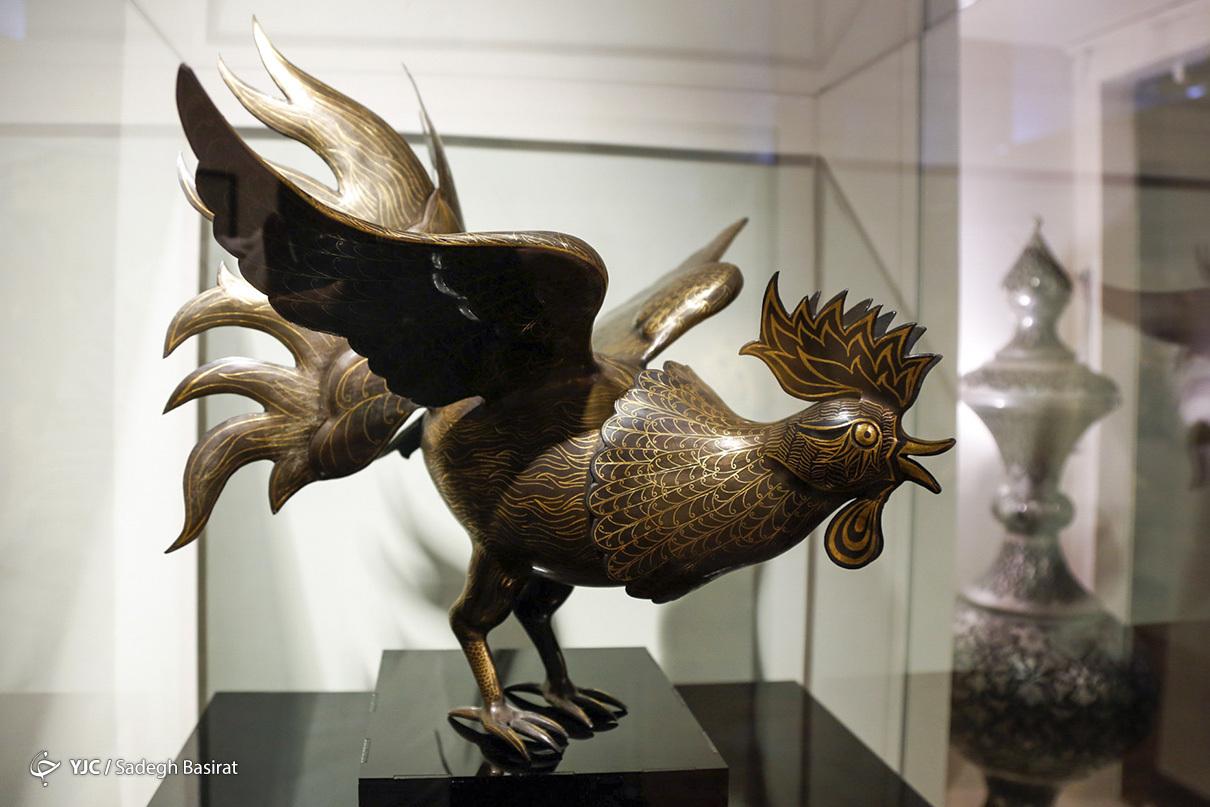
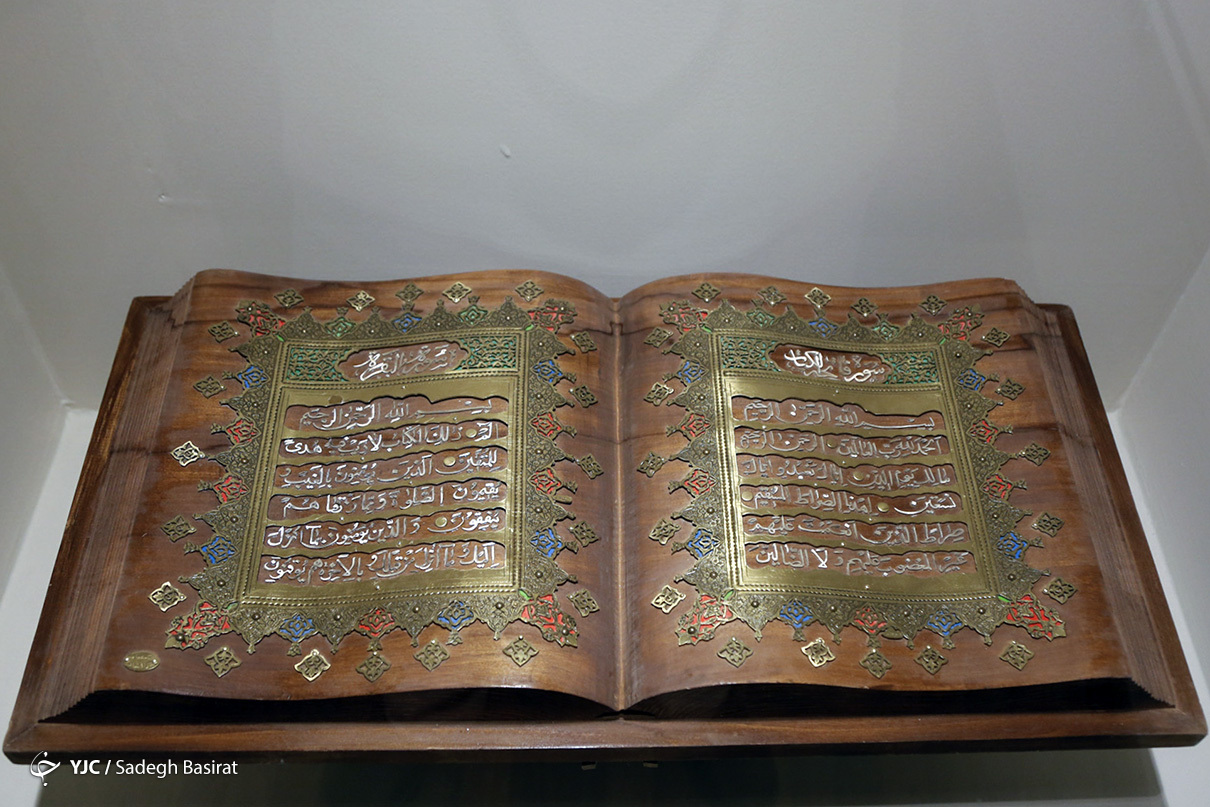
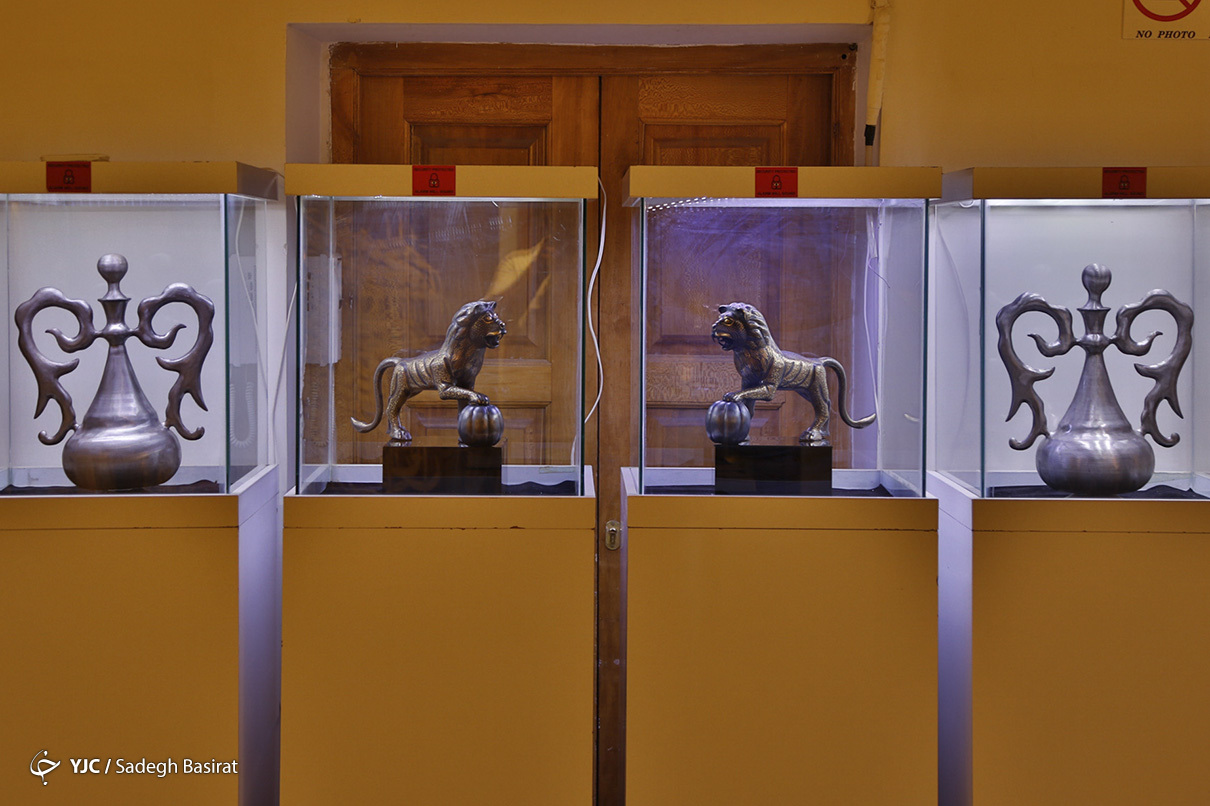
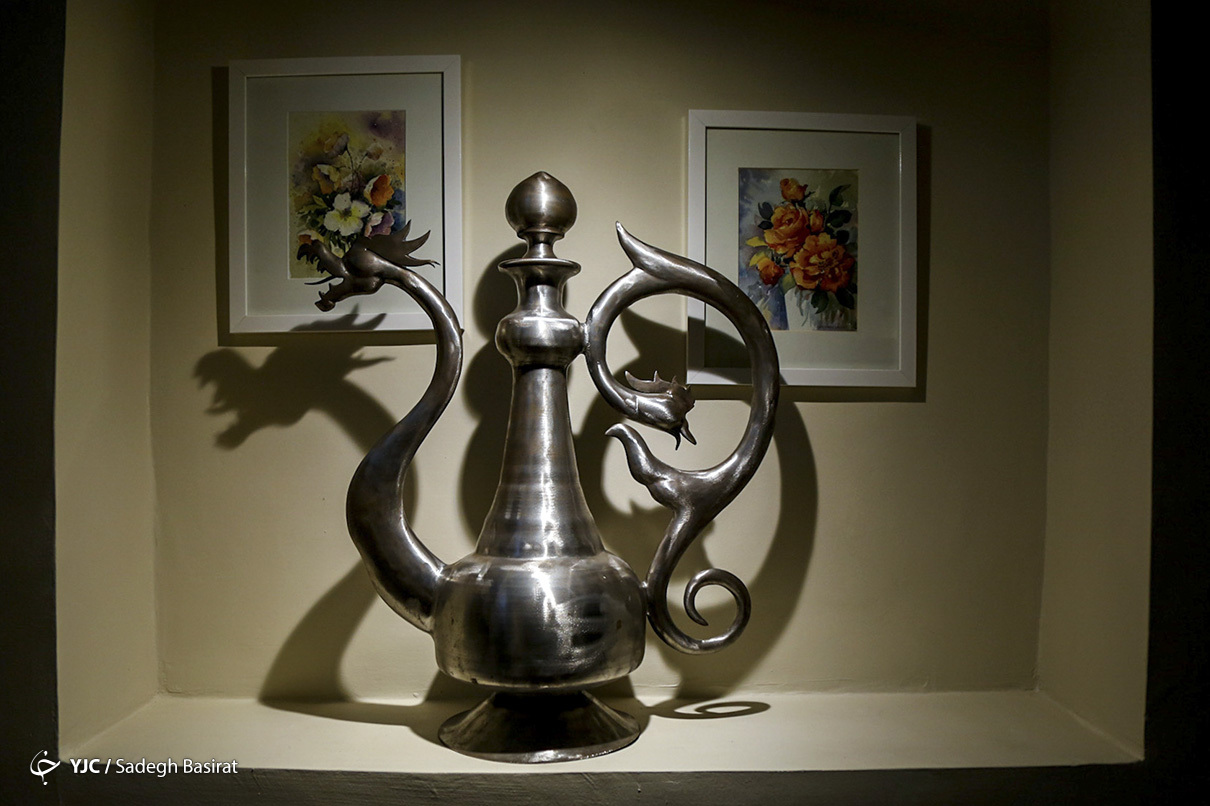
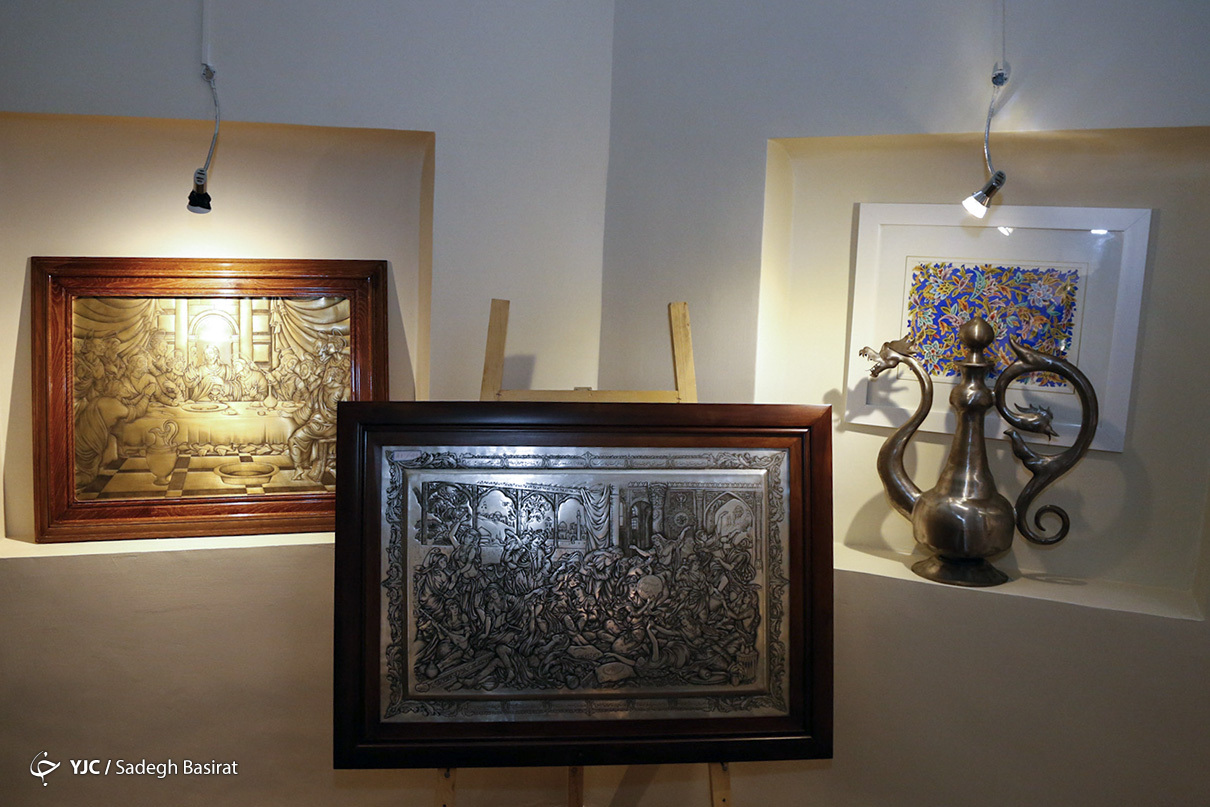
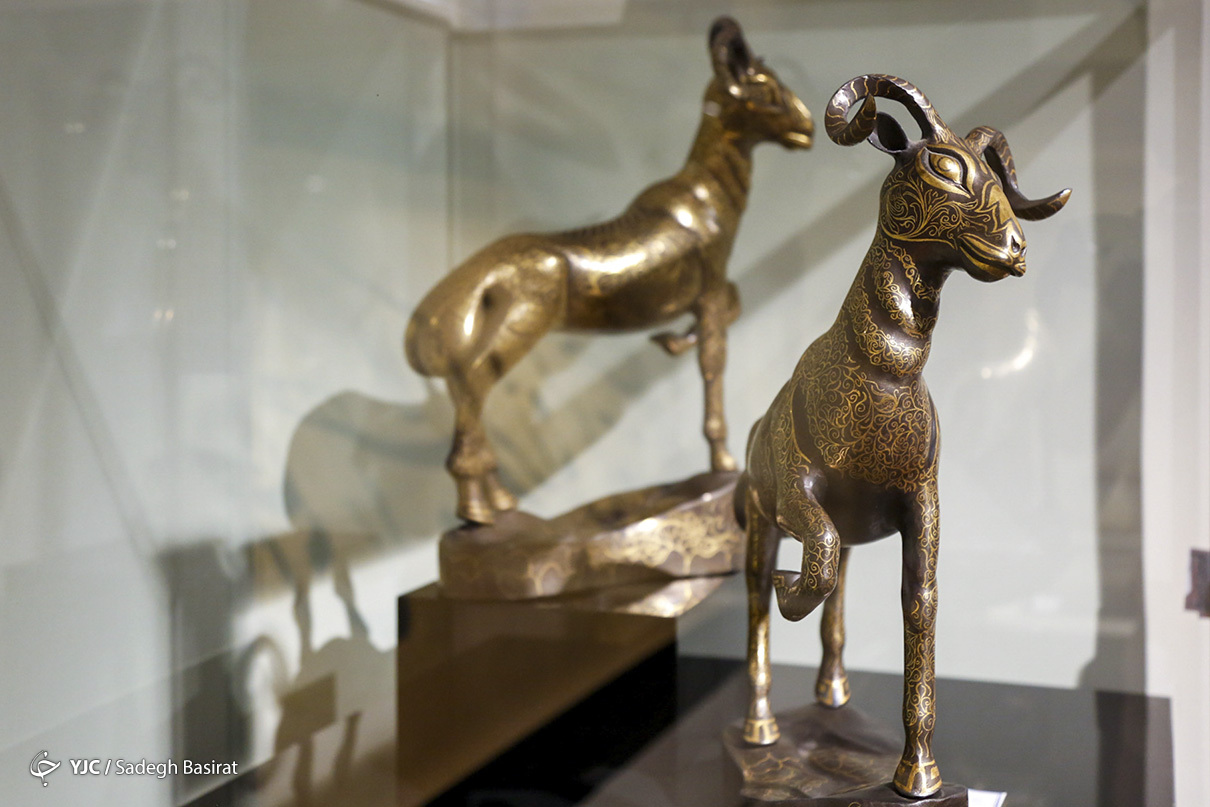
The Qeisarieh Museum Gallery of Isfahan has been also opened by the private sector in the complex, turning into a place to display and sell the works of art from contemporary artists.