Friday, January 2, 2026
Home Blog Page 2620

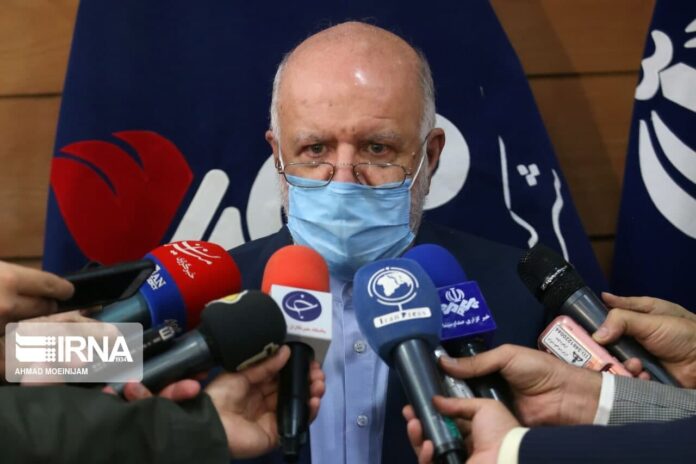
Iran Needs No Permission to Return to Oil Market: Minister

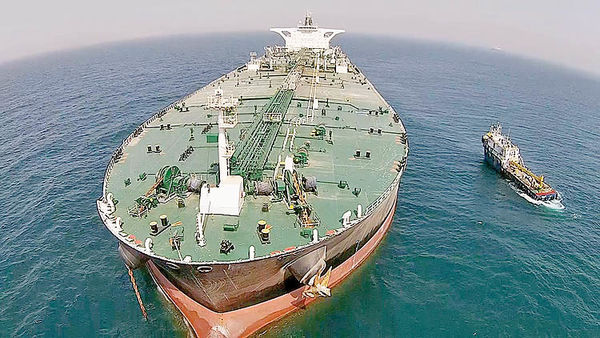
Bijan Namdar Zangeneh touched upon sanctions imposed on the country’s oil industry, and said, “If sanctions are lifted and resources are provided for the revival of oil wells whose production has dropped, it will be quite possible to export 2.3 million barrels of crude a day.”

“There is [good] market for Iran’s oil, and prices will not fall,” he noted.

Iran’s Oil Sale to Hit 2.9 Million bpd If Sanctions Lifted: President

The Iranian oil minister was blacklisted by the US Treasury Department last month. In reaction, Namdar Zangeneh said the move was a testimony to Washington’s failure to drive Iranian oil exports down to zero.

“The sanctions on me and my colleagues are a passive reaction to the failure of Washington’s policy of bringing [Iran’s] oil exports to zero,” said the minister back in October.

“The era of unilateralism in the world has ended. Iran’s oil industry will not give up,” he added.

The oil minister also emphasized last month that he had no assets held abroad to be subject to the US sanctions, saying he would sacrifice his life, assets and dignity for Iran.

The US Treasury Department imposed sanctions on the Iranian Ministry of Oil, the National Iranian Oil Company and the National Iranian Tanker Company for alleged financial support for the Quds Force of Iran’s Islamic Revolution Guards Corps (IRGC).

Iranian oil exports rose sharply in September in defiance of the US sanctions, according to three assessments based on tanker tracking.

Iranian-British National Gets Jail Term on Security Charges

Ahmadi, “who was working in Iran under the guise of being a researcher on social issues, stands accused of gaining ill-gotten wealth through cooperation with, and the implementation of projects run by institutes seeking to topple the government,” Fars News Agency reports.

Kameel, “who sought to bring about social changes in Iran, was accused of working in cahoots with the Hivos institute on issues related to women and children, trying to push the adoption of a motion to increase the marriage age in cooperation with two former woman MPs, being in contact with embassies of European countries to push for raising the marriage age in Iran and promote and support homosexualism in Iran, working with dissident foreign media and sending false reports to the UN human rights rapporteur against Iran,” the report added.

Among other accusations levelled against him is travelling to Israel as a BBC reporter.

Fars News claims numerous posts had gone viral on social media before, suggesting he had assaulted and molested some women’s rights activists and his co-researchers. The current sentence has nothing to do with such “moral corruption” allegations and it was issued with regards to security charges against him.

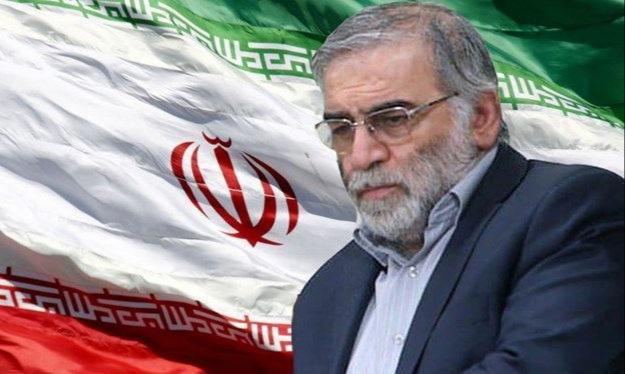
Israel Assassinated Fakhrizadeh to Trigger Instability, War in Region: President

Speaking to reporters in a press conference on Monday, President Hassan Rouhani said all those involved in the terrorist act wanted to ignite the flames of war in the region.

“The assassination of Mohsen Fakhrizadeh was the handiwork of those who wanted to plunge the region into war during the last days of the tenure of Trump’s evil administration. This was their main objective. The main goal that the Israeli regime pursued by assassinating Dr. Fakhrizadeh was to create instability and war during the final days of the Trump administration,” said the president.

He noted Iran will take vengeance upon those involved in the scientist’s assassination in an appropriate time.

“The Islamic Republic of Iran regards martyr Fakhrizadeh as an eminent scientist and reserves the right to avenge his assassination, and will take its revenge at the right place and time. But we will not allow others to determine its place and timing,” he said, highlighting the significance of regional stability to Iran.

President Rouhani then touched upon Iran’s cooperation with other countries to maintain stability in the region, adding this cooperation kept US President Donald Trump form getting any document passed in international circles against Iran.

“Cooperation among major countries is important in order to ensure stability in the region and across the world,” President Rouhani said.

“You know the reason why Trump was not successful [in his efforts] against Iran in international circles was the cooperation and coordination between Iran and other countries, especially between Iran and the 4+1 group. So, Trump failed in any case that he took to the UN Security Council and he failed to get anything approved,” he added.

“Therefore, we still seek to have close relations with all countries, especially countries such as Russia and China. We have had very close and good cooperation with them. We have also had cooperation with the European Union, with our neighbours. We want to have close relations with them all,” he noted.

The president noted cooperation among signatories to the Iran nuclear deal, officially known as the Joint Comprehensive Plan of Action (JCPOA), can help save the agreement.
He further referred to Iran’s initiative for peace in the region.

“You know, we presented the Hormuz peace initiative for the Persian Gulf region. The plan was brought up at the UN General Assembly last year and was later sent to the heads of all regional states, including the six countries to the south of the Persian Gulf as well as Iraq. This peace plan is still on the table and we are ready to hold more talks on this peace initiative,” he added.

Iran Assured Erdogan Had No Ill Intention in Reciting Poem: Rouhani

Speaking to reporters at a press conference on Monday, President Rouhani said his Turkish counterpart is extremely unlikely to have meant any disrespect for Iran’s territorial integrity by reciting a poem during his recent visit to the Republic of Azerbaijan.

“The relations between Iran and Turkey are very significant. We are two neighbours that have political and economic relations, hold talks on the regional issues, and are cooperating in the Astana process. Our ties are very important,” President Rouhani noted.

However, he added, Iran attaches great significance to its territorial integrity and place, as the Iranian people have the right to show sensitivity to a line and express their views.

What is important is that the foreign minister of Turkey called his Iranian counterpart to give an assurance that President Recep Tayyip Erdogan had meant no disrespect, an assertion that was reiterated by the Turkish presidential spokesperson and the Turkish ambassador to Tehran, President Rouhani added.

The president said the meaning of the poem that President Erdogan recited in Baku would be interpreted differently inside and outside Iran. 

In his remarks at the same event in Baku, president of Turkey had emphasized the necessity for multilateral cooperation over regional issues and collaboration among Turkey, Iran, Russia, the Republic of Azerbaijan, and Armenia, President Rouhani noted.

One must take account of President Erdogan’s full speech, not the poem alone, Rouhani added.

“Considering the experience of working with Mr. Erdogan over the past seven years, the reciprocal visits and the extensive negotiations that we’ve held, I think it’s extremely unlikely that he had meant disrespect for the Iranian nation or our territorial integrity,” President Rouhani stated.

The Turkish authorities have made it clear that President Erdogan had meant that people of the Republic of Azerbaijan rejoice at the liberation of their territories, President Rouhani added.

Mr. Erdogan quite often recites poems from Hafez, Saadi Shirazi, and Rumi, the Iranian president added, saying the controversy has been resolved after explanation from the Turkish officials.

He further reasserted the right of Iranian people to have an objection, show sensitivity and express their patriotism.

“The sensitivity from our people is extremely important. The whole world must know that we attach significance to every millimeter of our land. Everybody should pay more attention to such sensitivity in Iran and the importance of territorial integrity in their speeches and remarks,” President Rouhani said.

Iran’s Oil Sale to Hit 2.9 Million bpd If Sanctions Lifted: President

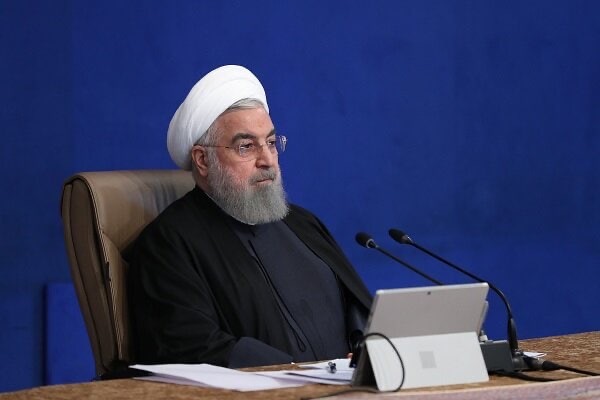
Speaking at a press conference on Monday, President Rouhani said he has ordered the Petroleum Ministry to put the export of 2.9 million barrels per day of oil on the agenda for the next Iranian year, which begins in March 2021.

Iran’s oil wells must be prepared for that amount of production, the president added, saying the country will definitely extract and sell at least 2.3 million barrels per day of oil.

On the prospect of removal of the sanctions on Iran, President Rouhani said the international situation is such that the economic war and sanctions against Tehran could not continue.

“I believe the end of sanctions has begun,” the president said.

The president emphasized that his administration has devised the national budget bill for the next year on the basis of realism, not optimism.

The oil sales target figure of 2.3 mbpd is a result of extensive discussions and analysis, he underlined.

He also explained that the minimum sale of 2.3 million barrels per day of oil under the sanctions will materialize through exports and domestic sale, saying that figure may include 1.8 million barrels of export and 500,000 barrels for sale inside the country.

If the sanctions are lifted, Iran will regain its share of OPEC output and will once again sell oil as much as it did in 2015, the president underscored.

COVID-19 Outbreak in Iran: 250 New Deaths, 7,500 New orinq

According to Sima-Sadat Lari, the new fatalities increase Iran’s overall death toll to 52,447, and the new cases raise the total number of infections to 1,115,770.

Lari went on to say that 5,711 patients are also in critical conditions caused by more severe infection.

The spokeswoman noted that 6,750,359 COVID-19 tests have been taken across the country so far.
She said currently 12 cities are in the “red zone”, 288 in the “orange zone”, and 148 in the “yellow zone” in terms of coronavirus outbreak.

The “red zones” include Zarrindasht in Fars province, Baft in Kerman province, Gomishan in Golestan province, Astara, Bandar Anzali, Rudsar and Talesh in Gilan province, and Amol, Behshahr, Ramsar, Galugah, and Neka in Mazandaran province.

Iran’s Missile Program, Regional Policies Not Related to JCPOA: Rouhani

Speaking in a press conference on Monday, Rouhani said Iran will not accept any precondition, whether it is demanded by the incoming US president or Germany or any other party.

He said he has not heard from US President-elect Joe Biden that the US would need another deal with Iran if it is to return to its commitments.

That is what Trump asked during his four-year term in office, he said, adding that any precondition would be unacceptable no matter who raises it.

“The JCPOA is not negotiable; whether all parties implement the deal we already have or no one implements it,” the president added.

“Missile and regional issues have nothing to do with the JCPOA. The Americans argued for months to include [Iran’s] missiles in the negotiations and we rejected it. Or they tried to raise regional issues, but we didn’t agree,” he noted.

“Trump was unaware of these [talks], but Biden well knows what has been raised in the [2015] negotiations. These are not negotiable. What’s on the table is that all parties return to their commitments,” he added.

Iran’s Demand for Compensation

He said Iran has suffered huge damages because of the US sanctions in the past three years, but the country is not going to raise the demand as a precondition.

That will cause the sanctions to remain for several more years, he said.

Rouhani noted that if Iran wants to claim compensation for all the damages it has suffered, it must wage a world war against Europe and the US.

Iran definitely has demands from many countries, above all the US, but we should first return to the JCPOA and have sanctions lifted and then talk about compensation, he clarified.

Another Mysterious Monolith Found, This Time in Iran

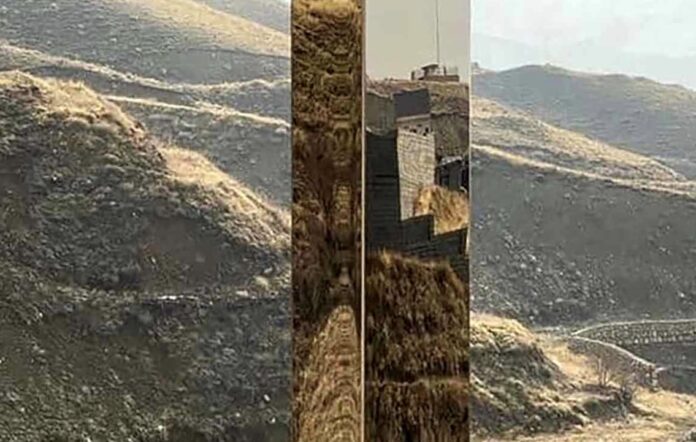
The metal monolith, planted firmly in the ground with no clear sign of where it came from or why it was there, has been found in a small village northeast of Iran’s capital Tehran.

After the discovery and swift disappearance of the mysterious shining metal monoliths in many places in the world, the new towering structure has popped up at the top of a valley in Niknam-Deh, a small village north of Jajrud, around 15 kilometres east of Tehran.

The new monolith is erected between the mountainside and a ravine, according to a reporter of Asr-e Iran news website.

The shiny metal structure in the village is around three metres in height.

The reporter says letters ‘N’ and ‘S’ have been inscribed on the metal object, showing directions to north and south.

Local officials have not provided any explanation for the appearance of the new monolith in the area.

The first stainless steel monolith was found last month in Utah, the US, inspiring copycats around the world.

Iran Opens Clinical Skills Training Centre with Homegrown Equipment

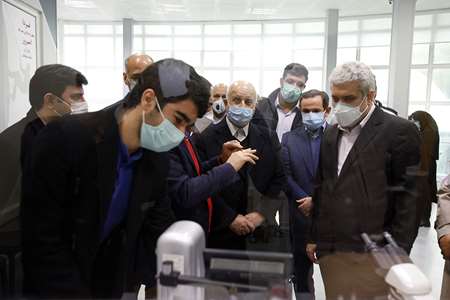
Sorena Sattari on Monday inaugurated the Advanced Clinical Skills Training Centre at Imam Khomeini hospital of Tehran.

The training centre, affiliated with Tehran University of Medical Sciences, is furnished with medical equipment that have been designed and manufactured by the Iranian knowledge-based companies.

The centre is equipped with a broad range of medical gear, including advanced surgical and clinical simulators and state-of-the-art equipment for specialized training courses for the medical students and other hospital personnel.   

The eye-catching equipment available in the training centre include Parsis surgical navigation system, Sina remote-controlled robotic surgery system, Sina robotic surgical simulator, laparoscopy simulator, spinal anesthesia simulator, eye surgery simulator, robot-assisted surgery tools, and a three-dimensional simulator for developing clinical skills.

In comments after opening the site, Sattari described the new centre as an outstanding example of connection between knowledge-based innovations and the medical sciences. 

The vice president said the domestic knowledge-based companies are capable of fulfilling the country’s technological needs for laboratory and medical equipment.

In separate comments on the sidelines of the event, Secretary of Iran’s Nanotechnology Innovation Council Saeed Sarkar said efforts are underway to set up 20 clinical skills training centres across the country under the auspices of the Vide Presidency for Science and Technology.

Iran’s Leader Permits Expediency Council to Procced with Work on FATF Bills

FATF’s Blacklisting of Iran; Threat or Opportunity?

Iranian Vice President for Legal Affair Laya Joneidi announced on Monday that Ayatollah Khamenei has agreed on the extension of work on reviewing the FATF bills.

In a recent letter to the Leader, the administration had put forward legal proposals to address a series of concerns of the Expediency Council’s members and has explicated Iran’s current action plan and a number of other developments, such as amendments to a series of recommendations made by the Financial Action Task Force, she added.

Ayatollah Khamenei has approved the administration’s proposal for the extension of period for working on the remaining bills relating to the FATF commitments, and referred the case to the Expediency Council, Joneidi noted.

In October 2018, the Iranian Parliament passed a bill proposed by the government on combating the financing of terrorism as part of the country’s implementation of international standards set by the FATF.

The combating the financing of terrorism (CFT) bill, one of the four put forward by the government to meet FATF demands, was passed by 143 votes to 120.

Out of the four bills required by the FATF, Iran has already approved two, but the other two bills have been stalled amid worries that they may expose the country to financial spying and new sanctions on Tehran.