Saturday, December 27, 2025
Home Blog Page 2577

Iran-Kenya B2B Meeting: 30 Iranian High-Tech Firms Due in Nairobi for Business Talks

Iran and Kenya have maintained friendly relations in commerce, culture, politics, and a wide range of other fields. 

Kenya is the fifth largest economy south of the Sahara, and enjoys a well-educated, qualified, skilled and young labour force, advanced infrastructure and IT capabilities and access to vast agricultural resources.

Opportunities for mutual cooperation

Considering Tehran’s interest in reinforcing its relations with Nairobi, the two nations’ economic relations could experience a growing trend, particularly in the sphere of the knowledge-based products and services. In recent years, Iran has paid special attention to its knowledge-based companies, in a way that almost 5,000 high-tech companies are currently active in the country in various fields.

Accordingly, arrangements are being made for an official visit to Kenya by over 30 Iranian knowledge-based companies in order to promote the international cooperation between the Iranian knowledge-based, innovative and technological firms and the Kenyan enterprises.

Promotion of mutual trade and technological ties

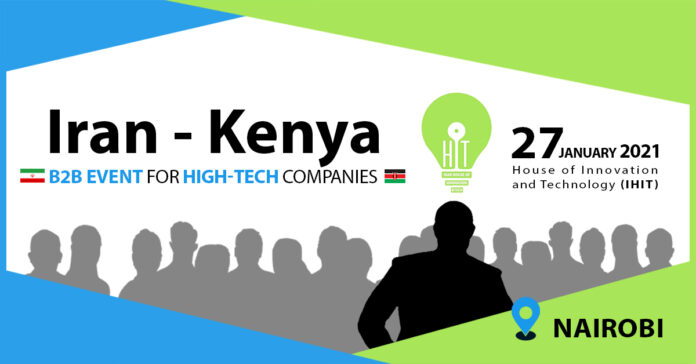
The business trip to Nairobi, due to take place on January 27, 2021, will be aimed at enhancing economic interaction between the private sectors of the two countries in the area of high technologies. The activities of the Iranian knowledge-based companies that are planned to visit Kenya are mainly focused on Information and Communications Technology (ICT) and Information Technology (IT), electricity and electronics, medicine and medical equipment, advanced materials, engineering services, and machinery and equipment.

One of the main events during the three-day business trip to Kenya will be B2B meetings between the Iranian knowledge-based companies and their Kenyan peers, slated for January 27, 2021 at the Iran House of Innovation and Technology (IHIT), which is to be opened by high-ranking officials of the two countries on the same day.

The IHIT is located at Dennis Pritt Road, next to Maalim Juma Road, Kilimani, Nairobi, Kenya. P.O. Box 38101-00100.

In order to participate in these B2B and expert meetings with Iranian companies, you can review their activities and sign up for participation.
Three Innovation Centres Inaugurated in Iran’s Qom

One of the centres was the Eshraq Cultural Creativity and Innovation Centre which seeks to develop innovative ideas of Islamic theology schools.

The centre guides and supports seminary students and teams presenting creative ideas in order to set up and develop creative companies working in cultural and religious domains.

Another centre was the Mobtada Creativity and Innovation Centre which aims to support creative ideas in cultural and religious domains.

The third centre was the one at the sci-tech park of the province of Qom.

Present at the inauguration ceremonies of all three centres was Iranian Vice President for Science and Technology Sorena Sattari.

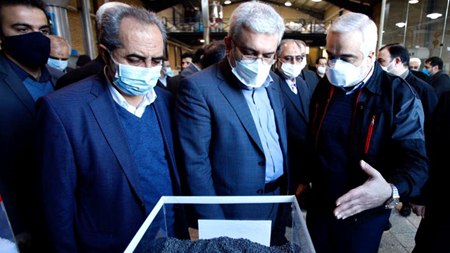
During his trip to Qom, Sattari also visited several knowledge-based companies as well as an exhibition showcasing the products of these firms.

Tehran, Baku Reach Deal on Reconstruction of Liberated Azeri Towns

Iranian Minister of Economic Affairs and Finance Farhad Dejpasand said the two countries are planning to run joint projects in different sectors.

“Our memorandum of understanding includes two parts. The first part is to follow up on the projects we are implementing and finalize our future plans,” he said.

“The second part concerns the participation of Iran’s private sector and utilizing the potential of Iran’s construction sector for restoration, rebuilding and construction [of buildings] in liberated areas in the Azerbaijan Republic,” he added.

“Fortunately, the Azeri side warmly welcomed this offer of cooperation. We can best utilize these potentialities. We are jointly running some projects in Iran and in the Azerbaijan Republic, projects on water, roads and industries, especially the pharmaceutical and machinery industries,” said the Iranian minister.

“They are very good projects, and I hope we will be able to implement them according to the timetable,” he noted.

“I believe today will be a turning point in Iran-Azerbaijan relations. Hopefully, if these programs come to fruition, our foreign trade will take a giant leap, too, because we have more potential that what we are already doing,” he underlined.

Biden Must Return to Commitments as First Step to Win Iran’s Trust: Spokesman

New US Sanctions Not to Affect Iran’s Activities: Spokesman

Speaking at a weekly press conference on Tuesday, Ali Rabiei said Iran has focused efforts on the “full revival of the JCPOA” by all parties to the agreement.

“We expect the new US administration to focus on winning Iran’s trust by honoring all of its commitments fully and instantly,” he noted.

“Iran’s stance on the US’ return to the JCPOA has been declared and reiterated by our country’s officials several times. The US administration must first carry out its commitments under the JCPOA and the United Nations Security Council Resolution 2231, and this is the only existing way for the new administration of the United States,” the spokesperson added.

Rabiei also dismissed reports on contact with the new US administration, saying Tehran has not received any message from the team of US president-elect Joe Biden.

On the prospect of talks with the next US administration, the Iranian spokesperson underlined, “Negotiations would be basically meaningless as long as we do not make sure that the US will return to its commitments unconditionally and fulfill those legal duties in full.”

Iran Not After War with US: FM Zarif

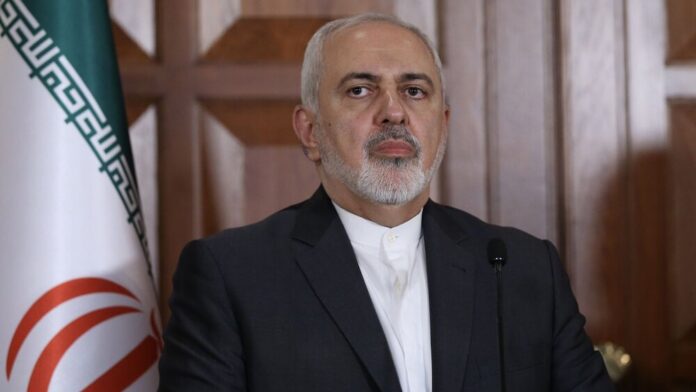
“Iran is not after tensions and war, but the actions of the disgraced, outgoing Trump will not affect Iranian people’s willpower,” said Mohammad Javad Zarif on the sidelines of a meeting of the National Security and Foreign Policy Commission of the Iranian Parliament.

“If he (Trump) intends to launch aggression against Iran, he needs to take into account the history of previous instances of aggression, but I think our deterrence power is working well in the one or two days left until the Trump administration’s life ends,” the top diplomat underlined.

Zarif then touched upon the legislation passed by Parliament to counter US sanctions, saying the government will implement the law.

Elsewhere in his remarks, Zarif said the foreign ministry is pursuing measures to bring to justice those who ordered and perpetrated the assassination of top Iranian commander Lt. General Qassem Soleimani.

He said Iran is following up on the issue through legal channels both in the country and in Iraq.

US Will Get Nowhere by Pursuing Policy of Hostility: Iran

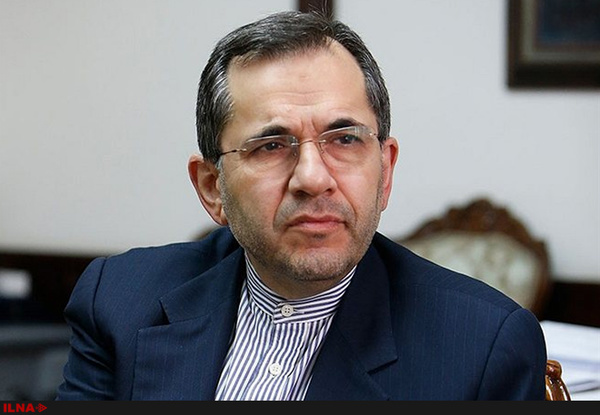
Majid Takht-Ravanchi said Washington has a grudge against Iran and Iranians.

“In a policy of hostility, General Soleimani is assassinated in a hostile manner, which is against international law. Of course, this shows the Americans’ spite, grudge and hostility toward the Islamic Republic of Iran are endless. They should give up these wrong policies which leads to Washington’s isolation,” he said.

He underlined the current team in the US foreign policy are addicted to imposing sanctions.

“They should abandon animosity and come to realize that Iran … is a powerful country in the region and wants to live in peace and tranquility with its neighbours within the framework of international law,” Takht-Ravanchi said.

Elsewhere in his remarks, the top diplomat touched upon the 2015 Iran nuclear deal, officially known as the Joint Comprehensive Plan of Action (JCPOA).

He noted the nuclear agreement is not in a good position now because some signatories to the JCPOA failed to live up to their commitments under the deal.

“By withdrawing from the JCPOA, the US blatantly violated the deal,” he said.

“The US also prevented other countries from doing their job (fulfilling their obligations),” he added.

He added it is too early to tell how the new US administration will act“We can judge the new US government’s performance only after it has started its work,” he said.

Iran Gov’t Assures Knowledge-Based Companies of Continued Support

In remarks at a meeting of the Pardis Technology Park managers on Monday, January 18, Jahangiri said the administration’s focus on strengthening the digital and knowledge-based economy in recent years has reversed the trend in the emigration of elites and educated people.

Reports suggest that a remarkable number of elites have returned home for scientific activities, the vice-president added, noting that at least 200 ones have established knowledge-based companies in the homeland.

Hailing the technology parks as perfect institutions that link the scientific and technological sector to the market and society, the vice-president said the number of Iranian knowledge-based companies has grown dramatically in recent years.

Jahangiri further stressed the need to remove bureaucratic obstacles to the activities of the Iranian startups and knowledge-based enterprises, saying the country’s main asset at present is the knowledge and ideas of the young people that create added value, not the oil, gas or natural resources.

The vice-president finally emphasized that the Science Ministry, the Health Ministry, and the Vice Presidency for Science and Technology are duty bound to synchronize the domestic scientific developments with the global scientific advances and turn the knowledge into added value.

Iran, China to Hold Meeting of Women’s Cultural Dialogue

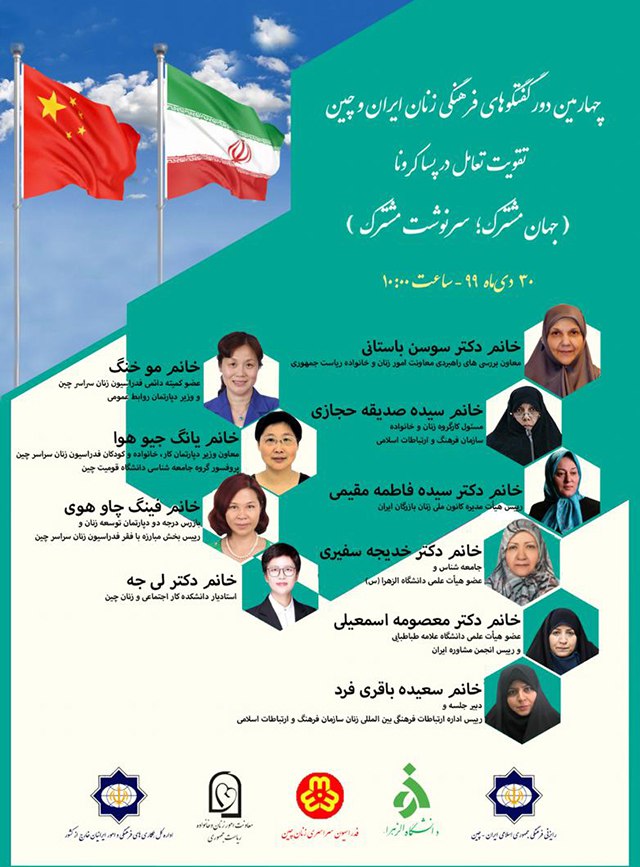
The new round of cultural dialogue among the Iranian and Chinese women with the purpose of stronger interaction in the post-coronavirus era will be held via videoconference on Tuesday, January 19.

The webinar, entitled “common world, common fate”, would be held under the auspices of the Islamic Culture and Communication Organization of Iran, the Iranian cultural attaché office in Beijing, the All-China Women’s Federation, the Iranian Vice Presidency for Women and Family Affairs, and Al-Zahra University of Iran.

According to director general of cultural cooperation and Iranian expatriates’ affairs department of the Islamic Culture and Communication Organization, Mohammad Ali Kiani, six Iranian and four Chinese women will deliver speeches to the webinar on various topics, such as women’s health, role of women in stability of families under the coronavirus pandemic, women’s role in tackling poverty, as well as the lifestyle and psychological health of women in the post-coronavirus era.

The first edition of cultural dialogue between the Iranian and Chinese women was held in Lanzhou, capital of China’s Gansu Province, seven years ago.

Iran Says Producing Uranium Metal for ‘Peaceful Purposes’

Asked by reporters about the recent statement from the UK, France and Germany, Saeed Khatibzadeh said on Tuesday, “The statement has been a joint statement from the spokespersons for the foreign ministries of the three countries, not a joint statement from the foreign ministers.”

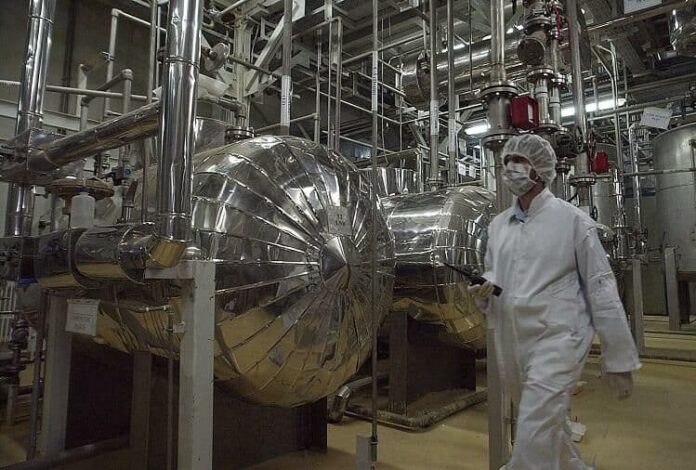
“Anyway, as already announced by the Atomic Energy Organization (of Iran), utilization of the uranium metal production factory in Isfahan, stipulated in the Parliament’s legislation, and the production of advanced fuel (silicide) to be used at the Tehran Research Reactor, are two totally different issues,” the spokesman added.

“What the (International Atomic Energy) Agency has reported on applies to the start of research and development activities to design a more advanced fuel for Tehran Research Reactor, dubbed silicide fuel,” Khatibzadeh added, noting that Iran had informed the IAEA about the plan two years ago and has recently provided the UN nuclear agency with the designing information.

The uranium metal is an intermediate product in the process of producing silicide fuel, he noted, adding, “The Design Information Questionnaire (DIQ) for Isfahan uranium metal plant has not been yet submitted to the Agency (IAEA), and this will take place after the necessary arrangements and within a deadline set by the law.”
The Foreign Ministry’s spokesperson finally dismissed the baseless speculations about the issue, saying, “Uranium metal also has peaceful applications. A number of countries are currently using uranium metal-based fuel for their reactors, and this is not in contradiction to the Non-Proliferation Treaty and the Safeguards (Agreement) commitments of the countries. Moreover, this technology is a necessity in Iran, which must fulfill the patients’ demands for nuclear medicine with the best quality, and it is completely based on humanitarian and peaceful grounds.”

Iran, Azerbaijan Weigh Plans to Boost Trade Ties

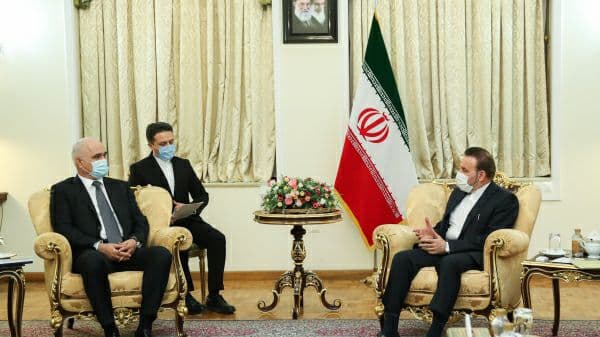
In a Monday meeting held after the 14th meeting of the Joint Commission on Iran-Azerbaijan Economic Cooperation, Vaezi hailed the growing relations between the two Muslim neighbours, saying 13 presidential meetings indicate the two countries’ determination to boost relations.

He also noted that the economic and trade interaction between Tehran and Baku have grown constantly despite the outbreak of the coronavirus pandemic, pointing to more than 100 reciprocal meetings between diplomatic delegations at the level of ministers and signing of over 40 cooperation agreements.

Vaezi also unveiled plans to finalize a preferential trade agreement between Tehran and Baku within the next month, emphasized the necessity for reconstruction of the Azeri territories liberated recently after the Nagorno-Karabakh war, and noted that the Iranian companies can participate in the reconstruction process.

For his part, the Azeri deputy prime minister praised Iran’s stances on the Nagorno-Karabakh dispute and its support for the territorial integrity of Azerbaijan, calling for the promotion of economic and trade ties with the friendly neighbor, Iran.

Mustafayev said he has attended the latest round of the Economic Cooperation Joint Commission with a 14-strong delegation within the framework of seven specialized committees on cooperation in various fields, noting that good decisions have been made in the meetings.

He further dismissed rumours that the Azerbaijan- Nakhchivan railway would ignore Iran’s interests, stressing that the new rail route will serve the interests of Iran, the Republic of Azerbaijan, Armenia, Russia, Turkey and Georgia, as the six countries will be able to expand trade cooperation.