Saturday, January 17, 2026
Home Blog Page 2138

Iranian FM: We are decisively after a good deal with P4+1

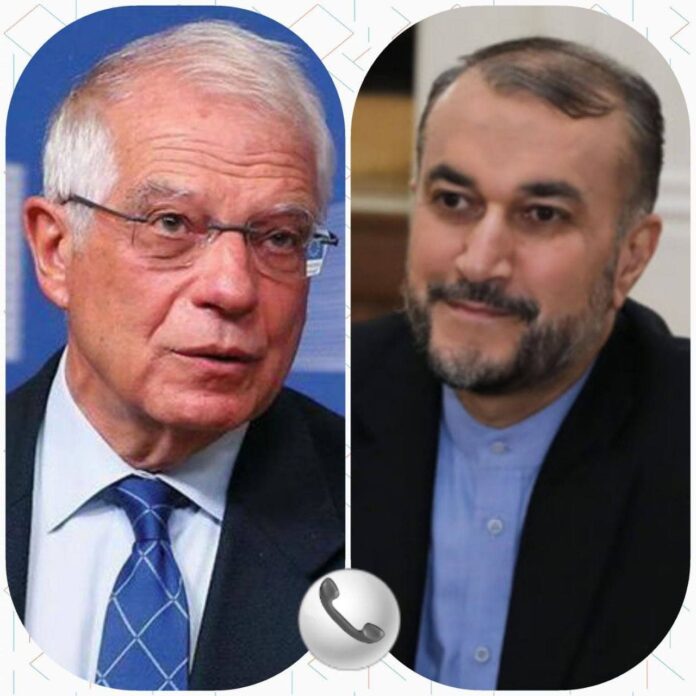
Amir Abdollahian made the comment in a telephone conversation with Josef Borrel, EU Foreign Policy Chief and lead coordinator of the Vienna negotiations, over the trend of the ongoing negotiations in the Austrian capital. He said, the nuclear deal, JCPOA, has unfortunately provided no economic benefits for Iran in recent years.

The Iranian foreign minister added, “We will reach a good deal only if it realizes our economic interests sustainably and reliably.”

Amir Abdollahian also once again underlined that Iran is determined to reach a good deal and to this end, it will remain in constant and close contact with the EU.

The top Iranian diplomat also thanked Josef Borrel, Enrique Mora, EU Deputy Foreign Policy Chief, and the bloc for their efforts to coordinate the talks in Vienna. Amir Abdollahian said there have been some positive developments in the negotiations but they fall short of meeting Iran’s expectations.

Borrel for his part noted that the Vienna talks are at a critical juncture. The EU foreign policy chief added that all sides should come to the Austrian capital with a clear agenda and with the aim of reaching a deal and they should be ready for adopting political decisions.

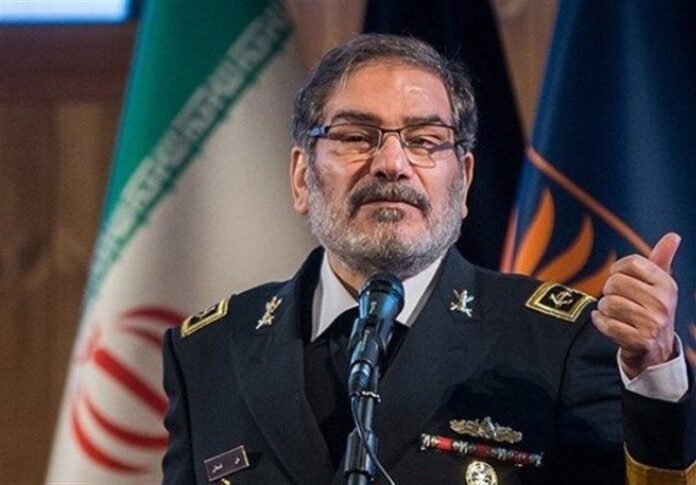
Iran’s Shamkhani: Feigning sanctions removal not constructive

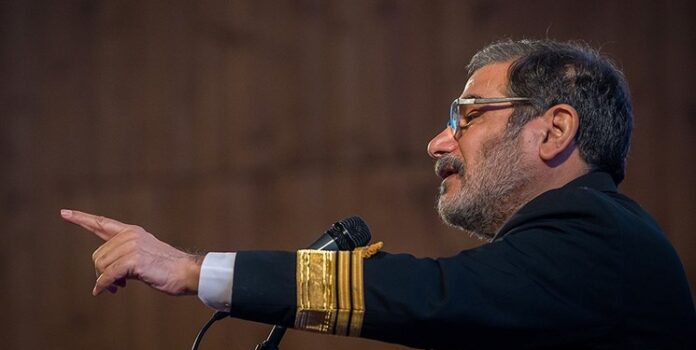
Ali Shamkhani

Shamkhani added that the prerequisite for a deal between Iran and the P4+1 group is genuine, effective and verifiable enjoyment by Iran of economic benefits from the termination of the sanctions.

Shamkhani made those remarks in a tweet after the US said it has waived sanctions on Iran’s civilian nuclear program in a technical step necessary to return to the 2015 nuclear agreement.

The US said the resumption of the waiver, ended by the Donald Trump administration in 2020, will be essential to ensuring Iran’s swift compliance if a new deal is reached in talks in Vienna.

The waiver allows other countries and companies to participate in Iran’s civilian nuclear program without triggering US sanctions on them, in the name of promoting safety and on-proliferation.

The step came as talks to restore the 2015 Joint Comprehensive Plan of Action, or JCPOA, which Trump unilaterally left in 2018, are at an advanced stage.

Both Iran and the P4+1 group of countries say the negotiations are moving in the right direction and that a deal is possible though some challenges remain.

Iran has repeatedly said it will only accept a deal that effectively and verifiably ends the sanctions reinstated on the country following Trump’s pullout from the JCPOA.

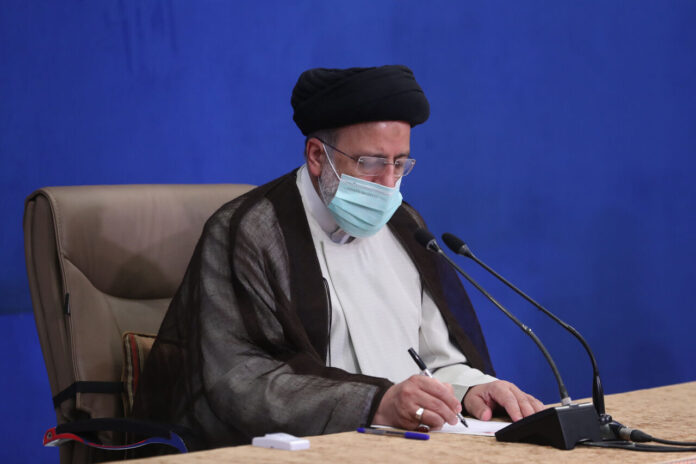
President Raisi congratulates Italian counterpart on re-election

Raisi in a message on Saturday congratulated the re-election of Mattarella as President of Italy.

President Raisi emphasized the friendly relations between the Islamic Republic of Iran and Italy.

Recalling the deep-rooted history of political, economic, and cultural relations between Iran and Italy, President Raisi expressed hope that the interactions between the two states will be further expanded in various areas of bilateral, international, and regional cooperation in the light of a joint effort to utilize various capacities of cooperation based on mutual respect.

Iran’s president concluded his message by wishing health and success for the president of Italy and prosperity for the people of the Republic of Italy.

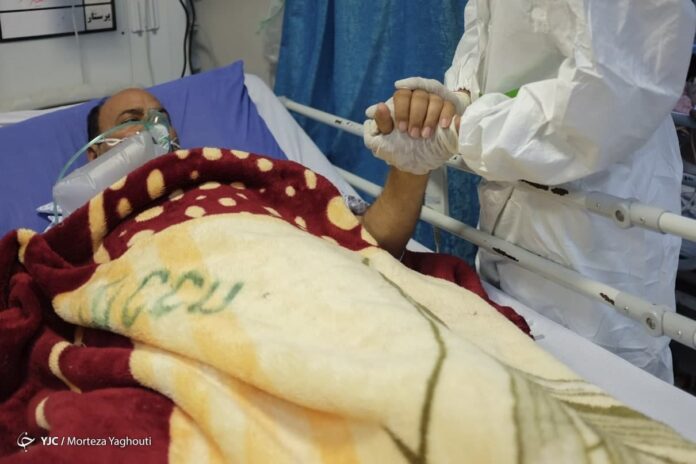
Covid kills 64 more people in Iran

That’s way lower than Friday’s daily caseload which was over 32,000 infections.

The Saturday tally also showed over 1,500 hospitalizations were logged. The figures also put the number of daily fatalities at 64 during the 24 hours.

The total death toll from the Coronavirus in Iran since the start of the pandemic now stands at 132,745. Most of the recent infections and deaths are people who contracted the Omicron variant of the virus.

The strain is highly contagious and is spreading fast across Iran.

Iranian health officials are warning citizens to strictly observe health protocols to contain this new wave of Covid.

The Health Ministry has also declared 120 cities as coronavirus red zones amid the sixth wave of the outbreak of the disease.

According to the ministry on Saturday, now 153 cities are orange with high risk, while 167 cities are yellow with medium risk and only 8 cities are marked blue, having very low risk of contraction.

Omicron has already overwhelmed most of Europe and the entire United States where millions of cases of the variant have been registered.

Meanwhile, the vaccination process is continuing in Iran with the number of boosters administered crossing the 19 million mark. Authorities say if people get their third dose of vaccine, the current wave will subside.

Oscar-winning Farhadi ready for awards season with ‘A Hero’

In 2017, Farhadi won the Oscar for best foreign-language film for “The Salesman” – but boycotted the ceremony because of then-US President Donald Trump’s ban on travel to the United States from seven majority Muslim nations including Iran.

Promoting his new movie from a hotel room in West Hollywood, Farhadi says that, if he is nominated again, these Oscars will be a very different experience.

“It makes me very happy that as an Iranian I’m going through this path,” he added.

“I know that for part of the Iranian youth, this can create hope … and this creates this satisfaction feeling inside me. It gives those young people some kind of hope so they can continue this path and bring some awards and prizes to Iran,” he continued.

“A Hero”, a co-winner of the Grand Prix distinction at the Cannes Film Festival, follows Rahim, a prisoner who makes a plan with his fiancée to sell a bag of gold coins that she has found to pay off his debts so he can be released from jail. He has a sudden change of heart and manages to track down the coins’ owner. But being hailed as a hero raises unexpected complications for the young man that draw in those around him.

“This contradiction that is inside this title is something that I liked a lot,” Farhadi stated.

“When I announced it for the first time, it was strange for some of my close friends – but when you put the main character next to the title, the combination of these two creates a new meaning,” he noted.

Thrust into the spotlight by winning the Golden Bear award for “A Separation” at the Berlin Film Festival in 2011, Farhadi is known for creating simple stories that focus on the challenges of being human.
“We tried to give all the characters in the film a good amount of time for the audience to understand them and comprehend who they are,” he continued.

“A Hero” is currently streaming on Amazon Prime Video.

US lawmakers reject Amnesty report on Israeli ‘apartheid’

In an era of hyper-partisanship in the United States, a new bipartisan consensus appeared to emerge on Capitol Hill this week: condemning Amnesty International over its report accusing Israel of committing the crime of apartheid against Palestinians.

Dozens of US lawmakers from both major parties, including powerful legislators and heads of key committees in the House of Representatives and Senate, have released statements rejecting Amnesty’s findings – with some accusing the group of fuelling antisemitism.

These forceful condemnations, analysts say, illustrate the level of support Israel enjoys in Washington despite mounting allegations of abuse – but they do not reduce the validity of the rights group’s report.

“They want to nip this in the bud, but the bud has already broken ground and undeveloped roots, and it’s going to be a losing battle on their part,” said James Zogby, president of the Arab American Institute (AAI), a Washington-based think tank.

Zogby told Al Jazeera that domestic political pressures have compelled many legislators to condemn the Amnesty report, but the group’s status and international credibility make it difficult to dismiss its conclusion that Israel is systematically oppressing Palestinians.

He added that while many US legislators are demonising the report and accusing Amnesty International of bias, they have not discussed specific allegations.

“They’ve decided to just focus on the use of the word ‘apartheid’ because that’s the only case they can make … ‘How dare you use apartheid to describe Israel’,” he continued.

In its February 1 report, Amnesty said Israel is committing the crime of apartheid against Palestinians in the occupied Palestinian territories (OPT), as well as within Israel. Human Rights Watch, Israeli rights group B’Tselem and Palestinian rights groups have all reached the same conclusion.

“Israel has imposed a system of oppression and domination over Palestinians wherever it exercises control over the enjoyment of their rights – across Israel and the OPT and with regard to Palestinian refugees,” Amnesty’s report (PDF) reads.

“The segregation is conducted in a systematic and highly institutionalized manner through laws, policies and practices, all intended to prevent Palestinians from claiming and enjoying equal rights to Jewish Israelis within Israel and the OPT, and thus intended to oppress and dominate the Palestinian people,” it added.

The response from US Congress members was swift.

A day after the report was released, nine centrist House Democrats, including former Democratic National Committee chairwoman Debbie Wasserman Schultz, called it “baseless”, “biased” and “steeped in antisemitism”, stating it was “part of Amnesty’s broad, decades-long campaign to criminalize and delegitimize the world’s only Jewish state”.

Republican Congressman Lee Zeldin also attacked the rights group.

“Amnesty International is a so-called ‘human rights organization’ that routinely hurls false accusations of oppression against Israel, ignores violent attacks on Israel from its hostile neighbors and fans the flames of antisemitism around the world,” he said in a statement on the day the report was published.

The Israeli government also had called the report “false, biased and antisemitic” – even before it was released.

“It’s pretty clear that these accusations of antisemitism are meant to avoid having a real conversation about Israel’s treatment of Palestinians,” stated Morriah Kaplan, spokesperson for IfNotNow, a youth-led, anti-occupation US Jewish group.

“And I think that it actually does a disservice to the larger and necessary fight against anti-Semitism,” Kaplan added.

The chairs and ranking members of the foreign policy panels in the House and the Senate also denounced the report, with Bob Menendez, who leads the Senate Foreign Relations Committee, saying he was “deeply disturbed” by it.

“This report diminishes the very real Apartheid that brutalized Black South Africans for decades,” Menendez noted.

But Amnesty explicitly stated that its report does not argue that the situation in Israel-Palestine is “the same or analogous to the system of segregation, oppression and domination as perpetrated in South Africa between 1948 and 1994”.

Moreover, Palestinian rights supporters have pointed out that South African anti-apartheid leaders, including the late Archbishop Desmond Tutu, have likened the struggle of Palestinians to that of Black South Africans.

Amnesty International USA did not return Al Jazeera’s response for comment, but the group released a statement in response to congressional concerns earlier this week, stressing that the group’s “sole mandate” is to document human rights abuses wherever they occur.

“The US Government is uniquely placed to meaningfully pressure Israeli authorities to repeal discriminatory laws and policies, issue reparations where appropriate, and uphold its obligations under international human rights and humanitarian law,” it said.

Meanwhile, a handful of progressive Democrats explicitly endorsed or appeared to back the report through social media posts, including Congresswomen Betty McCollum, Cori Bush, Ilhan Omar and Rashida Tlaib.

“Congress can no longer ignore or excuse Israel’s occupation & system of oppression,” McCollum, who has proposed a bill that would restrict Washington’s $3.8bn-a-year military aid to Israel over human rights abuses, wrote in response to the report.

Palestinian rights advocates had been counting on the rise of progressives, who have tried to push human rights issues to the fore within the Democratic Party, to shake Washington’s unconditional support for Israel.

Kaplan, of IfNotNow, told Al Jazeera that the adamant opposition to the report demonstrates that rights advocates are “effectively moving the conversation”, prompting Israel’s supporters to strongly defend the status quo, adding, “It’s showing that there are cracks, that we’re pushing on the right levers, but we just can’t expect for change to come overnight.”

IAEA chief: Iran-P4+1 talks in Vienna on right track

Rafel Grossi was speaking during an interview with Saudi-funded Al-Arabiya news channel. Rafel Grossi added that the next few days will decide the outcome of the ongoing efforts. Grossi added that parties to the talks in Vienna have not yet reached an agreement but they have not given up hope to make a deal.  

The IAEA chief urged all sides to be patient and encourage Iran to cooperate. 

Gross said the current debate at the political level is what the negotiating parties want, and the most important question is whether a return to the 2015 nuclear deal is possible. Elsewhere in his comments, the IAEA chief said that the agency is concerned about what he called the presence of undeclared nuclear material in Iran’s atomic sites. He called on Iran to answer the IAEA’s questions and allow the agency’s monitoring devices to have full access to Iranian nuclear facilities.

He added that without the commitment of the Iranian authorities and the cooperation of all parties, no agreement will be reached.

This as the IAEA inspectors have been provided with full access to Iran nuclear sites under the safeguard agreements. Tehran also used to voluntarily implement the additional protocol to the Non Proliferation Treaty (NPT) safeguards agreement, but stopped it due to the non-compliance of the other sides to the nuclear deal following the US withdrawal from the deal in 2018. 

The protocol grants Agency inspectors greater authority in verifying Tehran’s nuclear program.

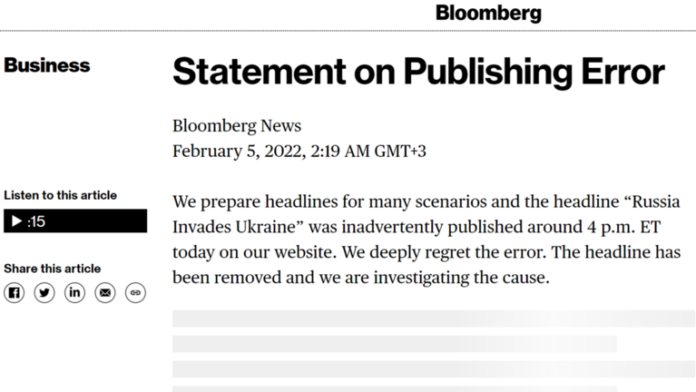
Kremlin: Bloomberg disseminating false news over Ukraine

His comment comes after Bloomberg earlier rolled out a “Russia invades Ukraine” headline; it later removed the eye-popping link, saying it was published accidentally and that they will investigate the incident.

Peskov underlined that Bloomberg’s false report underscores the danger of “aggressive statements”.

“This is a perfect demonstration of how dangerous the situation is when provoked by the endless aggressive statements that come from Washington, from London, and from other European governments,” the Kremlin spokesman underscored.

He stated he does not think that the news agency’s false headline was a provocation, but stressed that “any spark” can be dangerous in a tense situation.

“And this is probably also a great demonstration of how such messages can lead to irreparable consequences,” he continued.

Peskov pointed out that tensions are particularly fueled by how the Western countries continue to not only hype up the “agressive statements”, but also by beefing up Ukraine with weapons and sending troops near the Russian border.

On Friday, Ukraine’s Defence Minister Oleksii Reznikov said that 85 tonnes of US military aid had already arrived in Ukraine. Among other states providing such aid to Ukraine are Canada, the United Kingdom and some Baltic states.

Earlier, US President Joe Biden has signed off on deploying additional American troops to Eastern Europe to “ensure a robust defense” of US allies. The Pentagon noted that the troops to be deployed in Poland, Germany and Romania will not “fight in Ukraine”. 1,000 US personnel were set to be redeployed from Germany to Romania and some 2,000 American troops were designated for Poland.

Despite Russia’s attempts to reduce tensions, Washington claimed on Thursday that Russia was plotting “to stage fabricated attacks by Ukrainian military…as a pretext for a further invasion of Ukraine”.

Russian Foreign Minister Sergey Lavrov dismissed the claims, calling them “nonsense”, and Russian Ambassador to the United States Anatoly Antonov said that US accusations are a part of “information war against Russia”.

“Washington has been provoking the whole world for several months with statements that Ukraine is about to become a victim of ‘Russian aggression’. However, there was a mistake, because there was no attack,” Antonov noted.

Claims of that a “Russian invasion of Ukraine” is in the works have been on the rise in recent weeks, with the West specifically accusing Moscow of “amassing troops” near the Ukrainian border. The Kremlin noted that the Russian troops, located within the country’s territory, do not pose any threat.

In its turn, the deployment by NATO and the US of additional military contingents near the Russian border do trigger security concerns in the Kremlin. In an attempt to de-escalate the tensions, the Kremlin proposed security agreements to the US and NATO, demanding legal guarantees that the alliance would not expand eastwards and not deploy offensive weapons in the countries that share a border with Russia.

In its response, the West insisted that NATO won’t give up on its “open door” policy, saying that Ukraine is free to choose its defense blocs.

Iran’s nuclear right cannot be restricted: Top official

“Iran’s legal right to continue research and development work and maintain its peaceful nuclear capabilities and accomplishments as well as to ensure its safety against supported wicked acts cannot be restricted with any agreement,” said Secretary of the Supreme National Security Council Ali Shamkhani in a tweet.

Moreover, he had already made a tweet about reports that contact with the American delegation to the Vienna talks has, so far, been made via unofficial exchanges and that there has not been, and will not be any need for anything beyond that.

“This method will be replaced with other methods only when a good deal is close at hand,” he had explained.

Iran and the P 4+1 group, namely Russia, China, France, Britain and Germany, are engaged in talks in the Austrian capital Vienna in a bid to revive the 2015 nuclear deal – JCPOA- and a possible return of the US to the agreement. 

The US, under former President Donald Trump, withdrew from the JCPOA in 2018, leaving the internationally-recognized deal in tatters.

Tehran says as the US did not abide by its commitments under the deal, it does not talk directly with Washington in Vienna.

PastoCovac vaccine creates 100% immunity against coronavirus: Official

“The injection of three doses of the PastoCovac vaccine will create an immunity of over 90% against the Omicron strain,” said Alireza Biglari.

“With the injection of the fourth dose of the PastoCovac vaccine, immunity against Omicron will reach 100%,” he claimed.

“The PastoCovac vaccine creates 96% immunity against the Beta variant in Cuba and Delta strain in Iran,” he explained.

“There is a capacity of producing 5 million doses of the PastoCovac vaccine monthly in the country,” he said.

This comes as reports suggest the number of COVID-19 infections are on the rise in Iran.

Meanwhile, the national coronavirus inoculation campaign is in full swing to help contain the deadly virus and its more contagious variants such as Omicron which have hit the nation.