Monday, December 22, 2025
Home Blog Page 20

US to spend $800mn on support for Ukraine in 2026, 2027: Pentagon budget draft

The document also obligates the Pentagon chief to report to the House of Representatives and Senate on the temporary suspension or cessation of intelligence provision to Ukraine.

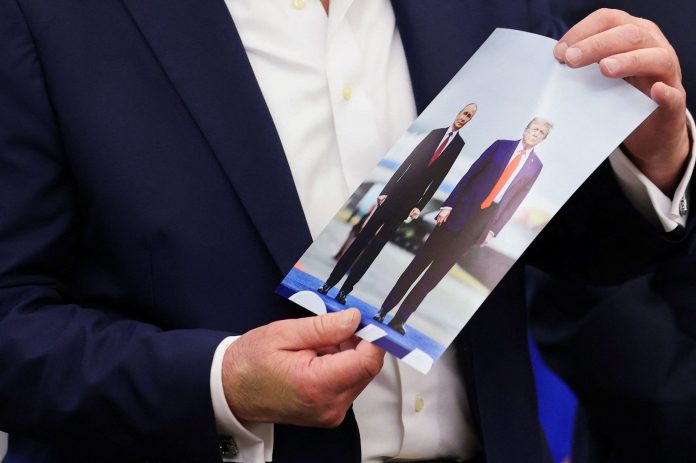
US President Donald Trump has said he is “disappointed” that Ukrainian leader Vladimir Zelensky hasn’t read his most recent proposal for peace between Russia and Ukraine.

“I have to say that I’m a little bit disappointed that President Zelensky hasn’t yet read the proposal, that was as of a few hours ago,” Trump told reporters in Washington, DC, on Sunday, without elaborating.

The US president added that Russia was “fine” with the plan but not the Ukrainian leader.

“I’m not sure that Zelensky is fine with it. His people love it, but he isn’t ready,” Trump added.

Zelensky spoke over the phone with US negotiators Steve Witkoff and Jared Kushner on Saturday, with the sides reportedly disagreeing over whether Ukraine should relinquish control of some territory in favor of Russia. In a video address late on Sunday, Zelensky said Ukraine “deserves a dignified peace,” and that he would hold consultations with Kiev’s European backers in the coming days.

Trump has argued in the past that Ukraine may have to withdraw troops from Donbass in accordance with Russia’s ceasefire terms. Zelensky, however, has ruled out abandoning any territory.

Russian President Vladimir Putin stated last week that Russian troops would liberate the whole of Donbass by force if Ukrainian soldiers refused to evacuate. Moscow has demanded that Kiev recognize Russia’s new borders, including Crimea and the two Donbass republics, as well as abandon its plan to join NATO and restrict the size of its military.


Off-road drivers compete in Iran’s national championship

Drivers from various provinces showcased their technical skills and endurance on challenging dirt tracks designed to test acceleration, control and obstacle navigation.

Organizers said the event reflects the growing popularity of off-road motorsport in Iran and highlighted the strong participation of female drivers.

More in pictures:

Kazakhstan announces upcoming visit by Iran’s President Pezeshkian

Masoud Pezeshkian

According to the statement, the trip is aimed at advancing bilateral cooperation and will include high-level talks focused on expanding economic and trade ties, enhancing transport and logistics connectivity, and promoting cultural and humanitarian exchanges between the two countries.

Kazakh news agency Kazinform, cited by IRNA, reported that officials in Astana view the visit as part of ongoing efforts to strengthen strategic cooperation. The agenda reflects growing momentum in relations, with bilateral trade nearly doubling over the past two years.

The Iranian delegation will include a large contingent of private-sector representatives. Hamed Asgari, deputy for international affairs at Iran’s Chamber of Commerce, said ahead of the trip that the business community is prepared to play a leading role in boosting economic engagement with Kazakhstan.

He described the visit, accompanied by more than 100 major Iranian companies, as a “turning point,” signaling a shift from general dialogue to concrete, project-based cooperation.

Asgari added that the scale of private-sector participation demonstrates Iran’s intention to expand its presence in Kazakhstan’s market and deepen long-term economic partnerships.

UN committed to supporting Syrian-led transition: Secretary-General

Syria War

“Today marks one year since the fall of the Assad government and the end of a decades-old system of repression,” Guterres said Sunday in a statement.

He paid tribute to the resilience and courage of the Syrian people, “who never stopped nurturing hope despite enduring unimaginable hardship,” calling it a day to honor their sacrifices and renew aspirations that fueled “historic change.”

Guterres added what lies ahead is more than a political transition but rather a chance to rebuild “shattered communities” and “heal deep divisions.”

“It is an opportunity to forge a nation where every Syrian — regardless of ethnicity, religion, gender or political affiliation — can live securely, equally, and with dignity,” he continued.

The UN chief noted the past year showed that meaningful change is possible when Syrians are empowered and supported in driving their own transition, stressing that challenges ahead are “not insurmountable.”

While humanitarian needs “remain immense,” Guterres noted progress in restoring essential services, expanding humanitarian access and creating pathways for refugees and displaced persons to return.

“The international community must stand firmly behind this Syrian-led, Syrian-owned transition,” he said, adding, “This includes ensuring respect for Syria’s sovereignty, removing barriers to reconstruction, funding humanitarian appeals, (and) promoting economic development.”

“On this anniversary, we stand united in purpose – to build a foundation of peace and prosperity and renew our pledge to a free, sovereign, united, and inclusive Syria,” he stated.

Syria is marking a year since the fall of Assad, which opened a transformative new era.

In early December 2024, the rule of the Baath Party, which came to power in 1963, collapsed when Damascus was seized and Assad fled to Russia.


Israeli PM says will not quit politics if he receives pardon

Benjamin Netanyahu

Asked by a reporter if planned on retiring from political life if he receives a pardon, Netanyahu replied: “no”.

Netanyahu last month asked President Isaac Herzog for a pardon, with lawyers for the prime minister arguing that frequent court appearances were hindering Netanyahu’s ability to govern and that a pardon would be good for Israel.

Pardons in Israel have typically been granted only after legal proceedings have concluded and the accused has been convicted. There is no precedent for issuing a pardon mid-trial.

Netanyahu has repeatedly denied wrongdoing in response to the charges of bribery, fraud and breach of trust, and his lawyers have said that the prime minister still believes the legal proceedings, if concluded, would result in a complete acquittal.

U.S. President Donald Trump wrote to Herzog, before Netanyahu made his request, urging the Israeli president to consider granting the prime minister a pardon.

Some Israeli opposition politicians have argued that any pardon should be conditional on Netanyahu retiring from politics and admitting guilt. Others have said the prime minister must first call national elections, which are due by October 2026.


New wave of mysterious Caspian seal deaths raises alarm across region

Local authorities in Kazakhstan’s Mangystau region reported that roughly 500 seals have died along the coast since the beginning of the year, with more than 180 carcasses found in early November alone.

Officials say over 3,500 seals have been recorded dead in the area since 2022.

The incident has drawn attention in Iran as well, where 54 dead seals have been recovered along the country’s northern shores since spring.

Iranian environmental officials say most carcasses discovered on Iranian beaches likely drifted southward from northern parts of the Caspian Sea.

Preliminary assessments in Kazakhstan show no evidence of oil contamination, chemical spills, or fishing-net entanglement.

Experts say viral infection, weakened immunity and declining food resources remain possible causes, though conclusive results await laboratory analysis.

Environmental groups in Kazakhstan and Iran have urged authorities to establish clear protocols for responding to stranded or dead seals and to expand coastal monitoring.

Scientists warn that falling water levels, shrinking wetlands and habitat disruption across the Caspian basin are intensifying risks for the species and demand coordinated action among all five coastal countries.

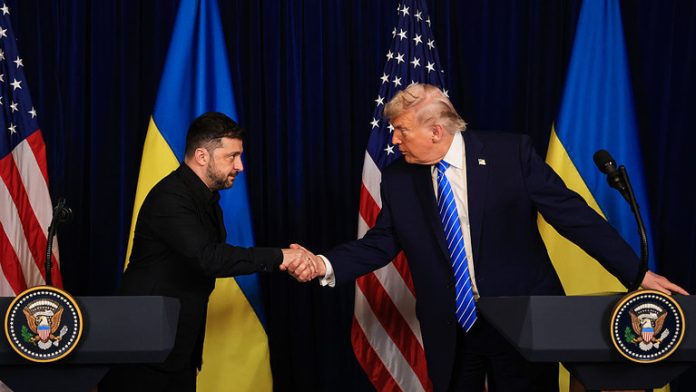
Trump claims Zelensky ‘isn’t ready’ to accept US peace accord

“I’m a little bit disappointed that President Zelensky hasn’t yet read the proposal, that was as of a few hours ago. His people love it, but he hasn’t,” Trump claimed as he spoke with reporters on Sunday night.

Days of negotiations between US and Ukrainian officials ended Saturday without an apparent breakthrough, with Zelensky calling the discussions “constructive, although not easy.”

His comments come as Zelensky was set to meet with the leaders of Britain, France and Germany in London on Monday, with discussions set to focus on the continuing talks between the US and Ukraine.

Off the back of the Trump-backed Gaza ceasefire, the US has been working to push through a peace deal between Ukraine and Russia. US officials claim they are in the final stage of reaching an agreement, but there is little sign that either Ukraine or Russia is willing to sign the framework deal drawn up by Trump’s negotiating team.

In his comments on Sunday, Trump said “Russia is, I believe, fine with [the deal], but I’m not sure that Zelensky’s fine with it. His people love it. But he isn’t ready.”

Russian President Vladimir Putin hasn’t publicly expressed approval for the White House plan and last week said that aspects of Trump’s proposal were unworkable. US envoys Steve Witkoff and Jared Kushner met Putin at the Kremlin last week but failed to achieve an obvious break through.

The US plan has been through several drafts since it first emerged in November, with criticism it was too soft on Russia. Despite ongoing efforts from Trump and his team to push through a deal, progress in the peace talks has been slow, with disputes over security guarantees for Kyiv and the status of Russian-occupied territory still unresolved.

“The American representatives know the basic Ukrainian positions,” Zelensky stated in his nightly video address on Sunday.

Trump has had a hot-and-cold relationship with Zelensky since reentering the White House, and has repeatedly urged the Ukrainians to cede land to Russia to bring an end to a conflict he says has cost far too many lives.

Zelensky stressed on Saturday he had a “substantive phone call” with the American officials engaged in the talks with a Ukrainian delegation in Florida. He said he had been given an update over the phone by US and Ukrainian officials at the talks.

“Ukraine is determined to keep working in good faith with the American side to genuinely achieve peace,” Zelensky wrote on social media.

Trump’s criticism of Zelensky came as Russia on Sunday welcomed the Trump administration’s new national security strategy. Spokesperson Dmitry Peskov said the updated strategic document, which spells out the administration’s core foreign policy interests, was largely in line with Moscow’s vision.

The document released Friday by the White House said the US wants to improve its relationship with Russia after years of Moscow being treated as a global pariah. The document was also highly critical of European countries, and said that the continent was at risk of “civilisational erasure”.

Trump’s outgoing Ukraine envoy, Keith Kellogg, stated at a defence forum on Saturday that the administration’s efforts to end the war were in “the last 10 metres”. He added there were two outstanding issues: territory and the fate of the Zaporizhzhia nuclear power plant.

Kellogg is seen as among the US officials most sympathetic to Kyiv’s position, but is due to leave his role in January and was present at the Florida talks. Many others in Trump’s orbit, including Witkoff, have been much more open to adopting Russian positions. Trump’s son, Donald Jr, said at a forum in Doha on Sunday that Zelensky was deliberately continuing the conflict for fear of losing power if it ended. He said the US would not be “the idiot with the chequebook” any longer.


Israeli PM rules out creation of Palestinian state

Netanyahu made the remarks on Sunday in Jerusalem during a joint press conference with German Chancellor Friedrich Merz. While Merz reaffirmed Berlin’s commitment to the creation of an independent Palestinian state, Netanyahu openly disagreed with him, claiming that such an entity would be “committed to our destruction at our doorstep.”

“They already had a state in Gaza, a de facto state, and it was used to try to destroy the one and only Jewish state,” Netanyahu stated, referring to the Palestinian enclave that has been effectively run by Hamas.

Israel believes that there’s “a path to advance a broader peace with the Arab states” and to “establish a workable peace with our Palestinian neighbors” that does not involve the creation of an independent entity, he added.

Israel’s prime minister has repeatedly rejected the two-state solution proposed by the UN Security Council. The scheme entails the creation of a Palestinian state within the armistice lines that existed before the 1967 Six-Day War with East Jerusalem as its capital.

The original UN plan for partition in 1947 envisioned separate Jewish and Arab states, but a series of subsequent wars allowed Israel to seize most of the land which had been allocated to the Palestinians.

Netanyahu noted that the occupation of the West Bank, considered to be illegal under international law, remains a subject of discussion, yet signaled that the status quo is expected to remain in place for the foreseeable future.


New US security strategy accords largely with Russia’s view: Kremlin

Kremlin

The U.S. National Security Strategy described Trump’s vision as one of “flexible realism” and argued that the U.S. should revive the 19th century Monroe Doctrine, which declared the Western Hemisphere to be Washington’s zone of influence.

The strategy, signed by Trump, also warned that Europe faces “civilizational erasure”, that it was a “core” U.S. interest to negotiate an end to the war in Ukraine, and that Washington wanted to reestablish strategic stability with Russia.

“The adjustments that we see correspond in many ways to our vision,” Kremlin spokesman Dmitry Peskov told state television reporter Pavel Zarubin when asked about the new U.S. strategy.

Such fulsome public agreement between Moscow and Washington on the tectonic plates of global politics is rare, though they did cooperate closely after the 1991 fall of the Soviet Union on returning nuclear weapons from former Soviet republics to Russia, and after the deadly Sept. 11, 2001, attacks on the United States.

During the Cold War, Moscow portrayed the United States as a decadent capitalist empire doomed by the historical certainties of Marxism, while U.S. Ronald Reagan in 1983 called the Soviet Union an “evil empire” and the “focus of evil in the modern world.”

After the Soviet collapse, Moscow expressed hopes for a partnership with the West but as Washington moved to support the enlargement of the NATO alliance, as outlined in President Bill Clinton’s 1994 strategy, tensions began to mount. They were pushed to breaking point under President Vladimir Putin, who rose to the top Kremlin job on the last day of 1999.

Asked about the pledge in the U.S. document to end “the perception, and preventing the reality, of the NATO military alliance as a perpetually expanding alliance”, Peskov stated it was encouraging.

But Peskov also cautioned that what he said was the U.S. “deep state” saw the world differently to Trump, who has used the term to refer to an allegedly entrenched network of U.S. officials who seek to undermine those who challenge the status quo, including Trump himself.

Critics of Trump say there is no such thing as a “deep state,” and that Trump and his allies are trafficking in a conspiracy theory to justify an executive-branch power grab.

Since Russia’s 2014 annexation of Crimea and its 2022 invasion of Ukraine, U.S. strategies have designated Moscow as an aggressor or a threat that was trying to destabilise the post-Cold War order by force.

In comments to the state-run TASS news agency, Peskov added calling for cooperation with Moscow on strategic stability issues rather than describing Russia as a direct threat was a positive step.


Appeals court lifts detention order for actor Pejman Jamshidi, cites lack of new evidence

Kambiz Barjas, Jamshidi’s lawyer, said that the only medical report in the case file dates back to the early days of the complaint and that neither party had been referred to the forensic medical authority again afterward.

“The medical information in the case is the same initial data. No new documentation has been added,” he said.

Barjas stated that the ruling issued by Branch One of the Court of Appeals fully aligned with the legal team’s arguments.

“If the forensic report or any other evidence in the file contained proof supporting the alleged accusations od sexual misconduct, the appeals court would not have overturned the initial verdict,” he noted.

He emphasized that the case contains a fixed set of evidence that has not changed over time.

“This is not a matter of competing claims. The final decision rests with the appeals court, which examined the same documents and determined whether the allegations were substantiated,” he said.

Barjas noted that the appeals court explicitly stated there was “no new evidence that would justify the continuation of Jamshidi’s detention,” and that under the law, the court was obligated to lift the detention order and overturn the preliminary ruling.

Reports first surfaced on October 20 regarding the arrest of a “well-known actor.” Hours later Jamshidi was identified as the individual involved in the complaint. The case was filed following a complaint by a woman, and Jamshidi was initially detained before being released on bail.