US President Joe Biden has officially announced a new Ukraine military aid package, which will include advanced missile systems.
The Himars multiple launch rocket system that Washington will be providing to Ukraine has a range of about 50 miles.
“Today, I am announcing a significant new security assistance package to provide timely and critical aid to the Ukrainian military,” Biden said in a statement.
“This new package will arm them with new capabilities and advanced weaponry, including HIMARS with battlefield munitions, to defend their territory from Russian advances,” he added.
The package also includes helicopters, Javelin anti-tank weapon systems, tactical vehicles, spare parts, and more.
Biden has agreed to send the medium-range rocket systems to Ukraine, after refusing to supply Kiev with long-range missile systems that could be used to attack targets in Russia.
The Biden administration made the decision, claiming that Volodymyr Zelensky “assured” Ukraine would not use American weapons against Russia. The Kremlin stressed that it had no confidence in Kiev’s pledges.
NATO to gather officials from Sweden, Finland and Turkey: Stoltenberg
NATO Secretary-General Jens Stoltenberg says he will convene a meeting in Brussels in the coming days with senior officials from Sweden, Finland and Turkey to discuss Ankara’s opposition to the two Nordic countries joining the transatlantic security alliance.
“I’m in close contact with President [Recep Tayyip] Erdogan of Turkey and with the leaders of Finland and Sweden,” Stoltenberg said at a news conference in Washington, DC, following talks with US Secretary of State Antony Blinken.
Ukraine has assured US it will not use weapons systems against targets in Russia: Blinken
Blinken says Ukraine has given the US assurances that it will not use long-range weapons systems provided by Washington against targets within Russia’s borders.
“There is a strong trust bond between Ukraine and the United States, as well as with our allies and partners,” he stated at a news conference in Washington, DC, alongside Stoltenberg.
Addressing remarks from Moscow that Washington’s move amounted to adding “fuel to the fire” of the conflict, Blinken noted the “best way to avoid escalation is for Russia to stop the aggression and the war that it started”.
“It’s fully within its power to do so,” he added.
Blinken said he believes the Ukraine conflict will last “many more months” based on what the situation at present.
“As best we can assess right now, we are still looking at many months of conflict,” Blinken added.
The Secretary of State reiterated the US position that the conflict could be over right away if Russia ends its military operation in Ukraine, but added “We don’t see any signs of that right now.”
Blinken stated that the United States will support Ukraine as long as the conflict lasts and ensure that the country has everything it needs to defend itself against Russia.
Lavrov warns US weapons supplies could widen conflict
Russian Foreign Minister Sergey Lavrov stated Washington’s move to supply Ukraine with advanced rocket launchers raises the risks of a “third country” being dragged into the conflict.
Lavrov was responding to a question at a news conference in Saudi Arabia about the White House’s weapons plans.
Moscow trying to ‘extinguish civilisation’ in Donbas: Berlin
Germany’s foreign minister says Russia has adopted a strategy of flattening settlements from a safe distance in the Donbas.
In a speech to the German parliament, Annalena Baerbock stated Russia was fighting a war to “depopulate and extinguish civilisation” in the eastern Ukrainian region.
“City by city, village by village, Russian troops are destroying them from a safe distance,” she continued, adding, “First the missiles, then the warplanes with artillery, and then, when everything is flattened, the tanks roll in.”
Baerbock added that Berlin needed to supply Kyiv with more artillery, drones and air defence weapons as it attempts to hold off the Russian onslaught.
Germany cannot afford protracted planning for renewables: Scholz
Germany cannot afford to take too long on planning and permissions processes for its renewable energy rollout to rid itself from imported fossil fuel from Russia and other countries, Chancellor Olaf Scholz has said.
“We will have to clear out of the way the many obstacles that have amassed,” Scholz told the annual conference of utility group BDEW.
2 children killed daily on average in nearly 100 days of war in Ukraine: UN
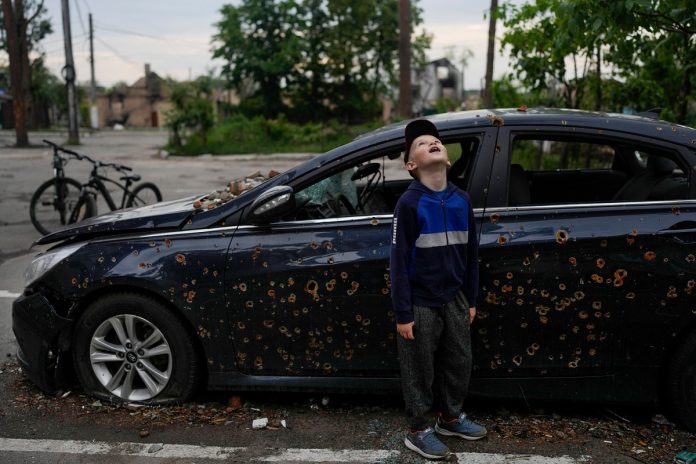
Nearly 100 days of the war in Ukraine have devastated children at a scale and speed unseen since World War II, and on average over two children are killed a day, the UN said Wednesday.
“Based on reports verified by Office for the High Commissioner for Human Rights, on average more than two children are killed and more than four injured each day in Ukraine — mostly in attacks using explosive weapons in populated areas,” according to UNICEF.
In its latest official death toll on Tuesday, the human rights office said at least 262 children have been killed and 415 injured in Ukraine’s fighting, but it “believes that the actual figures are considerably higher.”
Some 3 million children inside Ukraine and over 2.2 million children in refugee-hosting countries are now in need of humanitarian assistance since Russia launched its war on its neighboring country on Feb. 24, added the UN.
Almost two out of every three children in Ukraine have been displaced due to the war in the country.
The civilian infrastructure that the children depend on — including at least 256 health facilities and one in six UNICEF-supported “safe schools” in the east — is continually damaged or destroyed.
Hundreds of other schools across the country have also been damaged.
Conditions for children in eastern and southern Ukraine where the fighting has intensified are increasingly desperate, the UNICEF noted.
“June 1 is International Day for the Protection of Children in Ukraine and across the region,” stated Catherine Russell, the UNICEF executive director.
China opposes the policy of the US and a number of Western states on incitement of the conflict in Ukraine and considers it necessary to stop ramping up pressure on Russia via unilateral sanctions, Chinese Foreign Ministry spokesman Zhao Lijian said Wednesday.
“As for the situation in Ukraine, China […] insists that the US and other Western states stop fueling the fire and stop increasing unilateral sanctions [against Russia],” he underscored during a briefing.
The Chinese diplomat pointed out that Beijing “is using various channels” to maintain contacts with all interested sides.
“We call for a ceasefire and end of hostilities,” the diplomat underlined.
Russia accuses US of ‘adding fuel to the fire’ with weapons supplies
Russia has accused the US of deliberately “adding fuel to the fire” by supplying advanced rocket systems to Ukraine.
“The US is obviously holding the line that it will fight Russia to the last Ukrainian,” Dmitry Peskov, the Kremlin spokesman, told reporters.
He added that Moscow did not trust Kyiv not to use the weapons to fire into Russian territory.
When asked how Russia would respond if Ukraine used US-supplied rockets to strike Russian territory, Peskov said: “Let’s not talk about worst-case scenarios”.
UN chief hopeful on deal to ease food supplies crisis
United Nations Secretary-General Antonio Guterres has said he is hopeful of a solution to alleviate the impact of the war in Ukraine on global food supplies, but cautioned any agreement was still some way off.
“I think that there is progress, but we are not yet there. These are complex things and the fact that everything is interlinked, makes the negotiation particularly complex,” he told a news conference with Swedish Prime Minister Magdalena Andersson in Stockholm.
With Russia controlling or effectively blockading all Ukrainian Black Sea ports, grain shipments from Ukraine have stalled since the invasion began while Moscow has blamed Western sanctions for disrupting exports of both grain and fertiliser.
Finland, Sweden yet to allay Turkey’s objections to NATO membership bids: Erdogan
Turkish President Recep Tayyip Erdogan says Ankara has not yet received any concrete proposals to address its concerns over Finland and Sweden’s NATO membership bids.
Ankara has objected to the Nordic countries’ ascension to the alliance on the ground that they support groups it deems to be “terrorists”.
Speaking in Turkey’s parliament, Erdogan stated Ankara wanted to see a “sincere” approach from Sweden and Finland regarding its concerns, adding it would not change its view unless it saw concrete and binding steps.
He also added Turkey’s objection to Stockholm and Helsinki’s membership bids was not “opportunism” but rather a matter of national security.
Poland to serve as an ‘economic hub’ for Ukraine: PM
Poland’s prime minister says his country will serve as an “economic hub” for neighbouring Ukraine, helping it export grain and other products while Russia blocks Ukraine’s export routes, chiefly its ports.
Speaking on Wednesday in the Ukrainian town of Borodyanka, near the capital, Kyiv, Mateusz Morawiecki stated Poland is working on expanding its infrastructure and capacity to facilitate the export of millions of tonnes of Ukrainian grain and other agriculture products.
He added that Warsaw was receiving European Union funds for the purpose and warned that North African countries which rely heavily on Ukrainian grain could face problems feeding their populations without the foodstuff.
Kremlin blames West, Ukraine for potential global food crisis
The Kremlin has warned the world could be on the verge of a major food crisis because of “illegal restrictions” imposed on Russia by Western countries and decisions made by Ukrainian authorities.
More than three months since invading Ukraine, Russia has seized large parts of its neighbour’s coast and is blockading its ports, but is trying to pin the blame for the lack of grain shipments on Western sanctions and on Kyiv itself.
“We are potentially on the verge of a very deep food crisis linked to the introduction of illegal restrictions against us and the actions of Ukrainian authorities who have mined the path to the Black Sea and are not shipping grain from there despite Russia not impeding in any way,” Kremlin spokesman Dmitry Peskov told reporters on a conference call.
West has ‘irrational fear’ of Russia: Ukrainian negotiator
A Ukrainian presidential advisor has accused Europe and the US of having an “irrational fear” of Russia that is affecting their response to the conflict.
Mykhailo Podolyak, a key negotiator for Ukraine during previous rounds of talks with Russia over ending the war, told the Interfax Ukraine news agency the political elites of the West “want to return to the pre-war period and do not want to solve problems”.
He added that their financial priorities took precedence in decision-making.
Moscow does not believe Ukrainian President Volodymyr Zelensky’s claims that Kiev will not attack Russian territory, should it obtain US-made long-range multiple launch rocket systems, Kremlin spokesman Dmitry Peskov told reporters Wednesday.
“No,” the spokesman said, answering a question whether the Kremlin trusts Zelensky’s words. “In order to trust, there must be previous experience when such promises were fulfilled. Unfortunately, such experience is completely nonexistent,” Peskov explained.
“On the contrary, the entire history of events proves that, starting with Zelensky’s main campaign promise to end the war in Ukraine’s southeast once and for all, [the promise] was not fulfilled, and the Minsk Agreements were not implemented, they sunk into oblivion, and by Ukraine’s fault at that,” the spokesman pointed out.
“So we don’t really have any trust credit for the Ukrainian side,” he noted.
On Tuesday, Zelensky said in his interview for US’ Newsmax TV channel that Kiev has no intention to use US-made long-range multiple launch rocket systems to attack Russian territory.
West trying to ‘mobilize’ countries by using Ukraine to protect status quo: Lavrov
Western countries are trying to get other countries to their side by using the situation in Ukraine as a pretext to preserve the existing world order, Russian Foreign Minister Sergey Lavrov said on Wednesday.
“Of course, these processes [in the world] are at a turning point. The formation of a multipolar world is underway, and our Western colleagues are trying to prevent these processes, they want to maintain and extend their dominance to all regions. They are trying to mobilize all other countries to come under their flag, using the situation in Ukraine and around it as a pretext,” Lavrov stated during a meeting with Secretary General of the Organization of Islamic Cooperation (OIC) Hissein Ibrahim Taha.
Russia hopes that Western countries will realize the need to consider global issues on the basis of the principles of the UN Charter, Lavrov added.
“We are ready for such a dialogue, but only on an equal and mutually respectful basis,” Lavrov noted.
The current situation reflects deep-seated problems that have been accumulating in Europe for many years, primarily in connection with the refusal of NATO countries to fulfill the promise given to the Soviet Union not to expand the alliance to the east, Lavrov said.
He further noted that Russia appreciated “the balanced, objective position taken by the Organization of Islamic Cooperation, as well as the League of Arab States, and the Cooperation Council for the Arab States of the Gulf in relation to what is happening.”
“I hope that our Western partners at some stage will also realize the need to consider world problems, to agree on ways for their further development by the international community not on the basis of dictatorship [of one’s will], but on the basis of the principles of the UN Charter, primarily the principle that implies respect for the sovereign equality of states,” the foreign minister stressed.
Russia slams attitude of major EU countries towards Ukraine as despicable
The statement of most major EU countries who stand against Ukraine’s status as a candidate for membership in the association is meanness towards it, Russian Foreign Ministry Spokeswoman Maria Zakharova told the Sputnik Radio on Wednesday.
“Well, this is mean to Ukraine, because all previous years, decades, and we now take the situation before 2014, that is, respectively, it is not ten years, it is more, they said exactly the opposite. They promised Ukraine membership every year, they said every year that ‘now you are another half step, another half centimeter, another millimeter closer to the cherished goal’,” the diplomat said, commenting on Italian Prime Minister Mario Draghi’s statement that almost all major EU countries are against Ukraine’s status as a candidate to the European Union.
Zakharova noted that “today the Italian Prime Minister is saying exactly what Ukrainian President Viktor Yanukovych said in 2013, that Ukraine is not ready to become a member of the EU and start practical European integration”.
According to the diplomat, Yanukovych was “almost killed, kicked out, squeezed out of the political landscape” for these words back then, while the Italian prime minister, when making such statements, “does not fall out of the agenda in any way”.
Major EU states oppose granting Ukraine candidate status: Italy
Only Rome supports giving Ukraine candidate status in the European Union, with all the other major EU members opposed, Italian Prime Minister Mario Draghi revealed.
The bloc’s officials will try to draft a fast-track proposal for how Kiev could join sometime in June, he added.
“Almost all the major EU member countries are against giving Ukraine candidate status – except Italy,” Draghi said at a press conference in Brussels, answering a question from the Italian news agency ANSA.
“Candidate status is currently not predictable due to the opposition of these countries,” he said.
Draghi stated that he could “imagine” that the European Commission would present a plan to fast-track Ukraine’s application for future candidate status at a meeting in June.
He noted that most states wait for years to become candidates, let alone for EU membership itself, and that the EU has proposed various other arrangements to “sweeten the pill,” but none of them were acceptable to the government in Kiev.
Ukraine submitted its application for EU membership on February 28, four days after the outbreak of hostilities with Russia. The European Council “acknowledged the European aspirations and the European choice of Ukraine” in March, and announced they had “swiftly” passed Kiev’s paperwork to the European Commission.
In early May, Russia announced that Ukraine’s membership in the EU would be just as unacceptable for Moscow as Kiev joining NATO.
Pope Francis says wheat should not be used as a “weapon of war”, urges lifting of blockade on exports
Pope Francis has called for the lifting of a blockade on wheat exports from Ukraine, saying the staple food should not be used “as a weapon of war.”
Speaking at the end of his weekly audience on Wednesday, the Pontiff said that he is following “with great concern” the situation at Ukrainian ports.
The lives of millions of people depend on the export of wheat, “especially among the poorest countries,” he added.
“I make a heartfelt appeal that every effort be made to resolve this issue, to guarantee the universal human right be nourished,” the Pontiff said.
“Please do not use wheat, a staple food, as a weapon of war,” he added.
Russians now control 70% of Severodonetsk: Ukrainian official
Russian forces now control 70% of the city of Severodonetsk in eastern Ukraine, the head of the Luhansk regional military administration said Wednesday.
Serhiy Hayday stated “part of the Ukrainian troops” have now “retreated to more advantageous, pre-prepared positions” while other troops continue “fighting inside the city.”
Evacuation is still suspended from Severodonetsk, and it is “not possible to import humanitarian aid,” he added.
Neighboring Lysychansk is “completely under Ukrainian control,” but all “free settlements” of the Luhansk region are “constantly under fire,” he continued.
If Russian forces gain control of Severodonetsk, the neighboring city of Lysychansk will be the only urban area of any size in Luhansk to remain under Ukrainian control.
Russia warns OPCW about impending provocations by Ukraine with chemical weapons
Moscow has notified the Organisation for the Prohibition of Chemical Weapons (OPCW) about possible provocations by Kiev, Russian Permanent Representative to the organisation Alexander Shulgin said on Wednesday.
“We have already informed [the OPCW]. In total, we have recently sent 12 verbal notes, in which we wrote in detail about the places and methods of the supposed provocations [by Ukraine]”, he told the Rossiya 24 broadcaster.
The OPCW is currently researching this information, the diplomat added.
Germany to send Kyiv anti-aircraft missiles, radar systems
Chancellor Olaf Scholz says Germany will supply Ukraine with modern anti-aircraft missiles and radar systems following pleas from Kyiv as well as German opposition parties to step up heavy weapons deliveries to the country.
Scholz told legislators in the Bundestag that the government had decided to provide Ukraine with IRIS-T missiles developed by Germany together with other NATO nations. He said Germany will also supply Ukraine with radar systems to help locate enemy artillery.
“We have been delivering continuously since the beginning of the war,” Scholz added, pointing to more than 15 million rounds of ammunition, 100,000 hand grenades and over 5,000 anti-tank mines sent to Kyiv since Russia invaded in late February.
Gazprom cuts gas to two energy firms in Denmark, Germany
Denmark has become the fifth country to be cut off from Russian natural gas following the refusal of its biggest power wholesaler Orsted to pay for deliveries in rubles.
Supplies to Shell Energy Europe Limited in Germany have also been halted for the same reason, Russian energy giant Gazprom announced on Wednesday.
“As of the end of the business day on May 31, Gazprom Export had not received payment for gas supplies in April from Orsted Salg & Service,” the Russian company explained in a statement.
It added that in 2021, Gazprom Export supplied the Danish company with 1.97 bcm of gas, which amounted to about two thirds of total gas consumption in Denmark.
“The contract between Gazprom Export and Shell Energy Europe Limited for the supply of gas to Germany provides for a volume of up to 1.2 bcm of gas per year,” Gazprom said.
Shell accounts for just 2.6% of the 95 bcm of natural gas Germany consumes each year.
“Shell continues to work on a phased withdrawal from Russian hydrocarbons,” the company told the BBC.
Most of Germany’s larger gas buyers, including Uniper and RWE, have agreed to the Kremlin’s ruble payment scheme.
Russia’s new payment mechanism requires gas buyers from “unfriendly” countries that have placed sanctions on Moscow to open accounts in Russia’s Gazprombank. They can then deposit funds in their currency of choice, which the bank converts to rubles and transfers to Gazprom.
The Russian energy giant recently suspended gas exports to Bulgaria, Poland, Finland and the Netherlands after they refused to comply. According to the Russian Energy Ministry, about two dozen European companies have so far opened ruble accounts.
Russian troops have “consolidated in city center” of Severodonetsk, Ukrainian official
Russian troops are “storming” the eastern city of Severodonetsk and have “consolidated in the city center,” said Serhiy Hayday, head of the Luhansk regional military administration on Wednesday.
Russia carried out assaults on Tuesday in the “northern, southern and eastern districts of Severodonetsk,” Hayday continued, adding Russians now control “most” of the city.
“The Russians are storming, consolidating in the center of Severodonetsk, while continuing to destroy infrastructure and industrial facilities,” and also destroying residential homes in and around the city, he stated.
Over 240 children have been killed since Russia’s invasion: Ukraine prosecutor general
At least 243 children have died and 446 others have been injured in Ukraine since the Russian invasion began in February, the Ukrainian prosecutor general’s office said on Wednesday.
In addition to the deaths and casualties, at least 1,937 educational institutions in Ukraine have been damaged, with 181 of them completely destroyed, the prosecutor’s statement added.
The figures are “not final” as they do not include casualties in places where “active hostilities” are ongoing and in those occupied by Russian forces.
Wednesday, June 1, marks Children’s Day in Ukraine.
Russia scolds US over advanced arms shipments to Ukraine
Russia has said that a US decision to supply advanced rocket systems and munitions to Ukraine was extremely negative and would increase the risk of a direct confrontation.
Russian Deputy Foreign Minister Sergei Ryabkov told state news agency RIA Novosti that Moscow views US military aid to Ukraine “extremely negatively”.
Ryabkov singled out US plans to supply Kyiv with its High Mobility Artillery Rocket System (HIMARS), a multiple rocket launcher system that Washington said it would supply to Ukraine as part of its latest military aid package.
Denmark to vote on closer EU defence ties due to Russia concerns
Danes vote on Wednesday to decide whether to join the EU’s defence policy, potentially becoming the final hold-out in the bloc to sign up as Russia’s invasion of Ukraine forces countries to radically reassess their security.
Denmark is the only member of the 27 nation bloc not in the Common Security and Defence Policy, having secured exemptions from it and the euro currency in a 1993 referendum on the Maastricht Treaty, which laid the groundwork for the modern EU.
If the notoriously EU-critical Danes vote to abolish the opt-out, as polls suggest will be the case, it would mark another significant shift in policy for Europe after Russia launched the invasion in February.
Participating in the Common Security and Defence Policy would enable Denmark to take part in joint EU military operations, such as those in Somalia, Mali and Bosnia and Herzegovina.
Russia continues long-range missile attacks on infrastructure across Ukraine: UK
Russia continues to conduct long-range missile attacks on Ukraine’s infrastructure across the country, the United Kingdom’s defence ministry has said.
In its latest intelligence briefing, the ministry confirmed previous reports that Russian forces are pushing closer to the centre of Severodonetsk city.
“Over half of the town is likely now occupied by Russian forces, including Chechen fighters,” the ministry announced.
It added that with Ukraine’s Black Sea ports being blocked, Ukraine’s ports on the Danube river have become critical to its exports.
Russia will not suffer from EU oil embargo: Official
Russia’s economy will not suffer from the European Union’s embargo on its oil due to new markets and rising fuel prices, the chairwoman of Russia’s Federation Council has said.
“We can easily reorient this oil, the demand for which is huge, to other markets,” Valentina Matviyenko told reporters on Wednesday after a meeting with Mozambican President Filipe Nyusi.
“There is only a certain amount of production on the world market, a certain volume of oil for sale, any more, nobody will be able to get from the moon,” Matviyenko stated, adding that the sanctions were encouraging Russia to build more oil refinery plants rather than relying on crude exports.
Matviyenko also noted that “the price of oil will rise significantly,” which would balance out whatever profits Russia might lose from lower exports.
Russian troops storming Severodonetsk, destroying infrastructure: Governor
Russian forces are storming Severodonetsk and consolidating their positions in the centre of the city, while continuing to destroy the region’s infrastructure, the governor of the Luhansk region has said.
Serhiy Haidai stated that at about 6:55 pm on Tuesday, Russians hit Severodonetsk’s giant Azot chemical plant, which produces nitrogen-based fertilisers, “releasing toxic substances”.
“During the day, the enemy fired artillery at the Proletary factory in Lysychansk,” he added in a post on Telegram.
Haidai noted that at least six houses and a local art school were destroyed in the settlement of Vrubivka, five houses destroyed in the village of Novoivanivka, four in Severodonetsk, three in Lysychansk and two in the village of Mykolaivka.
‘We do not seek a war between NATO and Russia’: Biden
President Joe Biden has said that although the US is continuing to “reinforce NATO’s eastern flank with forces and US capabilities”, Washington does not seek a war between NATO and Russia.
“As much as I disagree with Mr. [Vladimir] Putin, and find his actions an outrage, the United States will not try to bring about his ouster in Moscow,” Biden wrote in a guest essay in the New York Times newspaper.
“So long as the United States or our allies are not attacked, we will not be directly engaged in this conflict, either by sending American troops to fight in Ukraine or by attacking Russian forces,” he stated.
Biden added that the US was not “encouraging or enabling Ukraine to strike beyond its borders”, adding, “We do not want to prolong the war just to inflict pain on Russia.”
US to provide long-range rocket system to Ukraine: Official
The United States will provide Ukraine with the M142 High Mobility Artillery Rocket System (HIMARS), a senior Joe Biden administration official has said, upgrading Kyiv’s battleground capabilities as it battles Russian invaders.
“These systems will be used by the Ukrainians to repel Russian advances on Ukrainian territory, but they will not be used on targets in Russian territory,” the official told reporters.
The range of US rockets for HIMARS (High Mobility Artillery Rocket Systems) to be delivered to Ukraine soon, will not exceed 80 kilometers, a high-ranking US administration official has told a special phone briefing.
In his words, the projectiles will have the capacity to strike a target about 80 km, or 48 miles, away.
Biden said in a guest essay for the New York Times that the US “will provide the Ukrainians with more advanced rocket systems and munitions that will enable them to more precisely strike key targets on the battlefield in Ukraine.”
“We will continue providing Ukraine with advanced weaponry, including Javelin anti-tank missiles, Stinger antiaircraft missiles, powerful artillery and precision rocket systems, radars, unmanned aerial vehicles, Mi-17 helicopters and ammunition,” Biden added.
Ukraine loses 60 to 100 soldiers daily: Zelensky
Some 60 to 100 Ukrainian soldiers are killed per day in the war with Russia, President Volodymyr Zelensky has said, adding that around 500 are wounded daily.
In an interview with Newsmax in Kyiv, Zelensky also stated that Ukraine’s requests for longer-range weapons were for Ukraine to defend its territory, not to attack Russia on theirs.
“We’re not interested in what’s happening in Russia. We’re only interested in our own territory in Ukraine,” he added.
Ukraine’s standing as the “defensive perimeter” for the world against Russia and Vladimir Putin means it cannot “concede” anything, he stated.
“We’re not ready to concede any of our territories, because our territories are our territories: It’s our independence, our sovereignty; that’s the issue,” Zelenskyy continued.
Zelensky acknowledged, “there are some difficulties with some territories; there are some details, but all those difficulties, they could be discussed, and those discussions would be necessary to stop the war.”
US warns against formalising Russian control in Kherson
Washington has warned against attempts by Russia to “institutionalise” its control over “sovereign Ukrainian territory”, particularly in the Kherson region.
Ned Price, the State Department spokesman, said Russia could announce an independent region in the area in an effort to eventually annex it.
“It’s a predictable part of the Russian playbook, which is why we are continuing to sound the alarm now, particularly following Russian President Putin’s unilateral decree that would fast-track the issuance of Russian passports to Ukrainian citizens,” he added.
Russia’s nuclear forces holding drills: Interfax
Russia’s nuclear forces are holding drills in Ivanovo province, northeast of Moscow, the Interfax news agency cited the Russian defence ministry as saying.
Some 1,000 servicemen are exercising in intense manoeuvres using more than 100 vehicles, including Yars intercontinental ballistic missile launchers, the ministry said.
UN confirms 9,029 civilian casualties in Ukraine
The United Nations human rights body (OHCHR) has confirmed 9,029 civilian casualties in Ukraine from February 24 until midnight local time on May 30.
The OHCHR’s latest civilian casualty confirmed 4,113 people have been killed and 4,916 injured.
But the organisation noted that the actual figures were considerably higher as information was still pending from areas of “intense hostilities”, such as Mariupol, Izyum and Popasna.
“Most of the civilian casualties recorded were caused by the use of explosive weapons with a wide impact area, including shelling from heavy artillery and multiple launch rocket systems, and missile and air strikes,” the OHCHR announced.
Moscow risking its hold on Kherson in the battle for Severodonetsk: ISW
Moscow’s focus on seizing the eastern city of Severodonetsk, and the Donbas region more generally, puts its vital position in the Kherson region at risk, the Institute for the Study of War (ISW) has announced.
“If Russia is able to retain a strong lodgement in Kherson when fighting stops it will be in a very strong position from which to launch a future invasion,” the ISW said in its latest campaign assessment, adding that if Ukraine were to regain the region, it would be in a much stronger position to defend itself against a future attack.
The institute said that this strategic situation should lead Russia to concentrate its combat power on holding Kherson, but Russia’s president has instead chosen to “concentrate all the forces and resources that can be scraped together in a desperate and bloody push to seize areas of eastern Ukraine that will give him largely symbolic gains”.
“Continuing successful Ukrainian counter-offensives in Kherson indicate that Ukraine’s commanders recognise these realities and are taking advantage of the vulnerabilities that Putin’s decisions have created,” the ISW said.
It added that Ukrainian forces were now withdrawing from Severodonetsk, allowing Russian forces to move in “relatively quickly”.
Biden closing in on new weapons package for Ukraine
US President Joe Biden and his team are still considering the sending of longer-range rocket systems to Ukraine but do not want them used to launch attacks inside Russian territory, the White House has said.
US officials stated Biden and his national security aides are in the final stages of preparing a new weapons package for Ukraine with an announcement expected soon, possibly as early as Wednesday, White House press secretary Karine Jean-Pierre noted.
Biden earlier had told reporters that “we’re not going to send to Ukraine rocket systems that strike into Russia.”
Ukrainian officials report ‘shutdown of all communications’ in Kherson region
Ukrainian officials have reported a “shutdown of all communications” in the Russian-occupied southern region of Kherson.
Ukraine’s State Service for Special Communication and Information Protection said in a statement that an unspecified intrusion “by the occupation regime” had taken place and that equipment had been powered down and cables disconnected.
“The residents of the region are currently left without Ukrainian mobile communication and Internet access, as well as with no means to make national and international phone calls using landline phone devices,” the agency added.
The Russian-backed occupation regime of the Kherson region said earlier on Tuesday that the region had switched over to Russia’s mobile and Internet networks.
Ukrainian forces making some progress in southern region: Zelensky
Ukrainian forces have had some success near the southern city of Kherson and are advancing in parts of the Kharkiv region to the east of Kyiv, President Volodymyr Zelensky has said.
“Our defenders are showing the utmost courage and remain masters of the situation at the front despite the fact the Russian army has a significant advantage in terms of equipment and numbers,” he added.
UN says it had ‘constructive’ talks in Moscow on Russian grain, fertiliser exports
A senior UN official had “constructive discussions” in Moscow with Russian First Deputy Prime Minister Andrei Belousov on facilitating Russian grain and fertiliser exports to global markets, UN spokesman Stephane Dujarric has said.
“The objective of her discussions is focused on facilitating Russian grain and fertiliser to global markets, with the key aim of addressing growing global food insecurity,” Dujarric added.
UN Secretary-General Antonio Guterres, who visited Moscow and Kyiv last month, is trying to broker what he calls a “package deal” to resume both Ukrainian food exports and Russian food and fertiliser exports.
World oil prices close at highest level in nearly 3 months after EU deal on partial ban of Russian oil imports
Brent crude oil closed on Tuesday to the highest level in nearly three months after the European Union reached a deal to ban 90% of its Russian oil imports by the end of the year.
However, oil finished well off its highs of the day after a new report signaled OPEC could be preparing to finally ramp up badly-needed production.
Brent crude, the world benchmark, gained 1% on the day, settling at $122.84 a barrel – the highest close since March 8. Earlier in the session, Brent traded as high as $125.28.
After initially rallying, US crude closed at $114.67 a barrel, down 0.4% on the day.
This comes after the EU forged an agreement on a partial ban on Russian oil imports in a bid to punish Moscow for its invasion of Ukraine. Although new sanctions were widely expected, this move will further scramble global energy supplies.
Europe is the biggest buyer of Russian energy, with about 2.4 million barrels of Russian crude getting sent to Europe every day in 2021, according to the International Energy Agency.