Tuesday, January 20, 2026
Home Blog Page 1737

Iranian daily urges Raisi to act on pledge to establish center for protests

Iran President Ebrahim Raisi

“We agree with Mr. President that ‘protests are absolutely okay, but riots should be prevented.’ But the question is: how should people voice their protests in a way that their measures are not exploited by certain parties and turned into riots?” wrote Jomhouri-e Eslami in an editorial.

The daily pointed to President Raisi’s comments in a recent TV interview, during which he said, “Criticism of the methods of enforcing laws should not be restricted. What’s wrong with allocating a center to dialog, criticism and even protests against problems?”

The daily highlighted what it described as the government’s bias toward pro-establishment demonstrations and also protests critical of the government.

The “basic problem” is that a group of people can hold rallies whenever or wherever they wish without the need to seek official permission, chant whatever slogan they prefer, while others never get to obtain permissions and are thus forced to voice their demands in a fashion that their protests are used by opportunists and turned into riots, it said.

Addressing President Raisi, the daily said no riots will happen if you act on the pledge to establish a center for dialog, criticism and protests as soon as you make such a promise and if security bodies begin to issue permissions for gatherings “without any discrimination.”

Analyst: Russia’s ‘accession’ of four Ukrainian regions might end war

Russia’s ‘accession’ of four Ukrainian regions

Abdolreza Faraji Rad, Iran’s former ambassador to Norway, told ILNA news agency that if Ukraine yields to the Putin’s move to formally sign Kherson, Zaporizhzhia, Luhansk and Donetsk as Russian territory, the two sides can sit down to end the war.

However, Farajdi Rad said if Ukrainian leaders insist on their stance, the scarier scenario will unravel and will get the whole world involved.

“The fact is that the Ukraine war has reached a deadlock due to Kiev’s aggressive stance, and Russia is facing this deadlock with 15,000 nuclear warheads,” he explained.

He pointed out if Ukraine, aided by the West, continues to have the upper hand, Russia will resort to chemical attacks as a first stage, adding launching a nuclear attack is a far-fetched possibility.

The former Iranian diplomat said Russia would seek to avoid a nuclear attack as it is aware of the severe consequences, including being expelled from the United Nations Security Council, losing its veto power, and the ensuing international sanctions.

As presidential elections are approaching in the US, Europe also favors cessation of hostilities in Ukraine as a prolonged war would set the stage ready for anti-Europe and anti-NATO former US president Donald Trump to win the presidency, Faraji Rad concluded.

Iran’s stealth drones capable of striking MKO base in Albania: Iranian Paper

Iran drones

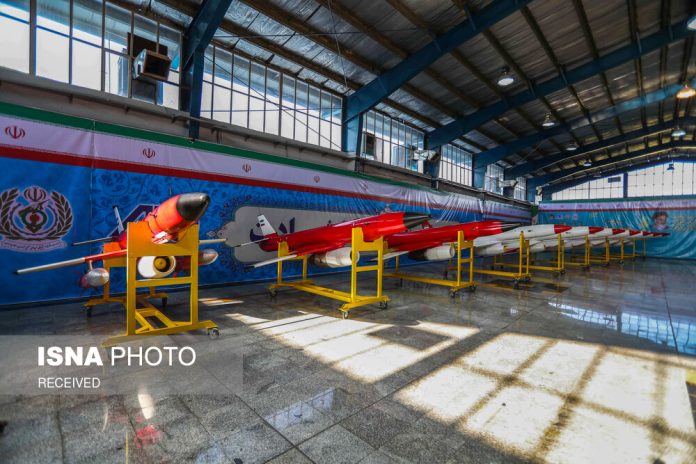
“Iran’s drone or missile capabilities are not limited to the geographical area of neighboring countries; rather, Iran enjoys so many capabilities in the aerospace sector, especially in the domain of drones, that it can easily target the MKO base in Tirana,” wrote the government’s official newspaper، Iran.

“Iran has stealth suicide and combat drones which can travel far beyond the distance between Iran and Albania and strike the target,” the daily added.

The government’s official outlet also touched upon a statement released by Iran’s Intelligence Ministry in which it has highlighted the MKO’s role in the recent unrest in several Iranian cities.

In the statement, the ministry announced that some of the rioters arrested are MKO members.

“Under international law, when a terrorist group blatantly jeopardizes the security of a country and openly admits to its acts, that country is legitimately entitled to target the base and members of that group, exactly similar to what happened in Iraq’s northern region against terror groups stationed there, or what happened against the ISIS terrorist group in Syria,” the Iran newspaper noted.

In other words, added the paper, Iran reserves the right, due to the MKO’s acts of terror, to target their base.

The MKO terror group was forced to leave Iraq in 2016 after it faced opposition from the Iraqi government and people, and was stationed in Albania as planned by the US.

Raisi calls for expansion of bilateral relations between Iran and China

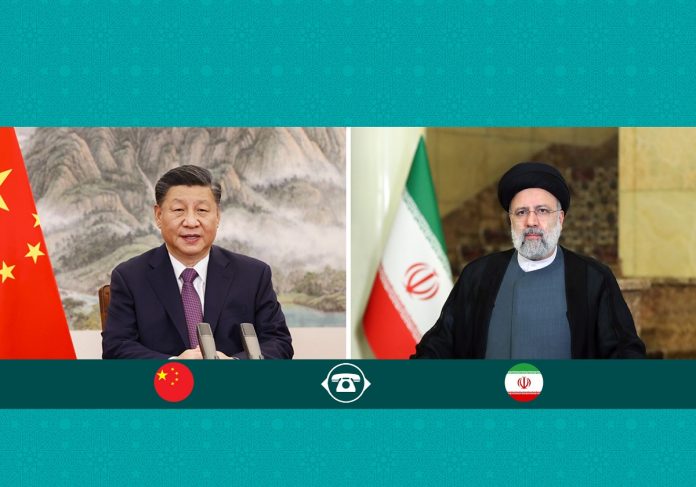
Iran and China Presidents Raisi and Xi

Raisi in a Saturday message to his Chinese counterpart Xi Jinping extended his good wishes to the Chinese president and people on the National Day of the People’s Republic of China, saying Tehran is ready to strengthen its bilateral and multilateral cooperation with Beijing.

Saturday marks the 73rd Anniversary of the founding of the People’s Republic of China.

“As two independent countries that oppose unilateralism and interference in the internal affairs of other countries, Iran and China share many common grounds for all-out expansion of their relations,” he said.

Raisi underlined that the world is facing challenges today which stand in need of cooperation of independent countries and global solutions.

He underscored the Islamic Republic welcomes the Chinese president’s global development and global security initiatives as ideas aimed at promoting the collective interests of nations, improving their well-being, and strengthening global peace and stability.

“Undoubtedly, the serious will of the two sides to implement the Comprehensive Strategic Partnership draws a clear perspective for strengthening ties and realizing the common goals and interests of the two countries,” the Iranian president maintained.

“Therefore, I would like to underscore the Islamic Republic of Iran’s readiness to strengthen as much as possible full-scale cooperation with the People’s Republic of China in the form of bilateral mechanisms and within the framework of multilateral arrangements and institutions,” he added.

Back in March 2021, Iran and China signed a 25-year comprehensive strategic partnership deal to strengthen their long-standing economic and political alliance. The partnership was first announced in 2016, when Xi visited Iran to strengthen Tehran-Beijing ties. It aims to boost economic cooperation between the two countries and paves the way for Iran’s participation in the Belt and Road Initiative, a massive infrastructure project stretching from East Asia to Europe.

Iran and China have enjoyed close ties in recent years, particularly after the United States reinstated sanctions on the Iranian economy in 2018 after unilaterally withdrawing from the Iran nuclear agreement.

Israel army OKs assassination drones in West Bank

Israel Drone

According to a report published by the Jerusalem Post, Israeli commanders will now be allowed to use the platforms not only as cover and intelligence for forces during operations but also to carry out strikes against Palestinians.

The order seemingly comes within the context of Israeli forces attempts to police the Palestinian territories, especially since drones are a military instrument that can be used easily and without risk.

Army Chief, Aviv Kochavi, gave his approval to use the armed drones for assassinations and “to carry out strikes” against Palestinian resistance groups that “pose an imminent threat to the Israeli military”, the media outlet said.

The Israeli army has evaluated the situation in the West Bank, said Kochavi on Wednesday, adding that Israel will keep preparing for every scenario to ensure what he described as “Israel’s security”.

According to the Jerusalem Post, Israel is hoping that drones and remote-controlled weapons can keep its troops out of harm’s way in the West Bank for the time being. In the same context, it is noteworthy that the Israeli occupation forces recently installed a remote gun turret in a heavily populated area of al-Khalil, after reportedly deploying facial recognition technology on the Palestinian territory last year.

Israel has used Elbit’s Hermes 450 drones to carry out targeted assassinations in Gaza since 2008. According to reports, these drones have been in production since the late 1990s. However, establishing a full account of their usage is difficult, as Israel’s military censor had banned reports on their use until earlier this year.

In July, the Jerusalem Post reported on this note that Israel Air Force has been using attack drones for at least the past 20 years, and it has been extensively documented in US diplomatic cables as well as at international air shows. The Israeli troops, however, never publicly disclosed the use of such platforms, and Israeli journalists who attempted to publish anything were blocked by the censor.

Also in September, the same source confirmed that Israeli occupation commanders had undergone training to prepare them for the possibility that they will use armed drones during counter-terrorism operations. It is believed that the order was given as Israel feels it might be facing an extensive operation in the northern West Bank, similar to Operation Defensive Shield in 2002.

The Tel Aviv regime follows the footsteps of its number one ally, the United States, which has been conducting drone strikes for years, especially under the Obama administration.

In 2020, the US carried out its notorious drone attack in which it assassinated commander of Iran’s Islamic Revolution Guard Corps’ Al-Quds Brigade, General Qassem Soleimani on Iraqi soil.

Back then, Agnes Callamard, a United Nations special rapporteur on extrajudicial, summary or arbitrary executions, said, “There are no robust standards governing drones’ development, proliferation, export, or capability for use of force. No transparency. No effective oversight. No accountability.”

Similarly, using drone strikes allows the Israeli occupation to evade accountability the same way the US has been for years.

Despite Israeli claims that the intelligence provided by drones makes it easier to target those Palestinians it has defined as “terrorists”, research shows civilians are the main victims.

In 2009, the total number of Gazan civilians killed by drone-launched missiles remains unclear. Human rights organizations including B’Tselem, the Palestinian Center for Human Rights, and the Al-Mezan Center for Human Rights reported 42 drone attacks that killed 87 civilians in the 2008 war on Gaza.

Amnesty International told media outlets that it documented 48 civilian deaths from drones, and this does not represent the full number. In only six Israeli drone strikes back then, 29 Palestinian civilians were killed, 8 of them children.

Israel’s response back then was that Israeli forces failed to take all feasible precautions to verify whether the targets were Palestinian resistance fighters or civilians. According to statistics compiled by human rights groups in Gaza, civilians are the chief casualties of what Israel refers to as “surgical” strikes from drones.

Eminent Iranian movie director’s passport seized upon arrival in Tehran

Mehran Modiri

He arrived in Tehran early Friday on an Emirati flight.

Modiri had published a video in recent days, that authorities say was aimed at arousing public sentiment and fueling the unrest in Iran.

Several Iranian celebrities have come under scrutiny for their position on the recent unrest in the country sparked following the death of a young Iranian woman, who died in hospital days after being detained by morality police.

Modiri who is the director of many entertainment TV programs, had in his video message, called on officials not to air any of his works.

He left Iran for the UAE soon after the clip went viral on social media.

Intelligence Ministry reveals role of West, Israel, Saudis in deadly Iran unrest

Iran Protests

In a statement, the ministry said while the country’s law enforcement units were busy responding to unrest in several Iranian cities for days, intelligence forces focused their mission mainly on identifying the masterminds operating behind the scenes, including foreign governments and foreign-sponsored counter-revolutionary terror groups such as the Albania-based Mujahedin-e-Khalq Organization (MKO).

Over the past days, when “hidden seditionist layers” had stepped up their activities, the chances increased for intelligence forces to identify the terrorists and the elements behind acts of sabotage, the ministry added.

It added that Iranian security forces had to face elements related to certain grouplets, those tied to foreign spy services, deceived rioters on the streets, and direct intervention of the US and UK governments and the Saudis.

The ministry listed its arrests.

Among them were 49 individuals tied to the MKO, who had a hand in fabricating false news, presence in riots and giving directions to the slogans chanted during the gatherings, acts of vandalism, providing rioters with equipment and explosives for confronting the police and setting fire to public places and property.

It said 77 members of separatist groups in Kurdistan, including official mercenaries of the Zionist regime such as the so-called Komala Party. Such grouplets were active on both sides of the country’s western borders and were hatching plots against the Kurdish people.

One of the individuals, the statement added, had received training in a US-Zionist base in Iraq’s semi-autonomous Kurdistan region and was arrested in a surprise intelligence operation.

Meanwhile, five Takfiri terrorists were detained and a large cache of weapons were confiscated from them. They were planning bomb attacks and an assassination operation against a senior authority.

The statement said five members of the Baha’ei cult, who took orders from a base in the Israeli-occupied city of Haifa, were also identified and arrested.

Among those detained were also 92 monarchists and loyalists to the ex-Pahlavi regime as well as 9 foreign nationals, including citizens of Germany, Poland, Italy, the Netherlands, France and Sweden, who were present on the scenes of riots.
Intelligence forces also arrested 28 people with criminal backgrounds.

It also said huge caches of arms had also been confiscated from the terrorists.

Terrorists also planned bomb attacks on two passenger planes and sensitive industrial sites. The plots were, however, thwarted, it added.

Over the past months, it added, some Western and Israeli spy services had given training to their elements for operating against the Islamic establishment and bringing about regime change in Iran.

It said warnings had been issued to the foreign embassies whose personnel had “even the slightest” presence in the violent riots, including those of Germany, the UK and Sweden.

Source: 2 terrorists killed in Iran’s Zahedan attack

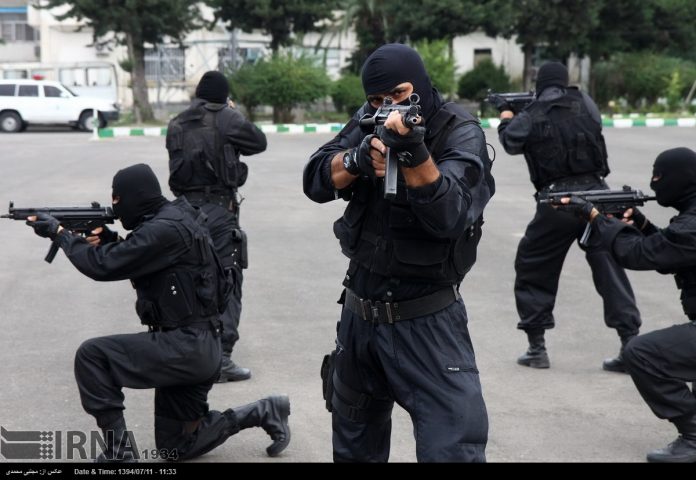
Iran Security Forces

“The two dead have been identified as Abdolmajid Rigi and Yasser Shahbakhsh, who were killed in yesterday’s incident in Zahedan,” said an informed security source on Saturday.

“They intended to incite people, vandalize public property and kill ordinary people as well as police forces,” the source added.

At least 19 people were killed in Friday’s terrorist attack, including three security forces.

Dozens were also wounded.

Iranian judge survives attempt on life

Crime Scene

The incident happened in the town of Saravan.

“The attempt on the life of the judge working at the Saravan Prosecutor’s Office failed, and he emerged unscathed from the attack,” said the provincial prosecutor.

“Security forces are trying to identify the perpetrators,” the same source added.

The botched assassination attempt follows a terror attack in the provincial city of Zahedan in which 19 people lost their lives and dozens were wounded.

The so-called group Jaish al-Adl claimed responsibility for the attack.

Posing as worshippers in Friday prayers, they raided a police station in Zahedan.

The terrorists opened fire at the station while hurling incendiary devices and rocks at it.

Several ordinary people and security forces were shot during the shooting.

Terrorist attacks kill senior IRGC cmdr., 19 people in southeast Iran

Protest Sistan and Baluchestan

In one of the attacks, a group of armed separatist terrorists raided a police station in the city of Zahedan on Friday afternoon, hurling Molotov cocktails at the facility and opening fire on people, according to local officials and police.

State TV said armed separatist terrorists had concealed themselves among worshippers at the nearby Makki Mosque.

Security forces quickly responded to the attack and restored order in the area.

As the terrorists failed in the attack, they engaged in acts of vandalism against banks, stores and public property elsewhere in the area, officials say.

The assault claimed the lives of 19 people and injured 20 others.

Meanwhile, terrorists also opened indiscriminate fire near Makki Mosque following Friday prayers.

Security forces swiftly arrived at the scene and ended the shooting attack.

Senior IRGC intelligence commander Seyyed Ali Mousavi was shot in the chest during an exchange of fire with the gunmen and transferred to a hospital. He later succumbed to his wounds.

The so-called Jaish al-Adl terrorist group claimed responsibility.

Iranian authorities said the elements behind the violence in Zahedan had been identified and arrested.

One of those arrested at the site, identified as Gorgij, recounted the circumstances surrounding the shooting attack.

He said a Peugeot 206 stopped near the police station prior to the attack and distributed arms among a group of people, including himself, who had gathered there.

The detainee said he took a sidearm but he tried to flee the scene as the terrorists started to shoot at the police station.

Sistan and Baluchestan Province borders Afghanistan and Pakistan, and has seen previous attacks on security forces by terrorists who infiltrate the country’s borders from the neighboring states.